Previous Year Paper

SBI PO Prelims Memory Based Paper (Held on:25 June 2018) (Previous Year Paper)

Held in 2018

100 questions60 minutes
With answers
Free

Paper last updated:

Practise under exam conditions

Take this paper as a timed mock test. Review your answers after you submit.

Attempt timed test

Questions & answers

Read the paper at your pace. Open an explanation when you need it.

English Language (30 questions)

Question 1

Select the phrase/ connector (it must be at the start) from the given three options which can be used to form a single sentence from the two sentences given below, implying the same meaning as expressed in the statement sentences.

The country was in a state of deep turmoil. The President declared an emergency.

(i) As the country .....

(ii) On declaring an emergency .....

(iii) Being in a state of .....

  1. AOption (a)

    Only (i)

  2. BOption (b)

    Both (i) and (ii)

  3. COption (c)

    Both (ii) and (iii)

  4. DOption (d)

    Both (i) and (iii)

  5. EOption (e)

    None of these

View answer & explanation

Correct answer

Answer: (a)A.

Only (i)

Why this answer is correct

The correct answer is 'Only (i)'.

Key Points

  • The given two sentences are only connected with the connector 'As' to make a meaningful sentence.
  • 'As' is an adverb that is used to give the reason.
  • From the second sentence, We can conclude that the president declared the emergency but the reason is the first sentence hence we need to use an adverb to tell the reason.
  • From the third sentence, it can not be possible because 'being' is used, it means the subject 'the country' has already known so we can't use 'being as a state'

Out of the given three options, the two sentences can be joined into a single sentence as:- 'As the country was in a state of deep turmoil, the President declared an emergency.'​

Question 2

Select the phrase/ connector (it must be at the start) from the given three options which can be used to form a single sentence from the two sentences given below, implying the same meaning as expressed in the statement sentences.

The police arrived at the railway station. The suspect saw them, fired three bullets, and ran away.

(i) After firing three bullets......

(ii) In watching the police......

(iii) As soon as the police......

  1. AOption (a)

    Only (i)

  2. BOption (b)

    Both (i) and (ii)

  3. COption (c)

    Both (ii) and (iii)

  4. DOption (d)

    Only (iii)

  5. EOption (e)

    None of these

View answer & explanation

Correct answer

Answer: (d)D.

Only (iii)

Why this answer is correct

The correct answer is 'Only (iii)'.

Key Points

Out of the given three options, the two sentences can be joined correctly in two ways: 'As soon as the police arrived at the railway station, the suspect saw them, fired three bullets, and ran away'.

Question 3

Select the phrase/ connector (it must be at the start) from the given three options which can be used to form a single sentence from the two sentences given below, implying the same meaning as expressed in the statement sentences.

Indira Gandhi was assassinated in 1984. Rajiv Gandhi became the Prime Minister.

(i) When Indira Gandhi...

(ii) Only before Rajiv Gandhi...

(iii) Having been assassinated...

  1. AOption (a)

    Only (i)

  2. BOption (b)

    Both (i) and (ii)

  3. COption (c)

    Both (ii) and (iii)

  4. DOption (d)

    Both (i) and (iii)

  5. EOption (e)

    None of these

View answer & explanation

Correct answer

Answer: (a)A.

Only (i)

Why this answer is correct

The correct answer is 'Only (i)'.

Key Points

Out of the given three options, the given sentences can be joined correctly as: 'When Indira Gandhi was assassinated in 1984, Rajiv Gandhi became the Prime Minister'.

Thus, only option (i) is correct.

Question 4

Select the phrase/ connector (it must be at the start) from the given three options which can be used to form a single sentence from the two sentences given below, implying the same meaning as expressed in the statement sentences.

The Central Government must cut down on the defence budget. Otherwise, the financial crisis will not be resolved.

(i) Unless the Central Government...

(ii) While the Central Government...

(iii) After the Central Government...

  1. AOption (a)

    Only (i)

  2. BOption (b)

    Both (i) and (ii)

  3. COption (c)

    Both (ii) and (iii)

  4. DOption (d)

    Both (i) and (iii)

  5. EOption (e)

    None of these

View answer & explanation

Correct answer

Answer: (a)A.

Only (i)

Why this answer is correct

The correct answer is option 1, i.e., 'Only (i)'.

  • Out of the given three options, the two sentences can be joined in only one way: 'Unless the Central Government cuts down on the defence budget, the financial crisis will not be resolved'.

  • Thus, only option (i) is correct. 

  • We use the conjunction unless to mean ‘except if’. The clause which follows unless is a subordinate clause (sc): it needs the main clause (mc) to make a complete sentence.

  • Unless is a conditional word (like if), so we don’t use will or would in the subordinate clause:

  • Unless I hear from you, I’ll see you at two o’clock.

  • Not: Unless I’ll hear from you …

  • We use unless to introduce an extra thought or piece of information:

  • He didn’t even know about the crash – unless he’d heard about it on the radio.

Question 5

Select the phrase/ connector (it must be at the start) from the given three options which can be used to form a single sentence from the two sentences given below, implying the same meaning as expressed in the statement sentences.

He has failed many times and almost all his plans have seen little success. He still hopes to succeed one day.

(i) Although he hopes...

(ii) While he has failed...

(iii) In spite of the fact that...

  1. AOption (a)

    Only (i)

  2. BOption (b)

    Both (i) and (ii)

  3. COption (c)

    Both (ii) and (iii)

  4. DOption (d)

    Both (i) and (iii)

  5. EOption (e)

    None of these

View answer & explanation

Correct answer

Answer: (c)C.

Both (ii) and (iii)

Why this answer is correct

The correct answer is option 3, i.e., 'Both (ii) and (iii)'.

Out of the given three options, the two sentences can be joined in two ways: 'While he has failed many times and almost all his plans have seen little success, he still hopes to succeed one day' and 'In spite of the fact that he has failed many times and almost all his plans have seen little success, he still hopes to succeed one day'.

However, option 1 does make a meaningful sentence but changes the meaning of the context. 

Thus, only options (ii) and (iii) are correct.

Question 6

In the following question, 2 columns are given containing three phrases/ sentences each. In the first column sentences A, B, C and in the second column D, E, F are given. A sentence from the first column may or may not connect with another sentence/phrase from the second column to make a grammatically and contextually correct sentence. The question has five options, four of which display the sequences of the sentences. If none of the above is the answer, then mark option (e) as the answer.

Column 1Column 2
A. Blowing the horn loudly in front of a schoolD. Every trees dirty
B. The pollution has madeE. Is strictly forbidden by law
C. The old man was rushed to the hospitalF. After the movie was a hit at the premier
  1. AOption (a)

    A-E

  2. BOption (b)

    B-D

  3. COption (c)

    A-F

  4. DOption (d)

    C-E

  5. EOption (e)

    None of these

View answer & explanation

Correct answer

Answer: (a)A.

A-E

Why this answer is correct

The correct answer is A-E 

Key Points

In the given question we have to find out the following:

  • Which sentence from Column 1 joined with a sentence from Column 2 gives a contextually and grammatically correct sentence.
  • Looking at the option we find that A-E is the only one that forms a proper coherent sentence. 
  • Blowing the horn loudly in form of school is strictly forbidden by law.
  • ​The other options given fail to create a contextually and grammatically correct sentence.
  • Thus the correct answer is A-E​

​


Reading the second option B-D:

  • We might think that the sentence The pollution has made every trees dirty sound correct.
  • But this sentence is wrong as it is not grammatically correct. 
  • The noun that comes after the word 'every' should always be singular.
  • Here the word trees is plural making it grammatically incorrect.

Question 7

In the following question, 2 columns are given containing three phrases/ sentences each. In the first column sentences A, B, C and in the second column D, E, F are given. A sentence from the first column may or may not connect with another sentence/phrase from the second column to make a grammatically and contextually correct sentence. The question has five options, four of which display the sequences of the sentences. If none of the above is the answer, then mark option (e) as the answer.

Column 1:Column 2:
A. It is the duty of the governmentD. To safeguard the rights of its citizens
B. The children in our neighbourhoodE. Are late for the financial year.
C. The Indian monsoonF. Are enjoying their summer break from school
  1. AOption (a)

    A-F

  2. BOption (b)

    A-D and B-F

  3. COption (c)

    B-D

  4. DOption (d)

    C-F

  5. EOption (e)

    None of the above

View answer & explanation

Correct answer

Answer: (b)B.

A-D and B-F

Why this answer is correct

The correct answer is 2.

Sentence A, when joined with D, gives the meaning that the government must protect the rights of the people.

Sentence B, when joined with F, gives the meaning that the children are having summer holidays.

Question 8

In the following question, 2 columns are given containing three phrases/ sentences each. In the first column sentences A, B, C and in the second column D, E, F are given. A sentence from the first column may or may not connect with another sentence/phrase from the second column to make a grammatically and contextually correct sentence. The question has five options, four of which display the sequences of the sentences. If none of the above is the answer, then mark option (e) as the answer.

Column 1:Column 2:
A. The young children of today’s generationD. How much water does the body require
B. The gardener knowsE. Have an advanced knowledge of computers
C. The bus driver was drunkF. Saving money for the future
  1. AOption (a)

    B-F

  2. BOption (b)

    B-D

  3. COption (c)

    A-E

  4. DOption (d)

    C-F

  5. EOption (e)

    None of the above

View answer & explanation

Correct answer

Answer: (c)C.

A-E

Why this answer is correct

The correct answer is 3.

Sentence A, when joined with E, gives the meaning that the young generation has much more knowledge of computers.

Question 9

In the following question, 2 columns are given containing three phrases/ sentences each. In the first column sentences A, B, C and in the second column D, E, F are given. A sentence from the first column may or may not connect with another sentence/phrase from the second column to make a grammatically and contextually correct sentence. The question has five options, four of which display the sequences of the sentences. If none of the above is the answer, then mark option (e) as the answer.

Column 1:Column 2:
A. The rising terrorism in some placesD. Is the breeding place for germs
B. Stagnant waterE. Has inspired many people
C. You must study hardF. Is hurting the sentiments of women
  1. AOption (a)

    A-D

  2. BOption (b)

    B-D

  3. COption (c)

    C-F

  4. DOption (d)

    C-E

  5. EOption (e)

    None of the above

View answer & explanation

Correct answer

Answer: (b)B.

B-D

Why this answer is correct

The correct answer is 2.

Sentence B, when joined with D, gives the meaning that germs grow where water has been stored for a period of time.

Question 10

In the following question, 2 columns are given containing three phrases/ sentences each. In the first column sentences A, B, C and in the second column D, E, F are given. A sentence from the first column may or may not connect with another sentence/phrase from the second column to make a grammatically and contextually correct sentence. The question has five options, four of which display the sequences of the sentences. If none of the above is the answer, then mark option (e) as the answer.

Column 1:Column 2:
A. The heavy rains in MumbaiD. is considered an act of kindness
B. The school across the laneE. was tortured for the rest of his life
C. Catering to the needs of poor peopleF. have flood the banks of the country
  1. AOption (a)

    A-F

  2. BOption (b)

    B-E

  3. COption (c)

    C-D

  4. DOption (d)

    C-F

  5. EOption (e)

    None of the above

View answer & explanation

Correct answer

Answer: (c)C.

C-D

Why this answer is correct

The correct answer is 3.

Sentence C, when joined with D, gives the meaning that looking after the needs of the poor people is something that brings out the kindness in a person.

Question 11

In the question below, a part of the sentence is underlined. Below are given alternatives to the underlined part which may improve the sentence. Choose the correct alternative. In case no improvement is needed, choose 'No improvement'.​

The new sofa is very nicer than the old one.

  1. AOption (a)

    very nice

  2. BOption (b)

    more nicer

  3. COption (c)

    nice

  4. DOption (d)

    much nicer

  5. EOption (e)

    No improvement

View answer & explanation

Correct answer

Answer: (d)D.

much nicer

Why this answer is correct

'Than' suggests comparative degree and so, we cannot use 'nice'. We do not use 'very nice than' for comparison. 'More nicer' is not used as the use of two intensifies, more and +er is incorrect in standard English. The correct answer is much nicer.

Question 12

In the question below, a part of the sentence is underlined. Below are given alternatives to the underlined part which may improve the sentence. Choose the correct alternative. In case no improvement is needed, choose 'No improvement'.

I thought the noise was made by a thief but it was just the man next door.

  1. AOption (a)

    The man next doors 

  2. BOption (b)

    The man next door's

  3. COption (c)

    The man next's door

  4. DOption (d)

    The man next doors'

  5. EOption (e)

    No improvement

View answer & explanation

Correct answer

Answer: (e)E.

No improvement

Why this answer is correct

The correct answer is No improvement.

Key Points

The man next door- this phrase refers to the man who is the next-door neighbour of the subject in this sentence.

So, the answer is 5.

The other options, all of which have apostrophes do not make any sense whatsoever.

Question 13

In the question below, a part of the sentence is underlined. Below are given alternatives to the underlined part which may improve the sentence. Choose the correct alternative. In case no improvement is needed, choose 'No improvement'.

Let me give you a few advice.

  1. AOption (a)

    the advice

  2. BOption (b)

    a piece of advice

  3. COption (c)

    advices

  4. DOption (d)

    an advice

  5. EOption (e)

    No improvement

View answer & explanation

Correct answer

Answer: (b)B.

a piece of advice

Why this answer is correct

Advice is an uncountable noun and so, we cannot use 'an advice' or 'a few advice'. 'The' is used to specify and so 'the advice' is not appropriate in the context of the sentence. The correct answer is a piece of advice.

Question 14

In the question below, a part of the sentence is underlined. Below are given alternatives to the underlined part which may improve the sentence. Choose the correct alternative. In case no improvement is needed, choose 'No improvement'.

The court accused the government for concealing critical matters from the public.

  1. AOption (a)

    accused the government in

  2. BOption (b)

    accused the government on

  3. COption (c)

    accused the government of

  4. DOption (d)

    accused the government

  5. EOption (e)

    No improvement

View answer & explanation

Correct answer

Answer: (c)C.

accused the government of

Why this answer is correct

With 'accused', we use the preposition 'of' and we do not use any other prepositions.

One can accuse someone of doing something. Accused for is used when referring to a 3rd party or on behalf of.

Hence, the correct answer is accused the government of.

Question 15

In the question below, a part of the sentence is underlined. Below are given alternatives to the underlined part which may improve the sentence. Choose the correct alternative. In case no improvement is needed, choose 'No improvement'.

The doctor had decided to give way on the patient.

  1. AOption (a)

    give forth

  2. BOption (b)

    give up

  3. COption (c)

    give off

  4. DOption (d)

    give to

  5. EOption (e)

    no improvement

View answer & explanation

Correct answer

Answer: (b)B.

give up

Why this answer is correct

'To give up' means to stop making an effort and accept defeat, 'give way' means 'to collapse or to be replaced by (something)', 'give off' means 'to produce' and 'give forth' means 'to announce or to send out'. The appropriate answer is give up on.

Question 16

In the following question, a part of the sentence is underlined. Below are given alternatives to the underlined part which may improve the sentence. Choose the correct alternative. In case no improvement is required, choose 'No Improvement' option.

He not only bought a bike, but also a new car.

  1. AOption (a)

    bought not only

  2. BOption (b)

    bought only

  3. COption (c)

    bought

  4. DOption (d)

    bought only not

  5. EOption (e)

    No improvement

View answer & explanation

Correct answer

Answer: (a)A.

bought not only

Why this answer is correct

When used to emphasise something, 'only' is placed next to the word which one intends to emphasise. In the given sentence, the emphasis is on the noun, 'bike' and not the verb, 'bought'.

So, the correct answer is 'bought not only'.

Question 17

In the following question, a part of the sentence is underlined. Below are given alternatives to the underlined part which may improve the sentence. Choose the correct alternative. In case no improvement is required, choose 'No Improvement' option.

I cannot see no gain in investing in this project.

  1. AOption (a)

    see any gain

  2. BOption (b)

    saw gain

  3. COption (c)

    see a gain

  4. DOption (d)

    saw any gain

  5. EOption (e)

    No improvement

View answer & explanation

Correct answer

Answer: (a)A.

see any gain

Why this answer is correct

The correct answer is see any gain.

Key Points

This question deals with the concept of double negatives. 

Using 'no gain' after 'cannot see' is grammatically incorrect in standard British English and we have to replace 'no gain' with 'any gain' to make the sentence correct.

Additional Information 

In standard English, each subject-predicate construction should only have one negative form. 

  • I will not bake a cake.(correct)
  • I cannot go nowhere tonight(incorrect)
  • We are not planning a trip(correct)

Question 18

In the following question, a part of the sentence is underlined. Below are given alternatives to the underlined part which may improve the sentence. Choose the correct alternative. In case no improvement is required, choose "No Improvement" option.

We discussed about the matter yesterday.

  1. AOption (a)

    discussed for

  2. BOption (b)

    discussed on

  3. COption (c)

    discussed

  4. DOption (d)

    discussed of

  5. EOption (e)

    No improvement

View answer & explanation

Correct answer

Answer: (c)C.

discussed

Why this answer is correct

The correct answer is discussed.

Key Points

  • In the sentence, 'discuss' is a transitive verb and transitive verbs do not require a preposition.

Correct sentence: "We discussed the matter yesterday." 

Additional Information

  • A transitive verb requires a direct object to complete its meaning—an 'agent' performs an action and a "patient" ( or "theme") undergoes the action.

  • The direct object usually takes the form of a noun phrase.

  • A transitive verb is a verb that requires an object to receive the action.

  • Example:

  • Correct: The speaker discussed different marketing strategies in the video. 

  • Incorrect:  The speaker discussed in the video.

  • The verb "discuss" requires an object ("different marketing strategies"). It is necessary to state what the speaker discussed.

Read the passage carefully and answer the questions given below it. Certain words have been highlighted for your attention.

Once again, a vigorous monsoon so vital to India’s economic fortunes has left some states in shambles. From Assam to Karnataka, heavy rainfall in a short span of time has created paralyzing floods that have taken a heavy toll on life, wiped out crops and destroyed hard-earned assets. When the waters recede, a familiar cycle of assessment of damage by Central teams, preparation of loss estimates and expensive restoration work such as repairs to river embankments, will follow. In Assam, where 31 deaths have been recorded already, there are projects to strengthen the embankments of the heavily silted Brahmaputra; the Flood Control Department as well as the disaster relief force have well-funded budgets. Yet, the hundreds of crores of rupees periodically spent on flood preparation, relief and mitigation research in the State have not yielded a protocol that reduces the impact of heavy rain.

The swollen river invariably dissolves the weak earthen embankments overnight. Now that another furious season is providing fresh insight into the causes, effects, and impact of rain and floods in northeastern India and elsewhere, it is time the Centre took a coordinated view in tackling the crisis. To begin with, it has to review the efficacy of the flood forecasts issued by nearly 180 specialized stations now in operation, and the pattern of responses of the 19 States and Union Territories that receive these alerts.

Urban India is no less traumatized by floods, but city governments have not learned too many lessons from devastation and losses. The scenes of gridlock and frustration in Gurgaon, Bengaluru, and Delhi last week travelled around the world, just months after the disaster in Chennai. Can there be a surgical solution to sclerotic urban planning? The spectacle of flooding and destruction should convince the Environment Ministry that it is retrograde to sanction large real estate projects without an environmental impact assessment.

Question 19

Which of the following phrases would be a suitable title for the given passage?​​

  1. AOption (a)

    Urban infrastructure and planning

  2. BOption (b)

    Assam deaths

  3. COption (c)

    Poor flood planning and its casualties

  4. DOption (d)

    Economic fortunes of India

  5. EOption (e)

    None of the above

View answer & explanation

Correct answer

Answer: (c)C.

Poor flood planning and its casualties

Why this answer is correct

The correct option is Option 3, i.e., ‘poor flood planning and its casualties’.The given option is correct because the title encompasses almost all the ideas in the passage and conveys the central idea. The other options are an aspect of the passage and do not give a full idea. Hence, the correct option is Option 3.

Question 20

Which of the following words is the most similar in meaning to the word ‘sclerotic’ as given in the passage?​​

  1. AOption (a)

    Adaptive

  2. BOption (b)

    Thoughtful

  3. COption (c)

    Smooth

  4. DOption (d)

    Unresponsive

  5. EOption (e)

    None of the above

View answer & explanation

Correct answer

Answer: (d)D.

Unresponsive

Why this answer is correct

The correct option is Option 4, i.e., ‘unresponsive’.The word ‘sclerotic’ is used in the passage to define the state of urban planning as ‘rigid and non-adaptive’. The word most similar in meaning, is, therefore, ‘unresponsive’ as the other options have an entirely different meaning. Hence, the correct option is Option 4.

Question 21

Which of the following stands TRUE as per the reading of the given passage?​​

  1. AOption (a)

    The Centre must review the efficacy of the flood forecasts issued by nearly 180 specialized stations now in operation, and the pattern of responses of the 19 States and Union Territories that receive these alerts.

  2. BOption (b)

    The Environment Ministry should sanction large estate projects without an environmental impact assessment.

  3. COption (c)

    The hundreds of crores of rupees spent on flood preparation and relief have yielded a protocol that made an impact on the heavy rain.

  4. DOption (d)

    The floods are a boon to the farmers, leading to the growth of crops and a flourishing economy.

  5. EOption (e)

    None of the above

View answer & explanation

Correct answer

Answer: (a)A.

The Centre must review the efficacy of the flood forecasts issued by nearly 180 specialized stations now in operation, and the pattern of responses of the 19 States and Union Territories that receive these alerts.

Why this answer is correct

The correct option is Option 1.After reading the passage, it is clear that Options 2 & 3 are incorrect and the exact opposite has been stated in the passage. For Option 2, the word ‘retrograde’ in the passage signifies that sanctioning of large estate projects without an environmental impact is harmful. Option 4 is simply wrong. Therefore, the correct option is Option 1.

Question 22

What happens when the waters recede?​

  1. AOption (a)

    Loss of crops and deaths follow it.

  2. BOption (b)

    The efficacy of flood forecasts and the pattern of the states and UTs are reviewed.

  3. COption (c)

    Assessment and preparation of damage estimates are done, along with expensive restoration work.

  4. DOption (d)

    Scenes of gridlock and frustration follow.

  5. EOption (e)

    None of the above

View answer & explanation

Correct answer

Answer: (c)C.

Assessment and preparation of damage estimates are done, along with expensive restoration work.

Why this answer is correct

The correct option is Option 3, i.e., ‘Assessment and preparation of damage estimates are done, along with expensive restoration work’.From the first paragraph of the passage, it is seen that after the waters recede, the cycle of assessment of the damage, preparation of loss estimates and expensive restoration work begins. Therefore, the correct option is Option 3.

Question 23

Which of the following words is most similar in meaning to the word ‘swollen’ as used in the passage?         ​

  1. AOption (a)

    Littoral

  2. BOption (b)

    Flooded

  3. COption (c)

    Fluvial

  4. DOption (d)

    Pelagic

  5. EOption (e)

    None of the above

View answer & explanation

Correct answer

Answer: (b)B.

Flooded

Why this answer is correct

The correct option is Option 2, i.e., ‘flooded’.‘Swollen’ in the context means ‘a river overflowing with water’. The word ‘flooded’ is synonymous to ‘swollen’ in the context of the passage, making it an obvious choice. The other words are not similar in meaning. Therefore, the correct option is Option 2.

Question 24

Which of the below sentences summarises the key idea of the passage?​​

  1. AOption (a)

    A vigorous monsoon can lead to economic loss to some states.

  2. BOption (b)

    Research on flood preparation and urban planning have gone to waste and no solution is at hand.

  3. COption (c)

    Impact of floods from Assam to Karnataka.

  4. DOption (d)

    Urban planning in India is very inefficient and poor.

  5. EOption (e)

    None of the above

View answer & explanation

Correct answer

Answer: (b)B.

Research on flood preparation and urban planning have gone to waste and no solution is at hand.

Why this answer is correct

The correct answer is Option 2, i.e., ‘Research on flood preparation and urban planning have gone to waste and no solution is at hand’.Option 1 lays down the premise of the passage but does not form the key idea. Similarly, Option 3 is a statement mentioned in the passage and does not form the underlying idea. Option 4 is the conclusion of the passage but not the summary.Option 2 is the best choice because after reading the passage, one understands that the flood preparation and urban planning done to avoid such a situation have gone to waste and people are suffering. Therefore, the correct option is Option 2.

Question 25

In the question given below, a sentence has been divided into five parts out of which the first part is given in bold. Each question is followed by five options which give the sequence of the rearranged parts. Choose the option that gives the correct sequence. If the sentence is already arranged or the given sequence does not match then choose (e) i.e. 'None of the above' as the answer.

The ease of communication/ in the digital era (A)/ to talk to each other, (B)/ instead we talk at each other (C)/ has not increased our ability (D).

  1. AOption (a)

    BCAD​

  2. BOption (b)

    BCDA

  3. COption (c)

    ACBD

  4. DOption (d)

    ADBC

  5. EOption (e)

    None of the above

View answer & explanation

Correct answer

Answer: (d)D.

ADBC

Why this answer is correct

The correct answer is ADBC.

Key Points

  • The sentence is about the ease of communication in the digital era. Therefore, A is the second part.
  • Part D discusses the effect of it. Therefore, the next part is D.
  • B comes after D as it informs us that the ability to talk to each other has not been increased.
  • C is the last part because the actual effect of the ease of communication is mentioned.
  • Hence, option 4) is the answer.
<br>

The given parts of the sentence when arranged in the correct sequence: ADBC stands ‘The ease of communication in the digital era has not increased our ability to talk to each other, instead we talk at each other.’

Question 26

In the question given below, a sentence has been divided into five parts out of which the first part is given in bold. Each question is followed by five options which give the sequence of the rearranged parts. Choose the option that gives the correct sequence. If the sentence is already arranged or the given sequence does not match then choose (e) i.e. 'None of the above' as the answer.

The Supreme Court attempted to narrow the scope of provisions/ holding that membership (A)/ an individual was engaged (B)/ in active incitement to violence (C)/ was limited to cases where (D).

  1. AOption (a)

    BDCA​

  2. BOption (b)

    ADBC

  3. COption (c)

    ADCB

  4. DOption (d)

    DCBA

  5. EOption (e)

    None of the above

View answer & explanation

Correct answer

Answer: (b)B.

ADBC

Why this answer is correct

The correct answer is 2.

The given parts of the sentence when arranged in the correct sequence: ADBC stands ‘The Supreme Court attempted to narrow the scope of provisions holding that membership was limited to cases where an individual was engaged in active incitement to violence’.

Question 27

In the question given below, a sentence has been divided into five parts out of which the first part is given in bold. Each question is followed by five options which give the sequence of the rearranged parts. Choose the option that gives the correct sequence. If the sentence is already arranged or the given sequence does not match then choose (e) i.e. 'None of the above' as the answer.

After years of injustice against women/ it does not matter which political dispensation (A)/ comes to power (B)/ but what really counts (C)/ is what it does for the safety and security of women. (D)

  1. AOption (a)

    DBCA

  2. BOption (b)

    ADBC

  3. COption (c)

    ACDB

  4. DOption (d)

    BDAC

  5. EOption (e)

    None of the above

View answer & explanation

Correct answer

Answer: (e)E.

None of the above

Why this answer is correct

The correct answer is option 5.

The given parts of the sentence are already in the correct sequence.

Question 28

In the question given below, a sentence has been divided into five parts out of which the first part is given in bold. Each question is followed by five options which give the sequence of the rearranged parts. Choose the option that gives the correct sequence. If the sentence is already arranged or the given sequence does not match then choose (e) i.e. 'None of the above' as the answer.

The report said that the state government/ would be paid fantastic compensation (A)/ had told that landowners whose properties (B)/ had to be acquired (C)/ for the proposed highway (D).

  1. AOption (a)

    CDBA​

  2. BOption (b)

    ACDB

  3. COption (c)

    BCDA

  4. DOption (d)

    ACBD

  5. EOption (e)

    None of the above

View answer & explanation

Correct answer

Answer: (c)C.

BCDA

Why this answer is correct

The correct answer is 3.

The given parts of the sentence when arranged in the correct sequence: BCDA stands as’ The report said that the state government had told that landowners whose properties had to be acquired for the proposed highway would be paid fantastic compensation.

Question 29

In the question given below, a sentence has been divided into five parts out of which the first part is given in bold. Each question is followed by five options which give the sequence of the rearranged parts. Choose the option that gives the correct sequence. If the sentence is already arranged or the given sequence does not match then choose (e) i.e. 'None of the above' as the answer.

If computers and advanced technologies/ help the agricultural universities to advise(A)/ India could see a farming revolution in the future (B)/ farmers on the best practices that can be used (C)/ to increase crop yield and quality of the crops then (D).

  1. AOption (a)

    ABDC

  2. BOption (b)

    ACDB

  3. COption (c)

    CDBA

  4. DOption (d)

    DABC

  5. EOption (e)

    None of the above

View answer & explanation

Correct answer

Answer: (b)B.

ACDB

Why this answer is correct

The correct answer is ACDB.

Key Points

The given parts of the sentence when arranged in the correct sequence: ACDB stands as

'If computers and advanced technologies help the agricultural universities to advise farmers on the best practices that can be used to increase crop yield and quality of the crops, then India could see a farming revolution in the future’.

Question 30

In the question given below, a sentence has been divided into five parts out of which the first part is given in bold. Each question is followed by five options which give the sequence of the rearranged parts. Choose the option that gives the correct sequence. If the sentence is already arranged or the given sequence does not match then choose (e) i.e. 'None of the above' as the answer.

In agriculture, for example,/ and when to expect pest infestations (A)/ when to sow, where to spray herbicide (B)/ machine will provide information to the farmers (C)/ on the quality of the soil (D).

  1. AOption (a)

    CDBA​

  2. BOption (b)

    ABCD

  3. COption (c)

    DBCA

  4. DOption (d)

    BDAC

  5. EOption (e)

    None of the above

View answer & explanation

Correct answer

Answer: (a)A.

CDBA​

Why this answer is correct

The correct answer is CDBA​.

Key Points

The given parts of the sentence when arranged in the correct sequence: CDBA stands as’ In agriculture, for example, machine will provide information to the farmers on the quality of the soil when to sow, where to spray herbicide, and when to expect pest infestations’.

Quantitative Aptitude (35 questions)

Question 31

In the following number series, a wrong number is given. Find out the wrong number.

5.9, 6, 6.1, 6.4, 7.9, 18.5, 112.9

  1. AOption (a)

    18.5

  2. BOption (b)

    6.4

  3. COption (c)

    6.1

  4. DOption (d)

    112.9

  5. EOption (e)

    7.9

View answer & explanation

Correct answer

Answer: (a)A.

18.5

Why this answer is correct

The pattern of given series is:

⇒ 6 – 5.9 = 0.1 = 0.1

⇒ 6.1 – 6 = 0.1 = 0.1 × 1

⇒ 6.4 – 6.1 = 0.3 = 0.1 × 3

⇒ 7.9 – 6.4 = 1.5 = 0.3 × 5

⇒ 18.4 – 7.9 = 10.5 = 1.5 × 7 (not 18.5)

⇒ 112.9 – 18.4 = 10.5 × 9 = 94.5

∴ Wrong number in series = 18.5

Question 32

In the following number series, a wrong number is given. Find out the wrong number.

26, 27, 34, 58, 106, 186, 306

  1. AOption (a)

    58

  2. BOption (b)

    27

  3. COption (c)

    34

  4. DOption (d)

    186

  5. EOption (e)

    106

View answer & explanation

Correct answer

Answer: (b)B.

27

Why this answer is correct

The pattern of given series is:

⇒ 26 – 26 = 12 – 1 = 0 (not 27)

⇒ 34 – 26 = 32 – 1 = 8

⇒ 58 – 34 = 52 – 1 = 24

⇒ 106 – 58 = 72 – 1 = 48

⇒ 186 – 106 = 92 – 1​ = 80  

⇒ 306 – 186 = 112 – 1​ = 120

∴ Wrong number in series is 27.

Question 33

In the following number series, a wrong number is given. Find out the wrong number.

1, 3, 9, 31, 129, 652, 3913

  1. AOption (a)

    652

  2. BOption (b)

    3913

  3. COption (c)

    9

  4. DOption (d)

    129

  5. EOption (e)

    3

View answer & explanation

Correct answer

Answer: (a)A.

652

Why this answer is correct

1 × 1 + 2 = 3

⇒ 3 × 2 + 3 = 9

⇒ 9 × 3 + 4 = 31

⇒ 31 × 4 + 5 = 129

⇒ 129 × 5 + 6 = 651 (not 652)

⇒ 651 × 6 + 7 = 3913

∴ Wrong number in series = 652

Question 34

In the following number series, a wrong number is given. Find out the wrong number.

330, 80, 280, 120, 250, 130, 240

  1. AOption (a)

    330

  2. BOption (b)

    280

  3. COption (c)

    250

  4. DOption (d)

    130

  5. EOption (e)

    240

View answer & explanation

Correct answer

Answer: (d)D.

130

Why this answer is correct

330 – 80 = 250

⇒ 280 – 80 = 200

⇒ 280 – 120 = 160

⇒ 250 – 120 = 130

⇒ 250 – 140 = 110 (not 130)

⇒ 240 – 140 = 100

(250 – 200 = 50, 200 – 160 = 40, 160 – 130 = 30, 130 – 110 = 20, 110 – 100 = 10)

∴ Wrong number in series = 130

Alternate Method

There is one more solution which is faster 330, 80, 280, 120, 250, 130, 240

Difference of alternate numbers

330-280=50

120-80=40

280-250=30

130-120=10(should be 20)

250-240=10

Question 35

In the following number series, a wrong number is given. Find out the wrong number.

291, 147, 75, 39, 22, 12, 7.5

  1. AOption (a)

    147

  2. BOption (b)

    75

  3. COption (c)

    39

  4. DOption (d)

    22

  5. EOption (e)

    7.5

View answer & explanation

Correct answer

Answer: (d)D.

22

Why this answer is correct

291 – 147 = 144

⇒ 147 – 75 = 72

⇒ 75 – 39 = 36

⇒ 39 – 21 = 18 (not 22)

⇒ 21 – 12 = 9

⇒ 12 – 7.5 = 4.5

∴ Wrong number in series = 22

Question 36

What approximate value will come in the place of the question mark ‘?’ in the following question? 

2? = 32.01 ÷ 128.01 × 1023.97 ÷ 7.97

  1. AOption (a)

    7

  2. BOption (b)

    3

  3. COption (c)

    5

  4. DOption (d)

    9

  5. EOption (e)

    6

View answer & explanation

Correct answer

Answer: (c)C.

5

Why this answer is correct

2? = 32.01 ÷ 128.01 × 1023.97 ÷ 7.97

By approximation;

⇒ 2? = 32 ÷ 128 × 1024 ÷ 8 = 32 ÷ 128 × 128

2? = 32 = 25

⇒ ? = 5

Question 37

What approximate value will come in the place of the question mark ‘?’ in the following question?

339.98 ÷ ? = √143.98 + √64.02

  1. AOption (a)

    20

  2. BOption (b)

    17

  3. COption (c)

    10

  4. DOption (d)

    23

  5. EOption (e)

    40

View answer & explanation

Correct answer

Answer: (b)B.

17

Why this answer is correct

339.98 ÷ ? = √143.98 + √64.02

By approximation;

⇒ 340 ÷ ? = √144 + √64 = 20

⇒ ? = 340/20 = 17

Question 38

What approximate value will come in the place of the question mark ‘?’ in the following question?

34.03% of 550.08 ÷ ? = 297.08 + √728.97 - √89998

  1. AOption (a)

    14

  2. BOption (b)

    21

  3. COption (c)

    8

  4. DOption (d)

    17

  5. EOption (e)

    12

View answer & explanation

Correct answer

Answer: (c)C.

8

Why this answer is correct

34.03% of 550.08 ÷ ? = 297.08 + √728.97 - √89998

By approximation;

⇒ 34% of 550 ÷ ? = 297 + √729 - √90000

187 ÷ ? = 297 + 27 - 300 = 24

⇒ ? = 8 (approx.)

Question 39

What approximate value will come in the place of the question mark ‘?’ in the following question?

(? ÷ 9.97) × 12.08 = 20.12% of 1319.98

  1. AOption (a)

    220

  2. BOption (b)

    260

  3. COption (c)

    250

  4. DOption (d)

    200

  5. EOption (e)

    240

View answer & explanation

Correct answer

Answer: (a)A.

220

Why this answer is correct

(? ÷ 9.97) × 12.08 = 20.12% of 1319.98

By approximation;

(? ÷ 10) × 12 = 20% of 1320

? ÷ 10 × 12 = 264

⇒ ? = 264 × 10/12 = 220

Question 40

What approximate value will come in the place of the question mark ‘?’ in the following question?

?% of 179.98 = √{(24.03)2 + (17.99)2 + (60.02% of 659.96)}

  1. AOption (a)

    60

  2. BOption (b)

    20

  3. COption (c)

    70

  4. DOption (d)

    30

  5. EOption (e)

    10

View answer & explanation

Correct answer

Answer: (b)B.

20

Why this answer is correct

?% of 179.98 = √((24.03)2 + (17.99)2 + (60.02% of 659.96))

By approximation;

?% of 180 = √((24)2 + (18)2 + (60% of 660))

?% of 180 = √(576 + 324 + 396) = √1296 = 36

⇒ ?% = 36/180 = 1/5

⇒ ? = 20

Direction: Below Bar graph shows number of pens sold by a shopkeeper on six different days of a week. Study the information carefully and answer the following questions.

Question 41

Total number of pens sold on Tuesday is what percentage more than the total number of pens sold on Wednesday?

  1. AOption (a)

    92%

  2. BOption (b)

    85%

  3. COption (c)

    55%

  4. DOption (d)

    90%

  5. EOption (e)

    None of these

View answer & explanation

Correct answer

Answer: (d)D.

90%

Why this answer is correct

Total number of pens sold on Tuesday = 95

Total number of pens sold on Wednesday = 50

∴ Required % = (95 - 50)/50 × 100 = 90%

Question 42

If 6% and 5% of total number of pens sold on Wednesday and Thursday respectively are defective then what is the total number of non-defective pens sold on Wednesday and Thursday together?

  1. AOption (a)

    112

  2. BOption (b)

    110

  3. COption (c)

    104

  4. DOption (d)

    98

  5. EOption (e)

    None of these

View answer & explanation

Correct answer

Answer: (c)C.

104

Why this answer is correct

The total number of non-defective pens sold on Wednesday = (100 - 6)/100 x 50 = 47

The total number of non-defective pens sold on Thursday = (100 - 5)/100 × 60 = 57

∴ Total number of non-defective pens sold on Wednesday and Thursday together = 47 + 57 = 104

Question 43

What is the total number of pens sold on Sunday and Monday together, if total number of pens sold on Sunday is 12.5% less than the total number of pens sold on Saturday?

  1. AOption (a)

    110

  2. BOption (b)

    115

  3. COption (c)

    105

  4. DOption (d)

    90

  5. EOption (e)

    95

View answer & explanation

Correct answer

Answer: (b)B.

115

Why this answer is correct

The total number of pens sold on Monday = 45

The total number of pens sold on Saturday = 80

The total number of pens sold on Sunday = (100 – 12.5)/100 × 80 = 70

∴ The total number of pens sold on Sunday and Monday together = 45 + 70 = 115

Question 44

What is the difference between total number of pens sold on Thursday, Friday and Saturday together to the total number of pens sold on Monday, Tuesday and Wednesday together?

  1. AOption (a)

    25

  2. BOption (b)

    35

  3. COption (c)

    20

  4. DOption (d)

    30

  5. EOption (e)

    None of these

View answer & explanation

Correct answer

Answer: (a)A.

25

Why this answer is correct

The total number of pens sold on Thursday, Friday and Saturday together = 60 + 75 + 80 = 215

The total number of pens sold on Monday, Tuesday and Wednesday together = 45 + 95 + 50 = 190

∴ Required difference = 215 - 190 = 25

Question 45

What is the average number of pens sold during a week if total number of pens sold on Saturday is 25% more than the total number of pens sold on Sunday?

  1. AOption (a)

    60

  2. BOption (b)

    65

  3. COption (c)

    68

  4. DOption (d)

    67

  5. EOption (e)

    None of these

View answer & explanation

Correct answer

Answer: (d)D.

67

Why this answer is correct

Let total number of pens sold on Sunday = x

So, according to the question,

Total number of pens sold on Sunday = (100 + 25)/100 × x

⇒ 80 = 125/100 × x

⇒ x = 8000/125 = 64

So, total number of pens sold on a week = 45 + 95 + 50 + 60 + 75 + 80 + 64 = 469

∴ Required average = 469/7 = 67

Question 46

Given below are two quantities named A and B. Based on the given information, you have to determine the relation between the two quantities. You should use the given data and your knowledge of Mathematics to choose between the possible answers.

In a bag, there are 6 red balls, 6 orange balls, and x green balls. The probability of getting the green ball is 1/4.

Quantity A: x

Quantity B: 4

  1. AOption (a)

    Quantity A > Quantity B

  2. BOption (b)

    Quantity A < Quantity B

  3. COption (c)

    Quantity A ≥ Quantity B

  4. DOption (d)

    Quantity A ≤ Quantity B

  5. EOption (e)

    Quantity A = Quantity B or relationship cannot be determined.

View answer & explanation

Correct answer

Answer: (e)E.

Quantity A = Quantity B or relationship cannot be determined.

Why this answer is correct

Quantity A:

Probability of getting green ball is 1/4

We know that, Probability = Favourable outcomes/Total outcomes

Probability = x/(12 + x)

1/4 = x/(12 + x)

3x = 12

x = 4

Quantity B = 4

Hence Quantity A = Quantity B

Question 47

Given below are two quantities named A and B. Based on the given information, you have to determine the relation between the two quantities. You should use the given data and your knowledge of Mathematics to choose between the possible answers.

Quantity A: Profit percent when an article of cost price Rs. 140 is sold for Rs. 168.

Quantity B: Percentage discount availed by customer when he buys an article with marked price Rs. 2000 for Rs. 1800.

  1. AOption (a)

    Quantity B > Quantity A

  2. BOption (b)

    Quantity B < Quantity A

  3. COption (c)

    Quantity B ≥ Quantity A

  4. DOption (d)

    Quantity B ≤ Quantity A

  5. EOption (e)

    Quantity B = Quantity A or no relation

View answer & explanation

Correct answer

Answer: (b)B.

Quantity B < Quantity A

Why this answer is correct

First we will find Quantity A,

Quantity A:

Here, Cost price (CP) = 140 and

Selling Price (SP) = 168

% Profit = (SP – CP)/CP × 100

⇒ % Profit = (168 – 140)/140 × 100 = 20

Now,

Quantity B:

Here, Marked Price (MP) = 2000

Selling Price (SP) = 1800

% Discount = (MP – SP)/MP × 100

⇒ % Discount = (2000 – 1800)/2000 × 100 = 10

Clearly, Quantity B < Quantity A

Question 48

Given below are two quantities named A and B. Based on the given information, you have to determine the relation between the two quantities. You should use the given data and your knowledge of Mathematics to choose between the possible answers.

A committee of five members is to be formed out of 5 students, 3 teachers and 2 coaches.

Quantity A: The number of ways, the committee can be formed which consists of 2 students, 2 teachers and 1 coach.

Quantity B: The number of ways, the committee can be formed which consists of any five people.

  1. AOption (a)

    Quantity B > Quantity A

  2. BOption (b)

    Quantity B < Quantity A

  3. COption (c)

    Quantity B ≥ Quantity A

  4. DOption (d)

    Quantity B ≤ Quantity A

  5. EOption (e)

    Quantity B = Quantity A or no relation

View answer & explanation

Correct answer

Answer: (a)A.

Quantity B > Quantity A

Why this answer is correct

Firstly we will find Quantity A,

Quantity A:

Number of ways to choose 2 students from 5 students = 5C2 = 10

Number of ways to choose 2 teachers from 3 teachers = 3C2 = 3

Number of ways to choose 1 coach from 2 coaches = 2C1 = 2

∴ Total number of ways = 10 × 3 × 2 = 60

Now,

Quantity B:

Total number of people = 5 + 3 + 2 = 10

Number of ways to choose 5 people from 10 people = 10C5 = 252

Quantity B > Quantity A

Question 49

Given below are two quantities named A and B. Based on the given information, you have to determine the relation between the two quantities. You should use the given data and your knowledge of Mathematics to choose between the possible answers.

Sum of LCM and HCF of two numbers P and Q are 37.

Quantity A: Product of P and Q.

Quantity B: Sum of P and Q.

  1. AOption (a)

    Quantity A > Quantity B

  2. BOption (b)

    Quantity A < Quantity B

  3. COption (c)

    Quantity A ≥ Quantity B

  4. DOption (d)

    Quantity A ≤ Quantity B

  5. EOption (e)

    Quantity A = Quantity B OR relationship cannot be determined.

View answer & explanation

Correct answer

Answer: (e)E.

Quantity A = Quantity B OR relationship cannot be determined.

Why this answer is correct

We know that LCM is always a multiple of HCF.

Let LCM = k(HCF)

⇒ HCF + k(HCF) = 37

⇒ (k + 1)(HCF) = 37

Possible values of k are 0 and 36.

If k = 0, HCF = 37, which is not possible as LCM will become 0.

If k = 36, HCF = 1, and LCM = 36.

So, P and Q can be 1 and 36, or 4 and 9.

If they are 1 and 36, their sum is 37 and product is 36.

If they are 4 and 9, their sum is 13 and product is 36.

So, sum can be lesser or greater than product.

No relation between A and B can be established.

Question 50

Given below are two quantities named A and B. Based on the given information, you have to determine the relation between the two quantities. You should use the given data and your knowledge of Mathematics to choose between the possible answers.

Quantity A: A boy can do a homework in 2 hours. The number of home-works he can complete if he works for 6 hrs:

Quantity B: A can do a piece of work in 20 days. B can do the same work in 25 days. A and B work together for 9 days. C who can do the same work in 10 days joins them now. Then the number of days in which the remaining work will be completed:

  1. AOption (a)

    Quantity A > Quantity B

  2. BOption (b)

    Quantity A < Quantity B

  3. COption (c)

    Quantity A ≥ Quantity B

  4. DOption (d)

    Quantity A ≤ Quantity B

  5. EOption (e)

    Quantity A = Quantity B

View answer & explanation

Correct answer

Answer: (a)A.

Quantity A > Quantity B

Why this answer is correct

Shortcut Trick Quantity A: Works done = Total Time ÷ Time per homework = 6 ÷ 2 = 3. Quantity B: LCM of 20, 25, 10 = 100. Efficiencies: A = 5, B = 4, C = 10. Work in 9 days = (5 + 4) × 9 = 81. Remaining work = 100 − 81 = 19. Remaining days = 19 ÷ (5 + 4 + 10) = 19 ÷ 19 = 1. Since 3 > 1, Quantity A > Quantity B. ∴ The correct answer is Quantity A > Quantity B. Alternate Method Quantity A: Given: Time for 1 homework = 2 hours, Total time = 6 hours. ⇒ Number of home-works = 6 ÷ 2 ⇒ Quantity A = 3 home-works Quantity B:

Person Days Total Work Efficiency

A 20 100 5

B 25 4

C 10 10

⇒ Combined efficiency of A and B = 5 + 4 = 9 units/day ⇒ Work done by A and B in 9 days = 9 × 9 = 81 units ⇒ Remaining work = 100 − 81 = 19 units ⇒ Combined efficiency of A, B, and C = 5 + 4 + 10 = 19 units/day ⇒ Remaining days = 19 ÷ 19 = 1 day ⇒ Quantity B = 1 day Comparing A and B: 3 > 1 ∴ The correct answer is Quantity A > Quantity B. Additional Information Total Work Formula Total Work = Efficiency × Time. Using the LCM of individual times as Total Work simplifies efficiency calculations. Comparison of Quantities In Quantity Comparison questions, ensure both quantities are evaluated in their respective units before establishing the relation (>, <, or =).

Question 51

Sum of volume of cone (A) and volume of cylinder (H) is 5040 π cm3 and height of both cone and cylinder is same that is 20 cm. If radius of cylinder is 12 cm then find the ratio of radius of A to radius of H.

  1. AOption (a)

    3 : 2

  2. BOption (b)

    3 : 5

  3. COption (c)

    5 : 3

  4. DOption (d)

    2 : 3

  5. EOption (e)

    4 : 3

View answer & explanation

Correct answer

Answer: (a)A.

3 : 2

Why this answer is correct

Shortcut Trick

Given: Total volume = 5040π cm3 and Height (h) = 20 cm.

Volume of cylinder = π × 122 × 20 = 2880π cm3.

Volume of cone = 5040π − 2880π = 2160π cm3.

Since Volume of cone = (1/3) × π × rA2 × 20 = 2160π ⇒ rA2 = 324 ⇒ rA = 18 cm.

Ratio of radii = 18 : 12 = 3 : 2.

∴ The correct answer is 3 : 2.

Alternate Method

Given:

Height of cone and cylinder (h) = 20 cm

Radius of cylinder (rH) = 12 cm

Total Volume = 5040π cm3

Formula Used:

Volume of Cone = (1/3)πr2h

Volume of Cylinder = πr2h

Calculations:

⇒ Volume of Cylinder (H) = π × (12)2 × 20 = 2880π cm3

⇒ Volume of Cone (A) = Total Volume − Volume of Cylinder

⇒ Volume of Cone (A) = 5040π − 2880π = 2160π cm3

⇒ (1/3) × π × rA2 × 20 = 2160π

⇒ rA2 = (2160 × 3) ÷ 20

⇒ rA2 = 108 × 3 = 324

⇒ rA = √324 = 18 cm

⇒ Ratio = rA : rH = 18 : 12

⇒ Ratio = 3 : 2

∴ The correct answer is 3 : 2.

Additional Information

Volume of Mensuration Shapes

For a given height and radius, the volume of a cylinder is exactly 3 times the volume of a cone.

Curved Surface Area

CSA of Cylinder = 2πrh | CSA of Cone = πrl, where l = √(r2 + h2) is the slant height.

Ratio Property

If heights are equal, the ratio of volumes of two cylinders or cones is equal to the ratio of the squares of their radii.

Question 52

Sum of X and Y age 7 year ago is 86. X age 20 year ago is equal to Y age 4 year ago. Find the age of Y four year hence.

  1. AOption (a)

    48 years

  2. BOption (b)

    50 years

  3. COption (c)

    46 years

  4. DOption (d)

    52 years

  5. EOption (e)

    58 years

View answer & explanation

Correct answer

Answer: (c)C.

46 years

Why this answer is correct

Shortcut Trick

Total current age of X and Y = 86 + (7 × 2) = 100 years.

Difference between X and Y age = 20 − 4 = 16 years (X is older).

Present age of Y = (Sum − Difference) ÷ 2 = (100 − 16) ÷ 2 = 42 years.

Age of Y four years hence = 42 + 4 = 46 years.

∴ The correct answer is 46 years.

Alternate Method

Given:

(X − 7) + (Y − 7) = 86

X − 20 = Y − 4

Calculations:

⇒ X + Y − 14 = 86

⇒ X + Y = 100 --- (Eq. 1)

⇒ X − Y = 20 − 4

⇒ X − Y = 16 --- (Eq. 2)

⇒ Adding Eq. 1 and Eq. 2: 2X = 116 ⇒ X = 58

⇒ Subtracting Eq. 2 from Eq. 1: 2Y = 84 ⇒ Y = 42

⇒ Age of Y 4 years hence = Y + 4 = 42 + 4 = 46 years

∴ The correct answer is 46 years.

Additional Information

Sum of Ages in Past/Future

If the sum of ages of 'n' persons 't' years ago was S, then their present sum is S + (n × t).

Age Difference Constant

The difference between the ages of two people remains constant regardless of the number of years passed or future time.

Finding Individual Values from Sum and Difference

If Sum = S and Difference = D, then Larger value = (S + D) ÷ 2 and Smaller value = (S − D) ÷ 2.

Question 53

Train A of length 140 m can cross a platform of length 180 m in 16 seconds and the ratio of speed of train B and train A is 3 ∶ 2. Find the length of train B if train B cross a man in 15 seconds.

  1. AOption (a)

    350 m

  2. BOption (b)

    450 m

  3. COption (c)

    295 m

  4. DOption (d)

    300 m

  5. EOption (e)

    360 m

View answer & explanation

Correct answer

Answer: (b)B.

450 m

Why this answer is correct

Shortcut Trick

Speed of Train A = (140 + 180) ÷ 16 = 320 ÷ 16 = 20 m/s.

Ratio of speeds (B : A) = 3 : 2 ⇒ Speed of Train B = 20 × (3/2) = 30 m/s.

Length of Train B = Speed of B × Time to cross man = 30 × 15 = 450 m.

∴ The correct answer is 450 m.

Alternate Method

Given:

Length of Train A (LA) = 140 m, Length of Platform (LP) = 180 m.

Time taken by A (TA) = 16 s, Ratio of speeds (SB : SA) = 3 : 2.

Time taken by B to cross a man (TB) = 15 s.

Formula Used:

Speed = Total Distance ÷ Total Time

Length of Train = Speed × Time (when crossing a stationary point object)

Calculations:

⇒ Speed of Train A (SA) = (LA + LP) ÷ TA

⇒ SA = (140 + 180) ÷ 16 = 320 ÷ 16 = 20 m/s

⇒ Speed of Train B (SB) = (3 ÷ 2) × 20 = 30 m/s

⇒ Length of Train B = SB × TB

⇒ Length of Train B = 30 × 15 = 450 m

∴ The correct answer is 450 m.

Additional Information

Relative Speed

When two objects move in opposite directions, relative speed = S1 + S2. In the same direction, relative speed = |S1 − S2|.

Train Crossing Objects

To cross a pole/man, distance = length of train. To cross a bridge/platform, distance = length of train + length of object.

Unit Conversion

To convert kmph to m/s, multiply by 5/18. To convert m/s to kmph, multiply by 18/5.

Question 54

Upstream speed is 6km/hr less than the downstream stream speed. The speed of the boat is 21km/hr. Find the time to cover the distance of 108 km in the upward direction.

  1. AOption (a)

    4 hr

  2. BOption (b)

    5 hr

  3. COption (c)

    8 hr

  4. DOption (d)

    9 hr

  5. EOption (e)

    6 hr

View answer & explanation

Correct answer

Answer: (e)E.

6 hr

Why this answer is correct

Shortcut Trick

Difference between Downstream and Upstream speed is 2 × Stream Speed.

2 × Stream Speed = 6 km/hr ⇒ Stream Speed = 3 km/hr.

Upstream Speed = Boat Speed − Stream Speed = 21 − 3 = 18 km/hr.

Required Time = Distance ÷ Upstream Speed = 108 ÷ 18 = 6 hours.

∴ The correct answer is 6 hr.

Alternate Method

Given:

Speed of boat (u) = 21 km/hr

Let speed of stream = v km/hr

Downstream speed (D) = u + v = 21 + v

Upstream speed (U) = u − v = 21 − v

Formula Used:

Time = Distance ÷ Speed

Difference (D − U) = 6 km/hr

Calculations:

⇒ (21 + v) − (21 − v) = 6

⇒ 2v = 6 ⇒ v = 3 km/hr

⇒ Upstream speed (U) = 21 − 3 = 18 km/hr

⇒ Time = 108 ÷ 18

⇒ Time = 6 hr

∴ The correct answer is 6 hr.

Additional Information

Downstream and Upstream Speed

Downstream speed (a) = u + v and Upstream speed (b) = u − v, where u is speed in still water and v is stream speed.

Boat and Stream Speed Formulas

Speed of boat (u) = (a + b) ÷ 2 and Speed of stream (v) = (a − b) ÷ 2.

Average Speed in Still Water

Average speed for a round trip is (Downstream × Upstream) ÷ Boat speed.

Question 55

Calculate the probability of forming different words in which letters of word ABJURED can be arranged so that vowels always occur together.

  1. AOption (a)

    1/6

  2. BOption (b)

    3/35

  3. COption (c)

    1/9

  4. DOption (d)

    1/7

  5. EOption (e)

    5/7

View answer & explanation

Correct answer

Answer: (d)D.

1/7

Why this answer is correct

Shortcut Trick

Total letters in ABJURED = 7. Total arrangements = 7!

Vowels (A, U, E) = 3; Consonants (B, J, R, D) = 4.

Treat (AUE) as 1 unit. Total units = 4 + 1 = 5. Arrangements = 5! × 3!

Probability = (5! × 3!) ÷ 7! = (120 × 6) ÷ 5040 = 720 ÷ 5040 = 1/7.

∴ The correct answer is 1/7.

Alternate Method

Given: Word = ABJURED. Letters = 7 (A, B, J, U, R, E, D).

Formula Used: Probability = (Favorable outcomes) ÷ (Total outcomes)

⇒ Total outcomes n(S) = 7! = 7 × 6 × 5 × 4 × 3 × 2 × 1 = 5040

⇒ Vowels = A, U, E (3 letters). Consonants = B, J, R, D (4 letters).

⇒ Bundle 3 vowels together as one unit. Total items to arrange = 4 consonants + 1 unit = 5 items.

⇒ Arrangements of these 5 items = 5! = 120.

⇒ Internal arrangement of 3 vowels = 3! = 6.

⇒ Favorable outcomes n(E) = 5! × 3! = 120 × 6 = 720

⇒ Probability P(E) = 720 ÷ 5040 = 1/7

∴ The correct answer is 1/7.

Additional Information

Arrangement of n items

The number of ways to arrange n distinct objects is n! (n-factorial).

String Method (Always Together)

To keep specific items together, tie them in a single bundle and arrange that bundle with the remaining items.

Vowels Never Together

Calculated as (Total arrangements − Arrangements where vowels are always together).

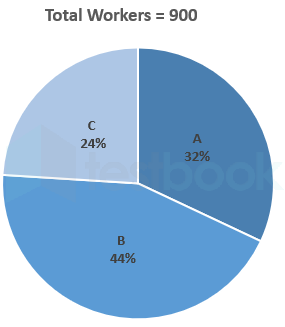
Directions: Pie chart given below shows the total number of workers in three different companies A, B, and C. Given below is the ratio between officers and workers working in the company. Study the data carefully and answer the following questions:


CompanyOfficers: Workers
A1 : 16
B1 : 18
C1 : 12


Note: total employees = Officers + Workers

Question 56

What is the ratio of officers of company A and B together to the officers of company B and C together?

  1. AOption (a)

    9 : 11

  2. BOption (b)

    11 : 9

  3. COption (c)

    17 : 20

  4. DOption (d)

    20 : 17

  5. EOption (e)

    1 : 1

View answer & explanation

Correct answer

Answer: (e)E.

1 : 1

Why this answer is correct

Number of workers = (Percentage of workers) × (Total Workers)

Number of officers = (Ratio of officers : workers) × (number of workers)

CompanyPercentage of workersNumber of workersOfficers: WorkersNumber of officers
A32%2881 : 1618
B44%3961 : 1822
C24%2161 : 1218


Number of officers in A and B together = 18 + 22 = 40

Number of officers in B and C together = 22 + 18 = 40

Thus, the ratio of officers of company A and B together to the officers of company B and C together = 1 : 1

Note that, here, the pie chart given is based on total workers and in the table below the ratio given is of officers ∶  workers.

So, we are to equate the part of workers in the ratio to the number of workers obtained from pie chart.

If you take total workers mistakenly as total employees then the entire solution will be wrong.

Question 57

By what percentage in the total number of employees of company B more than that of company C?

  1. AOption (a)

    44%

  2. BOption (b)

    45%

  3. COption (c)

    46%

  4. DOption (d)

    79%

  5. EOption (e)

    77%

View answer & explanation

Correct answer

Answer: (d)D.

79%

Why this answer is correct

CompanyPercentage of workersNumber of workersOfficers : WorkersNumber of officersTotal employees
B44%3961 : 1822418
C24%2161 : 1218234


Percentage difference = ((final - initial)/initial) × 100%

= ((418 - 234)/234) × 100% = 78.63% ≈ 79%

Note that, here, the pie chart given is based on total workers and in the table below the ratio given is of officers ∶  workers.

So, we are to equate the part of workers in the ratio to the number of workers obtained from pie chart.

If you take total workers mistakenly as total employees then the entire solution will be wrong.

Question 58

If a pie chart was made of total number of employees, what is the angle subtended by the officers of company A?

  1. AOption (a)

    111°

  2. BOption (b)

    7.2°

  3. COption (c)

    6.7°

  4. DOption (d)

    7.6°

  5. EOption (e)

    108°

View answer & explanation

Correct answer

Answer: (c)C.

6.7°

Why this answer is correct

CompanyNumber of workersNumber of officersTotal employees
A28818306
B39622418
C21618234
total90058958


Percentage of officers of company A = 18958×\frac{{18}}{{958}} \times 100% = 1.88%

Converting it to degrees,

1.88% of 360° = 6.76°

Note that, here, the pie chart given is based on total workers and in the table below the ratio given is of officers ∶  workers.

So, we are to equate the part of workers in the ratio to the number of workers obtained from pie chart.

If you take total workers mistakenly as total employees then the entire solution will be wrong.

Question 59

What is the ratio of number of workers of company C to that of company B?

  1. AOption (a)

    8 : 11

  2. BOption (b)

    11 : 8

  3. COption (c)

    6 : 11

  4. DOption (d)

    11 : 6

  5. EOption (e)

    6 : 8

View answer & explanation

Correct answer

Answer: (c)C.

6 : 11

Why this answer is correct

Number of workers of company C = 24% of 900

Number of workers of company B = 44% of 900

Ratio of number of workers of company C to that of company B = 24% of 900 : 44% of 900 = 24 : 44 = 6 : 11


ALTERNATIVE METHOD:

In this type of questions, where percentage is known and ratio or percentage is asked. then there is no need to use the real values.

∴ Required Ratio = 24 : 44 = 6 : 11

Question 60

What is the ratio of officers of company A and C together to that of workers of company B?

  1. AOption (a)

    6 : 1

  2. BOption (b)

    4 : 1

  3. COption (c)

    11 : 1

  4. DOption (d)

    1 : 11

  5. EOption (e)

    1 : 6

View answer & explanation

Correct answer

Answer: (d)D.

1 : 11

Why this answer is correct

CompanyNumber of workersNumber of officers
A28818
B39622
C21618


Officers of company A and C together = 18 + 18 = 36

Workers of company B = 396

Ratio of officers of company A and C together workers of company B = 36 : 396 = 1 : 11

Note that, here, the pie chart given is based on total workers and in the table below the ratio given is of officers ∶  workers.

So, we are to equate the part of workers in the ratio to the number of workers obtained from pie chart.

If you take total workers mistakenly as total employees then the entire solution will be wrong.

Directions: Based on the given passage, answer the questions that follow.

A invested Rs. 50000 in a company in the beginning of the year. After few months, B invested Rs. 40000 in the same company. At the end of the year, A received Rs. 12000 as his share of profit for the year. In the next year, A and B again invested the same amount as they did in the previous year for the whole year. After 3 months, C invested Rs. 60000 and received Rs. 4500 as his share of profit at the end of second year.

Question 61

In the third year, if A, B and C invested the same amount as before in the second of the year, what is C’s share in a profit of Rs. 60000?

  1. AOption (a)

    Rs. 12000

  2. BOption (b)

    Rs. 18000

  3. COption (c)

    Rs. 24000

  4. DOption (d)

    Rs. 32000

  5. EOption (e)

    Rs. 36000

View answer & explanation

Correct answer

Answer: (c)C.

Rs. 24000

Why this answer is correct

In third year,

A’s investment = Rs. 50000 for 12 months

B’s investment = Rs. 40000 for 12 months

C’s investment = Rs. 60000 for 12 months

Hence,

⇒ A’s share : B’s share : C’s share = 50000 : 40000 : 60000

⇒ A’s share : B’s share : C’s share = 5 : 4 : 6

∴ C’s share = (6/15) × 60000 = Rs. 24000

Question 62

What is the share of A in the profit in the second year?

  1. AOption (a)

    Rs. 3000

  2. BOption (b)

    Rs. 3500

  3. COption (c)

    Rs. 4000

  4. DOption (d)

    Rs. 5000

  5. EOption (e)

    Rs. 5500

View answer & explanation

Correct answer

Answer: (d)D.

Rs. 5000

Why this answer is correct

In second year,

A’s investment = Rs. 50000 for 12 months

C’s investment = Rs. 60000 for (12 – 3) = 9 months

C’s share = Rs. 4500

Hence,

⇒ (50000 × 12) : (60000 × 9) = A’s share : 4500

⇒ 10 : 9 = A’s share : 4500

⇒ A’s share = (10/9) × 4500

∴ A’ share = Rs. 5000

Question 63

If B invested in the company after 4 months, what is the ratio of the share in profit of A and B?

  1. AOption (a)

    5 : 4

  2. BOption (b)

    5 : 8

  3. COption (c)

    8 : 5

  4. DOption (d)

    15 : 4

  5. EOption (e)

    15 : 8

View answer & explanation

Correct answer

Answer: (e)E.

15 : 8

Why this answer is correct

A’s investment = Rs. 50000 for 12 months

B’s investment = Rs. 40000 for (12 – 4) = 8 months

∴ Ratio of their share in profit = (50000 × 12) : (40000 × 8) = 15 : 8

Question 64

If B received Rs. 5600 as his share of profit at the end of first year, after how many months did he invested in the company?

  1. AOption (a)

    3

  2. BOption (b)

    4

  3. COption (c)

    5

  4. DOption (d)

    6

  5. EOption (e)

    7

View answer & explanation

Correct answer

Answer: (c)C.

5

Why this answer is correct

Let B invested in the company after ‘x’ months

A’s investment = Rs. 50000 for 12 months

B’s investment = Rs. 40000 for (12 – x) months

A’s share = Rs. 12000

B’s share = Rs. 5600

Hence,

⇒ (50000 × 12) : [40000 × (12 – x) ] = 12000 : 5600

⇒ (5 × 12) : [4 × (12 – x) ] = 120 : 56

⇒ 60 : (48 – 4x) = 120 : 56

⇒ (60 × 56)/120 = 48 – 4x

⇒ 28 = 48 – 4x

⇒ 4x = 20

⇒ x = 5

∴ B invested in the company after 5 months

Question 65

At the end of the first year, what amount did B received as his share of profit?

  1. AOption (a)

    Rs. 6000

  2. BOption (b)

    Rs. 9600

  3. COption (c)

    Rs. 10000

  4. DOption (d)

    Rs. 12000

  5. EOption (e)

    Couldn’t be determined

View answer & explanation

Correct answer

Answer: (e)E.

Couldn’t be determined

Why this answer is correct

As the time duration for which B invested his money is not known, his share of profit couldn’t be determined.

Reasoning Ability (35 questions)

Directions: Study the following information carefully to answer the given questions.

Seven different boxes namely D, E, F, G, H, I and J having different no. of articles in it placed one above the other. No. of articles is 3, 7, 10, 13, 17, 18, 20. The following information is given below.

There are two boxes between G and the box in which there are 13 articles. Two boxes are placed between D and the box in which there are 10 articles. There are only three boxes between H and the box which have 10 articles. G is placed below D. I is immediately below the box which has 17 articles. D doesn’t have 17 articles. Only one box is there between E and J. There are two boxes between the boxes having 17 and 7 articles. G lies above the box having 13 articles. The difference between no. of articles in boxes G and just above G is 13. The number of articles in the box which is just above J is less than the no. of articles in J. E does not have 7 no. of articles.

Question 66

Find the pair of articles and boxes which is not correct?

  1. AOption (a)

    E - 18

  2. BOption (b)

    I - 13

  3. COption (c)

    D - 3

  4. DOption (d)

    J - 7

  5. EOption (e)

    None of these

View answer & explanation

Correct answer

Answer: (a)A.

E - 18

Why this answer is correct

Seven boxes: D, E, F, G, H, I and J.

No. of articles: 3, 7, 10, 13, 17, 18 and 20.

  1. There are two boxes between G and the box in which there are 13 articles.

  2. G lies above the box having 13 articles.

  3. G is placed below D.

  4. I is immediately below the box which has 17 articles.

  5. D doesn’t have 17 articles.

  6. There are two boxes between the boxes having 17 and 7 articles.

  7. Two boxes are placed between D and the box in which there are 10 articles.

  8. There are only three boxes between H and the box which have 10 articles.

(Combining all, we have four possible cases)

Case 1:

BoxesNo. of articles
H7
D
G
17
I10
13


Case 2:

BoxesNo. of articles
H
D
G
17
I10
13
7


Case 3:

BoxesNo. of articles
H
D
7
G
10
17
I13


Case 4:

BoxesNo. of articles
H7
D
G
17
I10
13


  1. Only one box is there between E and J.

(There will be seven possible cases)

  1. E does not have 7 no. of articles.

Case 1:

BoxesNo. of articles
H7
D
G
E17
I10
J13


Case 2:

BoxesNo. of articles
H7
D
G
J17
I10
E13


Case 3:

BoxesNo. of articles
H
D
G
E17
I10
J13
7


Case 4:

BoxesNo. of articles
H
D
G
J17
I10
E13
7


Case 5:

BoxesNo. of articles
H
D
J7
G
E10
17
I13


Case 6:

BoxesNo. of articles
H7
D
G
E17
I10
J13


Case 7:

BoxesNo. of articles
H7
D
G
J17
I10
E13


  1. The difference between no. of articles in boxes G and just above G is 13.

(Hence, Case 1, 2, 3, 4, 6 and 7 will be eliminated, we can further proceed with Case 5)

  1. The number of articles in the box which is just above J is less than the no. of articles in J.
BoxesNo. of articles
H18
D3
J7
G20
E10
F17
I13


Clearly, box E has 18 no. of articles is wrong.

Question 67

Which of the following condition is correct regarding the box which contains 3 articles with respect to H?

  1. AOption (a)

    There are only one box between the box H and the box which contains 3 articles

  2. BOption (b)

    Box H is immediately above the box which contains 3 articles

  3. COption (c)

    Box which contains 3 articles is immediately above box H

  4. DOption (d)

    All of the above is true

  5. EOption (e)

    None of the above is true

View answer & explanation

Correct answer

Answer: (b)B.

Box H is immediately above the box which contains 3 articles

Why this answer is correct

Seven boxes: D, E, F, G, H, I and J.

No. of articles: 3, 7, 10, 13, 17, 18 and 20.

  1. There are two boxes between G and the box in which there are 13 articles.

  2. G lies above the box having 13 articles.

  3. G is placed below D.

  4. I is immediately below the box which has 17 articles.

  5. D doesn’t have 17 articles.

  6. There are two boxes between the boxes having 17 and 7 articles.

  7. Two boxes are placed between D and the box in which there are 10 articles.

  8. There are only three boxes between H and the box which have 10 articles.

(Combining all, we have four possible cases)

Case 1:

BoxesNo. of articles
H7
D
G
17
I10
13


Case 2:

BoxesNo. of articles
H
D
G
17
I10
13
7


Case 3:

BoxesNo. of articles
H
D
7
G
10
17
I13


Case 4:

BoxesNo. of articles
H7
D
G
17
I10
13


  1. Only one box is there between E and J.

(There will be seven possible cases)

  1. E does not have 7 no. of articles.

Case 1:

BoxesNo. of articles
H7
D
G
E17
I10
J13


Case 2:

BoxesNo. of articles
H7
D
G
J17
I10
E13


Case 3:

BoxesNo. of articles
H
D
G
E17
I10
J13
7


Case 4:

BoxesNo. of articles
H
D
G
J17
I10
E13
7


Case 5:

BoxesNo. of articles
H
D
J7
G
E10
17
I13


Case 6:

BoxesNo. of articles
H7
D
G
E17
I10
J13


Case 7:

BoxesNo. of articles
H7
D
G
J17
I10
E13


  1. The difference between no. of articles in boxes G and just above G is 13.

(Hence, Case 1, 2, 3, 4, 6 and 7 will be eliminated, we can further proceed with Case 5)

  1. The number of articles in the box which is just above J is less than the no. of articles in J.
BoxesNo. of articles
H18
D3
J7
G20
E10
F17
I13


Clearly, Box H is immediately above the box which contains 3 articles.

Question 68

Box D contains how many articles?

  1. AOption (a)

    17

  2. BOption (b)

    18

  3. COption (c)

    7

  4. DOption (d)

    13

  5. EOption (e)

    None of these

View answer & explanation

Correct answer

Answer: (e)E.

None of these

Why this answer is correct

Seven boxes: D, E, F, G, H, I and J.

No. of articles: 3, 7, 10, 13, 17, 18 and 20.

  1. There are two boxes between G and the box in which there are 13 articles.

  2. G lies above the box having 13 articles.

  3. G is placed below D.

  4. I is immediately below the box which has 17 articles.

  5. D doesn’t have 17 articles.

  6. There are two boxes between the boxes having 17 and 7 articles.

  7. Two boxes are placed between D and the box in which there are 10 articles.

  8. There are only three boxes between H and the box which have 10 articles.

(Combining all, we have four possible cases)

Case 1:

BoxesNo. of articles
H7
D
G
17
I10
13


Case 2:

BoxesNo. of articles
H
D
G
17
I10
13
7


Case 3:

BoxesNo. of articles
H
D
7
G
10
17
I13


Case 4:

BoxesNo. of articles
H7
D
G
17
I10
13


  1. Only one box is there between E and J.

(There will be seven possible cases)

  1. E does not have 7 no. of articles.

Case 1:

BoxesNo. of articles
H7
D
G
E17
I10
J13


Case 2:

BoxesNo. of articles
H7
D
G
J17
I10
E13


Case 3:

BoxesNo. of articles
H
D
G
E17
I10
J13
7


Case 4:

BoxesNo. of articles
H
D
G
J17
I10
E13
7


Case 5:

BoxesNo. of articles
H
D
J7
G
E10
17
I13


Case 6:

BoxesNo. of articles
H7
D
G
E17
I10
J13


Case 7:

BoxesNo. of articles
H7
D
G
J17
I10
E13


  1. The difference between no. of articles in boxes G and just above G is 13.

(Hence, Case 1, 2, 3, 4, 6 and 7 will be eliminated, we can further proceed with Case 5)

  1. The number of articles in the box which is just above J is less than the no. of articles in J.
BoxesNo. of articles
H18
D3
J7
G20
E10
F17
I13


Clearly, box D contains 3 articles.

Question 69

How many articles are there in box ‘G’?

  1. AOption (a)

    13

  2. BOption (b)

    17

  3. COption (c)

    20

  4. DOption (d)

    18

  5. EOption (e)

    Can’t be determined

View answer & explanation

Correct answer

Answer: (c)C.

20

Why this answer is correct

Seven boxes: D, E, F, G, H, I and J.

No. of articles: 3, 7, 10, 13, 17, 18 and 20.

  1. There are two boxes between G and the box in which there are 13 articles.

  2. G lies above the box having 13 articles.

  3. G is placed below D.

  4. I is immediately below the box which has 17 articles.

  5. D doesn’t have 17 articles.

  6. There are two boxes between the boxes having 17 and 7 articles.

  7. Two boxes are placed between D and the box in which there are 10 articles.

  8. There are only three boxes between H and the box which have 10 articles.

(Combining all, we have four possible cases)

Case 1:

BoxesNo. of articles
H7
D
G
17
I10
13


Case 2:

BoxesNo. of articles
H
D
G
17
I10
13
7


Case 3:

BoxesNo. of articles
H
D
7
G
10
17
I13


Case 4:

BoxesNo. of articles
H7
D
G
17
I10
13


  1. Only one box is there between E and J.

(There will be seven possible cases)

  1. E does not have 7 no. of articles.

Case 1:

BoxesNo. of articles
H7
D
G
E17
I10
J13


Case 2:

BoxesNo. of articles
H7
D
G
J17
I10
E13


Case 3:

BoxesNo. of articles
H
D
G
E17
I10
J13
7


Case 4:

BoxesNo. of articles
H
D
G
J17
I10
E13
7


Case 5:

BoxesNo. of articles
H
D
J7
G
E10
17
I13


Case 6:

BoxesNo. of articles
H7
D
G
E17
I10
J13


Case 7:

BoxesNo. of articles
H7
D
G
J17
I10
E13


  1. The difference between no. of articles in boxes G and just above G is 13.

(Hence, Case 1, 2, 3, 4, 6 and 7 will be eliminated, we can further proceed with Case 5)

  1. The number of articles in the box which is just above J is less than the no. of articles in J.
BoxesNo. of articles
H18
D3
J7
G20
E10
F17
I13


Clearly, 20 articles are there in box ‘G’.

Question 70

How many boxes is/are there between G and I?

  1. AOption (a)

    One

  2. BOption (b)

    Two

  3. COption (c)

    Three

  4. DOption (d)

    Four

  5. EOption (e)

    None

View answer & explanation

Correct answer

Answer: (b)B.

Two

Why this answer is correct

Seven boxes: D, E, F, G, H, I and J.

Number of articles: 3, 7, 10, 13, 17, 18 and 20.

  1. There are two boxes between G and the box in which there are 13 articles.

  2. G lies above the box having 13 articles.

  3. G is placed below D.

  4. I is immediately below the box which has 17 articles.

  5. D doesn’t have 17 articles.

  6. There are two boxes between the boxes having 17 and 7 articles.

  7. Two boxes are placed between D and the box in which there are 10 articles.

  8. There are only three boxes between H and the box which have 10 articles.

(Combining all, we have four possible cases)

Case 1:

BoxesNo. of articles
H7
D
G
17
I10
13


Case 2:

BoxesNo. of articles
H
D
G
17
I10
13
7


Case 3:

BoxesNo. of articles
H
D
7
G
10
17
I13


Case 4:

BoxesNo. of articles
H7
D
G
17
I10
13


  1. Only one box is there between E and J.

(There will be seven possible cases)

  1. E does not have 7 number of articles.

Case 1:

BoxesNo. of articles
H7
D
G
E17
I10
J13


Case 2:

BoxesNo. of articles
H7
D
G
J17
I10
E13


Case 3:

BoxesNo. of articles
H
D
G
E17
I10
J13
7


Case 4:

BoxesNo. of articles
H
D
G
J17
I10
E13
7


Case 5:

BoxesNo. of articles
H
D
J7
G
E10
17
I13


Case 6:

BoxesNo. of articles
H7
D
G
E17
I10
J13


Case 7:

BoxesNo. of articles
H7
D
G
J17
I10
E13


  1. The difference between the number of articles in box G and just above G is 13.

(Hence, Case 1, 2, 3, 4, 6 and 7 will be eliminated, we can further proceed with Case 5)

  1. The number of articles in the box which is just above J is less than the number of articles in J.
BoxesNo. of articles
H18
D3
J7
G20
E10
F17
I13


Clearly, there are two boxes between G and I.

Directions: These questions are based on the following information.

A to F are the six members of the family. There are two fathers, one mother and three brothers in this family. C is the sister of F and both are the children of A. D is the only eldest member of this family. B is a bachelor and brother of E’s husband. E is daughter - in - law of D. D is the father of A and grandfather of F. F is the brother of C.

Question 71

How many male members are there?

  1. AOption (a)

    5

  2. BOption (b)

    4

  3. COption (c)

    3

  4. DOption (d)

    1

  5. EOption (e)

    Cannot be determined

View answer & explanation

Correct answer

Answer: (b)B.

4

Why this answer is correct

From the given information,

  1. A to F are the six members of the family.

  2. There are two fathers, one mother and three brothers in this family.

  3. C is the sister of F and both are the children of A.

  4. D is the only eldest member of this family.

  5. B is the brother of E’s husband.

  6. D is the father of A and grandfather of F.

  7. F is the brother of C.

Hence, 4 male members are there in this family.

Direction: Study the following information carefully and answer the questions given below.

Fourteen people E, F, G, H, I, J, K, L, M, N, O, P, Q and R are sitting in two parallel rows containing seven people in each row, in such a way that there is an equal distance between adjacent persons. The persons who are seated in row 1 facing south, and the persons who are seated in row 2 facing north. Therefore, in the given seating arrangement each member seated in a row faces another member of the other row, but not necessarily in the same order.

Neither Q nor N sits immediately next to F. P faces the one who sits one of the middles of the row.  H sits on one of the extreme ends but not immediate neighbour of O. N does not face immediate neighbours of G. There are more than one persons between E and O who does not sit on one of the extreme ends. There is no one between M and G who does not face O. There is one person between K and I and none of them sits immediately next to E. There are more than one persons between P and J. There are two persons between P and F who sits second to the left of R. E faces R but does not face North direction. J does not face K.

Question 72

Who among the following faces L?

  1. AOption (a)

    Q

  2. BOption (b)

    N

  3. COption (c)

    K

  4. DOption (d)

    G

  5. EOption (e)

    Can’t say

View answer & explanation

Correct answer

Answer: (b)B.

N

Why this answer is correct

Fourteen Persons: E, F, G, H, I, J, K, L, M, N, O, P, Q and R.

  1. P faces the one who sits in one of the middles of the row.

  2. There are two persons between P and F who sits second to the left of R.

  3. E faces R but does not face North direction.

  4. There are more than one persons between P and J.

  5. There are more than one persons between E and O who does not sit on one of the extreme ends.

  6. H sits on one of the extreme ends but not an immediate neighbour of O.

  7. There is one person between K and I and none of them sits immediately next to E.

  8. There is no one between M and G who does not face O.

9) J does not face K.

  1. Neither Q nor N sits immediately next to F.

  2. N does not face immediate neighbours of G.​

Hence, L faces N.

Question 73

Who among the following faces G?

  1. AOption (a)

    I

  2. BOption (b)

    Q

  3. COption (c)

    K

  4. DOption (d)

    N

  5. EOption (e)

    Can’t say

View answer & explanation

Correct answer

Answer: (c)C.

K

Why this answer is correct

Fourteen Persons: E, F, G, H, I, J, K, L, M, N, O, P, Q and R.

  1. P faces the one who sits in one of the middles of the row.

  2. There are two persons between P and F who sits second to the left of R.

  3. E faces R but does not face North direction.

  4. There are more than one persons between P and J.

  5. There are more than one persons between E and O who does not sit on one of the extreme ends.

  6. H sits on one of the extreme ends but not an immediate neighbour of O.

  7. There is one person between K and I and none of them sits immediately next to E.

  8. There is no one between M and G who does not face O.

9) J does not face K.

  1. Neither Q nor N sits immediately next to F.

  2. N does not face immediate neighbours of G.​

Hence, G faces K.

Question 74

Four of the following five are alike in a certain way and hence form a group. Which of them does not belong to the group?

  1. AOption (a)

    J

  2. BOption (b)

    L

  3. COption (c)

    F

  4. DOption (d)

    I

  5. EOption (e)

    H

View answer & explanation

Correct answer

Answer: (b)B.

L

Why this answer is correct

Fourteen Persons: E, F, G, H, I, J, K, L, M, N, O, P, Q and R.

  1. P faces the one who sits in one of the middles of the row.

  2. There are two persons between P and F who sits second to the left of R.

  3. E faces R but does not face North direction.

  4. There are more than one persons between P and J.

  5. There are more than one persons between E and O who does not sit on one of the extreme ends.

  6. H sits on one of the extreme ends but not an immediate neighbour of O.

  7. There is one person between K and I and none of them sits immediately next to E.

  8. There is no one between M and G who does not face O.

9) J does not face K.

  1. Neither Q nor N sits immediately next to F.

  2. N does not face immediate neighbours of G.

Except L, rest of them sit one of the extreme ends.

Question 75

Which among the following pair is different among the others?

  1. AOption (a)

    Q - M

  2. BOption (b)

    N - P

  3. COption (c)

    R - K

  4. DOption (d)

    E - F

  5. EOption (e)

    I - J

View answer & explanation

Correct answer

Answer: (e)E.

I - J

Why this answer is correct

Fourteen Persons: E, F, G, H, I, J, K, L, M, N, O, P, Q and R.

  1. P faces the one who sits in one of the middles of the row.

  2. There are two persons between P and F who sits second to the left of R.

  3. E faces R but does not face North direction.

  4. There are more than one persons between P and J.

  5. There are more than one persons between E and O who does not sit on one of the extreme ends.

  6. H sits on one of the extreme ends but not an immediate neighbour of O.

  7. There is one person between K and I and none of them sits immediately next to E.

  8. There is no one between M and G who does not face O.

9) J does not face K.

  1. Neither Q nor N sits immediately next to F.

  2. N does not face immediate neighbours of G.

I faces J. Hence, it was different from the rest.

Question 76

Who among the following faces the one who sits second to the left of M?

  1. AOption (a)

    P

  2. BOption (b)

    N

  3. COption (c)

    K

  4. DOption (d)

    Q

  5. EOption (e)

    Can’t say

View answer & explanation

Correct answer

Answer: (d)D.

Q

Why this answer is correct

Fourteen Persons: E, F, G, H, I, J, K, L, M, N, O, P, Q and R.

  1. P faces the one who sits in one of the middles of the row.

  2. There are two persons between P and F who sits second to the left of R.

  3. E faces R but does not face North direction.

  4. There are more than one persons between P and J.

  5. There are more than one persons between E and O who does not sit on one of the extreme ends.

  6. H sits on one of the extreme ends but not an immediate neighbour of O.

  7. There is one person between K and I and none of them sits immediately next to E.

  8. There is no one between M and G who does not face O.

9) J does not face K.

  1. Neither Q nor N sits immediately next to F.

  2. N does not face immediate neighbours of G.​

Hence, Q faces the one who sits second to the left of M.

Question 77

Direction: In the following question assuming the given statements to be true, find which of the conclusion among given conclusions is / are definitely true and then give your answers accordingly.

Statement: A ≥ B; E = F; D ≤ E; B ≤ D

Conclusion:

I. A < D

II. A > D

  1. AOption (a)

    Only conclusion I is True.

  2. BOption (b)

    Only conclusion II is True.

  3. COption (c)

    Either conclusion I or conclusion II is True.

  4. DOption (d)

    Neither conclusion I nor conclusion II is True.

  5. EOption (e)

    Both the conclusion I and conclusion II are True.

View answer & explanation

Correct answer

Answer: (d)D.

Neither conclusion I nor conclusion II is True.

Why this answer is correct

Given, A ≥ B; E = F; D ≤ E; B ≤ D

After rearranging, A ≥ B ≤ D ≤ E = F

I. A < D → Not true because no clear relationship can be established between A and D as A ≥ B ≤ D.

II. A > D → Not true because no clear relationship can be established between A and D as A ≥ B ≤ D.

Hence, neither I nor II follow.

Question 78

Direction: In the following question assuming the given statements to be true, find which of the conclusion among given conclusions is / are definitely true and then give your answers accordingly.

Statements: 

B ≥ C = D ≥ E; A ≤ F ≤ P = D

Conclusions:

I. D ≥ A

II. B ≥ F

  1. AOption (a)

    If I is true then II should be true.

  2. BOption (b)

    Both I and II are true.

  3. COption (c)

    Only I is true.

  4. DOption (d)

    Only II is true.

  5. EOption (e)

    Either I or II is true.

View answer & explanation

Correct answer

Answer: (b)B.

Both I and II are true.

Why this answer is correct

Given statements: B ≥ C = D ≥ E; A ≤ F ≤ P = D

On combining: C = D ≥ F ≥ A; B ≥ D ≥ E; D = P ≥ F ≥ A

Conclusions:

I. D ≥ A → True (as A ≤ P and P = D → A ≤ D or D ≥ A).

II. B ≥ F → True (as B ≥ D and F ≤ P and P = D → F ≤ D or D ≥ F → B ≥ F).

Therefore, both conclusion I and conclusion II are true.

Question 79

Direction: In the following question assuming the given statements to be true, find which of the conclusion among given conclusions is / are definitely true and then give your answers accordingly.

Statements: 

P < X ≤ Y < Q; S > Y < T; P = V > R

Conclusions:

I. V < S

II. T > R

  1. AOption (a)

    None is true.

  2. BOption (b)

    Only I is true.

  3. COption (c)

    Either I or II are true.

  4. DOption (d)

    Only II is true.

  5. EOption (e)

    Both are true.

View answer & explanation

Correct answer

Answer: (e)E.

Both are true.

Why this answer is correct

Given statements: P < X ≤ Y < Q; S > Y < T; P = V > R

On combining: V = P < Y < Q; Y < S; T > Y ≥ X; R < P < X

Conclusions:

I. V < S → True (as V < Y and Y < S → V < S).

II. T > R → True (as P > R and Y > P and T > Y → T > Y > P > R → T > R).

Therefore, both conclusion I and conclusion II are true.

Question 80

Directions

In the given questions, assuming the given statements to be true. Find which of the given two conclusions numbered I, II is/are definitely true and give your answer accordingly.

Statement:

 S ≤ K > R = Z; P ≤ R > N

Conclusions:

I. N > S

II. P < S

  1. AOption (a)

    Only II is true. 

  2. BOption (b)

    Only I is true.

  3. COption (c)

    Either I or II is true.

  4. DOption (d)

    Both I and II are true

  5. EOption (e)

    Neither I nor II is true.

View answer & explanation

Correct answer

Answer: (e)E.

Neither I nor II is true.

Why this answer is correct

Given statements: S ≤ K > R = Z; P ≤ R > N

On combining: S ≤ K > R ≥ P; S ≤ K > R > N

Conclusion I: N > S is false (as S ≤ K > R > N)

Conclusion II: P < S is false (as S ≤ K > R ≥ P)

Hence, none of the conclusion is true.

Directions: Study the information given below carefully and answer the questions that follow:

Point H is 9 km north of point T. Point I is 6 km east of point T. Point L is 12 km south of point I. Point L is 20 km east of point A. Point K is midway between point A and point L. Point S is 8 km north of point K.

Question 81

If a car travels 4 km towards north from point S and then turned towards east which point will it be facing?

  1. AOption (a)

    I

  2. BOption (b)

    L

  3. COption (c)

    K

  4. DOption (d)

    T

  5. EOption (e)

    A

View answer & explanation

Correct answer

Answer: (d)D.

T

Why this answer is correct

According to the information given

From the above diagram, the car will be facing point T.

Question 82

Ram walks 6 km towards point K from point L, Shivam calls and tells him that he has to reach at point T. In which direction should he head now?

  1. AOption (a)

    North - East

  2. BOption (b)

    South - East

  3. COption (c)

    North

  4. DOption (d)

    Continue walking towards east

  5. EOption (e)

    West

View answer & explanation

Correct answer

Answer: (c)C.

North

Why this answer is correct

According to the information given,

From the above diagram, he has to walk towards north.

Directions: J, K, L, M, S, T, U and V are eight employees of an organisation and they will attend a meeting in the four months (March, June, October, November) in a year. The meeting held in each month on 13th and 22nd date. Only two meetings held in a month. Each of the employees has a distinct and favourite colour of choice ranging from Blue, Red, Yellow, White, Black, Pink, Green and Brown but not necessarily in the same order.

(i) No person attends meeting after L. M attends the meeting in the month which has less than 31 days.

(ii) S, who likes red colour and U attend the meeting after M on date 22nd of different months.

(iii) The employees who attend first and last meetings in the year like Yellow colour and black colour respectively.

(iv) J and K attend the meeting before M, who likes White colour.

(v) The persons who like Pink and green attends the meeting in same month on dates 22nd and 13th respectively.

(vi) V doesn’t attend the meeting in the month in which S attends or L attends.

(vii) The employee who attends meeting on 13th November likes Blue colour. The person Who likes Brown attends the meeting after J in same month.

Question 83

The employee, who likes Blue colour is

  1. AOption (a)

    J

  2. BOption (b)

    V

  3. COption (c)

    T

  4. DOption (d)

    M

  5. EOption (e)

    None of these

View answer & explanation

Correct answer

Answer: (c)C.

T

Why this answer is correct

Employees: J, K, L, M, S, T, U and V

Months: March, June, October, November

Dates: 13th and 22nd

Favourite colour: Blue, Red, Yellow, White, Black, Pink, Green and Brown

  1. No person attends meeting after L. M attends the meeting in the month which has less than 31 days.

So, M attends the meeting in either June or November.

MonthDateEmployeeFavorite Color
March13th
22nd
June13thM
22ndM
October13th
22nd
November13thM
22ndL


  1. S, who likes Red colour and U attend the meeting after M on date 22nd of different

months.

Hence, M attends the meeting on 13th June.

MonthDateEmployeeFavorite Color
March13th
22nd
June13thM
22ndS/URed/ U’s favourite colour
October13th
22ndS/URed/ U’s favourite colour
November13th
22ndL


  1. The employees who attend first and last meetings in the year like Yellow colour and Black

colour respectively.

MonthDateEmployeeFavorite Color
March13thYellow
22nd
June13thM
22ndS/URed/ U’s favourite colour
October13th
22ndS/URed/ U’s favourite colour
November13th
22ndLBlack


  1. J and K attend the meeting before M, who likes White colour.
MonthDateEmployeeFavorite Color
March13thJ/KYellow
22ndJ/K
June13thMWhite
22ndS/URed/ U’s favourite colour
October13th
22ndS/U
November13thRed/ U’s favourite colour
22ndLBlack


  1. The persons who like pink and Green attends the meeting in same month on dates 22nd

and 13th respectively.

So, S attends meeting on 22nd June and the persons who like Pink and Green attends the

meeting in October.

MonthDateEmployeeFavorite Color
March13thJ/KYellow
22ndJ/K
June13thMWhite
22ndSRed
October13thGreen
22ndUPink
November13th
22ndLBlack


  1. V doesn’t attend the meeting in the month in which S attends or L attends.
MonthDateEmployeeFavorite Color
March13thJ/KYellow
22ndJ/K
June13thMWhite
22ndSRed
October13thVGreen
22ndUPink
November13th
22ndLBlack


  1. The employee who attends meeting on 13th November likes Blue colour. The person who

likes Brown attends the meeting after J in same month.

Hence, K likes Brown colour and T likes blue colour.

MonthDateEmployeeFavorite Color
March13thJYellow
22ndKBrown
June13thMWhite
22ndSRed
October13thVGreen
22ndUPink
November13thTBlue
22ndLBlack


Hence, T likes Blue colour.

Question 84

V attends the meeting on

  1. AOption (a)

    13th of October

  2. BOption (b)

    22nd of June

  3. COption (c)

    13th of June

  4. DOption (d)

    13th of November

  5. EOption (e)

    None of these

View answer & explanation

Correct answer

Answer: (a)A.

13th of October

Why this answer is correct

Employees: J, K, L, M, S, T, U and V

Months: March, June, October, November

Dates: 13th and 22nd

Favourite colour: Blue, Red, Yellow, White, Black, Pink, Green and Brown

  1. No person attends meeting after L. M attends the meeting in the month which has less than 31 days.

So, M attends the meeting in either June or November.

MonthDateEmployeeFavorite Color
March13th
22nd
June13thM
22ndM
October13th
22nd
November13thM
22ndL


  1. S, who likes Red colour and U attend the meeting after M on date 22nd of different

months.

Hence, M attends the meeting on 13th June.

MonthDateEmployeeFavorite Color
March13th
22nd
June13thM
22ndS/URed/ U’s favourite colour
October13th
22ndS/URed/ U’s favourite colour
November13th
22ndL


  1. The employees who attend first and last meetings in the year like Yellow colour and Black

colour respectively.

MonthDateEmployeeFavorite Color
March13thYellow
22nd
June13thM
22ndS/URed/ U’s favourite colour
October13th
22ndS/URed/ U’s favourite colour
November13th
22ndLBlack


  1. J and K attend the meeting before M, who likes White colour.
MonthDateEmployeeFavorite Color
March13thJ/KYellow
22ndJ/K
June13thMWhite
22ndS/URed/ U’s favourite colour
October13th
22ndS/U
November13thRed/ U’s favourite colour
22ndLBlack


  1. The persons who like pink and Green attends the meeting in same month on dates 22nd

and 13th respectively.

So, S attends meeting on 22nd June and the persons who like Pink and Green attends the

meeting in October.

MonthDateEmployeeFavorite Color
March13thJ/KYellow
22ndJ/K
June13thMWhite
22ndSRed
October13thGreen
22ndUPink
November13th
22ndLBlack


  1. V doesn’t attend the meeting in the month in which S attends or L attends.
MonthDateEmployeeFavorite Color
March13thJ/KYellow
22ndJ/K
June13thMWhite
22ndSRed
October13thVGreen
22ndUPink
November13th
22ndLBlack


  1. The employee who attends meeting on 13th November likes Blue colour. The person who

likes Brown attends the meeting after J in same month.

Hence, K likes Brown colour and T likes blue colour.

MonthDateEmployeeFavorite Color
March13thJYellow
22ndKBrown
June13thMWhite
22ndSRed
October13thVGreen
22ndUPink
November13thTBlue
22ndLBlack


Hence, V attends meeting on 13th of October.

Question 85

The employee, who likes Red colour attends the meeting on

  1. AOption (a)

    13th of June

  2. BOption (b)

    22nd of March

  3. COption (c)

    22nd of June

  4. DOption (d)

    13th November

  5. EOption (e)

    None of these

View answer & explanation

Correct answer

Answer: (c)C.

22nd of June

Why this answer is correct

Employees: J, K, L, M, S, T, U and V

Months: March, June, October, November

Dates: 13th and 22nd

Favourite colour: Blue, Red, Yellow, White, Black, Pink, Green and Brown

  1. No person attends meeting after L. M attends the meeting in the month which has less than 31 days.

So, M attends the meeting in either June or November.

MonthDateEmployeeFavorite Color
March13th
22nd
June13thM
22ndM
October13th
22nd
November13thM
22ndL


  1. S, who likes Red colour and U attend the meeting after M on date 22nd of different

months.

Hence, M attends the meeting on 13th June.

MonthDateEmployeeFavorite Color
March13th
22nd
June13thM
22ndS/URed/ U’s favourite colour
October13th
22ndS/URed/ U’s favourite colour
November13th
22ndL


  1. The employees who attend first and last meetings in the year like Yellow colour and Black

colour respectively.

MonthDateEmployeeFavorite Color
March13thYellow
22nd
June13thM
22ndS/URed/ U’s favourite colour
October13th
22ndS/URed/ U’s favourite colour
November13th
22ndLBlack


  1. J and K attend the meeting before M, who likes White colour.
MonthDateEmployeeFavorite Color
March13thJ/KYellow
22ndJ/K
June13thMWhite
22ndS/URed/ U’s favourite colour
October13th
22ndS/U
November13thRed/ U’s favourite colour
22ndLBlack


  1. The persons who like pink and Green attends the meeting in same month on dates 22nd

and 13th respectively.

So, S attends meeting on 22nd June and the persons who like Pink and Green attends the

meeting in October.

MonthDateEmployeeFavorite Color
March13thJ/KYellow
22ndJ/K
June13thMWhite
22ndSRed
October13thGreen
22ndUPink
November13th
22ndLBlack


  1. V doesn’t attend the meeting in the month in which S attends or L attends.
MonthDateEmployeeFavorite Color
March13thJ/KYellow
22ndJ/K
June13thMWhite
22ndSRed
October13thVGreen
22ndUPink
November13th
22ndLBlack


  1. The employee who attends meeting on 13th November likes Blue colour. The person who

likes Brown attends the meeting after J in same month.

Hence, K likes Brown colour and T likes blue colour.

MonthDateEmployeeFavorite Color
March13thJYellow
22ndKBrown
June13thMWhite
22ndSRed
October13thVGreen
22ndUPink
November13thTBlue
22ndLBlack


Hence, the employee who likes Red colour attends the meeting on 22nd of June.

Question 86

The employee who attends the meeting before S in same month is

  1. AOption (a)

    M

  2. BOption (b)

    T

  3. COption (c)

    L

  4. DOption (d)

    U

  5. EOption (e)

    None of these

View answer & explanation

Correct answer

Answer: (a)A.

M

Why this answer is correct

Employees: J, K, L, M, S, T, U and V

Months: March, June, October, November

Dates: 13th and 22nd

Favourite colour: Blue, Red, Yellow, White, Black, Pink, Green and Brown

  1. No person attends meeting after L. M attends the meeting in the month which has less than 31 days.

So, M attends the meeting in either June or November.

MonthDateEmployeeFavorite Color
March13th
22nd
June13thM
22ndM
October13th
22nd
November13thM
22ndL


  1. S, who likes Red colour and U attend the meeting after M on date 22nd of different

months.

Hence, M attends the meeting on 13th June.

MonthDateEmployeeFavorite Color
March13th
22nd
June13thM
22ndS/URed/ U’s favourite colour
October13th
22ndS/URed/ U’s favourite colour
November13th
22ndL


  1. The employees who attend first and last meetings in the year like Yellow colour and Black

colour respectively.

MonthDateEmployeeFavorite Color
March13thYellow
22nd
June13thM
22ndS/URed/ U’s favourite colour
October13th
22ndS/URed/ U’s favourite colour
November13th
22ndLBlack


  1. J and K attend the meeting before M, who likes White colour.
MonthDateEmployeeFavorite Color
March13thJ/KYellow
22ndJ/K
June13thMWhite
22ndS/URed/ U’s favourite colour
October13th
22ndS/U
November13thRed/ U’s favourite colour
22ndLBlack


  1. The persons who like pink and Green attends the meeting in same month on dates 22nd

and 13th respectively.

So, S attends meeting on 22nd June and the persons who like Pink and Green attends the

meeting in October.

MonthDateEmployeeFavorite Color
March13thJ/KYellow
22ndJ/K
June13thMWhite
22ndSRed
October13thGreen
22ndUPink
November13th
22ndLBlack


  1. V doesn’t attend the meeting in the month in which S attends or L attends.
MonthDateEmployeeFavorite Color
March13thJ/KYellow
22ndJ/K
June13thMWhite
22ndSRed
October13thVGreen
22ndUPink
November13th
22ndLBlack


  1. The employee who attends meeting on 13th November likes Blue colour. The person who

likes Brown attends the meeting after J in same month.

Hence, K likes Brown colour and T likes blue colour.

MonthDateEmployeeFavorite Color
March13thJYellow
22ndKBrown
June13thMWhite
22ndSRed
October13thVGreen
22ndUPink
November13thTBlue
22ndLBlack


Hence, the employee who attends the meeting before S in same month is M.

Question 87

The employees who attend meeting in November are

  1. AOption (a)

    U, T

  2. BOption (b)

    T, L

  3. COption (c)

    M, S

  4. DOption (d)

    U, V

  5. EOption (e)

    None of these

View answer & explanation

Correct answer

Answer: (b)B.

T, L

Why this answer is correct

Employees: J, K, L, M, S, T, U and V

Months: March, June, October, November

Dates: 13th and 22nd

Favourite colour: Blue, Red, Yellow, White, Black, Pink, Green and Brown

  1. No person attends meeting after L. M attends the meeting in the month which has less than 31 days.

So, M attends the meeting in either June or November.

MonthDateEmployeeFavorite Color
March13th
22nd
June13thM
22ndM
October13th
22nd
November13thM
22ndL


  1. S, who likes Red colour and U attend the meeting after M on date 22nd of different

months.

Hence, M attends the meeting on 13th June.

MonthDateEmployeeFavorite Color
March13th
22nd
June13thM
22ndS/URed/ U’s favourite colour
October13th
22ndS/URed/ U’s favourite colour
November13th
22ndL


  1. The employees who attend first and last meetings in the year like Yellow colour and Black

colour respectively.

MonthDateEmployeeFavorite Color
March13thYellow
22nd
June13thM
22ndS/URed/ U’s favourite colour
October13th
22ndS/URed/ U’s favourite colour
November13th
22ndLBlack


  1. J and K attend the meeting before M, who likes White colour.
MonthDateEmployeeFavorite Color
March13thJ/KYellow
22ndJ/K
June13thMWhite
22ndS/URed/ U’s favourite colour
October13th
22ndS/U
November13thRed/ U’s favourite colour
22ndLBlack


  1. The persons who like pink and Green attends the meeting in same month on dates 22nd

and 13th respectively.

So, S attends meeting on 22nd June and the persons who like Pink and Green attends the

meeting in October.

MonthDateEmployeeFavorite Color
March13thJ/KYellow
22ndJ/K
June13thMWhite
22ndSRed
October13thGreen
22ndUPink
November13th
22ndLBlack


  1. V doesn’t attend the meeting in the month in which S attends or L attends.
MonthDateEmployeeFavorite Color
March13thJ/KYellow
22ndJ/K
June13thMWhite
22ndSRed
October13thVGreen
22ndUPink
November13th
22ndLBlack


  1. The employee who attends meeting on 13th November likes Blue colour. The person who

likes Brown attends the meeting after J in same month.

Hence, K likes Brown colour and T likes blue colour.

MonthDateEmployeeFavorite Color
March13thJYellow
22ndKBrown
June13thMWhite
22ndSRed
October13thVGreen
22ndUPink
November13thTBlue
22ndLBlack


Hence, the employees who attend meeting in November are T and L.

Question 88

Five persons namely A, B, C, D and E are going to the office on different days of the week, starting from Monday to Friday. Two persons are going between C and B. C is going before Wednesday. D is going to the office immediately after E. A is not going on Friday. Then who among the following persons are going to the office on Wednesday?

  1. AOption (a)

    B

  2. BOption (b)

    C

  3. COption (c)

    D

  4. DOption (d)

    E

  5. EOption (e)

    A

View answer & explanation

Correct answer

Answer: (d)D.

E

Why this answer is correct

Persons: A, B, C, D and E.

Different days of the week: Monday to Friday.

  1. C is going before Wednesday.

  2. Two persons are going between C and B.

Case – 1Case – 2
DayPersonPerson
MonC
TueC
Wed
ThusB
FriB


  1. D is going to the office immediately after E.
Case – 1Case – 2
DayPersonPerson
MonC
TueEC
WedDE
ThusBD
FriB


  1. A is not going on Friday.
DayPerson
MonA
TueC
WedE
ThusD
FriB


Thus, E is going to the office on Wednesday.

Question 89

Direction: The following question consists of three statements numbered I and II. Decide if data given in the statements are sufficient to answer the questions below.

A, B, C, D, E and F six persons are living on six different floors. The first floor comes to bottom and above it comes second floor and as well as top floor is sixth floor. Who lives on the 3rd floor?

I. C lives immediately above E. B lives immediately below E. B lives on an odd numbered floor. F lives on the ground floor.

II. There are three persons gap between D and A.

  1. AOption (a)

    Both I and II

  2. BOption (b)

    Only II

  3. COption (c)

    Either I or II

  4. DOption (d)

    Only I

  5. EOption (e)

    All are required

View answer & explanation

Correct answer

Answer: (d)D.

Only I

Why this answer is correct

From statement I:

6DorA
5CC
4EE
3BB
2AD
1FF


From statement II:

6A/ Dor
5A/ D
4
3
2A/ D
1A/ D


On combining statement I and II:

6A/ D
5C
4E
3B
2A/ D
1F


Hence, Statement I required to answer the question.

Question 90

Directions

The question below consists of a question and two statements numbered I and II given below it. You have to decide whether the data provided in the statements are sufficient to answer the question. Read all the statements and give answer.

Who among A, B, T, V, M and S is exactly in the middle when they are arranged in ascending order of their heights?

Statements:

I. V is taller than B but shorter than S.

II. T is taller than B and M but shorter than A.

  1. AOption (a)

    I alone is sufficient while II alone is not sufficient

  2. BOption (b)

    II alone is sufficient while I alone is not sufficient

  3. COption (c)

    Either I or II is sufficient

  4. DOption (d)

    Neither I nor II is sufficient

  5. EOption (e)

    Both I and II are sufficient

View answer & explanation

Correct answer

Answer: (d)D.

Neither I nor II is sufficient

Why this answer is correct

Statement I.

V is taller than B but shorter than S.

S > V > B

Statement I alone is not sufficient.

Statement II.

T is taller than B and M but shorter than A.

A > T > B and M

Statement II alone is not sufficient.

Using both the statements,

S > V > B; A > T > B and M

We are not able to arrange them in ascending order of their heights.

So, neither I nor II is sufficient.

Question 91

Direction: Question and two statements numbered I and II given below it. You have to decide whether the data given in the statements are sufficient to answer the question. Read both the statement and mark the appreciate answer.

How many people are standing between A and B in a straight line of 15 people (Note:  All are standing in a straight line facing north.)

I. C stand fifth from the left end of the line. A and D are immediate neighbor of C. Only two people stand between C and B.

II. E stands third from the right end of the line. Only six people stand between D and E. Only one person stands between A and D. D stand exactly between A and B.

  1. AOption (a)

    Data in statement I alone are sufficient to answer the question, while the data in statement II alone are not sufficient to answer the question 

  2. BOption (b)

    Data in statement II alone are sufficient to answer the question, while the data in statement I alone are not sufficient to answer the question

  3. COption (c)

    Data either in statement I alone or in statement II alone are sufficient to answer the question.

  4. DOption (d)

    Data in both statements I and II together are not sufficient to answer the question

  5. EOption (e)

    Data in both the statements I and II tighter are necessary to answer the question.

View answer & explanation

Correct answer

Answer: (b)B.

Data in statement II alone are sufficient to answer the question, while the data in statement I alone are not sufficient to answer the question

Why this answer is correct

From Statement I:

Straight line of 15 people

  1. C stand fifth from the left end of the line, A and D are immediate neighbour of C.

  2. Only two people stand between C and B.

As we can see in above diagram’s there are two cases so position of A and B is not definite hence, we can’t determine how many people are between A and B in straight-line of 15 people.

From Statement II:

Straight line of 15 people

  1. E stands third from the right end of the line.

  2. Only six people stand between D and E.

  3. Only one person stands between A and D. D stand exactly between A and B.

  4. D stand exactly between A and B.

From above diagram we can see that there are 3 people between A and B.

Hence, only statement II alone is sufficient to answer the question, while the data in statement I alone are not sufficient to answer the question.

Directions: Study the following information carefully and answer the questions given below.

A number arrangement machine, when given a particular input, rearranges it following a particular rule. The following is the illustration of the input and the steps of arrangement.

Input:    12, 17, 14, 23, 22, 19, 25, 29

Step I:    6, 16, 10, 10, 8, 20, 14, 22

Step II:   9, 64, 25, 25, 16, 100, 49, 121

Step III: 15, 20, 17, 17, 16, 22, 19, 23

Step IV: 9, 18, 9, 9, 9, 18, 9, 18

Step V:   11, 20, 11, 11, 11, 20, 11, 20

Question 92

What will be the fifth step of the following input?

Input 52, 78, 43, 39, 47, 36, 57, 19

  1. AOption (a)

    78, 43, 52, 39, 47, 57, 36, 19

  2. BOption (b)

    11, 20, 11, 20, 20, 20, 20, 20

  3. COption (c)

    39, 43, 47, 78, 36, 57, 52, 19

  4. DOption (d)

    47, 36, 43, 39, 57, 19, 52, 78

  5. EOption (e)

    None of these

View answer & explanation

Correct answer

Answer: (b)B.

11, 20, 11, 20, 20, 20, 20, 20

Why this answer is correct

Logic:

Step I: Add the digits of the number and multiply by 2.

Step II: Divide the number by 2 and square it.

Step III: Take Square root and add 12 in it

Step IV: Subtract the sum of digit from number

Step V: Add 2 in each number

Input:    52, 78, 43, 39, 47, 36, 57, 19

Step I:    14, 30, 14, 24, 22, 18, 24, 20

Step II:   49, 225, 49, 144, 121, 81, 144, 100

Step III: 19, 27, 19, 24, 23, 21, 24, 22

Step IV: 9, 18, 9, 18, 18, 18, 18, 18

Step V:   11, 20, 11, 20, 20, 20, 20, 20

Hence, “11, 20, 11, 20, 20, 20, 20, 20” will be fifth step of given input.

Question 93

What will be the second step of the following input?

Input 13, 11, 19, 17, 24, 21, 27, 29

  1. AOption (a)

    69, 81, 72, 85, 96, 63, 54, 87

  2. BOption (b)

    11, 18, 15, 23, 29, 13, 9, 17

  3. COption (c)

    8, 5, 25, 16, 81, 36, 64, 49

  4. DOption (d)

    16, 4, 100, 64, 36, 9, 81, 121

  5. EOption (e)

    None of the above

View answer & explanation

Correct answer

Answer: (d)D.

16, 4, 100, 64, 36, 9, 81, 121

Why this answer is correct

Logic:

Step I: Add the digits of number and multiply by 2.

Step II: Divide the number by 2 and square it.

Step III: Take Square root and add 12 in it

Step IV: Subtract the sum of digit from number

Step V: Add 2 in each number

Input: 13, 11, 19, 17, 24, 21, 27, 29

Step-1: 8, 4, 20, 16, 12, 6, 18, 22

Step-II: 16, 4, 100, 64, 36, 9, 81, 121

Hence 2nd step of input will be “16, 4, 100, 64, 36, 9, 81, 121”

Question 94

What will be the third step of the following input?

Input 26, 29, 32, 35, 38, 41, 44, 47

  1. AOption (a)

    16, 22, 10, 16, 22, 10, 16, 22

  2. BOption (b)

    64, 121, 25, 64, 121, 25, 64, 121

  3. COption (c)

    20, 23, 17, 20, 23, 17, 20, 23

  4. DOption (d)

    25, 28, 34, 38, 40, 45, 48, 50

  5. EOption (e)

    None of these

View answer & explanation

Correct answer

Answer: (c)C.

20, 23, 17, 20, 23, 17, 20, 23

Why this answer is correct

Logic:

Step I: Add the digits of number and multiply by 2.

Step II: Divide the number by 2 and square it.

Step III: Take Square root and add 12 in it

Step IV: Subtract the sum of digit from number

Step V: Add 2 in each number

Input 26, 29, 32, 35, 38, 41, 44, 47

Step-I: 16, 22, 10, 16, 22, 10, 16, 22

Step-II: 64, 121, 25, 64, 121, 25, 64, 121

Step-III: 20, 23, 17, 20, 23, 17, 20, 23

Hence, correct option is “20, 23, 17, 20, 23, 17, 20, 23”

Question 95

What is fourth step of a given input is 9, 11, 7, 6, 13, 10, 12 ?

  1. AOption (a)

    11, 7, 13, 10, 9, 12, 6

  2. BOption (b)

    7, 9, 13, 8, 11, 6, 19

  3. COption (c)

    21, 7, 10, 6, 12, 9, 5

  4. DOption (d)

    18, 9, 9, 9, 9, 9, 9

  5. EOption (e)

    None of these

View answer & explanation

Correct answer

Answer: (d)D.

18, 9, 9, 9, 9, 9, 9

Why this answer is correct

Step I: Add the digits of number and multiply by 2.

Step II: Divide the number by 2 and square it.

Step III: Take Square root and add 12 in it

Step IV: Subtract the sum of digit from number

Step V: Add 2 in each number

Input: 9, 11, 7, 6, 13, 10, 12

Step I: 18, 4, 14, 12, 8, 2, 6

Step II: 81, 4, 49, 36, 16, 1, 9

Step III: 21, 14, 19, 18, 16, 13, 15  

Step IV: 18, 9, 9, 9, 9, 9, 9

Hence, fourth step of input will be “18, 9, 9, 9, 9, 9, 9”

Question 96

If the given input is 22, 30, 26, 38, 42, 38, 72, 28, what will be the step V for the input?

  1. AOption (a)

    4, 11, 7, 10, 5, 11, 9, 5

  2. BOption (b)

    9, 13, 11, 7, 15, 19, 5, 28

  3. COption (c)

    15, 9, 7, 19, 11, 14, 8, 9

  4. DOption (d)

    17, 15, 5, 11, 8, 9, 13, 10

  5. EOption (e)

    None of these

View answer & explanation

Correct answer

Answer: (e)E.

None of these

Why this answer is correct

Logic:

Step I: Add the digits of number and multiply by 2.

Step II: Divide the number by 2 and square it.

Step III: Take Square root and add 12 in it

Step IV: Subtract the sum of digit from number

Step V: Add 2 in each number

Given: Step-I: 8, 6, 16, 22, 12, 22, 18, 20

Step-II: 16, 9, 64, 121, 36, 121, 81, 100

Step-III: 16, 15, 20, 23, 18, 23, 21, 22

Step-IV:  9, 9, 18, 18, 9, 18, 18, 18

Step-V: 11, 11, 20, 20, 11, 20, 20, 20

Hence, “11, 11, 20, 20, 11, 20, 20, 20” will be correct option

Directions: Study the following information to answer the given questions.

“T3, T2, S7” means “Truth is eternal”;

“S7, N9, E8, T3”means “Enmity is not eternal”;

“N9, F4, T2, S6” means “Truth does not perish”;

“O1, F5, S7, Z0” means “Honesty is being truthful”.

Question 97

What are the possible codes of the word “perish”?

  1. AOption (a)

    F4 or F5

  2. BOption (b)

    S6 or S7

  3. COption (c)

    F4 or S6

  4. DOption (d)

    T3 or S6

  5. EOption (e)

    All of these

View answer & explanation

Correct answer

Answer: (c)C.

F4 or S6

Why this answer is correct

Information given can be represented as,

As we can see from the third sentence,

N9 → not

T2 → truth

So, either of the remaining codes, i.e., F4 or S6, could be code for “perish”.

Question 98

In this code language, if the sentence “honesty will not perish” is coded as “Z0, F2, N9, S6”, what is the word for the code “Z0”?

  1. AOption (a)

    Honesty

  2. BOption (b)

    Will

  3. COption (c)

    Not

  4. DOption (d)

    Perish

  5. EOption (e)

    Either a or b

View answer & explanation

Correct answer

Answer: (a)A.

Honesty

Why this answer is correct

Information given can be represented as,

The common code between 4th and 5th sentence is “Z0” and the common word is “honesty”.

Thus word “honesty” has the code “Z0”.

Question 99

What is the word for the code “S7”?

  1. AOption (a)

    Truth

  2. BOption (b)

    Eternal

  3. COption (c)

    Not

  4. DOption (d)

    Is

  5. EOption (e)

    Either c or d

View answer & explanation

Correct answer

Answer: (d)D.

Is

Why this answer is correct

Information given can be represented as,

Thus word “is” is coded as “S7”.

Question 100

What will be the possible code of the sentence “enmity may perish or may not”?

  1. AOption (a)

    D5 E8 T3 N3 D5 S6

  2. BOption (b)

    T2 S6 E8 D5 K7 D5

  3. COption (c)

    D4 S6 T2 E8 K6 N7

  4. DOption (d)

    Both b and c

  5. EOption (e)

    None of these

View answer & explanation

Correct answer

Answer: (e)E.

None of these

Why this answer is correct

Information given can be represented as,

From these, we know

Enmity → E8

May → new code (should be present 2 times as the word “may” is coming for 2 times)

Perish → either F4 or S6

Or → new code

Not → N9

So the answer should have code E8, N9, either F4 or S6, a single new code and a double new code.

There is no such code present in the given options.

100 questions in the full paper