Previous Year Paper

SBI PO Prelims Memory Based Paper (Held on:24 June 2018 (Previous Year Paper)

Held in 2018

100 questions60 minutes
With answers
Free

Paper last updated:

Practise under exam conditions

Take this paper as a timed mock test. Review your answers after you submit.

Attempt timed test

Questions & answers

Read the paper at your pace. Open an explanation when you need it.

English Language (30 questions)

Arrange the sentences in the correct order and answer the following questions.

A. Over the past year, perceptions of relative U.S. economic power have declined in many of America’s key trading partners and allies.

B. Following the onset of the financial crisis nearly a decade ago, Europeans increasingly named China, rather than the U.S., as the world’s leading economic power. 

C. This year, however, the pattern has reversed itself again, and in countries such as Germany, the United Kingdom, and Spain, China is once more seen as occupying the top spot.
D. But in recent years, as the American economy slowly recovered, the pendulum began to swing back in the direction of the U.S. 

E. The trend can be seen in several European countries, where views about the economic balance of power have fluctuated in recent years.

Question 1

Which of the following is the THIRD statement?

  1. AOption (a)

    A

  2. BOption (b)

    B

  3. COption (c)

    C

  4. DOption (d)

    D

  5. EOption (e)

    E

View answer & explanation

Correct answer

Answer: (b)B.

B

Why this answer is correct

The correct answer is B

Key Points

  • Let's analyze the logical flow of the passage to ascertain the correct order of the sentences:
  • A. Over the past year, perceptions of relative U.S. economic power have declined in many of America’s key trading partners and allies: Since this statement talks about the 'past year',
  • E. The trend can be seen in several European countries, where views about the economic balance of power have fluctuated in recent years: Since this statement talks about the 'trend' mentioned in statement A and also talks about how the perception has 'fluctuated' in European countries,
  • B. Following the onset of the financial crisis nearly a decade ago, Europeans increasingly named China, rather than the U.S., as the world’s leading economic power: Since this statement talks about what happened a decade (ten years) ago.
  • D. But in recent years, as the American economy slowly recovered, the pendulum began to swing back in the direction of the U.S.: This statement not only talks about the 'recent years' but also starts with 'But', thus indicating a contrasting comparison.
  • C. This year, however, the pattern has reversed itself again, and in countries such as Germany, the United Kingdom, and Spain, China is once more seen as occupying the top spot: Since this statement talks about the most recent time period, that is, 'this year', this should be the concluding sentence.


<br>

Thus the correct order of sentences is: Over the past year, perceptions of relative US economic power have declined in many of America's key trading partners and allies. The trend can be seen in several European countries, where views about the economic balance of power have fluctuated in recent years. following the onset of the financial crisis nearly a decade ago, Europeans increasingly named China, rather than the US, as the world's leading economic power. But in recent years, as the American economy slowly recovered, the pendulum began to swing back in the direction of the US. This year, however, the pattern has reversed itself again, and in countries such as Germany, the United Kingdom, and Spain, China is once more seen as occupying the top spot.

Question 2

Which of the following is the FIRST statement?

  1. AOption (a)

    A

  2. BOption (b)

    B

  3. COption (c)

    C

  4. DOption (d)

    D

  5. EOption (e)

    E

View answer & explanation

Correct answer

Answer: (a)A.

A

Why this answer is correct

The correct answer is A

Key Points

  • Let's analyze the logical flow of the passage to ascertain the correct order of the sentences:
  • A. Over the past year, perceptions of relative U.S. economic power have declined in many of America’s key trading partners and allies: Since this statement talks about the 'past year',
  • E. The trend can be seen in several European countries, where views about the economic balance of power have fluctuated in recent years: Since this statement talks about the 'trend' mentioned in statement A and also talks about how the perception has 'fluctuated' in European countries,
  • B. Following the onset of the financial crisis nearly a decade ago, Europeans increasingly named China, rather than the U.S., as the world’s leading economic power: Since this statement talks about what happened a decade (ten years) ago.
  • D. But in recent years, as the American economy slowly recovered, the pendulum began to swing back in the direction of the U.S.: This statement not only talks about the 'recent years' but also starts with 'But', thus indicating a contrasting comparison.
  • C. This year, however, the pattern has reversed itself again, and in countries such as Germany, the United Kingdom, and Spain, China is once more seen as occupying the top spot: Since this statement talks about the most recent time period, that is, 'this year', this should be the concluding sentence.
<br>

Thus the correct order of sentences is: Over the past year, perceptions of relative US economic power have declined in many of America's key trading partners and allies. The trend can be seen in several European countries, where views about the economic balance of power have fluctuated in recent years. following the onset of the financial crisis nearly a decade ago, Europeans increasingly named China, rather than the US, as the world's leading economic power. But in recent years, as the American economy slowly recovered, the pendulum began to swing back in the direction of the US. This year, however, the pattern has reversed itself again, and in countries such as Germany, the United Kingdom, and Spain, China is once more seen as occupying the top spot.

Question 3

Which of the following is the SECOND statement?

  1. AOption (a)

    A

  2. BOption (b)

    B

  3. COption (c)

    C

  4. DOption (d)

    D

  5. EOption (e)

    E

View answer & explanation

Correct answer

Answer: (e)E.

E

Why this answer is correct

The correct answer is E

Key Points

  • Let's analyze the logical flow of the passage to ascertain the correct order of the sentences:
  • A. Over the past year, perceptions of relative U.S. economic power have declined in many of America’s key trading partners and allies: Since this statement talks about the 'past year',
  • E. The trend can be seen in several European countries, where views about the economic balance of power have fluctuated in recent years: Since this statement talks about the 'trend' mentioned in statement A and also talks about how the perception has 'fluctuated' in European countries,
  • B. Following the onset of the financial crisis nearly a decade ago, Europeans increasingly named China, rather than the U.S., as the world’s leading economic power: Since this statement talks about what happened a decade (ten years) ago.
  • D. But in recent years, as the American economy slowly recovered, the pendulum began to swing back in the direction of the U.S.: This statement not only talks about the 'recent years' but also starts with 'But', thus indicating a contrasting comparison.
  • C. This year, however, the pattern has reversed itself again, and in countries such as Germany, the United Kingdom, and Spain, China is once more seen as occupying the top spot: Since this statement talks about the most recent time period, that is, 'this year', this should be the concluding sentence.


<br>

Thus the correct order of sentences is: Over the past year, perceptions of relative US economic power have declined in many of America's key trading partners and allies. The trend can be seen in several European countries, where views about the economic balance of power have fluctuated in recent years. following the onset of the financial crisis nearly a decade ago, Europeans increasingly named China, rather than the US, as the world's leading economic power. But in recent years, as the American economy slowly recovered, the pendulum began to swing back in the direction of the US. This year, however, the pattern has reversed itself again, and in countries such as Germany, the United Kingdom, and Spain, China is once more seen as occupying the top spot.

Question 4

Which of the following is the FIFTH statement?

  1. AOption (a)

    A

  2. BOption (b)

    B

  3. COption (c)

    C

  4. DOption (d)

    D

  5. EOption (e)

    E

View answer & explanation

Correct answer

Answer: (c)C.

C

Why this answer is correct

The correct answer is C

Key Points

  • Let's analyze the logical flow of the passage to ascertain the correct order of the sentences:
  • A. Over the past year, perceptions of relative U.S. economic power have declined in many of America’s key trading partners and allies: Since this statement talks about the 'past year',
  • E. The trend can be seen in several European countries, where views about the economic balance of power have fluctuated in recent years: Since this statement talks about the 'trend' mentioned in statement A and also talks about how the perception has 'fluctuated' in European countries,
  • B. Following the onset of the financial crisis nearly a decade ago, Europeans increasingly named China, rather than the U.S., as the world’s leading economic power: Since this statement talks about what happened a decade (ten years) ago.
  • D. But in recent years, as the American economy slowly recovered, the pendulum began to swing back in the direction of the U.S.: This statement not only talks about the 'recent years' but also starts with 'But', thus indicating a contrasting comparison.
  • C. This year, however, the pattern has reversed itself again, and in countries such as Germany, the United Kingdom, and Spain, China is once more seen as occupying the top spot: Since this statement talks about the most recent time period, that is, 'this year', this should be the concluding sentence.


<br>

Thus the correct order of sentences is: Over the past year, perceptions of relative US economic power have declined in many of America's key trading partners and allies. The trend can be seen in several European countries, where views about the economic balance of power have fluctuated in recent years. following the onset of the financial crisis nearly a decade ago, Europeans increasingly named China, rather than the US, as the world's leading economic power. But in recent years, as the American economy slowly recovered, the pendulum began to swing back in the direction of the US. This year, however, the pattern has reversed itself again, and in countries such as Germany, the United Kingdom, and Spain, China is once more seen as occupying the top spot.

Question 5

Which of the following is the FOURTH statement?

  1. AOption (a)

    A

  2. BOption (b)

    B

  3. COption (c)

    C

  4. DOption (d)

    D

  5. EOption (e)

    E

View answer & explanation

Correct answer

Answer: (d)D.

D

Why this answer is correct

The correct answer is D

Key Points

  • Let's analyze the logical flow of the passage to ascertain the correct order of the sentences:
  • A. Over the past year, perceptions of relative U.S. economic power have declined in many of America’s key trading partners and allies: Since this statement talks about the 'past year',
  • E. The trend can be seen in several European countries, where views about the economic balance of power have fluctuated in recent years: Since this statement talks about the 'trend' mentioned in statement A and also talks about how the perception has 'fluctuated' in European countries,
  • B. Following the onset of the financial crisis nearly a decade ago, Europeans increasingly named China, rather than the U.S., as the world’s leading economic power: Since this statement talks about what happened a decade (ten years) ago.
  • D. But in recent years, as the American economy slowly recovered, the pendulum began to swing back in the direction of the U.S.: This statement not only talks about the 'recent years' but also starts with 'But', thus indicating a contrasting comparison.
  • C. This year, however, the pattern has reversed itself again, and in countries such as Germany, the United Kingdom, and Spain, China is once more seen as occupying the top spot: Since this statement talks about the most recent time period, that is, 'this year', this should be the concluding sentence.


<br>

Thus the correct order of sentences is: Over the past year, perceptions of relative US economic power have declined in many of America's key trading partners and allies. The trend can be seen in several European countries, where views about the economic balance of power have fluctuated in recent years. following the onset of the financial crisis nearly a decade ago, Europeans increasingly named China, rather than the US, as the world's leading economic power. But in recent years, as the American economy slowly recovered, the pendulum began to swing back in the direction of the US. This year, however, the pattern has reversed itself again, and in countries such as Germany, the United Kingdom, and Spain, China is once more seen as occupying the top spot.

Question 6

Read the sentence to find out whether there is an error in it. The error, if any, will be in one part of the sentence. If there is no error, the answer is option (5). Ignore errors of punctuation, if any.

Shooting as well as horse riding (1) are taught (2) to cadets at the National Defence (3) Academy every morning. (4)

  1. AOption (a)

    1

  2. BOption (b)

    2

  3. COption (c)

    3

  4. DOption (d)

    4

  5. EOption (e)

    No error

View answer & explanation

Correct answer

Answer: (b)B.

2

Why this answer is correct

Key Points

  • The error is in part 2 of the sentence.
  • According to the 'Proximity rule' of Subject-verb agreement, when a compound subject contains both a singular and a plural noun or pronoun joined by "or" or "nor," the verb should agree with the part of the subject that is closest to the verb. This is also called the rule of proximity.
  • Also, according to the same rule, Two singular nouns joined by ‘with’, ‘as well as’, ‘in addition to’, ‘together’ and ‘besides’ will have a singular verb as the number of verb is always decided on the basis of the primary subject in a sentence.
  • In the above question sentence, 'Shooting' is considered to the primary subject that is singular in number. 'Horse riding' is an addition to the 'Primary subject' i.e. 'Shooting'.
  • Thus, the error is in part 2 of the sentence as the plural verb form ‘are’ is incorrect. It should be the singular verb form ‘is.’
  • For example, Ram, as well as Shyam, was absent during the concert.

​Correct sentence: "Shooting as well as horse riding is taught to cadets at the National Defence Academy every morning."

Question 7

Read the sentence to find out whether there is an error in it. The error, if any, will be in one part of the sentence. If there is no error, the answer is option (5). Ignore errors of punctuation, if any.

The President, along with several international guests, (1) are to be present (2) during the swearing-in ceremony (3) of the new government. (4)

  1. AOption (a)

    1

  2. BOption (b)

    2

  3. COption (c)

    3

  4. DOption (d)

    4

  5. EOption (e)

    No error

View answer & explanation

Correct answer

Answer: (b)B.

2

Why this answer is correct

The correct option is option 2

Key Points

  • The error is in part 2 of the sentence.
  • Words joined to a singular subject by ‘with’, ‘as well as’, etc., will accommodate the singular verb.
  • 'The President' is singular and is joined by 'along with'. Therefore, the verb should be singular.
  • Thus, the error is in part 2 of the sentence as the plural verb form ‘are’ is incorrect. It should be ‘is.’
  • For example: The newly elected Prime Minister along with his Ministers is keen to reform the economy.
  • Hence the correct answer is option 2.

The correct sentence is: "The President, along with several international guests, is to be present during the swearing-in ceremony of the new government."

Question 8

Read the sentence to find out whether there is an error in it. The error, if any, will be in one part of the sentence. If there is no error, the answer is option (5). Ignore errors of punctuation, if any.

India has a long way (1) to go to reach environmental (2) quality similar to that enjoyed (3) in developed economies. (4)

  1. AOption (a)

    1

  2. BOption (b)

    2

  3. COption (c)

    3

  4. DOption (d)

    4

  5. EOption (e)

    No error

View answer & explanation

Correct answer

Answer: (e)E.

No error

Why this answer is correct

The correct answer is- 'error lies in the part-5'

Key Points

  • There is no error in the given question. It is structured correctly.
  • The correct adjective 'environmental' has been used here which qualifies the noun 'quality'

The correct sentence is- India has a long way to go to reach environmental quality similar to that enjoyed in developed economies

Question 9

Read the sentence to find out whether there is an error in it. The error, if any, will be in one part of the sentence. If there is no error, the answer is option (5). Ignore errors of punctuation, if any.

Stories are all about going further reality (1) and it is no wonder that they (2) let you understand big concepts with only (3) a little bit of reading practice. (4)

  1. AOption (a)

    1

  2. BOption (b)

    2

  3. COption (c)

    3

  4. DOption (d)

    4

  5. EOption (e)

    No error

View answer & explanation

Correct answer

Answer: (a)A.

1

Why this answer is correct

The error lies in 1 as the word 'further' means 'more' and it makes no sense here.

The correct word here is the preposition 'beyond' which means that stories take us far away from reality. 

The correct sentence is:-

Stories are all about going beyond reality and it is no wonder that they let you understand big concepts with only a little bit of reading practice.

Hence the correct answer is option 1.

Question 10

Read the sentence to find out whether there is an error in it. The error, if any, will be in one part of the sentence. If there is no error, the answer is option (5). Ignore errors of punctuation, if any.

Who wouldn’t love to chat (1)/ about who character is their favorite, (2) or predict what will happen in a (3) suspense story they are reading? (4)

  1. AOption (a)

    1

  2. BOption (b)

    2

  3. COption (c)

    3

  4. DOption (d)

    4

  5. EOption (e)

    No error

View answer & explanation

Correct answer

Answer: (b)B.

2

Why this answer is correct

The error lies in 2 as the word 'who' is incorrect here. It is used to introduce a clause giving further information about a person or people previously mentioned. The correct word here is 'which' which goes with the word  'character'. 

The correct sentence:

Who wouldn’t love to chat about which character is their favorite, or predict what will happen in a suspense story they are reading?

Hence the correct answer is option 2.

Question 11

Read the sentence to find out whether there is an error in it. The error, if any, will be in one part of the sentence. If there is no error, the answer is option (5). Ignore errors of punctuation, if any.

Over the last few decades, (1) the exploitation of our planet and (2) the degradation of our environment have (3) grown up at an alarming rate. (4)

  1. AOption (a)

    1

  2. BOption (b)

    2

  3. COption (c)

    3

  4. DOption (d)

    4

  5. EOption (e)

    No error

View answer & explanation

Correct answer

Answer: (d)D.

4

Why this answer is correct

The error lies in 4 as the word 'grown' is incorrect here.

'Grown up' means 'a person who is an adult.' The correct word here should be 'gone' which means 'increase.'

The correct sentence is:-

Over the last few decades, the exploitation of our planet and the degradation of our environment have gone up at an alarming rate.

Hence option 4 is the correct answer.

Question 12

Read the sentence to find out whether there is an error in it. The error, if any, will be in one part of the sentence. If there is no error, the answer is option (5). Ignore errors of punctuation, if any.

In June, the Swedish medical company (1) Elekta announced the introduction Watson (2) for Oncology, a medical AI system developed (3) by IBM in the United States. (4)

  1. AOption (a)

    1

  2. BOption (b)

    2

  3. COption (c)

    3

  4. DOption (d)

    4

  5. EOption (e)

    No error

View answer & explanation

Correct answer

Answer: (b)B.

2

Why this answer is correct

The error lies in part 2 as the preposition 'of' is missing after the word 'introduction'. The preposition is mandatory here as it means 'the action of introducing something.'

Correct sentence:

In June the Swedish medical company Elekta announced the introduction of Watson for Oncology, a medical AI system developed by IBM in the United States.

Option 2 is the correct answer.

Parents prefer private schools. A global survey in 2017 found that they were a lot more likely to give the teaching at their children’s school a positive rating if it was private than if it was public; parents in Chile have voted with their children’s feet in favour of the private sector. The private sector’s efficiency is one reason why it does well at providing access to education. Another is its speed: in fast-growing cities, governments struggle to provide schools, but wherever there are people, schools spring up.

Governments are often less keen on private education. Some of the reasons for their hostility are bad ones: a reluctance to cede power, the opportunity for patronage, the influence of teachers’ unions. But some are entirely in order: governments need to promote quality, access to schooling and equity. The private sector is good at some, but not all, of those. Yet well-designed public-private partnerships can work. Two of the world’s best education systems—those of the Netherlands and Hong Kong—are based on them. 

The main reason for the private sector’s superior efficiency seems to be teachers, who are paid less and are more likely to turn up for work than at government schools. Politics has a lot to do with that. Teachers’ unions have huge bargaining power and can, therefore, protect their members from being held to account for poor performance. An Indian study found that in 3,000 government schools, only one principal had ever dismissed a teacher; among 600 private schools, 35 had.

Question 13

Which of the following is TRUE based on the above passage?

  1. AOption (a)

    However well-designed the public-private partnerships are, they can never effectively work.

  2. BOption (b)

    Parents do not prefer public schools as they do not have responsible teachers.

  3. COption (c)

    Teachers’ unions have very less bargaining power and, therefore, exercise it with accountability. 

  4. DOption (d)

    Well-designed public-private partnerships in the sector of education can be beneficial. 

  5. EOption (e)

    Public schools are more affordable than private schools.

View answer & explanation

Correct answer

Answer: (d)D.

Well-designed public-private partnerships in the sector of education can be beneficial. 

Why this answer is correct

The author, through the passage, is trying to explain the problems that exist in the public schooling system as compared to the private sector. According to the passage, the public-private partnerships in education can be really fruitful. The example of public-private partnerships in the Netherlands and Hong Kong has been provided to support this argument.

Hence, the correct answer is option 4.

Question 14

According to the above passage which of the following is true?

  1. AOption (a)

    Private schools are failing at meeting the demands of the country's population.

  2. BOption (b)

    The accountability of teachers is much higher in the private education sector than public.

  3. COption (c)

    Teachers' unions don't perform the tasks of saving incompetent teachers from getting fired. 

  4. DOption (d)

    Parents these days are aware of the children and opt accordingly.

  5. EOption (e)

    Private schools have a more positive rating among parents as compared to public schools. 

View answer & explanation

Correct answer

Answer: (e)E.

Private schools have a more positive rating among parents as compared to public schools. 

Why this answer is correct

The answer to this question is provided in the lines: Parents prefer private schools. A global survey in 2017 found that they were a lot more likely to give the teaching at their children’s school a positive rating if it was private than if it was public; parents in Chile have voted with their children’s feet in favour of the private sector.

Therefore, private schools have a more positive rating among parents as compared to public schools. 

Hence option 5 is the correct answer.

Question 15

What does the author mean by the line ‘parents in Chile have voted with their children’s feet in favour of the private sector’?

  1. AOption (a)

    Parents in Chile gave favourable ratings to public schools over private ones. 

  2. BOption (b)

    Parents in Chile gave the best ratings to public schools.

  3. COption (c)

    Parents in Chile gave favourable ratings to private schools over public ones. 

  4. DOption (d)

    Parents in Chile gave the worst ratings to public schools.

  5. EOption (e)

    Parents in Chile gave favourable ratings to public schools over all others.

View answer & explanation

Correct answer

Answer: (c)C.

Parents in Chile gave favourable ratings to private schools over public ones. 

Why this answer is correct

The line ‘parents in Chile have voted with their children’s feet in favour of the private sector’ means that 'Parents in Chile gave favourable ratings to private schools over public ones.'

Hence option 3 is the correct answer.

Question 16

Why does the author mention the Netherlands?

  1. AOption (a)

    As an example of a well-designed public-private partnership in education that can work.

  2. BOption (b)

    As an example of a well-designed public-private partnership in education that cannot work.

  3. COption (c)

    As an example of a debate about the public-private partnership in education.

  4. DOption (d)

    As an example of a the disadvantages of the public-private partnership in education.

  5. EOption (e)

    As an example of a the problems of the public-private partnership in education.

View answer & explanation

Correct answer

Answer: (a)A.

As an example of a well-designed public-private partnership in education that can work.

Why this answer is correct

The answer to this question is in the in the lines: Yet well-designed public-private partnerships can work. Two of the world’s best education systems—those of the Netherlands and Hong Kong—are based on them.

Hence the correct answer is option 1.

Question 17

What is the author trying to convey through the passage?

  1. AOption (a)

    To not compare the public schooling sector with the private one. 

  2. BOption (b)

    To show the disadvantages of the public schooling sector.

  3. COption (c)

    To show the disadvantages of the private schooling sector.

  4. DOption (d)

    To show that a public-private partnership in schools can work.

  5. EOption (e)

    To show that a public-private partnership in schools cannot work.

View answer & explanation

Correct answer

Answer: (d)D.

To show that a public-private partnership in schools can work.

Why this answer is correct

From a close reading of the passage, it becomes clear that the main objective of the author in the passage is to show that a public-private partnership in schools can work.

Hence the correct answer is option 4.

Question 18

Which of the words can explain the meaning of the word good in the passage?

  1. AOption (a)

    Advantageous

  2. BOption (b)

    Efficient

  3. COption (c)

    Productive

  4. DOption (d)

    All of these.

  5. EOption (e)

    None of these.

View answer & explanation

Correct answer

Answer: (d)D.

All of these.

Why this answer is correct

The lines in which the word good appears are: But some are entirely in order: governments need to promote quality, access to schooling and equity. The private sector is good at some, but not all, of those. 

Here, good refers to the private sector being advantageous, efficient, and productive in some of the things (out of providing quality, access to schooling and equity), but not all.

Therefore, the correct answer is option 4.

Question 19

Which of the following words are similar in meaning to cede in the passage?

  1. AOption (a)

    Relinquish

  2. BOption (b)

    Yield

  3. COption (c)

    Surrender

  4. DOption (d)

    None of these.

  5. EOption (e)

    All of these. 

View answer & explanation

Correct answer

Answer: (e)E.

All of these. 

Why this answer is correct

Relinquish, Yield, and ​Surrender all mean the same as cede, which is to voluntarily cease to keep or claim; give up.

Hence the correct answer is option 5.

Question 20

What is the main reason for the private sector’s superior efficiency?

  1. AOption (a)

    The efficiency of the teachers.

  2. BOption (b)

    The power of the teachers' unions.

  3. COption (c)

    The high fees charged by the private schools.

  4. DOption (d)

    The higher level of education provided by the private schools. 

  5. EOption (e)

    The faith of the parents and the popularity of the private schools. 

View answer & explanation

Correct answer

Answer: (a)A.

The efficiency of the teachers.

Why this answer is correct

The answer to this questions is given in the following lines of the passage: The main reason for the private sector’s superior efficiency seems to be teachers, who are paid less and are more likely to turn up for work than at government schools.

Hence the correct answer is option 1.

Question 21

In the following sentence, a part of the sentence is emboldened. Below are given alternatives to the emboldened part, which may improve the sentence. Choose the correct alternative. In case no improvement is needed, choose the alternative that indicates 'No improvement.'

Acting in front of the camera is easy acting on the stage, as there is no audience.

  1. AOption (a)

    Ease than

  2. BOption (b)

    Is easier than

  3. COption (c)

    Are easy

  4. DOption (d)

    Will be easier

  5. EOption (e)

    No improvement

View answer & explanation

Correct answer

Answer: (b)B.

Is easier than

Why this answer is correct

Correct option: 2.

The sentence requires a comparative formation because it compares two things.

Hence, correct answer: Is easier than.

Option 1 does not make any sense grammatically.

Option 4 uses the wrong tense form (future).

Option 3 is wrong because of 'are'.

Question 22

In the following sentence, a part of the sentence is emboldened. Below are given alternatives to the emboldened part, which may improve the sentence. Choose the correct alternative. In case no improvement is needed, choose the alternative that indicates 'No improvement.'

The municipality has decided to collect dry and wet waste separate as every housing society.

  1. AOption (a)

    Separately from

  2. BOption (b)

    Separate in

  3. COption (c)

    In separation

  4. DOption (d)

    Separate

  5. EOption (e)

    No improvement

View answer & explanation

Correct answer

Answer: (a)A.

Separately from

Why this answer is correct

Correct answer: Option 1.

The sentence means that the municipality will collect both type of waste(dry and wet) separately from every housing society.

Hence the correct answer is option 1.

Question 23

In the following sentence, a part of the sentence is emboldened. Below are given alternatives to the emboldened part, which may improve the sentence. Choose the correct alternative. In case no improvement is needed, choose the alternative that indicates 'No improvement.'

Though low inflation helps keep prices of commodities low, it can create unemployment.

  1. AOption (a)

    Holds to keep

  2. BOption (b)

    Protects

  3. COption (c)

    Does not help

  4. DOption (d)

    No improvement

  5. EOption (e)

    Help to keeps

View answer & explanation

Correct answer

Answer: (d)D.

No improvement

Why this answer is correct

The correct answer is No improvement.


Key Points

  • 'Help' is one of the verbs which can take the bare infinitive.
  • Ex. Please help me move this table.
  • Ex. This can help keep you thin.
  • In the simple present, most regular verbs use the root form, except in the third-person singular (which ends in -s).
  • Hence, the main verb 'help' should become 'helps'.
  • Therefore, the statement doesn't need any improvements.

Additional Information

  • Help can be followed by either a gerund or a to-infinitive but with different meanings:
  • I can't help thinking that you are hiding something. (only in the negative: I have to think that you are hiding something.)
  • Could you help me (to) undo my shoelaces? My fingers are frozen. (Could you undo my shoelaces?)
  • ​Help can be followed by a bare infinitive or a to-infinitive.
  • 'Help to keeps' is grammatically wrong.

Question 24

In the following sentence, a part of the sentence is emboldened. Below are given alternatives to the emboldened part, which may improve the sentence. Choose the correct alternative. In case no improvement is needed, choose the alternative that indicates 'No improvement.'

As an institute, we created qualify professionals for a highly globalized and digital-driven world.

  1. AOption (a)

    No improvement

  2. BOption (b)

    We train qualified

  3. COption (c)

    Qualified

  4. DOption (d)

    Creating quality

  5. EOption (e)

    Qualified training

View answer & explanation

Correct answer

Answer: (b)B.

We train qualified

Why this answer is correct

The correct answer is option (2) 

Key Points

  • The sentence essentially means that the institute trains qualified professionals for specialized jobs.
  • Hence the correct answer is "we train qualified."

Correct sentence: "As an institute, we train qualified professionals for a highly globalized and digital-driven world."

Question 25

In the following sentence, a part of the sentence is emboldened. Below are given alternatives to the emboldened part, which may improve the sentence. Choose the correct alternative. In case no improvement is needed, choose the alternative that indicates 'No improvement.'

Apart from providing "clean" electricity, the nuclear plant will providing clean drinking water to every household in the area

  1. AOption (a)

    Have provide

  2. BOption (b)

    Also provides

  3. COption (c)

    Provide

  4. DOption (d)

    No improvement

  5. EOption (e)

    Had provide

View answer & explanation

Correct answer

Answer: (b)B.

Also provides

Why this answer is correct

The correct answer is option 2 i.e. 'Also provides'

Explanation: In a sentence, the phrase 'will providing' is incorrect it should be replaced with 'Also provides'.

Let's look at the options:

'Will providing' is grammatically incorrect because with the modal verbs we use 'base form of the verbs.'

'Have provide' is grammatically incorrect because with 'have' we use the third form of the verb i.e. 'Have provided' also here we can't use a perfect tense because it shows the completion of the action in the given sentence it is incorrect to say that clean drinking water has already supply.

'Provide' is also grammatically incorrect because we have to write the singular verb with the singular subject i.e. 'the nuclear plant.'

Similarly, 'had provide' is also incorrect.

The suitable option is 2 i.e. 'Also provides' 'also' here is an adverb that means 'in addition to'

So the correct sentence is:

Apart from providing 'clean' electricity, the nuclear plant also provides clean drinking water to every household in the area.

Question 26

Fill in the blank with the correct word.

The bulletproof vest _______ the young police officer's life by stopping the bullet from passing through the vest.

  1. AOption (a)

    Saved

  2. BOption (b)

    Dignified

  3. COption (c)

    Protect

  4. DOption (d)

    Stopped

  5. EOption (e)

    None of the above

View answer & explanation

Correct answer

Answer: (a)A.

Saved

Why this answer is correct

The correct answer is option 1 i.e. saved.

Key Points

  • The sentence suggests that the bulletproof vest has somehow protected the life of the police officer.
  • Let's see the meaning of the given words:
  • Saved: keep safe or rescue (someone or something ) from harm or danger. 
  • For example, They brought him in to help save the club from bankruptcy.
  • Dignified: having or showing a composed or serious manner that is worthy of respect.
  • For example, She maintained a dignified silence in front of the police.
  • Protect: keep safe from harm or injury.
  • For example, He tried to protect Kelly from the attack.
  • Stopped: (of an event, action, or process) come to an end; cease to happen.
  • For example, His laughter stopped as quickly as it had begun.
  • Hence, option 1 is the correct answer.
  • Other options cannot be placed here.

Confusion Points

  • 'Protected' could have been the correct answer. But the option has the base form of the verb protect. Hence it is the wrong answer.

Question 27

Fill in the blank with the appropriate option.

Although the medicine was once thought safe, _________ data has proven it to be harmful to children.

  1. AOption (a)

    Productive

  2. BOption (b)

    Procreate

  3. COption (c)

    Recent

  4. DOption (d)

    Individual

  5. EOption (e)

    None of the above

View answer & explanation

Correct answer

Answer: (c)C.

Recent

Why this answer is correct

Correct answer: Option 3.

Key Points

  • The blank requires a word that can quantify the noun 'data'.
  • Productive can be a close option, but it cannot be contextually correct.
  • Therefore, recent is the correct answer.
  • Procreate means to reproduce.
  • Individual means single, separate; of a particular person.

Question 28

Fill in the blank with the appropriate option.

In every workforce, there will be some people more _________ and thus better paid than others.

  1. AOption (a)

    Capable

  2. BOption (b)

    Lazy

  3. COption (c)

    Guard

  4. DOption (d)

    Human

  5. EOption (e)

    Monetary

View answer & explanation

Correct answer

Answer: (a)A.

Capable

Why this answer is correct

Correct option: Option 1.

The sentence suggests that the blank should contain a positive word. Hence, 'lazy' is out.

Option 1 is the correct answer.

Options 3, 4 and 5 are contextually inappropriate.

Question 29

Fill in the blank with the appropriate option.

His competence as an economist had been ______ by his successful fight against inflation.

  1. AOption (a)

    Capable

  2. BOption (b)

    Tired

  3. COption (c)

    Prejudice

  4. DOption (d)

    Proved

  5. EOption (e)

    Disturbed

View answer & explanation

Correct answer

Answer: (d)D.

Proved

Why this answer is correct

Correct option: Option 4.

The trick to solving this question lies in the adjective 'successful'. The blank thus requires something which is positive. Hence, options 2, 3 and 5 are not applicable.

Option 1 is not correct because it is inappropriate.

Question 30

Fill in the blank with the appropriate option.

The headhunters faced problems in _________ suitably qualified scientific officers for national laboratories.

  1. AOption (a)

    Order

  2. BOption (b)

    Making

  3. COption (c)

    Last

  4. DOption (d)

    Produce

  5. EOption (e)

    Recruiting

View answer & explanation

Correct answer

Answer: (e)E.

Recruiting

Why this answer is correct

The correct option is option 5 i.e. Recruiting

Key Points

  • The sentence requires a word which means acquisition.
  • Let's see the meaning of given words:
  • Order means the arrangement of a group of people or things in a list from first to last: 
  • For example: We ranked the tasks in order of importance.
  • Making means the process of making or producing something:
  • For example: There's an article on the making of a television series.
  • Produce means to make or grow something:
  • For example: The factory produces about 900 cars a year.
  • Recruiting means to try to persuade someone to work for a company or to join an organization
  • Hence, the correct answer is recruiting.
  • Other options do not fit here.

Numerical Ability (35 questions)

Question 31

The ratio of the A's present age and B's age 4 years ago is 7 : 8. After 8 years, ratio of age of A to that of B is 9 : 11. Find the present age of B.

  1. AOption (a)

    36 years

  2. BOption (b)

    23 years

  3. COption (c)

    24 years

  4. DOption (d)

    25 years

  5. EOption (e)

    26 years

View answer & explanation

Correct answer

Answer: (a)A.

36 years

Why this answer is correct

Shortcut Trick

Let A's present age be 7x and B's age 4 years ago be 8x.

Current ages: A = 7x, B = 8x + 4.

Ages after 8 years: (7x + 8) / (8x + 4 + 8) = 9 / 11.

Solving for x: 77x + 88 = 72x + 108 → 5x = 20 → x = 4.

B's present age = 8(4) + 4 = 32 + 4 = 36 years.

∴ The correct answer is 36 years.

Alternate Method

Given: Ratio of A : (B − 4) = 7 : 8 and (A + 8) : (B + 8) = 9 : 11.

Calculations:

⇒ Let A = 7x and B − 4 = 8x → B = 8x + 4.

⇒ After 8 years, A's age = 7x + 8.

⇒ After 8 years, B's age = (8x + 4) + 8 = 8x + 12.

⇒ (7x + 8) / (8x + 12) = 9 / 11

⇒ 11(7x + 8) = 9(8x + 12)

⇒ 77x + 88 = 72x + 108

⇒ 5x = 20

⇒ x = 4

⇒ B's present age = 8x + 4 = 8(4) + 4 = 36 years.

∴ The correct answer is 36 years.

Additional Information

Ratio Method for Ages

When comparing ages at different points in time, ensure all parts of the ratio refer to the same timeframe or define variables clearly relative to the present age.

Age Difference Constant

The difference between the ages of two people remains constant throughout their lives, which can often be used to balance ratios quickly.

Question 32

In a 170 lt mixture of milk and water the ratio of milk and water is 12 : 5. If 20% of the mixture was taken out and 10 liters of water is added. Find the quantity of water in the new mixture.

  1. AOption (a)

    60 litres

  2. BOption (b)

    50 litres

  3. COption (c)

    70 litres

  4. DOption (d)

    80 litres

  5. EOption (e)

    90 litres

View answer & explanation

Correct answer

Answer: (b)B.

50 litres

Why this answer is correct

Shortcut Trick

Remaining mixture after 20% removal = 80% of 170 = 136 liters.

Water quantity in remaining mixture = (5/17) × 136 = 5 × 8 = 40 liters.

New water quantity = 40 + 10 (added water) = 50 liters.

∴ The correct answer is 50 litres.

Alternate Method

Given: Initial Total Mixture = 170 liters, Ratio (M:W) = 12 : 5, Removed = 20%, Added Water = 10 liters.

Formula Used: Quantity of component = (Ratio Part / Total Ratio) × Total Quantity

⇒ Total Ratio Parts = 12 + 5 = 17 units.

⇒ Quantity after removal = 170 − (20% of 170) = 170 − 34 = 136 liters.

⇒ In a mixture, when a part is removed, the ratio remains constant in the remaining part.

⇒ Water in 136 liters = (5 / 17) × 136

⇒ Water = 5 × 8 = 40 liters.

⇒ New quantity of water = 40 + 10 = 50 liters.

∴ The correct answer is 50 litres.

Additional Information

Mixture Removal Property

When a portion of a mixture is removed, the ratio of ingredients in the remaining mixture and the removed portion remains the same as the original ratio.

Alligation Rule

It is used to find the ratio in which two or more ingredients at their respective prices/concentrations must be mixed to produce a mixture at a given price/concentration.

Successive Replacement

Final Quantity = Initial Quantity × (1 − x/V)n, where x is quantity replaced, V is total volume, and n is number of operations.

Question 33

The cost price of A is double the cost price of B. If the selling price of B is Rs. 3600 and the profit percentage is 20% then find the cost price of A.

  1. AOption (a)

    3600

  2. BOption (b)

    4200

  3. COption (c)

    6000

  4. DOption (d)

    6500

  5. EOption (e)

    7500

View answer & explanation

Correct answer

Answer: (c)C.

6000

Why this answer is correct

Shortcut Trick

For Article B: Profit is 20%, so CP × 1.2 = SP.

CP of B = 3600 ÷ 1.2 = 3000.

Given: CP of A = 2 × CP of B.

CP of A = 2 × 3000 = 6000.

∴ The correct answer is 6000.

Alternate Method

Given: Selling Price of B (SPB) = 3600, Profit% on B = 20%, CPA = 2 × CPB.

Formulas: CP = SP × 100 ÷ (100 + Profit%).

⇒ Step 1: Calculate CP of B = 3600 × (100 ÷ 120) = 3600 ÷ 1.2 = 3000.

⇒ Step 2: Calculate CP of A = 2 × CP of B = 2 × 3000 = 6000.

∴ The correct answer is 6000.

Additional Information

Cost Price (CP)

The price at which an article is purchased. CP = SP − Profit or CP = SP + Loss.

Profit Percentage

Profit% = (Profit ÷ CP) × 100. It is always calculated on the Cost Price unless stated otherwise.

Question 34

144 added to 40% of a number results in 188. Find the number.

  1. AOption (a)

    115

  2. BOption (b)

    125

  3. COption (c)

    110

  4. DOption (d)

    135

  5. EOption (e)

    120

View answer & explanation

Correct answer

Answer: (c)C.

110

Why this answer is correct

Shortcut Trick

Difference in values → 188 − 144 = 44

This difference represents 40% of the number.

40% → 44

100% → (44 ÷ 40) × 100 = 1.1 × 100 = 110

∴ The correct answer is 110.

Alternate Method

Given:

Let the number be x.

Equation: 40% of x + 144 = 188

Calculations:

⇒ 0.40 × x + 144 = 188

⇒ 0.40x = 188 − 144

⇒ 0.40x = 44

⇒ x = 44 ÷ 0.40

⇒ x = 440 ÷ 4

⇒ x = 110

∴ The correct answer is 110.

Additional Information

Percentage to Fraction Conversion

To simplify calculations, convert percentages to fractions: 40% = 40/100 = 2/5.

Percentage Change Formula

Percentage Change = [(New Value − Original Value) ÷ Original Value] × 100.

Base Change Rule

If a value is increased by r%, it must be decreased by [r/(100+r)] × 100% to return to the original value.

Question 35

A sum of Rs. X was invested in a scheme at the rate of 10% calculated on simple interest for 3 years and the amount received is further invested into another scheme for 2 years at a rate of 20% compounded annually. If the final amount received is Rs. 12168, then find the value of X.

  1. AOption (a)

    4500

  2. BOption (b)

    6500

  3. COption (c)

    2500

  4. DOption (d)

    5500

  5. EOption (e)

    3500

View answer & explanation

Correct answer

Answer: (b)B.

6500

Why this answer is correct

Shortcut Trick

Effective Simple Interest for 3 years at 10% = 30%.

Amount after 3 years = 130% of X = 1.3X.

Effective Compound Interest for 2 years at 20% = 20 + 20 + (20 × 20)/100 = 44%.

Final Amount = 1.3X × 144% = 12168.

X = 12168 ÷ (1.3 × 1.44) = 12168 ÷ 1.872 = 6500.

∴ The correct answer is ₹6500.

Alternate Method

Given: Rate1 = 10% (SI), Time1 = 3 yrs, Rate2 = 20% (CI), Time2 = 2 yrs, Final Amount = ₹12168.

Formula: Amount(SI) = P(1 + RT/100) and Amount(CI) = P(1 + R/100)T.

⇒ Amount after Scheme 1 (A1) = X × [1 + (10 × 3)/100]

⇒ A1 = X × (130/100) = 1.3X

⇒ Final Amount = A1 × [1 + 20/100]2

⇒ 12168 = 1.3X × (1.2)2

⇒ 12168 = 1.3X × 1.44

⇒ 12168 = 1.872X

⇒ X = 12168 ÷ 1.872 = 6500

∴ The correct answer is ₹6500.

Additional Information

Simple Interest (SI) Property

Simple interest is calculated only on the principal amount. Total Interest = (P × R × T) ÷ 100.

Successive Percentage for CI

For 2 years, the effective compound interest rate can be calculated using the formula: a + b + (a × b) ÷ 100.

SI vs CI Difference

For 2 years, the difference between CI and SI is P × (R ÷ 100)2.

Question 36

Find out the approximate value which should replace the question mark (?) in the following question.

1/7.99 + 1/11.96 – 1/3.94 + 1/? = 0

  1. AOption (a)

    24

  2. BOption (b)

    26

  3. COption (c)

    34

  4. DOption (d)

    36

  5. EOption (e)

    44

View answer & explanation

Correct answer

Answer: (a)A.

24

Why this answer is correct

Concept Used:

To Follow BODMAS Rule

Step-1- Parts of an equation enclosed in 'Brackets' must be solved first, and in the bracket, the BODMAS rule must be followed,

Step-2- Any mathematical 'Of' or 'Exponent' must be solved next,

Step-3-Next, the parts of the equation that contain 'Division' and 'Multiplication' are calculated,

Step-4-Last but not least, the parts of the equation that contain 'Addition' and 'Subtraction' should be calculated.

Calculation:

Given expression is,

1/7.99 + 1/11.96 – 1/3.94 + 1/? = 0

1/8 + 1/12 – 1/4 + 1/? = 0

1/? = 1/4 – 1/8 – 1/12

1/? = (6 – 3 – 2) / 24

? = 24

Question 37

Find out the approximate value which should replace the question mark (?) in the following question.

39.96% of (198.99 + 5.992) = ?

  1. AOption (a)

    94

  2. BOption (b)

    96

  3. COption (c)

    95

  4. DOption (d)

    97

  5. EOption (e)

    99

View answer & explanation

Correct answer

Answer: (a)A.

94

Why this answer is correct

Concept Used:

To Follow BODMAS Rule

Step-1- Parts of an equation enclosed in 'Brackets' must be solved first, and in the bracket, the BODMAS rule must be followed,

Step-2- Any mathematical 'Of' or 'Exponent' must be solved next,

Step-3-Next, the parts of the equation that contain 'Division' and 'Multiplication' are calculated,

Step-4-Last but not least, the parts of the equation that contain 'Addition' and 'Subtraction' should be calculated.

Calculation:

Given expression is,

39.96% of (198.99 + 5.992) = ?

40% of (199 + 62) = ?

40/100 × (199 + 36) = ?

40/100 × 235 = ?

? = 94

Question 38

Find out the approximate value which should replace the question mark (?) in the following question.

17.01+23.04 –48.01÷4.03=?217.01 + 23.04 \ – 48.01 ÷ \sqrt{4.03} = ?^2

  1. AOption (a)

    16

  2. BOption (b)

    2

  3. COption (c)

    4

  4. DOption (d)

    6

  5. EOption (e)

    8

View answer & explanation

Correct answer

Answer: (c)C.

4

Why this answer is correct

Concept Used:

To Follow BODMAS Rule

Step-1- Parts of an equation enclosed in 'Brackets' must be solved first, and in the bracket, the BODMAS rule must be followed,

Step-2- Any mathematical 'Of' or 'Exponent' must be solved next,

Step-3-Next, the parts of the equation that contain 'Division' and 'Multiplication' are calculated,

Step-4-Last but not least, the parts of the equation that contain 'Addition' and 'Subtraction' should be calculated.

Calculation:

Given expression is,

17.01 + 23.04 – 48.01 ÷ √4.03 = ?2

17 + 23 – 48 ÷ 2 = ?2

16 = ?2

42 = ?2

? = 4

Question 39

Find out the approximate value which should replace the question mark (?) in the following question.

23.02 – 13.19 × √9.09 + 200.02 = ?

  1. AOption (a)

    230

  2. BOption (b)

    184

  3. COption (c)

    260

  4. DOption (d)

    360

  5. EOption (e)

    300

View answer & explanation

Correct answer

Answer: (b)B.

184

Why this answer is correct

Concept Used:

To Follow BODMAS Rule

Step-1- Parts of an equation enclosed in 'Brackets' must be solved first, and in the bracket, the BODMAS rule must be followed,

Step-2- Any mathematical 'Of' or 'Exponent' must be solved next,

Step-3-Next, the parts of the equation that contain 'Division' and 'Multiplication' are calculated,

Step-4-Last but not least, the parts of the equation that contain 'Addition' and 'Subtraction' should be calculated.

Calculation:

Given expression is,

23.02 – 13.19 × √9.09 + 200.02 = ?

23 – 13 × √9 + 200 = ?

23 – 13 × 3 + 200 = ?

23 – 39 + 200 = ?

? = 184

Question 40

Find out the approximate value which should replace the question mark (?) in the following question.

4.03 × (6.02)2 - √120.89 + √144.06 = ?

  1. AOption (a)

    125

  2. BOption (b)

    135

  3. COption (c)

    145

  4. DOption (d)

    148

  5. EOption (e)

    150

View answer & explanation

Correct answer

Answer: (c)C.

145

Why this answer is correct

Concept Used:

To Follow BODMAS Rule

Step-1- Parts of an equation enclosed in 'Brackets' must be solved first, and in the bracket, the BODMAS rule must be followed,

Step-2- Any mathematical 'Of' or 'Exponent' must be solved next,

Step-3-Next, the parts of the equation that contain 'Division' and 'Multiplication' are calculated,

Step-4-Last but not least, the parts of the equation that contain 'Addition' and 'Subtraction' should be calculated.

Calculation:

Given expression is,

4.03 × (6.02)2 - √120.89 + √144.06 = ?

4 × 62 - √121 + √144 = ?

4 × 36 – 11 + 12 = ?

? = 145

Question 41

Find out the approximate value which should replace the question mark (?) in the following question.

8.02 – (? – 9.01) + (10.92)2 = 120

  1. AOption (a)

    3

  2. BOption (b)

    -3

  3. COption (c)

    18

  4. DOption (d)

    5

  5. EOption (e)

    2

View answer & explanation

Correct answer

Answer: (c)C.

18

Why this answer is correct

Concept Used:

To Follow BODMAS Rule

Step-1- Parts of an equation enclosed in 'Brackets' must be solved first, and in the bracket, the BODMAS rule must be followed,

Step-2- Any mathematical 'Of' or 'Exponent' must be solved next,

Step-3- Next, the parts of the equation that contain 'Division' and 'Multiplication' are calculated,

Step-4- Last but not least, the parts of the equation that contain 'Addition' and 'Subtraction' should be calculated.

Calculation:

Given expression is,

8.02 – (? – 9.01) + (10.92)2 = 120

8 – (? – 9) + (11)2 = 120

8 – ? + 9 + 121 = 120

? = 18

Question 42

A started a business with the investment of Rs. 8000. After 4 months, B joins him with the capital of Rs. 10000. After 8 months of starting the business, C also joins him with the capital of Rs. 15000. Find the share of C in the profit of Rs. 118000 after 1 year.

  1. AOption (a)

    2000

  2. BOption (b)

    15000

  3. COption (c)

    35000

  4. DOption (d)

    26000

  5. EOption (e)

    30000

View answer & explanation

Correct answer

Answer: (e)E.

30000

Why this answer is correct

Shortcut Trick

Investment Ratio = (8000 × 12) : (10000 × 8) : (15000 × 4)

Simplify ratios: (8 × 12) : (10 × 8) : (15 × 4) ⇒ 96 : 80 : 60.

Dividing by 4: 24 : 20 : 15.

Total units = 24 + 20 + 15 = 59 units.

59 units = Rs. 118000 ⇒ 1 unit = Rs. 2000.

Share of C = 15 units × 2000 = Rs. 30000.

∴ The correct answer is Rs. 30000.

Alternate Method

Given: Capital of A = Rs. 8000, B = Rs. 10000, C = Rs. 15000. Time periods: A = 12 months, B = 8 months, C = 4 months. Total Profit = Rs. 118000.

Formula: Profit Share Ratio = (Capital1 × Time1) : (Capital2 × Time2) : (Capital3 × Time3)

⇒ Profit share of A = 8000 × 12 = 96000

⇒ Profit share of B = 10000 × 8 = 80000

⇒ Profit share of C = 15000 × 4 = 60000

⇒ Ratio A:B:C = 96000 : 80000 : 60000 = 24 : 20 : 15

⇒ C share = (15 ÷ 59) × 118000 = 15 × 2000 = 30000

∴ The correct answer is Rs. 30000.

Additional Information

Partnership Basics

In a partnership, the profit is distributed among partners in the ratio of the product of their investment and time duration.

Compound Partnership

When partners invest capital for different time periods, it is called a compound partnership. Profit Ratio = (C1 × T1) : (C2 × T2).

Question 43

The cost of gardening a circular field C at the rate of 10 Rs./m2 is Rs. 3465. The side of square S is equal to the diameter of the circle C. Find the perimeter of the square S.

  1. AOption (a)

    76

  2. BOption (b)

    92

  3. COption (c)

    84

  4. DOption (d)

    68

  5. EOption (e)

    65

View answer & explanation

Correct answer

Answer: (c)C.

84

Why this answer is correct

Shortcut Trick

Area of Circular Field C = Total Cost ÷ Rate = 3465 ÷ 10 = 346.5 m2.

Using πr2 = 346.5 ⇒ (22/7) × r2 = 346.5 ⇒ r2 = 110.25 ⇒ radius (r) = 10.5 m.

Diameter of circle = 2 × 10.5 = 21 m = Side of Square S.

Perimeter of Square S = 4 × Side = 4 × 21 = 84 m.

∴ The correct answer is 84 m.

Alternate Method

Given: Rate = ₹10/m2, Total Cost = ₹3465, Side of Square S = Diameter of Circle C.

Formula Used: Area of Circle = πr2; Perimeter of Square = 4 × side.

⇒ Area of Circle C = 3465 ÷ 10 = 346.5 m2

⇒ (22/7) × r2 = 346.5

⇒ r2 = (346.5 × 7) ÷ 22 = 15.75 × 7 = 110.25

⇒ r = √110.25 = 10.5 m

⇒ Diameter (D) = 2 × 10.5 = 21 m

⇒ Side of Square (a) = 21 m

⇒ Perimeter = 4 × a = 4 × 21 = 84 m

∴ The correct answer is 84 m.

Additional Information

Circle Mensuration

Area = πr2 and Circumference = 2πr. The diameter (D) is twice the radius (2r).

Square Properties

Area = side2 and Perimeter = 4 × side. Diagonal of a square = side × √2.

Costing Rule

Total cost of gardening/fencing = Rate per unit × Total Area/Perimeter.

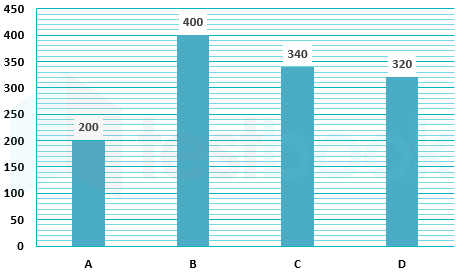
Direction: The given bar graph shows the number of workers in a factory.

Above the age of 40 years
A50
B70
C110
D120

Question 44

If 40% of the total number of workers in a factory A and C together are females and 20% of the number of workers in a factory B are males. Find the total females in factory A, B and C together.

  1. AOption (a)

    510

  2. BOption (b)

    448

  3. COption (c)

    536

  4. DOption (d)

    400

  5. EOption (e)

    356

View answer & explanation

Correct answer

Answer: (c)C.

536

Why this answer is correct

Percentage of females in factory A and C together = 40%

Number of females in factory A and C together = 40% of (200 + 340) = 216

Percentage of males in factory B = 20%

Percentage of females in factory B = 100 – 20 = 80%

Number of females in factory B = 80% of 400 = 320

∴ Required number = 216 + 320 = 536

Question 45

If the total number of males and females in a new factory E is 20% more than the total number of males and females in factory D and the ratio of the number of males and females in factory E is 7 : 5. Find the number of females in factory E.

  1. AOption (a)

    220

  2. BOption (b)

    224

  3. COption (c)

    180

  4. DOption (d)

    160

  5. EOption (e)

    240

View answer & explanation

Correct answer

Answer: (d)D.

160

Why this answer is correct

Number of workers in factory D = 320

Number of workers in factory E = 320 + 20% of 320 = 384

Ratio of the number of males and females in factory E = 7 : 5

∴ required number of females = 5/12 × 384 = 160

Question 46

If 60% of the workers above 40 years in factory A and C together and 50% of the workers above 40 years in factory B and D together is females then find the ratio of the number of males in factory A and C to factory B and D together who were above 40 years of age.

  1. AOption (a)

    75 : 83

  2. BOption (b)

    29 : 55

  3. COption (c)

    64 : 95

  4. DOption (d)

    38 : 59

  5. EOption (e)

    67 : 85

View answer & explanation

Correct answer

Answer: (c)C.

64 : 95

Why this answer is correct

Percentage of females in factory A and C together (above 40 years) = 60%

Percentage of males in factory A and C together (above 40 years) = 40%

Number of males in factory A and C together (above 40 years) = 40/100 × (50 + 110) = 64

Percentage of females in factory B and D together (above 40 years) = 50%

Percentage of males in factory B and D together (above 40 years) = 50%

Number of males in factory B and D together (above 40 years) = 50/100 × (70 + 120) = 95

∴ required ratio = 64 : 95

Question 47

In factory C, the number of males above 40 years of age is 30 and in factory A, the number of males above 40 years is 30. Find female workers above the age of 40 in factory C is how much percent more/less than the number of female workers above the age of 40 in factory A?

  1. AOption (a)

    300%

  2. BOption (b)

    400%

  3. COption (c)

    150%

  4. DOption (d)

    200%

  5. EOption (e)

    600%

View answer & explanation

Correct answer

Answer: (a)A.

300%

Why this answer is correct

Number of males in factory C (above 40 years) = 30

Number of females in factory C (above 40 years) = 110 – 30 = 80

Number of males in factory A (above 40 years) = 30

Number of females in factory A (above 40 years) = 50 – 30 = 20

∴ required percentage = [(80 – 20) / 20 ] × 100 = 300%

Question 48

If the total number of females above 40 years in all the factories is 20% then what will be the average number of female workers above 40 years in all the factories?

  1. AOption (a)

    17.1

  2. BOption (b)

    17.2

  3. COption (c)

    17.5

  4. DOption (d)

    17.8

  5. EOption (e)

    17 

View answer & explanation

Correct answer

Answer: (c)C.

17.5

Why this answer is correct

Total number of workers above 40 years in all the factories = 50 + 70 + 110 + 120 = 350

Number of females above 40 years in all the factories = 20% of 350 = 70

∴ required average = 70/4 = 17.5

Question 49

Find the total number of workers in all the factories whose age is below 40 years.

  1. AOption (a)

    840

  2. BOption (b)

    860

  3. COption (c)

    910

  4. DOption (d)

    915

  5. EOption (e)

    925

View answer & explanation

Correct answer

Answer: (c)C.

910

Why this answer is correct

Total number of workers in all the factories = 200 + 400 + 340 + 320 = 1260

Total number of workers above 40 years of age = 50 + 70 + 110 + 120 = 350

∴ total number of workers in all the factories whose age is below 40 years = 1260 – 350 = 910

Direction: The given pie chart shows the distribution of 5000 animals in 5 different forests.

Note: The animals are of 3 types: 1. Herbivores 2. Carnivores 3. Omnivores

Question 50

Find the ratio of the number of animals in the forest A and B together to the number of animals in the forest D and E together.

  1. AOption (a)

    1 : 2

  2. BOption (b)

    2 : 3

  3. COption (c)

    3 : 4

  4. DOption (d)

    4 : 5

  5. EOption (e)

    5 : 6

View answer & explanation

Correct answer

Answer: (a)A.

1 : 2

Why this answer is correct

Calculation:

Percentage of animals in the forest A and B together = (20% + 5%) = 25%

Number of animals in the forest A and B together = 25% of 5000 = 1250

Percentage of animals in the forest D and E together = (10% + 40%) = 50%

Number of animals in the forest D and E together = 50% of 5000 = 2500

∴ Required ratio = 1250 : 2500 = 1 : 2


The ratio = (20 + 5)% : (40 + 10)%

The ratio = 25 : 50 = 1 : 2

∴ Required ratio is 1 : 2

Question 51

If the number of herbivores animals in forest E is half of the carnivores animals in the same forest and equal to the number of omnivores animals in the same forest then find the number of herbivores animals in forest E.

  1. AOption (a)

    500

  2. BOption (b)

    200

  3. COption (c)

    300

  4. DOption (d)

    400

  5. EOption (e)

    600

View answer & explanation

Correct answer

Answer: (a)A.

500

Why this answer is correct

Calculation:

Let the number of herbivores animals in forest E = x

Number of carnivores’ animals in forest E = 2x

Number of omnivores animals in forest E = x

x + 2x + x = 40% of 5000

⇒ x = 500

∴ The number of herbivores animals in the forest E is 500

Question 52

If total number of carnivores animals in all the forest is 10%. Then find the average number of carnivores animals in all the forest.

  1. AOption (a)

    100

  2. BOption (b)

    200

  3. COption (c)

    30

  4. DOption (d)

    40

  5. EOption (e)

    56

View answer & explanation

Correct answer

Answer: (a)A.

100

Why this answer is correct

Calculation:

Number of animals in all the forest = 5000

Percentage of carnivores animals in all the forest = 10%

Number of carnivores animals in all the forest = 10% of 5000 = 500

∴ Required average = 500/5 = 100

Question 53

If 25% of the animals in forest A is omnivores. Then the number of omnivores animals in the forest A is what percent of the total number of animals in the forest D?

  1. AOption (a)

    16%

  2. BOption (b)

    20%

  3. COption (c)

    36%

  4. DOption (d)

    40%

  5. EOption (e)

    50%

View answer & explanation

Correct answer

Answer: (e)E.

50%

Why this answer is correct

Calculation: 

Number of animals in forest A = 20% of 5000 = 1000

Percentage of omnivores animals in forest A = 25%

Number of omnivores animals in forest A = 25% of 1000 = 250

Number of animals in the forest D = 10% of 5000 = 500

∴ Required ratio = (250/500) × 100 = 50%

Question 54

The total number of animals in the forest A, B and C together is what percent more or less than the total number of animals in the forest D and E together?

  1. AOption (a)

    10%

  2. BOption (b)

    20%

  3. COption (c)

    32%

  4. DOption (d)

    0%

  5. EOption (e)

    5%

View answer & explanation

Correct answer

Answer: (d)D.

0%

Why this answer is correct

Calculation:

The total percentage of animals in the forest A, B and C together = (20% + 5% + 25%) = 50%

The total number of animals in the forest A, B and C together = 50% of 5000 = 2500

The total percentage of animals in the forest D and E together = (10% + 40%) = 50%

The total number of animals in the forest D and E together = 50% of 5000 = 2500

∴ Required percentage = [(2500 – 2500) / 2500] × 100 = 0% 


The total percentage of animals in the forest A, B and C together = (20% + 5% + 25%) = 50%

The total percentage of animals in the forest D and E together = (10% + 40%) = 50%

Required percentage = [(50 – 50) / 50] × 100 = 0%

∴ Required percentage is 0%

Question 55

What will come in place of question mark (?) in the following series?

18, 26, 53, 117, 242, ?

  1. AOption (a)

    458

  2. BOption (b)

    216

  3. COption (c)

    518

  4. DOption (d)

    468

  5. EOption (e)

    478

View answer & explanation

Correct answer

Answer: (a)A.

458

Why this answer is correct

18 + 23 = 26

26 + 33 = 53

53 + 43 = 117

117 + 53 = 242

242 + 63 = 458

Question 56

Find the missing number in the series

100, 108, 98, 106, 96, ?

  1. AOption (a)

    104

  2. BOption (b)

    107

  3. COption (c)

    108

  4. DOption (d)

    204

  5. EOption (e)

    114

View answer & explanation

Correct answer

Answer: (a)A.

104

Why this answer is correct

The given series is followed by +8, -10 

100 + 8 = 108

108 - 10 = 98

98 + 8 = 106

106 - 10 = 96

96 + 8 = 104

Question 57

Find the missing number in the series

2, 1, 1, 1.5, 3, ?

  1. AOption (a)

    5.5

  2. BOption (b)

    6.5

  3. COption (c)

    7.5

  4. DOption (d)

    6

  5. EOption (e)

    7

View answer & explanation

Correct answer

Answer: (c)C.

7.5

Why this answer is correct

2 × 1/2 = 1

1 × 2/2 = 1

1 × 3/2 = 1.5

1.5 × 4/2 = 3

3 × 5/2 = 7.5

Question 58

Find the missing number in the series

18, 24, 36, 56, 86, ?

  1. AOption (a)

    128

  2. BOption (b)

    256

  3. COption (c)

    156

  4. DOption (d)

    144

  5. EOption (e)

    196

View answer & explanation

Correct answer

Answer: (a)A.

128

Why this answer is correct

The given sequence is +6, +12 (6+6), +20 (12+8), +30 (20+10) 

18 + 6 = 24

24 + 12 = 36

36 + 20 = 56

56 + 30 = 86

86 + 42 = 128

Question 59

Find the missing number in the series

1, 11, 99, 693, 3465, ?

  1. AOption (a)

    8946

  2. BOption (b)

    11296

  3. COption (c)

    10395

  4. DOption (d)

    12974

  5. EOption (e)

    10296

View answer & explanation

Correct answer

Answer: (c)C.

10395

Why this answer is correct

1  × 11 = 11

11 × 9 = 99

99 × 7 = 693

693 × 5 = 3465

3465 × 3 = 10395

Directions: There are 3500 employees in a company working in three departments namely, Production, Marketing and Accounts. The ratio of male to female employees is 13 ∶ 7. 30% of the employees are in the Accounts department. 20% of the males are in the Production department. Number of female employees in the Production department are two third the number of employees in the Accounts department. The ratio of male and female employees in the Marketing department is 5 ∶ 2.

Question 60

What is the ratio of female to male in the Accounts department?

  1. AOption (a)

    179 ∶ 31

  2. BOption (b)

    31 ∶ 179

  3. COption (c)

    13 ∶ 179

  4. DOption (d)

    179 ∶ 13 

  5. EOption (e)

    1 ∶ 13

View answer & explanation

Correct answer

Answer: (b)B.

31 ∶ 179

Why this answer is correct

Let the no. male employees in the company be 13x and the female employees be 7x.

∴ 13x + 7x = 3500

⇒ 20x = 3500

⇒ x = 3500/20

⇒ x = 175

∴ No. of male employees = 13 × 175 = 2275

No. of employees in the accounts department = 30% of 3500

⇒30100×;3500 \Rightarrow \frac{{30}}{{100}} \times {\rm{;}}3500

⇒ 35 × 30 = 1050

No. of males in the production department = 20% of 2275

⇒20100×;2275 ⇒15×;2275;=;455\begin{array}{l} \Rightarrow \frac{{20}}{{100}} \times {\rm{;}}2275\ \Rightarrow \frac{1}{5} \times {\rm{;}}2275{\rm{;}} = {\rm{;}}455 \end{array}

No. of females in the production department = 23×;1050;=;700\frac{2}{3} \times {\rm{;}}1050{\rm{;}} = {\rm{;}}700

∴ Total employees in production department = 700 + 455 = 1155

∴ Total employees in marketing department = 3500 – (1155 + 1050) = 1295

Let the no. male employees in the marketing department be 5x and the female employees be 2x.

∴ 5x + 2x = 1295

⇒ 7x = 1295

⇒ x = 185

⇒ Male employees in marketing department = 5 × 185 = 925

∴ No. of males in the Accounts department = 2275 – (455 + 925) = 895

⇒ No. of females in the Accounts department = 1050 – 895 = 155

∴ Ratio of females to males in the Accounts department = 155895;=;31179;=;31;:;179\frac{{155}}{{895}}; = ;\frac{{31}}{{179}}; = ;31; : ;179

Question 61

What percentage of male employees work in the Accounts department?

  1. AOption (a)

    40

  2. BOption (b)

    34.39

  3. COption (c)

    39.34

  4. DOption (d)

    49.34

  5. EOption (e)

    43.39

View answer & explanation

Correct answer

Answer: (c)C.

39.34

Why this answer is correct

Let the no. male employees in the company be 13x and the female employees be 7x.

∴ 13x + 7x = 3500

⇒ 20x = 3500

⇒ x = 3500/20

⇒ x = 175

∴ No. of male employees = 13 × 175 = 2275

No. of employees in the accounts department = 30% of 3500

⇒30100×3500\Rightarrow \frac{{30}}{{100}} \times 3500

⇒ 35 × 30 = 1050

No. of males in the production department = 20% of 2275

⇒20100×2275 ⇒15×2275;=;455\begin{array}{l} \Rightarrow \frac{{20}}{{100}} \times 2275\ \Rightarrow \frac{1}{5} \times 2275{\rm{;}} = {\rm{;}}455 \end{array}

No. of females in the production department = 23×1050;=;700\frac{2}{3} \times 1050{\rm{;}} = {\rm{;}}700

∴ Total employees in production department = 700 + 455 = 1155

∴ Total employees in marketing department = 3500 – (1155 + 1050) = 1295

Let the no. male employees in the marketing department be 5x and the female employees be 2x.

∴ 5x + 2x = 1295

⇒ 7x = 1295

⇒ x = 185

⇒ Male employees in marketing department = 5 × 185

= 925

∴ No. of males in the Accounts department = 2275 – (455 + 925) = 895

∴ % of male employees in Accounts department = 8952275×100;=;39.34\frac{{895}}{{2275}} \times 100; = {\rm{;}}39.34

Question 62

What is the number of female employees in the Production department?

  1. AOption (a)

    1050

  2. BOption (b)

    700

  3. COption (c)

    350

  4. DOption (d)

    530

  5. EOption (e)

    735

View answer & explanation

Correct answer

Answer: (b)B.

700

Why this answer is correct

No. of employees in the accounts department = 30% of 3500

⇒30100×3500\Rightarrow \frac{{30}}{{100}} \times 3500

⇒ 35 × 30 = 1050

No. of females in the production department = 23×1050;=;700\frac{2}{3} \times 1050{\rm{;}} = {\rm{;}}700

Question 63

What is the difference between the no. males in the Marketing department and the Production department?

  1. AOption (a)

    470

  2. BOption (b)

    490

  3. COption (c)

    740

  4. DOption (d)

    940

  5. EOption (e)

    790

View answer & explanation

Correct answer

Answer: (a)A.

470

Why this answer is correct

Let the no. male employees in the company be 13x and the female employees be 7x.

∴ 13x + 7x = 3500

⇒ 20x = 3500

⇒ x = 3500/20

⇒ x = 175

∴ No. of male employees = 13 × 175 = 2275

No. of employees in the accounts department = 30% of 3500

⇒30100×;3500\Rightarrow \frac{{30}}{{100}} \times {\rm{;}}3500

⇒ 35 × 30 = 1050

No. of males in the production department = 20% of 2275

⇒20100×2275;=;455\Rightarrow \frac{{20}}{{100}} \times 2275{\rm{;}} = {\rm{;}}455

No. of females in the production department = 23×;1050;=;700\frac{2}{3} \times {\rm{;}}1050{\rm{;}} = {\rm{;}}700

∴ Total employees in production department = 700 + 455 = 1155

∴ Total employees in marketing department = 3500 – (1155 + 1050) = 1295

Let the no. male employees in the marketing department be 5x and the female employees be 2x.

∴ 5x + 2x = 1295

⇒ 7x = 1295

⇒ x = 185

⇒ Male employees in marketing department = 5 × 185 = 925

∴ The difference between the no. males in the Marketing department and the Production department = 925 – 455 = 470

Question 64

A train crosses a platform having a length of 300 m in 30 seconds and a standing pole in 10 seconds. Calculate the length of the train in meters.

  1. AOption (a)

    85 m

  2. BOption (b)

    220 m

  3. COption (c)

    150 m

  4. DOption (d)

    200 m

  5. EOption (e)

    110 m

View answer & explanation

Correct answer

Answer: (c)C.

150 m

Why this answer is correct

Shortcut Trick

Time to cross platform (Train + Platform) = 30 seconds

Time to cross standing pole (Train only) = 10 seconds

Time taken to cover platform length alone = 30 − 10 = 20 seconds

Ratio of Train length to Platform length = 10 : 20 = 1 : 2

If 2 units = 300 m, then 1 unit = 150 m

∴ The correct answer is 150 m.

Alternate Method

Given: Length of platform = 300 m, Time to cross pole = 10 s, Time to cross platform = 30 s.

Formula Used: Speed = Distance ÷ Time

⇒ Speed of train (v) = Train Length (L) ÷ 10

⇒ Speed of train (v) = (L + 300) ÷ 30

⇒ L ÷ 10 = (L + 300) ÷ 30

⇒ 3 × L = L + 300

⇒ 2 × L = 300

⇒ L = 150 m

∴ The correct answer is 150 m.

Additional Information

Relative Speed

When two objects move in the same direction, relative speed = S1 − S2. In opposite directions, relative speed = S1 + S2.

Train Crossing Objects

To cross a point object (pole, man), distance = length of train. To cross a stationary object with length (bridge, tunnel, platform), distance = length of train + length of object.

Unit Conversion

To convert km/hr to m/s, multiply by 5/18. To convert m/s to km/hr, multiply by 18/5.

Question 65

In a set of 6 numbers, the average of first four is 10 and that of last four is 8. If the average of all the six numbers is 9, then find the average of the third and fourth number.

  1. AOption (a)

    7

  2. BOption (b)

    8

  3. COption (c)

    9

  4. DOption (d)

    10

  5. EOption (e)

    11

View answer & explanation

Correct answer

Answer: (c)C.

9

Why this answer is correct

Shortcut Trick

Sum of first four numbers = 4 × 10 = 40

Sum of last four numbers = 4 × 8 = 32

Total Sum of all six numbers = 6 × 9 = 54

Sum of 3rd and 4th numbers = (Sum of 1-4) + (Sum of 3-6) − (Sum of 1-6)

Sum of 3rd and 4th = 40 + 32 − 54 = 18

Average of 3rd and 4th = 18 ÷ 2 = 9

∴ The correct answer is 9.

Alternate Method

Let the 6 numbers be x1, x2, x3, x4, x5, x6.

Given: Average of 6 numbers = 9; Average of first four = 10; Average of last four = 8.

Formula Used: Sum = Average × Number of terms

⇒ Sum of all numbers (S6) = 6 × 9 = 54

⇒ Sum of first 4 (Sfirst4) = 4 × 10 = 40

⇒ Sum of last 4 (Slast4) = 4 × 8 = 32

⇒ (x1 + x2 + x3 + x4) + (x3 + x4 + x5 + x6) = 40 + 32 = 72

⇒ (x1 + x2 + x3 + x4 + x5 + x6) + (x3 + x4) = 72

⇒ 54 + (x3 + x4) = 72

⇒ x3 + x4 = 72 − 54 = 18

⇒ Average of x3 and x4 = 18 ÷ 2 = 9

∴ The correct answer is 9.

Additional Information

Overlap Concept in Averages

When groups overlap, the sum of individual groups minus the total sum gives the sum of the overlapping elements.

Weighted Average

The combined average of two groups is given by (n1a1 + n2a2) ÷ (n1 + n2), where n is the count and a is the average.

Reasoning Ability (35 questions)

Direction: Study the information carefully and answer the given questions.

Eight people A, B, C, D, E, F, G and H are sitting around a circular table with equal distance between them. Some of them are facing the centre while others are facing outside (i.e. opposite to the centre).

H is an immediate neighbor of F. F faces the centre. Only three people sit between F and A. C sits third to the left of A. Immediate neighbors of C face the same direction (i.e. if one neighbor faces the centre then the other also faces the centre and vice versa). G sits to the immediate right of B. B is an immediate neighbor of H.D sits second to the left of G. Immediate neighbors of D faces opposite direction (i.e. if one neighbor faces the centre other faces outside the centre and vice-versa). E sits to the immediate left of C. Both D and H face a direction opposite to that of E (i.e. if E faces the centre then both D and H face outside the centre and vice versa).

Question 66

Who among the following sits second to the left of H?

  1. AOption (a)

    C

  2. BOption (b)

    E

  3. COption (c)

    G

  4. DOption (d)

    B

  5. EOption (e)

    None of these

View answer & explanation

Correct answer

Answer: (c)C.

G

Why this answer is correct

Eight people: A, B, C, D, E, F, G, and H sitting around a table.

Some of them are facing the centre while others are facing outside (i.e. opposite to the centre)

1)  F faces the centre.

  1. Only three people sit between F and A.

  2. C sits third to the left of A.

4) Immediate neighbors of C face the same direction

5) H is an immediate neighbor of F.

6) B is an immediate neighbor of H.

7) G sits to the immediate right of B.

8) D sits second to the left of G.

9) Immediate neighbors of D faces the opposite direction.

(As in the case ii, Immediate neighbors of D faces the same direction, case ii gets eliminated).

10) E sits to the immediate left of C.

  1. Both D and H face a direction opposite to that of E.

Hence, G sits second to the left of H.

Question 67

Four of the following five pairs are alike in a certain and hence form a group. Which among the following does not belong to that group?

  1. AOption (a)

    AG.

  2. BOption (b)

    DB.

  3. COption (c)

    CF.

  4. DOption (d)

    DH.

  5. EOption (e)

    BE

View answer & explanation

Correct answer

Answer: (b)B.

DB.

Why this answer is correct

Eight people: A, B, C, D, E, F, G, and H sitting around a table.

Some of them are facing the centre while others are facing outside (i.e. opposite to the centre)

1)  F faces the centre. 

  1. Only three people sit between F and A. 

  2. C sits third to the left of A.

4) Immediate neighbors of C face the same direction

5) H is an immediate neighbor of F.

6) B is an immediate neighbor of H.

7) G sits to the immediate right of B.

8) D sits second to the left of G.

9) Immediate neighbors of D faces the opposite direction.

(As in the case ii, Immediate neighbors of D faces the same direction, case ii gets eliminated).

10) E sits to the immediate left of C. 

  1. Both D and H face a direction opposite to that of E.

Here except DB, all other pairs are facing in the same directions of each other.

Hence, DB is the odd one out.

Question 68

If D and B interchange their position, then which among the following sits second to the right of A as per the new arrangement?

  1. AOption (a)

    D

  2. BOption (b)

    B

  3. COption (c)

    E

  4. DOption (d)

    C

  5. EOption (e)

    None of these

View answer & explanation

Correct answer

Answer: (a)A.

D

Why this answer is correct

Eight people: A, B, C, D, E, F, G, and H sitting around a table.

Some of them are facing the centre while others are facing outside (i.e. opposite to the centre)

1)  F faces the centre. 

  1. Only three people sit between F and A. 

  2. C sits third to the left of A.

4) Immediate neighbors of C face the same direction

5) H is an immediate neighbor of F.

6) B is an immediate neighbor of H.

7) G sits to the immediate right of B.

8) D sits second to the left of G.

9) Immediate neighbors of D faces the opposite direction.

(As in the case ii, Immediate neighbors of D faces the same direction, case ii gets eliminated).

10) E sits to the immediate left of C. 

  1. Both D and H face a direction opposite to that of E.

Hence, if D and B interchange their positions, then D sits second to the right of A.

Question 69

How many persons sit between E and F when counted from the left of E?

  1. AOption (a)

    One

  2. BOption (b)

    Four

  3. COption (c)

    Three

  4. DOption (d)

    None of these

  5. EOption (e)

    Five

View answer & explanation

Correct answer

Answer: (e)E.

Five

Why this answer is correct

Eight people: A, B, C, D, E, F, G, and H sitting around a table.

Some of them are facing the centre while others are facing outside (i.e. opposite to the centre)

1)  F faces the centre. 

  1. Only three people sit between F and A. 

  2. C sits third to the left of A.

4) Immediate neighbors of C face the same direction

5) H is an immediate neighbor of F.

6) B is an immediate neighbor of H.

7) G sits to the immediate right of B.

8) D sits second to the left of G.

9) Immediate neighbors of D faces the opposite direction.

(As in the case ii, Immediate neighbors of D faces the same direction, case ii gets eliminated).

10) E sits to the immediate left of C. 

  1. Both D and H face a direction opposite to that of E.

Hence, five-persons sit between E and F when counted from the left of E.

Question 70

What is the position of A with respect to G?

  1. AOption (a)

    Immediate Right

  2. BOption (b)

    Third to the Right

  3. COption (c)

    Third to the Left

  4. DOption (d)

    Immediate Left

  5. EOption (e)

    Second to the Left

View answer & explanation

Correct answer

Answer: (d)D.

Immediate Left

Why this answer is correct

Eight people: A, B, C, D, E, F, G, and H sitting around a table.

Some of them are facing the centre while others are facing outside (i.e. opposite to the centre)

1)  F faces the centre. 

  1. Only three people sit between F and A. 

  2. C sits third to the left of A.

4) Immediate neighbors of C face the same direction

5) H is an immediate neighbor of F.

6) B is an immediate neighbor of H.

7) G sits to the immediate right of B.

8) D sits second to the left of G.

9) Immediate neighbors of D faces the opposite direction.

(As in the case ii, Immediate neighbors of D faces the same direction, case ii gets eliminated).

10) E sits to the immediate left of C. 

  1. Both D and H face a direction opposite to that of E.

Hence, A sits to the immediate left of G.

Question 71

Direction: In the question below are given two statements followed by two conclusions numbered I and II. You have to take the given statements to be true even if they seem to be at variance with commonly known facts. Read all the conclusions and then decide which of the given conclusions logically follows from the given statements disregarding commonly known facts.

Statement:

No apple is gloves.

All boats are apple.

All radios are boat.

Conclusion:

I. At least some apples are boats.

II. All gloves are radios.

  1. AOption (a)

    Only I follows

  2. BOption (b)

    Only II follows

  3. COption (c)

    Either I or II follows

  4. DOption (d)

    Neither I nor II follows

  5. EOption (e)

    Both I and II follow

View answer & explanation

Correct answer

Answer: (a)A.

Only I follows

Why this answer is correct

The least possible Venn diagram is as follows:

Conclusions:

I. At least some apples are boats → True

II. All gloves are radios → False.

Hence, only conclusion I follow.

Question 72

Direction: In the question below are given three statements followed by two conclusions numbered I and II. You have to take the given statements to be true even if they seem to be at variance with commonly known facts. Read all the conclusions and then decide which of the given conclusions logically follows from the given statements disregarding commonly known facts.

Statements:

Only a few wines are cashews.

Few bottles are wines.

No dot is cashew.

Conclusion:

I. At least some wines are dots.

II. All cashews being bottles is a possibility.

  1. AOption (a)

    Only I follows

  2. BOption (b)

    Only II follows

  3. COption (c)

    Either I or II follows

  4. DOption (d)

    Neither I nor II follows

  5. EOption (e)

    Both I and II follow

View answer & explanation

Correct answer

Answer: (b)B.

Only II follows

Why this answer is correct

The least possible diagram for the given statements is as follows

Conclusion:

I. At least some wines are dots → False.

II. All cashews being bottles is a possibility → Possibility is true.

Hence, only II follows.

Question 73

Direction: In the question below are given two statements followed by two conclusions numbered I and II. You have to take the given statements to be true even if they seem to be at variance with commonly known facts. Read all the conclusions and then decide which of the given conclusions logically follows from the given statements disregarding commonly known facts.

Statements:

All grains are band.

All poets are band.

No band is a lubricant.

Conclusion:

I. All bands being grain is a possibility.

II. No poet is a lubricant.

  1. AOption (a)

    Only I follows

  2. BOption (b)

    Only II follows

  3. COption (c)

    Either I or II follows

  4. DOption (d)

    Neither I nor II follows

  5. EOption (e)

    Both I and II follow

View answer & explanation

Correct answer

Answer: (e)E.

Both I and II follow

Why this answer is correct

The least possible diagram for the given statements is as follows

Conclusion:

I. All bands being grain is a possibility → Possibility is true.

II. No poet is a lubricant → True.  

Hence, both I and II follow.

Question 74

Direction: In the question below are given three statements followed by two conclusions numbered I and II. You have to take the given statements to be true even if they seem to be at variance with commonly known facts. Read all the conclusions and then decide which of the given conclusions logically follows from the given statements disregarding commonly known facts.

Statement:

Only a few circles are Dollars.

Some Dollars are Soaps.

No rectangle is a circle.

Conclusion:

I. All circles being rectangles is a possibility.

II. Some rectangles are definitely not soaps.

  1. AOption (a)

    Only I follows

  2. BOption (b)

    Only II follows

  3. COption (c)

    Either I or II follows

  4. DOption (d)

    Neither I nor II follows

  5. EOption (e)

    Both I and II follow

View answer & explanation

Correct answer

Answer: (d)D.

Neither I nor II follows

Why this answer is correct

The least possible diagram for the given statements is as follows

Conclusion:

I. All circles being rectangle is a possibility → False (as no rectangle is a circle means no circle is a rectangle)

II. Some rectangles are definitely not soaps → False.

Hence, neither I nor II follows.

Direction: Read the information carefully and answer the questions asked below.

Karthik is at point H and is facing towards East. He started walking from point H and walked 60 m to reach a point Z. From Z he has taken a right turn and walked 54 m to reach W, and again taken a left turn and walked 50 m to reach point S. Arjun started from point F and walked 30 m towards West direction to reach point G. From G he takes a left turn and walked 54 m to reach point S.

Question 75

What is the distance between H and F?

  1. AOption (a)

    118 m

  2. BOption (b)

    110 m

  3. COption (c)

    150 m

  4. DOption (d)

    140 m

  5. EOption (e)

    120 m

View answer & explanation

Correct answer

Answer: (d)D.

140 m

Why this answer is correct

Hence, the distance between H and F is 140m.

Hence, 140m is the correct answer.

Question 76

In which direction is point W with respect to point G?

  1. AOption (a)

    South – West

  2. BOption (b)

    North – West

  3. COption (c)

    North

  4. DOption (d)

    South – East

  5. EOption (e)

    South

View answer & explanation

Correct answer

Answer: (a)A.

South – West

Why this answer is correct

Point W is in South-West direction with respect to point G.

Hence, South-West is the correct answer.

Question 77

Four of the following five are alike in a certain way, which among the following does not belong to the group?

  1. AOption (a)

    Z

  2. BOption (b)

    F

  3. COption (c)

    W

  4. DOption (d)

    G

  5. EOption (e)

    H

View answer & explanation

Correct answer

Answer: (c)C.

W

Why this answer is correct

W is not in the straight line as H, Z, G, F.

Hence, W is the correct answer.

Direction: Study the following information carefully and answer the questions given below.

Ten people are sitting in a straight line facing North with equal distance between each other. 

Only 3 people sit to the left of M. Only one person sits between M and R. P sits third to the right of R. As many people sit to the right of P as to the left of Q. Only three people sit between Q and S. U is an immediate neighbor of S. T sits second to the left of W.  N sits to the immediate right of V.

Question 78

How many people sit between N and R?

  1. AOption (a)

    Four

  2. BOption (b)

    Two

  3. COption (c)

    Five

  4. DOption (d)

    One

  5. EOption (e)

    Three

View answer & explanation

Correct answer

Answer: (c)C.

Five

Why this answer is correct

Ten people are sitting in a straight line facing North with equal distance between each other.

1) Only 3 people sit to the left of M.

2) Only one person sits between M and R.

  1. P sits third to the right of R.

  2. As many people sit to the right of P as to the left of Q.

5) Only three people sit between Q and S. (Here case ii gets eliminated).

6) U is an immediate neighbor of S.

  1. T sits second to the left of W. 

  2. N sits to the immediate right of V.

Hence, there are five people sit between N and R.

Question 79

Who sits second to the right of Q?

  1. AOption (a)

    W

  2. BOption (b)

    R

  3. COption (c)

    M

  4. DOption (d)

    T

  5. EOption (e)

    N

View answer & explanation

Correct answer

Answer: (e)E.

N

Why this answer is correct

Ten people are sitting in a straight line facing North with equal distance between each other.

1) Only 3 people sit to the left of M.

2) Only one person sits between M and R. 

  1. P sits third to the right of R. 

  2. As many people sit to the right of P as to the left of Q.

5) Only three people sit between Q and S. (Here case ii gets eliminated).

6) U is an immediate neighbor of S. 

  1. T sits second to the left of W.  

8) N sits to the immediate right of V.

Hence, N sits 2nd to the right of Q.

Question 80

Which of the following pairs represents persons seated at the two extreme ends of the line?

  1. AOption (a)

    QW

  2. BOption (b)

    ST

  3. COption (c)

    TQ

  4. DOption (d)

    UN

  5. EOption (e)

    WS

View answer & explanation

Correct answer

Answer: (b)B.

ST

Why this answer is correct

Ten people are sitting in a straight line facing North with equal distance between each other.

1) Only 3 people sit to the left of M.

2) Only one person sits between M and R. 

  1. P sits third to the right of R. 

  2. As many people sit to the right of P as to the left of Q.

5) Only three people sit between Q and S. (Here case ii gets eliminated).

6) U is an immediate neighbor of S. 

  1. T sits second to the left of W.  

8) N sits to the immediate right of V.

Hence, "ST" represents persons seated at the two extreme ends of the line

Question 81

Four of the following five are alike in a certain way and so form a group. Who among the following does not belong to the group?

  1. AOption (a)

    SP

  2. BOption (b)

    UV

  3. COption (c)

    WT

  4. DOption (d)

    MR

  5. EOption (e)

    VP

View answer & explanation

Correct answer

Answer: (a)A.

SP

Why this answer is correct

Ten people are sitting in a straight line facing North with equal distance between each other.

1) Only 3 people sit to the left of M.

2) Only one person sits between M and R. 

  1. P sits third to the right of R. 

  2. As many people sit to the right of P as to the left of Q.

5) Only three people sit between Q and S. (Here case ii gets eliminated).

6) U is an immediate neighbor of S. 

  1. T sits second to the left of W.  

8) N sits to the immediate right of V.

Here except 'SP', other pairs have one people between them.

Hence, "SP" is the odd one out.

Question 82

Which of the following statement is definitely true?

  1. AOption (a)

    Two people sit between V and W

  2. BOption (b)

    V sits 3rd to the right of S

  3. COption (c)

    M sits at extreme left end

  4. DOption (d)

    None of the given statement is true

  5. EOption (e)

    P sits immediate left of Q

View answer & explanation

Correct answer

Answer: (e)E.

P sits immediate left of Q

Why this answer is correct

Ten people are sitting in a straight line facing North with equal distance between each other.

1) Only 3 people sit to the left of M.

2) Only one person sits between M and R. 

  1. P sits third to the right of R. 

  2. As many people sit to the right of P as to the left of Q.

5) Only three people sit between Q and S. (Here case ii gets eliminated).

6) U is an immediate neighbor of S. 

  1. T sits second to the left of W.  

8) N sits to the immediate right of V.

Hence, 'P sits immediate left of Q' is the true statement.

Question 83

How many pairs of letters are there in the word “MERCHANT” which has as many letters between them as in the English alphabetical series? (in both forward and backward direction)

  1. AOption (a)

    Two

  2. BOption (b)

    Three

  3. COption (c)

    Four

  4. DOption (d)

    More than four

  5. EOption (e)

    One

View answer & explanation

Correct answer

Answer: (d)D.

More than four

Why this answer is correct

Given word: MERCHANT

Hence, there are more than four pairs → Forward: EH,MT; Backward: AC, CE, AE, NR.

Question 84

In a word "MODELLING", if all letters are arranged in the alphabetical order, and then the vowels are changed to the previous letter and the consonants are changed to the next letter as per the English alphabetical series, then how many letters do not repeat more than once?

  1. AOption (a)

    Three

  2. BOption (b)

    Four

  3. COption (c)

    None

  4. DOption (d)

    One

  5. EOption (e)

    Five

View answer & explanation

Correct answer

Answer: (a)A.

Three

Why this answer is correct

Given Word: MODELLING

After arranging all letters of the given word in alphabetical order: 

D E G I L L M N O

After changing all vowels to the previous letter and all consonants to the next letter as per the English alphabetical series: 

E D H H M M N O N

Hence, only three letters E, D, and O are not repeating more than once in the above arrangement.

Directions: Study the following information and answer the given questions:

There are six people A, B, C, D, E, and F of different heights. A is taller than D and C. B is taller than A but shorter than E. C is not the shortest person. D is shorter than only three-person. The third tallest person has 115cm height.

Question 85

Who is the tallest?

  1. AOption (a)

    F

  2. BOption (b)

    E

  3. COption (c)

    A

  4. DOption (d)

    C

  5. EOption (e)

    D

View answer & explanation

Correct answer

Answer: (b)B.

E

Why this answer is correct

Six people A, B, C, D, E, and F.

A is taller than D and C.

B is taller than A but shorter than E.

C is not the shortest person.

D is shorter than only three person. The third tallest person has 115cm height.

E > B > A > D > C > F

Therefore, E is the tallest.

Question 86

If the height of A and E is 235cm and the height of A and D is 220cm, then what is the height of E ?

  1. AOption (a)

    80

  2. BOption (b)

    120

  3. COption (c)

    85

  4. DOption (d)

    95

  5. EOption (e)

    100

View answer & explanation

Correct answer

Answer: (b)B.

120

Why this answer is correct

Six people A, B, C, D, E, and F.

A is taller than D and C. 

B is taller than A but shorter than E. 

C is not the shortest person. 

D is shorter than only three-person. The third tallest person has 170 cm in height.

E > B > A > D > C > F

Now, A + E = 235------- (i)

and A + D = 220--------(ii)

A is the third tallest person = 115 cm

E = 235 - 115 = 120 cm

 Hence, the height of E is 120 cm.

Directions: Read the following information carefully and answer the questions that follow.

A, B, C, D, E, F, G, and H live on 8 different floors of 8 storey building. The lower most floor is numbered 1. The one above it, is numbered 2. Going on like this, the topmost floor is numbered 8. One person lives on each floor.

B lives on an odd-numbered floor above floor 3. Two people live between B and C. Three people live between C and D. The number of people who live below C is equal to the number of people who live above A. F lives on two floors above C. G lives on one of the floors below E and H lives on one of the floors above both G & E. A lives on one of the floors above D.

Question 87

Four of the following five are alike in a certain way and hence they form a group, which one of the following does not belong to the group?

  1. AOption (a)

    GE

  2. BOption (b)

    DH

  3. COption (c)

    EB

  4. DOption (d)

    CD

  5. EOption (e)

    FD

View answer & explanation

Correct answer

Answer: (d)D.

CD

Why this answer is correct

Given,

i) B lives on an odd-numbered floor above floor 3.

From the above statement, we get two cases, i.e. Case-1 & Case-2

FloorCase-1Case-2
8
7B
6
5B
4
3
2
1


ii) Two people live between B and C.

From the above statement, we get two sub cases of Case-1, i.e. Case-1(a) & Case-1(b)

FloorCase-1(a)Case-1(b)Case-2
8C
7B
6
5BB
4C
3
2C
1


iii) Three people live between C and D.

FloorCase-1(a)Case-1(b)Case-2
8CD
7B
6D
5BB
4DC
3
2C
1


iv) The number of people who live below C is equal to the number of people who live above A.

FloorCase-1(a)Case-1(b)Case-2
8CD
7AB
6D
5BBA
4DC
3
2C
1A


v) A lives on one of the floors above D.

From the above statement, this condition is violated. So, Case-2 is eliminated.

FloorCase-1(a)Case-1(b)
8C
7A
6D
5BB
4D
3
2C
1A


vi) F lives on two floors above C.

From the above statement, there is no place for F in Case-1(a). So, Case-1(a) is eliminated.

FloorCase-1(b)
8
7A
6D
5B
4F
3
2C
1


vii) G lives on one of the floors below E and H lives on one of the floors above G & E.

FloorCase-1(b)
8H
7A
6D
5B
4F
3E
2C
1G


All of have 1 person sitting in between them except CD.

Hence, CD is the correct answer.

Question 88

On which of the following floors A lives?

  1. AOption (a)

    2nd

  2. BOption (b)

    7th

  3. COption (c)

    4th

  4. DOption (d)

    1st

  5. EOption (e)

    None of these

View answer & explanation

Correct answer

Answer: (b)B.

7th

Why this answer is correct

Given,

i) B lives on an odd-numbered floor above floor 3.

From the above statement, we get two cases, i.e. Case-1 & Case-2

FloorCase-1Case-2
8
7B
6
5B
4
3
2
1


ii) Two people live between B and C.

From the above statement, we get two sub cases of Case-1, i.e. Case-1(a) & Case-1(b)

FloorCase-1(a)Case-1(b)Case-2
8C
7B
6
5BB
4C
3
2C
1


iii) Three people live between C and D.

FloorCase-1(a)Case-1(b)Case-2
8CD
7B
6D
5BB
4DC
3
2C
1


iv) The number of people who live below C is equal to the number of people who live above A.

FloorCase-1(a)Case-1(b)Case-2
8CD
7AB
6D
5BBA
4DC
3
2C
1A


v) A lives on one of the floors above D.

From the above statement, this condition is violated. So, Case-2 is eliminated.

FloorCase-1(a)Case-1(b)
8C
7A
6D
5BB
4D
3
2C
1A


vi) F lives on two floors above C.

From the above statement, there is no place for F in Case-1(a). So, Case-1(a) is eliminated.

FloorCase-1(b)
8
7A
6D
5B
4F
3
2C
1


vii) G lives on one of the floors below E and H lives on one of the floors above G.

FloorCase-1(b)
8H
7A
6D
5B
4F
3E
2C
1G


Hence, A lives in 7th floor.

Question 89

Which of the following statements is not correct?

  1. AOption (a)

    H lives on the topmost floor

  2. BOption (b)

    G lives immediately below C

  3. COption (c)

    D lives on the even numbered floor

  4. DOption (d)

    All of the above are correct

  5. EOption (e)

    There are three people living between E and H

View answer & explanation

Correct answer

Answer: (e)E.

There are three people living between E and H

Why this answer is correct

Given,

i) B lives on an odd-numbered floor above floor 3.

From the above statement, we get two cases, i.e. Case-1 & Case-2

FloorCase-1Case-2
8
7B
6
5B
4
3
2
1


ii) Two people live between B and C.

From the above statement, we get two sub cases of Case-1, i.e. Case-1(a) & Case-1(b)

FloorCase-1(a)Case-1(b)Case-2
8C
7B
6
5BB
4C
3
2C
1


iii) Three people live between C and D.

FloorCase-1(a)Case-1(b)Case-2
8CD
7B
6D
5BB
4DC
3
2C
1


iv) The number of people who live below C is equal to the number of people who live above A.

FloorCase-1(a)Case-1(b)Case-2
8CD
7AB
6D
5BBA
4DC
3
2C
1A


v) A lives on one of the floors above D.

From the above statement, this condition is violated. So, Case-2 is eliminated.

FloorCase-1(a)Case-1(b)
8C
7A
6D
5BB
4D
3
2C
1A


vi) F lives on two floors above C.

From the above statement, there is no place for F in Case-1(a). So, Case-1(a) is eliminated.

FloorCase-1(b)
8
7A
6D
5B
4F
3
2C
1


vii) G lives on one of the floors below E and H lives on one of the floors above G & E.

FloorCase-1(b)
8H
7A
6D
5B
4F
3E
2C
1G


There are four people living between E and H.

Hence, There are three people living between E and H is the correct answer according to the question.

Question 90

Who lives immediately above F?

  1. AOption (a)

    H

  2. BOption (b)

    B

  3. COption (c)

    C

  4. DOption (d)

    E

  5. EOption (e)

    A

View answer & explanation

Correct answer

Answer: (b)B.

B

Why this answer is correct

Given,

i) B lives on an odd-numbered floor above floor 3.

From the above statement, we get two cases, i.e. Case-1 & Case-2

FloorCase-1Case-2
8
7B
6
5B
4
3
2
1


ii) Two people live between B and C.

From the above statement, we get two sub cases of Case-1, i.e. Case-1(a) & Case-1(b)

FloorCase-1(a)Case-1(b)Case-2
8C
7B
6
5BB
4C
3
2C
1


iii) Three people live between C and D.

FloorCase-1(a)Case-1(b)Case-2
8CD
7B
6D
5BB
4DC
3
2C
1


iv) The number of people who live below C is equal to the number of people who live above A.

FloorCase-1(a)Case-1(b)Case-2
8CD
7AB
6D
5BBA
4DC
3
2C
1A


v) A lives on one of the floors above D.

From the above statement, this condition is violated. So, Case-2 is eliminated.

FloorCase-1(a)Case-1(b)
8C
7A
6D
5BB
4D
3
2C
1A


vi) F lives on two floors above C.

From the above statement, there is no place for F in Case-1(a). So, Case-1(a) is eliminated.

FloorCase-1(b)
8
7A
6D
5B
4F
3
2C
1


vii) G lives on one of the floors below E and H lives on one of the floors above G & E.

FloorCase-1(b)
8H
7A
6D
5B
4F
3E
2C
1G


B lives immediately above F.

Hence, B is the correct answer.

Question 91

How many people live exactly between C and A?

  1. AOption (a)

    1

  2. BOption (b)

    3

  3. COption (c)

    5

  4. DOption (d)

    4

  5. EOption (e)

    2

View answer & explanation

Correct answer

Answer: (d)D.

4

Why this answer is correct

Given,

i) B lives on an odd-numbered floor above floor 3.

From the above statement, we get two cases, i.e. Case-1 & Case-2

FloorCase-1Case-2
8
7B
6
5B
4
3
2
1


ii) Two people live between B and C.

From the above statement, we get two sub cases of Case-1, i.e. Case-1(a) & Case-1(b)

FloorCase-1(a)Case-1(b)Case-2
8C
7B
6
5BB
4C
3
2C
1


iii) Three people live between C and D.

FloorCase-1(a)Case-1(b)Case-2
8CD
7B
6D
5BB
4DC
3
2C
1


iv) The number of people who live below C is equal to the number of people who live above A.

FloorCase-1(a)Case-1(b)Case-2
8CD
7AB
6D
5BBA
4DC
3
2C
1A


v) A lives on one of the floors above D.

From the above statement, this condition is violated. So, Case-2 is eliminated.

FloorCase-1(a)Case-1(b)
8C
7A
6D
5BB
4D
3
2C
1A


vi) F lives on two floors above C.

From the above statement, there is no place for F in Case-1(a). So, Case-1(a) is eliminated.

FloorCase-1(b)
8
7A
6D
5B
4F
3
2C
1


vii) G lives on one of the floors below E and H lives on one of the floors above G & E.

FloorCase-1(b)
8H
7A
6D
5B
4F
3E
2C
1G


Four people live exactly between C and A.

Hence, 4 is the correct answer.

Question 92

Which of the following would replace @ and # in the following expression so that ‘N > Y’ is definitely true?

S ≥ Z = R @ Y; A = Z # B = N

  1. AOption (a)

    ≥, ≥

  2. BOption (b)

     <, > 

  3. COption (c)

    >, <

  4. DOption (d)

    ≤, ≥

  5. EOption (e)

    ≥, >

View answer & explanation

Correct answer

Answer: (c)C.

>, <

Why this answer is correct

Putting all the signs step by step in place of @ and # we get:

S ≥ Z = R ≥ Y; A = Z ≥ B = N; N > Y is False

S ≥ Z = R < Y; A = Z > B = N;  N > Y is False 

S ≥ Z = R > Y; A = Z < B = N;  N > Y is True

S ≥ Z = R ≤ Y; A = Z ≥ B = N;  N > Y is Flase

S ≥ Z = R ≥ Y; A = Z > B = N;  N > Y is False

Hence, the correct answer is '>, <'

Question 93

In which of the following expressions will the expression ‘H < J’ will be definitely true?

  1. AOption (a)

    G < H = I = J

  2. BOption (b)

    H > G > I = J

  3. COption (c)

    J = I ≥ G > H

  4. DOption (d)

    H ≥ G > I < J

  5. EOption (e)

    None of these

View answer & explanation

Correct answer

Answer: (c)C.

J = I ≥ G > H

Why this answer is correct

In G < H = I = J → J = H

In H > G > I = J → H > J → so in this statement H < J is definitely false.

In J = I ≥ G > H → J > H → so in this statement H < J is definitely true.

In H ≥ G > I < J → we can’t say whether H > J or H < J.

Hence in expression J = I ≥ G > H, H < J is definitely true.

Question 94

Directions

In the following question, how to place the symbols so that both the conditions, A ≤ T and B < Z, definitely hold true when all the expressions are considered together?

Z ____ T ≥ L; B ________ T; P < A ______ L

  1. AOption (a)

    > , ≤, ≤

  2. BOption (b)

    > , =, <

  3. COption (c)

    ≤, ≤, <

  4. DOption (d)

    <, = , > 

  5. EOption (e)

    > , =, >

View answer & explanation

Correct answer

Answer: (a)A.

> , ≤, ≤

Why this answer is correct

Let us check each option:

  1. Z > T ≥ L and P < A ≤ L → A ≤ T; B ≤ T and Z > T ≥ L → B < Z as required

  2. Z > T ≥ L and P < A < L → A < T

  3. Z ≤ T and B ≤ T → relation between B and Z can’t be determined.

  4. Z < T and B = T → B > Z

Hence,>, ≤, ≤ are to be placed so that both A ≤ T and B < Z  hold definitely true.

Question 95

Four of the following five are alike in a certain way and so form a group. Which is the one that does not belong to that group?

  1. AOption (a)

    DGIK

  2. BOption (b)

    ZWUS

  3. COption (c)

    KNPR

  4. DOption (d)

    QTVX

  5. EOption (e)

    HKMO

View answer & explanation

Correct answer

Answer: (b)B.

ZWUS

Why this answer is correct

The pattern followed here is;

As per the English alphabetical series,

D + 3 = G; G + 2 = I; I + 2 = K,

Z - 3 = W; W - 2 = U; U - 2 = S,

K + 3 = N; N + 2 = P; P + 2 = R,

Q + 3 = T; T + 2 = V; V + 2 = X,

H + 3 = K; K + 2 = M; M + 2 = O

Hence, 'ZWUS' is the odd one out.

Study the following information carefully and answer the questions given below.

Six teachers A, B, C, D, E, and F are going to attend the meeting in a famous ground of Delhi, on different months viz. January, April and August but not necessarily in the same order. In each month, they will attend the meeting on dates 5th or 11th of the given month. Only one teacher will attend the meeting on these given dates. B will attend the meeting on 11th of any of the given month but before D. There is no one between C and D attending the meeting. Two teachers will attend the meeting between B and D. Two teachers will attend the meeting between A and F. Only one teacher will attend the meeting between F and C. C will attend the meeting in August.

Question 96

Who among the following will attend the meeting on 5th January? 

  1. AOption (a)

    D

  2. BOption (b)

    E

  3. COption (c)

    F

  4. DOption (d)

    A

  5. EOption (e)

    None of these

View answer & explanation

Correct answer

Answer: (d)D.

A

Why this answer is correct

Six teachers: A, B, C, D, E, and F

  1. Two teachers will attend the meeting between B and D.

  2. B will attend the meeting on 11th of any of the given month but before D.

  3. There is no one between C and D attending the meeting.

  4. Two teachers will attend the meeting between A and F.

  5. Only one teacher will attend the meeting between F and C.

  6. C will attend the meeting in August.

MonthPerson
January5thA
11thB
April5thE
11thF
August5thD
11thC

Thus, A will attend the meeting on 5th January.

Question 97

How many teachers will attend meeting between E and D?

  1. AOption (a)

    Two

  2. BOption (b)

    Three

  3. COption (c)

    Four

  4. DOption (d)

    Five

  5. EOption (e)

    One

View answer & explanation

Correct answer

Answer: (e)E.

One

Why this answer is correct

Six teachers: A, B, C, D, E, and F

  1. Two teachers will attend the meeting between B and D.

  2. B will attend the meeting on 11th of any of the given month but before D.

  3. There is no one between C and D attending the meeting.

  4. Two teachers will attend the meeting between A and F. 

  5. Only one teacher will attend the meeting between F and C. 

  6. C will attend the meeting in August.

MonthPerson
January5thA
11thB
April5thE
11thF
August5thD
11thC

So, there is only one teacher who attends the meeting between E and G.

Question 98

Who among following will attend the meeting on 11th April?

  1. AOption (a)

    A

  2. BOption (b)

    E

  3. COption (c)

    D

  4. DOption (d)

    C

  5. EOption (e)

    F

View answer & explanation

Correct answer

Answer: (e)E.

F

Why this answer is correct

Six teachers: A, B, C, D, E, and F

  1. Two teachers will attend the meeting between B and D.

  2. B will attend the meeting on 11th of any of the given month but before D.

  3. There is no one between C and D attending the meeting.

  4. Two teachers will attend the meeting between A and F. 

  5. Only one teacher will attend the meeting between F and C. 

  6. C will attend the meeting in August.

MonthPerson
January5thA
11thB
April5thE
11thF
August5thD
11thC

Hence, F will attend the meeting on 11th April.

Question 99

How many teachers will attend the meeting after D?

  1. AOption (a)

    One

  2. BOption (b)

    Two

  3. COption (c)

    Three

  4. DOption (d)

    No one

  5. EOption (e)

    Four

View answer & explanation

Correct answer

Answer: (a)A.

One

Why this answer is correct

Six teachers: A, B, C, D, E, and F

  1. Two teachers will attend the meeting between B and D.

  2. B will attend the meeting on 11th of any of the given month but before D.

  3. There is no one between C and D attending the meeting.

  4. Two teachers will attend the meeting between A and F. 

  5. Only one teacher will attend the meeting between F and C. 

  6. C will attend the meeting in August.

MonthPerson
January5thA
11thB
April5thE
11thF
August5thD
11thC

Hence, only one teacher will attend the meeting after D.

Question 100

E attends the meeting on which of the following dates?

  1. AOption (a)

    5th April

  2. BOption (b)

    5th August

  3. COption (c)

    11th August

  4. DOption (d)

    11th January

  5. EOption (e)

    None of these

View answer & explanation

Correct answer

Answer: (a)A.

5th April

Why this answer is correct

Six teachers: A, B, C, D, E, and F

  1. Two teachers will attend the meeting between B and D.

  2. B will attend the meeting on 11th of any of the given month but before D.

  3. There is no one between C and D attending the meeting.

  4. Two teachers will attend the meeting between A and F. 

  5. Only one teacher will attend the meeting between F and C. 

  6. C will attend the meeting in August.

MonthPerson
January5thA
11thB
April5thE
11thF
August5thD
11thC

E attends the meeting on 5th April.

100 questions in the full paper