Previous Year Paper

SBI PO Prelims Memory Based Paper (Held on: 22 Nov 2021 Shift 2) (Previous Year Paper)

Held in 2021

100 questions60 minutes
With answers
Free

Paper last updated:

Practise under exam conditions

Take this paper as a timed mock test. Review your answers after you submit.

Attempt timed test

Questions & answers

Read the paper at your pace. Open an explanation when you need it.

English Language (30 questions)

Read the passage carefully and answer the questions that follow. Some words may be highlighted. Pay attention.

Coal mines were the beating heart of Britain's industrial revolution. Their sooty, energy-dense output gave life to new-fangled factories and shipyards, fuelling the nation's march towards modernity. They helped shape a carbon-intensive economy and paved the way for a global dependence on fossil fuels, and in doing so, fired the starting pistol on the climate crisis that today confronts us all.

But what if, in a serendipitous circle of history, our extractive past could be repurposed for a greener, cleaner future? What if the vast maze of coal mines beneath our feet, now filled with naturally warm water, could help decarbonise the UK's – and the world's – herculean heating needs?

That was the question Adam Black, a renewable energy enthusiast employed by one of Britain's largest bottling firms, Lanchester Wines, asked himself a decade ago. "I had about 400,000 sq ft of warehouse that needed heating and it was right over four layers of mine workings, which had naturally flooded over time. I felt we could use this mine water for heating", he recollects.

With the help of a few geothermal experts from Iceland, Black sunk a borehole into the murky depths of the old High Main coal seam in Gateshead, Tyne and Wear, England. Warmed by natural geological processes, the water they pumped to the surface was a pleasant 15C (59F). With a little supplemental warmth from an electric heat pump – "a bit like a fridge in reverse" – it was perfect for keeping the company's warehouse, and the millions of wine bottles within, at the right temperature. "Nowadays we're heating a couple of warehouses, a distribution depot, a local bakery, and soon a nearby car showroom too!", says Black.

He's not the only one excited by the energy potential of mine water. The UK Coal Authority, which is responsible for the country's disused pits, has big plans for the coming decade. Its geologists believe one-quarter of British homes currently sit on a coalfield, stretching across Wales, central Scotland, northern England, and the Midlands. An estimated 2 billion cubic metres of warm water occupy the old mine shafts and these flooded shafts contain around 2.2 million GWh of heat, with the potential to store more. Researchers suggest that this makes mine water one of the UK's largest underused clean energy sources. Accordingly, to help meet the country's sweeping carbon-reduction target, the Coal Authority is exploring the feasibility of some 70 mine water heating projects across the country.

Yet, while there's mounting evidence of mine water's energy potential, the idea isn't without issue. Retrofitting houses with the means to tap into a geothermal district heating network isn't cheap and new builds aren't often sited next to derelict collieries. Further, there are technical hurdles like stability concerns around abandoned mine shafts which were simply left to collapse. The capital costs are much higher with mine water geothermal, though under the right conditions the energy generated can be cheaper than that from conventional sources. 

Adam Black at Lanchester Wines hopes that the costs will fall as the technology develops and uptake increases, "and if the energy authorities do their bit with regulation".

Beyond doubt is that the resource is there and waiting: A labyrinth of warrens once laden with men and machinery, now flooded with naturally warm water, ready to be tapped.


Question 1

Based on Passage: View directions & passage

Choose the most appropriate antonym for the word ‘murky’.

  1. AOption (a)

    dark

  2. BOption (b)

    bright

  3. COption (c)

    gloomy

  4. DOption (d)

    colourless 

  5. EOption (e)

    hued

View answer & explanation

Correct answer

Answer: (b)B.

bright

Why this answer is correct

The correct answer is ‘bright’.

Key Points

  • The word ‘murky’ means dark or gloomy.
  • The word ‘bright’ means filled with light, illuminated. Thus, it is the most opposite word for ‘murky’.

Therefore, the correct answer is option 2.


Additional Information

Let us look at the meanings of other words in the options:

WordMeaning
darkdevoid of light
gloomypartially or totally dark
colourlesslacking any colour
huedcoloured or colourful

Question 2

Based on Passage: View directions & passage

Choose the synonym for the word ‘derelict’.

  1. AOption (a)

    conducive

  2. BOption (b)

    abandoned 

  3. COption (c)

    dreadful 

  4. DOption (d)

    hampered

  5. EOption (e)

    prolific

View answer & explanation

Correct answer

Answer: (b)B.

abandoned 

Why this answer is correct

The correct answer is ‘abandoned’.

Key Points

  • The word ‘derelict’ means deserted or abandoned (as by an owner or occupant).
  • The word ‘abandoned’(option 2) means deserted. Thus, it is a synonym of ‘derelict’.

Therefore, option 2 is the correct answer.


Additional Information

Let us look at the meanings of other words in the options:

WordMeaning
conducivefacilitative, helpful
dreadfulextremely bad or shocking
hamperedhindered or obstructed
prolificproductive

Question 3

Based on Passage: View directions & passage

Consider the following statements and choose the correct option.

(A) Coal mines helped to form a carbon-intensive economy and facilitated global independence on fossil fuels.

(B) An estimated 2 billion cubic metres of warm water occupy the old mine shafts and these flooded shafts contain around 2.2 billion GWh of heat, with the potential to store more.

(C) Under the right conditions, the energy generated from mine water geothermal can be cheaper than that from conventional sources.

  1. AOption (a)

    Only A and B are correct

  2. BOption (b)

    All are correct

  3. COption (c)

    Only C is correct

  4. DOption (d)

    Only B and C are correct

  5. EOption (e)

    All are incorrect

View answer & explanation

Correct answer

Answer: (c)C.

Only C is correct

Why this answer is correct

The correct answer is- only C is correct.

Key Points

Let us consider the following sentences of the passage:

  • ‘They helped shape a carbon-intensive economy and paved the way for a global dependence on fossil fuels, and in doing so, fired the starting pistol on the climate crisis that today confronts us all.’ Therefore, statement A is incorrect as it says that coal mines facilitated global independence on fossil fuels.
  • ‘An estimated 2 billion cubic metres of warm water occupy the old mine shafts and these flooded shafts contain around 2.2 million GWh of heat, with the potential to store more.’ As statement B mentions 2.2 billion GWh instead of 2.2 million GWh, it is incorrect.
  • ‘The capital costs are much higher with mine water geothermal, though under the right conditions the energy generated can be cheaper than that from conventional sources.’ Statement C mentions **the same, so it is correct.**​

Therefore, the correct answer is option 3.

Question 4

Based on Passage: View directions & passage

Find the relation between the statements given below.

Statement I: New builds aren't often sited next to derelict collieries.

Statement II: Retrofitting houses with the means to tap into a geothermal district heating network isn't cheap.

  1. AOption (a)

    Statement (II) is the cause and Statement (I) is the effect

  2. BOption (b)

    Both the statements (I) and (II) are effects of some common cause

  3. COption (c)

    Both Statement (I) and Statement (II) are independent causes

  4. DOption (d)

    Statement (I) is the cause and Statement (II) is the effect

  5. EOption (e)

    Both the statements (I) and (II) are effects of independent causes

View answer & explanation

Correct answer

Answer: (c)C.

Both Statement (I) and Statement (II) are independent causes

Why this answer is correct

The correct answer is Both Statement (I) and Statement (II) are independent causes.

Key Points

The following has been mentioned in the passage:

“Retrofitting houses with the means to tap into a geothermal district heating network isn't cheap and new builds aren't often sited next to derelict collieries.”

  • According to the passage, there are issues concerning the potential development of mine water geothermal. The houses need retrofitting to connect to the heating network and thus substantial cost is involved. It is not cheap.
  • The new builds are not always located next to the collieries. Though the new builds incorporate the infrastructure at the construction itself and avoid retrofitting, the pertinent problem is their proximity to the collieries. Thus, they need additional infrastructure to connect to the network. This might involve high costs as well as technical problems.
  • Thus, the above two issues are independent of each other. Hence, option 1 and option 4 are incorrect.
  • Both the statements(I) and (II) represent two causes, independent of each other, impeding the mine water geothermal development. Option 2 and option 5 term them as effects, so they are incorrect too.

Therefore, option 3 is the correct answer.

Question 5

Based on Passage: View directions & passage

The geologists of the UK Coal Authority believe one-quarter of British homes currently sit on a coalfield. This coalfield stretches across which of the following regions?

  1. AOption (a)

    Tyne and Wear, Wales and northern England

  2. BOption (b)

    Wales, Scotland and Northern Ireland

  3. COption (c)

    Wales, England and the Midlands

  4. DOption (d)

    Wales, central Scotland, northern England and the Midlands

  5. EOption (e)

    None of the above

View answer & explanation

Correct answer

Answer: (d)D.

Wales, central Scotland, northern England and the Midlands

Why this answer is correct

The correct answer is Wales, central Scotland, northern England and the Midlands.

Key Points

  • According to the passage, ‘Its geologists believe one-quarter of British homes currently sit on a coalfield, stretching across Wales, central Scotland, northern England, and the Midlands.’
  • Thus, the answer is clear i.e. option 4.

Question 6

Based on Passage: View directions & passage

The tone of the passage is-

  1. AOption (a)

    optimistic

  2. BOption (b)

    descriptive

  3. COption (c)

    argumentative 

  4. DOption (d)

    illustrative

  5. EOption (e)

    serious

View answer & explanation

Correct answer

Answer: (b)B.

descriptive

Why this answer is correct

The correct answer is descriptive.

Key Points

  • The passage gives information about the potential use of coal mine water as a source of geothermal energy. It talks about the enthusiasm towards the adoption of this alternative energy source, by the UK Coal Authority.
  • It mentions the conditions favouring the feasibility of mine water energy in regions of the UK. Besides, the passage also explains the hurdles to the development of this energy network.
  • Thus, the passage describes certain facets of the mine water geothermal energy, so the tone is descriptive. The other options are incorrect are they are inappropriate in representing the overall tone of the passage.

Therefore, option 2 is the correct answer.


Additional Information

Let us consider the tones given in other options:

optimistictaking a positive view of the future outcome
argumentativecharacterized by argument or disagreement about an issue
illustrativedemonstrating through examples or illustrations
criticalinclined to criticize

Question 7

Based on Passage: View directions & passage

Why is the Coal Authority exploring the feasibility of some 70 mine water heating projects across the country?

  1. AOption (a)

    to check whether the estimation by the researchers is true

  2. BOption (b)

    to confiscate the areas occupied Illegally

  3. COption (c)

    to help meet the country’s sweeping carbon-reduction target

  4. DOption (d)

    to increase dependence on the carbon-intensive technology

  5. EOption (e)

    to earn better profit

View answer & explanation

Correct answer

Answer: (c)C.

to help meet the country’s sweeping carbon-reduction target

Why this answer is correct

The correct answer is to help meet the country’s sweeping carbon-reduction target.

Key Points

  • The following is mentioned in the passage:  “Accordingly, to help meet the country's sweeping carbon-reduction target, the Coal Authority is exploring the feasibility of some 70 mine water heating projects across the country”
  • ​Hence, option 3 is the answer.

Additional Information

The word “sweeping” means extensive; wide-ranging.​

Question 8

In the following sentence, a part of the sentence is underlined. Below are given alternatives to the underlined part, which may improve the sentence. Choose the correct alternative. In case no improvement is needed, choose the option ‘No improvement.'

People need not worry or think out the repercussions of complaining to the DA, if they find evidence.

A Think up

B Think through

C Think over

  1. AOption (a)

    Only A

  2. BOption (b)

    Only B

  3. COption (c)

    Only C

  4. DOption (d)

    Both A and C

  5. EOption (e)

    No improvement

View answer & explanation

Correct answer

Answer: (c)C.

Only C

Why this answer is correct

The sentence uses the form think out, which is incorrect and needs improvement.

Using the preposition ‘out’ is incorrect here hence it has to be corrected.

The correct phrasal verb to be used here is ‘think over’.

To think over is a phrase which means to consider.

e.g. His employer asked him to think over all the issues pointed out in the meeting.

The only alternative that improves the sentence is C.

None of the other alternatives can make the sentence meaningful.

Therefore, the correct answer is option 3.

Question 9

In the following sentence a part of the sentence has been underlined. Below are given alternatives to the underlined part, which might improve the sentence.Choose the correct alternative. In case no improvement is needed, choose option 5.

It is clear that the accused has been strongly backed with the politicians of the country.

A. Strongly backed against

B.Strongly backed by

C.Strongly supported by

  1. AOption (a)

    Only C

  2. BOption (b)

    Both A and B

  3. COption (c)

    Both A and C

  4. DOption (d)

    Both B and C

  5. EOption (e)

    No improvement

View answer & explanation

Correct answer

Answer: (d)D.

Both B and C

Why this answer is correct

The correct answer is 'Both B and C'.

Key Points

  • A person or an incident is backed 'by' someone and 'with' something.
  • Here the word 'politicians' is mentioned thus the correct preposition here would be 'by'.
  • Thus, option B is correct.
  • Option C is correct too as the word 'support' is correct here. It has been correctly structured.
  • Thus option 4 is the correct answer.

Question 10

In the following sentence, a part of the sentence is underlined. Below are given alternatives to the underlined part, which may improve the sentence. Choose the correct alternative. In case no improvement is needed, choose the option that indicates 'No improvement'.

On the Internet, it is easier than ever to actually communicate a message to most number of people.

A. Many people

B.Large numbers of people

C. The most number of people

D. More number of people

  1. AOption (a)

    Only C

  2. BOption (b)

    A, C and D

  3. COption (c)

    B, C and D

  4. DOption (d)

    A, B and C

  5. EOption (e)

    No improvement

View answer & explanation

Correct answer

Answer: (d)D.

A, B and C

Why this answer is correct

The correct answer is option 4.

The phrase 'most number of people' is grammatically incorrect and therefore needs to be corrected.

'More number of people' is grammatically incorrect and therefore cannot be used. 'More' is always used in comparison to something. That 'something' has not been mentioned in the sentence.

'Many people' is grammatically correct and goes with the context of the sentence.

'Large numbers of people' is also grammatically correct and goes with the context of the sentence.

'The most number of people' is also grammatically correct and can be used, without changing the meaning of the sentence.

Thus, the correct answer is option 4, i.e., A, B and C.

Correct sentences:

On the Internet, it is easier than ever to actually communicate a message to many numbers of people.

On the Internet, it is easier than ever to actually communicate a message to large numbers of people.

On the Internet, it is easier than ever to actually communicate a message to the most number of people.

Question 11

Below are given alternatives to the bold part at 1, 2, 3 and 4 which may improve the sentence. Choose the correct alternative. In case no improvement is needed, your answer is 5.

The bus was too crowded that we had to stand all the way.

  1. AOption (a)

    so crowded

  2. BOption (b)

    very crowded

  3. COption (c)

    so much crowded

  4. DOption (d)

    very much crowded

  5. EOption (e)

    No  improvement

View answer & explanation

Correct answer

Answer: (a)A.

so crowded

Why this answer is correct

**‘**Too crowded’, ‘very crowded’, ‘so much crowded’ and ‘very much crowded’ are all incorrect. While ‘too crowded’ and ‘very crowded’ are grammatically correct phrases, they cannot be followed by the part of the sentence that begins with ‘that’. Basically, these two phrases must stand alone and not be followed by effects. The other two phrases are grammatically incorrect. The sentence should read as “The bus was so crowded that we had to stand all the way”. The ‘so’ sets up the condition, and the ‘that’ sets up the consequence.

Question 12

In the following question, a sentence is given with an idiom or phrase highlighted in bold. Select the option given below that replaces the phrase or idiom in bold/underlined and mark that as your answer. Ignore punctuation errors, if any.

The people who get on in this world are the people who get up and look at the circumstances they want, and if they cannot find them, make them.

  1. AOption (a)

    look out

  2. BOption (b)

    look for

  3. COption (c)

    look after

  4. DOption (d)

    look forward to

  5. EOption (e)

    No improvement

View answer & explanation

Correct answer

Answer: (b)B.

look for

Why this answer is correct

The correct answer is Option (2) i.e. look for

Key Points

  • Look out (Phrasal Verb): be vigilant and take notice.
  • Look after (Phrasal Verb): take care of
  • Look forward to (Phrasal Verb): await eagerly
  • Look for (Phrasal Verb): to hope to get something that you want or need.
  • The sentence implies that the person (subject) is in search of the circumstances they want. Therefore, the only phrasal verb that goes well with the context of the sentence is 'look for'.
  • Hence, option 2 is correct.

Correct sentence: The people who get on in this world are the people who get up and look for the circumstances they want, and if they cannot find them, make them.

Additional Information

Some other phrasal verbs with the verb 'look'

  • Look ahead: to think about and plan the future.
  • Look away: to turn your eyes away from someone or something that you were looking at
  • Look back: to think about something that happened in the past
  • Look down on: to think something or someone is inferior

Rearrange the following five sentences/group of sentences (A), (B), (C), (D), and (E) in the proper sequence to form a meaningful paragraph; then answer the questions given below them.

(A) New behaviours can become automatic through the process of habit formation.

(B) A habit is a routine of behavior that is repeated regularly and tends to occur subconsciously.

(C) Habitual behavior often goes unnoticed in persons exhibiting it, because a person does not need to engage in self-analysis when undertaking routine tasks.

(D) A 2002 daily experience study by habit researcher Wendy Wood and her colleagues found that approximately 43% of daily behaviors are performed out of habit.

(E) The American Journal of Psychology defines a "habit, from the standpoint of psychology, as a more or less fixed way of thinking, willing, or feeling acquired through previous repetition of a mental experience."

Question 13

Based on Passage: View directions & passage

Which of the following should be the LAST sentence after rearrangement?

  1. AOption (a)

    A

  2. BOption (b)

    B

  3. COption (c)

    C

  4. DOption (d)

    D

  5. EOption (e)

    E

View answer & explanation

Correct answer

Answer: (a)A.

A

Why this answer is correct

The correct answer is A.

Key Points

  • The given passage is about habit.s
  • The first sentence should be B because it describes what is a habit. Thus the topic is introduced.
  • The second sentence is E because it mentions how habit is defined in the American Journal of Psychology.
  • The third sentence is C because it mentions why habitual behaviour often goes unnoticed.
  • The fourth sentence is D because it mentions that some of our daily behaviours are performed out of habit.
  • The last sentence is A because it mentions that through the habit formation process, new behaviours can become automatic.
  • So, the correct sequence is BECDA.

The following paragraph is formed after arranging the five sentences in proper sequence:

A habit is a routine of behaviour that is repeated regularly and tends to occur subconsciously. The American Journal of Psychology defines a "habit, from the standpoint of psychology, as a more or less fixed way of thinking, willing, or feeling acquired through previous repetition of a mental experience." Habitual behaviour often goes unnoticed in persons exhibiting it, because a person does not need to engage in self-analysis when undertaking routine tasks. A 2002 daily experience study by habit researcher Wendy Wood and her colleagues found that approximately 43% of daily behaviors are performed out of habit. New behaviours can become automatic through the process of habit formation.

Exhibiting: showing

Question 14

Based on Passage: View directions & passage

Which of the following should be the FOURTH sentence after rearrangement?

  1. AOption (a)

    A

  2. BOption (b)

    B

  3. COption (c)

    C

  4. DOption (d)

    D

  5. EOption (e)

    E

View answer & explanation

Correct answer

Answer: (d)D.

D

Why this answer is correct

The correct answer is D.

Key Points 

  • The given passage is about habits.
  • The first sentence should be B because it describes what is a habit. Thus the topic is introduced.
  • The second sentence is E because it mentions how habit is defined in the American Journal of Psychology.
  • The third sentence is C because it mentions why habitual behaviour often goes unnoticed.
  • The fourth sentence is D because it mentions that some of our daily behaviours are performed out of habit.
  • The last sentence is A because it mentions that through the habit formation process, new behaviours can become automatic.
  • So, the correct sequence is BECDA.

The following paragraph is formed after arranging the five sentences in proper sequence:

A habit is a routine of behaviour that is repeated regularly and tends to occur subconsciously. The American Journal of Psychology defines a "habit, from the standpoint of psychology, as a more or less fixed way of thinking, willing, or feeling acquired through previous repetition of a mental experience." Habitual behaviour often goes unnoticed in persons exhibiting it, because a person does not need to engage in self-analysis when undertaking routine tasks. A 2002 daily experience study by habit researcher Wendy Wood and her colleagues found that approximately 43% of daily behaviours are performed out of habit. New behaviours can become automatic through the process of habit formation.

Habitual: continual or continuous

Question 15

Based on Passage: View directions & passage

Which of the following should be the THIRD sentence after rearrangement?

  1. AOption (a)

    A

  2. BOption (b)

    B

  3. COption (c)

    C

  4. DOption (d)

    D

  5. EOption (e)

    E

View answer & explanation

Correct answer

Answer: (c)C.

C

Why this answer is correct

The correct answer is C.

Key Points

  • The given passage is about habits.
  • The first sentence should be B because it describes what is a habit. Thus the topic is introduced.
  • The second sentence is E because it mentions how habit is defined in the American Journal of Psychology.
  • The third sentence is C because it mentions why habitual behaviour often goes unnoticed.
  • The fourth sentence is D because it mentions that some of our daily behaviours are performed out of habit.
  • The last sentence is A because it mentions that through the habit formation process, new behaviours can become automatic.
  • So, the correct sequence is BECDA.

The following paragraph is formed after arranging the five sentences in proper sequence:

A habit is a routine of behaviour that is repeated regularly and tends to occur subconsciously. The American Journal of Psychology defines a "habit, from the standpoint of psychology, as a more or less fixed way of thinking, willing, or feeling acquired through previous repetition of a mental experience." Habitual behaviour often goes unnoticed in persons exhibiting it, because a person does not need to engage in self-analysis when undertaking routine tasks. A 2002 daily experience study by habit researcher Wendy Wood and her colleagues found that approximately 43% of daily behaviours are performed out of habit. New behaviours can become automatic through the process of habit formation.

Repetition: the process of repeating something

Question 16

Based on Passage: View directions & passage

Which of the following should be the SECOND sentence after rearrangement?

  1. AOption (a)

    A

  2. BOption (b)

    B

  3. COption (c)

    C

  4. DOption (d)

    D

  5. EOption (e)

    E

View answer & explanation

Correct answer

Answer: (e)E.

E

Why this answer is correct

The correct answer is E.

Key Points

  • The given passage is about habits.
  • The first sentence should be B because it describes what is a habit. Thus the topic is introduced.
  • The second sentence is E because it mentions how habit is defined in the American Journal of Psychology.
  • The third sentence is C because it mentions why habitual behaviour often goes unnoticed.
  • The fourth sentence is D because it mentions that some of our daily behaviours are performed out of habit.
  • The last sentence is A because it mentions that through the habit formation process, new behaviours can become automatic.
  • So, the correct sequence is BECDA.

The following paragraph is formed after arranging the five sentences in proper sequence:

A habit is a routine of behavior that is repeated regularly and tends to occur subconsciously. The American Journal of Psychology defines a "habit, from the standpoint of psychology, as a more or less fixed way of thinking, willing, or feeling acquired through previous repetition of a mental experience." Habitual behavior often goes unnoticed in persons exhibiting it, because a person does not need to engage in self-analysis when undertaking routine tasks. A 2002 daily experience study by habit researcher Wendy Wood and her colleagues found that approximately 43% of daily behaviors are performed out of habit. New behaviours can become automatic through the process of habit formation.

  • Acquired: received or gained

Question 17

Based on Passage: View directions & passage

Which of the following should be the FIRST sentence after rearrangement?

  1. AOption (a)

    A

  2. BOption (b)

    B

  3. COption (c)

    C

  4. DOption (d)

    E

  5. EOption (e)

    D

View answer & explanation

Correct answer

Answer: (b)B.

B

Why this answer is correct

The correct answer is B.

Key Points

  • The given passage is about habits.
  • The first sentence should be B because it describes what is a habit. Thus the topic is introduced.
  • The second sentence is E because it mentions how habit is defined in the American Journal of Psychology.
  • The third sentence is C because it mentions why habitual behavior often goes unnoticed.
  • The fourth sentence is D because it mentions that some of our daily behaviors are performed out of habit.
  • The last sentence is A because it mentions that through habit formation process, new behaviours can become automatic.
  • So, the correct sequence is BECDA.

The following paragraph is formed after arranging the five sentences in proper sequence:

A habit is a routine of behavior that is repeated regularly and tends to occur subconsciously. The American Journal of Psychology defines a "habit, from the standpoint of psychology, as a more or less fixed way of thinking, willing, or feeling acquired through previous repetition of a mental experience." Habitual behavior often goes unnoticed in persons exhibiting it, because a person does not need to engage in self-analysis when undertaking routine tasks. A 2002 daily experience study by habit researcher Wendy Wood and her colleagues found that approximately 43% of daily behaviors are performed out of habit. New behaviours can become automatic through the process of habit formation.

Additional Information

  • Formation: setting up

Question 18

Directions

The given sentence has been broken into four parts. The error, if any, will be in one part of the sentence. Select the option which contains the error-less combination. If all are correct, mark Option 5 as your answer.

The penguins do loose(A)/ internal body heat to the (B)/ surrounding air through thermal radiation, (C)/ just as our bodies do on a cold day. (D)/ No error(E)

  1. AOption (a)

    ABC

  2. BOption (b)

    ABD

  3. COption (c)

    BDC

  4. DOption (d)

    ACD

  5. EOption (e)

    No error

View answer & explanation

Correct answer

Answer: (c)C.

BDC

Why this answer is correct

The correct answer is option 3 i.e. BDC. 

Key Points

  • The error lies in part A.
  • The word 'loose' used here is incorrect. The correct word will be 'lose' in this context.
  • Lose is a verb that means to be without (lose a sock), to fail (lose the game), or to be deprived of (lose a job). Other forms of this verb are lost and losing.
  • Loose is most often an adjective that means not tight (a loose belt) or unbound and unconstrained (loose lips). It can also be used as an adverb or verb with similar meanings of being unconstrained.

So, the correct sentence is,

The penguins do lose internal body heat to the surrounding air through thermal radiation, just as our bodies do on a cold day.

Question 19

Read the following sentence and determine whether there is an error in it. The error, if any, will be in one part of the sentence. If the sentence is error-free, then select ‘No Error’ as your answer.

The modern bourgeoisie society (A)/ has done away by (B)/ class antagonisms but has established (C)/ new conditions of oppression in place of the old ones. (D)

  1. AOption (a)

    A

  2. BOption (b)

    B

  3. COption (c)

    C

  4. DOption (d)

    D

  5. EOption (e)

    No error

View answer & explanation

Correct answer

Answer: (b)B.

B

Why this answer is correct

The correct answer is has done away by - the error lies in this part only.

Key Points

For the sentence to be grammatically correct, 'with' should be used instead of 'by'.

The corrected form of the sentence is:

PartGrammatical mistakeCorrected Part
B'has done away by' is the grammatically incorrect part.has done away with

Therefore, option 2) is the correct answer.

Thus, the correct sentence is: The modern bourgeoisie society has done away with class antagonisms but has established new conditions of oppression in place of the old ones.

Additional Information

Here are the main points of comparison between 'By' and 'With':

ByWith
‘By’ is always used in sentences with passive voice'With' features in active voice sentences
Any institution, object, or  person is denoted using the word ‘By’‘With’ is primely utilized to denote ingredients, tools, or any part of the body
By is followed by a verb as it indicates an action on the subject‘With’ is followed by a Noun
‘By’ is the word mainly used to indicate a person or a thing responsible for the action‘With’ is the word used to denote something that is required to do the act
By is not only a preposition but it can also be used as a noun, adjective, and an adverb‘With’ is a preposition and remains the same in any situation

Question 20

Read the following sentence and determine whether there is any error in it. The error, if any, will be in one part of the sentence. If the sentence is error-free, then select ‘No Error’ as your answer.

Neither did they have a**(A)/** discussion before implementing the plan**(B)/** or did they inform the stakeholders**(C)/** regarding the resources being utilised. (D)

  1. AOption (a)

    A

  2. BOption (b)

    B

  3. COption (c)

    C

  4. DOption (d)

    D

  5. EOption (e)

    No Error

View answer & explanation

Correct answer

Answer: (c)C.

C

Why this answer is correct

The correct answer is - or did they inform the stakeholders- the error lies in this part only.

Key Points

In the given sentence, the error is in part C where or did they is an incorrect usage.

  • ‘Neither’ is a conjunction which means not either. It is used with ‘nor’ to connect two or more negative statements. In the above sentence, it is used with ‘or’ which is incorrect.
  • Evidently,the sentence talks consists of two statements to be joined by a conjunction:
  1. They did not have a discussion before implementing the plan.
  2. They did not inform the stakeholders regarding the resources being utilised.
  • Therefore, neither-nor conjunction is most appropriate in the context given that the two statements are negative.


Thus, the correct sentence is: Neither did they have a discussion before implementing the plan nor did they inform the stakeholders regarding the resources being utilised.

Additional Information

  • Correlative conjunctions are pairs of conjunctions that work together. Examples: neither-nor, either-or, not only-but also.​ ​
  • He ate neither the cake nor the pasta. (Two negative alternatives)
  • She can either drive to the airport herself or get a taxi. (Two choices)
  • Not only have I finished studying for the exam, but also I have completed my project.​​ (*adding/emphasising the second fact)*​

Question 21

Read the sentence below to find out if there is any error in it. The error, if any, will be in one part of the sentence. The letter of that part is the answer. If there is no error the answer is (5). (Ignore errors in punctuation if any).

In his bail order, Added sessions (A)/Judge Anil Kumar Pandey said considering**(B)/ the seriousness of evidence,(C)/ the court didn’t deem it fit to release the accused on bail(D)/No error(E).**

  1. AOption (a)

    A

  2. BOption (b)

    B

  3. COption (c)

    C

  4. DOption (d)

    D

  5. EOption (e)

    E

View answer & explanation

Correct answer

Answer: (a)A.

A

Why this answer is correct

The correct answer is option 1.

Key Points

  • The error in part A of a sentence, the error is in the usage of added
  • In the given sentence verb form of add is used i.e. added
  • But in the given sentence word add is used to give additional information regarding sessions
  • Hence we need to use adjective form of add i.e. Additional.

Correct sentence - In his bail order, Additional sessions Judge Anil Kumar Pandey said considering the seriousness of evidence,  the court didn’t deem it fit to release the accused on bail.

Additional Information

  • Adjective is the word that gives additional information regarding the noun

Question 22

Directions

Read the sentence to find out whether there is any error in it. The error, if any, will be in one part of the sentence. The number of that part is the answer. If there is no error, the answer is (5). Ignore errors of punctuation, if any.**

"Few well-wishers are enough to fight against thousands of haters because, /(A) in the end, good always wins over evil. So fear not, my friends, /(B) if you find hate coming in your way- have faith in yourself and the universe; /(C) everything will be alright," said the wise professor in his introductory speech to the batch. /(D)

  1. AOption (a)

    A

  2. BOption (b)

    B

  3. COption (c)

    C

  4. DOption (d)

    D

  5. EOption (e)

    No error

View answer & explanation

Correct answer

Answer: (a)A.

A

Why this answer is correct

The correct answer is Option 1 i.e. A.


  • ‘A few’ is used in the positive sense, and means ‘some, though not much’.
  • ‘Few’ is used in the negative sense, and means ‘hardly any’.
  • The given sentence conveys a positive meaning of 'having some well-wishers are enough to fight against many haters’, so a positive adjective ‘a few’ should be used accordingly.
  • Hence, ‘a few’ should be used to make the sentence correct.

 So, the correct sentence is- "A few well-wishers are enough to fight against thousands of haters because, in the end, good always wins over evil. So fear not, my friends, if you find hate coming in your way- have faith in yourself and the universe; everything will be alright," said the wise professor in his introductory speech to the batch. 


  • Let’s see the meanings and usage of the following adjective-
  • Few- used with countable nouns
  • ‘Few’ means ‘hardly anything’.
  • For example-
  1. Few Bengalis can speak Marathi fluently.
  • ‘A few’ means ‘some, at least’.
  • For example-
  1. A few Tamilians know Malayalam flawlessly.
  • ‘The few’ means ‘not many, but all there is’.
  • For example-
  1. The few Bengalis I know can speak Marathi fluently.

Question 23

In the following question, two columns are given containing three phrases each. The phrases are labelled A, B, and C in the first column and P, Q, and R in the second column. A phrase from the first column may or may not connect with a phrase in the second column to make a grammatically and contextually meaningful sentence. Identify the correct option given below that gives the correct sequence in which one or more sentence can be formed. If none of the options makes it possible for a meaningful sentence to be formed, indicate 'None of these' as your answer.

Column 1Column 2
(A) The Delhi High Court has ordered the DSLSA(P) Thereafter, he switched off his phone.
(B) Justice M. Singh ordered that DSLSA should proceed(Q) The Crime Branch on Sunday conducted multiple raids
(C) He left behind his wife and two minor daughters(R) He said the Kejriwal government wasted six months
  1. AOption (a)

    C-Q

  2. BOption (b)

    A-R

  3. COption (c)

    C-Q and A-R

  4. DOption (d)

    C-Q, A-R, and B-P

  5. EOption (e)

    None of these

View answer & explanation

Correct answer

Answer: (e)E.

None of these

Why this answer is correct

The correct answer is None of these.

Key Points

In this question, We cannot form a meaningful combination by selecting phrases from column 1 and column 2.

  • Because there is no relation between phrases given in column 1 and phrases given in column 2 (regarding contextually or grammatically)

Question 24

In the following question, two columns are given containing three phrases each. The phrases are labelled A, B, and C in the first column and D, E and F in the second column. A phrase from the first column may or may not connect with a phrase in the second column to make a grammatically and contextually meaningful sentence. Identify the correct option from those given below that gives the correct sequence in which one or more sentences can be formed. If none of the options makes it possible for a meaningful sentence to be formed, indicate 'No of these' as your answer.

Column 1Column 2
A. A new technology developed by Indian scientists for ecological restoration is helpingD. could sense light, moisture, gravity, pressure and possessed several other qualities
B. As early as in 1880, Charles Darwin demonstrated that plantsE. moisture contrasts known as weather fronts
C. The major cause of rain production is moisture moving along three-dimensional zones of temperature andF. in revival of mangroves degraded due to rising sea levels.
  1. AOption (a)

    B-D and C-F

  2. BOption (b)

    A-F

  3. COption (c)

    C-F

  4. DOption (d)

    A-D

  5. EOption (e)

    None of these

View answer & explanation

Correct answer

Answer: (b)B.

A-F

Why this answer is correct

The correct answer is A-F.

Key Points

  • Phrase A informs us about 'a new technology developed by Indian scientists' and phrase F mentions how it is helping. Hence, the correct combination is A-F.
  • The correct sentence is: A new technology developed by Indian scientists for ecological restoration is helping in revival of mangroves degraded due to rising sea levels.
  • Phrase B informs us that Darwin demonstrated something and phrase D informs us what was demonstrated. So, the correct combination is B-D.
  • The correct sentence is: As early as in 1880, Charles Darwin demonstrated that plants could sense light, moisture, gravity, pressure and possessed several other qualities.
  • Phrase C discusses the major cause of rain production and phrase E mentions that moisture contrast is another cause of rain production. So, the correct combination is C-E.
  • The correct sentence is: The major cause of rain production is moisture moving along three-dimensional zones of temperature and moisture contrasts known as weather fronts.

Question 25

Directions

In the following question, 2 columns are given containing three phrases each. In the first column the phrases are A, B and C and the second column has phrases D, E and F. A phrase from the first column may or may not connect with a phrase from the second column to make a grammatically and contextually correct sentence. There are 5 options, 5 of which display the sequence(s) in which the phrases can be joined to form a grammatically and contextually correct sentence. If none of the options given forms a correct sentence after combination, select ‘None of the above’ as your answer.**

Column 1Column 2
A. Alice was infuriated with her husband's behaviorD. a lush green forest and babbling brooks.
B. The camp was surrounded on all sides byE. when he misbehaved at the gala with all her co-workers.
C. There is a reason Samantha is laughingF. so hard at Mark's hilarious jokes.
  1. AOption (a)

    A - D

  2. BOption (b)

    B - E and C - F

  3. COption (c)

    A - E,  B - D and C - F

  4. DOption (d)

    A - D, B - E and C - F

  5. EOption (e)

    None of the above

View answer & explanation

Correct answer

Answer: (c)C.

A - E,  B - D and C - F

Why this answer is correct

The correct answer is A - E,  B - D and C - F

Key Points 

  • There are 3 correct combinations from the options given that form meaningful sentences.
  • Parts A and E connect contextually. Part A states 'Alice was infuriated with her husband's behavior' and this is completed by the phrase in Part E which states 'when he misbehaved at the gala with all her co-workers'.
  • In A - E, 'infuriated' means to be extremely angry over something. This can be caused by the bad behavior shown by someone, for example, a person from one's family misbehaving with someone one works with. So, one of the correct combinations is A - E.
  • Parts B and D connect contextually. Part B states that 'The camp was surrounded on all sides by' and this is completed by the phrase in Part D which states 'a lush green forest and babbling brooks'.
  • A 'camp' is 'a recreational institution providing facilities for outdoor activities, sports, crafts, and other special interests' and thus would most likely be placed in an outdoor setting like a forest or near a lake. So, one of the correct combinations is B - D.
  • Parts C and E connect contextually. Part C states 'There is a reason Samantha is laughing' which is completed by the phrase in Part E which states 'so hard at Mark's hilarious jokes'.
  • 'Laughing' is the act of 'making spontaneous sounds and movements of the face and body' at something that one finds funny or 'hilarious'. Thus, one of the correct combinations is C - E. 
  • ​A - D is incorrect because being angry about inappropriate behavior has nothing to do with lush green forests and babbling streams.
  • B - E is incorrect because being surrounded on all sides has nothing to do with misbehaving with co-workers.

The correct sentences are: 

  • Alice was infuriated with her husband's behavior when he misbehaved at the gala with all her coworkers.
  • The camp was surrounded on all sides by a lush green forest and babbling brooks.
  • There is a reason Samantha is laughing so hard at Mark's hilarious jokes.

Additional Information

Let's look at the meanings of some of the hard words: 

WordMeaning
Infuriatedbe extremely angry and impatient
Babbling(of flowing water) making a continuous murmuring sound
Hilariousextremely amusing

Question 26

In the following question, two columns are given containing three phrases each. In the first column phrases are A, B, and C and in the second column, the phrases are D, E, and F. A phrase from the first column may or may not connect with phrase from the second column to make grammatically and contextually correct sentence. There are five options, four of which display the sequence(s) in which the phrases can be joined to form a grammatically and contextually correct sentence. If none of the options forms a correct sentence after combination, select ‘None of these’ as your answer.

Column 1Column 2
A.  Israeli Prime Minister Naftali Bennett aims to dissuade the US President from returning to the Iran nuclear deal whenD. of a lucrative export during the pandemic has thrust people into poverty.
B. Natural disaster compounded by the collapseE. a researcher with the British Antarctic Survey on May 13, 2015.
C. The iceberg, dubbed A-76, was spotted breaking away from the Ronne Ice Shelf in the Weddell Sea byF. the two leaders meet at the White House for the annual bilateral dialogue.
  1. AOption (a)

    A - F, B - E, C - D

  2. BOption (b)

    B - F, C - E, A - D

  3. COption (c)

    A - F, B - D, C - E

  4. DOption (d)

    A - E, B - F, C - D

  5. EOption (e)

    None of these

View answer & explanation

Correct answer

Answer: (c)C.

A - F, B - D, C - E

Why this answer is correct

The correct answer is A - F, B - D, C - E.

Key Points 

  • There are three combinations from the given phrases that make meaningful sentences.
  • Parts A and F connect grammatically and contextually. Part A states ‘Israeli Prime Minister Naftali Bennett aims to dissuade the US President from returning to the Iran nuclear deal when’ which is connected with Part F i.e. ‘the two leaders meet at the White House for the annual bilateral dialogue’.
  • ​The word ‘when’ in Part A indicates that the information regarding time or occasion is mentioned in the next part. As such, Part F mentions the meeting of the two leaders(i.e. the occasion) at the White House. Thus, A-F is the correct combination.
  • Parts B and D connect grammatically and contextually. Part B states ‘Natural disaster compounded by the collapse’ which is connected with Part D i.e. ‘of a lucrative export during the pandemic has thrust people into poverty’.
  • The word ‘compounded’ in Part B indicates that the Natural disaster has been accompanied by another adverse event or scenario. Considering Part D, ‘lucrative export’ refers to the event compounding Natural disaster and adversely affecting the people. Thus, B-D is the correct combination.
  • Parts C and E connect grammatically and contextually. Part C states ‘The iceberg, dubbed A-76, was spotted breaking away from the Ronne Ice Shelf in the Weddell Sea by’ which is connected with Part E i.e. ‘a researcher with the British Antarctic Survey on May 13*, 2015*’.
  • ​While the preposition ‘by’ in Part C indicates that the iceberg A-76 was spotted by a person/people, part E mentions ‘a researcher’ with the British Antarctic Survey. Hence, we can infer that it was a researcher who spotted the iceberg. Thus, C-E is the correct combination.

The correct sentences will be:

  • Israeli Prime Minister Naftali Bennett aims to dissuade the US President from returning to the Iran nuclear deal when the two leaders meet at the White House for the annual bilateral dialogue
  • Natural disaster compounded by the collapse of a lucrative export during the pandemic has thrust people into poverty.
  • The iceberg, dubbed A-76, was spotted breaking away from the Ronne Ice Shelf in the Weddell Sea by a researcher with the British Antarctic Survey on May 13, 2015.

Question 27

Find out the most effective word from the given options to fill the blanks of the following question.

1. More than 300 graves were ________ by the invading army. 2. Because the priests were knowledgeable men, they never ________ the holy chambers

  1. AOption (a)

    Desecrated

  2. BOption (b)

    Dilapidated

  3. COption (c)

    Convoluted

  4. DOption (d)

    Persecuted

  5. EOption (e)

    Devastated

View answer & explanation

Correct answer

Answer: (a)A.

Desecrated

Why this answer is correct

The correct answer is Desecrated.

Key Points

Desecrated: treated (a sacred place or thing) with violent disrespect

  • In the first sentence, using 'desecrated' would imply that the invading army ravaged and violently attacked the graves.
  • In the second sentence, using 'desecrated' would mean that since the priests are knowledgeable men, they will never harm or insult the holy chambers.

Thus, we can see that 'Desicrated' would fit both the blanks appropriately.

Additional Information

WordMeaning
Dilapidated(of a building or object) in a state of disrepair or ruin as a result of age or neglect
Convolutedextremely complex and difficult to follow
Persecutedsubject (someone) to hostility and ill-treatment, especially because of their race or political or religious beliefs
Devastateddestroyed or ruined

Question 28

Find out the most effective word from the given options to fill the blanks of the following question.

1. Only a couple of people I know share your ________ thoughts on those religious principles. 2. ________ banter between two people can ruin the mood of a party.

  1. AOption (a)

    Scintillating

  2. BOption (b)

    Subdued

  3. COption (c)

    Aspirational

  4. DOption (d)

    Esoteric

  5. EOption (e)

    Empathetic

View answer & explanation

Correct answer

Answer: (d)D.

Esoteric

Why this answer is correct

The correct answer is Esoteric.

Key Points

Esoteric: intended for or likely to be understood by only a small number of people with specialized knowledge or interest

  • In the first sentence, filling the blank with 'esoteric' would imply that the thoughts on the religious principles are not very commonplace. This is exactly what the sentence intends to convey.
  • In the second sentence, the use of 'esoteric' in place of the blank would mean that the other people can feel left out or bored if a discussion takes place on a topic few have an idea about.

Hence, we can see that 'esoteric' can be used in place of both the blanks in Sentences 1 and 2.

Additional Information

WordMeaning
Scintillatingbrilliantly and excitingly clever or skilful
Subduedquiet and rather reflective or depressed
Aspirationalhaving or characterized by aspirations to achieve social prestige and material success
Empatheticshowing an ability to understand and share the feelings of another.

Question 29

Find out the most effective word from the given options to fill in the blanks of the following questions.

He was killed in ________ during the Second World War.

The government is trying to _________ inflation by freezing salaries in the public sector.

  1. AOption (a)

    yield

  2. BOption (b)

    submit

  3. COption (c)

    surrender

  4. DOption (d)

    defer

  5. EOption (e)

    combat

View answer & explanation

Correct answer

Answer: (e)E.

combat

Why this answer is correct

The correct answer is ​combat.

Key Points

  • From the first sentence, we get to know that he was killed in a fight during Second World War.
  • From the second sentence, we get to know that the government is blocking the salaries of the public sector to fight inflation.
  • In option 5, the word combat means a fight or contest between individuals or groups.
  • Therefore, combat is the only word that fits here appropriately.

So, the correct sentences are, 

He was killed in combat during the Second World War.

The government is trying to combat inflation by freezing salaries in the public sector.

Additional Information ​​

Other wordsMeaning
yieldproduce or provide (a natural, agricultural, or industrial product)
submitaccept or yield to a superior force or to the authority or will of another person
surrenderstop resisting an enemy or opponent and submit to their authority
deferto delay something until a later time

Question 30

In the following question, two columns are given containing three phrases each. The phrases are labelled A, B, and C in the first column and D, E and F in the second column. A phrase from the first column may or may not connect with a phrase in the second column to make a grammatically and contextually meaningful sentence. Identify the correct option from those given below that gives the correct sequence in which one or more sentences can be formed. If none of the options makes it possible for a meaningful sentence to be formed, indicate 'No of these' as your answer.

Column 1Column 2
A. Rain can bring joy, as some consider it to be soothing or enjoyD. important as a routine form of communication.
B. As communication technology has developed in recent history, posted letters on paper have become lessE. has existed in the form of legends, mythic tales, folk tales, fairy tales, fables and anecdotes in various ancient communities across the world.
C. The short story is one of the oldest types of literature andF. the aesthetic appeal of it.
  1. AOption (a)

    B-D and A-F

  2. BOption (b)

    C-F

  3. COption (c)

    A-D

  4. DOption (d)

    B-F

  5. EOption (e)

    None of these

View answer & explanation

Correct answer

Answer: (a)A.

B-D and A-F

Why this answer is correct

The correct answer is B-D and A-F.

Key Points

  • Phrase A informs us that rain can bring joy and phrase F mentions that one can enjoy the aesthetic appeal of it. The right combination is A-F.
  • The correct sentence is: Rain can bring joy, as some consider it to be soothing or enjoy the aesthetic appeal of it.
  • Phrase B informs us about the development of communication technology and phrase D mentions that posted letters have become less important because of the development of communication technology. So, the right combination is B-D.
  • The correct sentence is: As communication technology has developed in recent history, posted letters on paper have become less important as a routine form of communication.
  • Phrase C is about the short story and phrase E mentions how it has existed. Hence, the right combination is C-E.
  • The correct sentence is: The short story is one of the oldest types of literature and has existed in the form of legends, mythic tales, folk tales, fairy tales, fables and  anecdotes in various ancient communities across the world.

Quantitative Aptitude (35 questions)

Study the table and answer the following question. Data regarding the number of people (educated and uneducated) who are attending the seminar.

DayNumber of educated (Males + Female)Overall ratio uneducated: educatedTotal number of males are attending the seminar
Sunday6206 : 5350
Monday4504 : 5340
Tuesday3407 : 5420
Wednesday2504 : 5400
Thursday4603 : 4420

Note - Total number of people who are attending the seminar = Number of educated people + Number of uneducated people

Question 31

Based on Passage: View directions & passage

Total number of people who are attending the seminar on Sunday was much percentage more than the people who are attending on the Thursday?

  1. AOption (a)

    88.59%

  2. BOption (b)

    92.89%

  3. COption (c)

    69.44%

  4. DOption (d)

    53.69%

  5. EOption (e)

    NOT

View answer & explanation

Correct answer

Answer: (c)C.

69.44%

Why this answer is correct

Given:

The number of people who are attending the session on Sunday (male + Female) = 620

Number of people who are attending the session on Thursday (Male + Female) = 460

Formula used

Required more percentage = required difference ÷ (total educated + uneducated attending on Thursday)

Calculation

Total number of educated people who are attending on Sunday = 620

Total number of uneducated people who are attending Sunday = 620 × 6 ÷ 5 = 744

Total number of Educated and Uneducated person = 744 + 620 = 1364

Number of educated people who are attending on Thursday = 460

Total number of Illiterate people who are attending on Thursday = 460 × 3 ÷ 4 = 345

Hence, total number of educated and uneducated people = 345 + 460 = 805

Hence, required percentage = (1364 - 805) ÷ 805 × 100

= 559 ÷ 805 × 100 = 69.44 %

Question 32

Based on Passage: View directions & passage

If 210 educated males attended the seminar on Thursday then what was the number of educated females who attended the seminar on Thursday?

  1. AOption (a)

    410

  2. BOption (b)

    310

  3. COption (c)

    210

  4. DOption (d)

    250

  5. EOption (e)

    400

View answer & explanation

Correct answer

Answer: (d)D.

250

Why this answer is correct

Given:

Thursday 210 educated male attended the seminar

Calculation

Number of male on Thursday (educated + uneducated) = 420

Number of educated male people on Thursday = 420 – 210 = 210

The given educated (male + female) = 460

Educated female on Thursday = 460 – 210 = 250

Question 33

Based on Passage: View directions & passage

On Friday, if number of educated people (Males + Females) reduced by 40% and the number of uneducated people (Males + Females) was increased by 40 % as compared to Monday, then what was the difference between the number of educated and uneducated people who attended the seminar on Friday?

  1. AOption (a)

    234

  2. BOption (b)

    332

  3. COption (c)

    210

  4. DOption (d)

    410

  5. EOption (e)

    510

View answer & explanation

Correct answer

Answer: (a)A.

234

Why this answer is correct

Given:

Reduced in the Percentage of educated people = 40%

Increase in the percentage of uneducated people = 40%

Formula used

Difference between number educated and uneducated people on Friday = Total number of uneducated people – Total number of educated people

Calculation

Number of educated people on Monday = 450

After the reduction of 40% = 450 × (60 ÷ 100) = 270 educated people

Total number of uneducated people on Monday = (450 × 4) ÷ 5 = 360

Increased in the percentage of uneducated people = 360 + 360 × (40 ÷ 100) = 360 + 144 = 504

Difference between educated and uneducated people on Friday = 504 – 270 = 234

Question 34

Based on Passage: View directions & passage

What the ratio between the total number of educated people on Tuesday (male + female) and the total number of uneducated people on Monday?

  1. AOption (a)

    18 : 21

  2. BOption (b)

    17 : 18

  3. COption (c)

    15 : 17

  4. DOption (d)

    19 : 22

  5. EOption (e)

    None of these

View answer & explanation

Correct answer

Answer: (b)B.

17 : 18

Why this answer is correct

Given:

Total number of educated people (male + female) on Tuesday = 340

Total number of educated people (male + female) on Monday = 450

Formula used

Required ratio = Total number of educated people on Tuesday ÷ Total number of uneducated people on Monday

Calculation

Educated people on Tuesday (male + female) = 340

Uneducated people on Monday = 450 × 4 ÷ 5 = 360

Hence, the required ratio = 340 ÷ 360

= 17 : 18

Question 35

Based on Passage: View directions & passage

What is the average number of educated people (Males + Females) who attended the seminar on Sunday, Tuesday, and Wednesday?

  1. AOption (a)

    450.6

  2. BOption (b)

    400.3

  3. COption (c)

    500.2

  4. DOption (d)

    300.5

  5. EOption (e)

    403.3

View answer & explanation

Correct answer

Answer: (e)E.

403.3

Why this answer is correct

Given:

Total number of educated people on Sunday = 620

Total number of educated people on Tuesday = 340

Total number of educated people on Wednesday = 250

Formula used

Required average = total educated people (male + female) ÷ total number of days

Calculation

Total number of educated people = 620 + 340 + 250 = 1210

Hence, the required average of educated people on Sunday, Tuesday, and Wednesday = 1210 ÷ 3 = 403.3

Question 36

In the given questions, two equations numbered l and II are given. You have to solve both the equations and mark the appropriate answer.

I. x2 - 8√3x + 45 = 0

II. y2 - 10√2y + 32 = 0

  1. AOption (a)

    x > y

  2. BOption (b)

    x < y

  3. COption (c)

    x ≥ y

  4. DOption (d)

    x ≤ y

  5. EOption (e)

    x = y, no relation found between x and y

View answer & explanation

Correct answer

Answer: (e)E.

x = y, no relation found between x and y

Why this answer is correct

From I,

x2 - 8√3x + 45 = 0

⇒ x2 - 5√3x - 3√3x + 45 = 0

⇒ x(x - 5√3) - 3√3(x - 5√3) = 0

⇒ (x  - 3√3)(x - 5√3) = 0 

Taking,

⇒ x - 3√3 = 0 or x - 5√3 = 0

⇒ x = 3√3 or x = 5√3

From II,

y2 - 10√2y + 32 = 0 

⇒ y2 - 8√2y - 2√2y + 32 = 0

⇒ y(y - 8√2) - 2√2(y - 8√2) = 0

⇒ (y - 8√2)(y - 2√2) = 0

Taking,

⇒ y - 8√2 = 0 or y - 2√2 = 0

⇒ y = 8√2 or y = 2√2

Comparison between x and y (via Tabulation):

xYRelation
3√38√2x < y
3√32√2x > y
5√38√2x < y
5√32√2x > y

​∴ x = y or no relation found between x and y.

Question 37

In the given questions, two equations numbered l and II are given. You have to solve both the equations and mark the appropriate answer.

I. x2 + 20x + 91 = 0

II. y2 - 21y + 80 = 0

  1. AOption (a)

    x > y

  2. BOption (b)

    x < y

  3. COption (c)

    x ≥ y

  4. DOption (d)

    x ≤ y

  5. EOption (e)

    x = y or no relation found between x and y 

View answer & explanation

Correct answer

Answer: (b)B.

x < y

Why this answer is correct

From I,

x2 + 20x + 91 = 0

⇒ x2  + 13x + 7x - 91 = 0

⇒ x(x + 13) + 7(x + 13) = 0

⇒ (x + 7)(x + 13) = 0

Taking,

⇒ x + 13 = 0 or x + 7 = 0

⇒ x = - 13 or x = - 7

From II,

y2 - 21y + 80 = 0

⇒ y2 - 16y - 5y + 80 = 0

⇒ y(y - 16) - 5(y - 16) = 0

⇒ (y - 16)(y - 5) = 0

Taking,

⇒ y - 5 = 0 or y - 16 = 0

⇒ y = 5 or y = 16

Comparison between x and y (via Tabulation):

xYRelation
- 135x < y
-1316x < y
-75x < y
-716x < y

​∴ By comparing x and y, x < y.

Question 38

In the given question, two equations numbered l and II are given. Solve both the equations and mark the appropriate answer.

I. 8x2 – 6x – 35 = 0

II. 4y2 + 28y + 49 = 0

  1. AOption (a)

    x > y

  2. BOption (b)

    x < y

  3. COption (c)

    x ≥ y

  4. DOption (d)

    x ≤ y

  5. EOption (e)

    x = y or relationship between x and y cannot be established

View answer & explanation

Correct answer

Answer: (a)A.

x > y

Why this answer is correct

Given:

8x2 – 6x – 35 = 0

4y2 + 28y + 49 = 0

Calculation:

From I,

8x2 – 6x – 35 = 0

⇒ 8x2 - 20x + 14x - 35 = 0

⇒ 4x(2x – 5) + 7(2x – 5) = 0

⇒ (4x + 7)(2x - 5) = 0

⇒ x = –7/4, 5/2

From II,

4y2 + 28y + 49 = 0

⇒ (2y)2 + 2 × 2y × 7 + 72 = 0

⇒ (2y + 7)2 = 0

⇒ 2y = -7

⇒ y = –7/2

Comparison between x and y (via Tabulation):

Value of xValue of yRelation
–7/4–7/2x > y
5/2–7/2x > y

∴ x > y.

Question 39

In the given question, two equations numbered l and II are given. Solve both the equations and mark the appropriate answer.

I. 3x2 - 4x - 32 = 0

II. 7y2 - 8y - 12 = 0

  1. AOption (a)

    x > y

  2. BOption (b)

    x < y

  3. COption (c)

    x ≥ y

  4. DOption (d)

    x ≤ y

  5. EOption (e)

    x = y or relation between x and y can not be established.

View answer & explanation

Correct answer

Answer: (e)E.

x = y or relation between x and y can not be established.

Why this answer is correct

Given:

I. 3x2 - 4x - 32 = 0

II. 7y2 - 8y - 12 = 0

Calculation:

From I,

3x2 - 4x - 32 = 0

⇒ 3x2 - 12x + 8x - 32 = 0

⇒ 3x(x - 4) + 8(x - 4) = 0

⇒ (x - 4)(3x + 8) = 0

Taking,

⇒ (x - 4) = 0 or (3x + 8) = 0

⇒ x = 4 or -(8/3)

From II,

7y2 - 8y - 12 = 0

⇒ 7y2 - 14y + 6y - 12 = 0

⇒  7y(y - 2) + 6(y - 2) = 0

⇒ (y - 2)(7y + 6) = 0

Taking,

⇒ (y - 2) = 0 or (7y + 6) = 0

⇒ y = 2 or -(6/7)

Comparison between x and y (via Tabulation):

Value of xValue of yRelation
42x > y
4-6/7x > y
-8/32x < y
-8/3-6/7x < y


∴ x = y or relation between x and y can not be established.

Question 40

In the given question, two equations numbered l and II are given. Solve both the equations and mark the appropriate answer.

I. 9x2 - 29x + 22 = 0

II. 2y2 - 17y + 36 = 0

  1. AOption (a)

    x > y

  2. BOption (b)

    x < y

  3. COption (c)

    x ≥ y

  4. DOption (d)

    x ≤ y

  5. EOption (e)

    x = y or relation between x and y can not be established.

View answer & explanation

Correct answer

Answer: (b)B.

x < y

Why this answer is correct

Given:

I. 9x2 - 29x + 22 = 0

II. 2y2 - 17y + 36 = 0

Calculation:

From I,

9x2 - 29x + 22 = 0

⇒ 9x2 - 18x - 11x + 22 = 0

⇒ 9x(x - 2) - 11(x - 2) = 0

⇒ (x - 2)(9x - 11) = 0

Taking,

⇒ (x - 2) = 0 or (9x - 11) = 0

⇒ x = 2 or (11/9)

From II,

2y2 - 17y + 36 = 0

⇒ 2y2 - 8y - 9y + 36 = 0

⇒ 2y(y - 4) - 9(y - 4) = 0

⇒ (y - 4)(2y - 9) = 0

Taking,

⇒ (y - 4) = 0 or (2y - 9) = 0

⇒ y = 4 or (9/2)

Comparison between x and y (via Tabulation):

Value of xValue of yRelation
24x < y
29/2x < y
11/94x < y
11/99/2x < y


∴ x < y.

Question 41

Satish is a Manager in a sales department of the company and under him three team leaders Ashu, Tapan and Suman work, each team leader has five members each and average sales by the team of Ashu, Tapan and Suman is 67, 72 and 48 respectively, the avg sales include the sales done by team leaders also, if the average target sales for the month is 63, how much sales Satish have to do to reach the target?

  1. AOption (a)

    65

  2. BOption (b)

    68

  3. COption (c)

    70

  4. DOption (d)

    75

  5. EOption (e)

    56

View answer & explanation

Correct answer

Answer: (d)D.

75

Why this answer is correct

Shortcut Trick

Total persons = 3 teams × (1 leader + 5 members) + 1 Manager = 3 × 6 + 1 = 19 persons.

Sum of sales by teams = 6 × 67 + 6 × 72 + 6 × 48 = 6 × (67 + 72 + 48) = 6 × 187 = 1122.

Total target sales = 19 × 63 = 1197.

Satish sales = 1197 − 1122 = 75.

∴ The correct answer is 75.

Alternate Method

Given: Team Leaders (Ashu, Tapan, Suman) = 3; Members per team = 5.

Formula Used: Total Sales = Average × Number of People

⇒ Total members in each team (including leader) = 5 + 1 = 6

⇒ Sales by Ashu team = 6 × 67 = 402

⇒ Sales by Tapan team = 6 × 72 = 432

⇒ Sales by Suman team = 6 × 48 = 288

⇒ Sum of sales by all teams = 402 + 432 + 288 = 1122

⇒ Total people in department = (3 × 6) + 1 (Satish) = 19

⇒ Total target sales required = 19 × 63 = 1197

⇒ Sales required by Satish = 1197 − 1122 = 75

∴ The correct answer is 75.

Additional Information

Weighted Average

When different groups have different averages, the combined average is (n1x1 + n2x2 + ...) ÷ (n1 + n2 + ...).

Net Deviation Method

The sum of deviations of all observations from the average is always zero. This can be used to find a missing value in a set quickly.

Question 42

Out of total monthly salary of Bhaumik spends 30% of his monthly salary on Rent and 15 % on travelling expenses. 35% of the remaining monthly salary for food and while the remaining salary is saved which is equal to Rs. 14300, if his salary is increased by 10% but expense remains same how much money will he save monthly?

  1. AOption (a)

    Rs 17200

  2. BOption (b)

    Rs 18300

  3. COption (c)

    Rs 15500

  4. DOption (d)

    Rs 24000

  5. EOption (e)

    Rs 16500

View answer & explanation

Correct answer

Answer: (b)B.

Rs 18300

Why this answer is correct

Shortcut Trick

Let initial salary be 100 units. Spent on Rent + Travel = 30% + 15% = 45%.

Remaining = 55 units. Spent on Food = 35% of 55 = 19.25 units.

Savings = 55 − 19.25 = 35.75 units = ₹14300 → 1 unit = ₹400.

Original Salary = 100 units = ₹40000. New Salary = ₹44000 (10% increase).

Expenses = (45 + 19.25) units = 64.25 units = 64.25 × 400 = ₹25700.

New Savings = 44000 − 25700 = ₹18300.

∴ The correct answer is ₹18300.

Alternate Method

Given: Rent = 30%, Travel = 15%, Food = 35% of remaining, Savings = ₹14300.

⇒ Let Salary = S. Remaining after Rent and Travel = S × (100 − 45)% = 0.55S.

⇒ Savings = 0.55S × (100 − 35)% = 0.55S × 0.65 = 0.3575S.

⇒ 0.3575S = 14300 ⇒ S = 14300 ÷ 0.3575 = ₹40000.

⇒ Initial Total Expenses = Salary − Savings = 40000 − 14300 = ₹25700.

⇒ New Salary = 40000 + 10% of 40000 = ₹44000.

⇒ New Savings = New Salary − Expenses = 44000 − 25700 = ₹18300.

∴ The correct answer is ₹18300.

Additional Information

Percentage of Remaining

When spending on 'remaining' amount, use the multiplying factor: Final = Initial × (1 − r1/100) × (1 − r2/100).

Successive Percentage Change

Net change for two successive changes a% and b% is given by [a + b + (ab/100)]%.

Base Change Rule

If expenses remain constant, any increase in income directly adds to the savings amount.

Question 43

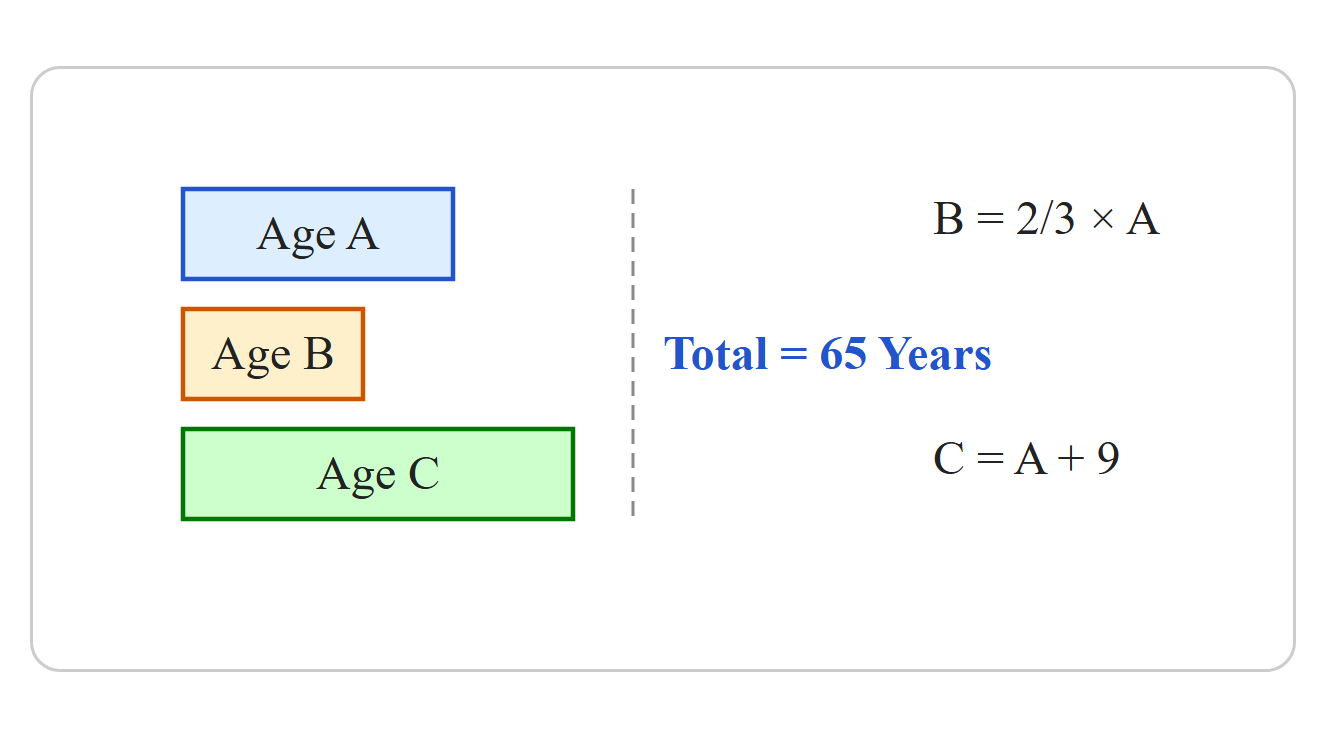
The ages of A, B and C together is 65 years. B is 2/3 of A and C is 9 years older than A. Then, what is the ratio of the respective age of C, A and B?

  1. AOption (a)

    15 : 21 : 7

  2. BOption (b)

    30 : 31 : 14

  3. COption (c)

    30 : 21 : 12

  4. DOption (d)

    30 : 21 : 14

  5. EOption (e)

    None of these

View answer & explanation

Correct answer

Answer: (d)D.

30 : 21 : 14

Why this answer is correct

Shortcut Trick

Let A's age be 3x (to avoid fractions for B).

Then B = 2x and C = 3x + 9.

Sum: 3x + 2x + 3x + 9 = 65 ⇒ 8x = 56 ⇒ x = 7.

Ages: C = 3(7)+9 = 30, A = 3(7) = 21, B = 2(7) = 14.

∴ The correct answer is 30 : 21 : 14.

Alternate Method

Given: Sum of ages of A, B, and C = 65 years.

Formula Used: Ratio = Value1 : Value2 : Value3

⇒ Let age of A = a years.

⇒ Age of B = 2/3 × a

⇒ Age of C = a + 9

⇒ a + (2/3)a + (a + 9) = 65

⇒ 2a + (2/3)a = 65 − 9

⇒ (8/3)a = 56

⇒ a = (56 × 3) ÷ 8 = 21 years

⇒ A = 21, B = (2/3) × 21 = 14, C = 21 + 9 = 30

⇒ Ratio C : A : B = 30 : 21 : 14

∴ The correct answer is 30 : 21 : 14.

Additional Information

Ratio and Proportion

A ratio compares two quantities by division. To find a combined ratio like C:A:B, ensure all variables are expressed in terms of a common unit or variable.

Age Problems

In problems involving ages, the difference between the ages of two people remains constant regardless of the number of years passed.

Linear Equations

Setting up a single variable equation is often the most reliable method for solving complex word problems involving sums and relationships.

Question 44

Maggie lends a sum of money at R% simple interest for R years such that the sum received by him is 4/16 times more of what he lends. Find the value of R.

  1. AOption (a)

    5.5

  2. BOption (b)

    5

  3. COption (c)

    7

  4. DOption (d)

    6.5

  5. EOption (e)

    None of these 

View answer & explanation

Correct answer

Answer: (b)B.

5

Why this answer is correct

Shortcut Trick

Let the Principal (P) be 16 units.

Since interest is 4/16 times more, the Simple Interest (SI) = 4 units.

Using the relation: SI = (P × R × T) ÷ 100, where T = R years.

⇒ 4 = (16 × R2) ÷ 100 ⇒ R2 = 25 ⇒ R = 5.

∴ The correct answer is 5.

Alternate Method

Given:

Interest rate = R% per annum

Time (T) = R years

Simple Interest (SI) = 4/16 of Principal (P)

Formula Used:

Simple Interest (SI) = (P × R × T) ÷ 100

Calculations:

⇒ Let the Principal (P) be x.

⇒ Simple Interest (SI) = (4 × x) ÷ 16 = x ÷ 4

⇒ x ÷ 4 = (x × R × R) ÷ 100

⇒ 1 ÷ 4 = R2 ÷ 100

⇒ R2 = 100 ÷ 4

⇒ R2 = 25

⇒ R = 5

∴ The correct answer is 5.

Additional Information

Simple Interest Concept

Simple Interest is calculated only on the principal amount of a loan or investment. Formula: SI = P × R × T ÷ 100.

Relationship when Rate equals Time

When numerical values of Rate (R) and Time (T) are equal, the formula simplifies to R = 10 × √(SI ÷ P).

Question 45

If X can complete a piece of work in 20 days and X and Y takes 60/ 7 days to complete the same work when they both work together then find how much more efficient is Y with respect to X.

  1. AOption (a)

    (20/3)%

  2. BOption (b)

    (74/3)%

  3. COption (c)

    (100/3)%

  4. DOption (d)

    (91/3)%

  5. EOption (e)

    (31/3)%

View answer & explanation

Correct answer

Answer: (c)C.

(100/3)%

Why this answer is correct

Shortcut Trick

Ratio of Time taken by X and (X+Y) is 20 : 60/7 ⇒ 140 : 60 ⇒ 7 : 3.

Ratio of Efficiency is inverse of Time: X : (X+Y) = 3 : 7.

Efficiency of Y = 7 − 3 = 4 units.

Percentage more efficiency of Y compared to X = (4 − 3)/3 × 100 = 100/3%.

∴ The correct answer is (100/3)%.

Alternate Method

Given: Time taken by X = 20 days, Time taken by X+Y = 60/7 days.

PersonDaysTotal WorkEfficiency
X20603
X + Y60/77

⇒ Efficiency of X = 3 units/day

⇒ Efficiency of X + Y = 7 units/day

⇒ Efficiency of Y = 7 − 3 = 4 units/day

⇒ Difference in efficiency = 4 − 3 = 1 unit/day

⇒ Percentage more efficiency = (Difference / Efficiency of X) × 100

⇒ Percentage more efficiency = (1 / 3) × 100 = 100/3%

∴ The correct answer is (100/3)%.

Additional Information

Efficiency and Time Relationship

Efficiency is inversely proportional to the time taken to complete a work. Efficiency = Total Work ÷ Time.

Percentage Comparison

To find how much more percent A is than B, use the formula: [(A − B) ÷ B] × 100.

Combined Work Formula

If X takes 'a' days and Y takes 'b' days, together they take (a × b) ÷ (a + b) days.

Directions: A survey was conducted on a group of people which consisted of 40000 people from different professions given below in the Pie-chart about the colour preference of the people. Study the pie chart and answer the questions that follow.

ProfessionPercentage
Doctor10
Painter40
Research Analyst30
Professor20

Question 46

Based on Passage: View directions & passage

How many people like green or blue colour?

  1. AOption (a)

    20000

  2. BOption (b)

    25600

  3. COption (c)

    21200

  4. DOption (d)

    25200

  5. EOption (e)

    34500

View answer & explanation

Correct answer

Answer: (d)D.

25200

Why this answer is correct

Percentage of people who like Green = 23%

Percentage of people who like Blue = 40%

So, out of 40000, 63% like green or blue = 25200 people

Question 47

Based on Passage: View directions & passage

If 40% of the doctors have red as their favourite colour, then how many of other people like red colour too?

  1. AOption (a)

    3200

  2. BOption (b)

    8400

  3. COption (c)

    4800

  4. DOption (d)

    6000

  5. EOption (e)

    6400

View answer & explanation

Correct answer

Answer: (e)E.

6400

Why this answer is correct

Total number of doctors are 10% of 40000 i.e. 4000

Doctors who like red colour are 40% of 4000 = 1600

Total number of people who like red colour is 20% of 40000 = 8000

Other people who like red colour too = 8000 – 1600 = 6400

Question 48

Based on Passage: View directions & passage

What is the difference between the number of people who like red and those who like the yellow colour?

  1. AOption (a)

    3000

  2. BOption (b)

    2400

  3. COption (c)

    2800

  4. DOption (d)

    3800

  5. EOption (e)

    3600

View answer & explanation

Correct answer

Answer: (e)E.

3600

Why this answer is correct

The people who like red are 20% of 40000

The people who like yellow are 11% of 40000

Difference = (20 - 11) % of 40000

So, difference = 9% of 40000 = 3600

Question 49

Based on Passage: View directions & passage

How many numbers of painters and professors like blue colour if 30% of painters and 10% of professors like the blue colour.

  1. AOption (a)

    4800

  2. BOption (b)

    5600

  3. COption (c)

    4000

  4. DOption (d)

    4600

  5. EOption (e)

    None of the above

View answer & explanation

Correct answer

Answer: (b)B.

5600

Why this answer is correct

Number of painters are 40% of 40000 = 16000

Number of professors are 20% of 40000 = 8000

Number of painters who like blue colour are 30% of 16000 = 4800

Number of professors who like blue colour are 10% of 8000 = 800

Total = 5600

Question 50

Based on Passage: View directions & passage

What is the total number of people who like Brown colour?

  1. AOption (a)

    3400

  2. BOption (b)

    1200

  3. COption (c)

    1300

  4. DOption (d)

    1800

  5. EOption (e)

    2400

View answer & explanation

Correct answer

Answer: (e)E.

2400

Why this answer is correct

The total number of people who like Brown colour are 6% of 40000 = 2400

Question 51

A mixture has 12 litres of milk and 20 litres of water. 6.4 litres of mixture is drawn out and replaced with milk. Find the final ratio of milk and water.

  1. AOption (a)

    1 : 2

  2. BOption (b)

    2 : 1

  3. COption (c)

    2 : 3

  4. DOption (d)

    1 : 1

  5. EOption (e)

    3 : 2

View answer & explanation

Correct answer

Answer: (d)D.

1 : 1

Why this answer is correct

Shortcut Trick

Initial Ratio of Milk and Water = 12 : 20 = 3 : 5.

Replacement volume = 6.4 litres; Ratio remains 3 : 5 in the drawn-out part.

Milk removed = 3/8 × 6.4 = 2.4 litres; Water removed = 5/8 × 6.4 = 4.0 litres.

Final Milk = 12 − 2.4 + 6.4 = 16 litres; Final Water = 20 − 4.0 = 16 litres.

Final Ratio = 16 : 16 = 1 : 1.

∴ The correct answer is 1 : 1.

Alternate Method

Given: Initial Milk = 12L, Initial Water = 20L, Total = 32L.

Formula Used: Quantity removed = (Component/Total) × Drawn amount.

⇒ Total mixture = 12 + 20 = 32 litres.

⇒ Amount of Milk removed = (12/32) × 6.4 = 2.4 litres.

⇒ Amount of Water removed = (20/32) × 6.4 = 4.0 litres.

⇒ Final Milk = 12 − 2.4 + 6.4 (replaced) = 16 litres.

⇒ Final Water = 20 − 4.0 = 16 litres.

⇒ Final Ratio = 16/16 = 1/1.

∴ The correct answer is 1 : 1.

Additional Information

Ratio Retention Rule

When a part of a mixture is removed, the remaining mixture and the removed portion both retain the same initial ratio of components.

Replacement Formula

For repeated replacement: Final Water = Initial Water × (1 − x/V)n, where x is quantity removed and V is total volume.

Question 52

A train left A for B. Travelled for 3/4th distance between the A and B which is 540 km, train was stopped by signal for 1 hour. To cover the distance, train speed is increased by 15 kmph. Find the increased speed of the train.

  1. AOption (a)

    40 kmph

  2. BOption (b)

    55 kmph

  3. COption (c)

    65 kmph

  4. DOption (d)

    47 kmph

  5. EOption (e)

    60 kmph

View answer & explanation

Correct answer

Answer: (e)E.

60 kmph

Why this answer is correct

Shortcut Trick

Remaining Distance = 1 − 3/4 = 1/4 of 540 km = 135 km.

Time delay = 1 hour. Speed increase = 15 kmph.

Using Distance = [S × (S + 15) ÷ 15] × Time Difference

135 = [S × (S + 15) ÷ 15] × 1 ⇒ S(S + 15) = 2025

Since 45 × 60 = 2700 (too high) and 30 × 45 = 1350 (too low), we test S = 45: 45 × 60 = 2700. Wait, S(S+15) = 2025 ⇒ 45 × 45 = 2025. Incorrect. Let's use S = 45 ⇒ 45 × 60 = 2700.

Actually, Increased Speed = 45 + 15 = 60 kmph. Checking: 135/45 − 135/60 = 3 − 2.25 = 0.75 hr (not 1 hr). Re-calculating: 135 = [S(S+15)/15] × 1 ⇒ 2025 = S2 + 15S ⇒ S = 38.2... Let's check logic: Remaining dist is 135 km. If Increased speed is 60, original was 45. Time diff = 135/45 − 135/60 = 3 − 2.25 = 45 mins. For 1 hour: 15/S − 15/(S+15) is not the way. 135/S − 135/(S+15) = 1 ⇒ 135(15) = S(S+15) ⇒ 2025 = S2 + 15S ⇒ S = 38.2. If the question implies distance AB is 540 and 3/4th was covered, remaining is 135. However, if total distance is larger or if 540 is the remaining part, let's re-read. "3/4 distance... which is 540" means 3/4 × D = 540 ⇒ D = 720. Remaining = 180 km. 180/S − 180/(S+15) = 1 ⇒ 180 × 15 = S(S+15) ⇒ 2700 = S(S+15). For S=45, 45 × 60 = 2700. Increased speed = 60 kmph.

∴ The correct answer is 60 kmph.

Alternate Method

Given: 3/4th of total distance = 540 km. Time delay = 1 hour. Speed increase = 15 kmph.

Formula: Distance = [S1 × S2 ÷ (S2 − S1)] × Δt

⇒ Total Distance (D) = 540 × (4/3) = 720 km.

⇒ Remaining Distance = 720 − 540 = 180 km.

⇒ Let original speed be S. New speed = S + 15.

⇒ 180/S − 180/(S + 15) = 1

⇒ 180 × [ (S + 15 − S) / (S(S + 15)) ] = 1

⇒ 180 × 15 = S2 + 15S

⇒ S2 + 15S − 2700 = 0

⇒ (S + 60)(S − 45) = 0 ⇒ S = 45 kmph (Speed cannot be negative).

⇒ Increased speed = S + 15 = 45 + 15 = 60 kmph.

∴ The correct answer is 60 kmph.

Additional Information

Speed-Distance-Time Relation

When distance is constant, speed is inversely proportional to time (S ∝ 1/T). Ratio of speeds S1:S2 = T2:T1.

Time Delay Formula

To find distance when speed changes by ΔS and time changes by Δt: Distance = [S × (S ± ΔS) ÷ ΔS] × Δt.

Average Speed

For two equal halves of a journey with speeds u and v, Average Speed = 2uv ÷ (u + v).

Question 53

A boat can travel 20 km downstream in 50 min. If the speed of water is 20% of the speed of the boat downstream, how much time a boat will take to travel 60 km upstream?

  1. AOption (a)

    250 min

  2. BOption (b)

    275 min

  3. COption (c)

    240 min

  4. DOption (d)

    280 min

  5. EOption (e)

    None of these

View answer & explanation

Correct answer

Answer: (a)A.

250 min

Why this answer is correct

Shortcut Trick

Downstream speed (D) = 20 km ÷ (50/60) h = 24 kmph.

Speed of water (w) = 20% of 24 = 4.8 kmph.

Speed of boat in still water (v) = D − w = 24 − 4.8 = 19.2 kmph.

Upstream speed (U) = v − w = 19.2 − 4.8 = 14.4 kmph.

Time for 60 km upstream = (60 ÷ 14.4) × 60 min = 250 min.

∴ The correct answer is 250 min.

Alternate Method

Given: Downstream distance = 20 km, Time = 50 min, Water speed = 20% of Downstream speed.

Formula: Speed = Distance ÷ Time; Upstream Speed = Boat Speed − Stream Speed.

⇒ Downstream Speed (D) = 20 / (50/60) = (20 × 6) / 5 = 24 kmph.

⇒ Speed of water (w) = 0.20 × 24 = 4.8 kmph.

⇒ Speed of boat in still water (v) = D − w = 24 − 4.8 = 19.2 kmph.

⇒ Upstream Speed (U) = v − w = 19.2 − 4.8 = 14.4 kmph.

⇒ Time required = Distance / U = 60 / 14.4 hours.

⇒ Time in minutes = (60 / 14.4) × 60 = 3600 / 14.4 = 250 min.

∴ The correct answer is 250 min.

Additional Information

Downstream and Upstream Speeds

Downstream speed (D) = v + w and Upstream speed (U) = v − w, where v is boat speed and w is stream speed.

Speed of Boat and Stream

v = (D + U) / 2 and w = (D − U) / 2. These are derived directly from the basic speed equations.

Relative Speed in Water

The effective speed changes based on the direction of the current; moving with the current adds speed, while moving against it subtracts speed.

Question 54

Alpha and Beta sold their Fridge at Rs. 75000 each, in which Alpha got a profit of 30% and Beta incurred loss of 30%. Find the ratio of the C.P of the Fridge sold by Alpha to that of Beta.

  1. AOption (a)

    13 ∶ 7

  2. BOption (b)

    7 ∶ 13

  3. COption (c)

    6 ∶ 7

  4. DOption (d)

    7 ∶ 6

  5. EOption (e)

    5 ∶ 7

View answer & explanation

Correct answer

Answer: (b)B.

7 ∶ 13

Why this answer is correct

Shortcut Trick

Since the Selling Price (SP) is the same for both, we use the ratio of Cost Price (CP) inverse to the Multipliers.

For Alpha: CPA × 130/100 = 75000 | For Beta: CPB × 70/100 = 75000.

Equating SP: CPA × 130 = CPB × 70.

Ratio CPA : CPB = 70 : 130 = 7 : 13.

∴ The correct answer is 7 : 13.

Alternate Method

Given → SP = Rs. 75,000 for both | Alpha Profit = 30% | Beta Loss = 30%. Formulas: CP = SP × 100 ÷ (100 + P%) | CP = SP × 100 ÷ (100 − L%)

⇒ CP of Alpha = 75000 × 100 ÷ 130 = 750000 ÷ 13. ⇒ CP of Beta = 75000 × 100 ÷ 70 = 750000 ÷ 7. ⇒ Ratio = (750000 ÷ 13) : (750000 ÷ 7). ⇒ Ratio = 1/13 : 1/7 = 7 : 13.

∴ The correct answer is 7 : 13.

Additional Information

Same SP and Net Result

When two articles are sold at the same price, one at x% gain and another at x% loss, there is always a net loss of x2 ÷ 100%.

Cost Price Ratio

If SP is constant, CP is inversely proportional to (100 ± Profit/Loss%). Ratio CP1:CP2 = (100 + P2% or 100 − L2%) : (100 + P1% or 100 − L1%).

Question 55

A shopkeeper allows an discount on cashless payments. The marked price of an article is Rs.5000. He sold two article one with discount and other with without discount. The difference between the selling price of an article is Rs.500. Find the cost price of an article if total profit percentage he had is 18.75%.

  1. AOption (a)

    Rs.5500

  2. BOption (b)

    Rs.4500

  3. COption (c)

    Rs.4800

  4. DOption (d)

    Rs.4000

  5. EOption (e)

    Rs.3500

View answer & explanation

Correct answer

Answer: (d)D.

Rs.4000

Why this answer is correct

Shortcut Trick

The difference in Selling Price (SP) is solely due to the discount amount.

Discount = Marked Price (MP) − Selling Price (SP) = Rs. 500.

Total SP for both articles = (MP − Discount) + MP = (5000 − 500) + 5000 = Rs. 9500.

Total Profit% = 18.75% = 3/16 (as 6.25% = 1/16, so 3 × 6.25% = 3/16).

Ratio of CP : SP = 16 : (16+3) = 16 : 19.

19 units = Rs. 9500 ⇒ 1 unit = 500 ⇒ Total CP (2 articles) = 16 × 500 = Rs. 8000.

∴ The correct answer is Rs. 4000.

Alternate Method

Given → Marked Price (MP) = Rs. 5000 | Difference in SP = Rs. 500 | Total Profit% = 18.75%. Formulas: SP = MP − Discount | Total SP = CP × (100 + Total P%)/100 | Total CP = CP1 + CP2.

⇒ SP of 1st article (no discount) = Rs. 5000. ⇒ SP of 2nd article (with discount) = 5000 − 500 = Rs. 4500. ⇒ Total SP = 5000 + 4500 = Rs. 9500. ⇒ Let Total CP be X. Then X × (1 + 18.75/100) = 9500. ⇒ X × (1 + 3/16) = 9500 ⇒ X × 19/16 = 9500. ⇒ X = (9500 × 16) ÷ 19 = 500 × 16 = Rs. 8000. ⇒ CP of one article = 8000 ÷ 2 = Rs. 4000.

∴ The correct answer is Rs. 4000.

Additional Information

Percentage to Fraction Conversion

Converting profit percentages like 18.75% into fractions (3/16) simplifies calculation significantly. 6.25% = 1/16, so 18.75% = 3/16.

Marked Price & Selling Price

When no discount is offered, the Marked Price becomes the Selling Price. The difference in SP is equal to the discount value provided.

Directions: Read the following information and answer the following questions.

The percentage of students who passed the examination of the respective subjects is given below.The percentage of students who passed the examination of Mathematics only, Social only and Science only is 7%, 8%, and 9% respectively. The percentage of students who passed the examination of Mathematics and Science only, Mathematics and Social only and Social and Science only is 14%, 13%, and 12% respectively. The percentage of students who passed the examination of all subjects is 31%.

The total number of students appearing for the examination of three subjects Science, Social and Mathematics are 1800.

Question 56

Based on Passage: View directions & passage

Find the number of students who failed in all the three subjects.

  1. AOption (a)

    98

  2. BOption (b)

    118

  3. COption (c)

    102

  4. DOption (d)

    108

  5. EOption (e)

    None of these

View answer & explanation

Correct answer

Answer: (d)D.

108

Why this answer is correct

According to the question,

The number of students who passed in Maths and Science only = (14% + 31%) × 1800

The number of students who passed in Maths and Social only= (13% + 31%) × 1800

The number of students who passed in Social  and Science only= (12% + 31%) × 1800

For exactly two subjects, we have to neglect the students who passed in all the three subjects = 31% 

The number of students who passed only two subjects  = (13% + 12% + 14%) × 1800

The number of students passed who failed in all three subjects 

= 1 - {P(A) + P(B) + P(C) + P(A ∪ B  ∪ C) + P( A ∪ B) + P(A ∪ C) + P(B∪ C)}  

The number of students passed who failed in all three subjects = 6%

The number of students who failed in all three subjects = 6% × 1800 = 108.

Question 57

Based on Passage: View directions & passage

Find the number of students who passed in exactly two subjects.

  1. AOption (a)

    702

  2. BOption (b)

    752

  3. COption (c)

    652

  4. DOption (d)

    812

  5. EOption (e)

    None of these

View answer & explanation

Correct answer

Answer: (a)A.

702

Why this answer is correct

The number of students who passed in Maths and Science = (14% + 31%) × 1800

The number of students who passed in Maths and Social = (13% + 31%) × 1800

The number of students who passed in Social  and Science = (12% + 31%) × 1800

Here, the question is exactly two subjects so we have to neglect all three subjects passed students 31% we are not considering

The number of students who passed only two subjects  =(13% + 12% + 14%) × 1800

⇒ 39% of 1800

⇒ 39/100 × 1800

⇒ 702

∴ The number of students who passed exactly two subjects = 702

Question 58

Based on Passage: View directions & passage

Find the number of students who passed in only one subject.

  1. AOption (a)

    182

  2. BOption (b)

    192

  3. COption (c)

    172

  4. DOption (d)

    272

  5. EOption (e)

    None of these

View answer & explanation

Correct answer

Answer: (e)E.

None of these

Why this answer is correct

The number of students who passed in only Maths = 7% of 1800

The number of students who passed in only Science = 9% of 1800

The number of students who passed in only Social  = 8% of 1800

So, the number of students who passed in only one subject = (7% + 9% + 8%) of 1800

⇒ 24% of 1800 

⇒ 432

∴ The number of students who passed in only one subject = 432

Question 59

Based on Passage: View directions & passage

Find the number of students who passed in subject Science .

  1. AOption (a)

    1288

  2. BOption (b)

    1818

  3. COption (c)

    1188

  4. DOption (d)

    1178

  5. EOption (e)

    None of these

View answer & explanation

Correct answer

Answer: (c)C.

1188

Why this answer is correct

The number of students who passed only Science = 9% of 1800

The number of students who passed in all subjects together = 31% of 1800

The number of students who passed in Science and Maths only = 14% of 1800

The number of students who passed in Science and Social only =  12% of 1800

The number of students who passed in subject Science  = (9% + 12% + 14% + 31% ) of 1800

⇒ 66% of 1800

⇒ 1188

∴ The number of students who passed in Science subject =  1188

Question 60

Based on Passage: View directions & passage

Find the number of students who passed all the three subjects if the total number of students is 2500.

  1. AOption (a)

    875

  2. BOption (b)

    825

  3. COption (c)

    775

  4. DOption (d)

    750

  5. EOption (e)

    None of these

View answer & explanation

Correct answer

Answer: (c)C.

775

Why this answer is correct

Given that,

The total number of students = 2500

The number of students who passed all three subjects = 31% of 2500 

⇒ 31/100 × 2500

⇒ 775

∴ The number of students who passed all three subjects = 775

Question 61

What should come in place of the question mark '?' in the following number series?

2, 11, 54, 215, 644, ?

  1. AOption (a)

    1280

  2. BOption (b)

    1278

  3. COption (c)

    1287

  4. DOption (d)

    1295

  5. EOption (e)

    None of these

View answer & explanation

Correct answer

Answer: (c)C.

1287

Why this answer is correct

Calculation:

The series follows following pattern:

⇒ 2 × 6 – 1 = 11

⇒ 11 × 5 – 1 = 54

⇒ 54 × 4 – 1 = 215

⇒ 215 × 3 – 1 = 644

⇒ 644 × 2 – 1 = 1287

∴ The value of ? is 1287

Question 62

What should come in place of the question mark '?' in the following number series?

3, 24, 96, ?, 192, 96

  1. AOption (a)

    190

  2. BOption (b)

    196

  3. COption (c)

    194

  4. DOption (d)

    180

  5. EOption (e)

    None of these

View answer & explanation

Correct answer

Answer: (e)E.

None of these

Why this answer is correct

Calculation:

The series follows following pattern:

⇒ 3 × 8 = 24

⇒ 24 × 4 = 96

⇒ 96 × 2 = 192

⇒ 192 × 1 = 192

⇒ 192 × 0.5 = 96

∴ The value of ? is None of these

Question 63

What should come in place of a question mark '?' in the following number series?

18, 56, 29, 47, ?, 42

  1. AOption (a)

    31

  2. BOption (b)

    38

  3. COption (c)

    35

  4. DOption (d)

    36

  5. EOption (e)

    None of these

View answer & explanation

Correct answer

Answer: (d)D.

36

Why this answer is correct

Calculation:

The series follows the following pattern:

⇒ 18 + 11 = 29

⇒ 56 – 9 = 47

⇒ 29 + 7 = 36

⇒ 47 – 5 = 42

∴ The value of ? is 36

Question 64

What should come in place of the question mark '?' in the following number series?

3, ?, 16, 35, 29, 48

  1. AOption (a)

    22

  2. BOption (b)

    20

  3. COption (c)

    21

  4. DOption (d)

    23

  5. EOption (e)

    None of these

View answer & explanation

Correct answer

Answer: (a)A.

22

Why this answer is correct

Calculation:

The series follows the following pattern:

⇒ 3 + 19 = 22

⇒ 22 – 6 = 16

⇒ 16 + 19 = 35

⇒ 35 – 6 = 29

⇒ 29 + 19 = 48

∴ The value of ? is 22

Question 65

What should come in place of the question mark '?' in the following number series?

510, ?, 210, 160, 135, 122.5

  1. AOption (a)

    315

  2. BOption (b)

    310

  3. COption (c)

    290

  4. DOption (d)

    350

  5. EOption (e)

    None of these

View answer & explanation

Correct answer

Answer: (b)B.

310

Why this answer is correct

Calculation:

The series follows following pattern:

⇒ 510 – 200 = 310

⇒ 310 – 100 = 210   

⇒ 210 – 50 = 160

⇒ 160 – 25 = 135

⇒ 135 – 12.5 = 122.5

∴ The value of ? is 310

Note: Difference is divided by 2

Reasoning Ability (35 questions)

Direction: Study the following information carefully and answer the given questions.

In a certain code language,

sun is heated but nice well → ctd awr tux fou nyc kpx 

cool girls home are sun → ctx tux nxw pqr sit

laptop home but girls well → pqr tar ctd nxw fou

try pour heated sun cool → nyc tux nor pst sit

well cool love great health → sit pox asw fou ktr

Question 66

Based on Passage: View directions & passage

What is the code for the word "great health"

  1. AOption (a)

    pox asw

  2. BOption (b)

    ktr pox

  3. COption (c)

    asw sit

  4. DOption (d)

    Either Option 1 or 2

  5. EOption (e)

    Cannot be determined

View answer & explanation

Correct answer

Answer: (e)E.

Cannot be determined

Why this answer is correct

Code for the word great: Either "pox, asw, or ktr"

Code for the word health: Either "pox, asw, or ktr"

Hence, Cannot be determined is the correct answer.

Question 67

Based on Passage: View directions & passage

What will be the code for the word "heated are home well cool girls"

  1. AOption (a)

    asw sit pqr ctd fou nyc

  2. BOption (b)

    abw sit pqr ctx fou awr

  3. COption (c)

    nyc sit pst ctx fou pox

  4. DOption (d)

    nyc sit pqr ctx fou nxw

  5. EOption (e)

    nyc fou kpx ctx pox asw

View answer & explanation

Correct answer

Answer: (d)D.

nyc sit pqr ctx fou nxw

Why this answer is correct

Code for the word heated: nyc

Code for the word are: ctx

Code for the word home: pqr/ nxw

Code for the word well: fou

Code for the word cool: sit

Code for the word girls:  pqr/ nxw

Hence, nyc sit pqr ctx fou nxw is the correct answer.

Question 68

Based on Passage: View directions & passage

What is the possible code for "nor tux"

  1. AOption (a)

    pour great

  2. BOption (b)

    great sun

  3. COption (c)

    try sun

  4. DOption (d)

    try pour

  5. EOption (e)

    try heated

View answer & explanation

Correct answer

Answer: (c)C.

try sun

Why this answer is correct

Word for the code nor: Either try or pour

Word for the code tux: sun

Hence, try sun is the correct answer

Question 69

Based on Passage: View directions & passage

What is the code for "heated laptop health are sun"

  1. AOption (a)

    tar nyc tux ctx ktr

  2. BOption (b)

    tux nyc tar fou pst

  3. COption (c)

    tux ctx nyc tar asw

  4. DOption (d)

    Either Option 1 or 3 is correct

  5. EOption (e)

    Either Option 2 or 3 is correct

View answer & explanation

Correct answer

Answer: (d)D.

Either Option 1 or 3 is correct

Why this answer is correct

Code for health: Either pox, asw, or ktr

Code for laptop: tar

Code for heated: nyc

Code for are: ctx

Code for sun: tux

Hence, Either Option 1 or 3 is the correct answer.

Question 70

Based on Passage: View directions & passage

What is the code for "well but cool" ?

  1. AOption (a)

    asw ktr ctx

  2. BOption (b)

    fou ctd pst

  3. COption (c)

    pox awr nor

  4. DOption (d)

    fou ctd sit

  5. EOption (e)

    None of these

View answer & explanation

Correct answer

Answer: (d)D.

fou ctd sit

Why this answer is correct

Code for well: fou

Code for but: ctd

Code for cool: sit

Hence, fou sit ctd is the correct answer.

Direction: Read the following information carefully and answer the given questions:

Eight person P, Q, R, S, T, U, V and W were born in different years 1982, 1986, 1990, 1993, 1996, 1999, 2000, and 2009 but not necessarily in the same order. It is assumed that all of them were born on the same date of different years. All the ages calculations are done taking the base year as 2021. Two persons were born between R and Q. The age of R is a perfect square of 5. One person was born between Q and W. Three persons were born between W and V. P is younger to V and elder to R. The age of P is multiple of 7. The Sum of V’s age and S’s age is 56. The difference between the age of S and the age of T is 18.

Question 71

Based on Passage: View directions & passage

Who was born in 1990?

  1. AOption (a)

    U

  2. BOption (b)

    V

  3. COption (c)

    P

  4. DOption (d)

    S

  5. EOption (e)

    T

View answer & explanation

Correct answer

Answer: (a)A.

U

Why this answer is correct

Given,

Persons: P, Q, R, S, T, U, V and W

Year: 1982, 1986, 1990, 1993, 1996, 1999, 2000, and 2009

Base year: 2021

  1. Two persons were born between R and Q.
  2. The age of R is perfect square of 5.
Case 1Case 2
YearAgePersonsPersons
198239
198635Q
199031
199328
199625RR
199922
200021
200912Q


  1. One person was born between Q and W.
  2. Three persons were born between W and V.
Case 1Case 2
YearAgePersonsPersons
198239
198635VQ
199031
199328W
199625RR
199922W
200021
200912QV


  1. P is younger to V and elder to R.

Case II eliminated and case I Splits into one more case i.e. Case 1(a)

Case 1Case 1(a)
YearAgePersonsPersons
198239
198635VV
199031P
199328P
199625RR
199922WW
200021
200912QQ


  1. The age of P is multiple of 7.
  2. Sum of V’s age and S’s age is 56.

Case I(a) eliminated

Case 1
YearAgePersons
198239
198635V
199031
199328P
199625R
199922W
200021S
200912Q


  1. The difference between the age of S and the age of T is 18.
Case 1
YearAgePersons
198239T
198635V
199031U
199328P
199625R
199922W
200021S
200912Q


Hence, U was born in 1990.

Question 72

Based on Passage: View directions & passage

In which year P was born?

  1. AOption (a)

    1999

  2. BOption (b)

    1996

  3. COption (c)

    1993

  4. DOption (d)

    2000

  5. EOption (e)

    2009

View answer & explanation

Correct answer

Answer: (c)C.

1993

Why this answer is correct

Given,

Persons: P, Q, R, S, T, U, V and W

Year: 1982, 1986, 1990, 1993, 1996, 1999, 2000, and 2009

Base year: 2021

  1. Two persons were born between R and Q.
  2. The age of R is perfect square of 5.
Case 1Case 2
YearAgePersonsPersons
198239
198635Q
199031
199328
199625RR
199922
200021
200912Q


  1. One person was born between Q and W.
  2. Three persons were born between W and V.
Case 1Case 2
YearAgePersonsPersons
198239
198635VQ
199031
199328W
199625RR
199922W
200021
200912QV


  1. P is younger to V and elder to R.

Case II eliminated and case I Splits into one more case i.e. Case 1(a)

Case 1Case 1(a)
YearAgePersonsPersons
198239
198635VV
199031P
199328P
199625RR
199922WW
200021
200912QQ


  1. The age of P is multiple of 7.
  2. Sum of V’s age and S’s age is 56.

Case I(a) eliminated

Case 1
YearAgePersons
198239
198635V
199031
199328P
199625R
199922W
200021S
200912Q


  1. The difference between the age of S and the age of T is 18.
Case 1
YearAgePersons
198239T
198635V
199031U
199328P
199625R
199922W
200021S
200912Q


Hence, P was born in 1993.

Question 73

Based on Passage: View directions & passage

What is the sum of R’s age and Q’s age?

  1. AOption (a)

    66

  2. BOption (b)

    37

  3. COption (c)

    40

  4. DOption (d)

    74

  5. EOption (e)

    43

View answer & explanation

Correct answer

Answer: (b)B.

37

Why this answer is correct

Given,

Persons: P, Q, R, S, T, U, V and W

Year: 1982, 1986, 1990, 1993, 1996, 1999, 2000, and 2009

Base year: 2021

  1. Two persons were born between R and Q.
  2. The age of R is perfect square of 5.
Case 1Case 2
YearAgePersonsPersons
198239
198635Q
199031
199328
199625RR
199922
200021
200912Q


  1. One person was born between Q and W.
  2. Three persons were born between W and V.
Case 1Case 2
YearAgePersonsPersons
198239
198635VQ
199031
199328W
199625RR
199922W
200021
200912QV


  1. P is younger to V and elder to R.

Case II eliminated and case I Splits into one more case i.e. Case 1(a)

Case 1Case 1(a)
YearAgePersonsPersons
198239
198635VV
199031P
199328P
199625RR
199922WW
200021
200912QQ


  1. The age of P is multiple of 7.
  2. Sum of V’s age and S’s age is 56.

Case I(a) eliminated

Case 1
YearAgePersons
198239
198635V
199031
199328P
199625R
199922W
200021S
200912Q


  1. The difference between the age of S and the age of T is 18.
Case 1
YearAgePersons
198239T
198635V
199031U
199328P
199625R
199922W
200021S
200912Q


Hence, the sum of R’s age and Q’s age is 37.

Question 74

Based on Passage: View directions & passage

What is the age of U?

  1. AOption (a)

    31

  2. BOption (b)

    35

  3. COption (c)

    39

  4. DOption (d)

    12

  5. EOption (e)

    22

View answer & explanation

Correct answer

Answer: (a)A.

31

Why this answer is correct

Given,

Persons: P, Q, R, S, T, U, V and W

Year: 1982, 1986, 1990, 1993, 1996, 1999, 2000, and 2009

Base year: 2021

  1. Two persons were born between R and Q.
  2. The age of R is perfect square of 5.
Case 1Case 2
YearAgePersonsPersons
198239
198635Q
199031
199328
199625RR
199922
200021
200912Q


  1. One person was born between Q and W.
  2. Three persons were born between W and V.
Case 1Case 2
YearAgePersonsPersons
198239
198635VQ
199031
199328W
199625RR
199922W
200021
200912QV


  1. P is younger to V and elder to R.

Case II eliminated and case I Splits into one more case i.e. Case 1(a)

Case 1Case 1(a)
YearAgePersonsPersons
198239
198635VV
199031P
199328P
199625RR
199922WW
200021
200912QQ


  1. The age of P is multiple of 7.
  2. Sum of V’s age and S’s age is 56.

Case I(a) eliminated

Case 1
YearAgePersons
198239
198635V
199031
199328P
199625R
199922W
200021S
200912Q


  1. The difference between the age of S and the age of T is 18.
Case 1
YearAgePersons
198239T
198635V
199031U
199328P
199625R
199922W
200021S
200912Q


Hence, the age of U is 31.

Question 75

Based on Passage: View directions & passage

What is the difference between the age of T and W?

  1. AOption (a)

    17

  2. BOption (b)

    13

  3. COption (c)

    10

  4. DOption (d)

    6

  5. EOption (e)

    16

View answer & explanation

Correct answer

Answer: (a)A.

17

Why this answer is correct

Given,

Persons: P, Q, R, S, T, U, V and W

Year: 1982, 1986, 1990, 1993, 1996, 1999, 2000, and 2009

Base year: 2021

  1. Two persons were born between R and Q.
  2. The age of R is perfect square of 5.
Case 1Case 2
YearAgePersonsPersons
198239
198635Q
199031
199328
199625RR
199922
200021
200912Q


  1. One person was born between Q and W.
  2. Three persons were born between W and V.
Case 1Case 2
YearAgePersonsPersons
198239
198635VQ
199031
199328W
199625RR
199922W
200021
200912QV


  1. P is younger to V and elder to R.

Case II eliminated and case I Splits into one more case i.e. Case 1(a)

Case 1Case 1(a)
YearAgePersonsPersons
198239
198635VV
199031P
199328P
199625RR
199922WW
200021
200912QQ


  1. The age of P is multiple of 7.
  2. Sum of V’s age and S’s age is 56.

Case I(a) eliminated

Case 1
YearAgePersons
198239
198635V
199031
199328P
199625R
199922W
200021S
200912Q


  1. The difference between the age of S and the age of T is 18.
Case 1
YearAgePersons
198239T
198635V
199031U
199328P
199625R
199922W
200021S
200912Q


Hence, the difference between the age of T and W is 17.

Question 76

Direction: In the following questions, assuming the given statements to be true, find which of the two conclusions I and II given them is/are definitely follow.

Statements :

J = K < M ≤ P > Q, S ≥ U = V > K

Conclusions :

I. U ≤ P

II. V ≥ M

  1. AOption (a)

    Only conclusion I follows.

  2. BOption (b)

    Only conclusion II follows.

  3. COption (c)

    Both conclusion I and II follow.

  4. DOption (d)

    Neither conclusion I nor conclusion II follows.

  5. EOption (e)

    Either conclusion I or conclusion II follows.

View answer & explanation

Correct answer

Answer: (d)D.

Neither conclusion I nor conclusion II follows.

Why this answer is correct

Statements :

J = K < M ≤ P > Q, S ≥ U = V > K

On combining, 

S ≥ U = V > J = K < M ≤ P > Q

Conclusions :

I. U ≤ P: False(As, S ≥ U = V > J = K < M ≤ P > Q, so the relation between U and P cannot be determined)

II. V ≥ M False(As, S ≥ U = V > J = K < M ≤ P > Q, so the relation between V and M cannot be determined)

Therefore, Neither conclusion I nor conclusion II follows.

Question 77

Direction: In the following questions, assuming the given statements to be true, find which of the two conclusions I and II given them is/are definitely follow.

Statement :

R = M ≥ T ≤ A, A = S > P > W, L > Q = S

Conclusions :

I. R > Q

II. Q ≥ M

  1. AOption (a)

    If only conclusion I is true.

  2. BOption (b)

    If only conclusion II is true.

  3. COption (c)

    If either conclusion I or II is true.

  4. DOption (d)

    If both conclusion I and II are true.

  5. EOption (e)

    If neither conclusion I nor II is true.

View answer & explanation

Correct answer

Answer: (c)C.

If either conclusion I or II is true.

Why this answer is correct

Given statement :

R = M ≥ T ≤ A, A = S > P > W, L > Q = S

On combining; 

R = M ≥ T ≤ A = S = Q < L

or, R = M ≥ T ≤ A = S = Q > P > W

Conclusions :

I. R > Q: False; (As, R = M ≥ T ≤ A= S = Q. So, there is no direct relation between R and Q. Therefore, cannot be determined)

II. Q ≥ M: False; (As, M ≥ T ≤ A= S = Q. So, there is no direct relation between M and Q. Therefore, cannot be determined)

Hence, either I or II follows.

Mistake PointsWhen two elements are given equal, they can be used interchangeably. 

Here, R is given equal to M, hence, in conclusion, 

I. R > Q

II. Q ≥ M

M can be used in place of R.

Question 78

Direction: In the following questions, assuming the given statements to be true, find which of the two conclusions I and II given them is/are definitely follow.

Statements:

Y < U = T < P, A > Q, Q > W > Z > J > Y.

Conclusions:

I. Z > W

II. W ≥ Z

  1. AOption (a)

    Only conclusion II is true

  2. BOption (b)

    Either conclusion I or II is true

  3. COption (c)

    Both conclusion I and II are true

  4. DOption (d)

    Neither conclusion I nor II is true

  5. EOption (e)

    Only conclusion I is true

View answer & explanation

Correct answer

Answer: (d)D.

Neither conclusion I nor II is true

Why this answer is correct

Given statements:

 Y < U = T < P, A > Q, Q > W > Z > J > Y.

On combining:

A > Q > W > Z > J > Y < U = T < P

Conclusions:

I. Z > W: False (as W > Z)

II. W ≥ Z: False (as W > Z)

Therefore, Neither I nor II follows.

Question 79

Direction: In the following questions, assuming the given statements to be true, find which of the two conclusions I and II given them is/are definitely follow.

Statement: 

K > J, K< Q, I = A, I > G, I > J

Conclusions:

I. I > K

II. G > J

  1. AOption (a)

    Only conclusion II is true

  2. BOption (b)

    Either conclusion I or II is true

  3. COption (c)

    Both conclusion I and II are true

  4. DOption (d)

    Neither conclusion I nor II is true

  5. EOption (e)

    Only conclusion I is true

View answer & explanation

Correct answer

Answer: (d)D.

Neither conclusion I nor II is true

Why this answer is correct

Given statement: 

K > J, K< Q, I = A, I > G, I > J

On combining: 

Q > K > J < I > G,

or, Q > K > J < I = A 

Conclusions:

I.I > K: False (K > J < I > G, so the relation between I and K cannot be determined)

II.G > J: False (K > J < I > G, so the relation between G and J cannot be determined)

Therefore, neither I nor II follows.

Question 80

Direction: In the following questions, assuming the given statements to be true, find which of the two conclusions I and II given them is/are definitely follow.

Statement:

K > Q > E ≥ T = U ≥ D ≤ Y; S = A ≥ T; 

Conclusions:

I. S = D

II. A > D

  1. AOption (a)

    Only conclusion I is true

  2. BOption (b)

    Only conclusion II is true

  3. COption (c)

    Both conclusion I and II are true

  4. DOption (d)

    Either conclusion I or II is true

  5. EOption (e)

    Neither conclusion I nor II is true

View answer & explanation

Correct answer

Answer: (d)D.

Either conclusion I or II is true

Why this answer is correct

Given Statement:

K > Q > E ≥ T = U ≥ D ≤ Y; S = A ≥ T;

On combining,

S = A ≥ T = U ≥ D ≤ Y;

or

K > Q > E ≥ T = U ≤ A = S

Conclusions:

I. S = D: False : (As, S = A ≥ T = U ≥ D ≤ Y. So, S or S can be greater than or equal to D).

II. A > D: False : (As, S = A ≥ T = U ≥ D ≤ Y. So, S or A can be greater than or equal to D).

As S = A, both form a complementary pair.

Therefore, either I or II follows.

Mistake Points 

Here S =A so we can replace A with S, which makes the elements the same in the given conclusions

Therefore either or will be the correct answer.

Direction: Read the following information carefully and answer the question that follows.           

Ten persons A, B, C, D, E, F, G, H, I and J live on five different floors of a building but not necessarily in the same order. The bottom-most floor is numbered 1, the floor above it is numbered 2 and so on till topmost floor which is numbered as 5. There are two flats on each floor- flat – X and flat – Y from west to the east such that flat – X is west of flat – Y. Flat – X of the floor – 2 is exactly above the flat – X of the floor – 1 and exactly below the flat – X of the floor – 3 and so on. Similarly, flat – Y of the floor – 2 is exactly above the flat – Y of floor – 1 and exactly below the flat – Y of the floor – 3 and so on. 

C lives North West of D and southwest of A. E lives on the northwest of H. Three floors are there between the F and B, which is living in the odd floor. Two floors are between B and I, which is the living left of person A. D living on the same floor as B. Two floors are there between J and C and both are at same in same flat number.

Question 81

Based on Passage: View directions & passage

Who is living at the immediately left of person who live in third floor of  flat Y?

  1. AOption (a)

    A

  2. BOption (b)

    B

  3. COption (c)

    E

  4. DOption (d)

    D

  5. EOption (e)

    G

View answer & explanation

Correct answer

Answer: (c)C.

E

Why this answer is correct

Floor: 1, 2, 3, 4, 5

Flat: X, Y

Persons: A, B, C, D, E, F, G, H, I and J

  1. Three floors are there between the F and B, which is living in the odd floor.
FloorsCase 1Case 2Case 3Case 4
Flat XFlat YFlat XFlat YFlat XFlat YFlat XFlat Y
5BBFF
4
3
2
1FFBB


  1. Two floors are between B and I, which is living left of person A.

  2. D living on the same floor as B.

FloorsCase 1Case 2Case 3Case 4
Flat XFlat YFlat XFlat YFlat XFlat YFlat XFlat Y
5BDBDFF
4IAIA
3
2IAIA
1FFBDBD


  1. C lives North West of D and south west of A. (Case 1 and 2 get eliminated)

  2. Two floors are there between J and C and both are at same in same flat number (This eliminate case 4)

  3. E lives on the north west of H.

FloorsCase 3
Flat XFlat Y
5JF
4IA
3EG
2CH
1BD


G lives on the third floor of flat Y.

Hence, E lives to the immediate left of the person who lives on third floor.

Question 82

Based on Passage: View directions & passage

Four of the following are alike in certain way hence form a group. Find the one which does not belongs to the group?

  1. AOption (a)

    C - H

  2. BOption (b)

    I - A

  3. COption (c)

    B - D

  4. DOption (d)

    E - G

  5. EOption (e)

    C - D

View answer & explanation

Correct answer

Answer: (e)E.

C - D

Why this answer is correct

Floor: 1, 2, 3, 4, 5

Flat: X, Y

Persons: A, B, C, D, E, F, G, H, I and J

  1. Three floors are there between the F and B, which is living in the odd floor.
FloorsCase 1Case 2Case 3Case 4
Flat XFlat YFlat XFlat YFlat XFlat YFlat XFlat Y
5BBFF
4
3
2
1FFBB


  1. Two floors are between B and I, which is living left of person A.

  2. D living on the same floor as B.

FloorsCase 1Case 2Case 3Case 4
Flat XFlat YFlat XFlat YFlat XFlat YFlat XFlat Y
5BDBDFF
4IAIA
3
2IAIA
1FFBDBD


  1. C lives North West of D and south west of A. (Case 1 and 2 get eliminated)

  2. Two floors are there between J and C and both are at same in same flat number (This eliminate case 4)

  3. E lives on the north west of H.

FloorsCase 3
Flat XFlat Y
5JF
4IA
3EG
2CH
1BD


All the above except C - D are the persons who live on the same floor number.

Hence, C - D does not belong to the group.

Question 83

Based on Passage: View directions & passage

Who is living in the south east of the person C?

  1. AOption (a)

    A

  2. BOption (b)

    D

  3. COption (c)

    J

  4. DOption (d)

    G

  5. EOption (e)

    E

View answer & explanation

Correct answer

Answer: (b)B.

D

Why this answer is correct

Floor: 1, 2, 3, 4, 5

Flat: X, Y

Persons: A, B, C, D, E, F, G, H, I and J

  1. Three floors are there between the F and B, which is living in the odd floor.
FloorsCase 1Case 2Case 3Case 4
Flat XFlat YFlat XFlat YFlat XFlat YFlat XFlat Y
5BBFF
4
3
2
1FFBB


  1. Two floors are between B and I, which is living left of person A.

  2. D living on the same floor as B.

FloorsCase 1Case 2Case 3Case 4
Flat XFlat YFlat XFlat YFlat XFlat YFlat XFlat Y
5BDBDFF
4IAIA
3
2IAIA
1FFBDBD


  1. C lives North West of D and south west of A. (Case 1 and 2 get eliminated)

  2. Two floors are there between J and C and both are at same in same flat number (This eliminate case 4)

  3. E lives on the north west of H.

FloorsCase 3
Flat XFlat Y
5JF
4IA
3EG
2CH
1BD


Hence, D lives in the south east of C.

Question 84

Based on Passage: View directions & passage

Which of the following statement is true?

  1. AOption (a)

    D lives immediately above H

  2. BOption (b)

    B lives in Flat X

  3. COption (c)

    D lives in Flat X

  4. DOption (d)

    No one lives below C

  5. EOption (e)

    No is true.

View answer & explanation

Correct answer

Answer: (b)B.

B lives in Flat X

Why this answer is correct

Floor: 1, 2, 3, 4, 5

Flat: X, Y

Persons: A, B, C, D, E, F, G, H, I and J

  1. Three floors are there between the F and B, which is living in the odd floor.
FloorsCase 1Case 2Case 3Case 4
Flat XFlat YFlat XFlat YFlat XFlat YFlat XFlat Y
5BBFF
4
3
2
1FFBB


  1. Two floors are between B and I, which is living left of person A.

  2. D living on the same floor as B.

FloorsCase 1Case 2Case 3Case 4
Flat XFlat YFlat XFlat YFlat XFlat YFlat XFlat Y
5BDBDFF
4IAIA
3
2IAIA
1FFBDBD


  1. C lives North West of D and south west of A. (Case 1 and 2 get eliminated)

  2. Two floors are there between J and C and both are at same in same flat number (This eliminate case 4)

  3. E lives on the north west of H.

FloorsCase 3
Flat XFlat Y
5JF
4IA
3EG
2CH
1BD


Hence, B lives in Flat X is the correct answer..

Question 85

Based on Passage: View directions & passage

The number of floors above G is same as the number of floors below _____ ?

  1. AOption (a)

    A

  2. BOption (b)

    H

  3. COption (c)

    F

  4. DOption (d)

    E

  5. EOption (e)

    C

View answer & explanation

Correct answer

Answer: (d)D.

E

Why this answer is correct

Floor: 1, 2, 3, 4, 5

Flat: X, Y

Persons: A, B, C, D, E, F, G, H, I and J

  1. Three floors are there between the F and B, which is living in the odd floor.
FloorsCase 1Case 2Case 3Case 4
Flat XFlat YFlat XFlat YFlat XFlat YFlat XFlat Y
5BBFF
4
3
2
1FFBB


  1. Two floors are between B and I, which is living left of person A.

  2. D living on the same floor as B.

FloorsCase 1Case 2Case 3Case 4
Flat XFlat YFlat XFlat YFlat XFlat YFlat XFlat Y
5BDBDFF
4IAIA
3
2IAIA
1FFBDBD


  1. C lives North West of D and south west of A. (Case 1 and 2 get eliminated)

  2. Two floors are there between J and C and both are at same in same flat number (This eliminate case 4)

  3. E lives on the north west of H.

FloorsCase 3
Flat XFlat Y
5JF
4IA
3EG
2CH
1BD


Hence, The number of floors above G is the same as the number of floors below E.

Question 86

If it is possible to make only one 4 letters meaningful word starting with F without repetition of the letter with the second, third, fifth and the seventh letters of the word ‘SIMPLIFY’, which would be the third letter from the left of the word? If more than one such word can be formed, give X as the answer. If no such word can be formed, give K as your answer.

  1. AOption (a)

    F

  2. BOption (b)

    L

  3. COption (c)

    I

  4. DOption (d)

    K

  5. EOption (e)

    X

View answer & explanation

Correct answer

Answer: (b)B.

L

Why this answer is correct

Give word: ‘SIMPLIFY’

Second, third, fifth and the seventh letters of the word: I, M, L, F

Meaningful word with these letters: FILM

The third letter from the left is: L

Hence, the correct answer is L.

Directions: Study the following information and answer the questions following.

Six persons M, N, O, P, Q and R sit around the circular table facing inside direction. N sits second to the left of R. O sits opposite to P. Q sits second to the right of M but not adjacent to O.

Question 87

Based on Passage: View directions & passage

Who sits opposite to M?

  1. AOption (a)

    Q

  2. BOption (b)

    P

  3. COption (c)

    N

  4. DOption (d)

    O

  5. EOption (e)

    R

View answer & explanation

Correct answer

Answer: (c)C.

N

Why this answer is correct

Persons: M, N, O, P, Q and R.

  1. N sits second to the left of R.

  2. O sits opposite to P.

  1. Q sits second to the right of M but not adjacent to O.

  Hence, N sits opposite to M.

Directions: Read the following information carefully and answer the given questions:

There are eight persons: A, B, C, D, F, G, H and I in a bank at different designations: MD, GM, AGM, DGM, Manager, AM, PO, and Clerk from higher to lower positions. They all like different colors - Red, Yellow, Green, Blue, Black, Pink, Grey, and White. As many persons are senior to C as junior to F who is senior to at least five persons. B is immediately junior to D. Only three persons are junior to the one who likes Yellow. C is not the Clerk in the bank. A does not like Yellow and C does not like White. The one who likes Blue is junior to the one who likes Red but senior to the one who likes Pink. Three posts are there between A and H. I is a senior to G. The one who likes Green is the MD. The one who likes Red is the fourth senior to the one who likes White. A is junior to F but senior to C. H likes Black. I neither likes White nor Green.

Question 88

Based on Passage: View directions & passage

Who among the following is the DGM in the Bank?

  1. AOption (a)

    B

  2. BOption (b)

    The one who likes Red

  3. COption (c)

    The one who likes Blue

  4. DOption (d)

    C

  5. EOption (e)

    Cannot be determined

View answer & explanation

Correct answer

Answer: (c)C.

The one who likes Blue

Why this answer is correct

Eight Persons: A, B, C, D, E, F, G, and H

Colors: Red, Yellow, Green, Blue, Black, Pink, Grey, and White

1) As many persons are senior to C as junior to F who is senior to at least five persons.

2) Only three persons are junior to the one who likes Yellow.

3) C is not the Clerk in the bank.

4) The one who likes Green is the MD.

Case 1Case 2
DesignationsPersonsColorsDesignationsPersonsColors
MDGreenMDGreen
GMGMF
AGMFAGM
DGMDGM
ManagerYellowManagerYellow
AMCAM
POPOC
ClerkClerk

5) A does not like Yellow

  1. Three posts are there between A and H.

7) A is junior to F but senior to C

8) H likes Black.

Case 1Case 2
DesignationsPersonsColorsDesignationsPersonsColors
MDGreenMDGreen
GMGMF
AGMFAGM
DGMADGMA
ManagerYellowManagerYellow
AMCAM
POPOC
ClerkHBlackClerkHBlack

9) B is immediately junior to D.

10) I is a senior to G.

Case 1Case 2
DesignationsPersonsColorsDesignationsPersonsColors
MDDGreenMDIGreen
GMBGMF
AGMFAGMG
DGMADGMA
ManagerIYellowManagerDYellow
AMCAMB
POGPOC
ClerkHBlackClerkHBlack
  1. The one who likes Red is the fourth senior to the one who likes White.

12) C does not like White.

13) The one who likes Blue is junior to the one who likes Red but senior to the one who likes Pink.

14) I neither likes White nor Green.

As the above condition is not satisfied in case 2, it will get canceled.

DesignationsPersonsColors
MDDGreen
GMBGrey
AGMFRed
DGMABlue
ManagerIYellow
AMCPink
POGWhite
ClerkHBlack

Hence, the one who likes Blue is the DGM in the bank.

Question 89

Based on Passage: View directions & passage

Who likes Grey?

  1. AOption (a)

    D

  2. BOption (b)

    B

  3. COption (c)

    G

  4. DOption (d)

    A

  5. EOption (e)

    C

View answer & explanation

Correct answer

Answer: (b)B.

B

Why this answer is correct

Eight Persons: A, B, C, D, E, F, G, and H

Colors: Red, Yellow, Green, Blue, Black, Pink, Grey, and White

1) As many persons are senior to C as junior to F who is senior to at least five persons.

2) Only three persons are junior to the one who likes Yellow.

3) C is not the Clerk in the bank.

4) The one who likes Green is the MD.

Case 1Case 2
DesignationsPersonsColorsDesignationsPersonsColors
MDGreenMDGreen
GMGMF
AGMFAGM
DGMDGM
ManagerYellowManagerYellow
AMCAM
POPOC
ClerkClerk

5) A does not like Yellow

  1. Three posts are there between A and H.

7) A is junior to F but senior to C

8) H likes Black.

Case 1Case 2
DesignationsPersonsColorsDesignationsPersonsColors
MDGreenMDGreen
GMGMF
AGMFAGM
DGMADGMA
ManagerYellowManagerYellow
AMCAM
POPOC
ClerkHBlackClerkHBlack

9) B is immediately junior to D.

10) I is a senior to G.

Case 1Case 2
DesignationsPersonsColorsDesignationsPersonsColors
MDDGreenMDIGreen
GMBGMF
AGMFAGMG
DGMADGMA
ManagerIYellowManagerDYellow
AMCAMB
POGPOC
ClerkHBlackClerkHBlack
  1. The one who likes Red is the fourth senior to the one who likes White.

12) C does not like White.

13) The one who likes Blue is junior to the one who likes Red but senior to the one who likes Pink.

14) I neither likes White nor Green.

As the above condition is not satisfied in case 2, it will get canceled.

DesignationsPersonsColors
MDDGreen
GMBGrey
AGMFRed
DGMABlue
ManagerIYellow
AMCPink
POGWhite
ClerkHBlack

Hence, B likes Grey.

Question 90

Based on Passage: View directions & passage

Which color does F like?

  1. AOption (a)

    White

  2. BOption (b)

    Blue

  3. COption (c)

    Yellow

  4. DOption (d)

    Green

  5. EOption (e)

    Red

View answer & explanation

Correct answer

Answer: (e)E.

Red

Why this answer is correct

Eight Persons: A, B, C, D, E, F, G, and H

Colors: Red, Yellow, Green, Blue, Black, Pink, Grey, and White

1) As many persons are senior to C as junior to F who is senior to at least five persons.

2) Only three persons are junior to the one who likes Yellow.

3) C is not the Clerk in the bank.

4) The one who likes Green is the MD.

Case 1Case 2
DesignationsPersonsColorsDesignationsPersonsColors
MDGreenMDGreen
GMGMF
AGMFAGM
DGMDGM
ManagerYellowManagerYellow
AMCAM
POPOC
ClerkClerk

5) A does not like Yellow

  1. Three posts are there between A and H.

7) A is junior to F but senior to C

8) H likes Black.

Case 1Case 2
DesignationsPersonsColorsDesignationsPersonsColors
MDGreenMDGreen
GMGMF
AGMFAGM
DGMADGMA
ManagerYellowManagerYellow
AMCAM
POPOC
ClerkHBlackClerkHBlack

9) B is immediately junior to D.

10) I is a senior to G.

Case 1Case 2
DesignationsPersonsColorsDesignationsPersonsColors
MDDGreenMDIGreen
GMBGMF
AGMFAGMG
DGMADGMA
ManagerIYellowManagerDYellow
AMCAMB
POGPOC
ClerkHBlackClerkHBlack
  1. The one who likes Red is the fourth senior to the one who likes White.

12) C does not like White.

13) The one who likes Blue is junior to the one who likes Red but senior to the one who likes Pink.

14) I neither likes White nor Green.

As the above condition is not satisfied in case 2, it will get canceled.

DesignationsPersonsColors
MDDGreen
GMBGrey
AGMFRed
DGMABlue
ManagerIYellow
AMCPink
POGWhite
ClerkHBlack

Hence, F likes Red.

Question 91

Based on Passage: View directions & passage

The person who likes Pink is on which designation?

  1. AOption (a)

    AM

  2. BOption (b)

    Manager

  3. COption (c)

    GM

  4. DOption (d)

    PO

  5. EOption (e)

    Clerk

View answer & explanation

Correct answer

Answer: (a)A.

AM

Why this answer is correct

Eight Persons: A, B, C, D, E, F, G, and H

Colors: Red, Yellow, Green, Blue, Black, Pink, Grey, and White

1) As many persons are senior to C as junior to F who is senior to at least five persons.

2) Only three persons are junior to the one who likes Yellow.

3) C is not the Clerk in the bank.

4) The one who likes Green is the MD.

Case 1Case 2
DesignationsPersonsColorsDesignationsPersonsColors
MDGreenMDGreen
GMGMF
AGMFAGM
DGMDGM
ManagerYellowManagerYellow
AMCAM
POPOC
ClerkClerk

5) A does not like Yellow

  1. Three posts are there between A and H.

7) A is junior to F but senior to C

8) H likes Black.

Case 1Case 2
DesignationsPersonsColorsDesignationsPersonsColors
MDGreenMDGreen
GMGMF
AGMFAGM
DGMADGMA
ManagerYellowManagerYellow
AMCAM
POPOC
ClerkHBlackClerkHBlack

9) B is immediately junior to D.

10) I is a senior to G.

Case 1Case 2
DesignationsPersonsColorsDesignationsPersonsColors
MDDGreenMDIGreen
GMBGMF
AGMFAGMG
DGMADGMA
ManagerIYellowManagerDYellow
AMCAMB
POGPOC
ClerkHBlackClerkHBlack
  1. The one who likes Red is the fourth senior to the one who likes White.

12) C does not like White.

13) The one who likes Blue is junior to the one who likes Red but senior to the one who likes Pink.

14) I neither likes White nor Green.

As the above condition is not satisfied in case 2, it will get canceled.

DesignationsPersonsColors
MDDGreen
GMBGrey
AGMFRed
DGMABlue
ManagerIYellow
AMCPink
POGWhite
ClerkHBlack

Hence, the one who likes Pink is the AM.

Question 92

Based on Passage: View directions & passage

Who is the PO in the bank?

  1. AOption (a)

    C

  2. BOption (b)

    G

  3. COption (c)

    H

  4. DOption (d)

    B

  5. EOption (e)

    F

View answer & explanation

Correct answer

Answer: (b)B.

G

Why this answer is correct

Eight Persons: A, B, C, D, E, F, G, and H

Colors: Red, Yellow, Green, Blue, Black, Pink, Grey, and White

1) As many persons are senior to C as junior to F who is senior to at least five persons.

2) Only three persons are junior to the one who likes Yellow.

3) C is not the Clerk in the bank.

4) The one who likes Green is the MD.

Case 1Case 2
DesignationsPersonsColorsDesignationsPersonsColors
MDGreenMDGreen
GMGMF
AGMFAGM
DGMDGM
ManagerYellowManagerYellow
AMCAM
POPOC
ClerkClerk

5) A does not like Yellow

  1. Three posts are there between A and H.

7) A is junior to F but senior to C

8) H likes Black.

Case 1Case 2
DesignationsPersonsColorsDesignationsPersonsColors
MDGreenMDGreen
GMGMF
AGMFAGM
DGMADGMA
ManagerYellowManagerYellow
AMCAM
POPOC
ClerkHBlackClerkHBlack

9) B is immediately junior to D.

10) I is a senior to G.

Case 1Case 2
DesignationsPersonsColorsDesignationsPersonsColors
MDDGreenMDIGreen
GMBGMF
AGMFAGMG
DGMADGMA
ManagerIYellowManagerDYellow
AMCAMB
POGPOC
ClerkHBlackClerkHBlack
  1. The one who likes Red is the fourth senior to the one who likes White.

12) C does not like White.

13) The one who likes Blue is junior to the one who likes Red but senior to the one who likes Pink.

14) I neither likes White nor Green.

As the above condition is not satisfied in case 2, it will get canceled.

DesignationsPersonsColors
MDDGreen
GMBGrey
AGMFRed
DGMABlue
ManagerIYellow
AMCPink
POGWhite
ClerkHBlack

Hence, G is the PO in the bank.

Direction: These questions are based on the following information.

At a family gathering, there are 7 members present – A, B, C, D, E, F, and G. B is the sister of E. C is the father of G, who is spouse of A. F is the son of D, who is the mother of G, who is female. E is the son of A. There are two couples present at the gathering.

Question 93

Based on Passage: View directions & passage

How F is related to A in this gathering?

  1. AOption (a)

    Father

  2. BOption (b)

    Brother-in-law

  3. COption (c)

    Uncle

  4. DOption (d)

    Father-in-law

  5. EOption (e)

    Brother

View answer & explanation

Correct answer

Answer: (b)B.

Brother-in-law

Why this answer is correct

From the given information,

  1. B is the sister of E. C is the father of G, who is spouse of A.

  2. F is the son of D, who is the mother of G, who is female.

  3. E is the son of A.

  4. There are two couples present at the gathering.

Hence, in the gathering F is the brother-in-law of A.

Question 94

Based on Passage: View directions & passage

How C is related to A in this gathering?

  1. AOption (a)

    Father

  2. BOption (b)

    Brother

  3. COption (c)

    Uncle

  4. DOption (d)

    Father-in-law

  5. EOption (e)

    Brother-in-law

View answer & explanation

Correct answer

Answer: (d)D.

Father-in-law

Why this answer is correct

From the given information,

  1. B is the sister of E. C is the father of G, who is spouse of A.

  2. F is the son of D, who is the mother of G, who is female.

  3. E is the son of A.

  4. There are two couples present at the gathering.

Hence, in the gathering C is A’s father-in-law.

Question 95

Based on Passage: View directions & passage

Who is the grandmother of E in this gathering?

  1. AOption (a)

    C

  2. BOption (b)

    F

  3. COption (c)

    D

  4. DOption (d)

    G

  5. EOption (e)

    A

View answer & explanation

Correct answer

Answer: (c)C.

D

Why this answer is correct

From the given information,

  1. B is the sister of E. C is the father of G, who is spouse of A.

  2. F is the son of D, who is the mother of G, who is female.

  3. E is the son of A.

  4. There are two couples present at the gathering.

Hence, in the gathering D is the grandmother of E.

Directions: Study the information given below carefully and answer the questions that follow.

10 people seats in the two rows consist of five seats in each. One row is facing north and the other is facing south such that both rows face each other. A, B, C, D, and E are sitting in the south-facing row and P, Q, R, S, and T are facing in the north-facing row.

D is sitting second to the left of the person who is facing R. A is sitting to the immediate right of the person who is facing Q. B is sitting third to the right of the person who is facing S. E is not sitting next to D. P is facing the person who is sitting to the immediate right of B. T is sitting second to the left of S.

Question 96

Based on Passage: View directions & passage

Who is sitting opposite S?

  1. AOption (a)

    C

  2. BOption (b)

    D

  3. COption (c)

    A

  4. DOption (d)

    E

  5. EOption (e)

    B

View answer & explanation

Correct answer

Answer: (a)A.

C

Why this answer is correct

People = A, B, C, D, E, P, Q, R, S, and T

Direction = North and South

  1. B is sitting third to the right of the person who is facing S.

(It means that B is either sitting at the rightmost end or he is sitting at the second seat from the right end.)

  1. P is facing the person who is sitting to the immediate right of B.

(As someone is sitting to the immediate right of B, implies, case I is not true. Thus, P is sitting fourth to the left of S.)

  1. T is sitting second to the left of S.

  1. D is sitting second to the left of the person who is facing R.

(The person sitting second to the right of D must be sitting on one of the first three seats from the right end. Both the immediate neighbors of B are not facing R, which implies, B is facing R as it is the only possibility.)

  1. E is not sitting next to D.

(Implies, E is sitting opposite P.)

  1. A is sitting to the immediate right of the person who is facing Q.

(There is only one seat where we can place Q i.e. opposite D. A is sitting between B and D. Also, now that only C is left to be placed, we can place him opposite S.)

Hence, C is sitting opposite S.

Question 97

Based on Passage: View directions & passage

Who is sitting second to the right of the person who is facing B?

  1. AOption (a)

    D

  2. BOption (b)

    E

  3. COption (c)

    S

  4. DOption (d)

    Q

  5. EOption (e)

    T

View answer & explanation

Correct answer

Answer: (d)D.

Q

Why this answer is correct

People = A, B, C, D, E, P, Q, R, S, and T

Direction = North and South

  1. B is sitting third to the right of the person who is facing S.

(It means that B is either sitting at the rightmost end or he is sitting at the second seat from the right end.)

  1. P is facing the person who is sitting to the immediate right of B.

(As someone is sitting to the immediate right of B, implies, case I is not true. Thus, P is sitting fourth to the left of S.)

  1. T is sitting second to the left of S.

  1. D is sitting second to the left of the person who is facing R.

(The person sitting second to the right of D must be sitting on one of the first three seats from the right end. Both the immediate neighbors of B are not facing R, which implies, B is facing R as it is the only possibility.)

  1. E is not sitting next to D.

(Implies, E is sitting opposite P.)

  1. A is sitting to the immediate right of the person who is facing Q.

(There is only one seat where we can place Q i.e. opposite D. A is sitting between B and D. Also, now that only C is left to be placed, we can place him opposite S.)

Here R is facing B and Q is sitting second to the right of R.

Hence, Q is the correct answer.

Question 98

Based on Passage: View directions & passage

Four of the following five are alike based on the seating position and thus form a group. Which of the following does not belong to the group?

  1. AOption (a)

    P

  2. BOption (b)

    C

  3. COption (c)

    S

  4. DOption (d)

    E

  5. EOption (e)

    D

View answer & explanation

Correct answer

Answer: (e)E.

D

Why this answer is correct

People = A, B, C, D, E, P, Q, R, S, and T

Direction = North and South

  1. B is sitting third to the right of the person who is facing S.

(It means that B is either sitting at the rightmost end or he is sitting at the second seat from the right end.)

  1. P is facing the person who is sitting to the immediate right of B.

(As someone is sitting to the immediate right of B, implies, case I is not true. Thus, P is sitting fourth to the left of S.)

  1. T is sitting second to the left of S.

  1. D is sitting second to the left of the person who is facing R.

(The person sitting second to the right of D must be sitting on one of the first three seats from the right end. Both the immediate neighbors of B are not facing R, which implies, B is facing R as it is the only possibility.)

  1. E is not sitting next to D.

(Implies, E is sitting opposite P.)

  1. A is sitting to the immediate right of the person who is facing Q.

(There is only one seat where we can place Q i.e. opposite D. A is sitting between B and D. Also, now that only C is left to be placed, we can place him opposite S.)

Except for D, all are sitting at extreme ends.

Hence, D does not belong to the group.

Question 99

Based on Passage: View directions & passage

Who is sitting opposite A?

  1. AOption (a)

    S

  2. BOption (b)

    P

  3. COption (c)

    T

  4. DOption (d)

    Q

  5. EOption (e)

    R

View answer & explanation

Correct answer

Answer: (c)C.

T

Why this answer is correct

People = A, B, C, D, E, P, Q, R, S, and T

Direction = North and South

  1. B is sitting third to the right of the person who is facing S.

(It means that B is either sitting at the rightmost end or he is sitting at the second seat from the right end.)

  1. P is facing the person who is sitting to the immediate right of B.

(As someone is sitting to the immediate right of B, implies, case I is not true. Thus, P is sitting fourth to the left of S.)

  1. T is sitting second to the left of S.

  1. D is sitting second to the left of the person who is facing R.

(The person sitting second to the right of D must be sitting on one of the first three seats from the right end. Both the immediate neighbors of B are not facing R, which implies, B is facing R as it is the only possibility.)

  1. E is not sitting next to D.

(Implies, E is sitting opposite P.)

  1. A is sitting to the immediate right of the person who is facing Q.

(There is only one seat where we can place Q i.e. opposite D. A is sitting between B and D. Also, now that only C is left to be placed, we can place him opposite S.)

Clearly, T is sitting opposite A.

Question 100

Based on Passage: View directions & passage

Who are the immediate neighbors of Q?

  1. AOption (a)

    PR

  2. BOption (b)

    PS

  3. COption (c)

    TS

  4. DOption (d)

    TP

  5. EOption (e)

    RT

View answer & explanation

Correct answer

Answer: (c)C.

TS

Why this answer is correct

People = A, B, C, D, E, P, Q, R, S, and T

Direction = North and South

  1. B is sitting third to the right of the person who is facing S.

(It means that B is either sitting at the rightmost end or he is sitting at the second seat from the right end.)

  1. P is facing the person who is sitting to the immediate right of B.

(As someone is sitting to the immediate right of B, implies, case I is not true. Thus, P is sitting fourth to the left of S.)

  1. T is sitting second to the left of S.

  1. D is sitting second to the left of the person who is facing R.

(The person sitting second to the right of D must be sitting on one of the first three seats from the right end. Both the immediate neighbors of B are not facing R, which implies, B is facing R as it is the only possibility.)

  1. E is not sitting next to D.

(Implies, E is sitting opposite P.)

  1. A is sitting to the immediate right of the person who is facing Q.

(There is only one seat where we can place Q i.e. opposite D. A is sitting between B and D. Also, now that only C is left to be placed, we can place him opposite S.)

Clearly, T and S are the immediate neighbors of Q.

100 questions in the full paper