Previous Year Paper

SBI PO Prelims Memory Based Paper (Held on: 22 Nov 2021 Shift 1) (Previous Year Paper)

Held in 2021

100 questions60 minutes
With answers
Free

Paper last updated:

Practise under exam conditions

Take this paper as a timed mock test. Review your answers after you submit.

Attempt timed test

Questions & answers

Read the paper at your pace. Open an explanation when you need it.

English Language (30 questions)

Question 1

Directions

Read the sentence to find out whether there is any error in it. The error, if any, will be in one part of the sentence. The number of that part is the answer. If there is no error, the answer is (5). Ignore errors of punctuation, if any.**

As per the present market scenario, we have only (A) / two options in front of us- either importing the raw materials from abroad (B)/ or taking care of the entire production in our country. Although, (C)/ the second option seems most sustainable, and the board of directors is concentrating on that. (D)

  1. AOption (a)

    A

  2. BOption (b)

    B

  3. COption (c)

    C

  4. DOption (d)

    D

  5. EOption (e)

    No error

View answer & explanation

Correct answer

Answer: (d)D.

D

Why this answer is correct

The correct answer is Option 4 i.e. D.}


  • ‘More’ is used in the comparative degree, and ‘most’ is used in the superlative degree.
  • The given sentence is in the comparative degree as it tells us the comparison between two alternatives- getting the raw materials from outside or producing everything in the country.
  • Let’s see an example-
  1. He is cleverer and more talented than the first boy in the class. 

  2. He is cleverer and most talented than the first boy in the class. 

  • Hence, ‘more’ should be used to make the sentence correct.

 So, the correct sentence is - “As per the present market scenario, we have only two options in front of us- either importing the raw materials from abroad or taking care of the entire production in our country. Although, the second option seems more sustainable, and the board of directors is concentrating on that.”


  • The Positive degree of adjectives is used to refer to just the quality of a person or thing.
  • For example-
  1. Uncle John is a courageous man.
  • The Comparative degree of adjectives is used when a comparison is made between two persons or things.
  • For example-
  1. Uncle John is more courageous than his brother.
  • The Superlative degree of adjectives is used when the comparison is made between more than two-person or things.
  • For example-
  1. Uncle John is the most courageous of all.
Question 2

Read the sentence below to find out if there is any error in it. The error, if any, will be in one part of the sentence. The letter of that part is the answer. If there is no error the answer is (5). (Ignore errors in punctuation if any).

Three men were arrested for alleged (A)/ impersonating civic body officials (B)/ and extorting money from shopkeepers (C) /in east Delhi’s Mansarovar Park, the police said on Sunday. (D)/. No Error. (E)

  1. AOption (a)

    A

  2. BOption (b)

    B

  3. COption (c)

    C

  4. DOption (d)

    D

  5. EOption (e)

    E

View answer & explanation

Correct answer

Answer: (a)A.

A

Why this answer is correct

The Correct answer is option A

Key Points

  • Error is in part A of the sentence.
  • The word 'alleged' is giving additional information regarding 'impersonating civic body officials'
  • Here we need to use the adverb of 'Alleged' i.e 'Allegedly'


Correct answer - Three men were arrested for allegedly impersonating civic body officials and extorting money from shopkeepers in east Delhi’s Mansarovar Park, the police said on Sunday.

Question 3

In the question below, three statements are given which may or may not be grammatically correct. Identify the statement/statements that is/are incorrect.

I. Young people in China eats more snacks than people of the same age in other Asian countries.

II. He spends a good deal of money on gadgets.

III. Without waiting for instructions from the Government, some cable operators in the city had block the news.

  1. AOption (a)

    Only I

  2. BOption (b)

    Only II

  3. COption (c)

    Only III

  4. DOption (d)

    Only I and II

  5. EOption (e)

    Only I and III

View answer & explanation

Correct answer

Answer: (e)E.

Only I and III

Why this answer is correct

The correct answer is Only I and III.

Key Points

Out of the given statements, the errors are in statements I and III. 

  • ​In statement I, the usage of the word eats is incorrect. The subject **young **people is plural and must agree with a plural verb. Thus, eat will replace eats to rectify the incorrect sentence. According to the Subject-verb Concord, the verb must agree with its subject in number and person.
  • For e.g.- The cost of all essential commodities has gone up.
  • In statement III, the usage of the word block is incorrect. According to the structure of Past Perfect Tense had is followed by the third form of the verb (V3). But here had is followed by block which is the first form of the verb(V1), so it should be replaced with blocked(V3) for making the sentence grammatically correct.

Statement II is grammatically and contextually correct. In statement II the phrase a good/great deal is used to show a large quantity of something.

​Thus, the correct sentences are: I. Young people in China eat more snacks than people of the same age in other Asian countries. and II*. Without waiting for instructions from the Government, some cable operators in the city had blocked the news.*

Additional Information

  • The structure of sentence with had(Past Perfect Tense): Subject + had + v3 + object + other words
  • ​For e.g.,- John had baked a cake before you arrived.

Question 4

In the question below, three statements are given which may or may not be grammatically correct. Identify the statement/statements that is/are incorrect.

I. When shall we arrive to our destination?

II. Neither Virat nor Ajay were there at the theatre when I went there.

III. Thirteen kilometers is a long distance to walk.

  1. AOption (a)

    Only I

  2. BOption (b)

    Only II

  3. COption (c)

    Only III

  4. DOption (d)

    Only I and II

  5. EOption (e)

    Only II and III

View answer & explanation

Correct answer

Answer: (d)D.

Only I and II

Why this answer is correct

The correct answer is 'Only I and II'.

Key Points

 Out of the given statements, the errors are in statements I and II. 

  • ​In statement I, the usage of the word to is incorrect. Here at will be replaced by to because we usually say that someone arrives at a place instead of to a place.
  • For e.g.- We arrived at the station at 3 o'clock.
  • ​​In statement II, the usage of the word were is incorrect**.** When there are two different subjects that are joined by neither…nor and are different in numbers, the subject closer to the verb decides whether the verb will be singular or plural.
  • Here, the subject closer to the verb were is Ajay and thus the verb were will be replaced by was to agree with the singular subject.
  • For e.g.- Neither the ministers nor the King has been arrested.

​​

Statement III is contextually and grammatically correct as collective nouns indicating time, money, and measurements used as a whole are singular and take a singular verb.

  • Here, kilometers is a collective noun indicating the distance(measurement) hence takes a singular verb.
  • ​For e.g.- Two miles is too much for this man to run.

​Thus, the correct sentences are: I. When shall we arrive at our destination? and II. Neither Virat nor Ajay was there at the theatre when I went there.

Additional Information

When there are two different subjects that are joined by either…or, neither…nor, not only, but also and or, and are different in numbers, the subject closer to the verb decides whether the verb will be singular or plural.

  • There are either some boys or a girl in the class.
  • Not only Sapna but also her friends have come.

Use of At vs. In for location:

  • At is used when you are at the top, bottom, or end of something; at a specific address; at a general location; and at a point.
  • In is used for space, small vehicles, water, neighborhood, city, and country.

Question 5

Directions

In the following sentence, one part of the sentence has an error, and the other parts are correct. Find out which part has an error and mark it as your answer. If there is no error, mark ‘No error’ as your answer. Ignore the error of punctuation, if any.

Though the town found the prank hilarious. (A) Taylor, the head of the town council posted a notice asking who the prankster is (B) and why was he creating havoc in the town. (C) I do not know what is wrong with him, he feels like whoever did this will come clean to him. (D) No error. (E)

  1. AOption (a)

    A

  2. BOption (b)

    B

  3. COption (c)

    C

  4. DOption (d)

    D

  5. EOption (e)

    E

View answer & explanation

Correct answer

Answer: (c)C.

C

Why this answer is correct

The Correct answer is option (3) i.e. C.

Key Points

  • The error lies in part C of the sentence as the verb "was" comes before the subject "he".

  • Indirect interrogative doesn't have anything to do with the interrogative structure.

  • Neither the helping verb comes before the subject nor the question mark comes at the end of the sentence.

  • Example:

  • I had never seen him in this locality before that's why I inquired who was he? 

  • I had never seen him in this locality before that's why I inquired who he was. 

Additional Information

  • Structure of Assertive sentence: Subject + Helping Verb + Main Verb 
  • Example: Rahul is going to Shimla.
  • Structure of Direct Interrogative sentence: Yes /No Questions - Helping Verb + Subject +  Main Verb + Object?
  • Example: Are you playing football?
  • Structure of Direct Interrogative sentence: WH Questions -  WH word + Helping Verb + Subject +  Main Verb + Object?
  • Example: Where are you playing football?
  • An indirect question is a question embedded inside a statement (i.e., a declarative sentence) or another question (i.e., an interrogative sentence).
  • Example: I did not understand why you did not ask for help.

Correct sentence: "Though the town found the prank hilarious. Taylor, the head of the town council posted a notice asking who the prankster is and why he was creating havoc in the town. I do not know what is wrong with him, he feels like whoever did this will come clean to him. ​"

Question 6

Find out the most effective word from the given options to fill in the blanks of the following questions. 

The building was ________ with graffiti. 

She _________ the book by writing on it.

  1. AOption (a)

    adorn

  2. BOption (b)

    enhance

  3. COption (c)

    defaced

  4. DOption (d)

    garnish

  5. EOption (e)

    decorate

View answer & explanation

Correct answer

Answer: (c)C.

defaced

Why this answer is correct

The correct answer is defaced.

Key Points

  • From the first sentence, we get to know that building was spoiled with all the graffiti(writing or drawings scribbled, scratched, or spray)
  • From the second sentence, we get to know that she spoiled her book by writing on it.
  • In option 3, the word defaced means to spoil the surface or appearance of (something), for example by drawing or writing on it.
  • Therefore, defaced is the only word that fits here appropriately.

So, the correct sentences are, 

The building was defaced with graffiti. 

She defaced the book by writing on it.

Additional Information ​​

Other wordsMeaning
adornmake more beautiful or attractive
enhanceto increase or improve in value, quality, desirability, or attractiveness
garnishdecorate or embellish (something, especially food)
decoratemake (something) look more attractive by adding extra items or images to it

Question 7

Find out the most effective word from the given options to fill in the blanks of the following questions.

His sense of ________ and fair play made him refuse the offer.

My neighbour has no sense of _________ and often walks around naked in his backyard.

  1. AOption (a)

    discourtesy

  2. BOption (b)

    disrespect

  3. COption (c)

    insolence

  4. DOption (d)

    rude

  5. EOption (e)

    decency

View answer & explanation

Correct answer

Answer: (e)E.

decency

Why this answer is correct

The correct answer is ​decency.

Key Points

  • From the first sentence, we get to know that he refused that offer due to his sense of virtue and morality.
  • From the second sentence, we get to know that his neighbour often walks around naked which shows he does not have any standards of respectability.
  • In option 5, the word decency means behaviour that conforms to accepted standards of morality or respectability.
  • Therefore, decency is the only word that fits here appropriately.

So, the correct sentences are, 

His sense of decency and fair play made him refuse the offer.

*My neighbour has no sense of decency and often walks around naked in his backyard.*​

Additional Information

Other wordsMeaning
discourtesyrude and inconsiderate behaviour
disrespectlack of respect or courtesy
insolencerude and disrespectful behaviour
rudeoffensively impolite or bad-mannered

Question 8

Find out the most effective word from the given options to fill in the blanks of the following questions.

This certification provides project managers with a professional __________ from the Project Management Institute. 

Singer and actress Beyonce can add a new __________ to her resume.

  1. AOption (a)

    credential

  2. BOption (b)

    autocracy

  3. COption (c)

    severity

  4. DOption (d)

    dictator

  5. EOption (e)

    tyranny

View answer & explanation

Correct answer

Answer: (a)A.

credential

Why this answer is correct

The correct answer is credential.

Key Points

  • From the first sentence, we get to know that the certification that project managers received is like a qualification.
  • From the second sentence, we get to know that Beyonce is a singer and has become an actress that she can add as an achievement to her resume.
  • In option 1, the word credential means a qualification, achievement, quality, or aspect of a person's background, especially when used to indicate their suitability for something.
  • Therefore, credential is the only word that fits here appropriately.

So, the correct sentences are, 

This certification provides project managers with a professional credential from the Project Management Institute. 

Singer and actress Beyonce can add a new credential to her resume.

Additional Information

Other wordsMeaning
autocracya system of government in which supreme power over a state is concentrated in the hands of one person
severitythe condition of being very bad, serious, unpleasant, or harsh
dictatora political leader who possesses absolute power
tyrannyan act or the pattern of harsh, cruel, and unfair control over other people

Question 9

Select the phrase/connector from the given three options which can be used to form a single sentence from the two sentences given below, implying the same as expressed in the statement sentence. 

Maxine was the topper in her class. Sasha was in the bottom three.

  1. Notwithstanding
  2. Whereas
  3. Unless
  1. AOption (a)

    Only 1

  2. BOption (b)

    Only 3

  3. COption (c)

    Both 1 and 3

  4. DOption (d)

    Only 2

  5. EOption (e)

    Both 2 and 1

View answer & explanation

Correct answer

Answer: (d)D.

Only 2

Why this answer is correct

The correct answer is Whereas

Key Points

  • The first statement talks about how Maxine is a topper in her class.
  • The second statement talks about how Sasha was in the bottom three in the same class.
  • 'Whereas' is a connector used to refer to a contrast or comparison.
  • In the current sentence, there are 2 people from the same class and their rankings are being compared.

Thus, the final sentence will be: "Maxine was the topper in her class, whereas Sasha was in the bottom three."

Question 10

Select the phrase/connector from the given three options which can be used to form a single sentence from the two sentences given below, implying the same as expressed in the statement sentence.

Global warming has not stopped because of the global pandemic. We have learned that Mother Nature responds positively to our improved behaviour

  1. How we have learned
  2. Behind global warming
  3. While global warming
  1. AOption (a)

    Only 1

  2. BOption (b)

    Only 2

  3. COption (c)

    Only 3

  4. DOption (d)

    Both 1 and 3

  5. EOption (e)

    Both 2 and 3

View answer & explanation

Correct answer

Answer: (c)C.

Only 3

Why this answer is correct

The correct answer is Only 3.

Key Points

  • The phrase which we should choose to connect the sentences is Only 3. 
  • The word 'While' means 'during the time that' So, the phrase 'While global warming' would join the sentences appropriately.
  • 'How' means 'that' or 'the way in which'. Hence, the phrase 'How we have learned' cannot be used to join the sentences.
  • 'Behind' means 'at the back of'. So, the phrase 'Behind global warming' is not appropriate for the sentences.

The sentence after using the phrase is: While global warming has not stopped because of the global pandemic, we have learned that Mother Nature responds positively to our improved behaviour.

Additional Information

Responds: replies to

Positively: in a positive way

Question 11

Select the phrase\connector from the given three options which can be used to form a single sentence from the two sentences given below, implying the same as expressed in the statement sentence.

I was not in a situation to step out of the house yesterday because of my severe headache. I attended the sales meeting at my office on the instructions of my senior management.

I. Since

II. Notwithstanding

III. Still

  1. AOption (a)

    Only I

  2. BOption (b)

    Only II and III

  3. COption (c)

    Only II

  4. DOption (d)

    Only I and II

  5. EOption (e)

    None of these

View answer & explanation

Correct answer

Answer: (b)B.

Only II and III

Why this answer is correct

The  correct option is 2 i.e. Only II and III

Key Points

  • The phrase which we should choose to connect the sentences is Only II and III.
  • ​ 'notwithstanding' means 'nevertheless or despite' . So, the phrase would appropriately connect the sentence.
  • Example: Injuries notwithstanding, the team won the semifinal.
  • 'still' is used 'when we want to focus more on the result than the reason'. Clearly, the phrase can form a meaningful sentence
  • Example:  We’re still waiting for our new couch to be delivered.
  • The word 'since' is used 'when we want to focus more on the result than the reason.' So, the phrase is inappropriate for the given sentence.

                         Example: They are rather expensive since they are quite hard to find. 

Additional Information

  • Severe: extremely bad or serious.
  • Instruction: detailed information about how something should be done or operated.

The sentence after using the phrase is: Notwithstanding the situation to step out of the house yesterday because of my severe headache, I attended the sales meeting at my office on the instructions of my senior management. (

Correct)

I was not in a situation to step out of the house yesterday because of my severe headache still, I attended the sales meeting at my office on the instructions of my senior management.(

Correct)

Rearrange the following five sentences/group of sentences (A), (B), (C), (D), and (E) in the proper sequence to form a meaningful paragraph; then answer the questions given below them.

(A) Large species such as elephants, rhinoceroses, large primates, tapirs and peccaries are the first animals to disappear in fragmented rainforests. 

(B) Human population growth results in changes in land-use, which can cause natural habitats to become fragmented, altered, or destroyed. 

(C) This finding suggests that disturbances affected the local animals' willingness and ability to travel between patches.

(D) Large mammals are often more vulnerable to extinction than smaller animals because they require larger home ranges and thus are more prone to suffer the effects of deforestation.

(E) A case study from Amazonian Ecuador analyzed two oil-road management approaches and their effects on the surrounding wildlife communities.

Question 12

Based on Passage: View directions & passage

Which of the following should be the LAST sentence after rearrangement?

  1. AOption (a)

    C

  2. BOption (b)

    D

  3. COption (c)

    B

  4. DOption (d)

    E

  5. EOption (e)

    A

View answer & explanation

Correct answer

Answer: (a)A.

C

Why this answer is correct

The correct answer is C.

Key Points 

  • The given passage is about the harmful effects of human population growth.

  • The first sentence is B because it introduces the topic by mentioning the result of human population growth.

  • The second sentence is D because it discusses why large mammals are more vulnerable to extinction than smaller animals.

  • The third sentence is A because the names of the animals which may disappear in the beginning are mentioned.

  • The fourth sentence is E because it informs us about a case study that analyzed two oil-road management approaches and their effects on the surrounding wildlife communities.

  • The last sentence is C because it mentions what the finding of the case study suggests, thereby concluding the passage.

  • Therefore, the correct sequence is BDAEC.

  • The following paragraph is formed after arranging the five sentences in proper sequence:

Human population growth results in changes in land-use, which can cause natural habitats to become fragmented, altered, or destroyed. Large mammals are often more vulnerable to extinction than smaller animals because they require larger home ranges and thus are more prone to suffer the effects of deforestation. Large species such as elephants, rhinoceroses, large primates, tapirs and peccaries are the first animals to disappear in fragmented rainforests. A case study from Amazonian Ecuador analyzed two oil-road management approaches and their effects on the surrounding wildlife communities. This finding suggests that disturbances affected the local animals' willingness and ability to travel between patches.

Additional Information 

  • Disappear: vanish from sight
  • Fragmented: broke into pieces
  • Altered: changed
  • Vulnerable: at risk
  • Extinction: vanishing or dying out
  • Deforestation: cutting down or removal of trees

Question 13

Based on Passage: View directions & passage

Which of the following should be the THIRD sentence after rearrangement?

  1. AOption (a)

    A

  2. BOption (b)

    D

  3. COption (c)

    C

  4. DOption (d)

    B

  5. EOption (e)

    E

View answer & explanation

Correct answer

Answer: (a)A.

A

Why this answer is correct

The correct answer is A.

Key Points 

  • The given passage is about the harmful effects of human population growth.

  • The first sentence is B because it introduces the topic by mentioning the result of human population growth.

  • The second sentence is D because it discusses why large mammals are more vulnerable to extinction than smaller animals.

  • The third sentence is A because the names of the animals which may disappear in the beginning are mentioned.

  • The fourth sentence is E because it informs us about a case study that analyzed two oil-road management approaches and their effects on the surrounding wildlife communities.

  • The last sentence is C because it mentions what the finding of the case study suggests, thereby concluding the passage.

  • Therefore, the correct sequence is BDAEC.

  • The following paragraph is formed after arranging the five sentences in proper sequence:

Human population growth results in changes in land-use, which can cause natural habitats to become fragmented, altered, or destroyed. Large mammals are often more vulnerable to extinction than smaller animals because they require larger home ranges and thus are more prone to suffer the effects of deforestation. Large species such as elephants, rhinoceroses, large primates, tapirs and peccaries are the first animals to disappear in fragmented rainforests. A case study from Amazonian Ecuador analyzed two oil-road management approaches and their effects on the surrounding wildlife communities. This finding suggests that disturbances affected the local animals' willingness and ability to travel between patches.

Additional Information 

  • Disappear: vanish from sight
  • Fragmented: broke into pieces
  • Altered: changed
  • Vulnerable: at risk
  • Extinction: vanishing or dying out
  • Deforestation: cutting down or removal of trees

Question 14

Based on Passage: View directions & passage

Which of the following should be the SECOND sentence after rearrangement?

  1. AOption (a)

    D

  2. BOption (b)

    C

  3. COption (c)

    B

  4. DOption (d)

    A

  5. EOption (e)

    E

View answer & explanation

Correct answer

Answer: (a)A.

D

Why this answer is correct

The correct answer is D.

Key Points  

  • The given passage is about the harmful effects of human population growth.

  • The first sentence is B because it introduces the topic by mentioning the result of human population growth.

  • The second sentence is D because it discusses why large mammals are more vulnerable to extinction than smaller animals.

  • The third sentence is A because the names of the animals which may disappear in the beginning are mentioned.

  • The fourth sentence is E because it informs us about a case study that analyzed two oil-road management approaches and their effects on the surrounding wildlife communities.

  • The last sentence is C because it mentions what the finding of the case study suggests, thereby concluding the passage.

  • Therefore, the correct sequence is BDAEC.

  • The following paragraph is formed after arranging the five sentences in proper sequence:

Human population growth results in changes in land-use, which can cause natural habitats to become fragmented, altered, or destroyed. Large mammals are often more vulnerable to extinction than smaller animals because they require larger home ranges and thus are more prone to suffer the effects of deforestation. Large species such as elephants, rhinoceroses, large primates, tapirs and peccaries are the first animals to disappear in fragmented rainforests. A case study from Amazonian Ecuador analyzed two oil-road management approaches and their effects on the surrounding wildlife communities. This finding suggests that disturbances affected the local animals' willingness and ability to travel between patches.

Additional Information 

  • Disappear: vanish from sight
  • Fragmented: broke into pieces
  • Altered: changed
  • Vulnerable: at risk
  • Extinction: vanishing or dying out
  • Deforestation: cutting down or removal of trees

Question 15

Based on Passage: View directions & passage

Which of the following should be the FIRST sentence after rearrangement?

  1. AOption (a)

    A

  2. BOption (b)

    B

  3. COption (c)

    C

  4. DOption (d)

    E

  5. EOption (e)

    D

View answer & explanation

Correct answer

Answer: (b)B.

B

Why this answer is correct

The correct answer is B.

Additional Information 

  • The given passage is about the harmful effects of human population growth.

  • The first sentence is B because it introduces the topic by mentioning the result of human population growth.

  • The second sentence is D because it discusses why large mammals are more vulnerable to extinction than smaller animals.

  • The third sentence is A because the names of the animals which may disappear in the beginning are mentioned.

  • The fourth sentence is E because it informs us about a case study that analyzed two oil-road management approaches and their effects on the surrounding wildlife communities.

  • The last sentence is C because it mentions what the finding of the case study suggests, thereby concluding the passage.

  • Therefore, the correct sequence is BDAEC.

  • The following paragraph is formed after arranging the five sentences in proper sequence:

Human population growth results in changes in land-use, which can cause natural habitats to become fragmented, altered, or destroyed. Large mammals are often more vulnerable to extinction than smaller animals because they require larger home ranges and thus are more prone to suffer the effects of deforestation. Large species such as elephants, rhinoceroses, large primates, tapirs and peccaries are the first animals to disappear in fragmented rainforests. A case study from Amazonian Ecuador analyzed two oil-road management approaches and their effects on the surrounding wildlife communities. This finding suggests that disturbances affected the local animals' willingness and ability to travel between patches.

Additional Information  

  • Disappear: vanish from sight
  • Fragmented: broke into pieces
  • Altered: changed
  • Vulnerable: at risk
  • Extinction: vanishing or dying out
  • Deforestation: cutting down or removal of trees

Question 16

Based on Passage: View directions & passage

Which of the following should be the FOURTH sentence after rearrangement?

  1. AOption (a)

    D

  2. BOption (b)

    C

  3. COption (c)

    E

  4. DOption (d)

    B

  5. EOption (e)

    A

View answer & explanation

Correct answer

Answer: (c)C.

E

Why this answer is correct

The correct answer is E.

Key Points

  • The given passage is about the harmful effects of human population growth.
  • The first sentence is B because it introduces the topic by mentioning the result of human population growth.
  • The second sentence is D because it discusses why large mammals are more vulnerable to extinction than smaller animals.
  • The third sentence is A because the names of the animals which may disappear in the beginning are mentioned.
  • The fourth sentence is E because it informs us about a case study that analyzed two oil-road management approaches and their effects on the surrounding wildlife communities.
  • The last sentence is C because it mentions what the finding of the case study suggests, thereby concluding the passage.
  • Therefore, the correct sequence is BDAEC.

The following paragraph is formed after arranging the five sentences in proper sequence:

Human population growth results in changes in land-use, which can cause natural habitats to become fragmented, altered, or destroyed. Large mammals are often more vulnerable to extinction than smaller animals because they require larger home ranges and thus are more prone to suffer the effects of deforestation. Large species such as elephants, rhinoceroses, large primates, tapirs and peccaries are the first animals to disappear in fragmented rainforests. A case study from Amazonian Ecuador analyzed two oil-road management approaches and their effects on the surrounding wildlife communities. This finding suggests that disturbances affected the local animals' willingness and ability to travel between patches.

Additional Information

Disappear: vanish from sight

Fragmented: broke into pieces

Altered: changed

Vulnerable: at risk

Extinction: vanishing or dying out

Deforestation: cutting down or removal of trees

Question 17

Directions

In the following question, a sentence is given with four words marked as (A), (B), (C) and (D). These words may or may not be placed in their correct order. Four options with different arrangements of these words have been provided. Mark the option with the correct arrangement as the answer. If no rearrangement is required, mark option (5) as your answer.

One day an old hen(A) whose name was Cluck-cluck went into the blueberries(B) with her little chick(C) Tuppen to get some woods(D) to eat

  1. AOption (a)

    A-B

  2. BOption (b)

    B-C

  3. COption (c)

    C-D

  4. DOption (d)

    B-D

  5. EOption (e)

    No rearrangement

View answer & explanation

Correct answer

Answer: (d)D.

B-D

Why this answer is correct

The correct answer is 4 i.e. B-D

Key Points

We can look at the given sentence in the following way:

One day an old _________ (A) whose name was Cluck-cluck went into the _________ (B) with her little _________ (C) Tuppen to get some _________ (D) to eat 

  • Blueberries: a small sweet blue-black edible berry
  • woods:  

an area of land, smaller than a forest, that is covered with growing trees.

  • Therefore woods cannot be eaten or not edible therefore the phase woods to eat is wrong
  • blueberries are edible therefore went into the blueberries is a wrong phrase
  • Therefore B and D should be interchanged to make the sentence contextually correct.
  • chick: 

a young bird, especially one newly hatched.

  • hen: a female bird, especially of a domestic one.

Therefore, the correct sentence is,

One day an old hen whose name was Cluck-cluck went into the woods with her little chick Tuppen to get some blueberries to eat​​

Question 18

Directions

In the following question, a sentence is given with four words marked as (A), (B), (C) and (D). These words may or may not be placed in their correct order. Four options with different arrangements of these words have been provided. Mark the option with the correct arrangement as the answer. If no rearrangement is required, mark option (5) as your answer.

We discovered a small penknife(A) with a single notches(B) broken off about the middle and very rusty(C), besides having two or three blade(D) on its edge

  1. AOption (a)

    A-B

  2. BOption (b)

    B-D

  3. COption (c)

    C-D

  4. DOption (d)

    A-D

  5. EOption (e)

    No rearrangement

View answer & explanation

Correct answer

Answer: (b)B.

B-D

Why this answer is correct

The correct option is 2 i.e. B-D

Key Points

Let's look at the given sentence in the following way

we discovered a small ________ (A)with a single ________ (B) broken off about the middle and very ________(C), besides having two or three ________ (D) on its edge.

  • penknife: a small knife with a blade that folds into the handle.
  • notch: an angular or V-shaped cut in an object, notches is the plural form of the notch
  • 'single notches' is grammatically incorrect single indicates means only one.
  • 'two or three blade' is incorrect because two or three indicate more than one means plural, the blade is singular
  • 'single blade' and 'two or three notches' make two correct phrases
  • Therefore B and D should be interchanged
  • rusty: an object (certain metal) affected by rust


Therefore the correct sentence is,

We discovered a small penknife with a single blade broken off about the middle and very rusty, besides having two or three notches on its edge

Question 19

Directions

In the following question, a sentence is given with four words marked as (A), (B), (C) and (D). These words may or may not be placed in their correct order. Four options with different arrangements of these words have been provided. Mark the option with the correct arrangement as the answer. If no rearrangement is required, mark option (5) as your answer.

There was a afterward(A) going on for a long time for marriage(B) between one of the king's sons, first Henry, and negotiation(C) Charles, and a princess(D) of Spain

  1. AOption (a)

    A-B

  2. BOption (b)

    B-C

  3. COption (c)

    C-D

  4. DOption (d)

    A-C

  5. EOption (e)

    No rearrangement

View answer & explanation

Correct answer

Answer: (d)D.

A-C

Why this answer is correct

The correct option is 4 i.e. A-C

Key Points

We can look at the sentence in the following way:

There was a _________ (A) going on for a long time for a _________ (B) between one of the king's sons, first Henry, and _________ (C) Charles, and a _________ (D) of Spain.

  • afterward**:** 

at a later or future time, it is an adverb and incorrectly used in Blank A. Because before blank A there is the use of an article a.

  • afterward starts with vowel therefore it should be followed by article an
  • negotiation: a 

discussion aimed at reaching an agreement.

  • 'Negotiation Charles' this phrase is grammatically and contextually incorrect here
  • Therefore A and C should be interchanged
  • marriage: the legally or formally recognized union of two people as partners in a personal relationship
  • princess: a female member of a royal family especially​​​​.​​​​​​​

Therefore the correct sentence is,

There was a negotiation going on for a long time for marriage between one of the king's sons, first Henry, and afterward Charles, and a princess of Spain.​

Question 20

In the following question, a sentence is given with four words marked as (A), (B), (C) and (D). These words may or may not be placed in a correct order. Four options with different arrangements of these words have been provided. Mark the option with the correct arrangement as the answer. If no rearrangement is required, mark option (5) as your answer.

The survivors**(A)** of living in a concentration(B) camp was so agonizing(C) that trauma**(D)** couldn’t get over it easily.

  1. AOption (a)

    C - D

  2. BOption (b)

    A - D

  3. COption (c)

    B - D

  4. DOption (d)

    A - B

  5. EOption (e)

    No arrangements

View answer & explanation

Correct answer

Answer: (b)B.

A - D

Why this answer is correct

The correct answer is A - D.

Key Points

Let us look at the given sentence in the following manner: 

  • The _____(A) of living in a ______(B) camp was ______(C) that the ______(D) couldn’t get over easily.
  • From the below-given table, we get to know the meanings of the words in bold.
  • In (A) The survivors of living and in (D) trauma couldn’t get both are incorrect phrases.
  • The sentence tells us that the survivors of the concentration camp couldn't get over the disturbing experiences and sufferings they faced in the camp.
  • So, A and D should be interchanged to make the sentence correct. 

Therefore the correct sentence is, The trauma of living in a concentration camp was so agonizing that the survivors couldn’t get over it easily. ​

Additional Information

To understand which word belongs to which blank we need to know their meanings as enlisted below:

WordsMeanings
traumaa deeply distressing or disturbing experience.
concentration (camp)a place in which large numbers of people, especially political prisoners or members of persecuted minorities, are deliberately imprisoned in a relatively small area with inadequate facilities, sometimes to provide forced labour or to await mass execution
agonizingcausing great physical or mental pain
survivorspeople who survive, especially who remain alive after an event in which others have died

Question 21

Direction: In the following question a sentence is given with five words marked as (A), (B), (C), (D) and (E). These words may not be placed in their correct order, five options with different arrangements of these words are provided. Mark the option with the correct arrangement as the answer. If no rearrangement is required, mark option (E) as your answer.

The US reference dictionary Merriam-Webster will change its suggestion**(A)** of the word racism at the definition**(B)** of a young black(C) woman, who wanted it to better reflect the oppression of people of colour(D).

  1. AOption (a)

    A-B

  2. BOption (b)

    C-D

  3. COption (c)

    A-D

  4. DOption (d)

    B-C

  5. EOption (e)

    No rearrangement

View answer & explanation

Correct answer

Answer: (a)A.

A-B

Why this answer is correct

The correct answer is 'A-B'.

Key Points

  • Let us look at the given sentence in following manner-
  • The US reference dictionary Merriam-Webster will change its _______(A) of the word racism at the ______(B) of a young _______(C) woman, who wanted it to better reflect the oppression of people of _______(D).
  • Try to understand the meaning of the given words to choose their proper place.
  • suggestion- an idea, plan or action that is suggested
  • definition- a statement that explains the meaning of a word or phrase
  • From the meanings, we can surely say that the sentence makes no sense.
  • When two words 'suggestion' and 'definition' are interchanged, the sentence makes correct sense. So A and B should be interchanged to make the sentence correct.

Therefore, the correct sentence is- 'The US reference dictionary Merriam-Webster will change its definition of the word racism at the suggestion of a young black woman, who wanted it to better reflect the oppression of people of colour.'

Question 22

Directions

In each of the following questions, one phrase has been given and it has been followed by four sentences. You have to find out in which of these sentences phrase has been used properly according to its meaning and mark your answer from the options denoted by 1,2,3,4. Mark 5. As your answer if you find that phrase has been applied properly in all the sentences.

Tick off

I. Jackie shared things to tick off the list before leaving home for an international holiday.

II. I am very ticked off with my sister for using my cell phone without asking.

III. Please read the complete list and tick off the appropriate boxes.

  1. AOption (a)

    I and III

  2. BOption (b)

    II and III

  3. COption (c)

    Only II

  4. DOption (d)

    I and II

  5. EOption (e)

    All are correct

View answer & explanation

Correct answer

Answer: (e)E.

All are correct

Why this answer is correct

The correct answer is 'All are correct'.

Key Points

  • The meaning of the idiom 'tick off' is:
  • To make angry or indignant.
  • Example: The cancellation of the flight really ticked me off.
  • Mark an item in a list with a tick to show that it has been dealt with.
  • Example: I ticked several items off my ‘to do’ list.
  • By reading the above meanings of the idiom 'tick off' we can understand that:
  • Sentence I is correct (Because Jackie marked an item off his list of doing things).
  • Sentence II is correct (Because the person was very angry at her sister for using the cell phone without asking).
  • Sentence III is correct (Because it has been asked to mark the appropriate boxes after reading the complete list).
  • Hence, the correct answer is option 5.

Additional Information

  • To do list: A list of tasks that need to be completed, typically organized in order of priority.

Question 23

Directions

In each of the following questions, one phrase has been given and it has been followed by four sentences. You have to find out in which of these sentences the phrase has been used properly according to its meaning and mark your answer from the options. Mark "All are correct" as your answer if you find that phrase has been applied properly in all the sentences.

Up in arms

I. Environmental groups are up in arms about plans for fracking in the area.

II. Local residents are up in arms over plans to build a new motorway.

III. His decision to leave the team just on the eve of the intercollegiate tournament was certainly up in arms.

  1. AOption (a)

    Only I

  2. BOption (b)

    Only III

  3. COption (c)

    I and II

  4. DOption (d)

    I and III

  5. EOption (e)

    All are correct

View answer & explanation

Correct answer

Answer: (c)C.

I and II

Why this answer is correct

The correct answer is I and II.

Key Points

  • The idiom ‘up in arms’ means angry or upset.
  • Example: The union is up in arms over the reduction in health benefits.
  • By reading the above sentences we can understand that:
  • Sentence I is correct (Because the Environment groups are upset regarding the plans for fracking in the area).
  • Sentence II is correct (Because the local residents were angry regarding the plans of building a new motorway as it might hamper the tranquility in the area).
  • Sentence III is incorrect (Because the idiom ‘up in arms’ is not contextually correct as per the meaning of the given sentence).
  • Hence, option 3 is the correct answer.

Additional Information

  • Fracking: A method of getting oil or gas from the rock below the surface of the ground by making large cracks in it. Fracking is short for "hydraulic fracturing".

Question 24

Directions

In each of the following questions, one phrase has been given and it has been followed by four sentences. You have to find out in which of these sentences phrase has been used properly according to its meaning and mark your answer from the options denoted by 1,2,3,4. Mark 5. As your answer if you find that phrase has been applied properly in all the sentences.**

On cloud nine

I. The grandmother was on cloud nine to see her grandson after a long time.

II. She’s been on cloud nine since she heard the news of her engagement.

III. Nikki was on cloud nine and the joy and excitement that radiated from her was infectious.

  1. AOption (a)

    Only III

  2. BOption (b)

    I and II

  3. COption (c)

    Only I

  4. DOption (d)

    II and III

  5. EOption (e)

    All are correct

View answer & explanation

Correct answer

Answer: (e)E.

All are correct

Why this answer is correct

The correct answer is All are correct.

Key Points

  • The idiom ‘on cloud nine’ means to be extremely happy and excited.
  • Example: David was on cloud nine after winning the competition.
  • By reading the above sentences we can understand that:
  • Sentence I is correct (Because the grandmother was extremely happy to see her grandson after a long time).
  • Sentence II is correct (Because the person has been really excited and happy since she heard the news of her engagement).
  • Sentence III is correct (Because Nikki inner happiness and excitement were radiating and could be felt by everyone around her).
  • Hence, option 5 is the correct answer.

Read the passage given and answer the questions that follow. Your answers should be based only on the passage.

Curiosity is the desire to learn, to understand new things, and to know how they work. Curiosity can manifest in many ways, as the desire to read the gossip columns or watch reality shows on TV, or as the desire to know about people and their lives. It can also manifest as the desire to accumulate knowledge about science, geography, or other topics, or as the urge to know how to fix things. Curiosity is the expression of the urge to learn and acquire facts and knowledge. It widens the mind and opens it to different opinions, different lifestyles, and different topics. Curious people ask questions, read and explore. They are active in seeking information or experience and are willing to meet challenges and to broaden their horizons. They are not shy to ask questions and delve deeply into the topic that interests them.

Curiosity can be directed to _______ and ________ details, or to matters that are more important. It can also lead to learning, acquiring knowledge, and becoming an expert in one’s field. Curiosity is a vital ingredient for becoming a good journalist, writer, inventor, or scientist. Curiosity is important for excelling in any job and doing it better, because you ask questions, learn from others, and look for ways to do your job better. The mind of curious people is active. They want to know and to understand. This puts them in a better position to learn a job and do it better and more creatively, unlike a person who lacks curiosity. When curious people fail, they analyze their failure, because they are keen on knowing the reasons, so they can do better the next time. This increases their chances for success. Being curious is important for excelling in any job and doing it better, because you ask questions, learn from others, and look for ways to do your job better.

Question 25

Based on Passage: View directions & passage

Which of the following expresses the opposite meaning to the word 'accumulate'?

  1. AOption (a)

    Gather

  2. BOption (b)

    Garner

  3. COption (c)

    Dissipate

  4. DOption (d)

    Anticipate

  5. EOption (e)

    Cumulate

View answer & explanation

Correct answer

Answer: (c)C.

Dissipate

Why this answer is correct

The correct answer is ‘Dissipate’.

Key Points

  • The word ‘accumulate’ means to collect or increase something gradually, especially over a period of time.
  • Example: We’ve accumulated a lot of junk over the years.
  • The antonyms of the word ‘accumulate’ are “dissipate, diminish, recede”.
  • The word ‘dissipate’ means to (cause to) gradually disappear or waste.
  • Example: It took months of effort to dissipate the oil spill in the North Sea.
  • Therefore, we can say that the word ‘dissipate’ is the antonym for ‘accumulate’.
  • Hence, option 3 is the correct answer.

Additional Information

  • Let’s look into the meanings of the other given words:
  • Garner: To collect something, usually after much work or with difficulty.
  • Example: The approaches that garner the best responses from customers have evolved.
  • Anticipate: To imagine or expect that something will happen.
  • Example: It's always best to anticipate a problem before it arises.
  • Cumulate: To collect a large amount of something over a period of time by gradually adding more.
  • Example: The system has the ability to cumulate data over a number of years.

Question 26

Based on Passage: View directions & passage

Which of the following has a similar meaning to “acquire” in the context of the passage?

  1. AOption (a)

    Analyze

  2. BOption (b)

    Expression

  3. COption (c)

    Learning

  4. DOption (d)

    Excelling

  5. EOption (e)

    Obtain

View answer & explanation

Correct answer

Answer: (e)E.

Obtain

Why this answer is correct

The correct answer is ‘Obtain.

Key Points

  • The word ‘obtain’ means to gain or attain usually by planned action or effort.
  • Example: We obtained a copy of the original letter.
  • The synonyms of the word ‘acquire’ are “obtain, attain, gain”.
  • The word 'acquire' means to get or buy something.
  • Example: He has acquired a reputation for being difficult to work with.
  • By understanding the meanings of the words 'acquire' and ‘obtain’, we can say that the word ‘obtain’ best expresses the meaning of the word ‘acquire’.
  • Hence, option 5 is the correct answer.

Additional Information

  • Let’s look into the meanings of the other given words:
  • Analyze: To study something in a systematic and careful way.
  • Example: In the article, several experienced diplomats analyzed the president’s foreign policy.
  • Expressing: To show a feeling, opinion, or fact.
  • Example: Words can't express how happy I am.
  • Excelling: To be extremely good at something.
  • Example: Rebecca always excelled in languages at school.

Question 27

Based on Passage: View directions & passage

Which of the following is correct about curious persons as per the passage?

  1. AOption (a)

    They are hesistant to ask questions

  2. BOption (b)

    They don't ask questions but still look for ways to do their job better

  3. COption (c)

    They always think that they are superior and don't try to learn from others

  4. DOption (d)

    They ask questions and learn from the others

  5. EOption (e)

    They learn from others but don't look to do their ways better

View answer & explanation

Correct answer

Answer: (d)D.

They ask questions and learn from the others

Why this answer is correct

The correct answer is ‘They ask questions and learn from the others’.

Key Points

  • The passage is based on Curiosity and its effects on human behaviour.
  • Let’s refer to this line from the passage: “Being curious is important for excelling in any job and doing it better, because you ask questions, learn from others, and look for ways to do your job better.”
  • By reading the above line we can clearly understand that a curious person never hesitates to ask questions and learn from others and look for better ways to excel in their jobs.
  • Hence, option 4 is the correct answer.

Question 28

Based on Passage: View directions & passage

Which of the following is not correct as per the passage?

  1. AOption (a)

    Curiosity widens the mind and opens it to different opinions

  2. BOption (b)

    Curiosity is a vital ingredient for becoming a good journalist, writer, inventor or scientist

  3. COption (c)

    When curious people fail, they analyze their failure, because they are keen on knowing the reasons, so they can do better the next time

  4. DOption (d)

    Curiosity is the expression of the urge to learn and acquire facts and knowledge

  5. EOption (e)

    Curious people are not active about seeking information or experience, and are willing to meet challenges and to broaden their horizons

View answer & explanation

Correct answer

Answer: (e)E.

Curious people are not active about seeking information or experience, and are willing to meet challenges and to broaden their horizons

Why this answer is correct

The correct answer is ‘Curious people are not active about seeking information or experience, and are willing to meet challenges and to broaden their horizons’.

Key Points

  • Let’s refer to this line from the passage: “They are active in seeking information or experience and are willing to meet challenges and to broaden their horizons.”
  • By reading the above line we can understand that curious people can go to any extent and are always active in seeking information to increase their knowledge and experience.
  • Therefore, the above option is not true as per the context of the passage.
  • Hence, the correct answer is option 5.

Question 29

Based on Passage: View directions & passage

Curiosity can be directed to _______ and ________details.

  1. AOption (a)

    Silence, Important

  2. BOption (b)

    Violence, Illogical

  3. COption (c)

    Gossip, Unimportant

  4. DOption (d)

    Gossip, Important

  5. EOption (e)

    Violence, Important

View answer & explanation

Correct answer

Answer: (c)C.

Gossip, Unimportant

Why this answer is correct

The correct answer is ‘gossip, unimportant’.

Key Points

  • Let’s refer to this line from the passage: “Curiosity can be directed to _______ and ________ details, or to matters that are more important.”
  • The term ‘curiosity’ refers to an eager wish to know or learn about something.
  • Example: I'm burning with curiosity - you must tell me who won!
  • By reading the above line and relating it to the meaning of the word ‘curiosity’ we can get that curiosity can direct a person’s attention towards gossip and unimportant details only to feed the urge of knowing more about a certain thing or it may even direct one’s attention towards matters that are more important.
  • Therefore, the words ‘gossip’ and ‘unimportant’ fit more appropriately in the blank.
  • Hence, option 3 is the correct answer.

Question 30

Based on Passage: View directions & passage

Which of the following means "broaden their horizons"?

  1. AOption (a)

    To get extra information about anything

  2. BOption (b)

    Expand one's range of interests, activities, and knowledge.

  3. COption (c)

    To disclose the secret of anyone

  4. DOption (d)

    Broaden the dimensions of an area

  5. EOption (e)

    Get two things done with a single action

View answer & explanation

Correct answer

Answer: (b)B.

Expand one's range of interests, activities, and knowledge.

Why this answer is correct

The correct answer is ‘expand one’s range of interests, activities, and knowledge’.

Key Points

  • The passage is based on Curiosity and its effects on human behaviour.
  • Let’s refer to this line from the passage: “They are active in seeking information or experience and are willing to meet challenges and to broaden their horizons.”
  • By reading the above line we can understand that it is talking about seeking information and experience and for that one is ready to meet any kind of challenges to expand their range of interests, activities, and knowledge.
  • The idiom ‘broaden their horizon’ means to increase the range of one's knowledge, understanding, or experience.
  • Example: Travel can help to broaden your horizons/mind.
  • Hence, option 2 is the correct answer.

Quantitative Aptitude (35 questions)

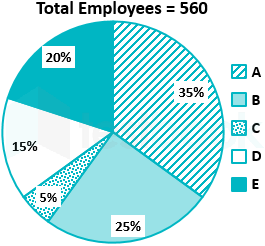
Directions: A pie chart below shows the percentage distribution of employees from the different departments namely A, B, C, D and E and the total number of employees in the company is 560. The following table gives the ratio of males and females corresponding to the departments. Study the pie chart and answer the given questions.

DepartmentsThe ratio of male employees to female employees
A75 : 23
B5 : 2
C2 : 5
D10 : 11
E13 : 15

Question 31

Based on Passage: View directions & passage

How many female employees working in departments B and C together?

  1. AOption (a)

    40

  2. BOption (b)

    50

  3. COption (c)

    60

  4. DOption (d)

    70

  5. EOption (e)

    80

View answer & explanation

Correct answer

Answer: (c)C.

60

Why this answer is correct

Calculation:

DepartmentsMale + FemaleMaleFemale
A19615046
B14010040
C28820
D844044
E1125260


Number of employees from department B = (25/100) × 560 = 140

⇒ Number of female employees from department B = (140/7) × 2 = 40

Number of employees from department C = (5/100) × 560 = 28

⇒ Number of female employees from department C = (28/7) × 5 = 20

Total number of female employees from department B and C = 40 + 20 = 60

∴ The number of female employees working in the departments B and C together is 60.

Question 32

Based on Passage: View directions & passage

How many male employees working in departments B and D together?

  1. AOption (a)

    120

  2. BOption (b)

    130

  3. COption (c)

    140

  4. DOption (d)

    150

  5. EOption (e)

    160

View answer & explanation

Correct answer

Answer: (c)C.

140

Why this answer is correct

Calculation:

DepartmentsMale + FemaleMaleFemale
A19615046
B14010040
C28820
D844044
E1125260


Number of employees in department B = (25/100) × 560 = 140

⇒ Number of male employees in department B = (140/7) × 5 = 100

Number of employees in department D = (15/100) × 560 = 84

⇒ Number of male employees in department D = (84/21) × 10 = 40

Total number of male employees in department B and D = 100 + 40 = 140

∴ The number of male employees working in departments B and D together is 140.

Question 33

Based on Passage: View directions & passage

What is the ratio of the number of female employees from department C and D together to that of the male employees working in department B and D together?

  1. AOption (a)

    35 : 43

  2. BOption (b)

    16 : 35

  3. COption (c)

    35 : 16

  4. DOption (d)

    35 : 99

  5. EOption (e)

    99 : 35

View answer & explanation

Correct answer

Answer: (b)B.

16 : 35

Why this answer is correct

Calculation:

DepartmentsMale + FemaleMaleFemale
A19615046
B14010040
C28820
D844044
E1125260


Number of employees from department C = (5/100) × 560 = 28

⇒ Number of female employees from department C = (28/7) × 5 = 20

Number of employees from department D = (15/100) × 560 = 84

⇒ Number of female employees from department D = (84/21) × 11 = 44 

⇒ Number of male employees from department D = (84/21) × 10 = 40

Number of employees from department B = (25/100) × 560 = 140

⇒ Number of male employees from department B = (140/7) × 5 = 100

⇒ Required ratio = (20 + 44) : (100 + 40) = 64 : 140

⇒ Required ratio = 16 : 35

∴ The ratio of the number of female employees from department C and D together to that of the male employees working in department B and D together is 16 : 35.


The number of female employees from department C and D together = 64

No need to calculate further, as per the option only option 2 contains a factor or multiple of 64.

Question 34

Based on Passage: View directions & passage

What percentage of the total number of employees working in department B is more than the total number of employees working in department E?

  1. AOption (a)

    15%

  2. BOption (b)

    20%

  3. COption (c)

    25%

  4. DOption (d)

    30%

  5. EOption (e)

    35%

View answer & explanation

Correct answer

Answer: (c)C.

25%

Why this answer is correct

Calculation:

DepartmentsMale + FemaleMaleFemale
A19615046
B14010040
C28820
D844044
E1125260


Number of employees from department B = (25/100) × 560 = 140

Number of employees from department E = (20/100) × 560 = 112

⇒ Percentage change = {(140 – 112)/112} × 100

⇒ Percentage change = {28/112} × 100 = 25%

∴ The required percentage is 25%.

From the pie chart, we can see that

Department B = 25%

Department E = 20%

⇒ Percentage change = (25 - 20)/20 × 100 = 25%

Question 35

Based on Passage: View directions & passage

Find out the department in which the number of male employees is maximum.

  1. AOption (a)

    A

  2. BOption (b)

    B

  3. COption (c)

    C

  4. DOption (d)

    D

  5. EOption (e)

    E

View answer & explanation

Correct answer

Answer: (a)A.

A

Why this answer is correct

Calculation:

DepartmentsMale + FemaleMaleFemale
A19615046
B14010040
C28820
D844044
E1125260


Number of employees from department A = (35/100) × 560 = 196

⇒ Number of male employees from department A = (196/98) × 75 = 150

Number of employees from department B = (25/100) × 560 = 140

⇒ Number of male employees from department B = (140/7) × 5 = 100

Number of employees from department C = (5/100) × 560 = 28

⇒ Number of male employees from department C = (28/7) × 2 = 8

Number of employees from department D = (15/100) × 560 = 84

⇒ Number of male employees from department D = (84/21) × 10 = 40

Number of employees from department E = (20/100) × 560 = 112

⇒ Number of male employees from department E = (112/28) × 13 = 52

From the above values we can deduce,

The maximum number of male employees are from department A

∴ The maximum number of male employees are from department A.

Number of employees from department A = (35/100) × 560 = 196

⇒ Number of male employees from department A = (196/98) × 75 = 150

No need to calculate further as the maximum number of employees after A department is from B i.e. 25% or 140 which is 10 less than the number of male employees from Department A

Question 36

Three pipes A, B and C can fill a tank in 6 hours together. All three pipes are opened for 2 hours, and then pipe C is closed. The remaining part of the tank is filled by pipes A and B in 7 hours. How much time will pipe C take to fill the empty tank alone?

  1. AOption (a)

    14 hours

  2. BOption (b)

    18 hours

  3. COption (c)

    20 hours

  4. DOption (d)

    12 hours

  5. EOption (e)

    None of these

View answer & explanation

Correct answer

Answer: (a)A.

14 hours

Why this answer is correct

Shortcut Trick

Total work = 6 units (assuming combined efficiency of A+B+C = 1 unit/hr).

Work done in 2 hours = 2 units. Remaining work = 6 − 2 = 4 units.

Efficiency of (A + B) = Remaining work ÷ Remaining time = 4 ÷ 7 = 4/7 units/hr.

Efficiency of C = Total efficiency − (A + B) efficiency = 1 − 4/7 = 3/7 units/hr.

Time taken by C = Total work ÷ Efficiency of C = 6 ÷ (3/7) = 6 × (7/3) = 14 hours.

∴ The correct answer is 14 hr.

Alternate Method

Given: Time for (A+B+C) = 6 hours. Opened for 2 hours. (A+B) finish remaining in 7 hours.

Formula: Efficiency = Work ÷ Time

⇒ Let total work = 42 units (LCM of 6 and 7).

⇒ Efficiency of (A + B + C) = 42 ÷ 6 = 7 units/hr.

⇒ Work done in 2 hours = 7 × 2 = 14 units.

⇒ Remaining work = 42 − 14 = 28 units.

⇒ Efficiency of (A + B) = 28 ÷ 7 = 4 units/hr.

⇒ Efficiency of C = Efficiency of (A+B+C) − Efficiency of (A+B) = 7 − 4 = 3 units/hr.

⇒ Time for C alone = Total work ÷ Efficiency of C = 42 ÷ 3 = 14 hours.

∴ The correct answer is 14 hr.

Additional Information

Pipe and Cistern Basics

Filling pipes are considered positive work while outlet/leakage pipes are negative work. Total work = Time × Efficiency.

Combined Work Formula

If A takes X hours and B takes Y hours, together they take (XY) ÷ (X + Y) hours to fill the tank.

Efficiency vs Time

Efficiency is inversely proportional to the time taken. If time ratio is a:b, efficiency ratio is b:a.

Question 37

2 men can complete the job in 24 days. If the faster one can alone complete the job 20 days faster than the second man, find the time taken by faster man to complete the work.

  1. AOption (a)

    68 days

  2. BOption (b)

    48 days

  3. COption (c)

    60 days

  4. DOption (d)

    20 days

  5. EOption (e)

    40 days

View answer & explanation

Correct answer

Answer: (e)E.

40 days

Why this answer is correct

Shortcut Trick

Let the time taken by the faster man be x days and the slower man be (x + 20) days.

Combined work formula: (x × (x + 20)) ÷ (x + x + 20) = 24 days.

Test options for x: If x = 40, then (40 × 60) ÷ (40 + 60) = 2400 ÷ 100 = 24 days.

The condition is satisfied when the faster man takes 40 days.

∴ The correct answer is 40 days.

Alternate Method

Given:

Time taken by 2 men together = 24 days.

Difference in time between two men = 20 days.

Formula Used:

1/Ttotal = 1/T1 + 1/T2

Calculations:

Let the time taken by the faster man be x days.

⇒ Time taken by the slower man = (x + 20) days.

⇒ 1/x + 1/(x + 20) = 1/24

⇒ (x + 20 + x) ÷ (x(x + 20)) = 1/24

⇒ (2x + 20) ÷ (x2 + 20x) = 1/24

⇒ 48x + 480 = x2 + 20x

⇒ x2 − 28x − 480 = 0

⇒ x2 − 40x + 12x − 480 = 0

⇒ x(x − 40) + 12(x − 40) = 0

⇒ (x − 40)(x + 12) = 0

⇒ x = 40 (Since time cannot be negative, x = −12 is rejected).

∴ The correct answer is 40 days.

Additional Information

Work Efficiency

Efficiency is inversely proportional to the time taken. If A is n times faster than B, then A takes 1/n of the time taken by B.

Combined Work Formula

If two individuals complete a task in 'a' and 'b' days respectively, they together complete it in (ab) ÷ (a + b) days.

Question 38

A train of length 210m takes 1/5 min to pass over another train 270 m long coming from the opposite direction. If the speed of the first train is x km/hr and the speed of the second train is (x + 12) km/hr, then, find the value of x?

  1. AOption (a)

    66

  2. BOption (b)

    64

  3. COption (c)

    60

  4. DOption (d)

    72

  5. EOption (e)

    None of these

View answer & explanation

Correct answer

Answer: (a)A.

66

Why this answer is correct

Shortcut Trick

Total distance = 210 + 270 = 480 m

Relative speed in m/s = 480 ÷ (60 ÷ 5) = 480 ÷ 12 = 40 m/s

Relative speed in km/hr = 40 × (18 ÷ 5) = 144 km/hr

Sum of speeds = x + (x + 12) = 144 ⇒ 2x = 132 ⇒ x = 66

∴ The correct answer is 66 km/hr.

Alternate Method

Given: Length of train 1 (L1) = 210 m, Length of train 2 (L2) = 270 m, Time (t) = 1/5 min = 12 sec, Speed 1 (S1) = x km/hr, Speed 2 (S2) = (x + 12) km/hr.

Formula Used: Relative Speed (Opposite) = (L1 + L2) ÷ Time

⇒ Relative Speed = (x + x + 12) km/hr = (2x + 12) km/hr

⇒ Speed in m/s = (2x + 12) × (5 ÷ 18)

⇒ (2x + 12) × (5 ÷ 18) = (210 + 270) ÷ 12

⇒ (2x + 12) × (5 ÷ 18) = 480 ÷ 12 = 40

⇒ 2x + 12 = 40 × (18 ÷ 5) = 144

⇒ 2x = 144 − 12 = 132

⇒ x = 66 km/hr

∴ The correct answer is 66 km/hr.

Additional Information

Relative Speed Concept

When two objects move in opposite directions, relative speed = S1 + S2. When moving in the same direction, relative speed = |S1 − S2|.

Unit Conversion

To convert km/hr to m/s, multiply by 5/18. To convert m/s to km/hr, multiply by 18/5.

Train Crossing Problems

Total distance while crossing another train is always the sum of lengths of both trains (L1 + L2), regardless of direction.

Question 39

If a boat goes 14 km upstream in 84 minutes and the speed of the stream is 6 km/h then what will be the speed of the boat in still water?

  1. AOption (a)

    16 km/h

  2. BOption (b)

    22 km/h

  3. COption (c)

    18 km/h

  4. DOption (d)

    12 km/h

  5. EOption (e)

    None of the above

View answer & explanation

Correct answer

Answer: (a)A.

16 km/h

Why this answer is correct

Shortcut Trick

Upstream speed = Distance ÷ Time = 14 km ÷ (84/60) h = 10 km/h.

Upstream Speed = Speed of boat (u) − Speed of stream (v).

10 = u − 6 ⇒ u = 16 km/h.

∴ The correct answer is 16 km/h.

Alternate Method

Given:

Upstream Distance = 14 km

Time = 84 minutes = 84/60 hours = 1.4 hours

Speed of stream (v) = 6 km/h

Formula Used:

Upstream Speed = Distance ÷ Time

Upstream Speed = Speed of Boat in still water (u) − Speed of Stream (v)

Calculations:

⇒ Upstream Speed = 14 ÷ (84/60)

⇒ Upstream Speed = (14 × 60) ÷ 84

⇒ Upstream Speed = 840 ÷ 84 = 10 km/h

⇒ u − v = 10

⇒ u − 6 = 10

⇒ u = 10 + 6 = 16 km/h

∴ The correct answer is 16 km/h.

Additional Information

Downstream Speed

It is the net speed of the boat when it moves with the flow of the stream, calculated as Downstream Speed = u + v.

Boat Speed Calculation

If downstream speed (D) and upstream speed (U) are known, speed in still water u = (D + U) ÷ 2.

Stream Speed Calculation

If downstream speed (D) and upstream speed (U) are known, speed of stream v = (D − U) ÷ 2.

Question 40

A vessel is full of a mixture of kerosene and petrol in which there is 20% kerosene. 5 litres are drawn off and then the vessel is filled with petrol. If the kerosene is now 15%, how much does the vessel hold?

  1. AOption (a)

    30 litres

  2. BOption (b)

    35 litres

  3. COption (c)

    26 litres

  4. DOption (d)

    32 litres

  5. EOption (e)

    20 litres

View answer & explanation

Correct answer

Answer: (e)E.

20 litres

Why this answer is correct

Shortcut Trick

Initial Kerosene concentration = 20% | Final concentration = 15%

Quantity of Kerosene remains constant relative to the total mixture after the 5 litres are removed.

Ratio of Initial Volume (V1) to Final Volume (V2) is inverse of concentration: 15 : 20 → 3 : 4

Difference in ratio parts = 4 − 3 = 1 unit → 5 litres

Total capacity (Final Volume) = 4 units × 5 litres = 20 litres

∴ The correct answer is 20 litres.

Alternate Method

Given: Initial Kerosene % = 20%, Final Kerosene % = 15%, Quantity replaced = 5 litres.

Formula: Final Concentration = Initial Concentration × [1 − (Replacement Volume / Total Volume)]

⇒ 15 = 20 × [1 − (5 / V)]

⇒ 15 / 20 = 1 − (5 / V)

⇒ 3 / 4 = 1 − (5 / V)

⇒ 5 / V = 1 − 3 / 4

⇒ 5 / V = 1 / 4

⇒ V = 5 × 4 = 20

∴ The correct answer is 20 litres.

Additional Information

Replacement Formula

The final quantity of a component after replacement is given by Qfinal = Qinitial × (1 − x/V)n, where x is quantity replaced, V is total volume, and n is number of operations.

Alligation Method for Replacement

One can treat the replacement as mixing the remaining mixture (20% kerosene) with pure petrol (0% kerosene) to get a 15% result.

Concentration vs Volume

In replacement problems where the total volume remains constant, the ratio of concentrations is inversely proportional to the ratio of the component's volume before and after dilution.

Question 41

Ratio of difference between the ages of father and son and sum of ages of father and son is 3 : 10. If the difference of the age of father and son is 24 years, then find the age of Father.

  1. AOption (a)

    52 years

  2. BOption (b)

    28 years

  3. COption (c)

    104 years

  4. DOption (d)

    80 years

  5. EOption (e)

    None of the above

View answer & explanation

Correct answer

Answer: (a)A.

52 years

Why this answer is correct

Shortcut Trick

Ratio of Difference to Sum = 3 : 10

Given, Difference = 24 years ⇒ 3 units = 24 years ⇒ 1 unit = 8 years.

Sum = 10 units = 10 × 8 = 80 years.

Father's age = (Sum + Difference) ÷ 2 = (80 + 24) ÷ 2 = 52 years.

∴ The correct answer is 52 years.

Alternate Method

Given:

Ratio of (F − S) : (F + S) = 3 : 10

Difference (F − S) = 24 years

Calculations:

⇒ 3 units = 24 years

⇒ 1 unit = 24 ÷ 3 = 8 years

⇒ Sum (F + S) = 10 units = 10 × 8 = 80 years

⇒ F + S = 80

⇒ F − S = 24

Adding both equations:

⇒ 2F = 104

⇒ F = 104 ÷ 2 = 52

∴ The correct answer is 52 years.

Additional Information

Sum and Difference Rule

If the sum (a+b) and difference (a−b) of two numbers are known, then the larger number is (Sum + Diff) ÷ 2 and the smaller number is (Sum − Diff) ÷ 2.

Age Difference Property

The difference between the ages of two persons remains constant throughout their lives, regardless of the number of years passed or preceding.

Componendo and Dividendo

If (a+b)/(a−b) = x/y, then a/b = (x+y)/(x−y). In this case, F/S = (10+3)/(10−3) = 13/7.

Question 42

Aman, Bijoy and Chandra subscribes together Rs. 50,000 for a business. Aman sub-scribes Rs. 4,000 more than Bijoy and BijoyRs. 5,000 more than Chandra. Out of a total profit of Rs. 35,000 Aman receives

  1. AOption (a)

    Rs. 8,500

  2. BOption (b)

    Rs. 14,700

  3. COption (c)

    Rs. 11,998

  4. DOption (d)

    Rs. 12,600

  5. EOption (e)

    Rs. 9,250

View answer & explanation

Correct answer

Answer: (b)B.

Rs. 14,700

Why this answer is correct

Shortcut Trick

Let Chandra's share be x. Then Bijoy = x + 5,000 and Aman = x + 5,000 + 4,000 = x + 9,000.

Total: 3x + 14,000 = 50,000 ⇒ 3x = 36,000 ⇒ x = 12,000.

Investment Ratio (A:B:C) = 21,000 : 17,000 : 12,000 = 21 : 17 : 12.

Total ratio parts = 21 + 17 + 12 = 50.

Aman's Profit = (21 ÷ 50) × 35,000 = 21 × 700 = 14,700.

∴ The correct answer is Rs. 14,700.

Alternate Method

Given → Total Investment = Rs. 50,000 | Total Profit = Rs. 35,000. Formulas: Profit Ratio = Investment Ratio × Time Ratio | Profit share = (Individual Ratio ÷ Total Ratio) × Total Profit.

⇒ Let Chandra = C. Bijoy = C + 5000. Aman = (C + 5000) + 4000 = C + 9000. ⇒ Total = C + (C + 5000) + (C + 9000) = 50,000. ⇒ 3C + 14,000 = 50,000 ⇒ 3C = 36,000 ⇒ C = 12,000. ⇒ Aman's Investment = 12,000 + 9,000 = 21,000. ⇒ Bijoy's Investment = 12,000 + 5,000 = 17,000. ⇒ Ratio of Profit = 21,000 : 17,000 : 12,000 = 21 : 17 : 12. ⇒ Aman's share = [21 ÷ (21 + 17 + 12)] × 35,000 = (21 ÷ 50) × 35,000 = 14,700.

∴ The correct answer is Rs. 14,700.

Additional Information

Partnership Ratios

When the time period of investment is the same for all partners, the profit is divided strictly in the ratio of their capitals.

Variable Time Partnership

If time periods differ, profit is shared in the ratio of (Capital1 × Time1) : (Capital2 × Time2).

Question 43

In a society number of males are 80 more than the number of females, in total number of males 30% are boys and in females 35% are girls and rest are adults. If the number of girls is 15 less than the number of boys. Calculate the total population of the society.

  1. AOption (a)

    440

  2. BOption (b)

    450

  3. COption (c)

    500

  4. DOption (d)

    520

  5. EOption (e)

    580

View answer & explanation

Correct answer

Answer: (a)A.

440

Why this answer is correct

Shortcut Trick

Let the number of females be x and males be (x + 80).

Boys = 30% of (x + 80) and Girls = 35% of x.

Given: Boys − Girls = 15 ⇒ 0.30(x + 80) − 0.35x = 15.

0.30x + 24 − 0.35x = 15 ⇒ 0.05x = 9 ⇒ x = 180.

Total Population = Males + Females = (180 + 80) + 180 = 440.

∴ The correct answer is 440.

Alternate Method

Given:

Let Females (F) = x

Males (M) = x + 80

Boys = 30% of M = 0.3(x + 80)

Girls = 35% of F = 0.35x

Calculation:

⇒ Boys − Girls = 15

⇒ 0.3(x + 80) − 0.35x = 15

⇒ 0.3x + 24 − 0.35x = 15

⇒ 24 − 15 = 0.35x − 0.3x

⇒ 9 = 0.05x

⇒ x = 9 ÷ 0.05 = 180

⇒ Number of Females = 180

⇒ Number of Males = 180 + 80 = 260

⇒ Total Population = 260 + 180 = 440

∴ The correct answer is 440.

Additional Information

Percentage Calculations

To calculate x% of a value y, use the formula (x ÷ 100) × y. In population problems, always define the base variables clearly.

Linear Equations in Word Problems

Translate phrases like more than or less than into addition or subtraction signs relative to the base variable to form a solvable equation.

Total Population Logic

Total Population is the sum of all categories (Adult Males + Boys + Adult Females + Girls), which simplifies to Total Males + Total Females.

Question 44

Avinash bought an iron at some price, later he sold it to Praveen at 10% profit. However Praveen damage the iron and spent Rs.1500 for it's repairing and later sold it to Piyush at a loss of 25%. What is the price at which Avinash brought the Iron, such that if he directly sold the iron to Piyush he would have gained a profit of 5%?

  1. AOption (a)

    Rs.4500

  2. BOption (b)

    Rs.4800

  3. COption (c)

    Rs.6200

  4. DOption (d)

    Rs.5500

  5. EOption (e)

    Rs.5000

View answer & explanation

Correct answer

Answer: (e)E.

Rs.5000

Why this answer is correct

Shortcut Trick

Let Avinash's CP be x. SP to Praveen = 1.1x.

Praveen's effective CP = 1.1x + 1500. SP to Piyush = 0.75 × (1.1x + 1500).

Direct SP to Piyush for 5% profit = 1.05x.

Equating both SP values: 0.75 × (1.1x + 1500) = 1.05x ⇒ 0.825x + 1125 = 1.05x.

0.225x = 1125 ⇒ x = 1125 ÷ 0.225 = 5000.

∴ The correct answer is Rs.5000.

Alternate Method

Given → Profit1 = 10%, Repair Cost = Rs.1500, Loss2 = 25%, Target Profit = 5%. Formulas: SP = CP × (100 + P%) ÷ 100 | SP = CP × (100 − L%) ÷ 100

⇒ Let Avinash buy at Rs. x. He sells to Praveen at 1.1x. ⇒ Praveen spends 1500 on repairs, so Total CP for Praveen = 1.1x + 1500. ⇒ Praveen sells it to Piyush at 25% loss ⇒ Piyush's CP = 75% of (1.1x + 1500) = 0.75(1.1x + 1500). ⇒ If Avinash sells directly to Piyush for 5% profit, SP = 1.05x. ⇒ 0.825x + 1125 = 1.05x. ⇒ 1.05x − 0.825x = 1125 ⇒ 0.225x = 1125. ⇒ x = 1125 ÷ 0.225 = 5000.

∴ The correct answer is Rs.5000.

Additional Information

Effective Cost Price

When a person spends money on repairs, transportation, or installation, that amount is added to the purchase price to find the Total Cost Price.

Chain Transactions

In a series of sales, the Selling Price of the first person becomes the Cost Price for the next person.

Directions: Study the paragraph and answer the questions that follow.

In a senior secondary school, every class is divided into six sections A, B, C, D, E and F. There are 50 students in each section of the class. In the sections A, B and C of class 10th, the girl to boy ratio is 2 ∶ 3, while in sections D and E, the girl to boy ratio is 3 ∶ 7. On the other hand, there are equal number of boys and girls in the section F of class 10th. The number of boys in the sections A and B of class 12th is 80% and 90% of the number of boys in the sections A and B of class 10th. While, the number of girls in the other sections of class 12th is 60% of the number of boys in the respective sections of the class 10th.

Question 45

Based on Passage: View directions & passage

How many total number of girls are there in the sections A, B and C of class 10th?

  1. AOption (a)

    30

  2. BOption (b)

    45

  3. COption (c)

    60

  4. DOption (d)

    75

  5. EOption (e)

    90

View answer & explanation

Correct answer

Answer: (c)C.

60

Why this answer is correct

Total no. of students in one section = 50

Ratio of girls to boys = 2 ∶ 3

Total no. of girls in one section = 2/5 × 50 = 20

∴ Total no. of girls in sections A, B, C = 3 × 20 = 60

Question 46

Based on Passage: View directions & passage

How many boys are there in the section A of class 12th?

  1. AOption (a)

    20

  2. BOption (b)

    24

  3. COption (c)

    28

  4. DOption (d)

    30

  5. EOption (e)

    36

View answer & explanation

Correct answer

Answer: (b)B.

24

Why this answer is correct

Total no. of students in a section = 50

Ratio of girls to boys in section A of class 10th = 2 ∶ 3

No. of boys in section A of class 10th = 3/5 × 50 = 30

∴ No. of boys in section A of class 12th = 80% of 30 = 24

Question 47

Based on Passage: View directions & passage

How many girls are there in the section C of class 12th?

  1. AOption (a)

    12

  2. BOption (b)

    15

  3. COption (c)

    18

  4. DOption (d)

    20

  5. EOption (e)

    24

View answer & explanation

Correct answer

Answer: (c)C.

18

Why this answer is correct

Total no. of students in a section = 50

Ratio of girls to boys in section C of class 10th = 2 ∶ 3

No. of boys in section C of class 10th = 3/5 × 50 = 30

∴ No. of girls in section C of class 12th = 60% of 30 = 18

Question 48

Based on Passage: View directions & passage

How many total number of boys are there in the sections D and E of class 12th?

  1. AOption (a)

    21

  2. BOption (b)

    58

  3. COption (c)

    35

  4. DOption (d)

    42

  5. EOption (e)

    50

View answer & explanation

Correct answer

Answer: (b)B.

58

Why this answer is correct

Total no. of students in a section = 50

Ratio of girls to boys in sections D and E of class 10th = 3 ∶ 7

Total no. of boys in sections D & E of class 10th = 2 × 7/10 × 50 = 70

Total no. of girls in sections D & E of class 12th = 60% of 70 = 42

∴ Total no. of boys in section D & E of class 12th = 100 – 42 = 58

Question 49

In the given question, two equations numbered l and II are given. You have to solve both the equations and mark the appropriate answer-

(i). 9x2 – 75x + 100 = 0

(ii). y2 – 25y + 154 = 0

  1. AOption (a)

    If x < y

  2. BOption (b)

    If x > y

  3. COption (c)

    If x ≥ y

  4. DOption (d)

    If x ≤ y

  5. EOption (e)

    If x = y or relationship between x & y cannot be established.

View answer & explanation

Correct answer

Answer: (a)A.

If x < y

Why this answer is correct

(i). 9x2 – 75x + 100 = 0

⇒ 9x2 – 60x – 15x + 100 = 0

⇒ 3x (3x - 20) – 5 (3x - 20) = 0

⇒ (3x - 20) (3x - 5) = 0

⇒ 3x – 20 = 0 and 3x – 5 = 0

⇒ x = 203;and;x;=;5/3\frac{{20}}{3};{\rm{and;x;}} = {\rm{;}}5/3                    ...(i)

(ii). Y2 - 25y + 154 : 0

⇒ y2 – 14y – 11y + 154 = 0

⇒ Y(y – 14) – 11 (y - 14) = 0

⇒ (y - 11) (y - 14) = 0

⇒ y – 11 = 0 and y – 14 = 0

⇒ y = 11 and y = 14                        ...(ii)

From eq. (i) and (ii), it clearly shows that x < y.

Question 50

In the following question two equations numbered I & II are given. You have to solve both the equations and mark answers.

(i). 5x2 – 18x + 16 = 0

(ii). Y2 – 21y + 104 = 0

  1. AOption (a)

    If x < y

  2. BOption (b)

    If x > y

  3. COption (c)

    If x ≥ y

  4. DOption (d)

    If x ≤ y

  5. EOption (e)

    If x = y or relationship between x & y cannot be established.

View answer & explanation

Correct answer

Answer: (a)A.

If x < y

Why this answer is correct

(i). 5x2 – 18 x + 16 = 0

⇒ 5x2 – 10x – 8x + 16 = 0

⇒ 5x (x - 2) – 8 (x - 2) = 0

⇒ (5x - 8) (x - 2) = 0

⇒ 5x – 8 = 0 and x – 2 = 0

⇒ x = 8/5 and x = 2                           ...(i)

(ii). Y2 – 21y + 104 = 0

⇒ y2- 13y – 8y + 104 = 0

⇒ y (y - 13) – 8 + (y - 13) = 0

⇒ (y - 8) (y - 13) = 0

⇒y – 8 = 0 and y – 13 = 0

⇒ y = 8 and y = 13                           ...(ii)

From eq. (i) and (ii), it clearly shows that x < y.

Question 51

In the following questions two equations numbered I and II are given. You have to solve both the equations and find the relation between x ​and y.

I. x2 + 3x + 2 = 0

II. 2y2 = 5y

  1. AOption (a)

    x < y

  2. BOption (b)

    x > y

  3. COption (c)

    x ≤ y

  4. DOption (d)

    x ≥ y

  5. EOption (e)

    x = y

View answer & explanation

Correct answer

Answer: (a)A.

x < y

Why this answer is correct

According to the given equations,

I. x2 + 3x + 2 = 0

By middle term splitting, we get,

x2 + 2x + x + 2 = 0

x(x + 2) + 1(x + 2) = 0

(x + 1)(x + 2) = 0

x = -1

x = -2

II. 2y2 = 5y

2y2 - 5y = 0

y(2y – 5) = 0

y = 0

y = 5/2

Both values of y are greater than both values of x.

Question 52

In the following question two equations are given. You have to solve these equations and determine relation between x and y. 

I. x2 – 5x – 14 = 0

II. y2 – 15y + 56 = 0

  1. AOption (a)

    x< y

  2. BOption (b)

    x> y

  3. COption (c)

    x = y OR the relationship cannot be determined

  4. DOption (d)

    x ≥ y

  5. EOption (e)

    x ≤ y

View answer & explanation

Correct answer

Answer: (e)E.

x ≤ y

Why this answer is correct

I. x2 – 5x – 14 = 0

⇒ x2 – 7x + 2x – 14 = 0

⇒ x(x – 7) + 2(x – 7) = 0

⇒ (x – 7)(x + 2) = 0

Then, x = + 7 or x = - 2

II. y2 – 15y + 56 = 0

⇒ y2 – 7y – 8y + 56 = 0

⇒ y(y – 7) – 8(y – 7) = 0

⇒ (y – 7)(y – 8) = 0

Then, y = + 7 or y = + 8

So, when x = + 7, x = y for y = + 7 and x < y for y = + 8

And when x = - 2, x < y for y = + 7 and x < y for y = + 8

∴ So, we can observe that x ≤ y.

Question 53

In the given question, two equations numbered l and II are given. Solve both the equations and mark the appropriate answer.

I. 2x2 + 16x – 18 = 0

II. y2 – 6y + 5 = 0

  1. AOption (a)

    x < y

  2. BOption (b)

    x > y

  3. COption (c)

    x = y OR the relationship cannot be determined

  4. DOption (d)

    x ≥ y

  5. EOption (e)

    x ≤ y

View answer & explanation

Correct answer

Answer: (e)E.

x ≤ y

Why this answer is correct

I. 2x2 + 16x – 18 = 0

⇒ 2x2 + 18x – 2x – 18 = 0

⇒ 2x(x + 9) – 2(x + 9) = 0

⇒ (x + 9)(2x – 2) = 0

Then, x = - 9 or x = + 2/2 = 1

II. y2 – 6y + 5 = 0

⇒ y2 – 5y – y + 5 = 0

⇒ y(y – 5) – 1(y – 5) = 0

⇒ (y – 5)(y – 1) = 0

Then, y = + 5 or y = + 1

So, when x = - 9, x < y for y = + 5 and x < y for y = + 1

And when x = + 1, x < y for y = + 5 and x = y for y = + 1

∴ So, we can clearly observe that x ≤ y**.**

Question 54

In the following question two equations are given. You have to solve these equations and determine relation between a and b.

I. 12x2 + 16x – 3= 0

II. y2 – 7y + 12 = 0

  1. AOption (a)

    x < y

  2. BOption (b)

    x > y

  3. COption (c)

    x = y or CND

  4. DOption (d)

    x ≤ y

  5. EOption (e)

    x ≥ y

View answer & explanation

Correct answer

Answer: (a)A.

x < y

Why this answer is correct

I. 12x2 + 16x – 3= 0

⇒ 12x2 + 18x – 2x – 3 = 0

⇒ 6a(2x + 3) – 1(2x + 3) = 0

⇒ (2x + 3)(6x – 1) = 0

Then, x = - 3/2 or x = + 1/6

II. y2 – 7y + 12 = 0

⇒ y2 – 3y – 4y + 12 = 0

⇒ y(y – 3) – 4(y – 3) = 0

⇒ (y – 3)(y – 4) = 0

Then, y = 3 or y = 4


Comparison between x and y (via Tabulation):
Value of xValue of yRelation
-1.53x < y
-1.54x < y
1/63x < y
1/64x < y


∴ We can clearly observe that x < y.

Question 55

Based on Passage: View directions & passage

What is the boy to girl ratio in the section F of class 12th?

  1. AOption (a)

    3 ∶ 2

  2. BOption (b)

    4 ∶ 1

  3. COption (c)

    5 ∶ 3

  4. DOption (d)

    3 ∶ 7

  5. EOption (e)

    9 ∶ 1

View answer & explanation

Correct answer

Answer: (d)D.

3 ∶ 7

Why this answer is correct

Total no. of students in a section = 50

Ratio of girls to boys in section F of class 10th = 1 ∶ 1

No. of boys in section F of class 10th = 1/2 × 50 = 25

No. of girls in section F of class 12th = 60% of 25 = 15

No. of boys in section F of class 12th = 50 – 15 = 35

∴ Boy to Girl ratio in section F of class 12th = 35 ∶ 15 = 7 : 3

Direction: Read the following graph carefully and answer the following questions :

Graph shows number of students in a college in five years.

Total number of students = boys students + girls students

Question 56

Based on Passage: View directions & passage

In the year 2005, if 10% of boys students and 25% of girls students graduated from college then what will be the average number of students who are admitted into the college in the same year?

  1. AOption (a)

    410

  2. BOption (b)

    550

  3. COption (c)

    680

  4. DOption (d)

    700

  5. EOption (e)

    750

View answer & explanation

Correct answer

Answer: (e)E.

750

Why this answer is correct

Given:

In 2005, Number of boys = 1000

In 2005, Number of girls = 800

Formula used:

Average = (Sum of values/number of values)

Calculation:

Total number of students who graduated from college in the year 2005

⇒ (1000 × 10 / 100) + (800 × 25 / 100)

⇒ 100 + 200

⇒ 300

Total number of students who are admitted into the college in the year 2005 ⇒ (1000 + 800) – 300

⇒ 1500

Required average

⇒ (1500/2)

⇒ 750

∴ The average is 750.

Question 57

Based on Passage: View directions & passage

45% of boys students in each year are using the library, approximately the number of boys students who are not using the library in the year 2008 is what percent of a total number of boys students who are not using the library in all five years?

  1. AOption (a)

    46%

  2. BOption (b)

    45%

  3. COption (c)

    24%

  4. DOption (d)

    55%

  5. EOption (e)

    26%

View answer & explanation

Correct answer

Answer: (c)C.

24%

Why this answer is correct

Total number of boys students in college in five years = 1000 + 1200 + 1500 + 1800 + 2000

= 7500

Total number of boys students who are not using library in five years = 7500 × 55 / 100 = 4125

Total number of boys students who are not using library in year 2008 = 1800 × 55 / 100 = 990

Required percentage = 990 / 4125 × 100

Required percentage = 24%

Question 58

Based on Passage: View directions & passage

Approximately what percent of the total number of students in the year 2009 is of total number of students in all five years? 

  1. AOption (a)

    19%

  2. BOption (b)

    20%

  3. COption (c)

    22%

  4. DOption (d)

    28%

  5. EOption (e)

    26%

View answer & explanation

Correct answer

Answer: (e)E.

26%

Why this answer is correct

Total number of boys students in college in five years = 1000 + 1200 + 1500 + 1800 + 2000 = 7500

Total number of girls students in college in five years = 800 + 1100 + 2000 + 2400 + 2200 = 8500

Total number of students in five years in college = 7500 + 8500 = 16000

Total number of students in college in year 2009 = 2000 + 2200 = 4200

Required percentage = 4200 / 16000 × 100 = 26.25% ≈ 26%

Question 59

Based on Passage: View directions & passage

The percentage of girls students who are using Scooty are 40%, 35%, 55%, 60% and 70% in five years respectively then approximately the number of girls students who are using Scooty is what percent more than the number of girls students who are not using Scooty?

  1. AOption (a)

    22%

  2. BOption (b)

    20%

  3. COption (c)

    24%

  4. DOption (d)

    26%

  5. EOption (e)

    29%

View answer & explanation

Correct answer

Answer: (e)E.

29%

Why this answer is correct

Total number of girls students who are using Scooty in five years = 800 × 40/100 + 1100 × 35/100 + 2000 × 55/100 + 2400 × 60/100 + 2200 × 70/100

= 320 + 385 + 1100 + 1440 + 1540

= 4785

Total number of girls students in college in five years = 800 + 1100 + 2000 + 2400 + 2200 = 8500

Total number of Girls students who are not using Scooty = 8500 – 4785 = 3715

⇒ 4785 = 3715 + 3715 × ? /100

⇒ ? = 28.80% ≈ 29%

Question 60

Based on Passage: View directions & passage

If 20% of boys and 35% of girls students in five years are placed in the company, then what is the ratio between the boys and girls students who are placed in five years?

  1. AOption (a)

    117 : 48

  2. BOption (b)

    48 : 67

  3. COption (c)

    60 : 119

  4. DOption (d)

    119 : 117

  5. EOption (e)

    117 : 60

View answer & explanation

Correct answer

Answer: (c)C.

60 : 119

Why this answer is correct

Total number of boys students in college in five years = 1000 + 1200 + 1500 + 1800 + 2000 = 7500

Total number of girls students in college in five years = 800 + 1100 + 2000 + 2400 + 2200 = 8500

Required ratio = (7500 × 20 / 100) : (8500 × 35 / 100) = 1500 : 2975 = 60 : 119

Question 61

What should come in place of the question mark '?' in the following number series?

20, 20, 41, 125, 503, ?

  1. AOption (a)

    2417

  2. BOption (b)

    2487

  3. COption (c)

    2519

  4. DOption (d)

    2119

  5. EOption (e)

    2389

View answer & explanation

Correct answer

Answer: (c)C.

2519

Why this answer is correct

The series follows the following pattern:

20 × 1 + 0 = 20

⇒ 20 × 2 + 1 = 41

⇒ 41 × 3 + 2 = 125

⇒ 125 × 4 + 3 = 503

⇒ 503 × 5 + 4 = 2519

∴ The required term in the series will be 2519.

Question 62

What should come in place of question mark ‘?’ in the following number series?

182, 186, 202, ?, 302, 402

  1. AOption (a)

    238

  2. BOption (b)

    240

  3. COption (c)

    225

  4. DOption (d)

    235

  5. EOption (e)

    230

View answer & explanation

Correct answer

Answer: (a)A.

238

Why this answer is correct

182 + 22 = 186

186 + 42 = 202

202 + 62 = 238

238 + 82 = 302

302 + 102 = 402

Question 63

What should come in place of the question mark '?' in the following number series?

512, 256, 384, 960, ?, 15120

  1. AOption (a)

    2740

  2. BOption (b)

    4580

  3. COption (c)

    3360

  4. DOption (d)

    5520

  5. EOption (e)

    7120

View answer & explanation

Correct answer

Answer: (c)C.

3360

Why this answer is correct

The series follows the following pattern:

512 × 0.5 = 256

256 × 1.5 = 384

384 × 2.5 = 960

960 × 3.5 = 3360

3360 × 4.5 = 15120

∴ The required term in the series will be 3360.

Question 64

What should come in place of the question mark '?' in the following number series?

722, 363, 124, ?, 12, 8

  1. AOption (a)

    45

  2. BOption (b)

    56

  3. COption (c)

    72

  4. DOption (d)

    35

  5. EOption (e)

    64

View answer & explanation

Correct answer

Answer: (d)D.

35

Why this answer is correct

The series follows the following pattern:

722 ÷ 2 + 2 = 363

363 ÷ 3 + 3 = 124

124 ÷ 4 + 4 = 35

35 ÷ 5 + 5 = 12

12 ÷ 6 + 6 = 8

∴ The required term in the series will be 35.

Question 65

What will come in place of question mark '?' in the following number series?

4, 10, 22, 42, 72, 114, ?

  1. AOption (a)

    144

  2. BOption (b)

    197

  3. COption (c)

    154

  4. DOption (d)

    170

  5. EOption (e)

    161

View answer & explanation

Correct answer

Answer: (d)D.

170

Why this answer is correct

The series follows the pattern given below- 

4     10     22     42     72     114      170

    6     12    20     30     42      56

        6       8     10    12      14

∴ The next term in the series is 170.

Reasoning Ability (35 questions)

Study the following information and Answer the questions given below:

Six persons A, B, C, D, E, F are sitting around a circular table facing the center and likes different Fruits viz. Apple, Banana, Orange, Grapes, Mango and Pomegranate, but not necessarily in same order. E sits third to the left of F. The one who likes Banana is an immediate neighbor of F. F neither likes Apple nor Banana. The one who likes Apple sits second to the right of the one who likes Banana. Only one person sits between the one who likes Pomegranate and E. A likes Oranges and sits at immediate left of D. B sits third to the right of the one who likes Pomegranate. D sits second to the left of the one who likes Banana. B does not like Grapes and C does not like Mango.

Question 66

Based on Passage: View directions & passage

Who among the following likes Pomegranate?

  1. AOption (a)

    A

  2. BOption (b)

    C

  3. COption (c)

    F

  4. DOption (d)

    D

  5. EOption (e)

    E

View answer & explanation

Correct answer

Answer: (d)D.

D

Why this answer is correct

Six persons:  A, B, C, D, E, F

Six Fruits: Apple, Banana, Orange, Grapes, Mango and Pomegranate

1) E sits third to the left of F.

  1. The one who likes Banana is an immediate neighbor of F. F neither likes Apple nor Banana.

Case 1:

Case 2:

  1. The one who likes Apple sits second to the right of the one who likes Banana.

  2. Only one person sits between the one who likes Pomegranate and E. 

Case 1:

Case 2:


5) A likes Oranges and sits at immediate left of D. (This is not possible is case 1)

  1. B sits third to the right of the one who likes Pomegranate.

Case 2:

7) B sits third to the right of the one who likes Pomegranate.

  1. D sits second to the left of the one who likes Banana.

  2. B does not like Grapes and C does not like Mango.

Hence, D likes pomegranate is the correct answer.

Question 67

Based on Passage: View directions & passage

Who sits second to the right to the one who likes Mango?

  1. AOption (a)

    A

  2. BOption (b)

    C

  3. COption (c)

    B

  4. DOption (d)

    F

  5. EOption (e)

    D

View answer & explanation

Correct answer

Answer: (a)A.

A

Why this answer is correct

Six persons:  A, B, C, D, E, F

Six Fruits: Apple, Banana, Orange, Grapes, Mango and Pomegranate

1) E sits third to the left of F.

  1. The one who likes Banana is an immediate neighbor of F. F neither likes Apple nor Banana.

Case 1:

Case 2:

  1. The one who likes Apple sits second to the right of the one who likes Banana.

  2. Only one person sits between the one who likes Pomegranate and E. 

Case 1:

Case 2:


5) A likes Oranges and sits at immediate left of D. (This is not possible is case 1)

  1. B sits third to the right of the one who likes Pomegranate.

Case 2:

7) B sits third to the right of the one who likes Pomegranate.

  1. D sits second to the left of the one who likes Banana.

  2. B does not like Grapes and C does not like Mango.

Hence, A sits second to the right of the one who likes Mango.

Question 68

Based on Passage: View directions & passage

How many persons sit between F and B when counted in clockwise direction with respect to F?

  1. AOption (a)

    1

  2. BOption (b)

    2

  3. COption (c)

    4

  4. DOption (d)

    3

  5. EOption (e)

    0

View answer & explanation

Correct answer

Answer: (d)D.

3

Why this answer is correct

Six persons:  A, B, C, D, E, F

Six Fruits: Apple, Banana, Orange, Grapes, Mango and Pomegranate

1) E sits third to the left of F.

  1. The one who likes Banana is an immediate neighbor of F. F neither likes Apple nor Banana.

Case 1:

Case 2:

  1. The one who likes Apple sits second to the right of the one who likes Banana.

  2. Only one person sits between the one who likes Pomegranate and E. 

Case 1:

Case 2:


5) A likes Oranges and sits at immediate left of D. (This is not possible is case 1)

  1. B sits third to the right of the one who likes Pomegranate.

Case 2:

7) B sits third to the right of the one who likes Pomegranate.

  1. D sits second to the left of the one who likes Banana.

  2. B does not like Grapes and C does not like Mango.


Hence, 3 persons sit between F and B when counted clockwise direction with respect to F.

Question 69

Based on Passage: View directions & passage

Which of the following combination is true?

  1. AOption (a)

    F - Pomegranate

  2. BOption (b)

    A - Apple

  3. COption (c)

    D - Mango

  4. DOption (d)

    B - Orange

  5. EOption (e)

    C - Banana

View answer & explanation

Correct answer

Answer: (e)E.

C - Banana

Why this answer is correct

Six persons:  A, B, C, D, E, F

Six Fruits: Apple, Banana, Orange, Grapes, Mango and Pomegranate

1) E sits third to the left of F.

  1. The one who likes Banana is an immediate neighbor of F. F neither likes Apple nor Banana.

Case 1:

Case 2:

  1. The one who likes Apple sits second to the right of the one who likes Banana.

  2. Only one person sits between the one who likes Pomegranate and E. 

Case 1:

Case 2:


5) A likes Oranges and sits at immediate left of D. (This is not possible is case 1)

  1. B sits third to the right of the one who likes Pomegranate.

Case 2:

7) B sits third to the right of the one who likes Pomegranate.

  1. D sits second to the left of the one who likes Banana.

  2. B does not like Grapes and C does not like Mango.

Hence, C - Banana is the correct answer.

Question 70

Based on Passage: View directions & passage

Which of the following statement is true about C?

  1. AOption (a)

    C likes Oranges

  2. BOption (b)

    B is immediate neighbor of C

  3. COption (c)

    C sits second to the left of D

  4. DOption (d)

    Only I and II are true

  5. EOption (e)

    None of these

View answer & explanation

Correct answer

Answer: (b)B.

B is immediate neighbor of C

Why this answer is correct

Six persons:  A, B, C, D, E, F

Six Fruits: Apple, Banana, Orange, Grapes, Mango and Pomegranate

1) E sits third to the left of F.

  1. The one who likes Banana is an immediate neighbor of F. F neither likes Apple nor Banana.

Case 1:

Case 2:

  1. The one who likes Apple sits second to the right of the one who likes Banana.

  2. Only one person sits between the one who likes Pomegranate and E. 

Case 1:

Case 2:


5) A likes Oranges and sits at immediate left of D. (This is not possible is case 1)

  1. B sits third to the right of the one who likes Pomegranate.

Case 2:

7) B sits third to the right of the one who likes Pomegranate.

  1. D sits second to the left of the one who likes Banana.

  2. B does not like Grapes and C does not like Mango.

Hence, B is an immediate neighbour of C is the correct answer.

Question 71

If it is possible to make only one 4 letters meaningful word without repetition of the letter with the third, fourth, sixth and the eighth letters of the word ‘RAVISHMENT’, which would be the third letter from the left of the word? If more than one such word can be formed, give X as the answer. If no such word can be formed, give K as your answer.

  1. AOption (a)

    I

  2. BOption (b)

    V

  3. COption (c)

    H

  4. DOption (d)

    K

  5. EOption (e)

    X

View answer & explanation

Correct answer

Answer: (b)B.

V

Why this answer is correct

Give word: ‘RAVISHMENT’

Third, fourth, sixth and the eighth letters of the word : V, I, H and E

Meaningful word with these letters: HIVE

The third letter from the left is: V

Hence, the correct answer is V.

Directions: Study the following information to answer the given questions.

12 persons are sitting in a parallel row such that six persons sit in each row. Persons in row 1 face south and persons in row 2 face north. A, B, C, D, E and F sit in row 1 while P, Q, R, S,T  and U in row 2. F sits third to the right of one, who sits opposite to U. One person sits between F and A. F does not sit at any end. E sits opposite to T. Three persons sit between T and S. T does not sit at any extreme end. B sits opposite to P, who is not adjacent to T. C does not sit at extreme end or opposite to Q.

Question 72

Based on Passage: View directions & passage

Who among the following sits immediate left of R?

  1. AOption (a)

    S

  2. BOption (b)

    Q

  3. COption (c)

    P

  4. DOption (d)

    T

  5. EOption (e)

    U

View answer & explanation

Correct answer

Answer: (b)B.

Q

Why this answer is correct

Persons: A, B, C, D, E, F ,P, Q, R, S,T and U

Row 1: A, B, C, D, E and F are facing south.

Row 2: P, Q, R, S, T  and U are facing north.

  1. F sits third to the right of one, who sits opposite to U.

  2. One person sits between F and A. 

  3. F does not sit at any end

Case 1(a):

Case 1(b):

Case 2: 

  1. E sits opposite to T.

  2. Three persons sit between T and S.

  3. T does not sit at any extreme end. So, case 1(b) and case 2 are rejected.

  4. B sits opposite to P, who is not adjacent to T.

  5. C does not sit at extreme end or opposite to Q.

Final case:

So, Q sits immediate left of R.

Hence, Q is the correct answer.

Question 73

Based on Passage: View directions & passage

How many persons sit between A and D in the same row?

  1. AOption (a)

    One

  2. BOption (b)

    Two

  3. COption (c)

    Three

  4. DOption (d)

    Four

  5. EOption (e)

    No one

View answer & explanation

Correct answer

Answer: (d)D.

Four

Why this answer is correct

Persons: A, B, C, D, E, F ,P, Q, R, S,T and U

Row 1: A, B, C, D, E and F are facing south.

Row 2: P, Q, R, S, T  and U are facing north.

  1. F sits third to the right of one, who sits opposite to U.

  2. One person sits between F and A. 

  3. F does not sit at any end

Case 1(a):

Case 1(b):

Case 2: 

  1. E sits opposite to T.

  2. Three persons sit between T and S.

  3. T does not sit at any extreme end. So, case 1(b) and case 2 are rejected.

  4. B sits opposite to P, who is not adjacent to T.

  5. C does not sit at extreme end or opposite to Q.

Final case:

​

Four persons sit between A and D in the same row.

Hence, Four is the correct answer.

Question 74

Based on Passage: View directions & passage

Who sits opposite to C?

  1. AOption (a)

    P

  2. BOption (b)

    Q

  3. COption (c)

    R

  4. DOption (d)

    S

  5. EOption (e)

    U

View answer & explanation

Correct answer

Answer: (c)C.

R

Why this answer is correct

Persons: A, B, C, D, E, F ,P, Q, R, S,T and U

Row 1: A, B, C, D, E and F are facing south.

Row 2: P, Q, R, S, T  and U are facing north.

  1. F sits third to the right of one, who sits opposite to U.

  2. One person sits between F and A. 

  3. F does not sit at any end

Case 1(a):

Case 1(b):

Case 2: 

  1. E sits opposite to T.

  2. Three persons sit between T and S.

  3. T does not sit at any extreme end. So, case 1(b) and case 2 are rejected.

  4. B sits opposite to P, who is not adjacent to T.

  5. C does not sit at extreme end or opposite to Q.

Final case:

​

R sits opposite to C.

Hence, R is the correct answer.

Question 75

Based on Passage: View directions & passage

Find the odd one out.

  1. AOption (a)

    A

  2. BOption (b)

    D

  3. COption (c)

    F

  4. DOption (d)

    S

  5. EOption (e)

    U

View answer & explanation

Correct answer

Answer: (c)C.

F

Why this answer is correct

Persons: A, B, C, D, E, F ,P, Q, R, S,T and U

Row 1: A, B, C, D, E and F are facing south.

Row 2: P, Q, R, S, T  and U are facing north.

  1. F sits third to the right of one, who sits opposite to U.

  2. One person sits between F and A. 

  3. F does not sit at any end

Case 1(a):

Case 1(b):

Case 2: 

  1. E sits opposite to T.

  2. Three persons sit between T and S.

  3. T does not sit at any extreme end. So, case 1(b) and case 2 are rejected.

  4. B sits opposite to P, who is not adjacent to T.

  5. C does not sit at extreme end or opposite to Q.

Final case:

​

All are sitting at extreme end except F.

Hence, F is the correct answer.

Question 76

Based on Passage: View directions & passage

Who sits second to the right of C?

  1. AOption (a)

    B

  2. BOption (b)

    A

  3. COption (c)

    E

  4. DOption (d)

    F

  5. EOption (e)

    No one

View answer & explanation

Correct answer

Answer: (a)A.

B

Why this answer is correct

Persons: A, B, C, D, E, F ,P, Q, R, S,T and U

Row 1: A, B, C, D, E and F are facing south.

Row 2: P, Q, R, S, T  and U are facing north.

  1. F sits third to the right of one, who sits opposite to U.

  2. One person sits between F and A. 

  3. F does not sit at any end

Case 1(a):

Case 1(b):

Case 2: 

  1. E sits opposite to T.

  2. Three persons sit between T and S.

  3. T does not sit at any extreme end. So, case 1(b) and case 2 are rejected.

  4. B sits opposite to P, who is not adjacent to T.

  5. C does not sit at extreme end or opposite to Q.

Final case:

​

B sits second to the right of C.

Hence, B is the correct answer.

Question 77

How many such pairs of digits are there in the number ‘81346528’, each of which has as many digits between them in the number (both forward and backward direction) as they have between them in the numerical series?

  1. AOption (a)

    One

  2. BOption (b)

    Two

  3. COption (c)

    Three

  4. DOption (d)

    Four

  5. EOption (e)

    More than four

View answer & explanation

Correct answer

Answer: (e)E.

More than four

Why this answer is correct

The required pairs in the given number are:

Pair in forward direction: (1, 5), (3, 4), (4, 8), (3, 8)

Pairs in backward direction: (2, 8), (5, 6)

Hence, more than four is the correct answer.

Question 78

Directions

In the question below are given three statements followed by two conclusions. You have to take the given statements to be true even if they seem to be at variance with commonly known facts. Read all the conclusions and then decide which of the given conclusions logically follows from the given statements disregarding commonly known facts.

Statements:

Some Turtle are Cute.

Only a few Cute are Rabbit.

Only a few Rabbit are White.

Conclusions:

I. All Turtle can be Rabbit.

II. Some Rabbit are not White is a possibility.

  1. AOption (a)

    Only Conclusion II follows

  2. BOption (b)

    Only Conclusion I follows

  3. COption (c)

    Neither conclusion I nor II follows

  4. DOption (d)

    Both Conclusion I and II follows

  5. EOption (e)

    Either conclusion I or II follows

View answer & explanation

Correct answer

Answer: (b)B.

Only Conclusion I follows

Why this answer is correct

The least possible Venn diagram is:

Conclusions:

I. All Turtle can be Rabbit → True (The possibility is true, as no direct relationship between the two is given).

II. Some Rabbit are not White is a possibility → False (As, Only a few Rabbit are White is given, which means Some Rabbit are White and Some Rabbit are not White, so this is a definitely true conclusion and possibility with true conclusion is always false).

Hence, Only Conclusion I follows.

Question 79

Direction: In the question below are given three statements followed by two conclusions I, II. You have to take the given statements to be true even if they seem to be at variance from commonly known facts, Read all the given conclusions and then decide which of the following conclusions logically follows from the given statements disregarding commonly known facts

Statements:

Some Boxes are High.

Only a few High are Low.

Some Low are not Down.

Conclusions:

I. Some Low being High is a possibility.

II. All Boxes can be Low.

  1. AOption (a)

    Only Conclusion I follows

  2. BOption (b)

    Only Conclusion II follows

  3. COption (c)

    Either Conclusion I or II follows

  4. DOption (d)

    Both Conclusion I and II follows

  5. EOption (e)

    None Conclusion follows

View answer & explanation

Correct answer

Answer: (b)B.

Only Conclusion II follows

Why this answer is correct

The least possible Venn diagram is:

Conclusions:

I. Some Low are High is a possibility → False (As, Only a few High are Low is given which means Some High are Low and Some High are not Low, which also states that Some Low are High, so this is a definite conclusion so the possibility is false).

II. All Boxes can be Low → True (The possibility is true, as no direct relationship between the two is given).

Hence, Only Conclusion II follows.

Question 80

Direction: In the question below are given three statements followed by three conclusions I, II and III. You have to take the given statements to be true even if they seem to be at variance from commonly known facts, Read all the given conclusions and then decide which of the following conclusions logically follows from the given statements disregarding commonly known facts.

Statements:

Only a few Keys are Button.

Some Button are Switch Board.

No Switch Board is Wires.

Conclusions:

I. Some Button are not Wires is a possibility.

II. Some Keys are Switch Board.

III. All Button being Keys is a possibility.

  1. AOption (a)

    Only Conclusion I follows

  2. BOption (b)

    Only Conclusion II follows

  3. COption (c)

    Only Conclusion III follows

  4. DOption (d)

    Both Conclusion I and II follows

  5. EOption (e)

    None follows

View answer & explanation

Correct answer

Answer: (c)C.

Only Conclusion III follows

Why this answer is correct

The least possible Venn diagram is:

Conclusions:

I. Some Button are not Wires is a possibility → False (Some Buttons are Switch Board and No Switch Board is Wires, so the part of Button which is Switch board will never be Wires, so this is a definite conclusion and possibility with definite conclusion is false).

II. Some Keys are Switch Board → False (This is possible but not definite, as no direct relationship between the two is given).

III. All Button being Keys is a possibility → True (As, Only a few Keys are Button is given, which means Some Keys are Button and Some Keys are not Button, which also states that Some Button are Keys, but we don't have any information regarding remaining portion of Button whether it is Keys or not, so the possibility is true).

Hence, Only Conclusion III follows.

Question 81

Direction: In the question below are given three statements followed by two conclusions numbered I and II. You have to take the given statements to be true even if they seem to be at variance with commonly known facts. Read all the conclusions and then decide which of the given conclusions logically follows from the given statements disregarding commonly known facts.

Statements:

Only a few pizza is maggie.

Some maggie is burger.

No pasta is pizza

Conclusions:

I. Some burger can be pasta.

II. All pizza is maggie.

  1. AOption (a)

    Only conclusion I follow

  2. BOption (b)

    Only conclusion II follow

  3. COption (c)

    Either conclusions I or II follows

  4. DOption (d)

    Neither conclusions I nor II follows

  5. EOption (e)

    Both conclusion I and II follow

View answer & explanation

Correct answer

Answer: (a)A.

Only conclusion I follow

Why this answer is correct

The least possible Venn diagram for the given statements is as follows: 

Conclusions: 

I. Some burger can be pasta → True (as there is no relation between burger and pasta. So, it is possible. Hence, Some burger can be pasta is true).

II. All pizza is maggie → False (as only a few pizza is maggie which means some pizza is maggie and some pizza is not maggie. So, All pizza is maggie is false).

Hence, Only conclusions I follow.

Question 82

Directions: In the question below are given three statements followed by two conclusions. You have to take the given statements to be true even if they seem to be at variance with commonly known facts. Read all the conclusions and then decide which of the given conclusions logically follows from the given statements disregarding commonly known facts.

Statements:

I. Some ratios are percent

II. All percent are fractions

III. Only a few fractions are sections

Conclusions:

I. Some ratios are not sections

II. All ratios are sections

  1. AOption (a)

    Only conclusion I follows

  2. BOption (b)

    Only conclusion II follows

  3. COption (c)

    Neither conclusion I nor II follows

  4. DOption (d)

    Both conclusion I and II follows

  5. EOption (e)

    Either conclusion I or II follows

View answer & explanation

Correct answer

Answer: (e)E.

Either conclusion I or II follows

Why this answer is correct

The least possible venn diagram for the given statements is

Conclusions:

I. Some ratios are not sections → False (No definite positive or negative relation is given between the elements, so it is possible but not definite, therefore it is false)

II. All ratios are sections → False (No definite positive or negative relation is given between the elements, so it is possible but not definite, therefore it is false)

Conclusion I and II thus form a complementary pair

Hence, Either conclusion I or II follows.

Direction: Read the following information carefully and answer the questions that follow:

There are ten persons namely A, B, C, D, E, F, G, H, I and J attending the meeting on either 13th or 24th of January, February, March, April and May.

Only two persons attend the meeting before E.  Three persons attend the meeting between B and H. F attends the meeting in March. B attends the meeting on the 24th of the month which has the least number of days. A and D attend on odd dates. D attends on the month which has 30 days. Two persons attend the meeting between J and D. J attends the meeting immediately after I. Two persons attend the meeting between G and I.

Question 83

Based on Passage: View directions & passage

Who attends the meeting on 24th January?

  1. AOption (a)

    J

  2. BOption (b)

    C

  3. COption (c)

    B

  4. DOption (d)

    G

  5. EOption (e)

    H

View answer & explanation

Correct answer

Answer: (b)B.

C

Why this answer is correct

Given:

Ten persons: A, B, C, D, E, F, G, H, I and J

Date: 13th or 24th

Months: January, February, March, April and May.

  1. Only two persons attend the meeting before E. 

  2. B attends the meeting on the 24th of the month which has the least number of days.

  3. Three persons attend the meeting between B and H.

MonthDatePersons
January (31)13th
January (31)24th
February (28)13thE
February (28)24thB
March (31)13th
March (31)24th
April (30)13th
April (30)24thH
May (31)13th
May (31)24th


4) D attends on the month which has 30 days.

  1. A and D attend on odd dates. 

6) Two persons attend the meeting between J and D.

Case 1:

MonthDatePersons
January (31)13thA
January (31)24th
February (28)13thE
February (28)24thB
March (31)13th
March (31)24th
April (30)13thD
April (30)24thH
May (31)13th
May (31)24thJ


Case 2:

MonthDatePersons
January (31)13th
January (31)24th
February (28)13thE
February (28)24thB
March (31)13thA
March (31)24th
April (30)13thD
April (30)24thH
May (31)13th
May (31)24thJ


Case 3:

MonthDatePersons
January (31)13th
January (31)24th
February (28)13thE
February (28)24thB
March (31)13th
March (31)24th
April (30)13thD
April (30)24thH
May (31)13thA
May (31)24thJ


7) F attends the meeting in March. 

  1. J attends the meeting immediately after I (this eliminates case 3)

  2. Two persons attend the meeting between G and I (this eliminates case 2).

The final table is as follows:

MonthDatePersons
January (31)13thA
January (31)24thC
February (28)13thE
February (28)24thB
March (31)13thF
March (31)24thG
April (30)13thD
April (30)24thH
May (31)13thI
May (31)24thJ


Hence, C attends the meeting on 24th January.

Question 84

Based on Passage: View directions & passage

How many persons attend the meeting between B and I?

  1. AOption (a)

    Two

  2. BOption (b)

    Five

  3. COption (c)

    Six

  4. DOption (d)

    One

  5. EOption (e)

    Four

View answer & explanation

Correct answer

Answer: (e)E.

Four

Why this answer is correct

Given:

Ten persons: A, B, C, D, E, F, G, H, I and J

Date: 13th or 24th

Months: January, February, March, April and May.

  1. Only two persons attend the meeting before E. 

  2. B attends the meeting on the 24th of the month which has the least number of days.

  3. Three persons attend the meeting between B and H.

MonthDatePersons
January (31)13th
January (31)24th
February (28)13thE
February (28)24thB
March (31)13th
March (31)24th
April (30)13th
April (30)24thH
May (31)13th
May (31)24th


4) D attends on the month which has 30 days.

  1. A and D attend on odd dates. 

6) Two persons attend the meeting between J and D.

Case 1:

MonthDatePersons
January (31)13thA
January (31)24th
February (28)13thE
February (28)24thB
March (31)13th
March (31)24th
April (30)13thD
April (30)24thH
May (31)13th
May (31)24thJ


Case 2:

MonthDatePersons
January (31)13th
January (31)24th
February (28)13thE
February (28)24thB
March (31)13thA
March (31)24th
April (30)13thD
April (30)24thH
May (31)13th
May (31)24thJ


Case 3:

MonthDatePersons
January (31)13th
January (31)24th
February (28)13thE
February (28)24thB
March (31)13th
March (31)24th
April (30)13thD
April (30)24thH
May (31)13thA
May (31)24thJ


7) F attends the meeting in March. 

  1. J attends the meeting immediately after I (this eliminates case 3)

  2. Two persons attend the meeting between G and I (this eliminates case 2).

The final table is as follows:

MonthDatePersons
January (31)13thA
January (31)24thC
February (28)13thE
February (28)24thB
March (31)13thF
March (31)24thG
April (30)13thD
April (30)24thH
May (31)13thI
May (31)24thJ


Hence, Four persons attend the meeting between B and I.

Question 85

Based on Passage: View directions & passage

Who attends the meeting immediately after F?

  1. AOption (a)

    B

  2. BOption (b)

    G

  3. COption (c)

    E

  4. DOption (d)

    H

  5. EOption (e)

    I

View answer & explanation

Correct answer

Answer: (b)B.

G

Why this answer is correct

Given:

Ten persons: A, B, C, D, E, F, G, H, I and J

Date: 13th or 24th

Months: January, February, March, April and May.

  1. Only two persons attend the meeting before E. 

  2. B attends the meeting on the 24th of the month which has the least number of days.

  3. Three persons attend the meeting between B and H.

MonthDatePersons
January (31)13th
January (31)24th
February (28)13thE
February (28)24thB
March (31)13th
March (31)24th
April (30)13th
April (30)24thH
May (31)13th
May (31)24th


4) D attends on the month which has 30 days.

  1. A and D attend on odd dates. 

6) Two persons attend the meeting between J and D.

Case 1:

MonthDatePersons
January (31)13thA
January (31)24th
February (28)13thE
February (28)24thB
March (31)13th
March (31)24th
April (30)13thD
April (30)24thH
May (31)13th
May (31)24thJ


Case 2:

MonthDatePersons
January (31)13th
January (31)24th
February (28)13thE
February (28)24thB
March (31)13thA
March (31)24th
April (30)13thD
April (30)24thH
May (31)13th
May (31)24thJ


Case 3:

MonthDatePersons
January (31)13th
January (31)24th
February (28)13thE
February (28)24thB
March (31)13th
March (31)24th
April (30)13thD
April (30)24thH
May (31)13thA
May (31)24thJ


7) F attends the meeting in March.

  1. J attends the meeting immediately after I (this eliminates case 3)

  2. Two persons attend the meeting between G and I (this eliminates case 2).

The final table is as follows:

MonthDatePersons
January (31)13thA
January (31)24thC
February (28)13thE
February (28)24thB
March (31)13thF
March (31)24thG
April (30)13thD
April (30)24thH
May (31)13thI
May (31)24thJ


Hence, G attends the meeting immediately after F.

Question 86

Based on Passage: View directions & passage

In which month does J attend the meeting?

  1. AOption (a)

    February

  2. BOption (b)

    March

  3. COption (c)

    January

  4. DOption (d)

    May

  5. EOption (e)

    April

View answer & explanation

Correct answer

Answer: (d)D.

May

Why this answer is correct

Given:

Ten persons: A, B, C, D, E, F, G, H, I and J

Date: 13th or 24th

Months: January, February, March, April and May.

  1. Only two persons attend the meeting before E. 

  2. B attends the meeting on the 24th of the month which has the least number of days.

  3. Three persons attend the meeting between B and H.

MonthDatePersons
January (31)13th
January (31)24th
February (28)13thE
February (28)24thB
March (31)13th
March (31)24th
April (30)13th
April (30)24thH
May (31)13th
May (31)24th


4) D attends on the month which has 30 days.

  1. A and D attend on odd dates. 

6) Two persons attend the meeting between J and D.

Case 1:

MonthDatePersons
January (31)13thA
January (31)24th
February (28)13thE
February (28)24thB
March (31)13th
March (31)24th
April (30)13thD
April (30)24thH
May (31)13th
May (31)24thJ


Case 2:

MonthDatePersons
January (31)13th
January (31)24th
February (28)13thE
February (28)24thB
March (31)13thA
March (31)24th
April (30)13thD
April (30)24thH
May (31)13th
May (31)24thJ


Case 3:

MonthDatePersons
January (31)13th
January (31)24th
February (28)13thE
February (28)24thB
March (31)13th
March (31)24th
April (30)13thD
April (30)24thH
May (31)13thA
May (31)24thJ


7) F attends the meeting in March 

  1. J attends the meeting immediately after I (this eliminates case 3)

  2. Two persons attend the meeting between G and I (this eliminates case 2).

The final table is as follows:

MonthDatePersons
January (31)13thA
January (31)24thC
February (28)13thE
February (28)24thB
March (31)13thF
March (31)24thG
April (30)13thD
April (30)24thH
May (31)13thI
May (31)24thJ


Hence, J attends the meeting in the month of May.

Question 87

Based on Passage: View directions & passage

Who attends the meeting immediately before C?

  1. AOption (a)

    B

  2. BOption (b)

    E

  3. COption (c)

    A

  4. DOption (d)

    G

  5. EOption (e)

    H

View answer & explanation

Correct answer

Answer: (c)C.

A

Why this answer is correct

Given:

Ten persons: A, B, C, D, E, F, G, H, I and J

Date: 13th or 24th

Months: January, February, March, April and May.

  1. Only two persons attend the meeting before E. 

  2. B attends the meeting on the 24th of the month which has the least number of days.

  3. Three persons attend the meeting between B and H.

MonthDatePersons
January (31)13th
January (31)24th
February (28)13thE
February (28)24thB
March (31)13th
March (31)24th
April (30)13th
April (30)24thH
May (31)13th
May (31)24th


4) D attends on the month which has 30 days.

  1. A and D attend on odd dates. 

6) Two persons attend the meeting between J and D.

Case 1:

MonthDatePersons
January (31)13thA
January (31)24th
February (28)13thE
February (28)24thB
March (31)13th
March (31)24th
April (30)13thD
April (30)24thH
May (31)13th
May (31)24thJ


Case 2:

MonthDatePersons
January (31)13th
January (31)24th
February (28)13thE
February (28)24thB
March (31)13thA
March (31)24th
April (30)13thD
April (30)24thH
May (31)13th
May (31)24thJ


Case 3:

MonthDatePersons
January (31)13th
January (31)24th
February (28)13thE
February (28)24thB
March (31)13th
March (31)24th
April (30)13thD
April (30)24thH
May (31)13thA
May (31)24thJ


7) F attends the meeting in March. 

  1. J attends the meeting immediately after I (this eliminates case 3)

  2. Two persons attend the meeting between G and I (this eliminates case 2).

The final table is as follows:

MonthDatePersons
January (31)13thA
January (31)24thC
February (28)13thE
February (28)24thB
March (31)13thF
March (31)24thG
April (30)13thD
April (30)24thH
May (31)13thI
May (31)24thJ


Hence, A attends the meeting immediately before C.

Directions: Answer these questions based on the following information.

There are 8 members in a family A, B, C, D, E, F, G and H. There are two couples in this family, each couple having only one son and one daughter. D is the only son of B. D is the only brother of A. A’s father-in-law is E. G is the sister of F. A has only one son and one daughter. F is the only son of A. C is the mother-in-law of H.

Question 88

Based on Passage: View directions & passage

How is C related to G?

  1. AOption (a)

    Mother

  2. BOption (b)

    Father

  3. COption (c)

    Maternal grandfather

  4. DOption (d)

    Maternal grandmother

  5. EOption (e)

    Uncle

View answer & explanation

Correct answer

Answer: (d)D.

Maternal grandmother

Why this answer is correct

According to the information given,

  1. D is the only son of B – Meaning if there is any other child of B it will be a female member. And D is son of B.

  2. D is the only brother of A – Here A becomes a female member and daughter of B. And D and A are brother and sister.

  3. A’s father-in-law is E – So, A is female as mentioned earlier and is married, and E is the father-in-law of A.

  4. A has one son and one daughter. F is the only son of A. – Meaning if there is any other child of A it will be a female member.

  5. C is the mother-in-law of H – As mentioned in the question there are two couples. So, H is married to A and C is mother-in-law of H. Meaning C is female and married to B, who will be the father of D and A.

  6. G is the sister of F.

Hence, C is the Maternal grandmother of G.

Question 89

Based on Passage: View directions & passage

How is H related to B?

  1. AOption (a)

    Daughter-in-law

  2. BOption (b)

    Son-in-law

  3. COption (c)

    Daughter

  4. DOption (d)

    Son

  5. EOption (e)

    None of the above

View answer & explanation

Correct answer

Answer: (b)B.

Son-in-law

Why this answer is correct

According to the information given,

  1. D is the only son of B – Meaning if there is any other child of B it will be a female member. And D is son of B.

  2. D is the only brother of A – Here A becomes a female member and daughter of B. And D and A are brother and sister.

  3. A’s father-in-law is E – So, A is female as mentioned earlier and is married, and E is the father-in-law of A.

  4. F is the only son of A – Meaning if there is any other child of A it will be a female member.

  5. C is the mother-in-law of H – As mentioned in the question there are two couples. And E has only one child. So, H is married to A and C is mother-in-law of H meaning C is female and married to B, who will be the father of D and A.

  6. G is the sister of F.

Hence, H is the son-in-law of B.

Question 90

Based on Passage: View directions & passage

How is A related to E?

  1. AOption (a)

    Nephew

  2. BOption (b)

    Niece

  3. COption (c)

    Daughter-in-law

  4. DOption (d)

    Daughter

  5. EOption (e)

    None of the above

View answer & explanation

Correct answer

Answer: (c)C.

Daughter-in-law

Why this answer is correct

According to the information given,

  1. D is the only son of B – Meaning if there is any other child of B it will be a female member. And D is son of B.

  2. D is the only brother of A – Here A becomes a female member and daughter of B. And D and A are brother and sister.

  3. A’s father-in-law is E – So, A is female as mentioned earlier and is married, and E is the father-in-law of A.

  4. F is the only son of A – Meaning if there is any other child of A it will be a female member.

  5. C is the mother-in-law of H – As mentioned in the question there are two couples. And E has only one child. So, H is married to A and C is mother-in-law of H meaning C is female and married to B, who will be the father of D and A.

  6. G is the sister of F.

Hence, A is the daughter-in-law of E.

Eight persons P, Q, R, S, T, U, V and W are sitting in a row. All of them are facing North. Each of them has a different profession i.e, Engineer, Doctor, C. A., Teacher, Lawyer, Singer, Actor, and Entrepreneur but not necessarily in the same order.

R and Q are sitting at the extreme end of the row. Three persons sit between R and the one who is a Doctor. Two persons sit between the one who is an Engineer and the one who is a Doctor. W and U are immediate neighbors of S, who is a Doctor. V sits immediately to the left of W. One person sits between the person who is a C. A. and U, who is a Teacher. P is not an Actor. P sits immediately to the left of Q, who is an Engineer. The Entrepreneur is not a neighbor of a Lawyer. Entrepreneur sits second to the right of Singer.

Question 91

Based on Passage: View directions & passage

Which among the following is true?

  1. AOption (a)

    R is an Actor

  2. BOption (b)

    Q is a Singer

  3. COption (c)

    T is an Actor

  4. DOption (d)

    P is a teacher

  5. EOption (e)

    U is a Doctor

View answer & explanation

Correct answer

Answer: (c)C.

T is an Actor

Why this answer is correct

Given Names: P, Q, R, S, T, U, V and W 

Given Professions: Engineer, Doctor, C.A., Teacher, Lawyer, Singer, Actor, and Entrepreneur.

  1. R and Q are sitting at the extreme end of the row. 

(Here there are 2 possible cases, Case 1: R is at the right end and Q is at the left end, and Case 2: R is at the left end and Q is at the right end).

2. Three persons sit between R and the one who is a Doctor. 

Case 1: 

Case 2:

3. Two persons sit between the one who is an Engineer and the one who is a Doctor.  4. P sits immediately to the left of Q, who is an Engineer.

(In case 1, P cannot sit immediately left of Q. So, we can eliminate case 1).

Case 2:

  1. W and U are immediate neighbors of S, who is a Doctor.
  2. V sits immediately to the left of W.

(W cannot be a neighbor of P because V is sitting immediately to the left of W. So, W will be sitting immediately to the left of S)

7. One person sits between the person who is a C. A. and U, who is a Teacher.

Case 2:

  1. Entrepreneur sits second to the right of Singer.
  2. P is not an Actor.

(So, according to statements 8 and 9, V is an Entrepreneur and R is a Singer but if P is not an Actor then the only profession remaining is a Lawyer so P is a Lawyer and Q will be an actor)

  1. The Entrepreneur is not a neighbor of a Lawyer.

The final arrangement will be as follows:

Hence, T is an Actor is true.

Question 92

Based on Passage: View directions & passage

What is the profession of the person who sits fourth from the right end of the row?

  1. AOption (a)

    Doctor

  2. BOption (b)

    Lawyer

  3. COption (c)

    Engineer

  4. DOption (d)

    Actor

  5. EOption (e)

    C. A.

View answer & explanation

Correct answer

Answer: (a)A.

Doctor

Why this answer is correct

Given Names: P, Q, R, S, T, U, V and W 

Given Professions: Engineer, Doctor, C.A., Teacher, Lawyer, Singer, Actor, and Entrepreneur.

1. R and Q are sitting at the extreme end of the row. 

(Here there are 2 possible cases, Case 1: R is at the right end and Q is at the left end, and Case 2: R is at the left end and Q is at the right end).

2. Three persons sit between R and the one who is a Doctor. 

Case 1: 

Case 2:

3. Two persons sit between the one who is an Engineer and the one who is a Doctor.  4. P sits immediately to the left of Q, who is an Engineer.

(In case 1, P cannot sit immediately left of Q. So, we can eliminate case 1).

Case 2:

  1. W and U are immediate neighbors of S, who is a Doctor.
  2. V sits immediately to the left of W.

(W cannot be a neighbor of P because V is sitting immediately to the left of W. So, W will be sitting immediately to the left of S)

7. One person sits between the person who is a C. A. and U, who is a Teacher.

Case 2:

  1. Entrepreneur sits second to the right of Singer.
  2. P is not an Actor.

(So, according to statements 8 and 9, V is an Entrepreneur and R is a Singer but if P is not an Actor then the only profession remaining is a Lawyer so P is a Lawyer and Q will be an actor)

  1. The Entrepreneur is not a neighbor of a Lawyer.

The final arrangement will be as follows:

Hence, Doctor is the profession of the person who sits fourth from the right end of the row.

Question 93

Based on Passage: View directions & passage

Who among the following person sits to the immediate right of R?

  1. AOption (a)

    V

  2. BOption (b)

    S

  3. COption (c)

    T

  4. DOption (d)

    U

  5. EOption (e)

    P

View answer & explanation

Correct answer

Answer: (c)C.

T

Why this answer is correct

Given Names: P, Q, R, S, T, U, V and W 

Given Professions: Engineer, Doctor, C.A., Teacher, Lawyer, Singer, Actor, and Entrepreneur.

1. R and Q are sitting at the extreme end of the row. 

(Here there are 2 possible cases, Case 1: R is at the right end and Q is at the left end, and Case 2: R is at the left end and Q is at the right end).

2. Three persons sit between R and the one who is a Doctor. 

Case 1: 

Case 2:

3. Two persons sit between the one who is an Engineer and the one who is a Doctor.  4. P sits immediately to the left of Q, who is an Engineer.

(In case 1, P cannot sit immediately left of Q. So, we can eliminate case 1).

Case 2:

  1. W and U are immediate neighbors of S, who is a Doctor.
  2. V sits immediately to the left of W.

(W cannot be a neighbor of P because V is sitting immediately to the left of W. So, W will be sitting immediately to the left of S)

7. One person sits between the person who is a C. A. and U, who is a Teacher.

Case 2:

  1. Entrepreneur sits second to the right of Singer.
  2. P is not an Actor.

(So, according to statements 8 and 9, V is an Entrepreneur and R is a Singer but if P is not an Actor then the only profession remaining is a Lawyer so P is a Lawyer and Q will be an actor)

  1. The Entrepreneur is not a neighbor of a Lawyer.

The final arrangement will be as follows:

Hence, Hence, T sits to the immediate right of R.

Question 94

Based on Passage: View directions & passage

Four of the following are alike in a certain way and form a group. Which of the following does not belong to that group?

  1. AOption (a)

    Singer, Entrepreneur

  2. BOption (b)

    Actor, C.A.

  3. COption (c)

    Entrepreneur, Doctor

  4. DOption (d)

    C. A., Teacher

  5. EOption (e)

    Doctor, Engineer

View answer & explanation

Correct answer

Answer: (e)E.

Doctor, Engineer

Why this answer is correct

Given Names: P, Q, R, S, T, U, V and W 

Given Professions: Engineer, Doctor, C.A., Teacher, Lawyer, Singer, Actor, and Entrepreneur.

1. R and Q are sitting at the extreme end of the row. 

(Here there are 2 possible cases, Case 1: R is at the right end and Q is at the left end, and Case 2: R is at the left end and Q is at the right end).

2. Three persons sit between R and the one who is a Doctor. 

Case 1: 

Case 2:

3. Two persons sit between the one who is an Engineer and the one who is a Doctor.  4. P sits immediately to the left of Q, who is an Engineer.

(In case 1, P cannot sit immediately left of Q. So, we can eliminate case 1).

Case 2:

  1. W and U are immediate neighbors of S, who is a Doctor.
  2. V sits immediately to the left of W.

(W cannot be a neighbor of P because V is sitting immediately to the left of W. So, W will be sitting immediately to the left of S)

7. One person sits between the person who is a C. A. and U, who is a Teacher.

Case 2:

  1. Entrepreneur sits second to the right of Singer.
  2. P is not an Actor.

(So, according to statements 8 and 9, V is an Entrepreneur and R is a Singer but if P is not an Actor then the only profession remaining is a Lawyer so P is a Lawyer and Q will be an actor)

  1. The Entrepreneur is not a neighbor of a Lawyer.

The final arrangement will be as follows:

According to the final arrangement, one person sits between Singer and Entrepreneur. Similarly, one person sits between Actor and CA, one person sits between Entrepreneur and Doctor, one person sits between CA and Teacher but two persons sit between Doctor and Engineer.

Hence, Doctor and Engineer do not belong to the group.

Question 95

Based on Passage: View directions & passage

Which among the following pairs sit in the middle of the row?

  1. AOption (a)

    S - P

  2. BOption (b)

    U - Q

  3. COption (c)

    W - S

  4. DOption (d)

    R - T

  5. EOption (e)

    R - Q

View answer & explanation

Correct answer

Answer: (c)C.

W - S

Why this answer is correct

Given Names: P, Q, R, S, T, U, V and W 

Given Professions: Engineer, Doctor, C.A., Teacher, Lawyer, Singer, Actor, and Entrepreneur.

1. R and Q are sitting at the extreme end of the row. 

(Here there are 2 possible cases, Case 1: R is at the right end and Q is at the left end, and Case 2: R is at the left end and Q is at the right end).

2. Three persons sit between R and the one who is a Doctor. 

Case 1: 

Case 2:

3. Two persons sit between the one who is an Engineer and the one who is a Doctor.  4. P sits immediately to the left of Q, who is an Engineer.

(In case 1, P cannot sit immediately left of Q. So, we can eliminate case 1).

Case 2:

  1. W and U are immediate neighbors of S, who is a Doctor.
  2. V sits immediately to the left of W.

(W cannot be a neighbor of P because V is sitting immediately to the left of W. So, W will be sitting immediately to the left of S)

7. One person sits between the person who is a C. A. and U, who is a Teacher.

Case 2:

  1. Entrepreneur sits second to the right of Singer.
  2. P is not an Actor.

(So, according to statements 8 and 9, V is an Entrepreneur and R is a Singer but if P is not an Actor then the only profession remaining is a Lawyer so P is a Lawyer and Q will be an actor)

  1. The Entrepreneur is not a neighbor of a Lawyer.

The final arrangement will be as follows:


Hence, W and S are sitting in the middle of the row.

Direction: Study the given information and answer the following questions:

Nikunj starts walking from point B and walks 8m towards the west to reach point M, then he takes a right turn and walks for 11m to reach point X. From point X he takes a left turn and walks for 10m to reach point N, from point N he walks 12m south direction to reach point W, then takes a left turn and walks 15m to reach point O, from point O he takes a left turn and walk for 12 m and reaches point P, then take a right turn and walk for 3m and reach point Q, which is the final position.

Question 96

Based on Passage: View directions & passage

What is the shortest distance between point O and point B?

  1. AOption (a)

    5√2m

  2. BOption (b)

    12m

  3. COption (c)

    √10m

  4. DOption (d)

    2√10m

  5. EOption (e)

    None of these

View answer & explanation

Correct answer

Answer: (c)C.

√10m

Why this answer is correct

As per the given information,

  1. Nikunj starts walking from point B and walks 8m towards the west to reach point M, then he takes a right turn and walks for 11m to reach point X.

The best possible diagram is, 

  1. From point X he takes a left turn and walks for 10m to reach point N, from point N he walks 12m south direction to reach point W then takes a left turn and walks 15m to reach point O.

The best possible diagram is, 

  1. from point O he takes a left turn and walk for 12m and reaches the point P, then take a right turn and walk for 3m and reach point Q, which is the final position.

Therefore, the final diagram is,

On applying the Pythagoras theorem, we get the shortest distance between point O and point B.

〖OB〗2=32+12〖OB〗^2=3^2+1^2

= 9 + 1

=√10=√10

Hence,  √10√10 m is the shortest distance between point O and point B.

Question 97

Based on Passage: View directions & passage

What is the direction of point M with respect to point N?

  1. AOption (a)

    North

  2. BOption (b)

    South-east

  3. COption (c)

    South

  4. DOption (d)

    East

  5. EOption (e)

    None of these

View answer & explanation

Correct answer

Answer: (b)B.

South-east

Why this answer is correct

  1. Nikunj starts walking from point B and walks 8m towards the west to reach point M, then he takes a right turn and walks for 11m to reach point X.

The best possible diagram is, 

  1. From point X he takes a left turn and walks for 10m to reach point N, from point N he walks 12m south direction to reach point W then takes a left turn and walks 15m to reach point O.

The best possible diagram is, 

  1. from point O he takes a left turn and walk for 12m and reaches the point P, then take a right turn and walk for 3m and reach point Q, which is the final position.

Therefore, the final diagram is,

Hence, southeast is the direction of point M with respect to point N.

Question 98

Based on Passage: View directions & passage

What is the distance between point B and point Q?

  1. AOption (a)

    11m

  2. BOption (b)

    12m

  3. COption (c)

    13m

  4. DOption (d)

    20m

  5. EOption (e)

    None of these

View answer & explanation

Correct answer

Answer: (a)A.

11m

Why this answer is correct

  1. Nikunj starts walking from point B and walks 8m towards the west to reach point M, then he takes a right turn and walks for 11m to reach point X.

The best possible diagram is, 

  1. From point X he takes a left turn and walks for 10m to reach point N, from point N he walks 12m south direction to reach point W then takes a left turn and walks 15m to reach point O.

The best possible diagram is, 

  1. from point O he takes a left turn and walk for 12m and reaches the point P, then take a right turn and walk for 3m and reach point Q, which is the final position.

Therefore, the final diagram is,

Hence, 11m is the distance between point B and point Q.

Direction: Read the following information carefully and answer the given questions:

There are six family members A, B, C, D, E and F and all of them are of different age. A is younger than only one person. E is older than B and D but not as old as A. D is older than only one person. F is the youngest in the family.

Question 99

Based on Passage: View directions & passage

Who is older than D but younger than E?

  1. AOption (a)

    B

  2. BOption (b)

    A

  3. COption (c)

    C

  4. DOption (d)

    F

  5. EOption (e)

    None of these

View answer & explanation

Correct answer

Answer: (a)A.

B

Why this answer is correct

Six members: A, B, C, D, E and F

1)  A is younger than only one person → A is the second oldest person.

 ____  > A >_____ >_____ >_____ >_____

2) D is older than only one person → D is the second youngest person.

3) F is the youngest in the family.

_____ > A >_____ >_____ > D > F

4) E is older than B and D but not as old as A → E is younger than A but older than B.

_____ > A > E > B > D > F

Only C is remaining, so C will be the oldest person in the family.

So, the final arrangement will be as follows:

C > A > E > B > D > F

Hence, B is older than D but younger than E.

Question 100

If in a certain code language ORANGE is coded as RRFNNE, then how CUPBOARD will be coded in the same language?

  1. AOption (a)

    FUUBFAAD

  2. BOption (b)

    XUGHVAAD

  3. COption (c)

    XUUBVAIW

  4. DOption (d)

    FUUBVAAD

  5. EOption (e)

    FUUBVAZE

View answer & explanation

Correct answer

Answer: (d)D.

FUUBVAAD

Why this answer is correct

The pattern which follows here is:

Same pattern will be followed for CUPBOARD:

Hence, the correct answer is FUUBVAAD.

100 questions in the full paper