Previous Year Paper

SBI PO Prelims Memory Based Paper (Held on: 21 Nov 2021 Shift 3) (Previous Year Paper)

Held in 2021

100 questions60 minutes
With answers
Free

Paper last updated:

Practise under exam conditions

Take this paper as a timed mock test. Review your answers after you submit.

Attempt timed test

Questions & answers

Read the paper at your pace. Open an explanation when you need it.

English Language (30 questions)

Read the following passage carefully and answer the questions that follow it. Certain words have been highlighted for your attention.

In India, Apple Inc's normally deft management of government relations is being put to a fresh high stakes test. For almost two years, Apple has battled India's telecom regulator over a demand that it allow the use of the government's anti-spam app. Non-compliance, the watchdog threatened last month, could result in phones being ‘derecognised’ from the country's networks, meaning they would no longer function. Apple has not gotten the tax breaks it has sought for suppliers to expand local manufacturing — key if it is to avoid steep import duties that have made its iPhones, already pricey for many Indian consumers, even more expensive. Local content prerequisites have also stopped the U.S. tech giant from opening its own stores. The lack of direct sales channels has helped make it vulnerable to discounting and prompted it to recently embark on a major overhaul of its retail strategy. At the heart of its latest tussle with the government is India's pervasive problem with spam and nuisance calls — one the Telecom Regulatory Authority of India (TRAI) is trying to counter with an app that it wants all phone makers to install.

The app has been available on the Android store since 2016, but Apple in March said that TRAI's app ‘as envisioned violates the privacy policy of the App Store’. The new version of its iPhone operating system, expected in autumn, will allow many of the app's functions but not fully automatic spam filtering as that functionality could open the door to Apple users being tracked by third parties, Apple said in a letter to regulators. TRAI, however, last month notified Indian telecom firms it could give them six months notice to ‘derecognize’ devices from their networks if the devices do not support anti-spam apps that are approved by the government. In the letter, dated June 18 and responding to a draft of the proposed notification, Apple asked for the clause about derecognition to be dropped. ‘We look forward to working with TRAI to address the issue of unsolicited commercial communications, while simultaneously ensuring that we fully honour our commitment to protect the privacy and security of our users’, Apple's head of public policy in India, Kulin Sanghvi, wrote in a letter.

The Indian Cellular Association has also come out in opposition to the regulator's move. In order to respond to Apple's request to drop the derecognition threat, TRAI Chairman R.S. Sharma said the notification could not be quashed or challenged by writing a letter. “The most appropriate way to challenge this is in court”, he said. Apple has also failed to find favour with Prime Minister Narendra Modi's administration when it comes to tariffs. Championing policies that force overseas tech firms to manufacture locally, the government has imposed import duties. A base model iPhoneX is now priced at nearly 1,400inIndia−some40%morethanintheUnitedStates.Apple,whichcurrentlyassemblesonlytwolow−endiPhonesinIndia,hassaidtariff−freeimportsarecriticalforsmartphonecomponentsuppliersandessentialtomakelocalmanufacturingpractical.Butitspleashavegoneunheededanditscompetitorsarenotmakingthesamearguments.SamsungElectronicsbuildsallitsIndianphoneslocallyandlastmonthopenedtheworld′sbiggestmobilemanufacturingplantontheoutskirtsofNewDelhi–whichisslatedtobecomeanexporthub.AkeysupplierforChina′sXiaomi,anothermajorApplerival,thisweeksaiditwouldspend1,400 in India - some 40 \% more than in the United States. Apple, which currently assembles only two low-end iPhones in India, has said tariff-free imports are critical for smartphone component suppliers and essential to make local manufacturing practical. But its pleas have gone unheeded and its competitors are not making the same arguments. Samsung Electronics builds all its Indian phones locally and last month opened the world's biggest mobile manufacturing plant on the outskirts of New Delhi – which is slated to become an export hub. A key supplier for China's Xiaomi, another major Apple rival, this week said it would spend 200 million to build a plant in southern India. The steep tariffs are exacerbating sales woes for Apple in India, where it has to rely on a network of distributors to supply devices. Competition among retailers has led to rampant discounting, at both physical stores and online, and Apple's policy to keep prices uniform within a single market has collapsed in India. It has also often meant a desultory buying experience for the consumer.

Question 1

As used in the first paragraph, what do you not infer from the word ‘tussle’?

  1. AOption (a)

    scuffle

  2. BOption (b)

    brawl

  3. COption (c)

    fight

  4. DOption (d)

    struggle

  5. EOption (e)

    tosspot

View answer & explanation

Correct answer

Answer: (e)E.

tosspot

Why this answer is correct

The correct answer is option 5, i.e. tosspot.

The word ‘tussle’ means ‘a vigorous struggle or scuffle’.

In the above question, the word ‘not’ is written thus, we must select the answer choice that is nowhere close to the given word.

Options 1, 2, 3 and 4 are all synonymous with the given word and thus, can be rejected as our answer choices.

The word has been used in the above passage as, ‘At the heart of its latest tussle (brawl or fight) with the government is India's pervasive problem with spam and nuisance calls’.

Thus, the only option choice that is not relevant with the given word is option 5, i.e. ‘tosspot’ which is used to refer to a habitual drinker (also used as a general term of abuse).

Question 2

For almost _______ years, Apple has battled India's telecom regulator over a demand that it allow__________.

  1. AOption (a)

    use of government's anti-spam app, two

  2. BOption (b)

    two, use of government's spam app

  3. COption (c)

    two, use of government's anti-spam app

  4. DOption (d)

    use of government's spam app, two

  5. EOption (e)

    two, use of governments anti-spam app

View answer & explanation

Correct answer

Answer: (c)C.

two, use of government's anti-spam app

Why this answer is correct

The correct answer is option 3, i.e. two, use of government's anti-spam app.

The answer to the above question can be traced from the introductory paragraph of the above passage.

In the paragraph, it is stated that, ‘For almost two years, Apple has battled India's telecom regulator over a demand that it allow the use of the government's anti-spam app’.

Moreover, the first blank is regarding the number of years thus, option 1 can be rejected on first reading.

Option 5 can also be rejected as in the given context we are referring to single government’s (singular) app and not multiple governments (plural) apps.

Only option 3 captures the correct answer choice, thus it is the only appropriate answer.

Question 3

Apple has also failed to find favour with PM’s administration when it comes to_________.

  1. AOption (a)

    anti-spam app

  2. BOption (b)

    tariffs

  3. COption (c)

    privacy and security of users

  4. DOption (d)

    derecognition threat

  5. EOption (e)

    public policy

View answer & explanation

Correct answer

Answer: (b)B.

tariffs

Why this answer is correct

The correct answer is option 2, i.e. tariffs.

This is a direct question meaning its answer can be traced directly from the passage and no inference of any sort is required to mark the answer. The answer to the above question can be traced from the last paragraph of the above passage.

In the paragraph, it is clearly stated that, ‘Apple has also failed to find favour with Prime Minister Narendra Modi's administration when it comes to **tariffs (**a tax or duty to be paid on a particular class of imports or exports)’.

Thus, rest of the options can be rejected.

Question 4

Which of the following is the most appropriate match?

  1. AOption (a)

    Apple – USA

  2. BOption (b)

    Xiaomi – China

  3. COption (c)

    Apple – USA &  Xiaomi – China

  4. DOption (d)

    Apple – China & Xiaomi – USA

  5. EOption (e)

    Xiaomi – USA

View answer & explanation

Correct answer

Answer: (c)C.

Apple – USA &  Xiaomi – China

Why this answer is correct

The correct answer is option 3, i.e.Apple – USA &  Xiaomi – China.

Key Points

In the first paragraph of the above passage, it is mentioned that, ‘Local content prerequisites have also stopped the U.S. tech giant from opening its own stores’. Here, ‘U.S. tech giant’ refers to Apple.

In the last paragraph of the above passage, it is mentioned that, ‘A key supplier for China's Xiaomi, another major Apple rival, this week said it would spend $200 million to build a plant in southern India’.

Thus, from both the statements we infer that option 3 is the most appropriate answer choice.

Moreover, we must always look for the most appropriate answer choice (mentioned in question also) which is option 3 and on that basis we can reject options 1 and 2.

Question 5

Who would spend $200 million to build a plant in southern India?

  1. AOption (a)

    Apple

  2. BOption (b)

    Samsung

  3. COption (c)

    Xiaomi

  4. DOption (d)

    TRAI

  5. EOption (e)

    iPhoneX

View answer & explanation

Correct answer

Answer: (c)C.

Xiaomi

Why this answer is correct

The correct answer is option 3, i.e. Xiaomi.

This is probably one of the easiest question of all whose answer can be located from the last paragraph of the passage where it is stated that, ‘A key supplier for China's Xiaomi, another major Apple rival, this week said it would spend $200 million to build a plant in southern India’.

Based on direct reference from the last paragraph, the most appropriate answer choice is option 2.

Question 6

According to Apple, TRAI’s app violates what?

  1. AOption (a)

    iPhone’s operating system

  2. BOption (b)

    spam and nuisance calls

  3. COption (c)

    privacy policy of the TRAI’s Store

  4. DOption (d)

    privacy policy of the App Store

  5. EOption (e)

    smartphone component

View answer & explanation

Correct answer

Answer: (d)D.

privacy policy of the App Store

Why this answer is correct

The correct answer is option 4, i.e. privacy policy of the App Store.

This is a direct question meaning its answer can be traced directly from the passage and no inference of any sort is required to mark the answer. The answer to the above question can be traced from the beginning of the second paragraph of the above passage.

In the paragraph, it is clearly stated that, ‘The app has been available on the Android store since 2016, but Apple in March said that TRAI's app ‘as envisioned violates the privacy policy of the App Store’’.

Thus, rest of the option choice can be rejected.

Question 7

As used in the last paragraph, what do you infer from the word ‘exacerbating’?

  1. AOption (a)

    aggravate

  2. BOption (b)

    calm

  3. COption (c)

    reduce

  4. DOption (d)

    exotic

  5. EOption (e)

    exquisite

View answer & explanation

Correct answer

Answer: (a)A.

aggravate

Why this answer is correct

The correct answer is option 1, i.e. aggravate.

The word ‘exacerbating’ means ‘to make (a problem, bad situation, or negative feeling) worse’.

The word has been used in the above passage as, ‘The steep tariffs are exacerbating (amplifying or intensifying) sales woes for Apple in India, where it has to rely on a network of distributors to supply devices’.

From the given options, both 2 and 3 can be rejected as they are the antonyms of the given word.

Option 4, i.e. ‘exotic’ means ‘originating in or characteristic of a distant foreign country’ and can be rejected as it is irrelevant with the given word.

Option 5, i.e. ‘exquisite’ means ‘extremely beautiful and delicate’ and is also irrelevant with the given word and thus, can be rejected.

Thus, the only correct answer choice is option 1.

Question 8

The following statement, ‘We look forward to working with TRAI to address the issue of unsolicited commercial communications, while simultaneously ensuring that we fully honor our commitment to protect the privacy and security of our users’, has been said by?

i. Apple's head of public policy in India.

ii. R.S. Sharma

iii. TRAI Chairman

iv. Apple's head of private policy in India

v. Kulin Sanghvi

  1. AOption (a)

    All except ii, iii and v

  2. BOption (b)

    All except ii, iii and iv

  3. COption (c)

    All except ii, iv 

  4. DOption (d)

    All except ii and v

  5. EOption (e)

    All i, ii, iii, iv and v

View answer & explanation

Correct answer

Answer: (b)B.

All except ii, iii and iv

Why this answer is correct

The correct answer is option 2, i.e. All except ii, iii and iv, i.e. both i and v follow.

The answer to this question can be traced from the last lines of the second paragraph where it is clearly stated that,

‘We look forward to working with TRAI to address the issue of unsolicited commercial communications, while simultaneously ensuring that we fully honor our commitment to protect the privacy and security of our users’, Apple's head of public policy in India, Kulin Sanghvi, wrote in a letter.

Since, the statements has been said by Kulin Sanghvi who is Apple's head of public policy in India and only option 2 captures both the choices thus it is the most correct answer choice.

R.S. Sharma is TRAI’s Chairman and is not the one who said the given statement thus, ii and iii can be rejected.

Moreover, ‘Apple’s head private policy in India’ is out of context thus, iv can be rejected.

Question 9

In the question below, three statements are given which may or may not be grammatically correct. Identify the statement/statements that is/are incorrect.

I. Its hazardous to use a handheld cell phone while driving.

II. They are also dangerous says, researchers.

III. Sugar and flour are needed for the recipe.

  1. AOption (a)

    Only I

  2. BOption (b)

    Only II

  3. COption (c)

    Only III

  4. DOption (d)

    Only I and II

  5. EOption (e)

    Only II and III

View answer & explanation

Correct answer

Answer: (d)D.

Only I and II

Why this answer is correct

The correct answer is 'Only I and II'.

Key Points

In the given statements, the errors are in statement I and statement II.​

  • ​​​In statement I, its should be replaced by it’s (it is) to make the sentence grammatically correct.
  • Here Its is a possessive determiner we use to say that something belongs to or refers to something whereas it’s is a contraction of “it is” or “it has”.
  • For e.g.- 1. Its been a year since the last time they met. (Incorrect)                          2. It’s been a year since the last time they met. (Correct)
  • In statement II, the verb should be say in place of says since the subject is researchers, which is plural in number. According to the Subject-verb Concord, the verb must agree with its subject in number and person.
  • For e.g.- No examples are relevant to the case

Thus, the correct sentences are I. It’s hazardous to use a handheld cell phone while driving.  and II. T**hey are also dangerous say, researchers.

Statement III is grammatically and contextually correct. Sentence III is an example of subject-verb agreement with a compound subject.

Additional Information

Compound subjects (two subjects in the same sentence) usually take a plural verb, unless the combination is treated as singular in popular usage or the two subjects refer to the same thing or person.

  • Neither my dad nor my brothers know how to ski. (Correct sentence)
  • Corn and cheese are great on a pizza. (Correct sentence)

Question 10

In the question below, three statements are given which may or may not be grammatically correct. Identify the statement/statements that is/are incorrect.

I. India’s manufacturing sector was believed to be at the verge of sickness.

II. The changing fortune is indicated by increasing investment.

III. Clouds hung thick and grey in Bengaluru airport.

  1. AOption (a)

    Only I

  2. BOption (b)

    Only II

  3. COption (c)

    Only III

  4. DOption (d)

    Only II and III

  5. EOption (e)

    Only I and III

View answer & explanation

Correct answer

Answer: (e)E.

Only I and III

Why this answer is correct

The correct answer is 'Only I and III'.

Key Points

In the given statements, the errors are in statement I and statement III.

  • In statement I, the preposition at will be replaced by on to make the sentence grammatically correct. The idiom on the verge of means at the point when (something) is about to happen or is very likely to happen.
  • For e.g.- The company was on the verge of going bankrupt.
  • In statement III, the preposition in will be replaced by over because the preposition in indicates rest or motion inside anything or refer to a period of time usually in the future.
  • For e.g.- She is in the garden.
  • He will return in a month
<br>

Here the sentence talks about clouds so we have to use the preposition over which means moving across space above someone or something to make the sentence grammatically correct.

  • Statement II is grammatically and contextually correct. Here the preposition by is used which means according to; from the evidence of.
  • For e.g.- By my watch, it is 10:30.
  • Thus the correct sentences are: I. India’s manufacturing sector was believed to be on the verge of sickness. and **​II. Clouds hung thick and grey over Bengaluru airport.
<br>

Additional Information

Over can be used in the following ways

As a prepositionAs an adverb
It happened over a hundred years ago. Two men were fighting over her.He fell over and broke his arm. The semester will be over soon.

Direction: Fill in the blanks for the passage below with the correct word.

A kingdom is a piece of land that is ruled by a king or a queen. A kingdom is often called a monarchy, which means that one person, usually inheriting their position by birth or marriage, is the leader, or head of state. Kingdoms are one of the earliest types of societies on Earth, dating back thousands of years. There have been hundreds, if not thousands, of different kingdoms throughout history. Kingdoms can be huge, such as the United Kingdom. During the nineteenth century, the United Kingdom, ruled from London, England, stretched over five continents. Kingdoms can also be small, such as the kingdom of Brunei, which is smaller than the U.S. state of Delaware. Once upon a time in India, King Amarasakti ruled the city-state of Mahilaropyam in the south of India. The kingdom was filled with riches and the king had three witless sons who became a matter of endless (1) _________ for him. (2) _________ that his sons had no interest in learning, or that he would never be able to carry forward the reputation of the kingdom as a trading hub with the Ghana Empire, which located in the modern countries of Mauritania and Mali, was a kingdom on the southwest edge of the Sahara Desert. King Amarasakti summoned his ministers and said, "You know I am not happy with my sons. According to men of learning, an unborn son is better than a son who is a (3) _________.  A son who is stupid will bring dishonour to his father. How can I make my sons fit to be my (4) _________? I turn to you for advice."

One of the ministers (5) _________ the name of Vishnu Sharman, a great scholar enjoying the (6) _________ of hundreds of his disciples. "He is the most (7) _________ person to tutor your children. Entrust them to his care and very soon you will see the change."

Question 11

What should come in place of (1)?

  1. AOption (a)

    Joy

  2. BOption (b)

    Ache

  3. COption (c)

    Worry

  4. DOption (d)

    Pity

  5. EOption (e)

    Hazard

View answer & explanation

Correct answer

Answer: (c)C.

Worry

Why this answer is correct

The correct option is 3) i.e. Worry

Key Points

  • Option 3: Worry (verb)- Feel or cause to feel anxious or troubled about actual or potential problems.
  • This word fits the blank correctly and conveys the meaning that his three sons were a matter of grave concern(worry) for Amarasakti. It means that King Amarasakti troubled by the action of his sons, this caused him anxiety (worry). ✔️
  • Example: He worried about his soldier sons in the war.

​

Additional Information

  • Option 1: Joy(noun)- a feeling of great pleasure and happiness. This word does not fit the blank correctly. ❌
  • Example: My heart is singing for joy this morning.
  • Option 2: ache(noun)- a continuous or prolonged dull pain in a part of one's body. This word does not fit the blank correctly. ❌
  • Example: The ache deep within her started again.
  • Option 4: Pity(noun)- a feeling of sadness or sympathy for someone else's unhappiness or difficult situation. This word does not fit the blank correctly.❌
  • Example: These people don't want pity, they want practical help.
  • Option 5: Hazard(noun)- a danger or risk. This word does not fit the blank correctly. ❌
  • ​Example: Polluted water sources are a hazard to wildlife.

Question 12

What should come in place of (2)?

  1. AOption (a)

    Fact

  2. BOption (b)

    Belief

  3. COption (c)

    Since

  4. DOption (d)

    Realising

  5. EOption (e)

    Being

View answer & explanation

Correct answer

Answer: (d)D.

Realising

Why this answer is correct

The correct option is 4) i.e. Realising

Key Points

  • Option 4: Realising(verb)- Become fully aware of (something) as a fact, understand clearly. 
  • This word fits the blank correctly and conveys the meaning that King Amarasakti has understood that his sons have no interest in learning and therefore will not be able to perform their duties properly towards the subject of the land. ✔️
  • Example: He realized his mistake at once.

​

Additional Information

  • Option 1: Fact(noun)- a thing that is known or proved to be true. This word does not fit the blank correctly. ❌
  • Example: He ignores some historical and economic facts.
  • Option 2: Belief(noun)- trust, faith, or confidence in (someone or something). This word does not fit the blank correctly. ❌
  • Example: That man has a strong belief in Buddhism.
  • Option 3: Since(preposition)- in the intervening period between (the time mentioned) and the time under consideration, typically the present. This word does not fit the blank correctly.❌
  • Example: She hasn't spoken to him since last year.
  • ​Option 5: Being(noun)- existence. This word does not fit the blank correctly. ❌
  • ​Example: The railway brought many towns into being.

Question 13

What should come in place of (3)?

  1. AOption (a)

    great

  2. BOption (b)

    fool

  3. COption (c)

    brilliant

  4. DOption (d)

    disciple

  5. EOption (e)

    scholar

View answer & explanation

Correct answer

Answer: (b)B.

fool

Why this answer is correct

The correct option is 2) i.e. fool

Key Points

  • Option 2: fool(noun)- a person who acts unwisely or imprudently, a silly person. We use this term to denote a person who has acts in a manner that is considered to be unsuited in a particular circumstance.
  • This word fits the blank correctly and the meaning that according to men of learning, an unborn son is better than a son who is a muttonhead (a slang term used to express disapproval).✔️
  • Example: I felt like a fool for speaking out of turn in the meeting.

​

Additional Information

  • Option 1: great(adjective)- having or showing greatness. ❌
  • Example: He was a benevolent man, great and kind.​
  • Option 3: brilliant(adjective)- exceptionally clever or talented. This word does not fit the blank correctly.❌
  • Example: He was quite brilliant and was promoted almost at once.
  • Option 4: disciple(noun)- a follower or pupil of a teacher, leader, or philosopher. This word does not fit the blank correctly. ❌
  • Example: Adversity is a good disciple.
  • Option 5: scholar(noun)- a specialist in a particular branch of study, especially the humanities. This word does not fit the blank correctly. ❌
  • ​Example: He became a good Hungarian scholar.

Question 14

What should come in place of (4)?

  1. AOption (a)

    successors

  2. BOption (b)

    self

  3. COption (c)

    place

  4. DOption (d)

    level

  5. EOption (e)

    siblings

View answer & explanation

Correct answer

Answer: (a)A.

successors

Why this answer is correct

The correct option is 1) i.e. successors

Key Points

  • Option 1: Successors(noun)- a person or thing that succeeds another. It means that the object is next in line to something that is being passed on or passed down. 
  • This word does not fit the blank correctly and conveys a proper meaning that how he can make his sons fit to be his heir? ✔️
  • Example: Schoenberg saw himself as a natural successor to the German romantic school.

​

Additional Information

       Example: I couldn't entrust my children to strangers.     

  • Option 2: self(noun)- a person's essential being that distinguishes them from others, especially considered as the object of introspection or reflexive action. This word does not fit the blank correctly. ❌
  • Example: While Molly was her usual quiet self, and perhaps a little nervous, it was obvious she was excited.
  • Option 3: place(noun)- a particular position, point, area in space, a location. This word does not fit the blank correctly.❌
  • Example: I can't be in two places at once.
  • Option 4: level(noun)- a horizontal plane or line with respect to the distance above or below a given point. This word does not fit the blank correctly. ❌
  • Example: The front garden is on a level with this floor.
  • Option 5: siblings(noun)- a brother or sister. This word does not fit the blank correctly. ❌
  • ​Example: I have four siblings: three brothers and a sister.
  • ​​Entrust(v erb): put (something) into someone's care or protection

Question 15

What should come in place of (5)?

  1. AOption (a)

    pointed

  2. BOption (b)

    called

  3. COption (c)

    requested

  4. DOption (d)

    suggested

  5. EOption (e)

    said

View answer & explanation

Correct answer

Answer: (d)D.

suggested

Why this answer is correct

The correct option is 4) i.e. suggested

Key Points

  • Option 4: Suggested(Verb)- put forward for consideration. This word does fits the blank correctly and meaning that one of the ministers recommends the name of Vishnu Sharman. 'Suggest' means to give kind advice to an individual, group or organization. ✔️
    • Example: I suggest that we wait a day or two.

​

Additional Information

  • Option 1: pointed(adjective)- (of a remark or look) expressing criticism in a direct and unambiguous way. This word does not fit the blank correctly. ❌
  • Example: Pointed comments were made about racial discrimination within the army.
  • Option 2: called(verb)- cry out. This word does not fit the blank correctly. ❌ 
  • Example: He heard an insistent voice calling his name.
  • Option 3: requested(verb)- politely or formally ask for. This word does not fit the blank correctly.❌
  • Example: He received the information he had requested.
  • Option 5: said(verb)- utter words so as to convey information, an opinion, a feeling or intention, or an instruction. This word does not fit the blank correctly. ❌
  • ​Example: He became a good Hungarian scholar.
  • Summon(verb): order (someone) to be present.
  • Example: They were summoned to the court to give advice.

Question 16

What should come in place of (6)?

  1. AOption (a)

    rights

  2. BOption (b)

    attendance

  3. COption (c)

    glamour

  4. DOption (d)

    teachings

  5. EOption (e)

    respect

View answer & explanation

Correct answer

Answer: (e)E.

respect

Why this answer is correct

The correct option is 5) i.e. respect

Key Points

  • Option 5: Respect(noun)- a feeling of deep admiration for someone or something elicited by their abilities, qualities, or achievements. 
  • This word fits the blank correctly and conveys a proper meaning that a great scholar Vishnu Sharman enjoying the popularity of hundreds of his disciples.✔️ 
  • ​Example: The director had a lot of respect for Douglas as an actor.

​

Additional Information

  • Option 1: rights(adjective)- morally good, justified, acceptable. This word does not fit the blank correctly. ❌
  • Example: I want no manly rights for women.
  • Option 2: attendance(noun)- the action or state of going regularly to or being present at a place or event. This word does not fit the blank correctly. ❌
  • Example: My attendance at church was very patchy.
  • Option 3: glamour(noun)- an attractive, exciting quality that makes certain people or things seem appealing. This word does not fit the blank correctly.❌
  • Example: She left her hometown, attracted to the glamour of the big city.
  • Option 4: teachings(noun)- the occupation, profession, or work of a teacher. This word does not fit the blank correctly. ❌
  • Example: I went into teaching because I like working with children.
  • Witless(adjective): foolish, stupid.
  • Example: The novel centers around a witless father who is continually being conned by his three children.

Question 17

What should come in place of (7)?

  1. AOption (a)

     competent

  2. BOption (b)

    right

  3. COption (c)

    easy

  4. DOption (d)

    actual

  5. EOption (e)

    skill

View answer & explanation

Correct answer

Answer: (a)A.

 competent

Why this answer is correct

The correct option is 1) i.e. competent

Key Points

  • Option 1: Competent(adjective)- (of a person) efficient and capable. Also used in official purposes where we say that the signature of 'competent' authority is required, meaning that the concerned person will be responsible for after signing a particular document. 
  • This word fits the blank correctly and conveys a proper meaning that he (Vishnu Sharman) is the most capable person to tutor the king's children.✔️
  • Example: An infinitely competent mother of three.

​​​

Additional Information

  • Option 2: right(adjective)- morally good, justified, acceptable. This word does not fit the blank correctly. ❌ 
  • Example: I hope we're doing the right thing.
  • Option 3: easy(adjective)- achieved without great effort, presenting few difficulties. This word does not fit the blank correctly.❌
  • Example: You make an easy target.
  • Option 4: actual(adjective)- existing in fact, real. This word does not fit the blank correctly. ❌
  • Example: The estimate was much less than the actual cost.
  • Option 5: skill(noun)- the ability to do something well; expertise. This word does not fit the blank correctly. ❌
  • ​Example: We have the skill and the strategy.

Question 18

In the question below, three statements are given which may or may not be grammatically correct. Identify the statement/statements that is/are incorrect.

I. No sooner did I speak, than he left.

II. The patient was accompanied with his friend.

III. Mr. Sharma may be late but I am sure Mr. Kapoor won't be.

  1. AOption (a)

    Only I

  2. BOption (b)

    Only II

  3. COption (c)

    Only III

  4. DOption (d)

    Only I and II

  5. EOption (e)

    Only II and III

View answer & explanation

Correct answer

Answer: (b)B.

Only II

Why this answer is correct

The correct answer is Only II**.**

Key Points

In the given statements, the error is in statement II where by will replace with because by is used to denote the doer of an action/object in the Passive Voice.

Here the doer of an action/object is 'his friend'.

  • For e.g.- The thief was beaten by a policeman.
<br>

The preposition 'With' means ‘in the same place as someone or something or ‘accompanying’.

  • ​​For e.g.- He struck the dog with a stick.
  • Statement I doesn't have any error because the usage of 'No sooner...than' is correct. Whenever we use the adverb 'no sooner' at the starting of the sentence, it is always followed by a helping verb.
  • Statement III is correct because here the usage of won’t is grammatically correct. Here Won’t implies that you are choosing not to do something, whether or not you have the ability.

Thus, the correct sentence is: The patient was accompanied by his friend.

Additional Information

Whenever adverbs like “No sooner”, “Hardly”, “Scarcely”, etc. are used at the beginning of a sentence, they are always followed by a helping verb.

  • Hardly had I begun to speak when I was interrupted.
  • ​Scarcely had we started our meal when the phone rang.​

​​


 Note that adverbs “hardly, scarcely, and barely” are always followed by “when”, while “No sooner” is followed by “than”.

Question 19

Directions. In the question given below three sentences are given and are named as I, II, and III. You have to determine which sentence/s contains an error and mark the appropriate option. If there is no error, then mark ‘No error’ as your answer.

I. If Bangladesh follows the Paris Climate Agreement, the country may not implemented other projects such as Rampal Power Plant and Rooppur nuclear power plant.

II. Had he completed the assignment on time, he will join us on the trip to Goa.

III. If he applied for the job, he would receive a confirmation mail from the company regarding the same.

  1. AOption (a)

    Only I

  2. BOption (b)

    Both I and II

  3. COption (c)

    Only III

  4. DOption (d)

    Both II and III

  5. EOption (e)

    No error

View answer & explanation

Correct answer

Answer: (b)B.

Both I and II

Why this answer is correct

The correct answer is Option 2 i.e., Both I and II.


  • These are conditional sentences, and in these types of sentences, one part of the sentence depends upon the other because of cause and effect.
1. Conditional word + subject + v1/v5 + object, subject + will/ shall/ may + v1 + object. 2. If + subject + v2 + object, subject + would/ should/ could/ might + v1 + object. 3. If + subject + had + v3 + object, subject + would/ should/ could/ might + have + v3 + object. 4. Had + subject + v3 + object, subject + would + have + v3 + object.

Part I-

  • Part I is a First Conditional sentence, and hence follows rule number ‘1’.

  • According to this rule**,** the error lies in the wrong usage of ‘may not implemented’ in the main clause.

  • Hence, ‘may not implemented’ should be replaced by ‘may not implement’ to make the sentence correct.

  • Let’s see an example-

  • If Stefan comes to my party, I will give him a surprise. 

  • If Stefan comes to my party, I will gave him a surprise. 

Part II-

  • Part II follows rule number ‘4’.

  • According to the rule**,** the error lies in the wrong usage of ‘will join’ in the main clause.

  • Hence, ‘will join’ should be replaced by ‘would have joined’ to make the sentence correct.

  • Let’s see an example-

  • Had I watched that movie, I would have participated in the discussion. 

  • Had I watched that movie, I will participate in the discussion. 

  • In the given sentence, ‘will join’ is wrongly used instead of ‘would have joined’ in the main clause.


So, the correct sentences are:

Correct sentence I: “If Bangladesh follows the Paris Climate Agreement, the country may not implement other projects such as Rampal Power Plant and Rooppur nuclear power plant.” 

Correct sentence II: “Had he completed the assignment on time, he would have joined us on the trip to Goa.” 


  • Conditional sentences follow a special structure.
  • Conditional words are If, until, unless, as soon as, when, while, as long as, since, etc.

Question 20

In the following question, a sentence is given with four words marked as (A), (B), (C) and (D). These words may or may not be placed in the correct order. Four options with different arrangements of these words have been provided. Mark the option with the correct arrangement as the answer. If no rearrangement is required, mark option (5) as your answer.

Since I live in a experience**(A)** region, I temperate**(B)** all of the seasons from warm(C) summers to cold(D) winters.

  1. AOption (a)

    A - C

  2. BOption (b)

    C - D

  3. COption (c)

    A - D

  4. DOption (d)

    A - B

  5. EOption (e)

    No rearrangements

View answer & explanation

Correct answer

Answer: (d)D.

A - B

Why this answer is correct

The correct answer is A - B.

Key Points

Let us look at the given sentence in the following manner: 

  • Since I live in a ______(A) region, I ______(B) all of the seasons from ______(C) summers to _____(D) winters.
  • From the below-given table, we get to know the meanings of the words in bold.
  • In (A) experience region and in (B) I temperate both are incorrect phrases.
  • The sentence tells us that she lives in a region where she can experience all of the seasons from warm summers to cold winters.
  • So, A and B should be interchanged to make the sentence correct. 

Therefore the correct sentence is, ***Since I live in a temperate region, I experience all of the seasons from warm summers to cold winters.***​

Additional Information

To understand which word belongs to which blank we need to know their meanings as enlisted below:

WordsMeanings
temperaterelating to or denoting a region or climate characterized by mild temperatures.
experiencepractical contact with and observation of facts or events.
warmof or at a fairly or comfortably high temperature.
coldof or at a low or relatively low temperature, especially when compared with the human body.

Question 21

In the following question, a sentence is given with four words marked as (A), (B), (C) and (D). These words may or may not be placed in the correct order. Four options with different arrangements of these words have been provided. Mark the option with the correct arrangement as the answer. If no rearrangement is required, mark option (5) as your answer.

Unlike(A) many people today, I tangible**(B)** a prefer**(C)** book made out of paper to an electronic reading(D) tool.

  1. AOption (a)

    A - C

  2. BOption (b)

    D - B

  3. COption (c)

    A - B

  4. DOption (d)

    C - B

  5. EOption (e)

    No rearrangements

View answer & explanation

Correct answer

Answer: (d)D.

C - B

Why this answer is correct

The correct answer is C - B. 

Key Points

Let us look at the given sentence in the following manner*:*

  • ______(A) many people today, I ______(B) a _____(C) book made out of paper over an electronic _____(D) tool.
  • From the below-given table, we get to know the meanings of the words in bold.
  • In (C) a prefer book and in (B) I tangible both are incorrect phrases.
  • The sentence tells us that she prefers a physical book rather than an electronic book.
  • So, C and B should be interchanged to make the sentence correct. 

Therefore the correct sentence is, Unlike many people today, I prefer a tangible book made out of paper to an electronic reading tool. ​

Additional Information

To understand which word belongs to which blank we need to know their meanings as enlisted below:

WordsMeanings
Unlikedifferent from; not similar to.
preferlike (one thing or person) better than another or others; tend to choose.
tangibleperceptible by touch.
readingpertaining to or used for reading(look at and understand the meaning of)

Question 22

In the following question, a sentence is given with four words marked as (A), (B), (C) and (D). These words may or may not be placed in the correct order. Four options with different arrangements of these words have been provided. Mark the option with the correct arrangement as the answer. If no rearrangement is required, mark option (5) as your answer.

Two teens were vandalism**(A)** with charged**(B)** after they spray(C) painted curse words on their elderly neighbour’s garage(D).

  1. AOption (a)

    C-A

  2. BOption (b)

    A-D

  3. COption (c)

    B-C

  4. DOption (d)

    B-A

  5. EOption (e)

    No arrangements

View answer & explanation

Correct answer

Answer: (d)D.

B-A

Why this answer is correct

The correct answer is B-A.

Key Points

Let us look at the given sentence in the following manner: 

  • Two teens were ________ (A) with ________ (B) after they ________ (C) painted curse words on their elderly neighbour’s ________ (D).
  • From the below-given table, we get to know the meanings of the words in bold.
  • In (B) with charged and in (A) were vandalism both are incorrect phrases.
  • The sentence tells us that two teens were accused of damaging an elderly neighbour’s garage with spray-painted curse words.
  • So, B and A should be interchanged to make the sentence correct. 

Therefore the correct sentence is, Two teens were charged with vandalism after they spray-painted curse words on their elderly neighbour’s garage.

​

Additional Information

To understand which word belongs to which blank we need to know their meanings as enlisted below:

WordsMeanings
chargedformally accuse (someone) of something, especially an offence under the law.
vandalismaction involving deliberate destruction of or damage to public or private property.
spraythe liquid that is blown or driven through the air in the form of tiny drops.
garagea building for housing a motor vehicle or vehicles.

Question 23

In the following question, a sentence is given with four words marked as (A), (B), (C) and (D). These words may or may not be placed in the correct order. Four options with different arrangements of these words have been provided. Mark the option with the correct arrangement as the answer. If no rearrangement is required, mark option (5) as your answer.

When Jim did not get the justice(A) he thought he vengeance**(B)** in court, he got his own deserved**(C)** by shooting(D) his attack.

  1. AOption (a)

    A-D

  2. BOption (b)

    C-D

  3. COption (c)

    B-C

  4. DOption (d)

    A-B

  5. EOption (e)

    No arrangements

View answer & explanation

Correct answer

Answer: (c)C.

B-C

Why this answer is correct

The correct answer is B-C.

Key Points

Let us look at the given sentence in the following manner: 

  • When Jim did not get the ________ (A) he thought he ________ (B) in court, he got his own ________ (C) by ________ (D) his attack.
  • From the below-given table, we get to know the meanings of the words in bold.
  • In (B) he vengeance and in (C) his own deserved both are incorrect phrases.
  • The sentence tells us that Jim got his vengeance when he thought he did not get the correct justice in court.
  • So, B and C should be interchanged to make the sentence correct. 

Therefore the correct sentence is, When Jim did not get the justice he thought he deserved in court, he got his own vengeance by shooting his attack.

​

Additional Information

To understand which word belongs to which blank we need to know their meanings as enlisted below:

WordsMeanings
justicejust behaviour or treatment.
deserveddo something or have or show qualities worthy of
vengeancethe punishment inflicted or retribution exacted for an injury or wrong.
shootingmove suddenly and rapidly in a particular direction

Question 24

Given below is a word, followed by three sentences that consist of that word. Identify the sentences(s) that best express(es) the meaning of the word. Choose option 5 ‘None of the above’ if the word is not suitable in any of the sentences.

INSTANT

A. The instant the girl saw her mother, she burst out crying.

B. The women took an instant dislike to one another.

C. She was too lazy to make herself a sandwich and salad, and decided to just have some instant soup.

  1. AOption (a)

    Only A

  2. BOption (b)

    Only B

  3. COption (c)

    Only C

  4. DOption (d)

    All A, B, and C

  5. EOption (e)

    None of the above

View answer & explanation

Correct answer

Answer: (d)D.

All A, B, and C

Why this answer is correct

The correct answer is 'All A, B, and C'.

Key Points

  • Instant means happening suddenly or immediately.
  • Example- The film was an instant success.
  • All 3 sentences have been used correctly.
  • Hence. the correct answer is option 4.

Question 25

Given below is a word, followed by three sentences that consist of that word. Identify the sentences(s) that best express(es) the meaning of the word. Choose option 5 ‘None of the above’ if the word is not suitable in any of the sentences.

DOCK

A. I can take you to the dock on the other side.

B. Queen Street, the principal thoroughfare, leads inland from the main dock, and contains the majority of the public buildings.

C. He said he felt bad about it, but conceded that Tessa had been less than dock with him on more than one occasion.

  1. AOption (a)

    Only A

  2. BOption (b)

    Only B

  3. COption (c)

    Only C

  4. DOption (d)

    Only A and B

  5. EOption (e)

    none of the above

View answer & explanation

Correct answer

Answer: (d)D.

Only A and B

Why this answer is correct

The correct answer is 'Only A and B'.

Key Points

  • Only sentences A and B express the correct meanings of the word dock.
  • In sentence C the word dock is incorrect.
  • The correct word should be 'honest' in place of dock.
  • Dock means an area of a port where ships stop to be loaded, repaired, etc. (गोदी, बंदरगाह का वहा हिस्‍सा जहाँ जहाज़ का माल उतारा-चढ़ाया जाता है, जहाज़ की मरम्‍मत होती है आदि )
  • Hence, sentence A and B gives appropriate meaning.
  • Hence, the correct answer is option 4.

Question 26

Given below is a word, followed by three sentences that consist of that word. Identify the sentences(s) that best express(es) the meaning of the word. Choose option 5 ‘None of the above’ if the word is not suitable in any of the sentences.

DENOUEMENT 

A. There are no new denouements or progress in the plan.

B. While I do not want to ruin the story for you, you should know the hero’s brother dies in the denouement. 

C. How can you say that the denouement condition of the poor people does not affect us?

  1. AOption (a)

    All A, B and C

  2. BOption (b)

    Only B and C

  3. COption (c)

    Only C

  4. DOption (d)

    Only B

  5. EOption (e)

    Only A

View answer & explanation

Correct answer

Answer: (d)D.

Only B

Why this answer is correct

The correct answer is Only B

Key Points

  • Let's look at the meaning of the word:
  • Denouement:  the final part of a play, movie, or narrative in which the strands of the plot are drawn together and matters are explained or resolved
  • The first sentence states that there is no 'progress' in the plan, this refers to the movement of a plan from start to finish but this means that the plan is not at its final stage yet. 
  • Also, since there is mention only of one plan, it would have only one 'denouement' (singular).
  • The third sentence refers to a condition being 'denouement', whereas 'denouement' is not a state one can achieve.
  • The second sentence mentions a 'story' and how the speaker does not want to 'ruin' it, ruining a story would usually work by revealing the ending, thus defeating the whole purpose of indulging in the story in the first place.
<br>

Thus, the correct answer is Only B.

Question 27

Given below is a word, followed by three sentences that consist of that word. Identify the sentences(s) that best express(es) the meaning of the word. Choose option 5 ‘None of the above’ if the word is not suitable in any of the sentences.

EPHEMERAL

A. The cultivation of green forage is extensive and is divided into the categories of temporary and ephemeral.

B. New words are constantly being coined, some will prove ephemeral, and others are here to stay.

C. The topography and the climate of Nevada have led to the formation of two kinds of lakes, the ephemeral and the perennial.

  1. AOption (a)

    Only A

  2. BOption (b)

    Only C

  3. COption (c)

    Both B and C

  4. DOption (d)

    Both A and B

  5. EOption (e)

    None of the above

View answer & explanation

Correct answer

Answer: (c)C.

Both B and C

Why this answer is correct

The correct answer is Both B and C.

Key Points

The meaning of ‘ephemeral’ is lasting for a very short time. It is an adjective.

  • In sentence A, ephemeral is inappropriately used. It should be replaced with perennial to make the sentence contextually correct.
  • In sentence B, the word has been correctly used. Here the word ephemeral is aptly used as it is used for denoting the time period of newly coined words.
  • In sentence C, ephemeral means ‘lasting for a very short time. So it fits the context perfectly where the word is used to describe one of the types of the lake. One lasting for a short span of time and the other forever.

Additional Information                                   

WordMeaning
PerennialLasting or existing for a long or apparently infinite time; enduring or continually recurring
TopographyThe arrangement of the natural and artificial physical features of an area

Question 28

In the given question, a word in the sentence is printed in bold. Below the sentence, alternatives to the emboldened part are given which may help improve the sentence. Choose the given alternative out of the given five options.

He might lose a sense of his superiority which impact his ego in public and private life.

  1. AOption (a)

    Bear

  2. BOption (b)

    Boosted

  3. COption (c)

    Candour

  4. DOption (d)

    Bolsters 

  5. EOption (e)

    Tolerate

View answer & explanation

Correct answer

Answer: (d)D.

Bolsters 

Why this answer is correct

The correct answer is Bolsters.

Key Points

  • Impact(Noun): A forceful consequence; a strong effect
  • Ex: "the book had an important impact on my thinking"
  • Bolsters(V): Support and strengthen
  • Ex: "Bolster morale"
  • Hence, the word Impact should be replaced with the word Bolsters to form a contextually correct sentence.

It should read as: He might lose a sense of his superiority which bolsters his ego in public and private life.differently.​

Additional Information

Let us understand the meaning of other words.

  • Bear(V): Have as a feature; convey
  • "Bear a signature"
  • Boosted(V): to increase something in number, value or strength
  • "If we lower the price, that should boost sales."
  • Candour(Noun): the trait of being honest and frank.
  • "I admire her candour, especially when nobody else bothers to speak up."
  • Tolerate(V): Put up with something or somebody unpleasant
  • "he learned to tolerate the heat"

Question 29

Which of the phrases given in the options should replace the word/phrase that is underlined in the sentence to make it grammatically correct? if the sentence is correct as it is given and no correction is required, select 'No correction required' as the answer.

Hardly had the peoples reached Mumbai then they were ordered to return to Delhi.

  1. AOption (a)

    the peoples reached Mumbai then

  2. BOption (b)

    the peoples reached Mumbai than

  3. COption (c)

    the people reached Mumbai when

  4. DOption (d)

    the people's reached Mumbai when

  5. EOption (e)

    No correction required

View answer & explanation

Correct answer

Answer: (c)C.

the people reached Mumbai when

Why this answer is correct

The correct answer is the people reached Mumbai when.

Key Points

  • There are two errors in the bold part.
  • Firstly, the term ‘people’ is a collective noun. Collective nouns are used in the singular form. Therefore, ‘peoples’ must be replaced by ‘people’ in order to make the sentence correct.
  • Secondly, ‘hardly’ and ‘when’ form a pair of coordinating conjunctions. Coordinating conjunctions join phrases, words, etc. of equal ranks. Therefore, ‘when’ should be used instead of ‘than’ in order to make it a grammatically correct sentence.
  • Among the choices available, option 3 replaces the bold part most appropriately.
  • Hence, option 3 is the correct answer.

The correct sentence is: Hardly had the people reached Mumbai when they were ordered to return to Delhi.

Additional Information

  • Hardly -when is used in past perfect tense sentences as follows. Sometimes we use Scarcely-when in place of Hardly-when
  • Hardly had the race started when we started cheering.
  • Scarcely had you asked a question when he answered it.
  • We can use 'no sooner- than' as follows.
  • No sooner did we call him than he responded.

Question 30

In the following question, a sentence is given with four words marked as (A), (B), (C) and (D). These words may or may not be placed in the correct order. Four options with different arrangements of these words have been provided. Mark the option with the correct arrangement as the answer. If no rearrangement is required, mark option (5) as your answer.

After appraisal**(A)** a low receiving**(B)** on my diamond ring, I realized the suspicious(C) looking jeweller had sold me a spurious(D) jewel.

  1. AOption (a)

    A - D

  2. BOption (b)

    C - D

  3. COption (c)

    A - B

  4. DOption (d)

    B - C

  5. EOption (e)

    No arrangements

View answer & explanation

Correct answer

Answer: (c)C.

A - B

Why this answer is correct

The correct answer is A - B. 

Key Points

Let us look at the given sentence in the following manner: 

  • After ______(A) a low _______(B) on my diamond ring, I realized the ______(C) looking jeweller had sold me a ______(D) jewel.
  • From the below-given table, we get to know the meanings of the words in bold.
  • In (A) after appraisal and in (B) low receiving both are incorrect phrases.
  • The sentence tells us that she received a very low consideration for her diamond ring that made her realize that the suspicious-looking jeweller might have sold her a fake jewel.
  • So, A and B should be interchanged to make the sentence correct. 

Therefore the correct sentence is, ***After receiving a low appraisal on my diamond ring, I realized the suspicious-looking jeweller had sold me a spurious jewel.***​

Additional Information

To understand which word belongs to which blank we need to know its meaning as enlisted below:

WordsMeanings
receivingbe given, presented with, or paid (something)
appraisalan act of assessing something or someone
suspicioushaving or showing a cautious distrust of someone or something
spuriousnot being what it purports to be; false or fake

Quantitative Aptitude (35 questions)

Question 31

In the given question, two equations numbered l and II are given. Solve both the equations and mark the appropriate answer.

l. 24x2 + 38x + 15 = 0

ll. 54y2 + 123y + 65 = 0

  1. AOption (a)

    x > y

  2. BOption (b)

    x < y

  3. COption (c)

    x ≥ y 

  4. DOption (d)

    x ≤ y

  5. EOption (e)

    x = y or relation between x and y can not be determined.

View answer & explanation

Correct answer

Answer: (c)C.

x ≥ y 

Why this answer is correct

Calculation:

l. 24x2 + 38x + 15 = 0

⇒ 24x2 + 18x + 20x + 15 = 0

⇒ 6x(4x + 3) + 5(4x + 3) = 0

⇒ (6x + 5) (4x + 3) = 0

⇒ x = -5/6, -3/4

ll. 54y2 + 123y + 65 = 0

⇒ 54y2 + 78y + 45y + 65 = 0

⇒ 6y(9y + 13) + 5(9y + 13) = 0

⇒ (6y + 5) (9y + 13) = 0

⇒ y = -5/6, -13/9

Comparison between x and y (via Tabulation):

Value of xValue of yRelation
-5/6-5/6x = y
-5/6-13/9x > y
-3/4-5/6x > y
-3/4-13/9x > y


∴ The result will be x ≥ y.

Question 32

In the given question, two equations numbered l and II are given. Solve both the equations and mark the appropriate answer.

I. x2 + 36x + 243 = 0

II. 2y2 – 32y + 120 = 0

  1. AOption (a)

    if x > y

  2. BOption (b)

    if x ≥ y

  3. COption (c)

    if x < y

  4. DOption (d)

     if x ≤ y

  5. EOption (e)

    if x = y or the relationship cannot be established.

View answer & explanation

Correct answer

Answer: (c)C.

if x < y

Why this answer is correct

First Equation:

x2 + 36x + 243 = 0

⇒ x2 + 27x + 9x + 243 = 0

⇒ x(x + 27) + 9(x + 27) = 0

⇒ (x + 27)(x + 9) = 0

⇒ x = -27 or x = -9

Second Equation:

2y2 – 32y + 120 = 0

⇒ 2y2 – 12y – 20y + 120 = 0

⇒ 2y(y – 6) – 20(y – 6) = 0

⇒ (y – 6)(2y – 20) = 0

⇒ y = 6 or y = 10

Comparison between x and y (via Tabulation):

Value of xValue of yRelation
-276x < y
-2710x < y
-96x < y
-910x < y
<br>

∴ y > x

Question 33

In the given question, two equations numbered l and II are given. Solve both the equations and mark the appropriate answer.

I. 24x2 + 96x + 90 = 0

II. 28y2 + 56y + 21 = 0

  1. AOption (a)

    x > y

  2. BOption (b)

    x < y

  3. COption (c)

    x ≥ y

  4. DOption (d)

    x ≤ y

  5. EOption (e)

    x = y or relationship between x and y cannot be established.

View answer & explanation

Correct answer

Answer: (d)D.

x ≤ y

Why this answer is correct

Calculations:

I. 24x2 + 96x + 90 = 0

⇒ 6(4x2 + 16x + 15) = 0

⇒ 4x2 + 16x + 15 = 0

⇒ 4x2 + 10x + 6x + 15 = 0

⇒ 2x(2x + 5) + 3(2x + 5) = 0

⇒ (2x + 5) (2x + 3) = 0

⇒ x = -5/2, -3/2


II. 28y2 + 56y + 21 = 0

⇒ 7(4y2 + 8y + 3) = 0

⇒ 4y2 + 8y + 3 = 0

⇒ 4y2 + 6y + 2y + 3 = 0

⇒ 2y(2y + 3) + 1(2y + 3) = 0

⇒ (2y + 3)(2y + 1) = 0

⇒ y = -3/2, -1/2


Value of xValue of yRelation
-5/2-3/2x < y
-5/2-1/2x < y
-3/2-3/2x = y
-3/2-1/2x < y


∴ x ≤ y

Question 34

In the given question, two equations numbered l and II are given. Solve both the equations and mark the appropriate answer.

I. x2 + 3x – 130 = 0

II. 2y2 – 10y – 208 = 0

  1. AOption (a)

    x > y

  2. BOption (b)

    x < y

  3. COption (c)

    x ≥ y

  4. DOption (d)

    x ≤ y

  5. EOption (e)

    x = y or relationship between x and y cannot be established

View answer & explanation

Correct answer

Answer: (e)E.

x = y or relationship between x and y cannot be established

Why this answer is correct

I. x2 + 3x – 130 = 0 

⇒ x2 + 13x – 10x – 130 = 0

⇒ x(x + 13) – 10(x + 13) = 0

⇒ (x – 10) (x + 13) = 0

⇒ x = 10, -13

II. 2y2 – 10y – 208 = 0 

⇒ y2 – 5y – 104 = 0

⇒ y2 – 13y + 8y – 104 = 0

⇒ y(y – 13) + 8(y – 13) = 0

⇒ (y + 8) (y – 13) = 0

⇒ y = -8, 13

Value of xValue of yRelation
10-8x > y
1013x < y
-13-8x < y
-1313x < y


∴ x = y or the relationship between x and y cannot be established.

As constant terms of both the equations are negative, we can say the answer will be 'relationship between x and y cannot be established'.

Question 35

In the given question, two equations numbered l and II are given. Solve both the equations and mark the appropriate answer.

I. 2x2 – 3x – 2 = 0

II. 4y2 – 17y + 4 = 0

  1. AOption (a)

    x > y

  2. BOption (b)

    x < y

  3. COption (c)

    x ≥ y

  4. DOption (d)

    x ≤ y

  5. EOption (e)

    x = y or relationship between x and y cannot be established

View answer & explanation

Correct answer

Answer: (e)E.

x = y or relationship between x and y cannot be established

Why this answer is correct

I.) 2x2 – 3x – 2 = 0

⇒ 2x2 – 4x + x – 2 = 0

⇒ 2x(x – 2) + 1(x – 2) = 0

⇒ (2x + 1) (x – 2) = 0

⇒ x = -1/2, 2

II. 4y2 – 17y + 4 = 0

⇒ 4y2 – 16y – y + 4 = 0

⇒ 4y(y – 4) – 1(y – 4) = 0

⇒ (4y – 1) (y – 4) = 0

⇒ y = 1/4, 4

Value of xValue of yRelation
-1/21/4x < y
-1/24x < y
21/4x > y
24x < y


∴ x = y or relationship between x and y cannot be established

Question 36

Direction: In the following number series, a wrong number is given. Find out the wrong number.

6, 5, 8, 21, 81, 395

  1. AOption (a)

    81

  2. BOption (b)

    21

  3. COption (c)

    395

  4. DOption (d)

    8

  5. EOption (e)

    5

View answer & explanation

Correct answer

Answer: (a)A.

81

Why this answer is correct

6

⇒ 6 × 1 - 1 = 5

⇒ 5 × 2 - 2 = 8

⇒ 8 × 3 - 3 = 21

⇒ 21 × 4 - 4 = 80

⇒ 80 × 5 - 5 = 395

∴ 81 is the wrong in the given pattern

Question 37

Direction: In the following number series, a wrong number is given. Find out the wrong number.

6, 7, 11, 38, 54, 179, 214

  1. AOption (a)

    179

  2. BOption (b)

    214

  3. COption (c)

    54

  4. DOption (d)

    38

  5. EOption (e)

    11

View answer & explanation

Correct answer

Answer: (b)B.

214

Why this answer is correct

6 + 13 = 7

7 + 22 = 11

11 + 33 = 38

38 + 42 = 54

54 + 53 = 179

179 + 62 = 215

∴ Wrong number in given number series is 214.

Question 38

In the following number series, a wrong number is given. Find out the wrong number.

32, 33, 25, 52, 12, 113

  1. AOption (a)

    33

  2. BOption (b)

    25

  3. COption (c)

    52

  4. DOption (d)

    12

  5. EOption (e)

    113

View answer & explanation

Correct answer

Answer: (d)D.

12

Why this answer is correct

Given:

32, 33, 25, 52, 12, 113

Calculation:

The series follows the following pattern,

32 + 13 = 33

33 - 23 = 25

25 + 33 = 52

52 - 43 = -12 ≠ 12

-12 + 53 = 113 

Since -12 will come in place of 12.

∴ The required wrong number will be 12.

Question 39

In the following number series, a wrong number is given. Find out the wrong number.

12, 6, 24, 3, 44, 1.5

  1. AOption (a)

    1.5

  2. BOption (b)

    44

  3. COption (c)

    12

  4. DOption (d)

    6

  5. EOption (e)

    24

View answer & explanation

Correct answer

Answer: (b)B.

44

Why this answer is correct

Given:

12, 6, 24, 3, 44, 1.5

Calculation:

The series follows the following pattern,

12 ÷ 2 = 6

6 × 4 = 24

24 ÷ 8 = 3

3 × 16 = 48 ≠ 44

48 ÷ 32 = 1.5

Since 48 will come in place of 44

∴ The required wrong number will be 44.

Question 40

In each of the following number series, the wrong number is given, find out that number.

429, 436, 447, 452, 481, 504

  1. AOption (a)

    429

  2. BOption (b)

    436

  3. COption (c)

    447

  4. DOption (d)

    452

  5. EOption (e)

    481

View answer & explanation

Correct answer

Answer: (d)D.

452

Why this answer is correct

Given:

429, 436, 447, 452, 481, 504

Calculation:

The pattern of the given series can be explained as,

Since 462 will come in place of 452

∴ The required wrong number will be 452.

Instructions: Study the following information carefully and answer accordingly.

In a competition, among a certain number of participants (Boy + Girl), some participate in both the events of Dancing and Singing while some of them participate in Singing or Dancing alone.

The ratio of Boys to Girls who participate in Dancing is 4:3 and the ratio of boys and girls who participate in singing is 8:13 respectively, while the ratio of Boy to Girl who participates in both the events of Singing and Dancing is 2: 1 and the ratio of Boys to Girls who participate only in the Singing event are 1: 2. The participation of boys in the Dancing event alone is 10 more than the Girls who participate in it. Boys who participate in both Dancing and Singing are 20% of the Boys who participate in Dancing events alone.

Question 41

Find the number of participants who participated in both events (Dancing and Singing).

  1. AOption (a)

    5

  2. BOption (b)

    10

  3. COption (c)

    20

  4. DOption (d)

    15

  5. EOption (e)

    None of these

View answer & explanation

Correct answer

Answer: (d)D.

15

Why this answer is correct

Given:

Ratio of Boys to Girls who participate in Dancing = 4 : 3

Ratio of Boys to Girls who participate in Singing = 8 : 13

Ratio of Boy to Girl who participates in both the events of Singing and Dancing = 2 : 1

Ratio of Boys to Girls who participate only in the Singing event = 1 : 2

participation of boys in the Dancing event alone is 10 more than the Girls participation in Dancing alone

Boys who participate in both Dancing and Singing is 20% of the Boys who participate in Dancing events alone

Concept:

Total participant in Dance = participate only in Dance + participate in both Dancing and Singing

Total participant in Singing = participate only in Singing + participate in both Dancing and Singing

Calculation:

Let number of Girl participate only in dancing = x

So, Number of Boys participate only in dancing = x + 10

Number of Boys participate in both Dancing and Singing = (20/100) × (x + 10)

⇒ (x + 10)/5

Number of Girls participate in both Dancing and Singing = (1/2) × {(x + 10)/5}

⇒ (x + 10)/10

Number of Boys participate in dance/Number of girls participate in dance = 4/3

4/3 = {(x + 10) + (x + 10)/5}/{x + (x + 10)/10}

⇒ 2/3 = (6x + 60)/(11x + 10)

⇒ 18x + 180 = 22x + 20

⇒ 4x = 160

⇒ x = 40

Number of Girl participate only in dancing = 40

Number of Boys participate only in dancing = 40 + 10

⇒ 50

Number of Boys participate in both Dancing and Singing = (40 + 10)/5

⇒ 10

Number of Girls participate in both Dancing and Singing = (40 + 10)/10

⇒ 5

Number of participants who participated in both events (Dancing and Singing) = 10 + 5

⇒ 15

∴ 15 participants, participated in both events (Dancing and Singing).

Instructions: Study the following information carefully and answer accordingly.

In a competition, among a certain number of participants (Boy + Girl), some participate in both the events of Dancing and Singing while some of them participate in Singing or Dancing alone.

The ratio of Boys to Girls who participate in Dancing and Singing is 4 : 3 and 8 : 13 respectively, while the ratio of Boy to Girl who participates in both the events of Singing and Dancing is 2 : 1 and the ratio of Boys to Girls who participate only in the Singing event is 1 : 2. The participation of boys in the Dancing event alone is 10 more than the Girls who participate in it. Boys who participate in both Dancing and Singing is 20% of the Boys who participate in Dancing events alone.

Question 42

The number of Boys who participated only in Singing events is what percent of Boys who participated only in Dancing events?

  1. AOption (a)

    55%

  2. BOption (b)

    45%

  3. COption (c)

    60%

  4. DOption (d)

    50%

  5. EOption (e)

    None of these

View answer & explanation

Correct answer

Answer: (c)C.

60%

Why this answer is correct

Given:

Ratio of Boys to Girls who participate in Dancing = 4 : 3

Ratio of Boys to Girls who participate in Singing = 8 : 13

Ratio of Boy to Girl who participates in both the events of Singing and Dancing = 2 : 1

Ratio of Boys to Girls who participate only in the Singing event = 1 : 2

participation of boys in the Dancing event alone is 10 more than the Girls participation in Dancing alone

Boys who participate in both Dancing and Singing is 20% of the Boys who participate in Dancing events alone

Concept:

Total participant in Dance = participate only in Dance + participate in both Dancing and Singing

Total participant in Singing = participate only in Singing + participate in both Dancing and Singing

Calculation:

Let number of Girl participate only in dancing = x

So, Number of Boys participate only in dancing = x + 10

Number of Boys participate in both Dancing and Singing = (20/100) × (x + 10)

⇒ (x + 10)/5

Number of Girls participate in both Dancing and Singing = (1/2) × {(x + 10)/5}

⇒ (x + 10)/10

Number of Boys participate in dance/Number of girls participate in dance = 4/3

4/3 = {(x + 10) + (x + 10)/5}/{x + (x + 10)/10}

⇒ 2/3 = (6x + 60)/(11x + 10)

⇒ 18x + 180 = 22x + 20

⇒ 4x = 160

⇒ x = 40

Number of Girl participate only in dancing = 40

Number of Boys participate only in dancing = 40 + 10

⇒ 50

Number of Boys participate in both Dancing and Singing = (40 + 10)/5

⇒ 10

Number of Girls participate in both Dancing and Singing = (40 + 10)/10

⇒ 5

Number of Boys participate in dance = 50 + 10

⇒ 60

Number of girls participate in dance = 40 + 5

⇒ 45

Number of Boys in singing/Number of Girls in singing = 8/13

8/13 = (10 + y)/(5 + 2y)

⇒ 40 + 16y = 130 + 13y

⇒ 3y = 90

⇒ y = 30

Let number of Boys who participated only in Singing events is x% of Boys who participated only in Dancing events

x% = (30/50) × 100

⇒ 60%

∴ Number of Boys who participated only in Singing events is 60% of Boys who participated only in Dancing events.

Question 43

Find the ratio of boys who participated in Dancing to Girls who participated in Singing.

  1. AOption (a)

    13 : 12

  2. BOption (b)

    9 : 11

  3. COption (c)

    11 : 13

  4. DOption (d)

    12 : 13

  5. EOption (e)

    None of these

View answer & explanation

Correct answer

Answer: (d)D.

12 : 13

Why this answer is correct

Given:

Ratio of Boys to Girls who participate in Dancing = 4 : 3

Ratio of Boys to Girls who participate in Singing = 8 : 13

Ratio of Boy to Girl who participates in both the events of Singing and Dancing = 2 : 1

Ratio of Boys to Girls who participate only in the Singing event = 1 : 2

participation of boys in the Dancing event alone is 10 more than the Girls participation in Dancing alone

Boys who participate in both Dancing and Singing is 20% of the Boys who participate in Dancing events alone

Concept:

Total participant in Dance = participate only in Dance + participate in both Dancing and Singing

Total participant in Singing = participate only in Singing + participate in both Dancing and Singing

Calculation:

Let number of Girl participate only in dancing = x

So, Number of Boys participate only in dancing = x + 10

Number of Boys participate in both Dancing and Singing = (20/100) × (x + 10)

⇒ (x + 10)/5

Number of Girls participate in both Dancing and Singing = (1/2) × {(x + 10)/5}

⇒ (x + 10)/10

Number of Boys participate in dance/Number of girls participate in dance = 4/3

4/3 = {(x + 10) + (x + 10)/5}/{x + (x + 10)/10}

⇒ 2/3 = (6x + 60)/(11x + 10)

⇒ 18x + 180 = 22x + 20

⇒ 4x = 160

⇒ x = 40

Number of Girl participate only in dancing = 40

Number of Boys participate only in dancing = 40 + 10

⇒ 50

Number of Boys participate in both Dancing and Singing = (40 + 10)/5

⇒ 10

Number of Girls participate in both Dancing and Singing = (40 + 10)/10

⇒ 5

Number of Boys participate in dance = 50 + 10

⇒ 60

Number of girls participate in dance = 40 + 5

⇒ 45

Number of Boys in singing/Number of Girls in singing = 8/13

8/13 = (10 + y)/(5 + 2y)

⇒ 40 + 16y = 130 + 13y

⇒ 3y = 90

⇒ y = 30

Number of Boys in singing only = 30

Number of Girls in singing only = 2 × 30

⇒ 60

Number of Boys in singing = 30 + 10

⇒ 40

Number of Girls in singing = 60 + 5

⇒ 65

Ratio of boy who participated in Dancing to Girls who participated in Singing = 60 : 65

⇒ 12 : 13

∴ Ratio of boy who participated in Dancing to Girls who participated in Singing is 12 : 13.

Question 44

Find the ratio of participants who participated only in Dancing to only in Singing.

  1. AOption (a)

    1 : 1

  2. BOption (b)

    2 : 1

  3. COption (c)

    1 : 2

  4. DOption (d)

    4 :3

  5. EOption (e)

    None of these

View answer & explanation

Correct answer

Answer: (a)A.

1 : 1

Why this answer is correct

Given:

Ratio of Boys to Girls who participate in Dancing = 4 : 3

Ratio of Boys to Girls who participate in Singing = 8 : 13

Ratio of Boy to Girl who participates in both the events of Singing and Dancing = 2 : 1

Ratio of Boys to Girls who participate only in the Singing event = 1 : 2

participation of boys in the Dancing event alone is 10 more than the Girls participation in Dancing alone

Boys who participate in both Dancing and Singing is 20% of the Boys who participate in Dancing events alone

Concept:

Total participant in Dance = participate only in Dance + participate in both Dancing and Singing

Total participant in Singing = participate only in Singing + participate in both Dancing and Singing


Calculation:

Let number of Girl participate only in dancing = x

So, Number of Boys participate only in dancing = x + 10

Number of Boys participate in both Dancing and Singing = (20/100) × (x + 10)

⇒ (x + 10)/5

Number of Girls participate in both Dancing and Singing = (1/2) × {(x + 10)/5}

⇒ (x + 10)/10

Number of Boys participate in dance/Number of girls participate in dance = 4/3

4/3 = {(x + 10) + (x + 10)/5}/{x + (x + 10)/10}

⇒ 2/3 = (6x + 60)/(11x + 10)

⇒ 18x + 180 = 22x + 20

⇒ 4x = 160

⇒ x = 40

Number of Girl participate only in dancing = 40

Number of Boys participate only in dancing = 40 + 10

⇒ 50

Number of Boys participate in both Dancing and Singing = (40 + 10)/5

⇒ 10

Number of Girls participate in both Dancing and Singing = (40 + 10)/10

⇒ 5

Number of Boys participate in dance = 50 + 10

⇒ 60

Number of girls participate in dance = 40 + 5

⇒ 45

Number of Boys in singing/Number of Girls in singing = 8/13

8/13 = (10 + y)/(5 + 2y)

⇒ 40 + 16y = 130 + 13y

⇒ 3y = 90

⇒ y = 30

Number of Boys in singing only = 30

Number of Girls in singing only = 2 × 30

⇒ 60

Participant only in Dancing = 50 + 40

⇒ 90

Participant only in Singing = 30 + 60

⇒ 90

Participant only in Dancing : Participant only in Singing = 90 : 90

⇒ 1 : 1

∴ Ratio of participants who participated only in Dancing to only in Singing is 1 : 1.

Question 45

How many participants were there in the competition?

  1. AOption (a)

    200

  2. BOption (b)

    185

  3. COption (c)

    205

  4. DOption (d)

    194

  5. EOption (e)

    None of these

View answer & explanation

Correct answer

Answer: (e)E.

None of these

Why this answer is correct

Given:

Ratio of Boys to Girls who participate in Dancing = 4 : 3

Ratio of Boys to Girls who participate in Singing = 8 : 13

Ratio of Boy to Girl who participates in both the events of Singing and Dancing = 2 : 1

Ratio of Boys to Girls who participate only in the Singing event = 1 : 2

participation of boys in the Dancing event alone is 10 more than the Girls participation in Dancing alone

Boys who participate in both Dancing and Singing is 20% of the Boys who participate in Dancing events alone

Concept:

Total participant in Dance = participate only in Dance + participate in both Dancing and Singing

Total participant in Singing = participate only in Singing + participate in both Dancing and Singing

Total participant in competition = participate only in Dance + participate in both Dancing and Singing + participate only in Singing

Calculation:

Let number of Girl participate only in dancing = x

So, Number of Boys participate only in dancing = x + 10

Number of Boys participate in both Dancing and Singing = (20/100) × (x + 10)

⇒ (x + 10)/5

Number of Girls participate in both Dancing and Singing = (1/2) × {(x + 10)/5}

⇒ (x + 10)/10

Number of Boys participate in dance/Number of girls participate in dance = 4/3

4/3 = {(x + 10) + (x + 10)/5}/{x + (x + 10)/10}

⇒ 2/3 = (6x + 60)/(11x + 10)

⇒ 18x + 180 = 22x + 20

⇒ 4x = 160

⇒ x = 40

Number of Girl participate only in dancing = 40

Number of Boys participate only in dancing = 40 + 10

⇒ 50

Number of Boys participate in both Dancing and Singing = (40 + 10)/5

⇒ 10

Number of Girls participate in both Dancing and Singing = (40 + 10)/10

⇒ 5

Number of Boys participate in dance = 50 + 10

⇒ 60

Number of girls participate in dance = 40 + 5

⇒ 45

Number of Boys in singing/Number of Girls in singing = 8/13

8/13 = (10 + y)/(5 + 2y)

⇒ 40 + 16y = 130 + 13y

⇒ 3y = 90

⇒ y = 30

Number of Boys in singing only = 30

Number of Girls in singing only = 2 × 30

⇒ 60

Number of Boys in singing = 30 + 10

⇒ 40

Number of Girls in singing = 60 + 5

⇒ 65

Total participant in competition = (50 + 40) +(10 + 5) + (30 + 60)

⇒ 90 + 15 + 90

⇒ 195

∴ Total 195 participants were there in the competition.
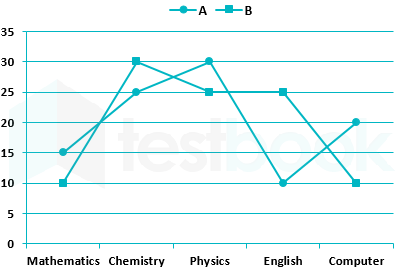
Direction: Study the following table carefully and answer the given question:

Table shows the percentage of votes received by four candidates in a college election out of total voting of 7000.

CandidateNumber of Votes receivedInvalid votes
A26%200
B42%100
C18%250
D14%120

Question 46

Find the approximate percentage of valid votes received by candidate A out of the total votes.

  1. AOption (a)

    25%

  2. BOption (b)

    29%

  3. COption (c)

    23%

  4. DOption (d)

    32%

  5. EOption (e)

    None of these

View answer & explanation

Correct answer

Answer: (c)C.

23%

Why this answer is correct

Total number of votes received by A = 26% of 7000 = 1820

Invalid votes = 200

Valid votes = 1820 – 200 = 1620

∴ Percentage of valid votes = (1620/7000) × 100 = 23.14% ≈ 23%

Question 47

Valid votes received by A is how much percent more than the total votes received by C?

  1. AOption (a)

    24.28%

  2. BOption (b)

    28.57%

  3. COption (c)

    32.47%

  4. DOption (d)

    26.12%

  5. EOption (e)

    None of these

View answer & explanation

Correct answer

Answer: (b)B.

28.57%

Why this answer is correct

Valid votes received by A = 1620

Total votes received by C = 18% of 7000 = 1260

∴ Required percentage = [(1620 – 1260) /1260] × 100 = 28.57%

Question 48

Find the ratio of the valid votes received by B and D.

  1. AOption (a)

    143 ∶ 42

  2. BOption (b)

    42 ∶ 11

  3. COption (c)

    142 ∶ 43

  4. DOption (d)

    153 ∶ 57

  5. EOption (e)

    None of these

View answer & explanation

Correct answer

Answer: (c)C.

142 ∶ 43

Why this answer is correct

Total votes received by B = 42% of 7000 = 2940

Valid votes received by B = 2940 – 100 = 2840

Total votes received by D = 14% of 7000 = 980

Valid votes received by D = 980 – 120 = 860

Required ratio = 2840 ∶ 860 = 142 ∶ 43

Question 49

How many valid votes did A, C and D together received more than valid votes received by B?

  1. AOption (a)

    700

  2. BOption (b)

    850

  3. COption (c)

    740

  4. DOption (d)

    650

  5. EOption (e)

    None of these

View answer & explanation

Correct answer

Answer: (d)D.

650

Why this answer is correct

Number of votes received by A, C and D together = 58% of 7000 = 4060

Number of valid votes received by A, C and D together = 4060 – 570 = 3490

Number of votes received by B = 42% of 7000 = 2940

Number of valid votes received by B = 2940 – 100 = 2840

∴ Required difference = 3490 – 2840 = 650

Question 50

Total number of invalid votes is what percent of the total voting?

  1. AOption (a)

    9.57%

  2. BOption (b)

    8.23%

  3. COption (c)

    10.75%

  4. DOption (d)

    13.12%

  5. EOption (e)

    None of these

View answer & explanation

Correct answer

Answer: (a)A.

9.57%

Why this answer is correct

Total number of invalid votes = 200 + 100 + 250 + 120 = 670

∴ Required percentage = (670/7000) × 100 = 9.57%

Directions: Study the following graph carefully and answer the given questions:

Line graph shows the percentage of 5 different subjects of books sold by two Stores A and B.

Total number of books sold by store A = 4,50,000

Total number of books sold by store B = 5,20,000

Question 51

If 15% of Computer books sold by A and B were returned by the customers due to some defects, then how many Computer books were originally sold by both stores together?

  1. AOption (a)

    1,42,800

  2. BOption (b)

    1,21,825

  3. COption (c)

    1,20,700

  4. DOption (d)

    21,300

  5. EOption (e)

    None of these

View answer & explanation

Correct answer

Answer: (c)C.

1,20,700

Why this answer is correct

Number of Computer books sold by A = 20% of 450000 = (20/100) × 4,50,000 = 90,000

Similarly, Number of Computer books sold by B = (10/100) × 5,20,000 = 52,000

Total Computer books sold by both stores together = 90000 + 52000 = 1,42,000

Given that, out of these 1,42,000 Computer books, 15% of the books are returned by the customers.

∴ Number of Computer books originally sold by these stores = 85% of 1,42,000

= (85/100) × 1,42,000 = 120700

Question 52

If the number of Mathematics Books sold by B was the same as that of A, what would have been its approximate percentage share in the total books sold by B?

  1. AOption (a)

    11%

  2. BOption (b)

    13%

  3. COption (c)

    15%

  4. DOption (d)

    9%

  5. EOption (e)

    21%

View answer & explanation

Correct answer

Answer: (b)B.

13%

Why this answer is correct

Mathematics Books sold by B = Mathematics Books sold by A

∵ Mathematics Books sold by A = 15% of 450000

= (15/100) × 450000 = 67500

∴ Mathematics Books sold by B = 67500

Also, total sold books by B = 520000

∴ Percentage share of Mathematics Books in total sold books by B

= (67500/520000) × 100 = 12.98 ≈ 13%.

Question 53

What was the difference between the total number of Physics books sold by A and B?

  1. AOption (a)

    5,000

  2. BOption (b)

    7,500

  3. COption (c)

    10,000

  4. DOption (d)

    2,500

  5. EOption (e)

    None of these

View answer & explanation

Correct answer

Answer: (a)A.

5,000

Why this answer is correct

Total number of Physics books sold by A = (30/100) × 4,50,000 = 1,35,000

Total number of Physics books sold by B = (25/100) × 5,20,000 = 1,30,000

∴ The difference in Physics books sold by A and B = 1,35,000 – 1,30,000 = 5,000

Question 54

For which of the following books, difference of books sold by store A and B is maximum?

  1. AOption (a)

    Mathematics

  2. BOption (b)

    Computer

  3. COption (c)

    English

  4. DOption (d)

    Chemistry

  5. EOption (e)

    Physics

View answer & explanation

Correct answer

Answer: (c)C.

English

Why this answer is correct

AB
Books% of books soldNo. of books sold% of books soldNo. of books soldDifference between A and B
Mathematics15%6750010%5200015500
Chemistry25%11250030%15600043500
Physics30%13500025%1300005000
English10%4500025%13000085000
Computer20%9000010%5200038000


∴ Difference of books sold by store A and B is maximum for English books.

Question 55

If the percentage of Chemistry books sold by B was the same as that of A, what would have been the number of Chemistry books sold by B?

  1. AOption (a)

    1,12,500

  2. BOption (b)

    1,20,000

  3. COption (c)

    1,25,000

  4. DOption (d)

    1,30,000

  5. EOption (e)

    None of these

View answer & explanation

Correct answer

Answer: (d)D.

1,30,000

Why this answer is correct

Given: 

Percentage of Chemistry books sold by B = Percentage of Chemistry books sold by A

Percentage of Chemistry books sold by A = 25%

Percentage of Chemistry books sold by B = 25%

∴ Number of Chemistry books sold by B = 25% of 520000 = (25/100) × 520000 = 130000

Question 56

The average salary of male employees in a company is Rs. 12000 and that of the female is Rs. 11200. The Mean salary of all the employees is Rs. 11600. What is the % of female employees?

  1. AOption (a)

    55%

  2. BOption (b)

    50%

  3. COption (c)

    60%

  4. DOption (d)

    56%

  5. EOption (e)

    40%

View answer & explanation

Correct answer

Answer: (b)B.

50%

Why this answer is correct

Shortcut Trick

Apply Alligation: Difference between Male (12000) and Mean (11600) is 400.

Difference between Female (11200) and Mean (11600) is 400.

Ratio of Male : Female = 400 : 400 = 1 : 1.

Female % = 1 ÷ (1 + 1) × 100 = 50%.

∴ The correct answer is 50%.

Alternate Method

Given: Average Male Salary = ₹12000, Average Female Salary = ₹11200, Mean Salary = ₹11600.

Formula Used: Alligation method or Weighted Average formula.

⇒ Ratio of Male : Female = (11600 − 11200) : (12000 − 11600)

⇒ Ratio = 400 : 400

⇒ Ratio = 1 : 1

⇒ Percentage of Female employees = [Female Ratio ÷ (Male Ratio + Female Ratio)] × 100

⇒ Percentage = [1 ÷ (1 + 1)] × 100 = (1 ÷ 2) × 100

⇒ Percentage = 50%

∴ The correct answer is 50%.

Additional Information

Alligation Rule

It is a rule used to find the ratio in which two ingredients at given prices must be mixed to produce a mixture at a given price. Ratio = (Cheaper Quantity) : (Dearer Quantity) = (D − M) : (M − C).

Weighted Average

The mean salary can also be found using Average = (n1x1 + n2x2) ÷ (n1 + n2), where n is the count and x is the individual average.

Question 57

In a factory, there are a total of 6000 workers and 80% of the workers are male, 19% of the male workers in the factory are at least 55 years old. Find the number of male workers below 55 years.

  1. AOption (a)

    3888

  2. BOption (b)

    2888

  3. COption (c)

    4888

  4. DOption (d)

    6888

  5. EOption (e)

    8888

View answer & explanation

Correct answer

Answer: (a)A.

3888

Why this answer is correct

Shortcut Trick

Total workers = 6000

Total male workers = 80% of 6000 = 4800

Male workers below 55 years = (100% − 19%) of Total males

⇒ 81% of 4800 = 81 × 48 = 3888

∴ The correct answer is 3888.

Alternate Method

Given:

Total number of workers = 6000

Percentage of male workers = 80%

Percentage of male workers ≥ 55 years = 19%

Calculations:

⇒ Number of male workers = 6000 × (80/100) = 4800

⇒ Percentage of male workers below 55 years = 100% − 19% = 81%

⇒ Number of male workers below 55 years = 4800 × (81/100)

⇒ 48 × 81 = 3888

∴ The correct answer is 3888.

Additional Information

Percentage Base Change

When calculating a percentage of a subset, first find the subset value: Subset = Total × (Sub% / 100), then apply the second percentage to this result.

Complementary Percentage

If x% of a group belongs to Category A, then (100 − x)% belongs to Category B, provided there are only two mutually exclusive categories.

Question 58

When the sum of a certain amount was distributed among Radha, Sita and Ram in the ratio 2 : 3 : 4 respectively, but by mistake distributed in the ratio 7 : 2 : 5 respectively. As a result, Sita got Rs.60 Less. Find the amount?

  1. AOption (a)

    Rs. 290

  2. BOption (b)

    Rs. 300

  3. COption (c)

    Rs. 315

  4. DOption (d)

    Rs. 320

  5. EOption (e)

    None of these 

View answer & explanation

Correct answer

Answer: (c)C.

Rs. 315

Why this answer is correct

Shortcut Trick

Initial total ratio sum = 2 + 3 + 4 = 9 units.

Mistaken total ratio sum = 7 + 2 + 5 = 14 units.

Equating total sum (LCM of 9 and 14 = 126): Initial Sita = (3/9) × 126 = 42; Mistaken Sita = (2/14) × 126 = 18.

Difference in Sita share = 42 − 18 = 24 units → ₹60.

Total amount = (60 ÷ 24) × 126 = 2.5 × 126 = ₹315.

∴ The correct answer is ₹315.

Alternate Method

Given: Initial ratio of Radha, Sita, Ram = 2 : 3 : 4. Mistaken ratio = 7 : 2 : 5. Difference in Sita share = ₹60.

Formula Used: Share of a person = (Individual ratio ÷ Total ratio) × Total Amount.

⇒ Let the total amount be x.

⇒ Initial share of Sita = (3 ÷ 9) × x = x/3

⇒ Mistaken share of Sita = (2 ÷ 14) × x = x/7

⇒ Difference = x/3 − x/7 = 60

⇒ (7x − 3x) ÷ 21 = 60

⇒ 4x ÷ 21 = 60

⇒ 4x = 1260

⇒ x = 315

∴ The correct answer is ₹315.

Additional Information

Ratio Balancing

When the same quantity is distributed in two different ratios, multiply the ratios by the sum of the other ratio to equalize the total parts.

Compound Ratio

The compound ratio of (a : b) and (c : d) is (ac : bd). Useful when comparing multiple distribution changes.

Invertendo and Alternendo

If a : b = c : d, then b : a = d : c (Invertendo) and a : c = b : d (Alternendo).

Question 59

The ratio of the ages of Tina and Jatin is 23 : p. Tina is 10 years younger to Rahul. After 16 years, Rahul will be 72 years old. If the difference between the ages of Jatin and Tina is equal to the age of Rahul 4 years ago, find the value of p. 

  1. AOption (a)

    45

  2. BOption (b)

    47

  3. COption (c)

    42

  4. DOption (d)

    49 

  5. EOption (e)

    52

View answer & explanation

Correct answer

Answer: (d)D.

49 

Why this answer is correct

Shortcut Trick

Rahul's present age = 72 − 16 = 56 years.

Tina's age = 56 − 10 = 46 years (given as 23 units).

∴ 1 unit = 46 ÷ 23 = 2 years.

Jatin − Tina = Rahul 4 years ago = 56 − 4 = 52 years.

Jatin's age = 46 + 52 = 98 years.

Value of p = 98 ÷ 2 = 49.

∴ The correct answer is 49.

Alternate Method

Given: Ratio of Tina to Jatin = 23 : p

⇒ Rahul's age after 16 years = 72 years

⇒ Rahul's present age = 72 − 16 = 56 years

⇒ Tina's present age = Rahul − 10 = 56 − 10 = 46 years

⇒ Since 23 units = 46 years, then 1 unit = 2 years

⇒ Jatin − Tina = Rahul's age 4 years ago = 56 − 4 = 52 years

⇒ Jatin's age = 46 + 52 = 98 years

⇒ p = Jatin's age ÷ 1 unit value = 98 ÷ 2 = 49

∴ The correct answer is 49.

Additional Information

Ratio and Proportion in Ages

If the ratio of ages is a : b and the value of one part is 'x', then actual ages are ax and bx.

Age Difference Constant

The difference between the ages of two persons remains constant throughout their lives, regardless of the number of years passed or preceding.

Present Age Calculation

To find the present age from a future age (n years later), subtract n. To find it from a past age (n years ago), add n.

Question 60

Prashant borrowed Rs. 60,000 at 6% p.a. compound interest for 2 years from Surya. He lent the borrowed amount to Nikul at 15% p.a. simple interest for 2 years. Find the profit of Prashant in this transaction.

  1. AOption (a)

    Rs. 11,820

  2. BOption (b)

    Rs. 10,584

  3. COption (c)

    Rs. 12,200

  4. DOption (d)

    Rs. 9,848

  5. EOption (e)

    None of these

View answer & explanation

Correct answer

Answer: (b)B.

Rs. 10,584

Why this answer is correct

Shortcut Trick

Effective Rate for Simple Interest (SI) = 15% × 2 = 30%.

Effective Rate for Compound Interest (CI) = 6 + 6 + (6 × 6)/100 = 12.36%.

Profit percentage = 30% − 12.36% = 17.64%.

Total Profit = 17.64% of ₹60,000 = 0.1764 × 60,000 = ₹10,584.

∴ The correct answer is ₹10,584.

Alternate Method

Given: Principal (P) = ₹60,000, CI Rate (R1) = 6%, SI Rate (R2) = 15%, Time (T) = 2 years.

Formula Used: Amount under CI = P(1 + R/100)T; SI = (P × R × T)/100.

⇒ Simple Interest earned from Nikul = (60,000 × 15 × 2) ÷ 100 = ₹18,000.

⇒ Compound Interest paid to Surya = 60,000[(1 + 6/100)2 − 1]

⇒ CI = 60,000[(1.06)2 − 1] = 60,000[1.1236 − 1] = 60,000 × 0.1236 = ₹7,416.

⇒ Prashant profit = Interest Received − Interest Paid

⇒ Profit = 18,000 − 7,416 = ₹10,584.

∴ The correct answer is ₹10,584.

Additional Information

Effective Rate of Compound Interest

For a 2-year period, the effective CI rate can be calculated using the successive percentage formula: R + R + (R×R)/100.

Difference between CI and SI

The difference between CI and SI for 2 years on a principal P at rate R is given by P(R/100)2.

Transaction Profit Logic

In lending transactions, profit is the numerical difference between the total interest earned from the borrower and total interest paid to the lender.

Question 61

A daughter and a Son can complete 7/10 work in 14/3 days. With the help of the mother they can complete half the work in 2 days. Find out the time taken by the mother to complete the full work if she would have worked alone.

  1. AOption (a)

    12 days

  2. BOption (b)

    8 days

  3. COption (c)

    10 days

  4. DOption (d)

    13 days

  5. EOption (e)

    None of the above

View answer & explanation

Correct answer

Answer: (c)C.

10 days

Why this answer is correct

Shortcut Trick

Daughter + Son complete full work in (14/3) × (10/7) = 20/3 days.

Daughter + Son + Mother complete full work in 2 × 2 = 4 days.

Using Work = Efficiency × Time, let Total Work = 20 units (LCM of 20/3 and 4).

Efficiency (D+S) = 20 ÷ (20/3) = 3; Efficiency (D+S+M) = 20 ÷ 4 = 5.

Efficiency (Mother) = 5 − 3 = 2 units/day. Time = 20 ÷ 2 = 10 days.

∴ The correct answer is 10 days.

Alternate Method

Given:

Time taken by Daughter (D) + Son (S) for 7/10 work = 14/3 days.

Time taken by D + S + Mother (M) for 1/2 work = 2 days.

PersonDays (Full Work)Total WorkEfficiency
Daughter + Son20/320 units3
D + S + Mother45

Calculations:

⇒ Full work time (D+S) = (14/3) ÷ (7/10) = (14/3) × (10/7) = 20/3 days.

⇒ Full work time (D+S+M) = 2 ÷ (1/2) = 4 days.

⇒ Total Work (LCM of 20/3 and 4) = 20 units.

⇒ Efficiency of Mother = Efficiency (D+S+M) − Efficiency (D+S)

⇒ Efficiency of Mother = 5 − 3 = 2 units/day.

⇒ Time taken by Mother alone = Total Work ÷ Mother Efficiency

⇒ Time = 20 ÷ 2 = 10 days.

∴ The correct answer is 10 days.

Additional Information

Total Work Formula

If a person completes a fraction x/y of work in T days, the time for full work is T × (y/x).

Efficiency Relationship

Combined efficiency of multiple people is the sum of their individual efficiencies (Work/Time).

Time and Work Inverse Rule

Time taken to complete work is inversely proportional to the efficiency: T = W ÷ E.

Question 62

There are two types of pulses. Cost of pulses are Rs. 150 per kg and Rs. 100 per kg. In what ratio these pulses are mixed so that the mixture sold at Rs. 121 kg to earn a profit of 10%.

  1. AOption (a)

    2 ∶ 3

  2. BOption (b)

    1 ∶ 4

  3. COption (c)

    4 ∶ 7

  4. DOption (d)

    5 ∶ 7

  5. EOption (e)

    6 ∶ 7

View answer & explanation

Correct answer

Answer: (b)B.

1 ∶ 4

Why this answer is correct

Shortcut Trick

Cost Price (CP) of mixture = Selling Price (SP) ÷ (1 + Profit%) = 121 ÷ 1.1 = ₹110.

Apply Alligation between ₹150 and ₹100 to get the mean value ₹110.

Ratio = (110 − 100) : (150 − 110) = 10 : 40 = 1 : 4.

∴ The correct answer is 1 : 4.

Alternate Method

Given: CP of Pulse 1 = ₹150/kg, CP of Pulse 2 = ₹100/kg, SP of Mixture = ₹121/kg, Profit = 10%.

Formula Used: CP = [SP × 100] / [100 + Profit%]

⇒ Mean CP of Mixture = (121 × 100) / 110

⇒ Mean CP = ₹110/kg

⇒ Using Rule of Alligation: (Quantity of Pulse 1) / (Quantity of Pulse 2) = (110 − 100) / (150 − 110)

⇒ Ratio = 10 / 40

⇒ Ratio = 1 : 4

∴ The correct answer is 1 : 4.

Additional Information

Rule of Alligation

It is used to find the ratio in which two ingredients at given prices must be mixed to produce a mixture of a specified price. Ratio = (Cheaper CP − Mean CP) : (Mean CP − Dearer CP) is always positive in magnitude.

Consistency of Units

While applying alligation, all values (Pulse 1, Pulse 2, and Mixture) must be in the same unit, i.e., all must be Cost Prices. If SP is given, convert it to CP first.

Question 63

A train travelling at the speed of 100 km/h crossed another train half its length in 27 seconds travelling in opposite directions at the speed of 60 km/h. The same train crosses a platform in 36 seconds. Find the length of the platform.

  1. AOption (a)

    300 m

  2. BOption (b)

    240 m

  3. COption (c)

    200 m

  4. DOption (d)

    250 m

  5. EOption (e)

    360 m

View answer & explanation

Correct answer

Answer: (c)C.

200 m

Why this answer is correct

Shortcut Trick

Relative Speed = 100 + 60 = 160 km/h = 160 × (5/18) m/s.

Total distance (L + L/2) = 1.5L = Speed × Time = (160 × 5/18) × 27 = 1200 m.

Length of Train (L) = 1200 / 1.5 = 800 m.

Platform Crossing: (L + P) = Speed1 × Time = (100 × 5/18) × 36 = 1000 m.

Length of Platform (P) = 1000 − 800 = 200 m.

∴ The correct answer is 200 m.

Alternate Method

Given: Speed1 = 100 km/h, Speed2 = 60 km/h, Time1 = 27 s, Time2 = 36 s.

Formula: Distance = Speed × Time; Relative Speed (Opposite) = S1 + S2.

⇒ Convert speeds: 100 km/h = 100 × (5/18) m/s; 60 km/h = 60 × (5/18) m/s.

⇒ Total Relative Speed = (100 + 60) × 5/18 = 160 × 5/18 = 400/9 m/s.

⇒ Total Distance = (L + L/2) = 1.5L = (400/9) × 27 = 1200 m.

⇒ L = 1200 / 1.5 = 800 m.

⇒ Distance during platform crossing = L + P = 100 × (5/18) × 36.

⇒ 800 + P = 100 × 5 × 2 = 1000 m.

⇒ P = 1000 − 800 = 200 m.

∴ The correct answer is 200 m.

Additional Information

Relative Speed

When moving in opposite directions, speeds are added (S1 + S2). When moving in the same direction, speeds are subtracted (S1 − S2).

Unit Conversion

To convert km/h to m/s, multiply by 5/18. To convert m/s to km/h, multiply by 18/5.

Train-Platform Rule

When a train crosses a platform, bridge, or tunnel, total distance covered is Length of Train + Length of Object.

Question 64

A invests Rs.400, B invests Rs.600 into a partnership. After 5 months, B adds Rs.100 and C joined them with Rs.800. After 10 months, A adds Rs.300 to his investment. Their total profit is Rs. 2079 after 1 year. Find the difference between the profit shares of C and A.

  1. AOption (a)

    Rs. 30

  2. BOption (b)

    Rs. 22

  3. COption (c)

    Rs. 18

  4. DOption (d)

    Rs. 40

  5. EOption (e)

    Rs. 36

View answer & explanation

Correct answer

Answer: (b)B.

Rs. 22

Why this answer is correct

Shortcut Trick

Ratio of Profit = Σ(Investment × Time)

A: (400 × 10) + (700 × 2) = 4000 + 1400 = 5400

B: (600 × 5) + (700 × 7) = 3000 + 4900 = 7900

C: (800 × 7) = 5600

Profit Ratio A : B : C = 54 : 79 : 56. Total units = 189

Difference (C − A) = (56 − 54) = 2 units. Value = (2079 ÷ 189) × 2 = 11 × 2 = 22.

∴ The correct answer is Rs. 22.

Alternate Method

Given → Investment of A = Rs. 400, B = Rs. 600, C = Rs. 800. Time period = 12 months. Formulas: Profit Share = Investment × Time | Total Profit = Sum of individual shares.

⇒ Profit share of A = (400 × 10) + (400 + 300) × 2 = 4000 + 1400 = 5400. ⇒ Profit share of B = (600 × 5) + (600 + 100) × 7 = 3000 + 4900 = 7900. ⇒ Profit share of C = 800 × (12 − 5) = 800 × 7 = 5600. ⇒ Ratio A : B : C = 5400 : 7900 : 5600 = 54 : 79 : 56. ⇒ Sum of ratios = 54 + 79 + 56 = 189 units. ⇒ 189 units = Rs. 2079 ⇒ 1 unit = 2079 ÷ 189 = 11. ⇒ Difference (C − A) = 56 − 54 = 2 units. ⇒ Required difference = 2 × 11 = Rs. 22.

∴ The correct answer is Rs. 22.

Additional Information

Partnership Basics

When investments change over time, the profit is distributed based on the weighted average of investment with respect to time.

Profit Calculation

Profit of a partner = Investment × Duration. If multiple investments are made, Profit ∝ (I1t1 + I2t2 + ...).

Question 65

The Marked price of a dress is Rs. 2000. A shopkeeper offers 20% discount on price and again he gives discount of 10% on new price. After two discounts, a new customer comes and ask for 10% discount, then again he offers discount on new price. Find the amount customer will pay after all the discounts.

  1. AOption (a)

    Rs. 1200

  2. BOption (b)

    Rs. 1300

  3. COption (c)

    Rs. 1296

  4. DOption (d)

    Rs. 1285

  5. EOption (e)

    Rs. 1348

View answer & explanation

Correct answer

Answer: (c)C.

Rs. 1296

Why this answer is correct

Shortcut Trick

Total discount multiplier = (100 − 20)% × (100 − 10)% × (100 − 10)%

Selling Price = 2000 × 0.80 × 0.90 × 0.90

Selling Price = 2000 × 80/100 × 90/100 × 90/100

Selling Price = 2000 × 0.648 = 1296

∴ The correct answer is Rs. 1296.

Alternate Method

Given: Marked Price (MP) = Rs. 2000, Successive Discounts = 20%, 10%, and 10%. Formulas: Price after discount = MP × (100 − D1)/100 × (100 − D2)/100...

⇒ First discount = 20% of 2000 = 400. New price = 2000 − 400 = 1600. ⇒ Second discount = 10% of 1600 = 160. New price = 1600 − 160 = 1440. ⇒ Third discount = 10% of 1440 = 144. Final price = 1440 − 144 = 1296.

∴ The correct answer is Rs. 1296.

Additional Information

Successive Discounts

When a series of discounts are applied, each subsequent discount is calculated on the reduced price from the previous step. Formula for two discounts: a + b − (ab ÷ 100).

Marked Price vs Selling Price

Marked Price is the list price before any reductions. Selling Price is the actual amount paid by the customer after all discounts.

Reasoning Ability (35 questions)

Directions: Study the following information and answer the given questions.

Eight tourists P, Q, R, S, T, U, V, and W sitting around a circular table, but not necessarily in the same order. Some of them facing the centre while others are facing away from the centre. Q faces the centre and sits third to the right of P. Only one person sits between Q and S, and S is a neighbour of P. R is facing inside. V is sitting second right of W. Three people sit between V and S and V is facing the opposite direction of P. S, W and V are facing the same direction. Only one person sits between U and T. Both U and T facing the same direction. T is facing away from the centre. Only one person sits between T and P, P is facing the opposite direction of T. R is a neighbour of V and W.

Question 66

Who is sitting third to the right of T?

  1. AOption (a)

    U

  2. BOption (b)

    V

  3. COption (c)

    W

  4. DOption (d)

    P

  5. EOption (e)

    Q

View answer & explanation

Correct answer

Answer: (c)C.

W

Why this answer is correct

People: P, Q, R, S, T, U, V, and W.

Statements:

  1. Q faces the center and sits third right of P. 
  2. Only one person sits between Q and S, who is a neighbor of P.

Possibilities are:

  1. Three people sit between V and S and V is facing the opposite direction of P. 

  2. V is sitting second to the right of W.

  3. S, W, and V are facing the same direction.

  4. R is a neighbor of V and W. R is facing inside. 

  5. Only one person sits between U and T. Both U and T facing the same direction. 

  6. T is facing away from the center. Only one person sits between T and P, who is facing the opposite direction of T. 

According to statement 8 does not follow the possibility 2. So, we continue with possibility 1 only.

The final arrangement will be:

Hence, the answer is W.

Question 67

Who is sitting immediately right of the U?

  1. AOption (a)

    Q

  2. BOption (b)

    P

  3. COption (c)

    R

  4. DOption (d)

    S

  5. EOption (e)

    T

View answer & explanation

Correct answer

Answer: (a)A.

Q

Why this answer is correct

People: P, Q, R, S, T, U, V, and W.

Statements:

  1. Q faces the center and sits third right of P. 
  2. Only one person sits between Q and S, who is a neighbor of P.

Possibilities are:

  1. Three people sit between V and S, who are facing the opposite direction of P. 

  2. V is sitting second to the right of W.

  3. S, W, and V are facing the same direction.

  4. R is a neighbor of V and W. R is facing inside.

  5. Only one person sits between U and T. Both U and T facing the same direction. 

  6. T is facing away from the center. Only one person sits between T and P, who is facing the opposite direction of T. 

According to statement 8 does not follow the possibility 2. So, we continue with possibility 1 only.

The final arrangement will be:

Hence, the answer is Q.

Question 68

What is the position of Q with respective T?

  1. AOption (a)

    Second to the left

  2. BOption (b)

    Second to the right

  3. COption (c)

    Third to the left

  4. DOption (d)

    Third to the right

  5. EOption (e)

    immediately left

View answer & explanation

Correct answer

Answer: (e)E.

immediately left

Why this answer is correct

People: P, Q, R, S, T, U, V, and W.

Statements:

  1. Q faces the center and sits third right of P. 
  2. Only one person sits between Q and S, who is a neighbor of P.

Possibilities are:

  1. Three people sit between V and S, who are facing the opposite direction of P. 

  2. V is sitting second to the right of W.

  3. S, W, and V are facing the same direction.

  4. R is a neighbor of V and W. R is facing inside.

  5. Only one person sits between U and T. Both U and T facing the same direction. 

  6. T is facing away from the center. Only one person sits between T and P, who is facing the opposite direction of T. 

According to statement 8 does not follow the possibility 2. So, we continue with possibility 1 only.

The final arrangement will be:

Hence, the answer is immediately left.

Question 69

How many people facing outside?

  1. AOption (a)

    1

  2. BOption (b)

    2

  3. COption (c)

    4

  4. DOption (d)

    5

  5. EOption (e)

    6

View answer & explanation

Correct answer

Answer: (d)D.

5

Why this answer is correct

People: P, Q, R, S, T, U, V, and W.

Statements:

  1. Q faces the center and sits third right of P. 
  2. Only one person sits between Q and S, who is a neighbor of P.

Possibilities are:

  1. Three people sit between V and S, who are facing the opposite direction of P. 

  2. V is sitting second to the right of W.

  3. S, W, and V are facing the same direction.

  4. R is a neighbor of V and W. R is facing inside.

  5. Only one person sits between U and T. Both U and T facing the same direction. 

  6. T is facing away from the center. Only one person sits between T and P, who is facing the opposite direction of T. 

According to statement 8 does not follow the possibility 2. So, we continue with possibility 1 only.

The final arrangement will be:

Hence, the answer is 5.

Question 70

Who is sitting second to the right of P?

  1. AOption (a)

    U

  2. BOption (b)

    V

  3. COption (c)

    W

  4. DOption (d)

    S

  5. EOption (e)

    T

View answer & explanation

Correct answer

Answer: (e)E.

T

Why this answer is correct

People: P, Q, R, S, T, U, V, and W.

Statements:

  1. Q faces the center and sits third right of P. 
  2. Only one person sits between Q and S, who is a neighbor of P.

Possibilities are:

  1. Three people sit between V and S, who are facing the opposite direction of P. 

  2. V is sitting second to the right of W.

  3. S, W, and V are facing the same direction.

  4. R is a neighbor of V and W. R is facing inside.

  5. Only one person sits between U and T. Both U and T facing the same direction. 

  6. T is facing away from the center. Only one person sits between T and P, who is facing the opposite direction of T. 

According to statement 8 does not follow the possibility 2. So, we continue with possibility 1 only.

The final arrangement will be:

Hence, the answer is T.

Question 71

In each question below are given some statements followed by some conclusions. You have to take the given statements to be true even if they seem to be at variance with commonly known facts and then decide which of the given conclusions logically follows from the given statements, disregarding commonly known facts. Give answer

Statements:

Only a few Red are Blue.

Only a few Blue is Pink.

All Pink is Yellow.

Conclusions:

I. All Yellow being Blue is a possibility.

II. Some Pink is Red.

  1. AOption (a)

    If only conclusion I follows.

  2. BOption (b)

    If only conclusion II follows.

  3. COption (c)

    If either conclusion I or II follows.

  4. DOption (d)

    If neither conclusion I nor II follows.

  5. EOption (e)

    If both conclusions I and II follow.

View answer & explanation

Correct answer

Answer: (a)A.

If only conclusion I follows.

Why this answer is correct

The best possible Venn diagram is,

Conclusions:

I. All Yellow being Blue is a possibility: True(as no such restriction is seen in the diagram above, it is possible)

II. Some Pink are Red: False (No direct relation between Red and Pink)

Hence, Only conclusion I follow.

Additional InformationOnly a few A are B means some A are B and some A are not B.

Some B is not A - false

All B being A is a possibility - true

All A being B is a possibility - false

Question 72

Direction: In the question below are given three statements followed by two conclusions numbered I and II. You have to take the given statements to be true even if they seem to be at variance with commonly known facts. Read all the conclusions and then decide which of the given conclusions logically follows from the given statements disregarding commonly known facts.

Statements:

Only a few Lakes are River.

Only a few River are Salty.

Some Salty are Water.

Conclusions:

I. All Lakes can never be River.

II. Some River can never be Salty.

  1. AOption (a)

    Only conclusion I follows

  2. BOption (b)

    Only conclusion II follows

  3. COption (c)

    Either conclusion I or II follows

  4. DOption (d)

    Neither conclusion I nor II follows

  5. EOption (e)

    Both conclusions I and II follow

View answer & explanation

Correct answer

Answer: (e)E.

Both conclusions I and II follow

Why this answer is correct

The least possible diagram for the given statements is as follows;

Conclusions:

I. All Lakes can never be River → True (As Only a few Lakes are River so some lakes are river and some lakes are not river, as some lakes are not river all lakes can never be river is true) 

II. Some River can never be Salty → True (As Only a few River are Salty, some river are salty and some river are not salty, so some river can never be salty is true)

Hence, Both conclusions I and II follow.

Question 73

Direction: In the question below are given three statements followed by two conclusions numbered I and II. You have to take the given statements to be true even if they seem to be at variance with commonly known facts. Read all the conclusions and then decide which of the given conclusions logically follows from the given statements disregarding commonly known facts.

Statements:

Only a few Mobile are Belts.

All Belts are Masks.

Some Masks are Covers.

Conclusion:

I. Some Masks are Belt.

II. Some Mobile are Covers is a possibility.

  1. AOption (a)

    Only conclusion I follows

  2. BOption (b)

    Only conclusion II follows

  3. COption (c)

    Both conclusions I and II follow

  4. DOption (d)

    Either conclusion I or II follows

  5. EOption (e)

    Neither conclusion I nor II follows

View answer & explanation

Correct answer

Answer: (c)C.

Both conclusions I and II follow

Why this answer is correct

The least possible diagram for the given statements is as follows;

Conclusions:

I. Some Masks are Belt → True (As All Belts are Masks → Some part of Masks will be Belts. So, it is true)

II. Some Mobile are Covers is a possibility → True (As there is no direct relation between Mobile and Covers but it is possible. So, it is true)

 Both conclusions I and II follow.

Direction: Study the following information carefully and answer the given questions.

Six persons P, Q, R, A, B, and C are living in a three-storey building such that ground floor is numbered as 1, above it is floor 2 then top floor is numbered as 3. Each of the floor has 2 flats in it as flat-X and flat-Y. Flat-X of floor-2 is immediately above flat-X of floor-1 and immediately below flat-X of floor-3. In the same way flat-Y of floor-2 is immediately above flat-Y of floor-1 and immediately below flat-Y of floor-3. Flat-X is in west of flat-Y. They all are from different countries.

P lives on an odd numbered floor in flat X. The one who is from Finland lives immediately above C in the same flat. A lives to the west of C. P and the one who is from Finland do not live on the same floor. Neither A nor Q is from Brazil. C is either from Mexico or from Nepal. There is one floor between Q and the one who is from Serbia who lives above Q. B does not live in flat Y. The one who is from Canada lives on the same floor on which the one who is from Nepal lives.

Question 74

Who among the following lives in Flat Y?

  1. AOption (a)

    B

  2. BOption (b)

    R

  3. COption (c)

    A

  4. DOption (d)

    P

  5. EOption (e)

    None

View answer & explanation

Correct answer

Answer: (b)B.

R

Why this answer is correct

Six persons: P, Q, R, A, B, and C

Floors: 1, 2, and 3

Flat: X and Y

(1) P lives on an odd numbered floor in flat X. Therefore, we get two the following two cases here.

Case (I)Case (II)
FloorFlat - XFlat - YFlat - XFlat - Y
3P
2
1P


(2) The one who is from Finland lives immediately above C in the same flat.

(3) A lives to the west of C.

(4) P and the one who is from Finland do not live on the same floor.

Case (I)Case (II)
FloorFlat - XFlat - YFlat - XFlat - Y
3P(Finland)
2(Finland)AC
1ACP


(5) B does not live in flat Y.

(6) There is one floor between Q and the one who is from Serbia who lives above Q. Since, only flat Y of floor 3 is left for Q in case (I), case (I) eliminates here.

Case (II)
FloorFlat - XFlat - Y
3B (Serbia)(Finland)
2AC
1PQ


(7) Neither A nor Q is from Brazil.

(8) C is either from Mexico or from Nepal (implies, P is from Brazil).

(9) The one who is from Canada lives on the same floor on which the one who is from Nepal lives (implies, A is from Canada and C is from Nepal). Thus, the final arrangement is as follows:

Case (II)
FloorFlat - XFlat - Y
3B (Serbia)R (Finland)
2A (Canada)C (Nepal)
1P (Brazil)Q (Mexico)


As, we can see that all B, A, and P live in Flat X, whereas R lives in Flat Y.

Hence, R lives in Flat Y.

Question 75

Which of the following combination is not correct?

  1. AOption (a)

    C - Nepal

  2. BOption (b)

    P - Flat X

  3. COption (c)

    Q - Mexico

  4. DOption (d)

    B - Serbia

  5. EOption (e)

    R - Flat X

View answer & explanation

Correct answer

Answer: (e)E.

R - Flat X

Why this answer is correct

Six persons: P, Q, R, A, B, and C

Floors: 1, 2, and 3

Flat: X and Y

(1) P lives on an odd numbered floor in flat X. Therefore, we get two the following two cases here.

Case (I)Case (II)
FloorFlat - XFlat - YFlat - XFlat - Y
3P
2
1P


(2) The one who is from Finland lives immediately above C in the same flat.

(3) A lives to the west of C.

(4) P and the one who is from Finland do not live on the same floor.

Case (I)Case (II)
FloorFlat - XFlat - YFlat - XFlat - Y
3P(Finland)
2(Finland)AC
1ACP


(5) B does not live in flat Y.

(6) There is one floor between Q and the one who is from Serbia who lives above Q. Since, only flat Y of floor 3 is left for Q in case (I), case (I) eliminates here.

Case (II)
FloorFlat - XFlat - Y
3B (Serbia)(Finland)
2AC
1PQ


(7) Neither A nor Q is from Brazil.

(8) C is either from Mexico or from Nepal (implies, P is from Brazil).

(9) The one who is from Canada lives on the same floor on which the one who is from Nepal lives (implies, A is from Canada and C is from Nepal). Thus, the final arrangement is as follows:

Case (II)
FloorFlat - XFlat - Y
3B (Serbia)R (Finland)
2A (Canada)C (Nepal)
1P (Brazil)Q (Mexico)


As, we can see that R lives in Flat Y.

Hence, R - Flat X is not the correct combination.

Question 76

Who lives on the bottom most floor?

  1. AOption (a)

    B

  2. BOption (b)

    The one who is from Brazil

  3. COption (c)

    The one who is from Nepal 

  4. DOption (d)

    The one who is from Mexico

  5. EOption (e)

    Both (2) and (4) 

View answer & explanation

Correct answer

Answer: (e)E.

Both (2) and (4) 

Why this answer is correct

Six persons: P, Q, R, A, B, and C

Floors: 1, 2, and 3

Flat: X and Y

(1) P lives on an odd numbered floor in flat X. Therefore, we get two the following two cases here.

Case (I)Case (II)
FloorFlat - XFlat - YFlat - XFlat - Y
3P
2
1P


(2) The one who is from Finland lives immediately above C in the same flat.

(3) A lives to the west of C.

(4) P and the one who is from Finland do not live on the same floor.

Case (I)Case (II)
FloorFlat - XFlat - YFlat - XFlat - Y
3P(Finland)
2(Finland)AC
1ACP


(5) B does not live in flat Y.

(6) There is one floor between Q and the one who is from Serbia who lives above Q. Since, only flat Y of floor 3 is left for Q in case (I), case (I) eliminates here.

Case (II)
FloorFlat - XFlat - Y
3B (Serbia)(Finland)
2AC
1PQ


(7) Neither A nor Q is from Brazil.

(8) C is either from Mexico or from Nepal (implies, P is from Brazil).

(9) The one who is from Canada lives on the same floor on which the one who is from Nepal lives (implies, A is from Canada and C is from Nepal). Thus, the final arrangement is as follows:

Case (II)
FloorFlat - XFlat - Y
3B (Serbia)R (Finland)
2A (Canada)C (Nepal)
1P (Brazil)Q (Mexico)


We can see that the one who is from Brazil and the one who is from Mexico live on the bottom most floor.

Hence, both (b) and (d) is the correct answer.

Question 77

Who among the following lives to the east of B?

  1. AOption (a)

    C

  2. BOption (b)

    The one who is from Nepal

  3. COption (c)

    The one who is from Finland

  4. DOption (d)

    P

  5. EOption (e)

    Both (a) and (c)

View answer & explanation

Correct answer

Answer: (c)C.

The one who is from Finland

Why this answer is correct

Six persons: P, Q, R, A, B, and C

Floors: 1, 2, and 3

Flat: X and Y

(1) P lives on an odd numbered floor in flat X. Therefore, we get two the following two cases here.

Case (I)Case (II)
FloorFlat - XFlat - YFlat - XFlat - Y
3P
2
1P


(2) The one who is from Finland lives immediately above C in the same flat.

(3) A lives to the west of C.

(4) P and the one who is from Finland do not live on the same floor.

Case (I)Case (II)
FloorFlat - XFlat - YFlat - XFlat - Y
3P(Finland)
2(Finland)AC
1ACP


(5) B does not live in flat Y.

(6) There is one floor between Q and the one who is from Serbia who lives above Q. Since, only flat Y of floor 3 is left for Q in case (I), case (I) eliminates here.

Case (II)
FloorFlat - XFlat - Y
3B (Serbia)(Finland)
2AC
1PQ


(7) Neither A nor Q is from Brazil.

(8) C is either from Mexico or from Nepal (implies, P is from Brazil).

(9) The one who is from Canada lives on the same floor on which the one who is from Nepal lives (implies, A is from Canada and C is from Nepal). Thus, the final arrangement is as follows:

Case (II)
FloorFlat - XFlat - Y
3B (Serbia)R (Finland)
2A (Canada)C (Nepal)
1P (Brazil)Q (Mexico)


Hence, the one who is from Finland lives to the east of B.

Question 78

Which of the following does not belong to the group?

  1. AOption (a)

    B

  2. BOption (b)

    R

  3. COption (c)

    P

  4. DOption (d)

    Q

  5. EOption (e)

    A

View answer & explanation

Correct answer

Answer: (e)E.

A

Why this answer is correct

Six persons: P, Q, R, A, B, and C

Floors: 1, 2, and 3

Flat: X and Y

(1) P lives on an odd numbered floor in flat X. Therefore, we get two the following two cases here.

Case (I)Case (II)
FloorFlat - XFlat - YFlat - XFlat - Y
3P
2
1P


(2) The one who is from Finland lives immediately above C in the same flat.

(3) A lives to the west of C.

(4) P and the one who is from Finland do not live on the same floor.

Case (I)Case (II)
FloorFlat - XFlat - YFlat - XFlat - Y
3P(Finland)
2(Finland)AC
1ACP


(5) B does not live in flat Y.

(6) There is one floor between Q and the one who is from Serbia who lives above Q. Since, only flat Y of floor 3 is left for Q in case (I), case (I) eliminates here.

Case (II)
FloorFlat - XFlat - Y
3B (Serbia)(Finland)
2AC
1PQ


(7) Neither A nor Q is from Brazil.

(8) C is either from Mexico or from Nepal (implies, P is from Brazil).

(9) The one who is from Canada lives on the same floor on which the one who is from Nepal lives (implies, A is from Canada and C is from Nepal). Thus, the final arrangement is as follows:

Case (II)
FloorFlat - XFlat - Y
3B (Serbia)R (Finland)
2A (Canada)C (Nepal)
1P (Brazil)Q (Mexico)


We can see that, all B, R, P, and Q live in odd numbered floor and thus forms a group.

Hence, A does not belong to that group.

Question 79

Directions

In the following question assuming the given statements to be True, find which of the conclusion among given conclusions is/are definitely true and then give your answers accordingly.

Statements: 

P ≤ Q = R; P ≥ S < U ≤ W

Conclusions:

I. R = S

II. S > R

  1. AOption (a)

    Only I is True

  2. BOption (b)

    Only II is True

  3. COption (c)

    Both I and II are True ≤

  4. DOption (d)

    None is True

  5. EOption (e)

    Either I or II is True

View answer & explanation

Correct answer

Answer: (d)D.

None is True

Why this answer is correct

Given statements: P ≤ Q = R; P ≥ S < U ≤ W

On combining: R = Q ≥ P ≥ S < U ≤ W

Conclusions:

I. R = S → False (as R = Q ≥ P ≥ S → R ≥ S)

II. S > R → False (as R = Q ≥ P ≥ S → R ≥ S)

Hence, Neither I nor II is True.

Question 80

Directions

In the following question assuming the given statements to be true, find which of the conclusion among the given conclusions is/ are definitely true and then give your answers accordingly

Statements: B > C ≥ A ≤ U ≤ D; F ≤ G = L; D ≤ F ≤ L

Conclusions:

I. A < G

II. G ≤ A

  1. AOption (a)

    Only I is true

  2. BOption (b)

    Only II is true

  3. COption (c)

    Either I or II is true

  4. DOption (d)

    Both I and II is true

  5. EOption (e)

    Neither I nor II is true

View answer & explanation

Correct answer

Answer: (e)E.

Neither I nor II is true

Why this answer is correct

Given statements: B > C ≥ A ≤ U ≤ D; F ≤ G = L; D ≤ F ≤ L

Conclusions:

I. A < G → False (as A ≤ U ≤ D ≤ F ≤ L = G, A ≤ G. So, it is false)

II. G ≤ A → False (as A ≤ U ≤ D ≤ F ≤ L = G, A ≤ G. So, it is false)

Hence, Neither I nor II is true.

Question 81

Directions

In the following question assuming the given statements to be true, find which of the conclusion among the given conclusions is/are definitely true and then give your answers accordingly.

Statements: U ≤ F ≤ G ≤ Y; Y ≤ R > I < O

Conclusions:

I. R > U

II. U = R

  1. AOption (a)

    Only I follow

  2. BOption (b)

    Only II follow

  3. COption (c)

    Both I and II follow

  4. DOption (d)

    Either I or II follow

  5. EOption (e)

    Neither I nor II follow

View answer & explanation

Correct answer

Answer: (d)D.

Either I or II follow

Why this answer is correct

Given statement: U ≤ F ≤ G ≤ Y; Y ≤ R > I < O

Conclusions:

I. R > U → False (Given U ≤ F ≤ G ≤ Y and Y ≤ R > I < O so by combining both statement U ≤ F ≤ G ≤ Y ≤ R > I < O. Thus R > U is false)

II. U = R → False (Given U ≤ F ≤ G ≤ Y and Y ≤ R > I < O so by combining both statement U ≤ F ≤ G ≤ Y ≤ R > I < O. Thus U = R is false)

As U ≤ R  → R > U or R = U

Hence, Either I or II follow is the correct answer.

Question 82

Direction: In the following questions assuming the given statements to be true, find which of the conclusion(s) among the given conclusions is/ are definitely true and then give your answers accordingly.

Statements: P > Q ≤ S ≥ T; V = W ≤T 

Conclusions:

I. P > T

II. S ≥ V

  1. AOption (a)

    Only conclusion I is true

  2. BOption (b)

    Only conclusion II is true

  3. COption (c)

    Both conclusion I and II are true

  4. DOption (d)

    Either conclusion I or II is true

  5. EOption (e)

    Neither conclusion I nor II are true

View answer & explanation

Correct answer

Answer: (b)B.

Only conclusion II is true

Why this answer is correct

Given Statements: P > Q ≤ S ≥ T; V = W ≤T 

Conclusions:

I. P > T - False (Given P > Q ≤ S ≥ T and V = W ≤ T  so by combining  P > Q ≤ S ≥ T ≥ W = V  so the relation between P and T is not clear thus P > T is false)

II. S ≥ V - True (Given P > Q ≤ S ≥ T and  V = W ≤T  so by combining  P > Q ≤ S ≥ T ≥ W = V so the relation between S and V is clear thus S ≥ V is true )

 Hence, Only conclusion​ II is true.

Direction: Study the following information carefully and answer the given questions.

Six people A, B, C, D, E, and F eat different chocolates on six days of the week starting from Monday to Saturday but not necessarily in the same order. On each day only one person eats the chocolate. Only three people eat chocolate between E and the one who eat 5-star. E eats before A who eats Dairy Milk on Thursday.  Three people eat chocolate between the one who eats Kitkat and the one who eats Snicker. B eats chocolate immediately before the one who eats Amul. D eats Perk two days before the one who eats Kitkat. C does not like 5-Star.

Question 83

Who eats Amul?

  1. AOption (a)

    A

  2. BOption (b)

    B

  3. COption (c)

    C

  4. DOption (d)

    D

  5. EOption (e)

    E

View answer & explanation

Correct answer

Answer: (e)E.

E

Why this answer is correct

Six people: A, B, C, D, E, and F eat different chocolates on six days of week starting from Monday to Saturday.

(1) Only three people eat chocolate between E and the one who eat 5-star.

(2) E eats before A who eats Dairy Milk on Thursday. 

Case (I)Case (II)
DaysPersonChocolatePersonChocolate
MondayE
TuesdayE
Wednesday
ThursdayADairy MilkADairy Milk
Friday5-Star
Saturday5-Star


(3) Three people eat chocolate between the one who eats Kitkat and the one who eats Snicker.

(4) B eats chocolate immediately before the one who eats Amul.

Case (I)Case (II)
DaysPersonChocolatePersonChocolate
MondayEBKitkat / Snicker
TuesdayBKitkat / SnickerEAmul
WednesdayAmul
ThursdayADairy MilkADairy Milk
Friday5-StarKitkat / Snicker
SaturdayKitkat / Snicker5-Star


(5) D eats Perk two days before the one who eats Kitkat. Therefore, Case (I) eliminates here.

(6) C does not like 5-Star. Thus, the final arrangement is as follows:

DaysPersonChocolate
MondayBSnicker
TuesdayEAmul
WednesdayDPerk
ThursdayADairy Milk
FridayCKitkat
SaturdayF5-Star


Hence, E eats Amul.

Question 84

On which day B eats the chocolate?

  1. AOption (a)

    Monday

  2. BOption (b)

    Tuesday

  3. COption (c)

    Wednesday

  4. DOption (d)

    Friday

  5. EOption (e)

    Saturday

View answer & explanation

Correct answer

Answer: (a)A.

Monday

Why this answer is correct

Six people: A, B, C, D, E, and F eat different chocolates on six days of week starting from Monday to Saturday.

(1) Only three people eat chocolate between E and the one who eat 5-star.

(2) E eats before A who eats Dairy Milk on Thursday. 

Case (I)Case (II)
DaysPersonChocolatePersonChocolate
MondayE
TuesdayE
Wednesday
ThursdayADairy MilkADairy Milk
Friday5-Star
Saturday5-Star


(3) Three people eat chocolate between the one who eats Kitkat and the one who eats Snicker.

(4) B eats chocolate immediately before the one who eats Amul.

Case (I)Case (II)
DaysPersonChocolatePersonChocolate
MondayEBKitkat / Snicker
TuesdayBKitkat / SnickerEAmul
WednesdayAmul
ThursdayADairy MilkADairy Milk
Friday5-StarKitkat / Snicker
SaturdayKitkat / Snicker5-Star


(5) D eats Perk two days before the one who eats Kitkat. Therefore, Case (I) eliminates here.

(6) C does not like 5-Star. Thus, the final arrangement is as follows:

DaysPersonChocolate
MondayBSnicker
TuesdayEAmul
WednesdayDPerk
ThursdayADairy Milk
FridayCKitkat
SaturdayF5-Star


Hence, B eats the chocolate on Monday.

Question 85

Which of the following combination is correct?

  1. AOption (a)

    A-Thursday-Perk

  2. BOption (b)

    B-Monday-Snicker

  3. COption (c)

    C-Friday-5-Star

  4. DOption (d)

    D-Tuesday-Perk

  5. EOption (e)

    E-Tuesday-Kitkat

View answer & explanation

Correct answer

Answer: (b)B.

B-Monday-Snicker

Why this answer is correct

Six people: A, B, C, D, E, and F eat different chocolates on six days of week starting from Monday to Saturday.

(1) Only three people eat chocolate between E and the one who eat 5-star.

(2) E eats before A who eats Dairy Milk on Thursday. 

Case (I)Case (II)
DaysPersonChocolatePersonChocolate
MondayE
TuesdayE
Wednesday
ThursdayADairy MilkADairy Milk
Friday5-Star
Saturday5-Star


(3) Three people eat chocolate between the one who eats Kitkat and the one who eats Snicker.

(4) B eats chocolate immediately before the one who eats Amul.

Case (I)Case (II)
DaysPersonChocolatePersonChocolate
MondayEBKitkat / Snicker
TuesdayBKitkat / SnickerEAmul
WednesdayAmul
ThursdayADairy MilkADairy Milk
Friday5-StarKitkat / Snicker
SaturdayKitkat / Snicker5-Star


(5) D eats Perk two days before the one who eats Kitkat. Therefore, Case (I) eliminates here.

(6) C does not like 5-Star. Thus, the final arrangement is as follows:

DaysPersonChocolate
MondayBSnicker
TuesdayEAmul
WednesdayDPerk
ThursdayADairy Milk
FridayCKitkat
SaturdayF5-Star


Hence, B-Monday-Snicker is correct.

Question 86

How many persons eats chocolate before C?

  1. AOption (a)

    One

  2. BOption (b)

    Two

  3. COption (c)

    Three

  4. DOption (d)

    Four

  5. EOption (e)

    None

View answer & explanation

Correct answer

Answer: (d)D.

Four

Why this answer is correct

Six people: A, B, C, D, E, and F eat different chocolates on six days of week starting from Monday to Saturday.

(1) Only three people eat chocolate between E and the one who eat 5-star.

(2) E eats before A who eats Dairy Milk on Thursday. 

Case (I)Case (II)
DaysPersonChocolatePersonChocolate
MondayE
TuesdayE
Wednesday
ThursdayADairy MilkADairy Milk
Friday5-Star
Saturday5-Star


(3) Three people eat chocolate between the one who eats Kitkat and the one who eats Snicker.

(4) B eats chocolate immediately before the one who eats Amul.

Case (I)Case (II)
DaysPersonChocolatePersonChocolate
MondayEBKitkat / Snicker
TuesdayBKitkat / SnickerEAmul
WednesdayAmul
ThursdayADairy MilkADairy Milk
Friday5-StarKitkat / Snicker
SaturdayKitkat / Snicker5-Star


(5) D eats Perk two days before the one who eats Kitkat. Therefore, Case (I) eliminates here.

(6) C does not like 5-Star. Thus, the final arrangement is as follows:

DaysPersonChocolate
MondayBSnicker
TuesdayEAmul
WednesdayDPerk
ThursdayADairy Milk
FridayCKitkat
SaturdayF5-Star


Hence, four persons eats chocolate before C.

Question 87

Which of the following statement is false?

  1. AOption (a)

    B eats chocolate on Monday

  2. BOption (b)

    D eats Perk

  3. COption (c)

    A eats Dairy Milk on Thursday

  4. DOption (d)

    F eats 5-star on Friday

  5. EOption (e)

    All are false

View answer & explanation

Correct answer

Answer: (d)D.

F eats 5-star on Friday

Why this answer is correct

Six people: A, B, C, D, E, and F eat different chocolates on six days of week starting from Monday to Saturday.

(1) Only three people eat chocolate between E and the one who eat 5-star.

(2) E eats before A who eats Dairy Milk on Thursday. 

Case (I)Case (II)
DaysPersonChocolatePersonChocolate
MondayE
TuesdayE
Wednesday
ThursdayADairy MilkADairy Milk
Friday5-Star
Saturday5-Star


(3) Three people eat chocolate between the one who eats Kitkat and the one who eats Snicker.

(4) B eats chocolate immediately before the one who eats Amul.

Case (I)Case (II)
DaysPersonChocolatePersonChocolate
MondayEBKitkat / Snicker
TuesdayBKitkat / SnickerEAmul
WednesdayAmul
ThursdayADairy MilkADairy Milk
Friday5-StarKitkat / Snicker
SaturdayKitkat / Snicker5-Star


(5) D eats Perk two days before the one who eats Kitkat. Therefore, Case (I) eliminates here.

(6) C does not like 5-Star. Thus, the final arrangement is as follows:

DaysPersonChocolate
MondayBSnicker
TuesdayEAmul
WednesdayDPerk
ThursdayADairy Milk
FridayCKitkat
SaturdayF5-Star


We can see that F eats 5-Star on Saturday.

Hence, option (4) is false.

Question 88

In the given word ‘TELEVISION’ if the vowels are changed to the next letters and the consonants are changed to the previous letters as per the alphabetical series, then which letter/letters are repeated more than once?

  1. AOption (a)

    P, M

  2. BOption (b)

    R, U

  3. COption (c)

    S, K

  4. DOption (d)

    F, J

  5. EOption (e)

    F, K

View answer & explanation

Correct answer

Answer: (d)D.

F, J

Why this answer is correct

Given : TELEVISION

After changing the vowels to the next letter and the consonants to the previous letter;

SFKFUJRJPM

Hence, there are two letters (F, J) in the given words which are repeated more than once.

Directions: Study the information given below carefully and answer the questions that follow.

Prithvi starts walking from his home in the south direction and walks for 7 km to reach point A. Then he takes a right turn and walks 5 km to reach point B. From point B he turns 90 degrees to his left and walks for 8 km to reach point C. From point C again he turns 90 degrees towards his left and walks for 10 km to reach point D. Then he takes a left turn and walks 17 km in the north direction to reach point E. Finally, he makes a 90 degree left turn and walks for 5 km to reach point F.

Question 89

Point D is in which direction with respect to the house?

  1. AOption (a)

    South

  2. BOption (b)

    East

  3. COption (c)

    Northeast

  4. DOption (d)

    Southwest 

  5. EOption (e)

    Southeast

View answer & explanation

Correct answer

Answer: (e)E.

Southeast

Why this answer is correct

According to the given information,


Hence, Southeast is the correct answer.

Question 90

What is the distance between Prithvi’s house and the final point?

  1. AOption (a)

    3 km

  2. BOption (b)

    5 km

  3. COption (c)

    1 km

  4. DOption (d)

    2 km

  5. EOption (e)

    4 km

View answer & explanation

Correct answer

Answer: (d)D.

2 km

Why this answer is correct

According to the given information,

Here the distance between House and final point is = 17 - (8 + 7) = 2 km.

Hence, 2 km is the correct answer.

Question 91

What is the shortest distance between point B and point D?

  1. AOption (a)

    15 km

  2. BOption (b)

    10√2 km

  3. COption (c)

    18.5 km

  4. DOption (d)

    √164 km

  5. EOption (e)

    17km

View answer & explanation

Correct answer

Answer: (d)D.

√164 km

Why this answer is correct

According to the given information,

Here the shortest distance between point D and B is = BD2 = BC2 + CD2

BD2 = 82 + 102

BD2 = 64 + 100 = 164

BD = √164

Hence, √164 km is the correct answer.

Question 92

Point C is in which direction with respect to point E?

  1. AOption (a)

    Southeast

  2. BOption (b)

    South

  3. COption (c)

    West

  4. DOption (d)

    Southwest

  5. EOption (e)

    Northwest

View answer & explanation

Correct answer

Answer: (d)D.

Southwest

Why this answer is correct

According to the given information,

Hence, Southwest is the correct answer.

Directions: These questions are based on the following information.

There are 9 members in a three generation family i.e. Anjali, Ram, Shyam, Piyush, Ragini, Himanshu, Neha, Shubham and Aditi. There are three married couples in the family. There are five male and four female in the family. Shyam is the brother-in-law of Shubham, who is the daughter in law of Himanshu. Aditi and Shyam are unmarried members. Ragini is the grandmother of Shyam. Ram is the paternal uncle of Neha. Piyush is the maternal grandfather of Neha and father of Aditi. Himanshu is the brother in law of Aditi.

Question 93

Who is Mother-in-law of Shubham ?

  1. AOption (a)

    Ragini

  2. BOption (b)

    Anjali

  3. COption (c)

    Himanshu

  4. DOption (d)

    Aditi

  5. EOption (e)

    None of these

View answer & explanation

Correct answer

Answer: (b)B.

Anjali

Why this answer is correct

From the given information,

  1. There are three married couples in the family.

  2. Shyam is the brother-in-law of Shubham, who is the daughter-in-law of Himanshu.

  3. Aditi and Shyam are unmarried members.

  4. Himanshu is the brother-in-law of Aditi.

(from the above statements it is clear that brother of Shyam is married to Shubham because Shyam is an unmarried member and Shubham is daughter in law of Himanshu, which means Himanshu is the father of Shyam)

  1. Himanshu is the brother-in-law of Aditi. ( It means Himanshu is married to the sibling of Aditi because Aditi is an unmarried member)

  2. Piyush is the maternal grandfather of Neha and father of Aditi. ( This means Neha belongs to the third generation)

  3. Ram is the paternal uncle of Neha and Ragini is the grandmother of Shyam. ( This means Ragini belongs to first-generation and she is the wife of Piyush and Ram belongs to the second generation that means Himanshu is the father of Neha and brother of Ram) 

  4. There are five males and four females in the family. ( this implies that Aditi is a female member of the family).

The final arrangement

Hence, Anjali is the Mother-in-law of Shubham.

Question 94

How Anjali is related to Shyam?

  1. AOption (a)

    Father

  2. BOption (b)

    Sister

  3. COption (c)

    Mother

  4. DOption (d)

    Grandmother

  5. EOption (e)

    None of these

View answer & explanation

Correct answer

Answer: (c)C.

Mother

Why this answer is correct

From the given information,

  1. There are three married couples in the family.

  2. Shyam is the brother-in-law of Shubham, who is the daughter-in-law of Himanshu.

  3. Aditi and Shyam are unmarried members.

  4. Himanshu is the brother-in-law of Aditi.

(from the above statements it is clear that brother of Shyam is married to Shubham because Shyam is an unmarried member and Shubham is daughter in law of Himanshu, which means Himanshu is the father of Shyam)

  1. Himanshu is the brother-in-law of Aditi. ( It means Himanshu is married to the sibling of Aditi because Aditi is an unmarried member)

  2. Piyush is the maternal grandfather of Neha and father of Aditi. ( This means Neha belongs to the third generation)

  3. Ram is the paternal uncle of Neha and Ragini is the grandmother of Shyam. ( This means Ragini belongs to first-generation and she is the wife of Piyush and Ram belongs to the second generation that means Himanshu is the father of Neha and brother of Ram) 

  4. There are five males and four females in the family. ( this implies that Aditi is a female member of the family).

The final arrangement

Hence, Anjali is the mother of Shyam.

Question 95

How Himanshu is related to Ragini?

  1. AOption (a)

    Daughter-in-law

  2. BOption (b)

    Son-in-law

  3. COption (c)

    Son

  4. DOption (d)

    Daughter

  5. EOption (e)

    None of these

View answer & explanation

Correct answer

Answer: (b)B.

Son-in-law

Why this answer is correct

From the given information,

  1. There are three married couples in the family.

  2. Shyam is the brother-in-law of Shubham, who is the daughter-in-law of Himanshu.

  3. Aditi and Shyam are unmarried members.

  4. Himanshu is the brother-in-law of Aditi.

(from the above statements it is clear that brother of Shyam is married to Shubham because Shyam is an unmarried member and Shubham is daughter in law of Himanshu, which means Himanshu is the father of Shyam)

  1. Himanshu is the brother-in-law of Aditi. ( It means Himanshu is married to the sibling of Aditi because Aditi is an unmarried member)

  2. Piyush is the maternal grandfather of Neha and father of Aditi. ( This means Neha belongs to the third generation)

  3. Ram is the paternal uncle of Neha and Ragini is the grandmother of Shyam. ( This means Ragini belongs to first-generation and she is the wife of Piyush and Ram belongs to the second generation that means Himanshu is the father of Neha and brother of Ram) 

  4. There are five males and four females in the family. ( this implies that Aditi is a female member of the family).

The final arrangement

Hence, Himanshu is the Son-in-law of Ragini.

Directions: Study the following information carefully and answer the given questions.

Nine boxes namely A, B, C, D, E, F, G, H and I are placed one above the other but not necessarily in the same order. Only five boxes are placed between D and C. E is placed immediately above C. Only three boxes are placed between E and A. D is neither at the topmost nor at the bottommost position. As many boxes are placed between A and E as between C and F. More than five boxes are placed between E and B. One box is placed between F and G. I is placed above H but not immediately above G.

Question 96

Number of boxes above H is equal to the number of boxes below _____.

  1. AOption (a)

    A

  2. BOption (b)

    B

  3. COption (c)

    C

  4. DOption (d)

    E

  5. EOption (e)

    F

View answer & explanation

Correct answer

Answer: (a)A.

A

Why this answer is correct

Nine boxes: A, B, C, D, E, F, G, H and I.

(1) Only five boxes are placed between D and C.

(2) E is placed immediately above C.

(3) D is neither at the topmost nor at the bottommost position.

Case (1)Case (2)Case (3)
BoxesPersonPersonPerson
9E
8DC
7D
6
5
4
3E
2CED
1C


(4) Only three boxes are placed between E and A.

(5) As many boxes are placed between A and E as between C and F.

Case (1)Case (2)Case (3)
BoxesPersonPersonPerson
9E
8DC
7AD
6FA
5FA
4F
3E
2CED
1C


(6) One box is placed between F and G.

(7) More than five boxes are placed between E and B. Here, case (1) eliminates.

Case (2)Case (3)
BoxesPersonPerson
9BE
8C
7D
6AG
5FA
4F
3G
2ED
1CB


(8) I is placed above H but not immediately above G. Therefore, case (3) eliminates here and the final arrangement is as follows:

Case (2)
BoxesPerson
9B
8I
7D
6A
5F
4H
3G
2E
1C


We can see that there are five boxes above H.

Hence, number of boxes above H is equal to the number of boxes below A.

Question 97

How many boxes are there between D and G?

  1. AOption (a)

    One

  2. BOption (b)

    Two 

  3. COption (c)

    Three

  4. DOption (d)

    Four

  5. EOption (e)

    None

View answer & explanation

Correct answer

Answer: (c)C.

Three

Why this answer is correct

Nine boxes: A, B, C, D, E, F, G, H and I.

(1) Only five boxes are placed between D and C.

(2) E is placed immediately above C.

(3) D is neither at the topmost nor at the bottommost position.

Case (1)Case (2)Case (3)
BoxesPersonPersonPerson
9E
8DC
7D
6
5
4
3E
2CED
1C


(4) Only three boxes are placed between E and A.

(5) As many boxes are placed between A and E as between C and F.

Case (1)Case (2)Case (3)
BoxesPersonPersonPerson
9E
8DC
7AD
6FA
5FA
4F
3E
2CED
1C


(6) One box is placed between F and G.

(7) More than five boxes are placed between E and B. Here, case (1) eliminates.

Case (2)Case (3)
BoxesPersonPerson
9BE
8C
7D
6AG
5FA
4F
3G
2ED
1CB


(8) I is placed above H but not immediately above G. Therefore, case (3) eliminates here and the final arrangement is as follows:

Case (2)
BoxesPerson
9B
8I
7D
6A
5F
4H
3G
2E
1C


Hence, there are three boxes between D and G.

Question 98

Which of the following statement is true?

  1. AOption (a)

    A is placed three places above G.

  2. BOption (b)

    There are four boxes between I and G.

  3. COption (c)

    A is placed immediately below D.

  4. DOption (d)

    Number of boxes above D is equal to the number of boxes below G.

  5. EOption (e)

    All are true

View answer & explanation

Correct answer

Answer: (e)E.

All are true

Why this answer is correct

Nine boxes: A, B, C, D, E, F, G, H and I.

(1) Only five boxes are placed between D and C.

(2) E is placed immediately above C.

(3) D is neither at the topmost nor at the bottommost position.

Case (1)Case (2)Case (3)
BoxesPersonPersonPerson
9E
8DC
7D
6
5
4
3E
2CED
1C


(4) Only three boxes are placed between E and A.

(5) As many boxes are placed between A and E as between C and F.

Case (1)Case (2)Case (3)
BoxesPersonPersonPerson
9E
8DC
7AD
6FA
5FA
4F
3E
2CED
1C


(6) One box is placed between F and G.

(7) More than five boxes are placed between E and B. Here, case (1) eliminates.

Case (2)Case (3)
BoxesPersonPerson
9BE
8C
7D
6AG
5FA
4F
3G
2ED
1CB


(8) I is placed above H but not immediately above G. Therefore, case (3) eliminates here and the final arrangement is as follows:

Case (2)
BoxesPerson
9B
8I
7D
6A
5F
4H
3G
2E
1C


Hence, option (5) is correct.

Question 99

How many boxes are below I?

  1. AOption (a)

    One

  2. BOption (b)

    Five

  3. COption (c)

    Six

  4. DOption (d)

    Four

  5. EOption (e)

    Seven

View answer & explanation

Correct answer

Answer: (e)E.

Seven

Why this answer is correct

Nine boxes: A, B, C, D, E, F, G, H and I.

(1) Only five boxes are placed between D and C.

(2) E is placed immediately above C.

(3) D is neither at the topmost nor at the bottommost position.

Case (1)Case (2)Case (3)
BoxesPersonPersonPerson
9E
8DC
7D
6
5
4
3E
2CED
1C


(4) Only three boxes are placed between E and A.

(5) As many boxes are placed between A and E as between C and F.

Case (1)Case (2)Case (3)
BoxesPersonPersonPerson
9E
8DC
7AD
6FA
5FA
4F
3E
2CED
1C


(6) One box is placed between F and G.

(7) More than five boxes are placed between E and B. Here, case (1) eliminates.

Case (2)Case (3)
BoxesPersonPerson
9BE
8C
7D
6AG
5FA
4F
3G
2ED
1CB


(8) I is placed above H but not immediately above G. Therefore, case (3) eliminates here and the final arrangement is as follows:

Case (2)
BoxesPerson
9B
8I
7D
6A
5F
4H
3G
2E
1C


Hence, there are seven boxes below I.

Question 100

Which box is placed at the sixth position from the top?

  1. AOption (a)

    G

  2. BOption (b)

    E

  3. COption (c)

    A

  4. DOption (d)

    H

  5. EOption (e)

    F

View answer & explanation

Correct answer

Answer: (d)D.

H

Why this answer is correct

Nine boxes: A, B, C, D, E, F, G, H and I.

(1) Only five boxes are placed between D and C.

(2) E is placed immediately above C.

(3) D is neither at the topmost nor at the bottommost position.

Case (1)Case (2)Case (3)
BoxesPersonPersonPerson
9E
8DC
7D
6
5
4
3E
2CED
1C


(4) Only three boxes are placed between E and A.

(5) As many boxes are placed between A and E as between C and F.

Case (1)Case (2)Case (3)
BoxesPersonPersonPerson
9E
8DC
7AD
6FA
5FA
4F
3E
2CED
1C


(6) One box is placed between F and G.

(7) More than five boxes are placed between E and B. Here, case (1) eliminates.

Case (2)Case (3)
BoxesPersonPerson
9BE
8C
7D
6AG
5FA
4F
3G
2ED
1CB


(8) I is placed above H but not immediately above G. Therefore, case (3) eliminates here and the final arrangement is as follows:

Case (2)
BoxesPerson
9B
8I
7D
6A
5F
4H
3G
2E
1C


Hence, H is placed at the sixth position from the top.

100 questions in the full paper