Previous Year Paper

SBI PO Prelims Memory Based Paper (Held on: 21 Nov 2021 Shift 1) (Previous Year Paper)

Held in 2021

100 questions60 minutes
With answers
Free

Paper last updated:

Practise under exam conditions

Take this paper as a timed mock test. Review your answers after you submit.

Attempt timed test

Questions & answers

Read the paper at your pace. Open an explanation when you need it.

English Language (30 questions)

Read the passage given and answer the following questions. Some words are highlighted for you. Please pay attention.

When the atoll's managers, the U.S. Fish and Wildlife Service, The Nature Conservancy, and Island Conservation, were planning to conduct a rat eradication project, UC Santa Barbara community ecologist Hillary Young and her research group saw it as an unusual opportunity. They had already been visiting Palmyra regularly to track another non-native species, the coconut palm, to see whether it was spreading invasively in the area, potentially impacting the nesting seabird population and changing the island's soil composition. They had plots where they were monitoring trees in various stages of growth and survival; how would the vegetation respond to the eradication of the island's main seed and seedling eater?

"Prior to the eradication, most of the understory of Palmyra was either bare ground, sandy soil or coral rubble or covered in a carpet of ferns," said Ana Millerter Kuile, a graduate student researcher in the Young Group and lead author of a study that appears in the journal Biotropica. The rats _______quick to eat seeds and young plants coming out of the ground, and they frequented the canopy as well, often nesting in the coconut palms and eating coconuts.

Eradication of the rats, which was conducted in 2011, did in fact result in a resurgence of vegetation in Palmyra. And not only that. The Asian tiger mosquito was wiped out, while two species of land crab emerged, adding to the atoll's biodiversity.

But rarely is ecology easily untangled. In the years that followed eradication, Palmyra's understory did indeed fill with juvenile trees as seeds that hit the ground was allowed to take root. Only they were often not the Pisonia or other native trees that would have been the more ideal forests for the native seabirds and animals of Palmyra.

Continuing their restoration of the island, Palmyra's managers were working to remove the vast majority of the island's millions of coconut palms to give local species a chance to dominate, a project that is currently on hold due to the COVID-19 pandemic.

Anticipating the indirect downstream effects, such as potential shifts in ecology toward other invasive species, could become part of a more holistic island rodent eradication effort, Millerter Kuile said.

Question 1

Based on Passage: View directions & passage

From the given options choose the correct synonym for the highlighted word 'resurgence' as used in the passage.

  1. AOption (a)

    plunge

  2. BOption (b)

    impoverishment

  3. COption (c)

    upsurge

  4. DOption (d)

    stagnation

  5. EOption (e)

    slump

View answer & explanation

Correct answer

Answer: (c)C.

upsurge

Why this answer is correct

The correct answer is option 3. upsurge

Key Points

  • Resurgence means rising again into life, activity, or prominence a resurgence of interest.
  • Example- The children really hoped that they would not see a resurgence in their father's illness.
  • Upsurge means a sudden increase of something.
  • Hence, upsurge is the most appropriate synonym.
  • Plunge: to jump, drop or fall suddenly and with force.
  • Impoverishment: the process of becoming poor; loss of wealth.
  • Stagnation: a situation in which something stays the same and does not grow and develop.
  • Slump: (used about economic activity, prices, etc.) to fall suddenly and by a large amount.
  • Hence, the correct answer is option 3.
Question 2

Based on Passage: View directions & passage

What will fit in the blank taken from the passage. "The rats _______quick to eat seeds and young plants coming out of the ground, and they frequented the canopy as well, often nesting in the coconut palms and eating coconuts."

  1. AOption (a)

    needed

  2. BOption (b)

    were

  3. COption (c)

    at

  4. DOption (d)

    rather

  5. EOption (e)

    none of these

View answer & explanation

Correct answer

Answer: (b)B.

were

Why this answer is correct

The correct answer is were.

Key Points

  • The rats were quick to eat seeds and young plants coming out of the ground, and they frequented the canopy as well, often nesting in the coconut palms and eating coconuts.
  • Were is the most appropriate option as it fits perfectly.
  • The rats needed quick to eat seeds and young plants.... (incorrect)
  • The rats at quick to eat seeds and young plants... (incorrect)
  • The rats rather quick to eat seeds and young plants... (incorrect)
  • Hence, the correct answer is option 2.

Question 3

Based on Passage: View directions & passage

Who said this, "most of the understory of Palmyra was either bare ground, sandy soil or coral rubble or covered in a carpet of ferns"?

  1. AOption (a)

    Santa Barbara

  2. BOption (b)

    Hillary Young

  3. COption (c)

    Hillary Clinton

  4. DOption (d)

    Ana Millerter Kuile

  5. EOption (e)

    None of the above

View answer & explanation

Correct answer

Answer: (d)D.

Ana Millerter Kuile

Why this answer is correct

The correct answer is "Ana Millerter Kuile"

Key Points

  • It is mentioned in the second paragraph, the first sentence, "Prior to the eradication, most of the understory of Palmyra was either bare ground, sandy soil or coral rubble or covered in a carpet of ferns," said Ana Millerter Kuile.
  • Hence, the correct answer is option 4.

Question 4

Based on Passage: View directions & passage

Who is Ana Millerter Kuile?

  1. AOption (a)

    A graduate student

  2. BOption (b)

    A graduate student researcher

  3. COption (c)

    Lead author in the journal Biotropica.

  4. DOption (d)

    All of the above

  5. EOption (e)

    None of these

View answer & explanation

Correct answer

Answer: (d)D.

All of the above

Why this answer is correct

The correct answer is All of the above

Key Points

  • Mentioned in the second paragraph, first and second sentence, "Prior to the eradication, most of the understory of Palmyra was either bare ground, sandy soil or coral rubble or covered in a carpet of ferns," said Ana Millerter Kuile, a graduate student researcher in the Young Group and lead author of a study that appears in the journal Biotropica."
  • Hence, the correct answer is option 4.

Question 5

Based on Passage: View directions & passage

Eradication of rats was conducted in which year?

  1. AOption (a)

    2009

  2. BOption (b)

    2010

  3. COption (c)

    2011

  4. DOption (d)

    2012

  5. EOption (e)

    2013

View answer & explanation

Correct answer

Answer: (c)C.

2011

Why this answer is correct

The correct answer is 2011.

Key Points

  • It is mentioned in the third paragraph, first sentence, "Eradication of the rats, which was conducted in 2011".
  • Hence, the correct answer is option 3.

Question 6

Based on Passage: View directions & passage

What is the tone of the passage?

  1. AOption (a)

    ironical

  2. BOption (b)

    judgemental

  3. COption (c)

    informative

  4. DOption (d)

    critical

  5. EOption (e)

    none of these

View answer & explanation

Correct answer

Answer: (c)C.

informative

Why this answer is correct

The correct answer is informative.

Key Points 

  • Tone of the passage:  The ‘tone’ refers to the feelings or emotions expressed by the author towards an issue. It could also encompass his style of writing.
  • Let's explore the options:
  • Ironical: An ironic tone is an expression of a writer's attitude toward their subject, often conveyed using sarcasm, exaggeration or understatement. An ironic tone calls attention to the difference between the way a subject is described and what is actually true about that subject. The irony is often used for satirical writing, which commonly seeks to criticize its subject.
  • Judgemental: It is typically used for passages when the author expresses his views on some issues and takes a stand-is this person or issue right or wrong? Is this good or bad? Is someone intelligent or dumb? These are all judgements. Therefore the characteristic of such a tone is the presence of opinions or the author’s perception/ views on a person, thing or issue.
  • Informative: This tone is appropriate when the author has given a lot of figures, facts or data in the passage. The author’s purpose in writing the passage/ article was to increase the reader’s knowledge of the given issue or subject. Hence a lot of details are given. A characteristic of passages with a descriptive/ informative tone is therefore the presence of data, facts etc. and the relative absence of opinions.
  • Critical: In essence, being critical implies evaluating the aspects of a text and analysing the factors and facets of the article. The best example if a critical tone would be a movie review or a food outlet review. There, the user would reiterate the good things about the movie before taking a plunge at the more miserable and critical objects of the movie.
  • Thus, from the above explanation, we can infer that the correct answer is option 3, i.e. informative because in the whole passage, the author is giving information regarding the research done, projects involved and much more about the conservation of nature.

Question 7

Based on Passage: View directions & passage

Why were Palmyra's managers removing island's millions of coconut palms?

  1. AOption (a)

    To eradicate rats

  2. BOption (b)

    To make more land free from trees

  3. COption (c)

    To give local species a chance to dominate

  4. DOption (d)

    Both 1 and 2

  5. EOption (e)

    Both 2 and 3

View answer & explanation

Correct answer

Answer: (c)C.

To give local species a chance to dominate

Why this answer is correct

The correct answer is "to give local species a chance to dominate"

Key Points

  • It is mentioned in the second last paragraph, "Continuing their restoration of the island, Palmyra's managers were working to remove the vast majority of the island's millions of coconut palms to give local species a chance to dominate, a project that is currently on hold due to the COVID-19 pandemic."
  • Hence, the correct answer is option 3.

Question 8

Based on Passage: View directions & passage

Choose the synonym of the word 'Eradicate'

  1. AOption (a)

    earn

  2. BOption (b)

    destroy

  3. COption (c)

    support

  4. DOption (d)

    differentiate

  5. EOption (e)

    none of these

View answer & explanation

Correct answer

Answer: (b)B.

destroy

Why this answer is correct

The correct answer is destroy.

Key Points

  • Eradicate means to get rid of, completely destroy.
  • Earn means to get money by working.
  • Destroy means to damage something so badly that it can no longer be used or no longer exists.
  • support means to help somebody by saying that you agree with him/her/it, and sometimes giving practical help such as money.
  • Differentiate means to see or show how things are different.
  • Hence, the correct answer is option 2.

Question 9

Based on Passage: View directions & passage

Choose the most appropriate antonym of 'growth'.

  1. AOption (a)

    withering

  2. BOption (b)

    increase

  3. COption (c)

    loiter

  4. DOption (d)

    lighten

  5. EOption (e)

    none of these

View answer & explanation

Correct answer

Answer: (a)A.

withering

Why this answer is correct

The correct answer is 'withering'.

Key Points

  • Growth: (noun) the process of growing and developing वृद्धि और विकास
  • Withering: The meaning of withering is acting or serving to cut down or destroy.
  • Increase means to become or to make something larger in number or amount.
  • Loiter means to stand or walk around somewhere for no obvious reason.
  • Lighten means to become lighter in weight or to make something lighter.
  • Hence, the correct answer is option 1.

Question 10

Based on Passage: View directions & passage

What will be the most antonym of potential?

  1. AOption (a)

    like

  2. BOption (b)

    helpless

  3. COption (c)

    promising

  4. DOption (d)

    capable

  5. EOption (e)

    none of these

View answer & explanation

Correct answer

Answer: (b)B.

helpless

Why this answer is correct

The correct answer is helpless.

Key Points

  • Potential: that may possibly become something, happen, be used, etc.
  • Helpless: unable to take care of yourself or do things without the help of other people.
  • Hence, the correct answer is option 2.

Question 11

In the given question, a word in the sentence is printed in bold. Below the sentence, alternatives to the emboldened part are given which may help improve the sentence. Choose the given alternative out of the given five options.

The US has adept many foreign foods to better suit the tastes of Americans.

  1. AOption (a)

    Adopted

  2. BOption (b)

    Adapted

  3. COption (c)

    Advent

  4. DOption (d)

    Adequate

  5. EOption (e)

    Advocate

View answer & explanation

Correct answer

Answer: (b)B.

Adapted

Why this answer is correct

The correct answer is Adapted.

Key Points

  • Adept(adj): having knowledge or skill (usu. in a particular area)
  • Ex: Beth loves playing the piano, but she’s especially adept at the violin.
  • Adapt(v):  to make suitable to requirements or conditions. 
  • Ex: Dogs are known for their ability to quickly adapt to their environments.
  • Hence, the word Adept should be replaced with the word Adapted to form a contextually correct sentence.

It should read as: The US has adapted many foreign foods to better suit the tastes of Americans.

Additional Information Let us understand the meaning of other words.

  • Adequate(adj): having sufficient qualifications to meet a specific task or purpose
  • Though his resume was adequate, the company doubted whether he’d be a good fit.
  • Advent(noun):  the arrival or creation of something (usu. historic)
  • The world has never been the same since the advent of the light bulb.
  • Advocate(v): to defend or promote something (usu. a belief, theory, opinion, etc.)
  • Environmental protesters often advocate for cleaner energy practices.

Question 12

In the given question, a word in the sentence is printed in bold/underlined. Below the sentence, alternatives to the emboldened part are given which may help improve the sentence. Choose the given alternative out of the given five options.

The gender performance he plays is intended to entertain his audience into betraying her innermost feelings.

  1. AOption (a)

    Persuade

  2. BOption (b)

    Cajole

  3. COption (c)

    Beguile

  4. DOption (d)

    Amateur

  5. EOption (e)

    Betray

View answer & explanation

Correct answer

Answer: (c)C.

Beguile

Why this answer is correct

The correct answer is Beguile.

Key Points

  • Entertain(Verb): Take into consideration; have in view
  • Ex: "He entertained the notion of moving to South America"
  • Beguile(Noun): Cause rapt attraction or admiration; attract love
  • Ex: "He was completely beguiled by her beauty."
  • Hence, the word Entertain should be replaced with the word Beguile to form a contextually correct sentence.

It should read as: The gender performance he plays is intended to beguile his audience into betraying her innermost feelings.

Additional InformationLet us understand the meaning of other words.

  • Persuade(v): Cause somebody to adopt a certain position, belief.
  • "You can't persuade me to buy this ugly vase!"
  • Cajole(v): Influence or urge by gentle urging, caressing, or flattering
  • "He cajoled her into going along"
  • Amateur(adj): Engaged in as a pastime
  • "an amateur painter"
  • Betray(V): Reveal unintentionally
  • "Her smile betrayed her true feelings"

Question 13

In the given question, a word in the sentence is printed in bold. Below the sentence, alternatives to the emboldened part are given which may help improve the sentence. Choose the given alternative out of the given five options.

The shock of the king's death had disrupt the royalist cause.

  1. AOption (a)

    Syntax

  2. BOption (b)

    Energize

  3. COption (c)

    Honour

  4. DOption (d)

    Enervated 

  5. EOption (e)

    None of these

View answer & explanation

Correct answer

Answer: (d)D.

Enervated 

Why this answer is correct

The correct answer is Enervated.

Key Points

  • Disrupt(V): Make a break-in
  • Ex: "We disrupt the program for the following messages"
  • Enervated(Adj): Lacking energy or vitality.
  • Ex: "They enervated workers even before the troop reinforcements went into action"
  • Hence, the word Disrupt should be replaced with the word Enervated to form a contextually correct sentence.

It should read as: The shock of the king's death had Enervated the royalist cause.

Additional Information 

Let us understand the meaning of other words.

  • Syntax(Noun): the grammatical arrangement of words in sentences
  • He finds errors in the syntax of this essay.
  • Energize(V): Cause to be alert and energetic
  • "Coffee and tea energize me"
  • Honour (V): Bestow honour or rewards upon
  • "Today we honour our soldiers"

Question 14

In the given question, a word in the sentence is printed in bold. Below the sentence, alternatives to the emboldened part are given which may help improve the sentence. Choose the given alternative out of the given five options.

The retired operator enjoyed monopoly rents and did not want to give up this special status.

  1. AOption (a)

    Incumbent

  2. BOption (b)

    Incandescent

  3. COption (c)

    Incompetent

  4. DOption (d)

    Clumsy

  5. EOption (e)

    Incapable

View answer & explanation

Correct answer

Answer: (a)A.

Incumbent

Why this answer is correct

The correct answer is Incumbent

Key Points

  • Retired (adj): No longer active in your work or profession
  • Ex: "a retired teacher can apply for this post.
  • Incumbent(adj): Necessary (for someone) as a duty or responsibility; morally binding
  • Ex: "an incumbent geological formation."
  • Hence, the word Retired should be replaced with the word Incumbent to form a contextually correct sentence.

It should read as: The incumbent operator enjoyed monopoly rents and did not want to give up this special status.

Additional Information Let us understand the meaning of other words.

  • Incandescent(adj): Growing warm; increasing in heat
  • "an incandescent lamp"
  • Incompetent(adj): (law) legally not qualified or sufficient
  • "incompetent witnesses"
  • Clumsy(adj): Lacking grace in movement or posture
  • "clumsy fingers"

Question 15

In this question, a sentence has been divided into five parts (A), (B), (C), (D) and (E). Read the sentence to find out whether there is any grammatical error in it. The error if any, will be in one part of the sentence. Mark that part as your answer. If there is no error, the answer is ‘No error’. Ignore the error of punctuation if any.

The programme, Infrastructure (A)/ for Resilient Island States, (B)/ will be implemented among 2022 and 2030 (C)/ in 58 countries in three geographical regions.(D)/ No error. (E)

  1. AOption (a)

    A

  2. BOption (b)

    B

  3. COption (c)

    C

  4. DOption (d)

    D

  5. EOption (e)

    E

View answer & explanation

Correct answer

Answer: (c)C.

C

Why this answer is correct

The correct answer is 'C'.

Key Points

  • The usage of the preposition 'among' is incorrect.
  • The correct preposition to be used here is 'between'.
  • The correct sentence will be: The programme, Infrastructure for Resilient Island States, will be implemented between 2022 and 2030 in 58 countries in three geographical regions.
  • Hence, the correct answer is option 3.

​ 

Additional Information

  • Example sentences using 'between':
  • That is the only difference between them.
  • When it came back to her face, a slow smile erased the creases between his brows.
  • Example sentences using 'among'.
  • The bees were buzzing among the flowers.
  • He smiled, revealing fangs among the neat row of white teeth.

Question 16

In this question, a sentence has been divided into four parts (A), (B), (C) and (D). Read the sentence to find out whether there is any grammatical error in it. The error if any, will be in one part of the sentence. Mark that part as your answer. If there is no error, the answer is ‘No error’. Ignore the error of punctuation if any.

Mahendra Singh Dhoni, over the past decade, (A)/ herald a new era for Indian cricket, (B)/ even as the World Cup firmly established the newest version of the game, (C)/ which had till then stumbled along with a whiff of irrelevance. (D)/ No error (E)

  1. AOption (a)

    A

  2. BOption (b)

    B

  3. COption (c)

    C

  4. DOption (d)

    D

  5. EOption (e)

    E

View answer & explanation

Correct answer

Answer: (b)B.

B

Why this answer is correct

The correct answer is 'B'.

Key Points

  • The word should be 'heralded' instead of 'herald'.
  • Heralded is in the past form, and the entire sentence too is in the past form. (As the words 'established, stumbled)
  • Here, the sentence follows parallelism.
  • Hence, the correct answer is option 2.

​ 

Additional Information

  • Examples of parallelism:​
  • *​I like to **jog, bake, *paint,and watch movies.
  • The company is looking for a candidate who is friendly, organized, meticulous, and punctual.

Question 17

Read the following sentence and determine whether there is any error in it. The error, if any, will be in one part of the sentence. If the sentence is error-free, then select ‘No Error’ as your answer.

Experts say that halting the financing of these coal-power projects abroad**(A)/** is a good start, but adding that the emissions they produce**(B)/** are dwarfed by those generated by the 1,000 GW**(C)/** of coal-power that China generates domestically.(D)

  1. AOption (a)

    A

  2. BOption (b)

    B

  3. COption (c)

    C

  4. DOption (d)

    D

  5. EOption (e)

    No Error

View answer & explanation

Correct answer

Answer: (b)B.

B

Why this answer is correct

The correct answer is -is a good start, but adding that the emissions they produce- the error lies in this part only.

Key Points 

In the given sentence, the error lies in Part B where the usage of verb form ‘adding’ is incorrect.

  • The sentence mentions the opinion of the experts regarding halting the financing of coal-power projects abroad. It also talks about China’s domestically generated emissions.
  • Reading the sentence, we notice that the use of the verb ‘adding’ is inappropriate as per the concept of Parallel structure/ Parallelism in grammar. As the sentence is in the simple present tense( indicated by the verb ‘say’ in part A), the correct verb form to be used in part B should be ‘add’(simple present) and not ‘adding’(present continuous).

Thus, the correct sentence is: Experts say that halting the financing of these coal-power projects abroad is a good start, but add that the emissions they produce are dwarfed by those generated by the 1,000 GW of coal-power that China generates domestically.

Question 18

Read the following sentence and determine whether there is any error in it. The error, if any, will be in one part of the sentence. If the sentence is error-free, then select ‘No Error’ as your answer.

Bringing clean renewable energy to low-income countries**(A)/** would enable more women and girls to gain access**(B)/** to education, as without electricity they often**(C)/** lack the means to study after nightfall.(D)

  1. AOption (a)

    A

  2. BOption (b)

    B

  3. COption (c)

    C

  4. DOption (d)

    D

  5. EOption (e)

    No error

View answer & explanation

Correct answer

Answer: (e)E.

No error

Why this answer is correct

The correct answer is ‘No Error’.

Key Points 

  • The given sentence is comprehensive and grammatically correct. It talks about the advantage of bringing renewable energy to low-income countries while emphasizing the empowerment of women and girls through secured access to education.
  • The sentence is present tense, and all the four parts( A,B,C & D) are coherently structured.

Thus, the correct answer is Option 5.

Question 19

Read the following sentence and determine whether there is any error in it. The error, if any, will be in one part of the sentence. If the sentence is error-free, then select ‘No Error’ as your answer.

I want to tell him to be more open, to ignore the lure**(A)/** of advertised values, to pay attention when his**(B)/** loved ones are speaking as if it is the last**(C)/** time he might hear them.(D)

  1. AOption (a)

    A 

  2. BOption (b)

    B

  3. COption (c)

    C

  4. DOption (d)

    D

  5. EOption (e)

    No Error

View answer & explanation

Correct answer

Answer: (c)C.

C

Why this answer is correct

The correct answer is -loved ones are speaking as if it is the last- the error lies in this part only.

Key Points 

In the sentence, the error lies in Part C where the usage ‘ if it is the last’ is incorrect.

  • Reading the sentence, we can infer that the sentence has an unreal conditional clause i.e. “if it is the last time he might hear them”. However, the construction of the clause is incorrect.
  • While describing a state that is not the current reality, the correct verb to be used is ‘were’. This is true whenever a hypothetical situation or a subjunctive mood is expressed.
  • ​The sentence mentions that the first person wants to tell ‘him’ to pay attention when his loved ones are speaking. Here, the hypothetical situation is: it may be the last time that he hears them. This notion is introduced by ‘if’ and should be followed by ‘were’ (not the present tense ‘is’) according to the rule of grammar.

Thus, the correct sentence is: I want to tell him to be more open, to ignore the lure of advertised values, to pay attention when his loved ones are speaking as if it were the last time he might hear them.

Question 20

Directions

In the following questions, a sentence is given with five words marked as (A), (B), (C), (D) and (E). These words may or may not be placed in their places. Four options with different arrangements of these words are given. Mark the option with the correct arrangement as the answer. If no change is required, mark 'No arrangement required’ as your answer.

Run(A) Indian Institutes of science many(B) Technology polymer(C) and(D) programmes on special(E) science.

  1. AOption (a)

    ABCDE

  2. BOption (b)

    ACBED

  3. COption (c)

    BDAEC

  4. DOption (d)

    BDACE

  5. EOption (e)

    No rearrangement

View answer & explanation

Correct answer

Answer: (c)C.

BDAEC

Why this answer is correct

The correct answer is BDAEC​.

 Key Points

Let's consider A, B, C, D, and E to be five blanks, with A being the first B second, and so on.

  • The first blank requires an adjective to describe specific information about the noun used after it 'Indian Institutes. Therefore, 'many' is the correct answer here
  • The second blank requires conjunction combining two words 'science and technology. Therefore, 'and is the correct answer here.
  • The third blank requires a verb that describes the action of the noun'. Therefore, 'run' is the correct answer here.
  • The fourth blank requires an adjective to modify the noun 'programs'. Therefore 'special' is the correct answer.
  • The fifth blank requires a noun that is a part of another noun 'science'. Therefore, 'polymer' is the correct answer

Therefore, the correct answer is,

Many Indian Institutes of science and Technology run special programs on polymer science.

Question 21

Directions

In the following questions, a sentence is given with five words marked as (A), (B), (C), (D) and (E). These words may or may not be placed in their places. Four options with different arrangements of these words are given. Mark the option with the correct arrangement as the answer. If no change is required, mark 'No arrangement required’ as your answer.

During a cattle(A) of were(B), streams and rivers dried up, the drought(C) died from period(D) and thirst(E) ruined.

  1. AOption (a)

    ABCDE

  2. BOption (b)

    ACEBD

  3. COption (c)

    CDEAB

  4. DOption (d)

    DCAEB

  5. EOption (e)

    No rearrangement

View answer & explanation

Correct answer

Answer: (d)D.

DCAEB

Why this answer is correct

The correct answer is DCAEB​.

 Key Points

Let's consider A, B, C, D, and E to be five blanks, with A being the first B second, and so on.

  • The first blank requires a noun because a preposition 'during' is used before it which means 'within a period of time mentioned'. Therefore, 'period' is the correct answer here.
  • The second blank requires a noun which gives further information about the noun 'period', as in, 'period of what?'- drought. Therefore, 'drought' is the correct answer here.
  • The third blank requires a noun, that too a living being because 'died' is used after it. Therefore, 'cattle' is the correct answer here.
  • The fourth blank requires a noun that specifies the reason for the death of cattle. Therefore 'thirst' is the correct answer.
  • The fifth blank requires a verb which is denoting the previously mentioned noun 'cattle'. Therefore, 'were' is the correct answer

Therefore, the correct answer is,

During a period of drought, streams, and rivers dried up, the cattle died from thirst and were ruined.

Question 22

Directions

In the following questions, a sentence is given with five words marked as (A), (B), (C), (D) and (E). These words may or may not be placed in their places. Four options with different arrangements of these words are given. Mark the option with the correct arrangement as the answer. If no change is required, mark 'No arrangement required’ as your answer.

A dog is completely environment(A) on its health(B) for all its owner(C), including the need for good needs(D)  and a safe dependent(E).

  1. AOption (a)

    ABCDE

  2. BOption (b)

    ADBCE

  3. COption (c)

    ECDBA

  4. DOption (d)

    DCBAE

  5. EOption (e)

    No rearrangement

View answer & explanation

Correct answer

Answer: (c)C.

ECDBA

Why this answer is correct

The correct answer is ECDBA​.

 Key Points

Let's consider A, B, C, D, and E to be five blanks, with A being the first B second, and so on.

  • The first blank requires an adjective because before that an adverb completely is used, so adverb is modifying an adjective here. Therefore, 'dependent' is the correct answer here
  • The second blank requires a noun, as in, 'the dog is dependent on whom?'- its owner. Therefore, 'owner' is the correct answer here.
  • The third blank requires an adverb, and the adverb 'needs' seems to be grammatically correct here. Therefore, 'needs' is the correct answer here.
  • The fourth blank requires a noun that is being modified by the adjective 'good'. Therefore 'health' is the correct answer.
  • The fifth blank requires a noun that is being modified by the adjective 'safe'. Therefore, 'environment' is the correct answer

Therefore, the correct answer is,

A dog is completely dependent on its owner for all its needs, including the need for good health and a safe environment

Question 23

In the following question, a sentence is given with four words marked as (A), (B), (C), and (D). These words may or may not be placed in the correct order. Four options with different arrangements of these words have been provided. 

We are told that the Taliban’s takeover(A) in Afghanistan has aggressive(B) serious threats of cross-border infiltration(C) from Pakistan, while China, our other tense neighbour, has been increasingly revived(D) over the past year.

  1. AOption (a)

    A-D

  2. BOption (b)

    B-C

  3. COption (c)

    B-D

  4. DOption (d)

    A-B

  5. EOption (e)

    A-C

View answer & explanation

Correct answer

Answer: (c)C.

B-D

Why this answer is correct

The correct answer is B-D.

Key Points

  • The given words 'aggressive' and 'revived' are not placed in the correct order.
  • The sentence: We are told that the Taliban’s ______(A) in Afghanistan has ______ (B) serious threats of cross-border (C) from Pakistan, while China, our other tense neighbour, has been increasingly(D) over the past year.
  • The correct sentence will be: We are told that the Taliban’s takeover**(A)** in Afghanistan has revived**(B)** serious threats of cross-border infiltration**(C)** from Pakistan, while China, our other tense neighbour, has been increasingly aggressive**(D)** over the past year.
  • Hence, the correct answer is option 3.

Question 24

In the following question, a sentence is given with four words marked as (A), (B), (C), and (D). These words may or may not be placed in the correct order. Four options with different arrangements of these words have been provided. 

As successive central and state administrations have(A) found, curbing illegal migration between(B) coordinated action requires(C) India and its neighbours, first at the political and then at(D) the security level.

  1. AOption (a)

    B-C

  2. BOption (b)

    A-B

  3. COption (c)

    C-D

  4. DOption (d)

    A-D

  5. EOption (e)

    B-D

View answer & explanation

Correct answer

Answer: (a)A.

B-C

Why this answer is correct

The correct answer is B-C.

Key Points

  • The words 'between' and 'requires' have been placed incorrectly.
  • The correct sentence will be:  As successive central and state administrations have(A) found, curbing illegal migration requires(B) coordinated action between(C) India and its neighbours, first at the political and then at(D) the security level.
  • Hence, the correct answer is option 1.

Direction: Read the given passage and choose the correct answers for the questions given below.

A region in Australia’s southeast was cloaked in sheets of web after floodwaters forced thousands of spiders to find higher ground. Residents in Victoria’s Gippsland region witnessed the ________ 1 ________ after intense rain and heavy flooding rocked the area last week, damaging dozens of homes and leaving two people dead.The waterlogged soil sent thousands, possibly millions of spiders ________ 2 ________ for refuge on plants, signs and anything else above ground.

“We are constantly surrounded by spiders, but we don’t usually see them. They are hiding in the leaf litter and in the soil,” Lizzy Lowe, a postdoctoral researcher at Macquarie University, wrote in an explainer about the phenomenon. “When these flood events happen, they need to ________ 3 ________ quickly up out of holes they live in underground. They come out en masse and use their silk to help them do that.” Baby spiders use the same technique of letting out strands of their silk, known as ballooning, to catch the wind and disperse after emerging from egg sacs. Simultaneous ballooning by thousands of spiders results in the blanket silk effect, called gossamer.

Ken Walker, a senior curator of entomology at the Melbourne Museum, told the media group ‘The Guardian’ that the gossamer effect ________ 4 ________ semi-regularly in Victoria during the wet season in the winter. “There has been a massive flooding event pretty quickly, so they are using the ballooning not to escape for hundreds of kilometres but to almost throw up a lasso on top of the vegetation. It ________ 5 ________ on to the tops of the vegetation because it is lighter than air, and then they quickly climb up.”

A council member, Carolyn Crossley, shared a video of the effect and asked for support for the Gippsland Emergency Relief Fund, which is providing assistance to areas hit hard by the floods. Locals were advised to leave the spiders alone. The webbing will ________ 6 ________ on its own, and the arachnids will likely soon disperse and head back to their underground homes, Walker said.

Question 25

Based on Passage: View directions & passage

Choose the correct word  to fill the 1st blank.

  1. AOption (a)

    apprehension 

  2. BOption (b)

    spectacle

  3. COption (c)

    vision

  4. DOption (d)

    apathy

  5. EOption (e)

    display

View answer & explanation

Correct answer

Answer: (b)B.

spectacle

Why this answer is correct

The correct answer is “spectacle”.

Key Points

The first sentence of the passage mentions that the floodwaters forced the spiders to find higher ground and the region was covered in sheets of web. The second sentence conveys that the residents witnessed this after heavy rain and flooding damaged the city. 

  • Studying the first and second sentences, we can infer that the event witnessed by residents was unexpected. Therefore, we need to look for a word which is similar in meaning to ‘unusual or unexpected event’.
  • Considering the meanings of the words in the options, “spectacle” which means an usual/unexpected event that attracts attention, is the correct word. The word “apprehension” (option 1) is inappropriate in the context because the residents witnessed something caused by floods and did not fear or suspect. Option 3-“vision” is suggestive of dream, so it is incorrect. Also, the word “apathy” (option 4) is wrong as the residents cannot feel indifference to the damage to life and property caused by flooding. “Display” (option 5) is incorrect too.

Therefore, option 2- “spectacle” is the correct answer.

Additional Information

  • Let us look at the meanings of other words given in the options-
WordMeaning
apprehensionsuspicion or fear especially of a future evil
visiondream, conceit
apathylack of concern, indifference
displayexhibition, exposition

Question 26

Based on Passage: View directions & passage

Choose the correct word to fill the 2nd  blank.

  1. AOption (a)

    scrambling

  2. BOption (b)

    disarraying

  3. COption (c)

    meditating

  4. DOption (d)

    dealing

  5. EOption (e)

    wondering

View answer & explanation

Correct answer

Answer: (a)A.

scrambling

Why this answer is correct

The correct answer is “scrambling”.

Key Points

Looking at the sentence with the blank, it talks about the effect of waterlogged soil. The sentence conveys that the waterlogged soil made millions of spiders to take refuge on plants, signs or anything above the ground. 

  • The tone of the sentence clearly says that the spiders were forced to find the refuge on plants and other possible things, So, the spiders would have struggled to find a support. Therefore, we need to look for a word that is suggestive of ‘struggling to get something’.
  • Considering the meanings of the words in the options, “scrambling” which means struggling eagerly or unceremoniously for possession of something, is the correct word. The word “disarraying”(option 2) is not suitable in the context. Next, “meditating” (option 3) is incorrect as the spiders would not have been just considering or thinking to find support, rather they were struggling to survive due to the waterlogged soil. The word “dealing” (option 4) is incorrect as it is unspecific and inappropriate. Option 5-“wondering” is out of the context.

Therefore, option 1- “scrambling” is the correct answer.


Additional Information

  • Let us look at the meanings of other words given in the options-


WordMeaning
disarrayingdisarranging the proper order or arrangement
meditatingconsidering, thinking
dealingtaking action with regard to something
wonderingbeing curious or in doubt about something

Question 27

Based on Passage: View directions & passage

Choose the correct word to fill the 3rd  blank.

  1. AOption (a)

    resist

  2. BOption (b)

    reverberate

  3. COption (c)

    evacuate

  4. DOption (d)

    stay

  5. EOption (e)

    abide

View answer & explanation

Correct answer

Answer: (c)C.

evacuate

Why this answer is correct

The correct answer is “evacuate”.

Key Points

It is clearly mentioned that the spiders are usually not seen as they are hiding in the soil. Reading further, the sentence with the blank conveys that the spiders need to leave the holes where they live in the underground, during floods. While they do come up out of the holes, they use the help of their silk.

  • Looking at the context, therefore, we need to find a word which is suggestive of ‘leave or vacate’.
  • Considering the meanings of the words in the options, “evacuate” which means vacate from a dangerous place to a safe place, is the correct word. The word “resist” (option 1) is incorrect as it is completely out of the context. Also, the word “reverberate” is not related to the meaning conveyed by the sentence.So it is incorrect. “Stay” (option 4) conveys the opposite meaning and “abide”(option 5) is synonymous with “stay”, so they are incorrect too.

Therefore, option 3- “evacuate” is the correct answer.


Additional Information

  • Let us look at the meaning of other words given in the options-


WordMeaning
resistoppose, fight
reverberateecho
stayto continue in a place or condition
abideto remain stable to fixed in a state

Question 28

Based on Passage: View directions & passage

Choose the correct word to fill the 4th  blank.

  1. AOption (a)

    strives

  2. BOption (b)

    works

  3. COption (c)

    fastens

  4. DOption (d)

    occurs

  5. EOption (e)

    retreats

View answer & explanation

Correct answer

Answer: (d)D.

occurs

Why this answer is correct

The correct answer is “occurs”.

Key Points

The sentence with blank 4, conveys that the gossamer effect takes place semi-regularly in the Victoria region during the wet season in the winter. 

  • Therefore, we need to look for a word (verb) which is similar in meaning to ‘take place or happen’.
  • ​Considering the meanings of the words in the options, “occurs” which means happens or take place, is the correct word. The word “strives” (option 1) is incorrect as it is irrelevant in the context of the sentence. Also, “works” (option 2) is incorrect as the meaning: an effect ‘performs’ semi-regularly, is incorrect. Further, “fastens” (option 4) and “retreats” (option 5) are incorrect as they are not related to the meaning conveyed by the sentence.

Therefore, option 4- “occurs” is the correct answer.


Additional Information

  • Let us look at the meanings of other words given in the options-


WordMeaning
strivestries very hard
worksperforms
fastensattaches or securely firmly
retreatswithdraws

Question 29

Based on Passage: View directions & passage

Choose the correct word  to fill the 5th  blank.

  1. AOption (a)

    hooks

  2. BOption (b)

    unlinks

  3. COption (c)

    separates

  4. DOption (d)

    anchors

  5. EOption (e)

    hooks, anchors

View answer & explanation

Correct answer

Answer: (e)E.

hooks, anchors

Why this answer is correct

The correct answer is “hooks, anchors”.

Key Points

Looking at the sentences prior to the sentence with the blank 5, it is clear that the spiders use ‘ballooning’ to throw up a lasso (i.e. rope/strand like support) on top of the vegetation and avoid escaping for hundreds of kilometres during the floods.

  • The sentence with the blank conveys that the lasso (silk strand of the spiders) holds firmly on to the top of the vegetation as it is lighter and help spiders to climb up. Therefore, we need to look for a word which is similar in meaning to ‘hold firm through support’.
  • Considering the meanings of the above words, “hooks” means fastens or holds something as if with a hook; “anchors” means holding something in a position by fastening it firmly. Thus, “hooks”and “anchors” (option 5) both are correct words. The word “separates”(option 3) is incorrect as it conveys an opposite meaning. Also, option 2 “unlinks” gives the opposite meaning (detach) and hence incorrect.

Therefore, option 5- “hooks, anchors” is the correct answer.


Additional Information

  • Let us look at the meanings of other words given in the options-


WordMeaning
separatesdisconnects, to set or keep apart
unlinksbecomes detached, disconnects

Question 30

Based on Passage: View directions & passage

Choose the correct word to fill the 6th  blank.

  1. AOption (a)

    unify

  2. BOption (b)

    act

  3. COption (c)

    amalgamate

  4. DOption (d)

    break up

  5. EOption (e)

    pervade

View answer & explanation

Correct answer

Answer: (d)D.

break up

Why this answer is correct

The correct answer is “break up”.

Key Points

The sentence with the blank 6, conveys that the webbing by spiders will cease or decompose on its own and the spiders will disperse to their underground homes. The previous sentence that locals are asked to leave the spiders alone, supports the fact that webbing will be decomposed by its own and hence there is no need for an intervention.

  • Therefore, we need to look for a word similar in meaning to ‘decompose or cease’.
  • Considering the meaning of the above words, “break up” which means to cease to exist as a whole, is the correct word. The word “unify” (option 1) means the opposite and hence incorrect. Also, “act” (option 2) is incorrect as it is unspecific and does not clearly say how it ‘manages’ on it’s own. Option 3-“amalgamate” and option 5-“pervade” convey the opposite meaning, so they are incorrect too.

Therefore, option 4- “break up” is the correct answer.


Additional Information

  • Let us look at the meanings of other words given in the options-


WordMeaning
unifyunite,combine
actmanage
amalgamateunite or merge into a single body
pervadespread throughout

Quantitative Aptitude (35 questions)

Instructions: Study the following information carefully and answer accordingly.

In the SSC and PO exams, among a certain number of participants (Boy + Girl), some participate in both the events of SSC and PO while some of them participate in PO or SSC alone.

The ratio of Boys to Girls who participate in SSC and PO is 4 : 3 and 8 : 13 respectively, while the ratio of Boy to Girl who participates in both the exams PO and SSC is 2 : 1 and the ratio of Boys to Girls who participate only in the PO exams is  1 : 2. The participation of boys in the SSC exam alone is 10 more than the Girls who participate in it. Boys who participate in both SSC and PO is 20% of the Boys who participate in SSC events alone.

Question 31

Based on Passage: View directions & passage

Find the ratio of boys who participated in SSC to Girls who participated in PO.

  1. AOption (a)

    12:13

  2. BOption (b)

    13:12

  3. COption (c)

    11:15

  4. DOption (d)

    9:25

  5. EOption (e)

    3:5

View answer & explanation

Correct answer

Answer: (a)A.

12:13

Why this answer is correct

Ratio of Boys to Girls who participate in SSC = 4 : 3

Ratio of Boys to Girls who participate in PO = 8 : 13

Ratio of Boy to Girl who participates in both the events of PO and SSC = 2 : 1

Ratio of Boys to Girls who participate only in the PO exam = 1 : 2

participation of boys in the SSC exam alone is 10 more than the Girls participation in SSC alone

Boys who participate in both SSC and PO is 20% of the Boys who participate in SSC exam alone

Concept:


Total participant in SSC = participate only in SSC + participate in both SSC and PO

Total participant in PO = participate only in PO + participate in both SSC and PO

Calculation:

Let number of Girl participate only in SSC = x

So, Number of Boys participate only in SSC = x + 10

Number of Boys participate in both SSC and PO = (20/100) × (x + 10)

⇒ (x + 10)/5

Number of Girls participate in both SSC and PO = (1/2) × {(x + 10)/5}

⇒ (x + 10)/10

Number of Boys participate in SSC/Number of girls participate in SSC = 4/3

4/3 = {(x + 10) + (x + 10)/5}/{x + (x + 10)/10}

⇒ 2/3 = (6x + 60)/(11x + 10)

⇒ 18x + 180 = 22x + 20

⇒ 4x = 160

⇒ x = 40

Number of Girl participate only in SSC = 40

Number of Boys participate only in PO = 40 + 10

⇒ 50

Number of Boys participate in both SSC and PO = (40 + 10)/5

⇒ 10

Number of Girls participate in both SSC and PO = (40 + 10)/10

⇒ 5


Number of Boys participate in SSC = 50 + 10

⇒ 60

Number of girls participate in SSC = 40 + 5

⇒ 45


Number of Boys in PO/Number of Girls in po = 8/13

8/13 = (10 + y)/(5 + 2y)

⇒ 40 + 16y = 130 + 13y

⇒ 3y = 90

⇒ y = 30

Number of Boys in PO only = 30

Number of Girls in PO only = 2 × 30

⇒ 60


Number of Boys in PO = 30 + 10

⇒ 40

Number of Girls in PO = 60 + 5

⇒ 65

Ratio of boy who participated in SSC to Girls who participated in PO = 60 : 65

⇒ 12 : 13

∴ Ratio of boy who participated in SSC to Girls who participated in PO is 12 : 13.

Question 32

Based on Passage: View directions & passage

How many participants were there in the competition?

  1. AOption (a)

    190

  2. BOption (b)

    199

  3. COption (c)

    250

  4. DOption (d)

    195

  5. EOption (e)

    205

View answer & explanation

Correct answer

Answer: (d)D.

195

Why this answer is correct

Ratio of Boys to Girls who participate in SSC = 4 : 3

Ratio of Boys to Girls who participate in PO = 8 : 13

Ratio of Boy to Girl who participates in both the events of PO and SSC = 2 : 1

Ratio of Boys to Girls who participate only in the PO event = 1 : 2

participation of boys in the SSC event alone is 10 more than the Girls participation in PO alone

Boys who participate in both SSC and PO is 20% of the Boys who participate in Dancing events alone

Concept:


Total participant in SSC = participate only in SSC + participate in both SSC and PO

Total participant in PO = participate only in PO + participate in both SSC and PO

Total participant in competition = participate only in SSC + participate in both SSC and PO + participate only in PO

Calculation:

Let number of Girl participate only in SSC = x

So, Number of Boys participate only in SSC = x + 10

Number of Boys participate in both SSC and PO = (20/100) × (x + 10)

⇒ (x + 10)/5

Number of Girls participate in both SSC and PO = (1/2) × {(x + 10)/5}

⇒ (x + 10)/10

Number of Boys participate in SSC/Number of girls participate in SSC = 4/3

4/3 = {(x + 10) + (x + 10)/5}/{x + (x + 10)/10}

⇒ 2/3 = (6x + 60)/(11x + 10)

⇒ 18x + 180 = 22x + 20

⇒ 4x = 160

⇒ x = 40

Number of Girl participate only in SSC = 40

Number of Boys participate only in SSC = 40 + 10

⇒ 50

Number of Boys participate in both SSC and PO = (40 + 10)/5

⇒ 10

Number of Girls participate in both SSC PO= (40 + 10)/10

⇒ 5


Number of Boys participate in SSC = 50 + 10

⇒ 60

Number of girls participate in SSC = 40 + 5

⇒ 45


Number of Boys in PO/Number of Girls in PO = 8/13

8/13 = (10 + y)/(5 + 2y)

⇒ 40 + 16y = 130 + 13y

⇒ 3y = 90

⇒ y = 30

Number of Boys in PO only = 30

Number of Girls in PO only = 2 × 30

⇒ 60


Number of Boys in PO = 30 + 10

⇒ 40

Number of Girls in PO = 60 + 5

⇒ 65

Total participant in competition = (50 + 40) +(10 + 5) + (30 + 60)

⇒ 90 + 15 + 90

⇒ 195

∴ Total 195 participants were there in the competition.

Question 33

Based on Passage: View directions & passage

Find the number of participants who participated in both events (SSC and PO)?

  1. AOption (a)

    10

  2. BOption (b)

    25

  3. COption (c)

    13

  4. DOption (d)

    15

  5. EOption (e)

    18

View answer & explanation

Correct answer

Answer: (d)D.

15

Why this answer is correct

Ratio of Boys to Girls who participate in SSC = 4 : 3

Ratio of Boys to Girls who participate in PO = 8 : 13

Ratio of Boy to Girl who participates in both the events of PO and SSC = 2 : 1

Ratio of Boys to Girls who participate only in the PO event = 1 : 2

participation of boys in the SSC exam alone is 10 more than the Girls participation in SSC alone

Boys who participate in both SSC and PO is 20% of the Boys who participate in SSC exam alone

Concept:


Total participant in SSC = participate only in SSC + participate in both SSC and PO

Total participant in PO = participate only in PO + participate in both SSC and PO

Calculation:

Let number of Girl participate only in SSC = x

So, Number of Boys participate only in SSC = x + 10

Number of Boys participate in both SSC and PO = (20/100) × (x + 10)

⇒ (x + 10)/5

Number of Girls participate in both SSC and PO = (1/2) × {(x + 10)/5}

⇒ (x + 10)/10

Number of Boys participate in SSC/Number of girls participate in SSC = 4/3

4/3 = {(x + 10) + (x + 10)/5}/{x + (x + 10)/10}

⇒ 2/3 = (6x + 60)/(11x + 10)

⇒ 18x + 180 = 22x + 20

⇒ 4x = 160

⇒ x = 40

Number of Girl participate only in SSC = 40

Number of Boys participate only in SSC = 40 + 10

⇒ 50

Number of Boys participate in both SSC and PO = (40 + 10)/5

⇒ 10

Number of Girls participate in both SSC and PO = (40 + 10)/10

⇒ 5

number of participants who participated in both events (SSC and PO) = 10 + 5

⇒ 15

∴ 15 participants, participated in both exams (SSC and PO).

Question 34

Based on Passage: View directions & passage

The number of Boys who participated only in PO exam is what percent of Boys who participated only in SSC events?

  1. AOption (a)

    60%

  2. BOption (b)

    55%

  3. COption (c)

    65%

  4. DOption (d)

    35%

  5. EOption (e)

    40%

View answer & explanation

Correct answer

Answer: (a)A.

60%

Why this answer is correct

Ratio of Boys to Girls who participate in SSC = 4 : 3

Ratio of Boys to Girls who participate in PO = 8 : 13

Ratio of Boy to Girl who participates in both the exams of PO and SSC = 2 : 1

Ratio of Boys to Girls who participate only in the PO exams = 1 : 2

participation of boys in the SSC exam alone is 10 more than the Girls participation in SSC alone

Boys who participate in both SSC and PO is 20% of the Boys who participate in SSC exam alone

Concept:


Total participant in SSC = participate only in SSC + participate in both SSC and PO

Total participant in PO = participate only in PO + participate in both SSC and PO

Calculation:

Let number of Girl participate only in SSC = x

So, Number of Boys participate only in SSC = x + 10

Number of Boys participate in both SSC and PO = (20/100) × (x + 10)

⇒ (x + 10)/5

Number of Girls participate in both SSC and PO = (1/2) × {(x + 10)/5}

⇒ (x + 10)/10

Number of Boys participate in SSC/Number of girls participate in SSC = 4/3

4/3 = {(x + 10) + (x + 10)/5}/{x + (x + 10)/10}

⇒ 2/3 = (6x + 60)/(11x + 10)

⇒ 18x + 180 = 22x + 20

⇒ 4x = 160

⇒ x = 40

Number of Girl participate only in SSC = 40

Number of Boys participate only in SSC = 40 + 10

⇒ 50

Number of Boys participate in both SSC and PO = (40 + 10)/5

⇒ 10

Number of Girls participate in both SSC and PO = (40 + 10)/10

⇒ 5


Number of Boys participate in SSC = 50 + 10

⇒ 60

Number of girls participate in SSC = 40 + 5

⇒ 45


Number of Boys in PO/Number of Girls in PO = 8/13

8/13 = (10 + y)/(5 + 2y)

⇒ 40 + 16y = 130 + 13y

⇒ 3y = 90

⇒ y = 30

Let number of Boys who participated only in PO events is x% of Boys who participated only in SSC exam

x% = (30/50) × 100

⇒ 60%

∴ Number of Boys who participated only in PO exam is 60% of Boys who participated only in SSC exams.

Question 35

Based on Passage: View directions & passage

Find the ratio of participants who participated only in SSC to only in PO.

  1. AOption (a)

    4:3

  2. BOption (b)

    1:1

  3. COption (c)

    2:3

  4. DOption (d)

    3:4

  5. EOption (e)

    5:2

View answer & explanation

Correct answer

Answer: (b)B.

1:1

Why this answer is correct

Ratio of Boys to Girls who participate in SSC = 4 : 3

Ratio of Boys to Girls who participate in PO = 8 : 13

Ratio of Boy to Girl who participates in both the events of PO and SSC = 2 : 1

Ratio of Boys to Girls who participate only in the PO exam = 1 : 2

participation of boys in the SSC exam alone is 10 more than the Girls participation in SSC alone

Boys who participate in both SSC and PO is 20% of the Boys who participate in SSC exam alone

Concept:


Total participant in SSC = participate only in SSC + participate in both SSC and PO

Total participant in PO = participate only in PO + participate in both SSC and PO


Calculation:

Let number of Girl participate only in SSC = x

So, Number of Boys participate only in SSC = x + 10

Number of Boys participate in both SSC and PO = (20/100) × (x + 10)

⇒ (x + 10)/5

Number of Girls participate in both SSC and PO = (1/2) × {(x + 10)/5}

⇒ (x + 10)/10

Number of Boys participate in SSC/Number of girls participate in SSC = 4/3

4/3 = {(x + 10) + (x + 10)/5}/{x + (x + 10)/10}

⇒ 2/3 = (6x + 60)/(11x + 10)

⇒ 18x + 180 = 22x + 20

⇒ 4x = 160

⇒ x = 40

Number of Girl participate only in SSC = 40

Number of Boys participate only in SSC = 40 + 10

⇒ 50

Number of Boys participate in both SSC and PO = (40 + 10)/5

⇒ 10

Number of Girls participate in both SSC and PO = (40 + 10)/10

⇒ 5


Number of Boys participate in SSC = 50 + 10

⇒ 60

Number of girls participate in SSC = 40 + 5

⇒ 45


Number of Boys in PO/Number of Girls in PO= 8/13

8/13 = (10 + y)/(5 + 2y)

⇒ 40 + 16y = 130 + 13y

⇒ 3y = 90

⇒ y = 30

Number of Boys in PO only = 30

Number of Girls in PO only = 2 × 30

⇒ 60

Participant only in SSC = 50 + 40

⇒ 90

Participant only in PO = 30 + 60

⇒ 90

Participant only in SSC : Participant only in PO = 90 : 90

⇒ 1 : 1

∴ Ratio of participants who participated only in SSC to only in PO is 1 : 1.

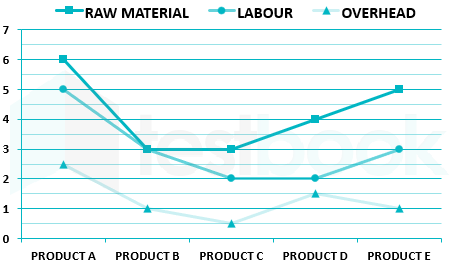
Direction: Data given below shows the requirement in producing 1 unit of several products. The raw material is given in kg which is required for the production of 1 unit of each product. Unit of labour tells the number of workers used on that product. Overhead shows the price in Rs. required to manufacture one unit of that particular product.

Wage per labour is Rs. 35

Price per kg of raw material is Rs. 25

Question 36

Based on Passage: View directions & passage

Find the Cost Price of producing product A.

  1. AOption (a)

    Rs. 373.50

  2. BOption (b)

    Rs. 355.50

  3. COption (c)

    Rs. 318.50

  4. DOption (d)

    Rs. 327.50

  5. EOption (e)

    Rs. 416.50

View answer & explanation

Correct answer

Answer: (d)D.

Rs. 327.50

Why this answer is correct

Cost of raw material = 6 × 25 = Rs. 150

Cost of labour = 5 × 35 = Rs. 175

Overhead cost = Rs. 2.5

Total cost = Rs. 150 + Rs. 175 + Rs. 2.5 = Rs. 327.50

Question 37

Based on Passage: View directions & passage

Find the profit made by selling product B for Rs. 200.

  1. AOption (a)

    Rs. 25

  2. BOption (b)

    Rs. 20

  3. COption (c)

    Rs. 19

  4. DOption (d)

    Rs. 15

  5. EOption (e)

    Rs. 30

View answer & explanation

Correct answer

Answer: (c)C.

Rs. 19

Why this answer is correct

Cost of raw material = 3 × 25 = Rs. 75

Cost of labour = 3 × 35 = Rs. 105

Overhead cost = Rs. 1

⇒ Total cost = Rs. 181

Profit = SP – CP

Profit = 200 – 181 = Rs. 19

Question 38

Based on Passage: View directions & passage

Find the ratio of the cost price of D and E if there is no overhead cost.

  1. AOption (a)

    17 : 15

  2. BOption (b)

    18 : 21

  3. COption (c)

    17 : 23

  4. DOption (d)

    15 : 25

  5. EOption (e)

    23 : 22

View answer & explanation

Correct answer

Answer: (c)C.

17 : 23

Why this answer is correct

Product D

Cost of raw material = 4 × 25 = Rs. 100

Cost of labour = 2 × 35 = Rs. 70

Total cost = Rs. 170

Product E

Cost of raw material = 5 × 25 = Rs. 125

Cost of labour = 3 × 35 = Rs. 105

⇒ Total cost = Rs. 230

⇒ Ratio of cost of product D and E = 17 : 23

Question 39

Based on Passage: View directions & passage

Find the amount seller receive on selling 4 units of product C at 10% profit.

  1. AOption (a)

    Rs. 700.3

  2. BOption (b)

    Rs. 640.2

  3. COption (c)

    Rs. 550.4

  4. DOption (d)

    Rs. 600.7

  5. EOption (e)

    Rs. 750.5

View answer & explanation

Correct answer

Answer: (b)B.

Rs. 640.2

Why this answer is correct

Cost of raw material = 3 × 25 = Rs. 75

Cost of labour = 2 × 35 = Rs. 70

Overhead cost = Rs. 0.5

⇒ Total cost = Rs. 145.50

Cost price of 4 units = 145 × 4 = 582

SP = 582 × 1.1 = Rs. 640.2

Question 40

Based on Passage: View directions & passage

Find the difference between the cost price of Product A and product C?

  1. AOption (a)

    Rs. 180

  2. BOption (b)

    Rs. 160

  3. COption (c)

    Rs. 150

  4. DOption (d)

    Rs. 182

  5. EOption (e)

    Rs. 195

View answer & explanation

Correct answer

Answer: (d)D.

Rs. 182

Why this answer is correct

Product C

Cost of raw material = 3 × 25 = Rs. 75

Cost of labour = 2 × 35 = Rs. 70

Overhead cost = Rs. 0.5

⇒ Total cost = Rs. 145.50

Product A

Cost of raw material = 6 × 25 = Rs. 150

Cost of labour = 5 × 35 = Rs. 175

Overhead cost = Rs. 2.5

⇒ Total cost = Rs. 327.5

⇒ Difference of cost = 327.5 – 145.5 = Rs. 182

Direction: Study the table and answer the following questions.

The following table shows the number of Lok Sabha seats and Rajya Sabha seats of 6 different states of India.

StateLok SabhaRajya Sabha
Maharashtra48-
West Bengal42-
Bihar--
Tamil Nadu3918
Madhya Pradesh--
Uttar Pradesh-31

Question 41

Based on Passage: View directions & passage

If the sum of Lok Sabha and Rajya Sabha seats of Uttar Pradesh is equal to 111, then find by how much percentage (approx.) Lok Sabha seats of Uttar Pradesh is greater than Lok Sabha seats of Tamil Nadu.

  1. AOption (a)

    110%

  2. BOption (b)

    105%

  3. COption (c)

    120%

  4. DOption (d)

    115%

  5. EOption (e)

    None of these

View answer & explanation

Correct answer

Answer: (b)B.

105%

Why this answer is correct

Given

Total number of seat (Lok Sabha and Rajya Sabha) of Uttar Pradesh = 111

The number of Rajya Sabha seats of UP = 31

Calculation

Let the number of Lok Sabha seats of Uttar Pradesh be x

Hence, 31 + x = 111

⇒ x = 80

Lok Sabha seat of Tamil Nadu = 39

Now, Required percentage = [(80 – 39)/39] × 100 = (41/39) × 100 = 105.1% ≈ 105%

Question 42

Based on Passage: View directions & passage

If the ratio of Lok Sabha and Rajya Sabha seats of West Bengal is 21 : 8,  find the ratio of total seats (Lok Sabha and Rajya Sabha) of West Bengal and Tamil Nadu.

  1. AOption (a)

    58 : 57

  2. BOption (b)

    57 : 58

  3. COption (c)

    52 : 51

  4. DOption (d)

    51 : 52

  5. EOption (e)

    None of these

View answer & explanation

Correct answer

Answer: (a)A.

58 : 57

Why this answer is correct

Given

Lok Sabha seats of West Bengal = 42

Calculation

Let the Lok Sabha and Rajya Sabha seats of West Bengal be 21x and 8x

According to the question,

21x = 42

⇒ x = 2

Now, 8x = 8 × 2 = 16

Total number of seats of West Bengal = Lok Sabha + Rajya Sabha = 42 + 16 = 58

Total number of seats of Tamil Nadu = Lok Sabha + Rajya Sabha = 39 + 18 = 57

∴ Ratio of total seats of West Bengal and Tamil Nadu = 58 : 57

Question 43

Based on Passage: View directions & passage

The number of seats in Rajya Sabha of Bihar is equal to the 3 more than 1/3rd of Lok Sabha seats of Tamil Nadu. If the total seat (Lok Sabha and Rajya Sabha) of Bihar is 55. How much percentage (approx.) of the Lok Sabha seats of Bihar is less than the Lok Sabha seats of Maharashtra?

  1. AOption (a)

    20%

  2. BOption (b)

    18.75%

  3. COption (c)

    16%

  4. DOption (d)

    13%

  5. EOption (e)

    None of these

View answer & explanation

Correct answer

Answer: (b)B.

18.75%

Why this answer is correct

Given

Lok Sabha seats of Tamil Nadu = 39

Lok sabha seats of Maharashtra = 48

Calculation

According to the question,

Rajya Sabha seats of bihar = 3 + (Lok Sabha seats of Tamil Nadu/3)

⇒ 3 + (39/3) = 16

Total seats (Lok Sabha and Rajya Sabha) of Bihar = 55

⇒ 16 + seats of Lok Sabha = 55

⇒ Seats of Lok Sabha = 39

Hence, Required percentage = (48 – 39)/48 × 100 = (9/48) × 100 = 18.75%

∴ Lok Sabha seats of Bihar is less than the Lok Sabha seats of Maharashtra by 18.75%

Question 44

Based on Passage: View directions & passage

The total number of seats (Lok Sabha and Rajya Sabha) of Madhya Pradesh is equal to 331333\frac{1}{3}% of 120. If the ratio of Lok Sabha and Rajya Sabha seats of MP is 29 : 11, find the ratio of the Rajya Sabha seats of Madhya Pradesh and the Lok Sabha seats of Maharashtra.

  1. AOption (a)

    48 : 11

  2. BOption (b)

    11 : 48

  3. COption (c)

    29 : 48

  4. DOption (d)

    48 : 29

  5. EOption (e)

    None of these

View answer & explanation

Correct answer

Answer: (b)B.

11 : 48

Why this answer is correct

Given

Lok Sabha seats of Maharashtra = 48

Calculation

According to the question,

Total number of seats of Madhya Pradesh = 331333\frac{1}{3}% × 120 = (1/3) × 120 = 40

As, the ratio of Lok Sabha and Rajya Sabha seats of MP = 29 : 11 = 29x : 11x

Hence, 29x + 11x = 40

⇒ x = 1

So, Rajya Sabha seats of Madhya Pradesh = 11

Now, Rajya Sabha seats of Madhya Pradesh : Lok Sabha seats of Maharashtra = 11 : 48

∴ The ratio of Rajya Sabha seats of Madhya Pradesh and Lok Sabha Seats of Maharashtra is 11 : 48

Question 45

Based on Passage: View directions & passage

The population of Uttar Pradesh is 25 Crore. If the Lok Sabha seats of Uttar Pradesh is equal to 18 more than twice the Rajya Sabha seats of Uttar Pradesh, then find the population density per seat of Lok Sabha of Uttar Pradesh. 

  1. AOption (a)

    31250000

  2. BOption (b)

    3125000

  3. COption (c)

    312500

  4. DOption (d)

    312500000

  5. EOption (e)

    None of these

View answer & explanation

Correct answer

Answer: (b)B.

3125000

Why this answer is correct

Given

Rajya Sabha seats of Uttar Pradesh = 31

Calculation

Let the Lok Sabha seats of Uttar Pradesh be x

Rajya Sabha seats of Uttar Pradesh = 31

According to the question,

Lok Sabha seats of Uttar Pradesh – 2(Rajya Sabha seats of Uttar Pradesh) = 18

⇒ x – 2(31) = 18

⇒ x = 18 + 62 = 80

Population density = (Total Population/Number of Lok sabha seats) = 250000000/80

= 25000000/8

= 3125000

∴ The population density of Lok Sabha of Uttar Pradesh is 3125000

Question 46

What approximate value should come in the place of question mark (?) in the following question?

√1763.98 + √1444.04 - (39.99% of 149.92) = ?

  1. AOption (a)

    25

  2. BOption (b)

    20

  3. COption (c)

    30

  4. DOption (d)

    40

  5. EOption (e)

    35

View answer & explanation

Correct answer

Answer: (b)B.

20

Why this answer is correct

Follow BODMAS rule to solve this question, as per the order given below, 

Step - 1: Parts of an equation enclosed in 'Brackets' must be solved first, and follow BODMAS rule in the bracket,

Step - 2: Any mathematical 'Of' or 'Exponent' must be solved next,

Step - 3: Next, the parts of the equation that contain 'Division' and 'Multiplication' are calculated,

Step - 4: Last but not least, the parts of the equation that contain 'Addition' and 'Subtraction' should be calculated.

Since, we need to find out the approximate value,

So, we can write these values to their nearest integers.

Given expression is

√1763.98 + √1444.04 - (39.99% of 149.92) = ?

⇒ √1764 + √1444 - (40% of 150) = ?

⇒ 42 + 38 - (40/100 × 150) = ?

⇒ 42 + 38 - 60 = ?

⇒ 80 - 60 = ?

⇒ 20 = ?

Question 47

What approximate value should come in the place of question mark (?) in the following question?

29.9% of 499.99 - 49.93% of 399.99 + 69.92% of 199.99 = ?

  1. AOption (a)

    -190

  2. BOption (b)

    110

  3. COption (c)

    -140

  4. DOption (d)

    70

  5. EOption (e)

    90

View answer & explanation

Correct answer

Answer: (e)E.

90

Why this answer is correct

Follow BODMAS rule to solve this question, as per the order given below, 

Step - 1: Parts of an equation enclosed in 'Brackets' must be solved first, and following BODMAS rule in the bracket-

Step - 2: Any mathematical 'Of' or 'Exponent' must be solved next.

Step - 3: Next, the parts of the equation that contain 'Division' and 'Multiplication' are calculated.

Step - 4: Last but not least, the parts of the equation that contain 'Addition' and 'Subtraction' should be calculated.

Since we need to find out the approximate value,

we can write these values to their nearest integers.

Given expression is

29.9% of 499.99 - 49.93% of 399.99 + 69.92% of 199.99 = ?

⇒ 30% of 500 - 50% of 400 + 70% of 200 = ?

⇒ (30/100) × 500 - (50/100) × 400 + (70/100) × 200 = ?

⇒ 150 - 200 + 140 = ?

⇒ 290 - 200 = ?

⇒ ? = 90

Question 48

What approximate value should come in the place of question mark (?) in the following question?

638.4 ÷ 22.1 + 99.7 × 20.1 - (27)2 = ?

  1. AOption (a)

    1200

  2. BOption (b)

    1400

  3. COption (c)

    1350

  4. DOption (d)

    1300

  5. EOption (e)

    1450

View answer & explanation

Correct answer

Answer: (d)D.

1300

Why this answer is correct

Follow BODMAS rule to solve this question, as per the order given below,

Step-1- Parts of an equation enclosed in 'Brackets' must be solved first, and in the bracket,

Step-2- Any mathematical 'Of' or 'Exponent' must be solved next,

Step-3- Next, the parts of the equation that contain 'Division' and 'Multiplication' are calculated,

Step-4- Last but not least, the parts of the equation that contain 'Addition' and 'Subtraction' should be calculated.

Given expression is,

638.4 ÷ 22.1 + 99.7 × 20.1 - (27)2 = ?

Taking the approximate values as,

638.4 ≈ 638, 22.1 ≈ 22, 99.7 ≈ 100, 20.1 ≈ 20

⇒ 638 ÷ 22 + 100 × 20 - (27)2 = ?

⇒ 29 + 2000 - 729 = ?

∴ ? = 1300

Question 49

What approximate value should come in the place of the question mark (?) in the following question?

39.98% of 699.97 = 799.98 + 59.84% of 599.99 - ?

  1. AOption (a)

    880

  2. BOption (b)

    960

  3. COption (c)

    640

  4. DOption (d)

    780

  5. EOption (e)

    720

View answer & explanation

Correct answer

Answer: (a)A.

880

Why this answer is correct

Follow the BODMAS rule to solve this question, as per the order given below. 

Step - 1: Parts of an equation enclosed in 'Brackets' must be solved first and following  BODMAS rule in the bracket-

Step - 2: Any mathematical 'Of' or 'Exponent' must be solved next.

Step - 3: Next, the parts of the equation that contain 'Division' and 'Multiplication' are calculated.

Step - 4: Last but not least, the parts of the equation that contain 'Addition' and 'Subtraction' should be calculated.

Since we need to find out the approximate value, we can write these values to their nearest integers.

Given expression is

39.98% of 699.97 = 799.98 + 59.84% of 599.99 - ?

⇒ 40% of 700 = 800 + 60% of 600 - ?

⇒ 280 = 800 + 360 - ?

⇒ ? = 1160 - 280 = 880

Question 50

What approximate value should come in the place of the question mark (?) in the following question?

39.99% of 799.98 + 59.98% of 499.98 = 24.89% of ?

  1. AOption (a)

    2260

  2. BOption (b)

    2640

  3. COption (c)

    2480

  4. DOption (d)

    3260

  5. EOption (e)

    2880

View answer & explanation

Correct answer

Answer: (c)C.

2480

Why this answer is correct

Follow the BODMAS rule to solve this question, as per the order given below.

Step - 1: Parts of an equation enclosed in 'Brackets' must be solved first and following BODMAS rule in the bracket-

Step - 2: Any mathematical 'Of' or 'Exponent' must be solved next.

Step - 3: Next, the parts of the equation that contain 'Division' and 'Multiplication' are calculated.

Step - 4: Last but not least, the parts of the equation that contain 'Addition' and 'Subtraction' should be calculated.

Since we need to find out the approximate value, we can write these values to their nearest integers.

Given expression is

39.99% of 799.98 + 59.98% of 499.98 = 24.89% of ?

⇒ 40% of 800 + 60% of 500 = 25% of ?

⇒ 320 + 300 = (25/100) × ?

⇒ 620 × 100/25 = ?

⇒ ? = 2480

Question 51

What should come in place of the question mark '?' in the following number series?

25, 26, 18, 45, ?, 106

  1. AOption (a)

    -16

  2. BOption (b)

    -18

  3. COption (c)

    -19

  4. DOption (d)

    -21

  5. EOption (e)

    14

View answer & explanation

Correct answer

Answer: (c)C.

-19

Why this answer is correct

Calculation:

⇒ 25 + (1)3 = 26

⇒ 26 - (2)3 = 18

⇒ 18 + (3)3 = 45

⇒ 45 - (4)3 = - 19

⇒ -19 + (5)3 = 106

∴ The missing number is -19.

Question 52

What will come in the place of the question mark (?) in the following number series?

18, 20, 26, 38,  58, ?

  1. AOption (a)

    68

  2. BOption (b)

    72

  3. COption (c)

    86

  4. DOption (d)

    88

  5. EOption (e)

    94

View answer & explanation

Correct answer

Answer: (d)D.

88

Why this answer is correct

Calculation:

⇒  18 + 1 x 2 = 20

⇒ 20 + 2 x 3 = 26

⇒ 26 + 3 x 4 = 38

⇒ 38 + 4 x 5 = 58 

⇒ 58 + 5 x 6 = 88

∴ The required answer is 88.

Question 53

What should come in place of the question mark '?' in the following number series?

5, 12, 33, 136, 675, ?

  1. AOption (a)

    4056

  2. BOption (b)

    3448

  3. COption (c)

    3696

  4. DOption (d)

    1250

  5. EOption (e)

    1360

View answer & explanation

Correct answer

Answer: (a)A.

4056

Why this answer is correct

Calculation:

⇒ 5 x 2 + 2 = 12

⇒ 12 x 3 - 3 = 33

⇒ 33 x 4 + 4 = 136

⇒ 136 x 5 - 5 = 675

⇒ 675 x 6 + 6 = 4056 

∴ The missing number is 4056.

Question 54

What should come in place of the question mark '?' in the following number series?

4,11, 37, 153, ?, 4633

  1. AOption (a)

    771

  2. BOption (b)

    768

  3. COption (c)

    789

  4. DOption (d)

    761

  5. EOption (e)

    753

View answer & explanation

Correct answer

Answer: (a)A.

771

Why this answer is correct

Calculation:

⇒ 4 x 2 + 3 = 11

⇒ 11 x 3 + 4 = 37

⇒ 37 x 4 + 5 = 153

⇒ 153 x 5 + 6 = 771

⇒ 771 x 6 + 7 = 4633 

∴ The required answer is 771.

Question 55

What should come in place of the question mark (?) in the following number series

8, 4.5, 5.5, 13, 56, ?

  1. AOption (a)

    254

  2. BOption (b)

    356

  3. COption (c)

    456

  4. DOption (d)

    468

  5. EOption (e)

    396

View answer & explanation

Correct answer

Answer: (c)C.

456

Why this answer is correct

Calculation:

⇒ 8 x 0.5 + 0.5 = 4.5

⇒ 4.5 x 1 + 1 = 5.5

⇒ 5.5 x 2 + 2 = 13

⇒ 13 x 4 + 4 = 56

⇒ 56 x 8 + 8 = 456

∴ The required answer is 456.

Question 56

In a river, the ratio of the speed of stream and speed of the boat in still water is 4 : 7. Again, the ratio of the speed of the stream and speed of another boat in still water is 2 : 5. What is the ratio of the speed of the first boat to the second boat in still water?

  1. AOption (a)

    13 : 8

  2. BOption (b)

    7 : 10

  3. COption (c)

    14 : 5

  4. DOption (d)

    7 : 5

  5. EOption (e)

    3 : 2

View answer & explanation

Correct answer

Answer: (b)B.

7 : 10

Why this answer is correct

Shortcut Trick

Equate the speed of the stream in both ratios to compare the boats.

Ratio 1 (Stream : Boat1) = 4 : 7

Ratio 2 (Stream : Boat2) = 2 : 5 × 2 → 4 : 10

Comparing the Boat speeds directly when Stream speed is 4 units.

Boat1 : Boat2 = 7 : 10

∴ The correct answer is 7 : 10.

Alternate Method

Given: Ratio of stream (s) to boat 1 (b1) = 4 : 7. Ratio of stream (s) to boat 2 (b2) = 2 : 5.

Calculations:

⇒ Let Speed of Stream = s, Speed of Boat 1 = b1, and Speed of Boat 2 = b2.

⇒ From first ratio: s/b1 = 4/7 ⇒ b1 = 7s/4

⇒ From second ratio: s/b2 = 2/5 ⇒ b2 = 5s/2

⇒ Ratio of Boat 1 to Boat 2 = b1 : b2 = (7s/4) : (5s/2)

⇒ Multiply by 4 to clear denominators: 7s : (5s/2 × 4) = 7s : 10s

⇒ b1 : b2 = 7 : 10

∴ The correct answer is 7 : 10.

Additional Information

Relative Speed in Water

Downstream Speed = Speed of Boat + Speed of Stream. Upstream Speed = Speed of Boat − Speed of Stream.

Common Variable Method

When comparing two ratios with a common element, multiply the terms of the ratios so that the common element has the same numerical value.

Question 57

18 men can complete a project in 24 days and 16 women can complete the same project in 30 days. 15 men start the work but after 6 days they left. 20 women can complete the remaining work. If each person gets 225 per day. What are the total wages of all women?

  1. AOption (a)

    Rs. 171000

  2. BOption (b)

    Rs. 150000

  3. COption (c)

    Rs. 125000

  4. DOption (d)

    Rs. 85500

  5. EOption (e)

    Rs. 90000

View answer & explanation

Correct answer

Answer: (d)D.

Rs. 85500

Why this answer is correct

Shortcut Trick

Work ratio: 18M × 24 = 16W × 30 ⇒ 9M = 10W ⇒ M/W = 10/9.

Total Work = 18 × 10 × 24 = 4320 units.

Work done by 15 men in 6 days = 15 × 10 × 6 = 900 units.

Remaining work = 4320 − 900 = 3420 units.

Days taken by 20 women = 3420 ÷ (20 × 9) = 19 days.

Total wages for women = 20 × 19 × 225 = ₹85500.

∴ The correct answer is ₹85500.

Alternate Method

Given:

18 Men = 24 days | 16 Women = 30 days | Daily wage = ₹225.

Calculations:

⇒ Total work in terms of man-days = 18 × 24 = 432 man-days.

⇒ Total work in terms of woman-days = 16 × 30 = 480 woman-days.

⇒ Efficiency equivalence: 432 Men = 480 Women ⇒ 1 Man = 480/432 Women = 10/9 Women.

⇒ Work done by 15 men in 6 days = 90 man-days.

⇒ Remaining work in man-days = 432 − 90 = 342 man-days.

⇒ Remaining work in woman-days = 342 × (10/9) = 380 woman-days.

⇒ Days required by 20 women = 380 ÷ 20 = 19 days.

⇒ Total wages of women = Total woman-days × Wage per person.

⇒ Total wages = 380 × 225 = ₹85500.

∴ The correct answer is ₹85500.

Additional Information

Chain Rule Formula

The relationship between work, people, and time is given by (M1×D1×H1)/W1 = (M2×D2×H2)/W2.

Work and Wages

Wages are generally distributed in the ratio of the work done by each person (Efficiency × Time).

Man-Days Concept

Total Work = Number of Persons × Number of Days. This allows conversion between different labor types based on efficiency ratios.

Question 58

Sam bought two different articles- A and B at a total cost of Rs. 5000. He sold article A at a loss of 25% and article B at a profit of 6%. Sam incurred an overall loss of Rs. 165 by selling both the articles. What is the cost price of article A?

  1. AOption (a)

    Rs. 1200 

  2. BOption (b)

    Rs. 2000

  3. COption (c)

    Rs. 1250 

  4. DOption (d)

    Rs. 1800 

  5. EOption (e)

    Rs. 1500

View answer & explanation

Correct answer

Answer: (e)E.

Rs. 1500

Why this answer is correct

Shortcut Trick

Overall loss percentage = (165 ÷ 5000) × 100 = 3.3%.

Using Alligation: Article A loss is −25%, Article B profit is +6%, Overall is −3.3%.

Ratio of CPA to CPB = (6 − (−3.3)) : (−3.3 − (−25)) = 9.3 : 21.7.

Simplified Ratio = 93 : 217 = 3 : 7.

Total units (3 + 7) = 10 units ⇒ Rs. 5000.

Cost price of Article A = 3 units = (5000 ÷ 10) × 3 = Rs. 1500.

∴ The correct answer is Rs. 1500.

Alternate Method

Given → Total CP = Rs. 5000 | Loss on A = 25% | Profit on B = 6% | Net Loss = Rs. 165. Formulas: Profit = SP − CP | Loss = CP − SP | Total Loss = (Loss on A) − (Profit on B).

⇒ Let the cost price of Article A be Rs. x and Article B be Rs. (5000 − x). ⇒ Loss on A = 25% of x = 0.25x. ⇒ Profit on B = 6% of (5000 − x) = 0.06 × (5000 − x) = 300 − 0.06x. ⇒ Overall Loss = Loss on A − Profit on B = 165. ⇒ 0.25x − (300 − 0.06x) = 165. ⇒ 0.25x − 300 + 0.06x = 165 ⇒ 0.31x = 165 + 300 = 465. ⇒ x = 465 ÷ 0.31 = 1500.

∴ The correct answer is Rs. 1500.

Additional Information

Rule of Alligation

It is used to find the ratio in which two quantities are mixed. In profit and loss, alligation on percentage profit/loss gives the ratio of Cost Prices.

Net Profit/Loss

Total Profit or Loss = (Profit1 + Profit2 + ...) − (Loss1 + Loss2 + ...). If the result is positive, it is a net profit; otherwise, a net loss.

Question 59

On a certain sum of money, the simple interest for 2 years is Rs. 400 at the rate of 5% per annum. It was invested at compound interest at the same rate for the same duration as before, how much more interest would be earned?

  1. AOption (a)

    25

  2. BOption (b)

    40

  3. COption (c)

    10

  4. DOption (d)

    15

  5. EOption (e)

    21

View answer & explanation

Correct answer

Answer: (c)C.

10

Why this answer is correct

Shortcut Trick

For a duration of 2 years, the difference between Compound Interest (CI) and Simple Interest (SI) is given by the interest earned on the first year's interest.

SI for 2 years = ₹400 → SI for 1 year = 400 ÷ 2 = ₹200.

Extra interest earned (CI − SI) = Interest on first year SI = 5% of ₹200.

Difference = 200 × (5 ÷ 100) = ₹10.

∴ The correct answer is ₹10.

Alternate Method

Given: Simple Interest (SI) = ₹400, Time (T) = 2 years, Rate (R) = 5% per annum.

Formula Used: SI = (P × R × T) ÷ 100; Difference (CI − SI) = (P × R2) ÷ 1002

⇒ 400 = (P × 5 × 2) ÷ 100

⇒ 400 = P × (10 ÷ 100)

⇒ P = 400 × 10 = ₹4000

⇒ Difference = (4000 × 5 × 5) ÷ (100 × 100)

⇒ Difference = (4000 × 25) ÷ 10000

⇒ Difference = 100000 ÷ 10000 = ₹10

∴ The correct answer is ₹10.

Additional Information

Difference for 2 Years

The difference between CI and SI for 2 years is P(R/100)2 or simply the interest on the first year's interest.

Difference for 3 Years

The difference for 3 years is given by the formula: D = [P(R/100)2] × [(300+R)/100].

Effective Rate of Interest

For 2 years at R%, effective SI is 2R% and effective CI is (2R + R2/100)%. The difference is (R2/100)% of Principal.

Question 60

The average of ages of Suman, Kanti and Reena is 30 years, six years from now the average ages of Suman and Kanti will be 36 years. Find the age of Reena?

  1. AOption (a)

    45

  2. BOption (b)

    50

  3. COption (c)

    30

  4. DOption (d)

    35

  5. EOption (e)

    40

View answer & explanation

Correct answer

Answer: (c)C.

30

Why this answer is correct

Shortcut Trick

Total age of Suman, Kanti and Reena = 30 × 3 = 90 years.

Present average of Suman and Kanti = 36 − 6 = 30 years.

Total age of Suman and Kanti = 30 × 2 = 60 years.

Reena age = 90 − 60 = 30 years.

∴ The correct answer is 30 years.

Alternate Method

Given:

Average age of Suman (S), Kanti (K) and Reena (R) = 30 years.

Average age of S and K after 6 years = 36 years.

Formula Used:

Sum of observations = Average × Number of observations

Calculations:

⇒ S + K + R = 30 × 3 = 90 years --- (Eq 1)

⇒ (S + 6) + (K + 6) = 36 × 2

⇒ S + K + 12 = 72

⇒ S + K = 72 − 12 = 60 years --- (Eq 2)

⇒ Subtracting (Eq 2) from (Eq 1):

⇒ (S + K + R) − (S + K) = 90 − 60

⇒ R = 30 years

∴ The correct answer is 30 years.

Additional Information

Average Age Property

If the average age of a group is A, then after 'n' years, the average age will be (A + n).

Weighted Average

Combined Average = (n1A1 + n2A2) ÷ (n1 + n2), where n is the number of people and A is their average.

Question 61

Ujjwal gave two tests having the same maximum marks. The qualifying percentage of the first and second tests are 40% and 30% respectively. In the second test, he scored 132 marks which are 15 less than the qualifying marks. Find the qualifying marks in the first test.

  1. AOption (a)

    194

  2. BOption (b)

    176

  3. COption (c)

    195

  4. DOption (d)

    186

  5. EOption (e)

    196

View answer & explanation

Correct answer

Answer: (e)E.

196

Why this answer is correct

Shortcut Trick

Scored marks in 2nd test = 132

Qualifying marks in 2nd test = 132 + 15 = 147

Given 30% of Maximum Marks = 147

Qualifying marks in 1st test = 40% of Maximum Marks = (147 ÷ 30) × 40 = 147 × 4/3 = 196

∴ The correct answer is 196.

Alternate Method

Given: Qualifying % (Test 1) = 40%, Qualifying % (Test 2) = 30%, Marks scored (Test 2) = 132, Deficit = 15.

⇒ Qualifying marks in second test = 132 + 15 = 147

⇒ Let the maximum marks for each test be x.

⇒ 30% of x = 147

⇒ (30/100) × x = 147

⇒ x = (147 × 100) ÷ 30 = 490

⇒ Qualifying marks in first test = 40% of 490

⇒ (40/100) × 490 = 4 × 49 = 196

∴ The correct answer is 196.

Additional Information

Percentage Base Change

When the base (Maximum Marks) is the same, we can use the unitary method: (Given Value ÷ Given % Base) × Required % Base.

Pass/Fail Marks Logic

Pass Marks = Marks Obtained + Marks failed by, or Pass Marks = Marks Obtained − Marks exceeded by.

Question 62

A 40 cm long paper strip was cut into two strips in the ratio 5 ∶ 3. The longer strip was further divided into two strips in the ratio 4 ∶ 1, while the smaller strip was also divided into two strips in the ratio 3 ∶ 2. What is the difference between the lengths of the two shortest strips?

  1. AOption (a)

    1 cm

  2. BOption (b)

    2 cm

  3. COption (c)

    3 cm

  4. DOption (d)

    4 cm

  5. EOption (e)

    5 cm

View answer & explanation

Correct answer

Answer: (a)A.

1 cm

Why this answer is correct

Shortcut Trick

Initial division 5 : 3 (Total 8 units = 40 cm) ⇒ 1 unit = 5 cm.

Longer strip = 25 cm, Shorter strip = 15 cm.

Sub-division of 25 cm (4 : 1) → Shortest part = 1/5 × 25 = 5 cm.

Sub-division of 15 cm (3 : 2) → Shortest part = 2/5 × 15 = 6 cm.

Difference = 6 cm − 5 cm = 1 cm.

∴ The correct answer is 1 cm.

Alternate Method

Given: Total Length = 40 cm. Ratios: 5 : 3, 4 : 1, and 3 : 2.

Step 1: First Division

⇒ Total ratio = 5 + 3 = 8 units.

⇒ 8 units = 40 cm ⇒ 1 unit = 5 cm.

⇒ Longer strip = 5 × 5 = 25 cm.

⇒ Smaller strip = 3 × 5 = 15 cm.

Step 2: Further Division

⇒ Longer strip (25 cm) in 4 : 1 ⇒ Smallest part = 1/5 × 25 = 5 cm.

⇒ Smaller strip (15 cm) in 3 : 2 ⇒ Smallest part = 2/5 × 15 = 6 cm.

Step 3: Difference

⇒ Difference = 6 cm − 5 cm = 1 cm.

∴ The correct answer is 1 cm.

Additional Information

Ratio Division Rule

To divide a quantity Q in ratio a : b, the parts are [a/(a+b)] × Q and [b/(a+b)] × Q.

Compound Ratio

When ratios are applied successively, the final part can be found by multiplying the individual fraction ratios, e.g., (3/8) × (2/5) × Total.

Question 63

One year before, Shreya was six times as old as her daughter. Six years hence, Shreya’s age will exceed her daughter’s age by 30 years. The ratio of the present ages of Shreya and her daughter is?

  1. AOption (a)

    35 : 5

  2. BOption (b)

    49 : 8

  3. COption (c)

    23 : 4

  4. DOption (d)

    37 : 7

  5. EOption (e)

    None of these

View answer & explanation

Correct answer

Answer: (d)D.

37 : 7

Why this answer is correct

Shortcut Trick

The age difference between two people remains constant throughout their lives.

Difference = 30 years. One year ago, Shreya (S) was 6 times her daughter (D). S − D = 5 units.

5 units = 30 years ⇒ 1 unit = 6 years. One year ago: D = 6 years, S = 36 years.

Present ages: D = 6 + 1 = 7 years, S = 36 + 1 = 37 years.

∴ The correct answer is 37 : 7.

Alternate Method

Given: 1 year ago Shreya = 6 × Daughter. 6 years hence, Difference = 30 years.

⇒ Let 1 year ago, Daughter's age = x and Shreya's age = 6x.

⇒ Age difference = 6x − x = 5x.

⇒ 5x = 30 (Since age difference never changes).

⇒ x = 6.

⇒ 1 year ago: Shreya = 36 years, Daughter = 6 years.

⇒ Present Age of Shreya = 36 + 1 = 37 years.

⇒ Present Age of Daughter = 6 + 1 = 7 years.

⇒ Ratio = 37 : 7.

∴ The correct answer is 37 : 7.

Additional Information

Constant Difference Property

The numerical difference between the ages of two persons remains the same at any point in time (past, present, or future).

Ratio Adjustment

If ages are given in a ratio a:b and after 'n' years the ratio becomes c:d, ensure (a−b) = (c−d) by multiplying the ratios by suitable constants to solve quickly.

Question 64

A mixture of 189 litres that contain alcohol and water in the ratio of 5 ∶ 4. Find the amount of pure alcohol added to the mixture, to get a new mixture containing alcohol and water in the ratio of 5 ∶ 3.

  1. AOption (a)

    27 litres

  2. BOption (b)

    35 litres

  3. COption (c)

    32 litres

  4. DOption (d)

    40 litres

  5. EOption (e)

    None of these

View answer & explanation

Correct answer

Answer: (b)B.

35 litres

Why this answer is correct

Shortcut Trick

Initial Ratio (Alcohol : Water) = 5 : 4 (Total = 9 units)

Final Ratio (Alcohol : Water) = 5 : 3 (Water changes, Alcohol stays 5 units)

Since only Alcohol is added, Water quantity must remain constant. Equalize Water: 4 × 3 = 12 and 3 × 4 = 12.

New Ratios: 15 : 12 (Total 27 units = 189 litres) → 20 : 12. Alcohol increase = 5 units.

27 units = 189 litres ⇒ 1 unit = 7 litres. 5 units = 5 × 7 = 35 litres.

∴ The correct answer is 35 litres.

Alternate Method

Given: Total mixture = 189 litres, Initial Ratio = 5 : 4, Final Ratio = 5 : 3.

⇒ Total units = 5 + 4 = 9 units

⇒ 1 unit = 189 ÷ 9 = 21 litres

⇒ Initial Alcohol = 5 × 21 = 105 litres

⇒ Initial Water = 4 × 21 = 84 litres

⇒ Let 'x' litres of alcohol be added.

⇒ (105 + x) ÷ 84 = 5 ÷ 3

⇒ 3 × (105 + x) = 5 × 84

⇒ 315 + 3x = 420

⇒ 3x = 105

⇒ x = 35 litres

∴ The correct answer is 35 litres.

Additional Information

Constant Quantity Method

When one component is added, the other component remains constant. Calculate the constant quantity first to find the new total volume.

Ratio Balancing

To solve quickly, make the parts of the unchanged component equal in both ratios by multiplying with suitable integers.

Alligation for Addition

Pure addition can be treated as a mixture of the initial concentration and 100% pure substance concentration.

Question 65

A train covers the distance from A to B at a speed of 42 km/hr. At the same time, the second train starts from B to A at the speed of 53 km/hr. If the distance between A and B is 950 km, then, at what distance from A, do the two trains cross each other?

  1. AOption (a)

    420 km

  2. BOption (b)

    530 km

  3. COption (c)

    210 km

  4. DOption (d)

    840 km

  5. EOption (e)

    None of these

View answer & explanation

Correct answer

Answer: (a)A.

420 km

Why this answer is correct

Shortcut Trick

When two objects start at the same time, the distance covered by each is directly proportional to their speed.

Ratio of speeds (A : B) = 42 : 53

Sum of ratio parts = 42 + 53 = 95 units

95 units → 950 km ⇒ 1 unit = 10 km

Distance from A = Speed of A × Time = 42 × 10 = 420 km

∴ The correct answer is 420 km.

Alternate Method

Given: Speed of Train 1 = 42 km/hr, Speed of Train 2 = 53 km/hr, Total Distance = 950 km.

Formula Used: Relative Speed = S1 + S2 (opposite direction); Time = Distance ÷ Speed.

⇒ Relative Speed = 42 + 53 = 95 km/hr

⇒ Time taken to meet = Total Distance ÷ Relative Speed

⇒ Time = 950 ÷ 95 = 10 hours

⇒ Distance from A = Speed of train starting from A × Time

⇒ Distance from A = 42 × 10 = 420 km

∴ The correct answer is 420 km.

Additional Information

Relative Speed Concept

When two objects move toward each other, their relative speed is the sum of their individual speeds (S1 + S2).

Distance-Speed Relationship

For a constant time of travel, the ratio of distances covered is equal to the ratio of speeds (D1/D2 = S1/S2).

Meeting Time Formula

If two objects start simultaneously, the meeting time T = Total Distance ÷ (S1 + S2).

Reasoning Ability (35 questions)

Directions: Read the instructions carefully and answer the question below:

Six boxes L, M, N, O, P and Q are stacked one above the other but not necessarily in the same order. Six items namely Books, Erasers, Pen, Pencils, Sharpener and Stapler are kept in these six boxes but not necessarily in the same order.

Box L is kept at the top of the stack. Box M which contains Pencils is kept three boxes below the Box L. Box N is kept immediately above the box which contains Erasers. As many boxes are placed above the box N as many are placed below the box that contains Sharpener. The box O contains Pen and is kept below the box that contains Erasers. The box that contains Books is not placed immediately above the box that contains Erasers. Box P is placed above the box that contains Pencils.

Question 66

Based on Passage: View directions & passage

What item is kept in Box P?

  1. AOption (a)

    Sharpener

  2. BOption (b)

    Books

  3. COption (c)

    Pencil

  4. DOption (d)

    Erasers

  5. EOption (e)

    Pen 

View answer & explanation

Correct answer

Answer: (d)D.

Erasers

Why this answer is correct

Six boxes: L, M, N, O, P and Q

Six items: Books, Erasers, Pen, Pencils, Sharpener and Stapler

i) Box L is kept at the top of the stack.

ii) Box M which contains Pencils is kept three boxes below the Box L.

iii) Box N is kept immediately above the box which contains Erasers.

Case 1Case 2
BoxItemBoxItem
Box LBox L
Box N
Erasers
Box MPencilBox MPencil
Box N
Erasers


iv) As many boxes are placed above the box N as many are placed below the box that contains Sharpener.

v) The box O contains Pen and is kept below the box that contains Erasers.

This eliminates case 2.

Case 1
BoxItem
Box L
Box N
Erasers
Box MPencil
Sharpener
Box OPen


vi) The box that contains Books is not placed immediately above the box that contains Erasers.

vii) Box P is placed above the box that contains Pencils.

Case 1
BoxItem
Box LBooks
Box NStaplers
Box PErasers
Box MPencil
Box QSharpener
Box OPen

Hence, Erasers is kept in Box P.

Question 67

Based on Passage: View directions & passage

How many boxes are kept between the boxes which contains Books and Pencil?

  1. AOption (a)

    Two

  2. BOption (b)

    Three

  3. COption (c)

    Four

  4. DOption (d)

    One 

  5. EOption (e)

    Five

View answer & explanation

Correct answer

Answer: (a)A.

Two

Why this answer is correct

Six boxes: L, M, N, O, P and Q

Six items: Books, Erasers, Pen, Pencils, Sharpener and Stapler

i) Box L is kept at the top of the stack.

ii) Box M which contains Pencils is kept three boxes below the Box L.

iii) Box N is kept immediately above the box which contains Erasers.

Case 1Case 2
BoxItemBoxItem
Box LBox L
Box N
Erasers
Box MPencilBox MPencil
Box N
Erasers


iv) As many boxes are placed above the box N as many are placed below the box that contains Sharpener.

v) The box O contains Pen and is kept below the box that contains Erasers.

This eliminates case 2.

Case 1
BoxItem
Box L
Box N
Erasers
Box MPencil
Sharpener
Box OPen


vi) The box that contains Books is not placed immediately above the box that contains Erasers.

vii) Box P is placed above the box that contains Pencils.

Case 1
BoxItem
Box LBooks
Box NStaplers
Box PErasers
Box MPencil
Box QSharpener
Box OPen

Hence, two boxes are kept between the boxes which contains Books and Pencil.

Question 68

Based on Passage: View directions & passage

How many boxes are kept between box N and the box that contains Pen?

  1. AOption (a)

    Two

  2. BOption (b)

    Three

  3. COption (c)

    Four

  4. DOption (d)

    One 

  5. EOption (e)

    Five

View answer & explanation

Correct answer

Answer: (b)B.

Three

Why this answer is correct

Six boxes: L, M, N, O, P and Q

Six items: Books, Erasers, Pen, Pencils, Sharpener and Stapler

i) Box L is kept at the top of the stack.

ii) Box M which contains Pencils is kept three boxes below the Box L.

iii) Box N is kept immediately above the box which contains Erasers.

Case 1Case 2
BoxItemBoxItem
Box LBox L
Box N
Erasers
Box MPencilBox MPencil
Box N
Erasers


iv) As many boxes are placed above the box N as many are placed below the box that contains Sharpener.

v) The box O contains Pen and is kept below the box that contains Erasers.

This eliminates case 2.

Case 1
BoxItem
Box L
Box N
Erasers
Box MPencil
Sharpener
Box OPen


vi) The box that contains Books is not placed immediately above the box that contains Erasers.

vii) Box P is placed above the box that contains Pencils.

Case 1
BoxItem
Box LBooks
Box NStaplers
Box PErasers
Box MPencil
Box QSharpener
Box OPen

Hence, three boxes are kept between box N and the box that contains Pen.

Question 69

Based on Passage: View directions & passage

In which box Books are kept?

  1. AOption (a)

    Box O

  2. BOption (b)

    Box L

  3. COption (c)

    Box P

  4. DOption (d)

    Box Q

  5. EOption (e)

    Box M

View answer & explanation

Correct answer

Answer: (b)B.

Box L

Why this answer is correct

Six boxes: L, M, N, O, P and Q

Six items: Books, Erasers, Pen, Pencils, Sharpener and Stapler

i) Box L is kept at the top of the stack.

ii) Box M which contains Pencils is kept three boxes below the Box L.

iii) Box N is kept immediately above the box which contains Erasers.

Case 1Case 2
BoxItemBoxItem
Box LBox L
Box N
Erasers
Box MPencilBox MPencil
Box N
Erasers


iv) As many boxes are placed above the box N as many are placed below the box that contains Sharpener.

v) The box O contains Pen and is kept below the box that contains Erasers.

This eliminates case 2.

Case 1
BoxItem
Box L
Box N
Erasers
Box MPencil
Sharpener
Box OPen


vi) The box that contains Books is not placed immediately above the box that contains Erasers.

vii) Box P is placed above the box that contains Pencils.

Case 1
BoxItem
Box LBooks
Box NStaplers
Box PErasers
Box MPencil
Box QSharpener
Box OPen

Hence, Books are kept in the box L.

Direction: Study the information given below carefully and answer the questions that follow.

Eight persons joined Infosys on the 5th and 17th of four months among January, April, August, and September. Each of these persons scored different marks in their written test among 14, 16, 19, 22, 27, 29, 32, and 33.

Three persons joined between those who scored 16 marks and 27 marks. H doesn’t score 27 marks. G scored two marks more than F. A joined before G. Total marks scored by the candidates, who joined in April, is not more than 50 marks. H joined immediately after the one who scored 29 and in a month with 30 days. The number of persons who joined before A is the same as those who joined after F. D joined immediately after A. C scored three marks lesser than D and joined in April. E scored more than B and joined before B. Only one person joined between B and the one who scored 22 marks. The person, who scored 19 marks joined immediately after the one who scored 32 marks. The highest scorer joined on 5th April.

Question 70

Based on Passage: View directions & passage

Who among the following scored 2nd highest marks?

  1. AOption (a)

    H

  2. BOption (b)

    A

  3. COption (c)

    E

  4. DOption (d)

    B

  5. EOption (e)

    None of these

View answer & explanation

Correct answer

Answer: (b)B.

A

Why this answer is correct

Eight persons joined Infosys.

Dates:- 5th and 17th

Months:- January, April, August, and September.

Marks:- 14, 16, 19, 22, 27, 29, 32 and 33.

  1. H joined immediately after the one who scored 29 and in a month with 30 days.
  2. The highest scorer joined on 5th April.
  3. C scored three marks lesser than D and joined in April.
  4. Total marks scored by the candidates, who joined in April is not more than 50 marks.

So, C should be 16 and D should be 19.

Following are the possibilities we get,

MonthsDatesCase 1Case 2Case 3
January5th
17th(29)
April5thH (33)(33)(33)
17thC (16)C (16)C (16)
August5th
17th(29)
September5thH(29)
17thH


  1. Three persons joined between those who scored 16 marks and 27 marks.
  2. H doesn’t score 27 marks, so case 3 is eliminated.
MonthsDatesCase 1Case 2
January5th
17th(29)
April5thH (33)(33)
17thC (16)C (16)
August5th
17th(29)
September5thH
17th(27)(27)


  1. G scored two marks more than F.

So, the only possibility is G scored 29 and F scored 27.

  1. A joined before G.
  2. Number of persons who joined before A is the same as those who joined after F.
MonthsDatesCase 1Case 2
January5thAA
17thG (29)
April5thH (33)(33)
17thC (16)C (16)
August5th
17thG (29)
September5thH
17thF (27)F (27)


  1. D joined immediately after A, this is violated in case 1, so it is eliminated.
  2. E scored more than B and joined before B. So, E must have scored 33 marks.
  3. Only one person joined between B and the one who scored 22 marks. So, H scored 22 marks.
  4. Person, who scored 19 marks joined immediately after the one who scored 32 marks. 

So, D scored 19 marks, and A scored 32 marks. Thus, B must have scored 14 marks.

The final schedule table is given below:

MonthsDatesPersons (Marks)
January5thA (32)
17thD (19)
April5thE (33)
17thC (16)
August5thB (14)
17thG (29)
September5thH (22)
17thF (27)


Hence, A scored the 2nd highest marks (32).

Question 71

Based on Passage: View directions & passage

How many persons joined between the lowest scorer and the one who scored 3rd highest marks?

  1. AOption (a)

    Four

  2. BOption (b)

    Three

  3. COption (c)

    Two

  4. DOption (d)

    Six

  5. EOption (e)

    None of these

View answer & explanation

Correct answer

Answer: (e)E.

None of these

Why this answer is correct

Eight persons joined Infosys.

Dates:- 5th and 17th

Months:- January, April, August, and September.

Marks:- 14, 16, 19, 22, 27, 29, 32 and 33.

  1. H joined immediately after the one who scored 29 and in a month with 30 days.
  2. The highest scorer joined on 5th April.
  3. C scored three marks lesser than D and joined in April.
  4. Total marks scored by the candidates, who joined in April is not more than 50 marks.

So, C should be 16 and D should be 19.

Following are the possibilities we get,

MonthsDatesCase 1Case 2Case 3
January5th
17th(29)
April5thH (33)(33)(33)
17thC (16)C (16)C (16)
August5th
17th(29)
September5thH(29)
17thH


  1. Three persons joined between those who scored 16 marks and 27 marks.
  2. H doesn’t score 27 marks, so case 3 is eliminated.
MonthsDatesCase 1Case 2
January5th
17th(29)
April5thH (33)(33)
17thC (16)C (16)
August5th
17th(29)
September5thH
17th(27)(27)


  1. G scored two marks more than F.

So, the only possibility is G scored 29 and F scored 27.

  1. A joined before G.
  2. Number of persons who joined before A is the same as those who joined after F.
MonthsDatesCase 1Case 2
January5thAA
17thG (29)
April5thH (33)(33)
17thC (16)C (16)
August5th
17thG (29)
September5thH
17thF (27)F (27)


  1. D joined immediately after A, this is violated in case 1, so it is eliminated.
  2. E scored more than B and joined before B. So, E must have scored 33 marks.
  3. Only one person joined between B and the one who scored 22 marks. So, H scored 22 marks.
  4. Person, who scored 19 marks joined immediately after the one who scored 32 marks. 

So, D scored 19 marks, and A scored 32 marks. Thus, B must have scored 14 marks.

The final schedule table is given below:

MonthsDatesPersons (Marks)
January5thA (32)
17thD (19)
April5thE (33)
17thC (16)
August5thB (14)
17thG (29)
September5thH (22)
17thF (27)


No person joined between B (14) lowest scorer and G (29) 3rd highest scorer.

Hence, none of these is the answer.

Question 72

Based on Passage: View directions & passage

What is the difference between the score of B and the one who joined on 17th August?

  1. AOption (a)

    01

  2. BOption (b)

    10

  3. COption (c)

    15

  4. DOption (d)

    06

  5. EOption (e)

    08

View answer & explanation

Correct answer

Answer: (c)C.

15

Why this answer is correct

Eight persons joined Infosys.

Dates:- 5th and 17th

Months:- January, April, August, and September.

Marks:- 14, 16, 19, 22, 27, 29, 32 and 33.

  1. H joined immediately after the one who scored 29 and in a month with 30 days.
  2. The highest scorer joined on 5th April.
  3. C scored three marks lesser than D and joined in April.
  4. Total marks scored by the candidates, who joined in April is not more than 50 marks.

So, C should be 16 and D should be 19.

Following are the possibilities we get,

MonthsDatesCase 1Case 2Case 3
January5th
17th(29)
April5thH (33)(33)(33)
17thC (16)C (16)C (16)
August5th
17th(29)
September5thH(29)
17thH


  1. Three persons joined between those who scored 16 marks and 27 marks.
  2. H doesn’t score 27 marks, so case 3 is eliminated.
MonthsDatesCase 1Case 2
January5th
17th(29)
April5thH (33)(33)
17thC (16)C (16)
August5th
17th(29)
September5thH
17th(27)(27)


  1. G scored two marks more than F.

So, the only possibility is G scored 29 and F scored 27.

  1. A joined before G.
  2. Number of persons who joined before A is the same as those who joined after F.
MonthsDatesCase 1Case 2
January5thAA
17thG (29)
April5thH (33)(33)
17thC (16)C (16)
August5th
17thG (29)
September5thH
17thF (27)F (27)


  1. D joined immediately after A, this is violated in case 1, so it is eliminated.
  2. E scored more than B and joined before B. So, E must have scored 33 marks.
  3. Only one person joined between B and the one who scored 22 marks. So, H scored 22 marks.
  4. Person, who scored 19 marks joined immediately after the one who scored 32 marks. 

So, D scored 19 marks, and A scored 32 marks. Thus, B must have scored 14 marks.

The final schedule table is given below:

MonthsDatesPersons (Marks)
January5thA (32)
17thD (19)
April5thE (33)
17thC (16)
August5thB (14)
17thG (29)
September5thH (22)
17thF (27)


B scored 14 marks and G, who joined on 17th August, scored 29 marks.

Difference = (29 – 14) = 15.

Hence, the difference is 15.

Question 73

Based on Passage: View directions & passage

What is the sum of marks scored by both the persons, who joined in August?

  1. AOption (a)

    47

  2. BOption (b)

    55

  3. COption (c)

    52

  4. DOption (d)

    43

  5. EOption (e)

    None of these

View answer & explanation

Correct answer

Answer: (d)D.

43

Why this answer is correct

Eight persons joined Infosys.

Dates:- 5th and 17th

Months:- January, April, August, and September.

Marks:- 14, 16, 19, 22, 27, 29, 32 and 33.

  1. H joined immediately after the one who scored 29 and in a month with 30 days.
  2. The highest scorer joined on 5th April.
  3. C scored three marks lesser than D and joined in April.
  4. Total marks scored by the candidates, who joined in April is not more than 50 marks.

So, C should be 16 and D should be 19.

Following are the possibilities we get,

MonthsDatesCase 1Case 2Case 3
January5th
17th(29)
April5thH (33)(33)(33)
17thC (16)C (16)C (16)
August5th
17th(29)
September5thH(29)
17thH


  1. Three persons joined between those who scored 16 marks and 27 marks.
  2. H doesn’t score 27 marks, so case 3 is eliminated.
MonthsDatesCase 1Case 2
January5th
17th(29)
April5thH (33)(33)
17thC (16)C (16)
August5th
17th(29)
September5thH
17th(27)(27)


  1. G scored two marks more than F.

So, the only possibility is G scored 29 and F scored 27.

  1. A joined before G.
  2. Number of persons who joined before A is the same as those who joined after F.
MonthsDatesCase 1Case 2
January5thAA
17thG (29)
April5thH (33)(33)
17thC (16)C (16)
August5th
17thG (29)
September5thH
17thF (27)F (27)


  1. D joined immediately after A, this is violated in case 1, so it is eliminated.
  2. E scored more than B and joined before B. So, E must have scored 33 marks.
  3. Only one person joined between B and the one who scored 22 marks. So, H scored 22 marks.
  4. Person, who scored 19 marks joined immediately after the one who scored 32 marks. 

So, D scored 19 marks, and A scored 32 marks. Thus, B must have scored 14 marks.

The final schedule table is given below:

MonthsDatesPersons (Marks)
January5thA (32)
17thD (19)
April5thE (33)
17thC (16)
August5thB (14)
17thG (29)
September5thH (22)
17thF (27)


B and G scored 14 and 29 marks, respectively and both of them joined in August.

Sum = (14 + 29) = 43.

Hence, the sum of marks scored by both the persons, who joined in August is 43.

Question 74

Based on Passage: View directions & passage

Which among the following is different from others as per the puzzle?

  1. AOption (a)

    19

  2. BOption (b)

    32

  3. COption (c)

    33

  4. DOption (d)

    14

  5. EOption (e)

    22

View answer & explanation

Correct answer

Answer: (a)A.

19

Why this answer is correct

Eight persons joined Infosys.

Dates:- 5th and 17th

Months:- January, April, August, and September.

Marks:- 14, 16, 19, 22, 27, 29, 32 and 33.

  1. H joined immediately after the one who scored 29 and in a month with 30 days.
  2. The highest scorer joined on 5th April.
  3. C scored three marks lesser than D and joined in April.
  4. Total marks scored by the candidates, who joined in April is not more than 50 marks.

So, C should be 16 and D should be 19.

Following are the possibilities we get,

MonthsDatesCase 1Case 2Case 3
January5th
17th(29)
April5thH (33)(33)(33)
17thC (16)C (16)C (16)
August5th
17th(29)
September5thH(29)
17thH


  1. Three persons joined between those who scored 16 marks and 27 marks.
  2. H doesn’t score 27 marks, so case 3 is eliminated.
MonthsDatesCase 1Case 2
January5th
17th(29)
April5thH (33)(33)
17thC (16)C (16)
August5th
17th(29)
September5thH
17th(27)(27)


  1. G scored two marks more than F.

So, the only possibility is G scored 29 and F scored 27.

  1. A joined before G.
  2. Number of persons who joined before A is the same as those who joined after F.
MonthsDatesCase 1Case 2
January5thAA
17thG (29)
April5thH (33)(33)
17thC (16)C (16)
August5th
17thG (29)
September5thH
17thF (27)F (27)


  1. D joined immediately after A, this is violated in case 1, so it is eliminated.
  2. E scored more than B and joined before B. So, E must have scored 33 marks.
  3. Only one person joined between B and the one who scored 22 marks. So, H scored 22 marks.
  4. Person, who scored 19 marks joined immediately after the one who scored 32 marks. 

So, D scored 19 marks, and A scored 32 marks. Thus, B must have scored 14 marks.

The final schedule table is given below:

MonthsDatesPersons (Marks)
January5thA (32)
17thD (19)
April5thE (33)
17thC (16)
August5thB (14)
17thG (29)
September5thH (22)
17thF (27)


Except 19, all the scores are of those persons who joined on 5th.

Question 75

Direction: In the question below are given two statements followed by two conclusions numbered I and II. You have to take the given statements to be true even if they seem to be at variance with commonly known facts. Read all the conclusions and then decide which of the given conclusions logically follows from the given statements disregarding commonly known facts.

Statements:

All chocolates are spicy

All spicy are sweets

Conclusions:

I. Some sweets are chocolates

II. Some sweets are spicy

  1. AOption (a)

    Only I follow

  2. BOption (b)

    Only II follow

  3. COption (c)

    Either I or II follows

  4. DOption (d)

    Neither I nor II follows

  5. EOption (e)

    Both I and II follow

View answer & explanation

Correct answer

Answer: (e)E.

Both I and II follow

Why this answer is correct

The least possible Venn diagram for the given statements is as follows

Conclusions:

I. Some sweets are chocolates → True (As we can see that all chocolates are spicy and all spicy are sweets. So, some sweets are chocolates is definitely true)

II. Some sweets are spicy → True (As we can see that all spicy are sweets. So, some sweets are spicy is definitely true)

Hence, Both I and II follow.

Question 76

Directions

In the question below are given three statements followed by three conclusions numbered I, II, and III. You have to take the given statements to be true even if they seem to be at variance with commonly known facts. Read all the conclusions and then decide which of the given conclusions logically follows from the given statements disregarding commonly known facts.

Statements:

Some silver are gold.

All gold are bronze

Some bronze are metals

Conclusions:

I. Atleast some metals are gold

II. Some bronze being gold is a possibility

III. Some bronze are definitely silver

  1. AOption (a)

    Conclusions I and II follows

  2. BOption (b)

    Conclusion II and III follows

  3. COption (c)

    Conclusions I and III follows

  4. DOption (d)

    Only conclusion III follow

  5. EOption (e)

    All follows 

View answer & explanation

Correct answer

Answer: (d)D.

Only conclusion III follow

Why this answer is correct

The least possible diagram for the given statements is as follows

Conclusions:

I. Atleast some metals are gold → False (It is possible but not definite)

II. Some bronze being gold is a possibility → False (It is a true statement. It cannot be a possibility)

III. Some bronze are definitely silver → True (Some gold is silver and all gold is bronze)

Hence, only conclusion III follows.

Question 77

Directions

In the question below are given two statements followed by two conclusions numbered I and II. You have to take the given statements to be true even if they seem to be at variance with commonly known facts. Read all the conclusions and then decide which of the given conclusions logically follows from the given statements disregarding commonly known facts.

Statements:

Some televisions are computers

No television is a printer

Conclusions:

I. No printer is a computer

II. Some computers are definitely not televisions

  1. AOption (a)

    Only conclusion I follows

  2. BOption (b)

    Only conclusion II follows

  3. COption (c)

    Either conclusion I or II follows

  4. DOption (d)

    Neither conclusion I nor II follows

  5. EOption (e)

    Both conclusion I and II follows

View answer & explanation

Correct answer

Answer: (d)D.

Neither conclusion I nor II follows

Why this answer is correct

The least possible diagram for the given statements is as follows

Conclusions:

I. No printer is a computer → False (It is possible but not definite, as there is no direct relation between printer and computer)

II. Some computers are definitely not televisions → False (It is possible but not definite)

Hence, neither conclusion I nor II follows.

Direction: Study the information given below carefully and answer the questions that follow.

Two buses i.e. bus M and bus N starts moving from two different points and finally meet at point Y. Bus M starts moving from point U in east direction. After moving 5 km, it turns right from point V, it moves 6 km and then turns left from point W and moves 4 km till point X. Bus M then turns left from point X and moves 9 km till point Y.

Bus N starts moving from point A in east direction, after moving 5 km, it turns left from point B and moves 8 km till point C. Bus N then turns left from point C and moves 3 km till point D, it then turns right from point D and moves 4 km till point E, it then turns left from point E and moves 2 km till point Y.

Question 78

Based on Passage: View directions & passage

Four are the same in a certain way thus forms a group. Which among the following does not belong to the group?

  1. AOption (a)

    U – V

  2. BOption (b)

    D – C

  3. COption (c)

    A – B

  4. DOption (d)

    X – D

  5. EOption (e)

    Y – E

View answer & explanation

Correct answer

Answer: (d)D.

X – D

Why this answer is correct

According to the given information, we get the following figure,

In all the options, first point is in west of second point except in X – D.

Hence, ‘X – D’ does not belong to the group.

Question 79

Based on Passage: View directions & passage

What is shortest distance between point W and point A?

  1. AOption (a)

    5 km

  2. BOption (b)

    7 km

  3. COption (c)

    6 km

  4. DOption (d)

    8 km

  5. EOption (e)

    10 km

View answer & explanation

Correct answer

Answer: (a)A.

5 km

Why this answer is correct

According to the given information, we get the following figure, 

By using Pythagoras theorem,

Shortest distance between W and A = √ (32 + 42) = √ (9 + 16) = √25 = 5

Hence, the shortest distance between point W and point A is 5 km.

Question 80

Based on Passage: View directions & passage

In which direction is point Y with respect to point A?

  1. AOption (a)

    West

  2. BOption (b)

    North-West

  3. COption (c)

    North

  4. DOption (d)

    East

  5. EOption (e)

    South-West

View answer & explanation

Correct answer

Answer: (c)C.

North

Why this answer is correct

According to the given information, we get the following figure,

Hence, point Y is in north of point A.

Question 81

If it is possible to make only one 4 letter meaningful word without repetition of letter with the first, seventh, ninth and the eleventh letters of the word ‘CONSTUPRATE’, which would be the second letter of the word? If more than one such word can be formed, give X as the answer. If no such word can be formed, give K as your answer.

  1. AOption (a)

    K

  2. BOption (b)

    C

  3. COption (c)

    A

  4. DOption (d)

    E

  5. EOption (e)

    X

View answer & explanation

Correct answer

Answer: (e)E.

X

Why this answer is correct

As two words are there:

PACE and CAPE

Hence, X is the correct answer.

Direction: Study the following information carefully and answer the given questions.

Nine people work in three different departments Marketing, Production, and Operations, such that at least two persons work in each department. Not more than four people work in same department. B and E work in same department. H and G work in same department but neither with A nor with M. J, K and L work in same department. M works in Operations. B does not works in Marketing department. A works in production department not with L.

Question 82

Based on Passage: View directions & passage

Who among the following works in different department?

  1. AOption (a)

    M

  2. BOption (b)

    K

  3. COption (c)

    L

  4. DOption (d)

    J

  5. EOption (e)

    E

View answer & explanation

Correct answer

Answer: (e)E.

E

Why this answer is correct

Three different departments: Marketing, Production, and Operations.

(1) B and E work in same department.

(2) M works in Operations.

(3) B does not works in Marketing department. Therefore, we get following two cases:

DepartmentCase (I)Case (II)
Marketing
ProductionBE
OperationMMBE


(4) A works in production department not with L. 

(5) H and G work in same department but neither with A nor with M.  

DepartmentCase (I)Case (II)
MarketingHGHG
ProductionBEAA
OperationMMBE


(6) J, K and L work in same department. Since, A does not work with L, case (II) eliminates here and thus the final arrangement is as follows:

DepartmentCase (I)
MarketingHG
ProductionBEA
OperationMJKL


We can see that, M, K, L, and J work in same department i.e., operations.

Hence, E works in different department.

Question 83

Based on Passage: View directions & passage

B works in which department?

  1. AOption (a)

    Operation

  2. BOption (b)

    Production

  3. COption (c)

    Marketing 

  4. DOption (d)

    Either operation of marketing 

  5. EOption (e)

    Either operation or production

View answer & explanation

Correct answer

Answer: (b)B.

Production

Why this answer is correct

Three different departments: Marketing, Production, and Operations.

(1) B and E work in same department.

(2) M works in Operations.

(3) B does not works in Marketing department. Therefore, we get following two cases:

DepartmentCase (I)Case (II)
Marketing
ProductionBE
OperationMMBE


(4) A works in production department not with L. 

(5) H and G work in same department but neither with A nor with M.  

DepartmentCase (I)Case (II)
MarketingHGHG
ProductionBEAA
OperationMMBE


(6) J, K and L work in same department. Since, A does not work with L, case (II) eliminates here and thus the final arrangement is as follows:

DepartmentCase (I)
MarketingHG
ProductionBEA
OperationMJKL


Hence, B works in production department.

Question 84

Based on Passage: View directions & passage

Which of the following works in different departments?

  1. AOption (a)

    H and G

  2. BOption (b)

    B and A

  3. COption (c)

    K and J

  4. DOption (d)

    M and G 

  5. EOption (e)

    A and E

View answer & explanation

Correct answer

Answer: (d)D.

M and G 

Why this answer is correct

Three different departments: Marketing, Production, and Operations.

(1) B and E work in same department.

(2) M works in Operations.

(3) B does not works in Marketing department. Therefore, we get following two cases:

DepartmentCase (I)Case (II)
Marketing
ProductionBE
OperationMMBE


(4) A works in production department not with L. 

(5) H and G work in same department but neither with A nor with M.  

DepartmentCase (I)Case (II)
MarketingHGHG
ProductionBEAA
OperationMMBE


(6) J, K and L work in same department. Since, A does not work with L, case (II) eliminates here and thus the final arrangement is as follows:

DepartmentCase (I)
MarketingHG
ProductionBEA
OperationMJKL


Hence, M and G work in different departments.

Question 85

Based on Passage: View directions & passage

Which of the following statement is false?

  1. AOption (a)

    H works only with G.

  2. BOption (b)

    Only two people work in production department

  3. COption (c)

    E and A works in same department

  4. DOption (d)

    B and G works in different department

  5. EOption (e)

    None of these

View answer & explanation

Correct answer

Answer: (b)B.

Only two people work in production department

Why this answer is correct

Three different departments: Marketing, Production, and Operations.

(1) B and E work in same department.

(2) M works in Operations.

(3) B does not works in Marketing department. Therefore, we get following two cases:

DepartmentCase (I)Case (II)
Marketing
ProductionBE
OperationMMBE


(4) A works in production department not with L. 

(5) H and G work in same department but neither with A nor with M.  

DepartmentCase (I)Case (II)
MarketingHGHG
ProductionBEAA
OperationMMBE


(6) J, K and L work in same department. Since, A does not work with L, case (II) eliminates here and thus the final arrangement is as follows:

DepartmentCase (I)
MarketingHG
ProductionBEA
OperationMJKL


We can see that there are three people in production department.

Hence, only two people work in production department is false.

Direction: Study the following information carefully and answer the given questions.

An uncertain number of people are sitting in a row facing north and are at equal distance between them. S is sitting third from the extreme end. Two people are sitting between S and F. T is sitting second to the right of F. A is sitting exactly in between E and F. Six people are sitting between T and V, who does not sit at any end. Number of people sitting to the right of G is same as the people sitting to the left of E. G is sitting to sixth to the right of T. A is adjacent to E. Two people are sitting between P and R, who is sitting to the right of V.

Question 86

Based on Passage: View directions & passage

Which of the following statements is true?

  1. AOption (a)

    One person sitting is between P and T.

  2. BOption (b)

    V is to the immediate left of G.

  3. COption (c)

    Only two people are sitting to the right of G.

  4. DOption (d)

    F is sitting second to the right of S.

  5. EOption (e)

    Four people are sitting to the left of A.

View answer & explanation

Correct answer

Answer: (e)E.

Four people are sitting to the left of A.

Why this answer is correct

(1) S is sitting third from the extreme end.

(2) Two people are sitting between S and F.

(3) T is sitting second to the right of F.

(4) A is sitting exactly between E and F. A is adjacent to E.

(5) Six people are sitting between T and V, who does not sit at any end.

(6) G is sitting to sixth to the right of T. Case (II) eliminates here.

(7) Number of people sitting to the right of G is same as the people sitting to the left of E.

(8) Two people are sitting between P and R who is sitting to the right of V. Therefore, the final seating arrangement is as follows:

Hence, option 5 is true.

Question 87

Based on Passage: View directions & passage

Number of people sitting to the right of A is same as to the left of _____.

  1. AOption (a)

    G

  2. BOption (b)

    P

  3. COption (c)

    T

  4. DOption (d)

    S

  5. EOption (e)

    R

View answer & explanation

Correct answer

Answer: (b)B.

P

Why this answer is correct

(1) S is sitting third from the extreme end.

(2) Two people are sitting between S and F.

(3) T is sitting second to the right of F.

(4) A is sitting exactly between E and F.  A is adjacent to E.

(5) Six people are sitting between T and V, who does not sit at any end.

(6) G is sitting to sixth to the right of T. Case (II) eliminates here.

(7) Number of people sitting to the right of G is same as the people sitting to the left of E.

(8) Two people are sitting between P and R who is sitting to the right of V. Therefore, the final seating arrangement is as follows:

Hence, number of people sitting to the right of A is same as to the left of P.

Question 88

Based on Passage: View directions & passage

How many people are sitting between A and G?

  1. AOption (a)

    Two

  2. BOption (b)

    Four

  3. COption (c)

    Six

  4. DOption (d)

    Eight

  5. EOption (e)

    Can't be determined

View answer & explanation

Correct answer

Answer: (d)D.

Eight

Why this answer is correct

(1) S is sitting third from the extreme end.

(2) Two people are sitting between S and F.

(3) T is sitting second to the right of F.

(4) A is sitting exactly between E and F. A is adjacent to E.

(5) Six people are sitting between T and V, who does not sit at any end.

(6) G is sitting to sixth to the right of T. Case (II) eliminated here.

(7) Number of people sitting to the right of G is the same as the people sitting to the left of E.

(8) Two people are sitting between P and R who is sitting to the right of V. Therefore, the final seating arrangement is as follows:

Hence, eight persons are sitting between A and G.

Question 89

Based on Passage: View directions & passage

How many people are there in the row?

  1. AOption (a)

    14

  2. BOption (b)

    20

  3. COption (c)

    17

  4. DOption (d)

    9

  5. EOption (e)

    10

View answer & explanation

Correct answer

Answer: (c)C.

17

Why this answer is correct

(1) S is sitting third from the extreme end.

(2) Two people are sitting between S and F.

(3) T is sitting second to the right of F.

(4) A is sitting exactly between E and F. A is adjacent to E.

(5) Six people are sitting between T and V, who does not sit at any end.

(6) G is sitting to sixth to the right of T. Case (II) eliminates here.

(7) Number of people sitting to the right of G is same as the people sitting to the left of E.

(8) Two people are sitting between P and R who is sitting to the right of V. Therefore, the final seating arrangement is as follows:

Hence, 17 persons are there in the row.

Question 90

Based on Passage: View directions & passage

Who is sitting second to the left of A?

  1. AOption (a)

    None

  2. BOption (b)

    S

  3. COption (c)

    T

  4. DOption (d)

    G

  5. EOption (e)

    Can't be determined

View answer & explanation

Correct answer

Answer: (b)B.

S

Why this answer is correct

(1) S is sitting third from the extreme end.

(2) Two people are sitting between S and F.

(3) T is sitting second to the right of F.

(4) A is sitting exactly between E and F. A is adjacent to E.

(5) Six people are sitting between T and V, who does not sit at any end.

(6) G is sitting to sixth to the right of T. Case (II) eliminates here.

(7) Number of people sitting to the right of G is same as the people sitting to the left of E.

(8) Two people are sitting between P and R who is sitting to the right of V. Therefore, the final seating arrangement is as follows:

Hence, S is sitting second to the left of A.

Direction: Study the following information carefully and answer the given questions.

Fourteen people are sitting in 2 rows, 7 in each. A, B, C, D, E, F, and G in row 1 facing south and P, Q, R, S, T, U, and V in row 2 facing north but not necessarily in the same order. People in both rows face each other.

F is sitting third from on of the extreme ends. Two persons are sitting between the one facing F and S. Three persons are sitting between the immediate neighbor of the one who is facing S and D. T is facing the immediate neighbor of D. P is sitting to the immediate right of T. A and B does not sit at any of the ends. Two persons are sitting between the one who is facing the immediate neighbor of A and P. At least three persons are sitting between the one facing P and B. Q is facing the one who is sitting second to the left of B. C is neither facing T nor Q. R is sitting fourth to the left of V. G is sitting to second to the right of E.

Question 91

Based on Passage: View directions & passage

Which of the following person does not sit at any of the ends.

  1. AOption (a)

    C

  2. BOption (b)

    P

  3. COption (c)

    D

  4. DOption (d)

    R

  5. EOption (e)

    T

View answer & explanation

Correct answer

Answer: (e)E.

T

Why this answer is correct

Fourteen People: A, B, C, D, E, F, and G in row 1 facing south and P, Q, R, S, T, U, and V in row 2 facing north.

(1) F is sitting third from on of the extreme ends.

(2) Two persons are sitting between the one facing F and S.

(3) Three persons are sitting between the immediate neighbor of the one who is facing S and D.

(4) T is facing the immediate neighbor of D.

(5) P is sitting to the immediate right of T.

(6) A and B does not sit at any of the ends.

(7) Two persons are sitting between the one who is facing the immediate neighbor of A and P.

(8) At least three persons are sitting between the one facing P and B. Since, B cannot sit at any end case I eliminates.

(9) Q is facing the one who is sitting second to the left of B. 

(10) C is neither facing T nor Q.

(11) R is sitting fourth to the left of V. So, we left with only U in the row which is facing north.

(12) G is sitting to second to the right of E. Therefore the final seating arrangement is as follows:

Hence, T does not sit at any end.

Question 92

Based on Passage: View directions & passage

____ is sitting second to the right of F.

  1. AOption (a)

    U

  2. BOption (b)

    B

  3. COption (c)

    A

  4. DOption (d)

    G

  5. EOption (e)

    D

View answer & explanation

Correct answer

Answer: (c)C.

A

Why this answer is correct

Fourteen People: A, B, C, D, E, F, and G in row 1 facing south and P, Q, R, S, T, U, and V in row 2 facing north.

(1) F is sitting third from on of the extreme ends.

(2) Two persons are sitting between the one facing F and S.

(3) Three persons are sitting between the immediate neighbor of the one who is facing S and D.

(4) T is facing the immediate neighbor of D.

(5) P is sitting to the immediate right of T.

(6) A and B does not sit at any of the ends.

(7) Two persons are sitting between the one who is facing the immediate neighbor of A and P.

(8) At least three persons are sitting between the one facing P and B. Since, B cannot sit at any end case I eliminates.

(9) Q is facing the one who is sitting second to the left of B. 

(10) C is neither facing T nor Q.

(11) R is sitting fourth to the left of V. So, we left with only U in the row which is facing north.

(12) G is sitting to second to the right of E. Therefore the final seating arrangement is as follows:

Hence, A is sitting second to the right of F.

Question 93

Based on Passage: View directions & passage

Which of the following statement/s is/are true?

I. U sits third from the extreme end.

II. P does not sit at any of the ends.

III. More than three people are sitting between R and T.

  1. AOption (a)

    Only I

  2. BOption (b)

    Only II

  3. COption (c)

    Only III

  4. DOption (d)

    Both I and II

  5. EOption (e)

    Both I and III

View answer & explanation

Correct answer

Answer: (e)E.

Both I and III

Why this answer is correct

Fourteen People: A, B, C, D, E, F, and G in row 1 facing south and P, Q, R, S, T, U, and V in row 2 facing north.

(1) F is sitting third from on of the extreme ends.

(2) Two persons are sitting between the one facing F and S.

(3) Three persons are sitting between the immediate neighbor of the one who is facing S and D.

(4) T is facing the immediate neighbor of D.

(5) P is sitting to the immediate right of T.

(6) A and B does not sit at any of the ends.

(7) Two persons are sitting between the one who is facing the immediate neighbor of A and P.

(8) At least three persons are sitting between the one facing P and B. Since, B cannot sit at any end case I eliminates.

(9) Q is facing the one who is sitting second to the left of B. 

(10) C is neither facing T nor Q.

(11) R is sitting fourth to the left of V. So, we left with only U in the row which is facing north.

(12) G is sitting to second to the right of E. Therefore the final seating arrangement is as follows:

I. U sits third from the extreme end → True

II. P does not sit at any of the ends → False (as P sits at the left end of row 2)

III. More than three people are sitting between R and T → True (as there are 4 people between R and T)

Hence, both I and III is the correct answer.

Question 94

Based on Passage: View directions & passage

How many people are sitting between D and A?

  1. AOption (a)

    Two

  2. BOption (b)

    Three

  3. COption (c)

    Four

  4. DOption (d)

    One

  5. EOption (e)

    None

View answer & explanation

Correct answer

Answer: (b)B.

Three

Why this answer is correct

Fourteen People: A, B, C, D, E, F, and G in row 1 facing south and P, Q, R, S, T, U, and V in row 2 facing north.

(1) F is sitting third from on of the extreme ends.

(2) Two persons are sitting between the one facing F and S.

(3) Three persons are sitting between the immediate neighbor of the one who is facing S and D.

(4) T is facing the immediate neighbor of D.

(5) P is sitting to the immediate right of T.

(6) A and B does not sit at any of the ends.

(7) Two persons are sitting between the one who is facing the immediate neighbor of A and P.

(8) At least three persons are sitting between the one facing P and B. Since, B cannot sit at any end case I eliminates.

(9) Q is facing the one who is sitting second to the left of B. 

(10) C is neither facing T nor Q.

(11) R is sitting fourth to the left of V. So, we left with only U in the row which is facing north.

(12) G is sitting to second to the right of E. Therefore the final seating arrangement is as follows:

Hence, three people are sitting between D and A.

Question 95

Based on Passage: View directions & passage

Who is facing Q?

  1. AOption (a)

    A

  2. BOption (b)

    C

  3. COption (c)

    F

  4. DOption (d)

    G

  5. EOption (e)

    E

View answer & explanation

Correct answer

Answer: (d)D.

G

Why this answer is correct

**Fourteen People:**A, B, C, D, E, F, and G in row 1 facing south and P, Q, R, S, T, U, and V in row 2 facing north

(1) F is sitting third from on of the extreme ends.

(2) Two persons are sitting between the one facing F and S.

(3) Three persons are sitting between the immediate neighbor of the one who is facing S and D.

(4) T is facing the immediate neighbor of D.

(5) P is sitting to the immediate right of T.

(6) A and B does not sit at any of the ends.

(7) Two persons are sitting between the one who is facing the immediate neighbor of A and P.

(8) At least three persons are sitting between the one facing P and B. Since, B cannot sit at any end case I eliminates.

(9) Q is facing the one who is sitting second to the left of B. 

(10) C is neither facing T nor Q.

(11) R is sitting fourth to the left of V. So, we left with only U in the row which is facing north.

(12) G is sitting to second to the right of E. Therefore the final seating arrangement is as follows:

Hence, G is facing Q

Question 96

Directions

In the following question assuming the given statements to be true, find which of the conclusion among given conclusions is/are definitely true and then give your answers accordingly.

Statements: A ≥ D = E; M < N = E; A ≤ P

Conclusions:

I. P > D

II. M < D

III. E > N

  1. AOption (a)

    Only II is true

  2. BOption (b)

    Only I is true

  3. COption (c)

    Both I and II are true

  4. DOption (d)

    None is true

  5. EOption (e)

    Either II or III is true

View answer & explanation

Correct answer

Answer: (a)A.

Only II is true

Why this answer is correct

Given statements: A ≥ D = E; M < N = E; A ≤ P

On combining: P ≥ A ≥ D = E = N > M

I. P > D → False (as P ≥ A ≥ D)

II. M < D → True (as D = E = N > M → M < D)

III. E > N → False (as E = N)

Thus, the only conclusion II is true.

Question 97

Which of the following symbols should be placed in the blank spaces respectively (in the same order from left to right) in order to complete the given expression in such a manner that “G > V” and “F ≥ W” definitely holds true?

F _ G _ W _ V

  1. AOption (a)

    <, ≥, <

  2. BOption (b)

    ≥, <, =

  3. COption (c)

    <, >, =

  4. DOption (d)

    =, ≥, >

  5. EOption (e)

    None of the above

View answer & explanation

Correct answer

Answer: (d)D.

=, ≥, >

Why this answer is correct

Let us check each option:

  1. F < G ≥ W < V → G > V (false) and F ≥ W (false).

  2. F ≥ G < W = V → G > V (false as V > G) and F ≥ W (false).

  3. F < G > W = V → G > V (true) and F ≥ W (false).

  4. F = G ≥ W > V → G > V (true) and F ≥ W (true).

Hence, the correct sequence of symbols to satisfy the given condition is “=, ≥, >”.

Question 98

Directions

In the following question assuming the given statements to be True, find which of the conclusion among given conclusions is/are definitely true and then give your answers accordingly.

Statements: X < M ≤ W; B ≥ L ≥ O; O = X       

Conclusions:

I. B > M

II. M ≥ B

III. L < W

  1. AOption (a)

    Only III is True

  2. BOption (b)

    Both I and III are True

  3. COption (c)

    Either I or II is True

  4. DOption (d)

    Both II and III are True

  5. EOption (e)

    Only II is True

View answer & explanation

Correct answer

Answer: (c)C.

Either I or II is True

Why this answer is correct

Given statements: X < M ≤ W; B ≥ L ≥ O; O = X       

On combining: B ≥ L ≥ O = X; W ≥ M > O = X

Conclusions:

I. B > M → False (B ≥ L ≥ O and M > O → relation between B and M cannot be determined.)

II. M ≥ B → False (B ≥ L ≥ O and M > O → relation between B and M cannot be determined.)

III. L < W → False (L ≥ O and W ≥ M > O → relation between L and W can’t be determined.)

None of the conclusions are true but conclusions I and II form a complementary pair.

Thus, either conclusion I or conclusion II is true.

Question 99

Which of the following symbols should be placed in the blank spaces respectively (in the same order from left to right) in order to complete the given expression in such a manner that “P > S” definitely holds True?

P __ Q __ R __ S

  1. AOption (a)

    >, =, >

  2. BOption (b)

    ≤, <, =

  3. COption (c)

    <, =, <

  4. DOption (d)

    <, =, >

  5. EOption (e)

    <, <, =

View answer & explanation

Correct answer

Answer: (a)A.

>, =, >

Why this answer is correct

Let us check each option:

  1. P > Q = R > S 🡪 P > S

  2. P ≤ Q < R = S 🡪 P < S

  3. P < Q = R < S 🡪 P < S

  4. P < Q = R > S 🡪 Clear relation between P and S cannot be determined.

  5. P < Q < R = S 🡪 P < S

Hence, the correct sequence of symbols to satisfy the given condition is “>, =, >”.

Question 100

How many such pairs of digits are there in the number '5982416' each of which has as many digits as between them in the number as are there in the general numerical order (Both forward and backward) directions?

  1. AOption (a)

    One

  2. BOption (b)

    Two

  3. COption (c)

    Five

  4. DOption (d)

    Three

  5. EOption (e)

    Four

View answer & explanation

Correct answer

Answer: (d)D.

Three

Why this answer is correct

Pairs (25, 89 46)

Hence, Three pairs of digits are there in the number '5982416' each of which has as many digits as between them in the number as are there in the general numerical order.

100 questions in the full paper