Previous Year Paper

SBI PO Prelims Memory Based Paper (Held On: 18 Dec 2022 Shift 1) (Previous Year Paper)

Held in 2022

100 questions60 minutes
With answers
Free

Paper last updated:

Practise under exam conditions

Take this paper as a timed mock test. Review your answers after you submit.

Attempt timed test

Questions & answers

Read the paper at your pace. Open an explanation when you need it.

English Language (30 questions)

<br>

Directions: Read the passage given below and answer the questions that follow by choosing the correct/most appropriate options: 

The advent of 5G technology has revolutionized connectivity, promising lightning-fast speeds and seamless communication. However, ensuring its efficacy and reliability within the confines of an airplane presents unique challenges. This RC aims to explore the feasibility and potential benefits of implementing a robust 5G network for passenger mobile usage during flights.

In order to achieve a viable solution, stakeholders in the aviation industry must come together to hammer out a comprehensive plan. Airlines, telecommunication providers, and regulatory bodies need to collaborate closely to address technical obstacles and guarantee passenger safety. One key aspect is to concede that cellular signals pose no threat to the aircraft's avionics. Extensive research and stringent testing protocols should be implemented to alleviate concerns and provide unequivocal evidence.

Another vital element is securing agreements with telecom companies to establish reliable 5G infrastructure that caters specifically to in-flight usage. These agreements should focus on optimizing network coverage, minimizing signal interference, and maximizing bandwidth capacity. Additionally, international cooperation and harmonization of regulations will be crucial to ensure seamless connectivity across different airspace jurisdictions.

By hammering out the intricate details, all parties involved can agree upon standardized guidelines and protocols for the use of mobile devices during flights*. This will enhance the passenger _______, enabling them to stay connected and productive throughout their journey while simultaneously respecting safety and security regulations.*

Implementing a 5G network for passenger mobile usage in airplanes requires collective efforts, with stakeholders conceding potential concerns and agreeing on effective solutions. A seamless and reliable 5G network can be developed by working out the technical details while establishing solid partnerships, improving the in-flight experience for passengers, and creating a new standard for connection in the aviation industry.

Question 1

Which of the following is a synonym for the word "concede"?

  1. AOption (a)

    Refute

  2. BOption (b)

    Concur

  3. COption (c)

    Deny

  4. DOption (d)

    Oppose

  5. EOption (e)

    Challenge

View answer & explanation

Correct answer

Answer: (b)B.

Concur

Why this answer is correct

The correct answer is Option 2. 

Key Points

  • Concur means to agree or have the same opinion, which is similar to conceding. This option is a possible synonym for concede.

Additional Information

  • Refute: Refute means to prove something to be false or incorrect, which is the opposite of conceding. Therefore, refute is not a synonym for concede.
  • Deny: Deny means to refuse to accept or acknowledge something, which is opposite to conceding. Therefore, deny is not a synonym for concede.
  • Oppose: Oppose means to be against or resist something, which is contrary to conceding. Therefore, oppose is not a synonym for concede.
  • Challenge: Challenge means to question or dispute something, which is not synonymous with conceding. Therefore, challenge is not a synonym for concede.
Question 2

Which of the following is an antonym for the word "agree"?

  1. AOption (a)

    Disagree

  2. BOption (b)

    Consent

  3. COption (c)

    Concur

  4. DOption (d)

    Harmonize

  5. EOption (e)

    Support

View answer & explanation

Correct answer

Answer: (a)A.

Disagree

Why this answer is correct

The correct answer is Option 1. 

Key Points

  • Disagree means to have a different opinion or to be in conflict with someone, which is the opposite of agreeing. This option is a possible antonym for agree.

Additional Information

  • Consent: Consent means to give permission or to agree to something, which is synonymous with agreeing. Therefore, consent is not an antonym for agree.
  • Concur: Concur means to agree or have the same opinion, which is synonymous with agreeing. Therefore, concur is not an antonym for agree.
  • Harmonize: Harmonize means to blend or reconcile different elements, which does not represent the opposite of agreeing. Therefore, harmonize is not an antonym for agree.
  • Support: Support means to endorse or assist, which can be done both when agreeing and disagreeing. Therefore, support is not an antonym for agree.

Question 3

What is the purpose of implementing extensive research and stringent testing protocols, as mentioned in the passage?

  1. AOption (a)

    To confirm that cellular signals are a threat to the aircraft's avionics

  2. BOption (b)

    To disregard concerns related to cellular signals in airplanes

  3. COption (c)

    To ensure passenger safety by addressing concerns and providing evidence

  4. DOption (d)

     To create obstacles and hinder the implementation of 5G in airplanes

  5. EOption (e)

    To promote the use of mobile devices during flights without any limitations

View answer & explanation

Correct answer

Answer: (c)C.

To ensure passenger safety by addressing concerns and providing evidence

Why this answer is correct

The correct answer is Option 3. 

 Key Points

  • To ensure passenger safety by addressing concerns and providing evidence
  • The passage states that extensive research and stringent testing protocols should be implemented to alleviate concerns and provide unequivocal evidence.
  • This suggests that the purpose of these measures is to address any potential safety concerns related to cellular signals in airplanes. By conducting thorough research and testing, stakeholders aim to gather evidence that supports the notion that cellular signals do not pose a threat to the aircraft's avionics.
  • The ultimate goal is to ensure passenger safety by addressing concerns and providing concrete evidence to support the implementation of a robust 5G network.

Question 4

What is one of the challenges in ensuring the efficacy and reliability of 5G within an airplane?

  1. AOption (a)

    Regulatory compliance

  2. BOption (b)

    Network optimization

  3. COption (c)

    Signal interference

  4. DOption (d)

    International cooperation

  5. EOption (e)

    Passenger safety

View answer & explanation

Correct answer

Answer: (c)C.

Signal interference

Why this answer is correct

The correct answer is Option 3. 

Key Points

  • The passage mentions several aspects that must be addressed to ensure the efficacy and reliability of 5G within an airplane, including the need for stakeholders to collaborate to address technical obstacles and guarantee passenger safety.
  • Among these obstacles, the challenge of cellular signals potentially interfering with the aircraft's operations is explicitly stated.
  • Hence, the "signal interference" (option 3) is a correct answer as one of the challenges in ensuring the efficacy and reliability of 5G within an airplane.

Question 5

What is one of the key elements in securing agreements with telecom companies for in-flight 5G infrastructure?

  1. AOption (a)

    Airspace jurisdictions

  2. BOption (b)

     Regulatory bodies

  3. COption (c)

    Telecommunication providers

  4. DOption (d)

    Signal interference

  5. EOption (e)

     Harmonization of regulations

View answer & explanation

Correct answer

Answer: (d)D.

Signal interference

Why this answer is correct

The correct answer is Option 4.

Key Points

  • The third paragraph of the passage discusses what these agreements should focus on: "These agreements should focus on optimizing network coverage, minimizing signal interference, and maximizing bandwidth capacity."
  • 'Signal interference' (Option 3) is the key element when securing agreements for in-flight 5G infrastructure according to this passage, as minimizing it is essential to providing a reliable and efficient network for passengers.
  • Therefore, Option 3 'Signal interference' is the correct answer. The telecom providers are pivotal in this process, but the question specifically asks for a key element within the agreements, not a key party involved.

Question 6

What does the phrase "hammering out" mean in the given passage?

  1. AOption (a)

     Physically using a hammer to construct something

  2. BOption (b)

     Intensely discussing and negotiating to find a workable solution

  3. COption (c)

    Hammering a point repeatedly to emphasize its importance

  4. DOption (d)

    Engaging in a physical activity to relieve stress after negotiations

  5. EOption (e)

    Demonstrating determination and perseverance through the use of a hammer

View answer & explanation

Correct answer

Answer: (b)B.

 Intensely discussing and negotiating to find a workable solution

Why this answer is correct

The correct answer is Option 2.

Key Points

  • This option accurately reflects the meaning of "hammering out" in the given passage. It refers to the team's determined efforts to engage in discussions and negotiations to reach a viable solution.
  • Passage context: "The team of experts gathered in the conference room, diligently discussing the details of the project. They were determined to reach a consensus and overcome any differences. Hours went by, and finally, after intense negotiations, they started hammering out a viable solution.

Additional Information

  • Physically using a hammer to construct something: The passage context does not suggest any physical construction work. "Hammering out" is not related to physical hammer usage in this context.
  • Hammering a point repeatedly to emphasize its importance: While this option contains the word "hammering," it does not capture the meaning of "hammering out" in the context of the passage. The phrase does not refer to emphasizing a point through repetitive hammering.
  • Engaging in a physical activity to relieve stress after negotiations: The passage does not mention any stress or physical activities after negotiations. This option does not align with the meaning of "hammering out" in the given context.
  • Demonstrating determination and perseverance through the use of a hammer: While determination and perseverance are implied in the passage, "hammering out" does not involve the literal use of a hammer. This option does not accurately represent the meaning in the given context.

Question 7

What should the agreements with telecom companies primarily focus on, according to the passage?

  1. AOption (a)

    Reducing network coverage to minimize signal interference

  2. BOption (b)

     Limiting bandwidth capacity to ensure stable connections

  3. COption (c)

    Establishing partnerships with non-telecom companies

  4. DOption (d)

    Optimizing network coverage, minimizing signal interference, and maximizing bandwidth capacity

  5. EOption (e)

    Increasing signal interference to test the reliability of the 5G network

View answer & explanation

Correct answer

Answer: (d)D.

Optimizing network coverage, minimizing signal interference, and maximizing bandwidth capacity

Why this answer is correct

The correct answer is Option 4. 

Key Points

  • Optimizing network coverage, minimizing signal interference, and maximizing bandwidth capacity
  • The passage mentions that securing agreements with telecom companies is a vital element in establishing reliable 5G infrastructure for passenger mobile usage in airplanes. These agreements should focus on three main aspects: optimizing network coverage, minimizing signal interference, and maximizing bandwidth capacity. By emphasizing these factors, stakeholders aim to ensure a reliable and seamless 5G network for in-flight usage. This will help provide consistent connectivity and a high-quality mobile experience for passengers throughout their journey.

Question 8

What will fit in the blank taken from the passage "​This will enhance the passenger _______, enabling them to stay connected and productive throughout their journey while simultaneously respecting safety and security regulations."

  1. AOption (a)

    Experience

  2. BOption (b)

    Satisfaction

  3. COption (c)

    Connectivity

  4. DOption (d)

    Efficiency

  5. EOption (e)

    Enjoyment

View answer & explanation

Correct answer

Answer: (a)A.

Experience

Why this answer is correct

The correct answer is Option 1.

Key Points

  • Experience: This option accurately represents the overall benefits mentioned in the passage.
  • Enhancing the passenger experience means creating an environment where passengers can have a positive and seamless journey, staying connected, productive, and respectful of safety and security regulations.
  • The passage states that by hammering out the intricate details and agreeing upon standardized guidelines and protocols for the use of mobile devices during flights, all parties involved can enhance the passenger experience. This means that the focus is on improving and enriching the overall journey for passengers.

Additional Information 

  • Option 2) Satisfaction: While satisfaction can be a component of the enhanced passenger experience, it doesn't encompass the full scope of the benefits mentioned in the passage, such as staying connected and productive.
  • Option 3) Connectivity: While connectivity is important for passengers to stay connected, it does not encompass the entire passenger experience, which includes factors beyond just being connected.
  • Option 4) Efficiency: Efficiency can contribute to an improved passenger experience, but it doesn't encompass the full range of benefits mentioned in the passage, such as staying connected and productive throughout the journey.
  • Option 5) Enjoyment: Enjoyment is a part of the passenger experience, but it does not capture the complete idea conveyed in the passage, which includes staying connected and productive while respecting safety and security regulations.

Question 9

Directions

In the given sentence, three words are marked as (A), (B), and (C). These words may or may not be placed in their right places. Four options with different arrangements of these words are given below, mark the option with the correct arrangement as your answer. If no change is required mark 'No rearrangement required' as your answer.**

When the anticipation(A) was about to announce the winner of the best actor award an host(B) of atmosphere(C) vibrated through the crowd.

  1. AOption (a)

    ACB

  2. BOption (b)

    CAB

  3. COption (c)

    BCA

  4. DOption (d)

    BAC

  5. EOption (e)

    No rearrangement required

View answer & explanation

Correct answer

Answer: (c)C.

BCA

Why this answer is correct

The correct answer is option 3.

Key Points

The given sentence is - 

When the ______(A) was about to announce the winner of the best actor award an ______(B) of _______(C) vibrated through the crowd.

  • To answer the question let's first look at the meanings of all the marked words -
  • (A) Anticipation - It's a noun that means 'the action of anticipating something; expectation or prediction'. (प्रत्याशा/पूर्वानुमान)
  • (B) Host - It's a noun that means 'a person who receives or entertains other people as guests'. (मेज़बान)
  • (C) Atmosphere - It's a noun that means 'the pervading tone or mood of a place, situation, or creative work'. (माहौल)
  • After looking at the meanings of all the marked words we can conclude that 'host' should come in the first blank while 'atmosphere' and 'anticipation' should come in the third and fourth blank respectively because the correct phrase in the context of the sentence is 'atmosphere of anticipation' which means that the people present at the award ceremony had a feeling of excitement for the announcement of the award.
  • Therefore, the correct answer is 'BCA'.

​

The correct sentence after rearrangement would be - When the host(B) was about to announce the winner of the best actor award an atmosphere(C) of anticipation(A) vibrated through the crowd.

Question 10

Directions

In the given sentence, three words are marked as (A), (B), and (C). These words may or may not be placed in their right places. Four options with different arrangements of these words are given below, mark the option with the correct arrangement as your answer. If no change is required mark 'No rearrangement required' as your answer.**

Kolkata, with one the largely(A) road space among the metropolis of the country, is fast(B) dependent on metro railway services for lowest(C) movement of passengers.

  1. AOption (a)

    ACB

  2. BOption (b)

    CBA

  3. COption (c)

    BAC

  4. DOption (d)

    CAB

  5. EOption (e)

    No rearrangement required

View answer & explanation

Correct answer

Answer: (d)D.

CAB

Why this answer is correct

The correct answer is option 4.

Key Points

The given sentence is - 

Kolkata, with one the _______(A) road space among the metropolis of the country, is ______(B) dependent on metro railway services for ______(C) movement of passengers.

  • To answer the question let's first look at the meanings of all the marked words -
  • (A) Largely - It's an adverb that means 'to a great extent; on the whole; mostly'. (काफी हद तक)
  • (B) Fast - It's an adjective that means 'moving or capable of moving at high speed'. (तेज़)
  • (C) Lowest - It's a superlative adjective that means 'below average in amount, extent, or intensity'. (निम्नतम)
  • After looking at the meanings of all the marked words we can conclude that 'lowest' should come in the first blank because it is a superlative adjective and as per grammar rules, it should be preceded by the article 'the'.
  • Also, 'largely' which is an adverb should come in the second blank because then it would be followed by the verb 'dependent' and 'fast' that is an adjective should come in the third blank before the noun 'movement'.
  • Therefore, the correct answer is 'CAB'.

​

The correct sentence after rearrangement would be - Kolkata, with one the lowest(C) road space among the metropolis of the country, is largely(A) dependent on metro railway services for fast(B) movement of passengers.

Question 11

Directions

In the given sentence, three words are marked as (A), (B), and (C). These words may or may not be placed in their right places. Four options with different arrangements of these words are given below, mark the option with the correct arrangement as your answer. If no change is required mark 'No rearrangement required' as your answer.**

No country can go far if a invested(A) proportion of its population is illiterate, unhealthy, or malnourished, all the significant(B) that are developed today countries(C) well in education, health, and nutrition.

  1. AOption (a)

    ACB

  2. BOption (b)

    BCA

  3. COption (c)

    BAC

  4. DOption (d)

    CBA

  5. EOption (e)

    No rearrangement required

View answer & explanation

Correct answer

Answer: (b)B.

BCA

Why this answer is correct

The correct answer is option 2.

Key Points

The given sentence is - 

No country can go far if a _______(A) proportion of its population is illiterate, unhealthy, or malnourished, all the _______(B) that are developed today _______(C) well in education, health, and nutrition.

  • To answer the question let's first look at the meanings of all the marked words -
  • (A) Invested - It's a verb that means 'devote (one's time, effort, or energy) to a particular undertaking with the expectation of a worthwhile result'. (निवेश)
  • (B) Significant - It's an adjective that means 'sufficiently great or important to be worthy of attention; noteworthy'. (महत्वपूर्ण)
  • (C) Countries - It's a noun that means ' nations with their own government, occupying a particular territory'.
  • After looking at the meanings of all the marked words we can conclude that 'significant' which is an adjective should come in the first blank followed by the noun 'proportion'.
  • Also, 'countries' should come in the second blank, and 'invested' should come in the third blank.
  • Therefore, the correct answer is 'BCA'.

​

The correct sentence after rearrangement would be - No country can go far if a significant(B) proportion of its population is illiterate, unhealthy, or malnourished, all the countries(C) that are developed today invested(A) well in education, health, and nutrition.

Question 12

Directions

In the given sentence, three words are marked as (A), (B), and (C). These words may or may not be placed in their right places. Four options with different arrangements of these words are given below, mark the option with the correct arrangement as your answer. If no change is required mark 'No rearrangement required' as your answer.**

If you suspect that 21st-century technology(A) has broken your brain, it will be reassuring(B) to know that attention(C) spans have never been what they used to be.

  1. AOption (a)

    CAB

  2. BOption (b)

    CBA

  3. COption (c)

    ACB

  4. DOption (d)

    BAC

  5. EOption (e)

    No rearrangement required

View answer & explanation

Correct answer

Answer: (e)E.

No rearrangement required

Why this answer is correct

The correct answer is option 5.

Key Points

The given sentence is - 

If you suspect that 21st-century ______(A) has broken your brain, it will be _______(B) to know that _______(C) spans have never been what they used to be.

  • To answer the question let's first look at the meanings of all the marked words -
  • (A) Technology - It's a noun that means 'machinery and equipment developed from the application of scientific knowledge'.(तकनीकी)
  • (B) Reassuring - It's an adjective that means 'serving or intended to remove someone's doubts or fears'.(आश्वासनपूर्ण)
  • (C) Attention - It's a noun that means 'notice taken of someone or something; the regarding of someone or something as interesting or important'. (ध्यान)
  • After looking at the meanings of all the marked words we can conclude that all the words are given in their right places and don't require any rearrangement.
  • Therefore, the correct answer is 'No rearrangement required'.

Question 13

Directions

In the given sentence, three words are marked as (A), (B), and (C). These words may or may not be placed in their right places. Four options with different arrangements of these words are given below, mark the option with the correct arrangement as your answer. If no change is required mark 'No rearrangement required' as your answer.**

Power is accessible(A) for everyday operations in almost every essential(B) of modern life and power engineers help ensure that this power is facet(C) to people.

  1. AOption (a)

    BAC

  2. BOption (b)

    BCA

  3. COption (c)

    CAB

  4. DOption (d)

    CBA

  5. EOption (e)

    No rearrangement required

View answer & explanation

Correct answer

Answer: (b)B.

BCA

Why this answer is correct

The correct answer is option 2.

Key Points

The given sentence is - 

Power is _______(A) for everyday operations in almost every _______(B) of modern life and power engineers help ensure that this power is _______(C) to people.

  • To answer the question let's first look at the meanings of all the marked words -
  • (A) Accessible - It's an adjective that means 'able to be easily obtained or used'. (सुलभ)
  • (B) Essential - It's an adjective that means 'absolutely necessary; extremely important'. (आवश्यक)
  • (C) Facet - It's a noun that means 'a particular aspect or feature of something'. (पहलू)
  • After looking at the meanings of all the marked words we can conclude that the sentence talks about power being an important part of everyday operations and power engineers help ensure people get access to power.
  • Thus, 'essential' will come in the first blank and 'facet' and 'accessible' will come in the second and third blank respectively.
  • Therefore, the correct answer is 'BCA'.

​

The correct sentence after rearrangement would be - Power is essential(B) for everyday operations in almost every facet(C) of modern life and power engineers help ensure that this power is accessible(A) to people.

Question 14

Directions

In the given sentence, three words are marked as (A), (B), and (C). These words may or may not be placed in their right places. Four options with different arrangements of these words are given below, mark the option with the correct arrangement as your answer. If no change is required mark 'No rearrangement required' as your answer.**

The presence of foreign competition(A) in India will bring in an element of quality(B) and increase the standards and universities(C) of Indian institutions.

  1. AOption (a)

    CAB

  2. BOption (b)

    CBA

  3. COption (c)

    ACB

  4. DOption (d)

    BAC

  5. EOption (e)

    No rearrangement required

View answer & explanation

Correct answer

Answer: (a)A.

CAB

Why this answer is correct

The correct answer is option 1.

Key Points

The given sentence is - 

The presence of foreign _______(A) in India will bring in an element of _______(B) and increase the standards and _______(C) of Indian institutions.

  • To answer the question let's first look at the meanings of all the marked words -
  • (A) Competition - It's a noun that means 'the activity or condition of striving to gain or win something by defeating or establishing superiority over others'. (प्रतिस्पर्धा)
  • (B) Quality - It's a noun that means 'the standard of something as measured against other things of a similar kind; the degree of excellence of something.' (गुणवत्ता)
  • (C) Universities - It's a noun that means 'a high-level educational institution in which students study for degrees and academic research is done'. (विश्वविद्यालय)
  • After looking at the meanings of all the marked words we can conclude that 'universities' should come in the first blank because the sentence is talking about the foreign universities bringing in the element of competition in our country.
  • Thus, 'competition' should come in the second blank and 'quality' should come in the third blank.
  • Therefore, the correct answer is 'CAB'.

​

The correct sentence after rearrangement would be - The presence of foreign universities(C) in India will bring in an element of competition(A) and increase the standards and quality(B) of Indian institutions.

Question 15

Directions

Given below is a word, followed by three sentences that consist of that word. Identify the sentence(s) that express(es) the meaning of the word.**

DEFY

A. The brave young woman decided to defy the rules and pursue her dreams.

B. His actions openly defied the authority of the government.

C. The officer was convicted for refusing to defy orders

  1. AOption (a)

    Only A

  2. BOption (b)

    Both A and B

  3. COption (c)

    Only B

  4. DOption (d)

    Both B and C

  5. EOption (e)

    Only C

View answer & explanation

Correct answer

Answer: (b)B.

Both A and B

Why this answer is correct

The correct Option is 2. 

Key Points

  • A. The brave young woman decided to defy the rules and pursue her dreams.
  • In this sentence, "DEFY" is used as a verb. It means to openly resist or refuse to obey or adhere to something, in this case, the rules. The sentence portrays the act of the young woman challenging the rules and going against them in order to pursue her dreams.
  • B. His actions openly defied the authority of the government.
  • Similarly, in this sentence, "DEFY" is used as a verb. It describes the act of openly resisting or challenging the authority of the government through one's actions. It implies that the person's actions were in direct opposition to the government's authority.
  • C The officer was convicted for refusing to defy orders
  • In this sentence, "DEFY" is used as a verb as well. However, the meaning of "DEFY" in this sentence is different from the intended meaning. "DEFY" typically implies resistance or opposition to authority, but in this context, it suggests that the officer did not refuse to defy orders (meaning they followed the orders instead).
  • Therefore, Sentence C does not express the meaning of "DEFY" as intended.

Question 16

Directions

Given below is a word, followed by three sentences that consist of that word. Identify the sentence(s) that express(es) the meaning of the word.**

HANDLE

A. She carefully held the handle of the door.

B. The detective found a crucial piece of evidence with his keen handle on the case.

C. He couldn't handle the pressure and decided to quit.

  1. AOption (a)

    Only A

  2. BOption (b)

    Both B and A.

  3. COption (c)

    Only B

  4. DOption (d)

    Both B and C

  5. EOption (e)

    All of the Above 

View answer & explanation

Correct answer

Answer: (e)E.

All of the Above 

Why this answer is correct

The correct answer is Option 5.

Key Points

  • A. She carefully held the handle of the door.
  • This sentence relates to the physical act of holding onto the handle of a door. It expresses the meaning of "HANDLE" as a noun referring to a part of an object that is meant to be held or operated. For example, a door handle is used to open or close a door.
  • B. The detective found a crucial piece of evidence with his keen handle on the case.
  • This sentence uses "HANDLE" as a noun but in a figurative sense. It suggests that the detective had a strong understanding, control, or grasp of the case. It implies that the detective had a good handle or command over the situation or problem at hand.
  • C. He couldn't handle the pressure and decided to quit.
  • In this sentence, "HANDLE" is used as a verb. It indicates the ability or capacity to cope with or manage something. It suggests that the person in question was unable to deal with the pressure and subsequently chose to quit.

Now, let's determine the sentence(s) that express(es) the meaning of the word "HANDLE":

  • Sentence A expresses the meaning of "HANDLE" as a noun referring to a part of an object that is meant to be held or operated. (For example, holding the handle of a door.)
  • Sentence B expresses the meaning of "HANDLE" as a noun in a figurative sense, representing understanding, control, or grasp. (For example, having a keen handle on a case.)
  • Sentence C uses "HANDLE" as a verb, indicating the ability to cope with or manage something. (For example, being unable to handle the pressure.)


Based on the analysis, the answer is: All of the Above

Question 17

Which of the phrases given in the options should replace the word/phrase that is underlined in the sentence to make it grammatically correct? if the sentence is correct as it is given and no correction is required, select 'No correction required' as the answer.

Hardly had the peoples reached Mumbai then they were ordered to return to Delhi.

  1. AOption (a)

    the peoples reached Mumbai then

  2. BOption (b)

    the peoples reached Mumbai than

  3. COption (c)

    the people reached Mumbai when

  4. DOption (d)

    the people's reached Mumbai when

  5. EOption (e)

    No correction required

View answer & explanation

Correct answer

Answer: (c)C.

the people reached Mumbai when

Why this answer is correct

The correct answer is the people reached Mumbai when.

Key Points

  • There are two errors in the bold part.
  • Firstly, the term ‘people’ is a collective noun. Collective nouns are used in the singular form. Therefore, ‘peoples’ must be replaced by ‘people’ in order to make the sentence correct.
  • Secondly, ‘hardly’ and ‘when’ form a pair of coordinating conjunctions. Coordinating conjunctions join phrases, words, etc. of equal ranks. Therefore, ‘when’ should be used instead of ‘than’ in order to make it a grammatically correct sentence.
  • Among the choices available, option 3 replaces the bold part most appropriately.
  • Hence, option 3 is the correct answer.

The correct sentence is: Hardly had the people reached Mumbai when they were ordered to return to Delhi.

Additional Information

  • Hardly -when is used in past perfect tense sentences as follows. Sometimes we use Scarcely-when in place of Hardly-when
  • Hardly had the race started when we started cheering.
  • Scarcely had you asked a question when he answered it.
  • We can use 'no sooner- than' as follows.
  • No sooner did we call him than he responded.

Question 18

Which of the phrases given in the options should replace the word/phrase that is underlined in the sentence to make it grammatically correct? if the sentence is correct as it is given and no correction is required, select 'No correction required' as the answer.

The cost of medical care in this country is very high that they had to sell their land to pay for it.

  1. AOption (a)

    is quite high and

  2. BOption (b)

    too high for

  3. COption (c)

    so high but

  4. DOption (d)

    more high 

  5. EOption (e)

    no correction required

View answer & explanation

Correct answer

Answer: (a)A.

is quite high and

Why this answer is correct

The correct answer is "is quite high and"

Key Points

  • Quite: to a certain or fairly significant extent or degree; fairly.
  • This structure emphasizes that the cost of medical care is high and then introduces the fact that they had to sell their land as a result of it.
  • The word "and" is used as a coordinating conjunction here to join two independent clauses.
  • However, option 1 replaces the bold part appropriately and thus becomes the best replacement among all.
  • The correct sentence is: The cost of medical care in this country is quite high and they had to sell their land to pay for it.

Question 19

Which of the phrases given in the options should replace the word/phrase that is underlined in the sentence to make it grammatically correct? if the sentence is correct as it is given and no correction is required, select 'No correction required' as the answer.

BJP is the country's only political party with a trained political human resource, which will serve as the backing bone in the organization’s workforce in the coming years.

  1. AOption (a)

    the backing bone of the organization’s

  2. BOption (b)

    the backbone in the organization’s

  3. COption (c)

    the backbone of the organization’s

  4. DOption (d)

    the backbones of the organization’s

  5. EOption (e)

    No correction required

View answer & explanation

Correct answer

Answer: (c)C.

the backbone of the organization’s

Why this answer is correct

The correct answer is "The backbone of the organization's"

Key Points 

  • The correct idiomatic expression in this sentence is ‘the backbone of' and not 'the backing bone in'.
  • Be the backbone (Idiom): The part of something that makes it successful or strong.
  • Ex: Ordinary volunteers form the backbone of most charitable organizations.
  • Hence ‘the backbone of’ should be used in place of ‘the backing bone in’ to make the sentence grammatically correct.
  • Among the given choices, only option 3 replaces the given bold part most appropriately.
  • Hence the correct answer is Option 3.

The correct sentence is: BJP is the country's only political party with a trained political human resource, which will serve as the backbone of the organization’s workforce in the coming years.

Rearrange the following five segments (A), (B), (C), (D) and (E) in the proper sequence to form a meaningful paragraph; then answer the questions given below them.

A. NPCIL is a dividend-paying company with the highest credit rating of AAA by CRISIL and CARE

B. At present, NPCIL operates 22 nuclear power reactors with an installed capacity of 6780 MW.

C. NPCIL is responsible for siting, design, construction, commissioning and operation of nuclear power reactors. 

D. Nuclear Power Corporation of India Limited (NPCIL), formed in 1987, is a Public Sector Enterprise under the administrative control of Department of Atomic Energy (DAE). 

E. Safety is given overriding priority in all facets of nuclear power reactors.

Question 20

Which is the first sentence according to the paragraph?

  1. AOption (a)

    A

  2. BOption (b)

    B

  3. COption (c)

    C

  4. DOption (d)

    D

  5. EOption (e)

    E

View answer & explanation

Correct answer

Answer: (d)D.

D

Why this answer is correct

The correct answer is D

Key Points

Reading the given sentences we find that: 

  • The paragraph starts by introducing the Nuclear Power Corporation of India Limited, and my mentioning what it is; which is D.
  • Then statement A provides us more information regarding NPCIL that it is a dividend-paying company.
  • This is soon followed by statement C which elaborates on what NPCIL does, its responsibilities.
  • This is elaborated using the second statement that is the overriding priority given to safety as mentioned in E.
  • The paragraph ends by concluding the present operation of NPCIL i.e the number of power reactors and it's capacity, which is B.

Therefore the correct sequence is DACEB.

Question 21

Which is the second sentence according to the passage?

  1. AOption (a)

    A

  2. BOption (b)

    B

  3. COption (c)

    C

  4. DOption (d)

    D

  5. EOption (e)

    E

View answer & explanation

Correct answer

Answer: (a)A.

A

Why this answer is correct

The correct answer is A.

Key Points

Reading the given sentences we find that: 

  • The paragraph starts by introducing the Nuclear Power Corporation of India Limited, and my mentioning what it is; which is D.
  • Then statement A provides us more information regarding NPCIL that it is a dividend-paying company.
  • This is soon followed by statement C which elaborates on what NPCIL does, its responsibilities.
  • This is elaborated using the second statement that is the overriding priority given to safety as mentioned in E.
  • The paragraph ends by concluding the present operation of NPCIL i.e the number of power reactors and it's capacity, which is B.

Therefore the correct sequence is DACEB.

Question 22

Which is the third sentence according to the paragraph?

  1. AOption (a)

    A

  2. BOption (b)

    B

  3. COption (c)

    C

  4. DOption (d)

    D

  5. EOption (e)

    E

View answer & explanation

Correct answer

Answer: (c)C.

C

Why this answer is correct

The correct answer is C. 

Key Points

Reading the given sentences we find that: 

  • The paragraph starts by introducing the Nuclear Power Corporation of India Limited, and my mentioning what it is; which is D.
  • Then statement A provides us more information regarding NPCIL that it is a dividend-paying company.
  • This is soon followed by statement C which elaborates on what NPCIL does, its responsibilities.
  • This is elaborated using the second statement that is the overriding priority given to safety as mentioned in E.
  • The paragraph ends by concluding the present operation of NPCIL i.e the number of power reactors and it's capacity, which is B.

Therefore the correct sequence is DACEB.

Question 23

Which is the fourth sentence according to the paragraph?

  1. AOption (a)

    A

  2. BOption (b)

    B

  3. COption (c)

    C

  4. DOption (d)

    D

  5. EOption (e)

    E

View answer & explanation

Correct answer

Answer: (e)E.

E

Why this answer is correct

The correct answer is E. 

Key Points

Reading the given sentences we find that: 

  • The paragraph starts by introducing the Nuclear Power Corporation of India Limited, and my mentioning what it is; which is D.
  • Then statement A provides us more information regarding NPCIL that it is a dividend-paying company.
  • This is soon followed by statement C which elaborates on what NPCIL does, its responsibilities.
  • This is elaborated using the second statement that is the overriding priority given to safety as mentioned in E.
  • The paragraph ends by concluding the present operation of NPCIL i.e the number of power reactors and it's capacity, which is B.

Therefore the correct sequence is DACEB.

Question 24

Which is the fifth sentence according to the paragraph?

  1. AOption (a)

    A

  2. BOption (b)

    B

  3. COption (c)

    C

  4. DOption (d)

    D

  5. EOption (e)

    E

View answer & explanation

Correct answer

Answer: (b)B.

B

Why this answer is correct

The correct answer is B. 

Key Points

Reading the given sentences we find that: 

  • The paragraph starts by introducing the Nuclear Power Corporation of India Limited, and my mentioning what it is; which is D.
  • Then statement A provides us more information regarding NPCIL that it is a dividend-paying company.
  • This is soon followed by statement C which elaborates on what NPCIL does, its responsibilities.
  • This is elaborated using the second statement that is the overriding priority given to safety as mentioned in E.
  • The paragraph ends by concluding the present operation of NPCIL i.e the number of power reactors and it's capacity, which is B.

Therefore the correct sequence is DACEB.

Question 25

Read the sentence below to find out if there is any error in it. The error, if any, will be in one part of the sentence. The letter of that part is the answer. If there is no error the answer is (5). (Ignore errors in punctuation if any).

Their most significant gains (A)/ have been in the north half of the country, (B)/ a traditional stronghold of the U.S.­ allied (C)/ warlords who helped defeat them in 2001**(D)**/ No Error (E)

  1. AOption (a)

    A

  2. BOption (b)

    B

  3. COption (c)

    C

  4. DOption (d)

    D

  5. EOption (e)

    E

View answer & explanation

Correct answer

Answer: (b)B.

B

Why this answer is correct

The Correct answer is Option B

  • The error is B part of the sentence.
  • In the given sentence word north is giving additional information 'regarding half of the country'
  • Hence adverb form of North needs to be used, here North is to be replaced with 'Northern'


Correct answer - Their most significant gains have been in the northern half of the country, a traditional stronghold of the U.S.­ allied warlords who helped defeat them in 2001*.***

Question 26

Read the sentence below to find out if there is any error in it. The error, if any, will be in one part of the sentence. The letter of that part is the answer. If there is no error the answer is (5). (Ignore errors in punctuation if any).

Policies and plans pertaining to transport**(A)/ and mobility, shelter and (B)/ social infrastructure was also (C)/ discussed at the webinar held on Tuesday.(D)/ No Error(E)**

  1. AOption (a)

    A

  2. BOption (b)

    B

  3. COption (c)

    C

  4. DOption (d)

    D

  5. EOption (e)

    E

View answer & explanation

Correct answer

Answer: (c)C.

C

Why this answer is correct

The correct answer is option 3.


  • The error is in the C part of the sentence.
  • In the given sentence it is mentioned 'Policies and plans'  which is in the plural form.
  • Hence in part C, we need to replace was with Were.

​Correct answer - Policies and plans pertaining to transport and mobility, shelter, and social infrastructure were also discussed at the webinar held on Tuesday.


  • The Noun is Part of the sentence which defines persons, Place or things.
  • Helping verbs in the sentence is decided with the help of a noun or subject.
  • Helping verbs for a singular subject - am. is, was
  • Helping verbs for a Plural subject - are, were

Question 27

Read the sentence below to find out if there is any error in it. The error, if any, will be in one part of the sentence. The letter of that part is the answer. If there is no error the answer is (5). (Ignore errors in punctuation if any).

The protesters will reach designated (A)/ public locations by any (B)/ means of transport including scooters,(C)/ motorcycles, tractor, car, buses, truck.(D)/ No error**(E)**

  1. AOption (a)

    A

  2. BOption (b)

    B

  3. COption (c)

    C

  4. DOption (d)

    D

  5. EOption (e)

    E

View answer & explanation

Correct answer

Answer: (d)D.

D

Why this answer is correct

The correct answer is option 4.


  • The error is in part D of the sentence. in the use of 'car, truck'
  • car, truck needs to be considered in plural form with another mode of transportation to make the sentence meaningful.

Correct sentence - The protesters will reach designated public locations  by any means of transport including scooters, motorcycles, tractors, cars, buses, trucks.


  • The noun is Part of the sentence which defines persons, Place or things.
  • Helping verbs in the sentence are decided with the help of a noun or subject.
  • We cannot use a combination of singular and plural to describe common things. we either need to use singular or plural.

Question 28

Read the sentence below to find out if there is any error in it. The error, if any, will be in one part of the sentence. The letter of that part is the answer. If there is no error the answer is (5). (Ignore errors in punctuation if any).

After a drastically fall in demand for (A)/ air travel from March onwards due (B)/ to the second wave of COVID­19, there is (C)/ now a steady rise in the number of daily passengers. (D)/ No Error (E)

  1. AOption (a)

    A

  2. BOption (b)

    B

  3. COption (c)

    C

  4. DOption (d)

    D

  5. EOption (e)

    E

View answer & explanation

Correct answer

Answer: (a)A.

A

Why this answer is correct

The Correct answer is Option A

  • Error is part A of the sentence.
  • adverb 'drastically' is incorrectly used.
  • 'Drastically' is to be replaced with 'Drastic'
<br>

Correct answer - After a drastic fall in demand for air travel from March onwards due to the second wave of COVID­19, there is now a steady rise in the number of daily passengers.

Question 29

Read the sentence below to find out if there is any error in it. The error, if any, will be in one part of the sentence. The letter of that part is the answer. If there is no error the answer is (5). (Ignore errors in punctuation if any).

 Several ministry have**(A)/ been clubbed (B)/ together, sources say,(C)/ to increase synergy.(D)/ No error(E)**

  1. AOption (a)

    A

  2. BOption (b)

    B

  3. COption (c)

    C

  4. DOption (d)

    D

  5. EOption (e)

    E

View answer & explanation

Correct answer

Answer: (a)A.

A

Why this answer is correct

The correct answer is option 1.


  • The error is in Part A of the sentence. The error is in the usage of the Ministry
  • In the given sentence before ministry, it is mentioned 'several'
  • Hence there are more than one ministries
  • Here, we need to replace 'Ministry' with 'Ministries'

Correct answer- Several ministries have been clubbed together, sources say to increase synergy.


  • The noun is Part of the sentence which defines persons, Place or things.
  • Helping verbs in the sentence is decided with the help of a noun or subject.

Question 30

Read the sentence below to find out if there is any error in it. The error, if any, will be in one part of the sentence. The letter of that part is the answer. If there is no error the answer is (5). (Ignore errors in punctuation if any).

While the expansion of (A)/the road and railway (B)/network there has been (C)/subject to many debate**(D)/ No error(E)**

  1. AOption (a)

    A

  2. BOption (b)

    B

  3. COption (c)

    C

  4. DOption (d)

    D

  5. EOption (e)

    E

View answer & explanation

Correct answer

Answer: (d)D.

D

Why this answer is correct

The correct answer is option 4.


  • The error in part D of a sentence, the error is in the usage of Many debate
  • 'Much' is used when we are speaking about a singular noun.
  • 'Many' is used when we are speaking about a plural noun.
  • When we speak about 'many' and 'much', it's worth mentioning countable and uncountable nouns.
  • nouns can be used with a number and have singular and plural forms.

Correct answer- While the expansion of the road and railway network there has been subject to much debate.


  • Adjective is the word which gives additional information regarding the noun.

Quantitative Aptitude (35 questions)

Question 31

In the given question, two equations numbered l and II are given. Solve both the equations and mark the appropriate answer.

l. x2 – 13x + 40 = 0

ll. y2 – 13y + 42 = 0

  1. AOption (a)

    x > y

  2. BOption (b)

    x < y

  3. COption (c)

    x ≥ y

  4. DOption (d)

    x ≤ y

  5. EOption (e)

    x = y or relation between them cannot be established

View answer & explanation

Correct answer

Answer: (e)E.

x = y or relation between them cannot be established

Why this answer is correct

Calculation:

⇒ x2 - 13x + 40 = 0

⇒ x2 - 8x - 5x + 40 = 0

⇒ x(x - 8) - 5(x - 8) = 0

⇒ (x - 8) (x - 5) = 0

⇒ x = 8, 5

⇒ y2 – 13y + 42 = 0

⇒ y2 – 6y – 7y + 42 = 0

⇒ y (y - 6) – 7(y – 6) = 0

⇒ (y - 6) (y - 7) = 0

⇒ y = 6, 7

Value of xValue of yRelation
86x > y
87x > y
56x < y
57x < y

∴ The relation between x and y cannot be established

Question 32

In the given question, two equations numbered l and II are given. Solve both the equations and mark the appropriate answer.

I. x2 + 8x + 12 = 0

II. y2 + 14y + 24 = 0

  1. AOption (a)

    x > y

  2. BOption (b)

    x ≥ y

  3. COption (c)

    x < y

  4. DOption (d)

    x ≤ y

  5. EOption (e)

    x = y or relationship between x and y cannot be established

View answer & explanation

Correct answer

Answer: (e)E.

x = y or relationship between x and y cannot be established

Why this answer is correct

Calculation:

I. x2 + 8x + 12 = 0

⇒ x2 + 6x + 2x + 12 = 0

⇒ x(x + 6) + 2(x + 6) = 0

⇒ (x + 6) (x + 2) =0

⇒ x = –6, –2

II. y2 + 14y + 24 = 0

⇒ y2 + 12x + 2x + 24 = 0

⇒ y(y + 12) + 2(x + 12) = 0

⇒ (y + 12) (x + 2) = 0

⇒ y = –12, –2

Comparison between x and y (via tabulation):

XYRelation
–6–12x > y
–6–2x < y
–2–12x > y
–2–2x =y


∴ x = y or relationship between x and y cannot be established

Question 33

In the given question, two equations numbered l and II are given. Solve both the equations and mark the appropriate answer.

I. x2 – 9x + 18 = 0

II. y2 – 15y + 56 = 0

  1. AOption (a)

    x > y

  2. BOption (b)

    x ≥ y

  3. COption (c)

    x < y

  4. DOption (d)

    x ≤ y

  5. EOption (e)

    x = y or relationship between x and y cannot be established

View answer & explanation

Correct answer

Answer: (c)C.

x < y

Why this answer is correct

Calculation:

I. x2 – 9x + 18 = 0

⇒ x2 – 6x – 3x + 18 = 0

⇒ x(x – 6) – 3(x – 6) = 0

⇒ (x – 6) (x – 3) = 0

⇒ x = 6, 3

II. y2 – 15y + 56 = 0

⇒ y2 – 8y – 7y + 56 = 0

⇒ y(y – 8) – 7(y – 8) = 0

⇒ (y – 8) (y – 7) = 0

⇒ y = 8, 7

Comparison between x and y (via tabulation):

XYRelation
68x < y
67x < y
38x < y
37x < y
<br>

∴ x < y

Question 34

In the given question, two questions numbered I and II are given. Solve both the equations and mark the appropriate answer.

I. x2 - 35x + 124 = 0

II. y2 + 21y - 130 = 0

  1. AOption (a)

    x > y

  2. BOption (b)

    x < y

  3. COption (c)

    x ≥ y

  4. DOption (d)

    x ≤ y

  5. EOption (e)

    x = y or relation between x and y can't be established.

View answer & explanation

Correct answer

Answer: (e)E.

x = y or relation between x and y can't be established.

Why this answer is correct

Given:

I. x2 - 35x + 124 = 0

II. y2 + 21y - 130 = 0

Calculation:

From I,

x2 - 35x + 124 = 0

⇒ x2 - 31x - 4x + 124 = 0

⇒ x(x - 31) - 4(x - 31) = 0

⇒ (x - 31)(x - 4) = 0

Taking,

⇒ (x - 31) = 0 or (x - 4) = 0

⇒ x = 31 or 4

From II,

y2 + 21y - 130 = 0

⇒ y2 + 26y - 5y - 130 = 0

⇒ y(y + 26) - 5(y + 26) = 0

⇒ (y + 26)(y - 5) = 0

Taking,

⇒ (y + 26) = 0 or (y - 5) = 0

⇒ y = -26 or 5

Comparison between x and y (via Tabulation):

Value of xValue of yRelation
31-26x > y
315x > y
4-26x > y
45x < y


∴ x = y or relation between x and y can not be established.

Question 35

In the given question, two equations numbered l and II are given. Solve both the equations and mark the appropriate answer.

I. 4x2 + 18x + 20 = 0

II. 3y2 + 24y - 60 = 0

  1. AOption (a)

    x < y

  2. BOption (b)

    x > y

  3. COption (c)

    x ≤ y

  4. DOption (d)

    x ≥ y

  5. EOption (e)

    No relation in x and y or x = y

View answer & explanation

Correct answer

Answer: (e)E.

No relation in x and y or x = y

Why this answer is correct

Given:

I. 4x2 + 18x + 20 = 0

II. 3y2 + 24y - 60 = 0

Calculation:

From I

4x2 + 18x + 20 = 0

⇒ 2x2 + 9x + 10 = 0

⇒ 2x2 + 4x + 5x + 10 = 0

⇒ 2x(x + 2) + 5(x + 2) = 0

⇒ (x + 2)(2x + 5) = 0

⇒ x = -2, -5/2

From II

3y2 + 24y - 60 = 0

⇒ y2 + 8y - 20 = 0

⇒ y2 + 10y - 2y - 20 = 0

⇒ y(y + 10) - 2(y + 10) = 0

⇒ (y + 10)(y - 2) = 0

⇒ y = -10, 2

Comparison between x and y (via Tabulation)

Value of xValue of yRelation between
x & y
-2-10x > y
-22x < y
-5/2-10x > y
-5/22x < y
<br>

∴ No relation in x and y or x = y

Question 36

The Honda company reduces the number of its worker in the ratio 7 : 4 and increases their wages in the ratio 3 : 5 then find the ratio of the company's expenditure on total wages previously and now.

  1. AOption (a)

    21 : 20 

  2. BOption (b)

    20 : 21

  3. COption (c)

    4 : 5 

  4. DOption (d)

    5 : 4

  5. EOption (e)

    None of these 

View answer & explanation

Correct answer

Answer: (a)A.

21 : 20 

Why this answer is correct

Shortcut Trick

Ratio of number of workers = 7 : 4

Ratio of wages per worker = 3 : 5

Ratio of Total Expenditure = (7 × 3) : (4 × 5) = 21 : 20

∴ The correct answer is 21 : 20.

Alternate Method

Given:

Initial number of workers = 7x, New number of workers = 4x

Initial wages = 3y, New wages = 5y

Formula Used:

Total Expenditure = (Number of Workers) × (Wages per Worker)

Calculations:

⇒ Previous Expenditure = 7x × 3y = 21xy

⇒ Current Expenditure = 4x × 5y = 20xy

⇒ Ratio = 21xy : 20xy

⇒ Ratio = 21 : 20

∴ The correct answer is 21 : 20.

Additional Information

Compound Ratio

When two or more ratios are multiplied term by term, the resulting ratio is called a Compound Ratio. Here, (a:b) and (c:d) gives (ac:bd).

Expenditure Relation

In commercial arithmetic, Total Cost or Expenditure is always the product of Quantity (workers/items) and Rate (wages/price).

Inverse Variation

If the total expenditure remains constant, the number of workers would be inversely proportional to the wages per worker.

Question 37

In a bank the average salary of all the Staff is Rs. 600. The average salary of all 12 officers is Rs. 4000 and the average salary of the rest Staff is Rs. 560. Find the number of rest of the staff in the bank.

  1. AOption (a)

    1020

  2. BOption (b)

    1000

  3. COption (c)

    1100

  4. DOption (d)

    1120

  5. EOption (e)

    None of these 

View answer & explanation

Correct answer

Answer: (a)A.

1020

Why this answer is correct

Shortcut Trick

Apply Alligation between Officers and Rest Staff.

Ratio of (Officers : Rest Staff) = (600 − 560) : (4000 − 600) = 40 : 3400 = 1 : 85.

Since 1 unit (Officers) = 12, then 85 units (Rest Staff) = 85 × 12 = 1020.

∴ The correct answer is 1020.

Alternate Method

Given: Average salary of 12 Officers = ₹4000, Average salary of Rest Staff = ₹560, Average salary of Total Staff = ₹600.

Calculations:

⇒ Let the number of Rest Staff be N.

⇒ Total salary = (12 × 4000) + (N × 560) = (12 + N) × 600

⇒ 48000 + 560N = 7200 + 600N

⇒ 48000 − 7200 = 600N − 560N

⇒ 40800 = 40N

⇒ N = 40800 ÷ 40

⇒ N = 1020

∴ The correct answer is 1020.

Additional Information

Alligation Method

It is a rule used to find the ratio in which two or more ingredients at their respective prices must be mixed to produce a mixture of a specified price. Ratio = (Higher Value − Mean) : (Mean − Lower Value).

Average Salary Formula

Total Salary = Average Salary × Number of Employees. This base formula is used to set up linear equations for solving population distribution problems.

Question 38

Saurabh bought 45 kg tea at Rs. 140 per kg and 40 kg at Rs. 155 per kg. He mixed the two. Now at what price (app) per kg he should sell so that he may get 20% on this loss?

  1. AOption (a)

    Rs. 118

  2. BOption (b)

    Rs. 120

  3. COption (c)

    Rs. 115

  4. DOption (d)

    Rs. 123

  5. EOption (e)

    Rs.113

View answer & explanation

Correct answer

Answer: (a)A.

Rs. 118

Why this answer is correct

Shortcut Trick

Ratio of quantities = 45 : 40 = 9 : 8.

Weighted Average CP = (9 × 140 + 8 × 155) ÷ (9 + 8) = (1260 + 1240) ÷ 17 = 2500 ÷ 17 ≈ 147.06.

SP for 20% loss = Weighted Average CP × 80 ÷ 100.

SP = (2500 ÷ 17) × 0.8 = 2000 ÷ 17 ≈ 117.64.

Approximating to the nearest integer, we get Rs. 118.

∴ The correct answer is Rs. 118.

Alternate Method

Given → Total quantity 1 = 45 kg, Rate 1 = Rs. 140/kg; Total quantity 2 = 40 kg, Rate 2 = Rs. 155/kg; Loss% = 20%. Formulas: Total CP = (Q1 × R1) + (Q2 × R2) | Average CP = Total CP ÷ Total Quantity | SP = CP × (100 − Loss%) ÷ 100.

⇒ Cost of first variety = 45 × 140 = Rs. 6300. ⇒ Cost of second variety = 40 × 155 = Rs. 6200. ⇒ Total CP = 6300 + 6200 = Rs. 12500. ⇒ Total Quantity = 45 + 40 = 85 kg. ⇒ Selling Price to incur 20% loss = 12500 × (80 ÷ 100) = Rs. 10000. ⇒ SP per kg = 10000 ÷ 85 = Rs. 117.64... ⇒ Required approximate price = Rs. 118.

∴ The correct answer is Rs. 118.

Additional Information

Weighted Average Method

When two groups of items with different averages are combined, the new average is [n1x1 + n2x2] ÷ [n1 + n2].

Profit and Loss on SP

Loss is calculated on Cost Price unless specified otherwise. Loss = CP − SP. Loss% = (Loss ÷ CP) × 100.

Question 39

A and B can do a piece of work 18 days and 24 days respectively. Both started the work together but A left after 6 days and C joined B. They together finished the remaining work in 6 days. In how many days C alone can finish that work?

  1. AOption (a)

    36

  2. BOption (b)

    30

  3. COption (c)

    32

  4. DOption (d)

    40

  5. EOption (e)

    46

View answer & explanation

Correct answer

Answer: (a)A.

36

Why this answer is correct

Shortcut Trick

Total Work (LCM of 18, 24) = 72 units.

Efficiency: A = 4, B = 3.

Work done in first 6 days (A+B): (4 + 3) × 6 = 42 units.

Remaining work: 72 − 42 = 30 units.

Efficiency of (B+C) = 30 ÷ 6 = 5. ∴ C's efficiency = 5 − 3 = 2.

Time for C = 72 ÷ 2 = 36 days.

∴ The correct answer is 36 days.

Alternate Method

Given: Time taken by A = 18 days, B = 24 days. A worked for 6 days. B worked for (6 + 6) = 12 days. C worked for 6 days.

Formula Used: Total Work = ∑(Efficiency × Time) or ∑(Work done by each) = 1.

PersonDaysTotal WorkEfficiency
A18724
B243

⇒ Work done by A in 6 days = 4 × 6 = 24 units

⇒ Work done by B in 12 days (6 initial + 6 with C) = 3 × 12 = 36 units

⇒ Work done by A and B = 24 + 36 = 60 units

⇒ Remaining work completed by C = 72 − 60 = 12 units

⇒ C finishes 12 units in 6 days

⇒ Efficiency of C = 12 ÷ 6 = 2 units/day

⇒ Time for C alone = Total Work ÷ Efficiency of C = 72 ÷ 2 = 36 days

∴ The correct answer is 36 days.

Additional Information

Work and Efficiency

Efficiency is inversely proportional to time. Efficiency = Total Work ÷ Time.

Pipes and Cisterns

Similar to Time & Work, but includes negative efficiency for outlet pipes (leakage).

Work & Wages

Wages are distributed in the ratio of the work done by each person.

Question 40

A boat goes from point A to B upstream and returns to A through the same path. If the time of journey from A to B is twice that of the time taken to travel from B to A, then the ratio of the speed of the boat in still water to the speed of the current is

  1. AOption (a)

    2 ∶ 1

  2. BOption (b)

    4 ∶ 3

  3. COption (c)

    3 ∶ 2

  4. DOption (d)

    5 ∶ 4 

  5. EOption (e)

    3 ∶ 1

View answer & explanation

Correct answer

Answer: (e)E.

3 ∶ 1

Why this answer is correct

Shortcut Trick

Time ratio (Upstream : Downstream) = 2 : 1

Speed ratio (Upstream : Downstream) = 1 : 2 (Inverse of time)

Ratio of Still Water Speed : Current Speed = (D + U) : (D − U)

Ratio = (2 + 1) : (2 − 1) = 3 : 1

∴ The correct answer is 3 : 1.

Alternate Method

Given: Time taken upstream (A to B) = 2 × Time taken downstream (B to A).

Formula Used: Speed = Distance ÷ Time; Upstream Speed (U) = u − v; Downstream Speed (D) = u + v.

⇒ Let speed of boat in still water = u and speed of current = v.

⇒ Distance (d) is constant, so (u − v) × 2t = (u + v) × t.

⇒ 2u − 2v = u + v

⇒ 2u − u = v + 2v

⇒ u = 3v

⇒ u : v = 3 : 1

∴ The correct answer is 3 : 1.

Additional Information

Upstream and Downstream Speed

Downstream Speed (D) = u + v and Upstream Speed (U) = u − v, where u is boat speed and v is current speed.

Still Water Speed Calculation

The speed of the boat in still water (u) is the average of downstream and upstream speeds: u = (D + U) ÷ 2.

Current Speed Calculation

The speed of the current (v) is half the difference between downstream and upstream speeds: v = (D − U) ÷ 2.

Direction: Read the following information and answer the question accordingly. 

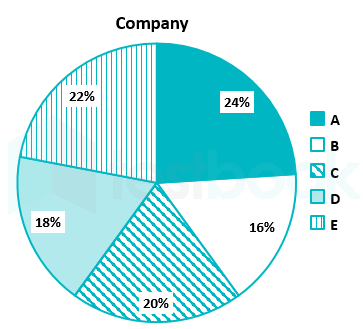
The given Pie chart shows the percentage distribution of total number of Employees in five different Company A,B,C,D,E. respectively. Total number of employees in five different Company is 3000.(Note: Ratio of Male to Female Employees is 3:2 in each company)

Question 41

If another Company F has 10% more employees than company C and the ratio of male to female employees remains 3:2. Then find the number of female employees in company F?

  1. AOption (a)

    260

  2. BOption (b)

    264

  3. COption (c)

    266

  4. DOption (d)

    268

  5. EOption (e)

    270

View answer & explanation

Correct answer

Answer: (b)B.

264

Why this answer is correct

From the Pie chart data,

Total number of employees in company D = 18%*3000 = 540

Number of Male in Company D = (3/5)*540 = 324

Number of Female in Company D = (2/5)*540 = 215

Similarly, 

CompanyTotal EmployeesMale EmployeesFemale Employees
A720432288
B480288192
C600360240
D540324216
E660396264


Solution:

Total number of Employees in company C = 600

Total number of Employees in company F is 110% of Employees in company C

Therefore, total number of Employees in company F = 110%*600 = 660

Hence, number of Female Employees in company F = (2/5)*660 = 264

Question 42

Find the Central Angle (in degrees) of total number of Employees in company D.

  1. AOption (a)

    62.8

  2. BOption (b)

    68.6

  3. COption (c)

    54.6

  4. DOption (d)

    64.8

  5. EOption (e)

    58.2

View answer & explanation

Correct answer

Answer: (d)D.

64.8

Why this answer is correct

From the Pie chart data,

Total number of employees in company D = 18%*3000 = 540

Number of Male in Company D = (3/5)*540 = 324

Number of Female in Company D = (2/5)*540 = 216

Similarly, 

CompanyTotal EmployeesMale EmployeesFemale Employees
A720432288
B480288192
C600360240
D540324216
E660396264

The total % distribution of Company D is 18% out of total number of Employees in all the company.

Total angle formed at the center of the pie chart is 360o 

Hence, Central Angle of Company D = (18/100)*360o = 64.8

Question 43

What is the average number of Males Employees in company B and E?

  1. AOption (a)

    340

  2. BOption (b)

    342

  3. COption (c)

    344

  4. DOption (d)

    346

  5. EOption (e)

    348

View answer & explanation

Correct answer

Answer: (b)B.

342

Why this answer is correct

From the Piechart data,

CompanyTotal EmployeesMale EmployeesFemale Employees
A720432288
B480288192
C600360240
D540324216
E660396264


Total number of Employees in company B = 16%*3000 = 480

number of males in company B = (3/5)*480 = 288

Total number of Employees in Company E = 22%*300 = 660

number of Male Employees in copmany E = (3/5)*660 = 396

Average number of Male Employees in company B and E = (288 + 396)/2 = 342

Question 44

The number of Female employees in Company C is what percentage more than the number of Female Employees in Company D?

  1. AOption (a)

    9.09%

  2. BOption (b)

    11.11%

  3. COption (c)

    18.18%

  4. DOption (d)

    22.22%

  5. EOption (e)

    33.33%

View answer & explanation

Correct answer

Answer: (b)B.

11.11%

Why this answer is correct

From the Pie chart data,

Total number of employees in company D = 18%*3000 = 540

Number of Male in Company D = (3/5)*540 = 324

Number of Female in Company D = (2/5)*540 = 215

Similarly, 

CompanyTotal EmployeesMale EmployeesFemale Employees
A720432288
B480288192
C600360240
D540324216
E660396264

Therefore, Required % = (240-216)/216 = 1/9 = 11.11%

Question 45

What is the difference between the total number of Male and Female Employees in Company D?

  1. AOption (a)

    104

  2. BOption (b)

    106

  3. COption (c)

    108

  4. DOption (d)

    110

  5. EOption (e)

    112

View answer & explanation

Correct answer

Answer: (c)C.

108

Why this answer is correct

From the Pie chart data,

Total number of employees in company D = 18%*3000 = 540

Number of Male in Company D = (3/5)*540 = 324

Number of Female in Company D = (2/5)*540 = 216

Similarly, 

CompanyTotal EmployeesMale EmployeesFemale Employees
A720432288
B480288192
C600360240
D540324216
E660396264


 difference between number of Male and Female in Company D = 324 - 216 = 108.

Question 46

A family decided to spend 13% of their monthly income on traveling, 27% of their monthly income on household expenses, and 35% of their monthly income on family’s medical expenses, and 5% on insurance. The family has the remaining amount of Rs. 13200 as cash. What is the monthly income of the family?

  1. AOption (a)

    Rs 66,000

  2. BOption (b)

    Rs 50,000

  3. COption (c)

    Rs 45,000

  4. DOption (d)

    Rs 35,000

  5. EOption (e)

    None of these

View answer & explanation

Correct answer

Answer: (a)A.

Rs 66,000

Why this answer is correct

Shortcut Trick

Total Expenditure % = 13% + 27% + 35% + 5% = 80%

Remaining Savings % = 100% − 80% = 20%

20% of Income = ₹13200

100% (Total Income) = 13200 × 5 = ₹66,000

∴ The correct answer is ₹66,000.

Alternate Method

Given:

⇒ Traveling = 13%

⇒ Household expenses = 27%

⇒ Medical expenses = 35%

⇒ Insurance = 5%

⇒ Remaining Cash = ₹13200

Calculations:

⇒ Total spending = (13 + 27 + 35 + 5)% = 80%

⇒ Savings % = 100% − 80% = 20%

⇒ Let Total Income be 'X'

⇒ 20% of X = 13200

⇒ (20/100) × X = 13200

⇒ X = 13200 × 5

⇒ X = 66,000

∴ The correct answer is ₹66,000.

Additional Information

Percentage Base Change

When expenditures are given as a % of the total income, simply add the percentages. If given as % of remaining income, use successive multiplication: Remaining = Income × (1 − r1) × (1 − r2).

Income, Expenditure, and Savings Relationship

Income = Expenditure + Savings. If Income increases by x% and Expenditure by y%, the change in Savings depends on their initial ratio.

Question 47

Kamal and Raju started a partnership for total of 3.5 years in such a way that initially Kamal invested Rs. 7500 for 24 months after that Kamal withdraws his amount and Raju invests certain capital for the remaining time. The profit Raju received after 3.5 years is Rs. 1400 out of total profit of Rs. 3000.What was the amount Raju invested.

  1. AOption (a)

    Rs. 9000

  2. BOption (b)

    Rs. 7500

  3. COption (c)

    Rs. 8400

  4. DOption (d)

    Rs. 8750

  5. EOption (e)

    Rs. 8000

View answer & explanation

Correct answer

Answer: (d)D.

Rs. 8750

Why this answer is correct

Shortcut Trick

Profit ratio Kamal : Raju = (3000 − 1400) : 1400 = 1600 : 1400 = 8 : 7.

Time ratio = 24 months : (42 − 24) months = 24 : 18 = 4 : 3.

Investment ratio = (Profit ÷ Time) ⇒ (8 ÷ 4) : (7 ÷ 3) = 2 : 7/3 = 6 : 7.

Since 6 units = Rs. 7500, then 1 unit = Rs. 1250.

Raju investment = 7 × 1250 = Rs. 8750.

∴ The correct answer is Rs. 8750.

Alternate Method

Given → Kamal Investment (Ck) = Rs. 7500, Time (Tk) = 24 months. Total time = 3.5 years = 42 months. Raju Time (Tr) = 42 − 24 = 18 months. Total profit = Rs. 3000, Raju Profit (Pr) = Rs. 1400. Formulas: Profit Ratio = (Investment1 × Time1) : (Investment2 × Time2)

Steps: ⇒ Profit of Kamal (Pk) = Total Profit − Raju Profit = 3000 − 1400 = Rs. 1600. ⇒ Ratio of profits (Pk / Pr) = (Ck × Tk) / (Cr × Tr). ⇒ 1600 / 1400 = (7500 × 24) / (X × 18). ⇒ 8 / 7 = (7500 × 4) / (X × 3). ⇒ 8 × 3 × X = 7 × 7500 × 4. ⇒ 24X = 210000. ⇒ X = 210000 / 24 = Rs. 8750.

∴ The correct answer is Rs. 8750.

Additional Information

Partnership Basic Concept

In a partnership, the profit is distributed among partners in the ratio of the product of their invested capital and the duration of investment.

Investment Calculation

If profits and time periods are known, the investment ratio can be found by Investment = Profit ÷ Time.

Question 48

A man invests a certain sum of money at the rate of interest 10% for 2 years. After 2 years, he earns Rs. 400 as a simple interest. If he invests the same sum of money at the same rate for 2 years on compound interest, then find how much percentage of the compound interest is greater than the simple interest?

  1. AOption (a)

    7.5%

  2. BOption (b)

    10%

  3. COption (c)

    5%

  4. DOption (d)

    20%

  5. EOption (e)

    15%

View answer & explanation

Correct answer

Answer: (c)C.

5%

Why this answer is correct

Shortcut Trick

For 2 years, the percentage by which Compound Interest (CI) is greater than Simple Interest (SI) is given by the formula: (r ÷ 2)%.

Given Rate (r) = 10%.

Percentage difference = (10 ÷ 2)% = 5%.

∴ The correct answer is 5%.

Alternate Method

Given:

Simple Interest (SI) = ₹400, Rate (r) = 10%, Time (t) = 2 years.

Formula Used:

SI = (P × r × t) ÷ 100

CI = P[(1 + r/100)t − 1]

Calculations:

⇒ 400 = (P × 10 × 2) ÷ 100

⇒ 400 = P × 0.2 ⇒ P = ₹2000

⇒ CI for 2 years = 2000 × [(1 + 10/100)2 − 1]

⇒ CI = 2000 × [1.21 − 1] = 2000 × 0.21 = ₹420

⇒ Difference = CI − SI = 420 − 400 = ₹20

⇒ Percentage greater = (Difference ÷ SI) × 100

⇒ Percentage greater = (20 ÷ 400) × 100 = 5%

∴ The correct answer is 5%.

Additional Information

Effective Rate of Interest

The effective rate for Compound Interest for 2 years is r + r + (r × r)/100. For 10%, it is 10 + 10 + 1 = 21%.

Difference between CI and SI

For 2 years, the difference (D) is given by D = P(r/100)2.

Simple Interest Property

Simple Interest remains constant every year if the principal and rate are unchanged. Total SI = r × t % of Principal.

Question 49

A man purchased 150 t-shirts, each costing the same, but 40% of them are lost in transit which cannot be recovered. He sold 50% of the remaining at 20% profit each and remaining at 5% loss each. If the total selling price of t-shirts is Rs. 7740, then what was the cost price of each t-shirts?

  1. AOption (a)

    Rs. 100

  2. BOption (b)

    Rs. 60

  3. COption (c)

    Rs. 90

  4. DOption (d)

    Rs. 80

  5. EOption (e)

    Rs. 85

View answer & explanation

Correct answer

Answer: (d)D.

Rs. 80

Why this answer is correct

Shortcut Trick

Total units = 150. Lost (40%) = 60. Remaining = 90.

Sold 50% of 90 (45 units) at 20% profit and 45 units at 5% loss.

Let CP of 1 t-shirt = x. Total SP = 45 × 1.20x + 45 × 0.95x = 7740.

54x + 42.75x = 96.75x = 7740.

x = 7740 ÷ 96.75 = 80.

∴ The correct answer is Rs. 80.

Alternate Method

Given: Total t-shirts = 150, Loss in transit = 40%, Profit on half remaining = 20%, Loss on other half = 5%, Total SP = Rs. 7740.

Formulas: SP = CP × (100 + P%) ÷ 100 | SP = CP × (100 − L%) ÷ 100

⇒ Let Cost Price (CP) of each t-shirt = Rs. C.

⇒ Number of t-shirts lost = 40% of 150 = 60. Remaining = 150 − 60 = 90.

⇒ Half of remaining sold at 20% profit: 45 × C × 1.20 = 54C.

⇒ Half of remaining sold at 5% loss: 45 × C × 0.95 = 42.75C.

⇒ Total SP = 54C + 42.75C = 96.75C.

⇒ Given 96.75C = 7740 ⇒ C = 7740 ÷ 96.75 = 80.

∴ The correct answer is Rs. 80.

Additional Information

Total Cost vs Net Profit

Net Profit or Loss is calculated on the Total Cost Price of all 150 items, even those lost in transit. Total CP = 150 × 80 = 12000.

Effective Selling Price

Items that are lost/damaged have a Selling Price of 0, contributing to a 100% loss for those specific units.

Question 50

A train running at a speed of x km/hr crosses another (running in the opposite direction) train in 21 seconds which is 4/3th of its length and running at a speed of (x – 6) km/hr. Second train crosses a railway platform whose length is 300 meters, in 42 sec. Then, what is the value of x?

  1. AOption (a)

    42

  2. BOption (b)

    45

  3. COption (c)

    70

  4. DOption (d)

    25

  5. EOption (e)

    None of these

View answer & explanation

Correct answer

Answer: (c)C.

70

Why this answer is correct

Shortcut Trick

Let length of Train 1 be 3L and Train 2 be 4L.

From Train 2 crossing platform: Speed × 42 = 4L + 300 ⇒ (x − 6) × (5/18) × 42 = 4L + 300.

From Relative Speed: (x + x − 6) × (5/18) × 21 = 7L.

By substituting L or solving the ratio of distances, we find x = 70.

∴ The correct answer is 70.

Alternate Method

Given: Speed of Train 1 = x km/hr, Speed of Train 2 = (x − 6) km/hr. Length of Train 2 = (4/3) × Length of Train 1. Let length of Train 1 = 3L, then Train 2 = 4L.

Formula: Distance = Speed × Time

⇒ For Train 2 crossing platform: (x − 6) × (5/18) × 42 = 4L + 300

⇒ (x − 6) × (35/3) = 4L + 300 → (Eq 1)

⇒ For trains crossing each other (Relative speed): (x + x − 6) × (5/18) × 21 = 3L + 4L

⇒ (2x − 6) × (35/6) = 7L ⇒ (x − 3) × (35/3) = 7L ⇒ L = 5(x − 3)/3 → (Eq 2)

⇒ Substitute L in (Eq 1): (x − 6) × (35/3) = 4 × [5(x − 3)/3] + 300

⇒ 35x − 210 = 20x − 60 + 900

⇒ 15x = 1050

⇒ x = 70

∴ The correct answer is 70.

Additional Information

Relative Speed

When two objects move in opposite directions, relative speed = S1 + S2. In the same direction, relative speed = |S1 − S2|.

Unit Conversion

To convert km/hr to m/s, multiply by 5/18. To convert m/s to km/hr, multiply by 18/5.

Crossing Distance

When a train crosses another train or platform, the total distance covered is the sum of their respective lengths.

Directions: Read the following information carefully and answer the questions based on it.

Following bar graph shows number of students of different branches of a college. Study the graph and answer the following question.

Question 51

Find the average number of boys in a college including five branches.

  1. AOption (a)

    400

  2. BOption (b)

    390

  3. COption (c)

    300

  4. DOption (d)

    370

  5. EOption (e)

    420

View answer & explanation

Correct answer

Answer: (b)B.

390

Why this answer is correct

Given,

Total number of boys including those from the five branches

= 500 + 500 + 450 + 200 + 300

= 1950

Required average

= 1950/5

= 390

Question 52

Total number of girls in College for five branches is approximately what percent of total number of students in College?

  1. AOption (a)

    34.45%

  2. BOption (b)

    45%

  3. COption (c)

    60.6%

  4. DOption (d)

    43.48%

  5. EOption (e)

    None of these

View answer & explanation

Correct answer

Answer: (d)D.

43.48%

Why this answer is correct

Given,

Total number to girls including five branches

= 300 + 100 + 250 + 600 + 250

= 1500

Total number of boys including five branches

= 500 + 500 + 450 + 200 + 300

= 1950

Total number of students in College

= 1500 + 1950

= 3450

Required percentage

= (1500/3450) × 100 ≈ 43.48%

Question 53

Ratio of total number of students in computer branch to total number of Students of Mechanical and Electronics is -

  1. AOption (a)

    22 : 15

  2. BOption (b)

    21 : 16

  3. COption (c)

    16 : 23

  4. DOption (d)

    23 : 15

  5. EOption (e)

    None of these

View answer & explanation

Correct answer

Answer: (c)C.

16 : 23

Why this answer is correct

Total number of students in Computer branch

= 200 + 600

= 800

Total number of students in Mechanical and Electronics branch

= (500 + 100) + (300 + 250)

= 1150

Required ratio

= 800 : 1150

= 32 : 46

= 16 : 23

Question 54

Total number of boys in Mechanical branch is approximately what percent of total number of boy’s students in all five branches?

  1. AOption (a)

    21.7%

  2. BOption (b)

    25.64%

  3. COption (c)

    22.54%

  4. DOption (d)

    30%

  5. EOption (e)

    None of these

View answer & explanation

Correct answer

Answer: (b)B.

25.64%

Why this answer is correct

Given,

Total number of boys including five branches

= 500 + 500 + 450 + 200 + 300

= 1950

Number of boy’s students in Mechanical branch = 500

Required percentage

= (500/1950) × 100 ≈ 25.64%

Question 55

Which branch has minimum ratio of boys’ and girls’ students?

  1. AOption (a)

    Electrical

  2. BOption (b)

    Computer

  3. COption (c)

    Civil

  4. DOption (d)

    Electronics

  5. EOption (e)

    Both 2 and 3

View answer & explanation

Correct answer

Answer: (b)B.

Computer

Why this answer is correct

Given,

Civil branch = 500 : 300 = 5 : 3 = 1.66

Mechanical branch = 500 : 100 = 5 : 1 = 5

Electrical branch = 450 : 250 = 9 : 5 = 1.8

Computer branch = 200 : 600 = 1 : 3 = 0.33

Electronics branch = 300 : 250 = 6 : 5 = 1.2

From this,

Computer branch has minimum ratio of boys and girls students in College.

Question 56

Tap P and Q can fill a tank in 7 and 10 hours, respectively. Pipe R can empty the same tank in 15 hours. If all the three pipes are opened simultaneously, then in how much time the tank will be filled completely?

  1. AOption (a)

    437254\frac{{37}}{{25}} hours

  2. BOption (b)

    525375\frac{{25}}{{37}} hours

  3. COption (c)

    925379\frac{{25}}{{37}} hours

  4. DOption (d)

    11372511\frac{{37}}{{25}} hours

  5. EOption (e)

    None of the above

View answer & explanation

Correct answer

Answer: (b)B.

525375\frac{{25}}{{37}} hours

Why this answer is correct

Shortcut Trick

Total Capacity (LCM of 7, 10, 15) = 210 units.

Efficiency of P = 210 ÷ 7 = 30, Efficiency of Q = 210 ÷ 10 = 21, Efficiency of R = −(210 ÷ 15) = −14.

Combined Efficiency (P + Q − R) = 30 + 21 − 14 = 37.

Time Taken = Total Capacity ÷ Combined Efficiency = 210 ÷ 37 = 525⁄37 hours.

∴ The correct answer is 525⁄37 hr.

Alternate Method

PipeTime (hrs)Total Work (LCM)Efficiency
P (Inlet)721030
Q (Inlet)1021
R (Outlet)15−14

⇒ Net efficiency when all pipes are open = Efficiency of P + Efficiency of Q + Efficiency of R

⇒ Net efficiency = 30 + 21 − 14 = 37 units/hr

⇒ Total time to fill the tank = Total Work ÷ Net efficiency

⇒ Total time = 210 ÷ 37

⇒ Total time = 525⁄37 hr

∴ The correct answer is 525⁄37 hr.

Additional Information

Inlet and Outlet Pipes

An inlet pipe fills the tank (positive work), while an outlet pipe (leak) empties it (negative work).

Efficiency Rule

Total Work = Time × Efficiency. If a tank is filled in 'x' hours and emptied in 'y' hours, net work in 1 hour = (1/x − 1/y).

Pipes & Cisterns Concept

This topic follows the same principles as Time and Work, treating the volume of the tank as the total work to be completed.

Question 57

The present age of Ram and Rohit are in the ratio of 7 : 8 respectively. After 6 years, the respective ratio between the age of Ram and Rohit will be 9 : 10. What is the age of Rohit after 10 years?

  1. AOption (a)

    30 years

  2. BOption (b)

    34 years

  3. COption (c)

    40 years

  4. DOption (d)

    42 years

  5. EOption (e)

    27 years

View answer & explanation

Correct answer

Answer: (b)B.

34 years

Why this answer is correct

Shortcut Trick

Ratio of Ram and Rohit: 7 : 8 (Present) → 9 : 10 (After 6 years).

Difference in ratio parts = 9 − 7 = 2 units and 10 − 8 = 2 units.

2 units → 6 years, so 1 unit → 3 years.

Present age of Rohit = 8 units × 3 = 24 years.

Age after 10 years = 24 + 10 = 34 years.

∴ The correct answer is 34 years.

Alternate Method

Given: Present ratio = 7 : 8, Ratio after 6 years = 9 : 10.

Let Ram and Rohit present ages be 7x and 8x.

⇒ (7x + 6) / (8x + 6) = 9 / 10

⇒ 10(7x + 6) = 9(8x + 6)

⇒ 70x + 60 = 72x + 54

⇒ 2x = 6

⇒ x = 3

⇒ Present age of Rohit = 8 × 3 = 24 years.

⇒ Age after 10 years = 24 + 10 = 34 years.

∴ The correct answer is 34 years.

Additional Information

Ratio Difference Equality

If the age difference between ratios is not equal, multiply ratios by the difference of the other ratio to equalize them.

Age Calculations

The difference between the ages of two people remains constant regardless of the number of years passed.

Question 58

For traveling a distance of 48 km, a girl noticed that after walking for 1 hour and 40 minutes, the distance covered by her was 2/7 of the remaining distance. What was her speed in meters per second?

  1. AOption (a)

    16/9 m/s

  2. BOption (b)

    14/5 m/s

  3. COption (c)

    3 m/s

  4. DOption (d)

    4 m/s

  5. EOption (e)

    Non of the above

View answer & explanation

Correct answer

Answer: (a)A.

16/9 m/s

Why this answer is correct

Shortcut Trick

Ratio of covered distance to remaining distance = 2 : 7

Total units = 2 + 7 = 9 units → 48 km

Distance covered = (2 ÷ 9) × 48 = 32/3 km

Time = 1 hour 40 minutes = 1 + 40/60 = 5/3 hours

Speed = (32/3) ÷ (5/3) = 32/5 kmph = (32/5) × (5/18) = 16/9 m/s

∴ The correct answer is 16/9 m/s.

Alternate Method

Given: Total distance = 48 km, Time = 1 hour 40 mins, Covered distance = 2/7 × Remaining distance.

Formula Used: Speed = Distance ÷ Time; 1 kmph = 5/18 m/s.

⇒ Let remaining distance be x km.

⇒ Distance covered = 2/7 × x

⇒ (2x/7) + x = 48 ⇒ 9x/7 = 48 ⇒ x = (48 × 7) ÷ 9 = 112/3 km

⇒ Distance covered = 48 − 112/3 = (144 − 112) ÷ 3 = 32/3 km

⇒ Time = 1 hr + 40/60 hr = 1 + 2/3 = 5/3 hours

⇒ Speed = (32/3) ÷ (5/3) = 32/5 km/h

⇒ Speed in m/s = 32/5 × 5/18 = 16/9 m/s

∴ The correct answer is 16/9 m/s.

Additional Information

Unit Conversion

To convert km/h to m/s, multiply by 5/18. To convert m/s to km/h, multiply by 18/5.

Average Speed

Average speed is defined as the total distance traveled divided by the total time taken (Total Distance ÷ Total Time).

Ratio Application

If a : b is the ratio of two parts, the first part is [a/(a+b)] × Total and the second part is [b/(a+b)] × Total.

Question 59

The ratio between the length of the rectangular field and the side of the square field is 6 : 1 and the breadth of the rectangular field is 1/3rd of the side of the square field. If the perimeter of the square is 120 m, then, find the cost of fencing the rectangular field at the rate of Rs. 20 per m?

  1. AOption (a)

    Rs. 7,600

  2. BOption (b)

    Rs. 7,200

  3. COption (c)

    Rs. 7,500

  4. DOption (d)

    Rs. 8,200

  5. EOption (e)

    None of these

View answer & explanation

Correct answer

Answer: (a)A.

Rs. 7,600

Why this answer is correct

Shortcut Trick

Side of square = 120 ÷ 4 = 30 m

Length (L) of rectangle = 6 × 30 = 180 m

Breadth (B) of rectangle = 30 ÷ 3 = 10 m

Perimeter = 2 × (180 + 10) = 380 m

Total Cost = 380 × 20 = ₹7,600

∴ The correct answer is ₹7,600.

Alternate Method

Given: Ratio of length (L) to square side (s) = 6 : 1. Ratio of breadth (B) to square side (s) = 1/3 : 1. Perimeter of square = 120 m. Rate = ₹20/m.

Formula Used: Perimeter of square = 4 × s; Perimeter of rectangle = 2 × (L + B); Total Cost = Perimeter × Rate.

⇒ 4 × side = 120

⇒ Side (s) = 120 ÷ 4 = 30 m

⇒ Length (L) = 6 × 30 = 180 m

⇒ Breadth (B) = (1/3) × 30 = 10 m

⇒ Perimeter of rectangle = 2 × (180 + 10) = 2 × 190 = 380 m

⇒ Total cost of fencing = 380 × 20 = 7600

∴ The correct answer is ₹7,600.

Additional Information

Mensuration Formulas

Area of rectangle = L × B; Area of square = side2. Fencing always refers to the Perimeter of the shape.

Unit Conversion

Ensure all dimensions are in the same unit (meters) before calculating costs or areas to avoid calculation errors.

Question 60

There are two vessels A and B of milk and water. The vessel A contains ratio of milk to water as 3 : 5 and vessel B contains ratio of milk to water as 2 : 3. If 32 litres of mixture from vessel A and x litre of mixture from vessel B is taken out to form the new mixture. Ratio of milk to water in the new mixture is 5 : 8. Find the value of x.

  1. AOption (a)

    15 litres

  2. BOption (b)

    20 litres

  3. COption (c)

    22 litres

  4. DOption (d)

    25 litres

  5. EOption (e)

    28 litres

View answer & explanation

Correct answer

Answer: (b)B.

20 litres

Why this answer is correct

Shortcut Trick

Concentration of milk in A = 3/8, in B = 2/5, and in Resultant = 5/13.

By Alligation: (2/5 − 5/13) : (5/13 − 3/8) ⇒ (26 − 25)/65 : (40 − 39)/104.

Ratio of quantities A : B = (1/65) : (1/104) = 104 : 65 = 8 : 5.

Given 8 units = 32 litres ⇒ 1 unit = 4 litres.

Value of x (5 units) = 5 × 4 = 20 litres.

∴ The correct answer is 20 litres.

Alternate Method

Given: Vessel A (Milk:Water = 3:5), Vessel B (Milk:Water = 2:3), New Mix (5:8), Vol A = 32L.

Formula: Ratio of volumes VA/VB = (mB − mm) / (mm − mA) where m is milk fraction.

⇒ Milk in 32L of A = (3/8) × 32 = 12 L; Water in A = (5/8) × 32 = 20 L.

⇒ Milk in xL of B = 2x/5; Water in B = 3x/5.

⇒ Total Milk / Total Water = (12 + 2x/5) / (20 + 3x/5) = 5/8.

⇒ 8 × (12 + 2x/5) = 5 × (20 + 3x/5)

⇒ 96 + 16x/5 = 100 + 15x/5

⇒ 16x/5 − 15x/5 = 100 − 96

⇒ x/5 = 4 ⇒ x = 20 litres.

∴ The correct answer is 20 litres.

Additional Information

Rule of Alligation

It is a rule used to find the ratio in which two or more ingredients at their respective prices/concentrations must be mixed to produce a mixture at a given mean price/concentration.

Mixture Concentration

When mixing two quantities with concentration c1 and c2 to get cm, the ratio of quantities is (c2 − cm) : (cm − c1).

Question 61

What approximate will come in the place of the question mark ‘?’ in the following question?

9.78% of 79.94 + ?% of 9.67 = 10.94 × 2.99 + √100 × 2.98

  1. AOption (a)

    600

  2. BOption (b)

    550

  3. COption (c)

    580

  4. DOption (d)

    610

  5. EOption (e)

    None of these.

View answer & explanation

Correct answer

Answer: (b)B.

550

Why this answer is correct

Given:

9.78% of 79.94 + ?% of 9.67 = 10.94 × 2.99 + √100 × 2.98

Concept used:

Follow the BODMAS rule according to the table given below:

Calculation:

9.78% of 79.94 + ?% of 9.67 = 10.94 × 2.99 + √100 × 2.98

⇒ 10% of 80 + ?% of 10 = 11 × 3 + √100 × 3

⇒ (10/100) × 80 + (?/100) × 10 = 33 + 10 × 3

⇒ 8 + (?/10) = 33 + 30

⇒ 8 + (?/10) = 63

⇒ (?/10) = 63 - 8 

⇒ (?/10) = 55 

⇒ ? = 55 × 10 = 550

∴ The value of ? is 550.

Question 62

What approximate value should come in place of the question mark (?) in the following question?

49.97% of 1900.1 + (7.99)3 × 4.97 + ? = (5.03)3 × 27.98

  1. AOption (a)

    -6

  2. BOption (b)

    6

  3. COption (c)

    10

  4. DOption (d)

    -10

  5. EOption (e)

    20

View answer & explanation

Correct answer

Answer: (d)D.

-10

Why this answer is correct

Given:

49.97% of 1900.1 + (7.99)3 × 4.97 + ? = (5.03)3 × 27.98

Concept used:

Rules of Approximation:

  1. If a number has digits to the right of the decimal less than 5, then just drop the digits to the right of the decimal. The number so obtained will be the approximated value.
  2. If a number has digits to the right of the decimal more than 5, then just drop the digits to the right of the decimal and raise the remaining number by '1'.The number so obtained will be the approximated value.

Follow the BODMAS rule according to the table given below:

Calculation:

49.97% of 1900.1 + (7.99)3 × 4.97 + ? = (5.03)3 × 27.98

⇒ 50% of 1900 + 83 × 5 + ? = 53 × 28

⇒ (50/100) × 1900 + 512 × 5 + ? = 125 × 28

⇒ 950 + 2560 + ? = 3500

⇒ 3510 + ? = 3500

⇒ ? = 3500 – 3510

⇒ ? = -10

∴ The value of ? is -10.

Question 63

What approximate value will come in the place of the question mark (?) in the following question?  

15.67 × 62.5% - 12.5 × 7.99% + 24.2 ÷ 6 = 50.01 ÷ 5.12 + ?

  1. AOption (a)

    30

  2. BOption (b)

    50

  3. COption (c)

    15

  4. DOption (d)

    3

  5. EOption (e)

    17

View answer & explanation

Correct answer

Answer: (d)D.

3

Why this answer is correct

Given:

15.67 × 62.5% - 12.5 × 7.99% + 24.2 ÷ 6 = 50.01 ÷ 5.12 + ?

Concept used:

Calculation:

15.67 × 62.5% - 12.5 × 7.99% + 24.2 ÷ 6 = 50.01 ÷ 5.12 + ?

⇒ 16 × (5/8) - 12.5 × (8/100) + 24/6 = 50/5 + ?

⇒ 10 - 1 + 4 = 10 + ?

⇒ ? = 10 - 1 + 4 - 10

⇒ ? = 3

∴ The value of ? is 3.

Question 64

What approximate will come in the place of the question mark ‘?’ in the following question?

37.98% of 549.99 + √(49.02) ÷ ? = 7.99 × (2.97)3

  1. AOption (a)

    0

  2. BOption (b)

    1

  3. COption (c)

    2

  4. DOption (d)

    3

  5. EOption (e)

    4

View answer & explanation

Correct answer

Answer: (b)B.

1

Why this answer is correct

Given:

37.98% of 549.99 + √(49.02) ÷ ? = 7.99 × (2.97)3

Rules of Approximation:

  1. If a number has digits to the right of the decimal less than 5, then just drop the digits to the right of the decimal. The number so obtained will be the approximated value.
  2. If a number has digits to the right of the decimal more than 5, then just drop the digits to the right of the decimal and raise the remaining number by '1'.The number so obtained will be the approximated value.

Concept used:

Follow the BODMAS rule according to the table given below:

Calculation:

37.98% of 549.99 + √(49.02) ÷ ? = 7.99 × (2.97)3

⇒ 38% of 550 + √49 ÷ ? = 8 × 33

⇒ (38/100) × 550 + 7 ÷ ? = 8 × 27

⇒ 209 + 7 ÷ ? = 216

⇒ 7 ÷ ? = 7

⇒ ? = 1

∴ 1 should come in place of the question mark (?).

Question 65

What approximate value should come in place of question mark?

(22.03% of 150.01) + (361.33)1/2 + (63.92÷2.012) + (11.02% of 499.98) = ?

  1. AOption (a)

    129

  2. BOption (b)

    119

  3. COption (c)

    139

  4. DOption (d)

    149

  5. EOption (e)

    159

View answer & explanation

Correct answer

Answer: (c)C.

139

Why this answer is correct

Solution :

 Concept used :

 Follow the BODMAS rule to solve this question, as per the question is given below:

 Step 1: Parts of an equation enclosed in ' Brackets ' must be solved first and in the bracket,

 Step 2: Any mathematical ' of ' or 'exponent' must be solved next,

 Step 3: Next, The part of the equation that contains 'Division' and 'multiplication' are calculated,

 Step 4: Last but not least, the parts of the equation that contains 'Addition ' and 'Subtraction' should be calculated

 Given :

⇒ (22.03% of 150.01 ) + (361.33)1/2 + (63.92 ÷ 2.012) + (11.02% of 499.98) = ?

Approximate the number to its nearest value 

⇒ (22% of 150 ) + (361)1/2 + (64÷ 2) + (11 % of 500) = ?

⇒ 22 × 150 /100 + (19)2×1/2 + 32 + 11 × 500 /100 = ?

⇒ 33 + 19 + 32 + 55 = ?

⇒ 84 + 55 = ?

⇒ ? = 139

Hence 139 is the correct answer.

Reasoning Ability (35 questions)

Direction: Study the following information carefully to answer the given questions.

6 people – A, B, C, P, Q, and R, work in the same school had their performance reviews in the months of March, July and December on either the 14th or the 26th of the month. Each of them teaches a different subject. B had his performance review on the 26th of July. The Biology teacher had his performance review after the Maths teacher in the same month. The History teacher had his review before A, who did not teach Chemistry. 4 people had their reviews between P and C, who did not teach Physics. C was not the English teacher but had his review immediately after Q. R did not teach Biology. 2 people had their reviews between the Physics teacher and B. The English teacher had his review in December.

Question 66

Who is the Maths teacher?

  1. AOption (a)

    B

  2. BOption (b)

    C

  3. COption (c)

    P

  4. DOption (d)

    Q

  5. EOption (e)

    A

View answer & explanation

Correct answer

Answer: (e)E.

A

Why this answer is correct

Given:

6 people – A, B, C, P, Q, and R

6 subjects – Physics, History, Maths, Biology, English, and Chemistry

  1. B had his performance review on the 26th of July.
  2. 2 people had their reviews between the Physics teacher and B.
  3. The English teacher had his review in December.
MonthsDatesCase 1 (a)Case 1 (b)
PersonsSubjectPersonsSubject
March14PhysicsPhysics
26
July14
26BB
December14English
26English


  1. The Biology teacher had his performance review after the Maths teacher in the same month.
  2. The History teacher had his review before A, who did not teach Chemistry.
  3. 4 people had their reviews between P and C, who did not teach Physics.
MonthsDatesCase 1 (a. 1)Case 1 (a. 2)Case 1 (b)
PersonsSubjectPersonsSubjectPersonsSubject
March14PPhysicsPPhysicsPPhysics
26HistoryHistoryHistory
July14AMathsMathsAMaths
26BBiologyBBiologyBBiology
December14EnglishAEnglishChemistry
26CChemistryCChemistryCEnglish


  1. C was not the English teacher but had his review immediately after Q.
  2. R did not teach Biology.
MonthsDatesCase 1 (a)
PersonsSubject
March14PPhysics
26RHistory
July14AMaths
26BBiology
December14QEnglish
26CChemistry


(A is allocated on July 14 because Point 5 state ‘the History teacher had his review before A’.)

(Case 1 (a.2) and Case 1(b) will not be possible as it will not satisfy point 7.)

Final arrangement:

MonthsDatesPersonsSubject
March14PPhysics
26RHistory
July14AMaths
26BBiology
December14QEnglish
26CChemistry


Hence, A is the Maths teacher.

Question 67

How many people had their review between the History and Chemistry teacher?

  1. AOption (a)

    1 person

  2. BOption (b)

    4 people

  3. COption (c)

    2 people

  4. DOption (d)

    5 people

  5. EOption (e)

    3 people

View answer & explanation

Correct answer

Answer: (e)E.

3 people

Why this answer is correct

Given:

6 people – A, B, C, P, Q, and R

6 subjects – Physics, History, Maths, Biology, English, and Chemistry

  1. B had his performance review on the 26th of July.
  2. 2 people had their reviews between the Physics teacher and B.
  3. The English teacher had his review in December.
MonthsDatesCase 1 (a)Case 1 (b)
PersonsSubjectPersonsSubject
March14PhysicsPhysics
26
July14
26BB
December14English
26English


  1. The Biology teacher had his performance review after the Maths teacher in the same month.
  2. The History teacher had his review before A, who did not teach Chemistry.
  3. 4 people had their reviews between P and C, who did not teach Physics.
MonthsDatesCase 1 (a. 1)Case 1 (a. 2)Case 1 (b)
PersonsSubjectPersonsSubjectPersonsSubject
March14PPhysicsPPhysicsPPhysics
26HistoryHistoryHistory
July14AMathsMathsAMaths
26BBiologyBBiologyBBiology
December14EnglishAEnglishChemistry
26CChemistryCChemistryCEnglish


  1. C was not the English teacher but had his review immediately after Q.
  2. R did not teach Biology.
MonthsDatesCase 1 (a)
PersonsSubject
March14PPhysics
26RHistory
July14AMaths
26BBiology
December14QEnglish
26CChemistry


(A is allocated on July 14 because Point 5 state ‘the History teacher had his review before A’.)

(Case 1(a.2) and Case 1(b) will not be possible as it will not satisfy point 7.)

Final arrangement:

MonthsDatesPersonsSubject
March14PPhysics
26RHistory
July14AMaths
26BBiology
December14QEnglish
26CChemistry


R is the History teacher.

C is the Chemistry teacher.

Hence, 3 people had their review between R and C.

Question 68

Who was the Chemistry teacher?

  1. AOption (a)

    A

  2. BOption (b)

    P

  3. COption (c)

    B

  4. DOption (d)

    Q

  5. EOption (e)

    C

View answer & explanation

Correct answer

Answer: (e)E.

C

Why this answer is correct

Given:

6 people – A, B, C, P, Q, and R

6 subjects – Physics, History, Maths, Biology, English, and Chemistry

  1. B had his performance review on the 26th of July.
  2. 2 people had their reviews between the Physics teacher and B.
  3. The English teacher had his review in December.
MonthsDatesCase 1 (a)Case 1 (b)
PersonsSubjectPersonsSubject
March14PhysicsPhysics
26
July14
26BB
December14English
26English


  1. The Biology teacher had his performance review after the Maths teacher in the same month.
  2. The History teacher had his review before A, who did not teach Chemistry.
  3. 4 people had their reviews between P and C, who did not teach Physics.
MonthsDatesCase 1 (a. 1)Case 1 (a. 2)Case 1 (b)
PersonsSubjectPersonsSubjectPersonsSubject
March14PPhysicsPPhysicsPPhysics
26HistoryHistoryHistory
July14AMathsMathsAMaths
26BBiologyBBiologyBBiology
December14EnglishAEnglishChemistry
26CChemistryCChemistryCEnglish


  1. C was not the English teacher but had his review immediately after Q.
  2. R did not teach Biology.
MonthsDatesCase 1 (a)
PersonsSubject
March14PPhysics
26RHistory
July14AMaths
26BBiology
December14QEnglish
26CChemistry


(A is allocated on July 14 because Point 5 state ‘the History teacher had his review before A’.)

(Case 1 (a.2) and Case 1(b) will not be possible as it will not satisfy point 7.)


Final arrangement:

MonthsDatesPersonsSubject
March14PPhysics
26RHistory
July14AMaths
26BBiology
December14QEnglish
26CChemistry


Hence, C is the Chemistry teacher.

Question 69

When did the English teacher have his review?

  1. AOption (a)

    December 26

  2. BOption (b)

    July 14

  3. COption (c)

    March 26

  4. DOption (d)

    July 26

  5. EOption (e)

    December 14

View answer & explanation

Correct answer

Answer: (e)E.

December 14

Why this answer is correct

Given:

6 people – A, B, C, P, Q, and R

6 subjects – Physics, History, Maths, Biology, English, and Chemistry

  1. B had his performance review on the 26th of July.
  2. 2 people had their reviews between the Physics teacher and B.
  3. The English teacher had his review in December.
MonthsDatesCase 1 (a)Case 1 (b)
PersonsSubjectPersonsSubject
March14PhysicsPhysics
26
July14
26BB
December14English
26English


  1. The Biology teacher had his performance review after the Maths teacher in the same month.
  2. The History teacher had his review before A, who did not teach Chemistry.
  3. 4 people had their reviews between P and C, who did not teach Physics.
MonthsDatesCase 1 (a. 1)Case 1 (a. 2)Case 1 (b)
PersonsSubjectPersonsSubjectPersonsSubject
March14PPhysicsPPhysicsPPhysics
26HistoryHistoryHistory
July14AMathsMathsAMaths
26BBiologyBBiologyBBiology
December14EnglishAEnglishChemistry
26CChemistryCChemistryCEnglish


  1. C was not the English teacher but had his review immediately after Q.
  2. R did not teach Biology.
MonthsDatesCase 1 (a)
PersonsSubject
March14PPhysics
26RHistory
July14AMaths
26BBiology
December14QEnglish
26CChemistry


(A is allocated on July 14 because Point 5 states ‘the History teacher had his review before A’.)

(Case 1 (a.2) and Case 1(b) will not be possible as it will not satisfy point 7.)

Final arrangement:

MonthsDatesPersonsSubject
March14PPhysics
26RHistory
July14AMaths
26BBiology
December14QEnglish
26CChemistry


Hence, Q - the English teacher, had his review on December 14.

Question 70

Who had the first performance review?

  1. AOption (a)

    The Biology teacher

  2. BOption (b)

    R

  3. COption (c)

    The History teacher

  4. DOption (d)

    Q

  5. EOption (e)

    The Physics teacher

View answer & explanation

Correct answer

Answer: (e)E.

The Physics teacher

Why this answer is correct

Given:

6 people – A, B, C, P, Q, and R

6 subjects – Physics, History, Maths, Biology, English, and Chemistry

  1. B had his performance review on the 26th of July.
  2. 2 people had their reviews between the Physics teacher and B.
  3. The English teacher had his review in December.
MonthsDatesCase 1 (a)Case 1 (b)
PersonsSubjectPersonsSubject
March14PhysicsPhysics
26
July14
26BB
December14English
26English


  1. The Biology teacher had his performance review after the Maths teacher in the same month.
  2. The History teacher had his review before A, who did not teach Chemistry.
  3. 4 people had their reviews between P and C, who did not teach Physics.
MonthsDatesCase 1 (a. 1)Case 1 (a. 2)Case 1 (b)
PersonsSubjectPersonsSubjectPersonsSubject
March14PPhysicsPPhysicsPPhysics
26HistoryHistoryHistory
July14AMathsMathsAMaths
26BBiologyBBiologyBBiology
December14EnglishAEnglishChemistry
26CChemistryCChemistryCEnglish


  1. C was not the English teacher but had his review immediately after Q.
  2. R did not teach Biology.
MonthsDatesCase 1 (a)
PersonsSubject
March14PPhysics
26RHistory
July14AMaths
26BBiology
December14QEnglish
26CChemistry


(A is allocated on July 14 because Point 5 states ‘the History teacher had his review before A’.)

(Case 1 (a.2) and Case 1 (b) will not be possible as it will not satisfy point 7.)


Final arrangement:

MonthsDatesPersonsSubject
March14PPhysics
26RHistory
July14AMaths
26BBiology
December14QEnglish
26CChemistry


Hence, P - the Physics teacher, had the first performance review.

Directions: Read the following comprehension and answer the questions given below.

Starting from point P, Yuvraj walked 20 meters toward the South and reached point O. He turned left and walked 30 meters and reached point Q. From point Q he turned left and walked 20 meters and reached point R. He again turned left and walked 40 meters and reached point S. Then he turned right and walked for 30 meters and reached point T. He again turned left and walked 20 meters and reached point U. Then he turned left and walked 70 meters and reached point V. From there he turned left and walked 20 meters and reached point W. Then he turned left and walked 10 meters and reached point X. At last, he turned right and walked 10 meters, and reached point Y.

Question 71

What is the total distance travelled Yuvraj from starting point P to point V? (When we follow the path via point P to S and so on till V)

  1. AOption (a)

    110 meters

  2. BOption (b)

    135 meters

  3. COption (c)

    130 meters

  4. DOption (d)

    120 meters

  5. EOption (e)

    90 meters

View answer & explanation

Correct answer

Answer: (c)C.

130 meters

Why this answer is correct

1) Starting from point P, Yuvraj walked 20 meters toward the South and reached point O.

  1. He turned left and walked 30 meters and reached point Q.

  2. He then turned left and walked 20 meters and reached point R.

  3. He again turned left and walked 40 meters and reached point S.

  4. Then he turned right and walked for 30 meters and reached point T.

  5. He again turned left and walked 20 meters and reached point U.

  6. Then he turned left and walked 70 meters and reached point V.

  7. From there he turned left and walked 20 meters and reached point W.

  8. Then he turned left and walked 10 meters and reached point X.

  9. At last he turned right and walked 10 meters and reached point Y.

Drawn the figure according to the information given in the question:


Distance from P to S = 10m , S to T= 30m, T to U= 20m, U to V= 70m**,**

10+ 30 + 20 + 70 = 130 meters 

Hence, the total distance traveled by Yuvraj from starting point P to point V is 130 m.

Question 72

Point S is on which direction with respect to O?

  1. AOption (a)

    North - West

  2. BOption (b)

    North

  3. COption (c)

    North - South

  4. DOption (d)

    South

  5. EOption (e)

    East

View answer & explanation

Correct answer

Answer: (a)A.

North - West

Why this answer is correct

1) Starting from point P, Yuvraj walked 20 meters toward the South and reached point O.

  1. He turned left and walked 30 meters and reached point Q.

  2. He then turned left and walked 20 meters and reached point R.

  3. He again turned left and walked 40 meters and reached point S.

  4. Then he turned right and walked for 30 meters and reached point T.

  5. He again turned left and walked 20 meters and reached point U.

  6. Then he turned left and walked 70 meters and reached point V.

  7. From there he turned left and walked 20 meters and reached point W.

  8. Then he turned left and walked 10 meters and reached point X.

  9. At last he turned right and walked 10 meters and reached point Y.

Drawn the figure according to the information given in the question:


Hence, Point S is North - West of O.

Question 73

In which direction point Q with respect to the Y?

  1. AOption (a)

    North

  2. BOption (b)

    South

  3. COption (c)

    North-East

  4. DOption (d)

    North-West

  5. EOption (e)

    South-East

View answer & explanation

Correct answer

Answer: (c)C.

North-East

Why this answer is correct

1) Starting from point P, Yuvraj walked 20 meters toward the South and reached point O.

  1. He turned left and walked 30 meters and reached point Q.

  2. From point Q he turned left and walked 20 meters and reached point R.

  3. He again turned left and walked 40 meters and reached point S.

  4. Then he turned right and walked for 30 meters and reached point T.

  5. He again turned left and walked 20 meters and reached point U.

  6. Then he turned left and walked 70 meters and reached point V.

  7. From there he turned left and walked 20 meters and reached point W.

  8. Then he turned left and walked 10 meters and reached point X.

  9. At last he turned right and walked 10 meters and reached point Y.


Drawn the figure according to the information given in the question:


Hence, Q is in North-East direction of Y.

Direction: Study the following information carefully to answer the given questions.

A certain number of people sit in a row facing North. U sits 3rd to the left of S. T sits 3rd from one of the ends of the row, 7 places away from R. P sits 2nd to the right of R. A sits at the right end of the row. One person sits between X and B, and has 4 people sit between B and Z. Q sits immediately between X and T. Nobody sits to the left of R.

Question 74

Who sit between P and X?

  1. AOption (a)

    U and A

  2. BOption (b)

    R and S

  3. COption (c)

    B and S

  4. DOption (d)

    U and B

  5. EOption (e)

    S and A

View answer & explanation

Correct answer

Answer: (c)C.

B and S

Why this answer is correct

Given:

All people sit facing North.

  1. A sits at the right end of the row.

  2. Nobody sits to the left of R.

  3. T sits 3rd from one of the ends of the row, 7 places away from R.

  4. P sits 2nd to the right of R.

  5. Q sits immediately between X and T.

  6. One person sits between X and B, and has 4 people sit between B and Z.

  7. U sits 3rd to the left of S.

Hence, B and S sit between P and S.

Question 75

How many people sit in the row?

  1. AOption (a)

    9 people

  2. BOption (b)

    10 people

  3. COption (c)

    11 people

  4. DOption (d)

    12 people

  5. EOption (e)

    13 people

View answer & explanation

Correct answer

Answer: (b)B.

10 people

Why this answer is correct

Given:

All people sit facing North.

  1. A sits at the right end of the row.

  2. Nobody sits to the left of R.

  3. T sits 3rd from one of the ends of the row, 7 places away from R.

  4. P sits 2nd to the right of R.

  5. Q sits immediately between X and T.

  6. One person sits between X and B, who has 4 people sit between B and Z.

  7. U sits 3rd to the left of S.


Hence, 10 people sit in the row.

Question 76

Who sits 2nd to the left of the one who sits 5th to the right of the one sitting at the left end of the row?

  1. AOption (a)

    A

  2. BOption (b)

    P

  3. COption (c)

    Q

  4. DOption (d)

    B

  5. EOption (e)

    Z

View answer & explanation

Correct answer

Answer: (d)D.

B

Why this answer is correct

Given:

All people sit facing North.

  1. A sits at the right end of the row.
  2. Nobody sits to the left of R.
  3. T sits 3rd from one of the ends of the row, 7 places away from R.
<br>


  1. P sits 2nd to the right of R.
  2. Q sits immediately between X and T.
  3. One person sits between X and B, who has 4 people sit between B and Z.
  4. U sits 3rd to the left of S.
<br>


R sits at the left end of the row.

X sits 5th to the right of R.

Hence, B sits 2nd to the left of X.

Question 77

How many such pairs of letters are there in the word ‘CUSTOMER’, each of which has as many letters between them in the word (both forward and backward direction) as they have between them in the English Alphabet?

  1. AOption (a)

    One

  2. BOption (b)

    Three

  3. COption (c)

    Two

  4. DOption (d)

    Zero

  5. EOption (e)

    More than three

View answer & explanation

Correct answer

Answer: (c)C.

Two

Why this answer is correct

Given: CUSTOMER


Here, Two pairs of letters are there in the word ‘CUSTOMER’, each of which has as many letters between them in the word (both forward and backward direction) as they have between them in the English Alphabet.

Hence, Two pairs is the correct answer.

Directions: Read the Following comprehension carefully and answer the following questions given below.

Nine people viz; G, H, I, J, K, L, M, N and O are working in a company in three different departments viz; Marketing, Finance and Admin. A minimum of 2 people and a maximum of 4 people are working in a department. I is not working in Admin. G is working in Finance. M is not working in Marketing and not with G also. N is not working in Marketing. O is working with G. H and K working together but not in Marketing. J neither works in Finance nor with M. N is not working with K. L is working with only one person.

Question 78

In which department maximum number of people working?

  1. AOption (a)

    Department of H

  2. BOption (b)

    Finance

  3. COption (c)

    Admin

  4. DOption (d)

    Marketing

  5. EOption (e)

    Both option II and III

View answer & explanation

Correct answer

Answer: (b)B.

Finance

Why this answer is correct

Nine people viz; G, H, I, J, K, L, M, N and O

three different department viz; Marketing, Finance and Admin.

Minimum 2 people and maximum 4 people are working in a department.

  1. G is working in Finance. 2. M is not working in Marketing and not with G also. 3. O is working with G. 4. I is not working in Admin.
Case-1Case-2
DepartmentPersonPerson
MarketingI
FinanceG, OG, I, O
AdminML


5. N is not working in Marketing. 6. N is not working with K. 7. H and K working together but not in Marketing. 8. J neither works in Finance nor with M.

Case-1aCase-1bCase-2
DepartmentPersonPersonPerson
MarketingI, JI, JJ
FinanceG, N, OG, O, H, KI, G, O, N
AdminM, H, KM, NM, H, K


  1. L is working with only one person. So, case-1a and case-1b gets eliminated.

So, Final arrangement is,

DepartmentPerson
MarketingJ, L
FinanceI, G, O, N
AdminM, H, K


 In Finance department maximum number of people working.

Question 79

H works in which department?

  1. AOption (a)

    Admin

  2. BOption (b)

    Finance

  3. COption (c)

    Marketing

  4. DOption (d)

    Can't determine

  5. EOption (e)

    Works with I

View answer & explanation

Correct answer

Answer: (a)A.

Admin

Why this answer is correct

Nine people viz; G, H, I, J, K, L, M, N and O

three different department viz; Marketing, Finance and Admin.

Minimum 2 people and maximum 4 people are working in a department.

  1. G is working in Finance. 2. M is not working in Marketing and not with G also. 3. O is working with G. 4. I is not working in Admin.
Case-1Case-2
DepartmentPersonPerson
MarketingI
FinanceG, OG, I, O
AdminML


5. N is not working in Marketing. 6. N is not working with K. 7. H and K working together but not in Marketing. 8. J neither works in Finance nor with M.

Case-1aCase-1bCase-2
DepartmentPersonPersonPerson
MarketingI, JI, JJ
FinanceG, N, OG, O, H, KI, G, O, N
AdminM, H, KM, NM, H, K


  1. L is working with only one person. So, case-1a and case-1b gets eliminated.

So, Final arrangement is,

DepartmentPerson
MarketingJ, L
FinanceI, G, O, N
AdminM, H, K


 H works in Admin.

Question 80

Who is the following works with L?

  1. AOption (a)

    G

  2. BOption (b)

    H

  3. COption (c)

    N

  4. DOption (d)

    J

  5. EOption (e)

    M

View answer & explanation

Correct answer

Answer: (d)D.

J

Why this answer is correct

Nine people viz; G, H, I, J, K, L, M, N and O

three different department viz; Marketing, Finance and Admin.

Minimum 2 people and maximum 4 people are working in a department.

  1. G is working in Finance. 2. M is not working in Marketing and not with G also. 3. O is working with G. 4. I is not working in Admin.
Case-1Case-2
DepartmentPersonPerson
MarketingI
FinanceG, OG, I, O
AdminML


5. N is not working in Marketing. 6. N is not working with K. 7. H and K working together but not in Marketing. 8. J neither works in Finance nor with M.

Case-1aCase-1bCase-2
DepartmentPersonPersonPerson
MarketingI, JI, JJ
FinanceG, N, OG, O, H, KI, G, O, N
AdminM, H, KM, NM, H, K


  1. L is working with only one person. So, case-1a and case-1b gets eliminated.

So, Final arrangement is,

DepartmentPerson
MarketingJ, L
FinanceI, G, O, N
AdminM, H, K


J works with L.

Question 81

Which department has least number of people working?

  1. AOption (a)

    Department of H

  2. BOption (b)

    Department of M

  3. COption (c)

    Department of J

  4. DOption (d)

    Department of I

  5. EOption (e)

    Department of G

View answer & explanation

Correct answer

Answer: (c)C.

Department of J

Why this answer is correct

Nine people viz; P, Q, R, S, T, U, V, W, and X.

three different department viz; Marketing, Finance and Admin.

Minimum 2 people and maximum 4 people are working in a department.

1- G is working in Finance.

2- M is not working in Marketing and not with G also.

3- O is working wih G.

4- I is not working in Admin.

Case-1Case-2
DepartmentPersonPerson
MarketingI
FinanceG, OG, I, O
AdminML


5-  N is not working in Marketing.

6- N is not working with K.

7- H and K working together but not in Marketing.

8- J neither works in Finance nor with M.

Case-1aCase-1bCase-2
DepartmentPersonPersonPerson
MarketingI, JI, JJ
FinanceG, N, OG, O, H, KI, G, O, N
AdminM, H, KM, NM, H, K


9- L is working with only one person. So, case-1a and case-1b gets eliminated.

So, Final arrangement is,

DepartmentPerson
MarketingJ, L
FinanceI, G, O, N
AdminM, H, K


 Department of J has least number of people working.

Question 82

Who works in Finance?

  1. AOption (a)

    I

  2. BOption (b)

    G

  3. COption (c)

    L

  4. DOption (d)

    Both option I and III

  5. EOption (e)

    Both option I and II

View answer & explanation

Correct answer

Answer: (e)E.

Both option I and II

Why this answer is correct

Nine people viz; G, H, I, J, K, L, M, N and O

three different department viz; Marketing, Finance and Admin.

Minimum 2 people and maximum 4 people are working in a department.

  1. G is working in Finance. 2. M is not working in Marketing and not with G also. 3. O is working with G. 4. I is not working in Admin.
Case-1Case-2
DepartmentPersonPerson
MarketingI
FinanceG, OG, I, O
AdminML


5. N is not working in Marketing. 6. N is not working with K. 7. H and K working together but not in Marketing. 8. J neither works in Finance nor with M.

Case-1aCase-1bCase-2
DepartmentPersonPersonPerson
MarketingI, JI, JJ
FinanceG, N, OG, O, H, KI, G, O, N
AdminM, H, KM, NM, H, K


  1. L is working with only one person. So, case-1a and case-1b gets eliminated.

So, Final arrangement is,

DepartmentPerson
MarketingJ, L
FinanceI, G, O, N
AdminM, H, K


 Both I and G works in Finance.

Question 83

A series is given with one term missing. Select the correct alternative from the given ones that will complete the series.

TRP, QOM, NLJ, KIG, ?

  1. AOption (a)

    HDF

  2. BOption (b)

    HFC

  3. COption (c)

    HFD

  4. DOption (d)

    HJL

  5. EOption (e)

    None of above

View answer & explanation

Correct answer

Answer: (c)C.

HFD

Why this answer is correct

Table show alphabet serial number –

The logic is shown below –

Hence, “HFD” is the missing term which completes the series.

Question 84

Direction: In the question below, there are three statements followed by two conclusions numbered I and II. You have to take the given statements to be true even if they seem to be at variance with commonly known facts. Read all the conclusions and then decide which of the given conclusions logically follows from the given statements disregarding the commonly known facts.

Statements:

Some book are shelf.

Each shelf is board.

No board is table.

Conclusions:

I. No shelf is table.

II. Some board are book.

  1. AOption (a)

    Only conclusion I follows

  2. BOption (b)

    Only conclusion iI follows

  3. COption (c)

    Both I and II follow

  4. DOption (d)

    Neither I nor II follows

  5. EOption (e)

    Either I or II follows

View answer & explanation

Correct answer

Answer: (c)C.

Both I and II follow

Why this answer is correct

The least possible Venn diagram for the given statements is as follows,


Conclusion:

I. No shelf is table → True (as all shelf are board and no board is table)

II. Some board are book → True (as all each shelf is board nd some shelf are book)

Hence, both I and II follow.

Question 85

Direction: In the question below are given three statements followed by two conclusions numbered I and II. You have to take the given statements to be true even if they seem to be at variance with commonly known facts. Read all the conclusions and then decide which of the given conclusions logically follows from the given statements disregarding the commonly known facts.

Statement:

Some Buses are Shoes.

No Shoes are Oil.

All Oil are Keywords.

Conclusion: 

I. Some Buses are not Oil. 

II. Some keywords are Shoes.

  1. AOption (a)

    Only conclusion I follow

  2. BOption (b)

    Only conclusion II follow

  3. COption (c)

    Either conclusion I or II follows

  4. DOption (d)

    Neither conclusion I nor II follows

  5. EOption (e)

    Both conclusion I and II follow

View answer & explanation

Correct answer

Answer: (a)A.

Only conclusion I follow

Why this answer is correct

The least possible Venn diagram for the given statements is as,

Conclusion: 

I. Some Buses are not Oil → True (as no shoes are oil and some buses are shoes. This imply that part of the bus that is shoes definitely not oil. Hence, true).

II. Some Keywords are Shoes → False (It is possible but not definite as there is no direct relation between Keywords and Shoes).

Hence,  only conclusion I follow.

Question 86

Direction: In the question below are given three statements followed by two conclusions numbered I and II. You have to take the given statements to be true even if they seem to be at variance with commonly known facts. Read all the conclusions and then decide which of the given conclusions logically follows from the given statements disregarding the commonly known facts.

Statement:

Only a few Boys are Girls.

Some Girls are Women.

All Women are Men.

Conclusion: 

I. All Boys being Girls is a possibility.

II. Some Men are Girls.

  1. AOption (a)

    Only conclusion I follow

  2. BOption (b)

    Only conclusion II follow

  3. COption (c)

    Either conclusion I or II follows

  4. DOption (d)

    Neither conclusion I nor II follows

  5. EOption (e)

    Both conclusion I and II follow

View answer & explanation

Correct answer

Answer: (b)B.

Only conclusion II follow

Why this answer is correct

The least possible Venn diagram;

Conclusion: 

I. All Boys being Girls is a possibility → False (because Only a few Boys are Girls which means there is a condition that some boys are girls but some boys are not girls also.)

II. Some Men are Girls → True (As Some Girls are Women and All Women are Men. Imply that some Men are Girls).

Hence, Only conclusion II follows.

Directions: Read the Following comprehension carefully and answer the following questions given below.

Fourteen people are sitting in two parallel rows. Row-1 is in the South of row-2. Persons of row 1 faces persons of row 2. Each row has 7 seats. A, B, C, D, E, F and G are sitting in row-2 and facing South while P, Q, R, S, T, U and V Are sitting in row-1 and facing North. G is second from one end. Only one people is sitting between P and the one who is facing G. Only two people are sitting between G and C. A is sitting immediately to the left of C. The one who is facing A is sitting immediate left of R. One person is sitting between T and U. As many people are sitting between T and R as are sitting between T and U. S and D are facing each other and sitting on an end. Only one person is sitting between C and E, who is not facing U. B is sitting immediate right of F. Both F and G are not facing V.

Question 87

Who is facing V?

  1. AOption (a)

    F

  2. BOption (b)

    E

  3. COption (c)

    D

  4. DOption (d)

    A

  5. EOption (e)

    B

View answer & explanation

Correct answer

Answer: (d)D.

A

Why this answer is correct

Fourteen people .

A, B, C, D, E, F and G are sitting in row-2 and facing South.

P, Q, R, S, T, U and V Are sitting in row-1 and facing North.

1- G is second from one end. 

2- Only one people is sitting between P and the one who is facing G. 

3- Only two people are sitting between G and C. 

4- A is sitting immediately to the left of C. 


Case-1


Case-2


5- The one who is facing A is sitting immediate left of R. 

6- One person is sitting between T and U. 

7- As many people are sitting between T and R as are sitting between T and U. 


Case-1


Case-2


8- S and D are facing each other and sitting on an end. 

9- Only one person is sitting between C and E, who is not facing U. 

10- B is sitting immediate right of F. 


Case-1


Case-2


11- Both F and G are not facing V. So, case-2 gets eliminated.

So, Final arrangement;


Hence,  A is facing V.

Question 88

How many people are sitting between C and D?

  1. AOption (a)

    Four

  2. BOption (b)

    Three

  3. COption (c)

    Two

  4. DOption (d)

    One

  5. EOption (e)

    None

View answer & explanation

Correct answer

Answer: (b)B.

Three

Why this answer is correct

Fourteen people .

A, B, C, D, E, F and G are sitting in row-2 and facing South.

P, Q, R, S, T, U and V Are sitting in row-1 and facing North.

1- G is second from one end. 

2- Only one people is sitting between P and the one who is facing G. 

3- Only two people are sitting between G and C. 

4- A is sitting immediately to the left of C. 


Case-1


Case-2

5- The one who is facing A is sitting immediate left of R. 

6- One person is sitting between T and U. 

7- As many people are sitting between T and R as are sitting between T and U. 


Case-1


Case-2


8- S and D are facing each other and sitting on an end. 

9- Only one person is sitting between C and E, who is not facing U. 

10- B is sitting immediate right of F. 


Case-1


Case-2


11- Both F and G are not facing V. So, case-2 gets eliminated.


So, Final arrangement;


Hence, Three  people are sitting between C and D.

Question 89

Who is sitting third to the right of E?

  1. AOption (a)

    G

  2. BOption (b)

    C

  3. COption (c)

    F

  4. DOption (d)

    D

  5. EOption (e)

    A

View answer & explanation

Correct answer

Answer: (c)C.

F

Why this answer is correct

Fourteen people .

A, B, C, D, E, F and G are sitting in row-2 and facing South.

P, Q, R, S, T, U and V Are sitting in row-1 and facing North.

1- G is second from one end. 

2- Only one people is sitting between P and the one who is facing G. 

3- Only two people are sitting between G and C. 

4- A is sitting immediately to the left of C. 

Case-1


Case-2

5- The one who is facing A is sitting immediate left of R. 


6- One person is sitting between T and U. 


7- As many people are sitting between T and R as are sitting between T and U.  

Case-1


Case-2


8- S and D are facing each other and sitting on an end. 

9- Only one person is sitting between C and E, who is not facing U. 

10- B is sitting immediate right of F. 


Case-1


Case-2

11- Both F and G are not facing V. So, case-2 gets eliminated.


So, Final arrangement;


Hence, F  is sitting third to the right of E.

Question 90

Four of the five options are alike in a certain way find the odd one out?

  1. AOption (a)

    D

  2. BOption (b)

    S

  3. COption (c)

    G

  4. DOption (d)

    E

  5. EOption (e)

    R

View answer & explanation

Correct answer

Answer: (c)C.

G

Why this answer is correct

Fourteen people .

A, B, C, D, E, F and G are sitting in row-2 and facing South.

P, Q, R, S, T, U and V Are sitting in row-1 and facing North.

1- G is second from one end. 

2- Only one people is sitting between P and the one who is facing G. 

3- Only two people are sitting between G and C. 

4- A is sitting immediately to the left of C. 


Case-1


Case-2


5- The one who is facing A is sitting immediate left of R. 

6- One person is sitting between T and U. 

7- As many people are sitting between T and R as are sitting between T and U. 

Case-1


Case-2


 8- S and D are facing each other and sitting on an end. 

9- Only one person is sitting between C and E, who is not facing U. 

10- B is sitting immediate right of F. 


Case-1


Case-2


11- Both F and G are not facing V. So, case-2 gets eliminated.


So, Final arrangement;


Hence, D,S,E,R are sitting on an end but G is not so G is the odd one.

Question 91

Who is sitting second to the left of the one who is facing A?

  1. AOption (a)

    T

  2. BOption (b)

    S

  3. COption (c)

    P

  4. DOption (d)

    Q

  5. EOption (e)

    R

View answer & explanation

Correct answer

Answer: (c)C.

P

Why this answer is correct

Fourteen people .

A, B, C, D, E, F and G are sitting in row-2 and facing South.

P, Q, R, S, T, U and V Are sitting in row-1 and facing North.

1- G is second from one end. 

2- Only one people is sitting between P and the one who is facing G. 

3- Only two people are sitting between G and C. 

4- A is sitting immediately to the left of C. 


Case-1


Case-2


5- The one who is facing A is sitting immediate left of R. 

6- One person is sitting between T and U. 

7- As many people are sitting between T and R as are sitting between T and U. 


Case-1


Case-2


8- S and D are facing each other and sitting on an end. 

9- Only one person is sitting between C and E, who is not facing U. 

10- B is sitting immediate right of F. 


Case-1


Case-2


11- Both F and G are not facing V. So, case-2 gets eliminated.


So, Final arrangement;


Hence, P is sitting second to the left of the one who is facing A.

Question 92

A series is given with one term missing. Select the correct alternative from the given ones that will complete the series.

LP, MR, ? , OV, PX

  1. AOption (a)

    MT

  2. BOption (b)

    MU

  3. COption (c)

    NT

  4. DOption (d)

    NU

  5. EOption (e)

    None

View answer & explanation

Correct answer

Answer: (c)C.

NT

Why this answer is correct

The logic follows here is:-

Thus, the correct answer is “NT”.

Question 93

Directions: In the following question assuming the given statements to be True, find which of the conclusion among given conclusions is/are definitely true and then give your answers accordingly.

Statements: P > Q > R ; R > S ≥ T

Conclusions:

I. R > T

II. P > S

  1. AOption (a)

    Only I is true

  2. BOption (b)

    Only II is true

  3. COption (c)

    Both I and II are true

  4. DOption (d)

    Either I or II is true

  5. EOption (e)

    Neither I nor II is true

View answer & explanation

Correct answer

Answer: (c)C.

Both I and II are true

Why this answer is correct

Given Statements : P > Q > R ; R > S ≥ T

On Combining : P > Q > R > S ≥ T

Conclusions:

I. R > T → True ( As R > S ≥ T ; Thus clear relation between R and T can be determined )

II. P > S → True ( As P > Q > R > S ; Thus clear relation between P and S can be determined )

Therefore Both conclusion I and II are True.

Question 94

Direction: In the following question assuming the given statements to be True, find which of the conclusion among given conclusions is/are definitely true and then give your answers accordingly.

Statements: M > E ≤ W; Q < E; Q ≥ P > S

Conclusions:

I. M > S

II. E ≥ P

  1. AOption (a)

    Only II is True

  2. BOption (b)

    Neither I nor II is true

  3. COption (c)

    Both I and II are True

  4. DOption (d)

    Either I or II is True

  5. EOption (e)

    Only I is True

View answer & explanation

Correct answer

Answer: (e)E.

Only I is True

Why this answer is correct

Given statements: M > E ≤ W; Q < E; Q ≥ P > S

On combining: M > E > Q ≥ P > S; W ≥ E > Q ≥ P > S

Conclusions:

I. M > S → True (as M > E > Q ≥ P > S → M > S)

II. E ≥ P → False (as E > Q ≥ P → E > P)

Hence, only I is True.

Question 95

If it is possible to make only one four-letter meaningful English word with the 4th, 8th, 10th and 11th letters of word GALACTOMETER, which of the following will be the second letter from the left of that word? If no such word can be made give ‘X’ as the answer and if more than one such word can be made give ‘Y’ as the answer.

  1. AOption (a)

    E

  2. BOption (b)

    A

  3. COption (c)

    Y

  4. DOption (d)

    M

  5. EOption (e)

    X

View answer & explanation

Correct answer

Answer: (c)C.

Y

Why this answer is correct

Given: GALACTOMETER

Used letters:- GALACTOMETER -  4th, 8th, 10th and 11th which are A, M, T, E.

Meaningful words are:- MATE, TEAM, MEAT etc...

MATE - A friend or somebody you live, work or do an activity with.

TEAM - a group of people who play a sport or game together against another group.

MEAT- the parts of animals or birds that people eat.

Hence, more than one such word can be made so the answer is Y.

Directions: Read the Following comprehension carefully and answer the following questions given below.

Seven people viz; K, L, M, N, O, P, and Q are living in a seven story buildiing where topmst floor is numbered as 7 and bottomost floor is numbered as 1. All of them like different colours viz; Blue, White, Green, Red, Black, Pink, and Yellow but not necessarily the same. Only two people lives below the one who likes Blue. Only one person lives between the one who likes Green and Blue. Q lives immediately above the one who likes Blue. O lives two floors above Q. Only one person lives between O and the one who likes Red. M likes Black and lives on Topmst floor. The one who likes Pink lives immediately above the one who likes Green. Only one person lives between Q and N. The one who likes White lives immediately above the one who likes Yellow. Only one peson lives between K and L, who lives below K but not on the bottommost floor. P doesn't likes Green.

Question 96

Who likes Yellow colour?

  1. AOption (a)

    Q

  2. BOption (b)

    L

  3. COption (c)

    P

  4. DOption (d)

    O

  5. EOption (e)

    K

View answer & explanation

Correct answer

Answer: (c)C.

P

Why this answer is correct

Seven people viz; K, L, M, N, O, P, and Q.

different colours viz; Blue, White, Green, Red, Black, Pink, and Yellow.

1- Only two people lives below the one who likes Blue.

2- Only one person lives between the one who likes Green and Blue.

3- Q lives immediately above the one who likes Blue.

Case-1Case-2
FloorPersonColourPersonColour
7
6
5Green
4QQ
3BlueBlue
2
1Green


4- O lives two floors above Q.

5- M likes Black and lives on Topmst floor.

6- The one who likes Pink lives immediately above the one who likes Green.

Case-1Case-2
FloorPersonColourPersonColour
7MBlackMBlack
6OPinkO
5Green
4QQ
3BlueBlue
2Pink
1Green


7- Only one person lives between Q and N.

8- Only one person lives between O and the one who likes Red.

9- The one who likes White lives immediately above the one who likes Yellow.

10- Only one peson lives between K and L, who lives below K but not on the bottommost floor.

Case-1Case-2
FloorPersonColourPersonColour
7MBlackMBlack
6OPinkOWhite
5KGreenKYellow
4QRedQRed
3LBlueLBlue
2NWhiteNPink
1YellowGreen


11- P doesn't likes Green. So, case-2 gets eliminated.

So, Final arrangement;

FloorPersonColour
7MBlack
6OPink
5KGreen
4QRed
3LBlue
2NWhite
1PYellow


 P likes Yellow.

Question 97

How many people lives between N and K?

  1. AOption (a)

    Three

  2. BOption (b)

    Two

  3. COption (c)

    Four

  4. DOption (d)

    One

  5. EOption (e)

    None

View answer & explanation

Correct answer

Answer: (b)B.

Two

Why this answer is correct

Seven people viz; K, L, M, N, O, P, and Q.

different colours viz; Blue, White, Green, Red, Black, Pink, and Yellow.

1- Only two people lives below the one who likes Blue.

2- Only one person lives between the one who likes Green and Blue.

3- Q lives immediately above the one who likes Blue.

Case-1Case-2
FloorPersonColourPersonColour
7
6
5Green
4QQ
3BlueBlue
2
1Green


4- O lives two floors above Q.

5- M likes Black and lives on Topmst floor.

6- The one who likes Pink lives immediately above the one who likes Green.

Case-1Case-2
FloorPersonColourPersonColour
7MBlackMBlack
6OPinkO
5Green
4QQ
3BlueBlue
2Pink
1Green


7- Only one person lives between Q and N.

8- Only one person lives between O and the one who likes Red.

9- The one who likes White lives immediately above the one who likes Yellow.

10- Only one peson lives between K and L, who lives below K but not on the bottommost floor.

Case-1Case-2
FloorPersonColourPersonColour
7MBlackMBlack
6OPinkOWhite
5KGreenKYellow
4QRedQRed
3LBlueLBlue
2NWhiteNPink
1YellowGreen


11- P doesn't likes Green. So, case-2 gets eliminated.

So, Final arrangement;

FloorPersonColour
7MBlack
6OPink
5KGreen
4QRed
3LBlue
2NWhite
1PYellow


Two people lives between N and K.

Question 98

Four of the five options are same in a certain way find the odd one out?

  1. AOption (a)

    M

  2. BOption (b)

    P

  3. COption (c)

    L

  4. DOption (d)

    Q

  5. EOption (e)

    K

View answer & explanation

Correct answer

Answer: (d)D.

Q

Why this answer is correct

Seven people viz; K, L, M, N, O, P, and Q.

different colours viz; Blue, White, Green, Red, Black, Pink, and Yellow.

1- Only two people lives below the one who likes Blue.

2- Only one person lives between the one who likes Green and Blue.

3- Q lives immediately above the one who likes Blue.

Case-1Case-2
FloorPersonColourPersonColour
7
6
5Green
4QQ
3BlueBlue
2
1Green


4- O lives two floors above Q.

5- M likes Black and lives on Topmst floor.

6- The one who likes Pink lives immediately above the one who likes Green.

Case-1Case-2
FloorPersonColourPersonColour
7MBlackMBlack
6OPinkO
5Green
4QQ
3BlueBlue
2Pink
1Green


7- Only one person lives between Q and N.

8- Only one person lives between O and the one who likes Red.

9- The one who likes White lives immediately above the one who likes Yellow.

10- Only one peson lives between K and L, who lives below K but not on the bottommost floor.

Case-1Case-2
FloorPersonColourPersonColour
7MBlackMBlack
6OPinkOWhite
5KGreenKYellow
4QRedQRed
3LBlueLBlue
2NWhiteNPink
1YellowGreen


11- P doesn't likes Green. So, case-2 gets eliminated.

So, Final arrangement;

FloorPersonColour
7MBlack
6OPink
5KGreen
4QRed
3LBlue
2NWhite
1PYellow


 M, P, L, K lives on an odd numbered floor but Q lives on an even numbered floor. So Q is odd one.

Question 99

Who lives immediately above the one who lives on bottomost floor?

  1. AOption (a)

    L

  2. BOption (b)

    Q

  3. COption (c)

    The one who likes White

  4. DOption (d)

    The one who likes Yellow

  5. EOption (e)

    O

View answer & explanation

Correct answer

Answer: (c)C.

The one who likes White

Why this answer is correct

Seven people viz; K, L, M, N, O, P, and Q.

different colours viz; Blue, White, Green, Red, Black, Pink, and Yellow.

1- Only two people lives below the one who likes Blue.

2- Only one person lives between the one who likes Green and Blue.

3- Q lives immediately above the one who likes Blue.

Case-1Case-2
FloorPersonColourPersonColour
7
6
5Green
4QQ
3BlueBlue
2
1Green


4- O lives two floors above Q.

5- M likes Black and lives on Topmst floor.

6- The one who likes Pink lives immediately above the one who likes Green.

Case-1Case-2
FloorPersonColourPersonColour
7MBlackMBlack
6OPinkO
5Green
4QQ
3BlueBlue
2Pink
1Green


7- Only one person lives between Q and N.

8- Only one person lives between O and the one who likes Red.

9- The one who likes White lives immediately above the one who likes Yellow.

10- Only one peson lives between K and L, who lives below K but not on the bottommost floor.

Case-1Case-2
FloorPersonColourPersonColour
7MBlackMBlack
6OPinkOWhite
5KGreenKYellow
4QRedQRed
3LBlueLBlue
2NWhiteNPink
1YellowGreen


11- P doesn't likes Green. So, case-2 gets eliminated.

So, Final arrangement;

FloorPersonColour
7MBlack
6OPink
5KGreen
4QRed
3LBlue
2NWhite
1PYellow


 N(White) lives immediately above the one who lives on bottomost floor.

Question 100

Who lives between the one who likes Red and N?

  1. AOption (a)

    Q

  2. BOption (b)

    L

  3. COption (c)

    M

  4. DOption (d)

    O

  5. EOption (e)

    K

View answer & explanation

Correct answer

Answer: (b)B.

L

Why this answer is correct

Seven people viz; K, L, M, N, O, P, and Q.

different colours viz; Blue, White, Green, Red, Black, Pink, and Yellow.

1- Only two people lives below the one who likes Blue.

2- Only one person lives between the one who likes Green and Blue.

3- Q lives immediately above the one who likes Blue.

Case-1Case-2
FloorPersonColourPersonColour
7
6
5Green
4QQ
3BlueBlue
2
1Green


4- O lives two floors above Q.

5- M likes Black and lives on Topmst floor.

6- The one who likes Pink lives immediately above the one who likes Green.

Case-1Case-2
FloorPersonColourPersonColour
7MBlackMBlack
6OPinkO
5Green
4QQ
3BlueBlue
2Pink
1Green


7- Only one person lives between Q and N.

8- Only one person lives between O and the one who likes Red.

9- The one who likes White lives immediately above the one who likes Yellow.

10- Only one peson lives between K and L, who lives below K but not on the bottommost floor.

Case-1Case-2
FloorPersonColourPersonColour
7MBlackMBlack
6OPinkOWhite
5KGreenKYellow
4QRedQRed
3LBlueLBlue
2NWhiteNPink
1YellowGreen


11- P doesn't likes Green. So, case-2 gets eliminated.

So, Final arrangement;

FloorPersonColour
7MBlack
6OPink
5KGreen
4QRed
3LBlue
2NWhite
1PYellow


L lives between the one who likes Red and N.

100 questions in the full paper