SBI Clerk · Topic Collection

Quantitative Aptitude PYQs

Arithmetic, number systems, percentages, ratios, profit and loss, time and work, algebra, geometry, mensuration, and trigonometry.

1495 Total Questions38 Official PapersYears: 2018–2025Search in Quantitative Aptitude
Showing questions 641–660 of 1495Page 33 of 75
SBI Clerk Prelims Memory Based Paper (Held On: 05 Jan, 2024 Shift 2) (Previous Year Paper)·Numerical Ability
View full paper

Question 641

SBI Clerk 2024• Numerical Ability• Numerical Ability

What will come in place of the question mark (?) in the following number series?

1, 3, 8, 19, 39, 71, ?

  1. AOption (a)

    128

  2. BOption (b)

    228

  3. COption (c)

    118

  4. DOption (d)

    108

  5. EOption (e)

    None of these

View answer & explanation

Correct answer

Answer: (c)C.

118

Why this answer is correct

Pattern of the given series can be explained as,

SBI Clerk Prelims Memory Based Paper (Held On: 05 Jan, 2024 Shift 2) (Previous Year Paper)·Numerical Ability
View full paper

Question 642

SBI Clerk 2024• Numerical Ability• Numerical Ability

What will come in place of question mark (?) in the following number series?

10, 15, 25, 40, ?, 85

  1. AOption (a)

    55

  2. BOption (b)

    65

  3. COption (c)

    50

  4. DOption (d)

    70

  5. EOption (e)

    60

View answer & explanation

Correct answer

Answer: (e)E.

60

Why this answer is correct

Given:

The number series:

10, 15, 25, 40, ?, 85

Concept Used:

Number series following a fixed pattern.

Calculation;

The given number series follows the pattern:

10 + (5 × 1) = 15

15 + (5 × 2) = 25

25 + (5 × 3) = 40

40 + (5 × 4) = 60

60 + (5 × 5) = 85

∴ The number in place of “?” in the given number series is 60

SBI Clerk Prelims Memory Based Paper (Held On: 05 Jan, 2024 Shift 2) (Previous Year Paper)·Numerical Ability
View full paper

Question 643

SBI Clerk 2024• Numerical Ability• Numerical Ability

What will come in place of question mark (?) in the following number series?

12, 13, 28, ?, 352, 1765

  1. AOption (a)

    102

  2. BOption (b)

    81

  3. COption (c)

    91

  4. DOption (d)

    87

  5. EOption (e)

    105

View answer & explanation

Correct answer

Answer: (d)D.

87

Why this answer is correct

Given:

The number series:

12, 13, 28, ?, 352, 1765

Concept Used:

Number series following a fixed pattern.

Calculation;

The given number series follows the pattern:

12 × 1 + 1 =  13

13 × 2 + 2 =  28

28 × 3 + 3 =  87

87 × 4 + 4 =  352

352 × 5 + 5 =  1765

∴ The number in place of “?” in the given number series is 87

SBI Clerk Prelims Memory Based Paper (Held On: 05 Jan, 2024 Shift 2) (Previous Year Paper)·Numerical Ability
View full paper

Question 644

SBI Clerk 2024• Numerical Ability• Numerical Ability

What will come in place of question mark (?) in the following number series?

10, 11, 15, 24, ?, 65

  1. AOption (a)

    42

  2. BOption (b)

    45

  3. COption (c)

    48

  4. DOption (d)

    35

  5. EOption (e)

    40

View answer & explanation

Correct answer

Answer: (e)E.

40

Why this answer is correct

Given:

The number series:

10, 11, 15, 24, ?, 65

Concept Used:

Number series following a fixed pattern.

Calculation;

The given number series follows the pattern:

10 + 12 = 11

11 + 22 = 15

15 + 32 = 24

24 + 42 = 40

40 + 52 = 65

∴ The number in place of “?” in the given number series is 40

SBI Clerk Prelims Memory Based Paper (Held On: 05 Jan, 2024 Shift 2) (Previous Year Paper)·Numerical Ability
View full paper

Question 645

SBI Clerk 2024• Numerical Ability• Numerical Ability

What should come in place of question mark ‘?’ in the following number series?

27, 38, 51, 68, 87, ?

  1. AOption (a)

    100

  2. BOption (b)

    120

  3. COption (c)

    115

  4. DOption (d)

    110

  5. EOption (e)

    None of these

View answer & explanation

Correct answer

Answer: (d)D.

110

Why this answer is correct

Given:

27, 38, 51, 68, 87, ?

Calculation:

The series follows the following pattern

27 + 11 = 38

38 + 13 = 51

51 + 17 = 68

68 + 19 = 87

87 + 23 = 110

∴ The Required term in the series will be 110

SBI Clerk Prelims Memory Based Paper (Held On: 05 Jan, 2024 Shift 2) (Previous Year Paper)·Numerical Ability
View full paper

Question 646

SBI Clerk 2024• Numerical Ability• Numerical Ability

Speed of Suraj is 16 km/h in still water. Current is flowing at the rate of 4 km/hour, what will be the average speed (in km/h) of Suraj in the journey comprising of an upstream and a downstream journey.

  1. AOption (a)

    15

  2. BOption (b)

    20

  3. COption (c)

    25

  4. DOption (d)

    22

  5. EOption (e)

    18

View answer & explanation

Correct answer

Answer: (a)A.

15

Why this answer is correct

Shortcut Trick

Speed in still water (u) = 16 km/h, Speed of current (v) = 4 km/h.

Downstream speed (D) = u + v = 16 + 4 = 20 km/h.

Upstream speed (U) = u − v = 16 − 4 = 12 km/h.

Average Speed for a round trip = [2 × D × U] ÷ [D + U] = [2 × 20 × 12] ÷ [20 + 12] = 480 ÷ 32 = 15 km/h.

∴ The correct answer is 15 km/h.

Alternate Method

Given:

Speed of Suraj in still water (u) = 16 km/h

Speed of current (v) = 4 km/h

Formula Used:

Downstream Speed = u + v

Upstream Speed = u − v

Average Speed = (Total Distance) ÷ (Total Time)

Calculations:

⇒ Downstream Speed (D) = 16 + 4 = 20 km/h

⇒ Upstream Speed (U) = 16 − 4 = 12 km/h

⇒ Let the distance for one way be 'd' km.

⇒ Total distance = d + d = 2d

⇒ Total time = (d ÷ 20) + (d ÷ 12) = (3d + 5d) ÷ 60 = 8d ÷ 60

⇒ Average speed = 2d ÷ (8d ÷ 60) = (2d × 60) ÷ 8d = 120 ÷ 8

⇒ Average speed = 15 km/h

∴ The correct answer is 15 km/h.

Additional Information

Downstream and Upstream Speed

Downstream speed is the sum of speed in still water and stream speed (u+v), while upstream is the difference (u−v).

Average Speed for Constant Distance

When distances are equal, Average Speed = (2 × x × y) ÷ (x + y), where x and y are the speeds for the two parts.

Speed in Still Water from D and U

Speed in still water (u) = (Downstream speed + Upstream speed) ÷ 2.

Current Speed from D and U

Current speed (v) = (Downstream speed − Upstream speed) ÷ 2.

SBI Clerk Prelims Memory Based Paper (Held On: 05 Jan, 2024 Shift 2) (Previous Year Paper)·Numerical Ability
View full paper

Question 647

SBI Clerk 2024• Numerical Ability• Numerical Ability

Pavan is 12 years older than Raghav and the respective ratio of Raghav's age 8 years hence and Shreya's present age is 17 : 7. If at present Pavan's age is thrice the age of Shreya. What will be Pavan's age 3 years hence? 

  1. AOption (a)

    21 yrs

  2. BOption (b)

    24 yrs

  3. COption (c)

    27 yrs

  4. DOption (d)

    25 yrs

  5. EOption (e)

    22 yrs

View answer & explanation

Correct answer

Answer: (b)B.

24 yrs

Why this answer is correct

Shortcut Trick

Let Shreya's present age be 7 units based on the given ratio.

Then, Raghav's age 8 years hence = 17 units.

Pavan's present age = 3 × Shreya = 21 units.

Difference between Pavan and Raghav: (21 units) − (17 units − 8) = 12 years.

⇒ 4 units + 8 = 12 ⇒ 4 units = 4 ⇒ 1 unit = 1 year.

Pavan's present age = 21 × 1 = 21 years.

Pavan's age 3 years hence = 21 + 3 = 24 years.

∴ The correct answer is 24 yrs.

Alternate Method

Given:

  1. P = R + 12
  2. (R + 8) ÷ S = 17 ÷ 7
  3. P = 3S

Calculations:

⇒ From (3), S = P ÷ 3

⇒ From (1), R = P − 12

⇒ Substitute R and S in (2):

⇒ ((P − 12) + 8) ÷ (P ÷ 3) = 17 ÷ 7

⇒ (P − 4) ÷ (P ÷ 3) = 17 ÷ 7

⇒ 3 × (P − 4) ÷ P = 17 ÷ 7

⇒ 21 × (P − 4) = 17P

⇒ 21P − 84 = 17P

⇒ 4P = 84

⇒ P = 21 years (Present age)

⇒ Age after 3 years = 21 + 3 = 24 years

∴ The correct answer is 24 yrs.

Additional Information

Ratio and Proportion in Ages

When the ratio of ages at different time intervals is given, always equate the constant difference or express all variables in terms of a single variable.

Age Difference Property

The difference between the ages of two persons remains constant throughout their lives, regardless of the number of years passed.

Future and Past Ages

If present age is 'x', age 'n' years hence is (x + n) and age 'n' years ago was (x − n).

SBI Clerk Prelims Memory Based Paper (Held On: 05 Jan, 2024 Shift 2) (Previous Year Paper)·Numerical Ability
View full paper

Question 648

SBI Clerk 2024• Numerical Ability• Numerical Ability

The compound interest on a certain sum of money for 2 years is Rs. 2,781 and the simple interest for the same time at the same rate is Rs. 2,700. Find the rate of interest.

  1. AOption (a)

    12%

  2. BOption (b)

    8%

  3. COption (c)

    6%

  4. DOption (d)

    3%

  5. EOption (e)

    10%

View answer & explanation

Correct answer

Answer: (c)C.

6%

Why this answer is correct

Shortcut Trick

For 2 years, the difference between CI and SI is the interest earned on the first year SI.

SI for 1 year = 2700 ÷ 2 = ₹1350.

Difference (CI − SI) = 2781 − 2700 = ₹81.

Rate of Interest = (Difference ÷ 1st Year SI) × 100 = (81 ÷ 1350) × 100 = 6%.

∴ The correct answer is 6%.

Alternate Method

Given:

Simple Interest (SI) for 2 years = ₹2,700

Compound Interest (CI) for 2 years = ₹2,781

Time (T) = 2 years

Calculations:

⇒ SI for 1 year = 2700 ÷ 2 = ₹1,350

⇒ Difference (D) = CI − SI = 2781 − 2700 = ₹81

⇒ This difference ₹81 is the interest calculated on the first year's interest (₹1,350) for 1 year.

⇒ Rate (R) = (D × 100) ÷ (SI for 1 year × 1)

⇒ R = (81 × 100) ÷ 1350

⇒ R = 8100 ÷ 1350 = 6%

∴ The correct answer is 6%.

Additional Information

Relation between CI and SI for 2 years

The ratio of Compound Interest to Simple Interest for 2 years is given by the formula: CI / SI = (200 + R) / 200.

Difference formula for 2 years

The difference (D) between CI and SI for 2 years is D = P × (R/100)2.

Compound Interest Basics

For the first year (if compounded annually), Simple Interest and Compound Interest are always equal.

SBI Clerk Prelims Memory Based Paper (Held On: 05 Jan, 2024 Shift 2) (Previous Year Paper)·Numerical Ability
View full paper

Question 649

SBI Clerk 2024• Numerical Ability• Numerical Ability

Ram, Lakhan and Bharat started a business with capital ₹ 85000, ₹ 68000 and ₹ 34000 respectively. At the end of 5 years, the total Profit is 13,310. What is the difference of profit share between Ram and Bharat?

  1. AOption (a)

    Rs. 3,630

  2. BOption (b)

    Rs. 3,600

  3. COption (c)

    Rs. 3,500

  4. DOption (d)

    Rs. 2,420

  5. EOption (e)

    None of these

View answer & explanation

Correct answer

Answer: (a)A.

Rs. 3,630

Why this answer is correct

Shortcut Trick

The ratio of Profit Share is equal to the ratio of Investment when the time period is the same for all partners.

Ratio of Capitals (Ram : Lakhan : Bharat) = 85000 : 68000 : 34000 = 85 : 68 : 34 = 5 : 4 : 2.

Total ratio units = 5 + 4 + 2 = 11 units. Total Profit = Rs. 13,310.

Value of 1 unit = 13310 ÷ 11 = Rs. 1,210.

Difference between Ram and Bharat = (5 − 2) units = 3 units.

Difference in Profit = 3 × 1210 = Rs. 3,630.

∴ The correct answer is Rs. 3,630.

Alternate Method

Given: Ram's Capital = Rs. 85,000, Lakhan's Capital = Rs. 68,000, Bharat's Capital = Rs. 34,000. Total Profit = Rs. 13,310. Time = 5 years (constant).

Formula: Profit Ratio = (C1 × T1) : (C2 × T2) : (C3 × T3)

⇒ Ratio of Profit = (85000 × 5) : (68000 × 5) : (34000 × 5)

⇒ Ratio of Profit = 85 : 68 : 34 = 5 : 4 : 2

⇒ Let Ram's share = 5x, Lakhan's = 4x, Bharat's = 2x

⇒ 5x + 4x + 2x = 13310 ⇒ 11x = 13310 ⇒ x = 1210

⇒ Difference (Ram − Bharat) = 5x − 2x = 3x

⇒ 3 × 1210 = 3630

∴ The correct answer is Rs. 3,630.

Additional Information

Partnership Basics

In a partnership, profit is distributed based on the product of Investment and Time. If time is constant, profit depends solely on the investment ratio.

Simple vs Compound Partnership

A Simple Partnership involves investments for the same duration, while a Compound Partnership involves investments for different time periods.
SBI Clerk Prelims Memory Based Paper (Held On: 05 Jan, 2024 Shift 2) (Previous Year Paper)·Numerical Ability
View full paper

Question 650

SBI Clerk 2024• Numerical Ability• Numerical Ability

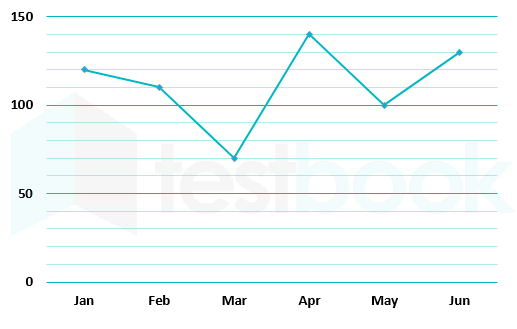
Directions: The following line graph shows the number of projects completed in six different months by a company.

The total number of projects completed in January is approximately what percentage more/less than the total number of projects completed in March?

  1. AOption (a)

    68%

  2. BOption (b)

    77%

  3. COption (c)

    76%

  4. DOption (d)

    71%

  5. EOption (e)

    73%

View answer & explanation

Correct answer

Answer: (d)D.

71%

Why this answer is correct

Solution:

Number of projects completed in January = 120

Number of projects completed in March = 70

Required percentage = 120/70 ×  100 = (171.14 - 100) ~ 71%

∴ The total number of projects completed in January is approximately 71% more than the total number of projects completed in March.

SBI Clerk Prelims Memory Based Paper (Held On: 05 Jan, 2024 Shift 2) (Previous Year Paper)·Numerical Ability
View full paper

Question 651

SBI Clerk 2024• Numerical Ability• Numerical Ability

Directions: The following line graph shows the number of projects completed in six different months by a company.

If the total number of projects completed by company B in February is 50% more than that of company A (consider the above diagram for company A) in January and the sum of the total number of projects completed by company B in February and March is 255, then find the difference between the total number of projects completed by company B in February and March.

  1. AOption (a)

    135

  2. BOption (b)

    125

  3. COption (c)

    105

  4. DOption (d)

    110

  5. EOption (e)

    115

View answer & explanation

Correct answer

Answer: (c)C.

105

Why this answer is correct

Solution:

Number of projects completed by company A in January = 120

Number of projects completed by company B in February = 120 ×  150/100 = 180

Number of projects completed by company B in March = 255 - 180 = 75

Required difference = (180 - 75) = 105

SBI Clerk Prelims Memory Based Paper (Held On: 05 Jan, 2024 Shift 2) (Previous Year Paper)·Numerical Ability
View full paper

Question 652

SBI Clerk 2024• Numerical Ability• Numerical Ability

Directions: The following line graph shows the number of projects completed in six different months by a company.

Find the ratio of the total number of projects completed in May to the total number of projects completed in January and June together.

  1. AOption (a)

    3: 7

  2. BOption (b)

    2: 3

  3. COption (c)

    4: 5

  4. DOption (d)

    2: 5

  5. EOption (e)

    3: 5

View answer & explanation

Correct answer

Answer: (d)D.

2: 5

Why this answer is correct

Solution:

Number of projects completed in May = 100

Number of projects completed in January and June = (120 + 130) = 250 

Required ratio = 100: 250 = 2: 5

SBI Clerk Prelims Memory Based Paper (Held On: 05 Jan, 2024 Shift 2) (Previous Year Paper)·Numerical Ability
View full paper

Question 653

SBI Clerk 2024• Numerical Ability• Numerical Ability

Directions: The following line graph shows the number of projects completed in six different months by a company.

If the average number of projects completed in January, May and December is 115, then the total number of projects completed in February is what percentage of the total number of projects completed in December?

  1. AOption (a)

    82%

  2. BOption (b)

    84%

  3. COption (c)

    88%

  4. DOption (d)

    92%

  5. EOption (e)

    86%

View answer & explanation

Correct answer

Answer: (c)C.

88%

Why this answer is correct

Solution:

Number of projects completed in May = 100

Number of projects completed in January = 120

Number of projects completed in December = 115 ×  3 - (100 + 120) = 125

Number of projects completed in February = 110

Required percentage = 110/125 ×  100 = 88%

SBI Clerk Prelims Memory Based Paper (Held On: 05 Jan, 2024 Shift 2) (Previous Year Paper)·Numerical Ability
View full paper

Question 654

SBI Clerk 2024• Numerical Ability• Numerical Ability

Directions: The following line graph shows the number of projects completed in six different months by a company.

If the total number of projects completed in August is twice the difference between the total number of projects completed in March and June, and the ratio of the total number of projects completed in April to July is 7: 5, then find the sum of the total number of projects completed in July and August.

  1. AOption (a)

    265

  2. BOption (b)

    350

  3. COption (c)

    220

  4. DOption (d)

    240

  5. EOption (e)

    250

View answer & explanation

Correct answer

Answer: (c)C.

220

Why this answer is correct

Solution:

Number of projects completed in March = 70

Number of projects completed in June = 130

Total number of projects completed in August = 2 ×  (130 - 70) = 120

Number of projects completed in April = 140

Number of projects completed in July = 140/7 ×  5 = 100

Required sum = (120 + 100) = 220

SBI Clerk Prelims Memory Based Paper (Held On: 05 Jan, 2024 Shift 2) (Previous Year Paper)·Numerical Ability
View full paper

Question 655

SBI Clerk 2024• Numerical Ability• Numerical Ability

If the principal of ₹ 10,000 amounts to ₹ 19,600 with 40% p.a. rate of interest compounded annually. Calculate the time for which it was invested.

  1. AOption (a)

    10 years

  2. BOption (b)

    5 years

  3. COption (c)

    2 years

  4. DOption (d)

    4 years

  5. EOption (e)

    3 years

View answer & explanation

Correct answer

Answer: (c)C.

2 years

Why this answer is correct

Shortcut Trick

Ratio of Amount (A) to Principal (P) is 19600 : 10000 = 196 : 100.

Rate is 40%, so the Multiplier is (1 + 40/100) = 1.4 or 14/10.

Check the power: (14/10)2 = 196/100.

Since the power is 2, the Time Period is 2 years.

∴ The correct answer is 2 years.

Alternate Method

Given: Principal (P) = ₹ 10,000, Amount (A) = ₹ 19,600, Rate (R) = 40% p.a.

Formula Used: A = P(1 + R/100)n

⇒ 19600 = 10000(1 + 40/100)n

⇒ 19600 / 10000 = (140 / 100)n

⇒ 196 / 100 = (1.4)n

⇒ (1.4)2 = (1.4)n

⇒ n = 2

∴ The correct answer is 2 years.

Additional Information

Compound Interest (CI) Formula

Interest is calculated on the initial principal and also on the accumulated interest of previous periods: CI = A − P.

Half-yearly Compounding

If interest is compounded half-yearly, the rate is halved (R/2) and the time is doubled (2n) in the formula.

Rule of 72

A quick way to estimate the time required to double an investment: Time ≈ 72 ÷ Interest Rate.

SBI Clerk Prelims Memory Based Paper (Held On: 05 Jan, 2024 Shift 2) (Previous Year Paper)·Numerical Ability
View full paper

Question 656

SBI Clerk 2024• Numerical Ability• Numerical Ability

Ramesh purchased a land for Rs. 45000 and sold (3/5) part at a loss of 5%. How much per cent of profit should be sold the remaining part so that he made 15% profit on the whole?

  1. AOption (a)

    45%

  2. BOption (b)

    35%

  3. COption (c)

    50%

  4. DOption (d)

    55%

  5. EOption (e)

    40%

View answer & explanation

Correct answer

Answer: (a)A.

45%

Why this answer is correct

Shortcut Trick

Use the weighted average method based on parts of the land.

Let the total parts be 5. Loss is taken as negative and profit as positive.

Total Profit = (Part 1 × P/L%) + (Part 2 × P/L%)

15% × 5 = (3 × −5%) + (2 × x%)

75 = −15 + 2x ⇒ 2x = 90 ⇒ x = 45%.

∴ The correct answer is 45%.

Alternate Method

Given: Total CP = Rs. 45,000, Loss on 3/5 part = 5%, Total Profit required = 15%.

Formulas: SP = CP × (100 ± P/L)% / 100 | Profit = SP − CP.

⇒ Total required SP = 45000 × (115/100) = Rs. 51,750.

⇒ CP of 3/5 part = 45000 × (3/5) = Rs. 27,000.

⇒ SP of 3/5 part (at 5% loss) = 27000 × (95/100) = Rs. 25,650.

⇒ Required SP for remaining part = 51750 − 25650 = Rs. 26,100.

⇒ CP of remaining 2/5 part = 45000 × (2/5) = Rs. 18,000.

⇒ Profit on remaining part = 26100 − 18000 = Rs. 8,100.

⇒ Profit % = (8100 / 18000) × 100 = 45%.

∴ The correct answer is 45%.

Additional Information

Weighted Average in Profit & Loss

When different portions of a single quantity are sold at different profit/loss percentages, the overall profit/loss percentage is the weighted average of individual percentages.

Independent of Actual Value

If the question asks for the percentage profit or loss, the actual price (like Rs. 45000) does not affect the final result; only the ratio of parts matters.

SBI Clerk Prelims Memory Based Paper (Held On: 05 Jan, 2024 Shift 2) (Previous Year Paper)·Numerical Ability
View full paper

Question 657

SBI Clerk 2024• Numerical Ability• Numerical Ability

What will come in the place of the question mark ‘?’ in the following question?

\(2\frac{1}{4} + 3\frac{1}{6} - 1\frac{2}{8} = ?; + 1\frac{1}{{12}}\)

  1. AOption (a)

    \(4{3 \over 12}\)

  2. BOption (b)

    \(3{4 \over 24}\)

  3. COption (c)

    \(3{1 \over 12}\)

  4. DOption (d)

    \(3{5 \over 12}\)

  5. EOption (e)

    \(3{4 \over 12}\)

View answer & explanation

Correct answer

Answer: (c)C.

\(3{1 \over 12}\)

Why this answer is correct

Calculation:

Given expression is-

\(2\frac{1}{4} + 3\frac{1}{6} - 1\frac{2}{8} = ?; + 1\frac{1}{{12}}\)

First convert mixed fraction into proper fraction

(9/4) + (19/6) – (10/8) = ? + (13/12)

⇒ ? = 9/4 + 19/6 – 10/8 – 13/12

⇒ ? = (54 + 76 – 30 – 26)/24

⇒ ? = 74/24 = 37/12 = \(3{1 \over 12}\)

 \(2\frac{1}{4} + 3\frac{1}{6} - 1\frac{2}{8} = ?; + 1\frac{1}{{12}}\)

⇒ (2 + 3 - 1 - 1) + (1/4 + 1/6 - 2/8 - 1/12)

⇒ 3 + (1/12)

⇒ \(3{1 \over 12}\)

SBI Clerk Prelims Memory Based Paper (Held On: 05 Jan, 2024 Shift 2) (Previous Year Paper)·Numerical Ability
View full paper

Question 658

SBI Clerk 2024• Numerical Ability• Numerical Ability

What will come in the place of the question mark ‘?’ in the following question?

\(1{1\over6} + {1\over8} + {2{5\over8}} - {3{2\over3}} = ?\)

  1. AOption (a)

    1/5

  2. BOption (b)

    2/3

  3. COption (c)

    1/6

  4. DOption (d)

    1/4

  5. EOption (e)

    1/2

View answer & explanation

Correct answer

Answer: (d)D.

1/4

Why this answer is correct

Given:

\(1{1\over6} + {1\over8} + {2{5\over8}} - {3{2\over3}} = ?\)

Concept Used:

Calculation:

\(1{1\over6} + {1\over8} + {2{5\over8}} - {3{2\over3}} = ?\)

⇒ 1 + 2 - 3 + [(1/6) + (1/8) + (5/8) - (2/3)] = ?

⇒ (1/6) + (1/8) + (5/8) - (2/3) = ?

⇒ (6/8) - (1/2) = ?

⇒ ? = 1/4

∴ The value of (?) is 1/4.

SBI Clerk Prelims Memory Based Paper (Held On: 05 Jan, 2024 Shift 2) (Previous Year Paper)·Numerical Ability
View full paper

Question 659

SBI Clerk 2024• Numerical Ability• Numerical Ability

What will come in place of question mark (?) in the following question?

58 + (222 ÷ 3) ÷ 37 + 22 = ?2

  1. AOption (a)

    9

  2. BOption (b)

    4

  3. COption (c)

    8

  4. DOption (d)

    6

  5. EOption (e)

    7

View answer & explanation

Correct answer

Answer: (c)C.

8

Why this answer is correct

Concept Used:

Calculation:

⇒58 + (222 ÷ 3) ÷ 37 + 22 = ?2

⇒ 58 + 74/37 + 4 = ?2 

⇒ 58 + 2 + 4 = ?2

⇒ 64 = ?2

⇒ 8 = ?

SBI Clerk Prelims Memory Based Paper (Held On: 05 Jan, 2024 Shift 2) (Previous Year Paper)·Numerical Ability
View full paper

Question 660

SBI Clerk 2024• Numerical Ability• Numerical Ability

What will come in the place of the question mark ‘?’ in the following question?

250 ÷ 5 × 2/350 + 26/7 = ?

  1. AOption (a)

    5

  2. BOption (b)

    6

  3. COption (c)

    7

  4. DOption (d)

    4

  5. EOption (e)

    none of these

View answer & explanation

Correct answer

Answer: (d)D.

4

Why this answer is correct

Concept:

Calculation:

⇒ 250 ÷ 5 × 2/350 + 26/7 = ?

⇒ 50 × (2/350) + 26/7 = ?

⇒ 2/7 + 26/7 = ?

⇒ 28/7 = ?

⇒ ? = 4

∴ The required result will be 4.

How should I prepare for Quantitative Aptitude in SBI Clerk?

Solving previous year questions by topic helps identify recurring concepts, question patterns, and frequently asked sub-topics. Attempt each question, review the step-by-step explanation, and note down key formulas or facts for quick revision before the exam.