Previous Year Paper

SBI Clerk Prelims Memory Based Paper (Held On: 05 Jan, 2024 Shift 2) (Previous Year Paper)

Held in 2024

100 questions60 minutes
With answers
Free

Paper last updated:

Practise under exam conditions

Take this paper as a timed mock test. Review your answers after you submit.

Attempt timed test

Questions & answers

Read the paper at your pace. Open an explanation when you need it.

English Language (30 questions)

Directions: Read the given passage carefully to answer the following questions. Each question will have five alternatives as its answer. Choose the correct option as your answer.

Fishing is a significant industry in Korea, particularly in coastal areas like Jeju Island. The waters around these regions are abundant with various marine life, making them ideal for fishing activities. Local fishermen primarily target species like mackerel, squid, and the Jeju hairtail, which are highly valued in Korean cuisine.

The life of a fisherman involves starting their day early, often before sunrise, to take advantage of the best fishing conditions. They use a combination of traditional and modern techniques to maximize their catch. This includes using nets and lines that are designed to be effective for specific types of fish.

The fishing process is closely tied to the seasons and weather. Spring usually offers the richest haul due to favorable ocean conditions and the life cycle of fish. However, winter fishing can be challenging due to rough seas and cold weather, which test the resilience and skill of the fishermen.

On the boat, teamwork is crucial. Fishermen must work together ____ operate the equipment, haul in their catch, and manage their vessel safely. The term "bloster," often used among fishermen, refers to someone exceptionally skilled at handling the most challenging conditions at sea.

After a day at sea, the catch is brought back to shore and sold at local markets. This not only provides income for the fishermen but also supports the local economy by supplying fresh seafood.

Overall, fishing is more than just an occupation in Korea; it is a heritage that embodies the relationship between humans and the sea. It demands knowledge, patience, and respect for nature, contributing to the cultural fabric of coastal communities.

Question 1

Based on Passage: View directions & passage

Find a synonym for 'heritage' in the passage's context.

  1. AOption (a)

    Legacy

  2. BOption (b)

    Burden

  3. COption (c)

    Novelty

  4. DOption (d)

    Decline

  5. EOption (e)

    Hindrance

View answer & explanation

Correct answer

Answer: (a)A.

Legacy

Why this answer is correct

The correct answer is 'Legacy'.

Key Points

  • The given word in the question is 'heritage', which refers to something inherited from the past, such as traditions or practices.
  • For Example: The cultural heritage of the city is reflected in its architecture and annual festivals.
  • The word 'Legacy', which is a synonym for 'heritage', means something left or handed down by a predecessor.
  • For Example: The ancient manuscripts are part of the monastery’s legacy.
  • Hence, the correct synonym for 'heritage' is 'legacy'.
  • Therefore, the correct answer is "Option 1".

 Additional Information

  • Burden refers to a heavy load, either literal or metaphorical, that is difficult to carry.
  • Novelty refers to the quality of being new, original, or unusual.
  • Decline means to gradually diminish in quality, quantity, or strength.
  • Hindrance refers to a thing that provides resistance, delay, or obstruction to something or someone.
Question 2

Based on Passage: View directions & passage

According to the passage, what is the impact of fishing on the local economy?

  1. AOption (a)

     It leads to overfishing and depletion of resources

  2. BOption (b)

    It has no significant impact on the local economy

  3. COption (c)

    It primarily supports international trade

  4. DOption (d)

    It supplies fresh seafood and provides income for fishermen

  5. EOption (e)

     It increases pollution in coastal areas

View answer & explanation

Correct answer

Answer: (d)D.

It supplies fresh seafood and provides income for fishermen

Why this answer is correct

Correct Answer: D) It supplies fresh seafood and provides income for fishermen

Key Points

  • The passage details how the fishing industry supports the local economy by supplying fresh seafood and providing income for fishermen.
  • This activity supports not just the fishermen and their families but also the broader community through market sales.

Question 3

Based on Passage: View directions & passage

​According to the passage, what is the term "bloster" used to describe among fishermen?

  1. AOption (a)

    A type of boat used for fishing

  2. BOption (b)

    A special kind of fishing net

  3. COption (c)

    A fisherman skilled at handling challenging sea conditions

  4. DOption (d)

     A traditional fishing technique

  5. EOption (e)

    A local fish market

View answer & explanation

Correct answer

Answer: (c)C.

A fisherman skilled at handling challenging sea conditions

Why this answer is correct

Correct Answer: C) A fisherman skilled at handling challenging sea conditions

Key Points

  • The term "bloster" is used to describe a fisherman who is particularly skilled at managing difficult conditions at sea.
  • This term is a testament to the respect earned by those who can adeptly navigate and fish in challenging environments.

Question 4

Based on Passage: View directions & passage

According to the passage, which of the following statements is/are correct?

A. The local economy benefits from the fishing industry.

B. The primary fish caught are tuna and bass.

C. The fishing industry contributes to pollution as its main impact.

  1. AOption (a)

    Only C

  2. BOption (b)

    Only A

  3. COption (c)

    Only B

  4. DOption (d)

    Both A & C

  5. EOption (e)

    Both A & B

View answer & explanation

Correct answer

Answer: (b)B.

Only A

Why this answer is correct

The correct answer is Option 2.

Key Points

  • The correct answer is 'A only'.
  • Statement A states that the local economy benefits from the fishing industry. This is correct as the passage explains that the fishing industry supports local economies by providing fresh seafood and income for fishermen, which in turn supports their communities.
  • Statement B mentions that the primary fish caught are tuna and bass. This is incorrect according to the passage, which specifies that mackerel, squid, and Jeju hairtail are the primary targets of fishermen in the region.
  • Statement C says that the fishing industry contributes to pollution as its main impact. This is not supported by the passage, which highlights the economic and cultural contributions of fishing without mentioning environmental negatives like pollution.

Question 5

Based on Passage: View directions & passage

What does the passage suggest about the role of weather and seasons in fishing?

  1. AOption (a)

    They primarily affect the type of fish caught.

  2. BOption (b)

    They have no significant impact on fishing activities.

  3. COption (c)

    They are crucial factors affecting the success of fishing.

  4. DOption (d)

    They determine the pricing of fish in markets.

  5. EOption (e)

    They influence the migration patterns of fish but not the fishing itself.

View answer & explanation

Correct answer

Answer: (c)C.

They are crucial factors affecting the success of fishing.

Why this answer is correct

Correct Answer: C) They are crucial factors affecting the success of fishing

Key Points

  • The passage details that the fishing activities are significantly affected by weather conditions and seasonal changes. It specifically notes that spring offers favorable conditions for a rich haul, while winter can pose challenges with rough seas and cold weather.
  • This context highlights how intrinsic weather and seasonal variations are to the planning and outcome of fishing activities.

Question 6

Based on Passage: View directions & passage

According to the passage, which of the following statements is/are incorrect?

A. Fishermen start their day early to use the best fishing conditions.

B. Fishermen in Korea use only modern techniques to fish.

C. Fishermen are not affected by weather conditions.

  1. AOption (a)

    Only A

  2. BOption (b)

    Only B

  3. COption (c)

    Only C

  4. DOption (d)

    Both B & C

  5. EOption (e)

    ​Both A & C

View answer & explanation

Correct answer

Answer: (d)D.

Both B & C

Why this answer is correct

The correct answer is 'Both B & C'.

Key Points

  • Statement A says that fishermen start their day early to use the best fishing conditions. This is true according to the passage, which mentions that fishermen begin their work before sunrise to take advantage of optimal fishing conditions.
  • Statement B states that fishermen in Korea use only modern techniques to fish. This is incorrect, as the passage clearly indicates that they use a combination of traditional and modern techniques to maximize their catch.
  • Statement C asserts that fishermen are not affected by weather conditions. This is contradicted by the passage, which notes that the seasons and weather significantly influence fishing activities, especially noting the challenges faced during winter due to rough seas and cold weather.

Question 7

Based on Passage: View directions & passage

Find an antonym for the word 'challenging' as used in the context of the passage

  1. AOption (a)

    Difficult

  2. BOption (b)

    Easy

  3. COption (c)

    Complex

  4. DOption (d)

    Hard

  5. EOption (e)

    Complicated

View answer & explanation

Correct answer

Answer: (b)B.

Easy

Why this answer is correct

The correct answer is 'Easy'.

Key Points

  • The given word in the question is 'challenging', which refers to something that tests one's abilities, often in a way that is difficult.
  • For Example: The challenging weather conditions made the fishing trip particularly tough.
  • The word 'Easy', which is an antonym for 'challenging', means achieved without great effort or presenting few difficulties.
  • For Example: The task was easier than expected and was completed quickly.
  • Hence, the correct antonym for 'challenging' is 'easy'.
  • Therefore, the correct answer is "Option 2".

Question 8

Based on Passage: View directions & passage

Fill in the blank in the passage: "Fishermen must work together ____ operate the equipment, haul in their catch, and manage their vessel safely."

  1. AOption (a)

    to

  2. BOption (b)

    and

  3. COption (c)

    but

  4. DOption (d)

    as

  5. EOption (e)

    with

View answer & explanation

Correct answer

Answer: (a)A.

to

Why this answer is correct

Correct Answer: A) to

Key Points

  • The blank in the sentence "Fishermen must work together ____ operate the equipment, haul in their catch, and manage their vessel safely" requires a word that connects the clause "Fishermen must work together" with the actions that follow. The correct word to use in this context is "to," which introduces the purpose or intention behind the fishermen working together.
  • The use of "to" is grammatically appropriate to link the need for teamwork to the actions of operating equipment, hauling in the catch, and managing the vessel, which are dependent on their cooperative effort.

Question 9

Directions

Given below are five scattered segments of a sentence. Indicate the correct sequence which correctly assembles the segments and completes the sentence.**

A. may slightly increase the risk of premature death, 

B. while insomnia's impact on physical health, 

C. like obesity, diabetes, and high blood pressure, 

D. potentially linked to underlying diseases

E. is debated, research suggests only daytime symptoms

  1. AOption (a)

    DEBCA

  2. BOption (b)

    DABCE

  3. COption (c)

    BCEAD

  4. DOption (d)

    CAEBD

  5. EOption (e)

    BAECD

View answer & explanation

Correct answer

Answer: (c)C.

BCEAD

Why this answer is correct

The correct answer is option 3.

Key Points

​​The correct sequence for the scattered segments is BCEAD.

  • B, "while insomnia's impact on physical health," is the first part as it introduces the main topic of the sentence, which is insomnia's impact on physical health.
  • C, "like obesity, diabetes, and high blood pressure," is the second part as it provides additional information about the impact of insomnia on physical health, giving examples of conditions that are relevant.
  • E, "is debated, research suggests only daytime symptoms," is the third part as it follows C appropriately, adding that while there is debate about insomnia's impact on physical health and introduces the research finding regarding daytime symptoms, providing additional context within the sentence.
  • A, "may slightly increase the risk of premature death," is the fourth part as it logically connects with E, suggesting a potential consequence of insomnia on physical health, which is an increased risk of premature death.
  • D, "potentially linked to underlying diseases," is the last part of the given sentence, and it correctly ends the sentence by providing further context, explaining that this increased risk of premature death may be linked to underlying diseases.


The complete sentence would be - "While insomnia's impact on physical health, like obesity, diabetes, and high blood pressure, is debated, research suggests only daytime symptoms may slightly increase the risk of premature death, potentially linked to underlying diseases."


Additional Information

  • Let's understand some important vocabulary given in the question:
  • Impact - the effect or influence of one thing on another; a significant result or consequence (प्रभाव)
  • For Example -
  • The new environmental policies had a positive impact on air quality in the city.
  • Symptoms - physical or mental manifestations that indicate the presence of a disease, condition, or problem (लक्षण)
  • For Example -
  • Common symptoms of the flu include fever, cough, and fatigue.
  • Premature - occurring or done before the expected or proper time; early (असमयिक)
  • For Example -
  • The premature birth of the baby required special medical attention.
  • Underlying - situated beneath or hidden beneath the surface; fundamental or basic (मूल)
  • For Example -
  • The underlying issue in their relationship was a lack of trust.

Question 10

Directions

Given below are five scattered segments of a sentence. Indicate the correct sequence which correctly assembles the segments and completes the sentence.**

A. Japanese techniques such as Pomodoro and Ikigai 

B. resulting from a lack of discipline 

C. boosting happiness and productivity through 

D. within the framework of capitalism

E. is a key means of overcoming unhappiness

  1. AOption (a)

    DEBCA

  2. BOption (b)

    EDABC

  3. COption (c)

    ABCED

  4. DOption (d)

    DECBA

  5. EOption (e)

    CAEBD

View answer & explanation

Correct answer

Answer: (e)E.

CAEBD

Why this answer is correct

The correct answer is option 5.

Key Points

​​The correct sequence for the scattered segments is CAEBD.

  • C, "boosting happiness and productivity through," is the first part as it introduces the main theme of the sentence, which is about improving happiness and productivity.
  • A, "Japanese techniques such as Pomodoro and Ikigai," is the second part as it follows C appropriately, providing specific examples of the techniques that can be used to improve happiness and productivity.
  • E, "is a key means of overcoming unhappiness," is the third part because it logically connects with A, completing the idea by explaining that these Japanese techniques are important for overcoming unhappiness.
  • B, "resulting from a lack of discipline," is the fourth part, as it elaborates on the potential cause or reason for unhappiness mentioned in E.
  • D, "within the framework of capitalism," is the last part of the given sentence, offering a broader context or perspective within which these techniques can be applied.


The complete sentence would be - "Boosting happiness and productivity through Japanese techniques such as Pomodoro and Ikigai is a key means of overcoming unhappiness resulting from a lack of discipline within the framework of capitalism."


Additional Information

  • Let's understand some important vocabulary given in the question:
  • Boost - to increase or improve something, often with the goal of making it more successful or productive (बढ़ाना)
  • For Example -
  • Implementing new technology can boost productivity in the workplace.
  • Productivity - the measure of how efficiently resources (such as time, labour, or capital) are used to produce goods or services (उत्पादकता)
  • For Example -
  • The company's productivity increased after they streamlined their production processes.
  • Overcome - to successfully deal with or defeat a problem, challenge, or obstacle (पार करना)
  • For Example -
  • She had to overcome many obstacles to achieve her career goals.
  • Capitalism - an economic and political system in which a country's trade and industry are controlled and operated by private individuals or corporations for profit, rather than by the state (पूँजीवाद)
  • For Example -
  • Capitalism promotes competition and innovation in the marketplace.

Question 11

Directions

Given below are five scattered segments of a sentence. Indicate the correct sequence which correctly assembles the segments and completes the sentence.**

A. a preventable issue rooted in complex circumstances, 

B. Society must embrace addiction as 

C. to combat its damaging effects 

D. on individuals and the economy

E. promoting ethical treatment and collective efforts

  1. AOption (a)

    EDABC

  2. BOption (b)

    CADBE

  3. COption (c)

    BAECD

  4. DOption (d)

    ABCED

  5. EOption (e)

    DECBA

View answer & explanation

Correct answer

Answer: (c)C.

BAECD

Why this answer is correct

The correct answer is option 3.

Key Points

​​The correct sequence for the scattered segments is BAECD.

  • B, "Society must embrace addiction as," is the first part as it introduces the central theme of the sentence, which is about society's approach to addiction.
  • A, "a preventable issue rooted in complex circumstances," is the second part as it follows B appropriately, expanding on the idea of addiction being preventable and having complex underlying causes.
  • E, "promoting ethical treatment and collective efforts," is the third part, as it logically connects with A, explaining the approach society should take by promoting ethical treatment and collective efforts to address addiction.
  • C, "to combat its damaging effects," is the fourth part as it follows E, continuing to describe what these efforts should aim to do, which is combatting the damaging effects of addiction.
  • D, "on individuals and the economy," is the last part and correctly concludes the sentence by specifying that the mentioned approach should be used to combat the damaging effects of addiction both on individuals and the broader economy.


The complete sentence would be - "Society must embrace addiction as a preventable issue rooted in complex circumstances, promoting ethical treatment and collective efforts to combat its damaging effects on individuals and the economy."


Additional Information

  • Let's understand some important vocabulary given in the question:
  • Embrace - to accept or support something willingly or enthusiastically (अपनाना)
  • For Example:
  • She decided to embrace the new opportunity that came her way and pursue her passion for art.
  • Addiction - a strong and harmful need to regularly have something or do something (लत)
  • For Example:
  • His addiction to smoking had serious health consequences.
  • Preventable - capable of being avoided or stopped from happening (रोकने योग्य)
  • For Example:
  • Many accidents on the road are preventable if people follow traffic rules and drive responsibly.
  • Circumstances - the conditions and facts that are relevant to a particular event or situation (परिस्थितियाँ)
  • For Example:
  • He made the decision based on his financial circumstances at the time.
  • Ethical - relating to principles of right and wrong behaviour, especially in a professional context (नैतिक)
  • For Example:
  • The company's ethical policies emphasized honesty and integrity in business practices.
  • Combat - to actively fight against something, especially something harmful or undesirable (सामना करना)
  • For Example:
  • The government is taking measures to combat the spread of the infectious disease.

Question 12

Directions

Given below are five scattered segments of a sentence. Indicate the correct sequence which correctly assembles the segments and completes the sentence.**

A. as employees worldwide adapted to 

B. during the pandemic years, 

C. work-from-home or hybrid work patterns, 

D. apps and services for work-related reasons

E. a number of them began using personal messaging

  1. AOption (a)

    CEBAD

  2. BOption (b)

    BACED

  3. COption (c)

    EDBCA

  4. DOption (d)

    BADEC

  5. EOption (e)

    EADBC

View answer & explanation

Correct answer

Answer: (b)B.

BACED

Why this answer is correct

The correct answer is option 2.

Key Points

​​The correct sequence for the scattered segments is BACED.

  • B, "during the pandemic years," is the first part as it provides the temporal context for the sentence, setting the stage for the events that occurred during the pandemic years.
  • A, "as employees worldwide adapted to," is the second part as it logically follows B, explaining what employees did during the pandemic years, which is adapting to a new work environment.
  • C, "work-from-home or hybrid work patterns," is the third part as it follows A appropriately, providing details about the specific work patterns employees adapted to during the pandemic.
  • E, "a number of them began using personal messaging," is the fourth part as it follows C and describes one of the specific behaviours employees adopted during the pandemic years - using personal messaging apps and services.
  • D, "apps and services for work-related reasons" is the last part of the sentence, completing it by specifying the purpose of using personal messaging apps and services.


The complete sentence would be - "During the pandemic years, as employees worldwide adapted to work-from-home or hybrid work patterns, a number of them began using personal messaging apps and services for work-related reasons."


Additional Information

  • Let's understand the meanings of the given vocabulary in the provided format:
  • Pandemic - prevalent over a whole country or the world; affecting a large number of people, animals, or areas (महामारी)
  • For Example -
  • The COVID-19 pandemic had a significant impact on global public health and the economy.
  • Adapt - make suitable for a new use or purpose; modify (अनुकूलित करना)
  • For Example -
  • To survive in the ever-changing business landscape, companies need to adapt to new technologies and market trends.
  • Hybrid - a thing made by combining two different elements; a mixture (मिश्रित)
  • For Example -
  • The hybrid car runs on both gasoline and electricity, offering improved fuel efficiency and reduced emissions.

Below, a passage is given with five blanks labelled (A)-(E). Below the passage, five options are given for each blank. Choose the word that fits each blank most appropriately in the context of the passage, and mark the corresponding answer.

Our lives have been simplified by the ___ (A) ___ of computer and Internet, but these benefits which have been ushered in by the technology revolution have had an (B)affect on the core of our interpersonal-relationships. Communication is no longer ___(C) ___postal mail or face-to-face contact, but via electronic mail, personal internet message boards, and by virtue of hand-held personal electronic assistants. **(D)** computer technology has brought us to within a mouse click of any sought-after piece of information, this technology boom has___(E)___ us to the confines of our computer desks and has taken us away from the traditional settings where personal and communication skills were developed.

Question 13

Based on Passage: View directions & passage

Which of the following words most appropriately fits the blank labelled (A)?

  1. AOption (a)

    Arrival

  2. BOption (b)

    Surfacing

  3. COption (c)

    Materialisation

  4. DOption (d)

    Advent

  5. EOption (e)

    Onset

View answer & explanation

Correct answer

Answer: (d)D.

Advent

Why this answer is correct

Although all the words given in the options are synonymous in a way, the contexts in which they are used vary.  ‘Advent’ means the arrival of something of importance. Computers and internet are things of importance and thus ‘advent’ is the best option here.

Question 14

Based on Passage: View directions & passage

Which of the following words most appropriately fits the blank labelled (B)?

  1. AOption (a)

    Adverse

  2. BOption (b)

    Averse

  3. COption (c)

    Unpropitious

  4. DOption (d)

    Unscrupulous

  5. EOption (e)

    Unlucky

View answer & explanation

Correct answer

Answer: (a)A.

Adverse

Why this answer is correct

The word ‘but’ in the sentence indicates that whatever is mentioned after it will be contradictory to anything mentioned before it. Hence, one should look for a word that indicates the unfavourable effects of the technological advancements. ‘Unscrupulous’ meaning dishonest and unfair is irrelevant.  ‘Unpropitious’ means not favouring success. ‘Averse’ means having a strong dislike for something. ‘Unlucky is out of context. The correct word to fill this blank is ‘adverse’ which means unfavourable and is the right word to describe the  contrasting effect of the internet  on our interpersonal lives.

Question 15

Based on Passage: View directions & passage

Which of the following words most appropriately fits the blank labelled (C)?

  1. AOption (a)

    Vis-a-vis

  2. BOption (b)

    Via

  3. COption (c)

    En route

  4. DOption (d)

    Albeit

  5. EOption (e)

    Sans

View answer & explanation

Correct answer

Answer: (b)B.

Via

Why this answer is correct

Blank (C) requires a verb that conveys the meaning of ‘through’. ‘Vis-a-vis’ means with regard to. ‘Albeit’ means ‘though’. ‘Sans’ means without and ‘en route’ means on the way. The correct choice is ‘via’ which means ‘through’ or ‘by the way of’.

Question 16

Based on Passage: View directions & passage

Which of the following words most appropriately fits the blank labelled (D)?

  1. AOption (a)

    Since

  2. BOption (b)

    Therefore

  3. COption (c)

    Because

  4. DOption (d)

    Although

  5. EOption (e)

    As

View answer & explanation

Correct answer

Answer: (d)D.

Although

Why this answer is correct

Careful reading of the sentence will make it clear that the portion of the sentence after the comma speaks about the demerits of technology, while the one before the comma states it merits. Hence a contrastive conjunction is required in the beginning of the sentence. ‘Although’ is the correct answer.

Question 17

Based on Passage: View directions & passage

Which of the following words most appropriately fits the blank labelled (E)?

  1. AOption (a)

    Unfrequented

  2. BOption (b)

    Conceals

  3. COption (c)

    Concealed

  4. DOption (d)

    Sequesters

  5. EOption (e)

    Sequestered

View answer & explanation

Correct answer

Answer: (e)E.

Sequestered

Why this answer is correct

The choices in the simple present tense are ruled as the sentence is in present perfect. ‘Concealed’ means hidden or kept secret. ‘Unfrequented’ means visited rarely. ‘Sequestered’ which means isolated is the correct choice.

Question 18

Direction: The given sentence is divided into four parts: A, B, C, and D. Choose the part that contains an error as your answer. If the sentence is error-free, mark E i.e. No error as your answer.

The number of foreign tourists (A)/ visiting India are increasing (B)/ day by day during (C)/ this tourist season. (D)/ No error (E)

  1. AOption (a)

    A

  2. BOption (b)

    B

  3. COption (c)

    C

  4. DOption (d)

    D

  5. EOption (e)

    E

View answer & explanation

Correct answer

Answer: (b)B.

B

Why this answer is correct

The correct answer is: 'Option 2'.

Key Points

  • The error part lies in 'Part 'B' of the sentence that is: 'visiting India are increasing'.
  • The given sentence starts with 'The number of'. According to the rule of it, 'Singular verb' is used after 'The number of'.
  • So, replacing 'are' with 'is' in the sentence will make it correct.
  • Hence, the correct answer is: 'B'.
  • Correct sentence: The number of foreign tourists visiting India is increasing day by day during this tourist season.

Question 19

Direction: The given sentence is divided into four parts: A, B, C, and D. Choose the part that contains an error as your answer. If the sentence is error-free, mark E i.e. No error as your answer.

The Chief Minister of the state has announced (A)/ five lakhs rupees compensation (B)/ for the family of those (C)/ killed in the flood and rain. (D)/ No error (E)

  1. AOption (a)

    A

  2. BOption (b)

    B

  3. COption (c)

    C

  4. DOption (d)

    D

  5. EOption (e)

    E

View answer & explanation

Correct answer

Answer: (b)B.

B

Why this answer is correct

The correct answer is: 'Option 2'.

Key Points

  • The error part lies in Part 'B' that is; 'five lakhs rupees compensation'.
  • The given sentence has an error of 'Number + Unit + Noun'. Here, 'Number' is 'five', 'Unit' is 'lakhs', 'Noun' is 'rupees'.
  • According to the rule, Singular form of the Unit that is; 'Lakh' will be used here to make the sentence correct.
  • Hence, the correct answer is: 'B'.
  • Correct sentence: Chief Minister of the state has announced five lakh rupees compensation for the family of those killed in the flood and rain.

Question 20

The given sentence is divided into four parts; A, B, C and D. Choose the part that contains an error as your answer. If the sentence is error-free, mark E i.e. No error as your answer.

The company has decided to (A) / layoff a few employees (B) / due to the recent (C) / financial downturn. (D) / No error (E)

  1. AOption (a)

    A

  2. BOption (b)

    E

  3. COption (c)

    D

  4. DOption (d)

    C

  5. EOption (e)

    B

View answer & explanation

Correct answer

Answer: (e)E.

B

Why this answer is correct

The correct answer is Option 5.


Key Points

  • The primary issue in the sentence is the incorrect usage of the term "layoff."
  • The term "layoff" is a noun and should be changed to the phrasal verb "lay off."
  • To ensure grammatical correctness, "lay off" should be used in the context of the sentence.
  • Thus, the error is located in part B of the sentence.

Therefore, the correct answer is B.


Correct Sentence: "The company has decided to lay off a few employees due to the recent financial downturn."


Additional Information

  • A: "The company has decided to" – This part of the sentence is grammatically correct and does not require any changes.
  • C: "due to the recent" – This part of the sentence is grammatically correct and does not require any changes.
  • D: "financial downturn." – This part of the sentence is grammatically correct and does not require any changes.
  • No error – This would be the correct option if there were no mistakes in the sentence, but there is an error in part B.

Question 21

Direction: The given sentence is divided into four parts: A, B, C, and D. Choose the part that contains an error as your answer. If the sentence is error-free, mark E i.e. No error as your answer.

 The company is (A)/ in debt and has been (B)/ unable to pay their creditors (C)/ for the past six months. (D)/ No error (E)

  1. AOption (a)

    A

  2. BOption (b)

    B

  3. COption (c)

    C

  4. DOption (d)

    D

  5. EOption (e)

    E

View answer & explanation

Correct answer

Answer: (c)C.

C

Why this answer is correct

The correct answer is "Option 3".

Key Points

  • The erroneous part is "their".
  • Here, the subject "the company" is singular, so it should be followed by the singular possessive pronoun "its".
  • The word "their" is incorrect in this context because it is a plural possessive pronoun.
  • Example: The guitar is useless without its strings.
  • Hence, the erroneous part is "their".

Therefore, the correct answer is "Option 3".

Correct Sentence: "The company is in debt and has been unable to pay its creditors for the past six months."

Additional Information

 Difference between "its" and "it's":

  • "Its" is a possessive pronoun, indicating ownership or possession.
  • Example: The company announced its new product.
  • "It's" is a contraction of "it is" or "it has."
  • Example: It's raining outside.

Question 22

Direction: The given sentence is divided into four parts: A, B, C, and D. Choose the part that contains an error as your answer. If the sentence is error-free, mark E i.e. No error as your answer.

Everybody know (A)/ that his failure can (B)/ be attributed only (C)/ to his lack of practice. (D)/ No error (E)

  1. AOption (a)

    A

  2. BOption (b)

    B

  3. COption (c)

    C

  4. DOption (d)

    D

  5. EOption (e)

    E

View answer & explanation

Correct answer

Answer: (a)A.

A

Why this answer is correct

The correct answer is "Option 1".

Key Points

  • The erroneous part is "knows".
  • The subject of the sentence is "Everybody," which is a singular pronoun, So the verb should also be in singular form to agree with the subject.
  • The correct verb form to use with a singular subject is "knows" instead of "know."
  • Hence, the erroneous part is "knows".

Therefore, the correct answer is "Option 1".

Correct Sentence:  "Everybody knows that his failure can be attributed only to his lack of practice."

Additional Information

  • "Each", "every", "either", and "neither" is used with a singular noun.
  • Example: Each child was given a balloon.

Question 23

Directions

In the following sentence, four words given in bold are marked as (A), (B), (C), and (D), which are possible pairs to be interchanged. Choose the pair(s) of words that need to be interchanged to make the sentence grammatically correct and meaningful. If no interchange is required, mark option 5 i.e., "No interchange required" as your answer.**

India's ecosystem (A) in healthcare AI is commendable (B), yet sustaining (C) growth requires ongoing investments in research, academia-industry collaborations, and innovation-friendly progress. (D)

  1. AOption (a)

    A-B

  2. BOption (b)

    B-C

  3. COption (c)

    C-D

  4. DOption (d)

    D-A

  5. EOption (e)

    No interchange required

View answer & explanation

Correct answer

Answer: (d)D.

D-A

Why this answer is correct

The correct answer is option 4.

 Key Points To answer this question, let's first understand the meanings of the marked words:

  • Ecosystem - the complex network or interconnected system of living organisms and their environment, including the interactions between them (पारिस्थितिकी प्रणाली)
  • For Example -
  • The forest ecosystem is home to a wide variety of plants and animals.
  • Commendable - deserving praise and admiration; worthy of approval (प्रशंसनीय)
  • For Example -
  • Her dedication to humanitarian work is commendable and has made a positive impact on many lives.
  • Sustaining - maintaining or continuing over some time; keeping something in existence (सुस्थिति)
  • For Example -
  • The company's focus on quality control is crucial for sustaining its reputation in the market.
  • Progress - forward or onward movement toward a destination or a more advanced state; development or improvement (प्रगति)
  • For Example -
  • The progress made in technology has revolutionized the way we live and work.
  • After understanding the meanings of the marked words, we can conclude that swapping "ecosystem" with "progress" in the sentence would make it grammatically and contextually correct because the sentence would then emphasize the need to invest in the progress of healthcare AI.
  • Hence, the correct answer is "D-A."


The correct sentence after the rearrangement would be: "India's progress in healthcare AI is commendable, yet sustaining growth requires ongoing investments in research, academia-industry collaborations, and an innovation-friendly ecosystem."

Question 24

Directions

In the following sentence, four words given in bold are marked as (A), (B), (C), and (D), which are possible pairs to be interchanged. Choose the pair(s) of words that need to be interchanged to make the sentence grammatically correct and meaningful. If no interchange is required, mark option 5 i.e., "No interchange required" as your answer.**

A policy framework (A) is needed to ensure equitable (B) contributions from major OTT service providers to subscriber (C) operators, determined by factors such as telecom (D) count and data usage.

  1. AOption (a)

    C-D

  2. BOption (b)

    A-B

  3. COption (c)

    B-C, A-D

  4. DOption (d)

    D-A, B-C

  5. EOption (e)

    No interchange required

View answer & explanation

Correct answer

Answer: (a)A.

C-D

Why this answer is correct

The correct answer is option 1.

 Key Points To answer this question, let's first understand the meanings of the marked words:

  • Framework - a structure, plan, or set of rules that provide guidance or a basis for decision-making (ढांचा)
  • For Example -
  • The legal framework for the country's tax system is complex and extensive.
  • Equitable - characterized by fairness and impartiality, ensuring everyone is treated fairly (न्यायसंगत)
  • For Example -
  • The company implemented an equitable pay scale to ensure that all employees receive fair compensation for their work.
  • Subscriber - an individual or entity that uses a particular service, often by paying for a subscription (सदस्य)
  • For Example -
  • The telecommunications company gained millions of subscribers when it introduced its new data plans.
  • Telecom - short for "telecommunications," it refers to the transmission of information over long distances, typically through electronic means (दूरसंचार)
  • For Example -
  • The telecom industry has witnessed rapid advancements in technology in recent years.
  • After understanding the meanings of the marked words, we can conclude that the word "subscriber" should be interchanged with "telecom" to make the sentence grammatically and contextually correct because it is the telecom operators that provide services to subscribers, not the other way around.
  • Hence, the correct answer is "C-D."


The correct sentence after the rearrangement would be: "A policy framework is needed to ensure equitable contributions from major OTT service providers to telecom operators, determined by factors such as subscriber count and data usage."

Question 25

Directions

In the following sentence, four words given in bold are marked as (A), (B), (C), and (D), which are possible pairs to be interchanged. Choose the pair(s) of words that need to be interchanged to make the sentence grammatically correct and meaningful. If no interchange is required, mark option 5 i.e., "No interchange required" as your answer.**

In this era of professional (A) change, the growing presence of embracing (B) AI in the workplace presents challenges, but people are generative (C) the positive impact it can have on their transformative (D) lives.

  1. AOption (a)

    A-B, C-D

  2. BOption (b)

    A-B

  3. COption (c)

    A-D

  4. DOption (d)

    B-C, D-A

  5. EOption (e)

    No interchange required

View answer & explanation

Correct answer

Answer: (d)D.

B-C, D-A

Why this answer is correct

The correct answer is option 4.

 Key Points To answer this question, let's first understand the meanings of the marked words:

  • Professional - relating to or connected with a person's work or occupation, typically requiring specialized knowledge or training (पेशेवर)
  • For Example -
  • His professional experience and expertise in finance made him a valuable asset to the company.
  • Embracing - accepting or supporting something enthusiastically (स्वीकारना)
  • For Example -
  • She is embracing the opportunity to learn a new language.
  • Generative - capable of producing, creating, or generating something (सृजनात्मक)
  • For Example -
  • The generative process of brainstorming ideas can lead to innovative solutions.
  • Transformative - causing a significant and fundamental change or alteration (परिवर्तनकारी)
  • For Example -
  • The introduction of the internet was a transformative moment in the history of communication.
  • After understanding the meanings of the marked word, we can conclude that in the given sentence, "embracing" should be interchanged with "generative" because "generative" aligns better with the idea that people are creating or generating a positive impact through AI, whereas "embracing" suggests merely accepting AI.
  • Similarly, "professional" should be interchanged with "transformative" to convey that the era is characterized by significant changes rather than emphasizing a focus on professionalism.
  • Hence, the correct answer is "B-C, D-A."


The correct sentence after the rearrangement would be: "In this era of transformative change, the growing presence of generative AI in the workplace presents challenges, but people are embracing the positive impact it can have on their professional lives."

Question 26

Directions

In the following sentence, four words given in bold are marked as (A), (B), (C), and (D), which are possible pairs to be interchanged. Choose the pair(s) of words that need to be interchanged to make the sentence grammatically correct and meaningful. If no interchange is required, mark option 5 i.e., "No interchange required" as your answer.**

The Earth, our unique (A) home in the vast universe, faces peril (B) due to human actions, and merely (C) addressing climate change isn't enough; accountability across all boundaries is essential (D) to protect it.

  1. AOption (a)

    B-C

  2. BOption (b)

    A-D, B-C

  3. COption (c)

    B-D

  4. DOption (d)

    C-A

  5. EOption (e)

    No interchange required

View answer & explanation

Correct answer

Answer: (e)E.

No interchange required

Why this answer is correct

The correct answer is option 5.

 Key Points To answer this question, let's first understand the meanings of the marked words:

  • Unique - being the only one of its kind; unlike anything else (अद्वितीय)
  • For Example -
  • The Mona Lisa's smile is considered unique in the world of art, making it an iconic masterpiece.
  • Peril - serious and immediate danger or risk (खतरा)
  • For Example -
  • The hikers found themselves in peril when a sudden snowstorm hit the mountain.
  • Merely - used to emphasize that something is small, slight, or insignificant (केवल)
  • For Example -
  • His apology was merely an attempt to avoid further consequences for his actions.
  • Essential - necessary or extremely important (आवश्यक)
  • For Example -
  • Clean water and food are essential for human survival.
  • After understanding the meanings of the marked words, we can conclude that all the marked words are in their correct places, and there is no need to interchange any words.
  • Hence, the correct answer is "No interchange required."

Question 27

Which of the following phrases (1), (2), (3), (4) given below in the statement should replace the phrase printed in bold in the sentence to make it grammatically correct? If the sentence is correct as it is given and ‘No Correction is required’, mark (5) as the answer.

They were woken up by someone hammering below the door.

  1. AOption (a)

    at the door.

  2. BOption (b)

    in the door.

  3. COption (c)

    on the door.

  4. DOption (d)

    besides the door.

  5. EOption (e)

    No Correction is required

View answer & explanation

Correct answer

Answer: (c)C.

on the door.

Why this answer is correct

The correct answer is on the door.

​

Key Points

  • Context: The given sentence says that they woke up when someone was hammering on the surface of the door. So, to give this sentence a meaningful sense we need to replace the preposition 'below' with 'on'.
  • The meaning of the preposition 'On' is 'on a surface of something', here, something is the door.
  • Example- The book is on the table.
  • Hence, the correct answer would be option 2 i.e. on the table.
  • Let’s see the meaning of other prepositions given in the option:
  • ​Here the prepositions 'at' 'in' 'on' denote place. But we need to understand their difference.
  • 'At' is used to denote a point.
  • E.g. She is at her home.
  • 'In' is used to denote a larger place like country or city.
  • E.g. I live in London.
  • Below is used to denote a lower position (than), under
  • E.g. From the top of the skyscraper the cars below us looked like insects.
  • 'Beside' means next to, and 'besides' means 'additionally' which is wrong contextually.

So the right answer is option 3 as 'on' is denoting 'on a surface of something.'

Question 28

Which of the following phrases (1), (2), (3), (4) given below in the statement should replace the phrase printed in bold in the sentence to make it grammatically correct? If the sentence is correct as it is given and ‘No Correction is required’, mark (5) as the answer.

I was very impressed above how she made such a powerful and accurate representation of the place.

  1. AOption (a)

     impressed at how

  2. BOption (b)

     impressed on how

  3. COption (c)

     impressed in how

  4. DOption (d)

    No correction required

  5. EOption (e)

     impressed for how

View answer & explanation

Correct answer

Answer: (a)A.

 impressed at how

Why this answer is correct

The correct answer is option 1.

Key Points

  • Context: The given sentence says that since the presentation is so powerful and accurate, someone was very impressed by her.. So, to give this sentence a meaningful sense we need to replace the preposition 'above' with 'at'.
  • The meaning of the preposition above is when something directly over it or higher than it.
  • Example- He lifted his hands above his head.
  • Here. the meaning of the preposition 'At' is used to indicate one’s activity
  • Example- John laughed at my acting in the play.
  • Let’s see the meaning of other prepositions given in the option:
  • The meaning of the preposition On refers a surface of something
  • Example- I kept the dishes on the dining table.
  • The meaning of the preposition 'In' is used to denote a larger place like country or city.
  • Example- I live in London.
  • The meaning of the preposition For is to indicate the duration or time
  • **Example-**I attended the session for one year only.

Hence, the correct answer is impressed at how

Question 29

Which of the following phrases (1), (2), (3), (4) given below in the statement should replace the phrase printed in bold in the sentence to make it grammatically correct? If the sentence is correct as it is given and ‘No Correction is required’, mark (5) as the answer.

The oil tanker ran aground below a mud bank in thick fog.

  1. AOption (a)

    in a mud bank

  2. BOption (b)

    at a mud bank

  3. COption (c)

    on a mud bank

  4. DOption (d)

    beside a mud bank

  5. EOption (e)

    No correction required

View answer & explanation

Correct answer

Answer: (c)C.

on a mud bank

Why this answer is correct

The correct answer is 'on a mud bank​'

Key Points

  • Context: The given sentence says that the oil tanker ran on the muddy ground in thick fog. So, to give this sentence a meaningful sense we need to replace the preposition 'below' with 'on'.
  • The meaning of the preposition 'On' is, it is used to denote position. 
  • Example- The book is on the table.
  • Let’s see the meaning of other prepositions given in the option:
  • ​Here the prepositions 'at' 'in' 'on' denote place. But we need to understand their difference.
  • 'At' is used to denote a point.
  • E.g. She is at her home.
  • 'In' is used to denote a larger place like country or city.
  • E.g. I live in London.
  • Below is used to denote a lower position (than), under
  • E.g. From the top of the skyscraper the cars below us looked like insects.
  • 'Beside' is next to but 'besides' means 'additionally' and cannot be used to denote a place(muddy bank) here.

So the right answer is option 3 as 'on' is denoting 'on a surface of something.'

Question 30

In the following sentence, a part of the sentence is underlined. Below are given alternatives to the underlined part, which may improve the sentence. Choose the correct alternative. In case no improvement is needed, choose the option ‘No improvement’.

In its report, The State of the World’s Children 2019, UNICEF said that every second child in that age group is affected by some form of malnutrition.

  1. AOption (a)

    are affected

  2. BOption (b)

    is effected

  3. COption (c)

    are effected

  4. DOption (d)

    is effect

  5. EOption (e)

    No improvement

View answer & explanation

Correct answer

Answer: (e)E.

No improvement

Why this answer is correct

The correct answer is option 5.

Key Points

  • We use affect as a verb only and effect as both verb and noun.
  • Based on the structure, of the sentence, we need a verb, and hence, affect will be more appropriate.
  • Affect means to influence something or someone.
  • Effect, when used as a noun, means the result of an influence and when used as a verb, effect means to bring about or cause something to occur.
  • Examples –
  • The harmful effects of drugs should be highlighted. (effect as noun)
  • The breakup has affected him severely.
  • The government was not able to effect any change. (effect as a verb - meaning the government was not able to bring about any change)
  • The subject of the sentence is ‘every second child’ which is singular in nature.
  • So, we should use is affected and not are affected.  

Hence, the given sentence is grammatically correct and logically sound.

Numerical Ability (35 questions)

Question 31

What will come in place of the question mark (?) in the following number series?

1, 3, 8, 19, 39, 71, ?

  1. AOption (a)

    128

  2. BOption (b)

    228

  3. COption (c)

    118

  4. DOption (d)

    108

  5. EOption (e)

    None of these

View answer & explanation

Correct answer

Answer: (c)C.

118

Why this answer is correct

Pattern of the given series can be explained as,

Question 32

What will come in place of question mark (?) in the following number series?

10, 15, 25, 40, ?, 85

  1. AOption (a)

    55

  2. BOption (b)

    65

  3. COption (c)

    50

  4. DOption (d)

    70

  5. EOption (e)

    60

View answer & explanation

Correct answer

Answer: (e)E.

60

Why this answer is correct

Given:

The number series:

10, 15, 25, 40, ?, 85

Concept Used:

Number series following a fixed pattern.

Calculation;

The given number series follows the pattern:

10 + (5 × 1) = 15

15 + (5 × 2) = 25

25 + (5 × 3) = 40

40 + (5 × 4) = 60

60 + (5 × 5) = 85

∴ The number in place of “?” in the given number series is 60

Question 33

What will come in place of question mark (?) in the following number series?

12, 13, 28, ?, 352, 1765

  1. AOption (a)

    102

  2. BOption (b)

    81

  3. COption (c)

    91

  4. DOption (d)

    87

  5. EOption (e)

    105

View answer & explanation

Correct answer

Answer: (d)D.

87

Why this answer is correct

Given:

The number series:

12, 13, 28, ?, 352, 1765

Concept Used:

Number series following a fixed pattern.

Calculation;

The given number series follows the pattern:

12 × 1 + 1 =  13

13 × 2 + 2 =  28

28 × 3 + 3 =  87

87 × 4 + 4 =  352

352 × 5 + 5 =  1765

∴ The number in place of “?” in the given number series is 87

Question 34

What will come in place of question mark (?) in the following number series?

10, 11, 15, 24, ?, 65

  1. AOption (a)

    42

  2. BOption (b)

    45

  3. COption (c)

    48

  4. DOption (d)

    35

  5. EOption (e)

    40

View answer & explanation

Correct answer

Answer: (e)E.

40

Why this answer is correct

Given:

The number series:

10, 11, 15, 24, ?, 65

Concept Used:

Number series following a fixed pattern.

Calculation;

The given number series follows the pattern:

10 + 12 = 11

11 + 22 = 15

15 + 32 = 24

24 + 42 = 40

40 + 52 = 65

∴ The number in place of “?” in the given number series is 40

Question 35

What should come in place of question mark ‘?’ in the following number series?

27, 38, 51, 68, 87, ?

  1. AOption (a)

    100

  2. BOption (b)

    120

  3. COption (c)

    115

  4. DOption (d)

    110

  5. EOption (e)

    None of these

View answer & explanation

Correct answer

Answer: (d)D.

110

Why this answer is correct

Given:

27, 38, 51, 68, 87, ?

Calculation:

The series follows the following pattern

27 + 11 = 38

38 + 13 = 51

51 + 17 = 68

68 + 19 = 87

87 + 23 = 110

∴ The Required term in the series will be 110

Question 36

Speed of Suraj is 16 km/h in still water. Current is flowing at the rate of 4 km/hour, what will be the average speed (in km/h) of Suraj in the journey comprising of an upstream and a downstream journey.

  1. AOption (a)

    15

  2. BOption (b)

    20

  3. COption (c)

    25

  4. DOption (d)

    22

  5. EOption (e)

    18

View answer & explanation

Correct answer

Answer: (a)A.

15

Why this answer is correct

Shortcut Trick

Speed in still water (u) = 16 km/h, Speed of current (v) = 4 km/h.

Downstream speed (D) = u + v = 16 + 4 = 20 km/h.

Upstream speed (U) = u − v = 16 − 4 = 12 km/h.

Average Speed for a round trip = [2 × D × U] ÷ [D + U] = [2 × 20 × 12] ÷ [20 + 12] = 480 ÷ 32 = 15 km/h.

∴ The correct answer is 15 km/h.

Alternate Method

Given:

Speed of Suraj in still water (u) = 16 km/h

Speed of current (v) = 4 km/h

Formula Used:

Downstream Speed = u + v

Upstream Speed = u − v

Average Speed = (Total Distance) ÷ (Total Time)

Calculations:

⇒ Downstream Speed (D) = 16 + 4 = 20 km/h

⇒ Upstream Speed (U) = 16 − 4 = 12 km/h

⇒ Let the distance for one way be 'd' km.

⇒ Total distance = d + d = 2d

⇒ Total time = (d ÷ 20) + (d ÷ 12) = (3d + 5d) ÷ 60 = 8d ÷ 60

⇒ Average speed = 2d ÷ (8d ÷ 60) = (2d × 60) ÷ 8d = 120 ÷ 8

⇒ Average speed = 15 km/h

∴ The correct answer is 15 km/h.

Additional Information

Downstream and Upstream Speed

Downstream speed is the sum of speed in still water and stream speed (u+v), while upstream is the difference (u−v).

Average Speed for Constant Distance

When distances are equal, Average Speed = (2 × x × y) ÷ (x + y), where x and y are the speeds for the two parts.

Speed in Still Water from D and U

Speed in still water (u) = (Downstream speed + Upstream speed) ÷ 2.

Current Speed from D and U

Current speed (v) = (Downstream speed − Upstream speed) ÷ 2.

Question 37

Pavan is 12 years older than Raghav and the respective ratio of Raghav's age 8 years hence and Shreya's present age is 17 : 7. If at present Pavan's age is thrice the age of Shreya. What will be Pavan's age 3 years hence? 

  1. AOption (a)

    21 yrs

  2. BOption (b)

    24 yrs

  3. COption (c)

    27 yrs

  4. DOption (d)

    25 yrs

  5. EOption (e)

    22 yrs

View answer & explanation

Correct answer

Answer: (b)B.

24 yrs

Why this answer is correct

Shortcut Trick

Let Shreya's present age be 7 units based on the given ratio.

Then, Raghav's age 8 years hence = 17 units.

Pavan's present age = 3 × Shreya = 21 units.

Difference between Pavan and Raghav: (21 units) − (17 units − 8) = 12 years.

⇒ 4 units + 8 = 12 ⇒ 4 units = 4 ⇒ 1 unit = 1 year.

Pavan's present age = 21 × 1 = 21 years.

Pavan's age 3 years hence = 21 + 3 = 24 years.

∴ The correct answer is 24 yrs.

Alternate Method

Given:

  1. P = R + 12
  2. (R + 8) ÷ S = 17 ÷ 7
  3. P = 3S

Calculations:

⇒ From (3), S = P ÷ 3

⇒ From (1), R = P − 12

⇒ Substitute R and S in (2):

⇒ ((P − 12) + 8) ÷ (P ÷ 3) = 17 ÷ 7

⇒ (P − 4) ÷ (P ÷ 3) = 17 ÷ 7

⇒ 3 × (P − 4) ÷ P = 17 ÷ 7

⇒ 21 × (P − 4) = 17P

⇒ 21P − 84 = 17P

⇒ 4P = 84

⇒ P = 21 years (Present age)

⇒ Age after 3 years = 21 + 3 = 24 years

∴ The correct answer is 24 yrs.

Additional Information

Ratio and Proportion in Ages

When the ratio of ages at different time intervals is given, always equate the constant difference or express all variables in terms of a single variable.

Age Difference Property

The difference between the ages of two persons remains constant throughout their lives, regardless of the number of years passed.

Future and Past Ages

If present age is 'x', age 'n' years hence is (x + n) and age 'n' years ago was (x − n).

Question 38

The compound interest on a certain sum of money for 2 years is Rs. 2,781 and the simple interest for the same time at the same rate is Rs. 2,700. Find the rate of interest.

  1. AOption (a)

    12%

  2. BOption (b)

    8%

  3. COption (c)

    6%

  4. DOption (d)

    3%

  5. EOption (e)

    10%

View answer & explanation

Correct answer

Answer: (c)C.

6%

Why this answer is correct

Shortcut Trick

For 2 years, the difference between CI and SI is the interest earned on the first year SI.

SI for 1 year = 2700 ÷ 2 = ₹1350.

Difference (CI − SI) = 2781 − 2700 = ₹81.

Rate of Interest = (Difference ÷ 1st Year SI) × 100 = (81 ÷ 1350) × 100 = 6%.

∴ The correct answer is 6%.

Alternate Method

Given:

Simple Interest (SI) for 2 years = ₹2,700

Compound Interest (CI) for 2 years = ₹2,781

Time (T) = 2 years

Calculations:

⇒ SI for 1 year = 2700 ÷ 2 = ₹1,350

⇒ Difference (D) = CI − SI = 2781 − 2700 = ₹81

⇒ This difference ₹81 is the interest calculated on the first year's interest (₹1,350) for 1 year.

⇒ Rate (R) = (D × 100) ÷ (SI for 1 year × 1)

⇒ R = (81 × 100) ÷ 1350

⇒ R = 8100 ÷ 1350 = 6%

∴ The correct answer is 6%.

Additional Information

Relation between CI and SI for 2 years

The ratio of Compound Interest to Simple Interest for 2 years is given by the formula: CI / SI = (200 + R) / 200.

Difference formula for 2 years

The difference (D) between CI and SI for 2 years is D = P × (R/100)2.

Compound Interest Basics

For the first year (if compounded annually), Simple Interest and Compound Interest are always equal.

Question 39

Ram, Lakhan and Bharat started a business with capital ₹ 85000, ₹ 68000 and ₹ 34000 respectively. At the end of 5 years, the total Profit is 13,310. What is the difference of profit share between Ram and Bharat?

  1. AOption (a)

    Rs. 3,630

  2. BOption (b)

    Rs. 3,600

  3. COption (c)

    Rs. 3,500

  4. DOption (d)

    Rs. 2,420

  5. EOption (e)

    None of these

View answer & explanation

Correct answer

Answer: (a)A.

Rs. 3,630

Why this answer is correct

Shortcut Trick

The ratio of Profit Share is equal to the ratio of Investment when the time period is the same for all partners.

Ratio of Capitals (Ram : Lakhan : Bharat) = 85000 : 68000 : 34000 = 85 : 68 : 34 = 5 : 4 : 2.

Total ratio units = 5 + 4 + 2 = 11 units. Total Profit = Rs. 13,310.

Value of 1 unit = 13310 ÷ 11 = Rs. 1,210.

Difference between Ram and Bharat = (5 − 2) units = 3 units.

Difference in Profit = 3 × 1210 = Rs. 3,630.

∴ The correct answer is Rs. 3,630.

Alternate Method

Given: Ram's Capital = Rs. 85,000, Lakhan's Capital = Rs. 68,000, Bharat's Capital = Rs. 34,000. Total Profit = Rs. 13,310. Time = 5 years (constant).

Formula: Profit Ratio = (C1 × T1) : (C2 × T2) : (C3 × T3)

⇒ Ratio of Profit = (85000 × 5) : (68000 × 5) : (34000 × 5)

⇒ Ratio of Profit = 85 : 68 : 34 = 5 : 4 : 2

⇒ Let Ram's share = 5x, Lakhan's = 4x, Bharat's = 2x

⇒ 5x + 4x + 2x = 13310 ⇒ 11x = 13310 ⇒ x = 1210

⇒ Difference (Ram − Bharat) = 5x − 2x = 3x

⇒ 3 × 1210 = 3630

∴ The correct answer is Rs. 3,630.

Additional Information

Partnership Basics

In a partnership, profit is distributed based on the product of Investment and Time. If time is constant, profit depends solely on the investment ratio.

Simple vs Compound Partnership

A Simple Partnership involves investments for the same duration, while a Compound Partnership involves investments for different time periods.

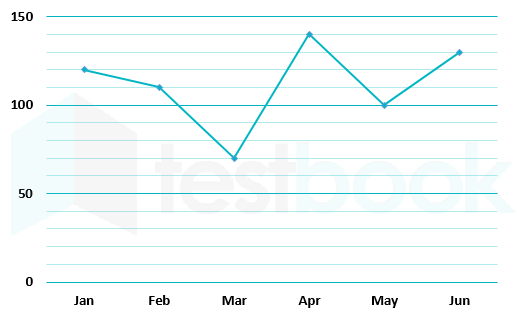
Directions: The following line graph shows the number of projects completed in six different months by a company.

Question 40

Based on Passage: View directions & passage

The total number of projects completed in January is approximately what percentage more/less than the total number of projects completed in March?

  1. AOption (a)

    68%

  2. BOption (b)

    77%

  3. COption (c)

    76%

  4. DOption (d)

    71%

  5. EOption (e)

    73%

View answer & explanation

Correct answer

Answer: (d)D.

71%

Why this answer is correct

Solution:

Number of projects completed in January = 120

Number of projects completed in March = 70

Required percentage = 120/70 ×  100 = (171.14 - 100) ~ 71%

∴ The total number of projects completed in January is approximately 71% more than the total number of projects completed in March.

Question 41

Based on Passage: View directions & passage

If the total number of projects completed by company B in February is 50% more than that of company A (consider the above diagram for company A) in January and the sum of the total number of projects completed by company B in February and March is 255, then find the difference between the total number of projects completed by company B in February and March.

  1. AOption (a)

    135

  2. BOption (b)

    125

  3. COption (c)

    105

  4. DOption (d)

    110

  5. EOption (e)

    115

View answer & explanation

Correct answer

Answer: (c)C.

105

Why this answer is correct

Solution:

Number of projects completed by company A in January = 120

Number of projects completed by company B in February = 120 ×  150/100 = 180

Number of projects completed by company B in March = 255 - 180 = 75

Required difference = (180 - 75) = 105

Question 42

Based on Passage: View directions & passage

Find the ratio of the total number of projects completed in May to the total number of projects completed in January and June together.

  1. AOption (a)

    3: 7

  2. BOption (b)

    2: 3

  3. COption (c)

    4: 5

  4. DOption (d)

    2: 5

  5. EOption (e)

    3: 5

View answer & explanation

Correct answer

Answer: (d)D.

2: 5

Why this answer is correct

Solution:

Number of projects completed in May = 100

Number of projects completed in January and June = (120 + 130) = 250 

Required ratio = 100: 250 = 2: 5

Question 43

Based on Passage: View directions & passage

If the average number of projects completed in January, May and December is 115, then the total number of projects completed in February is what percentage of the total number of projects completed in December?

  1. AOption (a)

    82%

  2. BOption (b)

    84%

  3. COption (c)

    88%

  4. DOption (d)

    92%

  5. EOption (e)

    86%

View answer & explanation

Correct answer

Answer: (c)C.

88%

Why this answer is correct

Solution:

Number of projects completed in May = 100

Number of projects completed in January = 120

Number of projects completed in December = 115 ×  3 - (100 + 120) = 125

Number of projects completed in February = 110

Required percentage = 110/125 ×  100 = 88%

Question 44

Based on Passage: View directions & passage

If the total number of projects completed in August is twice the difference between the total number of projects completed in March and June, and the ratio of the total number of projects completed in April to July is 7: 5, then find the sum of the total number of projects completed in July and August.

  1. AOption (a)

    265

  2. BOption (b)

    350

  3. COption (c)

    220

  4. DOption (d)

    240

  5. EOption (e)

    250

View answer & explanation

Correct answer

Answer: (c)C.

220

Why this answer is correct

Solution:

Number of projects completed in March = 70

Number of projects completed in June = 130

Total number of projects completed in August = 2 ×  (130 - 70) = 120

Number of projects completed in April = 140

Number of projects completed in July = 140/7 ×  5 = 100

Required sum = (120 + 100) = 220

Question 45

If the principal of ₹ 10,000 amounts to ₹ 19,600 with 40% p.a. rate of interest compounded annually. Calculate the time for which it was invested.

  1. AOption (a)

    10 years

  2. BOption (b)

    5 years

  3. COption (c)

    2 years

  4. DOption (d)

    4 years

  5. EOption (e)

    3 years

View answer & explanation

Correct answer

Answer: (c)C.

2 years

Why this answer is correct

Shortcut Trick

Ratio of Amount (A) to Principal (P) is 19600 : 10000 = 196 : 100.

Rate is 40%, so the Multiplier is (1 + 40/100) = 1.4 or 14/10.

Check the power: (14/10)2 = 196/100.

Since the power is 2, the Time Period is 2 years.

∴ The correct answer is 2 years.

Alternate Method

Given: Principal (P) = ₹ 10,000, Amount (A) = ₹ 19,600, Rate (R) = 40% p.a.

Formula Used: A = P(1 + R/100)n

⇒ 19600 = 10000(1 + 40/100)n

⇒ 19600 / 10000 = (140 / 100)n

⇒ 196 / 100 = (1.4)n

⇒ (1.4)2 = (1.4)n

⇒ n = 2

∴ The correct answer is 2 years.

Additional Information

Compound Interest (CI) Formula

Interest is calculated on the initial principal and also on the accumulated interest of previous periods: CI = A − P.

Half-yearly Compounding

If interest is compounded half-yearly, the rate is halved (R/2) and the time is doubled (2n) in the formula.

Rule of 72

A quick way to estimate the time required to double an investment: Time ≈ 72 ÷ Interest Rate.

Question 46

Ramesh purchased a land for Rs. 45000 and sold (3/5) part at a loss of 5%. How much per cent of profit should be sold the remaining part so that he made 15% profit on the whole?

  1. AOption (a)

    45%

  2. BOption (b)

    35%

  3. COption (c)

    50%

  4. DOption (d)

    55%

  5. EOption (e)

    40%

View answer & explanation

Correct answer

Answer: (a)A.

45%

Why this answer is correct

Shortcut Trick

Use the weighted average method based on parts of the land.

Let the total parts be 5. Loss is taken as negative and profit as positive.

Total Profit = (Part 1 × P/L%) + (Part 2 × P/L%)

15% × 5 = (3 × −5%) + (2 × x%)

75 = −15 + 2x ⇒ 2x = 90 ⇒ x = 45%.

∴ The correct answer is 45%.

Alternate Method

Given: Total CP = Rs. 45,000, Loss on 3/5 part = 5%, Total Profit required = 15%.

Formulas: SP = CP × (100 ± P/L)% / 100 | Profit = SP − CP.

⇒ Total required SP = 45000 × (115/100) = Rs. 51,750.

⇒ CP of 3/5 part = 45000 × (3/5) = Rs. 27,000.

⇒ SP of 3/5 part (at 5% loss) = 27000 × (95/100) = Rs. 25,650.

⇒ Required SP for remaining part = 51750 − 25650 = Rs. 26,100.

⇒ CP of remaining 2/5 part = 45000 × (2/5) = Rs. 18,000.

⇒ Profit on remaining part = 26100 − 18000 = Rs. 8,100.

⇒ Profit % = (8100 / 18000) × 100 = 45%.

∴ The correct answer is 45%.

Additional Information

Weighted Average in Profit & Loss

When different portions of a single quantity are sold at different profit/loss percentages, the overall profit/loss percentage is the weighted average of individual percentages.

Independent of Actual Value

If the question asks for the percentage profit or loss, the actual price (like Rs. 45000) does not affect the final result; only the ratio of parts matters.

Question 47

What will come in the place of the question mark ‘?’ in the following question?

214+316−128=?;+11122\frac{1}{4} + 3\frac{1}{6} - 1\frac{2}{8} = ?; + 1\frac{1}{{12}}

  1. AOption (a)

    43124{3 \over 12}

  2. BOption (b)

    34243{4 \over 24}

  3. COption (c)

    31123{1 \over 12}

  4. DOption (d)

    35123{5 \over 12}

  5. EOption (e)

    34123{4 \over 12}

View answer & explanation

Correct answer

Answer: (c)C.

31123{1 \over 12}

Why this answer is correct

Calculation:

Given expression is-

214+316−128=?;+11122\frac{1}{4} + 3\frac{1}{6} - 1\frac{2}{8} = ?; + 1\frac{1}{{12}}

First convert mixed fraction into proper fraction

(9/4) + (19/6) – (10/8) = ? + (13/12)

⇒ ? = 9/4 + 19/6 – 10/8 – 13/12

⇒ ? = (54 + 76 – 30 – 26)/24

⇒ ? = 74/24 = 37/12 = 31123{1 \over 12}

 214+316−128=?;+11122\frac{1}{4} + 3\frac{1}{6} - 1\frac{2}{8} = ?; + 1\frac{1}{{12}}

⇒ (2 + 3 - 1 - 1) + (1/4 + 1/6 - 2/8 - 1/12)

⇒ 3 + (1/12)

⇒ 31123{1 \over 12}

Question 48

What will come in the place of the question mark ‘?’ in the following question?

116+18+258−323=?1{1\over6} + {1\over8} + {2{5\over8}} - {3{2\over3}} = ?

  1. AOption (a)

    1/5

  2. BOption (b)

    2/3

  3. COption (c)

    1/6

  4. DOption (d)

    1/4

  5. EOption (e)

    1/2

View answer & explanation

Correct answer

Answer: (d)D.

1/4

Why this answer is correct

Given:

116+18+258−323=?1{1\over6} + {1\over8} + {2{5\over8}} - {3{2\over3}} = ?

Concept Used:

Calculation:

116+18+258−323=?1{1\over6} + {1\over8} + {2{5\over8}} - {3{2\over3}} = ?

⇒ 1 + 2 - 3 + [(1/6) + (1/8) + (5/8) - (2/3)] = ?

⇒ (1/6) + (1/8) + (5/8) - (2/3) = ?

⇒ (6/8) - (1/2) = ?

⇒ ? = 1/4

∴ The value of (?) is 1/4.

Question 49

What will come in place of question mark (?) in the following question?

58 + (222 ÷ 3) ÷ 37 + 22 = ?2

  1. AOption (a)

    9

  2. BOption (b)

    4

  3. COption (c)

    8

  4. DOption (d)

    6

  5. EOption (e)

    7

View answer & explanation

Correct answer

Answer: (c)C.

8

Why this answer is correct

Concept Used:

Calculation:

⇒58 + (222 ÷ 3) ÷ 37 + 22 = ?2

⇒ 58 + 74/37 + 4 = ?2 

⇒ 58 + 2 + 4 = ?2

⇒ 64 = ?2

⇒ 8 = ?

Question 50

What will come in the place of the question mark ‘?’ in the following question?

250 ÷ 5 × 2/350 + 26/7 = ?

  1. AOption (a)

    5

  2. BOption (b)

    6

  3. COption (c)

    7

  4. DOption (d)

    4

  5. EOption (e)

    none of these

View answer & explanation

Correct answer

Answer: (d)D.

4

Why this answer is correct

Concept:

Calculation:

⇒ 250 ÷ 5 × 2/350 + 26/7 = ?

⇒ 50 × (2/350) + 26/7 = ?

⇒ 2/7 + 26/7 = ?

⇒ 28/7 = ?

⇒ ? = 4

∴ The required result will be 4.

Question 51

What will come in the place of the question mark ‘?’ in the following question?

115% of 4880 – 85% of 1640 = ?

  1. AOption (a)

    4218

  2. BOption (b)

    4368

  3. COption (c)

    4448

  4. DOption (d)

    46228

  5. EOption (e)

    None of these

View answer & explanation

Correct answer

Answer: (a)A.

4218

Why this answer is correct

Calculations:

115% of 4880 – 85% of 1640 = ?

⇒ (115/100) × 4880 – (85/100) × 1640 = ? 

⇒ 5612 – 1394 = ?

⇒ ? = 4218

∴ The value of ? is 4218

Question 52

What will come in the place of the question mark ‘?’ in the following question?

?% of 590 + 36% of 170 = 150

  1. AOption (a)

    14.6

  2. BOption (b)

    16.4

  3. COption (c)

    17.8

  4. DOption (d)

    15.05

  5. EOption (e)

    None of these

View answer & explanation

Correct answer

Answer: (d)D.

15.05

Why this answer is correct

Calculations:

?% of 590 + 36% of 170 = 150 

⇒ (?/100) × 590 + (36/100) × 170 = 150 

⇒ (59 × ?)/10 + 612/10 = 150 

⇒ 59 × ? + 612 = 1500 

⇒ 59 × ? = 888

⇒ ? = 15.05

∴ The value of ? is 15.05

Question 53

What will come in the place of the question mark ‘?’ in the following question?

(102 - 68) + 46 = ? × 10

  1. AOption (a)

    6

  2. BOption (b)

    5

  3. COption (c)

    3

  4. DOption (d)

    2

  5. EOption (e)

    8

View answer & explanation

Correct answer

Answer: (e)E.

8

Why this answer is correct

Concept Used:

Follow BODMAS rule to solve this question, as per the order given below: 

Calculation:

⇒ (102 - 68) + 46 = ? × 10

⇒ 34 + 46 = ? × 10

⇒ 80/10 = ?

⇒ ? = 8

∴ The required value of "?" is 8

Question 54

What will come in place of question mark (?) in the following question?

852 - 13 × 8 - 102 × 3 - 1 = ?2

  1. AOption (a)

    21

  2. BOption (b)

    23

  3. COption (c)

    24

  4. DOption (d)

    20

  5. EOption (e)

    19

View answer & explanation

Correct answer

Answer: (a)A.

21

Why this answer is correct

Concept Used:

Calculation:

⇒ 852 - 13 × 8 - 102 × 3 - 1 = ?2 

⇒ 852 - 104 - 306 -1 = ?2

⇒ 441 = ?2

⇒ 21 = ?

Question 55

What will come in the place of the question mark ‘?’ in the following question?

60 - 38 ÷ 19 × 26 = ?

  1. AOption (a)

    8

  2. BOption (b)

    6

  3. COption (c)

    5

  4. DOption (d)

    4

  5. EOption (e)

    9

View answer & explanation

Correct answer

Answer: (a)A.

8

Why this answer is correct

Concept Used:

Follow BODMAS rule to solve this question, as per the order given below:

Calculation:

⇒ 60 - 38 ÷ 19 × 26 = ?

⇒ 60 - 2 × 26 = ?

⇒ 60 - 52 = ?

⇒ ? = 8

∴ The required value of "?" is 8

Question 56

What will come in the place of the question mark ‘?’ in the following question?

163 + 7 × 11 - 9 = ?  × 11

  1. AOption (a)

    11

  2. BOption (b)

    21

  3. COption (c)

    35

  4. DOption (d)

    25

  5. EOption (e)

    43

View answer & explanation

Correct answer

Answer: (b)B.

21

Why this answer is correct

Concept Used:

Follow BODMAS rule to solve this question, as per the order given below:

Calculation:

⇒ 163 + 7 × 11 - 9 = ?  × 11

⇒ 163 + 77 - 9 = ? × 11

⇒ 240 - 9 = ? × 11

⇒ 231/11 = ?

⇒ ? = 21

∴ The required value of "?" is 21

Question 57

What will come in place of question mark (?) in the following question?

312 - 928 - 52 = 2 × ? ÷ 11

  1. AOption (a)

    22

  2. BOption (b)

    34

  3. COption (c)

    45

  4. DOption (d)

    44

  5. EOption (e)

    76

View answer & explanation

Correct answer

Answer: (d)D.

44

Why this answer is correct

Concept Used:

Calculation:

312 - 928 - 52 = 2 × ? ÷ 11

⇒ 961 - 928 - 25 = 2 × ? /11

⇒ 33-25 = 2 × ? /11

⇒ 8 × 11 / 2 = ?

⇒ ? = 44

Question 58

What will come in the place of the question mark ‘?’ in the following question?

 39% of 700 + 12 = 5 × ?

  1. AOption (a)

    43

  2. BOption (b)

    57

  3. COption (c)

    54

  4. DOption (d)

    55

  5. EOption (e)

    66

View answer & explanation

Correct answer

Answer: (b)B.

57

Why this answer is correct

Concept Used:

Follow BODMAS rule to solve this question, as per the order given below: 

Calculation:

⇒ 39% of 700 + 12 = 5 × ?

⇒ (39/100) × 700 + 12 = 5 × ?

⇒ 39 × 7 + 12 = 5 × ?

⇒ 273 + 12 = 5 × ?

⇒ ? = 285/5

⇒ ? = 57

∴ The required value of "?" is 57

Question 59

What will come in place of the question mark (?) in the following question?

√676 × √576 – ? × 18 = 300

  1. AOption (a)

    14

  2. BOption (b)

    16

  3. COption (c)

    18

  4. DOption (d)

    20

  5. EOption (e)

    22

View answer & explanation

Correct answer

Answer: (c)C.

18

Why this answer is correct

Given

√676 × √576 – ? × 18 = 300

⇒ 26 × 24 - ? × 18 = 300

⇒ 624 - ? × 18 = 300

⇒ ? × 18 = 324

∴  ? = 18.

Question 60

What will come in place of the question mark (?) in the following question?

24 + √81 ÷ 3 × ? = 30

  1. AOption (a)

    1

  2. BOption (b)

    2

  3. COption (c)

    3

  4. DOption (d)

    4

  5. EOption (e)

    5

View answer & explanation

Correct answer

Answer: (b)B.

2

Why this answer is correct

Given

24 + √81 ÷ 3 × ? = 30

⇒ 9 ÷ 3 × ? = 6

⇒ 3 × ? = 6

∴ ? = 2.

Question 61

What will come in place of question mark (?) in the following question?

4 × (?/100) × 210 + 225 = 351

  1. AOption (a)

    15

  2. BOption (b)

    21

  3. COption (c)

    25

  4. DOption (d)

    12

  5. EOption (e)

    18

View answer & explanation

Correct answer

Answer: (a)A.

15

Why this answer is correct

Given

4 × (?/100) × 210 + 225 = 351

⇒ 4 × (?/100) × 210 = 126

⇒ ? = (126 × 100)/(4 × 210) 

∴ ? = 15.

Question 62

Two trains cross each other in 16 seconds coming from opposite directions. If the sum of their speeds is 25 m/s and train B is 60 m shorter than train A, then find the length of train A.

  1. AOption (a)

    235 m

  2. BOption (b)

    240 m

  3. COption (c)

    250 m

  4. DOption (d)

    230 m

  5. EOption (e)

    210 m

View answer & explanation

Correct answer

Answer: (d)D.

230 m

Why this answer is correct

Shortcut Trick

Total distance (Sum of lengths) = Relative Speed × Time

LA + LB = 25 × 16 = 400 m

Since LA − LB = 60 m, then LA = (Sum + Difference) ÷ 2

LA = (400 + 60) ÷ 2 = 230 m

∴ The correct answer is 230 m.

Alternate Method

Given:

Sum of speeds (Relative Speed) = 25 m/s

Time to cross = 16 s

Difference in lengths (LA − LB) = 60 m

Formula Used:

Distance = Speed × Time

Calculations:

⇒ Total Distance = Length of Train A (LA) + Length of Train B (LB)

⇒ LA + LB = 25 × 16

⇒ LA + LB = 400 m --- (Equation 1)

⇒ Given: LA − LB = 60 m --- (Equation 2)

⇒ Adding Eq 1 and Eq 2: 2 × LA = 400 + 60

⇒ 2 × LA = 460

⇒ LA = 230 m

∴ The correct answer is 230 m.

Additional Information

Relative Speed Concept

When two objects move in opposite directions, their relative speed is the sum of their individual speeds (S1 + S2). If they move in the same direction, it is the difference (S1 − S2).

Crossing Rule

When two trains cross each other, the total distance covered is always the sum of their lengths (L1 + L2), regardless of direction.

Unit Conversion

To convert km/hr to m/s, multiply by 5/18. To convert m/s to km/hr, multiply by 18/5.

Question 63

If each side of a wooden job which is rectangular in shape is increased by 40%, then the percentage increase in the area of a rectangle wooden job is:

  1. AOption (a)

    70% 

  2. BOption (b)

    65% 

  3. COption (c)

    80% 

  4. DOption (d)

    96% 

  5. EOption (e)

    None of these 

View answer & explanation

Correct answer

Answer: (d)D.

96% 

Why this answer is correct

Shortcut Trick

Apply the successive percentage change formula: Net % change = x + y + (x × y) ÷ 100

Here, both length and breadth increase by 40%, so x = 40 and y = 40.

Net % increase = 40 + 40 + (40 × 40) ÷ 100

Net % increase = 80 + 1600 ÷ 100 = 80 + 16 = 96%.

∴ The correct answer is 96%.

Alternate Method

Given: Increase in each side of the rectangular wooden job = 40%.

Formula Used: Area of Rectangle = Length × Breadth.

⇒ Let original Length (L) = 10 and Breadth (B) = 10.

⇒ Original Area = 10 × 10 = 100 units2.

⇒ New Length = 10 + 40% of 10 = 14.

⇒ New Breadth = 10 + 40% of 10 = 14.

⇒ New Area = 14 × 14 = 196 units2.

⇒ Percentage increase in area = [(196 − 100) ÷ 100] × 100 = 96%.

∴ The correct answer is 96%.

Additional Information

Successive Percentage Change

When a value is changed by x% and then y%, the net change is given by [x + y + (xy/100)]%.

Area of 2D Figures

For any 2D shape where dimensions are increased by k%, the area increases by [2k + (k2/100)]%.

Fraction Method

40% increase means the multiplier is 1.4. For area (two dimensions), the multiplier becomes 1.4 × 1.4 = 1.96, indicating a 96% increase.

Question 64

If A can fill 2/3 of a tank in 6 hours while B can fill 4/9th of the tank in 8 hours, find the time to fill 1/3 of the tank when both A and B work. (in hours).

  1. AOption (a)

    1

  2. BOption (b)

    1.5

  3. COption (c)

    2

  4. DOption (d)

    2.5

  5. EOption (e)

    None of the above/More than one of the above

View answer & explanation

Correct answer

Answer: (c)C.

2

Why this answer is correct

Shortcut Trick

Time taken by A to fill the full tank = 6 × (3/2) = 9 hours.

Time taken by B to fill the full tank = 8 × (9/4) = 18 hours.

Combined efficiency of A and B on total work of 18 units is 2 + 1 = 3 units/hour.

Time to fill 1/3 of the tank = (18 ÷ 3) × 3 = 6 ÷ 3 = 2 hours.

∴ The correct answer is 2 hours.

Alternate Method

Given:

Time taken by A to fill 2/3 of the tank = 6 hours

Time taken by B to fill 4/9 of the tank = 8 hours

Formula Used:

Total work = Efficiency × Time

Calculations:

⇒ Time taken by A to fill the complete tank = 6 × (3 ÷ 2) = 9 hours

⇒ Time taken by B to fill the complete tank = 8 × (9 ÷ 4) = 18 hours

PersonDaysTotal WorkEfficiency
A9 hours18 units2 units/hour
B18 hours1 unit/hour

⇒ Combined efficiency of A and B = 2 + 1 = 3 units/hour

⇒ Work to be completed = 1/3 of total work = 18 ÷ 3 = 6 units

⇒ Time required for A and B together = 6 ÷ 3 = 2 hours

∴ The correct answer is 2 hours.

Additional Information

Pipes and Cisterns Concept

Inflow pipes have positive efficiency, whereas outflow or leak pipes have negative efficiency. The net work done is the sum of their individual efficiencies.

Work-Time Relation

If a person completes a fraction 1/x of work in y days, then the total time required to complete the entire work is x × y days.

Question 65

There are two vessels- A and B containing milk and water in the ratio 8 : 7 and 4 : 5 respectively. In what ratio should they be mixed so that the ratio of milk and water in the resultant solution is 1 : 1?

  1. AOption (a)

    3 : 5

  2. BOption (b)

    4 : 3

  3. COption (c)

    5 : 3

  4. DOption (d)

    2 ; 1

  5. EOption (e)

    1 : 1

View answer & explanation

Correct answer

Answer: (c)C.

5 : 3

Why this answer is correct

Shortcut Trick

Apply Alligation on the fraction of milk in each vessel.

Vessel A milk fraction = 8/15 | Vessel B milk fraction = 4/9 | Resultant milk fraction = 1/2.

Common denominator for 15, 9, 2 is 90. Fractions become: 48/90, 40/90, 45/90.

Ratio = (45/90 − 40/90) : (48/90 − 45/90) = 5/90 : 3/90 = 5 : 3.

∴ The correct answer is 5 : 3.

Alternate Method

Given: Ratio in A = 8:7, Ratio in B = 4:5, Target Ratio = 1:1.

Formula: Quantity A / Quantity B = (m2 − m) / (m − m1)

⇒ Milk in A = 8/(8+7) = 8/15

⇒ Milk in B = 4/(4+5) = 4/9

⇒ Milk in mixture = 1/(1+1) = 1/2

⇒ Ratio = (1/2 − 4/9) : (8/15 − 1/2)

⇒ Ratio = (9 − 8)/18 : (16 − 15)/30

⇒ Ratio = 1/18 : 1/30 = 30 : 18 = 5 : 3

∴ The correct answer is 5 : 3.

Additional Information

Rule of Alligation

It is used to find the ratio in which two ingredients at given prices/concentrations must be mixed to produce a mixture at a mean price/concentration.

Mixture Concentration

When mixing liquids, focus on one component (either milk or water) consistently across all parts of the calculation to ensure accuracy.

Reasoning Ability (35 questions)

Direction: Study the following information carefully and answer the questions given below:

Eight persons A, B, C, D, E, F, G, and H are sitting around a square table in such a way that four of them sit at four corners facing toward the center, and the other four sit at the middle of the sides facing outside.

G does not sit at the corner. D sits second to the left of A who sits third left of G. C sits third to the left of B who is not a neighbour of G. Only two persons sit between F and H who sits opposite to E.

Question 66

Based on Passage: View directions & passage

Who among the following person sits second to the right of E?

  1. AOption (a)

    G

  2. BOption (b)

    B

  3. COption (c)

    A

  4. DOption (d)

    C

  5. EOption (e)

    Cannot be determined

View answer & explanation

Correct answer

Answer: (b)B.

B

Why this answer is correct

Given:

Eight persons - A, B, C, D, E, F, G, and H

Four of them sit at four corners facing toward the center.

Four sit at the middle of the sides facing outside.

Now,

1) G does not sit at the corner. 

  1. D sits second to the left of A who sits third left of G.

3) C sits third to the left of B who is not a neighbour of G.

The possibilities are -

  1. Only two persons sit between F and H who sits opposite to E. This is not possible in Case II and Case III.

Thus, the final arrangement is -

B sits second to the right of E.

The correct answer is B.

Question 67

Based on Passage: View directions & passage

How many persons sit between F and A when counted from the right of F?

  1. AOption (a)

    Two

  2. BOption (b)

    One

  3. COption (c)

    Three

  4. DOption (d)

    Five

  5. EOption (e)

    Four

View answer & explanation

Correct answer

Answer: (d)D.

Five

Why this answer is correct

Given:

Eight persons - A, B, C, D, E, F, G, and H

Four of them sit at four corners facing toward the center.

Four sit at the middle of the sides facing outside.

Now,

1) G does not sit at the corner. 

2) D sits second to the left of A who sits third left of G.

3) C sits third to the left of B who is not a neighbour of G.

The possibilities are -

  1. Only two persons sit between F and H who sits opposite to E. This is not possible in Case II and Case III.

Thus, the final arrangement is -

Five persons sit between F and A when counted from the right of F.

The correct answer is Five.

Question 68

Based on Passage: View directions & passage

Who among the following person faces C?

  1. AOption (a)

    A

  2. BOption (b)

    D

  3. COption (c)

    F

  4. DOption (d)

    G

  5. EOption (e)

    None of these

View answer & explanation

Correct answer

Answer: (a)A.

A

Why this answer is correct

Given:

Eight persons - A, B, C, D, E, F, G, and H

Four of them sit at four corners facing toward the center.

Four sit at the middle of the sides facing outside.

Now,

1) G does not sit at the corner. 

2) D sits second to the left of A who sits third left of G.

3) C sits third to the left of B who is not a neighbour of G.

The possibilities are -

  1. Only two persons sit between F and H who sits opposite to E. This is not possible in Case II and Case III.

Thus, the final arrangement is -

A faces C.

The correct answer is A.

Question 69

Based on Passage: View directions & passage

What is the position of D with respect to B?

  1. AOption (a)

    Fourth to the right

  2. BOption (b)

    Third to the right

  3. COption (c)

    Fourth to the left

  4. DOption (d)

    Third to the left

  5. EOption (e)

    None of these

View answer & explanation

Correct answer

Answer: (b)B.

Third to the right

Why this answer is correct

Given:

Eight persons - A, B, C, D, E, F, G, and H

Four of them sit at four corners facing toward the center.

Four sit at the middle of the sides facing outside.

Now,

1) G does not sit at the corner. 

2) D sits second to the left of A who sits third left of G.

3) C sits third to the left of B who is not a neighbour of G.

The possibilities are -

  1. Only two persons sit between F and H who sits opposite to E. This is not possible in Case II and Case III.

Thus, the final arrangement is -

D is third to the right of B.

The correct answer is D.

Question 70

Based on Passage: View directions & passage

Find the odd one out:

  1. AOption (a)

    A

  2. BOption (b)

    C

  3. COption (c)

    E

  4. DOption (d)

    D

  5. EOption (e)

    F

View answer & explanation

Correct answer

Answer: (c)C.

E

Why this answer is correct

Given:

Eight persons - A, B, C, D, E, F, G, and H

Four of them sit at four corners facing toward the center.

Four sit at the middle of the sides facing outside.

Now,

1) G does not sit at the corner. 

2) D sits second to the left of A who sits third left of G.

3) C sits third to the left of B who is not a neighbour of G.

The possibilities are -

  1. Only two persons sit between F and H who sits opposite to E. This is not possible in Case II and Case III.

Thus, the final arrangement is -

Except E, all are sitting at the corners.

The correct answer is E.

Directions: Study the following information carefully and answer the questions that follow.

In a family, there are eight persons. T is the sister of D. D is married to P, who is son of M. T is mother of J. Y is the father of U. Y has only one son and one daughter. U is the daughter of T. Q is son of D. M is a male.

Question 71

Based on Passage: View directions & passage

How is D related to M?

  1. AOption (a)

    Daughter-in-law

  2. BOption (b)

    Grand-daughter

  3. COption (c)

    Mother

  4. DOption (d)

    Sister-in-law

  5. EOption (e)

    None of these

View answer & explanation

Correct answer

Answer: (a)A.

Daughter-in-law

Why this answer is correct

The family tree diagram will be

  1. T is the sister of D.

  2. D is married to P, who is son of M

  3. Q is son of D.

  4. U is the daughter of T

  5. T is mother of J.

  6. Y is the father of U → Y and T form a couple

  7. Y has only one son and one daughter → J is son of Y and T

So, the final arrangement will be

Hence, D is the daughter-in-law of M.

Question 72

Based on Passage: View directions & passage

How is J related to Y?

  1. AOption (a)

    Son

  2. BOption (b)

    Father

  3. COption (c)

    Uncle

  4. DOption (d)

    Nephew

  5. EOption (e)

    None of these

View answer & explanation

Correct answer

Answer: (a)A.

Son

Why this answer is correct

The family tree diagram will be

​

1) T is the sister of D.

  1. D is married to P, who is son of M

  2. Q is son of D.

  3. U is the daughter of T

  4. T is mother of J.

  5. Y is the father of U → Y and T form a couple

  6. Y has only one son and one daughter → J is son of Y and T

So, the final arrangement will be

Hence, J is son of Y.

Question 73

Based on Passage: View directions & passage

How is U related to D?

  1. AOption (a)

    Niece

  2. BOption (b)

    Aunt

  3. COption (c)

    Mother

  4. DOption (d)

    Sister

  5. EOption (e)

    None of these

View answer & explanation

Correct answer

Answer: (a)A.

Niece

Why this answer is correct

The family tree diagram will be

​

  1. T is the sister of D.

  2. D is married to P, who is son of M

  3. Q is son of D.

  4. U is the daughter of T

  5. T is mother of J.

  6. Y is the father of U → Y and T form a couple

  7. Y has only one son and one daughter → J is son of Y and T

So, the final arrangement will be

Hence, U is niece of D.

Question 74

How many such pairs of letters are there in the word "HABITABLE" which has as many letters between them as in the English alphabetical order (both forward and backward)?

  1. AOption (a)

    Three

  2. BOption (b)

    One

  3. COption (c)

    Two

  4. DOption (d)

    Four

  5. EOption (e)

    None of these

View answer & explanation

Correct answer

Answer: (a)A.

Three

Why this answer is correct

Given word: HABITABLE

The given word can be represented as follows,


Hence, we can see that 3 such pairs are there → Forward: AB, AB; Backward: BH

So, the answer is 3 pairs.

Direction: Study the following information carefully and answer the question below. Eight boxes were kept one above the other in the form of a stack such that the box kept at the bottommost position is numbered as 1 box just above it is numbered as 2 and so on till the box at topmost position is numbered as 8.

Box A was kept two places below of box B. Only one box was kept between box C and Box B. Box D kept below box E but above box A. Box E neither kept at odd-numbered stack nor at the topmost position. At most one box was kept between box F and D. Box F kept below of box G but above box H.

Question 75

Based on Passage: View directions & passage

How many boxes were kept below box D?

  1. AOption (a)

    Two

  2. BOption (b)

    Three

  3. COption (c)

    Four

  4. DOption (d)

    Five

  5. EOption (e)

    None of these

View answer & explanation

Correct answer

Answer: (b)B.

Three

Why this answer is correct

  1. Box A was kept two places below of box B.

  2. Only one box was kept between B and C.

Case 1Case 2Case 3Case 4
Box 8C
Box 7C
Box 6BC
Box 5BC
Box 4AB
Box 3AB
Box 2A
Box 1A


3) Box D kept below box E but above box A.

  1. Box E neither kept at odd-numbered stack nor at the topmost position. So, case 1 and case 3 get eliminated.

  2. At most one box was kept between box F and D.

Case 2Case 4
Box 8
Box 7C
Box 6EE
Box 5BC
Box 4DF/D
Box 3AB
Box 2FF/D
Box 1A


  1. Box F kept below of box G but above box H. So, case 4 gets eliminate here.
Case 2Case 4
Box 8G
Box 7C
Box 6EE
Box 5BC
Box 4DF/D
Box 3AB
Box 2FF/D
Box 1HA


So, the final arrangement:

Case 2
Box 8G
Box 7C
Box 6E
Box 5B
Box 4D
Box 3A
Box 2F
Box 1H


Hence, three boxes are kept below box D.

Question 76

Based on Passage: View directions & passage

Which among the following boxes is kept at the topmost position?

  1. AOption (a)

    G

  2. BOption (b)

    C

  3. COption (c)

    D

  4. DOption (d)

    Either G or C

  5. EOption (e)

    None of these

View answer & explanation

Correct answer

Answer: (a)A.

G

Why this answer is correct

  1. Box A was kept two places below of box B.

  2. Only one box was kept between B and C.

Case 1Case 2Case 3Case 4
Box 8C
Box 7C
Box 6BC
Box 5BC
Box 4AB
Box 3AB
Box 2A
Box 1A


3) Box D kept below box E but above box A.

  1. Box E neither kept at odd-numbered stack nor at the topmost position. So, case 1 and case 3 get eliminated.

  2. At most one box was kept between box F and D.

Case 2Case 4
Box 8
Box 7C
Box 6EE
Box 5BC
Box 4DF/D
Box 3AB
Box 2FF/D
Box 1A


  1. Box F kept below of box G but above box H. So, case 4 gets eliminate here.
Case 2Case 4
Box 8G
Box 7C
Box 6EE
Box 5BC
Box 4DF/D
Box 3AB
Box 2FF/D
Box 1HA


So, the final arrangement:

Case 2
Box 8G
Box 7C
Box 6E
Box 5B
Box 4D
Box 3A
Box 2F
Box 1H


Hence, G is at the topmost position.

Question 77

Based on Passage: View directions & passage

Box A kept _______ to the _______ of box H?

  1. AOption (a)

    3rd above

  2. BOption (b)

    4th below

  3. COption (c)

    3rd below

  4. DOption (d)

    2nd above

  5. EOption (e)

    5th above

View answer & explanation

Correct answer

Answer: (d)D.

2nd above

Why this answer is correct

  1. Box A was kept two places below of box B.

  2. Only one box was kept between B and C.

Case 1Case 2Case 3Case 4
Box 8C
Box 7C
Box 6BC
Box 5BC
Box 4AB
Box 3AB
Box 2A
Box 1A


3) Box D kept below box E but above box A.

  1. Box E neither kept at odd-numbered stack nor at the topmost position. So, case 1 and case 3 get eliminated.

  2. At most one box was kept between box F and D.

Case 2Case 4
Box 8
Box 7C
Box 6EE
Box 5BC
Box 4DF/D
Box 3AB
Box 2FF/D
Box 1A


  1. Box F kept below of box G but above box H. So, case 4 gets eliminate here.
Case 2Case 4
Box 8G
Box 7C
Box 6EE
Box 5BC
Box 4DF/D
Box 3AB
Box 2FF/D
Box 1HA


So, the final arrangement:

Case 2
Box 8G
Box 7C
Box 6E
Box 5B
Box 4D
Box 3A
Box 2F
Box 1H


Hence, Box A is kept 2nd to the above of box H.

Question 78

Based on Passage: View directions & passage

What is the position of box C with respect to box F?

  1. AOption (a)

    7th above

  2. BOption (b)

    4th below

  3. COption (c)

    5th above

  4. DOption (d)

    6th above

  5. EOption (e)

    None of these

View answer & explanation

Correct answer

Answer: (c)C.

5th above

Why this answer is correct

  1. Box A was kept two places below of box B.

  2. Only one box was kept between B and C.

Case 1Case 2Case 3Case 4
Box 8C
Box 7C
Box 6BC
Box 5BC
Box 4AB
Box 3AB
Box 2A
Box 1A


3) Box D kept below box E but above box A.

  1. Box E neither kept at odd-numbered stack nor at the topmost position. So, case 1 and case 3 get eliminated.

  2. At most one box was kept between box F and D.

Case 2Case 4
Box 8
Box 7C
Box 6EE
Box 5BC
Box 4DF/D
Box 3AB
Box 2FF/D
Box 1A


  1. Box F kept below of box G but above box H. So, case 4 gets eliminate here.
Case 2Case 4
Box 8G
Box 7C
Box 6EE
Box 5BC
Box 4DF/D
Box 3AB
Box 2FF/D
Box 1HA


So, the final arrangement:

Case 2
Box 8G
Box 7C
Box 6E
Box 5B
Box 4D
Box 3A
Box 2F
Box 1H


Hence, box C is 5th above with respect to box F.

Question 79

Based on Passage: View directions & passage

Four from the following are related in a certain way and hence form group. Find the one which doesn’t belong to that group?

  1. AOption (a)

    B

  2. BOption (b)

    E

  3. COption (c)

    D

  4. DOption (d)

    G

  5. EOption (e)

    F

View answer & explanation

Correct answer

Answer: (a)A.

B

Why this answer is correct

  1. Box A was kept two places below of box B.

  2. Only one box was kept between B and C.

Case 1Case 2Case 3Case 4
Box 8C
Box 7C
Box 6BC
Box 5BC
Box 4AB
Box 3AB
Box 2A
Box 1A


3) Box D kept below box E but above box A.

  1. Box E neither kept at odd-numbered stack nor at the topmost position. So, case 1 and case 3 get eliminated.

  2. At most one box was kept between box F and D.

Case 2Case 4
Box 8
Box 7C
Box 6EE
Box 5BC
Box 4DF/D
Box 3AB
Box 2FF/D
Box 1A


  1. Box F kept below of box G but above box H. So, case 4 gets eliminate here.
Case 2Case 4
Box 8G
Box 7C
Box 6EE
Box 5BC
Box 4DF/D
Box 3AB
Box 2FF/D
Box 1HA


So, the final arrangement:

Case 2
Box 8G
Box 7C
Box 6E
Box 5B
Box 4D
Box 3A
Box 2F
Box 1H


Hence, B is odd in the group because B is at odd box and remaining are kept at even box

Direction: The following questions are based on the given numbers. Study the information carefully and answer the questions-

992     986   867     756     886

Question 80

Based on Passage: View directions & passage

If the digits are arranged in ascending order from left to right within the numbers, then which among the following numbers will be the second lowest?

  1. AOption (a)

    992

  2. BOption (b)

    986

  3. COption (c)

    867

  4. DOption (d)

    756

  5. EOption (e)

    886

View answer & explanation

Correct answer

Answer: (d)D.

756

Why this answer is correct

If the digits are arranged in ascending order from left to right within the numbers, then we get:

992 → 299

986 → 689

867 → 678

756 → 567

886 → 688

Arranging the newly formed numbers: 299 < 567 < 678 < 688 < 689

Thus, 567 is the second-lowest among the newly formed numbers, and its original form was 756.

Hence, 756 will be the second-lowest number.

Question 81

Based on Passage: View directions & passage

If 2 is subtracted from the odd digits within the numbers, then which among the following will be the third highest number?

  1. AOption (a)

    992

  2. BOption (b)

    986

  3. COption (c)

    867

  4. DOption (d)

    756

  5. EOption (e)

    886

View answer & explanation

Correct answer

Answer: (b)B.

986

Why this answer is correct

If 2 is subtracted from the odd digits within the numbers, then we get:

992 → 772

986 → 786

867 → 865

756 → 536

886 → 886

Arranging the newly formed numbers: 536 < 772 < 786 < 865 < 886

Hence, 986 will be the third-highest number.

Question 82

Based on Passage: View directions & passage

If the digits are arranged in descending order from left to right within the numbers, then how many numbers thus formed are divisible by 2?

  1. AOption (a)

    Four

  2. BOption (b)

    Three

  3. COption (c)

    Two

  4. DOption (d)

    Five

  5. EOption (e)

    One

View answer & explanation

Correct answer

Answer: (a)A.

Four

Why this answer is correct

If the digits are arranged in descending order from left to right within the numbers, then we get:

992 → 992

986 → 986

867 → 876

756 → 765

886 → 886

Thus, 992, 876, 986, and 886 are the numbers that are divisible by 2.

Hence, four numbers thus formed are divisible by 2.

Question 83

Based on Passage: View directions & passage

If the numbers are arranged in ascending order from right to left, then which is the third digit of the number that is placed second to the left of the number which is third from the left end in the new arrangement?

  1. AOption (a)

    9

  2. BOption (b)

    6

  3. COption (c)

    2

  4. DOption (d)

    5

  5. EOption (e)

    None of the above

View answer & explanation

Correct answer

Answer: (c)C.

2

Why this answer is correct

Given Numbers   992  986  886  868  756

If the numbers are arranged in ascending order from right to left, then we get:

992 > 986 > 886 > 868 > 756

Third Number from the left 886

Second to the left of 886 is 992

Third digit of the number 992 is 2

Hence, 2 is the third digit of the number that is placed second to the left of the number which is third from the left end in the new arrangement.

Question 84

Based on Passage: View directions & passage

If the first and the second digits are interchanged within the numbers, then which among the following will be the second highest number?

  1. AOption (a)

    886

  2. BOption (b)

    756

  3. COption (c)

    867

  4. DOption (d)

    992

  5. EOption (e)

    986

View answer & explanation

Correct answer

Answer: (e)E.

986

Why this answer is correct

If the first and the second digits are interchanged within the numbers, then we get:

992 → 992

986 → 896

867 → 687

756 → 576

886 → 886

Arranging the numbers thus formed: 576 < 687 < 886 < 896 < 992

Thus, among the newly formed numbers, 896 is the second-highest whose original form was 986.

Hence, 986 will be the second-highest number.

Direction: Study the following information carefully and answer based on it.

Eight people E, F, G, H, I, J, K and L are sitting in a row such that four of them are facing north and four of them are facing south. No two people who are immediate neighbours of each other faces in the same direction. Four people sit between F and G, but none of them sits at an extreme ends. E sits third to the left of F. E is an immediate neighbour of J, who sits third from the right end. I is sitting adjacent to F. More than three people sit between L and K, who does not sit at an extreme end.

Question 85

Based on Passage: View directions & passage

Who sits at the left end of the row?

  1. AOption (a)

    L

  2. BOption (b)

    H

  3. COption (c)

    I

  4. DOption (d)

    J

  5. EOption (e)

    None of these

View answer & explanation

Correct answer

Answer: (c)C.

I

Why this answer is correct

From the given instructions: 

  1. Four people sit between F and G, but none of them sits at an extreme ends. So, here we hace two cases, 


  1. E sits third to the left of F. E is an immediate neighbour of J, who sits third from the right end. 


Here, Case 2 gets cancelled because E is not an immediate neighbour of J in Case 2. 

  1. I is sitting adjacent to F. Here, we have one more case in Case 1 as Case 1(a). 


  1. More than three people (more than three means minimum four) sit between L and K, who does not sit at an extreme end.  


Here, Case 1(a) is invalid because K cannot be at an extreme end. So, Case 1(a) gets cancelled. 

  1. No two people who are immediate neighbours of each other faces in the same direction. 

So, Final Arrangement: 


I sits at the left end of the row.

Question 86

Based on Passage: View directions & passage

How many people are sitting between K and G?

  1. AOption (a)

    One

  2. BOption (b)

    Three

  3. COption (c)

    None

  4. DOption (d)

    Two

  5. EOption (e)

    More than three

View answer & explanation

Correct answer

Answer: (b)B.

Three

Why this answer is correct

From the given instructions: 

  1. Four people sit between F and G, but none of them sits at an extreme ends. So, here we hace two cases, 


  1. E sits third to the left of F. E is an immediate neighbour of J, who sits third from the right end. 


Here, Case 2 gets cancelled because E is not an immediate neighbour of J in Case 2. 

  1. I is sitting adjacent to F. Here, we have one more case in Case 1 as Case 1(a). 


  1. More than three people (more than three means minimum four) sit between L and K, who does not sit at an extreme end.  


Here, Case 1(a) is invalid because K cannot be at an extreme end. So, Case 1(a) gets cancelled. 

  1. No two people who are immediate neighbours of each other faces in the same direction. 

So, Final Arrangement: 


Three people are sitting between K and G.

Question 87

Based on Passage: View directions & passage

Who sits second to the left of the one who is third to the left of H?

  1. AOption (a)

    E

  2. BOption (b)

    L

  3. COption (c)

    K

  4. DOption (d)

    F

  5. EOption (e)

    None of these

View answer & explanation

Correct answer

Answer: (a)A.

E

Why this answer is correct

From the given instructions: 

  1. Four people sit between F and G, but none of them sits at an extreme ends. So, here we hace two cases, 


  1. E sits third to the left of F. E is an immediate neighbour of J, who sits third from the right end. 


Here, Case 2 gets cancelled because E is not an immediate neighbour of J in Case 2. 

  1. I is sitting adjacent to F. Here, we have one more case in Case 1 as Case 1(a). 


  1. More than three people (more than three means minimum four) sit between L and K, who does not sit at an extreme end.  


Here, Case 1(a) is invalid because K cannot be at an extreme end. So, Case 1(a) gets cancelled. 

  1. No two people who are immediate neighbours of each other faces in the same direction. 

So, Final Arrangement: 


E sits second to the left of the one (G) who sits third to the left of H.

Question 88

Based on Passage: View directions & passage

Four of the following options are related to each other in some manner. Find the odd one out.

  1. AOption (a)

    I

  2. BOption (b)

    E

  3. COption (c)

    K

  4. DOption (d)

    L

  5. EOption (e)

    G

View answer & explanation

Correct answer

Answer: (d)D.

L

Why this answer is correct

From the given instructions: 

  1. Four people sit between F and G, but none of them sits at an extreme ends. So, here we hace two cases, 


  1. E sits third to the left of F. E is an immediate neighbour of J, who sits third from the right end. 


Here, Case 2 gets cancelled because E is not an immediate neighbour of J in Case 2. 

  1. I is sitting adjacent to F. Here, we have one more case in Case 1 as Case 1(a). 


  1. More than three people (more than three means minimum four) sit between L and K, who does not sit at an extreme end.  


Here, Case 1(a) is invalid because K cannot be at an extreme end. So, Case 1(a) gets cancelled. 

  1. No two people who are immediate neighbours of each other faces in the same direction. 

So, Final Arrangement: 


So, L is the odd one out.

Question 89

Based on Passage: View directions & passage

Which of the following statement/s is/are false according to the final arrangement?

I. F sits second to the right of H.

II. Two people are between L and E.

III. K sits fourth to the right of J.

  1. AOption (a)

    Only I and II

  2. BOption (b)

    Only II and III

  3. COption (c)

    Only III

  4. DOption (d)

    Only I and III

  5. EOption (e)

    Only II

View answer & explanation

Correct answer

Answer: (c)C.

Only III

Why this answer is correct

From the given instructions: 

  1. Four people sit between F and G, but none of them sits at an extreme ends. So, here we hace two cases, 


  1. E sits third to the left of F. E is an immediate neighbour of J, who sits third from the right end. 


Here, Case 2 gets cancelled because E is not an immediate neighbour of J in Case 2. 

  1. I is sitting adjacent to F. Here, we have one more case in Case 1 as Case 1(a). 


  1. More than three people (more than three means minimum four) sit between L and K, who does not sit at an extreme end.  


Here, Case 1(a) is invalid because K cannot be at an extreme end. So, Case 1(a) gets cancelled. 

  1. No two people who are immediate neighbours of each other faces in the same direction. 

So, Final Arrangement: 


Only statement III is false.

Question 90

Direction: In the question below are given three statements followed by two conclusions numbered I and II. You have to take the given statements to be true even if they seem to be at variance with commonly known facts. Read all the conclusions and then decide which of the given conclusions logically follows from the given statements disregarding the commonly known facts.

Statement:

Only a few Camels are Tables.

No Tables are Beds.

Some Beds are Camels.

Conclusion: 

I. All Beds are Tables. 

II. All Beds being Camels is a possibility.

  1. AOption (a)

    Only conclusion I follow

  2. BOption (b)

    Only conclusion II follow

  3. COption (c)

    Either conclusion I or II follows

  4. DOption (d)

    Neither conclusion I nor II follows

  5. EOption (e)

    Both conclusion I and II follow

View answer & explanation

Correct answer

Answer: (b)B.

Only conclusion II follow

Why this answer is correct

The least possible Venn diagram;

Conclusion: 

I. All Beds are Tables → False (as in the statement itself it is mentioned that No Tables are Beds There will be no relation between Bed and Tables.)

II. All Beds being Camels is a possibility → True (Bed can be enclosed inside the camels and as it is a possibility case it is possible) 

The possibility diagram is as,

Hence, only conclusion II follows.

Question 91

Direction: In the following questions two statements are given below followed by two conclusions numbered I and II. You have to take the given statements to be true even if they follow the seem to be at variance from commonly known facts. Read both the conclusions and decide which of the given conclusions logically follows the given statements.

Statements:

Only a few games are sports.

Some adventure is games.

Conclusions:

I. No adventure is a sports.

II. Some adventure is sports.

  1. AOption (a)

    Only I follows

  2. BOption (b)

    Only II follows

  3. COption (c)

    Either I or II follows

  4. DOption (d)

    Neither I nor II follows

  5. EOption (e)

    Both I and II follows

View answer & explanation

Correct answer

Answer: (c)C.

Either I or II follows

Why this answer is correct

The least possible Venn diagram for the given statements is as follows:

Conclusions:

I. No adventure is sports → False (as there is no direct relation given between adventure and sports, so no definite conclusion could be drawn)

II. Some adventure are sports → False (as there is no direct relation given between adventure and sports, so no definite conclusion could be drawn)

Both are complementary conclusions.

Hence Either I or II follows.

Key Points

Conditions for Either - Or 

  1. Subject and predicate should be the same
  2. Both the individual conclusions should be false
  3. One conclusion should be positive and one conclusion should be negative
  4. There should either one of the following pairs present in the conclusions
  • All + Some not
  • Some + No

Question 92

Directions

In the question below are given two statements followed by two conclusions I and II. You have to take the given statements to be true even if they seem to be at variance from commonly known facts. Read all the conclusions and then decide which of the given conclusions logically follows from the given statements disregarding commonly known facts.

Statement:

Only a few spectacles are transparent.

No spectacle is a sunglass.

Conclusion:

I. Some transparent are spectacles.

II. Some sunglasses are definitely not transparent.

  1. AOption (a)

    Only I follows

  2. BOption (b)

    Only II follows

  3. COption (c)

    Both follows

  4. DOption (d)

    None follows

  5. EOption (e)

    Either I or II follows

View answer & explanation

Correct answer

Answer: (a)A.

Only I follows

Why this answer is correct

The least possible Venn diagram is:


Conclusion:

I. Some transparent are spectacles → True (Only a few spectacles are transparent. It means some Spectacles are transparent and some spectacles are not transparent Hence, Some transparent are spectacles is true)

II. Some sunglasses are definitely not transparent → False (It is possible but not definite As we can see in the diagram below that some sunglass can be transparent but noting can be sure about remaining part).

Hence only conclusion I follow.

Direction: Read the given information carefully and answer the questions asked below.

A certain number of persons sit in a linear row facing towards North. Five persons are sitting between N and R. X sits fourth to the right of R and third to the left of M. Number of persons sit between N and P is equal to the number of persons sit between P and X. N sits fourth from one of the extreme ends. Number of persons sits between N and A is one more than the persons sit between A and P. Q sits seventh to the left of P. As many persons sit to the right of M is one less than the total number of persons sit to the left of Q. Total number of persons are sitting between N and X is more than four.

Question 93

Based on Passage: View directions & passage

How many persons are sitting in a row?

  1. AOption (a)

    15

  2. BOption (b)

    16

  3. COption (c)

    17

  4. DOption (d)

    10

  5. EOption (e)

    12

View answer & explanation

Correct answer

Answer: (c)C.

17

Why this answer is correct

  1. N sits fourth from one of the extreme ends.

  2. Five persons are sitting between N and R. 

  3. X sits fourth to the right of R and third to the left of M. 

4.Number of persons sit between N and P is equal to the number of persons sit between P and X.

  1. Total number of persons are sitting between N and X is more than four.

Case II eliminated because in this case number of persons are sitting between N and X is not more than 4. 

  1. Number of persons sits between N and A is one more than the persons sit between A and P. 

  2. Q sits seventh to the left of P.

8.  As many persons sit to the right of M is one less than the total number of persons sit to the left of Q. 

Hence,17 persons are sitting in a row.

Question 94

Based on Passage: View directions & passage

Who sits fourth to the left of X?

  1. AOption (a)

    R

  2. BOption (b)

    N

  3. COption (c)

    M

  4. DOption (d)

    P

  5. EOption (e)

    Q

View answer & explanation

Correct answer

Answer: (a)A.

R

Why this answer is correct

  1. N sits fourth from one of the extreme ends.

  2. Five persons are sitting between N and R. 

  3. X sits fourth to the right of R and third to the left of M. 

4.Number of persons sit between N and P is equal to the number of persons sit between P and X.

  1. Total number of persons are sitting between N and X is more than four.

Case II eliminated because in this case number of persons are sitting between N and X is not more than 4. 

  1. Number of persons sits between N and A is one more than the persons sit between A and P. 

  2. Q sits seventh to the left of P.

8.  As many persons sit to the right of M is one less than the total number of persons sit to the left of Q. 

Hence, R sits fourth to the left of X.

Question 95

Based on Passage: View directions & passage

How many persons are sitting between N and X?

  1. AOption (a)

    Six

  2. BOption (b)

    Seven

  3. COption (c)

    Eight

  4. DOption (d)

    Nine

  5. EOption (e)

    Ten

View answer & explanation

Correct answer

Answer: (d)D.

Nine

Why this answer is correct

  1. N sits fourth from one of the extreme ends.

  2. Five persons are sitting between N and R. 

  3. X sits fourth to the right of R and third to the left of M. 

4.Number of persons sit between N and P is equal to the number of persons sit between P and X.

  1. Total number of persons are sitting between N and X is more than four.

Case II eliminated because in this case number of persons are sitting between N and X is not more than 4. 

  1. Number of persons sits between N and A is one more than the persons sit between A and P. 

  2. Q sits seventh to the left of P.

8.  As many persons sit to the right of M is one less than the total number of persons sit to the left of Q. 

Hence, Nine persons are sitting between N and X.

Question 96

Based on Passage: View directions & passage

How many persons sit to the left of A?

  1. AOption (a)

    One

  2. BOption (b)

    Two

  3. COption (c)

    Three

  4. DOption (d)

    Six

  5. EOption (e)

    Five

View answer & explanation

Correct answer

Answer: (d)D.

Six

Why this answer is correct

  1. N sits fourth from one of the extreme ends.

  2. Five persons are sitting between N and R. 

  3. X sits fourth to the right of R and third to the left of M. 

4.Number of persons sit between N and P is equal to the number of persons sit between P and X.

  1. Total number of persons are sitting between N and X is more than four.

Case II eliminated because in this case number of persons are sitting between N and X is not more than 4. 

  1. Number of persons sits between N and A is one more than the persons sit between A and P. 

  2. Q sits seventh to the left of P.

8.  As many persons sit to the right of M is one less than the total number of persons sit to the left of Q. 

Hence, Six person sits to the left of A.

Question 97

Direction: In the following questions assuming the given statements to be true, find which of the conclusion(s) among the given conclusions is/ are definitely true and then give your answers accordingly.

Statement: W ≤ H ≤ N ≤ E ≤ P; P > Q ≥ B < O > I

Conclusions:

I. P > W

II. W = P

  1. AOption (a)

    Only I follow

  2. BOption (b)

    Only II follow

  3. COption (c)

    Both I and II follow

  4. DOption (d)

    Either I or II follow

  5. EOption (e)

    Neither I nor II follow

View answer & explanation

Correct answer

Answer: (d)D.

Either I or II follow

Why this answer is correct

Given statement: W ≤ H ≤ N ≤ E ≤ P; P > Q ≥ B < O > I

Conclusions:

I. P > W → False (Given W ≤ H ≤ N ≤ E ≤ P and P > Q ≥ B < O > I so by combining both statement W ≤ H ≤ N ≤ E ≤ P > Q ≥ B < O > I. Thus  P > W is false)

II. W = P → False (Given W ≤ H ≤ N ≤ E ≤ P and P > Q ≥ B < O > I so by combining both statement W ≤ H ≤ N ≤ E ≤ P > Q ≥ B < O > I. Thus W = P is false)

As P ≥ W → P > W or P = W

Hence, Either I or II follow is the correct answer.

Question 98

Direction: In the following question assuming the given statements to be true, find which of the conclusion among the given conclusion is/are definitely true, and then give your answers accordingly.

Statements: K < L < M ≥ N; M = A < X ≤ P

Conclusion:

I. K ≥ P

II. K ≥ N

  1. AOption (a)

    Only I follow

  2. BOption (b)

    Only II follow

  3. COption (c)

    Both I and II follows

  4. DOption (d)

    Either I or II follow

  5. EOption (e)

    Neither I nor II follows

View answer & explanation

Correct answer

Answer: (e)E.

Neither I nor II follows

Why this answer is correct

Given Statements: K < L < M ≥ N; M = A < X ≤ P

On combining**:** K < L < M ≥ N, K < L < M = A < X ≤ P

Conclusions:

I. K ≥ P → False (As K < L < M = A < X ≤ P → K < P. So, it is false)

II. K ≥ N → False (As K < L < M ≥ N as the signs between K and N are opposite. So it is false)

Hence, Neither I nor II follows.

Question 99

Direction: In the following question assuming the given statements to be true, find which of the conclusion among given some conclusion is/are definitely true and then give your answers accordingly.

Statements: F ≥ L ≥ M < N = P ≥ A ≥ B > C 

Conclusions:

I. F ≥ C

II. F < C

  1. AOption (a)

    Only II follows

  2. BOption (b)

    Either I or II follows

  3. COption (c)

    Neither I nor II follows

  4. DOption (d)

    Only I follows

  5. EOption (e)

    Both I and II follow

View answer & explanation

Correct answer

Answer: (b)B.

Either I or II follows

Why this answer is correct

Given statements: F ≥ L ≥ M < N = P ≥ A ≥ B > C 

Conclusions:

I. F ≥ C → False (As  F ≥ L ≥ M < N = P ≥ A ≥ B > C, there is no direct relation between F and C. So, it is false)

II. F < C → False (As  F ≥ L ≥ M < N = P ≥ A ≥ B > C, there is no direct relation between F and C. So, it is false)

Here, both conclusions I and II forms a complementary pair as both have the same element and all the three symbols (<, =, >) are present between F and C.

Hence, Either I or II follows.

Question 100

If it is possible to make a meaningful word with the 1st, 4th, 7th and 8th letter of the word FESTIVAL, which of the following will be the third letter of that word, if more than one such word can be formed, give 'X' as the answer and if no such word can be formed, give 'Y' as the answer?

  1. AOption (a)

    F

  2. BOption (b)

    E

  3. COption (c)

    A

  4. DOption (d)

    Y

  5. EOption (e)

    X

View answer & explanation

Correct answer

Answer: (c)C.

A

Why this answer is correct

The 1st, 4th, 7th and 8th letter of FESTIVAL are F, T, A, L

The meaningful words that can be made from the given letters is FLAT

Third letter from the word is A.

100 questions in the full paper