Previous Year Paper

SBI Clerk Prelims Memory Based Paper (Held On: 6 January 2024 Shift 2) (Previous Year Paper)

Held in 2024

100 questions60 minutes
With answers
Free

Paper last updated:

Practise under exam conditions

Take this paper as a timed mock test. Review your answers after you submit.

Attempt timed test

Questions & answers

Read the paper at your pace. Open an explanation when you need it.

English Language (30 questions)

Directions: Read the given passage carefully to answer the following questions. Each question will have five alternatives as its answer. Choose the correct option as your answer.

An audacious collaboration between geneticists and conservationists plans to bring back the extinct dodo and reintroduce it to its once-native habitat in Mauritius.

US-based biotechnology and genetic engineering company Colossal Biosciences, which is pursuing the “de-extinction” of multiple species, including the woolly mammoth, has entered a partnership _____ the Mauritian Wildlife Foundation to find a suitable location for the large flightless birds.

The dodo has been extinct since 1681; a combination of predation by humans and animals introduced by humans led to its downfall, turning it into a textbook case for extinction. But according to the partners, its return to Mauritius could benefit the dodo’s immediate environment and other species.

Colossal first announced its intention to resurrect the dodo in January 2023. Exactly when it will be able to do so remains unclear, but fresh details regarding how it plans to recreate the species have been revealed.

The full genome of the dodo has been sequenced by Beth Shapiro, lead paleogeneticist at Colossal. In addition, the company says it has now sequenced the genome of the solitaire, an extinct relative of the dodo from Rodrigues Island, close to Mauritius, and the Nicobar pigeon, the dodo’s closest living relative, which resides on islands in Southeast Asia spanning the Indian and Pacific Oceans.

Geneticists at Colossal have found cells that act as a precursor for ovaries or testes in the Nicobar pigeon can grow successfully in a chicken embryo. They are now researching to see if these cells (called primordial germ cells, or PGCs) can turn into sperm and eggs.

This is a vital step in creating hybridized animals through reproduction. Scientists have previously introduced PGCs to create a chicken fathered by a duck – for which a duck embryo was injected with chicken PGCs, producing an adult duck with the sperm of a rooster. It then bred with a hen, which gave birth to a chick.

Colossal plans to go down a similar route. First, it will compare the dodo and solitaire genomes to the Nicobar pigeon’s to identify how they differ. Then it will edit the PGCs of a Nicobar so it expresses the physical traits of a dodo.

The edited PGCs will then be inserted into the embryos of a sterile chicken and rooster. With the introduction of the edited PGCs, the chicken and rooster will be capable of reproducing, and, in theory, their offspring will resemble the dodo thanks to the hybridized pigeon DNA in their reproductive systems.

“Physically, the restored dodo will be indiscernible from what we know of the dodo’s appearance,” said Matt James, Colossal’s chief animal officer, in an email.

James described the project as “an amazing engine of innovation for avian genetics, genomics, and cell biology,” in part because “most of the technologies that we use for cloning in mammals does not exist in birds today.” However, he declined to put a timeline on when the first embryo will be created.


Question 1

Based on Passage: View directions & passage

Which of the following words is similar in meaning to "audacious" in the context of the passage?

  1. AOption (a)

    Cautious

  2. BOption (b)

    Cowardly

  3. COption (c)

    Timid

  4. DOption (d)

    Bold

  5. EOption (e)

    Reserved

View answer & explanation

Correct answer

Answer: (d)D.

Bold

Why this answer is correct

The correct answer is option 4.

Key Points

  • The word 'audacious' in the passage is used to describe a bold, daring project to bring back an extinct species.
  • Audacious (साहसी) - showing a willingness to take surprisingly bold risks.
  • Now, let's consider the options:
  • Cautious (सावधान) - showing care and thought for the future, which is opposite to being audacious.
  • Cowardly (कायर) - lacking courage, again opposite to being audacious.
  • Timid (डरपोक) - showing a lack of courage or confidence, also the opposite of audacious.
  • Bold (निर्भीक) - showing an ability to take risks; confident and courageous, which aligns directly with being audacious.
  • Reserved (संकोची) - slow to reveal emotion or opinions, not corresponding with audacious.
  • Since 'Bold' and 'Audacious' are synonyms, reflecting a similar meaning of daring or fearless nature.
  • Therefore, the correct answer is "Bold (निर्भीक)."

Question 2

Based on Passage: View directions & passage

What is the primary goal of the collaboration between geneticists and conservationists mentioned in the passage?

  1. AOption (a)

    To increase biodiversity in Mauritius

  2. BOption (b)

     To bring back the extinct dodo and reintroduce it to Mauritius

  3. COption (c)

    To clone the woolly mammoth

  4. DOption (d)

    To study the effects of human predation on bird species

  5. EOption (e)

    To promote genetic research in the United States

View answer & explanation

Correct answer

Answer: (b)B.

 To bring back the extinct dodo and reintroduce it to Mauritius

Why this answer is correct

The correct answer is option B.

Key Points

  • To answer this question, let's refer to the following information from the first paragraph of the passage:
  • "An audacious collaboration between geneticists and conservationists plans to bring back the extinct dodo and reintroduce it to its once-native habitat in Mauritius."
  • This indicates that the primary goal of the collaboration is to bring back the extinct dodo and reintroduce it to Mauritius.
  • Therefore, the correct answer is "To bring back the extinct dodo and reintroduce it to Mauritius."

Question 3

Based on Passage: View directions & passage

Which of the following words is opposite in meaning to "extinct" in the context of the passage?

  1. AOption (a)

    Vanished

  2. BOption (b)

    Alive

  3. COption (c)

    Deceased

  4. DOption (d)

    Obsolete

  5. EOption (e)

    Dead

View answer & explanation

Correct answer

Answer: (b)B.

Alive

Why this answer is correct

The correct answer is option 2.

Key Points

  • The word 'extinct' refers to a species that no longer exists.
  • Extinct (विलुप्त) - no longer in existence; having died out.
  • Now, let's consider the options:
  • Vanished (गायब) - disappeared suddenly and completely, similar to extinct.
  • Alive (जीवित) - living, not dead or extinct.
  • Deceased (मृत) - dead, similar to extinct in terms of no longer being alive.
  • Obsolete (अप्रचलित) - no longer produced or used, metaphorically similar to extinct but used for objects, not living things.
  • Dead (मृत) - no longer alive, similar to extinct.
  • Since 'Alive' is the direct opposite of 'Extinct,' which refers to still existing or being alive in contrast to no longer existing.
  • Therefore, the correct answer is "Alive (जीवित)."

Question 4

Based on Passage: View directions & passage

According to the passage, what is a critical step in the process of creating hybridized animals that Colossal is researching?

  1. AOption (a)

     Injecting chicken embryos with Nicobar pigeon DNA

  2. BOption (b)

    Editing the full genome of the dodo  

  3. COption (c)

    Introducing primordial germ cells into chicken embryos

  4. DOption (d)

    Sequencing the genome of the woolly mammoth

  5. EOption (e)

    Comparing the genomes of the dodo and solitaire to that of modern birds

View answer & explanation

Correct answer

Answer: (c)C.

Introducing primordial germ cells into chicken embryos

Why this answer is correct

The correct answer is option C.

Key Points

  • To answer this question, let's refer to the following information from the sixth paragraph of the passage:
  • "They are now researching to see if these cells (called primordial germ cells, or PGCs) can turn into sperm and eggs."
  • This indicates that introducing primordial germ cells into chicken embryos is a critical step in their research for creating hybridized animals.
  • Therefore, the correct answer is "Introducing primordial germ cells into chicken embryos."

Question 5

Based on Passage: View directions & passage

Fill in the blank: Colossal Biosciences has entered a partnership ______ the Mauritian Wildlife Foundation to find a suitable location for reintroducing the dodo.

  1. AOption (a)

    with

  2. BOption (b)

    between

  3. COption (c)

    over

  4. DOption (d)

    against

  5. EOption (e)

    through

View answer & explanation

Correct answer

Answer: (a)A.

with

Why this answer is correct

The correct answer is option 1, 'with'.

Key Points

  • To determine the correct preposition, let's review the usage of "entered a partnership" in the context of the passage:
  • The phrase "entered a partnership" indicates the beginning or initiation of a collaborative relationship, which commonly takes the preposition 'with' to denote participation or involvement.
  • With - used to indicate the instrument, manner, or agent by a process. In Hindi, it translates to (के साथ).

Now, let's consider the options:

  • With - correctly implies joining or collaboration, fitting the context of forming a partnership.
  • Between - generally used to denote something shared by two parties, entities, or locations, but does not fit the syntax "entered a partnership between."
  • Over - typically used to discuss spatial relationships or discussions and conflicts regarding a topic; not suitable here.
  • Against - implies opposition or contact with force, which is incorrect for a partnership context.
  • Through - often indicates movement from one side to another or completion, which does not suit the context.
  • Given that 'with' correctly completes the expression of forming a partnership in the context of collaborative engagement.
  • Therefore, the correct answer is 'with' (के साथ).

Question 6

Based on Passage: View directions & passage

According to the author, which of the following is/are true in the context of the passage?

A. The dodo has been extinct since 1681 due to predation by humans and animals introduced by humans.

B. The primary goal of Colossal Biosciences is to enhance the genetic diversity of Mauritius through these efforts.

C. The edited PGCs will be inserted into the embryos of any bird species available.

  1. AOption (a)

    Only A

  2. BOption (b)

    Only B

  3. COption (c)

    Only C

  4. DOption (d)

    Both A and B

  5. EOption (e)

    Both B and C

View answer & explanation

Correct answer

Answer: (a)A.

Only A

Why this answer is correct

The correct answer is option 1, 'Only A'.

Key Points

  • The statement A from the options, "The dodo has been extinct since 1681 due to predation by humans and animals introduced by humans," is explicitly stated in the passage. It mentions that the dodo's extinction was caused by human activity and introduced species.
  • Statement B, suggesting that enhancing genetic diversity in Mauritius is the primary goal, is not mentioned anywhere in the passage. The primary goal discussed is the reintroduction of the dodo to its native habitat for environmental benefits.
  • Statement C, about inserting edited PGCs into any bird species, is incorrect as the passage specifically states that these PGCs will be inserted into the embryos of a sterile chicken and rooster.
  • Therefore, the only statement that is true according to the passage is A, making the correct answer 'Only A'.

Question 7

Based on Passage: View directions & passage

What will the edited PGCs be inserted into, according to the plans described in the passage?

  1. AOption (a)

    The embryos of a sterile chicken and rooster

  2. BOption (b)

    The embryos of the dodo and solitaire

  3. COption (c)

    The cells of the Nicobar pigeon

  4. DOption (d)

    A duck embryo

  5. EOption (e)

     A genetic database for future analysis

View answer & explanation

Correct answer

Answer: (a)A.

The embryos of a sterile chicken and rooster

Why this answer is correct

The correct answer is option A.

Key Points

  • To answer this question, let's refer to the following information from the second to last paragraph of the passage:
  • "The edited PGCs will then be inserted into the embryos of a sterile chicken and rooster."
  • This details that the edited PGCs will be inserted into the embryos of a sterile chicken and rooster, as part of the process to potentially resurrect the dodo.
  • Therefore, the correct answer is "The embryos of a sterile chicken and rooster."

Question 8

Based on Passage: View directions & passage

According to the author, which of the following is/are false in the context of the passage?

A. Colossal plans to edit the PGCs of the Nicobar pigeon to express the physical traits of a dodo.

B. The restored dodo will be completely different from the original dodo's appearance as known historically.

C. The geneticists at Colossal have successfully grown Nicobar pigeon cells in a chicken embryo.

  1. AOption (a)

    Only A

  2. BOption (b)

    Only B

  3. COption (c)

    Only C

  4. DOption (d)

    Both A and C

  5. EOption (e)

    Both B and C

View answer & explanation

Correct answer

Answer: (b)B.

Only B

Why this answer is correct

The correct answer is option 2, 'Only B'.

Key Points

  • Statement A, "Colossal plans to edit the PGCs of the Nicobar pigeon to express the physical traits of a dodo," is true as it is directly described in the passage.
  • Statement B, "The restored dodo will be completely different from the original dodo's appearance as known historically," is false because the passage indicates that the restored dodo will be indiscernible from its historical appearance.
  • Statement C about the success of growing Nicobar pigeon cells in a chicken embryo is also true as it is confirmed in the passage.
  • Therefore, the only false statement according to the passage is B, making the correct answer 'Only B'.

Question 9

Based on Passage: View directions & passage

Which company is involved in the de-extinction efforts of the dodo?

  1. AOption (a)

    Mauritian Wildlife Foundation

  2. BOption (b)

    Colossal Biosciences

  3. COption (c)

    Beth Shapiro Laboratories

  4. DOption (d)

     Nicobar Genetics Consortium

  5. EOption (e)

    Rodrigues Island Conservation Group

View answer & explanation

Correct answer

Answer: (b)B.

Colossal Biosciences

Why this answer is correct

The correct answer is option B.

Key Points

  • To answer this question, let's refer to the following information from the second paragraph of the passage:
  • "US-based biotechnology and genetic engineering company Colossal Biosciences, which is pursuing the 'de-extinction' of multiple species, including the woolly mammoth, has entered a partnership with the Mauritian Wildlife Foundation..."
  • This clearly states that Colossal Biosciences is involved in the de-extinction efforts of the dodo.
  • Therefore, the correct answer is "Colossal Biosciences."

Question 10

Directions

Select the phrase from the options below that should replace the underlined phrase in the sentence to make it grammatically and contextually correct. If the sentence is already correct, select 'No correction required' as your answer.

She is a MLA representing her constituency in the state assembly and is known for her dedication to public service and commitment to improving local infrastructure.

  1. AOption (a)

    an MLA who represents

  2. BOption (b)

    a MLA who is representing

  3. COption (c)

    an MLA representing

  4. DOption (d)

    the MLA representing

  5. EOption (e)

    no correction required

View answer & explanation

Correct answer

Answer: (c)C.

an MLA representing

Why this answer is correct

The correct answer is 'an MLA representing'.

Key Points

  • The correct phrase to use in this context is "an MLA representing."
  • The article "an" is correctly used before "MLA" because "MLA" is pronounced with an initial vowel sound (em-el-ay).
  • his is the correct replacement as it maintains the original meaning of the sentence, indicating that the MLA represents her constituency in the state assembly.

Therefore, the correct answer is 'Option 3'.

Correct sentence: She is an MLA representing her constituency in the state assembly and is known for her dedication to public service and commitment to improving local infrastructure.

Additional Information

  • Let's review the options:
  • An MLA who represents - This option is grammatically correct but changes the structure of the original sentence by introducing a relative clause ("who represents").
  • A MLA who is representing - While this option is grammatically correct, it adds unnecessary words and changes the structure of the original phrase.
  • The MLA representing - This option changes the meaning of the sentence by suggesting that there is only one MLA representing her constituency, which may not be the case.

Question 11

Directions

Select the phrase from the options below that should replace the underlined phrase in the sentence to make it grammatically and contextually correct. If the sentence is already correct, select 'No correction required' as your answer.

The two leaders had taken an unreserved common position on terrorism and have pledged enhanced India - US cooperation in the Indo - Pacific region.

  1. AOption (a)

    The two leaders take an unreserved

  2. BOption (b)

    The two leaders took an unreserved

  3. COption (c)

    The two leaders has taken an unreserved

  4. DOption (d)

    The two leaders have taken an unreserved

  5. EOption (e)

    No correction required

View answer & explanation

Correct answer

Answer: (d)D.

The two leaders have taken an unreserved

Why this answer is correct

The correct answer is: 'Option 4'.

Key Points

  • The given phrase is: 'The two leaders had taken an unreserved'.
  • The given sentence is in 'Present Perfect Tense'. So, the verb will be used according to it.
  • So, replacing 'The two leaders had taken an unreserved' with 'The two leaders have taken an unreserved' will make the sentence correct.

Therefore, the correct answer is: 'The two leaders have taken an unreserved'.

Correct sentence: The two leaders have taken an unreserved common position on terrorism and have pledged enhanced India - US cooperation in the Indo - Pacific region.

Additional Information

  • 'The two leaders take an unreserved' is not correct here.
  • 'The two leaders took an unreserved' is not correct here.
  • 'The two leaders has taken an unreserved' is not correct here.

Question 12

Directions

Select the phrase from the options below that should replace the underlined phrase in the sentence to make it grammatically and contextually correct. If the sentence is already correct, select 'No correction required' as your answer.

Simplest solution than this extravagant method which you are suggesting should be found out.

  1. AOption (a)

    A simpler solution than this extravagant 

  2. BOption (b)

    Simpler solution than this extravagant

  3. COption (c)

    The simplest solution than this extravagant

  4. DOption (d)

    A simplest solution than this extravagant

  5. EOption (e)

    No correction required

View answer & explanation

Correct answer

Answer: (a)A.

A simpler solution than this extravagant 

Why this answer is correct

The correct answer is: 'Option 1'.

Key Points

  • The given phrase is: 'Simplest solution than this extravagant'.
  • The given phrase has an error of 'Degrees of Adjective'.
  • In 'Comparative Degree', we use 'than' to compare two or more things.
  • So, replacing 'Simplest solution than this extravagant' with 'A simpler solution than this extravagant' will make the sentence correct.

Therefore, the correct answer is: 'A simpler solution than this extravagant'.

Correct sentence: A Simpler solution than this extravagant method which you are suggesting should be found out.

Additional Information

  • 'Simpler solution than this extravagant' is not correct in this context.
  • 'The simplest solution than this extravagant' is not correct in this context.
  • 'A simplest solution than this extravagant' is not correct in this context.

Question 13

Direction: Select the phrase from the options below that should replace the underlined phrase in the sentence to make it grammatically and contextually correct. If the sentence is already correct, select 'No correction required' as your answer.

I couldn't got some sleep because the people in the next room were talking very loudly.

  1. AOption (a)

    couldn't get some sleep

  2. BOption (b)

    couldn't get any sleep

  3. COption (c)

    couldn't got any sleep

  4. DOption (d)

    couldn't gotten sleep

  5. EOption (e)

    no correction required

View answer & explanation

Correct answer

Answer: (b)B.

couldn't get any sleep

Why this answer is correct

The correct answer is 'Option 2.'

Key Points

  • The error lies in the incorrect verb form "got" after "couldn't."
  • "Got" is the past tense form of "get," but the correct form in this context should be the base form "get."
  • "Any sleep" is a more idiomatic and common expression than "some sleep" in this context.
  • The phrase "couldn't get any sleep" effectively communicates the idea of being unable to sleep due to noise.
  • The use of "couldn't" appropriately indicates the inability to achieve sleep.
  • Hence the correct phrase is 'couldn't get any sleep'.

Therefore, the correct answer is 'Option 2.'

 Additional Information

  • "couldn't get some sleep": This option corrects the verb form to "get" but retains "some sleep," which is less common and slightly less idiomatic than "any sleep" in this context. However, it still corrects the main error of using "got."
  • "couldn't got any sleep": "Couldn't got" is grammatically incorrect; it should be "couldn't get." Additionally, "any sleep" is a better choice than "some sleep" for this context.
  • "couldn't gotten sleep": "Couldn't gotten" is grammatically incorrect; it should be "couldn't get." Additionally, "sleep" is used without an article ("any") which is needed to convey the meaning effectively.

Question 14

Directions

Select the phrase from the options below that should replace the underlined phrase in the sentence to make it grammatically and contextually correct. If the sentence is already correct, select 'No correction required' as your answer.

The singer began his concert by chanting the Gayatri mantra turning it finally into an experience close with prayer.

  1. AOption (a)

    to an experience close with prayer

  2. BOption (b)

    into an experience close to prayer

  3. COption (c)

    into an experience closing by prayer

  4. DOption (d)

    to an experience closed by prayer

  5. EOption (e)

    No correction required

View answer & explanation

Correct answer

Answer: (b)B.

into an experience close to prayer

Why this answer is correct

The correct answer is: 'Option 2'.

Key Points

  • The given phrase is: 'into an experience close with prayer'.
  • The underlined phrase has an error of the 'Usage of Preposition'.
  • So, replacing 'into an experience close with prayer' with 'into an experience close to prayer' will make the sentence correct as 'close to' is used to suggest something is used.

Therefore, the correct answer is: 'into an experience close to prayer'.

Correct sentence: The singer began his concert by chanting the Gayatri mantra turning it finally into an experience close to prayer.

Additional Information

  • 'to an experience close with prayer' is not appropriate here.
  • 'into an experience closing by prayer' is not appropriate here.
  • 'to an experience closed by prayer' is not appropriate here.

Question 15

Directions

In the following sentence, four words, marked as (A), (B), (C), and (D), are given in bold, out of which one word may or may not be misspelt. Identify the misspelt word and mark it as your answer. If all the highlighted words are correctly spelt, mark ''All are correctly spelt'' as your answer.

School administrators(A) were eagre(B) to find a resolution to the parent's complaint(C) about her child being bullied(D) on the bus.

  1. AOption (a)

    A

  2. BOption (b)

    B

  3. COption (c)

    C

  4. DOption (d)

    D

  5. EOption (e)

    All are correctly spelt

View answer & explanation

Correct answer

Answer: (b)B.

B

Why this answer is correct

The correct answer is 'B.'

Key Points

  • The given sentence talks about school administrators who were keen or anxious to find an intention or opinion made to the parent's complaint about her child being harmed, or intimidated on the bus.
  • Let us explore the highlighted words:
  • Administrators - People responsible for carrying out the administration of a business or organization. (प्रणाली, व्‍यापार का प्रशासक, प्रबंधक)
  • Eagre - There is no such word in English or we can say that there is some spelling mistake in this word.
  • The ​correct spelling is 'Eager' which means Strongly wanting to do or have something. (उत्सुक, इच्छुक)
  • Complaint - A statement that you are not satisfied with something. (शिकायत, असंतोष का कारण)
  • Bullied - To use your strength or power to hurt or frighten somebody weaker or to make him or her do something. (अपने से कमज़ोर को धमकाकर कोई कार्य करवाना; उस पर रोब जमाना)

Hence, the correct answer is option 2.

Correct Sentence: School administrators were eager to find a resolution to the parent's complaint about her child being bullied on the bus.

Question 16

Directions

In the following sentence, four words, marked as (A), (B), (C), and (D), are given in bold, out of which one word may or may not be misspelt. Identify the misspelt word and mark it as your answer. If all the highlighted words are correctly spelt, mark ''All are correctly spelt'' as your answer.

The valedictorian’s commencement(A) speech was very uplifting(B), and there was a general air of exubarence(C) following the ceremony(D).

  1. AOption (a)

    A

  2. BOption (b)

    B

  3. COption (c)

    C

  4. DOption (d)

    D

  5. EOption (e)

    All are correctly spelt

View answer & explanation

Correct answer

Answer: (c)C.

C

Why this answer is correct

The correct answer is 'C.'

Key Points

  • The given sentence talks about the valedictorian’s very inspiring beginning speech, and there was a general air of cheerfulness full of energy, excitement, and cheerfulness at the event.
  • Let us explore the highlighted words:
  • Commencement - The beginning of something. (आरंभ, शुरुआत)
  • Uplifting - Producing a feeling of hope and happiness. (आशा और ख़ुशी देने वाला)
  • Exubarence - There is no such word in English or we can say that there is some spelling mistake in this word.
  • The ​correct spelling is 'Exuberance' which means The quality of being full of energy, excitement, and cheerfulness. (उल्‍लास, जीवंतता)
  • Ceremony - A formal public or religious event. (औपचारिक सार्वजनिक समारोह अथवा धार्मिक अनुष्‍ठान)

Hence, the correct answer is option 3.

Correct Sentence: The valedictorian’s commencement speech was very uplifting, and there was a general air of exuberance following the ceremony.

Question 17

Directions

In the following sentence, four words, marked as (A), (B), (C), and (D), are given in bold, out of which one word may or may not be misspelt. Identify the misspelt word and mark it as your answer. If all the highlighted words are correctly spelt, mark ''All are correctly spelt'' as your answer.

Because Amrita was disappointed(A) in the customer service she received(B), she wrote a vehemant(C) letter to the manager of the restaurant(D).

  1. AOption (a)

    A

  2. BOption (b)

    B

  3. COption (c)

    C

  4. DOption (d)

    D

  5. EOption (e)

    All are correctly spelt

View answer & explanation

Correct answer

Answer: (c)C.

C

Why this answer is correct

The correct answer is 'C.'

Key Points

  • The given sentence talks about Amrita who wrote a letter showing very strong anger toward the manager of the restaurant because she was saddened or upset by the customer service she received.
  • Let us explore the highlighted words:
  • Disappointed - Sad or displeased because someone or something has failed to fulfil one's hopes or expectations. (विफलता या आशा के अनुरूप न होने के कारण निराश)
  • Received - To experience a particular kind of treatment. (विशेष प्रकार का बरताव या सुलूक मिलना)
  • Vehemant - There is no such word in English or we can say that there is some spelling mistake in this word.
  • The ​correct spelling is 'Vehement' which means Showing very strong (often negative) feelings, especially anger. (भावना, विशेषतः क्रोध की दृष्टि से प्रचंड, उग्र)
  • Restaurant - A place where you can buy and eat a meal. (रेस्‍तराँ, भोजनालय)

Hence, the correct answer is option 3.

Correct Sentence: Because Amrita was disappointed in the customer service she received, she wrote a vehement letter to the manager of the restaurant.

Question 18

Directions

In the following sentence, four words, marked as (A), (B), (C), and (D), are given in bold, out of which one word may or may not be misspelt. Identify the misspelt word and mark it as your answer. If all the highlighted words are correctly spelt, mark ''All are correctly spelt'' as your answer.

Each of the company’s delivery drivers is competant(A), but the newest driver’s efficiency(B) is being questioned after receiving(C) several speeding citations(D).

  1. AOption (a)

    A

  2. BOption (b)

    B

  3. COption (c)

    C

  4. DOption (d)

    D

  5. EOption (e)

    All are correctly spelt

View answer & explanation

Correct answer

Answer: (a)A.

A

Why this answer is correct

The correct answer is 'A.'

Key Points

  • The given sentence says that each of the company’s delivery drivers is capable, but the newest driver’s efficiency is being questioned after receiving several speeding official summons to appear before a court.
  • Let us explore the highlighted words:
  • Competant - There is no such word in English or we can say that there is some spelling mistake in this word.
  • The ​correct spelling is 'Competent' which means Having the ability or skill needed for something. (सक्षम, योग्‍य)
  • Efficiency - The state or quality of being efficient. (कार्यकुशलता, दक्षता, क्षमता)
  • Receiving - To get or accept something that somebody sends or gives to you. (प्राप्‍त या स्‍वीकार करना)
  • Citations - Official summons to appear before a court. (अदालत के समक्ष उपस्थित होने के लिए आधिकारिक सम्मन)

Hence, the correct answer is option 1.

Correct Sentence: Each of the company’s delivery drivers is competent, but the newest driver’s efficiency is being questioned after receiving several speeding citations.

Question 19

Directions

In the following sentence, four words, marked as (A), (B), (C), and (D), are given in bold, out of which one word may or may not be misspelt. Identify the misspelt word and mark it as your answer. If all the highlighted words are correctly spelt, mark ''All are correctly spelt'' as your answer.

Many people beleive(A) plants to be sentient(B) and responsive(C) to things such as music and the human voice(D).

  1. AOption (a)

    A

  2. BOption (b)

    B

  3. COption (c)

    C

  4. DOption (d)

    D

  5. EOption (e)

    All are correctly spelt

View answer & explanation

Correct answer

Answer: (a)A.

A

Why this answer is correct

The correct answer is 'A.'

Key Points

  • The given sentence says that many people who accept plants can perceive or feel things and pay attention to things such as music and the human voice.
  • Let us explore the highlighted words:
  • Beleive - There is no such word in English or we can say that there is some spelling mistake in this word.
  • The ​correct spelling is 'Believe' which means To feel sure that something is true or that somebody is telling the truth. (विश्‍वास करना, सही मान लेना)
  • Sentient - Having the ability to use your senses to see and to feel. (देखने एवं अनुभव करने के लिए अपनी क्षमता का उपयोग करनेवाला; सचेतन, संवेदनशील)
  • Responsive - Paying attention to somebody or something and reacting suitably or positively. (व्‍यक्ति या वस्‍तु का ध्‍यान रखने वाला और उपयुक्त या अनुकूल प्रतिक्रिया करने वाला; प्रतिसंवेदी)
  • Voice - The sounds that you make when you speak or sing; the ability to make these sounds. (बोलते या गाते समय निकलने वाली कंठस्‍वर, आवाज़, वाणी; ध्वनियाँ उत्‍पन्‍न करने की क्षमता, वाक्‌-शक्ति)

Hence, the correct answer is option 1.

Correct Sentence: Many people believe plants to be sentient and responsive to things such as music and the human voice.

Question 20

Directions

Below is a word, followed by three sentences incorporating the word. Identify the sentence(s) that best illustrate(s) the meaning of the word. Choose option 5: "None of the above" if the word is not used correctly in any of the sentences.**

PITCH

A. She gave her best pitch to the panel, hoping they would fund her startup.

B. The journalist pitched the idea of a new article to his editor.

C. They decided to pitch their tent by the riverside.

  1. AOption (a)

    Only A

  2. BOption (b)

    Both A and B

  3. COption (c)

    Both B and C

  4. DOption (d)

    All A, B, and C

  5. EOption (e)

    None of the above

View answer & explanation

Correct answer

Answer: (d)D.

All A, B, and C

Why this answer is correct

The correct answer is option 4, 'All A, B, and C'.

Key Points

  • To answer this question, let's first understand the meaning of "pitch":
  • Pitch - to set up a tent or shelter or to throw something; in business, it often refers to making a presentation or proposal.
  • Now, let's examine the given sentences:
  • Sentence A: She gave her best pitch to the panel, hoping they would fund her startup.
  • This sentence uses "pitch" in a business context, meaning a presentation or proposal, which is correct.
  • Sentence B: The journalist pitched the idea of a new article to his editor.
  • Here, "pitch" is used to describe proposing an idea, which is a correct usage in a professional context.
  • Sentence C: They decided to pitch their tent by the riverside.
  • This sentence uses "pitch" in its traditional sense of setting up a tent, which is correct.
  • All sentences use "pitch" appropriately according to its various definitions.
  • Therefore, the correct answer is "All A, B, and C."

Question 21

Directions

Below is a word, followed by three sentences incorporating the word/phrasal verb/idiom. Identify the sentence(s) that best illustrate(s) the meaning of the word. Choose option 5: "None of the above" if the word is not used correctly in any of the sentences.**

CAST

A. "the ship was held cast by the anchor chain.

B. She cast her vote during the local election.

C. He can cast many spells with his magical wand.

  1. AOption (a)

    Only A

  2. BOption (b)

    Only B

  3. COption (c)

    Both B and C

  4. DOption (d)

    All A, B, and C

  5. EOption (e)

    None of the above

View answer & explanation

Correct answer

Answer: (c)C.

Both B and C

Why this answer is correct

The correct answer is option 3, 'Both B and C'.

Key Points

  • To answer this question, let's first understand the meaning of "cast":
  • Cast - to throw something forcefully or to direct or send something in a particular direction; in entertainment, it means to assign roles to actors in a play, film, or show.
  • Now, let's examine the given sentences:
  • Sentence A: The ship was held cast by the anchor chain.
  • This sentence uses "cast" incorrectly, the correct word would be "fast" here..
  • Sentence B: She cast her vote during the local election.
  • This sentence uses "cast" in its traditional sense of "throwing" in a figurative way, as in casting a vote, which is a standard and correct use of the term.
  • Sentence C: He can cast many spells with his magical wand.
  • This sentence correctly uses "cast" in the context of performing magic, which involves directing or sending spells.
  • Considering the meanings, Sentences B and C correctly use the term "cast," fitting the given definitions, while Sentence A does not use "cast" correctly.
  • Therefore, the correct answer is "Both B and C."

Rearrange the following five sentences/group of sentences (A), (B), (C), (D), and (E) in the proper sequence to form a meaningful paragraph; then answer the questions given below them.

A. The first factory for the industrial production of cheese opened in Switzerland in 1815.

B. The mass production of cheese made it readily available to the poorer classes.

C. Earliest proposed dates for the origin of cheese making range from around 8000 BCE, when sheep were first domesticated.

D. Factory-made cheese overtook traditional cheese making in the World War II era.

E. There is no conclusive evidence indicating where cheese making originated, whether in Europe, Central Asia or the Middle East.

Question 22

Based on Passage: View directions & passage

Which of the following should be the FIRST sentence after rearrangement?

  1. AOption (a)

    C

  2. BOption (b)

    D

  3. COption (c)

    A

  4. DOption (d)

    B

  5. EOption (e)

    E

View answer & explanation

Correct answer

Answer: (e)E.

E

Why this answer is correct

The correct answer is E.

Key Points

  • The first sentence is E as it start discussing about the origination of cheese making.
  • The second sentence is C as it mentions the time when the process of cheese making started.

  • The third sentence is A as it informs about the first factory of cheese which was opened in Switzerland.
  • The fourth sentence is D as it mentions the consequence of preparing cheese in the factories.
  • The fifth sentence is B because it concludes the passage by mentioning that cheese is available to poor classes because of the mass production.
  • Thus the correct sequence is ECADB.
  • The first sentence is E.

Additional Information

Domesticated: to tame an animal

Production: the process of making something

Proposed: suggested

Question 23

Based on Passage: View directions & passage

Which of the following should be the THIRD sentence after rearrangement?

  1. AOption (a)

    A

  2. BOption (b)

    C

  3. COption (c)

    D

  4. DOption (d)

    B

  5. EOption (e)

    E

View answer & explanation

Correct answer

Answer: (a)A.

A

Why this answer is correct

The correct answer is A.


  • The first sentence is E as it start discussing about the origination of cheese making.
  • The second sentence is C as it mentions the time when the process of cheese making started.

  • The third sentence is A as it informs about the first factory of cheese which was opened in Switzerland.
  • The fourth sentence is D as it mentions the consequence of preparing cheese in the factories.
  • The fifth sentence is B because it concludes the passage by mentioning that cheese is available to poor classes because of the mass production.
  • Thus the correct sequence is ECADB.
  • The third sentence is A.


Domesticated: to tame an animal

Production: the process of making something

Proposed: suggested

Question 24

Based on Passage: View directions & passage

Which of the following should be the SECOND sentence after rearrangement?

  1. AOption (a)

    B

  2. BOption (b)

    C

  3. COption (c)

    D

  4. DOption (d)

    A

  5. EOption (e)

    E

View answer & explanation

Correct answer

Answer: (b)B.

C

Why this answer is correct

The correct answer is C.


  • The first sentence is E as it start discussing about the origination of cheese making.
  • The second sentence is C as it mentions the time when the process of cheese making started.
  • The third sentence is A as it informs about the first factory of cheese which was opened in Switzerland.
  • The fourth sentence is D as it mentions the consequence of preparing cheese in the factories.
  • The fifth sentence is B because it concludes the passage by mentioning that cheese is available to poor classes because of the mass production.
  • Thus the correct sequence is ECADB.
  • The second sentence is C.


Domesticated: to tame an animal

Production: the process of making something

Proposed: suggested

Question 25

Based on Passage: View directions & passage

Which of the following should be the FOURTH sentence after rearrangement?

  1. AOption (a)

    A

  2. BOption (b)

    D

  3. COption (c)

    B

  4. DOption (d)

    E

  5. EOption (e)

    C

View answer & explanation

Correct answer

Answer: (b)B.

D

Why this answer is correct

The correct answer is D.


  • The first sentence is E as it start discussing about the origination of cheese making.
  • The second sentence is C as it mentions the time when the process of cheese making started.
  • The third sentence is A as it informs about the first factory of cheese which was opened in Switzerland.
  • The fourth sentence is D as it mentions the consequence of preparing cheese in the factories.
  • The fifth sentence is B because it concludes the passage by mentioning that cheese is available to poor classes because of the mass production.
  • Thus the correct sequence is ECADB.
  • The fourth sentence is D.


Domesticated: to tame an animal

Production: the process of making something

Proposed: suggested

Question 26

Based on Passage: View directions & passage

Which of the following should be the LAST sentence after rearrangement?

  1. AOption (a)

    B

  2. BOption (b)

    C

  3. COption (c)

    D

  4. DOption (d)

    A

  5. EOption (e)

    E

View answer & explanation

Correct answer

Answer: (a)A.

B

Why this answer is correct

The correct answer is B.


  • The first sentence is E as it start discussing about the origination of cheese making.
  • The second sentence is C as it mentions the time when the process of cheese making started.
  • The third sentence is A as it informs about the first factory of cheese which was opened in Switzerland.
  • The fourth sentence is D as it mentions the consequence of preparing cheese in the factories.
  • The fifth sentence is B because it concludes the passage by mentioning that cheese is available to poor classes because of the mass production.
  • Thus the correct sequence is ECADB.
  • The Last sentence is B.


Domesticated: to tame an animal

Production: the process of making something

Proposed: suggested

Question 27

Direction: The given sentence is divided into four parts: A, B, C, and D. Choose the part that contains an error as your answer. If the sentence is error-free, mark E i.e. No error as your answer.

No sooner had (A)/ I started (B)/ strolling the lawn (C)/ when it started raining. (D)/ No error (E)

  1. AOption (a)

    B

  2. BOption (b)

    D

  3. COption (c)

    E

  4. DOption (d)

    A

  5. EOption (e)

    C

View answer & explanation

Correct answer

Answer: (b)B.

D

Why this answer is correct

The correct answer is: 'Option 2'.

Key Points

  • The error part lies in Part D that is; 'when it started raining'.
  • The given sentence starts with 'No sooner' and according to the rule, 'No sooner' goes with 'than' not with 'when'.
  • So, replacing 'when' with 'than' will make this sentence grammatically correct.
  • Hence, the correct answer is: 'D'.
  • Correct Sentence: 'No sooner had I started strolling the lawn than it started raining'.

Question 28

Direction: The given sentence is divided into four parts: A, B, C, and D. Choose the part that contains an error as your answer. If the sentence is error-free, mark E i.e. No error as your answer.

I never miss a new movie (A)/ in the theater (B)/, as I'm fond of (C)/ movies from childhood. (D)/ No Error (E)

  1. AOption (a)

    A

  2. BOption (b)

    B

  3. COption (c)

    C

  4. DOption (d)

    D

  5. EOption (e)

    E

View answer & explanation

Correct answer

Answer: (d)D.

D

Why this answer is correct

The correct answer is 'Option 4' i.e. this part of the sentence has an error.

Key Points

  • In the given sentence, the use of the preposition 'from' is incorrect.
  • The preposition 'from' is used for showing the place, direction, or time that somebody or something starts or started.
  • The use of the word 'childhood' in the sentence indicates the time when you are a child.
  • Therefore, the preposition 'since' should be used in place of the preposition 'from'.
  • The preposition 'since' means from a particular time in the past until a later time in the past or until now.

Therefore, the correct answer is 'movies from childhood'.

Correct sentence: "I never miss a new movie in the theater, as I'm fond of movies since childhood."

Question 29

Direction: The given sentence is divided into four parts: A, B, C, and D. Choose the part that contains an error as your answer. If the sentence is error-free, mark E i.e. No error as your answer.

You should gone (A)/ for learning new (B)/ skills on this vacation (C)/ to utilize your time. (D)/ No Error**(E)**

  1. AOption (a)

    A

  2. BOption (b)

    B

  3. COption (c)

    C

  4. DOption (d)

    D

  5. EOption (e)

    E

View answer & explanation

Correct answer

Answer: (a)A.

A

Why this answer is correct

The correct answer is 'Option 1'.

Key Points

  • The error in this part of the sentence is the wrong use of verb tense.
  • The auxiliary verb 'should' is followed by the base form of the verb.
  • Example- We should eat a balanced diet to be healthy.
  • All the modal verbs are followed by the base form of verbs.

Therefore, the correct answer is 'You should gone' i.e. this is the erroneous part in the given sentence.

Correct sentence: "You should go for learning new skills on this vacation to utilize your time."

Question 30

Direction: The given sentence is divided into four parts: A, B, C, and D. Choose the part that contains an error as your answer. If the sentence is error-free, mark E i.e. No error as your answer.

He is the most (A)/ intelligent and also (B)/ the very talented student (C)/ of the college. (D)/ No error (E).

  1. AOption (a)

    A

  2. BOption (b)

    B

  3. COption (c)

    C

  4. DOption (d)

    D

  5. EOption (e)

    E

View answer & explanation

Correct answer

Answer: (c)C.

C

Why this answer is correct

The correct answer is "Option 3".

Key Points

  • The erroneous part in the given sentence is "the very talented".
  • If two adjectives are joined by the conjunction then both the adjective should be in same degree.
  • Example: He is the tallest and the strongest player of the team.
  • Here, the adjectives "intelligent" and "talented" are joined by conjunction "and", So, they must be in same degree.
  • So, "most talented" is used instead of "very talented".
  • Hence, the erroneous part is "the very talented student".

Therefore, the correct answer is "Option 3".

Correct Sentence: "He is the most intelligent and also the most talented student of the college."

Numerical Ability (35 questions)

Directions: The following caselet shows the number of movie tickets and IPL tickets sold by three different apps such as A,B and C.

Number of movie tickets sold in app A is 350 which is 10 less than the number of movie tickets sold in app B. Number of IPL tickets sold in app A is 87.5% of the number of IPL tickets sold in app B. Number of IPL tickets sold in app C is 230 less than that of app B. Average number of movie and IPL tickets sold in app C is 275. And Number of movie tickets to IPL tickets sold in app C are in the ratio 6: 5.

Question 31

Based on Passage: View directions & passage

Find the ratio between the number of movie tickets sold in app B and C to the number of IPL tickets sold to A and B.

  1. AOption (a)

    5: 7

  2. BOption (b)

    3: 5

  3. COption (c)

    2: 7

  4. DOption (d)

    11: 15

  5. EOption (e)

    4: 7

View answer & explanation

Correct answer

Answer: (d)D.

11: 15

Why this answer is correct

General Solution:

Number of movie tickets sold in app A = 350

Number of movie tickets sold in app B = 350 + 10 = 360

Number of IPL tickets sold in app A = 7x

Number of IPL tickets sold in app B = 8x

Number of IPL tickets sold in app C = (8x - 230)

Total movie and IPL tickets sold in app C = 275 ×  2 = 550

Number of movie tickets sold in app C = 550/11 ×  6 = 300

Number of IPL tickets sold in app C = (550 - 300) = 250

To find the value of x 

(8x - 230) = 250

8x = 480

x = 60

Number of IPL tickets sold in app A = 420

Number of IPL tickets sold in app B = 480


Name of the appNumber of movie ticketsNumber of IPL tickets
A350420
B360480
C300250


Solution:

Number of movie tickets sold in app B = 360

Number of movie tickets sold in app C = 300

Number of IPL tickets sold in app A = 420

Number of IPL tickets sold in app B = 480

Required ratio = (360 + 300): (420 + 480) = 660: 900 

= 11: 15

Question 32

Based on Passage: View directions & passage

If 3/7 of the movie tickets in app A are sold to males and 1/6 of IPL tickets in app A are sold to females, find the number of tickets sold to males in app A.

  1. AOption (a)

    400

  2. BOption (b)

    450

  3. COption (c)

    500

  4. DOption (d)

    550

  5. EOption (e)

    650

View answer & explanation

Correct answer

Answer: (c)C.

500

Why this answer is correct

General Solution:

Number of movie tickets sold in app A = 350

Number of movie tickets sold in app B = 350 + 10 = 360

Number of IPL tickets sold in app A = 7x

Number of IPL tickets sold in app B = 8x

Number of IPL tickets sold in app C = (8x - 230)

Total movie and IPL tickets sold in app C = 275 ×  2 = 550

Number of movie tickets sold in app C = 550/11 ×  6 = 300

Number of IPL tickets sold in app C = (550 - 300) = 250

To find the value of x 

(8x - 230) = 250

8x = 480

x = 60

Number of IPL tickets sold in app A = 420

Number of IPL tickets sold in app B = 480

Name of the appNumber of movie ticketsNumber of IPL tickets
A350420
B360480
C300250


Solution:

Number of movie tickets sold to males in app A = 350 ×  3/7 = 150

Number of movie tickets sold to females in app A = (350 - 150) = 200

Number of IPL tickets sold to females in app A = 420/6 = 70

Number of IPL tickets sold to males in app A = (420 - 70) = 350

Required sum = (150 + 350) = 500

Question 33

Based on Passage: View directions & passage

Find the sum of the 1/5th of the movie tickets sold in app A and 1/6th of the number of IPL tickets sold in app B.

  1. AOption (a)

    170

  2. BOption (b)

    150

  3. COption (c)

    160

  4. DOption (d)

    130

  5. EOption (e)

    110

View answer & explanation

Correct answer

Answer: (b)B.

150

Why this answer is correct

General Solution:

Number of movie tickets sold in app A = 350

Number of movie tickets sold in app B = 350 + 10 = 360

Number of IPL tickets sold in app A = 7x

Number of IPL tickets sold in app B = 8x

Number of IPL tickets sold in app C = (8x - 230)

Total movie and IPL tickets sold in app C = 275 ×  2 = 550

Number of movie tickets sold in app C = 550/11 ×  6 = 300

Number of IPL tickets sold in app C = (550 - 300) = 250

To find the value of x 

(8x - 230) = 250

8x = 480

x = 60

Number of IPL tickets sold in app A = 420

Number of IPL tickets sold in app B = 480


Name of the appNumber of movie ticketsNumber of IPL tickets
A350420
B360480
C300250


Solution:

1/5th of the movie tickets sold in app A = 350/5 = 70

1/6th of the IPL tickets sold in app B = 480/6 = 80

Required sum = (80 + 70) = 150

Question 34

What should come in place of the question mark '?' in the following number series?

(?), 3125, 256, 27, 4, 1

  1. AOption (a)

    46665

  2. BOption (b)

    46655

  3. COption (c)

    46656

  4. DOption (d)

    44040

  5. EOption (e)

    46566

View answer & explanation

Correct answer

Answer: (c)C.

46656

Why this answer is correct

Given Series:

(?), 3125, 256, 27, 4, 1

The logic followed here is as follows:

⇒ (6)6 = 46656

⇒ (5)5 = 3125

⇒ (4)4 = 256

⇒ (3)3 = 27

⇒ (2)2 = 4

⇒ (1)1 = 1

Hence, 46656 will come in the place of (?).

Question 35

What should come in place of the question mark '?' in the following number series?

43, 50, 39, 52, 35, (?)

  1. AOption (a)

    29

  2. BOption (b)

    31

  3. COption (c)

    54

  4. DOption (d)

    50

  5. EOption (e)

    27

View answer & explanation

Correct answer

Answer: (c)C.

54

Why this answer is correct

Given Series:

43, 50, 39, 52, 35, (?)

The logic followed here is as follows:

⇒ 43 + 7 = 50

⇒ 50 - 11 = 39

⇒ 39 + 13 = 52

⇒ 52 - 17 = 35

⇒ 35 + 19 = 54

Hence, 54 will come in the place of (?).

Question 36

What should come in place of the question mark '?' in the following number series?

51, 100, 151, 205, 264, (?)

  1. AOption (a)

    330

  2. BOption (b)

    331

  3. COption (c)

    332

  4. DOption (d)

    333

  5. EOption (e)

    335

View answer & explanation

Correct answer

Answer: (a)A.

330

Why this answer is correct

Given Series:

51, 100, 151, 205, 264, (?)

The logic followed here is as follows:

⇒ 51 + 49 = 100

⇒ 100 + 51 = 151

⇒ 151 + 54 = 205

⇒ 205 + 59 = 264

⇒ 264 + 66 = 330

Hence, 330 will come in the place of (?).

Question 37

What should come in place of the question mark '?' in the following number series?

120, 139, 167, 213, 295, (?)

  1. AOption (a)

    453

  2. BOption (b)

    451

  3. COption (c)

    452

  4. DOption (d)

    449

  5. EOption (e)

    450

View answer & explanation

Correct answer

Answer: (d)D.

449

Why this answer is correct

Given Series:

120, 139, 167, 213, 295, (?)

The logic followed here is as follows:

⇒ 111 + 9 = 120

⇒ 121 + 18 = 139

⇒ 131 + 36 = 167

⇒ 141 + 72 = 213

⇒ 151 + 144 = 295

⇒ 161 + 288 = 449

Hence, 449 will come in the place of (?).

Question 38

What should come in place of the question mark '?' in the following number series?

2, 10, 30, 68, ?, 222

  1. AOption (a)

    125

  2. BOption (b)

    130

  3. COption (c)

    245

  4. DOption (d)

    155

  5. EOption (e)

    165

View answer & explanation

Correct answer

Answer: (b)B.

130

Why this answer is correct

The series follows the following pattern:

13 + 1 = 2

23 + 2 = 10

33 + 3 = 30

43 + 4 = 68

53 + 5 = 130

63 + 6 = 222

∴ The missing term in the series is 130.

Question 39

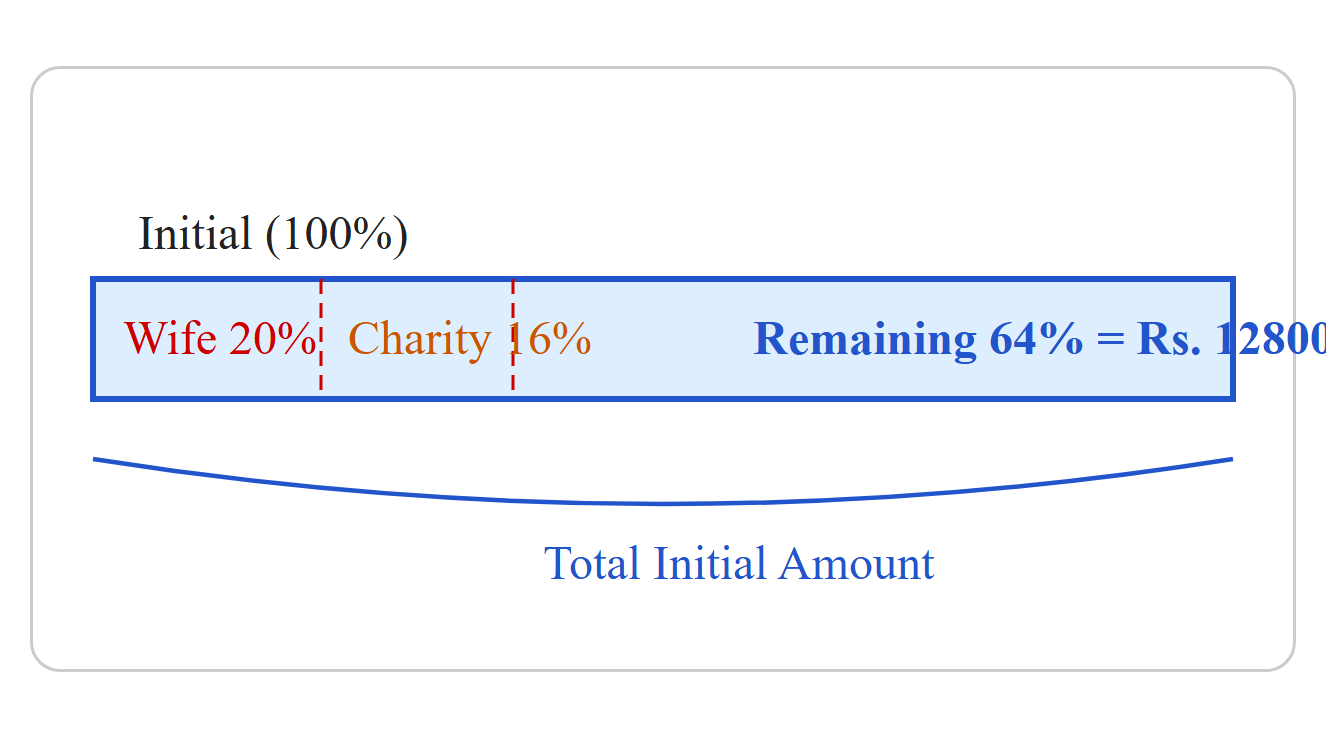
Rahul gives 20% of some amount to his wife and again 20% of the remaining amount to charity. Then he has only Rs. 12800 with him. What is initial amount of Rahul?

  1. AOption (a)

    20,000

  2. BOption (b)

    30,000

  3. COption (c)

    40,000

  4. DOption (d)

    50,000

  5. EOption (e)

    None of these

View answer & explanation

Correct answer

Answer: (a)A.

20,000

Why this answer is correct

Shortcut Trick

Successive remaining percentage method: 20% = 1/5, so remaining part = 4/5.

Let initial amount be X. Total remaining fraction = 4/5 × 4/5 = 16/25.

Given: 16 units = 12800 → 1 unit = 800.

Initial amount (25 units) = 25 × 800 = 20,000.

∴ The correct answer is Rs. 20,000.

Alternate Method

Given: Percentage given to wife = 20%; Percentage of remaining given to charity = 20%; Final balance = Rs. 12800.

Formula: Final Amount = Initial Amount × (1 − r1/100) × (1 − r2/100)

⇒ Let initial amount be X.

⇒ Amount after giving to wife = X × (100 − 20)/100 = 0.80X

⇒ Amount after charity = 0.80X × (100 − 20)/100 = 0.80X × 0.80 = 0.64X

⇒ 0.64X = 12800

⇒ X = 12800 ÷ 0.64

⇒ X = 1280000 ÷ 64 = 20000

∴ The correct answer is Rs. 20,000.

Additional Information

Successive Percentage Change

When values change on the remaining balance, the net change is calculated as a + b + (ab/100). For reductions, use negative values.

Base Value Concept

Always identify the base for each percentage. In remaining value problems, the base changes after every step.

Fractional Equivalent

Using fractions like 20% = 1/5 makes calculations faster: (Initial) × (4/5) × (4/5) = Final.

Question 40

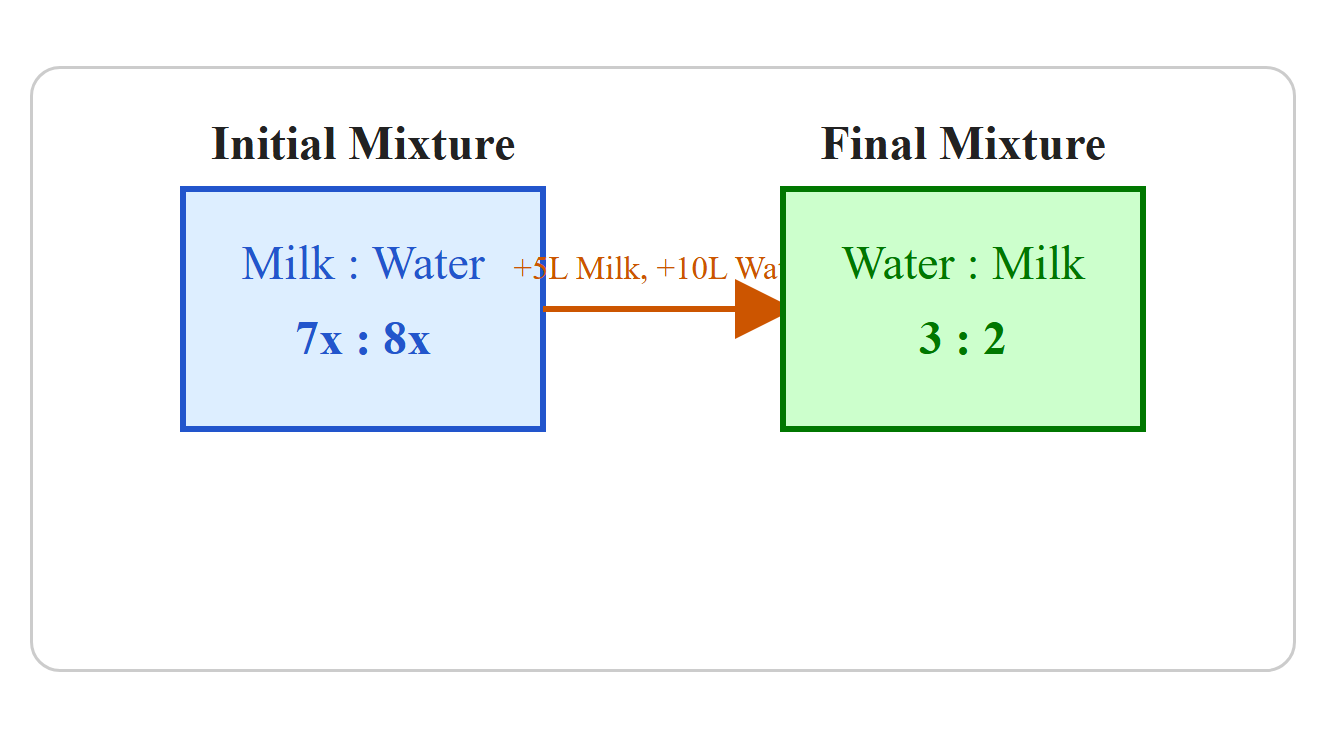
A mixture contains milk and water in the ratio of 7 : 8. If 10 litres water and 5 litres milk is added in the mixture then the ratio of water and milk becomes 3 : 2. Find the initial quantity in the mixture?

  1. AOption (a)

    30 litres

  2. BOption (b)

    45 litres

  3. COption (c)

    60 litres

  4. DOption (d)

    15 litres

  5. EOption (e)

    32 litres

View answer & explanation

Correct answer

Answer: (d)D.

15 litres

Why this answer is correct

Shortcut Trick

Initial Ratio (Milk : Water) = 7 : 8

Final Ratio (Water : Milk) = 3 : 2 → (Milk : Water) = 2 : 3

Using Cross-Multiplication Method: (7 × 3 − 8 × 2) units = (10 × 2 − 5 × 3) litres

(21 − 16) units = (20 − 15) litres ⇒ 5 units = 5 litres ⇒ 1 unit = 1 litre

Initial total quantity = (7 + 8) units = 15 units = 15 × 1 = 15 litres.

∴ The correct answer is 15 litres.

Alternate Method

Given: Initial Ratio M:W = 7:8. Let initial milk = 7x and initial water = 8x.

Formula: (Milk + added Milk) / (Water + added Water) = Final Milk / Final Water

⇒ Final Water : Milk = 3 : 2 ⇒ Final Milk : Water = 2 : 3

⇒ (7x + 5) / (8x + 10) = 2 / 3

⇒ 3 × (7x + 5) = 2 × (8x + 10)

⇒ 21x + 15 = 16x + 20

⇒ 21x − 16x = 20 − 15

⇒ 5x = 5 ⇒ x = 1

⇒ Initial quantity = 7x + 8x = 15x

⇒ Initial quantity = 15 × 1 = 15 litres

∴ The correct answer is 15 litres.

Additional Information

Ratio and Proportion Basics

A ratio a:b indicates the relative size of two quantities. The total quantity is the sum of the ratio parts multiplied by a common constant x.

Alligation Method

Used to find the mean value of a mixture when two ingredients of different prices or concentrations are mixed together.

Mixture Replacement Formula

Final Quantity = Initial Quantity × (1 − y/x)n, where y is the amount replaced and x is the total volume.

Directions: The given table shows the number of questions attempted by three different persons in five different subjects, A, B, C, D and E.


Name of the personABCDE
P4448566872
Q8052427664
R5866386278

Question 41

Based on Passage: View directions & passage

Number of questions attempted by person P and Q in subject C is approximately what percentage of the number of questions attempted by person R in subject A.

  1. AOption (a)

    141%

  2. BOption (b)

    163%

  3. COption (c)

    169%

  4. DOption (d)

    171%

  5. EOption (e)

    156%

View answer & explanation

Correct answer

Answer: (c)C.

169%

Why this answer is correct

Solution:

Number of questions attempted by person P in subject C = 56

Number of questions attempted by person Q in subject C = 42

Number of questions attempted by person R in subject A = 58

Required percentage = (56 + 42)/58 ×  100 = 168.96% ~ 169%

Question 42

Based on Passage: View directions & passage

If Person Q attempts an average of 60 questions from subjects A to F and Person R attempts an average of 70 questions from subjects A to F. Find the difference between the number of questions attempted by Q and R in subject F.

  1. AOption (a)

    58

  2. BOption (b)

    43

  3. COption (c)

    72

  4. DOption (d)

    56

  5. EOption (e)

    64

View answer & explanation

Correct answer

Answer: (c)C.

72

Why this answer is correct

Solution:

Total questions attempted by person Q from subjects  A to F = 60 ×  6 = 360

Total questions attempted by person R from subjects A to F = 70 ×  6 = 420

Number of questions attempted by person Q in subject F = 360 - (80 + 52 + 42 + 76 + 64) = 46

Number of questions attempted by person R in subject F = 420 - (58 + 66 + 38 + 62 + 78) = 118

Required difference = (118 - 46) = 72

Question 43

Based on Passage: View directions & passage

Find the ratio between Number of questions attempted by person P and Q in subject B and P and R in subject E.

  1. AOption (a)

    5: 6

  2. BOption (b)

    2: 3

  3. COption (c)

    3: 4

  4. DOption (d)

    5: 4

  5. EOption (e)

    7: 4

View answer & explanation

Correct answer

Answer: (b)B.

2: 3

Why this answer is correct

Solution:

Number of questions attempted by person P in subject B = 48

Number of questions attempted by person Q in subject B = 52

Number of questions attempted by person P in subject E = 72

Number of questions attempted by person R in subject E = 78

Required ratio = (100 : 150) = 2: 3

Question 44

Based on Passage: View directions & passage

Person S attempted 25% more than the number of questions attempted by Person P in subject B and Person T attempted 50% more than the number of questions attempted by person Q in subject B. Find the number of questions attempted by Person S and Person T in subject B.

  1. AOption (a)

    126

  2. BOption (b)

    152

  3. COption (c)

    138

  4. DOption (d)

    142

  5. EOption (e)

    168

View answer & explanation

Correct answer

Answer: (c)C.

138

Why this answer is correct

Solution:

Number of questions attempted by person P in subject B = 48

Number of questions attempted by person S in subject B = 48 ×  125/100 = 60

Number of questions attempted by person Q in subject B = 52

Number of questions attempted by person T in subject B = 52 ×  150/100 = 78

Required sum = (60 + 78) = 138

Question 45

Based on Passage: View directions & passage

If Person Q scored 234 marks by adding total in all the subjects, if each question carries 1 mark and each wrong answer carries 0.25 marks. Find the number of wrong questions attempted by Person Q.

  1. AOption (a)

    96

  2. BOption (b)

    88

  3. COption (c)

    64

  4. DOption (d)

    68

  5. EOption (e)

    72

View answer & explanation

Correct answer

Answer: (c)C.

64

Why this answer is correct

Solution:

Total marks scored by person Q = 234

Total questions attempted = (80 + 52 + 42 + 76 + 64) = 314

Number of wrong questions = x

(314 - x) ×  1 - (x × 1/4) = 234

(314  - x) -  0.25x = 234

x = 80/1.25

x = 64

∴ Number of wrong questions attempted by Person Q is 64.

Question 46

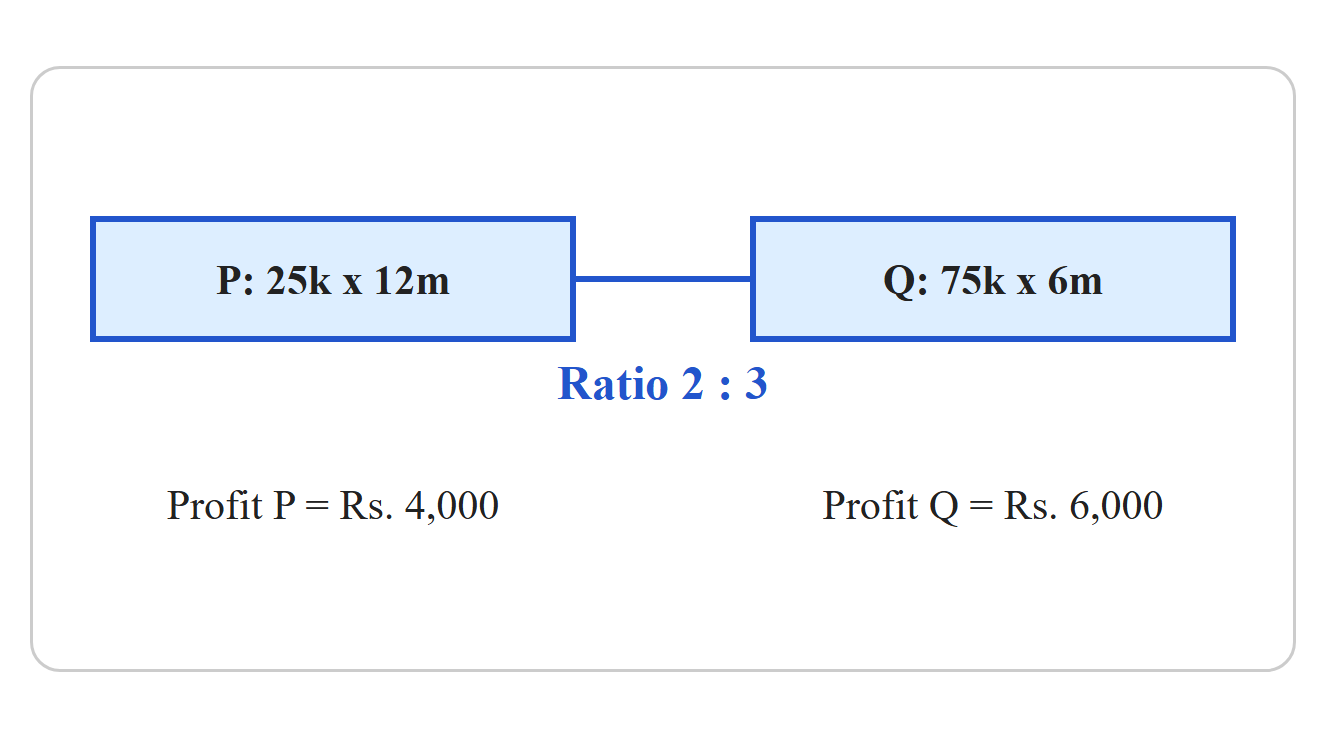
P and Q started a business investing amounts of 25,000 Rs and 75,000 Rs. Q left the business after 6 months. Q’s share in profit was Rs. 6000 at the end of the year, Then what is the total profit earned by them together?

  1. AOption (a)

    Rs 10,000

  2. BOption (b)

    Rs 12,000

  3. COption (c)

    Rs 14,000

  4. DOption (d)

    Rs 1,000

  5. EOption (e)

    None of these

View answer & explanation

Correct answer

Answer: (a)A.

Rs 10,000

Why this answer is correct

Shortcut Trick

Ratio of Profit = Ratio of (Investment × Time).

Profit Ratio P : Q = (25,000 × 12) : (75,000 × 6) = (1 × 12) : (3 × 6) = 12 : 18 = 2 : 3.

Given Q’s share (3 units) = Rs. 6,000 ⇒ 1 unit = Rs. 2,000.

Total profit (2 + 3 = 5 units) = 5 × 2,000 = Rs. 10,000.

∴ The correct answer is Rs. 10,000.

Alternate Method

Given: P’s investment = Rs. 25,000, Time = 12 months; Q’s investment = Rs. 75,000, Time = 6 months; Q’s profit = Rs. 6,000.

Formula: Profit1 ÷ Profit2 = (Investment1 × Time1) ÷ (Investment2 × Time2)

⇒ Ratio of Profit P : Q = (25000 × 12) : (75000 × 6)

⇒ Ratio P : Q = 300,000 : 450,000 = 30 : 45 = 2 : 3

⇒ Let P’s profit be 2x and Q’s profit be 3x.

⇒ 3x = 6000 ⇒ x = 2000

⇒ Total Profit = 2x + 3x = 5x = 5 × 2000 = Rs. 10,000

∴ The correct answer is Rs. 10,000.

Additional Information

Partnership Basics

In a partnership, if the period of investment is different, it is called a compound partnership where profit is shared in the ratio of the products of capital and time.

Ratio Proportionality

If Investment is constant, Profit ∝ Time. If Time is constant, Profit ∝ Investment.

Question 47

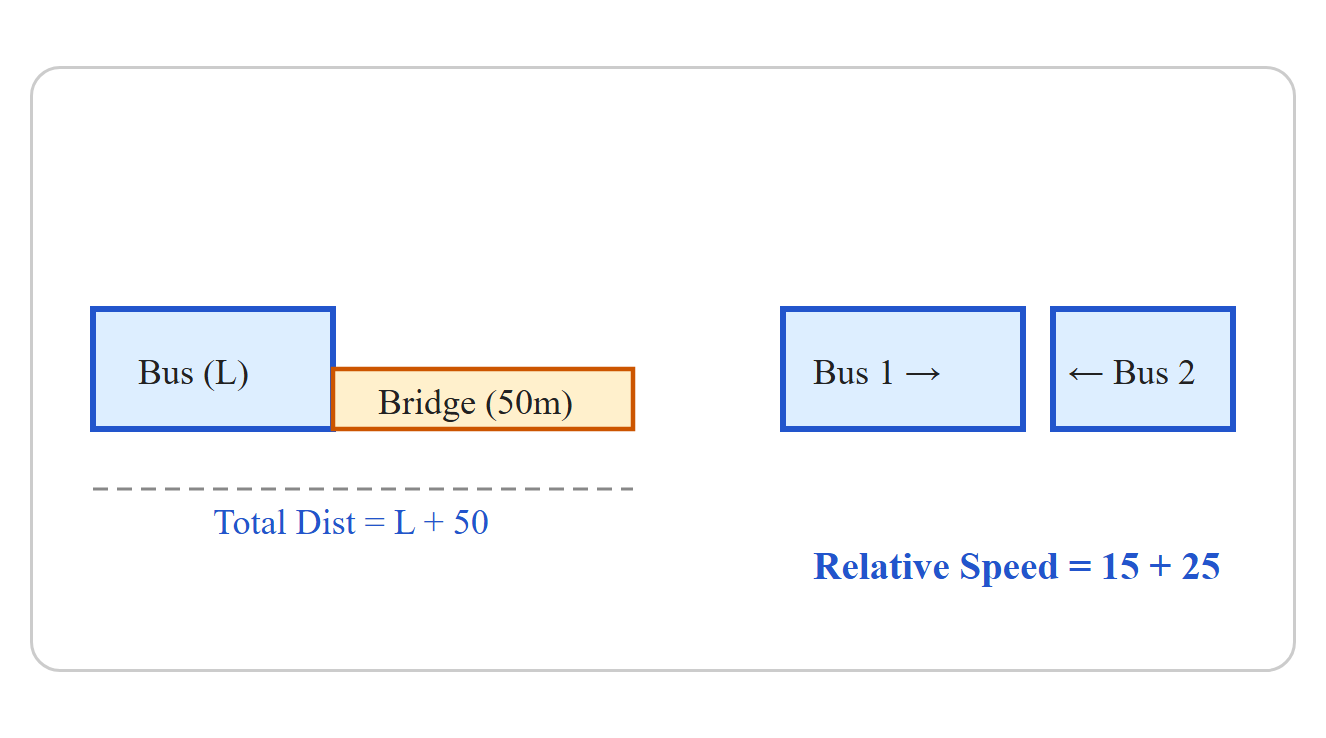
A bus crosses a bridge of length 50 m in 10 sec. If the speed of bus is 15 m/s, then find the time taken by bus to cross similar bus coming from opposite direction with speed of 25 m/s.

  1. AOption (a)

    5 sec

  2. BOption (b)

    15 sec

  3. COption (c)

    7 sec

  4. DOption (d)

    10 sec

  5. EOption (e)

    None of these

View answer & explanation

Correct answer

Answer: (a)A.

5 sec

Why this answer is correct

Shortcut Trick

Length of bus = (Speed × Time) − Bridge Length = (15 × 10) − 50 = 100 m.

Relative Speed (Opposite direction) = 15 + 25 = 40 m/s.

Total distance to cross similar bus = 100 + 100 = 200 m.

Time taken = 200 ÷ 40 = 5 sec.

∴ The correct answer is 5 sec.

Alternate Method

Given: Bridge length = 50 m, crossing time = 10 sec, Bus Speed1 = 15 m/s, Bus Speed2 = 25 m/s.

Formula Used: Distance = Speed × Time; Relative Speed (Opposite) = S1 + S2.

⇒ Case 1: (Length of Bus + Length of Bridge) = Speed × Time

⇒ L + 50 = 15 × 10

⇒ L + 50 = 150 ⇒ L = 100 m

⇒ Case 2: Crossing a similar bus (Length = 100 m) from opposite direction

⇒ Total Distance = L + L = 100 + 100 = 200 m

⇒ Relative Speed = 15 + 25 = 40 m/s

⇒ Time = 200 ÷ 40 = 5 sec

∴ The correct answer is 5 sec.

Additional Information

Relative Speed Concept

When two objects move in opposite directions, relative speed is the sum of their speeds (S1 + S2). In the same direction, it is the difference (|S1 − S2|).

Crossing Distance Rule

When a vehicle crosses a platform/bridge or another vehicle, the total distance covered is the sum of the lengths of both entities.

Unit Conversion

To convert km/hr to m/s, multiply by 5/18. To convert m/s to km/hr, multiply by 18/5.

Question 48

What will come in place of question mark (?) in the following question?

(8 + 6 × 7) ÷ 10 × 3 = ?

  1. AOption (a)

    18

  2. BOption (b)

    20

  3. COption (c)

    30

  4. DOption (d)

    15

  5. EOption (e)

    45

View answer & explanation

Correct answer

Answer: (d)D.

15

Why this answer is correct

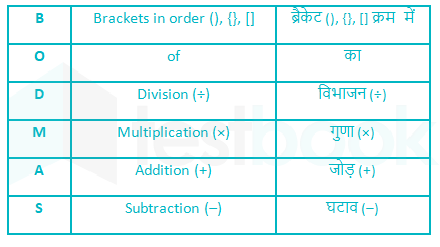
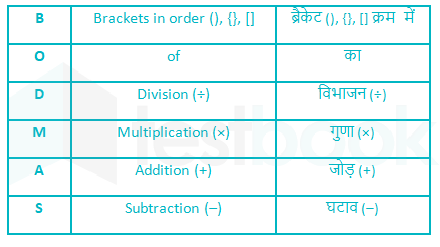
Follow BODMAS rule to solve this question, as per the order is given below,

Step-1∶ Parts of an equation enclosed in 'Brackets' must be solved first and in the bracket,

Step-2∶ Any mathematical 'Of' or 'Exponent' must be solved next,

Step-3∶ Next, the parts of the equation that contain 'Division' and 'Multiplication' are calculated,

Step-4∶ Last but not least, the parts of the equation that contain 'Addition' and 'Subtraction' should be calculated

(8 + 6 × 7) ÷ 10 × 3

⇒ (8 + 42) ÷ 10 × 3

⇒ 50 ÷ 10 × 3

⇒ 5 × 3 = 15

Question 49

What will come in place of question mark (?) in the following question?

25% of 800 + ? = 40% of 1250

  1. AOption (a)

    300

  2. BOption (b)

    200

  3. COption (c)

    250

  4. DOption (d)

    400

  5. EOption (e)

    350

View answer & explanation

Correct answer

Answer: (a)A.

300

Why this answer is correct

25% of 800 + ? = 40% of 1250

⇒ 200 + ? = 500

⇒ ? = 500 - 200 = 300

Question 50

What will come in place of question mark (?) in the following question?

35% of (32 × 8 ÷ 16 ÷ 4)% of 10000 = ?

  1. AOption (a)

    120

  2. BOption (b)

    80

  3. COption (c)

    140

  4. DOption (d)

    60

  5. EOption (e)

    40

View answer & explanation

Correct answer

Answer: (c)C.

140

Why this answer is correct

35% of (32 × 8 ÷ 16 ÷ 4)% of 10000

35% of (32 × 8 × 1/16 × 1/4)% of 10000

⇒ 35% of (32 × 1/8)% of 10000

⇒ 35% of 4% of 10000

⇒ 0.35 × 0.04 × 10000 = 140

Question 51

What will come in place of question mark (?) in the following question?

(220 ÷ 20 × 135 ÷ 15) /3 = ?

  1. AOption (a)

    31

  2. BOption (b)

    44

  3. COption (c)

    33

  4. DOption (d)

    42

  5. EOption (e)

    28

View answer & explanation

Correct answer

Answer: (c)C.

33

Why this answer is correct

Given

(220 ÷ 20 × 135 ÷ 15) /3 = ?

⇒ (11 × 9)/3 = ?

⇒ ? = 33

∴ (220 ÷ 20 × 135 ÷ 15) /3 = 33

Question 52

What will come in place of the question mark (?) in the following question?

40% of 180 + 70% of ? = 121

  1. AOption (a)

    81

  2. BOption (b)

    77

  3. COption (c)

    65

  4. DOption (d)

    70

  5. EOption (e)

    75

View answer & explanation

Correct answer

Answer: (d)D.

70

Why this answer is correct

Concept used:

Calculation:

40% of 180 + 70% of ? = 121

⇒ (40/100 × 180) + (70/100 × ?) = 121

⇒ 72 + (70/100 × ?) = 121

⇒ (70/100 × ?) = 49

 ∴ ? = 49 × 100/70 = 70.

Question 53

What value should come in place of the question mark ‘?’ in the following question?

142 + 712 - 192 = ? + 123

  1. AOption (a)

    4751

  2. BOption (b)

    4752

  3. COption (c)

    4753

  4. DOption (d)

    4754

  5. EOption (e)

    4755

View answer & explanation

Correct answer

Answer: (c)C.

4753

Why this answer is correct

142 + 712 - 192 = ? + 123

⇒ 196 + 5041 - 361 = ? + 123 

⇒ ? = 4753

Smart Approach

As last digit in all options are different we need not to solve question fully

Taking only last digits, we get

6 + 1 - 1 = ? + 3

⇒ ? = 3

Hence, option 3 is correct.

Question 54

What will come in place of question mark (?) in the following equation?

80% of [80% of 245 – 56] = ? ÷ 5

  1. AOption (a)

    420

  2. BOption (b)

    720

  3. COption (c)

    480

  4. DOption (d)

    560

  5. EOption (e)

    520

View answer & explanation

Correct answer

Answer: (d)D.

560

Why this answer is correct

80% of [80% of 245 – 56] = ? ÷ 5

⇒ 80% of [80% of 245 – 56] = ? ÷ 5

⇒ 80% of [(80/100) × 245 – 56] = ? ÷ 5

⇒ 80% of [196 – 56] = ? ÷ 5

⇒ 80% of 140 = ? ÷ 5

⇒ 112 × 5 = ?

∴ ? = 560

Question 55

What will come in place of question mark (?) in the following equation?

√? × 45 = 250 × 15 + 138 × 25

  1. AOption (a)

    14400

  2. BOption (b)

    21600

  3. COption (c)

    19600

  4. DOption (d)

    16900

  5. EOption (e)

    25600

View answer & explanation

Correct answer

Answer: (e)E.

25600

Why this answer is correct

√? × 45 = 250 × 15 + 138 × 25

⇒ √? × 45 = 3750 + 3450

⇒ √? × 45 = 7200

⇒ √? = 160

⇒ ? = 25600

Question 56

What will come in place of question mark (?) in the following equation?

2? = 32 ÷ 128 × 1024 ÷ 8

  1. AOption (a)

    4

  2. BOption (b)

    5

  3. COption (c)

    3

  4. DOption (d)

    7

  5. EOption (e)

    6

View answer & explanation

Correct answer

Answer: (b)B.

5

Why this answer is correct

Given:

2? = 32 ÷ 128 × 1024 ÷ 8

Concept:

Follow BODMAS rule to solve this question, as per the order given below, 

Calculation:

2? = 32 ÷ 128 × 1024 ÷ 8

⇒ 2? = (32/128) × (1024/8)

⇒ 2? = (1/4) × (128) = 32

⇒ 25 = 32

(?) = 5

Question 57

What will come in place of the question mark (?) in the following question?

25% of 1080 - ?% of 400 = 90

  1. AOption (a)

    25

  2. BOption (b)

    35

  3. COption (c)

    55

  4. DOption (d)

    65

  5. EOption (e)

    45

View answer & explanation

Correct answer

Answer: (e)E.

45

Why this answer is correct

Follow BODMAS rule to solve this question, as per the order given below, 

25% of 1080 - ?% of 400 = 90

⇒ 270 - 4 × ? = 90

⇒ 270 - 90 = 4 × ?

⇒ 180 = 4 × ?

⇒ ? = 180/4

∴ ? = 45

Question 58

What will come in place of question mark (?) in the following equation?

25% of 160 + 50% of 320 = ?

  1. AOption (a)

    180

  2. BOption (b)

    200

  3. COption (c)

    80

  4. DOption (d)

    100

  5. EOption (e)

    120

View answer & explanation

Correct answer

Answer: (b)B.

200

Why this answer is correct

Follow BODMAS rule to solve this question, as per the order given below, 

Step-1: Parts of an equation enclosed in 'Brackets' must be solved first, and in the bracket, 

Step-2: Any mathematical 'Of' or 'Exponent' must be solved next, 

Step-3: Next, the parts of the equation that contain 'Division' and 'Multiplication' are calculated, 

Step-4: Last but not least, the parts of the equation that contain 'Addition' and 'Subtraction' should be calculated 

25% of 160 + 50% of 320 = ?

⇒ 40 + 160 = ?

∴ ? = 200

Question 59

What will come in place of question mark (?) in the following equation?

52 × 48 + 113 × 87 + 35 × 25 = ? - √196

  1. AOption (a)

    13215

  2. BOption (b)

    13216

  3. COption (c)

    13217

  4. DOption (d)

    13218

  5. EOption (e)

    13219

View answer & explanation

Correct answer

Answer: (b)B.

13216

Why this answer is correct

52 × 48 + 113 × 87 + 35 × 25 = ? - √196

⇒ (502 - 22) + (1002 - 132) + (302 - 52) = ? - 14

⇒ 2500 - 4 + 10000 - 169 + 900 - 25 + 14 = ?

⇒ ? = 13216 

Short trick

As all options has different unit digit. Hence, we can find the answer only by calculating unit digit.

52 × 48 + 113 × 87 + 35 × 25 = ? - √196

⇒ 6 + 1 + 5 = ? - 4

⇒ 12 + 4 = ?

⇒ ? = 16 = 6 (unit digit)

Hence, answer will be 13216.

Question 60

What will come in place of question mark (?) in the following equation?

√676 + 82 ×  5.5 + 73 = ? + 121

  1. AOption (a)

    200

  2. BOption (b)

    300

  3. COption (c)

    400

  4. DOption (d)

    500

  5. EOption (e)

    600

View answer & explanation

Correct answer

Answer: (e)E.

600

Why this answer is correct

√676 + 82 ×  5.5 + 73 = ? + 121

⇒ 26 + 64 × (55/10) + 343 - 121 = ?

⇒ 26 + 352 + 343 - 121 = ?

⇒ 721 - 121 = ?

⇒ ? = 600

Question 61

What will come in place of question mark (?) in the following equation?

2.5% of 40 + 4.5% of 80 = ?% of 10

  1. AOption (a)

    36

  2. BOption (b)

    24

  3. COption (c)

    46

  4. DOption (d)

    52

  5. EOption (e)

    38

View answer & explanation

Correct answer

Answer: (c)C.

46

Why this answer is correct

Concept used:

Follow BODMAS rule to solve this question, as per the order given below

Calculations:

2.5% of 40 + 4.5% of 80 = ?% of 10

⇒ (2.5/100) × 40 + (4.5/100) × 80 = (?/100) × 10

⇒ 1 + 3.6 = ?/10

⇒ 4.6 = ?/10

⇒ ? = 46

∴ The value of ? is 46.

Question 62

What will come in place of question mark (?) in the following equation?

450% of ? ÷ 90 + 350% of 200 ÷ 70 = 20

  1. AOption (a)

    180

  2. BOption (b)

    190

  3. COption (c)

    200

  4. DOption (d)

    210

  5. EOption (e)

    220

View answer & explanation

Correct answer

Answer: (c)C.

200

Why this answer is correct

450% of ? ÷ 90 + 350% of 200 ÷ 70 = 20

⇒ (450/100 × ?/90) + (350/100 × 200/70) = 20

⇒ ?/20 + 10 = 20

⇒ ?/20 = 10

⇒ ? = 200

Question 63

Some amount of Rs. 12000 was lent at 7% per annum and the remaining at 4% per annum. If the total simple interest from both the fractions in 4 years was Rs. 2880, find the sum lent at 4% per annum.

  1. AOption (a)

    8000

  2. BOption (b)

    4000

  3. COption (c)

    9600

  4. DOption (d)

    2400

  5. EOption (e)

    None of these

View answer & explanation

Correct answer

Answer: (b)B.

4000

Why this answer is correct

Shortcut Trick

Total interest in 4 years = ₹2880 → Interest in 1 year = 2880 ÷ 4 = ₹720.

Overall interest rate = (720 ÷ 12000) × 100 = 6%.

Using Alligation: (Rate 1: 7%) vs (Rate 2: 4%) with Mean (6%).

Ratio of sums = (6 − 4) : (7 − 6) = 2 : 1.

Sum at 4% = (1 ÷ 3) × 12000 = ₹4000.

∴ The correct answer is ₹4000.

Alternate Method

Given: Total Principal (P) = ₹12000, Total Time (T) = 4 years, Total SI = ₹2880.

Formula Used: SI = (P × R × T) ÷ 100

⇒ Let sum lent at 4% be x. Then sum lent at 7% is (12000 − x).

⇒ [(12000 − x) × 7 × 4] ÷ 100 + [x × 4 × 4] ÷ 100 = 2880

⇒ (12000 − x) × 28 + 16x = 288000

⇒ 336000 − 28x + 16x = 288000

⇒ 12x = 48000

⇒ x = 4000

∴ The correct answer is ₹4000.

Additional Information

Simple Interest Concept

Simple Interest is calculated only on the principal amount. The interest remains constant every year if the rate and principal do not change.

Rule of Alligation in SI

When a sum is divided into two parts with different interest rates, the ratio of the two parts can be found using the difference between individual rates and the overall average rate.

Effective Rate of Interest

Effective Rate = (Total SI × 100) ÷ (Principal × Time). This helps in simplifying multi-rate problems into a single comparison.

Question 64

A sum of money is sufficient to pay X’s wages for 21 days and Y’s wages for 28 days. For how many days the sum of money will be enough to pay both?

  1. AOption (a)

    15 days

  2. BOption (b)

    6 days

  3. COption (c)

    12 days

  4. DOption (d)

    24 days

  5. EOption (e)

    None of the above

View answer & explanation

Correct answer

Answer: (c)C.

12 days

Why this answer is correct

Shortcut Trick

Let the total sum of money be the LCM of 21 and 28.

LCM(21, 28) = 84 units.

Efficiency of X = 84 ÷ 21 = 4 units/day.

Efficiency of Y = 84 ÷ 28 = 3 units/day.

Combined efficiency = 4 + 3 = 7 units/day.

Number of days = 84 ÷ 7 = 12 days.

∴ The correct answer is 12 days.

Alternate Method

Given:

Wages for X can be paid for = 21 days

Wages for Y can be paid for = 28 days

Formula Used:

If a sum pays A for 'a' days and B for 'b' days, then it pays both for (a × b) ÷ (a + b) days.

PersonDaysTotal Work (Sum)Efficiency (Wage/Day)
X21844
Y283

Calculations:

⇒ Let the total sum of money be S.

⇒ Daily wage of X = S ÷ 21

⇒ Daily wage of Y = S ÷ 28

⇒ Combined daily wage = (S ÷ 21) + (S ÷ 28)

⇒ Combined daily wage = (4S + 3S) ÷ 84 = 7S ÷ 84 = S ÷ 12

⇒ Number of days the sum lasts for both = S ÷ (S ÷ 12)

⇒ Number of days = 12 days

∴ The correct answer is 12 days.

Additional Information

Work and Wages Principle

Wages are generally distributed in the ratio of work done or in the ratio of efficiencies if the time period is the same.

Time and Work Relation

The logic used for sum of money and wages is identical to Time and Work problems where sum is Total Work and wages/day is Efficiency.

Reciprocal Method

For multiple people, the number of days D is found using: 1/D = 1/d1 + 1/d2 + ... + 1/dn.

Question 65

If an item is sold at a 10% discount to Rohit and a 30% discount to Abhishek and difference between their selling price is Rs. 240. Find the marked price of the article.

  1. AOption (a)

    Rs. 1200 

  2. BOption (b)

    Rs. 1100

  3. COption (c)

    Rs. 1000

  4. DOption (d)

    Rs. 1500

  5. EOption (e)

    Rs. 1300

View answer & explanation

Correct answer

Answer: (a)A.

Rs. 1200 

Why this answer is correct

Shortcut Trick

Let the Marked Price (MP) be 100%.

Discount for Rohit = 10% ⇒ SP1 = 90%.

Discount for Abhishek = 30% ⇒ SP2 = 70%.

Difference in Selling Price (SP) = 90% − 70% = 20%.

According to the question, 20% = Rs. 240.

Marked Price (100%) = (240 ÷ 20) × 100 = Rs. 1200.

∴ The correct answer is Rs. 1200.

Alternate Method

Given: Discount1 = 10%, Discount2 = 30%, Difference in SP = Rs. 240.

Formulas: SP = MP × (100 − Discount%) ÷ 100.

⇒ Let Marked Price be x.

⇒ SP for Rohit = x × (90/100) = 0.9x.

⇒ SP for Abhishek = x × (70/100) = 0.7x.

⇒ Difference = 0.9x − 0.7x = 240.

⇒ 0.2x = 240.

⇒ x = 240 ÷ 0.2 = 1200.

∴ The correct answer is Rs. 1200.

Additional Information

Marked Price and Selling Price

The Marked Price (MP) is the price printed on an item. The price at which it is sold after a discount is the Selling Price (SP). SP = MP − Discount.

Discount Percentage

Discount is always calculated on the Marked Price. Formula: Discount% = (Discount ÷ MP) × 100.

Reasoning Ability (35 questions)

Question 66

Directions: In the following question assuming the given statements to be True, find which of the conclusion among given conclusions is/are definitely true and then give your answers accordingly.

Statements: P > Q > R ; R > S ≥ T

Conclusions:

I. R > T

II. P > S

  1. AOption (a)

    Only I is true

  2. BOption (b)

    Only II is true

  3. COption (c)

    Both I and II are true

  4. DOption (d)

    Either I or II is true

  5. EOption (e)

    Neither I nor II is true

View answer & explanation

Correct answer

Answer: (c)C.

Both I and II are true

Why this answer is correct

Given Statements : P > Q > R ; R > S ≥ T

On Combining : P > Q > R > S ≥ T

Conclusions:

I. R > T → True ( As R > S ≥ T ; Thus clear relation between R and T can be determined )

II. P > S → True ( As P > Q > R > S ; Thus clear relation between P and S can be determined )

Therefore Both conclusion I and II are True.

Question 67

Directions: In the following question assuming the given statements to be True, find which of the conclusion among given conclusions is/are definitely true and then give your answers accordingly.

Statements: X ≤ U < V > T; U < S; H > V

Conclusions:

I. X < H

II T ≤ S

  1. AOption (a)

    Only I is True

  2. BOption (b)

    Only II is True

  3. COption (c)

    Either I or II is True

  4. DOption (d)

    Neither I nor II is True

  5. EOption (e)

    Both I and II are True

View answer & explanation

Correct answer

Answer: (a)A.

Only I is True

Why this answer is correct

Given statements:  X ≤ U < V > T; U < S; H > V

On combining:X ≤ U < V > T; U < S; H > V

Conclusions:

I. X < H → True (H > V and  V > U ≥ X → X < H)

II. T ≤ S → False (U <  S and U < V > T  → thus clear relation between T and  S cannot be determined)

Therfore Only conclusion I is True.

Question 68

Directions: In the following question assuming the given statements to be True, find which of the conclusion among given conclusions is/are definitely true and then give your answers accordingly.

Statements: A > B ≥ C ; C < D

Conclusion:

I.A > D

II.A > C

  1. AOption (a)

    Only I is true

  2. BOption (b)

    Only II is true

  3. COption (c)

    Neither I nor II is true

  4. DOption (d)

    Both I and II are true

  5. EOption (e)

    Either I or II is true

View answer & explanation

Correct answer

Answer: (b)B.

Only II is true

Why this answer is correct

Given statements: A > B ≥ C ; C < D

Conclusions:

I. A > D → False (as A > B ≥ C < D )

II. A > C → True (as A > B ≥ C → A > C)

Only II is true.

Directions: Read the following information carefully and answer the questions given below.

Eight persons – R, S, T, U, W, X, Y and Z – gave the exam in four different months among – April, May, June and July – on different dates among – 7th and 28th – of the same year. No two persons gave on the same date of the same month.

Only two persons gave after U. Only one person gave between U and S. S and R gave exams on different dates. R gave an exam after S. Five persons gave exam between W and T. T gave before R and both gave on different dates. Y gave after Z, who gave in the month which has odd number of days. Y and W did not give in the same month.

Question 69

Based on Passage: View directions & passage

In which month does Y gave the exam?

  1. AOption (a)

    April

  2. BOption (b)

    May

  3. COption (c)

    June

  4. DOption (d)

    July

  5. EOption (e)

    Cannot be determined

View answer & explanation

Correct answer

Answer: (c)C.

June

Why this answer is correct

Persons – 8; R, S, T, U, W, X, Y and Z;

Months – April, May, June and July;

Dates – 7th and 28th;

  1. Only two persons gave after U.
  2. Only one person gave between U and S.

From this we get the possible arrangements:

Months (Days)DateCase ICase II
April (30)7th
28th
May (31)7th
28thS
June (30)7th
28thUU
July (31)7th
28thS
  1. S and R gave on different dates.
  2. R gave after S.

    From this case II is eliminated as we cannot determine the month in which R gave the exam.

Months (Days)DateCase ICase I (a)
April (30)7th
28th
May (31)7th
28thSS
June (30)7thR
28thUU
July (31)7thR
28th
  1. Five persons gave between W and T.
  2. T gave before R and both gave on different dates.
Months (Days)DateCase ICase I (a)
April (30)7th
28thTT
May (31)7th
28thSS
June (30)7thR
28thUU
July (31)7thR
28thWW
  1. Y gave after Z, who gave in the month which has odd number of days.
Months (Days)DateCase ICase I (a)
April (30)7thXX
28thTT
May (31)7thZZ
28thSS
June (30)7thRY
28thUU
July (31)7thYR
28thWW
  1. Y and W did not give in the same month.

From this case I is eliminated, as Y and W attended in the same month which is not possible. From this we get the final arrangement as follows.

Months (Days)DateCase I (a)
April (30)7thX
28thT
May (31)7thZ
28thS
June (30)7thY
28thU
July (31)7thR
28thW

Y gave the exam in the month of June.

Question 70

Based on Passage: View directions & passage

How many persons gave the exam between X and Z?

  1. AOption (a)

    One

  2. BOption (b)

    Two

  3. COption (c)

    Three

  4. DOption (d)

    Four

  5. EOption (e)

    More than four

View answer & explanation

Correct answer

Answer: (a)A.

One

Why this answer is correct

Persons – 8; R, S, T, U, W, X, Y and Z;

Months – April, May, June and July;

Dates – 7th and 28th;

  1. Only two persons gave after U.
  2. Only one person gave between U and S.

From this we get the possible arrangements:

Months (Days)DateCase ICase II
April (30)7th
28th
May (31)7th
28thS
June (30)7th
28thUU
July (31)7th
28thS
  1. S and R gave on different dates.
  2. R gave after S.

    From this case II is eliminated as we cannot determine the month in which R gave the exam.

Months (Days)DateCase ICase I (a)
April (30)7th
28th
May (31)7th
28thSS
June (30)7thR
28thUU
July (31)7thR
28th
  1. Five persons gave between W and T.
  2. T gave before R and both gave on different dates.
Months (Days)DateCase ICase I (a)
April (30)7th
28thTT
May (31)7th
28thSS
June (30)7thR
28thUU
July (31)7thR
28thWW
  1. Y gave after Z, who gave in the month which has odd number of days.
Months (Days)DateCase ICase I (a)
April (30)7thXX
28thTT
May (31)7thZZ
28thSS
June (30)7thRY
28thUU
July (31)7thYR
28thWW
  1. Y and W did not give in the same month.

From this case I is eliminated, as Y and W attended in the same month which is not possible. From this we get the final arrangement as follows.

Months (Days)DateCase I (a)
April (30)7thX
28thT
May (31)7thZ
28thS
June (30)7thY
28thU
July (31)7thR
28thW

Only one person gave the exam between X and Z.

Question 71

Based on Passage: View directions & passage

Four of the following five are alike in a certain way and hence form a group. Find the one who does not belong to that group?

  1. AOption (a)

    Z

  2. BOption (b)

    R

  3. COption (c)

    Y

  4. DOption (d)

    X

  5. EOption (e)

    W

View answer & explanation

Correct answer

Answer: (e)E.

W

Why this answer is correct

Persons – 8; R, S, T, U, W, X, Y and Z;

Months – April, May, June and July;

Dates – 7th and 28th;

  1. Only two persons gave after U.
  2. Only one person gave between U and S.

From this we get the possible arrangements:

Months (Days)DateCase ICase II
April (30)7th
28th
May (31)7th
28thS
June (30)7th
28thUU
July (31)7th
28thS
  1. S and R gave on different dates.
  2. R gave after S.

    From this case II is eliminated as we cannot determine the month in which R gave the exam.

Months (Days)DateCase ICase I (a)
April (30)7th
28th
May (31)7th
28thSS
June (30)7thR
28thUU
July (31)7thR
28th
  1. Five persons gave between W and T.
  2. T gave before R and both gave on different dates.
Months (Days)DateCase ICase I (a)
April (30)7th
28thTT
May (31)7th
28thSS
June (30)7thR
28thUU
July (31)7thR
28thWW
  1. Y gave after Z, who gave in the month which has odd number of days.
Months (Days)DateCase ICase I (a)
April (30)7thXX
28thTT
May (31)7thZZ
28thSS
June (30)7thRY
28thUU
July (31)7thYR
28thWW
  1. Y and W did not give in the same month.

From this case I is eliminated, as Y and W attended in the same month which is not possible. From this we get the final arrangement as follows.

Months (Days)DateCase I (a)
April (30)7thX
28thT
May (31)7thZ
28thS
June (30)7thY
28thU
July (31)7thR
28thW

Except W, all other persons gave the exam in odd numbered date.

W is the odd one out.

Question 72

Based on Passage: View directions & passage

Number of persons who gave the exam before R is the same as the number of persons who gave the exam after ___.

  1. AOption (a)

    T

  2. BOption (b)

    W

  3. COption (c)

    U

  4. DOption (d)

    S

  5. EOption (e)

    Z

View answer & explanation

Correct answer

Answer: (a)A.

T

Why this answer is correct

Persons – 8; R, S, T, U, W, X, Y and Z;

Months – April, May, June and July;

Dates – 7th and 28th;

  1. Only two persons gave after U.
  2. Only one person gave between U and S.

From this we get the possible arrangements:

Months (Days)DateCase ICase II
April (30)7th
28th
May (31)7th
28thS
June (30)7th
28thUU
July (31)7th
28thS
  1. S and R gave on different dates.
  2. R gave after S.

    From this case II is eliminated as we cannot determine the month in which R gave the exam.

Months (Days)DateCase ICase I (a)
April (30)7th
28th
May (31)7th
28thSS
June (30)7thR
28thUU
July (31)7thR
28th
  1. Five persons gave between W and T.
  2. T gave before R and both gave on different dates.
Months (Days)DateCase ICase I (a)
April (30)7th
28thTT
May (31)7th
28thSS
June (30)7thR
28thUU
July (31)7thR
28thWW
  1. Y gave after Z, who gave in the month which has odd number of days.
Months (Days)DateCase ICase I (a)
April (30)7thXX
28thTT
May (31)7thZZ
28thSS
June (30)7thRY
28thUU
July (31)7thYR
28thWW
  1. Y and W did not give in the same month.

From this case I is eliminated, as Y and W attended in the same month which is not possible. From this we get the final arrangement as follows.

Months (Days)DateCase I (a)
April (30)7thX
28thT
May (31)7thZ
28thS
June (30)7thY
28thU
July (31)7thR
28thW

Here, the number of persons who gave the exam before R is six similarly the number of persons gave the exam after T is also six.

T is the correct answer.

Question 73

Based on Passage: View directions & passage

On which date and in which month does X gave the exam?

  1. AOption (a)

    28th  May

  2. BOption (b)

    7th April

  3. COption (c)

    28th April

  4. DOption (d)

    7th July

  5. EOption (e)

    7th May

View answer & explanation

Correct answer

Answer: (b)B.

7th April

Why this answer is correct

Persons – 8; R, S, T, U, W, X, Y and Z;

Months – April, May, June and July;

Dates – 7th and 28th;

  1. Only two persons gave after U.
  2. Only one person gave between U and S.

From this we get the possible arrangements:

Months (Days)DateCase ICase II
April (30)7th
28th
May (31)7th
28thS
June (30)7th
28thUU
July (31)7th
28thS
  1. S and R gave on different dates.
  2. R gave after S.

    From this case II is eliminated as we cannot determine the month in which R gave the exam.

Months (Days)DateCase ICase I (a)
April (30)7th
28th
May (31)7th
28thSS
June (30)7thR
28thUU
July (31)7thR
28th
  1. Five persons gave between W and T.
  2. T gave before R and both gave on different dates.
Months (Days)DateCase ICase I (a)
April (30)7th
28thTT
May (31)7th
28thSS
June (30)7thR
28thUU
July (31)7thR
28thWW
  1. Y gave after Z, who gave in the month which has odd number of days.
Months (Days)DateCase ICase I (a)
April (30)7thXX
28thTT
May (31)7thZZ
28thSS
June (30)7thRY
28thUU
July (31)7thYR
28thWW
  1. Y and W did not give in the same month.

From this case I is eliminated, as Y and W attended in the same month which is not possible. From this we get the final arrangement as follows.

Months (Days)DateCase I (a)
April (30)7thX
28thT
May (31)7thZ
28thS
June (30)7thY
28thU
July (31)7thR
28thW

X gave the exam on 7th in April.

Question 74

If 2 is subtracted from every odd digit of the number 78356497, then what will be the product of 2nd digit from the left and 4th digit from the right end?

  1. AOption (a)

    81

  2. BOption (b)

    25

  3. COption (c)

    45

  4. DOption (d)

    72

  5. EOption (e)

    48

View answer & explanation

Correct answer

Answer: (e)E.

48

Why this answer is correct

Given number – 78356497

By subtracting 2 from every odd digit, we get 58136475.

Odd Digits in the number: 7, 3, 5, 9

Number78356497
After Subtracting 2 From Odd Digit58136475

2nd digit from the left end is 8

4th digit from the right end is 6

8 × 6 = 48

Correct answer is ‘48’.

Confusion PointsQuestion is asked Odd Digit not Odd Place Digit.

By subtracting 2 from every odd digit, we get 58136475.

Question 75

Direction: In the question below are given three statements followed by two conclusions numbered I and II You have to take the given statements to be true even if they seem to be at variance with commonly known facts. Read all the conclusions and then decide which of the given conclusions logically follows from the given statements disregarding commonly known facts.

Statements:

Some Black is Red.

All Red is Blue.

No Blue is Green.

Conclusions:

I. All Green Can be Black.

II. Some Green is Red.

  1. AOption (a)

    Only I follow

  2. BOption (b)

    Only II follow

  3. COption (c)

    Both I and II follow

  4. DOption (d)

    Neither I nor II follows

  5. EOption (e)

    Either I or II follows

View answer & explanation

Correct answer

Answer: (a)A.

Only I follow

Why this answer is correct

The least possible Venn diagram for the given statements is as follows:

Conclusions:

I. All Green Can be Black → True (As there is no direct relation between green and black so All Green can be Black is possible but not definite. So, it is true)

II. Some Green is Red → False (As All Red is Blue and No Blue is green, Some green is red is not possible. So, it is false)

Only I follow.

Question 76

In each of the following questions below are given some statements followed by two conclusions. You have to take the given statements to be true even if they seem to be at variance with commonly known facts. Read all the conclusions and then decide which of the given conclusions logically follows from the given statements disregarding commonly known facts.

Statement:

Only a few top is bottom.

Only a few bottom is side.

All side is corner.

Conclusions:

I. All top is side.

II. Some top is not side.

  1. AOption (a)

    None follows

  2. BOption (b)

    Only I follows

  3. COption (c)

    Only II follows

  4. DOption (d)

    Either I or II follows

  5. EOption (e)

    Both I and II follows

View answer & explanation

Correct answer

Answer: (d)D.

Either I or II follows

Why this answer is correct

The best possible diagram is, 

Conclusions:

I. All top is side: False (No direct relation between top and side, it is possible but not definite)

II. Some top is not side: False (No direct relation between top and side, it is possible but not definite)

Conclusion I and II form a complementary pair.

Either I or II follows.

Key Points

Conditions for Either - Or 

  1. Subject and predicate should be the same
  2. Both the individual conclusions should be false
  3. One conclusion should be positive and one conclusion should be negative
  4. There should either one of the following pairs present in the conclusions
  • All + Some not
  • Some + No

Question 77

Direction: In each of the questions given below statements are followed by some conclusions. You have to take the given statements to be true even if they seem to be at variance from commonly known facts. Read all the conclusions and then decide which of the given conclusions logically follows from the given statements disregarding commonly known facts.

Statements:

No crack is much.

All lush is much.

Only a few much is east

Conclusions:

I. Some crack is not east.

II. Some east is much. 

III. All much is east.

  1. AOption (a)

    Only I follows.

  2. BOption (b)

    Only II follows.

  3. COption (c)

    Only III follows.

  4. DOption (d)

    None follows. 

  5. EOption (e)

    Only I and II follow

View answer & explanation

Correct answer

Answer: (b)B.

Only II follows.

Why this answer is correct

The least Possible Venn diagram is shown below:

Conclusions:

I. Some crack is not east - False (As crack and east do not have any direct relation it is possible but not definite)

II. Some east is much.  - True (Only a few much is east so some much is east and some much is not east)

III. All much is east. - False (Only a few much is east so some much is east and some much is not east so this is definitely false)

Only II follows.

Direction: Read the following information carefully and answer the question that follows.

Seven Boxes P, Q, R, A, B, C and D are placed one above the other in any particular order.

Box no. 1 is at the bottom and Box no. 7 is at the top. Neither Box Q nor Box C are placed at the bottom. Box C placed at the even place. There are four boxes placed between Box P and Box B. Neither Box P nor Box B is placed at the bottom. Box R is immediately above box P. There are two boxes placed between box B and Box D.

Question 78

Based on Passage: View directions & passage

Which Box is placed at the bottom?

  1. AOption (a)

    Box R

  2. BOption (b)

    Box C

  3. COption (c)

    Box A

  4. DOption (d)

    Box P

  5. EOption (e)

    Box Q

View answer & explanation

Correct answer

Answer: (c)C.

Box A

Why this answer is correct

  1. There are four boxes placed between Box P and Box B. Neither Box P nor Box B is placed at the bottom
NumberBoxes (Case 1)Boxes (Case 2)
7BP
6
5
4
3
2PB
1


  1. There are two boxes placed between box B and Box D.
NumberBoxes (Case 1)Boxes (Case 2)
7BP
6
5D
4D
3
2PB
1


  1. Box R is immediately above the box P. (Here, there is no space for the box R to place above the box P)
NumberBoxes
7B
6
5
4D
3R
2P
1


  1. Box C placed at the even place.
NumberBoxes
7B
6C
5
4D
3R
2P
1


  1. Neither Box Q and Box C are placed at the bottom. (Here, box Q is placed at the position of 5th so that box A is placed at the bottom).

Hence, the final arrangement will be as follows:

NumberBoxes
7B
6C
5Q
4D
3R
2P
1A


Hence, Box A is placed at the bottom.

Question 79

Based on Passage: View directions & passage

Which of the following statement is true for the given information?

  1. AOption (a)

    Box P is placed at the top.

  2. BOption (b)

    Box R is at the middle of the arrangement.

  3. COption (c)

    Two boxes between box C and box D.

  4. DOption (d)

    Box D is immediately below the box Q.

  5. EOption (e)

    None of these

View answer & explanation

Correct answer

Answer: (d)D.

Box D is immediately below the box Q.

Why this answer is correct

  1. There are four boxes placed between Box P and Box B. Neither Box P nor Box B is placed at the bottom
NumberBoxes (Case 1)Boxes (Case 2)
7BP
6
5
4
3
2PB
1


  1. There are two boxes placed between box B and Box D.
NumberBoxes (Case 1)Boxes (Case 2)
7BP
6
5D
4D
3
2PB
1


  1. Box R is immediately above the box P. (Here, there is no space for the box R to place above the box P)
NumberBoxes
7B
6
5
4D
3R
2P
1


  1. Box C placed at the even place.
NumberBoxes
7B
6C
5
4D
3R
2P
1


  1. Neither Box Q and Box C are placed at the bottom. (Here, box Q is placed at the position of 5th so that box A is placed at the bottom).

Hence, the final arrangement will be as follows:

NumberBoxes
7B
6C
5Q
4D
3R
2P
1A


Hence, box D is immediately below box Q.

Question 80

Based on Passage: View directions & passage

How many boxes are placed between Box Q and Box R?

  1. AOption (a)

    One

  2. BOption (b)

    Two

  3. COption (c)

    Three

  4. DOption (d)

    Four

  5. EOption (e)

    None

View answer & explanation

Correct answer

Answer: (a)A.

One

Why this answer is correct

  1. There are four boxes placed between Box P and Box B. Neither Box P nor Box B is placed at the bottom
NumberBoxes (Case 1)Boxes (Case 2)
7BP
6
5
4
3
2PB
1


  1. There are two boxes placed between box B and Box D.
NumberBoxes (Case 1)Boxes (Case 2)
7BP
6
5D
4D
3
2PB
1


  1. Box R is immediately above the box P. (Here, there is no space for the box R to place above the box P)
NumberBoxes
7B
6
5
4D
3R
2P
1


  1. Box C placed at the even place.
NumberBoxes
7B
6C
5
4D
3R
2P
1


  1. Neither Box Q and Box C are placed at the bottom. (Here, box Q is placed at the position of 5th so that box A is placed at the bottom).

Hence, the final arrangement will be as follows:

NumberBoxes
7B
6C
5Q
4D
3R
2P
1A


Therefore, only one is placed between the box Q and Box R.

Question 81

Based on Passage: View directions & passage

Which of the following statement is true about box D?

  1. AOption (a)

    Box D is immediately below box Q.

  2. BOption (b)

    Box D is above box A.

  3. COption (c)

    Box D is placed between box R and Q.

  4. DOption (d)

    All of the above

  5. EOption (e)

    None of these

View answer & explanation

Correct answer

Answer: (d)D.

All of the above

Why this answer is correct

  1. There are four boxes placed between Box P and Box B. Neither Box P nor Box B is placed at the bottom
NumberBoxes (Case 1)Boxes (Case 2)
7BP
6
5
4
3
2PB
1


  1. There are two boxes placed between box B and Box D.
NumberBoxes (Case 1)Boxes (Case 2)
7BP
6
5D
4D
3
2PB
1


  1. Box R is immediately above the box P. (Here, there is no space for the box R to place above the box P)
NumberBoxes
7B
6
5
4D
3R
2P
1


  1. Box C placed at the even place.
NumberBoxes
7B
6C
5
4D
3R
2P
1


  1. Neither Box Q and Box C are placed at the bottom. (Here, box Q is placed at the position of 5th so that box A is placed at the bottom).

Hence, the final arrangement will be as follows:

NumberBoxes
7B
6C
5Q
4D
3R
2P
1A


Hence, all the statements are true.

Question 82

Based on Passage: View directions & passage

Which box is placed exactly between Box D and Box P?

  1. AOption (a)

    Box B

  2. BOption (b)

    Box C

  3. COption (c)

    Box A

  4. DOption (d)

    Box P

  5. EOption (e)

    Box R

View answer & explanation

Correct answer

Answer: (e)E.

Box R

Why this answer is correct

  1. There are four boxes placed between Box P and Box B. Neither Box P nor Box B is placed at the bottom
NumberBoxes (Case 1)Boxes (Case 2)
7BP
6
5
4
3
2PB
1


  1. There are two boxes placed between box B and Box D.
NumberBoxes (Case 1)Boxes (Case 2)
7BP
6
5D
4D
3
2PB
1


  1. Box R is immediately above the box P. (Here, there is no space for the box R to place above the box P)
NumberBoxes
7B
6
5
4D
3R
2P
1


  1. Box C placed at the even place.
NumberBoxes
7B
6C
5
4D
3R
2P
1


  1. Neither Box Q and Box C are placed at the bottom. (Here, box Q is placed at the position of 5th so that box A is placed at the bottom).

Hence, the final arrangement will be as follows:

NumberBoxes
7B
6C
5Q
4D
3R
2P
1A


Hence, Box R is exactly between box D and Box P.

Direction: The following questions are based on the five three-digit numbers given below;

824 625 769 983 726

Question 83

Based on Passage: View directions & passage

If five numbers are written with their digits in the increasing order, which is the second  digit of second lowest number?  

  1. AOption (a)

    5

  2. BOption (b)

    4

  3. COption (c)

    6

  4. DOption (d)

    8

  5. EOption (e)

    7

View answer & explanation

Correct answer

Answer: (a)A.

5

Why this answer is correct

Given series: 824 625 769 983 726

After arranging their digits in increasing order in numbers,

248 256 267 389 679

The second lowest number is 256

second digit of this number is 5

If five numbers are written with their digits in the increasing order, the second  digit of second lowest number is 5.

Question 84

Based on Passage: View directions & passage

If third digit of third highest number is divided by the third digit of highest number then what will be the final answer?

  1. AOption (a)

    3

  2. BOption (b)

    5

  3. COption (c)

    6

  4. DOption (d)

    7

  5. EOption (e)

    2

View answer & explanation

Correct answer

Answer: (a)A.

3

Why this answer is correct

Given series: 824 625 769 983 726

After arranging the numbers in lowest to highest term;

625    726    769    824    983

third highest number is = 769

highest number is = 983

Third digit of third highest number is 9, and third digit of highest number is 3.

When 9 is divided by 3 answer is 9 / 3 = 3

If third digit of third highest number is divided by the third digit of highest number then the answer is 3.

Question 85

Based on Passage: View directions & passage

If the sum of last two digits of each number is multplied by 5 and then first digit is substracted from the resultant, then after doing the operation how many resultant numbers are odd numbers?

  1. AOption (a)

    2

  2. BOption (b)

    3

  3. COption (c)

    5

  4. DOption (d)

    6

  5. EOption (e)

    7

View answer & explanation

Correct answer

Answer: (a)A.

2

Why this answer is correct

Given series:  824 625 769 983 726

On adding last two digit we get;

824 (2 + 4) = 6

625 (2 + 5) = 7

769 (6 + 9) = 15

983 (8 + 3) = 11

726 (2 + 6) = 8

After multipliying these resultant by 5 and first digit is substracted from them;

6 * 5 = 30 (30 - 8) = 22

7 * 5 = 35 (35 - 6) = 29

15 * 5 = 75 (75 - 7) = 68

11 * 5 = 55 (55 - 9) = 46

8 * 5 = 40 (40 - 7) = 33

Here we get 2 odd numbers as a result, 29 and 33

2 resultant numbers are odd numbers.

Question 86

Based on Passage: View directions & passage

If all numbers are arranged in ascending order from left to right which of the following will be the sum of squres of all the three digits of the number which is exactly in the middle of the new arrangement?

  1. AOption (a)

    128

  2. BOption (b)

    166

  3. COption (c)

    175

  4. DOption (d)

    345

  5. EOption (e)

    453

View answer & explanation

Correct answer

Answer: (b)B.

166

Why this answer is correct

Given series:  824 625 769 983 726

After arranging the numbers in ascending order from left to right we get:

625 726 769 824 983 The number which is exact in middle is 769

sum of squares of all digits are (7 * 7 + 6 * 6 + 9 * 9) = 49 + 36 + 81 = 166

Sum of squares of all digits of middle no. is 166.

Question 87

Based on Passage: View directions & passage

How many numbers are greater than that the average of all the five numbers?

  1. AOption (a)

    4

  2. BOption (b)

    3

  3. COption (c)

    2

  4. DOption (d)

    1

  5. EOption (e)

    5

View answer & explanation

Correct answer

Answer: (c)C.

2

Why this answer is correct

Given series:  824 625 769 983 726

Average of all five numbers are;

824 + 625 + 769 + 983 + 726 = 3927 / 5 = 785.4

Numbers which are greater than that of 785.4 is 983 and 824.

Two numbers are greater than that average of all five numbers.

Directions: Study the following information carefully and answer the questions given below:

Eight members M, O, P, R, S, T, U, and V are in a family. Either both the parents of a person are alive or neither of them is alive. There are only three generations in the family. O is the mother of R and T. U is the sister-in-law of R and S is the sister-in-law T. M is the granddaughter of P. V is the only child of R. V is the grandson of O.

Question 88

Based on Passage: View directions & passage

How M is related to R?

  1. AOption (a)

    Grandson

  2. BOption (b)

    Sister

  3. COption (c)

    Niece

  4. DOption (d)

    Nephew

  5. EOption (e)

    Cannot Be Determined

View answer & explanation

Correct answer

Answer: (c)C.

Niece

Why this answer is correct

As per the given information, 

  1. Eight members M, O, P, R, S, T, U, and V are in a family. Either both the parents of a person are alive or neither of them is alive. There are only three generations in the family.

  2. O is the mother of R and T.

  3. U is the sister-in-law of R and S is the sister-in-law T.

  4. M is the granddaughter of P.

  5. V is the only child of R. V is the grandson of O. 

 M is the niece of R.

Question 89

Based on Passage: View directions & passage

If G is married to M then how is G related to U?

  1. AOption (a)

    Sister-in-law

  2. BOption (b)

    Son

  3. COption (c)

    Mother

  4. DOption (d)

    Son-in-law

  5. EOption (e)

    Mother-in-law

View answer & explanation

Correct answer

Answer: (d)D.

Son-in-law

Why this answer is correct

As per the given information, 

  1. Eight members M, O, P, R, S, T, U, and V are in a family. Either both the parents of a person are alive or neither of them is alive. There are only three generations in the family.

  2. O is the mother of R and T.

  3. U is the sister-in-law of R and S is the sister-in-law T.

  4. M is the granddaughter of P.

  5. V is the only child of R. V is the grandson of O. 

 If G is married to M then G is the Son-in-law of U.

Question 90

Based on Passage: View directions & passage

Which of the following statement is Correct?

  1. AOption (a)

    P is grandfather of M

  2. BOption (b)

    V and S are of same gender

  3. COption (c)

    S is mother of M

  4. DOption (d)

    T is married to S

  5. EOption (e)

    R is married to U

View answer & explanation

Correct answer

Answer: (a)A.

P is grandfather of M

Why this answer is correct

As per the given information, 

  1. Eight members M, O, P, R, S, T, U, and V are in a family. Either both the parents of a person are alive or neither of them is alive. There are only three generations in the family.

  2. O is the mother of R and T.

  3. U is the sister-in-law of R and S is the sister-in-law T.

  4. M is the granddaughter of P.

  5. V is the only child of R. V is the grandson of O. 

 P is grandfather of M is the correct statement.

Question 91

How many such pairs of letters are there in the word ‘EXTRACTION’, each of which has as many letters between them in the word (both forward and backward direction) as they have between them in the English Alphabet?

  1. AOption (a)

    One

  2. BOption (b)

    Two

  3. COption (c)

    Three

  4. DOption (d)

    Four

  5. EOption (e)

    More than four

View answer & explanation

Correct answer

Answer: (c)C.

Three

Why this answer is correct

Hence, three pairs are three pairs in the word ‘EXTRACTION’, each of which has as many letters between them in the word (both forward and backward direction) as they have between them in the English Alphabet.

Direction: Study the following information carefully and answer the question.

There are eight persons S, T, U, V, W, X, Y, and Z are sitting on a square table in such a way that two persons are sitting on each side of the table at an equal distance. All the persons are facing towards the center.

Only two persons sit between T and U. V stands second to the right of U. The number of persons from the right of V to T is the same as the number of persons from the left of S to U. X stands to the immediate right of S. Z stands to the immediate left of W. Only one person sits between W and Y. W is not sitting in the front of V.

Question 92

Based on Passage: View directions & passage

Which of the following person sits exactly in front of X?

  1. AOption (a)

    U

  2. BOption (b)

    Y

  3. COption (c)

    Z

  4. DOption (d)

    T

  5. EOption (e)

    None of these

View answer & explanation

Correct answer

Answer: (e)E.

None of these

Why this answer is correct

Given that, there are eight person S, T, U, V, W, X, Y and Z are sitting on a square table in such a way that two persons are sitting on each side of the table at an equal distance. All the person are facing towards the center.

  1. Only two person sits between T and U. V stands second to the right of U.

  1. The number of persons from the right of V to T is the same as the number of persons from the left of S to U.

3. X stands to the immediate right of S. Z stands to the immediate left of W. As there is no position to the immediate right of S. Case – 3 and 4 eliminated.

4. Only one person sits between W and Y. W is not sitting in front of V. Hence, case-2 ruled out.

Therefore, Final the result will be, 

W is sitting in front of X,

None of these is the correct answer.

Question 93

Based on Passage: View directions & passage

Four of the following five are alike in a certain way and hence form a group, which of the following does not belong to this group?

  1. AOption (a)

    TZ

  2. BOption (b)

     XS

  3. COption (c)

    TX

  4. DOption (d)

    ZY

  5. EOption (e)

    VY

View answer & explanation

Correct answer

Answer: (d)D.

ZY

Why this answer is correct

Given that, there are eight people S, T, U, V, W, X, Y and Z are sitting on a square table in such a way that two persons are sitting on each side of the table at an equal distance. All the person are facing towards the center.

  1. Only two person sits between T and U. V stands second to the right of U.

  1. The number of persons from the right of V to T is the same as the number of persons from the left of S to U.

3. X stands to the immediate right of S. Z stands to the immediate left of W. As there is no position to the immediate right of S. Case – 3 and 4 eliminated.

4. Only one person sits between W and Y. W is not sitting in front of V. Hence, case-2 ruled out.

Therefore, Final the result will be, 

All, except ZY, are immediate neighbors of each other.

ZY is the odd one.

Question 94

Based on Passage: View directions & passage

Which of the following person sits fifth right of U? 

  1. AOption (a)

    S

  2. BOption (b)

    Y

  3. COption (c)

    Z

  4. DOption (d)

    T

  5. EOption (e)

    None of these.

View answer & explanation

Correct answer

Answer: (d)D.

T

Why this answer is correct

Given that, there are eight person S, T, U, V, W, X, Y and Z are sitting on a square table in such a way that two persons are sitting on each side of the table at an equal distance. All the person are facing towards the center.

  1. Only two person sits between T and U. V stands second to the right of U.

  1. The number of persons from the right of V to T is the same as the number of persons from the left of S to U.

3. X stands to the immediate right of S. Z stands to the immediate left of W. As there is no position to the immediate right of S. Case – 3 and 4 eliminated.

4. Only one person sits between W and Y. W is not sitting in front of V. Hence, case-2 ruled out.

Therefore, Final the result will be, 

 T sits fifth to right of U.

Question 95

Based on Passage: View directions & passage

What is the position of X with respect to U? 

  1. AOption (a)

    Third right

  2. BOption (b)

    Third left

  3. COption (c)

    Fourth left 

  4. DOption (d)

    Both A and B

  5. EOption (e)

    Both A and C

View answer & explanation

Correct answer

Answer: (c)C.

Fourth left 

Why this answer is correct

Given that, there are eight person S, T, U, V, W, X, Y and Z are sitting on a square table in such a way that two persons are sitting on each side of the table at an equal distance. All the person are facing towards the center.

  1. Only two person sits between T and U. V stands second to the right of U.

  1. The number of persons from the right of V to T is the same as the number of persons from the left of S to U.

3. X stands to the immediate right of S. Z stands to the immediate left of W. As there is no position to the immediate right of S. Case – 3 and 4 eliminated.

4. Only one person sits between W and Y. W is not sitting in front of V. Hence, case-2 ruled out.

Therefore, Final the result will be, 

The position of X is fourth left with respect to U.

Question 96

Based on Passage: View directions & passage

Which of the following statement Is not true regarding V?

I . V is not sitting in front of Z.

II . V is not sitting second right of U.

III. V is not in the exact middle of X and W.

  1. AOption (a)

    Only I 

  2. BOption (b)

    Only II 

  3. COption (c)

    Only I and II 

  4. DOption (d)

    Only I and III 

  5. EOption (e)

    All are correct.

View answer & explanation

Correct answer

Answer: (b)B.

Only II 

Why this answer is correct

Given that, there are eight person S, T, U, V, W, X, Y and Z are sitting on a square table in such a way that two persons are sitting on each side of the table at an equal distance. All the person are facing towards the center.

  1. Only two person sits between T and U. V stands second to the right of U.

  1. The number of persons from the right of V to T is the same as the number of persons from the left of S to U.

3. X stands to the immediate right of S. Z stands to the immediate left of W. As there is no position to the immediate right of S. Case – 3 and 4 eliminated.

4. Only one person sits between W and Y. W is not sitting in front of V. Hence, case-2 ruled out.

Therefore, Final the result will be, 

Only II is incorrect.

Question 97

If it is possible to make only one 4 letters meaningful word without repetition of the letter with the third, fifth, ninth and twelfth letters of the word ‘COMPENSATION’, which would be the third letter of the word from the left? If more than one such word can be formed, give X as the answer. If no such word can be formed, give K as your answer.

  1. AOption (a)

    M

  2. BOption (b)

    E

  3. COption (c)

    N

  4. DOption (d)

    K

  5. EOption (e)

    X

View answer & explanation

Correct answer

Answer: (d)D.

K

Why this answer is correct

The third, fifth, ninth and twelfth letters of the word ‘COMPENSATION’ are M, E, T and N.

no such word can be formed.

Hence, the correct answer is K.

Mistake Points MENT is not a scrabble word, it is used as a suffix in an English word, but it has no meaning at all.

Direction: Read the given information and carefully answer the following questions.

A certain number of people are sitting in a straight line, facing north. Distance between two adjacent people is the same.

Only one person sits to the right of Shruti. Tarun sits fifth to the right of Shree. Three people sit between Tanya and Taru. The number of people sitting between Taru and Tarun is the same as the number of people sitting between Tarun and Shruti. Shree is an immediate neighbor of Tanya. The number of people sitting to the right of Tarun is one more than the number of people sitting to the left of Shree. Shree does not sit to the right of Taru. Two people sit between Tia and Tarun but Tia is not an immediate neighbor of Taru.

Question 98

Based on Passage: View directions & passage

How many people are sitting in the row?

  1. AOption (a)

    7

  2. BOption (b)

    9

  3. COption (c)

    11

  4. DOption (d)

    12

  5. EOption (e)

    14

View answer & explanation

Correct answer

Answer: (c)C.

11

Why this answer is correct

  1. Three people sit between Tanya and Taru.

  2. Shree is an immediate neighbor of Tanya.

  3. Shree does not sit to the right of Taru.

Case 1:

Case 2:

  1. Tarun sits fifth to the right of Shree.

Case 2 is eliminated.

  1. Two people sit between Tia and Tarun but Tia is not an immediate neighbor of Taru.   

  2. The number of people sitting between Taru and Tarun is the same as the number of people sitting between Tarun and Shruti.

  3. Only one person sits to the right of Shruti.

  4. The number of people sitting to the right of Tarun is one more than the number of people sitting to the left of Shree.

The final arrangement is given below-

So, 11 people are sitting in a row.

Question 99

Based on Passage: View directions & passage

Who sits third to the left of Taru?

  1. AOption (a)

    Shree

  2. BOption (b)

    Tanya

  3. COption (c)

    Shruti

  4. DOption (d)

    Tarun

  5. EOption (e)

    Tia

View answer & explanation

Correct answer

Answer: (a)A.

Shree

Why this answer is correct

  1. Three people sit between Tanya and Taru.

  2. Shree is an immediate neighbor of Tanya.

  3. Shree does not sit to the right of Taru.

Case 1:

Case 2:

  1. Tarun sits fifth to the right of Shree.

Case 2 is eliminated.

  1. Two people sit between Tia and Tarun but Tia is not an immediate neighbor of Taru.   

  2. The number of people sitting between Taru and Tarun is the same as the number of people sitting between Tarun and Shruti.

  3. Only one person sits to the right of Shruti.

  4. The number of people sitting to the right of Tarun is one more than the number of people sitting to the left of Shree.

The final arrangement is given below-

So, Shree sits third to the left of Taru.

Question 100

Based on Passage: View directions & passage

If Sia sits immediately left of Taru then who sits third to the right of Sia?

  1. AOption (a)

    Taru

  2. BOption (b)

    Tarun

  3. COption (c)

    Tia

  4. DOption (d)

    Tanya

  5. EOption (e)

    Shree

View answer & explanation

Correct answer

Answer: (b)B.

Tarun

Why this answer is correct

  1. Three people sit between Tanya and Taru.

  2. Shree is an immediate neighbor of Tanya.

  3. Shree does not sit to the right of Taru.

Case 1:

Case 2:

  1. Tarun sits fifth to the right of Shree.

Case 2 is eliminated.

  1. Two people sit between Tia and Tarun but Tia is not an immediate neighbor of Taru.   

  2. The number of people sitting between Taru and Tarun is the same as the number of people sitting between Tarun and Shruti.

  3. Only one person sits to the right of Shruti.

  4. The number of people sitting to the right of Tarun is one more than the number of people sitting to the left of Shree.

The final arrangement is given below-

So, if Sia sits immediately left of Taru then Tarun sits third to the right of Sia.

100 questions in the full paper