Previous Year Paper

SBI Clerk Prelims Memory Based Paper (Held On: 22 June 2019) (Previous Year Paper)

Held in 2019

100 questions60 minutes
With answers
Free

Paper last updated:

Practise under exam conditions

Take this paper as a timed mock test. Review your answers after you submit.

Attempt timed test

Questions & answers

Read the paper at your pace. Open an explanation when you need it.

English Language (30 questions)

Read the passage given below and answer the following questions. Some words have been highlighted in the passage for your attention.

The future is about access, anywhere learning and collaboration, both locally and globally. Teaching and learning are going to be social and interactive. Schools of the future could have a traditional cohort of students, as well as online-only students who live across the country or even the world. Things are already starting to move this way with the emergence of massive open online courses (MOOCs).

The future of technology in education is the cloud.

Schools will only need one major thing to be prepared for the future. They will not need software installed, servers or local file storage. Schools will need a fast-robust internet connection. Infrastructure is paramount to the future of technology in education.

Teachers can use the cloud to set, collect and grade work online. Students will have instant access to grades, comments and work via a computer, smartphone or tablet. This is where devices come in. All devices no matter which ones we will use in the future will need to access the cloud. Each student will have their own. Either a device specified by the school or one they have chosen to bring in themselves.

School classrooms are going to change. With the cloud, the world will be our classroom. E-learning will change teaching and learning. Students can learn from anywhere and teachers can teach from anywhere.

The cloud can also encourage independent learning. Teachers could adopt a flipped classroom approach more often. Students will take ownership of their own learning. Teachers can put resources online for students to use. These could be videos, documents, audio podcasts or interactive images. All these resources can be accessed via a student's computer, smartphone or tablet. As long as they have an internet connection either via Wi-Fi, 3G, or 4G they are good to go.

Rather than being 'taught' students can learn independently and in their own way. There is also a massive amount of resources online that students can find and use themselves, without the help of the teacher.

This, of course, means the role of the teacher will change.

What we must remember is that when schools adopt new technology and services, they must be evaluated. This way, as a school, you know if they are successful and what improvements are needed. Staff will also need training; you can't expect staff to use new technology if they are not confident users or creators. Any initiative is doomed to failure without well trained, confident staff who can see how technology can support and benefit teaching and learning.

Plenty of schools have already embraced this, but there's still a long way to go to ensure all schools are ready for the future of technology. It is time for all schools to embrace the cloud.
Question 1

Based on Passage: View directions & passage

What does the author mean by the sentence, "The future of technology in education is the cloud."?

  1. AOption (a)

    Cloud computing will change the nature of education. 

  2. BOption (b)

    The education sector will be terribly hit by the monsoon.

  3. COption (c)

    The education sector is facing some dark times.

  4. DOption (d)

    The education sector has come up with huge plans that might not come true.

  5. EOption (e)

    None of these.

View answer & explanation

Correct answer

Answer: (a)A.

Cloud computing will change the nature of education. 

Why this answer is correct

From a close reading of the passage, it is clear that the topic of concern is the changing nature of education due to the internet and cloud computing. The passage goes in detail to describe the changes that will occur in the sector of education due to the same. 

Hence the correct option is 1. Cloud computing will change the nature of education.

Question 2

Based on Passage: View directions & passage

According to the passage, which of the following statements is true?

  1. AOption (a)

    Education in the future will be more accessible locally and globally. 

  2. BOption (b)

    Teaching and learning will become more social and interactive.

  3. COption (c)

    Schools in future will have students who attend phsically and online students spread all over the world 

  4. DOption (d)

    Massive open online courses are the first step in this change.

  5. EOption (e)

    All of these.

View answer & explanation

Correct answer

Answer: (e)E.

All of these.

Why this answer is correct

The correct answer is option 5. All of these.

It is given in the following lines of the passage: The future is about access, anywhere learning and collaboration, both locally and globally. Teaching and learning are going to be social. Schools of the future could have a traditional cohort of students, as well as online-only students who live across the country or even the world. Things are already starting to move this way with the emergence of massive open online courses (MOOCs).

Question 3

Based on Passage: View directions & passage

What, according to the passage, might be the reason that might lead the doom of this initiative?

  1. AOption (a)

    The lack of servers and other facilities might hinder the success of this change.

  2. BOption (b)

    There are people resisting this change in favor of the older model of education.

  3. COption (c)

    An ill-trained and under-confident staff of teachers who do not see the benefits of online education.

  4. DOption (d)

    None of these.

  5. EOption (e)

    All of these.

View answer & explanation

Correct answer

Answer: (c)C.

An ill-trained and under-confident staff of teachers who do not see the benefits of online education.

Why this answer is correct

The correct answer is option 1. An ill-trained and under-confident staff of teachers who do not see the benefits of online education.

It is given in the following lines of the passage: Staff will also need training; you can't expect staff to use new technology if they are not confident users or creators. Any initiative is doomed to failure without well trained, confident staff who can see how technology can support and benefit teaching and learning.

Question 4

Based on Passage: View directions & passage

Give a suitable title to the passage.

  1. AOption (a)

    Cloud computing: The new era of global education

  2. BOption (b)

    Training the future teachers

  3. COption (c)

    Advantages of cloud computing in education

  4. DOption (d)

    Served by servers: An online approach to education

  5. EOption (e)

    Education in the cloud.

View answer & explanation

Correct answer

Answer: (a)A.

Cloud computing: The new era of global education

Why this answer is correct

Out of the given options, the best title is option 1, Cloud computing: The new era of global education.

From a close reading of the passage, we realize that the main idea that is being discussed in detail here is the changes that will come in the current model of education because of the advent of internet and cloud computing. 

All the other options are incorrect as they relate to only a particular aspect of the passage or are ambiguous.

Question 5

Based on Passage: View directions & passage

How are the school classrooms going to change?

  1. AOption (a)

    The classrooms will span all over the world because of internet.

  2. BOption (b)

    The students will be able to learn from anywhere in the world.

  3. COption (c)

    Teachers will be able to teach from anywhere in the world.

  4. DOption (d)

    1, 2, and 3.

  5. EOption (e)

    None of the above.

View answer & explanation

Correct answer

Answer: (d)D.

1, 2, and 3.

Why this answer is correct

The correct answer is option 4. Options 1, 2, and 3.

It is given in the following lines of the passage: School classrooms are going to change. With the cloud, the world will be our classroom. E-learning will change teaching and learning. Students can learn from anywhere and teachers can teach from anywhere.

Question 6

Based on Passage: View directions & passage

Choose a suitable antonym for the given word.

MASSIVE

  1. AOption (a)

    Puny

  2. BOption (b)

    Humungous

  3. COption (c)

    Medium

  4. DOption (d)

    Elaborate

  5. EOption (e)

    None of the above

View answer & explanation

Correct answer

Answer: (a)A.

Puny

Why this answer is correct

Let us look at the meanings of all the words:

Massive: large and heavy or solid.

Puny: small and weak.

Humongous: huge; enormous.

Medium: about halfway between two extremes of size or another quality; average.

Elaborate: detailed and complicated in design and planning.

Hence option 1 is the correct answer.

Question 7

Based on Passage: View directions & passage

Choose a suitable synonym for the given word.

ENSURE

  1. AOption (a)

    Pressure

  2. BOption (b)

    Assure

  3. COption (c)

    Lure

  4. DOption (d)

    Procure

  5. EOption (e)

    None of the above

View answer & explanation

Correct answer

Answer: (b)B.

Assure

Why this answer is correct

Let us look at the meanings of all the words:

Ensure: make certain that (something) will occur or be the case.

Pressure: the continuous physical force exerted on or against an object by something in contact with it.

Assure: make (something) certain to happen.

Lure: tempt (a person or animal) to do something or to go somewhere, especially by offering some form of reward.

Procure: obtain (something), especially with care or effort.

Hence option 2 is the correct answer.

Question 8

Based on Passage: View directions & passage

Choose a suitable synonym for the given word.

ADOPT

  1. AOption (a)

    Deny

  2. BOption (b)

    Accept

  3. COption (c)

    Affect

  4. DOption (d)

    Attempt

  5. EOption (e)

    ​None of the above

View answer & explanation

Correct answer

Answer: (b)B.

Accept

Why this answer is correct

Let us look at the meanings of all the words:

Adopt: choose to take up, follow, or use.

Deny: a state that one refuses to admit the truth or existence of.

Accept: give an affirmative answer to (an offer or proposal); say yes to.

Affect: have an effect on; make a difference to.

Attempt: make an effort to achieve or complete (something difficult).

Question 9

Fill in the blank with the appropriate word. 

He is one of the best and ________________ teachers that the school ever had.

  1. AOption (a)

    great

  2. BOption (b)

    most hard-working

  3. COption (c)

    more hard-working

  4. DOption (d)

    hard-working

  5. EOption (e)

    None of the above.

View answer & explanation

Correct answer

Answer: (b)B.

most hard-working

Why this answer is correct

In a sentence, if the first of two or even more adjectives is the superlative degree, the others must also be of the superlative degree.

Therefore, 'most hard-working' will fill the blank.

The complete sentence will be: He is one of the best and most hard-working teachers that the school ever had. 

The correct option is 2.

Question 10

Fill in the blank with the appropriate word. 

No ______________ than fifty girls took part in the dance competition for the University's anniversary celebration.

  1. AOption (a)

    lesser

  2. BOption (b)

    less

  3. COption (c)

    fewer

  4. DOption (d)

    below

  5. EOption (e)

    None of the above

View answer & explanation

Correct answer

Answer: (c)C.

fewer

Why this answer is correct

The correct word here must be fewer.

Key Points

  • When we are dealing with a number we must use 'fewer' and when we are dealing with 'quantity' we must use 'less.'
  • The complete sentence will be: No fewer than fifty girls took part in the dance competition for the University's anniversary celebration.  

Hence the correct option is 3.

Question 11

Fill in the blank with the appropriate word. 

Before long, we will all be old and realize that health is ________________ to wealth.

  1. AOption (a)

    Preferable

  2. BOption (b)

    More preferable

  3. COption (c)

    The most preferable

  4. DOption (d)

    Much preferable

  5. EOption (e)

    None of the above.

View answer & explanation

Correct answer

Answer: (a)A.

Preferable

Why this answer is correct

In the given sentence, the word 'preferable' already has the force of a comparative degree and hence does not require 'more' or 'much' in front of it.

'The most preferable' is an incorrect option as it is a superlative degree that cannot be used for comparing two entities.

So we must use 'preferable' alone. 

So, option 1 is correct. 

The complete sentence will be: Before long, we will all be old and realize that health is preferable to wealth.

Question 12

Fill in the blank with the appropriate word. 

I think that the _______________ the sweetest of all flowers.

  1. AOption (a)

    Rose was

  2. BOption (b)

    Roses are 

  3. COption (c)

    Rose is

  4. DOption (d)

    Roses were 

  5. EOption (e)

    Roses have been

View answer & explanation

Correct answer

Answer: (c)C.

Rose is

Why this answer is correct

Here we need not write 'roses' because 'rose' a singular noun represents the whole class of flowers.

Since the article 'the' is used, we must go for a singular noun.

So, the correct option is option 3. 

The complete sentence will be: I think that the rose is the sweetest of all flowers.

Question 13

Fill in the blank with the appropriate word.

Reputation was the one thing that she _______________ without merit and lost without fault.

  1. AOption (a)

    Left

  2. BOption (b)

    Given

  3. COption (c)

    Got

  4. DOption (d)

    Taken

  5. EOption (e)

    Accepted

View answer & explanation

Correct answer

Answer: (c)C.

Got

Why this answer is correct

Since the last part of the sentence uses 'lost' which is a verb in its past form, the verb that will fill the blank will also be in its past form.

Given' and 'taken' are rejected as they are verbs in their past perfect form and are also contextually incorrect. 'Left' is also rejected as it is contextually incorrect.

Hence we must use 'got' in the blank.

Hence the correct answer is option 3.

The complete sentence is: Reputation was the one thing that she got without merit and lost without fault.

Question 14

Read the sentence to find out whether there is an error in it or not. The error, if any, will be in one part of the sentence. The number of that part is the answer. If there is no error, the answer is (5). Ignore errors of punctuation, if any.

The aforementioned position (1)/ was to be close for the (2)/ candidates possessing a (3)/ score of 160 or lower. (4)/ No error 5)

  1. AOption (a)

    1

  2. BOption (b)

    2

  3. COption (c)

    3

  4. DOption (d)

    4

  5. EOption (e)

    No Error

View answer & explanation

Correct answer

Answer: (b)B.

2

Why this answer is correct

The error lies in part 2.

The sentence uses the form' to be close', which is incorrect.

Since the sentence uses the form 'to be' before 'close', the correct form here must be the verb form 'closed' meaning 'not open'.

Therefore, the correct answer is option 2.

The corrected sentence is: The aforementioned position was to be closed for the candidates possessing a score of 160 or lower.

Question 15

Read the sentence to find out whether there is an error in it or not. The error, if any, will be in one part of the sentence. The number of that part is the answer. If there is no error, the answer is (5). Ignore errors of punctuation, if any.

The cold mist have (1) /   engulfed the entire town (2) /  as if reclaimed in (3) /  its own parallel dimension. (4)/

  1. AOption (a)

    1

  2. BOption (b)

    2

  3. COption (c)

    3

  4. DOption (d)

    4

  5. EOption (e)

    No Error

View answer & explanation

Correct answer

Answer: (a)A.

1

Why this answer is correct

The error lies in part 1.

The sentence uses the form 'have engulfed', which is incorrect here.

The correct form here should be either 'has' or 'had', since the 'mist' is singular and so the corresponding auxiliary verb form must also be singular.

Therefore, the correct answer is option 1.

Te corrected sentence will be: The cold mist has engulfed the entire town as if reclaimed in its own parallel dimension.

Question 16

Read the sentence to find out whether there is an error in it or not. The error, if any, will be in one part of the sentence. The number of that part is the answer. If there is no error, the answer is (5). Ignore errors of punctuation, if any.

Try hard as he might, (1) / Alvira knew her brother (2) / could never hoped to (3) / regain his health. (4) /

  1. AOption (a)

    1

  2. BOption (b)

    2

  3. COption (c)

    3

  4. DOption (d)

    4

  5. EOption (e)

    No Error

View answer & explanation

Correct answer

Answer: (c)C.

3

Why this answer is correct

The error lies in part 3.

The sentence uses the form 'could never hoped', which is incorrect. 

The correct form here should be the simple present tense form of the verb, viz, 'hope', as the modal verb 'could' already expresses the tense and ability of the verb.

Therefore, the correct answer is option 3.

The corrected sentence will be: Try hard as he might, Alvira knew her brother could never hope to regain his health.

Question 17

In the following question, one part of the sentence may have an error. Find out which part of the sentence has an error and click the option corresponding to it. If the sentence is free from error, click the 'No error' option.

Little does the King  (1) / know that an evil plan  (2) / was already being hatched in his  (3) / palace at that moment. (4)

  1. AOption (a)

    1

  2. BOption (b)

    2

  3. COption (c)

    3

  4. DOption (d)

    4

  5. EOption (e)

    No error

View answer & explanation

Correct answer

Answer: (a)A.

1

Why this answer is correct

The error lies in part 1.

The sentence uses the form 'little does' one know, which is incorrect here.

As the sentence uses the past tense verb 'was', the correct form here should be 'little did' the King know.

'Little did/does one know' is a way of expressing the ignorance of a person about something.

Therefore, the correct answer is option 1.

The corrected sentence is: Little did the King know that an evil plan was already being hatched in his palace at that moment.

Question 18

Read the sentence to find out whether there is an error in it or not. The error, if any, will be in one part of the sentence. The number of that part is the answer. If there is no error, the answer is (5). Ignore errors of punctuation, if any.

He was aware (1)/  that the oath he (2)/  had taken was soon to (3)/  be proven to disastrous.(4) / No error (5)

  1. AOption (a)

    1

  2. BOption (b)

    2

  3. COption (c)

    3

  4. DOption (d)

    4

  5. EOption (e)

    No Error

View answer & explanation

Correct answer

Answer: (d)D.

4

Why this answer is correct

The error lies in part 4.

The sentence uses the preposition 'to' after the verb form 'to be proven', which, given the context of the sentence is unnecessary. It should be 'to be proven disastrous' and not 'to be proven to disastrous'.

Note here that both past participle forms 'proved' and 'proven' are correct.

Therefore, the correct answer is option 4.

The corrected sentence will be: He was aware that the oath he had taken was soon to be proven disastrous.

Question 19

Read the sentence to find out whether there is an error in it or not. The error, if any, will be in one part of the sentence. The number of that part is the answer. If there is no error, the answer is (5). Ignore errors of punctuation, if any.

Had they had seen (1)/ us misappropriate their (2)/ belongings they would (3)/ have been enraged. (4)

  1. AOption (a)

    1

  2. BOption (b)

    2

  3. COption (c)

    3

  4. DOption (d)

    4

  5. EOption (e)

    No error

View answer & explanation

Correct answer

Answer: (a)A.

1

Why this answer is correct

The error lies in part 1.

The sentence uses the form 'had they seen us', which is used to show a possibility of something happening, which means this conjunction 'had' is used synonymously with the conditional conjunction 'if'.

Whenever we use the conjunction 'had', there is no need to use the auxiliary verb again in the sentence. i.e. 'had they seen us' (which means if they had seen us) is correct and not 'had they had seen us'. The second 'had' is redundant here. 

Therefore, the correct answer is option 1.

The corrected sentence is*: Had they seen us misappropriate their belongings they would have been enraged.*

Question 20

Read the sentence to find out whether there is an error in it or not. The error, if any, will be in one part of the sentence. The number of that part is the answer. If there is no error, the answer is (5). Ignore errors of punctuation, if any.

The raging storm (1) / followed the man, (2) / inevitable swallowing up (3)  / everything in its path. (4)

  1. AOption (a)

    1

  2. BOption (b)

    2

  3. COption (c)

    3

  4. DOption (d)

    4

  5. EOption (e)

    No error

View answer & explanation

Correct answer

Answer: (c)C.

3

Why this answer is correct

The error lies in part 3.

The sentence uses the adjective form 'inevitable', which is incorrect here. As the sentence is referring to the storm following the man, the correct form here should be the adverb 'inevitably'.

Inevitable means something that is sure to happen. For e.g. All men find that death is an inevitable enemy.

Therefore, the correct answer is option 3.

The corrected sentence is: The raging storm followed the man, inevitably swallowing up everything in its path.

Question 21

Read the sentence to find out whether there is any error in it or not. The error, if any, will be in one part of the sentence. The number of that part is the answer. If there is no error, the answer is (5). Ignore errors of punctuation, if any.

The actual legal (1)/ responsibilities may vary (2)/ among jurisdictions and (3)/ are seldom if never clear.(4)

  1. AOption (a)

    1

  2. BOption (b)

    2

  3. COption (c)

    3

  4. DOption (d)

    4

  5. EOption (e)

    No error

View answer & explanation

Correct answer

Answer: (d)D.

4

Why this answer is correct

The correct answer is 4- the error lies in the 4th part of the sentence.

Key Points

We must remember it as a rule of thumb that ''seldom if ever'' and ''seldom or never'' are the correct expressions. ''Seldom if never'' is wrong.

So the correct option is 4. 

The corrected sentence is: The actual legal responsibilities may vary between jurisdictions and are seldom if ever clear. 

Additional Information

  • Seldom if ever: this expression is used as a more forceful way to say 'seldom' or 'rarely'
  • Seldom or never: this expression is used to mean 'very rarely'

Question 22

Read the sentence to find out whether there is any error in it or not. The error, if any, will be in one part of the sentence. The number of that part is the answer. If there is no error, the answer is (5). Ignore errors of punctuation, if any.

Had Rekha not (1)/ discouraged me I may  (2)/ have sung a song or  (3) /two at your wedding.  (4)/

  1. AOption (a)

    1

  2. BOption (b)

    2

  3. COption (c)

    3

  4. DOption (d)

    4

  5. EOption (e)

    No Error

View answer & explanation

Correct answer

Answer: (b)B.

2

Why this answer is correct

The error is in part 2 of the sentence.

Here ''had Rekha'' and ''if Rekha had'' means the same thing. So this formation is correct. What's wrong is the use of 'may' which is in the present tense. We need to use the past tense. So we must use ''might'' instead of ''may.'' 

So, option 2 is correct. 

The corrected sentence is: Had Rekha not discouraged me I might have sung a song or two at your wedding.

Question 23

Read the sentence to find out whether there is any error in it or not. The error, if any, will be in one part of the sentence. The number of that part is the answer. If there is no error, the answer is (5). Ignore errors of punctuation, if any.

If we have players like (1)/  Ronaldo in our team, we (2)/  would have qualified for (3)/  the FIFA World Cup long ago. (4)

  1. AOption (a)

    1

  2. BOption (b)

    2

  3. COption (c)

    3

  4. DOption (d)

    4

  5. EOption (e)

    No error

View answer & explanation

Correct answer

Answer: (a)A.

1

Why this answer is correct

The error here is in part 1 of the sentence.

We can see the formation of ''would have+V3'' in the later part of the sentence, which demands that the dependent clause or the first part of the sentence be in the past perfect tense. Now 'we had'' gives us the illusion that the sentence is already in past perfect, but actually, it is not.

Note that, here ''had'' is used as the main verb'' which means ''possess.'' So, to make it past perfect we must use the helping verb ''had''. 

So, option 1 is correct. 

The corrected sentence is: If we had had players like Ronaldo in our team, we would have qualified for the FIFA World Cup long ago.

Rearrange the following sentences/group of sentences (A), (B), (C), (D), (E) and in the proper sequence to form a meaningful paragraph then answer the question given below.

A. But she was brutally snapped out of her daydreams when the boss asked her to work for some more hours after the closing time.

B. All she wanted to do was go home and snuggle in her bed with a hot mug of cocoa.

C. It had been a long tiring week for Daisy.

D. She was angry at her for asking her to stay back.

E. It was a Friday so everyone else had gone back home, and she felt so alone and tired and frustrated.

Question 24

Based on Passage: View directions & passage

Which of the following would be the SECOND sentence after rearrangement?

  1. AOption (a)

    A

  2. BOption (b)

    B

  3. COption (c)

    C

  4. DOption (d)

    D

  5. EOption (e)

    E

View answer & explanation

Correct answer

Answer: (b)B.

B

Why this answer is correct

The first sentence in the paragraph should always introduce a new topic. Out of all the given sentences, only C is independent as it gives the main subject, which is Daisy. Hence C is the first sentence.

The second sentence is B as it talks about what Daisy would like to do, that is, going home. This is followed by A as it talks about why she can't go home.

Next is D as the ‘she’ refers to Daisy's boss who is mentioned in A.

Next comes E which talks about how everyone else had left and how Daisy feels alone.

So, the correct sequence is CBADE.

Hence the correct answer is option 2.

The ordered paragraph is:  It had been a long tiring week for Daisy. All she wanted to do was go home and snuggle in her bed with a hot mug of cocoa. But she was brutally snapped out of her daydreams when the boss asked her to work for some more hours after the closing time. She was angry at her for asking her to stay back. It was a Friday so everyone else had gone back home, and she felt so alone and tired and frustrated.

Question 25

Based on Passage: View directions & passage

Which of the following would be the FIRST sentence after rearrangement?

  1. AOption (a)

    A

  2. BOption (b)

    C

  3. COption (c)

    D

  4. DOption (d)

    B

  5. EOption (e)

    E

View answer & explanation

Correct answer

Answer: (b)B.

C

Why this answer is correct

The first sentence in the paragraph should always introduce a new topic. Out of all the given sentences, only C is independent as it gives the main subject, which is Daisy. Hence C is the first sentence.

The second sentence is B as it talks about what Daisy would like to do, that is, going home. This is followed by A as it talks about why she can't go home.

Next is D as the ‘she’ refers to Daisy's boss who is mentioned in A.

Next comes E which talks about how everyone else had left which is followed by F which supports the previous statement by saying how Daisy feels alone.

So, the correct sequence is CBADE.

Hence the correct answer is option 2.

The ordered paragraph is:  It had been a long tiring week for Daisy. All she wanted to do was go home and snuggle in her bed with a hot mug of cocoa. But she was brutally snapped out of her daydreams when the boss asked her to work for some more hours after the closing time. She was angry at her for asking her to stay back. It was a Friday so everyone else had gone back home, and she felt so alone and tired and frustrated.

Question 26

Based on Passage: View directions & passage

Which of the following would be the THIRD sentence after rearrangement?

  1. AOption (a)

    A

  2. BOption (b)

    C

  3. COption (c)

    B

  4. DOption (d)

    D

  5. EOption (e)

    E

View answer & explanation

Correct answer

Answer: (a)A.

A

Why this answer is correct

The first sentence in the paragraph should always introduce a new topic. Out of all the given sentences, only C is independent as it gives the main subject, which is Daisy. Hence C is the first sentence.

The second sentence is B as it talks about what Daisy would like to do, that is, going home. This is followed by A as it talks about why she can't go home.

Next is D as the ‘she’ refers to Daisy's boss who is mentioned in A.

Next comes E which talks about how everyone else had left which is followed by F which supports the previous statement by saying how Daisy feels alone.

So, the correct sequence is CBADE.

Hence the correct answer is option 1. 

The ordered paragraph is:  It had been a long tiring week for Daisy. All she wanted to do was go home and snuggle in her bed with a hot mug of cocoa. But she was brutally snapped out of her daydreams when the boss asked her to work for some more hours after the closing time. She was angry at her for asking her to stay back. It was a Friday so everyone else had gone back home, and she felt so alone and tired and frustrated.

Question 27

Based on Passage: View directions & passage

Which of the following would be the FIFTH sentence after rearrangement?

  1. AOption (a)

    A

  2. BOption (b)

    C

  3. COption (c)

    B

  4. DOption (d)

    E

  5. EOption (e)

    D

View answer & explanation

Correct answer

Answer: (d)D.

E

Why this answer is correct

The first sentence in the paragraph should always introduce a new topic. Out of all the given sentences, only C is independent as it gives the main subject, which is Daisy. Hence C is the first sentence.

The second sentence is B as it talks about what Daisy would like to do, that is, going home. This is followed by A as it talks about why she can't go home.

Next is D as the ‘she’ refers to Daisy's boss who is mentioned in A.

Next comes E which talks about how everyone else had left which is followed by F which supports the previous statement by saying how Daisy feels alone.

So, the correct sequence is CBADE.

Hence the correct answer is option 4.

The ordered paragraph is:  It had been a long tiring week for Daisy. All she wanted to do was go home and snuggle in her bed with a hot mug of cocoa. But she was brutally snapped out of her daydreams when the boss asked her to work for some more hours after the closing time. She was angry at her for asking her to stay back. It was a Friday so everyone else had gone back home, and she felt so alone and tired and frustrated.

Question 28

Based on Passage: View directions & passage

Which of the following would be the FOURTH sentence after rearrangement?

  1. AOption (a)

    A

  2. BOption (b)

    B

  3. COption (c)

    D

  4. DOption (d)

    C

  5. EOption (e)

    E

View answer & explanation

Correct answer

Answer: (c)C.

D

Why this answer is correct

The first sentence in the paragraph should always introduce a new topic. Out of all the given sentences, only C is independent as it gives the main subject, which is Daisy. Hence C is the first sentence.

The second sentence is B as it talks about what Daisy would like to do, that is going home. This is followed by A as it talks about why she can't go home.

Next is D as the ‘she’ refers to Daisy's boss who is mentioned in A.

Next comes E which talks about how everyone else had left which is followed by F which supports the previous statement by saying how Daisy feels alone.

So, the correct sequence is CBADE.

Hence the correct answer is option 3.

The ordered paragraph is:  It had been a long tiring week for Daisy. All she wanted to do was go home and snuggle in her bed with a hot mug of cocoa. But she was brutally snapped out of her daydreams when the boss asked her to work for some more hours after the closing time. She was angry at her for asking her to stay back. It was a Friday so everyone else had gone back home, and she felt so alone and tired and frustrated.

Question 29

In the following sentence, four words or phrases have been printed in bold. One bold part of the sentence is not acceptable in Standard English. Pick up that part and mark its number. If there are no errors in the bold parts, mark (E) i.e. No error as the answer.

The prince(1) was taken(2) aback but he didn't dare(3) to enrage(4) his father.

  1. AOption (a)

    1

  2. BOption (b)

    2

  3. COption (c)

    3

  4. DOption (d)

    4

  5. EOption (e)

    No error

View answer & explanation

Correct answer

Answer: (e)E.

No error

Why this answer is correct

All the words in the given statement are spelled correctly. 

The correct answer is option 5. No error.

Question 30

In the following sentence, four words or phrases have been printed in bold. One bold part of the sentence is not acceptable in Standard English. Pick up that part and mark its number. If there are no errors in the bold parts, mark (E) i.e. No error as the answer.

As per the reports, the financial (1) strain faced by the campany (2) is just a temporary phase (3) and the company is likely to prosper (4) shortly.

  1. AOption (a)

    1

  2. BOption (b)

    2

  3. COption (c)

    3

  4. DOption (d)

    4

  5. EOption (e)

    No error

View answer & explanation

Correct answer

Answer: (b)B.

2

Why this answer is correct

The correct answer is Option 2 i.e. 'Campany'

Key Points

  • The word 'campany' has been incorrectly spelled in the sentence.
  • The correct spelling of the word is 'company'.
  • Company is a business organization selling goods or services.
  • All the other words have been correctly spelled.

Numerical Ability (35 questions)

Question 31

What should come in place of the question mark (?) in the following question?

34500 ÷ 460 ÷ 25 =?

  1. AOption (a)

    800

  2. BOption (b)

    3

  3. COption (c)

    23.5

  4. DOption (d)

    0.33

  5. EOption (e)

    None of these

View answer & explanation

Correct answer

Answer: (b)B.

3

Why this answer is correct

Given expression is,

⇒ 34500 ÷ 460 ÷ 25 =?

⇒ 75 ÷ 25 =?

⇒ 3 =?

Hence the answer is 3

Question 32

What should come in place of the question mark (?) in the following question?

199 + 53 ÷ 4 × 42 =?

  1. AOption (a)

    969

  2. BOption (b)

    655

  3. COption (c)

    966

  4. DOption (d)

    799

  5. EOption (e)

    None of these

View answer & explanation

Correct answer

Answer: (e)E.

None of these

Why this answer is correct

Follow BODMAS rule to solve this question, as per the order given below,

Step-1- Parts of an equation enclosed in 'Brackets' must be solved first, and in the bracket, the BODMAS rule must be followed,

Step-2- Any mathematical 'Of' or 'Exponent' must be solved next,

Step-3-Next, the parts of the equation that contain 'Division' and 'Multiplication' are calculated,

Step-4-Last but not least, the parts of the equation that contain 'Addition' and 'Subtraction' should be calculated.

Now, given expression:

⇒ 199 + 53 ÷ 4 × 42 =?

⇒ 199 + 125 ÷ 4 × 42 = ?

⇒ 199 + 125 × 4 = ?

⇒ ? = 199 + 500

⇒ ? = 699

Question 33

What value should come in place of question mark (?) in the following question?

196 + 42 × 11 – 171 = ?

  1. AOption (a)

    423

  2. BOption (b)

    487

  3. COption (c)

    427

  4. DOption (d)

    421

  5. EOption (e)

    None of these

View answer & explanation

Correct answer

Answer: (b)B.

487

Why this answer is correct

Follow BODMAS rule to solve this question, as per the order given below,

**Step-1-**Parts of an equation enclosed in 'Brackets' must be solved first,

**Step-2-**Any mathematical 'Of' or 'Exponent' must be solved next,

**Step-3-**Next, the parts of the equation that contain 'Division' and 'Multiplication' are calculated,

**Step-4-**Last but not least, the parts of the equation that contain 'Addition' and 'Subtraction' should be calculated.

Now, the given expression:

196 + 42 × 11 – 171

= 196 + 462 – 171

= 487

Question 34

What will come in the place of the question mark ‘?’ in the following question?

219×2219÷623=?−1122\frac{1}{9} \times 2\frac{2}{{19}} \div 6\frac{2}{3} = ? -1\frac{1}{2}

  1. AOption (a)

    1561\frac{5}{6}

  2. BOption (b)

    2162\frac{1}{6}

  3. COption (c)

    3123\frac{1}{2}

  4. DOption (d)

    2122\frac{1}{2}

  5. EOption (e)

    2562\frac{5}{6}

View answer & explanation

Correct answer

Answer: (b)B.

2162\frac{1}{6}

Why this answer is correct

Follow BODMAS rule to solve this question, as per the order given below,

Step - 1 - Parts of an equation enclosed in the ‘BRACKETS’ must be solved first

Step - 2 - Any mathematical ‘OF’ or ‘EXPONEMTS’ must be solved next

Step - 3 - Next the part of the equation that contains ‘DIVISION; and ‘MULTIPLICATION’ are calculated

Step - 4 - Last but not least, the parts of the equation that contains ‘ADDITION’ and ‘SUBTRACTION’ should be calculated

Now, the given expression:

⇒ 219×2219÷623=?−1122\frac{1}{9} \times 2\frac{2}{{19}} \div 6\frac{2}{3} = ? -1\frac{1}{2}

⇒ 199×4019÷203=?−32\frac{{19}}{9} \times \frac{{40}}{{19}} \div \frac{{20}}{3} = ? -\frac{3}{2}

⇒ 199×4019×320=?−32\frac{{19}}{9} \times \frac{{40}}{{19}} \times \frac{3}{{20}} = ? -\frac{3}{2}

⇒ 23=?−32\frac{2}{3} = ? - \frac{3}{2}

⇒ 23+32=?\frac{2}{3} + \frac{3}{2} = ?

⇒ ?=136=216? = \frac{{13}}{6} = 2\frac{1}{6}

Hence, the required answer is 2162\frac{1}{6}.

Question 35

What will come in place of question mark ‘?’ in the following question?

15; + ;\left{ {\left( {2\frac{4}{7}; \times ;5\frac{4}{2}} \right); \div ;\left( {6\frac{2}{9}; \times ;2\frac{4}{7}} \right)} \right}; = ;?

  1. AOption (a)

    153

  2. BOption (b)

    129/8

  3. COption (c)

    160/8

  4. DOption (d)

    65/4

  5. EOption (e)

    145/8

View answer & explanation

Correct answer

Answer: (b)B.

129/8

Why this answer is correct

Follow BODMAS rule to solve this question, as per the order given below,

Step-1- Parts of an equation enclosed in 'Brackets' must be solved first, and in the bracket,

Step-2- Any mathematical 'Of' or 'Exponent' must be solved next,

Step-3- Next, the parts of the equation that contain 'Division' and 'Multiplication' are calculated,

Step-4- Last but not least, the parts of the equation that contain 'Addition' and 'Subtraction' should be calculated.

Given expression is,

\begin{array}{l} 15; + ;\left{ {\left( {2\frac{4}{7}; \times ;5\frac{4}{2}} \right); \div ;\left( {6\frac{2}{9}; \times ;2\frac{4}{7}} \right)} \right}; = ;?\ \Rightarrow {\rm{;}}15; + ;\left{ {\left( {\frac{{18}}{7}; \times ;\frac{{14}}{2}} \right); \div ;\left( {\frac{{56}}{9}; \times ;\frac{{18}}{7}} \right)} \right}; = ;?\ \Rightarrow {\rm{;}}15; + ;\left( {\frac{{18}}{{16}}} \right); = ;?\ \Rightarrow {\rm{;}}15; + ;\frac{9}{8}; = ;?\ \Rightarrow {\rm{;}}?; = ;\frac{{120; + ;9}}{8}; = ;\frac{{129}}{8} \end{array}  

⇒ ? = 129/8

Question 36

What should come in place of question mark (?) in the following question?

46 + 25% of (? + 1289) = 1340

  1. AOption (a)

    3880

  2. BOption (b)

    3887

  3. COption (c)

    8387

  4. DOption (d)

    3778

  5. EOption (e)

    None of these

View answer & explanation

Correct answer

Answer: (b)B.

3887

Why this answer is correct

Follow BODMAS rule to solve this question, as per the order given below,

Step - 1. Parts of an equation enclosed in 'Brackets' must be solved first,

Step - 2. Any mathematical 'Of' or 'Exponent' must be solved next,

Step - 3. Next, the parts of the equation that contain 'Division' and 'Multiplication' are calculated,

Step - 4. Last but not least, the parts of the equation that contain 'Addition' and 'Subtraction' should be calculated.

Given expression:

Following the order, we first attempt to solve the part in the brackets: (x + 1289).

We observe that this cannot be simplified any further. Hence we move on to “Of”.

We have,

25% of (x + 1289) = 25100×(x;+;1289);=;x;+;12894\frac{{25}}{{100}} \times \left( {x; + ;1289} \right); = ;\frac{{x; + ;1289}}{4}

Next, we add ⇒ 46;+;x;+;1289446; + ;\frac{{x; + ;1289}}{4}

Equating it to the RHS, we have

46;+;x;+;12894;=;1340 ⇒x;+;12894;=;1294\begin{array}{l} 46; + ;\frac{{x; + ;1289}}{4}; = ;1340\ \Rightarrow \frac{{x; + ;1289}}{4}; = ;1294 \end{array}

⇒ x + 1289 = 5176

⇒ x = 3887

Question 37

What should come in place of question mark (?) in the following question?

36% of 450 + ?% of 350 = 463

  1. AOption (a)

    98

  2. BOption (b)

    100

  3. COption (c)

    86

  4. DOption (d)

    76

  5. EOption (e)

    None of these

View answer & explanation

Correct answer

Answer: (c)C.

86

Why this answer is correct

Follow BODMAS rule to solve this question, as per the order given below,

Step - 1. Parts of an equation enclosed in 'Brackets' must be solved first,

Step - 2. Any mathematical 'Of' or 'Exponent' must be solved next,

Step - 3. Next, the parts of the equation that contain 'Division' and 'Multiplication' are calculated,

Step - 4. Last but not least, the parts of the equation that contain 'Addition' and 'Subtraction' should be calculated.

Given expression:

We have, 36% of 450 + ?% of 350 = 463

⇒ 162 + 7/2 × ? = 463

⇒ 7/2 × ? = 301

⇒ ? = 301 × 2/7 = 86

Question 38

What should come in place of the question mark (?) in the following question?

15 × 184 + 27 – 59 = ? + 156/12

  1. AOption (a)

    2175

  2. BOption (b)

    2517

  3. COption (c)

    2715

  4. DOption (d)

    3000

  5. EOption (e)

    2500

View answer & explanation

Correct answer

Answer: (c)C.

2715

Why this answer is correct

Applying the BODMAS Rule, the priority of operations is Bracket of

  • Division
  • Multiple
  • Addition
  • Subtraction

Rearranging the given problem,

⇒ (15 × 184) + 27 – 59 = ? + (156/12)

⇒ (15 × 184) + 27 – 59 = ? + 13

⇒ 2760 + 27 – 59 = ? + 13

⇒ 2760 + 27 – 59 – 13 = ?

⇒ 2760 + 27 – (59 + 13) = ?

⇒ 2760 + 27 – 72 = ?

⇒ (2760 + 27) – 72 = ?

⇒ 2787 – 72 = ?

∴ ? = 2715

Question 39

What should come in place of question mark (?) in the following questions?

3780 ÷ 14 × 15 + 340 = ?

  1. AOption (a)

    3500

  2. BOption (b)

    4580

  3. COption (c)

    3525

  4. DOption (d)

    4390

  5. EOption (e)

    5400

View answer & explanation

Correct answer

Answer: (d)D.

4390

Why this answer is correct

To Follow BODMAS Rule

Step-1- Parts of an equation enclosed in 'Brackets' must be solved first, and in the bracket, the BODMAS rule must be followed,

Step-2- Any mathematical 'Of' or 'Exponent' must be solved next,

Step-3-Next, the parts of the equation that contain 'Division' and 'Multiplication' are calculated,

Step-4-Last but not least, the parts of the equation that contain 'Addition' and 'Subtraction' should be calculated.

Given expression is,

3780 ÷ 14 × 15 + 340 = ?

⇒ 270 × 15 + 340 = ?

⇒ 4050 + 340 = ?

⇒ ? = 4390

Question 40

What should come in place of question mark (?) in the following given question?

55 + 8 × 0.75 – 12 = ?

  1. AOption (a)

    22

  2. BOption (b)

    36

  3. COption (c)

    49

  4. DOption (d)

    56

  5. EOption (e)

    None of these

View answer & explanation

Correct answer

Answer: (c)C.

49

Why this answer is correct

Follow BODMAS rule to solve this question, as per the order given below,

**Step-1-**Parts of an equation enclosed in 'Brackets' must be solved first,

**Step-2-**Any mathematical 'Of' or 'Exponent' must be solved next,

**Step-3-**Next, the parts of the equation that contain 'Division' and 'Multiplication' are calculated,

**Step-4-**Last but not least, the parts of the equation that contain 'Addition' and 'Subtraction' should be calculated.

Now, the given expression,

55 + 8 × 0.75 – 12 = ?

⇒ ? = 55 + 6 – 12

⇒ ? = 49

Question 41

In each of these questions, two equations are given. You need to solve these equations and find out the value of x and y and give an answer

I) x2 – 7x + 12 = 0

II) y2 + y – 30 = 0

  1. AOption (a)

    if x > y

  2. BOption (b)

    if x ≥ y

  3. COption (c)

    if x < y

  4. DOption (d)

    x ≤ y

  5. EOption (e)

    x = y or the relationship cannot be established

View answer & explanation

Correct answer

Answer: (e)E.

x = y or the relationship cannot be established

Why this answer is correct

As per the given data,

From I)

⇒ x2 - 7x + 12 = 0

⇒ x2 - 3x - 4x +12 = 0

⇒ x (x - 3) - 4 (x - 3) = 0

⇒ (x - 4)(x - 3) = 0

∴ x = 4 and x = 3

From II)

⇒ y2 + y - 30 = 0

⇒ y2 + 6y - 5y -30 = 0

⇒ y (y + 6) - 5 (y + 6) = 0

⇒ (y - 5)(y + 6) = 0

∴ y = 5 and y = -6

When x = 4 and y = 5, then x < y

 x = 4 and y = -6, then x > y

 x = 3 and y = 5, then x < y

 x = 3 and y = -6, then x > y

∴ from the above, we can say relationship cannot be determined

Question 42

In each of these questions, two equations are given. You need to solve these equations and find out the value of x and y and give an answer

I) 2x2 + 15x + 13 = 0

II) y2 - 7y + 12 = 0

  1. AOption (a)

    If x > y

  2. BOption (b)

    If x ≥ y

  3. COption (c)

    If x < y

  4. DOption (d)

    If x ≤ y

  5. EOption (e)

    If x = y or the relationship can not be established

View answer & explanation

Correct answer

Answer: (c)C.

If x < y

Why this answer is correct

As per the given data,

From I)

⇒ 2x2 + 15x + 13 = 0

⇒ 2x2 + 2x + 13x + 13 = 0

⇒ 2x (x + 1) + 13 (x + 1) = 0

⇒ (2x + 13)(x + 1) = 0

∴ x = -13/2 and x = -1

From II)

⇒ y2 - 7y +12 = 0

⇒ y2 - 3y - 4y + 12 = 0

⇒ y (y - 3) - 4 (y -3) = 0

⇒ (y - 4)(y - 3) = 0

∴ y = 4 and y = 3

When x = -13/2 and y = 4, then x < y

 x = -13/2 and y = 3, then x < y

 x = -1 and y = 4, then x < y

 x = -1 and y = 3, then x < y

∴ From the above, we can say x < y

Question 43

In each of these questions, two equations are given. You need to solve these equations and find out the value of x and y and give an answer

I) x2 – 16x + 63 = 0

II) y2 – 44y + 84 = 0

  1. AOption (a)

    if x < y

  2. BOption (b)

    if x ≤ y

  3. COption (c)

    if x > y

  4. DOption (d)

    if x ≥ y

  5. EOption (e)

    if x = y or the relationship can not be established

View answer & explanation

Correct answer

Answer: (e)E.

if x = y or the relationship can not be established

Why this answer is correct

As per the given data,

From I)

⇒ x2 – 16x + 63 = 0

⇒ x2 - 7y - 9y + 63 = 0

⇒ x (x - 7) -9 (x - 7) = 0

⇒ (x - 9)(x - 7) = 0

∴ x = 9 and 7

From II)

⇒ y2 - 44y + 84 = 0

⇒ y2 - 42y - 2y + 84 = 0

⇒ y (y - 42) - 2 (y - 42) = 0

⇒ (y - 2)(y - 42) = 0

∴ y = 2 and y = 42

When x = 9 and y = 2, then x > y

 x = 9 and y = 42, then x < y

 x = 7 and y = 2, then x > y

 x = 7 and y = 42, then x < y

∴ From the above we can say, Relationship cannot be determined

Question 44

In each of these questions, two equations are given. You need to solve these equations and find out the value of x and y and give an answer

I) x2 + 16x + 48 = 0

II) y2 + 21y + 38 = 0

  1. AOption (a)

    if x > y

  2. BOption (b)

    if x ≥ y

  3. COption (c)

    if x < y

  4. DOption (d)

    if x ≤ y

  5. EOption (e)

    if x = y or the relationship cannot be established.

View answer & explanation

Correct answer

Answer: (e)E.

if x = y or the relationship cannot be established.

Why this answer is correct

From the given data,

⇒ x2 + 16x + 48 = 0

⇒ x2 + 12x + 4x + 48 = 0

⇒ x (x + 12) + 4 (x + 12) = 0

⇒ (x + 4) (x + 12) = 0

∴ x = - 4 and x = - 12

Also given that y2 + 21y + 38 = 0

⇒ y2 + 19 y + 2y + 38 = 0

⇒ y (y + 19) + 2 (y + 19) = 0

⇒ (y + 2) (y + 19) = 0

⇒ y = - 2 and y = - 19

∴ When x = - 4 and y = - 2, then x < y

x = - 4 and y = - 19, then x > y

x = - 12 and y = - 2, then x < y

x = - 12 and y = - 19, then x > y

∴ Relationship cannot be determined

Question 45

In the following question, two equations are given. You need to solve these equations and find out the value of x and y and give an answer

x2 + 3x + 2 = 0

y2 + 3y − 4 = 0

  1. AOption (a)

    x ≤ y

  2. BOption (b)

    x > y

  3. COption (c)

    x < y

  4. DOption (d)

    x = y or no relation is obtained

  5. EOption (e)

    x ≥ y

View answer & explanation

Correct answer

Answer: (d)D.

x = y or no relation is obtained

Why this answer is correct

From equation 1:

⇒ x2 + 2x + x + 2 = 0

⇒ (x + 2)(x + 1) = 0

∴ x = −2 or x = −1

From equation 2:

⇒ y2 + 4y − y − 4 = 0

⇒ (y − 1)(y + 4) = 0

∴ y = 1 or y = −4

When x = −1, y = 1 then x < y

When x = −1, y = −4 then x > y

When x = −2, y = 1 then x < y

When x = −2, y = −4 then x > y

∴ No relation is obtained between x and y

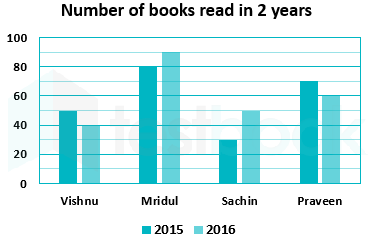
Directions: Read the bar graph carefully and answer the given questions.

Question 46

Based on Passage: View directions & passage

Total number of books read by Sachin and Mridul in both the years is how much more or less than the total number of books read by Praveen and Vishnu in both the years?

  1. AOption (a)

    30 More

  2. BOption (b)

    30 Less

  3. COption (c)

    50 More

  4. DOption (d)

    50 Less

  5. EOption (e)

    None of the above

View answer & explanation

Correct answer

Answer: (a)A.

30 More

Why this answer is correct

Total books read by Mridul and Sachin in both the years = 170 + 80 = 250

Total books read by Vishnu and Praveen in both the years = 90 + 130 = 220

Difference = 250 – 220 = 30 More

Question 47

Based on Passage: View directions & passage

What is the sum of all the books read by all of them in both the years ?

  1. AOption (a)

    470

  2. BOption (b)

    450

  3. COption (c)

    500

  4. DOption (d)

    490

  5. EOption (e)

    460

View answer & explanation

Correct answer

Answer: (a)A.

470

Why this answer is correct

Total books read by Vishnu in both the years = 90

Total books read by Mridul in both the years = 170

Total books read by Sachin in both the years = 80

Total books read by Praveen in both the years = 130

Total = 90 + 170 + 80 + 130 = 470

Question 48

Based on Passage: View directions & passage

Books read by Praveen in the year 2015 is what percent more or less than the number of books read by Mridul in the year 2015 ?

  1. AOption (a)

    15%

  2. BOption (b)

    10%

  3. COption (c)

    12.5%

  4. DOption (d)

    40%

  5. EOption (e)

    20%

View answer & explanation

Correct answer

Answer: (c)C.

12.5%

Why this answer is correct

Number of books read by Praveen in 2015 = 70

Number of books read by Mridul in 2015 = 80

∴ Required Percentage = (80 – 70 / 80) × 100 = 12.5%

Question 49

Based on Passage: View directions & passage

What is the average of total number of books read by all of them in the year 2016?

  1. AOption (a)

    50

  2. BOption (b)

    60

  3. COption (c)

    40

  4. DOption (d)

    45

  5. EOption (e)

    55

View answer & explanation

Correct answer

Answer: (b)B.

60

Why this answer is correct

Number of books read by Vishnu in 2016= 40

Number of books read by Mridul in 2016 = 90

Number of books read by Sachin in 2016= 50

Number of books read by Praveen in 2016= 60

Total Number of books read by all of them in 2016= 40 + 90 + 50 + 60 = 240

∴ Required Average = 240/4 = 60

Question 50

Based on Passage: View directions & passage

Find the ratio of sum of number of books read by Vishnu and Mridul together in 2015 to the sum of number of books read by Sachin and Praveen together in 2015.

  1. AOption (a)

    13 ∶ 10

  2. BOption (b)

    6 ∶ 5

  3. COption (c)

    3 ∶ 4

  4. DOption (d)

    5 ∶ 3

  5. EOption (e)

    7 ∶ 5

View answer & explanation

Correct answer

Answer: (a)A.

13 ∶ 10

Why this answer is correct

Number of books read by Vishnu in 2015 = 50

Number of books read by Mridul in 2015 = 80

Number of books read by Vishnu and Mridul in 2015 = 50 + 80 = 130

Number of books read by Sachin in 2015 = 30

Number of books read by Praveen in 2015 = 70

Number of books read by Sachin and Praveen in 2015 = 30 + 70 = 100

∴ Required ratio = 130 ∶ 100 = 13 ∶ 10

Question 51

An amount is to be distributed among Abhishek and Pritha in the ratio of 5: 7. If Abhishek gets Rs. 2000 less than Pritha, then find the Abhishek’s share.

  1. AOption (a)

    3000

  2. BOption (b)

    5000

  3. COption (c)

    6000

  4. DOption (d)

    7000

  5. EOption (e)

    4000

View answer & explanation

Correct answer

Answer: (b)B.

5000

Why this answer is correct

Shortcut Trick

Ratio of shares Abhishek : Pritha = 5 : 7

Difference in ratio parts = 7 − 5 = 2 units

Given, 2 units = ₹2000 → 1 unit = ₹1000

Abhishek’s share (5 units) = 5 × ₹1000 = ₹5000

∴ The correct answer is ₹5000.

Alternate Method

Given:

Ratio of distribution = 5 : 7

Difference in amounts = ₹2000

Calculations:

⇒ Let Abhishek’s share be 5x and Pritha’s share be 7x.

⇒ According to the question, 7x − 5x = 2000

⇒ 2x = 2000

⇒ x = 2000 ÷ 2 = 1000

⇒ Abhishek’s share = 5x = 5 × 1000

⇒ Abhishek’s share = ₹5000

∴ The correct answer is ₹5000.

Additional Information

Ratio and Proportion

A ratio compares two quantities. If A:B is the ratio and the total amount is T, then A's share = [A / (A+B)] × T.

Difference in Ratios

When the difference between two shares is given, the value of one unit is calculated as (Actual Difference) ÷ (Difference in Ratio Parts).

Question 52

A white car running at a speed of 72 km/hr is approaching a black car at a speed of 54 km/hr from a distance of 32 m behind. In how much time will it cross the black car?

  1. AOption (a)

    3.6 sec.

  2. BOption (b)

    4.8 sec.

  3. COption (c)

    5.5 sec.

  4. DOption (d)

    6.4 sec.

  5. EOption (e)

    7.2 sec.

View answer & explanation

Correct answer

Answer: (d)D.

6.4 sec.

Why this answer is correct

Shortcut Trick

Relative Speed in same direction = 72 − 54 = 18 km/hr.

Convert to m/s: 18 × (5/18) = 5 m/s.

Time to cross = Distance ÷ Relative Speed = 32 ÷ 5 = 6.4 seconds.

∴ The correct answer is 6.4 sec.

Alternate Method

Given:

Speed of White Car (S1) = 72 km/hr

Speed of Black Car (S2) = 54 km/hr

Initial Distance (D) = 32 m

Formula Used:

Relative Speed (Same Direction) = S1 − S2

Time = Distance ÷ Relative Speed

Calculations:

⇒ Relative Speed = 72 − 54 = 18 km/hr

⇒ Conversion to m/s = 18 × (5/18) = 5 m/s

⇒ Time required = 32 ÷ 5

⇒ Time = 6.4 seconds

∴ The correct answer is 6.4 sec.

Additional Information

Relative Speed Concepts

When two objects move in the same direction, relative speed is (S1 − S2). When moving in opposite directions, it is (S1 + S2).

Unit Conversion

To convert km/hr to m/s, multiply by 5/18. To convert m/s to km/hr, multiply by 18/5.

Overtaking Time

The time taken to overtake depends only on the gap distance and the difference in speeds between the two vehicles.

Question 53

At what per cent above the cost price must Atul mark his goods so that he gains 20% after giving a discount of 25% ?

  1. AOption (a)

    48%

  2. BOption (b)

    35%

  3. COption (c)

    49%

  4. DOption (d)

    32%

  5. EOption (e)

    None of these

View answer & explanation

Correct answer

Answer: (e)E.

None of these

Why this answer is correct

Shortcut Trick

Use the ratio formula: MP ÷ CP = (100 + Profit%) ÷ (100 − Discount%).

MP ÷ CP = (100 + 20) ÷ (100 − 25) = 120 ÷ 75.

Simplified Ratio: MP : CP = 8 : 5.

Marked up value = 8 − 5 = 3 units.

Markup percentage = (3 ÷ 5) × 100 = 60%.

∴ The correct answer is 60%.

Alternate Method

Given: Profit = 20%, Discount = 25%.

Formulas: SP = CP × (100 + Profit%) ÷ 100 | SP = MP × (100 − Discount%) ÷ 100 | Markup% = (MP − CP) ÷ CP × 100.

⇒ Let Cost Price (CP) be 100.

⇒ To gain 20%, Selling Price (SP) = 100 + 20 = 120.

⇒ Since SP is obtained after 25% discount on Marked Price (MP), SP = 75% of MP.

⇒ 120 = (75 ÷ 100) × MP ⇒ MP = (120 × 100) ÷ 75 = 160.

⇒ Markup = MP − CP = 160 − 100 = 60.

⇒ Markup% = (60 ÷ 100) × 100 = 60%.

∴ The correct answer is 60%.

Additional Information

Relation between MP and CP

The ratio of Marked Price to Cost Price is always (100 + Profit%) / (100 − Discount%). If there is a loss, use (100 − Loss%).

Marked Price & Discount

Discount is always calculated on the Marked Price (MP), whereas Profit or Loss is calculated on the Cost Price (CP).

Question 54

A boat takes 6 hours less to travel a distance downstream than to travel the same distance upstream. If the speed of the boat in still water is 9 km/hr and speed of stream is 3 km/hr, Find the total distance covered by the boat.

  1. AOption (a)

    150 km

  2. BOption (b)

    144 km

  3. COption (c)

    140 km

  4. DOption (d)

    134 km

  5. EOption (e)

    None of these

View answer & explanation

Correct answer

Answer: (b)B.

144 km

Why this answer is correct

Shortcut Trick

Speed downstream (u) = 9 + 3 = 12 km/hr

Speed upstream (v) = 9 − 3 = 6 km/hr

Ratio of Speed (Down : Up) = 12 : 6 = 2 : 1

Ratio of Time (Down : Up) = 1 : 2 (since Distance is constant)

Difference in time ratio = 2 − 1 = 1 unit → 6 hours

Time taken downstream = 1 × 6 = 6 hours | Distance = 12 × 6 = 72 km

Total distance covered (Up + Down) = 72 + 72 = 144 km.

∴ The correct answer is 144 km.

Alternate Method

Given: Speed of boat (x) = 9 km/hr, Speed of stream (y) = 3 km/hr, Time difference = 6 hours.

Formula Used: Distance (D) = [ (u × v) ÷ (u − v) ] × Time Difference

⇒ Downstream Speed (u) = 9 + 3 = 12 km/hr

⇒ Upstream Speed (v) = 9 − 3 = 6 km/hr

⇒ One-way Distance (D) = [ (12 × 6) ÷ (12 − 6) ] × 6

⇒ D = [ 72 ÷ 6 ] × 6 = 72 km

⇒ Total Distance = Upstream Distance + Downstream Distance = 72 + 72

⇒ Total Distance = 144 km

∴ The correct answer is 144 km.

Additional Information

Relative Speed in Streams

Downstream speed (u) = x + y; Upstream speed (v) = x − y, where x is boat speed in still water and y is stream speed.

Still Water Speed Formula

Speed of boat in still water (x) = (u + v) ÷ 2 and Speed of stream (y) = (u − v) ÷ 2.

Average Speed of Boat

For a round trip (Upstream and Downstream), Average Speed = (u × v) ÷ x = (x2 − y2) ÷ x.

Question 55

The ratio of the A's present age and B's age 4 years ago is 7 : 8. After 8 years, ratio of age of A to that of B is 9 : 11. Find the present age of B.

  1. AOption (a)

    36 years

  2. BOption (b)

    23 years

  3. COption (c)

    24 years

  4. DOption (d)

    25 years

  5. EOption (e)

    26 years

View answer & explanation

Correct answer

Answer: (a)A.

36 years

Why this answer is correct

Shortcut Trick

Let A's present age be 7x and B's age 4 years ago be 8x.

Current ages: A = 7x, B = 8x + 4.

Ages after 8 years: (7x + 8) / (8x + 4 + 8) = 9 / 11.

Solving for x: 77x + 88 = 72x + 108 → 5x = 20 → x = 4.

B's present age = 8(4) + 4 = 32 + 4 = 36 years.

∴ The correct answer is 36 years.

Alternate Method

Given: Ratio of A : (B − 4) = 7 : 8 and (A + 8) : (B + 8) = 9 : 11.

Calculations:

⇒ Let A = 7x and B − 4 = 8x → B = 8x + 4.

⇒ After 8 years, A's age = 7x + 8.

⇒ After 8 years, B's age = (8x + 4) + 8 = 8x + 12.

⇒ (7x + 8) / (8x + 12) = 9 / 11

⇒ 11(7x + 8) = 9(8x + 12)

⇒ 77x + 88 = 72x + 108

⇒ 5x = 20

⇒ x = 4

⇒ B's present age = 8x + 4 = 8(4) + 4 = 36 years.

∴ The correct answer is 36 years.

Additional Information

Ratio Method for Ages

When comparing ages at different points in time, ensure all parts of the ratio refer to the same timeframe or define variables clearly relative to the present age.

Age Difference Constant

The difference between the ages of two people remains constant throughout their lives, which can often be used to balance ratios quickly.

Question 56

In a 40 lt mixture of milk and water, the ratio of milk and water is 4 : 1. If 20 lt of the mixture was taken out and 10 liters of water is added. Find the quantity of water in the new mixture.

  1. AOption (a)

    26

  2. BOption (b)

    24

  3. COption (c)

    14

  4. DOption (d)

    15

  5. EOption (e)

    None of these

View answer & explanation

Correct answer

Answer: (c)C.

14

Why this answer is correct

Shortcut Trick

Remaining mixture = 40 − 20 = 20 liters.

In remaining mixture, water = (1 / 5) × 20 = 4 liters.

Final water = Initial water in remaining + Added water = 4 + 10 = 14 liters.

∴ The correct answer is 14 liters.

Alternate Method

Given: Total mixture = 40 liters, Ratio (M:W) = 4:1, Removed = 20 liters, Added water = 10 liters.

⇒ Remaining Mixture = 40 − 20 = 20 liters.

⇒ Ratio in remaining mixture remains 4 : 1.

⇒ Quantity of water in 20 liters = [1 / (4+1)] × 20

⇒ Quantity of water = (1 / 5) × 20 = 4 liters.

⇒ Final quantity of water = 4 + 10 = 14 liters.

∴ The correct answer is 14 liters.

Additional Information

Ratio Invariance

When a portion of a homogeneous mixture is removed, the ratio of components in the remaining part and the removed part remains the same as the initial ratio.

Mixture Alligation

To find final concentrations after adding pure components, treat pure water as 100% water (or 0% milk) and apply the weighted average formula.

Question 57

A and B entered into a partnership with capital in the ratio of 5 : 6. After 6 months, C joined the business with half of the capital than B. If at the end of the year, the share of A in total profit is Rs. 2400, then find the total profit earned by C.

  1. AOption (a)

    Rs. 720

  2. BOption (b)

    Rs. 2880

  3. COption (c)

    Rs. 960

  4. DOption (d)

    Rs. 1120

  5. EOption (e)

    None of these

View answer & explanation

Correct answer

Answer: (a)A.

Rs. 720

Why this answer is correct

Shortcut Trick

Ratio of Profit = Ratio of (Capital × Time).

Ratio A : B : C = (5 × 12) : (6 × 12) : (3 × 6) = 60 : 72 : 18 = 10 : 12 : 3.

Given A share (10 units) = Rs. 2400 ⇒ 1 unit = Rs. 240.

C share (3 units) = 3 × 240 = Rs. 720.

∴ The correct answer is Rs. 720.

Alternate Method

Given: Capital ratio A : B = 5 : 6. C joins after 6 months with half of B capital. Duration = 1 year.

Formulas: Profit = Capital × Time | Profit ShareA : Profit ShareB : Profit ShareC = (Ca × Ta) : (Cb × Tb) : (Cc × Tc)

⇒ Let capital of A and B be 5x and 6x respectively.

⇒ Capital of C = 6x ÷ 2 = 3x.

⇒ Time periods: Ta = 12 months, Tb = 12 months, Tc = 6 months.

⇒ Profit ratio = (5x × 12) : (6x × 12) : (3x × 6) = 60x : 72x : 18x.

⇒ Simplifying the ratio = 10 : 12 : 3.

⇒ A share = 10 units = 2400 ⇒ 1 unit = 240.

⇒ C share = 3 units = 3 × 240 = 720.

∴ The correct answer is Rs. 720.

Additional Information

Partnership Basics

In a simple partnership, profits are shared in the ratio of investments if the time period is the same. In a compound partnership, profits are shared in the ratio of the product of capital and time.

Investment Calculation

If the profit ratio and time ratio are known, the capital ratio can be found using: Capital = Profit ÷ Time.

Question 58

The difference between the Compound Interest on a certain sum of money at 20% for second year and first year is Rs. 1200. Find the sum.

  1. AOption (a)

    Rs. 25000

  2. BOption (b)

    Rs. 30000

  3. COption (c)

    Rs. 50000

  4. DOption (d)

    Rs. 5000

  5. EOption (e)

    None of these

View answer & explanation

Correct answer

Answer: (b)B.

Rs. 30000

Why this answer is correct

Shortcut Trick

Let the Principal (P) be 100 units.

First year CI = 20% of 100 = 20 units.

Second year CI = First year CI + Interest on First year CI = 20 + (20% of 20) = 24 units.

Difference = 24 − 20 = 4 units → ₹1200.

1 unit = ₹300 ∴ 100 units = 100 × 300 = ₹30000.

∴ The correct answer is ₹30000.

Alternate Method

Given: Rate (R) = 20%, Difference between 2nd year CI and 1st year CI = ₹1200.

Formula Used: CI for 1st year = PR/100; CI for 2nd year = P(R/100)(1 + R/100).

⇒ CI1 = P × (20/100) = 0.2P

⇒ CI2 = P × (20/100) × (1 + 20/100) = 0.2P × 1.2 = 0.24P

⇒ Difference = 0.24P − 0.2P = 0.04P

⇒ 0.04P = 1200

⇒ P = 1200 ÷ 0.04 = 120000 ÷ 4

⇒ P = 30000

∴ The correct answer is ₹30000.

Additional Information

CI for Particular Year

The difference between the CI of two consecutive years (e.g., 2nd year and 1st year) is simply the interest calculated on the previous year's interest: Diff = CI1 × R/100.

Difference for 2 Years

The difference between CI and SI for 2 years is given by the formula D = P(R/100)2.

Effective Rate Method

For a rate R%, the 1st year interest is R% of P and the 2nd year interest is [R + (R2/100)]% of P. The difference is (R2/100)% of P.

Question 59

The average age of 18 people is 25 years. After including 3 more persons, the average age is increased by 3 years. Find the average age of 3 new persons?

  1. AOption (a)

    42 years

  2. BOption (b)

    48 years

  3. COption (c)

    46 years

  4. DOption (d)

    54 years

  5. EOption (e)

    36 years

View answer & explanation

Correct answer

Answer: (c)C.

46 years

Why this answer is correct

Shortcut Trick

Initial average = 25 years, New average = 25 + 3 = 28 years.

Total increase = (Initial persons × Increase in average) + (New persons × New average)

Sum of 3 new persons = (18 × 3) + (3 × 28) = 54 + 84 = 138 years.

Average of 3 new persons = 138 ÷ 3 = 46 years.

∴ The correct answer is 46 years.

Alternate Method

Given: Initial persons = 18, Initial average = 25 years. New persons added = 3. New average = 25 + 3 = 28 years.

Formula Used: Total Sum = Average × Number of people

⇒ Total age of 18 people = 18 × 25 = 450 years.

⇒ Total people after addition = 18 + 3 = 21 people.

⇒ Total age of 21 people = 21 × 28 = 588 years.

⇒ Sum of ages of 3 new persons = 588 − 450 = 138 years.

⇒ Average of 3 new persons = 138 ÷ 3 = 46 years.

∴ The correct answer is 46 years.

Additional Information

Weighted Average Formula

When two groups are combined, the resulting average is (n1x1 + n2x2) ÷ (n1 + n2).

Net Deviation Method

The sum of deviations from the average is always zero. New sum = (Change in average × Total final members) + (Old average × New members).

Question 60

The length and the breadth of a rectangle is in the ratio of 2:3. If the area of the rectangle is 96cm2 . Find its perimeter.

  1. AOption (a)

    24 cm

  2. BOption (b)

    40 cm

  3. COption (c)

    160 cm

  4. DOption (d)

    56 cm

  5. EOption (e)

    None of these

View answer & explanation

Correct answer

Answer: (b)B.

40 cm

Why this answer is correct

Shortcut Trick

Ratio of length and breadth = 2 : 3

Area ratio parts = 2 × 3 = 6 units2

6 units2 = 96 cm2 ⇒ 1 unit2 = 16 ⇒ 1 unit = 4 cm

Perimeter = 2 × (2 + 3) units = 10 units = 10 × 4 = 40 cm

∴ The correct answer is 40 cm.

Alternate Method

Given: Ratio of Length (L) to Breadth (B) = 2 : 3

Formula Used: Area = L × B; Perimeter = 2(L + B)

⇒ Let Length = 2x and Breadth = 3x

⇒ Area = 2x × 3x = 96

⇒ 6x2 = 96

⇒ x2 = 16

⇒ x = 4 cm

⇒ Length = 2 × 4 = 8 cm and Breadth = 3 × 4 = 12 cm

⇒ Perimeter = 2(8 + 12) = 2(20) = 40 cm

∴ The correct answer is 40 cm.

Additional Information

Properties of Rectangle

A rectangle is a quadrilateral where opposite sides are equal and all internal angles are 90°.

Diagonal of Rectangle

The diagonal (d) can be calculated using the Pythagorean theorem: d = √(L2 + B2).

Area and Perimeter relationship

For a fixed perimeter, a square (where L=B) has the maximum possible area among all rectangles.

Question 61

Find the missing number in the series

2.5, 5, 15, 60, ?, 1800

  1. AOption (a)

    180

  2. BOption (b)

    220

  3. COption (c)

    420

  4. DOption (d)

    300

  5. EOption (e)

    None of these

View answer & explanation

Correct answer

Answer: (d)D.

300

Why this answer is correct

2.5 × 2 = 5

⇒ 5 × 3 = 15

⇒ 15 × 4 = 60

⇒ 60 × 5 = 300

⇒ 300 × 6 = 1800

Question 62

Find the missing number in the series

4, 3, 4, 9, 32, ?

  1. AOption (a)

    205

  2. BOption (b)

    165

  3. COption (c)

    175

  4. DOption (d)

    155

  5. EOption (e)

    145

View answer & explanation

Correct answer

Answer: (d)D.

155

Why this answer is correct

4 × 1 – 1 = 3

⇒ 3 × 2 – 2 = 4

⇒ 4 × 3 – 3 = 9

⇒ 9 × 4 – 4 = 32

⇒ 32 × 5 – 5 = 155

Question 63

Find the missing number in the series

343, 729, 1331, 2197, ?

  1. AOption (a)

    2725

  2. BOption (b)

    2250

  3. COption (c)

    3025

  4. DOption (d)

    3375

  5. EOption (e)

    3125

View answer & explanation

Correct answer

Answer: (d)D.

3375

Why this answer is correct

343 = 73

729 = 93

1331 = 113

2197 = 133

3375 = 153

Question 64

Find the missing number in the series

 100,150, 300, 750, ?

  1. AOption (a)

    1500

  2. BOption (b)

    2250

  3. COption (c)

    3000

  4. DOption (d)

    2000

  5. EOption (e)

    1800

View answer & explanation

Correct answer

Answer: (b)B.

2250

Why this answer is correct

100

100 × 1.5 = 150

150 × 2 = 300

300 × 2.5 = 750

750 × 3 = 2250

Question 65

Find the missing number in the series

55, 50, ?, 25, 5, -20

  1. AOption (a)

    40

  2. BOption (b)

    35

  3. COption (c)

    30

  4. DOption (d)

    45

  5. EOption (e)

    50

View answer & explanation

Correct answer

Answer: (a)A.

40

Why this answer is correct

The series follows the following pattern:

55 - 5 = 50

50 - 10 = 40

40 - 15 = 25

25 - 20 = 5

5 - 25 = -20

Reasoning Ability (35 questions)

Direction: Read the information carefully and answer the question given below.

Eight people P, Q, R, S, T, U, V and W are sitting around a circular table. All are facing towards the center but not necessarily in the same order.

Only two people sit between P and R. S sits immediate right of R. Three people sit between S and T. Two people sits between V and U. Q sits second to the left of U. W sits immediate left of V.

Question 66

Based on Passage: View directions & passage

What is the position of S with respect to U?

  1. AOption (a)

    Third to the right

  2. BOption (b)

    Second to the left

  3. COption (c)

    Third to the left

  4. DOption (d)

    Second to the right

  5. EOption (e)

    Can't be determined

View answer & explanation

Correct answer

Answer: (c)C.

Third to the left

Why this answer is correct

Given,

i) Only two people sit between P and R.

From the above statement we have two cases i.e. Case 1 and Case 2;

ii) S sits immediate right of R.

iii) Three people sit between S and T.

From the above statement, Case-2 is eliminated because there is no place for T.

iv) Two people sit between V and U.

v) Q sits second to the left of U.

vi) W sits immediate left of V.

S sits third to the left of U.

Hence, Third to left is the correct answer.

Question 67

Based on Passage: View directions & passage

Who sits fourth to the right of W?

  1. AOption (a)

    P

  2. BOption (b)

    S

  3. COption (c)

    R

  4. DOption (d)

    Q

  5. EOption (e)

    None of these

View answer & explanation

Correct answer

Answer: (d)D.

Q

Why this answer is correct

Given,

i) Only two people sit between P and R.

From the above statement we have two cases i.e. Case 1 and Case 2;

ii) S sits immediate right of R.

iii) Three people sit between S and T.

From the above statement, Case-2 is eliminated because there is no place for T.

iv) Two people sit between V and U.

v) Q sits second to the left of U.

vi) W sits immediate left of V.

Q sits fourth to the right of W.

Hence, Q is the correct answer.

Question 68

Based on Passage: View directions & passage

Who sits second to the left of V?

  1. AOption (a)

    R

  2. BOption (b)

    Q

  3. COption (c)

    T

  4. DOption (d)

    U

  5. EOption (e)

    S

View answer & explanation

Correct answer

Answer: (c)C.

T

Why this answer is correct

Given,

i) Only two people sit between P and R.

From the above statement we have two cases i.e. Case 1 and Case 2;

ii) S sits immediate right of R.


iii) Three people sit between S and T.

From the above statement, Case-2 is eliminated because there is no place for T.

iv) Two people sit between V and U.

v) Q sits second to the left of U.

vi) W sits immediate left of V.

T sits second to the left of V

Hence, T is the correct answer.

Question 69

Based on Passage: View directions & passage

Choose the one which is different from other options?

  1. AOption (a)

    PT

  2. BOption (b)

    TV

  3. COption (c)

    VW

  4. DOption (d)

    PS

  5. EOption (e)

    QR

View answer & explanation

Correct answer

Answer: (c)C.

VW

Why this answer is correct

Given,

i) Only two people sit between P and R.

From the above statement we have two cases i.e. Case 1 and Case 2;

ii) S sits immediate right of R.

iii) Three people sit between S and T.

From the above statement, Case-2 is eliminated because there is no place for T.

iv) Two people sit between V and U.

v) Q sits second to the left of U.

vi) W sits immediate left of V.

All of have 1 person between them except VW.

Hence, VW is the correct answer.

Directions: Read the following information carefully and answer the questions which follow:

Point B is 6 m to the west of point A. Point C is 4 m to the north of point B. Point G is between point B and point C. Point H is 12 m to the south of point C. Point D is 3 m to the west of point C and point F is 4 m to the south of point D. Point E is 3 m to the east of point H.

Question 70

Based on Passage: View directions & passage

What is the shortest distance between F and E?

  1. AOption (a)

    8 m

  2. BOption (b)

    10 m

  3. COption (c)

    12 m

  4. DOption (d)

    √88 m

  5. EOption (e)

    None of these

View answer & explanation

Correct answer

Answer: (b)B.

10 m

Why this answer is correct

Distance between F and E = √(62 + 82) = √(36 + 64) = √100 = 10 m

Hence, 10m is the correct answer. 82−−−−−−√√62−−√62−−√62

36+64−−−−−−−

Question 71

Based on Passage: View directions & passage

Which is the odd one out?

  1. AOption (a)

    F

  2. BOption (b)

    C

  3. COption (c)

    G

  4. DOption (d)

    H

  5. EOption (e)

    None of these

View answer & explanation

Correct answer

Answer: (a)A.

F

Why this answer is correct

Clearly, F is not in a straight line.

Hence, F is the correct answer.

Question 72

Based on Passage: View directions & passage

What is the direction of D with respect to A?

  1. AOption (a)

    East

  2. BOption (b)

    North-east

  3. COption (c)

    South-west

  4. DOption (d)

    North-west

  5. EOption (e)

    South-east

View answer & explanation

Correct answer

Answer: (d)D.

North-west

Why this answer is correct

Clearly, from the above diagram, we can say D is North-west of A.

Hence, North-west is the correct answer.

Study the following information carefully and answer the questions following it.

Certain people are sitting in a single row facing north.

A is sitting in third place from the right end. There are 2 people between A and C. There is one person between C and D. E is to the second left of D. H is to the fifth right of C. A is exactly sitting between B and F who is to the right of A. G is to the second left of J who is to the second left of I who is an immediate neighbor of B.

Question 73

Based on Passage: View directions & passage

Who is sitting at the extreme ends?

  1. AOption (a)

    G, D

  2. BOption (b)

    B, E

  3. COption (c)

    E, H

  4. DOption (d)

    A, B

  5. EOption (e)

    C, I

View answer & explanation

Correct answer

Answer: (c)C.

E, H

Why this answer is correct

  1. A is sitting in third place form the right end. 

  2. There are 2 people between A and C. 

  3. There is one person between C and D. 

  4. E is to the second left of D. 

  5. H is to the fifth right of C. 

  6. A is exactly sitting between B and F who is to the right of A. 

  7. G is to the second left of J who is to the second left of I.

Hence, E and H are sitting at the extreme ends.

Question 74

Based on Passage: View directions & passage

What is the position of D with respect to H?

  1. AOption (a)

    Third to the right

  2. BOption (b)

    Seventh to the left

  3. COption (c)

    Sixth to the left

  4. DOption (d)

    Third to the left

  5. EOption (e)

    Can't be determined

View answer & explanation

Correct answer

Answer: (b)B.

Seventh to the left

Why this answer is correct

  1. A is sitting in third place form the right end. 

  2. There are 2 people between A and C. 

  3. There is one person between C and D. 

  4. E is to the second left of D. 

  5. H is to the fifth right of C. 

  6. A is exactly sitting between B and F who is to the right of A. 

  7. G is to the second left of J who is to the second left of I.

Hence, D is sitting seven to the left of H.

Question 75

Based on Passage: View directions & passage

How many people are sitting between C and F?

  1. AOption (a)

    5

  2. BOption (b)

    4

  3. COption (c)

    3

  4. DOption (d)

    2

  5. EOption (e)

    1

View answer & explanation

Correct answer

Answer: (c)C.

3

Why this answer is correct

  1. A is sitting in third place form the right end. 

  2. There are 2 people between A and C. 

  3. There is one person between C and D. 

  4. E is to the second left of D. 

  5. H is to the fifth right of C. 

  6. A is exactly sitting between B and F who is to the right of A. 

  7. G is to the second left of J who is to the second left of I.

Hence, there are 3 persons are sitting between C and F.

Question 76

Based on Passage: View directions & passage

Which of the following statements is true?

  1. AOption (a)

    C and B are neighbours.

  2. BOption (b)

    There is one person between B and F.

  3. COption (c)

    J is at one extreme end.

  4. DOption (d)

    H is two people away from D.

  5. EOption (e)

    B is exactly between C and I.

View answer & explanation

Correct answer

Answer: (b)B.

There is one person between B and F.

Why this answer is correct

  1. A is sitting in third place form the right end. 

  2. There are 2 people between A and C. 

  3. There is one person between C and D. 

  4. E is to the second left of D. 

  5. H is to the fifth right of C. 

  6. A is exactly sitting between B and F who is to the right of A. 

  7. G is to the second left of J who is to the second left of I.

Hence, the statement given only in option 2 is correct.

Question 77

Based on Passage: View directions & passage

Who is sitting exactly between G and I?

  1. AOption (a)

    E

  2. BOption (b)

    J

  3. COption (c)

    D

  4. DOption (d)

    C

  5. EOption (e)

    B

View answer & explanation

Correct answer

Answer: (b)B.

J

Why this answer is correct

  1. A is sitting in third place form the right end.

  2. There are 2 people between A and C.

  3. There is one person between C and D.

  4. E is to the second left of D.

  5. H is to the fifth right of C.

  6. A is exactly sitting between B and F who is to the right of A.

  7. G is to the second left of J who is to the second left of I.

Hence, J is exactly sitting between G and I.

Direction: In the question below are given some statements followed by some conclusions. You have to take the given statements to be true even if they seem to be at variance with commonly known facts. Read all the conclusions and then decide which of the given conclusions logically follows from the given statements disregarding commonly known facts.

Question 78

Based on Passage: View directions & passage

Statements:

All apps are fan.

Some apps are grey.

Conclusions:

I. Very few fans are grey.

II. No fan is grey.

  1. AOption (a)

    Only I follows

  2. BOption (b)

    Only II follows

  3. COption (c)

    Either I or II follows

  4. DOption (d)

    Neither I nor II follows

  5. EOption (e)

    Both I and II follow

View answer & explanation

Correct answer

Answer: (a)A.

Only I follows

Why this answer is correct

The least possible diagram for the given statements is as follows

Conclusions:

I. Very few fans are grey → True (It is definitely true)

II. No fan is grey → False (It is definitely false)

Hence, only I follows.

Question 79

Based on Passage: View directions & passage

Statements:

No plate is cat.

All vans are plates.

Conclusion:

I. Some cats are plates.

II. No van is cat.

III. Some plates are vans.

  1. AOption (a)

    Only I and II follows

  2. BOption (b)

    Only III follows

  3. COption (c)

    Only I follows

  4. DOption (d)

    Only II follows

  5. EOption (e)

    Only II and III follow

View answer & explanation

Correct answer

Answer: (e)E.

Only II and III follow

Why this answer is correct

The possible diagrams of the statements are,

I. Some cats are plates → False

II. No van is cat → True

III. Some plates are vans → True

Hence, only II and III follow.

Question 80

Based on Passage: View directions & passage

Statements:

All mangoes are figs.

Some figs are skies.

No bat is mango.

Conclusions:

I. Some figs are mangoes.

II. Some skies are bats.

III. Some skies being mangoes is a possibility.

  1. AOption (a)

    Only I follows

  2. BOption (b)

    Only II and III follow

  3. COption (c)

    All follow

  4. DOption (d)

    Only II follows

  5. EOption (e)

    Only I and III follow

View answer & explanation

Correct answer

Answer: (e)E.

Only I and III follow

Why this answer is correct

The least possible Venn diagram for the given statements is as follows,

Conclusions:

I. Some figs are mangoes → True (as shown is figure)

II. Some skies are bats → False (it is possible but not definite)

III. Some skies being mangoes is a possibility → True

Hence, only I and III follow.

Question 81

Based on Passage: View directions & passage

Statements:

All phones are caps.

No cap is a map.

Some maps are boats.

Conclusions:

I. No cap is a boat.

II. Some boats being phones is a possibility.

  1. AOption (a)

    Only I follows

  2. BOption (b)

    Only II follows

  3. COption (c)

    Either I or II follows

  4. DOption (d)

    Neither I nor II follows

  5. EOption (e)

    Both I and II follow

View answer & explanation

Correct answer

Answer: (b)B.

Only II follows

Why this answer is correct

The least possible Venn diagram for the given statements is as follows

Conclusions:

I. No cap is a boat → False, as no cap is map.

II. Some boats being phones is a possibility→ True (it is possible but not definite)

Hence, only conclusion II follows.

Directions: Study the following information and answer the given questions.

Ten persons are sitting in two parallel rows containing five people each, in such a way that there is equal distance between adjacent persons. In row 1 – A, B, C, D and E are seated (but not necessarily in the same order) and all of them are facing North. In row 2 – L, M, N, O and P are seated (but not necessarily in the same order) and all of them are facing South. In the given seating arrangement each member seated in a row faces another member of the other row. B sits second to the right of D who is sitting in the middle of the row. The person facing B sits to the immediate left of N. L sits second to the right of N. Only two persons sit between L and P. E is not an immediate neighbour of D. O does not face E. C is not facing N.

Question 82

Based on Passage: View directions & passage

Which of the following statement is true regarding O?

  1. AOption (a)

    L sits to the immediate left of O.

  2. BOption (b)

    Only three persons sit between P and O.

  3. COption (c)

    O sits exactly in the middle of the row.

  4. DOption (d)

    O faces one of the immediate neighbors of B.

  5. EOption (e)

    None of the given statement is true.

View answer & explanation

Correct answer

Answer: (c)C.

O sits exactly in the middle of the row.

Why this answer is correct

Persons: Row 1 – A, B, C, D, E.

Row 2 – L, M, N, O, P.

Directions: North and South

B sits second to the right of D who is sitting in the middle of the row.

The person facing B sits to the immediate left of N.

L sits second to the right of N.

Only two persons sit between L and P.

E is not an immediate neighbour of D.

O does not face E.

C is not facing N.

Hence, O sits exactly in the middle of the row is true.

Question 83

Based on Passage: View directions & passage

Who among the following is facing A?

  1. AOption (a)

    L

  2. BOption (b)

    M

  3. COption (c)

    O

  4. DOption (d)

    P

  5. EOption (e)

    N

View answer & explanation

Correct answer

Answer: (e)E.

N

Why this answer is correct

Persons: Row 1 – A, B, C, D, E.

Row 2 – L, M, N, O, P.

Directions: North and South

B sits second to the right of D who is sitting in the middle of the row.

The person facing B sits to the immediate left of N.

L sits second to the right of N.

Only two persons sit between L and P.

E is not an immediate neighbour of D.

O does not face E.

C is not facing N.

Hence, N is facing A.

Question 84

Based on Passage: View directions & passage

Who amongst the following is facing M?

  1. AOption (a)

    E

  2. BOption (b)

    A

  3. COption (c)

    D

  4. DOption (d)

    B

  5. EOption (e)

    C

View answer & explanation

Correct answer

Answer: (a)A.

E

Why this answer is correct

Persons: Row 1 – A, B, C, D, E.

Row 2 – L, M, N, O, P.

Directions: North and South

B sits second to the right of D who is sitting in the middle of the row.

The person facing B sits to the immediate left of N.

L sits second to the right of N.

Only two persons sit between L and P.

E is not an immediate neighbour of D.

O does not face E.

C is not facing N.

Hence, E is facing M.

Question 85

Based on Passage: View directions & passage

Four of the following five are alike in a certain way based on the given arrangement and hence form a group. Which is the one that does not belong to the group?

  1. AOption (a)

    NO

  2. BOption (b)

    CE

  3. COption (c)

    AB

  4. DOption (d)

    PO

  5. EOption (e)

    ML

View answer & explanation

Correct answer

Answer: (d)D.

PO

Why this answer is correct

Persons: Row 1 – A, B, C, D, E.

Row 2 – L, M, N, O, P.

Directions: North and South

B sits second to the right of D who is sitting in the middle of the row.

The person facing B sits to the immediate left of N.

L sits second to the right of N.

Only two persons sit between L and P.

E is not an immediate neighbour of D.

O does not face E.

C is not facing N.

Except, 'PO' all others are neighbours of each other.

Hence, 'PO' is the odd one.

Question 86

Based on Passage: View directions & passage

What is the position of C with respect to B?

  1. AOption (a)

    Second to the left

  2. BOption (b)

    Third to the left

  3. COption (c)

    Immediate left

  4. DOption (d)

    Immediate right

  5. EOption (e)

    Second to the right

View answer & explanation

Correct answer

Answer: (b)B.

Third to the left

Why this answer is correct

Persons: Row 1 – A, B, C, D, E.

Row 2 – L, M, N, O, P.

Directions: North and South

B sits second to the right of D who is sitting in the middle of the row.

The person facing B sits to the immediate left of N.

L sits second to the right of N.

Only two persons sit between L and P.

E is not an immediate neighbour of D.

O does not face E.

C is not facing N.

Hence, C is third to the left of B.

Directions: Study the following information carefully to answer the given questions:

6 B G @ I L 7 3 H A % © D F K E 8 J Q 1 * V T U 2 $ W$

Question 87

Based on Passage: View directions & passage

How many such symbols are there in the above arrangement each of which is immediately followed by a consonant but not preceded by another symbol?

  1. AOption (a)

    None

  2. BOption (b)

    One

  3. COption (c)

    Two

  4. DOption (d)

    Three

  5. EOption (e)

    Four

View answer & explanation

Correct answer

Answer: (c)C.

Two

Why this answer is correct

  1. Immediately preceded by means immediately before or to come just before.
  2. Immediately followed by means immediately after or to come just after. 3. Here, G @ I will not followed this condition and I is a vowel not consonant.

Given series:

Left Side # 6 B G @ I L 7 3 H A % © D F K E 8 J Q 1 * V T U 2 $ W Right Side

  1. Symbols which are immediately followed by a consonant but not preceded by another symbol:

Condition to be checked:

Not symbol → Symbol → Consonant

6 B G @ I L 7 3 H A % © D F K E 8 J Q 1 * V T U 2 $ W

Here there are 2 Symbols which is immediately followed by a consonant but not preceded by another symbol: 1 * V, 2 $ W.

Hence, there are 2 symbols which is immediately followed by a consonant but not preceded by another symbol$.

Question 88

Based on Passage: View directions & passage

Four of the following five are alike in a certain way based on the positions of their elements in the above arrangement and so form a group. Which is the one that does not belong to the group?

  1. AOption (a)

    IL@

  2. BOption (b)

    AH%

  3. COption (c)

    KFE

  4. DOption (d)

    QJ1

  5. EOption (e)

    V * T

View answer & explanation

Correct answer

Answer: (a)A.

IL@

Why this answer is correct

Given series:

Left Side # 6 B G @ I L 7 3 H A % © D F K E 8 J Q 1 * V T U 2 $ W Right Side

Here the group is formed in which second element is to the immediate left of the first element, and the third element is immediate right of the first element.

Left Side # 6 B G @ I L 7 3 H A % © D F K E 8 J Q 1 *** V T** U 2 $ W Right Side

Hence, I L @ does not belong to the group.

Question 89

Based on Passage: View directions & passage

If all the numbers are dropped from the above arrangement which element will be fifth to the left of eleventh from the left?

  1. AOption (a)

    I

  2. BOption (b)

    H

  3. COption (c)

    T

  4. DOption (d)
  5. EOption (e)

    None of these

View answer & explanation

Correct answer

Answer: (e)E.

None of these

Why this answer is correct

Given series:

Left Side # 6 B G @ I L 7 3 H A % © D F K E 8 J Q 1 * V T U 2 $ W Right Side

  1. If all the numbers are dropped:

B G @ I L H A % © D F K E J Q * V T U $ W

  1. Fifth to the left of eleventh from the left.

As, Left – Left = Left

11th from the left – 5th from the left = 6th from the left

Clearly, 6th from the left is L.

Then, letter/ Symbol that is fifth to the left of eleventh from the left is ‘L’.

Question 90

Based on Passage: View directions & passage

In the following question, select the related letters from the given alternatives.

B G : L 7 : : A % : ?

  1. AOption (a)

    EK

  2. BOption (b)

    DF

  3. COption (c)

    KF

  4. DOption (d)

    FK

  5. EOption (e)

    None of these

View answer & explanation

Correct answer

Answer: (d)D.

FK

Why this answer is correct

Given series:

Left Side # 6 B G @ I L 7 3 H A % © D F K E 8 J Q 1 * V T U 2 $ W Right Side

B G : L 7 : : A % : ?

Clearly, the logic behind this is; the elements are neighbors and there are 2 spaces between two groups of neighbors.

Hence, the next term is FK$.

Question 91

Based on Passage: View directions & passage

How many such vowels are there in the above arrangement each of which is immediately followed by a symbol and also immediately preceded by a consonant?

  1. AOption (a)

    None

  2. BOption (b)

    One

  3. COption (c)

    Two

  4. DOption (d)

    Three

  5. EOption (e)

    Four

View answer & explanation

Correct answer

Answer: (b)B.

One

Why this answer is correct

Given series:

Left Side # 6 B G @ I L 7 3 H A % © D F K E 8 J Q 1 * V T U 2 $ W Right Side

  1. Vowels which are immediately followed by a symbol and also immediately preceded by a consonant:

6 B G @ I L 7 3 H A % © D F K E 8 J Q 1 * V T U 2 $ W

Hence, there is 1 Vowel which is immediately followed by a symbol and also immediately preceded by a consonant:

H A %

Question 92

If it is possible to make a meaningful word from second, fourth, fifth, sixth and seventh letters of the word ACKNOWLEDGE, then which will be the first letter of that word? Mark X if no such word can be formed and M if more than one such word can be formed.

  1. AOption (a)

    N

  2. BOption (b)

    C

  3. COption (c)

    L

  4. DOption (d)

    X

  5. EOption (e)

    M

View answer & explanation

Correct answer

Answer: (b)B.

C

Why this answer is correct

Given word: ACKNOWLEDGE

2nd letter = C; 4th letter = N; 5th letter = O; 6th letter = W; 7th letter = L

Letters given: C N O W L

Possible words: C L O W N (a comic entertainer)

Hence, only one word can be formed and the first letter of the word is “C”.

Study the following information to answer the given questions.

Seven persons: A, B, C, D, E, F, and G purchased some items one after another i.e., eraser, pen, TV, printer, mouse, mug, and phone but not necessary in the same order.

A purchased a mouse and there is a gap of 2 persons between A and E. 

E didn’t come first or at last. 

As many persons came after A are the same as the number of persons who came before F who purchased the pen.

C purchased an eraser immediately before A.

There is a gap of 4 persons between E and G who purchased a printer.

D purchased a phone immediately before E who purchased a TV.

The mug is purchased by B.

Question 93

Based on Passage: View directions & passage

Who purchased the pen?

  1. AOption (a)

    B

  2. BOption (b)

    C

  3. COption (c)

    D

  4. DOption (d)

    E

  5. EOption (e)

    F

View answer & explanation

Correct answer

Answer: (e)E.

F

Why this answer is correct

Seven persons: A, B, C, D, E, F and G

Items: Eraser, Pen, TV, Printer, Mouse, Mug and Phone

  1. There is a gap of 4 persons between E and G who purchased a printer.

  2. E didn’t come first or at last.

  3. A purchased a mouse and there is a gap of 2 persons between A and E. 

  4. C purchased eraser immediately before A.

  5. D purchased phone immediately before E who purchased a TV. 

PersonProduct
DPhone
ETV
CEraser
AMouse
GPrinter
  1. The many persons came after A are the same as the number of persons came before F who purchased the pen.

  2. The mug is purchased by B.

Case I
PersonProduct
DPhone
ETV
FPen
CEraser
AMouse
BMug
GPrinter

Hence, F purchased the pen.

Question 94

Based on Passage: View directions & passage

There is a gap of how many persons between F and G?

  1. AOption (a)

    4

  2. BOption (b)

    1

  3. COption (c)

    3

  4. DOption (d)

    2

  5. EOption (e)

    5

View answer & explanation

Correct answer

Answer: (c)C.

3

Why this answer is correct

Seven persons: A, B, C, D, E, F and G

Items: Eraser, Pen, TV, Printer, Mouse, Mug and Phone

  1. There is a gap of 4 persons between E and G who purchased a printer.

  2. E didn’t come first or at last.

  3. A purchased a mouse and there is a gap of 2 persons between A and E. 

  4. C purchased eraser immediately before A.

  5. D purchased phone immediately before E who purchased a TV. 

PersonProduct
DPhone
ETV
CEraser
AMouse
GPrinter
  1. The many persons came after A are the same as the number of persons came before F who purchased the pen.

  2. The mug is purchased by B.

Case I
PersonProduct
DPhone
ETV
FPen
CEraser
AMouse
BMug
GPrinter

Hence, there are 3 persons between F and G.

Question 95

Based on Passage: View directions & passage

Which item has been purchased just before mug?

  1. AOption (a)

    Printer

  2. BOption (b)

    Mouse

  3. COption (c)

    Phone

  4. DOption (d)

    TV

  5. EOption (e)

    Eraser

View answer & explanation

Correct answer

Answer: (b)B.

Mouse

Why this answer is correct

Seven persons: A, B, C, D, E, F and G

Items: Eraser, Pen, TV, Printer, Mouse, Mug, and Phone

  1. There is a gap of 4 persons between E and G who purchased a printer.

  2. E didn’t come first or at last.

  3. A purchased a mouse and there is a gap of 2 persons between A and E. 

  4. C purchased an eraser immediately before A.

  5. D purchased a phone immediately before E who purchased a TV.

PersonProduct
DPhone
ETV
CEraser
AMouse
GPrinter
  1. The many persons who came after A are the same as the number of persons who came before F who purchased the pen.

  2. The mug is purchased by B.

Case I
PersonProduct
DPhone
ETV
FPen
CEraser
AMouse
BMug
GPrinter

Hence, the mouse has been purchased just before mug.

Question 96

Based on Passage: View directions & passage

Which item was purchased at last?

  1. AOption (a)

    Printer

  2. BOption (b)

    Mug

  3. COption (c)

    Mouse

  4. DOption (d)

    Eraser

  5. EOption (e)

    TV

View answer & explanation

Correct answer

Answer: (a)A.

Printer

Why this answer is correct

Seven persons: A, B, C, D, E, F and G

Items: Eraser, Pen, TV, Printer, Mouse, Mug and Phone

  1. There is a gap of 4 persons between E and G who purchased a printer.

  2. E didn’t come first or at last.

  3. A purchased a mouse and there is a gap of 2 persons between A and E. 

  4. C purchased eraser immediately before A.

  5. D purchased phone immediately before E who purchased a TV. 

PersonProduct
DPhone
ETV
CEraser
AMouse
GPrinter
  1. The many persons came after A are the same as the number of persons came before F who purchased the pen.

  2. The mug is purchased by B.

Case I
PersonProduct
DPhone
ETV
FPen
CEraser
AMouse
BMug
GPrinter

The printer was purchased at last.

Question 97

Based on Passage: View directions & passage

Who came just before F to purchase?

  1. AOption (a)

    A

  2. BOption (b)

    B

  3. COption (c)

    C

  4. DOption (d)

    D

  5. EOption (e)

    E

View answer & explanation

Correct answer

Answer: (e)E.

E

Why this answer is correct

Seven persons: A, B, C, D, E, F and G

Items: Eraser, Pen, TV, Printer, Mouse, Mug and Phone

  1. There is a gap of 4 persons between E and G who purchased a printer.

  2. E didn’t come first or at last.

  3. A purchased a mouse and there is a gap of 2 persons between A and E. 

  4. C purchased eraser immediately before A.

  5. D purchased phone immediately before E who purchased a TV. 

PersonProduct
DPhone
ETV
CEraser
AMouse
GPrinter
  1. The many persons came after A are the same as the number of persons came before F who purchased the pen.

  2. The mug is purchased by B.

Case I
PersonProduct
DPhone
ETV
FPen
CEraser
AMouse
BMug
GPrinter

E came just before F to purchase.

Question 98

Directions

In the following question assuming the given statements to be True, find which of the given conclusion is/are definitely true and then give your answers accordingly.

Statements:

B > C; C ≥ D = E; G ≤ H < E ≥ I = F

Conclusions:

I. F ≤ C

II. B > H

  1. AOption (a)

    Only I is True

  2. BOption (b)

    Only II is True

  3. COption (c)

    Both I and II are True

  4. DOption (d)

    Either I or II is True

  5. EOption (e)

    Neither I nor II is True

View answer & explanation

Correct answer

Answer: (c)C.

Both I and II are True

Why this answer is correct

Given statements: B > C; C ≥ D = E; G ≤ H < E ≥ I = F

On combining: B > C ≥ D = E > H ≥ G; C ≥ D = E ≥ I = F

Conclusions:

I. F ≤ C → True (as F = I ≤ E → F ≤ E and E = D ≤ C → F ≤ C)

II. B > H → True (as B > C ≥ D = E → B > E and H < E → B > H)

Hence, both conclusions I and II follow.

Question 99

Directions

In the following question assuming the given statements to be True, find which of the given conclusion is/are definitely true and then give your answers accordingly.

Statements:

P = Q; Q ≥ R; R < S; T > P; S ≤ U

Conclusions:

I. T > R

II. R < U

  1. AOption (a)

    Only I is True

  2. BOption (b)

    Only II is True

  3. COption (c)

    Both I and II are True

  4. DOption (d)

    Either I or II is True

  5. EOption (e)

    Neither I nor II is True

View answer & explanation

Correct answer

Answer: (c)C.

Both I and II are True

Why this answer is correct

Given statements: P = Q; Q ≥ R; R < S; T > P; S ≤ U

On combining: T > P = Q ≥ R < S ≤ U

Conclusions:

I. T > R → True (as T > P = Q ≥ R → T > R)

II. R < U → True (as R < S ≤ U → R < U)

Hence, both conclusions I and II follow.

Question 100

Directions: In the following question assuming the given statements to be True, find which of the conclusion among given conclusions is/are definitely follows the statement and then give your answers accordingly.

Statements : V ≥ W; X > Y; V ≥ Z; W ≥ X

Conclusions :

I. X > Z

II. Z > W

III. W > Y

  1. AOption (a)

    Only conclusion I follows

  2. BOption (b)

    Only conclusion II follows

  3. COption (c)

    Only conclusion III follows

  4. DOption (d)

    Only conclusion I and II follow

  5. EOption (e)

    Only conclusion I and III follow

View answer & explanation

Correct answer

Answer: (c)C.

Only conclusion III follows

Why this answer is correct

Given statements: V ≥ W; X > Y; V ≥ Z; W ≥ X

On combining: V ≥ W ≥ X > Y; V ≥ Z

Conclusions:

I. X > Z → False (as X ≤ V ≥ Z → thus relationship between X and Z cannot be determined)

II. Z > W → False (as W ≤ V ≥ Z → thus relationship between W and Z cannot be determined)

III. W > Y  → True (W ≥ X > Y)

Therefore, only conclusion III is true and follows the statement.

100 questions in the full paper