Official Paper

SBI Clerk Prelims Memory Based Paper (Held On: 21 September 2025 Shift 1) (Previous Year Paper)

100 questions · 60 minutes · with answers · free

English Language (30 questions)

Directions: Read the given passage carefully to answer the following questions. Each question will have five alternatives as its answer. Choose the correct option as your answer.

The art of bookbinding is an age-old craft that has been preserved and passed down through generations. In the bustling city of Cairo, lies an Egyptian company known for its exquisite, traditional bookbinding. This legacy began with a man named Ahmed El-Farouk, the grandfather of the current generation of bookbinders. Decades ago, Ahmed began this endeavour with a small workshop in the heart of the city, dedicating his life to the meticulous craft of binding books by hand. Over the years, this modest business flourished under his watchful eye. Ahmed's keen eye for detail and relentless pursuit of quality earned him a reputation that went beyond the borders of Cairo. As the business entered the hands of his children and then his grandchildren, the family remained devoted to the traditional methods that Ahmed had perfected. They believe that while modern technology can streamline processes, nothing compares to the soulful touch of handmade craftsmanship.

Now, it is Ahmed’s granddaughter, Layla El-Farouk, who oversees the bookbinding company. Layla has always cherished the family's legacy, and she swore to maintain the ________ of their work. Unlike many of their competitors, who have readily embraced digital mechanisms, Layla’s operation continues to rely on the techniques and tools first used by her grandfather. The family takes great pride in the fact that each book and notebook that leaves their workshop is a testament to their ancestral heritage. Each piece tells a story of dedication and expertise that modern technologies simply cannot replicate. Layla’s niece, Mariam, recently joined the family business after completing her studies. Mariam has a fresh perspective, but like her aunt, she values the experience and skill embedded in their traditional methods. The family ethos is clear: they prefer quality over quantity, and each project is a labour of love. Mariam looks forward to learning the nuanced techniques from her aunt, absorbing the lessons that have been handed down through the years. The handmade notebooks produced by the company are particularly prized possessions, sought after by those who appreciate the finer things in life. Clients from all over the world take a sincere interest in the unique craftsmanship that the El-Farouk family offers. They desire notebooks that carry a sense of history and artistry, rather than mass-produced items that lack character and charm. In a world constantly driven by technological advancements and rapid production, the El-Farouk family stands as a gentle reminder of the value of tradition and the beauty of handmade art. They continue to craft each book with the same dedication that Ahmed first brought to his workshop, proving that some legacies are worth preserving through the ages.

1

According to the passage, what is the name of the granddaughter who oversees the bookbinding company now?

  1. ((a))

    Mariam El-Farouk

  2. ((b))

    Fatima El-Farouk

  3. ((c))

    Layla El-Farouk

  4. ((d))

    Amina El-Farouk

  5. ((e))

    Sara El-Farouk

Show Answer
Answer: ((c))

Layla El-Farouk

The correct answer is Option 3.


Key Points

  • The passage explicitly states that the granddaughter overseeing the bookbinding company is Layla El-Farouk.
  • "Now, it is Ahmed’s granddaughter, Layla El-Farouk, who oversees the bookbinding company."
  • Other names mentioned in the options, such as Mariam, Fatima, Amina, and Sara, are not indicated as the current overseer of the company according to the passage.

Therefore, the correct answer is Option 3.


Reference Sentence: "Now, it is Ahmed’s granddaughter, Layla El-Farouk, who oversees the bookbinding company."


Additional Information

  • Option 1: Mariam El-Farouk is mentioned as Layla’s niece, not the one overseeing the company.
  • Option 2: Fatima El-Farouk is not mentioned in the passage.
  • Option 4: Amina El-Farouk is not mentioned in the passage.
  • Option 5: Sara El-Farouk is not mentioned in the passage.
2

Where did Ahmed El-Farouk initially set up his bookbinding workshop?

  1. ((a))

    Alexandria

  2. ((b))

    Luxor

  3. ((c))

    Giza

  4. ((d))

    Cairo

  5. ((e))

    Aswan

Show Answer
Answer: ((d))

Cairo

The correct answer is Option 4.


Key Points

Key Points

  • The passage mentions that the bookbinding company is located in the bustling city of Cairo.
  • The legacy of the bookbinding business began with Ahmed El-Farouk, who initially set up the workshop in Cairo.
  • Other locations such as Alexandria, Luxor, Giza, and Aswan are not mentioned in the passage as the place where Ahmed set up his workshop.

Therefore, the correct answer is Option 4.


Reference Sentence: "In the bustling city of Cairo, lies an Egyptian company known for its exquisite, traditional bookbinding. This legacy began with a man named Ahmed El-Farouk, the grandfather of the current generation of bookbinders."


Additional Information

Additional Information

  • Option 1: Alexandria is not mentioned in the passage.
  • Option 2: Luxor is not mentioned in the passage.
  • Option 3: Giza is not mentioned in the passage.
  • Option 5: Aswan is not mentioned in the passage.
3

Who recently joined the family business after completing their studies?

  1. ((a))

    Ahmed

  2. ((b))

    Layla

  3. ((c))

    Mariam

  4. ((d))

    Amina

  5. ((e))

    Sara

Show Answer
Answer: ((c))

Mariam

The correct answer is Option 3.


Key Points

Key Points

  • The passage mentions that Mariam, Layla's niece, recently joined the family business after completing her studies.
  • Other names such as Ahmed, Layla, Amina, and Sara are mentioned in the passage, but none of them are described as having recently joined the family business after completing their studies.

Therefore, the correct answer is Option 3.


Reference Sentence: "Layla’s niece, Mariam, recently joined the family business after completing her studies."


Additional Information

Additional Information

  • Option 1: Ahmed is mentioned as the founder of the bookbinding business.
  • Option 2: Layla is mentioned as the current overseer of the company, not someone who recently joined.
  • Option 4: Amina is not mentioned in the passage.
  • Option 5: Sara is not mentioned in the passage.
4

According to the passage, what do clients from all over the world seek in the products of the El-Farouk family?

  1. ((a))

    Modern technology

  2. ((b))

    Mass production

  3. ((c))

    Unique craftsmanship

  4. ((d))

    Digital mechanisms

  5. ((e))

    Cheap prices

Show Answer
Answer: ((c))

Unique craftsmanship

The correct answer is Option 3.


Key Points

Key Points

  • The passage states that clients from all over the world take a sincere interest in the unique craftsmanship that the El-Farouk family offers.
  • Clients desire notebooks that carry a sense of history and artistry, rather than mass-produced items that lack character and charm.

Therefore, the correct answer is Option 3.


Reference Sentence: "Clients from all over the world take a sincere interest in the unique craftsmanship that the El-Farouk family offers."


Additional Information

Additional Information

  • Option 1: Modern technology is not what clients are seeking in this context.
  • Option 2: Mass production is explicitly mentioned as something that clients do not desire.
  • Option 4: Digital mechanisms are not what clients are seeking in this context.
  • Option 5: Cheap prices are not mentioned as a factor for client interest in the passage.
5

According to the passage, which of the given statements is correct?

A) Layla El-Farouk prefers using modern technology for bookbinding.

B) Layla’s niece, Mariam, values the traditional methods used by their family.

C) The El-Farouk family values quantity over quality.

  1. ((a))

    Only A

  2. ((b))

    Only B

  3. ((c))

    Only C

  4. ((d))

    A and C

  5. ((e))

    B and C

Show Answer
Answer: ((b))

Only B

The correct answer is Option 2.


Key Points

  • Statement A: Layla El-Farouk prefers using modern technology for bookbinding.
  • This statement is incorrect as the passage mentions that Layla’s operation continues to rely on the traditional techniques and tools first used by her grandfather.
  • Statement B: Layla’s niece, Mariam, values the traditional methods used by their family.
  • This statement is correct according to the passage, which indicates that Mariam values the experience and skill embedded in their traditional methods.
  • Statement C: The El-Farouk family values quantity over quality.
  • This statement is incorrect as the passage clearly states that the family prefers quality over quantity.
  • Hence, the statement B is identified as correct in the context of the passage.

Therefore, the correct answer is: ‘Only B’.

6

According to the passage, which of the given statements is incorrect?

A) Ahmed El-Farouk began the bookbinding business decades ago.

B) The business was passed from Ahmed to his daughters and then to his grandchildren.

C) Modern technology has completely replaced traditional methods in the El-Farouk business.

  1. ((a))

    Only A

  2. ((b))

    Only B

  3. ((c))

    Only C

  4. ((d))

    A and C

  5. ((e))

    B and C

Show Answer
Answer: ((e))

B and C

The correct answer is option 5) B and C.

Key Points

  • Let's analyze the given statements according to the passage to find the incorrect ones:
  • Statement A: Ahmed El-Farouk began the bookbinding business decades ago.
  • This statement is correct. The passage explicitly states: "Decades ago, Ahmed began this endeavour with a small workshop in the heart of the city..."
  • Statement B: The business was passed from Ahmed to his daughters and then to his grandchildren.
  • This statement is incorrect. The text mentions that the business was passed down to his "children" ("As the business entered the hands of his children and then his grandchildren..."). Specifying "daughters" narrows down and alters the original facts given in the text.
  • Statement C: Modern technology has completely replaced traditional methods in the El-Farouk business.
  • This statement is incorrect. The entire passage highlights that the El-Farouk family relies on traditional, handmade methods and tools rather than modern technology ("Unlike many of their competitors, who have readily embraced digital mechanisms, Layla’s operation continues to rely on the techniques and tools first used by her grandfather.").
  • Therefore, both statements B and C are incorrect based on the text.

Consequently, the correct answer is "B and C."

7

Layla has always cherished the family's legacy, and she swore to maintain the ________ of their work.

  1. ((a))

    quality

  2. ((b))

    integrity

  3. ((c))

    speed

  4. ((d))

    ideology

  5. ((e))

    technology

Show Answer
Answer: ((b))

integrity

The correct answer is 'integrity'.


Key Points

  • The sentence implies that Layla is committed to preserving an important aspect of their work, which resonates with trustworthiness and adherence to ethical principles.
  • 'Integrity' fits the context as it denotes the quality of being honest and maintaining strong moral principles, crucial for upholding the family’s traditional craftsmanship.
  • The other options: "quality," "speed," "ideology," and "technology" do not match the context as appropriately. While 'quality' may seem a close option, 'integrity' better captures the sense of maintaining core values and ethical standards.

​Therefore, the correct answer is 'Option 2'.

Complete Sentence: Layla has always cherished the family's legacy, and she swore to maintain the integrity of their work.

Additional Information

  • Quality (गुणवत्ता): Focuses on the standard of the work, which is part of integrity but does not encompass the full meaning intended in this context.
  • Speed (गति): Refers to the quickness of completing tasks, which is not relevant to the context of preserving traditional methods.
  • Ideology (विचारधारा): Refers to a system of ideas, which can be part of integrity but not as precise in this context.
  • Technology (प्रौद्योगिकी): Refers to modern methods and tools which the family is not emphasizing in their traditional craft.
8

Which of the following words is similar in meaning to "began" as used in the passage?

  1. ((a))

    finished

  2. ((b))

    initiated

  3. ((c))

    halted

  4. ((d))

    ended

  5. ((e))

    terminated

Show Answer
Answer: ((b))

initiated

The correct answer is: Option 2 i.e., 'initiated'.

Key Points

  • The word "began" in the context of the passage refers to the start or commencement of something. (शुरू करना)
  • Example: He began his new job last week.
  • "Initiated" refers to starting or beginning something for the first time. (आरंभ करना)
  • Example: She initiated the project with a feasibility study.
  • Hence, we can infer that the meaning of "began" in this context is similar to "initiated".

Therefore, the correct answer is: Initiated.

Additional Information

Here are the other options explained along with their Hindi meanings and example sentences:

  • Finished (समाप्त किया): To bring something to an end.
  • Example: She finished her homework before dinner.
  • Halted (रोक दिया): To stop abruptly or suddenly.
  • Example: The train halted at the station.
  • Ended (समाप्त हो गया): To come to a conclusion.
  • Example: The movie ended with a surprising twist.
  • Terminated (समाप्त किया): To bring something to an official end.
  • Example: His contract was terminated midway.
9

Which of the following words can replace the word "take" in the context of this passage?

  1. ((a))

    abandon

  2. ((b))

    yield

  3. ((c))

    seize

  4. ((d))

    issue

  5. ((e))

    leave

Show Answer
Answer: ((c))

seize

The correct answer is: Option 3 i.e., 'seize'.

Key Points

  • The word "take" in the context of the passage refers to clients from all over the world who "take a sincere interest" in the El-Farouk family's craftsmanship. Here, it implies that the clients actively accept or grasp an interest in the craftsmanship. (ग्रहण करना)
  • Example: She took great pleasure in reading books.
  • "Seize" refers to taking hold of something quickly and firmly. (अधिकृत करना)
  • Example: He seized the opportunity with both hands.
  • Hence, we can infer that the meaning of "take" in this context is similar to "seize".

Therefore, the correct answer is: Seize.

Additional Information

Here are the other options explained along with their Hindi meanings and example sentences:

  • Abandon (त्यागना): To leave something or someone completely.
  • Example: He had to abandon his car due to heavy snow.
  • Yield (समर्पण करना): To produce or provide something or to give way to pressure.
  • Example: The research yielded some interesting results.
  • Issue (जारी करना): To supply or distribute something officially.
  • Example: The government issued a new set of regulations.
  • Leave (छोड़ देना): To go away from someone or something.
  • Example: They decided to leave early to avoid traffic.
10

Which of the following words is opposite in meaning to "look" in the context of this passage?

  1. ((a))

    observe

  2. ((b))

    glimpse

  3. ((c))

    ignore

  4. ((d))

    watch

  5. ((e))

    view

Show Answer
Answer: ((c))

ignore

The correct answer is: Option 3 i.e., 'ignore.'

Key Points

  • The word "look" in the context of this passage refers to paying attention to or focusing on something. (देखना)
  • Example: "People look at the El-Farouk family’s craftsmanship with admiration."
  • "Ignore" means to deliberately pay no attention to something or someone. (नज़रअंदाज करना)
  • Example: "He chose to ignore the warning signs."
  • Hence, we can infer that the word that is opposite in meaning to "look" in this context is "ignore".

Therefore, the correct answer is: Ignore.

Additional Information

Here are the other options explained along with their Hindi meanings and example sentences:

  • Observe (निरिक्षण करना): To watch carefully.
  • Example: The scientist observed the chemical reaction closely.
  • Glimpse (झलक देखना): To see something briefly or partially.
  • Example: He caught a glimpse of her as she walked by.
  • Watch (देखना): To look at something attentively for a period of time.
  • Example: They watched the movie together.
  • View (देखना): To look at something carefully, often with a specific purpose.
  • Example: She viewed the paintings at the gallery.
11

Directions: In the following question, one part of the sentence may have an error. Find out which part of the sentence has an error and click the button corresponding to it. If the sentence is free from error, click the ''No error'' option.

The matter is (A)/ strictly irrelevance (B)/ at this point (C)/ in the proceedings (D)/. No error /(E)

  1. ((a))

    A

  2. ((b))

    B

  3. ((c))

    C

  4. ((d))

    D

  5. ((e))

    E

Show Answer
Answer: ((b))

B

The correct answer is 'B' i.e. this part of the sentence has an error.

Key Points

  • In the second part of the given sentence, the use of the noun 'irrelevance' is incorrect.
  • The noun 'irrelevance' means the quality or state of not having anything to do with the matter at hand. (अप्रासंगिकता, असंबद्घता)
  • The adverb 'strictly' indicates that an adjective should be followed.
  • Therefore, the adjective 'irrelevant' should be used in place of the noun 'irrelevance'.
  • The adjective 'irrelevant' means not connected with something or important to it. (किसी वस्‍तु से असंबद्घ या उसके लिए महत्वहीन, अप्रासंगिक, असंबद्घ)
  • Therefore, the adjective 'irrelevant' should be used in place of the noun 'irrelevance'.

Hence, the correct answer is option 2.

Correct sentence: The matter is strictly irrelevant at this point in the proceedings.

12

Directions: In the following question, one part of the sentence may have an error. Find out which part of the sentence has an error and click the button corresponding to it. If the sentence is free from error, click the ''No error'' option.

The audience were (A)/ becoming restive as they (B)/ waited for the (C)/ performance to begin. (D)/ No error /(E)

  1. ((a))

    A

  2. ((b))

    B

  3. ((c))

    C

  4. ((d))

    D

  5. ((e))

    E

Show Answer
Answer: ((a))

A

The correct answer is 'A' i.e. this part of the sentence has an error.

Key Points

  • In the first part of the given sentence, the use of the plural form of the verb 'were' is incorrect.
  • Collective nouns which refer to a group of people or things can take either a singular verb or a plural one depending on the meaning that is being implied.
  • If the collective noun is taken to represent the group as one whole (here, The audience), then the singular form of the verb is used.
  • Example: The audience was cheering the performer.
  • The singular form of the verb "was" should be used with the singular subject 'The audience'.
  • Therefore, the singular form of the verb 'was' should be used in place of the plural form 'were'.

Hence, the correct answer is option 1.

Correct sentence: The audience was becoming restive as they waited for the performance to begin.

<br>

Additional Information

  • If individual members are implied, then the verb takes the plural form.
  • Example: When the play ended, the audience were reluctant to leave.
13

Directions: In the following question, one part of the sentence may have an error. Find out which part of the sentence has an error and click the button corresponding to it. If the sentence is free from error, click the ''No error'' option.

Rahul goes (A)/ to a (B)/ new school (C)/ next term (D)/. No error /(E)

  1. ((a))

    A

  2. ((b))

    B

  3. ((c))

    C

  4. ((d))

    D

  5. ((e))

    E

Show Answer
Answer: ((a))

A

The correct answer is 'A' i.e. this part of the sentence has an error.

Key Points

  • In the first part of the given sentence, the use of the simple present tense 'goes' is incorrect.
  • We use the simple present tense when an action is happening right now, or when it happens regularly.
  • The simple present tense is formed by using the root form or by adding ‑s or ‑es to the end.
  • The given sentence is talking about a future action that we know will be done in the next term.
  • When we speak of a future action that we know will be done, in this case, we must mention the time (here, next term) in which we will complete the action.
  • We use the present continuous tense when an action or condition is happening now, frequently, and may continue into the future.
  • The present continuous formula: to be (am, is, are) + verb (the present participle).
  • Therefore, the present continuous tense ''is going'' should be used in place of the simple present tense 'goes'.

Hence, the correct answer is option 1.

Correct sentence: Rahul is going to a new school next term.

<br>

Additional Information

  • Like the simple present tense, the present continuous tense is also generally used to talk about an action that is taking place in the present, the only difference is that it denotes an action that is continuing to happen or progressing at the current moment.
14

Directions: In the following question, one part of the sentence may have an error. Find out which part of the sentence has an error and click the button corresponding to it. If the sentence is free from error, click the ''No error'' option.

Rome is (A)/ further from (B)/ London than (C)/ Paris is (D)/. No error /(E)

  1. ((a))

    A

  2. ((b))

    B

  3. ((c))

    C

  4. ((d))

    D

  5. ((e))

    E

Show Answer
Answer: ((b))

B

The correct answer is 'B' i.e. this part of the sentence has an error.

Key Points

  • In the second part of the given sentence, the use of the adverb 'further' is incorrect.
  • The adverb 'further' means 'something additional'. (कुछ या कोई और; इससे अधिक)
  • The use of the word 'from' in the sentence indicates the distance between two places.
  • Therefore, the adverb 'farther' should be used in place of the adverb 'further'.
  • The adverb 'farther' means 'at a greater distance'. (अधिक दूरी पर)

Hence, the correct answer is option 2.

Correct sentence: Rome is farther from London than Paris is.

<br>

Additional Information

  • 'Farther' can be used as an adjective and an adverb. It’s used to mean 'at a greater distance,' whether literally or figuratively.
  • 'Further' may be used in a similar way to mean “at a greater distance” (though “farther” is more common).
15

Directions: In the following question, one part of the sentence may have an error. Find out which part of the sentence has an error and click the button corresponding to it. If the sentence is free from error, click the ''No error'' option.

They along with (A)/ their instructor (B)/ is going (C)/ to visit Bhutan (D)/. No error /(E)

  1. ((a))

    A

  2. ((b))

    B

  3. ((c))

    C

  4. ((d))

    D

  5. ((e))

    E

Show Answer
Answer: ((c))

C

The correct answer is 'C' i.e. this part of the sentence has an error.

Key Points

  • In the third part of the given sentence, the use of the singular form of the verb 'is' is incorrect.
  • If two subjects (here, they and their instructor) are joined with the help of words like along with, with, in addition to, besides, as well as, no less than, nothing, unlike, etc., then the verb should agree with the first subject.
  • The first subject 'They' in the sentence is a plural subject therefore the plural form of the verb 'are' should be used in the third part.
  • Therefore, the plural form of the verb 'are' should be used in place of the singular form of the verb 'is'.

Hence, the correct answer is option 3.

Correct sentence: They along with their instructor are going to visit Bhutan.

<br>

Additional Information

  • Subjects and verbs must agree with one another in number (singular or plural).
  • Thus, if a subject is singular, its verb must also be singular; if a subject is plural, its verb must also be plural.
16

Direction: Evaluate the following word, accompanied by three sentences containing it. Determine the sentence(s) that accurately convey the meaning of the given word.

Ascend

A. The hiker stopped to rest before he continued to ascend the steep mountain.

B. As the sun began to ascend, the valley was bathed in a golden light.

C. She decided to ascend her old clothes by donating them to charity.

  1. ((a))

    Only A

  2. ((b))

    Both A & B

  3. ((c))

    Only C

  4. ((d))

    All A, B & C

  5. ((e))

    None of these

Show Answer
Answer: ((b))

Both A & B

The correct answer is option 2.

Key Points

  • To answer this question, let's first understand the meaning of the word given in the question:
  • Ascend: to move upward, to rise from a lower station; to climb or go up.
  • Now, let's examine the given sentences:
  • Sentence A: The hiker stopped to rest before he continued to ascend the steep mountain.
  • This sentence correctly uses the word "ascend" to describe the hiker climbing up the mountain.
  • Sentence B: As the sun began to ascend, the valley was bathed in a golden light.
  • This sentence correctly uses the word "ascend" to describe the sun rising in the sky.
  • Sentence C: She decided to ascend her old clothes by donating them to charity.
  • This sentence incorrectly uses the word "ascend" as it does not fit the context of donating clothes to charity.
  • So, sentences A and B correctly use the word "ascend" to illustrate different contexts of moving upward or rising.

Therefore, the correct answer is "Both A & B."

Read the passage carefully and select the correct answer for the given blank out of the given alternatives.

Business ethics (also known as Corporate ethics) is a form of applied ethics or professional ethics that examines (1) principles and moral or ethical problems that arise in a __(2)environment. It applies to all aspects of business conduct and is relevant to the conduct of individuals and business organisations as a whole. (Wikipedia) Most people agree that high ethical standards (3)both businesses and individuals to conform to sound moral(4). However, some special aspects must be considered when applying ethics to business. To survive, businesses must make a(5). If profits are realised by misconduct then the life of the business may be short-lived. The business must balance their desires for profits against the needs and desires of society. Maintaining this balance can be difficult. To help with this, society has developed rules – both legal and implicit – to guide the business in their efforts to earn ____(6)___in ways that will not harm individuals or society as a whole. (Ferrell, Fraedrich, Ferrell, 2002.)

17

Pick the appropriate word to be filled in blank 1.

  1. ((a))

    practical

  2. ((b))

    ethical

  3. ((c))

    social

  4. ((d))

    analytical

  5. ((e))

    political

Show Answer
Answer: ((b))

ethical

The correct answer is 'ethical'.


Key Points

  • The passage discusses principles and moral or ethical problems in a business environment.
  • The appropriate adjective should indicate something related to principles and morality.
  • "Ethical" (नैतिक) fits well as it pertains to moral principles, which aligns with the context.
  • Other options ("practical", "social", "analytical", "political") do not fit the context of describing moral principles and ethical problems.

Therefore, the correct answer is 'Option 2'.


Complete Passage: Business ethics (also known as Corporate ethics) is a form of applied ethics or professional ethics that examines ethical principles and moral or ethical problems that arise in a (2) environment. It applies to all aspects of business conduct and is relevant to the conduct of individuals and business organisations as a whole. (Wikipedia) Most people agree that high ethical standards (3) both businesses and individuals to conform to sound moral __(4). However, some special aspects must be considered when applying ethics to business. To survive, businesses must make a __(5). If profits are realised by misconduct then the life of the business may be short-lived. The business must balance their desires for profits against the needs and desires of society. Maintaining this balance can be difficult. To help with this, society has developed rules – both legal and implicit – to guide the business in their efforts to earn __(6)_in ways that will not harm individuals or society as a whole. (Ferrell, Fraedrich, Ferrell, 2002.)


Additional Information

  • Practical (व्यावहारिक): "Practical" means useful and sensible, which does not quite fit the context of discussing moral principles.
  • Social (सामाजिक): "Social" means relating to society or its organization, which does not directly align with moral or ethical principles.
  • Analytical (विश्लेषणात्मक): "Analytical" means involving detailed examination, which does not correspond with the focus on ethical principles.
  • Political (राजनीतिक): "Political" means relating to government or public affairs, which is not relevant to moral or ethical principles in a business context.
18

Pick the appropriate word to be filled in blank 2.

  1. ((a))

    cheerful

  2. ((b))

    sad

  3. ((c))

    bad

  4. ((d))

    business

  5. ((e))

    good

Show Answer
Answer: ((d))

business

The correct answer is 'business'.


Key Points

  • The passage discusses principles and moral or ethical problems in a specific kind of environment.
  • The appropriate noun should indicate the type of environment where business ethics is relevant.
  • "Business"(व्यापार) fits well as it directly refers to the environment related to business operations.
  • Other options ("cheerful", "sad", "bad", "good") do not fit the context of describing the specific environment where ethical principles are applied.

Therefore, the correct answer is 'Option 4'.


Complete Passage: Business ethics (also known as Corporate ethics) is a form of applied ethics or professional ethics that examines ethical principles and moral or ethical problems that arise in a business environment. It applies to all aspects of business conduct and is relevant to the conduct of individuals and business organisations as a whole. (Wikipedia) Most people agree that high ethical standards (3) both businesses and individuals to conform to sound moral __(4). However, some special aspects must be considered when applying ethics to business. To survive, businesses must make a __(5). If profits are realised by misconduct then the life of the business may be short-lived. The business must balance their desires for profits against the needs and desires of society. Maintaining this balance can be difficult. To help with this, society has developed rules – both legal and implicit – to guide the business in their efforts to earn __(6)in ways that will not harm individuals or society as a whole. (Ferrell, Fraedrich, Ferrell, 2002.)


Additional Information

  • Cheerful (प्रसन्न): "Cheerful" means happy and optimistic, which does not fit the context of describing a type of environment.
  • Sad (दुखद): "Sad" means unhappy, which does not align with describing a specific type of environment related to business.
  • Bad (खराब): "Bad" means of poor quality or low standard, which does not correspond with the context of an environment for business ethics.
  • Good (अच्छा): "Good" means having the desired qualities, which is too general and does not specify a type of environment.
19

Pick the appropriate word to be filled in blank 3.

  1. ((a))

    business

  2. ((b))

    contains

  3. ((c))

    include

  4. ((d))

    produce

  5. ((e))

    require

Show Answer
Answer: ((e))

require

The correct answer is 'require'.


Key Points

  • The passage discusses the necessity of high ethical standards for both businesses and individuals.
  • The appropriate verb should indicate a need or obligation for businesses and individuals.
  • "Require" (ज़रूरत होना) fits well as it means to need or to be essential, which aligns with the context of high ethical standards being essential for conformity to moral standards.
  • Other options ("business", "contains", "include", "produce") do not fit the context of indicating a necessity or obligation.

Therefore, the correct answer is 'Option 5'.


Complete Passage: Business ethics (also known as Corporate ethics) is a form of applied ethics or professional ethics that examines ethical principles and moral or ethical problems that arise in a business environment. It applies to all aspects of business conduct and is relevant to the conduct of individuals and business organisations as a whole. (Wikipedia) Most people agree that high ethical standards require both businesses and individuals to conform to sound moral __(4). However, some special aspects must be considered when applying ethics to business. To survive, businesses must make a __(5). If profits are realised by misconduct then the life of the business may be short-lived. The business must balance their desires for profits against the needs and desires of society. Maintaining this balance can be difficult. To help with this, society has developed rules – both legal and implicit – to guide the business in their efforts to earn __(6)_in ways that will not harm individuals or society as a whole. (Ferrell, Fraedrich, Ferrell, 2002.)


Additional Information

  • Business (व्यापार): "Business" is a noun and does not fit as a verb in the context of indicating a necessity.
  • Contains (शामिल करना): "Contains" means to hold or include within, which does not imply necessity or requirement.
  • Include (शामिल करना): "Include" means to comprise or contain as part of a whole, which does not imply necessity or requirement.
  • Produce (उत्पन्न करना): "Produce" means to generate, which does not indicate necessity or obligation.
20

Pick the appropriate word to be filled in blank 4.

  1. ((a))

    principles

  2. ((b))

    standards

  3. ((c))

    ethics

  4. ((d))

    value

  5. ((e))

    education

Show Answer
Answer: ((b))

standards

The correct answer is 'standards'.


Key Points

  • The passage discusses high ethical standards and their role in encouraging conformity to moral guidelines.
  • The appropriate noun should indicate the expected level of conduct or guidelines that high ethical standards require.
  • "Standards" (मानक) fits well as it refers to the level or quality of conduct that businesses and individuals should conform to.
  • Other options ("principles", "ethics", "value, "education") do not fit the context of specifying the expected guidelines or level.

Therefore, the correct answer is 'Option 2'.


Complete Passage: Business ethics (also known as Corporate ethics) is a form of applied ethics or professional ethics that examines ethical principles and moral or ethical problems that arise in a business environment. It applies to all aspects of business conduct and is relevant to the conduct of individuals and business organisations as a whole. (Wikipedia) Most people agree that high ethical standards require both businesses and individuals to conform to sound moral standards*. However, some special aspects must be considered when applying ethics to business. To survive, businesses must make a* __(5). If profits are realised by misconduct then the life of the business may be short-lived. The business must balance their desires for profits against the needs and desires of society. Maintaining this balance can be difficult. To help with this, society has developed rules – both legal and implicit – to guide the business in their efforts to earn __(6)in ways that will not harm individuals or society as a whole. (Ferrell, Fraedrich, Ferrell, 2002.)


Additional Information

  • Principles (सिद्धांत): "Principles" refers to fundamental truths or propositions, which does not directly indicate the expected level of conduct.
  • Ethics (नैतिकता): "Ethics" means moral principles, which is too broad in this context and does not specify the expected level of conduct.
  • Value (मूल्य): "Value" can refer to the importance, worth, or usefulness of something, but it is too general for the context of specifying guidelines.
  • Education (शिक्षा): "Education" means the process of receiving or giving systematic instruction, which is not relevant to the context of moral guidelines.
21

Pick the appropriate word to be filled in blank 5.

  1. ((a))

    loss

  2. ((b))

    head start

  3. ((c))

    campaigning

  4. ((d))

    stand

  5. ((e))

    profit

Show Answer
Answer: ((e))

profit

The correct answer is 'profit'.


Key Points

  • The passage discusses the necessity for businesses to generate revenue to survive.
  • The appropriate noun should indicate the financial gain required for the survival of businesses.
  • "Profit" (लाभ) fits well as it refers to the financial gain that businesses must achieve to continue operating.
  • Other options ("loss", "head start", "campaigning", "stand") do not fit the context of financial necessity for survival.

Therefore, the correct answer is 'Option 5'.


Complete Passage: Business ethics (also known as Corporate ethics) is a form of applied ethics or professional ethics that examines ethical principles and moral or ethical problems that arise in a business environment. It applies to all aspects of business conduct and is relevant to the conduct of individuals and business organisations as a whole. (Wikipedia) Most people agree that high ethical standards require both businesses and individuals to conform to sound moral standards*. However, some special aspects must be considered when applying ethics to business. To survive, businesses must make a* profit*. If profits are realised by misconduct then the life of the business may be short-lived. The business must balance their desires for profits against the needs and desires of society. Maintaining this balance can be difficult. To help with this, society has developed rules – both legal and implicit – to guide the business in their efforts to earn* __(6)_in ways that will not harm individuals or society as a whole. (Ferrell, Fraedrich, Ferrell, 2002.)


Additional Information

  • Loss (हानि): "Loss" means the state of no longer having something or having less of it, which is contrary to the requirement for survival in a business.
  • Head Start (अग्रता): "Head Start" means an initial advantage, which is not relevant to the financial necessity for business survival.
  • Campaigning (अभियान): "Campaigning" means actions taken to achieve a particular result, which is not relevant to financial necessity or gains.
  • Stand (खड़ा होना): "Stand" means to be in an upright position or to adopt a position, which does not fit the context of financial necessity for business survival.
22

Pick the appropriate word to be filled in blank 6.

  1. ((a))

    losses

  2. ((b))

    customers

  3. ((c))

    profits

  4. ((d))

    people

  5. ((e))

    leaders

Show Answer
Answer: ((c))

profits

The correct answer is 'profits'.


Key Points

  • The passage discusses the necessity for businesses to generate revenue without causing harm to individuals or society.
  • The appropriate noun should indicate the financial gains that businesses strive to achieve while adhering to ethical practices.
  • "Profits" (मुनाफे) fits well as it refers to the financial gains that businesses aim to achieve in ethical ways.
  • Other options ("losses", "customers", "people", "leaders") do not fit the context of financial gain achieved through ethical business practices.

Therefore, the correct answer is 'Option 3'.


Complete Passage: Business ethics (also known as Corporate ethics) is a form of applied ethics or professional ethics that examines ethical principles and moral or ethical problems that arise in a business environment. It applies to all aspects of business conduct and is relevant to the conduct of individuals and business organisations as a whole. (Wikipedia) Most people agree that high ethical standards require both businesses and individuals to conform to sound moral standards*. However, some special aspects must be considered when applying ethics to business. To survive, businesses must make a* profit*. If profits are realised by misconduct then the life of the business may be short-lived. The business must balance their desires for profits against the needs and desires of society. Maintaining this balance can be difficult. To help with this, society has developed rules – both legal and implicit – to guide the business in their efforts to earn* profits in ways that will not harm individuals or society as a whole. (Ferrell, Fraedrich, Ferrell, 2002.)


Additional Information

  • Losses (हानियाँ): "Losses" means the state of having less of something, which is contrary to the concept of achieving gains.
  • Customers (ग्राहक): "Customers" refers to individuals who buy goods or services, which does not fit the context of financial gains.
  • People (लोग): "People" refers to human beings in general, which does not fit the context of financial gains or profits.
  • Leaders (नेता): "Leaders" refers to those who guide or direct others, which does not fit the context of financial gains or profits.
23

Direction: In the following question, two columns are given containing three phrases each. The phrases are labeled A, B, and C in the first column and P, Q, and R in the second column. A phrase from the first column may or may not connect with a phrase in the second column to make a grammatically and contextually meaningful sentence. Identify the correct option from those given below that gives the correct sequence in which one or more sentences can be formed. If none of the options makes it possible for a meaningful sentence to be formed, indicate 'None of these' as your answer.


Column 1Column 2
(A) We found an antique(P) team to move forward.
(B) Copper is mainly used(Q) statue at the store.
(C) The captain ordered his(R) to make electrical wires.
  1. ((a))

    B-R

  2. ((b))

    C-Q

  3. ((c))

    A-P and C-R

  4. ((d))

    B-Q

  5. ((e))

    None of these

Show Answer
Answer: ((a))

B-R

The correct answer is B-R.

Key Points

The right combination from the given options that makes a meaningful sentence is B and R.

Let us take a look at the sentence combinations:

  • A is combined with Q to form a meaningful sentence: We found an antique statue at the store.
  • A cannot be used with either P or R because it would not make a meaningful sentence.

We found an antique team to move forward.

We found an antique to make electrical wires.

  • The next combination would have to be B-R: Copper is mainly used to make electrical wires.
  • If we consider the combination B-P, it does not make any meaningful sentence:

Copper is mainly used team to move forward.

  • Then, the final combination is C-P: The captain ordered his team to move forward.

Thus, the correct combination of sentences from the given options is: (B) Copper is mainly used (R) to make electrical wires.

24

Direction: In the following question, two columns are given containing three phrases each. The phrases are labeled A, B, and C in the first column and P, Q, and R in the second column. A phrase from the first column may or may not connect with a phrase in the second column to make a grammatically and contextually meaningful sentence. Identify the correct option from those given below that gives the correct sequence in which one or more sentences can be formed. If none of the options makes it possible for a meaningful sentence to be formed, indicate 'None of these' as your answer.


Column 1Column 2
(A) He was lauded for(P) achieving the top rank.
(B) I made a mistake(Q) faster than an athlete.
(C) A cheetah can run(R) while filling the form.
  1. ((a))

    A-Q

  2. ((b))

    B-Q and C-P

  3. ((c))

    C-R

  4. ((d))

    A-P

  5. ((e))

    None of these

Show Answer
Answer: ((d))

A-P

The correct answer is A-P.

Key Points

The right combination from the given options that makes a meaningful sentence is A and P.

Let us take a look at the sentence combinations:

  • A is combined with P to form a meaningful sentence: He was lauded for achieving the top rank.
  • A cannot be used with either Q or R because it would not make a meaningful sentence.

He was lauded for faster than an athlete.

He was lauded for while filling the form.

  • The next combination would have to be B-R: I made a mistake while filling the form.
  • If we consider the combination B-Q, it does not make any meaningful sentence:

I made a mistake faster than an athlete.

  • Then, the final combination is C-Q: A cheetah can run faster than an athlete.

Thus, the correct combination of sentences from the given options is: (A) He was lauded for (P) achieving the top rank.

25

In the following question, a sentence is given with four words marked as (A), (B), (C) and (D). These words may or may not be placed in the correct order. Four options with different arrangements of these words have been provided. Mark the option with the correct arrangement as the answer. If no rearrangement is required, mark option (5) as your answer.

On Tuesday, we will have a party to celebrate(A) Michelle’s career triumph(B) of being manager**(C)** to general promoted**(D).**

  1. ((a))

    A - C

  2. ((b))

    B - D

  3. ((c))

    A - B

  4. ((d))

    C - D

  5. ((e))

    No arrangements

Show Answer
Answer: ((d))

C - D

The correct answer is C - D.

<br>

Key Points

Let us look at the given sentence in the following manner:

  • On Tuesday, we will have a party to ______(A) Michelle’s career ______(B) of being ______(C) to the general ______(D).
  • From the below-given table, we get to know the meanings of the words in bold.
  • In (C) being manager and in (D) general promoted both are incorrect phrases.
  • The sentence tells us that they planned a party on Tuesday to celebrate Michelle’s career victory of being promoted to general manager.
  • So, C and D should be interchanged to make the sentence correct. 

Therefore the correct sentence is, ***On Tuesday, we will have a party to celebrate Michelle’s career triumph of being promoted to general manager.***​

Additional Information

To understand which word belongs to which blank we need to know its meaning as enlisted below:

WordsMeanings
celebrateacknowledge (a significant or happy day or event) with a social gathering or enjoyable activity.
triumpha great victory or achievement.
promotedsupport or actively encourage (a cause, venture, etc.); further the progress of
managera person who manages or is in charge of something
26

In the following question, a sentence is given with four words marked as (A), (B), (C) and (D). These words may or may not be placed in the correct order. Four options with different arrangements of these words have been provided. Mark the option with the correct arrangement as the answer. If no rearrangement is required, mark option (5) as your answer.

At the root(A) of Candace’s eating solace**(B)** is her habit of dealing(C) with sadness by seeking disorder**(D)** in food.

  1. ((a))

    C - A

  2. ((b))

    A - D

  3. ((c))

    B - D

  4. ((d))

    A - B

  5. ((e))

    No arrangements

Show Answer
Answer: ((c))

B - D

The correct answer is B - D

Key Points

  • Let us look at the given sentence in the following manner: At the ______(A) of Candace’s eating ______(B) is her habit of ______(C) with sadness by seeking ______(D) in food.
  • From the below-given table, we get to know the meanings of the words in bold.
  • In (B) eating solace and in (D) disorder in food both are incorrect phrases.
  • The sentence tells us that Candace developed an eating disorder because she started seeking comfort in food as a way of dealing with her sadness.
  • So, B and D should be interchanged to make the sentence correct. 

Therefore the correct sentence is, ***At the root of Candace’s eating disorder is her habit of dealing with sadness by seeking solace in food.***​

Additional Information

  • To understand which word belongs to which blank we need to know its meaning as enlisted below:
WordsMeanings
rootthe basic cause, source, or origin of something
disorderan illness that disrupts normal physical or mental functions
dealingto cope with or control (a difficult person or situation).
solacecomfort or consolation in a time of distress or sadness.
27

In the following question, a sentence is given with four words marked as (A), (B), (C) and (D). These words may or may not be placed in the correct order. Four options with different arrangements of these words have been provided. Mark the option with the correct arrangement as the answer. If no rearrangement is required, mark option (5) as your answer.

We admired(A) the way the new devotion**(B)** worked wholeheartedly(C), with full employee**(D)** to our company.

  1. ((a))

    A-D

  2. ((b))

    C-D

  3. ((c))

    A-C

  4. ((d))

    B-D

  5. ((e))

    No arrangement

Show Answer
Answer: ((d))

B-D

The correct answer is B-D.

Key Points

Let us look at the given sentence in the following manner: 

  • We _________ (A) the way the new _________ (B) worked _________ (C), with full _________ (D) to our company.
  • From the below-given table, we get to know the meanings of the words in bold.
  • In (B) the way the new devotion and in (D) full employee to our company both are incorrect phrases.
  • The sentence tells us that they respected the way the new employee worked with commitment and loyalty.
  • So, B and D should be interchanged to make the sentence correct. 

Therefore the correct sentence is, We admired the way the new employee worked wholeheartedly, with full devotion to our company.

Additional Information

To understand which word belongs to which blank we need to know their meanings as enlisted below:

WordsMeanings
admiredregard with respect or warm approval.
employeea person employed for wages or salary, especially at the non-executive level.
wholeheartedlywith complete sincerity and commitment.
devotionlove, loyalty, or enthusiasm for a person or activity.
28

The given question has one blank indicating that something has been omitted. Choose the word from the given options that could fit in the blank correctly.

As a psychic, Samantha's specialty was being a ________, she was accurate in reading people's minds 50% of the time.

  1. ((a))

    Clairvoyant

  2. ((b))

    Telepath

  3. ((c))

    Communist

  4. ((d))

    Capitalist

  5. ((e))

    Gymnast

Show Answer
Answer: ((b))

Telepath

The correct answer is telepath

Key Points

  • Telepath: A person who can read people's minds and communicate with them through their minds.

It should read as:

As a psychic, Samantha's speciality was being a telepath, she was accurate in reading people's minds 50% of the time. 

Important Points

The fact that the sentence mentions 'reading people's minds' is an indication of what Samantha's speciality is should help the reader choose between the options. 

Additional Information

Let's look at the meaning of the other words:

  • Clairvoyant: A person who claims to have knowledge of events that may happen in the future or those that are happening beyond their sensory contact.
  • Communist: A person who believes in the principles and tenets of communism (a concept promoted by Karl Marx)
  • Capitalist: A wealthy person who invests in trade and the industry in order to make profit
  • Gymnast: A person trained and skilled in gymnastics (a sport of physical agility)
29

The given question has one blank indicating that something has been omitted. Choose the word from the given options that could fit in the blank correctly.

The management at the hotel was very ________ of the guests' complaints; they ignored all of them.

  1. ((a))

    Laudatory

  2. ((b))

    Dismissive

  3. ((c))

    Appreciative 

  4. ((d))

    Practical

  5. ((e))

    None of the above

Show Answer
Answer: ((b))

Dismissive

The correct answer is dismissive

Key Points

  • Dismissive: Feeling or showing that something is unworthy of consideration.

It should be read as:

The management at the hotel was very dismissive of the guests' complaints, they ignored all of them. 

Important Points

The phrase 'ignored all of them' is very important in this sentence as it lets the reader know what the management did with the complaints of the guests and whether it was positive or negative. 

Additional Information

Let's look at the meaning of the other words:

  • Laudatory: Expressive praise or appreciation (usually for a performance)
  • Appreciative: Feeling or showing gratitude or pleasure
  • Practical: Something that is feasible, likely to be possible in real life
30

The given question has one blank indicating that something has been omitted. Choose the word from the given options that could fit in the blank correctly.

The President was _________ at the fast speed with which the sloth climbed up the tree.

  1. ((a))

    Furious

  2. ((b))

    Astonished

  3. ((c))

    Dismayed

  4. ((d))

    Disappointed

  5. ((e))

    Fainted

Show Answer
Answer: ((b))

Astonished

The correct answer is astonished

Key Points

  • Astonished: To be greatly amazed and impressed by something

It should be read as:

The President was astonished at the speed with which the sloth climbed up the tree. 

Important Points

The important thing here is the fact that the sloth climbed up the tree fast, whereas it is general knowledge that a sloth is a slow mover and doesn't do anything fast. This would tell the reader what kind of reaction can be expected from the President. 

Additional Information

Let's look at the meaning of the other words:

  • Furious: Extremely angry
  • Dismayed: To be distressed and sad about something
  • Disappointed: Displeased that someone or something has failed to meet expectations
  • Fainted: Lose consciousness for a short period of time due to a temporary shortage of oxygen to the brain

Numerical Ability (35 questions)

Directions: Read the following information carefully and answer the questions based on it.

There are three companies: A, B, and C, each with a certain number of males and females.

The total number of males across A, B, and C is 86. The number of females with person A is 25% more than the number of females with person B. The number of males with person B is 1.5 times the number of males with person A. The number of males with person C is 6 more than the number of males with person B. The number of females with person C is 20, which is 20% less than the number of females in A.

31

What is the average number of males in company A and C?

  1. ((a))

    24

  2. ((b))

    31

  3. ((c))

    28

  4. ((d))

    35

  5. ((e))

    26

Show Answer
Answer: ((c))

28

General Solution:

Let

Males: A = x, B = y, C = z

Total males: x + y + z = 86

Given: y = 1.5 × x ⇒ y = 3x/2

z = y + 6 = 3x/2 + 6

Solve for x:

x + y + z = 86 ⇒ x + 3x/2 + (3x/2 + 6) = 86

x + 1.5x + 1.5x + 6 = 86

4x + 6 = 86 ⇒ 4x = 80 ⇒ x = 20

Then y = 1.5 × 20 = 30

z = 30 + 6 = 36

Females:

Let females in B = fB

Females in A = fA = 1.25 × fB

Females in C = fC = 20 = 0.8 × fA ⇒ fA = 25

Then fB = fA/1.25 = 25/1.25 = 20

Thus,

Males: A = 20, B = 30, C = 36

Females: A = 25, B = 20, C = 20

Calculations:

Males in A = 20, Males in C = 36

Average = (20 + 36) ÷ 2 = 56 ÷ 2 = 28

Hence, the correct answer is 28.

32

If the number of females in company C were 10% more, what would be the new total number of females?

  1. ((a))

    82

  2. ((b))

    79

  3. ((c))

    67

  4. ((d))

    55

  5. ((e))

    94

Show Answer
Answer: ((c))

67

General Solution:

Let

Males: A = x, B = y, C = z

Total males: x + y + z = 86

Given: y = 1.5 × x ⇒ y = 3x/2

z = y + 6 = 3x/2 + 6

Solve for x:

x + y + z = 86 ⇒ x + 3x/2 + (3x/2 + 6) = 86

x + 1.5x + 1.5x + 6 = 86

4x + 6 = 86 ⇒ 4x = 80 ⇒ x = 20

Then y = 1.5 × 20 = 30

z = 30 + 6 = 36

Females:

Let females in B = fB

Females in A = fA = 1.25 × fB

Females in C = fC = 20 = 0.8 × fA ⇒ fA = 25

Then fB = fA/1.25 = 25/1.25 = 20

Thus,

Males: A = 20, B = 30, C = 36

Females: A = 25, B = 20, C = 20

Calculations:

Original females:

A = 25

B = 20

C = 20

Increase females in C by 10%:

New females in C = 20 × 1.10 = 22

Total females now = 25 + 20 + 22 = 67

Hence, the correct answer is 67.

33

What is the ratio of the number of males in company C to the number of females in company B?

  1. ((a))

    8:3

  2. ((b))

    9:5

  3. ((c))

    4:1

  4. ((d))

    5:3

  5. ((e))

    6:5

Show Answer
Answer: ((b))

9:5

General Solution:

Let

Males: A = x, B = y, C = z

Total males: x + y + z = 86

Given: y = 1.5 × x ⇒ y = 3x/2

z = y + 6 = 3x/2 + 6

Solve for x:

x + y + z = 86 ⇒ x + 3x/2 + (3x/2 + 6) = 86

x + 1.5x + 1.5x + 6 = 86

4x + 6 = 86 ⇒ 4x = 80 ⇒ x = 20

Then y = 1.5 × 20 = 30

z = 30 + 6 = 36

Females:

Let females in B = fB

Females in A = fA = 1.25 × fB

Females in C = fC = 20 = 0.8 × fA ⇒ fA = 25

Then fB = fA/1.25 = 25/1.25 = 20

Thus,

Males: A = 20, B = 30, C = 36

Females: A = 25, B = 20, C = 20

Calculations:

From previous solution:

Males in C = 36

Females in B = 20

Ratio (Males in C : Females in B) = 36 : 20 = 9 : 5

Hence, the correct answer is 9 : 5.

34

The number of females in company B is what percentage of the number of males in company A?

  1. ((a))

    25%

  2. ((b))

    50%

  3. ((c))

    75%

  4. ((d))

    100%

  5. ((e))

    125%

Show Answer
Answer: ((d))

100%

Females with B = 20

Males with A = 20

Required percentage = (Females B ÷ Males A) × 100

= (20 ÷ 20) × 100 = 100%

Hence, the correct answer is 100%.

35

What is the difference between the number of males and females in company C?

  1. ((a))

    14

  2. ((b))

    12

  3. ((c))

    10

  4. ((d))

    16

  5. ((e))

    18

Show Answer
Answer: ((d))

16

General Solution:

Let

Males: A = x, B = y, C = z

Total males: x + y + z = 86

Given: y = 1.5 × x ⇒ y = 3x/2

z = y + 6 = 3x/2 + 6

Solve for x:

x + y + z = 86 ⇒ x + 3x/2 + (3x/2 + 6) = 86

x + 1.5x + 1.5x + 6 = 86

4x + 6 = 86 ⇒ 4x = 80 ⇒ x = 20

Then y = 1.5 × 20 = 30

z = 30 + 6 = 36

Females:

Let females in B = fB

Females in A = fA = 1.25 × fB

Females in C = fC = 20 = 0.8 × fA ⇒ fA = 25

Then fB = fA/1.25 = 25/1.25 = 20

Thus,

Males: A = 20, B = 30, C = 36

Females: A = 25, B = 20, C = 20

Calculations:

From general solution, Person C has:

Males = 36

Females = 20

Difference = Males − Females = 36 − 20 = 16

Hence, the correct answer is 16.

36

What is the total number of females with companies A and B combined?

  1. ((a))

    48

  2. ((b))

    39

  3. ((c))

    46

  4. ((d))

    55

  5. ((e))

    45

Show Answer
Answer: ((e))

45

General Solution:

Let

Males: A = x, B = y, C = z

Total males: x + y + z = 86

Given: y = 1.5 × x ⇒ y = 3x/2

z = y + 6 = 3x/2 + 6

Solve for x:

x + y + z = 86 ⇒ x + 3x/2 + (3x/2 + 6) = 86

x + 1.5x + 1.5x + 6 = 86

4x + 6 = 86 ⇒ 4x = 80 ⇒ x = 20

Then y = 1.5 × 20 = 30

z = 30 + 6 = 36

Females:

Let females in B = fB

Females in A = fA = 1.25 × fB

Females in C = fC = 20 = 0.8 × fA ⇒ fA = 25

Then fB = fA/1.25 = 25/1.25 = 20

Thus,

Males: A = 20, B = 30, C = 36

Females: A = 25, B = 20, C = 20

Calculations:

Females with A = 25, Females with B = 20

Total females with A and B = 25 + 20 = 45

Hence, the correct answer is 45.

37

A borrowed sum was paid in two instalments of Rs.121 each. If the rate of compound interest is 10% per annum , what sum was borrowed?

  1. ((a))

    220

  2. ((b))

    210

  3. ((c))

    200

  4. ((d))

    240

  5. ((e))

    None of these

Show Answer
Answer: ((b))

210

Shortcut Trick

Rate = 10% = 1/10. For Compound Interest instalments, ratio of Principal to Amount for 1st year is 10 : 11 and for 2nd year is 102 : 112 = 100 : 121.

To make instalments equal, multiply 1st year ratio by 11: (10 × 11) : (11 × 11) = 110 : 121.

Total Principal = 110 + 100 = 210 units. Given instalment (121 units) = ₹121.

∴ 1 unit = ₹1. Total sum = 210 × 1 = ₹210.

∴ The correct answer is ₹210.

Alternate Method

Given: Instalment (I) = ₹121, Rate (r) = 10%, n = 2 years.

Formula Used: Principal (P) = [I / (1 + r/100)1] + [I / (1 + r/100)2]

⇒ P = [121 / (1 + 10/100)] + [121 / (1 + 10/100)2]

⇒ P = [121 / (1.1)] + [121 / (1.1)2]

⇒ P = [121 / 1.1] + [121 / 1.21]

⇒ P = 110 + 100

⇒ P = ₹210

∴ The correct answer is ₹210.

Additional Information

CI Instalment Formula

The total principal P for n instalments of value I is P = I × [((1+R)n − 1) / (R(1+R)n)], where R is the decimal rate.

Present Value Method

Total sum borrowed is the sum of the present values of each instalment: P = PV1 + PV2 + ... + PVn.

SI vs CI Instalment

In Simple Interest, instalments are calculated on a linear basis, whereas in Compound Interest, each instalment reduces the principal exponentially.

38

The circle and rectangle have the same area. The length and breadth of the rectangle are 44 cm and 56 cm respectively, then what is the area of the circle?

  1. ((a))

    2464 cm2

  2. ((b))

    2500 cm2

  3. ((c))

    2564 cm2

  4. ((d))

    2600 cm2

  5. ((e))

    2574 cm2

Show Answer
Answer: ((a))

2464 cm2

Shortcut Trick

Since Area of Circle = Area of Rectangle, simply multiply the dimensions of the rectangle.

Area = Length × Breadth = 44 × 56.

Calculation: 44 × 56 = 2464 cm2.

∴ The correct answer is 2464 cm2.

Alternate Method

Given:

Length of rectangle (L) = 44 cm

Breadth of rectangle (B) = 56 cm

Formula Used:

Area of Rectangle = Length × Breadth

Calculations:

Area of rectangle = 44 × 56

Area of rectangle = 2464 cm2

⇒ According to the question, Area of Circle = Area of Rectangle

Area of Circle = 2464 cm2

∴ The correct answer is 2464 cm2.

Additional Information

Area of Circle

The area of a circle is calculated using the formula A = πr2, where r is the radius.

Perimeter of Rectangle

The perimeter of a rectangle is the total distance around the outside, calculated as P = 2 × (Length + Breadth).

Circumference of Circle

The boundary of a circle is called the circumference, given by the formula C = 2πr or πd.

39

What will come in the place of the question mark ‘?’ in the following question?

410 × ? × 26 = 67250 + 50010

  1. ((a))

    11

  2. ((b))

    14

  3. ((c))

    16

  4. ((d))

    22

  5. ((e))

    None of these

Show Answer
Answer: ((a))

11

Follow BODMAS rule to solve this question, as per the order given below,

Step - 1 - Parts of an equation enclosed in the ‘BRACKETS’ must be solved first

Step - 2 - Any mathematical ‘OF’ or ‘EXPONENTS’ must be solved next

Step - 3 - Next the part of the equation that contains ‘DIVISION; and ‘MULTIPLICATION’ are calculated

Step - 4 - Last but not least, the parts of the equation that contains ‘ADDITION’ and ‘SUBTRACTION’ should be calculated

Now, the given expression:

⇒ 410 × ? × 26 = 67250 + 50010

⇒ 10660 × ? = 117260

⇒ ?;=;11726010660;=;11?; = ;\frac{{117260}}{{10660}}; = ;11

40

What will come in the place of the question mark ‘?’ in the following question?

207 ÷ 3 × 2.25 + 43.5 – 9 = ?

  1. ((a))

    136.45

  2. ((b))

    123.85

  3. ((c))

    142.95

  4. ((d))

    189.75

  5. ((e))

    None of these

Show Answer
Answer: ((d))

189.75

Follow BODMAS rule to solve this question, as per the order given below,

Step - 1 - Parts of an equation enclosed in the ‘BRACKETS’ must be solved first

Step - 2 - Any mathematical ‘OF’ or ‘EXPONENTS’ must be solved next

Step - 3 - Next the part of the equation that contains ‘DIVISION; and ‘MULTIPLICATION’ are calculated

Step - 4 - Last but not least, the parts of the equation that contains ‘ADDITION’ and ‘SUBTRACTION’ should be calculated

Now, the given expression:

⇒ 207 ÷ 3 × 2.25 + 43.5 – 9 = ?

⇒ 69 × 2.25 + 43.5 – 9 = ?

⇒ 155.25 + 43.5 – 9 = ?

⇒ 198.75 – 9 = ?

⇒ 189.75 = ?

41

What will come in the place of the question mark ‘?’ in the following question?

(14)2 + (19)2 – (11)2 + ? = (21)2

  1. ((a))

    1

  2. ((b))

    5

  3. ((c))

    10

  4. ((d))

    15

  5. ((e))

    4

Show Answer
Answer: ((b))

5

Follow BODMAS rule to solve this question, as per the order given below,

Step - 1 - Parts of an equation enclosed in the ‘BRACKETS’ must be solved first

Step - 2 - Any mathematical ‘OF’ or ‘EXPONEMTS’ must be solved next

Step - 3 - Next the part of the equation that contains ‘DIVISION; and ‘MULTIPLICATION’ are calculated

Step - 4 - Last but not least, the parts of the equation that contains ‘ADDITION’ and ‘SUBTRACTION’ should be calculated

Now, the given expression:

⇒ (14)2 + (19)2 – (11)2 + ? = (21)2

⇒ 196 + 361 – 121 + ? = 441

⇒ 557 – 121 + ? = 441

⇒ 436 + ? = 441

⇒ ? = 441 – 436

⇒ ? = 5

42

What will come in the place of the question mark ‘?’ in the following question?

74% of 2650 + 30% of 320 = ?

  1. ((a))

    2057

  2. ((b))

    2043

  3. ((c))

    2036

  4. ((d))

    2055

  5. ((e))

    None of these

Show Answer
Answer: ((a))

2057

Given expression:

⇒ 74% of 2650 + 30% of 320 = ?

⇒ 74100;×;2650;+;30100;×;320;=;?\frac{{74}}{{100}}; \times ;2650; + ;\frac{{30}}{{100}}; \times ;320; = ;?

⇒ ? = 1961 + 96

⇒ ? = 2057

43

What should come in place of the question mark '?' in the following question?

20% of 25% of 40% of 2500 = ?

  1. ((a))

    500

  2. ((b))

    480

  3. ((c))

    50

  4. ((d))

    48

  5. ((e))

    None of these

Show Answer
Answer: ((c))

50

Calculation:

20% of 25% of 40% of 2500

⇒ (20/100) of (25/100) of (40/100) of 2500

⇒ (1/5) × (1/4) × (2/5) × 2500 

⇒ (2/100) × 2500 

⇒ 50

∴ The correct answer is option 3

44

What will come in the place of the question mark ‘?’ in the following question?

[(84)2 ÷ 28 × 12] ÷ 24 = 7 × ?

  1. ((a))

    19

  2. ((b))

    15

  3. ((c))

    21

  4. ((d))

    17

  5. ((e))

    None of the above

Show Answer
Answer: ((e))

None of the above

[(84)2 ÷ 28 × 12] ÷ 24 = 7 × ?

⇒ [7056 ÷ 28 × 12] ÷ 24 = 7 × ?

⇒ [252 × 12] ÷ 24 = 7 × ?

⇒ 3024 ÷ 24 = 7 × ?

⇒ 126 = 7 × ?

∴ ? = 18

45

What will come in place of the question mark ‘?’ in the following question?

{(7999 + 2001) ÷ 4} × 0.05 = (5)?

  1. ((a))

    2

  2. ((b))

    4

  3. ((c))

    125

  4. ((d))

    3

  5. ((e))

    5

Show Answer
Answer: ((d))

3

Given expression is,

⇒ {(7999 + 2001) ÷ 4} × 0.05 = (5)?

⇒ (10000 ÷ 4) × 0.05 = (5)?

⇒ (2500 × 0.05) = (5)?

⇒ 125 = (5)?

⇒ 53 = 5?

⇒ ? = 3

46

What will come in place of question mark ‘?’ in the following question?

27% of 500 + 81% of 600 = ?% of 6900

  1. ((a))

    9

  2. ((b))

    0.9

  3. ((c))

    29

  4. ((d))

    17

  5. ((e))

    19

Show Answer
Answer: ((a))

9

Given expression is,

⇒ 27% of 500 + 81% of 600 = ?% of 6900

27100×500+81100×600=?100×6900\Rightarrow \frac{{27}}{{100}} \times 500 + \frac{{81}}{{100}} \times 600 = \frac{?}{{100}} \times 6900

⇒ 135 + 486 = 69 × ?

⇒ 621 = 69 × ?

⇒ ? = 9

47

What will come in the place of the question mark ‘?’ in the following question?

 4.25% of 740 – ?% of 680 = 7.65

  1. ((a))

    7.5

  2. ((b))

    6.5

  3. ((c))

    5.5

  4. ((d))

    3.5

  5. ((e))

    4.5

Show Answer
Answer: ((d))

3.5

Follow BODMAS to solve this question, as per the order given below,

Step-1: Parts of an equation enclosed in ‘Brackets’ must be solved first,

Step-2: Any mathematical ‘Of’ or ‘Exponent’ must be solved next,

Step-3: Next, the parts of the equation that contains ‘Division’ and ‘Multiplication’ are calculated,

Step-4: Last but not the least, the parts of the equation that contains ‘Addition’ and Subtraction’ should be calculated.

Given expression,​

⇒ 4.25% of 740 – ?% of 680 = 7.65

4.25100;×;740;?100;×;680;=;7.65 ;31.45;;?100;×;680;=;7.65 ?100;×;680;=;31.45;;7.65 ?;=;23.8;×;100680;\begin{array}{l} \Rightarrow \frac{{4.25}}{{100}}; \times ;740 - ;\frac{?}{{100}}; \times ;680; = ;7.65\ \Rightarrow {\rm{;}}31.45; - ;\frac{?}{{100}}; \times ;680; = ;7.65\ \Rightarrow \frac{?}{{100}}; \times ;680; = ;31.45; - ;7.65\ \Rightarrow ?; = ;23.8; \times ;\frac{{100}}{{680}}; \end{array}

⇒ ? = 3.5

48

What will come in the place of the question mark ‘?’ in the following question?

 ?% of 560 – 25% of 340 – 12 × 9 = 3

  1. ((a))

    57

  2. ((b))

    43

  3. ((c))

    36

  4. ((d))

    35

  5. ((e))

    None of these

Show Answer
Answer: ((d))

35

Given expression:

⇒ ? % of 560 – 25% of 340 – 12 × 9 = 3

;x100;×;560;25100;×;340;12;×;9;=;3 ;x100;×;560;85;108;=;3 ;x100;×;560;=;3;+;108;+;85 ;x100;×;560;=;196 x;=;196;×;100560;\begin{array}{l} \Rightarrow {\rm{;}}\frac{x}{{100}}; \times ;560 - ;\frac{{25}}{{100}}; \times ;340; - 12; \times ;9; = ;3\ \Rightarrow {\rm{;}}\frac{x}{{100}}; \times ;560 - ;85; - 108; = ;3\ \Rightarrow {\rm{;}}\frac{x}{{100}}; \times ;560; = ;3; + ;108; + ;85\ \Rightarrow {\rm{;}}\frac{x}{{100}}; \times ;560; = ;196\ \Rightarrow x; = ;196; \times ;\frac{{100}}{{560}}; \end{array}

⇒ x = 35

49

A boat’s speed downstream is 8 km/hr more than its upstream speed. If the speed of the boat in still water is 10 km/hr, find the time taken to cover 54 km upstream and 42 km downstream.

  1. ((a))

    10 hours

  2. ((b))

    11 hours

  3. ((c))

    12 hours

  4. ((d))

    13 hours

  5. ((e))

    14 hours

Show Answer
Answer: ((c))

12 hours

Shortcut Trick

Difference between downstream speed and upstream speed is 2 × speed of stream (v).

2v = 8 ⇒ v = 4 km/hr.

Still water speed (u) = 10 km/hr. Upstream speed = 10 − 4 = 6 km/hr. Downstream speed = 10 + 4 = 14 km/hr.

Total time = (54 ÷ 6) + (42 ÷ 14) = 9 + 3 = 12 hr.

∴ The correct answer is 12 hr.

Alternate Method

Given:

Speed of boat in still water (u) = 10 km/hr.

Downstream Speed (D) − Upstream Speed (U) = 8 km/hr.

Formula Used:

D = u + v and U = u − v, where v is the speed of stream.

Time = Distance ÷ Speed.

Calculations:

⇒ (u + v) − (u − v) = 8

⇒ 2v = 8 ⇒ v = 4 km/hr.

⇒ Upstream speed (U) = 10 − 4 = 6 km/hr.

⇒ Downstream speed (D) = 10 + 4 = 14 km/hr.

⇒ Time taken upstream = 54 ÷ 6 = 9 hr.

⇒ Time taken downstream = 42 ÷ 14 = 3 hr.

⇒ Total time = 9 + 3 = 12 hr.

∴ The correct answer is 12 hr.

Additional Information

Downstream and Upstream Speed

Downstream speed (D) = u + v and Upstream speed (U) = u − v. Note that u is always greater than v for the boat to move upstream.

Still Water Speed Calculation

Speed of boat in still water (u) = (D + U) ÷ 2. This is the arithmetic mean of downstream and upstream speeds.

Stream Speed Calculation

Speed of the stream (v) = (D − U) ÷ 2. It represents half the difference between downstream and upstream speeds.

Directions: Read the following information carefully and answer the questions based on it.

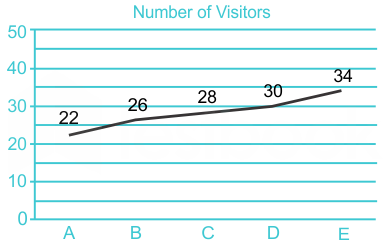
The line graph below illustrates the number of visitors who visited five different shops, Shop A, Shop B, Shop C, Shop D, and Shop E on a Sunday.

50

What is the difference between the number of visitors to Shop D and Shop A?

  1. ((a))

    6

  2. ((b))

    7

  3. ((c))

    8

  4. ((d))

    9

  5. ((e))

    5

Show Answer
Answer: ((c))

8

Given:

Shop A = 22 visitors

Shop D = 30 visitors

Calculation:

Difference = Visitors(Shop D) − Visitors(Shop A) = 30 − 22 = 8

Hence, the correct answer is 8.

51

By what percentage did the number of visitors increase from Shop A to Shop B?

  1. ((a))

    14.14%

  2. ((b))

    17.17%

  3. ((c))

    18.18%

  4. ((d))

    19.19%

  5. ((e))

    16.16%

Show Answer
Answer: ((c))

18.18%

Given:

Visitors at Shop A = 22

Visitors at Shop B = 26

Calculation:

Increase = 26 − 22 = 4

Percentage increase = (Increase ÷ Original) × 100 = (4 ÷ 22) × 100

Percentage increase = 400 ÷ 22 = 200 ÷ 11 ≈ 18.18%

Thus, the number of visitors increased by approximately 18.18% from Shop A to Shop B.

52

What is the ratio of the number of visitors to Shop C to the number of visitors to Shop E?

  1. ((a))

    12:13

  2. ((b))

    13:17

  3. ((c))

    16:19

  4. ((d))

    15:19

  5. ((e))

    14:17

Show Answer
Answer: ((e))

14:17

Given:

ShopNumber of Visitors
A22
B26
C28
D30
E34

Required ratio = Visitors at C : Visitors at E = 28 : 34 ⇒ 14 : 17

Hence, the correct answer is 14 : 17.

53

What is the average number of visitors per shop on Sunday?

  1. ((a))

    24

  2. ((b))

    21

  3. ((c))

    20

  4. ((d))

    28

  5. ((e))

    25

Show Answer
Answer: ((d))

28

Given:

ShopNumber of Visitors
A22
B26
C28
D30
E34

Total visitors = 22 + 26 + 28 + 30 + 34 = 140

Number of shops = 5

Average = Total visitors ÷ Number of shops = 140 ÷ 5 = 28

Thus, the average number of visitors per shop on Sunday = 28

54

If the number of visitors to Shop D had been 20% less, what would have been the difference between the visitors to Shop D and Shop B? 

  1. ((a))

    8

  2. ((b))

    9

  3. ((c))

    2

  4. ((d))

    7

  5. ((e))

    4

Show Answer
Answer: ((c))

2

Given:

ShopNumber of Visitors
A22
B26
C28
D30
E34

Change:

Shop D visitors reduced by 20%.

New D = 30 × (1 − 0.20) = 30 × 0.80 = 24

Visitors at B = 26

Difference = |B − New D| = |26 − 24| = 2

Thus, the difference would be 2 visitors (Shop B has 2 more than Shop D).

55

A bag contains 6 blue pens and 4 black pens. Two pens are drawn from the bag with replacement. Then, find the probability that the drawn caps are in alternate colour.

  1. ((a))

    12/25

  2. ((b))

    13/25

  3. ((c))

    14/19

  4. ((d))

    15/19

  5. ((e))

    17/19

Show Answer
Answer: ((a))

12/25

Shortcut Trick

Total pens = 6 Blue + 4 Black = 10 pens.

Alternate colors with replacement: (Blue × Black) + (Black × Blue).

P(Alternate) = (6/10 × 4/10) + (4/10 × 6/10) = 24/100 + 24/100 = 48/100.

Simplifying 48/100 → 12/25.

∴ The correct answer is 12/25.

Alternate Method

Given:

Number of Blue pens = 6

Number of Black pens = 4

Total pens = 10

Formula Used:

Probability P(E) = (Number of favorable outcomes) ÷ (Total number of outcomes)

For with replacement, the total outcomes remain constant for each draw.

Calculations:

⇒ Case 1: First pen is Blue and second is Black.

⇒ P(Blue) × P(Black) = (6/10) × (4/10) = 24/100

⇒ Case 2: First pen is Black and second is Blue.

⇒ P(Black) × P(Blue) = (4/10) × (6/10) = 24/100

⇒ Total Probability = 24/100 + 24/100 = 48/100

⇒ Reducing the fraction: 48/100 = 12/25

∴ The correct answer is 12/25.

Additional Information

With Replacement vs Without Replacement

In with replacement, the sample space remains constant (10 × 10). In without replacement, the sample space reduces (10 × 9).

Independent Events

Drawing with replacement makes the events independent, meaning the outcome of the first draw does not affect the second.

Sum of Probabilities

The sum of all possible mutually exclusive outcomes in an experiment is always 1.

56

Pipe A is 4 times slower than pipe B and takes 18 minutes more to fill the tank than B. What is the time (in minutes) taken by pipe A to fill the tank?

  1. ((a))

    24

  2. ((b))

    36

  3. ((c))

    21

  4. ((d))

    42

  5. ((e))

    None of these

Show Answer
Answer: ((a))

24

Shortcut Trick

Efficiency ratio of Pipe A to Pipe B = 1 : 4 (since A is 4 times slower).

Time ratio is the inverse of efficiency = 4 : 1.

Difference in time ratio parts = 4 − 1 = 3 units.

Given 3 units = 18 minutes ⇒ 1 unit = 6 minutes.

Time taken by Pipe A = 4 units = 4 × 6 = 24 minutes.

∴ The correct answer is 24 minutes.

Alternate Method

Given:

Efficiency of Pipe B = 4 × Efficiency of Pipe A

Let the time taken by Pipe B be T minutes.

Then the time taken by Pipe A = T + 18 minutes.

Formula Used:

Efficiency × Time = Constant (Total Work)

Calculations:

⇒ EfficiencyA × TimeA = EfficiencyB × TimeB

⇒ 1 × (T + 18) = 4 × T

⇒ T + 18 = 4T

⇒ 3T = 18

⇒ T = 6 minutes

⇒ Time taken by Pipe A = T + 18 = 6 + 18 = 24 minutes.

∴ The correct answer is 24 minutes.

Additional Information

Efficiency and Time Relationship

Efficiency is inversely proportional to time. If Pipe A is 'n' times as fast as Pipe B, then Pipe A takes (1/n) of the time taken by B.

Pipes and Cisterns Concept

Total capacity = LCM of time taken by individual pipes or Efficiency × Time taken.

57

Three persons Ram, Shyam, and Neel ages are in the ratio of 4: 5: 7. Then find the sum of their ages (in years) after 2 years, if age of Neel is 49 years.

  1. ((a))

    118

  2. ((b))

    108

  3. ((c))

    112

  4. ((d))

    124

  5. ((e))

    None of these

Show Answer
Answer: ((a))

118

Shortcut Trick

Ratio of ages of Ram, Shyam, and Neel = 4 : 5 : 7

Given, Neel's age (7 units) = 49 years ⇒ 1 unit = 7 years

Total units for present age = 4 + 5 + 7 = 16 units

Total present age = 16 × 7 = 112 years

Total age after 2 years = 112 + (3 × 2) = 118 years

∴ The correct answer is 118 years.

Alternate Method

Given: Ratio of ages = 4 : 5 : 7, Neel's age = 49 years.

Calculations:

⇒ Let the ages be 4x, 5x, and 7x.

⇒ 7x = 49

⇒ x = 49 ÷ 7 = 7

⇒ Ram's age = 4 × 7 = 28 years

⇒ Shyam's age = 5 × 7 = 35 years

⇒ Sum of present ages = 28 + 35 + 49 = 112 years

⇒ Sum of ages after 2 years = 112 + (2 + 2 + 2) = 118 years

∴ The correct answer is 118 years.

Additional Information

Ratio and Proportion

If quantities are in ratio a:b:c, then actual values can be taken as ax, bx, and cx where x is a common multiplier.

Age Problems Rule

When calculating the sum of ages after 'n' years for 'k' people, add (n × k) to the current total sum.

Directions: Read the following information carefully and answer the questions based on it.

The table below shows the scores of two sportspersons, A and B, in three different games: Cricket, Football, and Hockey.

GameAB
Cricket120155
Football8592
Hockey10598
58

What is the average score of Sportsperson B in all three games?

  1. ((a))

    105

  2. ((b))

    110

  3. ((c))

    115

  4. ((d))

    120

  5. ((e))

    125

Show Answer
Answer: ((c))

115

Total score of B = 155 + 92 + 98 = 345

Number of games = 3

Average score of B = Total score ÷ Number of games = 345 ÷ 3 = 115

Hence, the correct answer is 115.

59

 What is the ratio of Sportsperson B's score in Football to Sportsperson A's score in Cricket?

  1. ((a))

    29:30

  2. ((b))

    23:30

  3. ((c))

    26:29

  4. ((d))

    25:27

  5. ((e))

    None of these

Show Answer
Answer: ((b))

23:30

Score of B in Football = 92

Score of A in Cricket = 120

Step 2: Ratio = B's Football : A's Cricket = 92 : 120

Simplify ratio → divide both by 4 → 23 : 30

Hence, the correct answer is 23 : 30.

60

By what percentage did Sportsperson A's score increase from Football to Hockey?

  1. ((a))

    23.53%

  2. ((b))

    23.21%

  3. ((c))

    24.53%

  4. ((d))

    25.21%

  5. ((e))

    None of these

Show Answer
Answer: ((a))

23.53%

Sportsperson A's scores:

Football = 85

Hockey = 105

Percentage Increase = ((New Value − Old Value) ÷ Old Value) × 100

Substitute values:

= ((105 − 85) ÷ 85) × 100

= (20 ÷ 85) × 100

= 23.53% (approx)

Hence, the correct answer is 23.53%.

61

A bike man can reach a certain place in 45 hrs. If he reduced his speed by 3/5, he goes 54 km less in that time. What is his speed?

  1. ((a))

    3 km/hr

  2. ((b))

    2 km/hr

  3. ((c))

    4 km/hr

  4. ((d))

    8 km/hr

  5. ((e))

    None of these

Show Answer
Answer: ((b))

2 km/hr

Shortcut Trick

When time is constant, the distance ratio is equal to the speed ratio.

Speed reduced by 3/5 → New Speed = 1 − 3/5 = 2/5 of Original Speed.

Ratio of Speeds (Original : New) = 5 : 2 ∴ Ratio of Distance = 5 : 2.

Difference in distance = 5 − 2 = 3 units → 54 km. So, 1 unit = 18 km.

Original Distance = 5 units × 18 = 90 km. Speed = 90 km ÷ 45 hrs = 2 km/hr.

∴ The correct answer is 2 km/hr.

Alternate Method

Given: Time (T) = 45 hrs, Speed reduction = 3/5, Distance reduction = 54 km.

Formula: Distance = Speed × Time

⇒ Let the original speed be 's' km/hr.

⇒ Reduced speed = s − (3/5)s = (2/5)s km/hr.

⇒ Original Distance (D1) = s × 45

⇒ New Distance (D2) = (2/5)s × 45 = 18s

⇒ Difference in distance (D1 − D2) = 45s − 18s = 54 km

⇒ 27s = 54

⇒ s = 54 ÷ 27 = 2 km/hr

∴ The correct answer is 2 km/hr.

Additional Information

Constant Time Property

When time is kept constant, the ratio of the speeds of two objects is directly proportional to the ratio of the distances covered by them (S1/S2 = D1/D2).

Average Speed

If a person covers a certain distance at speed x and the same distance at speed y, the average speed for the whole journey is (2xy)/(x + y).

Relative Speed

Speed of two bodies moving in the same direction is the difference of their speeds (u − v), and in the opposite direction is the sum of their speeds (u + v).

62

Three numbers are in the ratio of 5 : 4 : 8. The sum of first number and second number is equal to sum of third number and 18. Find the difference between third number and second number.

  1. ((a))

    90

  2. ((b))

    72

  3. ((c))

    108

  4. ((d))

    54

  5. ((e))

    60

Show Answer
Answer: ((b))

72

Shortcut Trick

Ratio of numbers = 5 : 4 : 8

Sum of (1st + 2nd) ratio units = 5 + 4 = 9 units

Difference between this sum and 3rd ratio unit = 9 − 8 = 1 unit

Given 1 unit = 18

Difference between 3rd (8 units) and 2nd (4 units) = 8 − 4 = 4 units

4 units = 4 × 18 = 72

∴ The correct answer is 72.

Alternate Method

Given: Ratio of three numbers = 5 : 4 : 8

Let the three numbers be 5x, 4x, and 8x.

As per the question:

⇒ (5x + 4x) = 8x + 18

⇒ 9x = 8x + 18

⇒ 9x − 8x = 18

x = 18

To find the difference between the third number and second number:

⇒ Difference = 8x − 4x

⇒ Difference = 4x

⇒ Difference = 4 × 18

⇒ Difference = 72

∴ The correct answer is 72.

Additional Information

Ratio and Proportion

A ratio compares values by division. If a : b : c is given, numbers are assumed as ax, bx, and cx where x is the common multiplier.

Property of Equations

When translating word problems to linear equations, carefully group terms like 'sum of' and 'difference between' to maintain equality.

63

Suresh and Goutam started a business to invest their amount in the ratio of 11 ∶ 9 for a year. At the end of the year the total profit will be Rs. 5,000. Find the amount which is 20% more than the profit of Goutam.

  1. ((a))

    Rs. 2,500

  2. ((b))

    Rs. 2,700

  3. ((c))

    Rs. 3,600

  4. ((d))

    Rs. 2,000

  5. ((e))

    Rs. 5,400

Show Answer
Answer: ((b))

Rs. 2,700

Shortcut Trick

Total ratio parts = 11 + 9 = 20 units.

Total profit = Rs. 5,000 ⇒ 1 unit = 5,000 ÷ 20 = Rs. 250.

Goutam profit = 9 units = 9 × 250 = Rs. 2,250.

Required value = 120% of Goutam profit = 1.2 × 2,250 = Rs. 2,700.

∴ The correct answer is Rs. 2,700.

Alternate Method

Given → Investment ratio Suresh : Goutam = 11 : 9, Time = 1 year, Total Profit = Rs. 5,000. Formulas: Profit Ratio = Investment × Time | Individual Profit = (Own Ratio ÷ Total Ratio) × Total Profit.

⇒ Ratio of profits = 11 × 1 : 9 × 1 = 11 : 9. ⇒ Goutam share of profit = (9 ÷ (11 + 9)) × 5,000. ⇒ Goutam profit = (9 ÷ 20) × 5,000 = 9 × 250 = Rs. 2,250. ⇒ Amount 20% more than Goutam profit = 2,250 + (20% of 2,250). ⇒ Result = 2,250 + 450 = Rs. 2,700.

∴ The correct answer is Rs. 2,700.

Additional Information

Partnership Concept

Profit is distributed in the ratio of the product of Investment and Time Period.

Percentage Increase

To find a value x% more than A, use the formula: Result = A × (100 + x) ÷ 100.

64

An article costing Rs.964 is marked to be sold at a price which gives a profit of 25%. What will be its Profit percentage (approx) in a sale when 17% is taken off the marked price?

  1. ((a))

    3.7%

  2. ((b))

    4%

  3. ((c))

    3.5%

  4. ((d))

    3.2%

  5. ((e))

    4.2%

Show Answer
Answer: ((a))

3.7%

Shortcut Trick

Successive percentage formula: Net Change = a + b + (a × b) ÷ 100

Here, profit markup (a) = +25% and discount (b) = −17%.

Net Profit% = 25 − 17 + (25 × −17) ÷ 100

Net Profit% = 8 − 425 ÷ 100 = 8 − 4.25 = 3.75%.

The approximate value is 3.7%.

∴ The correct answer is 3.7%.

Alternate Method

Given: Cost Price (CP) = Rs. 964, Markup Profit% = 25%, Discount% = 17%. Formulas: MP = CP × (100 + Markup%) ÷ 100 | SP = MP × (100 − Discount%) ÷ 100 | Profit% = (SP − CP) ÷ CP × 100.

⇒ Assume CP = 100 units (Note: Actual CP of 964 is redundant for percentage calculation). ⇒ Marked Price (MP) = 100 + 25% of 100 = 125 units. ⇒ Selling Price (SP) = 125 − 17% of 125 = 125 − 21.25 = 103.75 units. ⇒ Profit = 103.75 − 100 = 3.75 units. ⇒ Profit% = (3.75 ÷ 100) × 100 = 3.75%. ⇒ Approx profit percentage = 3.7%.

∴ The correct answer is 3.7%.

Additional Information

Marked Price & Discount

Marked price is the price tagged on an article. Discount is always calculated on the Marked Price unless stated otherwise.

Redundant Data

When the final answer is required in percentage and the initial conditions are in percentages, the absolute value (Rs. 964) does not affect the result.

65

In an election between two candidates, one got 60% of the total valid votes, 30% of the votes were invalid. If the total number of votes was 8000, the number of valid votes that the other candidate got?

  1. ((a))

    2280

  2. ((b))

    2260

  3. ((c))

    2220

  4. ((d))

    2200

  5. ((e))

    2240

Show Answer
Answer: ((e))

2240

Shortcut Trick

Total Votes = 8000

Valid Votes = 70% of 8000 = 5600

Other candidate percentage = 100% − 60% = 40%

Required Votes = 40% of 5600 = 2240

∴ The correct answer is 2240.

Alternate Method

Given:

Total votes = 8000

Invalid votes = 30%

First candidate share = 60% of valid votes

Calculations:

⇒ Valid votes % = 100% − 30% = 70%

⇒ Number of valid votes = 8000 × (70/100) = 5600

⇒ Share of the other candidate = 100% − 60% = 40%

⇒ Votes of the other candidate = 5600 × (40/100)

⇒ Votes of the other candidate = 56 × 40 = 2240

∴ The correct answer is 2240.

Additional Information

Percentage Change Base

Always ensure the percentage is applied to the correct base. Here, the candidate share is 60% of valid votes, not total votes.

Valid vs Invalid Votes

Valid Votes = Total Votes − Invalid Votes. Only valid votes are distributed among candidates.

Successive Multiplication

The result can be found in one step: Result = Total × (Valid% / 100) × (Other Candidate% / 100).

Reasoning Ability (35 questions)

Direction: Read the following information carefully and answer the questions based on given information.

Eight persons K, L, M, N, O, P, Q and R live on an eight storey building but not necessarily in same order. Three persons live between O and P. One person lives between M and L who lives above M. K lives immediately above R. N and Q lives on an adjacent floor. O lives on an odd number floor below the fifth floor. R lives above Q but below M. N does not live just below O.

66

Who among the following person lives three floors below the floor of M?

  1. ((a))

    K

  2. ((b))

    R

  3. ((c))

    O

  4. ((d))

    Q

  5. ((e))

    N

Show Answer
Answer: ((c))

O

Here, persons K, L, M, N, O, P, Q and R.

  1. Three persons live between O and P.

  2. O lives on an odd number floor below the fifth floor.

FloorsCase – 1Case – 2
PersonsPersons
8
7P
6
5P
4
3O
2
1O


  1. One person lives between M and L who lives above M.

  2. K lives immediately above R.

  3. R lives above Q but below M.

FloorsCase – 1Case – 2
PersonsPersons
8LL
7P
6MM
5KP
4RK
3OR
2
1O


  1. N and Q lives on an adjacent floor. Therefore, case 2 is eliminated.

  2. N does not live just below O. Hence, the final arrangement is as follows

FloorsPersons
8L
7P
6M
5K
4R
3O
2Q
1N


Hence, O lives three floors below the floor of M.

67

As many persons live below the floor of Q as many above whom?

  1. ((a))

    L

  2. ((b))

    P

  3. ((c))

    M

  4. ((d))

    K

  5. ((e))

    R

Show Answer
Answer: ((b))

P

Here, persons K, L, M, N, O, P, Q and R.

  1. Three persons live between O and P.

  2. O lives on an odd number floor below the fifth floor.

FloorsCase – 1Case – 2
PersonsPersons
8
7P
6
5P
4
3O
2
1O


  1. One person lives between M and L who lives above M.

  2. K lives immediately above R.

  3. R lives above Q but below M.

FloorsCase – 1Case – 2
PersonsPersons
8LL
7P
6MM
5KP
4RK
3OR
2
1O


  1. N and Q lives on an adjacent floor. Therefore, case 2 is eliminated.

  2. N does not live just below O. Hence, the final arrangement is as follows

FloorsPersons
8L
7P
6M
5K
4R
3O
2Q
1N


Since, one person lives below the floor of Q and one person lives above the floor of P.

Hence, the correct answer is P.

68

Who among the following person lives on sixth floor?

  1. ((a))

    P

  2. ((b))

    L

  3. ((c))

    K

  4. ((d))

    M

  5. ((e))

    R

Show Answer
Answer: ((d))

M

Here, persons K, L, M, N, O, P, Q and R.

  1. Three persons live between O and P.

  2. O lives on an odd number floor below the fifth floor.

FloorsCase – 1Case – 2
PersonsPersons
8
7P
6
5P
4
3O
2
1O


  1. One person lives between M and L who lives above M.

  2. K lives immediately above R.

  3. R lives above Q but below M.

FloorsCase – 1Case – 2
PersonsPersons
8LL
7P
6MM
5KP
4RK
3OR
2
1O


  1. N and Q lives on an adjacent floor. Therefore, case 2 is eliminated.

  2. N does not live just below O. Hence, the final arrangement is as follows

FloorsPersons
8L
7P
6M
5K
4R
3O
2Q
1N


Hence, M lives on sixth floor.

69

Which of the the following statement(s) is/ are correct?

  1. ((a))

    M lives just above the floor of K.

  2. ((b))

    N lives on an odd number floor.

  3. ((c))

    O lives below R.

  4. ((d))

    None of these.

  5. ((e))

    All of these.

Show Answer
Answer: ((e))

All of these.

Here, persons K, L, M, N, O, P, Q and R.

  1. Three persons live between O and P.

  2. O lives on an odd number floor below the fifth floor.

FloorsCase – 1Case – 2
PersonsPersons
8
7P
6
5P
4
3O
2
1O


  1. One person lives between M and L who lives above M.

  2. K lives immediately above R.

  3. R lives above Q but below M.

FloorsCase – 1Case – 2
PersonsPersons
8LL
7P
6MM
5KP
4RK
3OR
2
1O


  1. N and Q lives on an adjacent floor. Therefore, case 2 is eliminated.

  2. N does not live just below O. Hence, the final arrangement is as follows

FloorsPersons
8L
7P
6M
5K
4R
3O
2Q
1N


Since, M lives just above the floor of K. Therefore, statement first is correct.

N lives on an odd number floor. Therefore, statement second is correct.

O lives below R. Therefore, statement third is correct.

Hence, the correct answer is all of these.

70

If all the persons live according to the alphabetical order from top to bottom, then the position of how many persons remain unchanged?

  1. ((a))

    Two

  2. ((b))

    Three

  3. ((c))

    One

  4. ((d))

    None

  5. ((e))

    More than three

Show Answer
Answer: ((a))

Two

Here, persons K, L, M, N, O, P, Q and R.

  1. Three persons live between O and P.

  2. O lives on an odd number floor below the fifth floor.

FloorsCase – 1Case – 2
PersonsPersons
8
7P
6
5P
4
3O
2
1O


  1. One person lives between M and L who lives above M.

  2. K lives immediately above R.

  3. R lives above Q but below M.

FloorsCase – 1Case – 2
PersonsPersons
8LL
7P
6MM
5KP
4RK
3OR
2
1O


  1. N and Q lives on an adjacent floor. Therefore, case 2 is eliminated.

  2. N does not live just below O. Hence, the final arrangement is as follows

FloorsPersonsRearrangement
8LK
7PL
6MM
5KN
4RO
3OP
2QQ
1NR


Since, the position of M and Q remain the same.

Hence, the correct answer is two persons.

71

Direction: The question below is given three statements followed by two conclusions: I and II. You have to take the given statements to be true even if they seem to be at variance with commonly known facts. Read all the conclusions and then decide which of the given conclusions logically follows from the given statements disregarding commonly known facts.

Statement:

All cows are goats

No goats is camel

Some camels are horses

Conclusion:

I. At least some horses are goats

II. All cows being camels is a possibility

  1. ((a))

    Neither I nor II follows

  2. ((b))

    Only I follows

  3. ((c))

    Either I or II follows

  4. ((d))

    Only II follows

  5. ((e))

    Both I and II follows

Show Answer
Answer: ((a))

Neither I nor II follows

The least possible Venn diagram for the given statements is as follows:

Conclusion:

I. At least some horses are goats → False (As there is no relation between horses and goats so we cannot say whether some horses are goats or not)

II. All cows being camels is a possibility → False (As per the statement no goats is camels and all cows are goats, If we will take goats inside camels then the conditions of the statement will be violated)

Hence, Neither I nor II follows.

72

Direction: The question below is given three statements followed by two conclusions: I and II. You have to take the given statements to be true even if they seem to be at variance with commonly known facts. Read all the conclusions and then decide which of the given conclusions logically follows from the given statements disregarding commonly known facts.

Statement:

All flowers are leaves

Some leaves are steams

Only a few steams are stones

Conclusion:

I. All stones are leaves is a possibility

II. Some stones are not leaves

  1. ((a))

    Both I and II follows

  2. ((b))

    Either I or II follows

  3. ((c))

    Only I follows

  4. ((d))

    Neither I nor II follows

  5. ((e))

    Only II follows

Show Answer
Answer: ((c))

Only I follows

The least possible Venn diagram for the given statements is as follows:


Conclusion:

I. All stones are leaves is a possibility → True (As there is no definite relation between leaves and stones, If we will take stones inside leaves then no statement will be violated)

II. Some stones are not leaves → False (As there is no definite relation between leaves and stones but no negative statement is there so no negative conclusion will follow)

Hence, Only I follows​.

Additional information:

If there is no negative statement then no negative conclusion will follow.

73

Direction: The question below is given three statements followed by two conclusions: I and II. You have to take the given statements to be true even if they seem to be at variance with commonly known facts. Read all the conclusions and then decide which of the given conclusions logically follows from the given statements disregarding commonly known facts.

Statement:

All coins are notes

Only notes are cash

Some coins are liquid

Conclusion:

I. At least some cash are coins

II. Some cash are liquid is a possibility

  1. ((a))

    Both I and II follow

  2. ((b))

    Either I or II follows

  3. ((c))

    Only I follows

  4. ((d))

    Neither I nor II follows

  5. ((e))

    Only II follows

Show Answer
Answer: ((d))

Neither I nor II follows

The least possible Venn diagram for the given statements is as follows

<br>

Conclusion:

I. At least some cash are coins → False (Some cash cannot be coin as cash will make positive relation only with notes but it can make negative relation with any other element)

II. Some cash are liquid is a possibility → False (Cash will make positive relation only with notes)

Hence, Neither I nor II follows.

<br>

Additional Information

1. ‘Only A are B’ means that B can not be linked with any other object. 2. The term 'Atleast' can be used as 'Some'. 

If it is given that 'Atleast some A are B', it means some amount of A is definitely B, and there is also the possibility of all A being B.

74

How many pairs of letters are there in the word "COUNTER" which have as many letters between them as in the English alphabetical series (both in forward and backward direction)? 

  1. ((a))

    One 

  2. ((b))

    Two

  3. ((c))

    None

  4. ((d))

    Three

  5. ((e))

    More than three

Show Answer
Answer: ((a))

One 

Backward direction:- R - T

Hence, there is only one such pair.

Direction: Read the following information carefully and answer the questions based on given information.

A certain number of persons sit on the horizontal row and faces towards North direction. Three persons sit between O and F. D sits adjacent to R. Four persons sit between Z and B. O sits second position from the end position. Only two persons sit between M and D. B sits third to the left of M. Q sits two places away from O and adjacent to Z. R has only one neighbour. Not more than one person sits between Q and F. O sits to the immediate left of Z.

75

How many persons sit between B and R?

  1. ((a))

    Four

  2. ((b))

    Three

  3. ((c))

    Two

  4. ((d))

    None

  5. ((e))

    More than four

Show Answer
Answer: ((e))

More than four

  1. D sits adjacent to R.

  2. R has only one neighbour.

  3. Only two persons sit between M and D. 

  1. B sits third to the left of M. Therefore, case 1 is eliminated.

  2. Four persons sit between Z and B.

  3. Q sits two places away from O and adjacent to Z.

  1. Three persons sit between O and F.

  2. O sits second position from the end position. Therefore, case 2(a) is eliminated.

  3. Not more than one person sits between Q and F. Hence, the final arrangement is as follows

Since, six persons sit between B and R.

Hence, the correct answer is more than four.

76

Which of the following statement(s) is/are correct?

  1. ((a))

    Q sits immediate left to Z.

  2. ((b))

    Only two persons sit to the right of F.

  3. ((c))

    R sits extreme left end.

  4. ((d))

    O sits second from the left end.

  5. ((e))

    None of these

Show Answer
Answer: ((d))

O sits second from the left end.

  1. D sits adjacent to R.

  2. R has only one neighbour.

  3. Only two persons sit between M and D. 

  1. B sits third to the left of M. Therefore, case 1 is eliminated.

  2. Four persons sit between Z and B.

  3. Q sits two places away from O and adjacent to Z.

  1. Three persons sit between O and F.

  2. O sits second position from the end position. Therefore, case 2(a) is eliminated.

  3. Not more than one person sits between Q and F. Hence, the final arrangement is as follows

Since, Q sits immediate right to Z not left. Therefore, statement first is incorrect.

More than two persons sit to the right of F. Therefore, statement second is incorrect.

R sits extreme right end not left end. Therefore, statement third is incorrect.

O sits second from the left end. Therefore, statement fourth is correct. 

Hence, the correct statement is O sits second from the left end.

77

What is the position of B with respect to F?

  1. ((a))

    Second to the left.

  2. ((b))

    Second to the right.

  3. ((c))

    Fourth to the left.

  4. ((d))

    Fifth to the right.

  5. ((e))

    Immediate right.

Show Answer
Answer: ((b))

Second to the right.

  1. D sits adjacent to R.

  2. R has only one neighbour.

  3. Only two persons sit between M and D. 

  1. B sits third to the left of M. Therefore, case 1 is eliminated.

  2. Four persons sit between Z and B.

  3. Q sits two places away from O and adjacent to Z.

  1. Three persons sit between O and F.

  2. O sits second position from the end position. Therefore, case 2(a) is eliminated.

  3. Not more than one person sits between Q and F. Hence, the final arrangement is as follows

Hence, B sits second to the right of F.

Directions: Answer the questions based on the sequence of numbers given

6 6 2 6 6 6 2 2 5 5 6 2 2 2 4 6 6 4 4 2 2 5 6 6 6 5 5 4 4 2 2

78

How many 2’s are preceded by 6 in the series?

  1. ((a))

    2

  2. ((b))

    1

  3. ((c))

    5

  4. ((d))

    4

  5. ((e))

    3

Show Answer
Answer: ((e))

3

Consider series: 6 6 2 6 6 6 2 2 5 5 6 2 2 2 4 6 6 4 4 2 2 5 6 6 6 5 5 4 4 2 2

Hence, only three times 2 is preceded by 6 in the series.

79

How many 5’s are followed by 6 in the series?

  1. ((a))

    6

  2. ((b))

    2

  3. ((c))

    5

  4. ((d))

    4

  5. ((e))

    3

Show Answer
Answer: ((b))

2

Consider series: 6 6 2 6 6 6 2 2 5 5 6 2 2 2 4 6 6 4 4 2 2 5 6 6 6 5 5 4 4 2 2

the two 5’s are followed by 6 in the series.

80

If all the 2’s and 4’s are added, resultant frequency of 6’s are?

  1. ((a))

    10

  2. ((b))

    12

  3. ((c))

    15

  4. ((d))

    14

  5. ((e))

    16

Show Answer
Answer: ((e))

16

Consider series: 6 6 2 6 6 6 2 2 5 5 6 2 2 2 4 6 6 4 4 2 2 5 6 6 6 5 5 4 4 2 2

5 pairs of 2’s and 4’s are added

Original frequency of 6’s are 11

Hence the total frequency of 6’s are: 16

81

How many total pairs of consecutive 2’s are present?

  1. ((a))

    6

  2. ((b))

    2

  3. ((c))

    5

  4. ((d))

    4

  5. ((e))

    6 and 2

Show Answer
Answer: ((c))

5

Consider series: 6 6 2 6 6 6 2 2 5 5 6 2 2 2 4 6 6 4 4 2 2 5 6 6 6 5 5 4 4 2 2

In 2 2 2 there are 2 consecutive pairs of 2’s together

hence total number of consecutive pairs of 2 are 5.

82

Which of the following numbers have the highest frequency?

  1. ((a))

    6

  2. ((b))

    2

  3. ((c))

    5

  4. ((d))

    4

  5. ((e))

    6 and 2

Show Answer
Answer: ((a))

6

Consider series: 6 6 2 6 6 6 2 2 5 5 6 2 2 2 4 6 6 4 4 2 2 5 6 6 6 5 5 4 4 2 2

Number of 6’s: 11

Number of 2’s: 10

Number of 4’s: 5

Number of 5’s: 5

thus 6 has highest frequency.

83

Find the odd one out.

  1. ((a))

    DGLS

  2. ((b))

    KNSZ

  3. ((c))

    BEJQ

  4. ((d))

    MPSV

  5. ((e))

    CFKR

Show Answer
Answer: ((d))

MPSV

The logic followed here is:-

Thus, out of all the options, 'MPSV' is the odd one out as the common difference between the position value according to the English alphabet

​Hence, "MPSV" is the correct answer.

Direction: Read the following information carefully and answer the questions based on given information.

Eight boxes A, B, C, D, E, F, G and H are stacked one over another from bottom to top but not necessarily in same order. Four boxes are placed between Box A and Box E which is placed below the box A. Box H is below the box A. Three boxes are placed between Box G and Box B which is placed just above Box D. Box F is placed four boxes above Box E. Box G is above Box A. Box C is below the box H.

84

Which of the following box is placed two boxes above the box D?

  1. ((a))

    Box A

  2. ((b))

    Box F

  3. ((c))

    Box H

  4. ((d))

    Box E

  5. ((e))

    Box C

Show Answer
Answer: ((c))

Box H

Here, boxes are A, B, C, D, E, F, G and H.

  1. Four boxes are placed between Box A and Box E which is placed below the box A.

  2. Box G is above Box A.

  3. Box F is placed four boxes above Box E.  

Case – 1Case – 2
BoxesBoxes
G
A
AF
F
E
E


  1. Three boxes are placed between Box G and Box B which is placed just above Box D.

  2. Box C is below the box H.

  3. Box H is below the box A. Therefore, case 1 is eliminated. Hence, the final arrangement is as follows

Boxes
G
A
F
H
B
D
E
C


Hence, Box H is placed two boxes above the box D.

85

How many boxes are placed between Box B and Box C?

  1. ((a))

    Only one box

  2. ((b))

    None

  3. ((c))

    Three boxes

  4. ((d))

    Two boxes

  5. ((e))

    More than three boxes

Show Answer
Answer: ((d))

Two boxes

Here, boxes are A, B, C, D, E, F, G and H.

  1. Four boxes are placed between Box A and Box E which is placed below the box A.

  2. Box G is above Box A.

  3. Box F is placed four boxes above Box E.  

Case – 1Case – 2
BoxesBoxes
G
A
AF
F
E
E


  1. Three boxes are placed between Box G and Box B which is placed just above Box D.

  2. Box C is below the box H.

  3. Box H is below the box A. Therefore, case 1 is eliminated. Hence, the final arrangement is as follows

Boxes
G
A
F
H
B
D
E
C


Hence, two boxes are placed between Box B and Box C.

86

Which of the following statement(s) is/are incorrect?

A) Box A is placed two boxes below Box G.

B) Only one box is placed below the Box C.

C) More than two boxes are placed above Box H.

  1. ((a))

    Both A and B

  2. ((b))

    Both B and C

  3. ((c))

    Only C

  4. ((d))

    None of these

  5. ((e))

    All of these

Show Answer
Answer: ((a))

Both A and B

Here, boxes are A, B, C, D, E, F, G and H.

  1. Four boxes are placed between Box A and Box E which is placed below the box A.

  2. Box G is above Box A.

  3. Box F is placed four boxes above Box E.  

Case – 1Case – 2
BoxesBoxes
G
A
AF
F
E
E


  1. Three boxes are placed between Box G and Box B which is placed just above Box D.

  2. Box C is below the box H.

  3. Box H is below the box A. Therefore, case 1 is eliminated. Hence, the final arrangement is as follows

Boxes
G
A
F
H
B
D
E
C


Since, Box A is placed just below Box G. Therefore, statement A is incorrect.

No box is placed below the Box C. Therefore, statement B is incorrect.

Three boxes are placed above Box H. Therefore, statement C is correct.

Hence, the incorrect statements are Both A and B.

87

As many boxes are placed above the box F as many below which box?

  1. ((a))

    Box E

  2. ((b))

    Box D

  3. ((c))

    Box B

  4. ((d))

    Box C

  5. ((e))

    Box H

Show Answer
Answer: ((b))

Box D

Here, boxes are A, B, C, D, E, F, G and H.

  1. Four boxes are placed between Box A and Box E which is placed below the box A.

  2. Box G is above Box A.

  3. Box F is placed four boxes above Box E.  

Case – 1Case – 2
BoxesBoxes
G
A
AF
F
E
E


  1. Three boxes are placed between Box G and Box B which is placed just above Box D.

  2. Box C is below the box H.

  3. Box H is below the box A. Therefore, case 1 is eliminated. Hence, the final arrangement is as follows

Boxes
G
A
F
H
B
D
E
C


Since, two boxes are placed above the box F and two boxes are placed below the box D.

Hence, the correct answer is Box D.

88

Which box is placed two boxes below the box which if placed four boxes above Box C?

  1. ((a))

    Box H

  2. ((b))

    Box E

  3. ((c))

    Box D

  4. ((d))

    Box F

  5. ((e))

    Box B

Show Answer
Answer: ((c))

Box D

Here, boxes are A, B, C, D, E, F, G and H.

  1. Four boxes are placed between Box A and Box E which is placed below the box A.

  2. Box G is above Box A.

  3. Box F is placed four boxes above Box E.  

Case – 1Case – 2
BoxesBoxes
G
A
AF
F
E
E


  1. Three boxes are placed between Box G and Box B which is placed just above Box D.

  2. Box C is below the box H.

  3. Box H is below the box A. Therefore, case 1 is eliminated. Hence, the final arrangement is as follows

Boxes
G
A
F
H
B
D
E
C


Since, Box H is placed four boxes above the Box C and Box D is placed two boxes below the Box H.

Hence, the correct answer is Box D.

89

Directions: In the following question assuming the statements to be true, find the conclusion which is/are correct and answer accordingly.

Statements: N ≤ Q; M > B; Q = R < O < M

Conclusions:

I. N < O

II. Q ≤ M

  1. ((a))

    Both conclusion I and II follow.

  2. ((b))

    Either conclusion I or conclusion II follows.

  3. ((c))

    Only conclusion I follows.

  4. ((d))

    Only conclusion II follows.

  5. ((e))

    Neither conclusion I nor conclusion II follows.

Show Answer
Answer: ((c))

Only conclusion I follows.

Given statements: N ≤ Q; M > B; Q = R < O < M

Combining: N ≤ Q = R < O < M > B

Conclusions:

I. N < O → True (as N ≤ Q = R < O → N < O)

II. Q ≤ M → False (as N ≤ Q = R < O < M → Q < M, thus Q ≤ M cannot be true)

Hence, only conclusion I follows.

90

Directions: In the following question assuming the statements to be true, find the conclusion which is/are correct and answer accordingly.

Statements: A ≥ C ≥ D > G = I ≥ B; S ≥ M > B

Conclusions: 

I. C ≥ M

II. A > I

  1. ((a))

    Only conclusion I follows.

  2. ((b))

    Only conclusion II follows.

  3. ((c))

    Neither of the conclusions follow.

  4. ((d))

    Either conclusion I or conclusion II follows.

  5. ((e))

    Both the conclusion I and II follow.

Show Answer
Answer: ((b))

Only conclusion II follows.

Given statements: A ≥ C ≥ D > G = I ≥ B; S ≥ M > B

Combining:  A ≥ C ≥ D > G = I ≥ B < M ≤ S

Conclusions:

I. C ≥ M → False (as C ≥ D > G = I ≥ B < M → no clear relation between C and M can be determined)

II. A > I → True (as A ≥ C ≥ D > G = I → A > I)

Hence, only conclusion II follows.

91

Directions: In the following question assuming the given statements to be true, find the conclusion which is/are correct and give an answer accordingly.

Statements: G < L; D ≥ G; H = L; H ≤ B

Conclusions: 

I. G > B

II. B > D

  1. ((a))

    Only conclusion I follows.

  2. ((b))

    Only conclusion II follows.

  3. ((c))

    Either conclusion I or conclusion II follows.

  4. ((d))

    Both the conclusions follow.

  5. ((e))

    Neither of the conclusions follows.

Show Answer
Answer: ((e))

Neither of the conclusions follows.

Given statements: G < L; D ≥ G; H = L; H ≤ B

Combining: D ≥ G < L = H ≤ B

Conclusions:

I. G > B → False (as G < L = H ≤ B → G > B cannot be true)

II. B > D → False (as D ≥ G < L = H ≤ B → no relation between B and D can be determined)

Hence, neither conclusion I nor conclusion II follows.

Direction: Read the following information carefully and answer the questions based on given information.

Eight persons S, T, U, V, W, X, Y and Z sit around a square table such that four persons sit at the corner of the table faces towards the centre and four persons sit on the side of the table faces away from the centre. All the given information is not necessarily in same order. W sits third to the left of S. X sits fifth to the right of T. Z sits four places away from U. V sits adjacent to X and Z. W sits immediate right of T. Y does not face towards the centre.

92

Who among the following sits second to the left of Z?

  1. ((a))

    X

  2. ((b))

    T

  3. ((c))

    S

  4. ((d))

    W

  5. ((e))

    Y

Show Answer
Answer: ((d))

W

Here, persons are S, T, U, V, W, X, Y and Z.

  1. W sits third to the left of S.

  2. X sits fifth to the right of T.

  3. W sits immediate right of T.

  1. V sits adjacent to X and Z.

  2. Z sits four places away from U.

  3. Y does not face towards the center. Therefore, case 1 is eliminated. Hence, the final arrangement is as follows

Hence, W sits second to the left of Z.

93

In a certain way, S is related to T and W is related to X then who among the following is related to V in the same way?  

  1. ((a))

    T

  2. ((b))

    Z

  3. ((c))

    U

  4. ((d))

    Y

  5. ((e))

    S

Show Answer
Answer: ((d))

Y

Here, persons are S, T, U, V, W, X, Y and Z.

  1. W sits third to the left of S.

  2. X sits fifth to the right of T.

  3. W sits immediate right of T.

  1. V sits adjacent to X and Z.

  2. Z sits four places away from U.

  3. Y does not face towards the center. Therefore, case 1 is eliminated. Hence, the final arrangement is as follows

Since, S sits opposite to T and W sits opposite to  X therefore, in the same way V sits opposite to Y.

Hence, the correct answer is Y.

94

Which of the following statement(s) is/are correct?

A) S and T faces towards the center.

B) W sits immediate right to Y.

C) Z faces away from the center.

  1. ((a))

    Both A and B

  2. ((b))

    Both B and C

  3. ((c))

    None of these

  4. ((d))

    Both A and C

  5. ((e))

    All of these

Show Answer
Answer: ((c))

None of these

Here, persons are S, T, U, V, W, X, Y and Z.

  1. W sits third to the left of S.

  2. X sits fifth to the right of T.

  3. W sits immediate right of T.

  1. V sits adjacent to X and Z.

  2. Z sits four places away from U.

  3. Y does not face towards the center. Therefore, case 1 is eliminated. Hence, the final arrangement is as follows

Since, S and T faces away from the center. Therefore, statement A is incorrect.

W sits immediate left to Y. Therefore, statement B is incorrect.

Z faces towards the center.Therefore, statement C is incorrect.

Hence, the correct answer is None of these.

95

How many persons sit between Z and Y, when counted from the left of Y?

  1. ((a))

    One person

  2. ((b))

    Two persons

  3. ((c))

    Three persons

  4. ((d))

    Four persons

  5. ((e))

    More than four persons

Show Answer
Answer: ((b))

Two persons

Here, persons are S, T, U, V, W, X, Y and Z.

  1. W sits third to the left of S.

  2. X sits fifth to the right of T.

  3. W sits immediate right of T.

  1. V sits adjacent to X and Z.

  2. Z sits four places away from U.

  3. Y does not face towards the center. Therefore, case 1 is eliminated. Hence, the final arrangement is as follows

Hence, only two persons sit between Z and Y, when counted from the left of Y.

96

Who sits opposite to X?

  1. ((a))

    Y

  2. ((b))

    Z

  3. ((c))

    T

  4. ((d))

    W

  5. ((e))

    None of these

Show Answer
Answer: ((d))

W

Here, persons are S, T, U, V, W, X, Y and Z.

  1. W sits third to the left of S.

  2. X sits fifth to the right of T.

  3. W sits immediate right of T.

  1. V sits adjacent to X and Z.

  2. Z sits four places away from U.

  3. Y does not face towards the center. Therefore, case 1 is eliminated. Hence, the final arrangement is as follows

Hence, W sits opposite to X.

97

If it is possible to make only one four - letter meaningful word with the first, third, tenth and eleventh letter of the word "BLOCKBUSTER", which of the following is the third letter of that word? If no such word can be made give "X" as the answer and if more than one such word can be made give "Y" as the answer. 

  1. ((a))

    O

  2. ((b))

    R

  3. ((c))

    B

  4. ((d))

    X

  5. ((e))

    Y

Show Answer
Answer: ((e))

Y

Here, given word is "BLOCKBUSTER" 

The first letter is 'B', third letter is 'O', tenth letter is 'E'  and eleventh letter is 'R'

The possible meaningful words are Bore and Robe.

Hence, the correct answer is Y.

Directions: Study the information given below carefully and answer the questions that follow.

Point N is 5 km to the south of point L. Point O is 3 km to the north of point S. Point R is 6 km to the west of point M. Point P is 10 km to the east of point L. Point Q is 4 km to the east of point N. Point Q is 5 km to the south of point S. Point P is 3 km to the north of point M.

98

What is the position of point O with respect to the position of point L?

  1. ((a))

    6 km North-West

  2. ((b))

    3 km West

  3. ((c))

    2√5 km South-East

  4. ((d))

    5 km North-East

  5. ((e))

    4 km East

Show Answer
Answer: ((d))

5 km North-East

The least possible diagram based on the given information,

The distance between points L and S = 4 km

The distance between points S and O = 3 km

Using the Pythagoras Theorem,

The shortest distance between points L and O is,

√(16 + 9) = √25 = 5 km

Clearly, point O is 5 km north-east of point L.

99

What is the direction of point O from point Q?

  1. ((a))

    North

  2. ((b))

    North-East

  3. ((c))

    South-East

  4. ((d))

    South-West

  5. ((e))

    West

Show Answer
Answer: ((a))

North

The least possible diagram based on the given information,

Clearly, point O is to the north of point Q.

100

What is the distance between points S and P?

  1. ((a))

    10 km

  2. ((b))

    6 km

  3. ((c))

    8 km

  4. ((d))

    4 km

  5. ((e))

    5 km

Show Answer
Answer: ((b))

6 km

The least possible diagram based on the given information,

Clearly, the distance between points S and P is 6 km.

Attempt this paper under real exam conditions

Timed interface, section switching, instant scoring, and question-by-question analytics — free.

Start Timed Attempt