Official Paper

SBI Clerk Prelims Memory Based Paper (Held On: 20 September 2025 Shift 1) (Previous Year Paper)

100 questions · 60 minutes · with answers · free

English Language (30 questions)

1

Direction: The given sentence is divided into four parts: A, B, C, and D. Choose the part that contains an error as your answer. If the sentence is error-free, mark E, i.e., No error as your answer.

She has visited (A) more countries in (B) a year than (C) I have did in my lifetime. (D) No error (E)

  1. ((a))

    A

  2. ((b))

    B

  3. ((c))

    C

  4. ((d))

    D

  5. ((e))

    E

Show Answer
Answer: ((d))

D

The correct answer is Option 4.


Key Points

  • The primary issue in the sentence is the incorrect use of "did" after "have."
  • The correct auxiliary verb for the present perfect tense is "have" followed by the base form "done."
  • The correct phrase should be "I have done in my lifetime," ensuring grammatical correctness and clarity.
  • Thus, the error is located in part D of the sentence.

Therefore, the correct answer is D.


Correct Sentence: "She has visited more countries in a year than I have done in my lifetime."


Additional Information

  • A: "She has visited" – This part of the sentence is grammatically correct and does not require any changes.
  • B: "more countries in" – This part of the sentence is grammatically correct and does not require any changes.
  • C: "a year than" – This part of the sentence is grammatically correct and does not require any changes.
  • No error – This would be the correct option if there were no mistakes in the sentence, but there is an error in part D.
2

Direction: The given sentence is divided into four parts: A, B, C, and D. Choose the part that contains an error as your answer. If the sentence is error-free, mark E, i.e., No error as your answer.

Scarcely had they entered (A) the building when (B) the fire alarm (C) started ringing. (D) No error (E)

  1. ((a))

    A

  2. ((b))

    B

  3. ((c))

    C

  4. ((d))

    D

  5. ((e))

    E

Show Answer
Answer: ((e))

E

The correct answer is Option 5.


Key Points

  • The sentence structure is correct and follows the rule for the use of "scarcely" which is followed by "when".
  • The sequence of events is clear and grammatically correct.
  • All parts of the sentence are correctly structured with no grammatical errors.
  • Thus, the sentence is error-free.

Therefore, the correct answer is E.


Correct Sentence: "Scarcely had they entered the building when the fire alarm started ringing."


Additional Information

  • A: "Scarcely had they entered" – This part of the sentence is grammatically correct and does not require any changes.
  • B: "the building when" – This part of the sentence is grammatically correct and does not require any changes.
  • C: "the fire alarm" – This part of the sentence is grammatically correct and does not require any changes.
  • D: "started ringing." – This part of the sentence is grammatically correct and does not require any changes.
  • No error – This is the correct option as there are no mistakes in the sentence.
3

Direction: The given sentence is divided into four parts: A, B, C, and D. Choose the part that contains an error as your answer. If the sentence is error-free, mark E, i.e., No error as your answer.

The teacher, along with (A) her students, were waiting (B) for the class to (C) begin with enthusiasm. (D) No error (E)

  1. ((a))

    A

  2. ((b))

    B

  3. ((c))

    C

  4. ((d))

    D

  5. ((e))

    E

Show Answer
Answer: ((b))

B

The correct answer is Option 2.


Key Points

  • The subject of the sentence is "The teacher," which is singular.
  • When the subject is singular, the verb should also be singular.
  • "Along with her students" is a prepositional phrase and does not affect the subject-verb agreement.
  • The correct verb should be "was" instead of "were."
  • Thus, the error is located in part B of the sentence.

Therefore, the correct answer is Option 2.


Correct Sentence: "The teacher, along with her students, was waiting for the class to begin with enthusiasm."


Additional Information

  • A: "The teacher, along with" – This part of the sentence is grammatically correct and does not require any changes.
  • C: "for the class to" – This part of the sentence is grammatically correct and does not require any changes.
  • D: "begin with enthusiasm." – This part of the sentence is grammatically correct and does not require any changes.
  • No error – This would be the correct option if there were no mistakes in the sentence, but there is an error in part B.
4

Direction: The given sentence is divided into four parts: A, B, C, and D. Choose the part that contains an error as your answer. If the sentence is error-free, mark E, i.e., No error as your answer.

Despite of her (A) many years of experience, (B) she still struggled (C) with the new software. (D) No error (E)

  1. ((a))

    A

  2. ((b))

    B

  3. ((c))

    C

  4. ((d))

    D

  5. ((e))

    E

Show Answer
Answer: ((a))

A

The correct answer is Option 1.


Key Points

  • The primary issue in the sentence is the incorrect use of the preposition "of" after "Despite."
  • The word "Despite" should not be followed by "of." The correct usage is "Despite" without "of."
  • The correct phrase should be "Despite her many years of experience," ensuring grammatical correctness and clarity.
  • Thus, the error is located in part A of the sentence.

Therefore, the correct answer is A.


Correct Sentence: "Despite her many years of experience, she still struggled with the new software."


Additional Information

  • B: "many years of experience," – This part of the sentence is grammatically correct and does not require any changes.
  • C: "she still struggled" – This part of the sentence is grammatically correct and does not require any changes.
  • D: "with the new software." – This part of the sentence is grammatically correct and does not require any changes.
  • No error – This would be the correct option if there were no mistakes in the sentence, but there is an error in part A.
5

Direction: The given sentence is divided into four parts: A, B, C, and D. Choose the part that contains an error as your answer. If the sentence is error-free, mark E, i.e., No error as your answer.

The information on (A) the website as well as (B) in the brochures need to (C) be updated immediately. (D) No error (E)

  1. ((a))

    A

  2. ((b))

    B

  3. ((c))

    C

  4. ((d))

    D

  5. ((e))

    E

Show Answer
Answer: ((c))

C

The correct answer is Option 3.


Key Points

  • The primary issue in the sentence is the subject-verb agreement.
  • The subject "The information on the website as well as in the brochures" is singular.
  • The verb "need" should be "needs" to agree with the singular subject.
  • Thus, the error is located in part C of the sentence.

Therefore, the correct answer is C.


Correct Sentence: "The information on the website as well as in the brochures needs to be updated immediately."


Additional Information

  • A: "The information on" – This part of the sentence is grammatically correct and does not require any changes.
  • B: "the website as well as" – This part of the sentence is grammatically correct and does not require any changes.
  • D: "be updated immediately." – This part of the sentence is grammatically correct and does not require any changes.
  • No error – This would be the correct option if there were no mistakes in the sentence, but there is an error in part C.

Directions: Read the given passage carefully to answer the following questions. Each question will have five alternatives as its answer. Choose the correct option as your answer.

Once upon a time, in the bustling coastal village of Luminara, the sea was the lifeblood of the community. Fishermen set sail each dawn on the azure waters, returning with bountiful catches that sustained their families. Children built sandcastles on the shore, while tourists from far and wide marvelled at the pristine beauty of the beaches. But beneath the shimmering surface, trouble brewed deep in the heart of the ocean, as the menace of marine pollution grew day by day. In recent years, the problem of sea pollution had garnered global attention. Streams of polythene and other waste materials had begun to infiltrate the serene waters, causing distress among the marine life and tarnishing the once-immaculate shores of Luminara. The villagers watched in ________ as dead fish and turtles, their stomachs filled with plastic, washed ashore. The impact on their livelihood and the natural beauty of their home was profound, as they feared for the future of their beloved sea. Realising the urgency of the situation, world leaders, activists, and businessmen gathered for an imperative meeting in Rio de Janeiro, Brazil. The International Summit on Marine Pollution drew big people from all corners of the globe, united by a common objective: to combat the escalating crisis of sea pollution. The atmosphere was charged with a blend of anxiety and hope as delegates from over sixty countries convened to share their perspectives and formulate a global strategy. Amelia, a renowned marine biologist and environmental activist from Australia, took to the podium first. Her deep knowledge of marine ecosystems painted a grim picture of the current scenario, detailing how polythene and other pollutants were causing irrevocable damage to marine life. She called for a drastic reduction in plastic production and stronger regulatory frameworks to manage waste disposal.

Following Amelia, Richard Kane, an influential businessman from the United States, shared an innovative approach his company had undertaken to tackle the problem. They had developed biodegradable alternatives to conventional plastics and were investing in recycling technologies that showed promising results. Richard emphasised the necessity of public-private collaborations to drive meaningful change, urging his fellow businessmen to contribute to sustainable solutions. Representatives from different countries then provided updates on their national initiatives. India highlighted their recent ban on certain single-use plastics and the aggressive cleanup drives conducted along its extensive coastline. Norway spoke about their success in implementing stringent waste management policies and investing in marine research. Kenya showcased community-led programmes that educated citizens about the dangers of plastic pollution and how to reduce their consumption. The summit concluded with a strong sense of unity and determination. A comprehensive action plan was put forward, emphasising the roles of policy changes, technological advancements, and global cooperation. The representatives pledged to return to their countries with renewed vigour, ready to implement the strategies discussed. Back in Luminara, the villagers felt a glimmer of hope as news of the summit reached them. They understood that change would take time, but knowing that the world was now committed to protecting their precious sea gave them the strength to persevere. With the world finally coming together, there was a deep sense of optimism that the tide of marine pollution could, indeed, be reversed.

6

According to the passage, who was the first speaker at the International Summit on Marine Pollution?

  1. ((a))

    Richard Kane

  2. ((b))

    A delegate from India

  3. ((c))

    Amelia

  4. ((d))

    A representative from Norway

  5. ((e))

    The President of Brazil

Show Answer
Answer: ((c))

Amelia

The correct answer is Option 3.


Key Points

  • Amelia was the first speaker at the International Summit on Marine Pollution.
  • She is described as a renowned marine biologist and environmental activist from Australia.
  • Amelia shared her deep knowledge of marine ecosystems and the impact of pollutants.

Therefore, the correct answer is Option 3.


Detailed Explanation: Amelia was the first to take to the podium at the International Summit on Marine Pollution, contributing significant insights into the damage caused by marine pollutants and advocating for stronger regulatory frameworks and reduction in plastic production.


Additional Information

  • Option 1: Richard Kane – Richard Kane spoke after Amelia and shared innovative approaches his company had undertaken.
  • Option 2: A delegate from India – Representatives from different countries shared their national initiatives after Richard Kane.
  • Option 4: A representative from Norway – Norway's representative spoke about their success in implementing waste management policies.
  • Option 5: The President of Brazil – The passage does not mention the President of Brazil as a speaker at the summit.
7

Which country highlighted their recent ban on single-use plastics at the International Summit on Marine Pollution?

  1. ((a))

    Australia

  2. ((b))

    Kenya

  3. ((c))

    India

  4. ((d))

    Norway

  5. ((e))

    Brazil

Show Answer
Answer: ((c))

India

The correct answer is Option 3.


Key Points

  • India highlighted their recent ban on certain single-use plastics.
  • This was mentioned during the updates on national initiatives provided by representatives from different countries.
  • India also mentioned their aggressive cleanup drives along its extensive coastline.

Therefore, the correct answer is Option 3.


Explanation: During the International Summit on Marine Pollution, representatives from different countries provided updates on their initiatives. Specifically, the passage states that India highlighted their ban on certain single-use plastics and their cleanup efforts along the coast.


Additional Information

  • Option 1: Australia – Amelia from Australia spoke about the damage caused by marine pollutants but did not mention a ban on single-use plastics.
  • Option 2: Kenya – Kenya showcased community-led programmes for reducing plastic consumption.
  • Option 4: Norway – Norway discussed their success with waste management policies and marine research.
  • Option 5: Brazil – The passage does not mention any initiative specifically highlighted by Brazil.
8

What innovative approach did Richard Kane's company develop to tackle marine pollution?

  1. ((a))

    Stringent waste management policies

  2. ((b))

    Recycling technologies

  3. ((c))

    Biodegradable alternatives to conventional plastics

  4. ((d))

    Community-led programmes

  5. ((e))

    Cleanup drives along coastlines

Show Answer
Answer: ((c))

Biodegradable alternatives to conventional plastics

The correct answer is Option 3.


Key Points

  • Richard Kane's company developed biodegradable alternatives to conventional plastics.
  • This innovative approach was part of their effort to tackle marine pollution.
  • Additionally, the company was investing in recycling technologies that showed promising results.

Therefore, the correct answer is Option 3.


Explanation: Richard Kane, an influential businessman from the United States, shared the innovative approach his company had undertaken at the International Summit on Marine Pollution. He highlighted their development of biodegradable alternatives to conventional plastics and their investment in recycling technologies.


Additional Information

  • Option 1: Stringent waste management policies – Norway spoke about their success with waste management policies, not Richard Kane's company.
  • Option 2: Recycling technologies – Although Richard Kane mentioned investing in recycling technologies, the innovative approach specifically developed was biodegradable alternatives to conventional plastics.
  • Option 4: Community-led programmes – Kenya showcased community-led programmes for educating citizens, not Richard Kane's company.
  • Option 5: Cleanup drives along coastlines – India highlighted their cleanup drives along coastlines, not Richard Kane's company.
9

Which initiative was showcased by Kenya at the summit?

  1. ((a))

    Development of biodegradable plastics

  2. ((b))

    National ban on single-use plastics

  3. ((c))

    Investment in marine research

  4. ((d))

    Community-led programs to educate citizens about plastic pollution

  5. ((e))

    Stringent waste management policies

Show Answer
Answer: ((d))

Community-led programs to educate citizens about plastic pollution

The correct answer is Option 4.


Key Points

  • Kenya showcased community-led programmes that educated citizens about the dangers of plastic pollution and how to reduce their consumption.
  • This initiative was highlighted during the updates on national initiatives provided by different countries at the summit.

Therefore, the correct answer is Option 4.


Explanation: During the International Summit on Marine Pollution, representatives from different countries shared their national initiatives. Specifically, the passage mentions that Kenya showcased community-led programmes aimed at educating citizens about the dangers of plastic pollution and ways to reduce their plastic consumption.


Additional Information

  • Option 1: Development of biodegradable plastics – This initiative was developed by Richard Kane's company from the United States, not Kenya.
  • Option 2: National ban on single-use plastics – India highlighted their ban on certain single-use plastics at the summit.
  • Option 3: Investment in marine research – This was discussed by Norway, not Kenya.
  • Option 5: Stringent waste management policies – Norway mentioned their success in implementing stringent waste management policies.
10

According to the passage, which of the given statements is correct?

A) The summit concluded with anxiety rather than hope.

B) The villagers of Luminara felt a glimmer of hope after the summit.

C) Amelia is a renowned marine biologist from Brazil.

  1. ((a))

    Only A

  2. ((b))

    Only B

  3. ((c))

    Only C

  4. ((d))

    A and B

  5. ((e))

    B and C

Show Answer
Answer: ((b))

Only B

The correct answer is Option 2.


Key Points

  • Statement A: The summit concluded with anxiety rather than hope.
  • This statement is incorrect as the passage states that the summit concluded with a strong sense of unity and determination.
  • Statement B: The villagers of Luminara felt a glimmer of hope after the summit.
  • This statement is correct as the passage mentions that the villagers felt a glimmer of hope upon hearing about the summit.
  • Statement C: Amelia is a renowned marine biologist from Brazil.
  • This statement is incorrect as the passage states that Amelia is from Australia.

Therefore, the correct answer is: ‘Only B’.

11

The villagers watched in ________ as dead fish and turtles, their stomachs filled with plastic, washed ashore.

  1. ((a))

    curiosity

  2. ((b))

    apathy

  3. ((c))

    amazement

  4. ((d))

    dismay

  5. ((e))

    indifference

Show Answer
Answer: ((d))

dismay

The correct answer is 'dismay'.


Key Points

  • The word "dismay" means a feeling of unhappiness and disappointment (निराशा).
  • The villagers felt sad and disappointed when they saw marine life polluted and dead because of plastic.
  • The other options: "curiosity," "apathy," "amazement," and "indifference" do not fit the emotional context appropriately.

​Therefore, the correct answer is 'Option 4'.

Complete Sentence: The villagers watched in dismay as dead fish and turtles, their stomachs filled with plastic, washed ashore.

Additional Information

  • Curiosity (जिज्ञासा): means a strong desire to know or learn something.
  • Apathy (उदासीनता): means lack of interest, enthusiasm, or concern.
  • Amazement (आश्चर्य): means a feeling of great surprise or wonder.
  • Indifference (असंगति): means lack of interest, concern, or sympathy.
12

Which of the following words is similar in meaning to "approach" as used in the passage?

  1. ((a))

    Retreat

  2. ((b))

    Method

  3. ((c))

    Avoidance

  4. ((d))

    Refusal

  5. ((e))

    Deter

Show Answer
Answer: ((b))

Method

The correct answer is 'Option 2' i.e., 'Method'.

Key Points

  • The word "approach" means a way or means of dealing with something. (दृष्टिकोण)
  • Example: His approach to solving difficult problems is always methodical and well-reasoned.
  • "Method" refers to a particular procedure or way of doing something, often systematic. (विधि)
  • Example: The scientific method involves a series of steps including observation, hypothesis, and experiments.
  • Therefore, the word 'method' is similar in meaning to the word 'approach'.

Therefore, the correct answer is 'Method'.

Additional Information

Here are the other options explained along with their Hindi meanings and example sentences:

  • Retreat (पीछे हटना): Move back or withdraw, typically to a place of safety or seclusion.
  • Example: The army's retreat was orderly and planned.
  • Avoidance (परिहार): The action of keeping away from or not doing something.
  • Example: His avoidance of the issue only made things worse.
  • Refusal (अस्वीकृति): The act of rejecting something.
  • Example: Her refusal to cooperate made the project difficult.
  • Deter (रोकना): To discourage someone from doing something by instilling doubt or fear of the consequences.
  • Example: High prices are likely to deter many from buying the property.
13

Which of the following words is the opposite in meaning to "deep" as used in the passage?

  1. ((a))

    Shallow

  2. ((b))

    Vast

  3. ((c))

    Murky

  4. ((d))

    Profound

  5. ((e))

    Complex

Show Answer
Answer: ((a))

Shallow

The correct answer is 'Option 1' i.e., 'Shallow'.

Key Points

  • The word "deep" in the passage refers to something that is extending far down from the surface. (गहरा)
  • Example: The diver explored the deep waters of the ocean.
  • "Shallow" means having little depth or being close to the surface. (उथला)
  • Example: The children played in the shallow end of the pool.
  • Therefore, the opposite of 'deep' is 'shallow'.

Therefore, the correct answer is 'Shallow'.

Additional Information

Here are the other options explained along with their Hindi meanings and example sentences:

  • Vast (विशाल): Very great in size, quantity, or extent.
  • Example: The desert extends over a vast area.
  • Murky (धुंधला): Dark and gloomy, especially due to thick mist or dirt.
  • Example: The water in the pond was murky and unclear.
  • Profound (गहरा): Very intense or deeply felt; often used metaphorically.
  • Example: His speech had a profound impact on all who heard it.
  • Complex (जटिल): Not simple; involved and complicated.
  • Example: The solution to the problem was complex and required several steps.
14

Direction: Evaluate the following word, accompanied by three sentences containing it. Determine the sentence(s) that accurately convey the meaning of the given word.

Sow

A. In the spring, farmers sow seeds in the fields to grow crops.

B. He decided to sow his wild oats before settling down.

C. She wanted to sew a new dress for the party.

  1. ((a))

    Only A

  2. ((b))

    Both A & B

  3. ((c))

    Only C

  4. ((d))

    All A, B & C

  5. ((e))

    None of these

Show Answer
Answer: ((b))

Both A & B

The correct answer is option 2.

Key Points

  • To answer this question, let's first understand the meaning of the word given in the question:
  • Sow: to plant seeds in the ground; to introduce or spread an idea or feeling. (बोना, विचार फैलाना)
  • Now, let's examine the given sentences:
  • Sentence A: In the spring, farmers sow seeds in the fields to grow crops.
  • This sentence correctly uses the word "sow" to describe the act of planting seeds.
  • Sentence B: He decided to sow his wild oats before settling down.
  • This sentence also correctly uses the word "sow" metaphorically to describe indulging in youthful indiscretions before becoming more responsible.
  • Sentence C: She wanted to sew a new dress for the party.
  • This sentence uses the word "sew", which is different from "sow". "Sew" means to stitch fabric together.
  • So, both sentences A and B correctly use the word "sow" to illustrate its meaning, whereas sentence C does not.

Therefore, the correct answer is option 2.

15

Directions: In the following question, a sentence is given with four words marked as (A), (B), (C), and (D). These words may or may not be placed in the correct order. Four options with different arrangements of these words have been provided. Mark the option with the correct arrangement as the answer. If no rearrangement is required, mark option (5) as your answer.

If the drought(A) doesn’t end soon, it will depend(B) the lives of people who harm(C) upon agriculture as their livelihood(D).

  1. ((a))

    B-C

  2. ((b))

    B-D

  3. ((c))

    A-C

  4. ((d))

    A-B

  5. ((e))

    No change required

Show Answer
Answer: ((a))

B-C

The correct answer is 'B-C.'

Key Points

  • The given sentence says that if it doesn't rain soon, it will harm the lives of people who depend upon agriculture as their means of support or living.
  • Let us explore the meaning of the highlighted words:
  • Drought - A long period without rain. (लम्बी अवधि तक वर्षा न होना, सूखा, अनावृष्टि)
  • Depend - To rely on something. (निर्भर करना)
  • Harm - To cause damage; hurt. (क्षति पहुँचाना; नुक़सान करना)
  • Livelihood - A means of securing the necessities of life. (धन अर्जित करने का ढंग; आजीविका, रोज़ी)
  • Thus, (B) and (C) must be interchanged.

Hence, the correct answer is option 1.

Correct Sentence: If the drought doesn’t end soon, it will harm the lives of people who depend upon agriculture as their livelihood.

16

Directions: In the following question, a sentence is given with four words marked as (A), (B), (C), and (D). These words may or may not be placed in the correct order. Four options with different arrangements of these words have been provided. Mark the option with the correct arrangement as the answer. If no rearrangement is required, mark option (5) as your answer.

Even though computers can calculate(A) profits and losses very quickly, bastion(B) accountants tend to stick(C) with the veteran(D) of the accounting world, ledgers, and pencils.

  1. ((a))

    A-B

  2. ((b))

    B-C

  3. ((c))

    C-D

  4. ((d))

    D-B

  5. ((e))

    No change required

Show Answer
Answer: ((d))

D-B

The correct answer is 'D-B.'

Key Points

  • The given sentence talks about veteran accountants who tend to stay with the stronghold of the accounting world, ledgers, and pencils even though computers can calculate profits and losses very quickly.
  • Let us explore the meaning of the highlighted words:
  • Calculate - To find something out by using mathematics; to work something out. (गणना करना, हिसाब लगाना, परिकलन करना)
  • Bastion - Something that protects a way of life or a belief that is in danger of disappearing. (मत या जीवनशैली का संरक्षक; समर्थक)
  • Stick - To stay in a difficult or unpleasant situation. (कठिन या अप्रिय परिस्थिति में बने रहना, प्रतिकूल परिस्थिति को बरदाश्‍त करना)
  • Veteran - A person who has very long experience of a particular job or activity. (कार्य-विशेष में दक्ष व्‍यक्ति उसमें लंबा अनुभव होने के कारण, पुराना आदमी)
  • Thus, (D) and (B) must be interchanged.

Hence, the correct answer is option 4.

Correct Sentence: Even though computers can calculate profits and losses very quickly, veteran accountants tend to stick with the bastion of the accounting world, ledgers, and pencils.

17

Directions: In the following question, a sentence is given with four words marked as (A), (B), (C), and (D). These words may or may not be placed in the correct order. Four options with different arrangements of these words have been provided. Mark the option with the correct arrangement as the answer. If no rearrangement is required, mark option (5) as your answer.

After the plane crashed(A), each of the survivors(B) received free airfare for life as a suffering(C) for their consolation(D).

  1. ((a))

    A-B

  2. ((b))

    C-D

  3. ((c))

    B-D

  4. ((d))

    C-B

  5. ((e))

    No change required

Show Answer
Answer: ((b))

C-D

The correct answer is 'C-D.'

Key Points

  • The given sentence talks about the survivors of a plane crash who received free airfare for life as a consolation for their state of undergoing pain, distress, or hardship.
  • Let us explore the meaning of the highlighted words:
  • Crashed - To collide violently with an obstacle or another vehicle. (टकराना; गाड़ी को किसी जगह पर मार देना)
  • Survivors - People who survive, especially people remaining alive after an event in which others have died. (दुर्घटना में बच जाने वाला व्‍यक्ति)
  • Suffering - The state of undergoing pain, distress, or hardship. (पीड़ा, कष्‍ट या वेदना)
  • Consolation - The comfort received by a person after a loss or disappointment. (दिलासा देने या धैर्य बँधाने वाली वस्‍तु या व्‍यक्ति; सांत्‍वना)
  • Thus, (C) and (D) must be interchanged.

Hence, the correct answer is option 2.

Correct Sentence: After the plane crashed, each of the survivors received free airfare for life as a consolation for their suffering.

18

Directions: In the following question, a sentence is given with four words marked as (A), (B), (C), and (D). These words may or may not be placed in the correct order. Four options with different arrangements of these words have been provided. Mark the option with the correct arrangement as the answer. If no rearrangement is required, mark option (5) as your answer.

The exhausted(A) mother asked experienced(B) friends and family to deal(C) ways to recommend(D) with a colicky baby.

  1. ((a))

    A-D

  2. ((b))

    B-C

  3. ((c))

    D-C

  4. ((d))

    A-B

  5. ((e))

    No change required

Show Answer
Answer: ((c))

D-C

The correct answer is 'D-C.'

Key Points

  • The given sentence talks about a very tired mother who asked experienced friends and family to suggest ways to deal with a baby who cries from the pain and discomfort of indigestion.
  • Let us explore the meaning of the highlighted words:
  • Exhausted - Very tired. (बहुत थका हुआ; चकनाचूर)
  • Experienced - Having the knowledge or skill that is necessary for something. (कुछ करने के लिए पर्याप्त ज्ञान अथवा कौशल प्राप्त व्यक्ति, अनुभवी, तजुरबेकार)
  • Deal - To cope with or control a difficult person or situation. (किसी कठिन व्यक्ति या स्थिति से निपटना या उसे नियंत्रित करना)
  • Recommend - To tell somebody what you strongly believe he or she should do. (किसी को कोई विशेष काम करने की सलाह देना)
  • Thus, (D) and (C) must be interchanged.

Hence, the correct answer is option 3.

Correct Sentence: The exhausted mother asked experienced friends and family to recommend ways to deal with a colicky baby.

19

Directions: In the following question, a sentence is given with four words marked as (A), (B), (C), and (D). These words may or may not be placed in the correct order. Four options with different arrangements of these words have been provided. Mark the option with the correct arrangement as the answer. If no rearrangement is required, mark option (5) as your answer.

Without innovation(A), humanity would never gain prosper**(B)** to new technologies to help(C) us advance and access**(D)**.

  1. ((a))

    A-B

  2. ((b))

    B-C

  3. ((c))

    C-A

  4. ((d))

    D-B

  5. ((e))

    No change required

Show Answer
Answer: ((d))

D-B

The correct answer is 'D-B.'

Key Points

  • The given sentence says that without new ideas humanity would never obtain an approach to new technologies to help humanity to develop in a successful way.
  • Let us explore the meaning of the highlighted words:
  • Innovation - A new idea, method, or device. (नवप्रवर्तन, नवपरिवर्तन)
  • Prosper - To develop in a successful way; to be successful. (सफलतापूर्वक विकसित होना, फलना-फूलना; समृद्घ होना)
  • Help - To make something better or easier. (हालात को बेहतर या अधिक आसान बना देना)
  • Access - The chance or right to use or have something. (किसी वस्‍तु को प्रयोग में लाने या प्राप्‍त करने का अवसर या अधिकार)
  • Thus, (D) and (B) must be interchanged.

Hence, the correct answer is option 4.

Correct Sentence: Without innovation, humanity would never gain access to new technologies to help us advance and prosper.

20

Directions: Select the most appropriate word to fill in the blank.

A peace negotiation has been in _______ for the last 25 years, and the hope is that this would culminate in a lasting settlement.

  1. ((a))

    Progress

  2. ((b))

    Congress

  3. ((c))

    Distress

  4. ((d))

    Regress

  5. ((e))

    Suppress

Show Answer
Answer: ((a))

Progress

The correct answer is 'Progress.'

Key Points

  • The given sentence is talking about a peace negotiation that has been in advancement or progression for the last 25 years.
  • Therefore, the most appropriate word to be filled in the blank is 'Progress'.
  • Also, the use of the word ''negotiation'' in the sentence indicates the use of the word 'progress' in the blank.
  • The word 'Progress' means Development towards an improved or more advanced condition.
  • Example: We have made great progress in controlling inflation.

Hence, the correct answer is option 1.

Complete Sentence: A peace negotiation has been in progress for the last 25 years, and the hope is that this would culminate in a lasting settlement.

<br>

Additional Information

  • Let us explore  the other options:
  • Congress means The action of coming together.
  • Distress means Extreme anxiety, sorrow, or pain.
  • Regress means The action of returning to a former or less developed state.
  • Suppress means To stop something by using force.
21

Directions: Select the most appropriate word to fill in the blank.

This year’s super-hot summer should be a _______, even if we have not yet learnt from earlier events of extreme temperatures, erratic rainfall, cloudbursts, and cyclones.

  1. ((a))

    Entertaining

  2. ((b))

    Caning

  3. ((c))

    Warning

  4. ((d))

    Banning

  5. ((e))

    Earning

Show Answer
Answer: ((c))

Warning

The correct answer is 'Warning.'

Key Points

  • The given sentence is talking about considering super-hot summer as a caution or alert.
  • Therefore, the most appropriate word to be filled in the blank is 'Warning'.
  • Also, the use of the word ''extreme'' in the sentence indicates the use of the word 'warning' in the blank.
  • The word 'Warning' means Something that tells you to be careful or tells you about something, usually something bad, before it happens.
  • Example: The police have issued a warning about pickpockets.

Hence, the correct answer is option 3.

Complete Sentence: This year’s super-hot summer should be a warning, even if we have not yet learnt from earlier events of extreme temperatures, erratic rainfall, cloudbursts, and cyclones.

<br>

Additional Information

  • Let us explore  the other options:
  • Entertaining means To provide someone with amusement or enjoyment.
  • Caning means To defeat heavily or punish severely.
  • Banning means To officially or legally prohibit something.
  • Earning means To obtain money in return for labor or services.
22

Directions: Select the most appropriate word to fill in the blank.

Socialism is a political ______ that continues to cause much ideological and political confusion in India.

  1. ((a))

    Legacy

  2. ((b))

    Estate

  3. ((c))

    Device

  4. ((d))

    Capital

  5. ((e))

    Fortune

Show Answer
Answer: ((a))

Legacy

The correct answer is 'legacy'.

Key Points

  • The given sentence is talking about how Socialism shaped the principal economic and social policies of the Indian government in the past and is a political legacy.
  • Therefore, the most appropriate word to be filled in the blank is 'legacy'.
  • The word 'legacy' means of relating to, associated with, or carried over from an earlier time, technology, business, etc.
  • Example: The son carried on his father's legacy and took the position on the company's board of directors.

Hence, the correct answer is Option 1.

Additional Information

  • Let us explore the other options:
  • estate: all the money and property owned by a particular person, especially at death.
  • device: a plan, method, or trick with a particular aim.
  • capital: wealth in the form of money or other assets owned by a person or organization or available for a purpose such as starting a company or investing.
  • fortune: chance or luck as an arbitrary force affecting human affairs.
23

Directions: Select the most appropriate word to fill in the blank.

The Sanskrit prayer song Sri Venkatesa Suprabhatham is the ______ of most middle-class religious Hindu households of southern India.

  1. ((a))

    curability

  2. ((b))

    hallmark

  3. ((c))

    originality

  4. ((d))

    medallion

  5. ((e))

    stamp

Show Answer
Answer: ((b))

hallmark

The correct answer is 'hallmark'.


Key Points

  • The given sentence is talking about a Sanskrit prayer song will is commonly played in most Hindu households of southern India.
  • Therefore, the most appropriate word to fill in the blank, from the given options is 'hallmark'.
  • The word 'hallmark' means a distinctive characteristic of something or someone.
  • Example: Simplicity and warmness is the hallmark of the people of this small town.


Hence, the correct option is option 2.


Additional Information

  • Let us explore the given options:
  • Curability: capability of being cured or healed.
  • Originality: the ability to think independently and creatively.
  • Medallion: a large medal
  • Stamp: impress a pattern or mark on (a surface, object, or document) using an engraved or inked block or die.
24

Directions: Select the most appropriate word to fill in the blank.

Gopinath is a Brahmin but didn’t express any_____with the portrayal of being anti-caste.

  1. ((a))

    emergence

  2. ((b))

    manifestation

  3. ((c))

    issue

  4. ((d))

    development

  5. ((e))

    materialising

Show Answer
Answer: ((c))

issue

The correct answer is 'issue'.


Key Points

  • The given sentence is talking about Captain Gopinath who in real life did not show any problem with his portrayal in the film as being anti-caste.
  • Therefore, the most appropriate word to fill in the blank from the given options is 'issue'.
  • The word 'issue' means something that is discussed or disputed.
  • Example: The issue at hand was not discussed at the meeting.

Hence the correct answer is option 3.


Additional Information

  • Let us explore the given options:
  • Emergence: the process of coming into existence or prominence.
  • Manifestation: an event, action, or object that clearly shows or embodies something abstract or theoretical.
  • Development: an event constituting a new stage in a changing situation.
  • Materialising: become actual fact; happen.
25

Directions: Select the most appropriate word to fill in the blank.

Her first _____ was not to believe any of it, to reject it all.

  1. ((a))

    instinct

  2. ((b))

    abstain

  3. ((c))

    inability

  4. ((d))

    attitude

  5. ((e))

    distaste

Show Answer
Answer: ((a))

instinct

The correct answer is 'instinct'.

Key Points 

  • The given sentence is talking about a woman probably in a difficult situation which is unbelievable to her and her first thought is to disbelieve.
  • Therefore, the most appropriate word to be filled in the blank is 'instinct'.
  • The word 'instinct' means an act or course of action in response to a stimulus that is automatic rather than learned. 
  • Example: The first instinct he had was to lie to get away from an embarrassing situation.

Hence, the correct answer is Option 1.


Additional Information


  • Let us explore the other options:
  • Abstain: restrain oneself from doing or enjoying something.
  • Inability: the state of being unable to do something.
  • Attitude: a settled way of thinking or feeling about something.
  • Distaste: mild dislike or aversion.

Directions: In the question, six sentences (A), (B), (C), (D), (E) and (F) are given, rearrange these given sentences in a particular sequence to form a meaningful paragraph and answer the questions given.

(A) "We should extend our visit, father," the young girl insisted, completely enchanted by the rustic charm of the village.

(B) Her father, who had originally planned a brief visit, found himself trying to convince his daughter that it was time to return home.

(C) It had all started when her father mentioned that he was undertaking a trip to the village, invoking in his daughter an enthusiastic wish to accompany him.

(D) He agreed, and they embarked on their village journey together, not realizing the impact it would have on the little girl.

(E) Much to her father's surprise, she fell in love with the village at first glance and expressed a desire to spend more time there.

(F) Posing a gentle smile, the father promised his persistent daughter that they would revisit the village, thus finally persuading her to head home.

26

Which of the following is the FIRST sentence after rearrangement?

  1. ((a))

    A

  2. ((b))

    B

  3. ((c))

    C

  4. ((d))

    D

  5. ((e))

    F

Show Answer
Answer: ((c))

C

The correct answer is option (3) i.e. ‘C’.

Key Points 

  • The correct sequence after rearrangement is C-D-E-A-B-F.
  • Sentence 1 (C): This is the FIRST sentence of the passage as it introduces the idea of the trip to the village and the daughter's enthusiasm to accompany her father. It's the beginning of the whole story.
  • Sentence 2 (D): This sentence becomes the second one as it precisely follows the first. After the father agrees to accompany her, it tells us about the start of their journey to the village, continuing the narrative logically from where the first sentence left off.
  • Sentence 3 (E): This sentence shows the immediate reaction of the daughter when she first sees the village, declaring her love for it. It indicates how the journey is starting to have an impact on the girl, iterating further on their ongoing journey, making a logical continuation from the second sentence.
  • Sentence 4 (A): The fourth sentence builds on the sentiment expressed in the third sentence. It shows the daughter's insistence on extending their visit to the village, reflecting her affection that was mentioned in the third sentence.
  • Sentence 5 (B): The fifth sentence shows the father's reaction in response to his daughter's insistence portrayed in the fourth sentence. He had intended the visit to be brief and now finds himself persuading his daughter to return home.
  • Sentence 6 (F): As the final sentence, this wraps up the story nicely, showing the father's gentle promise to his daughter to return to the village, therefore resolving the conflict presented in the fifth sentence.

Hence, the FIRST sentence is Sentence C.

Complete Paragraph after rearrangement: It had all started when her father mentioned that he was undertaking a trip to the village, invoking in his daughter an enthusiastic wish to accompany him. He agreed, and they embarked on their village journey together, not realizing the impact it would have on the little girl. Much to her father's surprise, she fell in love with the village at first glance and expressed a desire to spend more time there. "We should extend our visit, father," the young girl insisted, completely enchanted by the rustic charm of the village. Her father, who had originally planned a brief visit, found himself trying to convince his daughter that it was time to return home. Posing a gentle smile, the father promised his persistent daughter that they would revisit the village, thus finally persuading her to head home.

27

Which of the following is the SECOND sentence after rearrangement?

  1. ((a))

    A

  2. ((b))

    B

  3. ((c))

    C

  4. ((d))

    D

  5. ((e))

    E

Show Answer
Answer: ((d))

D

The correct answer is option (4) i.e. ‘D’.

Key Points

  • The correct sequence after rearrangement is C-D-E-A-B-F.
  • Sentence 1 (C): This is the first sentence of the passage as it introduces the idea of the trip to the village and the daughter's enthusiasm to accompany her father. It's the beginning of the whole story.
  • Sentence 2 (D): This sentence becomes the SECOND one as it precisely follows the first. After the father agrees to accompany her, it tells us about the start of their journey to the village, continuing the narrative logically from where the first sentence left off.
  • Sentence 3 (E): This sentence shows the immediate reaction of the daughter when she first sees the village, declaring her love for it. It indicates how the journey is starting to have an impact on the girl, iterating further on their ongoing journey, making a logical continuation from the second sentence.
  • Sentence 4 (A): The fourth sentence builds on the sentiment expressed in the third sentence. It shows the daughter's insistence on extending their visit to the village, reflecting her affection that was mentioned in the third sentence.
  • Sentence 5 (B): The fifth sentence shows the father's reaction in response to his daughter's insistence portrayed in the fourth sentence. He had intended the visit to be brief and now finds himself persuading his daughter to return home.
  • Sentence 6 (F): As the final sentence, this wraps up the story nicely, showing the father's gentle promise to his daughter to return to the village, therefore resolving the conflict presented in the fifth sentence.

Hence, the SECOND sentence is Sentence D.

Complete Paragraph after rearrangement: It had all started when her father mentioned that he was undertaking a trip to the village, invoking in his daughter an enthusiastic wish to accompany him. He agreed, and they embarked on their village journey together, not realizing the impact it would have on the little girl. Much to her father's surprise, she fell in love with the village at first glance and expressed a desire to spend more time there. "We should extend our visit, father," the young girl insisted, completely enchanted by the rustic charm of the village. Her father, who had originally planned a brief visit, found himself trying to convince his daughter that it was time to return home. Posing a gentle smile, the father promised his persistent daughter that they would revisit the village, thus finally persuading her to head home.

28

Which of the following is the THIRD sentence after rearrangement?

  1. ((a))

    A

  2. ((b))

    C

  3. ((c))

    D

  4. ((d))

    E

  5. ((e))

    B

Show Answer
Answer: ((d))

E

The correct answer is option (4) i.e. ‘E’.

Key Points

  • The correct sequence after rearrangement is C-D-E-A-B-F.
  • Sentence 1 (C): This is the first sentence of the passage as it introduces the idea of the trip to the village and the daughter's enthusiasm to accompany her father. It's the beginning of the whole story.
  • Sentence 2 (D): This sentence becomes the second one as it precisely follows the first. After the father agrees to accompany her, it tells us about the start of their journey to the village, continuing the narrative logically from where the first sentence left off.
  • Sentence 3 (E): This is the THIRD sentence that shows the immediate reaction of the daughter when she first sees the village, declaring her love for it. It indicates how the journey is starting to have an impact on the girl, iterating further on their ongoing journey, making a logical continuation from the second sentence.
  • Sentence 4 (A): The fourth sentence builds on the sentiment expressed in the third sentence. It shows the daughter's insistence on extending their visit to the village, reflecting her affection that was mentioned in the third sentence.
  • Sentence 5 (B): The fifth sentence shows the father's reaction in response to his daughter's insistence portrayed in the fourth sentence. He had intended the visit to be brief and now finds himself persuading his daughter to return home.
  • Sentence 6 (F): As the final sentence, this wraps up the story nicely, showing the father's gentle promise to his daughter to return to the village, therefore resolving the conflict presented in the fifth sentence.

Hence, the THIRD sentence is Sentence E.

Complete Paragraph after rearrangement: It had all started when her father mentioned that he was undertaking a trip to the village, invoking in his daughter an enthusiastic wish to accompany him. He agreed, and they embarked on their village journey together, not realizing the impact it would have on the little girl. Much to her father's surprise, she fell in love with the village at first glance and expressed a desire to spend more time there. "We should extend our visit, father," the young girl insisted, completely enchanted by the rustic charm of the village. Her father, who had originally planned a brief visit, found himself trying to convince his daughter that it was time to return home. Posing a gentle smile, the father promised his persistent daughter that they would revisit the village, thus finally persuading her to head home.

29

Which of the following is the FOURTH sentence after rearrangement?

  1. ((a))

    A

  2. ((b))

    B

  3. ((c))

    C

  4. ((d))

    D

  5. ((e))

    E

Show Answer
Answer: ((a))

A

The correct answer is option (1) i.e. ‘A’.

Key Points

  • The correct sequence after rearrangement is  C-D-E-A-B-F.
  • Sentence 1 (C): This is the first sentence of the passage as it introduces the idea of the trip to the village and the daughter's enthusiasm to accompany her father. It's the beginning of the whole story.
  • Sentence 2 (D): This sentence becomes the second one as it precisely follows the first. After the father agrees to accompany her, it tells us about the start of their journey to the village, continuing the narrative logically from where the first sentence left off.
  • Sentence 3 (E): This sentence shows the immediate reaction of the daughter when she first sees the village, declaring her love for it. It indicates how the journey is starting to have an impact on the girl, iterating further on their ongoing journey, making a logical continuation from the second sentence.
  • Sentence 4 (A): The FOURTH sentence builds on the sentiment expressed in the third sentence. It shows the daughter's insistence on extending their visit to the village, reflecting her affection that was mentioned in the third sentence.
  • Sentence 5 (B): The fifth sentence shows the father's reaction in response to his daughter's insistence portrayed in the fourth sentence. He had intended the visit to be brief and now finds himself persuading his daughter to return home.
  • Sentence 6 (F): As the final sentence, this wraps up the story nicely, showing the father's gentle promise to his daughter to return to the village, therefore resolving the conflict presented in the fifth sentence.

Hence, the FOURTH sentence is Sentence A.

Complete Paragraph after rearrangement: It had all started when her father mentioned that he was undertaking a trip to the village, invoking in his daughter an enthusiastic wish to accompany him. He agreed, and they embarked on their village journey together, not realizing the impact it would have on the little girl. Much to her father's surprise, she fell in love with the village at first glance and expressed a desire to spend more time there. "We should extend our visit, father," the young girl insisted, completely enchanted by the rustic charm of the village. Her father, who had originally planned a brief visit, found himself trying to convince his daughter that it was time to return home. Posing a gentle smile, the father promised his persistent daughter that they would revisit the village, thus finally persuading her to head home.

30

Which of the following is the LAST sentence after rearrangement?

  1. ((a))

    C

  2. ((b))

    D

  3. ((c))

    E

  4. ((d))

    A

  5. ((e))

    F

Show Answer
Answer: ((e))

F

The correct answer is option (5) i.e. ‘F’.

Key Points

  • The correct sequence after rearrangement is C-D-E-A-B-F.
  • Sentence 1 (C): This is the first sentence of the passage as it introduces the idea of the trip to the village and the daughter's enthusiasm to accompany her father. It's the beginning of the whole story.
  • Sentence 2 (D): This sentence becomes the second one as it precisely follows the first. After the father agrees to accompany her, it tells us about the start of their journey to the village, continuing the narrative logically from where the first sentence left off.
  • Sentence 3 (E): This sentence shows the immediate reaction of the daughter when she first sees the village, declaring her love for it. It indicates how the journey is starting to have an impact on the girl, iterating further on their ongoing journey, making a logical continuation from the second sentence.
  • Sentence 4 (A): The fourth sentence builds on the sentiment expressed in the third sentence. It shows the daughter's insistence on extending their visit to the village, reflecting her affection that was mentioned in the third sentence.
  • Sentence 5 (B): The fifth sentence shows the father's reaction in response to his daughter's insistence portrayed in the fourth sentence. He had intended the visit to be brief and now finds himself persuading his daughter to return home.
  • Sentence 6 (F): As the final sentence, this wraps up the story nicely, showing the father's gentle promise to his daughter to return to the village, therefore resolving the conflict presented in the fifth sentence.

Hence, the LAST sentence is Sentence F.

Complete Paragraph after rearrangement: It had all started when her father mentioned that he was undertaking a trip to the village, invoking in his daughter an enthusiastic wish to accompany him. He agreed, and they embarked on their village journey together, not realizing the impact it would have on the little girl. Much to her father's surprise, she fell in love with the village at first glance and expressed a desire to spend more time there. "We should extend our visit, father," the young girl insisted, completely enchanted by the rustic charm of the village. Her father, who had originally planned a brief visit, found himself trying to convince his daughter that it was time to return home. Posing a gentle smile, the father promised his persistent daughter that they would revisit the village, thus finally persuading her to head home.

Numerical Ability (35 questions)

31

The ratio of the present ages of Gauravi and Gitika is 5 :3 respectively. If the sum of their ages seven years ago was 66 years, then find the present age of Gitika.

  1. ((a))

    27 years

  2. ((b))

    24 years

  3. ((c))

    36 years

  4. ((d))

    33 years

  5. ((e))

    30 years

Show Answer
Answer: ((e))

30 years

Shortcut Trick

Sum of present ages = 66 + (7 × 2) = 80 years.

Total ratio parts = 5 + 3 = 8 units.

8 units = 80 years → 1 unit = 10 years.

Gitika's present age = 3 × 10 = 30 years.

∴ The correct answer is 30 years.

Alternate Method

Given: Ratio of present ages of Gauravi and Gitika = 5 : 3.

Calculation:

⇒ Let the present ages be 5x and 3x.

⇒ Sum of ages 7 years ago = (5x − 7) + (3x − 7) = 66

⇒ 8x − 14 = 66

⇒ 8x = 80

⇒ x = 10

⇒ Gitika's present age = 3x = 3 × 10 = 30 years.

∴ The correct answer is 30 years.

Additional Information

Age Sum Translation

If the sum of ages of 'n' people is S years now, the sum 't' years ago was S − (n × t).

Ratio and Proportion in Ages

The difference between the ages of two people remains constant regardless of the number of years passed.

Future Age Calculation

If current age is X, age after 'n' years will be X + n. Sum of ages after 'n' years for 'm' people increases by m × n.

32

Raman started business with Rs. 8000 and after 3 months Lakhan joined the business with some amount. After a year, the profit is divided in the ratio 32 : 21. Find the contribution of Lakhan in the business.

  1. ((a))

    Rs. 6000

  2. ((b))

    Rs. 9000

  3. ((c))

    Rs. 7500

  4. ((d))

    Rs. 7000

  5. ((e))

    Rs. 8500

Show Answer
Answer: ((d))

Rs. 7000

Shortcut Trick

Ratio of Profit = (Capital1 × Time1) : (Capital2 × Time2)

Given: Raman (C1=8000, T1=12) and Lakhan (C2=x, T2=9).

Profit Ratio = (8000 × 12) : (x × 9) = 32 : 21.

Simplifying: 96000 : 9x = 32 : 21 ⇒ 96000 ÷ 9x = 32 ÷ 21.

x = (96000 × 21) ÷ (32 × 9) = 3000 × 7 ÷ 3 = 7000.

∴ The correct answer is Rs. 7000.

Alternate Method

Given → Raman Capital = Rs. 8000, Raman Time = 12 months, Lakhan Time = (12 − 3) = 9 months, Profit Ratio = 32 : 21. Formulas: Profit = Capital × Time | Capital = Profit ÷ Time

⇒ Let Lakhan contribution be x. ⇒ Profit of Raman = 8000 × 12 = 96000 units. ⇒ Profit of Lakhan = x × 9 = 9x units. ⇒ 96000 ÷ 9x = 32 ÷ 21. ⇒ 32 × 9x = 96000 × 21. ⇒ 288x = 2016000. ⇒ x = 2016000 ÷ 288 = 7000.

∴ The correct answer is Rs. 7000.

Additional Information

Partnership Basics

In a partnership, the profit is distributed in the ratio of the product of investment and time duration.

Investment Time

If a person joins 'n' months after the start for a year, their money is invested for (12 − n) months.

33

Two cars are running at the speed of 60 km/hr and 35 km/hr respectively and the distance between them is 50 km. find the time taken by fast car to catch the slow car, if both cars are running in the same direction.

  1. ((a))

    2.5 hours

  2. ((b))

    2 hours

  3. ((c))

    1.5 hours

  4. ((d))

    3 hours

  5. ((e))

    1 hour

Show Answer
Answer: ((b))

2 hours

Shortcut Trick

Relative Speed in same direction = Difference of speeds = 60 − 35 = 25 kmph.

Time taken to catch = Distance ÷ Relative Speed.

Time = 50 ÷ 25 = 2 hr.

∴ The correct answer is 2 hr.

Alternate Method

Given:

Speed of Fast Car (S1) = 60 km/hr

Speed of Slow Car (S2) = 35 km/hr

Initial Distance (D) = 50 km

Formula Used:

Relative Speed (Same Direction) = S1 − S2

Time = Distance ÷ Relative Speed

Calculations:

⇒ Relative Speed = 60 km/hr − 35 km/hr = 25 km/hr

⇒ Time taken = 50 km ÷ 25 km/hr

⇒ Time taken = 2 hr

∴ The correct answer is 2 hr.

Additional Information

Relative Speed in Opposite Direction

When two objects move towards each other, their relative speed is the sum of their individual speeds: SR = S1 + S2.

Unit Conversion

To convert km/hr to m/s, multiply by 5/18. To convert m/s to km/hr, multiply by 18/5.

Average Speed

If a certain distance is covered at S1 and the same distance at S2, the average speed is (2 × S1 × S2) ÷ (S1 + S2).

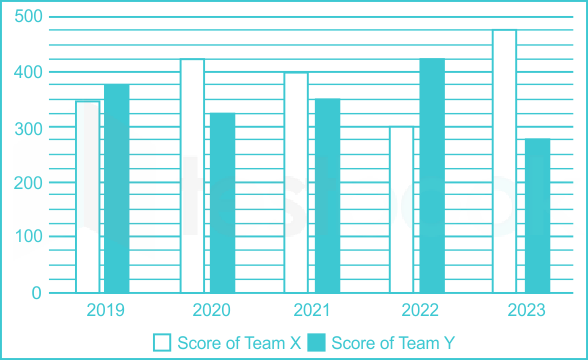
There are two teams X and Y. The bar graph shows the score of two teams in five different years [ 2019, 2020, 2021, 2022 and 2023]

34

Find the ratio of the combined score of Team X (2020 + 2021) to the combined score of Team Y (2020 + 2021)?

  1. ((a))

    6:1

  2. ((b))

    5:2

  3. ((c))

    4:5

  4. ((d))

    11:9

  5. ((e))

    12:7

Show Answer
Answer: ((d))

11:9

​Calculation

Team X (2020 + 2021) = 425 + 400 = 825

Team Y (2020 + 2021) = 325 + 350 = 675

Ratio = 825 : 675

Both numbers are divisible by 75. 825 / 75 = 11 and 675 / 75 = 9.

→ 11 : 9

35

Find the difference between Team Y’s score and Team X’s score in 2022 and 2023 together?

  1. ((a))

    72

  2. ((b))

    77

  3. ((c))

    75

  4. ((d))

    25

  5. ((e))

    76

Show Answer
Answer: ((c))

75

​Calculation

Team Y (2022) = 425, and Team Y (2023) = 275

Team X (2022) = 300 Team X ( 2023) = 475

Difference = [475 + 300] – [ 425 + 275] = 775 – 700 = 75

36

What percentage of the total combined score (Team X + Team Y) for 2021 was contributed by Team X.

  1. ((a))

    55%

  2. ((b))

    53.33%

  3. ((c))

    66%

  4. ((d))

    22%

  5. ((e))

    33.33

Show Answer
Answer: ((b))

53.33%

​Calculation

Team X (2021) = 400, Team Y (2021) = 350

Total = 400 + 350 = 750

Percentage = (400 / 750) × 100 = 53.33%

37

What percentage Team Y’s score in 2019 was greater than Team X’s score?

  1. ((a))

    7.14%

  2. ((b))

    12.5%

  3. ((c))

    22.5%

  4. ((d))

    20%

  5. ((e))

    6%

Show Answer
Answer: ((a))

7.14%

​Calculation

Difference = 375 – 350 = 25

Percentage = (25 / 350) × 100 = 7.14%

38

Suppose that in 2024 Team X’s score increases by 20% over its 2023 score, while Team Y’s score decreases by 10% compared to its 2021 score. Find the difference between score of team X and Y in 2024?

  1. ((a))

    245

  2. ((b))

    255

  3. ((c))

    355

  4. ((d))

    455

  5. ((e))

    625

Show Answer
Answer: ((b))

255

Calculation

Team X (2023) = 475 → 20% increase = 475 + 95 = 570

Team Y (2021) = 350 → 10% decrease = 350 – 35 = 315

Difference = 570 – 315 = 255

39

The average marks of A, B and C is 45 while the average marks of B, C and D is 40. If the sum of marks of A and D is 75, find the marks A got in the examination.

  1. ((a))

    45 marks

  2. ((b))

    30 marks

  3. ((c))

    40 marks

  4. ((d))

    35 marks

  5. ((e))

    50 marks

Show Answer
Answer: ((a))

45 marks

Shortcut Trick

Difference in Total Marks = (45 − 40) × 3 = 15 marks.

Since A, B, C and B, C, D are compared, (A − D) = 15.

Given (A + D) = 75.

Solving for A: A = (Sum + Difference) ÷ 2 = (75 + 15) ÷ 2 = 45.

∴ The correct answer is 45 marks.

Alternate Method

Given:

Average of A, B, C = 45 marks

Average of B, C, D = 40 marks

Sum of A and D = 75 marks

Calculations:

⇒ Total marks (A + B + C) = 45 × 3 = 135 --- (Eq 1)

⇒ Total marks (B + C + D) = 40 × 3 = 120 --- (Eq 2)

⇒ Subtracting Eq 2 from Eq 1: (A + B + C) − (B + C + D) = 135 − 120

⇒ A − D = 15 --- (Eq 3)

⇒ Given: A + D = 75 --- (Eq 4)

⇒ Adding Eq 3 and Eq 4: 2A = 90

⇒ A = 90 ÷ 2 = 45

∴ The correct answer is 45 marks.

Additional Information

Average Concept

Average = (Sum of all observations) ÷ (Total number of observations). Sum = Average × Number of terms.

Linear Equations Trick

If x + y = S and x − y = D, then x = (S + D) ÷ 2 and y = (S − D) ÷ 2.

Weighted Average

Combined Average = (n1A1 + n2A2) ÷ (n1 + n2), used when two groups are merged.

40

A and B together can do a piece of work in 18 days, B and C in 24 days, and A and C in 36 days. The number of days, all of them working together take to complete the work, is

  1. ((a))

    18

  2. ((b))

    16

  3. ((c))

    17

  4. ((d))

    15

  5. ((e))

    20

Show Answer
Answer: ((b))

16

Shortcut Trick

Combined efficiency of 2(A + B + C) = Efficiency(A+B) + Efficiency(B+C) + Efficiency(A+C)

Total Work = LCM(18, 24, 36) = 72 units.

Efficiencies: (A+B) = 4, (B+C) = 3, (A+C) = 2. Sum = 9 units.

Efficiency of (A+B+C) = 9 ÷ 2 = 4.5 units.

Time taken = 72 ÷ 4.5 = 16 days.

∴ The correct answer is 16 days.

Alternate Method

Given: Time taken by (A + B) = 18 days, (B + C) = 24 days, and (A + C) = 36 days.

Formula Used: Efficiency = Total Work ÷ Time Taken

PersonDaysTotal WorkEfficiency
A + B18724
B + C243
A + C362

⇒ Adding the efficiencies: (A + B) + (B + C) + (A + C) = 4 + 3 + 2

⇒ 2(A + B + C) = 9

⇒ Efficiency of (A + B + C) = 9/2 = 4.5

⇒ Time taken by (A + B + C) = Total Work ÷ Efficiency

⇒ Time = 72 ÷ 4.5 = 16 days

∴ The correct answer is 16 days.

Additional Information

Work and Efficiency Relationship

Efficiency is inversely proportional to the time taken to complete the work. If time increases, efficiency decreases.

Individual Efficiency Calculation

To find the efficiency of A alone: Efficiency(A) = Efficiency(A+B+C) − Efficiency(B+C).

Total Work Assumption

Total work is usually taken as the LCM of the number of days to keep efficiency values as integers or simple decimals.

41

A container contains a mixture of water and milk in the ratio 3 ∶ 2. When 5 liters of mixture is removed and replaced by pure milk then the ratio becomes 1 ∶ 2. Find the initial quantity of milk in the container.

  1. ((a))

    4.5 liters 

  2. ((b))

    3.5 liters

  3. ((c))

    6.25 liters

  4. ((d))

    5.25 liters

  5. ((e))

    2.25 liters

Show Answer
Answer: ((a))

4.5 liters 

Shortcut Trick

Initial Ratio (W:M) = 3 : 2 (Total = 5 units) | Final Ratio (W:M) = 1 : 2 (Total = 3 units)

Since only Milk is added, Water remains constant. Make Water units same: (3:2) and (1:2)×3 → (3:2) and (3:6).

Milk increase = 6 − 2 = 4 units. This 4 units = 5 liters replaced. So, 1 unit = 1.25 liters.

Total capacity = 3 + 6 = 9 units = 9 × 1.25 = 11.25 liters. Initial Milk = (2/5) × 11.25 = 4.5 liters.

∴ The correct answer is 4.5 liters.

Alternate Method

Given: Initial ratio Water : Milk = 3 : 2. Replaced volume = 5 liters. Final ratio = 1 : 2.

Formula Used: Quantity of liquid = Total volume × (Ratio part / Total parts)

⇒ Let total initial volume be 5x. Water = 3x, Milk = 2x.

⇒ After removing 5L: Water = 3x − 5×(3/5) = 3x − 3; Milk = 2x − 5×(2/5) = 2x − 2.

⇒ Adding 5L pure Milk: New Milk = 2x − 2 + 5 = 2x + 3.

⇒ New Ratio: (3x − 3) / (2x + 3) = 1 / 2

⇒ 2(3x − 3) = 1(2x + 3) ⇒ 6x − 6 = 2x + 3 ⇒ 4x = 9 ⇒ x = 2.25.

⇒ Initial Milk = 2x = 2 × 2.25 = 4.5 liters.

∴ The correct answer is 4.5 liters.

Additional Information

Mixture Replacement Rule

When a portion of mixture is removed, the ratio of components in the remaining mixture stays the same as the initial ratio.

Alligation Method for Replacement

Concentration of milk in original × (Volume left) + Concentration of added milk × (Volume added) = Final concentration × Total Volume.

42

What will come in place of question mark '?' in the following question?

987 + 23% of 1500 = ? + 21% of 700

  1. ((a))

    1275

  2. ((b))

    1180

  3. ((c))

    1185

  4. ((d))

    1075

  5. ((e))

    1285

Show Answer
Answer: ((c))

1185

Follow BODMAS rule to solve this question, as per the order given below

⇒ 987 + 23% of 1500 = ? + 21% of 700

987+23100×1500=;?+21100×700\Rightarrow 987 + \frac{{23}}{{100}} \times 1500 = ;? + \frac{{21}}{{100}} \times 700

⇒ 987 + 23 × 15 = ? + 21 × 7

⇒ 987 + 345 = ? + 147

⇒ 1332 = ? + 147

⇒ ? = 1332 – 147 = 1185

⇒ ? = 1185

43

What will come in place of question mark (?) in the following question?

271 + 85 × 3 – 122 = ? + 36 × 9

  1. ((a))

    102

  2. ((b))

    120

  3. ((c))

    162

  4. ((d))

    150

  5. ((e))

    80

Show Answer
Answer: ((e))

80

Follow BODMAS rule to solve this question, as per the order given below,

Step - 1 - Parts of an equation enclosed in 'Brackets' must be solved first, and in the bracket,

Step - 2 - Any mathematical 'Of' or 'Exponent' must be solved next,

Step - 3 - Next, the parts of the equation that contain 'Division' and 'Multiplication' are calculated,

Step - 4 - Last but not least, the parts of the equation that contain 'Addition' and 'Subtraction' should be calculated.

Given expression is,

⇒ 271 + 85 × 3 – 122 = ? + 36 × 9

⇒ 271 + 255 – 122 = ? + 36 × 9

⇒ 526 – 122 = ? + 324

⇒ ? = 404 – 324

∴ ? = 80

44

What will come in place of question mark ‘?’ in the following question?

3 – [19 + {14 – (16 – 3 – 21)}] = ?

  1. ((a))

    -41

  2. ((b))

    -38

  3. ((c))

    38

  4. ((d))

    40

  5. ((e))

    -40

Show Answer
Answer: ((b))

-38

Concept used:

Calculation:

Given expression is,

3 – [19 + {14 – (16 – 3 – 21)}]=?

⇒ 3 – [19 + {14 – (13 – 21)}] =?

⇒ 3 – [19 + {14 – (- 8)}] =?

⇒ 3 – [19 + {14 + 8}] =?

⇒ 3 – [19 + 22] =?

⇒ 3 – [41] =?

⇒ ? = -38

∴ The value of ? is -38

45

What will come in place of question mark (?) in the following question?

(42 – 23) × 6 – 5 × (42 + 5) = ?

  1. ((a))

    2

  2. ((b))

    5

  3. ((c))

    10

  4. ((d))

    0

  5. ((e))

    9

Show Answer
Answer: ((e))

9

Concept used:

Follow BODMAS rule to solve this question, as per the order given below:

The given expression is,

(42 – 23) × 6 – 5 × (42 + 5)

= 19 × 6 – 5 × (16 + 5)

= 19 × 6 – 5 × 21

= 114 – 105

= 9

46

What will come in the place of the question mark '?' in the following question?

599 – 339 + 459 – 319 = ?2

  1. ((a))

    30

  2. ((b))

    20

  3. ((c))

    900

  4. ((d))

    400

  5. ((e))

    25

Show Answer
Answer: ((b))

20

Concept used:

Follow BODMAS rule to solve this question, as per the order given below,

Calculation:

599 – 339 + 459 – 319 = ?2 

599 + 459 – (339 + 319) = ?2

1058 – 658 = 400 = ?2

? = √400 = 20

∴ The value of ?' is 20

47

Find the value of 3-2 × 272/3 ÷ (729)-1/3

  1. ((a))

    9

  2. ((b))

    18

  3. ((c))

    8

  4. ((d))

    6

  5. ((e))

    15

Show Answer
Answer: ((a))

9

Given

The value is 3-2 × 272/3 ÷ (729)-1/3

Calculation

3-2 × 272/3 ÷ (729)-1/3

⇒ (1/32) × (33)2/3 ÷ (93)-1/3

⇒ (1/9) × 32 ÷ 1/9

⇒ (1/9) × 9 × 9

⇒  9

∴ the value of 3-2 × 272/3 ÷ (729)-1/3 is 9

48

What will come in the place of the question mark ‘?’ in the following question?

[90 ÷ 6 × (24 - 8 ÷ 4) ÷ 3] – 90 ÷ 5 + 34 = ?

  1. ((a))

    181

  2. ((b))

    154

  3. ((c))

    135

  4. ((d))

    126

  5. ((e))

    142

Show Answer
Answer: ((d))

126

Given:

[90 ÷ 6 × (24 - 8 ÷ 4) ÷ 3] – 90 ÷ 5 + 34

Concept used:

Follow the BODMAS rule according to the table given below:

Calculation:

Using the BODMAS rule

⇒ [90 ÷ 6 × (24 – 8 ÷ 4) ÷ 3] – 90 ÷ 5 + 34 = ?

⇒ [90 ÷ 6 × (24 – 2) ÷ 3] – 90 ÷ 5 + 34 = ?

⇒ [90 ÷ 6 × (22) ÷ 3] – 90 ÷ 5 + 34 = ?

⇒ [90 ÷ 6 × 22/3] – 90 ÷ 5 + 34 = ?

⇒ [15 × 22/3] – 90 ÷ 5 + 34 = ?

⇒ [110] – 90 ÷ 5 + 34 = ?

⇒ 110 – 18 + 34 = ?

⇒ 110 + 16 = ?

⇒ ? = 126

In place of ‘?’ 126 will come in place of ‘?’

49

What will come in the place of question mark (?) in the following question?

2487 + 4876 – 5645 + 222 = ?

  1. ((a))

    1940

  2. ((b))

    2160

  3. ((c))

    2040

  4. ((d))

    1870

  5. ((e))

    1904

Show Answer
Answer: ((a))

1940

Concept used:

Follow BODMAS rule to solve this question, as per the order given below:

Calculation:

⇒ 2487 + 4876 – 5645 + 222 = ?

⇒ 7363 – 5645 + 222 = ?

⇒ 1718 + 222 = ?

⇒ ? = 1940

∴ The value of ? is 1940

50

What value should come in place of question mark (?) in the question?

(27)2 – (13)2 + (12)3 + (23)2 = ?

  1. ((a))

    2817

  2. ((b))

    2957

  3. ((c))

    2500

  4. ((d))

    2653

  5. ((e))

    2845

Show Answer
Answer: ((a))

2817

Calculations:

Considering the given equation,

(27)2 – (13)2 + (12)3 + (23)2 = ?

⇒ 729 – 169 + 1728 + 529 = ?

⇒ 2817 = ?

∴ The value of ? is 2817.

51

What will come in the place of the question mark ‘?’ in the following question?

[(-251) × 21 × (-12)] ÷ ? = 63

  1. ((a))

    2501

  2. ((b))

    1004

  3. ((c))

    3005

  4. ((d))

    1503

  5. ((e))

     1808

Show Answer
Answer: ((b))

1004

Concept used:

Follow BODMAS rule to solve this question, as per the order given below,

Calculation:

[(-251) × 21 × (-12)] ÷ ? = 63

⇒ [(-251) × 21 × (-12)]/63 = ?

⇒ (251 × 12)/3 = ?

⇒ 251 × 4 = ?

⇒ ? = 1004

∴ The value of ? is 1004

52

What will come in place of question mark (?) in the following question?

(36 + ? + 121)1/2 + 26 = 39

  1. ((a))

    10

  2. ((b))

    11

  3. ((c))

    12

  4. ((d))

    13

  5. ((e))

    14

Show Answer
Answer: ((c))

12

Concept used:

Calculation:

(36 + ? + 121)1/2​ + 26 = 39

⇒ (36 + ? + 121)1/2​ = 39 - 26

⇒ (36 + ? + 121) = 132

⇒ (? + 157) = 169

⇒ ? = 169 - 157 = 12

53

What value should come in place of question mark(?) in the question?

[(130)2 ÷ 25 × 15] ÷ 30 = ?

  1. ((a))

    352

  2. ((b))

    314

  3. ((c))

    326

  4. ((d))

    338

  5. ((e))

    426

Show Answer
Answer: ((d))

338

Calculation:

[(130)2 ÷ 25 × 15] ÷ 30

⇒ (130×13025×15)÷30(\frac{130 × 130}{25} × 15)÷30 = (130 × 26 × 3) ÷ 30

⇒ 13 × 26 = 338

Direction: Read the data carefully and answer the questions given below.

There are 3 individuals A, B and C. Salary of A is Rs. 10,000. He spent 10% of his salary. B’s salary is Rs. 2000 more than A's salary. Saving of C is Rs. 3000 which is (1/3)rd of his salary. B’s saving is the difference of A's and C's saving

54

If the income of A is increased by 20%, then find his saving, if expenses remained the same.

  1. ((a))

    Rs. 11,000

  2. ((b))

    Rs. 12,000

  3. ((c))

    Rs. 13,000

  4. ((d))

    Rs. 14,000

  5. ((e))

    Rs. 15,000

Show Answer
Answer: ((a))

Rs. 11,000

IncomeExpensesSaving
ARs. 10,000Rs. 1000Rs. 9000
BRs. 12,000Rs. 6,000Rs. 6,000
CRs. 9,000Rs. 6,000Rs. 3,000
<br>

New income = 10,000 + 20% of 10,000

⇒ Rs. 12,000

Expenses = Rs.1,000

New saving = Rs. (12,000 – 1,000)

⇒ Rs. 11,000

55

Expenses of C is what percent of his saving?

  1. ((a))

    150%

  2. ((b))

    30%

  3. ((c))

    300%

  4. ((d))

    200%

  5. ((e))

    20%

Show Answer
Answer: ((d))

200%

IncomeExpensesSaving
ARs. 10,000Rs. 1000Rs. 9000
BRs. 12,000Rs. 6,000Rs. 6,000
CRs. 9,000Rs. 6,000Rs. 3,000
<br>

Expenses = Rs. 6,000

Saving = Rs. 3,000

Required percent = [(6,000/3,000)] × 100

⇒ 200%

56

Saving of B is what percent of B's income?

  1. ((a))

    20%

  2. ((b))

    30%

  3. ((c))

    40%

  4. ((d))

    50%

  5. ((e))

    10%

Show Answer
Answer: ((d))

50%

IncomeExpensesSaving
ARs. 10,000Rs. 1000Rs. 9000
BRs. 12,000Rs. 6,000Rs. 6,000
CRs. 9,000Rs. 6,000Rs. 3,000
<br>

Saving = Rs. 6000

Income = Rs. 12,000

Required percentage = [(6,000/12,000)] × 100

⇒ 50%

57

Find the time in which Rs. 25000 will become Rs. 51840 at 20% per annum compound interest.

  1. ((a))

    5 years

  2. ((b))

    6 years

  3. ((c))

    4 years

  4. ((d))

    3 years

  5. ((e))

    2 years

Show Answer
Answer: ((c))

4 years

Shortcut Trick

Ratio of Amount (A) to Principal (P): 51840 / 25000 = 5184 / 2500 = 1296 / 625.

Rate (R) = 20% → Multiplying factor = (1 + 20/100) = 6/5.

Check power: (6/5)n = 1296/625 ⇒ (6/5)4 = 1296/625.

∴ The correct answer is 4 years.

Alternate Method

Given: Principal (P) = ₹25000, Amount (A) = ₹51840, Rate (R) = 20% p.a.

Formula Used: A = P(1 + R/100)n

⇒ 51840 = 25000(1 + 20/100)n

⇒ 51840 / 25000 = (120/100)n

⇒ 5184 / 2500 = (6/5)n

⇒ 1296 / 625 = (6/5)n

⇒ (6/5)4 = (6/5)n

⇒ n = 4

∴ The correct answer is 4 years.

Additional Information

Compound Interest Formula

The amount A is calculated as A = P(1 + r/n)nt, where n is the number of times interest is compounded per year.

Effective Rate of Interest

For half-yearly compounding, the rate becomes R/2 and the time becomes 2n.

Rule of 72

A simplified way to determine how long an investment will take to double, given a fixed annual rate of interest: Time ≈ 72 / Rate.

58

Speed of a boat in still water and speed of current is in ratio 9 : 2. If the difference between distance covered by boat in 2 hours upstream and in 5 hours downstream is 123km. Speed of boat in still water?

  1. ((a))

    18

  2. ((b))

    24

  3. ((c))

    21

  4. ((d))

    27

  5. ((e))

    None of these

Show Answer
Answer: ((d))

27

Shortcut Trick

Ratio of Boat speed (B) to Current speed (C) = 9 : 2.

Upstream speed (U) = 9 − 2 = 7 units; Downstream speed (D) = 9 + 2 = 11 units.

Difference = (5 × 11) − (2 × 7) = 55 − 14 = 41 units.

41 units = 123 km ⇒ 1 unit = 3 kmph.

Boat speed = 9 units = 9 × 3 = 27 kmph.

∴ The correct answer is 27 kmph.

Alternate Method

Given:

Ratio of Still Water Speed (u) and Current Speed (v) = 9x : 2x.

Formula Used:

Downstream Speed = u + v | Upstream Speed = u − v | Distance = Speed × Time.

Calculations:

⇒ Downstream Speed = 9x + 2x = 11x

⇒ Upstream Speed = 9x − 2x = 7x

⇒ Distance Downstream (5 hrs) = 11x × 5 = 55x

⇒ Distance Upstream (2 hrs) = 7x × 2 = 14x

⇒ Difference: 55x − 14x = 123

⇒ 41x = 123

⇒ x = 3

⇒ Speed of boat in still water = 9x = 9 × 3 = 27 kmph

∴ The correct answer is 27 kmph.

Additional Information

Relative Speed in Streams

Downstream speed (D) is the sum of boat speed (u) and stream speed (v). Upstream speed (U) is the difference (u − v).

Calculating Component Speeds

Boat speed in still water u = (D + U) ÷ 2 and Stream speed v = (D − U) ÷ 2.

Average Speed

Average speed for a round trip (upstream and downstream) = (D × U) ÷ u = (u2 − v2) ÷ u.

59

A man sells 20 bananas at Rs.600, there is loss equal to cost price of 5 bananas. Find the cost price of a banana.

  1. ((a))

    Rs.40

  2. ((b))

    Rs.45

  3. ((c))

    Rs.35

  4. ((d))

    Rs.30

  5. ((e))

    Rs.60

Show Answer
Answer: ((a))

Rs.40

Shortcut Trick Loss = CP of 5 bananas Loss occurs when CP > SP. For 20 bananas: Loss = CP of 20 − SP of 20 Equating: CP of 5 = CP of 20 − SP of 20 ⇒ SP of 20 = CP of 15 Given SP of 20 = Rs.600, therefore CP of 15 = Rs.600 CP of 1 banana = 600 ÷ 15 = Rs.40 ∴ The correct answer is Rs.40.

Alternate Method Given: Number of bananas = 20 | Selling Price (SP) = Rs.600 | Loss = CP of 5 bananas. Formulas: Loss = CP − SP | Cost Price (CP) = Total Cost ÷ Quantity.

⇒ Let the CP of 1 banana be x. ⇒ CP of 20 bananas = 20x. ⇒ Loss = CP of 5 bananas = 5x. ⇒ SP of 20 bananas = CP − Loss = 20x − 5x = 15x. ⇒ According to the question, 15x = 600. ⇒ x = 600 ÷ 15 = 40. ∴ The correct answer is Rs.40.

Additional Information Loss in Terms of CP When loss is expressed as the Cost Price of 'n' articles, simply subtract 'n' from the total quantity to find the equivalent CP representing the SP. Profit in Terms of CP If there were a profit equal to CP of 'n' articles, SP = CP × (Total + n).

60

Buses start from a bus terminal with a speed of 40 km/hr at intervals of 20 minutes. What is the speed of a man coming from the opposite direction towards the bus terminal if he meets the bus at intervals of 16 minutes?

  1. ((a))

    12 km/hr

  2. ((b))

    5 km/hr

  3. ((c))

    10 km/hr

  4. ((d))

    20 km/hr

  5. ((e))

    15 km/hr

Show Answer
Answer: ((c))

10 km/hr

Shortcut Trick

Distance covered by Bus in (20 − 16) minutes = Distance covered by Man in 16 minutes.

Ratio of Time taken for same distance (Bus : Man) = 4 : 16 = 1 : 4.

Ratio of Speed (Bus : Man) = 4 : 1.

Since Bus speed is 40 km/hr (4 units), Man speed (1 unit) = 40 ÷ 4 = 10 km/hr.

∴ The correct answer is 10 km/hr.

Alternate Method

Given: Speed of Bus (Sb) = 40 km/hr, Time interval of buses (T1) = 20 min, Meeting interval (T2) = 16 min.

Formula Used: Sb × (T1 − T2) = Sm × T2

⇒ Distance between two consecutive buses = Speed × Time = 40 × (20/60) km.

⇒ When man moves towards terminal, Relative Speed = (Sb + Sm).

⇒ Distance = Relative Speed × Meeting Time

⇒ 40 × 20 = (40 + Sm) × 16

⇒ 800 = 640 + 16 × Sm

⇒ 16 × Sm = 160

⇒ Sm = 10 km/hr.

∴ The correct answer is 10 km/hr.

Additional Information

Relative Speed Concept

When two objects move in opposite directions, their relative speed is the sum of their individual speeds (S1 + S2).

Constant Distance Rule

For a constant distance, Speed is inversely proportional to Time. If time ratio is a:b, then speed ratio is b:a.

Bus and Man logic

If the man moves away from the terminal, he would meet the bus at intervals longer than the original frequency (T1 + Δt).

The given table shows the total number of books [ Fiction + Non – fiction] and number of fictions books sold in five different months [ January, February, March, April and May]

MonthTotal number of books sold [ Fiction + Non – Fiction]Number of fiction Books sold
January17585
February280120
March225115
April320180
May260150
61

Find the ratio of total books sold in February and April together to the total books sold in March and May together?

  1. ((a))

    12:17

  2. ((b))

    118:129

  3. ((c))

    121:123

  4. ((d))

    120 : 97

  5. ((e))

    11:17

Show Answer
Answer: ((d))

120 : 97

Common Calculation

MonthTotal number of books sold [ Fiction + Non – Fiction]Number of fiction Books soldNumber of Non - fiction Books sold
January17585175 - 85=90
February280120280 – 120 = 160
March225115225 – 115 = 110
April320180320 -180 = 140
May260150260 – 150= 110

Calculation

Feb + Apr = 280 + 320 = 600

March + May = 225 + 260 = 485

Both numbers are divisible by 5. 600 / 5 = 120 and 485 / 5 = 97.

Ratio = 600 : 485 = 120 : 97

62

What is the difference between the number of fiction books sold in April and January?

  1. ((a))

    55

  2. ((b))

    95

  3. ((c))

    74

  4. ((d))

    85

  5. ((e))

    35

Show Answer
Answer: ((b))

95

Common Calculation

MonthTotal number of books sold [ Fiction + Non – Fiction]Number of fiction Books soldNumber of Non - fiction Books sold
January17585175 - 85=90
February280120280 – 120 = 160
March225115225 – 115 = 110
April320180320 -180 = 140
May260150260 – 150= 110

​Calculation

April Fiction = 180

January Fiction = 85

Difference = 180 – 85 = 95

63

By what percentage is the number of Non-Fiction books sold in February more than that in March?

  1. ((a))

    55%

  2. ((b))

    62.5%

  3. ((c))

    45.5%

  4. ((d))

    36.5%

  5. ((e))

    37.5%

Show Answer
Answer: ((c))

45.5%

Common Calculation

MonthTotal number of books sold [ Fiction + Non – Fiction]Number of fiction Books soldNumber of Non - fiction Books sold
January17585175 - 85=90
February280120280 – 120 = 160
March225115225 – 115 = 110
April320180320 -180 = 140
May260150260 – 150= 110

Calculation

Feb Non-Fiction = 160, Mar Non-Fiction = 110

Difference = 50

Percentage more = (50/110) × 100 = 45.5%

64

The number of Non - Fiction books sold in April what percent more or less than that in February?

  1. ((a))

    22.5%

  2. ((b))

    62.5%

  3. ((c))

    10%

  4. ((d))

    27.5%

  5. ((e))

    12.5%

Show Answer
Answer: ((e))

12.5%

Common Calculation

MonthTotal number of books sold [ Fiction + Non – Fiction]Number of fiction Books soldNumber of Non - fiction Books sold
January17585175 - 85=90
February280120280 – 120 = 160
March225115225 – 115 = 110
April320180320 -180 = 140
May260150260 – 150= 110

Calculation

April’s Non- Fiction = 140, February’s Non- Fiction = 160

Percentage less than in April = (20/160) ×100 = 12.5 %

65

In June, the total books sold were 300, out of which 40% were Fiction books. Find the difference between number of Non-Fiction books sold in June and Non-Fiction books sold in May?

  1. ((a))

    55

  2. ((b))

    70

  3. ((c))

    75

  4. ((d))

    36

  5. ((e))

    35

Show Answer
Answer: ((b))

70

Common Calculation:-

MonthTotal number of books sold [ Fiction + Non – Fiction]Number of fiction Books soldNumber of Non - fiction Books sold
January17585175 - 85=90
February280120280 – 120 = 160
March225115225 – 115 = 110
April320180320 -180 = 140
May260150260 – 150= 110

Calculation

Fiction (June) = 40% of 300 = 120

Non-Fiction (June) = 300 - 120 = 180

Non-Fiction (May) = 110

Difference = 180 – 110 = 70

Reasoning Ability (35 questions)

Direction: Read the following information carefully and answer the questions based on given information.

Eight persons A, B, C, D, E, F, G and H live on an eight storey apartment but not necessarily in same order. The bottom most floor is floor 1 just above floor 1 is floor 2 and so on up to floor 8 which is the top most floor. A lives two floors above C. Three persons live between E and F. H lives below the floor of C. One person lives between B and G. F lives on the odd number floor below the fifth floor. G lives just below the floor of E. No two persons whose names start with consecutive letters live adjacent floors.

66

Who among the following person lives two floors above the floor of D? 

  1. ((a))

    B

  2. ((b))

    G

  3. ((c))

    E

  4. ((d))

    F

  5. ((e))

    No one

Show Answer
Answer: ((c))

E

Here, persons are A, B, C, D, E, F, G and H.

  1. F lives on the odd number floor below the fifth floor.

  2. Three persons live between E and F.

  3. G lives just below the floor of E.

FloorsCase – 1Case – 2
PersonsPersons
8
7E
6G
5E
4G
3F
2
1F


  1. One person lives between B and G.

  2. A lives two floors above C.

  3. H lives below the floor of C.

FloorsCase – 1Case – 2
PersonsPersons
8AB
7E
6CG
5E
4GA
3HF
2BC
1FH


  1. No two person whose names start with consecutive letters live adjacent floors. Therefore, case 1 is eliminated. Hence, the final arrangement is as follows
FloorsPersons
8B
7E
6G
5D
4A
3F
2C
1H


Hence, E lives two floors above the floor of D.

67

On which floor does A lives ?

  1. ((a))

    6th floor

  2. ((b))

    5th floor

  3. ((c))

    3rd floor

  4. ((d))

    4th floor

  5. ((e))

    8th floor

Show Answer
Answer: ((d))

4th floor

Here, persons are A, B, C, D, E, F, G and H.

  1. F lives on the odd number floor below the fifth floor.

  2. Three persons live between E and F.

  3. G lives just below the floor of E.

FloorsCase – 1Case – 2
PersonsPersons
8
7E
6G
5E
4G
3F
2
1F


  1. One person lives between B and G.

  2. A lives two floors above C.

  3. H lives below the floor of C.

FloorsCase – 1Case – 2
PersonsPersons
8AB
7E
6CG
5E
4GA
3HF
2BC
1FH


  1. No two person whose names start with consecutive letters live adjacent floors. Therefore, case 1 is eliminated. Hence, the final arrangement is as follows
FloorsPersons
8B
7E
6G
5D
4A
3F
2C
1H


Hence, A lives on 4th floor.

68

Which of the following statement(s) is/are correct?

  1. ((a))

    B lives on seventh floor.

  2. ((b))

    Only one person lives between A and H.

  3. ((c))

    G lives just below the floor of D.

  4. ((d))

    H lives on second floor.

  5. ((e))

    None of these.

Show Answer
Answer: ((e))

None of these.

Here, persons are A, B, C, D, E, F, G and H.

  1. F lives on the odd number floor below the fifth floor.

  2. Three persons live between E and F.

  3. G lives just below the floor of E.

FloorsCase – 1Case – 2
PersonsPersons
8
7E
6G
5E
4G
3F
2
1F


  1. One person lives between B and G.

  2. A lives two floors above C.

  3. H lives below the floor of C.

FloorsCase – 1Case – 2
PersonsPersons
8AB
7E
6CG
5E
4GA
3HF
2BC
1FH


  1. No two person whose names start with consecutive letters live adjacent floors. Therefore, case 1 is eliminated. Hence, the final arrangement is as follows
FloorsPersons
8B
7E
6G
5D
4A
3F
2C
1H


Since, B lives on eighth floor not seventh floor. Therefore, statement first is incorrect.

Two persons live between A and H. Therefore, statement second is incorrect.

G lives just above not below the floor of D. Therefore, statement third is incorrect.

H lives on first floor not second floor. Therefore, statement fourth is incorrect.

Hence, the correct statement is None of these.

69

How many persons live between E and A?

  1. ((a))

    As many persons live between G and B.

  2. ((b))

    As many persons live below the floor of F.

  3. ((c))

    As many persons live above the floor of B.

  4. ((d))

    As many persons lives above the floor of D.

  5. ((e))

    As many persons live between D and F.

Show Answer
Answer: ((b))

As many persons live below the floor of F.

Here, persons are A, B, C, D, E, F, G and H.

  1. F lives on the odd number floor below the fifth floor.

  2. Three persons live between E and F.

  3. G lives just below the floor of E.

FloorsCase – 1Case – 2
PersonsPersons
8
7E
6G
5E
4G
3F
2
1F


  1. One person lives between B and G.

  2. A lives two floors above C.

  3. H lives below the floor of C.

FloorsCase – 1Case – 2
PersonsPersons
8AB
7E
6CG
5E
4GA
3HF
2BC
1FH


  1. No two person whose names start with consecutive letters live adjacent floors. Therefore, case 1 is eliminated. Hence, the final arrangement is as follows
FloorsPersons
8B
7E
6G
5D
4A
3F
2C
1H


Since, two persons live between the floor of E and A and two persons live below the floor of F.

Hence, the correct answer is  As many persons live below the floor of F.

70

Which of the following statement(s) is/are not correct?

A) No lives above B.

B) E lives just above the floor of B.

C) D and B lives on adjacent floors.

  1. ((a))

    Only A

  2. ((b))

    Only B

  3. ((c))

    Only C

  4. ((d))

    Both A and B

  5. ((e))

    Both B and C

Show Answer
Answer: ((e))

Both B and C

Here, persons are A, B, C, D, E, F, G and H.

  1. F lives on the odd number floor below the fifth floor.

  2. Three persons live between E and F.

  3. G lives just below the floor of E.

FloorsCase – 1Case – 2
PersonsPersons
8
7E
6G
5E
4G
3F
2
1F


  1. One person lives between B and G.

  2. A lives two floors above C.

  3. H lives below the floor of C.

FloorsCase – 1Case – 2
PersonsPersons
8AB
7E
6CG
5E
4GA
3HF
2BC
1FH


  1. No two person whose names start with consecutive letters live adjacent floors. Therefore, case 1 is eliminated. Hence, the final arrangement is as follows
FloorsPersons
8B
7E
6G
5D
4A
3F
2C
1H


Since, B lives on top floor so no one lives above his floor. Therefore, the statement A is correct.

E lives just below not above the floor of B. Therefore, the statement B is incorrect.

Two persons live between D and B. Therefore, statement C is incorrect.

Hence, the correct answer is Both B and C.

71

Directions: In the following question assuming the given statements to be true, find which of the conclusion among given conclusions is / are definitely true and then give your answers accordingly.

Statement: M > C < D = R ≤ E < A ≥ V > Y

Conclusions:

I. R < A

II. M < E

III. D ≤ E

  1. ((a))

    Only III is True.

  2. ((b))

    Both conclusion I and III are True.

  3. ((c))

    Only II is True.

  4. ((d))

    Both conclusions I and II are True.

  5. ((e))

    None is True.

Show Answer
Answer: ((b))

Both conclusion I and III are True.

Given: M > C < D = R ≤ E < A ≥ V > Y

I. R < A → True (as R ≤ E < A)

II. M < E → False (as M > C < D = R ≤ E; thus a clear relation between M and E cannot be established).

III. D ≤ E → True (as D = R ≤ E)

Hence, conclusion I and III are true.

72

Directions: In the following question assuming the given statements to be true, find which conclusion among the given conclusions is/are definitely true and then give your answers accordingly.

Statement:

A ≥ B > C; C ≤ D ≤ E < F

Conclusions:

I. A ≥ E

II. C < F

  1. ((a))

    Only I is True

  2. ((b))

    Only II is True

  3. ((c))

    Either I or II is true

  4. ((d))

    Both conclusions I and II are True

  5. ((e))

    None is True

Show Answer
Answer: ((b))

Only II is True

Given:

A ≥ B > C; C ≤ D ≤ E < F

On Combining:

A ≥ B > C ≤ D ≤ E < F

Conclusions:

I. A ≥ E→ False (as A ≥ B > C ≤ D ≤ E; therefore, the relationship between A and E cannot be determined)

II. C < F→ True (as C ≤ D ≤ E < F; therefore C < F)

Hence, only conclusion II is true.

73

Directions: In the question, assuming the given statements to be true, find which of the conclusion (s) among given two conclusions is /are definitely true and then give your answer accordingly.

Statements: C ≥ F; B < C > D < H = I

Conclusions:

I. I > F

II. H > C

  1. ((a))

    Either conclusion I or II is true.

  2. ((b))

    Only conclusion II is true.

  3. ((c))

    Only conclusion I is true.

  4. ((d))

    Both conclusions I and II are true.

  5. ((e))

    None of the conclusions is true

Show Answer
Answer: ((e))

None of the conclusions is true

Given statements: C ≥ F; B < C > D < H = I

On combining, we get

B < C ≥ F; I = H > D < C ≥ F

Conclusions:

I. I > F → False (As I = H > D < C ≥ F, thus, the relation between I and F cannot be determined)

II. H > C → False (As H > D < C, thus, the relation between H and C cannot be determined)

Hence, none of the conclusions is true

Direction: Read the following information carefully and answer the questions based on given information.

Eight persons B, F, H, K, O, R, V and X purchased a gift one after another but not necessarily in same order. At least three persons purchased gift between K and X. O purchased a gift two persons before H. Three persons purchased gift between V and F. K purchased gift before X and neither of them is the first or last person. Only two persons purchased gift between V and O who purchased gift after V. H purchased gift before B. R does not purchase a gift adjacent to X and V.

74

Who among the following person is the first person who purchased a gift?

  1. ((a))

    R

  2. ((b))

    V

  3. ((c))

    O

  4. ((d))

    H

  5. ((e))

    F

Show Answer
Answer: ((b))

V

Here, persons are B, F, H, K, O, R, V and X.

  1. At least three persons purchased gift between K and X.

  2. K purchased gift before X and neither of them is the first or last person.

Case – 1Case – 2Case – 3
PersonsPersonsPersons
KK
K
X
XX


  1. Three persons purchased gift between V and F.

  2. Only two persons purchased gift between V and O who purchased gift after V.

  3. O purchased a gift two persons before H.

Case – 1Case – 2(a)Case – 2(b)Case – 3
PersonsPersonsPersonsPersons
OVOV
KKK
HHK
VOVO
FF
XHH
XXX
FF


  1. H purchased gift before B.

  2. R does not purchase a gift adjacent to X and V. Therefore, cases 1, 2(b) and 3 are eliminated. Hence, the final arrangement is as follows

Persons
V
K
R
O
F
H
X
B


Hence, V is the first one who purchased a gift.

75

How many persons purchased gift between R and F ?

  1. ((a))

    Three

  2. ((b))

    One

  3. ((c))

    Two

  4. ((d))

    None 

  5. ((e))

    More than three

Show Answer
Answer: ((b))

One

Here, persons are B, F, H, K, O, R, V and X.

  1. At least three persons purchased gift between K and X.

  2. K purchased gift before X and neither of them is the first or last person.

Case – 1Case – 2Case – 3
PersonsPersonsPersons
KK
K
X
XX


  1. Three persons purchased gift between V and F.

  2. Only two persons purchased gift between V and O who purchased gift after V.

  3. O purchased a gift two persons before H.

Case – 1Case – 2(a)Case – 2(b)Case – 3
PersonsPersonsPersonsPersons
OVOV
KKK
HHK
VOVO
FF
XHH
XXX
FF


  1. H purchased gift before B.

  2. R does not purchase a gift adjacent to X and V. Therefore, cases 1, 2(b) and 3 are eliminated. Hence, the final arrangement is as follows

Persons
V
K
R
O
F
H
X
B


Hence, one person purchased gift between R and F.

76

Which of the following statement(s) is/are incorrect?

  1. ((a))

    B is the last person who purchased a gift.

  2. ((b))

    H purchased a gift just before X.

  3. ((c))

    K purchased a gift just after V.

  4. ((d))

    More than three persons purchased gift after H.

  5. ((e))

    None of these.

Show Answer
Answer: ((d))

More than three persons purchased gift after H.

Here, persons are B, F, H, K, O, R, V and X.

  1. At least three persons purchased gift between K and X.

  2. K purchased gift before X and neither of them is the first or last person.

Case – 1Case – 2Case – 3
PersonsPersonsPersons
KK
K
X
XX


  1. Three persons purchased gift between V and F.

  2. Only two persons purchased gift between V and O who purchased gift after V.

  3. O purchased a gift two persons before H.

Case – 1Case – 2(a)Case – 2(b)Case – 3
PersonsPersonsPersonsPersons
OVOV
KKK
HHK
VOVO
FF
XHH
XXX
FF


  1. H purchased gift before B.

  2. R does not purchase a gift adjacent to X and V. Therefore, cases 1, 2(b) and 3 are eliminated. Hence, the final arrangement is as follows

Persons
V
K
R
O
F
H
X
B


Since, B is the last person who purchased a gift. Therefore, statement first is correct.

H purchased a gift just before X. Therefore, statement second is correct.

K purchased a gift just after V. Therefore, statement third is correct.

Only two persons purchased gift after H. Therefore, statement fourth is incorrect.

Hence, the incorrect statement is More than three persons purchased gift after H.

77

As many persons purchased gift before O as many persons after whom?

  1. ((a))

    F

  2. ((b))

    R

  3. ((c))

    X

  4. ((d))

    B

  5. ((e))

    H

Show Answer
Answer: ((a))

F

Here, persons are B, F, H, K, O, R, V and X.

  1. At least three persons purchased gift between K and X.

  2. K purchased gift before X and neither of them is the first or last person.

Case – 1Case – 2Case – 3
PersonsPersonsPersons
KK
K
X
XX


  1. Three persons purchased gift between V and F.

  2. Only two persons purchased gift between V and O who purchased gift after V.

  3. O purchased a gift two persons before H.

Case – 1Case – 2(a)Case – 2(b)Case – 3
PersonsPersonsPersonsPersons
OVOV
KKK
HHK
VOVO
FF
XHH
XXX
FF


  1. H purchased gift before B.

  2. R does not purchase a gift adjacent to X and V. Therefore, cases 1, 2(b) and 3 are eliminated. Hence, the final arrangement is as follows

Persons
V
K
R
O
F
H
X
B


Since, three persons purchased gift before O and three persons purchased gift after F.

Hence, the correct answer is F.

78

Which of the following statement(s) is/are correct regarding R?

A) As many persons purchased gift before R as many persons after H.

B) O purchased gift just after R.

C) F purchased gift before R.

  1. ((a))

    Only B

  2. ((b))

    Only C

  3. ((c))

    Both A and B

  4. ((d))

    Only A

  5. ((e))

    Both B and C

Show Answer
Answer: ((c))

Both A and B

Here, persons are B, F, H, K, O, R, V and X.

  1. At least three persons purchased gift between K and X.

  2. K purchased gift before X and neither of them is the first or last person.

Case – 1Case – 2Case – 3
PersonsPersonsPersons
KK
K
X
XX


  1. Three persons purchased gift between V and F.

  2. Only two persons purchased gift between V and O who purchased gift after V.

  3. O purchased a gift two persons before H.

Case – 1Case – 2(a)Case – 2(b)Case – 3
PersonsPersonsPersonsPersons
OVOV
KKK
HHK
VOVO
FF
XHH
XXX
FF


  1. H purchased gift before B.

  2. R does not purchase a gift adjacent to X and V. Therefore, cases 1, 2(b) and 3 are eliminated. Hence, the final arrangement is as follows

Persons
V
K
R
O
F
H
X
B


Since, two persons purchased gift before R and same number of persons purchased gift after H. Therefore, statement A is correct.

O purchased gift just after R. Therefore, statement B is correct.

F purchased gift after R not before R. Therefore, statement C is incorrect.

Hence, the correct statement is both A and B.

79

If in a certain code language, SECOND is coded as QLFUCE , then how the word PAUSED would be coded in that language?

  1. ((a))

    UCFRYW

  2. ((b))

    QBVTFE

  3. ((c))

    UCSYW

  4. ((d))

    QBVUFE

  5. ((e))

    QBSTFE

Show Answer
Answer: ((a))

UCFRYW

the pattern of code is as follows,

Similarly, the word PAUSED can be coded as,

Hence, the word PAUSED would be coded as UCFRYW.

Directions: Read the information and answer the given questions.

Eight persons, namely, S, T, U, V, W, X, Y, and Z, have their visits on different dates, either on the 7th or the 20th of the months January, March, May, and September, but not necessarily in the same order. E×actly three people have their visits between X’s visit and V’s visit. Y’s visit takes place immediately before X’s visit, and X’s visit is on 7th March. U’s visit is scheduled immediately after W’s visit. T’s visit is in a month that has 31 days. Z’s visit is scheduled after S’s visit. There are more than two people whose visits fall between T’s visit and S’s visit. Not more than two people visit between T and Z.

80

Who among the following person has a visit immediately before W’s visit?

  1. ((a))

    Y

  2. ((b))

    The one whose visit is on 20th May

  3. ((c))

    V

  4. ((d))

    The one whose visit is on 7th March

  5. ((e))

    S

Show Answer
Answer: ((d))

The one whose visit is on 7th March

  1. Y’s visit takes place immediately before X’s visit, and X’s visit is on 7th March. 
MonthsDatesPersons
January (31)7
20Y
March (31)7X
20
May (31)7
20
September (30)7
20


​2. Exactly three people have their visits between X’s visit and V’s visit. 

MonthsDatesPersons
January (31)7
20Y
March (31)7X
20
May (31)7
20
September (30)7V
20


3. T’s visit is in a month that has 31 days.  4. There are more than two people whose visits fall between T’s visit and S’s visit.

Here, we have 4 Cases, i.e., Case 1, Case 2, Case 3, and Case 4.

MonthsDatesPersons
Case 1Case 2Case 3Case 4
January (31)7TSS
20YYYY
March (31)7XXXX
20T
May (31)7S/T
20S/T
September (30)7VVVV
20S/S


5. U’s visit is scheduled immediately after W’s visit. 

Now, we can eliminate Case 3, but we have a new subcase of Case 1.

MonthsDatesPersons
Case 1Case 1aCase 2Case 4
January (31)7TTS
20YYYY
March (31)7XXXX
20WTW
May (31)7UWWU
20S/UUT
September (30)7VVVV
20S/SS


  1. Z’s visit is scheduled after S’s visit. 

Now, we can eliminate Case 1a and Case 2.

MonthsDatesPersons
Case 1Case 4
January (31)7TS
20YY
March (31)7XX
20WW
May (31)7UU
20ST
September (30)7VV
20ZZ


  1. Not more than two people visit between T and Z.

Now, we can eliminate Case 1.

This is our final arrangement,

MonthsDatesPersons
Case 4
January (31)7S
20Y
March (31)7X
20W
May (31)7U
20T
September (30)7V
20Z


Hence, the correct answer is The one whose visit is on 7th March.

81

Z has a visit on which date?

  1. ((a))

    20th May

  2. ((b))

    20th September

  3. ((c))

    20th March

  4. ((d))

    7th May

  5. ((e))

    7th September

Show Answer
Answer: ((b))

20th September

1. Y’s visit takes place immediately before X’s visit, and X’s visit is on 7th March. 

MonthsDatesPersons
January (31)7
20Y
March (31)7X
20
May (31)7
20
September (30)7
20


​2. Exactly three people have their visits between X’s visit and V’s visit. 

MonthsDatesPersons
January (31)7
20Y
March (31)7X
20
May (31)7
20
September (30)7V
20


3. T’s visit is in a month that has 31 days.  4. There are more than two people whose visits fall between T’s visit and S’s visit.

Here, we have 4 Cases, i.e., Case 1, Case 2, Case 3, and Case 4.

MonthsDatesPersons
Case 1Case 2Case 3Case 4
January (31)7TSS
20YYYY
March (31)7XXXX
20T
May (31)7S/T
20S/T
September (30)7VVVV
20S/S


5. U’s visit is scheduled immediately after W’s visit. 

Now, we can eliminate Case 3, but we have a new subcase of Case 1.

MonthsDatesPersons
Case 1Case 1aCase 2Case 4
January (31)7TTS
20YYYY
March (31)7XXXX
20WTW
May (31)7UWWU
20S/UUT
September (30)7VVVV
20S/SS


  1. Z’s visit is scheduled after S’s visit. 

Now, we can eliminate Case 1a and Case 2.

MonthsDatesPersons
Case 1Case 4
January (31)7TS
20YY
March (31)7XX
20WW
May (31)7UU
20ST
September (30)7VV
20ZZ


  1. Not more than two people visit between T and Z.

Now, we can eliminate Case 1.

This is our final arrangement,

MonthsDatesPersons
Case 4
January (31)7S
20Y
March (31)7X
20W
May (31)7U
20T
September (30)7V
20Z


Hence, the correct answer is 20th September.

82

How many persons have a visit between Z and W?

  1. ((a))

    Two

  2. ((b))

    Three

  3. ((c))

    Four

  4. ((d))

    One

  5. ((e))

    None

Show Answer
Answer: ((b))

Three

1. Y’s visit takes place immediately before X’s visit, and X’s visit is on 7th March. 

MonthsDatesPersons
January (31)7
20Y
March (31)7X
20
May (31)7
20
September (30)7
20


​2. Exactly three people have their visits between X’s visit and V’s visit. 

MonthsDatesPersons
January (31)7
20Y
March (31)7X
20
May (31)7
20
September (30)7V
20


3. T’s visit is in a month that has 31 days.  4. There are more than two people whose visits fall between T’s visit and S’s visit.

Here, we have 4 Cases, i.e., Case 1, Case 2, Case 3, and Case 4.

MonthsDatesPersons
Case 1Case 2Case 3Case 4
January (31)7TSS
20YYYY
March (31)7XXXX
20T
May (31)7S/T
20S/T
September (30)7VVVV
20S/S


5. U’s visit is scheduled immediately after W’s visit. 

Now, we can eliminate Case 3, but we have a new subcase of Case 1.

MonthsDatesPersons
Case 1Case 1aCase 2Case 4
January (31)7TTS
20YYYY
March (31)7XXXX
20WTW
May (31)7UWWU
20S/UUT
September (30)7VVVV
20S/SS


  1. Z’s visit is scheduled after S’s visit. 

Now, we can eliminate Case 1a and Case 2.

MonthsDatesPersons
Case 1Case 4
January (31)7TS
20YY
March (31)7XX
20WW
May (31)7UU
20ST
September (30)7VV
20ZZ


  1. Not more than two people visit between T and Z.

Now, we can eliminate Case 1.

This is our final arrangement,

MonthsDatesPersons
Case 4
January (31)7S
20Y
March (31)7X
20W
May (31)7U
20T
September (30)7V
20Z


Hence, the correct answer is Three.

83

Find the odd one out.

  1. ((a))

    S

  2. ((b))

    X

  3. ((c))

    U

  4. ((d))

    Z

  5. ((e))

    T

Show Answer
Answer: ((d))

Z

1. Y’s visit takes place immediately before X’s visit, and X’s visit is on 7th March. 

MonthsDatesPersons
January (31)7
20Y
March (31)7X
20
May (31)7
20
September (30)7
20


​2. Exactly three people have their visits between X’s visit and V’s visit. 

MonthsDatesPersons
January (31)7
20Y
March (31)7X
20
May (31)7
20
September (30)7V
20


3. T’s visit is in a month that has 31 days.  4. There are more than two people whose visits fall between T’s visit and S’s visit.

Here, we have 4 Cases, i.e., Case 1, Case 2, Case 3, and Case 4.

MonthsDatesPersons
Case 1Case 2Case 3Case 4
January (31)7TSS
20YYYY
March (31)7XXXX
20T
May (31)7S/T
20S/T
September (30)7VVVV
20S/S


5. U’s visit is scheduled immediately after W’s visit. 

Now, we can eliminate Case 3, but we have a new subcase of Case 1.

MonthsDatesPersons
Case 1Case 1aCase 2Case 4
January (31)7TTS
20YYYY
March (31)7XXXX
20WTW
May (31)7UWWU
20S/UUT
September (30)7VVVV
20S/SS


  1. Z’s visit is scheduled after S’s visit. 

Now, we can eliminate Case 1a and Case 2.

MonthsDatesPersons
Case 1Case 4
January (31)7TS
20YY
March (31)7XX
20WW
May (31)7UU
20ST
September (30)7VV
20ZZ


  1. Not more than two people visit between T and Z.

Now, we can eliminate Case 1.

This is our final arrangement,

MonthsDatesPersons
Case 4
January (31)7S
20Y
March (31)7X
20W
May (31)7U
20T
September (30)7V
20Z


Except for the Z who visited in the month which have 30 ays, all others visit in month having 31 days.

Hence, the correct answer is Z.

84

How many persons have visit before T’s visit?

  1. ((a))

    Three

  2. ((b))

    Four

  3. ((c))

    Five

  4. ((d))

    Two

  5. ((e))

    More than five

Show Answer
Answer: ((c))

Five

1. Y’s visit takes place immediately before X’s visit, and X’s visit is on 7th March. 

MonthsDatesPersons
January (31)7
20Y
March (31)7X
20
May (31)7
20
September (30)7
20


​2. Exactly three people have their visits between X’s visit and V’s visit. 

MonthsDatesPersons
January (31)7
20Y
March (31)7X
20
May (31)7
20
September (30)7V
20


3. T’s visit is in a month that has 31 days.  4. There are more than two people whose visits fall between T’s visit and S’s visit.

Here, we have 4 Cases, i.e., Case 1, Case 2, Case 3, and Case 4.

MonthsDatesPersons
Case 1Case 2Case 3Case 4
January (31)7TSS
20YYYY
March (31)7XXXX
20T
May (31)7S/T
20S/T
September (30)7VVVV
20S/S


5. U’s visit is scheduled immediately after W’s visit. 

Now, we can eliminate Case 3, but we have a new subcase of Case 1.

MonthsDatesPersons
Case 1Case 1aCase 2Case 4
January (31)7TTS
20YYYY
March (31)7XXXX
20WTW
May (31)7UWWU
20S/UUT
September (30)7VVVV
20S/SS


  1. Z’s visit is scheduled after S’s visit. 

Now, we can eliminate Case 1a and Case 2.

MonthsDatesPersons
Case 1Case 4
January (31)7TS
20YY
March (31)7XX
20WW
May (31)7UU
20ST
September (30)7VV
20ZZ


  1. Not more than two people visit between T and Z.

Now, we can eliminate Case 1.

This is our final arrangement,

MonthsDatesPersons
Case 4
January (31)7S
20Y
March (31)7X
20W
May (31)7U
20T
September (30)7V
20Z


Hence, the correct answer is Five.

85

Direction: In the question below are given two statements followed by three conclusions numbered I, II and III. You have to take the given statements to be true even if they seem to be at variance with commonly known facts. Read all the conclusions and then decide which of the given conclusions logically follows from the given statements disregarding commonly known facts.

Statements:

Only few pen are pencils.

No pencil is eraser.

Conclusions:

I. No pen is eraser.

II. Some erasers are pencil.

III. All pen being pencils is a possibility.

  1. ((a))

    None follows

  2. ((b))

    Either I or II follows

  3. ((c))

    Only III follows

  4. ((d))

    Only I follows

  5. ((e))

    Both I and II follow

Show Answer
Answer: ((a))

None follows

The least possible Venn diagram for the given statements is as follows,

Conclusions:

I. No pen is eraser → False (it is possible but not definite.)

II. Some erasers are pencil → False (as no pencil is eraser which also  means no eraser is pencil.)

III. All pen being pencils is a possibility → False (not possible as only few pens are pencils which means some pens are pencils and some pen are not pencils.)

Thus, none of the conclusions follows.

86

Direction: In the question below are given two statements followed by three conclusions numbered I, II and III. You have to take the given statements to be true even if they seem to be at variance with commonly known facts. Read all the conclusions and then decide which of the given conclusions logically follows from the given statements disregarding commonly known facts.

Statements:

Some lemons are fruits.

Only fruits are orange.

Conclusions:

I. Some lemons are orange.

II. All lemons being fruits is a possibility.

III. No lemon is orange.

  1. ((a))

    None follows

  2. ((b))

    Either I or III follows

  3. ((c))

    Only III follows

  4. ((d))

    Only I follows

  5. ((e))

    Both II and III follows

Show Answer
Answer: ((e))

Both II and III follows

The least possible Venn diagram for the given statements is as follows,

Conclusions:

I. Some lemons are orange → False (only fruits are orange.)

II. All lemons being fruits is a possibility → True (it is possible.)

III. No lemon is orange → True (only fruits are orange.)

Thus, both conclusions II and III follow.

87

Direction: In the question below are given two statements followed by two conclusions numbered I and II. You have to take the given statements to be true even if they seem to be at variance with commonly known facts. Read all the conclusions and then decide which of the given conclusions logically follows from the given statements disregarding commonly known facts.

Statements:

Some mobiles are charger.

All chargers are laptop.

Conclusions:

I. No laptop is charger.

II. Some mobiles are laptop.

  1. ((a))

    None follows

  2. ((b))

    Either I or II follows

  3. ((c))

    Only II follows

  4. ((d))

    Only I follows

  5. ((e))

    Both I and II follow

Show Answer
Answer: ((c))

Only II follows

The least possible Venn diagram for the given statements is as follows,

Conclusions:

I. No laptop is charger → False (some charger are laptop → some laptop are charger.)

II. Some mobiles are laptop → True (as some mobile are chargers and all chargers are laptop.)

Thus, only conclusion II follows.

88

Direction: In the question below are given two statements followed by two conclusions numbered I and II. You have to take the given statements to be true even if they seem to be at variance with commonly known facts. Read all the conclusions and then decide which of the given conclusions logically follows from the given statements disregarding commonly known facts.

Statement:                                                                                        

Some sweets are pens.

All pens are clocks.

Conclusion:

I. Some clocks are sweets.

II. All sweets are clocks.

  1. ((a))

    Only I follows

  2. ((b))

    Only II follows

  3. ((c))

    Either I or II follows

  4. ((d))

    Neither I nor II follows

  5. ((e))

    Both I and II follow

Show Answer
Answer: ((a))

Only I follows

The least possible diagram for the given statements is as follows 

Conclusions:

I. Some clocks are sweets → True (Some part of clocks are definitely sweets) 

II. All sweets are clocks → False (It is possible but not definite)

Hence, only I follows.

Directions: Read the information and answer the given questions.

A certain number of persons are standing in a straight line, all facing north. There is only one person between R and K. R is positioned at one end of the row. The number of individuals between M and T is the same as that between K and M. Exactly six persons are standing between K and J. J is placed third from one of the ends. P stands fifth to the right of M. There are more than six people standing between R and T. T doesn't stand immediately left of P. Not more than five people stand between J and P.

89

How many persons are sitting in a row?

  1. ((a))

    10

  2. ((b))

    11

  3. ((c))

    12

  4. ((d))

    13

  5. ((e))

    14

Show Answer
Answer: ((c))

12

  1. R is positioned at one end of the row. 
  2. There is only one person between R and K.

Here, we have 2 Cases, i.e., Case 1 and Case 2.

3. Exactly six persons are standing between K and J.  4. J is placed third from one of the ends. 

  1. The number of individuals between M and T is the same as that between K and M. 6. There are more than six people standing between R and T.

Here, we have 4 Cases, i.e., Case 1, Case 2, Case 1a, and Case 2a.

7. P stands fifth to the right of M.

Now, we can eliminate Case 2.

  1. Not more than five people stand between J and P.

Now, we can eliminate Case 2a.

  1. T doesn't stand immediately left of P.

Now, we can eliminate Case 1a.

This is our final arrangement,

Hence, the correct answer is 12.

90

What is the position of M with respect to J?

  1. ((a))

    Third to the left

  2. ((b))

    Second to the right

  3. ((c))

    Fourth to the left

  4. ((d))

    Sixth to the right

  5. ((e))

    Immediately left

Show Answer
Answer: ((c))

Fourth to the left

1. R is positioned at one end of the row.  2. There is only one person between R and K.

Here, we have 2 Cases, i.e., Case 1 and Case 2.

3. Exactly six persons are standing between K and J.  4. J is placed third from one of the ends. 

  1. The number of individuals between M and T is the same as that between K and M. 6. There are more than six people standing between R and T.

Here, we have 4 Cases, i.e., Case 1, Case 2, Case 1a, and Case 2a.

7. P stands fifth to the right of M.

Now, we can eliminate Case 2.

  1. Not more than five people stand between J and P.

Now, we can eliminate Case 2a.

  1. T doesn't stand immediately left of P.

Now, we can eliminate Case 1a.

This is our final arrangement,

Hence, the correct answer is Fourth to the left.

91

Who among the following is standing immediately right of J?

  1. ((a))

    K

  2. ((b))

    R

  3. ((c))

    P

  4. ((d))

    M

  5. ((e))

    T

Show Answer
Answer: ((c))

P

1. R is positioned at one end of the row.  2. There is only one person between R and K.

Here, we have 2 Cases, i.e., Case 1 and Case 2.

3. Exactly six persons are standing between K and J.  4. J is placed third from one of the ends. 

  1. The number of individuals between M and T is the same as that between K and M. 6. There are more than six people standing between R and T.

Here, we have 4 Cases, i.e., Case 1, Case 2, Case 1a, and Case 2a.

7. P stands fifth to the right of M.

Now, we can eliminate Case 2.

  1. Not more than five people stand between J and P.

Now, we can eliminate Case 2a.

  1. T doesn't stand immediately left of P.

Now, we can eliminate Case 1a.

This is our final arrangement,

Hence, the correct answer is P.

92

How many letters remain unchanged after arranging the letters in ascending order of a given word "IMPACTFUL"?

  1. ((a))

    One

  2. ((b))

    Two

  3. ((c))

    Three

  4. ((d))

    None

  5. ((e))

    More than three

Show Answer
Answer: ((d))

None

The given word is, "IMPACTFUL"

LettersIMPACTFUL
Ascending orderACFILMPTU


There is no letter that remains unchanged.

Hence, the correct answer is None.

Directions: The following questions are based on the five three-letter words given below.

NFG       UIZ       KGH       LTZ       OPF

93

If the first letter of all the words is changed to its previous letter of the English alphabetical series, then how many words will have more than two consonants? (Same or different consonant)

  1. ((a))

    One

  2. ((b))

    Zero

  3. ((c))

    Three

  4. ((d))

    Two

  5. ((e))

    Four

Show Answer
Answer: ((e))

Four

Given series- NFG       UIZ       KGH       LTZ       OPF

The first letter of all the words is changed to its previous letter of the English alphabetical series:  MFG       TIZ       JGH       KTZ       NPF

So, four words will have more than two consonants.

Hence, the answer is four.

94

If all the letters in each of the words are arranged alphabetically (within the word), how many words will remain unchanged?

  1. ((a))

    Two

  2. ((b))

    Zero

  3. ((c))

    Three

  4. ((d))

    One

  5. ((e))

    Four

Show Answer
Answer: ((d))

One

Given series- NFG       UIZ       KGH       LTZ       OPF

All the letters in each of the words are arranged alphabetically within the word:  FGN       IUZ       GHK       LTZ       FOP

So, LTZ word will remain unchanged.

Hence, the answer is one.

95

If the first and second letter of each word is changed to its next letter according to the alphabetical series, then how many words are there which contains one or more than one vowels?

  1. ((a))

    Three

  2. ((b))

    One

  3. ((c))

    Two

  4. ((d))

    Four

  5. ((e))

    Zero

Show Answer
Answer: ((c))

Two

Given series- NFG       UIZ       KGH       LTZ       OPF

The first and second letter of each word is changed to its next letter according to the alphabetical series:  OGG       VJZ       LHH       MUZ       PQF

Hence, the answer is two.

NOTE-

There are five vowels in English alphabets - A, E, I, O, U

96

If each vowel of each word is changed to its previous letter according to the alphabetical series, then how many meaningful words will be formed?

  1. ((a))

    Two

  2. ((b))

    Zero

  3. ((c))

    Three

  4. ((d))

    One

  5. ((e))

    Four

Show Answer
Answer: ((b))

Zero

Given series- NFG       UIZ       KGH       LTZ       OPF

Each vowel of each word is changed to its previous letter according to the alphabetical series: 

NFG       THZ       KGH       LTZ       NPF

So, zero meaningful words will be formed.

Hence, the answer is zero.

97

If words are arranged according to the alphabetical series from left to right, then which is second from the left end?

  1. ((a))

    LTZ

  2. ((b))

    NFG

  3. ((c))

    OPF

  4. ((d))

    KGH

  5. ((e))

    UIZ

Show Answer
Answer: ((a))

LTZ

Given series- NFG       UIZ       KGH       LTZ       OPF

Words are arranged according to the alphabetical series from left to right: 

KGH       LTZ       NFG       OPF       UIZ

So, LTZ is second from the left end.

Hence, the answer is LTZ.

Direction: Study the information given below carefully and answer the questions that follow.

Rashmi planned a treasure hunt for her sister Riya. According to the directions given to her, Riya starts from the position O. She walks 10 m to the east and finds first clue A. Then she takes a right turn and walks 5 m where she gets clue B. Then she takes another right turn and walks 5 m to find clue C. Then she turns left and walks 3 m to reach a point where clue D is kept. She finally takes a left turn and walks 10 m to reach the point where the treasure is kept.

98

What is the shortest distance between clue A and clue C?

  1. ((a))

    5√2 m

  2. ((b))

    5 m

  3. ((c))

    10 m

  4. ((d))

    2 m

  5. ((e))

    10√2 m

Show Answer
Answer: ((a))

5√2 m

Let us draw the diagram according to the information given in the question,

According to Pythagoras’ theorem, the shortest distance between clue A and clue C

= √(52 + 52)

= √(25 + 25)

= √50

= 5√2

Hence, the shortest distance between clue A and clue C is 5√2 m.

99

In which direction is the starting point with respect to the end point of the treasure hunt?

  1. ((a))

    North-east

  2. ((b))

    North-west

  3. ((c))

    South-east

  4. ((d))

    South-west

  5. ((e))

    North

Show Answer
Answer: ((b))

North-west

Let us draw the diagram according to the information given in the question,

Hence, the starting point is in the north-west direction with respect to the end point.

100

How far and in which direction is clue B from clue D?

  1. ((a))

    √34 m, North

  2. ((b))

    √34 m, North-east

  3. ((c))

    √34 m, South-east

  4. ((d))

    √34 m, South-west

  5. ((e))

    √34 m, South

Show Answer
Answer: ((b))

√34 m, North-east

Let us draw the diagram according to the information given in the question,

Clue B is in the north-east direction with respect to clue D.

According to Pythagoras’ theorem, the distance between clue B and clue D

= √(52 + 32)

= √(25 + 9)

= √34

Hence, clue B is √34 m north-east of clue D.

Attempt this paper under real exam conditions

Timed interface, section switching, instant scoring, and question-by-question analytics — free.

Start Timed Attempt