Previous Year Paper

SBI Clerk Prelims Memory Based Paper (Held On: 19 Nov 2022 Shift 2) (Previous Year Paper)

Held in 2022

100 questions60 minutes
With answers
Free

Paper last updated:

Practise under exam conditions

Take this paper as a timed mock test. Review your answers after you submit.

Attempt timed test

Questions & answers

Read the paper at your pace. Open an explanation when you need it.

Reasoning Ability (35 questions)

Direction: Read the following information carefully and answer the questions given below:

Eight girls: Dia, Gia, Mia, Nia, Pia, Tia, Sia, and Ria going on a Science Excavation trip from their school on two different dates of the month 16th and the 27th of the months: January, February, September, and October. All information is not necessary in the same order.

Gia goes on the trip in the months which have neither a maximum number of days nor a minimum number of days. Only two girls are going on the trip between Gia and Mia. Dia goes on the trip after Gia but not on an odd date. Only three girls are going on the trip between Nia and Sia, who goes on the trip before Tia. Pia goes on the trip before Tia but neither of them will go on the trip on an even number of dates nor in October. Ria goes on the trip after Tia.

Question 1

Based on Passage: View directions & passage

Who will go on the trip on 16th of any month?

  1. AOption (a)

    Pia

  2. BOption (b)

    Tia

  3. COption (c)

    Gia

  4. DOption (d)

    Nia

  5. EOption (e)

    Ria

View answer & explanation

Correct answer

Answer: (d)D.

Nia

Why this answer is correct

Eight girls: Dia, Gia, Mia, Nia, Pia, Tia, Sia, and Ria.

Months: January, February, September, and October.

Dates: 16th and the 27th

1) Gia goes on the trip in the months which have neither a maximum number of days or a minimum number of days. 

Gia will neither go on the trip in February as there are only 28days nor will go on the trip in January or October as there are 31days. So, She will go on the trip in September.

2) Only two girls are going on the trip between Gia and Mia.

3) Dia goes on the trip after Gia but not on an odd date.

Girls
MonthsDaysDatesCase ICase II.ICase II.II
January3116th
27thMia
February2816thMia
27th
September3016thGiaGia
27thGia
October3116thDiaDiaDia
27thMia

4) Pia goes on the trip before Tia but neither of them will go on the trip on an even number of dates nor in October.

Pia and Tia will go on the trip on the 27th of any month but both of them will not go on the trip in October.

Girls
MonthsDaysDatesCase ICase II.ICase II.II
January3116th
27thPiaMiaPia
February2816thMia
27thTiaPiaTia
September3016thGiaGia
27thGiaTia
October3116thDiaDiaDia
27thMia

5) Ria goes on the trip after Tia. 

6) Only three girls are going on the trip between Nia and Sia, who goes on the trip before Tia.

Case II.I and Case II.II eliminate as in both the cases there will be only one person between Nia and Sia.

The final arrangement:

MonthsDaysDatesGirls
January3116thSia
27thPia
February2816thMia
27thTia
September3016thNia
27thGia
October3116thDia
27thRia

Hence, Nia will go on the trip on 16th September.

Question 2

Based on Passage: View directions & passage

Who goes on the trip exactly before last?

  1. AOption (a)

    Ria

  2. BOption (b)

    Dia

  3. COption (c)

    Gia

  4. DOption (d)

    Nia

  5. EOption (e)

    Tia

View answer & explanation

Correct answer

Answer: (b)B.

Dia

Why this answer is correct

Eight girls: Dia, Gia, Mia, Nia, Pia, Tia, Sia, and Ria.

Months: January, February, September, and October.

Dates: 16th and the 27th

1) Gia goes on the trip in the months which have neither a maximum number of days or a minimum number of days. 

Gia will neither go on the trip in February as there are only 28days nor will go on the trip in January or October as there are 31days. So, She will go on the trip in September.

  1. Only two girls are going on the trip between Gia and Mia.

3) Dia goes on the trip after Gia but not on an odd date.

Girls
MonthsDaysDatesCase ICase II.ICase II.II
January3116th
27thMia
February2816thMia
27th
September3016thGiaGia
27thGia
October3116thDiaDiaDia
27thMia

4) Pia goes on the trip before Tia but neither of them will go on the trip on an even number of dates nor in October.

Pia and Tia will go on the trip on the 27th of any month but both of them will not go on the trip in October.

Girls
MonthsDaysDatesCase ICase II.ICase II.II
January3116th
27thPiaMiaPia
February2816thMia
27thTiaPiaTia
September3016thGiaGia
27thGiaTia
October3116thDiaDiaDia
27thMia

5) Ria goes on the trip after Tia. 

6) Only three girls are going on the trip between Nia and Sia, who goes on the trip before Tia.

Case II.I and Case II.II eliminate as in both the cases there will be only one person between Nia and Sia.

The final arrangement:

MonthsDaysDatesGirls
January3116thSia
27thPia
February2816thMia
27thTia
September3016thNia
27thGia
October3116thDia
27thRia


Hence, Dia goes on the trip exactly before last.

Question 3

Based on Passage: View directions & passage

Four of the following five are alike in a certain way and hence they form a group. Which one of the following does not belongs to that group?

  1. AOption (a)

    Pia - Sia

  2. BOption (b)

    Tia - Mia

  3. COption (c)

    Ria - Dia

  4. DOption (d)

    Mia - Pia

  5. EOption (e)

    Gia - Nia

View answer & explanation

Correct answer

Answer: (d)D.

Mia - Pia

Why this answer is correct

Eight girls: Dia, Gia, Mia, Nia, Pia, Tia, Sia, and Ria.

Months: January, February, September, and October.

Dates: 16th and the 27th

1) Gia goes on the trip in the months which have neither a maximum number of days or a minimum number of days. 

Gia will neither go on the trip in February as there are only 28days nor will go on the trip in January or October as there are 31days. So, She will go on the trip in September.

2) Only two girls are going on the trip between Gia and Mia.

3) Dia goes on the trip after Gia but not on an odd date.

Girls
MonthsDaysDatesCase ICase II.ICase II.II
January3116th
27thMia
February2816thMia
27th
September3016thGiaGia
27thGia
October3116thDiaDiaDia
27thMia

4) Pia goes on the trip before Tia but neither of them will go on the trip on an even number of dates nor in October.

Pia and Tia will go on the trip on the 27th of any month but both of them will not go on the trip in October.

Girls
MonthsDaysDatesCase ICase II.ICase II.II
January3116th
27thPiaMiaPia
February2816thMia
27thTiaPiaTia
September3016thGiaGia
27thGiaTia
October3116thDiaDiaDia
27thMia

5) Ria goes on the trip after Tia. 

6) Only three girls are going on the trip between Nia and Sia, who goes on the trip before Tia.

Case II.I and Case II.II eliminate as in both the cases there will be only one person between Nia and Sia.

The final arrangement:

MonthsDaysDatesGirls
January3116thSia
27thPia
February2816thMia
27thTia
September3016thNia
27thGia
October3116thDia
27thRia


Hence, Except Mia - Pia all are born in the same month.

Question 4

Based on Passage: View directions & passage

Who goes on the trip after Gia?

  1. AOption (a)

    Tia 

  2. BOption (b)

    Pia

  3. COption (c)

    Nia

  4. DOption (d)

    Sia

  5. EOption (e)

    None of these

View answer & explanation

Correct answer

Answer: (e)E.

None of these

Why this answer is correct

Eight girls: Dia, Gia, Mia, Nia, Pia, Tia, Sia, and Ria.

Months: January, February, September, and October.

Dates: 16th and the 27th

1) Gia goes on the trip in the months which have neither a maximum number of days or a minimum number of days. 

Gia will neither go on the trip in February as there are only 28days nor will go on the trip in January or October as there are 31days. So, She will go on the trip in September.

2) Only two girls are going on the trip between Gia and Mia.

3) Dia goes on the trip after Gia but not on an odd date.

Girls
MonthsDaysDatesCase ICase II.ICase II.II
January3116th
27thMia
February2816thMia
27th
September3016thGiaGia
27thGia
October3116thDiaDiaDia
27thMia

4) Pia goes on the trip before Tia but neither of them will go on the trip on an even number of dates nor in October.

Pia and Tia will go on the trip on the 27th of any month but both of them will not go on the trip in October.

Girls
MonthsDaysDatesCase ICase II.ICase II.II
January3116th
27thPiaMiaPia
February2816thMia
27thTiaPiaTia
September3016thGiaGia
27thGiaTia
October3116thDiaDiaDia
27thMia


5) Ria goes on the trip after Tia. 

6) Only three girls are going on the trip between Nia and Sia, who goes on the trip before Tia.

Case II.I and Case II.II eliminate as in both the cases there will be only one person between Nia and Sia.

The final arrangement:

MonthsDaysDatesGirls
January3116thSia
27thPia
February2816thMia
27thTia
September3016thNia
27thGia
October3116thDia
27thRia

Hence, Only Dia and Ria goes on the trip after Gia.

Question 5

Based on Passage: View directions & passage

Who goes on the trip on 27th February?

  1. AOption (a)

    Gia

  2. BOption (b)

    Pia

  3. COption (c)

    Tia

  4. DOption (d)

    Mia

  5. EOption (e)

    Ria

View answer & explanation

Correct answer

Answer: (c)C.

Tia

Why this answer is correct

Eight girls: Dia, Gia, Mia, Nia, Pia, Tia, Sia, and Ria.

Months: January, February, September, and October.

Dates: 16th and the 27th

1) Gia goes on the trip in the months which have neither a maximum number of days or a minimum number of days. 

Gia will neither go on the trip in February as there are only 28days nor will go on the trip in January or October as there are 31days. So, She will go on the trip in September.

2) Only two girls are going on the trip between Gia and Mia.

3) Dia goes on the trip after Gia but not on an odd date.

Girls
MonthsDaysDatesCase ICase II.ICase II.II
January3116th
27thMia
February2816thMia
27th
September3016thGiaGia
27thGia
October3116thDiaDiaDia
27thMia

4) Pia goes on the trip before Tia but neither of them will go on the trip on an even number of dates nor in October.

Pia and Tia will go on the trip on the 27th of any month but both of them will not go on the trip in October.

Girls
MonthsDaysDatesCase ICase II.ICase II.II
January3116th
27thPiaMiaPia
February2816thMia
27thTiaPiaTia
September3016thGiaGia
27thGiaTia
October3116thDiaDiaDia
27thMia

5) Ria goes on the trip after Tia. 

6) Only three girls are going on the trip between Nia and Sia, who goes on the trip before Tia.

Case II.I and Case II.II eliminate as in both the cases there will be only one person between Nia and Sia.

The final arrangement:

MonthsDaysDatesGirls
January3116thSia
27thPia
February2816thMia
27thTia
September3016thNia
27thGia
October3116thDia
27thRia


Hence, Tia goes on the 27th february.

Question 6

Direction: In the question below are given three statements followed by two conclusions I and II. You have to take the given statements to be true even if they seem to be at variance from commonly known facts. Read all the conclusions and then decide which of the given conclusions logically follows from the given statements disregarding commonly known facts.

Statements: 

All balls are dolls .

All dolls are mobiles.

All mobiles are tablets.

Conclusions:

I. All balls are tablets.

II. Some mobiles are dolls.

  1. AOption (a)

    Only conclusion I follow

  2. BOption (b)

    Only conclusion II follows

  3. COption (c)

    Conclusion I and II both follow

  4. DOption (d)

    Neither conclusion I nor conclusion II follows

  5. EOption (e)

    Either conclusion I or conclusion II follows

View answer & explanation

Correct answer

Answer: (c)C.

Conclusion I and II both follow

Why this answer is correct

The least possible diagram for the given statements is as follows

Conclusions:

I. All balls are tablets → True (All balls are dolls and all dolls are mobile and all mobiles are tablets so all balls are also tablets)

II. Some mobiles are dolls → True (all dolls are mobile so some mobiles are dolls)

Conclusion I and II both follow.

Question 7

Direction: In the question below are given three statements followed by two conclusions I and II. You have to take the given statements to be true even if they seem to be at variance from commonly known facts. Read all the conclusions and then decide which of the given conclusions logically follows from the given statements disregarding commonly known facts.

Statements: 

All apples are oranges.

No orange is lime.

All potatoes are limes.

Conclusions:

I. No potato is orange.

II. Some apples are limes.

  1. AOption (a)

    Only conclusion I follow

  2. BOption (b)

    Only conclusion II follows

  3. COption (c)

    Conclusion I and II both follow

  4. DOption (d)

    Neither conclusion I nor conclusion II follows

  5. EOption (e)

    Either conclusion I or conclusion II follows

View answer & explanation

Correct answer

Answer: (a)A.

Only conclusion I follow

Why this answer is correct

The least possible diagram for the given statements is as follows

Conclusions:

I. No potato is orange → True (Because all potatoes are lime and no lime is orange so no potato is orange)

II. Some apples are limes → False (Because no orange are limes and all apples are orange so some apples are limes it is not possible)

Only conclusion I follow.

Question 8

Direction: In the question below are given three statements followed by two conclusions numbered I and II. You have to take the given statements to be true even if they seem to be at variance with commonly known facts. Read all the conclusions and then decide which of the given conclusions logically follows from the given statements disregarding commonly known facts.

Statements:

Only captain is america.

Only a few captain are hydra.

Few hydra are bucky.

Conclusions:

I. No bucky is captain.

II. Some america is bucky.

  1. AOption (a)

    Only I follows 

  2. BOption (b)

    Only II follows 

  3. COption (c)

    Both I and II follow

  4. DOption (d)

    Neither I nor II follows

  5. EOption (e)

    Either I or II follows

View answer & explanation

Correct answer

Answer: (d)D.

Neither I nor II follows

Why this answer is correct

Solution:

The least possible Venn diagram for the given statements is as follows,

Conclusions:

I. No bucky is captain. →  False (it is possible but not definite, because no direct relation between bucky and captain is given)

II. Some america is bucky. →  False (because only captain can be america)

Hence, Neither I nor II follows is the correct answer.

Additional Information:

Only captain is america means all america is captain and no other element can be america.

Only a few captain are hydra means some captains are hydra and some are not.

Directions: Study the following information carefully to answer the given questions:

Y 5 @ N 2 # U 9 B E 6 % S © 3 Q A & 7 W I ¥ Z 8 £

Question 9

Based on Passage: View directions & passage

How many such consonants are there in the above arrangement each of which is immediately preceded by a symbol and immediately followed by a number?

  1. AOption (a)

    Three

  2. BOption (b)

    Two

  3. COption (c)

    One

  4. DOption (d)

    More than three

  5. EOption (e)

    None

View answer & explanation

Correct answer

Answer: (b)B.

Two

Why this answer is correct

Given series:

(Left side) Y 5 @ N 2 # U 9 B E 6 % S © 3 Q A & 7 W I ¥ Z 8 £ (Right side)

Now, consonants which are immediately preceded by a symbol and immediately followed by a number: Symbol → Consonant → Number

Y 5 @ N 2 # U 9 B E 6 % S © 3 Q A & 7 W I ¥ Z 8 £

Hence, there are two consonants N and Z which are immediately preceded by a symbol and immediately followed by a number → @ N 2 and ¥ Z 8.

Note: A, E, I, O, U are the vowels in English alphabet and all else are called consonants.

Mistake Points 

Please note that U is not a consonant.

According to the question, the pattern should be

Symbol → Consonant → Number

Y 5 @ N 2 # U 9 B E 6 % S © 3 Q A & 7 W I ¥ Z 8 £

Hence, there are two consonants N and Z which are immediately preceded by a symbol and immediately followed by a number → @ N 2 and ¥ Z 8.

Question 10

Based on Passage: View directions & passage

What should come in place of question mark on the basis of the above arrangement?

@ 2 U    B 6 S    ?    I Z £

  1. AOption (a)

    3 A &

  2. BOption (b)

    © Q &

  3. COption (c)

    A 7 I

  4. DOption (d)

    3 A 7

  5. EOption (e)

    None of these

View answer & explanation

Correct answer

Answer: (d)D.

3 A 7

Why this answer is correct

Given series:

(Left side) Y 5 @ N 2 # U 9 B E 6 % S © 3 Q A & 7 W I ¥ Z 8 £ (Right side)

Here, each element of each term moves 6 steps forward to give the corresponding element of the next term.

@ + 6 = B; B + 6 = 3; 3 + 6 = I

2 + 6 = 6; 6 + 6 = A; A + 6 = Z

U + 6 = S; S + 6 = 7; 7 + 6 = £

Hence, according to this the missing term will be 3 A 7.

Question 11

Based on Passage: View directions & passage

If all the vowels in the above arrangement are dropped, then which of the following will be the 8th from the right end?

  1. AOption (a)

    3

  2. BOption (b)

    &

  3. COption (c)

    Q

  4. DOption (d)

    A

  5. EOption (e)

    None of these

View answer & explanation

Correct answer

Answer: (c)C.

Q

Why this answer is correct

Given series:

(Left side) Y 5 @ N 2 # U 9 B E 6 % S © 3 Q A & 7 W I ¥ Z 8 £ (Right side)

When all the vowels are dropped, the new sequence is;

Y 5 @ N 2 # 9 B 6 % S © 3 Q & 7 W ¥ Z 8 £

Now, the 8th term from the right in the new sequence:

(Y 5 @ N 2 # 9 B 6 % S © 3 Q & 7 W ¥ Z 8 £) → Q.

Hence, “Q” is the correct answer. 

Note: A, E, I, O, U are the vowels in English alphabet and all else are called consonants.

Question 12

Based on Passage: View directions & passage

If the order of the last 12 elements is reversed, which of the following will be 6th to the left of 21st from the left end?

  1. AOption (a)

    Z

  2. BOption (b)

    8

  3. COption (c)

    3

  4. DOption (d)

    Q

  5. EOption (e)

    None of these

View answer & explanation

Correct answer

Answer: (b)B.

8

Why this answer is correct

Given series:

(Left side) Y 5 @ N 2 # U 9 B E 6 % S © 3 Q A & 7 W I ¥ Z 8 £ (Right side)

The new sequence after reversing the last 12 elements;

Y 5 @ N 2 # U 9 B E 6 % S £ 8 Z ¥ I W 7 & A Q 3 ©

As, Left – Left = Left

21st from the left – 6th from the left = 15th from the left

Hence, 15th from the left is 8.

Question 13

Based on Passage: View directions & passage

Four of following five are alike in a certain way based on their positions in the above arrangement and so form a group. Which one does not belong to that group?

  1. AOption (a)

    9 N

  2. BOption (b)

    6 S 3

  3. COption (c)

    7 I A

  4. DOption (d)

    ¥ 8 W

  5. EOption (e)

    @ 2 Y

View answer & explanation

Correct answer

Answer: (b)B.

6 S 3

Why this answer is correct

Given series:

(Left side) Y 5 @ N 2 # U 9 B E 6 % S © 3 Q A & 7 W I ¥ Z 8 £ (Right side)

Here, the group is formed in which the first and second elements move 2 steps forward and 4 steps backward respectively to give the second and third elements.

  1. + 2 = 9; 9 - 4 = N

2) 6 + 2 = S; S + 2 = 3

  1. 7 + 2 = I; I - 4 = A

  2. ¥ + 2 = 8; 8 - 4 = W

  3. @ + 2 = 2; 2 - 4 = Y

Hence, 6 S 3 does not belong to that group.

Question 14

Directions

In the following question assuming the given statements to be True, find which of the conclusion among given conclusions is/are definitely true and then give your answers accordingly.

Statements: T = V < U ≥ X; V ≤ S; H > U

Conclusions:

I. S ≥ T

II. X < H

  1. AOption (a)

    Only I is True

  2. BOption (b)

    Only II is True

  3. COption (c)

    Either I or II is True

  4. DOption (d)

    Neither I nor II is True

  5. EOption (e)

    Both I and II are True

View answer & explanation

Correct answer

Answer: (e)E.

Both I and II are True

Why this answer is correct

Given statements : T = V < U ≥ X; V ≤ S; H > U

On Combining : T = V < U ≥ X; V ≤ S; H > U

Conclusions:

I. S ≥ T → True  (As V ≤ S and T = V → S ≥ T)

II. X < H → True (As H > U and U  ≥  X → X < H )

Therefore Both I and II are True

Question 15

Directions

In the following question assuming the given statements to be True, find which of the conclusion among given conclusions is/are definitely true and then give your answers accordingly.

Statements: L < O < M ; Q > N ≥ P > M 

Conclusions:

I. P > L

II. M > N

  1. AOption (a)

    Only I is True

  2. BOption (b)

    Only II is True

  3. COption (c)

    Both I and II are True

  4. DOption (d)

    Either I or II is True

  5. EOption (e)

    Neither I nor II is True

View answer & explanation

Correct answer

Answer: (a)A.

Only I is True

Why this answer is correct

Given Statements : L < O < M ; Q> N ≥ P > M 

On Combining : Q > N ≥ P > M > O > L

Conclusions :

I. P > L → True ( As P > M > O > L → thus clear relation P and L can be determined )

II. M > N → False ( As N ≥ P > M → thus we conclude that M is less than N not greater )

Therefore Only I is true.

Question 16

Directions: In the following question assuming the given statements to be True, find which of the conclusion among given conclusions is/are definitely true and then give your answers accordingly.

Statements: X ≤ U < V > T; U < S; H > V

Conclusions:

I. X < H

II T ≤ S

  1. AOption (a)

    Only I is True

  2. BOption (b)

    Only II is True

  3. COption (c)

    Either I or II is True

  4. DOption (d)

    Neither I nor II is True

  5. EOption (e)

    Both I and II are True

View answer & explanation

Correct answer

Answer: (a)A.

Only I is True

Why this answer is correct

Given statements:  X ≤ U < V > T; U < S; H > V

On combining:X ≤ U < V > T; U < S; H > V

Conclusions:

I. X < H → True (H > V and  V > U ≥ X → X < H)

II. T ≤ S → False (U <  S and U < V > T  → thus clear relation between T and  S cannot be determined)

Therfore Only conclusion I is True.

Directions: Study the following information carefully and answer the questions given below.

Seven boxes – P, Q, R, S, T, U, and V are stacked one above the other but not necessarily in the same order. At most two boxes are placed below box Q. Box U is placed one of the places above box T, but not exactly above. Two boxes are placed between box R and box S, where box S is above box R. Box R is placed exactly above box Q. Box P is placed at one of the places below box S. Number of boxes above box P is the same as the number of boxes below box V. At least five boxes are placed below box S. Box T is placed near Box V.

Question 17

Based on Passage: View directions & passage

How many boxes are placed above box U?

  1. AOption (a)

    One

  2. BOption (b)

    Two

  3. COption (c)

    Three

  4. DOption (d)

    Four

  5. EOption (e)

    Five

View answer & explanation

Correct answer

Answer: (b)B.

Two

Why this answer is correct

Seven boxes P, Q, R, S, T, U, and V are stacked one above the other.

  1. At most two boxes are placed below box Q. (Here the word ‘at most’ means Maximum.)
  2. Box R is placed exactly above box Q.

Following are the possibilities we get,

Case 1Case 2Case 3
Top
Box R
Box RBox Q
Box RBox Q
BottomBox Q
  1. Two boxes are placed between box R and box S, where box S is above box R.
  2. At least five boxes are placed below box S.

Here, this statement is violated in case 1, so it is eliminated.

Case 2Case 3
TopBox S
Box S
Box R
Box RBox Q
Box Q
Bottom
  1. Number of boxes above box P is the same as the number of boxes below box V.
  2. Box P is placed at one of the places below box S.

Here, this statement is not possible in case 2, so it is eliminated and the following are the possibilities we get in case 3,

Case 3aCase 3b
TopBox SBox S
Box PBox V
Box RBox R
Box QBox Q
Box VBox P
Bottom
  1. Box U is placed in one of the places above box T, but not exactly above.
  2. Box T is placed near Box V.

Here, this statement is not possible in case 3b, so it is eliminated. So, the final arrangement is,

Boxes
TopBox S
Box P
Box U
Box R
Box Q
Box V
BottomBox T

Clearly, two boxes are placed above box U.

Additional Information

The word 'at least' means the minimum number, while 'at most' means the maximum number.

Question 18

Based on Passage: View directions & passage

Which box is placed second from the bottom?

  1. AOption (a)

    R

  2. BOption (b)

    S

  3. COption (c)

    T

  4. DOption (d)

    U

  5. EOption (e)

    V

View answer & explanation

Correct answer

Answer: (e)E.

V

Why this answer is correct

Seven boxes P, Q, R, S, T, U, and V are stacked one above the other.

  1. At most two boxes are placed below box Q. (Here the word ‘at most’ means Maximum.)
  2. Box R is placed exactly above box Q.

Following are the possibilities we get,

Case 1Case 2Case 3
Top
Box R
Box RBox Q
Box RBox Q
BottomBox Q
  1. Two boxes are placed between box R and box S, where box S is above box R.
  2. At least five boxes are placed below box S.

Here, this statement is violated in case 1, so it is eliminated.

Case 2Case 3
TopBox S
Box S
Box R
Box RBox Q
Box Q
Bottom
  1. Number of boxes above box P is the same as the number of boxes below box V.
  2. Box P is placed at one of the places below box S.

Here, this statement is not possible in case 2, so it is eliminated and the following are the possibilities we get in case 3,

Case 3aCase 3b
TopBox SBox S
Box PBox V
Box RBox R
Box QBox Q
Box VBox P
Bottom
  1. Box U is placed in one of the places above box T, but not exactly above.
  2. Box T is placed near Box V.

Here, this statement is not possible in case 3b, so it is eliminated. So, the final arrangement is,

Boxes
TopBox S
Box P
Box U
Box R
Box Q
Box V
BottomBox T

Clearly, box V is placed second from the bottom.

Additional Information

The word 'at least' means the minimum number, while 'at most' means the maximum number.

Question 19

Based on Passage: View directions & passage

How many boxes are placed between box T and box S?

  1. AOption (a)

    One

  2. BOption (b)

    Three

  3. COption (c)

    Four

  4. DOption (d)

    Five

  5. EOption (e)

    None

View answer & explanation

Correct answer

Answer: (d)D.

Five

Why this answer is correct

Seven boxes P, Q, R, S, T, U, and V are stacked one above the other.

  1. At most two boxes are placed below box Q. (Here the word ‘at most’ means Maximum.)
  2. Box R is placed exactly above box Q.

Following are the possibilities we get,

Case 1Case 2Case 3
Top
Box R
Box RBox Q
Box RBox Q
BottomBox Q
  1. Two boxes are placed between box R and box S, where box S is above box R.
  2. At least five boxes are placed below box S.

Here, this statement is violated in case 1, so it is eliminated.

Case 2Case 3
TopBox S
Box S
Box R
Box RBox Q
Box Q
Bottom
  1. Number of boxes above box P is the same as the number of boxes below box V.
  2. Box P is placed at one of the places below box S.

Here, this statement is not possible in case 2, so it is eliminated and the following are the possibilities we get in case 3,

Case 3aCase 3b
TopBox SBox S
Box PBox V
Box RBox R
Box QBox Q
Box VBox P
Bottom
  1. Box U is placed in one of the places above box T, but not exactly above.
  2. Box T is placed near Box V.

Here, this statement is not possible in case 3b, so it is eliminated. So, the final arrangement is,

Boxes
TopBox S
Box P
Box U
Box R
Box Q
Box V
BottomBox T

Clearly, five boxes are placed between box T and box S.

Additional Information

The word 'at least' means the minimum number, while 'at most' means the maximum number.

Question 20

Based on Passage: View directions & passage

If box S is related to box P and box R is related to box Q in the same way box V is related to which box?

  1. AOption (a)

    T

  2. BOption (b)

    Q

  3. COption (c)

    R

  4. DOption (d)

    U

  5. EOption (e)

    P

View answer & explanation

Correct answer

Answer: (a)A.

T

Why this answer is correct

Seven boxes P, Q, R, S, T, U, and V are stacked one above the other.

  1. At most two boxes are placed below box Q. (Here the word ‘at most’ means Maximum.)
  2. Box R is placed exactly above box Q.

Following are the possibilities we get,

Case 1Case 2Case 3
Top
Box R
Box RBox Q
Box RBox Q
BottomBox Q
  1. Two boxes are placed between box R and box S, where box S is above box R.
  2. At least five boxes are placed below box S.

Here, this statement is violated in case 1, so it is eliminated.

Case 2Case 3
TopBox S
Box S
Box R
Box RBox Q
Box Q
Bottom
  1. Number of boxes above box P is the same as the number of boxes below box V.
  2. Box P is placed at one of the places below box S.

Here, this statement is not possible in case 2, so it is eliminated and the following are the possibilities we get in case 3,

Case 3aCase 3b
TopBox SBox S
Box PBox V
Box RBox R
Box QBox Q
Box VBox P
Bottom
  1. Box U is placed in one of the places above box T, but not exactly above.
  2. Box T is placed near Box V.

Here, this statement is not possible in case 3b, so it is eliminated. So, the final arrangement is,

Boxes
TopBox S
Box P
Box U
Box R
Box Q
Box V
BottomBox T

Here, box S is placed exactly above box P, and box R is placed exactly above box Q, in the same way, box V is placed exactly above box T.

Clearly, box V is related to box T.

The word 'at least' means the minimum number, while 'at most' means the maximum number.

Question 21

Based on Passage: View directions & passage

If we rearrange all the boxes in alphabetical order from bottom to top, then the position of how many boxes remains unchanged?

  1. AOption (a)

    One

  2. BOption (b)

    Three

  3. COption (c)

    Four

  4. DOption (d)

    Five

  5. EOption (e)

    None

View answer & explanation

Correct answer

Answer: (e)E.

None

Why this answer is correct

Seven boxes P, Q, R, S, T, U, and V are stacked one above the other.

  1. At most two boxes are placed below box Q. (Here the word ‘at most’ means Maximum.)
  2. Box R is placed exactly above box Q.

Following are the possibilities we get,

Case 1Case 2Case 3
Top
Box R
Box RBox Q
Box RBox Q
BottomBox Q
  1. Two boxes are placed between box R and box S, where box S is above box R.
  2. At least five boxes are placed below box S.

Here, this statement is violated in case 1, so it is eliminated.

Case 2Case 3
TopBox S
Box S
Box R
Box RBox Q
Box Q
Bottom
  1. Number of boxes above box P is the same as the number of boxes below box V.
  2. Box P is placed at one of the places below box S.

Here, this statement is not possible in case 2, so it is eliminated and the following are the possibilities we get in case 3,

Case 3aCase 3b
TopBox SBox S
Box PBox V
Box RBox R
Box QBox Q
Box VBox P
Bottom
  1. Box U is placed in one of the places above box T, but not exactly above.
  2. Box T is placed near Box V.

Here, this statement is not possible in case 3b, so it is eliminated. So, the final arrangement is,

Boxes
TopBox S
Box P
Box U
Box R
Box Q
Box V
BottomBox T

If we rearrange all the boxes in alphabetical order from bottom to top, then

BoxesAlphabetical order
TopBox SBox V
Box PBox U
Box UBox T
Box RBox S
Box QBox R
Box VBox Q
BottomBox TBox P

Clearly, the position of None (None of the boxes) remains unchanged.

Additional Information

The word 'at least' means the minimum number, while 'at most' means the maximum number.

Question 22

How many such pairs of letters are there in the word ‘MISUNDERSTANDING’, each of which has as many letters between them in the word (both forward and backward direction) as they have between them in the English Alphabet?

  1. AOption (a)

    One

  2. BOption (b)

    Two

  3. COption (c)

    Three

  4. DOption (d)

    Four

  5. EOption (e)

    More than four

View answer & explanation

Correct answer

Answer: (e)E.

More than four

Why this answer is correct

Eight pairs are there in the word ‘MISUNDERSTANDING’, each of which has as many letters between them in the word (both forward and backward direction) as they have between them in the English Alphabet.

Hence, the correct answer is more than four.

Note: Ignore the count from S to A, U to D and U to G as they start the repetition cycle again after Z.

Directions: Study the information given below carefully and answer the questions that follow.

Point R is 6 km to the south of point J. Point S is 4 km to the north of point M. Point H is 10 km to the east of point S. Point M is 7 km to the west of point R. Point P is 6 km to the north of point F. Point D is 4 km to the east of point S. Point F is 4 km to the south of point D. Point N is 3 km to the west of point H. Point U is 6 km to the south of point D.

Question 23

Based on Passage: View directions & passage

What is the distance between points J and P?

  1. AOption (a)

    4 km

  2. BOption (b)

    5 km

  3. COption (c)

    10 km

  4. DOption (d)

    6 km

  5. EOption (e)

    3 km

View answer & explanation

Correct answer

Answer: (e)E.

3 km

Why this answer is correct

The least possible diagram based on the given information,

Clearly, the distance between points J and P is 3 km.

Question 24

Based on Passage: View directions & passage

Four of the following five are alike in a certain way based on their position and thus form a group. Which of the following does not belong to the group?

  1. AOption (a)

    S

  2. BOption (b)

    U

  3. COption (c)

    D

  4. DOption (d)

    N

  5. EOption (e)

    H

View answer & explanation

Correct answer

Answer: (b)B.

U

Why this answer is correct

The least possible diagram based on the given information,

Except U, all others lie in the same line.

Hence, U does not belong to the group.

Question 25

Based on Passage: View directions & passage

What is the direction of point S from point U?

  1. AOption (a)

    South-East

  2. BOption (b)

    West

  3. COption (c)

    East

  4. DOption (d)

    North-West

  5. EOption (e)

    South-West

View answer & explanation

Correct answer

Answer: (d)D.

North-West

Why this answer is correct

The least possible diagram based on the given information,

Clearly, point S is to the north-west of point U.

Question 26

In the word “DOORLOCK” if all the vowels are replaced with the letter immediate next to it in the English alphabet series and all the consonants are replaced with the letter immediately before it in the English alphabet series, then how many vowels are there in the new word so formed?

  1. AOption (a)

    One 

  2. BOption (b)

    Two

  3. COption (c)

    Three

  4. DOption (d)

    None

  5. EOption (e)

    None of these

View answer & explanation

Correct answer

Answer: (d)D.

None

Why this answer is correct

Given word and the new word after the given rearrangement:

DOORLOCK
CPPQKPBJ


Hence, no vowel is there in the new word.

Directions: Study the following information carefully and answer the questions given below:

Seven persons A, B, C, D, E, F and G got appointment letter from IBPS in seven different days from Monday to Sunday of a week but not necessarily in the same order. G does not get appointment letter on Sunday. B got appointment letter before E. Only one person got appointment letter between A and D. F got appointment letter in one of the day after D.A got appointment letter on Wednesday. C got appointment letter before D and after B. Two people got appointment between B and E.

Question 27

Based on Passage: View directions & passage

Which of the following is not true?

  1. AOption (a)

    B got appointment letter on Monday

  2. BOption (b)

    E got appointment letter immediately after A

  3. COption (c)

    Three persons got appointment letter after D

  4. DOption (d)

    Both 1 and 2 are not true

  5. EOption (e)

    All are not true

View answer & explanation

Correct answer

Answer: (c)C.

Three persons got appointment letter after D

Why this answer is correct

Persons–A, B, C, D, E, F and G

  1. A got appointment letter on Wednesday.

2.Only one person got appointment letter between A and D.(So, D got appointment letter either on Monday or on Friday)

Case I

DaysPersons
MondayD
Tuesday
WednesdayA
Thursday
Friday
Saturday
Sunday

Case II

DaysPersons
Monday
Tuesday
WednesdayA
Thursday
FridayD
Saturday
Sunday

3.Two persons got appointment letter between B and E.

4.B got appointment letter before E.

5.C got appointment letter before D and after B.(So,case I will be eliminated and C got appointment letter on Tuesday, B got appointment letter on Monday and E got appointment letter on Thursday)

DaysStudents
MondayB
TuesdayC
WednesdayA
ThursdayE
FridayD
Saturday
Sunday
  1. F got appointment letter in one of the day after D.

7.G does not get appointment letter Sunday.(So, G got appointment letter on Saturday and F got appointment letter on Sunday)

DaysStudents
MondayB
TuesdayC
WednesdayA
ThursdayE
FridayD
SaturdayG
SundayF

Hence, only two persons got appointment letter after D.

Question 28

Based on Passage: View directions & passage

Which of the following combination is correct?

  1. AOption (a)

    B – Monday

  2. BOption (b)

    C– Sunday

  3. COption (c)

    D– Saturday

  4. DOption (d)

    E– Friday

  5. EOption (e)

    F– Tuesday

View answer & explanation

Correct answer

Answer: (a)A.

B – Monday

Why this answer is correct

Persons–A, B, C, D, E, F and G

  1. A got appointment letter on Wednesday.

2.Only one person got appointment letter between A and D.(So, D got appointment letter either on Monday or on Friday)

Case I

DaysPersons
MondayD
Tuesday
WednesdayA
Thursday
Friday
Saturday
Sunday

Case II

DaysPersons
Monday
Tuesday
WednesdayA
Thursday
FridayD
Saturday
Sunday

3.Two persons got appointment letter between B and E.

4.B got appointment letter before E.

5.C got appointment letter before D and after B.(So,case I will be eliminated and C got appointment letter on Tuesday, B got appointment letter on Monday and E got appointment letter on Thursday)

DaysStudents
MondayB
TuesdayC
WednesdayA
ThursdayE
FridayD
Saturday
Sunday
  1. F got appointment letter in one of the day after D.

7.G does not get appointment letter Sunday.(So, G got appointment letter on Saturday and F got appointment letter on Sunday)

DaysStudents
MondayB
TuesdayC
WednesdayA
ThursdayE
FridayD
SaturdayG
SundayF

Hence, B got appointment letter on Monday.

Question 29

Based on Passage: View directions & passage

Who got appointment letter on Friday?

  1. AOption (a)

    B

  2. BOption (b)

    C

  3. COption (c)

    D

  4. DOption (d)

    E

  5. EOption (e)

    G

View answer & explanation

Correct answer

Answer: (c)C.

D

Why this answer is correct

Persons–A, B, C, D, E, F and G

  1. A got appointment letter on Wednesday.

2.Only one person got appointment letter between A and D.(So, D got appointment letter either on Monday or on Friday)

Case I

DaysPersons
MondayD
Tuesday
WednesdayA
Thursday
Friday
Saturday
Sunday

Case II

DaysPersons
Monday
Tuesday
WednesdayA
Thursday
FridayD
Saturday
Sunday

3.Two persons got appointment letter between B and E.

4.B got appointment letter before E.

5.C got appointment letter before D and after B.(So,case I will be eliminated and C got appointment letter on Tuesday, B got appointment letter on Monday and E got appointment letter on Thursday)

DaysStudents
MondayB
TuesdayC
WednesdayA
ThursdayE
FridayD
Saturday
Sunday
  1. F got appointment letter in one of the day after D.

7.G does not get appointment letter Sunday.(So, G got appointment letter on Saturday and F got appointment letter on Sunday)

DaysStudents
MondayB
TuesdayC
WednesdayA
ThursdayE
FridayD
SaturdayG
SundayF

Hence, D got appointment letter on Friday.

Question 30

Based on Passage: View directions & passage

How many persons got appointment letter between B and F?

  1. AOption (a)

    Three

  2. BOption (b)

    Two

  3. COption (c)

    None

  4. DOption (d)

    One

  5. EOption (e)

    More than three

View answer & explanation

Correct answer

Answer: (e)E.

More than three

Why this answer is correct

Persons–A, B, C, D, E, F and G

  1. A got appointment letter on Wednesday.

2.Only one person got appointment letter between A and D.(So, D got appointment letter either on Monday or on Friday)

Case I

DaysPersons
MondayD
Tuesday
WednesdayA
Thursday
Friday
Saturday
Sunday

Case II

DaysPersons
Monday
Tuesday
WednesdayA
Thursday
FridayD
Saturday
Sunday

3.Two persons got appointment letter between B and E.

4.B got appointment letter before E.

5.C got appointment letter before D and after B.(So,case I will be eliminated and C got appointment letter on Tuesday, B got appointment letter on Monday and E got appointment letter on Thursday)

DaysStudents
MondayB
TuesdayC
WednesdayA
ThursdayE
FridayD
Saturday
Sunday
  1. F got appointment letter in one of the day after D.

7.G does not get appointment letter Sunday.(So, G got appointment letter on Saturday and F got appointment letter on Sunday)

DaysStudents
MondayB
TuesdayC
WednesdayA
ThursdayE
FridayD
SaturdayG
SundayF

Hence, more than three persons got appointment letter between B and F.

Question 31

Based on Passage: View directions & passage

E got appointment letter in which of the following days?

  1. AOption (a)

    Monday

  2. BOption (b)

    Wednesday

  3. COption (c)

    Thursday

  4. DOption (d)

    Saturday

  5. EOption (e)

    Tuesday

View answer & explanation

Correct answer

Answer: (c)C.

Thursday

Why this answer is correct

Persons–A, B, C, D, E, F and G

  1. A got appointment letter on Wednesday.

2.Only one person got appointment letter between A and D.(So, D got appointment letter either on Monday or on Friday)

Case I

DaysPersons
MondayD
Tuesday
WednesdayA
Thursday
Friday
Saturday
Sunday

Case II

DaysPersons
Monday
Tuesday
WednesdayA
Thursday
FridayD
Saturday
Sunday

3.Two persons got appointment letter between B and E.

4.B got appointment letter before E.

5.C got appointment letter before D and after B.(So,case I will be eliminated and C got appointment letter on Tuesday, B got appointment letter on Monday and E got appointment letter on Thursday)

DaysStudents
MondayB
TuesdayC
WednesdayA
ThursdayE
FridayD
Saturday
Sunday
  1. F got appointment letter in one of the day after D.

7.G does not get appointment letter Sunday.(So, G got appointment letter on Saturday and F got appointment letter on Sunday)

DaysStudents
MondayB
TuesdayC
WednesdayA
ThursdayE
FridayD
SaturdayG
SundayF

Hence, E got appointment letter on Thursday.

Question 32

Select the one which different from other four alternatives.

  1. AOption (a)

    CBD

  2. BOption (b)

    GFH

  3. COption (c)

    MNO

  4. DOption (d)

    RQS

  5. EOption (e)

    VUW

View answer & explanation

Correct answer

Answer: (c)C.

MNO

Why this answer is correct

The positions of the letters according to the English alphabet series :

C (-1) → B (+2) → D

G (-1) → F (+2) → H

M (+1) → N (+1) → O

R (-1) → Q (+2) → S

V (-1) → U (+2) → W

Thus, MNO has a different pattern.

Directions: These questions are based on the following information.

Eight persons P, Q, R, S, T, V, W and X are in a family with three different generations. W is the son of T, who is the only daughter of P. P is the brother-in-law of V and does not has any siblings. Not more than three and not less than two members in the same generation. X is the niece of Q, who is the sibling of T. R is the brother-in-law of Q. V is not a female. Less than four female members are there in the family.

Question 33

Based on Passage: View directions & passage

How is Q related to S?

  1. AOption (a)

    Nephew

  2. BOption (b)

    Cousin

  3. COption (c)

    Son

  4. DOption (d)

    Daughter

  5. EOption (e)

    Father

View answer & explanation

Correct answer

Answer: (c)C.

Son

Why this answer is correct

From the given information,

  1. W is the son of T, who is the only daughter of P.

  2. P is the brother-in-law of V and does not has any siblings.

3) X is the niece of Q, who is the sibling of T.

4) R is the brother-in-law of Q.

5) V is not a female. So, S is the wife of P. 

  1. P has only one daughter. So Q will the son of P.

  2. Less than four female members are there in the family, so Q will be male member in the family.

Therefore the final arrangement is:

Therefore Q is the son of S.

Question 34

Based on Passage: View directions & passage

Who among the following is the Maternal uncle of W?

  1. AOption (a)

    Q

  2. BOption (b)

    R

  3. COption (c)

    S

  4. DOption (d)

    V

  5. EOption (e)

    Cannot be determined

View answer & explanation

Correct answer

Answer: (a)A.

Q

Why this answer is correct

From the given information,

  1. W is the son of T, who is the only daughter of P.

  2. P is the brother-in-law of V and does not has any siblings.

3) X is the niece of Q, who is the sibling of T.

4) R is the brother-in-law of Q.

5) V is not a female. So, S is the wife of P. 

  1. P has only one daughter. So Q will the son of P.

  2. Less than four female members are there in the family, so Q will be male member in the family.

Therefore the final arrangement is:

Therefore, Q is the Maternal uncle of W.

Question 35

Based on Passage: View directions & passage

How many females are there in the family?

  1. AOption (a)

    One

  2. BOption (b)

    Four

  3. COption (c)

    Two

  4. DOption (d)

    Three

  5. EOption (e)

    Cannot be determined

View answer & explanation

Correct answer

Answer: (d)D.

Three

Why this answer is correct

From the given information,

  1. W is the son of T, who is the only daughter of P.

  2. P is the brother-in-law of V and does not has any siblings.

3) X is the niece of Q, who is the sibling of T.

4) R is the brother-in-law of Q.

5) V is not a female. So, S is the wife of P. 

  1. P has only one daughter. So Q will the son of P.

  2. Less than four female members are there in the family, so Q will be male member in the family.

Therefore the final arrangement is:

Therefore, there are three females.

Numerical Ability (35 questions)

Question 36

What should come in the place of the question mark (?) in the following question?

[(27 × 10) ÷ 30 + 10500 ÷ 500] = ? × 15

  1. AOption (a)

    1

  2. BOption (b)

    4

  3. COption (c)

    2.65

  4. DOption (d)

    0.90

  5. EOption (e)

    2

View answer & explanation

Correct answer

Answer: (e)E.

2

Why this answer is correct

Given:

[(27 × 10) ÷ 30 + 10500 ÷ 500] = ? × 15

Concept Used:

Calculation:

Suppose x will come in the place of the question mark;

[(27 × 10) ÷ 30 + 10500 ÷ 500] = x × 15

Applying BODMAS Rule;

⇒ [(270) ÷ 30 + 21] = 15x

⇒ 9 + 21 = 15x

⇒ 30 = 15x

∴ x = 2

Question 37

What should come in place of question mark ‘?’ in the following question?

999 ÷ 3 – 165 = 75 + 111 - ?

  1. AOption (a)

    20

  2. BOption (b)

    28

  3. COption (c)

    18

  4. DOption (d)

    22

  5. EOption (e)

    24

View answer & explanation

Correct answer

Answer: (c)C.

18

Why this answer is correct

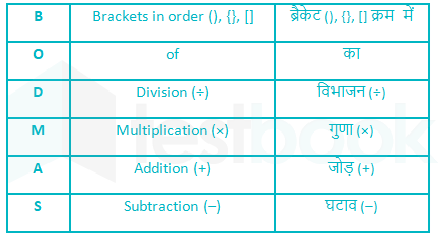
Follow BODMAS (Brackets, Of, Division, Multiplication, Addition, Subtraction) rule to solve this question, as per the order given below,

Step-1- Parts of an equation enclosed in 'Brackets' must be solved inside the bracket first,

Step-2-  Then any mathematical 'Of' or 'Exponent' must be solved,

Step-3- Next, the parts of the equation that contain 'Division' and 'Multiplication' are calculated,

Step-4- Last but not least, the parts of the equation that contain 'Addition' and 'Subtraction' should be calculated.

Given expression is,

⇒ 999 ÷ 3 – 165 = 75 + 111 - ?

⇒ 333 – 165 = 186 - ?

⇒ 168 = 186 - ?

⇒ ? = 186 – 168

⇒ ? = 18

Question 38

What will come in the place of the question mark ‘?’ in the following question?

(71 × 8) + 90 = 132 × 4 + ?

  1. AOption (a)

    160

  2. BOption (b)

    140

  3. COption (c)

    132

  4. DOption (d)

    130

  5. EOption (e)

    135

View answer & explanation

Correct answer

Answer: (d)D.

130

Why this answer is correct

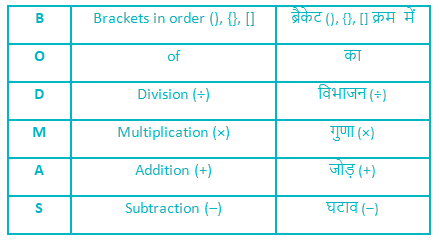
Concept used:

Follow the BODMAS rule according to the table given below:

Calculation:

⇒ (71 × 8) + 90 = 132 × 4 + ?

⇒ 568 + 90 = 528 + ?

⇒ 658 = 528 + ?

⇒ ? = 658 – 528

⇒ ? = 130

∴ The value of ? is 130

Question 39

What will come in the place of the question mark ‘?’ in the following question?

2624of;408+2548%;of;43200=?\frac{{26}}{{24}}of;408 + \frac{{25}}{{48}}\% ;of;43200 = ?

  1. AOption (a)

    547

  2. BOption (b)

    447

  3. COption (c)

    467

  4. DOption (d)

    647

  5. EOption (e)

    667

View answer & explanation

Correct answer

Answer: (e)E.

667

Why this answer is correct

Follow BODMAS rule to solve this question, as per the order given below,

Step-1-Parts of an equation enclosed in 'Brackets' must be solved first,

Step-2-Any mathematical 'Of' or 'Exponent' must be solved next,

Step-3-Next, the parts of the equation that contain 'Division' and 'Multiplication' are calculated,

Step-4-Last but not least, the parts of the equation that contain 'Addition' and 'Subtraction' should be calculated.

Now, given expression:

?=2624×408+254800×43200? = \frac{{26}}{{24}} \times 408 + \frac{{25}}{{4800}} \times 43200

⇒ ? = 442 + 225

⇒ ? = 667

Question 40

What will come in place of question mark (?) in the following question?

(8 + 6 × 7) ÷ 10 × 3 = ?

  1. AOption (a)

    18

  2. BOption (b)

    20

  3. COption (c)

    30

  4. DOption (d)

    15

  5. EOption (e)

    45

View answer & explanation

Correct answer

Answer: (d)D.

15

Why this answer is correct

Follow BODMAS rule to solve this question, as per the order is given below,

Step-1∶ Parts of an equation enclosed in 'Brackets' must be solved first and in the bracket,

Step-2∶ Any mathematical 'Of' or 'Exponent' must be solved next,

Step-3∶ Next, the parts of the equation that contain 'Division' and 'Multiplication' are calculated,

Step-4∶ Last but not least, the parts of the equation that contain 'Addition' and 'Subtraction' should be calculated

(8 + 6 × 7) ÷ 10 × 3

⇒ (8 + 42) ÷ 10 × 3

⇒ 50 ÷ 10 × 3

⇒ 5 × 3 = 15

Question 41

What will come in place of question mark (?) in the following equation?

5 × √25 + 300 - 100 = ?2

  1. AOption (a)

    12

  2. BOption (b)

    20

  3. COption (c)

    15

  4. DOption (d)

    25

  5. EOption (e)

    30

View answer & explanation

Correct answer

Answer: (c)C.

15

Why this answer is correct

Follow BODMAS rule to solve this question, as per the order given below, 

Step-1: Parts of an equation enclosed in 'Brackets' must be solved first, and in the bracket, 

Step-2: Any mathematical 'Of' or 'Exponent' must be solved next, 

Step-3: Next, the parts of the equation that contain 'Division' and 'Multiplication' are calculated, 

Step-4: Last but not least, the parts of the equation that contain 'Addition' and 'Subtraction' should be calculated 

5 × √25 + 300 - 100 = ?2

⇒ 5 × 5 + 200 = ?2

⇒ 225 = ?2

∴ 15 = ?

Question 42

What will come in place of  the question mark (?) in the following equation?

18 - ? + 19 + (11)2 = 120

  1. AOption (a)

    38

  2. BOption (b)

    48

  3. COption (c)

    42

  4. DOption (d)

    34

  5. EOption (e)

    24

View answer & explanation

Correct answer

Answer: (a)A.

38

Why this answer is correct

Follow BODMAS rule to solve this question, as per the order given below,  

Step-1: Parts of an equation enclosed in 'Brackets' must be solved first and in the bracket, 

Step-2: Any mathematical 'Of' or 'Exponent' must be solved next.

Step-3: Next, the parts of the equation that contain 'Division' and 'Multiplication' are calculated, 

Step-4: Last but not least, the parts of the equation that contain 'Addition' and 'Subtraction' should be calculated 

18 - ? + 19 + (11)2 = 120

⇒ 18 - ? + 19 + 121 = 120

⇒ ? = 121 - 120 + 19 + 18

∴ ? = 38

Question 43

What will come in place of question mark (?) in the following equation?

2.5% of 40 + 4.5% of 80 = ?% of 10

  1. AOption (a)

    36

  2. BOption (b)

    24

  3. COption (c)

    46

  4. DOption (d)

    52

  5. EOption (e)

    38

View answer & explanation

Correct answer

Answer: (c)C.

46

Why this answer is correct

Concept used:

Follow BODMAS rule to solve this question, as per the order given below

Calculations:

2.5% of 40 + 4.5% of 80 = ?% of 10

⇒ (2.5/100) × 40 + (4.5/100) × 80 = (?/100) × 10

⇒ 1 + 3.6 = ?/10

⇒ 4.6 = ?/10

⇒ ? = 46

∴ The value of ? is 46.

Question 44

What will come in place of question mark (?) in the following equation?

450% of ? ÷ 90 + 350% of 200 ÷ 70 = 20

  1. AOption (a)

    180

  2. BOption (b)

    190

  3. COption (c)

    200

  4. DOption (d)

    210

  5. EOption (e)

    220

View answer & explanation

Correct answer

Answer: (c)C.

200

Why this answer is correct

450% of ? ÷ 90 + 350% of 200 ÷ 70 = 20

⇒ (450/100 × ?/90) + (350/100 × 200/70) = 20

⇒ ?/20 + 10 = 20

⇒ ?/20 = 10

⇒ ? = 200

Question 45

What will come in place of question mark (?) in the following equation?

935.5 + 555.4 + 64.5 + 1444.6 = 600% of ?

  1. AOption (a)

    200

  2. BOption (b)

    250

  3. COption (c)

    300

  4. DOption (d)

    350

  5. EOption (e)

    None of these

View answer & explanation

Correct answer

Answer: (e)E.

None of these

Why this answer is correct

935.5 + 555.4 + 64.5 + 1444.6 = 600% of ?

⇒ (935.5 + 64.5) + (555.5 + 1444.6) = 600/100 × ?

⇒ 1000 + 2000 = 6 × ?

⇒ 3000 = 6 × ?

⇒ ? = 3000/6= 500

Question 46

What will come in place of question mark (?) in the following question?

256 × 2-5 × ? = (2/25) of 50 × 75

  1. AOption (a)

    25

  2. BOption (b)

    37.5

  3. COption (c)

    22.5

  4. DOption (d)

    50

  5. EOption (e)

    16

View answer & explanation

Correct answer

Answer: (b)B.

37.5

Why this answer is correct

256 × 2-5 × ? = (2/25) of 50 × 75

⇒ 28 × 2-5 × ? = (2/25) of 50 × 75

⇒ 28 × 2-5 × ? = (2/25) ×  50 × 75

⇒ 28 × 2-5 × ? = 2 ×  2 × 75

⇒ 28/25 × ? = 4 × 75

⇒ 8 × ? = 4 × 75

⇒ ? = 75/2

⇒ ? = 37.5

Question 47

What will come in place of question mark (?) in the following question?

232 - 413 ÷ 59 = ? × 18

  1. AOption (a)

    24

  2. BOption (b)

    34

  3. COption (c)

    29

  4. DOption (d)

    39

  5. EOption (e)

    None of these

View answer & explanation

Correct answer

Answer: (c)C.

29

Why this answer is correct

232 - 413 ÷ 59 = ? × 18

⇒ 529 - 7 = ? × 18

⇒ 522/18 = ?

⇒ ? = 29

Question 48

The present ages of A and B are in the ratio 3 : 4 and ratio of B and C is 1 : 2 and ratio of C and D is 4 : 3. If the age of D is 72 years, then find the age of the oldest of the four.

  1. AOption (a)

    86 yrs

  2. BOption (b)

    80 yrs

  3. COption (c)

    78 yrs

  4. DOption (d)

    82 yrs

  5. EOption (e)

    96 yrs

View answer & explanation

Correct answer

Answer: (e)E.

96 yrs

Why this answer is correct

Shortcut Trick

Combine the ratio of A : B : C : D using the common terms.

A : B = 3 : 4 | B : C = 1 : 2 (or 4 : 8) | C : D = 4 : 3 (or 8 : 6).

Combined ratio A : B : C : D = 3 : 4 : 8 : 6.

Given D = 6 units = 72 years → 1 unit = 12 years.

Oldest is C = 8 units = 8 × 12 = 96 years.

∴ The correct answer is 96 yrs.

Alternate Method

Given:

Ratio A : B = 3 : 4

Ratio B : C = 1 : 2

Ratio C : D = 4 : 3

Age of D = 72 years

Calculations:

⇒ To combine, make B same: A : B = 3 : 4, B : C = 4 : 8

⇒ Now make C same: C : D is 4 : 3, but in combined it is 8. So, C : D = 8 : 6

⇒ Combined Ratio A : B : C : D = 3 : 4 : 8 : 6

⇒ Value of D = 6x = 72

⇒ x = 72 ÷ 6 = 12

⇒ Oldest is C (highest ratio part)

⇒ Age of C = 8 × 12 = 96 years

∴ The correct answer is 96 yrs.

Additional Information

Combined Ratio Rule

To combine A:B and B:C, multiply the ratios so that the common term (B) has the same value in both sets.

Ratio & Proportion Basics

If a : b = c : d, then the product of extremes equals the product of means (a × d = b × c).

Age Related Problems

The difference between the ages of two persons remains constant throughout their lives regardless of the time elapsed.

Question 49

A train crosses a platform in 10 seconds while running at a speed of 45 km/h and it takes 15 seconds to pass a man walking at 5 m/s in the same direction of the train. Find the difference in the length of the train and length of the platform.

  1. AOption (a)

    200 m

  2. BOption (b)

    145 m

  3. COption (c)

    100 m

  4. DOption (d)

    125 m

  5. EOption (e)

    156 m

View answer & explanation

Correct answer

Answer: (c)C.

100 m

Why this answer is correct

Shortcut Trick

Speed of train = 45 × (5/18) = 12.5 m/s.

Relative Speed with man = 12.5 − 5 = 7.5 m/s.

Length of Train (LT) = 7.5 × 15 = 112.5 m.

Total Length (LT + LP) = 12.5 × 10 = 125 m.

Length of Platform (LP) = 125 − 112.5 = 12.5 m.

Difference = 112.5 − 12.5 = 100 m.

∴ The correct answer is 100 m.

Alternate Method

Given:

Speed of train = 45 km/h = 45 × (5/18) m/s = 12.5 m/s.

Speed of man = 5 m/s.

Formula Used:

Distance = Speed × Time

Relative Speed (Same direction) = S1 − S2

Calculations:

⇒ Case 1 (Crossing man): Train length (LT) = (SpeedTrain − SpeedMan) × Time

⇒ LT = (12.5 − 5) × 15 = 7.5 × 15 = 112.5 m.

⇒ Case 2 (Crossing platform): LT + LP = SpeedTrain × Time

⇒ 112.5 + LP = 12.5 × 10 = 125 m.

⇒ LP = 125 − 112.5 = 12.5 m.

⇒ Difference = LT − LP = 112.5 − 12.5 = 100 m.

∴ The correct answer is 100 m.

Additional Information

Unit Conversion

To convert km/h to m/s, multiply by 5/18. To convert m/s to km/h, multiply by 18/5.

Relative Speed

When two objects move in the same direction, relative speed is the difference of their speeds. In opposite directions, it is the sum.

Train Crossing Lengths

When a train crosses a point object (man/pole), distance = Length of train. When it crosses a platform/bridge, distance = Length of train + Length of platform.

Question 50

If the ratio of the radius of two circles is 3 : 5. The perimeter of the smaller circle is 10% more than that of the perimeter of the square. If the side of the square is 30 cm, then, find the area of the larger circle?

  1. AOption (a)

    3220 cm2

  2. BOption (b)

    4250 cm2

  3. COption (c)

    3550 cm2

  4. DOption (d)

    3850 cm2

  5. EOption (e)

    3250 cm2

View answer & explanation

Correct answer

Answer: (d)D.

3850 cm2

Why this answer is correct

Shortcut Trick

Perimeter of square = 4 × 30 = 120 cm.

Perimeter of small circle = 110% of 120 = 132 cm.

Radius of small circle (r1) = 132 ÷ (2 × 22/7) = 21 cm.

Ratio of radii 3 : 5 → 3 units = 21 cm, so 5 units (r2) = 35 cm.

Area of larger circle = (22/7) × 35 × 35 = 110 × 35 = 3850 cm2.

∴ The correct answer is 3850 cm2.

Alternate Method

Given: Ratio r1 : r2 = 3 : 5. Side of square (a) = 30 cm. Perimeter of small circle = 1.10 × Perimeter of square.

Formula: Perimeter of square = 4a; Circumference of circle = 2πr; Area of circle = πr2.

⇒ Perimeter of square = 4 × 30 = 120 cm.

⇒ Circumference of smaller circle (C1) = 1.10 × 120 = 132 cm.

⇒ 2 × (22/7) × r1 = 132

⇒ r1 = (132 × 7) ÷ 44 = 3 × 7 = 21 cm.

⇒ According to ratio 3 : 5, r2 = (21 ÷ 3) × 5 = 35 cm.

⇒ Area of larger circle = (22/7) × 352 = (22/7) × 1225 = 22 × 175 = 3850 cm2.

∴ The correct answer is 3850 cm2.

Additional Information

Circle Mensuration

The ratio of the circumferences of two circles is the same as the ratio of their radii (r1:r2), while the ratio of their areas is the square of the ratio of their radii (r12:r22).

Square Properties

For a square with side 'a', the perimeter is 4a and the area is a2. The diagonal of a square is a√2.

Percentage Increase

To find a value 10% more than X, multiply X by 1.10 or 11/10. For 10% less, multiply by 0.90.

Direction: Read the information carefully and answer the given questions:

1000 students enrolled for ‘NEET EXAM”. 75% of the students appeared in an exam. 30% of the students who appeared in an exam attempts Physics in the exam and remaining attempts only Chemistry and Biology section. The number of students attempts Chemistry section is 75 more than the number of students attempts in Biology section. Ratio of girls and boys appeared in an exam is 2 ∶ 3. Number of girl’s attempt in each section are equal. 30% of the girls cleared the exam and the number of boys who cleared the exam is two times the number of girls who cleared the exam.

Question 51

Based on Passage: View directions & passage

Students who cleared the exam is what% of the students who appeared in the exam?

  1. AOption (a)

    12%

  2. BOption (b)

    24%

  3. COption (c)

    56%

  4. DOption (d)

    36%

  5. EOption (e)

    46%

View answer & explanation

Correct answer

Answer: (d)D.

36%

Why this answer is correct

Total number of students = 1000

Number of students appeared in the NEET exam = 75% of 1000 = 750

Number of girls who appeared in the exam = (2/5) × 750 = 300

Number of girls cleared the exam = 30% of 300 = 90

Number of boys cleared the exam = 2 × 90 = 180

Required percentage = (270/750) × 100 = 36%

∴ Students who cleared the exam is 36% of the students who appeared in the exam

Question 52

Based on Passage: View directions & passage

The total number of boys who attempts the Chemistry section is what percent of total number of students who appeared in Chemistry section?

  1. AOption (a)

    12.66%

  2. BOption (b)

    13.66%

  3. COption (c)

    66.66%

  4. DOption (d)

    68.56%

  5. EOption (e)

    67.56%

View answer & explanation

Correct answer

Answer: (c)C.

66.66%

Why this answer is correct

Total number of students = 1000

Number of students appeared in the NEET exam = 75% of 1000 = 750

Number of students attempts Only Physics sections = 30% of 750 = 225

Number of students attempts Chemistry and Biology section = 750 – 225 = 525

Let the number of students attempts Biology section = x

⇒ x + (x + 75) = 525

⇒ 2x + 75 = 525

⇒ 2x = 450

⇒ x = 225

Number of students attempts Chemistry section = 225 + 75 = 300

Number of girls who attempts Chemistry section = 300/3 = 100

Number of Boys who attempts Chemistry section = 200

Required percentage = (200/300) × 100 = 66.66%

∴ The total number of boys who attempts the Chemistry section is 66.66% of total number of students who appeared in Chemistry section

Question 53

Based on Passage: View directions & passage

The total number of boys who cleared the NEET exam, is what percent of total number of students who appeared in the exam?

  1. AOption (a)

    12%

  2. BOption (b)

    24%

  3. COption (c)

    14%

  4. DOption (d)

    16%

  5. EOption (e)

    15%

View answer & explanation

Correct answer

Answer: (b)B.

24%

Why this answer is correct

Total number of students = 1000

Number of students appeared in the NEET exam = 75% of 1000 = 750

Number of girls who appeared in the exam = (2/5) × 750 = 300

Number of girls cleared the exam = 30% of 300 = 90

Number of boys cleared the exam = 2 × 90 = 180

Required percentage = (180/750) × 100 = 24%

∴ The total number of boys who cleared the NEET exam is 24% of total number of students who appeared in the exam

Question 54

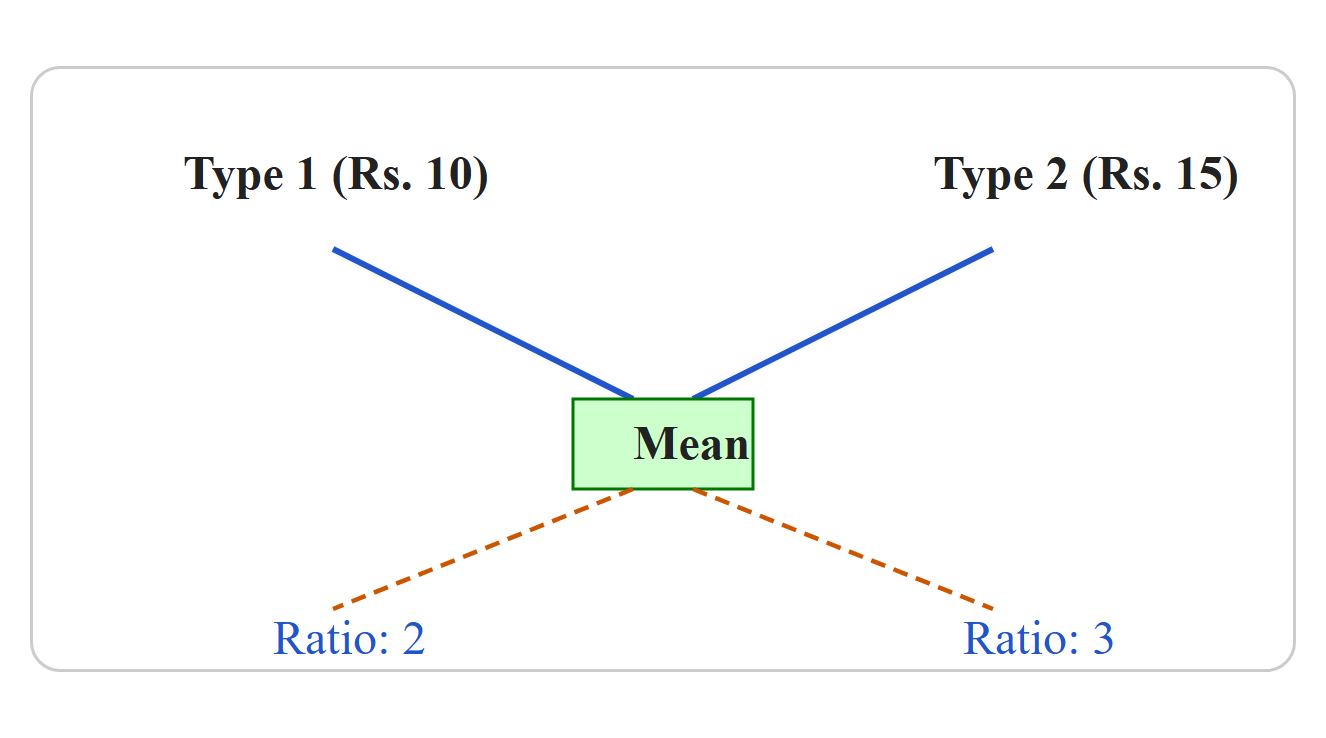
Two varieties of milk with different prices is mixed in the ratio 2 : 3. The price of 1st type of milk is Rs 10 per litre while the price of 2nd type of milk is Rs. 15 per litre. The average price of the mixture.

  1. AOption (a)

    Rs. 11 per litre

  2. BOption (b)

    Rs. 12 per litre

  3. COption (c)

    Rs. 13 per litre

  4. DOption (d)

    Rs. 14 per litre

  5. EOption (e)

    Rs. 15 per litre

View answer & explanation

Correct answer

Answer: (c)C.

Rs. 13 per litre

Why this answer is correct

Shortcut Trick

Weighted Average = (Price1 × Ratio1 + Price2 × Ratio2) ÷ Total Ratio

Average Price = (10 × 2 + 15 × 3) ÷ (2 + 3)

Average Price = (20 + 45) ÷ 5 = 65 ÷ 5 = 13

∴ The correct answer is Rs. 13 per litre.

Alternate Method

Given:

Price of 1st variety (P1) = Rs. 10/litre

Price of 2nd variety (P2) = Rs. 15/litre

Ratio of mixing (n1 : n2) = 2 : 3

Formula Used:

Average Price = (Total Cost) ÷ (Total Quantity)

Calculations:

⇒ Let quantities be 2L and 3L respectively.

⇒ Cost of 1st type = 10 × 2 = Rs. 20

⇒ Cost of 2nd type = 15 × 3 = Rs. 45

⇒ Total Cost = 20 + 45 = Rs. 65

⇒ Total Quantity = 2 + 3 = 5 litres

⇒ Average Price = 65 ÷ 5 = Rs. 13 per litre

∴ The correct answer is Rs. 13 per litre.

Additional Information

Alligation Rule

It states that (Quantity of Cheaper) / (Quantity of Dearer) = (CP of Dearer − Mean Price) / (Mean Price − CP of Cheaper).

Weighted Average Formula

Average = (n1x1 + n2x2) ÷ (n1 + n2), where n represents the weights/ratios and x represents the values/prices.

Question 55

Sachin's batting average for 50 innings is 60 runs. His highest score exceeds his lowest score by 182 runs. If these two innings are excluded, the average of the remaining 48 innings is 58 runs. The lowest score made by Sachin in his inning is: 

  1. AOption (a)

    16

  2. BOption (b)

    17

  3. COption (c)

    18

  4. DOption (d)

    29

  5. EOption (e)

    None of these

View answer & explanation

Correct answer

Answer: (b)B.

17

Why this answer is correct

Shortcut Trick

Total runs of excluded innings (H + L) = (50 × 60) − (48 × 58)

H + L = 3000 − 2784 = 216 runs

Given: H − L = 182 runs

Lowest score (L) = (Sum − Difference) ÷ 2 = (216 − 182) ÷ 2 = 34 ÷ 2 = 17 runs

∴ The correct answer is 17 runs.

Alternate Method

Given: Total innings = 50, Initial Average = 60, H − L = 182, Average of 48 innings = 58.

⇒ Total runs in 50 innings = 50 × 60 = 3000

⇒ Total runs in 48 innings = 48 × 58 = 2784

⇒ Sum of Highest (H) and Lowest (L) scores = 3000 − 2784 = 216

⇒ H + L = 216

⇒ H − L = 182

⇒ Subtracting equations: (H + L) − (H − L) = 216 − 182

⇒ 2L = 34

⇒ L = 17

∴ The correct answer is 17 runs.

Additional Information

Average Formula

Average = Total Sum of Observations ÷ Number of Observations.

Sum and Difference Rule

If (x + y) = S and (x − y) = D, then the smaller value y = (S − D) ÷ 2 and the larger value x = (S + D) ÷ 2.

Weighted Average

Total Sum = (n1 × Avg1) + (n2 × Avg2). Useful when combining groups or sets of data.

Question 56

A boat travels 30 km upstream and 30 km downstream in 8 hours. Time taken for the same boat to travel 50 km downstream if its speed against the stream is 6 kmph.

  1. AOption (a)

    10 hours

  2. BOption (b)

    6 hours

  3. COption (c)

    8 hours

  4. DOption (d)

    4 hours

  5. EOption (e)

    5 hours

View answer & explanation

Correct answer

Answer: (e)E.

5 hours

Why this answer is correct

Shortcut Trick

Given Upstream speed (U) = 6 kmph.

Total time for 30 km Upstream and 30 km Downstream = 8 hours.

Time Upstream = 30 ÷ 6 = 5 hours ⇒ Time Downstream = 8 − 5 = 3 hours.

Downstream speed (D) = Distance ÷ Time = 30 ÷ 3 = 10 kmph.

Time for 50 km Downstream = 50 ÷ 10 = 5 hours.

∴ The correct answer is 5 hr.

Alternate Method

Given:

Total distance Upstream (Du) = 30 km

Total distance Downstream (Dd) = 30 km

Total time taken (T) = 8 hours

Upstream speed (U) = 6 kmph

Formula Used:

Time = Distance ÷ Speed

Calculations:

⇒ Time taken Upstream (Tu) = Distance ÷ Speed = 30 ÷ 6 = 5 hours

⇒ Total Time = Tu + Td

⇒ 8 = 5 + Td

⇒ Td = 3 hours

⇒ Downstream speed (D) = Distance ÷ Time = 30 ÷ 3 = 10 kmph

⇒ Required time for 50 km Downstream = 50 ÷ 10

⇒ Required time = 5 hours

∴ The correct answer is 5 hr.

Additional Information

Speed Formulas

Speed in Still Water (x) = (D + U) ÷ 2 | Speed of Stream (y) = (D − U) ÷ 2

Downstream vs Upstream

Downstream speed (D) = x + y | Upstream speed (U) = x − y

Average Speed

If distance traveled is equal, Average Speed = (2 × D × U) ÷ (D + U)

Question 57

A seller mixes 26 kg rice of a price of Rs. 20/kg, with 30 kg of different variety rice of a price of Rs. 36/kg. He sells both the mixed rices at Rs. 30/kg. What will be the profit in percentage? 

  1. AOption (a)

    25%

  2. BOption (b)

    10%

  3. COption (c)

    15%

  4. DOption (d)

    20%

  5. EOption (e)

    5%

View answer & explanation

Correct answer

Answer: (e)E.

5%

Why this answer is correct

Shortcut Trick

Total quantity = 26 + 30 = 56 kg.

Total Cost Price (CP) = (26 × 20) + (30 × 36) = 520 + 1080 = Rs. 1600.

Total Selling Price (SP) = 56 × 30 = Rs. 1680.

Profit = 1680 − 1600 = Rs. 80.

Profit% = (80 ÷ 1600) × 100 = 5%.

∴ The correct answer is 5%.

Alternate Method

Given → Quantity 1 = 26 kg at Rs. 20/kg, Quantity 2 = 30 kg at Rs. 36/kg, SP = Rs. 30/kg. Formulas: Total CP = (Q1 × P1) + (Q2 × P2) | Profit% = ((Total SP − Total CP) ÷ Total CP) × 100.

⇒ Weighted average CP per kg = ((26 × 20) + (30 × 36)) ÷ (26 + 30) ⇒ Average CP = (520 + 1080) ÷ 56 = 1600 ÷ 56 = Rs. 28.57 per kg. ⇒ Profit per kg = 30 − 28.57 = Rs. 1.43 per kg. ⇒ Profit% = (1.43 ÷ 28.57) × 100 = 5%.

∴ The correct answer is 5%.

Additional Information

Weighted Average Method

When two varieties are mixed, the average cost price lies between the prices of the individual varieties. Formula: CPavg = (n1c1 + n2c2) / (n1 + n2).

Profit Percentage

Profit percentage is always calculated on the Cost Price (CP) unless stated otherwise in the question.

Question 58

Raj lends an amount of Rs.50,000 to Sumesh at a rate of 12% for five years. But after two years Raj decided to increase the rate to 20%. Find the extra amount Sumesh has to pay due to this hike in interest.

  1. AOption (a)

    Rs. 8,000

  2. BOption (b)

    Rs. 10,000

  3. COption (c)

    Rs. 12,000

  4. DOption (d)

    Rs. 14,000

  5. EOption (e)

    Rs. 16,000

View answer & explanation

Correct answer

Answer: (c)C.

Rs. 12,000

Why this answer is correct

Shortcut Trick

Interest rate hike = 20% − 12% = 8% per year.

Number of years remaining = 5 − 2 = 3 years.

Total extra interest % = 8% × 3 = 24%.

Extra amount = 24% of ₹50,000 = ₹12,000.

∴ The correct answer is ₹12,000.

Alternate Method

Given: Principal (P) = ₹50,000, Original Rate (R1) = 12%, New Rate (R2) = 20%, Total Time = 5 years, Hike after 2 years.

Formula Used: Simple Interest (SI) = (P × R × T) ÷ 100

⇒ Remaining time (T) for which rate is increased = 5 − 2 = 3 years.

⇒ Difference in rates (ΔR) = 20% − 12% = 8%.

⇒ Extra Amount = (P × ΔR × T) ÷ 100

⇒ Extra Amount = (50000 × 8 × 3) ÷ 100

⇒ Extra Amount = 500 × 24 = ₹12,000.

∴ The correct answer is ₹12,000.

Additional Information

Simple Interest Concept

Simple Interest is calculated only on the principal amount. It remains constant every year if the rate and principal don't change.

Rate Change Impact

The extra interest is simply the Principal multiplied by the change in rate and the duration for which the change applies.

Total Amount Formula

Total Amount (A) = Principal (P) + Simple Interest (SI). In this case, the extra amount is the difference in SI.

Question 59

In a mixture, the ratio between milk and water is 8 : 1. If 18 litres of mixtures is removed and 4 litres of water is added, then the quantity of milk is 24 litres more than that of water. Find the initial quantity of milk in the mixture.

  1. AOption (a)

    56 litres

  2. BOption (b)

    48 litres

  3. COption (c)

    40 litres

  4. DOption (d)

    42 litres

  5. EOption (e)

    64 litres

View answer & explanation

Correct answer

Answer: (b)B.

48 litres

Why this answer is correct

Shortcut Trick

Ratio of Milk : Water = 8 : 1. Let common factor be x.

After removing 18 litres, the ratio remains 8 : 1. Let remaining Milk = 8x and Water = x.

Water added = 4 litres → New Water = x + 4. Milk = 8x.

Difference: 8x − (x + 4) = 24 ⇒ 7x − 4 = 24 ⇒ 7x = 28 ⇒ x = 4.

Remaining Milk = 8 × 4 = 32 litres. Milk removed in 18L = (8/9) × 18 = 16 litres.

Initial Milk = 32 + 16 = 48 litres.

∴ The correct answer is 48 litres.

Alternate Method

Given: Initial Ratio M:W = 8:1. Removed Mixture = 18 litres. Added Water = 4 litres. Final Difference (M − W) = 24 litres.

Step 1: Calculate milk and water in 18L mixture.

⇒ Milk removed = 18 × (8/9) = 16 litres.

⇒ Water removed = 18 × (1/9) = 2 litres.

Step 2: Let initial milk be 8K and water be 1K.

⇒ Remaining Milk = 8K − 16.

⇒ Remaining Water = 1K − 2.

Step 3: Final Water after adding 4L = (K − 2) + 4 = K + 2.

Step 4: Apply the difference condition.

⇒ (8K − 16) − (K + 2) = 24

⇒ 7K − 18 = 24

⇒ 7K = 42

⇒ K = 6.

Step 5: Initial Milk = 8K = 8 × 6 = 48 litres.

∴ The correct answer is 48 litres.

Additional Information

Mixture Ratio Property

When a part of a mixture is removed, the ratio of components in the remaining mixture remains the same as the initial ratio.

Replacement Method

If a mixture is replaced by a component, calculate the amount of each component removed first using the initial ratio before applying the addition.

Alligation Rule

Quantity of Cheaper / Quantity of Dearer = (Price of Dearer − Mean Price) / (Mean Price − Price of Cheaper).

Question 60

A and B started a business with Rs. 95000 and Rs. 57000 respectively. But B was a business partner they decided to share their profit in the ratio of 4 : 3. If C joins with a condition that they will share profit and loss in the ratio of 2 : 1 : 3. Find the sacrifice ratio of A and B.

  1. AOption (a)

    10 : 11

  2. BOption (b)

    11 : 10

  3. COption (c)

    5 : 7

  4. DOption (d)

    13 : 19

  5. EOption (e)

    21 : 17

View answer & explanation

Correct answer

Answer: (a)A.

10 : 11

Why this answer is correct

Shortcut Trick

Old ratio of A and B = 4 : 3 (Sum = 7).

New ratio of A, B, and C = 2 : 1 : 3 (Sum = 6).

Equating the total parts: Multiply old by 6 and new by 7.

Old A : B = 24 : 18. New A : B : C = 14 : 7 : 21.

Sacrifice A = 24 − 14 = 10. Sacrifice B = 18 − 7 = 11.

∴ The correct answer is 10 : 11.

Alternate Method

Given → Old Profit Sharing Ratio of A and B = 4 : 3 | New Profit Sharing Ratio of A, B, and C = 2 : 1 : 3. Formulas: Sacrifice Ratio = Old Share − New Share.

⇒ A's old share = 4/7 and B's old share = 3/7. ⇒ A's new share = 2/6 = 1/3 and B's new share = 1/6. ⇒ A's sacrifice = 4/7 − 1/3 = (12 − 7)/21 = 5/21. ⇒ B's sacrifice = 3/7 − 1/6 = (18 − 7)/42 = 11/42. ⇒ To compare, make denominators same: A's sacrifice = 10/42. ⇒ Ratio of sacrifice (A : B) = 10/42 : 11/42 = 10 : 11.

∴ The correct answer is 10 : 11.

Additional Information

Sacrifice Ratio

Calculated when a new partner is admitted. It is the ratio in which old partners surrender their share of profit in favor of the new partner.

Capital vs Profit Ratio

While capital ratio here is 95 : 57 (5 : 3), the actual profit sharing ratio specified in the agreement (4 : 3) always takes precedence for calculation.

Question 61

What should come in place of the question mark '?' in the following number series?

38, 39, 35, 44, 28, ?

  1. AOption (a)

    43

  2. BOption (b)

    53

  3. COption (c)

    48

  4. DOption (d)

    58

  5. EOption (e)

    63

View answer & explanation

Correct answer

Answer: (b)B.

53

Why this answer is correct

The series follows the following pattern:

38 + 12 = 39

39 - 22 = 35

35 + 32 = 44

44 - 42 = 28

28 + 52 = 53

Question 62

What should come in place of the question mark '?' in the following number series?

12, 23, 45, ?, 177, 353

  1. AOption (a)

    93

  2. BOption (b)

    97

  3. COption (c)

    101

  4. DOption (d)

    83

  5. EOption (e)

    89

View answer & explanation

Correct answer

Answer: (e)E.

89

Why this answer is correct

The series follows the following pattern:

12 × 2 - 1 = 23

23 × 2 - 1 = 45

45 × 2 - 1 = 89

89 × 2 - 1 = 177

177 × 2 - 1 = 353

Question 63

What should come in place of the question mark '?' in the following number series?

11.5, 12.5, 27, ?, 340, 1705

  1. AOption (a)

    84

  2. BOption (b)

    96

  3. COption (c)

    74

  4. DOption (d)

    114

  5. EOption (e)

    106

View answer & explanation

Correct answer

Answer: (a)A.

84

Why this answer is correct

The series follows the following pattern:

11.5 × 1 + 1 = 12.5

12.5 × 2 + 2 = 27

27 × 3 + 3 = 84

84 × 4 + 4 = 340

340 × 5 + 5 = 1705

Question 64

What should come in place of the question mark '?' in the following number series?

50, 54, 45, 61, ?, 72

  1. AOption (a)

    46

  2. BOption (b)

    36

  3. COption (c)

    106

  4. DOption (d)

    56

  5. EOption (e)

    96

View answer & explanation

Correct answer

Answer: (b)B.

36

Why this answer is correct

The series follows the following pattern:

50 + 22 = 54

54 – 32 = 45

45 + 42 = 61

61 – 52 = 36

36 + 62 = 72

Question 65

What should come in place of the question mark '?' in the following number series?

14, 18, 26, ?, 74, 138

  1. AOption (a)

    32

  2. BOption (b)

    42

  3. COption (c)

    52

  4. DOption (d)

    22

  5. EOption (e)

    62

View answer & explanation

Correct answer

Answer: (b)B.

42

Why this answer is correct

The series follows the following pattern:

14 + 4 = 18

18 + 8 = 26

26 + 16 = 42

42 + 32 = 74

74 + 64 = 138

Direction: Read the following graph carefully and answer the following questions:

The Bar Graph given below shows the number of ice creams and chocolates sold by four different companies.


Question 66

Based on Passage: View directions & passage

The number of chocolates sold by company P and Q together is what percentage more than the number of ice creams sold by company Q and R together? 

  1. AOption (a)

    5%

  2. BOption (b)

    15%

  3. COption (c)

    30%

  4. DOption (d)

    40%

  5. EOption (e)

    20%

View answer & explanation

Correct answer

Answer: (e)E.

20%

Why this answer is correct

In company P:

Number of Chocolates sold = 980

In company Q:

Number of Chocolates sold = 820

Total number of chocolates sold by company P and Q together = 980 + 820 = 1800

In company Q:

Number of Ice creams sold = 900

In company R:

Number of Ice creams sold = 600

Total number of Ice creams sold by company R and Q together = 900 + 600 = 1500

Required% = (1800 - 1500)/1500 × 100

⇒ 300/1500 × 100

⇒ 20%

Question 67

Based on Passage: View directions & passage

The number of chocolates sold by company U is 25% more than the number of ice creams sold by company Q. Find the average of the number of chocolates sold by all five companies together.

  1. AOption (a)

    865

  2. BOption (b)

    825

  3. COption (c)

    805

  4. DOption (d)

    860

  5. EOption (e)

    820

View answer & explanation

Correct answer

Answer: (a)A.

865

Why this answer is correct

The number of chocolates sold by company U = 125% of 900 = 1125

Total number of Chocolates sold by the five companies = 980 + 820 + 740 + 660 + 1125 = 4325

Required average = 4325/5

⇒ 865

Question 68

Based on Passage: View directions & passage

What is the difference between the total number of Ice creams and chocolates sold by company P and Q and the total number of chocolates sold by company R and S?

  1. AOption (a)

    1955

  2. BOption (b)

    1950

  3. COption (c)

    1900

  4. DOption (d)

    1850

  5. EOption (e)

    1940

View answer & explanation

Correct answer

Answer: (e)E.

1940

Why this answer is correct

In company P:

Number of Ice creams sold = 640

Number of Chocolates sold = 980

In company Q:

Number of Ice creams sold = 900

Number of Chocolates sold = 820

In company R:

Number of Chocolates sold = 740

In company S:

Number of Chocolates sold = 660

Required difference = [(640 + 980 + 900 + 820) - (740 + 660)]

⇒ 3340 - 1400 = 1940

Question 69

Based on Passage: View directions & passage

If the ratio of Ice creams to Chocolates sold by another company T is 7 : 8 and the number of both items i.e., Ice creams and Chocolates sold by company T increased by same number to company S, then by what percent number of Ice creams and Chocolates respectively increased with repsect to company S?

  1. AOption (a)

    40%, 16.66%

  2. BOption (b)

    25%, 21.21%

  3. COption (c)

    25%, 16.66%

  4. DOption (d)

    24%, 16%

  5. EOption (e)

    18%, 6.66%

View answer & explanation

Correct answer

Answer: (b)B.

25%, 21.21%

Why this answer is correct

Let the number of each items sold is increased by ‘x’

⇒ (560 + x)/(660 + x) = 7/8

⇒ 4480 + 8x = 4620 + 7x

⇒ x = 140

∴ Percent increase in items sold,

Ice creams = 140/560 × 100 = 25%

Chocolates = 140/660 × 100 = 21.21%

Question 70

Based on Passage: View directions & passage

What is the ratio of the total number of Ice creams and Chocolates sold by the four companies?

  1. AOption (a)

    27:32

  2. BOption (b)

    29:31

  3. COption (c)

    26:33

  4. DOption (d)

    23:32

  5. EOption (e)

    None of these

View answer & explanation

Correct answer

Answer: (a)A.

27:32

Why this answer is correct

In company P:

Number of Ice creams sold = 640

Number of Chocolates sold = 980

In company Q:

Number of Ice creams sold = 900

Number of Chocolates sold = 820

In company R:

Number of Ice creams sold = 600

Number of Chocolates sold = 740

In company S:

Number of Ice creams sold = 560

Number of Chocolates sold = 660

Total number of Ice creams sold by the four companies = 640 + 900 + 600 + 560 = 2700

Total number of Chocolates sold by the four companies = 980 + 820 + 740 + 660 = 3200

Required ratio = 2700 : 3200 = 27:32

∴ The correct answer is 27:32.

English Language (30 questions)

Directions: Read the passage given below and answer the questions that follow by choosing the correct/most appropriate options:

Heatwaves unfolding on the bottom of the ocean can be more intense and last longer than those on the sea surface, new research suggests, but such extremes in the deep ocean are often overlooked. A team of scientists with the U.S. National Oceanic and Atmospheric Administration has conducted the first _______ of marine heatwaves along North America's continental shelves. They found that these bottom heatwaves ranged from 0.5 degrees Celsius to 3C warmer than normal temperatures and could _______ more than six months — much longer than heatwaves at the surface. "We simply don't have a ton of instruments on the ocean bottom along continental shelves," said study co-author Dillon Amaya, an NOAA climate scientist. The ocean is a powerful thing. It destroys instruments that we have in the water for too long. Surface heat waves can be picked up by satellites and can result in huge algal blooms. But, Amaya said, often no one knows a bottom marine heatwave is happening until the impacts show up in commercial bottom-dwelling species like lobsters and crabs.

The assessment, published in the journal Nature Communications, used computer models of the ocean and observations to analyze seafloor heat waves. It found that while sometimes a marine heatwave can hit both the sea surface and ocean bottom at the same time, bottom heatwaves can also occur on their own. The ocean has absorbed about 90% of the excess heat from global warming, with the ocean's average temperature increasing by about 1.5C over the last century. Marine heatwaves have become about 50% more frequent over the past decade. "It's a little less clear if climate change is strongly impacting bottom marine heatwaves in the same way it would at the surface," Amaya said, saying changes to ocean circulation patterns could also play a role. Past bottom marine heatwaves have decimated Pacific cod and snow crab populations. "Pacific cod in the Gulf of Alaska is an important fishery and … that population has declined by 75% following the big marine heatwave in 2015," said Michael Jacox, a scientist at NOAA's Southwest Fisheries Science Center. Warmer water, he said, can increase the energy needs of species at the same time that there's less prey available for them to eat, leading to more deaths and fewer births.

Question 71

Based on Passage: View directions & passage

According to the passage, for what purpose does computer models of the ocean and observations are used?

  1. AOption (a)

    To more deaths and fewer births.

  2. BOption (b)

    To hit both the sea surface and ocean bottom at the same time.

  3. COption (c)

    To decimate Pacific cod and snow crab populations.

  4. DOption (d)

    To increase the energy needs of species.

  5. EOption (e)

    To analyze seafloor heat waves.

View answer & explanation

Correct answer

Answer: (e)E.

To analyze seafloor heat waves.

Why this answer is correct

The correct answer is 'To analyze seafloor heat waves.'

Key Points

  • The first sentence of the second paragraph says "The assessment, published in the journal Nature Communications, used computer models of the ocean and observations to analyze seafloor heat waves.''
  • From the above sentence, we can say that computer models of the ocean and observations are used to analyze seafloor heat waves.

Hence, the only possible answer is option 5.

Question 72

Based on Passage: View directions & passage

When does one get to know a bottom marine heatwave is happening?

  1. AOption (a)

    When a marine heatwave hit both the sea surface and ocean bottom at the same time.

  2. BOption (b)

    When heatwaves unfolding on the bottom of the ocean is more intense.

  3. COption (c)

    When the impacts show up in commercial bottom-dwelling species like lobsters and crabs.

  4. DOption (d)

    When the bottom heatwaves ranged from 0.5 degrees Celsius to 3C warmer than normal temperatures.

  5. EOption (e)

    When the ocean's average temperature increases by about 1.5C.

View answer & explanation

Correct answer

Answer: (c)C.

When the impacts show up in commercial bottom-dwelling species like lobsters and crabs.

Why this answer is correct

The correct answer is 'When the impacts show up in commercial bottom-dwelling species like lobsters and crabs.'

Key Points

  • The last sentence of the first paragraph says "But, Amaya said, often no one knows a bottom marine heatwave is happening until the impacts show up in commercial bottom-dwelling species like lobsters and crabs.''
  • From the above sentence, we can say that one gets to know a bottom marine heatwave is happening when the impacts show up in commercial bottom-dwelling species like lobsters and crabs.

Hence, the only possible answer is option 3.

Question 73

Based on Passage: View directions & passage

How does less availability of prey affect marine species?

  1. AOption (a)

    It leads to more deaths and fewer births of marine species.

  2. BOption (b)

    It destroys instruments that we have in the water for too long.

  3. COption (c)

    It strongly impacts bottom marine heatwaves in the same way it would at the surface.

  4. DOption (d)

    It absorbs about 90% of the excess heat from global warming.

  5. EOption (e)

    It leads to less fewer and more births of ​marine species.

View answer & explanation

Correct answer

Answer: (a)A.

It leads to more deaths and fewer births of marine species.

Why this answer is correct

The correct answer is 'It leads to more deaths and fewer births of marine species.'

Key Points

  • The last sentence of the second paragraph says "Warmer water, he said, can increase the energy needs of species at the same time that there's less prey available for them to eat, leading to more deaths and fewer births.''
  • From the above sentence, we can say that less availability of prey (an animal that is caught and killed by another for food) leads to more deaths and fewer births of marine species.

Hence, the only possible answer is option 1.

Question 74

Based on Passage: View directions & passage

Which of the following is/are incorrect according to the given passage?

A. The ocean's average temperature is decreasing by about 1.5C over the last century.

B. The ocean has absorbed only 10% of the excess heat from global warming.

C. The ocean destroys instruments that are inside the water for too long.

  1. AOption (a)

    Only A

  2. BOption (b)

    Both A and B

  3. COption (c)

    Only B

    ×

    duplicate options found. English Question 1 options 3,5

  4. DOption (d)

    Both B and C

  5. EOption (e)

    Only C

View answer & explanation

Correct answer

Answer: (b)B.

Both A and B

Why this answer is correct

The correct answer is 'Both A and B.'

Key Points

  • The sixth sentence of the first paragraph says "It (the ocean) destroys instruments that we have in the water for too long.''
  • From the above sentence, we can say that statement C is correct according to the given passage.​​​
  • The third sentence of the second paragraph says "The ocean has absorbed about 90% of the excess heat from global warming, with the ocean's average temperature increasing by about 1.5C over the last century''.
  • From the above sentences, we can say that statements A and B are incorrect according to the given passage.​​

Hence, the only possible answer is option 2.

Question 75

Based on Passage: View directions & passage

Which of the following is/are correct according to the given passage?

A. It is found that a marine heatwave can never hit both the sea surface and ocean bottom at the same time.

B. Surface heat waves can't be picked up by satellites and can't result in huge algal blooms.

C. Heatwaves unfolding on the bottom of the ocean are often ignored.

  1. AOption (a)

    Only A

  2. BOption (b)

    Both A and B

  3. COption (c)

    Only B

  4. DOption (d)

    Both B and C

  5. EOption (e)

    Only C

View answer & explanation

Correct answer

Answer: (e)E.

Only C

Why this answer is correct

The correct answer is 'Only C.'

Key Points

  • The first sentence of the first paragraph says "Heatwaves unfolding on the bottom of the ocean can be more intense and last longer than those on the sea surface, new research suggests, but such extremes in the deep ocean are often overlooked.''
  • From the above sentence, we can say that statement C is correct according to the given passage.​​​
  • The second sentence of the second paragraph says "It found that while sometimes a marine heatwave can hit both the sea surface and ocean bottom at the same time, bottom heatwaves can also occur on their own'' and the second-last sentence of the first paragraph says "Surface heat waves can be picked up by satellites and can result in huge algal blooms''.
  • From the above sentences, we can say that statements A and B are incorrect according to the given passage.​​

Hence, the only possible answer is option 5.

Question 76

Based on Passage: View directions & passage

What will fit in the blank taken from the passage: ''They found that these bottom heatwaves ranged from 0.5 degrees Celsius to 3C warmer than normal temperatures and could _______ more than six months — much longer than heatwaves at the surface.''

  1. AOption (a)

    Last

  2. BOption (b)

    Conclusion

  3. COption (c)

    Termination

  4. DOption (d)

    Begin

  5. EOption (e)

    Prior

View answer & explanation

Correct answer

Answer: (a)A.

Last

Why this answer is correct

The correct answer is 'Last.'

Key Points

  • The given sentence "They found that these bottom heatwaves ranged from 0.5 degrees Celsius to 3C warmer than normal temperatures and could _______ more than six months — much longer than heatwaves at the surface'' is talking about the bottom heatwaves ranged from 0.5 degrees Celsius to 3C warmer than normal temperatures that could continue or go on for more than six months.
  • Also, the use of the word ''longer'' in the sentence indicates the use of the word 'last' in the blank.
  • The word 'Last' means To continue for a period of time. (कुछ समय तक जारी रहना, चलना, बने रहना)
  • Example: The guitar solo will last for twenty minutes.

Hence, the correct answer is option 1.

Complete Sentence: They found that these bottom heatwaves ranged from 0.5 degrees Celsius to 3C warmer than normal temperatures and could last more than six months — much longer than heatwaves at the surface.

Additional Information

  • Let us explore  the other options:
  • Conclusion means An end to something. (समाप्ति, समापन)
  • Termination means The action of terminating something or the fact of being terminated. (समाप्ति)
  • Begin means To start doing something; to do the first part of something. (कोई काम आरंभ करना, शुरू करना; पहले चरण का आरंभ करना)
  • Prior means Coming before or earlier. (पूर्ववर्ती, किसी से पहले या शुरू में आने वाला)

Question 77

Based on Passage: View directions & passage

What will fit in the blank taken from the passage: ''A team of scientists with the U.S. National Oceanic and Atmospheric Administration has conducted the first _______ of marine heatwaves along North America's continental shelves.''

  1. AOption (a)

    Disappointment

  2. BOption (b)

    Contentment

  3. COption (c)

    Adamant

  4. DOption (d)

    Assessment

  5. EOption (e)

    Amusement

View answer & explanation

Correct answer

Answer: (d)D.

Assessment

Why this answer is correct

The correct answer is 'Assessment.'

Key Points

  • The given sentence "A team of scientists with the U.S. National Oceanic and Atmospheric Administration has conducted the first _______ of marine heatwaves along North America's continental shelves'' is talking about a team of scientists conducting the first judgment or evaluation of marine heatwaves along North America's continental shelves.
  • Also, the use of the word ''conducted'' in the sentence indicates the use of the word 'assessment' in the blank.
  • The word 'Assessment' means The process of making a judgment or evaluation about someone or something. (सोचा-समझा अभिमत, मूल्‍यांकन, राय)
  • Example: After the blind date, her assessment was that the man did not have polite manners.

Hence, the correct answer is option 4.

Complete Sentence: A team of scientists with the U.S. National Oceanic and Atmospheric Administration has conducted the first assessment of marine heatwaves along North America's continental shelves.

Additional Information

  • Let us explore  the other options:
  • Disappointment means Sadness or displeasure caused by the non-fulfillment of one's hopes or expectations. (निराशा)
  • Contentment means A feeling of happy satisfaction. (मधुर संतुष्टि, संतोष)
  • Adamant means Very sure; refusing to change your mind. (अपने मत पर अटल, दृढ़; अड़ियल)
  • Amusement means The feeling caused by something that makes you laugh or smile, or by something that entertains you. (मन-बहलाव, मनोविनोद)

Question 78

Based on Passage: View directions & passage

Choose the antonym of the word 'Decimated'.

  1. AOption (a)

    Ruined

  2. BOption (b)

    Raised

  3. COption (c)

    Wrecked

  4. DOption (d)

    Devastated

  5. EOption (e)

    Shattered

View answer & explanation

Correct answer

Answer: (b)B.

Raised

Why this answer is correct

The correct answer is 'Raised.'

Key Points

  • The word 'Decimated' means To badly damage something or make something weaker. (किसी को अत्‍यधिक नुक़सान पहुँचाना या अशक्त कर देना)
  • Example: The category five hurricane decimated the small beach town.
  • Let's look at the meaning of the given options:-
  • Ruined - To damage something so badly that it loses all its value, pleasure, etc. (किसी चीज़ को तबाह कर देना, बरबाद कर देना)
  • Example: The bad weather ruined the party.
  • Raised - To increase the level of something or to make something better or stronger. (किसी वस्‍तु के स्‍तर में वृद्धि करना या उसे बेहतर या अधिक सशक्त करना)
  • Example: He worked diligently at practical reforms and raised the standard of clerical life and work.
  • Wrecked - To spoil completely. (बरबाद कर देना)
  • Example: Bad weather wrecked our vacation.
  • Devastated - To destroy or ruin. (सर्वनाश करना, तबाह करना)
  • Example: The area has been devastated by war.
  • Shattered - To destroy something completely. (पूर्णतया नष्‍ट कर देना, छिन्‍न-भिन्‍न कर देना) 
  • Example: The force of the explosion shattered the windows.

Hence, the only possible answer is option 2.

Additional Information

  • The antonyms of the word 'Decimated' are "Raised, Built, Created".
  • The synonyms of the word 'Decimated' are "Ruined, Devastated,  Acute ".

Question 79

Based on Passage: View directions & passage

Choose the synonym of the word 'Overlooked'.

  1. AOption (a)

    Regarded

  2. BOption (b)

    Valued

  3. COption (c)

    Discerned

  4. DOption (d)

    Noticed

  5. EOption (e)

    Ignored

View answer & explanation

Correct answer

Answer: (e)E.

Ignored

Why this answer is correct

The correct answer is 'Ignored.'

Key Points

  • The word 'Overlooked' means To fail to see or notice something. (किसी वस्‍तु को देखने या उस पर ध्यान देने से चूक जाना, अनदेखी कर जाना)
  • Example: The detective overlooked an important clue.
  • Let's look at the meaning of the given options:-
  • Regarded - To make note of something; to take into consideration. (ध्यान देना)
  • Example: She regarded him with astonishment when he announced he had gotten engaged.
  • Valued - To consider someone or something to be important or beneficial. (किसी व्‍यकि्त या वस्‍तु को महत्वपूर्ण या मूल्‍यवान मानना)
  • Example: The cooperation of other countries is highly valued, so we try to stay on good terms with them when we can.
  • Discerned - To recognize or find out. (किसी वस्‍तु को देख या पहचान पाना)
  • Example: He discerned their capabilities, studied their characters, and sought to remedy their defects by frank and searching criticism.
  • Noticed - To see and become conscious of something. (किसी बात को देखना और सतर्क हो जाना)
  • Example: People should not hesitate to contact the police if they've noticed anyone acting suspiciously.
  • Ignored - To pay no attention to somebody or something. (व्‍यक्ति या वस्‍तु पर कोई ध्यान न देना, की उपेक्षा करना)
  • Example: They ignored the warning signs.

Hence, the only possible answer is option 5.

Additional Information

  • The synonyms of the word 'Overlooked' are "Ignored, Neglected, Disregarded".
  • The antonyms of the word 'Overlooked' are "Regarded, Valued,  Inhibited ".

Question 80

Based on Passage: View directions & passage

Choose the antonym of the word 'Intense'.

  1. AOption (a)

    Fierce

  2. BOption (b)

    Acute

  3. COption (c)

    Moderate

  4. DOption (d)

    Severe

  5. EOption (e)

    Ferocious

View answer & explanation

Correct answer

Answer: (c)C.

Moderate

Why this answer is correct

The correct answer is 'Moderate.'

Key Points

  • The word 'Intense' means Extreme in degree, power, or effect. (बहुत अधिक, उग्र या गंभीर)
  • Example: The intense heat allowed me to fry an egg on the sidewalk.
  • Let's look at the meaning of the given options:-
  • Fierce - Having or displaying an intense or ferocious aggressiveness; very strong. (बह���त कड़ा; ज़बरदस्‍त, उग्र, प्रचंड, भीषण)
  • Example: Fierce winds were blowing, threatening to capsize our boat.
  • Acute - Very serious; very great. (बहुत गंभीर; बहुत अधिक)
  • Example: The war has aggravated an acute economic crisis.
  • Moderate - Average in amount, intensity, quality, or degree. (मध्‍यम स्‍तर का न बहुत अधिक न बहुत कम)
  • Example: His new wealth had only a moderate effect on his way of life.
  • Severe - Very great; intense. (बहुत अधिक; उग्र या गंभीर)
  • Example: Both changes are having a severe effect on science.
  • Ferocious - Very great; extreme. (बहुत अधिक; उग्र व ख़ूनख्‍़वार) 
  • Example: Compared to the natural process of ruination, human destruction seems much more ferocious.

Hence, the only possible answer is option 3.

Additional Information

  • The antonyms of the word 'Intense' are "Moderate, Mild, Light".
  • The synonyms of the word 'Intense' are "Fierce, Severe, Acute".

Question 81

Directions

In the given sentence, three words are marked as (A), (B), and (C). These words may or may not be placed in their right places. Four options with different arrangements of these words are given below, mark the option with the correct arrangement as your answer. If no change is required mark 'No rearrangement required' as your answer.**

Many mechanism(A) banks are over-cautious about using this restrictions(B) so that it would not invite any secondary Indian(C) from the U.S.

  1. AOption (a)

    BAC

  2. BOption (b)

    CAB

  3. COption (c)

    ACB

  4. DOption (d)

    CBA

  5. EOption (e)

    No rearrangement required

View answer & explanation

Correct answer

Answer: (b)B.

CAB

Why this answer is correct

The correct answer is option 2.

Key Points

The given sentence is - 

Many _______(A) banks are over-cautious about using this  ________(B) so that it would not invite any secondary _______(C) from the U.S.

  • To answer the question let's first look at the meanings of all the marked words -
  • (A) Mechanism - It's a noun that means 'a natural or established process by which something takes place or is brought about'. (क्रियाविधि)
  • (B) Restrictions - It's a noun that means 'the limitation or control of someone or something, or the state of being restricted.' (प्रतिबंध)
  • (C) Indian - It's an adjective that means 'relating to India or its people, customs, or languages'. (भारतीय)
  • After looking at the meanings of all the marked words we can conclude that in the given sentence 'Indian' should come in the first blank because it is an adjective and it should be followed by the noun 'banks'.
  • Also, the word 'restrictions' is given in the wrong place because it is preceded by 'this' which is a singular pronoun and thus, 'mechanism' should come in the second blank.
  • Therefore, the correct answer is 'CAB'.

​

The correct sentence after rearrangement would be - Many Indian(C) banks are over-cautious about using this mechanism(A) so that it would not invite any secondary restrictions(B) from the U.S.

Question 82

Directions

In the given sentence, three words are marked as (A), (B), and (C). These words may or may not be placed in their right places. Four options with different arrangements of these words are given below, mark the option with the correct arrangement as your answer. If no change is required mark 'No rearrangement required' as your answer.**

He was hired for the job because he was persuade(A) at speaking and able to eloquent(B) people and these are the skills that the company(C) was looking for.

  1. AOption (a)

    BAC

  2. BOption (b)

    CAB

  3. COption (c)

    ACB

  4. DOption (d)

    CBA

  5. EOption (e)

    No rearrangement required

View answer & explanation

Correct answer

Answer: (a)A.

BAC

Why this answer is correct

The correct answer is option 1.

Key Points

The given sentence is - 

He was hired for the job because he was _______(A) at speaking and able to ______(B) people and these are the skills that the _______(C) was looking for.

  • To answer the question let's first look at the meanings of all the marked words -
  • (A) Persuade - It's a verb that means 'induce (someone) to do something through reasoning or argument'. (राज़ी करना)
  • (B) Eloquent - It's an adjective that means 'fluent or persuasive in speaking or writing'. (सुवक्ता)
  • (C) Company - It's a noun that means 'a commercial business'.
  • After looking at the meanings of all the marked words we can conclude that the word 'company' is given in its right place while 'persuade' and 'eloquent' are given in the wrong places because 'eloquent' is an adjective and we need a verb in the second blank.
  • Thus, 'persuade' and 'eloquent' should switch places.
  • Therefore, the correct answer is 'BAC'.


The correct sentence after rearrangement would be - He was hired for the job because he was eloquent(B) at speaking and able to persuade(A) people and these are the skills that the company(C) was looking for.

Question 83

Directions

In the given sentence, three words are marked as (A), (B), and (C). These words may or may not be placed in their right places. Four options with different arrangements of these words are given below, mark the option with the correct arrangement as your answer. If no change is required, mark 'No rearrangement required' as your answer.**

"The company(A) announced a new partnership(B) with a leading technology firm(C)."

  1. AOption (a)

    BAC

  2. BOption (b)

    ACB

  3. COption (c)

    CAB

  4. DOption (d)

    CBA

  5. EOption (e)

    No rearrangement is required

View answer & explanation

Correct answer

Answer: (e)E.

No rearrangement is required

Why this answer is correct

The correct answer is option (5) No rearrangement is required.

Key Points 

  • The given sentence is - "The ____ (A) announced a new ______(B) with a leading _____firm(C)."
  • To answer the question, let's look at the meanings of the marked words:
  • (A) Company - It's a noun that refers to an organization or business entity.
  • (B) Partnership - It's a noun that means a cooperative relationship between two or more parties.
  • (C) Technology - It's a noun that refers to the application of scientific knowledge for practical purposes.
  • After considering the meanings of the marked words, the correct arrangement is:
  • "The company announced a new partnership with a leading technology firm."

Question 84

Directions

In the given sentence, three words are marked as (A), (B), and (C). These words may or may not be placed in their right places. Four options with different arrangements of these words are given below, mark the option with the correct arrangement as your answer. If no change is required, mark 'No rearrangement required' as your answer.**

"The ahead(A) successfully completed the project team(B) of the deadline(C)."

  1. AOption (a)

    BAC

  2. BOption (b)

    ABC

  3. COption (c)

    CAB

  4. DOption (d)

    CBA

  5. EOption (e)

    No rearrangement required

View answer & explanation

Correct answer

Answer: (a)A.

BAC

Why this answer is correct

The correct answer is option a) BAC.

Key Points 

  • The given sentence is - "The ahead(A) successfully completed the project team(B) of the deadline(C)."
  • To answer the question, let's look at the meanings of the marked words:
  • (A) Team - It's a noun that refers to a group of people working together towards a common goal.
  • (B) Ahead - It's an adverb that means in advance or before a specified time or event.
  • (C) Deadline - It's a noun that refers to a time or date by which something must be completed.
  • After considering the meanings of the marked words, the correct arrangement is:
  • "The team successfully completed the project ahead of the deadline."

Question 85

Select the part of the sentence which has an error from the given options. Select 'No error' if all are correct

Mary speaks more higher of the iTouch than the iPod.(A)/ The price variation between multiple (B)/ variants is a staggering ten thousand rupees, so please do consider (C)/ other brands rather than following the shepherd. (D)/

  1. AOption (a)

    A

  2. BOption (b)

    B

  3. COption (c)

    C

  4. DOption (d)

    D

  5. EOption (e)

    No error

View answer & explanation

Correct answer

Answer: (a)A.

A

Why this answer is correct

The correct option is option 1) i.e. A.

Key Points

  • Instead of 'more higher' it would be better to remove the -er and use the adverb in its comparative degree i.e. 'highly' should be used.
  • In this sentence, the correct sequence would be 'more highly'.
  • Mary speaks more highly of the iTouch than the iPod.

Additional Information       

  • Some participles can be used as adjectives.
  • Past participles such as 'bored', 'tired' are used to describe how someone feels at a particular moment.
  • Present participles such as 'boring' or 'tiring' refer to the things that cause those feelings.
  • Example:  A shocked person is someone who feels extremely surprised, while a shocking person is someone who makes others feel shocked.

Correct answer: "Mary speaks more highly of the iTouch than the iPod. The price variation between multiple variants is a staggering ten thousand rupees, so please do consider other brands rather than following the shepherd." 

Question 86

Select the part of the sentence which has an error from the given options. Select 'No error' if all are correct

Justin is the most fastest runner on the track team.(A) He has won the nationals (B) twice, but there has been a (C) deterioration in his form over the years. (D)

  1. AOption (a)

    D

  2. BOption (b)

    B

  3. COption (c)

    A

  4. DOption (d)

    C

  5. EOption (e)

    No error

View answer & explanation

Correct answer

Answer: (c)C.

A

Why this answer is correct

The correct option is 3) i.e A

Key Points

  • The superlative degree (or superlative) compares more than two things to show which has the least or greatest degree of the quality (e.g., brightest, most bright).
  • The use of “most” is incorrect as 'fastest' is in the superlative degree. We avoid the use of double superlative.
  • Justin is the fastest runner on the track team. 

Additional Information

  • The superlative degree is used to denote the multiple things and state the highest degree for the adjective, it formed by adding -est at the end of the adjective.
  • Example: Smart (Adjective) Smartest (Superlative degree)

​

Correct sentence: Justin is the fastest runner on the track team. He has won the nationals twice, but there has been a deterioration in his form over the years.

Question 87

Select the part of the sentence which has an error from the given options. Select 'No error' if all are correct

Mussolini may be said to have done more (A) for the unity of Italy than other man. (B) His methods were inhuman (C) and probably controversial.(D)

  1. AOption (a)

    A

  2. BOption (b)

    B

  3. COption (c)

    C

  4. DOption (d)

    D

  5. EOption (e)

    No error

View answer & explanation

Correct answer

Answer: (b)B.

B

Why this answer is correct

The correct option is 2) i.e. B

Key Points

  • When a comparison is instituted (here between 'Mussolini' and 'others')  by means of a comparative followed by 'than', the compared thing must be excluded by using words such as 'any'.
  • After 'the unity of Italy than' the word 'any' is placed before 'other man'. 
  • The correct sentence is ' for the unity of Italy than any other man'
  • ​Any other used to refer to a person or thing that is not particular or specific but is not the one named, and also in addition to the person or thing just mentioned.
  • Example: Any other day but tomorrow would be okay
  • Example: Does anyone have any other ideas?

Additional Information

  • Any is used in the negative or interrogative sentences to express quantity or degree.
  • For example:
  • a) I shall not buy any bananas.
  • *b) Have you bought any bananas?*​

Correct sentence: Mussolini may be said to have done more for the unity of Italy than any other man. His methods were inhuman and probably controversial. 

Question 88

Directions. Identify the segment of the sentence which contains the grammatical error. If there is no error mark ‘No error’ as your answer.

If Stefan had studied well (A)/ during his board exams, (B)/ he will have secured a rank (C)/ among the top ten rank holders of his school. (D)/ No error

  1. AOption (a)

    A

  2. BOption (b)

    B

  3. COption (c)

    C

  4. DOption (d)

    D

  5. EOption (e)

    No error

View answer & explanation

Correct answer

Answer: (c)C.

C

Why this answer is correct

The correct answer is Option 3 i.e., ‘he will have secured a rank’- the error lies in this part only.

  • This is a conditional sentence, and in this type of sentence, one sentence depends upon the other because of cause and effect.
  • In this case, this type of sentence follows a special structure.
  • Conditional words are If, until, unless, as soon as, when, while, as long as, since, etc.
1. Conditional word + subject + v1/v5 + object, subject + will/ shall/ may + v1 + object. 2. If + subject + v2 + object, subject + would/ should/ could/ might + v1 + object. 3. If + subject + had + v3 + object, subject + would/ should/ could/ might + have + v3 + object. 4. Had + subject + v3 + object, subject + would + have + v3 + object.
  • The given sentence follows rule number ‘3’, and according to the rule**, the error lies in Part ‘C’.**

For example- If we had reached the theatre on time, we would have seen Robert Pattinson.

  • In the given sentence, ‘will’ is wrongly used before ‘have’ instead of ‘would’ in the main clause.

Hence, ‘will have secured’ should be replaced by ‘would have secured’.

So, the correct sentence is:

“If Stefan had studied well during his board exams, he would have secured a rank among the top ten rank holders of his school.”

Mistake Point:

It is important to remember that when we use the Third Conditional, the Past Perfect Tense is used only in the subordinate clause and not in the main clause.

  • For example-

♦If we had reached the airport on time, we would have bid goodbye to Stefan. 

♦If we had reached the airport on time, we had bid goodbye to Stefan. 

Question 89

Directions

In the following question, some part of the sentence may have an error. Find out which part of the sentence has an error and select the appropriate option. If a sentence is free from errors, select option 'No error'.

We need more psychiatrists (A) who specializes in (B) treating mentally (C) ill people in crisis. (D) No error (E)

  1. AOption (a)

    A

  2. BOption (b)

    B

  3. COption (c)

    C

  4. DOption (d)

    D

  5. EOption (e)

    E

View answer & explanation

Correct answer

Answer: (b)B.

B

Why this answer is correct

The correct answer is 'B' i.e. error lies in part B of the sentence.

Key Points

In part B of the sentence, the usage of 'specializes' is incorrect Instead, use 'specialize'

  • According to the rule of grammar, Whenever the relative pronoun is used 'who' the verb after it should be according to the antecedent of the relative pronoun.
  • In the given sentence, the antecedent is 'psychiatrists' which is a plural noun hence use the plural verb.
  • Let's see an example-
  • He is the man who is responsible for this mischief.

So the correct sentence is→ We need more psychiatrists who specialize in treating mentally ill people in crisis.

A passage is given below with five blanks labelled (A)-(E). Below the passage, five options are given for each blank. Choose the word that fits each blank most appropriately in the context of the passage, and mark the corresponding answer.

Graphic art and design (A) the history of humankind from cave paintings to the dazzling neon signs of the modern era. In both its history and in the relatively recent (B) of visual communication in the twenty-first century, there is sometimes a blurring distinction and overlapping relation of advertising art, graphic design and fine art. They (C) many of the common elements, theories, principles, practices and language. The (D) of graphic design lies in representing information, providing form to ideas, expression and feeling and giving shapes to artefacts that (E) the human experience.

Question 90

Based on Passage: View directions & passage

Which of the following words would most appropriately fit in the blank (A)?

  1. AOption (a)

    Surmount 

  2. BOption (b)

    Leap 

  3. COption (c)

    Travel 

  4. DOption (d)

    Slide 

  5. EOption (e)

    Span

View answer & explanation

Correct answer

Answer: (e)E.

Span

Why this answer is correct

The correct answer is option 5), i.e. span.

The passage is about graphic art and design. 

 Following are the meaning of the words given in the options – 

  • Surmount: (verb) to overcome (a difficulty or obstacle).
  • Leap: (verb) to move quickly and suddenly.
  • Travel: (verb) to make a journey, typically of some length.
  • Slide: (verb) to move something smoothly along a surface.
  • Span: (verb) to extend across (a period of time or a range of subjects).

“Graphic art and design (A) the history of humankind from cave paintings to the dazzling neon signs of the modern era.” – the sentence is about the gradual evolution of graphic art and design over the years. Given the context of the sentence and the meanings of the words given in the options, option 5), i.e. span will be the most appropriate.

Question 91

Based on Passage: View directions & passage

Which of the following words would most appropriately fit in the blank (B)?

  1. AOption (a)

    Expansion 

  2. BOption (b)

    Exhilaration 

  3. COption (c)

    Jubilation 

  4. DOption (d)

    Supervision 

  5. EOption (e)

    Illusion 

View answer & explanation

Correct answer

Answer: (a)A.

Expansion 

Why this answer is correct

The correct answer is option 1), i.e. expansion  

The passage is about graphic art and design.  

Following are the meaning of the words given in the options – 

  • Expansion: (noun) the action of becoming larger or more extensive.
  • Illusion: (noun) a deceptive appearance or impression.
  • Supervision: (noun) the action of supervising someone or something.
  • Jubilation: (noun) a feeling of great happiness and triumph.
  • Exhilaration: (noun) a feeling of excitement, happiness, or elation.

“In both its history and in the relatively recent (B) of visual communication in the twenty-first century, there is sometimes a blurring distinction and overlapping relation of advertising art, graphic design and fine art.​” - here, we need a noun to state what happened to the field of visual communication. Option 1), i.e. expansion fits here contextually.

Question 92

Based on Passage: View directions & passage

Which of the following words would most appropriately fit in the blank (C)?

  1. AOption (a)

    Differ 

  2. BOption (b)

    Share 

  3. COption (c)

    Penetrate 

  4. DOption (d)

    Predict 

  5. EOption (e)

    Preserve 

View answer & explanation

Correct answer

Answer: (b)B.

Share 

Why this answer is correct

The correct answer is option 2), i.e. share.

The passage is about graphic art and design. 

Following are the meaning of the words given in the options – 


  • Differ: (verb) to be unlike or dissimilar.
  • Share: (verb) to possess (a view or quality) in common with others.
  • Preserve: (verb) to maintain something in its original or existing state.
  • Predict: (verb) to say or estimate that (a specified thing) will happen in the future or will be a consequence of something.
  • Penetrate: (verb) to go into or through (something), especially with force or effort.

“They (C) many of the common elements, theories, principles, practices and language.” – the given sentence states that there are many common aspects shared between advertising art, graphic design and fine art. The word “common” suggests the same. In the previous sentence, it has been mentioned that there is no clear distinction among them. 

Thus, only option 2), i.e. share is the correct answer.

Question 93

Based on Passage: View directions & passage

Which of the following words would most appropriately fit in the blank (D)?

  1. AOption (a)

    Correspondence

  2. BOption (b)

    Precariousness

  3. COption (c)

    Acceptance

  4. DOption (d)

    Essence 

  5. EOption (e)

    None of the above 

View answer & explanation

Correct answer

Answer: (d)D.

Essence 

Why this answer is correct

The correct answer is option 4), i.e. essence.

The passage is about graphic art and design.

Following are the meaning of the words given in the options – 


  • Correspondence: (noun) a close similarity, connection, or equivalence.
  • Precariousness: (noun) the state of being dangerously likely to fall or collapse.
  • Acceptance: (noun) the action of consenting to receive or undertake something offered.
  • Essence: (noun) the intrinsic nature or indispensable quality of something, especially something abstract, which determines its character.


“The (D) of graphic design lies in representing information, providing form to ideas, expression and feeling…”- the given sentence mentions the distinct qualities of graphic art and designs. Out of all the options, option 4), i.e. "essence" matches the context of the sentence and the theme of the passage.

Question 94

Based on Passage: View directions & passage

Which of the following words would most appropriately fit in the blank (E)?

  1. AOption (a)

    Deliberate 

  2. BOption (b)

    Personify 

  3. COption (c)

    Document

  4. DOption (d)

    Demolish

  5. EOption (e)

    Brag

View answer & explanation

Correct answer

Answer: (c)C.

Document

Why this answer is correct

The correct answer is option 3), i.e. document.

The passage is about graphic art and design.  

Following are the meaning of the words given in the options – 

  • Demolish: (verb) to pull or knock down a building. It also means to comprehensively refute an argument or its proponent.
  • Brag: (verb) to say something in a boastful manner.
  • Document: (verb) to record something in written, photographic, or other forms.
  • Personify: (verb) to represent (a quality or concept) by a figure in human form.
  • Deliberate: (verb) to engage in long and careful consideration.

"...giving shapes to artefacts that (E) the human experience." - the given sentence states the role of graphic art in giving shapes to artefacts. An artefact is an object made by a human being, typically one of cultural or historical interest. Only option 3), i.e. "document" can form a contextually correct sentence.

Question 95

Directions

In a question given below an incomplete sentence that must be filled/completed with one of the sentences/phrases given below i.e. one of the sentences/phrases can be fit into the given blanks. Choose the correct option and complete the given sentence.**

It must be remembered that the Galwan clash,______________________________ after an agreement to disengage

  1. AOption (a)

    in which India lost 20 soldiers, occur immediately

  2. BOption (b)

    in which India lost 20 soldiers, occurred immediately

  3. COption (c)

    in which India loss 20 soldiers, occurred immediately

  4. DOption (d)

    in which India lost 20 soldiers, occurred immediate

  5. EOption (e)

    India in which lost 20 soldiers, occurred immediately

View answer & explanation

Correct answer

Answer: (b)B.

in which India lost 20 soldiers, occurred immediately

Why this answer is correct

The correct answer is 'in which India lost 20 soldiers, occurred immediately'.

Key Points

  • Let's see the grammatical structure of the sentence:
  • In the sentence after the comma, we have a pronoun i.e. which it is representing Galwan clash, and the preposition 'in'  means expressing the situation of something that is or appears to be enclosed or surrounded by something else.
  • The rule of plagiarism is working here, all the verbs are in simple past, so all the verbs should be in past form.
  • Immediately is an adverb and modifying the verb occurred which is correct.

Thus, the correct answer is- It must be remembered that the Galwan clash, in which India lost 20 soldiers, occurred immediately after an agreement to disengage

Additional Information

  • In statement 1, each and every verb is in past therefore by the rule of parallelism occur should be in past tense too. Therefore the usage of occur is incorrect.
  • In statement 3, same as in statement 1 the verb 'loss' should be in past tense by the rule of parallelism therefore incorrect.
  • In statement 4, Immediate is an adjective which is used to modify the noun or pronoun but it is being used after the verb 'occured' therefore incorrect because verbs are modified by adverbs.
  • In statement 5, two nouns i.e. the galwan clash and India is joined by a comma which is incorrect.
  • Thus, only statement 2 fits the blank.

Question 96

Directions

In a question given below an incomplete sentence that must be filled/ completed with one of the sentences/phrases given below i.e. one of the sentences/phrases cab be fit into the given blanks. Choose the correct option and complete the given sentences.

Modi’s attempt to convey personal ______________________________ contentious is a good step.

  1. AOption (a)

    warmth so show that politics need not just be

  2. BOption (b)

    warmth and show that politics need not just is

  3. COption (c)

    warmth and show the politics need not just be

  4. DOption (d)

    warmth and showed that politics need not just be

  5. EOption (e)

    warmth and show that politics need not just be

View answer & explanation

Correct answer

Answer: (e)E.

warmth and show that politics need not just be

Why this answer is correct

The correct answer is 'warmth and show that politics need not just be'.

Key Points

  • In the sentence, we see that the word personal needs a noun.
  • Here personal is an adjective, which is defining a noun.
  • So, the noun warmth is perfect to be used next to the adjective personal.
  • "And show that politics need not just be" Here 'and' is a conjunction, adding more information to the sentence.
  • The other options will be grammatically incorrect.
  • The final and correct sentence is: Modi’s attempt to convey personal warmth and show that politics need not just be contentious is a good step.
  • Hence, the correct answer is option 5.

Question 97

In the given question, a sentence is given with a part of it missing and represented by a blank. Choose the phrase that can be placed in the given blank to make a meaningful and grammatically correct sentence.

Some countries__________  their citizens to monitor if quarantine laws are being followed, or even welding some residents in their homes to stop the spread of the virus.

  1. AOption (a)

    are annoying

  2. BOption (b)

    are analyzing

  3. COption (c)

    are depending on

  4. DOption (d)

    are spying on

  5. EOption (e)

    None of these

View answer & explanation

Correct answer

Answer: (d)D.

are spying on

Why this answer is correct

The correct answer is option 4), i.e. are spying on.

  • The given sentence is about how some countries are trying to enforce quarantine laws.
  • Option 1) cannot be chosen.The meaning of the word annoying is irritating and it is not suitable for the sentence.
  • Option 2) and option 3) are not suitable for the sentence.
  • Option 4) is the best fit.The word spying means to keep an eye on and it is suitable for the sentence.


Hence, option 4) is the answer.

Question 98

In the given question, a sentence is given with a part of it missing and represented by a blank. Choose the phrase that can be placed in the given blank to make a meaningful and grammatically correct sentence.

Our willingness __________ leaves us vulnerable to the insidious threat of creeping authoritarianism.

  1. AOption (a)

    to determine sacrifice

  2. BOption (b)

    to increase sacrifice

  3. COption (c)

    to accept sacrifice

  4. DOption (d)

    to answer sacrifice

  5. EOption (e)

    None of these

View answer & explanation

Correct answer

Answer: (c)C.

to accept sacrifice

Why this answer is correct

The correct answer is option 3), i.e. to accept sacrifice.

  • The given sentence is about the consequence of something.
  • Option 1) cannot be chosen.The word determine means control and sacrifice cannot be determined willingly.
  • Option 2) and option 4) are irrelevant for this sentence.
  • Option 3) is the best fit because one may accept sacrifice willingly.


Hence, option 3) is the answer.

Question 99

The question below contains five scattered segments of a sentence. Indicate the sequence which correctly assembles the segments and completes the sentence.

A. formation of the stars

B. is gravitational instability

C. one simple 

D. physical concept which

E. lies behind the

  1. AOption (a)

    CDEAB

  2. BOption (b)

    BCEAD

  3. COption (c)

    CDBEA

  4. DOption (d)

    DBEAC

  5. EOption (e)

    ADEBC

View answer & explanation

Correct answer

Answer: (a)A.

CDEAB

Why this answer is correct

The correct answer is CDEAB.

Key Points

  • C is the part that tells about the beginning of the matter,i.e., ' One simple '. Hence, it will be the first part after rearrangement.
  • Part D refers to the physical concept that comes after part C. Hence, D follows C.
  • Part E and A talk about the fact that there is a concept responsible for the formation of stars. So, first part E follows D.  Then, A follows E.
  • Part B talks about the factor that is gravitational instability. Hence, B follows A.

​

Correct rearrangement of segments is - One simple physical concept which lies behind the formation of the stars is gravitational instability.

Hint

  • While solving jumbles, one must first look for any independent sentences/segments or the option which establishes the subject matter.
  • Then, one must look for connections between the sentences/segments.
  • Some sentences/segments might have some concluding notion. So these parts will always be at the end.

Question 100

The question below contains five scattered segments of a sentence. Indicate the sequence which correctly assembles the segments and completes the sentence.

A. after waking

B. people are 

C. more susceptible

D. to heart attacks

E. in the first few hours

  1. AOption (a)

    CABDE

  2. BOption (b)

    BCDEA

  3. COption (c)

    DEACB

  4. DOption (d)

    AEBCD

  5. EOption (e)

    BACDE

View answer & explanation

Correct answer

Answer: (b)B.

BCDEA

Why this answer is correct

The correct answer is BCDEA.

Key Points

  • B is the part that establishes the beginning of the matter,i.e., 'People are  '. Hence, it will be the first part after rearrangement.
  • Part C refers to that people are more prone to the disease. Hence, C follows B.
  • Part D talks about heart attacks. So, part C follows D.
  • Part E and A convey the chances of heart attacks occurring in the first few hours after waking. Hence, E must come after part D. Then, part A follows E.

​

Correct rearrangement of segments is - People are more susceptible to heart attacks in the first few hours after waking.

Hint

  • While solving jumbles, one must first look for any independent sentences/segments or the option which establishes the subject matter.
  • Then, one must look for connections between the sentences/segments.
  • Some sentences/segments might have some concluding notion. So these parts will always be at the end.

100 questions in the full paper