Previous Year Paper

SBI Clerk Prelims Memory Based Paper (Held On: 13 Jul 2021 Shift 1) (Previous Year Paper)

Held in 2021

100 questions60 minutes
With answers
Free

Paper last updated:

Practise under exam conditions

Take this paper as a timed mock test. Review your answers after you submit.

Attempt timed test

Questions & answers

Read the paper at your pace. Open an explanation when you need it.

English Language (30 questions)

Question 1

Read the following sentence and determine whether there is any error in it. The error, if any, will be in one part of the sentence. If the sentence is error-free, then select ‘No Error’ as your answer.

Despite of the rain, the parade went**(A)/on uninterrupted which was followed by(B)/** the President’s address and other formal (C)/ festivities of the Republic Day. (D)

  1. AOption (a)

    A

  2. BOption (b)

    B

  3. COption (c)

    C

  4. DOption (d)

    D

  5. EOption (e)

    No Error

View answer & explanation

Correct answer

Answer: (a)A.

A

Why this answer is correct

The correct answer is - Despite of the rain, the parade- the error lies in this part only.

Key Points

In the given sentence, the error lies in part A where Despite of is an incorrect usage.

  • The sentence talks the Republic Day celebrations going on uninterrupted, even though it was raining. Thus, in simple words, the festivities continued without being influenced or hindered by the rain.
  • ‘Despite’ means without taking any notice of or being influenced by. It is most appropriate in the context of the given sentence.
  • It is important to note that **‘despite’**​ should be not be followed by ‘of’. Rather, it should be directly followed by the time-dependent clause which tells about the fact.


Thus, the correct sentence is:  Despite the rain, the parade went on uninterrupted which was followed by the President’s address and other​ formal festivities of the Republic Day.


  • ‘In spite of’ is another expression that reflects the contrast between two things. Just like ‘despite’, ‘in spite of’ means without being prevented by. However, ‘of’ is a part of the expression ‘in spite of’ itself and not that of the clause following it. Example:
  • ​Despite her dedicated effort, she failed.
  • In spite of the dedicated effort, she failed.​

Additional Information

  • Both despite and in spite of require a clause to show the flip of that as mentioned in the fact.
  • Both of the mentioned preposition expressions are synonymous to ‘notwithstanding’, ‘regardless of’, ‘even though’.
Question 2

Read the following sentence and determine whether there is any error in it. The error, if any, will be in one part of the sentence. If the sentence is error-free, then select ‘No Error’ as your answer.

“Lisa is more stronger than**(A)/** her opponent”, said the coach**(B)/** during the press briefing**(C)/** ahead of the Asian Games.(D)

  1. AOption (a)

    A

  2. BOption (b)

    B

  3. COption (c)

    C

  4. DOption (d)

    D

  5. EOption (e)

    No Error

View answer & explanation

Correct answer

Answer: (a)A.

A

Why this answer is correct

The correct answer is -Lisa is more stronger than- the error lies in this part only.


Key Points

In the given sentence, the error is part A where more stronger than is an incorrect usage.

  • Here, the coach says that Lisa is stronger than her opponent. There is a comparison between Lisa and her opponent and thus a comparative adjective stronger is used.
  • The adjective ‘strong’ when used in a comparative form becomes ‘stronger’. There is no need of using more along with this comparative adjective. Therefore, usage of ‘more stronger’ is a repetition mistake or redundancy.


Thus, the correct sentence is: “Lisa is stronger than her opponent”, said the coach during the press briefing ahead of the Asian Games.


Additional Information

  • Comparative form of the adjectives with three or more syllables consists of ‘more’ in front of the adjective. Similarly, the superlative form of such adjective consists of ‘most’ in front of the adjective.​
  • Examples of the adjectives with ‘more’ and ‘most’ in their comparatives and superlatives:
AdjectiveComparativeSuperlative
carefulmore carefulmost careful
excitingmore excitingmost exciting
importantmore importantmost important
reliablemore reliablemost reliable
comfortablemore comfortablemost comfortable
thoughtfulmore thoughtfulmost thoughtful

Question 3

Directions

Read the sentence to find out whether there is any error in it. The error, if any, will be in one part of the sentence. The number of that part is the answer. If there is no error, the answer is (5). Ignore errors of punctuation, if any.**

I lost the bag in which I had my all documents, certificates, and academic records. /(A) I have a job interview tomorrow where I need all these things, /(B) and I have no clue what will happen. I lodged /(C) a police complaint, but within this short time, nothing is possible. /(D)

  1. AOption (a)

    A

  2. BOption (b)

    B

  3. COption (c)

    C

  4. DOption (d)

    D

  5. EOption (e)

    No error

View answer & explanation

Correct answer

Answer: (a)A.

A

Why this answer is correct

The correct answer is Option 1 i.e. A.


  • According to the rule, before possessives, determiners such as ‘all’, ‘both’, half’, etc. are used.
  • Let’s see an example-
  1. She loves both her daughters equally and distributed the property evenly between them.
  • Hence, ‘all my documents’ should be used instead of ‘my all documents’ to make the sentence correct.


 So, the correct sentence is - “I lost the bag in which I had all my documents, certificates, and academic records. I have a job interview tomorrow where I need all these things, and I have no clue what will happen. I lodged a police complaint, but within this short time, nothing is possible.”

Question 4

Directions

Read the sentence to find out whether there is any error in it. The error, if any, will be in one part of the sentence. The number of that part is the answer. If there is no error, the answer is (5). Ignore errors of punctuation, if any.**

The fabric is as softer as cotton, but it is /(A) not pure cotton. That's why she got so many /(B) allergic reactions on her face after using that mask /(C) and is now under proper medication and care. /(D)

  1. AOption (a)

    A

  2. BOption (b)

    B

  3. COption (c)

    C

  4. DOption (d)

    D

  5. EOption (e)

    No error

View answer & explanation

Correct answer

Answer: (a)A.

A

Why this answer is correct

The correct answer is Option 1 i.e. A.


  • According to the rule, if ‘as…..as’ is used in a sentence, the adjective or adverb used in-between ‘as’ should always be in the Positive Degree.
  • Let’s see an example-
  1. He is as brave as his father, who is a police officer. 

  2. He is as bravest as his father, who is a police officer. 

  • Hence, ‘as soft as’ should be used to make the sentence correct.

 So, the correct sentence is- “The fabric is as soft as cotton, but it is not pure cotton. That's why she got so many allergic reactions on her face after using that mask and is now under proper medication and care.”

Question 5

Read the sentence below to find out if there is any error in it. The error, if any, will be in one part of the sentence. The letter of that part is the answer. If there is no error the answer is (5). (Ignore errors in punctuation if any).

After the (A)/ rise, the (B)/ cases started (C)/ dropping sudden. (D)./ No Error (E)

  1. AOption (a)

    A

  2. BOption (b)

    B

  3. COption (c)

    C

  4. DOption (d)

    D

  5. EOption (e)

    E

View answer & explanation

Correct answer

Answer: (d)D.

D

Why this answer is correct

The Correct answer is option D

  • Error is in part D of the sentence.
  • The word 'sudden' is giving additional information regarding 'Dropping cases'
  • Here we need to use the adverb of 'Sudden' i.e 'Suddenly'


Correct answer - After the rise, the cases started dropping suddenly.

Question 6

In this question, a sentence has been divided into four parts (A), (B), (C) and (D). Read the sentence to find out whether there is any grammatical error in it. The error if any, will be in one part of the sentence. Mark that part as your answer. If there is no error, the answer is ‘No error’. Ignore the error of punctuation if any.

Kiva has loaned out (A) nearly a quarter of (B) a billion dollars to (C) small and medium businesses for 2005. (D)

  1. AOption (a)

    (A)

  2. BOption (b)

    (B)

  3. COption (c)

    (C)

  4. DOption (d)

    (D)

  5. EOption (e)

    No error

View answer & explanation

Correct answer

Answer: (d)D.

(D)

Why this answer is correct

The correct answer is '(D)'.

Key Points

Reading the sentence we find that:

  • The adverbial phrase for 2005 used in part D is incorrect.
  • We don’t use for  with a point in time (2005).
  • The sentence can be made correct if we use since.
<br>

The correct sentence will be: Kiva has loaned out nearly a quarter of a billion dollars to small and medium businesses since 2005. 

Additional Information

  • In adverbial phrases that tell us for how long,
  • for is always followed by an expression of duration - I stayed in Manali for three days.
  • since is always followed by an expression of a point in time - There has not been a more exciting discovery since last century.

A passage is given below with five blanks labelled (A)-(E). Below the passage, five options are given for each blank. Choose the word that fits each blank most appropriately in the context of the passage, and mark the corresponding answer.

The end of World War II was not just the end of a war, but also the (A) of a tense and dynamic period that affected society on all levels. This “postwar” period, as it became known, shaped the world as we know it today; likewise, the period was shaped itself both by the war that had (B) it, and the powerful forces that surrounded it. As the energy of fundamentally different ideologies—Communism and Democracy—collided with advances in science such as the nuclear bomb, a dangerous environment ensued that created an atmosphere of (C) throughout the world and especially, within America. 

This atmosphere is known broadly as the “Cold War.” While the Cold War played out step-by-step between the United States and the Soviet Union, it was (D) playing out in the everyday lives of the masses within their borders. Paranoia, nevertheless, was not an effect that followed immediately after the close of the War. In fact, the United States had enjoyed an extended period of economic (E) during the war, and following the war, the U.S. economy continued with great strength for more than a decade.

Question 7

Which of the following words most appropriately fits the blank labelled (A)?

  1. AOption (a)

    Significant

  2. BOption (b)

    Advantage

  3. COption (c)

    Beginning

  4. DOption (d)

    Successfully

  5. EOption (e)

    Staff

View answer & explanation

Correct answer

Answer: (c)C.

Beginning

Why this answer is correct

The sentence mentions ‘tense and dynamic period that affected society on all levels’, therefore, ruling-out words like ‘significant’ and ‘advantage’ as these terms do not fit the context.

The word ‘successfully’ disturbs the meaning of the sentence.

The word ‘beginning’ that means 'to start' fits the blank best.

Question 8

Which of the following words most appropriately fits the blank labelled (B)?

  1. AOption (a)

    Preceded

  2. BOption (b)

    Damper

  3. COption (c)

    Subsequent

  4. DOption (d)

    Arming

  5. EOption (e)

    Static

View answer & explanation

Correct answer

Answer: (a)A.

Preceded

Why this answer is correct

The correct answer is option 1.

Key Points

  • The word ‘damper’ cannot be used with respect to 'war', as mentioned in the sentence.
  • The words 'subsequent' and 'arming' are grammatically incorrect and therefore making ‘preceded’ as the best fit to fill the blank.
  • Let us look at the meaning of the words:
  • Preceded: to happen, come or go before somebody/something. (किसी अन्‍य व्‍यक्ति या वस्‍तु से पहले होना, जाना या आना, पूर्ववर्ती होना (स्‍थान, समय या क्रम में))
  • Damper: a little wet (सीलनभरा)
  • Subsequent: coming after or later (बाद का या बाद में होने या आने वाला; परवर्ती या उत्तरवर्ती)
  • Arming: the act of taking arms or providing with arms; (असलह)
  • Static: not moving, changing or developing (थमा हुआ, स्थिर (जिसमें कोई गति, परिवर्तन या विकास न हो रहा हो))

Question 9

Which of the following words most appropriately fits the blank labelled (C)?

  1. AOption (a)

    Public

  2. BOption (b)

    Radical

  3. COption (c)

    Politically

  4. DOption (d)

    Paranoia

  5. EOption (e)

    Symbolic

View answer & explanation

Correct answer

Answer: (d)D.

Paranoia

Why this answer is correct

The sentence mentions ‘Communism and Democracy’, which should be used as a hint while picking up the word fitting the blank.

As the sentence indicates a negative remark, ‘public’ and ‘radical’ gets omitted.

The word ‘politically’ is grammatically incorrect.

The word ‘paranoia’ fits the blank along with appropriately conveying the meaning of the sentence too.

Question 10

Which of the following words most appropriately fits the blank labelled (D)?

  1. AOption (a)

    Warheads

  2. BOption (b)

    Separated

  3. COption (c)

    Simultaneously

  4. DOption (d)

    Hiding

  5. EOption (e)

    Seek

View answer & explanation

Correct answer

Answer: (c)C.

Simultaneously

Why this answer is correct

The correct answer is 'Simultaneously'.

Key Points

  • The words 'separated' means to become divided or detached and 'hiding' means a severe defeat, thus, are grammatically incorrect.
  • The word ‘warheads’ refers to the explosive head of a missile, torpedo, or similar weapon, which do not make a strong option to fit the blank as it doesn't fit the context of the sentence.
  • The word ‘simultaneously’ means existing or occurring at the same time and hence, makes the best fit for the blank as it conveys the most appropriate meaning.
  • Therefore, the correct answer is option 3.

Question 11

Which of the following words most appropriately fits the blank labelled (E)?

  1. AOption (a)

    Expansion

  2. BOption (b)

    Retrospect

  3. COption (c)

    Behind

  4. DOption (d)

    Repressive

  5. EOption (e)

    Subject

View answer & explanation

Correct answer

Answer: (a)A.

Expansion

Why this answer is correct

The words ‘behind’ and 'repressive' gets omitted due to being grammatically incorrect.

The word ‘retrospect’ does not fit the context of the sentence.

‘Expansion’ not just carries the required message fitting the sense of the statement, but also make the sentence meaningful.

Question 12

In the following sentence, four words or phrases have been printed in bold. One bold part in the sentence is not acceptable in Standard English. Pick up that part and mark its number. If there are no errors in the bold parts, mark (5) i.e. No error as the answer.

The analysis must be deeper if we are to gain any further conclutions.

  1. AOption (a)

    analysis 

  2. BOption (b)

    deeper

  3. COption (c)

    gain 

  4. DOption (d)

    conclutions

  5. EOption (e)

    no error

View answer & explanation

Correct answer

Answer: (d)D.

conclutions

Why this answer is correct

The misspelled word is 'conclutions'.

Key Points

  • The correct spelling is Conclusions.
  • Conclusion means an end to something (समाप्ति, समापन)
  • Example- Let us hope the peace talks reach a successful conclusion.
  • Let us look at the meanings of the other words:
  • Analysis: the careful examination of the different parts or details of something (विश्‍लेषण)
  • Deeper: (it is a comparative adjective) going a long way down from the surface (गहरा, सतह से नीचे की ओर लंबाई में जाने वाला)
  • Gain: to obtain or win something, especially something that you need or want (वस्‍तु तक पहुँचना या प्राप्‍त करना, विशेषतः अपेक्षित या अभीष्‍ट वस्‍तु; पाना)
  • Hence, the correct answer is option 4.

Question 13

In the following sentence, four words or phrases have been printed in bold. One bold part in the sentence is not acceptable in Standard English. Pick up that part and mark its number. If there are no errors in the bold parts, mark (5) i.e. No error as the answer.

The players need to practise in order to improve their techneeque.

  1. AOption (a)

    players 

  2. BOption (b)

    practise 

  3. COption (c)

    improve 

  4. DOption (d)

    techneeque

  5. EOption (e)

    no error

View answer & explanation

Correct answer

Answer: (d)D.

techneeque

Why this answer is correct

The misspelled word is 'techneeque'.

Key Points

  • The correct spelling is 'technique'.
  • Technique means a particular way of doing.
  • Example- He’s a naturally talented runner, but he needs to work on his technique.
  • Let us look at the meaning of the other words:
  • practise- to do an activity or train regularly so that you become very good at something (in the above sentence, the word practise is being used as a verb.)
  • Improve: to become or to make something better.
  • Players: a person who plays a game or sport
  • Hence, the correct answer is option 4.

​

Additional Information

Difference between practice and practise:

  • In British English, practice is a noun, and practise is a verb.
  • used as an uncountable noun
  • Practice- involves doing something regularly in order to improve your ability at it.
  • Examples-
  • Your skiing will get better with practice.
  • He has to do a lot of music practice.
  • used as a countable noun
  • A practice is something that is done regularly, for example as a custom.
  • Examples-
  • Our usual practice is to keep a written record of all meetings.
  • The ancient practice of yoga is still popular today.
  • used as a verb
  • If you practise something, you do it or take part in it regularly.

Examples-

  • I had been practising the piece for months.
  • His family practised traditional Judaism.
  • In American English, the spelling `practise' is not normally used. The verb and noun are both spelled practice.
  • Example- I practiced throwing and catching the ball every day.

Question 14

In the following sentence, four words or phrases have been printed in bold. One bold part in the sentence is not acceptable in Standard English. Pick up that part and mark its number. If there are no errors in the bold parts, mark (5) i.e. No error as the answer.

I admired the creativity which previaled among the young writers.

  1. AOption (a)

    admired 

  2. BOption (b)

    creativity 

  3. COption (c)

    previaled 

  4. DOption (d)

    writers

  5. EOption (e)

    no error

View answer & explanation

Correct answer

Answer: (c)C.

previaled 

Why this answer is correct

The misspelled word is 'previaled'.

Key Points

  • The correct spelling is 'prevailed'.
  • Prevail means to exist or be common in a particular place or at a particular time. (स्‍थान-विशेष या समय-विशेष में (किसी बात का) विद्यमान या प्रचलन में होना)
  • Example- Those beliefs still prevail among certain social groups.
  • Let us look at the other words given in the options:
  • Admired: to respect or like somebody/something very much; to look at somebody/something with pleasure (किसी के प्रति आदर व प्रशंसा का भाव रखना; किसी को प्रिय दृष्टि से देखना)
  • Creativity: the ability to make or produce new things using skill or imagination (सृजन-क्षमता)
  • Writer: a person who writes, especially one whose job is to write books, stories, etc. (पुस्‍तक आदि का) लेखक
  • Hence, the correct answer is option 3.

Question 15

In the following sentence, four words or phrases have been printed in bold. One bold part in the sentence is not acceptable in Standard English. Pick up that part and mark its number. If there are no errors in the bold parts, mark (5) i.e. No error as the answer.

It was intented to encourage her, but it was more a distraction.

  1. AOption (a)

    intented 

  2. BOption (b)

    encourage 

  3. COption (c)

    more 

  4. DOption (d)

    distraction

  5. EOption (e)

    no error

View answer & explanation

Correct answer

Answer: (a)A.

intented 

Why this answer is correct

The misspelled word is 'intented'.

Key Points

  • The correct spelling is 'intended'.
  • Intend means to plan or mean to do something (कुछ करने की योजना बनाना या इरादा करना)
  • Example- I did not intend to be rude.
  • Let us look at the meanings of the other words given in the options:
  • Encourage-  to give hope, support or confidence to somebody (किसी को) प्रोत्‍साहित करना; (किसी की) हिम्‍मत बढ़ाना
  • More- a larger number or amount of people or things; something extra as well as what you have (व्‍यकि्तयों या वस्‍तुओं की अधिक बड़ी संख्‍या या मात्रा; जो है वह भी (और) साथ ही और भी, से अधिक)
  • Distraction- something that takes your attention away from what you were doing or thinking about (काम से ध्यान बँटाने वाली वस्‍तु, एकाग्रता भंग करनेवाली वस्तु)
  • Hence, the correct answer is option 1.

Question 16

In the following sentence, four words or phrases have been printed in bold. One bold part in the sentence is not acceptable in Standard English. Pick up that part and mark its number. If there are no errors in the bold parts, mark (5) i.e. No error as the answer.

They defennded their country against the invaders.

  1. AOption (a)

    defennded 

  2. BOption (b)

    country 

  3. COption (c)

    against 

  4. DOption (d)

    invaders

  5. EOption (e)

    no error

View answer & explanation

Correct answer

Answer: (a)A.

defennded 

Why this answer is correct

The misspelled word is 'defennded'.

Key Points

  • The correct spelling is 'defended'.
  • Defend means to protect somebody/something from harm or danger (संकट से किसी की) रक्षा करना
  • Example- She defended herself successfully in court, and was found innocent of the charges against her.
  • Let us look at the meanings of the words given in the options:
  • Country: an area of land with its own people, government, etc. (किसी भूक्षेत्र में रहनेवाले लोग, उनकी सरकार आदि, देश)
  • Against: (preposition) being an opponent to somebody/something in a game, competition, etc., or an enemy of somebody/something in a war or fight. (के विरुद्घ (खेल आदि में) या (युद्ध में) शत्रु)
  • Invaders:  someone who enters by force in order to conquer. (कोई है जो जीतने के लिए बलपूर्वक प्रवेश करता है।)
  • Hence, the correct answer is option 1.

Read the passage given below and answer the questions that follow. 

It is well accorded that COVID-19 extracts a huge toll on the mental health of patients and leaves behind a slew of neurological sequelae in its wake. However, what is alarming is the wide gamut of mental and neurological disorders seen even in those with milder symptoms. Such patients frequently reported being anxious, depressed and having difficulty in sleeping. A higher incidence of frank psychosis manifesting as disorganization of thought processes and personality disorders was also reported. Many survivors of COVID-19 had to battle substance abuse in its immediate aftermath. There was a steep increase in the amount of alcohol consumed by regular drinkers. Persons who had stopped smoking and consuming alcohol resumed their habit in disconcerting numbers. 

The occurrence of neurodegenerative disorders like Parkinsonism is concerning as this would bring long-term disability in the form of impaired mobility and memory decline. It has been hypothesized that the causative mechanism for many of the neurological conditions due to COVID-19 may be the direct invasion of the nervous system by the virus, an increased tendency to blood clotting or an exaggerated immune response by the body. Various other factors like pre-existing psychiatric illness, prolonged quarantine, perceived lack of organizational support, and social stigma are risk factors. Anxiety, Nervousness, and Post-traumatic stress disorder are often fuelled by fear of infecting other family members, physical distancing, loneliness, and ________ at home in cramped quarters. 

The pandemic has radically transformed the way businesses function and services delivered. Remote working disrupts a healthy-work life balance. Face to face contact and human interactions which were considered so essential for emotional well-being has taken a backseat. Lack of comforting physical contact like shaking hands and hugging friends is stressful and disconcerting. Online classes and home-schooling have placed a gargantuan burden both on students and parents. Lack of access to reliable computer hardware and spotty internet connections, particularly in rural areas and in the economically backward have created a new class divide. Children have been deprived of co-curricular activities, participation in group events and sports which is essential for their holistic development. Mental stress and fatigue have increased manyfold due to the rigours imposed by virtual learning.

Question 17

Choose the most appropriate option to fill in the blank for the sentence given below. 

Anxiety, Nervousness, and Post-traumatic stress disorder are often fuelled by fear of infecting other family members, physical distancing, loneliness, and ________ at home in cramped quarters.

  1. AOption (a)

    Freedom 

  2. BOption (b)

    Luxury 

  3. COption (c)

    Independence

  4. DOption (d)

    Confinement

  5. EOption (e)

    Consent

View answer & explanation

Correct answer

Answer: (d)D.

Confinement

Why this answer is correct

The correct answer is: Confinement. 

Key Points

Let's look at the meaning of the correct answer. 

  • Confinement: The action of confining or the state of being confined.
  • The given sentence talks about state of confinement people experience while staying home.

Therefore the correct answer is Confinement**.**

Question 18

What is the hypothesis behind the many neurological conditions arising due to COVID-19?

  1. AOption (a)

    A direct invasion of the nervous system by the virus. 

  2. BOption (b)

    An increased tendency to blood clotting. 

  3. COption (c)

    An exaggerated immune response by the body. 

  4. DOption (d)

    All of the above 

  5. EOption (e)

    None of the above. 

View answer & explanation

Correct answer

Answer: (d)D.

All of the above 

Why this answer is correct

The correct answer is: All of the above. 

Key Points

Reading the given passage we find the following lines:  

  • 'It has been hypothesized that the causative mechanism for many of the neurological conditions due to COVID-19 may be the direct invasion of the nervous system by the virus, an increased tendency to blood clotting or an exaggerated immune response by the body.'
  • Thus from the given points, we find that direct invasion of the nervous system, increased tendency to blood clotting, and an exaggerated immune response by the body all arise due to the neurological conditions due to COVID-19.

Therefore the correct answer is All of the above.

Question 19

Choose the statement that is false according to the passage.

  1. AOption (a)

    COVID patients frequently reported difficulty in sleeping

  2. BOption (b)

    Smoking and consumption of alcohol decreased due to prolonged quarantine. 

  3. COption (c)

    Disorders like Parkinsonism occurring during COVID is a cause of concern. 

  4. DOption (d)

    Prolonged quarantine is a risk factor that can be associated with COVID related neurological conditions. 

  5. EOption (e)

    None of the above.

View answer & explanation

Correct answer

Answer: (b)B.

Smoking and consumption of alcohol decreased due to prolonged quarantine. 

Why this answer is correct

The correct answer is: Smoking and consumption of alcohol decreased due to prolonged quarantine. 

Key Points

Reading the passage we find that:  

  • **'**There was a steep increase in the amount of alcohol consumed by regular drinkers. Persons who had stopped smoking and consuming alcohol resumed their habit in disconcerting numbers.'

Here from the given sentence, it is clear that the statement given in the option is false. 

Therefore the correct answer is Smoking and consumption of alcohol decreased due to prolonged quarantine.

Question 20

How did the pandemic transform the way businesses are run? 

  1. AOption (a)

    Remote working has disrupted the work-life balance. 

  2. BOption (b)

    There is a constant need to be readily available for work. 

  3. COption (c)

    Face to face contact and human interactions have taken a back seat. 

  4. DOption (d)

    Both 1 and 3

  5. EOption (e)

    None of the above.

View answer & explanation

Correct answer

Answer: (d)D.

Both 1 and 3

Why this answer is correct

The correct answer is: Both 1 and 3.

Key Points

Reading the passage we find that:  

  • 'Remote working disrupts a healthy-work life balance. Face to face contact and human interactions which were considered so essential for emotional well-being has taken a backseat. Lack of comforting physical contact like shaking hands and hugging friends is stressful and disconcerting.'

Therefore the correct answer is Both 1 and 3 as we see both the points are mentioned in the passage.

Question 21

Choose the statement that is true according to the passage.

  1. AOption (a)

    People are able to enjoy the work life balance due to work from home. 

  2. BOption (b)

    Spending time inside has given people an opportunity for self reflection. 

  3. COption (c)

    Less exposure to the pollution of the outside world is a blessing for many. 

  4. DOption (d)

    The imposed virtual learning has increased the mental stress and fatigue in students. 

  5. EOption (e)

    None. 

View answer & explanation

Correct answer

Answer: (d)D.

The imposed virtual learning has increased the mental stress and fatigue in students. 

Why this answer is correct

The correct answer is: The imposed virtual learning has increased the mental stress and fatigue in students. 

Key Points

Reading the sentence we find that:  

'Mental stress and fatigue have increased manyfold due to the rigours imposed by virtual learning.'

Thus from the given line, it is clear that virtual learning has increased mental stress and fatigue in students. 

All the other points mentioned in the options are wrong and is not mentioned in the passage.

Question 22

What is the synonym of the word function given in the passage?

  1. AOption (a)

    Conjugate

  2. BOption (b)

    Break 

  3. COption (c)

    Impede

  4. DOption (d)

    Operate

  5. EOption (e)

    Conclude

View answer & explanation

Correct answer

Answer: (d)D.

Operate

Why this answer is correct

The correct answer is Operate. 

Key Points

Let's look at the meaning of the given word and the correct option: 

  • Function: Work or operate in a particular way.
  • Operate: Control the functioning of something.

Thus from the given meaning, it is clear that the correct answer is Operate. 

Additional Information

  • Conjugate: Become temporarily united (biological term).
  • Impede: Delay or prevent by obstructing.

Question 23

What is the synonym of the word gargantuan mentioned in the passage?

  1. AOption (a)

    Puny 

  2. BOption (b)

    Miniscule 

  3. COption (c)

    Tepid

  4. DOption (d)

    Enormous 

  5. EOption (e)

    Opulent

View answer & explanation

Correct answer

Answer: (d)D.

Enormous 

Why this answer is correct

The correct answer is: Enormous 

Key Points

Let's look at the meaning of the given word. 

  • Gargantuan: Enormous.

Thus from the above meaning, it is clear that the correct answer is Enormous. 

Additional Information

  • Puny: small and weak.
  • Miniscule: extremely small, tiny.
  • Tepid: slightly warm; lukewarm.
  • Opulent: costly and luxurious.

Question 24

According to the passage, what is alarming considering COVID-19's toll on mental health? 

  1. AOption (a)

    The rise of the black fungus wrecking havoc on patients with mild immunity. 

  2. BOption (b)

    The steep increase in the amount of alcohol consumption by regular drinkers. 

  3. COption (c)

    The rise of virtual learning and work from home. 

  4. DOption (d)

    The wide range of mental and neurological disorders in patients with milder symptoms. 

  5. EOption (e)

    None of the above.

View answer & explanation

Correct answer

Answer: (d)D.

The wide range of mental and neurological disorders in patients with milder symptoms. 

Why this answer is correct

The correct answer is: The wide range of mental and neurological disorders in patients with milder symptoms.  

Key Points

Reading the given passage we find that: 

'However, what is alarming is the wide gamut of mental and neurological disorders seen even in those with milder symptoms.'

Thus from the given sentence, it is clear that the correct answer is option 4.

Question 25

What is the synonym of the word accord ?

  1. AOption (a)

    Transpose

  2. BOption (b)

    Expel

  3. COption (c)

    Reject 

  4. DOption (d)

    Agreement

  5. EOption (e)

    Admit

View answer & explanation

Correct answer

Answer: (d)D.

Agreement

Why this answer is correct

The correct answer is Agreement. 

Key Points

Let's look at the meaning of the given word.

  • Accord: Be harmonious or consistent with.
  • Agreement: Having the same opinion about something.

Thus from the given meanings, it is clear that the correct answer is Agreement.  

Additional Information

Transpose: Cause two things to exchange places

Rearrange the following five segments (A), (B), (C), (D) and (E) in the proper sequence to form a meaningful paragraph; then answer the questions given below them.

A. NPCIL is a dividend-paying company with the highest credit rating of AAA by CRISIL and CARE

B. At present, NPCIL operates 22 nuclear power reactors with an installed capacity of 6780 MW.

C. NPCIL is responsible for siting, design, construction, commissioning and operation of nuclear power reactors. 

D. Nuclear Power Corporation of India Limited (NPCIL), formed in 1987, is a Public Sector Enterprise under the administrative control of Department of Atomic Energy (DAE). 

E. Safety is given overriding priority in all facets of nuclear power reactors.

Question 26

Which is the first sentence according to the paragraph?

  1. AOption (a)

    A

  2. BOption (b)

    B

  3. COption (c)

    C

  4. DOption (d)

    D

  5. EOption (e)

    E

View answer & explanation

Correct answer

Answer: (d)D.

D

Why this answer is correct

The correct answer is D

Key Points

Reading the given sentences we find that: 

  • The paragraph starts by introducing the Nuclear Power Corporation of India Limited, and my mentioning what it is; which is D.
  • Then statement A provides us more information regarding NPCIL that it is a dividend-paying company.
  • This is soon followed by statement C which elaborates on what NPCIL does, its responsibilities.
  • This is elaborated using the second statement that is the overriding priority given to safety as mentioned in E.
  • The paragraph ends by concluding the present operation of NPCIL i.e the number of power reactors and it's capacity, which is B.

Therefore the correct sequence is DACEB.

Question 27

Which is the second sentence according to the passage?

  1. AOption (a)

    A

  2. BOption (b)

    B

  3. COption (c)

    C

  4. DOption (d)

    D

  5. EOption (e)

    E

View answer & explanation

Correct answer

Answer: (a)A.

A

Why this answer is correct

The correct answer is A.

Key Points

Reading the given sentences we find that: 

  • The paragraph starts by introducing the Nuclear Power Corporation of India Limited, and my mentioning what it is; which is D.
  • Then statement A provides us more information regarding NPCIL that it is a dividend-paying company.
  • This is soon followed by statement C which elaborates on what NPCIL does, its responsibilities.
  • This is elaborated using the second statement that is the overriding priority given to safety as mentioned in E.
  • The paragraph ends by concluding the present operation of NPCIL i.e the number of power reactors and it's capacity, which is B.

Therefore the correct sequence is DACEB.

Question 28

Which is the third sentence according to the paragraph?

  1. AOption (a)

    A

  2. BOption (b)

    B

  3. COption (c)

    C

  4. DOption (d)

    D

  5. EOption (e)

    E

View answer & explanation

Correct answer

Answer: (c)C.

C

Why this answer is correct

The correct answer is C. 

Key Points

Reading the given sentences we find that: 

  • The paragraph starts by introducing the Nuclear Power Corporation of India Limited, and my mentioning what it is; which is D.
  • Then statement A provides us more information regarding NPCIL that it is a dividend-paying company.
  • This is soon followed by statement C which elaborates on what NPCIL does, its responsibilities.
  • This is elaborated using the second statement that is the overriding priority given to safety as mentioned in E.
  • The paragraph ends by concluding the present operation of NPCIL i.e the number of power reactors and it's capacity, which is B.

Therefore the correct sequence is DACEB.

Question 29

Which is the fourth sentence according to the paragraph?

  1. AOption (a)

    A

  2. BOption (b)

    B

  3. COption (c)

    C

  4. DOption (d)

    D

  5. EOption (e)

    E

View answer & explanation

Correct answer

Answer: (e)E.

E

Why this answer is correct

The correct answer is E. 

Key Points

Reading the given sentences we find that: 

  • The paragraph starts by introducing the Nuclear Power Corporation of India Limited, and my mentioning what it is; which is D.
  • Then statement A provides us more information regarding NPCIL that it is a dividend-paying company.
  • This is soon followed by statement C which elaborates on what NPCIL does, its responsibilities.
  • This is elaborated using the second statement that is the overriding priority given to safety as mentioned in E.
  • The paragraph ends by concluding the present operation of NPCIL i.e the number of power reactors and it's capacity, which is B.

Therefore the correct sequence is DACEB.

Question 30

Which is the fifth sentence according to the paragraph?

  1. AOption (a)

    A

  2. BOption (b)

    B

  3. COption (c)

    C

  4. DOption (d)

    D

  5. EOption (e)

    E

View answer & explanation

Correct answer

Answer: (b)B.

B

Why this answer is correct

The correct answer is B. 

Key Points

Reading the given sentences we find that: 

  • The paragraph starts by introducing the Nuclear Power Corporation of India Limited, and my mentioning what it is; which is D.
  • Then statement A provides us more information regarding NPCIL that it is a dividend-paying company.
  • This is soon followed by statement C which elaborates on what NPCIL does, its responsibilities.
  • This is elaborated using the second statement that is the overriding priority given to safety as mentioned in E.
  • The paragraph ends by concluding the present operation of NPCIL i.e the number of power reactors and it's capacity, which is B.

Therefore the correct sequence is DACEB.

Numerical Ability (35 questions)

Question 31

What will come in the place of the question mark ‘?’ in the following question?

? = 40% of 320 + 43 ÷ 16 × 108 ÷ 8

  1. AOption (a)

    176

  2. BOption (b)

    172

  3. COption (c)

    168

  4. DOption (d)

    166

  5. EOption (e)

    182

View answer & explanation

Correct answer

Answer: (e)E.

182

Why this answer is correct

Concept used:

Calculation:

? = 40% of 320 + 43 ÷ 16 × 108 ÷ 8

⇒ ? = 128 + 64 ÷ 16 × 108 ÷ 8 

⇒ ? = 128 + 4 × (27/2)

⇒ ? = 128 + 54 = 182 

∴ The required answer is 182

Question 32

What will come in the place of the question mark ‘?’ in the following question?

35% of 180 + 182 = (27)5/3 + ?2

  1. AOption (a)

    18

  2. BOption (b)

    15

  3. COption (c)

    12

  4. DOption (d)

    13

  5. EOption (e)

    14

View answer & explanation

Correct answer

Answer: (c)C.

12

Why this answer is correct

Given  

35% of 180 + 182 = (27)5/3 + ?2

Concept Used 

Follow the BODMAS rule according to the table given below:

Calculation 

35% of 180 + 182 = (27)5/3 + ?2

⇒ 63 + 324 = 35 + ?2

⇒ ? = √ (324 + 63 - 243) = 12

∴ The required answer is 12

Question 33

What will come in the place of the question mark ‘?’ in the following question?

38 + 41 × (441 ÷ 21) – 172 = ?

  1. AOption (a)

    605

  2. BOption (b)

    209

  3. COption (c)

    610

  4. DOption (d)

    508

  5. EOption (e)

    None of these

View answer & explanation

Correct answer

Answer: (c)C.

610

Why this answer is correct

Given 

38 + 41 × (441 ÷ 21) – 172 = ?

Concept used 

Follow the BODMAS rule according to the table given below:

Calculation 

38 + 41 × (441 ÷ 21) – 172 = ?

⇒ 38 + 41 × 21 - 289 = ? 

⇒ 38 + 861 - 289 = ?

⇒ ? = 610 

∴ The required answer is 610

Question 34

What will come in the place of the question mark ‘?’ in the following question?

(252 – 106) ÷ 3 – 132 + 35 = ?

  1. AOption (a)

    39

  2. BOption (b)

    41

  3. COption (c)

    43

  4. DOption (d)

    35

  5. EOption (e)

    None of these

View answer & explanation

Correct answer

Answer: (a)A.

39

Why this answer is correct

Given 

(252 – 106) ÷ 3 – 132 + 35 = ?

Concept used 

Follow the BODMAS rule according to the table given below:

Calculation 

(252 – 106) ÷ 3 – 132 + 35 = ?

⇒ (625 - 106) ÷ 3 - 169 + 35 = ?

⇒ 519 ÷ 3 - 169 + 35 = ? 

⇒ 173 - 169 + 35 = ?

⇒ ? = 39 

∴ the required answer is 39

Mistake Points ⇒ 173 - 169 + 35 = ?

there is no btacket after - sign before 169 so the calculation can't come -204.

Question 35

What will come in the place of the question mark ‘?’ in the following question?

215 + 369 – 60% of 900 + 5 = ?2

  1. AOption (a)

    8

  2. BOption (b)

    7

  3. COption (c)

    6

  4. DOption (d)

    9

  5. EOption (e)

    None of these

View answer & explanation

Correct answer

Answer: (b)B.

7

Why this answer is correct

Given 

215 + 369 – 60% of 900 + 5 = ?2

Concept Used 

Follow the BODMAS rule according to the table given below:

Calculation

215 + 369 – 60% of 900 + 5 = ?2

⇒ √(215 + 369 - 540 + 5) = ?

⇒ ? = √(589 - 540) = 7

∴ The required answer is 7

Question 36

What will come in the place of the question mark ‘?’ in the following question?

40% of 820 + 60% of 390 – 511 = 49 + ?

  1. AOption (a)

    8

  2. BOption (b)

    1

  3. COption (c)

    3

  4. DOption (d)

    2

  5. EOption (e)

    None of these

View answer & explanation

Correct answer

Answer: (d)D.

2

Why this answer is correct

Given

40% of 820 + 60% of 390 – 511 = 49 + ?

Concept Used 

Follow the BODMAS rule according to the table given below:

Calculation 

40% of 820 + 60% of 390 – 511 = 49 + ?

⇒ 4 × 82 + 6 × 39 - 511 - 49 = ? 

⇒ ? = 328 + 234 - 560 

⇒ ? = 2 

∴ The required answer is 2


Alternative method:

We can also solve it by fraction method

As we know fraction value of 40% = 2/5

And, 60% = 3/5

40% of 820 + 60% of 390 – 511 = 49 + ?

⇒ 2/5 × 820 + 3/5 × 390 – 511 – 49 = ?

⇒ ? = 328 + 234 - 560 

⇒ ? = 2 

∴ The required answer is 2

Question 37

What approximate value should come in place of the question mark (?) in the following question?

39.87 + 56.83 – 19.11 × 3.99 + 7.84 = ?

  1. AOption (a)

    25

  2. BOption (b)

    32

  3. COption (c)

    27

  4. DOption (d)

    26

  5. EOption (e)

    29

View answer & explanation

Correct answer

Answer: (e)E.

29

Why this answer is correct

Concept Used:

Follow BODMAS rule to solve this question, as per the order given below.

​

Calculation:

39.87 + 56.83 – 19.11 × 3.99 + 7.84 = ?

⇒ 40 + 57 – 19 × 4 + 8 = ?

⇒ 97 – 76 + 8 = ?

⇒ 105– 76= ?

⇒ 29 = ?

∴ The value of (?) is 29

Question 38

What will come in the place of the question mark ‘?’ in the following question?

17 × 18 ÷ √324 × 11 + 48 – 10 = ?2

  1. AOption (a)

    12

  2. BOption (b)

    14

  3. COption (c)

    15

  4. DOption (d)

    13

  5. EOption (e)

    18

View answer & explanation

Correct answer

Answer: (c)C.

15

Why this answer is correct

Given 

17 × 18 ÷ √324 × 11 + 48 – 10 = ?2

Concept used 

Follow the BODMAS rule according to the table given below:

Calculation 

17 × 18 ÷ √324 × 11 + 48 – 10 = ?2

⇒ 17 × 18 ÷ 18 × 11 + 48 - 10 = ?2

⇒? = √(17 × 1 × 11 + 38)

⇒ ? = √(187 + 38) = 15   

∴ The required answer is 15

Question 39

What will come in the place of the question mark ‘?’ in the following question?

? × 22 = 2740 ÷ 20 - [(100/9)% of 729 – 10]

  1. AOption (a)

    2

  2. BOption (b)

    5

  3. COption (c)

    3

  4. DOption (d)

    4

  5. EOption (e)

    None of these

View answer & explanation

Correct answer

Answer: (c)C.

3

Why this answer is correct

Given 

? × 22 = 2740 ÷ 20 - [(100/9)% of 729 – 10]

Concept Used 

Follow the BODMAS rule according to the table given below:

Calculation 

? × 22 = 2740 ÷ 20 - [(100/9)% of 729 – 10]

⇒ ? × 22 = 137 - [81 - 10]

⇒ ? × 22 = 137 - 71 

⇒ ? = 66/22 = 3 

∴ The required answer is 3

Question 40

What will come in the place of the question mark ‘?’ in the following question?

?2/3 = 64% of 150 + 7 × 3 – 92

  1. AOption (a)

    1296

  2. BOption (b)

    36

  3. COption (c)

    6

  4. DOption (d)

    216

  5. EOption (e)

    None of these

View answer & explanation

Correct answer

Answer: (d)D.

216

Why this answer is correct

Given:

?2/3 = 64% of 150 + 7 × 3 – 92

Concept Used:

Follow the BODMAS rule according to the table given below:

Calculation:

?2/3 = 64% of 150 + 7 × 3 – 92

⇒ ?2/3 = 96 + 21 - 81 

⇒ ?2/3 = 117 - 81 

⇒ ?2/3 = 36

⇒ ?2/3× 1/2 = √36

⇒ ?1/3 = 6

⇒ ?1/3× 3 = 63

⇒ ?1 = 216

⇒ ? = 216

∴ The required answer is 216

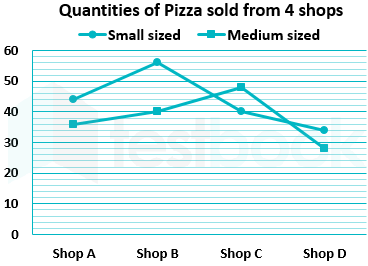
Direction: Study the data carefully and answer the following questions.

Following is the data given of selling 2 types of pizza from 4 shops A, B, C and D.

Question 41

Find the difference between total number of small sized pizzas sold from shop A, B and D together and total number of pizza sold from Shop C.

  1. AOption (a)

    34

  2. BOption (b)

    42

  3. COption (c)

    46

  4. DOption (d)

    52

  5. EOption (e)

    None of these

View answer & explanation

Correct answer

Answer: (c)C.

46

Why this answer is correct

Given: 

Small Pizzas sold by A = 44

Small Pizzas sold by B = 56

Small Pizzas sold by D = 34

Total number of Pizza sold by C = 88

Solution: 

Difference between total number of small sized pizzas sold from shop A, B and D together and total number of pizza sold from Shop C = (44 + 56 + 34) - 88

⇒ Difference = 46

∴ Difference between total number of small sized pizzas sold from shop A, B and D together and total number of pizza sold from Shop C is 46.

Question 42

Total number of pizzas sold from shop D is what % of total number of pizzas sold from shop A?

  1. AOption (a)

    77.5%

  2. BOption (b)

    82.5%

  3. COption (c)

    90.75%

  4. DOption (d)

    62.5%

  5. EOption (e)

    None of these

View answer & explanation

Correct answer

Answer: (a)A.

77.5%

Why this answer is correct

Given:

Total number of Pizza sold from shop D = 62

Total number of Pizza sold from shop A = 80

Solution:

62 × 100/80 = 77.5

∴ Total number of pizzas sold from shop D is 77.5 % of total number of pizzas sold from shop A.

Question 43

Find the ratio between total number of pizzas sold from shop C to that of shop B.

  1. AOption (a)

    13 : 12

  2. BOption (b)

    11 : 12

  3. COption (c)

    12 : 13

  4. DOption (d)

    22 :23

  5. EOption (e)

    None of these

View answer & explanation

Correct answer

Answer: (b)B.

11 : 12

Why this answer is correct

Given: 

Total number of pizzas sold from shop C = 88

Total number of pizzas sold from shop B = 96

Solution: 

Ratio between total number of pizzas sold from shop C to that of shop B = 88/96 = 11/12

∴ Ratio between total number of pizzas sold from shop C to that of shop B is 11:12.

Question 44

What is the average of total number of medium sized pizzas sold from all the shops together?

  1. AOption (a)

    40

  2. BOption (b)

    44

  3. COption (c)

    52

  4. DOption (d)

    38

  5. EOption (e)

    None of these

View answer & explanation

Correct answer

Answer: (d)D.

38

Why this answer is correct

Given:

Number of medium pizzas sold by A = 36

Number of medium pizzas sold by B = 40

Number of medium pizzas sold by C = 48

Number of medium pizzas sold by D = 28

Formula used: 

Average = Sum of all observations/number of observations 

Solution:

Average = (36 + 40 + 48 + 28)/4

⇒ Average = 152/4 = 38

∴ Average of total number of medium sized pizzas sold from all the shops together is 38.

Question 45

If the number of large sized pizzas sold from shop C is 20% of the number of small sized pizzas sold, then find the total number of pizzas sold from shop C.

  1. AOption (a)

    90

  2. BOption (b)

    102

  3. COption (c)

    96

  4. DOption (d)

    104

  5. EOption (e)

    None of these

View answer & explanation

Correct answer

Answer: (c)C.

96

Why this answer is correct

Given:

The number of small sized pizzas sold from shop C = 40

Solution: 

Number of large Pizza sold from shop C = 40 × 20/100 = 8

Number of medium sized Pizzas from shop C = 48

The number of small sized pizzas sold from shop C = 40

Total number of Pizzas sold from shop C = 40 + 48 + 8 = 96

∴ Total number of pizzas sold from shop C is 96.

Question 46

In each of the following number series, a wrong number is given. Find out that number.

12, 14, 18, 23, 32, 42, 54

  1. AOption (a)

    12

  2. BOption (b)

    32

  3. COption (c)

    23

  4. DOption (d)

    18

  5. EOption (e)

    54

View answer & explanation

Correct answer

Answer: (c)C.

23

Why this answer is correct

Calculation:

The series follows the following pattern:

⇒ 12 + 2 = 14 

⇒ 14 + 4 = 18 

⇒ 18 + 6 = 24

⇒ 24 + 8 = 32 

⇒ 32 + 10 = 42 

⇒ 42 + 12 = 54 

∴ The wrong number is 23

Question 47

In each of the following number series, a wrong number is given. Find out that number.

38, 39, 43, 52, 70, 93, 129

  1. AOption (a)

    70

  2. BOption (b)

    52

  3. COption (c)

    93

  4. DOption (d)

    129

  5. EOption (e)

    39

View answer & explanation

Correct answer

Answer: (a)A.

70

Why this answer is correct

Calculation:

The series follows following pattern: 

⇒ 38 + 1 = 39 

⇒ 39 + 4 = 43 

⇒ 43 + 9 = 52 

⇒ 52 + 16 = 68

⇒ 68 + 25 = 93 

⇒ 93 + 36 = 129 

∴ The wrong number in the series is 70

Question 48

In each of the following number series, a wrong number is given. Find out that number.

18, 35, 69, 136, 273, 545

  1. AOption (a)

    69

  2. BOption (b)

    35

  3. COption (c)

    18

  4. DOption (d)

    136

  5. EOption (e)

    273

View answer & explanation

Correct answer

Answer: (d)D.

136

Why this answer is correct

Calculation:

The series follows following pattern:

⇒ 18 + 17 = 35 

⇒ 35 + 34 = 69 

⇒ 69 + 68 = 137 

⇒ 137 + 136 = 273 

⇒ 273 + 272 = 545 

∴ The wrong number in the series is 136

Question 49

In each of the following number series, a wrong number is given. Find out that number.

48, 41, 34, 27, 21, 13, 6

  1. AOption (a)

    13

  2. BOption (b)

    21

  3. COption (c)

    41

  4. DOption (d)

    6

  5. EOption (e)

    27

View answer & explanation

Correct answer

Answer: (b)B.

21

Why this answer is correct

Calculation:

The series follows following pattern:

⇒ 48 – 7 = 41 

⇒ 41 – 7 = 34 

⇒ 34 – 7 = 27 

⇒ 27 – 7 = 20

⇒ 20 – 7 = 13 

⇒ 13 – 7 = 6 

∴ The wrong number in the series is 21

Question 50

In each of the following number series, a wrong number is given. Find out that number.

87, 88, 84, 110, 95, 220

  1. AOption (a)

    95

  2. BOption (b)

    220

  3. COption (c)

    110

  4. DOption (d)

    87

  5. EOption (e)

    88

View answer & explanation

Correct answer

Answer: (c)C.

110

Why this answer is correct

Calculation:

The series follows following pattern:

⇒ 87 + 13 = 87 + 1 = 88 

⇒ 88 – 22 = 88 – 4 = 84

⇒ 84 + 33 = 84 + 27 = 111

⇒ 111 – 42 = 111 – 16 = 95 

⇒ 95 + 53 = 95 + 125 = 220 

∴ The wrong number in the series is 110

Question 51

Water is flowing at the rate of 5 km/h through a pipe of diameter 14 cm into a rectangular tank which is 50 m long, 44 m wide. The time taken for the rise in the level of water in the tank to be 7 cm is (in hours)

  1. AOption (a)

    2

  2. BOption (b)

    3

  3. COption (c)

    2.5

  4. DOption (d)

    1.5

  5. EOption (e)

    none of these

View answer & explanation

Correct answer

Answer: (a)A.

2

Why this answer is correct

Shortcut Trick

Volume of water from pipe in 1 hour = π × r2 × speed = (22/7) × 0.07 × 0.07 × 5000 = 77 m3.

Required volume in tank = Length × Breadth × Height = 50 × 44 × 0.07 = 154 m3.

Time taken = Required Volume ÷ Flow rate per hour = 154 ÷ 77 = 2 hours.

∴ The correct answer is 2 hours.

Alternate Method

Given:

Speed of water = 5 km/h = 5000 m/h

Diameter of pipe = 14 cm ⇒ Radius (r) = 7 cm = 0.07 m

Tank dimensions: L = 50 m, B = 44 m, Required Rise (h) = 7 cm = 0.07 m

Formula Used:

Volume of cylinder = πr2h | Volume of cuboid = L × B × H

Calculations:

⇒ Volume of water required in tank = 50 × 44 × 0.07

⇒ Volume = 50 × 44 × (7/100) = 154 m3

⇒ Volume of water flowing through pipe per hour = π × (0.07)2 × 5000

⇒ Flow rate = (22/7) × 0.0049 × 5000 = 22 × 0.0007 × 5000 = 77 m3/h

⇒ Time = Total Volume ÷ Flow Rate per hour

⇒ Time = 154 ÷ 77 = 2 hours

∴ The correct answer is 2 hours.

Additional Information

Rate of Flow Concept

Volume of water flowing through a pipe in time 't' is given by Area of Cross-section × Speed × Time.

Unit Conversion

Always ensure all dimensions are in the same unit (meters) before calculation. 1 km = 1000 m and 1 cm = 0.01 m.

Volume of Water in Tank

The volume of water for a specific rise in level is simply Area of base × Rise in height (L × B × h).

Question 52

Two men A and B started a job in which A was thrice as good as B and therefore took 60 days less than B to finish the job. How many days will they take to finish the job, if they start working together?

  1. AOption (a)

    15 days

  2. BOption (b)

    20 days

  3. COption (c)

    22.5 days

  4. DOption (d)

    25 days

  5. EOption (e)

    none of these

View answer & explanation

Correct answer

Answer: (c)C.

22.5 days

Why this answer is correct

Shortcut Trick

Efficiency ratio A : B = 3 : 1

Time ratio A : B = 1 : 3 (Inverse of efficiency)

Difference in time units = 3 − 1 = 2 units → 60 days

1 unit = 30 days. So, A takes 30 days and B takes 90 days.

Together (XY / X+Y) = (30 × 90) ÷ (30 + 90) = 2700 ÷ 120 = 22.5 days.

∴ The correct answer is 22.5 days.

Alternate Method

PersonDaysTotal WorkEfficiency
A30903
B901

Given: Efficiency of A is 3 times B. Time difference is 60 days.

Calculation:

⇒ Let time taken by B = x days, then A = x − 60 days.

⇒ Ratio of time A : B = 1 : 3

⇒ (x − 60) / x = 1 / 3

⇒ 3x − 180 = x

⇒ 2x = 180 ⇒ x = 90 days (Time for B)

⇒ Time for A = 90 − 60 = 30 days.

⇒ Total Work = LCM(30, 90) = 90 units.

⇒ Combined Efficiency = 3 + 1 = 4 units/day.

⇒ Time taken together = 90 ÷ 4 = 22.5 days.

∴ The correct answer is 22.5 days.

Additional Information

Efficiency and Time Relation

Efficiency is inversely proportional to the time taken to complete a task. If efficiency ratio is x:y, the time ratio is y:x.

Work from Efficiency

Total Work = Efficiency × Time. This is the fundamental unit for solving all Time and Work problems.

Combined Work Formula

For two people taking x and y days respectively, the time taken together is (x × y) ÷ (x + y).

Question 53

Pipe A alone can fill a tank in 8 hours. Pipe B alone can fill it in 6 hours. If both the pipes are opened and after 2 hours pipe A is closed, then the other pipe will fill the remaining tank in 

  1. AOption (a)

    6 hrs

  2. BOption (b)

    3.5 hrs

  3. COption (c)

    4 hrs

  4. DOption (d)

    2.5 hrs

  5. EOption (e)

    none of these

View answer & explanation

Correct answer

Answer: (d)D.

2.5 hrs

Why this answer is correct

Shortcut Trick

Total Capacity (LCM of 8, 6) = 24 units.

Efficiency of A = 3, Efficiency of B = 4.

Work done by (A + B) in 2 hours = (3 + 4) × 2 = 14 units.

Remaining work = 24 − 14 = 10 units.

Time taken by B = 10 ÷ 4 = 2.5 hours.

∴ The correct answer is 2.5 hr.

Alternate Method

Given:

Time taken by Pipe A = 8 hours

Time taken by Pipe B = 6 hours

Duration both pipes are open = 2 hours

Person/PipeDays/HoursTotal WorkEfficiency
Pipe A8243
Pipe B64

Calculations:

⇒ Combined efficiency of (A + B) = 3 + 4 = 7 units/hr

⇒ Work completed in 2 hours = 7 × 2 = 14 units

⇒ Remaining work = Total work − Completed work = 24 − 14 = 10 units

⇒ Time taken by Pipe B to fill remaining tank = Remaining work ÷ Efficiency of B

⇒ Time = 10 ÷ 4 = 2.5 hours

∴ The correct answer is 2.5 hr.

Additional Information

Pipes & Cisterns Basics

If a pipe fills a tank in x hours, its 1-hour work is 1/x. If an outlet pipe empties it in y hours, its efficiency is negative (-1/y).

Total Work Concept

Always take the LCM of individual times as the total capacity of the tank to simplify calculations into integers.

Remaining Work

Remaining Work = Total Work − (Efficiency × Time already spent). Time to complete = Remaining Work ÷ Efficiency of remaining pipes.

Question 54

The ratio between two numbers is 2 : 3. If each number is increased by 4, the ratio between them becomes 5 : 7. The difference between the numbers is

  1. AOption (a)

    2 

  2. BOption (b)

    4

  3. COption (c)

    6

  4. DOption (d)

    8

  5. EOption (e)

    none of these

View answer & explanation

Correct answer

Answer: (d)D.

8

Why this answer is correct

Shortcut Trick

Initial Ratio = 2 : 3 (Difference = 1 unit)

Final Ratio = 5 : 7 (Difference = 2 units)

Make differences equal: Multiply initial ratio by 2 → 4 : 6. Difference now is 2 units.

Change in units: 5 − 4 = 1 unit. Given 1 unit = 4.

Difference between numbers = 6 − 4 = 2 units ⇒ 2 × 4 = 8.

∴ The correct answer is 8.

Alternate Method

Given: Ratio of two numbers = 2 : 3. Increment = 4. New ratio = 5 : 7.

Let the numbers be 2x and 3x.

⇒ (2x + 4) / (3x + 4) = 5 / 7

⇒ 7(2x + 4) = 5(3x + 4)

⇒ 14x + 28 = 15x + 20

⇒ 15x − 14x = 28 − 20

⇒ x = 8

Difference between numbers = 3x − 2x = x.

⇒ Difference = 8

∴ The correct answer is 8.

Additional Information

Ratio Balancing Method

When the same value is added to or subtracted from both terms, the difference between the ratio parts should remain constant. Multiply the ratios to equalize these differences.

Cross Multiplication Method

For a : b changing to c : d after adding k: Value of 1 unit = (k × (d − c)) / (ad − bc). This works even if added values are different.

Duplicate Ratio

The duplicate ratio of a : b is a2 : b2, and the sub-duplicate ratio is √a : √b.

Question 55

Aditya got some amount of money from his father, In how many years will the ratio of the money and the interest obtained from it be 10 : 3 at 6% p.a.? 

  1. AOption (a)

    7 years

  2. BOption (b)

    3 years

  3. COption (c)

    5 years

  4. DOption (d)

    4 years

  5. EOption (e)

    none of these

View answer & explanation

Correct answer

Answer: (c)C.

5 years

Why this answer is correct

Shortcut Trick

Ratio of Principal (P) to Simple Interest (SI) = 10 : 3

Let Principal = 10 units and Interest = 3 units.

Rate (R) = 6% p.a.

Time (T) = (SI × 100) ÷ (P × R) = (3 × 100) ÷ (10 × 6) = 300 ÷ 60 = 5 years.

∴ The correct answer is 5 years.

Alternate Method

Given:

Ratio of Money (Principal) : Interest = 10 : 3

Rate of Interest (R) = 6% per annum

Formula Used:

Simple Interest (SI) = (P × R × T) ÷ 100

Calculations:

⇒ Let Principal (P) = 10x and Simple Interest (SI) = 3x

⇒ 3x = (10x × 6 × T) ÷ 100

⇒ 3 = (60 × T) ÷ 100

⇒ 300 = 60 × T

⇒ T = 300 ÷ 60

⇒ T = 5

∴ The correct answer is 5 years.

Additional Information

Simple Interest Components

Simple Interest is calculated only on the Principal amount. Amount = Principal + Simple Interest.

Rate and Time Relationship

For a fixed Principal, Simple Interest is directly proportional to both the Rate of interest and the Time period.

Annual Rate Conversion

If time is given in months, divide by 12 to convert to years. If given in days, divide by 365.

Direction: Read the following information carefully and answer the following questions.

Statement I- There are 220 students studying in college A and college B. Students from 3 cities i.e Patna, Delhi and Mumbai study in these 2 colleges.

Statement II- Ratio of total number of students in college A and total number of students in college B is 6 : 5. Number of students of Mumbai who studies in college B is 30% of total number of students of college B.

Statement III- Number of students of Mumbai who studies in college B is 75% of number of students of Patna who studies in college A.

Statement IV- Number of students from Delhi who studies in college B is 62.5% of the number of students from Patna who studies in college A. Ratio of students from Patna in college B and number of students from Mumbai who studies in college A is 9 : 10.

Question 56

Find the ratio of number of students from Delhi in college A to that of number of students from Delhi college B.

  1. AOption (a)

    4 : 5

  2. BOption (b)

    3 : 4

  3. COption (c)

    6 : 5

  4. DOption (d)

    5 : 3

  5. EOption (e)

    None of these

View answer & explanation

Correct answer

Answer: (c)C.

6 : 5

Why this answer is correct

From the Statement 1

Total student in college A and B = 220 

Statement 2 

Ratio of student in college A and B = 6 : 5 

So, Number of student in college A = (220/11) × 6 = 120 

Number of student in college B = 220 - 120 = 100 

Number of student in college B from Mumbai = 30% of 100 = 30 

Statement 3 

Number of student of Mumbai in college B = 75% of Number of student of Patna in college A 

Number of student of Patna in college A = (30/75) × 100 = 40 

Statement 4 

Number of students from Delhi  in college B = 62.5% of the number of students from Patna  in college A

Number of student from Delhi in college B = (5/8) × 40 = 25

Number of student from Patna in college B = 100 - 30 - 25 = 45 

Ratio of students from Patna in college B and number of students from Mumbai who studies in college A =  9 : 10.

So, Number of student from Mumbai in college A = (45/9) × 10 = 50

Number of student from Delhi in college A = 120 - 40 - 50 = 30 

Ratio of student from Delhi in college A and college B = 30 : 25 

⇒ 6 : 5 

∴ The required answer is 6 : 5

Question 57

Number of students from Patna in college A is what % of total number of students in college B?

  1. AOption (a)

    40%

  2. BOption (b)

    45%

  3. COption (c)

    35%

  4. DOption (d)

    60%

  5. EOption (e)

    None of these

View answer & explanation

Correct answer

Answer: (a)A.

40%

Why this answer is correct

From the Statement 1

Total student in college A and B = 220 

Statement 2 

Ratio of student in college A and B = 6 : 5 

So, Number of student in college A = (220/11) × 6 = 120 

Number of student in college B = 220 - 120 = 100 

Number of student in college B from Mumbai = 30% of 100 = 30 

Statement 3 

Number of student of Mumbai in college B = 75% of Number of student of Patna in college A 

Number of student of Patna in college A = (30/75) × 100 = 40  

Required Percentage = (40)/100 × 100 = 40% 

∴ Number of students from Patna in college A is 40% of total number of students in college B

Question 58

Find the difference between total number of students from Patna to that of Delhi.

  1. AOption (a)

    35

  2. BOption (b)

    30

  3. COption (c)

    45

  4. DOption (d)

    50

  5. EOption (e)

    None of these

View answer & explanation

Correct answer

Answer: (b)B.

30

Why this answer is correct

From the Statement 1

Total student in college A and B = 220 

Statement 2 

Ratio of student in college A and B = 6 : 5 

So, Number of student in college A = (220/11) × 6 = 120 

Number of student in college B = 220 - 120 = 100 

Number of student in college B from Mumbai = 30% of 100 = 30 

Statement 3 

Number of student of Mumbai in college B = 75% of Number of student of Patna in college A 

Number of student of Patna in college A = (30/75) × 100 = 40 

Statement 4 

Number of students from Delhi  in college B = 62.5% of the number of students from Patna  in college A

Number of student from Delhi in college B = (5/8) × 40 = 25

Number of student from Patna in college B = 100 - 30 - 25 = 45 

Ratio of students from Patna in college B and number of students from Mumbai who studies in college A =  9 : 10.

So, Number of student from Mumbai in college A = (45/9) × 10 = 50

Number of student from Delhi in college A = 120 - 40 - 50 = 30 

Total student from Patna = 40 + 45 = 85 

Total student from Delhi = 25 + 30 = 55

Required Difference = 85 - 55 = 30

∴ Difference between total number of students from Patna to that of Delhi is 30

Question 59

Which city has the most number of students studying in both colleges?

  1. AOption (a)

    Patna

  2. BOption (b)

    Delhi

  3. COption (c)

    Mumbai

  4. DOption (d)

    Both Patna and Mumbai

  5. EOption (e)

    Both Delhi and Mumbai

View answer & explanation

Correct answer

Answer: (a)A.

Patna

Why this answer is correct

From the  Statement 1

Total student in college A and B = 220 

Statement 2 

Ratio of student in college A and B = 6 : 5 

So, Number of student in college A = (220/11) × 6 = 120 

Number of student in college B = 220 - 120 = 100 

Number of student in college B from Mumbai = 30% of 100 = 30 

Statement 3 

Number of student of Mumbai in college B = 75% of Number of student of Patna in college A 

Number of student of Patna in college A = (30/75) × 100 = 40 

Statement 4 

Number of students from Delhi  in college B = 62.5% of the number of students from Patna  in college A

Number of student from Delhi in college B = (5/8) × 40 = 25

Number of student from Patna in college B = 100 - 30 - 25 = 45 

Ratio of students from Patna in college B and number of students from Mumbai who studies in college A =  9 : 10.

So, Number of student from Mumbai in college A = (45/9) × 10 = 50

Number of student from Delhi in college A = 120 - 40 - 50 = 30

Total student from Mumbai in both college = 50 + 30 = 80  

Total student from Patna = 40 + 45 = 85 

Total student from Delhi = 25 + 30 = 55

So, The highest number of student from Patna in both colleges 

∴ The most number of students studying in both colleges is Patna

Question 60

Find the total number of students studying in college A from Delhi and Mumbai.

  1. AOption (a)

    85

  2. BOption (b)

    75

  3. COption (c)

    90

  4. DOption (d)

    80

  5. EOption (e)

    None of these

View answer & explanation

Correct answer

Answer: (d)D.

80

Why this answer is correct

From the  Statement 1

Total student in college A and B = 220 

Statement 2 

Ratio of student in college A and B = 6 : 5 

So, Number of student in college A = (220/11) × 6 = 120 

Number of student in college B = 220 - 120 = 100 

Number of student in college B from Mumbai = 30% of 100 = 30 

Statement 3 

Number of student of Mumbai in college B = 75% of Number of student of Patna in college A 

Number of student of Patna in college A = (30/75) × 100 = 40 

Statement 4 

Number of students from Delhi  in college B = 62.5% of the number of students from Patna  in college A

Number of student from Delhi in college B = (5/8) × 40 = 25

Number of student from Patna in college B = 100 - 30 - 25 = 45 

Ratio of students from Patna in college B and number of students from Mumbai who studies in college A =  9 : 10.

So, Number of student from Mumbai in college A = (45/9) × 10 = 50

Number of student from Delhi in college A = 120 - 40 - 50 = 30

Total Number of student from Delhi and Mumbai in college A = 30 + 50 = 80 

∴ The required answer is 80

Question 61

A, B and C are partners. A receives 9/10 of the profit and B and C share the remaining profit equally. A's income is increased by Rs. 270 when the profit % of A rises from 12 to 15%. Find the capital invested by B and C each respectively.

  1. AOption (a)

    Rs. 500, Rs. 600

  2. BOption (b)

    Rs. 500, Rs. 500

  3. COption (c)

    Rs. 600, Rs. 500

  4. DOption (d)

    Rs. 600, Rs. 600

  5. EOption (e)

    none of these

View answer & explanation

Correct answer

Answer: (b)B.

Rs. 500, Rs. 500

Why this answer is correct

Shortcut Trick

Change in profit percentage for A = 15% − 12% = 3%.

According to the question, 3% of A's capital = Rs. 270.

100% of A's capital = (270 ÷ 3) × 100 = Rs. 9,000.

Profit sharing ratio A : (B + C) = 9/10 : 1/10 = 9 : 1.

Since Investment ratio = Profit ratio, total capital of B and C = 9000 ÷ 9 = Rs. 1,000.

B and C share equally ∴ Capital of B = Capital of C = 1000 ÷ 2 = Rs. 500.

∴ The correct answer is Rs. 500, Rs. 500.

Alternate Method

Given → A's share = 9/10, B and C share equally. Income increase = Rs. 270. Formulas: Profit = Investment × Rate | Change in Income = Capital × (R2 − R1)%

⇒ Remaining profit = 1 − 9/10 = 1/10. ⇒ Share of B = Share of C = (1/10) ÷ 2 = 1/20. ⇒ Ratio of shares A : B : C = 9/10 : 1/20 : 1/20 = 18 : 1 : 1. ⇒ Let A's capital be K. Change in income = K × (15% − 12%) = 270. ⇒ K × 3/100 = 270 ⇒ K = 9000. ⇒ Since 18 units = 9000, then 1 unit = 9000 ÷ 18 = 500. ⇒ B's capital = 1 unit = Rs. 500; C's capital = 1 unit = Rs. 500.

∴ The correct answer is Rs. 500, Rs. 500.

Additional Information

Partnership Investment

In a partnership, if the time period is the same for all partners, the profit sharing ratio is directly proportional to the capital invested.

Income and Profit %

Total Income = Capital × Profit Rate. Therefore, an increase in income is equal to the Capital multiplied by the difference in profit percentages.

Question 62

In an examination, a student must get 36% marks to pass. A student who gets 190 marks failed by 35 marks. The total marks in that examination is

  1. AOption (a)

    625

  2. BOption (b)

    500

  3. COption (c)

    450

  4. DOption (d)

    650

  5. EOption (e)

    None of these

View answer & explanation

Correct answer

Answer: (a)A.

625

Why this answer is correct

Shortcut Trick

Passing Marks = Obtained marks + Failing marks = 190 + 35 = 225

As per percentage, Passing Marks = 36% of Total Marks

36% → 225

100% → (225 ÷ 36) × 100 = 6.25 × 100 = 625

∴ The correct answer is 625.

Alternate Method

Given:

Passing percentage = 36%

Marks obtained = 190

Shortfall to pass = 35 marks

Calculations:

⇒ Required Passing Marks = 190 + 35

⇒ Required Passing Marks = 225

⇒ Let Total Marks be 'x'

⇒ 36% of x = 225

⇒ (36 ÷ 100) × x = 225

⇒ x = (225 × 100) ÷ 36

⇒ x = 22500 ÷ 36

⇒ x = 625

∴ The correct answer is 625.

Additional Information

Percentage to Value Conversion

To find the total value when a percentage part is known, use: Total = (Value ÷ Percentage) × 100.

Passing Marks Concept

Passing Marks = Obtained Marks + Marks by which failed, OR Passing Marks = Obtained Marks − Marks in excess of passing.

Successive Percentage Change

If a value changes by a% then b%, net change = (a + b + ab/100)%.

Question 63

The population of a town is 15000. If the number of males increases by 8% and that of females by 10%, then the population would increase to 16300. Find the number of females in the town. 

  1. AOption (a)

    4000

  2. BOption (b)

    3000

  3. COption (c)

    6000

  4. DOption (d)

    5000

  5. EOption (e)

    None of these

View answer & explanation

Correct answer

Answer: (d)D.

5000

Why this answer is correct

Shortcut Trick

Net increase in population = 16300 − 15000 = 1300.

Assume all 15000 are males, increase = 15000 × 8% = 1200.

Assume all 15000 are females, increase = 15000 × 10% = 1500.

Apply Alligation: (1500 − 1300) : (1300 − 1200) = 200 : 100 = 2 : 1.

Number of females = (1 / 3) × 15000 = 5000.

∴ The correct answer is 5000 females.

Alternate Method

Given: Initial Population = 15000, Final Population = 16300, Male increase = 8%, Female increase = 10%.

Formula Used: Total Increase = (Male % × Males) + (Female % × Females)

⇒ Total increase in value = 16300 − 15000 = 1300

⇒ Total percentage increase = (1300 / 15000) × 100 = 8.666...% or 26/3%

⇒ Using Alligation for Ratio (M : F):

⇒ (10 − 26/3) : (26/3 − 8)

⇒ (4/3) : (2/3)

⇒ 4 : 2 = 2 : 1

⇒ Number of females = [1 / (2 + 1)] × 15000

⇒ Number of females = (1 / 3) × 15000 = 5000

∴ The correct answer is 5000 females.

Additional Information

Alligation Rule

It is a rule that enables us to find the ratio in which two or more ingredients at their respective prices/percentages must be mixed to produce a mixture of a specified price/percentage.

Percentage Change

Percentage change = [(New Value − Old Value) / Old Value] × 100. Always keep the base as the original value.

Population Problems

If population P increases at r% per annum, population after n years = P(1 + r/100)n.

Question 64

The average weight of 12 players in a team is increased by 1/3 kg, when one of the player whose weight is 55 kg is replaced by an another player. What is the weight of the new player?

  1. AOption (a)

    57 kg

  2. BOption (b)

    59 kg

  3. COption (c)

    62 kg

  4. DOption (d)

    65 kg

  5. EOption (e)

    None of these

View answer & explanation

Correct answer

Answer: (b)B.

59 kg

Why this answer is correct

Shortcut Trick

Weight of New Player = Weight of Replaced Player + (Total Players × Increase in Average)

Weight of New Player = 55 + (12 × 1/3)

Weight of New Player = 55 + 4 = 59 kg

∴ The correct answer is 59 kg.

Alternate Method

Given:

Number of players (n) = 12

Weight of player replaced = 55 kg

Average weight increase = 1/3 kg

Calculations:

⇒ Total weight increase = Number of players × Increase in average

⇒ Total weight increase = 12 × 1/3 = 4 kg

⇒ Weight of new player = Weight of replaced player + Total weight increase

⇒ Weight of new player = 55 + 4 = 59 kg

∴ The correct answer is 59 kg.

Additional Information

Net Change in Sum

When one member is replaced, the Total Sum changes by the difference between the new value and the old value: (New Value − Old Value) = n × (Change in Average).

Average Concept

Average = Sum of all observations ÷ Number of observations. If the average increases, the new value must be greater than the replaced value.

Question 65

While selling an article, a shopkeeper gives a discount of 5%. If he gives a discount of 6% , he earns Rs. 15 less as profit. What is the marked price of the article

  1. AOption (a)

    Rs. 1200

  2. BOption (b)

    Rs. 1500

  3. COption (c)

    Rs. 1800

  4. DOption (d)

    Rs. 2000

  5. EOption (e)

    None of these

View answer & explanation

Correct answer

Answer: (b)B.

Rs. 1500

Why this answer is correct

Shortcut Trick

Difference in discount percentage = 6% − 5% = 1%.

This 1% difference in Marked Price (MP) results in Rs. 15 less profit.

Since Profit decreases as Discount increases, 1% of MP = Rs. 15.

Therefore, 100% of MP = 15 × 100 = Rs. 1500.

∴ The correct answer is Rs. 1500.

Alternate Method

Given: First discount = 5%, Second discount = 6%, Decrease in profit = Rs. 15.

Formulas: SP = MP × (100 − Discount%) ÷ 100 | Profit = SP − CP.

⇒ Let the Marked Price (MP) be x.

⇒ First Selling Price (SP1) = x × (100 − 5) ÷ 100 = 0.95x.

⇒ Second Selling Price (SP2) = x × (100 − 6) ÷ 100 = 0.94x.

⇒ Difference in Profit = SP1 − SP2 = 0.95x − 0.94x = 0.01x.

⇒ 0.01x = 15 ⇒ x = 15 ÷ 0.01 = 1500.

∴ The correct answer is Rs. 1500.

Additional Information

Relationship between SP and MP

The Selling Price is calculated by subtracting the Discount from the Marked Price. SP = MP − Discount.

Impact of Discount on Profit

For a fixed Cost Price, any increase in the discount percentage directly reduces the profit by the same monetary amount. Change in Profit = MP × (Difference in Discount%).

Reasoning Ability (35 questions)

Direction: Read the given information carefully and answer the questions asked below.

Eight people P, Q, R, S, T, U, V and W are sitting around a square table in such a way that four of them sit at four corners of the square while four sit in the middle of each of the four sides. People who are sitting at the corner are facing outside the center while people sitting in the middle are facing the center. R sits second to the right of V. Only one person sits between R and W. P is not an immediate neighbor of W and does not sit at corner. Q faces S who sits immediately to the left of U.

Question 66

What is the position of U with respect to T?

  1. AOption (a)

    Third to the left

  2. BOption (b)

    Third to the right

  3. COption (c)

    Immediate to the left

  4. DOption (d)

    Immediate to the right

  5. EOption (e)

    Fourth to the right

View answer & explanation

Correct answer

Answer: (a)A.

Third to the left

Why this answer is correct

  1. R sits second to the right of V.

  2. Only one person sits between R and W.

3)  P is not an immediate neighbor of W and does not sit at corner. 

4)Q faces S who sits immediately to the left of U. (This eliminates case 2) 

Hence, U sits third to the left of T.

Question 67

How many people sit between R and S, when counted in a clockwise direction from S?

  1. AOption (a)

    None

  2. BOption (b)

    One

  3. COption (c)

    Two

  4. DOption (d)

    Three

  5. EOption (e)

    More than three

View answer & explanation

Correct answer

Answer: (e)E.

More than three

Why this answer is correct

  1. R sits second to the right of V.

  2. Only one person sits between R and W.

3) P is not an immediate neighbor of W and does not sit at corner. 

4) Q faces S who sits immediately to the left of U. (This eliminates case 2)

Hence, four people sit between R and S, when counted in a clockwise direction from S.

Question 68

What is true regarding P?

  1. AOption (a)

    P sits immediate right of U.

  2. BOption (b)

    P Second to the right of Q

  3. COption (c)

    P is an immediate neighbor of R

  4. DOption (d)

    Both 1) and 2)

  5. EOption (e)

    Both 1) and 3) 

View answer & explanation

Correct answer

Answer: (d)D.

Both 1) and 2)

Why this answer is correct

  1. R sits second to the right of V.

  2. Only one person sits between R and W.

  3. P is not an immediate neighbor of W and does not sit at corner.

  4. Q faces S who sits immediately to the left of U. (This eliminates case 2)


Hence, both 1) and 2) are true.

Question 69

Who sits second to the left of the person who sits immediate right of S?

  1. AOption (a)

    U

  2. BOption (b)

    R

  3. COption (c)

    V

  4. DOption (d)

    T

  5. EOption (e)

    W

View answer & explanation

Correct answer

Answer: (b)B.

R

Why this answer is correct

  1. R sits second to the right of V.

  2. Only one person sits between R and W.

  3. P is not an immediate neighbor of W and does not sit at corner.

  4. Q faces S who sits immediately to the left of U. (This eliminates case 2)


Person who sits immediately to the right of S is W, R sits second to the left of W.

Hence, R sits second to the left of the person who sits immediate right of S.

Question 70

Four among the five are the same in some way and thus form a group, which of the following does not belong to that group?

  1. AOption (a)

    R

  2. BOption (b)

    U

  3. COption (c)

    V

  4. DOption (d)

    W

  5. EOption (e)

    Q

View answer & explanation

Correct answer

Answer: (e)E.

Q

Why this answer is correct

  1. R sits second to the right of V.

  2. Only one person sits between R and W.

  3. P is not an immediate neighbor of W and does not sit at corner.

  4. Q faces S who sits immediately to the left of U. (This eliminates case 2)


All are sitting at the corner of the table except Q.

Hence, Q does not belong to that group.

Direction: Study the following information and answer the questions given below.

In a certain code language,

“focus on economic development” is written as “vl no py su”

“greater growth more development” is written as “wr ea vl om”

“more focus is important” is written as “su ta nx ea”

“economic growth is important” is written as “ta py om nx”

Question 71

What is the code for 'economic'

  1. AOption (a)

    no

  2. BOption (b)

    py

  3. COption (c)

    nx

  4. DOption (d)

    ta

  5. EOption (e)

    su

View answer & explanation

Correct answer

Answer: (b)B.

py

Why this answer is correct

Hence, code for 'economic' is 'py'.

Question 72

'su' is the code for which of the following?

  1. AOption (a)

    more

  2. BOption (b)

    development

  3. COption (c)

    focus

  4. DOption (d)

    on

  5. EOption (e)

    important

View answer & explanation

Correct answer

Answer: (c)C.

focus

Why this answer is correct

Hence, 'su' is the code for focus.

Question 73

What is the code for "growth is important"?

  1. AOption (a)

    om ta py

  2. BOption (b)

    om ta nx

  3. COption (c)

    wr ta nx

  4. DOption (d)

    ea nx py

  5. EOption (e)

    Cannot be determined

View answer & explanation

Correct answer

Answer: (b)B.

om ta nx

Why this answer is correct

Code for growth is 'om'.

Code for 'is important' is 'ta nx'

Hence, code for 'growth is important' is 'om ta nx'.

Question 74

What is the code for 'important'?

  1. AOption (a)

    ta

  2. BOption (b)

    py

  3. COption (c)

    nx

  4. DOption (d)

    om

  5. EOption (e)

    Cannot be determined

View answer & explanation

Correct answer

Answer: (e)E.

Cannot be determined

Why this answer is correct

Code for 'important' is either 'ta' or 'nx'.

Hence, answer is cannot be determined.

Question 75

What is the code for 'greater'?

  1. AOption (a)

    wr

  2. BOption (b)

    ea

  3. COption (c)

    vl

  4. DOption (d)

    om

  5. EOption (e)

    no

View answer & explanation

Correct answer

Answer: (a)A.

wr

Why this answer is correct

Hence, 'wr' is the code for greater.

Question 76

If the digits are arranged in descending order within the given numbers which of the following number will be the highest?

793, 689, 957, 495, 879

  1. AOption (a)

    793

  2. BOption (b)

    689

  3. COption (c)

    957

  4. DOption (d)

    495

  5. EOption (e)

    879

View answer & explanation

Correct answer

Answer: (e)E.

879

Why this answer is correct

Digits are arranged in descending order within the number:

793 → 973

689 → 986

957 → 975

495 → 954

879 → 987

Hence, "879" is the correct answer.

Direction: Study the given information carefully and answer the questions.

Seven persons, A, B, C, D, E, F and G go to movies on different days of the week starting from Monday to Sunday but not necessarily in the same order. One person goes between G and C, A goes on one of the days before C. G goes on Friday. D goes on the second day of the week. Three persons go-between D and F. B does not go on Monday or Thursday. The number of persons who goes after C is equal to the number of persons goes before G.

Question 77

A goes for movie on which of the following days?

  1. AOption (a)

    Monday

  2. BOption (b)

    Tuesday 

  3. COption (c)

    Wednesday

  4. DOption (d)

    Thursday

  5. EOption (e)

    Sunday

View answer & explanation

Correct answer

Answer: (a)A.

Monday

Why this answer is correct

1) G goes on Friday.

2) One person goes between G and C.

DaysCase 1Case 2
Monday
Tuesday
WednesdayC
Thursday
FridayGG
Saturday
SundayC
<br>

3) D goes on the second day of the week.

4) Three persons go between D and F.

DaysCase 1Case 2
Monday
TuesdayDD
WednesdayC
Thursday
FridayGG
SaturdayFF
SundayC
<br>

5) The number of persons goes after C is equal to the number of persons go before G. 

Here, case 2 will be cancelled.

  1. A goes on one of the days before C.

7) B does not go on Monday or Thursday.

DaysPerson
MondayA
TuesdayD
WednesdayC
ThursdayE
FridayG
SaturdayF
SundayB
<br>

Hence, A goes on Monday.

Question 78

How many person/ persons go for movie after E?

  1. AOption (a)

    No One

  2. BOption (b)

    One

  3. COption (c)

    Two

  4. DOption (d)

    Three

  5. EOption (e)

    Four

View answer & explanation

Correct answer

Answer: (d)D.

Three

Why this answer is correct

1) G goes on Friday.

2) One person goes between G and C.

DaysCase 1Case 2
Monday
Tuesday
WednesdayC
Thursday
FridayGG
Saturday
SundayC
<br>

3) D goes on the second day of the week.

4) Three persons go between D and F.

DaysCase 1Case 2
Monday
TuesdayDD
WednesdayC
Thursday
FridayGG
SaturdayFF
SundayC
<br>

5) The number of persons goes after C is equal to the number of persons go before G. 

Here, case 2 will be cancelled.

  1. A goes on one of the days before C.

7) B does not go on Monday or Thursday.

DaysPerson
MondayA
TuesdayD
WednesdayC
ThursdayE
FridayG
SaturdayF
SundayB
<br>

Hence, three persons go for movie after E.

Question 79

The number of persons go for movie before C is same as the number of persons who go for movie after _____?

  1. AOption (a)

    B

  2. BOption (b)

    E

  3. COption (c)

    F

  4. DOption (d)

    G

  5. EOption (e)

    D

View answer & explanation

Correct answer

Answer: (d)D.

G

Why this answer is correct

1) G goes on Friday.

2) One person goes between G and C.

DaysCase 1Case 2
Monday
Tuesday
WednesdayC
Thursday
FridayGG
Saturday
SundayC
<br>

3) D goes on the second day of the week.

4) Three persons go between D and F.

DaysCase 1Case 2
Monday
TuesdayDD
WednesdayC
Thursday
FridayGG
SaturdayFF
SundayC
<br>

5) The number of persons goes after C is equal to the number of persons go before G. 

Here, case 2 will be cancelled.

  1. A goes on one of the days before C.

7) B does not go on Monday or Thursday.

DaysPerson
MondayA
TuesdayD
WednesdayC
ThursdayE
FridayG
SaturdayF
SundayB
<br>

Hence, the number of persons go for movie before C is the same as the number of persons who go for movie after G.

Question 80

Who among the following goes for movie on Saturday? 

  1. AOption (a)

    A

  2. BOption (b)

    F

  3. COption (c)

    E

  4. DOption (d)

    G

  5. EOption (e)

    D

View answer & explanation

Correct answer

Answer: (b)B.

F

Why this answer is correct

1) G goes on Friday.

2) One person goes between G and C.

DaysCase 1Case 2
Monday
Tuesday
WednesdayC
Thursday
FridayGG
Saturday
SundayC
<br>

3) D goes on the second day of the week.

4) Three persons go between D and F.

DaysCase 1Case 2
Monday
TuesdayDD
WednesdayC
Thursday
FridayGG
SaturdayFF
SundayC
<br>

5) The number of persons goes after C is equal to the number of persons go before G. 

Here, case 2 will be cancelled.

  1. A goes on one of the days before C.

7) B does not go on Monday or Thursday.

DaysPerson
MondayA
TuesdayD
WednesdayC
ThursdayE
FridayG
SaturdayF
SundayB
<br>

Hence, F goes on Saturday.

Question 81

Who among the following goes for movie just before E? 

  1. AOption (a)

    F

  2. BOption (b)

    D

  3. COption (c)

    C

  4. DOption (d)

    A

  5. EOption (e)

    G

View answer & explanation

Correct answer

Answer: (c)C.

C

Why this answer is correct

1) G goes on Friday.

2) One person goes between G and C.

DaysCase 1Case 2
Monday
Tuesday
WednesdayC
Thursday
FridayGG
Saturday
SundayC
<br>

3) D goes on the second day of the week.

4) Three persons go between D and F.

DaysCase 1Case 2
Monday
TuesdayDD
WednesdayC
Thursday
FridayGG
SaturdayFF
SundayC
<br>

5) The number of persons goes after C is equal to the number of persons go before G. 

Here, case 2 will be cancelled.

  1. A goes on one of the days before C.

7) B does not go on Monday or Thursday.

DaysPerson
MondayA
TuesdayD
WednesdayC
ThursdayE
FridayG
SaturdayF
SundayB
<br>

Hence, "C" goes for the movie just before E.

Question 82

What will be the difference between the sum of all the even digits and the sum of all the odd digits of the given number ‘81247563’  

  1. AOption (a)

    1

  2. BOption (b)

    2

  3. COption (c)

    3

  4. DOption (d)

    4

  5. EOption (e)

    5

View answer & explanation

Correct answer

Answer: (d)D.

4

Why this answer is correct

Given number: 81247563

Sum of all even digit: 8 + 2 + 4 + 6 = 20

Sum of all odd digit: 1 + 7 + 5 + 3 = 16

Difference between the sum of all even and sum of all odd digit = 20 - 16 = 4

Hence, "4" will be the difference between the sum of all the even digits and the sum of all the odd digits of the given number ‘81247563’.

Question 83

Direction: In the question below are given two statements followed by two conclusions numbered I and II .You have to take the given statements to be true even if they seem to be at variance with commonly known facts. Read all the conclusions and then decide which of the given conclusions logically follows from the given statements disregarding commonly known facts.

Statements

Only a few animal are cat

Some animal are dog

Conclusions

I. All Cat are animal

II. Some cat are Dog

  1. AOption (a)

    Only II follow

  2. BOption (b)

    Both I and II follow

  3. COption (c)

    Either I or II follow

  4. DOption (d)

    Only I follow

  5. EOption (e)

    Neither I nor II follow

View answer & explanation

Correct answer

Answer: (e)E.

Neither I nor II follow

Why this answer is correct

Statements

Only a few animal are cat → Some part of Animal are overlapping with Cat and some part of animal are not cat

Some animal are dog → Some part of animal are overlapping with dog 

Venn diagram for the given statements are follows.

Conclusions

I. All Cat are animal → False ( some part of animal are not cat but remaining part of the animal can be cat so, this possible statement not definite hence false)

II. Some cat are Dog → False( some dog are cat or not is definite it can be a possible case but not definite)

Hence Neither I nor II follow is the correct answer.

Question 84

Direction: In the question below are given two statements followed by two conclusions numbered I, and II. You have to take the given statements to be true even if they seem to be at variance with commonly known facts. Read all the conclusions and then decide which of the given conclusions logically follows from the given statements disregarding commonly known facts.

Statement:

Only a few Sea are River

All River are Water bodies

Conclusion :

I. Some Sea are Water bodies

II. All sea are River

  1. AOption (a)

    Both I and II follows

  2. BOption (b)

    Neither I and II follows

  3. COption (c)

    Either I or II follows

  4. DOption (d)

    Only I follow

  5. EOption (e)

    Only II follows

View answer & explanation

Correct answer

Answer: (d)D.

Only I follow

Why this answer is correct

Statement:

Only a few Sea are River → Some parts of Sea are River and Some parts of sea are not River.

All River are Water bodies → All river will be part of Waterbodies

The least possible venn diagram will be.

Conclusion :

I. Some Sea are Water bodies → True ( Some parts of Sea are River and All River are water bodies hence some sea are water bodies)

II. All sea are River → False ( Some parts of Sea are River and Some parts of the sea are not River hence all sea are river is False )

Hence,Only I follow.

Question 85

Direction: In the question below are given two statements followed by two conclusions numbered I and II .You have to take the given statements to be true even if they seem to be at variance with commonly known facts. Read all the conclusions and then decide which of the given conclusions logically follows from the given statements disregarding commonly known facts.

Statements

No Door is Table 

Only a few Wood are Table

Conclusions

I. All Door are Wood

II. Some Door are not Wood

  1. AOption (a)

    Only II follow

  2. BOption (b)

    Only I follow

  3. COption (c)

    Both I and II follows

  4. DOption (d)

    Either I or II follow

  5. EOption (e)

    Neither I nor II follows

View answer & explanation

Correct answer

Answer: (d)D.

Either I or II follow

Why this answer is correct

Least possible venn diagram is 

Conclusions

I. All Door are Wood → False( All doors are wood or not is not the definite conclusion, its possible condition hence this individual conclusion is false)

II. Some Door are not Wood  → False( Some door are not wood is not the definite conclusion, its possible condition hence this individual conclusion is false)

All and Some not form a complementary pair. It means either  All Door are Wood or Some Door are not Wood.

Hence, Either I or II follows.

Question 86

Direction: In the question below are given Two statements followed by Two conclusions numbered I and II. You have to take the given statements to be true even if they seem to be at variance with commonly known facts. Read all the conclusions and then decide which of the given conclusions logically follows from the given statements disregarding commonly known facts.

Statements:

All Desk are Jungle.

All Jungle are Mountain.

Conclusions:

I. No Jungle is Mountain.

II. Some Mountain are Desk.

  1. AOption (a)

    Both I and II follow 

  2. BOption (b)

    Only I follows

  3. COption (c)

    Only II follows

  4. DOption (d)

    Either I or II follow

  5. EOption (e)

    None of these 

View answer & explanation

Correct answer

Answer: (c)C.

Only II follows

Why this answer is correct

The least possible Venn diagram for the given statements is as follows,

Conclusions:

I. No Jungle is Mountain → False( All Desk are Jungle and All Jungle are Mountain hence all the statements are positive this conclusion is False.)

II. Some Mountain are Desk → True (All Desk are Jungle and All Jungle are Mountain hence Some Mountain are desk)

Hence only II is correct answer.

Question 87

How many such pairs of letters are there in the word ‘ENTHUSIASM’, each of which has as many letters between them in the word (both forward and backward direction) as they have between them in the English alphabetical series?

  1. AOption (a)

    One

  2. BOption (b)

    Two

  3. COption (c)

    Three

  4. DOption (d)

    Four

  5. EOption (e)

    More than Four

View answer & explanation

Correct answer

Answer: (c)C.

Three

Why this answer is correct

Forward Pair - EH

Backward Pair - NI, TM

Hence, Three such three such pair of which has as many letters between them in the word as they have between them in the English alphabetical series.

Direction: Study the given information carefully and answer the following questions.

Eight people P, Q, R, S, T, U, V and W buy different items but not necessarily in the same order. Two people buy items between P and S. One person buys between T and Q. T buys an item before Q. At least two people buy after Q. Three people buy items between V and Q. V neither buy at first nor at last. The number of persons buy items before T is same as the number of persons buy the item after W. Two people buy item between W and P. R buys before U.

Question 88

Who among the following buys the item at first?

  1. AOption (a)

    W

  2. BOption (b)

    P

  3. COption (c)

    Q

  4. DOption (d)

    T

  5. EOption (e)

    S

View answer & explanation

Correct answer

Answer: (d)D.

T

Why this answer is correct

  1. At least two people buy after Q.

  2. Three people buy items between V and Q.

  3. V neither buy at first nor at last

  4. One person buys between T and Q. 

  5. T buys an item before Q.

CASE 1CASE 2
T
V
Q
T
Q
V
<br>

6) The number of persons buy items before T is same as the number of persons buy the item after W.

7)  Two people buy item between W and P.

CASE 1CASE 2
T
V
Q
T
WP
Q
V
PW
<br>

8) Two people buy items between P and S (This eliminate case 1) 

9) R buys before U. 

CASE 2
T
S
Q
R
P
U
V
W
<br>

Hence, T buys the item at first.

Question 89

How many persons buy the item after U?

  1. AOption (a)

    None

  2. BOption (b)

    One

  3. COption (c)

    Two

  4. DOption (d)

    Three

  5. EOption (e)

    More than Three

View answer & explanation

Correct answer

Answer: (c)C.

Two

Why this answer is correct

  1. At least two people buy after Q.

  2. Three people buy items between V and Q.

  3. V neither buy at first nor at last

  4. One person buys between T and Q. 

  5. T buys an item before Q.

CASE 1CASE 2
T
V
Q
T
Q
V
<br>

6) The number of persons buy items before T is same as the number of persons buy the item after W.

7)  Two people buy item between W and P.

CASE 1CASE 2
T
V
Q
T
WP
Q
V
PW
<br>

8) Two people buy items between P and S (This eliminate case 1) 

9) R buys before U. 

CASE 2
T
S
Q
R
P
U
V
W
<br>

Hence, Two people buys the item after U.

Question 90

How many persons buy item between R and W? 

  1. AOption (a)

    No one

  2. BOption (b)

    One

  3. COption (c)

    Two

  4. DOption (d)

    Three

  5. EOption (e)

    Four

View answer & explanation

Correct answer

Answer: (d)D.

Three

Why this answer is correct

  1. At least two people buy after Q.

  2. Three people buy items between V and Q.

  3. V neither buy at first nor at last

  4. One person buys between T and Q. 

  5. T buys an item before Q.

CASE 1CASE 2
T
V
Q
T
Q
V

6) The number of persons buy items before T is same as the number of persons buy the item after W.

7)  Two people buy item between W and P.

CASE 1CASE 2
T
V
Q
T
WP
Q
V
PW

8) Two people buy items between P and S (This eliminate case 1) 

9) R buys before U. 

CASE 2
T
S
Q
R
P
U
V
W

Hence, Three person buy the item between R and W.

Question 91

The number of persons buy item before S is same as the number of persons buy item after ____?

  1. AOption (a)

    P

  2. BOption (b)

    Q

  3. COption (c)

    S

  4. DOption (d)

    W

  5. EOption (e)

    V

View answer & explanation

Correct answer

Answer: (e)E.

V

Why this answer is correct

  1. At least two people buy after Q.

  2. Three people buy items between V and Q.

  3. V neither buy at first nor at last

  4. One person buys between T and Q. 

  5. T buys an item before Q.

CASE 1CASE 2
T
V
Q
T
Q
V

6) The number of persons buy items before T is same as the number of persons buy the item after W.

7)  Two people buy item between W and P.

CASE 1CASE 2
T
V
Q
T
WP
Q
V
PW

8) Two people buy items between P and S (This eliminate case 1) 

9) R buys before U. 

CASE 2
T
S
Q
R
P
U
V
W

Hence, The number of persons buy item before S is same as the number of persons buy item after V.

Question 92

Who among the following buy just before R?

  1. AOption (a)

    P

  2. BOption (b)

    Q

  3. COption (c)

    S

  4. DOption (d)

    V

  5. EOption (e)

    W

View answer & explanation

Correct answer

Answer: (b)B.

Q

Why this answer is correct

  1. At least two people buy after Q.

  2. Three people buy items between V and Q.

  3. V neither buy at first nor at last

  4. One person buys between T and Q. 

  5. T buys an item before Q.

CASE 1CASE 2
T
V
Q
T
Q
V

6) The number of persons buy items before T is same as the number of persons buy the item after W.

7)  Two people buy item between W and P.

CASE 1CASE 2
T
V
Q
T
WP
Q
V
PW

8) Two people buy items between P and S (This eliminate case 1) 

9) R buys before U. 

CASE 2
T
S
Q
R
P
U
V
W

Hence, Q buys immediately before R.

Directions: These questions are based on the following information.

There are 8 members P, Q, V, R, T, B, Z, and S in a family. P is the Husband of V, who is the mother of S. Q is a male, who has only one child. Q and S are siblings of the same gender. B is the brother of V. R is the sister of Z, who is the mother of T. T is the daughter of Q.

Question 93

How is T related to S?

  1. AOption (a)

    Nephew

  2. BOption (b)

    Niece

  3. COption (c)

    Brother

  4. DOption (d)

    Sister

  5. EOption (e)

    Aunt

View answer & explanation

Correct answer

Answer: (b)B.

Niece

Why this answer is correct

  1. P is the Husband of V who is the mother of S.

  2. Q is a male who has only one child.

  3. Q and S are siblings of the same gender.

  4. B is the brother of V.

  5. R is the sister of Z who is the mother of T.

  6. T is the daughter of Q.

Hence T is the niece of S.

Question 94

How B is related to P?

  1. AOption (a)

    Son - in - law

  2. BOption (b)

    Sister in law 

  3. COption (c)

    Brother in law

  4. DOption (d)

    Daugther in law

  5. EOption (e)

    None of these

View answer & explanation

Correct answer

Answer: (c)C.

Brother in law

Why this answer is correct

  1. P is the Husband of V who is the mother of S.

  2. Q is a male who has only one child.

  3. Q and S are siblings of the same gender.

  4. B is the brother of V.

  5. R is the sister of Z who is the mother of T.

  6. T is the daughter of Q.

Hence B is Brother in law of P.

Question 95

How many male member are there in the family.

  1. AOption (a)

    5

  2. BOption (b)

    6

  3. COption (c)

    Cannot be determined

  4. DOption (d)

    3

  5. EOption (e)

    4

View answer & explanation

Correct answer

Answer: (e)E.

4

Why this answer is correct

  1. P is the Husband of V who is the mother of S.

  2. Q is a male who has only one child.

  3. Q and S are siblings of the same gender.

  4. B is the brother of V.

  5. R is the sister of Z who is the mother of T.

  6. T is the daughter of Q.

Directions: Study the following information carefully to answer the given questions:

2 # C D 6 % F I M K H 8 © @ T U V 4 € 2 7 8 $ H O K W 5 Y 4 ¥ Y A P @

Question 96

Which of the following is the sixth to the left of the twenty-fourth element from the left end of the above arrangement?

  1. AOption (a)

    4

  2. BOption (b)

    V

  3. COption (c)

    @

  4. DOption (d)

    H

  5. EOption (e)

    None of these

View answer & explanation

Correct answer

Answer: (a)A.

4

Why this answer is correct

Given series:

Left side  2 # C D 6 % F I M K H 8 © @ T U V 4 € 2 7 8 $ H O K W 5 Y 4 ¥ Y A P @ Right side

As Left side - Left side = Left side

24th from the left - 6th from the left = 18 from the left

Clearly, 18th from the left is 4.

Question 97

If all the even numbers are dropped from the given series, then which of the following element will be 10th from the right end?

  1. AOption (a)

  2. BOption (b)

    O

  3. COption (c)

    Y

  4. DOption (d)

    7

  5. EOption (e)

    None of these

View answer & explanation

Correct answer

Answer: (b)B.

O

Why this answer is correct

Given series:

Left side 2 # C D 6 % F I M K H 8 © @ T U V 4 € 2 7 8 $ H O K W 5 Y 4 ¥ Y A P @ Right side

  1. If all the even numbers are dropped:

C D % F I M K H © @ T U V € 7 $ H O K W 5 Y ¥ Y A P @

  1. 10th element from the right end is O

Hence, the element that is 10th from the right end is 'O'.

Question 98

How many such vowels are there in the above arrangement each of which is immediately followed by a consonant but not immediately preceded by a number?

  1. AOption (a)

    One

  2. BOption (b)

    Two

  3. COption (c)

    Three

  4. DOption (d)

    More than three

  5. EOption (e)

    None

View answer & explanation

Correct answer

Answer: (d)D.

More than three

Why this answer is correct

Given series:

Left side 2 # C D 6 % F I M K H 8 © @ T U V 4 € 2 7 8 $ H O K W 5 Y 4 ¥ Y A P @ Right side

First of All, mark the Vowels:

2 # C D 6 % F I M K H 8 © @ T U V 4 € 2 7 8 $ H O K W 5 Y 4 ¥ Y A P @

Required order: Not number → vowel → Consonant

2 # C D 6 % F I M K H 8 © @ T U V 4 € 2 7 8 $ H O K W 5 Y 4 ¥ Y A P @

Hence, there are more than 3 vowels that are immediately followed by a consonant but not immediately preceded by a number: FIM, TUV, HOK, YAP

Question 99

Which of the following is the ninth to the right of the twenty third element from the right end of the above arrangement?

  1. AOption (a)

    8

  2. BOption (b)

    @

  3. COption (c)

    ©

  4. DOption (d)

    4

  5. EOption (e)

    None of these

View answer & explanation

Correct answer

Answer: (a)A.

8

Why this answer is correct

Given series:

2 # C D 6 % F I M K H 8 © @ T U V 4 € 2 7 8 $ H O K W 5 Y 4 ¥ Y A P @

As, Right - Right = Right

23rd from the Right - 9th from the Right = 14 from the Right

Clearly, 14th from the Right is '8'

Question 100

Four of the following five are alike in a certain way based on their positions in the above arrangement and so form a group. Which is the one that does not belong to that group?

  1. AOption (a)

    C6F

  2. BOption (b)

    H©T

  3. COption (c)

    7$O

  4. DOption (d)

    V€7

  5. EOption (e)

    4YA

View answer & explanation

Correct answer

Answer: (e)E.

4YA

Why this answer is correct

Given series:

Left side 2 # C D 6 % F I M K H 8 © @ T U V 4 € 2 7 8 $ H O K W 5 Y 4 ¥ Y A P @ Right side

According to the positions of the elements in the series:

1) C6F → C + 2 = 6 and 6 + 2 = F

2) H©T → H + 2 = © and © + 2 = T

3) 7O → 7+ 2= O → 7 + 2 =  and $ + 2 = O

4) V€7 → V + 2 = € and € + 2 = 7

5) 4YA → 4 + 2 = Y and Y + 1 = A

Hence, 4YA does not belong to the group.

100 questions in the full paper