Previous Year Paper

SBI Clerk Prelims Memory Based Paper (Held On: 12 Jul 2021 Shift 1) (Previous Year Paper)

Held in 2021

100 questions60 minutes
With answers
Free

Paper last updated:

Practise under exam conditions

Take this paper as a timed mock test. Review your answers after you submit.

Attempt timed test

Questions & answers

Read the paper at your pace. Open an explanation when you need it.

English Language (30 questions)

Question 1

In this question, a sentence has been divided into four parts (A), (B), (C) and (D). Read the sentence to find out whether there is any grammatical error in it. The error if any, will be in one part of the sentence. Mark that part as your answer. If there is no error, the answer is ‘No error’. Ignore the error of punctuation if any.

The room was (A) crowded with (B) small pieces of furnitures, (C) cupboards, and little tables. (D)

  1. AOption (a)

    (A)

  2. BOption (b)

    (B)

  3. COption (c)

    (C)

  4. DOption (d)

    (D)

  5. EOption (e)

    No error

View answer & explanation

Correct answer

Answer: (c)C.

(C)

Why this answer is correct

The correct answer is '(C)'.

Key Points

Reading the sentence we find that:

  • The plural furnitures used in part C is incorrect.
  • Furniture is an uncountable noun.
  • We commonly use the term piece of furniture to refer to one or more items or to refer to different kinds of furniture.

The correct sentence will be: The room was crowded with small pieces of furniture, cupboards, and little tables.

Additional Information

  • When a material noun denotes a mass of matter, it is not used in the plural form.
    - The house is built of brick and stone. (not bricks and stones)
  • There are 4 types of uncountable nouns:
  • Singular nouns that are always mass nouns - furniture, advice
  • Plural nouns that are always mass nouns - clothes, scissors
  • Nouns that can be unit nouns or mass nouns and have the same meaning - Coffee 
    - Unit: Can I get you a coffee?
    - Mass: I’ve spilled coffee all over my keyboard.
  • Nouns that can be unit nouns or mass nouns but have different meanings - Control
    - Unit: The pilot sat down at the controls. (knobs and switches)
     - Mass: Since he retired he has been reluctant to relinquish control of the company. (command, domination)
Question 2

In this question, a sentence has been divided into four parts (A), (B), (C) and (D). Read the sentence to find out whether there is any grammatical error in it. The error if any, will be in one part of the sentence. Mark that part as your answer. If there is no error, the answer is ‘No error’. Ignore the error of punctuation if any.

He thought (A) of the number of times (B) that himself (C) had been a coward.(D)

  1. AOption (a)

    (A)

  2. BOption (b)

    (B)

  3. COption (c)

    (C)

  4. DOption (d)

    (D)

  5. EOption (e)

    No error

View answer & explanation

Correct answer

Answer: (c)C.

(C)

Why this answer is correct

The correct answer is '(C)'.

Key Points

Reading the sentence we find that:

  • The emphatic pronoun himself used in part C cannot be used alone.
  • Emphatic pronouns cannot stand alone as subjects.
  • The sentence can be made correct by using an antecedent like he.

The correct sentence will be: He thought of the number of times that he himself had been a coward.

Additional Information

  • An emphatic pronoun refers back to another noun (or pronoun) in the sentence to emphasize it.
  • For example: The Queen herself attended the party. (The Queen is the noun being emphasized. It is called the antecedent of the emphatic pronoun.)

Question 3

In this question, a sentence has been divided into four parts (A), (B), (C) and (D). Read the sentence to find out whether there is any grammatical error in it. The error if any, will be in one part of the sentence. Mark that part as your answer. If there is no error, the answer is ‘No error’. Ignore the error of punctuation if any.

He ate (A) greedily the chicken sandwich (B) in the manner of (C) a starving man. (D)

  1. AOption (a)

    (A)

  2. BOption (b)

    (B)

  3. COption (c)

    (C)

  4. DOption (d)

    (D)

  5. EOption (e)

    No error

View answer & explanation

Correct answer

Answer: (b)B.

(B)

Why this answer is correct

The correct answer is '(B)'.

Key Points

Reading the sentence we find that:

  • The adverb greedily used in part B is incorrectly placed.
  • Greedily  is an adverb of manner
  • It cannot  be placed between a verb and its direct object
  • The sentence can be made correct if we put greedily at the end of the clause.
<br>

The correct sentence will be: He ate the chicken sandwich greedily, in the manner of a starving man. 

Additional Information

  • Adverbs of manner tell us how something happens.
  • An adverb of manner cannot be put between a verb and its direct object.
  • The adverb must be placed either before the verb or at the end of the clause.
  • Incorrect - He gave us generously the money.
  • Correct - He gave us the money generously.

Question 4

In this question, a sentence has been divided into four parts (A), (B), (C) and (D). Read the sentence to find out whether there is any grammatical error in it. The error if any, will be in one part of the sentence. Mark that part as your answer. If there is no error, the answer is ‘No error’. Ignore the error of punctuation if any.

I bought (A) some Mughal silver charming ornaments (B) at the Hauz Khas market (C) and enjoyed visiting the ruins yesterday. (D)

  1. AOption (a)

    (A)

  2. BOption (b)

    (B)

  3. COption (c)

    (C)

  4. DOption (d)

    (D)

  5. EOption (e)

    No error

View answer & explanation

Correct answer

Answer: (b)B.

(B)

Why this answer is correct

The correct answer is '(B)'.

Key Points

Reading the sentence we find that:

  • The adjective order some Mughal silver charming used in part B is incorrect.
  • The order of cumulative adjectives is as follows: quantity, opinion, size, temperature, age, color, shape, origin, and material
  • The sentence can be made correct if we reorder the adjectives in the following manner - some charming Mughal silver ( quantity- opinion - age - material)
<br>

The correct sentence will be: I bought some charming Mughal silver ornaments at the Hauz Khas market and enjoyed visiting the ruins yesterday. 

Additional Information

  • When a number of adjectives are used together, the order depends on the function of the adjective. The usual order is:
  • quantity, value/opinion, size, temperature, age, shape, colour, origin, material


What the adjective expressesExamples
Quantityfour, ten, a few, several
Opiniondelicious, charming, beautiful
Sizetall, tiny, huge
Temperaturehot, cold
Ageold, young, new, 14-year-old
Colourred, purple, green
Shapesquare, round
OriginSwedish, Victorian, Chinese
Materialglass, silver, wooden


  • For example - I love the beautiful old big green antique car that is always parked at the end of the street. [quality – age – size – color – origin]

Question 5

In this question, a sentence has been divided into four parts (A), (B), (C), and (D). Read the sentence to find out whether there is any grammatical error in it. The error if any, will be in one part of the sentence. Mark that part as your answer. If there is no error, the answer is ‘No error’. Ignore the error of punctuation if any.

Mr. Roy was admitted (A) to hospital yesterday (B) with a gunshot wound (C) on his leg.(D)

  1. AOption (a)

    (A)

  2. BOption (b)

    (B)

  3. COption (c)

    (C)

  4. DOption (d)

    (D)

  5. EOption (e)

    No error

View answer & explanation

Correct answer

Answer: (e)E.

No error

Why this answer is correct

The correct answer is 'No error'.

Key Points

  • Reading the sentence we find that it is grammatically correct.
  • The sentence talks about how a person had got shot on his leg and hence was admitted to the hospital for it.

Question 6

In this question, a sentence has been divided into four parts (A), (B), (C) and (D). Read the sentence to find out whether there is any grammatical error in it. The error if any, will be in one part of the sentence. Mark that part as your answer. If there is no error, the answer is ‘No error’. Ignore the error of punctuation if any.

There's a morning (A) Rajdhani train that (B) making the trip from (C) Kolkata to Delhi in less than ten hours.(D)

  1. AOption (a)

    (A)

  2. BOption (b)

    (B)

  3. COption (c)

    (C)

  4. DOption (d)

    (D)

  5. EOption (e)

    No error

View answer & explanation

Correct answer

Answer: (c)C.

(C)

Why this answer is correct

The correct answer is '(C)'.

Key Points

Reading the sentence we find that:

  • The present continuous tense making used in part C is incorrect.
  • We don’t use the present continuous tense for facts and permanent situations. We use the present simple tense.
  • The sentence can be made correct if we use the simple present tense makes.
<br>

The correct sentence will be: There's a morning Rajdhani train that makes the trip from Kolkata to Delhi in less than ten hours.

Additional Information

  • We use the simple present tense when an action is happening right now, or when it happens regularly (or unceasingly, which is why it’s sometimes called present indefinite).
  • Depending on the person, the simple present tense is formed by using the root form or by adding ‑s or ‑es to the end.
  • I ride a bike.
  • She rides a bike.
  • They ride a bike.

Question 7

Fill in the blank with the correct word.

The problems associated with abandonment are so common, with such grave ________, that it is classified as gender-based violence.

  1. AOption (a)

    Reciprocation

  2. BOption (b)

    Result

  3. COption (c)

    Propaganda

  4. DOption (d)

    Ramifications

  5. EOption (e)

    Intimidation

View answer & explanation

Correct answer

Answer: (d)D.

Ramifications

Why this answer is correct

Reciprocation means a mutual exchange, to share the same feelings as someone else.

Result is a consequence or outcome.

Propaganda refers to information, especially of a biased or misleading nature, used to promote a political cause or point of view.

Ramifications mean the possible results of an action, often an unwelcome one.

Intimidation means to frighten or threaten someone.

'Ramifications' is the perfect choice hence, option 4 is the correct answer.

Question 8

Fill in the blanks with the correct word from the options given below:

The virus had ________ none of us knew existed.

  1. AOption (a)

    freedom 

  2. BOption (b)

    terms

  3. COption (c)

    powers

  4. DOption (d)

    agony

  5. EOption (e)

    safe

View answer & explanation

Correct answer

Answer: (c)C.

powers

Why this answer is correct

The correct answer is powers.

Key Points

  • Reading the given sentence we find that:
  • The sentence is talking about a quality that the virus had which makes it difficult to kill or cure.
  • Power: great or marked ability to do or act.
  • For Example - His phone was destroyed and his power drained.
  • Out of the given options, only power is the correct option.
  • Thus, the correct answer is Option 3.

Additional Information

  • Let's look at the meaning of the other words given in options:-
  • Freedom - the power or right to act, speak or think as one wants.
  • Terms - a fixed or limited period for which something, for example, office, imprisonment, or investment, lasts or is intended to last.
  • Agony - extreme physical or mental suffering.
  • Safe - protected from or not exposed to danger or risk; not likely to be harmed or lost.

Question 9

Fill in the blank with the correct word from the options give below.

As the snow melted, the roads became very ________.

  1. AOption (a)

    slippery 

  2. BOption (b)

    shallow

  3. COption (c)

    defective

  4. DOption (d)

    impolite

  5. EOption (e)

    capable

View answer & explanation

Correct answer

Answer: (a)A.

slippery 

Why this answer is correct

The correct answer is slippery. 

Key Points

Let's look at the meaning of the given word slippery. 

  • Slippery: difficult to hold firmly or stand on because it is smooth, wet, or slimy.
  • Thus from the given meaning we can conclude that the snow melted and made the road wet and slimy.
<br>

Therefore the correct answer is slippery. 

Additional Information

  • shallow: of little depth.
  • impolite: not having or showing good manners; rude.
  • capable: having the ability, fitness, or quality necessary to do or achieve a specified thing.

Question 10

Fill in the blank with the correct word from the options given below. 

The tortoise jumped into the lake with ________ of becoming a sea turtle.

  1. AOption (a)

    loss

  2. BOption (b)

    series

  3. COption (c)

    basis

  4. DOption (d)

    dreams

  5. EOption (e)

    answers

View answer & explanation

Correct answer

Answer: (d)D.

dreams

Why this answer is correct

The correct answer is dreams. 

Key Points

  • In the given sentence, we need a word close to the meaning of 'a cherished aspiration, ambition, or ideal' to fill in the blank.
  • Let us see the meanings of the given words:
  • Loss: the fact that you no longer have something or have less of something
  • Series: a number of similar or related events or things, one following another
  • Basis: the most important facts, ideas, etc. from which something is developed
  • Dreams: something that you want to happen very much but that is not very likely
  • Answers: a solution to a problem
  • From the meanings of the words, we can say that 'dreams' is the most appropriate answer.
  • Therefore, the correct answer is 'dreams.'

​The complete sentence: The tortoise jumped into the lake with dreams of becoming a sea turtle.

Question 11

Fill in the blank with the correct answer from the options given below: 

It was a strange fact, however, that talent and skill, if ________ for too long, cease to dazzle.

  1. AOption (a)

    suspended 

  2. BOption (b)

    spent

  3. COption (c)

    displayed 

  4. DOption (d)

    surrounded 

  5. EOption (e)

    commanded 

View answer & explanation

Correct answer

Answer: (c)C.

displayed 

Why this answer is correct

The correct answer is displayed. 

Key Points

  • In the given sentence, we need a word close to the meaning of 'exhibited' to fill in the blank.
  • Let us see the meanings of the given words:
  • Suspended: to stop something from being active, either temporarily or permanently
  • Spent: having been used and unable to be used again
  • Displayed: to show something or a collection of things in an organized way for people to see
  • Surrounded: to be everywhere around something
  • Commanded: control over someone or something and responsibility for him, her, or it
  • From the meanings of the words, we can say that 'displayed' is the most appropriate answer.
  • Therefore, the correct answer is 'displayed.'

​The complete sentence: It was a strange fact, however, that talent and skill, if displayed for too long, cease to dazzle.

Question 12

Fill in the blanks with the correct word from the options given below. 

The novel was a great _________ and he gave up his job to pursue literature.

  1. AOption (a)

    control 

  2. BOption (b)

    failure

  3. COption (c)

    charity 

  4. DOption (d)

    variety 

  5. EOption (e)

    success

View answer & explanation

Correct answer

Answer: (e)E.

success

Why this answer is correct

The correct answer is success. 

Key Points

  • In the given sentence, we need a word close to the meaning of 'accomplishment' to fill in the blank.
  • Let us see the meanings of the given words:
  • Control: the power to influence or direct people's behaviour or the course of events
  • Failure: lack of success
  • Charity: an organization set up to provide help and raise money for those in need
  • Variety: the quality or state of being different or diverse; the absence of uniformity or monotony
  • Success: the accomplishment of an aim or purpose
  • From the meanings of the words, we can say that 'success' is the most appropriate answer.
  • Therefore, the correct answer is 'success.'

​The complete sentence**:** The novel was a great success and he gave up his job to pursue literature.

Question 13

Given below is a word, followed by three sentences which consist of that word. Identify the sentences(s) which best express(es) the meaning of the word. Choose option 5 ‘None of the above’ if the word is not suitable in any of the sentences.

SQUASH

A. The spectators had to be squashed into the hall for want of space.

B. We are in no position to squash the simmering tensions between the two communities.

C. He squashed his car into the tree.

  1. AOption (a)

    Both A and B

  2. BOption (b)

    Both B and C

  3. COption (c)

    Only C

  4. DOption (d)

    Only  B

  5. EOption (e)

    None of the above

View answer & explanation

Correct answer

Answer: (a)A.

Both A and B

Why this answer is correct

The correct answer is Both A and B.

Key Points

The meaning of ‘Squash’ is squeeze or force into a small or restricted space. It is a verb.

  • In sentence A, the word has been correctly used. Here the word squashed is aptly used for describing the unavailability of space and it fits the context perfectly.
  • In sentence B, squash means ‘to put an end to something that troubles someone’. So it fits the context perfectly where it is used for the simmering tensions between the two communities.
  • In sentence C, squash is inappropriately used. It should be replaced with either ‘crash’ or ‘ram’ to make the sentence contextually correct.
<br>

Additional Information

Crash or ram- hit or drive a vehicle into something.

Question 14

Given below is a word, followed by three sentences which consist of that word. Identify the sentence(s) which best express(es) the meaning of the word. Choose option 5 ‘None of the above’ if the word is not suitable in any of the sentences.

DROWSY

A. Although he's quite old he's still very drowsy.

B. He had regained consciousness but was drowsy and uncomfortable.

C. I'd just woken up and was still drowsy.

  1. AOption (a)

    Only A

  2. BOption (b)

    Only B

  3. COption (c)

    Both B and C

  4. DOption (d)

    Both A and C

  5. EOption (e)

    None of the above

View answer & explanation

Correct answer

Answer: (c)C.

Both B and C

Why this answer is correct

The correct answer is '​Both B and C'.

Key Points

  • The meaning of the word 'Drowsy' is 'sleepy and lethargic; half asleep'. It is an adjective.
  • In sentence A, the word 'drowsy' is incorrectly used. Here, 'although' is used which means even though or in spite of. Hence, the word 'active' which means 'energetic' should be used.
  • Sentence B has correctly used the given word. It is said that the person regained some consciousness but was uncomfortable and half asleep.
  • Sentence C has correctly used the given word. As the person had just woken up, he was still half asleep. 

Additional Information

  • Synonyms of 'Drowsy' are: Sleepy, Dozy.
  • Antonyms of 'Drowsy' are: Wakeful, Alert.

Question 15

Given below is a word, followed by three sentences which consist of that word. Identify the sentences(s) which best express(es) the meaning of the word. Choose option 5 ‘None of the above’ if the word is not suitable in any of the sentences.

ANALYSIS

A. He did a wonderful analysis of the subject after the exam. 

B. The man felt dejected seeing the analysis of his new car. 

C. A perfect analysis of the land is very essential before a counteroffensive.

  1. AOption (a)

    Both A and B

  2. BOption (b)

    Both A and C

  3. COption (c)

    Only A

  4. DOption (d)

    Only B

  5. EOption (e)

    None of the above. 

View answer & explanation

Correct answer

Answer: (b)B.

Both A and C

Why this answer is correct

The correct answer is Both A and C. 

Key Points

Let's look at the meaning of the word analysis. 

Analysis: Detailed examination, inspection.

Reading the given meaning and the sentences, it is clear that the correct statements are A and C. 

In statement B 'analysis of his new car' is the wrong usage.

Question 16

Given below is a word, followed by three sentences which consist of that word. Identify the sentences(s) which best express(es) the meaning of the word. Choose option 5 ‘None of the above’ if the word is not suitable in any of the sentences.

VULGAR 

A. She laughed in a loud, vulgar manner that distressed the guests. 

B. The crowd felt happy and vulgar after cheering for their team. 

C. He had a disarming voice and a calm vulgar look that put her at ease.

  1. AOption (a)

    Both A and B

  2. BOption (b)

    Both B and C

  3. COption (c)

    Only C 

  4. DOption (d)

    Only A 

  5. EOption (e)

    None of the above. 

View answer & explanation

Correct answer

Answer: (d)D.

Only A 

Why this answer is correct

The correct answer is Only A. 

Key Points

Let's look at the meaning of the given word: 

  • Vulgar: lacking sophistication or good taste.
  • Reading the given sentences we find that:
  • The only sentence where vulgar is correctly used is A.
<br>

Therefore the correct answer is Only A.

Question 17

Given below is a word, followed by three sentences which consist of that word. Identify the sentences(s) which best express(es) the meaning of the word. Choose option 5 ‘None of the above’ if the word is not suitable in any of the sentences.

CAUTIOUS 

A. He was such a reckless and cautious driver that nobody wanted to get in his car. 

B. The cautious zebra failed to notice the approaching lion and was mindlessly jumping around in the field. 

C. Her cautious attitude irked her mother as she knew that one day it would get her into trouble.

  1. AOption (a)

    Both A and B 

  2. BOption (b)

    Both B and C 

  3. COption (c)

    Only B 

  4. DOption (d)

    Only C 

  5. EOption (e)

    None of the above. 

View answer & explanation

Correct answer

Answer: (e)E.

None of the above. 

Why this answer is correct

The correct answer is option 5.

Key Points

  • To answer this question, let's first understand the meaning of the word given in the question:
  • Cautious: being careful to avoid potential problems or dangers. (सावधान, चौकस)
  • Now, let's examine the given sentences:
  • Sentence A: He was such a reckless and cautious driver that nobody wanted to get in his car.
  • This sentence incorrectly uses the word "cautious" because "reckless" and "cautious" are contradictory terms.
  • Sentence B: The cautious zebra failed to notice the approaching lion and was mindlessly jumping around in the field.
  • This sentence incorrectly uses the word "cautious" because a cautious zebra would be aware of the approaching lion and avoid danger.
  • Sentence C: Her cautious attitude irked her mother as she knew that one day it would get her into trouble.
  • This sentence incorrectly uses the word "cautious" because being cautious typically helps avoid trouble, not cause it.
  • So, none of the sentences correctly use the word "cautious" to illustrate its proper meaning.

Therefore, the correct answer is "None of the above."

Read the passage given below and answer the questions that follow. 

Fish are one of the most highly utilized and intriguing vertebrate taxa by humans; they are harvested from wild stocks as part of global fishing industries, grown under intensive aquaculture conditions, are the most common pet and are widely used for scientific research. But fish are seldom afforded the same level of compassion or welfare as warm-blooded vertebrates. Part of the problem is the large gap between people's perception of fish intelligence and the scientific reality. This is an important issue because public perception guides government policy. The perception of an animal's intelligence often drives our decision whether or not to include them in our moral circle.

From a welfare perspective, most researchers would suggest that if an animal is sentient, then it can most likely suffer and should therefore be offered some form of formal protection. There has been a debate about fish welfare for decades which centres on the question of whether they are sentient or conscious. The implications for affording the same level of protection to fish as other vertebrates are great, not least because of fishing-related industries. Here, the passage reviews the current state of knowledge of fish cognition starting with their sensory perception and moving on to cognition. The review reveals that fish perception and cognitive abilities are abundant, often matching or exceeding other vertebrates. A review of the evidence for pain perception strongly suggests that fish experience pain in a manner similar to the rest of the vertebrates. Although scientists cannot provide a definitive answer on the level of consciousness for any non-human vertebrate, the extensive evidence of fish behavioral and cognitive sophistication and pain perception suggests that best practice would be to lend fish the same level of protection as any other vertebrate.

Question 18

Why are fish not afforded the same level of compassion as other vertebrates? 

  1. AOption (a)

    Fish live in water therefore they are not considered as vertebrates. 

  2. BOption (b)

    The wide variety of fish makes it impossible to offer compassion. 

  3. COption (c)

    There is a large gap between people's perception of fish intelligence and scientific reality. 

  4. DOption (d)

    Fish are highly aggressive creatures that should be used only for food. 

  5. EOption (e)

    None of the above. 

View answer & explanation

Correct answer

Answer: (c)C.

There is a large gap between people's perception of fish intelligence and scientific reality. 

Why this answer is correct

The correct answer is Option 3.

Key Points

  • We can see that it is mentioned in the third sentence of the first paragraph, "Part of the problem is the large gap between people's perception of fish intelligence and the scientific reality."
  • From this, all other options get easily eliminated.
  • Hence, the correct answer is option 3.

Question 19

What helps humans to decide whether or not to include an animal in their moral circle? 

  1. AOption (a)

    The amount of loyalty that the animal is willing to show.

  2. BOption (b)

    The visible aggressive nature of the animal. 

  3. COption (c)

    Classification on the basis of taxonomy. 

  4. DOption (d)

    The perception of an animal's intelligence. 

  5. EOption (e)

    None of the above. 

View answer & explanation

Correct answer

Answer: (d)D.

The perception of an animal's intelligence. 

Why this answer is correct

The correct answer is Option 4.

Key Points

  • We see that it is mentioned in the last sentence of the first paragraph, "The perception of an animal's intelligence often drives our decision whether or not to include them in our moral circle."
  • Thus, all other options get easily eliminated leaving only option 4 to be correct.
  • Hence, the correct answer is option 4.

Question 20

The debate about fish welfare is centered on? 

  1. AOption (a)

    The question of whether they are sentient or conscious. 

  2. BOption (b)

    The question of whether they have a moral circle or not. 

  3. COption (c)

    The question of whether they are vertebrates or invertebrates.

  4. DOption (d)

    All of the above

  5. EOption (e)

    None of the above. 

View answer & explanation

Correct answer

Answer: (a)A.

The question of whether they are sentient or conscious. 

Why this answer is correct

The correct answer is Option 1.

Key Points

  • It is mentioned in the second sentence of the second paragraph, "There has been a debate about fish welfare for decades which centres on the question of whether they are sentient or conscious."
  • So clearly 'The question of whether they are sentient or conscious.' is the correct answer.
  • All options get easily eliminated leaving only option 1 to be correct.

Question 21

Which of the given statement is false according to the passage.

  1. AOption (a)

    Fish perception and cognitive abilities are abundant. 

  2. BOption (b)

    Fish are harvested from wild stocks as part of global fishing industry. 

  3. COption (c)

    Researches suggest that if an animal is sentient it can most likely suffer. 

  4. DOption (d)

    Fish do not experience pain in a manner similar to that of other vertebrates. 

  5. EOption (e)

    None of the above. 

View answer & explanation

Correct answer

Answer: (d)D.

Fish do not experience pain in a manner similar to that of other vertebrates. 

Why this answer is correct

The correct answer is Option 4.

Key Points

  • Option 1- It is mentioned in the fifth sentence of the second paragraph, "The review reveals that fish perception and cognitive abilities are abundant, often matching or exceeding other vertebrates." So, this statement is true.
  • Option 2- It is mentioned in the first sentence of the first paragraph, "Fish are one of the most highly utilized and intriguing vertebrate taxa by humans; they are harvested from wild stocks as part of global fishing industries," This statement is true.
  • Option 3- This sentence is mentioned in the first sentence of the second paragraph, "From a welfare perspective, most researchers would suggest that if an animal is sentient, then it can most likely suffer and should therefore be offered some form of formal protection."
  • Option 4- It is mentioned in the second paragraph, " A review of the evidence for pain perception strongly suggests that fish experience pain in a manner similar to the rest of the vertebrates." Only this statement is false.
  • Hence, only option 4 is correct.

Question 22

What does the passage review? 

  1. AOption (a)

    The level of compassion and welfare offered to fish. 

  2. BOption (b)

    The gap between intelligence and reality. 

  3. COption (c)

    The definitive answer to human consciousness.

  4. DOption (d)

    The current state of knowledge of fish cognition. 

  5. EOption (e)

    None of the above. 

View answer & explanation

Correct answer

Answer: (d)D.

The current state of knowledge of fish cognition. 

Why this answer is correct

The correct answer is Option 4.

Key Points 

  • The passage mentions the statement in the fourth sentence of the second paragraph, "Here, the passage reviews the current state of knowledge of fish cognition starting with their sensory perception and moving on to cognition."
  • Hence, option 4 is the correct answer.

Question 23

Which of the given statement is true according to the passage.

  1. AOption (a)

    The cognitive ability of fish makes it one of the most sought after vertebrates. 

  2. BOption (b)

    Fish are grown under intensive aquaculture conditions. 

  3. COption (c)

    Cognitive abilities of vertebrates are higher than that of invertebrates. 

  4. DOption (d)

    Fish are immune to pain and have high cognitive tolerance. 

  5. EOption (e)

    None of the above. 

View answer & explanation

Correct answer

Answer: (b)B.

Fish are grown under intensive aquaculture conditions. 

Why this answer is correct

The correct answer is Option 2.

Key Points

  • It is mentioned in the very first sentence of the first paragraph, "Fish are one of the most highly utilized and intriguing vertebrate taxa by humans; they are harvested from wild stocks as part of global fishing industries, grown under intensive aquaculture conditions, are the most common pet and are widely used for scientific research. "
  • Hence, the correct answer is option 2.

Question 24

What is the synonym of the word intriguing mentioned in the passage.

  1. AOption (a)

    Gripping

  2. BOption (b)

    Boring

  3. COption (c)

    Worrying

  4. DOption (d)

    Frightening

  5. EOption (e)

    Confusing

View answer & explanation

Correct answer

Answer: (a)A.

Gripping

Why this answer is correct

The correct answer is Gripping. 

Key Points

  • Intriguing means engaging the interest to a marked degree.
  • Example- This intriguing book is both thoughtful and informative.
  • Its synonyms are- interesting, fascinating, absorbing, compelling, gripping, riveting, captivating, engaging, enthralling, diverting, titillating, tantalizing. stimulating, thought-provoking, etc.
  • Its antonyms are- boring, drab, dry, dull, heavy, monotonous, tedious, uninteresting, etc.
  • Hence, the correct answer is option 1.

Question 25

What is the synonym of the word abundant mentioned in the passage.

  1. AOption (a)

    Plentiful

  2. BOption (b)

    Scarce

  3. COption (c)

    Paltry 

  4. DOption (d)

    Meagre

  5. EOption (e)

    Rare

View answer & explanation

Correct answer

Answer: (a)A.

Plentiful

Why this answer is correct

The correct answer is Plentiful. 

Key Points

  • Abundant means existing in very large quantities; more than enough.
  • Example- Mosquitoes are extremely abundant in this dark wet place.
  • Its synonyms are- ample, bountiful · copious, generous, heavy, rich, sufficient, etc.
  • Its antonyms are- bare, minimal, scant, spare, etc.
  • Hence, the correct answer is option 1.

Rearrange the following five sentences (A), (B), (C), (D) and (E) in a proper sequence so as to form a meaningful paragraph, and then answer the questions given below.

A. Being native or foreign is society's enduring parameter of judging belonging.

B. People judge others by their skin, gender, caste, religion and class.

C. Unfortunately, ecology is also now a realm of judgment, beyond mere objective labelling. Conservationists label trees as alien and exotic. 

D. Some criticised the felling and sympathised with the forest. Others joined the tree-shaming or remained silent about the felling.

E. And the Nilgiri administration recently judged a forest as dispensable on that count.

Question 26

Which of the following sentence is FIRST in the above given passage?

  1. AOption (a)

    A

  2. BOption (b)

    B

  3. COption (c)

    D

  4. DOption (d)

    E

  5. EOption (e)

    C

View answer & explanation

Correct answer

Answer: (b)B.

B

Why this answer is correct

Correct option - 2

On looking at the given sentences, we observe that it is based on how people judge each other by their skin, gender, etc. Similarly, trees are also being judged by such characteristics and considered which tree is dispensable(which can be replaced) and which is indispensable. So, the 1st sentence should be B since it gives the general view of the passage. Since several parameters are shown in B, among which the most important parameter is the judgement of a person based on whether he is a native or foreigner. That is further stressed upon in A. Thus, A is the 2nd sentence, i.e. BA. Now, a similarity of judging trees on the same parameters is shown in C. Thus, C is the 3rd sentence, i.e. BAC. So, an example of judging of trees on such a parameter is shown in E. Thus, E is the 4th sentence, i.e. BACE. Hence, the last(fifth) sentence is D. Thus, the correct sequence is BACED. 

Option 2 i.e. B is the correct answer.

Question 27

Which of the following sentence is SECOND in the above given passage?

  1. AOption (a)

    A

  2. BOption (b)

    E

  3. COption (c)

    D

  4. DOption (d)

    C

  5. EOption (e)

    B

View answer & explanation

Correct answer

Answer: (a)A.

A

Why this answer is correct

Correct option - 1

On looking at the given sentences, we observe that it is based on how people judge each other by their skin, gender, etc. Similarly, trees are also being judged by such characteristics and considered which tree is dispensable(which can be replaced) and which is indispensable. So, the 1st sentence should be B since it gives the general view of the passage. Since several parameters are shown in B, among which the most important parameter is the judgement of a person based on whether he is a native or foreigner. That is further stressed upon in A. Thus, A is the 2nd sentence, i.e. BA. Now, a similarity of judging trees on the same parameters is shown in C. Thus, C is the 3rd sentence, i.e. BAC. So, an example of judging of trees on such a parameter is shown in E. Thus, E is the 4th sentence, i.e. BACE. Hence, the last(fifth) sentence is D.  Thus, the correct sequence is BACED. 

Option 1 i.e. A is the correct answer.

Question 28

Which of the following sentence is THIRD in the above given passage?

  1. AOption (a)

    A

  2. BOption (b)

    B

  3. COption (c)

    D

  4. DOption (d)

    E

  5. EOption (e)

    C

View answer & explanation

Correct answer

Answer: (e)E.

C

Why this answer is correct

Correct option - 5

On looking at the given sentences, we observe that it is based on how people judge each other by their skin, gender, etc. Similarly, trees are also being judged by such characteristics and considered which tree is dispensable(which can be replaced) and which is indispensable. So, the 1st sentence should be B since it gives the general view of the passage. Since several parameters are shown in B, among which the most important parameter is the judgement of a person based on whether he is a native or foreigner. That is further stressed upon in A. Thus, A is the 2nd sentence, i.e. BA. Now, a similarity of judging trees on the same parameters is shown in C. Thus, C is the 3rd sentence, i.e. BAC. So, an example of judging of trees on such a parameter is shown in E. Thus, E is the 4th sentence, i.e. BACE. Hence, the last(fifth) sentence is D. Thus, the correct sequence is BACED.  

Option 5 i.e. C is the correct answer.

Question 29

Which of the following sentence is FOURTH in the above given passage?

  1. AOption (a)

    A

  2. BOption (b)

    B

  3. COption (c)

    E

  4. DOption (d)

    D

  5. EOption (e)

    C

View answer & explanation

Correct answer

Answer: (c)C.

E

Why this answer is correct

Correct option - 3

On looking at the given sentences, we observe that it is based on how people judge each other by their skin, gender, etc. Similarly, trees are also being judged by such characteristics and considered which tree is dispensable(which can be replaced) and which is indispensable. So, the 1st sentence should be B since it gives the general view of the passage. Since several parameters are shown in B, among which the most important parameter is the judgement of a person based on whether he is a native or foreigner. That is further stressed upon in A. Thus, A is the 2nd sentence, i.e. BA. Now, a similarity of judging trees on the same parameters is shown in C. Thus, C is the 3rd sentence, i.e. BAC. So, an example of judging of trees on such a parameter is shown in E. Thus, E is the 4th sentence, i.e. BACE. Hence, the last(fifth) sentence is D. Thus, the correct sequence is BACED. 

Option 3 i.e. E is the correct answer.

Question 30

Which of the following sentence is FIFTH(LAST) in the above given passage?

  1. AOption (a)

    B

  2. BOption (b)

    C

  3. COption (c)

    D

  4. DOption (d)

    A

  5. EOption (e)

    E

View answer & explanation

Correct answer

Answer: (c)C.

D

Why this answer is correct

Correct option - 3

On looking at the given sentences, we observe that it is based on how people judge each other by their skin, gender, etc. Similarly, trees are also being judged by such characteristics and considered which tree is dispensable(which can be replaced) and which is indispensable. So, the 1st sentence should be B since it gives the general view of the passage. Since several parameters are shown in B, among which the most important parameter is the judgement of a person based on whether he is a native or foreigner. That is further stressed upon in A. Thus, A is the 2nd sentence, i.e. BA. Now, a similarity of judging trees on the same parameters is shown in C. Thus, C is the 3rd sentence, i.e. BAC. So, an example of judging of trees on such a parameter is shown in E. Thus, E is the 4th sentence, i.e. BACE. Hence, the last(fifth) sentence is D. Thus, the correct sequence is BACED. 

Option 3 i.e. D is the correct answer.

Numerical Ability (35 questions)

Question 31

In an exam, the average marks of 40 students is 75. Afterwards, it is found that the marks of 2 students are taken wrong as 56 and 38 instead of 65 and 69. Find the correct average.

  1. AOption (a)

    74

  2. BOption (b)

    72

  3. COption (c)

    76

  4. DOption (d)

    80

  5. EOption (e)

    None of these

View answer & explanation

Correct answer

Answer: (c)C.

76

Why this answer is correct

Shortcut Trick

Net change in marks = (Correct marks) − (Wrong marks)

Net change = (65 + 69) − (56 + 38) = 134 − 94 = +40

Average change = Total change ÷ Number of students = 40 ÷ 40 = +1

Correct Average = Old average + Average change = 75 + 1 = 76

∴ The correct answer is 76.

Alternate Method

Given: Number of students = 40, Old Average = 75, Wrong marks = 56, 38, Correct marks = 65, 69.

Formula: Correct Average = [ (Average × N) − (Wrong Sum) + (Correct Sum) ] ÷ N

⇒ Total Marks (Incorrect) = 40 × 75 = 3000

⇒ Total Correct Marks = 3000 − (56 + 38) + (65 + 69)

⇒ Total Correct Marks = 3000 − 94 + 134

⇒ Total Correct Marks = 3000 + 40 = 3040

⇒ Correct Average = 3040 ÷ 40

⇒ Correct Average = 76

∴ The correct answer is 76.

Additional Information

Net Deviation Method

When values are misread, calculate the net error. New Average = Old Average + (Net Error ÷ Total Observations).

Combined Average

The average of two groups combined is (n1x1 + n2x2) ÷ (n1 + n2).

Weighted Average

Used when different groups have different importance or sizes. Formula: Σwixi ÷ Σwi.

Question 32

A can finish a work in 18 days and B can do the same work in 15 days. B worked for 10 days and left the job. In how many days can A alone finish the remaining work? 

  1. AOption (a)

    6

  2. BOption (b)

    5

  3. COption (c)

    8

  4. DOption (d)

    4

  5. EOption (e)

    none of these

View answer & explanation

Correct answer

Answer: (a)A.

6

Why this answer is correct

Shortcut Trick

Total Work = LCM(18, 15) = 90 units.

Efficiency: A = 5 units/day, B = 6 units/day.

Work done by B in 10 days = 10 × 6 = 60 units.

Remaining work = 90 − 60 = 30 units.

Time taken by A = 30 ÷ 5 = 6 days.

∴ The correct answer is 6 days.

Alternate Method

Given: Time taken by A = 18 days, Time taken by B = 15 days, B works for 10 days.

Formula Used: Total Work = Days × Efficiency; Remaining Work = Total Work − Work Done.

PersonDaysTotal WorkEfficiency
A189090 ÷ 18 = 5
B1590 ÷ 15 = 6

⇒ Work completed by B in 10 days = 10 × 6 = 60 units

⇒ Remaining Work = 90 − 60 = 30 units

⇒ Time taken by A to finish remaining work = 30 ÷ 5

⇒ Time = 6 days

∴ The correct answer is 6 days.

Additional Information

Work and Efficiency Relation

Efficiency is inversely proportional to the time taken to complete a work. Efficiency = Total Work ÷ Time.

Remaining Work Concept

When a person leaves, the remaining work is calculated by subtracting the work already done from the total LCM-based work.

Fractional Method

If B works for 10 days, he completes 10/15 = 2/3 of the work. Remaining work is 1 − 2/3 = 1/3. Time for A = 1/3 × 18 = 6 days.

Question 33

The simple interest on a certain sum of money at the rate of 5 p.a. for 8 years is Rs. 840. The rate of interest for which the same amount of interest can be received on the same sum after 5 years is 

  1. AOption (a)

    7%

  2. BOption (b)

    8%

  3. COption (c)

    9%

  4. DOption (d)

    10%

  5. EOption (e)

    none of these

View answer & explanation

Correct answer

Answer: (b)B.

8%

Why this answer is correct

Shortcut Trick

Since the Principal (P) and Interest (I) are constant, the product of Rate (R) and Time (T) must be equal.

R1 × T1 = R2 × T2

5% × 8 years = R2 × 5 years

R2 = (5 × 8) ÷ 5 = 8%

∴ The correct answer is 8%.

Alternate Method

Given: Simple Interest (SI) = ₹840, Rate (R1) = 5%, Time (T1) = 8 years, New Time (T2) = 5 years.

Formula Used: Simple Interest (SI) = (P × R × T) ÷ 100

⇒ Case 1: 840 = (P × 5 × 8) ÷ 100

⇒ 840 = (P × 40) ÷ 100 ⇒ 840 = 0.4P

⇒ P = 840 ÷ 0.4 = ₹2100

⇒ Case 2: 840 = (2100 × R × 5) ÷ 100

⇒ 840 = 21 × R × 5

⇒ 840 = 105 × R

⇒ R = 840 ÷ 105 = 8%

∴ The correct answer is 8%.

Additional Information

Constant Interest Relationship

When the Principal and Interest remain the same, the Rate is inversely proportional to Time (R1T1 = R2T2).

Simple Interest Formula

Simple Interest (SI) = (P × R × T) / 100, where P is Principal, R is Rate of Interest per annum, and T is Time in years.

Amount Formula

Total Amount (A) = Principal (P) + Simple Interest (SI) = P(1 + RT/100).

Question 34

The present ages of A and B are 36 and 50 years respectively if after k years the ratio of their ages will be 3 : 4, then the value of k is 

  1. AOption (a)

    3

  2. BOption (b)

    4

  3. COption (c)

    6

  4. DOption (d)

    7

  5. EOption (e)

    none of these

View answer & explanation

Correct answer

Answer: (c)C.

6

Why this answer is correct

Shortcut Trick

Age Difference remains constant: 50 − 36 = 14 years.

Future ratio 3 : 4 → Difference between parts = 4 − 3 = 1 unit.

Equating difference: 1 unit = 14 years.

Future age of A = 3 × 14 = 42 years.

k = Future age − Present age = 42 − 36 = 6 years.

∴ The correct answer is 6.

Alternate Method

Given: Present age of A = 36, Present age of B = 50. Future ratio after k years = 3 : 4.

Formula: (Present Age + k) / (Present Age + k) = Future Ratio

⇒ (36 + k) / (50 + k) = 3 / 4

⇒ 4 × (36 + k) = 3 × (50 + k)

⇒ 144 + 4k = 150 + 3k

⇒ 4k − 3k = 150 − 144

⇒ k = 6

∴ The correct answer is 6.

Additional Information

Constant Age Difference

The numerical difference between the ages of two persons never changes over time. If A is 14 years younger than B now, he will always be 14 years younger.

Ratio and Proportion in Ages

When ages increase by the same number of years (k), the ratio changes but the difference in ratio units must be scaled to match the actual age difference.

Question 35

Equal amounts of water were poured into two empty jars of different capacities, which made one jar 1/4 full and the other jar 1/3 full. If the water in the jar with lesser capacity is then poured into jar with greater capacity, then the part of the larger jar filled with the water is

  1. AOption (a)

    1/2 

  2. BOption (b)

    7/12

  3. COption (c)

    1/4

  4. DOption (d)

    1/3

  5. EOption (e)

    none of these

View answer & explanation

Correct answer

Answer: (a)A.

1/2 

Why this answer is correct

Shortcut Trick

Let the volume of water poured into each jar be 1 unit.

Capacity of Jar 1 (1/4 full) = 4 units | Capacity of Jar 2 (1/3 full) = 3 units.

Jar 1 is the larger jar (capacity 4) and Jar 2 is the smaller jar (capacity 3).

Total water in Jar 1 after pouring water from Jar 2 = 1 + 1 = 2 units.

Part of larger jar filled = 2 ÷ 4 = 1/2.

∴ The correct answer is 1/2.

Alternate Method

Given:

Amount of water in both jars is equal. Let the amount be x.

For Jar A (Greater capacity): (1/4) × CapacityA = x ⇒ CapacityA = 4x

For Jar B (Lesser capacity): (1/3) × CapacityB = x ⇒ CapacityB = 3x

Calculations:

⇒ Total water to be contained in Jar A = Water initially in A + Water from B

⇒ Total Water = x + x = 2x

⇒ Fraction of Jar A filled = (Total Water) ÷ (CapacityA)

⇒ Fraction = 2x ÷ 4x

⇒ Fraction = 1/2

∴ The correct answer is 1/2.

Additional Information

Ratio of Capacities

When the same quantity fills different fractions of two vessels, the capacities are inversely proportional to those fractions. Ratio C1 : C2 = (1/f1) : (1/f2).

Fraction Addition

To find the final filled part, always divide the total volume of liquid by the total capacity of the destination container.

Direction: Read the following information carefully and answer the following questions.

A class has total 60 students. All the students likes only one of 3 flowers i.e Lotus, Sunflower and Rose. Number of boys is 5/7 times the number of girls. Ratio of number of girls who likes Rose and total number of girls is 2 : 7. Number of boys who likes Sunflower is 60% of the number of girls who likes Rose. Number of girls who likes Sunflower is 2.5 times the number of boys who likes Sunflower. Number of girls who likes Sunflower is 150% of the number of boys who likes Lotus.

Question 36

Find the total number of girls in the class.

  1. AOption (a)

    30

  2. BOption (b)

    25

  3. COption (c)

    35

  4. DOption (d)

    40

  5. EOption (e)

    None of these

View answer & explanation

Correct answer

Answer: (c)C.

35

Why this answer is correct

From the Data

Total number of student = 60 

Number of boys = 5/7 of Number of girls 

So, Number of boys : Number of girls = 5 : 7 

then, Number of girls = (7/12) × 60 = 35 

∴ The Number of girls is 35.

Question 37

Find the ratio of number of boys and number of girls who likes Lotus.

  1. AOption (a)

    1 : 2

  2. BOption (b)

    3 : 5

  3. COption (c)

    2 : 1

  4. DOption (d)

    1: 1

  5. EOption (e)

    None of these

View answer & explanation

Correct answer

Answer: (d)D.

1: 1

Why this answer is correct

From the Data

Total number of student = 60 

Number of boys = 5/7 of Number of girls 

So, Number of boys : Number of girls = 5 : 7 

then, Number of girls = (7/12) × 60 = 35 

Number of girls who like roses = (2/7) × 35 = 10

Number of boys who like sunflower = 60% of number of boys = 6

Number of girls who likes sunflower = 2.5 × Number of boys who likes sunflower = 2.5 × 6 = 15

Number of girls who like lotus = 35 - 15 - 10 = 10 

Number of boys who like Lotus = (15/150) × 100 = 10

Ratio of Number of girls and boys who like lotus = 10 : 10 = 1 : 1 

∴ The required answer is 1 : 1

Question 38

Find the total number of students who likes Rose.

  1. AOption (a)

    19

  2. BOption (b)

    18

  3. COption (c)

    21

  4. DOption (d)

    22

  5. EOption (e)

    None of these

View answer & explanation

Correct answer

Answer: (a)A.

19

Why this answer is correct

​From the Data

Total number of student = 60 

Number of boys = 5/7 of Number of girls 

So, Number of boys : Number of girls = 5 : 7 

then, Number of girls = (7/12) × 60 = 35 

Number of girls who like roses = (2/7) × 35 = 10

Number of boys who like sunflower = 60% of number of girls who like roses = 6

Number of girls who likes sunflower = 2.5 × Number of boys who likes sunflower = 2.5 × 6 = 15

Number of boys who like Lotus = (15/150) × 100 = 10

Number of boys who like roses = 25 - 10 - 6 = 9 

Total number of student who likes roses = 10 + 9 = 19

∴ The required answer is 19

Question 39

Number of boys who likes Rose is what % of the number of girls who likes Lotus?

  1. AOption (a)

    85%

  2. BOption (b)

    90%

  3. COption (c)

    75%

  4. DOption (d)

    95%

  5. EOption (e)

    None of these

View answer & explanation

Correct answer

Answer: (b)B.

90%

Why this answer is correct

From the Data

Total number of student = 60 

Number of boys = 5/7 of Number of girls 

So, Number of boys : Number of girls = 5 : 7 

then, Number of girls = (7/12) × 60 = 35 

Number of girls who like roses = (2/7) × 35 = 10

Number of boys who like sunflower = 60% of number of boys = 6

Number of girls who likes sunflower = 2.5 × Number of boys who likes sunflower = 2.5 × 6 = 15

Number of girls who like lotus = 35 - 15 - 10 = 10 

Number of boys who like Lotus = (15/150) × 100 = 10

Number of boys who like roses = 25 - 10 - 6 = 9 

Required Percentage = (9/10) × 100 = 90%

∴ The required answer is 90%

Question 40

What is the difference between number of boys who likes Lotus and Sunflower and number of girls who likes Sunflower and Rose?

  1. AOption (a)

    8

  2. BOption (b)

    7

  3. COption (c)

    9

  4. DOption (d)

    6

  5. EOption (e)

    None of these

View answer & explanation

Correct answer

Answer: (c)C.

9

Why this answer is correct

From the Data

Total number of student = 60 

Number of boys = 5/7 of Number of girls 

So, Number of boys : Number of girls = 5 : 7 

then, Number of girls = (7/12) × 60 = 35 

Number of girls who like roses = (2/7) × 35 = 10

Number of boys who like sunflower = 60% of number of boys = 6

Number of girls who likes sunflower = 2.5 × Number of boys who likes sunflower = 2.5 × 6 = 15

Number of girls who like lotus = 35 - 15 - 10 = 10 

Number of boys who like Lotus = (15/150) × 100 = 10

Number of boys who like roses = 25 - 10 - 6 = 9 

Difference the number of boy who like sunflower and lotus and number of girls who like sunflower and roses = (15 + 10) - (10 + 6) 

⇒ 25 - 16 = 9 

∴ The required answer is 9

Question 41

In each of the following number series, the wrong number is given, find out that number.

5, 9, 18, 33, 65, 129

  1. AOption (a)

    33

  2. BOption (b)

    65

  3. COption (c)

    18

  4. DOption (d)

    9

  5. EOption (e)

    129

View answer & explanation

Correct answer

Answer: (c)C.

18

Why this answer is correct

Calculation 

⇒ 5 + 4 = 9

⇒ 9 + 8 = 17 

⇒ 17 + 16 = 33 

⇒ 33 + 32 = 65 

⇒ 65 + 64 = 129 

∴ The wrong number in the series is 18

Question 42

In each of the following number series, the wrong number is given, find out that number.

15, 17, 19, 25, 32, 43

  1. AOption (a)

    17

  2. BOption (b)

    19

  3. COption (c)

    32

  4. DOption (d)

    43

  5. EOption (e)

    25

View answer & explanation

Correct answer

Answer: (b)B.

19

Why this answer is correct

Calculation 

⇒ 15 + 2 = 17 

⇒ 17 + 3 = 20

⇒ 20 + 5 = 25 

⇒ 25 + 7 = 32 

⇒ 32 + 11 = 43 

∴ The wrong number is 19

Question 43

In each of the following number series, a wrong number is given. Find out that number.

5, 6, 14, 40, 105, 230

  1. AOption (a)

    40

  2. BOption (b)

    5

  3. COption (c)

    14

  4. DOption (d)

    105

  5. EOption (e)

    230

View answer & explanation

Correct answer

Answer: (a)A.

40

Why this answer is correct

Calculation 

⇒ 5 + 1 = 6 

⇒ 6 + 8 = 14 

⇒ 14 + 27 = 41

⇒ 41 + 64 = 105 

⇒ 105 + 125 = 230 

∴ The wrong number is 40

Question 44

In each of the following number series, a wrong number is given. Find out that number.

540, 540, 270, 135, 22.5, 4.5

  1. AOption (a)

    540

  2. BOption (b)

    270

  3. COption (c)

    22.5

  4. DOption (d)

    135

  5. EOption (e)

    4.5

View answer & explanation

Correct answer

Answer: (d)D.

135

Why this answer is correct

Calculation 

⇒ 540 ÷ 1 = 540 

⇒ 540 ÷ 2 = 270 

⇒ 270 ÷ 3 = 90 

⇒ 90 ÷ 4 = 22.5 

⇒ 22.5 ÷ 5 = 4.5 

∴ The wrong number is 135

Question 45

In each of the following number series, the wrong number is given, find out that number.

120, 80, 65, 50, 45, 42.5

  1. AOption (a)

    45

  2. BOption (b)

    42.5

  3. COption (c)

    65

  4. DOption (d)

    80

  5. EOption (e)

    120

View answer & explanation

Correct answer

Answer: (c)C.

65

Why this answer is correct

Calculation 

⇒ 120 - 40 = 80 

⇒ 80 - 20 = 60

⇒ 60 - 10 = 50  

⇒ 50 - 5 = 45 

⇒ 45 - 2.5 = 42.5 

∴ The wrong number in the series is 65

Question 46

What will come in the place of the question mark ‘?’ in the following question?

(3.9 + 4.1) × 2.5 + 9 – 25 = ?2

  1. AOption (a)

    5

  2. BOption (b)

    3

  3. COption (c)

    2

  4. DOption (d)

    4

  5. EOption (e)

    7

View answer & explanation

Correct answer

Answer: (c)C.

2

Why this answer is correct

Calculation 

(3.9 + 4.1) × 2.5 + 9 – 25 = ?2

⇒ 8 × 2.5 + 9 - 25 = ?2

⇒ 20 + 9 - 25 = ?2

⇒ ? = √4 = 2  

∴ The required answer is 2

Question 47

What will come in the place of the question mark ‘?’ in the following question?

60% of 90 + 12.5% × 64 – 39 + 16 = ?

  1. AOption (a)

    35

  2. BOption (b)

    39

  3. COption (c)

    38

  4. DOption (d)

    41

  5. EOption (e)

    None of these

View answer & explanation

Correct answer

Answer: (b)B.

39

Why this answer is correct

Calculation 

Using BODMAS Rule 

60% of 90 + 12.5% × 64 – 39 + 16 = ?

⇒ 54 + 8 - 39 + 16 = ?

⇒ 39 = ? 

∴ The correct answer is 39

Question 48

What will come in the place of the question mark ‘?’ in the following question?

[(306/17) × 12] ÷ 6 + 18 – 30 = ?

  1. AOption (a)

    22

  2. BOption (b)

    21

  3. COption (c)

    23

  4. DOption (d)

    24

  5. EOption (e)

    None of these

View answer & explanation

Correct answer

Answer: (d)D.

24

Why this answer is correct

Calculation:

[(306/17) x 12] ÷ 6 + 18 - 30 = ?

⇒ [18 x 12] ÷ 6 + 18 - 30 = ?

⇒ 216 ÷ 6 + 18 - 30 = ?

⇒ 36 + 18 - 30 = ?

⇒ 54 - 30 = ?

⇒ 24 = ?

∴ The correct answer is 24

Question 49

What will come in the place of the question mark ‘?’ in the following question?

(123 – 51) ÷ 3 + 33 – ? = 239

  1. AOption (a)

    340

  2. BOption (b)

    239

  3. COption (c)

    347

  4. DOption (d)

    452

  5. EOption (e)

    None of these

View answer & explanation

Correct answer

Answer: (c)C.

347

Why this answer is correct

Calculation 

(123 – 51) ÷ 3 + 33 – ? = 239

⇒ (1728 - 51) ÷ 3 + 27 - ? = 239 

⇒ 559 + 27 - ? = 239 

⇒ ? = 347 

∴ The correct answer is 347

Question 50

What will come in the place of the question mark ‘?’ in the following question?

(33.98 + 28.02 + 2)1/2 × 3.2 – 11.6 = ?

  1. AOption (a)

    14

  2. BOption (b)

    16

  3. COption (c)

    12

  4. DOption (d)

    11

  5. EOption (e)

    None of these

View answer & explanation

Correct answer

Answer: (a)A.

14

Why this answer is correct

Calculation 

Using BODMAS Rule 

(33.98 + 28.02 + 2)1/2 × 3.2 – 11.6 = ?

⇒ (64)1/2 ×  3.2 - 11.6 = ?

⇒ 25.6 - 11.6 = ?

⇒  ? = 14 

∴ The correct answer is 14

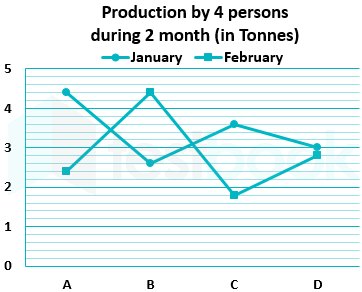
Direction: Study the data carefully and answer the following questions.

Following is the production data by 4 persons during 2 months.

Question 51

Production by A in January in what % more than production by B in January (Approx)?

  1. AOption (a)

    82%

  2. BOption (b)

    76%

  3. COption (c)

    83%

  4. DOption (d)

    90%

  5. EOption (e)

    69%

View answer & explanation

Correct answer

Answer: (e)E.

69%

Why this answer is correct

Given:

Production by A in January = 4.4 tones

Production by B in January = 2.6 tones

Formula used:

Percentage Difference = (Final Value - Initial Value) × 100/Initial Value 

Solution:

Percentage Difference = (4.4 - 2.6) × 100/2.6

⇒ Percentage Difference = 69.23% =  69%(approx.)

∴ Production by A in January is 69%(approx.) more than Production by B in January.

Question 52

Find the average of total production done in February month.

  1. AOption (a)

    2.85

  2. BOption (b)

    2.89

  3. COption (c)

    2.65

  4. DOption (d)

    2.96

  5. EOption (e)

    None of these

View answer & explanation

Correct answer

Answer: (a)A.

2.85

Why this answer is correct

Given:

Production in February by A = 2.4 tones

Production in February by B = 4.4 tones

Production in February by C = 1.8 tones

Production in February by D = 2.8 tones

Formula used:

Average = Sum of all observations/ number of observations 

Solution:

Average = (2.4 + 4.4 + 1.8 + 2.8)/4

⇒ Average = 2.85 tonnes

∴ The required average is 2.85 tonnes

Question 53

Find the ratio between production done by C and D together in January to production done by B and C together in February.

  1. AOption (a)

    37 : 32

  2. BOption (b)

    33: 31

  3. COption (c)

    28 : 29

  4. DOption (d)

    30 : 31

  5. EOption (e)

    None of these

View answer & explanation

Correct answer

Answer: (b)B.

33: 31

Why this answer is correct

Given:

Production by C in January = 3.6 tones

Production by D in January = 3 tones

Production in February by B = 4.4 tones

Production in February by C = 1.8 tones

Solution: 

Ratio of production done by C and D together in January to production done by B and C together in February = (3.6 + 3)/(4.4 + 1.8) 

⇒ Ratio = 6.6/6.2 = 33/31

∴ Ratio between production done by C and D together in January to production done by B and C together in February is 33 : 31.

Question 54

Find the difference between total production done in January to that of February (in Kg).

  1. AOption (a)

    2000 kg

  2. BOption (b)

    2100 kg

  3. COption (c)

    2500 kg

  4. DOption (d)

    2200 kg

  5. EOption (e)

    None of these

View answer & explanation

Correct answer

Answer: (d)D.

2200 kg

Why this answer is correct

From the graph:

Total Production in January = (4.4 + 2.6 + 3.6 + 3) = 13.6 tonnes

Total Production in February = (2.4 + 4.4 + 1.8 + 2.8) = 11.4 tonnes

Difference in Production in January and February = 13.6 - 11.4 = 2.2 tonne = 2.2 × 1000 kg = 2200 kg 

∴ The required answer is 2200 kg

Question 55

Find the total production by A in February month and by C in January month.

  1. AOption (a)

    5 tonnes

  2. BOption (b)

    5.8 tonnes

  3. COption (c)

    6 tonnes

  4. DOption (d)

    4.8 tonnes

  5. EOption (e)

    None of these

View answer & explanation

Correct answer

Answer: (c)C.

6 tonnes

Why this answer is correct

From the Graph 

Production by A in February month = 2.4 tonnes

Production by C in January month = 3.6 tonnes 

Total Production by them in respective months = 2.4 + 3.6 = 6 tonnes 

∴ The required answer is 6 tonnes

Question 56

What will come in the place of the question mark ‘?’ in the following question?

855.8 + 89.2 –  (19 × 12) + (64 ÷ 4) = ?

  1. AOption (a)

    732

  2. BOption (b)

    733

  3. COption (c)

    645

  4. DOption (d)

    644

  5. EOption (e)

    None of these

View answer & explanation

Correct answer

Answer: (b)B.

733

Why this answer is correct

Calculation 

855.8 + 89.2 –  (19 × 12) + (64 ÷ 4) = ?

⇒ 945 - 228 + 16 = ?

⇒ ? = 733 

∴ The correct answer is 733

Question 57

What will come in the place of the question mark ‘?’ in the following question?

16.66% of 96 + 37.5% of 200 – (27 × 2) = ?

  1. AOption (a)

    37

  2. BOption (b)

    40

  3. COption (c)

    51

  4. DOption (d)

    31

  5. EOption (e)

    None of these

View answer & explanation

Correct answer

Answer: (a)A.

37

Why this answer is correct

Calculation 

Using BODMAS Rule 

16.66% of 96 + 37.5% of 200 – (27 × 2) = ?

⇒ 1/6 × 96 + 3/8 × 200 - 54 = ?

⇒ 16 + 75 - 54 = ? 

⇒ ? = 37 

∴ The correct answer is 37

Question 58

What will come in the place of the question mark ‘?’ in the following question?

[(5/7) + (13/21)] × 62 + 50 – 76 = ?

  1. AOption (a)

    21

  2. BOption (b)

    23

  3. COption (c)

    25

  4. DOption (d)

    22

  5. EOption (e)

    None of these

View answer & explanation

Correct answer

Answer: (d)D.

22

Why this answer is correct

Calculation 

[(5/7) + (13/21)] × 62 + 50 – 76 = ?

⇒ [(15 + 13)/21] × 36 + 50 – 76  = ?

⇒ [28/21] × 36 + 50 – 76 = ?

​⇒ [4/3] × 36 + 50 – 76 = ?

⇒ 4 × 12 + 50 – 76= ?

⇒ 48 - 26 = ? 

⇒ ? = 22 

∴ The correct answer is 22

Question 59

What will come in the place of the question mark ‘?’ in the following question?

18.68 + 17.54 – 12.22 + 38.02 = ?

  1. AOption (a)

    54.88

  2. BOption (b)

    37.98

  3. COption (c)

    32.68

  4. DOption (d)

    62.02

  5. EOption (e)

    None of these

View answer & explanation

Correct answer

Answer: (d)D.

62.02

Why this answer is correct

Calculation 

18.68 + 17.54 – 12.22 + 38.02 = ?

⇒ 36.22 - 12.22 + 38.02 = ?

⇒ 24 + 38.02 = ? 

⇒ ? = 62.02 

∴ The correct answer is 62.02

Question 60

What will come in the place of the question mark ‘?’ in the following question?

50 × 42 ÷ 12 + 92 – 60 = ?2

  1. AOption (a)

    18

  2. BOption (b)

    17

  3. COption (c)

    14

  4. DOption (d)

    12

  5. EOption (e)

    None of these

View answer & explanation

Correct answer

Answer: (c)C.

14

Why this answer is correct

Calculation 

Using BODMAS 

50 × 42 ÷ 12 + 92 – 60 = ?2

⇒ 50 × 7 ÷ 2 + 92 – 60 = ?2

⇒ 25 × 7 + 81 - 60 = ?2

⇒ 175 + 21 = ?2

⇒ ? = √196 = 14 

∴ The correct answer is 14

Question 61

By selling 9 pen for a rupee, a shopkeeper incurred a loss of 4%. To make a gain of 44%, the number of pen to be sold for a rupee is

  1. AOption (a)

    3

  2. BOption (b)

    4

  3. COption (c)

    5

  4. DOption (d)

    7

  5. EOption (e)

    6

View answer & explanation

Correct answer

Answer: (e)E.

6

Why this answer is correct

Shortcut Trick

Price and Quantity are inversely proportional when the total expenditure is constant.

Initial Selling Price (at 4% loss) = 100% − 4% = 96%

Desired Selling Price (at 44% gain) = 100% + 44% = 144%

Ratio of Prices = 96 : 144 = 2 : 3

Ratio of Quantities = 3 : 2

Given 3 units = 9 pens, so 1 unit = 3 pens. Therefore, 2 units = 6 pens.

∴ The correct answer is 6.

Alternate Method

Given → Selling Price of 9 pens = Re. 1 | Loss = 4% | Desired Gain = 44%

Formulas: CP = (SP × 100) ÷ (100 − Loss%) | New SP = CP × (100 + Gain%) ÷ 100

⇒ SP of 1 pen = 1/9 rupee.

⇒ CP of 1 pen = (1/9 × 100) ÷ (100 − 4) = (1/9 × 100) ÷ 96 = 100/864 rupee.

⇒ New SP of 1 pen = (100/864) × (144/100) = 144/864 = 1/6 rupee.

⇒ Number of pens sold for 1 rupee = 1 ÷ (1/6) = 6.

∴ The correct answer is 6.

Additional Information

Price-Quantity Relation

When total value is fixed, quantity is inversely proportional to price per unit. If price increases by ratio a:b, quantity decreases by ratio b:a.

Cost Price from Multiple SPs

CP = (SP1 × 100) ÷ (100 ± P/L1) = (SP2 × 100) ÷ (100 ± P/L2). This allows finding a new SP directly from an old one.

Question 62

A man rows down a river 30 km in 6 hrs with the stream and returns in 10 hrs. The rate at which he rows in still water is 

  1. AOption (a)

    3 km/h

  2. BOption (b)

    4 km/h

  3. COption (c)

    5 km/h

  4. DOption (d)

    6 km/h

  5. EOption (e)

    none of these

View answer & explanation

Correct answer

Answer: (b)B.

4 km/h

Why this answer is correct

Shortcut Trick

Downstream speed (D) = 30 ÷ 6 = 5 km/h

Upstream speed (U) = 30 ÷ 10 = 3 km/h

Speed in still water = (D + U) ÷ 2 = (5 + 3) ÷ 2 = 4 km/h

∴ The correct answer is 4 km/h.

Alternate Method

Given:

Distance (d) = 30 km

Time downstream (t1) = 6 hrs

Time upstream (t2) = 10 hrs

Formula Used:

Speed = Distance ÷ Time

Speed in still water (u) = (Downstream Speed + Upstream Speed) ÷ 2

Calculations:

⇒ Downstream speed (x + y) = 30 ÷ 6 = 5 km/h

⇒ Upstream speed (x − y) = 30 ÷ 10 = 3 km/h

⇒ Adding both equations: 2x = 5 + 3

⇒ 2x = 8

⇒ x = 4 km/h

∴ The correct answer is 4 km/h.

Additional Information

Speed of Stream

The speed of the current/stream (y) is calculated as: y = (Downstream Speed − Upstream Speed) ÷ 2.

Relative Speed in Water

Downstream speed = Speed in still water + Speed of stream. Upstream speed = Speed in still water − Speed of stream.

Average Speed for Round Trip

Average Speed = (Downstream Speed × Upstream Speed) ÷ Speed in still water.

Question 63

A train 290 m long is running at a speed of 36 km per hour, then it will cross a bridge of length 180 m in 

  1. AOption (a)

    37 s

  2. BOption (b)

    40 s

  3. COption (c)

    45 s

  4. DOption (d)

    47 s

  5. EOption (e)

    none of these

View answer & explanation

Correct answer

Answer: (d)D.

47 s

Why this answer is correct

Shortcut Trick

Convert speed: 36 kmph = 36 × (5/18) = 10 m/s.

Total distance = 290 m + 180 m = 470 m.

Time = Distance ÷ Speed = 470 ÷ 10 = 47 s.

∴ The correct answer is 47 s.

Alternate Method

Given:

Length of train (L1) = 290 m

Length of bridge (L2) = 180 m

Speed of train (v) = 36 km/h

Formula Used:

Speed = Distance ÷ Time

Time = (L1 + L2) ÷ Speed

Calculations:

⇒ Speed in m/s = 36 × (5/18)

⇒ Speed = 10 m/s

⇒ Total Distance = 290 + 180 = 470 m

⇒ Time taken = 470 ÷ 10

⇒ Time taken = 47 s

∴ The correct answer is 47 s.

Additional Information

Unit Conversion

To convert km/h to m/s, multiply by 5/18. To convert m/s to km/h, multiply by 18/5.

Crossing Stationary Objects

When a train crosses a bridge, tunnel, or platform, the total distance covered is the sum of the length of the train and the object.

Relative Speed

In the same direction, relative speed is the difference (S1 − S2); in the opposite direction, it is the sum (S1 + S2).

Question 64

30 men take 25 days to dig a pond. If the pond would have been dug in 15 days, then what is the number of men to be employed?

  1. AOption (a)

    45

  2. BOption (b)

    60

  3. COption (c)

    50

  4. DOption (d)

    57

  5. EOption (e)

    none of these

View answer & explanation

Correct answer

Answer: (c)C.

50

Why this answer is correct

Shortcut Trick

Apply the Chain Rule formula: M1D1 = M2D2

30 men × 25 days = M2 men × 15 days

⇒ M2 = (30 × 25) ÷ 15 = 2 × 25 = 50 men

∴ The correct answer is 50 men.

Alternate Method

Given:

Initial men (M1) = 30

Initial days (D1) = 25

Required days (D2) = 15

Formula Used:

Total Work = Men × Days

PersonDaysTotal WorkEfficiency
Initial Group25750 units30 units/day
New Group1550 units/day

Calculations:

⇒ Total work to dig the pond = 30 × 25 = 750 units

⇒ Number of men required to finish 750 units in 15 days = Total Work ÷ Days

⇒ Required men = 750 ÷ 15

⇒ Required men = 50

∴ The correct answer is 50 men.

Additional Information

Work and Men Relationship

Men and days are inversely proportional. If work is constant, M1 ÷ M2 = D2 ÷ D1.

General Man-Day Formula

For varying work, use (M1 × D1 × H1) ÷ W1 = (M2 × D2 × H2) ÷ W2, where H is hours and W is work.

Question 65

The monthly salaries of A and B together amount to Rs. 40000. A spends 85% of his salary and B spends 95% of his salary. If now their savings are the same, then the salary of A is 

  1. AOption (a)

    Rs. 10,000

  2. BOption (b)

    Rs. 12000

  3. COption (c)

    Rs. 16000

  4. DOption (d)

    Rs. 18000

  5. EOption (e)

    none of these 

View answer & explanation

Correct answer

Answer: (a)A.

Rs. 10,000

Why this answer is correct

Shortcut Trick

Savings of A = 100% − 85% = 15% of salary A.

Savings of B = 100% − 95% = 5% of salary B.

Since Savings are equal: 15% of A = 5% of B ⇒ 3A = 1B ⇒ A : B = 1 : 3.

Total Ratio parts = 1 + 3 = 4 units → ₹40000. So, 1 unit = ₹10000.

∴ The correct answer is ₹10,000.

Alternate Method

Given: Total salary = ₹40,000. Expenditure of A = 85%, Expenditure of B = 95%. Savings are equal.

⇒ Savings of A = (100 − 85)% of A = 15% of A

⇒ Savings of B = (100 − 95)% of B = 5% of B

⇒ 15% × A = 5% × B

⇒ A / B = 5 / 15 = 1 / 3

⇒ Sum of ratios = 1 + 3 = 4

⇒ Salary of A = (1 / 4) × 40000

⇒ Salary of A = ₹10,000

∴ The correct answer is ₹10,000.

Additional Information

Income Expenditure Formula

Income = Expenditure + Savings. This basic identity is used to calculate missing components when percentages are given.

Ratio of Salaries

If savings are equal, the ratio of salaries is inversely proportional to the savings percentage: Salary1 × Savings%1 = Salary2 × Savings%2.

Percentage to Fraction Conversion

To simplify calculations, convert percentages to fractions: 5% = 1/20, 15% = 3/20.

Reasoning Ability (35 questions)

Direction: Read the following information carefully and answer the question that follows:

Eight persons - A, B, C, D, E, F, G  and H were born in different months of January to August of the same year but not necessarily in the same order. Not more than one person is born in a month. G was born in a month that has 31 days but not in the month of May. There is a gap of one month between G and A. A born somewhere after G. B was born in the month which has the least number of days.  E was born immediately after C. Number of persons born before E is one more than the number of person born after E. F born before D. There is a gap of two months between A and H.

Question 66

How many persons born before C?

  1. AOption (a)

    One

  2. BOption (b)

    Two

  3. COption (c)

    Three

  4. DOption (d)

    Four

  5. EOption (e)

    No one

View answer & explanation

Correct answer

Answer: (c)C.

Three

Why this answer is correct

Eight persons - A, B, C, D, E, F, G  and H 

Months - January to August 

1) G was born in a month that has 31 days but not in the month of May. 

2) There is a gap of one month between G and A.

  1. A born somewhere after G.

  2. B was born in the month which has the least number of days.

Case 1:Case 2:
MonthPersonPerson
January (31 days)G
February (28/29 days)BB
March (31 days)AG
April (30 days)
May (31 days)A
June (30 days)
July (31 days)
August (31 days)


  1. There is a gap of two months between A and H.

  2. E was born immediately after C.

  3. Number of persons born before E is one more than the number of person born after E.

(This will eliminate Case 2)

Case 1:
MonthPerson
January (31 days)G
February (28/29 days)B
March (31 days)A
April (30 days)C
May (31 days)E
June (30 days)H
July (31 days)
August (31 days)


  1. F born before D.
Case 1:
MonthPerson
January (31 days)G
February (28/29 days)B
March (31 days)A
April (30 days)C
May (31 days)E
June (30 days)H
July (31 days)F
August (31 days)D


Hence, three persons were born before C.

Question 67

Who born in the month of January?

  1. AOption (a)

    A

  2. BOption (b)

    B

  3. COption (c)

    G

  4. DOption (d)

    D

  5. EOption (e)

    F

View answer & explanation

Correct answer

Answer: (c)C.

G

Why this answer is correct

Eight persons - A, B, C, D, E, F, G  and H 

Months - January to August 

1) G was born in a month that has 31 days but not in the month of May. 

2) There is a gap of one month between G and A.

  1. A born somewhere after G.

  2. B was born in the month which has the least number of days.

Case 1:Case 2:
MonthPersonPerson
January (31 days)G
February (28/29 days)BB
March (31 days)AG
April (30 days)
May (31 days)A
June (30 days)
July (31 days)
August (31 days)


  1. There is a gap of two months between A and H.

  2. E was born immediately after C.

  3. Number of persons born before E is one more than the number of person born after E.

(This will eliminate Case 2)

Case 1:
MonthPerson
January (31 days)G
February (28/29 days)B
March (31 days)A
April (30 days)C
May (31 days)E
June (30 days)H
July (31 days)
August (31 days)


  1. F born before D.
Case 1:
MonthPerson
January (31 days)G
February (28/29 days)B
March (31 days)A
April (30 days)C
May (31 days)E
June (30 days)H
July (31 days)F
August (31 days)D


Hence, G was born in the month of January.

Question 68

Which of the following persons born in the month which has 30 days?

  1. AOption (a)

    A, G

  2. BOption (b)

    C, G

  3. COption (c)

    H, D

  4. DOption (d)

    C, H

  5. EOption (e)

    H, B

View answer & explanation

Correct answer

Answer: (d)D.

C, H

Why this answer is correct

Eight persons - A, B, C, D, E, F, G  and H 

Months - January to August 

1) G was born in a month that has 31 days but not in the month of May. 

2) There is a gap of one month between G and A.

  1. A born somewhere after G.

  2. B was born in the month which has the least number of days.

Case 1:Case 2:
MonthPersonPerson
January (31 days)G
February (28/29 days)BB
March (31 days)AG
April (30 days)
May (31 days)A
June (30 days)
July (31 days)
August (31 days)


  1. There is a gap of two months between A and H.

  2. E was born immediately after C.

  3. Number of persons born before E is one more than the number of person born after E.

(This will eliminate Case 2)

Case 1:
MonthPerson
January (31 days)G
February (28/29 days)B
March (31 days)A
April (30 days)C
May (31 days)E
June (30 days)H
July (31 days)
August (31 days)


  1. F born before D.
Case 1:
MonthPerson
January (31 days)G
February (28/29 days)B
March (31 days)A
April (30 days)C
May (31 days)E
June (30 days)H
July (31 days)F
August (31 days)D


Hence, C and H were born in the month which has 30 days.

Question 69

Who born immediately after F?

  1. AOption (a)

    A

  2. BOption (b)

    G

  3. COption (c)

    C

  4. DOption (d)

    D

  5. EOption (e)

    H

View answer & explanation

Correct answer

Answer: (d)D.

D

Why this answer is correct

Eight persons - A, B, C, D, E, F, G  and H 

Months - January to August 

1) G was born in a month that has 31 days but not in the month of May. 

2) There is a gap of one month between G and A.

  1. A born somewhere after G.

  2. B was born in the month which has the least number of days.

Case 1:Case 2:
MonthPersonPerson
January (31 days)G
February (28/29 days)BB
March (31 days)AG
April (30 days)
May (31 days)A
June (30 days)
July (31 days)
August (31 days)


  1. There is a gap of two months between A and H.

  2. E was born immediately after C.

  3. Number of persons born before E is one more than the number of person born after E.

(This will eliminate Case 2)

Case 1:
MonthPerson
January (31 days)G
February (28/29 days)B
March (31 days)A
April (30 days)C
May (31 days)E
June (30 days)H
July (31 days)
August (31 days)


  1. F born before D.
Case 1:
MonthPerson
January (31 days)G
February (28/29 days)B
March (31 days)A
April (30 days)C
May (31 days)E
June (30 days)H
July (31 days)F
August (31 days)D


Hence, D was immediately after F..

Question 70

Which of the following statement is true?

  1. AOption (a)

    G was born in the month of March.

  2. BOption (b)

    There are two persons between A and E.

  3. COption (c)

    E was born immediately before H. 

  4. DOption (d)

    H was born in the month of July.

  5. EOption (e)

    None is correct.

View answer & explanation

Correct answer

Answer: (c)C.

E was born immediately before H. 

Why this answer is correct

Eight persons - A, B, C, D, E, F, G  and H 

Months - January to August 

1) G was born in a month that has 31 days but not in the month of May. 

2) There is a gap of one month between G and A.

  1. A born somewhere after G.

  2. B was born in the month which has the least number of days.

Case 1:Case 2:
MonthPersonPerson
January (31 days)G
February (28/29 days)BB
March (31 days)AG
April (30 days)
May (31 days)A
June (30 days)
July (31 days)
August (31 days)


  1. There is a gap of two months between A and H.

  2. E was born immediately after C.

  3. Number of persons born before E is one more than the number of person born after E.

(This will eliminate Case 2)

Case 1:
MonthPerson
January (31 days)G
February (28/29 days)B
March (31 days)A
April (30 days)C
May (31 days)E
June (30 days)H
July (31 days)
August (31 days)


  1. F born before D.
Case 1:
MonthPerson
January (31 days)G
February (28/29 days)B
March (31 days)A
April (30 days)C
May (31 days)E
June (30 days)H
July (31 days)F
August (31 days)D


Let's check each option:

1) G was born in the month of March. → False

2) There are two persons between A and E. → False

3) E was born immediately before H. → True

4) H was born in the month of July. → False

Hence, E was born immediately before H is true.

Question 71

Direction: In the question below are given three statements followed by two conclusions numbered I and II. You have to take the given statements to be true even if they seem to be at variance with commonly known facts. Read all the conclusions and then decide which of the given conclusions logically follows from the given statements disregarding commonly known facts.

Statements:

Some apples are orange.

No oranges are fruit.

Only a few fruits are bananas.

Conclusions:

I. Some apples are fruit.

II. Some fruits are bananas.

  1. AOption (a)

    Only 1 follows

  2. BOption (b)

    Only 2 follows

  3. COption (c)

    Either 1 or 2 follows

  4. DOption (d)

    Both 1 and 2 follows

  5. EOption (e)

    None follows

View answer & explanation

Correct answer

Answer: (b)B.

Only 2 follows

Why this answer is correct

The least possible Venn diagram for the given statements is:

Conclusions:

I. Some apples are fruit. → False ( As there is no definite relation between apples and fruit. Therefore this is possible but not definite)

II. Some fruits are bananas. → True (As it is given "Only a few fruits are bananas" therefore some fruits are bananas is true)

Hence, only 2 follows is the correct answer.

Question 72

Direction: In the question below are given three statements followed by two conclusions numbered I and II. You have to take the given statements to be true even if they seem to be at variance with commonly known facts. Read all the conclusions and then decide which of the given conclusions logically follows from the given statements disregarding commonly known facts.

Statements:

Some red are blue.

No red are black.

All black are pink.

Conclusions:

I. Some pink are black.

II. Some red are pink.

  1. AOption (a)

    Only 1 follows

  2. BOption (b)

    Only 2 follows

  3. COption (c)

    Both 1 and 2 follows

  4. DOption (d)

    Either 1 or 2 follows

  5. EOption (e)

    Neither 1 nor 2 follows.

View answer & explanation

Correct answer

Answer: (a)A.

Only 1 follows

Why this answer is correct

The least possible Venn diagram is as follows:

Conclusions:

I. Some pink are black. → True (As it is given  all black are pink this imply that some pink are black.)

II. Some red are pink. → False (As there is no definite relation between red and pink. Therefore this is possible but not definite).

Hence, only 1 follows.

Question 73

Direction: In the question below are given three statements followed by two conclusions numbered I and II. You have to take the given statements to be true even if they seem to be at variance with commonly known facts. Read all the conclusions and then decide which of the given conclusions logically follows from the given statements disregarding commonly known facts.

Statements:

No dogs are cats.

Only a few cats are wild.

All wild are animal.

Conclusions:

I. All cats are animal.

II. Some cats are not animal.

  1. AOption (a)

    Only 1 follows

  2. BOption (b)

    Only 2 follows.

  3. COption (c)

    Both 1 and 2 follows.

  4. DOption (d)

    Either 1 or 2 follows.

  5. EOption (e)

    Neither 1 nor 2 follows.

View answer & explanation

Correct answer

Answer: (d)D.

Either 1 or 2 follows.

Why this answer is correct

The least possible Venn diagram for the given statements is:

Conclusions:

I. All cats are animal. → False (No specific information given about cats and animals, hence, it is possible but not definite.)

II. Some cats  are not animal. → False ( No specific information given about cats and animals, hence, it is possible but not definite.)

Both of the above conclusions are following the conditions of 'either -or' pair.

Hence, either I or II follows.

Additional Information

 Conditions of Either-or case:

  1. The elements should be the same in both the statements.
  2. Both the conclusions should be false individually.
  3. One conclusion should be positive and one conclusion should be negative (Complementary pair)

The two complementary pairs are:

  1. All + Some not

  2. No + Some

Note: Some + Some not is not  considered under Either -or case.

Question 74

Directions: In the question below are given three statements followed by two conclusions. You have to take the given statements to be true even if they seem to be at variance with commonly known facts. Read all the conclusions and then decide which of the given conclusions logically follows from the given statements disregarding commonly known facts.

Statements:

I. Some chairs are tables

II. Only a few tables are bed

III. No bed is furniture

Conclusions:

I. Some chairs are bed

II. Some furniture are tables

  1. AOption (a)

    Only conclusion I follows

  2. BOption (b)

    Only conclusion II follows

  3. COption (c)

    Both conclusion I and II follows

  4. DOption (d)

    Either conclusion I or II follows

  5. EOption (e)

    Neither conclusion I nor II follows

View answer & explanation

Correct answer

Answer: (e)E.

Neither conclusion I nor II follows

Why this answer is correct

The least possible venn diagram for the given statements is

Conclusions:

I. Some chairs are bed → False (No definite positive or negative relation is given between the elements, so it is possible but not definite, therefore it is false)

II. Some furniture are tables → False (No definite positive or negative relation is given between the elements, so it is possible but not definite, therefore it is false)

Hence, Neither conclusion I nor II follows.

Question 75

Directions

In the question below are given three statements followed by two conclusions. You have to take the given statements to be true even if they seem to be at variance with commonly known facts. Read all the conclusions and then decide which of the given conclusions logically follows from the given statements disregarding commonly known facts.

Statements:

I. Some mobiles are calculators

II. Some calculators are pens

III. Only a few pens are scales

Conclusions:

I. Some mobiles being pens is a possibility

II. Some pens are not scales

  1. AOption (a)

    Only conclusion I follows

  2. BOption (b)

    Only conclusion II follows

  3. COption (c)

    Either conclusion I or II follows

  4. DOption (d)

    Neither conclusion I nor II follows

  5. EOption (e)

    Both conclusion I and II follows

View answer & explanation

Correct answer

Answer: (e)E.

Both conclusion I and II follows

Why this answer is correct

The least possible venn diagram for the given statements is

Conclusions:

I. Some mobiles being pens is a possibility → True (As no definite or negative relation is given between the elements, therefore it is possible)

II. Some pens are not scales → True (As the relation of “only a few” is given between the elements, which implies that “some” and “some not” both are true)

Hence, Both conclusion I and II follows.

Eight persons - A, B, C, D, E, F, G and H live in a building of 4 floors and 2 flats - Flat 1 and Flat 2. Flat 1 is to the west of Flat 2 and Flat 1 of Floor 1 is immediately below Flat 1 of Floor 2 and Flat 2 of Floor 1 is immediately below Flat 2 of Floor 2 and so on. There are two floors between B and C. B lives above C and they live in different flats. A lives west of D but on the odd number of floor. F lives immediately above C in same flat. No person lives west of G who lives on the fourth floor. H does not live on floor number one.

Question 76

Who lives just East of F ?

  1. AOption (a)

    A

  2. BOption (b)

    C

  3. COption (c)

    D

  4. DOption (d)

    H

  5. EOption (e)

    B

View answer & explanation

Correct answer

Answer: (d)D.

H

Why this answer is correct

Eight persons - A, B, C, D, E, F, G and H

Floor - 1 to 4, Flat - 1 and 2

  1. There are two floor between B and C. B lives above C in the different flats. So here two possibilities for this.
Case - ICase - II
FloorFlat -1Flat -2Flat - 1Flat - 2
4BB
3
2
1CC


2) A lives just west of D but on the odd number of floors. So, here remaining odd number floor is number 3. F lives just above C

Case - ICase - II
FloorFlat -1Flat -2Flat - 1Flat - 2
4BB
3ADAD
2FF
1CC


  1. No person lives west of G who lives on fourth floor.

In Case - II B lives on flat - 1 so G lives between flat - 2, So here B lives west of G. It contradict the given condition no person lives west of G so here Case - II gets cancelled. 

Case - I
FloorFlat -1Flat -2
4GB
3AD
2F
1C


  1. H does not live on floor number one. So H will live on floor number 2. There is only one place remaining for the E, on floor number 1.
Case - I
FloorFlat -1Flat -2
4GB
3AD
2FH
1CE


Hence, H lives just east of F.

Question 77

On which Floor B lives?

  1. AOption (a)

    First

  2. BOption (b)

    Second

  3. COption (c)

    Third

  4. DOption (d)

    Fourth

  5. EOption (e)

    None

View answer & explanation

Correct answer

Answer: (d)D.

Fourth

Why this answer is correct

Eight persons - A, B, C, D, E, F, G and H

Floor - 1 to 4, Flat - 1 and 2

  1. There are two floor between B and C. B lives above C. So here two possibilities for this.
Case - ICase - II
FloorFlat -1Flat -2Flat - 1Flat - 2
4BB
3
2
1CC


2) A lives just west of D but on odd number of floor. So, here remaining odd number floor is number 3. F lives just above C

Case - ICase - II
FloorFlat -1Flat -2Flat - 1Flat - 2
4BB
3ADAD
2FF
1CC


  1. No person lives west of G who lives on fourth floor.

In Case - II B lives on flat - 1 so G lives between flat - 2, So here B lives west of G. It contradict the given condition no person lives west of G so here Case - II gets cancelled. 

Case - I
FloorFlat -1Flat -2
4GB
3AD
2F
1C


  1. H does not live on floor number one. So H will live on floor number 2. There is only one place remaining for the E, on floor number 1.
Case - I
FloorFlat -1Flat -2
4GB
3AD
2FH
1CE


Hence, B lives on Fourth Floor.

Question 78

Who lives just below H ?

  1. AOption (a)

    A

  2. BOption (b)

    B

  3. COption (c)

    C

  4. DOption (d)

    D

  5. EOption (e)

    E

View answer & explanation

Correct answer

Answer: (e)E.

E

Why this answer is correct

Eight persons - A, B, C, D, E, F, G and H

Floor - 1 to 4, Flat - 1 and 2

  1. There are two floor between B and C. B lives above C. So here two possibilities for this.
Case - ICase - II
FloorFlat -1Flat -2Flat - 1Flat - 2
4BB
3
2
1CC


2) A lives just west of D but on odd number of floor. So, here remaining odd number floor is number 3. F lives just above C

Case - ICase - II
FloorFlat -1Flat -2Flat - 1Flat - 2
4BB
3ADAD
2FF
1CC


  1. No person lives west of G who lives on fourth floor.

In Case - II B lives on flat - 1 so G lives between flat - 2, So here B lives west of G. It contradict the given condition no person lives west of G so here Case - II gets cancelled. 

Case - I
FloorFlat -1Flat -2
4GB
3AD
2F
1C


  1. H does not live on floor number one. So H will live on floor number 2. There is only one place remaining for the E, on floor number 1.
Case - I
FloorFlat -1Flat -2
4GB
3AD
2FH
1CE


Hence, E lives just below H.

Question 79

Which of the following pair is correct ? 

  1. AOption (a)

    Floor - 2 Flat - 1 - H

  2. BOption (b)

    Floor - 3 Flat - 2 - D

  3. COption (c)

    Floor - 4 Flat - 2 - G

  4. DOption (d)

    Floor - 1 Flat - 2 - C

  5. EOption (e)

    Floor - 3 Flat - 1 - F

View answer & explanation

Correct answer

Answer: (b)B.

Floor - 3 Flat - 2 - D

Why this answer is correct

Eight persons - A, B, C, D, E, F, G and H

Floor - 1 to 4, Flat - 1 and 2

  1. There are two floor between B and C. B lives above C. So here two possibilities for this.
Case - ICase - II
FloorFlat -1Flat -2Flat - 1Flat - 2
4BB
3
2
1CC


2) A lives just west of D but on odd number of floor. So, here remaining odd number floor is number 3. F lives just above C

Case - ICase - II
FloorFlat -1Flat -2Flat - 1Flat - 2
4BB
3ADAD
2FF
1CC


  1. No person lives west of G who lives on fourth floor.

In Case - II B lives on flat - 1 so G lives between flat - 2, So here B lives west of G. It contradict the given condition no person lives west of G so here Case - II gets cancelled. 

Case - I
FloorFlat -1Flat -2
4GB
3AD
2F
1C


  1. H does not live on floor number one. So H will live on floor number 2. There is only one place remaining for the E, on floor number 1.
Case - I
FloorFlat -1Flat -2
4GB
3AD
2FH
1CE


Hence, Floor - 3 Flat - 2 - D is correct pair.

Question 80

Which Floor Flat Combination is correct for E ?

  1. AOption (a)

    Floor 1 Flat 2

  2. BOption (b)

    Floor 2 Flat 1

  3. COption (c)

    Floor 3 Flat 2

  4. DOption (d)

    Floor 4 Flat 1

  5. EOption (e)

    Floor 2 Flat 2

View answer & explanation

Correct answer

Answer: (a)A.

Floor 1 Flat 2

Why this answer is correct

Eight persons - A, B, C, D, E, F, G and H

Floor - 1 to 4, Flat - 1 and 2

  1. There are two floor between B and C. B lives above C. So here two possibilities for this.
Case - ICase - II
FloorFlat -1Flat -2Flat - 1Flat - 2
4BB
3
2
1CC


2) A lives just west of D but on odd number of floor. So, here remaining odd number floor is number 3. F lives just above C

Case - ICase - II
FloorFlat -1Flat -2Flat - 1Flat - 2
4BB
3ADAD
2FF
1CC


  1. No person lives west of G who lives on fourth floor.

In Case - II B lives on flat - 1 so G lives between flat - 2, So here B lives west of G. It contradict the given condition no person lives west of G so here Case - II gets cancelled. 

Case - I
FloorFlat -1Flat -2
4GB
3AD
2F
1C


  1. H does not live on floor number one. So H will live on floor number 2. There is only one place remaining for the E, on floor number 1.
Case - I
FloorFlat -1Flat -2
4GB
3AD
2FH
1CE


Hence, Floor - 1 Flat - 2 is correct combination.

Direction: The following questions are based on the given five words. Study the given information carefully and answer the following questions.

YXZ  BAC  JFG  ROP GON

Question 81

If each consonant is changed to the previous letter of the given words and vowel remains the same, then how many words have more than one vowel?

  1. AOption (a)

    One

  2. BOption (b)

    Two

  3. COption (c)

    Three

  4. DOption (d)

    Four

  5. EOption (e)

    Five

View answer & explanation

Correct answer

Answer: (c)C.

Three

Why this answer is correct

Give Series: YXZ  BAC  JFG  ROP GON

When Changed to previous letter: XWY  AAB  IEF  QOO  FOM

Words having more than one vowel:  AAB  IEF  QOO

Hence, Three words have more than one vowel.

Question 82

How many letters are in the alphabet series between third letter of the second word from left and second letter of the second word from the right end ? 

  1. AOption (a)

    Eight

  2. BOption (b)

    Nine

  3. COption (c)

    Ten

  4. DOption (d)

    Eleven

  5. EOption (e)

    Twelve

View answer & explanation

Correct answer

Answer: (d)D.

Eleven

Why this answer is correct

Give Series: YXZ  BAC  JFG  ROP GON

Second word form left end - BAC, Third letter - C 

Second word from right end - ROP, Second letter - O

 Hence, There are Eleven letters between C and O.

Question 83

If first and second letter of the each word is interchange then how many words starts with a vowel ?

  1. AOption (a)

    One

  2. BOption (b)

    Two

  3. COption (c)

    Three

  4. DOption (d)

    Four

  5. EOption (e)

    Five

View answer & explanation

Correct answer

Answer: (c)C.

Three

Why this answer is correct

Give Series: YXZ  BAC  JFG  ROP GON

After interchanging the first and second letter of words:  XYZ  ABC  FJG  ORP  OGN 

Here words start with the vowel: ABC  ORP  OGN

Hence, Three words start with vowel.

Question 84

If all the given letters are arranged in the alphabetical order from left to right within the words, then which one will be fourth from left end ?

  1. AOption (a)

    YXZ

  2. BOption (b)

    BAC

  3. COption (c)

    JFG

  4. DOption (d)

    ROP

  5. EOption (e)

    GON

View answer & explanation

Correct answer

Answer: (d)D.

ROP

Why this answer is correct

Give Series: YXZ  BAC  JFG  ROP GON

Arrange in alphabetical order: XYZ  ABC  FGJ  OPR  GNO 

Here the fourth word From the left end is OPR, which forms from the word ROP.

Hence, the answer is ROP.

Question 85

If 'E' is added in the last of the each word then how many meaningful word will form (not starting from B)?

  1. AOption (a)

    One

  2. BOption (b)

    Three

  3. COption (c)

     Two

  4. DOption (d)

    Four

  5. EOption (e)

    Five

View answer & explanation

Correct answer

Answer: (c)C.

 Two

Why this answer is correct

Give Series: YXZ  BAC  JFG  ROP GON

When we add 'E' in the last of each word: YXZE  BACE  JFGE  ROPE GONE

Here meaningful words are ROPE and GONE

Hence, two meaningful words will form.

Direction: Study the following information carefully and answer the given questions.

In a certain code language:

'he is very fast' is coded as 'pa za kt pu

'this is computer' is coded as 'fp pu qs'

'machine is fast' is coded as 'pu kt tq'

'I like computer' is coded as 'fp sp el'

Question 86

What would be the code of 'computer' ?

  1. AOption (a)

    el

  2. BOption (b)

    pu

  3. COption (c)

    fp

  4. DOption (d)

    kt

  5. EOption (e)

    za

View answer & explanation

Correct answer

Answer: (c)C.

fp

Why this answer is correct

The codes are as follows:

Hence, the code for 'computer' is 'fp'.

Question 87

What is the code of 'machine'?

  1. AOption (a)

    tq

  2. BOption (b)

    kt

  3. COption (c)

    pa

  4. DOption (d)

    pu

  5. EOption (e)

    Can not be determined.

View answer & explanation

Correct answer

Answer: (a)A.

tq

Why this answer is correct

The codes are as follows:

Hence, the code for 'machine' is 'tq'.

Question 88

What is the code of 'he'?

  1. AOption (a)

    pa

  2. BOption (b)

    za

  3. COption (c)

    Either 1 or 2

  4. DOption (d)

    kt

  5. EOption (e)

    pu

View answer & explanation

Correct answer

Answer: (c)C.

Either 1 or 2

Why this answer is correct

The codes are as follows:

The code of 'he' can be 'pa' or 'za'

Hence, either 1 or 2 is the correct answer.

Direction: Read the following information carefully and answer the question that follows:

Twelve persons are sitting in two parallel rows containing six person each in such a way that there is an equal distance between adjacent persons. In row-1 P, Q, R, S, T and U are seated and all of them are facing South. In row-2 A, B, C, D, E and F are seated and all of them are facing North. Therefore, in the given seating arrangement each member seated in a row faces another member in the other row.

Q sits at one of the end of the row. One person sits between P and Q. R sits opposite to D. A sits immediately right of D. Three persons sit between S and T and S does not sit at any end of the line. U is not an immediate neighbour of T. E sits opposite to S. C sits second to the right of B. Either B or C sits at end of the row. P does not face B and T does not face C. F sits second to the right of E.

Question 89

Who sits at end of the row?

  1. AOption (a)

    P

  2. BOption (b)

    C

  3. COption (c)

    A

  4. DOption (d)

    U

  5. EOption (e)

    R

View answer & explanation

Correct answer

Answer: (c)C.

A

Why this answer is correct

Twelve persons are sitting in two parallel rows containing six person each.

In row-1 : P, Q, R, S, T and U

In row-2 : A, B, C, D, E and F

  1. Q sits at one of the end of the row.

  2. One person sits between P and Q.

The possible arrangement is as follows:

  1. Three persons sit between S and T and S does not sit at any end of the line.

  2. E sits opposite to S.

5) U is not an immediate neighbour of T.

  1. C sits second to the right of B.

  2. Either B or C sits at end of the row.

  3. P does not face B and T does not face C.

  4. R sits opposite D.

  5. A sits immediate right of D.

  6. F sits second to the right of E.

(This will eliminate Case 2)

Hence, A sits at end of the row.

Question 90

Who sits second to the right of U?

  1. AOption (a)

    Q

  2. BOption (b)

    S

  3. COption (c)

    P

  4. DOption (d)

    T

  5. EOption (e)

    R

View answer & explanation

Correct answer

Answer: (b)B.

S

Why this answer is correct

Twelve persons are sitting in two parallel rows containing six person each.

In row-1 : P, Q, R, S, T and U

In row-2 : A, B, C, D, E and F

  1. Q sits at one of the end of the row.

  2. One person sits between P and Q.

The possible arrangement is as follows:

  1. Three persons sit between S and T and S does not sit at any end of the line.

  2. E sits opposite to S.

5) U is not an immediate neighbour of T.

  1. C sits second to the right of B.

  2. Either B or C sits at end of the row.

  3. P does not face B and T does not face C.

  4. R sits opposite D.

  5. A sits immediate right of D.

  6. F sits second to the right of E.

(This will eliminate Case 2)

Hence, S sits second to the right of U.

Question 91

Four of the five are alike in certain way and form a group. Find the one which does not belong to the group?

  1. AOption (a)

    Q, B

  2. BOption (b)

    P, C

  3. COption (c)

    U, F

  4. DOption (d)

    T, A

  5. EOption (e)

    P, F

View answer & explanation

Correct answer

Answer: (e)E.

P, F

Why this answer is correct

Twelve persons are sitting in two parallel rows containing six person each.

In row-1 : P, Q, R, S, T and U

In row-2 : A, B, C, D, E and F

  1. Q sits at one of the end of the row.

  2. One person sits between P and Q.

The possible arrangement is as follows:

  1. Three persons sit between S and T and S does not sit at any end of the line.

  2. E sits opposite to S.

5) U is not an immediate neighbour of T.

  1. C sits second to the right of B.

  2. Either B or C sits at end of the row.

  3. P does not face B and T does not face C.

  4. R sits opposite D.

  5. A sits immediate right of D.

  6. F sits second to the right of E.

(This will eliminate Case 2)

All the persons except (P, F) are sitting opposite each other.

Hence, P, F  does not belong to the group.

Question 92

Who sits immediate right of the person who faces D?

  1. AOption (a)

    Q

  2. BOption (b)

    U

  3. COption (c)

    P

  4. DOption (d)

    T

  5. EOption (e)

    S

View answer & explanation

Correct answer

Answer: (b)B.

U

Why this answer is correct

Twelve persons are sitting in two parallel rows containing six person each.

In row-1 : P, Q, R, S, T and U

In row-2 : A, B, C, D, E and F

  1. Q sits at one of the end of the row.

  2. One person sits between P and Q.

The possible arrangement is as follows:

  1. Three persons sit between S and T and S does not sit at any end of the line.

  2. E sits opposite to S.

5) U is not an immediate neighbour of T.

  1. C sits second to the right of B.

  2. Either B or C sits at end of the row.

  3. P does not face B and T does not face C.

  4. R sits opposite D.

  5. A sits immediate right of D.

  6. F sits second to the right of E.

(This will eliminate Case 2)

R faces D and immediate right of R is U.

Hence, U is the correct answer.

Question 93

Which of the following pairs sit at end of the rows?

  1. AOption (a)

    Q - A

  2. BOption (b)

    T - C

  3. COption (c)

    A - P

  4. DOption (d)

    Q - R

  5. EOption (e)

    None of these 

View answer & explanation

Correct answer

Answer: (a)A.

Q - A

Why this answer is correct

Twelve persons are sitting in two parallel rows containing six person each.

In row-1 : P, Q, R, S, T and U

In row-2 : A, B, C, D, E and F

  1. Q sits at one of the end of the row.

  2. One person sits between P and Q.

The possible arrangement is as follows:

  1. Three persons sit between S and T and S does not sit at any end of the line.

  2. E sits opposite to S.

5) U is not an immediate neighbour of T.

  1. C sits second to the right of B.

  2. Either B or C sits at end of the row.

  3. P does not face B and T does not face C.

  4. R sits opposite D.

  5. A sits immediate right of D.

  6. F sits second to the right of E.

(This will eliminate Case 2)

Hence, Q - A sits at end of the row.

Question 94

In a certain code language "all means some" is coded as "578" and "few means some" is coded as "358" and "all means not" is codes as "874". What is the code of "all"?

  1. AOption (a)

    5

  2. BOption (b)

    8

  3. COption (c)

    3

  4. DOption (d)

    7

  5. EOption (e)

    4

View answer & explanation

Correct answer

Answer: (d)D.

7

Why this answer is correct

The code is as follows:

Hence, the code for "all" is "7".

Direction: Read the following information carefully and answer the question that follow:

There are 6 members of a family in a gathering – P, Q, R, S, T and U.

S is the son of Q. Q is the daughter of R. P is the daughter of T. P and Q are siblings. U is the father of S.

Question 95

How is S related to T?

  1. AOption (a)

    Son

  2. BOption (b)

    Grandson

  3. COption (c)

    Grand daughter

  4. DOption (d)

    Grand father

  5. EOption (e)

    Can not be determined

View answer & explanation

Correct answer

Answer: (b)B.

Grandson

Why this answer is correct

1) S is the son of Q.

  1. Q is the daughter of R.

  2. P is the daughter of T.

  3. P and Q are siblings.

  4. U is the father of S.

Using symbol table the family tree diagram is as follow:

Hence, S is the grandson of T.

Question 96

Who is the father of Q?

  1. AOption (a)

    T

  2. BOption (b)

    R

  3. COption (c)

    P

  4. DOption (d)

    U

  5. EOption (e)

    Can not be determined.

View answer & explanation

Correct answer

Answer: (e)E.

Can not be determined.

Why this answer is correct

1) S is the son of Q.

  1. Q is the daughter of R.

3) P is the daughter of T.

  1. P and Q are siblings.

  2. U is the father of S.

Using symbol table the family tree diagram is as follow:

As the gender of T and R is not clear, therefore father of Q can not be determined.

Hence, can not be determined is the correct answer.

Question 97

Directions

In the following question assuming the given statement to be true, find which of the conclusion among the given conclusions is / are definitely true and then give your answer accordingly.

Statement: X > Z < Y ≤ V; P > K > S = Q ≥ V  

Conclusion:

I) K > X 

II) Y < P

  1. AOption (a)

    Only I is true.

  2. BOption (b)

    Only II is true.

  3. COption (c)

    Either I or II is true.

  4. DOption (d)

    Neither  I nor II is true.

  5. EOption (e)

    Both I and II are true.

View answer & explanation

Correct answer

Answer: (b)B.

Only II is true.

Why this answer is correct

Given Statement: X > Z < Y ≤ V; P > K > S = Q ≥ V 

On Combining: P > K > S = Q ≥ V ≥ Y > Z < X

Conclusion:

I) K > X → False ( As  K > S = Q ≥ V ≥ Y > Z < X → so, no direct relation between K and X can be determined)

II) Y < P → True ( As  P > K > S = Q ≥ V ≥ Y → so P > Y)

Hence, Only II is true.

Question 98

Directions: In the following question assuming the given statements to be True, find which

of the conclusion among given conclusions is / are definitely true and then give your

answers accordingly.

Statements:  U ≤ W ≥ R > S ; T > S = V

Conclusions:

I. W < V

II. T <  V

  1. AOption (a)

    Only I is true 

  2. BOption (b)

    Only II is true

  3. COption (c)

    Either I or II is true

  4. DOption (d)

    Neither I nor II is true 

  5. EOption (e)

    Both I and II is true

View answer & explanation

Correct answer

Answer: (d)D.

Neither I nor II is true 

Why this answer is correct

Given statements:  U ≤ W ≥ R > S ; T > S = V

on combining :   U ≤ W ≥ R > S = V < T

Conclusions:

I.  W < V → False  ( as W ≥ R > S = V ) it is clear that W is greater than V

II.  T < V → False  ( as S = V < T )   V is shorter than T

none of the conclusion follows therefore Neither I nor II is true

<br>

Confusion Points

both  statements not follow  the given  statement  as per statement  W ≥ R > S = V  it is clear W > V  while in conclusion it is given 

W < V  so it is false .

similarly  S = V < T → V < T  but in conclusion it is T < V so it is false

therefore  None is true

Question 99

Directions

  • In these Questions, Relationship between different elements is shown in the statements. These statements are followed by 2 Conclusions. Marks Answer as Option Given.

Statement: P ≥ Q = R ≥ N < S

Conclusions:

I) S > Q

II) P ≥ N

  1. AOption (a)

    Only I follow

  2. BOption (b)

    Only II follow

  3. COption (c)

    Both I and II follow

  4. DOption (d)

    Either I or II follow

  5. EOption (e)

    None follow

View answer & explanation

Correct answer

Answer: (b)B.

Only II follow

Why this answer is correct

Given statements: P ≥ Q = R ≥ N < S

Conclusions: 

I) S > Q → False (as Q = R ≥ N < S → relation between S and Q cannot be determined)

II) P ≥ N → True (as P ≥ Q = R ≥ N → P ≥ N)

Hence, Only conclusion II follows.

Question 100

If it is possible to make a meaningful word with the 2nd, the 3rd  and the 8th  letters of the word ‘ABSOLUTE’, then which of the following will be the 3rd letter from the left of that word? If more than one such word can be formed give ‘X’ as the answer and if no such word can be formed give ‘Y’ as the answer.

  1. AOption (a)

    X

  2. BOption (b)

    Y

  3. COption (c)

    E

  4. DOption (d)

    S

  5. EOption (e)

    B

View answer & explanation

Correct answer

Answer: (b)B.

Y

Why this answer is correct

Word: ABSOLUTE

The 2nd, the 3rd  and the 8th letters of the word are B, S, and E respectively.

So, there is no meaningful word that can be made with the given letters.

Hence, "Y" is the correct answer.

100 questions in the full paper