Previous Year Paper

SBI Clerk Prelims Memory Based Paper (Held On: 11 Jul 2021 Shift 1) (Previous Year Paper)

Held in 2021

100 questions60 minutes
With answers
Free

Paper last updated:

Practise under exam conditions

Take this paper as a timed mock test. Review your answers after you submit.

Attempt timed test

Questions & answers

Read the paper at your pace. Open an explanation when you need it.

English Language (30 questions)

Question 1

In this question, a sentence has been divided into four parts (A), (B), (C) and (D). Read the sentence to find out whether there is any grammatical error in it. The error if any, will be in one part of the sentence. Mark that part as your answer. If there is no error, the answer is ‘No error’. Ignore the error of punctuation if any.

One of my (A)/ best friends are (B)/ planning to start (C)/ a new venture (D)/ No error (E)

  1. AOption (a)

    A

  2. BOption (b)

    B

  3. COption (c)

    C

  4. DOption (d)

    D

  5. EOption (e)

    E

View answer & explanation

Correct answer

Answer: (b)B.

B

Why this answer is correct

The correct answer is Option 2.


  • The error is in part B of the sentence.
  • A singular verb is used after One of, Neither of, Either of, and Each of.
  • Eg. Either Shradha or Sujata is going to be a winner.
  • Hence we need to replace 'are' with 'is'

Correct sentence - One of my best friends is planning to start a new venture.


  • The Noun is Part of the sentence which defines persons, Place or things.
  • Helping verbs in the sentence are decided with the help of a noun or subject.

Question 2

In this question, a sentence has been divided into four parts (A), (B), (C) and (D). Read the sentence to find out whether there is any grammatical error in it. The error if any, will be in one part of the sentence. Mark that part as your answer. If there is no error, the answer is ‘No error’. Ignore the error of punctuation if any.

Neither the Pope nor the clergy are (A) responsible for the actions (B) taken in the name of religion (C) in the country. (D)

  1. AOption (a)

    (A)

  2. BOption (b)

    (B)

  3. COption (c)

    (C)

  4. DOption (d)

    (D)

  5. EOption (e)

    No error

View answer & explanation

Correct answer

Answer: (a)A.

(A)

Why this answer is correct

The correct answer is '(A)'.

Key Points

Reading the sentence we find that:

  • The plural linking verb is used in part A is incorrect as there is a subject-verb disagreement.
  • Clergy ( the entire class of religious officials) is a collective Noun which follows the verb in singular form
  • The sentence can be made correct if we use the Singular linking verb is.
<br>

The correct sentence will be: Neither the Pope nor the clergy is responsible for the actions taken in the name of religion in the country.

Additional Information

  • Sometimes two subjects are joined by ‘nor’ and are of different count
  • Then the succeeding verb agrees in count with the one nearest to it.
  • So, in the given sentence, the succeeding verb is singular as clergy is singular.

Question 3

In this question, a sentence has been divided into four parts (A), (B), (C) and (D). Read the sentence to find out whether there is any grammatical error in it. The error if any, will be in one part of the sentence. Mark that part as your answer. If there is no error, the answer is ‘No error’. Ignore the error of punctuation if any.

Can the French be so(A)/ enormously superior than us (B)/ that we could (C)/ not beat them? (D)/

  1. AOption (a)

    (A)

  2. BOption (b)

    (B)

  3. COption (c)

    (C)

  4. DOption (d)

    (D)

  5. EOption (e)

    No error

View answer & explanation

Correct answer

Answer: (b)B.

(B)

Why this answer is correct

The correct answer is '(B)'.

Key Points

Reading the sentence we find that:

  • The conjunction than used in part B is incorrect.
  • We need to use the word to after the superlative adjective superior for the sentence to be correct.

The correct sentence will be:Can the French be so enormously superior to us that we could not beat them?

Additional Information

  • A Comparative Adjective is a word that describes a noun by comparing it to another noun.
  • They are followed by the word ‘than’.
  • A Superlative Adjective is a word that describes a noun by comparing it to two or more nouns to the highest or lowest degree.
  • They are followed by the word ‘to’.

Question 4

In this question, a sentence has been divided into four parts (A), (B), (C) and (D). Read the sentence to find out whether there is any grammatical error in it. The error if any, will be in one part of the sentence. Mark that part as your answer. If there is no error, the answer is ‘No error’. Ignore the error of punctuation if any.

The sun had been (A)/ under the cloud all day, (B)/ and their had been (C)/ brief showers. (D)/

  1. AOption (a)

    (A)

  2. BOption (b)

    (B)

  3. COption (c)

    (C)

  4. DOption (d)

    (D)

  5. EOption (e)

    No error

View answer & explanation

Correct answer

Answer: (c)C.

(C)

Why this answer is correct

The correct answer is '(C)'.

Key Points

Reading the sentence we find that:

  • The pronoun their used in part C is incorrect.
  • Their  is used to reflect possession. It means that something 'belongs' to someone.
  • The sentence can be made correct if we use the pronoun there.

The correct sentence will be: The sun had been under the cloud all day, and there had been brief showers.

Additional Information

  • They're, there, their are often confused. Let us see their meanings and uses - 
  • They're is a contraction of they are or they were. - They're (they are) trying to escape from the prison.
  • There can be used either as adverb  or a pronoun.
  • As an adverb it means at that place. It is a location adverb - I can go there to check on your mother.​
  • As a pronoun it is used to introduce a word or a clause - We know that there are things we need to talk about.
  • Their is the third-person plural possessive pronoun. - Their house is next to an open field.

Question 5

In this question, a sentence has been divided into four parts (A), (B), (C) and (D). Read the sentence to find out whether there is any grammatical error in it. The error if any, will be in one part of the sentence. Mark that part as your answer. If there is no error, the answer is ‘No error’. Ignore the error of punctuation if any.

For four years (A) and four months (B) he alone lived on the island (C) without any human contact. (D)

  1. AOption (a)

    (A)

  2. BOption (b)

    (B)

  3. COption (c)

    (C)

  4. DOption (d)

    (D)

  5. EOption (e)

    No error

View answer & explanation

Correct answer

Answer: (c)C.

(C)

Why this answer is correct

The correct answer is '(C)'.

Key Points

Reading the sentence we find that:

  • The adjective alone used in part C has been placed incorrectly.
  • Alone is an adjective that cannot be placed before the linking verb lived.
  • So the adjective needs to be placed after the noun, and the sentence should be accordingly restructured for it to be correct.

The correct sentence will be: For four years and four months he lived alone on the island without any human contact.  

Additional Information

  • Generally adjectives are placed before nouns.
  • But some adjectives can only be placed after the noun or linking verbs.
  • These include - alike, alight, alive, fine, glad, ill, poorly, alone, ashamed, awake, aware and unwell.
    - the sisters were very much alike
    - he looked poorly

Question 6

In this question, a sentence has been divided into four parts (A), (B), (C) and (D). Read the sentence to find out whether there is any grammatical error in it. The error if any, will be in one part of the sentence. Mark that part as your answer. If there is no error, the answer is ‘No error’. Ignore the error of punctuation if any.

I would be (A) grateful in hear (B) from anyone who (C) may be able to help. (D)

  1. AOption (a)

    (A)

  2. BOption (b)

    (B)

  3. COption (c)

    (C)

  4. DOption (d)

    (D)

  5. EOption (e)

    No error

View answer & explanation

Correct answer

Answer: (b)B.

(B)

Why this answer is correct

The correct answer is '(B)'.

Key Points

Reading the sentence we find that:

  • The preposition in used in part B is incorrect.
  • The adjective grateful (feeling or showing an appreciation for something done or received.) is always followed by the preposition to when it is required.

The correct sentence will be: I would be grateful to hear from anyone who may be able to help.

Additional Information

  • Certain verbs, nouns, adjective and participles are followed by particular prepositions only.
  • abounds (verb) followed by preposition in.
  • attend (verb) followed by preposition to.
  • grateful (adjective) followed by preposition to.

In the following passage, some of the words have been left out. Read the passage carefully and select the correct answer for the given blanks out of the given alternatives.

Japan is not often associated with having a rich sports _(1)__ by other countries around the world. This is probably due to many other (2) of the country that outweigh this culture, and possibly rightfully so. Whether that be technological (3), a unique history dating back thousands of years, or even video games and anime. It’s sports culture is often an after-thought. That being said, Japan without a doubt, has an affinity for athletics that rivals any other country.

Walking around in Japan you can often spot the ubiquitous sports culture. Whether that be the baseball bars that can be found wondering around or that soccer team that you get stuck with on the same train car in the afternoon. You can see students often carrying Kendo or Kyudo, a sports (4)coming home from school, something quite unique to Japan. Outrageously large driving range nets are scattered all over Tokyo prefecture and it’s very hard to walk around for fifteen minutes in a town without passing at least one baseball diamond or soccer field.

In order to __(5)_ the basis for the sports culture in Japan, one must first look to the religious and historical development of the country.

Question 7

What should come in place of the blank labelled 1?

  1. AOption (a)

    Complex

  2. BOption (b)

    Building

  3. COption (c)

    Culture 

  4. DOption (d)

    Pavement

  5. EOption (e)

    Test

View answer & explanation

Correct answer

Answer: (c)C.

Culture 

Why this answer is correct

The correct answer is Culture.

Key Points

Culture: the ideas, customs, and social behaviour of a particular group of people or society

The line refers to Japan not being considered to have a predominant sports tradition by other countries around the world.

Additional Information

WordMeaning
Complexconsisting of many different and connected parts
Buildinga structure with a roof and walls, such as a house or factory
Pavementa raised paved or asphalted path for pedestrians at the side of a road
Testa procedure intended to establish the quality, performance, or reliability of something, especially before it is taken into widespread use

Question 8

What should come in place of the blank labelled 2?

  1. AOption (a)

    Perceptions 

  2. BOption (b)

    Ignorance

  3. COption (c)

    Emphasis

  4. DOption (d)

    Satisfaction

  5. EOption (e)

    Comparison

View answer & explanation

Correct answer

Answer: (a)A.

Perceptions 

Why this answer is correct

The correct answer is Perceptions. 

Key Points

Perceptions: the ways in which something is regarded, understood, or interpreted

The given line talks about other countries having interpretations of their own regarding Japan's history, tradition and culture.

Additional Information

WordMeaning
IgnoranceLack of knowledge or information
Emphasisspecial importance, value, or prominence given to something
Satisfactionfulfilment of one's wishes, expectations, or needs, or the pleasure derived from this
Comparisona consideration or estimate of the similarities or dissimilarities between two things or people

Question 9

What should come in place of the blank labelled 3?

  1. AOption (a)

    Upbringing

  2. BOption (b)

    Relation

  3. COption (c)

    Development

  4. DOption (d)

    Appearance

  5. EOption (e)

    Maintanence

View answer & explanation

Correct answer

Answer: (c)C.

Development

Why this answer is correct

The correct answer is Development. 

Key Points

Development: a specified state of growth or advancement

The context talks about Japan's association with sports-  as viewed by other counties. The given line talks about various facets of Japan, one of them being its technological advancements.

Additional Information

WordMeaning
Upbringingthe treatment and instruction received by a child from its parents throughout its childhood
Relationthe way in which two or more people or things are connected; a thing's effect on or relevance to another
Appearancethe way that someone or something looks
Maintenancethe process of preserving a condition or situation or the state of being preserved

Question 10

What should come in place of the blank labelled 4?

  1. AOption (a)

    Agreement

  2. BOption (b)

    Replacement

  3. COption (c)

    Department

  4. DOption (d)

    Measurement

  5. EOption (e)

    Equipment

View answer & explanation

Correct answer

Answer: (e)E.

Equipment

Why this answer is correct

The correct answer is Equipment. 

Key Points

Equipment: the necessary items for a particular purpose

The line talks about students carrying a specialized sports item- Kyodo- while coming home from school. 

Additional Information

WordMeaning
Agreementharmony or accordance in opinion or feeling
Replacementthe action or process of replacing someone or something
Departmenta division of a large organization such as a government, university, or business, dealing with a specific area of activity
Measurementthe size, length, or amount of something, as established by measuring


The word equipment has no plural form.

Question 11

What should come in place of the blank labelled 5?

  1. AOption (a)

    Conceal 

  2. BOption (b)

    Understand 

  3. COption (c)

    Ignore

  4. DOption (d)

    Disobey 

  5. EOption (e)

    Obstruct

View answer & explanation

Correct answer

Answer: (b)B.

Understand 

Why this answer is correct

The correct answer is Understand. 

Key Points

Understand: perceive the intended meaning of (words, a language, or a speaker)

The given line talks about the need for looking into the religious and historical background of Japan to perceive its position in sports. 

Additional Information

WordMeaning
Concealnot allow to be seen; hide
Ignorerefuse to take notice of or acknowledge; disregard intentionally
Disobeyfail to obey (rules, a command, or someone in authority)
Obstructblock (an opening, path, road, etc.); be or get in the way of

Question 12

The following questions consist of a sentence. Four of the words of the sentences are marked in bold, which may or may not be correctly spelled. Option corresponding to misspelled word is your answer. If there is no misspelled word in the sentence then choose No error as your answer. 

A siut(A) of armour(B) provides excellent(C) sun protection(D) on hot days.

  1. AOption (a)

    A

  2. BOption (b)

    B

  3. COption (c)

    C

  4. DOption (d)

    D

  5. EOption (e)

    No error. 

View answer & explanation

Correct answer

Answer: (a)A.

A

Why this answer is correct

The correct answer is A. 

Key Points

The word suit is incorrectly spelt as siut.  

  • Suit: a set of outer clothes made of the same fabric and designed to be worn together, typically consisting of a jacket and trousers or a jacket and skirt.

Therefore the error lies in part A.

  • Armour: clothing, often made of metal, that soldiers wore in earlier times to protect themselves (धातु का बना आवरण जो प्राचीन समय में सैनिक आत्मरक्षा के लिए पहनते थे; कवच, बख्‍़तर)
  • Excellent: very good; of high quality (बहुत बढ़िया; उच्‍च स्‍तर का, उत्‍कृष्‍ट)
  • Protection: the act of keeping somebody/something safe so that he/she/it is not harmed or damaged (सुरक्षा, हिफ़ाज़त)
  • Hence, the given answer is correct.

Question 13

The following questions consist of a sentence. Four of the words of the sentences are marked in bold, which may or may not be correctly spelt. Option corresponding to misspelt word is your answer. If there is no misspelt word in the sentence then choose 'No error' as your answer. 

I would have gotten(A) the promotion(B), but my attendence(C) wasn’t good enough(D).

  1. AOption (a)

    A

  2. BOption (b)

    B

  3. COption (c)

    C

  4. DOption (d)

    D

  5. EOption (e)

    No error

View answer & explanation

Correct answer

Answer: (c)C.

C

Why this answer is correct

The correct answer is C. 

Key Points

  • The word is incorrectly spelt as attendence.
  • The correct spelling is attendance.

Important Points

  • Let us look at the other emboldened words:
  • Gotten: (it is the past participle of 'got') to receive, obtain or buy something. (किसी वस्‍तु को पाना, लेना या ख़रीदना)
  • Promotion: a move to a higher position or more important job (पदोन्‍नति या अधिक बड़ी नौकरी की प्राप्ति)
  • Enough: as much or as many of something as necessary (पर्याप्त, काफ़ी, जितना (मात्रा या संख्‍या) आवश्‍यक हो उतना)
  • Hence, the given answer is correct.

Question 14

The following questions consist of a sentence. Four of the words of the sentences are marked in bold, which may or may not be correctly spelt. Option corresponding to misspelt word is your answer. If there is no misspelt word in the sentence then choose 'No error' as your answer. 

The veiw(A) from the lighthouse(B) excited even the most seasoned(C) traveller(D).

  1. AOption (a)

    A

  2. BOption (b)

    B

  3. COption (c)

    C

  4. DOption (d)

    D

  5. EOption (e)

    No error 

View answer & explanation

Correct answer

Answer: (a)A.

A

Why this answer is correct

The correct answer is A. 

Key Points

  • The word view is incorrectly spelt as veiw.
  • View means an opinion or a particular way of thinking about something; the ability to see something or to be seen from a particular place.
  • All other words in bold have correct spellings.
  • Hence, the given answer is correct.

Question 15

The following questions consist of a sentence. Four of the words of the sentences are marked in bold, which may or may not be correctly spelt. Option corresponding to misspelt word is your answer. If there is no misspelt word in the sentence then choose 'No error' as your answer. 

Your girlfriend bought(A) your favourite (B) cookie crisp cerial(C) but forgot(D) to get milk.

  1. AOption (a)

    A

  2. BOption (b)

    B

  3. COption (c)

    C

  4. DOption (d)

    D

  5. EOption (e)

    No error

View answer & explanation

Correct answer

Answer: (c)C.

C

Why this answer is correct

The correct answer is C. 

Key Points

  • The word cereal is incorrectly spelt as cerial.
  • Cereal: a breakfast food made from roasted grain, typically eaten with milk.
  • Bought: (past tense: bought; past participle: bought)  to get something by paying money for it
  • favourite: liked more than any other
  • forgot: (past tense: forgot) to not be able to remember something

Question 16

The following questions consist of a sentence. Four of the words of the sentences are marked in bold, which may or may not be correctly spelt. Option corresponding to misspelt word is your answer. If there is no misspelt word in the sentence then choose 'No error' as your answer. 

They improved(A) drammatically(B) once the lead(C) singer left(D).

  1. AOption (a)

    A

  2. BOption (b)

    B

  3. COption (c)

    C

  4. DOption (d)

    D

  5. EOption (e)

    No error

View answer & explanation

Correct answer

Answer: (b)B.

B

Why this answer is correct

The correct answer is B. 

Key Points

  • The word dramatically is wrongly spelt as drammatically.
  • Let us look at the other emboldened words:
  • Improved: to become or to make something better. (किसी स्थिति का बेहतर होना या उसे बेहतर बनाना, सुधरना या सुधारना)
  • Lead: to go with or in front of a person or animal to show the way or to make him/her/it go in the right direction. (किसी व्‍यक्ति या पशु को साथ ले जाना या उसे रास्‍ता दिखाना या सही दिशा में भेजना)
  • Left: to leave (छोड़ देना)

Question 17

A sentence is given with a phrase highlighted in bold. Which of the phrases given below the sentence should replace it improve the sentence? If the sentence is correct as it is given and no correction is required, select 'No correction required' as your answer.

You’ve met Oliver, but I have other brother whom you haven’t met, called Lucas.

  1. AOption (a)

    I have the other

  2. BOption (b)

    I have another

  3. COption (c)

    I have other

  4. DOption (d)

    I have few

  5. EOption (e)

    No correction required

View answer & explanation

Correct answer

Answer: (b)B.

I have another

Why this answer is correct

The correct answer is Option 2)i.e. I have another. 

Key Points

  • In the given sentence, the subject ‘I’ have already introduced my brother ‘Oliver’ and now we are talking about a different brother.
  • The use of ‘other’ is incorrect before ‘brother.’❌
  • The most appropriate determiner for the given sentence is ‘another’.✔️
  • When we use the indefinite article ‘an’ before other, we write it as one word another. ‘Another’ means ‘one more, an additional, extra, an alternative or different’.
  • Example: Is there another cafe around here we could go to? (alternative or different)
  • We use another with singular nouns.
  • Here, in the given sentence ‘brother’ is a singular noun.
  • Therefore, by reading the above explanation we find that option 2 is correct.

📌Correct sentence: You’ve met Oliver, but I have another brother whom you haven’t met, called Lucas.✔️

Additional Information 

  • Another is singular. We don’t use it with plural nouns.
  • Example: Another interesting places to visit include the old harbor and the castle.❌(Incorrect)
  • Example: Other interesting places to visit include the old harbor and the castle.✔️(Correct)
  • We write another as one word.
  • Example: There is an other car park a little further down the same street.❌ (Incorrect)
  • Example: There is another car park a little further down the same street.✔️ (Correct)
  • The words another and other mean the same thing, except that another is used with a singular noun and other is used with uncountable and plural nouns.

Question 18

A sentence/part of the sentence is emboldened. Five alternatives are given to the emboldened part which will improve the sentence. Choose the correct alternative and choose the option corresponding to it. In case no improvement is needed, click the button corresponding to 'No improvement required'.

The storm clobbered many communities still recovering from the flooding two months ago, caused by the hurricane Irene, leaving weary homeowners exhausted and demoralized.

  1. AOption (a)

    Still recover from

  2. BOption (b)

    That have recovered

  3. COption (c)

    Still recovered from

  4. DOption (d)

    That are recovering

  5. EOption (e)

    No corrections required

View answer & explanation

Correct answer

Answer: (e)E.

No corrections required

Why this answer is correct

Correct option - 5

The above-mentioned sentence is error free and does not require any corrections.

Therefore, the correct answer is option 5, i.e., No corrections required.

Question 19

A sentence/part of the sentence is emboldened. Five alternatives are given to the emboldened part which will improve the sentence. Choose the correct alternative and choose the option corresponding to it. In case no improvement is needed, click the button corresponding to 'No improvement required'.

Nevertheless, before going to meeting Samuel, she assumed a calm and dignified mien.

  1. AOption (a)

    Gone to meet

  2. BOption (b)

    Went for meeting

  3. COption (c)

    Going for meeting

  4. DOption (d)

    Going to meet

  5. EOption (e)

    No correction required

View answer & explanation

Correct answer

Answer: (d)D.

Going to meet

Why this answer is correct

The correct answer is Option 4 i.e. 'Going to meet'

Explanation: The phrase 'going to a meeting' is grammatically incorrect and therefore needs to be corrected. By reading the above-mentioned sentence.

Nevertheless is an adverb which means 'that contrasts' before is a preposition hence we need a prepositional object and it can be a noun/gerund/pronoun and hence in this case we will use a gerund form. The action of 'meeting' hasn't performed yet hence use an infinitive not a preposition after the gerund. So 'to meet' is correct.

Additional Information

The meaning of mien is 'a person's appearance or manner.'

So the correct sentence is:

Nevertheless, before going to meet Samuel, she assumed a calm and dignified mien.

Question 20

A sentence/part of the sentence is emboldened. Five alternatives are given to the emboldened part which will improve the sentence. Choose the correct alternative and choose the option corresponding to it. In case no improvement is needed, click the button corresponding to 'No improvement required'.

His conversation was unaffected by simple and frank, and his language was natural, always abounding in curious anecdotes.

  1. AOption (a)

    Unaffected was simple

  2. BOption (b)

    Unaffectedly simple

  3. COption (c)

    Unaffected and simple

  4. DOption (d)

    Unaffectedly in simple

  5. EOption (e)

    No correction required.

View answer & explanation

Correct answer

Answer: (b)B.

Unaffectedly simple

Why this answer is correct

Correct option - 2

The phrase 'unaffected by simple' does not fit into the sentence grammatically and therefore needs to be corrected. The sentence suggests that 'his conversation was without being affected simple and frank...'

Option 1 and option 4 are grammatically incorrect and therefore cannot be used.

The phrase 'unaffected and simple and frank' also does not make any sense and therefore option 3 is also rejected.

This leaves us with option 2, i.e., 'Unaffectedly simple', to be the only correct answer.

Correct sentence: His conversation was unaffectedly simple and frank; his language natural; always abounding in curious anecdotes.

Question 21

In the question given below, the sentence/part of the sentence is in bold. Five alternatives are given for the bold words. Choose the correct alternative that will improve the sentence or mark the option corresponding to it. Choose option 5 if no improvement is required.

The two roommates has been talking all night and later on, they went to bed in the morning.

  1. AOption (a)

    had been talkative

  2. BOption (b)

    had been talking

  3. COption (c)

    had being talked

  4. DOption (d)

    have been talking

  5. EOption (e)

    No improvement is required

View answer & explanation

Correct answer

Answer: (b)B.

had been talking

Why this answer is correct

The correct answer is Option 2 i.e. 'had been talking'

Explanation: Firstly, the verb ‘has’ does not agree with the noun ‘roommates’ in number. It is correct to say ‘roommates have’.

Second, the action of talking completed before they went to bed. Since the action of ‘going to bed’ is in simple past, its preceding action here must be in past perfect continuous tense ‘had been talking’ and NOT in present perfect continuous tense ‘have been talking’

So the Correct sentence is

The two roommates had been talking all night and later on, they went to bed in the morning.

Read the passage given below and answer the questions that follow. 

Language and culture are intertwined. A particular language usually points out to a specific group of people. When you interact with another language, it means that you are also interacting with the culture that speaks the language. You cannot understand one’s culture without accessing its language directly.

When you learn a new language, it not only involves learning its alphabet, the word arrangement and the rules of grammar, but also learning about the specific society’s customs and behaviour. When learning or teaching a language, the culture where the language belongs must be referenced because language is very much ingrained in the culture.

Complex is one term that you can use to describe human communication since paralanguage is used to transmit messages. Paralanguage is specific to a culture, therefore communication with other ethnic groups can lead to misunderstandings.

When you grow up in a specific society, it is inevitable that you learn the glances, gestures and little changes in voice or tone and other communication tools to emphasize or alter what you want to do or say. These specific communication techniques of one culture are learned mostly by imitating and observing people, initially from parents and immediate relatives and later from friends and people outside the close family circle.

Body language, which is also known as kinesics, is the most obvious type of paralanguage. These are the postures, expressions and gestures used as non-verbal language. However, it is likewise possible to alter the meaning of various words by changing the character or tone of the voice.

The phrase, language is culture and culture is language is often mentioned when language and culture are discussed. It’s because the two have a homologous although complex relationship. Language and culture developed together and influenced each other as they evolved. Using this context, Alfred L Krober, a cultural anthropologist from the United States said that culture started when speech was available, and from that beginning, the enrichment of either one led the other to develop further.

If culture is a consequence of the interactions of humans, the acts of communication are their cultural manifestations within a specific community. Ferruccio Rossi-Landi, a philosopher from Italy whose work focused on philosophy, semiotics and linguistics said that a speech community is made up of all the messages that were exchanged with one another using a given language, which is understood by the entire society. Rossi-Landi further added that young children learn their language and culture from the society they were born in. In the process of learning, they develop their cognitive abilities as well.
Question 22

Which among the following is an important factor when learning or teaching a language?

  1. AOption (a)

    Alphabets should be taught first as they are the building blocks. 

  2. BOption (b)

    Only a native speaker should teach the language. 

  3. COption (c)

    The culture where the language belongs must be referenced. 

  4. DOption (d)

    Morphemes and phonemes should be avoided. 

  5. EOption (e)

    None of the above. 

View answer & explanation

Correct answer

Answer: (c)C.

The culture where the language belongs must be referenced. 

Why this answer is correct

The correct answer is: The culture where the language belongs must be referenced.  

Key Points

Reading the passage we find that: 

  • '*When learning or teaching a language, *the culture where the language belongs must be referenced because language is very much ingrained in the culture.**'

Thus from the given point, it is clear that the correct answer is The culture where the language belongs must be referenced.

Question 23

Which one is the most obvious type of paralanguage?

  1. AOption (a)

    Spoken Language

  2. BOption (b)

    Written Language

  3. COption (c)

    Body Language

  4. DOption (d)

    Phrasal Language

  5. EOption (e)

    None of the above

View answer & explanation

Correct answer

Answer: (c)C.

Body Language

Why this answer is correct

The correct answer is Body Language. 

Key Points

Reading the passage we find that: 

  • "*Body language, which is also known as kinesics, is the *most obvious type of paralanguage.**"
  • Thus it is clear that the most obvious type of paralanguage is body language.

Therefore the correct answer is Body Language.

Question 24

The communication techniques of one culture are learned mostly by?

  1. AOption (a)

    Imitating and observing people inside the close family circle. 

  2. BOption (b)

    Imitating and observing foreigners inside the family circle. 

  3. COption (c)

    Imitating and observing people outside the close family circle. 

  4. DOption (d)

    Both 1 and 3

  5. EOption (e)

    None of the above. 

View answer & explanation

Correct answer

Answer: (d)D.

Both 1 and 3

Why this answer is correct

The correct answer is Both 1 and 3.

Key Points

Reading the passage we find that: 

  • 'These specific communication techniques of one culture are learned mostly by imitating and observing people, initially from parents and immediate relatives and later from friends and people outside the close family circle.'
  • Here we find that communication techniques of once culture are learned mostly by first imitating and observing people initially parents and which form the close family circle and then friends and people outside the close family circle.

Thus we can conclude that both 1 and 3 mentioned in the options is the correct answer.

Question 25

Which of the following statement is FALSE according to the passage?

  1. AOption (a)

    A particular language points to a particular group of people. 

  2. BOption (b)

    When you grow up in a society you ignore glances, gestures and little changes in voice. 

  3. COption (c)

    Language and culture are homologous with a complex relationship. 

  4. DOption (d)

    It is possible to alter the meaning of words by changing the tone.  

  5. EOption (e)

    None of the above. 

View answer & explanation

Correct answer

Answer: (b)B.

When you grow up in a society you ignore glances, gestures and little changes in voice. 

Why this answer is correct

The correct answer is When you grow up in a society you ignore glances, gestures and little changes in voice. 

Key Points

Reading the passage we find that: 

  • "When you grow up in a specific society, it is inevitable that you learn the glances, gestures and little changes in voice or tone and other communication tools to emphasize or alter what you want to do or say."
  • From this line, it is clear that the sentence given in the option is false whereas all the other given options are mentioned in the passage.

Therefore the correct answer is: When you grow up in a society you ignore glances, gestures and little changes in voice.

Question 26

According to Alfred L Krober when did culture start? 

  1. AOption (a)

    Culture started when people began doing rituals. 

  2. BOption (b)

    Culture started when close hunter gatherer bonds were formed. 

  3. COption (c)

    Culture started with the introduction of grammar.

  4. DOption (d)

    All of the above. 

  5. EOption (e)

    None of the above. 

View answer & explanation

Correct answer

Answer: (e)E.

None of the above. 

Why this answer is correct

The correct answer is None of the above. 

Key Points

Reading the passage we find the following line: 

  • 'Alfred L Krober, a cultural anthropologist from the United States said that culture started when speech was available, and from that beginning, the enrichment of either one led the other to develop further.'
  • Looking at the options we find that this point is not reflected in any of the options.

Therefore the correct answer is None of the above.

Question 27

What constitutes a speech community? 

  1. AOption (a)

    A homologous culture with the same semiotics. 

  2. BOption (b)

    All the messages exchanged using the same paralanguage. 

  3. COption (c)

    A group of people with the same body language. 

  4. DOption (d)

    Messages exchanged with one another using a given language. 

  5. EOption (e)

    None of the above. 

View answer & explanation

Correct answer

Answer: (d)D.

Messages exchanged with one another using a given language. 

Why this answer is correct

The correct answer is Messages exchanged with one another using a given language. 

Key Points

Reading the passage we find that:  

'Ferruccio Rossi-Landi, a philosopher from Italy whose work focused on philosophy, semiotics and linguistics said that a speech community is made up of all the messages that were exchanged with one another using a given language,'

Thus from the given point it is clear that the correct answer is Messages exchanged with one another using a given language.

Question 28

According to Rossi-Landi when children learn their language and culture it leads to:

  1. AOption (a)

    The development of their cognitive abilities. 

  2. BOption (b)

    A better understanding of the society. 

  3. COption (c)

    Fine body language and vivid expressions. 

  4. DOption (d)

    All of the above. 

  5. EOption (e)

    None of the above. 

View answer & explanation

Correct answer

Answer: (a)A.

The development of their cognitive abilities. 

Why this answer is correct

The correct answer is The development of their cognitive abilities. 

Key Points

Reading the given sentence we find that: 

  • 'Rossi-Landi further added that young children learn their language and culture from the society they were born in. In the process of learning, they develop their cognitive abilities as well.'
  • Thus here it is mentioned that they develop their cognitive abilities as well.

Therefore we can conclude that the correct answer is The development of their cognitive abilities.

Question 29

What is the synonym of the word complex highlighted in the passage?

  1. AOption (a)

    Simple

  2. BOption (b)

    Lucid

  3. COption (c)

    Plain

  4. DOption (d)

    Intricate

  5. EOption (e)

    Rare

View answer & explanation

Correct answer

Answer: (d)D.

Intricate

Why this answer is correct

The correct answer is Intricate. 

Key Points

Let's look at the meaning of the given word and the correct option.

  • Complex: consisting of many different and connected parts.
  • Intricate: Very complicated or detailed.

Thus it is clear that intricate is the synonym of complex. 

Additional Information 


Lucid: Easy to understand.

Question 30

What is the antonym of the word inevitable highlighted in the passage?

  1. AOption (a)

    Coarse

  2. BOption (b)

    Inescapable 

  3. COption (c)

    Splendid

  4. DOption (d)

    Rare

  5. EOption (e)

    Avoidable

View answer & explanation

Correct answer

Answer: (e)E.

Avoidable

Why this answer is correct

The correct answer is Avoidable. 

Key Points

Let's look at the meaning of the given word and the correct answer. 

  • Inevitable: certain to happen; unavoidable.
  • Avoidable: Able to avoided.

Thus from the given meanings, it is clear that the correct answer is Avoidable as both words have the opposite meaning. 

Additional Information

  • Coarse: Rough or harsh in texture.
  • Inescapable: unable to be avoided or denied.
  • Splendid: Very impressive; magnificent.

Numerical Ability (35 questions)

Question 31

What will come in the place of the question mark ‘?’ in the following question?

40% of 60 + 16.66% × 54 – 20 + 13 = ?

  1. AOption (a)

    22

  2. BOption (b)

    28

  3. COption (c)

    26

  4. DOption (d)

    24

  5. EOption (e)

    None of these

View answer & explanation

Correct answer

Answer: (c)C.

26

Why this answer is correct

Given:

40% of 60 + 16.66% × 54 – 20 + 13 = ?

Concept used:

Follow the BODMAS rule according to the table given below:

Calculation:

40% of 60 + 16.66% × 54 – 20 + 13 = ?

⇒ 40/100 × 60 + 1/6 × 54 – 20 + 13 = ?

⇒ ? = 24 + 9 - 20 + 13

? = 26

∴ The value of ? is 26

Question 32

What will come in the place of the question mark ‘?’ in the following question?

25 + 41 × (28 ÷ 7) – 132 = ?

  1. AOption (a)

    20

  2. BOption (b)

    35

  3. COption (c)

    25

  4. DOption (d)

    15

  5. EOption (e)

    None of these

View answer & explanation

Correct answer

Answer: (a)A.

20

Why this answer is correct

Concept used:

Follow the BODMAS rule according to the table given below:

Calculation:

25 + 41 × (28 ÷ 7) – 132 = ?

⇒ 25 + 41 × 4 - 169 = ?

⇒ ? = 25 + 164 - 169

⇒ ? = 20

∴ The value of ? is 20

Question 33

What will come in the place of the question mark ‘?’ in the following question?

[(61/13) × 91] ÷ 7 + 9 – 25 = ?

  1. AOption (a)

    45

  2. BOption (b)

    55

  3. COption (c)

    35

  4. DOption (d)

    39

  5. EOption (e)

    None of these

View answer & explanation

Correct answer

Answer: (a)A.

45

Why this answer is correct

Given:

[(61/13) × 91] ÷ 7 + 9 – 25 = ?

Concept used:

Follow the BODMAS rule according to the table given below:

Calculation:

[(61/13) × 91] ÷ 7 + 9 – 25 = ?

⇒ [61 × 7] ÷ 7 + 9 – 25 = ?

⇒ ? = 61 + 9 - 25

? = 45

∴ The value of ? is 45

Question 34

What will come in the place of the question mark ‘?’ in the following question? 

(40 + 24) ÷ 8 × 18 – ? = 126

  1. AOption (a)

    17

  2. BOption (b)

    19

  3. COption (c)

    21

  4. DOption (d)

    18

  5. EOption (e)

    None of these

View answer & explanation

Correct answer

Answer: (d)D.

18

Why this answer is correct

Given:

(40 + 24) ÷ 8 × 18 – ? = 126

Concept used:

Follow the BODMAS rule according to the table given below:

Calculation:

(40 + 24) ÷ 8 × 18 – ? = 126

⇒ (64) ÷ 8 × 18 – ? = 126

⇒ ? = 8 × 18 - 126

? = 18

∴ The value of ? is 18

Question 35

What will come in the place of the question mark ‘?’ in the following question?

(152 – 114) ÷ 3 – 40 + 23 = ?

  1. AOption (a)

    7

  2. BOption (b)

    5

  3. COption (c)

    8

  4. DOption (d)

    9

  5. EOption (e)

    None of these

View answer & explanation

Correct answer

Answer: (b)B.

5

Why this answer is correct

Given:

(152 – 114) ÷ 3 – 40 + 23 = ?

Concept used:

Follow the BODMAS rule according to the table given below:

Calculation:

(152 – 114) ÷ 3 – 40 + 23 = ?

⇒ (225 - 114) ÷ 3 - 40 + 8 = ?

⇒ ? = 37 - 40 + 8

? = 5

∴ The value of ? is 5

Question 36

What will come in the place of the question mark ‘?’ in the following question?

(15 + 24) × 3 ÷ 13 + 18 – 5 = ?

  1. AOption (a)

    25

  2. BOption (b)

    32

  3. COption (c)

    22

  4. DOption (d)

    17

  5. EOption (e)

    19

View answer & explanation

Correct answer

Answer: (c)C.

22

Why this answer is correct

Given:

(15 + 24) × 3 ÷ 13 + 18 – 5 = ?

Concept used:

Follow the BODMAS rule according to the table given below:

Calculation:

(15 + 24) × 3 ÷ 13 + 18 – 5 = ?

⇒ (39) × 3 ÷ 13 + 18 - 5 = ?

⇒ ? = 9 + 18 - 5

? = 22

∴ The value of ? is 22

Question 37

What will come in the place of the question mark ‘?’ in the following question?

78 + 85 – (13 × 8) + (81 ÷ 3) = ?

  1. AOption (a)

    84

  2. BOption (b)

    86

  3. COption (c)

    92

  4. DOption (d)

    96

  5. EOption (e)

    None of these

View answer & explanation

Correct answer

Answer: (b)B.

86

Why this answer is correct

Given:

78 + 85 – (13 × 8) + (81 ÷ 3) = ?

Concept used:

Follow the BODMAS rule according to the table given below:

Calculation:

78 + 85 – (13 × 8) + (81 ÷ 3) = ?

⇒ 163 - 104 + 27 = ?

⇒ ? = 190 - 104 

? = 86

∴ The value of ? is 86

Question 38

What will come in the place of the question mark ‘?’ in the following question?

48 × 7 ÷ 12 + 33 – 72 = √?

  1. AOption (a)

    49

  2. BOption (b)

    25

  3. COption (c)

    64

  4. DOption (d)

    36

  5. EOption (e)

    None of these

View answer & explanation

Correct answer

Answer: (d)D.

36

Why this answer is correct

Given:

48 × 7 ÷ 12 + 33 – 72 = √?

Concept used:

Follow the BODMAS rule according to the table given below:

Calculation:

48 × 7 ÷ 12 + 33 – 72 = √?

⇒ 28 + 27 – 49= √?

⇒ √? = 6 

? = 36

∴ The value of ? is 36

Question 39

What will come in the place of the question mark ‘?’ in the following question?

20 + 39 – 78 + (17 × 3) – 15 = ?

  1. AOption (a)

    16

  2. BOption (b)

    21

  3. COption (c)

    18

  4. DOption (d)

    23

  5. EOption (e)

    None of these

View answer & explanation

Correct answer

Answer: (e)E.

None of these

Why this answer is correct

Given:

20 + 39 – 78 + (17 × 3) – 15 = ?

Concept used:

Follow the BODMAS rule according to the table given below:

Calculation:

20 + 39 – 78 + (17 × 3) – 15 = ?

⇒ 59 – 78 + 51 – 15 = ?

⇒ ? = 17 

? = 17

∴ The value of ? is 17

Question 40

What will come in the place of the question mark ‘?’ in the following question?

√(89 + 32) + 53 – (49 × 2) = ?

  1. AOption (a)

    55

  2. BOption (b)

    36

  3. COption (c)

    38

  4. DOption (d)

    42

  5. EOption (e)

    None of these

View answer & explanation

Correct answer

Answer: (c)C.

38

Why this answer is correct

Given:

√(89 + 32) + 53 – (49 × 2) = ?

Concept used:

Follow the BODMAS rule according to the table given below:

Calculation:

√(89 + 32) + 53 – (49 × 2) = ?

⇒ √(121) + 125 – 98 = ?

⇒ ? = 38

? = 38

∴ The value of ? is 38

Direction: Study the data carefully and answer the following questions.

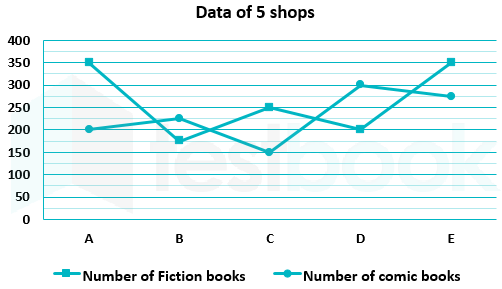
Following is the data given of selling of 5 shops A, B, C, D and E of two different types of books.

Question 41

Find the difference between number of fiction books sold from shop B to number of comic books sold from shop D.

  1. AOption (a)

    150

  2. BOption (b)

    100

  3. COption (c)

    125

  4. DOption (d)

    75

  5. EOption (e)

    None of these

View answer & explanation

Correct answer

Answer: (c)C.

125

Why this answer is correct

Calculation:

ShopsNumber of fiction booksNumber of comic books
A350200
B175225
C250150
D200300
E350275

number of fiction books sold from shop B = 175

number of comic books sold from shop D = 300

∴ Required difference = 300 - 175 = 125

Question 42

Find the average of total number of fictions books sold from all the 5 shops.

  1. AOption (a)

    265

  2. BOption (b)

    275

  3. COption (c)

    305

  4. DOption (d)

    315

  5. EOption (e)

    None of these

View answer & explanation

Correct answer

Answer: (a)A.

265

Why this answer is correct

Calculation:

ShopsNumber of fiction booksNumber of comic books
A350200
B175225
C250150
D200300
E350275

number of fiction books sold from all the 5 shops = (350 + 175 + 250 + 200 + 350) = 1325

∴ Required average = 1325/5 = 265

Question 43

Number of comic books sold from shop E is what % more than number of comic books sold from shop A?

  1. AOption (a)

    40%

  2. BOption (b)

    33.33%

  3. COption (c)

    27.5%

  4. DOption (d)

    37.5%

  5. EOption (e)

    75%

View answer & explanation

Correct answer

Answer: (d)D.

37.5%

Why this answer is correct

Calculation:

ShopsNumber of fiction booksNumber of comic books
A350200
B175225
C250150
D200300
E350275

Number of comic books sold from shop E = 275

number of comic books sold from shop A = 200

∴ Required % = (275 - 200)/200 × 100 = 37.5%

Question 44

Find the ratio between total books sold from shop C to that of shop B.

  1. AOption (a)

    3 : 4

  2. BOption (b)

    1 : 1

  3. COption (c)

    4 : 3

  4. DOption (d)

    2 : 1

  5. EOption (e)

    None of these

View answer & explanation

Correct answer

Answer: (b)B.

1 : 1

Why this answer is correct

Calculation:

ShopsNumber of fiction booksNumber of comic books
A350200
B175225
C250150
D200300
E350275

total books sold from shop C = (150 + 250) = 400

total books sold from shop B = (175 + 225) = 400

∴ Required ratio = 400 : 400 = 1 : 1

Question 45

Find the difference between total comic books sold to total fiction books sold from all the shops.

  1. AOption (a)

    200

  2. BOption (b)

    150

  3. COption (c)

    175

  4. DOption (d)

    100

  5. EOption (e)

    250

View answer & explanation

Correct answer

Answer: (c)C.

175

Why this answer is correct

Calculation:


ShopsNumber of fiction booksNumber of comic books
A350200
B175225
C250150
D200300
E350275

number of comic books sold from all the 5 shops = (200 + 225 + 150 + 300 + 275) = 1150

number of fiction books sold from all the 5 shops = (350 + 175 + 250 + 200 + 350) = 1325

∴ Required difference = (1325 - 1150) = 175

Question 46

What should come in place of the question mark '?' in the following number series?

40, 20, 20, 30, 60, ?

  1. AOption (a)

    125

  2. BOption (b)

    120

  3. COption (c)

    150

  4. DOption (d)

    160

  5. EOption (e)

    None of these

View answer & explanation

Correct answer

Answer: (c)C.

150

Why this answer is correct

Given:

40, 20, 20, 30, 60, ?

Calculation:

The series follows the following pattern:

40 × 0.5 = 20

20 × 1 = 20

20 × 1.5 = 30

30 × 2 = 60

60 × 2.5 = 150

Question 47

What should come in place of the question mark '?' in the following number series?

27, 32, 42, 57, 77, ?

  1. AOption (a)

    102

  2. BOption (b)

    92

  3. COption (c)

    112

  4. DOption (d)

    99

  5. EOption (e)

    None of these

View answer & explanation

Correct answer

Answer: (a)A.

102

Why this answer is correct

Given:

27, 32, 42, 57, 77, ?

Calculation:

The series follows the following pattern:

27 + (5 × 1) = 32

32 + (5 × 2) = 42

42 + (5 × 3) = 57

57 + (5 × 4) = 77

77 + (5 × 5) = 102

Question 48

What should come in place of the question mark '?' in the following number series?

15, 31, 63, 127, ?, 511

  1. AOption (a)

    254

  2. BOption (b)

    258

  3. COption (c)

    245

  4. DOption (d)

    255

  5. EOption (e)

    None of these

View answer & explanation

Correct answer

Answer: (d)D.

255

Why this answer is correct

Given:

15, 31, 63, 127, ?, 511

Calculation:

The series follows the following pattern:

15 × 2 + 1 = 31

31 × 2 + 1 = 63

63 × 2 + 1 = 127

127 × 2 + 1 = 255

Question 49

What should come in place of the question mark '?' in the following number series?

4, 5, 13, 40, 104, ?

  1. AOption (a)

    219

  2. BOption (b)

    229

  3. COption (c)

    204

  4. DOption (d)

    238

  5. EOption (e)

    None of these

View answer & explanation

Correct answer

Answer: (b)B.

229

Why this answer is correct

Calculation:

The series follows the following pattern:

⇒ 4 + 13 = 5

⇒ 5 + 23 = 13

⇒ 13 + 33 = 40

⇒ 40 + 43 = 104

⇒ 104 + 53 = 229

∴ The value of ? is 229

Question 50

What should come in place of the question mark '?' in the following number series?

7, 14, 42, 168, 840, ?

  1. AOption (a)

    4960

  2. BOption (b)

    5080

  3. COption (c)

    5040

  4. DOption (d)

    4920

  5. EOption (e)

    None of these

View answer & explanation

Correct answer

Answer: (c)C.

5040

Why this answer is correct

Given:

7, 14, 42, 168, 840, ?

Calculation:

The series follows the following pattern:

7 × 2 = 14

14 × 3 = 42

42 × 4 = 168

168 × 5 = 840

840 × 6 = 5040

Question 51

In an exam, the average marks of 20 students is 70. Afterwards, it is found that the marks of 2 students are taken wrong as 54 and 74 instead of 64 and 84. Find the correct average.

  1. AOption (a)

     70

  2. BOption (b)

    69

  3. COption (c)

     71

  4. DOption (d)

     72

  5. EOption (e)

     None of these

View answer & explanation

Correct answer

Answer: (c)C.

 71

Why this answer is correct

Shortcut Trick

Net change in marks = (64 + 84) − (54 + 74) = 148 − 128 = +20

Average change = Net change ÷ Total students = 20 ÷ 20 = +1

Correct Average = Old Average + Average change = 70 + 1 = 71

∴ The correct answer is 71.

Alternate Method

Given:

Number of students (n) = 20

Initial Average marks = 70

Incorrect marks = 54 and 74

Correct marks = 64 and 84

Calculations:

⇒ Total initial sum of marks = 20 × 70 = 1400

⇒ Sum of incorrect marks = 54 + 74 = 128

⇒ Sum of correct marks = 64 + 84 = 148

⇒ Correct total sum = 1400 − 128 + 148

⇒ Correct total sum = 1420

⇒ Correct average = Correct total sum ÷ Total students

⇒ Correct average = 1420 ÷ 20 = 71

∴ The correct answer is 71.

Additional Information

Net Deviation Method

Correct Average = Observed Average + (Sum of Correct Values − Sum of Incorrect Values) ÷ Total Number of Items.

Weighted Average

When two groups with averages A1 and A2 and sizes n1 and n2 are combined, the new average is (n1A1 + n2A2) ÷ (n1 + n2).

Question 52

Ratio of age of Aditya and Vaibhav after 6 years is 17 : 24 and the difference between their age is 14 years. Find the present age of Aditya.

  1. AOption (a)

    26 years

  2. BOption (b)

    28 years

  3. COption (c)

    27 years

  4. DOption (d)

    23 years

  5. EOption (e)

    None of these

View answer & explanation

Correct answer

Answer: (b)B.

28 years

Why this answer is correct

Shortcut Trick

Age difference remains constant at 14 years regardless of time.

Ratio after 6 years = 17 : 24. Difference in ratio units = 24 − 17 = 7 units.

7 units = 14 years ⇒ 1 unit = 2 years.

Aditya's age after 6 years = 17 × 2 = 34 years.

Present age of Aditya = 34 − 6 = 28 years.

∴ The correct answer is 28 years.

Alternate Method

Given: Ratio of ages after 6 years = 17 : 24; Difference in ages = 14 years.

Let the ages of Aditya and Vaibhav after 6 years be 17x and 24x.

⇒ 24x − 17x = 14

⇒ 7x = 14

⇒ x = 2

⇒ Aditya's age after 6 years = 17 × 2 = 34 years

⇒ Aditya's present age = 34 − 6 = 28 years

∴ The correct answer is 28 years.

Additional Information

Concept of Age Difference

The difference between the ages of two persons never changes with time. If the difference is 14 years now, it will remain 14 years after n years or n years ago.

Ratio Scaling

When the ratio is a:b and the real difference is D, then 1 unit = D ÷ (b − a). Multiply this unit with the ratio parts to get the actual ages at that point in time.

Question 53

Train A running with the speed of 20 m/s crosses a platform in 30 seconds. Another train B whose length is 150 metre more than length of train A is running with the speed of 10 m/s crosses a pole in 40 seconds. Find the length of platform.

  1. AOption (a)

    330 metre

  2. BOption (b)

    380 metres

  3. COption (c)

    290 metres

  4. DOption (d)

    350 metres

  5. EOption (e)

    None of these

View answer & explanation

Correct answer

Answer: (d)D.

350 metres

Why this answer is correct

Shortcut Trick

Length of Train B = Speed × Time = 10 × 40 = 400 m.

Length of Train A = 400 − 150 = 250 m.

Total Distance (A + Platform) = Speed of A × Time = 20 × 30 = 600 m.

Length of Platform = 600 − 250 = 350 m.

∴ The correct answer is 350 metres.

Alternate Method

Given: Speed of Train A = 20 m/s, Time to cross platform = 30 s. Speed of Train B = 10 m/s, Time to cross pole = 40 s. Length B = Length A + 150 m.

Formula Used: Distance = Speed × Time; When crossing a pole, Distance = Length of Train; When crossing a platform, Distance = Length of Train + Length of Platform.

⇒ Length of Train B (LB) = SpeedB × Timepole

⇒ LB = 10 m/s × 40 s = 400 m.

⇒ Length of Train A (LA) = LB − 150 = 400 − 150 = 250 m.

⇒ For Train A crossing Platform: (LA + LP) = SpeedA × Timeplatform

⇒ 250 + LP = 20 × 30

⇒ 250 + LP = 600

⇒ LP = 600 − 250 = 350 m.

∴ The correct answer is 350 metres.

Additional Information

Relative Speed

When two trains move in the same direction, relative speed is (u − v). In opposite directions, it is (u + v).

Unit Conversion

To convert km/hr to m/s, multiply by 5/18. To convert m/s to km/hr, multiply by 18/5.

Crossing Objects

When a train crosses a point object (pole, man), distance = length of train. When crossing a platform or bridge, distance = length of train + length of object.

Question 54

Pipes A and B can together fill a tank in 20 hours and pipe C can empty 40% of the tank in 20 hours. Find the time taken by all the 3 pipes together to fill 60% of the tank.

  1. AOption (a)

    20 hours

  2. BOption (b)

    25 hours

  3. COption (c)

    12 hours

  4. DOption (d)

    30 hours

  5. EOption (e)

    None of these

View answer & explanation

Correct answer

Answer: (a)A.

20 hours

Why this answer is correct

Shortcut Trick

Net efficiency of (A + B) = 100% / 20 hr = 5% per hour.

Efficiency of C (emptying) = 40% / 20 hr = 2% per hour.

Combined efficiency of (A + B − C) = 5% − 2% = 3% per hour.

Time to fill 60% of the tank = 60% ÷ 3% = 20 hours.

∴ The correct answer is 20 hr.

Alternate Method

Given:

Time taken by (A + B) to fill the tank = 20 hours

Time taken by C to empty 40% of the tank = 20 hours

⇒ Time taken by C to empty the full tank (100%) = (20 ÷ 40) × 100 = 50 hours

PipesHoursTotal Work (LCM)Efficiency
(A + B)20100 units100 ÷ 20 = 5
C (Emptying)50100 ÷ 50 = −2

Calculations:

⇒ Combined efficiency of (A + B + C) = 5 − 2 = 3 units/hour

⇒ 60% of Total Work = 0.60 × 100 = 60 units

⇒ Time taken = 60 units ÷ 3 units/hour

⇒ Time taken = 20 hours

∴ The correct answer is 20 hr.

Additional Information

Inlet and Outlet Pipes

Inlet pipes add water (positive efficiency) while outlet or leak pipes remove water (negative efficiency).

Work Done Formula

Total Work = Efficiency × Time. For partial work, Required Time = (Fraction × Total Work) ÷ Net Efficiency.

Efficiency Percentage

Efficiency can be calculated as % of tank filled per unit time where 100% represents the full capacity.

Question 55

Speed of the stream is 3 km/hr and the upstream speed is 7 km/hr. Find the time taken by boat to cover 91 km downstream.

  1. AOption (a)

    6 hours

  2. BOption (b)

    5 hours

  3. COption (c)

    7 hours

  4. DOption (d)

    4 hours

  5. EOption (e)

    None of these

View answer & explanation

Correct answer

Answer: (c)C.

7 hours

Why this answer is correct

Shortcut Trick

Downstream Speed = Upstream Speed + 2 × Stream Speed

Downstream Speed = 7 + 2 × 3 = 13 km/hr

Time Taken = Distance ÷ Downstream Speed = 91 ÷ 13 = 7 hr

∴ The correct answer is 7 hr.

Alternate Method

Given:

Stream Speed (v) = 3 km/hr

Upstream Speed (u) = 7 km/hr

Distance = 91 km

Formula Used:

Upstream Speed (u) = Boat Speed (b) − Stream Speed (v)

Downstream Speed (d) = Boat Speed (b) + Stream Speed (v)

Calculations:

⇒ 7 = b − 3

⇒ b = 7 + 3 = 10 km/hr (Speed of boat in still water)

⇒ Downstream Speed (d) = 10 + 3 = 13 km/hr

⇒ Time = Distance ÷ Downstream Speed

⇒ Time = 91 ÷ 13

⇒ Time = 7 hr

∴ The correct answer is 7 hr.

Additional Information

Still Water Speed

Speed of boat in still water = (Downstream Speed + Upstream Speed) ÷ 2.

Stream Speed

Speed of stream = (Downstream Speed − Upstream Speed) ÷ 2.

Average Speed

Average speed for a round trip = (Downstream × Upstream) ÷ Still Water Speed.

Direction: Read the following information carefully and answer the following questions.

A class has a total of 500 students. All the students are involved in exactly one of three different activities, i.e. Dancing, Singing, and Photography. The number of students in dancing is 20% of total students in the class and the ratio of boys to girls in dancing is 3: 7. The number of students in photography is 60% of the number of students in singing. The number of girls in Singing is 50 less than the number of boys in Singing. The number of girls in photography is 87.5% of the number of boys in Photography.

Question 56

Find the number of students involved in Photography.

  1. AOption (a)

    125

  2. BOption (b)

    100

  3. COption (c)

    150

  4. DOption (d)

    175

  5. EOption (e)

    None of these

View answer & explanation

Correct answer

Answer: (c)C.

150

Why this answer is correct

Calculation:

The total number of students is 500.

Students involved in dancing is 20% of the total students.

⇒ 20% of 500 = 100 students 

Let the students involved in photography be P, those in dancing be D and students involved in singing be S.

⇒ P + S + D = 500      ----(1)

⇒ P + S = 500 - D 

⇒ P + S = 400      ----(2)

It is given that students involved in photography is 60% of students involved in singing

⇒ P =  60 % of S      ----(3)

put the value of P = 60 S/100 in equation (2)

⇒ 60 S /100 + S = 400

⇒ 16 S/10 = 400

⇒ S = 250

⇒ From equation (2) ,

⇒ P + S  = 400

⇒ P + 250  = 400

⇒ P = 150

∴ Number of students involved in photography is 15

Question 57

Find the difference between the number of boys involved in Photography and the number of girls involved in Dancing.

  1. AOption (a)

    10

  2. BOption (b)

    5

  3. COption (c)

    15

  4. DOption (d)

    20

  5. EOption (e)

    None of these

View answer & explanation

Correct answer

Answer: (a)A.

10

Why this answer is correct

Calculation:

From the above question we find out the number of students involved in different activities as follows:

Number of students in dancing = 20% of 500 = 100

Now, Number of students in Singing and Photography = (500 – 100)

⇒ 400

Let number of students in singing be x

Number of students in Photography = 0.6x

So, x + 0.6x = 400

⇒ 1.6x = 400

⇒ x = 250

Singing = 250

Photography = 0.6 × 250 = 150

It is given that the ratio of number of boys to the girls in dancing is 3 : 7

Number of girls in dancing = (7/10) × 100 = 70

Also the number of girls in photography is 87.5 % of the number of boys 

⇒ Boys(photo) + Girls(photo) = 150

⇒ Boys(photo) + 87.5% of boys(photo) = 150

⇒ 1875 boys(photo) / 1000 = 150

On solving, we get the value of boys involved in photography = 80

Required difference = (80 – 70)

⇒ 10

∴ The difference between the boys involved in photography and the girls involved in dancing is 10

Question 58

Find the ratio between the number of girls to the number of boys in the class.

  1. AOption (a)

    14 : 15

  2. BOption (b)

    12 : 13

  3. COption (c)

    15 : 14

  4. DOption (d)

    7 : 8

  5. EOption (e)

    None of these

View answer & explanation

Correct answer

Answer: (b)B.

12 : 13

Why this answer is correct

Calculation:

The number of students involved in different activities is as follows:

Dancing = 100

Singing = 250

Photography = 150

Number of boys in dancing = 3/10 * 100 = 30

Number of girls involved in dancing = 100 - 30 = 70

It is given that the number of girls in singing is 50 less than the boys-

let the number of boys in singing be B and the number of girls be G 

 ⇒B + G = 250      ----(1)

also G = B - 50      ----(2)

On solving the above two equations we get the number of boys in singing as 150 and the number of girls in singing as 100.

Number of girls in photography = 87.5% of boys 

⇒ Number of girls in photography is 70 and the number of boys in photography is 80

Now the total number of girls =  70 + 100 + 70 = 240

and the total number of boys = 30 + 150 + 80 = 260

Hence the ratio will be 240 : 260 = 12 : 13

Question 59

Number of girls involved in Singing is what % of number of boys involved in Photography?

  1. AOption (a)

    110%

  2. BOption (b)

    120%

  3. COption (c)

    150%

  4. DOption (d)

    125%

  5. EOption (e)

    None of these

View answer & explanation

Correct answer

Answer: (d)D.

125%

Why this answer is correct

Calculation:

The number of students involved in different activities are as follows:

Dancing = 100

Singing = 250

Photography = 150

Number of boys in dancing = 3/10 * 100 = 30

Number of girls involved in dancing = 100 - 30 = 70

It is given that the number of girls in singing is 50 less than the boys-

let the number of boys in singing be B and the number of girls be G 

⇒ B + G = 250      ----(1)

also G = B - 50      ----(2)

On solving the above two equations we get the number of boys in singing as 150 and the number of girls in singing as 100.

Number of girls in photography = 87.5% of boys 

⇒ The number of girls in photography is 70 and the number of boys in photography is 80

Number of girls involved in singing =100

Number of boys involved in photography = 80

Required % = 100/80 * 100% = 125%

Question 60

Find the total number of girls in the class.

  1. AOption (a)

    220

  2. BOption (b)

    210

  3. COption (c)

    240

  4. DOption (d)

    230

  5. EOption (e)

    None of these

View answer & explanation

Correct answer

Answer: (c)C.

240

Why this answer is correct

Calculation:

The number of students involved in different activities is as follows:

Dancing = 100

Singing = 250

Photography = 150

Number of boys in dancing = 3/10 * 100 = 30

Number of girls involved in dancing = 100 - 30 = 70

It is given that the number of girls in singing is 50 less than the boys-

let the number of boys in singing be B and the number of girls be G 

 ⇒B + G = 250      ----(1)

also G = B - 50      ----(2)

On solving the above two equations we get the number of boys in singing as 150 and the number of girls in singing as 100.

Number of girls in photography = 87.5% of boys 

The number of girls in photography is 70 and the number of boys in photography is 80

Number of girls in dancing = 70

Number of girls in singing = 100

Number of girls in photography  = 70

Total number of girls in the class = 70 + 100 + 70 = 240

Question 61

Length of a rectangle is 3 cm more than width of rectangle and the difference between area of circle and area of rectangle is 84 cm2. Fiind the length of rectangle if radius of circle is 7 cm.  (circle > rectangle)

  1. AOption (a)

    8 cm

  2. BOption (b)

    10 cm

  3. COption (c)

    7 cm

  4. DOption (d)

    14 cm

  5. EOption (e)

    None of these

View answer & explanation

Correct answer

Answer: (b)B.

10 cm

Why this answer is correct

Shortcut Trick

Area of circle = (22/7) × 72 = 154 cm2.

Area of rectangle = 154 − 84 = 70 cm2.

Let width = x, then length = x + 3. So, x(x + 3) = 70.

By inspection, 7 × 10 = 70, where 10 − 7 = 3. Thus, length = 10 cm.

∴ The correct answer is 10 cm.

Alternate Method

Given: Radius (r) = 7 cm, Difference in areas = 84 cm2, Length (L) = Width (W) + 3 cm.

Formula Used: Area of circle = πr2; Area of rectangle = L × W.

⇒ Area of Circle = (22/7) × 7 × 7 = 154 cm2.

⇒ Area of Rectangle = 154 − 84 = 70 cm2.

⇒ L × W = 70

⇒ (W + 3) × W = 70

⇒ W2 + 3W − 70 = 0

⇒ W2 + 10W − 7W − 70 = 0

⇒ W(W + 10) − 7(W + 10) = 0

⇒ W = 7 cm (ignoring negative value)

⇒ Length = 7 + 3 = 10 cm.

∴ The correct answer is 10 cm.

Additional Information

Properties of Rectangles

Perimeter of a rectangle is 2 × (length + width). The diagonals are equal and bisect each other.

Circle Mensuration

Circumference of a circle = 2πr. For a radius of 7 cm, the circumference is always 44 cm and the area is 154 cm2.

Quadratic Roots Shortcut

For x2 + bx + c = 0, if c is negative, the roots have opposite signs. Find factors of c that differ by b.

Question 62

An amount of Rs. 14,000 is invested at the rate of 20% compounded annually for 2 years. Find the sum received after 2 years.

  1. AOption (a)

    Rs. 21,240

  2. BOption (b)

    Rs. 19,380

  3. COption (c)

    Rs. 20,160

  4. DOption (d)

    Rs. 22,340

  5. EOption (e)

    None of these

View answer & explanation

Correct answer

Answer: (c)C.

Rs. 20,160

Why this answer is correct

Shortcut Trick

For 2 years at 20% interest rate, effective Compound Interest rate = x + y + (xy/100)

Effective rate = 20 + 20 + (20 × 20)/100 = 44%

Total amount received = 100% + 44% = 144% of Principal

Sum received = 14,000 × 1.44 = 20,160

∴ The correct answer is Rs. 20,160.

Alternate Method

Given:

Principal (P) = Rs. 14,000

Rate (R) = 20% per annum

Time (n) = 2 years

Formula Used:

Amount (A) = P[1 + (R/100)]n

Calculations:

⇒ A = 14,000 × [1 + (20/100)]2

⇒ A = 14,000 × (120/100) × (120/100)

⇒ A = 14,000 × (6/5) × (6/5)

⇒ A = 14,000 × (36/25)

⇒ A = 560 × 36

⇒ A = 20,160

∴ The correct answer is Rs. 20,160.

Additional Information

Compound Interest vs Simple Interest

For the first year, Simple Interest and Compound Interest are the same if interest is compounded annually.

Half-Yearly Compounding

When compounded half-yearly, the rate is halved (R/2) and the time is doubled (2n) in the formula.

Successive Percentage Change

Compound Interest is essentially an application of successive percentage increases on the principal amount.

Question 63

A invested Rs. 5000 in a business and after 6 months, B also joined him. At the end of year, B received Rs. 2700 profit out of Rs. 8700. Find the investment of B.

  1. AOption (a)

    Rs. 4000

  2. BOption (b)

    Rs. 5400

  3. COption (c)

    Rs. 4800

  4. DOption (d)

    Rs. 4500

  5. EOption (e)

    None of these

View answer & explanation

Correct answer

Answer: (d)D.

Rs. 4500

Why this answer is correct

Shortcut Trick

Total profit = 8700, B's profit = 2700 ⇒ A's profit = 8700 − 2700 = 6000.

Profit Ratio A : B = 6000 : 2700 = 20 : 9.

Time Ratio A : B = 12 months : 6 months = 2 : 1.

Investment Ratio = (Profit ÷ Time) ⇒ A : B = (20 ÷ 2) : (9 ÷ 1) = 10 : 9.

10 units = 5000 ⇒ 1 unit = 500. B's investment = 9 × 500 = 4500.

∴ The correct answer is Rs. 4500.

Alternate Method

Given: A's investment (CA) = Rs. 5000, A's time (TA) = 12 months, B's time (TB) = 6 months, Total Profit = Rs. 8700, B's Profit (PB) = Rs. 2700.

Formula: Ratio of Profit = (InvestmentA × TimeA) : (InvestmentB × TimeB)

⇒ Let B's investment be X.

⇒ A's profit = 8700 − 2700 = 6000.

⇒ (5000 × 12) ÷ (X × 6) = 6000 ÷ 2700

⇒ (5000 × 2) ÷ X = 60 ÷ 27

⇒ 10000 ÷ X = 20 ÷ 9

⇒ 20X = 90000 ⇒ X = 4500.

∴ The correct answer is Rs. 4500.

Additional Information

Partnership Basic Principle

Profit is always distributed in the ratio of the product of Investment and Time Period.

Variable Time Investment

If investment amounts are C1, C2 for times T1, T2, then Profit Ratio P1:P2 = C1T1 : C2T2.

Question 64

Sachin marked an article 20% above the cost price and sold it for Rs. 4,896 after giving some discount. Find the discount% if the cost of article is Rs. 5,100.

  1. AOption (a)

    20%

  2. BOption (b)

    24%

  3. COption (c)

    18%

  4. DOption (d)

    25%

  5. EOption (e)

    None of these

View answer & explanation

Correct answer

Answer: (a)A.

20%

Why this answer is correct

Shortcut Trick

Cost Price (CP) = Rs. 5,100.

Marked Price (MP) = CP × 120/100 = 5,100 × 1.2 = Rs. 6,120.

Selling Price (SP) = Rs. 4,896.

Discount Value = MP − SP = 6,120 − 4,896 = Rs. 1,224.

Discount% = (Discount ÷ MP) × 100 = (1,224 ÷ 6,120) × 100 = 20%.

∴ The correct answer is 20%.

Alternate Method

Given: CP = Rs. 5,100, Markup% = 20%, SP = Rs. 4,896.

Formulas: MP = CP × (100 + Markup%) ÷ 100 | Discount% = (MP − SP) ÷ MP × 100

⇒ Marked Price (MP) = 5100 + 20% of 5100 = 5100 + 1020 = Rs. 6,120.

⇒ Discount Amount = MP − SP = 6120 − 4896 = Rs. 1,224.

⇒ Discount Percentage = (1224 ÷ 6120) × 100.

⇒ Discount Percentage = 1/5 × 100 = 20%.

∴ The correct answer is 20%.

Additional Information

Marked Price & Discount

The Marked Price is the price indicated on the label. Discount is always calculated on the Marked Price, not on the Cost Price.

Markup Percentage

Markup% = [(MP − CP) ÷ CP] × 100. It represents how much more the seller asks for compared to the original cost.

Question 65

In a village, total number of voters was 5000. 8% of the total votes got rejected and the winner got 60% of the valid votes. Find the number of votes loser got.

  1. AOption (a)

    2760 votes

  2. BOption (b)

    2020 votes

  3. COption (c)

    1840 votes

  4. DOption (d)

    2330 votes

  5. EOption (e)

    None of these

View answer & explanation

Correct answer

Answer: (c)C.

1840 votes

Why this answer is correct

Shortcut Trick

Valid votes = 5000 × 92% = 4600

Winner gets 60% ⇒ Loser gets (100% − 60%) = 40% of valid votes.

Loser votes = 4600 × 40% = 1840 votes.

∴ The correct answer is 1840 votes.

Alternate Method

Given: Total voters = 5000, Rejected votes = 8%, Winner share = 60% of valid votes.

Formula: Valid Votes = Total × (100 − Rejected)%; Loser share = Valid × (100 − Winner%)%

⇒ Total Votes = 5000

⇒ Rejected Votes = 8% of 5000 = (8/100) × 5000 = 400

⇒ Valid Votes = 5000 − 400 = 4600

⇒ Winner Votes = 60% of 4600 = (60/100) × 4600 = 2760

⇒ Loser Votes = 4600 − 2760 = 1840

∴ The correct answer is 1840 votes.

Additional Information

Percentage Calculation

To find x% of y, use (x ÷ 100) × y. For quick calculation, 10% is y/10 and 1% is y/100.

Election Logic

In a two-candidate election, if Winner % is W and Loser % is L, then W + L = 100% of Valid Votes. Majority = (W − L)% of Valid Votes.

Valid vs Invalid Votes

Valid Votes = Total Votes Cast − Invalid/Rejected Votes. Results are always calculated on the basis of Valid Votes unless specified otherwise.

Reasoning Ability (35 questions)

Direction: Study the following information carefully and answer the question given below.

Eight people P, Q, R, S, T, U, V and W are sitting around a circle. All of them are facing the center but not necessarily in the same order.

P is sitting to the second of T. S is sitting next to the left of R. U is sitting opposite to W. W is sitting third to the left of P. R is neighbour of neither W nor T. R is sitting opposite to Q. V is not a neighbour of Q.

Question 66

What is the position of T with respect to R?

  1. AOption (a)

    Immediate left

  2. BOption (b)

    Immediate right

  3. COption (c)

    Third to the right

  4. DOption (d)

    Third to the left

  5. EOption (e)

    None of the above

View answer & explanation

Correct answer

Answer: (c)C.

Third to the right

Why this answer is correct

Given: Eight people P, Q, R, S, T, U, V and W are sitting around a circle. All of them are facing the center but not necessarily in the same order.

1. P is sitting to the second of T.

There will be two cases:

2. W is sitting third to the left of P. 3. U is sitting opposite W.

4. R is sitting opposite Q.  5. R is neighbour of neither W nor T.

6. V is not a neighbour of Q. 7. S is sitting next to the left of R. 

Here, case I will be cancelled out as no suitable place for V is left in case I.

So, the final arrangement will be:

Hence, T is sitting third to the right with respect to R.

Question 67

Which among the following statement is true?

  1. AOption (a)

    V is sitting fifth to the left of R.

  2. BOption (b)

    P is sitting opposite to R.

  3. COption (c)

    One person is sitting between Q and W.

  4. DOption (d)

    R is third to the right of T

  5. EOption (e)

    Q is sitting opposite to V

View answer & explanation

Correct answer

Answer: (c)C.

One person is sitting between Q and W.

Why this answer is correct

Given: Eight people P, Q, R, S, T, U, V and W are sitting around a circle. All of them are facing the center but not necessarily in the same order.

1. P is sitting to the second of T.

There will be two cases:

2. W is sitting third to the left of P. 3. U is sitting opposite W.

4. R is sitting opposite Q.  5. R is neighbour of neither W nor T.

6. V is not a neighbour of Q. 7. S is sitting next to the left of R. 

Here, case I will be cancelled out as no suitable place for V is left in case I.

So, the final arrangement will be:

Hence, one person is sitting between Q and W is true.

Question 68

Who is sitting opposite to T?

  1. AOption (a)

    P

  2. BOption (b)

    Q

  3. COption (c)

    R

  4. DOption (d)

    S

  5. EOption (e)

    V

View answer & explanation

Correct answer

Answer: (d)D.

S

Why this answer is correct

Given: Eight people P, Q, R, S, T, U, V and W are sitting around a circle. All of them are facing the center but not necessarily in the same order.

1. P is sitting to the second of T.

There will be two cases:

2. W is sitting third to the left of P. 3. U is sitting opposite W.

4. R is sitting opposite Q.  5. R is neighbour of neither W nor T.

6. V is not a neighbour of Q. 7. S is sitting next to the left of R. 

Here, case I will be cancelled out as no suitable place for V is left in case I.

So, the final arrangement will be:

Hence, S is sitting opposite to T.

Question 69

Who among the following is sitting next to right of S?

  1. AOption (a)

    R

  2. BOption (b)

    S

  3. COption (c)

    U

  4. DOption (d)

    T

  5. EOption (e)

    V

View answer & explanation

Correct answer

Answer: (a)A.

R

Why this answer is correct

Given: Eight people P, Q, R, S, T, U, V and W are sitting around a circle. All of them are facing the center but not necessarily in the same order.

1. P is sitting to the second of T.

There will be two cases:

2. W is sitting third to the left of P. 3. U is sitting opposite W.

4. R is sitting opposite Q.  5. R is neighbour of neither W nor T.

6. V is not a neighbour of Q. 7. S is sitting next to the left of R. 

Here, case I will be cancelled out as no suitable place for V is left in case I.

So, the final arrangement will be:

Hence,  R sitting next to the right of S.

Question 70

How many persons are sitting between Q and U when counted from the left of Q?

  1. AOption (a)

    1

  2. BOption (b)

    3

  3. COption (c)

    4

  4. DOption (d)

    5

  5. EOption (e)

    2

View answer & explanation

Correct answer

Answer: (d)D.

5

Why this answer is correct

Given: Eight people P, Q, R, S, T, U, V and W are sitting around a circle. All of them are facing the center but not necessarily in the same order.

1. P is sitting to the second of T.

There will be two cases:

2. W is sitting third to the left of P. 3. U is sitting opposite W.

4. R is sitting opposite Q.  5. R is neighbour of neither W nor T.

6. V is not a neighbour of Q. 7. S is sitting next to the left of R. 

Here, case I will be cancelled out as no suitable place for V is left in case I.

So, the final arrangement will be:

Hence, 5 persons are sitting between Q and U.

Question 71

Direction: In the question below are given three statements followed by two conclusions numbered I and II. You have to take the given statements to be true even if they seem to be at variance with commonly known facts. Read all the conclusions and then decide which of the given conclusions logically follows from the given statements disregarding commonly known facts.

Statements:

Some stars are moon.

No moon are sun.

Only a few sun are planet.

Conclusions:

I. Some stars are sun.

II. Some planet are sun.

  1. AOption (a)

    Only I follows

  2. BOption (b)

    Only II follows

  3. COption (c)

    None follows

  4. DOption (d)

    Both follow

  5. EOption (e)

    Either I or II follow.

View answer & explanation

Correct answer

Answer: (b)B.

Only II follows

Why this answer is correct

The least possible Venn diagram for the given statements is:

Conclusions:

I. Some stars are sun. → False (No relationship is given between starts and sun, hence this condition is possible but not definite.)

II. Some planet are sun. → True (As it is given that 'only a few sun are planet.' some planets must be sun.)

Hence, only II follows.

Question 72

Direction: In the question below are given three statements followed by two conclusions numbered I and II. You have to take the given statements to be true even if they seem to be at variance with commonly known facts. Read all the conclusions and then decide which of the given conclusions logically follows from the given statements disregarding commonly known facts.

Statements:

All scales are pencil.

Some pencils are pens.

Some pens are not erasers.

Conclusions:

I. Some pens are scales.

II. Some scales are pencil.

  1. AOption (a)

    Only I follows.

  2. BOption (b)

    Only II follows

  3. COption (c)

    Both follow

  4. DOption (d)

    None follows

  5. EOption (e)

    Either I or II follows

View answer & explanation

Correct answer

Answer: (b)B.

Only II follows

Why this answer is correct

The least possible Venn diagram for the given statements is:

Conclusions:

I. Some pens are scales. → False (No relationship is given between pens and scales, hence, it is possible but not definite.)

II. Some scales are pencil. → True (As all scales are pencil is true, some scales are pencil will also be true.)

Hence, only II follows.

Question 73

Direction: In the question below are given three statements followed by two conclusions numbered I and II. You have to take the given statements to be true even if they seem to be at variance with commonly known facts. Read all the conclusions and then decide which of the given conclusions logically follows from the given statements disregarding commonly known facts.

Statements:

No grapes are lemons.

Only a few lemons are apple.

All apple are banana.

Conclusions:

I. All lemons are banana.

II. Some lemons  are not banana.

  1. AOption (a)

    Only I follows

  2. BOption (b)

    Only II follows

  3. COption (c)

    Either I or II follows

  4. DOption (d)

    None follows

  5. EOption (e)

    Both follow

View answer & explanation

Correct answer

Answer: (c)C.

Either I or II follows

Why this answer is correct

The least possible Venn diagram for the given statements is:

Conclusions:

I. All lemons are banana. → False ( No specific information given about lemons and banana, hence, it is possible but not definite.)

II. Some lemons  are not banana. → False ( No specific information given about lemons and banana, hence, it is possible but not definite.)

Both of the above conclusions are following the conditions of 'either -or' pair.

Hence, either I or II follows.

Additional Information

 Conditions of Either-or case:

  1. The elements should be the same in both the statements.
  2. Both the conclusions should be false individually.
  3. One conclusion should be positive and one conclusion should be negative (Complementary pair)

The two complementary pairs are:

  1. All + Some not

  2. No + Some

Note: Some + Some not is not  considered under Either -or case.

Question 74

Direction: In the question below are given three statements followed by two conclusions numbered I and II. You have to take the given statements to be true even if they seem to be at variance with commonly known facts. Read all the conclusions and then decide which of the given conclusions logically follows from the given statements disregarding commonly known facts.

Statements:

Some circle are square.

Only a few square are rectangle.

All circle are triangle.

Conclusions:

I. All rectangle being circle is a possibility.

II. Some square are triangle.

  1. AOption (a)

    Only I follow

  2. BOption (b)

    Only II follow

  3. COption (c)

    Either I or II follow

  4. DOption (d)

    Both follow

  5. EOption (e)

    None follow

View answer & explanation

Correct answer

Answer: (d)D.

Both follow

Why this answer is correct

The least possible Venn diagram for the given statements is:

Conclusions:

I. All rectangle being circle is a possibility. → True ( As nothing specific about rectangle and circle is given and none of the given statements is contradicting this possibility, hence the given possibility is true. The possibility diagram is shown below:

II. Some square are triangle. → True ( As some square are circle and all the circle are triangle, hence it is definitely true.)

Both follow.

Question 75

Direction: In the question below are given three statements followed by two conclusions numbered I and II. You have to take the given statements to be true even if they seem to be at variance with commonly known facts. Read all the conclusions and then decide which of the given conclusions logically follows from the given statements disregarding commonly known facts.

Statements:

Only a few tree are sparrow.

Some sparrow are bird.

No pigeon is sparrow.

Conclusions:

I. Some tree are bird.

II. Some pigeon are bird.

  1. AOption (a)

    Only I follows

  2. BOption (b)

    Only II follows

  3. COption (c)

    Either I or II follow

  4. DOption (d)

    None follows

  5. EOption (e)

    Both follow

View answer & explanation

Correct answer

Answer: (d)D.

None follows

Why this answer is correct

The least possible Venn diagram based on the given statement is:

Conclusions:

I. Some tree are bird. → False (Nothing specific about tree and bird is given, hence this condition is possible but not definite.)

II. Some pigeon are bird. → False (Nothing specific about pigeon and bird is given, hence this condition is possible but not definite.)

Hence, none follows.

Directions: Study the following question and answering the question referring to the word sequence below:

MNO  ABD  ATE  POT  KLO

Question 76

If the second and the third letters are interchanged within the given words, then how many words thus formed will not end with a vowel?

  1. AOption (a)

    1

  2. BOption (b)

    2

  3. COption (c)

    3

  4. DOption (d)

    4

  5. EOption (e)

    5

View answer & explanation

Correct answer

Answer: (d)D.

4

Why this answer is correct

Given series: MNO  ABD   ATE  POT  KLO

After interchanging the second and the third letters: MON   ADB   AET   PTO    KOL

Hence, 4 words are there which will not end with a vowel.

Question 77

If words are arranged in the sequence they appear in the dictionary from left to right, which word is third from the right end?

  1. AOption (a)

    MNO

  2. BOption (b)

    ABD

  3. COption (c)

    ATE

  4. DOption (d)

    KLO

  5. EOption (e)

    POT

View answer & explanation

Correct answer

Answer: (d)D.

KLO

Why this answer is correct

Given series: MNO  ABD   ATE  POT  KLO

After arranging in alphabetical order: ABD   ATE   KLO   MNO   POT

Hence, KLO will be the third word from the right end.

Question 78

If S is added in end of the each given word, how many meaningful words will be formed?

  1. AOption (a)

    No meaningful word will be formed

  2. BOption (b)

    1

  3. COption (c)

    2

  4. DOption (d)

    3

  5. EOption (e)

    4

View answer & explanation

Correct answer

Answer: (b)B.

1

Why this answer is correct

Given series: MNO  ABD   ATE  POT  KLO

After adding S in each word,

MNOS  ABDS   ATES  POTS  KLOS

Hence, 1 meaningful word will be formed.

Question 79

If the letters in the given words are arranged as they appear in a dictionary from right to left (within the word), then how many letters, as in the English alphabet, are there between the second letter of the third word from the left end and the second letter of the fourth word from the left end?

  1. AOption (a)

    10

  2. BOption (b)

    12

  3. COption (c)

    13

  4. DOption (d)

    7

  5. EOption (e)

    None

View answer & explanation

Correct answer

Answer: (a)A.

10

Why this answer is correct

Given series: MNO  ABD  ATE  POT  KLO

Words according to the dictionary order: ONM  DBA  TEA  TPO  OLK

Second letter of the third word: E

Second letter of the fourth word: P

Number of letters between E and P according to English Alphabetical series : 10 

Hence, there are 10 letters in the alphabet series between E and P.

Question 80

If each consonant is changed to the previous letter in the alphabetic series and vowel remains the same, then how many words have more than one vowel?

  1. AOption (a)

    2

  2. BOption (b)

    3

  3. COption (c)

    1

  4. DOption (d)

    4

  5. EOption (e)

    None

View answer & explanation

Correct answer

Answer: (b)B.

3

Why this answer is correct

Given series:

MNO  ABD   ATE  POT  KLO

After applying the given condition, each consonant is changed to the previous letter in the alphabetic series and vowel remains the same

LMO  AAC  ASE  OOS JKO

The number of words having more than 1 vowel is 3.

Hence, 3 is the correct answer.

Direction: Study the following information carefully and answer the given questions.

In a certain code language:

'weather was bad' is written as 'rz ku st'

'it was raining' is written as ' et wp ku'

'raining very heavily' is written as 'uk vn wp'

'weather was balmy' is written as 'ku rz ap'

Question 81

What is the code for 'weather'?

  1. AOption (a)

    st

  2. BOption (b)

    rz

  3. COption (c)

    ku

  4. DOption (d)

    op

  5. EOption (e)

    uk

View answer & explanation

Correct answer

Answer: (b)B.

rz

Why this answer is correct

The codes are as follows:

Therefore the code for 'weather' is 'rz'.

Hence, rz is the correct answer.

Question 82

What would be the possible code for 'very'?

  1. AOption (a)

    uk

  2. BOption (b)

    vn

  3. COption (c)

    ku

  4. DOption (d)

    wp

  5. EOption (e)

    Either 1 or 2

View answer & explanation

Correct answer

Answer: (e)E.

Either 1 or 2

Why this answer is correct

The codes are as follows:

Therefore the code for 'very' is either 'vn' or 'uk'.

Hence, either 1 or 2 is the correct answer.

Question 83

If 'very high' is coded as 'uk zi' then what would be the code for 'heavily'?

  1. AOption (a)

    rz

  2. BOption (b)

    uk

  3. COption (c)

    vn

  4. DOption (d)

    wp

  5. EOption (e)

    st

View answer & explanation

Correct answer

Answer: (c)C.

vn

Why this answer is correct

The codes are as follows:

If the code of 'very high' is 'uk zi'

Therefore the code for 'heavily' is 'vn'

Hence, vn is the correct answer.

Question 84

What is the code for 'it was balmy' ?

  1. AOption (a)

    ap et wp

  2. BOption (b)

    ku wp et

  3. COption (c)

    ap ku et

  4. DOption (d)

    ap vn uk

  5. EOption (e)

    ap ku rz

View answer & explanation

Correct answer

Answer: (c)C.

ap ku et

Why this answer is correct

The codes are as follows:

Therefore the code for 'it was balmy' is 'ap ku et'.

Hence,'ap ku et' is the correct answer.

Eight friends A, B, C, D, E, F, G and H have to deliver lectures on either the 6th or 17th of four different months among January, March, April and July but not necessarily in the same order. Not more than 2 persons will give a lecture in a month. Only one person will deliver a lecture each day. A delivers his lecture on the 6th of a month which has only 31 days but not in the month of March. E delivers the lecture immediately after B. Only three lectures were delivered between A and B. Only two persons give lectures between F and C and C is not the last one. The number of persons who give the lecture after E is the same as the number of persons who give the lecture before F.  G and C give their lectures in the same month. D gives the lecture before H.

Question 85

Who deliver the lecture on 17th April?

  1. AOption (a)

    A

  2. BOption (b)

    B

  3. COption (c)

    C

  4. DOption (d)

    D

  5. EOption (e)

    G

View answer & explanation

Correct answer

Answer: (d)D.

D

Why this answer is correct

Eight friends: A, B, C, D, E, F, G and H

Four month: January, March, April and July

Date : 6th, 17th

1) A delivers his lecture on the 6th of a month which has only 31 days but not in the month of March. 

  1. Only three lectures were delivered between A and B.

3) E delivers the lecture immediately after B.

Case 1:Case 2:
MonthsDatesPersonPerson
January (31 days)6A
17
March (31 days)6B
17E
April (30 days)6B
17E
July (31 days)6A
17


  1. The number of persons who give the lecture after E is the same as the number of persons who give the lecture before F. 

5) Only two persons give lectures between F and C and C is not the last one.

(This will eliminate case 1).

Case 2:
MonthsDatesPerson
January (31 days)6
17C
March (31 days)6B
17E
April (30 days)6F
17
July (31 days)6A
17


6) G and C give their lectures in the same month.

  1. D gives the lecture before H.
Case 2:
MonthsDatesPerson
January (31 days)6G
17C
March (31 days)6B
17E
April (30 days)6F
17D
July (31 days)6A
17H


Hence, D delivers the lecture on 17th April.

Question 86

Who among the following deliver the lecture immediately after D?

  1. AOption (a)

    C

  2. BOption (b)

    A

  3. COption (c)

    G

  4. DOption (d)

    H

  5. EOption (e)

    B

View answer & explanation

Correct answer

Answer: (b)B.

A

Why this answer is correct

Eight friends: A, B, C, D, E, F, G and H

Four month: January, March, April and July

Date : 6th, 17th

1) A delivers his lecture on the 6th of a month which has only 31 days but not in the month of March. 

  1. Only three lectures were delivered between A and B.

3) E delivers the lecture immediately after B.

Case 1:Case 2:
MonthsDatesPersonPerson
January (31 days)6A
17
March (31 days)6B
17E
April (30 days)6B
17E
July (31 days)6A
17


  1. The number of persons who give the lecture after E is the same as the number of persons who give the lecture before F. 

5) Only two persons give lectures between F and C and C is not the last one.

(This will eliminate case 1).

Case 2:
MonthsDatesPerson
January (31 days)6
17C
March (31 days)6B
17E
April (30 days)6F
17
July (31 days)6A
17


6) G and C give their lectures in the same month.

  1. D gives the lecture before H.
Case 2:
MonthsDatesPerson
January (31 days)6G
17C
March (31 days)6B
17E
April (30 days)6F
17D
July (31 days)6A
17H


Hence, A deliver the lecture immediately after D.

Question 87

How many lectures delivered after C?

  1. AOption (a)

    Four

  2. BOption (b)

    Two

  3. COption (c)

    One

  4. DOption (d)

    Six

  5. EOption (e)

    Five

View answer & explanation

Correct answer

Answer: (d)D.

Six

Why this answer is correct

Eight friends: A, B, C, D, E, F, G and H

Four month: January, March, April and July

Date : 6th, 17th

1) A delivers his lecture on the 6th of a month which has only 31 days but not in the month of March. 

  1. Only three lectures were delivered between A and B.

3) E delivers the lecture immediately after B.

Case 1:Case 2:
MonthsDatesPersonPerson
January (31 days)6A
17
March (31 days)6B
17E
April (30 days)6B
17E
July (31 days)6A
17


  1. The number of persons who give the lecture after E is the same as the number of persons who give the lecture before F. 

5) Only two persons give lectures between F and C and C is not the last one.

(This will eliminate case 1).

Case 2:
MonthsDatesPerson
January (31 days)6
17C
March (31 days)6B
17E
April (30 days)6F
17
July (31 days)6A
17


6) G and C give their lectures in the same month.

  1. D gives the lecture before H.
Case 2:
MonthsDatesPerson
January (31 days)6G
17C
March (31 days)6B
17E
April (30 days)6F
17D
July (31 days)6A
17H


Hence, Six lectures delivers lectures after C.

Question 88

Who deliver the lecture on 6th March?

  1. AOption (a)

    G

  2. BOption (b)

    B

  3. COption (c)

    C

  4. DOption (d)

    H

  5. EOption (e)

    E

View answer & explanation

Correct answer

Answer: (b)B.

B

Why this answer is correct

Eight friends: A, B, C, D, E, F, G and H

Four month: January, March, April and July

Date : 6th, 17th

1) A delivers his lecture on the 6th of a month which has only 31 days but not in the month of March. 

  1. Only three lectures were delivered between A and B.

3) E delivers the lecture immediately after B.

Case 1:Case 2:
MonthsDatesPersonPerson
January (31 days)6A
17
March (31 days)6B
17E
April (30 days)6B
17E
July (31 days)6A
17


  1. The number of persons who give the lecture after E is the same as the number of persons who give the lecture before F. 

5) Only two persons give lectures between F and C and C is not the last one.

(This will eliminate case 1).

Case 2:
MonthsDatesPerson
January (31 days)6
17C
March (31 days)6B
17E
April (30 days)6F
17
July (31 days)6A
17


6) G and C give their lectures in the same month.

  1. D gives the lecture before H.
Case 2:
MonthsDatesPerson
January (31 days)6G
17C
March (31 days)6B
17E
April (30 days)6F
17D
July (31 days)6A
17H


Hence, B delivers the lecture on 6th March.

Question 89

How many person (s) deliver lectures between B and F?

  1. AOption (a)

    One 

  2. BOption (b)

    Two

  3. COption (c)

    Three

  4. DOption (d)

    Four

  5. EOption (e)

    Five

View answer & explanation

Correct answer

Answer: (a)A.

One 

Why this answer is correct

Eight friends: A, B, C, D, E, F, G and H

Four month: January, March, April and July

Date : 6th, 17th

1) A delivers his lecture on the 6th of a month which has only 31 days but not in the month of March. 

  1. Only three lectures were delivered between A and B.

3) E delivers the lecture immediately after B.

Case 1:Case 2:
MonthsDatesPersonPerson
January (31 days)6A
17
March (31 days)6B
17E
April (30 days)6B
17E
July (31 days)6A
17


  1. The number of persons who give the lecture after E is the same as the number of persons who give the lecture before F. 

5) Only two persons give lectures between F and C and C is not the last one.

(This will eliminate case 1).

Case 2:
MonthsDatesPerson
January (31 days)6
17C
March (31 days)6B
17E
April (30 days)6F
17
July (31 days)6A
17


6) G and C give their lectures in the same month.

  1. D gives the lecture before H.
Case 2:
MonthsDatesPerson
January (31 days)6G
17C
March (31 days)6B
17E
April (30 days)6F
17D
July (31 days)6A
17H


Hence, One person deliver lecture between B and F.

Eight Person P, Q, R, S, T, U, V and W are sitting in a room in a single row with equal distances between each other, but not necessarily in the same order. All of them are facing north direction. Only one person sits between T and P. Number of persons to the left of Q is one less than to the right of Q. Two persons sit between T and S. V sits second to the right of U. T sits immediate left of Q. W is not an immediate neighbour of V.

Question 90

Who sits immediate left of U?

  1. AOption (a)

    P

  2. BOption (b)

    Q

  3. COption (c)

    S

  4. DOption (d)

    W

  5. EOption (e)

    V

View answer & explanation

Correct answer

Answer: (b)B.

Q

Why this answer is correct

Eight Person:  P, Q, R, S, T, U, V and W

1)  T sits immediate left of Q.

  1. Number of persons to the left of Q is one less than to the right of Q.

3) Only one person sits between T and P.

The possible arrangement is as follows:

  1. Two persons sit between T and S.

  2. V sits second to the right of U.

(This will eliminate case 1).

6)  W is not an immediate neighbour of V.

This is the final arrangement

Q sits immediately left of U.

Question 91

Which of the following statement is false?

  1. AOption (a)

    P sits at one of end of the row.

  2. BOption (b)

    U sits immediate left of S.

  3. COption (c)

    There are two persons between U and R.

  4. DOption (d)

    No one sits between W and T.

  5. EOption (e)

    Only one person sits to the right of S.

View answer & explanation

Correct answer

Answer: (e)E.

Only one person sits to the right of S.

Why this answer is correct

Eight Person:  P, Q, R, S, T, U, V and W

1)  T sits immediate left of Q.

  1. Number of persons to the left of Q is one less than to the right of Q.

3) Only one person sits between T and P.

The possible arrangement is as follows:

  1. Two persons sit between T and S.

  2. V sits second to the right of U.

(This will eliminate case 1).

6)  W is not an immediate neighbour of V.

This is the final arrangement

Let's check each option:

  1. P sits at one of the ends of the row. → True.

  2. U sits immediate left of S. → True.

3) There are two persons between U and R. → True.

4) No one sits between W and T. → True.

5) One person sits to the right of S. → False

One person sits to the right of S is false.

Question 92

How many persons sits between T and R?

  1. AOption (a)

    One

  2. BOption (b)

    Two

  3. COption (c)

    Three

  4. DOption (d)

    Four

  5. EOption (e)

    No one

View answer & explanation

Correct answer

Answer: (d)D.

Four

Why this answer is correct

Eight Person:  P, Q, R, S, T, U, V and W

1)  T sits immediate left of Q.

  1. Number of persons to the left of Q is one less than to the right of Q.

3) Only one person sits between T and P.

The possible arrangement is as follows:

  1. Two persons sit between T and S.


  1. V sits second to the right of U.

(This will eliminate case 1).

6)  W is not an immediate neighbour of V.

This is the final arrangement

Four person sits between T and R.

Question 93

Who sits at extreme end of the row?

  1. AOption (a)

    W

  2. BOption (b)

    R

  3. COption (c)

    S

  4. DOption (d)

    T

  5. EOption (e)

    U

View answer & explanation

Correct answer

Answer: (b)B.

R

Why this answer is correct

Eight Person:  P, Q, R, S, T, U, V and W

1)  T sits immediate left of Q.

  1. Number of persons to the left of Q is one less than to the right of Q.

3) Only one person sits between T and P.

The possible arrangement is as follows:

  1. Two persons sit between T and S.

  2. V sits second to the right of U.

(This will eliminate case 1).

6)  W is not an immediate neighbour of V.

This is the final arrangement

 R sits at extreme end of the row.​

Question 94

Four of the five are alike in certain way and form a group. Find the one which does not belongs to the group.

  1. AOption (a)

    P, W

  2. BOption (b)

    W, T

  3. COption (c)

    U, S

  4. DOption (d)

    T, Q

  5. EOption (e)

    S, T

View answer & explanation

Correct answer

Answer: (e)E.

S, T

Why this answer is correct

Eight Person:  P, Q, R, S, T, U, V and W

1)  T sits immediate left of Q.

  1. Number of persons to the left of Q is one less than to the right of Q.

3) Only one person sits between T and P.

The possible arrangement is as follows:

  1. Two persons sit between T and S.

  2. V sits second to the right of U.

(This will eliminate case 1).

6)  W is not an immediate neighbour of V.

This is the final arrangement

All except (S, T) are immediate neighbours of each other.

S, T does not belong to the group.

Question 95

If it is possible to make a meaningful word with the 1st, the 3rd, the 4th  and the 7th letters of the word ‘COMPUTATION’, then which of the following will be the 3rd letter from the left of that word? If more than one such word can be formed give ‘X’ as the answer and if no such word can be formed give ‘Y’ as the answer.

  1. AOption (a)

    A

  2. BOption (b)

    M

  3. COption (c)

    X

  4. DOption (d)

    Y

  5. EOption (e)

    P

View answer & explanation

Correct answer

Answer: (b)B.

M

Why this answer is correct

Word: COMPUTATION

The 1st, 3rd, 4th, and 7th letters of the word are C, M, P, and A respectively.

Words = CAMP

So, there is one word formed and the third letter from the left is M.

Hence, "M" is the correct answer.

Question 96

How many such pairs of letters are there in the word ‘SUGGESTION’, each of which has as many letters between them in the word (both forward and backward direction) as they have between them in the English alphabetical series?

  1. AOption (a)

    One

  2. BOption (b)

    Two

  3. COption (c)

    Three

  4. DOption (d)

    Four

  5. EOption (e)

    More than four

View answer & explanation

Correct answer

Answer: (d)D.

Four

Why this answer is correct

Forward Pair - GN, ST

Backward Pair - GE, ON

Hence, four such pairs each of which has as many letters between them in the word as they have between them in the English alphabetical series.

Question 97

Six boxes - A, B, C, D, E and F and all of them have different weights. Box B is not the heaviest. Box A is lighter than only one Box. Box F is heavier than both C and D. Box D is heavier than B but not heavy as C.  If Box E is the lightest then which of the following box is exactly between the heaviest and the lightest Box? 

  1. AOption (a)

    F

  2. BOption (b)

    B

  3. COption (c)

    C

  4. DOption (d)

    D

  5. EOption (e)

    Both 3 and 4

View answer & explanation

Correct answer

Answer: (e)E.

Both 3 and 4

Why this answer is correct

Six boxes - A, B, C, D, E and F

1) Box A is lighter than only one Box.

2) Box E is the lightest.

__ > A > __ > __ > __ > E

3) Box B is not the heaviest.

3) Box F is heavier than both C and D.

  1. Box D is heavier than B but not heavy as C.

F > A > C > D > B > E

The Box is exactly between the heaviest and the lightest Box are : C and D

Hence, the correct answer is both options 3 and 4.

Direction: Read the following information carefully and answer the question that follow:

There are 6 members of a family in a gathering – P, Q, R, S, T and U.

R is father of S and married to Q. T is sister in law of U who is a female. P is daughter of S. S is not married to T. Q has one daughter and one son.

Question 98

How S is related to T?

  1. AOption (a)

    Cannot be determined.

  2. BOption (b)

    Brother

  3. COption (c)

    Sister

  4. DOption (d)

    Brother in law

  5. EOption (e)

    Sister in law

View answer & explanation

Correct answer

Answer: (b)B.

Brother

Why this answer is correct

According to the given conditions, the family tree will be:

Hence, S is brother of T.

Question 99

Who is the grandmother of P?

  1. AOption (a)

    S

  2. BOption (b)

    U

  3. COption (c)

    Q

  4. DOption (d)

    R

  5. EOption (e)

    None of these

View answer & explanation

Correct answer

Answer: (c)C.

Q

Why this answer is correct

According to the given conditions, the family tree will be:

Hence, Q is the grandmother of P.

Question 100

How P is related to T?

  1. AOption (a)

    Daughter

  2. BOption (b)

    Father

  3. COption (c)

    Sister

  4. DOption (d)

    Niece

  5. EOption (e)

    Sister in law

View answer & explanation

Correct answer

Answer: (d)D.

Niece

Why this answer is correct

According to the given conditions, the family tree will be:

Hence, P is the niece of T.

100 questions in the full paper