Previous Year Paper

SBI Clerk Prelims Memory Based Paper (Held On: 10 Jul 2021 Shift 1) (Previous Year Paper)

Held in 2021

100 questions60 minutes
With answers
Free

Paper last updated:

Practise under exam conditions

Take this paper as a timed mock test. Review your answers after you submit.

Attempt timed test

Questions & answers

Read the paper at your pace. Open an explanation when you need it.

English Language (30 questions)

Question 1

In this question, a sentence has been divided into four parts (A), (B), (C) and (D). Read the sentence to find out whether there is any grammatical error in it. The error if any, will be in one part of the sentence. Mark that part as your answer. If there is no error, the answer is ‘No error’. Ignore the error of punctuation if any.

A computer can do (A) some tasks best than (B) a person can (C) as humans often make silly mistakes. (D)

  1. AOption (a)

    (A)

  2. BOption (b)

    (B)

  3. COption (c)

    (C)

  4. DOption (d)

    (D)

  5. EOption (e)

    No error

View answer & explanation

Correct answer

Answer: (b)B.

(B)

Why this answer is correct

The correct answer is '(B)'.

Key Points

Reading the sentence we find that:

  • The superlative adjective best used in part B is incorrect.
  • The sentence is comparing the work of a computer with that of humans.
  • Since the comparison is between two objects, we need to use the comparative adjective.
  • The sentence can be made correct if we use the comparative adjective better.
<br>

The correct sentence will be: A computer can do some tasks better than a person can as humans often make silly mistakes.

Additional Information

  • To compare two things, always use a comparative adjective:
  • Example: She is the cleverer of the two women.
  • To compare three or more things, always use a superlative adjective:
  • Example: She is the cleverest of them all.
Question 2

In this question, a sentence has been divided into four parts (A), (B), (C) and (D). Read the sentence to find out whether there is any grammatical error in it. The error if any, will be in one part of the sentence. Mark that part as your answer. If there is no error, the answer is ‘No error’. Ignore the error of punctuation if any.

Since Julie (A) was not hungry,(B) therefore we ate (C) dinner without her.(D)

  1. AOption (a)

    (A)

  2. BOption (b)

    (B)

  3. COption (c)

    (C)

  4. DOption (d)

    (D)

  5. EOption (e)

    No error

View answer & explanation

Correct answer

Answer: (c)C.

(C)

Why this answer is correct

The correct answer is '(C)'.

Key Points

Reading the sentence we find that:

  • The second conjunction therefore used in part C is incorrect.
  • We do not repeat conjunctions for the same function.
  • The conjunction since  used at the beginning of the sentence joins the two clauses ( Julie was not hungry/ we ate our dinner without her)
  • There is no need to use the conjunction therefore.
  • The sentence can be made correct if we remove therefore.
<br>

The correct sentence will be: Since Julie was not hungry, we ate dinner without her.

Additional Information

  • There must not a repetition of conjunction for the same function.
  • The only conjunctions that occur in pairs are correlative conjunctions.

Question 3

In this question, a sentence has been divided into four parts (A), (B), (C) and (D). Read the sentence to find out whether there is any grammatical error in it. The error if any, will be in one part of the sentence. Mark that part as your answer. If there is no error, the answer is ‘No error’. Ignore the error of punctuation if any.

We shook myself (A) dry on the porch (B) and returned to the (C) warmth of the cabin.(D)

  1. AOption (a)

    (A)

  2. BOption (b)

    (B)

  3. COption (c)

    (C)

  4. DOption (d)

    (D)

  5. EOption (e)

    No error

View answer & explanation

Correct answer

Answer: (a)A.

(A)

Why this answer is correct

The correct answer is '(A)'.

Key Points

Reading the sentence we find that:

  • The pronouns used in part A are incongruous.
  • Pronouns need to match in number.
  • If we is correct then the plural pronoun ourselves should be used.
  • If myself is correct then the singular pronoun I should be used.
<br>

The correct sentence will be: We shook ourselves / I shook myself dry on the porch and returned to the warmth of the cabin./ 

Additional Information

  • Reflexive pronouns are words ending in -self or -selves that are used when the subject and the object of a sentence are the same (e.g., I believe in myself).
  • They can act as either objects or indirect objects.
  • The nine English reflexive pronouns are myself, yourself, himself, herself, oneself, itself, ourselves, yourselves, and themselves.

Question 4

In this question, a sentence has been divided into four parts (A), (B), (C) and (D). Read the sentence to find out whether there is any grammatical error in it. The error if any, will be in one part of the sentence. Mark that part as your answer. If there is no error, the answer is ‘No error’. Ignore the error of punctuation if any.

The pictures (A) were painted by hand, (B) and some them (C) were very beautiful. (D)

  1. AOption (a)

    (A)

  2. BOption (b)

    (B)

  3. COption (c)

    (C)

  4. DOption (d)

    (D)

  5. EOption (e)

    No error

View answer & explanation

Correct answer

Answer: (c)C.

(C)

Why this answer is correct

The correct answer is '(C)'.

Key Points

Reading the sentence we find that:

  • The phrase some them used in part C is incorrect.
  • Some is a quantifier while them is a determiner.
  • The two needs the preposition of between them for the phrase to be correct.
<br>

The correct sentence will be: The pictures were painted by hand, and some of them were very beautiful.

Additional Information

  • We must use of between a quantifier and another determiner - I was at a party with some of my friends.

Question 5

In this question, a sentence has been divided into four parts (A), (B), (C) and (D). Read the sentence to find out whether there is any grammatical error in it. The error if any, will be in one part of the sentence. Mark that part as your answer. If there is no error, the answer is ‘No error’. Ignore the error of punctuation if any.

Two children, (A)/ brother and sister,(B)/ were on there way (C)/ to school.(D)

  1. AOption (a)

    (A)

  2. BOption (b)

    (B)

  3. COption (c)

    (C)

  4. DOption (d)

    (D)

  5. EOption (e)

    No error

View answer & explanation

Correct answer

Answer: (c)C.

(C)

Why this answer is correct

The correct answer is '(C)'.

Key Points

Reading the sentence we find that:

  • The pronoun there used in part C is incorrect.
  • There is an adverb that means in, at, or to that place or position..
  • The sentence can be made correct if we use the pronoun their.
<br>

The correct sentence will be: Two children, brother and sister, were on their way to school.

Additional Information

  • They're, there, their are often confused. Let us see their meanings and uses - 
  • They're is a contraction of they are or they were. - They're (they are) trying to escape from the prison.
  • There can be used either as adverb  or a pronoun.
  • As an adverb it means at that place. It is a location adverb - I can go there to check on your mother.​
  • As a pronoun it is used to introduce a word or a clause - We know that there are things we need to talk about.
  • Their is the third-person plural possessive pronoun. - Their house is next to an open field.

In the following passage, some of the words have been left out. Read the passage carefully and select the correct answer for the given blanks out of the given alternatives.

Studies have shown that good quality sleep is important in (1)_ good mental health. Think back to times when you’ve awoken and felt well-rested – how much clearer was your mind, your emotions and your overall mood?

Although the (2)_ between sleep and mental health is not completely understood, it’s generally (3)_ that getting a good night's sleep can help your mental and emotional resilience against mental illnesses such as depression and anxiety. It’s believed that during the REM (Rapid Eye Movement) cycle of sleep, your mind begins to dream and it’s at this stage during the night which contributes to emotional health. Unfortunately, (4)_ in sleep can interrupt these cycles which can impair thinking and emotional regulation.

But sleep doesn’t just ward off risks of mental illness; it also helps (5)_ general mental functions as well. For example: throughout your day, your brain is taking in new information and responding to all kinds of stimuli. Then at night, sleep gives your brain the downtime to consolidate and process this information, and commit it to memory so that it’s (6)_ in the future when required.

Question 6

What should come in place of the blank labelled 1?

  1. AOption (a)

    Foraging

  2. BOption (b)

    Attacking 

  3. COption (c)

    Stopping

  4. DOption (d)

    Controlling

  5. EOption (e)

    Maintaining

View answer & explanation

Correct answer

Answer: (e)E.

Maintaining

Why this answer is correct

The correct answer is Maintaining. 

Key Points

Reading the given sentence we find that: 

  • We need a word that means cause or enable to continue.
  • Maintaining:  cause or enable to continue.
  • Here the sentence is trying to convey that quality sleep is essential to enable a good mental health.

Therefore the correct answer is Maintaining. 

Additional Information

Foraging: Search wildly for food or provisions.

Question 7

What should come in place of the blank labelled 2?

  1. AOption (a)

    Ownership 

  2. BOption (b)

    Relationship 

  3. COption (c)

    Companionship 

  4. DOption (d)

    Partnership

  5. EOption (e)

    Courtship 

View answer & explanation

Correct answer

Answer: (b)B.

Relationship 

Why this answer is correct

The correct answer is Relationship. 

Key Points

Here the sentence says that sleep and mental health is connected. 

  • Thus we need a word that should convey a similar meaning.
  • Relationship: the way in which two or more people or things are connected, or the state of being connected.

Thus from the given meaning, we can conclude that the correct answer is Relationship. 

Additional Information

  • Companionship: A feeling of fellowship or friendship.
  • Courtship; The romantic period before a couple gets married.

Question 8

What should come in place of the blank labelled 3?

  1. AOption (a)

    Accepted

  2. BOption (b)

    Focused 

  3. COption (c)

    Curbed 

  4. DOption (d)

    Adjusted

  5. EOption (e)

    Created 

View answer & explanation

Correct answer

Answer: (a)A.

Accepted

Why this answer is correct

The correct answer is Accepted. 

Key Points

Reading the given segment we find that: 

  • We need a word that conveys the meaning 'generally believed or accepted.'
  • Accepted: generally believed or recognized to be valid or correct.

Thus from the given meaning, we can conclude that the word accepted is the correct word grammatically and contextually. 

Additional Information

  • Focused: Directing a great deal of attention interest or activity.
  • Curbed: Restrain or keep in check.
  • Adjusted: Alter or move slightly in order to achieve the desired result.

Question 9

What should come in place of the blank labelled 4?

  1. AOption (a)

    Connections

  2. BOption (b)

    Renovations

  3. COption (c)

    Attachments

  4. DOption (d)

    Disruptions

  5. EOption (e)

    Relations

View answer & explanation

Correct answer

Answer: (d)D.

Disruptions

Why this answer is correct

The correct answer is Disruptions.  

Key Points

  • The given passage talks about the importance of sleep.
  • Let us refer to this line from the passage, *'*Unfortunately, (4)_ in sleep can interrupt these cycles which can impair thinking and emotional regulation.​'
  • The blank needs a word that is related to break or problems that affect sleep.
  • So, 'disruptions' is the correct word for blank no. 4.
<br>

Complete sentence: Unfortunately, disruptions in sleep can interrupt these cycles which can impair thinking and emotional regulation.

Question 10

What should come in place of the blank labelled 5?

  1. AOption (a)

    Recede 

  2. BOption (b)

    Fade

  3. COption (c)

    Improve

  4. DOption (d)

    Dwindle

  5. EOption (e)

    Intrigue

View answer & explanation

Correct answer

Answer: (c)C.

Improve

Why this answer is correct

The correct answer is Improve.

Key Points

  • The given passage talks about the importance of sleep.
  • Let us refer to this line from the passage, *'*But sleep doesn’t just ward off risks of mental illness; it also helps (5)_ general mental functions as well. For example: throughout your day, your brain is taking in new information and responding to all kinds of stimuli.​'
  • The blank needs a word that means making mental functions better.
  • So, 'improve' is the correct word for blank no. 5.
<br>

Complete sentence: But sleep doesn’t just ward off risks of mental illness; it also helps improve general mental functions as well. For example: throughout your day, your brain is taking in new information and responding to all kinds of stimuli. 


Additional Information Let's look at the meaning of the other words  -

  • Recede -  to go or move away; retreat
  • Fade -  to gradually grow faint and disappear.
  • Dwindle  - to diminish gradually in size, amount, or strength.
  • Intrigue  - to arouse interest.

Question 11

What should come in place of the blank labelled 6?

  1. AOption (a)

    Unreachable 

  2. BOption (b)

    Obscure 

  3. COption (c)

    Vague

  4. DOption (d)

    Accessible 

  5. EOption (e)

    Suspicious

View answer & explanation

Correct answer

Answer: (d)D.

Accessible 

Why this answer is correct

The correct answer is Accessible. 

Key Points

  • The given passage talks about the importance of sleep.
  • Let us refer to this line from the passage, '**Then at night, sleep gives your brain the downtime to consolidate and process this information, and commit it to memory so that it’s (6)_ in the future when required.'
  • The blank needs a word that means 'able to be reached'
  • So, 'accessible' is the correct word for blank no. 6.
<br>

Complete sentence: Then at night, sleep gives your brain the downtime to consolidate and process this information, and commit it to memory so that it’s accessible in the future when required.

Question 12

In the following question, a sentence is given with four words marked as (A), (B), (C) and (D). These words may or may not be placed in the correct order. Four options with different arrangements of these words have been provided. Mark the option with the correct arrangement as the answer. If no rearrangement is required, mark option (5) as your answer.

We were arrived(A) to the party(B) and it was almost over(C) when we late(D).

  1. AOption (a)

    A-B

  2. BOption (b)

    C-D

  3. COption (c)

    D-A

  4. DOption (d)

    B-D

  5. EOption (e)

    C-A

View answer & explanation

Correct answer

Answer: (c)C.

D-A

Why this answer is correct

The correct answer is D-A

Key Points

In the given sentence we should replace D i.e late with A i.e arrived and vice versa to form a coherent sentence. 

  • arrived: reached a place at the end of a journey or a stage in a journey
  • party: a social gathering of invited guests, typically involving eating, drinking, and entertainment
  • over: finished
  • late: after the expected, proper, or usual time

Thus, we can see that D-A is the correct rearrangement we need to make the sentence meaningful. 

The correct sentence: We were late to the party and it was almost over when we arrived.

Question 13

In the following question, a sentence is given with four words marked as (A), (B), (C) and (D). These words may or may not be placed in a correct order. Four options with different arrangements of these words have been provided. Mark the option with the correct arrangement as the answer. If no rearrangement is required, mark option (5) as your answer.

Her life(A) in the house(B) of the confines(C) became her new normal(D).

  1. AOption (a)

    A-D

  2. BOption (b)

    B-A

  3. COption (c)

    D-C

  4. DOption (d)

    C-B

  5. EOption (e)

    No change required

View answer & explanation

Correct answer

Answer: (d)D.

C-B

Why this answer is correct

The correct answer is C-B. 

Key Points

Reading the given sentence we find that: 

  • The word confines should be replaced with the word house and vice versa.
  • This gives us the phrase 'in the confines of the house'
  • This means that she had been staying inside her house for a long time that it became her new normal.

Therefore the correct answer is C-B. 

The correct sentence: Her life in the confines of the house became her new normal.

Additional Information

confines: the borders or boundaries of a place, especially with regard to their restricting freedom of movement

The phrase 'new normal' means a current situation, social custom, etc., that is different from what has been experienced or done before but is expected to become usual or typical:

Eg. We are facing a new normal that includes raging forest fires and prolonged drought.

Question 14

In the following question, a sentence is given with four words marked as (A), (B), (C) and (D). These words may or may not be placed in a correct order. Four options with different arrangements of these words have been provided. Mark the option with the correct arrangement as the answer. If no rearrangement is required, mark option (5) as your answer.

After(A) seeing the terrified(B) shadow, she was really scary(C) and refused to move(D).

  1. AOption (a)

    C-B

  2. BOption (b)

    A-B

  3. COption (c)

    B-D

  4. DOption (d)

    D-A

  5. EOption (e)

    No change required. 

View answer & explanation

Correct answer

Answer: (a)A.

C-B

Why this answer is correct

The correct answer is C-B. 

Key Points

Reading the given sentence we find that: 

  • The word terrified should be replaced with scary and vice versa.
  • A shadow cannot be terrified as it is not a living entity.
  • Instead, it can only be scary. But a person can be terrified seeing something scary.
  • Therefore we should replace terrified with scary and scary with terrified to get the correct phrase i.e
  • 'seeing the scary shadow, she was really terrified.'

Therefore the correct answer is C-B

Question 15

In the following question, a sentence is given with four words marked as (A), (B), (C) and (D). These words may or may not be placed in a correct order. Four options with different arrangements of these words have been provided. Mark the option with the correct arrangement as the answer. If no rearrangement is required, mark option (5) as your answer.

The car accident(A) was horrific, it crushed(B) his dreams and his legs leaving him depressed(C) and in agony(D).

  1. AOption (a)

    A-B

  2. BOption (b)

    C-A

  3. COption (c)

    B-D

  4. DOption (d)

    D-C

  5. EOption (e)

    No change required. 

View answer & explanation

Correct answer

Answer: (e)E.

No change required. 

Why this answer is correct

The correct answer is No change required. 

Key Points

Reading the sentence we find that all the words are correctly placed. 

  • accident: an unfortunate incident that happens unexpectedly and unintentionally, typically resulting in damage or injury
  • crushed: compressed or squeezed forcefully so as to break, damage, or distort in shape
  • depressed: (of a person) in a state of unhappiness or despondency
  • agony: extreme physical or mental suffering

 Thus we can see that all the words have already been placed in the correct positions and the given sentence needs no  rearrangement.

Question 16

In the following question, a sentence is given with four words marked as (A), (B), (C) and (D). These words may or may not be placed in a correct order. Four options with different arrangements of these words have been provided. Mark the option with the correct arrangement as the answer. If no rearrangement is required, mark option (5) as your answer.

It took him a lot of time to lack(A) his crippling battle(B) of concentration(C) so that he could finish his work on time(D).

  1. AOption (a)

    A-C

  2. BOption (b)

    C-D

  3. COption (c)

    D-B

  4. DOption (d)

    B-A

  5. EOption (e)

    No change required. 

View answer & explanation

Correct answer

Answer: (d)D.

B-A

Why this answer is correct

The correct answer is B-A. 

Key Points

  • lack: the state of being without or not having enough of something
  • battle: a sustained fight between large organized armed forces
  • concentration: the action or power of focusing all one's attention
  • time: the indefinite continued progress of existence and events in the past, present, and future regarded as a whole

Reading the given sentence we find that: 

  • Battle should be replaced with lack to form the phrase lack of concentration.
  • And the part 'lot of time to battle' indicates his struggle.

Therefore the correct answer is B-A.

Question 17

In the following question, a sentence is given with four words marked as (A), (B), (C) and (D). These words may or may not be placed in a correct order. Four options with different arrangements of these words have been provided. Mark the option with the correct arrangement as the answer. If no rearrangement is required, mark option (5) as your answer.

Martha came(A) to the occasion(B) that a bunch(C) of flowers is a great gift for any conclusion(D).

  1. AOption (a)

    A-D

  2. BOption (b)

    B-C

  3. COption (c)

    D-B

  4. DOption (d)

    C-A

  5. EOption (e)

    No change required

View answer & explanation

Correct answer

Answer: (c)C.

D-B

Why this answer is correct

The correct answer is D-B. 

Key Points

  • came: arrived at a specified place
  • occasion: a special or noteworthy event, ceremony, or celebration
  • bunch: a number of things, typically of the same kind, growing or fastened together
  • conclusion: a judgement or decision reached by reasoning


Reading the given sentence we find that: 

  • Conclusion should be there in place of occasion.
  • It forms the phrase come to the conclusion.
  • And occasion, in the end**,** makes the sentence contextually correct.

Therefore the correct answer is D-B

Question 18

A sentence is given with a phrase highlighted in bold. Which of the phrases given below the sentence should replace it to improve the sentence? If the sentence is correct as it is given and no correction is required, select 'No correction required' as your answer.

The pilot fly the plane into the thick clouds which created heavy turbulence.

  1. AOption (a)

    pilot will fly the plane 

  2. BOption (b)

    pilot would have flying the plane

  3. COption (c)

    pilot flew the plane

  4. DOption (d)

    No correction required

  5. EOption (e)

    None of the above

View answer & explanation

Correct answer

Answer: (c)C.

pilot flew the plane

Why this answer is correct

The correct answer is pilot flew the plane. 

Key Points

  • Parallelism is all about balance. The parallel structure shows that two or more items are of the same level of importance within a sentence. For a group of words or phrases to be parallel, they must have the same logical and grammatical structure.
  • Since the second part of the sentence is in the past tense, the first part should also be in past indefinite tense.
  • Thus, 'pilot flew the plane' is the correct answer.

Question 19

A sentence is given with a phrase highlighted in bold. Which of the phrases given below the sentence should replace it improve the sentence? If the sentence is correct as it is given and no correction is required, select 'No correction required' as your answer.

The teenagers vandalized the statue without thought about the repercussions.

  1. AOption (a)

    statue without think 

  2. BOption (b)

    statue without had been thinking

  3. COption (c)

    statue without thinking 

  4. DOption (d)

    statue without a think 

  5. EOption (e)

    No error 

View answer & explanation

Correct answer

Answer: (c)C.

statue without thinking 

Why this answer is correct

The correct answer is statue without thinking. 

Key Points

  • There are some prepositions that are always followed by a gerund.
  • List of such prepositions:
  • ​about (in “how about”/ “what about”), after, apart from, because of, before, by, in, in spite of, instead of, on, without
  • Examples:
  • He told the joke without laughing.
  • In spite of studying a lot he didn't pass the exams.
  • ​Thus, 'statue without thinking' is the correct answer.

Question 20

A sentence is given with a phrase highlighted in bold. Which of the phrases given below the sentence should replace it improve the sentence? If the sentence is correct as it is given and no correction is required, select 'No correction required' as your answer.

Not for a moment I did think that I would be trekking in the highlands of Scotland.

  1. AOption (a)

    a moment I had 

  2. BOption (b)

    a moment did I 

  3. COption (c)

    a moment would I 

  4. DOption (d)

    No correction required

  5. EOption (e)

    None of the above

View answer & explanation

Correct answer

Answer: (b)B.

a moment did I 

Why this answer is correct

The correct answer is a moment did I

Key Points

  • Subject and verb are inverted for expressions beginning with not.
  • Therefore I did becomes did I

​Therefore the correct answer is a moment did I.

Question 21

A sentence is given with a phrase highlighted in bold. Which of the phrases given below the sentence should replace it improve the sentence? If the sentence is correct as it is given and no correction is required, select 'No correction required' as your answer.

Seeing his desperate struggle, the manager gave him an advice.

  1. AOption (a)

    gave him much advices.

  2. BOption (b)

    gave him a lot of advices.

  3. COption (c)

    gave him many advices.

  4. DOption (d)

    gave him a bit of advice.

  5. EOption (e)

    No error

View answer & explanation

Correct answer

Answer: (d)D.

gave him a bit of advice.

Why this answer is correct

The correct answer is gave him a bit of advice. 

Key Points

  • "An advice" is incorrect because "advice," when used as a single word, is uncountable. It's correct to say "some advice" or "a piece of advice" or "a bit of advice" or "a lot of advice" or "not much advice" etc.
  • Example:
  • ​As a bit of advice, it may be worth pondering.

Question 22

A sentence is given with a phrase highlighted in bold. Which of the phrases given below the sentence should replace it improve the sentence? If the sentence is correct as it is given and no correction is required, select 'No error' as your answer.

By the time the dictator realized what was happening, violent protests had already broken out in parts of the capital.

  1. AOption (a)

    already broken up 

  2. BOption (b)

    already broken off 

  3. COption (c)

    already broken into 

  4. DOption (d)

    already broken 

  5. EOption (e)

    No error. 

View answer & explanation

Correct answer

Answer: (e)E.

No error. 

Why this answer is correct

The correct answer is No error. 

Key Points

Reading the sentence we find that the correct phrase 'broken out' is used in the sentence. 

  • Broken out is the participle form of the phrase break out.
  • Break out: (of war, fighting, or similarly undesirable things) start suddenly.

​Therefore the correct answer is No error.

Read the passage given below and answer the questions that follow. 

Screaming is exhibited by many animals, but no species uses this extreme vocalization in as many different contexts as humans. Though we're pretty good at recognizing a scream when we hear one, the wide variety of screams makes it difficult to pin down what defines them.

To study screams is to probe the fuzzy boundary that separates humans from the rest of the animal kingdom. It is a way to explore our pre-linguistic past. Although we are fully symbolic creatures today, on occasion a trace of our primal selves bubbles to the surface in the form of a scream. Understanding its characteristics could improve the treatment of nonverbal patients, help fight crime, or simply make movies more frightening. But first scientists need to explain what makes a scream a scream.

To that end, researchers at Emory University’s Bioacoustics Laboratory recruited 181 volunteers to listen to short recordings of 75 nonverbal human vocalizations, such as screams, laughter, and crying. For each of the 75 sounds, the volunteers were asked to indicate whether they thought it was a scream. The researchers then analyzed 28 acoustic signatures of the sounds, such as pitch, frequency, and timbre, to determine which parameters influence the perception of a sound as a scream.

Most people would say that the defining characteristic of a scream is that it is a focused loud and high-pitched, but previous scream research suggests otherwise. In 2015, David Poeppel, a neuroscientist at New York University and the Max Planck Institute, led a study to determine the acoustic qualities that differentiate fearful screams from other nonverbal vocalizations. To do this, Poeppel and his colleagues compiled a corpus of screams lifted from YouTube videos and ones recorded in their lab, then asked volunteers to rank them according to how alarming the sound was. Poeppel also imaged the brains of his volunteers as they listened to screams to see how these sounds affected neural activity.

Question 23

Choose the correct synonym of the word 'indicate' highlighted in the passage.

  1. AOption (a)

    reject

  2. BOption (b)

    show

  3. COption (c)

    discard

  4. DOption (d)

    feel 

  5. EOption (e)

    ignore 

View answer & explanation

Correct answer

Answer: (b)B.

show

Why this answer is correct

The correct answer is show. 

Key Points

Let's look at the meaning of the given word and the correct option. 

  • Indicate: To point out; show.
  • Show: Allow to be visible; point out.

Thus from the given meanings, we find that both the words are synonyms.  

Therefore the correct answer is show. 

Additional Information

Let's look at the meaning of the other given options. 

  • Reject: Dismiss as inadequate.
  • Discard: Get rid of something.
  • Feel: Experience; be aware of something.
  • Ignore: Refuse to take notice.

Question 24

Choose the correct synonym of the word 'focused' highlighted in the passage.

  1. AOption (a)

    engrossed

  2. BOption (b)

    dejected

  3. COption (c)

    hampered

  4. DOption (d)

    elated

  5. EOption (e)

    crushed

View answer & explanation

Correct answer

Answer: (a)A.

engrossed

Why this answer is correct

The correct answer is engrossed. 

Key Points

Let's look at the meaning of the given word and the correct answer. 

  • Focused: Directing a great deal of attention or interest.
  • Engrossed: Absorb all the interest and attention of.

Thus from the given meanings, we find that both the words have the same meaning and are therefore synonyms. 

Therefore the correct answer is engrossed. 

Additional Information

  • Dejected: Sad and depressed.
  • Hampered: Hinder or impede the movement.
  • Elated: Ecstatically happy.

Question 25

Why is it difficult to pin down what defines a scream. 

  1. AOption (a)

    Screams are not used by humans making it incomprehensible.  

  2. BOption (b)

    Because screams happen only when we are excited. 

  3. COption (c)

    The wide variety of screams makes it hard. 

  4. DOption (d)

    Sound produced by a scream falls below the audible frequency. 

  5. EOption (e)

    None of the above.

View answer & explanation

Correct answer

Answer: (c)C.

The wide variety of screams makes it hard. 

Why this answer is correct

The correct answer is The wide variety of screams makes it hard. 

Key Points

Reading the passage we find that: 

  • It is hard to pin down what defines a scream because: "Though we're pretty good at recognizing a scream when we hear one, the wide variety of screams makes it difficult to pin down what defines them."
  • Thus from the emboldened part in the above line, we find that it is hard to define them because of the wide variety of screams.

Therefore we can conclude that the correct answer is 'The wide variety of screams makes it hard.'

Question 26

As per the given passage to study screams is to?

  1. AOption (a)

    Understand the evolution of words. 

  2. BOption (b)

    Comprehend our primordial existence. 

  3. COption (c)

    Know why we get scared. 

  4. DOption (d)

    Explore our pre-linguistic past. 

  5. EOption (e)

    None of the above.

View answer & explanation

Correct answer

Answer: (d)D.

Explore our pre-linguistic past. 

Why this answer is correct

The correct answer is 'Explore our pre-linguistic past.'

Key Points

Reading the passage we find the following lines:

  • "To study screams is to probe the fuzzy boundary that separates humans from the rest of the animal kingdom. It is a way to explore our pre-linguistic past."

Thus from the given line it is clear that the correct answer is Explore our pre-linguist past.

Question 27

Understanding the characteristics of a scream could improve:

  1. AOption (a)

    Treatment of nonverbal patients. 

  2. BOption (b)

    Make movies more frightening. 

  3. COption (c)

    Help fight crime. 

  4. DOption (d)

    All of the above. 

  5. EOption (e)

    None of the above. 

View answer & explanation

Correct answer

Answer: (d)D.

All of the above. 

Why this answer is correct

The correct answer is All of the above. 

Key Points

Reading the above passage we find the following lines:

  • '*Understanding its characteristics could improve the treatment of nonverbal patients, help fight crime, or simply make *movies more frightening.**'
  • Thus from the above line, we find that all the points mentioned in the options are present in the passage.

Therefore the correct answer is All of the above.

Question 28

What was the aim of David Poeppel's study?

  1. AOption (a)

    To study the 75 non verbal vocalizations. 

  2. BOption (b)

    To analyze the 28 acoustic signature of sounds. 

  3. COption (c)

    To probe the boundary that separates humans form animals. 

  4. DOption (d)

    To determine the acoustic qualities that differentiate fearful screams. 

  5. EOption (e)

    None of the above. 

View answer & explanation

Correct answer

Answer: (d)D.

To determine the acoustic qualities that differentiate fearful screams. 

Why this answer is correct

The correct answer is To determine the acoustic qualities that differentiate fearful screams. 

Key Points

Reading the above passage we find that:  

  • "In 2015, David Poeppel, a neuroscientist at New York University and the Max Planck Institute, led a study to determine the acoustic qualities that differentiate fearful screams from other nonverbal vocalizations."

Thus from the above line, it is clear that the aim of the study was to determine the acoustic qualities that differentiate fearful screams making it the correct answer.

Question 29

Why did Poeppel image the brains of his volunteers. 

  1. AOption (a)

    To study the probable cause of brain cancer. 

  2. BOption (b)

    To see how the screams affected neural activity. 

  3. COption (c)

    To understand the connection between fear and scream. 

  4. DOption (d)

    All of the above

  5. EOption (e)

    None of the above. 

View answer & explanation

Correct answer

Answer: (b)B.

To see how the screams affected neural activity. 

Why this answer is correct

The correct answer is To see how the screams affected neural activity.  

Key Points

Reading the passage we come across the following line: 

  • 'Poeppel also imaged the brains of his volunteers as they listened to screams to see how these sounds affected neural activity.'
  • From this line, it is very evident that Poeppel imaged the brain to see how sounds affected neural activity.

Thus making it the correct answer.

Question 30

Which of the following statement is false according to the given passage.

  1. AOption (a)

    Humans are good at recognizing a scream. 

  2. BOption (b)

    Most people say that screams are focused, loud and high-pitched. 

  3. COption (c)

    Fearful screams and non-verbal vocalizations are the same. 

  4. DOption (d)

    Volunteers were asked to rank the screams according to how alarming the sound was.  

  5. EOption (e)

    Screaming is exhibited by many animals. 

View answer & explanation

Correct answer

Answer: (c)C.

Fearful screams and non-verbal vocalizations are the same. 

Why this answer is correct

The correct answer is Fearful screams and non-verbal vocalizations are the same. 

Key Points

Reading the passage we find that: 

  • 'Though we're pretty good at recognizing a scream when we hear one, the wide variety of screams makes it difficult to pin down what defines them.'
  • Thus it is clear that humans are good at recognizing a scream.
  • 'Most people would say that the defining characteristic of a scream is that it is a focused loud and high-pitched,'
  • Thus the given line is mentioned in the passage and is true.
  • 'T**o do this, Poeppel and his colleagues compiled a corpus of screams lifted from YouTube videos and ones recorded in their lab, then asked volunteers to rank them according to how alarming the sound was.' 
  • Thus the given line is mentioned in the passage and is true.
  • 'Screaming is exhibited by many animals, but no species uses this extreme vocalization in as many different contexts as humans.'
  • Thus the given line is mentioned and is true.
  • 'David Poeppel, a neuroscientist at New York University and the Max Planck Institute, led a study to determine the acoustic qualities that differentiate fearful screams from other nonverbal vocalizations.'
  • From the given line it is clear that fearful screams and non-verbal vocalizations are different and the given statement in the options is false.

Thus option 3 is false and therefore, is the correct answer.

Numerical Ability (35 questions)

Question 31

What will come in the place of the question mark ‘?’ in the following question?

(3/5) × (18/15) ÷ (9/5) + 60% of 20 = ?

  1. AOption (a)

    58/5

  2. BOption (b)

    41/3

  3. COption (c)

    62/5

  4. DOption (d)

    55/7

  5. EOption (e)

    None of these

View answer & explanation

Correct answer

Answer: (c)C.

62/5

Why this answer is correct

Concept used:

Follow the BODMAS rule according to the table given below:

Calculation:

⇒ (3/5) × (18/15) ÷ (9/5) + 60% of 20 = ?

⇒ (3/5) × (18/15) × (5/9) + 12 = ?

⇒ 2/5 + 12 = ?

⇒ (60 + 2)/5 = ?

⇒ 62/5 = ?

∴ The required answer is 62/5

Question 32

What will come in the place of the question mark ‘?’ in the following question?

152 + 112 – 182 + 63 = ?

  1. AOption (a)

    240

  2. BOption (b)

    238

  3. COption (c)

    258

  4. DOption (d)

    242

  5. EOption (e)

    None of these

View answer & explanation

Correct answer

Answer: (b)B.

238

Why this answer is correct

Concept used:

Follow the BODMAS rule according to the table given below:

Calculation:

152 + 112 – 182 + 63 = ?

⇒ 225 + 121 – 324 + 216 = ?

⇒ 562 - 324 = ?

⇒ ? = 238

∴ The required answer is 238

Question 33

What will come in the place of the question mark ‘?’ in the following question?

30% of 50 + 16.66% × 48 – 20 + 13% of 200 = ?

  1. AOption (a)

    29

  2. BOption (b)

    39

  3. COption (c)

    25

  4. DOption (d)

    33

  5. EOption (e)

    None of these

View answer & explanation

Correct answer

Answer: (a)A.

29

Why this answer is correct

Concept used:

Follow the BODMAS rule according to the table given below:

Calculation:

⇒ 30% of 50 + 16.66% × 48 – 20 + 13% of 200 = ?

⇒ 15 + 16.66% × 48 – 20 + 26 = ?

⇒ 15 + (1/6) × 48 – 20 + 26 = ?   (16.66% = 1/6)

⇒ 15 + 8 – 20 + 26 = ?

⇒ 23 – 20 + 26 = ?

⇒ 29 = ?

∴ The required answer is 29

Question 34

What will come in the place of the question mark ‘?’ in the following question?

[(20/7) × 63] ÷ (18) + (20/3) = ?

  1. AOption (a)

    50/3

  2. BOption (b)

    40/7

  3. COption (c)

    55/3

  4. DOption (d)

    42/5

  5. EOption (e)

    None of these

View answer & explanation

Correct answer

Answer: (a)A.

50/3

Why this answer is correct

Concept used:

Follow the BODMAS rule according to the table given below:

Calculation:

⇒ [(20/7) × 63] ÷ (18) + (20/3) = ?

⇒ [(20 × 9] ÷ (18) + (20/3) = ?

⇒ [180] ÷ (18) + (20/3) = ?

⇒ 10 + (20/3) = ?

⇒ (30 + 20)/3 = ?

⇒ (50)/3 = ?

∴ The required answer is 50/3

Question 35

What will come in the place of the question mark ‘?’ in the following question?

78 + 85 – 30% of 200 + (8 × 5) = ?

  1. AOption (a)

    141

  2. BOption (b)

    151

  3. COption (c)

    155

  4. DOption (d)

    143

  5. EOption (e)

    None of these

View answer & explanation

Correct answer

Answer: (d)D.

143

Why this answer is correct

Concept used:

Follow the BODMAS rule according to the table given below:

Calculation:

⇒ 78 + 85 – 30% of 200 + (8 × 5) = ?

⇒ 78 + 85 – 60 + (8 × 5) = ?

⇒ 78 + 85 – 60 + (40) = ?

⇒ 78 + 25 + (40) = ?

⇒ 143 = ?

∴ The required answer is 143

Question 36

What will come in the place of the question mark ‘?’ in the following question? 

(25 + 35) ÷ 4 × 15 - 644 ÷ 7 = ?

  1. AOption (a)

    128

  2. BOption (b)

    90

  3. COption (c)

    32

  4. DOption (d)

    98

  5. EOption (e)

    133

View answer & explanation

Correct answer

Answer: (e)E.

133

Why this answer is correct

Given:

(25 + 35) ÷ 4 × 15 - 644 ÷ 7 = ?

Concept Used: 

​

Calculation:

(25 + 35) ÷ 4 × 15 - 644 ÷ 7 = ?

⇒ 60 ÷ 4 × 15 - 92 = ?

⇒ ? = 225 - 92

⇒ ? = 133

∴ The value of (?) is 133.

Question 37

What will come in the place of the question mark ‘?’ in the following question?

[(252 – 63) × 3 – 2]1/2 = ?

  1. AOption (a)

    38

  2. BOption (b)

    35

  3. COption (c)

    30

  4. DOption (d)

    45

  5. EOption (e)

    40

View answer & explanation

Correct answer

Answer: (b)B.

35

Why this answer is correct

Concept used:

Calculation:

⇒ [(252 – 63) × 3 – 2]1/2 = ?

⇒ [(625 – 216) × 3 – 2]1/2 = ?

⇒ [(409) × 3 – 2]1/2 = ?

⇒ [1227 – 2]1/2 = ?

⇒ [1225]1/2 = ?

⇒ 35 = ?

∴ The required answer is 35

Note: 

If the root is already in a number then only positive number is possible when we take square root.

Question 38

What will come in the place of the question mark ‘?’ in the following question?

15 × 18 + 20% of 45 = 9 × ?

  1. AOption (a)

    25

  2. BOption (b)

    35

  3. COption (c)

    42

  4. DOption (d)

    31

  5. EOption (e)

    38

View answer & explanation

Correct answer

Answer: (d)D.

31

Why this answer is correct

Given:

15 × 18 + 20% of 45 = 9 × ?

Concept Used: 

​

Calculation:

15 × 18 + 20% of 45 = 9 × ?

⇒ 270 + 9 = 9 × ?

⇒ ? = 279/9

⇒ ? = 31

∴ The value of (?) is 31.

Question 39

What will come in the place of the question mark ‘?’ in the following question?

841 ÷ 29 + 650 ÷ 5 + ? = 35% of 1600

  1. AOption (a)

    401

  2. BOption (b)

    301

  3. COption (c)

    501

  4. DOption (d)

    101

  5. EOption (e)

    251

View answer & explanation

Correct answer

Answer: (a)A.

401

Why this answer is correct

Given:

841 ÷ 29 + 650 ÷ 5 + ? = 35% of 1600

Concept Used: 

​

Calculation:

841 ÷ 29 + 650 ÷ 5 + ? = 35% of 1600

⇒ 29 + 130 + ? = 560

⇒ ? = 560 - 159

⇒ ? = 401

∴ The value of (?) is 401.

Question 40

What will come in the place of the question mark ‘?’ in the following question?

208 ÷ 13 × √441 + (13)2 = ?

  1. AOption (a)

    460

  2. BOption (b)

    505

  3. COption (c)

    510

  4. DOption (d)

    516

  5. EOption (e)

    495

View answer & explanation

Correct answer

Answer: (b)B.

505

Why this answer is correct

Given:

208 ÷ 13 × √441 + (13)2 = ?

Concept Used: 

​

Calculation:

208 ÷ 13 × √441 + (13)2 = ?

⇒ 16 × 21 + 169 = ?

⇒ ? = 336 + 169

⇒ ? = 505

∴ The value of (?) is 505.

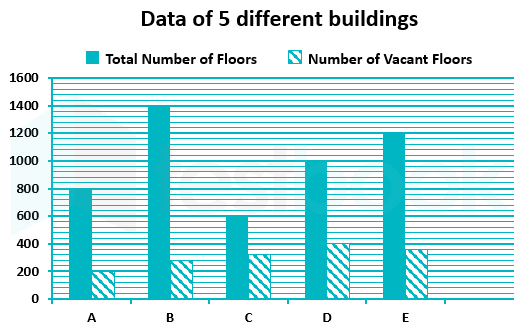
Directions: There are 5 different Buildings A, B, C, D and E and the number of Total number of floors and number of vacant floors given. Read the graph carefully and answer the given questions

Total Number of floors = Number of Vacant Floors + Number of Occupied floors

Question 41

Find the ratio between number of occupied floors in building B and that of building E.

  1. AOption (a)

    16 : 19

  2. BOption (b)

    14 : 11

  3. COption (c)

    4 : 3

  4. DOption (d)

    7 : 9

  5. EOption (e)

    None of these

View answer & explanation

Correct answer

Answer: (c)C.

4 : 3

Why this answer is correct

Formula Used:

Number of Occupied floors = Total Number of floors - Number of Vacant Floors 

Calculation:

Name of the buildingsTotal Number of floors in BuildingsNumber of Vacant Floors in BuildingsNumber of Occupied floors on Buildings
A800200600
B14002801120
C600320280
D1000400600
E1200360840


The ratio of the Number of occupied floors in building B to E

= 1120 : 840 ⇒ 4 : 3

∴ The ratio between the number of occupied floors in building B and that of building E is 4 : 3

Question 42

The number of occupied floors in building C is what % (approx) less than the number of vacant floors in building E?

  1. AOption (a)

    22%

  2. BOption (b)

    28%

  3. COption (c)

    26%

  4. DOption (d)

    30%

  5. EOption (e)

    20%

View answer & explanation

Correct answer

Answer: (a)A.

22%

Why this answer is correct

Formula Used:

Number of Occupied floors = Total Number of floors - Number of Vacant Floors 

Calculation:

Name of the buildingsTotal Number of floors in BuildingsNumber of Vacant Floors in BuildingsNumber of Occupied floors on Buildings
A800200600
B14002801120
C600320280
D1000400600
E1200360840


The number of occupied floors in building C is % less than the number of vacant floors in building E = (360 - 280)/360 × 100 ⇒ 22.22%

∴ The required percentage (approx) is 22%

Question 43

Find the difference between the total number of occupied floors of building B and C together and that of buildings D and E together.

  1. AOption (a)

    90

  2. BOption (b)

    110

  3. COption (c)

    40

  4. DOption (d)

    60

  5. EOption (e)

    None of these

View answer & explanation

Correct answer

Answer: (c)C.

40

Why this answer is correct

Formula Used:

Number of Occupied floors = Total Number of floors - Number of Vacant Floors 

Calculation:

Name of the buildingsTotal Number of floors in BuildingsNumber of Vacant Floors in BuildingsNumber of Occupied floors on Buildings
A800200600
B14002801120
C600320280
D1000400600
E1200360840


The total number of occupied floors of buildings B and C together = 1120 + 280 ⇒ 1400

The total number of occupied floors of building D and E together = 600 + 840 ⇒ 1440

The difference between (D + E) - (B + C) = 1440 - 1400 ⇒ 40

∴ The difference between the total number of occupied floors of buildings B and C together and that of buildings D and E together is 40

Question 44

If 3 persons live on each occupied floor of building A and 2 persons live on each occupied floor of building D, then find the total number of persons living in these 2 buildings.

  1. AOption (a)

    2800

  2. BOption (b)

    3000

  3. COption (c)

    2600

  4. DOption (d)

    3200

  5. EOption (e)

    None of these

View answer & explanation

Correct answer

Answer: (b)B.

3000

Why this answer is correct

Formula Used:

Number of Occupied floors = Total Number of floors - Number of Vacant Floors 

Calculation:

Name of the buildingsTotal Number of floors in BuildingsNumber of Vacant Floors in BuildingsNumber of Occupied floors on Buildings
A800200600
B14002801120
C600320280
D1000400600
E1200360840


Total number of people living on Building A = 600 × 3 ⇒ 1800

Total number of people living on Building D = 600 × 2 ⇒ 1200

Total number of people living on Building A and D = 1200 + 1800 ⇒ 3000 

∴ The total number of persons living in these 2 buildings is 3000

Question 45

Find the average of total number of occupied floors in all the 5 buildings.

  1. AOption (a)

    572

  2. BOption (b)

    652

  3. COption (c)

    526

  4. DOption (d)

    688

  5. EOption (e)

    None of these

View answer & explanation

Correct answer

Answer: (d)D.

688

Why this answer is correct

Formula Used:

Number of Occupied floors = Total Number of floors - Number of Vacant Floors 

Calculation:

Name of the buildingsTotal Number of floors in BuildingsNumber of Vacant Floors in BuildingsNumber of Occupied floors on Buildings
A800200600
B14002801120
C600320280
D1000400600
E1200360840


The total number of occupied floors in all 5 buildings = 600 + 1120 + 280 + 600 + 840 ⇒ 3440

The average of the total number of occupied floors in all the 5 buildings.= 3440/5 ⇒ 688

∴ The average is 688

Question 46

What should come in place of the question mark '?' in the following number series?

50, 200, 700, 2100, ?

  1. AOption (a)

    4250

  2. BOption (b)

    5800

  3. COption (c)

    5250

  4. DOption (d)

    5500

  5. EOption (e)

    None of these

View answer & explanation

Correct answer

Answer: (c)C.

5250

Why this answer is correct

Calculation:

Here the pattern follows

⇒ 50 × 4 = 200

⇒ 200 × 3.5 = 700 

⇒ 700 × 3 = 2100

⇒ 2100 × 2.5 = 5250

∴ The required number is 5250

Question 47

What should come in place of the question mark '?' in the following number series?

5, 16, 65, 326, ?

  1. AOption (a)

    1957

  2. BOption (b)

    1866

  3. COption (c)

    1738

  4. DOption (d)

    2106

  5. EOption (e)

    None of these

View answer & explanation

Correct answer

Answer: (a)A.

1957

Why this answer is correct

Calculation:

Here the pattern follows

⇒ 5 × 3 + 1 = 16

⇒ 16 × 4 + 1 = 65 

⇒ 65 × 5 + 1 = 326

⇒ 326 × 6 + 1 = 1957

∴ The required number is 1957

Question 48

What should come in place of the question mark '?' in the following number series?

20, 29, 4, 53, -28, ?

  1. AOption (a)

    88

  2. BOption (b)

    83

  3. COption (c)

    87

  4. DOption (d)

    93

  5. EOption (e)

    None of these

View answer & explanation

Correct answer

Answer: (d)D.

93

Why this answer is correct

Calculation:

Here the pattern follows as

⇒ 20 + 32 = 29

⇒ 29 - 52 = 4

⇒ 4 + 72 = 53

⇒ 53  - 92 = -28

⇒ -28 + 112 = 93

∴ The required number is 93

Question 49

What should come in place of the question mark '?' in the following number series?

10, 12, 15, 20, 27, 38, ?

  1. AOption (a)

    53

  2. BOption (b)

    55

  3. COption (c)

    49

  4. DOption (d)

    51

  5. EOption (e)

    None of these

View answer & explanation

Correct answer

Answer: (d)D.

51

Why this answer is correct

Calculation:

Here the prime number addition pattern follows

⇒ 10 + 2 = 12

⇒ 12 + 3 = 15

⇒ 15 + 5 = 20

⇒ 20 + 7 = 27

⇒ 27 + 11 = 38

⇒ 38 + 13 = 51

∴ The required number is 51

Question 50

What should come in place of the question mark '?' in the following number series?

49, 41, 33, 25, 17, ?

  1. AOption (a)

    8

  2. BOption (b)

    7

  3. COption (c)

    9

  4. DOption (d)

    10

  5. EOption (e)

    None of these

View answer & explanation

Correct answer

Answer: (c)C.

9

Why this answer is correct

Calculation:

Here the pattern follows as

⇒ 49 - 8 = 41

⇒ 41 - 8 = 33

⇒ 33 - 8 = 25

⇒ 25 - 8 = 17

⇒ 17 - 8 = 9

∴ The required number is 9

Question 51

The ratio of present ages of Prakash and Sohan is 5 : 3.  If the present age of Sohan is 27 years, then what will be the age of Prakash after 3 years?

  1. AOption (a)

    45 years

  2. BOption (b)

    48 years

  3. COption (c)

    42 years

  4. DOption (d)

    38 years

  5. EOption (e)

    50 years

View answer & explanation

Correct answer

Answer: (b)B.

48 years

Why this answer is correct

Shortcut Trick

Ratio of Prakash : Sohan = 5 : 3

3 units = 27 years ⇒ 1 unit = 9 years

Prakash's present age = 5 units = 5 × 9 = 45 years

Prakash's age after 3 years = 45 + 3 = 48 years

∴ The correct answer is 48 years.

Alternate Method

Given:

Present age of Sohan = 27 years

Ratio of Prakash and Sohan = 5 : 3

Calculations:

⇒ Let the present ages be 5x and 3x.

⇒ 3x = 27

⇒ x = 27 ÷ 3 = 9

⇒ Present age of Prakash = 5x = 5 × 9 = 45 years

⇒ Age of Prakash after 3 years = 45 + 3 = 48 years

∴ The correct answer is 48 years.

Additional Information

Ratio and Proportion in Ages

If the ratio of ages is a : b, and the actual age of one is known, the other can be found by multiplying the known value by the ratio fraction.

Future Age Calculation

To find the age after 'n' years, always add 'n' to the current present age. Age after n years = Present Age + n.

Question 52

A invested Rs. 4500 in a business and after some time B also joined him and invested Rs. 4800. At the end of year B received Rs. 4400 profit out of Rs. 9900. After how much time did B join the business?

  1. AOption (a)

    1 months 

  2. BOption (b)

    2 months 

  3. COption (c)

    4 months 

  4. DOption (d)

    3 months 

  5. EOption (e)

    None of these 

View answer & explanation

Correct answer

Answer: (d)D.

3 months 

Why this answer is correct

Shortcut Trick

Ratio of Profit (A : B) = (9900 − 4400) : 4400 = 5500 : 4400 = 5 : 4.

Profit Ratio = (InvestmentA × TimeA) : (InvestmentB × TimeB).

5 : 4 = (4500 × 12) : (4800 × t).

5 ÷ 4 = 54000 ÷ 4800t ⇒ t = (54000 × 4) ÷ (4800 × 5) = 9 months.

B joined after = 12 − 9 = 3 months.

∴ The correct answer is 3 months.

Alternate Method

Given: A investment = Rs. 4500, B investment = Rs. 4800, Total Profit = Rs. 9900, B profit = Rs. 4400.

Formulas: Profit Ratio = (I1 × T1) : (I2 × T2) | A profit = Total profit − B profit.

⇒ Profit of A = 9900 − 4400 = Rs. 5500.

⇒ (4500 × 12) ÷ (4800 × t) = 5500 ÷ 4400.

⇒ 54000 ÷ 4800t = 5 ÷ 4.

⇒ 4800t × 5 = 54000 × 4 ⇒ 24000t = 216000.

⇒ t = 216000 ÷ 24000 = 9 months.

⇒ B joined the business after = 12 − 9 = 3 months.

∴ The correct answer is 3 months.

Additional Information

Partnership Basics

In a partnership, the profit is distributed among partners in the ratio of the product of their investments and the time period for which the money was invested.

Time Calculation

Be careful to distinguish between the duration of investment (t) and the joining time (Total Time − t).

Question 53

A pipe can fill a rooftop water container in 12 hours and another pipe can empty 50% of the container in 10 hours. How long will it take for the empty container to be filled to 1/2 its capacity, if both the pipes are opened simultaneously?

  1. AOption (a)

    15 hours

  2. BOption (b)

    18 hours

  3. COption (c)

    12 hours

  4. DOption (d)

    14 hours

  5. EOption (e)

    10 hours

View answer & explanation

Correct answer

Answer: (a)A.

15 hours

Why this answer is correct

Shortcut Trick

Filling Pipe (A) = 12 hr, Emptying Pipe (B) = 20 hr (to empty 100%)

Net Efficiency = 1/12 − 1/20 = (5 − 3)/60 = 2/60 = 1/30

Time to fill full container = 30 hr

Time to fill 1/2 capacity = 30 ÷ 2 = 15 hr

∴ The correct answer is 15 hr.

Alternate Method

Given: Filling pipe (A) time = 12 hr. Emptying pipe (B) empties 50% in 10 hr ⇒ 100% in 20 hr.

Formula Used: Total Work = LCM of time | Efficiency = Total Work ÷ Time

PipeTime (hr)Total Work (units)Efficiency (units/hr)
A (Fill)1260+5
B (Empty)20−3

⇒ Combined Efficiency of (A + B) = 5 − 3 = 2 units/hr

⇒ Target capacity to be filled = 1/2 × 60 = 30 units

⇒ Time required = Target Capacity ÷ Combined Efficiency

⇒ Time required = 30 ÷ 2 = 15 hr

∴ The correct answer is 15 hr.

Additional Information

Inlet and Outlet Pipes

Inlet pipes add water (positive efficiency) while outlet pipes remove water (negative efficiency).

Work and Wages

Wages are always distributed in the ratio of the work done or the ratio of efficiencies when time is constant.

Pipes and Cisterns Formula

If pipe A fills in x hours and pipe B empties in y hours, net work in 1 hour = (1/x − 1/y).

Question 54

Two numbers are in the ratio of 21 : 26. If 8 is added in each, the new numbers are in the ratio of 5 : 6. Find the ratio of numbers, if 4 is subtracted from each number?

  1. AOption (a)

    19 : 24

  2. BOption (b)

    19 : 25

  3. COption (c)

    6 : 7

  4. DOption (d)

    9 : 16

  5. EOption (e)

    None of these 

View answer & explanation

Correct answer

Answer: (a)A.

19 : 24

Why this answer is correct

Shortcut Trick

Initial Ratio = 21 : 26 (Difference = 5)

New Ratio = 5 : 6 (Difference = 1)

Equalize difference: Multiply new ratio by 5 → 25 : 30

Change in units = 25 − 21 = 4 units. Given 4 units = 8, so 1 unit = 2.

Original numbers = 21 × 2 = 42 and 26 × 2 = 52. Subtract 4: (42 − 4) : (52 − 4) = 38 : 48 = 19 : 24.

∴ The correct answer is 19 : 24.

Alternate Method

Given: Ratio of two numbers = 21 : 26. Adding 8 to both results in 5 : 6.

Formula: Ratio = (a + k) / (b + k) = c / d

⇒ Let the numbers be 21x and 26x.

⇒ (21x + 8) / (26x + 8) = 5 / 6

⇒ 6(21x + 8) = 5(26x + 8)

⇒ 126x + 48 = 130x + 40

⇒ 4x = 8 → x = 2

⇒ Original numbers are 21 × 2 = 42 and 26 × 2 = 52.

⇒ After subtracting 4: (42 − 4) = 38 and (52 − 4) = 48.

⇒ Required ratio = 38 : 48 = 19 : 24.

∴ The correct answer is 19 : 24.

Additional Information

Ratio Balance Method

When the same value is added or subtracted from both terms of a ratio, the difference between the terms should remain constant. Multiply ratios to equalize these differences.

Duplicate and Sub-duplicate Ratio

Duplicate ratio of a:b is a2:b2 and sub-duplicate ratio is √a:√b.

Compound Ratio

For ratios a:b and c:d, the compound ratio is (a×c) : (b×d).

Question 55

A boat covers a certain distance downstream in 5 hours but takes 7 hours to return upstream to the starting point. If the speed of the stream is 3 km/h, then find the speed of the boat.

  1. AOption (a)

    20 km/h

  2. BOption (b)

    24 km/h

  3. COption (c)

    18 km/h

  4. DOption (d)

    26 km/h

  5. EOption (e)

    48 km/h

View answer & explanation

Correct answer

Answer: (c)C.

18 km/h

Why this answer is correct

Shortcut Trick

Ratio of Time (Downstream : Upstream) = 5 : 7

Ratio of Speed (Downstream : Upstream) = 7 : 5 (Inverse of time)

Boat Speed (B) : Stream Speed (S) = (7 + 5)/2 : (7 − 5)/2 = 6 : 1

Given 1 unit (Stream Speed) = 3 km/h, so 6 units (Boat Speed) = 6 × 3 = 18 km/h.

∴ The correct answer is 18 km/h.

Alternate Method

Given:

Time downstream (td) = 5 hours

Time upstream (tu) = 7 hours

Speed of the stream (v) = 3 km/h

Formula Used:

Distance = Speed × Time

Downstream Speed = u + v | Upstream Speed = u − v (where u = boat speed)

Calculations:

⇒ Let the speed of the boat in still water be u km/h.

⇒ Downstream speed = (u + 3) km/h

⇒ Upstream speed = (u − 3) km/h

⇒ Distance is constant: (u + 3) × 5 = (u − 3) × 7

⇒ 5u + 15 = 7u − 21

⇒ 7u − 5u = 15 + 21

⇒ 2u = 36

⇒ u = 18 km/h

∴ The correct answer is 18 km/h.

Additional Information

Boat and Stream Basic Relations

Boat Speed in Still Water (u) = (Downstream Speed + Upstream Speed) ÷ 2

Stream Speed Relation

Stream Speed (v) = (Downstream Speed − Upstream Speed) ÷ 2

Average Speed for Round Trip

Average Speed = (Downstream Speed × Upstream Speed) ÷ Boat Speed in still water

Direction: Read the following information carefully and answer the following questions.

Statement I- There are 3 groups of students X, Y and Z and they study in different classes A, B and C. Number of students in class A is 120. 

Statement II-  Number of students in class C is 80% of total number of students in class A and class B. Number of group X students in class A is 1/3rd of total number of students in class A. Total number of group X and group Y students in class B is 40.

Statement III- Ratio of group Y and group Z students in class A is 3 : 1. Ratio of group X and group Y students in class B is 3 : 1. Total number of students in class B is 250% of total number of students of group X and group Y in class B.

Statement IV- Ratio of group X, group Y and group Z students in class C is 3 : 5 : 3

Question 56

Find the number of students in class C.

  1. AOption (a)

    164

  2. BOption (b)

    158

  3. COption (c)

    176

  4. DOption (d)

    184

  5. EOption (e)

    162

View answer & explanation

Correct answer

Answer: (c)C.

176

Why this answer is correct

Calculation:

Number of group X students in class A = (1/3) of 120 = 40

Number of students in group Y and group Z of class A = 120 - 40 = 80

Now, number of group Y sudents in class A = (3/4) × 80 = 60

Number of group Z sudents in class A = 80 - 60 = 20

Now, number of group X students in class B = (3/4) × 40 = 30

Number of group Y students in class B = 40 - 30 = 10

Now, Total number of students in class B = 250% of 40 = 100

Number of students in class C = 80% of (120 + 100) = 176

Now, number of students in group X of class C = (3/11) × 176 = 48

Number of students in group Y of class C = (5/11) × 176 = 80

Number of students in group Z of class C = (3/11) × 176 = 48

Here, we have also given the above data in tabular form.

Class \ GroupTotal studentsXYZ
A120406020
B100301060
C176488048


From the table total number of students in class C = 176

∴ The number of students in class C is 176

Question 57

Number of students in class A is what % of number of students in class B?

  1. AOption (a)

    120%

  2. BOption (b)

    110%

  3. COption (c)

    80%

  4. DOption (d)

    60%

  5. EOption (e)

    140%

View answer & explanation

Correct answer

Answer: (a)A.

120%

Why this answer is correct

Calculation:

Number of group X students in class A = (1/3) of 120 = 40

Number of students in group Y and group Z of class A = 120 - 40 = 80

Now, number of group Y sudents in class A = (3/4) × 80 = 60

Number of group Z sudents in class A = 80 - 60 = 20

Now, number of group X students in class B = (3/4) × 40 = 30

Number of group Y students in class B = 40 - 30 = 10

Now, Total number of students in class B = 250% of 40 = 100

Number of students in class C = 80% of (120 + 100) = 176

Now, number of students in group X of class C = (3/11) × 176 = 48

Number of students in group Y of class C = (5/11) × 176 = 80

Number of students in group Z of class C = (3/11) × 176 = 48

Here, we have also given the above data in tabular form.

Class \ GroupTotal studentsXYZ
A120406020
B100301060
C176488048


Number of students in class A = 120

Number of students in class B = 100

The required % = (120/100) × 100 ⇒ 120%

∴ The number of students in class A is 120% of the number of students in class B

Question 58

Find the total number of students of group X.

  1. AOption (a)

    128

  2. BOption (b)

    126

  3. COption (c)

    112

  4. DOption (d)

    102

  5. EOption (e)

    118

View answer & explanation

Correct answer

Answer: (e)E.

118

Why this answer is correct

Calculation:

Number of group X students in class A = (1/3) of 120 = 40

Number of students in group Y and group Z of class A = 120 - 40 = 80

Now, number of group Y sudents in class A = (3/4) × 80 = 60

Number of group Z sudents in class A = 80 - 60 = 20

Now, number of group X students in class B = (3/4) × 40 = 30

Number of group Y students in class B = 40 - 30 = 10

Now, Total number of students in class B = 250% of 40 = 100

Number of students in class C = 80% of (120 + 100) = 176

Now, number of students in group X of class C = (3/11) × 176 = 48

Number of students in group Y of class C = (5/11) × 176 = 80

Number of students in group Z of class C = (3/11) × 176 = 48

Here, we have also given the above data in tabular form.

Class \ GroupTotal studentsXYZ
A120406020
B100301060
C176488048


Total number of students in X = 40 + 30 + 48 ⇒ 118

∴ The total number of students of group X is 118

Question 59

Find the ratio between group X and group Z students in class B.

  1. AOption (a)

    2 : 3

  2. BOption (b)

    3 : 4

  3. COption (c)

    2 : 5

  4. DOption (d)

    1 : 2

  5. EOption (e)

    4 : 3

View answer & explanation

Correct answer

Answer: (d)D.

1 : 2

Why this answer is correct

Calculation:

Number of group X students in class A = (1/3) of 120 = 40

Number of students in group Y and group Z of class A = 120 - 40 = 80

Now, number of group Y sudents in class A = (3/4) × 80 = 60

Number of group Z sudents in class A = 80 - 60 = 20

Now, number of group X students in class B = (3/4) × 40 = 30

Number of group Y students in class B = 40 - 30 = 10

Now, Total number of students in class B = 250% of 40 = 100

Number of students in class C = 80% of (120 + 100) = 176

Now, number of students in group X of class C = (3/11) × 176 = 48

Number of students in group Y of class C = (5/11) × 176 = 80

Number of students in group Z of class C = (3/11) × 176 = 48

Here, we have also given the above data in tabular form.

Class \ GroupTotal studentsXYZ
A120406020
B100301060
C176488048


Number of students in group X in class B = 30

Number of students in a group Z in class B = 60

The required ratio = 30 : 60 ⇒ 1 : 2

∴ The ratio between group X and group Z students in class B is 1 : 2

Question 60

Find the difference between number of students in class A and that of class C.

  1. AOption (a)

    44

  2. BOption (b)

    56

  3. COption (c)

    58

  4. DOption (d)

    48

  5. EOption (e)

    None of these

View answer & explanation

Correct answer

Answer: (b)B.

56

Why this answer is correct

Calculation:

Number of group X students in class A = (1/3) of 120 = 40

Number of students in group Y and group Z of class A = 120 - 40 = 80

Now, number of group Y sudents in class A = (3/4) × 80 = 60

Number of group Z sudents in class A = 80 - 60 = 20

Now, number of group X students in class B = (3/4) × 40 = 30

Number of group Y students in class B = 40 - 30 = 10

Now, Total number of students in class B = 250% of 40 = 100

Number of students in class C = 80% of (120 + 100) = 176

Now, number of students in group X of class C = (3/11) × 176 = 48

Number of students in group Y of class C = (5/11) × 176 = 80

Number of students in group Z of class C = (3/11) × 176 = 48

Here, we have also given the above data in tabular form.

Class \ GroupTotal studentsXYZ
A120406020
B100301060
C176488048


Number of students in class A = 120

Number of students in class C = 176

Difference between  C & A = 176 - 120 = 56

∴ The difference between the number of students in class A and that of class C is 56

Question 61

Ram invested Rs. 8000 at R% at S.I for 2 years. Amount received is again invested in scheme B at 12.5% at S.I for 1 years. Total interest received is Rs. 3700. Find the value of R.

  1. AOption (a)

    15%

  2. BOption (b)

    12%

  3. COption (c)

    10%

  4. DOption (d)

    18%

  5. EOption (e)

    None of these

View answer & explanation

Correct answer

Answer: (a)A.

15%

Why this answer is correct

Shortcut Trick

Interest from Scheme A = 8000 × R% × 2 = 160R

Amount from Scheme A = 8000 + 160R

Interest from Scheme B = (8000 + 160R) × 12.5% × 1 = 1000 + 20R

Total Interest = 160R + 1000 + 20R = 3700

180R = 2700 ⇒ R = 15%

∴ The correct answer is 15%.

Alternate Method

Given: Principal (P1) = ₹8000, Time (T1) = 2 years, Rate (R1) = R%, Rate (R2) = 12.5%, Time (T2) = 1 year, Total Interest = ₹3700.

Formula Used: Simple Interest (S.I.) = (P × R × T) ÷ 100; Amount (A) = P + S.I.

⇒ S.I.1 = (8000 × R × 2) ÷ 100 = 160R

⇒ Amount1 = 8000 + 160R

⇒ S.I.2 = [(8000 + 160R) × 12.5 × 1] ÷ 100

⇒ S.I.2 = (8000 + 160R) × 0.125 = 1000 + 20R

⇒ Total Interest = S.I.1 + S.I.2 = 3700

⇒ 160R + 1000 + 20R = 3700

⇒ 180R = 2700

⇒ R = 2700 ÷ 180 = 15

∴ The correct answer is 15%.

Additional Information

Simple Interest vs Amount

Simple Interest is calculated only on the principal amount, while Amount is the sum of Principal and Interest (A = P + S.I.).

Fractional Equivalent of Percentage

Converting 12.5% to a fraction (1/8) simplifies calculations significantly in competitive exams.

Successive Investment

When the Amount of one scheme is invested in another, the new principal becomes P2 = P1 × (1 + R1T1/100).

Question 62

Train A running with the speed of 36 km/hr crosses a pole in 20 seconds. Another train B whose length is 100 metre more than length of train A is running with the speed of 18 km/hr. Find the time taken by train B to cross a platform of length 500 metre.

  1. AOption (a)

    200 seconds

  2. BOption (b)

    150 seconds

  3. COption (c)

    160 seconds

  4. DOption (d)

    140 seconds

  5. EOption (e)

    None of these

View answer & explanation

Correct answer

Answer: (c)C.

160 seconds

Why this answer is correct

Shortcut Trick

Speed of Train A = 36 × (5/18) = 10 m/s. Length A = 10 × 20 = 200 m.

Length B = 200 + 100 = 300 m. Platform = 500 m.

Total Distance for B = 300 + 500 = 800 m. Speed B = 18 × (5/18) = 5 m/s.

Time taken by B = 800 ÷ 5 = 160 sec.

∴ The correct answer is 160 sec.

Alternate Method

Given: Speed of Train A = 36 km/hr, Time to cross pole = 20 sec, Length of Train B = Length A + 100 m, Speed of Train B = 18 km/hr, Platform length = 500 m.

Formula Used: Distance = Speed × Time; Time = Distance ÷ Speed; 1 km/hr = 5/18 m/s.

⇒ Speed of Train A in m/s = 36 × (5/18) = 10 m/s.

⇒ Length of Train A = Speed × Time = 10 × 20 = 200 m.

⇒ Length of Train B = 200 + 100 = 300 m.

⇒ Speed of Train B in m/s = 18 × (5/18) = 5 m/s.

⇒ Total Distance to be covered by B = Length of B + Length of Platform = 300 + 500 = 800 m.

⇒ Time taken by B = 800 ÷ 5 = 160 sec.

∴ The correct answer is 160 sec.

Additional Information

Unit Conversion

To convert km/hr to m/s, multiply by 5/18. To convert m/s to km/hr, multiply by 18/5.

Train Crossing Concepts

When a train crosses a pole or stationary person, distance = length of train. When it crosses a platform or bridge, distance = length of train + length of platform.

Relative Speed

If two trains move in the same direction, relative speed = S1 − S2. If they move in opposite directions, relative speed = S1 + S2.

Question 63

If the ratio of alcohol and water in a mixture of 85 litres is 11 ∶ 6. How much water should be added to make the ratio 5 ∶ 3?

  1. AOption (a)

    2 litres

  2. BOption (b)

    3 litres

  3. COption (c)

    4 litres

  4. DOption (d)

    5 litres

  5. EOption (e)

    6 litres

View answer & explanation

Correct answer

Answer: (b)B.

3 litres

Why this answer is correct

Shortcut Trick

Initial Ratio (Alcohol : Water) = 11 : 6 (Total units = 17)

Final Ratio (Alcohol : Water) = 5 : 3

Equate Alcohol: multiply initial by 5 and final by 11 → New Ratios: 55 : 30 and 55 : 33.

Total initial 85 units = 85 litres ⇒ 1 unit = 1 litre.

Water added = 33 − 30 = 3 units = 3 litres.

∴ The correct answer is 3 litres.

Alternate Method

Given: Total volume = 85 litres, Initial ratio = 11 : 6, Final ratio = 5 : 3.

Formula: Value of one part = Total Volume ÷ Sum of ratio parts.

⇒ Initial Alcohol = (11/17) × 85 = 55 litres.

⇒ Initial Water = (6/17) × 85 = 30 litres.

⇒ Let x litres of water be added.

⇒ New Alcohol / New Water = 55 / (30 + x) = 5 / 3.

⇒ 165 = 5 × (30 + x)

⇒ 165 = 150 + 5x

⇒ 5x = 15 ⇒ x = 3 litres.

∴ The correct answer is 3 litres.

Additional Information

Constant Quantity Concept

When only one component (e.g., water) is added to a mixture, the quantity of the other component (e.g., alcohol) remains constant. Equating the constant part in both ratios simplifies calculations.

Alligation Method

Can be used by taking water concentration. Initial water (6/17) and added pure water (1/1) are mixed to get a final concentration of 3/8.

Replacement vs Addition

In addition, total volume increases. In replacement, a portion of the mixture is removed and the same volume of a component is added, keeping total volume constant.

Question 64

A Raman marked his radio at 25% above the C.P and gave customers 12% discount on cash payment. In this way he gained Rs. 55. Find the cost price of radio.

  1. AOption (a)

    Rs 700

  2. BOption (b)

    Rs 100

  3. COption (c)

    Rs 550

  4. DOption (d)

    Rs 1000

  5. EOption (e)

    None of these

View answer & explanation

Correct answer

Answer: (c)C.

Rs 550

Why this answer is correct

Shortcut Trick

Let Cost Price (CP) be 100%.

Marked Price (MP) = 100% + 25% = 125%.

Selling Price (SP) = 125% × (100 − 12)% ÷ 100 = 125% × 0.88 = 110%.

Profit% = SP − CP = 110% − 100% = 10%.

Given, 10% = Rs. 55. ∴ 100% = Rs. 550.

∴ The correct answer is Rs 550.

Alternate Method

Given: Markup = 25%, Discount = 12%, Profit = Rs. 55.

Formulas: MP = CP × (100 + Markup%) ÷ 100 | SP = MP × (100 − Discount%) ÷ 100 | Profit = SP − CP

⇒ Let Cost Price = x.

⇒ Marked Price = x + 0.25x = 1.25x.

⇒ Selling Price = 1.25x − (12% of 1.25x) = 1.25x − 0.15x = 1.10x.

⇒ Profit = 1.10x − x = 0.10x.

⇒ 0.10x = 55 ⇒ x = 55 ÷ 0.10 = 550.

∴ The correct answer is Rs 550.

Additional Information

Successive Percentage Method

Net Profit% can be calculated using a + b + (a × b) ÷ 100, where a is markup% and b is discount% (negative).

Relation between CP and MP

The ratio of CP to MP is given by: CP ÷ MP = (100 − Discount%) ÷ (100 + Profit%).

Question 65

In the examination Raushan got 25% marks and failed by 64 marks. If he had got 40% marks he would have secured 32 marks more than the pass marks. Find the maximum marks in the examination.

  1. AOption (a)

    650

  2. BOption (b)

    600

  3. COption (c)

    640

  4. DOption (d)

    700

  5. EOption (e)

    None of these

View answer & explanation

Correct answer

Answer: (c)C.

640

Why this answer is correct

Shortcut Trick

Percentage difference between the two cases = 40% − 25% = 15%.

Marks difference between failing by 64 and passing by 32 = 64 + 32 = 96 marks.

15% of Maximum Marks = 96.

100% = (96 ÷ 15) × 100 = 6.4 × 100 = 640.

∴ The correct answer is 640 marks.

Alternate Method

Given:

Case 1: Marks = 25% of Maximum Marks, Result = Pass Marks − 64

Case 2: Marks = 40% of Maximum Marks, Result = Pass Marks + 32

Calculations:

⇒ Let the Maximum Marks be M.

⇒ 0.25 × M + 64 = Pass Marks

⇒ 0.40 × M − 32 = Pass Marks

⇒ 0.40 × M − 32 = 0.25 × M + 64

⇒ 0.40M − 0.25M = 64 + 32

⇒ 0.15M = 96

⇒ M = 96 ÷ 0.15

⇒ M = 640

∴ The correct answer is 640 marks.

Additional Information

Pass Percentage Formula

Pass % = (Marks Obtained + Marks needed to pass) ÷ Maximum Marks × 100.

Percentage Difference Rule

When comparing two scenarios of pass/fail, the difference in percentages is always equal to the sum of (failed by marks + passed by more marks).

Base Value in Percentages

The Maximum Marks always represent the 100% base value in examination-based percentage problems.

Reasoning Ability (35 questions)

Directions: Study the following information carefully and answer the questions given below.

Eight persons A, B, C, D, E, F, G, and H are sitting around a circle. All of them are facing the center but not necessarily in the same order. Two people sit between C and D. Three people sit between G and A. D is second to the right of F. Two people sit between H and B. G is not an immediate neighbor of D. H is an immediate neighbor of E.

Question 66

Who among the following is facing C? 

  1. AOption (a)

    D

  2. BOption (b)

    B

  3. COption (c)

    H

  4. DOption (d)

    E

  5. EOption (e)

    A

View answer & explanation

Correct answer

Answer: (c)C.

H

Why this answer is correct

1) D is second to the right of F. 

2) Two people sit between C and D.

3) Three people sit between G and A.

4) G is not an immediate neighbor of D. 

5) Two people sit between H and B.

6) H is an immediate neighbor of E.  (This eliminates the case 2) 

Hence, H is facing C.

Question 67

What is the position of D with respect to E?

  1. AOption (a)

    Immediate to the right

  2. BOption (b)

    Immediate to the left

  3. COption (c)

    Second to the right

  4. DOption (d)

    Second to the left

  5. EOption (e)

    Fifth to the right

View answer & explanation

Correct answer

Answer: (d)D.

Second to the left

Why this answer is correct

1) D is second to the right of F. 

2) Two people sit between C and D.

3) Three people sit between G and A.

4) G is not an immediate neighbor of D. 


5) Two people sit between H and B.

6) H is an immediate neighbor of E.  (This eliminates the case 2) 

Hence, D is second to second to the left of E.

Question 68

Who among the following is the immediate neighbor of C?

  1. AOption (a)

    B

  2. BOption (b)

    F

  3. COption (c)

    E

  4. DOption (d)

    Both B and E

  5. EOption (e)

    Both B and F

View answer & explanation

Correct answer

Answer: (e)E.

Both B and F

Why this answer is correct

1) D is second to the right of F. 

2) Two people sit between C and D.

3) Three people sit between G and A.

4) G is not an immediate neighbor of D. 

5) Two people sit between H and B.

6) H is an immediate neighbor of E.  (This eliminates the case 2) 

Hence, both B and F are immediate neighbor of C.

Question 69

Which among the following statement is true?

  1. AOption (a)

    E is an immediate neighbor of C.

  2. BOption (b)

    H is an immediate neighbor of D

  3. COption (c)

    D sits opposite to E

  4. DOption (d)

    C is second to the right of A

  5. EOption (e)

    None of the given statement is true

View answer & explanation

Correct answer

Answer: (b)B.

H is an immediate neighbor of D

Why this answer is correct

1) D is second to the right of F. 

2) Two people sit between C and D.

3) Three people sit between G and A.

4) G is not an immediate neighbor of D. 

5) Two people sit between H and B.

6) H is an immediate neighbor of E.  (This eliminates the case 2) 

Hence, H is an immediate neighbor of D is true.

Question 70

Four among the five are same in some way and thus form a group. Which among the following is odd one out. 

  1. AOption (a)

    B - D

  2. BOption (b)

    C - H

  3. COption (c)

    F - E

  4. DOption (d)

    A - G

  5. EOption (e)

    F - H

View answer & explanation

Correct answer

Answer: (e)E.

F - H

Why this answer is correct

1) D is second to the right of F. 

2) Two people sit between C and D.

3) Three people sit between G and A.

4) G is not an immediate neighbor of D. 

5) Two people sit between H and B.

6) H is an immediate neighbor of E.  (This eliminates the case 2) 

All the given pairs are opposite to each other except F - H. 

Hence, "F - H" is odd one out.

Question 71

Directions

In the question below are given two statements followed by two conclusions I and II. You have to take the given statements to be true even if they seem to be at variance from commonly known facts. Read all the conclusions and then decide which of the given conclusions logically follows from the given statements disregarding commonly known facts.

Statement:

Some vowels are words. 

Only a few words are sentences. 

Conclusion:

I. Some words are not sentences. 

II. Some vowels are sentences.

  1. AOption (a)

    Only conclusion I follows

  2. BOption (b)

    Only conclusion II follows

  3. COption (c)

    Either conclusion I or II follow. 

  4. DOption (d)

    Neither conclusion I nor II follow. 

  5. EOption (e)

    Both conclusion I and II follows

View answer & explanation

Correct answer

Answer: (a)A.

Only conclusion I follows

Why this answer is correct

Minimum possible venn diagram

I. Some words are not sentences. → True (Only a few words are sentences. Means some words are sentences and some words are not sentences) 

II. Some vowels are sentences. → False (This is possible but not definite) 

Hence, Only conclusion I follows.

Question 72

Directions

In the question below are given two statements followed by two conclusions I and II. You have to take the given statements to be true even if they seem to be at variance from commonly known facts. Read all the conclusions and then decide which of the given conclusions logically follows from the given statements disregarding commonly known facts.

Statement:

All numbers are natural. 

Only a few numbers are prime. 

Conclusion:

I. No prime is number. 

II. Some prime are natural.

  1. AOption (a)

    Both conclusion I and II follows

  2. BOption (b)

    Only conclusion II follows

  3. COption (c)

    Only conclusion I follows

  4. DOption (d)

    Neither conclusion I nor II follows

  5. EOption (e)

    Either conclusion I or II follows

View answer & explanation

Correct answer

Answer: (b)B.

Only conclusion II follows

Why this answer is correct

Minimum possible venn diagram 

I. No prime is number. → False (It is definitely false) 

II. Some prime are natural. → True (numbers which are prime are definitely natural) 

Hence, Only conclusion II follows.

Question 73

Direction: In the question below are given two statements followed by two conclusions numbered I and II. You have to take the given statements to be true even if they seem to be at variance with commonly known facts. Read all the conclusions and then decide which of the given conclusions logically follows from the given statements disregarding commonly known facts.

Statement:

Only a few cups are buckets.

No bucket is a jug.

Conclusion:

I. Some cups are not bucket.

II. Some cups are not jug.

  1. AOption (a)

    Only I follows

  2. BOption (b)

    Only II follows

  3. COption (c)

    Either I or II follows

  4. DOption (d)

    Neither I nor II follows

  5. EOption (e)

    Both I and II follow

View answer & explanation

Correct answer

Answer: (e)E.

Both I and II follow

Why this answer is correct

The least possible diagram for the given statements is as follows

Conclusions:

I. Some cups are not bucket. → True (It is clearly mentioned in statement that only few cups are buckets that means some cups are definitely not bucket)

II. Some cups are not jug. → True (Part of cups which is bucket is definitely not jug)

Hence, both I and II follows.

Direction: Read the given information carefully and answer the questions asked below.

Eight friends A, B, C, D, E, F, G and H are sitting in a row with equal distances between each other, but not necessarily in the same order. All of them are facing north direction. Two people sit between E and C. E sits at one of the extreme ends. A sits second to the right of C. B sits fourth to the left of F. F is not an immediate neighbor of C. H sits third to the left of D. D does not sit at extreme ends.

Question 74

Who among the following sits immediately to the right of F?

  1. AOption (a)

    A

  2. BOption (b)

    G

  3. COption (c)

    D

  4. DOption (d)

    E

  5. EOption (e)

    C

View answer & explanation

Correct answer

Answer: (b)B.

G

Why this answer is correct

  1. Two people sit between E and C.

  2. E sits at one of the extreme ends.

  3. A sits second to the right of C.

  4. B sits fourth to the left of F.

  5. F is not an immediate neighbor of C. (This eliminates case 2)

  6. H sits third to the left of D.

  7. D does not sit at extreme ends.

Hence, ‘G’ sits immediately to the right of F.

Question 75

How many people sit between C and B?

  1. AOption (a)

    One

  2. BOption (b)

    Two

  3. COption (c)

    Three

  4. DOption (d)

    Four

  5. EOption (e)

    None

View answer & explanation

Correct answer

Answer: (e)E.

None

Why this answer is correct

  1. Two people sit between E and C.

  2. E sits at one of the extreme ends.

  3. A sits second to the right of C.

  4. B sits fourth to the left of F.

  5. F is not an immediate neighbor of C. (This eliminates case 2)

  6. H sits third to the left of D.

  7. D does not sit at extreme ends.

Hence, no one sits between C and B.

Question 76

If all the persons are made to sit in alphabetical order from left to right, how many will remain unchanged as compared to their original seating position?

  1. AOption (a)

    One

  2. BOption (b)

    Two

  3. COption (c)

    Three

  4. DOption (d)

    None

  5. EOption (e)

    More than three

View answer & explanation

Correct answer

Answer: (d)D.

None

Why this answer is correct

  1. Two people sit between E and C.

  2. E sits at one of the extreme ends.

  3. A sits second to the right of C.

  4. B sits fourth to the left of F.

  5. F is not an immediate neighbour of C. (This eliminates case 2)

  6. H sits third to the left of D.

  7. D does not sit at extreme ends.

After rearrangement: 

All of them change their position as compared to their original seating position.

Hence, none unchanged as compared to their original seating position.

Question 77

Four among five are the same in a certain way. Find the one who does not belong to the group?

  1. AOption (a)

    E - G

  2. BOption (b)

    B - A

  3. COption (c)

    D - C

  4. DOption (d)

    F - H

  5. EOption (e)

    A - F

View answer & explanation

Correct answer

Answer: (e)E.

A - F

Why this answer is correct

  1. Two people sit between E and C.

  2. E sits at one of the extreme ends.

  3. A sits second to the right of C.

  4. B sits fourth to the left of F.

  5. F is not an immediate neighbor of C. (This eliminates case 2)

  6. H sits third to the left of D.

  7. D does not sit at extreme ends.


E → First from the left end, G → First from the right end

B → Third from the left end, A → Third from the right end

D → Fifth from the left end, C → Fifth from the right end

F → seventh from the left end, H → seventh from the right end

A → Sixth from the left end, F→ Second from the right end

Hence, ‘A - F’ does not belong to the group.

Question 78

Who among the following sits second from the left end?

  1. AOption (a)

    B

  2. BOption (b)

    C

  3. COption (c)

    H

  4. DOption (d)

    F

  5. EOption (e)

    A

View answer & explanation

Correct answer

Answer: (c)C.

H

Why this answer is correct

  1. Two people sit between E and C.

  2. E sits at one of the extreme ends.

  3. A sits second to the right of C.

  4. B sits fourth to the left of F.

  5. F is not an immediate neighbor of C. (This eliminates case 2)

  6. H sits third to the left of D.

  7. D does not sit at extreme ends.

Hence, H sits second from the left end.

Direction: Study the following information carefully and answer the given question. 

Sahil starts from Point A and walks 8 m in south and reaches point B, then turns towards his left and walks 4 m and reaches Point C, from point C he turns his right and walks 5 m and reaches Point D. From D he turns 8 m towards left and reaches to E. From E he again turns left and walk 5 m reaches to F again turn right and walk 4 m to reach point G. Finally he again turns to his left and walks 8 m and reaches Point H.

Question 79

What is the distance between A and H and H is in which direction with respect to A?

  1. AOption (a)

    16 m, East

  2. BOption (b)

    12 m, West

  3. COption (c)

    16 m, West

  4. DOption (d)

    24 m, North East

  5. EOption (e)

    12 m, South East

View answer & explanation

Correct answer

Answer: (a)A.

16 m, East

Why this answer is correct

Hence, H is 16 m in the East direction with respect to A.

Question 80

Point E is in which direction with respect to C?

  1. AOption (a)

    South

  2. BOption (b)

    South East

  3. COption (c)

    North West

  4. DOption (d)

    North

  5. EOption (e)

    North East

View answer & explanation

Correct answer

Answer: (b)B.

South East

Why this answer is correct

Hence, E is in South East direction with respect to C.

Question 81

How many such pairs of letters are there in the word ‘CONDITION’, each of which has as many letters between them in the word (both forward and backward direction) as they have between them in the English alphabetical series?

  1. AOption (a)

    One 

  2. BOption (b)

    Two

  3. COption (c)

    Three

  4. DOption (d)

    Four

  5. EOption (e)

    More than Four

View answer & explanation

Correct answer

Answer: (c)C.

Three

Why this answer is correct

Forward Pair - CI

Backward Pair - ON, ON

Hence, Three such pairs each of which has as many letters between them in the word as they have between them in the English alphabetical series.

Direction: Study the given information carefully and answer the following questions.

Eight people A, B, C, D, E, F, G and H buy different items but not necessarily in the same order. Three-person buys items between A and D. Two persons buy items between B and A. A buys item immediately before G and after C. Two people buy item between H and C. A buys an item after B. F buys an item before E. Neither F nor E buys items first or last.

Question 82

How many people buy item between F and G?

  1. AOption (a)

    One

  2. BOption (b)

    Two

  3. COption (c)

    Three

  4. DOption (d)

    Four

  5. EOption (e)

    Five

View answer & explanation

Correct answer

Answer: (b)B.

Two

Why this answer is correct

1) Two persons buy items between B and A

  1. A buys an item after B.

3) A buys item immediately before G and after C. 

4) Three-person buys items between A and D. 

CASE 1CASE 2CASE 3CASE 4
BD
BD
CBD
ACB
GAC
GAC
GA
DG


  1. Two people buy item between H and C. (This eliminates case 4)
CASE 1CASE 2CASE 3
BD
BD
CB
AC
GAC
HGA
HG
DH


  1. F buys an item before E.

  2. Neither F nor E buys items first or last. (This eliminates case 2 and case 3)

CASE 1
B
F
C
A
G
H
E
D


Hence two person buys F and G.

Question 83

Who among the following buys the item at last?

  1. AOption (a)

    C

  2. BOption (b)

    D

  3. COption (c)

    F

  4. DOption (d)

    A

  5. EOption (e)

    G

View answer & explanation

Correct answer

Answer: (b)B.

D

Why this answer is correct

1) Two persons buy items between B and A

  1. A buys an item after B.

3) A buys item immediately before G and after C. 

4) Three-person buys items between A and D. 

CASE 1CASE 2CASE 3CASE 4
BD
BD
CBD
ACB
GAC
GAC
GA
DG


  1. Two people buy item between H and C. (This eliminates case 4)
CASE 1CASE 2CASE 3
BD
BD
CB
AC
GAC
HGA
HG
DH


  1. F buys an item before E.

  2. Neither F nor E buys items first or last. (This eliminates case 2 and case 3)

CASE 1
B
F
C
A
G
H
E
D
<br>

Hence, D buys the the item at last.

Question 84

Who among the following buys item immediately before E? 

  1. AOption (a)

    C

  2. BOption (b)

    H

  3. COption (c)

    F

  4. DOption (d)

    B

  5. EOption (e)

    G

View answer & explanation

Correct answer

Answer: (b)B.

H

Why this answer is correct

1) Two persons buy items between B and A

  1. A buys an item after B.

3) A buys item immediately before G and after C. 

4) Three-person buys items between A and D. 

CASE 1CASE 2CASE 3CASE 4
BD
BD
CBD
ACB
GAC
GAC
GA
DG


  1. Two people buy item between H and C. (This eliminates case 4)
CASE 1CASE 2CASE 3
BD
BD
CB
AC
GAC
HGA
HG
DH


  1. F buys an item before E.

  2. Neither F nor E buys items first or last. (This eliminates case 2 and case 3)

CASE 1
B
F
C
A
G
H
E
D
<br>

Hence, H buys the item immediate before E.

Question 85

How many persons buy item after C?

  1. AOption (a)

    None

  2. BOption (b)

    Two

  3. COption (c)

    Three

  4. DOption (d)

    Four

  5. EOption (e)

    Five

View answer & explanation

Correct answer

Answer: (e)E.

Five

Why this answer is correct

1) Two persons buy items between B and A

  1. A buys an item after B.

3) A buys item immediately before G and after C. 

4) Three-person buys items between A and D. 

CASE 1CASE 2CASE 3CASE 4
BD
BD
CBD
ACB
GAC
GAC
GA
DG


  1. Two people buy item between H and C. (This eliminates case 4)
CASE 1CASE 2CASE 3
BD
BD
CB
AC
GAC
HGA
HG
DH


  1. F buys an item before E.

  2. Neither F nor E buys items first or last. (This eliminates case 2 and case 3)

CASE 1
B
F
C
A
G
H
E
D

Hence, five-person buys item after C.

Question 86

Four among the five are same in a certain way and thus form a group. Which among the following does not belong to the group?

  1. AOption (a)

    FC

  2. BOption (b)

    AG

  3. COption (c)

    CA

  4. DOption (d)

    GH

  5. EOption (e)

    AB

View answer & explanation

Correct answer

Answer: (e)E.

AB

Why this answer is correct

1) Two persons buy items between B and A

  1. A buys an item after B.

3) A buys item immediately before G and after C. 

4) Three-person buys items between A and D. 

CASE 1CASE 2CASE 3CASE 4
BD
BD
CBD
ACB
GAC
GAC
GA
DG


  1. Two people buy item between H and C. (This eliminates case 4)
CASE 1CASE 2CASE 3
BD
BD
CB
AC
GAC
HGA
HG
DH


  1. F buys an item before E.

  2. Neither F nor E buys items first or last. (This eliminates case 2 and case 3)

CASE 1
B
F
C
A
G
H
E
D

Hence, AB is the odd one out.

Question 87

Direction: In the following question assuming the given statement to be true. Find which of the following conclusion(s) among given conclusions is/are definitely true then give your answer accordingly.

Statement: D < E ≤ F, G > H ≥ I > F

Conclusion:

I. E ≤ H

II. H > D

  1. AOption (a)

    Only I is true

  2. BOption (b)

    Only II is true

  3. COption (c)

    Both I and II are true

  4. DOption (d)

    None is true

  5. EOption (e)

    Either I or II is true

View answer & explanation

Correct answer

Answer: (b)B.

Only II is true

Why this answer is correct

Given Statements: D < E ≤ F, G > H ≥ I > F

On combining:  D < E ≤ F < I ≤ H < G

Conclusions:

I. E ≤ H → False (as E ≤ F < I ≤ H → E < H)

II. H > D → True (as D < E ≤ F < I ≤ H → D < H)

Hence, only II is true.

Question 88

Direction: In the following question assuming the given statement to be true. Find which of the following conclusion(s) among given conclusions is/are definitely true then give your answer accordingly.

Statement: M ≥ B ≥ N = Z > X ≤ R > S

Conclusion:

I. M > X

II. N > S

  1. AOption (a)

    None is true

  2. BOption (b)

    Only II is true

  3. COption (c)

    Both I and II are true

  4. DOption (d)

    Only I is true

  5. EOption (e)

    Either I or II is true

View answer & explanation

Correct answer

Answer: (d)D.

Only I is true

Why this answer is correct

Given Statements: M ≥ B ≥ N = Z > X ≤ R > S

Conclusions:

I. M > X → True (as M ≥ B ≥ N = Z > X →M > X)

II. N > S → False (as N = Z > X ≤ R > S → Relation between N and S cannot be determined)

Hence, only I is true.

Question 89

Direction: In the following question assuming the given statement to be true. Find which of the following conclusion(s) among given conclusions is/are definitely true then give your answer accordingly.

Statement: M > N ≥ O = P ≤ Q < R > S

Conclusion:

I. M > P

II. O < R

  1. AOption (a)

    Only I true

  2. BOption (b)

    Only II true

  3. COption (c)

    Neither I nor II is true

  4. DOption (d)

    Both I and II are true

  5. EOption (e)

    Either I or II is true

View answer & explanation

Correct answer

Answer: (d)D.

Both I and II are true

Why this answer is correct

Given Statements: M > N ≥ O = P ≤ Q < R > S

Conclusion:

I. M > P → True (as M > N ≥ O = P → M > P)

II. O < R → True (as O = P ≤ Q < R → O < R)

Hence, both I and II are true.

Direction: Read the information carefully and answer the following questions.

There are twelve persons sitting in two parallel rows. Six persons A, B, C, D, E and F are facing south and other six P, Q, R, S, T, and U are facing north. Each person from one row faces exactly one person from the other row but not necessarily in the same order.

A and R sits diagonally opposite each other. There are two persons sitting between R and Q. One of the immediate neighbors of Q faces C, who does not sit near A. P faces B and P is not an immediate neighbor of Q. There are two persons sitting between B and D. T sits second to the right of U. E does not sit at any of the extreme ends. S and T is not immediate neighbor of each other. A sits at one of the extreme ends.

Question 90

How many persons are sitting between R and U?

  1. AOption (a)

    One

  2. BOption (b)

    Two

  3. COption (c)

    Three

  4. DOption (d)

    Four

  5. EOption (e)

    None

View answer & explanation

Correct answer

Answer: (c)C.

Three

Why this answer is correct

Given:

Persons sitting in two parallel rows.

Six persons: A, B, C, D, E and F are facing north.

 P, Q, R, S, T, and U are facing south.

Each person from one row faces exactly one person from the other row but not necessarily in the same order.

  1. A sits at one of the extreme ends. A and R sits diagonally opposite each other.

  2. There are two persons sitting between R and Q.

  3. One of the immediate neighbors of Q faces C, who does not sit near A.

  4. P faces B and P is not an immediate neighbor of Q.

  5. There are two persons sitting between B and D.

  6. T sits second to the right of U.

  7. E does not sit at any of the extreme ends.

  8. S and T is not immediate neighbor of each other. (This eliminates case 1)

Hence, three persons are there between R and U.

Question 91

Four are alike in some way. Find which of the following is different?

  1. AOption (a)

    P

  2. BOption (b)

    U

  3. COption (c)

    D

  4. DOption (d)

    B

  5. EOption (e)

    A

View answer & explanation

Correct answer

Answer: (e)E.

A

Why this answer is correct

Given:

Persons sitting in two parallel rows.

Six persons: A, B, C, D, E and F are facing north.

 P, Q, R, S, T, and U are facing south.

Each person from one row faces exactly one person from the other row but not necessarily in the same order.

  1. A sits at one of the extreme ends. A and R sits diagonally opposite each other.

  2. There are two persons sitting between R and Q.

  3. One of the immediate neighbors of Q faces C, who does not sit near A.

  4. P faces B and P is not an immediate neighbor of Q.

  5. There are two persons sitting between B and D.

  6. T sits second to the right of U.

  7. E does not sit at any of the extreme ends.

  8. S and T is not immediate neighbor of each other. (This eliminates case 1)

No one sits at extreme end except A.

Hence, A is different.

Question 92

Who is second to the left of Q?

  1. AOption (a)

    P

  2. BOption (b)

    S

  3. COption (c)

    T

  4. DOption (d)

    R

  5. EOption (e)

    Can’t determine

View answer & explanation

Correct answer

Answer: (b)B.

S

Why this answer is correct

Given:

Persons sitting in two parallel rows.

Six persons: A, B, C, D, E and F are facing north.

 P, Q, R, S, T, and U are facing south.

Each person from one row faces exactly one person from the other row but not necessarily in the same order.

  1. A sits at one of the extreme ends. A and R sits diagonally opposite each other.

  2. There are two persons sitting between R and Q.

  3. One of the immediate neighbors of Q faces C, who does not sit near A.

  4. P faces B and P is not an immediate neighbor of Q.

  5. There are two persons sitting between B and D.

  6. T sits second to the right of U.

  7. E does not sit at any of the extreme ends.

  8. S and T is not immediate neighbor of each other. (This eliminates case 1)

Clearly, S is second to the left of Q.

Question 93

If persons who are facing north sit as per alphabetical order from left to right. How many persons do not change their seats?

  1. AOption (a)

    Three

  2. BOption (b)

    None

  3. COption (c)

    One

  4. DOption (d)

    Two

  5. EOption (e)

    Four

View answer & explanation

Correct answer

Answer: (d)D.

Two

Why this answer is correct

Given:

Persons sitting in two parallel rows.

Six persons: A, B, C, D, E and F are facing north. 

P, Q, R, S, T, and U are facing south.

Each person from one row faces exactly one person from the other row but not necessarily in the same order.

  1. A sits at one of the extreme ends. A and R sits diagonally opposite each other.

  2. There are two persons sitting between R and Q.

  3. One of the immediate neighbors of Q faces C, who does not sit near A.

  4. P faces B and P is not an immediate neighbor of Q.

  5. There are two persons sitting between B and D.

  6. T sits second to the right of U.

  7. E does not sit at any of the extreme ends.

  8. S and T is not immediate neighbor of each other. (This eliminates case 1)

If persons who are facing north sit as per alphabetical order from left to right, the arrangement is as follows:

Hence, two persons do not change their seats.

Question 94

Who among the following sits opposite to T?

  1. AOption (a)

    C

  2. BOption (b)

    D

  3. COption (c)

    B

  4. DOption (d)

    E

  5. EOption (e)

    A

View answer & explanation

Correct answer

Answer: (a)A.

C

Why this answer is correct

Given:

Persons sitting in two parallel rows.

Six persons: A, B, C, D, E and F are facing north.

 P, Q, R, S, T, and U are facing south.

Each person from one row faces exactly one person from the other row but not necessarily in the same order.

  1. A sits at one of the extreme ends. A and R sits diagonally opposite each other.

  2. There are two persons sitting between R and Q.

  3. One of the immediate neighbors of Q faces C, who does not sit near A.

  4. P faces B and P is not an immediate neighbor of Q.

  5. There are two persons sitting between B and D.

  6. T sits second to the right of U.

  7. E does not sit at any of the extreme ends.

  8. S and T is not immediate neighbor of each other. (This eliminates case 1)

Hence, C sits opposite T.

Direction: Study the following alpha numeric series and answer the questions given below.

5 4 A B % & 3 5 E 2 1 U * G @ © 9 C 5 7 F K I 4 £ T V 9 4 H € L M 1

Question 95

How many vowels are there which are immediately preceded by a perfect square?

  1. AOption (a)

    0

  2. BOption (b)

    1

  3. COption (c)

    2

  4. DOption (d)

    3

  5. EOption (e)

    4

View answer & explanation

Correct answer

Answer: (c)C.

2

Why this answer is correct

Given series:

Left Side 5 4 A B % & 3 5 E 2 1 U * G @ © 9 C 5 7 F K I 4 £ T V 9 4 H € L M 1 Right Side

1)Vowels which are immediately preceded by a perfect square

Perfect square → Vowel

5 4 A B % & 3 5 E 2 1 U * G @ © 9 C 5 7 F K I 4 £ T V 9 4 H € L M 1

Hence there are only ‘two’ vowels which are immediately preceded by a perfect square.

Question 96

How many numbers are there which are immediately preceded by a symbol and followed by a consonant?

  1. AOption (a)

    0

  2. BOption (b)

    1

  3. COption (c)

    2

  4. DOption (d)

    3

  5. EOption (e)

    4

View answer & explanation

Correct answer

Answer: (b)B.

1

Why this answer is correct

Given series:

Left Side 5 4 A B % & 3 5 E 2 1 U * G @ © 9 C 5 7 F K I 4 £ T V 9 4 H € L M 1 Right Side

  1. Numbers which are immediately preceded by a symbol and followed by a consonant:

5 4 A B % & 3 5 E 2 1 U * G @ © 9 C 5 7 F K I 4 £ T V 9 4 H € L M 1

Hence, there is one such combination.

Question 97

If all the symbols in the above arrangement are dropped then which of the following element is tenth from the left of third element from the right?

  1. AOption (a)

    E

  2. BOption (b)

    U

  3. COption (c)

    5

  4. DOption (d)

    7

  5. EOption (e)

    F

View answer & explanation

Correct answer

Answer: (d)D.

7

Why this answer is correct

Given series:

Left Side 5 4 A B % & 3 5 E 2 1 U * G @ © 9 C 5 7 F K I 4 £ T V 9 4 H € L M 1 Right Side

  1. If all symbols are dropped the series will be:

Given series:

Left Side 5 4 A B 3 5 E 2 1 U G 9 C 5 7 F K I 4 T V 9 4 H L M 1 Right Side

  1. Element which is tenth from the left of third element from the right.

Firstly, Element which is third from right i.e. ‘L’

5 4 A B 3 5 E 2 1 U G 9 C 5 7 F K I 4 T V 9 4 H L M 1

Now 10th element from the left of ‘L’

5 4 A B 3 5 E 2 1 U G 9 C 5 7 F K I 4 T V 9 4 H L M 1

Hence ‘7’ is tenth from the left of third element from the right.

Question 98

If the first eighteen elements in the above sequence are written in reverse order, then which of the following will be at the eighteenth position from the right end?

  1. AOption (a)

    9

  2. BOption (b)

    4

  3. COption (c)

    A

  4. DOption (d)

    ©

  5. EOption (e)

    5

View answer & explanation

Correct answer

Answer: (b)B.

4

Why this answer is correct

Given series:

Left Side 5 4 A B % & 3 5 E 2 1 U * G @ © 9 C 5 7 F K I 4 £ T V 9 4 H € L M 1 Right Side

  1. First eighteen elements in the above sequence are written in reverse order

C 9 © @G * U 1 2 E 5 3 & % B A 4 5 5 7 F K I 4 £ T V 9 4 H € L M 1

  1. Now eighteenth position from right end

C 9 © @G * U 1 2 E 5 3 & % B A 4 5 5 7 F K I 4 £ T V 9 4 H € L M 1

Hence after reversing the first eighteen elements ‘4’ is at eighteenth position from the right.

Question 99

Four of the following are alike in a certain way based on their position in the above arrangement. Find the one which does not belong to that group?

  1. AOption (a)

    B & E

  2. BOption (b)

    7 K £

  3. COption (c)

    4 € 1

  4. DOption (d)

    4 B 3

  5. EOption (e)

    U G ©

View answer & explanation

Correct answer

Answer: (e)E.

U G ©

Why this answer is correct

Given series:

Left Side 5 4 A B % & 3 5 E 2 1 U * G @ © 9 C 5 7 F K I 4 £ T V 9 4 H € L M 1 Right Side

  1. B & E → B + 2 = &; & + 3 = E

  2. 7 K £ → 7 + 2 = K; K + 3 = £

  3. 4 € 1 → 4 + 2 = €; € + 3 = 1

  4. 4 B 3 → 4 + 2 = B; B + 3 = 3

5) U G © → U + 2 = G; G + 2 = ©

Hence ‘U G ©’ does not belong to the given group.

Question 100

If it is possible to make only one four-lettered meaningful word without repetition of any letter with the third, fourth, eighth, and the eleventh letters of the word ‘CONSECUTIVE’, which would be the second letter of the new word? If more than one such word can be formed, give X as the answer. If no such word can be formed, give Y as your answer.

  1. AOption (a)

    S

  2. BOption (b)

    N

  3. COption (c)

    T

  4. DOption (d)

    X

  5. EOption (e)

    Y

View answer & explanation

Correct answer

Answer: (d)D.

X

Why this answer is correct

In the CONSECUTIVE third, fourth, eighth and eleventh is N, S, T and E 

Word from these are NEST TENS and SENT. 

As more than one word can be formed. 

Hence, X is the answer.

100 questions in the full paper