Previous Year Paper

RRB Technician Grade III Official Paper (Held On: 30 Dec, 2024 Shift 1) (Previous Year Paper)

Held in 2024

100 questions90 minutes
With answers
Free

Paper last updated:

Practise under exam conditions

Take this paper as a timed mock test. Review your answers after you submit.

Attempt timed test

Questions & answers

Read the paper at your pace. Open an explanation when you need it.

Full Test (100 questions)

Question 1

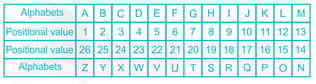
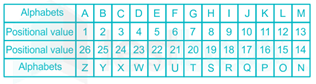
Based on the English alphabetical order, three of the following four letter-clusters are alike in a certain way and thus form a group. Which letter-cluster does not belong to that group?

(Note: The odd one out is not based on the number of consonants/vowels or their position in the letter-cluster.)

  1. AOption (a)

    JGM 

  2. BOption (b)

    TQW 

  3. COption (c)

    NKR 

  4. DOption (d)

    QNT 

View answer & explanation

Correct answer

Answer: (c)C.

NKR 

Why this answer is correct

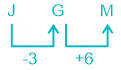
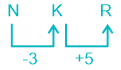
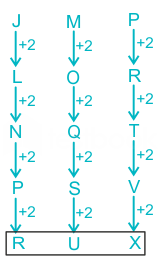
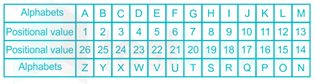
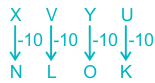
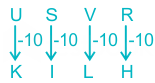
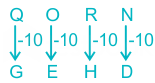
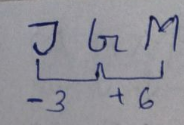
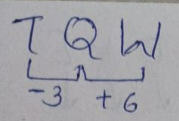
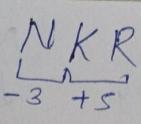
The logic followed here is:
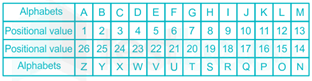
Option 1) JGM 
Option 2) TQW 
Option 3) NKR 
Option 4) QNT 
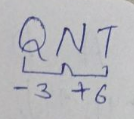
Hence, the correct answer is "Option 3".

Question 2

When iron filings are sprinkled around a magnet, they form a pattern. What does this pattern represent? 

  1. AOption (a)

    Electric field lines 

  2. BOption (b)

    Both electric and magnetic field lines  

  3. COption (c)

    Magnetic field lines 

  4. DOption (d)

    Neither electric nor magnetic field lines 

View answer & explanation

Correct answer

Answer: (c)C.

Magnetic field lines 

Why this answer is correct

The correct answer is Magnetic field lines.

Key Points

  • When iron filings are sprinkled around a magnet, they align themselves along the magnetic field lines of the magnet.
  • These patterns visually represent the magnetic field and its direction.
  • The iron filings experience a force in the presence of the magnetic field, causing them to move and align along the field lines.
  • The density of the filings indicates the strength of the magnetic field; the closer the lines, the stronger the magnetic field in that region.

Additional Information

  • Magnetic field:
  • A magnetic field is a vector field that describes the magnetic influence on moving electric charges, electric currents, and magnetic materials.
  • It is produced by moving electric charges and intrinsic magnetic moments of elementary particles associated with a fundamental quantum property, their spin.
  • Magnetic field lines:
  • Magnetic field lines are a visual tool used to represent magnetic fields.
  • They are imaginary lines that describe the direction of the magnetic force.
  • Ferromagnetic materials:
  • Materials like iron that can be magnetized are called ferromagnetic materials.
  • These materials have high magnetic permeability and are strongly attracted by a magnetic field.
  • Electromagnetism:
  • Electromagnetism is the branch of physics involving the study of the electromagnetic force, a type of physical interaction that occurs between electrically charged particles.
  • The electromagnetic force is one of the four fundamental interactions in nature.

Question 3

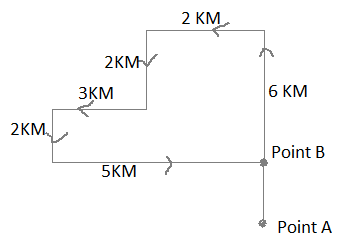
Ajit starts from point A and drives 6 km towards North. He then takes two simultaneous left turns and drives 2 km each. He then takes a right turn and drives 3 km.. He then takes a left turn and drives 2 km. He takes a final left tum and drives 5 km to reach a point B. How far (shortest distance) and towards which direction should he drive in order to reach Point A again? (All turns are 90 degrees tums only unless specified.)

  1. AOption (a)

    2 km South

  2. BOption (b)

    2 km North 

  3. COption (c)

    5 km West 

  4. DOption (d)

    3 km South  

View answer & explanation

Correct answer

Answer: (a)A.

2 km South

Why this answer is correct

Given:

 Ajit starts from point A and drives 6 km towards North.

He then takes two simultaneous left turns and drives 2 km each.

He then takes a right turn and drives 3 km.

He then takes a left turn and drives 2 km.

He takes a final left tum and drives 5 km to reach a point B.

Thus, he drive 2 km South in order to reach Point A again.

Hence, the correct answer is "Option 1".

Question 4

The tube which grows out of pollen grain to reach the ovary, travels through the: 

  1. AOption (a)

    anther 

  2. BOption (b)

    filament

  3. COption (c)

    style 

  4. DOption (d)

    petal 

View answer & explanation

Correct answer

Answer: (c)C.

style 

Why this answer is correct

The correct answer is style.

Key Points

  • The pollen tube grows from the pollen grain and travels through the style to reach the ovary.
  • The style is a slender stalk that connects the stigma to the ovary in the flower.
  • The primary function of the style is to provide a pathway for the pollen tube to deliver sperm cells to the ovule.
  • The growth of the pollen tube through the style is a crucial step in the fertilization process in flowering plants.

Additional Information

  • Stigma
  • The stigma is the part of the pistil where pollen germinates.
  • It is typically sticky, aiding in the capture of pollen grains.
  • Ovary
  • The ovary is the enlarged basal portion of the pistil where ovules are produced.
  • After fertilization, the ovary develops into a fruit.
  • Anther
  • The anther is the part of a stamen that contains the pollen.
  • It is typically located at the top of the filament.
  • Filament
  • The filament is the stalk that supports the anther in the stamen.
  • It helps position the anther for effective pollen transfer.

Question 5

The HCF of 45, 78 and 117 is: 

  1. AOption (a)

    9

  2. BOption (b)

    7

  3. COption (c)

    5

  4. DOption (d)

    3

View answer & explanation

Correct answer

Answer: (d)D.

3

Why this answer is correct

Shortcut Trick

Check the difference between the closest numbers: 117 − 78 = 39.

The HCF must be a factor of 39 (Factors: 1, 3, 13, 39).

Test the highest factor: 39 does not divide 45. 13 does not divide 45.

3 divides 45, 78, and 117 perfectly.

∴ The correct answer is 3.

Alternate Method

Given: Numbers are 45, 78, and 117.

Formula Used: Prime Factorization Method for finding Highest Common Factor (HCF).

⇒ Prime factors of 45 = 3 × 3 × 5 = 32 × 5

⇒ Prime factors of 78 = 2 × 3 × 13

⇒ Prime factors of 117 = 3 × 3 × 13 = 32 × 13

⇒ Common prime factor in all three numbers = 3

⇒ HCF = Lowest power of common prime factor = 31

⇒ HCF = 3

∴ The correct answer is 3.

Additional Information

Definition of HCF

The Highest Common Factor (HCF) is the largest positive integer that divides each of the integers without leaving a remainder.

Relationship between HCF and LCM

For two numbers a and b, HCF(a, b) × LCM(a, b) = a × b. This property does not directly apply to three or more numbers.

Division Method for HCF

Divide the larger number by the smaller one, then divide the previous divisor by the remainder until the remainder is zero. The last divisor is the HCF.

Question 6

Which of the options represents the correct and balanced chemical equation for the reaction between a metallic oxide and an acid?  

CuO + HCl → ______ + ________

  1. AOption (a)

    CuO + 2HCI → CuCl2 + H2O

  2. BOption (b)

    CuO + 2HCI → CuCl2 + O2

  3. COption (c)

    CuO + HCI → CuOH + HCl

  4. DOption (d)

    CuO + HCI → CuCl + H2

View answer & explanation

Correct answer

Answer: (a)A.

CuO + 2HCI → CuCl2 + H2O

Why this answer is correct

The correct answer is CuO + 2HCI → CuCl2 + H2O.

Key Points

  • When a metallic oxide reacts with an acid, it typically forms a salt and water.
  • Copper (II) oxide (CuO) is a black solid that reacts with hydrochloric acid (HCl) to form copper (II) chloride (CuCl2), a greenish-blue solution, and water (H2O).
  • The balanced chemical equation for this reaction is CuO + 2HCl → CuCl2 + H2O.
  • Balancing the equation ensures that the number of atoms of each element is the same on both sides of the equation, adhering to the law of conservation of mass.

Additional Information

  • Metallic Oxides:
  • Metallic oxides are compounds consisting of a metal and oxygen.
  • They are typically basic and react with acids to form salts and water.
  • Hydrochloric Acid (HCl):
  • Hydrochloric acid is a strong acid, commonly used in various chemical reactions.
  • It is highly corrosive and should be handled with care.
  • Balancing Chemical Equations:
  • Balancing chemical equations is essential for representing the law of conservation of mass.
  • It ensures that the number of atoms for each element is equal on both the reactant and product sides.
  • Copper (II) Chloride (CuCl2):
  • Copper (II) chloride is an inorganic compound with the formula CuCl2.
  • It appears as a greenish-blue solid and is used in various industrial and chemical applications.

Question 7

The list price of an article is Rs. 1200 and a discount of 15% is offered on the list price. The selling price of the article is: 

  1. AOption (a)

    Rs. 1080

  2. BOption (b)

    Rs 1120

  3. COption (c)

    Rs. 1020

  4. DOption (d)

    Rs. 1140

View answer & explanation

Correct answer

Answer: (c)C.

Rs. 1020

Why this answer is correct

Shortcut Trick

Discount% = 15% ⇒ Selling Price = 85% of List Price.

SP = 1200 × (100 − 15) ÷ 100.

SP = 1200 × 85 ÷ 100 = 12 × 85.

SP = 1020.

∴ The correct answer is Rs. 1020.

Alternate Method

Given: List Price (MP) = Rs. 1200, Discount Rate = 15%.

Formulas: Discount = MP × Discount% | SP = MP − Discount.

⇒ Discount Amount = 15% of 1200 = (15 ÷ 100) × 1200 = 180.

⇒ Selling Price (SP) = 1200 − 180 = 1020.

∴ The correct answer is Rs. 1020.

Additional Information

Marked Price and List Price

The List Price is the price at which the article is listed for sale before any discount. It is functionally the same as the Marked Price (MP).

Calculating SP with multiple discounts

If two successive discounts d1% and d2% are given, SP = MP × (100 − d1)/100 × (100 − d2)/100.

Question 8

Spores in Rhizopus are present in blobs, which are known as: 

  1. AOption (a)

    buds 

  2. BOption (b)

    sacs 

  3. COption (c)

    fruiting bodies 

  4. DOption (d)

    sporangia 

View answer & explanation

Correct answer

Answer: (d)D.

sporangia 

Why this answer is correct

The correct answer is sporangia.

Key Points

  • Rhizopus, a genus of common fungi, reproduces through the formation of spores housed in structures called sporangia.
  • The sporangia are spherical, sac-like structures situated at the tips of the upright hyphae known as sporangiophores.
  • When the sporangia mature, they release spores into the environment for dissemination and reproduction.
  • These spores are asexual and are produced in large numbers, facilitating the widespread propagation of the fungus.

Additional Information

  • Rhizopus
  • It is a genus of fungi that includes species like Rhizopus stolonifer, commonly known as black bread mold.
  • Rhizopus species are known for their rapid growth and are often found on decaying organic matter.
  • They play a significant role in the decomposition process, breaking down complex organic substances.
  • Sporangia
  • Sporangia are spore-producing structures found in various fungi, algae, and plants.
  • They can be unicellular or multicellular and are responsible for asexual reproduction.
  • In fungi, sporangia often burst open when mature, releasing spores into the environment.
  • Sporangiophores
  • Sporangiophores are specialized hyphae that bear sporangia at their tips.
  • They elevate the sporangia above the substrate, aiding in the effective dispersal of spores.
  • Asexual Reproduction in Fungi
  • Asexual reproduction in fungi involves the formation of spores without the fusion of gametes.
  • This mode of reproduction allows for rapid multiplication and colonization of new environments.

Question 9

Refer to the given series and answer the question that follows (all numbers are single-digit numbers only, and all counting is to be done from left to right).

(Left) 4 0 8 3 5 6 2 1 6 4 1 4 3 8 7 9 0 6 9 3 4 1 3 0 2 7 1 8 8 9

(Right) How many such odd digits are there, each of which is immediately preceded by an even digit and also immediately followed by an odd digit?

  1. AOption (a)

    3

  2. BOption (b)

    6

  3. COption (c)

    5

  4. DOption (d)

    4

View answer & explanation

Correct answer

Answer: (c)C.

5

Why this answer is correct

Given:  (Left) 4 0 8 3 5 6 2 1 6 4 1 4 3 8 7 9 0 6 9 3 4 1 3 0 2 7 1 8 8 9

Condition: Even number - Odd number - Odd number

now,

 (Left) 4 0 8 3 5 6 2 1 6 4 1 4 3 8 7 9 0 6 9 3 4 1 3 0 2 7 1 8 8 9

Thus, Only 5 such pairs which follow the condition, 8 3 5, 8 7 9, 6 9 3, 2 7 1, and  4 1 3.

Hence, the correct answer is "Option 3".

Question 10

When a body of mass m is raised to a height H against gravity, the potential energy of the body is: 

  1. AOption (a)

    decreased by an amount mgH 

  2. BOption (b)

    increased by an amount mgH/2 

  3. COption (c)

    increased by an amount mgH 

  4. DOption (d)

    decreased by an amount mgH/2 

View answer & explanation

Correct answer

Answer: (c)C.

increased by an amount mgH 

Why this answer is correct

The correct answer is increased by an amount mgH.

Key Points

  • Potential energy (PE) is the energy possessed by an object due to its position relative to a reference point, often the Earth.
  • When a body of mass m is raised to a height H against gravity, the work done against the gravitational force is stored as potential energy.
  • The formula for gravitational potential energy is PE = m * g * H, where g is the acceleration due to gravity (approximately 9.8 m/s² on Earth).
  • Thus, raising a body of mass m to a height H increases its potential energy by an amount equal to m * g * H.

Additional Information

  • Gravitational Force
  • It is a force that attracts any two objects with mass towards each other.
  • The gravitational force between two objects is proportional to the product of their masses and inversely proportional to the square of the distance between them.
  • Potential Energy
  • This is the energy possessed by a body due to its position or state.
  • It is a form of mechanical energy, alongside kinetic energy.
  • Work-Energy Principle
  • This principle states that the work done on an object is equal to the change in its kinetic energy.
  • In the context of potential energy, work done against gravity is stored as potential energy.
  • Conservation of Energy
  • This fundamental principle states that energy cannot be created or destroyed, only transformed from one form to another.
  • In an ideal system, the total energy remains constant over time.

Question 11

Who among the following assumed charge as Officer on Special Duty (Defence Secretary-designate) on August 2024? 

  1. AOption (a)

    Rajesh Kumar Singh 

  2. BOption (b)

    Arun Kumar Sharma  

  3. COption (c)

    Rajeev Kumar 

  4. DOption (d)

    Sandeep Chakravorty 

View answer & explanation

Correct answer

Answer: (a)A.

Rajesh Kumar Singh 

Why this answer is correct

The correct answer is Rajesh Kumar Singh.

Key Points

  • Rajesh Kumar Singh was appointed as the Officer on Special Duty (Defence Secretary-designate) on August 2024.
  • He is expected to take over as the Defence Secretary, a key position in the Ministry of Defence, overseeing the country's defence policies and administration.
  • Rajesh Kumar Singh has previously held various significant roles within the government, contributing to his extensive experience in public administration.
  • His appointment is part of a regular process of filling top positions within the Indian bureaucracy, ensuring experienced leadership in crucial ministries.

Additional Information

  • Defence Secretary
  • The Defence Secretary is a top official within the Ministry of Defence, responsible for the formulation and implementation of defence policies.
  • The role includes overseeing the defence budget, procurement, and coordination among the three armed services - Army, Navy, and Air Force.
  • The Defence Secretary is pivotal in ensuring national security and managing international defence cooperation.
  • Ministry of Defence
  • The Ministry of Defence is charged with coordinating and supervising all agencies and functions of the government relating to national security and the armed forces.
  • It is one of the key ministries in the Indian government, playing a critical role in maintaining the country's defence readiness and strategic interests.
  • The ministry is headed by the Defence Minister, a cabinet-level position.
  • Indian Bureaucracy
  • The Indian bureaucracy is an essential part of the government machinery, ensuring the implementation of policies and administration of public services.
  • It comprises various civil services, including the Indian Administrative Service (IAS), Indian Foreign Service (IFS), and Indian Police Service (IPS).
  • Bureaucrats play a key role in policy formulation, public administration, and governance.
  • Public Administration
  • Public administration involves the implementation of government policies and the management of public programs.
  • It is essential for maintaining order, delivering public services, and ensuring the effective functioning of the government.
  • Professionals in public administration work across various levels of government to improve societal outcomes.

Question 12

Why does the following action take place in plants?

Plant cells change shape by changing the amount of water in them, resulting in swelling or shrinking, and therefore in changing shape.

  1. AOption (a)

    To maintain balance 

  2. BOption (b)

    In fear 

  3. COption (c)

    To conserve energy 

  4. DOption (d)

    In immediate response to some stimulus 

View answer & explanation

Correct answer

Answer: (d)D.

In immediate response to some stimulus 

Why this answer is correct

The correct answer is In immediate response to some stimulus.

Key Points

  • Plant cells change shape in response to external stimuli such as light, gravity, touch, and water availability.
  • This process, known as turgor movement, involves the uptake or release of water in the cell's vacuoles, causing the cell to swell or shrink.
  • Examples of such movements include the opening and closing of stomata, and the rapid movements of mimosa leaves when touched.
  • These responses help plants adapt to their environment and optimize conditions for processes like photosynthesis and water conservation.

Additional Information

  • Turgor Pressure
  • The pressure exerted by the fluid (water) inside the cell against the cell wall.
  • It is crucial for maintaining the structural integrity and rigidity of plant cells.
  • Stomata
  • Small openings on the surfaces of leaves and stems that allow gas exchange.
  • Stomata open and close in response to environmental conditions to regulate water loss and gas exchange.
  • Phototropism
  • The growth of plant organs in response to light direction.
  • Plants bend towards the light source to maximize photosynthesis.
  • Hydrotropism
  • The growth response of plant roots towards moisture.
  • It enables roots to seek out water sources to sustain the plant.
  • Thigmotropism
  • The directional growth movement of plants in response to touch or physical contact.
  • Common in climbing plants, allowing them to wrap around structures for support.

Question 13

What least natural number must be added to 6072 to make it a perfect square?

  1. AOption (a)

    12

  2. BOption (b)

    10

  3. COption (c)

    16

  4. DOption (d)

    6

View answer & explanation

Correct answer

Answer: (a)A.

12

Why this answer is correct

Shortcut Trick

Estimate the square root of 6072: 702 = 4900 and 802 = 6400.

Since 6072 is close to 6400, test 782 = (80 − 2)2 = 6400 − 320 + 4 = 6084.

The next perfect square after 6072 is 6084.

Least number to be added = 6084 − 6072 = 12.

∴ The correct answer is 12.

Alternate Method

Given: Number = 6072

Formula: Required Number = (Next Perfect Square) − (Given Number)

Step-by-step Calculation:

⇒ Approximate square root: √6072 ≈ 77.92

⇒ The integer immediately greater than 77.92 is 78.

⇒ Calculate 782 = 78 × 78

⇒ 782 = 6084

⇒ Difference = 6084 − 6072

⇒ Difference = 12

∴ The correct answer is 12.

Additional Information

Perfect Square Unit Digits

A perfect square always ends in 0, 1, 4, 5, 6, or 9. It never ends in 2, 3, 7, or 8.

Long Division Method

To find what to add, perform long division; the square of (quotient + 1) minus the original number gives the required value.

Digital Root Property

The digital root (sum of digits reduced to a single digit) of a perfect square is always 1, 4, 7, or 9.

Question 14

Which of the following organisms reproduce by spore formation? 

  1. AOption (a)

    Earthworm 

  2. BOption (b)

    Hydra 

  3. COption (c)

    Rhizopus 

  4. DOption (d)

    Leishmania 

View answer & explanation

Correct answer

Answer: (c)C.

Rhizopus 

Why this answer is correct

The correct answer is Rhizopus.

Key Points

  • Rhizopus is a genus of common saprophytic fungi on plants and specialized parasites on animals.
  • It reproduces asexually through the formation of spores, which are produced in sporangia.
  • The spores are released into the air and can germinate when they land on a suitable substrate, leading to the formation of new mycelium.
  • Rhizopus species are also known for causing food spoilage, such as bread mold, due to their spore-forming ability.

Additional Information

  • Spores
  • Spores are reproductive units that can develop into a new organism without fusion with another reproductive unit.
  • They are typically single-celled and can be produced sexually or asexually.
  • Spores are highly resistant to environmental stresses such as heat, UV radiation, and desiccation.
  • Spore Formation in Fungi
  • Fungi reproduce by forming spores, which can be dispersed by wind, water, or animals.
  • Spore formation allows fungi to spread and colonize new environments efficiently.
  • Fungi can produce a vast number of spores, increasing the likelihood of successful reproduction.
  • Types of Spore Formation
  • There are different types of spores, including sporangiospores, conidiospores, and zygospores.
  • Sporangiospores are formed inside sporangia, while conidiospores are formed at the tips of specialized hyphae called conidiophores.
  • Zygospores are thick-walled resting spores formed by the fusion of two similar gametangia.
  • Rhizopus in Biotechnology
  • Rhizopus species are used in the production of various industrial products, such as organic acids and enzymes.
  • They play a role in the fermentation process for certain traditional foods, such as tempeh and sufu.
  • Their ability to produce large quantities of spores makes them valuable in biotechnological applications.

Question 15

A scanner costs Rs. 7,000 less than a printer. If the cost of the printer is twice the cost of the scanner, then the cost of the scanner is: 

  1. AOption (a)

    Rs. 7500

  2. BOption (b)

    Rs. 6000

  3. COption (c)

    Rs. 7000

  4. DOption (d)

    Rs. 14000

View answer & explanation

Correct answer

Answer: (c)C.

Rs. 7000

Why this answer is correct

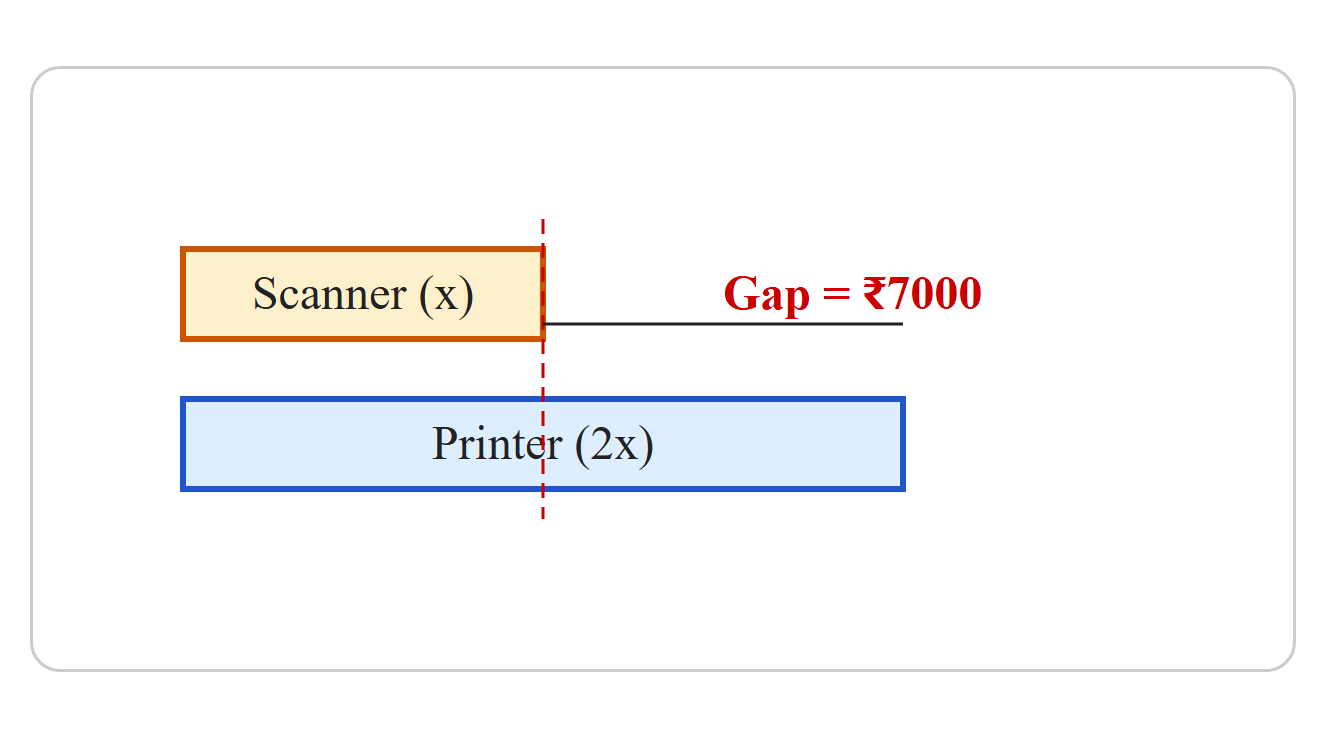
Shortcut Trick

Cost ratio of Printer to Scanner is 2 : 1.

Difference in ratio parts = 2 − 1 = 1 unit.

Given difference in price = ₹7000.

∴ 1 unit = ₹7000.

Cost of Scanner (1 unit) = ₹7000.

∴ The correct answer is ₹7000.

Alternate Method

Given:

Let the cost of the Scanner be ₹x.

Cost of the Printer = 2 × Cost of Scanner = ₹2x.

Calculations:

⇒ Cost of Printer − Cost of Scanner = ₹7000

⇒ 2x − x = 7000

⇒ x = 7000

∴ Cost of Scanner = ₹7000.

∴ The correct answer is ₹7000.

Additional Information

Linear Equations in One Variable

An equation of the form ax + b = 0, where a and b are real numbers and x is the unknown variable to be solved.

Ratio and Proportion

Comparison of two quantities by division. If A is twice B, the ratio is 2 : 1, and the difference between them represents the absolute value of 1 unit in the ratio.

Question 16

Heating of ethanol at 443 K with excess concentrated sulphuric acid yields which of the following? 

  1. AOption (a)

    Ethane

  2. BOption (b)

    Ethene

  3. COption (c)

    Ether 

  4. DOption (d)

    Acetic acid

View answer & explanation

Correct answer

Answer: (b)B.

Ethene

Why this answer is correct

The correct answer is Ethene.

Key Points

  • Heating ethanol at 443 K with excess concentrated sulfuric acid results in the dehydration of ethanol.
  • The dehydration process involves the removal of a water molecule from ethanol.
  • This reaction produces ethene (C2H4), a colorless and flammable gas.
  • The chemical equation for this reaction is: C2H5OH → C2H4 + H2O.
  • Concentrated sulfuric acid acts as a catalyst in this reaction.

Additional Information

  • Dehydration Reaction
  • A chemical reaction in which water is removed from a compound.
  • Commonly occurs in the presence of a strong acid like sulfuric acid.
  • Used to convert alcohols to alkenes.
  • Sulfuric Acid (H2SO4)
  • A strong mineral acid with strong dehydrating properties.
  • Commonly used in the chemical industry as a catalyst.
  • Can cause severe burns; hence, handle with care.
  • Ethene (C2H4)
  • Also known as ethylene.
  • Used as a precursor in the production of polyethylene, a common plastic.
  • Acts as a plant hormone involved in the ripening of fruits.
  • Applications of Ethene
  • Widely used in the manufacture of plastics and synthetic rubber.
  • Employed in the production of ethanol and other chemicals.
  • Utilized in agriculture to promote the ripening of fruits.

Question 17

If each vowel in the word PAINTER is changed to the nearest consonant succeeding it in the English alphabetical order and each consonant is changed to the nearest vowel succeeding it in English alphabetical order, then which of the following letters is repeated thrice in the new group of letters thus formed? 

  1. AOption (a)

    U

  2. BOption (b)

    O

  3. COption (c)

    B

  4. DOption (d)

    F

View answer & explanation

Correct answer

Answer: (a)A.

U

Why this answer is correct

Given word: PAINTER

According to the question,

Given wordPAINTER
Vowel → Next Consonant Consonant → Next VowelUBJOUFU

Here, the letter 'U' is repeated twice in the new group of letters thus formed.

Hence, "Option 1" is the correct answer.

Question 18

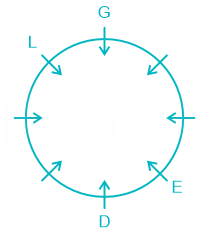
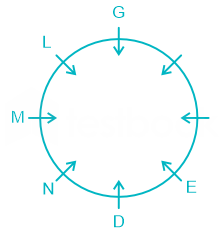
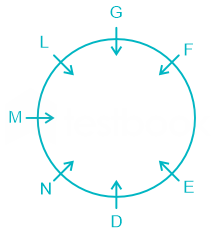
D, E, F, G, L, M and N are sitting around a circular table facing the centre. E sits to the immediate right of D. Only three people sit between E and L when counted from the left of E. Only three people sit between D and G when counted from the left of D. N sits to the immediate right of M. How many people sit between F and M when counted from the left of M?  

  1. AOption (a)

    Four 

  2. BOption (b)

    Three 

  3. COption (c)

    One 

  4. DOption (d)

    Two 

View answer & explanation

Correct answer

Answer: (d)D.

Two 

Why this answer is correct

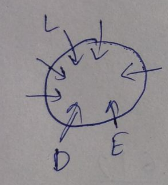
Given: D, E, F, G, L, M and N are sitting around a circular table facing the centre.

E sits to the immediate right of D. Only three people sit between E and L when counted from the left of E.

Only three people sit between D and G when counted from the left of D.


N sits to the immediate right of M.

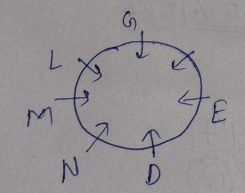
Final arrangement,

Thus, Only two person are sitting between F and M when counted from the left of M.

Hence, the correct answer is "Option 4".

Question 19

In which state did Prime Minister Narendra Modi inaugurate India’s first modern, selfsufficient gaushala named Adarsh Gaushala?  

  1. AOption (a)

    Bihar 

  2. BOption (b)

    Madhya Pradesh 

  3. COption (c)

    Rajasthan 

  4. DOption (d)

    Uttar Pradesh  

View answer & explanation

Correct answer

Answer: (b)B.

Madhya Pradesh 

Why this answer is correct

The correct answer is Madhya Pradesh.

Key Points

  • Prime Minister Narendra Modi inaugurated India's first modern, self-sufficient gaushala named Adarsh Gaushala in Madhya Pradesh.
  • The Adarsh Gaushala is designed to be a model for cattle care and management, incorporating modern technology and sustainable practices.
  • This initiative aims to improve the welfare of cattle by providing better facilities and ensuring their well-being.
  • The gaushala is equipped with facilities for the production of biogas and organic fertilizers, promoting environmental sustainability.

Additional Information

  • Gaushala:
  • A gaushala is a protective shelter for cows in India. It is an integral part of the rural economy and agricultural practices.
  • Gaushalas aim to provide shelter to old, unproductive, and abandoned cows, ensuring their safety and well-being.
  • They often serve as centers for the production of dairy products, organic manure, and biogas.
  • Biogas Production:
  • Biogas is produced by the anaerobic digestion of organic matter such as cow dung, agricultural waste, and food waste.
  • It is a renewable source of energy that can be used for cooking, heating, and generating electricity.
  • Biogas production helps in waste management and reduces greenhouse gas emissions.
  • Organic Fertilizers:
  • Organic fertilizers are derived from natural sources such as animal manure, compost, and plant residues.
  • They improve soil fertility and structure, promoting healthy plant growth.
  • Using organic fertilizers reduces the dependence on chemical fertilizers, contributing to sustainable agriculture.
  • Cattle Welfare:
  • Cattle welfare involves ensuring proper nutrition, healthcare, and living conditions for cattle.
  • It includes regular veterinary care, adequate shelter, and access to clean water and nutritious feed.
  • Improving cattle welfare enhances their productivity and contributes to the overall agricultural economy.

Question 20

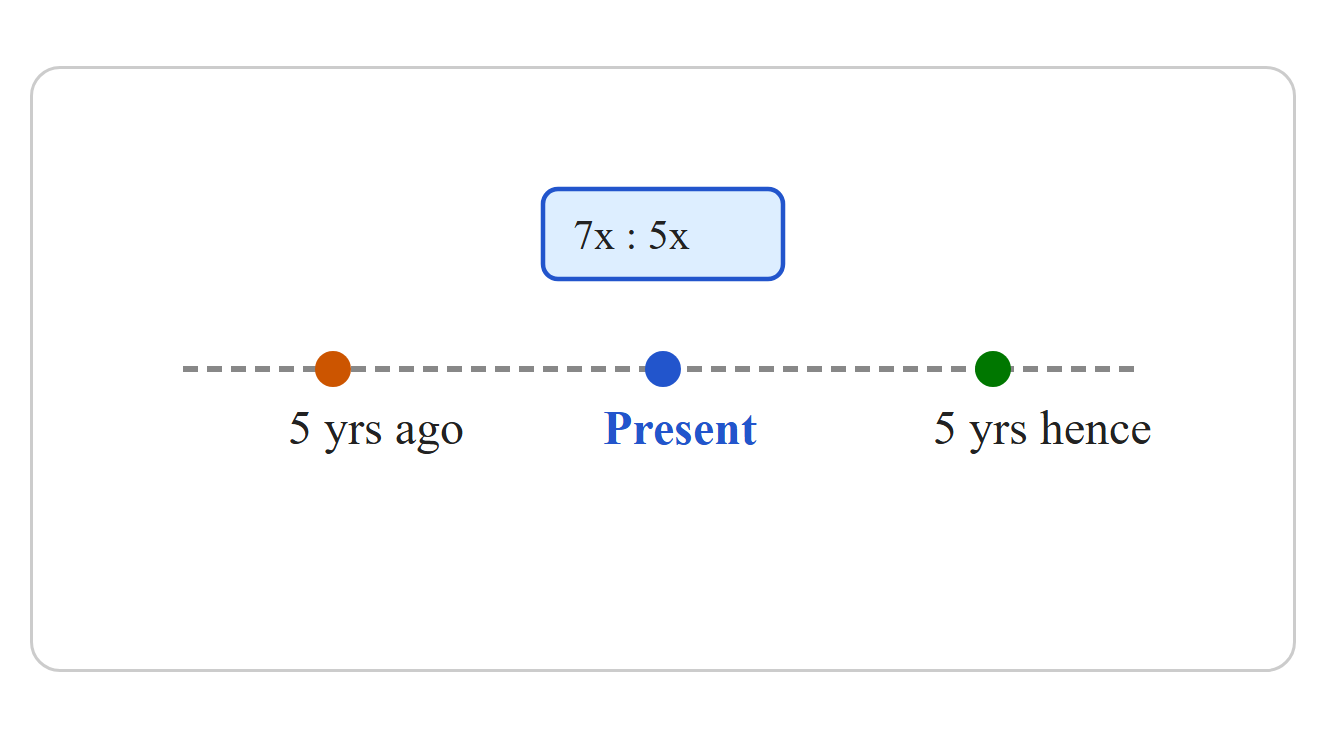
The ratio between the present ages of Amit and Amita is 7 : 5, respectively. The ratio between Amit’s age 5 years ago and Amita’s age 5 years hence is 1 ; 1. What is the ratio between Amit’s age 5 years hence and Amita’s age 5 years ago? 

  1. AOption (a)

    2 : 1

  2. BOption (b)

    1 : 2

  3. COption (c)

    2 : 3

  4. DOption (d)

    3 : 2

View answer & explanation

Correct answer

Answer: (a)A.

2 : 1

Why this answer is correct

Shortcut Trick

Ratio of Amit and Amita = 7 : 5. Let ages be 7x and 5x.

Condition: 7x − 5 = 5x + 5 ⇒ 2x = 10 ⇒ x = 5.

Present ages: Amit = 35, Amita = 25.

Required Ratio (35 + 5) : (25 − 5) = 40 : 20 = 2 : 1.

∴ The correct answer is 2 : 1.

Alternate Method

Given: Ratio of present ages of Amit and Amita = 7 : 5.

Calculations:

⇒ Let Amit present age = 7x and Amita present age = 5x.

⇒ According to question: (7x − 5) / (5x + 5) = 1 / 1

⇒ 7x − 5 = 5x + 5

⇒ 2x = 10 ⇒ x = 5

⇒ Amit present age = 7 × 5 = 35 years

⇒ Amita present age = 5 × 5 = 25 years

⇒ Amit age after 5 years = 35 + 5 = 40 years

⇒ Amita age 5 years ago = 25 − 5 = 20 years

⇒ Required Ratio = 40 : 20 = 2 : 1

∴ The correct answer is 2 : 1.

Additional Information

Ratio and Proportion in Ages

If the ratio of ages is a:b, we assume ages as ax and bx. The value of x remains constant for a specific point in time.

Age Difference Property

The difference between the ages of two persons always remains constant regardless of the number of years passed or gone by.

Question 21

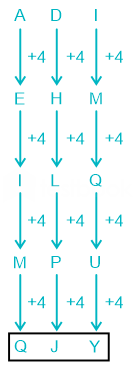
Which of the following options should come in place of the question mark (?) in the given series based on the English alphabetical order?

ADI EHM ILQ MPU ?

  1. AOption (a)

    TYQ

  2. BOption (b)

    TQY

  3. COption (c)

    QTY

  4. DOption (d)

    QYT

View answer & explanation

Correct answer

Answer: (c)C.

QTY

Why this answer is correct

The logic followed here is:

Logic: + 4 in the positional value of letters.

Hence, the correct answer is "Option 3".
Question 22

If ‘A’ stands for ‘÷’, ‘B’ stands for ‘×', 'C' stands for ‘+' and ‘D’ stands for ‘-‘, what will come in place of the question mark ‘?’ in the following equation?

2 B 18 D 20 A 4 C 15 = ?

  1. AOption (a)

    47

  2. BOption (b)

    46

  3. COption (c)

    48

  4. DOption (d)

    45

View answer & explanation

Correct answer

Answer: (b)B.

46

Why this answer is correct

Given: 2 B 18 D 20 A 4 C 15 = ?

Decoding the letters:

LettersABCD
coded as÷×+-

2 B 18 D 20 A 4 C 15 = ? ⇒ 2 × 18 - 20 ÷ 4 + 15 = ?

⇒  2 × 18 - 20 ÷ 4 + 15 = ?

⇒ 36 - 5 + 15

⇒ 51 - 5 = 46

Hence, the correct answer is "Option 2".

Question 23

Select the triad which follows the same pattern as that followed by the two triads given below. Both triads follow the same pattern.

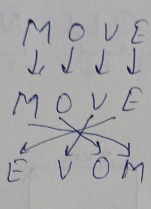
MOVE - MOVE - EVOM

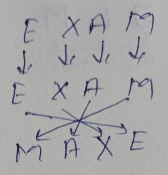
EXAM - EXAM - MAXE

  1. AOption (a)

    DRAW - DRAW - RAWD 

  2. BOption (b)

    NOSE - NSOE - ESON 

  3. COption (c)

    MOST - OMST - TOSM 

  4. DOption (d)

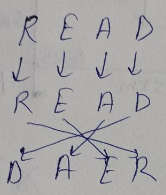
    READ - READ - DAER 

View answer & explanation

Correct answer

Answer: (d)D.

READ - READ - DAER 

Why this answer is correct

The logic followed here is:

For, MOVE - MOVE - EVOM

For, EXAM - EXAM - MAXE 

Similarly,

READ - READ - DAER 

Hence, the correct answer is "Option 4".

Question 24

which of the following is/ are correct related to Adrenalin hormone ?

(i) Heart beats faster

(ii) Breathing rate increases

(iii) Decreases blood pressure

  1. AOption (a)

    Only (ii) and (iii) 

  2. BOption (b)

    Only (i) and (ii) 

  3. COption (c)

    Only (i) and (iii) 

  4. DOption (d)

    (i), (ii) and (iii) 

View answer & explanation

Correct answer

Answer: (b)B.

Only (i) and (ii) 

Why this answer is correct

The correct answer is Only (i) and (ii).

Key Points

  • Adrenaline, also known as epinephrine, is a hormone and neurotransmitter produced by the adrenal glands.
  • One of the primary effects of adrenaline is to increase heart rate (i).
  • Adrenaline also causes an increase in the breathing rate (ii), to supply more oxygen to the muscles.
  • Contrary to statement (iii), adrenaline actually increases blood pressure by causing the blood vessels to constrict.

Additional Information

  • Fight or Flight Response: Adrenaline is crucial in the 'fight or flight' response, preparing the body for rapid action in stressful situations.
  • Metabolic Effects: Adrenaline increases glucose production by the liver, providing energy to muscles.
  • Adrenergic Receptors: The effects of adrenaline are mediated through adrenergic receptors, which are found in various tissues throughout the body.
  • Medical Use: Adrenaline is used medically in cases of cardiac arrest, anaphylaxis, and severe asthma attacks due to its ability to stimulate heart rate and open airways.
  • Side Effects: Excessive adrenaline can cause side effects such as anxiety, tremors, palpitations, and hypertension.

Question 25

If a 3-digit number 2y5 is divisible by 11, then the value of digit ‘y’ is: 

  1. AOption (a)

    3

  2. BOption (b)

    9

  3. COption (c)

    7

  4. DOption (d)

    2

View answer & explanation

Correct answer

Answer: (c)C.

7

Why this answer is correct

Shortcut Trick

For a 3-digit number abc to be divisible by 11, the sum of extreme digits minus middle digit should be 0 or 11.

Given number: 2y5

Sum of outer digits: 2 + 5 = 7

Middle digit: y

To make the difference zero: 7 − y = 0 ⇒ y = 7

∴ The correct answer is 7.

Alternate Method

Given: A 3-digit number 2y5 is divisible by 11.

Formula Used: Divisibility rule of 11 states that the difference between the sum of digits at odd positions and the sum of digits at even positions must be 0 or a multiple of 11.

Sum of digits at odd places (1st and 3rd) = 2 + 5 = 7

Sum of digits at even place (2nd) = y

Difference = |7 − y|

Case 1: 7 − y = 0

⇒ y = 7

Case 2: 7 − y = 11 (Not possible as y is a single digit)

Case 3: 7 − y = −11 ⇒ y = 18 (Not possible as y is a single digit)

∴ The correct answer is 7.

Additional Information

Divisibility by 9

A number is divisible by 9 if the sum of its digits is divisible by 9.

Divisibility by 3

A number is divisible by 3 if the sum of its digits is divisible by 3.

Divisibility by 11 (General Rule)

For any number, (Sum of digits at odd places) − (Sum of digits at even places) = 0, 11, 22, ...

Question 26

The LCM of the numbers 5, 12.5 and 0.05 is: 

  1. AOption (a)

    12.5

  2. BOption (b)

    125

  3. COption (c)

    25

  4. DOption (d)

    1.25

View answer & explanation

Correct answer

Answer: (c)C.

25

Why this answer is correct

Shortcut Trick

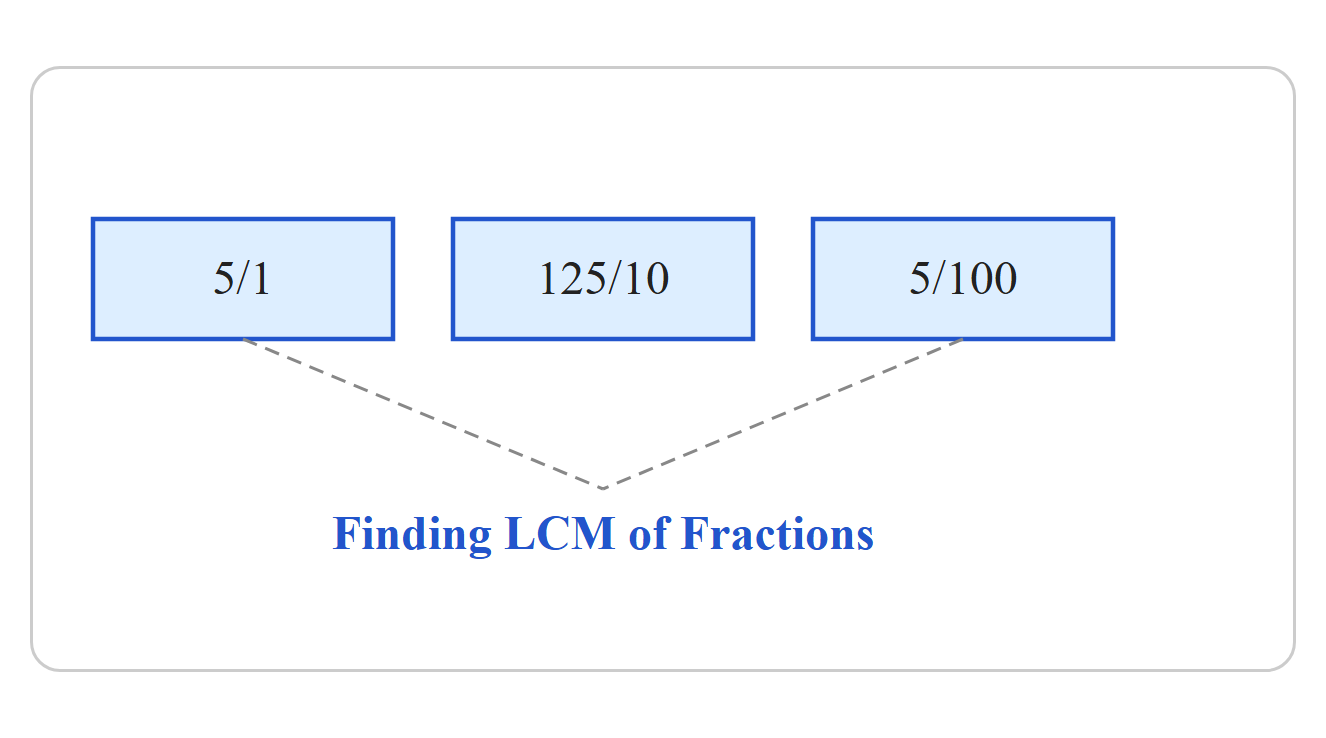
To find the LCM of decimals, make the number of decimal places equal: 5.00, 12.50, and 0.05.

Remove the decimal and treat them as integers: 500, 1250, and 5.

LCM(5, 500, 1250) ⇒ 1250 is not divisible by 500, but 1250 × 2 = 2500 is divisible by 500 and 5.

Place the decimal back (2 places): 2500 → 25.00.

∴ The correct answer is 25.

Alternate Method

Given: Numbers are 5, 12.5 and 0.05.

Formula Used: LCM of Fractions = (LCM of Numerators) ÷ (HCF of Denominators)

⇒ Convert decimals to fractions: 5/1, 125/10, 5/100.

⇒ Simplify fractions: 5/1, 25/2, 1/20.

⇒ LCM of Numerators (5, 25, 1) = 25.

⇒ HCF of Denominators (1, 2, 20) = 1.

⇒ Required LCM = 25 ÷ 1 = 25.

∴ The correct answer is 25.

Additional Information

LCM of Fractions

The Least Common Multiple of fractions is calculated as (LCM of numerators) ÷ (HCF of denominators).

HCF of Fractions

The Highest Common Factor of fractions is calculated as (HCF of numerators) ÷ (LCM of denominators).

Decimal Conversion Rule

To find LCM/HCF of decimals, it is often safer to convert them into like decimals (same number of decimal places) before treating them as integers.

Question 27

Mendel used a number of contrasting visible characters of garden peas. Match the last of the following with Which one of the following options appropriately fills the below blank space?

A. Round / Wrinkled seeds

B. Tall / Short plants

C. White / ______ flowers

  1. AOption (a)

    Pink  

  2. BOption (b)

    Green 

  3. COption (c)

    Yellow 

  4. DOption (d)

    Violet 

View answer & explanation

Correct answer

Answer: (d)D.

Violet 

Why this answer is correct

The correct answer is Violet.

Key Points

  • Mendel used garden peas (Pisum sativum) for his experiments on inheritance patterns.
  • He identified several pairs of contrasting traits, including flower color.
  • The contrasting flower colors studied by Mendel were white and violet.
  • These traits helped Mendel establish the fundamental laws of inheritance, such as the law of segregation and the law of independent assortment.

Additional Information

  • Gregor Mendel
  • Known as the father of genetics.
  • Conducted hybridization experiments on garden peas between 1856 and 1863.
  • His work laid the foundation for the field of genetics.
  • Law of Segregation
  • States that allele pairs separate or segregate during gamete formation, and randomly unite at fertilization.
  • This principle was derived from Mendel's monohybrid cross experiments.
  • Law of Independent Assortment
  • States that genes for different traits can segregate independently during the formation of gametes.
  • This principle was derived from Mendel's dihybrid cross experiments.
  • Contrasting Traits Studied by Mendel
  • Seed shape: round vs. wrinkled.
  • Plant height: tall vs. short.
  • Flower position: axial vs. terminal.

Question 28

A sum when invested at 1212%12\frac{1}{2}\% simple interest per annum amounts to Rs. 8,250 after 2 years. What is the simple interest in 1 year?

  1. AOption (a)

    Rs. 1650

  2. BOption (b)

    Rs. 910

  3. COption (c)

    Rs. 1700

  4. DOption (d)

    Rs. 825

View answer & explanation

Correct answer

Answer: (d)D.

Rs. 825

Why this answer is correct

Shortcut Trick

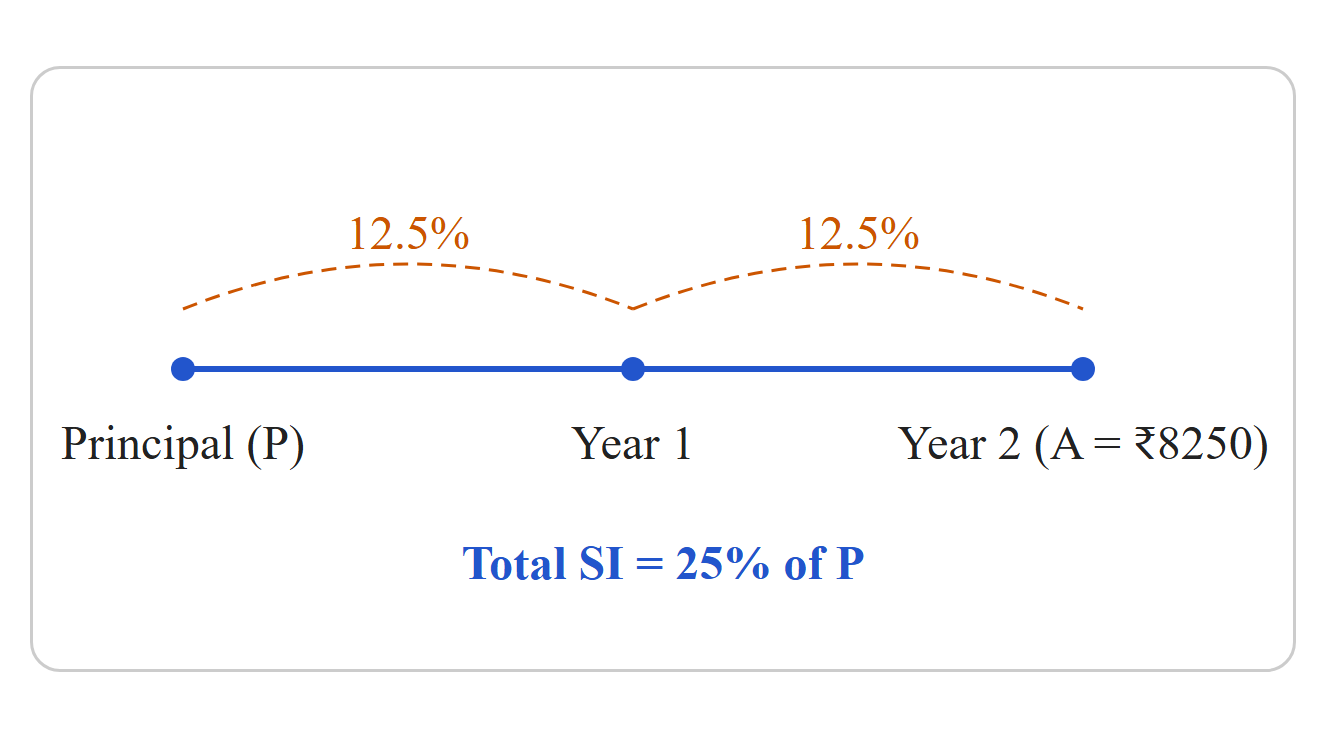
Rate = 12.5% = 1/8. Principal (P) = 8 units, Interest (I) for 1 year = 1 unit.

Interest for 2 years = 1 × 2 = 2 units. Amount (A) = P + I = 8 + 2 = 10 units.

Given 10 units = ₹8250 ⇒ 1 unit = ₹825.

Simple Interest for 1 year = 1 unit = ₹825.

∴ The correct answer is Rs. 825.

Alternate Method

Given: Rate (R) = 12.5%, Time (T) = 2 years, Amount (A) = ₹8,250.

Formula: Amount = Principal + Simple Interest ⇒ A = P + (P × R × T)/100

⇒ 8250 = P + (P × 12.5 × 2)/100

⇒ 8250 = P + (P × 25)/100

⇒ 8250 = P + 0.25P ⇒ 1.25P = 8250

⇒ P = 8250 / 1.25 = ₹6,600

⇒ Total SI for 2 years = 8250 − 6600 = ₹1,650

⇒ SI for 1 year = 1650 ÷ 2 = ₹825

∴ The correct answer is Rs. 825.

Additional Information

Simple Interest Concept

Simple interest is calculated only on the Principal amount, meaning the interest remains constant every year if the rate and principal are unchanged.

Amount Formula

The total Amount after T years is A = P(1 + RT/100), where P is principal, R is rate per annum, and T is time in years.

Fractional Conversion

Converting percentage rates to fractions (e.g., 12.5% = 1/8) simplifies calculations by treating the denominator as the Principal and numerator as Interest per unit time.

Question 29

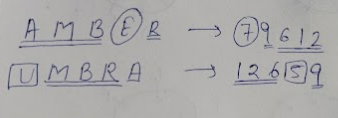
In a certain code language, 'AMBER’ is coded as '79612' and ‘UMBRA’ is coded as '12659'. What is the code for 'U’ in the given code language? 

  1. AOption (a)

    5

  2. BOption (b)

    9

  3. COption (c)

    2

  4. DOption (d)

    1

View answer & explanation

Correct answer

Answer: (a)A.

5

Why this answer is correct

The logic followed here is:

The coded for "U" is 5.

Hence, the correct answer is "Option 1".

Question 30

To raise awareness on the safe use of digital payment services and prevent scams, which of the following institution of India launched a UPI Safety Awareness Campaign ‘Main Moorkh Nahi Hoon’?  

  1. AOption (a)

    National Payments Corporation of India (NPCI) 

  2. BOption (b)

    Data Security Council of India (DSCI) 

  3. COption (c)

    Indian Cybercrime Coordination Centre (l4C) 

  4. DOption (d)

    Reserve Bank of India (RBI) 

View answer & explanation

Correct answer

Answer: (a)A.

National Payments Corporation of India (NPCI) 

Why this answer is correct

The correct answer is National Payments Corporation of India (NPCI).

Key Points

  • The National Payments Corporation of India (NPCI) is a key organization in the sphere of retail payments and settlement systems in India.
  • NPCI launched the UPI Safety Awareness Campaign 'Main Moorkh Nahi Hoon' to educate users about safe digital payment practices.
  • The campaign aims to prevent frauds and scams by raising awareness about secure usage of Unified Payments Interface (UPI).
  • NPCI plays a pivotal role in the development of innovative payment solutions like UPI, which has revolutionized digital transactions in India.

Additional Information

  • Unified Payments Interface (UPI)
  • UPI is an instant real-time payment system developed by NPCI, facilitating inter-bank transactions.
  • It allows users to link multiple bank accounts to a single mobile application, enabling seamless money transfers.
  • UPI transactions are secure, leveraging two-factor authentication as mandated by RBI.
  • The popularity of UPI has surged, making it one of the most preferred digital payment methods in India.
  • National Payments Corporation of India (NPCI)
  • Established in 2008, NPCI is an umbrella organization for operating retail payments and settlement systems in India.
  • It was founded by the Reserve Bank of India (RBI) and Indian Banks' Association (IBA).
  • NPCI's primary objective is to create robust payment and settlement infrastructure in India.
  • Besides UPI, NPCI has developed other payment solutions like RuPay, IMPS, and BHIM.
  • Digital Payment Security
  • Ensuring secure digital transactions involves using strong passwords, enabling two-factor authentication, and being cautious of phishing scams.
  • Users should regularly monitor their transaction history for any unauthorized activities.
  • It is crucial to download payment apps from official sources and avoid sharing OTPs or PINs with anyone.
  • Financial Literacy
  • Financial literacy involves understanding and effectively using various financial skills, including personal financial management, budgeting, and investing.
  • It is critical for individuals to enhance their financial knowledge to make informed decisions and avoid financial frauds.
  • Organizations and governments often conduct awareness campaigns to improve financial literacy among the population.

Question 31

(x+1x)(x−1x)(x2+1x2)(x4+1x4)\rm \left(x+\frac{1}{x}\right)\rm \left(x-\frac{1}{x}\right)\rm \left(x^2+\frac{1}{x^2}\right)\rm \left(x^4+\frac{1}{x^4}\right)  is equal to:

  1. AOption (a)

    x4−1x4\rm x^4-\frac{1}{x^4}

  2. BOption (b)

    x8−1x8\rm x^8-\frac{1}{x^8}

  3. COption (c)

    x10−1x10\rm x^{10}-\frac{1}{x^{10}}

  4. DOption (d)

    x6−1x6\rm x^6-\frac{1}{x^6}

View answer & explanation

Correct answer

Answer: (b)B.

x8−1x8\rm x^8-\frac{1}{x^8}

Why this answer is correct

Shortcut Trick

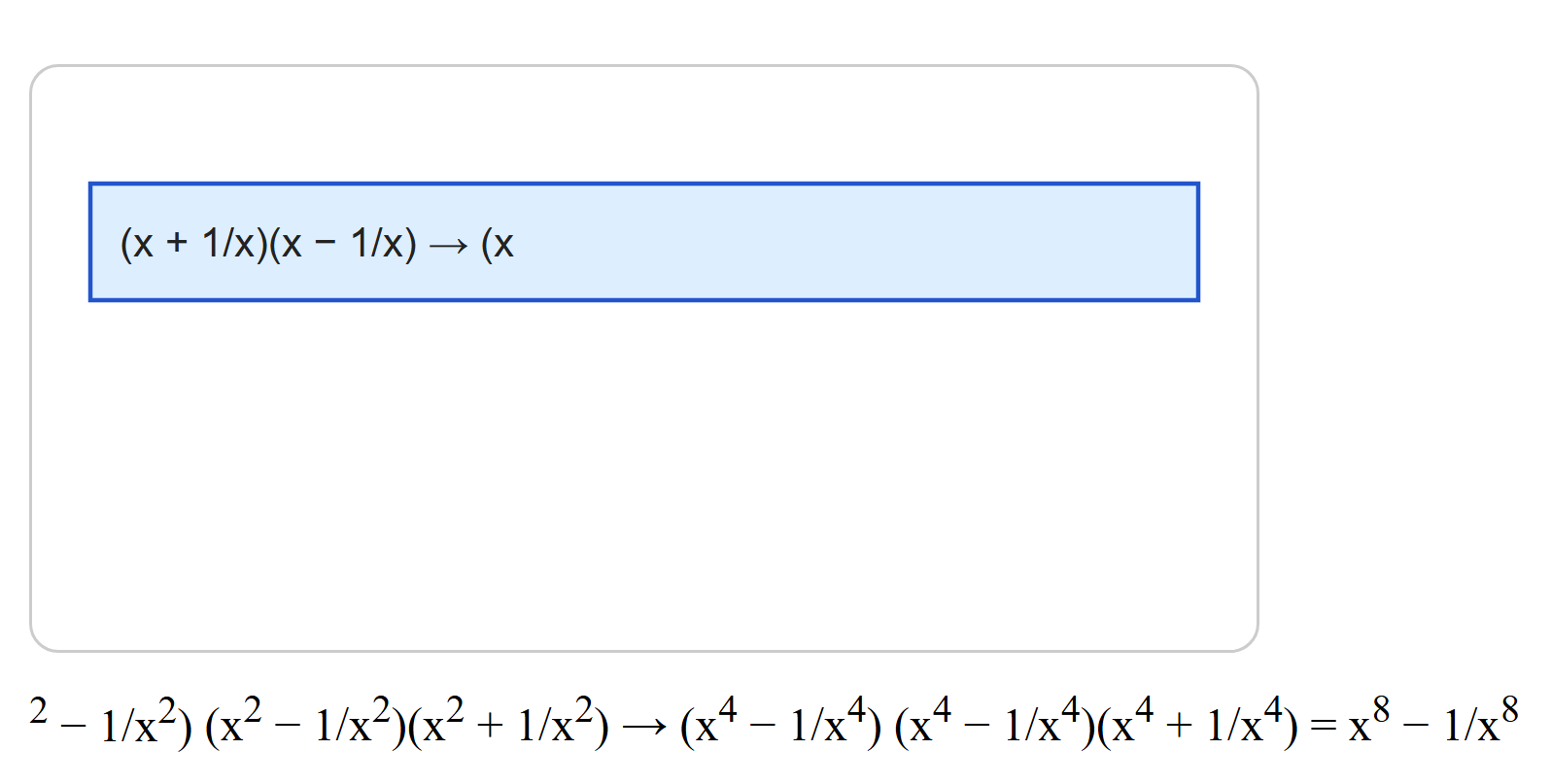
Apply the algebraic identity (a + b)(a − b) = a2 − b2 successively.

(x + 1/x)(x − 1/x) = x2 − 1/x2

(x2 − 1/x2)(x2 + 1/x2) = x4 − 1/x4

(x4 − 1/x4)(x4 + 1/x4) = x8 − 1/x8

∴ The correct answer is x8 − 1/x8.

Alternate Method

Given: (x + 1/x)(x − 1/x)(x2 + 1/x2)(x4 + 1/x4)

Formula Used: Difference of squares (a + b)(a − b) = a2 − b2

⇒ Step 1: Multiply (x + 1/x) and (x − 1/x) = x2 − (1/x)2 = x2 − 1/x2

⇒ Step 2: Multiply result with (x2 + 1/x2) = (x2)2 − (1/x2)2 = x4 − 1/x4

⇒ Step 3: Multiply result with (x4 + 1/x4) = (x4)2 − (1/x4)2 = x8 − 1/x8

∴ The correct answer is x8 − 1/x8.

Additional Information

Algebraic Identities

Standard identity: (a + b)2 = a2 + 2ab + b2 and (a − b)2 = a2 − 2ab + b2.

Power Rule

When multiplying terms with the same base, add exponents: xa × xb = xa+b. For powers: (xa)b = xa×b.

Successive Application

The pattern (x − 1)(x + 1)(x2 + 1)...(xn + 1) always results in x2n − 1.

Question 32

Kevin ranked 15th from the top and 20th from the bottom in his class. How many students are there in his class? 

  1. AOption (a)

    33

  2. BOption (b)

    36

  3. COption (c)

    34

  4. DOption (d)

    35

View answer & explanation

Correct answer

Answer: (c)C.

34

Why this answer is correct

The logic followed here is:

Position of Kevin from the top = 15th

Position of Kevin from the bottom = 20th

So,

Total number of students = Position of Kevin from the top + Position of Kevin from the bottom - 1

= 15 + 20 - 1

= 35 - 1 = 34.

Hence, the correct answer is "Option 3.

Question 33

If ‘I' stands for ‘+', ‘J’ stands for ‘×', ‘K’ stands for '÷', and ‘L' stands for ‘-’, what will be come in place of the question mark '?' in the following equation?

148 I 104 L 126 I (76 K 2) I (11 J 3) L 55 = ?

  1. AOption (a)

    168

  2. BOption (b)

    142

  3. COption (c)

    154

  4. DOption (d)

    122

View answer & explanation

Correct answer

Answer: (b)B.

142

Why this answer is correct

Given: 148 I 104 L 126 I (76 K 2) I (11 J 3) L 55 = ?

Decoding the letters:

LettersKJIL
coded as÷×+-

148 I 104 L 126 I (76 K 2) I (11 J 3) L 55 = ? ⇒ 148 + 104 - 126 + (76 ÷  2) + (11 ×  3) - 55 = ?

⇒ 148 + 104 - 126 - (76 ÷  2) + (11 ×  3) - 55 = ?

⇒ 148 + 104 - 126 + 38 + 33 - 55 = ?

⇒ 323 - 126 - 55 = ?

⇒ 323 - 181 = 142.

Hence, the correct answer is "Option 2".

Question 34

What is the momentum p, of an object of mass m, moving with a velocity ?

  1. AOption (a)

    p = (mv)-2

  2. BOption (b)

    p = mv2

  3. COption (c)

    p = mv

  4. DOption (d)

    p = vm-1

View answer & explanation

Correct answer

Answer: (c)C.

p = mv

Why this answer is correct

The correct answer is p = mv.

Key Points

  • Momentum is a fundamental concept in physics, defined as the product of an object's mass and its velocity.
  • The formula for momentum (p) is given by p = mv, where m is the mass of the object and v is its velocity.
  • Momentum is a vector quantity, meaning it has both magnitude and direction, aligning with the direction of the object's velocity.
  • In classical mechanics, the conservation of momentum is a crucial principle, stating that the total momentum of a closed system remains constant if no external forces act on it.
  • The SI unit of momentum is kilogram meter per second (kg·m/s).

Additional Information

  • Impulse:
  • Impulse is the change in momentum of an object when a force is applied over a time interval.
  • It is calculated as the product of the force (F) and the time (∆t) during which the force acts, given by Impulse = F∆t.
  • Impulse has the same unit as momentum (kg·m/s) and is also a vector quantity.
  • Newton's Second Law:
  • Newton's Second Law of Motion states that the force acting on an object is equal to the rate of change of its momentum, F = dp/dt.
  • This law forms the basis for the relationship between force, mass, and acceleration.
  • Conservation of Momentum:
  • The principle of conservation of momentum states that in a closed system with no external forces, the total momentum before and after an event remains constant.
  • This principle is widely used in collision and explosion problems in physics.
  • Elastic and Inelastic Collisions:
  • In an elastic collision, both momentum and kinetic energy are conserved.
  • In an inelastic collision, momentum is conserved, but kinetic energy is not; some of the kinetic energy is converted into other forms of energy, such as heat or sound.

Question 35

Which of the following statements is/are INCORRECT?

(i) The transport of insoluble product of photosynthesis is known as translocation.

(ii) Respiration is the evaporative loss of water through stomata.

(iii) Photosynthesis is the process by which autotrophs take in substances from outside and in the absence of sunlight convert them into stored forms of energy.

  1. AOption (a)

    (i), (ii) and (iii)  

  2. BOption (b)

    Only (ii) and (iii)  

  3. COption (c)

    Only (i) 

  4. DOption (d)

    Only (i) and (ii)  

View answer & explanation

Correct answer

Answer: (a)A.

(i), (ii) and (iii)  

Why this answer is correct

The correct answer is (i), (ii) and (iii).

Key Points

  • (i) The term "translocation" is indeed used for the transport of soluble products of photosynthesis, not insoluble products.
  • (ii) Respiration is the metabolic process of breaking down glucose to release energy, not the evaporative loss of water through stomata. The process of water loss through stomata is known as transpiration.
  • (iii) Photosynthesis requires sunlight to convert substances into stored forms of energy (glucose). The given statement incorrectly states that it occurs in the absence of sunlight.
  • All three statements (i), (ii), and (iii) are factually incorrect based on fundamental biological concepts.

Additional Information

  • Translocation in Plants
  • Translocation refers to the movement of soluble products of photosynthesis, such as sugars, from the leaves to other parts of the plant.
  • This process occurs through the phloem tissue.
  • Respiration in Plants
  • Respiration is a biochemical process where glucose is broken down to release energy, carbon dioxide, and water.
  • This process occurs in the mitochondria of cells and is vital for energy production in both plants and animals.
  • Transpiration in Plants
  • Transpiration is the process of water vapor loss from the plant to the atmosphere through stomata.
  • This helps in nutrient transport, cooling the plant, and maintaining water balance.
  • Photosynthesis
  • Photosynthesis is the process by which green plants and some other organisms use sunlight to synthesize nutrients from carbon dioxide and water.
  • The general equation for photosynthesis is: 6CO2 + 6H2O + light energy → C6H12O6 + 6O2.

Question 36

Which of the following phenomena CANNOT be explained using the universal law of gravitation? 

  1. AOption (a)

    Motion of planets around the Sun 

  2. BOption (b)

    Motion of the moon around the earth 

  3. COption (c)

    Tides 

  4. DOption (d)

    Firing of a gun 

View answer & explanation

Correct answer

Answer: (d)D.

Firing of a gun 

Why this answer is correct

The correct answer is Firing of a gun.

Key Points

  • The universal law of gravitation primarily deals with the gravitational attraction between masses.
  • It explains the motion of celestial bodies like planets around the Sun and the moon around the Earth.
  • Tides are influenced by the gravitational pull of the moon and the Sun on Earth's water bodies.
  • Firing of a gun involves the forces of combustion, pressure, and projectile motion, not gravitational attraction.

Additional Information

  • Universal Law of Gravitation
  • Formulated by Sir Isaac Newton, it states that every mass attracts every other mass in the universe with a force proportional to the product of their masses and inversely proportional to the square of the distance between their centers.
  • This law explains various phenomena including planetary orbits, free-fall, and the behavior of tides.
  • Projectile Motion
  • Describes the motion of an object thrown or projected into the air, subject to only the acceleration of gravity.
  • Firing a gun results in projectile motion, where the bullet follows a curved trajectory due to gravity and initial velocity imparted by the gunpowder explosion.
  • Combustion in Firearms
  • When a gun is fired, the gunpowder combusts and rapidly converts into gas, creating high pressure.
  • This pressure propels the bullet forward and out of the barrel.
  • Tidal Forces
  • Caused by the gravitational interaction between the Earth, Moon, and Sun.
  • Tides result from the difference in gravitational pull on different parts of the Earth's surface.

Question 37

In a certain code language, ‘RIFE’ is coded as ‘3647’ and ‘FORE’ is coded as ‘6438’. What is the code for ‘O” in the given code language? 

  1. AOption (a)

    8

  2. BOption (b)

    6

  3. COption (c)

    4

  4. DOption (d)

    3

View answer & explanation

Correct answer

Answer: (a)A.

8

Why this answer is correct

The logic followed here is:

The code for "O" is 8.

Hence, the correct answer is "Option 1".

Question 38

The average monthly income of P and Q is Rs. 5,050. The average monthly income of Q and R is Rs. 6,250 and the average monthly income of P and R is Rs. 5,200. The monthly income of P (in Rs.) is: 

  1. AOption (a)

    4050

  2. BOption (b)

    4000

  3. COption (c)

    3500

  4. DOption (d)

    5000

View answer & explanation

Correct answer

Answer: (b)B.

4000

Why this answer is correct

Shortcut Trick

Sum of (P+Q), (Q+R), and (P+R) = 2 × (P+Q+R).

P + Q = 5050 × 2 = 10100

Q + R = 6250 × 2 = 12500

P + R = 5200 × 2 = 10400

P = [(P+Q) + (P+R) − (Q+R)] ÷ 2 = [10100 + 10400 − 12500] ÷ 2 = 8000 ÷ 2 = 4000.

∴ The correct answer is ₹4000.

Alternate Method

Given: Average of P and Q = ₹5,050; Average of Q and R = ₹6,250; Average of P and R = ₹5,200.

Formula Used: Total Sum = Average × Number of entities.

⇒ P + Q = 5050 × 2 = 10100 --- (i)

⇒ Q + R = 6250 × 2 = 12500 --- (ii)

⇒ P + R = 5200 × 2 = 10400 --- (iii)

⇒ Adding (i), (ii), and (iii): 2(P + Q + R) = 10100 + 12500 + 10400 = 33000

⇒ P + Q + R = 33000 ÷ 2 = 16500

⇒ Monthly income of P = (P + Q + R) − (Q + R) = 16500 − 12500

⇒ P = 4000

∴ The correct answer is ₹4000.

Additional Information

Average Income Formula

Average = (Sum of all observations) ÷ (Total number of observations). In this case, Sum = Average × 2.

Cyclic Sums

For equations of type A+B, B+C, and C+A, the value of A = [(A+B) + (C+A) − (B+C)] ÷ 2.

Combined Average

The average of all three (P, Q, R) is the sum of the three pair-averages divided by 3, which is 16500 ÷ 3 = ₹5,500.

Question 39

Which of the following cells have dendrites and axons?

  1. AOption (a)

    Fibres

  2. BOption (b)

    Nerve cells  

  3. COption (c)

    White blood cells 

  4. DOption (d)

    Red blood cells 

View answer & explanation

Correct answer

Answer: (b)B.

Nerve cells  

Why this answer is correct

The correct answer is Nerve cells.

Key Points

  • Nerve cells, also known as neurons, are specialized cells that transmit information throughout the body.
  • Neurons have unique structures called dendrites and axons that help in the conduction of nerve impulses.
  • Dendrites receive signals from other neurons and convey this information to the cell body.
  • Axons transmit signals away from the cell body to other neurons, muscles, or glands.
  • Neurons are integral to the nervous system, which includes the brain, spinal cord, and peripheral nerves.

Additional Information

  • Neurons
  • Neurons are the basic building blocks of the nervous system.
  • They are highly specialized for the processing and transmission of cellular signals.
  • The human brain contains approximately 86 billion neurons.
  • Synapses
  • Synapses are the junctions where neurons communicate with each other.
  • They can be chemical or electrical.
  • Chemical synapses use neurotransmitters to transmit signals across the synaptic cleft.
  • Myelin Sheath
  • The myelin sheath is a fatty layer that covers the axons of many neurons.
  • It increases the speed at which electrical impulses travel along the axon.
  • Diseases such as multiple sclerosis can damage the myelin sheath, leading to neurological problems.
  • Glial Cells
  • Glial cells are non-neuronal cells that provide support and protection for neurons.
  • They are essential for maintaining homeostasis, forming myelin, and providing support and protection for neurons.
  • Types of glial cells include astrocytes, oligodendrocytes, and microglia.

Question 40

Which of the following oxides is amphoteric in nature? 

  1. AOption (a)

    Sodium peroxide 

  2. BOption (b)

    Calcium oxide 

  3. COption (c)

    Aluminium oxide 

  4. DOption (d)

    Copper oxide 

View answer & explanation

Correct answer

Answer: (c)C.

Aluminium oxide 

Why this answer is correct

The correct answer is Aluminium oxide.

Key Points

  • Aluminium oxide (Al2O3) is known for its amphoteric nature, meaning it can react with both acids and bases.
  • In an acidic medium, aluminium oxide behaves as a base to form salts and water.
  • In a basic medium, it acts as an acid, reacting with alkalis to form aluminates.
  • Aluminium oxide is widely used in various industrial applications due to its chemical stability and amphoteric properties.

Additional Information

  • Amphoteric Oxides
  • Amphoteric oxides are oxides that can react with both acids and bases to form salts and water.
  • Examples include aluminium oxide (Al2O3), zinc oxide (ZnO), and tin oxide (SnO).
  • These oxides exhibit dual behavior due to the presence of both acidic and basic properties in their chemical structure.
  • Basic Oxides
  • Basic oxides are oxides that react with acids to form salt and water.
  • Examples include sodium oxide (Na2O) and calcium oxide (CaO).
  • These oxides are typically formed by metals and are known as metal oxides.
  • Acidic Oxides
  • Acidic oxides are oxides that react with bases to form salt and water.
  • Examples include sulfur dioxide (SO2) and carbon dioxide (CO2).
  • These oxides are typically formed by non-metals and are known as non-metal oxides.
  • Neutral Oxides
  • Neutral oxides are oxides that do not react with either acids or bases to form salts.
  • Examples include nitrous oxide (N2O) and carbon monoxide (CO).
  • These oxides exhibit neutrality due to the lack of acidic or basic properties.

Question 41

If ‘A’ stands for '÷', ‘B’ stands for '×', 'C' stands for ‘+’, and ‘D’ stands for ‘-’, what will come in place of the question mark ‘?’ in the following equation?

78 A 13 B 15 D 20 C 30 = ?

  1. AOption (a)

    80

  2. BOption (b)

    110

  3. COption (c)

    90

  4. DOption (d)

    100

View answer & explanation

Correct answer

Answer: (d)D.

100

Why this answer is correct

Given: 78 A 13 B 15 D 20 C 30 = ? 

Decoding the letters:

LettersABCD
coded as÷×+-

78 A 13 B 15 D 20 C 30 = ? ⇒ 78 ÷  13 × 15 - 20 + 30 = ? 

⇒ 78 ÷  13 × 15 - 20 + 30 = ? 

⇒ 90 - 20 + 30 = ?

⇒ 120 - 20 = 100.

Hence, the correct answer is "Option 4".

Question 42

How many water molecules are present in plaster of Paris?

  1. AOption (a)

    Half molecules of water 

  2. BOption (b)

    Three molecules of water

  3. COption (c)

    One molecule of water 

  4. DOption (d)

    Zero molecules of water  

View answer & explanation

Correct answer

Answer: (a)A.

Half molecules of water 

Why this answer is correct

The correct answer is Half molecules of water.

Key Points

  • Plaster of Paris is chemically known as Calcium Sulfate Hemihydrate.
  • Its chemical formula is CaSO4·0.5H2O, indicating the presence of half a molecule of water per formula unit.
  • This half molecule of water is known as water of crystallization.
  • Plaster of Paris is obtained by heating gypsum (CaSO4·2H2O) at around 150°C.

Additional Information

  • Gypsum
  • Gypsum is a naturally occurring mineral used in construction and agriculture.
  • Its chemical formula is CaSO4·2H2O.
  • Gypsum is used to manufacture plaster of Paris and cement.
  • Water of Crystallization
  • Water molecules that are part of the crystal structure of a compound.
  • It helps maintain the crystalline structure and stability of the compound.
  • Uses of Plaster of Paris
  • Used in making casts for broken bones in medical applications.
  • Utilized in creating sculptures and decorative items.
  • Employed in building materials for coating walls and ceilings.
  • Preparation of Plaster of Paris
  • Heating gypsum to about 150°C results in the loss of water and the formation of plaster of Paris.
  • This process is reversible; adding water to plaster of Paris reverts it back to gypsum.

Question 43

In November 2024, the Union Cabinet approved which of the following new Central Sector schemes that seeks to provide financial support to meritorious students by providing education loan upto %7.5 lakhs with a 75% credit guarantee by the Government of India? 

  1. AOption (a)

    PM ShikshaDhan 

  2. BOption (b)

    PM VidyaDhan 

  3. COption (c)

    PM Shikshalaxmi  

  4. DOption (d)

    PM Vidyalaxmi  

View answer & explanation

Correct answer

Answer: (d)D.

PM Vidyalaxmi  

Why this answer is correct

The correct answer is PM Vidyalaxmi.

Key Points

  • The Union Cabinet approved the PM Vidyalaxmi scheme in November 2024, aimed at supporting meritorious students financially.
  • The scheme provides education loans of up to ₹7.5 lakhs to students.
  • It includes a 75% credit guarantee by the Government of India, reducing the financial burden on students and their families.
  • The scheme is part of the government's efforts to improve access to higher education for deserving students.
  • It aims to promote a more inclusive education system by offering financial support to students from diverse socioeconomic backgrounds.

Additional Information

  • Education Loan Schemes in India
  • Several schemes are aimed at providing financial assistance to students for higher education, including Vidya Lakshmi and the Central Sector Interest Subsidy Scheme (CSIS).
  • Vidya Lakshmi is a portal that provides information about educational loans and facilitates the application process to multiple banks.
  • The CSIS scheme offers interest subsidies on educational loans for economically weaker sections.
  • Credit Guarantee
  • A credit guarantee is a commitment to cover the lender's risk in case the borrower defaults.
  • This reduces the risk for banks and financial institutions, encouraging them to lend to students.
  • Higher Education in India
  • India has a vast higher education system, with numerous universities and colleges offering a variety of courses.
  • Access to higher education remains a challenge for many due to financial constraints.
  • Government Initiatives
  • The Indian government has launched several initiatives to enhance the accessibility and quality of education, such as the National Education Policy (NEP) 2020.
  • These initiatives aim to foster a more inclusive and equitable education system.

Question 44

In phloem, which of the following cells are dead cells? 

  1. AOption (a)

    Companion cells 

  2. BOption (b)

    Phloem fibres 

  3. COption (c)

    Sieve cells 

  4. DOption (d)

    Phloem parenchyma 

View answer & explanation

Correct answer

Answer: (b)B.

Phloem fibres 

Why this answer is correct

The correct answer is Phloem fibres.

Key Points

  • Phloem fibres, also known as bast fibres, are the only dead cells in the phloem tissue.
  • They provide mechanical support to the plant.
  • These fibres are elongated, thick-walled, and lignified cells.
  • Unlike other phloem cells, they lose their protoplasm at maturity.

Additional Information

  • Phloem Tissue:
  • Phloem is a complex tissue in vascular plants responsible for the transport of organic nutrients, particularly sucrose, from source tissues (leaves) to sink tissues (roots, flowers, fruits).
  • It consists of several types of cells: sieve elements, companion cells, phloem fibres, and phloem parenchyma.
  • Sieve Elements:
  • Sieve elements are the major conducting cells in phloem, consisting of sieve tubes in angiosperms and sieve cells in gymnosperms.
  • They are living cells at maturity but lack a nucleus, ribosomes, and other organelles.
  • Companion Cells:
  • Companion cells are closely associated with sieve tube elements in angiosperms.
  • They help in the maintenance and functioning of sieve tube elements and are living cells with a dense cytoplasm and a prominent nucleus.
  • Phloem Parenchyma:
  • Phloem parenchyma cells are living cells that store and transport nutrients within the phloem.
  • They also help in the repair and regeneration of phloem tissue.

Question 45

A body, starting from rest, falls from a building and reaches the ground in 2 secs. What will be the velocity of the body when it reaches the ground? (Acceleration due to gravity = 10 ms-2 )

  1. AOption (a)

    10 m/s 

  2. BOption (b)

    15 m/s

  3. COption (c)

    5 m/s

  4. DOption (d)

    20 m/s

View answer & explanation

Correct answer

Answer: (d)D.

20 m/s

Why this answer is correct

The correct answer is 20 m/s.

Key Points

  • The body starts from rest, so the initial velocity (u) is 0 m/s.
  • The time (t) taken to reach the ground is 2 seconds.
  • The acceleration due to gravity (g) is 10 m/s².
  • The final velocity (v) can be calculated using the formula v = u + gt.
  • Substituting the values, v = 0 + (10 m/s² * 2 s) = 20 m/s.

Additional Information

  • Acceleration due to Gravity (g):
  • It is the acceleration that the Earth imparts to objects due to gravity.
  • The standard value of g on Earth's surface is approximately 9.8 m/s², often rounded to 10 m/s² for simplicity in calculations.
  • Free Fall:
  • It is the motion of a body where gravity is the only force acting upon it.
  • In a vacuum, all objects fall at the same rate regardless of their masses.
  • Equations of Motion:
  • These equations describe the relationship between displacement, velocity, acceleration, and time.
  • Commonly used equations include: v = u + at, s = ut + 0.5at², and v² = u² + 2as.
  • Terminal Velocity:
  • It is the constant speed that a freely falling object eventually reaches when the resistance of the medium prevents further acceleration.
  • For objects falling through air, terminal velocity depends on the object's size, shape, and mass.

Question 46

Who among the following was awarded the ‘Best Film Critic’ for his work in Hindi language as part of the National Film Awards 2022 in 2024? 

  1. AOption (a)

    Deepak Dua 

  2. BOption (b)

    Parthiv Dhar 

  3. COption (c)

    Anirudha Bhattacharjee  

  4. DOption (d)

    Mithun Chakraborty 

View answer & explanation

Correct answer

Answer: (a)A.

Deepak Dua 

Why this answer is correct

The correct answer is Deepak Dua.

Key Points

  • Deepak Dua was awarded the 'Best Film Critic' for his work in Hindi language as part of the National Film Awards 2022.
  • The National Film Awards are among the most prestigious film awards in India, recognizing excellence in cinematic achievements.
  • Deepak Dua has been a prominent film critic known for his insightful reviews and contributions to Hindi cinema.
  • The National Film Awards are presented annually by the Directorate of Film Festivals, an organization set up by the Ministry of Information and Broadcasting, India.
  • The awards aim to encourage the production of films of aesthetic and technical excellence and social relevance.

Additional Information

  • National Film Awards
  • The National Film Awards were established in 1954 and are administered by the Directorate of Film Festivals, which is a part of the Ministry of Information and Broadcasting, India.
  • The awards aim to recognize the best of Indian cinema and promote the Indian film industry.
  • The awards are categorized into feature films, non-feature films, and best writing on cinema.
  • The President of India typically presents the awards at a ceremony held in New Delhi.
  • Winners are selected by a national panel of judges, which includes eminent personalities from the film industry.
  • Categories of National Film Awards
  • Feature Film Awards include awards for best director, best actor, best actress, best film, and various technical awards.
  • Non-Feature Film Awards include categories like best documentary, best short fiction, best animation, etc.
  • The awards for Best Writing on Cinema recognize books, articles, and reviews on film.
  • Significance of National Film Awards
  • The awards promote and inspire the Indian film industry to maintain high standards of artistic, technical, and production excellence.
  • They provide recognition and encouragement to filmmakers, artists, and technicians.
  • The awards also aim to encourage the study and appreciation of cinema as a medium of art and culture.

Question 47

Simplify  2.46×2.46−1.46×1.462.46−1.46\frac{2.46\times 2.46-1.46\times 1.46}{2.46-1.46} and select the most appropriate fraction.

  1. AOption (a)

    39210\frac{392}{10}

  2. BOption (b)

    392100\frac{392}{100}

  3. COption (c)

    39210000\frac{392}{10000}

  4. DOption (d)

    3921000\frac{392}{1000}

View answer & explanation

Correct answer

Answer: (b)B.

392100\frac{392}{100}

Why this answer is correct

Shortcut Trick

The expression is in the form of (a2 − b2) / (a − b).

Algebraic identity: a2 − b2 = (a − b)(a + b).

Therefore, (a − b)(a + b) / (a − b) = a + b.

Result = 2.46 + 1.46 = 3.92.

Converting to fraction: 3.92 = 392/100.

∴ The correct answer is 392/100.

Alternate Method

Given: Expression = ((2.46 × 2.46) − (1.46 × 1.46)) ÷ (2.46 − 1.46)

Formula Used: a2 − b2 = (a + b)(a − b)

⇒ Let a = 2.46 and b = 1.46.

⇒ Expression = (a2 − b2) / (a − b)

⇒ Expression = ((a + b)(a − b)) / (a − b)

⇒ Expression = a + b

⇒ Expression = 2.46 + 1.46

⇒ Expression = 3.92

⇒ 3.92 = 392 / 100

∴ The correct answer is 392/100.

Additional Information

Algebraic Identities

Square of sum: (a + b)2 = a2 + 2ab + b2. Square of difference: (a − b)2 = a2 − 2ab + b2.

Decimal to Fraction

To convert a decimal to a fraction, place the number over a power of 10 based on the number of decimal places (e.g., 0.xy = xy/100).

Question 48

If the ratio of the volume of two spheres is 1 : 8, then the ratio of their surface area is:  

  1. AOption (a)

    1 : 4

  2. BOption (b)

    1 : 2

  3. COption (c)

    1 : 8

  4. DOption (d)

    1 : 6

View answer & explanation

Correct answer

Answer: (a)A.

1 : 4

Why this answer is correct

Shortcut Trick

Ratio of Volumes (V1 : V2) = 1 : 8

Ratio of Radii (r1 : r2) = ³√1 : ³√8 = 1 : 2

Ratio of Surface Areas (A1 : A2) = (r1)2 : (r2)2 = 12 : 22 = 1 : 4

∴ The correct answer is 1 : 4.

Alternate Method

Given: Ratio of Volumes of two spheres = 1 : 8

Formula Used: Volume of sphere = (4/3)πr3 | Surface Area of sphere = 4πr2

⇒ V1 / V2 = [(4/3)πr13] / [(4/3)πr23] = 1 / 8

⇒ (r1 / r2)3 = 1 / 8

⇒ r1 / r2 = ³√(1 / 8) = 1 / 2

⇒ Ratio of Surface Areas = (4πr12) / (4πr22)

⇒ Ratio of Surface Areas = (r1 / r2)2 = (1 / 2)2 = 1 / 4

∴ The correct answer is 1 : 4.

Additional Information

Dimensional Proportionality

For any similar 3D shapes, if the ratio of linear dimensions (radius, side) is a:b, then the ratio of surface areas is a2:b2 and the ratio of volumes is a3:b3.

Hemisphere Formulas

For a hemisphere of radius r, the Curved Surface Area (CSA) is 2πr2, the Total Surface Area (TSA) is 3πr2, and the Volume is (2/3)πr3.

Question 49

Identify the balanced chemical equation for the following reaction. 

Mg + O2 → MgO

  1. AOption (a)

    2Mg+12O2→2MgO\rm 2Mg+\frac{1}{2}O_2\rightarrow 2MgO

  2. BOption (b)

    Mg+12O2→MgO\rm Mg+\frac{1}{2}O_2\rightarrow MgO

  3. COption (c)

    Mg+32O2→MgO\rm Mg+\frac{3}{2}O_2\rightarrow MgO

  4. DOption (d)

    2Mg+32O2→3MgO\rm 2Mg+\frac{3}{2}O_2\rightarrow 3MgO

View answer & explanation

Correct answer

Answer: (b)B.

Mg+12O2→MgO\rm Mg+\frac{1}{2}O_2\rightarrow MgO

Why this answer is correct

The correct answer is Mg + 1/2 O2 → MgO.

Key Points

  • The balanced chemical equation for the formation of magnesium oxide (MgO) from magnesium (Mg) and oxygen (O2) is: 2Mg + O2 → 2MgO.
  • To balance the chemical equation, ensure that the number of atoms of each element is equal on both sides of the equation.
  • In this reaction, 2 moles of magnesium react with 1 mole of oxygen gas to produce 2 moles of magnesium oxide.
  • The balanced equation reflects the conservation of mass, where the total mass of reactants equals the total mass of products.
  • Magnesium oxide is a white solid that forms when magnesium metal burns in the presence of oxygen.

Additional Information

  • Law of Conservation of Mass:
  • This fundamental principle states that mass is neither created nor destroyed in a chemical reaction.
  • In a balanced chemical equation, the total mass of the reactants equals the total mass of the products.
  • Balancing Chemical Equations:
  • The process of balancing chemical equations involves making sure that the number of atoms for each element is the same on both sides of the equation.
  • It is essential to correctly use stoichiometric coefficients to achieve balance.
  • Oxidation-Reduction (Redox) Reactions:
  • The reaction between magnesium and oxygen is an example of a redox reaction.
  • Magnesium is oxidized (loses electrons) and oxygen is reduced (gains electrons).
  • Properties of Magnesium Oxide:
  • Magnesium oxide (MgO) is a white, hygroscopic solid mineral.
  • It is used in various applications, including as a refractory material and as an antacid.
  • Combustion Reactions:
  • The reaction between magnesium and oxygen is also classified as a combustion reaction.
  • Combustion reactions typically involve a substance reacting with oxygen to produce heat and light.

Question 50

Select the set in which the numbers are related in the same way as are the numbers of the following sets.

(NOTE: Operations should be performed on the whole numbers, without breaking down the numbers into its constituent digits. E.g. 13 — Operations on 13 such as adding /subtracting ‘multiplying etc. to 13 can be performed. Breaking down 13 into 1 and 3 and then performing mathematical operations on 1 and 3 is not allowed.)

(32, 78, 93)

(29, 75, 90)

  1. AOption (a)

    (25, 71, 76) 

  2. BOption (b)

    (43, 79, 94) 

  3. COption (c)

    (35, 81, 92) 

  4. DOption (d)

    (38, 84, 99) 

View answer & explanation

Correct answer

Answer: (d)D.

(38, 84, 99) 

Why this answer is correct

The logic followed here is:

Logic: 2nd number - 1st number = 46, 3rd number - 2nd number = 15.

For (32, 78, 93)

⇒ 78 - 32 = 46

⇒ 93 - 78 = 15

For (29, 75, 90)  

⇒ 75 - 29 = 46

⇒ 90 - 75 = 15

Similarly, for Option 4:(38, 84, 99) 

⇒ 84 - 38 = 46

= 99 - 84 = 15

Hence, the correct answer is Option 4

Question 51

Archana can eat 21 litchis in 60 minutes. She wants to know how many minutes it would take her to eat 35 litchis at the same pace.  

  1. AOption (a)

    80 minutes 

  2. BOption (b)

    120 minutes

  3. COption (c)

    90 minutes

  4. DOption (d)

    100 minutes 

View answer & explanation

Correct answer

Answer: (d)D.

100 minutes 

Why this answer is correct

Shortcut Trick

Time taken to eat 1 litchi = 60 ÷ 21 minutes.

Time taken to eat 35 litchis = (60 ÷ 21) × 35 = 20 × 5 = 100 minutes.

∴ The correct answer is 100 min.

Alternate Method

Given:

Number of litchis eaten initially (L1) = 21

Time taken initially (T1) = 60 minutes

Target number of litchis (L2) = 35

Formula Used:

Since the pace is constant, the ratio of litchis eaten to time taken remains constant:

L1 ÷ T1 = L2 ÷ T2

Calculations:

⇒ 21 ÷ 60 = 35 ÷ T2

⇒ T2 = (35 × 60) ÷ 21

⇒ T2 = (5 × 60) ÷ 3

⇒ T2 = 5 × 20

⇒ T2 = 100 minutes

∴ The correct answer is 100 min.

Additional Information

Direct Proportion

When two quantities are in direct proportion, an increase in one leads to a proportional increase in the other. The ratio x ÷ y remains constant throughout.

Unitary Method

A problem-solving method where we first find the value of a single unit (by dividing), and then multiply this individual value to find the required total value.

Question 52

If 9 : 12 :: 12 : k, then find the value of k + 1.  

  1. AOption (a)

    18

  2. BOption (b)

    15

  3. COption (c)

    16

  4. DOption (d)

    17

View answer & explanation

Correct answer

Answer: (d)D.

17

Why this answer is correct

Shortcut Trick

For a continued proportion a : b :: b : c, the formula is b2 = a × c.

Here, 122 = 9 × k ⇒ 144 = 9 × k ⇒ k = 16.

Value of k + 1 = 16 + 1 = 17.

∴ The correct answer is 17.

Alternate Method

Given: 9 : 12 :: 12 : k

Formula: Product of Extremes = Product of Means

⇒ 9 × k = 12 × 12

⇒ 9k = 144

⇒ k = 144 ÷ 9

⇒ k = 16

To find: Value of k + 1

⇒ 16 + 1 = 17

∴ The correct answer is 17.

Additional Information

Mean Proportional

If a, b, c are in continued proportion, b is the mean proportional where b = √(ac).

Third Proportional

In the proportion a : b :: b : c, the term c is called the third proportional and c = b2/a.

Fourth Proportional

In a : b :: c : d, the term d is the fourth proportional where d = (b × c)/a.

Question 53

Triveni’s salary was first decreased by 16% and subsequently increased by 25%. The net percentage change in her salary was: 

  1. AOption (a)

    10% decrease 

  2. BOption (b)

    5% decrease 

  3. COption (c)

    5% increase 

  4. DOption (d)

    10% increase

View answer & explanation

Correct answer

Answer: (c)C.

5% increase 

Why this answer is correct

Shortcut Trick

Apply the Successive Percentage Formula: Net Change % = a + b + (ab/100)

Here, a = −16% (decrease) and b = +25% (increase).

Net Change = −16 + 25 + [(−16 × 25) / 100]

Net Change = 9 − (400 / 100) = 9 − 4 = +5%

∴ The correct answer is 5% increase.

Alternate Method

Given: Initial decrease = 16%, Subsequent increase = 25%

Formula Used: Final Value = Initial Value × (100 ± x)/100 × (100 ± y)/100

⇒ Let initial salary = 100

⇒ Salary after 16% decrease = 100 − 16 = 84

⇒ Salary after 25% increase = 84 + (25% of 84)

⇒ 25% of 84 = 84/4 = 21

⇒ Final salary = 84 + 21 = 105

⇒ Net change = 105 − 100 = 5

⇒ Percentage change = (5 / 100) × 100 = 5%

∴ The correct answer is 5% increase.

Additional Information

Successive Percentage Change

When a value is changed by x% and then by y% successively, the effective change is [x + y + (xy/100)]%.

Fraction Method

Convert percentages to fractions: 16% decrease = 21/25 multiplier; 25% increase = 5/4 multiplier. Net effect = 21/25 × 5/4 = 21/20 = 105/100.

Successive Discounts

Used in Profit & Loss, net discount = d1 + d2 − (d1 × d2 / 100)%.

Question 54

Identify the INCORRECT statement about regeneration.  

  1. AOption (a)

    Amoeba exhibit regeneration. 

  2. BOption (b)

    These specialist cells multiply rapidly and produce a large number of new cells. 

  3. COption (c)

    Specialised cells are responsible for regeneration.  

  4. DOption (d)

    Hydra and Planaria show regeneration mode of reproduction 

View answer & explanation

Correct answer

Answer: (a)A.

Amoeba exhibit regeneration. 

Why this answer is correct

The correct answer is Amoeba exhibit regeneration..

Key Points

  • Regeneration is a process whereby some organisms can regrow lost or damaged parts of their body.
  • Specialised cells are responsible for regeneration and they multiply rapidly to form new tissues.
  • Organisms such as Hydra and Planaria are known for their remarkable regenerative capabilities.
  • Amoeba, being a unicellular organism, does not exhibit regeneration as it reproduces by binary fission.

Additional Information

  • Binary Fission:
  • A type of asexual reproduction where a single organism divides into two equal parts, each becoming a new organism.
  • Amoeba reproduces through binary fission.
  • Hydra:
  • A small, freshwater organism known for its ability to regenerate entire bodies from small pieces.
  • Regeneration occurs through the proliferation of specialized cells called interstitial cells.
  • Planaria:
  • A type of flatworm capable of regenerating any part of its body.
  • Planaria utilize pluripotent stem cells known as neoblasts for regeneration.
  • Specialised Cells:
  • These cells have the ability to divide and differentiate to form various types of tissues and organs.
  • They play a crucial role in the regeneration process.

Question 55

Given below is a cause followed by possible effects numbered I, II and III. Read the cause carefully and decide which of the three can be a the possible effect(s).

Cause:

The truckers' strike entered its 6th day today in State X, as they protested against the increase in diesel prices.

Effects:

(I) Supply of fruits and vegetables from neighbouring states has dropped drastically in the wholesale markets in the last week across many cities in State X.

(II) Demand for diesel vehicles has been steadily increasing in State X despite an increase in diesel prices.

(III) The auto rickshaw union in City Z has declared an increase in the starting fares for autos for 48 hours starting tomorrow morning at 6 a.m.

  1. AOption (a)

    Both I and II can be the possible effects

  2. BOption (b)

    Only II can be a possible effect

  3. COption (c)

    Only I can be a possible effect

  4. DOption (d)

    Both II and III can be the possible effects

View answer & explanation

Correct answer

Answer: (c)C.

Only I can be a possible effect

Why this answer is correct

Cause:

The truckers' strike entered its 6th day today in State X, as they protested against the increase in diesel prices.

Statements:

I. Supply of fruits and vegetables from neighbouring states has dropped drastically in the wholesale markets in the last week across many cities in

State X.

This is clearly a direct effect of the truckers' strike. When truckers stop working, the transportation supply chain is immediately disrupted. Fruits and vegetables from neighboring states can't be delivered to wholesale markets in State X without trucks, resulting in drastically reduced supply.

II. Demand for diesel vehicles has been steadily increasing in State X despite an increase in diesel prices. 

This cannot be a direct effect because the statement indicates a "steady increase" in demand, which suggests a long-term trend rather than a response to a 6- day strike. Additionally, the statement contradicts economic logic - higher diesel prices would typically reduce demand for diesel vehicles, not increase it.

III. The auto rickshaw union in City Z has declared an increase in the starting fares for autos for 48 hours starting tomorrow morning at 6 a.m. 

This timing and structure of the auto union's action strongly suggests it's an independent event rather than a consequence of the truckers' strike.

Thus, Only I can be a possible effect.

Hence, the correct answer is "Option 3".
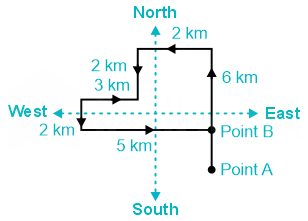
Question 56

An atom has 17 protons, 18 neutrons, and 17 electrons. What is its mass number?

  1. AOption (a)

    18

  2. BOption (b)

    24

  3. COption (c)

    35

  4. DOption (d)

    34

View answer & explanation

Correct answer

Answer: (c)C.

35

Why this answer is correct

The correct answer is 35.

Key Points

  • The mass number of an atom is calculated by summing the number of protons and neutrons in its nucleus.
  • In this case, the atom has 17 protons and 18 neutrons.
  • The formula for the mass number (A) is A = Number of Protons + Number of Neutrons.
  • Therefore, the mass number of this atom is 17 + 18 = 35.

Additional Information

  • Atomic Number
  • The atomic number is the number of protons in the nucleus of an atom.
  • It determines the chemical properties of an element and its place in the periodic table.
  • For this atom, the atomic number is 17, indicating it is chlorine (Cl).
  • Isotopes
  • Isotopes are variants of a particular chemical element that have different numbers of neutrons.
  • Chlorine has two stable isotopes: Cl-35 and Cl-37.
  • Isotopes have the same atomic number but different mass numbers.
  • Neutrons
  • Neutrons are neutral particles found in the nucleus of an atom.
  • They contribute to the mass of the atom but do not affect its chemical properties.
  • The number of neutrons in this atom is 18.
  • Electrons
  • Electrons are negatively charged particles orbiting the nucleus of an atom.
  • In a neutral atom, the number of electrons equals the number of protons.
  • For this atom, there are 17 electrons.

Question 57

Which of the following is the best example of a heterogeneous mixture?

  1. AOption (a)

    Salt in water

  2. BOption (b)

    Mixture of iron chloride and iron fillings 

  3. COption (c)

    Copper sulphate solution

  4. DOption (d)

    Sugar in water 

View answer & explanation

Correct answer

Answer: (b)B.

Mixture of iron chloride and iron fillings 

Why this answer is correct

The correct answer is Mixture of iron chloride and iron fillings.

Key Points

  • A heterogeneous mixture is one in which the components can be visibly distinguished and are not uniformly distributed.
  • The mixture of iron chloride and iron fillings is an example of a heterogeneous mixture because the two substances remain distinct and separate.
  • In this mixture, iron fillings can be seen as solid particles distinct from the iron chloride.
  • Such mixtures do not have a uniform composition throughout and the different components can be easily separated by physical methods like filtration or magnetic separation.

Additional Information

  • Homogeneous Mixture:
  • It is a mixture in which the composition is uniform throughout.
  • Examples include solutions like salt in water or sugar in water where the solute is completely dissolved.
  • Homogeneous mixtures cannot be separated by simple physical methods.
  • Methods of Separation:
  • Filtration: Used to separate an insoluble solid from a liquid.
  • Magnetic Separation: Useful for separating magnetic materials from non-magnetic ones.
  • Evaporation: Used to separate a dissolved solid from a liquid by evaporating the liquid.
  • Colloids:
  • A type of homogeneous mixture where the particle size is intermediate between a true solution and a suspension.
  • Examples include milk, fog, and jelly.
  • Suspensions:
  • A type of heterogeneous mixture where the particles are large enough to settle out over time.
  • Examples include sand in water or dust in air.

Question 58

SIDBI, in November 2024, signed a MoU with which of the following for strengthening the collaboration to support MSMEs through capacity building, credit facilities, and knowledge-sharing?

  1. AOption (a)

    Upcurve Business Services Pvt Ltd

  2. BOption (b)

    Ecozen Solutions

  3. COption (c)

    Peenya Industries Association

  4. DOption (d)

    Reliance Industries

View answer & explanation

Correct answer

Answer: (c)C.

Peenya Industries Association

Why this answer is correct

The correct answer is Peenya Industries Association.

Key Points

  • SIDBI (Small Industries Development Bank of India) signed a MoU with Peenya Industries Association in November 2024.
  • The collaboration aims to support Micro, Small, and Medium Enterprises (MSMEs) through capacity building, credit facilities, and knowledge-sharing initiatives.
  • Peenya Industries Association is one of the largest industrial associations in India, representing the interests of MSMEs in the Peenya Industrial Area in Bengaluru.
  • This partnership will focus on enhancing the competitiveness and growth of MSMEs by providing them with the necessary resources and support.
  • The MoU is part of SIDBI's ongoing efforts to strengthen the MSME ecosystem in India, which is a critical sector for economic development and job creation.

Additional Information

  • Small Industries Development Bank of India (SIDBI)
  • SIDBI was established on April 2, 1990, under an Act of the Indian Parliament.
  • It is the principal financial institution for the promotion, financing, and development of MSMEs in India.
  • SIDBI provides various financial products and services to MSMEs, including term loans, working capital loans, and equity support.
  • SIDBI also engages in policy advocacy and development initiatives to create a conducive environment for MSMEs.
  • Micro, Small, and Medium Enterprises (MSMEs)
  • MSMEs are classified based on their investment in plant and machinery or equipment and annual turnover.
  • MSMEs play a crucial role in the Indian economy, contributing significantly to GDP, exports, and employment.
  • They are often considered the backbone of the Indian economy due to their extensive presence across sectors and geographies.
  • The Indian government has implemented various schemes and policies to support the growth and development of MSMEs.
  • Peenya Industrial Area
  • Located in Bengaluru, Karnataka, Peenya Industrial Area is one of the oldest and largest industrial areas in India.
  • It houses a diverse range of industries, including manufacturing, engineering, electronics, and information technology.
  • Peenya Industries Association represents the interests of businesses operating in this industrial area.
  • The association works towards addressing the challenges faced by industries and facilitating their growth and development.
  • Capacity Building
  • Capacity building refers to the process of developing and strengthening the skills, abilities, and resources of organizations and individuals.
  • It is essential for enhancing the efficiency, effectiveness, and sustainability of organizations, particularly in the MSME sector.
  • Capacity building can include training programs, workshops, technical assistance, and mentoring.
  • It aims to improve the overall performance and competitiveness of MSMEs, enabling them to adapt to changing market conditions and technological advancements.

Question 59

Which of the following functions is NOT regulated by the medulla in the hind brain? 

  1. AOption (a)

    Regulation of hearing

  2. BOption (b)

    Vomiting control 

  3. COption (c)

    Salivary regulation 

  4. DOption (d)

    Blood pressure regulation  

View answer & explanation

Correct answer

Answer: (a)A.

Regulation of hearing

Why this answer is correct

The correct answer is Regulation of hearing.

Key Points

  • The medulla oblongata is responsible for regulating essential autonomic functions of the body.
  • It controls functions such as breathing, heart rate, and blood pressure.
  • Other functions of the medulla include regulating reflex actions like vomiting, coughing, sneezing, and swallowing.
  • Regulation of hearing is primarily managed by the auditory cortex in the temporal lobe of the brain, not the medulla.

Additional Information

  • Medulla Oblongata
  • The medulla oblongata is a section of the brainstem that connects the brain to the spinal cord.
  • It plays a crucial role in transmitting signals between the brain and the spinal cord.
  • Autonomic Nervous System
  • The autonomic nervous system controls involuntary physiological functions such as heart rate, digestion, respiratory rate, and pupillary response.
  • It is divided into the sympathetic and parasympathetic systems.
  • Auditory Cortex
  • The auditory cortex is located in the temporal lobe and is responsible for processing auditory information.
  • It is crucial for the perception and interpretation of sounds.
  • Brainstem
  • The brainstem consists of the midbrain, pons, and medulla oblongata.
  • It controls essential life functions such as breathing, heartbeat, and blood pressure.

Question 60

Which of the following is NOT a function of blood?  

  1. AOption (a)

    Helps in the synthesis of starch 

  2. BOption (b)

    Transports gases

  3. COption (c)

    Transports hormones 

  4. DOption (d)

    Transports waste materials 

View answer & explanation

Correct answer

Answer: (a)A.

Helps in the synthesis of starch 

Why this answer is correct

The correct answer is Helps in the synthesis of starch.

Key Points

  • Blood does not play any role in the synthesis of starch.
  • The synthesis of starch occurs in plants, specifically in the chloroplasts, through the process of photosynthesis.
  • Blood is responsible for the transportation of essential nutrients, gases, hormones, and waste materials throughout the body.
  • It plays a crucial role in maintaining homeostasis, immune response, and regulation of body temperature.

Additional Information

  • Functions of Blood
  • Transportation: Blood transports oxygen from the lungs to the tissues and carbon dioxide from the tissues to the lungs. It also carries nutrients, hormones, and waste products.
  • Regulation: Blood helps in regulating body temperature, pH balance, and water content of cells.
  • Protection: Blood contains cells and proteins that defend the body against infections and diseases. It also plays a role in clotting to prevent excessive blood loss.
  • Components of Blood
  • Red Blood Cells (RBCs): These cells are responsible for carrying oxygen from the lungs to the rest of the body and returning carbon dioxide to the lungs for exhalation.
  • White Blood Cells (WBCs): These cells are part of the immune system and help the body fight infection and other diseases.
  • Platelets: These are small cell fragments that play a key role in blood clotting.
  • Plasma: The liquid component of blood that carries cells and proteins throughout the body.
  • Starch Synthesis
  • Starch is synthesized in plants during photosynthesis.
  • It is stored in the chloroplasts of plant cells as a source of energy.
  • Starch is a polysaccharide composed of glucose units.

Question 61

In a certain code language,

‘P + Q’ means ‘P is the son of Q’,

‘P - Q’ means ‘P is the wife of Q’,

‘P × Q’ means ‘P is the husband of Q’ and

‘P ÷ Q’ means ‘P is the brother of Q’,

How is A related to E if ‘A + B - C + D × E’?

  1. AOption (a)

    Son  

  2. BOption (b)

    Daughter's son 

  3. COption (c)

    Son’s son 

  4. DOption (d)

    Brother 

View answer & explanation

Correct answer

Answer: (c)C.

Son’s son 

Why this answer is correct

Given:  ‘A + B - C + D × E

Decoding the symbols:

Symbols+-×÷
Coded assonwifehusbandbrother

‘A + B - C + D × E → It means that A is the son of B, B is the wife of C, C is the son of D, D is the husband of E.

Thus, A is the Son’s son  of E.

Hence, the correct answer is "Option 3".
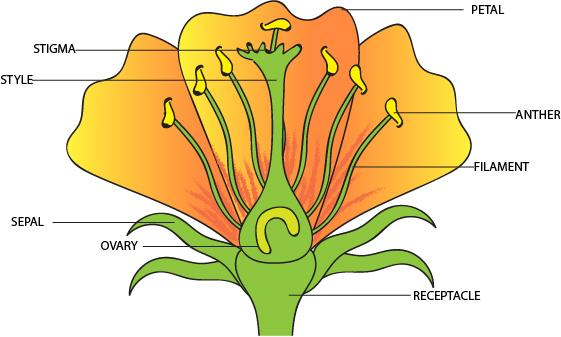
Question 62

A and B can do a piece of work in 12 days and 16 days, respectively. Both work for 3 days and then A goes away. Find how long will B take to complete the remaining work?  

  1. AOption (a)

    15 days 

  2. BOption (b)

    10 days 

  3. COption (c)

    9 days  

  4. DOption (d)

    12 days 

View answer & explanation

Correct answer

Answer: (c)C.

9 days  

Why this answer is correct

Shortcut Trick

Let Total Work be LCM(12, 16) = 48 units.

Efficiency of A = 4 units/day and B = 3 units/day.

Work done in 3 days = 3 × (4 + 3) = 21 units.

Remaining work = 48 − 21 = 27 units.

Time taken by B = 27 ÷ 3 = 9 days.

∴ The correct answer is 9 days.

Alternate Method

Given: Time taken by A = 12 days, Time taken by B = 16 days. Work period = 3 days.

Formula Used: Total Work = Efficiency × Time; Efficiency = 1 ÷ Time taken.

PersonDaysTotal WorkEfficiency
A12484
B163

⇒ Combined Efficiency of A and B = 4 + 3 = 7 units/day

⇒ Work completed in 3 days = 7 × 3 = 21 units

⇒ Remaining Work = 48 − 21 = 27 units

⇒ Time taken by B to finish remaining work = 27 ÷ 3

⇒ Time = 9 days

∴ The correct answer is 9 days.

Additional Information

Efficiency and Time Relation

Efficiency is inversely proportional to the Time Taken. If A is twice as efficient as B, A will take half the time of B.

Work and Wages

Wages are generally distributed in the Ratio of Efficiency or the actual amount of work done by each individual.

Pipes and Cisterns

The same logic applies where Inlet pipes have positive efficiency and Outlet pipes (leaks) have negative efficiency.

Question 63

How much amount did the Board of Control for Cricket in India Secretary Jay Shah provide to the Indian Olympic Association (IOA) as a support for the Indian contingent for Paris Olympics 2024?

  1. AOption (a)

    14.5 crore

  2. BOption (b)

    10.5 crore

  3. COption (c)

    8.5 crore

  4. DOption (d)

    12.5 crore

View answer & explanation

Correct answer

Answer: (c)C.

8.5 crore

Why this answer is correct

The correct answer is 8.5 crore.

Key Points

  • Jay Shah, the Secretary of the Board of Control for Cricket in India (BCCI), announced a financial support of 8.5 crore to the Indian Olympic Association (IOA).
  • This support is aimed at assisting the Indian contingent participating in the Paris Olympics 2024.
  • The financial contribution underscores the commitment of BCCI to promote sports beyond cricket and support Indian athletes.
  • This initiative is part of BCCI's broader vision to foster a multi-sport culture in India.
  • The funds will be utilized for training, preparation, and other logistical support for the Indian athletes.

Additional Information

  • Paris Olympics 2024
  • The 2024 Summer Olympics, officially known as the Games of the XXXIII Olympiad, will be held in Paris, France.
  • Paris has previously hosted the Olympics in 1900 and 1924.
  • The event is scheduled to take place from July 26 to August 11, 2024.
  • Approximately 10,500 athletes from 206 National Olympic Committees are expected to participate.
  • The games will feature 329 events in 32 sports.
  • Board of Control for Cricket in India (BCCI)
  • BCCI is the national governing body for cricket in India.
  • Founded in 1928, it is one of the richest and most powerful cricket boards in the world.
  • The board is responsible for organizing domestic and international cricket matches in India.
  • BCCI also oversees the Indian Premier League (IPL), one of the most lucrative T20 leagues globally.
  • Indian Olympic Association (IOA)
  • IOA is the governing body for the Olympic Movement and the Commonwealth Games in India.
  • Established in 1927, it ensures the representation of Indian athletes in international competitions like the Olympics.
  • IOA is affiliated with the International Olympic Committee (IOC).
  • It is responsible for the preparation and training of Indian athletes for the Olympics, Asian Games, and Commonwealth Games.
  • Support for Indian Athletes
  • Financial support is crucial for the training and development of athletes.
  • Such contributions help in providing world-class facilities and coaching.
  • It also covers travel, accommodation, and other expenses related to international competitions.
  • Supporting athletes boosts their morale and performance, leading to better outcomes in global events.

Question 64

A and B complete a work in 2 days. If A alone can do it in 4 days then, B alone can do 17-times of the same work in ______________(days). 

  1. AOption (a)

    68

  2. BOption (b)

    69

  3. COption (c)

    4

  4. DOption (d)

    5

View answer & explanation

Correct answer

Answer: (a)A.

68

Why this answer is correct

Shortcut Trick

Time taken by B alone to complete 1 unit of work = (A × B) ÷ (A − (A & B))

⇒ Time for B = (4 × 2) ÷ (4 − 2) = 8 ÷ 2 = 4 days.

For 17-times of the same work, time taken = 4 × 17 = 68 days.

∴ The correct answer is 68 days.

Alternate Method

Given:

Time taken by (A + B) = 2 days

Time taken by A alone = 4 days

PersonDaysTotal WorkEfficiency
A + B24 units2
A41

Calculations:

⇒ Efficiency of B = Efficiency of (A + B) − Efficiency of A

⇒ Efficiency of B = 2 − 1 = 1 unit/day

⇒ Time taken by B to do 1-time work = Total Work ÷ Efficiency = 4 ÷ 1 = 4 days

⇒ Time taken by B to do 17-times work = 17 × 4 = 68 days

∴ The correct answer is 68 days.

Additional Information

Efficiency and Work Relation

Work is directly proportional to Efficiency and Time. Formula: Work = Efficiency × Time.

Time and Work Reciprocal Rule

If a person completes a work in n days, then the work done in 1 day is 1/n part of the total work.

Multiple Work Units

If the amount of work increases by k-times, the time required at the same efficiency also increases by k-times.

Question 65

Which of the following factors does NOT affect the rate of evaporation? 

  1. AOption (a)

    Humidity of the surrounding air 

  2. BOption (b)

    Colour of the liquid 

  3. COption (c)

    Temperature of the liquid 

  4. DOption (d)

    Surface area of the liquid 

View answer & explanation

Correct answer

Answer: (b)B.

Colour of the liquid 

Why this answer is correct

The correct answer is Colour of the liquid.

Key Points

  • Evaporation is a process where liquid changes into vapor without boiling, and it primarily depends on the properties of the liquid and the surrounding environment.
  • Humidity of the surrounding air affects the rate of evaporation. Lower humidity levels increase the rate of evaporation.
  • Temperature of the liquid is a crucial factor. Higher temperatures increase the kinetic energy of molecules, speeding up evaporation.
  • Surface area of the liquid plays a significant role. A larger surface area allows more molecules to escape, increasing the rate of evaporation.
  • The colour of the liquid does not inherently affect the rate of evaporation. Evaporation is more dependent on physical properties like temperature and surface area.

Additional Information

  • Evaporation Process:
  • Evaporation is an endothermic process where liquid molecules absorb energy to transition into the gas phase.
  • This process occurs at the surface of the liquid and can happen at temperatures below boiling point.
  • Factors Affecting Evaporation:
  • Wind Speed: Higher wind speeds remove the saturated layer of air above the liquid, enhancing evaporation.
  • Atmospheric Pressure: Lower pressure reduces the energy needed for molecules to escape into the air, increasing evaporation.
  • Applications of Evaporation:
  • Used in cooling mechanisms such as sweat evaporation to regulate body temperature.
  • Important in industries for concentrating solutions and drying materials.
  • Evaporation vs. Boiling:
  • Evaporation occurs at the surface and at any temperature, while boiling occurs throughout the liquid at a specific boiling point.
  • Evaporation is a slower process compared to the rapid vaporization seen in boiling.

Question 66

The electric power consumed by a resistor of resistance R, carrying current I, is _______

  1. AOption (a)

    IR

  2. BOption (b)

    IR2

  3. COption (c)

    I/R

  4. DOption (d)

    I2R

View answer & explanation

Correct answer

Answer: (d)D.

I2R

Why this answer is correct

The correct answer is I2R.

Key Points

  • The electric power consumed by a resistor is given by the formula P = I2R, where P is power, I is current, and R is resistance.
  • This formula derives from Ohm's Law, which states that V = IR (voltage = current × resistance).
  • Using the relationship P = VI (power = voltage × current) and substituting V with IR, we get P = I2R.
  • This equation indicates that the power dissipated in a resistor increases with the square of the current.
  • The unit of power is the watt (W), where 1 watt equals 1 joule per second.

Additional Information

  • Ohm's Law
  • Ohm's Law is fundamental in understanding electrical circuits.
  • It states that the current through a conductor between two points is directly proportional to the voltage across the two points.
  • Ohm's Law formula: V = IR.
  • Resistor
  • A resistor is a passive electrical component that provides resistance to the flow of electric current.
  • Resistors are used to control the current in an electric circuit.
  • Resistance is measured in ohms (Ω).
  • Power
  • Power in an electrical circuit is the rate at which energy is consumed or converted.
  • The standard unit of power is the watt (W).
  • 1 watt is equivalent to 1 joule per second.
  • Joule's Law
  • Joule's Law relates to the heating effect of electric current.
  • It states that the heat produced in a resistor is proportional to the square of the current, the resistance, and the time for which the current flows.
  • Formula: H = I2Rt, where H is heat energy.

Question 67

1 kilowatt is equal to _______.

  1. AOption (a)

    1000 J s-2

  2. BOption (b)

    1000 J s-1

  3. COption (c)

    1000 J

  4. DOption (d)

    1000 J s

View answer & explanation

Correct answer

Answer: (b)B.

1000 J s-1

Why this answer is correct

The correct answer is 1000 J s-1.

Key Points

  • 1 kilowatt (kW) is equal to 1000 watts (W). The watt is a unit of power in the International System of Units (SI).
  • Power is defined as the rate at which energy is transferred or converted. It is measured in joules per second (J/s).
  • Therefore, 1 kilowatt is equivalent to 1000 joules per second (1000 J/s).
  • This unit is commonly used to quantify the rate of energy conversion in engines and electrical devices.

Additional Information

  • Watt (W)
  • A watt is the SI unit of power, equivalent to one joule per second (1 W = 1 J/s).
  • It is named after James Watt, an 18th-century Scottish inventor.
  • Joule (J)
  • A joule is the SI unit of energy, equivalent to the energy transferred when applying a force of one newton over a distance of one meter (1 J = 1 N·m).
  • It is named after James Prescott Joule, an English physicist.
  • Power
  • Power is the rate at which work is done or energy is transferred, measured in watts (W) in the SI system.
  • It is a scalar quantity and can be calculated as power = work/time.
  • Energy Conversion
  • Energy conversion is the process of changing energy from one form to another, such as mechanical energy to electrical energy.
  • Examples include generators, which convert mechanical energy into electrical energy, and engines, which convert chemical energy into mechanical energy.

Question 68

If AB = k + 3, BC = 2k and AC = 5k - 5, then for what value of ‘k’ does B lie on AC? 

  1. AOption (a)

    4

  2. BOption (b)

    8

  3. COption (c)

    2

  4. DOption (d)

    3

View answer & explanation

Correct answer

Answer: (a)A.

4

Why this answer is correct

Shortcut Trick If point B lies on the line segment AC, then the sum of the parts must equal the whole: AB + BC = AC. ⇒ (k + 3) + (2k) = 5k − 5 ⇒ 3k + 3 = 5k − 5 ⇒ 2k = 8 ⇒ k = 4 ∴ The correct answer is 4.

Alternate Method Given: Length of AB = k + 3 Length of BC = 2k Length of AC = 5k − 5 Condition: For point B to lie on the line segment AC, the points A, B, and C must be collinear and B must be between A and C.

Calculations: ⇒ AB + BC = AC ⇒ (k + 3) + 2k = 5k − 5 ⇒ 3k + 3 = 5k − 5 ⇒ 5k − 3k = 3 + 5 ⇒ 2k = 8 ⇒ k = 8 ÷ 2 ⇒ k = 4 ∴ The correct answer is 4.

Additional Information Collinearity Property Three points are collinear if the sum of the lengths of the two shorter segments equals the length of the longest segment. Triangle Inequality In a triangle, the sum of any two sides must be strictly greater than the third side (AB + BC > AC). If AB + BC = AC, the triangle collapses into a straight line. Section Formula If B divides AC in ratio m:n, then B = (mC + nA) / (m + n). Here, the ratio AB:BC is (4+3):(2×4) = 7:8.

Question 69

Two trains of length 220 m and 280 m are running towards each other on parallel lines at 42 km/h and 30 km/h, respectively. In how much time will they be clear of each other from the moment they meet?  

  1. AOption (a)

    10 sec  

  2. BOption (b)

    21 sec 

  3. COption (c)

    20 sec 

  4. DOption (d)

    25 sec

View answer & explanation

Correct answer

Answer: (d)D.

25 sec

Why this answer is correct

Shortcut Trick

Relative Speed (Opposite Direction) = 42 + 30 = 72 km/h.

Convert to m/s: 72 × (5/18) = 20 m/s.

Total Distance = Sum of lengths = 220 + 280 = 500 m.

Time = Total Distance ÷ Relative Speed = 500 ÷ 20 = 25 sec.

∴ The correct answer is 25 sec.

Alternate Method

Given:

Length of first train (L1) = 220 m

Length of second train (L2) = 280 m

Speed of first train (S1) = 42 km/h

Speed of second train (S2) = 30 km/h

Formula Used:

Time = (L1 + L2) ÷ (S1 + S2)

Conversion: 1 km/h = 5/18 m/s

Calculations:

⇒ Total Distance = 220 + 280 = 500 m

⇒ Relative Speed = (42 + 30) × (5/18) m/s

⇒ Relative Speed = 72 × (5/18) = 4 × 5 = 20 m/s

⇒ Time taken = 500 ÷ 20 = 25 seconds

∴ The correct answer is 25 sec.

Additional Information

Relative Speed Concept

When two objects move in opposite directions, their relative speed is the sum of their individual speeds (u + v). When moving in the same direction, it is the difference (u − v).

Unit Conversion

To convert speed from km/h to m/s, multiply by 5/18. To convert from m/s to km/h, multiply by 18/5.

Train Crossing Objects

When a train crosses a pole/man, distance = length of train. When it crosses a platform/bridge/another train, distance = length of train + length of object.

Question 70

What was the theme of the first Asian Buddhist Summit, held in November 2024?

  1. AOption (a)

    Role of Buddha Dhamma in Strengthening World 

  2. BOption (b)

    Role of Buddha Dhamma in Strengthening Asia

  3. COption (c)

    Role of Buddha Dhamma in Maintaining World Peace Order

  4. DOption (d)

    Role of Buddha Dhamma in Establishing Global Peace

View answer & explanation

Correct answer

Answer: (b)B.

Role of Buddha Dhamma in Strengthening Asia

Why this answer is correct

The correct answer is Role of Buddha Dhamma in Strengthening Asia.

Key Points

  • The first Asian Buddhist Summit was held in November 2024 with the theme "Role of Buddha Dhamma in Strengthening Asia".
  • This summit aimed to highlight the significance of Buddhist teachings in fostering unity and cooperation in Asia.
  • The event brought together Buddhist leaders and scholars from various Asian countries.
  • The summit focused on how the principles of Buddha Dhamma can contribute to regional peace and stability.
  • Participants discussed strategies to promote cultural exchange and mutual understanding through Buddhist values.

Additional Information

  • Buddha Dhamma
  • Buddha Dhamma refers to the teachings and doctrines of Gautama Buddha, which emphasize ethical conduct, mental discipline, and wisdom.
  • It includes principles such as the Four Noble Truths and the Noble Eightfold Path.
  • Four Noble Truths
  • The Four Noble Truths are the foundation of Buddha's teachings: the truth of suffering, the cause of suffering, the end of suffering, and the path to the end of suffering.
  • Noble Eightfold Path
  • The Noble Eightfold Path consists of right understanding, right intention, right speech, right action, right livelihood, right effort, right mindfulness, and right concentration.
  • This path is aimed at achieving enlightenment and liberation from the cycle of birth and death.
  • Significance of Buddhist Summits
  • Buddhist summits serve as platforms for promoting peace, dialogue, and cooperation among different cultures and nations.
  • They help in spreading the message of non-violence and compassion globally.
  • Buddhism in Asia
  • Buddhism is a major religion in many Asian countries including Thailand, Myanmar, Japan, Sri Lanka, and others.
  • It plays a significant role in the cultural and spiritual life of these nations.

Question 71

Refer to the given number and symbol series and answer the question that follows. Counting to be done from left to right only.

(Left) 2 7 & 3 Ω 9 # 1 * £ & % 4 6 @ 8 $ 5 (Right)

If all the symbols are dropped from the series, which of the following will be fifth from the right$?

  1. AOption (a)

    9

  2. BOption (b)

    1

  3. COption (c)

    3

  4. DOption (d)

    4

View answer & explanation

Correct answer

Answer: (b)B.

1

Why this answer is correct

Given: (Left) 2 7 & 3 Ω 9 # 1 * £ & % 4 6 @ 8 $ 5 (Right)

Condition:  all the symbols are dropped from the series,  fifth from the right.

Now, 

 (Left) 2 7  3  9  1 4 6  8 5 (Right)

Thus, 1 is the fifth from the right  after rearrangement of the series.

Hence, the correct answer is "Option 2".$

Question 72

Read the given statements and conclusions carefully. You have to take the given statements to be true even if they seem to be at variance from commonly known facts and decide which conclusion(s) logically follow(s) from the given statements.

Statements:

Some tablets are laptops.

All laptops are desktops.

Conclusions:

(I) Some desktops are tablets.

(II) No desktops are tablets.

  1. AOption (a)

    Only conclusion (II) follows

  2. BOption (b)

    Both conclusions (I) and (II) follow 

  3. COption (c)

    Only conclusion (I) follows

  4. DOption (d)

    Neither conclusion (I) nor (II) follows

View answer & explanation

Correct answer

Answer: (c)C.

Only conclusion (I) follows

Why this answer is correct

Statements:

Some tablets are laptops.

All laptops are desktops.

The least possible venn diagram is given:

Conclusions:

(I) Some desktops are tablets - True(because, Some tablets are laptops and All laptops are desktops, it implies that the part of laptops which are tablets are desktops as well).

(II) No desktops are tablets - False(because, Some tablets are laptops and All laptops are desktops, it implies that the part of laptops which are tablets are desktops as well so it cannot be definite).

Thus, Only conclusion (I) follows.

Hence, the correct answer is "Option 3".

Question 73

Which of the following compounds is used as an antacid?

  1. AOption (a)

    Sodium chloride

  2. BOption (b)

    Magnesium hydroxide

  3. COption (c)

    Calcium oxide

  4. DOption (d)

    Calcium hydroxide

View answer & explanation

Correct answer

Answer: (b)B.

Magnesium hydroxide

Why this answer is correct

The correct answer is Magnesium hydroxide.

Key Points

  • Magnesium hydroxide is commonly used as an antacid to neutralize stomach acid and relieve indigestion and heartburn.
  • It is often referred to as "milk of magnesia" due to its milky appearance.
  • Magnesium hydroxide works by neutralizing hydrochloric acid in the stomach, thereby increasing the pH level and reducing acidity.
  • It is also used as a laxative to relieve constipation by drawing water into the intestines and promoting bowel movements.

Additional Information

  • Antacids:
  • Antacids are substances that neutralize stomach acidity and are used to relieve heartburn, indigestion, or an upset stomach.
  • Common active ingredients include magnesium hydroxide, aluminum hydroxide, calcium carbonate, and sodium bicarbonate.
  • Antacids provide quick relief from symptoms but do not heal the underlying cause of acid-related conditions.
  • Mechanism of Action:
  • Antacids work by neutralizing the excess hydrochloric acid in the stomach, which increases the pH level and reduces acidity.
  • This action provides relief from pain and discomfort caused by acid reflux and indigestion.
  • Other Uses of Magnesium Hydroxide:
  • Besides being an antacid, magnesium hydroxide is also used as a laxative to treat constipation.
  • It works by drawing water into the intestines, which helps to soften stools and stimulate bowel movements.
  • Safety and Side Effects:
  • Common side effects of magnesium hydroxide include diarrhea, cramping, and an imbalance in electrolytes if used excessively.
  • Patients with kidney disease should use magnesium hydroxide with caution due to the risk of magnesium accumulation.

Question 74

Which of the following device is governed by Flemming’s Left Hand Rule 

  1. AOption (a)

    Electric Bulb 

  2. BOption (b)

    Electric Geyser 

  3. COption (c)

    Electric motor 

  4. DOption (d)

    Electric Iron 

View answer & explanation

Correct answer

Answer: (c)C.

Electric motor 

Why this answer is correct

The correct answer is Electric motor.

Key Points

  • Fleming's Left Hand Rule is used to determine the direction of force on a current-carrying conductor in a magnetic field, which is essential in the functioning of an electric motor.
  • According to the rule, if you align your thumb, forefinger, and middle finger perpendicular to each other, the thumb represents the direction of force (motion), the forefinger the magnetic field, and the middle finger the current.
  • Electric motors convert electrical energy into mechanical energy, and Fleming's Left Hand Rule helps in predicting the direction of this mechanical force.
  • This principle is critical in various applications, including fans, washing machines, and other household appliances that use electric motors.

Additional Information

  • Fleming's Right Hand Rule
  • This rule is used to determine the direction of induced current when a conductor moves in a magnetic field.
  • It is applicable in generators, where mechanical energy is converted into electrical energy.
  • Electric Generators
  • Electric generators operate on the principle of electromagnetic induction to convert mechanical energy into electrical energy.
  • They utilize Fleming's Right Hand Rule to determine the direction of induced current.
  • Magnetic Field
  • A magnetic field is a region around a magnetic material or a moving electric charge within which the force of magnetism acts.
  • It is fundamental to the operation of both motors and generators.
  • Electromagnetic Induction
  • It is the production of an electromotive force across a conductor when it is exposed to a varying magnetic field.
  • This principle is used in transformers, induction coils, and various other electrical devices.

Question 75

An imaginary straight line passing through the pole and the centre of curvature of a spherical mirror is called as ______

  1. AOption (a)

    emergent ray

  2. BOption (b)

    incident ray 

  3. COption (c)

    principal axis 

  4. DOption (d)

    reflected ray 

View answer & explanation

Correct answer

Answer: (c)C.

principal axis 

Why this answer is correct

The correct answer is principal axis.

Key Points

  • The principal axis is an imaginary line passing through the pole and the centre of curvature of a spherical mirror.
  • It is used as the reference line for measuring the angles of incident and reflected rays in optics.
  • The point where the principal axis meets the mirror surface is known as the pole (P) of the mirror.
  • The principal axis helps in determining the focal length and radius of curvature of the mirror.

Additional Information

  • Centre of Curvature
  • The centre of curvature is the center of the sphere from which the spherical mirror is a part.
  • It is denoted by the letter C.
  • Focal Point
  • The focal point, also known as the focus, is the point where parallel rays of light either converge or appear to diverge after reflecting from the mirror.
  • It is denoted by the letter F.
  • Focal Length
  • The focal length is the distance between the pole and the focal point of the mirror.
  • It is denoted by the letter f.
  • Radius of Curvature
  • The radius of curvature is the distance between the pole and the centre of curvature.
  • It is denoted by the letter R and is equal to twice the focal length (R = 2f).

Question 76

Which organelle is the powerhouse of the cell? 

  1. AOption (a)

    Golgi apparatus 

  2. BOption (b)

    Plastids 

  3. COption (c)

    Mitochondria 

  4. DOption (d)

    Endoplasmic reticulum  

View answer & explanation

Correct answer

Answer: (c)C.

Mitochondria 

Why this answer is correct

The correct answer is Mitochondria.

Key Points

  • Mitochondria are known as the powerhouse of the cell because they generate most of the cell's supply of adenosine triphosphate (ATP), used as a source of chemical energy.
  • They are double-membrane-bound organelles found in the cytoplasm of almost all eukaryotic cells, including plants and animals.
  • Mitochondria have their own DNA, which is inherited maternally and is used to produce some of the proteins and enzymes required for their function.
  • They play a crucial role in cellular respiration, a process that converts biochemical energy from nutrients into ATP.
  • Mitochondria are also involved in other processes like signaling, cellular differentiation, cell death, and the control of the cell cycle and cell growth.

Additional Information

  • Structure of Mitochondria:
  • Mitochondria have two membranes: an outer membrane and a highly folded inner membrane.
  • The inner membrane folds are called cristae, which increase the surface area for ATP production.
  • Functions Beyond Energy Production:
  • Mitochondria help regulate the metabolic activity of the cell.
  • They are involved in the synthesis of certain steroids and the urea cycle.
  • Role in Apoptosis:
  • They play a key role in programmed cell death (apoptosis), which is essential for the removal of damaged or unnecessary cells.
  • Genetic Diseases:
  • Mutations in mitochondrial DNA can lead to a variety of genetic disorders, often affecting the muscles and nervous system.
  • Evolutionary Origin:
  • The endosymbiotic theory suggests that mitochondria originated from a symbiotic relationship between a primitive eukaryotic cell and a prokaryote.

Question 77

Which Indian legendary sportsperson became the first Asian man to be inducted into the Tennis Hall of Fame?  

  1. AOption (a)

    Mahesh Bhupati 

  2. BOption (b)

    Rohan Bopanna

  3. COption (c)

    Leander Paes 

  4. DOption (d)

    Ramanathan Krishnan 

View answer & explanation

Correct answer

Answer: (c)C.

Leander Paes 

Why this answer is correct

The correct answer is Leander Paes.

Key Points

  • Leander Paes is a renowned Indian tennis player known for his outstanding achievements in doubles and mixed doubles events.
  • He was inducted into the International Tennis Hall of Fame in 2021, becoming the first Asian man to receive this honor.
  • Paes has won 18 Grand Slam titles, including eight in men's doubles and ten in mixed doubles.
  • He is considered one of the greatest doubles players in the history of tennis, with a career spanning over three decades.

Additional Information

  • International Tennis Hall of Fame
  • It is a non-profit organization that preserves and promotes the history of tennis and celebrates its champions.
  • Located in Newport, Rhode Island, USA, the Hall of Fame was established in 1954.
  • Induction into the Hall of Fame is considered one of the highest honors in the sport of tennis.
  • Grand Slam Titles
  • The four Grand Slam tournaments are the Australian Open, French Open, Wimbledon, and US Open.
  • Winning all four in a single year is known as a "Calendar Grand Slam," a rare and prestigious achievement.
  • Leander Paes has won titles in both men's doubles and mixed doubles categories across these tournaments.
  • Davis Cup
  • Leander Paes has represented India in the Davis Cup, the premier international team event in men's tennis.
  • He holds the record for the most Davis Cup doubles wins by an Indian player.
  • Olympics
  • Leander Paes won a bronze medal in singles at the 1996 Atlanta Olympics, marking India's first Olympic tennis medal.
  • He has participated in seven consecutive Olympic Games, a record for an Indian athlete.

Question 78

What is the name of the connective tissue that connects two bones to each other? 

  1. AOption (a)

    Adipose tissue

  2. BOption (b)

    Cartilage

  3. COption (c)

    Tendon 

  4. DOption (d)

    Ligament 

View answer & explanation

Correct answer

Answer: (d)D.

Ligament 

Why this answer is correct

The correct answer is Ligament.

Key Points

  • Ligaments are a type of connective tissue that connect bones to other bones in joints.
  • They are composed of dense, fibrous connective tissue that provides stability and support to joints.
  • Ligaments are crucial for maintaining the structure of the skeletal system and enabling proper movement.
  • They contain collagen fibers, which provide tensile strength and elasticity to withstand various types of stresses.

Additional Information

  • Tendons
  • Tendons are connective tissues that connect muscles to bones.
  • They are composed mainly of collagen fibers and are designed to withstand tension.
  • Tendons play a vital role in transmitting the force generated by muscles to bones, facilitating movement.
  • Cartilage
  • Cartilage is a flexible connective tissue found in various parts of the body, including joints, ear, and nose.
  • It provides cushioning and reduces friction between bones in joints.
  • There are three types of cartilage: hyaline, elastic, and fibrocartilage, each serving different functions.
  • Adipose Tissue
  • Adipose tissue, or body fat, is a type of connective tissue that stores energy in the form of fat.
  • It also provides insulation and cushioning to protect organs and tissues.
  • Adipose tissue is found beneath the skin, around internal organs, and in bone marrow.
  • Fibrous Connective Tissue
  • Fibrous connective tissue is characterized by a dense arrangement of collagen fibers.
  • It includes ligaments, tendons, and the dermis layer of the skin.
  • This type of tissue provides strength, support, and flexibility to various body structures.

Question 79

Zinc metal reacts with sodium hydroxide to produce _______

  1. AOption (a)

    zinc oxide 

  2. BOption (b)

    sodium zincate 

  3. COption (c)

    zinc hydroxide 

  4. DOption (d)

    sodium hydride 

View answer & explanation

Correct answer

Answer: (b)B.

sodium zincate 

Why this answer is correct

The correct answer is sodium zincate.

Key Points

  • Zinc reacts with sodium hydroxide to form sodium zincate and hydrogen gas.
  • The chemical reaction can be represented as: Zn + 2NaOH → Na₂ZnO₂ + H₂.
  • Sodium zincate is a compound that contains the zincate ion (ZnO₂²⁻).
  • This reaction showcases the amphoteric nature of zinc, which means it can react with both acids and bases.

Additional Information

  • Amphoteric Substances:
  • Amphoteric substances can react with both acids and bases to form salts and water.
  • Examples include zinc, aluminum, and lead.
  • Sodium Hydroxide (NaOH):
  • Commonly known as caustic soda or lye.
  • A strong base used in various industrial processes such as soap making, paper production, and chemical manufacturing.
  • Zinc (Zn):
  • A transition metal that is essential for human health.
  • Used in galvanization to protect iron and steel from rusting.
  • Hydrogen Gas (H₂):
  • The lightest and most abundant chemical element in the universe.
  • Used in various industrial processes, including the production of ammonia for fertilizers and in fuel cells for clean energy.

Question 80

Which of the following elements is monoatomic? 

  1. AOption (a)

    Nitrogen 

  2. BOption (b)

    Hydrogen 

  3. COption (c)

    Oxygen 

  4. DOption (d)

    Helium 

View answer & explanation

Correct answer

Answer: (d)D.

Helium 

Why this answer is correct

The correct answer is Helium.

Key Points

  • Helium is a noble gas and exists as a monoatomic gas under standard conditions.
  • It is the second lightest and second most abundant element in the observable universe, after hydrogen.
  • Helium atoms consist of a single nucleus with two protons and two neutrons, surrounded by two electrons.
  • Being monoatomic, helium does not form chemical bonds with other atoms and is chemically inert.
  • Helium's low boiling and melting points make it valuable for cryogenics and as a coolant in superconducting magnets.

Additional Information

  • Noble Gases
  • Noble gases are a group of chemical elements with similar properties; in the periodic table, they are located in Group 18.
  • They are all odorless, colorless, monatomic gases with very low chemical reactivity.
  • The noble gases include helium, neon, argon, krypton, xenon, and radon.
  • Due to their inertness, noble gases are used in applications where reactions with other substances are undesirable.
  • Helium's Applications
  • Helium is used in cryogenics, particularly in cooling superconducting magnets in MRI scanners and other devices.
  • It is also used as a protective gas in arc welding and in the production of silicon wafers for electronics.
  • Helium is utilized in gas chromatography as a carrier gas due to its inert properties.
  • It is used in breathing mixtures for deep-sea diving and in balloons and airships due to its lightness and non-flammability.
  • Helium's Discovery and Extraction
  • Helium was first discovered in 1868 by French astronomer Pierre Janssen and English astronomer Norman Lockyer independently, through spectroscopic analysis of the Sun.
  • Helium is extracted from natural gas deposits, where it is found in concentrations of up to 7% by volume.
  • Most of the world's helium supply comes from natural gas fields in the United States, particularly in Texas, Oklahoma, and Kansas.

Question 81

Based on the English alphabetical order, three of the following four letter-clusters are alike in a certain way and thus form a group. Which letter-cluster does not belong to that group ?

(Note: The odd one out is not based on the number of consonants/vowels or their position in the letter cluster.)

  1. AOption (a)

    NUP

  2. BOption (b)

    JQK

  3. COption (c)

    RYT

  4. DOption (d)

    FMH

View answer & explanation

Correct answer

Answer: (b)B.

JQK

Why this answer is correct

The logic followed here is:

Option 1) NUP

Option 2) JQK

Doesn't follow the pattern

Option 3) RYT

Option 4) FMH

Hence, the correct answer is "Option 2".

Question 82

Seven people, A, B, E, F, P, Q and R, are sitting in a row, facing north. No one sits to the right of F. Only three people sit between F and E. Only two people sit between E and P. A sits third to the left of R. Q sits to the immediate right of R. How many people sit between B and P? 

  1. AOption (a)

    Four

  2. BOption (b)

    One

  3. COption (c)

    Three

  4. DOption (d)

    Two

View answer & explanation

Correct answer

Answer: (c)C.

Three

Why this answer is correct

Given: Seven people, A, B, E, F, P, Q and R, are sitting in a row, facing north.

No one sits to the right of F. Only three people sit between F and E.

Only two people sit between E and P. A sits third to the left of R.

 Q sits to the immediate right of R. Only place left for B.

Thus, the only three people sit  between B and P.

Hence, the correct answer is "Option 3".

Question 83

The gravitational potential energy of an object of mass ‘m’ raised through a height ‘h’ from the earth’s surface is given by _______

  1. AOption (a)

    m a

  2. BOption (b)

    m a v

  3. COption (c)

    m g h

  4. DOption (d)

    m g v

View answer & explanation

Correct answer

Answer: (c)C.

m g h

Why this answer is correct

The correct answer is m g h.

Key Points

  • Gravitational potential energy is the energy possessed by an object due to its position in a gravitational field.
  • The formula for gravitational potential energy is given by U = mgh, where 'm' is mass, 'g' is the acceleration due to gravity, and 'h' is the height.
  • This formula assumes that the height 'h' is small compared to the radius of the Earth, so the gravitational force can be considered constant.
  • The unit of gravitational potential energy in the International System of Units (SI) is the Joule (J).

Additional Information

  • Gravity
  • Gravity is a force that attracts two bodies towards each other, depending on their masses and the distance between them.
  • The acceleration due to gravity on Earth is approximately 9.8 m/s².
  • Potential Energy
  • Potential energy is the stored energy of an object due to its position or state.
  • It can be converted into other forms of energy, such as kinetic energy.
  • Kinetic Energy
  • Kinetic energy is the energy that an object possesses due to its motion.
  • The formula for kinetic energy is given by KE = 0.5 * m * v², where 'm' is mass and 'v' is velocity.
  • Conservation of Energy
  • The law of conservation of energy states that energy cannot be created or destroyed, only transformed from one form to another.
  • In a closed system, the total energy remains constant.

Question 84

The value of a machine depreciates at the rate of 10% per annum. If its present value is Rs. 1,62,000, then what will be its worth after 2 years? 

  1. AOption (a)

    Rs. 1,31,220

  2. BOption (b)

    Rs. 1,32,860

  3. COption (c)

    Rs. 1,26,860

  4. DOption (d)

    Rs. 1,27,760

View answer & explanation

Correct answer

Answer: (a)A.

Rs. 1,31,220

Why this answer is correct

Shortcut Trick

Depreciation rate = 10% = 1/10 → Value becomes 9/10 each year.

Worth after 2 years = Present Value × (9/10)2

Worth = 1,62,000 × (81/100) = 1,620 × 81

Worth = 1,31,220

∴ The correct answer is Rs. 1,31,220.

Alternate Method

Given: Present Value (P) = Rs. 1,62,000, Rate of depreciation (R) = 10% per annum, Time (n) = 2 years.

Formula Used: Worth after n years = P × (1 − R/100)n

⇒ Worth = 1,62,000 × (1 − 10/100)2

⇒ Worth = 1,62,000 × (90/100) × (90/100)

⇒ Worth = 1,62,000 × 0.9 × 0.9

⇒ Worth = 1,62,000 × 0.81

⇒ Worth = 1,31,220

∴ The correct answer is Rs. 1,31,220.

Additional Information

Depreciation Formula

When the value of an object decreases at a constant rate, the final value is A = P(1 − R/100)n.

Successive Percentage Change

For two successive changes of a% and b%, the effective change is [a + b + (ab/100)]%. For 10% depreciation, a = −10 and b = −10, giving −19% total change.

Appreciation

If the value increases (like population or land price), the formula becomes A = P(1 + R/100)n.

Question 85

If a force of 2 N gives a mass m1, an acceleration of 8 ms-2 and a mass m2, an acceleration of 15 m s-2 , what will be the total mass if both the masses were tied together?

  1. AOption (a)

    2360\frac{23}{60} kg

  2. BOption (b)

    310\frac{3}{10} kg

  3. COption (c)

    410\frac{4}{10} kg

  4. DOption (d)

    1040\frac{10}{40} kg

View answer & explanation

Correct answer

Answer: (a)A.

2360\frac{23}{60} kg

Why this answer is correct

The correct answer is (23)/(60) kg.

Key Points

  • Newton's second law of motion states that Force (F) = mass (m) * acceleration (a).
  • Given, Force (F) = 2 N, acceleration (a1) = 8 ms-2, acceleration (a2) = 15 ms-2.
  • For mass m1: 2 = m1 * 8, hence m1 = 2/8 = 1/4 kg.
  • For mass m2: 2 = m2 * 15, hence m2 = 2/15 kg.
  • Total mass when both masses are tied together: m = m1 + m2 = 1/4 + 2/15 = (15 + 8)/60 = 23/60 kg.

Additional Information

  • Newton's Second Law of Motion: It states that the force acting on an object is equal to the mass of that object times its acceleration (F = ma).
  • SI Units: The International System of Units (SI) for force is the Newton (N), for mass is the kilogram (kg), and for acceleration is meters per second squared (ms-2).
  • Derived Units: The Newton can be derived as 1 N = 1 kg·m/s2, which means the force required to accelerate a 1 kg mass by 1 m/s2.
  • Proportionality: This law implies that for a constant force, an increase in mass results in a decrease in acceleration and vice versa.
  • Applications: Newton's second law is widely used in engineering and physics to predict the behavior of objects under various forces.

Question 86

The cost price of a toy is Rs. 210. What should be its MRP so that after a discount of 5% the shopkeeper gains 90%? 

  1. AOption (a)

    Rs. 420

  2. BOption (b)

    Rs. 480

  3. COption (c)

    Rs. 400

  4. DOption (d)

    Rs. 450

View answer & explanation

Correct answer

Answer: (a)A.

Rs. 420

Why this answer is correct

Shortcut Trick

The relationship between Cost Price (CP) and Marked Price (MRP) is given by the ratio:

CP / MRP = (100 − Discount%) / (100 + Gain%)

Ratio = (100 − 5) / (100 + 90) = 95 / 190 = 1 / 2

Since CP corresponds to 1 unit and is given as Rs. 210,

MRP corresponds to 2 units = 2 × 210 = Rs. 420.

∴ The correct answer is Rs. 420.

Alternate Method

Given → CP = Rs. 210, Gain = 90%, Discount = 5%. Formulas: SP = CP × (100 + Gain%) / 100 | MRP = SP × 100 / (100 − Discount%)

⇒ Calculate Selling Price (SP): SP = 210 × (100 + 90) / 100 = 210 × 1.9 = Rs. 399. ⇒ Let MRP be x. Discount is 5%, so 95% of x = SP. ⇒ 0.95 × x = 399 ⇒ x = 399 / 0.95 = Rs. 420.

∴ The correct answer is Rs. 420.

Additional Information

Marked Price and Discount

The Marked Price is the price printed on the label. Discount is always calculated on the Marked Price, while Profit/Loss is calculated on the Cost Price.

Relation Formula

MRP = [CP × (100 + Profit%)] / (100 − Discount%). This directly links CP and MRP when both profit and discount percentages are known.

Question 87

Which of the following options should come in place of the question mark (?) in the given series to make it logically complete?

16, 27, 38, 49, 60, ?

  1. AOption (a)

    73

  2. BOption (b)

    70

  3. COption (c)

    71

  4. DOption (d)

    72

View answer & explanation

Correct answer

Answer: (c)C.

71

Why this answer is correct

The logic followed here is:

Logic: + 11 in each steps:


Hence, the correct answer is "Option 3".
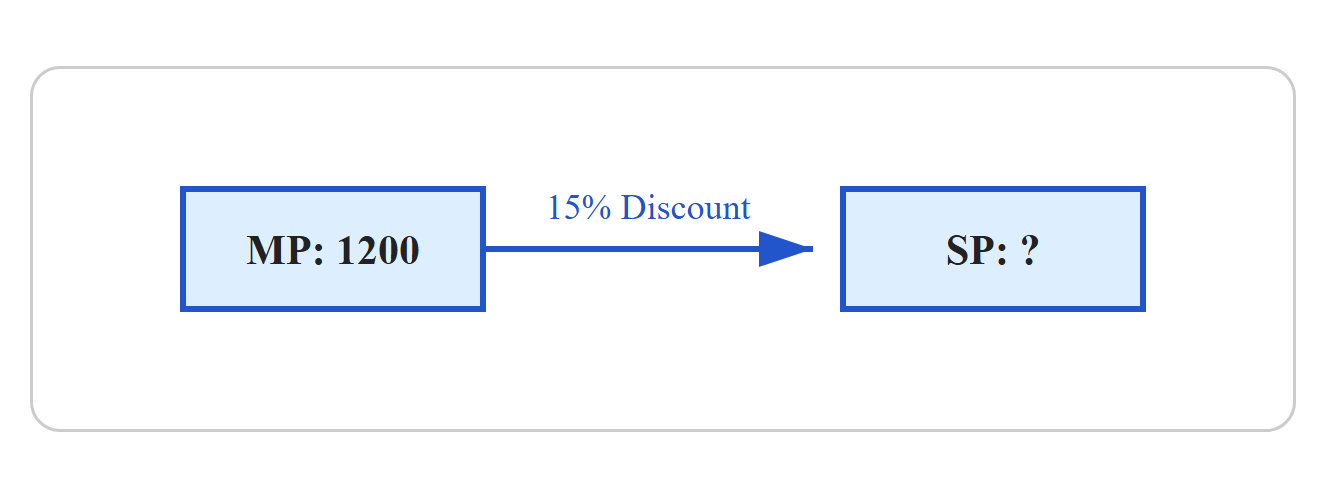
Question 88

Pradnya invests Rs. 2,00,000 in the name of her daughter, who is 16 years old, in a scheme that pays compound interest at a rate of 8% per annum, compounded annually. What will be the total amount due to the daughter when she becomes 18 years old?  

  1. AOption (a)

    Rs. 2,52,150

  2. BOption (b)

    Rs. 2,35,850

  3. COption (c)

    Rs. 2,33,280

  4. DOption (d)

    Rs. 2,51,250

View answer & explanation

Correct answer

Answer: (c)C.

Rs. 2,33,280

Why this answer is correct

Shortcut Trick

Effective Compound Interest rate for 2 years at 8% per annum is 8 + 8 + (8 × 8) ÷ 100 = 16.64%.

Total Amount = Principal + Compound Interest = 116.64% of the Principal.

Amount = (116.64 ÷ 100) × 2,00,000 = 2,33,280.

∴ The correct answer is Rs. 2,33,280.

Alternate Method

Given:

Principal (P) = Rs. 2,00,000

Rate of Interest (R) = 8% per annum compounded annually

Time (n) = Age 18 − Age 16 = 2 years

Formula Used:

Amount (A) = P × (1 + R ÷ 100)n

Age 16 Age 17 Age 18

P = 2,00,000 A = ?

+8% CI +8% CI

Total Duration = 2 Years

Calculations:

⇒ A = 2,00,000 × (1 + 8 ÷ 100)2

⇒ A = 2,00,000 × (108 ÷ 100) × (108 ÷ 100)

⇒ A = 2,00,000 × 1.08 × 1.08

⇒ A = 2,00,000 × 1.1664

⇒ A = 2,33,280

∴ The correct answer is Rs. 2,33,280.

Additional Information

Simple vs Compound Interest Difference

For 2 years, the difference between CI and SI on a certain principal at rate R% is given by D = P × (R ÷ 100)2.

Half-Yearly Compounding

When interest is compounded half-yearly, the rate is halved (R ÷ 2) and the time period is doubled (2n).

Effective CI Rate for 3 Years

The effective compound interest rate for 3 years is calculated directly as 3R + 3R2÷100 + R3÷10000.

Question 89

The value of universal gravitational constant is _______

  1. AOption (a)

    1 × 10-11 N m2 kg-2

  2. BOption (b)

    6.7 N m2 kg-2

  3. COption (c)

    5 × 10-1 N m2 kg-2

  4. DOption (d)

    6.7 × 10-11 N m2 kg-2

View answer & explanation

Correct answer

Answer: (d)D.

6.7 × 10-11 N m2 kg-2

Why this answer is correct

The correct answer is 6.7 × 10⁻¹¹ N m2 kg-2.

Key Points

  • The universal gravitational constant (G) is a fundamental physical constant that appears in Newton's law of universal gravitation.
  • The value of G is precisely 6.67430 × 10⁻¹¹ N m² kg-2 with a standard uncertainty of 0.00015 × 10⁻¹¹ N m² kg-2.
  • This constant is crucial in calculating the gravitational force between two masses.
  • The gravitational constant is the same throughout the universe and does not change with time or space.

Additional Information

  • Newton's Law of Universal Gravitation
  • This law states that every point mass attracts every other point mass by a force acting along the line intersecting both points.
  • The force is proportional to the product of the two masses and inversely proportional to the square of the distance between them.
  • The formula is F = G (m₁m₂) / r², where F is the gravitational force, m₁ and m₂ are the masses, r is the distance between the centers of the two masses, and G is the gravitational constant.
  • Significance of G
  • It allows us to measure the gravitational force between any two bodies with known masses and distance.
  • It is essential for calculations in celestial mechanics, including planetary orbits, satellite trajectories, and more.
  • Measurement of G
  • G was first measured by Henry Cavendish in 1798 using a torsion balance experiment.
  • Modern measurements continue to refine the value using more precise methods and equipment.
  • Role in General Relativity
  • In Einstein's theory of general relativity, G helps describe the curvature of spacetime due to mass and energy.
  • It plays a critical role in understanding gravitational waves, black holes, and the expansion of the universe.

Question 90

The process of fermentation involves the conversion of sugars into which of the following compounds?  

  1. AOption (a)

    Ethene 

  2. BOption (b)

    Methane 

  3. COption (c)

    Ethanoic acid 

  4. DOption (d)

    Ethanol 

View answer & explanation

Correct answer

Answer: (d)D.

Ethanol 

Why this answer is correct

The correct answer is Ethanol.

Key Points

  • Fermentation is a metabolic process that converts sugar to acids, gases, or alcohol.
  • In the case of ethanol fermentation, the primary conversion product is ethanol (C2H5OH).
  • Yeasts, such as Saccharomyces cerevisiae, are commonly used in the fermentation process to produce ethanol.
  • This process is widely utilized in the production of alcoholic beverages like beer and wine, as well as biofuels.

Additional Information

  • Anaerobic Process:
  • Fermentation occurs in the absence of oxygen, making it an anaerobic process.
  • This allows certain microorganisms to generate energy in environments lacking oxygen.
  • By-products:
  • In addition to ethanol, carbon dioxide (CO2) is another significant by-product of the fermentation process.
  • These by-products have various industrial applications, such as carbonation in beverages and baking.
  • Lactic Acid Fermentation:
  • A different type of fermentation where sugars are converted into lactic acid.
  • This process is used in the production of yogurt, sauerkraut, and other fermented foods.
  • Industrial Applications:
  • Ethanol produced via fermentation is used as a renewable fuel source, reducing dependence on fossil fuels.
  • It also serves as a solvent in the manufacture of personal care products, pharmaceuticals, and other chemicals.

Question 91

Read the given statements and conclusions carefully. You have to take the given statements to be true even if they seem to be at variance from commonly known facts and decide which conclusion(s) logically follow(s) from the given statements.

Statements:

All hands are legs.

No leg is an eye.

Conclusions:

I. All legs are hands.

II. No hand is an eye.

  1. AOption (a)

    Neither conclusion I nor II follows

  2. BOption (b)

    Only conclusion I follows

  3. COption (c)

    Only conclusion II follows

  4. DOption (d)

    Both conclusions I and II follow

View answer & explanation

Correct answer

Answer: (c)C.

Only conclusion II follows

Why this answer is correct

Statements:

All hands are legs.

No leg is an eye.

The least venn diagram is given:

Conclusions:

I. All legs are hands - False(Because, all hands are legs is given, so it can be possible only).

II. No hand is an eye - True(because, all hands are legs and no legs are ey, so no hand no hand is eye).

Thus, Only conclusion II follows

Hence, the correct answer is "Option 3".
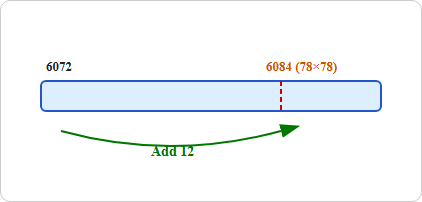
Question 92

Which of the following options should come in place of the question mark (?) in the given series based on the English alphabetical order?

JMP, LOR, NQT, PSV, ?

  1. AOption (a)

    RXU

  2. BOption (b)

    UXR

  3. COption (c)

    URX

  4. DOption (d)

    RUX

View answer & explanation

Correct answer

Answer: (d)D.

RUX

Why this answer is correct

The logic followed here is:

Logic: + 2 in the place value of letters.

Hence, the correct answer is "Option 4".
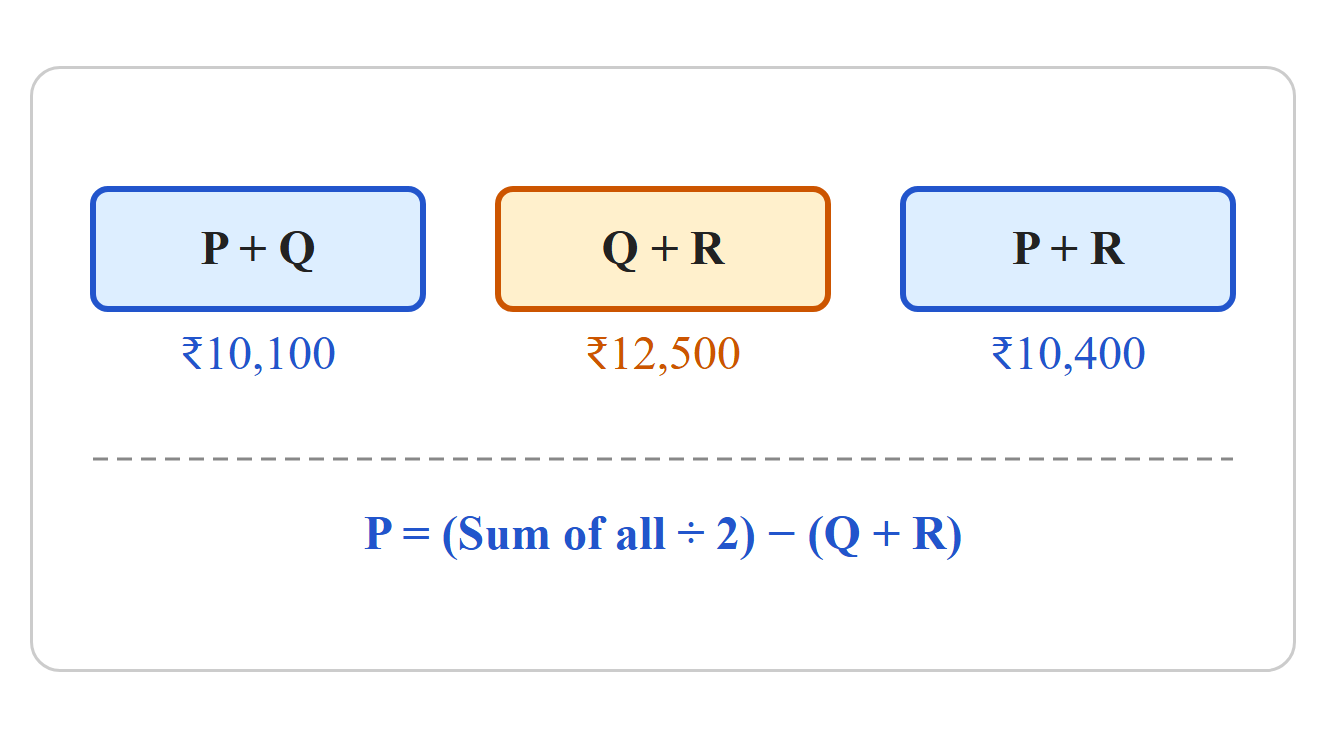
Question 93

Which of the following is produced when acid reacts with a base?

  1. AOption (a)
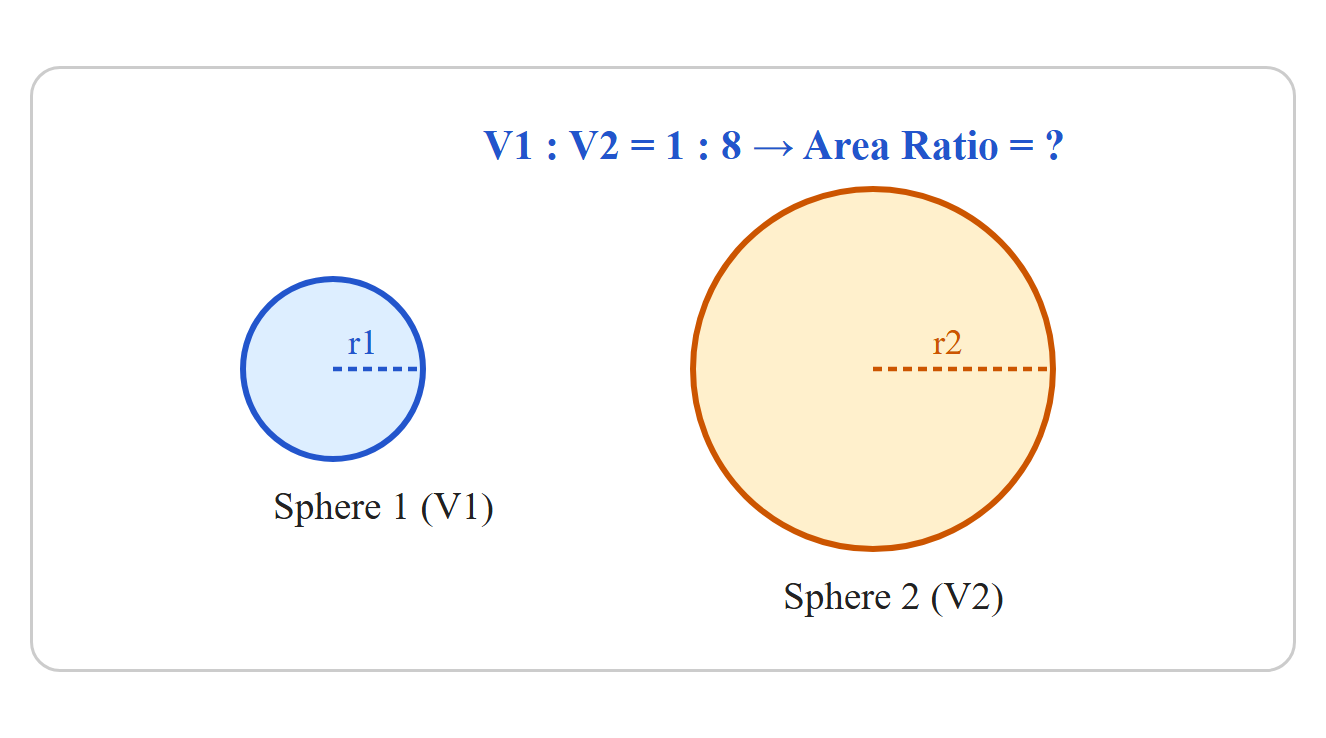
    Salt and water 

  2. BOption (b)

    Only water 

  3. COption (c)

    Salt and hydrogen ion 

  4. DOption (d)

    Salt and hydrogen gas 

View answer & explanation

Correct answer

Answer: (a)A.

Salt and water 

Why this answer is correct

The correct answer is Salt and water.

Key Points

  • A reaction between an acid and a base is known as a neutralization reaction.
  • In a neutralization reaction, salt and water are formed as products.
  • This type of reaction typically involves the combination of hydrogen ions (H+) from the acid and hydroxide ions (OH-) from the base to form water (H2O).
  • The general equation for a neutralization reaction is: Acid + Base → Salt + Water.
  • Examples include the reaction between hydrochloric acid (HCl) and sodium hydroxide (NaOH) to produce sodium chloride (NaCl) and water (H2O).

Additional Information

  • Acids
  • Acids are substances that release hydrogen ions (H+) when dissolved in water.
  • Common examples include hydrochloric acid (HCl), sulfuric acid (H2SO4), and acetic acid (CH3COOH).
  • Bases
  • Bases are substances that release hydroxide ions (OH-) when dissolved in water.
  • Common examples include sodium hydroxide (NaOH), potassium hydroxide (KOH), and calcium hydroxide (Ca(OH)2).
  • Salts
  • Salts are ionic compounds composed of positively charged cations and negatively charged anions.
  • They are formed as a result of the neutralization reaction between acids and bases.
  • Importance of Neutralization
  • Neutralization reactions are used in various applications such as antacid formulations, wastewater treatment, and soil pH adjustment.
  • They help in reducing acidity or alkalinity to maintain a balanced pH level in different environments.

Question 94

The value of (sec A + tan A) (1 - sin A) is: 

  1. AOption (a)

    tan A

  2. BOption (b)

    cos A

  3. COption (c)

    sin A

  4. DOption (d)

    cot A

View answer & explanation

Correct answer

Answer: (b)B.

cos A

Why this answer is correct

Shortcut Trick

Put A = 0° in the given expression.

(sec 0° + tan 0°) × (1 − sin 0°)

⇒ (1 + 0) × (1 − 0) = 1 × 1 = 1.

Now check options: (1) tan 0°=0, (2) cos 0°=1, (3) sin 0°=0, (4) cot 0°=not defined.

∴ The correct answer is cos A.

Alternate Method

Given: Expression = (sec A + tan A) (1 − sin A)

Formula Used: sec A = 1/cos A; tan A = sin A/cos A; 1 − sin2A = cos2A

⇒ [(1/cos A) + (sin A/cos A)] × (1 − sin A)

⇒ [(1 + sin A) / cos A] × (1 − sin A)

⇒ (1 + sin A)(1 − sin A) / cos A

⇒ (1 − sin2A) / cos A

⇒ cos2A / cos A

⇒ cos A

∴ The correct answer is cos A.

Additional Information

Trigonometric Identities

The three fundamental identities are: sin2θ + cos2θ = 1, 1 + tan2θ = sec2θ, and 1 + cot2θ = cosec2θ.

Reciprocal Relations

sec θ = 1/cos θ, cosec θ = 1/sin θ, and cot θ = 1/tan θ.

Algebraic Application

The identity (a + b)(a − b) = a2 − b2 is frequently used to simplify trigonometric products like (1 + sin A)(1 − sin A).

Question 95

What is the SI unit of pressure? 

  1. AOption (a)

    N m-2

  2. BOption (b)

    N m

  3. COption (c)

    N

  4. DOption (d)

    N m-1

View answer & explanation

Correct answer

Answer: (a)A.

N m-2

Why this answer is correct

The correct answer is N m-2.

Key Points

  • The SI unit of pressure is named after Blaise Pascal, a French mathematician, physicist, and inventor.
  • One Pascal (Pa) is defined as one newton per square meter (N/m²).
  • Pressure is a measure of the force applied per unit area.
  • The Pascal is widely used in various scientific and engineering disciplines to quantify internal pressure, stress, Young's modulus, and ultimate tensile strength.

Additional Information

  • Atmospheric Pressure: It is the pressure exerted by the weight of the atmosphere and is measured in Pascals (Pa) or millibars (mb).
  • Barometer: An instrument used to measure atmospheric pressure, typically in millibars (mb) or Pascals (Pa).
  • Gauge Pressure: It is the pressure relative to atmospheric pressure, often measured using a pressure gauge.
  • Absolute Pressure: It is the total pressure exerted on a system, including atmospheric pressure, and is measured in Pascals (Pa).
  • Conversion: 1 Pascal (Pa) is equal to 0.00001 bar, and 1 atmosphere (atm) is equal to 101,325 Pascals (Pa).

Question 96

If the volume of a cube is 729 cm3 then the measure of the main diagonal of the cube will be:

  1. AOption (a)

    7 cm

  2. BOption (b)

    9 cm

  3. COption (c)

    7√3 cm

  4. DOption (d)

    9√3 cm

View answer & explanation

Correct answer

Answer: (d)D.

9√3 cm

Why this answer is correct

Shortcut Trick

Side of cube (a) = ³√Volume = ³√729 = 9 cm.

Main Diagonal of cube = a√3.

Diagonal = 9 × √3 = 9√3 cm.

∴ The correct answer is 9√3 cm.

Alternate Method

Given: Volume of the cube = 729 cm3

Formula Used:

  1. Volume of a cube = a3 (where 'a' is the side length)
  2. Main Diagonal of a cube = √3 × a

Calculations:

⇒ a3 = 729

⇒ a = ³√729

⇒ a = 9 cm

⇒ Main Diagonal = a × √3

⇒ Main Diagonal = 9 × √3 = 9√3 cm

∴ The correct answer is 9√3 cm.

Additional Information

Total Surface Area of Cube

The sum of areas of all six faces is 6 × a2.

Lateral Surface Area

Area of the four vertical faces (excluding top and bottom) is 4 × a2.

Face Diagonal

The diagonal of any single square face is given by a√2.

Question 97

What is the sum of the deviations of the values of the data set 5, 6, 7,9, 10, 12 and 14, from the mean of the values given in the same date set? 

  1. AOption (a)

    0

  2. BOption (b)

    -1

  3. COption (c)

    2

  4. DOption (d)

    1

View answer & explanation

Correct answer

Answer: (a)A.

0

Why this answer is correct

Shortcut Trick

By the fundamental property of Arithmetic Mean, the sum of the deviations of all observations from their mean is always zero.

∑(xi − x̄) = 0

Therefore, without any calculation, the sum is 0.

∴ The correct answer is 0.

Alternate Method

Given: Data set = 5, 6, 7, 9, 10, 12, 14

Formula Used: Mean (x̄) = Sum of observations ÷ Total number of observations

⇒ Sum = 5 + 6 + 7 + 9 + 10 + 12 + 14 = 63

⇒ Number of terms (n) = 7

⇒ Mean (x̄) = 63 ÷ 7 = 9

⇒ Deviations from Mean: (5−9), (6−9), (7−9), (9−9), (10−9), (12−9), (14−9)

⇒ Deviations = −4, −3, −2, 0, 1, 3, 5

⇒ Sum of Deviations = (−4) + (−3) + (−2) + 0 + 1 + 3 + 5

⇒ Sum of Deviations = −9 + 9 = 0

∴ The correct answer is 0.

Additional Information

Property of Arithmetic Mean

The algebraic sum of deviations of a set of observations from their arithmetic mean is always zero.

Sum of Squared Deviations

The sum of the squares of deviations of the items from their arithmetic mean is minimum compared to any other value.

Mean of Discrete Series

For a discrete series, the mean is calculated as x̄ = (∑fixi) ÷ ∑fi.

Question 98

Who among the following individuals from India was one of the six recipients of the 2024 Planet Earth Awards?

  1. AOption (a)

    RK Pachauri 

  2. BOption (b)

    S Faizi  

  3. COption (c)

    Vandana Shiva 

  4. DOption (d)

    Sunita Narain 

View answer & explanation

Correct answer

Answer: (b)B.

S Faizi  

Why this answer is correct

The correct answer is S Faizi.

Key Points

  • S Faizi is a renowned Indian ecologist and environmentalist who has been recognized for his significant contributions to environmental conservation.
  • He was one of the six recipients of the 2024 Planet Earth Awards, which honor individuals for their exceptional dedication to protecting and preserving the environment.
  • The Planet Earth Awards are prestigious global recognitions given to those making impactful contributions towards sustainability and ecological balance.
  • Faizi's work primarily focuses on biodiversity conservation, and he has been involved in various international environmental policy formulations.

Additional Information

  • Planet Earth Awards
  • These awards are presented annually to individuals and organizations that have made outstanding contributions to environmental sustainability.
  • Recipients are chosen based on their impactful work in areas such as climate change mitigation, biodiversity conservation, and sustainable development.
  • The awards aim to bring global attention to the pressing environmental issues and the efforts being made to address them.
  • Biodiversity Conservation
  • Biodiversity conservation involves the protection and management of biological diversity to maintain ecosystem health and resilience.
  • It is crucial for sustaining the natural systems that provide essential services such as food, clean water, and air.
  • Efforts in biodiversity conservation include establishing protected areas, restoring habitats, and promoting sustainable use of natural resources.
  • Environmental Policy Formulation
  • Environmental policy formulation involves developing strategies and regulations to protect the environment and promote sustainable practices.
  • Policies are designed to address issues such as pollution, climate change, and resource depletion.
  • Effective environmental policies require collaboration among governments, organizations, and communities.

Question 99

XVYU is related to NLOK in a certain way based on the English alphabetical order. In the same way, USVR is related to KILH. To which of the following options is QORN related, following the same logic? 

  1. AOption (a)

    GEDH 

  2. BOption (b)

    HEGD

  3. COption (c)

    HEDG

  4. DOption (d)

    GEHD

View answer & explanation

Correct answer

Answer: (d)D.

GEHD

Why this answer is correct

The logic followed here is:

For, XVYU is related to NLOK

For, USVR is related to KILH


Similarly, 

QORN related ?

Hence, the correct answer is "Option 4".

Question 100

In the following number-pairs, the second number is obtained by applying certain mathematical operations to the first number. Which numbers should replace X and Y so that the pattern followed by the two numbers on the left side of :: is the same as that on the right side of :: ?

(NOTE: Operations should be performed on the whole numbers, without breaking down the numbers into its constituent digits. E.g. 13 — Operations on 13 such as adding /subtracting ‘multiplying etc. to 13 can be performed. Breaking down 13 into 1 and 3 and then performing mathematical operations on 1 and 3 is not allowed.)

X : 114 :: 26 : Y

  1. AOption (a)

    X = 31, Y = 72

  2. BOption (b)

    X = 38, Y = 78

  3. COption (c)

    X = 42, Y = 84

  4. DOption (d)

    X = 39, Y = 86

View answer & explanation

Correct answer

Answer: (b)B.

X = 38, Y = 78

Why this answer is correct

The logic followed here is:

Logic: 1st number × 3 = 2nd number.

For, X : 114

⇒ X × 3 = 114

⇒ X = 114 ÷ 3 = 38

Similarly,

26 : Y

⇒ 26 × 3 = Y

⇒ 78 = Y.

Thus, X = 38, Y = 78

Hence, the correct answer is "Option 2".

100 questions in the full paper