Previous Year Paper

RRB Technician Grade III Official Paper (Held On: 29 Dec, 2024 Shift 2) (Previous Year Paper)

Held in 2024

100 questions90 minutes
With answers
Free

Paper last updated:

Practise under exam conditions

Take this paper as a timed mock test. Review your answers after you submit.

Attempt timed test

Questions & answers

Read the paper at your pace. Open an explanation when you need it.

Full Test (100 questions)

Question 1

The first and only disabled person to hold the position of State Commissioner for Persons with Disabilities in the history of state, awarded with Padma Shri in 2024, Dr. KS Rajanna belongs to which of the following Indian states?

  1. AOption (a)

    Kerala

  2. BOption (b)

    Tamil Nadu

  3. COption (c)

    Andhra Pradesh

  4. DOption (d)

    Karnataka

View answer & explanation

Correct answer

Answer: (d)D.

Karnataka

Why this answer is correct

The correct answer is Karnataka.

Key Points

  • Dr. KS Rajanna is from the state of Karnataka, India.
  • He is the first and only disabled person to hold the position of State Commissioner for Persons with Disabilities in Karnataka.
  • Dr. KS Rajanna was awarded the prestigious Padma Shri in 2024.
  • His contributions to the welfare and rights of disabled persons in Karnataka have been widely recognized.

Additional Information

  • Padma Shri:
  • Padma Shri is one of the highest civilian awards in India, presented annually on Republic Day.
  • The award recognizes distinguished service in various fields such as arts, education, industry, literature, science, sports, medicine, social service, and public affairs.
  • It is the fourth highest civilian award in the Republic of India, after the Bharat Ratna, the Padma Vibhushan, and the Padma Bhushan.
  • State Commissioner for Persons with Disabilities:
  • The office is responsible for implementing the policies and schemes for the welfare of persons with disabilities at the state level.
  • The Commissioner ensures the protection of rights and full participation of persons with disabilities in society.
  • The role involves monitoring the implementation of various acts and regulations related to disability rights.
  • Disability Rights in India:
  • The Rights of Persons with Disabilities Act, 2016 is a landmark legislation in India that aims to uphold the dignity and rights of persons with disabilities.
  • The act provides for a range of measures to ensure that persons with disabilities can live with dignity and fully participate in society.
  • It includes provisions for accessibility, education, employment, and social security.
  • Achievements of Dr. KS Rajanna:
  • Dr. KS Rajanna has been instrumental in advocating for the rights and welfare of disabled persons in Karnataka.
  • His efforts have led to the implementation of various programs and initiatives aimed at improving the lives of persons with disabilities.
  • He has been a vocal advocate for inclusive education and employment opportunities for the disabled.
Question 2

Which of the following is NOT the correct relation between electric power (P), electric current(I), electric potential difference (V) and resistance(R): 

  1. AOption (a)

    P = I2R

  2. BOption (b)

    P = IR

  3. COption (c)

    P=V2R\rm P = \frac{V^2}{R}

  4. DOption (d)

    P = VI

View answer & explanation

Correct answer

Answer: (b)B.

P = IR

Why this answer is correct

The correct answer is Option 2: P = IR.

Key Points

  • Electric Power (P) is the rate at which electrical energy is consumed or generated.
  • P = I2R is derived from Ohm's Law (V = IR) and the definition of power (P = IV).
  • P = (V2/R) comes from the substitution of V = IR into the definition of power.
  • P = VI is the direct formula for power, where V is the potential difference and I is the current.
  • The formula P = IR is incorrect because it does not align with the proper relationships between power, voltage, current, and resistance.

Additional Information

  • Ohm's Law:
  • States that the current through a conductor between two points is directly proportional to the voltage across the two points.
  • Expressed as V = IR, where V is voltage, I is current, and R is resistance.
  • Electric Power:
  • Power (P) in an electrical circuit is the rate at which energy is used or produced.
  • It is measured in watts (W).
  • Resistance (R):
  • The opposition to the flow of electric current in a conductor.
  • Measured in ohms (Ω).
  • Current (I):
  • The flow of electric charge through a conductor.
  • Measured in amperes (A).
  • Voltage (V):
  • The electric potential difference between two points in a circuit.
  • Measured in volts (V).

Question 3

_______ causes the stem or root to enlarge in diameter. 

  1. AOption (a)

    Underneath meristem  

  2. BOption (b)

    Apical meristem 

  3. COption (c)

    Intercalary meristem 

  4. DOption (d)

    Cambium  

View answer & explanation

Correct answer

Answer: (d)D.

Cambium  

Why this answer is correct

The correct answer is Cambium.

Key Points

  • Cambium is a layer of actively dividing cells located between the xylem and phloem tissues in plants.
  • This layer is responsible for secondary growth, which increases the girth of stems and roots.
  • The cells of the cambium divide and differentiate to form secondary xylem (wood) towards the inside and secondary phloem towards the outside.
  • Cambium activity is seasonal in temperate regions, with growth rings forming as a result of variations in growth rate during different seasons.

Additional Information

  • Primary Growth: This occurs at the tips of roots and shoots due to the activity of apical meristems, leading to an increase in length.
  • Apical Meristem: These are the regions at the tips of roots and shoots where cells actively divide, contributing to the primary growth of the plant.
  • Intercalary Meristem: Found at the base of leaves or internodes, especially in grasses, contributing to lengthening of these plant parts.
  • Secondary Growth: This involves the thickening of stems and roots, occurring due to the activity of the vascular cambium and cork cambium.

Question 4

In an election between two candidates, the candidate who won received 1854 votes, whereas the candidate who lost received 618 votes. What percentage of the total number of votes received by the two candidates went in favour of the winning candidate?

  1. AOption (a)

    80%

  2. BOption (b)

    75%

  3. COption (c)

    60%

  4. DOption (d)

    70%

View answer & explanation

Correct answer

Answer: (b)B.

75%

Why this answer is correct

Shortcut Trick

Find the ratio between the winner's and loser's votes: 1854 : 618.

Simplify the ratio by dividing both numbers by 618: 3 : 1.

Total units = 3 (Winner) + 1 (Loser) = 4 units.

Winning candidate's share percentage = (3 ÷ 4) × 100 = 75%.

∴ The correct answer is 75%.

Alternate Method

Given:

Votes received by the Winning candidate = 1854

Votes received by the Losing candidate = 618

Formula Used:

Percentage of votes = (Votes Obtained ÷ Total Votes) × 100

⇒ Total number of votes = 1854 + 618 = 2472

⇒ Percentage in favor of the winner = (1854 ÷ 2472) × 100

⇒ Percentage = (3 ÷ 4) × 100

⇒ Percentage = 0.75 × 100 = 75%

∴ The correct answer is 75%.

Additional Information

Vote Margin

The margin of victory is the difference between the winner's votes and the loser's votes. Here, Margin = 1854 − 618 = 1236 votes.

Percentage of Total Votes

In a two-candidate election, if the winner gets x%, the loser automatically gets (100 − x)% of the total votes, assuming no invalid votes.

Valid vs. Invalid Votes

Total Votes Polled = Valid Votes + Invalid/Cancelled Votes. Percentages are usually calculated on the basis of valid votes unless specified otherwise.

Question 5

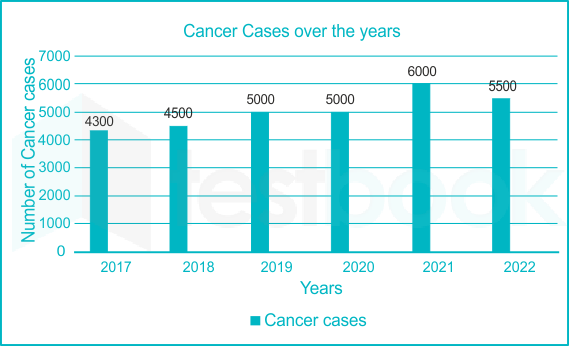
Study the following bar graph and answer the question below.  

What is the average number of cancer cases over the years?

  1. AOption (a)

    5550

  2. BOption (b)

    5005

  3. COption (c)

    5050

  4. DOption (d)

    5500

View answer & explanation

Correct answer

Answer: (c)C.

5050

Why this answer is correct

Formula Used:

Average = Sum of values / Number of values

Calculation:

Sum of the cases = 4300 + 4500 + 5000 + 5000 + 6000 + 5500

⇒ Sum of the cases = 30300

Number of years = 6

Average number of cases = 30300 / 6

⇒ Average = 5050 cases

Therefore, the average number of cancer cases over the years is 5050.

Question 6

What is used in the preparation of calcium sulphate hemihydrate? 

  1. AOption (a)

    Sodium Carbonate  

  2. BOption (b)

    Gypsum 

  3. COption (c)

    Copper Sulphate 

  4. DOption (d)

    Sodium Hydrogen Carbonate 

View answer & explanation

Correct answer

Answer: (b)B.

Gypsum 

Why this answer is correct

The correct answer is Gypsum.

Key Points

  • Gypsum (CaSO4·2H2O) is used in the preparation of calcium sulphate hemihydrate (CaSO4·0.5H2O).
  • Calcium sulphate hemihydrate is commonly known as Plaster of Paris.
  • The process involves heating gypsum to around 150°C to 180°C, which partially dehydrates it.
  • Plaster of Paris is widely used in construction, sculpture, and medical applications for making casts and molds.

Additional Information

  • Gypsum:
  • It is a soft sulfate mineral composed of calcium sulfate dihydrate.
  • Gypsum is naturally occurring and is mined from sedimentary deposits.
  • It is used in various industries, including agriculture as a soil conditioner and in the production of cement.
  • Plaster of Paris:
  • It is a quick-setting gypsum plaster consisting of a fine white powder (calcium sulfate hemihydrate).
  • When mixed with water, it rehydrates and sets quickly, making it useful for casting molds and medical bandages.
  • Dehydration Process:
  • The heating of gypsum to produce Plaster of Paris is a controlled process to ensure partial dehydration.
  • Overheating can lead to complete dehydration, forming anhydrite (CaSO4), which has different properties.
  • Uses of Plaster of Paris:
  • In construction, it is used for making decorative elements and false ceilings.
  • In orthopedics, it is used for making casts for broken limbs.
  • In art, it is used for making sculptures and other decorative items.

Question 7

Apical meristem is present in which of the following? 

  1. AOption (a)

    Plants 

  2. BOption (b)

    Virus 

  3. COption (c)

    Animals 

  4. DOption (d)

    Bacteria 

View answer & explanation

Correct answer

Answer: (a)A.

Plants 

Why this answer is correct

The correct answer is Plants.

Key Points

  • Apical meristems are regions of actively dividing cells in plants, found at the tips of roots and shoots.
  • They are responsible for primary growth, which increases the length of the plant.
  • Apical meristems give rise to various tissues and organs of a plant.
  • These meristems help in the elongation of roots and shoots, aiding in the plant's ability to reach light and absorb nutrients.

Additional Information

  • Meristematic Tissue:
  • Meristematic tissues are regions in plants where cells are continuously dividing.
  • These tissues are found in zones of the plant where growth can take place, such as the tips of stems and roots.
  • Types of Meristems:
  • Apical Meristem: Located at the tips of roots and shoots, responsible for primary growth.
  • Lateral Meristem: Found along the sides of stems and roots, responsible for secondary growth, increasing the thickness.
  • Primary Growth vs. Secondary Growth:
  • Primary Growth: Involves the elongation of the plant body, facilitated by apical meristems.
  • Secondary Growth: Involves the thickening of the plant body, facilitated by lateral meristems such as the vascular cambium and cork cambium.
  • Role of Apical Meristems:
  • They are crucial for the formation of new leaves and flowers.
  • They help the plant in adapting to its environment by growing towards light and water sources.

Question 8

The equivalent fraction of 5.2222...... is:

  1. AOption (a)

    479\frac{47}{9}

  2. BOption (b)

    42299\frac{422}{99}

  3. COption (c)

    48100\frac{48}{100}

  4. DOption (d)

    389\frac{38}{9}

View answer & explanation

Correct answer

Answer: (a)A.

479\frac{47}{9}

Why this answer is correct

Given:

Number = 5.2222......

Formula used:

x = a.bbbb... ⇒ x = a + b/9

Calculations:

Let x = 5.2222......

⇒ x = 5.2̄

⇒ x = 5 + 2/9

⇒ x = (5 × 9 + 2) / 9

⇒ x = (45 + 2) / 9

⇒ x = 47/9

∴ The correct answer is option (1).

Question 9

Simplify the following expression: (cosθ)(1+sinθ)+(1+sinθ)(cosθ)\frac{(cos θ)}{(1+sin θ)}+\frac{(1+sin θ)}{(cos θ)}

  1. AOption (a)

    2 cos θ

  2. BOption (b)

    1 + 2 sin θ

  3. COption (c)

    2 sec θ

  4. DOption (d)

    2 sin θ

View answer & explanation

Correct answer

Answer: (c)C.

2 sec θ

Why this answer is correct

Shortcut Trick

Put θ = 0° in the expression.

Expression ⇒ cos 0° / (1 + sin 0°) + (1 + sin 0°) / cos 0°

⇒ 1 / (1 + 0) + (1 + 0) / 1 = 1 + 1 = 2

Check options for θ = 0°: Option (3) 2 sec 0° = 2 × 1 = 2.

∴ The correct answer is 2 sec θ.

Alternate Method

Given: [cos θ / (1 + sin θ)] + [(1 + sin θ) / cos θ]

Formula Used: sin2 θ + cos2 θ = 1 and sec θ = 1 / cos θ

⇒ [cos2 θ + (1 + sin θ)2] / [cos θ (1 + sin θ)]

⇒ [cos2 θ + 1 + sin2 θ + 2 sin θ] / [cos θ (1 + sin θ)]

⇒ [(sin2 θ + cos2 θ) + 1 + 2 sin θ] / [cos θ (1 + sin θ)]

⇒ [1 + 1 + 2 sin θ] / [cos θ (1 + sin θ)]

⇒ [2 + 2 sin θ] / [cos θ (1 + sin θ)]

⇒ 2(1 + sin θ) / [cos θ (1 + sin θ)]

⇒ 2 / cos θ

⇒ 2 sec θ

∴ The correct answer is 2 sec θ.

Additional Information

Trigonometric Identities

Fundamental identities include sin2θ + cos2θ = 1, 1 + tan2θ = sec2θ, and 1 + cot2θ = cosec2θ.

Reciprocal Relations

sec θ = 1/cos θ, cosec θ = 1/sin θ, and cot θ = 1/tan θ.

Value Substitution Method

For simplifying expressions, substituting standard angles like 0°, 30°, or 45° (where defined) is often the fastest way to verify options.

Question 10

An electric water heater converts electrical energy into ______.

  1. AOption (a)

    wind energy

  2. BOption (b)

    potential energy 

  3. COption (c)

    heat energy 

  4. DOption (d)

    light energy 

View answer & explanation

Correct answer

Answer: (c)C.

heat energy 

Why this answer is correct

The correct answer is heat energy.

Key Points

  • An electric water heater converts electrical energy into heat energy, which is used to heat water.
  • When electric current passes through the heating element in the water heater, it generates heat due to the resistance of the element.
  • This heat is transferred to the water, raising its temperature to the desired level.
  • Heat energy is the most efficient form of energy for heating water, ensuring quick and effective temperature rise.
  • Electric water heaters are widely used due to their efficiency, safety, and ease of use.

Additional Information

  • Heating Element:
  • The heating element in an electric water heater is typically made of metal, such as copper or stainless steel, which has high electrical resistance.
  • When electricity flows through the element, it encounters resistance, causing it to heat up and transfer heat to the water.
  • Thermostat:
  • Most electric water heaters come with a thermostat to control the water temperature.
  • The thermostat ensures the water is heated to the set temperature and prevents overheating by cutting off the power supply when the desired temperature is reached.
  • Energy Efficiency:
  • Electric water heaters are known for their high energy efficiency, often converting nearly all the electrical energy into heat energy.
  • They are more efficient than gas water heaters in terms of energy conversion and heat retention.
  • Safety Features:
  • Modern electric water heaters are equipped with safety features like thermal cut-off, pressure relief valves, and automatic shut-off to prevent accidents and ensure safe operation.

Question 11

The contraction and relaxation of which of the following results in movement of the organ? 

  1. AOption (a)

    Nerve cells

  2. BOption (b)

    Cartilages  

  3. COption (c)

    Muscle cells 

  4. DOption (d)

    Bones 

View answer & explanation

Correct answer

Answer: (c)C.

Muscle cells 

Why this answer is correct

The correct answer is Muscle cells.

Key Points

  • Muscle cells, also known as muscle fibers, are responsible for the contraction and relaxation that results in the movement of organs and the body.
  • There are three types of muscle cells: skeletal, cardiac, and smooth muscles, each with specific functions in the body.
  • Skeletal muscles are attached to bones and are involved in voluntary movements such as walking and lifting.
  • Cardiac muscles are found in the heart and are responsible for pumping blood throughout the body.
  • Smooth muscles are found in organs such as the intestines and blood vessels, and they control involuntary movements like the digestion process and regulation of blood flow.

Additional Information

  • Myofibrils:
  • Myofibrils are the basic rod-like units of a muscle cell that are composed of repeating sections called sarcomeres, which are the contractile units.
  • Each myofibril contains thick (myosin) and thin (actin) filaments that slide past each other to produce muscle contraction.
  • Neuromuscular Junction:
  • The neuromuscular junction is the synapse or connection between a motor neuron and a muscle fiber.
  • It is where the nervous system communicates with muscles to trigger contraction through the release of neurotransmitters like acetylcholine.
  • ATP and Muscle Contraction:
  • Adenosine triphosphate (ATP) is the energy currency of the cell, and its hydrolysis provides the energy needed for muscle contraction.
  • Muscle contraction occurs when ATP binds to myosin, allowing it to interact with actin and produce a power stroke.
  • Muscle Tone:
  • Muscle tone refers to the continuous and passive partial contraction of muscles, which helps maintain posture and ensures muscles are ready for action.
  • It is regulated by the nervous system and is essential for maintaining balance and coordinating movements.

Question 12

Based on the English alphabetical order, three of the following four letter-cluster pairs are alike in a certain way and thus form a group. Which pair does not belong to that group?

(Note: The odd one out is not based on the number of consonants/vowels or their position in the letter-cluster.)

  1. AOption (a)

    WT-XZ 

  2. BOption (b)

    RO-SV 

  3. COption (c)

    NK-OQ 

  4. DOption (d)

    UR-VX 

View answer & explanation

Correct answer

Answer: (b)B.

RO-SV 

Why this answer is correct

The logic followed here is: 

Option 1) WT-XZ 

Option 2) RO-SV 

Option 3) NK-OQ 

Option 4) UR-VX 

So, 'RO-SV ' letter-cluster does not belong to that group.

Hence, the correct answer is "Option 2".

Question 13

When we stretch a spring, the form of energy stored in the spring is ______

  1. AOption (a)

    kinetic energy

  2. BOption (b)

    gravitational energy 

  3. COption (c)

    potential energy

  4. DOption (d)

    electric energy 

View answer & explanation

Correct answer

Answer: (c)C.

potential energy

Why this answer is correct

The correct answer is potential energy.

Key Points

  • When a spring is stretched or compressed, it stores energy in the form of elastic potential energy.
  • This stored potential energy is due to the deformation of the spring from its equilibrium position.
  • The amount of potential energy stored in the spring is given by the formula U = 1/2 k x2, where k is the spring constant and x is the displacement from the equilibrium position.
  • Elastic potential energy is a type of mechanical energy that is associated with the position of objects.
  • The potential energy stored in a stretched or compressed spring can be converted back into kinetic energy when the spring returns to its original shape.

Additional Information

  • Kinetic Energy:
  • Kinetic energy is the energy possessed by an object due to its motion.
  • It is given by the formula KE = 1/2 m v2, where m is the mass and v is the velocity of the object.
  • Gravitational Potential Energy:
  • Gravitational potential energy is the energy possessed by an object due to its position in a gravitational field.
  • It is given by the formula U = mgh, where m is the mass, g is the acceleration due to gravity, and h is the height above the reference point.
  • Spring Constant (k):
  • The spring constant is a measure of the stiffness of the spring.
  • A higher spring constant means a stiffer spring, which requires more force to stretch or compress it.
  • Hooke's Law:
  • Hooke's Law states that the force required to stretch or compress a spring is directly proportional to the displacement.
  • The formula is F = kx, where F is the force applied, k is the spring constant, and x is the displacement.

Question 14

The position(s) of how many letters will remain unchanged if each of the letters in the word DEFAULT is arranged in the English alphabetical order ? 

  1. AOption (a)

    2

  2. BOption (b)

    1

  3. COption (c)

    3

  4. DOption (d)

    0

View answer & explanation

Correct answer

Answer: (d)D.

0

Why this answer is correct

Given word: DEFAULT

After arranged in alphabetical order:

AlphabetsDEFAULT
Alphabetical orderADEFLTU


Now,

There are no alphabets that will remain unchanged if each of the letters in the word DEFAULT is arranged in English alphabetical order.

Hence, the correct answer is Option 4.

Question 15

When did the National Human Rights Commission (NHRC) issue an advisory to the Centre, the states and UT administrations to ensure widows’ welfare and the protection of their human rights, including the establishment of a 'widows’ cell’ in each district? 

  1. AOption (a)

    May 2024 

  2. BOption (b)

    April 2024 

  3. COption (c)

    June 2024 

  4. DOption (d)

    August 2024 

View answer & explanation

Correct answer

Answer: (c)C.

June 2024 

Why this answer is correct

The correct answer is June 2024.

Key Points

  • The National Human Rights Commission (NHRC) issued the advisory in June 2024.
  • The advisory was aimed at ensuring the welfare and protection of human rights of widows.
  • NHRC recommended the establishment of a 'widows' cell' in each district to address the specific needs and challenges faced by widows.
  • This initiative underscores the commitment to uplift and protect vulnerable sections of the society, particularly widows.
  • The advisory was directed towards the Centre, the states, and Union Territory (UT) administrations to ensure comprehensive implementation.

Additional Information

  • National Human Rights Commission (NHRC)
  • It is a statutory public body constituted on October 12, 1993, under the Protection of Human Rights Act, 1993.
  • NHRC is responsible for the protection and promotion of human rights in India.
  • It has the authority to investigate grievances regarding the violation of human rights.
  • Human Rights
  • Human rights are the basic rights and freedoms that belong to every person in the world, from birth until death.
  • These rights are based on shared values like dignity, fairness, equality, respect, and independence.
  • Widows' Welfare
  • Widows' welfare includes various social, economic, and legal measures to support and protect widows.
  • It aims to provide them with adequate living conditions, healthcare, education, and employment opportunities.
  • District-Level Initiatives
  • Establishing cells or committees at the district level can ensure that local issues and grievances are promptly addressed.
  • These initiatives are crucial for effective implementation and monitoring of welfare schemes and advisories.

Question 16

What is the primary goal of the NASA-ISRO Synthetic Aperture Radar (NISAR) mission? 

  1. AOption (a)

    Climate action 

  2. BOption (b)

    Defense satellites  

  3. COption (c)

    Space tourism  

  4. DOption (d)

    Trade monitoring  

View answer & explanation

Correct answer

Answer: (a)A.

Climate action 

Why this answer is correct

The correct answer is Climate action.

Key Points

  • NISAR is a joint Earth-observing mission between NASA and the Indian Space Research Organisation (ISRO).
  • The primary goal of NISAR is to monitor and measure changes in the Earth's surface, including ice sheets, forests, and agricultural lands, in order to understand climate change impacts.
  • It aims to provide crucial data for managing natural resources and hazards such as earthquakes, tsunamis, and volcanic eruptions.
  • The NISAR satellite will use advanced radar imaging to observe Earth’s land and ice masses in unprecedented detail, with a focus on the dynamics of the planet's surface.
  • This mission is expected to significantly contribute to our understanding of Earth's carbon cycle and ecosystem changes, which are vital for climate action.

Additional Information

  • Synthetic Aperture Radar (SAR):
  • SAR is a form of radar used to create two-dimensional images or three-dimensional reconstructions of objects, such as landscapes.
  • It operates by transmitting and receiving radar signals from space, which are then processed to form high-resolution images.
  • SAR can penetrate clouds and darkness, making it useful for continuous Earth monitoring.
  • Climate Change:
  • Climate change refers to long-term alterations in temperature and weather patterns, mainly due to human activities such as burning fossil fuels.
  • It leads to severe weather events, rising sea levels, and changes in ecosystems and biodiversity.
  • Earth Observation Satellites:
  • These satellites are used for monitoring and assessing Earth's natural and man-made environments.
  • They provide critical data for various applications including agriculture, forestry, land-use planning, and disaster management.
  • NASA and ISRO Collaboration:
  • NASA (National Aeronautics and Space Administration) is the United States government agency responsible for the civilian space program.
  • ISRO (Indian Space Research Organisation) is India's space agency, known for its successful Mars Orbiter Mission and various satellite launches.
  • The collaboration between NASA and ISRO for the NISAR mission exemplifies international cooperation in space exploration and Earth observation.

Question 17

Which of the following statements is NOT true regarding the particles of matter? 

  1. AOption (a)

    They are very small. 

  2. BOption (b)

    They are moving constantly. 

  3. COption (c)

    They do not have spaces in between them. 

  4. DOption (d)

    They attract each other. 

View answer & explanation

Correct answer

Answer: (c)C.

They do not have spaces in between them. 

Why this answer is correct

The correct answer is option 3.

Key Points

  • Particles of matter have spaces between them. This is evident when substances dissolve in one another, like salt in water, where the salt particles fill the spaces between the water particles.
  • The kinetic theory of matter states that particles are in constant motion. This is observable in diffusion, where particles move from an area of high concentration to low concentration.
  • Particles of matter are very small. They are so small that they cannot be seen with the naked eye and require powerful microscopes to be observed.
  • Particles of matter attract each other. This intermolecular attraction holds the particles together, contributing to the cohesion of substances.

Additional Information

  • Intermolecular Forces:
  • These are the forces of attraction or repulsion between neighboring particles (atoms, molecules, or ions).
  • Examples include hydrogen bonding, van der Waals forces, and dipole-dipole interactions.
  • Diffusion:
  • This process involves the movement of particles from an area of higher concentration to an area of lower concentration.
  • Diffusion is a key evidence of particle movement, showcasing that particles are in constant motion.
  • States of Matter:
  • Matter exists in different states such as solids, liquids, and gases, each with distinct particle arrangements and movement.
  • In solids, particles are closely packed and vibrate in fixed positions, while in gases, particles are far apart and move freely.
  • Kinetic Theory of Matter:
  • This theory explains that all matter is made of particles that are in constant motion.
  • The energy of these particles increases with temperature, influencing their speed and the state of matter.

Question 18

Which of the following metals is least reactive with acids? 

  1. AOption (a)

    Iron 

  2. BOption (b)

    Aluminium 

  3. COption (c)

    Copper 

  4. DOption (d)

    Zinc

View answer & explanation

Correct answer

Answer: (c)C.

Copper 

Why this answer is correct

The correct answer is Copper.

Key Points

  • Copper is one of the least reactive metals with acids, making it less likely to corrode or tarnish when exposed to acidic environments.
  • In the reactivity series of metals, copper is placed below hydrogen, indicating its lower reactivity with acids.
  • When copper reacts with acids, it does not produce hydrogen gas, unlike more reactive metals such as zinc or iron.
  • Due to its low reactivity, copper is often used in plumbing, roofing, and electrical wiring where resistance to corrosion is essential.

Additional Information

  • Reactivity Series:
  • The reactivity series is a list of metals arranged in order of decreasing reactivity.
  • Metals higher in the series react more vigorously with acids and other substances.
  • Metals like potassium and sodium are highly reactive, while gold and platinum are the least reactive.
  • Hydrogen Production:
  • Reactive metals such as zinc and iron react with acids to produce hydrogen gas.
  • Copper, being less reactive, does not produce hydrogen gas when it reacts with acids.
  • Corrosion Resistance:
  • Copper's resistance to corrosion is due to its low reactivity with environmental substances, including acids.
  • This property makes copper suitable for use in various applications where long-term durability is required.
  • Uses of Copper:
  • Copper is extensively used in electrical wiring due to its excellent conductivity and resistance to corrosion.
  • It is also used in plumbing, roofing, and industrial machinery.

Question 19

Which of the following options should come in place of the question mark (?) in the given series to make it logically complete?

18, 23, 33, 48, 68, ?

  1. AOption (a)

    90

  2. BOption (b)

    95

  3. COption (c)

    93

  4. DOption (d)

    85

View answer & explanation

Correct answer

Answer: (c)C.

93

Why this answer is correct

The logic follows here:

Hence, the correct answer is "Option (3)".

Question 20

Due to a reduction of 6.25% in the price of sugar, a man can buy 1 kg more for Rs. 120. The reduced price per kg of sugar is:

  1. AOption (a)

    Rs. 8

  2. BOption (b)

    Rs. 6.5

  3. COption (c)

    Rs. 7.5

  4. DOption (d)

    Rs. 7

View answer & explanation

Correct answer

Answer: (c)C.

Rs. 7.5

Why this answer is correct

Shortcut Trick

To find the reduced price directly, we can use the fractional equivalent of the given percentage.

Reduced Price = (Fraction of Reduction × Amount) ÷ Extra Quantity

⇒ Fraction value of 6.25% = 1/16

⇒ Reduced Price = (1/16 × 120) ÷ 1

⇒ Reduced Price = 120 ÷ 16 = 7.5

∴ The correct answer is Rs. 7.5.

Alternate Method

Original Reduced

Price: 16

Price: 15

−6.25%

Qty: 15 units

Qty: 16 units

+1 unit = 1 kg

Reduced Price = Total Amount ÷ New Qty = 120 ÷ 16 = 7.5

Given, reduction in price = 6.25% = 1/16.

⇒ Let the original price ratio be 16 units, then the reduced price = 16 − 1 = 15 units.

⇒ Ratio of Original Price to Reduced Price = 16 : 15

⇒ Since total expenditure is constant, the ratio of Original Quantity to New Quantity becomes inverse = 15 : 16

⇒ Increase in quantity in terms of units = 16 − 15 = 1 unit

⇒ 1 unit = 1 kg (as given in the question)

⇒ New Quantity bought = 16 units = 16 × 1 = 16 kg

⇒ Reduced Price per kg = Total Amount ÷ New Quantity

⇒ Reduced Price = 120 ÷ 16 = Rs. 7.5

∴ The correct answer is Rs. 7.5.

Additional Information

Price and Quantity Inverse Relation

When the total expenditure remains constant, Price and Consumption (Quantity) are inversely proportional to each other. If the Price ratio is a : b, the Quantity ratio will strictly be b : a.

Original Price Formula

If asked to calculate the Original Price instead, the formula is: Original Price = (Change% × Amount) ÷ [Extra Quantity × (100 − Change%)].

Fraction Equivalents of Percentages

Using fractions always simplifies percentage problems. Keep in mind that 6.25% = 1/16, 12.5% = 1/8, and 16.66% = 1/6.

Question 21

A. B, E, F, P, Q and R are sitting around a circular table facing the centre. A sits second to the right of B. Only one person sits between B and E. R sits to the immediate right of F. P is not an immediate neighbour of E. Who sits third to the left of Q? 

  1. AOption (a)

    F

  2. BOption (b)

    A

  3. COption (c)

    P

  4. DOption (d)

    R

View answer & explanation

Correct answer

Answer: (a)A.

F

Why this answer is correct

Given:

A. B, E, F, P, Q and R are sitting around a circular table facing the centre.

  1. A sits second to the right of B.

  2. Only one person sits between B and E.

  3. R sits to the immediate right of F.

  4. P is not an immediate neighbour of E.

So, 'F' sits third to the left of Q.

Hence, the correct answer is "Option (1)".

Question 22

Select the correct option related to the function regulated by ovaries. 

  1. AOption (a)

    Stimulates growth in all organs 

  2. BOption (b)

    Regulates metabolism 

  3. COption (c)

    Menstrual cycle 

  4. DOption (d)

    Stimulates pituitary glands 

View answer & explanation

Correct answer

Answer: (c)C.

Menstrual cycle 

Why this answer is correct

The correct answer is Menstrual cycle.

Key Points

  • The ovaries are responsible for producing hormones such as estrogen and progesterone, which are crucial for regulating the menstrual cycle.
  • These hormones control the development and release of eggs (oocytes) from the ovaries during the menstrual cycle.
  • The menstrual cycle is typically around 28 days long but can vary from person to person.
  • The cycle consists of four main phases: menstruation, the follicular phase, ovulation, and the luteal phase.

Additional Information

  • Estrogen: A hormone produced by the ovaries that plays a key role in the development of female secondary sexual characteristics and the regulation of the menstrual cycle.
  • Progesterone: A hormone released by the corpus luteum in the ovary that prepares the endometrium for pregnancy if fertilization occurs.
  • Ovulation: The process by which an ovary releases a mature egg into the fallopian tube, usually occurring around the midpoint of the menstrual cycle.
  • Menstruation: The shedding of the uterine lining, resulting in bleeding, which marks the start of a new menstrual cycle.
  • Follicular Phase: The phase of the menstrual cycle during which follicles in the ovary mature, ending with ovulation.

Question 23

Which of the following alcohols is used in cough syrups? 

  1. AOption (a)

    Ethanol  

  2. BOption (b)

    Methanol 

  3. COption (c)

    Ethanoic acid 

  4. DOption (d)

    Propanol 

View answer & explanation

Correct answer

Answer: (a)A.

Ethanol  

Why this answer is correct

The correct answer is Ethanol.

Key Points

  • Ethanol, also known as ethyl alcohol, is commonly used as a solvent in the pharmaceutical industry.
  • It is a key ingredient in cough syrups and other liquid medications due to its effectiveness in dissolving various substances.
  • Ethanol acts as a preservative and helps to prevent microbial growth in medicinal formulations.
  • It provides a consistent delivery of the medication by maintaining the stability and homogeneity of the active ingredients.

Additional Information

  • Ethanol:
  • It is a clear, colorless liquid with a characteristic alcoholic odor.
  • Ethanol is also used in the manufacture of perfumes, paints, and tinctures.
  • It is a potent central nervous system depressant and is the type of alcohol found in alcoholic beverages.
  • Methanol:
  • It is a toxic alcohol that can cause serious health issues, including blindness and death if ingested.
  • Methanol is primarily used in industrial applications and as an antifreeze, solvent, and fuel.
  • Ethanoic acid:
  • Also known as acetic acid, it is the main component of vinegar.
  • It is used as a preservative and flavoring agent in the food industry.
  • Propanol:
  • It refers to two types of alcohols: 1-propanol and 2-propanol (isopropanol).
  • Isopropanol is commonly used as a disinfectant and cleaning agent.

Question 24

Refer to the given number and symbol series and answer the question that follows. Counting to be done from left to right only.

(Left) & % 4 6 @ 8 $ & 3 Ω 2 7 ℧\mho 9 # 1 * £ 1 + & @ 5 (Right)

If all the symbols are dropped from the series, which of the following will be sixth from the right?

  1. AOption (a)

    1

  2. BOption (b)

    3

  3. COption (c)

    7

  4. DOption (d)

    2

View answer & explanation

Correct answer

Answer: (d)D.

2

Why this answer is correct

Given: (Left) & % 4 6 @ 8 $ & 3 Ω 2 7 ℧℧℧℧ 9 # 1 * £ 1 + & @ 5 (Right)

Here, we need to find the sixth number from the right after dropping all the symbols from the series.

First, let's remove all the symbols from the series: 4 6 8 3 2 7 9 1 1 5

Now, counting from the right, the sixth number is 2.

Hence, the correct answer is Option 4.

Question 25

Known for its rich cultural heritage, which of the following is India's first UNESCO 'City of Literature'?

  1. AOption (a)

    Jaipur

  2. BOption (b)

    Lucknow

  3. COption (c)

    Bhopal

  4. DOption (d)

    Kozhikode

View answer & explanation

Correct answer

Answer: (d)D.

Kozhikode

Why this answer is correct

The correct answer is Kozhikode.

Key Points

  • Kozhikode is the first Indian city to be named a UNESCO City of Literature.
  • The city was designated as such in October 2023 by UNESCO.
  • Kozhikode is known for its rich cultural heritage and long-standing literary traditions.
  • UNESCO's City of Literature program is part of the Creative Cities Network, which promotes the social, economic, and cultural development of cities in both the developed and the developing world.
  • Kozhikode's selection was based on its vibrant literary culture, including its numerous literary festivals, libraries, and educational institutions.

Additional Information

  • UNESCO Creative Cities Network:
  • The UNESCO Creative Cities Network (UCCN) was created in 2004 to promote cooperation among cities that have identified creativity as a strategic factor for sustainable urban development.
  • The network covers seven creative fields: Crafts and Folk Arts, Media Arts, Film, Design, Gastronomy, Literature, and Music.
  • As of 2021, the network comprises 246 cities from across the globe.
  • City of Literature:
  • The City of Literature title is awarded to cities that demonstrate a dedication to literature through publishing, literary events, and educational programs.
  • Edinburgh, Scotland, was the first city to receive the designation in 2004.
  • Being a City of Literature involves organizing literary festivals, promoting reading among all age groups, and fostering a vibrant literary community.
  • Kozhikode's Literary Scene:
  • Kozhikode hosts numerous literary events such as the Kerala Literature Festival, which attracts writers, thinkers, and artists from around the world.
  • The city is home to many historical libraries and has a rich tradition of publishing and literary discourse.
  • Kozhikode's literary culture is supported by its educational institutions, including the University of Calicut.
  • Other Notable Cities of Literature:
  • Some other cities that have been designated as UNESCO Cities of Literature include Dublin, Melbourne, Iowa City, and Prague.
  • These cities share their experiences and best practices in promoting literature and creativity.

Question 26

In a certain code language, 'VOCAL' is coded as '46218' and 'OVALS' is coded as '68514'. What is the code for 'S' in the given code language?

  1. AOption (a)

    4

  2. BOption (b)

    6

  3. COption (c)

    5

  4. DOption (d)

    1

View answer & explanation

Correct answer

Answer: (c)C.

5

Why this answer is correct

Logic : No specific pattern is followed here, random digits are assigned to each letter.

So,

  • 'VOCAL' is coded as '46218'
  • 'OVALS' is coded as '68514'

As some letters are common, so the codes will be :

LettersV / O / A / LCS
Codes4 / 6 / 1 / 825

So, 'S' is coded as '5'.

​Hence, "Option (3)" is the correct answer.

Question 27

What product is formed in the chlor-alkali process? 

  1. AOption (a)

    Baking Soda 

  2. BOption (b)

    Washing Soda 

  3. COption (c)

    Sodium Hydroxide 

  4. DOption (d)

    Sodium Chloride 

View answer & explanation

Correct answer

Answer: (c)C.

Sodium Hydroxide 

Why this answer is correct

The correct answer is Sodium Hydroxide.

Key Points

  • The chlor-alkali process involves the electrolysis of brine (sodium chloride solution).
  • This process produces three primary products: sodium hydroxide (NaOH), chlorine gas (Cl2), and hydrogen gas (H2).
  • Sodium hydroxide is a strong alkali used in various industries, including paper, soap, and detergent manufacturing.
  • The process occurs in an electrolytic cell, where an electric current is passed through the brine.
  • Sodium hydroxide is collected at the cathode, while chlorine gas is collected at the anode.

Additional Information

  • Electrolysis:
  • A process by which electrical energy is used to drive a non-spontaneous chemical reaction.
  • In the chlor-alkali process, it involves the decomposition of sodium chloride solution.
  • Brine:
  • A concentrated solution of sodium chloride (NaCl) in water.
  • Used as the raw material in the chlor-alkali process.
  • Chlorine Gas:
  • A by-product of the chlor-alkali process collected at the anode.
  • Used in water purification, disinfectants, and the production of PVC.
  • Hydrogen Gas:
  • Another by-product of the chlor-alkali process collected at the cathode.
  • Used in fuel cells, ammonia production, and hydrogenation of fats and oils.

Question 28

The list price of a washing machine is ₹13,200. It is sold to a retailer after a 20% discount. What is the cost price of the washing machine to the retailer?

  1. AOption (a)

    ₹10,560

  2. BOption (b)

    ₹10,660

  3. COption (c)

    ₹11,560

  4. DOption (d)

    ₹11,660

View answer & explanation

Correct answer

Answer: (a)A.

₹10,560

Why this answer is correct

Shortcut Trick

Retailer's Cost Price (CP) = List Price × (100 − Discount%) ÷ 100

CP = 13,200 × (100 − 20) ÷ 100

CP = 13,200 × 80 ÷ 100 = 132 × 80

CP = 10,560

∴ The correct answer is ₹10,560.

Alternate Method

Given: List Price = ₹13,200; Discount Rate = 20%.

Formulas: Discount = (Discount% ÷ 100) × List Price | CP = List Price − Discount

⇒ Discount = 13,200 × (20 ÷ 100) = ₹2,640

⇒ Retailer Cost Price = 13,200 − 2,640

⇒ Retailer Cost Price = ₹10,560

∴ The correct answer is ₹10,560.

Additional Information

List Price and Discount

The List Price (or Marked Price) is the price printed on the product. Discount is always calculated on this price to determine the final Selling Price.

Net Selling Price

For the seller, SP = MP × (100 − D%) ÷ 100. This Selling Price becomes the Cost Price for the buyer (retailer).

Question 29

Rajiv starts from point A and drives 2 km towards the West. He then takes a right turn and drives 1 km. He then takes a left turn and drives 3 km. He takes another left turn and drives 1 km. He then takes a final left turn and drives 4 km to reach point B. How far (shortest distance) and towards which direction should he drive to reach Point A again? (All turns are 90 degrees turns only unless specified.)

  1. AOption (a)

    1 km South

  2. BOption (b)

    1 km North

  3. COption (c)

    1 km East

  4. DOption (d)

    1 km West

View answer & explanation

Correct answer

Answer: (c)C.

1 km East

Why this answer is correct

Given:

  1. Rajiv starts from point A and drives 2 km towards the West.

  2. He then takes a right turn and drives 1 km.

  3. He then takes a left turn and drives 3 km.

  4. He takes another left turn and drives 1 km.

  5. He then takes a final left turn and drives 4 km to reach point B. 

From these, we get the direction diagram as follows-

Therefore, 1 km towards the East direction, she should drive to reach Point A again. 

Hence, the correct answer is "Option 3".

Question 30

B is thrice as good a workman as A and therefore is able to finish a job in 60 days less than A. Working together, they can do it in:

  1. AOption (a)

    25 days

  2. BOption (b)

    2212\frac12 days

  3. COption (c)

    30 days

  4. DOption (d)

    20 days

View answer & explanation

Correct answer

Answer: (b)B.

2212\frac12 days

Why this answer is correct

Shortcut Trick

Efficiency Ratio B : A = 3 : 1 ⇒ Time Ratio B : A = 1 : 3

Difference in time = 3 − 1 = 2 units ⇒ 2 units = 60 days ⇒ 1 unit = 30 days

Time taken by A = 90 days, B = 30 days

Working together = (A × B) ÷ (A + B) = (90 × 30) ÷ 120 = 22 1/2 days

∴ The correct answer is 22 1/2 days.

Alternate Method

Given: Efficiency of B = 3 × Efficiency of A and B takes 60 days less than A.

Formula Used: Time Taken = Total Work ÷ Efficiency

PersonDaysTotal WorkEfficiency
A90901
B303

⇒ Efficiency (B : A) = 3 : 1 ⇒ Time taken (B : A) = 1 : 3

⇒ Let time taken by B be x and A be 3x

⇒ 3x − x = 60 ⇒ 2x = 60 ⇒ x = 30 days

⇒ Total work = Efficiency × Time = 1 × 90 = 90 units

⇒ Combined Efficiency of A and B = 1 + 3 = 4

⇒ Time taken together = 90 ÷ 4 = 22.5 days

∴ The correct answer is 22 1/2 days.

Additional Information

Efficiency and Time Relationship

Efficiency is inversely proportional to the time taken to complete a work (Efficiency ∝ 1/Time). If A is 'n' times as good as B, then A takes 1/n of the time taken by B.

Combined Work Formula

If A can do a piece of work in 'x' days and B can do it in 'y' days, then together they can finish it in (x × y) ÷ (x + y) days.

Work and Wages

Wages are always distributed in the ratio of the work done, which for the same time period is equal to the ratio of their efficiencies.

Question 31

A resistor has a resistivity ρ. This resistor is now cut into three equal parts. The resistivity of each part will be: 

  1. AOption (a)

    ρ3\frac{\rho}{3}

  2. BOption (b)

    6ρ 

  3. COption (c)

    3ρ

  4. DOption (d)

    ρ

View answer & explanation

Correct answer

Answer: (d)D.

ρ

Why this answer is correct

The correct answer is ρ.

Key Points

  • The resistivity (ρ) of a material is a fundamental property that does not change when the material is cut into smaller pieces.
  • Resistivity is dependent only on the material itself, not on the dimensions or shape of the resistor.
  • When a resistor is cut into three equal parts, each part retains the same resistivity as the original resistor.
  • Therefore, the resistivity of each of the three parts remains ρ.

Additional Information

  • Resistivity (ρ)
  • Resistivity is a measure of how strongly a material opposes the flow of electric current.
  • It is denoted by the Greek letter ρ (rho) and is measured in ohm-meters (Ω·m).
  • Resistance (R)
  • Resistance is the property of a component that restricts the flow of electric current.
  • It depends on the material's resistivity, the component's length, and its cross-sectional area.
  • Formula: R = ρ * (L/A), where L is the length and A is the cross-sectional area.
  • Effect of Cutting a Resistor
  • When a resistor is cut into smaller pieces, the resistance of each piece changes, but the resistivity remains the same.
  • The resistance of each piece is determined by its new length and cross-sectional area.
  • Electrical Conductivity
  • Electrical conductivity is the reciprocal of resistivity and measures a material's ability to conduct electric current.
  • It is denoted by the Greek letter σ (sigma) and is measured in siemens per meter (S/m).

Question 32

Find the value of (10001 + 12) (10001 - 12).

  1. AOption (a)

    1000019857

  2. BOption (b)

    10019857

  3. COption (c)

    100019857

  4. DOption (d)

    1000190857

View answer & explanation

Correct answer

Answer: (c)C.

100019857

Why this answer is correct

Shortcut Trick

Apply the algebraic identity (a + b)(a − b) = a2 − b2.

Here, a = 10001 and b = 12.

⇒ 100012 − 122 = (10000 + 1)2 − 144

⇒ 100020001 − 144 = 100019857.

∴ The correct answer is 100019857.

Alternate Method

Given: (10001 + 12) × (10001 − 12)

Formula Used: (a + b)(a − b) = a2 − b2

⇒ a = 10001, b = 12

⇒ Result = (10001)2 − (12)2

⇒ To find (10001)2, use (10000 + 1)2 = 100002 + 12 + 2 × 10000 × 1

⇒ 100000000 + 1 + 20000 = 100020001

⇒ Result = 100020001 − 144

⇒ Result = 100019857

∴ The correct answer is 100019857.

Additional Information

Difference of Two Squares

The identity a2 − b2 = (a + b)(a − b) is used to simplify the product of a sum and a difference.

Square of a Sum

The identity (a + b)2 = a2 + 2ab + b2 helps in calculating squares of numbers close to powers of 10.

Square of a Difference

Similarly, (a − b)2 = a2 − 2ab + b2 is used for numbers slightly less than a round figure.

Question 33

Complex substances are broken down into simpler ones with the use of bio-catalysts called: 

  1. AOption (a)

    oil 

  2. BOption (b)

    enzymes 

  3. COption (c)

    fat 

  4. DOption (d)

    carbohydrates 

View answer & explanation

Correct answer

Answer: (b)B.

enzymes 

Why this answer is correct

The correct answer is enzymes.

Key Points

  • Enzymes are bio-catalysts that accelerate biochemical reactions in living organisms.
  • They are essential for metabolic processes, including the breakdown of complex substances into simpler ones.
  • Enzymes are highly specific in their action, each catalyzing a particular reaction or set of reactions.
  • They function under mild conditions of temperature and pH, characteristic of the cellular environment.

Additional Information

  • Types of Enzymes:
  • Hydrolases: Catalyze hydrolysis reactions, breaking down molecules by adding water.
  • Oxidoreductases: Involved in oxidation-reduction reactions, transferring electrons between molecules.
  • Transferases: Transfer functional groups from one molecule to another.
  • Active Site: The specific region on an enzyme where the substrate binds and the reaction occurs.
  • Cofactors: Non-protein molecules or ions required for the proper functioning of some enzymes.
  • Enzyme Inhibition: The process by which the activity of an enzyme is decreased or stopped. Inhibitors can be competitive or non-competitive.
  • Role in Digestion: Enzymes such as amylase, protease, and lipase play crucial roles in the digestion of carbohydrates, proteins, and fats, respectively.

Question 34

Read the given statements and conclusions carefully. You have to take the given statements to be true even if they seem to be at variance from commonly known facts and decide which conclusion(s) logically follow(s) from the given statements.

Statements:

Some walls are roofs.

All roofs are cats.

All cats are grasses.

Conclusions:

(I) Some grasses are walls.

(II) All grasses are roofs.

  1. AOption (a)

    Only conclusion (I) follows.

  2. BOption (b)

    Only conclusion (II) follows.

  3. COption (c)

    Both conclusions (I) and (II) follow.

  4. DOption (d)

    Neither conclusion (I) nor (II) follows.

View answer & explanation

Correct answer

Answer: (a)A.

Only conclusion (I) follows.

Why this answer is correct

Possible Venn diagram is:

Conclusions:

I. Some grasses are walls → True (because Some walls are roofs and all roofs are grasses so, some grasses are also walls)

II. All grasses are roofs → False (because It may be possible but not defined)

So, Only conclusion (I) follows.

Hence, the correct answer is "Option (1)".

Question 35

Which of the following non-metals is liquid at room temperature? 

  1. AOption (a)

    Oxygen

  2. BOption (b)

    Fluorine 

  3. COption (c)

    Mercury 

  4. DOption (d)

    Bromine 

View answer & explanation

Correct answer

Answer: (d)D.

Bromine 

Why this answer is correct

The correct answer is Bromine.

Key Points

  • Bromine is the only non-metal that is liquid at room temperature.
  • It is a reddish-brown element that evaporates easily to form a similarly colored gas.
  • Bromine is found in nature primarily in the form of bromide salts in the Earth's crust and seawater.
  • It has a melting point of -7.2°C and a boiling point of 58.8°C, making it liquid between these temperatures under standard conditions.

Additional Information

  • Properties of Bromine:
  • Bromine is highly reactive and is a member of the halogen group in the periodic table.
  • It is toxic and causes irritation to the skin, eyes, and respiratory system.
  • Uses of Bromine:
  • Bromine compounds are used in fire retardants, water purification, and as intermediates in the manufacture of organic chemicals.
  • It is also used in photography and the production of dyes and pharmaceuticals.
  • Occurrence:
  • Bromine is the 64th most abundant element in Earth's crust and is found in seawater at a concentration of about 65 parts per million.
  • It is extracted from brine pools and salt lakes.
  • Safety Measures:
  • Due to its toxicity, bromine must be handled with care, using appropriate safety equipment and ventilation.
  • Exposure to bromine vapors can be harmful, so it is important to have proper containment and protective measures in place.

Question 36

Which type of reproduction is seen in Spirogyra? 

  1. AOption (a)

    Binary fission 

  2. BOption (b)

    Vegetative propagation 

  3. COption (c)

    Fragmentation 

  4. DOption (d)

    Budding 

View answer & explanation

Correct answer

Answer: (c)C.

Fragmentation 

Why this answer is correct

The correct answer is Fragmentation.

Key Points

  • Fragmentation is a type of asexual reproduction where an organism breaks into two or more pieces, each of which grows into a new individual.
  • In Spirogyra, fragmentation occurs naturally when the filament breaks into smaller pieces due to mechanical damage or environmental stress.
  • Each fragment of Spirogyra contains a number of cells, and each fragment can grow into a new, independent filament.
  • This method of reproduction allows Spirogyra to rapidly increase its population in favorable conditions.

Additional Information

  • Asexual Reproduction: A type of reproduction that does not involve the fusion of gametes and results in offspring that are genetically identical to the parent organism.
  • Binary Fission: A form of asexual reproduction seen in prokaryotes, where the cell divides into two equal halves, each becoming a new organism.
  • Vegetative Propagation: A form of asexual reproduction in plants, where new individuals arise from vegetative parts such as roots, stems, or leaves.
  • Budding: A form of asexual reproduction where a new organism develops from an outgrowth or bud due to cell division at one particular site.
  • Spirogyra: A genus of filamentous green algae of the order Zygnematales, known for its spiral chloroplasts and found in freshwater habitats.

Question 37

Which of the following is the longest cell in our body?  

  1. AOption (a)

    Fat cell 

  2. BOption (b)

    Ovum 

  3. COption (c)

    Blood cell 

  4. DOption (d)

    Nerve cell 

View answer & explanation

Correct answer

Answer: (d)D.

Nerve cell 

Why this answer is correct

The correct answer is Nerve cell.

Key Points

  • Nerve cells, also known as neurons, are the longest cells in the human body.
  • Neurons can be as long as 1 meter (3.3 feet) in length.
  • The axon of the neuron, which transmits electrical impulses, contributes to the cell's length.
  • Nerve cells are essential for transmitting information between different parts of the body and the brain.

Additional Information

  • Axons and Dendrites:
  • The axon is a long, slender projection of a nerve cell that typically conducts electrical impulses away from the neuron's cell body.
  • Dendrites are branched, tree-like structures that receive messages from other nerve cells.
  • Myelin Sheath:
  • The axons of many neurons are covered with a myelin sheath, which insulates them and speeds up the transmission of electrical signals.
  • Synapses:
  • Neurons communicate with each other at junctions called synapses, where the axon terminal of one neuron meets the dendrite of another.
  • Neuron Types:
  • There are three main types of neurons: sensory neurons, motor neurons, and interneurons, each serving different functions in the nervous system.

Question 38

The value of Universal Gravitational constant is G on a certain planet of mass M, on another planet of mass 4M, the value of the Universal Gravitational constant will be:  

  1. AOption (a)

    Zero

  2. BOption (b)

    G/2

  3. COption (c)

    G

  4. DOption (d)

    4G

View answer & explanation

Correct answer

Answer: (c)C.

G

Why this answer is correct

The correct answer is G.

Key Points

  • The Universal Gravitational Constant (G) is a physical constant that is invariant and has the same value in all locations in the universe.
  • Its value is approximately 6.67430 × 10⁻¹¹ N·m2/kg2.
  • The value of G does not depend on the masses or the distance between the objects; it remains constant.
  • The gravitational force between two masses is given by Newton's law of universal gravitation, which incorporates the constant G.

Additional Information

  • Newton's Law of Universal Gravitation:
  • It states that every point mass attracts every other point mass in the universe with a force that is directly proportional to the product of their masses and inversely proportional to the square of the distance between their centers.
  • Formula for Gravitational Force (F):
  • F=Gm1m2r2F = \frac{Gm_1m_2}{r^2}
  • Where F is the gravitational force, G is the gravitational constant, m1 and m2 are the masses of the objects, and r is the distance between the centers of the two masses.
  • Importance of G:
  • G is crucial for calculating gravitational forces in physics, astronomy, and engineering.
  • It helps in understanding the motion of planets, stars, and galaxies.
  • Variation of Gravitational Force:
  • While G remains constant, the gravitational force can vary based on the masses involved and the distance between them.
  • This variation is described by the inverse-square law.

Question 39

Which of the following is a function of epithelial tissues? 

  1. AOption (a)

    Provides response to stimulus 

  2. BOption (b)

    Protection 

  3. COption (c)

    Storage of fats 

  4. DOption (d)

    Responsible for involuntary movements 

View answer & explanation

Correct answer

Answer: (b)B.

Protection 

Why this answer is correct

The correct answer is 2) Protection.

Key Points

  • Epithelial tissues act as a protective barrier against mechanical injury, pathogens, and chemical exposure.
  • They cover the body surface and line body cavities, providing a first line of defense.
  • Specialized epithelial cells, like those in the skin, prevent water loss and protect against environmental damage.
  • Certain epithelial cells have cilia and mucous production capabilities to trap and remove foreign particles.

Additional Information

  • Types of Epithelial Tissues:
  • Squamous Epithelium: Thin and flat cells that facilitate diffusion and filtration.
  • Cuboidal Epithelium: Cube-shaped cells that function in secretion and absorption.
  • Columnar Epithelium: Tall and column-like cells specialized for absorption and secretion.
  • Functions Beyond Protection:
  • Absorption: Epithelial cells in the intestines absorb nutrients from food.
  • Secretion: Glandular epithelial cells produce and release substances like enzymes and hormones.
  • Sensory Reception: Certain epithelial cells are involved in sensory perception, such as taste buds on the tongue.
  • Regeneration:
  • Epithelial tissues have a high capacity for regeneration, allowing for quick repair of injuries.
  • This regenerative ability is crucial for maintaining the integrity of barriers and surfaces.
  • Basement Membrane:
  • A thin, fibrous layer that supports epithelial cells and anchors them to underlying connective tissue.
  • The basement membrane is essential for tissue stability and cell signaling.

Question 40

EHCF is related to ILGJ in a certain way based on the English alphabetical order. In the same way, HKFI is related to LOJM. To which of the following options is MPKN related, following the same logic? 

  1. AOption (a)

    QTRO 

  2. BOption (b)

    TQRO 

  3. COption (c)

    TQOR  

  4. DOption (d)

    QTOR 

View answer & explanation

Correct answer

Answer: (d)D.

QTOR 

Why this answer is correct

The logic followed here is:

EHCF is related to ILGJ

HKFI is related to LOJM

Similarly, MPKN will be related:

Hence, the correct answer is "Option (4)".

Question 41

Who among the following are the founders of the Indian startup Zepto, who have emerged as the youngest billionaires in India according to the 2024 Hurun Rich List? 

  1. AOption (a)

    Asit Biswal and Rajesh Pradhan 

  2. BOption (b)

    Girish Redekar and Raghuveer Kancherla 

  3. COption (c)

    Kaivalya Vohra and Aadit Palicha  

  4. DOption (d)

    Kabeer Biswas and Ankur Agarwal 

View answer & explanation

Correct answer

Answer: (c)C.

Kaivalya Vohra and Aadit Palicha  

Why this answer is correct

The correct answer is Kaivalya Vohra and Aadit Palicha.

Key Points

  • Kaivalya Vohra and Aadit Palicha are the founders of the Indian startup Zepto.
  • Zepto is a fast-growing grocery delivery service in India.
  • According to the 2024 Hurun Rich List, they have emerged as the youngest billionaires in India.
  • Both founders are under the age of 25, making significant strides in the Indian startup ecosystem.

Additional Information

  • Zepto:
  • Zepto is a grocery delivery startup that promises delivery within 10 minutes.
  • Founded in 2021, it has rapidly expanded its services across multiple Indian cities.
  • Hurun Rich List:
  • The Hurun Rich List is an annual ranking of the wealthiest individuals in a particular country or globally.
  • It provides insights into the wealth distribution and economic trends among the elite.
  • Startup Ecosystem in India:
  • India has become one of the fastest-growing startup ecosystems in the world.
  • It ranks third globally in terms of the number of startups, after the USA and China.
  • Young Entrepreneurs:
  • Young entrepreneurs are increasingly making significant impacts in various sectors, including technology, e-commerce, and fintech.
  • They bring innovative solutions and new business models that disrupt traditional industries.

Question 42

What product will be formed when ethanol at 443K with excess concentrated sulphuric acid is heated?

  1. AOption (a)

    Ethyne and hydrogen 

  2. BOption (b)

    Ethene and water 

  3. COption (c)

    Ethane and water  

  4. DOption (d)

    Only ethyne 

View answer & explanation

Correct answer

Answer: (b)B.

Ethene and water 

Why this answer is correct

The correct answer is Ethene and water.

Key Points

  • When ethanol is heated at 443K with excess concentrated sulphuric acid, it undergoes a dehydration reaction.
  • The dehydration of ethanol results in the formation of ethene (C2H4) and water (H2O).
  • Concentrated sulphuric acid acts as a dehydrating agent in this reaction.
  • The chemical equation for this reaction is: C2H5OH → C2H4 + H2O.

Additional Information

  • Dehydration Reaction:
  • A type of chemical reaction that involves the loss of water from the reacting molecule.
  • In organic chemistry, it is commonly used to convert alcohols to alkenes.
  • Role of Sulphuric Acid:
  • Concentrated sulphuric acid (H2SO4) is used as a catalyst and dehydrating agent in the reaction.
  • It helps in the removal of a water molecule from ethanol to form ethene.
  • Ethene (Ethylene):
  • A colorless flammable gas with a faint "sweet and musky" odor.
  • It is the simplest alkene and an important building block in the petrochemical industry.
  • Applications of Ethene:
  • Ethene is widely used in the production of polymers such as polyethylene.
  • It also plays a role in the ripening of fruits and is used as a plant hormone in agriculture.

Question 43

'Charaideo Moidam' of which of the following northeast Indian states were included in the UNESCO World Heritage list in July 2024?

  1. AOption (a)

    Tripura

  2. BOption (b)

    Assam

  3. COption (c)

    Arunachal Pradesh 

  4. DOption (d)

    Nagaland 

View answer & explanation

Correct answer

Answer: (b)B.

Assam

Why this answer is correct

The correct answer is Assam.

Key Points

  • Charaideo Moidam is a significant cultural heritage site located in the northeastern state of Assam, India.
  • Charaideo Moidams are ancient burial mounds built by the Ahom dynasty, which ruled Assam for over 600 years.
  • These Moidams are often compared to the pyramids of Egypt due to their historical and architectural significance.
  • In July 2024, UNESCO included Charaideo Moidams in its World Heritage list, recognizing their cultural and historical importance.
  • The inclusion in the UNESCO list highlights the rich heritage and historical legacy of Assam and the Ahom dynasty.

Additional Information

  • Ahom Dynasty
  • The Ahom dynasty ruled Assam for over 600 years, from the 13th century to the early 19th century.
  • The dynasty was known for its military prowess and administrative skills.
  • Ahom rulers built several architectural marvels, including temples and palaces, many of which still stand today.
  • UNESCO World Heritage Sites
  • UNESCO World Heritage Sites are landmarks or areas selected by the United Nations Educational, Scientific and Cultural Organization for their cultural, historical, scientific, or other forms of significance.
  • The list is maintained by the international World Heritage Programme administered by the UNESCO World Heritage Committee.
  • India has several UNESCO World Heritage Sites, reflecting its rich cultural and natural heritage.
  • Cultural Heritage of Assam
  • Assam is known for its rich cultural heritage, including traditional dance forms like Bihu and Sattriya.
  • The state is also famous for its tea gardens and silk weaving, particularly Muga silk.
  • Assam's diverse culture is influenced by various ethnic groups and their traditions.

Question 44

Match Pradhan Mantri Mudra Yojana Categories with the Loan Amount as updated in the Union Budget 2023-24 and select the correct answer.

List I (Mudra Loans Categories)List II (Loan Amount)
1.ShishuA.Upto ₹50,000
2.KishorB.Above ₹50,000 and up to ₹5 lakh
3.TarunC.Above ₹5 lakh and up to ₹10 lakh
4.Tarun PlusD.Above ₹10 lakh and up to ₹20 lakh
  1. AOption (a)

    1 - A, 2 - B, 3 - C, 4 - D

  2. BOption (b)

    1 - B, 2 - A, 3 - D, 4 - C

  3. COption (c)

    1 - A, 2 - C, 3 - B, 4 - D 

  4. DOption (d)

    1 - A, 2 - B, 3 - D, 4 - C

View answer & explanation

Correct answer

Answer: (a)A.

1 - A, 2 - B, 3 - C, 4 - D

Why this answer is correct

The correct answer is 1 - A, 2 - B, 3 - C.

Key Points

  • The Pradhan Mantri Mudra Yojana (PMMY) offers loans under three categories: Shishu, Kishor, and Tarun.
  • Shishu category loans are provided for amounts up to ₹50,000.
  • Kishor category loans cover amounts above ₹50,000 and up to ₹5 lakh.
  • Tarun category loans are for amounts above ₹5 lakh and up to ₹10 lakh.
  • The scheme aims to support small businesses, entrepreneurs, and startups by providing necessary financial assistance.

Additional Information

  • Pradhan Mantri Mudra Yojana (PMMY):
  • Launched by the Government of India in April 2015.
  • Aimed at providing financial support to micro and small enterprises.
  • MUDRA stands for Micro Units Development & Refinance Agency Ltd.
  • The scheme provides refinance support to banks and microfinance institutions.
  • Eligibility Criteria:
  • Any Indian citizen who has a business plan for a non-farm income-generating activity.
  • Activities such as manufacturing, processing, trading, or service sector activities.
  • Loan can be availed through any of the participating banks, financial institutions, or microfinance institutions.
  • Implementation:
  • The scheme is implemented through Member Lending Institutions (MLIs) including Public Sector Banks, Private Sector Banks, State Cooperative Banks, Urban Cooperative Banks, Regional Rural Banks (RRBs), Non-Banking Financial Companies (NBFCs), and Micro Finance Institutions (MFIs).
  • Impact:
  • The scheme has significantly contributed to job creation and the growth of the micro-enterprise sector in India.
  • It has enabled financial inclusion by providing access to credit to the underserved and unserved population.

Question 45

What is the direction of the magnetic field produced by a current carrying straight wire? 

  1. AOption (a)

    Perpendicular to the plane of the wire  

  2. BOption (b)

    At an angle 60° to the plane of the wire 

  3. COption (c)

    At an angle 45° to the plane of the wire  

  4. DOption (d)

    Parallel to the plane of the wire 

View answer & explanation

Correct answer

Answer: (a)A.

Perpendicular to the plane of the wire  

Why this answer is correct

The correct answer is Perpendicular to the plane of the wire.

Key Points

  • The magnetic field produced by a current-carrying straight wire is perpendicular to the plane of the wire.
  • According to the Right-Hand Thumb Rule, if you grasp the wire with your right hand with the thumb pointing in the direction of the current, the fingers will curl in the direction of the magnetic field lines.
  • This rule indicates that the magnetic field forms concentric circles around the wire, perpendicular to the current direction.
  • The magnetic field strength decreases with distance from the wire, and its direction depends on the direction of the current.

Additional Information

  • Right-Hand Thumb Rule:
  • A rule used to determine the direction of the magnetic field around a current-carrying conductor.
  • If the thumb points in the direction of the current, the curled fingers indicate the magnetic field direction.
  • Magnetic Field Strength:
  • The strength of the magnetic field around the wire is proportional to the current and inversely proportional to the distance from the wire.
  • Electromagnetism:
  • The interaction between electricity and magnetism is described by the principles of electromagnetism.
  • Current-carrying conductors produce magnetic fields, which can interact with other magnetic fields.
  • Applications:
  • This principle is used in various applications such as electromagnets, electric motors, and generators.
  • Understanding the direction and nature of the magnetic field is crucial in the design and operation of these devices.

Question 46

Which of the following statements is NOT true?  

  1. AOption (a)

    The total energy before and after the transformation always remains constant. 

  2. BOption (b)

    Energy can neither be created nor destroyed. 

  3. COption (c)

    The total energy before and after the transformation is not constant. 

  4. DOption (d)

    Energy can only be transformed from one form to another. 

View answer & explanation

Correct answer

Answer: (c)C.

The total energy before and after the transformation is not constant. 

Why this answer is correct

The correct answer is Option 3.

Key Points

  • The Law of Conservation of Energy states that energy cannot be created or destroyed, only transformed from one form to another.
  • The total energy in a closed system remains constant before and after any transformation.
  • When energy changes form, such as from kinetic to potential energy, the overall energy quantity remains unchanged.
  • Option 3 is incorrect because it contradicts the conservation principle by stating that the total energy before and after the transformation is not constant.

Additional Information

  • First Law of Thermodynamics:
  • This law is synonymous with the conservation of energy principle.
  • It states that the total energy of an isolated system is constant; energy can be transformed from one form to another but cannot be created or destroyed.
  • Forms of Energy:
  • Energy exists in various forms such as kinetic, potential, thermal, chemical, electrical, and nuclear energy.
  • These forms of energy can transform from one type to another but the total energy remains unchanged in a closed system.
  • Energy Transformation:
  • Examples include a roller coaster converting potential energy to kinetic energy and vice versa, or a battery converting chemical energy to electrical energy.
  • Closed System:
  • A closed system is one where no energy enters or leaves the system; the total energy within the system remains constant.

Question 47

Who among the following players won the men’s player of the year award in the Hockey India Awards 2023 that was held in New Delhi on 31 March 2024? 

  1. AOption (a)

    PR Sreejesh 

  2. BOption (b)

    Abhishek 

  3. COption (c)

    Manpreet Singh 

  4. DOption (d)

    Hardik Singh 

View answer & explanation

Correct answer

Answer: (d)D.

Hardik Singh 

Why this answer is correct

The correct answer is Hardik Singh.

Key Points

  • Hardik Singh was named the men's player of the year at the Hockey India Awards 2023 held in New Delhi on 31 March 2024.
  • He plays as a midfielder for the Indian national hockey team.
  • Hardik Singh has been recognized for his exceptional performance and consistent contribution to the team.
  • He has previously represented India in various international tournaments, including the FIH Men's Hockey World Cup.

Additional Information

  • Hockey India Awards
  • The Hockey India Awards are organized annually to honor the best players, coaches, and officials in Indian hockey.
  • These awards aim to recognize and celebrate the achievements and contributions of individuals to the sport of hockey in India.
  • Men's Player of the Year Award
  • This award is given to the most outstanding male hockey player of the year based on their performance and impact on the field.
  • FIH Men's Hockey World Cup
  • The FIH Men's Hockey World Cup is an international field hockey competition organized by the International Hockey Federation (FIH).
  • It is one of the most prestigious tournaments in the sport, held every four years.
  • Midfielder Role in Hockey
  • The midfielder plays a crucial role in both defense and attack, linking the backline with the forward players.
  • A good midfielder needs to have excellent ball control, vision, and the ability to make quick decisions under pressure.

Question 48

Given below is a statement followed by two possible reasons numbered I and II. Read the statement carefully and decide which of the two explain(s) the event/observation/information given in the statement.

Statement - Noise pollution is an invisible danger. It cannot be seen, but it is present nonetheless, both on land and under the sea. Noise pollution is considered to be any unwanted or disturbing sound that affects the health and well- being of humans and other organisms.

Reasons:

I. Some of its major causes are vehicles, aircraft, industrial machines, loudspeakers, crackers, etc.

II. When used at high volume, some other appliances also contribute to noise pollution, like television, transistor,

radio, etc.

  1. AOption (a)

    Both I and II are possible reasons.

  2. BOption (b)

    Only II is a possible reason.

  3. COption (c)

    Only I is a possible reason.

  4. DOption (d)

    Neither I nor II is a possible reason.

View answer & explanation

Correct answer

Answer: (a)A.

Both I and II are possible reasons.

Why this answer is correct

Statement: Noise pollution is an invisible danger. It cannot be seen, but it is present nonetheless, both on land and under the sea. Noise pollution is considered to be any unwanted or disturbing sound that affects the health and well-being of humans and other organisms.

Reasons:

I: Some of its major causes are vehicles, aircraft, industrial machines, loudspeakers, crackers, etc.

II: When used at high volume, some other appliances also contribute to noise pollution, like television, transistor, radio, etc.

Explanation:

Both I and II are true because they correctly identify sources of noise pollution. Vehicles, aircraft, industrial machines, loudspeakers, and crackers are well-known contributors to noise pollution. Additionally, other appliances like television, transistor, and radio, when used at high volume, also contribute to noise pollution.

Hence, the correct answer is: Both I and II are possible reasons.

Question 49

The ratio of the present ages of Manmohan and his wife Manpreet is 7 : 6. After 6 years, the ratio of their ages will be 8 : 7. If at the time of marriage, the ratio of their ages was 4:3, then how many years ago from now did they get married?

  1. AOption (a)

    16 years

  2. BOption (b)

    18 years

  3. COption (c)

    13 years

  4. DOption (d)

    15 years

View answer & explanation

Correct answer

Answer: (b)B.

18 years

Why this answer is correct

Shortcut Trick

Ratio of present ages of Manmohan and Manpreet = 7 : 6 (Difference = 1 unit).

Ratio after 6 years = 8 : 7 (Difference = 1 unit).

Increase in ratio for both = 8 − 7 = 1 unit or 7 − 6 = 1 unit.

1 unit corresponds to 6 years ⇒ Present ages are 7 × 6 = 42 years and 6 × 6 = 36 years.

Marriage age ratio = 4 : 3. Let marriage be 'x' years ago: (42 − x)/(36 − x) = 4/3.

By solving or checking options: 42 − 18 = 24 and 36 − 18 = 18. Ratio 24 : 18 = 4 : 3.

∴ The correct answer is 18 years.

Alternate Method

Given: Present age ratio = 7 : 6, Ratio after 6 years = 8 : 7, Marriage ratio = 4 : 3.

⇒ Let present ages of Manmohan and Manpreet be 7k and 6k.

⇒ (7k + 6) / (6k + 6) = 8 / 7

⇒ 7(7k + 6) = 8(6k + 6)

⇒ 49k + 42 = 48k + 48

⇒ 49k − 48k = 48 − 42 ⇒ k = 6

⇒ Present ages: Manmohan = 7 × 6 = 42 years, Manpreet = 6 × 6 = 36 years.

⇒ Let they got married x years ago.

⇒ (42 − x) / (36 − x) = 4 / 3

⇒ 3(42 − x) = 4(36 − x)

⇒ 126 − 3x = 144 − 4x

⇒ 4x − 3x = 144 − 126 ⇒ x = 18 years.

∴ The correct answer is 18 years.

Additional Information

Ratio of Ages Difference

The age difference between two people remains constant over time. If the difference in ratio parts is not the same, multiply the ratios to equalize the differences.

Common Factor Method

Multiplying ratio terms by a constant 'k' allows you to convert ratios into actual values for algebraic operations.

Cross Multiplication Shortcut

For problems involving two ratios and a fixed value change, use: k = (Change × Difference of second ratio) ÷ (Difference of cross products).

Question 50

Select the triad which follows the same pattern as that followed by the two triads given below. Both triads follow the same pattern.

TODE - EOTD - ODTE

FAST - TAFS-ASFT

  1. AOption (a)

    PACK - APCK - KACP

  2. BOption (b)

    NEST-TENS - SENT

  3. COption (c)

    BACK-KABC - ACBK

  4. DOption (d)

    GREW - GERW - WERG

View answer & explanation

Correct answer

Answer: (c)C.

BACK-KABC - ACBK

Why this answer is correct

The logic follow here is:

TODE - EOTD - ODTE

And,

FAST - TAFS-ASFT

Now, check each option. In Option (3): BACK-KABC - ACBK

Thus, BACK-KABC - ACBK follow the same logic.

Hence, the correct answer is "Option 3".

Question 51

If a 3-digit number 42a is divisible by 9, then the value of digit 'a' is:

  1. AOption (a)

    6

  2. BOption (b)

    1

  3. COption (c)

    3

  4. DOption (d)

    9

View answer & explanation

Correct answer

Answer: (c)C.

3

Why this answer is correct

Shortcut Trick

For a number to be divisible by 9, the sum of its digits must be divisible by 9.

Sum of digits in 42a = 4 + 2 + a = 6 + a.

The nearest multiple of 9 after 6 is 9.

∴ 6 + a = 9 ⇒ a = 3.

∴ The correct answer is 3.

Alternate Method

Given: A 3-digit number 42a is divisible by 9.

Formula Used: Divisibility rule of 9: The sum of digits of the number must be a multiple of 9.

Calculations:

⇒ Sum of digits = 4 + 2 + a

⇒ Sum = 6 + a

⇒ Since the number is divisible by 9, (6 + a) must be 9, 18, 27, etc.

⇒ Since 'a' is a single-digit (0-9), the only possible value is 6 + a = 9.

⇒ a = 9 − 6

⇒ a = 3

∴ The correct answer is 3.

Additional Information

Divisibility by 3

Similar to the rule for 9, a number is divisible by 3 if the sum of its digits is divisible by 3.

Divisibility by 11

A number is divisible by 11 if the difference between the sum of digits at odd places and the sum of digits at even places is either 0 or a multiple of 11.

Single Digit Constraint

In place-value problems, 'a' represents a digit, meaning it must be an integer such that 0 ≤ a ≤ 9.

Question 52

Select the correct statement.

  1. AOption (a)

    When a girl is born, the ovaries already contain thousands of immature eggs.

  2. BOption (b)

    Many eggs are produced every month by the ovary.

  3. COption (c)

     The fallopian tube is also known as womb.

  4. DOption (d)

    One oviduct forms the uterus.

View answer & explanation

Correct answer

Answer: (a)A.

When a girl is born, the ovaries already contain thousands of immature eggs.

Why this answer is correct

The correct answer is 1) When a girl is born, the ovaries already contain thousands of immature eggs..

Key Points

  • Females are born with a finite number of eggs. At birth, a female's ovaries contain approximately 1-2 million immature eggs (oocytes).
  • These eggs remain dormant until puberty, when they begin to mature during the menstrual cycle.
  • Throughout a woman's reproductive life, only about 400-500 eggs will mature and be released during ovulation.
  • By the time of puberty, the number of eggs decreases to about 300,000 to 400,000.

Additional Information

  • Oogenesis: The process of egg formation in females is known as oogenesis. It begins before birth and is completed only if fertilization occurs.
  • Follicles: Each immature egg is contained within a structure called a follicle. During the menstrual cycle, follicles grow and mature, preparing for the release of an egg.
  • Menstrual Cycle: The cycle typically lasts about 28 days, during which an egg matures and is released from the ovary (ovulation). If the egg is not fertilized, it is shed during menstruation.
  • Hormonal Regulation: The maturation and release of eggs are regulated by hormones such as Follicle Stimulating Hormone (FSH) and Luteinizing Hormone (LH).

Question 53

Read the given statements and conclusions carefully. You have to take the given statements to be true even if they seem to be at variance from commonly known facts and decide which conclusion(s) logically follow(s) from the given statements.

Statements:

Some tigers are lions.

Some lions are cheetahs.=

Conclusions:

I. Some lions are tigers.

II. Some tigers are cheetahs.

  1. AOption (a)

    Only conclusion I follows

  2. BOption (b)

    Neither conclusion I nor II follows

  3. COption (c)

    Both conclusions I and II follow

  4. DOption (d)

    Only conclusion II follows

View answer & explanation

Correct answer

Answer: (a)A.

Only conclusion I follows

Why this answer is correct

Possible Venn diagram is:

Conclusions:

I. Some lions are tiger → True (because some tigers are lions so some lions are also tigers)

II. Some tigers are cheetahs → False (because no direct relationship is given between tigers and cheetahs so it may be possible but not defined)

So, Only conclusion (I) follows.

Hence, the correct answer is "Option (1)".

Question 54

If a person covers 90 km at a speed of 45 km/h and another distance of 150 km at a speed of 50 km/h, then his average speed for the whole journey is:

  1. AOption (a)

    49 km/h

  2. BOption (b)

    47 km/h

  3. COption (c)

    46 km/h

  4. DOption (d)

    48 km/h

View answer & explanation

Correct answer

Answer: (d)D.

48 km/h

Why this answer is correct

Shortcut Trick

Average Speed = Total Distance ÷ Total Time

Total Distance = 90 + 150 = 240 km

Total Time = (90 ÷ 45) + (150 ÷ 50) = 2 + 3 = 5 hours

Average Speed = 240 ÷ 5 = 48 km/h

∴ The correct answer is 48 km/h.

Alternate Method

Given:

Distance1 = 90 km, Speed1 = 45 km/h

Distance2 = 150 km, Speed2 = 50 km/h

Formula Used:

Average Speed = (D1 + D2) ÷ (T1 + T2)

Time = Distance ÷ Speed

Calculations:

⇒ Time taken for first part (T1) = 90 ÷ 45 = 2 hours

⇒ Time taken for second part (T2) = 150 ÷ 50 = 3 hours

⇒ Total Distance = 90 + 150 = 240 km

⇒ Total Time = 2 + 3 = 5 hours

⇒ Average Speed = 240 ÷ 5 = 48 km/h

∴ The correct answer is 48 km/h.

Additional Information

Average Speed for Equal Distances

If two equal distances are covered at speeds u and v, the average speed is given by (2 × u × v) ÷ (u + v).

Relative Speed

When two objects move in the same direction, relative speed is the difference (S1 − S2). In the opposite direction, it is the sum (S1 + S2).

Unit Conversion

To convert km/h to m/s, multiply by 5/18. To convert m/s to km/h, multiply by 18/5.

Question 55

Which Australian vessel participated in Exercise Malabar, 2024?

  1. AOption (a)

    HMAS Adelaide

  2. BOption (b)

    HMAS Stuart

  3. COption (c)

    HMAS Hobart

  4. DOption (d)

     HMAS Sydney

View answer & explanation

Correct answer

Answer: (b)B.

HMAS Stuart

Why this answer is correct

The correct answer is HMAS Stuart.

Key Points

  • HMAS Stuart is an Anzac-class frigate of the Royal Australian Navy (RAN).
  • HMAS Stuart was commissioned into the RAN in 2002.
  • HMAS Stuart has participated in numerous international naval exercises, including Exercise Malabar.
  • Exercise Malabar is a multilateral naval exercise involving the United States, Japan, India, and Australia.
  • HMAS Stuart's participation in Exercise Malabar strengthens defense ties and interoperability among the participating navies.

Additional Information

  • Exercise Malabar:
  • Originally a bilateral exercise between the United States and India, it expanded to include Japan in 2015 and Australia in 2020.
  • Exercise Malabar aims to enhance maritime cooperation and promote stability and security in the Indo-Pacific region.
  • The exercise includes a variety of activities, such as anti-submarine warfare, air defense, and surface warfare drills.
  • Anzac-class Frigates:
  • The Anzac-class frigates are a class of eight frigates operated by the Royal Australian Navy and two by the Royal New Zealand Navy.
  • These frigates are designed for a wide range of missions, including anti-submarine warfare, anti-aircraft warfare, and surface combat.
  • Royal Australian Navy (RAN):
  • The RAN is the naval branch of the Australian Defense Force.
  • Founded in 1911, the RAN plays a crucial role in securing Australia's maritime interests.
  • Indo-Pacific Security:
  • The Indo-Pacific region is of strategic importance due to its economic and geopolitical significance.
  • Naval exercises like Malabar contribute to the collective security and stability of the region.

Question 56

A perfect square number can never have the digit ________ at the units’ place. 

  1. AOption (a)

    1

  2. BOption (b)

    8

  3. COption (c)

    9

  4. DOption (d)

    4

View answer & explanation

Correct answer

Answer: (b)B.

8

Why this answer is correct

Shortcut Trick

The units digit of a perfect square is determined by the last digit of the number being squared.

Possible unit digits of 0 to 9 when squared are: 0, 1, 4, 9, 6, 5, 6, 9, 4, 1.

Therefore, a perfect square can only end in 0, 1, 4, 5, 6, or 9.

It can never end in 2, 3, 7, or 8.

∴ The correct answer is 8.

Alternate Method

Given: A set of natural numbers and their properties regarding perfect squares.

Calculations:

⇒ 12 = 1

⇒ 22 = 4

⇒ 32 = 9

⇒ 42 = 16 (unit digit 6)

⇒ 52 = 25 (unit digit 5)

⇒ 62 = 36 (unit digit 6)

⇒ 72 = 49 (unit digit 9)

⇒ 82 = 64 (unit digit 4)

⇒ 92 = 81 (unit digit 1)

⇒ 102 = 100 (unit digit 0)

⇒ Comparing the result set {0, 1, 4, 5, 6, 9} with the given options, 8 is not present.

∴ The correct answer is 8.

Additional Information

Sum of First n Odd Numbers

A perfect square n2 is always equal to the sum of the first n consecutive odd numbers (e.g., 4 = 1 + 3).

Digital Root Property

The digital root (sum of digits until a single digit is reached) of a perfect square can only be 1, 4, 7, or 9.

Trailing Zeros

A perfect square always ends with an even number of zeros at the end of the number.

Question 57

Pure ghee costs Rs. 100 per kg. After adulterating it with vegetable oil costing Rs. 50 per kg, a shopkeeper sells the mixture at the rate of Rs. 96 per kg, thereby making a profit of 20%. In what ratio does he mix the two?

  1. AOption (a)

    3 : 2

  2. BOption (b)

    1 : 2

  3. COption (c)

    3 : 1

  4. DOption (d)

    4 : 1

View answer & explanation

Correct answer

Answer: (a)A.

3 : 2

Why this answer is correct

Shortcut Trick

Selling Price (SP) of mixture = ₹96/kg, Profit = 20%

Cost Price (CP) of mixture = 96 × (100/120) = ₹80/kg

Using Alligation: (Higher CP − Mean CP) : (Mean CP − Lower CP)

Ratio = (80 − 50) : (100 − 80) = 30 : 20 = 3 : 2

∴ The correct answer is 3 : 2.

Alternate Method

Given:

Cost of Pure Ghee (C1) = ₹100/kg

Cost of Vegetable Oil (C2) = ₹50/kg

Selling Price of mixture = ₹96/kg

Profit percentage = 20%

Formula Used:

Cost Price (CP) = [Selling Price (SP) × 100] ÷ (100 + Profit %)

Calculations:

⇒ Mean CP of mixture = (96 × 100) ÷ 120

⇒ Mean CP = ₹80/kg

⇒ By Rule of Alligation:

⇒ Quantity of Ghee : Quantity of Oil = (Mean CP − Cost of Oil) : (Cost of Ghee − Mean CP)

⇒ Ratio = (80 − 50) : (100 − 80)

⇒ Ratio = 30 : 20

⇒ Ratio = 3 : 2

∴ The correct answer is 3 : 2.

Additional Information

Rule of Alligation

It is used to find the ratio in which two ingredients at given prices must be mixed to produce a mixture at a specific price. Ratio = (CP of dearer − Mean CP) : (Mean CP − CP of cheaper).

Profit and Cost Price

When a profit of x% is made, SP = CP × (100 + x)/100. Always ensure all values in the alligation diagram are Cost Prices.

Question 58

The chemical formula of ammonium sulphate is ______.

  1. AOption (a)

    Ca2SO4

  2. BOption (b)

    (NH4)SO4

  3. COption (c)

    (NH4)2SO4

  4. DOption (d)

    Na2SO4

View answer & explanation

Correct answer

Answer: (c)C.

(NH4)2SO4

Why this answer is correct

The correct answer is (NH4)2SO4.

Key Points

  • The chemical formula of ammonium sulfate is (NH4)2SO4.
  • Ammonium sulfate is a salt with the chemical formula (NH4)2SO4.
  • It consists of two ammonium ions (NH4+) and one sulfate ion (SO42-).
  • It is widely used as a fertilizer for alkaline soils.
  • The compound provides essential nutrients like nitrogen and sulfur to plants.

Additional Information

  • Ammonium Ions (NH4+)
  • Ammonium ions are positively charged ions derived from ammonia (NH3).
  • They play a critical role in the nitrogen cycle and are an important source of nitrogen for plants.
  • Sulfate Ion (SO42-)
  • Sulfate is a polyatomic anion with the empirical formula SO42-.
  • It is widely found in nature and is an essential nutrient for plants, aiding in amino acid and protein synthesis.
  • Uses of Ammonium Sulfate
  • Primarily used as a soil fertilizer, providing essential nutrients to crops.
  • Also used in water treatment, food processing, and as a flame retardant.
  • Properties of Ammonium Sulfate
  • It appears as a white crystalline solid.
  • Highly soluble in water and has a salty taste.

Question 59

Refer to the given number and symbol series and answer the question that follows. Counting to be done from left to right only.

(Left} 7 & 3 Ω 9 5 & 4 6 @ 8 $ # 1 *  £ 5 (Right)

How many such symbols are there, each of which is immediately preceded by an even number and also immediately followed by an odd number?

  1. AOption (a)

    One

  2. BOption (b)

    More than two

  3. COption (c)

    None

  4. DOption (d)

    Two

View answer & explanation

Correct answer

Answer: (c)C.

None

Why this answer is correct

Given: (Left} 7 & 3 Ω 9 5 & 4 6 @ 8 $ # 1 *  £ 5 (Right)

Here, We need to find the numbers that are immediately preceded by a symbol and also immediately followed by a symbol.

Required pattern: Even Number - Symbol - odd Number

(Left} 7 & 3 Ω 9 5 & 4 6 @ 8 $ # 1 *  £ 5 (Right)

So, there are no symbols following the condition.

Hence, the correct answer is "Option 3".

Question 60

Find the arithmetic mean of the given frequency distribution. 

MarksFrequency
503
284
856
407
  1. AOption (a)

    40.95

  2. BOption (b)

    56.2

  3. COption (c)

    50.5

  4. DOption (d)

    52.6

View answer & explanation

Correct answer

Answer: (d)D.

52.6

Why this answer is correct

Shortcut Trick

Total weighted sum = (50 × 3) + (28 × 4) + (85 × 6) + (40 × 7)

Total weighted sum = 150 + 112 + 510 + 280 = 1052

Total number of frequencies (N) = 3 + 4 + 6 + 7 = 20

Arithmetic Mean = 1052 ÷ 20 = 52.6

∴ The correct answer is 52.6.

Alternate Method

Given:

Marks (xi): 50, 28, 85, 40

Frequency (fi): 3, 4, 6, 7

Formula Used:

Arithmetic Mean (μ) = ∑(fi × xi) ÷ ∑fi

Calculations:

⇒ Sum of frequencies (∑fi) = 3 + 4 + 6 + 7 = 20

⇒ f1x1 = 50 × 3 = 150

⇒ f2x2 = 28 × 4 = 112

⇒ f3x3 = 85 × 6 = 510

⇒ f4x4 = 40 × 7 = 280

⇒ Sum of products (∑fixi) = 150 + 112 + 510 + 280 = 1052

⇒ Arithmetic Mean = 1052 ÷ 20

⇒ Arithmetic Mean = 52.6

Therefore, the correct option is 4.

∴ The correct answer is 52.6.

Additional Information

Arithmetic Mean for Discrete Series

For a discrete frequency distribution, the mean is calculated by multiplying each observation by its frequency, summing them up, and dividing by the total frequency.

Property of Mean

The algebraic sum of deviations of a set of observations from their arithmetic mean is always zero, i.e., ∑(xi − μ) = 0.

Empirical Relationship

In a moderately skewed distribution: Mode = 3 × Median − 2 × Mean.

Weighted Average

When values have different importance levels, the weighted mean provides a more accurate central tendency than a simple average.

Question 61

Flexibility in plants is due to: 

  1. AOption (a)

    sclerenchyma  

  2. BOption (b)

    collenchyma 

  3. COption (c)

    cambium 

  4. DOption (d)

    parenchyma 

View answer & explanation

Correct answer

Answer: (b)B.

collenchyma 

Why this answer is correct

The correct answer is collenchyma.

Key Points

  • Collenchyma is a specialized plant tissue that provides flexible support to plant organs, allowing for growth and movement.
  • It is typically found in regions of primary growth, such as stems, leaves, and petioles.
  • Collenchyma cells have unevenly thickened walls, which contribute to their ability to provide mechanical support while still allowing for flexibility.
  • This tissue is particularly abundant in parts of plants that are subject to bending and swaying, such as the edges of leaves and young stems.

Additional Information

  • Sclerenchyma:
  • This tissue provides rigid support and strength to plants but lacks the flexibility of collenchyma.
  • Sclerenchyma cells have thick, lignified walls and are often dead at maturity.
  • Commonly found in seed coats, nutshells, and fibers.
  • Parenchyma:
  • These are the most common plant cells, involved in photosynthesis, storage, and tissue repair.
  • Parenchyma cells have thin walls and are alive at maturity.
  • They are found throughout the plant body.
  • Cambium:
  • This is a type of meristematic tissue responsible for secondary growth in plants.
  • It forms new layers of vascular tissue, increasing the thickness of stems and roots.

Question 62

At what rate (in percentage) per annum simple interest will a sum of money double itself in 8 years?

  1. AOption (a)

    2.5%

  2. BOption (b)

    12.5%

  3. COption (c)

    5.6%

  4. DOption (d)

    6.25%

View answer & explanation

Correct answer

Answer: (b)B.

12.5%

Why this answer is correct

Shortcut Trick

When a sum of money doubles itself, the Interest is equal to the Principal (100%).

Rate × Time = 100% (for doubling)

Rate = 100 ÷ 8 = 12.5%

∴ The correct answer is 12.5%.

Alternate Method

Given:

Time (T) = 8 years

Let Principal (P) = 100

Since the sum doubles, Amount (A) = 200

Formula Used:

Simple Interest (I) = (P × R × T) ÷ 100

Calculations:

⇒ Interest (I) = Amount − Principal = 200 − 100 = 100

⇒ 100 = (100 × R × 8) ÷ 100

⇒ 100 = R × 8

⇒ R = 100 ÷ 8

⇒ R = 12.5%

∴ The correct answer is 12.5%.

Additional Information

General Formula for 'n' times

If a sum becomes 'n' times in 'T' years, the rate of interest R = [(n − 1) × 100] ÷ T.

Simple Interest vs Amount

Simple interest is calculated only on the initial principal. Amount = Principal + Simple Interest.

Rule of 72 (Approximation for CI)

To find the time to double money with Compound Interest, divide 72 by the annual interest rate.

Question 63

In a mixture of 80 litres, the ratio of milk to water is 3 : 1. The quantity of milk in the mixture is:

  1. AOption (a)

    60 litres

  2. BOption (b)

    40 litres

  3. COption (c)

    80 litres

  4. DOption (d)

    20 litres

View answer & explanation

Correct answer

Answer: (a)A.

60 litres

Why this answer is correct

Shortcut Trick

Total ratio parts = 3 + 1 = 4 units.

4 units = 80 litres.

1 unit = 20 litres.

Quantity of milk = 3 units = 3 × 20 = 60 litres.

∴ The correct answer is 60 litres.

Alternate Method

Given:

Total volume of mixture = 80 litres

Ratio of Milk : Water = 3 : 1

Calculations:

⇒ Sum of ratio parts = 3 + 1 = 4

⇒ Quantity of Milk = (Ratio of Milk ÷ Total Ratio) × Total Mixture

⇒ Quantity of Milk = (3 ÷ 4) × 80

⇒ Quantity of Milk = 3 × 20

⇒ Quantity of Milk = 60 litres

∴ The correct answer is 60 litres.

Additional Information

Ratio Distribution

To find the value of a specific part in a ratio a : b, use the formula: [a ÷ (a + b)] × Total Value.

Mixture Alligation

When two mixtures are combined, the final ratio is determined by the individual concentrations and the quantities mixed.

Percentage in Mixture

The percentage of a component is (Component Quantity ÷ Total Mixture) × 100. Here, milk is (60/80) × 100 = 75%.

Question 64

Which of the following electrolytes is used in electrolytic refining of copper?

  1. AOption (a)

    CuO

  2. BOption (b)

    Cu2Cl2

  3. COption (c)

    CuSO4

  4. DOption (d)

    Na2SO4

View answer & explanation

Correct answer

Answer: (c)C.

CuSO4

Why this answer is correct

The correct answer is CuSO4.

Key Points

  • CuSO4 (Copper(II) sulfate) is commonly used as the electrolyte in the electrolytic refining of copper.
  • In the electrolytic refining process, impure copper is used as the anode and pure copper is used as the cathode.
  • The electrolyte solution is typically an aqueous solution of copper(II) sulfate and sulfuric acid.
  • During the process, copper ions from the anode dissolve into the solution and are deposited onto the cathode, resulting in pure copper.
  • This method efficiently removes impurities such as iron, lead, and other metals from the copper.

Additional Information

  • Electrolytic Refining:
  • A process used to purify metals by electrolysis.
  • It involves dissolving the impure metal into an electrolyte and depositing the pure metal onto a cathode.
  • Copper(II) Sulfate (CuSO4):
  • A blue crystalline solid commonly used in electroplating and as a fungicide.
  • It is soluble in water and forms a blue solution of Cu2+ and SO42- ions.
  • Anode and Cathode:
  • Anode: The electrode where oxidation occurs (impure copper in refining).
  • Cathode: The electrode where reduction occurs (pure copper in refining).
  • Impurities in Copper:
  • During electrolytic refining, impurities such as iron, lead, and other metals are removed from copper.
  • These impurities either remain in the solution or settle as anode sludge.

Question 65

In a triangular glass prism, there is/are _______

  1. AOption (a)

    one triangular base and three rectangular lateral surface

  2. BOption (b)

    three triangular bases and one rectangular lateral surface  

  3. COption (c)

    two triangular bases and three rectangular lateral surfaces 

  4. DOption (d)

    three triangular bases and three rectangular lateral surfaces 

View answer & explanation

Correct answer

Answer: (c)C.

two triangular bases and three rectangular lateral surfaces 

Why this answer is correct

Given:

A triangular glass prism.

Concept used:

A triangular prism is a three-dimensional geometric shape.

It has two parallel and congruent triangular bases.

It has three rectangular lateral faces connecting the corresponding sides of the triangular bases.

Total number of faces = 5 (2 triangular bases + 3 rectangular lateral faces).

Correct Answer:

The correct option is:

Two triangular bases and three rectangular lateral surfaces.

(Option 3)

Question 66

In the following number-pairs, the second number is obtained by applying certain mathematical operations to the first number. Which numbers should replace X and Y so that the pattern followed by the two numbers on the left side of :: is same as that on the right side of ::?

(NOTE: Operations should be performed on the whole numbers, without breaking down the numbers into its constituent digits. E.g. 13 - Operations on 13 such as adding/subtracting/multiplying etc. to 13 can be performed. Breaking down 13 into 1 and 3 and then performing mathematical operations on 1 and 3 is not allowed.)

X : 56 :: 84 : Y

  1. AOption (a)

    X = 108, Y = 62

  2. BOption (b)

    X = 92, Y = 48

  3. COption (c)

    X = 98, Y = 32

  4. DOption (d)

    X = 96, Y = 54

View answer & explanation

Correct answer

Answer: (b)B.

X = 92, Y = 48

Why this answer is correct

Logic: 1st number - 36 = 2nd number.

For, X : 56

⇒ X - 36 = 56

⇒ X = 56 + 26 = 92

Similarly, 

For, 84 : Y

⇒ 84 - 36 = 48.

Hence, the correct answer is "Option 2".

Question 67

Based on the English alphabetical order, three of the following four letter-clusters are alike in a certain way and thus form a group. Which letter-cluster does not belong to that group?

(Note: The odd one out is not based on the number of consonants/vowels or their position in the letter-cluster.)

  1. AOption (a)

    FCG

  2. BOption (b)

    IFK

  3. COption (c)

    QNS

  4. DOption (d)

    LIN

View answer & explanation

Correct answer

Answer: (a)A.

FCG

Why this answer is correct

The logic followed here is: 

Option 1) FCG

Option 2) IFK

Option 3) QNS

Option 4) LIN

So, 'FCG' letter-cluster does not belong to that group.

Hence, the correct answer is "Option 1".

Question 68

A tin of biscuits weighs 1 kg 750 g. What is the total weight of 7 such tins?

  1. AOption (a)

    12.150 kg

  2. BOption (b)

    12.350 kg

  3. COption (c)

    12.050 kg

  4. DOption (d)

    12.250 kg

View answer & explanation

Correct answer

Answer: (d)D.

12.250 kg

Why this answer is correct

Shortcut Trick

Weight of one tin = 1.75 kg

Weight of 7 tins = 1.75 × 7

1.75 × 7 = (1.5 + 0.25) × 7 = 10.5 + 1.75 = 12.25 kg

∴ The correct answer is 12.250 kg.

Alternate Method

Given:

Weight of 1 biscuit tin = 1 kg 750 g

Formula Used:

Total weight = Individual weight × Number of items

Calculations:

⇒ Convert weight to a single unit (grams): 1 kg = 1000 g

⇒ 1 kg 750 g = 1000 + 750 = 1750 g

⇒ Total weight of 7 tins = 1750 g × 7

⇒ 1750 × 7 = 12250 g

⇒ Convert back to kg: 12250 ÷ 1000 = 12.250 kg

∴ The correct answer is 12.250 kg.

Additional Information

Unit Conversion

Always ensure units are consistent before multiplication. 1 kilogram (kg) = 1000 grams (g).

Decimal Multiplication

To multiply decimals, multiply as whole numbers and place the decimal point by counting total decimal places in the factors.

Question 69

The laws of reflection are applicable to ______.

  1. AOption (a)

    only to plane surfaces and not to spherical surfaces

  2. BOption (b)

    both plane and spherical surfaces 

  3. COption (c)

    neither plane surfaces nor spherical surfaces 

  4. DOption (d)

    only to spherical surface and not to plane surfaces 

View answer & explanation

Correct answer

Answer: (b)B.

both plane and spherical surfaces 

Why this answer is correct

The correct answer is both plane and spherical surfaces.

Key Points

  • The laws of reflection apply to both plane and spherical surfaces.
  • These laws include the incident ray, the reflected ray, and the normal to the surface at the point of incidence all lying in the same plane.
  • The angle of incidence is equal to the angle of reflection.
  • These principles hold true regardless of the shape of the reflecting surface, whether it is flat (plane) or curved (spherical).
  • This universality ensures the applicability of reflection principles across various optical devices and systems.

Additional Information

  • Reflection of Light:
  • Reflection is the process by which light bounces off a surface.
  • It can be categorized into two types: specular (mirror-like) and diffuse (scattering).
  • Plane Mirrors:
  • A plane mirror has a flat reflective surface.
  • It forms virtual images that are upright and of the same size as the object.
  • Spherical Mirrors:
  • Spherical mirrors have curved surfaces and are of two types: concave and convex.
  • Concave mirrors can form real or virtual images depending on the position of the object.
  • Convex mirrors always form virtual, diminished, and upright images.
  • Law of Reflection:
  • The incident ray, the reflected ray, and the normal to the reflecting surface at the point of incidence lie in the same plane.
  • The angle of incidence is always equal to the angle of reflection.

Question 70

The number of chromosomes become half in a daughter cell by the process of: 

  1. AOption (a)

    mitosis 

  2. BOption (b)

    amitosis 

  3. COption (c)

    meiosis 

  4. DOption (d)

    binary fission  

View answer & explanation

Correct answer

Answer: (c)C.

meiosis 

Why this answer is correct

The correct answer is meiosis.

Key Points

  • Meiosis is a type of cell division that reduces the chromosome number by half, resulting in four daughter cells, each with half the number of chromosomes of the parent cell.
  • This process is essential for sexual reproduction and occurs in the germ cells to produce gametes (sperm and eggs).
  • Meiosis involves two sequential divisions: meiosis I and meiosis II, each with its own set of phases (prophase, metaphase, anaphase, and telophase).
  • During meiosis, homologous chromosomes pair up and exchange genetic material in a process called crossing over, which increases genetic diversity.

Additional Information

  • Mitosis:
  • Mitosis is a type of cell division that results in two daughter cells, each having the same number and kind of chromosomes as the parent nucleus.
  • This process is responsible for growth, development, and tissue repair in multicellular organisms.
  • Amitosis:
  • Amitosis is a simple cell division process that occurs without the typical stages seen in mitosis and meiosis.
  • It is a direct division where the nucleus and cytoplasm divide by constriction, seen in simpler organisms such as bacteria.
  • Binary Fission:
  • Binary fission is an asexual reproduction method in unicellular organisms, where the cell divides into two equal parts.
  • It is commonly observed in prokaryotes like bacteria and some single-celled eukaryotes.
  • Genetic Variation:
  • Meiosis contributes to genetic variation through processes such as crossing over and independent assortment of chromosomes.
  • Genetic variation is crucial for the evolution and adaptability of species.

Question 71

Which of the following is a biodegradable substance? 

  1. AOption (a)

    Plastic bag 

  2. BOption (b)

    Dead plant 

  3. COption (c)

    Glass 

  4. DOption (d)

    Electric wire 

View answer & explanation

Correct answer

Answer: (b)B.

Dead plant 

Why this answer is correct

The correct answer is Dead plant.

Key Points

  • A dead plant is a biodegradable substance as it can be broken down by natural processes.
  • Biodegradation involves the decomposition of organic material by microorganisms, such as bacteria and fungi.
  • Dead plants contribute to the nutrient cycle by returning essential nutrients to the soil as they decompose.
  • This process is essential for maintaining soil health and fertility in natural ecosystems.

Additional Information

  • Biodegradation: The process by which organic substances are broken down into simpler organic or inorganic molecules by the enzymatic action of living organisms.
  • Microorganisms: Tiny living organisms, such as bacteria and fungi, that play a crucial role in the decomposition of organic matter.
  • Composting: A method of accelerating the decomposition of organic materials (like dead plants) by creating optimal conditions for microbial activity.
  • Non-Biodegradable Substances: Materials that do not easily break down through natural processes, such as plastics and glass, which can persist in the environment for a long time.
  • Environmental Impact: The decomposition of biodegradable substances helps reduce waste and supports ecological balance, whereas non-biodegradable substances can lead to pollution and other environmental issues.

Question 72

If ‘A’ stands for ‘÷’, ‘B’ stands for '×', 'C’ stands for ‘+’, and ‘D’ stands for ‘-’, then the resultant of which of the following would be 26?  

  1. AOption (a)

    29 C 34 A 2 D 4 B 5 

  2. BOption (b)

    29 A 34 D 2 B 4 C 5

  3. COption (c)

    29 B 34 C 2 A 4 D 5

  4. DOption (d)

    29 D 34 B 2 C 4 A 5

View answer & explanation

Correct answer

Answer: (a)A.

29 C 34 A 2 D 4 B 5 

Why this answer is correct

Given that: 

SymbolABCD
Meaning÷×+-

After replacing the symbols with their meanings in each option.

Option 1) 29 C 34 A 2 D 4 B 5 

29 + 34 ÷ 2 - 4 × 5 

= 29 + 17 - 4 × 5 

= 29 + 17 - 20 

= 46 - 20 

= 26  (Matches)

Option 2) 29 A 34 D 2 B 4 C 5  

29 ÷ 34 - 2 × 4 + 5  

= 0.85 - 2 × 4 + 5  

= 0.85 - 8 + 5  

= 5.85 - 8  

= - 2.15  (Does not match 26)

Option 3) 29 B 34 C 2 A 4 D 5

29 × 34 + 2 ÷ 4 - 5

= 29 × 34 + 0.5 - 5

= 986 + 0.5 - 5

= 986.5 - 5 

= 981.5  (Does not match 26)

Option 4) 29 D 34 B 2 C 4 A 5 

29 - 34 × 2 + 4 ÷ 5 

= 29 - 34 × 2 + 0.8 

= 29 - 68 + 0.8 

= 29.8 - 68

= - 38.2  (Does not match 26)

Hence, the correct answer is "Option 1".

Question 73

In a certain code language, 

‘P + Q’ means ‘P is the brother of Q’,

‘P - Q’ means ‘P is the daughter of Q’,

‘P × Q’ means ‘P is the wife of Q’ and

‘P ÷ Q’ means ‘ P is the son of Q’.

How is A related to E if ‘A + B - C × D ÷ E’?

  1. AOption (a)

    Daughter’s son 

  2. BOption (b)

    Son's son  

  3. COption (c)

    Son 

  4. DOption (d)

    Brother 

View answer & explanation

Correct answer

Answer: (b)B.

Son's son  

Why this answer is correct

Decoding symbols:

E is
Symbol+-×÷
MeaningBrotherDaughterWifeSon
to F

Given: A + B - C × D ÷ E

A is the brother of B, B is the daughter of C, C is the wife of D and D is the son of E.

So, A is the 'Son's son' of E.

Hence, the correct answer is "Option 4".

Question 74

Which of the following options should come in place of the question mark (?) in the given series to make it logically complete?

274, 252, 282, 260, 290, 268, ?

  1. AOption (a)

    284

  2. BOption (b)

    280

  3. COption (c)

    272

  4. DOption (d)

    298

View answer & explanation

Correct answer

Answer: (d)D.

298

Why this answer is correct

The logic follows here:

Hence, the correct answer is "Option (4)".

Question 75

Identify the gas that is evolved when magnesium and manganese react with nitric acid. 

  1. AOption (a)

    Oxygen gas

  2. BOption (b)

    Helium gas 

  3. COption (c)

    Hydrogen gas 

  4. DOption (d)

    Nitrogen gas 

View answer & explanation

Correct answer

Answer: (c)C.

Hydrogen gas 

Why this answer is correct

The correct answer is Hydrogen gas.

Key Points

  • Magnesium (Mg) and manganese (Mn) react with nitric acid (HNO3) to produce hydrogen gas (H2).
  • The reaction is a redox reaction where magnesium and manganese are oxidized, and nitric acid is reduced.
  • Hydrogen gas is typically evolved when metals react with acids, releasing H2 in the process.
  • Both magnesium and manganese are strong enough reducing agents to release hydrogen gas from nitric acid.

Additional Information

  • Redox Reactions
  • Redox reactions involve the transfer of electrons between two species. It consists of two half-reactions: oxidation and reduction.
  • Oxidation refers to the loss of electrons, while reduction refers to the gain of electrons.
  • Properties of Magnesium
  • Magnesium is a lightweight metal with a silvery-white appearance.
  • It is highly reactive, especially with acids, and forms hydrogen gas when reacting with most acids.
  • Properties of Manganese
  • Manganese is a metal with important industrial metal alloy uses, particularly in stainless steels.
  • It reacts with dilute acids to release hydrogen gas.
  • Nitric Acid
  • Nitric acid (HNO3) is a highly corrosive mineral acid.
  • It is commonly used in the production of fertilizers, explosives, and in various chemical synthesis processes.

Question 76

The radius of curvature of any mirror is +20 cm. What is the focal length and nature of this mirror? 

  1. AOption (a)

    +10 cm, concave 

  2. BOption (b)

    +10 cm, convex 

  3. COption (c)

    -40 cm, convex  

  4. DOption (d)

    +40 cm, concave 

View answer & explanation

Correct answer

Answer: (b)B.

+10 cm, convex 

Why this answer is correct

The correct answer is +10 cm, convex.

Key Points

  • The radius of curvature (R) of a mirror is twice the focal length (f).
  • Given the radius of curvature (R) is +20 cm.
  • Since R = 2f, the focal length (f) is +10 cm (f = R/2).
  • Positive focal length indicates that the mirror is convex.
  • Convex mirrors always have a positive focal length.

Additional Information

  • Concave Mirrors:
  • Concave mirrors have a negative focal length.
  • They converge light rays to a focal point.
  • Commonly used in telescopes, headlights, and shaving mirrors.
  • Convex Mirrors:
  • Convex mirrors diverge light rays.
  • They have a positive focal length.
  • Used in vehicle side mirrors and security mirrors.
  • Mirror Formula:
  • The mirror formula is 1/f = 1/v + 1/u.
  • Where f is the focal length, v is the image distance, and u is the object distance.
  • Sign Conventions:
  • Distances measured in the direction of incident light are positive.
  • Distances measured against the direction of incident light are negative.
  • For convex mirrors, focal length and radius of curvature are positive.

Question 77

A ray of light passing or appear to pass through the principal focus of a concave/convex mirror after reflection ______

  1. AOption (a)

    will emerge perpendicular to the principal axis 

  2. BOption (b)

    will emerge perpendicular to the principal axis, only in the case of concave mirror 

  3. COption (c)

    will emerge perpendicular to the principal axis, only in the case of convex mirror 

  4. DOption (d)

    will emerge parallel to the principal axis

View answer & explanation

Correct answer

Answer: (d)D.

will emerge parallel to the principal axis

Why this answer is correct

The correct answer is will emerge parallel to the principal axis.

Key Points

  • A ray of light that passes through or appears to pass through the principal focus of a concave or convex mirror will reflect and become parallel to the principal axis.
  • This behavior is a result of the laws of reflection where the angle of incidence equals the angle of reflection.
  • In concave mirrors, the principal focus is a real point where parallel rays converge after reflection.
  • In convex mirrors, the principal focus is a virtual point from which parallel rays appear to diverge after reflection.

Additional Information

  • Principal Axis: It is the line passing through the center of curvature and the pole of the mirror.
  • Principal Focus: The point where rays parallel to the principal axis converge (concave) or appear to diverge from (convex) after reflecting from the mirror.
  • Focal Length: The distance between the principal focus and the pole of the mirror. It is half the radius of curvature.
  • Concave Mirror: A spherical mirror that curves inward, reflecting light inward to one focal point.
  • Convex Mirror: A spherical mirror that curves outward, causing reflected light to diverge, making the focus appear behind the mirror.

Question 78

Which team won the title of World Championship of Legends 2024 in cricket? 

  1. AOption (a)

    Pakistan 

  2. BOption (b)

    India 

  3. COption (c)

    Sri Lanka 

  4. DOption (d)

    Australia 

View answer & explanation

Correct answer

Answer: (b)B.

India 

Why this answer is correct

The correct answer is India.

Key Points

  • India won the title of World Championship of Legends 2024 in cricket, showcasing their dominance in the sport.
  • The tournament was held at various venues across the globe, with the final match played at a prominent cricket stadium.
  • India's team comprised several legendary players who came out of retirement to participate in this unique event.
  • The Indian team displayed exceptional skills and teamwork throughout the tournament, leading them to victory.
  • This win added another prestigious title to India's rich cricket history.

Additional Information

  • World Championship of Legends:
  • A special cricket tournament featuring retired legendary players from various countries.
  • Aims to celebrate the contributions of these players and provide fans with nostalgic cricketing moments.
  • Involves teams representing different cricketing nations, each comprising former stars of the game.
  • India's Cricket Dominance:
  • India has a rich history in cricket, with multiple World Cup wins and numerous other international titles.
  • Indian cricket has produced legendary players like Sachin Tendulkar, MS Dhoni, and Virat Kohli.
  • The country has a massive fan following and a strong domestic cricket structure.
  • Cricketing Legends:
  • Players who have had illustrious careers and made significant impacts on the game.
  • Often remembered for their exceptional skills, sportsmanship, and contributions to their teams.
  • Such tournaments allow these legends to reconnect with fans and showcase their talents once more.
  • Teamwork and Strategy:
  • Key factors in winning cricket tournaments, involving collaboration and tactical planning.
  • Experienced players bring valuable insights and leadership to the team.
  • Effective communication and coordination on the field are crucial for success.

Question 79

Which of the following compounds is/are saturated? 

(i) C2H6

(ii) C3H8

(iii) C2H4

(iv) C4H10

  1. AOption (a)

    i and iv

  2. BOption (b)

    i and ii

  3. COption (c)

    i, ii and iii

  4. DOption (d)

    i, ii and iv

View answer & explanation

Correct answer

Answer: (d)D.

i, ii and iv

Why this answer is correct

The correct answer is 4.

Key Points

  • Saturated compounds are organic molecules containing only single bonds between carbon atoms.
  • C2H6 (ethane) is a saturated compound with single bonds only.
  • C3H8 (propane) is also saturated, containing only single bonds.
  • C4H10 (butane) is a saturated compound with single carbon-carbon bonds.
  • C2H4 (ethylene) is unsaturated because it contains a double bond between carbon atoms.

Additional Information

  • Alkanes:
  • Alkanes are hydrocarbons with only single covalent bonds between carbon atoms.
  • They follow the general formula CnH2n+2.
  • Examples: Methane (CH4), Ethane (C2H6), Propane (C3H8).
  • Alkenes:
  • Alkenes are hydrocarbons containing at least one double bond between carbon atoms.
  • They follow the general formula CnH2n.
  • Examples: Ethylene (C2H4), Propylene (C3H6).
  • Saturation in Organic Chemistry:
  • Saturation refers to the presence of single bonds between carbon atoms in a compound.
  • Saturated compounds are typically less reactive than unsaturated compounds.
  • Hydrocarbons:
  • Hydrocarbons are organic compounds consisting entirely of hydrogen and carbon.
  • They can be classified into alkanes, alkenes, alkynes, and aromatic hydrocarbons based on the types of bonds they contain.

Question 80

Which of the following statements is/are correct related to transportation?

(i) Arteries are the vessels which carry blood away from the heart to various organs of the body.

(ii) The arteries have thin and elastic walls.

(iii) Veins have valves that ensure that blood flows only in one direction.

  1. AOption (a)

    Only (i) and (ii) 

  2. BOption (b)

    Only (i) 

  3. COption (c)

    Only (i) and (iii) 

  4. DOption (d)

    (i), (ii) and (iii) 

View answer & explanation

Correct answer

Answer: (c)C.

Only (i) and (iii) 

Why this answer is correct

The correct answer is Only (i) and (iii).

Key Points

  • Arteries are blood vessels that carry blood away from the heart to various organs of the body, as stated in statement (i).
  • Arteries have thick and elastic walls to withstand high pressure, making statement (ii) incorrect.
  • Veins have valves that ensure blood flows only in one direction, which is correctly mentioned in statement (iii).

Additional Information

  • Arteries and Veins:
  • Arteries carry oxygenated blood away from the heart, except for the pulmonary artery which carries deoxygenated blood to the lungs.
  • Veins carry deoxygenated blood back to the heart, except for the pulmonary veins which carry oxygenated blood from the lungs to the heart.
  • Blood Pressure:
  • Arterial walls are thick to handle high blood pressure exerted by the heart's pumping action.
  • Veins operate under lower pressure and have thinner walls compared to arteries.
  • Valves in Veins:
  • Valves in veins prevent backflow of blood, ensuring it moves towards the heart.
  • These valves are especially important in the limbs to counteract gravity.
  • Elasticity of Arteries:
  • Elasticity allows arteries to expand and contract with each heartbeat, maintaining continuous blood flow.
  • This feature is crucial for the regulation of blood pressure and flow distribution.

Question 81

Which of the following options should come in place of the question mark (?) in the given series based on the English alphabetical order?

GJN ILP KNR MPT ?

  1. AOption (a)

    ROV

  2. BOption (b)

    OVR

  3. COption (c)

    RVO

  4. DOption (d)

    ORV

View answer & explanation

Correct answer

Answer: (d)D.

ORV

Why this answer is correct

The logic followed here is:

Hence, "Option 4" is the correct answer.

Question 82

What will come in the place of '?’ in the following equation, if ‘+’ and '-' are interchanged?

23 - 7 × 15 ÷ 5 + 17 = ?

  1. AOption (a)

    27

  2. BOption (b)

    24

  3. COption (c)

    25

  4. DOption (d)

    30

View answer & explanation

Correct answer

Answer: (a)A.

27

Why this answer is correct

Given Equation: 

23 - 7 × 15 ÷ 5 + 17 = ?

BODMAS Rule:

After interchanging '+' and '-' , we get

⇒ 23 + 7 × 15 ÷ 5 - 17 = ?

= 23 + 7 × 3 - 17

= 23 + 21 - 17

= 44 - 17

= 27

Hence, the correct option is "Option 1".

Question 83

By what percent does the curved surface area of a cylinder decrease, if the radius is increased by 30% and the height is decreased by 30%?

  1. AOption (a)

    9%

  2. BOption (b)

    60%

  3. COption (c)

    30%

  4. DOption (d)

    0%

View answer & explanation

Correct answer

Answer: (a)A.

9%

Why this answer is correct

Shortcut Trick

Net percentage change in Curved Surface Area (CSA) depends on the product of radius (r) and height (h).

Use the successive percentage formula: Net Change = a + b + (a × b)/100

Here, a = +30% (increase) and b = −30% (decrease).

Net Change = 30 − 30 + (30 × (−30))/100 = 0 − 900/100 = −9%.

The negative sign indicates a decrease in area.

∴ The correct answer is 9%.

Alternate Method

Given: Increase in Radius (r) = 30%, Decrease in Height (h) = 30%.

Formula Used: Curved Surface Area (CSA) of a Cylinder = 2πrh

⇒ Let original radius = r and original height = h.

⇒ Original CSA = 2πrh

⇒ New radius = r + 0.3r = 1.3r

⇒ New height = h − 0.3h = 0.7h

⇒ New CSA = 2 × π × (1.3r) × (0.7h) = 2πrh × (1.3 × 0.7) = 2πrh × 0.91

⇒ Percentage Change = [(New CSA − Original CSA) / Original CSA] × 100

⇒ Percentage Change = [(0.91 × 2πrh − 2πrh) / 2πrh] × 100

⇒ Percentage Change = (0.91 − 1) × 100 = −0.09 × 100 = −9%

∴ The correct answer is 9%.

Additional Information

Successive Percentage Change

When a value changes by x% and then by y%, the overall percentage change is given by (x + y + xy/100)%.

Cylinder Volume Change

Volume of a cylinder is πr2h. If radius changes by x% and height by y%, the net change in volume involves radius twice: (r × r × h).

Total Surface Area (TSA)

TSA of a cylinder = 2πr(h + r). Note that TSA does not follow a simple product rule like CSA when r and h change differently.

Question 84

The greatest ratio out of 2 : 3, 5 : 4, 3 : 2 and 4 : 5 is:

  1. AOption (a)

    3 : 2

  2. BOption (b)

    2 : 3

  3. COption (c)

    4 : 5

  4. DOption (d)

    5 : 4

View answer & explanation

Correct answer

Answer: (a)A.

3 : 2

Why this answer is correct

Shortcut TrickConvert each ratio into its decimal equivalent for immediate comparison.2 : 3 = 0.66, 5 : 4 = 1.25, 3 : 2 = 1.5, 4 : 5 = 0.8Comparing the decimals: 1.5 > 1.25 > 0.8 > 0.66∴ The correct answer is 3 : 2.Alternate MethodGiven Ratios: 2/3, 5/4, 3/2, 4/5Method: Cross-multiplication or Common Denominator (LCM of 3, 4, 2, 5 is 60).⇒ 2/3 = (2 × 20)/(3 × 20) = 40/60⇒ 5/4 = (5 × 15)/(4 × 15) = 75/60⇒ 3/2 = (3 × 30)/(2 × 30) = 90/60⇒ 4/5 = (4 × 12)/(5 × 12) = 48/60⇒ Comparing numerators: 90 > 75 > 48 > 40∴ The correct answer is 3 : 2.Additional InformationProper vs Improper RatiosA ratio a : b is proper if a < b (value < 1) and improper if a > b (value > 1). Improper ratios are always greater than proper ratios.Comparison by Cross MultiplicationTo compare a/b and c/d, multiply a × d and b × c. If a × d > b × c, then a/b > c/d.Duplicate RatioThe duplicate ratio of a : b is a2 : b2. For example, the duplicate ratio of 3 : 2 is 9 : 4.

Question 85

A ribbon of length 8 m 54 cm is cut into 7 pieces of equal length. The length of each piece is:

  1. AOption (a)

    1.02m

  2. BOption (b)

    1.22 m

  3. COption (c)

    1.12 m

  4. DOption (d)

    1.32 m

View answer & explanation

Correct answer

Answer: (b)B.

1.22 m

Why this answer is correct

Shortcut Trick

Convert the total length into a single unit: 8 m 54 cm = 854 cm.

Divide the total length by the number of pieces: 854 ÷ 7 = 122 cm.

Convert the result back to meters: 122 cm = 1.22 m.

∴ The correct answer is 1.22 m.

Alternate Method

Given:

Total length of ribbon = 8 m 54 cm

Number of equal pieces = 7

Formula Used:

Length of each piece = Total length ÷ Number of pieces

Calculations:

⇒ 1 m = 100 cm

⇒ 8 m 54 cm = (8 × 100) + 54 = 854 cm

⇒ Length of each piece = 854 cm ÷ 7

⇒ Length of each piece = 122 cm

⇒ In meters = 122 ÷ 100 = 1.22 m

∴ The correct answer is 1.22 m.

Additional Information

Metric Conversions

Standard unit of length is meter (m). 1 kilometer (km) = 1000 m, 1 m = 100 centimeters (cm), and 1 cm = 10 millimeters (mm).

Uniform Division

To divide a quantity into 'n' equal parts, always convert the quantity into the smallest unit present to avoid decimal errors during calculation.

Question 86

In a certain code language, ‘CARD’ is coded as ‘5193’ and ‘ROSE’ is coded as ‘8612'. What is the code for ‘R’ in the given code language? 

  1. AOption (a)

    5

  2. BOption (b)

    1

  3. COption (c)

    9

  4. DOption (d)

    8

View answer & explanation

Correct answer

Answer: (b)B.

1

Why this answer is correct

According to the given information,

Here, we can see that the code for 'R' is '1'.

Hence, the correct answer is "Option (2)".

Question 87

A cistern 6m long and 4 m wide contains water up to a depth of 1 m 25 cm. The total area of the wet surface is:

  1. AOption (a)

    50 m2

  2. BOption (b)

    49 m2

  3. COption (c)

    53.5 m2

  4. DOption (d)

    55 m2

View answer & explanation

Correct answer

Answer: (b)B.

49 m2

Why this answer is correct

Shortcut Trick

Wet surface area of an open tank = Area of base + Area of 4 walls

Area = (Length × Width) + 2 × Depth × (Length + Width)

Area = (6 × 4) + 2 × 1.25 × (6 + 4) = 24 + 2.5 × 10 = 24 + 25 = 49 m2

∴ The correct answer is 49 m2.

Alternate Method

Given:

Length (l) = 6 m

Width (w) = 4 m

Depth/Height (h) = 1 m 25 cm = 1.25 m

Formula Used:

Total wet surface area = (l × w) + 2(l + w)h

Calculations:

⇒ Area of the base = l × w = 6 × 4 = 24 m2

⇒ Area of 4 walls = 2 × h × (l + w)

⇒ Area of 4 walls = 2 × 1.25 × (6 + 4)

⇒ Area of 4 walls = 2.5 × 10 = 25 m2

⇒ Total wet surface area = 24 + 25 = 49 m2

∴ The correct answer is 49 m2.

Additional Information

Surface Area of Cuboid

The Total Surface Area (TSA) of a closed cuboid is 2(lb + bh + lh). For an open top tank, we subtract one lb.

Lateral Surface Area

The Lateral Surface Area (LSA) or area of four walls is given by 2h(l + b).

Volume of Cuboid

The Volume of water in the cistern is calculated as Length × Width × Depth (l × w × h).

Question 88

A pipe can fill a tank in 9 hours. Another pipe can empty the filled tank in 36 hours. If both the pipes are opened simultaneously, then the time (in hours) in which the tank will be one-third filled, is:

  1. AOption (a)

    12

  2. BOption (b)

    4

  3. COption (c)

    16

  4. DOption (d)

    8

View answer & explanation

Correct answer

Answer: (b)B.

4

Why this answer is correct

Shortcut TrickLet filling pipe be A and emptying pipe be B.Time taken to fill the tank completely = (TA × TB) ÷ (TB − TA) = (9 × 36) ÷ (36 − 9) = 324 ÷ 27 = 12 hours.Time to fill 1/3rd of the tank = 12 ÷ 3 = 4 hours.∴ The correct answer is 4 hours.Alternate MethodGiven:Time taken by pipe A to fill the tank = 9 hoursTime taken by pipe B to empty the tank = 36 hoursFormula Used:Efficiency = Total Work ÷ TimeCalculations:Let the total capacity (Total Work) of the tank be the LCM of 9 and 36.Person/PipeDays/HoursTotal WorkEfficiencyPipe A (Filling)9364Pipe B (Emptying)36−1⇒ Net efficiency of both pipes when opened simultaneously = 4 + (−1) = 3 units/hour⇒ Required capacity to be filled = 1/3rd of total capacity = 36 ÷ 3 = 12 units⇒ Time required to fill 1/3rd capacity = Required capacity ÷ Net efficiency⇒ Time required = 12 ÷ 3 = 4 hours∴ The correct answer is 4 hours.Additional InformationInlet and Outlet PipesAn inlet pipe does positive work (fills the tank) and an outlet pipe does negative work (empties the tank).Net Work EquationIf an inlet pipe fills a tank in X hours and an outlet pipe empties it in Y hours (where Y > X), the net part filled in 1 hour when both are opened = 1/X − 1/Y.

Question 89

Which of the following is the valency of carbon in ethene? 

  1. AOption (a)

    Two 

  2. BOption (b)

    Four 

  3. COption (c)

    Three 

  4. DOption (d)

    Six 

View answer & explanation

Correct answer

Answer: (b)B.

Four 

Why this answer is correct

The correct answer is Four.

Key Points

  • The valency of carbon in ethene (C2H4) is four.
  • Each carbon atom forms four covalent bonds—two with hydrogen atoms and two with the other carbon atom.
  • In ethene, the carbon atoms are connected by a double bond, consisting of one sigma bond and one pi bond.
  • The valency of four is due to carbon's ability to share four electrons to achieve a stable electronic configuration.

Additional Information

  • Ethene (C2H4):
  • Also known as ethylene, it is the simplest alkene and a colorless flammable gas with a sweet odor.
  • It is widely used in the chemical industry and as a plant hormone to regulate growth.
  • Carbon Valency:
  • Carbon has a valency of four because it has four electrons in its outer shell and needs four more to achieve a stable octet configuration.
  • This tetravalency allows carbon to form a variety of complex organic molecules.
  • Covalent Bonds in Ethene:
  • In ethene, each carbon forms two single bonds with hydrogen atoms and a double bond with the other carbon atom.
  • The double bond consists of one sigma (σ) bond and one pi (π) bond, making the molecule planar.
  • Bonding in Alkenes:
  • Alkenes are hydrocarbons that contain at least one carbon-carbon double bond.
  • The double bond affects the chemical reactivity and physical properties of the molecule.

Question 90

A constant force F is applied on an object. The work done by the force is positive if the object: 

  1. AOption (a)

    is displaced perpendicular to the force 

  2. BOption (b)

    is not displaced 

  3. COption (c)

    Is displaced opposite to the direction of the force  

  4. DOption (d)

    is displaced in the direction of the force 

View answer & explanation

Correct answer

Answer: (d)D.

is displaced in the direction of the force 

Why this answer is correct

The correct answer is is displaced in the direction of the force.

Key Points

  • Work done by a force is defined as the product of the force and the displacement of the object in the direction of the force. Mathematically, W = F × d × cos(θ), where θ is the angle between the force and displacement vectors.
  • When an object is displaced in the direction of the applied force, the angle θ is 0 degrees, and cos(0) = 1. Therefore, the work done is positive and is equal to the product of force and displacement (W = F × d).
  • If the displacement is perpendicular to the direction of the force, the angle θ is 90 degrees, and cos(90) = 0. Hence, the work done is zero (W = F × d × 0).
  • When an object is displaced opposite to the direction of the applied force, the angle θ is 180 degrees, and cos(180) = -1. In this case, the work done is negative (W = -F × d).

Additional Information

  • Force: A push or pull on an object that can cause a change in its motion. It is a vector quantity, meaning it has both magnitude and direction.
  • Displacement: The change in the position of an object. It is a vector quantity that has both magnitude and direction, and it represents the shortest distance between the initial and final positions.
  • Work: In physics, work is defined as the process of energy transfer to an object via a force that causes displacement. It is a scalar quantity and is measured in joules (J) in the SI system.
  • Energy: The capacity to do work. There are various forms of energy, such as kinetic, potential, thermal, electrical, and chemical energy, each of which can be converted into other forms.
  • Power: The rate at which work is done or energy is transferred. It is measured in watts (W) in the SI system, where 1 watt equals 1 joule per second.

Question 91

Which of the following options should come in place of the question mark (?) in the given series based on the English alphabetical order?

HKO, JMQ, LOS, NQU, ?

  1. AOption (a)

    PSW 

  2. BOption (b)

    SWP 

  3. COption (c)

    SPW 

  4. DOption (d)

    PWS 

View answer & explanation

Correct answer

Answer: (a)A.

PSW 

Why this answer is correct

The logic followed here is:

Hence, "Option 1" is the correct answer.

Question 92

In Bryophyllum, vegetative propagation takes place by: 

  1. AOption (a)

    pistil 

  2. BOption (b)

    buds produced in the notches along the leaf margin  

  3. COption (c)

    petal 

  4. DOption (d)

    stamen 

View answer & explanation

Correct answer

Answer: (b)B.

buds produced in the notches along the leaf margin  

Why this answer is correct

The correct answer is buds produced in the notches along the leaf margin.

Key Points

  • Bryophyllum is known for its unique method of vegetative propagation through the production of buds in the notches along the leaf margin.
  • These buds can grow into new plants when they fall off and find suitable conditions, such as moist soil.
  • This type of vegetative propagation allows Bryophyllum to reproduce quickly and efficiently without the need for seeds.
  • The buds along the leaf margins are called adventitious buds, which means they can develop into complete plants.

Additional Information

  • Vegetative Propagation:
  • It is a form of asexual reproduction in plants where new individuals arise without the production of seeds or spores.
  • Common methods include the use of runners, tubers, bulbs, and plantlets.
  • Adventitious Buds:
  • These are buds that develop in unusual places, such as along the leaf margin or on roots, rather than at the tips of stems or in leaf axils.
  • They have the potential to grow into complete plants, aiding in rapid vegetative propagation.
  • Advantages of Vegetative Propagation:
  • Allows for the rapid multiplication of plants.
  • Ensures genetic uniformity, as the offspring are clones of the parent plant.
  • Enables propagation of plants that do not produce viable seeds.
  • Examples of Plants Using Vegetative Propagation:
  • Potato (tubers), Onion (bulbs), Strawberry (runners), and Bryophyllum (leaf buds).

Question 93

Which of the following hydrocarbons generally produces a clean flame? 

  1. AOption (a)

    Ethylene  

  2. BOption (b)

    Ethane

  3. COption (c)

    Ethene 

  4. DOption (d)

    Ethyne 

View answer & explanation

Correct answer

Answer: (b)B.

Ethane

Why this answer is correct

The correct answer is Ethane.

Key Points

  • Ethane is a saturated hydrocarbon, also known as an alkane, with the chemical formula C2H6.
  • It burns with a clean, blue flame, producing carbon dioxide and water, indicating complete combustion.
  • Alkanes like ethane typically produce clean flames because they have a higher hydrogen-to-carbon ratio compared to unsaturated hydrocarbons.
  • Ethane's clean combustion makes it a preferred fuel in domestic and industrial applications where soot production needs to be minimized.

Additional Information

  • Combustion of Hydrocarbons:
  • Combustion is a chemical process in which a substance reacts with oxygen to give off heat.
  • Complete combustion of hydrocarbons typically produces carbon dioxide (CO2) and water (H2O).
  • Incomplete combustion can produce carbon monoxide (CO) and soot (carbon particles).
  • Types of Hydrocarbons:
  • Alkanes: Saturated hydrocarbons with single bonds only (e.g., methane, ethane).
  • Alkenes: Unsaturated hydrocarbons with at least one double bond (e.g., ethylene).
  • Alkynes: Unsaturated hydrocarbons with at least one triple bond (e.g., acetylene).
  • Flame Types:
  • Blue Flame: Indicates complete combustion with sufficient oxygen, producing less soot.
  • Yellow Flame: Indicates incomplete combustion, often producing soot.
  • Applications of Ethane:
  • Ethane is used as a petrochemical feedstock to produce ethylene through steam cracking.
  • It is also used in refrigeration systems and as an industrial gas.

Question 94

If the mean and the mode of a particular data set are 36 and 63, respectively, then, using an empirical relation, find the value of the median of the same data set.

  1. AOption (a)

    55

  2. BOption (b)

    45

  3. COption (c)

    40

  4. DOption (d)

    39

View answer & explanation

Correct answer

Answer: (b)B.

45

Why this answer is correct

Shortcut Trick

Apply the Empirical Formula: Mode = 3 × Median − 2 × Mean.

63 = 3 × Median − 2 × 36

63 = 3 × Median − 72

3 × Median = 135 ⇒ Median = 45.

∴ The correct answer is 45.

Alternate Method

Given:

Mean = 36

Mode = 63

Formula Used:

Median = (Mode + 2 × Mean) ÷ 3

Calculations:

⇒ Median = (63 + 2 × 36) ÷ 3

⇒ Median = (63 + 72) ÷ 3

⇒ Median = 135 ÷ 3

⇒ Median = 45

∴ The correct answer is 45.

Additional Information

Empirical Relation

For a moderately skewed distribution, the relation is approximately Mode = 3 Median − 2 Mean.

Symmetrical Distribution

In a perfectly symmetrical distribution (like the normal distribution), Mean = Median = Mode.

Skewness Property

If Mean > Median > Mode, the distribution is positively skewed. If Mode > Median > Mean, it is negatively skewed.

Question 95

The sum of three consecutive multiples of 6 is 3240, find the smallest one.

  1. AOption (a)

    1086

  2. BOption (b)

    1074

  3. COption (c)

    1054

  4. DOption (d)

    1006

View answer & explanation

Correct answer

Answer: (b)B.

1074

Why this answer is correct

Shortcut Trick

Middle term of an arithmetic series is the Average of the terms.

Average = 3240 ÷ 3 = 1080.

Since they are multiples of 6, the terms are (1080 − 6), 1080, and (1080 + 6).

Smallest term = 1080 − 6 = 1074.

∴ The correct answer is 1074.

Alternate Method

Given: Sum of 3 consecutive multiples of 6 is 3240.

Let the three consecutive multiples be (x − 6), x, and (x + 6).

⇒ (x − 6) + x + (x + 6) = 3240

⇒ 3x = 3240

⇒ x = 3240 ÷ 3

⇒ x = 1080

⇒ Smallest multiple = x − 6

⇒ Smallest multiple = 1080 − 6 = 1074

∴ The correct answer is 1074.

Additional Information

Arithmetic Progression (AP)

Consecutive multiples of a number 'n' form an AP with a common difference of 'n'.

Average of AP

For an odd number of terms in AP, the Average is always the middle term.

Sum of n terms

Sum = (n/2) × [2a + (n − 1)d], where 'a' is the first term and 'd' is the common difference.

Question 96

Which of the following statements is/are true for the gravitational force between two bodies:

(i) It is repulsive in nature.

(ii) It's magnitude is same throughout the universe.

(iii) It is directly proportional to the product of the masses of the bodies.

(iv) Due to this force the earth goes around the sun.

  1. AOption (a)

    Only (iii) 

  2. BOption (b)

    Both (i) and (ii)  

  3. COption (c)

    Both (ii) and (iii) 

  4. DOption (d)

    Both (iii) and (iv)  

View answer & explanation

Correct answer

Answer: (d)D.

Both (iii) and (iv)  

Why this answer is correct

The correct answer is Both (iii) and (iv).

Key Points

  • The gravitational force is always attractive and never repulsive.
  • The magnitude of the gravitational force varies based on the distance between the two bodies and their masses, not constant throughout the universe.
  • Gravitational force is directly proportional to the product of the masses of the two bodies involved.
  • This force is responsible for the earth's orbit around the sun.
  • Gravitational force is essential for maintaining the orbital paths of planets and other celestial bodies.

Additional Information

  • Newton's Law of Universal Gravitation: States that every mass exerts an attractive force on every other mass. The force is proportional to the product of the masses and inversely proportional to the square of the distance between them.
  • Gravitational Constant (G): The proportionality constant in Newton's law of gravitation, approximately equal to 6.674 × 10⁻¹¹ N(m/kg)2.
  • Mass and Weight: Mass is the amount of matter in an object, while weight is the force exerted by gravity on that mass.
  • Orbital Mechanics: The study of the motions of artificial satellites and natural celestial bodies under the influence of gravitational forces.
  • Einstein's Theory of General Relativity: Provides a more comprehensive description of gravity, describing it as the curvature of spacetime caused by mass and energy.

Question 97

Rajveer has invested Rs. 16,000 at 10% p.a. for 1 year on compound interest, compounded half-yearly. The amount received by him will be:

  1. AOption (a)

    Rs. 16,354

  2. BOption (b)

    Rs. 16,542

  3. COption (c)

    Rs. 17,640

  4. DOption (d)

    Rs. 17,830

View answer & explanation

Correct answer

Answer: (c)C.

Rs. 17,640

Why this answer is correct

Shortcut Trick

For half-yearly compounding, effective rate = 5% and time periods = 2.

Successive percentage for 5% and 5% = 5 + 5 + (5 × 5)/100 = 10.25%.

Total Amount = 110.25% of ₹16,000.

Total Amount = 1.1025 × 16,000 = ₹17,640.

∴ The correct answer is ₹17,640.

Alternate Method

Given:

Principal (P) = ₹16,000

Annual Rate (R) = 10% p.a.

Time (T) = 1 year

Formula Used:

For half-yearly compounding: Amount (A) = P[1 + (r/2)/100]2n

Calculations:

⇒ New Rate (r) = 10% ÷ 2 = 5% per half-year

⇒ Number of periods (n) = 1 × 2 = 2 periods

⇒ A = 16000 × [1 + 5/100]2

⇒ A = 16000 × [21/20] × [21/20]

⇒ A = 16000 × 441 ÷ 400

⇒ A = 40 × 441

⇒ A = 17640

∴ The correct answer is ₹17,640.

Additional Information

Half-Yearly Compounding Rule

When interest is compounded half-yearly, the annual rate is divided by 2 and the time period is multiplied by 2.

Quarterly Compounding Rule

When interest is compounded quarterly, the annual rate is divided by 4 and the time period is multiplied by 4.

Effective Rate Formula

For two successive changes of x% and y%, the net change is [x + y + (xy/100)]%.

Question 98

Seven boxes, A, B, E, F, L, M and P, are kept one over the other but not necessarily in the same order. Only two boxes are kept between L and B. Only A is kept above E. No box is kept below B. M is kept at some place below F but at some place above P. Which box is kept third above P?

  1. AOption (a)

    A

  2. BOption (b)

    L

  3. COption (c)

    E

  4. DOption (d)

    F

View answer & explanation

Correct answer

Answer: (d)D.

F

Why this answer is correct

Given: Seven boxes A, B, E, F, L, M, and P are kept one over the other, but not necessarily in the same order.

  1. Only two boxes are kept between L and B.

  2. Only A is kept above E.

  3. No box is kept below B.

A
E
L
B
  1. M is kept at some place below F but at some place above P.
A
E
F
L
M
P
B

After arranging the boxes, the box third above P is F.

Hence, the correct answer is Option 4.

Question 99

Seven people, A, B, C, D, E, F and G, are sitting in a row, facing north. No one sits to the right of A. Only four people

sit between D and B. E sits second to the right of D. C sits to the immediate left of F. How many people sit between G and B?

  1. AOption (a)

    Three

  2. BOption (b)

    Two

  3. COption (c)

    One

  4. DOption (d)

    Four

View answer & explanation

Correct answer

Answer: (a)A.

Three

Why this answer is correct

Given:

Seven people, A, B, C, D, E, F and G, are sitting in a row, facing north.

  1. No one sits to the right of A.

  2. Only four people sit between D and B.

  3. E sits second to the right of D.

  4. C sits to the immediate left of F.

only 'G' is remaining so final sitting arrangement is:

Hence, the correct answer is "Option (1)".

Question 100

In Δ ABC, BD ⊥ AC at D and ∠DBC = 54º. E is a point on BC such that ∠CAE= 34º. What is the measure of ∠AEB?

  1. AOption (a)

    80º

  2. BOption (b)

    56º

  3. COption (c)

    78º

  4. DOption (d)

    70º

View answer & explanation

Correct answer

Answer: (d)D.

70º

Why this answer is correct

Shortcut Trick

In ΔBDC, ∠BDC = 90º and ∠DBC = 54º. ∴ ∠C = 180º − (90º + 54º) = 36º.

In ΔAEC, ∠AEB is the Exterior Angle at vertex E.

∠AEB = ∠EAC + ∠C

⇒ ∠AEB = 34º + 36º = 70º.

∴ The correct answer is 70º.

Alternate Method

Given: BD ⊥ AC, ∠DBC = 54º, ∠CAE = 34º.

Formula Used: Sum of angles in a triangle is 180º; Exterior Angle Theorem.

Step 1: Consider ΔBDC.

⇒ ∠BDC = 90º (Since BD ⊥ AC)

⇒ ∠DBC + ∠BCD + ∠BDC = 180º

⇒ 54º + ∠C + 90º = 180º

⇒ ∠C = 180º − 144º = 36º

Step 2: Consider ΔAEC.

⇒ ∠CAE = 34º (Given)

⇒ ∠AEB is the Exterior Angle for ΔAEC at vertex E.

⇒ ∠AEB = ∠EAC + ∠ACE

⇒ ∠AEB = 34º + 36º = 70º.

∴ The correct answer is 70º.

Additional Information

Exterior Angle Theorem

The measure of an Exterior Angle of a triangle is equal to the sum of the measures of its two Remote Interior Angles.

Angle Sum Property

The sum of all Interior Angles of any triangle is always 180º.

Right-Angled Triangle Property

In a Right-Angled Triangle, the two Acute Angles are always Complementary (their sum is 90º).

100 questions in the full paper