Previous Year Paper

RRB Technician Grade III Official Paper (Held On: 26 Dec, 2024 Shift 1) (Previous Year Paper)

Held in 2024

100 questions90 minutes
With answers
Free

Paper last updated:

Practise under exam conditions

Take this paper as a timed mock test. Review your answers after you submit.

Attempt timed test

Questions & answers

Read the paper at your pace. Open an explanation when you need it.

Full Test (100 questions)

Question 1

CH3OH, C2H5OH, C3H7OH and C4H9OH compounds exhibit almost similar chemical properties because they belong to:

  1. AOption (a)

    a periodic series

  2. BOption (b)

    a homologous series

  3. COption (c)

    a heterologous series

  4. DOption (d)

    an electrochemical series

View answer & explanation

Correct answer

Answer: (b)B.

a homologous series

Why this answer is correct

The correct answer is a homologous series.

Key Points

  • Compounds CH2OH, C2H5OH, C3H7OH, and C4H9OH all belong to the homologous series of alcohols.
  • In a homologous series, compounds have the same functional group and similar chemical properties.
  • The members of a homologous series differ by a CH2 unit in their molecular formula.
  • Alcohols in this series have the functional group -OH, which is responsible for their similar chemical behaviors.

Additional Information

  • Homologous Series
  • A series of compounds with the same functional group and similar chemical properties.
  • Each successive member differs by a CH2 unit from the previous one.
  • Examples include alkanes, alkenes, alkynes, and alcohols.
  • Functional Group
  • A specific group of atoms within a molecule responsible for the characteristic chemical reactions of that molecule.
  • Common functional groups include hydroxyl (-OH), carboxyl (-COOH), and amino (-NH2).
  • Alcohols
  • Organic compounds containing one or more hydroxyl (-OH) groups attached to a carbon atom.
  • They are classified as primary, secondary, or tertiary based on the carbon atom to which the -OH group is attached.
  • Chemical Properties of Alcohols
  • Alcohols generally exhibit similar reactions such as oxidation, dehydration, and substitution.
  • They can form hydrogen bonds, which significantly influence their boiling points and solubility in water.

Question 2

The mass number of sulphur atom is:

  1. AOption (a)

    35.5

  2. BOption (b)

    32

  3. COption (c)

    37

  4. DOption (d)

    31

View answer & explanation

Correct answer

Answer: (b)B.

32

Why this answer is correct

The correct answer is 32.

Key Points

  • The mass number of a sulphur atom is 32.
  • This mass number is derived from the most common isotope of sulphur, which is Sulphur-32 (S-32).
  • Sulphur has 16 protons and 16 neutrons, making the total mass number 32.
  • The atomic number of sulphur is 16, which indicates the number of protons in its nucleus.

Additional Information

  • Isotopes of Sulphur
  • Sulphur has several isotopes, including S-32, S-33, S-34, and S-36.
  • S-32 is the most abundant isotope, making up about 95% of natural sulphur.
  • Isotopes differ in the number of neutrons in the nucleus while having the same number of protons.
  • Atomic Structure
  • An atom consists of protons, neutrons, and electrons.
  • The number of protons determines the atomic number and the element's identity.
  • Neutrons contribute to the atom's mass but do not affect its chemical properties.
  • Periodic Table
  • Sulphur is located in group 16 of the periodic table, also known as the chalcogens.
  • It is a non-metal and has similar properties to other elements in its group, such as oxygen and selenium.
  • Chemical Properties of Sulphur
  • Sulphur is known for its bright yellow color in its solid form.
  • It is commonly found in nature as a pure element and in various minerals.
  • Sulphur is essential for life as it is a component of amino acids and proteins.

Question 3

Select the set in which the numbers are related in the same way as are the numbers of the following sets.

(NOTE: Operations should be performed on the whole numbers, without breaking down the numbers into its constituent digits. E.g. 13-Operations on 13 such as adding/subtracting/multiplying etc. to 13 can be performed. Breaking down 13 into 1 and 3 and then performing mathematical operations on 1 and 3 is not allowed.)

(18, 6, 24)

(27, 9, 36)

  1. AOption (a)

    (33, 11, 42)

  2. BOption (b)

    (31, 11, 44)

  3. COption (c)

    (33, 10, 44)

  4. DOption (d)

    (33, 11, 44)

View answer & explanation

Correct answer

Answer: (d)D.

(33, 11, 44)

Why this answer is correct

The logic followed here is:

Given:

(18, 6, 24)

18 + 6 = 24

24 = 24 (LHS = RHS)

And,

(27, 9, 36)

27 + 9 = 36

36 = 36 (LHS = RHS)

So, checking each option one by one:

Option 1) (33, 11, 42)

18 + 6 = 42

24 ≠ 42 (LHS ≠ RHS)

Option 2) (31, 11, 44)

31 + 11 = 44

42 ≠ 44 (LHS ≠ RHS)

Option 3) (33, 10, 44)

33 + 10 = 44

43 ≠ 44 (LHS ≠ RHS)

Option 4) (33, 11, 44)

33 + 11 = 44

44 = 44 (LHS = RHS)

Thus, out of all the options, '(33, 11, 44)' follows the same logic as given.

Hence, "Option 4" is the correct answer.

Question 4

Which of the following plant hormones helps in promoting growth?

  1. AOption (a)

    Auxin, Cytokinins and Abscisic acid

  2. BOption (b)

    Gibberellins, Cytokinins and Abscisic acid

  3. COption (c)

    Auxin, Cytokinins and Gibberellins

  4. DOption (d)

    Auxin, Abscisic acid and Gibberellins

View answer & explanation

Correct answer

Answer: (c)C.

Auxin, Cytokinins and Gibberellins

Why this answer is correct

The correct answer is Auxin, Cytokinins and Gibberellins.

Key Points

  • Auxins are essential for cell elongation, root initiation, and growth in plant tissues.
  • Cytokinins promote cell division, influence apical dominance, and delay leaf senescence.
  • Gibberellins are crucial for stem elongation, seed germination, and flowering.
  • These hormones work synergistically to regulate various physiological processes in plants.

Additional Information

  • Abscisic Acid (ABA)
  • Known as the stress hormone, ABA helps plants respond to stress conditions like drought.
  • It plays a role in stomatal closure, thus reducing water loss.
  • Ethylene
  • Ethylene is a gaseous hormone involved in the ripening of fruits and the shedding of leaves.
  • It helps in the senescence of flowers and leaves.
  • Brassinosteroids
  • These are a class of polyhydroxysteroids that promote cell expansion and elongation.
  • They are also involved in vascular differentiation and stress tolerance.
  • Jasmonates
  • Jasmonates are lipid-based hormones that play a role in plant defense against herbivores.
  • They also contribute to reproductive development and root growth.

Question 5

In which of the following months was the Project PARI (Public Art of India) initiated? 

  1. AOption (a)

    October 2024

  2. BOption (b)

    August 2024

  3. COption (c)

    July 2024

  4. DOption (d)

    September 2024

View answer & explanation

Correct answer

Answer: (c)C.

July 2024

Why this answer is correct

The correct answer is July 2024.

Key Points

  • The Project PARI (Public Art of India) was initiated on Mon Jul 01 2024.
  • The project aims to promote public art and cultural heritage across India.
  • It involves collaboration with various local and international artists to create public art installations.
  • The initiative is supported by the Ministry of Culture and various state governments.
  • The project also aims to engage communities in the creation and appreciation of public art.

Additional Information

  • Public Art
  • Public art refers to works of art that are designed to be displayed in public spaces.
  • It includes sculptures, murals, installations, and other forms of art that are accessible to the public.
  • Public art can enhance the aesthetic appeal of a community and promote cultural heritage.
  • Ministry of Culture
  • The Ministry of Culture is responsible for the preservation and promotion of art and culture in India.
  • It supports various cultural projects and initiatives across the country.
  • Community Engagement
  • Community engagement involves the participation of local communities in the planning and execution of projects.
  • It fosters a sense of ownership and pride among community members.
  • Cultural Heritage
  • Cultural heritage includes tangible and intangible assets that are inherited from past generations.
  • It encompasses traditions, practices, places, objects, and artistic expressions.

Question 6

In November 2024, India sent a formal Letter of Intent to the International Olympic Committee to host the Olympics and Paralympics in which of the following years? 

  1. AOption (a)

    2035

  2. BOption (b)

    2034

  3. COption (c)

    2036

  4. DOption (d)

    2033

View answer & explanation

Correct answer

Answer: (c)C.

2036

Why this answer is correct

The correct answer is 2036.

Key Points

  • In November 2024, India sent a formal Letter of Intent to the International Olympic Committee (IOC) to host the Olympics and Paralympics in the year 2036.
  • The Indian government expressed its ambition to bring the prestigious event to India, showcasing its readiness and infrastructure capabilities.
  • The bid aligns with India's growing influence and capabilities in the international sports arena.
  • The proposed host city for the 2036 Olympics and Paralympics is Ahmedabad, which is being developed as a smart city with world-class facilities.

Additional Information

  • International Olympic Committee (IOC)
  • The IOC is the governing body of the Olympic Movement, headquartered in Lausanne, Switzerland.
  • It was founded on 23 June 1894 by Pierre de Coubertin and Demetrios Vikelas.
  • The IOC is responsible for organizing the Summer and Winter Olympic Games every four years.
  • It also oversees the Youth Olympic Games and other associated events.
  • Olympics and Paralympics
  • The Olympics are a major international multi-sport event divided into summer and winter games.
  • The Paralympics are a series of international contests for athletes with disabilities, held after the Olympic Games.
  • Both events promote unity, excellence, and fair play among athletes worldwide.
  • The Paralympic Games are overseen by the International Paralympic Committee (IPC), which works closely with the IOC.
  • Ahmedabad as a Smart City
  • Ahmedabad, located in the state of Gujarat, is one of India's fastest-growing cities.
  • The city has seen significant infrastructure development, making it a viable candidate for hosting large-scale international events.
  • Ahmedabad is home to the Sardar Vallabhbhai Patel Stadium, one of the largest cricket stadiums in the world.
  • The city's smart city initiatives include improved urban planning, transportation systems, and public services.

Question 7

Which of the following statements is true for an ionic compound?

  1. AOption (a)

    In an ionic compound, the transfer of electrons takes place from a non-metal to a non-metal. 

  2. BOption (b)

    In an ionic compound, the transfer of electrons takes place from a non-metal to a metal. 

  3. COption (c)

    In an ionic compound, the transfer of electrons takes place from a metal to a non-metal.

  4. DOption (d)

    In an ionic compound, the transfer of electrons takes place from a metal to a metal.

View answer & explanation

Correct answer

Answer: (c)C.

In an ionic compound, the transfer of electrons takes place from a metal to a non-metal.

Why this answer is correct

The correct answer is In an ionic compound, the transfer of electrons takes place from a metal to a non-metal..

Key Points

  • Ionic compounds are formed through the transfer of electrons from a metal to a non-metal.
  • Metals tend to lose electrons and become positively charged cations.
  • Non-metals tend to gain electrons and become negatively charged anions.
  • The electrostatic attraction between the oppositely charged ions results in the formation of an ionic bond.
  • An example of an ionic compound is sodium chloride (NaCl), where sodium (metal) transfers an electron to chlorine (non-metal).

Additional Information

  • Ionic Bond
  • A type of chemical bond where atoms transfer electrons to achieve a full valence shell.
  • Typically occurs between elements with a large difference in electronegativity.
  • Results in the formation of ions that attract each other to form a stable compound.
  • Properties of Ionic Compounds
  • High melting and boiling points due to strong electrostatic forces between ions.
  • Good electrical conductivity in molten or aqueous states, but not in solid form.
  • Generally soluble in water but insoluble in organic solvents.
  • Examples of Ionic Compounds
  • Sodium chloride (NaCl)
  • Magnesium oxide (MgO)
  • Calcium fluoride (CaF2)
  • Formation of Ions
  • Metals lose electrons to achieve a stable noble gas configuration, forming cations.
  • Non-metals gain electrons to achieve a stable noble gas configuration, forming anions.
  • This transfer of electrons leads to the formation of an ionic bond.

Question 8

Study the following table and answer the question.

The table depicts the number of oranges sold by shops A and B to males and females on Monday

ShopsNumber of oranges sold to malesNumber of oranges sold to females
A2126
B3937

What is the difference between the number of oranges sold by shops A and B to males?

  1. AOption (a)

    11

  2. BOption (b)

    18

  3. COption (c)

    15

  4. DOption (d)

    2

View answer & explanation

Correct answer

Answer: (b)B.

18

Why this answer is correct

Given:

Number of oranges sold by shop A to males = 21

Number of oranges sold by shop B to males = 39

Formula used:

Difference = Number of oranges sold by shop B to males - Number of oranges sold by shop A to males

Calculation:

⇒ Difference = 39 - 21

⇒ Difference = 18

∴ The difference between the number of oranges sold by shops A and B to males is 18.

Question 9

Refer to the given series and answer the question that follows (all numbers are single-digit numbers only).

(Left) 7 6 3 9 5 4 4 8 6 4 8 8 9 6 9 2 2 6 3 1 5 5 3 5 1 5 5 0 3 4 (Right)

What is the sum of the 15th digit from the left and the 11th digit from the right?

  1. AOption (a)

    12

  2. BOption (b)

    10

  3. COption (c)

    7

  4. DOption (d)

    11

View answer & explanation

Correct answer

Answer: (b)B.

10

Why this answer is correct

Given series: (Left) 7 6 3 9 5 4 4 8 6 4 8 8 9 6 9 2 2 6 3 1 5 5 3 5 1 5 5 0 3 4 (Right)

According to the question, sum of the 15th digit from the left and the 11th digit from the right

(Left) 7 6 3 9 5 4 4 8 6 4 8 8 9 6 9 2 2 6 3 1 5 5 3 5 1 5 5 0 3 4 (Right) → 9 + 1 = 10

Hence, "Option 2" is the correct answer.

Question 10

If 7, 11, 21 and k are in proportion, the value of k is:

  1. AOption (a)

    28

  2. BOption (b)

    42

  3. COption (c)

    33

  4. DOption (d)

    45

View answer & explanation

Correct answer

Answer: (c)C.

33

Why this answer is correct

Shortcut Trick

For proportion, the product of extremes equals the product of means.

7 × k = 11 × 21

k = (11 × 21) ÷ 7

k = 11 × 3 = 33

∴ The correct answer is 33.

Alternate Method

Given: Numbers 7, 11, 21, and k are in proportion.

Formula Used: If a, b, c, d are in proportion, then a/b = c/d (or ad = bc).

⇒ 7 / 11 = 21 / k

⇒ 7 × k = 11 × 21

⇒ k = (11 × 21) ÷ 7

⇒ k = 11 × 3

⇒ k = 33

∴ The correct answer is 33.

Additional Information

Fourth Proportional

If a, b, c, and x are in proportion, x is the fourth proportional to a, b, and c. It is calculated as x = (b × c) ÷ a.

Mean Proportional

The mean proportional between two numbers a and b is given by √(a × b).

Third Proportional

If a, b, and c are in continued proportion (a:b = b:c), then c is the third proportional, calculated as c = b2 ÷ a.

Question 11

The lengths of the diagonals of a rhombus are 10 cm and 24 cm. The length of the side of the rhombus is: -

  1. AOption (a)

    10 cm

  2. BOption (b)

    9 cm

  3. COption (c)

    13 cm

  4. DOption (d)

    8 cm

View answer & explanation

Correct answer

Answer: (c)C.

13 cm

Why this answer is correct

Shortcut Trick

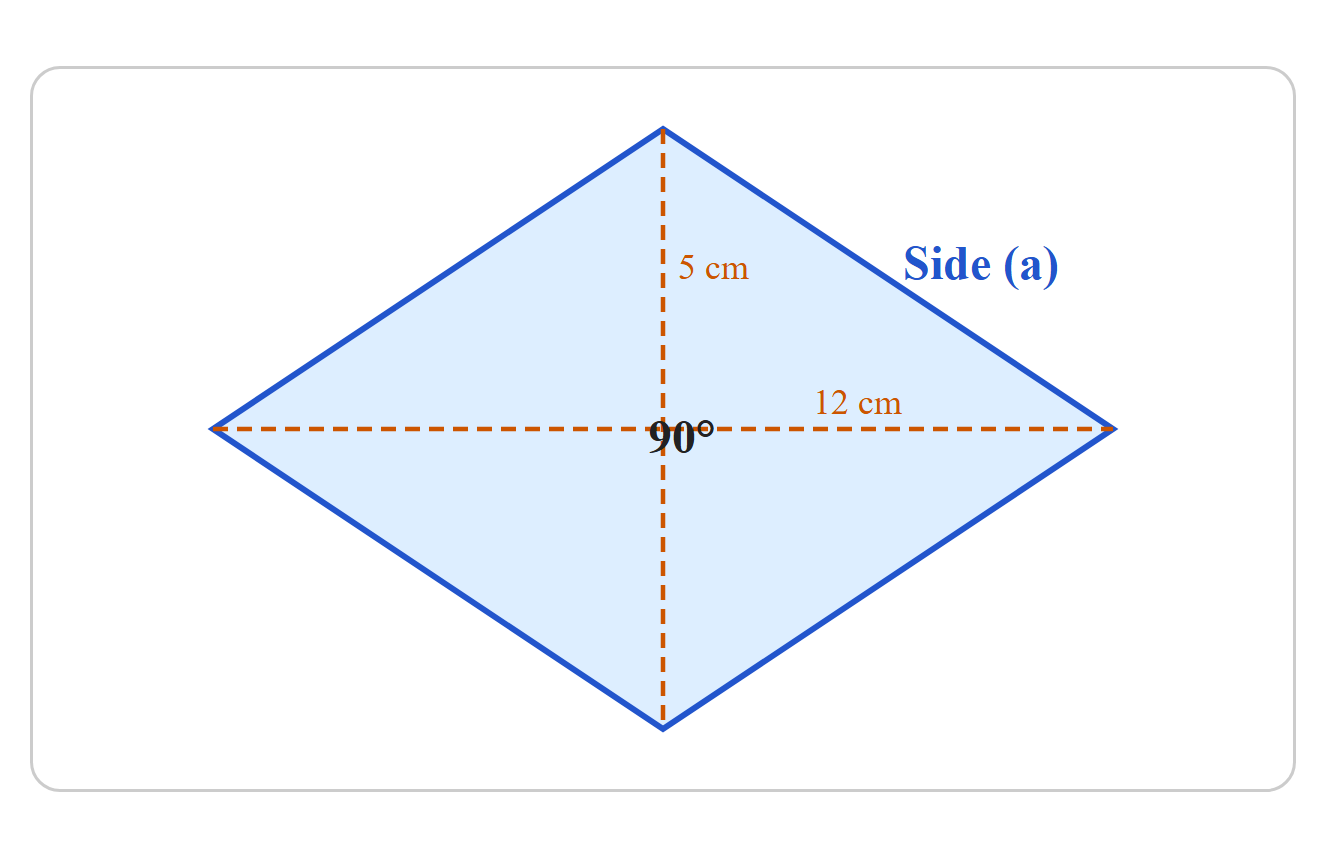
Side of a rhombus (a) = √((d1/2)2 + (d2/2)2)

Given diagonals are 10 cm and 24 cm.

Half of diagonals are 5 cm and 12 cm.

Using Pythagorean triplet (5, 12, 13), the side is 13 cm.

∴ The correct answer is 13 cm.

Alternate Method

Given:

First diagonal (d1) = 10 cm

Second diagonal (d2) = 24 cm

Formula Used:

4 × (Side)2 = d12 + d22

Calculations:

⇒ 4 × a2 = 102 + 242

⇒ 4 × a2 = 100 + 576

⇒ 4 × a2 = 676

⇒ a2 = 676 ÷ 4

⇒ a2 = 169

⇒ a = √169

⇒ a = 13 cm

∴ The correct answer is 13 cm.

Additional Information

Properties of Rhombus

All sides are equal and diagonals bisect each other at 90°.

Area of Rhombus

The area is calculated as 1/2 × d1 × d2.

Perimeter of Rhombus

The perimeter is 4 × Side.

Question 12

How does resistance depend on the cross-sectional area A of a conductor? 

  1. AOption (a)

    Proportional to A

  2. BOption (b)

    Inversely proportional to A

  3. COption (c)

    Does not depend on A

  4. DOption (d)

    Proportional to A2

View answer & explanation

Correct answer

Answer: (b)B.

Inversely proportional to A

Why this answer is correct

The correct answer is Inversely proportional to A.

Key Points

  • Resistance (R) of a conductor is inversely proportional to its cross-sectional area (A).
  • This relationship is mathematically represented as R∝1AR\propto\frac{1}{A}
  • Increasing the cross-sectional area of the conductor will decrease its resistance.
  • Conversely, decreasing the cross-sectional area of the conductor will increase its resistance.

Additional Information

  • Ohm's Law:
  • It states that the current through a conductor between two points is directly proportional to the voltage across the two points.
  • It is expressed as V = IR, where V is voltage, I is current, and R is resistance.
  • Factors Affecting Resistance:
  • Material of the conductor: Different materials have different resistivities.
  • Length of the conductor: Resistance is directly proportional to the length of the conductor (R ∝ L).
  • Temperature: Resistance usually increases with temperature for conductors.
  • Resistivity (ρ):
  • Resistivity is a material-specific property that affects resistance.
  • It is expressed in ohm-meters (Ω·m) and is defined as the resistance of a unit length and unit cross-sectional area of the material.
  • Formula for Resistance:
  • The resistance of a conductor can be calculated using the formula R=ρlAR=\rho\frac{l}{A}, where ρ is resistivity, L is length, and A is cross-sectional area.

Question 13

In a certain code language, 'ARID' is coded as '9078' and 'DIRE' is coded as '8095'. What is the code for 'E' in the given code language?

  1. AOption (a)

    0

  2. BOption (b)

    5

  3. COption (c)

    8

  4. DOption (d)

    9

View answer & explanation

Correct answer

Answer: (b)B.

5

Why this answer is correct

The logic followed here is:

'ARID' is coded as '9078'

'DIRE' is coded as '8095'

Thus, code for 'E' is '5'.

Hence, "Option 2" is the correct answer.

Question 14

As per the 10th consecutive Monetary Policy Committee (MPC) meeting, what is the repo rate at which the Reserve Bank of India lends to banks as on 30th October 2024?

  1. AOption (a)

    6.0%

  2. BOption (b)

    7.5%

  3. COption (c)

    6.5%

  4. DOption (d)

    7.0%

View answer & explanation

Correct answer

Answer: (c)C.

6.5%

Why this answer is correct

The correct answer is 3) 0.065.

Key Points

  • As of October 30, 2024, the repo rate at which the Reserve Bank of India (RBI) lends to banks is 0.065.
  • The repo rate is a critical tool used by the RBI to control inflation and regulate the money supply in the economy.
  • This rate is determined by the RBI's Monetary Policy Committee (MPC) which meets bi-monthly to review and set the repo rate.
  • The repo rate influences the interest rates offered by banks on loans and deposits, affecting borrowing and spending in the economy.
  • A lower repo rate typically aims to encourage borrowing and investment, stimulating economic growth.

Additional Information

  • Monetary Policy Committee (MPC)
  • The MPC is a committee of the RBI responsible for formulating the monetary policy of India.
  • It consists of six members: three officials from the RBI and three external members appointed by the Government of India.
  • The primary objective of the MPC is to maintain price stability while keeping in mind the objective of economic growth.
  • Repo Rate
  • The repo rate is the rate at which the central bank of a country (RBI in India) lends money to commercial banks in the event of any shortfall of funds.
  • It is used by monetary authorities to control inflation.
  • A decrease in the repo rate can lead to banks reducing their lending rates, making loans cheaper and boosting consumption and investment.
  • Reverse Repo Rate
  • The reverse repo rate is the rate at which the RBI borrows money from commercial banks.
  • It is used to control the money supply in the economy.
  • A higher reverse repo rate encourages banks to park more funds with the RBI, thereby reducing the money supply in the economy.
  • Inflation Control
  • The RBI uses various monetary policy tools, including the repo rate, to control inflation.
  • High inflation can erode purchasing power and hurt economic growth, while very low inflation can lead to deflation, where prices fall continuously.
  • Maintaining a balance is crucial for a stable economic environment.

Question 15

If 4 × 4(n + 5) = 256 then the value of 5(n + 4) is:

  1. AOption (a)

    25

  2. BOption (b)

    1

  3. COption (c)

    5

  4. DOption (d)

    125

View answer & explanation

Correct answer

Answer: (a)A.

25

Why this answer is correct

Given:

4 × 4(n + 5) = 256

Formula used:

am × an = a(m + n)

If ax = ay, then x = y

Calculations:

41 × 4(n + 5) = 256

⇒ 4(1 + n + 5) = 44

⇒ 4(n + 6) = 44

⇒ n + 6 = 4

⇒ n = 4 − 6

⇒ n = −2

Now, finding the value of 5(n + 4):

⇒ 5(−2 + 4)

⇒ 52

⇒ 25

∴ The correct answer is option (1).

Question 16

Which of the following sentences is correct if an object is in uniform motion?

  1. AOption (a)

    The object moves with varying speeds.

  2. BOption (b)

    The object moves with a constant speed.

  3. COption (c)

    The object does not travel equal distances with respect to equal time intervals.

  4. DOption (d)

    The object travels with different acceleration.

View answer & explanation

Correct answer

Answer: (b)B.

The object moves with a constant speed.

Why this answer is correct

The correct answer is Option 2: The object moves with a constant speed..

Key Points

  • An object in uniform motion travels equal distances in equal intervals of time, indicating a constant speed.
  • Uniform motion implies that the velocity of the object does not change over time.
  • In uniform motion, both the magnitude and direction of the object's velocity remain constant.
  • The path of an object in uniform motion can be linear or circular, but the speed remains constant throughout the motion.

Additional Information

  • Velocity: It is the speed of an object in a given direction. Uniform motion implies constant velocity.
  • Acceleration: The rate of change of velocity. In uniform motion, the acceleration is zero since the velocity is constant.
  • Displacement: The change in position of an object. In uniform motion, displacement is directly proportional to time.
  • Graphical Representation: A distance-time graph of an object in uniform motion is a straight line, indicating constant speed.
  • Non-Uniform Motion: When an object travels unequal distances in equal intervals of time, the motion is termed non-uniform, indicating varying speed.

Question 17

Three pipes A, B and C are opened to fill a tank such that B and C can fill the tank alone for 18 hours and 12 hours, respectively, while pipe A can empty a fully filled tank in 15 hours. All the three pipes are opened together, and after 5 hours pipe A is closed. In how many hours will the remaining tank be filled?

  1. AOption (a)

    1 hour 45 minutes

  2. BOption (b)

    1 hour 15 minutes

  3. COption (c)

    4 hours 36 minutes

  4. DOption (d)

    2 hours 50 minutes

View answer & explanation

Correct answer

Answer: (c)C.

4 hours 36 minutes

Why this answer is correct

Shortcut Trick

Let Total Work (LCM of 18, 12, 15) = 180 units.

Efficiencies: B = +10, C = +15, A = −12. Combined (A+B+C) = 10 + 15 − 12 = 13.

Work done in 5 hours = 13 × 5 = 65 units. Remaining = 180 − 65 = 115 units.

Time taken by B and C = 115 ÷ (10 + 15) = 115 ÷ 25 = 4.6 hours.

0.6 hours = 0.6 × 60 = 36 minutes.

∴ The correct answer is 4 hr 36 min.

Alternate Method

Given: Filling time for B = 18 hrs, C = 12 hrs. Emptying time for A = 15 hrs.

PipeHoursTotal Work (LCM)Efficiency
B (Fill)1818010
C (Fill)1215
A (Empty)15−12

⇒ Net efficiency of (A + B + C) = 10 + 15 − 12 = 13 units/hr

⇒ Work done in first 5 hours = 13 × 5 = 65 units

⇒ Remaining work to be filled = 180 − 65 = 115 units

⇒ Efficiency of (B + C) = 10 + 15 = 25 units/hr

⇒ Time required = 115 ÷ 25 = 4.6 hours

⇒ Conversion: 4 hours + (0.6 × 60) minutes = 4 hours 36 minutes

∴ The correct answer is 4 hr 36 min.

Additional Information

Pipes and Cisterns Logic

Inlet pipes contribute positive efficiency (filling) while outlet pipes contribute negative efficiency (emptying) toward the total capacity.

Time and Work Relation

Total Work = Efficiency × Time. For fractional hours, multiply the decimal part by 60 to convert it into minutes.

Question 18

What happens to the process of diffusion on heating?

  1. AOption (a)

    Diffusion depends on volume of matter. 

  2. BOption (b)

    On heating, diffusion becomes slower.

  3. COption (c)

    On heating, diffusion becomes faster. 

  4. DOption (d)

    There is no effect of heating on diffusion.

View answer & explanation

Correct answer

Answer: (c)C.

On heating, diffusion becomes faster. 

Why this answer is correct

The correct answer is On heating, diffusion becomes faster..

Key Points

  • Diffusion is the movement of particles from a region of higher concentration to a region of lower concentration.
  • On heating, the kinetic energy of the particles increases, causing them to move more rapidly.
  • The increased movement of particles results in faster mixing and spreading, thus increasing the rate of diffusion.
  • Diffusion is faster in gases than in liquids and solids because gas particles move more quickly and freely.

Additional Information

  • Temperature
  • Temperature is a measure of the average kinetic energy of the particles in a substance.
  • As temperature increases, the kinetic energy of particles increases, leading to faster movement and higher diffusion rates.
  • Concentration Gradient
  • The concentration gradient is the difference in the concentration of particles between two regions.
  • Diffusion occurs more rapidly when there is a steeper concentration gradient.
  • Medium of Diffusion
  • Diffusion occurs in gases, liquids, and solids, but the rate varies.
  • Gases have the highest diffusion rates, followed by liquids, and then solids due to the differences in particle movement and spacing.
  • Applications of Diffusion
  • Diffusion is essential in various biological processes, such as gas exchange in the lungs and nutrient absorption in cells.
  • It also plays a crucial role in industrial processes, including the mixing of gases and the spread of pollutants.

Question 19

75 × 75 + 2 × 75 × 25 + 25 × 25 is equal to:

  1. AOption (a)

    3750

  2. BOption (b)

    10000

  3. COption (c)

    6250

  4. DOption (d)

    7500

View answer & explanation

Correct answer

Answer: (b)B.

10000

Why this answer is correct

Shortcut Trick

The expression follows the algebraic identity a2 + 2ab + b2 = (a + b)2.

Here, a = 75 and b = 25.

⇒ (75 + 25)2 = 1002 = 10000.

∴ The correct answer is 10000.

Alternate Method

Given:

Expression: 75 × 75 + 2 × 75 × 25 + 25 × 25

Formula Used:

(a + b)2 = a2 + 2ab + b2

Calculations:

⇒ Let a = 75 and b = 25

⇒ a2 = 75 × 75

⇒ b2 = 25 × 25

⇒ 2ab = 2 × 75 × 25

⇒ The given expression is a2 + 2ab + b2

⇒ (75 + 25)2

⇒ (100)2

⇒ 10000

∴ The correct answer is 10000.

Additional Information

Square of a Binomial (Difference)

The formula for the square of a difference is (a − b)2 = a2 − 2ab + b2.

Difference of Two Squares

The factorization of the difference of two squares is a2 − b2 = (a − b)(a + b).

Square of a Trinomial

The expansion for three terms is (a + b + c)2 = a2 + b2 + c2 + 2ab + 2bc + 2ca.

Question 20

From the four possibilities, suspension has which property?

  1. AOption (a)

    Heterogeneous mixture

  2. BOption (b)

    Solid mixture

  3. COption (c)

    Plasma mixture

  4. DOption (d)

    Homogenous mixture

View answer & explanation

Correct answer

Answer: (a)A.

Heterogeneous mixture

Why this answer is correct

The correct answer is Heterogeneous mixture.

Key Points

  • A suspension is a heterogeneous mixture in which the solute particles do not dissolve but remain suspended throughout the bulk of the medium.
  • The particles in a suspension are larger than those found in solutions, typically being greater than 1 micrometer in size.
  • Suspensions can be separated into their individual components through processes such as filtration or sedimentation.
  • Over time, the particles in a suspension tend to settle out due to gravity, a property not observed in true solutions.

Additional Information

  • Colloids
  • Colloids are mixtures where the particle size is intermediate between those in solutions and suspensions, ranging from 1 to 1000 nanometers.
  • These particles do not settle out upon standing and cannot be separated by filtration.
  • An example of a colloid is milk.
  • Solutions
  • Solutions are homogeneous mixtures composed of two or more substances.
  • The solute in a solution is completely dissolved in the solvent.
  • An example of a solution is salt water.
  • Emulsions
  • Emulsions are a type of colloid where both phases are liquids.
  • They can be stabilized by emulsifying agents.
  • An example of an emulsion is mayonnaise.
  • Properties of Heterogeneous Mixtures
  • The components of a heterogeneous mixture can be visibly distinguished.
  • They do not have a uniform composition throughout.
  • Examples include salads and trail mixes.

Question 21

Read the given statements and conclusions carefully. You have to take the given statements to be true even if they seem to be at variance from commonly known facts and decide which conclusion(s) logically follow(s) from the given statements.

Statements:

Some plates are glasses.

Some glasses are bowls.

Some bowls are cups.

Conclusions:

(I) Some cups are glasses.

(II) Some bowls are plates.

  1. AOption (a)

    Only conclusion (II) follows. 

  2. BOption (b)

    Only conclusion (I) follows.

  3. COption (c)

    Neither conclusion (I) nor (II) follows.

  4. DOption (d)

    Both conclusions (I) and (II) follow.

View answer & explanation

Correct answer

Answer: (c)C.

Neither conclusion (I) nor (II) follows.

Why this answer is correct

The least possible Venn diagram for the given statements is as shown below :

Conclusions:

(I) Some cups are glasses → Does not follow (As some glasses are bowls and some bowls are cups. So it is possible but not definite.)

(II) Some bowls are plates → Does not follow (As some plates are glasses and some glasses are bowls. So it is possible but not definite.)

∴ Here, Neither conclusion (I) nor (II) follows.​

Hence, the correct answer is "Option 3"

Question 22

In 1987, the UNEP succeeded in forging an agreement to freeze Chlorofluorocarbons production at 1986 levels. What is the full form of UNEP?

  1. AOption (a)

    United Nations Ecological Programme

  2. BOption (b)

    United Nations Environment Programme

  3. COption (c)

    United Nations Ecological Policy

  4. DOption (d)

    United Nations Environment Policy

View answer & explanation

Correct answer

Answer: (b)B.

United Nations Environment Programme

Why this answer is correct

The correct answer is United Nations Environment Programme.

Key Points

  • United Nations Environment Programme (UNEP) was established in 1972 following the United Nations Conference on the Human Environment in Stockholm.
  • UNEP is headquartered in Nairobi, Kenya, and serves as the leading global environmental authority that sets the global environmental agenda.
  • The UNEP's mission is to provide leadership and encourage partnership in caring for the environment by inspiring, informing, and enabling nations and peoples to improve their quality of life without compromising that of future generations.
  • UNEP works in seven broad thematic areas: Climate Change, Disasters and Conflicts, Ecosystem Management, Environmental Governance, Chemicals and Waste, Resource Efficiency, and Environment under Review.

Additional Information

  • Montreal Protocol
  • It is an international treaty designed to protect the ozone layer by phasing out the production of numerous substances that are responsible for ozone depletion.
  • The treaty was agreed upon on 16 September 1987 and entered into force on 1 January 1989.
  • It is considered one of the most successful environmental agreements to date, with significant reductions in the global production, consumption, and emissions of ozone-depleting substances.
  • Chlorofluorocarbons (CFCs)
  • CFCs are a group of chemical compounds that were once commonly used in air conditioning, refrigeration, and aerosol propellants.
  • They are highly stable and can remain in the atmosphere for a long time, leading to the depletion of the ozone layer.
  • The discovery of the harmful effects of CFCs on the ozone layer led to international agreements to phase them out.
  • Ozone Layer
  • The ozone layer is a region of Earth's stratosphere that contains a high concentration of ozone (O3) and absorbs most of the Sun's ultraviolet radiation.
  • It plays a crucial role in protecting living organisms on Earth from harmful UV radiation, which can cause skin cancer, cataracts, and other health issues.
  • Human activities, particularly the emission of ozone-depleting substances, have caused significant thinning of the ozone layer, leading to the creation of the ozone hole.
  • Vienna Convention
  • The Vienna Convention for the Protection of the Ozone Layer is a multilateral environmental agreement that provided a framework for international efforts to protect the ozone layer.
  • Adopted in 1985, it aimed to promote cooperation on research, monitoring, and information exchange related to the ozone layer and ozone-depleting substances.
  • The Vienna Convention laid the groundwork for the subsequent Montreal Protocol.

Question 23

The difference between the ages of two siblings is 7 years. If the sum of their ages is 21 years, how old is the elder of the siblings?

  1. AOption (a)

    14 years

  2. BOption (b)

    3 years

  3. COption (c)

    7 years

  4. DOption (d)

    10 years

View answer & explanation

Correct answer

Answer: (a)A.

14 years

Why this answer is correct

Shortcut Trick

For two numbers, if Sum (S) and Difference (D) are known:

Elder (Larger number) = (Sum + Difference) ÷ 2

Elder = (21 + 7) ÷ 2 = 28 ÷ 2 = 14 years

∴ The correct answer is 14 years.

Alternate Method

Given:

Let the age of the elder sibling be x and the younger sibling be y.

⇒ x − y = 7 --- (Equation 1)

⇒ x + y = 21 --- (Equation 2)

Calculations:

Adding Equation 1 and Equation 2:

⇒ (x − y) + (x + y) = 7 + 21

⇒ 2x = 28

⇒ x = 28 ÷ 2

⇒ x = 14

∴ The correct answer is 14 years.

Additional Information

Linear Equations in Two Variables

When two linear equations involve the same variables, they form a system. The Elimination method is the fastest way to solve for one variable by adding or subtracting equations.

Sum and Difference Formula

If x + y = S and x − y = D, then the larger value x = (S+D)/2 and the smaller value y = (S−D)/2.

Age Invariance Property

The difference between ages of two people always remains constant, regardless of how many years pass.

Question 24

Which of the following is true about nuclear membranes and other cell organelles in cells? 

  1. AOption (a)

    All cytoplasmic organelles are present in prokaryotic cells.

  2. BOption (b)

    The nuclear membrane is present in prokaryotic cells. 

  3. COption (c)

    The nuclear membrane is absent in eukaryotic cells. 

  4. DOption (d)

    The nuclear membrane is absent in prokaryotic cells.

View answer & explanation

Correct answer

Answer: (d)D.

The nuclear membrane is absent in prokaryotic cells.

Why this answer is correct

The correct answer is The nuclear membrane is absent in prokaryotic cells..

Key Points

  • Prokaryotic cells, such as bacteria and archaea, lack a true nucleus and do not have a nuclear membrane.
  • The genetic material in prokaryotic cells is located in a nucleoid region, which is not enclosed by a membrane.
  • Eukaryotic cells, including plant, animal, and fungal cells, have a well-defined nucleus enclosed by a nuclear membrane.
  • The nuclear membrane in eukaryotic cells helps regulate the exchange of materials between the nucleus and the cytoplasm.

Additional Information

  • Prokaryotic Cells:
  • Prokaryotic cells are unicellular organisms that lack membrane-bound organelles.
  • Examples include bacteria and archaea.
  • They reproduce asexually through binary fission.
  • They have simpler structures compared to eukaryotic cells.
  • Eukaryotic Cells:
  • Eukaryotic cells have a defined nucleus and membrane-bound organelles.
  • They can be unicellular or multicellular organisms, including plants, animals, and fungi.
  • Eukaryotic cells reproduce through mitosis and meiosis.
  • They have a more complex structure compared to prokaryotic cells.
  • Nuclear Membrane:
  • Also known as the nuclear envelope, it consists of two lipid bilayers.
  • It separates the nucleus from the cytoplasm in eukaryotic cells.
  • The nuclear membrane contains nuclear pores that regulate the passage of molecules.
  • It plays a critical role in protecting the genetic material.
  • Nucleoid:
  • The region within a prokaryotic cell where the genetic material is located.
  • It is not enclosed by a membrane.
  • The nucleoid contains a single circular chromosome.
  • It is involved in controlling cellular activities and reproduction.

Question 25

Hari purchased 25 kg of wheat at the rate of Rs. 4 per kg and 35 kg of wheat at Rs. 4.50 per kg. He sold the mixture at the rate of Rs. 4.25 per kg. Find his gain or loss.

  1. AOption (a)

    Rs. 2.50, loss

  2. BOption (b)

    Rs. 2.00, loss

  3. COption (c)

    Rs, 3.50, profit

  4. DOption (d)

    Rs. 3.00, profit

View answer & explanation

Correct answer

Answer: (a)A.

Rs. 2.50, loss

Why this answer is correct

Shortcut Trick Total CP = (25 × 4) + (35 × 4.50) = 100 + 157.50 = 257.50 Total SP = (25 + 35) × 4.25 = 60 × 4.25 = 255.00 Since CP > SP, there is a Loss. Loss = 257.50 − 255.00 = 2.50 ∴ The correct answer is Rs. 2.50, loss.

Alternate Method Given → Quantity 1 = 25 kg at Rs. 4/kg, Quantity 2 = 35 kg at Rs. 4.50/kg, Selling Price = Rs. 4.25/kg. Formulas: Total CP = (Q1 × C1) + (Q2 × C2) | Total SP = (Q1 + Q2) × Selling Price | Loss = CP − SP.

⇒ Cost Price of 25 kg wheat = 25 × 4 = Rs. 100. ⇒ Cost Price of 35 kg wheat = 35 × 4.50 = Rs. 157.50. ⇒ Total Cost Price (CP) = 100 + 157.50 = Rs. 257.50. ⇒ Total Weight of mixture = 25 + 35 = 60 kg. ⇒ Total Selling Price (SP) = 60 × 4.25 = Rs. 255. ⇒ Loss = Total CP − Total SP = 257.50 − 255 = Rs. 2.50. ∴ The correct answer is Rs. 2.50, loss.

Additional Information Profit and Loss Basics When Selling Price (SP) is greater than Cost Price (CP), it is a Profit. Profit = SP − CP. Loss Condition When Cost Price (CP) is greater than Selling Price (SP), it is a Loss. Loss = CP − SP.

Question 26

A, B, E, G, P, L and M are sitting around a circular table facing the centre. Only L sits between A and P. P sits third to the left of E. G sits to the immediate left of E. B is not an immediate neighbour of P. Who sits fourth to the left of M?

  1. AOption (a)

    L

  2. BOption (b)

    A

  3. COption (c)

    E

  4. DOption (d)

    B

View answer & explanation

Correct answer

Answer: (d)D.

B

Why this answer is correct

Given: A, B, E, G, P, L and M are sitting around a circular table facing the centre.

1) P sits third to the left of E.

2) G sits to the immediate left of E.

3) Only L sits between A and P. 

  1. B is not an immediate neighbour of P.

After positioning B only one position is left which will be occupied by the only person left i.e. E.

Thus, according to the final arrangement, B sits fourth to the left of M.

Hence, "Option 4" is the correct answer.

Question 27

The average of ten numbers is 7. If 21 is added to each number, then the average of the new set of numbers will be:

  1. AOption (a)

    31

  2. BOption (b)

    7

  3. COption (c)

    28

  4. DOption (d)

    19

View answer & explanation

Correct answer

Answer: (c)C.

28

Why this answer is correct

Shortcut Trick

When a constant value is added to every number in a set, the average of the set increases by that same constant value.

New Average = Old Average + Constant Added

New Average = 7 + 21 = 28

∴ The correct answer is 28.

Alternate Method

Given:

Total numbers (n) = 10

Initial Average = 7

Formula Used:

Sum = Average × Number of terms

New Average = New Sum ÷ Number of terms

Calculations:

⇒ Initial Sum = 7 × 10 = 70

⇒ Value added to each number = 21

⇒ Total value added to sum = 21 × 10 = 210

⇒ New Sum = 70 + 210 = 280

⇒ New Average = 280 ÷ 10

⇒ New Average = 28

∴ The correct answer is 28.

Additional Information

Effect of Operations on Average

If each observation is increased, decreased, multiplied or divided by a non-zero constant 'k', the average is also increased, decreased, multiplied or divided by 'k' respectively.

Weighted Average

When two groups with averages A1 and A2 and sizes n1 and n2 are combined, the Combined Average = (n1A1 + n2A2) ÷ (n1 + n2).

Average of Consecutive Numbers

For any Arithmetic Progression (AP), the average is always the middle term or (First Term + Last Term) ÷ 2.

Question 28

Which of the following phenomena is used to liquefy gas? 

  1. AOption (a)

    Reducing pressure and reducing temperature

  2. BOption (b)

    Applying pressure and reducing temperature 

  3. COption (c)

    Applying temperature and reducing pressure 

  4. DOption (d)

    Applying pressure and increasing temperature

View answer & explanation

Correct answer

Answer: (b)B.

Applying pressure and reducing temperature 

Why this answer is correct

The correct answer is Applying pressure and reducing temperature.

Key Points

  • Liquefaction of gases is primarily achieved by applying pressure and reducing temperature.
  • This process involves compressing the gas to a point where it can be cooled sufficiently to turn into a liquid.
  • When the gas is compressed, the molecules are brought closer together, making it easier to condense.
  • Lowering the temperature reduces the kinetic energy of the gas molecules, further aiding in the transition from gas to liquid.
  • This principle is used in various industrial processes, including the production of liquefied natural gas (LNG).

Additional Information

  • Critical Temperature and Pressure
  • The critical temperature is the highest temperature at which a substance can exist as a liquid. Above this temperature, a gas cannot be liquefied, regardless of pressure.
  • The critical pressure is the pressure required to liquefy a gas at its critical temperature.
  • Boyle’s Law and Charles’s Law
  • Boyle’s Law states that the pressure of a given mass of gas is inversely proportional to its volume at a constant temperature.
  • Charles’s Law states that the volume of a gas is directly proportional to its temperature at constant pressure.
  • Industrial Applications
  • Liquefaction is used in the storage and transport of gases such as oxygen, nitrogen, and natural gas.
  • Liquefied gases are easier to store and transport as they take up less space.
  • Refrigeration Cycles
  • The principles of gas liquefaction are applied in refrigeration cycles, where refrigerants are compressed and expanded to absorb and release heat.
  • This process is used in air conditioning systems and refrigerators.

Question 29

Based on the English alphabetical order, three of the following four letter-clusters are alike in a certain way and thus form a group. Which letter-cluster does not belong to that group?

(Note: The odd one out is not based on the number of consonants/vowels or their position in the letter-cluster.)

  1. AOption (a)

    KHEB

  2. BOption (b)

    AXUR

  3. COption (c)

    GDAX

  4. DOption (d)

    OKJH

View answer & explanation

Correct answer

Answer: (d)D.

OKJH

Why this answer is correct

The logic followed here is:

Option 1) KHEB

Option 2) AXUR

Option 3) GDAX

Option 4) OKJH

Thus, out of all the options 'OKJH' is the odd one out.

Hence, "Option 4" is the correct answer.

Question 30

In the following number-pairs, the second number is obtained by applying certain mathematical operations to the first number. Which numbers should replace X and Y so that the pattern followed by the two numbers on the left side of :: is the same as that on the right side of ::?

(NOTE: Operations should be performed on the whole numbers, without breaking down the numbers into its constituent digits. E.g. 13 - Operations on 13 such as adding/subtracting/multiplying etc. to 13 can be performed. Breaking down 13 into 1 and 3 and then performing mathematical operations on 1 and 3 is not allowed.)

X : 36 :: 15: Y

  1. AOption (a)

    X = 12, Y = 50

  2. BOption (b)

    X = 12, Y = 60

  3. COption (c)

    X = 9, Y = 42

  4. DOption (d)

    X = 9, Y = 60

View answer & explanation

Correct answer

Answer: (d)D.

X = 9, Y = 60

Why this answer is correct

The logic followed here is:

Given: X : 36 :: 15: Y

So, checking each option one by one:

Option 1) X = 12, Y = 50 → 12 : 36 :: 15: 50

12 × 4 = 36

48 ≠ 36 (LHS ≠ RHS)

15 × 4 = 50

60 ≠ 50 (LHS ≠ RHS)

Option 2) X = 12, Y = 60 → 12 : 36 :: 15: 60

12 × 4 = 36

48 ≠ 36 (LHS ≠ RHS)

15 × 4 = 60

60 = 60 (LHS = RHS)

Option 3) X = 9, Y = 42 → 9 : 36 :: 15: 42

9 × 4 = 36

36 = 36 (LHS = RHS)

15 × 4 = 42

60 ≠ 42 (LHS ≠ RHS)

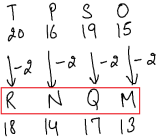
Option 4) X = 9, Y = 60 → 9 : 36 :: 15: 60

9 × 4 = 36

36 = 36 (LHS = RHS)

15 × 4 = 60

60 = 60 (LHS = RHS)

Hence, "Option 4" is the correct answer.

Question 31

Visitors to a show were charged Rs. 15 each on the first day. Rs. 7.50 on the second day, and Rs. 2.50 on the third day, and total attendance on the three days was in ratio 2 : 5 : 13, respectively. The average charge per person for the whole show is:

  1. AOption (a)

    Rs. 4

  2. BOption (b)

    Rs. 5

  3. COption (c)

    Rs. 3

  4. DOption (d)

    Rs. 6

View answer & explanation

Correct answer

Answer: (b)B.

Rs. 5

Why this answer is correct

Shortcut Trick

Total Weighted Average = (Price1 × Ratio1 + Price2 × Ratio2 + Price3 × Ratio3) / (Sum of Ratios)

Average = (15 × 2 + 7.50 × 5 + 2.50 × 13) / (2 + 5 + 13)

Average = (30 + 37.5 + 32.5) / 20 = 100 / 20 = 5

∴ The correct answer is Rs. 5.

Alternate Method

Given:

Charge on Day 1 = Rs. 15 | Attendance Ratio = 2

Charge on Day 2 = Rs. 7.50 | Attendance Ratio = 5

Charge on Day 3 = Rs. 2.50 | Attendance Ratio = 13

Formula Used:

Average Charge = (Total Revenue) ÷ (Total Number of Visitors)

Let the number of visitors on Day 1, Day 2, and Day 3 be 2x, 5x, and 13x respectively.

⇒ Total Revenue = (15 × 2x) + (7.50 × 5x) + (2.50 × 13x)

⇒ Total Revenue = 30x + 37.5x + 32.5x

⇒ Total Revenue = 100x

⇒ Total Visitors = 2x + 5x + 13x = 20x

⇒ Average Charge = 100x ÷ 20x

⇒ Average Charge = Rs. 5

∴ The correct answer is Rs. 5.

Additional Information

Weighted Average

When values have different levels of importance or frequency, the average is calculated as Σ(Valuei × Weighti) ÷ ΣWeighti.

Ratio Application in Averages

In problems involving ratios, actual numbers are not required; the ratio parts can be treated as the actual weights to find the average.

Revenue Calculation

Total Revenue is always the product of the rate per unit and the number of units (Revenue = Price × Quantity).

Question 32

In September 2024, Prime Minister Modi launched how many Param Rudra Super Computing Systems and a High Performance Computing (HPC) system for weather and climate research?

  1. AOption (a)

    7

  2. BOption (b)

    3

  3. COption (c)

    2

  4. DOption (d)

    5

View answer & explanation

Correct answer

Answer: (b)B.

3

Why this answer is correct

The correct answer is 3.

Key Points

  • In September 2024, Prime Minister Narendra Modi launched 3 Param Rudra Super Computing Systems.
  • The launch also included a High Performance Computing (HPC) system dedicated to weather and climate research.
  • The Param Rudra systems are part of India's efforts to enhance computational capabilities for scientific research.
  • These systems are expected to significantly improve the accuracy and efficiency of weather forecasting and climate modeling.
  • The initiative aligns with the Indian government's focus on leveraging technology for sustainable development.

Additional Information

  • Supercomputing in India
  • India has been actively developing its supercomputing capabilities under the National Supercomputing Mission (NSM).
  • The mission aims to build a network of supercomputers with a total computing capacity of 45 Petaflops.
  • Supercomputers are crucial for advancing research in various fields including weather forecasting, climate science, and material science.
  • High Performance Computing (HPC)
  • HPC involves aggregating computing power to deliver higher performance than typical desktop computers and servers.
  • It is essential for solving complex scientific, engineering, and business problems.
  • HPC systems can process vast amounts of data and perform a large number of calculations at high speed.
  • Weather and Climate Research
  • Advanced computing systems play a pivotal role in enhancing the precision of weather predictions.
  • Climate models require substantial computational power to simulate the Earth's climate and predict future changes.
  • Accurate weather forecasting helps in disaster management and mitigation, saving lives and property.
  • Param Supercomputers
  • Param is a series of supercomputers developed by the Centre for Development of Advanced Computing (C-DAC) in India.
  • The name "Param" means "supreme" in Sanskrit.
  • These systems are designed to meet the growing computational demands of scientific research and industrial applications in India.

Question 33

SOTQ is related to PLQN in a certain way based on the English alphabetical order. In the same way, OKPM is related to LHMJ. To which of the following options is LHMJ related, following the same logic?

  1. AOption (a)

    EIGJ

  2. BOption (b)

    IEJG

  3. COption (c)

    IEGJ

  4. DOption (d)

    EIJG

View answer & explanation

Correct answer

Answer: (b)B.

IEJG

Why this answer is correct

The logic followed here is:

SOTQ is related to PLQN

And,

OKPM is related to LHMJ

Similarly,

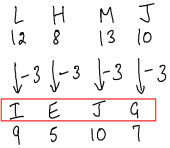
LHMJ is related to

Hence, "Option 2" is the correct answer.

Question 34

The correct expression of 8.46‾8.\overline{46} in the fractional form is

  1. AOption (a)

    83899\frac{838}{99}

  2. BOption (b)

    84699\frac{846}{99}

  3. COption (c)

    8399\frac{83}{99}

  4. DOption (d)

    8499\frac{84}{99}

View answer & explanation

Correct answer

Answer: (a)A.

83899\frac{838}{99}

Why this answer is correct

Given:

Number = 8.46̅

Formula used:

For a repeating decimal of the form x.ab̅ = (xab − x) / 99

Calculations:

Let n = 8.464646...

⇒ 100n = 846.464646...

⇒ 100n − n = 846.4646... − 8.4646...

⇒ 99n = 846 − 8

⇒ 99n = 838

⇒ n = 838 / 99

∴ The correct answer is option (1).

Question 35

Which of the following has the highest basicity?

  1. AOption (a)

    Blood

  2. BOption (b)

    Saliva

  3. COption (c)

    Sodium hydroxide

  4. DOption (d)

    Tap water

View answer & explanation

Correct answer

Answer: (c)C.

Sodium hydroxide

Why this answer is correct

The correct answer is Sodium hydroxide.

Key Points

  • Sodium hydroxide (NaOH) is a highly caustic base and alkali that decomposes proteins at ordinary ambient temperatures and may cause severe chemical burns.
  • It is a white solid ionic compound consisting of sodium cations (Na+) and hydroxide anions (OH−).
  • Sodium hydroxide has a pH value of approximately 14, indicating its strong basicity.
  • It is commonly used in various industrial processes, including the manufacture of paper, textiles, and detergents.

Additional Information

  • Basicity: It refers to the strength of a base in a solution. Strong bases like sodium hydroxide completely dissociate in water, releasing a high concentration of hydroxide ions (OH−).
  • pH Scale: The pH scale measures how acidic or basic a solution is, ranging from 0 to 14. A pH of 7 is neutral, below 7 is acidic, and above 7 is basic.
  • Common Bases: Other common bases include potassium hydroxide (KOH), calcium hydroxide (Ca(OH)2), and ammonia (NH3).
  • Safety Precautions: Due to its caustic nature, sodium hydroxide must be handled with care, using appropriate personal protective equipment (PPE) such as gloves and safety goggles.
  • Applications: Aside from industrial uses, sodium hydroxide is also used in the food industry for processing, like peeling fruits and vegetables, and in home cleaning products.

Question 36

Refer to the given series and answer the question that follows (all numbers are single-digit numbers only, and all counting is to be done from left to right).

(Left) 3 4 8 5 6 9 2 2 1 6 6 9 3 2 4 8 9 1 6 8 3 2 2 3 8 3 2 1 (Right)

How many such even digits are there, each of which is immediately preceded by a perfect square and immediately followed by an odd digit? (Note: 1 will be considered as a perfect square.)

  1. AOption (a)

    3

  2. BOption (b)

    2

  3. COption (c)

    0

  4. DOption (d)

    1

View answer & explanation

Correct answer

Answer: (b)B.

2

Why this answer is correct

Given series: (Left) 3 4 8 5 6 9 2 2 1 6 6 9 3 2 4 8 9 1 6 8 3 2 2 3 8 3 2 1 (Right)

According to the question, such even numbers which are immediately preceded by a perfect square and is immediately followed by an odd number:

Required condition: Perfect square - Even Number - Odd Number

(Left) 3 4 8 5 6 9 2 2 1 6 6 9 3 2 4 8 9 1 6 8 3 2 2 3 8 3 2 1 (Right)

Thus, there are two such even numbers which are immediately preceded by a perfect square and is immediately followed by an odd number.

Hence, "Option 2" is the correct answer.

Question 37

The Public Examinations (Prevention of Unfair Means) Bill, 2024, proposes a minimum fine of _____ for those involved in organised crimes of cheating.

  1. AOption (a)

    ₹1 Crore

  2. BOption (b)

    ₹50 Lakh

  3. COption (c)

    ₹10 Lakh

  4. DOption (d)

    ₹20 Lakh

View answer & explanation

Correct answer

Answer: (a)A.

₹1 Crore

Why this answer is correct

The correct answer is ₹1 Crore.

Key Points

  • The Public Examinations (Prevention of Unfair Means) Bill, 2024, is a legislative proposal aimed at curbing organized cheating in public examinations.
  • It proposes a stringent penalty structure to deter individuals and groups from engaging in cheating activities.
  • The bill stipulates a minimum fine of ₹1 Crore for those found guilty of organized cheating.
  • This significant penalty highlights the government's commitment to maintaining the integrity and fairness of public examinations.
  • The legislation is part of broader efforts to enhance the quality and credibility of the education system in India.

Additional Information

  • Organized Cheating:
  • Involves systematic and planned efforts to manipulate examination processes to unfairly benefit certain individuals.
  • Methods can include impersonation, use of unauthorized electronic devices, and collusion with examination officials.
  • Public Examinations:
  • Assessments conducted by government or authorized bodies to evaluate the knowledge and skills of candidates.
  • Examples include board exams, entrance tests for higher education, and recruitment exams for government jobs.
  • Legislative Measures:
  • Legislation is a key tool used by governments to enforce rules and maintain order within various sectors, including education.
  • Effective legislation can help deter malpractice and ensure fair conduct in public services.
  • Education Integrity:
  • Maintaining the credibility and fairness of the education system is crucial for ensuring equal opportunities for all students.
  • Integrity in education fosters trust among stakeholders, including students, parents, educators, and employers.

Question 38

P, Q, R, S, T, U, and V are sitting around a circular table facing the centre. Only 1 person sits between V and T when counted from the right of V. Q and R are both immediate neighbours of U. S is not an immediate neighbour of T. Only 1 person sits between P and R when counted from the left of R. Who sits third to the left of U?

  1. AOption (a)

    P

  2. BOption (b)

    T

  3. COption (c)

    S

  4. DOption (d)

    V

View answer & explanation

Correct answer

Answer: (a)A.

P

Why this answer is correct

Given: P, Q, R, S, T, U, and V are sitting around a circular table facing the centre.

1) Only 1 person sits between P and R when counted from the left of R.

2) Q and R are both immediate neighbours of U.

3) Only 1 person sits between V and T when counted from the right of V.

4) S is not an immediate neighbour of T.

After positioning B only one position is left which will be occupied by the only person left i.e. E.

Thus, according to the final arrangement, P sits third to the left of U.

Hence, "Option 1" is the correct answer.

Question 39

A trader marks his goods 25% above the cost price and allows a discount of 10% on them. His gain percentage is:

  1. AOption (a)

    10%

  2. BOption (b)

    12.5%

  3. COption (c)

    15%

  4. DOption (d)

    20%

View answer & explanation

Correct answer

Answer: (b)B.

12.5%

Why this answer is correct

Shortcut Trick

Net Profit% = a + b + (a × b) ÷ 100, where a is markup% and b is discount% (negative).

Markup = +25% and Discount = −10%.

Gain% = 25 − 10 + (25 × −10) ÷ 100

Gain% = 15 − 250 ÷ 100 = 15 − 2.5 = 12.5%.

∴ The correct answer is 12.5%.

Alternate Method

Given: Markup = 25%, Discount = 10%. Formulas: MP = CP × (100 + Markup%) ÷ 100 | SP = MP × (100 − Discount%) ÷ 100 | Profit% = (SP − CP) ÷ CP × 100.

⇒ Let Cost Price (CP) = 100. ⇒ Marked Price (MP) = 100 + 25% of 100 = 125. ⇒ Selling Price (SP) = 125 − 10% of 125 = 125 − 12.5 = 112.5. ⇒ Gain = SP − CP = 112.5 − 100 = 12.5. ⇒ Gain% = (12.5 ÷ 100) × 100 = 12.5%.

∴ The correct answer is 12.5%.

Additional Information

Relationship between CP and MP

The ratio of CP to MP can be expressed as: CP ÷ MP = (100 − Discount%) ÷ (100 + Profit%).

Mark-up Percentage

It is the extra price added to the CP to arrive at the MP. Mark-up% = (MP − CP) ÷ CP × 100.

Question 40

What will come in the place of '?' in the following equation, if '÷' and '-' are interchanged and '×' and '+' are interchanged?

16 - 2 + 5 ÷ 12 × 2 = ?

  1. AOption (a)

    30

  2. BOption (b)

    25

  3. COption (c)

    45

  4. DOption (d)

    18

View answer & explanation

Correct answer

Answer: (a)A.

30

Why this answer is correct

Given: 16 - 2 + 5 ÷ 12 × 2 = ?

According to the question, after ‘÷’ and ‘-’ are interchanged and ‘×’ and ‘+’ are interchanged:

16 - 2 + 5 ÷ 12 × 2 = ? ⇒ 16 ÷ 2 × 5 - 12 + 2 = ?

⇒ 16 ÷ 2 × 5 - 12 + 2 = ?

⇒ 8 × 5 - 12 + 2 = ?

⇒ 40 + 2 - 12 = ?

⇒ 42 - 12 = ?

⇒ 30 = ?

Hence, "Option 1" is the correct answer.

Question 41

In a certain code language,

'A + B' means 'A is the sister of B',

'A - B' means 'A is the husband of B',

'A x B' means 'A is the mother of B'

and 'A ÷ B' means 'A is the son of B'.

How is Q related to S if 'Q × R - S + T ÷ U'?

  1. AOption (a)

    Daughter

  2. BOption (b)

    Mother

  3. COption (c)

    Sister

  4. DOption (d)

    Husband's mother

View answer & explanation

Correct answer

Answer: (d)D.

Husband's mother

Why this answer is correct

Decoding symbols:

A is
Symbol+-×÷
MeaningSisterHusbandMotherSon
to B

Given: Q × R - S + T ÷ U

Q × R → Q is the mother of R.

R - S → R is the husband of S.

S + T → S is the sister of T.

T ÷ U → T is the son of U.

Thus, Q is S's mother-in-law or husband's mother.

Hence, the correct answer is "Option 4".

Question 42

Which of the following options should come in place of the question mark (?) in the given series to make it logically complete?

329, 472, 615, 758, 901, ?

  1. AOption (a)

    1082

  2. BOption (b)

    1025

  3. COption (c)

    1068

  4. DOption (d)

    1044

View answer & explanation

Correct answer

Answer: (d)D.

1044

Why this answer is correct

The logic followed here is:

Hence, "Option 4" is the correct answer.

Question 43

Based on the English alphabetical order, three of the following four letter-cluster pairs are alike in a certain way and thus form a group. Which pair does not belong to that group?

(Note: The odd one out is not based on the number of consonants/vowels or their position in the letter cluster.)

  1. AOption (a)

    NQ-LP

  2. BOption (b)

    FI-DG

  3. COption (c)

    IL-GJ

  4. DOption (d)

    DG-BE

View answer & explanation

Correct answer

Answer: (a)A.

NQ-LP

Why this answer is correct

The logic followed here is:

Option 1) NQ-LP

Option 2) FI-DG

Option 3) IL-GJ

Option 4) DG-BE

Thus, out of all the options 'NQ-LP' is the odd one out.

Hence, "Option 1" is the correct answer.

Question 44

Which of the following is NOT a subatomic particle?

  1. AOption (a)

    Neutron

  2. BOption (b)

    Electron

  3. COption (c)

    Proton

  4. DOption (d)

    Molecule

View answer & explanation

Correct answer

Answer: (d)D.

Molecule

Why this answer is correct

The correct answer is Molecule.

Key Points

  • A molecule is not a subatomic particle; it is a chemical structure consisting of at least two atoms bonded together.
  • Subatomic particles include neutrons, electrons, and protons, which are the fundamental components of an atom.
  • Molecules are formed through chemical bonds and can consist of different atoms or identical atoms.
  • Examples of molecules include H2O (water), CO2 (carbon dioxide), and O2 (oxygen).

Additional Information

  • Neutron:
  • Neutrons are subatomic particles found in the nucleus of an atom.
  • They have no electric charge and a mass slightly greater than that of protons.
  • Neutrons play a key role in the stability of the nucleus.
  • Electron:
  • Electrons are negatively charged subatomic particles.
  • They orbit the nucleus of an atom in various energy levels.
  • Electrons are involved in chemical bonding and electricity conduction.
  • Proton:
  • Protons are positively charged subatomic particles found in the nucleus of an atom.
  • The number of protons determines the atomic number and the element's identity.
  • Protons have a mass approximately equal to that of neutrons.
  • Molecule:
  • Molecules are composed of two or more atoms chemically bonded together.
  • They can be simple (e.g., O2) or complex (e.g., DNA).
  • Molecules are the smallest unit of a chemical compound that retains its chemical properties.

Question 45

If 'A' stands for '÷', 'B' stands for '×', 'C' stands for '+' and 'D' stands for '-', what will come in place of the question mark '?' in the following equation?

4 C 8 D 9 A 3 B 2 = ?

  1. AOption (a)

    6

  2. BOption (b)

    3

  3. COption (c)

    8

  4. DOption (d)

    5

View answer & explanation

Correct answer

Answer: (a)A.

6

Why this answer is correct

Decoding letters:

LettersABCD
Stands for÷×+-

Given: 4 C 8 D 9 A 3 B 2 = ?

After interchanging the letters,

4 C 8 D 9 A 3 B 2 = ? ⇒ 4 + 8 - 9 ÷ 3 × 2 = ?

⇒ 4 + 8 - 9 ÷ 3 × 2 = ?

⇒ 4 + 8 - 3 × 2 = ?

⇒ 4 + 8 - 6 = ?

⇒ 12 - 6 = ?

⇒ 6 = ?

Hence, "Option 1" is the correct answer.

Question 46

In an election between two candidates, one candidate got 40% of total votes and yet lost by 1000 votes. If all the votes polled were valid, then the total number of votes cast in the election was:

  1. AOption (a)

    10,000

  2. BOption (b)

    8000

  3. COption (c)

    6000

  4. DOption (d)

    5000

View answer & explanation

Correct answer

Answer: (d)D.

5000

Why this answer is correct

Shortcut Trick

Let the total votes be 100%.

Losing candidate got 40% → Winning candidate got (100% − 40%) = 60%.

Difference in votes = 60% − 40% = 20%.

Given 20% = 1000 votes.

100% = 1000 ÷ 20 × 100 = 5000 votes.

∴ The correct answer is 5000 votes.

Alternate Method

Given:

Percentage of votes for loser = 40%

Vote margin (Difference) = 1000

Calculations:

⇒ Total Votes = 100%

⇒ Votes of winner = 100% − 40% = 60%

⇒ Difference in percentages = 60% − 40% = 20%

⇒ 20% of Total Votes = 1000

⇒ Total Votes = (1000 ÷ 20) × 100

⇒ Total Votes = 50 × 100 = 5000

∴ The correct answer is 5000 votes.

Additional Information

Invalid Votes Concept

If invalid votes are present, then Valid Votes = Total Polled − Invalid. The winning/losing % is then calculated on valid votes unless specified otherwise.

Voter Turnout

If some voters did not cast votes: Votes Polled = Total Registered Voters × (Turnout %). Always identify the base population for percentage calculations.

Question 47

Which of the following options should come in place of the question mark (?) in the given series based on the English alphabetical order?

CFI, KNQ SVY, ADG,

  1. AOption (a)

    IKM

  2. BOption (b)

    JMP

  3. COption (c)

    JLN

  4. DOption (d)

    ILO

View answer & explanation

Correct answer

Answer: (d)D.

ILO

Why this answer is correct

The logic followed here is:

Hence, "Option 4" is the correct answer.

Question 48

A single cell may constitute a whole organism in all of the following, EXCEPT:

  1. AOption (a)

    bacteria

  2. BOption (b)

    Chlamydomonas

  3. COption (c)

    Rhizopus

  4. DOption (d)

    amoeba

View answer & explanation

Correct answer

Answer: (c)C.

Rhizopus

Why this answer is correct

The correct answer is Rhizopus.

Key Points

  • Rhizopus is a genus of fungi, also known as bread molds, which are multicellular organisms.
  • Unlike single-celled organisms, Rhizopus consists of multiple hyphae that form a complex mycelium structure.
  • The lifecycle of Rhizopus involves both asexual and sexual reproduction, indicating its multicellular nature.
  • Rhizopus species are primarily saprophytic, growing on decaying organic matter, and do not exist as single cells.

Additional Information

  • Bacteria
  • Bacteria are unicellular microorganisms that lack a nucleus and other membrane-bound organelles.
  • They reproduce primarily through binary fission, a form of asexual reproduction.
  • Bacteria can exist independently as single cells.
  • Chlamydomonas
  • Chlamydomonas is a genus of green algae which are single-celled eukaryotes.
  • They are known for their two flagella and are often found in freshwater environments.
  • Amoeba
  • Amoeba refers to a group of single-celled organisms that move and feed using pseudopodia.
  • They are a type of protist and can live in various environments, including soil and water.
  • Single-celled organisms
  • Single-celled organisms are also known as unicellular organisms.
  • They include bacteria, archaea, protozoa, single-celled algae, and single-celled fungi.
  • These organisms perform all necessary functions within one cell.

Question 49

What is the unit of electro motive force (EMF)?

  1. AOption (a)

    Newton

  2. BOption (b)

    Volt

  3. COption (c)

    Ampere

  4. DOption (d)

    Sec

View answer & explanation

Correct answer

Answer: (b)B.

Volt

Why this answer is correct

The correct answer is Volt.

Key Points

  • The unit of electromotive force (EMF) is the volt (V).
  • EMF is defined as the voltage generated by a battery or by the magnetic force according to Faraday's Law.
  • The volt is named after the Italian physicist Alessandro Volta (1745-1827), who invented the voltaic pile, considered to be the first chemical battery.
  • One volt is defined as the difference in electric potential between two points of a conducting wire carrying a constant current of one ampere when the power dissipated between the points is one watt.

Additional Information

  • Electromotive Force (EMF)
  • EMF is the energy provided by a cell or battery per coulomb of charge passing through it.
  • It is often denoted by the symbol ε or E.
  • EMF is responsible for driving the current in an electric circuit.
  • Measurement of EMF
  • EMF can be measured using a device called a voltmeter.
  • In practical applications, EMF is measured under open-circuit conditions, where no current is flowing.
  • Faraday's Law of Electromagnetic Induction
  • This law states that the induced EMF in any closed circuit is equal to the negative of the time rate of change of the magnetic flux through the circuit.
  • It is a fundamental principle used in the operation of generators, transformers, and inductors.
  • Voltage vs. EMF
  • While voltage refers to the potential difference between two points in a circuit, EMF refers to the total energy per charge produced by a source.
  • In an ideal battery, the voltage across the terminals is equal to the EMF; however, in real batteries, internal resistance causes the terminal voltage to be less than the EMF when current flows.

Question 50

Which of the following pairs is INCORRECTLY matched according to mode of reproduction?

  1. AOption (a)

    Bryophyllum - Spore formation

  2. BOption (b)

    Amoeba - Binary fission

  3. COption (c)

    Hydra - Budding

  4. DOption (d)

    Spirogyra - Fragmentation

View answer & explanation

Correct answer

Answer: (a)A.

Bryophyllum - Spore formation

Why this answer is correct

The correct answer is Bryophyllum - Spore formation.

Key Points

  • Bryophyllum reproduces vegetatively through leaf buds, not through spore formation.
  • Vegetative reproduction in Bryophyllum occurs when plantlets arise from the notches at the margins of its leaves.
  • Each plantlet can develop into a new individual when it falls onto the soil, a process known as propagation by fragmentation.
  • In contrast, spore formation is a mode of asexual reproduction seen in fungi, algae, and some non-flowering plants, but not in Bryophyllum.

Additional Information

  • Binary Fission in Amoeba
  • Amoeba reproduces asexually by binary fission, where the cell divides into two equal parts.
  • This process involves the replication of the genetic material followed by the division of the cytoplasm.
  • Budding in Hydra
  • Hydra reproduces by budding, a form of asexual reproduction where a new organism develops from an outgrowth or bud on the parent.
  • The bud detaches when it is mature enough to survive on its own.
  • Fragmentation in Spirogyra
  • Spirogyra, a filamentous green alga, reproduces through fragmentation where a filament breaks into smaller pieces, each of which can grow into a new individual.
  • This method is common in simple multicellular organisms and some plants.

Question 51

Evaluate the given expression.

3  - (5 - 6 ÷ 3)

  1. AOption (a)

    1

  2. BOption (b)

    3

  3. COption (c)

    0

  4. DOption (d)

    2

View answer & explanation

Correct answer

Answer: (c)C.

0

Why this answer is correct

Given:

Expression = 3 − (5 − 6 ÷ 3)

Formula used:

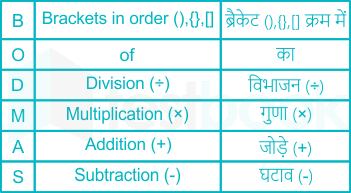
BODMAS Rule (Bracket, Of, Division, Multiplication, Addition, Subtraction)

Calculations:

3 − (5 − 6 ÷ 3)

First, solve the Division inside the bracket:

⇒ 3 − (5 − 2)

Now, solve the Subtraction inside the bracket:

⇒ 3 − 3

Final Subtraction:

⇒ 0

∴ The correct answer is option (3).

Question 52

If 3.2 : x :: x : 16.2, and x > 0, then find the value of x.

  1. AOption (a)

    9.7

  2. BOption (b)

    5.4

  3. COption (c)

    7.2

  4. DOption (d)

    6.3

View answer & explanation

Correct answer

Answer: (c)C.

7.2

Why this answer is correct

Shortcut Trick For a mean proportion x between two numbers a and b, where a : x :: x : b, the formula is x = √(a × b). Given values: a = 3.2 and b = 16.2 x = √(3.2 × 16.2) = √(32/10 × 162/10) = √(5184/100) x = 72/10 = 7.2 ∴ The correct answer is 7.2. Alternate Method

Given: 3.2 : x :: x : 16.2 and x > 0 Formula Used: If a : b :: c : d, then a/b = c/d or ad = bc. ⇒ 3.2 / x = x / 16.2 ⇒ x2 = 3.2 × 16.2 ⇒ x2 = 51.84 ⇒ x = √51.84 ⇒ x = 7.2 ∴ The correct answer is 7.2. Additional Information Mean Proportional The mean proportional between two numbers a and b is a value x such that a : x = x : b, calculated as x = √(ab). Third Proportional If a : b :: b : c, then c is called the third proportional to a and b, where c = b2 / a. Fourth Proportional If a : b :: c : d, then d is the fourth proportional to a, b, and c, calculated as d = (b × c) / a.

Question 53

Which modes of reproduction is used by unicellular organisms?

  1. AOption (a)

    Only budding

  2. BOption (b)

    Only regeneration

  3. COption (c)

    Only fission

  4. DOption (d)

    Budding, regeneration and fission

View answer & explanation

Correct answer

Answer: (d)D.

Budding, regeneration and fission

Why this answer is correct

The correct answer is Budding, regeneration and fission.

Key Points

  • Unicellular organisms primarily reproduce through a process known as binary fission, where a single cell divides into two identical daughter cells.
  • Binary fission is the most common mode of reproduction in prokaryotic organisms such as bacteria.
  • In eukaryotic unicellular organisms, such as amoebas and paramecia, a similar process occurs but involves mitosis followed by cytokinesis.
  • Fission allows for rapid population growth under favorable environmental conditions.

Additional Information

  • Budding
  • Budding is a form of asexual reproduction where a new organism grows from a certain part of the parent organism.
  • This method is commonly seen in yeasts (unicellular fungi) and some other organisms.
  • Regeneration
  • Regeneration is the process of renewal, restoration, and growth that makes genomes, cells, and organisms resilient to damage.
  • While commonly seen in multicellular organisms like starfish, unicellular species utilize various asexual modes including fission and budding to ensure reproduction.
  • Other Modes of Asexual Reproduction
  • Apart from fission, other modes of asexual reproduction include spore formation and fragmentation.

Question 54

The perimeter of a rhombus is 100 cm and one of the diagonals is 40 cm. Then the area of the rhombus is

  1. AOption (a)

    1200 cm2

  2. BOption (b)

    1000 cm2

  3. COption (c)

    500 cm2

  4. DOption (d)

    600 cm2

View answer & explanation

Correct answer

Answer: (d)D.

600 cm2

Why this answer is correct

Shortcut Trick

Side of rhombus = 100 ÷ 4 = 25 cm.

Using Pythagorean triplet in the right-angled triangle formed by half-diagonals: 25, 20, 15.

Second diagonal = 2 × 15 = 30 cm.

Area = (1/2) × 40 × 30 = 600 cm2.

∴ The correct answer is 600 cm2.

Alternate Method

Given: Perimeter = 100 cm, Diagonal 1 (d1) = 40 cm.

Formula Used: Side (a) = Perimeter ÷ 4; Side2 = (d1/2)2 + (d2/2)2; Area = (1/2) × d1 × d2

⇒ Side (a) = 100 ÷ 4 = 25 cm

⇒ Let d2 be the second diagonal.

⇒ 252 = (40/2)2 + (d2/2)2

⇒ 625 = 202 + (d2/2)2

⇒ 625 − 400 = (d2/2)2

⇒ 225 = (d2/2)2

⇒ 15 = d2/2 ⇒ d2 = 30 cm

⇒ Area = (1/2) × 40 × 30

⇒ Area = 20 × 30 = 600 cm2

∴ The correct answer is 600 cm2.

Additional Information

Properties of Rhombus

All four sides are equal, and diagonals bisect each other at right angles (90°).

Area and Perimeter Formula

Area = (1/2) × d1 × d2 and Perimeter = 4 × side.

Side-Diagonal Relationship

4 × side2 = d12 + d22. This is derived from the Pythagoras theorem.

Question 55

Pipe A, pipe B and pipe C together can fill a tank in 20 minutes, but because of the leak all three pipes take 10 minutes more time to fill the tank completely. Find the time in which leak can empty the full tank.

  1. AOption (a)

    40 min

  2. BOption (b)

    60 min

  3. COption (c)

    30 min

  4. DOption (d)

    45 min

View answer & explanation

Correct answer

Answer: (b)B.

60 min

Why this answer is correct

Shortcut Trick

Combined efficiency of (A+B+C) = 1/20 units/min.

Combined efficiency with leak = 1/(20 + 10) = 1/30 units/min.

Leak efficiency = 1/20 − 1/30 = (3 − 2)/60 = 1/60 units/min.

Time to empty = 60/1 = 60 minutes.

∴ The correct answer is 60 min.

Alternate Method

Person/PipeTime (min)Total Work (LCM)Efficiency
(A + B + C)2060 units3
(A + B + C + Leak)302

Given: Filling time = 20 min, Time with leak = 20 + 10 = 30 min.

Calculation:

⇒ Efficiency of (A + B + C) = 3 units/min

⇒ Efficiency of (A + B + C + Leak) = 2 units/min

⇒ Efficiency of Leak = Efficiency of (A + B + C + Leak) − Efficiency of (A + B + C)

⇒ Efficiency of Leak = 2 − 3 = −1 unit/min (Negative sign denotes emptying)

⇒ Time taken by Leak to empty the tank = Total Work ÷ Efficiency of Leak

⇒ Time = 60 ÷ 1 = 60 minutes

∴ The correct answer is 60 min.

Additional Information

Pipes & Cisterns Efficiency

Filling pipes have positive efficiency while emptying pipes or leaks have negative efficiency.

Net Work Formula

Total Time = 1 / (1/T1 + 1/T2 − 1/Tleak) where T represents individual time taken by each component.

Time and Efficiency Relationship

Efficiency is inversely proportional to the time taken to complete a specific task (Work = Efficiency × Time).

Question 56

If a person covers 60 km at a speed of 40 km/h and another distance of 120 km at a speed of 80 km/h, then his average speed for the whole journey is:

  1. AOption (a)

    50 km/h

  2. BOption (b)

    60 km/h

  3. COption (c)

    55 km/h

  4. DOption (d)

    48 km/h

View answer & explanation

Correct answer

Answer: (b)B.

60 km/h

Why this answer is correct

Shortcut Trick

Observe the ratio of Distance and Speed for both parts.

Part 1: 60 km ÷ 40 km/h = 1.5 hours

Part 2: 120 km ÷ 80 km/h = 1.5 hours

Since the time taken for both parts is the same, the Average Speed is simply the arithmetic mean of the speeds.

Average Speed = (40 + 80) ÷ 2 = 60 km/h.

∴ The correct answer is 60 km/h.

Alternate Method

Given:

D1 = 60 km, S1 = 40 km/h

D2 = 120 km, S2 = 80 km/h

Formula Used:

Average Speed = Total Distance ÷ Total Time

Calculations:

⇒ Time for first part (T1) = 60 ÷ 40 = 1.5 hours

⇒ Time for second part (T2) = 120 ÷ 80 = 1.5 hours

⇒ Total Distance = 60 + 120 = 180 km

⇒ Total Time = 1.5 + 1.5 = 3 hours

⇒ Average Speed = 180 ÷ 3 = 60 km/h

∴ The correct answer is 60 km/h.

Additional Information

Equal Time Average Speed

If a journey is divided into parts with equal time durations, the average speed is the simple Arithmetic Mean of the speeds: (v1 + v2 + ... + vn) ÷ n.

Equal Distance Average Speed

If two equal distances are covered at speeds v1 and v2, the average speed is the Harmonic Mean: (2 × v1 × v2) ÷ (v1 + v2).

General Unit Conversion

To convert speed from km/h to m/s, multiply by 5/18. To convert m/s to km/h, multiply by 18/5.

Question 57

Who among the following received the Major Dhyan Chand Khel Ratna Award 2023 from the Indian President in January 2024?

  1. AOption (a)

    Shri Chirag Chandrashekhar Shetty

  2. BOption (b)

    Ms. Aditi Gopichand Swami

  3. COption (c)

    Shri Mohammed Shami

  4. DOption (d)

    Shri Ojas Pravin Deotale

View answer & explanation

Correct answer

Answer: (a)A.

Shri Chirag Chandrashekhar Shetty

Why this answer is correct

The correct answer is Shri Chirag Chandrashekhar Shetty.

Key Points

  • Shri Chirag Chandrashekhar Shetty is an Indian badminton player who has made significant contributions to the sport.
  • In January 2024, he was honored with the Major Dhyan Chand Khel Ratna Award, India's highest sporting honor.
  • This prestigious award was conferred upon him by the President of India in recognition of his outstanding achievements in badminton.
  • He has been a prominent figure in Indian badminton, known for his exceptional skills and dedication to the sport.

Additional Information

  • Major Dhyan Chand Khel Ratna Award
  • It is the highest sporting honor in India, awarded annually by the Ministry of Youth Affairs and Sports.
  • The award is named after Major Dhyan Chand, an Indian field hockey player widely regarded as one of the greatest in the history of the sport.
  • The award was instituted in 1991-1992 and recognizes outstanding performance in sports.
  • Recipients of this award receive a medallion, a certificate, and a cash prize.
  • Chirag Shetty's Achievements
  • He has achieved significant success in both national and international badminton tournaments.
  • He is known for his prowess in doubles, often partnering with Satwiksairaj Rankireddy.
  • Chirag Shetty has represented India in various prestigious tournaments, including the BWF World Championships and the Commonwealth Games.
  • Importance of the Award
  • The Major Dhyan Chand Khel Ratna Award serves as a motivation for athletes to achieve excellence in their respective sports.
  • It brings recognition and encouragement to sportspersons and highlights their contributions to the nation's sports culture.
  • The award also helps in promoting and nurturing young talent in the sports field.

Question 58

A student has to secure 40% marks to pass. He gets 178 marks and fails by 22 marks. The maximum marks is:

  1. AOption (a)

    800

  2. BOption (b)

    1000

  3. COption (c)

    500

  4. DOption (d)

    200

View answer & explanation

Correct answer

Answer: (c)C.

500

Why this answer is correct

Shortcut Trick

Passing Marks = Marks Obtained + Failing Marks = 178 + 22 = 200.

As per the question, Passing Percentage = 40%.

40% → 200

100% → (200 ÷ 40) × 100 = 5 × 100 = 500.

∴ The correct answer is 500.

Alternate Method

Given:

Marks secured by the student = 178

Marks by which the student failed = 22

Minimum passing percentage = 40%

Formula Used:

Passing Marks = Marks Obtained + Failing Marks

Maximum Marks = (Passing Marks ÷ Passing Percentage) × 100

Calculations:

⇒ Passing Marks = 178 + 22

⇒ Passing Marks = 200

⇒ Let the Maximum Marks be M.

⇒ 40% of M = 200

⇒ (40 ÷ 100) × M = 200

⇒ M = (200 × 100) ÷ 40

⇒ M = 5 × 100

⇒ M = 500

∴ The correct answer is 500.

Additional Information

Percentage Calculation

To find the total value when a percentage is known: Total = (Value ÷ Percentage) × 100.

Passing Marks Concept

Passing Marks = Obtained Marks + Failing Marks. If a student gets more than passing marks, then Passing Marks = Obtained Marks − Excess Marks.

Percentage Difference

In problems with two students, the difference in their percentage marks is equal to the difference in their absolute marks.

Question 59

During a chemical reaction, 10 grams of substance A reacts with 15 grams of substance B to produce a new compound. According to the law of conservation of mass, what will be the total mass of the products?

  1. AOption (a)

    25 g

  2. BOption (b)

    10 g

  3. COption (c)

    16 g

  4. DOption (d)

    11 g

View answer & explanation

Correct answer

Answer: (a)A.

25 g

Why this answer is correct

The correct answer is 25 g.

Key Points

  • The law of conservation of mass states that mass is neither created nor destroyed in a chemical reaction.
  • The total mass of reactants equals the total mass of products in a closed system.
  • In the given reaction, 10 grams of substance A reacts with 15 grams of substance B.
  • The total mass of the reactants is 10 g + 15 g = 25 g.
  • Therefore, according to the law of conservation of mass, the total mass of the products will be 25 grams.

Additional Information

  • Law of Conservation of Mass
  • Formulated by Antoine Lavoisier in 1789.
  • States that the mass of an isolated system remains constant over time.
  • Fundamental principle in classical physics and chemistry.
  • Closed System
  • A physical system that does not exchange any matter with its surroundings.
  • Energy can be exchanged in the form of heat or work.
  • Essential for observing the law of conservation of mass.
  • Chemical Reaction
  • A process that leads to the transformation of one set of chemical substances to another.
  • Involves breaking and forming of chemical bonds.
  • Examples include combustion, oxidation, and reduction reactions.
  • Reactants and Products
  • Reactants are the starting substances in a chemical reaction.
  • Products are the substances formed as a result of the chemical reaction.
  • The mass of reactants must equal the mass of products in a closed system as per the law of conservation of mass.

Question 60

Which of the following is/are termed as nucleons?

  1. AOption (a)

    Only electrons

  2. BOption (b)

    Both protons and neutrons

  3. COption (c)

    Only neutrons

  4. DOption (d)

    Only protons 

View answer & explanation

Correct answer

Answer: (b)B.

Both protons and neutrons

Why this answer is correct

The correct answer is Both protons and neutrons.

Key Points

  • Nucleons are particles found in the nucleus of an atom.
  • The term "nucleons" encompasses both protons and neutrons.
  • Protons are positively charged particles, while neutrons are neutral, having no electrical charge.
  • Both protons and neutrons contribute to the atomic mass of an element.
  • Nucleons are bound together in the nucleus by the strong nuclear force, which is one of the four fundamental forces of nature.

Additional Information

  • Electrons:
  • Electrons are negatively charged particles that orbit the nucleus of an atom in electron shells.
  • Unlike protons and neutrons, electrons do not reside in the nucleus.
  • The number of electrons in an atom determines its chemical properties and reactivity.
  • Atomic Number:
  • The atomic number of an element is equal to the number of protons in the nucleus of its atoms.
  • The atomic number defines the identity of an element and its position in the periodic table.
  • Isotopes:
  • Isotopes are variants of a particular chemical element that have the same number of protons but different numbers of neutrons.
  • Isotopes of an element exhibit similar chemical behavior but can have different physical properties, such as different mass numbers and stability.
  • Strong Nuclear Force:
  • The strong nuclear force is the force that holds protons and neutrons together in the nucleus.
  • It is the strongest of the four fundamental forces but operates only over very short distances, on the order of a few femtometers (1 femtometer = 10^-15 meters).
  • This force is essential for the stability of atomic nuclei.

Question 61

Which phenomenon is responsible for the twinkling of a star? 

  1. AOption (a)

    Total internal reflection 

  2. BOption (b)

    Scattering 

  3. COption (c)

    Reflection 

  4. DOption (d)

    Atmospheric refraction 

View answer & explanation

Correct answer

Answer: (d)D.

Atmospheric refraction 

Why this answer is correct

The correct answer is Atmospheric refraction.

Key Points

  • The twinkling of stars is primarily caused by atmospheric refraction.
  • As starlight passes through the Earth's atmosphere, it is refracted (bent) due to the varying density and temperature layers in the atmosphere.
  • This refraction causes the light from stars to change direction slightly, making the stars appear to shift position and intensity, which is perceived as twinkling.
  • The phenomenon is more pronounced for stars closer to the horizon because their light passes through a greater thickness of the Earth's atmosphere compared to stars overhead.
  • Planets do not twinkle as much as stars because they are closer to Earth and their apparent size is larger, averaging out the effects of atmospheric refraction.

Additional Information

  • Atmospheric Refraction
  • It is the bending of light as it passes through the Earth's atmosphere.
  • The degree of refraction depends on the temperature gradient and the density of the atmospheric layers.
  • This bending causes celestial objects to appear slightly higher in the sky than their true positions.
  • Atmospheric refraction also affects the apparent shape and color of the sun and moon near the horizon, causing phenomena such as the green flash at sunset or sunrise.
  • Scintillation
  • Scintillation refers to the rapid variation in the brightness and color of starlight due to atmospheric turbulence.
  • It is responsible for the twinkling effect observed in stars.
  • The phenomenon is less noticeable in planets due to their larger apparent size.
  • Optical Turbulence
  • Optical turbulence is the random fluctuation in the refractive index of the atmosphere.
  • It is caused by the turbulent mixing of air at different temperatures and densities.
  • Optical turbulence is a key factor in the twinkling of stars and the blurring of astronomical images.
  • Adaptive Optics
  • Adaptive optics is a technology used in telescopes to compensate for the effects of atmospheric turbulence.
  • It involves real-time adjustments to the telescope's optics to correct for the blurring caused by the atmosphere.
  • This technology significantly improves the resolution of ground-based astronomical observations.

Question 62

According to the Newton's third law of motion, to every action:

  1. AOption (a)

    there is an equal and perpendicular reaction and they act on two different bodies 

  2. BOption (b)

    there is an unequal and opposite reaction and they act on the same body

  3. COption (c)

    there is an equal and opposite reaction and they act on two different bodies 

  4. DOption (d)

    there is an equal and opposite reaction and they act on the same body

View answer & explanation

Correct answer

Answer: (c)C.

there is an equal and opposite reaction and they act on two different bodies 

Why this answer is correct

The correct answer is there is an equal and opposite reaction and they act on two different bodies.

Key Points

  • Newton's third law states: "For every action, there is an equal and opposite reaction."
  • The action and reaction forces act on two different bodies.
  • This law explains the principle of conservation of momentum in isolated systems.
  • The equal and opposite forces are of the same type (e.g., both are gravitational, electromagnetic, etc.).

Additional Information

  • Newton's Laws of Motion:
  • First Law: An object remains at rest or in uniform motion unless acted upon by a net external force (law of inertia).
  • Second Law: The acceleration of an object is directly proportional to the net force acting on it and inversely proportional to its mass (F = ma).
  • Applications:
  • Rocket propulsion: Exhaust gases exert a force on the rocket, and the rocket exerts an equal and opposite force on the gases.
  • Walking: When you push the ground backward with your foot, the ground pushes you forward with an equal and opposite force.
  • Conservation of Momentum:
  • In a closed system, the total momentum before and after an event remains constant.
  • Newton's third law is fundamental to the principle of conservation of momentum.
  • Examples in Nature:
  • Birds flying: Wings push air downwards and backwards, and air pushes wings upwards and forwards.
  • Swimming: Swimmers push water backwards with their hands and feet, and water pushes them forward.

Question 63

Addition of 22 kg 589 g and 19 kg 678 g results in:

  1. AOption (a)

    41 kg 267 g

  2. BOption (b)

    41 kg 367 g

  3. COption (c)

    42 kg 267 g

  4. DOption (d)

    42 kg 367 g

View answer & explanation

Correct answer

Answer: (c)C.

42 kg 267 g

Why this answer is correct

Shortcut Trick

Add kilograms and grams separately.

Total Kg = 22 + 19 = 41 kg

Total Grams = 589 + 678 = 1267 g

Since 1000 g = 1 kg, then 1267 g = 1 kg 267 g

Final sum = 41 kg + 1 kg 267 g = 42 kg 267 g

∴ The correct answer is 42 kg 267 g.

Alternate Method

Given: First weight = 22 kg 589 g, Second weight = 19 kg 678 g

Formula Used: 1 kg = 1000 g

⇒ Sum of Grams = 589 + 678 = 1267 g

⇒ Carry over to Kg = 1267 ÷ 1000 = 1 kg (remainder 267 g)

⇒ Sum of Kg = 22 + 19 + 1 (carry) = 42 kg

⇒ Result = 42 kg 267 g

∴ The correct answer is 42 kg 267 g.

Additional Information

Metric Conversion

Standard unit of mass is gram. 1 kilogram (kg) = 1000 grams (g), 1 gram = 1000 milligrams (mg).

Addition Rule for Compound Units

When adding compound units like kg and g, if the sum of lower units exceeds the conversion base (1000), carry over the quotient to the higher unit.

Question 64

Which of the following is a reflex action?

  1. AOption (a)

    Talking to a child

  2. BOption (b)

    Pulling hand from the flame

  3. COption (c)

    Walking on the street

  4. DOption (d)

    Dancing on the stage

View answer & explanation

Correct answer

Answer: (b)B.

Pulling hand from the flame

Why this answer is correct

The correct answer is Pulling hand from the flame.

Key Points

  • Reflex actions are automatic and rapid responses to a stimulus that do not require conscious thought.
  • Pulling your hand away from a flame is a classic example of a reflex action, specifically a withdrawal reflex.
  • This action is controlled by the spinal cord, not the brain, which allows for a much quicker response to potential danger.
  • The reflex arc is the neural pathway that mediates this action, involving sensory neurons, interneurons, and motor neurons.

Additional Information

  • Reflex Arc:
  • The reflex arc is the neural pathway that controls a reflex action.
  • It typically involves a sensory neuron, an interneuron, and a motor neuron.
  • The sensory neuron detects a stimulus and sends a signal to the interneuron in the spinal cord, which then activates the motor neuron to produce a response.
  • Types of Reflexes:
  • Monosynaptic reflexes: Involve only one synapse between the sensory and motor neurons (e.g., knee-jerk reflex).
  • Polysynaptic reflexes: Involve multiple synapses with one or more interneurons (e.g., withdrawal reflex).
  • Autonomic Reflexes:
  • These reflexes regulate the activity of smooth muscles, the heart, and glands.
  • Examples include the regulation of blood pressure, digestion, and pupil size.
  • Somatic Reflexes:
  • These reflexes involve the skeletal muscles.
  • Examples include the stretch reflex and withdrawal reflex.

Question 65

Shakti starts from Point A and drives 22 km towards South. He then takes a left turn, drives 20 km, turns left and drives 12 km. He then takes a left turn and drives 17 km. He takes a final right turn, drives 10 km and stops at Point P. How far (shortest distance) and towards which direction should he drive in order to reach Point A again?

(All turns are 90 degree turns only unless otherwise specified.)

  1. AOption (a)

    3 km towards South

  2. BOption (b)

    2 km towards East

  3. COption (c)

    3 km towards West

  4. DOption (d)

    4 km towards North

View answer & explanation

Correct answer

Answer: (c)C.

3 km towards West

Why this answer is correct

Given:

Shakti starts from Point A and drives 22 km towards South.

He then takes a left turn, drives 20 km, turns left and drives 12 km.

He then takes a left turn and drives 17 km.

He takes a final right turn, drives 10 km and stops at Point P.

Thus, Shakti should drive (20 km - 17 km) 3 km in the west direction in order to reach Point A again.

Hence, "Option 3" is the correct answer.

Question 66

MILH is related to KGJF in a certain way based on the English alphabetical order. In the same way, QMPL is related to OKNJ. To which of the following options is TPSO related, following the same logic?

  1. AOption (a)

    RNMQ

  2. BOption (b)

    NRMO

  3. COption (c)

    NRQM

  4. DOption (d)

    RNQM

View answer & explanation

Correct answer

Answer: (d)D.

RNQM

Why this answer is correct

The logic followed here is:

MILH is related to KGJF

And,

QMPL is related to OKNJ

Similarly,

TPSO is related to

Hence, "Option 4" is the correct answer.

Question 67

How many spherical solid marbles, each having a radius of 0.2 cm, can be made from a solid sphere having a radius of 6 cm? 

  1. AOption (a)

    27000

  2. BOption (b)

    21000

  3. COption (c)

    9000

  4. DOption (d)

    18000

View answer & explanation

Correct answer

Answer: (a)A.

27000

Why this answer is correct

Shortcut Trick

Number of marbles = (Radius of larger sphere ÷ Radius of smaller marble)3

Ratio of radii = 6 ÷ 0.2 = 30

Number of marbles = 303 = 27000

∴ The correct answer is 27000 marbles.

Alternate Method

Given:

Radius of solid sphere (R) = 6 cm

Radius of each spherical marble (r) = 0.2 cm

Formula Used:

Volume of a sphere = (4/3) × π × radius3

Number of marbles (n) = Total Volume ÷ Volume of one marble

Calculations:

⇒ n × [(4/3) × π × r3] = (4/3) × π × R3

⇒ n = R3 ÷ r3

⇒ n = 63 ÷ (0.2)3

⇒ n = 216 ÷ 0.008

⇒ n = 216000 ÷ 8

⇒ n = 27000

∴ The correct answer is 27000 marbles.

Additional Information

Volume of Sphere

The amount of space inside a sphere is V = (4/3)πr3, where r is the radius.

Recasting Rule

When one solid is melted and recast into multiple smaller solids, the total volume remains constant.

Surface Area of Sphere

The total surface area of a sphere is given by the formula 4πr2.

Question 68

Which city was identified as the most polluted in 2023 according to the Sixth Annual World Air Quality Report?

  1. AOption (a)

    Delhi

  2. BOption (b)

    Mumbai 

  3. COption (c)

    Kolkata

  4. DOption (d)

    Begusarai

View answer & explanation

Correct answer

Answer: (d)D.

Begusarai

Why this answer is correct

The correct answer is Begusarai.

Key Points

  • Begusarai has been identified as the most polluted city in 2023 according to the Sixth Annual World Air Quality Report.
  • The report highlights that Begusarai has the highest concentration of PM2.5 particles in the air, which are harmful to human health.
  • PM2.5 levels in Begusarai have significantly surpassed the safe limit set by the World Health Organization (WHO).
  • This alarming level of air pollution is attributed to factors such as industrial emissions, vehicular pollution, and biomass burning.
  • The findings call for urgent measures to control and reduce air pollution in Begusarai to protect public health.

Additional Information

  • PM2.5 Particles
  • PM2.5 refers to particulate matter that is less than 2.5 micrometers in diameter.
  • These particles can penetrate deeply into the respiratory system and cause health issues such as respiratory infections, heart disease, and lung cancer.
  • World Health Organization (WHO) Air Quality Guidelines
  • The WHO sets guidelines for air quality to protect public health from the adverse effects of air pollution.
  • The recommended safe limit for PM2.5 is 10 µg/m³ (annual mean).
  • Sources of Air Pollution
  • Common sources include industrial emissions, vehicular exhaust, construction activities, and burning of biomass and fossil fuels.
  • Natural sources such as dust storms and wildfires also contribute to air pollution.
  • Health Effects of Air Pollution
  • Short-term exposure can cause symptoms like irritation of the eyes, nose, and throat, coughing, and shortness of breath.
  • Long-term exposure can lead to chronic respiratory diseases, cardiovascular diseases, and increased mortality rates.
  • Measures to Reduce Air Pollution
  • Implementing stricter emission standards for industries and vehicles.
  • Promoting the use of public transportation and cleaner fuels.
  • Increasing green cover through afforestation and urban green spaces.
  • Raising public awareness about the health impacts of air pollution and encouraging community actions.

Question 69

Transparency International’s Corruption Perceptions Index ranked India _______ out of 180 countries, indicating a persistent struggle with public sector corruption. 

  1. AOption (a)

    96th

  2. BOption (b)

    83rd

  3. COption (c)

    73rd

  4. DOption (d)

    103rd

View answer & explanation

Correct answer

Answer: (a)A.

96th

Why this answer is correct

The correct answer is 96th.

Key Points

  • Transparency International's Corruption Perceptions Index (CPI) is a global measure of corruption in the public sector.
  • In the 2024 CPI, India was ranked 96th out of 180 countries.
  • This ranking reflects India's ongoing struggle with corruption issues within its public sector.
  • The CPI score ranges from 0 (highly corrupt) to 100 (very clean), and India's score has been relatively stable in recent years.
  • India's CPI score in 2024 was 38, highlighting the need for continued efforts to combat corruption.

Additional Information

  • Transparency International:
  • Founded in 1993, it is an international non-governmental organization working to combat global corruption.
  • It is headquartered in Berlin, Germany, and operates through more than 100 national chapters worldwide.
  • Transparency International publishes the Corruption Perceptions Index annually.
  • Corruption Perceptions Index (CPI):
  • The CPI is a composite index that ranks countries by their perceived levels of public sector corruption.
  • It is based on expert assessments and opinion surveys.
  • The CPI is widely used as a key indicator of corruption globally.
  • Impact of Corruption:
  • Corruption undermines democracy and the rule of law.
  • It leads to the misallocation of resources and hampers economic development.
  • Corruption adversely affects public services and the overall quality of life.
  • Efforts to Combat Corruption in India:
  • The Indian government has implemented various measures such as the Lokpal and Lokayuktas Act.
  • Strengthening of anti-corruption agencies like the Central Vigilance Commission (CVC) and the Central Bureau of Investigation (CBI).
  • Introduction of technology-based initiatives like e-governance to reduce corruption.

Question 70

Which of the following are parts of the peripheral nervous system?

  1. AOption (a)

    Both cranial and spinal nerves

  2. BOption (b)

    Only spinal nerves

  3. COption (c)

    Only cranial nerves

  4. DOption (d)

    Neither cranial nor spinal nerves

View answer & explanation

Correct answer

Answer: (a)A.

Both cranial and spinal nerves

Why this answer is correct

The correct answer is Both cranial and spinal nerves.

Key Points

  • The peripheral nervous system (PNS) consists of all the nerves that lie outside the brain and spinal cord.
  • It includes 12 pairs of cranial nerves and 31 pairs of spinal nerves.
  • The cranial nerves originate from the brain and primarily serve the head and neck region.
  • The spinal nerves originate from the spinal cord and serve the rest of the body.
  • The PNS is responsible for transmitting sensory and motor information to and from the central nervous system (CNS).

Additional Information

  • Central Nervous System (CNS)
  • It consists of the brain and spinal cord.
  • The CNS is responsible for processing and interpreting sensory information and sending out instructions.
  • Autonomic Nervous System (ANS)
  • It is a part of the PNS that controls involuntary bodily functions.
  • The ANS is divided into the sympathetic and parasympathetic nervous systems.
  • Somatic Nervous System
  • It is another part of the PNS that controls voluntary movements.
  • The somatic nervous system transmits sensory and motor signals to and from the CNS.
  • Neurons
  • They are the basic building blocks of the nervous system.
  • Neurons transmit information through electrical and chemical signals.

Question 71

Two numbers are in the ratio 4 : 1. If difference between the numbers is 54, then find the greater number.

  1. AOption (a)

    90

  2. BOption (b)

    56

  3. COption (c)

    42

  4. DOption (d)

    72

View answer & explanation

Correct answer

Answer: (d)D.

72

Why this answer is correct

Shortcut Trick

Ratio of numbers → 4 : 1

Difference in ratio units → 4 − 1 = 3 units

According to question, 3 units → 54

1 unit → 54 ÷ 3 = 18

Greater number (4 units) → 4 × 18 = 72

∴ The correct answer is 72.

Alternate Method

Given:

Ratio of numbers = 4 : 1

Difference between numbers = 54

Let the numbers be 4x and 1x.

⇒ 4x − 1x = 54

⇒ 3x = 54

⇒ x = 54 ÷ 3

⇒ x = 18

Greater number = 4x

⇒ 4 × 18 = 72

∴ The correct answer is 72.

Additional Information

Ratio and Proportion

A ratio compares two quantities by division. If a : b is the ratio, the numbers can be assumed as ax and bx where x is the common multiplier.

Invertendo and Alternendo

If a/b = c/d, then b/a = d/c (Invertendo) and a/c = b/d (Alternendo).

Sum of Numbers in Ratio

If ratio is a : b and sum is S, the numbers are [a/(a+b)] × S and [b/(a+b)] × S.

Question 72

How long will it take for Rs. 1,500 to become ₹2,040 at 6% per annum simple interest?

  1. AOption (a)

    4 years

  2. BOption (b)

    5345\frac{3}{4} years

  3. COption (c)

    6 years

  4. DOption (d)

    4124\frac{1}{2} years

View answer & explanation

Correct answer

Answer: (c)C.

6 years

Why this answer is correct

Shortcut Trick

Total Interest = 2040 − 1500 = ₹540

Interest for 1 year = 6% of 1500 = ₹90

Time = Total Interest ÷ Interest per year = 540 ÷ 90 = 6 years

∴ The correct answer is 6 years.

Alternate Method

Given:

Principal (P) = ₹1,500

Amount (A) = ₹2,040

Rate (R) = 6% per annum

Formula Used:

Simple Interest (SI) = Amount − Principal

Time (T) = (SI × 100) ÷ (P × R)

Calculations:

⇒ SI = 2040 − 1500 = ₹540

⇒ T = (540 × 100) ÷ (1500 × 6)

⇒ T = 54000 ÷ 9000

⇒ T = 6 years

∴ The correct answer is 6 years.

Additional Information

Simple Interest Formula

SI = (P × R × T) ÷ 100, where P is Principal, R is Rate, and T is Time.

Amount Calculation

Total Amount (A) = P + SI = P × [1 + (R × T) ÷ 100].

SI vs CI Difference

For the first year, if interest is compounded annually, SI and CI are always equal.

Question 73

Which of the following is/are related to the practical applications of electricity in daily life?

(A) Electric oven.

(B) Electric laundry iron.

(C) Solar water heater

  1. AOption (a)

    Only (A) and (B)

  2. BOption (b)

    (A), (B) and (C)

  3. COption (c)

    Only (B) and (C) 

  4. DOption (d)

    Only (A) and (C)

View answer & explanation

Correct answer

Answer: (a)A.

Only (A) and (B)

Why this answer is correct

The correct answer is Only (A) and (B).

Key Points

  • Electric oven — Uses electricity directly to generate heat.
  • Electric laundry iron — Also uses electricity directly for heating.
  • Solar water heater — Primarily uses solar energy (sunlight) to heat water, not electricity.
  • So, only (A) and (B) are related to practical applications of electricity in daily life.

Additional Information

  • Electricity in Domestic Use
  • Electricity powers a range of household appliances including refrigerators, washing machines, and air conditioners, enhancing modern living standards.
  • Electric lights provide illumination, significantly extending the usable hours of the day.
  • Home entertainment systems, such as televisions and computers, rely on electricity, contributing to leisure and connectivity.
  • Renewable Energy Applications
  • Solar panels convert sunlight into electricity, representing a clean and sustainable energy source.
  • Wind turbines harness wind energy to generate electricity, contributing to renewable energy production.
  • Energy Efficiency
  • Energy-efficient appliances reduce electricity consumption and lower utility bills.
  • Smart home systems allow for automated control of electrical devices, enhancing energy management.
  • Electricity in Communication
  • Electricity is critical for powering communication devices such as smartphones, routers, and servers.
  • The internet and telecommunication infrastructure rely heavily on a stable electrical supply.

Question 74

A resistor has current flowing through it. If its resistance is halved while the voltage across it is kept constant, what will be the change in current?

  1. AOption (a)

    It will be halved.

  2. BOption (b)

    It will be doubled.

  3. COption (c)

    It will become zero.

  4. DOption (d)

    It will remain the same.

View answer & explanation

Correct answer

Answer: (b)B.

It will be doubled.

Why this answer is correct

The correct answer is It will be doubled..

Key Points

  • Ohm's Law states that the current (I) flowing through a resistor is directly proportional to the voltage (V) across it and inversely proportional to the resistance (R). The formula is I = V/R.
  • If the resistance (R) is halved and the voltage (V) remains constant, the current (I) will increase.
  • Mathematically, if the initial resistance is R and it is halved to R/2, the new current will be I_new = V / (R/2) = 2V/R = 2I_initial.
  • Therefore, halving the resistance while keeping the voltage constant will result in the current being doubled.

Additional Information

  • Ohm's Law:
  • Formulated by Georg Simon Ohm in 1827.
  • Defines the relationship between voltage, current, and resistance in an electrical circuit.
  • Expressed as V = IR, where V is voltage, I is current, and R is resistance.
  • Resistance:
  • Measured in ohms (Ω).
  • Determines how much a material opposes the flow of electric current.
  • Factors affecting resistance include material, length, cross-sectional area, and temperature.
  • Current:
  • Measured in amperes (A).
  • Represents the flow of electric charge in a circuit.
  • Can be direct (DC) or alternating (AC).
  • Voltage:
  • Measured in volts (V).
  • Represents the electrical potential difference between two points.
  • Provides the driving force that pushes the current through the circuit.

Question 75

In chemical industries, bleaching powder is used as:

  1. AOption (a)

    a fire extinguisher

  2. BOption (b)

    an oxidising agent

  3. COption (c)

    a reducing agent

  4. DOption (d)

    a dehydrating agent

View answer & explanation

Correct answer

Answer: (b)B.

an oxidising agent

Why this answer is correct

The correct answer is an oxidising agent.

Key Points

  • Bleaching powder (Calcium hypochlorite) is a strong oxidising agent, which means it can donate oxygen to other substances and oxidize them.
  • It is commonly used in chemical industries for bleaching paper pulp, textiles, and disinfecting drinking water due to its ability to kill bacteria and other pathogens.
  • Bleaching powder releases chlorine when exposed to air and moisture, which contributes to its oxidising properties.
  • It is widely used in the textile industry to bleach cotton and linen and in the paper industry to bleach wood pulp.

Additional Information

  • Oxidising Agents
  • Oxidising agents are substances that can accept electrons and bring about oxidation of other substances.
  • Common oxidising agents include substances like hydrogen peroxide, potassium permanganate, and chlorine.
  • They are used in various industrial processes including disinfection, bleaching, and water treatment.
  • Calcium Hypochlorite
  • Calcium hypochlorite, commonly known as bleaching powder, is a white solid, often used for water treatment and as a bleaching agent.
  • Its chemical formula is Ca(ClO)2.
  • It is more stable than sodium hypochlorite (liquid bleach) and has a longer shelf life.
  • Disinfection Process
  • Disinfection involves the elimination of most or all pathogenic microorganisms, except bacterial spores, from inanimate objects.
  • Bleaching powder is used to disinfect drinking water and swimming pools by killing harmful microorganisms.
  • Safety Measures
  • When handling bleaching powder, it is important to use protective gear, such as gloves and masks, to avoid irritation and inhalation of fumes.
  • It should be stored in a dry, cool place away from organic materials and acids to prevent hazardous reactions.

Question 76

Find the simple interest on ₹700 at 9% per month in 7 months.

  1. AOption (a)

    ₹441

  2. BOption (b)

    ₹464

  3. COption (c)

    ₹444

  4. DOption (d)

    ₹461

View answer & explanation

Correct answer

Answer: (a)A.

₹441

Why this answer is correct

Shortcut Trick

Interest for 1 month → 9% of ₹700 = ₹63

Interest for 7 months → 7 × ₹63 = ₹441

∴ The correct answer is ₹441.

Alternate Method

Given:

Principal (P) = ₹700

Rate (R) = 9% per month

Time (T) = 7 months

Formula Used:

Simple Interest (SI) = (P × R × T) ÷ 100

Calculations:

⇒ SI = (700 × 9 × 7) ÷ 100

⇒ SI = 7 × 9 × 7

⇒ SI = 63 × 7

⇒ SI = 441

∴ The correct answer is ₹441.

Additional Information

Simple Interest Consistency

Always ensure that the Rate and Time are in the same unit (both monthly or both yearly) before applying the formula.

Total Amount Formula

The total Amount (A) to be paid back is the sum of Principal and Simple Interest: A = P + SI.

Unit Conversion

To convert a monthly rate to an annual rate, multiply by 12. In this case, 9% p.m. = 108% per annum.

Question 77

The SI unit of force is:

  1. AOption (a)

    Dyne

  2. BOption (b)

    m/s

  3. COption (c)

    Newton

  4. DOption (d)

    rad/s

View answer & explanation

Correct answer

Answer: (c)C.

Newton

Why this answer is correct

The correct answer is Newton.

Key Points

  • The SI unit of force is called the Newton, symbolized as "N".
  • One Newton is defined as the amount of force required to accelerate a 1 kilogram mass by 1 meter per second squared (1 N = 1 kg·m/s²).
  • The Newton is named after Sir Isaac Newton in recognition of his work in classical mechanics, particularly Newton's Laws of Motion.
  • The unit was adopted in the International System of Units (SI) in 1948 during the 9th General Conference on Weights and Measures (CGPM).

Additional Information

  • Dyne
  • A dyne is a unit of force in the centimeter-gram-second (CGS) system of units.
  • It is equal to 10^-5 Newtons (1 dyne = 10^-5 N).
  • Newton's Laws of Motion
  • There are three fundamental laws that describe the relationship between the motion of an object and the forces acting on it.
  • These laws form the foundation of classical mechanics.
  • Force
  • In physics, force is an interaction that, when unopposed, will change the motion of an object.
  • It can be described as a push or pull on an object resulting from the object's interaction with another object.
  • SI Units
  • The International System of Units (SI) is the modern form of the metric system.
  • It is the most widely used system of measurement, established in 1960.

Question 78

Read the given statements and conclusions carefully. You have to take the given statements to be true even if they seem to be at variance from commonly known facts and decide which conclusion(s) logically follow(s) from the given statements.

Statements:

All onions are tomatoes.

Some tomatoes are potatoes.

Conclusions:

I. At least some tomatoes are onions.

II. Some onions are potatoes.

  1. AOption (a)

    Neither conclusion I nor II follows

  2. BOption (b)

    Both conclusions I and II follow

  3. COption (c)

    Only conclusion II follows 

  4. DOption (d)

    Only conclusion I follows 

View answer & explanation

Correct answer

Answer: (d)D.

Only conclusion I follows 

Why this answer is correct

The least possible Venn diagram for the given statements is as shown below :

Conclusions:

I. At least some tomatoes are onions → Follow (As all onions are tomatoes. As whole onions comes in tomatoes, therefore it is true.)

II. Some onions are potatoes → Does not follow (As all onions are tomatoes and some tomatoes are potatoes. So it is possible but not definite.)

∴ Here, Only conclusion I follows.​

Hence, the correct answer is "Option 4"

Question 79

Which of the following options should come in place of the question mark (?) in the given series based on the English alphabetical order?

HKN, ILO, JMP, KNQ ?

  1. AOption (a)

    LOR

  2. BOption (b)

    OLR

  3. COption (c)

    LRO

  4. DOption (d)

    ORL

View answer & explanation

Correct answer

Answer: (a)A.

LOR

Why this answer is correct

The logic followed here is:

Hence, "Option 1" is the correct answer.

Question 80

Which of the following pairs is an example of a solid state of matter?

  1. AOption (a)

    Sugar and sponge

  2. BOption (b)

    Water and oxygen

  3. COption (c)

    Juice and milk

  4. DOption (d)

    Oil and sugar

View answer & explanation

Correct answer

Answer: (a)A.

Sugar and sponge

Why this answer is correct

The correct answer is Sugar and sponge.

Key Points

  • Sugar is a crystalline solid that retains its shape and volume under standard conditions.
  • Sponge is a porous solid material that can compress and return to its original shape, demonstrating solid-state characteristics.
  • Both sugar and sponge have a defined shape and volume, which are key characteristics of solids.
  • Unlike liquids or gases, the molecules in solids such as sugar and sponge are closely packed together, providing rigidity and stability.

Additional Information

  • States of Matter:
  • The three primary states of matter are solid, liquid, and gas.
  • Solids have a fixed shape and volume, liquids have a fixed volume but take the shape of their container, and gases neither have a fixed shape nor a fixed volume.
  • Properties of Solids:
  • Solids are characterized by their rigidity and resistance to changes in shape or volume.
  • The particles in a solid are tightly packed in a regular pattern, which gives solids their definite shape and volume.
  • Crystalline and Amorphous Solids:
  • Crystalline solids, like sugar, have an orderly structure with repeating patterns.
  • Amorphous solids, like sponges, do not have a long-range order and can be more flexible in shape.
  • Compressibility:
  • Solids generally have low compressibility compared to liquids and gases.
  • Sponge is an exception due to its porous structure, allowing it to compress and expand.

Question 81

Who among the following received the 2024 Padma Bhushan award for Literature and Education-Journalism?

  1. AOption (a)

    Ram Naik

  2. BOption (b)

    Pyarelal Sharma

  3. COption (c)

    Ashwin B Mehta

  4. DOption (d)

    Hormusji N Cama

View answer & explanation

Correct answer

Answer: (d)D.

Hormusji N Cama

Why this answer is correct

The correct answer is Hormusji N Cama.

Key Points

  • Hormusji N Cama is a renowned figure in the field of Literature and Education-Journalism.
  • He has been honored with the prestigious Padma Bhushan award in the year 2024.
  • The Padma Bhushan is the third-highest civilian award in India, recognizing distinguished service of a high order.
  • Hormusji N Cama has significantly contributed to the field of journalism, particularly in promoting ethical journalism and media integrity.

Additional Information

  • Padma Awards
  • The Padma Awards are one of the highest civilian honors in India, instituted in 1954.
  • The awards are given in three categories: Padma Vibhushan, Padma Bhushan, and Padma Shri.
  • These awards are announced annually on the occasion of Republic Day.
  • The Padma Vibhushan is awarded for exceptional and distinguished service, the Padma Bhushan for distinguished service of a high order, and the Padma Shri for distinguished service in any field.
  • Ethical Journalism
  • Ethical journalism involves maintaining integrity, impartiality, and fairness in reporting news.
  • It emphasizes the importance of accuracy, verification, and accountability.
  • Journalists are expected to avoid conflicts of interest and to respect the privacy and dignity of individuals.
  • Promoting ethical journalism helps in building public trust and ensuring the credibility of media organizations.
  • Media Integrity
  • Media integrity refers to the ethical standards and professional conduct of journalists and media organizations.
  • It involves transparency, unbiased reporting, and accountability to the public.
  • Maintaining media integrity is crucial for preserving the democratic function of the press as a watchdog.
  • Efforts to ensure media integrity include self-regulation, adherence to journalistic codes of conduct, and independent oversight bodies.

Question 82

An object floats on a liquid if the density of the object is:

  1. AOption (a)

    greater than the density of the liquid

  2. BOption (b)

    equal to the density of the liquid

  3. COption (c)

    exactly twice the density of the liquid

  4. DOption (d)

    less than the density of the liquid

View answer & explanation

Correct answer

Answer: (d)D.

less than the density of the liquid

Why this answer is correct

The correct answer is less than the density of the liquid.

Key Points

  • An object will float on a liquid if its density is less than the density of the liquid.
  • This is due to the principle of buoyancy, where the upward buoyant force exerted by the liquid balances the weight of the object.
  • If the density of the object is higher than the liquid, it will sink because the weight of the object is greater than the buoyant force.
  • Objects with density equal to the liquid's density will remain suspended at any depth within the liquid.

Additional Information

  • Buoyancy
  • Buoyancy is the force exerted by a fluid that opposes the weight of an immersed object.
  • The magnitude of the buoyant force is equal to the weight of the fluid displaced by the object.
  • Archimedes' Principle
  • It states that the buoyant force on an object is equal to the weight of the fluid displaced by the object.
  • This principle helps in determining whether an object will float or sink in a fluid.
  • Density
  • Density is defined as mass per unit volume and is usually expressed in kilograms per cubic meter (kg/m³).
  • It is a key factor in determining whether an object will float or sink in a fluid.
  • Specific Gravity
  • Specific gravity is the ratio of the density of a substance to the density of a reference substance (typically water).
  • If the specific gravity of an object is less than 1, it will float in water.

Question 83

In this question, a statement is followed by two courses of action, numbered I and II. You must assume everything in the statement to be true and on the basis of the information given in the statement, decide which of the courses of action logically follow(s) for pursuing.

Statement:

Air quality in City A has significantly deteriorated over the last decade due to increased industrial emissions.

Courses of Action:

I. Authorities of City A should implement strict emission control regulations for industries in the city.

II. The industries should distribute face masks to the residents of City A to protect them from the poor air quality.

  1. AOption (a)

    Both I and II follow 

  2. BOption (b)

    Only I follows 

  3. COption (c)

    Neither I nor II follows 

  4. DOption (d)

    Only II follows 

View answer & explanation

Correct answer

Answer: (b)B.

Only I follows 

Why this answer is correct

Given statement: Air quality in City A has significantly deteriorated over the last decade due to increased industrial emissions.

Given courses of Action:

I. Authorities of City A should implement strict emission control regulations for industries in the city. → Follow

Implementing strict emission control measures for industries directly targets the root cause of worsening air quality. Since industrial emissions are the primary factor behind the decline, enforcing regulations would be a logical and effective solution.

II. The industries should distribute face masks to the residents of City A to protect them from the poor air quality. → Does not follow

Providing face masks to residents might offer temporary protection, but it does not address the underlying issue of rising pollution levels. While such a measure can reduce immediate health risks, it does not contribute to a long-term solution.

Hence, "Option 2" is the correct answer.

Question 84

When Planaria is cut into many pieces each piece grows into a complete organism. What is this known as?

  1. AOption (a)

    Binary fission

  2. BOption (b)

    Regeneration

  3. COption (c)

    Fragmentation

  4. DOption (d)

    Multiple fission

View answer & explanation

Correct answer

Answer: (b)B.

Regeneration

Why this answer is correct

The correct answer is Regeneration.

Key Points

  • Regeneration is the process by which organisms replace or restore lost or amputated body parts.
  • Planaria are a type of flatworm capable of regenerating an entire organism from a small fragment of their body.
  • This process involves the proliferation of stem cells called neoblasts, which differentiate into various cell types needed for regeneration.
  • Regeneration in Planaria is a highly studied phenomenon, providing insights into cellular differentiation and developmental biology.

Additional Information

  • Binary Fission
  • A form of asexual reproduction where a single organism divides into two parts, each becoming a new organism.
  • Commonly observed in prokaryotic microorganisms like bacteria and archaea.
  • Fragmentation
  • A form of asexual reproduction where an organism is split into fragments, each of which develops into a new organism.
  • Common in organisms like starfish, some annelid worms, and fungi.
  • Multiple Fission
  • A form of asexual reproduction where a single organism divides into multiple daughter cells simultaneously.
  • Seen in some protozoa, such as Plasmodium (the malaria parasite).
  • Neoblasts
  • Pluripotent stem cells found in Planaria responsible for their regenerative abilities.
  • These cells can differentiate into various cell types required for tissue regeneration and repair.

Question 85

Plaster of Paris is prepared when:

  1. AOption (a)
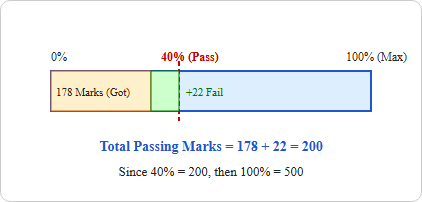
    brine is heated at 373 K and it loses water molecules

  2. BOption (b)

    ammonia is heated at 373 K and it loses water molecules

  3. COption (c)

    soda lime is heated at 373 K and it loses water molecules

  4. DOption (d)

    gypsum is heated at 373 K and it loses water molecules

View answer & explanation

Correct answer

Answer: (d)D.

gypsum is heated at 373 K and it loses water molecules

Why this answer is correct

The correct answer is gypsum is heated at 373 K and it loses water molecules.

Key Points

  • Plaster of Paris is chemically known as calcium sulfate hemihydrate.
  • It is prepared by heating gypsum (calcium sulfate dihydrate) at about 373 K (100°C).
  • During this process, gypsum loses water molecules to form Plaster of Paris.
  • The chemical equation for this process is:

CaSO4·2H2O (gypsum) → CaSO4·0.5H2O (Plaster of Paris) + 1.5H2O

Additional Information

  • Gypsum: A mineral composed of calcium sulfate dihydrate, with the chemical formula CaSO4·2H2O.
  • Calcium sulfate hemihydrate: The chemical name for Plaster of Paris, with the formula CaSO4·0.5H2O.
  • Uses of Plaster of Paris: Commonly used for making sculptures, molds, and casts; also in construction for finishing walls and ceilings.
  • Setting reaction: When mixed with water, Plaster of Paris rehydrates and sets into a hard solid, reforming into gypsum.
  • Temperature control: The heating temperature must be controlled carefully to ensure proper formation of Plaster of Paris without decomposing it to anhydrous calcium sulfate.

Question 86

Seven boxes A, B, C, L, X, Y and Z are kept one over the other but not necessarily in the same order. Only three boxes are kept above X. Only one box is kept between Z and X. Only three boxes are kept between Z and A. A is kept at some place above X. C is kept immediately below A. L is kept at one of the places above Y. B is not kept immediately above or below Z.

Which box is kept at the lowermost position?

  1. AOption (a)

    B

  2. BOption (b)

    Y

  3. COption (c)

    C

  4. DOption (d)

    Z

View answer & explanation

Correct answer

Answer: (b)B.

Y

Why this answer is correct

Given: Seven boxes A, B, C, L, X, Y and Z are kept one over the other.

1) Only three boxes are kept above X.

Sr.noBoxes
Top
1
2
3
4X
5
6
7
Bottom

2) Only one box is kept between Z and X.

3) Only three boxes are kept between Z and A.

4) A is kept at some place above X.

Sr.noBoxes
Top
1
2A
3
4X
5
6Z
7
Bottom

5) C is kept immediately below A.

6) B is not kept immediately above or below Z

Sr.noBoxes
Top
1B
2A
3C
4X
5
6Z
7
Bottom

7) L is kept at one of the places above Y.

Sr.noBoxes
Top
1B
2A
3C
4X
5L
6Z
7Y
Bottom

Thus, according to the final arrangement Y box is kept at the lowermost position.

Hence, "Option 2" is the correct answer.

Question 87

Which of the following Indian Navy personnel received the Shaurya Chakra 2024? 

  1. AOption (a)

    Commodore Ajay Mehta

  2. BOption (b)

    Lt.Cdr. Anil Kumar

  3. COption (c)

    Capt. Sharad Sinsunwal

  4. DOption (d)

    Vice Admiral KK Singh

View answer & explanation

Correct answer

Answer: (c)C.

Capt. Sharad Sinsunwal

Why this answer is correct

The correct answer is Capt. Sharad Sinsunwal.

Key Points

  • Capt. Sharad Sinsunwal received the Shaurya Chakra in 2024 for his exceptional bravery and courage.
  • The Shaurya Chakra is awarded for valor, courageous action, or self-sacrifice while not engaged in direct action with the enemy.
  • It is the third highest peacetime gallantry award in India, following the Ashoka Chakra and the Kirti Chakra.
  • Capt. Sharad Sinsunwal's actions were recognized as instrumental in a critical mission, displaying outstanding leadership and bravery.

Additional Information

  • Shaurya Chakra
  • Established on 4th January 1952, it is awarded to civilians as well as military personnel.
  • The medal is circular in shape, made of bronze, and depicts a lotus in the center with the words "Shaurya Chakra" inscribed in Hindi and English.
  • It is awarded for acts of gallantry and self-sacrifice outside the battlefield, such as during counter-terrorism operations.
  • Ashoka Chakra
  • The highest peacetime gallantry award in India.
  • It is awarded for the most conspicuous bravery or some daring or pre-eminent valor or self-sacrifice other than in the face of the enemy.
  • Kirti Chakra
  • The second highest peacetime gallantry award in India.
  • It is awarded for valor, courageous action, or self-sacrifice away from the battlefield.
  • Gallantry Awards in India
  • Gallantry awards are given to honor acts of bravery and sacrifice by individuals in the armed forces, other lawfully constituted forces, and civilians.
  • They are categorized into two types: Gallantry in the face of the enemy and Gallantry other than in the face of the enemy.

Question 88

What is the strength of the magnetic field found inside a current carrying solenoid? 

  1. AOption (a)

    Minimum in the middle

  2. BOption (b)

    More at the ends than at the centre

  3. COption (c)

    Found to increase from one end to the other

  4. DOption (d)

    Same at all points

View answer & explanation

Correct answer

Answer: (d)D.

Same at all points

Why this answer is correct

The correct answer is Same at all points.

Key Points

  • The magnetic field inside a current-carrying solenoid is uniform and parallel to the axis of the solenoid.
  • This uniformity is due to the cylindrical symmetry and the closely spaced turns of the solenoid.
  • The strength of the magnetic field inside the solenoid can be calculated using the formula: B = μ₀ * n * I, where B is the magnetic field, μ₀ is the permeability of free space, n is the number of turns per unit length, and I is the current.
  • Both theoretical and experimental observations confirm that the magnetic field strength is the same at every point inside the solenoid.

Additional Information

  • Solenoid
  • A solenoid is a coil of wire that is used to create a controlled magnetic field when an electric current is passed through it.
  • It is often used in electromagnets, inductors, and valves.
  • Magnetic Field Lines
  • Inside a solenoid, magnetic field lines are parallel and evenly spaced, indicating a uniform field.
  • Outside the solenoid, the magnetic field lines spread out and are much weaker.
  • Applications of Solenoids
  • Solenoids are used in various applications such as magnetic resonance imaging (MRI) machines, electric bells, and automotive starters.
  • Electromagnetism
  • Solenoids are a practical application of electromagnetism, a fundamental principle of physics that describes the relationship between electricity and magnetism.

Question 89

Which of the following pairs has the same unit?

  1. AOption (a)

    (i) Force and (ii) Inertia 

  2. BOption (b)

    (i) Energy and (ii) Inertia 

  3. COption (c)

    (i) Work and (ii) Energy 

  4. DOption (d)

    (i) Force and (ii) Work 

View answer & explanation

Correct answer

Answer: (c)C.

(i) Work and (ii) Energy 

Why this answer is correct

The correct answer is Work and Energy.

Key Points

  • Both work and energy are measured in Joules (J) in the International System of Units (SI).
  • Work is defined as the transfer of energy when a force is applied to an object causing displacement.
  • Energy is the capacity to do work. It exists in various forms such as kinetic energy, potential energy, thermal energy, etc.
  • 1 Joule is defined as the amount of work done when a force of one newton displaces an object by one meter in the direction of the force.
  • In equations, work is usually represented by the symbol W and energy by the symbol E.

Additional Information

  • Force
  • Force is a vector quantity that causes an object to undergo a change in speed, direction, or shape.
  • It is measured in newtons (N) in the SI system.
  • Newton's Second Law of Motion states that Force equals mass times acceleration (F = ma).
  • Inertia
  • Inertia is the resistance of any physical object to a change in its state of motion or rest.
  • It is directly proportional to the mass of the object.
  • Inertia is a concept introduced by Sir Isaac Newton in his First Law of Motion.
  • Energy Forms
  • Kinetic energy: Energy an object possesses due to its motion.
  • Potential energy: Energy stored in an object due to its position or state.
  • Thermal energy: Energy an object possesses due to the temperature and movement of its particles.

Question 90

How many pairs of sex chromosomes are present in humans?

  1. AOption (a)

    Forty six pairs

  2. BOption (b)

    One pair

  3. COption (c)

    Twenty two pairs

  4. DOption (d)

    Two pairs

View answer & explanation

Correct answer

Answer: (b)B.

One pair

Why this answer is correct

The correct answer is One pair.

Key Points

  • Humans have a total of 23 pairs of chromosomes, out of which one pair is the sex chromosomes.
  • The sex chromosomes determine the biological sex of an individual; females have two X chromosomes (XX), while males have one X and one Y chromosome (XY).
  • The remaining 22 pairs of chromosomes are called autosomes and are identical in both males and females.
  • The presence of the Y chromosome triggers male development, while its absence (having two X chromosomes) results in female development.

Additional Information

  • Autosomes:
  • These are the 22 pairs of chromosomes that are not involved in determining the sex of an individual.
  • Autosomes contain genes that regulate various body functions and traits.
  • Karyotype:
  • A karyotype is the number and appearance of chromosomes in the nucleus of a eukaryotic cell.
  • It is used in clinical genetics to diagnose chromosomal abnormalities.
  • Genetic Disorders:
  • Disorders like Turner syndrome and Klinefelter syndrome are caused by abnormalities in the sex chromosomes.
  • Turner syndrome occurs in females with one X chromosome (45,X), while Klinefelter syndrome occurs in males with an extra X chromosome (47,XXY).
  • Chromosome Function:
  • Chromosomes are structures within cells that contain DNA and many genes.
  • They play a crucial role in cell division, replication, and the transmission of genetic information.

Question 91

Refer to the given series and answer the question that follows (all numbers are single-digit numbers only).

(Left) 5 1 9 4 7 7 1 4 4 1 2 8 5 4 2 6 0 3 2 2 9 3 5 4 4 6 4 5 4 7 (Right)

What is the sum of the 10th digit from the left and the 12th digit from the right?

  1. AOption (a)

    3

  2. BOption (b)

    1

  3. COption (c)

    4

  4. DOption (d)

    2

View answer & explanation

Correct answer

Answer: (a)A.

3

Why this answer is correct

Given series: (Left) 5 1 9 4 7 7 1 4 4 1 2 8 5 4 2 6 0 3 2 2 9 3 5 4 4 6 4 5 4 7 (Right)

According to the question, sum of the 10th digit from the left and the 12th digit from the right

(Left) 5 1 9 4 7 7 1 4 4 1 2 8 5 4 2 6 0 3 2 2 9 3 5 4 4 6 4 5 4 7 (Right) → 1 + 2 = 3

Hence, "Option 1" is the correct answer.

Question 92

Which single-celled organism divides into many daughter cells simultaneously by multiple fission?

  1. AOption (a)

    Amoeba

  2. BOption (b)

    Plasmodium

  3. COption (c)

    Yeast

  4. DOption (d)

    Leishmania

View answer & explanation

Correct answer

Answer: (b)B.

Plasmodium

Why this answer is correct

The correct answer is Plasmodium.

Key Points

  • Plasmodium is a genus of unicellular parasites, most well-known for causing malaria in humans.
  • It reproduces asexually by a process called schizogony, a form of multiple fission, leading to the formation of many daughter cells simultaneously.
  • During multiple fission, the nucleus of the Plasmodium cell divides multiple times before the cell splits into several smaller cells, each with its own nucleus.
  • This process is crucial for the rapid multiplication and spread of the parasite within the host, particularly within red blood cells.

Additional Information

  • Amoeba
  • Amoeba is a single-celled organism belonging to the phylum Amoebozoa.
  • It reproduces asexually through binary fission, where the cell divides into two identical daughter cells.
  • Yeast
  • Yeast is a type of fungus that is unicellular and reproduces primarily by budding.
  • It is widely used in baking, brewing, and as a model organism in scientific research.
  • Leishmania
  • Leishmania is a genus of trypanosome protozoa and is responsible for the disease leishmaniasis in humans.
  • It reproduces primarily by binary fission in its host.
  • Schizogony
  • Schizogony is a type of asexual reproduction involving multiple fission, resulting in the formation of several daughter cells from a single parent cell.
  • This process is characteristic of certain protozoans, particularly those in the genus Plasmodium.

Question 93

In which of the following organisms is spore formation seen?

  1. AOption (a)

    Paramecium

  2. BOption (b)

    Plasmodium

  3. COption (c)

    Amoeba

  4. DOption (d)

    Rhizopus

View answer & explanation

Correct answer

Answer: (d)D.

Rhizopus

Why this answer is correct

The correct answer is Rhizopus.

Key Points

  • Rhizopus is a genus of common fungi that can reproduce via spore formation.
  • It is primarily found in decaying organic matter and soil, where it plays a key role in decomposition.
  • Rhizopus species form sporangia, which are structures that produce and release spores.
  • These spores are asexual reproductive units that can disperse in the air and germinate under suitable conditions.

Additional Information

  • Spore Formation
  • It is a method of asexual reproduction seen in fungi, bacteria, and some plants.
  • Spores are usually single-celled and can develop into a new organism without the need for fertilization.
  • They are typically resistant to extreme environmental conditions, aiding in the survival and dispersal of the organism.
  • Fungi Reproduction
  • Fungi can reproduce both sexually and asexually.
  • Asexual reproduction often occurs through spore formation, budding, or fragmentation.
  • Sexual reproduction involves the fusion of specialized reproductive cells.
  • Examples of Spore-Forming Organisms
  • Besides Rhizopus, other spore-forming fungi include Aspergillus and Penicillium.
  • Certain bacteria, such as Bacillus and Clostridium, also form spores.
  • Importance of Spores
  • Spores play a crucial role in the life cycle and dispersal of fungi.
  • They are used in various applications, including food production, antibiotics, and biopesticides.

Question 94

After fertilisation, which of the following is formed when the zygote divides several times within the ovule?

  1. AOption (a)

    Pollen grain

  2. BOption (b)

    Pistil

  3. COption (c)

    Embryo

  4. DOption (d)

    Stamen

View answer & explanation

Correct answer

Answer: (c)C.

Embryo

Why this answer is correct

The correct answer is Embryo.

Key Points

  • After fertilization, the zygote undergoes several mitotic divisions within the ovule to form the embryo.
  • The embryo is the early developmental stage of a seed plant.
  • This process occurs inside the ovule, which is located within the ovary of the flower.
  • The embryo will eventually develop into a new plant upon germination.
  • The development of the embryo is a critical step in the life cycle of flowering plants (angiosperms).

Additional Information

  • Zygote
  • The zygote is the initial cell formed when two gamete cells are joined by means of sexual reproduction.
  • It contains genetic material from both the male and female parent.
  • Ovule
  • The ovule is the structure in seed plants that contains the female gametophyte and after fertilization, becomes the seed.
  • It consists of the nucellus, integuments, and embryo sac.
  • Fertilization
  • Fertilization in plants is the process where the male gamete (pollen) fuses with the female gamete (ovule).
  • It leads to the formation of the zygote and initiates the development of the embryo.
  • Germination
  • Germination is the process by which a plant grows from a seed or similar structure.
  • It involves the resumption of metabolic activities and growth in the seed, leading to the emergence of the seedling.

Question 95

In a certain code language, 'happy children play' is coded as 'ha ch pl', and 'children love toys' is coded as 'ch lo tk. What is the code for 'children' in the given code language?

  1. AOption (a)

    ch

  2. BOption (b)

    Lo

  3. COption (c)

    pl

  4. DOption (d)

    ha

View answer & explanation

Correct answer

Answer: (a)A.

ch

Why this answer is correct

According to the given information,

Thus, according to the given codes the code 'ch' is for the word 'children'.

Hence, the correct answer is "Option 1".

Question 96

What kind of energy is possessed by a moving bullet?

  1. AOption (a)

    Potential energy

  2. BOption (b)

    Kinetic energy

  3. COption (c)

    Light energy

  4. DOption (d)

    Electrical energy

View answer & explanation

Correct answer

Answer: (b)B.

Kinetic energy

Why this answer is correct

The correct answer is Kinetic energy.

Key Points

  • Kinetic energy is the energy an object possesses due to its motion.
  • A bullet in motion has kinetic energy because it is moving with a certain velocity.
  • The formula for kinetic energy is KE=12mv2KE=\frac{1}{2}mv^2, where m is mass and v is velocity.
  • Kinetic energy is directly proportional to the mass of the object and the square of its velocity.
  • This type of energy is observed in any moving object, including vehicles, projectiles, and even atoms.

Additional Information

  • Potential Energy:
  • It is the energy stored in an object due to its position or configuration.
  • Examples include a rock perched at the edge of a cliff or a compressed spring.
  • The formula for gravitational potential energy is PE=mghPE=mgh where mmmm is mass,g ggg is acceleration due to gravity, and h is height.
  • Conservation of Energy:
  • The law of conservation of energy states that energy cannot be created or destroyed, only transformed from one form to another.
  • In the context of a moving bullet, its kinetic energy can be transformed into other forms of energy, such as heat and sound, upon impact.
  • Work-Energy Principle:
  • This principle states that work done on an object results in a change in its kinetic energy.
  • For a bullet, the work done by the gunpowder explosion provides the bullet with its kinetic energy.
  • Newton's Laws of Motion:
  • These laws describe the relationship between a body and the forces acting upon it, and the body's motion in response to those forces.
  • Newton's Second Law explains how the bullet's acceleration is related to the force and mass, contributing to its kinetic energy.

Question 97

Charge on how many electrons is equivalent to 1 coulomb of electric charge?

  1. AOption (a)

    4.2 × 1016

  2. BOption (b)

    1.6 × 1019

  3. COption (c)

    6 × 1018

  4. DOption (d)

    9.1 × 1031

View answer & explanation

Correct answer

Answer: (c)C.

6 × 1018

Why this answer is correct

The correct answer is 6 × 10¹⁸.

Key Points

  • The charge of a single electron is approximately -1.6 × 10⁻¹⁹ coulombs.
  • To find the number of electrons that make up 1 coulomb of charge, we use the formula: number of electrons = total charge / charge of one electron.
  • Dividing 1 coulomb by the charge of a single electron: 1 C / 1.6 × 10⁻¹⁹ C/electron ≈ 6.25 × 10¹⁸ electrons.
  • Therefore, the charge on approximately 6 × 10¹⁸ electrons is equivalent to 1 coulomb of electric charge.
  • This calculation is based on the fundamental charge of an electron, which is one of the fundamental constants in physics.

Additional Information

  • Coulomb (C)
  • It is the SI unit of electric charge.
  • One coulomb is equivalent to the charge transported by a constant current of one ampere in one second.
  • Electron
  • An electron is a subatomic particle with a negative charge.
  • It has a very small mass, approximately 9.109 × 10⁻³¹ kilograms.
  • Fundamental Charge
  • The fundamental charge (e) is the magnitude of charge of a single proton or electron.
  • Its value is approximately 1.602 × 10⁻¹⁹ coulombs.
  • Electric Current
  • Electric current is the flow of electric charge, typically measured in amperes (A).
  • One ampere is equivalent to one coulomb of charge passing through a point in a circuit per second.

Question 98

Which of the following is/are correct with regard to the technique of plants to get rid of waste material?

A. Plants get rid of excess water by transpiration.

B. Waste products may be stored in leaves that fall off.

C. Waste products are stored as resins and gums, especially in old xylem.

  1. AOption (a)

    Both A and C

  2. BOption (b)

    A, B and C

  3. COption (c)

    Both A and B

  4. DOption (d)

    Both B and C

View answer & explanation

Correct answer

Answer: (b)B.

A, B and C

Why this answer is correct

The correct answer is Option 2.

Key Points

  • Plants get rid of excess water by the process of transpiration. This involves the evaporation of water from the plant's surface, primarily through stomata.
  • Waste products may be stored in the leaves, which eventually fall off. This is a method plants use to remove harmful substances.
  • Plants also store waste products as resins and gums, often accumulating in the old xylem tissues.
  • These processes help the plant maintain its metabolic balance and avoid damage from toxic substances.
  • Another method includes the storage of waste in vacuoles within plant cells, which helps isolate harmful substances.

Additional Information

  • Transpiration
  • It is the process of water movement through a plant and its evaporation from aerial parts, like leaves, stems, and flowers.
  • Transpiration serves to cool plants and enables the flow of nutrients and water from roots to shoots.
  • Resins and Gums
  • Resins are complex organic substances produced by many plants, particularly conifers, and are typically exuded in response to injury.
  • Gums are polysaccharides that are soluble in water and are produced by many plants, often in response to wounding.
  • Vacuoles
  • Vacuoles are membrane-bound organelles in plant cells that store nutrients and waste products.
  • They play a significant role in maintaining the osmotic balance within the cell.
  • Leaf Abscission
  • Leaf abscission is the process by which leaves detach from a plant.
  • This process helps plants to shed leaves that store waste products, thus removing harmful substances from the plant system.

Question 99

How many prime numbers are there between 1 and 50?

  1. AOption (a)

    14

  2. BOption (b)

    15

  3. COption (c)

    13

  4. DOption (d)

    16

View answer & explanation

Correct answer

Answer: (b)B.

15

Why this answer is correct

Shortcut Trick

Memory code for prime numbers from 1 to 100: 44223 22321.

For 1 to 50, sum the first five digits: 4 + 4 + 2 + 2 + 3 = 15.

∴ The correct answer is 15.

Alternate Method

Given: Range of numbers between 1 and 50.

Definition: A prime number is a natural number greater than 1 that has no positive divisors other than 1 and itself.

Step-by-step listing:

⇒ Primes (1-10): 2, 3, 5, 7 (Total 4)

⇒ Primes (11-20): 11, 13, 17, 19 (Total 4)

⇒ Primes (21-30): 23, 29 (Total 2)

⇒ Primes (31-40): 31, 37 (Total 2)

⇒ Primes (41-50): 41, 43, 47 (Total 3)

⇒ Total count = 4 + 4 + 2 + 2 + 3 = 15

∴ The correct answer is 15.

Additional Information

Smallest Prime Number

The number 2 is the only even prime number and the smallest prime number.

Number 1

The number 1 is neither prime nor composite.

Primes 1 to 100

There are exactly 25 prime numbers between 1 and 100.

Co-prime Numbers

Two numbers are co-prime if their Highest Common Factor (HCF) is 1.

Question 100

The value of sin2 θ + cos2 θ - (sec2 θ - tan2 θ) + cot θ sin θ - cos θ is (θ lies in first quadrant)

  1. AOption (a)

    -1

  2. BOption (b)

    sec2 θ

  3. COption (c)

    0

  4. DOption (d)

    4sin θ cos θ 

View answer & explanation

Correct answer

Answer: (c)C.

0

Why this answer is correct

Shortcut Trick

Apply Trigonometric Identities directly: sin2 θ + cos2 θ = 1 and sec2 θ − tan2 θ = 1.

Substitute cot θ = cos θ / sin θ to simplify the last part of the expression.

Expression becomes: 1 − (1) + (cos θ / sin θ × sin θ) − cos θ.

Result: 0 + cos θ − cos θ = 0.

∴ The correct answer is 0.

Alternate Method

Given Expression: sin2 θ + cos2 θ − (sec2 θ − tan2 θ) + cot θ sin θ − cos θ

Formulas Used:

  1. sin2 θ + cos2 θ = 1
  2. sec2 θ − tan2 θ = 1
  3. cot θ = cos θ / sin θ

Calculations:

⇒ [sin2 θ + cos2 θ] − [sec2 θ − tan2 θ] + [(cos θ / sin θ) × sin θ] − cos θ

⇒ 1 − 1 + cos θ − cos θ

⇒ 0 + 0

⇒ 0

∴ The correct answer is 0.

Additional Information

Pythagorean Identities

Standard identities include sin2θ + cos2θ = 1, 1 + tan2θ = sec2θ, and 1 + cot2θ = cosec2θ.

Reciprocal Relations

tan θ = sin θ / cos θ, cot θ = cos θ / sin θ, and sec θ = 1 / cos θ.

Value Substitution Method

For identities, you can substitute a standard angle like θ = 45° to verify the result quickly during exams.

100 questions in the full paper