Previous Year Paper

RRB Technician Grade III Official Paper (Held On: 20 Dec, 2024 Shift 3) (Previous Year Paper)

Held in 2024

100 questions90 minutes
With answers
Free

Paper last updated:

Practise under exam conditions

Take this paper as a timed mock test. Review your answers after you submit.

Attempt timed test

Questions & answers

Read the paper at your pace. Open an explanation when you need it.

Full Test (100 questions)

Question 1

Five-fourths of a number is greater than three-fourths of the number by 7. Find the number.

  1. AOption (a)

    8

  2. BOption (b)

    12

  3. COption (c)

    14

  4. DOption (d)

    10

View answer & explanation

Correct answer

Answer: (c)C.

14

Why this answer is correct

Shortcut Trick

Let the common denominator be 4 units.

Difference between numerators = 5 units − 3 units = 2 units.

According to the question, 2 units corresponds to 7.

The full number (denominator) is 4 units.

4 units = 7 × 2 = 14.

∴ The correct answer is 14.

Alternate Method

Given:

Let the number be x.

⇒ (5/4)x − (3/4)x = 7

Calculations:

⇒ [(5 − 3) / 4] × x = 7

⇒ (2/4) × x = 7

⇒ (1/2) × x = 7

⇒ x = 7 × 2

⇒ x = 14

∴ The correct answer is 14.

Additional Information

Fractional Comparisons

When comparing fractions of the same base, the difference is simply the difference of the numerators divided by the common denominator.

Linear Equations

For any equation of form (a/c)x − (b/c)x = k, the value of x is calculated as x = (k × c) / (a − b).
Question 2

What will come in the place of "?" in the following equation, if '÷' and '×' are interchanged?

54 × 9 ÷ 8 + 22 - 33 = ?

  1. AOption (a)

    39

  2. BOption (b)

    37

  3. COption (c)

    42

  4. DOption (d)

    41

View answer & explanation

Correct answer

Answer: (b)B.

37

Why this answer is correct

Given: 54 × 9 ÷ 8 + 22 - 33 = ?

According to the question, after  '÷' and '×' are interchanged:

54 × 9 ÷ 8 + 22 - 33 = ? ⇒ 54 ÷ 9 × 8 + 22 - 33 = ?

⇒ 54 ÷ 9 × 8 + 22 - 33 = ?

⇒ 6 × 8 + 22 - 33 = ?

⇒ 48 + 22 - 33 = ?

⇒ 70 - 33 = ?

⇒ 37 = ?

Hence, "Option 2" is the correct answer.

Question 3

Refer to the given series and answer the question that follows (all numbers are single-digit numbers only).

(Left) 1 4 3 0 2 2 4 6 3 7 2 4 8 4 0 3 3 4 2 4 0 7 0 0 4 9 2 9 9 0 (Right)

What is the sum of the 1st digit from the left and the 12th digit from the right?

  1. AOption (a)

    4

  2. BOption (b)

    5

  3. COption (c)

    3

  4. DOption (d)

    0

View answer & explanation

Correct answer

Answer: (c)C.

3

Why this answer is correct

Given series: (Left) 1 4 3 0 2 2 4 6 3 7 2 4 8 4 0 3 3 4 2 4 0 7 0 0 4 9 2 9 9 0 (Right)

According to the question, sum of the 1st digit from the left and the 12th digit from the right:

(Left) 1 4 3 0 2 2 4 6 3 7 2 4 8 4 0 3 3 4 2 4 0 7 0 0 4 9 2 9 9 0 (Right) → 1 + 2 = 3

Hence, "Option 3" is the correct answer.

Question 4

Kulhads are disposable cups made of clay. A little thought shows that making these kulhads on a large scale would result in:

  1. AOption (a)

    losing the fertile top-soil

  2. BOption (b)

    large remains collected in environment

  3. COption (c)

    Unhygienic of its use

  4. DOption (d)

    choking the sewage line

View answer & explanation

Correct answer

Answer: (a)A.

losing the fertile top-soil

Why this answer is correct

The correct answer is losing the fertile top-soil.

Key Points

  • Kulhads are made from clay, which is sourced from the top layer of the soil.
  • The top-soil is the most fertile part of the soil, containing essential nutrients for plant growth.
  • Excessive removal of this top layer for making kulhads can lead to soil degradation and reduced agricultural productivity.
  • Loss of fertile top-soil adversely affects crop yields, impacting food security and farmers' livelihoods.
  • Soil erosion and desertification can be accelerated by the removal of the top-soil layer.

Additional Information

  • Top-soil
  • The uppermost layer of soil, typically 5-20 cm deep, rich in organic material and microorganisms.
  • It is crucial for plant growth, as it holds water and nutrients.
  • Top-soil conservation is essential for sustainable agriculture.
  • Soil Degradation
  • The decline in soil quality caused by its improper use or poor management.
  • It can result from erosion, loss of soil structure, and nutrient depletion.
  • Soil degradation leads to reduced agricultural productivity and ecological imbalance.
  • Soil Conservation Methods
  • Practices such as crop rotation, cover cropping, and contour plowing help in preventing soil erosion.
  • Maintaining vegetation cover and applying organic matter improve soil structure and fertility.
  • Soil conservation is vital for long-term agricultural sustainability and environmental health.
  • Impact on Agriculture
  • Loss of fertile top-soil reduces the land's agricultural potential.
  • Farmers face lower crop yields and increased costs for fertilizers and soil amendments.
  • Sustainable soil management practices are necessary to ensure food security and rural livelihoods.

Question 5

The smallest particle of an element that retains its properties is called a/an:

  1. AOption (a)

    electron

  2. BOption (b)

    compound

  3. COption (c)

    atom

  4. DOption (d)

    proton

View answer & explanation

Correct answer

Answer: (c)C.

atom

Why this answer is correct

The correct answer is atom.

Key Points

  • An atom is the smallest particle of an element that retains all the chemical properties of that element.
  • Atoms consist of a nucleus, containing protons and neutrons, surrounded by electrons.
  • Different elements have different numbers of protons, which is the atomic number that defines the element.
  • The structure of atoms determines the way they interact with other atoms to form compounds and molecules.
  • Atoms are the basic building blocks of matter and can join together to form molecules, which are the substances that make up the world around us.

Additional Information

  • Electron
  • Electrons are subatomic particles with a negative charge.
  • They orbit the nucleus of an atom in various energy levels or shells.
  • Electrons play a crucial role in chemical bonds and reactions.
  • Proton
  • Protons are positively charged subatomic particles found in the nucleus of an atom.
  • The number of protons (atomic number) defines the element.
  • Protons, along with neutrons, give the atom its mass.
  • Neutron
  • Neutrons are neutral subatomic particles found in the nucleus of an atom.
  • They contribute to the mass of an atom but do not affect its charge.
  • Neutrons play a key role in the stability of an atom's nucleus.
  • Compound
  • A compound is a substance formed when two or more different elements chemically bond together.
  • Compounds have properties different from the individual elements that make them up.
  • Water (H2O) and carbon dioxide (CO2) are common examples of compounds.

Question 6

P, Q, R, S, T, U, and V are sitting around a circular table facing the centre. Only 1 person sits between T and S when counted from the left of S. Only 2 people sit between V and R when counted from the right of R. T and Q are immediate neighbours of P. S sits immediately to the left of U. How many people sit between Q and R when counted from the left of Q?

  1. AOption (a)

    2

  2. BOption (b)

    4

  3. COption (c)

    1

  4. DOption (d)

    3

View answer & explanation

Correct answer

Answer: (d)D.

3

Why this answer is correct

Given series: P, Q, R, S, T, U, and V are sitting around a circular table facing the centre.

1) Only 1 person sits between T and S when counted from the left of S.

2) S sits immediately to the left of U.

3) T and Q are immediate neighbours of P.

4) Only 2 people sit between V and R when counted from the right of R.

Thus, according to the final arrangement, three people sit between Q and R when counted from the left of Q.

Hence, "Option 4" is the correct answer.

Question 7

The Sir Creek dispute is a long-standing border dispute between India and which neighbouring country?

  1. AOption (a)

    Nepal

  2. BOption (b)

    China

  3. COption (c)

    Pakistan

  4. DOption (d)

    Bangladesh

View answer & explanation

Correct answer

Answer: (c)C.

Pakistan

Why this answer is correct

The correct answer is Pakistan.

Key Points

  • The Sir Creek dispute is a territorial dispute between India and Pakistan, involving a marshy area in the Rann of Kutch region.
  • Sir Creek is a 96-km strip of water disputed between India and Pakistan in the Arabian Sea.
  • The dispute has its origins in the interpretation of the maritime boundary line between Sindh (Pakistan) and Gujarat (India) as per the 1914 agreement between the then government of Sindh and Rao Maharaj of Kutch.
  • The Sir Creek issue has implications for the maritime boundaries and exclusive economic zones of both countries, affecting rights over fishing and potential undersea oil and gas reserves.
  • Despite several rounds of talks, the dispute remains unresolved, with both nations holding differing interpretations of the boundary demarcation.

Additional Information

  • Exclusive Economic Zone (EEZ)
  • An EEZ is a sea zone prescribed by the United Nations Convention on the Law of the Sea (UNCLOS) over which a state has special rights regarding the exploration and use of marine resources.
  • It extends up to 200 nautical miles from the coast of the state in question.
  • The Sir Creek dispute impacts the determination of the EEZ boundaries for India and Pakistan.
  • UNCLOS
  • The United Nations Convention on the Law of the Sea (UNCLOS) is an international agreement that establishes a legal framework for all marine and maritime activities.
  • It was signed in 1982 and came into force in 1994.
  • Both India and Pakistan are signatories to UNCLOS, which influences their negotiations over the Sir Creek dispute.
  • Rann of Kutch
  • The Rann of Kutch is a large area of salt marshes located in the Thar Desert in the Kutch District of Gujarat, India, and the Sindh province of Pakistan.
  • It is renowned for its unique geography and is one of the largest salt deserts in the world.
  • The area is subject to seasonal flooding from the Arabian Sea.
  • Indus Waters Treaty
  • The Indus Waters Treaty is a water-distribution treaty between India and Pakistan, brokered by the World Bank and signed in 1960.
  • It outlines the allocation of water resources from the Indus River and its tributaries.
  • While not directly related to the Sir Creek dispute, it is another significant water-related agreement between the two countries.

Question 8

The main thinking part of the brain that receives sensory impulses from various receptors is the:

  1. AOption (a)

    fore-brain

  2. BOption (b)

    mid-brain

  3. COption (c)

    spinal cord

  4. DOption (d)

    hind-brain

View answer & explanation

Correct answer

Answer: (a)A.

fore-brain

Why this answer is correct

The correct answer is fore-brain.

Key Points

  • The fore-brain is the largest and most complex part of the brain, responsible for various higher-order functions.
  • It includes structures such as the cerebrum, thalamus, and hypothalamus.
  • The cerebrum, a major part of the fore-brain, is involved in sensory perception, voluntary motor actions, and cognitive functions.
  • The thalamus acts as a relay station, transmitting sensory and motor signals to the cerebral cortex.
  • The hypothalamus controls autonomic functions and links the nervous system to the endocrine system via the pituitary gland.

Additional Information

  • Mid-brain:
  • The mid-brain, or mesencephalon, is located between the fore-brain and hind-brain.
  • It plays a crucial role in motor movement, particularly movements of the eye, and in auditory and visual processing.
  • Structures within the mid-brain include the tectum and tegmentum.
  • Spinal Cord:
  • The spinal cord is part of the central nervous system that runs down the vertebral column.
  • It transmits nerve signals between the brain and the rest of the body.
  • It also coordinates reflexes and contains neural circuits that can independently control numerous basic reflexes and functions.
  • Hind-brain:
  • The hind-brain consists of structures such as the cerebellum, pons, and medulla oblongata.
  • It is responsible for coordinating movement and balance, and controlling vital functions such as breathing and heart rate.
  • The cerebellum is particularly important for motor control and coordination.

Question 9

A bought an item for ₹384 and sold it for ₹480. B bought another item for ₹1,254 and sold it for ₹1,672. What is the ratio of the gain percentage of A to the gain percentage of B?

  1. AOption (a)

    32\frac{3}{2}

  2. BOption (b)

    34\frac{3}{4}

  3. COption (c)

    154\frac{15}{4}

  4. DOption (d)

    152\frac{15}{2}

View answer & explanation

Correct answer

Answer: (b)B.

34\frac{3}{4}

Why this answer is correct

Shortcut Trick

Gain % of A = (480 − 384) ÷ 384 × 100 = 96 ÷ 384 × 100 = 25%.

Gain % of B = (1672 − 1254) ÷ 1254 × 100 = 418 ÷ 1254 × 100 = 33.33% or (100/3)%.

Ratio = 25 ÷ (100/3) = 25 × 3 ÷ 100 = 75 ÷ 100 = 3/4.

∴ The correct answer is 3/4.

Alternate Method

Given: CPA = ₹384, SPA = ₹480 | CPB = ₹1,254, SPB = ₹1,672.

Formulas: Profit = SP − CP | Profit% = (Profit ÷ CP) × 100.

⇒ Gain for A = 480 − 384 = 96.

⇒ Gain % of A (GA) = (96 ÷ 384) × 100 = 25%.

⇒ Gain for B = 1672 − 1254 = 418.

⇒ Gain % of B (GB) = (418 ÷ 1254) × 100 = (1 ÷ 3) × 100 = 100/3%.

⇒ Ratio (GA : GB) = 25 : (100/3) = 75 : 100 = 3 : 4.

∴ The correct answer is 3/4.

Additional Information

Gain and Loss Concepts

Profit occurs when Selling Price (SP) is greater than Cost Price (CP). Gain% is always calculated on the CP unless stated otherwise.

Ratio of Percentages

When finding the ratio of two percentages, the 100 in the denominator cancels out, essentially comparing the decimal or fractional multipliers directly.

Question 10

In a certain code language, 'gentle breeze rustles' is coded as 'jb eg lz, and 'breeze rustles softly' is coded as 'Iz cw eg'. What is the code for 'softly' in the given code language?

  1. AOption (a)

    cw

  2. BOption (b)

    jb

  3. COption (c)

    lz

  4. DOption (d)

    eg

View answer & explanation

Correct answer

Answer: (a)A.

cw

Why this answer is correct

According to the given information,

Thus, according to the given codes 'cw' is the code for the word 'softly'.

Hence, the correct answer is "Option 1".

Question 11

Which of the following reactions is NOT an example of oxidation? 

  1. AOption (a)

    Mg + O2 → 2 MgO

  2. BOption (b)

    2Cu + O2 → Cuo

  3. COption (c)

    2AgCl → 2Ag + Cl2

  4. DOption (d)

    C + O2 → CO2

View answer & explanation

Correct answer

Answer: (c)C.

2AgCl → 2Ag + Cl2

Why this answer is correct

The correct answer is 2AgCl → 2Ag + Cl2.

Key Points

  • Oxidation refers to the process where a substance loses electrons and increases its oxidation state.
  • The reaction 2AgCl → 2Ag + Cl2 involves the decomposition of silver chloride into silver and chlorine gas.
  • In this reaction, silver (Ag) is reduced (gains electrons), not oxidized.
  • Chlorine (Cl2 ) is formed by the oxidation of chloride ions (Cl-), but silver itself does not undergo oxidation.

Additional Information

  • Oxidation
  • It involves the loss of electrons from a substance, increasing in oxidation state.
  • Common examples include the reaction of metals with oxygen to form oxides.
  • Reduction
  • Reduction is the gain of electrons by a substance, leading to a decrease in oxidation state.
  • It often occurs alongside oxidation in redox (reduction-oxidation) reactions.
  • Redox Reactions
  • Redox reactions involve both reduction and oxidation processes occurring simultaneously.
  • These reactions are fundamental to various biological and industrial processes.
  • Examples of Oxidation
  • Combustion of fuels: C + O2 → CO2
  • Rusting of iron: 4Fe + 3O2 → 2Fe2O3.

Question 12

Who was the first to use a glass prism to obtain a spectrum of sunlight?

  1. AOption (a)

    Fermi

  2. BOption (b)

    Edison

  3. COption (c)

    Isaac Newton

  4. DOption (d)

    Einstein

View answer & explanation

Correct answer

Answer: (c)C.

Isaac Newton

Why this answer is correct

The correct answer is Isaac Newton.

Key Points

  • Isaac Newton was the first scientist to use a glass prism to obtain a spectrum of sunlight in the year 1666.
  • He conducted his experiments in his home in Woolsthorpe, England, during the Great Plague.
  • Newton discovered that white light is composed of a spectrum of colors, which can be separated using a prism.
  • His work laid the foundation for the study of optics and the understanding of the nature of light.

Additional Information

  • Prism
  • A prism is a transparent optical element with flat, polished surfaces that refract light.
  • Prisms can be used to break light up into its constituent spectral colors (the colors of the rainbow).
  • Optics
  • Optics is the branch of physics that studies the behavior and properties of light.
  • It includes the study of reflection, refraction, dispersion, and diffraction of light.
  • Spectrum
  • A spectrum refers to the range of different colors produced when light is dispersed by a prism.
  • The visible spectrum includes all the colors that can be seen by the human eye, ranging from red to violet.
  • Great Plague
  • The Great Plague (1665-1666) was the last major epidemic of the bubonic plague to occur in England.
  • During this period, many universities closed, and Isaac Newton returned to his home in Woolsthorpe, where he conducted his groundbreaking experiments.

Question 13

Seven boxes A, B, C, L, X, Y and Z are kept one over the other but not necessarily in the same order. Only three boxes are kept below L. Only two boxes are kept between L and Z. Only A is kept immediately above B. X is kept at some place below Y and at some place above C.

Which box is kept at second position from the bottom?

  1. AOption (a)

    Y

  2. BOption (b)

    A

  3. COption (c)

    C

  4. DOption (d)

    X

View answer & explanation

Correct answer

Answer: (c)C.

C

Why this answer is correct

Given: Seven boxes A, B, C, L, X, Y and Z are kept one over the other.

1) Only three boxes are kept below L.

2) Only A is kept immediately above B.

Sr.noBoxes
Top
1A
2B
3
4L
5
6
7
Bottom

2) Only two boxes are kept between L and Z.

Sr.noBoxes
Top
1A
2B
3
4L
5
6
7Z
Bottom

3) X is kept at some place below Y and at some place above C.

Sr.noBoxes
Top
1A
2B
3Y
4L
5X
6C
7Z
Bottom

Thus, according to the final arrangement C box is kept at second position from the bottom.

Hence, "Option 3" is the correct answer.

Question 14

Which of the following options should come in place of the question mark (?) in the given series based on the English alphabetical order?

BEH, KNQ TWZ, CFI?

  1. AOption (a)

    LNP

  2. BOption (b)

    KNQ

  3. COption (c)

    LOR

  4. DOption (d)

    KMO

View answer & explanation

Correct answer

Answer: (c)C.

LOR

Why this answer is correct

The logic followed here is:

Hence, "Option 3" is the correct answer.

Question 15

Consider a situation where a person is sitting in a car and is driving at a constant velocity in a straight line. If the car turns sharply to the left, the person will be pushed in which of the following directions?

  1. AOption (a)

    Forward

  2. BOption (b)

    Backward

  3. COption (c)

    Right

  4. DOption (d)

    Left

View answer & explanation

Correct answer

Answer: (c)C.

Right

Why this answer is correct

The correct answer is Right.

Key Points

  • When a car makes a sharp turn, the passengers inside experience a force due to inertia.
  • This force is a result of the body's tendency to maintain its state of motion, as per Newton's First Law of Motion.
  • If the car turns left, inertia causes the person to be pushed towards the right.
  • This perceived force pushing the person to the right is often referred to as a "centrifugal force" in a non-inertial reference frame.
  • The actual cause is the car moving left while the person's body tends to continue in a straight line.

Additional Information

  • Newton's First Law of Motion (Law of Inertia)
  • States that an object will remain at rest or in uniform motion in a straight line unless acted upon by an external force.
  • This law explains why passengers move in the opposite direction of the turn.
  • Centrifugal Force
  • It is a perceived force that acts outward on a body moving around a center, arising from the body's inertia.
  • It is not a real force but rather a result of the inertia of the body in a rotating reference frame.
  • Inertial Reference Frame
  • A frame of reference in which Newton's laws of motion hold true.
  • In such frames, objects not acted upon by forces move in straight lines at constant speeds.
  • Non-Inertial Reference Frame
  • A frame of reference that is accelerating or rotating.
  • In these frames, fictitious forces, such as centrifugal force, are introduced to explain motion.

Question 16

In a certain code language, 'morning sun rises' is coded as 'xyq tdj zat', and 'sun rises brightly' is coded as 'tdj zat rfp'. What is the code for 'morning' in the given code language?

  1. AOption (a)

    zat

  2. BOption (b)

    rfp

  3. COption (c)

    tdj

  4. DOption (d)

    xyq

View answer & explanation

Correct answer

Answer: (d)D.

xyq

Why this answer is correct

According to the given information,

Thus, according to the given codes 'xyg' is the code for the word 'morning'.

Hence, the correct answer is "Option 4".

Question 17

Which of the following will be the average velocity of the particle with initial velocity u and final velocity v in the given time interval?

  1. AOption (a)

    u−v2\rm \frac{u-v}{2}

  2. BOption (b)

    u + v

  3. COption (c)

    0

  4. DOption (d)

    u+v2\rm \frac{u+v}{2}

View answer & explanation

Correct answer

Answer: (d)D.

u+v2\rm \frac{u+v}{2}

Why this answer is correct

The correct answer is (u+v)/2.

Key Points

  • Average velocity is defined as the total displacement divided by the total time taken.
  • For a particle with constant acceleration, the average velocity over a time interval can be calculated using the initial and final velocities.
  • The formula for average velocity (v_avg) in this context is given by: v_avg = (u + v) / 2.
  • Here, 'u' represents the initial velocity and 'v' represents the final velocity of the particle.
  • This formula is derived from the kinematic equations of motion in classical mechanics.

Additional Information

  • Velocity: It is a vector quantity that refers to the rate at which an object changes its position. It has both magnitude and direction.
  • Displacement: This is a vector quantity that refers to the overall change in position of an object. It is the shortest distance from the initial to the final position of the object.
  • Acceleration: It is the rate of change of velocity with respect to time. It can be positive (speeding up) or negative (slowing down).
  • Kinematic Equations: These are equations that describe the motion of objects under the influence of constant acceleration. They are used to calculate displacement, velocity, and time.
  • Uniform Motion: This refers to motion at a constant speed in a straight line. For such motion, the average velocity is simply the constant velocity.

Question 18

Two pipes A and B together can fill a cistern in 4 hours. Had they been opened separately, then B would have taken 6 hours more than A to fill the cistern. How much time will be taken by A to fill the cistern separately?

  1. AOption (a)

    6 hours

  2. BOption (b)

    2 hours

  3. COption (c)

    1 hour

  4. DOption (d)

    8 hours

View answer & explanation

Correct answer

Answer: (a)A.

6 hours

Why this answer is correct

Shortcut Trick

Test the options to see which one satisfies the 4-hour combined time condition.

If Pipe A takes 6 hr, then Pipe B takes 6 + 6 = 12 hr.

Combined time = (A × B) ÷ (A + B)

Combined time = (6 × 12) ÷ (6 + 12) = 72 ÷ 18 = 4 hr.

Since this matches the given data, the choice is correct.

∴ The correct answer is 6 hr.

Alternate Method

Given: Combined time for Pipe A and Pipe B = 4 hr. Let time taken by A be x hr, then B = (x + 6) hr.

Formula Used: (1 ÷ TimeA) + (1 ÷ TimeB) = 1 ÷ Total Time

PersonDaysTotal WorkEfficiency
Pipe A6122
Pipe B121

⇒ 1/x + 1/(x + 6) = 1/4

⇒ (x + 6 + x) ÷ (x(x + 6)) = 1/4

⇒ (2x + 6) ÷ (x2 + 6x) = 1/4

⇒ 4 × (2x + 6) = x2 + 6x

⇒ 8x + 24 = x2 + 6x

⇒ x2 − 2x − 24 = 0

⇒ x2 − 6x + 4x − 24 = 0

⇒ x(x − 6) + 4(x − 6) = 0

⇒ (x − 6)(x + 4) = 0

⇒ x = 6 (Time cannot be negative, so x = 6)

∴ The correct answer is 6 hr.

Additional Information

Combined Work Rate

If two pipes fill a tank in x and y hours respectively, they together fill it in (xy) ÷ (x + y) hours.

Efficiency and Time Relationship

Efficiency is inversely proportional to Time. Efficiency = Total Work ÷ Time.

Inlet and Outlet Pipes

For an outlet pipe (drain), efficiency is taken as negative in the work calculation.

Question 19

Refer to the given series and answer the question that follows (all numbers are single-digit numbers only, and all counting is to be done from left to right).

(Left) 5 30 35 7 7 9 4 4 8 3 5 0 2 0 9 5 1 9 2 8 5 4 6 3 2 8 1 5 (Right)

How many such odd digits are there, each of which is immediately preceded by an even digit and also immediately followed by an even digit?

  1. AOption (a)

    0

  2. BOption (b)

    3

  3. COption (c)

    4

  4. DOption (d)

    2

View answer & explanation

Correct answer

Answer: (d)D.

2

Why this answer is correct

Given series: (Left) 5 3 0 3 5 7 7 9 4 4 8 3 5 0 2 0 9 5 1 9 2 8 5 4 6 3 2 8 1 5 (Right)

According to the question, such odd digits which are immediately preceded by and immediately succeeded by an even digit:

Required condition: Even digit - Odd digit - Even digit

(Left) 5 3 0 3 5 7 7 9 4 4 8 3 5 0 2 0 9 5 1 9 2 8 5 4 6 3 2 8 1 5 (Right)

Thus, there are two such even numbers which are immediately preceded by and immediately succeeded by an even digit.

Hence, "Option 4" is the correct answer.

Question 20

Two pipes, A and B, can fill a tank of 1000 litres in 5 hours and 6 hours, respectively. If they are opened together, how many hours will they take to fill an empty tank of 1800 litres?

  1. AOption (a)

    5411\frac{54}{11}

  2. BOption (b)

    5211\frac{52}{11}

  3. COption (c)

    2511\frac{25}{11}

  4. DOption (d)

    4511\frac{45}{11}

View answer & explanation

Correct answer

Answer: (a)A.

5411\frac{54}{11}

Why this answer is correct

Shortcut Trick

Filling rate of Pipe A = 1000 / 5 = 200 litres/hr.

Filling rate of Pipe B = 1000 / 6 = 500/3 litres/hr.

Combined rate = 200 + 500/3 = (600 + 500) / 3 = 1100/3 litres/hr.

Time for 1800 litres = 1800 ÷ (1100/3) = (1800 × 3) / 1100 = 54/11 hours.

∴ The correct answer is 54/11 hours.

Alternate Method

Given:

Capacity for Pipe A (5 hrs) and Pipe B (6 hrs) = 1000 litres.

Target tank capacity = 1800 litres.

Formula Used:

Efficiency = Work ÷ Time

PersonDays/HoursTotal Work (LCM)Efficiency
Pipe A530 units6
Pipe B65

Calculations:

⇒ If 30 units of work represents filling a 1000 litre tank.

⇒ Then for an 1800 litre tank, Work = (30 ÷ 1000) × 1800 = 3 × 18 = 54 units.

⇒ Combined Efficiency of Pipe A + Pipe B = 6 + 5 = 11 units/hr.

⇒ Time required = Total Work ÷ Efficiency

⇒ Time = 54 ÷ 11 hours.

∴ The correct answer is 54/11 hours.

Additional Information

Pipes and Cisterns

If a pipe can fill a tank in x hours and another fills it in y hours, both together fill it in (xy) / (x + y) hours for the same volume.

Inlet vs Outlet

Inlet pipes have positive efficiency, while outlet (leakage) pipes have negative efficiency.

Work Proportion

If the volume to be filled changes, the total units of work in the LCM method must be scaled proportionally.

Question 21

In a circuit, a 10 volt battery and three resistors R1 = 2Ω, R2 = 3Ω, and R3 = 6Ω are connected in parallel to each other. Which of the following is the correct value of effective resistance Re and current I flowing through the circuit?

  1. AOption (a)

    Re = 1Ω, I = 1 A

  2. BOption (b)

    Re = 2Ω, I = 1A

  3. COption (c)

    Re = 1​Ω, I = 10 A

  4. DOption (d)

    Re = 2 Ω, I = 10 A

View answer & explanation

Correct answer

Answer: (c)C.

Re = 1​Ω, I = 10 A

Why this answer is correct

The correct answer is Re = 1Ω, I = 10 A.

Key Points

  • The given circuit consists of a 10V battery and three resistors (R1 = 2Ω, R2 = 3Ω, R3 = 6Ω) connected in parallel.
  • In a parallel circuit, the effective resistance (Re) can be calculated using the formula: 1/Re = 1/R1 + 1/R2 + 1/R3.
  • Using the given values: 1/Re = 1/2 + 1/3 + 1/6 = 1Ω.
  • The total current (I) in the circuit can be calculated using Ohm's law: I = V/Re.
  • With V = 10V and Re = 1Ω, the total current I = 10V / 1Ω = 10A.

Additional Information

  • Ohm's Law
  • States that the current through a conductor between two points is directly proportional to the voltage across the two points.
  • The formula is given by: V = IR, where V is voltage, I is current, and R is resistance.
  • Series vs. Parallel Circuits
  • In series circuits, resistors are connected end-to-end, so the current is the same through each resistor.
  • In parallel circuits, resistors are connected across the same two points, so the voltage is the same across each resistor.
  • Effective Resistance in Parallel
  • The effective resistance of resistors in parallel is always less than the smallest individual resistor in the network.
  • This is because the total current through the circuit is the sum of the currents through each resistor.
  • Applications of Parallel Circuits
  • Used in household electrical wiring to ensure that appliances operate independently.
  • Commonly found in the automotive industry for connecting various electrical components like lights and sensors.

Question 22

Read the given statements and conclusions carefully. You have to take the given statements to be true even if they seem to be at variance from commonly known facts and decide which conclusion(s) logically follow(s) from the given statements.

Statements:

All museums are parks.

No park is a theatre.

Conclusions:

(I) No museum is a theatre.

(II) At least some parks are museums.

  1. AOption (a)

    Only conclusion I follows

  2. BOption (b)

    Only conclusion II follows

  3. COption (c)

    Neither conclusion I nor II follows

  4. DOption (d)

    Both conclusions I and II follow

View answer & explanation

Correct answer

Answer: (d)D.

Both conclusions I and II follow

Why this answer is correct

The least possible Venn diagram for the given statements is as shown below :

Conclusions:

(I) No museum is a theatre → Follow (As all museums are parks and no park is a theatre. As whole museums comes in parks which cannot be theatre.)

(II) At least some parks are museums→ Follow (As all museums are parks. As whole museums comes in parks, therefore it is true)

∴ Here, Both conclusions I and II follow.​

Hence, the correct answer is "Option 4".

Question 23

In which of the following organisms is fragmentation common?

  1. AOption (a)

    Only a few multicellular organisms

  2. BOption (b)

    In all unicellular organisms

  3. COption (c)

    In all multicellular organisms

  4. DOption (d)

    Only in few unicellular organisms

View answer & explanation

Correct answer

Answer: (a)A.

Only a few multicellular organisms

Why this answer is correct

The correct answer is Only a few multicellular organisms.

Key Points

  • Fragmentation is a type of asexual reproduction common in certain multicellular organisms.
  • It is especially prevalent among organisms such as sponges, some annelid worms, and sea stars.
  • During fragmentation, an organism breaks into fragments, each capable of growing independently into a new organism.
  • This method allows rapid population expansion in favorable conditions.

Additional Information

  • Asexual Reproduction
  • It is a mode of reproduction where offspring arise from a single organism.
  • It does not involve the fusion of gametes, and the offspring are genetically identical to the parent.
  • Common methods include binary fission, budding, fragmentation, and spore formation.
  • Binary Fission
  • A form of asexual reproduction most commonly observed in prokaryotic organisms like bacteria.
  • The parent organism divides into two equal-sized daughter cells.
  • Budding
  • Another form of asexual reproduction where a new organism develops from an outgrowth or bud due to cell division at one particular site.
  • It is commonly seen in yeast and some invertebrates like hydra.
  • Spore Formation
  • Involves the formation of spores that can develop into new individuals.
  • Commonly observed in fungi, algae, and some plants.

Question 24

The average of eight numbers is 14. The average of six of these numbers is 16. The average of the remaining two numbers is:

  1. AOption (a)

    8

  2. BOption (b)

    16

  3. COption (c)

    12

  4. DOption (d)

    4

View answer & explanation

Correct answer

Answer: (a)A.

8

Why this answer is correct

Shortcut Trick

Net deviation must be zero.

Average of 8 numbers = 14. Deviation for 6 numbers = 6 × (16 − 14) = +12.

To balance, deviation for remaining 2 numbers = −12.

Average of remaining 2 numbers = 14 + (−12 ÷ 2) = 14 − 6 = 8.

∴ The correct answer is 8.

Alternate Method

Given: Average of 8 numbers = 14, Average of 6 numbers = 16.

Formula Used: Sum = Average × Number of terms

⇒ Total sum of 8 numbers = 8 × 14 = 112

⇒ Sum of 6 numbers = 6 × 16 = 96

⇒ Sum of remaining 2 numbers = 112 − 96 = 16

⇒ Average of remaining 2 numbers = 16 ÷ 2 = 8

∴ The correct answer is 8.

Additional Information

Weighted Average

When two groups are combined, the total average A = (n1a1 + n2a2) ÷ (n1 + n2), where n is the count and a is the average.

Deviation Method

The sum of deviations of all observations from their arithmetic mean is always zero. This is useful for finding missing values in a data set.

Question 25

Which of the following contracts and relaxes to cause movement and contains special proteins?

  1. AOption (a)

    Cartilage

  2. BOption (b)

    Bone

  3. COption (c)

    Muscles

  4. DOption (d)

    Blood

View answer & explanation

Correct answer

Answer: (c)C.

Muscles

Why this answer is correct

The correct answer is Muscles.

Key Points

  • Muscles are tissues that contract and relax to cause movement in the body.
  • They contain special proteins called actin and myosin that facilitate contraction and relaxation.
  • There are three types of muscles in the human body: skeletal, smooth, and cardiac muscles.
  • Skeletal muscles are primarily responsible for voluntary movements such as walking, running, and lifting.
  • Muscles work in pairs; while one muscle contracts, the other relaxes, enabling smooth and controlled movements.

Additional Information

  • Actin and Myosin
  • These are the primary proteins involved in muscle contraction.
  • Actin forms thin filaments, while myosin forms thick filaments within muscle fibers.
  • The interaction between actin and myosin filaments is crucial for muscle contraction.
  • This interaction is powered by ATP (adenosine triphosphate), the energy currency of cells.
  • Skeletal Muscles
  • They are attached to bones by tendons and are under voluntary control.
  • Skeletal muscles are striated, meaning they have a banded appearance.
  • They are responsible for locomotion and other body movements.
  • Smooth Muscles
  • These muscles are found in the walls of internal organs such as the stomach, intestines, and blood vessels.
  • Smooth muscles are not under voluntary control and are responsible for involuntary movements.
  • They are non-striated and have a smooth appearance.
  • Cardiac Muscles
  • Cardiac muscles are found exclusively in the heart.
  • They are responsible for pumping blood throughout the body.
  • Cardiac muscles are striated like skeletal muscles but are involuntary like smooth muscles.

Question 26

According to the sign convention, the focal length of a convex lens is _______ and that of a concave lens is _____

  1. AOption (a)

    positive; positive

  2. BOption (b)

    negative; negative

  3. COption (c)

    negative; positive 

  4. DOption (d)

    positive; negative

View answer & explanation

Correct answer

Answer: (d)D.

positive; negative

Why this answer is correct

The correct answer is positive; negative.

Key Points

  • According to the sign convention used in optics, the focal length of a convex lens is considered positive.
  • Conversely, the focal length of a concave lens is considered negative.
  • This sign convention is based on the Cartesian coordinate system, where distances measured in the direction of the incident light (rightward) are positive, and those measured against it (leftward) are negative.
  • The convex lens, being converging, focuses parallel rays of light to a point on the positive side of the lens, hence the positive focal length.
  • The concave lens, being diverging, makes parallel rays of light appear to diverge from a point on the negative side of the lens, hence the negative focal length.

Additional Information

  • Convex Lens
  • A convex lens is thicker at the center than at the edges.
  • It converges light rays that are initially parallel, bringing them to a focus.
  • Commonly used in magnifying glasses, cameras, and corrective lenses for hyperopia (farsightedness).
  • Concave Lens
  • A concave lens is thinner at the center than at the edges.
  • It diverges light rays that are initially parallel, making them spread out.
  • Commonly used in corrective lenses for myopia (nearsightedness).
  • Sign Convention in Optics
  • Distances measured in the direction of the incident light are taken as positive.
  • Distances measured against the direction of the incident light are taken as negative.
  • This convention helps in the systematic analysis of image formation by lenses and mirrors.
  • Focal Length
  • The focal length of a lens is the distance between the center of the lens and its focal point.
  • It is a critical parameter in determining the imaging properties of the lens.
  • In convex lenses, the focal length is positive, and in concave lenses, it is negative as per the sign convention.

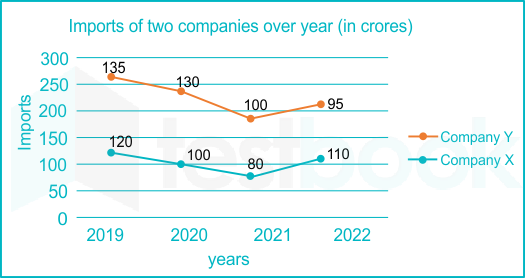
Question 27

Study the following chart and answer the question that follows.

<br> <br>

What is the difference in the imports by company X in the years 2019 and 2021?

  1. AOption (a)

    10 crore

  2. BOption (b)

    15 crore

  3. COption (c)

    40 crore

  4. DOption (d)

    20 crore

View answer & explanation

Correct answer

Answer: (c)C.

40 crore

Why this answer is correct

Given:

Imports by Company X in 2019 = 120 crores

Imports by Company X in 2021 = 80 crores

Formula used:

Difference in imports = Imports in 2019 - Imports in 2021

Calculation:

Difference = 120 - 80

⇒ Difference = 40 crores

∴ The difference in the imports by Company X in the years 2019 and 2021 is 40 crores.

Question 28

In October 2024, Partha Sengupta was appointed as the MD and CEO of ________.

  1. AOption (a)

    Canara Bank

  2. BOption (b)

    State Bank of India

  3. COption (c)

    ICICI Bank

  4. DOption (d)

    Bandhan Bank

View answer & explanation

Correct answer

Answer: (d)D.

Bandhan Bank

Why this answer is correct

The correct answer is Bandhan Bank.

Key Points

  • Partha Sengupta was appointed as the MD and CEO of Bandhan Bank in October 2024.
  • Bandhan Bank is a major Indian commercial bank with its headquarters located in Kolkata, West Bengal.
  • The bank was established in 2015 and primarily focuses on serving the unbanked and underbanked segments of the population.
  • Partha Sengupta's appointment follows his extensive experience in the banking sector, contributing to the bank's growth and operational efficiency.
  • Bandhan Bank operates a network of over 1000 branches across India, providing a range of financial services including retail banking, loans, and microfinance.

Additional Information

  • Banking Sector in India
  • India's banking sector is governed by the Reserve Bank of India (RBI), which is responsible for regulating and supervising financial institutions.
  • Commercial banks in India are categorized into public sector banks, private sector banks, foreign banks, and regional rural banks.
  • The sector has witnessed significant reforms in recent years, focusing on financial inclusion, digital banking, and asset quality improvement.
  • Technological advancements such as mobile banking, internet banking, and Unified Payments Interface (UPI) have revolutionized banking services in India.
  • Bandhan Bank
  • Founded in 2015, Bandhan Bank emerged from a microfinance institution, Bandhan Financial Services Limited.
  • The bank's mission is to bring banking services to the underprivileged and unbanked populations in India.
  • Bandhan Bank received its banking license from the Reserve Bank of India in June 2015 and commenced operations in August 2015.
  • It offers a wide range of banking products including savings and current accounts, fixed deposits, loans, insurance, and microfinance.
  • Partha Sengupta
  • Partha Sengupta has had a distinguished career in the banking and finance sector, with leadership roles in various financial institutions.
  • Prior to joining Bandhan Bank, he held key positions in notable banks, contributing to strategic planning and operational excellence.
  • His expertise includes areas such as retail banking, corporate banking, risk management, and digital banking innovations.
  • His leadership is expected to drive Bandhan Bank's expansion and enhance its service offerings to cater to a broader customer base.

Question 29

Excluding stoppages, the speed of a train is 45 km/h and including stoppages, it is 36 km/h. How many minutes does the train stop per hour?

  1. AOption (a)

    15 min

  2. BOption (b)

    11 min

  3. COption (c)

    10 min

  4. DOption (d)

    12 min

View answer & explanation

Correct answer

Answer: (d)D.

12 min

Why this answer is correct

Shortcut Trick

Stoppage time per hour = (Difference in speeds ÷ Speed excluding stoppages) × 60 minutes

Difference in speeds = 45 − 36 = 9 km/h

Stoppage time = (9 ÷ 45) × 60 = (1/5) × 60 = 12 minutes

∴ The correct answer is 12 min.

Alternate Method

Given:

Speed excluding stoppages = 45 km/h

Speed including stoppages = 36 km/h

Formula Used:

Time = Distance ÷ Speed

Calculations:

⇒ In 1 hour, the train covers 36 km when including stoppages.

⇒ Without stoppages, the train would cover 45 km in 60 minutes.

⇒ To cover 36 km without stoppages, time taken = (36 ÷ 45) × 60 minutes

⇒ Time taken = (4/5) × 60 = 48 minutes

⇒ Stoppage time = 60 minutes − 48 minutes

⇒ Stoppage time = 12 minutes

∴ The correct answer is 12 min.

Additional Information

Average Speed

Average Speed = Total Distance ÷ Total Time. When including stoppages, the total time increases, thereby reducing the average speed.

Relative Speed

For two objects moving in the same direction, Relative Speed = S1 − S2. For opposite directions, Relative Speed = S1 + S2.

Unit Conversion

To convert km/h to m/s, multiply by 5/18. To convert m/s to km/h, multiply by 18/5.

Question 30

How many isotopes of hydrogen element exist in nature?

  1. AOption (a)

    3

  2. BOption (b)

    2

  3. COption (c)

    5

  4. DOption (d)

    1

View answer & explanation

Correct answer

Answer: (a)A.

3

Why this answer is correct

The correct answer is 3.

Key Points

  • Hydrogen has three naturally occurring isotopes: protium (¹H), deuterium (²H), and tritium (³H).
  • Protium is the most abundant isotope, comprising about 99.98% of hydrogen found in nature.
  • Deuterium, also known as heavy hydrogen, accounts for about 0.02% of natural hydrogen and is used in heavy water reactors.
  • Tritium is radioactive and is found in trace amounts in nature, primarily produced by the interaction of cosmic rays with the atmosphere.

Additional Information

  • Isotopes
  • Isotopes are variants of a particular chemical element that differ in neutron number, and consequently in nucleon number.
  • All isotopes of an element have the same number of protons in each atom.
  • Protium (¹H)
  • Protium has one proton and no neutrons in its nucleus.
  • It is the most common isotope of hydrogen.
  • Deuterium (²H)
  • Deuterium has one proton and one neutron in its nucleus.
  • It is used in nuclear reactors and scientific research.
  • Tritium (³H)
  • Tritium has one proton and two neutrons in its nucleus.
  • It is radioactive and has a half-life of about 12.3 years.
  • Used in thermonuclear weapons and as a tracer in biochemical research.

Question 31

In which of the following months was Charaideo Maidam in Assam included in the UNESCO World Heritage Site list under the cultural category?

  1. AOption (a)

     August 2024

  2. BOption (b)

    July 2024

  3. COption (c)

    October 2024

  4. DOption (d)

    September 2024

View answer & explanation

Correct answer

Answer: (b)B.

July 2024

Why this answer is correct

The correct answer is Mon Jul 01 2024 00:00:00 GMT+0530 (India Standard Time).

Key Points

  • Charaideo Maidam in Assam was included in the UNESCO World Heritage Site list under the cultural category on Mon Jul 01 2024.
  • Charaideo Maidam, also known as the 'Pyramids of Assam,' is a significant archaeological site in India.
  • The site includes burial mounds of the Ahom dynasty and is a prominent example of Ahom architecture and culture.
  • The inclusion of Charaideo Maidam in the UNESCO list helps in preserving and promoting the cultural heritage of Assam.

Additional Information

  • UNESCO World Heritage Sites
  • UNESCO World Heritage Sites are designated for having cultural, historical, scientific, or other forms of significance.
  • These sites are legally protected by international treaties.
  • The World Heritage Committee oversees the list and ensures sites are preserved for future generations.
  • Ahom Dynasty
  • The Ahom dynasty ruled the Brahmaputra Valley in Assam for nearly 600 years.
  • Founded by Sukaphaa in 1228, the dynasty is known for its unique administrative and architectural achievements.
  • Archaeological Importance of Charaideo Maidam
  • The site consists of over 150 burial mounds, known locally as 'maidams.'
  • These mounds are similar to pyramids and contain the remains of Ahom royalty and nobility.
  • Artifacts found at the site include pottery, weapons, and inscriptions.
  • Preservation Efforts
  • The inclusion in the UNESCO list brings international attention and resources to help in preservation.
  • Local and national authorities work together to maintain and promote the site.
  • Efforts include archaeological research, infrastructure development, and tourism promotion.

Question 32

In ΔABC if ∠A = 50° and ∠B = 70°, find the measure of exterior angle A.

  1. AOption (a)

    140° 

  2. BOption (b)

    130°

  3. COption (c)

    60°

  4. DOption (d)

    30°

View answer & explanation

Correct answer

Answer: (b)B.

130°

Why this answer is correct

Shortcut Trick

Exterior angle at any vertex of a triangle is the sum of the two opposite interior angles.

Exterior ∠A = ∠B + ∠C

First find ∠C = 180° − (50° + 70°) = 60°.

Exterior ∠A = 70° + 60° = 130°.

∴ The correct answer is 130°.

Alternate Method

Given: ∠A = 50°, ∠B = 70°

Formula Used: Sum of angles on a straight line is 180°.

In ΔABC, interior ∠A = 50°.

The interior angle and the exterior angle at the same vertex form a linear pair.

⇒ Interior ∠A + Exterior ∠A = 180°

⇒ 50° + Exterior ∠A = 180°

⇒ Exterior ∠A = 180° − 50°

⇒ Exterior ∠A = 130°

∴ The correct answer is 130°.

Additional Information

Exterior Angle Theorem

The measure of an exterior angle of a triangle is equal to the sum of the measures of its two remote interior angles.

Linear Pair Postulate

If two angles form a linear pair, then they are supplementary, meaning their sum is exactly 180°.

Angle Sum Property

The sum of all interior angles of any triangle is always 180° (∠A + ∠B + ∠C = 180°).

Question 33

With an initial velocity of 10 m/s, an object is thrown vertically upwards. The maximum height attained by the object is (Assume g = 10m/s2)

  1. AOption (a)

    1 m

  2. BOption (b)

    100 m

  3. COption (c)

    5 m

  4. DOption (d)

    20 m

View answer & explanation

Correct answer

Answer: (c)C.

5 m

Why this answer is correct

The correct answer is 5 m.

Key Points

  • When an object is thrown vertically upwards, it decelerates under the influence of gravity (g = 10 m/s²).
  • The initial velocity (u) of the object is given as 10 m/s.
  • At the maximum height, the final velocity (v) is 0 m/s.
  • Using the equation of motion: v2=u2−2ghv^2=u^2-2gh, we can calculate the maximum height (h).
  • Substituting the values, 0=102−2×10×h0=10^2-2\times 10\times h, solving this gives h=5mh=5m meters.

Additional Information

  • Equations of Motion
  • These are used to describe the relationship between the velocity, acceleration, and displacement of an object.
  • The three primary equations of motion are: v=u+at,s=ut+12at2v=u+at, s=ut+\frac{1}{2}at^2, and v2=u2+2asv^2=u^2+2as.
  • Gravitational Acceleration (g)
  • It is the acceleration due to gravity, typically taken as 9.8 m/s² or approximated to 10 m/s² for simplicity in calculations.
  • This value indicates how fast an object accelerates when falling freely under the influence of gravity.
  • Maximum Height of a Projectile
  • The maximum height is the highest point reached by an object projected upwards.
  • At this point, the vertical component of the object's velocity is zero.
  • Vertical Projectile Motion
  • When an object is projected vertically upwards, it moves against the gravity until it reaches a point where the velocity becomes zero.
  • It then starts descending under the influence of gravity, retracing its path.

Question 34

According to the reactivity series of metals, which metal pair is found in native state?

  1. AOption (a)

    Calcium and aluminium

  2. BOption (b)

    Gold and platinum

  3. COption (c)

    Calcium and magnesium

  4. DOption (d)

    Sodium and potassium

View answer & explanation

Correct answer

Answer: (b)B.

Gold and platinum

Why this answer is correct

The correct answer is Gold and platinum.

Key Points

  • Gold and platinum are found in their native state due to their low reactivity.
  • They are part of the noble metals group, which resist oxidation and corrosion.
  • Gold and platinum are often found in their elemental form in nature, not combined with other elements.
  • These metals are less likely to form compounds with other elements, which is why they are found in pure form.
  • Both metals have been used historically in coinage, jewelry, and industrial applications due to their stability and rarity.

Additional Information

  • Reactivity Series of Metals
  • The reactivity series arranges metals in order of their reactivity from highest to lowest.
  • Metals higher in the series, like potassium and sodium, are more reactive and readily form compounds.
  • Metals lower in the series, like gold and platinum, are less reactive and often found in their native state.
  • The reactivity series helps predict how metals will react with acids, water, and other substances.
  • Native State
  • A native state refers to metals found in nature in their pure, elemental form.
  • Metals like gold, silver, and platinum are typically found in their native state due to their resistance to corrosion and oxidation.
  • Finding metals in their native state was historically significant for early human societies, leading to the development of metallurgy.
  • Noble Metals
  • Noble metals include gold, platinum, and other metals resistant to corrosion and oxidation.
  • They are called "noble" due to their stability and rarity.
  • Noble metals are used in various high-value applications, including electronics, jewelry, and catalytic converters.
  • Industrial and Historical Significance
  • Gold and platinum have been valued throughout history for their beauty and rarity.
  • Both metals have significant industrial applications due to their conductive and catalytic properties.
  • Gold is widely used in electronics for its excellent conductivity and resistance to tarnish.
  • Platinum is crucial in the automotive industry for catalytic converters, reducing harmful emissions.

Question 35

Express 0.512‾0.\overline{512} in the form pq\frac{p}{q}, where p and q are integers and q ≠ 0.

  1. AOption (a)

    502999\frac{502}{999}

  2. BOption (b)

    512999\frac{512}{999}

  3. COption (c)

    51299\frac{512}{99}

  4. DOption (d)

    52999\frac{52}{999}

View answer & explanation

Correct answer

Answer: (b)B.

512999\frac{512}{999}

Why this answer is correct

Shortcut Trick

To convert a pure recurring decimal to a fraction, write the repeating digits as the numerator.

For the denominator, write the digit 9 as many times as there are repeating digits in the decimal part.

Here, the repeating part is 512, which has three digits.

∴ The fraction is 512 ÷ 999.

∴ The correct answer is 512/999.

Alternate Method

Given: x = 0.512512512...

Formula Used: Multiply by 10n where n is the number of repeating digits.

⇒ Let x = 0.512512... — (Eq. 1)

⇒ Multiply both sides by 1000:

⇒ 1000x = 512.512512... — (Eq. 2)

⇒ Subtract (Eq. 1) from (Eq. 2):

⇒ 1000x − x = 512.512... − 0.512...

⇒ 999x = 512

⇒ x = 512/999

∴ The correct answer is 512/999.

Additional Information

Pure Recurring Decimal

A decimal in which all the figures after the decimal point are repeated. Example: 0.666... = 6/9 = 2/3.

Mixed Recurring Decimal

A decimal in which some figures do not repeat and some repeat. Formula: (Whole number formed by digits − Non-repeating part) ÷ (9 for each repeating digit and 0 for each non-repeating digit).

Rational Number Property

Every recurring decimal can be expressed in the form p/q, meaning it is always a rational number.

Question 36

In a certain code language,

A + B means 'A is the sister of B',

A - B means 'A is the husband of B',

A × B means 'A is the mother of B',

and A ÷ B means 'A is the brother of B'.

How is P related to T if 'P × Q ÷ R - S × T'?

  1. AOption (a)

    Mother's sister

  2. BOption (b)

    Father's mother

  3. COption (c)

    Mother's mother

  4. DOption (d)

    Father's sister

View answer & explanation

Correct answer

Answer: (b)B.

Father's mother

Why this answer is correct

Decoding symbols:

A is
Symbol+-×÷
MeaningSisterHusbandMotherBrother
to B

Given: P × Q ÷ R - S × T

P × Q → P is the mother of Q.

Q ÷ R → Q is the brother of R.

R - S → R is the husband of S.

S × T → S is the mother of T.

Thus, P is T's father's mother or paternal grandmother.

Hence, the correct answer is "Option 2".

Question 37

The ratio between the radius of the base and the height of a cylinder is 3: 4. If its volume is 38808 cm3 then, using π = 227\frac{22}{7} find the diameter of the cylinder.

  1. AOption (a)

    14 cm

  2. BOption (b)

    28 cm

  3. COption (c)

    42 cm

  4. DOption (d)

    21 cm

View answer & explanation

Correct answer

Answer: (c)C.

42 cm

Why this answer is correct

Shortcut Trick

Ratio of radius (r) to height (h) = 3 : 4 ⇒ Let r = 3x and h = 4x.

Volume = πr2h = (22/7) × (3x)2 × 4x = 38808.

⇒ (22/7) × 9x2 × 4x = 38808 ⇒ x3 = (38808 × 7) ÷ (22 × 36) = 343.

⇒ x = √3(343) = 7.

Diameter = 2r = 2 × 3x = 6 × 7 = 42 cm.

∴ The correct answer is 42 cm.

Alternate Method

Given: Ratio r : h = 3 : 4, Volume (V) = 38808 cm3, π = 22/7.

Formula Used: Volume of Cylinder = πr2h; Diameter = 2r.

⇒ Let r = 3x and h = 4x.

⇒ 38808 = (22/7) × (3x)2 × 4x

⇒ 38808 = (22/7) × 9x2 × 4x

⇒ 38808 = (22 × 36 × x3) / 7

⇒ x3 = (38808 × 7) / 792

⇒ x3 = 49 × 7 = 343

⇒ x = 7

⇒ Radius (r) = 3 × 7 = 21 cm

⇒ Diameter = 2 × 21 = 42 cm

∴ The correct answer is 42 cm.

Additional Information

Surface Area of Cylinder

Curved Surface Area (CSA) = 2πrh and Total Surface Area (TSA) = 2πr(r + h).

Volume Ratios

If dimensions are scaled by factor k, area scales by k2 and volume scales by k3.

Diameter Relation

The diameter is always twice the radius (d = 2r) in any circular cross-section solid.

Question 38

If the position of an object is in between the principal focus and pole of a concave mirror, then the image formed will be:

  1. AOption (a)

    real and enlarged

  2. BOption (b)

    virtual, erect and enlarged

  3. COption (c)

    real and diminished

  4. DOption (d)

    virtual and diminished

View answer & explanation

Correct answer

Answer: (b)B.

virtual, erect and enlarged

Why this answer is correct

The correct answer is virtual, erect and enlarged.

Key Points

  • When an object is placed between the principal focus (F) and the pole (P) of a concave mirror, the image formed is virtual.
  • The image is erect, meaning it is upright relative to the object.
  • The image is also enlarged, making it appear bigger than the actual object.
  • This phenomenon occurs because the light rays diverge after reflection and appear to come from a point behind the mirror.
  • This property is utilized in applications like shaving mirrors and makeup mirrors where a magnified upright image is desired.

Additional Information

  • Concave Mirror:
  • A concave mirror is a spherical mirror that curves inward, resembling a portion of the interior of a sphere.
  • It converges light rays that are incident parallel to its principal axis after reflecting them.
  • It has applications in devices such as telescopes, head mirrors in medical examinations, and in vehicle headlights to focus light.
  • Principal Focus:
  • The principal focus of a concave mirror is the point where light rays parallel to the principal axis converge after reflection.
  • It is located on the principal axis, midway between the mirror's surface and the center of curvature.
  • Image Formation by Mirrors:
  • The nature of the image (real or virtual, erect or inverted, magnified or diminished) depends on the position of the object relative to the mirror.
  • Concave mirrors can form real and inverted images or virtual and erect images based on the object's placement.
  • Mirror Equation:
  • The relationship between the object distance (u), image distance (v), and focal length (f) of a spherical mirror is given by the mirror equation: 1/f = 1/u + 1/v.
  • This equation helps in determining the position and nature of the image formed by the mirror.

Question 39

Who among the following discovered the nucleus of an atom?

  1. AOption (a)

    JJ Thomson

  2. BOption (b)

    J Chadwick

  3. COption (c)

    Neils Bohr

  4. DOption (d)

    E Rutherford

View answer & explanation

Correct answer

Answer: (d)D.

E Rutherford

Why this answer is correct

The correct answer is E Rutherford.

Key Points

  • Ernest Rutherford discovered the nucleus of an atom in 1911 through his famous gold foil experiment.
  • Rutherford's experiment showed that most of the atom is empty space with a small, dense, positively charged nucleus at its center.
  • He proposed the Rutherford model of the atom, which described the atom as having a central nucleus surrounded by electrons.
  • Rutherford's discovery laid the foundation for the modern understanding of atomic structure and helped in the development of the Bohr model of the atom.

Additional Information

  • Gold Foil Experiment:
  • Conducted by Rutherford in 1909 with the help of his students Geiger and Marsden.
  • Involved bombarding a thin gold foil with alpha particles.
  • Showed that most alpha particles passed through the foil, but some were deflected at large angles, indicating a dense central nucleus.
  • Rutherford Model of the Atom:
  • Proposed in 1911 following the gold foil experiment.
  • Described the atom as a small, dense nucleus surrounded by orbiting electrons.
  • Challenged the previous plum pudding model proposed by J.J. Thomson.
  • Subatomic Particles:
  • Protons: Positively charged particles found in the nucleus.
  • Neutrons: Neutral particles found in the nucleus, discovered by James Chadwick in 1932.
  • Electrons: Negatively charged particles orbiting the nucleus.
  • Rutherford's Contributions:
  • Considered the father of nuclear physics.
  • Won the Nobel Prize in Chemistry in 1908 for his work on the disintegration of elements and the chemistry of radioactive substances.
  • Discovered the concept of radioactive half-life.

Question 40

Which of the following substances is in solid form in the given reaction?

Sodium sulphate + barium chloride → sodium chloride + barium sulphate

  1. AOption (a)

    Sodium chloride

  2. BOption (b)

    Barium sulphate

  3. COption (c)

    Barium chloride

  4. DOption (d)

    Sodium sulphate

View answer & explanation

Correct answer

Answer: (b)B.

Barium sulphate

Why this answer is correct

The correct answer is Barium sulphate.

Key Points

  • Barium sulphate is the product that forms as a precipitate in the reaction between sodium sulphate and barium chloride.
  • It is an insoluble compound in water, leading to its solid formation in the reaction mixture.
  • The chemical equation for the reaction is: Na2SO4 + BaCl2 → 2 NaCl + BaSO4.
  • In this reaction, barium sulphate (BaSO4) is the only substance that precipitates out, i.e., forms a solid.

Additional Information

  • Precipitation Reaction
  • A precipitation reaction occurs when two soluble salts react in aqueous solution to form one or more insoluble products (precipitates).
  • Barium sulphate is a common precipitate used in laboratory experiments to demonstrate precipitation reactions.
  • Solubility Rules
  • Solubility rules help predict whether a substance will dissolve or form a precipitate in water.
  • Sulphates are generally soluble, except for those of barium, lead, and calcium.
  • Applications of Barium Sulphate
  • It is used as a radiopaque agent in medical imaging of the digestive system.
  • It is also used in the manufacturing of paints, coatings, and plastics as a white pigment and filler.
  • Chemical Equation Balancing
  • Balancing chemical equations ensures the conservation of mass where the number of atoms for each element is the same on both sides of the equation.
  • This reaction is balanced with the formula: Na2SO4 + BaCl2 → 2 NaCl + BaSO4.

Question 41

The fourth proportional to 15, 10 and 12 is:

  1. AOption (a)

    6

  2. BOption (b)

    10

  3. COption (c)

    8

  4. DOption (d)

    12

View answer & explanation

Correct answer

Answer: (c)C.

8

Why this answer is correct

Shortcut Trick

For three numbers a, b, and c, the fourth proportional (d) is calculated as d = (b × c) ÷ a.

Given numbers: a = 15, b = 10, c = 12.

Fourth Proportional = (10 × 12) ÷ 15

Fourth Proportional = 120 ÷ 15 = 8.

∴ The correct answer is 8.

Alternate Method

Given: Three numbers are 15, 10, and 12.

Formula Used: If a, b, c, and x are in proportion, then a : b :: c : x, which means a/b = c/x.

Let the fourth proportional be x.

⇒ 15 : 10 = 12 : x

⇒ 15 ÷ 10 = 12 ÷ x

⇒ 15 × x = 12 × 10

⇒ 15x = 120

⇒ x = 120 ÷ 15

⇒ x = 8

∴ The correct answer is 8.

Additional Information

Mean Proportional

The mean proportional between two numbers a and b is given by the formula √(a × b).

Third Proportional

The third proportional to two numbers a and b is defined as the value c such that a : b = b : c, calculated as c = b2 ÷ a.

Direct Proportion

Two quantities are in direct proportion if an increase in one leads to a proportional increase in the other, expressed as x/y = k.

Question 42

Express sin 54° + cos 72° in terms of Trigonometric ratios of angles between 0° and 45°.

  1. AOption (a)

    cos 36° + cos 18°

  2. BOption (b)

    sin 36° + sin 18°

  3. COption (c)

    cos 36° + sin 18°

  4. DOption (d)

    sin 36° + cos 18°

View answer & explanation

Correct answer

Answer: (c)C.

cos 36° + sin 18°

Why this answer is correct

Shortcut Trick

Apply complementary angle identities: sin θ = cos(90° − θ) and cos θ = sin(90° − θ).

sin 54° = cos(90° − 54°) = cos 36°.

cos 72° = sin(90° − 72°) = sin 18°.

Combining these gives the required expression in the range 0° to 45°.

∴ The correct answer is cos 36° + sin 18°.

Alternate Method

Given: sin 54° + cos 72°

Formula Used: sin(90° − A) = cos A and cos(90° − A) = sin A.

⇒ sin 54° = sin(90° − 36°) = cos 36°

⇒ cos 72° = cos(90° − 18°) = sin 18°

⇒ Expression = cos 36° + sin 18°

Since 36° and 18° are both between 0° and 45°, the condition is satisfied.

∴ The correct answer is cos 36° + sin 18°.

Additional Information

Complementary Angle Rules

Two angles are complementary if their sum is 90°. In such cases, sin A = cos(90° − A), tan A = cot(90° − A), and sec A = cosec(90° − A).

Trigonometric Values of 18° and 36°

sin 18° = (√5 − 1) ÷ 4 and cos 36° = (√5 + 1) ÷ 4. These values are often used in competitive geometry problems.

Question 43

How many key priorities are outlined in the Union Budget 2024-25 to achieve the objective of 'Viksit Bharat'?

  1. AOption (a)

    Seven

  2. BOption (b)

    Ten

  3. COption (c)

    Eight

  4. DOption (d)

    Nine

View answer & explanation

Correct answer

Answer: (d)D.

Nine

Why this answer is correct

The correct answer is Nine.

Key Points

  • The Union Budget 2024-25 has outlined nine key priorities aimed at achieving the objective of 'Viksit Bharat' or a developed India.
  • These priorities are focused on various sectors such as infrastructure, digital economy, education, health, and agriculture.
  • The objective of 'Viksit Bharat' is to ensure sustainable and inclusive growth, with a special emphasis on marginalized communities and sectors.
  • The budget aims to enhance economic resilience and competitiveness while promoting social welfare and environmental sustainability.
  • These priorities align with the long-term vision of making India a global economic powerhouse by 2047.

Additional Information

  • Infrastructure Development
  • Focus on enhancing transport, logistics, and urban infrastructure to improve connectivity and economic efficiency.
  • Increased investment in railways, highways, ports, and airports.
  • Promotion of green and sustainable infrastructure projects.
  • Digital Economy
  • Expansion of digital services and internet connectivity across rural and urban areas.
  • Encouragement of startups and innovation through favorable policies and funding.
  • Implementation of new technologies in government services to improve transparency and efficiency.
  • Education and Skill Development
  • Enhancement of the education system to meet global standards.
  • Focus on vocational training and skill development to prepare the workforce for future industries.
  • Increase in budget allocation for research and development.
  • Health Sector
  • Strengthening of healthcare infrastructure and services, especially in rural areas.
  • Promotion of preventive healthcare and wellness programs.
  • Increased funding for public health initiatives and medical research.
  • Agriculture and Rural Development
  • Support for farmers through better access to credit, technology, and markets.
  • Promotion of sustainable agricultural practices.
  • Development of rural infrastructure to improve living standards and economic opportunities.

Question 44

The reproductive parts of angiosperms are located in the flower, where the female reproductive part is made of three parts, stigma, style and ovary and is known as:

  1. AOption (a)

    stamen

  2. BOption (b)

    sepal

  3. COption (c)

    petal

  4. DOption (d)

    pistil

View answer & explanation

Correct answer

Answer: (d)D.

pistil

Why this answer is correct

The correct answer is pistil.

Key Points

  • The pistil is the female reproductive part of an angiosperm flower.
  • It is composed of three main parts: the stigma, style, and ovary.
  • The stigma is the sticky top part that collects pollen grains.
  • The style is a tube-like structure that supports the stigma and connects it to the ovary.
  • The ovary contains ovules, which develop into seeds upon fertilization.

Additional Information

  • Stamen
  • The stamen is the male reproductive part of a flower.
  • It consists of the anther and filament.
  • The anther produces and releases pollen, which contains the male gametes.
  • The filament is a stalk that supports the anther.
  • Sepal
  • Sepals are the outermost parts of the flower, forming the calyx.
  • They are usually green and protect the flower bud before it opens.
  • Petal
  • Petals are the colorful parts of a flower that attract pollinators.
  • They form the corolla and are located inside the sepals.
  • Pollination
  • Pollination is the transfer of pollen from the anther to the stigma.
  • It can occur through various agents like wind, water, insects, or animals.
  • Successful pollination leads to fertilization and seed formation.

Question 45

The value of (0.1 × 0.001 × 0.0001 × 106) is:

  1. AOption (a)

    1

  2. BOption (b)

    1100\frac{1}{100}

  3. COption (c)

    110\frac{1}{10}

  4. DOption (d)

    100

View answer & explanation

Correct answer

Answer: (b)B.

1100\frac{1}{100}

Why this answer is correct

Given:

(0.1 × 0.001 × 0.0001 × 106)

Formula used:

xa × xb = xa+b

Calculations:

0.1 = 10−1

0.001 = 10−3

0.0001 = 10−4

Value = 10−1 × 10−3 × 10−4 × 10⁶

⇒ Value = 10(−1 − 3 − 4 + 6)

⇒ Value = 10−2

⇒ Value = 1/102

⇒ Value = 1/100

∴ The correct answer is option (2).

Question 46

The atomic mass of an element is usually expressed in which of the following units?

  1. AOption (a)

    Kilograms

  2. BOption (b)

    Pounds

  3. COption (c)

    Grams per mole (g/mol)

  4. DOption (d)

    Atomic mass units (amu)

View answer & explanation

Correct answer

Answer: (d)D.

Atomic mass units (amu)

Why this answer is correct

The correct answer is Atomic mass units (amu).

Key Points

  • Atomic mass units (amu) are the standard unit of mass that quantifies the mass of an atom or molecule.
  • 1 amu is defined as one twelfth (1/12) of the mass of a carbon-12 atom.
  • The atomic mass unit allows chemists to compare the masses of different atoms on a scale that is easy to use and understand.
  • The unit is widely used in chemistry and physics to express atomic and molecular weights.
  • Atomic mass units are essential for understanding chemical reactions, molecular structures, and isotopic compositions.

Additional Information

  • Isotopes:
  • Atoms of the same element with different numbers of neutrons and thus different atomic masses.
  • Examples include Carbon-12, Carbon-13, and Carbon-14.
  • Molar Mass:
  • The mass of one mole of a substance (usually expressed in g/mol).
  • It is numerically equal to the atomic or molecular mass in amu but expressed in grams.
  • Avogadro's Number:
  • The number of atoms, ions, or molecules in one mole of a substance, approximately 6.022 x 10²³.
  • This constant is used to convert between atomic mass units and grams.
  • Relative Atomic Mass:
  • A weighted average of the atomic masses of an element's isotopes.
  • It reflects the abundance of each isotope in nature.

Question 47

Which of the following in eukaryotes is separated from the cytoplasm by a double-layered membrane and it directs the life processes of the cell?

  1. AOption (a)

    Ribosome

  2. BOption (b)

    Endoplasmic reticulum

  3. COption (c)

    Nucleus

  4. DOption (d)

    Plastids

View answer & explanation

Correct answer

Answer: (c)C.

Nucleus

Why this answer is correct

The correct answer is Nucleus.

Key Points

  • The nucleus in eukaryotic cells is separated from the cytoplasm by a double-layered membrane called the nuclear envelope.
  • The nucleus houses the cell's DNA and is the control center for the cell, directing all cellular activities including growth, metabolism, and reproduction.
  • The nuclear envelope contains nuclear pores that regulate the exchange of materials between the nucleus and the cytoplasm.
  • Inside the nucleus, the DNA is organized into structures called chromosomes, which contain the genetic instructions for the development and function of the organism.
  • The nucleolus, a structure within the nucleus, is responsible for producing ribosomal RNA (rRNA) and assembling ribosomes.

Additional Information

  • Ribosome:
  • Ribosomes are the molecular machines responsible for synthesizing proteins by translating messenger RNA (mRNA).
  • They can be found floating freely in the cytoplasm or attached to the endoplasmic reticulum.
  • Endoplasmic Reticulum (ER):
  • The ER is a network of membranes involved in protein and lipid synthesis.
  • It is classified into two types: rough ER (with ribosomes) and smooth ER (without ribosomes).
  • Plastids:
  • Plastids are organelles found in plant cells and algae.
  • They are responsible for functions such as photosynthesis (chloroplasts), storage of products (amyloplasts), and synthesis of compounds (chromoplasts).
  • Nuclear Envelope:
  • The nuclear envelope is a double membrane that encloses the nucleus.
  • It contains nuclear pores that control the movement of substances between the nucleus and the cytoplasm.

Question 48

NJQO is related to HDKI in a certain way based on the English alphabetical order. In the same way, SOVT is related to MIPN. To which of the following options is PLSQ related, following the same logic?

  1. AOption (a)

    FJKM

  2. BOption (b)

    FJMK

  3. COption (c)

    JFMK

  4. DOption (d)

    JFKM

View answer & explanation

Correct answer

Answer: (c)C.

JFMK

Why this answer is correct

The logic followed here is:

​NJQO is related to HDKI

And,

SOVT is related to MIPN

Similarly,

PLSQ is related to

Hence, "Option 3" is the correct answer.

Question 49

If the volume of a cuboid is 3x2 - 27, then its possible dimensions are:

  1. AOption (a)

    3, x2, -27x

  2. BOption (b)

    3, x2​, 27x

  3. COption (c)

    3, x - 3, x + 3

  4. DOption (d)

    3, 3, 3

View answer & explanation

Correct answer

Answer: (c)C.

3, x - 3, x + 3

Why this answer is correct

Shortcut Trick

Factorize the volume expression directly to find the dimensions.

Volume = 3x2 − 27

Take common factor 3: 3(x2 − 9)

Apply identity a2 − b2 = (a − b)(a + b): 3(x − 3)(x + 3)

∴ The correct answer is 3, x − 3, x + 3.

Alternate Method

Given: Volume of cuboid = 3x2 − 27

Formula Used: Volume of cuboid = Length × Breadth × Height

⇒ Volume = 3x2 − 27

⇒ Volume = 3(x2 − 9)

⇒ Volume = 3(x2 − 32)

⇒ Using identity a2 − b2 = (a − b)(a + b)

⇒ Volume = 3 × (x − 3) × (x + 3)

⇒ Possible dimensions are 3, (x − 3), and (x + 3).

∴ The correct answer is 3, x − 3, x + 3.

Additional Information

Algebraic Identities

Difference of squares: a2 − b2 = (a − b)(a + b). This is frequently used for factorizing volume expressions.

Volume of Cuboid

The volume of a cuboid is the product of its three dimensions: length (l), breadth (b), and height (h). V = l × b × h.

Factorization Method

To find dimensions from a polynomial volume, factorize the polynomial into three linear or constant factors.

Question 50

The sum of two rational numbers is -4. If one of them is −1325\frac{-13}{25}, then the other is:

  1. AOption (a)

    −8725\frac{-87}{25}

  2. BOption (b)

    −6725\frac{-67}{25}

  3. COption (c)

    −4725\frac{-47}{25}

  4. DOption (d)

    −3725\frac{-37}{25}

View answer & explanation

Correct answer

Answer: (a)A.

−8725\frac{-87}{25}

Why this answer is correct

Shortcut Trick

Let the required rational number be x.

Given Sum = −4 and First Number = −13/25.

x = Sum − First Number ⇒ −4 − (−13/25) = −4 + 13/25.

x = (−100 + 13) / 25 = −87/25.

∴ The correct answer is −87/25.

Alternate Method

Given:

Sum of two rational numbers = −4

One rational number = −13/25

Formula Used:

Other number = (Sum of numbers) − (Given number)

Calculations:

⇒ Let the other number be x.

⇒ x + (−13/25) = −4

⇒ x − 13/25 = −4

⇒ x = −4 + 13/25

⇒ x = (−4 × 25 + 13) / 25

⇒ x = (−100 + 13) / 25

⇒ x = −87/25

∴ The correct answer is −87/25.

Additional Information

Rational Numbers

A number that can be expressed in the form p/q, where p and q are integers and q ≠ 0.

Addition of Fractions

To add or subtract fractions with different denominators, find the LCM of the denominators first.

Signs in Arithmetic

When a negative number is subtracted, it becomes addition: a − (−b) = a + b.

Question 51

Select the triad which follows the same pattern as that followed by the two triads given below. Both triads follow the same pattern.

JE-KF-LM

NI-OJ-PQ

  1. AOption (a)

    LG-MH-NO

  2. BOption (b)

    PK-QL-RT

  3. COption (c)

    QL-RM-SU

  4. DOption (d)

    OJ-PK-QS

View answer & explanation

Correct answer

Answer: (a)A.

LG-MH-NO

Why this answer is correct

The logic followed here is:

Given:

JE-KF-LM

And,

NI-OJ-PQ

So, checking each option one by one:

Option 1) LG-MH-NO

Option 2) PK-QL-RT

Option 3) QL-RM-SU

Option 4) OJ-PK-QS

Thus, out of all the options, 'LG-MH-NO' follows the same logic is given.

Hence, "Option 1" is the correct answer.

Question 52

Who became the first Indian woman to win two gold medals at the 2024 Paralympic Games in Paris?

  1. AOption (a)

    Deepa Malik

  2. BOption (b)

    Avani Lekhara

  3. COption (c)

    Pramod Bhagat

  4. DOption (d)

    Bhavinaben Patel

View answer & explanation

Correct answer

Answer: (b)B.

Avani Lekhara

Why this answer is correct

The correct answer is Avani Lekhara.

Key Points

  • Avani Lekhara became the first Indian woman to win two gold medals at the 2024 Paralympic Games in Paris.
  • She secured her first gold medal in the R2 - Women's 10m Air Rifle Standing SH1 event.
  • Her second gold medal came in the R8 - Women's 50m Rifle 3 Positions SH1 event.
  • Avani Lekhara is a trailblazer in Indian para-shooting, having previously won gold at the 2020 Tokyo Paralympics.
  • She is celebrated for her resilience and determination, overcoming a severe spinal cord injury to achieve international success.

Additional Information

  • Paralympic Games
  • The Paralympic Games are a major international multi-sport event involving athletes with a range of disabilities.
  • They are organized in parallel with the Olympic Games and take place shortly after the conclusion of the Olympics.
  • The Games include various categories such as amputee, cerebral palsy, intellectual disability, wheelchair, and visually impaired sports.
  • The International Paralympic Committee (IPC) is responsible for organizing the Games.
  • Shooting Sports in Paralympics
  • Shooting is one of the sports contested at the Paralympic Games, governed by the International Paralympic Committee.
  • The sport is open to athletes with physical impairments and includes rifle and pistol events.
  • Athletes compete in different categories based on the type and extent of their impairments.
  • Competitions are held in both standing and seated positions to accommodate the range of disabilities.
  • SH1 and SH2 Categories
  • SH1 category is for athletes who can support the weight of the firearm with their arms.
  • SH2 category is for athletes who have an impairment in the upper limbs and require a shooting stand to support the firearm.
  • These classifications ensure fair competition among athletes with similar levels of function.
  • Avani Lekhara's Achievements
  • Avani Lekhara won gold in the 10m Air Rifle Standing SH1 event at the 2020 Tokyo Paralympics.
  • She is also a recipient of the prestigious Khel Ratna Award, India's highest sporting honor.
  • Avani has consistently performed at international shooting competitions, bringing laurels to the country.

Question 53

In which of the following countries did India win its first double team gold at the Chess Olympiad in September 2024?

  1. AOption (a)

    China

  2. BOption (b)

    Uzbekistan

  3. COption (c)

    Hungary

  4. DOption (d)

    Indonesia

View answer & explanation

Correct answer

Answer: (c)C.

Hungary

Why this answer is correct

The correct answer is Hungary.

Key Points

  • India won its first double team gold at the Chess Olympiad in September 2024 held in Hungary.
  • This achievement marked a significant milestone for Indian chess, showcasing their dominance at an international level.
  • The Chess Olympiad is a biennial chess tournament organized by FIDE, the international chess federation.
  • India's teams performed exceptionally well, securing gold in both the open and women's categories.

Additional Information

  • Chess Olympiad
  • The Chess Olympiad is a biennial chess tournament in which teams from all over the world compete.
  • It is organized by FIDE, the international chess federation, and includes both open and women's tournaments.
  • The event serves as a platform for countries to showcase their best chess talents.
  • FIDE
  • FIDE stands for Fédération Internationale des Échecs or International Chess Federation.
  • Founded in 1924, FIDE is responsible for overseeing international chess competitions and maintaining the official rules of chess.
  • FIDE's motto is "Gens una sumus," which means "We are one people."
  • Team Composition
  • Each team in the Chess Olympiad typically consists of four players and one reserve.
  • Teams compete in a series of rounds, with points awarded for wins and draws.
  • The team with the highest points at the end of the tournament wins the gold medal.
  • India's Chess Achievements
  • India has been steadily rising in the world of chess, with several players achieving international recognition.
  • Notable Indian chess players include Viswanathan Anand, who is a former World Chess Champion.
  • India's success at the Chess Olympiad highlights the country's growing prominence in the global chess community.

Question 54

In order to pass in an examination, a student is required to get 975 marks out of the maximum aggregate marks. Priya got 870 marks and was declared failed by 7%. What is the maximum aggregate marks that a student can get in the examination?

  1. AOption (a)

    1000

  2. BOption (b)

    1500

  3. COption (c)

    1200

  4. DOption (d)

    1400

View answer & explanation

Correct answer

Answer: (b)B.

1500

Why this answer is correct

Shortcut Trick

Passing Marks required = 975

Priya Marks obtained = 870

Deficit marks = 975 − 870 = 105

Given 7% = 105 marks ⇒ 1% = 15 marks

Maximum Marks (100%) = 15 × 100 = 1500

∴ The correct answer is 1500.

Alternate Method

Given:

Passing Marks = 975

Marks obtained by Priya = 870

Failure Margin (in %) = 7%

Calculations:

⇒ Difference in marks = Passing Marks − Obtained Marks

⇒ Difference = 975 − 870 = 105

⇒ According to the question, this difference is 7% of the maximum marks.

⇒ 7% of Maximum Marks (M) = 105

⇒ (7 ÷ 100) × M = 105

⇒ M = (105 × 100) ÷ 7

⇒ M = 15 × 100

⇒ M = 1500

∴ The correct answer is 1500.

Additional Information

Percentage Calculation

To find the whole value (100%) when a certain percentage (x%) is known as value V: Total = (V ÷ x) × 100.

Pass Percentage

Pass % = (Passing Marks ÷ Maximum Marks) × 100. In this case, (975 ÷ 1500) × 100 = 65%.

Score Gap Analysis

If a student fails by x marks and another passes by y marks over the passing limit, the gap between their scores is (x + y).

Question 55

Simplify the given expression.

3 + 3 ÷ 3 × 3 - 3

  1. AOption (a)

    0

  2. BOption (b)

    1

  3. COption (c)

    3

  4. DOption (d)

    -3

View answer & explanation

Correct answer

Answer: (c)C.

3

Why this answer is correct

Given:

Expression: 3 + 3 ÷ 3 × 3 − 3

Formula used:

The BODMAS rule (Bracket, Of, Division, Multiplication, Addition, Subtraction).

Calculations:

3 + 3 ÷ 3 × 3 − 3

⇒ 3 + (3 ÷ 3) × 3 − 3

⇒ 3 + 1 × 3 − 3

⇒ 3 + 3 − 3

⇒ 6 − 3

⇒ 3

∴ The correct answer is option (3).

Question 56

If a machine does 500 J of work in 4 seconds, what is its power output?

  1. AOption (a)

    125 watt

  2. BOption (b)

    2000 watt

  3. COption (c)

    8000 watt

  4. DOption (d)

    250 watt

View answer & explanation

Correct answer

Answer: (a)A.

125 watt

Why this answer is correct

The correct answer is 125 watt.

Key Points

  • Power is defined as the rate at which work is done or energy is transferred.
  • The formula to calculate power is Power = Work / Time.
  • In this case, the work done is 500 joules and the time taken is 4 seconds.
  • Using the formula, the power output is 500 J / 4 s = 125 watts.

Additional Information

  • Joule (J): The SI unit of work or energy. One joule is the amount of work done when a force of one newton displaces an object by one meter in the direction of the force.
  • Watt (W): The SI unit of power. One watt is equal to one joule per second.
  • Energy: The capacity to do work. It can exist in various forms such as kinetic, potential, thermal, electrical, chemical, and nuclear energy.
  • SI Units: The International System of Units (SI) is the modern form of the metric system and the world's most widely used system of measurement.

Question 57

Which of the following best describes the relationship between distance, time and speed when a body is NOT accelerating?

  1. AOption (a)

    Speed = Time / Distance

  2. BOption (b)

    Distance = Speed / Time

  3. COption (c)

    Distance = Time / Speed

  4. DOption (d)

    Time = Distance / Speed

View answer & explanation

Correct answer

Answer: (d)D.

Time = Distance / Speed

Why this answer is correct

The correct answer is time=(distance)/(speed).

Key Points

  • Speed is defined as the distance traveled per unit of time. It is a scalar quantity.
  • Time can be calculated by dividing the distance traveled by the speed if the speed is constant.
  • The formula time = distance/speed is used when a body is traveling at a constant speed, implying no acceleration.
  • This relationship is derived from the basic definition of speed: speed = distance/time.
  • Understanding this relationship is crucial in various fields such as physics, engineering, and everyday problem-solving.

Additional Information

  • Speed
  • Measured in units of distance divided by time, such as meters per second (m/s) or kilometers per hour (km/h).
  • It is a scalar quantity, meaning it only has magnitude and no direction.
  • Distance
  • Distance is a scalar quantity representing the interval between two points.
  • It is measured in units such as meters (m), kilometers (km), etc.
  • Time
  • Time is a continuous, measurable quantity in which events occur in a sequence from the past through the present to the future.
  • Measured in units such as seconds (s), minutes (min), hours (h), etc.
  • Constant Speed
  • When a body travels equal distances in equal intervals of time, it is said to be moving with a constant speed.
  • This implies no acceleration or deceleration in the body's motion.

Question 58

Select the correct option related to the function of villi in the small intestine.

  1. AOption (a)

    Secretion of minerals

  2. BOption (b)

    Increases absorptive surface area

  3. COption (c)

    Protection from acid

  4. DOption (d)

    Helps in excretion

View answer & explanation

Correct answer

Answer: (b)B.

Increases absorptive surface area

Why this answer is correct

The correct answer is Increases absorptive surface area.

Key Points

  • Villi are small, finger-like projections that extend into the lumen of the small intestine.
  • They increase the surface area available for nutrient absorption.
  • The increased surface area allows for more efficient absorption of nutrients from digested food.
  • Each villus contains a network of capillaries and a lymphatic vessel called a lacteal, which aid in the transport of absorbed nutrients.
  • Villi also have microvilli on their epithelial cells, further enhancing the absorptive surface area.

Additional Information

  • Microvilli
  • Microvilli are microscopic cellular membrane protrusions that increase the surface area for absorption.
  • They are found on the epithelial cells of the villi in the small intestine.
  • Microvilli form a brush border that contains enzymes essential for the final stages of digestion.
  • Enterocytes
  • Enterocytes are the primary cells of the epithelial lining of the small intestine.
  • They are responsible for nutrient absorption and have microvilli on their surface.
  • Enterocytes play a crucial role in the digestion and absorption of dietary nutrients.
  • Lacteals
  • Lacteals are specialized lymphatic vessels located within the villi of the small intestine.
  • They absorb dietary fats and transport them to the lymphatic system.
  • Lacteals play a vital role in the absorption of lipids and fat-soluble vitamins.
  • Brush Border Enzymes
  • Brush border enzymes are located on the microvilli of the enterocytes.
  • They are involved in the final breakdown of carbohydrates and proteins into absorbable units.
  • Examples include maltase, lactase, and sucrase.

Question 59

Which of the following helps in the absorption and upward movement of water and minerals dissolved in it from roots to the leaves?

  1. AOption (a)

    Transpiration

  2. BOption (b)

    Translocation

  3. COption (c)

    Photosynthesis 

  4. DOption (d)

    Respiration

View answer & explanation

Correct answer

Answer: (a)A.

Transpiration

Why this answer is correct

The correct answer is Transpiration.

Key Points

  • Transpiration is the process by which water evaporates from the surface of plant leaves, creating a negative pressure that pulls water upward from the roots through the xylem.
  • This process helps in the absorption and upward movement of water and minerals dissolved in it from the roots to the leaves.
  • It plays a crucial role in maintaining the water balance and nutrient distribution within the plant.
  • The continuous movement of water helps in the cooling of the plant and also enables the uptake of essential nutrients from the soil.

Additional Information

  • Xylem
  • Xylem is a type of vascular tissue in plants responsible for the transport of water and nutrients from the roots to other parts of the plant.
  • It consists of various types of cells, including tracheids and vessel elements, which are specialized for water conduction.
  • Stomata
  • Stomata are small openings on the surface of leaves and stems that facilitate gas exchange and transpiration.
  • They are surrounded by guard cells that regulate their opening and closing.
  • Root Hair
  • Root hairs are extensions of root epidermal cells that increase the surface area for water and mineral absorption from the soil.
  • Cohesion-Tension Theory
  • This theory explains the mechanism of water movement in plants, where cohesion between water molecules and tension created by transpiration drive the upward movement of water.

Question 60

If 'J' stands for '×', 'K' stands for ' '-', 'L' stands for '÷' and 'M' stands for '+', what will come in place of the question mark "?" in the following equation?

5 J 12 K 56 M 21 L 7 = ?

  1. AOption (a)

    -13

  2. BOption (b)

    -3

  3. COption (c)

    17

  4. DOption (d)

    7

View answer & explanation

Correct answer

Answer: (d)D.

7

Why this answer is correct

Decoding signs:

LetterJKLM
Stands For×-÷+

Given: 5 J 12 K 56 M 21 L 7 = ?

5 J 12 K 56 M 21 L 7 = ? ⇒ 5 × 12 - 56 + 21 ÷ 7 = ?

⇒ 5 × 12 - 56 + 21 ÷ 7 = ?

⇒ 5 × 12 - 56 + 3 = ?

⇒ 60 + 3 - 56 = ?

⇒ 63 - 56 = ?

⇒ 7 = ?

Hence, "Option 4" is the correct answer.

Question 61

Which of the following metals reacts only with steam NOT with cold or hot water?

  1. AOption (a)

    Magnesium

  2. BOption (b)

    Sodium

  3. COption (c)

    Aluminium

  4. DOption (d)

    Potassium

View answer & explanation

Correct answer

Answer: (c)C.

Aluminium

Why this answer is correct

The correct answer is Aluminium.

Key Points

  • Aluminium reacts with steam to form aluminium oxide and hydrogen gas.
  • It does not react with cold or hot water due to the formation of a protective oxide layer on its surface.
  • The reaction of aluminium with steam is represented by the equation: 2Al + 3H2O (steam) → Al2O3 + 3H2.
  • This property distinguishes aluminium from more reactive metals such as sodium and potassium, which react vigorously with cold water.
  • Aluminium's reactivity with steam but not with liquid water is crucial in various industrial applications, including metallurgy and manufacturing.

Additional Information

  • Reactivity Series of Metals
  • It is a series of metals arranged in order of their reactivity from highest to lowest.
  • It helps predict how metals will react with water, acids, and other substances.
  • Highly reactive metals like potassium and sodium react with cold water, while less reactive metals like aluminium react only with steam.
  • Oxide Layer Formation
  • Aluminium forms a thin, protective oxide layer when exposed to air.
  • This layer prevents further reaction with water and air, making it corrosion-resistant.
  • This property is utilized in industries to prevent rusting and degradation of aluminium products.
  • Hydrogen Gas Production
  • When metals react with water or steam, hydrogen gas is often produced.
  • Hydrogen gas is highly flammable and must be handled with care in industrial settings.
  • The production of hydrogen gas is an important factor in reactions involving metals and water.
  • Industrial Applications
  • Aluminium's selective reactivity is exploited in processes like the extraction of aluminium from bauxite ore.
  • It is also used in manufacturing processes where controlled reactions are required.
  • Understanding metal reactivity is crucial for safe and efficient industrial operations.

Question 62

A man has invested ₹65,000 at a rate of 712%7\frac{1}{2}\% per annum simple interest for 6 years. Find the amount that he will receive after 6 years.

  1. AOption (a)

    ₹29,500

  2. BOption (b)

    ₹94,250

  3. COption (c)

    ₹28,750

  4. DOption (d)

    ₹95,750

View answer & explanation

Correct answer

Answer: (b)B.

₹94,250

Why this answer is correct

Shortcut Trick

Total Interest Percentage = Rate × Time

Total % = 7.5% × 6 = 45%

Amount = Principal + 45% of Principal = 145% of ₹65,000

Amount = 1.45 × 65000 = ₹94,250

∴ The correct answer is ₹94,250.

Alternate Method

Given:

Principal (P) = ₹65,000

Rate (R) = 7.5% = 15/2%

Time (T) = 6 years

Formula Used:

Simple Interest (SI) = (P × R × T) ÷ 100

Amount (A) = Principal + Simple Interest

Calculations:

⇒ SI = (65000 × 15 × 6) ÷ (2 × 100)

⇒ SI = 650 × 15 × 3

⇒ SI = 650 × 45

⇒ SI = ₹29,250

⇒ Amount = 65000 + 29250

⇒ Amount = ₹94,250

∴ The correct answer is ₹94,250.

Additional Information

Simple Interest vs Compound Interest

In Simple Interest, the interest is calculated only on the principal, whereas in Compound Interest, it is calculated on the principal plus accumulated interest.

Effective Rate of Interest

Effective Rate for T years = (Rate × T)%. The final amount is always (100 + RT)% of the Principal.

Question 63

Two banks, A and B, offered loans at 5.5% and 6.5% per annum, respectively. Ramesh borrowed an amount of ₹3,00,000 from each bank. Find the positive difference between the amounts of simple interest paid to the two banks by Ramesh after 2 years.

  1. AOption (a)

    ₹4000

  2. BOption (b)

    ₹6000

  3. COption (c)

    ₹8000

  4. DOption (d)

    ₹2000

View answer & explanation

Correct answer

Answer: (b)B.

₹6000

Why this answer is correct

Shortcut Trick

Difference in rate = 6.5% − 5.5% = 1% per annum.

For 2 years, Total rate difference = 1% × 2 = 2%.

Difference in Interest = 2% of ₹3,00,000.

⇒ 0.02 × 3,00,000 = ₹6000.

∴ The correct answer is ₹6000.

Alternate Method

Given: Principal (P) = ₹3,00,000, Rate 1 (R1) = 5.5%, Rate 2 (R2) = 6.5%, Time (T) = 2 years.

Formula Used: Simple Interest (SI) = (P × R × T) ÷ 100

⇒ SI from Bank A = (3,00,000 × 5.5 × 2) ÷ 100

⇒ SI from Bank A = 3,000 × 11 = ₹33,000

⇒ SI from Bank B = (3,00,000 × 6.5 × 2) ÷ 100

⇒ SI from Bank B = 3,000 × 13 = ₹39,000

⇒ Difference = ₹39,000 − ₹33,000 = ₹6,000

∴ The correct answer is ₹6000.

Additional Information

Simple Interest Formula

SI = (P × R × T) / 100, where P is Principal, R is Rate per annum, and T is Time in years.

Direct Difference Method

If Principal and Time are same, Difference in SI = P × (R2 − R1) × T / 100.

Total Amount

Amount (A) = Principal (P) + Simple Interest (SI).

Question 64

Which of the following non-biodegradable substances may be inert and simply persist in the environment for a long time or may harm the various members of the eco-system?

  1. AOption (a)

    Paper made material

  2. BOption (b)

    Plant leaves made material

  3. COption (c)

    Clay made material

  4. DOption (d)

    Plastic made material

View answer & explanation

Correct answer

Answer: (d)D.

Plastic made material

Why this answer is correct

The correct answer is Plastic made material.

Key Points

  • Plastic materials are non-biodegradable, meaning they do not break down naturally in the environment.
  • They can persist for hundreds to thousands of years, causing long-term pollution.
  • Plastic waste can harm wildlife, including ingestion by marine and terrestrial animals, leading to injury or death.
  • Microplastics, small plastic particles, can accumulate in the food chain, posing health risks to humans and animals.
  • Efforts to manage plastic waste include recycling, reduction in use, and development of biodegradable alternatives.

Additional Information

  • Biodegradable vs Non-biodegradable:
  • Biodegradable substances are capable of being decomposed by bacteria or other living organisms.
  • Non-biodegradable substances, like plastics, do not break down naturally and can persist in the environment.
  • Environmental Impact:
  • Non-biodegradable waste contributes to pollution, harming ecosystems and biodiversity.
  • Plastic pollution is a significant environmental issue, affecting oceans, rivers, and terrestrial habitats.
  • Recycling and Management:
  • Recycling is a key strategy to reduce plastic waste, but not all plastics are recyclable.
  • Innovations in biodegradable plastics are being developed to reduce environmental impact.
  • Global Initiatives:
  • International agreements, such as the Basel Convention, aim to manage and reduce plastic waste globally.
  • Countries are implementing bans on single-use plastics to mitigate environmental damage.

Question 65

In August 2024, Biochemist Govindarajan Padmanabhan was awarded which of the following awards?

  1. AOption (a)

    Vigyan Ratna Puraskar

  2. BOption (b)

    Shanti Swarup Bhatnagar award

  3. COption (c)

    Vigyan Yuva-Shanti Swarup Bhatnagar

  4. DOption (d)

    Vigyan Shri

View answer & explanation

Correct answer

Answer: (a)A.

Vigyan Ratna Puraskar

Why this answer is correct

The correct answer is Vigyan Ratna Puraskar.

Key Points

  • Govindarajan Padmanabhan, a renowned biochemist, was awarded the Vigyan Ratna Puraskar in August 2024.
  • The Vigyan Ratna Puraskar is one of India's highest honors given for significant contributions in the field of science and technology.
  • It recognizes individuals who have made outstanding achievements and advancements in scientific research.
  • The award includes a certificate, a medal, and a cash prize, acknowledging the recipient's dedication and impact on science.

Additional Information

  • Shanti Swarup Bhatnagar Award:
  • Named after Shanti Swarup Bhatnagar, the founder director of the Council of Scientific & Industrial Research (CSIR).
  • Awarded annually for notable and outstanding research in various fields of science and technology.
  • Considered one of the most prestigious science awards in India.
  • Vigyan Yuva-Shanti Swarup Bhatnagar:
  • Awarded to young scientists for their remarkable contributions to scientific research.
  • Recognizes the potential of young researchers to become leaders in their respective scientific fields.
  • Aims to encourage and motivate young talent in science and technology.
  • Vigyan Shri:
  • Awarded to individuals for significant contributions to the popularization and promotion of science and technology.
  • Acknowledges efforts in making science accessible and engaging to the general public.
  • Highlights the importance of science communication in society.

Question 66

To achieve its target of becoming net carbon zero by 2035, Reliance Industries plans to replace transportation fuels with:

  1. AOption (a)

    solar and wind energy

  2. BOption (b)

    natural gas and biofuels 

  3. COption (c)

    biomass and nuclear energy

  4. DOption (d)

    clean electricity and hydrogen

View answer & explanation

Correct answer

Answer: (d)D.

clean electricity and hydrogen

Why this answer is correct

The correct answer is clean electricity and hydrogen.

Key Points

  • Reliance Industries aims to achieve net carbon zero by 2035 through the adoption of clean energy sources.
  • The company plans to replace traditional transportation fuels with clean electricity and hydrogen to reduce carbon emissions.
  • Hydrogen is being considered a key element because of its potential to significantly lower greenhouse gas emissions.
  • Clean electricity, generated from renewable sources like solar and wind, will play a crucial role in powering transportation systems.
  • This strategic shift aligns with global trends towards sustainable and renewable energy solutions.

Additional Information

  • Hydrogen as a Fuel
  • Hydrogen fuel cells generate electricity through a chemical reaction between hydrogen and oxygen, with water being the only byproduct.
  • Hydrogen can be produced using renewable energy sources, making it a sustainable option.
  • It offers high energy density and can be used in various transportation modes, including cars, buses, and trains.
  • Clean Electricity
  • Clean electricity is derived from renewable resources such as solar, wind, hydro, and geothermal energy.
  • It helps reduce reliance on fossil fuels and cuts down greenhouse gas emissions.
  • Advancements in technology are making renewable energy sources more efficient and cost-effective.
  • Global Energy Transition
  • Countries around the world are increasingly committing to net-zero carbon targets to combat climate change.
  • The transition involves significant investment in renewable energy infrastructure and technology.
  • International agreements like the Paris Agreement are driving the push towards sustainable energy solutions.
  • Reliance's Green Energy Initiatives
  • Reliance Industries has announced several green energy projects, including the development of the Dhirubhai Ambani Green Energy Giga Complex in Jamnagar, Gujarat.
  • The company is investing in solar panel manufacturing, battery storage, and green hydrogen production.
  • These initiatives are part of a broader strategy to diversify its energy portfolio and reduce carbon footprint.

Question 67

Which organism uses regenerative cells for reproduction in the process of budding?

  1. AOption (a)

    Leishmania

  2. BOption (b)

    Yeast

  3. COption (c)

    Amoeba

  4. DOption (d)

    Hydra

View answer & explanation

Correct answer

Answer: (d)D.

Hydra

Why this answer is correct

The correct answer is Hydra.

Key Points

  • Hydra is a simple freshwater organism belonging to the phylum Cnidaria.
  • Hydra reproduces asexually through a process called budding.
  • In budding, a new individual develops from an outgrowth or bud due to cell division at one particular site.
  • Hydra has regenerative cells, also known as interstitial cells, which enable it to reproduce through budding.
  • The bud eventually detaches from the parent organism and becomes an independent individual.

Additional Information

  • Regeneration
  • Regeneration is the process by which organisms replace or restore lost or amputated body parts.
  • It is a common feature in certain species such as starfish, planarians, and hydras.
  • Asexual Reproduction
  • Asexual reproduction involves a single parent and results in offspring that are genetically identical to the parent.
  • Common methods include budding, binary fission, and fragmentation.
  • Phylum Cnidaria
  • Cnidarians are characterized by the presence of specialized cells known as cnidocytes, which contain stinging organelles called nematocysts.
  • Examples include jellyfish, corals, and sea anemones.
  • Cell Differentiation
  • Cell differentiation is the process by which a less specialized cell becomes a more specialized cell type.
  • In hydras, interstitial cells can differentiate into various cell types needed for regeneration and budding.

Question 68

Two numbers are in the ratio 7: 5. If their positive difference is 360, then the greater number between them is:

  1. AOption (a)

    1260

  2. BOption (b)

    1500

  3. COption (c)

    1040

  4. DOption (d)

    900

View answer & explanation

Correct answer

Answer: (a)A.

1260

Why this answer is correct

Shortcut Trick

Ratio of numbers = 7 : 5

Difference in ratio units = 7 − 5 = 2 units

2 units → 360 ⇒ 1 unit = 180

Greater number (7 units) = 7 × 180 = 1260

∴ The correct answer is 1260.

Alternate Method

Given:

Ratio of numbers = 7 : 5

Positive Difference = 360

Let the numbers be 7x and 5x.

⇒ Difference = 7x − 5x = 2x

⇒ 2x = 360

⇒ x = 360 ÷ 2 = 180

⇒ Greater number = 7x = 7 × 180

⇒ Greater number = 1260

∴ The correct answer is 1260.

Additional Information

Ratio and Proportion

A ratio compares two quantities. If a : b = c : d, then product of extremes (a×d) equals product of means (b×c).

Componento and Dividendo

If a/b = c/d, then (a + b)/(a − b) = (c + d)/(c − d). This is useful for solving complex ratio equations.

Concept of Constant Ratio

When quantities are added or subtracted, if the ratio remains constant, it implies the parts must change by a factor x.

Question 69

Who developed the planetary model of the atom with electrons orbiting the nucleus in discrete energy levels?

  1. AOption (a)

    Niels Bohr

  2. BOption (b)

    Thomson (Joseph John Thomson)

  3. COption (c)

    Ernest Rutherford

  4. DOption (d)

    Dmitri Mendeleev

View answer & explanation

Correct answer

Answer: (a)A.

Niels Bohr

Why this answer is correct

The correct answer is Niels Bohr.

Key Points

  • Niels Bohr developed the planetary model of the atom in 1913.
  • In Bohr's model, electrons orbit the nucleus in discrete energy levels without radiating energy.
  • This model was an improvement over Rutherford's model, addressing the stability of electron orbits.
  • Bohr's atomic model introduced the concept of quantized electron orbits, which were later foundational to quantum mechanics.

Additional Information

  • Quantum Mechanics:
  • Quantum mechanics is a fundamental theory in physics describing the physical properties of nature at the scale of atoms and subatomic particles.
  • It was developed in the early 20th century by scientists including Max Planck, Albert Einstein, and Werner Heisenberg.
  • The theory explains phenomena that cannot be explained by classical physics, such as the dual nature of light and matter.
  • Rutherford's Model:
  • Proposed by Ernest Rutherford in 1911, the model depicted the atom as having a small, dense nucleus positively charged with electrons orbiting around it.
  • It could not explain the stability of electron orbits, as classical physics predicted that electrons would spiral into the nucleus.
  • Energy Levels:
  • In Bohr's model, electrons occupy fixed energy levels or shells around the nucleus.
  • Electrons can move between energy levels by absorbing or emitting a photon with energy equal to the difference between the levels.
  • Electron Configuration:
  • The arrangement of electrons in an atom's energy levels is known as electron configuration.
  • Electron configuration determines the chemical properties of an element.
  • Bohr's model provided a simple way to understand how electrons are distributed in atoms.

Question 70

Which of the following options should come in place of the question mark (?) in the given series based on the English alphabetical order?

DGJ, LOR, TWZ, BEH, ?

  1. AOption (a)

    JMP

  2. BOption (b)

    KMO

  3. COption (c)

    JLN

  4. DOption (d)

    KNQ

View answer & explanation

Correct answer

Answer: (a)A.

JMP

Why this answer is correct

The logic followed here is:

Hence, "Option 1" is the correct answer.

Question 71

Which of the following schemes was introduced by the Ministry of Culture, Government of India, to provide a platform for the artistes and artisans of the Northeast region to showcase their rich cultural heritage?

  1. AOption (a)

    The Quadra - Festival of the Northeast

  2. BOption (b)

    The Octave - Festival of the Northeast

  3. COption (c)

    The Trident - Festival of the Northeast 

  4. DOption (d)

    The Penta - Festival of the Northeast

View answer & explanation

Correct answer

Answer: (b)B.

The Octave - Festival of the Northeast

Why this answer is correct

The correct answer is The Octave - Festival of the Northeast.

Key Points

  • The Octave - Festival of the Northeast was introduced by the Ministry of Culture, Government of India.
  • This festival aims to provide a platform for the artistes and artisans of the Northeast region.
  • The festival showcases the rich cultural heritage and traditions of the eight northeastern states.
  • It includes various performances, exhibitions, and activities that highlight the unique cultural aspects of the region.
  • The festival is part of the government's initiative to promote and preserve the diverse cultural identities of India's Northeast.

Additional Information

  • Northeast India
  • Northeast India comprises eight states: Arunachal Pradesh, Assam, Manipur, Meghalaya, Mizoram, Nagaland, Sikkim, and Tripura.
  • The region is known for its rich biodiversity, ethnic diversity, and cultural heritage.
  • It is home to various indigenous tribes, each with its own distinct traditions and customs.
  • The region's cultural heritage includes traditional music, dance, festivals, and handicrafts.
  • Ministry of Culture
  • The Ministry of Culture is a government ministry responsible for the preservation and promotion of Indian culture and heritage.
  • It organizes various cultural events, festivals, and programs to promote the diverse cultural heritage of India.
  • The ministry supports artists and artisans through various schemes and initiatives.
  • It also manages various cultural institutions and museums across the country.
  • Cultural Festivals
  • Cultural festivals play a significant role in promoting and preserving the cultural heritage of a region.
  • They provide a platform for artists to showcase their talent and connect with a wider audience.
  • These festivals help in fostering a sense of pride and identity among the people of the region.
  • They also attract tourists, contributing to the local economy and promoting cultural exchange.
  • Art and Craft of Northeast India
  • Northeast India is known for its exquisite handloom and handicrafts.
  • The region produces various traditional textiles, bamboo and cane products, and pottery.
  • Handloom weaving is a major occupation in states like Assam, Manipur, and Nagaland.
  • The unique art and craft of the region reflect its rich cultural heritage and artistic traditions.

Question 72

Which of the following options should come in place of the question mark (?) in the given series to make it logically complete?

33, 41, 57, 89, 153, ?

  1. AOption (a)

    269

  2. BOption (b)

    253

  3. COption (c)

    297

  4. DOption (d)

    281

View answer & explanation

Correct answer

Answer: (d)D.

281

Why this answer is correct

The logic followed here is:

Hence, "Option 4" is the correct answer.

Question 73

Which of the following is an example of an object moving in uniform circular motion?

  1. AOption (a)

    A bird flying in the sky

  2. BOption (b)

    A person walking on a sidewalk

  3. COption (c)

    A satellite in a circular orbit around the earth.

  4. DOption (d)

    A car driving straight on a highway

View answer & explanation

Correct answer

Answer: (c)C.

A satellite in a circular orbit around the earth.

Why this answer is correct

The correct answer is A satellite in a circular orbit around the earth..

Key Points

  • A satellite in a circular orbit around the earth is an example of uniform circular motion because it moves at a constant speed along a circular path.
  • The centripetal force required to maintain the satellite's circular motion is provided by the gravitational pull of the Earth.
  • The satellite's velocity remains constant in magnitude but its direction continuously changes, resulting in a circular trajectory.
  • This type of motion is characterized by a constant angular velocity and a constant distance from the center of the Earth.

Additional Information

  • Centripetal Force:
  • It is the force that acts on a body moving in a circular path, directed towards the center around which the body is moving.
  • In the case of a satellite, this force is provided by the gravitational attraction of the Earth.
  • Gravitational Force:
  • It is the attractive force that exists between any two masses.
  • For satellites orbiting the Earth, this force ensures they stay in orbit.
  • Angular Velocity:
  • It is the rate of change of the angle through which the body moves on a circular path.
  • In uniform circular motion, the angular velocity remains constant.
  • Orbital Speed:
  • It is the constant speed at which a satellite must travel to stay in a stable orbit around a planet.
  • The orbital speed depends on the mass of the planet and the distance of the satellite from the planet's center.

Question 74

If the radius of sphere is decreased by 10 percent, then the volume of sphere will be decreased by what percentage?

  1. AOption (a)

    32.5%

  2. BOption (b)

    25.6%

  3. COption (c)

    30.6%

  4. DOption (d)

    27.1%

View answer & explanation

Correct answer

Answer: (d)D.

27.1%

Why this answer is correct

Shortcut Trick

Radius decrease = 10% → Fractional value = 1/10.

Initial Radius : Final Radius = 10 : 9.

Volume ∝ Radius3 ⇒ Ratio of Volume = (10)3 : (9)3 = 1000 : 729.

Decrease in Volume = ((1000 − 729) ÷ 1000) × 100 = 271 ÷ 10 = 27.1%.

∴ The correct answer is 27.1%.

Alternate Method

Given: Percentage decrease in Radius (r) = 10%.

Formula Used: Volume of Sphere = (4/3) × π × r3.

Net Percentage Change for three successive changes of x%, y%, and z%:

⇒ First two changes: a = x + y + (x × y)/100

⇒ Final change: Net = a + z + (a × z)/100

⇒ Here, x = y = z = −10 (negative sign denotes decrease).

⇒ First two: (−10) + (−10) + (−10 × −10)/100 = −20 + 1 = −19%.

⇒ Final: (−19) + (−10) + (−19 × −10)/100 = −29 + 1.9 = −27.1%.

∴ The correct answer is 27.1%.

Additional Information

Surface Area Change

The Surface Area of a sphere is proportional to r2. If radius decreases by 10%, area decreases by 10 + 10 − (10 × 10)/100 = 19%.

Successive Percentage Rule

For a 3D figure, the volume change depends on three dimensions. For a sphere, all three dimensions are the same radius (r × r × r).

Volume of Hemisphere

The percentage change in volume remains the same for a Hemisphere (2/3 π r3) as it also depends on r3.

Question 75

If 75% of x is 15 less than 15% of 1500, then the value of x is:

  1. AOption (a)

    300

  2. BOption (b)

    120

  3. COption (c)

    280

  4. DOption (d)

    150

View answer & explanation

Correct answer

Answer: (c)C.

280

Why this answer is correct

Shortcut Trick

15% of 1500 = 15 × 15 = 225.

Subtract 15: 225 − 15 = 210.

Given 75% of x (which is 3/4 of x) = 210.

x = 210 × (4/3) = 70 × 4 = 280.

∴ The correct answer is 280.

Alternate Method

Given:

Value 1 = 15% of 1500

Value 2 = 75% of x

Condition: 75% of x = (15% of 1500) − 15

Calculations:

⇒ 15% of 1500 = (15/100) × 1500 = 15 × 15 = 225

⇒ 75% of x = 225 − 15

⇒ 0.75 × x = 210

⇒ x = 210 ÷ 0.75

⇒ x = 210 ÷ (3/4) = (210 × 4) ÷ 3

⇒ x = 70 × 4 = 280

∴ The correct answer is 280.

Additional Information

Percentage to Fraction Conversion

Converting percentages to simple fractions like 75% = 3/4 or 25% = 1/4 speeds up calculation significantly.

Percentage Change Base

x% of y is always equal to y% of x. For example, 15% of 1500 is the same as 1500% of 15.

Linear Equation Formulation

Always translate verbal phrases like 'less than' or 'more than' into direct subtraction or addition from the base value.

Question 76

Based on the English alphabetical order, three of the following four letter-cluster pairs are alike in a certain way and thus form a group. Which pair does not belong to that group?

(Note: The odd one out is not based on the number of consonants/vowels or their position in the letter cluster.)

  1. AOption (a)

    PT-XR

  2. BOption (b)

    EI-MH

  3. COption (c)

    NR-VQ

  4. DOption (d)

    GK-OJ

View answer & explanation

Correct answer

Answer: (a)A.

PT-XR

Why this answer is correct

The logic followed here is:

Option 1) PT-XR

Option 2) EI-MH

Option 3) NR-VQ

Option 4) GK-OJ

Thus, out of all the options, 'PT-XR' is the odd one out.

Hence, "Option 1" is the correct answer.

Question 77

In the following number-pairs, the second number is obtained by applying certain mathematical operations to the first number. Which numbers should replace X and Y so that the pattern followed by the two numbers on the left side of :: is the same as that on the right side of ::?

(NOTE: Operations should be performed on the whole numbers, without breaking down the numbers into its constituent digits. E.g. 13 - Operations on 13 such as adding/subtracting/multiplying etc. to 13 can be performed. Breaking down 13 into 1 and 3 and then performing mathematical operations on 1 and 3 is not allowed.)

X : 84 :: 11 : Y

  1. AOption (a)

    X = 6, Y = 152

  2. BOption (b)

    X = 7, Y = 154

  3. COption (c)

    X = 6, Y = 154

  4. DOption (d)

    X = 6, Y = 153

View answer & explanation

Correct answer

Answer: (c)C.

X = 6, Y = 154

Why this answer is correct

The logic followed here is:

Given: X : 84 :: 11 : Y

So, checking each option one by one:

Option 1) X = 6, Y = 152 ⇒ 6 : 84 :: 11 : 152

6 × 14 = 84

84 = 84 (LHS = RHS)

11 × 14 = 152

154 ≠ 152 (LHS ≠ RHS)

Option  2) X = 7, Y = 154 ⇒ 7 : 84 :: 11 : 154

7 × 14 = 84

98 ≠ 84 (LHS = RHS)

11 × 14 = 154

154 ≠ 154 (LHS = RHS)

Option  3) X = 6, Y = 154⇒ 6 : 84 :: 11 : 154

6 × 14 = 84

84 = 84 (LHS = RHS)

11 × 14 = 154

154 = 154 (LHS = RHS)

Option  4) X = 6, Y = 153 ⇒ 6 : 84 :: 11 : 153

6 × 14 = 84

84 = 84 (LHS = RHS)

11 × 14 = 153

154 ≠ 153 (LHS ≠ RHS)

Hence, "Option 3" is the correct answer.

Question 78

If blood :: connective tissue, then bones :: ________.

  1. AOption (a)

    muscular tissue

  2. BOption (b)

    epithelial tissue

  3. COption (c)

    nervous tissue

  4. DOption (d)

    connective tissue

View answer & explanation

Correct answer

Answer: (d)D.

connective tissue

Why this answer is correct

The correct answer is connective tissue.

Key Points

  • Both blood and bones are categorized under connective tissues in the human body.
  • Connective tissue primarily serves to support and bind other tissues in the body.
  • Blood, as a connective tissue, plays a vital role in transporting oxygen, nutrients, and waste products throughout the body.
  • Bones, another type of connective tissue, provide structural support, protection of organs, and facilitation of movement.

Additional Information

  • Connective Tissue
  • Connective tissue is one of the four basic types of animal tissues, along with epithelial, muscular, and nervous tissues.
  • It develops from the mesoderm, one of the three primary germ layers in the very early embryo.
  • It is characterized by an extracellular matrix that separates the cells of the tissue.
  • Types of connective tissue include loose connective tissue, dense connective tissue, cartilage, bone, and blood.
  • Functions of Connective Tissue
  • Provides structural support to other tissues and organs.
  • Protects and insulates internal organs.
  • Stores energy reserves in the form of fat.
  • Transports substances throughout the body via blood.
  • Defends the body against pathogens through the immune response.
  • Bone Tissue
  • Bone tissue, or osseous tissue, is a hard, dense connective tissue that forms the structural elements of the skeleton.
  • It is composed of cells called osteocytes and a mineralized matrix that includes calcium phosphate.
  • Bones support and protect various organs of the body, produce red and white blood cells, and store minerals.
  • Bone remodeling is a continuous process where mature bone tissue is removed and new bone tissue is formed.
  • Blood as a Connective Tissue
  • Blood is considered a connective tissue because it has a matrix (plasma) and originates from the mesoderm layer of the embryo.
  • It consists of red blood cells, white blood cells, platelets, and plasma.
  • Blood has several functions including transportation of gases, nutrients, and waste products, regulation of body temperature, and protection against diseases.

Question 79

The total amount of electric charge that flows through a circuit is 1200 C in 2 min. Then the amount of electric current that is drawn by the same electric circuit is:

  1. AOption (a)

    100 A

  2. BOption (b)

    600 A

  3. COption (c)

    60 A

  4. DOption (d)

    10 A

View answer & explanation

Correct answer

Answer: (d)D.

10 A

Why this answer is correct

The correct answer is 10 A.

Key Points

  • The total electric charge (Q) that flows through the circuit is given as 1200 Coulombs (C).
  • The time (t) taken for this charge to flow is 2 minutes, which is equivalent to 120 seconds (2 min x 60 sec/min).
  • Electric current (I) is calculated using the formula I = Q / t.
  • Substituting the given values, I = 1200 C / 120 s = 10 A.
  • Thus, the electric current drawn by the circuit is 10 Amperes (A).

Additional Information

  • Electric Current:
  • Electric current is the flow of electric charge in a circuit.
  • It is measured in Amperes (A), where 1 Ampere is equal to 1 Coulomb of charge passing through a point in 1 second.
  • Coulomb (C):
  • A Coulomb is the unit of electric charge in the International System of Units (SI).
  • It is defined as the amount of charge transported by a constant current of one Ampere in one second.
  • Formula for Electric Current:
  • The formula to calculate electric current is I = Q / t, where I is the current, Q is the charge, and t is the time.
  • This relationship helps in determining the current when the charge and time are known.
  • Ohm's Law:
  • Ohm's Law states that the current through a conductor between two points is directly proportional to the voltage across the two points.
  • The formula is V = IR, where V is voltage, I is current, and R is resistance.

Question 80

Read the given statements and conclusions carefully. You have to take the given statements to be true even if they seem to be at variance from commonly known facts and decide which conclusion(s) logically follow(s) from the given statements.

Statements:

All oranges are mangoes.

No mango is a banana.

Conclusions:

(I) No banana is a mango.

(II) All mangoes are oranges.

  1. AOption (a)

    Neither conclusion I nor II follows

  2. BOption (b)

    Both conclusions I and II follow

  3. COption (c)

    Only conclusion II follows

  4. DOption (d)

    Only conclusion I follows

View answer & explanation

Correct answer

Answer: (d)D.

Only conclusion I follows

Why this answer is correct

The least possible Venn diagram for the given statements is as shown below :

Conclusions:

(I) No banana is a mango → Follow (As no mango is a banana. As direct relation is given between mangoes and banana, therefore it is true)

(II) All mangoes are oranges→ Does not follow (As all oranges are mangoes. So it is possible but not definite)

∴ Here, Only conclusion I follows.​

Hence, the correct answer is "Option 4".

Question 81

Which of the following statements is/are NOT true about the principal focus of a spherical mirror?

i) It always lies on the principal axis.

ii) An incident ray passing through the focus after reflection becomes parallel to the principal axis.

iii) Principal focus is a point where all the incident rays after reflection from the mirror meet.

  1. AOption (a)

    Only (i) and (ii)

  2. BOption (b)

    Only (iii)

  3. COption (c)

    Only (ii) and (iii)

  4. DOption (d)

    Only (i)

View answer & explanation

Correct answer

Answer: (b)B.

Only (iii)

Why this answer is correct

The correct answer is Only (iii).

Key Points

  • The principal focus of a spherical mirror always lies on the principal axis.
  • An incident ray passing through the focus, after reflection, becomes parallel to the principal axis.
  • Principal focus is defined as the point where rays parallel to the principal axis, after reflection, either converge (concave mirror) or appear to diverge from (convex mirror).
  • Statement (iii) is incorrect because not all incident rays, after reflection, meet at the principal focus. Only rays parallel to the principal axis do.

Additional Information

  • Concave Mirror:
  • A concave mirror is a spherical mirror that curves inward like a spoon.
  • It converges light rays to a point and is used in applications like telescopes, flashlights, and shaving mirrors.
  • Convex Mirror:
  • A convex mirror is a spherical mirror that curves outward.
  • It diverges light rays and is commonly used for rearview mirrors in vehicles and security purposes.
  • Principal Axis:
  • The principal axis is the straight line passing through the center of curvature and the pole of the mirror.
  • It is the reference line for defining the position of the principal focus and other points related to mirror reflection.
  • Center of Curvature:
  • The center of curvature is the center of the sphere of which the mirror is a part.
  • It lies on the principal axis and is denoted by the letter 'C'.
  • Focal Length:
  • Focal length is the distance between the pole and the principal focus of the mirror.
  • It is half of the radius of curvature for a spherical mirror.

Question 82

What is the power of this combination of lens placed together when the power of the converging lens is 4.50 D and diverging lens is 3.00 D?

  1. AOption (a)

    -1.5D

  2. BOption (b)

    -13.5D

  3. COption (c)

    -7.5D

  4. DOption (d)

    +1.5D

View answer & explanation

Correct answer

Answer: (d)D.

+1.5D

Why this answer is correct

The correct answer is +1.5D.

Key Points

  • The power of a combination of lenses is the algebraic sum of the powers of individual lenses.
  • The power of a converging lens (convex lens) is given as +4.50 D.
  • The power of a diverging lens (concave lens) is given as -3.00 D.
  • Adding the powers: 4.50 D + (-3.00 D) = 1.50 D.
  • Thus, the combined power of the lenses is +1.5 D.

Additional Information

  • Lens Power
  • The power of a lens (measured in diopters, D) is the reciprocal of its focal length in meters (P = 1/f).
  • Converging lenses have positive powers, while diverging lenses have negative powers.
  • Types of Lenses
  • Convex lenses (converging lenses) focus parallel rays of light to a single point.
  • Concave lenses (diverging lenses) spread out parallel rays of light.
  • Applications of Lenses
  • Convex lenses are used in magnifying glasses, cameras, and eyeglasses for hyperopia (farsightedness).
  • Concave lenses are used in eyeglasses for myopia (nearsightedness) and in certain types of cameras and telescopes.
  • Combination of Lenses
  • When multiple lenses are combined, their overall power is the sum of their individual powers.
  • This principle is used in designing complex optical systems like microscopes and telescopes.

Question 83

Refer to the given number and symbol series and answer the question that follows. Counting to be done from left to right only.

(Left) 5 3 @ # 1 & 9 + Ω 6 £ $ 2 % 8 4 7 (Right)

How many such numbers are there, each of which is immediately preceded by a symbol and also immediately followed by another symbol?

  1. AOption (a)

    1

  2. BOption (b)

    0

  3. COption (c)

    4

  4. DOption (d)

    2

View answer & explanation

Correct answer

Answer: (c)C.

4

Why this answer is correct

Given series: (Left) 5 3 @ # 1 & 9 + Ω 6 £ $ 2 % 8 4 7 (Right)

According to the question, such numbers which are immediately preceded by a symbol and also immediately followed by another symbol:

Required condition: Even digit - Odd digit - Even digit

(Left) 5 3 @ # 1 & 9 + Ω 6 £ $ 2 % 8 4 7 (Right)

Required combinations: # 1 &, & 9 +, Ω 6 £ and $ 2 % 

Thus, there are four such even numbers which are immediately preceded by a symbol and also immediately followed by another symbol.

Hence, "Option 3" is the correct answer.

Question 84

Which of the following grows rapidly and ripens to form a fruit?

  1. AOption (a)

    Anther

  2. BOption (b)

    Pollen tube

  3. COption (c)

    Stigma

  4. DOption (d)

    Ovary

View answer & explanation

Correct answer

Answer: (d)D.

Ovary

Why this answer is correct

The correct answer is Ovary.

Key Points

  • The ovary is a part of the female reproductive organ in flowering plants (angiosperms).
  • It contains ovules, which after fertilization develop into seeds.
  • As the ovules mature into seeds, the ovary walls thicken and develop into the fruit.
  • This transformation process ensures the protection and dispersion of seeds.

Additional Information

  • Flower Structure
  • The flower is the reproductive structure of angiosperms, consisting of male (stamens) and female (carpels) parts.
  • The stamen includes the anther and filament, while the carpel comprises the stigma, style, and ovary.
  • Pollination and Fertilization
  • Pollination is the transfer of pollen from the anther to the stigma of a flower.
  • Fertilization occurs when the pollen tube delivers sperm cells to the ovule, leading to the formation of seeds.
  • Fruit Formation
  • Post fertilization, the ovary undergoes changes and develops into a fruit.
  • Fruits protect the enclosed seeds and assist in their dispersal to new locations.
  • Types of Fruits
  • Simple fruits develop from a single ovary, while aggregate fruits come from multiple ovaries of one flower.
  • Multiple fruits are formed from the ovaries of multiple flowers growing in a cluster.

Question 85

Amita bought a laptop at a 20% discount on its marked price. If she paid ₹28,400 for the laptop, what was its marked price?

  1. AOption (a)

    ₹32600

  2. BOption (b)

    ₹33300

  3. COption (c)

    ₹36100

  4. DOption (d)

    ₹35500

View answer & explanation

Correct answer

Answer: (d)D.

₹35500

Why this answer is correct

Shortcut Trick

Let the Marked Price (MP) be 100%.

Given Discount = 20%, therefore Selling Price (SP) = 100% − 20% = 80%.

According to the question, 80% = ₹28,400.

Ratio-unitary method: 100% = (28,400 ÷ 80) × 100.

100% = 355 × 100 = ₹35,500.

∴ The correct answer is ₹35,500.

Alternate Method

Given: Selling Price (SP) = ₹28,400 and Discount% = 20%.

Formula: SP = MP × (100 − Discount%) ÷ 100

⇒ 28,400 = MP × (100 − 20) ÷ 100

⇒ 28,400 = MP × 80 ÷ 100

⇒ 28,400 = MP × 4 ÷ 5

⇒ MP = (28,400 × 5) ÷ 4

⇒ MP = 7,100 × 5 = 35,500

∴ The correct answer is ₹35,500.

Additional Information

Marked Price & Discount

Marked Price (MP) is the price printed on an item. The Selling Price (SP) is obtained by subtracting the discount from the MP. Formula: Discount = MP − SP.

Successive Discounts

When two discounts a% and b% are given, the single equivalent discount is calculated as (a + b − ab ÷ 100)%.

Question 86

Based on the English alphabetical order, three of the following four letter-cluster pairs are alike in a certain way and thus form a group. Which pair does not belong to that group?

(Note: The odd one out is not based on the number of consonants/vowels or their position in the letter-cluster.)

  1. AOption (a)

    OV-XP

  2. BOption (b)

    DI-PW

  3. COption (c)

    NU-WO

  4. DOption (d)

    RY-AS

View answer & explanation

Correct answer

Answer: (b)B.

DI-PW

Why this answer is correct

The logic followed here is:

Option 1) OV-XP

Option 2) DI-PW

Option 3) NU-WO

Option 4) RY-AS

Thus, out of all the options, 'DI-PW' is the odd one out.

Hence, "Option 2" is the correct answer.

Question 87

A line segment is of length 5 cm 7 mm. Another line segment of length 9 cm 6 mm is joined to it in the same direction. The length of the combined line segment is:

  1. AOption (a)

    14 cm 6 mm

  2. BOption (b)

    15 cm 3 mm

  3. COption (c)

    14 cm 3 mm

  4. DOption (d)

    15 cm 7 mm

View answer & explanation

Correct answer

Answer: (b)B.

15 cm 3 mm

Why this answer is correct

Shortcut Trick

Convert everything to mm: 5 cm 7 mm = 57 mm and 9 cm 6 mm = 96 mm.

Total length = 57 mm + 96 mm = 153 mm.

Convert back: 153 mm = 150 mm + 3 mm = 15 cm 3 mm.

∴ The correct answer is 15 cm 3 mm.

Alternate Method

Given:

Length of first segment = 5 cm 7 mm

Length of second segment = 9 cm 6 mm

Formula Used:

1 cm = 10 mm

Calculations:

⇒ Total Length = (5 cm 7 mm) + (9 cm 6 mm)

⇒ Add cm parts: 5 cm + 9 cm = 14 cm

⇒ Add mm parts: 7 mm + 6 mm = 13 mm

⇒ Since 10 mm = 1 cm, 13 mm = 1 cm 3 mm

⇒ Total = 14 cm + 1 cm 3 mm

⇒ Total = 15 cm 3 mm

∴ The correct answer is 15 cm 3 mm.

Additional Information

Unit Conversion

Always ensure all measurements are in the same unit before performing addition or subtraction. Use the standard 1 cm = 10 mm ratio.

Metric System Prefixes

Length is measured in meters (m). 1 m = 100 cm = 1000 mm. For smaller precision, millimeters (mm) are used.

Question 88

Which of the following metals is found in a free state in the earth's crust?

  1. AOption (a)

    Zinc

  2. BOption (b)

    Sodium

  3. COption (c)

    Gold

  4. DOption (d)

    Aluminium

View answer & explanation

Correct answer

Answer: (c)C.

Gold

Why this answer is correct

The correct answer is Gold.

Key Points

  • Gold is one of the few metals found in its native or free state in the earth's crust.
  • It is highly unreactive, which means it does not easily form compounds with other elements.
  • Gold is often found in its elemental form in veins within rocks, alluvial deposits, and nuggets in riverbeds.
  • Due to its scarcity and desirable properties, gold has been valued and used for coinage, jewelry, and other arts throughout recorded history.

Additional Information

  • Native Metals
  • Native metals are metals that are found in their metallic form, either pure or as an alloy, in nature.
  • Examples include copper, silver, and platinum, in addition to gold.
  • Reactivity Series
  • The reactivity series is a series of metals, arranged by their reactivity from highest to lowest.
  • Gold is at the bottom of this series, indicating its low reactivity.
  • Gold Mining
  • Gold mining involves the extraction of gold from its ores or alluvial deposits in the earth.
  • Techniques include panning, sluicing, dredging, and the use of cyanide leaching.
  • Uses of Gold
  • Apart from jewelry, gold is used in electronics and medical devices due to its excellent conductivity and biocompatibility.
  • Gold is also held in reserves by central banks as a store of value and a hedge against inflation.

Question 89

In 2023, the Total Gross Enrollment Ratio (GER) for elementary schools in India stood at _______.

  1. AOption (a)

    111.7%

  2. BOption (b)

    122.1%

  3. COption (c)

    110.2%

  4. DOption (d)

    100.1%

View answer & explanation

Correct answer

Answer: (d)D.

100.1%

Why this answer is correct

The correct answer is 100.1%.

Key Points

  • In 2023, the Total Gross Enrollment Ratio (GER) for elementary schools in India was 100.1.
  • The GER is a statistical measure used in the education sector to determine the number of students enrolled in a particular level of education, regardless of age, expressed as a percentage of the population of the age group that officially corresponds to the same level of education.
  • India's GER of 100.1 indicates that the number of students enrolled at the elementary level is equivalent to the population of the age group that should be at this level, suggesting near-universal enrollment.
  • This metric reflects the government's ongoing efforts to improve access to elementary education across the country.
  • It is a key indicator used by policymakers to assess the reach and inclusiveness of the education system.

Additional Information

  • Gross Enrollment Ratio (GER):
  • GER is an important education index that measures total enrollment in a specific level of education.
  • It can exceed 100% when there are significant numbers of students enrolled who are older or younger than the official age group for that level of education.
  • GER is used to gauge the level of participation in education.
  • Net Enrollment Ratio (NER):
  • NER is a more precise measure than GER as it only includes students of the official age group for a given level of education.
  • NER helps in understanding the extent to which the education system is retaining students within the official age brackets.
  • Right to Education (RTE) Act:
  • Enacted in 2009, the RTE Act in India mandates free and compulsory education for children between the ages of 6 and 14.
  • It aims to improve enrollment rates, reduce dropout rates, and ensure quality education.
  • Mid-Day Meal Scheme:
  • This scheme provides free lunches to children in primary and upper primary classes in government and government-aided schools.
  • It aims to enhance enrollment, retention, and attendance while simultaneously improving nutritional levels among children.

Question 90

The following observations are arranged in ascending order.

29, 32, 38, 50, x, x + 2, 72, 78, 84, 95

If the median is 63, then the value of x is:

  1. AOption (a)

    31

  2. BOption (b)

    62

  3. COption (c)

    50

  4. DOption (d)

    63

View answer & explanation

Correct answer

Answer: (b)B.

62

Why this answer is correct

Shortcut Trick

Number of observations (n) = 10 (Even).

Median for even n = average of (n/2)th and (n/2 + 1)th terms.

Middle terms are 5th and 6th: x and x + 2.

Median = (x + x + 2) ÷ 2 = x + 1.

x + 1 = 63 ⇒ x = 62.

∴ The correct answer is 62.

Alternate Method

Given: Observations = 29, 32, 38, 50, x, x + 2, 72, 78, 84, 95

Formula Used: Median = [(n/2)th term + (n/2 + 1)th term] ÷ 2

⇒ n = 10

⇒ Median = (5th term + 6th term) ÷ 2

⇒ 63 = [x + (x + 2)] ÷ 2

⇒ 63 = (2x + 2) ÷ 2

⇒ 63 = x + 1

⇒ x = 63 − 1

⇒ x = 62

∴ The correct answer is 62.

Additional Information

Median for Odd Data Sets

If the number of observations (n) is odd, the median is the ((n + 1)/2)th term after arranging data in ascending order.

Empirical Relation

The relationship between mean, median, and mode is: Mode = 3 × Median − 2 × Mean.

Question 91

What is the physical state of non-metal element bromine?

  1. AOption (a)

    Plasma state

  2. BOption (b)

    Liquid state

  3. COption (c)

    Gaseous state

  4. DOption (d)

    Solid state

View answer & explanation

Correct answer

Answer: (b)B.

Liquid state

Why this answer is correct

The correct answer is Liquid state.

Key Points

  • Bromine is the only non-metal that is in liquid state at room temperature.
  • It has a reddish-brown color in its liquid form, which easily evaporates to form a similarly colored gas.
  • Its melting point is -7.2°C, and its boiling point is 58.8°C, allowing it to exist as a liquid in a relatively narrow temperature range.
  • Bromine is commonly found in nature as part of various compounds, most notably in sea water and mineral salts.
  • It is highly reactive and toxic, necessitating careful handling and storage.

Additional Information

  • Halogens:
  • Bromine belongs to the halogen group in the periodic table, which also includes fluorine, chlorine, iodine, and astatine.
  • Halogens are known for their high reactivity and are typically found in nature combined with other elements.
  • Uses of Bromine:
  • Bromine is used in water treatment, flame retardants, and certain types of medication.
  • It also plays a role in the production of photographic chemicals and some dyes.
  • Toxicity:
  • Bromine vapors are highly irritating to the respiratory system and can cause severe burns upon contact with skin.
  • Proper safety measures, such as using fume hoods and protective gear, are necessary when handling bromine.
  • Periodic Table Position:
  • Bromine is located in Group 17 and Period 4 of the periodic table.
  • Its atomic number is 35, and its symbol is Br.

Question 92

What will be the effect of surface area on the evaporation process? 

  1. AOption (a)

    Evaporation increases with decrease in surface area. 

  2. BOption (b)

    No effect of surface area on evaporation process.

  3. COption (c)

    Evaporation decreases with increase in surface area. 

  4. DOption (d)

    Evaporation increases with increase in surface area.

View answer & explanation

Correct answer

Answer: (d)D.

Evaporation increases with increase in surface area.

Why this answer is correct

The correct answer is Evaporation increases with increase in surface area..

Key Points

  • Evaporation is the process by which water changes from a liquid to a gas or vapor.
  • Surface area directly affects the rate of evaporation. Larger surface areas allow more water molecules to escape into the air.
  • With increased surface area, more water molecules are exposed to air, speeding up the evaporation process.
  • In applications like drying clothes or agricultural practices, maximizing surface area can significantly accelerate drying times.

Additional Information

  • Factors Affecting Evaporation:
  • Temperature: Higher temperatures increase the energy of molecules, leading to a higher rate of evaporation.
  • Humidity: Lower humidity levels increase evaporation rates as dry air can hold more water vapor.
  • Wind Speed: Increased wind speed removes the air saturated with water vapor, allowing more evaporation.
  • Applications of Evaporation:
  • Cooling Mechanisms: Evaporation is a key component in cooling systems like sweating and air conditioning.
  • Industrial Processes: Used in processes such as drying, concentration of solutions, and chemical manufacturing.
  • Concepts in Evaporation:
  • Latent Heat of Vaporization: The amount of heat required to convert a unit mass of a liquid into vapor without a temperature change.
  • Evaporative Cooling: The phenomenon where the temperature of a liquid decreases as it evaporates.

Question 93

What is the chemical composition of washing soda? 

  1. AOption (a)

    Na2CO3.10H2O

  2. BOption (b)

    Al2(SO4)3.10H2O

  3. COption (c)

    Na2SO4.10H2O

  4. DOption (d)

    Al2(CO3)3.10H2O

View answer & explanation

Correct answer

Answer: (a)A.

Na2CO3.10H2O

Why this answer is correct

The correct answer is Na2CO3.10H2O.

Key Points

  • The chemical formula for washing soda is Na2CO3.10H2O, which stands for sodium carbonate decahydrate.
  • Washing soda is a water-soluble sodium salt of carbonic acid.
  • It is commonly used in laundry detergents as a water softener.
  • Washing soda is also used in the manufacture of glass, paper, rayon, soaps, and detergents.

Additional Information

  • Sodium Carbonate (Na2CO3)
  • It is a white, odorless powder that is hygroscopic in nature.
  • It can be synthetically produced from sodium chloride (common salt) and limestone through the Solvay process.
  • Sodium carbonate is also known as soda ash or soda crystals.
  • It is used in water treatment to raise pH levels.
  • Decahydrate (10H2O)
  • Decahydrate means that each molecule of sodium carbonate is associated with ten molecules of water.
  • It is important for the crystalline structure and properties of washing soda.
  • Hydration Process
  • When sodium carbonate is exposed to water, it absorbs water molecules and forms washing soda.
  • This process is known as hydration.
  • Water Softening
  • Washing soda helps to soften water by removing calcium and magnesium ions.
  • This improves the effectiveness of soaps and detergents in cleaning.

Question 94

Given below is a statement followed by two possible reasons numbered I and II. Read the statement carefully and decide which of the two explain(s) the event/observation/information given in the statement.

Statement - Even though the students of school X have ranked among the top three in board exams for the past three years, the school has never received the best school award.

Reasons:

I. School X has high tuition fees.

II. The best school award takes into consideration other activities along with academics.

  1. AOption (a)

    Only II is a possible reason.

  2. BOption (b)

    Neither I nor II is a possible reason.

  3. COption (c)

    Only I is a possible reason.

  4. DOption (d)

    Both I and II are possible reasons.

View answer & explanation

Correct answer

Answer: (a)A.

Only II is a possible reason.

Why this answer is correct

Given statement: Even though the students of school X have ranked among the top three in board exams for the past three years, the school has never received the best school award.

Given reasons:

I. School X has high tuition fees. → False/ Not possible

High school fees may effect accessibility but not necessarily impact award decisions.

II. The best school award takes into consideration other activities along with academics. → True/ Possible

If the award considers extra curricular activities along with academics, then a school excelling only in academics may not necessarily win.

Thus, Only II is a possible reason.

Hence, "Option 1" is the correct answer.

Question 95

John, Kate, Lisa, Mary, Neil and Omar are sitting around a circular table facing the centre. John sits second to left of Kate. Lisa sits third to right of Kate. Mary sits to the immediate left of Lisa. Neil sits to the immediate right of Kate. How many people sit between Omar and Mary when counted from the right of Omar ?

  1. AOption (a)

    One

  2. BOption (b)

    Zero

  3. COption (c)

    Two

  4. DOption (d)

    Three

View answer & explanation

Correct answer

Answer: (c)C.

Two

Why this answer is correct

Given series: John, Kate, Lisa, Mary, Neil and Omar are sitting around a circular table facing the centre.

1) John sits second to left of Kate.

2) Lisa sits third to right of Kate.

3) Mary sits to the immediate left of Lisa.

4) Neil sits to the immediate right of Kate.

After positioning Neil only one position is left which will be occupied by the only person left i.e. Omar.

Thus, according to the final arrangement, two people sit between Omar and Mary when counted from the right of Omar.

Hence, "Option 3" is the correct answer.

Question 96

Which of the following connects the kidney with the urinary bladder?

  1. AOption (a)

    Urethra

  2. BOption (b)

    Pelvis

  3. COption (c)

    Penis

  4. DOption (d)

    Ureter

View answer & explanation

Correct answer

Answer: (d)D.

Ureter

Why this answer is correct

The correct answer is Ureter.

Key Points

  • The ureter is a muscular tube that connects the kidney to the urinary bladder, facilitating the transport of urine.
  • Humans have two ureters, one attached to each kidney, ensuring the passage of urine from the kidneys to the bladder.
  • The ureter's primary function is to carry urine from the renal pelvis of the kidney to the urinary bladder.
  • Peristaltic movements in the ureter's smooth muscle walls help propel urine toward the bladder.


Additional Information

  • Kidney Function
  • The kidneys filter waste products and excess substances from the blood to form urine.
  • Each kidney contains approximately one million nephrons, the functional units responsible for urine formation.
  • Urinary Bladder
  • The urinary bladder is a hollow, muscular organ that stores urine before it is excreted from the body.
  • It can expand and contract to accommodate varying volumes of urine.
  • Urethra
  • The urethra is a tube that carries urine from the urinary bladder to the outside of the body during urination.
  • In males, the urethra also serves as a passageway for semen.
  • Renal Pelvis
  • The renal pelvis is a funnel-shaped structure in the kidney that collects urine from the nephrons and channels it into the ureter.
  • It acts as a transition point between the kidney and the ureter.

Question 97

In the following number-pairs, the second number is obtained by applying certain mathematical operations to the first number. Which numbers should replace X and Y so that the pattern followed by the two numbers on the left side of :: is the same as that on the right side of ::?

(NOTE: Operations should be performed on the whole numbers, without breaking down the numbers into its constituent digits. E.g. 13 - Operations on 13 such as adding/subtracting/multiplying etc. to 13 can be performed. Breaking down 13 into 1 and 3 and then performing mathematical operations on 1 and 3 is not allowed.)

X : 27 :: 15 : Y

  1. AOption (a)

    X=11, Y=37

  2. BOption (b)

    X=11, Y = 35

  3. COption (c)

    X=17, Y=35

  4. DOption (d)

    X=17, Y=38

View answer & explanation

Correct answer

Answer: (b)B.

X=11, Y = 35

Why this answer is correct

The logic followed here is:

Given: X : 27 :: 15 : Y

So, checking each option one by one:

Option 1) X=11, Y=37 ⇒ 11 : 27 :: 15 : 37

11 × 2 + 5 = 27

22 + 5 = 27

27 = 27 (LHS = RHS)

15 × 2 + 5 = 37

30 + 5 = 37

35 ≠ 35 (LHS ≠ RHS)

Option  2) X=11, Y = 35 ⇒ 11 : 27 :: 15 : 35

11 × 2 + 5 = 27

22 + 5 = 27

27 = 27 (LHS = RHS)

15 × 2 + 5 = 35

30 + 5 = 35

35 = 35 (LHS = RHS)

Option  3) X=17, Y=35⇒ 17 : 27 :: 15 : 35

17 × 2 + 5 = 27

34 + 5 = 27

39 ≠ 27 (LHS ≠ RHS)

15 × 2 + 5 = 37

30 + 5 = 37

35 = 35 (LHS = RHS)

Option  4) X=17, Y=38 ⇒ 17 : 27 :: 15 : 38

17 × 2 + 5 = 27

34 + 5 = 27

39 ≠ 27 (LHS ≠ RHS)

15 × 2 + 5 = 38

30 + 5 = 38

35 ≠ 38 (LHS ≠ RHS)

Hence, "Option 2" is the correct answer.

Question 98

All information from our environment is detected by the specialised tips of some nerve cells and these receptors are usually located in our sense organs such as:

  1. AOption (a)

    the inner ear

  2. BOption (b)

    the tongue

  3. COption (c)

    the inner ear, the nose and the tongue

  4. DOption (d)

    the nose

View answer & explanation

Correct answer

Answer: (c)C.

the inner ear, the nose and the tongue

Why this answer is correct

The correct answer is the inner ear, the nose and the tongue.

Key Points

  • Our sense organs contain specialized receptors that detect information from the environment.
  • The primary sense organs include the inner ear, nose, and tongue, which are equipped with different types of receptors.
  • The inner ear contains mechanoreceptors that detect sound and balance.
  • The nose contains olfactory receptors that detect smell.
  • The tongue contains taste receptors that detect different tastes.

Additional Information

  • Receptors
  • Receptors are specialized structures that respond to specific stimuli from the environment.
  • Different receptors are found in various sense organs, each tuned to specific types of stimuli.
  • Mechanoreceptors
  • These receptors respond to mechanical stimuli such as touch, pressure, and sound.
  • Found primarily in the skin and the inner ear.
  • Olfactory Receptors
  • These receptors are responsible for the sense of smell.
  • Located in the nasal cavity and detect airborne chemicals.
  • Taste Receptors
  • These receptors detect different tastes such as sweet, sour, salty, bitter, and umami.
  • Located on the taste buds of the tongue.

Question 99

The age of the father is three times the age of the son. If the age of the son is 15 years, then the sum of the age of father and son is:

  1. AOption (a)

    50 years

  2. BOption (b)

    45 years

  3. COption (c)

    60 years

  4. DOption (d)

    40 years

View answer & explanation

Correct answer

Answer: (c)C.

60 years

Why this answer is correct

Given: 

1) The age of the son is 15 years

Son's age = 15 yrs

  1. The age of the father is three times the age of the son.

Father's age = Son's age × 3

Father's age = 15 × 3 → 45 yrs

So, sum of the age of father and son is = 15 + 45 → 60 yrs

Hence, "Option 3" is the correct answer.

Question 100

Prakash starts from Point A and drives 30 km towards East. He then takes a right turn, drives 18 km, turns right and drives 17 km. He then takes a right turn and drives 9 km. He takes a final left turn, drives 13 km and stops at Point P. How far (shortest distance) and towards which direction should he drive in order to reach Point A again?

(All turns are 90 degree turns only unless otherwise specified.)

  1. AOption (a)

    9 km towards North

  2. BOption (b)

    9 km towards West 

  3. COption (c)

    10 km towards North

  4. DOption (d)

    10 km towards East

View answer & explanation

Correct answer

Answer: (a)A.

9 km towards North

Why this answer is correct

Given:

Prakash starts from Point A and drives 30 km towards East.

He then takes a right turn, drives 18 km, turns right and drives 17 km.

He then takes a right turn and drives 9 km.

He takes a final left turn, drives 13 km and stops at Point P. 

Thus, Prakash should drive (18 km - 9 km) 9 km in the north direction in order to reach Point A again.

Hence, "Option 1" is the correct answer.

100 questions in the full paper