Previous Year Paper

RRB NTPC (UG) CBT-I Official Paper (Held On 09 May, 2026 Shift 3) (Previous Year Paper)

Held in 2026

100 questions90 minutes
With answers
Free

Paper last updated:

Practise under exam conditions

Take this paper as a timed mock test. Review your answers after you submit.

Attempt timed test

Questions & answers

Read the paper at your pace. Open an explanation when you need it.

Mathematics (30 questions)

Question 1

The arithmetic mean of 25 observations is 32.6. If the arithmetic mean of the first 24 observations is 30, what is the 25th observation?

  1. AOption (a)

    90

  2. BOption (b)

    80

  3. COption (c)

    95

  4. DOption (d)

    85

View answer & explanation

Correct answer

Answer: (c)C.

95

Why this answer is correct

Shortcut Trick

Use the Deviation Method: The 25th observation accounts for the total change in the mean.

Change in Mean = 32.6 − 30 = 2.6

Total Deviation = 24 × 2.6 = 62.4

25th observation = New Mean + Total Deviation = 32.6 + 62.4 = 95

∴ The correct answer is 95.

Alternate Method

Given:

Arithmetic Mean of 25 observations = 32.6

Arithmetic Mean of the first 24 observations = 30

Formula Used:

Sum of observations = Mean × Total Number of observations
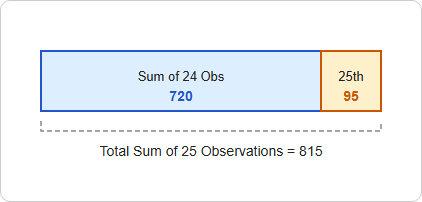
Calculations:

⇒ Total sum of 25 observations = 25 × 32.6 = 815

⇒ Total sum of first 24 observations = 24 × 30 = 720

⇒ 25th observation = Total Sum (25) − Total Sum (24)

⇒ 25th observation = 815 − 720 = 95

∴ The correct answer is 95.

Additional Information

Arithmetic Mean Formula

The average or Mean (x¯) is calculated as the sum of all values divided by the total number of values: x¯ = (∑xi) ÷ n.

Effect of Inclusion/Exclusion

When a new value is added, the New Sum = (Old Average × Old Count) + New Value. Conversely, New Value = (New Average × New Count) − (Old Average × Old Count).

Deviation Concept

The sum of deviations of all observations from their arithmetic mean is always zero (∑(xi − x¯) = 0).
Question 2

A dishonest shopkeeper professes to sell his goods at a 35% loss but uses a false balance and gains 85%. The actual weight (rounded off to one decimal place) he uses for 1 kg is:

  1. AOption (a)

    347.2 gm

  2. BOption (b)

    348.5 gm

  3. COption (c)

    351.4 gm

  4. DOption (d)

    349.4 gm

View answer & explanation

Correct answer

Answer: (c)C.

351.4 gm

Why this answer is correct

Shortcut Trick

Use the Effective Multiplier logic: Total Gain Factor = Price Factor × Weight Factor.

Total Gain 85% → Factor = 1.85 | Loss 35% → Factor = 0.65.

Weight Factor = 1000 / Actual Weight (x).
1.85 = 0.65 × (1000 / x) ⇒ x = 650 / 1.85.
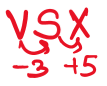
x = 351.35... ≈ 351.4 gm.

∴ The correct answer is 351.4 gm.

Alternate Method

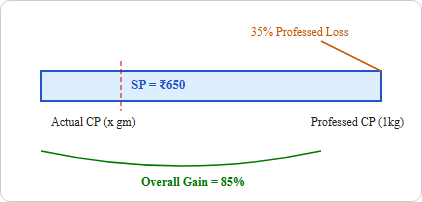
Given: Professed Loss = 35%, Overall Gain = 85%, Standard weight = 1000 gm.

Let the Actual Weight used by the shopkeeper be x gm.

Let the Cost Price (CP) of 1 gm be ₹1.

⇒ CP of 1000 gm = ₹1000.

⇒ Selling Price (SP) at 35% loss = 1000 − (35% of 1000) = ₹650.

⇒ The shopkeeper actually gives x gm for ₹650.

⇒ Actual CP of x gm = ₹x.

⇒ Overall Gain% = [(SP − CP) / CP] × 100

⇒ 85 = [(650 − x) / x] × 100

⇒ 0.85 = (650 / x) − 1

⇒ 1.85 = 650 / x

⇒ x = 650 / 1.85 = 351.351...

⇒ x ≈ 351.4 gm (rounded to one decimal place).

∴ The correct answer is 351.4 gm.

Additional Information

Dishonest Dealer Formula

Profit % = [(True Weight − False Weight) / False Weight] × 100, assuming goods are sold at cost price.

Overall Profit with Price Change

Final Gain/Loss % = [((100 ± P/L%) / 100) × (True Weight / False Weight) − 1] × 100.

Multiplier Method

Effective Multiplier (Mtotal) = Mprice × Mweight. If M > 1, it is a profit; if M < 1, it is a loss.

Question 3

Add 1116 \frac{11}{16} and 0.4375. What is the sum in decimal form?

  1. AOption (a)

    1.208

  2. BOption (b)

    1.125

  3. COption (c)

    0.975

  4. DOption (d)

    0.958

View answer & explanation

Correct answer

Answer: (b)B.

1.125

Why this answer is correct

Shortcut Trick

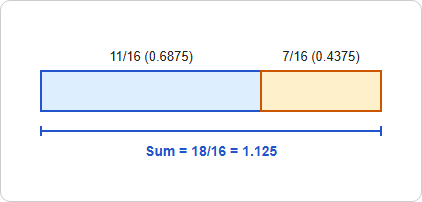
Convert the fraction 11/16 into its decimal equivalent: 11 ÷ 16 = 0.6875.

Perform the addition with the given decimal: 0.6875 + 0.4375 = 1.125.

∴ The correct answer is 1.125.

Alternate Method

Given:

Fraction = 11/16

Decimal = 0.4375

Formula Used:

Decimal to Fraction conversion: Value / 10n (where n is the number of decimal places).

Calculations:

⇒ Convert 0.4375 to a fraction: 0.4375 = 4375 ÷ 10000

⇒ Simplify the fraction: 4375/10000 = 875/2000 = 175/400 = 35/80 = 7/16

⇒ Calculate the Sum: 11/16 + 7/16 = (11 + 7) ÷ 16

⇒ Sum = 18/16 = 9/8

⇒ Convert 9/8 to decimal form: 9 ÷ 8 = 1.125

∴ The correct answer is 1.125.

Additional Information

Fraction to Decimal Conversion

A fraction is converted to a decimal by dividing the numerator by the denominator. If the denominator is in the form 2m × 5n, the decimal will be terminating.

Adding Decimals

To add decimals, align the decimal points and add as whole numbers, then place the decimal point directly below the others in the sum.

Like Fractions

Fractions with the same denominator are called like fractions. Their addition or subtraction is done by performing the operation on the numerators while keeping the denominator constant.

Question 4

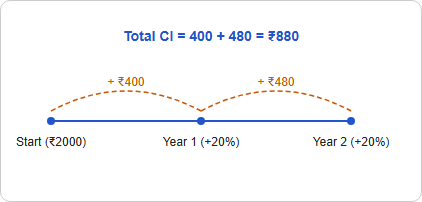
A sum of ₹2000 is invested at 20% compound interest per annum, compounded annually for 2 years. What is the compound interest earned at the end of 2 years?

  1. AOption (a)

    ₹1000

  2. BOption (b)

    ₹900

  3. COption (c)

    ₹800

  4. DOption (d)

    ₹880

View answer & explanation

Correct answer

Answer: (d)D.

₹880

Why this answer is correct

Shortcut Trick

Effective Rate of Interest for 2 years = x + y + (xy/100)%

⇒ 20 + 20 + (20 × 20)/100 = 44%

Compound Interest (CI) = 44% of ₹2000

⇒ 0.44 × 2000 = ₹880

∴ The correct answer is ₹880.

Alternate Method

Given: Principal (P) = ₹2000, Rate (R) = 20%, Time (n) = 2 years

Formula Used: Amount (A) = P(1 + R/100)n

⇒ A = 2000(1 + 20/100)2

⇒ A = 2000(1.2)2

⇒ A = 2000 × 1.44 = ₹2880

⇒ Compound Interest = Amount − Principal

⇒ CI = 2880 − 2000 = ₹880

∴ The correct answer is ₹880.

Additional Information

Difference between CI and SI

For a period of 2 years, the difference (D) between Compound Interest and Simple Interest is given by D = P × (R/100)2.

Effective Rate Formula

To find the equivalent single percentage for two successive increases of x% and y%, use the formula: x + y + (xy/100)%.

Compound Interest Ratio Method

For 2 years, the ratio 2:1 can be used. CI = 2 × (Interest on P) + 1 × (Interest on Interest).

Question 5

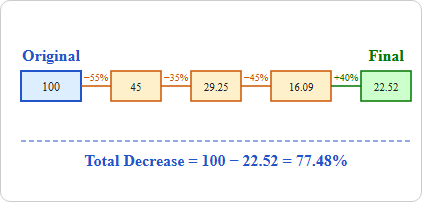
The price of fuel decreases by 55%, 35% and 45% in three successive months, but increases by 40% in the fourth month. What is the percentage decrease in the price of fuel in the fourth month as compared to its original price? (Round off to 2 decimal places.)

  1. AOption (a)

    81.67%

  2. BOption (b)

    77.48%

  3. COption (c)

    76.52%

  4. DOption (d)

    73.05%

View answer & explanation

Correct answer

Answer: (b)B.

77.48%

Why this answer is correct

Shortcut Trick

Use the Successive Multiplier Method to find the final price ratio.

Final Price Factor = 0.45 × 0.65 × 0.55 × 1.4 = 0.225225

Net Percentage Decrease = (1 − 0.225225) × 100 = 77.4775%

Rounding to 2 decimal places, we get 77.48%.

∴ The correct answer is 77.48%.

Alternate Method

Given: Successive decreases of 55%, 35%, 45% and an increase of 40%.

Formula Used: Final Price = Initial Price × (1 ± r1/100) × (1 ± r2/100) ...

Let the original price be 100.

⇒ Price after 1st month = 100 − 55% of 100 = 45

⇒ Price after 2nd month = 45 − 35% of 45 = 45 × 0.65 = 29.25

⇒ Price after 3rd month = 29.25 − 45% of 29.25 = 29.25 × 0.55 = 16.0875

⇒ Price after 4th month = 16.0875 + 40% of 16.0875 = 16.0875 × 1.4 = 22.5225

⇒ Total decrease from original = 100 − 22.5225 = 77.4775

⇒ Percentage decrease = (77.4775 / 100) × 100 = 77.4775%

∴ The correct answer is 77.48%.

Additional Information

Successive Percentage Change

When a value changes by a% and then by b%, the net change is [a + b + (ab/100)]%. For decreases, use negative values.

Multiplier Method

For a decrease of x%, the multiplier is (100 − x)/100. For an increase of y%, it is (100 + y)/100. Multiply all factors to get the final ratio.

Rounding Rule

When rounding to 2 decimal places, check the 3rd decimal. If it is 5 or greater, round up the 2nd decimal.

Question 6

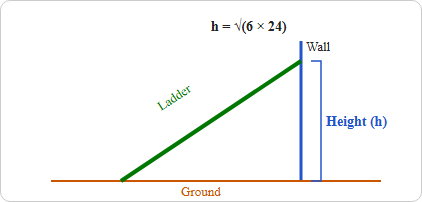
If the height at which a ladder touches the wall is the mean proportional between 6 meters and 24 meters, at what height does the ladder touch the wall?

  1. AOption (a)

    18 meters

  2. BOption (b)

    14 meters

  3. COption (c)

    16 meters

  4. DOption (d)

    12 meters

View answer & explanation

Correct answer

Answer: (d)D.

12 meters

Why this answer is correct

Shortcut Trick

The mean proportional between two numbers a and b is calculated as √(a × b).

Given a = 6 m and b = 24 m.

Height (h) = √(6 × 24) = √144 = 12 m.

∴ The correct answer is 12 m.

Alternate Method

Given:

First value (a) = 6 m

Second value (b) = 24 m

The height (h) of the ladder on the wall is the mean proportional.

Formula Used:

If h is the mean proportional between a and b, then:

a : h = h : b ⇒ h2 = a × b ⇒ h = √(a × b)

Calculations:

⇒ h = √(6 × 24)

⇒ h = √144

⇒ h = 12 m

∴ The correct answer is 12 m.

Additional Information

Mean Proportional (Geometric Mean)

The mean proportional between two numbers a and b is the value x such that a/x = x/b, which gives x = √(ab).

Third Proportional

If a and b are two numbers, then their third proportional c is such that a/b = b/c, which gives c = b2/a.

Fourth Proportional

If a, b, and c are three numbers, then their fourth proportional d is such that a/b = c/d, which gives d = (b × c)/a.

Question 7

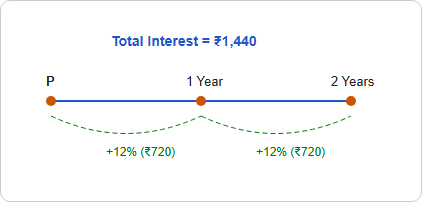
What sum (in ₹) will earn a simple interest of ₹1,440 in 2 years at 12% per year rate of interest?

  1. AOption (a)

    3,000

  2. BOption (b)

    12,000

  3. COption (c)

    6,000

  4. DOption (d)

    345.6

View answer & explanation

Correct answer

Answer: (c)C.

6,000

Why this answer is correct

Shortcut Trick

Effective Simple Interest rate for 2 years = 12% × 2 = 24%.

According to the question, 24% of the Principal = ₹1,440.

1% of the Principal = 1440 ÷ 24 = 60.

Total Principal (100%) = 60 × 100 = ₹6,000.

∴ The correct answer is ₹6,000.

Alternate Method

Given:

Simple Interest (SI) = ₹1,440

Rate of Interest (R) = 12% per annum

Time Period (T) = 2 years

Formula Used:

Simple Interest (SI) = (Principal × Rate × Time) ÷ 100

Calculations:

⇒ 1440 = (P × 12 × 2) ÷ 100

⇒ 1440 = (P × 24) ÷ 100

⇒ 1440 × 100 = 24P

⇒ P = 144000 ÷ 24

⇒ P = 6000

∴ The correct answer is ₹6,000.

Additional Information

Simple Interest (S.I.)

The interest remains constant every year as it is calculated only on the original principal. S.I. = (P × R × T) ÷ 100.

Amount (A)

Total sum of money (Principal + Interest) to be paid back at the end of the time period. A = P + S.I. = P[1 + (RT ÷ 100)].

Difference between C.I. and S.I.

For a period of 2 years, the difference is given by D = P × (R ÷ 100)2.

Rate and Time Calculation

Rate R = (SI × 100) ÷ (P × T) and Time T = (SI × 100) ÷ (P × R).

Question 8

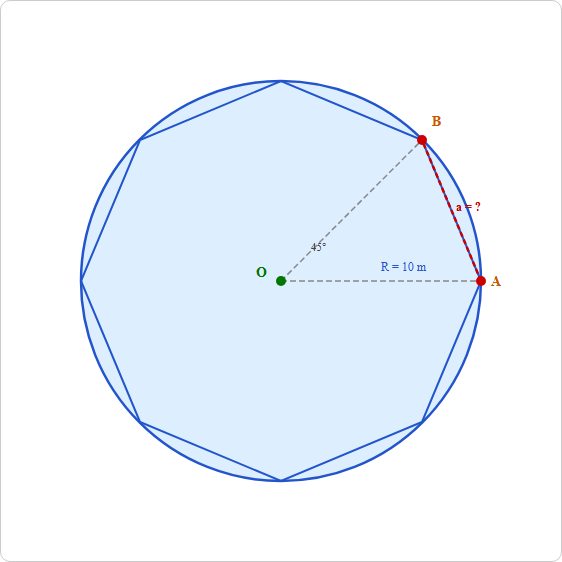
A regular octagonal fountain has a circumradius of 10 m. Find the approximate length of each side.

  1. AOption (a)

    9.27 m

  2. BOption (b)

    6.13 m

  3. COption (c)

    7.65 m

  4. DOption (d)

    8.71 m

View answer & explanation

Correct answer

Answer: (c)C.

7.65 m

Why this answer is correct

Shortcut Trick

For a regular octagon with circumradius R, the side length a is given by:

a = 2 × R × sin(180° / 8) = 2 × R × sin(22.5°)

Given: R = 10 m and sin(22.5°) ≈ 0.3827

a = 2 × 10 × 0.3827 ⇒ 20 × 0.3827

a = 7.654 m ≈ 7.65 m

∴ The correct answer is 7.65 m.

Alternate Method

Given: Circumradius (R) = 10 m, Number of sides (n) = 8.

Formula used: Law of Cosines in the triangle formed by the center and two adjacent vertices.

The central angle subtended by each side of the regular octagon at the center O is:

θ = 360° ÷ n ⇒ 360° ÷ 8 = 45°

In ΔOAB, let side AB = a, and OA = OB = R = 10 m.

Using Law of Cosines:

⇒ a2 = R2 + R2 − 2 × R × R × cos(45°)

⇒ a2 = 2R2 − 2R2 × (1/√2)

⇒ a2 = 2R2 (1 − 1/√2)

⇒ a2 = 2 × 102 × (1 − 0.7071)

⇒ a2 = 200 × 0.2929

⇒ a2 = 58.58

⇒ a = √58.58 ≈ 7.6537 m

∴ The correct answer is 7.65 m.

Additional Information

Area of a Regular Octagon

The area can be calculated as Area = 2(1 + √2)a2, where a is the side length.

Interior and Exterior Angles

For a regular octagon, each exterior angle is 45° and each interior angle is 135°.

Inradius of a Regular Polygon

The distance from the center to the midpoint of a side is r = R × cos(180°/n).

Question 9

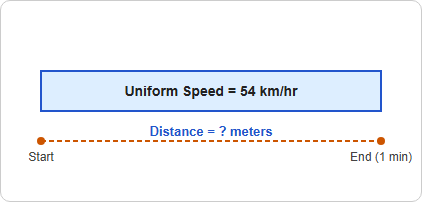
A bus travels at a uniform speed of 54 km/hr. How many meters does it cover in 1 minute?

  1. AOption (a)

    750 meters

  2. BOption (b)

    600 meters

  3. COption (c)

    800 meters

  4. DOption (d)

    900 meters

View answer & explanation

Correct answer

Answer: (d)D.

900 meters

Why this answer is correct

Shortcut Trick

Convert speed from km/hr to m/min directly.

Speed = 54 × (1000 ÷ 60) m/min

Speed = 54 × (50 ÷ 3) = 18 × 50 = 900 m/min

In 1 minute, the bus covers 900 meters.

∴ The correct answer is 900 m.

Alternate Method

Given:

Speed of the bus = 54 km/hr

Time taken = 1 min

Formula Used:

Distance = Speed × Time

Calculations:

⇒ 1 km = 1000 m and 1 hr = 60 min

⇒ Speed in m/min = (54 × 1000) ÷ 60

⇒ Speed = 54000 ÷ 60 = 900 m/min

⇒ Distance = 900 m/min × 1 min

⇒ Distance = 900 m

∴ The correct answer is 900 m.

Additional Information

Unit Conversion Trick

To convert speed from km/hr to m/s, multiply by 5/18. To convert m/s back to km/hr, multiply by 18/5.

Distance Formula

Distance = Speed × Time. Always ensure that the units of speed and time are consistent (e.g., both in seconds or both in hours) before calculation.

Uniform Speed

When an object covers equal distances in equal intervals of time, it is said to be moving with uniform speed.

Question 10

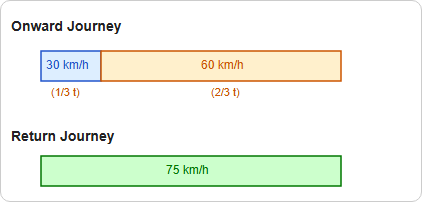
A motorist travels a certain journey in two stages. In the first stage, he travels for one-third of the total time at 30 km/hr. In the second stage, he travels for the rest of the time at 60 km/hr. He returns to the start at a uniform speed of 75 km/hr. What is the average speed for the entire round trip?

  1. AOption (a)

    55 km/hr

  2. BOption (b)

    60 km/hr

  3. COption (c)

    62 km/hr

  4. DOption (d)

    58 km/hr

View answer & explanation

Correct answer

Answer: (b)B.

60 km/hr

Why this answer is correct

Shortcut Trick

The average speed for the onward journey is the weighted average of speeds with respect to time.

Onward Average Speed = (1/3 × 30) + (2/3 × 60) = 10 + 40 = 50 km/hr.

Since the distance for the onward journey and return journey is equal, use the harmonic mean formula:

Average Speed = (2 × Von × Vret) ÷ (Von + Vret) = (2 × 50 × 75) ÷ (50 + 75) = 7500 ÷ 125 = 60 km/hr.

∴ The correct answer is 60 km/hr.

Alternate Method

Given:

Stage 1: Speed = 30 km/hr, Time = 1/3 of total onward time.

Stage 2: Speed = 60 km/hr, Time = 2/3 of total onward time.

Return Speed: 75 km/hr.

Calculations:

⇒ Let the total time for the onward journey be 3 hours.

⇒ Time for Stage 1 = 1/3 × 3 = 1 hour.

⇒ Time for Stage 2 = 2/3 × 3 = 2 hours.

⇒ Distance in Stage 1 = Speed × Time = 30 × 1 = 30 km.

⇒ Distance in Stage 2 = Speed × Time = 60 × 2 = 120 km.

⇒ Total onward distance = 30 + 120 = 150 km.

⇒ Return journey distance = 150 km.

⇒ Return time = Distance ÷ Speed = 150 ÷ 75 = 2 hours.

⇒ Total Trip Distance = Onward + Return = 150 + 150 = 300 km.

⇒ Total Trip Time = Onward Time + Return Time = 3 + 2 = 5 hours.

⇒ Average speed = Total Distance ÷ Total Time = 300 ÷ 5 = 60 km/hr.

∴ The correct answer is 60 km/hr.

Additional Information

Average Speed (Equal Distance)

When two equal distances are covered at speeds V1 and V2, the average speed is 2V1V2 ÷ (V1 + V2).

Average Speed (Equal Time Intervals)

If a journey is divided into equal time intervals at different speeds, the average speed is the simple arithmetic mean: (V1 + V2 + ... + Vn) ÷ n.

General Average Speed Formula

Average Speed = Total Distance ÷ Total Time. This applies to all scenarios regardless of uniformity in time or distance.

Question 11

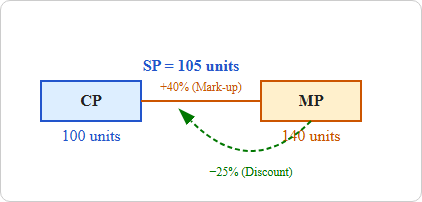
A shopkeeper marks an article at 40% above the cost price and allows a discount of 25%. What is the percentage profit or loss?

  1. AOption (a)

    5% profit

  2. BOption (b)

    15% loss

  3. COption (c)

    5% loss

  4. DOption (d)

    15% profit

View answer & explanation

Correct answer

Answer: (a)A.

5% profit

Why this answer is correct

Shortcut Trick

Apply the Successive Percentage formula: Net % change = a + b + (ab/100)

Here, Mark-up (a) = +40 and Discount (b) = −25

Net change = 40 − 25 + [40 × (−25) ÷ 100]

Net change = 15 − 10 = 5%

Positive result indicates Profit.

∴ The correct answer is 5% profit.

Alternate Method

Given:

Mark-up Percentage = 40%

Discount Percentage = 25%

Calculations:

⇒ Let the Cost Price (CP) of the article be 100.

⇒ Marked Price (MP) = CP + 40% of CP = 100 + 40 = 140.

⇒ Discount = 25% of MP = (25/100) × 140 = 35.

⇒ Selling Price (SP) = MP − Discount = 140 − 35 = 105.

⇒ Profit = SP − CP = 105 − 100 = 5.

⇒ Profit Percentage = (Profit ÷ CP) × 100 = (5 ÷ 100) × 100 = 5%.

∴ The correct answer is 5% profit.

Additional Information

CP-MP Relation Formula

CP ÷ MP = (100 − Discount%) ÷ (100 + Profit%). This is extremely useful for finding any one unknown variable when others are given.

Markup Percentage

Markup% = [(Marked Price − Cost Price) ÷ Cost Price] × 100. It represents how much the price is increased over the cost before selling.

Successive Discounts

If two successive discounts d1% and d2% are given, the equivalent single discount is [d1 + d2 − (d1 × d2) ÷ 100]%.

Question 12

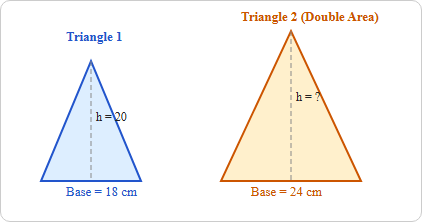
The base of a triangle is 18 cm and height is 20 cm. Find the height of another triangle of double the area having base 24 cm.

  1. AOption (a)

    24 cm

  2. BOption (b)

    22 cm

  3. COption (c)

    20 cm

  4. DOption (d)

    30 cm

View answer & explanation

Correct answer

Answer: (d)D.

30 cm

Why this answer is correct

Shortcut Trick

Ratio of areas: (Base1 × Height1) ÷ (Base2 × Height2) = Area1 ÷ Area2

Given: Area2 = 2 × Area1 ⇒ Area1 : Area2 = 1 : 2

(18 × 20) ÷ (24 × H2) = 1 ÷ 2

360 ÷ (24 × H2) = 1 ÷ 2

H2 = (360 × 2) ÷ 24 = 720 ÷ 24 = 30 cm

∴ The correct answer is 30 cm.

Alternate Method

Given:

Base of first triangle (b1) = 18 cm

Height of first triangle (h1) = 20 cm

Base of second triangle (b2) = 24 cm

Area of second triangle (A2) = 2 × Area of first triangle (A1)

Formula Used:

Area of a triangle = (1 ÷ 2) × base × height

Calculations:

⇒ Area1 = (1 ÷ 2) × 18 × 20

⇒ Area1 = 9 × 20 = 180 cm2

⇒ Area2 = 2 × Area1 = 2 × 180 = 360 cm2

⇒ 360 = (1 ÷ 2) × 24 × h2

⇒ 360 = 12 × h2

⇒ h2 = 360 ÷ 12

⇒ h2 = 30 cm

∴ The correct answer is 30 cm.

Additional Information

Heron's Formula

When all three sides a, b, and c are known, Area = √[s(s−a)(s−b)(s−c)], where s is the semi-perimeter (a+b+c)/2.

Equilateral Triangle Area

For a triangle with all sides equal to 'a', the area is given by (√3 ÷ 4) × a2.

Right-Angled Triangle

The area is (1 ÷ 2) × base × perpendicular, where the two sides forming the 90° angle act as base and height.

Question 13

Two taps can fill a cistern in 4 hours and 16 hours, respectively. A third tap can empty it in 4 hours. How long (in hours) will it take to fill one-fourth of the empty cistern if all the taps are opened together?

  1. AOption (a)

    8

  2. BOption (b)

    4

  3. COption (c)

    12

  4. DOption (d)

    16

View answer & explanation

Correct answer

Answer: (b)B.

4

Why this answer is correct

Shortcut Trick

Net efficiency = Efficiency of Tap 1 + Efficiency of Tap 2 − Efficiency of Tap 3.

Since Tap 1 fills in 4 hr and Tap 3 empties in 4 hr, their rates cancel each other out completely.

The net filling rate is solely determined by Tap 2, which takes 16 hr to fill the full cistern.

Time to fill 1/4 of the cistern = 1/4 × 16 hr = 4 hr.

∴ The correct answer is 4 hr.

Alternate Method

Given: Filling time for Tap A = 4 hr, Tap B = 16 hr, and Emptying time for Tap C = 4 hr.

Formula Used: Total Work = L.C.M. of time taken | Efficiency = Total Work ÷ Time.

Tap NameTime (hr)Total Capacity (LCM)Efficiency (units/hr)
Tap A (Fill)416 units4
Tap B (Fill)161
Tap C (Empty)4−4

⇒ Total efficiency when all taps are open = 4 + 1 − 4 = 1 unit/hr

⇒ Required capacity to fill = 1/4 × Total Capacity = 1/4 × 16 = 4 units

⇒ Time taken = Required Capacity ÷ Total Efficiency

⇒ Time taken = 4 units ÷ 1 unit/hr = 4 hr

∴ The correct answer is 4 hr.

Additional Information

Efficiency of Emptying Pipe

The efficiency of an outlet or emptying pipe is always taken as negative because it reduces the total volume of the cistern.

Net Work Formula

If pipe A fills in x hr and pipe B empties in y hr, the net part filled in 1 hr is (1/x − 1/y). If y > x, the tank will eventually fill.

Fractional Filling

To find the time for a fractional part of the tank, multiply the total time required for a full tank by that specific fraction.

Question 14

Find the value of k for which the expression x3 - 3x2 - 7x - k will be divisible by (x - 5).

  1. AOption (a)

    -5

  2. BOption (b)

    5

  3. COption (c)

    -15

  4. DOption (d)

    15

View answer & explanation

Correct answer

Answer: (d)D.

15

Why this answer is correct

Shortcut Trick

By the Remainder Theorem, if a polynomial is divisible by (x − 5), substituting x = 5 must yield zero.

Put x = 5 in the expression: 53 − 3(52) − 7(5) − k = 0

125 − 75 − 35 − k = 0

15 − k = 0 ⇒ k = 15

∴ The correct answer is 15.

Alternate Method

Given:

Polynomial P(x) = x3 − 3x2 − 7x − k

Divisor = (x − 5)

Formula Used:

According to the Factor Theorem, if (x − a) is a factor of P(x), then P(a) = 0.

Calculations:

⇒ For the expression to be divisible by (x − 5), the remainder must be 0.

⇒ P(5) = 0

⇒ (5)3 − 3 × (5)2 − 7 × (5) − k = 0

⇒ 125 − 3 × 25 − 35 − k = 0

⇒ 125 − 75 − 35 − k = 0

⇒ 50 − 35 − k = 0

⇒ 15 − k = 0

⇒ k = 15

∴ The correct answer is 15.

Additional Information

Remainder Theorem

When a polynomial f(x) is divided by (x − a), the remainder is always f(a).

Factor Theorem

A linear polynomial (x − a) is a factor of a polynomial f(x) if and only if f(a) = 0.

Divisibility Rule for Polynomials

If P(x) is divisible by Q(x), then every root of Q(x) must also be a root of P(x).

Question 15

If cosA = 45\frac{4}{5}, find the value of sin⁡2A−5cos⁡2A+sec⁡2Atan⁡2A \frac{\sin^2 A - 5\cos^2 A + \sec^2 A}{\tan^2 A} .

  1. AOption (a)

    −511225-\frac{511}{225}

  2. BOption (b)

    109225\frac{109}{225}

  3. COption (c)

    23225\frac{23}{225}

  4. DOption (d)

    −451225-\frac{451}{225}

View answer & explanation

Correct answer

Answer: (a)A.

−511225-\frac{511}{225}

Why this answer is correct

Shortcut Trick

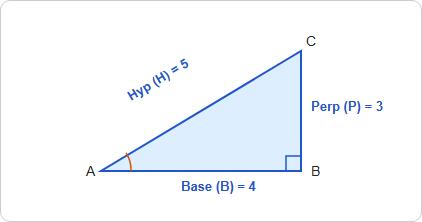
Given cos A = 4/5, we identify the Pythagorean triplet (3, 4, 5) where Base = 4, Hypotenuse = 5, and Perpendicular = 3.

Then sin A = 3/5, tan A = 3/4, and sec A = 5/4.

Substitute values into the expression: ((3/5)2 − 5×(4/5)2 + (5/4)2) ÷ (3/4)2.

Numerator = (9/25 − 80/25 + 25/16) = −71/25 + 25/16 = (−1136 + 625)/400 = −511/400.

Result = (−511/400) × (16/9) = −511/(25×9) = −511/225.

∴ The correct answer is −511/225.

Alternate Method

Given: cos A = 4/5

Formula Used: In a right-angled triangle, cos A = Base/Hypotenuse. By Pythagoras theorem, Perpendicular2 = Hypotenuse2 − Base2. Also, sin A = P/H, tan A = P/B, and sec A = H/B.

Calculations:

⇒ Let Base (B) = 4 and Hypotenuse (H) = 5.

⇒ Perpendicular (P) = √(52 − 42) = √(25 − 16) = √9 = 3.

⇒ sin A = P/H = 3/5

⇒ tan A = P/B = 3/4

⇒ sec A = H/B = 5/4

⇒ Value = (sin2 A − 5 cos2 A + sec2 A) / tan2 A

⇒ Value = ((3/5)2 − 5×(4/5)2 + (5/4)2) / (3/4)2

⇒ Value = (9/25 − 5×(16/25) + 25/16) / (9/16)

⇒ Value = (9/25 − 80/25 + 25/16) / (9/16) = (−71/25 + 25/16) / (9/16)

⇒ Value = [(−71×16 + 25×25) / (25×16)] ÷ (9/16)

⇒ Value = [(−1136 + 625) / 400] ÷ (9/16) = (−511/400) × (16/9)

⇒ Value = −511 / (25 × 9) = −511/225.

∴ The correct answer is −511/225.

Additional Information

Trigonometric Identities

Standard identities include sin2 A + cos2 A = 1, 1 + tan2 A = sec2 A, and 1 + cot2 A = cosec2 A.

Pythagorean Triplets

Common integer sets satisfying a2 + b2 = c2 like (3, 4, 5), (5, 12, 13), (8, 15, 17), and (7, 24, 25) are extremely useful in exam time-saving.

Reciprocal Ratios

The reciprocal ratios are defined as sec A = 1/cos A, cosec A = 1/sin A, and cot A = 1/tan A.

Question 16

Simplify: { (15/42) ÷ (15/3) } ÷ ( (3/10) × (20/9) + (5/14) ) + (3/6) ÷ (43/20) of (20/6)

  1. AOption (a)

    437\frac{4}{37}

  2. BOption (b)

    1145\frac{11}{45}

  3. COption (c)

    1447\frac{14}{47}

  4. DOption (d)

    643\frac{6}{43}

View answer & explanation

Correct answer

Answer: (d)D.

643\frac{6}{43}

Why this answer is correct

Shortcut Trick

Simplify the first bracket: {15/42 × 3/15} = 3/42 = 1/14.

Simplify the second bracket: (2/3 + 5/14) = (28 + 15)/42 = 43/42.

Divide the results: (1/14) ÷ (43/42) = 1/14 × 42/43 = 3/43.

Simplify the final term using BODMAS: 1/2 ÷ (43/6) = 1/2 × 6/43 = 3/43.

Combine: 3/43 + 3/43 = 6/43.

∴ The correct answer is 6/43.

Alternate Method

Given: { (15/42) ÷ (15/3) } ÷ ( (3/10) × (20/9) + (5/14) ) + (3/6) ÷ (43/20) of (20/6)

Formula Used: VBODMAS (Vinculum, Brackets, Of, Division, Multiplication, Addition, Subtraction)

⇒ Step 1 (Solve Brackets): { 15/42 × 3/15 } ÷ ( 2/3 + 5/14 ) + 3/6 ÷ ( 43/20 of 20/6 )

⇒ Step 2 (Simplify Fractions): { 1/14 } ÷ ( 43/42 ) + 1/2 ÷ ( 43/20 × 20/6 )

⇒ Step 3 (Process 'Of' and Divisions): (1/14 × 42/43) + 1/2 ÷ 43/6

⇒ Step 4 (Multiplication and Reciprocal): 3/43 + (1/2 × 6/43)

⇒ Step 5 (Final Addition): 3/43 + 3/43 = 6/43

∴ The correct answer is 6/43.

Additional Information

VBODMAS Rule

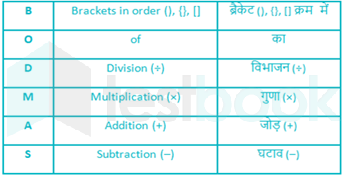
This rule defines the precedence of operations: Vinculum (Bar), Brackets (), Of, Division (÷), Multiplication (×), Addition (+), and Subtraction (−).

Fraction Reciprocal Rule

To divide by a fraction, multiply by its reciprocal: (a/b) ÷ (c/d) = (a/b) × (d/c).

'Of' vs Multiplication

The operator 'of' behaves as multiplication but holds a higher priority than division and regular multiplication in the order of operations.

Question 17

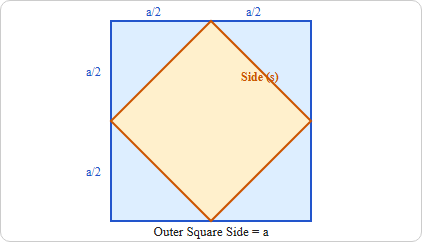
A square is drawn inside another square such that each vertex of the inner square lies at the midpoint of a side of the outer square. If the perimeter of the inner square is 40 cm, find the perimeter of the outer square.

  1. AOption (a)

    40cm

  2. BOption (b)

    802\sqrt2 cm

  3. COption (c)

    202\sqrt2 cm

  4. DOption (d)

    402\sqrt2 cm

View answer & explanation

Correct answer

Answer: (d)D.

402\sqrt2 cm

Why this answer is correct

Shortcut Trick

The ratio of the perimeter of an outer square to the inner square (formed by joining midpoints) is always √2 : 1.

Given, Perimeter of inner square = 40 cm.

Perimeter of outer square = Perimeter of inner square × √2

Perimeter of outer square = 40 × √2 = 40√2 cm.

∴ The correct answer is 40√2 cm.

Alternate Method

Given:

Perimeter of inner square = 40 cm

Formula Used:

Perimeter of a square = 4 × Side

In a right-angled triangle, Pythagoras Theorem: Hypotenuse2 = Base2 + Perpendicular2

Calculations:

⇒ Side of the inner square (s) = 40 ÷ 4 = 10 cm

⇒ Let the side of the outer square be a. Since the inner vertices are midpoints, the side of the inner square forms a triangle with legs a/2.

⇒ By Pythagoras Theorem: (a/2)2 + (a/2)2 = 102

⇒ a2/4 + a2/4 = 100

⇒ 2a2/4 = 100

⇒ a2/2 = 100 ⇒ a2 = 200

⇒ a = √200 = 10√2 cm

⇒ Perimeter of outer square = 4 × a = 4 × 10√2 = 40√2 cm

∴ The correct answer is 40√2 cm.

Additional Information

Area Ratio of Midpoint Squares

The area of a square formed by joining the midpoints of another square is exactly half (1/2) the area of the original square.

Successive Midpoint Squares

If the process is repeated, the perimeters form a Geometric Progression (GP) with a common ratio of 1/√2.

Diagonal Relationship

The side of the inner square is equal to half the diagonal of the outer square: s = d/2 = (a√2)/2 = a/√2.

Question 18

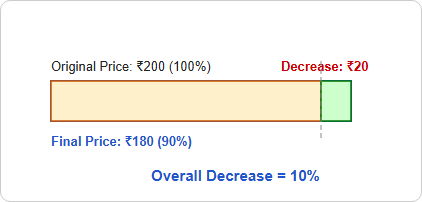
A shirt's price is decreased from ₹200 to ₹180. What is the percentage decrease?

  1. AOption (a)

    15%

  2. BOption (b)

    10%

  3. COption (c)

    5%

  4. DOption (d)

    20%

View answer & explanation

Correct answer

Answer: (b)B.

10%

Why this answer is correct

Shortcut Trick

Price Ratio = 200 : 180 → 10 : 9

Reduction in units = 10 − 9 = 1 unit

Percentage Decrease = (1 ÷ 10) × 100 = 10%

∴ The correct answer is 10%.

Alternate Method

Given:

Initial shirt's price = ₹200

Final shirt's price = ₹180

Formula Used:

Percentage Decrease = (Decrease ÷ Original Value) × 100

Calculations:

⇒ Price Decrease = ₹200 − ₹180 = ₹20

⇒ Percentage Decrease = (20 ÷ 200) × 100

⇒ Percentage Decrease = (1 ÷ 10) × 100

⇒ Percentage Decrease = 10%

∴ The correct answer is 10%.

Additional Information

Percentage Change Formula

Percentage change = ((New Value − Old Value) ÷ Old Value) × 100. A negative result indicates a decrease, while a positive result indicates an increase.

Fraction to Percentage Conversion

Common fractions: 1/2 = 50%, 1/4 = 25%, 1/5 = 20%, 1/10 = 10%, and 1/20 = 5%.

Successive Percentage Change

If a value changes by a% and then by b%, the effective change is (a + b + ab/100)%.

Question 19

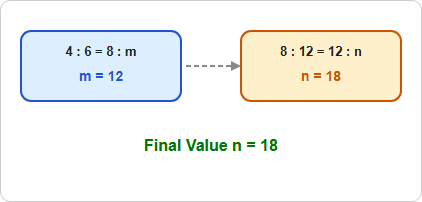
The fourth proportional to 4, 6, and 8 is m. The third proportional to 8 and m is n. What is the value of n?

  1. AOption (a)

    18

  2. BOption (b)

    20

  3. COption (c)

    16

  4. DOption (d)

    24

View answer & explanation

Correct answer

Answer: (a)A.

18

Why this answer is correct

Shortcut Trick

Fourth proportional m = (Product of middle terms) ÷ (First term)

⇒ m = (6 × 8) ÷ 4 = 12

Third proportional n = (Square of second term) ÷ (First term)

⇒ n = (12 × 12) ÷ 8 = 144 ÷ 8 = 18

∴ The correct answer is 18.

Alternate Method

Given:

Numbers for fourth proportional: 4, 6, 8, and m

Numbers for third proportional: 8, m, and n

Formula Used:

  1. If a, b, c, d are in proportion, then a/b = c/d
  2. If a, b, c are in continued proportion, then a/b = b/c (where c is the third proportional)

Calculations:

Step 1: Finding m

⇒ 4 ÷ 6 = 8 ÷ m

⇒ 4 × m = 6 × 8

⇒ 4 × m = 48

⇒ m = 12

Step 2: Finding n

⇒ 8 ÷ 12 = 12 ÷ n

⇒ 8 × n = 12 × 12

⇒ 8 × n = 144

⇒ n = 144 ÷ 8 = 18

∴ The correct answer is 18.

Additional Information

Fourth Proportional

For four numbers a, b, c, and d to be in proportion, the relation is a/b = c/d, which gives d = (b × c) / a.

Third Proportional

For three numbers a, b, and c to be in continued proportion, the relation is a/b = b/c, which gives c = b2 / a.

Mean Proportional

The mean proportional between two numbers a and b is given by the formula √(a × b).

Question 20

The H.C.F. and L.C.M. of two numbers are 25 and 500, respectively. If the first number is divided by 2, the quotient is 50 and the remainder is zero. Find the second number.

  1. AOption (a)

    50

  2. BOption (b)

    250

  3. COption (c)

    125

  4. DOption (d)

    100

View answer & explanation

Correct answer

Answer: (c)C.

125

Why this answer is correct

Shortcut Trick

First Number = 2 × 50 = 100.

Product of numbers = HCF × LCM.

100 × Second Number = 25 × 500.

Second Number = 12500 ÷ 100 = 125.

∴ The correct answer is 125.

Alternate Method

Given:

H.C.F. = 25

L.C.M. = 500

First number when divided by 2 gives quotient = 50 and remainder = 0.

Formula Used:

Dividend = (Divisor × Quotient) + Remainder

Product of two numbers = H.C.F. × L.C.M.

Calculations:

⇒ First number (N1) = (2 × 50) + 0

⇒ N1 = 100

⇒ N1 × N2 = 25 × 500

⇒ 100 × N2 = 12500

⇒ N2 = 12500 ÷ 100

⇒ N2 = 125

∴ The correct answer is 125.

Additional Information

Product Rule

For any two numbers a and b, the relationship is: a × b = HCF(a, b) × LCM(a, b).

Highest Common Factor (HCF)

The HCF is the greatest number that divides each of the two or more numbers without leaving a remainder.

Least Common Multiple (LCM)

The LCM of two or more numbers is the smallest number (not zero) that is a multiple of all the numbers.

Division Algorithm

The rule states that Dividend = (Divisor × Quotient) + Remainder, where 0 ≤ Remainder < Divisor.

Question 21

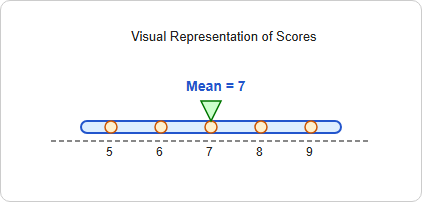
Five friends participated in a cooking contest and scored 6, 8, 7, 9, and 5 out of 10, respectively. What is the arithmetic mean of their scores?

  1. AOption (a)

    8

  2. BOption (b)

    7

  3. COption (c)

    6.5

  4. DOption (d)

    8.5

View answer & explanation

Correct answer

Answer: (b)B.

7

Why this answer is correct

Shortcut Trick

Assume a base average of 7.

Calculate deviations from 7: (6−7), (8−7), (7−7), (9−7), (5−7) ⇒ −1, +1, 0, +2, −2.

Net deviation = −1 + 1 + 0 + 2 − 2 = 0.

Required Mean = Base Average + (Net Deviation ÷ Count) = 7 + (0 ÷ 5) = 7.

∴ The correct answer is 7.

Alternate Method

Given:

Scores of five friends: 6, 8, 7, 9, and 5.

Total number of friends (n) = 5.

Formula Used:

Arithmetic Mean = (Sum of all observations) ÷ (Total number of observations)

Calculations:

⇒ Sum of scores = 6 + 8 + 7 + 9 + 5

⇒ Sum of scores = 35

⇒ Arithmetic Mean = 35 ÷ 5

⇒ Arithmetic Mean = 7

∴ The correct answer is 7.

Additional Information

Weighted Arithmetic Mean

When observations have different levels of importance, the mean is calculated as Σ(wi × xi) ÷ Σwi, where w is the weight.

Properties of Mean

The sum of deviations of all observations from their arithmetic mean is always zero.

Median vs Mean

While the mean is the average, the median is the middle value of a sorted data set. For the set (5, 6, 7, 8, 9), the median is also 7.

Question 22

Evaluate 223 + (-15)3 + (-7)3

  1. AOption (a)

    6929

  2. BOption (b)

    6981

  3. COption (c)

    6930

  4. DOption (d)

    6826

View answer & explanation

Correct answer

Answer: (c)C.

6930

Why this answer is correct

Shortcut Trick

If the sum of three numbers a + b + c = 0, then a3 + b3 + c3 = 3abc.

Check the sum of given numbers: 22 + (−15) + (−7) = 22 − 22 = 0.

Apply the trick: 3 × 22 × (−15) × (−7).

Calculation: 66 × 105 = 6930.

∴ The correct answer is 6930.

Alternate Method

Given Expression: 223 + (−15)3 + (−7)3

Let a = 22, b = −15, and c = −7.

Formula Used:

a3 + b3 + c3 − 3abc = (a + b + c)(a2 + b2 + c2 − ab − bc − ca)

Calculations:

⇒ First, find the sum (a + b + c):

⇒ a + b + c = 22 + (−15) + (−7)

⇒ a + b + c = 22 − 15 − 7 = 0

⇒ Since a + b + c = 0, the identity simplifies to: a3 + b3 + c3 = 3abc

⇒ Substituting the values: 3 × 22 × (−15) × (−7)

⇒ = 3 × 22 × 105

⇒ = 66 × 105

⇒ = 66 × (100 + 5) = 6600 + 330 = 6930

∴ The correct answer is 6930.

Additional Information

The Cubic Identity

The expression a3 + b3 + c3 − 3abc is always zero if a + b + c = 0 or if a = b = c.

Square of Trinomial

(a + b + c)2 = a2 + b2 + c2 + 2(ab + bc + ca). This is used to find individual squares or sum of products.

Difference of Cubes

x3 − y3 = (x − y)(x2 + xy + y2), useful for factoring two-term cubic expressions.

Question 23

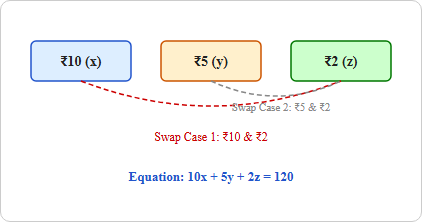
An amount of ₹120 is paid using ₹10, ₹5 and ₹2 coins. If the number of coins of ₹10 and ₹2 are interchanged, then the amount becomes ₹304. If the number of ₹5 and ₹2 coins are interchanged, then the amount is ₹165. How many ₹2 coins are used in the payment of ₹120?

  1. AOption (a)

    20

  2. BOption (b)

    15

  3. COption (c)

    10

  4. DOption (d)

    25

View answer & explanation

Correct answer

Answer: (d)D.

25

Why this answer is correct

Shortcut Trick

Let x, y, and z be the number of ₹10, ₹5, and ₹2 coins respectively.

Interchange ₹10 & ₹2: Increase = (10 − 2) × (z − x) = 304 − 120 ⇒ 8(z − x) = 184 ⇒ z − x = 23

Interchange ₹5 & ₹2: Increase = (5 − 2) × (z − y) = 165 − 120 ⇒ 3(z − y) = 45 ⇒ z − y = 15

Substitute x = z − 23 and y = z − 15 in original eq: 10(z − 23) + 5(z − 15) + 2z = 120

17z − 305 = 120 ⇒ 17z = 425 ⇒ z = 25

∴ The correct answer is 25 coins.

Alternate Method

Given:

Total amount = ₹120

Denominations = ₹10, ₹5, ₹2

New amount (₹10 ↔ ₹2) = ₹304

New amount (₹5 ↔ ₹2) = ₹165

Formula Used:

Total Value = (Number of coins × Value of each coin)

Let the number of coins be x, y, and z for ₹10, ₹5, and ₹2 respectively.

⇒ 10x + 5y + 2z = 120 −−− (1)

When ₹10 and ₹2 are interchanged:

⇒ 2x + 5y + 10z = 304 −−− (2)

When ₹5 and ₹2 are interchanged:

⇒ 10x + 2y + 5z = 165 −−− (3)

Subtract (1) from (2):

⇒ (2x + 5y + 10z) − (10x + 5y + 2z) = 304 − 120

⇒ 8z − 8x = 184

⇒ z − x = 23 ⇒ x = z − 23 −−− (4)

Subtract (1) from (3):

⇒ (10x + 2y + 5z) − (10x + 5y + 2z) = 165 − 120

⇒ 3z − 3y = 45

⇒ z − y = 15 ⇒ y = z − 15 −−− (5)

Substitute x and y in (1):

⇒ 10(z − 23) + 5(z − 15) + 2z = 120

⇒ 10z − 230 + 5z − 75 + 2z = 120

⇒ 17z − 305 = 120

⇒ 17z = 425

⇒ z = 25

∴ The correct answer is 25 coins.

Additional Information

Linear Equations in Three Variables

Equations of the form ax + by + cz = d require at least three independent constraints to find unique values for all variables.

Coin Problems Logic

The total value is the sum of (Quantity × Face Value). Interchanging quantities of denominations p and q changes the total by (p − q) × (Difference in counts).

Substitution Method

In multi-variable systems, expressing all variables in terms of one (e.g., everything in terms of z) simplifies the solution process significantly.

Question 24

Three numbers are in the ratio 4 : 3 : 13, and their LCM is 4524. Their HCF is:

  1. AOption (a)

    45

  2. BOption (b)

    49

  3. COption (c)

    29

  4. DOption (d)

    21

View answer & explanation

Correct answer

Answer: (c)C.

29

Why this answer is correct

Shortcut Trick

If the ratio of three numbers is a : b : c and their LCM is given, then HCF = LCM ÷ LCM(a, b, c).

LCM of ratio parts (4, 3, 13) = 4 × 3 × 13 = 156 (since they are co-prime).

HCF = 4524 ÷ 156 = 29.

∴ The correct answer is 29.

Alternate Method

Given:

Ratio of three numbers = 4 : 3 : 13

LCM of these numbers = 4524

Let the HCF of the three numbers be x.

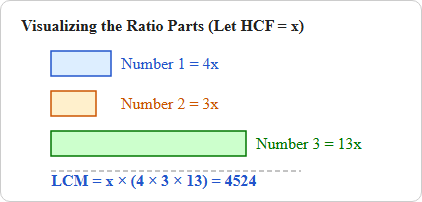
The three numbers can be represented as 4x, 3x, and 13x.

The LCM of (4x, 3x, 13x) is calculated as:

⇒ LCM = x × LCM(4, 3, 13)

Since 4, 3, and 13 have no common factors other than 1 (they are pairwise co-prime):

⇒ LCM(4, 3, 13) = 4 × 3 × 13 = 156

Now, equating to the given LCM value:

⇒ 156x = 4524

⇒ x = 4524 ÷ 156

⇒ x = 29

The HCF of the three numbers is x = 29.

∴ The correct answer is 29.

Additional Information

Relationship for Two Numbers

For any two numbers a and b, the product of the numbers is equal to the product of their HCF and LCM: a × b = HCF × LCM.

HCF of Fractions

HCF of (a/b, c/d, e/f) = HCF(a, c, e) ÷ LCM(b, d, f).

Co-prime Numbers

Two or more numbers are called co-prime if their HCF is 1. The LCM of a set of co-prime numbers is simply their product.

LCM of Fractions

LCM of (a/b, c/d, e/f) = LCM(a, c, e) ÷ HCF(b, d, f).

Question 25

A shopkeeper marks a jacket at ₹2,000. He gives a 20% discount, but charges 5% GST on the discounted price. What is the final price the customer pays?

  1. AOption (a)

    ₹1,680

  2. BOption (b)

    ₹1,700

  3. COption (c)

    ₹1,880

  4. DOption (d)

    ₹1,596

View answer & explanation

Correct answer

Answer: (a)A.

₹1,680

Why this answer is correct

Shortcut Trick

Net multiplier = (1 − 0.20) × (1 + 0.05) = 0.8 × 1.05 = 0.84

Final Price = Marked Price × 0.84

Final Price = 2000 × 0.84 = 1680

∴ The correct answer is ₹1,680.

Alternate Method

Given:

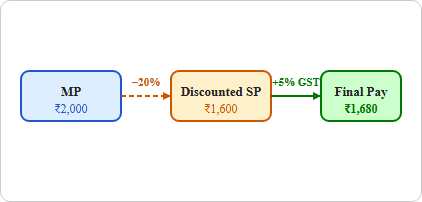
Marked Price (MP) = ₹2,000

Discount = 20%

GST = 5%

Calculations:

⇒ Discount = 20% of 2000 = (20/100) × 2000 = 400

⇒ Price after Discount = 2000 − 400 = 1600

⇒ GST = 5% of 1600 = (5/100) × 1600 = 80

⇒ Final Price = 1600 + 80 = 1680

∴ The correct answer is ₹1,680.

Additional Information

Net Percentage Change

When a value is changed successively by x% and y%, the net effective change is (x + y + (xy/100))%. Note that a discount is a negative change.

Marked Price (MP)

MP is the price listed on the product. Discounts are always calculated on this value: Selling Price (SP) = MP × (100 − D%)/100.

GST Application

Taxes like GST are calculated on the actual selling price (the price after applying all discounts), not on the original marked price.

Question 26

What is the third proportional to 0.25 and 0.15?

  1. AOption (a)

    0.04

  2. BOption (b)

    0.02

  3. COption (c)

    0.09

  4. DOption (d)

    0.15

View answer & explanation

Correct answer

Answer: (c)C.

0.09

Why this answer is correct

Shortcut Trick

Third Proportional c of two numbers a and b is calculated as c = b2 ÷ a.

Given a = 0.25 and b = 0.15.

Third Proportional = (0.15 × 0.15) ÷ 0.25

= 0.0225 ÷ 0.25 = 0.09

∴ The correct answer is 0.09.

Alternate Method

Given:

First number (a) = 0.25

Second number (b) = 0.15

Formula Used:

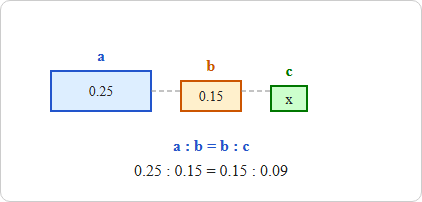
If a, b, and x are in continued proportion, then a : b :: b : x.

This implies a/b = b/x, where x is the third proportional.

Calculations:

⇒ 0.25 ÷ 0.15 = 0.15 ÷ x

⇒ x = (0.15 × 0.15) ÷ 0.25

⇒ x = 0.0225 ÷ 0.25

⇒ To simplify, multiply both numerator and denominator by 10000:

⇒ x = 225 ÷ 2500

⇒ x = 9 ÷ 100

⇒ x = 0.09

∴ The correct answer is 0.09.

Additional Information

Mean Proportional

The mean proportional between two numbers a and b is √(a × b).

Fourth Proportional

The fourth proportional d of three numbers a, b, and c is calculated as d = (b × c) ÷ a where a : b = c : d.

Continued Proportion

A sequence of numbers is in continued proportion if the ratio of any two consecutive terms is constant, i.e., a/b = b/c = c/d.

Question 27

A can complete a job in 9 days, while each of B and C can complete it in 18 days. All three start working together and work for x days. Then A leaves, and B and C together finish the remaining work in x days. Find the value of x.

  1. AOption (a)

    3.5

  2. BOption (b)

    4.5

  3. COption (c)

    3

  4. DOption (d)

    4

View answer & explanation

Correct answer

Answer: (c)C.

3

Why this answer is correct

Shortcut Trick

Total units of work = LCM(9, 18, 18) = 18 units.

Efficiencies: A = 2, B = 1, and C = 1.

In the first x days, all three work: Efficiency = 2 + 1 + 1 = 4.

In the next x days, only B and C work: Efficiency = 1 + 1 = 2.

Total work done = (4 × x) + (2 × x) = 6x = 18.

∴ The correct answer is 3.

Alternate Method

Given:

Time taken by A = 9 days

Time taken by B = 18 days

Time taken by C = 18 days

Formula Used:

Total Work = Efficiency × Time

PersonDaysTotal WorkEfficiency
A9182
B181
C181

Calculations:

⇒ Total Work = LCM of 9, 18, and 18 = 18 units.

⇒ Efficiency of (A + B + C) = 2 + 1 + 1 = 4 units/day.

⇒ Efficiency of (B + C) = 1 + 1 = 2 units/day.

⇒ Work done by all three in x days = 4 × x = 4x units.

⇒ Work done by B and C in the next x days = 2 × x = 2x units.

⇒ Total work = 4x + 2x = 6x units.

⇒ 6x = 18

⇒ x = 18 ÷ 6 = 3

∴ The correct answer is 3.

Additional Information

Efficiency and Time Relationship

Efficiency is inversely proportional to the time taken to complete a task. Efficiency = Work ÷ Time.

Combined Efficiency

When multiple people work together, their individual efficiencies are added to find the total work done per day.

LCM Method for Total Work

Assuming the Total Work as the LCM of the given time periods allows for calculation with whole numbers instead of fractions.

Question 28

A shopkeeper offers the following schemes on toys of the same marked price.

(A) Successive discounts of 34% and 37% on any number of toys bought.

(B) Successive discounts of 36%, 15% and 14% on any number of toys bought.

(C) 33% discount on the first 6 toys and 9% discount on each toy thereon.

(D) 3 toys free of cost on buying 9 toys.

A customer wants to buy 9 toys. Which of the above schemes is the least beneficial to her?

  1. AOption (a)

    D

  2. BOption (b)

    C

  3. COption (c)

    A

  4. DOption (d)

    B

View answer & explanation

Correct answer

Answer: (b)B.

C

Why this answer is correct

Shortcut Trick

To find the least beneficial scheme, identify the one with the lowest effective discount percentage.

(A) Successive 34% and 37% → 34 + 37 − (34 × 37 / 100) = 71 − 12.58 = 58.42%

(B) Successive 36%, 15%, 14% → 100 × 0.64 × 0.85 × 0.86 = 46.78% price → 53.22% discount

(C) Average discount for 9 toys → (6 × 33% + 3 × 9%) / 9 = (198% + 27%) / 9 = 225% / 9 = 25%

(D) 3 toys free on 9 toys bought → (Free / Total) × 100 = (3 / 9) × 100 = 33.33% (or 3/12 = 25%)

Comparing all, Scheme C provides the minimum discount of 25%.

∴ The correct answer is Scheme C.

Alternate Method

Assume the Marked Price (MP) of 1 toy is ₹100. A customer wants to buy 9 toys, so the total MP = ₹900.

Formula Used: Effective Discount % = (Total Discount / Total MP) × 100

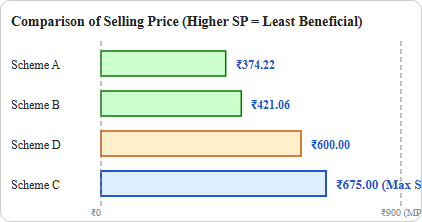
⇒ Scheme A: Net SP = 900 × (1 − 0.34) × (1 − 0.37) = 900 × 0.66 × 0.63 = ₹374.22

⇒ Scheme B: Net SP = 900 × 0.64 × 0.85 × 0.86 = ₹421.06

⇒ Scheme C: Discount = (6 × 33) + (3 × 9) = 198 + 27 = ₹225 | Net SP = 900 − 225 = ₹675

⇒ Scheme D: Buying 9 toys means getting 3 free out of the 9. Customer pays for 6 toys. Net SP = 6 × 100 = ₹600

⇒ Comparing the final Selling Prices, Scheme C results in the highest payment (₹675), making it the least beneficial scheme for the customer.

∴ The correct answer is Scheme C.

Additional Information

Successive Discount Formula

For two successive discounts of a% and b%, the effective discount is (a + b − ab/100)%.

Buy X Get Y Free

The effective discount percentage in a "Buy X Get Y Free" offer is calculated as [Y / (X + Y)] × 100.

Effective Discount for Bulk Purchase

Net Discount % = (Total Discount Value / Total Marked Price) × 100. This is useful for tiered discount schemes.

Question 29

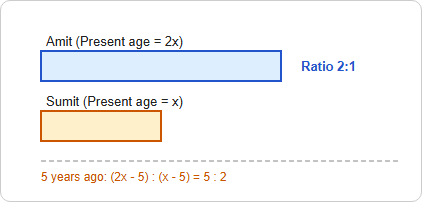
The present age of Amit is twice that of his brother Sumit. Five years ago, the ratio of their ages was 5:2. What is Sumit's present age?

  1. AOption (a)

    10 years

  2. BOption (b)

    8 years

  3. COption (c)

    20 years

  4. DOption (d)

    15 years

View answer & explanation

Correct answer

Answer: (d)D.

15 years

Why this answer is correct

Shortcut Trick

Present ratio (Amit : Sumit) = 2 : 1 | Ratio 5 years ago = 5 : 2.

Equate the age difference (2−1=1 and 5−2=3) by multiplying the present ratio by 3.

New Present ratio = 6 : 3 | Ratio 5 years ago = 5 : 2.

Difference in ratio parts (6−5 or 3−2) = 1 unit.

1 unit = 5 years. Therefore, Sumit present age = 3 units = 3 × 5 = 15 years.

∴ The correct answer is 15 years.

Alternate Method

Given:

Present age of Amit is twice that of Sumit.

Five years ago, the ratio of their ages was 5 : 2.

Formula Used:

Age ratio equation: (Age1 − t) / (Age2 − t) = Ratiopast

Let the Present age of Sumit be x years.

Then, the Present age of Amit = 2x years.

⇒ Age of Sumit five years ago = x − 5

⇒ Age of Amit five years ago = 2x − 5

⇒ (2x − 5) / (x − 5) = 5 / 2

⇒ 2 × (2x − 5) = 5 × (x − 5)

⇒ 4x − 10 = 5x − 25

⇒ 5x − 4x = 25 − 10

⇒ x = 15

∴ The correct answer is 15 years.

Additional Information

Constant Age Difference

The difference between the ages of two individuals remains the same at any point in time (past, present, or future).

Ratio Balancing

When the time gap is the same for both people, make the difference between the ratio terms equal to solve the problem faster without variables.

Concept of 'n' years ago/hence

If present age is x, age 'n' years ago is (x − n) and age 'n' years hence is (x + n).

Question 30

Simplify: 30 + [{-9 × (26 - 13 + 5)}]

  1. AOption (a)

    -135

  2. BOption (b)

    -132

  3. COption (c)

    -133

  4. DOption (d)

    -134

View answer & explanation

Correct answer

Answer: (b)B.

-132

Why this answer is correct

Shortcut Trick

Solve the innermost bracket first: (26 − 13 + 5) = 18.

Multiply the result by the value in the braces: −9 × 18 = −162.

Apply the final addition: 30 + (−162) = −132.

∴ The correct answer is -132.

Alternate Method

Given: 30 + [{−9 × (26 − 13 + 5)}]

Formula Used: BODMAS Rule (Brackets, Orders, Division, Multiplication, Addition, Subtraction).

⇒ 30 + [{−9 × (13 + 5)}]

⇒ 30 + [{−9 × 18}]

⇒ 30 + [−162]

⇒ 30 − 162

⇒ −132

∴ The correct answer is -132.

Additional Information

BODMAS Rule

It provides the correct sequence for solving mathematical operations: Brackets, Of, Division, Multiplication, Addition, and Subtraction.

Types of Brackets

Solve in the following priority order: Parentheses ( ) → Curly Braces { } → Square Brackets [ ].

Sign Rules for Multiplication

Multiplying two different signs results in a negative value: (+) × (−) = (−). Multiplying two same signs results in a positive value: (−) × (−) = (+).

General Awareness (40 questions)

Question 31

The Punchhi Commission (2007) was primarily constituted to examine and make recommendations regarding which provision of the Indian Constitution?

  1. AOption (a)

    Directive Principles of State Policy

  2. BOption (b)

    Centre–State Relations

  3. COption (c)

    Electoral Reforms in India

  4. DOption (d)

    Fundamental Rights

View answer & explanation

Correct answer

Answer: (b)B.

Centre–State Relations

Why this answer is correct

The correct answer is Centre-State Relations.

Key Points

  • The Punchhi Commission was established by the Government of India on 27th April 2007 to re-examine the evolving nature of Centre-State Relations in the context of globalized economic and political shifts.
  • The commission was chaired by Madan Mohan Punchhi, the former Chief Justice of India, and included other prominent members such as Dhirendra Singh, Vinod Kumar Duggal, and N.R. Madhava Menon.
  • Its primary objective was to review the existing arrangements between the Union and the States, building upon the foundational work done by the Sarkaria Commission in the 1980s.
  • The commission addressed critical issues including internal security, communal violence, the devolution of powers to Panchayati Raj Institutions, and the fiscal responsibilities of the states.
  • It provided specific recommendations on the exercise of discretionary powers by the Governor and the implementation of Article 355 and Article 356 of the Indian Constitution.

 Additional Information

  • Report and Recommendations:
  • The commission submitted its comprehensive report in seven volumes to the Union government on 31st March 2010.
  • One major recommendation was that the Governor should be an eminent person from outside the state and should not have participated in active politics for at least a few years prior to the appointment.
  • It suggested that Article 356 (President's Rule) should be used only as a last resort, following the principles established in the S.R. Bommai case (1994).
  • Context of Other Options:
  • Directive Principles of State Policy (DPSP): Contained in Part IV (Articles 36 to 51) of the Constitution, these are non-justiciable guidelines for the government to ensure social and economic justice.
  • Fundamental Rights: Listed in Part III (Articles 12 to 35), these are justiciable rights guaranteed to citizens, protecting individual liberties against state encroachment.
  • Electoral Reforms: This domain is typically covered by committees like the Dinesh Goswami Committee (1990) and the Indrajit Gupta Committee (1998) rather than the Punchhi Commission.

Question 32

The Vinaya Pitaka, one of the principal Buddhist texts, mainly focuses on which of the following?

  1. AOption (a)

    Rules for monks and nuns

  2. BOption (b)

    Cosmology and astrological systems

  3. COption (c)

    Meditative techniques and philosophy

  4. DOption (d)

    Stories of the Buddha’s previous lives

View answer & explanation

Correct answer

Answer: (a)A.

Rules for monks and nuns

Why this answer is correct

The correct answer is Rules for monks and nuns.

Key Points

  • The Vinaya Pitaka is the first of the three divisions of the Tripitaka (the 'Three Baskets'), which forms the primary canon of Theravada Buddhism.
  • Its primary function is to govern the monastic order by providing a comprehensive framework of rules and regulations for the Sangha.
  • The text details the ethical conduct and discipline required for bhikkhus (monks) and bhikkhunis (nuns), covering aspects such as robes, food, residence, and social interactions.
  • It contains the Patimokkha, which is a collection of 227 rules for monks and 311 for nuns, intended to be recited during the Uposatha (fortnightly assembly).
  • The Vinaya Pitaka is categorized into three main sections: the Suttavibhanga (analysis of rules), the Khandhaka (procedural rules and life of the Buddha), and the Parivara (a summary and analytical manual).
  • It was traditionally compiled during the First Buddhist Council held at Rajgir (Rajagriha) under the leadership of Mahakasyapa, shortly after the death of Gautama Buddha.

 Additional Information

  • The Sutta Pitaka:
  • Consists of over 10,000 sutras or discourses delivered by the Buddha to diverse audiences.
  • It includes the Jataka Tales, which are popular narratives describing the previous lives of the Buddha in both human and animal forms.
  • It is divided into five collections known as Nikayas: Digha, Majjhima, Samyutta, Anguttara, and Khuddaka.
  • The Abhidhamma Pitaka:
  • Focuses on the philosophical, psychological, and systematic analysis of the Buddha's teachings rather than simple moral stories.
  • It explores complex themes related to cosmology, ethics, and the nature of mind and matter.
  • Language and Origin:
  • The Tripitaka was originally preserved through oral tradition and later written down in Pali in Sri Lanka during the 1st century BCE.
  • The term Pitaka literally means 'basket', signifying the containers in which the original palm-leaf manuscripts were kept.

Question 33

Which Constitutional Article provides for establishment of Finance Commission of India every five years Constitutionally?

  1. AOption (a)

    Article 299

  2. BOption (b)

    Article 280

  3. COption (c)

    Article 270

  4. DOption (d)

    Article 291

View answer & explanation

Correct answer

Answer: (b)B.

Article 280

Why this answer is correct

The correct answer is Article 280.

Key Points

  • Article 280 of the Indian Constitution mandates the President of India to constitute a Finance Commission at the expiration of every fifth year or at such earlier time as the President considers necessary.
  • The primary function of the commission is to act as a balancing wheel of fiscal federalism in India by recommending the distribution of net proceeds of taxes between the Union and the States.
  • It provides the principles that should govern the grants-in-aid to the States out of the Consolidated Fund of India under Article 275.
  • The commission consists of a Chairman and four other members appointed by the President, whose qualifications are determined by the Parliament under the Finance Commission (Miscellaneous Provisions) Act, 1951.
  • The recommendations made by the Finance Commission are advisory in nature and are not binding on the Government of India.

 Additional Information

  • Article 299:
  • Relates to Contracts made in the exercise of the executive power of the Union or a State.
  • It stipulates that all such contracts must be expressed to be made by the President or the Governor.
  • Article 270:
  • Deals with the distribution of taxes levied and collected by the Union and distributed between the Union and the States.
  • This includes taxes on income other than agricultural income.
  • Article 291:
  • This article previously dealt with Privy Purse sums of Rulers of former Indian States.
  • It was repealed by the Constitution (Twenty-sixth Amendment) Act, 1971, which abolished the titles and privileges of the princely states.
  • Historical Context:
  • The First Finance Commission was established in 1951.
  • It was chaired by K.C. Neogy, setting the precedent for subsequent fiscal allocations in independent India.

Question 34

Which Mughal emperor strengthened imperial authority by introducing the Mansabdari system and a centralized bureaucracy?

  1. AOption (a)

    Akbar

  2. BOption (b)

    Shah Jahan

  3. COption (c)

    Humayun

  4. DOption (d)

    Muhammad Shah

View answer & explanation

Correct answer

Answer: (a)A.

Akbar

Why this answer is correct

The correct answer is Akbar.

Key Points

  • The Mansabdari system was the administrative bedrock of the Mughal Empire, formally introduced and structured by Akbar around 1571 to streamline both military and civil services.
  • Under this system, the term Mansab designated a rank or position, which determined the status, salary, and military responsibilities of an official within the centralized bureaucracy.
  • The rank was divided into two distinct designations: Zat, which indicated the personal status and fixed the salary of the Mansabdar, and Sawar, which specified the number of cavalrymen and horses the officer was required to maintain for the state.
  • Akbar used this system to bypass the traditional influence of hereditary tribal chieftains and powerful ethnic factions, ensuring that all officials were directly accountable to the Emperor for their appointments and promotions.
  • Remuneration for Mansabdars was provided either in cash (known as Naqdi) or through the assignment of land revenue from specific territories called Jagirs, though these lands were non-hereditary and subject to frequent transfer to prevent local power bases.

 Additional Information

  • Shah Jahan
  • He reigned during the Golden Age of Mughal architecture and introduced the Mahana (month-scale) system to address the disparity between the estimated revenue (Jama) and the actual revenue collected (Hasil).
  • Humayun
  • As the second Mughal Emperor and father of Akbar, his reign was characterized by internal struggle and his eventual expulsion by Sher Shah Suri; he did not establish a formalized administrative system like the Mansabdari.
  • Muhammad Shah
  • Commonly known as Rangila, his rule in the 18th century saw the rapid disintegration of the centralized authority and the eventual collapse of the Mansabdari and Jagirdari systems due to administrative corruption and external invasions.

Question 35

In India, which of the following institutions conducts Open Market Operations (OMOs) to manage money supply effectively?

  1. AOption (a)

    Securities and Exchange Board of India (SEBI)

  2. BOption (b)

    National Bank For Agriculture And Rural Development (NABARD)

  3. COption (c)

    Every state-owned govt. bank

  4. DOption (d)

    Reserve Bank of India (RBI)

View answer & explanation

Correct answer

Answer: (d)D.

Reserve Bank of India (RBI)

Why this answer is correct

The correct answer is Reserve Bank of India (RBI).

Key Points

  • Open Market Operations (OMOs) are the primary quantitative tools used by the Reserve Bank of India (RBI) to regulate the money supply and liquidity within the economy.
  • The process involves the simultaneous buying and selling of Government Securities (G-Secs) and Treasury Bills by the central bank in the open market.
  • When the RBI determines that there is excess liquidity leading to inflationary pressures, it sells securities to the public and commercial banks, effectively absorbing cash from the system.
  • In scenarios where the economy requires a boost in liquidity (monetary expansion), the RBI purchases securities, thereby injecting cash into the banking channels.
  • These operations are conducted under the framework of the Reserve Bank of India Act, 1934, and are aimed at managing interest rates and maintaining price stability.

 Additional Information

  • Securities and Exchange Board of India (SEBI):
  • It is the statutory regulator for the capital markets and securities market in India, established under the SEBI Act, 1992.
  • Its primary role is to protect the interests of investors and regulate market entities like Stock Exchanges and Mutual Funds.
  • National Bank For Agriculture And Rural Development (NABARD):
  • Founded in 1982 based on the B. Sivaraman Committee recommendations, it acts as the apex development finance institution.
  • Its core function is to provide credit for the promotion of agriculture, small-scale industries, and rural infrastructure.
  • State-owned government banks:
  • While Public Sector Banks (PSBs) are major participants in the bond market, they do not conduct OMOs; rather, they are the entities that buy or sell securities from/to the RBI.

Question 36

Why are lipids important in the cell membrane structure of living organisms?

  1. AOption (a)

    They catalyze biochemical reactions.

  2. BOption (b)

    They store genetic information.

  3. COption (c)

    They provide instructions for protein synthesis.

  4. DOption (d)

    They form a barrier that controls what enters and leaves the cell.

View answer & explanation

Correct answer

Answer: (d)D.

They form a barrier that controls what enters and leaves the cell.

Why this answer is correct

The correct answer is They form a barrier that controls what enters and leaves the cell.

Key Points

  • Lipids, specifically phospholipids, are the fundamental structural components of the cell membrane (plasma membrane) in all living organisms.
  • A phospholipid molecule is amphipathic, meaning it possesses a hydrophilic (water-loving) polar head and two hydrophobic (water-fearing) non-polar fatty acid tails.
  • In the aqueous environment of a biological system, these molecules spontaneously arrange into a phospholipid bilayer, where the tails point inward, away from water, and the heads face the exterior and interior cellular fluids.
  • This lipid bilayer serves as a semi-permeable barrier that prevents the free diffusion of polar or charged molecules, such as ions and large proteins, into or out of the cell.
  • The primary importance of this structure is to maintain homeostasis, allowing the cell to regulate its internal environment by controlling the passage of nutrients, waste products, and signaling molecules.
  • Small, non-polar molecules like oxygen and carbon dioxide can pass directly through this lipid barrier via simple diffusion.

 Additional Information

  • Proteins and Catalysis:
  • The function of catalyzing biochemical reactions is performed by enzymes, which are specialized proteins, not lipids.
  • Genetic Information:
  • The storage of genetic information is the primary role of nucleic acids, specifically DNA (Deoxyribonucleic acid).
  • RNA (Ribonucleic acid) provides the instructions for protein synthesis through processes like transcription and translation.
  • Membrane Fluidity:
  • Cholesterol is another vital lipid found in animal cell membranes that helps regulate membrane fluidity and stability across different temperatures.
  • Other Lipid Functions:
  • Beyond the membrane, lipids serve as high-density energy storage molecules (triglycerides) and act as chemical messengers in the form of steroid hormones.

Question 37

When considering the dimensions of electric charge, which fundamental units must be combined to express it in terms of SI base quantities?

  1. AOption (a)

    current and time

  2. BOption (b)

    length and time

  3. COption (c)

    mass and current

  4. DOption (d)

    current and length

View answer & explanation

Correct answer

Answer: (a)A.

current and time

Why this answer is correct

The correct answer is current and time.

Key Points

  • Electric charge is a fundamental physical property of matter that causes it to experience a force when placed in an electromagnetic field. In the International System of Units (SI), charge is treated as a derived quantity.
  • The definition of Electric Current (I) is the rate at which electric charge (Q) flows through a cross-section of a conductor. Mathematically, this is expressed by the equation Q = I × t, where t represents time.
  • The SI base units for current and time are the Ampere (A) and the Second (s), respectively. Since charge is the product of these two, its units must be expressed as the combination of current and time.
  • Through dimensional analysis, the dimensions of electric charge are represented as [M0 L0 T1 A1]. Here, A stands for the dimension of electric current and T stands for the dimension of time.
  • The specific derived unit for electric charge is the Coulomb (C). One Coulomb is equivalent to the amount of charge transferred by a steady current of one Ampere in one second (1 C = 1 A × s).

 Additional Information

  • SI Base Quantities:
  • The General Conference on Weights and Measures (CGPM) has established seven base quantities: Length (meter), Mass (kilogram), Time (second), Electric Current (ampere), Thermodynamic Temperature (kelvin), Amount of Substance (mole), and Luminous Intensity (candela).
  • While charge is often thought of as more "fundamental" in physics theory, the Ampere was historically chosen as the base unit because it can be defined and measured more accurately through the mechanical force between current-carrying wires.
  • Properties of Electric Charge:
  • Charge is quantized, meaning it exists in discrete packets. The elementary charge (e) is approximately 1.602 × 10⁻¹⁹ Coulombs.
  • Charge is conserved; it can neither be created nor destroyed in an isolated system, only transferred from one body to another.
  • It is a scalar quantity, possessing only magnitude and no direction, unlike current density or electric field vectors.

Question 38

What is the highest forum for discussion and debate on public issues and national policy in India?

  1. AOption (a)

    Election Commission

  2. BOption (b)

    Parliament

  3. COption (c)

    Supreme Court

  4. DOption (d)

    President’s Office

View answer & explanation

Correct answer

Answer: (b)B.

Parliament

Why this answer is correct

The correct answer is Parliament.

Key Points

  • The Parliament of India is the supreme legislative body of the country and serves as the highest forum for discussion and debate on public issues and national policy.
  • As per Article 79 of the Indian Constitution, the Parliament consists of the President and two Houses: the Rajya Sabha (Council of States) and the Lok Sabha (House of the People).
  • It is the primary platform where the executive branch is held accountable to the people through their elected representatives.
  • Members of Parliament utilize sessions to raise grievances, seek clarifications during Question Hour, and deliberate on the socio-economic needs of the nation through various motions and resolutions.
  • All major legislative proposals and budgetary allocations must be debated and approved by the Parliament, making it the central hub of democratic governance.

 Additional Information

  • Election Commission:
  • It is an autonomous constitutional authority established under Article 324 to administer election processes in India.
  • Its core function is the management of elections to the Parliament and State Legislatures, not the deliberation of national policies.
  • Supreme Court:
  • The apex judicial body of India, established under Article 124, which acts as the guardian of the Constitution.
  • While it interprets laws and resolves legal disputes, it is not a forum for political debate or public policy formulation.
  • President's Office:
  • The President is the Constitutional Head of the Republic under Article 52 and the First Citizen of India.
  • The office is ceremonial in nature regarding policy debates, as the President acts on the aid and advice of the Council of Ministers.

Question 39

Which of the following natural regions is dominated by xerophytic or drought-resisting scrub with long roots, few or no leaves, and waxy or needle-shaped foliage?

  1. AOption (a)

    Steppe grasslands

  2. BOption (b)

    Hot desert (Sahara type) region

  3. COption (c)

    British type cool temperate region

  4. DOption (d)

    Mediterranean woodland

View answer & explanation

Correct answer

Answer: (b)B.

Hot desert (Sahara type) region

Why this answer is correct

The correct answer is Hot desert (Sahara type) region.

Key Points

  • The vegetation in Hot Deserts, such as the Sahara, Thar, and Arabian deserts, consists primarily of xerophytic or drought-resistant scrub. These plants are specifically adapted to survive in environments with extreme aridity and high evapotranspiration.
  • A primary adaptation is the development of long taproots that extend deep into the soil to reach the groundwater table or permanent aquifers, ensuring a steady water supply during long dry spells.
  • To minimize water loss through transpiration, these plants have evolved needle-shaped, waxy, or leathery foliage. In many species, leaves are absent or modified into spines and thorns to protect stored moisture from herbivores.
  • Many desert plants are succulents, possessing thick, fleshy stems or leaves capable of storing large quantities of water. The photosynthetic process often occurs in the green stems rather than the leaves to further conserve moisture.

 Additional Information

  • Steppe grasslands
  • These are semi-arid regions found in continental interiors like Central Asia and North America.
  • The vegetation is dominated by short, tufted grasses and lacks the specialized xerophytic scrub features of true deserts.
  • Mediterranean woodland
  • Characterized by sclerophyllous vegetation, which includes evergreen trees with small, hard, leathery leaves.
  • They are adapted to dry summers and wet winters but do not exhibit the extreme drought-resisting needle-foliage of desert scrubs.
  • British type cool temperate region
  • This region experiences a maritime climate with rainfall distributed throughout the year.
  • The natural vegetation is primarily deciduous forests, such as Oak, Elm, and Beech, which shed leaves during the cold season.

Question 40

In 1905, the Swadeshi and Boycott movement was formally proclaimed in Bengal during a meeting held at:

  1. AOption (a)

    Nagpur Congress

  2. BOption (b)

    Dacca Town Square

  3. COption (c)

    Calcutta Town Hall

  4. DOption (d)

    Benaras Congress

View answer & explanation

Correct answer

Answer: (c)C.

Calcutta Town Hall

Why this answer is correct

The correct answer is Calcutta Town Hall.

Key Points

  • The formal proclamation of the Swadeshi Movement was made on August 7, 1905, at a massive meeting held at the Calcutta Town Hall. This event marked the organized beginning of the agitation against the Partition of Bengal.
  • During this historic meeting, the Boycott Resolution was passed, which advocated for the rejection of British-made goods, specifically targeting Manchester cloth and Liverpool salt, to exert economic pressure on the British government.
  • The movement was a direct response to the decision made by Lord Curzon, the then Viceroy of India, to partition the province of Bengal into two separate entities, which was seen as a move to divide Indians on communal lines and weaken the nationalist cause.
  • Prominent leaders like Surendranath Banerjee and Ananda Mohan Bose played a pivotal role in organizing this meeting, emphasizing the need for Atmashakti (self-reliance) and the promotion of indigenous industries and education.

 Additional Information

  • Benaras Congress (1905):
  • Presided over by Gopal Krishna Gokhale in December 1905, this session of the Indian National Congress officially supported the Swadeshi and Boycott movement for Bengal, though the formal proclamation had already occurred in August.
  • Nagpur Congress (1920):
  • This session is historically significant for ratifying the Non-Cooperation Movement under the leadership of Mahatma Gandhi and for reorganizing Provincial Congress Committees on a linguistic basis.
  • Partition of Bengal (1905):
  • The partition was officially implemented on October 16, 1905. This day was observed as a Day of Mourning throughout Bengal, characterized by people fasting, singing Vande Mataram, and tying Rakhi on each other's wrists as a symbol of unity.

Question 41

What was the theme for World Leprosy Day 2025?

  1. AOption (a)

    “Beat Leprosy”.

  2. BOption (b)

    “Unite. Act. Eliminate.”

  3. COption (c)

    “Act Now. End Leprosy.”

  4. DOption (d)

    “United for Dignity”

View answer & explanation

Correct answer

Answer: (b)B.

“Unite. Act. Eliminate.”

Why this answer is correct

The correct answer is 'Unite. Act. Eliminate.'.

Key Points

  • The theme for World Leprosy Day 2025 is 'Unite. Act. Eliminate.', emphasizing the global necessity to combine resources and willpower to finish the last mile of leprosy eradication.
  • World Leprosy Day is observed globally on the last Sunday of January every year; in 2025, this falls on January 26.
  • In India, the day is specifically commemorated on January 30 to mark the death anniversary of Mahatma Gandhi, who dedicated significant efforts to treating and rehabilitating persons affected by leprosy.
  • The 'Unite' aspect of the 2025 theme focuses on fostering solidarity and multi-sectoral partnerships between health organizations, governments, and civil societies.
  • The 'Act' component serves as a call for proactive measures, including increased funding, widespread early screening, and ensuring the availability of Multi-Drug Therapy (MDT).
  • The 'Eliminate' pillar targets the goals of the WHO Global Leprosy Strategy 2021–2030, which seeks to achieve zero transmission and zero stigma associated with the disease.

 Additional Information

  • Previous Themes:
  • 'Beat Leprosy': This was the official theme for 2024, which aimed to address the social and psychological barriers preventing patients from seeking treatment.
  • 'Act Now. End Leprosy.': The theme for 2023, emphasizing the urgency required to get leprosy eradication back on track post-pandemic.
  • 'United for Dignity': The 2022 theme, which focused on the human rights of people who have experienced leprosy and their right to a life free from discrimination.
  • Disease Background:
  • Mycobacterium leprae: The slow-growing bacterium responsible for leprosy, discovered by Dr. Gerhard Armauer Hansen in 1873, leading to the name Hansen's Disease.
  • Clinical Features: It primarily affects the peripheral nerves, skin, and eyes, leading to permanent disabilities if not treated early.
  • NLEP: The National Leprosy Eradication Programme in India is a centrally sponsored scheme aiming for the total elimination of the disease at the district level.

Question 42

What was India’s literacy rate according to the Census 2011 data?

  1. AOption (a)

    74.04%

  2. BOption (b)

    79.40%

  3. COption (c)

    70.00%

  4. DOption (d)

    64.83%

View answer & explanation

Correct answer

Answer: (a)A.

74.04%

Why this answer is correct

The correct answer is 74.04%.

Key Points

  • According to the 15th official census conducted by the Registrar General and Census Commissioner of India in 2011, the overall literacy rate of the country was recorded at 74.04%.
  • The data revealed a significant disparity between genders, with the male literacy rate standing at 82.14% while the female literacy rate was considerably lower at 65.46%.
  • For the purpose of the Census 2011, a person aged 7 years and above who can both read and write with understanding in any language is considered literate.
  • This figure represented a substantial improvement from the previous decade, as the literacy rate grew by approximately 9.21 percentage points compared to the 2001 Census.

 Additional Information

  • Comparative Statistics and State Data:
  • 64.83%: This figure represents the national literacy rate of India as recorded during the 2001 Census.
  • Highest Literacy: Among states, Kerala retained its top position with a literacy rate of 94.00%, followed by Lakshadweep (Union Territory) at 91.85% and Mizoram at 91.33%.
  • Lowest Literacy: Bihar recorded the lowest literacy rate in India at 61.80%, followed by Arunachal Pradesh at 65.38% and Rajasthan at 66.11%.
  • Gender Gap: The gap between male and female literacy rates at the national level was 16.68% in 2011, showing a declining trend from the 21.59% gap observed in 2001.

Question 43

What is the theme of the 24th World Sustainable Development Summit (WSDS 2025) organized by The Energy and Resources Institute (TERI)?

  1. AOption (a)

    "Biodiversity Conservation and Climate Resilience"

  2. BOption (b)

    "Innovations for Carbon Neutrality"

  3. COption (c)

    "Partnerships for Accelerating Sustainable Development and Climate Solutions"

  4. DOption (d)

    "Green Technology for Future Economies"

View answer & explanation

Correct answer

Answer: (c)C.

"Partnerships for Accelerating Sustainable Development and Climate Solutions"

Why this answer is correct

The correct answer is Partnerships for Accelerating Sustainable Development and Climate Solutions.

Key Points

  • The 24th edition of the World Sustainable Development Summit (WSDS) is scheduled to be held in February 2025 in New Delhi, organized by The Energy and Resources Institute (TERI).
  • The official theme for WSDS 2025 is 'Partnerships for Accelerating Sustainable Development and Climate Solutions', focusing on the urgent need for collaborative global action to meet the 2030 Agenda.
  • This flagship event serves as a premier international platform that brings together Heads of State, policymakers, and industry leaders to deliberate on environmental shifts and sustainable growth.
  • The summit aims to address the implementation gaps in Climate Action and the Sustainable Development Goals (SDGs) by fostering innovative partnerships across Global North and Global South nations.
  • It emphasizes the tripartite relationship between government, business, and civil society to scale up solutions for decarbonization and resource efficiency.

 Additional Information

  • The Energy and Resources Institute (TERI):
  • Established in 1974, it was originally known as the Tata Energy Research Institute before being renamed in 2003.
  • Headquartered in New Delhi, it is a leading non-profit research institution specializing in energy, environment, and sustainable development.
  • The WSDS is the only independently convened international summit on sustainable development originating from the Global South.
  • The previous edition, WSDS 2024, focused on the theme of 'Mainstreaming Sustainable Development and Climate Resilience for Collective Action'.
  • These summits contribute significantly to the discourse surrounding the United Nations Framework Convention on Climate Change (UNFCCC) and COP negotiations.

Question 44

In the architecture of the Windows Operating System, which crucial component acts as the bridge between the application programs and the core hardware, operating in a protected mode to manage process scheduling, memory allocation, and interrupt handling?

  1. AOption (a)

    Kernel, which contains the executive services, process manager, and security reference monitor.

  2. BOption (b)

    Windows Shell (Explorer), which manages the desktop, taskbar, and file system user interface.

  3. COption (c)

    Win32 Subsystem, which translates instructions for 32-bit applications and manages display output.

  4. DOption (d)

    Hardware Abstraction Layer (HAL), which isolates the kernel from platform-specific hardware differences.

View answer & explanation

Correct answer

Answer: (a)A.

Kernel, which contains the executive services, process manager, and security reference monitor.

Why this answer is correct

The correct answer is Kernel, which contains the executive services, process manager, and security reference monitor..

Key Points

  • The Kernel is the central component of the Windows NT architecture, operating in Kernel Mode (Protected Mode) to ensure system stability by preventing user applications from directly accessing critical hardware.
  • It serves as the essential bridge between Application Software and the Physical Hardware, managing the execution of threads and handling Hardware Interrupts or exceptions.
  • The Executive Services layer within the kernel contains specialized components like the Memory Manager, which handles Virtual Memory and physical memory allocation, and the Process Manager, which governs the life cycle of system processes.
  • The Security Reference Monitor (SRM) is a vital kernel component that enforces Access Control Lists (ACLs) and manages security auditing, ensuring that only authorized processes can access specific system resources.
  • Through Thread Scheduling, the kernel determines which execution thread receives CPU time, optimizing performance across Multiprocessor systems.

 Additional Information

  • Windows Shell (Explorer)
  • Operates primarily in User Mode rather than protected kernel mode.
  • Responsible for the Graphical User Interface (GUI), including the Taskbar, Start Menu, and file management via explorer.exe.
  • Win32 Subsystem
  • Functions as an Environment Subsystem that provides the primary Application Programming Interface (API) for Windows programs.
  • Manages Display Output, keyboard/mouse input, and console windows through csrss.exe and win32k.sys.
  • Hardware Abstraction Layer (HAL)
  • A low-level Kernel-mode library (hal.dll) that sits between the kernel and the hardware.
  • Its primary purpose is to hide Platform-Specific hardware differences (like different motherboards or chipsets) from the operating system, making Windows Portable across different hardware architectures.

Question 45

The conversion of chemical energy into electrical energy and then into light and thermal energy occurs in which of the following cases?

  1. AOption (a)

    When a fan rotates

  2. BOption (b)

    When a candle burns

  3. COption (c)

    When a flashlight is turned on

  4. DOption (d)

    When water is boiled

View answer & explanation

Correct answer

Answer: (c)C.

When a flashlight is turned on

Why this answer is correct

The correct answer is When a flashlight is turned on.

Key Points

  • In a flashlight, the sequence of energy transformation begins in the battery (or dry cell), which acts as a reservoir of chemical energy stored within its electrodes and electrolytes.
  • When the switch is moved to the ON position, it completes the electrical circuit, triggering a chemical reaction (typically a redox reaction) that releases electrons, thereby converting chemical energy into electrical energy.
  • This electric current then flows through the conductors to the light source, which can be an incandescent bulb or an LED (Light Emitting Diode).
  • Inside an incandescent bulb, the tungsten filament offers resistance to the flow of electrons, heating up significantly (Joule heating) until it glows, which converts the electrical energy into both light energy (photons) and thermal energy (heat).
  • In the case of an LED, while the conversion to light is more efficient through electroluminescence, a small amount of thermal energy is still generated as a byproduct of the process.

 Additional Information

  • Energy Transformations in Other Cases:
  • When a candle burns: The chemical energy stored in the wax is converted directly into light and thermal energy via combustion, without an intermediate electrical phase.
  • When a fan rotates: The electrical energy supplied from the mains or a battery is converted primarily into mechanical energy (specifically kinetic energy) using an electric motor and electromagnetic induction.
  • When water is boiled: If an electric kettle is used, electrical energy is converted into thermal energy through resistive heating; if a gas stove is used, chemical energy is converted directly into thermal energy.
  • Law of Conservation of Energy: These processes are governed by the principle that energy can neither be created nor destroyed, only transformed from one state to another.

Question 46

In dicotyledonous plants, which type of root system consists of a main primary root that gives rise to lateral branches?

  1. AOption (a)

    Tap root system

  2. BOption (b)

    Prop root system

  3. COption (c)

    Fibrous root system

  4. DOption (d)

    Adventitious root system

View answer & explanation

Correct answer

Answer: (a)A.

Tap root system

Why this answer is correct

The correct answer is Tap root system.

Key Points

  • In the majority of dicotyledonous plants, the direct elongation of the radicle leads to the formation of the primary root which grows inside the soil.
  • The primary root is the main central axis that persists throughout the life of the plant and gives rise to lateral branches of various orders, such as secondary roots and tertiary roots.
  • The combination of the primary root and its lateral branches is defined as the tap root system, which is a characteristic feature of Dicots.
  • This system is adapted for deep penetration into the soil to ensure better anchorage and efficient absorption of water and minerals from deeper layers.
  • A classic example of the tap root system is seen in the Mustard plant (Brassica campestris), as well as in Mango, Pea, and Gram.

 Additional Information

  • Fibrous root system:
  • Commonly found in monocotyledonous plants like Wheat and Maize.
  • The primary root is short-lived and is replaced by a large cluster of thin, thread-like roots originating from the base of the stem.
  • Adventitious root system:
  • These are roots that develop from any part of the plant other than the radicle, such as the stem or leaves.
  • Examples include roots found in Grass, Monstera, and the Banyan tree.
  • Prop root system:
  • A specialized type of adventitious root primarily designed for mechanical support.
  • They arise from heavy horizontal branches and grow vertically downward into the soil, acting as pillars, famously seen in the Banyan tree (Ficus benghalensis).

Question 47

Which Indian player set a new world record for most sixes in ODI cricket with 352 in November 2025?

  1. AOption (a)

    Rohit Sharma

  2. BOption (b)

    Shubham Gill

  3. COption (c)

    Suryakumar Yadav

  4. DOption (d)

    Virat Kohli

View answer & explanation

Correct answer

Answer: (a)A.

Rohit Sharma

Why this answer is correct

The correct answer is Rohit Sharma.

Key Points

  • Rohit Sharma, the captain of the Indian cricket team, set a monumental world record by becoming the first player to reach 352 sixes in One Day International (ODI) cricket.
  • The previous world record for the most sixes in ODIs was held by the former Pakistani captain Shahid Afridi, who hit 351 sixes during his illustrious career spanning from 1996 to 2015.
  • In November 2025, during a high-profile series, Rohit Sharma struck his 352nd six, officially surpassing Afridi to stand alone at the top of the all-time list for the 50-over format.
  • Widely known by the nickname Hitman, Sharma is celebrated for his effortless pull shots and timing, which have also allowed him to hold the record for the most sixes in International Cricket across all formats (Tests, ODIs, and T20Is) combined.
  • He remains the only cricketer in history to score three double centuries in the ODI format, further highlighting his dominance in white-ball cricket.

 Additional Information

  • Other Major Six-Hitters:
  • Shahid Afridi: Held the ODI record for over a decade with 351 sixes in 398 matches; he remains one of the most aggressive hitters in the history of the sport.
  • Chris Gayle: The Universe Boss from the West Indies sits third on the ODI list with 331 sixes and was the first to cross the 500-six mark in combined international formats.
  • Virat Kohli: While a legendary run-scorer with the most ODI centuries, his game is built more on strike-rotation and boundaries rather than purely clearing the fence compared to Rohit Sharma.
  • Suryakumar Yadav: Renowned as MR. 360, he dominates the T20 International rankings but has a different role and volume of matches in the ODI format.
  • Format Context:
  • An ODI (One Day International) is a limited-overs match consisting of 50 overs per side, governed by the International Cricket Council (ICC).

Question 48

In which year did the Indian Parliament enact the Fiscal Responsibility and Budget Management (FRBM) Act to promote fiscal prudence?

  1. AOption (a)

    2003

  2. BOption (b)

    2005

  3. COption (c)

    1998

  4. DOption (d)

    1991

View answer & explanation

Correct answer

Answer: (a)A.

2003

Why this answer is correct

The correct answer is 2003.

Key Points

  • The Fiscal Responsibility and Budget Management (FRBM) Act was enacted by the Indian Parliament in August 2003 to institutionalize financial discipline and improve macroeconomic management.
  • The primary objective of the Act was to ensure inter-generational equity in fiscal management and long-term stability by reducing the fiscal deficit and revenue deficit of the country.
  • It mandated the Central Government to eliminate the revenue deficit and bring down the fiscal deficit to a manageable 3% of the Gross Domestic Product (GDP) by March 2008 (though the deadline was later extended through various amendments).
  • Under this Act, the government is required to lay three crucial policy statements before Parliament along with the Union Budget: the Medium-Term Fiscal Policy Statement, the Fiscal Policy Strategy Statement, and the Macroeconomic Framework Statement.
  • The Act serves as a legal framework to prevent the government from overspending and ensures that public debt remains within sustainable limits over the medium term.

 Additional Information

  • Review and Amendments:
  • In 2016, the government constituted a committee headed by N.K. Singh to review the working of the FRBM Act and suggest a future fiscal roadmap.
  • The N.K. Singh Committee recommended a debt-to-GDP ratio of 60% for the combined government (40% for the Centre and 20% for States) to be achieved by 2023.
  • The Act includes an Escape Clause, which allows the government to deviate from the fiscal deficit target during extraordinary circumstances such as national security concerns, war, national calamity, or a collapse in agriculture.
  • While the 1991 reforms focused on Liberalization, Privatization, and Globalization (LPG) to address a balance of payments crisis, the 2003 FRBM Act was the specific legislative response to chronic fiscal imbalances.

Question 49

Which one of the following countries and India renewed their existing Kartarpur Corridor Agreement in October 2024?

  1. AOption (a)

    Nepal

  2. BOption (b)

    Bangladesh

  3. COption (c)

    Pakistan

  4. DOption (d)

    China

View answer & explanation

Correct answer

Answer: (c)C.

Pakistan

Why this answer is correct

The correct answer is Pakistan.

Key Points

  • The Government of India and Pakistan officially agreed to renew the Kartarpur Corridor Agreement for an additional period of five years in October 2024.
  • The original agreement was signed on October 24, 2019, for a duration of five years, and its renewal ensures uninterrupted facilitation of pilgrims from India to the holy site in Pakistan.
  • The Ministry of External Affairs (MEA) confirmed that the extension was achieved through diplomatic channels, maintaining the existing framework for visa-free travel.
  • This renewal allows up to 5,000 Indian pilgrims and Overseas Citizen of India (OCI) cardholders to visit the Gurdwara Darbar Sahib Kartarpur daily throughout the year.
  • The corridor remains a significant diplomatic link between the two nations, specifically catering to the religious sentiments of the Sikh community worldwide.

 Additional Information

  • Kartarpur Corridor Overview:
  • Geographical Location: It connects the Dera Baba Nanak shrine in the Gurdaspur district of Punjab, India, to the Gurdwara Darbar Sahib in Kartarpur, Narowal district of Pakistan.
  • Religious Significance: Kartarpur is the final resting place of Guru Nanak Dev Ji, the founder of Sikhism, where he spent the last 18 years of his life.
  • Travel Requirements: While the travel is visa-free, pilgrims must carry a valid passport and obtain an Electronic Travel Authorization (ETA) through the official government portal.
  • Service Fee: Pakistan continues to levy a service fee of 20 US Dollars per pilgrim for each visit, a point which India has consistently requested to be waived.
  • Historical Context: The foundation stones for the corridor were laid in November 2018, and it was inaugurated in 2019 to mark the 550th birth anniversary of Guru Nanak Dev Ji.

Question 50

In which of the following types of forest trees like spruce, fir and pine along with animals like lynx and moose are most likely to be found?

  1. AOption (a)

    Coniferous forests

  2. BOption (b)

    Temperate deciduous forests

  3. COption (c)

    Tropical rainforests

  4. DOption (d)

    Alpine tundra

View answer & explanation

Correct answer

Answer: (a)A.

Coniferous forests

Why this answer is correct

The correct answer is Coniferous forests.

Key Points

  • Coniferous forests, also known as Taiga or Boreal forests, are the largest terrestrial biomes, stretching across high latitudes of the Northern Hemisphere, including Canada, Scandinavia, and Russia.
  • The vegetation is dominated by gymnosperms like spruce, fir, and pine, which are uniquely adapted to withstand long, freezing winters and low annual precipitation.
  • Trees in this biome possess needle-like leaves with a thick waxy cuticle to minimize transpiration and a conical shape that prevents heavy snowfall from breaking their branches.
  • The fauna includes large herbivores like the moose, which feeds on aquatic plants and woody shrubs, and specialized carnivores like the lynx, which has large, fur-covered paws that function as natural snowshoes.

 Additional Information

  • Characteristics of other biomes mentioned in the options:
  • Temperate deciduous forests: Found in mid-latitude regions with moderate rainfall; characterized by broad-leaf trees like oak, maple, and beech that shed leaves in autumn.
  • Tropical rainforests: Located near the equator, featuring high levels of biodiversity, constant warmth, and extreme rainfall; common species include epiphytes, orchids, monkeys, and jaguars.
  • Alpine tundra: Occurs at high altitudes above the treeline (timberline) where conditions are too harsh for tree growth; vegetation is limited to mosses, lichens, and low-growing perennial shrubs.

Question 51

Which tribal movement required the British to deploy troops from distant regions due to its intensity?

  1. AOption (a)

    The Kol rebellion in Singhbhum challenged British authority.

  2. BOption (b)

    The Bhil uprising in Khandesh marked by sporadic local resistance.

  3. COption (c)

    The Mappila revolt was confined to coastal fishing villages.

  4. DOption (d)

    The Santhal rebellion that ended with a limited military response

View answer & explanation

Correct answer

Answer: (a)A.

The Kol rebellion in Singhbhum challenged British authority.

Why this answer is correct

The correct answer is The Kol rebellion in Singhbhum challenged British authority.

Key Points

  • Kol Rebellion (1831–1832): This major tribal uprising took place in the Chhotanagpur region, including Singhbhum, under the leadership of Buddho Bhagat and others. It challenged British colonial authority and their local agents, the Dikus (outsiders), who had seized tribal lands. Due to the rapid escalation and intense warfare waged by the Kols, the local British forces were overwhelmed, requiring the deployment of military troops from distant cantonments to suppress the rebellion. Hence, statement 1 is correct.
  • Bhil Uprising: The Bhils of Khandesh (modern-day Maharashtra) revolted between 1817 and 1819 against the British East India Company. This movement was not characterized by sporadic local resistance but was a series of intense, prolonged, and organized military efforts to resist British annexation and the loss of their traditional rights. Hence, statement 2 is incorrect.
  • Mappila Uprisings: Occurring in the Malabar region of Kerala, these uprisings (between 1836 and 1854) involved Muslim peasants resisting British land revenues and exploitative Hindu landlords. This movement was a widespread socio-religious and agrarian conflict and was not confined to coastal fishing villages. Hence, statement 3 is incorrect.
  • Santhal Rebellion (1855–1856): Also known as the Santhal Hul, this massive tribal revolt in Bihar and Bengal was led by Sidhu and Kanhu Murmu. The British suppressed this major revolt through an extremely heavy-handed, massive military operation involving martial law, not a limited military response. Hence, statement 4 is incorrect.

 Additional Information

  • Kol Uprising (1831–1832):
  • Geographical Region: It was concentrated in Singhbhum, Hazaribagh, Ranchi, and Manbhum of the Chhotanagpur division.
  • Major Cause: Large-scale transfer of traditional tribal lands to non-tribal landlords and merchants, heavy land taxation, and administrative interference.
  • Suppression: The intense warfare forced the British to mobilize a large-scale military force from remote centers to successfully subdue the rebellion by 1832.
  • Santhal Rebellion (1855–1856):
  • Region: The Rajmahal Hills (Damin-i-koh) area of Jharkhand.
  • Key Outcome: After ruthlessly crushing the rebellion, the British administration created the Santhal Parganas district to appease the tribal populace and enacted protective land regulations.
  • Mappila Revolt (1921):
  • Context: A series of uprisings in Malabar, which later culminated in the 1921 Moplah Rebellion, heavily influenced by the Khilafat Movement.

Question 52

In March 2025, Lenovo announced a partnership with which Indian AI firm to build India’s largest AI supercomputer?

  1. AOption (a)

    AI4Bharat

  2. BOption (b)

    Krutrim

  3. COption (c)

    QpiAI

  4. DOption (d)

    L&T Semiconductor

View answer & explanation

Correct answer

Answer: (b)B.

Krutrim

Why this answer is correct

The correct answer is Krutrim.

Key Points

  • In March 2025, the global technology giant Lenovo and India’s first AI unicorn, Krutrim, entered into a strategic partnership to develop India’s most powerful AI supercomputer.
  • The project aims to establish a world-class High-Performance Computing (HPC) infrastructure in Bengaluru, designed specifically to train Large Language Models (LLMs) optimized for over 22 Indian languages.
  • The supercomputer utilizes Lenovo’s Neptune direct water-cooling technology, which significantly enhances energy efficiency and performance density for massive GPU-based AI workloads.
  • This collaboration is part of the Krutrim Cloud initiative, which seeks to provide affordable GPU-as-a-Service to Indian startups and researchers, reducing the country’s dependence on foreign cloud providers.
  • The infrastructure is built to support sovereign AI, ensuring that India’s data and AI processing capabilities remain within national borders to enhance data security and technological self-reliance.

 Additional Information

  • Krutrim:
  • Founded by Bhavish Aggarwal, the founder of Ola, it achieved unicorn status in early 2024.
  • It focuses on building a full-stack AI solution, including foundational models, specialized AI silicon, and scalable cloud infrastructure.
  • AI4Bharat:
  • A research lab based at IIT Madras that focuses on building open-source datasets and NLP models for Indian languages, such as the Airavata model.
  • L&T Semiconductor:
  • A subsidiary of Larsen & Toubro (L&T) established to design and manufacture semiconductors, focusing on automotive, industrial, and Edge AI applications under the India Semiconductor Mission.
  • QpiAI:
  • A Bengaluru-based startup working on the convergence of Quantum Computing and AI to solve complex optimization problems in chemistry, logistics, and finance.

Question 53

The Rigveda mentions the terms arya varna and dasa varna. In the Early Vedic context, these terms indicate:

  1. AOption (a)

    Occupational guilds based on trade specialization

  2. BOption (b)

    Political offices within tribal administration

  3. COption (c)

    Fourfold caste hierarchy based strictly on birth

  4. DOption (d)

    Distinction between Vedic people and non-Vedic groups

View answer & explanation

Correct answer

Answer: (d)D.

Distinction between Vedic people and non-Vedic groups

Why this answer is correct

The correct answer is Distinction between Vedic people and non-Vedic groups.

Key Points

  • In the Early Vedic period (approximately 1500–1000 BCE), the social structure was primarily tribal and defined by identity markers rather than rigid hereditary castes.
  • The term varna is derived from the Sanskrit root meaning color or complexion, which was used by the Indo-Aryans to distinguish themselves from the indigenous populations.
  • Arya varna referred to the Vedic people who spoke Indo-Aryan languages, performed Yajnas (sacrifices), and followed the rituals prescribed in the Rigveda.
  • Dasa varna (or Dasyu varna) was a term used to describe the native inhabitants of the Indian subcontinent whom the Aryans encountered.
  • The Rigveda characterizes the Dasas as anyavrata (following different laws) and mridhravac (speaking a different tongue), emphasizing that the divide was initially cultural, linguistic, and ethnic.
  • Unlike the later system, this division was a binary social categorization used to differentiate the conquerors/migrants from the local groups.

 Additional Information

  • Fourfold Varna System:
  • The rigid hierarchy of Brahmins, Kshatriyas, Vaishyas, and Shudras is mentioned in the Purusha Sukta hymn of the 10th Mandala.
  • This hymn is considered a later addition to the Rigveda, reflecting the transition towards the end of the Early Vedic age.
  • Political Offices:
  • The administration was led by a Rajan (tribal chief), whose power was checked by tribal assemblies known as the Sabha, Samiti, Vidatha, and Gana.
  • Officials like the Purohita (priest) and Senani (army chief) held significant influence but were not defined by the terms arya varna or dasa varna.
  • Occupational Guilds:
  • Known as Shrenis, these became prominent much later, during the Age of Mahajanapadas and the Second Urbanization (c. 6th Century BCE).

Question 54

“Equality before law” and “equal protection of the laws” under fundamental rights are provided in which of the following provisions of the Constitution of India?

  1. AOption (a)

    Article 16

  2. BOption (b)

    Article 14

  3. COption (c)

    Article 15

  4. DOption (d)

    Article 13

View answer & explanation

Correct answer

Answer: (b)B.

Article 14

Why this answer is correct

The correct answer is Article 14.

Key Points

  • Article 14 of the Indian Constitution provides that the State shall not deny to any person equality before the law or the equal protection of the laws within the territory of India.
  • The concept of Equality before the law is of British origin and implies the absence of any special privileges in favor of any individual, ensuring that all persons are subject to the ordinary law of the land.
  • The concept of Equal protection of the laws is derived from the Constitution of the United States and requires that all persons in similar circumstances shall be treated alike, both in terms of privileges conferred and liabilities imposed.
  • This right is a part of the Right to Equality (Articles 14–18) and is available to both citizens and non-citizens, as well as legal persons like statutory corporations and companies.
  • The Supreme Court has established that Article 14 is a basic feature of the Constitution, meaning it cannot be destroyed even by an amendment under Article 368.

 Additional Information

  • Article 13:
  • Declares that all laws that are inconsistent with or in derogation of any of the Fundamental Rights shall be void.
  • It provides the constitutional basis for Judicial Review in India.
  • Article 15:
  • Prohibits the State from discriminating against any citizen on grounds only of religion, race, caste, sex, or place of birth.
  • It allows for special provisions for women, children, and socially and educationally backward classes.
  • Article 16:
  • Guarantees equality of opportunity for all citizens in matters relating to employment or appointment to any office under the State.
  • It prohibits discrimination in public employment based on religion, race, caste, sex, descent, place of birth, or residence.

Question 55

In December 2025, Orient Technologies announced a strategic partnership with which company to deliver advanced AI-powered SIEM capabilities across India?

  1. AOption (a)

    Sophos Limited

  2. BOption (b)

    Digi Yatra

  3. COption (c)

    ServiceNow

  4. DOption (d)

    Securonix

View answer & explanation

Correct answer

Answer: (d)D.

Securonix

Why this answer is correct

The correct answer is Securonix.

Key Points

  • In December 2025, Orient Technologies Limited, a leading Indian IT system integrator, announced a strategic collaboration with Securonix, a pioneer in Next-Gen SIEM (Security Information and Event Management).
  • The partnership aims to bring AI-powered SIEM and XDR (Extended Detection and Response) capabilities to the Indian market, specifically targeting government agencies and private enterprises.
  • The collaboration leverages the Securonix EON platform, which utilizes Generative AI to enhance threat hunting, automate incident response, and improve User and Entity Behavior Analytics (UEBA).
  • This initiative is designed to address the increasing cybersecurity threats in India and ensure compliance with localized data protection regulations, such as the Digital Personal Data Protection (DPDP) Act.
  • By combining Orient Technologies’ robust managed services and domestic reach with Securonix’s advanced cloud-native security tools, the alliance provides a comprehensive defense against zero-day attacks and insider threats.

 Additional Information

  • Securonix:
  • It is a global leader in cybersecurity analytics, recognized for integrating machine learning into security operations to detect sophisticated anomalies.
  • The firm pioneered UEBA, which monitors user activities to identify high-risk behaviors that traditional firewalls might miss.
  • ServiceNow:
  • A major provider of cloud-based platforms that automate IT service management (ITSM) and business workflows, often used alongside security tools for case management.
  • Sophos Limited:
  • A British security software company specializing in endpoint security, encryption, and network security solutions for mid-market organizations.
  • SIEM Technology:
  • A security management approach that combines Security Information Management (SIM) and Security Event Management (SEM) into one platform for real-time log analysis and reporting.

Question 56

In semi-arid north-western India, intensified canal irrigation leads to rising soil salinity and falling crop yields. What best explains this, and what correction is required?

  1. AOption (a)

    Prolonged irrigation causes waterlogging; priority is shifting to drought-resistant crop varieties.

  2. BOption (b)

    Excess irrigation washes nutrients downward; priority is increasing chemical fertiliser use.

  3. COption (c)

    Raised water table causes salt rise; priority is drainage improvement and salt leaching.

  4. DOption (d)

    Cold canal water stresses crops physiologically; priority is regulating irrigation water temperature.

View answer & explanation

Correct answer

Answer: (c)C.

Raised water table causes salt rise; priority is drainage improvement and salt leaching.

Why this answer is correct

The correct answer is Raised water table causes salt rise; priority is drainage improvement and salt leaching.

Key Points

  • In the semi-arid regions of North-Western India, specifically in states like Punjab, Haryana, and Rajasthan, the introduction of intensive canal irrigation without adequate drainage systems has led to a phenomenon known as waterlogging.
  • Excessive seepage from unlined canals and over-irrigation causes the groundwater table to rise steadily over time, eventually reaching the capillary fringe near the soil surface.
  • Through capillary action, water carrying dissolved minerals and salts (such as sodium, magnesium, and calcium) is pulled upward; when this water evaporates due to high temperatures, the salts are left behind, forming a saline crust or efflorescence.
  • This process, known as soil salinization, increases the osmotic pressure of the soil solution, making it difficult for crops to extract water and nutrients, thereby severely reducing crop yields.
  • The most effective corrective measures involve installing sub-surface drainage to lower the water table and practicing leaching, where excess fresh water is applied to dissolve and wash the salts deep into the ground, away from the root zone.

 Additional Information

  • Indira Gandhi Canal Project (IGNP):
  • While it transformed the Thar Desert into a green belt, it also caused massive ecological imbalances due to rising salinity in districts like Ganganagar and Hanumangarh.
  • Soil Terms:
  • Saline soils are often locally referred to as Reh, Usar, or Kallar in Northern India.
  • Incorrect Remedial Strategies:
  • Drought-resistant crops are designed for water scarcity, not for soils with high salinity or alkalinity.
  • Adding chemical fertilizers to saline soil can worsen the chemical imbalance and soil structure without addressing the physical presence of salts.
  • Gypsum application is specifically used for sodic (alkaline) soils to replace sodium with calcium, but it must be accompanied by proper drainage.

Question 57

Basavanna, the 12th-century saint and pioneer of the Vachana movement, made significant contributions to the devotional literature of which language?

  1. AOption (a)

    Hindi

  2. BOption (b)

    Marathi

  3. COption (c)

    Kannada

  4. DOption (d)

    Oriya

View answer & explanation

Correct answer

Answer: (c)C.

Kannada

Why this answer is correct

The correct answer is Kannada.

Key Points

  • Basavanna was a prominent 12th-century philosopher, statesman, and social reformer who lived in the Kalyani Chalukya and Kalachuri regions of present-day Karnataka.
  • He is celebrated as the primary pioneer of the Vachana Sahitya (Vachana literature), a unique genre of rhythmic prose-poems composed in the Kannada language.
  • The Vachana movement served as a radical social and religious reform initiative that advocated for gender and class equality while rejecting the Vedic caste system and complex rituals.
  • His verses were written in simple, colloquial Kannada to ensure that spiritual and social teachings were accessible to the common masses, effectively breaking the monopoly of Sanskrit over religious discourse.
  • Basavanna used the pen name (ankita nama) Kudalasangama Deva in his writings, referring to Lord Shiva at the confluence of the Krishna and Malaprabha rivers.

 Additional Information

  • Anubhava Mantapa:
  • Commonly referred to as the 'Hall of Spiritual Experience', this was a democratic platform established by Basavanna in Basavakalyan for social and philosophical debate.
  • It included other legendary Kannada poets and saints like Allama Prabhu, who presided over the assembly, and Akka Mahadevi.
  • Core Philosophies:
  • Kayakave Kailasa: This principle, meaning 'Work is Worship', emphasized the dignity of labor and established that every individual must earn their living through honest work.
  • Ishtalinga: He introduced the practice of wearing a small linga in a necklace to represent a personal, internal connection with the divine, bypassing the need for temple-based intermediaries.
  • Bhakti Movement:
  • Basavanna's contributions were a vital part of the broader Bhakti Movement in South India, which focused on a direct, emotional bond between the devotee and the deity.

Question 58

What was the fundamental change introduced by the Extremist leaders in Indian nationalism?

  1. AOption (a)

    Emphasis on gradual constitutional reforms

  2. BOption (b)

    Support for cooperative political dialogue

  3. COption (c)

    Promotion of Western education

  4. DOption (d)

    Articulation of ‘Swaraj’ with radical methods

View answer & explanation

Correct answer

Answer: (d)D.

Articulation of ‘Swaraj’ with radical methods

Why this answer is correct

The correct answer is Articulation of ‘Swaraj’ with radical methods.

Key Points

  • The Extremist phase of Indian nationalism, spanning roughly from 1905 to 1917, marked a significant departure from the Moderate approach of 'Pray, Petition, and Protest'. Leaders like Bal Gangadhar Tilak, Lala Lajpat Rai, and Bipin Chandra Pal (the Lal-Bal-Pal trio) shifted the focus toward mass mobilization.
  • The fundamental change was the transition from seeking constitutional reforms to demanding Swaraj (self-rule) as a matter of right. Tilak famously declared, 'Swaraj is my birthright and I shall have it', which became the clarion call for the new generation of nationalists.
  • Extremists introduced radical methods such as Passive Resistance, Boycott of foreign goods, and the promotion of Swadeshi (indigenous) products to strike at the economic interests of the British Raj.
  • They emphasized National Education to instill a sense of pride and patriotism in Indian youth, countering the Western-centric education system that they believed aimed at creating a class of loyal subjects.
  • The movement reached its peak during the Swadeshi Movement following the Partition of Bengal in 1905, which for the first time involved the participation of students, women, and the working class in the political struggle.

 Additional Information

  • Ideological Differences:
  • Moderates: Leaders like Dadabhai Naoroji and Gopal Krishna Gokhale believed in the providential nature of British rule and sought reforms through legislative councils and cooperative political dialogue.
  • Extremists: They viewed British rule as inherently exploitative and believed that political rights could only be achieved through self-sacrifice and mass pressure.
  • Surat Split (1907): The friction between these two ideologies led to a formal split in the Indian National Congress at the Surat session, where the Extremists were expelled from the party for a decade.

Question 59

The provision for organising village panchayats is mentioned under which Article of the Indian Constitution?

  1. AOption (a)

    Article 50

  2. BOption (b)

    Article 13

  3. COption (c)

    Article 40

  4. DOption (d)

    Article 37

View answer & explanation

Correct answer

Answer: (c)C.

Article 40

Why this answer is correct

The correct answer is Article 40.

Key Points

  • Article 40 of the Constitution of India mandates the Organisation of village panchayats.
  • It is categorized under the Directive Principles of State Policy (DPSP), which are contained in Part IV (Articles 36 to 51) of the Constitution.
  • The Article states that the State shall take steps to organize village panchayats and endow them with such powers and authority as may be necessary to enable them to function as units of self-government.
  • This provision was a reflection of Gandhian Principles, emphasizing decentralized governance and the empowerment of rural communities.
  • While Article 40 originally served as a directive, the 73rd Constitutional Amendment Act, 1992 later granted constitutional status to Panchayati Raj Institutions (PRIs) by adding Part IX and the 11th Schedule to the Constitution.

 Additional Information

  • Article 13:
  • Located in Part III, it deals with laws inconsistent with or in derogation of Fundamental Rights.
  • It provides the basis for Judicial Review, declaring that any law that violates fundamental rights shall be void.
  • Article 37:
  • It clarifies the nature of Directive Principles, stating they are non-justiciable (not enforceable by any court).
  • However, it emphasizes that these principles are fundamental in the governance of the country and must be applied by the State when making laws.
  • Article 50:
  • This Article directs the State to take steps to separate the Judiciary from the Executive in the public services of the State.
  • It aims to ensure the independence of the judiciary, which is a basic feature of the Indian Constitution.

Question 60

Which computer application category is most crucial for designing complex physical objects like cars, buildings, and machinery before they are built?

  1. AOption (a)

    Simulation Software

  2. BOption (b)

    Data Management Systems

  3. COption (c)

    Computer-Aided Design (CAD)

  4. DOption (d)

    Presentation Software

View answer & explanation

Correct answer

Answer: (c)C.

Computer-Aided Design (CAD)

Why this answer is correct

The correct answer is Computer-Aided Design (CAD).

Key Points

  • Computer-Aided Design (CAD) is a specialized software category used to create, modify, analyze, and optimize technical designs through computer systems.
  • It is the fundamental tool for Mechanical Engineers, Civil Engineers, and Architects to draft high-precision 2D sketches and complex 3D models of physical objects like automobile engines, bridges, and industrial machinery.
  • CAD allows for the calculation of geometric properties, mass properties, and material requirements, ensuring that the design is accurate to the millimeter before physical production begins.
  • By using Parametric Modeling, CAD software enables designers to change a single dimension and have the entire related assembly update automatically, significantly improving design productivity.
  • The output of CAD software often serves as the direct input for Computer-Aided Manufacturing (CAM) systems, which control CNC machines and 3D printers to build the actual components.

 Additional Information

  • Simulation Software:
  • Used for Computer-Aided Engineering (CAE) to test how a CAD model behaves under stress.
  • Applications include Finite Element Analysis (FEA) for structural integrity and Computational Fluid Dynamics (CFD) for aerodynamics.
  • Data Management Systems (DBMS):
  • Software like Oracle or SQL Server used for organizing and storing massive datasets.
  • In industrial contexts, Product Data Management (PDM) systems track various versions of CAD files and technical documentation.
  • Presentation Software:
  • General-purpose applications like Microsoft PowerPoint used to create slide decks.
  • Focuses on visual communication and storytelling rather than technical engineering or manufacturing specifications.

Question 61

In which of the following Buddhist literatures are the rules of conduct for the monastic life mentioned?

  1. AOption (a)

    Anguttara Nikaya

  2. BOption (b)

    Abhidhamma Pitaka

  3. COption (c)

    Sutta Pitaka

  4. DOption (d)

    Vinaya Pitaka

View answer & explanation

Correct answer

Answer: (d)D.

Vinaya Pitaka

Why this answer is correct

The correct answer is Vinaya Pitaka.

Key Points

  • The Vinaya Pitaka is the first part of the Tripitaka (Three Baskets), which constitutes the canonical collection of Buddhist scriptures.
  • It primarily contains the rules of conduct, discipline, and monastic etiquette for the Sangha, the community of monks and nuns.
  • The text was compiled during the First Buddhist Council held at Rajgir (Sattapani Cave) shortly after the Mahaparinirvana of the Buddha, and it was recited by the monk Upali.
  • It is divided into three main sections: the Suttavibhanga, the Khandhaka, and the Parivara.
  • The Patimokkha, found within the Suttavibhanga, lists 227 rules for monks and 311 rules for nuns, outlining ethical standards and penalties for transgressions.
  • The Khandhaka section details the regulations for admission into the order (Upasampada), dress codes, food, and the observance of the Vassa (rainy season retreat).

 Additional Information

  • Sutta Pitaka:
  • Commonly known as the Basket of Discourses, it contains the sermons and teachings of Gautama Buddha and his close disciples.
  • It was recited by Ananda at the First Buddhist Council and is divided into five Nikayas: Digha, Majjhima, Samyutta, Anguttara, and Khuddaka.
  • Abhidhamma Pitaka:
  • Referred to as the Basket of Higher Doctrine, it provides a rigorous philosophical and psychological analysis of the Buddha's teachings.
  • It was compiled during the Third Buddhist Council under the patronage of Emperor Ashoka and was presided over by Moggaliputta Tissa.
  • Anguttara Nikaya:
  • This is the fourth sub-division of the Sutta Pitaka, where the teachings are arranged numerically according to the number of items mentioned.
  • It is historically significant as it mentions the Sixteen Mahajanapadas (Great Kingdoms) of ancient India.

Question 62

Which Indian state recorded the lowest child sex ratio (0–6 years) in the 2011 census?

  1. AOption (a)

    Punjab

  2. BOption (b)

    Jammu & Kashmir

  3. COption (c)

    Chandigarh

  4. DOption (d)

    Haryana

View answer & explanation

Correct answer

Answer: (d)D.

Haryana

Why this answer is correct

The correct answer is Haryana.

Key Points

  • The Child Sex Ratio (CSR) is calculated as the number of girls per 1,000 boys in the age group of 0-6 years.
  • According to the 2011 Census data, Haryana recorded the lowest child sex ratio among all Indian states, with only 834 girls per 1,000 boys.
  • The national average for the child sex ratio in India was recorded at 919 in 2011, which showed a decline from 927 in the 2001 Census.
  • The primary reasons for the critically low ratio in Haryana include deep-rooted sociocultural biases, a strong preference for male children, and the illegal practice of female feticide through the misuse of medical technology.
  • To address this issue, the Government of India launched the Beti Bachao Beti Padhao campaign in January 2015 from Panipat, Haryana, specifically targeting districts with low CSR.

 Additional Information

  • Punjab:
  • In the 2011 Census, Punjab recorded a child sex ratio of 846, which was an improvement from its 2001 figure of 798, but it still remained among the lowest in the country.
  • Jammu & Kashmir:
  • The state of Jammu & Kashmir showed a significant decline in the 2011 Census, recording a child sex ratio of 862.
  • Highest Child Sex Ratio:
  • Among the Indian states, Arunachal Pradesh recorded the highest child sex ratio at 972, followed by Mizoram at 970.
  • Overall Sex Ratio:
  • The overall sex ratio of India (all ages) in 2011 was 943 females per 1,000 males, with Kerala having the highest ratio at 1,084.

Question 63

Who is the author of the book "The Great Conciliator: Lal Bahadur Shastri and the Transformation of India," which was launched in April 2025?

  1. AOption (a)

    Sanjeev Chopra

  2. BOption (b)

    P.S. Raman

  3. COption (c)

    Rosie Thomas

  4. DOption (d)

    Arun Singhal and Devendra Kumar Sharma

View answer & explanation

Correct answer

Answer: (a)A.

Sanjeev Chopra

Why this answer is correct

The correct answer is Sanjeev Chopra.

Key Points

  • The book titled The Great Conciliator: Lal Bahadur Shastri and the Transformation of India is authored by Sanjeev Chopra, a retired IAS officer and former Director of the Lal Bahadur Shastri National Academy of Administration (LBSNAA).
  • Launched in April 2025, the biography provides a comprehensive analysis of the life and political journey of India’s second Prime Minister, Lal Bahadur Shastri, emphasizing his role as a master of conflict resolution and consensus-building.
  • The narrative explores Shastri’s pivotal contributions to the Green Revolution and the White Revolution, highlighting how his leadership transformed India’s agricultural landscape and dairy production during a period of acute food scarcity.
  • Chopra utilizes his deep administrative insights to detail Shastri’s conciliatory approach to complex national issues, including linguistic riots, border disputes, and his strategic handling of the 1965 Indo-Pak War.
  • The book aims to recalibrate historical perceptions by presenting Shastri not merely as a humble leader, but as a decisive statesman whose short tenure of 19 months (1964–1966) laid the foundations for modern India’s self-reliance and national security.

 Additional Information

  • Sanjeev Chopra:
  • Apart from being a prominent historian and columnist, he is the primary force behind the Valley of Words international literature and arts festival held in Dehradun.
  • His previous notable works include We, the People of the States of India, which examines the internal cartography and the reorganization of Indian states post-independence.
  • Lal Bahadur Shastri’s Legacy:
  • He is famously known for coining the slogan Jai Jawan Jai Kisan (Hail the Soldier, Hail the Farmer) to mobilize the nation during the food crisis and the 1965 war.
  • He was the first person to be posthumously awarded the Bharat Ratna, India’s highest civilian honor, in 1966.

Question 64

Public Interest Litigation is an example of which doctrine?

  1. AOption (a)

    Judicial Activism

  2. BOption (b)

    Executive Action

  3. COption (c)

    Judicial Review

  4. DOption (d)

    Judicial Neutrality

View answer & explanation

Correct answer

Answer: (a)A.

Judicial Activism

Why this answer is correct

The correct answer is Judicial Activism.

Key Points

  • Public Interest Litigation (PIL) is a powerful tool used by the Indian judiciary to protect the legal rights of the general public and marginalized communities. It is considered the most significant manifestation of Judicial Activism in India, as it allows the courts to take a proactive role in social justice and administrative oversight.
  • The concept of Judicial Activism refers to a philosophy where judges go beyond traditional interpretations of the law to protect individual rights and ensure social welfare, often stepping in when the Legislature or Executive fails to act.
  • The most distinctive feature of PIL is the relaxation of the traditional rule of Locus Standi. Under this relaxed doctrine, any public-spirited individual or organization can approach the court on behalf of those who are unable to do so due to poverty, ignorance, or social disability.
  • The foundations of PIL were laid in the late 1970s and early 1980s by eminent jurists such as Justice V.R. Krishna Iyer and Justice P.N. Bhagwati. In the landmark case of S.P. Gupta vs. Union of India (1981), the Supreme Court formally established the legitimacy of PIL.
  • PIL can be filed in the Supreme Court under Article 32 of the Indian Constitution and in various High Courts under Article 226.

 Additional Information

  • Judicial Review:
  • This is the power of the judiciary to examine the constitutionality of legislative acts and executive orders.
  • It is rooted in Article 13, which declares that any law inconsistent with Fundamental Rights shall be void.
  • While PIL utilizes the power of Judicial Review, it specifically represents the activist spirit of the court to initiate justice for the masses.
  • Executive Action:
  • Refers to the administrative functions and decisions made by the Government and its officials.
  • PIL often acts as a check on arbitrary or illegal Executive Action to ensure accountability.
  • Judicial Neutrality:
  • The principle that judges should remain objective and impartial, making decisions strictly based on the letter of the law without being influenced by social or political pressures.
  • Judicial Activism is often viewed as the opposite of Judicial Restraint or strict neutrality, as it involves active court intervention in policy matters.
  • Epistolary Jurisdiction:
  • A unique aspect of PIL where the court treats simple letters or postcards addressed to the judges as formal writ petitions to address grievances of the poor.

Question 65

Which of the following is the main function of system software?

  1. AOption (a)

    To edit images.

  2. BOption (b)

    To browse the internet.

  3. COption (c)

    To manage computer hardware and run applications.

  4. DOption (d)

    To create documents.

View answer & explanation

Correct answer

Answer: (c)C.

To manage computer hardware and run applications.

Why this answer is correct

The correct answer is To manage computer hardware and run applications.

Key Points

  • System software serves as the primary interface between the computer hardware and the user/application software, ensuring that all physical components work together seamlessly.
  • The most critical form of system software is the Operating System (OS), which handles processor management, memory management, and input/output (I/O) operations.
  • It provides a necessary platform or environment for application software (like word processors or browsers) to execute by allocating required CPU cycles and RAM space.
  • It manages hardware resources such as hard drives, graphic cards, and peripheral devices through specialized programs called Device Drivers.
  • System software also handles file management, security protocols, and system utilities like disk defragmenters and backup tools to maintain system health.

 Additional Information

  • Application Software: Unlike system software, application software is designed for end-users to perform specific tasks.
  • To edit images: This is a function of image manipulation software like Adobe Photoshop or GIMP.
  • To browse the internet: This task is performed by Web Browsers such as Google Chrome, Mozilla Firefox, or Safari.
  • To create documents: This is the primary role of Word Processing Software like Microsoft Word or Google Docs.
  • BIOS (Basic Input/Output System): A type of system software stored on a ROM chip that initializes hardware during the booting process.
  • Compilers and Interpreters: These are Language Translators categorized under system software that convert high-level programming code into machine language.

Question 66

Which continent is known for being extremely cold and mostly covered in ice?

  1. AOption (a)

    North America

  2. BOption (b)

    South America

  3. COption (c)

    Antarctica

  4. DOption (d)

    Africa

View answer & explanation

Correct answer

Answer: (c)C.

Antarctica

Why this answer is correct

The correct answer is Antarctica.

Key Points

  • Antarctica is the southernmost continent on Earth, situated almost entirely within the Antarctic Circle and containing the Geographic South Pole.
  • It is recognized as the coldest, driest, and windiest continent, with temperatures on the East Antarctic Plateau reaching record lows of nearly −94°C.
  • Approximately 98% of the continent is covered by the Antarctic ice sheet, which has an average thickness of about 1.9 kilometers (1.2 miles).
  • This massive ice sheet holds roughly 70% of the planet's fresh water and 90% of all terrestrial ice on Earth.
  • Geographically, it is classified as a polar desert because its annual precipitation is extremely low, averaging only about 166 mm (6.5 inches).

 Additional Information

  • North America
  • Spans from the Arctic Ocean to the Caribbean Sea, featuring diverse climates ranging from polar tundra to tropical rainforests.
  • While it includes Greenland, which is largely ice-covered, the majority of the continent consists of temperate forests, grasslands, and mountains.
  • South America
  • Primarily located in the Southern Hemisphere, it is defined by the Amazon River basin and the Andes mountain range.
  • It hosts a variety of biomes, including the Atacama Desert (the driest non-polar desert) and the Patagonian Ice Fields, but is not predominantly ice-covered.
  • Africa
  • The second-largest continent, known for being the hottest continent on Earth with the massive Sahara Desert in the north.
  • Its landscape is dominated by savannas, arid plains, and equatorial jungles, with permanent ice found only on very high peaks like Mount Kilimanjaro.

Question 67

Which combination of keys closes the active applications of the computer?

  1. AOption (a)

    Alt Key + F8 Function Key

  2. BOption (b)

    Alt Key + F1 Function Key

  3. COption (c)

    Alt Key + F4 Function Key

  4. DOption (d)

    Alt Key + F6 Function Key

View answer & explanation

Correct answer

Answer: (c)C.

Alt Key + F4 Function Key

Why this answer is correct

The correct answer is Alt Key + F4 Function Key.

Key Points

  • The keyboard shortcut Alt + F4 is a standard command in the Microsoft Windows operating system designed to terminate the currently active window or application.
  • When this key combination is pressed, the Operating System sends a close signal to the program currently in focus; if there are unsaved changes, the application usually prompts the user with a dialogue box to save their work before exiting.
  • Beyond closing software, if Alt + F4 is pressed when no specific application is active (such as when the user is on the Desktop), it triggers the Shut Down Windows menu, providing options for Restart, Sleep, Hibernate, or Sign out.
  • This shortcut is globally recognized across almost all Windows-based software, including web browsers like Google Chrome, document editors like MS Word, and system utilities like File Explorer.

 Additional Information

  • Other Function Key Combinations:
  • Alt + F8: In applications like Microsoft Excel, this shortcut is used to open the Macro dialog box, allowing users to create, run, or delete automated scripts. Historically, in some boot sequences, it was used to access Safe Mode.
  • Alt + F1: This is often used in Microsoft Office environments to move to the next field or toggle specific interface elements like the Ribbon in certain views.
  • Alt + F6: This shortcut is used for task switching within a single application. It allows a user to toggle between different open windows belonging to the same program, such as moving between two open documents in Notepad or Microsoft Word.
  • Ctrl + W: While Alt + F4 closes the entire application, Ctrl + W is typically used to close only the active tab or the specific sub-window within a larger program.

Question 68

What target does India claim to have met by July 2025, as stated in the COP30 statement?

  1. AOption (a)

    50% of installed power generation capacity from non-fossil sources

  2. BOption (b)

    25% of electricity from non-fossil sources

  3. COption (c)

    100% renewable energy by 2030

  4. DOption (d)

    Zero coal-based power plants

View answer & explanation

Correct answer

Answer: (a)A.

50% of installed power generation capacity from non-fossil sources

Why this answer is correct

Concept:

India's climate strategy is defined by its Nationally Determined Contributions (NDCs) under the Paris Agreement and the Panchamrit goals announced at COP26. A key pillar of this strategy is the Energy Transition, which involves shifting the installed power generation capacity from fossil fuels (like coal) to non-fossil fuel sources, including Solar, Wind, Nuclear, and Large Hydroelectric power.

Share of Non-fossil Capacity % = (Total Non-fossil Installed Capacity ÷ Total Installed Power Capacity) × 100

Given

  • Target Achievement Date: July 2025.
  • Reporting Event: COP30 (Conference of the Parties) statement.
  • Objective: Share of non-fossil sources in India's electricity sector.

Calculation

India initially committed to reaching 40% non-fossil fuel capacity by 2030 during the 2015 Paris Agreement. This milestone was remarkably achieved in November 2021, ahead of schedule. Subsequently, the Indian government enhanced its target to 50% of total installed power generation capacity from non-fossil sources by 2030 in its Updated NDC (2022).

According to statements leading to or during COP30, India has successfully accelerated its Renewable Energy deployment, particularly in Solar Photovoltaic and Wind Energy. By July 2025, India reached the threshold where 50% of its total power capacity is derived from non-fossil fuel-based energy resources. This achievement positions India as a global leader in the Green Energy transition among major economies.

Final Answer: 50% of installed power generation capacity from non-fossil sources

Question 69

What was a significant reason behind the popularity of Tamil Bhakti hymns during the Chola rule?

  1. AOption (a)

    Their opposition to Vedic practices

  2. BOption (b)

    Their focus on the worship of local tribal deities

  3. COption (c)

    Their rejection of temple rituals

  4. DOption (d)

    Their support from Vellala peasants and rulers

View answer & explanation

Correct answer

Answer: (d)D.

Their support from Vellala peasants and rulers

Why this answer is correct

The correct answer is Their support from Vellala peasants and rulers.

Key Points

  • The Chola period (9th to 13th centuries) marked the institutionalization of the Tamil Bhakti movement, which flourished due to the proactive patronage of the Chola monarchs and the powerful Vellala landed peasantry.
  • Chola kings, particularly Rajaraja I and Rajendra I, utilized the Bhakti movement to consolidate their political authority by linking the institution of the monarchy with divine service and grand temple architecture.
  • The Vellalas, who were the dominant landowning agrarian class and the backbone of the Nadu (administrative units), provided the primary social and economic support for the maintenance of temples and the performance of Bhakti hymns.
  • Rajaraja Chola I was instrumental in the recovery and codification of the Tevaram (Saivite hymns) with the assistance of the scholar Nambiyandar Nambi, ensuring these hymns were preserved in a systematic scriptural format.
  • The integration of these hymns into temple rituals allowed for a shared religious identity that bridged the gap between the royal court and the common agrarian masses, especially the Vellala community which managed local resources.

 Additional Information

  • The Nayanars and Alvars:
  • The Bhakti movement was spearheaded by 63 Nayanars (devotees of Shiva) and 12 Alvars (devotees of Vishnu) who composed verses in vernacular Tamil, making devotion accessible without the need for complex Sanskrit knowledge.
  • The Periya Puranam, composed by Sekkizhar during the reign of Kulothunga II, documented the lives of these saints and reinforced the Bhakti tradition as a pillar of Tamil culture.
  • The Cholas appointed professional singers known as Oduvars or Araiyars to recite the Tevaram and Nalayira Divya Prabandham during daily rituals in grand temples like the Brihadisvara Temple in Thanjavur.
  • Temples functioned as massive economic centers where Vellala elites managed land grants (Brahmadeya and Vellanvagai), further intertwining religious popularity with local economic stability and social hierarchy.

Question 70

Which of the following committees has focused on tax reforms in India?

  1. AOption (a)

    Malhotra Committee

  2. BOption (b)

    Vijay L Kelkar Committee

  3. COption (c)

    Narasimham Committee

  4. DOption (d)

    Rangarajan Committee

View answer & explanation

Correct answer

Answer: (b)B.

Vijay L Kelkar Committee

Why this answer is correct

The correct answer is Vijay L Kelkar Committee.

Key Points

  • The Vijay L Kelkar Committee, formally known as the Task Force on Direct and Indirect Taxes, was established in 2002 by the Ministry of Finance to recommend comprehensive reforms in India's fiscal architecture.
  • The committee proposed significant changes to Direct Taxes, such as increasing the tax exemption limit for individuals and rationalizing tax slabs to foster better compliance and transparency.
  • In the realm of Indirect Taxes, it recommended the transition toward a Value Added Tax (VAT) system and provided the conceptual foundation for a unified Goods and Services Tax (GST) across the country.
  • One of its key contributions was the emphasis on tax administration reform, suggesting the implementation of a Tax Information Network (TIN) and Online Tax Accounting System (OLTAS) to minimize human interface and curb tax evasion.
  • The recommendations aimed at broadening the tax base and lowering tax rates to make the Indian economy more competitive and improve the Tax-to-GDP ratio.

 Additional Information

  • Malhotra Committee:
  • Formed in 1993 under R.N. Malhotra, it focused on reforms in the Insurance Sector.
  • It recommended the entry of private players and foreign equity into the insurance market, leading to the creation of the IRDAI in 1999.
  • Narasimham Committee:
  • This committee provided the blueprint for Banking Sector Reforms in two phases (1991 and 1998).
  • It advocated for the reduction of Statutory Liquidity Ratio (SLR) and Cash Reserve Ratio (CRR) and introduced prudential norms for asset classification and capital adequacy.
  • Rangarajan Committee:
  • Under Dr. C. Rangarajan, various committees were set up to address Poverty Estimation, Disinvestment in PSUs, and the pricing of petroleum products.
  • The 2012 committee on poverty provided a methodology based on monthly per capita expenditure for both rural and urban sectors.

General Intelligence and Reasoning (30 questions)

Question 71

In a certain code language,

A x B means ‘A is the father of B’,

A ≠ B means ‘A is the son of B’,

A ÷ B means ‘A is the daughter of B’ and

A ₹ B means ‘A is the sister of B’.

Based on the above, how is C related to M if 'C ÷ D ₹ E ≠ L x M'?

  1. AOption (a)

    Mother's mother

  2. BOption (b)

    Daughter

  3. COption (c)

    Sister's daughter

  4. DOption (d)

    Sister

View answer & explanation

Correct answer

Answer: (c)C.

Sister's daughter

Why this answer is correct

Family Chart:

Blood relation

Let us first decode the given symbols and then draw a family tree.

Symbol×≠÷₹
MeaningFatherSonDaughterSister


Given : C ÷ D ₹ E ≠ L × M


Based on the tree, L is the father of E, D, and M. D is the sister of M, and C is the daughter of D. Therefore, C is the Sister's daughter of M.

Hence, the correct answer is 'Option 3'.

Question 72

What should come in place of ‘?’ in the given series?

92 109 143 194 262 ?

  1. AOption (a)

    351

  2. BOption (b)

    347

  3. COption (c)

    349

  4. DOption (d)

    345

View answer & explanation

Correct answer

Answer: (b)B.

347

Why this answer is correct

The logic follows here, 

Logic: The difference between the consecutive terms in the series is a multiple of 17.

  • 92 + 17 = 109
  • 109 + 34 = 143
  • 143 + 51 = 194
  • 194 + 68 = 262
  • 262 + 85 = 347

Hence, the correct answer is "option 2".

Question 73

Seven boxes E, F, G, H, I, J and R are kept one over the other but not necessarily in the same order. Only two boxes are kept below E. Only one box is kept above R. Only one box is kept between R and H. G is kept immediately above J. F is kept at some place below I. How many boxes are kept between I and F?

  1. AOption (a)

    Three

  2. BOption (b)

    One

  3. COption (c)

    Two

  4. DOption (d)

    Zero

View answer & explanation

Correct answer

Answer: (b)B.

One

Why this answer is correct

Given: Seven boxes E, F, G, H, I, J and R are kept one over the other but not necessarily in the same order.

  1. Only two boxes are kept below E.
  2. Only one box is kept above R.
  3. Only one box is kept between R and H.
PositionBox
7
6R
5
4H
3E
2
1
  1. G is kept immediately above J.
  2. F is kept at some place below I.

Final Arrangement:

7I
6R
5F
4H
3E
2G
1J

Thus, there is only one box  kept between I and F.

Hence, the correct answer is 'Option 2'.

Question 74

G is the father of Y. Y is the son of J. M is the brother of W. W is the son of J. How is G related to W?

  1. AOption (a)

    Husband

  2. BOption (b)

    Father

  3. COption (c)

    Son

  4. DOption (d)

    Brother

View answer & explanation

Correct answer

Answer: (b)B.

Father

Why this answer is correct

Family Chart:

Blood relation

The family tree diagram is:

Therefore, G is the husband of J and they are the parents of Y, W, and M. Thus, G is the Father of W.

Hence, the correct answer is 'Option 2'.

Question 75

What should come in place of '?' in the given series based on the English alphabetical order?

YKQ QCI IUA AMS ?

  1. AOption (a)

    KFY

  2. BOption (b)

    SEK

  3. COption (c)

    RAD

  4. DOption (d)

    PEG

View answer & explanation

Correct answer

Answer: (b)B.

SEK

Why this answer is correct

The logic follows here, 

The missing term in the series is SEK.

Hence, the correct answer is "Option 2"

Question 76

Read the given statement(s) and conclusions carefully. Assuming that the information given in the statements is true, even if it appears to be at variance with commonly known facts, decide which of the given conclusions logically follow(s) from the statement(s).

Statements:

All beads are chairs.

All beads are monks.

Conclusions:

(I) Some chairs are monks.

(II) All monks are beads.

  1. AOption (a)

    Only conclusion (II) follows

  2. BOption (b)

    Neither conclusion (I) nor (II) follows

  3. COption (c)

    Both conclusions (I) and (II) follow

  4. DOption (d)

    Only conclusion (I) follows

View answer & explanation

Correct answer

Answer: (d)D.

Only conclusion (I) follows

Why this answer is correct

The least possible Venn diagram for the given statements is:

Conclusions:

(I) Some chairs are monks - Follows (All beads are chairs and all beads are monks. Some part of chairs is in part of monks)

(II) All monks are beads - Does not follow (All beads are monks. All monks are beads is may be possible but not definite)

Only conclusion (I) follows.

Hence, the correct answer is "Option 4".

Question 77

What should come in place of ? in the given series based on the English alphabetical order?

MNO PQR STU VWX ?

  1. AOption (a)

    YAZ

  2. BOption (b)

    YZA

  3. COption (c)

    YYZ

  4. DOption (d)

    YZB

View answer & explanation

Correct answer

Answer: (b)B.

YZA

Why this answer is correct

The logic follows here. 

Combining the results, the next term in the series is YZA.

Hence, the correct answer is "option 2"

Question 78

If ‘+’ means ‘−’, ‘−’ means ‘×’, ‘×’ means ‘÷’, ‘÷’ means ‘+’, then what will come in place of the question mark (?) in the following equation?

21 − 4 ÷ 10 + 36 × 4 = ?

  1. AOption (a)

    90

  2. BOption (b)

    85

  3. COption (c)

    89

  4. DOption (d)

    84

View answer & explanation

Correct answer

Answer: (b)B.

85

Why this answer is correct

BODMAS :

BODMAS

Given that:-

Symbol+-×÷
Meaning-×÷+

After replacing the signs and using BODMAS rule:

= 21 × 4 + 10 − 36 ÷ 4

= 21 × 4 + 10 − 9

= 84 + 10 − 9

= 94 − 9

The final value of the expression is 85.

Hence, the correct answer is "option 2"

Question 79

Based on the alphabetical order, three of the following four are alike in a certain way and thus form a group. Which is the one that does not belong to that group?

(Note: The odd one out is not based on the number of consonants/vowels or their position in the letter cluster.)

  1. AOption (a)

    ASK

  2. BOption (b)

    MEO

  3. COption (c)

    XPH

  4. DOption (d)

    EWO

View answer & explanation

Correct answer

Answer: (b)B.

MEO

Why this answer is correct

The logic follows here,

ASK,


MEO,


XPH,


EWO,

Therefore, the letter cluster that is different from the others is MEO.

Hence, the correct answer is 'Option 2'.

Question 80

If 2 is added to each odd digit and 1 is subtracted from each even digit in the number 7281654, which of the following digits will be third from the left in the new number thus formed?

  1. AOption (a)

    3

  2. BOption (b)

    7

  3. COption (c)

    9

  4. DOption (d)

    1

View answer & explanation

Correct answer

Answer: (b)B.

7

Why this answer is correct

Given: (left) 7 6 3 2 8 4 6 (right)

According to the conditions, if 2 is added to each odd digit and 1 is subtracted from each even digit in the number,

Left  7 9 1 7 3 5 7 3 Right

Hence, the correct answer is 'Option 2'.

Question 81

What should come in place of ‘?’ in the given series?

45 ? 63 81 105 135

  1. AOption (a)

    54

  2. BOption (b)

    52

  3. COption (c)

    51

  4. DOption (d)

    53

View answer & explanation

Correct answer

Answer: (c)C.

51

Why this answer is correct

The logic follows here, 

Logic:  The differences are increasing by 6 in each step.

  • 45 + 6 = 51
  • 51 + 12 = 63
  • 63 + 18 = 81
  • 81 + 24 = 105
  • 105 + 30 = 135

The missing number in the series is 51.

Hence, the correct answer is "option 3."

Question 82

Refer to the following letter series and answer the question. (Counting to be done from left to right only.)

(Left) K D A Z Z X L E L A R A E P E Y U Z F U Q P (Right)

How many such vowels are there, each of which is immediately preceded by a consonant and also immediately followed by a consonant?

  1. AOption (a)

    7

  2. BOption (b)

    8

  3. COption (c)

    6

  4. DOption (d)

    5

View answer & explanation

Correct answer

Answer: (c)C.

6

Why this answer is correct

Given: K D A Z Z X L E L A R A E P E Y U Z F U Q P

Required Condition: Consonant − Vowel − Consonant

(Left) K D A Z Z X L E L A R A E P E Y U Z F U Q P (Right)

There are 6 vowels that are immediately preceded and followed by a consonant: A, E, A, E, U, and U in the segments DAZ, LEL, LAR, PEY, YUZ, and FUQ.

Hence, the correct answer is "Option 3"

Question 83

In a certain code language, "ZCKU" is coded as "94" and "SAPI" is coded as "126". What is the code for "GXRB" in that given language?

  1. AOption (a)

    119

  2. BOption (b)

    127

  3. COption (c)

    114

  4. DOption (d)

    120

View answer & explanation

Correct answer

Answer: (c)C.

114

Why this answer is correct

The logic follows here, 

Logic: Sum of opposite positional values × 2.

ZCKU

  • Sum of opposite positional values = 1 + 24 + 16 + 6 = 47
  • Code = 47 × 2 = 94


SAPI 

  • Sum of opposite positional values = 8 + 26 + 11 + 18 = 63
  • Code = 63 × 2 = 126


Applying the same logic GXRB,

  • Sum of opposite positional values = 20 + 3 + 9 + 25 = 57
  • Code = 57 × 2 = 114


Hence, the correct answer is “Option 3”.

Question 84

In a certain code language, 'NHJCR' is coded as '77' and 'QETLO’ is coded as ‘61'. What is the code for 'PHASJ' in the given code language?

  1. AOption (a)

    76

  2. BOption (b)

    70

  3. COption (c)

    55

  4. DOption (d)

    52

View answer & explanation

Correct answer

Answer: (a)A.

76

Why this answer is correct

The logic follows here, 

qImage6a212b5fbc66773b86ee1f0f

Logic: Sum of opposite positional values of letters − 5.

For NHJCR, 

  • Sum of reverse positional values = 13 + 19 + 17 + 24 + 9 = 82
  • Code = 82 − 5 = 77


For QETLO,

  • Sum of reverse positional values = 10 + 22 + 7 + 15 + 12 = 66
  • Code = 66 − 5 = 61


Applying the same logic PHASJ:

  • Sum of reverse positional values = 11 + 19 + 26 + 8 + 17 = 81
  • Code = 81 − 5 = 76


Hence, the correct answer is "option 1"

Question 85

Seven people F, G, H, L, M, O and Q are sitting in a row facing north. No one sits to the right of Q. O sits to the immediate left of Q. Only three people sit between Q and H. F sits third to the left of L. G sits to the immediate right of L. How many people sit between M and O?

  1. AOption (a)

    Two

  2. BOption (b)

    Four

  3. COption (c)

    One

  4. DOption (d)

    Three

View answer & explanation

Correct answer

Answer: (d)D.

Three

Why this answer is correct

Given:  Seven people F, G, H, L, M, O, and Q, are sitting in a row facing north.

  1. No one sits to the right of Q.
  2. O sits to the immediate left of Q.
  3. Only three people sit between Q and H.
  4. F sits third to the left of L.
  5. G sits to the immediate right of L.

The Final Arrangement is, 

The people sitting between them are at the 3rd, 4th, and 5th positions, which are H, L, and G.

Hence, the correct answer is "option 4"

Question 86

Seven boxes A, B, C, D, E, F and G are kept one over the other but not necessarily in the same order. Only one box is kept above C. A is not the topmost box. Only two boxes are kept below D. G is kept below D but above F. E is kept below A. How many boxes are kept between A and E?

  1. AOption (a)

    None

  2. BOption (b)

    Two

  3. COption (c)

    One

  4. DOption (d)

    Three

View answer & explanation

Correct answer

Answer: (a)A.

None

Why this answer is correct

**Given:**Seven boxes A, B, C, D, E, F and G are kept one over the other but not necessarily in the same order

  1. Only one box is kept above C.
  2. Only two boxes are kept below D.
  3. G is kept below D but above F.
PositionBox
7
6C
5
4
3D
2G
1F
  1. A is not the topmost box.
  2. E is kept below A.

Final Arrangement:

7B
6C
5A
4E
3D
2G
1F

Thus, there are none boxes kept between A and E.

Hence, the correct answer is 'Option 1'.

Question 87

Each vowel in the word WONDERLANDS is changed to the letter immediately following it in the English alphabetical order AND each consonant is changed to the letter immediately preceding it in the English alphabetical order. Which of the following letters will appear exactly twice in the group of letters thus formed?

  1. AOption (a)

    F

  2. BOption (b)

    M

  3. COption (c)

    Q

  4. DOption (d)

    R

View answer & explanation

Correct answer

Answer: (b)B.

M

Why this answer is correct

Given Word: WONDERLANDS

Applying the logic ,

WONDERLANDS
−1+1−1−1+1−1−1+1−1−1−1
VPMCFQKBMCR

The letters in the group thus formed are: V, P, M, C, F, Q, K, B, M, C, R

The letters that appear exactly twice in the newly formed group are M and C.

Hence, the correct answer is "option 2"

Question 88

Based on the English alphabetical order, three of the following four letter-clusters are alike in a certain way and thus form a group. Which is the one that DOES NOT belong to that group?

(Note: The odd one out is not based on the number of consonants/vowels or their position in the letter-cluster.)

  1. AOption (a)

    KHN

  2. BOption (b)

    VSX

  3. COption (c)

    NKP

  4. DOption (d)

    ROT

View answer & explanation

Correct answer

Answer: (a)A.

KHN

Why this answer is correct

For VSX


For NKP


For ROT


For KHN


Therefore, KHN is the odd one out as it does not follow the common pattern.

Hence, the correct answer is "option 1"

Question 89

In the following triad, each group of letters is related to the subsequent one following a certain logic. Select, from the given options, the one which follows the same logic.

DENY - DYNE - YNED

HUGE - HEGU - EGUH

  1. AOption (a)

    GROW - GRWO - ROWG

  2. BOption (b)

    LOST - LTSO - TSOL

  3. COption (c)

    CLOT - LCOT - TLOC

  4. DOption (d)

    TURN - TRUN - NRUT

View answer & explanation

Correct answer

Answer: (b)B.

LOST - LTSO - TSOL

Why this answer is correct

The logic follows here, 

For 'DENY - DYNE - YNED',

For 'HUGE - HEGU - EGUH',

Applying the same logic to 'LOST':

Thus, the triad following the logic is 'LOST - LTSO - TSOL'.

Hence, the correct answer is 'Option 2'.

Question 90

Seven boxes A, B, R, U, P, T and S are kept one over the other but not necessarily in the same order. Only four boxes are kept above U. Only one box is kept above R. Only one box is kept between R and A. S is kept immediately above T. P is kept at someplace below B. How many boxes are kept between B and S?

  1. AOption (a)

    Four

  2. BOption (b)

    One

  3. COption (c)

    Three

  4. DOption (d)

    Two

View answer & explanation

Correct answer

Answer: (a)A.

Four

Why this answer is correct

Given: Seven boxes, A, B, R, U, P, T, and S, are kept one over the other but not necessarily in the same order.

  1. Only four boxes are kept above U.
  2. Only one box is kept above R.
  3. Only one box is kept between R and A.
PositionBox
7
6R
5
4A
3U
2
1
  1. S is kept immediately above T.
  2. P is kept at someplace below B.

Final Arrangement:

7B
6R
5P
4A
3U
2S
1T

Thus, there are four boxes R, P, A, and Ubetween B and S.

Hence, the correct answer is 'Option 1'.

Question 91

Dinesh starts from Point A and drives 20 km towards West. He then takes a left turn, drives 18 km, turns left and drives 21 km. He then takes a left turn and drives 28 km. He takes a final left turn, drives 1 km and stops at Point P. How far (shortest distance) and towards which direction should he drive in order to reach Point A again? (All turns are 90° turns only unless specified.)

  1. AOption (a)

    11 km to the South

  2. BOption (b)

    10 km to the North

  3. COption (c)

    10 km to the South

  4. DOption (d)

    11 km to the North

View answer & explanation

Correct answer

Answer: (c)C.

10 km to the South

Why this answer is correct

Given: 

  • Dinesh starts from Point A and drives 20 km towards West.
  • He then takes a left turn, drives 18 km, turns left and drives 21 km.
  • He then takes a left turn and drives 28 km.
  • He takes a final left turn, drives 1 km and stops at Point P

The Final Diagram is, 

10 km to the South to reach point A.

Hence,the correct answer is "option 3"

Question 92

If ‘P’ stands for ‘÷’, ‘Q’ stands for ‘×’, ‘R’ stands for ‘+’ and ‘S’ stands for ‘−’, then what will come in place of the question mark (?) in the following equation?

40 R 16 P 4 S 3 Q 5 = ?

  1. AOption (a)

    32

  2. BOption (b)

    25

  3. COption (c)

    29

  4. DOption (d)

    30

View answer & explanation

Correct answer

Answer: (c)C.

29

Why this answer is correct

BODMAS :

BODMAS

LetterSign
P÷
Q×
R+
S−


**Given Expression:**40 R 16 P 4 S 3 Q 5 = ?

After replacing the letters and applying the BODMAS rule:

= 40 + 4 − 3 × 5

= 40 + 4 − 15

= 44 − 15

=29 

Hence, the correct answer is "option 3"

Question 93

Select the set in which the numbers are related in the same way as are the numbers of the following sets.

(Note: Operations should be performed on the whole numbers, without breaking down the numbers into their constituent digits. E.g. 13 – Operations on 13 such as adding / subtracting / multiplying to 13 can be performed. Breaking down 13 into 1 and 3 and then performing mathematical operations on 1 and 3 is not allowed.)

(12, 36, 3)

(15, 75, 5)

  1. AOption (a)

    (8, 56, 9)

  2. BOption (b)

    (7, 72, 12)

  3. COption (c)

    (13, 188, 6)

  4. DOption (d)

    (14, 56, 4)

View answer & explanation

Correct answer

Answer: (d)D.

(14, 56, 4)

Why this answer is correct

The logic followed here is:

Logic: Second Number = First Number × Third Number

For the first set (12, 36, 3)

⇒ 12 × 3 = 36

For the second set (15, 75, 5)

⇒ 15 × 5 = 75

Applying the same logic to Option 4

(14, 56, 4)

⇒ 14 × 4 = 56

Hence, the correct answer is 'Option 4'.

Question 94

Seven people F, G, H, L, M, O and Q are sitting in a row facing north. No one sits to the right of M. Only three people sit between O and M. Only one person sits between M and L. H sits to the immediate left of G. Q is not an immediate neighbor of M. How many people sit between F and H?

  1. AOption (a)

    Three

  2. BOption (b)

    Two

  3. COption (c)

    Four

  4. DOption (d)

    One

View answer & explanation

Correct answer

Answer: (c)C.

Four

Why this answer is correct

Given: Seven people, F, G, H, L, M, O, and Q, are sitting in a row facing north.

  1. No one sits to the right of M.
  2. Only three people sit between O and M.
  3. Only one person sits between M and L.
  4. H sits to the immediate left of G.
  5. Q is not an immediate neighbor of M

The Final Diagram,

There are four people between F and H.

Hence, the correct answer is "option 3"

Question 95

Based on the English alphabetical order, three of the following four letter-cluster pairs are alike in a certain way and thus form a group. Which is the one that does not belong to that group?

(Note: The odd one out is not based on the number of consonants/vowels or their position in the letter-cluster pairs.)

  1. AOption (a)

    GK – YP

  2. BOption (b)

    QU – IB

  3. COption (c)

    WA-OH

  4. DOption (d)

    HL-ZS

View answer & explanation

Correct answer

Answer: (a)A.

GK – YP

Why this answer is correct

The logic follows here, 

For GK - YP,

For QU - IB,


For WA - OH,


For  HL - ZS,

Therefore, the letter-cluster pair that is different from the others is GK - YP.

Hence, the correct answer is 'Option 1'.

Question 96

Read the given statement(s) and conclusions carefully. Assuming that the information given in the statements is true, even if it appears to be at variance with commonly known facts, decide which of the given conclusions logically follow(s) from the statement(s).

Statements:

All shackets are hats.

Some shackets are caps.

Conclusions:

(I) Some hats are caps.

(II) All caps are shackets.

  1. AOption (a)

    Both conclusions (I) and (II) follow

  2. BOption (b)

    Only conclusion (II) follows

  3. COption (c)

    Neither conclusion (I) nor (II) follows

  4. DOption (d)

    Only conclusion (I) follows

View answer & explanation

Correct answer

Answer: (d)D.

Only conclusion (I) follows

Why this answer is correct

The least possible Venn diagram for the given statements is:

(I) Some hats are caps. - **Follow (**All shackets are hats.Some shackets are caps.Some hats are caps is true)

(II) All caps are shackets. - Does not follow (All shackets are hats). Some shackets are caps. All caps are shackets is may be possible but not definite. Hence, it is false.

Therefore, only conclusion (I) follows.

Hence, the correct answer is "Option 4".

Question 97

What should come in place of the question mark (?) in the given series based on the English alphabetical order?

RNT KGM DZF WSY ?

  1. AOption (a)

    WKF

  2. BOption (b)

    YFT

  3. COption (c)

    PLR

  4. DOption (d)

    FPR

View answer & explanation

Correct answer

Answer: (c)C.

PLR

Why this answer is correct

The logic follows here, 

The term that comes in place of the question mark is PLR.

Hence, the correct answer is "Option 3"

Question 98

Each letter in the word KNIFERS is arranged in the English alphabetical order. How many letters are there in the English alphabetical order between the letter which is third from the left and the one which is third from the right in the new letter cluster thus formed?

  1. AOption (a)

    5

  2. BOption (b)

    4

  3. COption (c)

    7

  4. DOption (d)

    3

View answer & explanation

Correct answer

Answer: (b)B.

4

Why this answer is correct

Given word: KNIFERS

Arranging the letters in English alphabetical order:

Left   E F I K N R S   Right

  • The letters in the standard English alphabet between I and N are : J, K, L, M.
  • Count of letters = 4

Hence, the correct answer is "option 2"

Question 99

KR 19 is related to NM 6 in a certain way. In the same way, MV 11 is related to PQ -2. To which of the following is CS 7 related, following the same logic?

  1. AOption (a)

    FN -6

  2. BOption (b)

    GH 7

  3. COption (c)

    KL 7

  4. DOption (d)

    HJ -9

View answer & explanation

Correct answer

Answer: (a)A.

FN -6

Why this answer is correct

The logic follows here, 

For KR 19 is related to NM 6,

For MV 11 is related to PQ -2,

Applying the same logic  to CS 7,

Hence, CS 7 is related to FN −6.

Hence, the correct answer is 'Option 1'.

Question 100

In the following triads, each group of letters is related to the subsequent one following a certain logic. Select from the given options, the one which follows the same logic.

LIES - ILSE - LSIE

FROG - RFGO - FGRO

  1. AOption (a)

    PALE - ALEP - LEPA

  2. BOption (b)

    SCAM - MSCA - AMSC

  3. COption (c)

    CUPS - UCSP - CSUP

  4. DOption (d)

    LUCK - UCLK - CLUK

View answer & explanation

Correct answer

Answer: (c)C.

CUPS - UCSP - CSUP

Why this answer is correct

The logic followed in this pattern is based on the positional rearrangement of letters from the first word to the subsequent words in each triad.

For the triad 'LIES - ILSE - LSIE':

L(1)I(2)E(3)S(4)
(2) ↓(1) ↓(4) ↓(3) ↓
ILSE

The third word 'LSIE' is formed by keeping the 1st letter and cycling the 2nd, 3rd, and 4th letters from the first word:

L(1)I(2)E(3)S(4)
(1) ↓(4) ↓(2) ↓(3) ↓
LSIE

For the triad 'FROG - RFGO - FGRO':

F(1)R(2)O(3)G(4)
(2) ↓(1) ↓(4) ↓(3) ↓
RFGO
F(1)R(2)O(3)G(4)
(1) ↓(4) ↓(2) ↓(3) ↓
FGRO

Applying the same logic to 'CUPS':

C(1)U(2)P(3)S(4)
(2) ↓(1) ↓(4) ↓(3) ↓
UCSP
C(1)U(2)P(3)S(4)
(1) ↓(4) ↓(2) ↓(3) ↓
CSUP

Thus, the triad CUPS - UCSP - CSUP follows the same logic.

Hence, the correct answer is "Option 3".

100 questions in the full paper