Previous Year Paper

RRB NTPC (UG) CBT-I Official Paper (Held On 09 May, 2026 Shift 1) (Previous Year Paper)

Held in 2026

100 questions90 minutes
With answers
Free

Paper last updated:

Practise under exam conditions

Take this paper as a timed mock test. Review your answers after you submit.

Attempt timed test

Questions & answers

Read the paper at your pace. Open an explanation when you need it.

Mathematics (30 questions)

Question 1

If x2 × x3 = xa and x2xb\frac{x^2}{x^b} = x1, what is the value of a + b?

  1. AOption (a)

    5

  2. BOption (b)

    7

  3. COption (c)

    6

  4. DOption (d)

    4

View answer & explanation

Correct answer

Answer: (c)C.

6

Why this answer is correct

Shortcut Trick

Apply Product Law: a = 2 + 3 = 5

Apply Quotient Law: 2 − b = 1 ⇒ b = 1

Required sum a + b = 5 + 1 = 6

∴ The correct answer is 6.

Alternate Method

Given:

Equation 1: x2 × x3 = xa

Equation 2: x2 ÷ xb = x1

Method Used:

Using Laws of Exponents for the same base x:

  1. Product Rule: xm × xn = xm+n
  2. Quotient Rule: xm ÷ xn = xm−n

Calculations:

From Equation 1:

⇒ x2+3 = xa

⇒ x5 = xa

⇒ a = 5

From Equation 2:

⇒ x2−b = x1

⇒ 2 − b = 1

⇒ b = 2 − 1 = 1

Final calculation for a + b:

⇒ a + b = 5 + 1 = 6

∴ The correct answer is 6.

Additional Information

Power of a Power Rule

When a base with an exponent is raised to another power, multiply the exponents: (xm)n = xm × n.

Zero Exponent Property

Any non-zero real number raised to the power of zero is always 1: x0 = 1.

Negative Exponent Property

A negative exponent indicates the reciprocal of the base: x−n = 1 ÷ xn.
Question 2

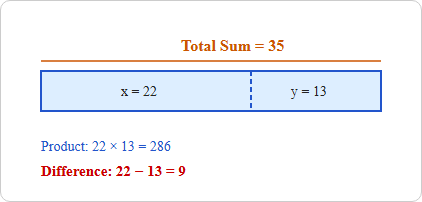
The sum of two positive numbers is 35 and their product is 286. The positive difference between them is:

  1. AOption (a)

    8

  2. BOption (b)

    14

  3. COption (c)

    9

  4. DOption (d)

    18

View answer & explanation

Correct answer

Answer: (c)C.

9

Why this answer is correct

Shortcut Trick

Use the standard algebraic relation: (Difference)2 = (Sum)2 − 4 × (Product)

⇒ (Difference)2 = 352 − 4 × 286

⇒ (Difference)2 = 1225 − 1144 = 81

⇒ Difference = √81 = 9

∴ The correct answer is 9.

Alternate Method

Given: Sum of two numbers (x + y) = 35 and their Product (xy) = 286.

Formula Used: (x − y)2 = (x + y)2 − 4xy

⇒ Let the two positive numbers be x and y.

⇒ x + y = 35

⇒ xy = 286

⇒ (x − y)2 = (35)2 − 4(286)

⇒ (x − y)2 = 1225 − 1144

⇒ (x − y)2 = 81

⇒ x − y = √81 = 9

∴ The correct answer is 9.

Additional Information

Quadratic Form Relation

If sum (S) and product (P) are known, the numbers are roots of the equation: t2 − St + P = 0.

Basic Algebraic Identities

(a + b)2 = a2 + b2 + 2ab and (a − b)2 = a2 + b2 − 2ab. Subtracting these gives (a + b)2 − (a − b)2 = 4ab.

Factorization Method

For xy = 286, find factors such that they add to 35. Factors of 286 are 1, 2, 11, 13, 22, 26, 143, 286. Here 22 + 13 = 35.

Question 3

A shopkeeper marks an article 40% above its cost price. He then allows two successive discounts of 18% and 5% on the marked price. Find the profit percentage.

  1. AOption (a)

    8.07%

  2. BOption (b)

    9.06%

  3. COption (c)

    8.96%

  4. DOption (d)

    9.77%

View answer & explanation

Correct answer

Answer: (b)B.

9.06%

Why this answer is correct

Shortcut Trick

Use the effective percentage change formula: Net % = x + y + (x × y)/100.

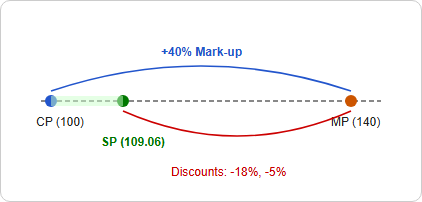
Combine Mark-up (+40%) and first Discount (−18%): 40 − 18 − (40 × 18)/100 = 14.8%.

Combine result (+14.8%) and second Discount (−5%): 14.8 − 5 − (14.8 × 5)/100 = 9.8 − 0.74 = 9.06%.

Since the net result is positive, it represents a Profit Percentage.

∴ The correct answer is 9.06%.

Alternate Method

Given:

Mark-up Percentage = 40%

Successive Discounts = 18% and 5%

Formula Used:

Marked Price (MP) = CP × (1 + Mark-up/100)

Selling Price (SP) = MP × (1 − d1/100) × (1 − d2/100)

Profit % = [(SP − CP) / CP] × 100

⇒ Let Cost Price (CP) = 100

⇒ Marked Price (MP) = 100 + 40% of 100 = 140

⇒ Price after 18% discount = 140 × (100 − 18)/100 = 140 × 0.82

⇒ Price after 18% discount = 114.8

⇒ Price after 5% discount (SP) = 114.8 × (100 − 5)/100 = 114.8 × 0.95

⇒ Selling Price (SP) = 109.06

⇒ Profit = SP − CP = 109.06 − 100 = 9.06

⇒ Profit % = (9.06 / 100) × 100 = 9.06%

∴ The correct answer is 9.06%.

Additional Information

Successive Discount Formula

Total discount for two rates d1 and d2 is given by: dnet = d1 + d2 − (d1 × d2)/100.

Profit and Discount Relation

The relationship between CP and MP is: MP/CP = (100 + Profit%)/(100 − Discount%).

Markup and Profit

Mark-up is the value added to CP to reach MP. Profit is the final gain after all discounts on MP.

Question 4

Girish scored 448 marks in an examination and was 64 marks short of 16% of maximum marks. In the same examination, his friend scored 672 marks. What is the percentage of marks scored by his friend?

  1. AOption (a)

    22%

  2. BOption (b)

    24%

  3. COption (c)

    19%

  4. DOption (d)

    21%

View answer & explanation

Correct answer

Answer: (d)D.

21%

Why this answer is correct

Shortcut Trick

Calculate the marks corresponding to 16% of the total.

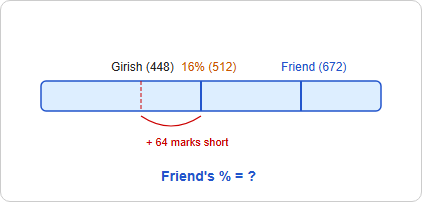
16% of Maximum Marks = 448 + 64 = 512 marks.

1% of Maximum Marks = 512 ÷ 16 = 32 marks.

Friend's Percentage = 672 ÷ 32 = 21%.

∴ The correct answer is 21%.

Alternate Method

Given:

Marks scored by Girish = 448

Shortfall to reach 16% = 64

Marks scored by Friend = 672

Formula Used:

Percentage = (Obtained Marks ÷ Maximum Marks) × 100

Calculations:

⇒ 16% of Maximum Marks = 448 + 64

⇒ 16% of Maximum Marks = 512

⇒ Maximum Marks = (512 ÷ 16) × 100

⇒ Maximum Marks = 32 × 100 = 3200

⇒ Friend's Percentage = (672 ÷ 3200) × 100

⇒ Friend's Percentage = 672 ÷ 32

⇒ Friend's Percentage = 21%

∴ The correct answer is 21%.

Additional Information

Maximum Marks and Base Value

The Maximum Marks acts as the base (100%) for all percentage calculations in an examination. Total Marks = (Score ÷ Percentage) × 100.
Percentage Shortfall

Shortfall is the difference between a target score and the actual score. Target Marks = Actual Marks + Shortfall.

Passing Marks Criteria

Many exam problems define Passing Marks as a specific percentage of the total. If a student fails by x marks, then Passing Marks = Student's Marks + x.

Question 5

A bus covers 90 km in 3 hours. If the speed of the bus is increased by 5 kmph, find the time taken to cover a distance of 70 km?

  1. AOption (a)

    3 hours

  2. BOption (b)

    3.5 hours

  3. COption (c)

    2.5 hours

  4. DOption (d)

    2 hours

View answer & explanation

Correct answer

Answer: (d)D.

2 hours

Why this answer is correct

Shortcut Trick

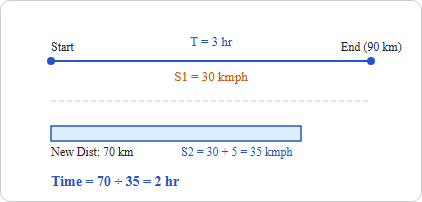
Initial Speed of the bus = 90 ÷ 3 = 30 kmph

Increased Speed = 30 + 5 = 35 kmph

Required Time = 70 ÷ 35 = 2 hours

∴ The correct answer is 2 hr.

Alternate Method

Given:

Initial Distance (D1) = 90 km

Initial Time (T1) = 3 hr

Speed Increase = 5 kmph

New Distance (D2) = 70 km

Formula Used:

Speed = Distance ÷ Time

Time = Distance ÷ Speed

Calculations:

⇒ Initial Speed = D1 ÷ T1

⇒ Initial Speed = 90 ÷ 3 = 30 kmph

⇒ New Speed = 30 + 5 = 35 kmph

⇒ New Time = D2 ÷ New Speed

⇒ New Time = 70 ÷ 35

⇒ New Time = 2 hr

∴ The correct answer is 2 hr.

Additional Information

Unit Conversion

To convert speed from kmph to m/s, multiply by 5/18. To convert m/s to kmph, multiply by 18/5.

Average Speed

Average Speed = Total Distance ÷ Total Time. If distances are equal, Average Speed = (2 × S1 × S2) ÷ (S1 + S2).

Relative Speed

Objects in opposite direction: Relative Speed = S1 + S2. Objects in same direction: Relative Speed = |S1 − S2|.

Question 6

A sum of ₹8,000 is invested at a compound interest rate of 12.5% per annum for 2 years, compounded annually. What is the compound interest earned?

  1. AOption (a)

    ₹2,250

  2. BOption (b)

    ₹2,000

  3. COption (c)

    ₹2,500

  4. DOption (d)

    ₹2,125

View answer & explanation

Correct answer

Answer: (d)D.

₹2,125

Why this answer is correct

Shortcut Trick

Rate 12.5% = 1/8 in fraction.

Ratio of Principal (P) to Amount (A) for 1 year = 8 : 9.

For 2 years, Ratio P : A = 82 : 92 = 64 : 81.

Compound Interest (CI) = 81 − 64 = 17 units.

64 units = ₹8,000 ⇒ 1 unit = 8,000 ÷ 64 = 125.

CI = 17 × 125 = ₹2,125.

∴ The correct answer is ₹2,125.

Alternate Method

Given:

Principal (P) = ₹8,000

Rate (R) = 12.5% per annum

Time (n) = 2 years

Formula Used:

Amount (A) = P × (1 + R/100)n

Compound Interest (CI) = Amount − Principal

Calculations:

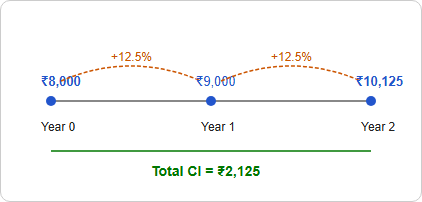
⇒ A = 8,000 × (1 + 12.5/100)2

⇒ A = 8,000 × (1 + 1/8)2

⇒ A = 8,000 × (9/8) × (9/8)

⇒ A = 125 × 81

⇒ A = ₹10,125

⇒ CI = 10,125 − 8,000

⇒ CI = ₹2,125

∴ The correct answer is ₹2,125.

Additional Information

Effective Interest Rate

For two years at rate R%, the effective compound interest rate is R + R + (R × R)/100.

Difference between CI and SI

For 2 years, CI − SI = P × (R/100)2.

Compounding Periods

If compounded half-yearly, the rate becomes R/2 and the time period becomes 2n.

Question 7

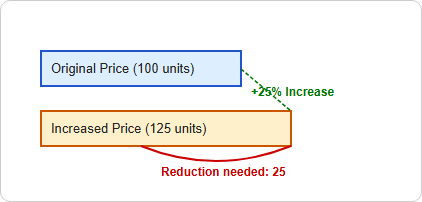
The price of an article is increased by 25%. By what percentage should the increased price be reduced so that it becomes equal to the original price?

  1. AOption (a)

    20%

  2. BOption (b)

    30%

  3. COption (c)

    25%

  4. DOption (d)

    22%

View answer & explanation

Correct answer

Answer: (a)A.

20%

Why this answer is correct

Shortcut Trick

Use the direct formula for percentage reduction to restore the original value: [r / (100 + r)] × 100.

Here, r = 25.

Reduction = [25 / (100 + 25)] × 100

Reduction = (25 / 125) × 100 = (1 / 5) × 100 = 20%.

∴ The correct answer is 20%.

Alternate Method

Given:

⇒ Increase in price = 25%

Formula Used:

⇒ Percentage Reduction = (Difference / Increased Price) × 100

Calculations:

⇒ Let the original price of the article be ₹100.

⇒ Increased price = 100 + 25% of 100 = 100 + 25 = ₹125.

⇒ To return to the original price (₹100), the reduction required = 125 − 100 = ₹25.

⇒ Required percentage reduction = (25 / 125) × 100

⇒ Required percentage reduction = (1 / 5) × 100

⇒ Required percentage reduction = 20%

∴ The correct answer is 20%.

Additional Information

Base Change Rule

If quantity A is r% more than B, then B is [r / (100 + r)] × 100% less than A. If A is r% less than B, then B is [r / (100 − r)] × 100% more than A.

Fractional Equivalents

25% is equivalent to 1/4. When a value increases by 1/n, it must be decreased by 1/(n+1) to return to its original value. Here, n=4, so reduction = 1/(4+1) = 1/5 = 20%.

Net Percentage Change

For two successive percentage changes a% and b%, the effective change is [a + b + (ab / 100)]%. To result in zero net change, the formula must equate to 0.

Question 8

Simplify: 5.25 + 2.75 - 35 \frac{3}{5} - 25×1020 \frac{2}{5} \times \frac{10}{20}

  1. AOption (a)

    6.2

  2. BOption (b)

    7.2

  3. COption (c)

    5.2

  4. DOption (d)

    8.2

View answer & explanation

Correct answer

Answer: (b)B.

7.2

Why this answer is correct

Shortcut Trick

Combine the decimal parts first: 5.25 + 2.75 = 8.

Simplify the product of fractions: (2/5) × (10/20) = (2/5) × (1/2) = 1/5 = 0.2.

Convert the remaining fraction to decimal: 3/5 = 0.6.

Perform the final subtraction: 8 − 0.6 − 0.2 = 7.2.

∴ The correct answer is 7.2.

Alternate Method

Given: 5.25 + 2.75 − (3/5) − (2/5) × (10/20)

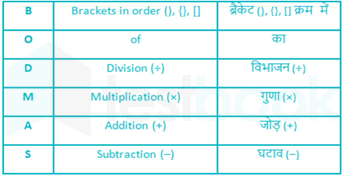
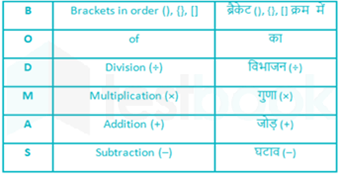
Method: Solve using the BODMAS rule (Brackets, Orders, Division, Multiplication, Addition, Subtraction).

⇒ 5.25 + 2.75 − 0.6 − (2/5 × 1/2)

⇒ 8.00 − 0.6 − (1/5)

⇒ 8 − 0.6 − 0.2

⇒ 8 − 0.8

⇒ 7.2

∴ The correct answer is 7.2.

Additional Information

BODMAS Rule

It defines the order of operations: Brackets, Of (orders), Division, Multiplication, Addition, and Subtraction.

Fraction to Decimal Conversion

To convert a fraction to a decimal, divide the numerator by the denominator (e.g., 3 ÷ 5 = 0.6).

Simplification Shortcut

Always look for common factors in fractions before multiplying to reduce the complexity of the numbers.

Question 9

Simplify: 15 + 12cot⁡2A−12cos⁡2A \frac{12}{\cot^2 A} - \frac{12}{\cos^2 A}

  1. AOption (a)

    3

  2. BOption (b)

    5

  3. COption (c)

    4

  4. DOption (d)

    7

View answer & explanation

Correct answer

Answer: (a)A.

3

Why this answer is correct

Shortcut Trick

Convert the given trigonometric expression into tangent and secant forms: 15 + 12 tan2 A − 12 sec2 A.

Factor out the common term 12: 15 + 12(tan2 A − sec2 A).

Apply the Pythagorean identity: Since sec2 A − tan2 A = 1, then tan2 A − sec2 A = −1.

The expression simplifies to: 15 + 12(−1) = 15 − 12 = 3.

∴ The correct answer is 3.

Alternate Method

Given: 15 + 12/cot2 A − 12/cos2 A

Formula Used: 1/cot A = tan A and 1/cos A = sec A; sec2 A − tan2 A = 1

⇒ Expression = 15 + 12 × (1/cot2 A) − 12 × (1/cos2 A)

⇒ Expression = 15 + 12 tan2 A − 12 sec2 A

⇒ Expression = 15 + 12(tan2 A − sec2 A)

⇒ From the identity sec2 A − tan2 A = 1, we know tan2 A − sec2 A = −1

⇒ Expression = 15 + 12(−1)

⇒ Expression = 15 − 12 = 3

∴ The correct answer is 3.

Additional Information

Pythagorean Identities

There are three fundamental identities: sin2 A + cos2 A = 1, 1 + tan2 A = sec2 A, and 1 + cot2 A = cosec2 A.

Reciprocal Relations

Trigonometric ratios are related as follows: tan A = 1/cot A, sec A = 1/cos A, and cosec A = 1/sin A.

Simplification Rule

When simplifying trigonometric expressions, always look to convert terms into sine/cosine or use established identities to reduce variables.

Question 10

The largest four-digit number which when divided by 6, 14 and 7 leaves remainder 5 in each case is:

  1. AOption (a)

    9998

  2. BOption (b)

    9959

  3. COption (c)

    9946

  4. DOption (d)

    9973

View answer & explanation

Correct answer

Answer: (b)B.

9959

Why this answer is correct

Shortcut Trick

Find the LCM of divisors 6, 14, and 7, which is 42.

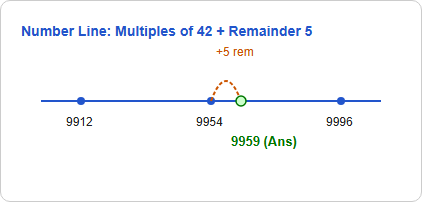
The largest 4-digit multiple of 42 is 9996 (calculated as 9999 − 3).

Adding the remainder: 9996 + 5 = 10001 (This is a 5-digit number).

Subtract the LCM to find the previous valid number: 10001 − 42 = 9959.

∴ The correct answer is 9959.

Alternate Method

Given:

Divisors: 6, 14, 7

Remainder: 5

Target: Largest 4-digit number

Formula Used:

Required Number = [LCM(Divisors) × k] + Remainder

Calculations:

⇒ LCM(6, 14, 7) = 42

⇒ Largest 4-digit number = 9999

⇒ 9999 ÷ 42 = 238 (Quotient), 3 (Remainder)

⇒ Largest 4-digit multiple of 42 = 9999 − 3 = 9996

⇒ Check 4-digit constraint: 9996 + 5 = 10001 (Not a 4-digit number)

⇒ Previous multiple of 42 = 9996 − 42 = 9954

⇒ Required number = 9954 + 5 = 9959

∴ The correct answer is 9959.

Additional Information

LCM and Remainder Concept

When a number N is divided by a, b, c and leaves the same remainder 'r' in each case, then N = LCM(a, b, c) × k + r, where k is an integer.

Divisibility by 14

A number is divisible by 14 if it is simultaneously divisible by its co-prime factors 2 and 7.

Successive Division vs Single Remainder

If remainders are different (r1, r2, r3), and the difference (divisor − remainder) is constant 'd', then the number N = LCM(divisors) × k − d.

Question 11

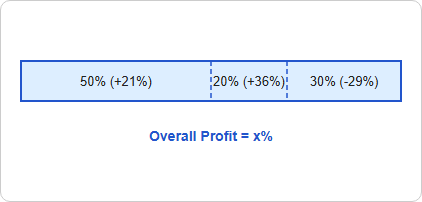
During a sale, 50% of the goods are sold at 21% profit, 40% of the remaining goods are sold at 36% profit and the still remaining goods are sold at a loss of 29%. If there is an overall profit of x%, then what is the value of x?

  1. AOption (a)

    9.5

  2. BOption (b)

    8.5

  3. COption (c)

    9

  4. DOption (d)

    10

View answer & explanation

Correct answer

Answer: (c)C.

9

Why this answer is correct

Shortcut Trick

Divide the parts into ratios based on percentage: 50% : 20% : 30% → 5 : 2 : 3 (Total = 10 units).

Apply net percentage change formula: Net % = [5 × 21 + 2 × 36 + 3 × (−29)] / 10.

Net % = (105 + 72 − 87) / 10 = 90 / 10 = 9%.

Since the overall profit is x%, the value of x is 9.

∴ The correct answer is 9.

Alternate Method

Let the total quantity of goods be 100 units and the cost price per unit be ₹1.

Given:

First part: 50% of 100 = 50 units sold at 21% profit.

Second part: 40% of remaining (100 − 50 = 50) = 20 units sold at 36% profit.

Third part: Remaining (50 − 20) = 30 units sold at 29% loss.

Calculations:

⇒ Profit on 1st part = 50 × 21/100 = ₹10.5

⇒ Profit on 2nd part = 20 × 36/100 = ₹7.2

⇒ Loss on 3rd part = 30 × 29/100 = ₹8.7

⇒ Total Net Profit = 10.5 + 7.2 − 8.7 = ₹9

⇒ Overall Profit % = (Total Profit / Total CP) × 100

⇒ x = (9 / 100) × 100 = 9

∴ The correct answer is 9.

Additional Information

Weighted Average Profit %

When goods are sold in parts with different profit/loss rates, the overall profit % = (w1p1 + w2p2 + ... + wnpn) / (w1 + w2 + ... + wn), where w represents weight/quantity and p represents profit/loss rate.

Successive Percentage Change

For two successive percentage changes a% and b%, the effective change is [a + b + (ab/100)]%. This is useful when the price is changed multiple times on the same base.

Basic Profit and Loss

Profit % = (Profit / CP) × 100 and Loss % = (Loss / CP) × 100. Always ensure the denominator is the Cost Price (CP) unless specified otherwise.

Question 12

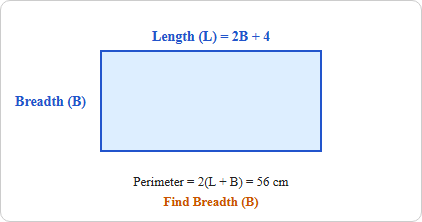
The perimeter of a rectangle is 56 cm. Its length is 4 cm more than twice its breadth. Find the breadth.

  1. AOption (a)

    6 cm

  2. BOption (b)

    10 cm

  3. COption (c)

    12 cm

  4. DOption (d)

    8 cm

View answer & explanation

Correct answer

Answer: (d)D.

8 cm

Why this answer is correct

Shortcut Trick

Sum of Length and Breadth = Half of Perimeter = 56 ÷ 2 = 28 cm.

Let Breadth be x, then Length = 2x + 4.

⇒ (2x + 4) + x = 28

⇒ 3x = 24 ⇒ x = 8 cm.

∴ The correct answer is 8 cm.

Alternate Method

Given:

⇒ Perimeter of Rectangle = 56 cm

⇒ Length (L) = 4 + 2 × Breadth (B)

Formula Used:

⇒ Perimeter = 2 × (Length + Breadth)

Calculations:

⇒ 2 × (L + B) = 56

⇒ L + B = 56 ÷ 2

⇒ L + B = 28

Substitute L = 2B + 4 in the equation:

⇒ (2B + 4) + B = 28

⇒ 3B + 4 = 28

⇒ 3B = 28 − 4

⇒ 3B = 24

⇒ B = 24 ÷ 3

⇒ B = 8 cm

∴ The correct answer is 8 cm.

Additional Information

Area of Rectangle

The total space occupied by the rectangle is given by the product of its dimensions: Area = Length × Breadth.

Diagonal of Rectangle

The distance between opposite corners can be found using the Pythagorean theorem: Diagonal = √(Length2 + Breadth2).

Perimeter of a Square

A square is a special rectangle where Length = Breadth = s. Its perimeter is 4 × s.

Question 13

Simplify \left{ \left(\frac{14}{24}\right) \div \left(\frac{14}{9}\right) \right} \div \left(\frac{3}{7} \times \frac{14}{9} + \frac{5}{8}\right) + \frac{9}{10} \div \frac{31}{24} \text{ of } \frac{24}{10}

  1. AOption (a)

    1831 \frac{18}{31}

  2. BOption (b)

    1337 \frac{13}{37}

  3. COption (c)

    1726\frac{17}{26}

  4. DOption (d)

    1433 \frac{14}{33}

View answer & explanation

Correct answer

Answer: (a)A.

1831 \frac{18}{31}

Why this answer is correct

Shortcut Trick

Simplify using BODMAS in segments:

Segment 1: (14/24 ÷ 14/9) = (14/24 × 9/14) = 3/8

Segment 2: (3/7 × 14/9 + 5/8) = (2/3 + 5/8) = 31/24

Segment 3: (9/10) ÷ (31/24 of 24/10) = (9/10) ÷ (31/10) = 9/31

Calculation: (3/8 ÷ 31/24) + 9/31 = (3/8 × 24/31) + 9/31 = 9/31 + 9/31 = 18/31

∴ The correct answer is 18/31.

Alternate Method

Given: { (14/24) ÷ (14/9) } ÷ (3/7 × 14/9 + 5/8) + 9/10 ÷ 31/24 of 24/10

Simplify using the BODMAS rule (Brackets, Of, Division, Multiplication, Addition, Subtraction):

⇒ Solve the first set of brackets: (14/24) × (9/14) = 9/24 = 3/8

⇒ Solve the inner multiplication in the second bracket: (3/7 × 14/9) = (1 × 2) / (1 × 3) = 2/3

⇒ Complete the second bracket by addition: 2/3 + 5/8 = (16 + 15) / 24 = 31/24

⇒ Solve the 'of' operator: 31/24 of 24/10 = 31/24 × 24/10 = 31/10

⇒ Rewrite the expression: (3/8 ÷ 31/24) + (9/10 ÷ 31/10)

⇒ Apply division by multiplying by the reciprocal: (3/8 × 24/31) + (9/10 × 10/31)

⇒ 9/31 + 9/31 = 18/31

∴ The correct answer is 18/31.

Additional Information

BODMAS Rule

It defines the order of operations as Brackets, Of, Division, Multiplication, Addition, and Subtraction.

'Of' Operator Precedence

The 'of' operator is treated as a multiplication but must be performed before any division or standard multiplication in the expression.

Division of Fractions

To divide one fraction by another, multiply the first fraction by the reciprocal of the second (a/b ÷ c/d = a/b × d/c).

Question 14

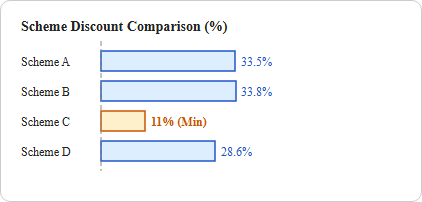
A shopkeeper offers the following schemes on toys of the same marked price.

(A) Successive discounts of 5% and 30% on any number of toys bought.

(B) Successive discounts of 18%, 15% and 5% on any number of toys bought.

(C) 11% discount on the first 5 toys and 47% discount on each toy thereon.

(D) 2 toys free of cost on buying 5 toys.

A customer wants to buy 5 toys. Which of the above schemes is the least beneficial to her?

  1. AOption (a)

    B

  2. BOption (b)

    C

  3. COption (c)

    A

  4. DOption (d)

    D

View answer & explanation

Correct answer

Answer: (b)B.

C

Why this answer is correct

Shortcut Trick

Scheme A: Net Discount = 5 + 30 − (5 × 30)/100 = 33.5%

Scheme B: Net Discount ≈ 18 + 15 + 5 = 38% (approx, but effectively around 33.8%)

Scheme C: For exactly 5 toys, only the 11% slab applies ⇒ 11%

Scheme D: Buy 5 Get 2 Free ⇒ Discount = (2 / 7) × 100 ≈ 28.57%

Comparing all, Scheme C (11%) provides the minimum discount, making it the least beneficial.

∴ The correct answer is Scheme C.

Alternate Method

Let the Marked Price (MP) of each toy be ₹100. For 5 toys, Total MP = ₹500.

Scheme A (Successive 5% and 30%):

⇒ Price after 5% = 500 − 25 = ₹475

⇒ Price after 30% = 475 − 142.5 = ₹332.5

⇒ Total Discount = 500 − 332.5 = ₹167.5 (33.5%)

Scheme B (Successive 18%, 15%, 5%):

⇒ Net Discount % = 100 − [100 × (0.82 × 0.85 × 0.95)]

⇒ Net Discount % = 100 − 66.215 = 33.785%

Scheme C (11% on first 5 toys):

⇒ Since the customer buys exactly 5 toys, the discount is strictly 11%.

⇒ Total Discount = 11% of 500 = ₹55

Scheme D (2 toys free on buying 5):

⇒ Customer pays for 5 toys and receives 7 toys.

⇒ Effective Discount % = (Free Items ÷ Total Items) × 100

⇒ Discount % = (2 ÷ 7) × 100 ≈ 28.57%

Comparing the effective discount percentages, Scheme C offers the lowest value (11%), which means the customer pays the highest price under this scheme.

∴ The correct answer is Scheme C.

Additional Information

Successive Discount Formula

For two successive discounts d1% and d2%, the single equivalent discount is (d1 + d2 − d1d2/100)%.

Buy X Get Y Free

The effective discount percentage in such schemes is calculated as [Y ÷ (X + Y)] × 100.

Least Beneficial Scheme

For a customer, the least beneficial scheme is the one that offers the lowest net discount or results in the highest Selling Price (SP).

Question 15

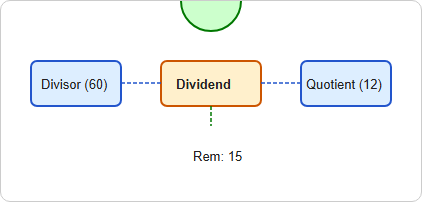
In a division sum, the divisor is 5 times the quotient and 4 times the remainder. If the remainder is 15, what is the dividend?

  1. AOption (a)

    735

  2. BOption (b)

    739

  3. COption (c)

    740

  4. DOption (d)

    734

View answer & explanation

Correct answer

Answer: (a)A.

735

Why this answer is correct

Shortcut Trick

Given Remainder = 15.

Divisor = 4 × 15 = 60.

Quotient = 60 ÷ 5 = 12.

Dividend = (60 × 12) + 15 = 720 + 15 = 735.

∴ The correct answer is 735.

Alternate Method

Given:

In a division sum:

Remainder (R) = 15

Divisor (D) = 4 × R

Divisor (D) = 5 × Quotient (Q)

Formula Used:

Dividend = (Divisor × Quotient) + Remainder

Calculations:

⇒ Divisor = 4 × 15 = 60

⇒ 60 = 5 × Quotient

⇒ Quotient = 60 ÷ 5 = 12

⇒ Dividend = (60 × 12) + 15

⇒ Dividend = 720 + 15

⇒ Dividend = 735

∴ The correct answer is 735.

Additional Information

Division Algorithm

For any two integers a and b, there exist unique integers q and r such that a = bq + r, where 0 ≤ r < b.

Properties of Remainder

The remainder is always a non-negative integer and is strictly less than the divisor. If the remainder is 0, the dividend is perfectly divisible by the divisor.

Verification Rule

To verify a division result, subtract the remainder from the dividend; the result must be the product of the divisor and the quotient.

Question 16

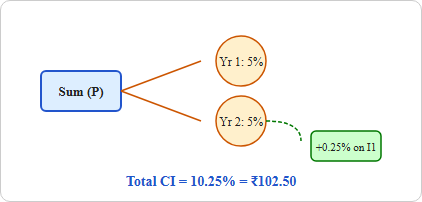
If the compound interest on a sum for 2 years at 5% per annum is ₹102.50, what is the sum?

  1. AOption (a)

    ₹1,000

  2. BOption (b)

    ₹1,100

  3. COption (c)

    ₹950

  4. DOption (d)

    ₹1,025

View answer & explanation

Correct answer

Answer: (a)A.

₹1,000

Why this answer is correct

Shortcut Trick

Effective Compound Interest rate for 2 years = 5 + 5 + (5 × 5)/100 = 10.25%

Given CI = 10.25% of Principal = ₹102.50

Principal = (102.50 ÷ 10.25) × 100

Principal = 10 × 100 = ₹1,000

∴ The correct answer is ₹1,000.

Alternate Method

Given:

Time (n) = 2 years, Rate (R) = 5% per annum, Compound Interest (CI) = ₹102.50

Formula Used:

CI = P[(1 + R/100)n − 1]

Calculations:

⇒ 102.50 = P[(1 + 5/100)2 − 1] ⇒ 102.50 = P[(21/20)2 − 1] ⇒ 102.50 = P[441/400 − 1] ⇒ 102.50 = P[(441 − 400)/400] ⇒ 102.50 = P × (41/400) ⇒ P = (102.50 × 400) ÷ 41 ⇒ P = 2.5 × 400 ⇒ P = ₹1,000

∴ The correct answer is ₹1,000.

Additional Information

Effective Rate for Compound Interest

For 2 years at rate R%, the net effective interest rate is calculated using the successive percentage formula: (R + R + R2/100)%.

Difference between CI and SI

The difference between Compound Interest and Simple Interest for 2 years is given by the formula: D = P(R/100)2.

Amount Formula

The total Amount (A) accumulated after n years is A = P(1 + R/100)n, where P is the Principal.

Question 17

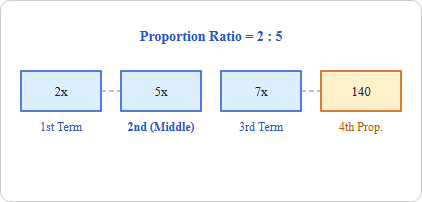
Three numbers in the ratio 2 : 5 : 7 are taken as the first, second, and third terms, respectively. If their fourth proportional is 140, find the middle number.

  1. AOption (a)

    40

  2. BOption (b)

    50

  3. COption (c)

    35

  4. DOption (d)

    30

View answer & explanation

Correct answer

Answer: (a)A.

40

Why this answer is correct

Shortcut Trick

The ratio of the first three terms is 2 : 5 : 7. Let the terms be 2x, 5x, and 7x.

According to the proportion rule: 1st / 2nd = 3rd / 4th.

⇒ 2 / 5 = 7x / 140

⇒ 7x = (2 × 140) ÷ 5 = 56

⇒ x = 56 ÷ 7 = 8

Middle number (2nd term) = 5 × 8 = 40.

∴ The correct answer is 40.

Alternate Method

Given: Ratio of three numbers = 2 : 5 : 7 and fourth proportional = 140.

Formula: If a, b, c, and d are in proportion (a : b :: c : d), then a × d = b × c.

⇒ Let the numbers be 2x, 5x, and 7x.

⇒ By proportion property: (2x) × 140 = (5x) × (7x)

⇒ 280x = 35x2

⇒ 280 = 35x (Dividing both sides by x)

⇒ x = 280 ÷ 35

⇒ x = 8

⇒ Middle number = 2nd term = 5x = 5 × 8 = 40.

∴ The correct answer is 40.

Additional Information

Mean Proportional

The mean proportional between two numbers a and b is given by √(a × b).

Third Proportional

If a, b, and c are in continued proportion (a : b :: b : c), then the third proportional c = b2 ÷ a.

Fourth Proportional

If four quantities a, b, c, and d are in proportion (a : b :: c : d), then d = (b × c) ÷ a.

Product Rule

For any proportion, the product of the extremes (1st and 4th terms) is always equal to the product of the means (2nd and 3rd terms).

Question 18

What is the digit y if the number 6y512 is exactly divisible by both 8 and 9?

  1. AOption (a)

    2

  2. BOption (b)

    6

  3. COption (c)

    8

  4. DOption (d)

    4

View answer & explanation

Correct answer

Answer: (d)D.

4

Why this answer is correct

Shortcut Trick

For divisibility by 9, the sum of digits must be a multiple of 9.

Sum of digits in 6y512 = 6 + y + 5 + 1 + 2 = 14 + y.

The nearest multiple of 9 after 14 is 18.

∴ 14 + y = 18 ⇒ y = 4.

∴ The correct answer is 4.

Alternate Method

Given: The number 6y512 is divisible by both 8 and 9.

Step 1: Check Divisibility by 8

A number is divisible by 8 if its last three digits are divisible by 8.

⇒ Last three digits = 512.

⇒ 512 ÷ 8 = 64 (Remainder = 0).

Since 512 is divisible by 8, the number 6y512 is divisible by 8 for any single digit value of y.

Step 2: Check Divisibility by 9

A number is divisible by 9 if the sum of its digits is divisible by 9.

⇒ Sum = 6 + y + 5 + 1 + 2

⇒ Sum = 14 + y

For the number to be divisible by 9, (14 + y) must be 18, 27, etc.

Since y is a single digit (0 to 9):

⇒ 14 + y = 18

⇒ y = 18 − 14

⇒ y = 4

∴ The correct answer is 4.

Additional Information

Divisibility Rule of 8

A number is divisible by 8 if the number formed by its last three digits is divisible by 8 or if the last three digits are zero.

Divisibility Rule of 9

A number is divisible by 9 if the sum of all its digits is exactly divisible by 9.

Divisibility Rule of 72

Since 72 = 8 × 9 (co-prime factors), a number is divisible by 72 only if it is divisible by both 8 and 9 simultaneously.

Question 19

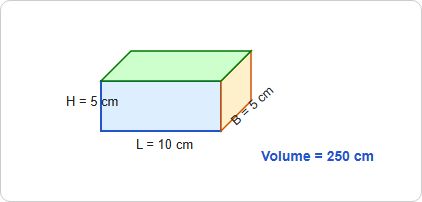
A solid cube is melted and half of its material is recast into a cuboid whose length, breadth, and height are in the ratio 2 : 1 : 1. The difference between the volume of the original cube and the cuboid formed is 250 cm3. Find the total surface area of the cuboid.

  1. AOption (a)

    250 cm2

  2. BOption (b)

    100 cm2

  3. COption (c)

    80 cm2

  4. DOption (d)

    120 cm2

View answer & explanation

Correct answer

Answer: (a)A.

250 cm2

Why this answer is correct

Shortcut Trick

Since the cuboid is made from half the cube's material, the difference (250 cm3) is equal to the volume of the cuboid itself.

Volume of cuboid = 250 cm3 ⇒ Ratio 2 : 1 : 1 ⇒ (2x) × (x) × (x) = 250.

2x3 = 250 ⇒ x3 = 125 ⇒ x = 5 cm.

Dimensions: L = 10 cm, B = 5 cm, H = 5 cm.

TSA = 2 × (10 × 5 + 5 × 5 + 5 × 10) = 2 × (50 + 25 + 50) = 250 cm2.

∴ The correct answer is 250 cm2.

Alternate Method

Given:

Ratio of cuboid dimensions (L : B : H) = 2 : 1 : 1

Difference (Vcube − Vcuboid) = 250 cm3

Volume of cuboid = 1/2 × Volume of cube

Formula Used:

Volume of cuboid = Length × Breadth × Height

Total Surface Area (TSA) = 2(LB + BH + HL)

Calculations:

⇒ Let Volume of Cube be Vc.

⇒ Volume of Cuboid Vb = 1/2 × Vc.

⇒ Vc − Vb = 250 ⇒ Vc − 0.5Vc = 250 ⇒ 0.5Vc = 250.

⇒ Vb = 250 cm3.

⇒ Let dimensions be 2x, x, and x.

⇒ 2x × x × x = 250 ⇒ 2x3 = 250.

⇒ x3 = 125 ⇒ x = 5 cm.

⇒ Length = 10 cm, Breadth = 5 cm, Height = 5 cm.

⇒ TSA = 2 × (10 × 5 + 5 × 5 + 5 × 10).

⇒ TSA = 2 × (50 + 25 + 50) = 2 × 125.

⇒ TSA = 250 cm2.

∴ The correct answer is 250 cm2.

Additional Information

Volume and Surface Area of Cube

For a cube of side 'a', Volume = a3 and Total Surface Area = 6a2.

Lateral Surface Area of Cuboid

LSA = 2 × Height × (Length + Breadth). This represents the area of the four side walls.

Diagonal of a Cuboid

The longest rod that can be placed in a cuboid has length d = √(L2 + B2 + H2).

Question 20

Two taps can fill a cistern in 4 hours and 10 hours, respectively. A third tap can empty it in 10 hours. How long (in hours) will it take to fill one-fourth of the empty cistern if all the taps are opened together?

  1. AOption (a)

    4

  2. BOption (b)

    2

  3. COption (c)

    3

  4. DOption (d)

    1

View answer & explanation

Correct answer

Answer: (d)D.

1

Why this answer is correct

Shortcut Trick

The filling rate of the second tap (10 hr) and the emptying rate of the third tap (10 hr) cancel each other out.

Net efficiency is determined solely by the first tap.

Time to fill the full cistern = 4 hr.

Time to fill 1/4th of the cistern = 4 ÷ 4 = 1 hr.

∴ The correct answer is 1 hr.

Alternate Method

Given: Filling times are 4 hr and 10 hr; Emptying time is 10 hr.

Formula: Total Work = LCM of individual times; Efficiency = Total Work ÷ Time.

TapTime (hr)Total Work (LCM)Efficiency
Tap A (Fill)4205
Tap B (Fill)102
Tap C (Empty)10−2

⇒ Net Efficiency of all taps = 5 + 2 − 2 = 5 units/hr.

⇒ Target work (1/4th of cistern) = 20 ÷ 4 = 5 units.

⇒ Time taken = Work ÷ Net Efficiency

⇒ Time taken = 5 ÷ 5 = 1 hr.

∴ The correct answer is 1 hr.

Additional Information

Negative Efficiency

In Pipes and Cisterns, an outlet pipe or a leak is always considered to have negative efficiency because it reduces the total volume of water.

Work-Efficiency Relation

Total Work = Efficiency × Time. For a constant work, Efficiency is inversely proportional to the Time taken to complete the task.

Combined Rate Formula

If two pipes fill in 'x' and 'y' hours and one empties in 'z' hours, the net part filled in 1 hour is (1/x + 1/y − 1/z).

Question 21

A and B can complete a task in 20 days and 25 days, respectively. They started working together, but B left after 5 days. How many more days will A take to finish the remaining work?

  1. AOption (a)

    10 days

  2. BOption (b)

    11 days

  3. COption (c)

    12 days

  4. DOption (d)

    9 days

View answer & explanation

Correct answer

Answer: (b)B.

11 days

Why this answer is correct

Shortcut Trick

Total work (LCM of 20, 25) = 100 units.

Efficiency: A = 5 units/day, B = 4 units/day.

Together in 5 days = (5 + 4) × 5 = 45 units.

Remaining work = 100 − 45 = 55 units.

Time for A = 55 ÷ 5 = 11 days.

∴ The correct answer is 11 days.

Alternate Method

Given:

Time taken by A = 20 days

Time taken by B = 25 days

Work duration together = 5 days

Formula Used:

Total Work = Efficiency × Time

PersonDaysTotal WorkEfficiency
A201005
B254

Calculations:

⇒ Total Work = LCM(20, 25) = 100 units

⇒ Efficiency of A = 100 ÷ 20 = 5 units/day

⇒ Efficiency of B = 100 ÷ 25 = 4 units/day

⇒ Combined Efficiency of A + B = 5 + 4 = 9 units/day

⇒ Work completed in 5 days = 9 × 5 = 45 units

⇒ Remaining Work = 100 − 45 = 55 units

⇒ Extra time taken by A = Remaining Work ÷ Efficiency of A

⇒ Time = 55 ÷ 5 = 11 days

∴ The correct answer is 11 days.

Additional Information

Pipes and Cisterns

Similar to Time & Work, but includes negative efficiency for outlet pipes that empty the tank.

Work and Wages

Wages are distributed in the ratio of the actual work done by each person, which is proportional to their efficiencies if they work for the same duration.

Alternate Day Work

Calculate work done in one full cycle (e.g., 2 days) and then divide the total work by the cycle efficiency.

Question 22

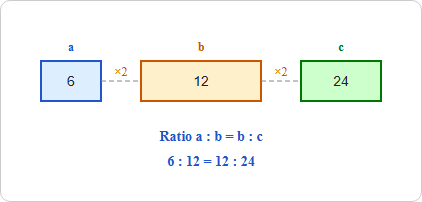
Find the third proportional to 6 and 12.

  1. AOption (a)

    36

  2. BOption (b)

    18

  3. COption (c)

    48

  4. DOption (d)

    24

View answer & explanation

Correct answer

Answer: (d)D.

24

Why this answer is correct

Shortcut Trick

The third proportional (c) for two numbers a and b is calculated using the formula: c = b2 ÷ a.

Given: a = 6 and b = 12.

Substituting the values: c = 122 ÷ 6

c = 144 ÷ 6 = 24.

∴ The correct answer is 24.

Alternate Method

Given: First number (a) = 6, Second number (b) = 12.

Formula Used: If three numbers a, b, and c are in continued proportion, then a : b :: b : c or a/b = b/c.

⇒ Let the third proportional be c.

⇒ According to the definition: 6 : 12 :: 12 : c

⇒ 6 ÷ 12 = 12 ÷ c

⇒ 1 ÷ 2 = 12 ÷ c

⇒ c = 12 × 2

⇒ c = 24.

∴ The correct answer is 24.

Additional Information

Mean Proportional

The mean proportional between two numbers a and b is given by the square root of their product: Mean = √(a × b).

Fourth Proportional

For four numbers a, b, c, and d to be in proportion (a : b :: c : d), the fourth proportional d is calculated as (b × c) ÷ a.

Continued Proportion

A series of numbers are in continued proportion if the ratio of any term to the next term is constant (a/b = b/c = c/d ...).

Question 23

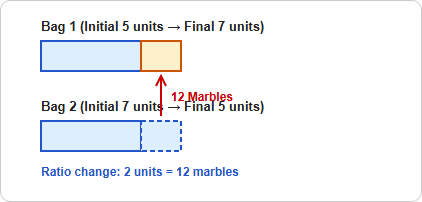
Two bags contain marbles in the ratio 5 : 7. If 12 marbles are transferred from the second bag to the first bag, the ratio of marbles in the two bags becomes 7 : 5. Find the original number of marbles in the second bag.

  1. AOption (a)

    68

  2. BOption (b)

    63

  3. COption (c)

    42

  4. DOption (d)

    72

View answer & explanation

Correct answer

Answer: (c)C.

42

Why this answer is correct

Shortcut Trick

Initial sum of ratios: 5 + 7 = 12 units; Final sum: 7 + 5 = 12 units.

Since the total marbles remain constant, compare the ratio parts directly.

Change in Bag 2: 7 units → 5 units = 2 units decrease.

Given transfer = 12 marbles ⇒ 2 units = 12 marbles.

1 unit = 6 marbles; Original Bag 2 = 7 units × 6 = 42 marbles.

∴ The correct answer is 42 marbles.

Alternate Method

Given:

Initial ratio of marbles in Bag 1 and Bag 2 = 5 : 7

Number of marbles transferred from Bag 2 to Bag 1 = 12

Final ratio of marbles = 7 : 5

Formula Used:

If original values are ax and bx, and k is transferred: (ax + k) / (bx − k) = m / n

Calculations:

⇒ Let the original number of marbles be 5x and 7x.

⇒ According to the question: (5x + 12) / (7x − 12) = 7 / 5

⇒ 5 × (5x + 12) = 7 × (7x − 12)

⇒ 25x + 60 = 49x − 84

⇒ 49x − 25x = 60 + 84

⇒ 24x = 144

⇒ x = 144 ÷ 24 = 6

⇒ Original marbles in Bag 2 = 7x = 7 × 6 = 42

∴ The correct answer is 42 marbles.

Additional Information

Ratio and Constant Sum

When items are transferred between two bags, the total quantity remains unchanged. Scaling ratios to have the same sum allows for direct comparison of units.

Inverse Proportion

If the product of two variables is constant, they are in inverse proportion. In this case, the total count is fixed, so an increase in one bag must result in a decrease in the other.

Proportionality Constant (x)

The constant x converts a ratio into actual values. Multiplying each term of the ratio by x gives the real quantity of the objects involved.

Question 24

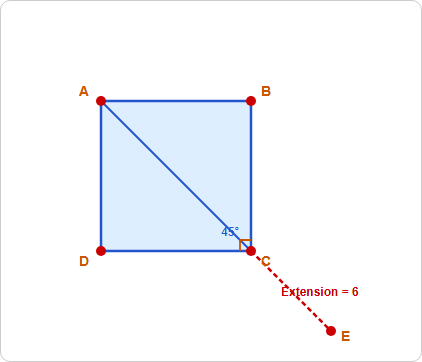
If a square’s diagonal is extended by 6 units beyond a vertex, forming a triangle outside the square, what is the angle between this extension and the adjacent side of the square?

  1. AOption (a)

    45 degrees

  2. BOption (b)

    60 degrees

  3. COption (c)

    30 degrees

  4. DOption (d)

    90 degrees

View answer & explanation

Correct answer

Answer: (a)A.

45 degrees

Why this answer is correct

Shortcut Trick

The diagonal of a square always acts as the angle bisector of the 90° vertex angle.

Therefore, the angle between the diagonal and any adjacent side is exactly 45°.

Since an extension of a straight line does not change its orientation, the acute angle formed between the extension of the diagonal and the adjacent side remains 45°.

In standard geometry, the angle between two intersecting lines is typically measured as the acute angle unless specified otherwise.

∴ The correct answer is 45 degrees.

Alternate Method

Given:

A square ABCD where the diagonal AC is extended by 6 units to point E.

Formula Used:

  1. Interior angle of a square = 90°
  2. Angle between the diagonal and side of a square = 45°
  3. Angles on a straight line (linear pair) sum to 180°

Calculations:

⇒ In square ABCD, the interior angle ∠BCD = 90°.

⇒ The diagonal AC bisects ∠BCD, so ∠ACB = 45° and ∠ACD = 45°.

⇒ Line ACE is a straight line because it is an extension of the diagonal.

⇒ The adjacent side to the extension at vertex C is either BC or CD.

⇒ The angle between the extension CE and side BC is ∠BCE.

⇒ Since ∠ACB + ∠BCE = 180° (Linear Pair), then ∠BCE = 180° − 45° = 135°.

⇒ In geometry, the angle between two lines is often considered the acute angle.

⇒ Acute angle = 180° − 135° = 45°.

∴ The correct answer is 45 degrees.

Additional Information

Diagonal of a Square

The diagonal of a square with side s is given by d = s√2 and always bisects the vertex angles into 45° each.

Linear Pair of Angles

Angles on a straight line that share a common vertex and side sum up to 180°, forming a supplementary pair.

Angle between Lines

When two lines intersect, they form two pairs of angles; the smaller angle (0° to 90°) is typically defined as the angle between the lines.

Question 25

The sum of the ages of a daughter and her mother is 76 years. After 4 years, the age of the mother will be three times that of the daughter. What is the present age (in years) of the mother?

  1. AOption (a)

    57

  2. BOption (b)

    59

  3. COption (c)

    17

  4. DOption (d)

    18

View answer & explanation

Correct answer

Answer: (b)B.

59

Why this answer is correct

Shortcut Trick

Total sum of ages after 4 years = 76 + (2 × 4) = 84 years.

Ratio of Mother to Daughter after 4 years = 3 : 1.

Total units = 3 + 1 = 4 units → 84 years.

1 unit = 84 ÷ 4 = 21 years.

Mother's age after 4 years = 3 × 21 = 63 years.

Present age of Mother = 63 − 4 = 59 years.

∴ The correct answer is 59 years.

Alternate Method

Given:

Sum of present ages = 76 years.

Ratio after 4 years = 3 : 1 (Mother : Daughter).

Let the present age of the Mother be M and the Daughter be D.

⇒ M + D = 76 --- (Eq. 1)

After 4 years, ages will be (M + 4) and (D + 4).

⇒ (M + 4) = 3 × (D + 4)

⇒ M + 4 = 3D + 12

⇒ M − 3D = 8 --- (Eq. 2)

Subtracting (Eq. 2) from (Eq. 1):

⇒ (M + D) − (M − 3D) = 76 − 8

⇒ 4D = 68

⇒ D = 17 years

Substituting D in (Eq. 1):

⇒ M + 17 = 76

⇒ M = 76 − 17 = 59 years

∴ The correct answer is 59 years.

Additional Information

Age Sum Concept

If the sum of ages of 'n' people is S, then after 't' years, the new sum will be S + (n × t).

Constant Age Difference

The difference between the ages of two individuals always remains constant, regardless of the number of years passed.

Ratio Method for Ages

When a ratio is given for a future or past time, calculate the sum or difference for that specific time to use the unitary method effectively.

Question 26

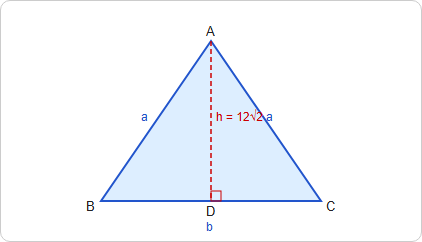
An altitude of 122 12\sqrt{2} cm is drawn to the base of an isosceles triangle. The perimeter of this triangle is 48 cm. Find the area of the triangle.

  1. AOption (a)

    122 12\sqrt{2} cm2

  2. BOption (b)

    362 36\sqrt{2} cm2

  3. COption (c)

    602 60\sqrt{2} cm2

  4. DOption (d)

    722 72\sqrt{2} cm2

View answer & explanation

Correct answer

Answer: (d)D.

722 72\sqrt{2} cm2

Why this answer is correct

Shortcut Trick

In an isosceles triangle with equal sides a, base b, and altitude h, the relationship is (2a − b) = 4h2 ÷ Perimeter.

Given h = 12√2 and Perimeter (2a + b) = 48.

⇒ (2a − b) = (4 × 288) ÷ 48 = 1152 ÷ 48 = 24.

⇒ Base b = (48 − 24) ÷ 2 = 12 cm.

⇒ Area = 1/2 × base × height = 1/2 × 12 × 12√2 = 72√2 cm2.

∴ The correct answer is 72√2 cm2.

Alternate Method

Given:

Altitude (h) = 12√2 cm

Perimeter (P) = 48 cm

Formula Used:

For an isosceles triangle, Perimeter = 2a + b and a2 = h2 + (b/2)2, where a is the equal side and b is the base.

Calculations:

⇒ a2 − (b/2)2 = h2

⇒ a2 − b2/4 = (12√2)2

⇒ (4a2 − b2) / 4 = 144 × 2

⇒ (2a − b)(2a + b) = 1152

Substitute Perimeter (2a + b) = 48:

⇒ (2a − b) × 48 = 1152

⇒ 2a − b = 1152 ÷ 48 = 24

Now, we have two equations: 2a + b = 48 and 2a − b = 24.

⇒ (2a + b) − (2a − b) = 48 − 24

⇒ 2b = 24 ⇒ b = 12 cm

⇒ Area = 1/2 × base × height = 1/2 × 12 × 12√2

⇒ Area = 6 × 12√2 = 72√2 cm2

∴ The correct answer is 72√2 cm2.

Additional Information

Properties of Isosceles Triangle

The altitude drawn from the vertex of the equal sides to the base bisects the base and the vertex angle.

Area Formula

The area of an isosceles triangle can also be calculated as (b/4) × √(4a2 − b2), where a is the length of the equal sides and b is the base.

Pythagorean Relation

In an isosceles triangle, the hypotenuse of the right-angled triangle formed by the altitude is the equal side (a), and the legs are the altitude (h) and half the base (b/2).

Question 27

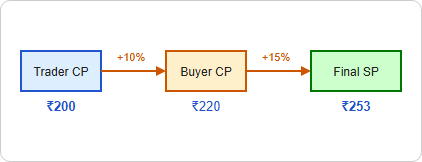
A trader buys a chair for ₹200, sells it at a 10% profit, and then the buyer sells it again at a 15% profit. What is the final selling price?

  1. AOption (a)

    ₹242

  2. BOption (b)

    ₹253

  3. COption (c)

    ₹230

  4. DOption (d)

    ₹260

View answer & explanation

Correct answer

Answer: (b)B.

₹253

Why this answer is correct

Shortcut Trick

Net Profit % = x + y + (xy ÷ 100)

Net Profit % = 10 + 15 + (10 × 15 ÷ 100) = 25 + 1.5 = 26.5%

Final Selling Price = 200 × (100 + 26.5)%

Final Selling Price = 200 × 1.265 = ₹253

∴ The correct answer is ₹253.

Alternate Method

Given: Cost Price (CP) of the chair = ₹200, First Profit = 10%, Second Profit = 15%

Formula: Selling Price (SP) = CP × (100 + Profit%) ÷ 100

⇒ First Selling Price (SP1) = 200 + (10% of 200)

⇒ SP1 = 200 + (10 ÷ 100 × 200) = 200 + 20 = ₹220

⇒ This SP1 becomes the Cost Price for the buyer.

⇒ Final Selling Price (SP2) = 220 + (15% of 220)

⇒ SP2 = 220 + (15 ÷ 100 × 220) = 220 + 33 = ₹253

∴ The correct answer is ₹253.

Additional Information

Successive Percentage Change

When a value is changed by x% and then by y%, the net effective percentage change is given by [x + y + (xy ÷ 100)]%.

Profit and Loss Formulas

Profit = Selling Price − Cost Price. Profit percentage is always calculated on the Cost Price (CP) unless stated otherwise.

Successive Discounts

If two successive discounts d1% and d2% are offered, the equivalent single discount is [d1 + d2 − (d1 × d2 ÷ 100)]%.

Question 28

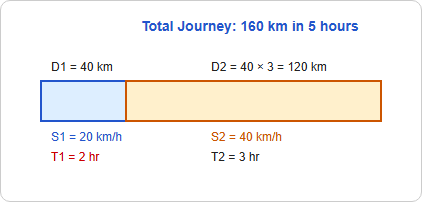
Ritu covers a distance of 40 km at 20 km/h and another distance at 40 km/h in 3 hours. Find the average speed for the whole journey.

  1. AOption (a)

    26 km/h

  2. BOption (b)

    32 km/h

  3. COption (c)

    38 km/h

  4. DOption (d)

    31 km/h

View answer & explanation

Correct answer

Answer: (b)B.

32 km/h

Why this answer is correct

Shortcut Trick

Total Distance = 40 + (40 × 3) = 40 + 120 = 160 km

Total Time = (40 ÷ 20) + 3 = 2 + 3 = 5 hours

Average Speed = Total Distance ÷ Total Time = 160 ÷ 5 = 32 km/h

∴ The correct answer is 32 km/h.

Alternate Method

Given:

Case 1: Distance1 = 40 km, Speed1 = 20 km/h

Case 2: Speed2 = 40 km/h, Time2 = 3 hours

Formula:

Average Speed = Total Distance ÷ Total Time

Time = Distance ÷ Speed | Distance = Speed × Time

Calculations:

⇒ Time1 = Distance1 ÷ Speed1 = 40 ÷ 20 = 2 hours

⇒ Distance2 = Speed2 × Time2 = 40 × 3 = 120 km

⇒ Total Distance = Distance1 + Distance2 = 40 + 120 = 160 km

⇒ Total Time = Time1 + Time2 = 2 + 3 = 5 hours

⇒ Average Speed = 160 ÷ 5 = 32 km/h

∴ The correct answer is 32 km/h.

Additional Information

Average Speed for Equal Distances

If a person covers two equal distances at speeds x and y, then the average speed = 2xy ÷ (x + y).

Average Speed for Equal Time Intervals

If a person travels for equal time intervals at speeds x and y, then the average speed = (x + y) ÷ 2.

Unit Conversion

To convert km/h to m/s, multiply by 5/18. To convert m/s to km/h, multiply by 18/5.

Question 29

The average of 8 numbers is 45. If each number is decreased by 4, what will the new average be?

  1. AOption (a)

    41

  2. BOption (b)

    45

  3. COption (c)

    8

  4. DOption (d)

    37

View answer & explanation

Correct answer

Answer: (a)A.

41

Why this answer is correct

Shortcut Trick

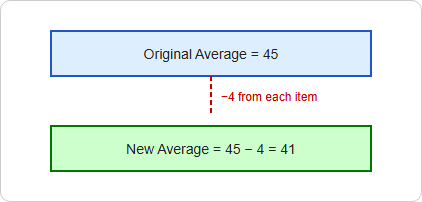
If every number in a set is decreased by a constant value k, the new average is simply the old average minus k.

Here, Old Average = 45 and Constant Decrease (k) = 4.

New Average = 45 − 4 = 41.

∴ The correct answer is 41.

Alternate Method

Given: Total numbers = 8, Average = 45, Decrease per number = 4.

Formula Used: Average = Sum of observations ÷ Total number of observations

⇒ Original Sum = Average × Count = 45 × 8 = 360

⇒ Total decrease across 8 numbers = 4 × 8 = 32

⇒ New Sum = 360 − 32 = 328

⇒ New Average = 328 ÷ 8

⇒ New Average = 41

∴ The correct answer is 41.

Additional Information

Effect of Operations on Average

If each term is multiplied by x, the average is multiplied by x. Similarly, if each term is divided by x (x ≠ 0), the average is divided by x.

Arithmetic Mean Formula

Mean (&xmacr;) = (Σxi) ÷ n, where Σxi is the sum of observations and n is the total number of observations.

Sum of First n Natural Numbers

The average of the first n natural numbers is (n + 1) ÷ 2.

Question 30

The average of five numbers 7, 11, 15, x, and 23 is 15. What is the value of x?

  1. AOption (a)

    23

  2. BOption (b)

    19

  3. COption (c)

    21

  4. DOption (d)

    17

View answer & explanation

Correct answer

Answer: (b)B.

19

Why this answer is correct

Shortcut Trick

In an Average problem, the sum of deviations from the mean must be zero.

Deviations from 15: (7−15) = −8, (11−15) = −4, (15−15) = 0, (23−15) = +8.

Net deviation of known numbers = −8 + (−4) + 0 + 8 = −4.

To balance the Average, the deviation of x must be +4.

x = 15 + 4 = 19.

∴ The correct answer is 19.

Alternate Method

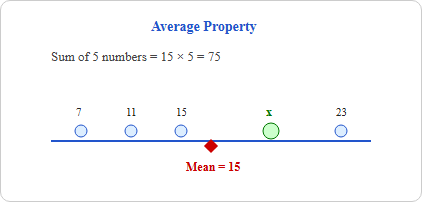
Given: Numbers = 7, 11, 15, x, 23 | Total count (n) = 5 | Average = 15

Formula Used: Average = (Sum of all observations) ÷ (Total number of observations)

⇒ Total Sum = Average × Number of terms

⇒ 7 + 11 + 15 + x + 23 = 15 × 5

⇒ 56 + x = 75

⇒ x = 75 − 56

⇒ x = 19

∴ The correct answer is 19.

Additional Information

Arithmetic Mean Definition

The mean is the sum of all data points divided by the count of data points: Mean = (Σxi) ÷ n.

Properties of Deviations

The algebraic sum of deviations of a set of observations from their Arithmetic Mean is always zero.

Average of AP

If numbers are in an Arithmetic Progression (AP), the Average is equal to the middle term (for odd n) or the mean of the two middle terms (for even n).

General Awareness (40 questions)

Question 31

Which of the following statements is/are true or false about the Windows 11 Task Manager?

(i) It can monitor network usage and identify which app is using the most bandwidth.

(ii) It can only view or end unresponsive apps, not start new programs or processes.

  1. AOption (a)

    (i) True, (ii) True

  2. BOption (b)

    (i) False, (ii) False

  3. COption (c)

    (i) False, (ii) True

  4. DOption (d)

    (i) True, (ii) False

View answer & explanation

Correct answer

Answer: (d)D.

(i) True, (ii) False

Why this answer is correct

The correct answer is (i) True, (ii) False.

Key Points

  • In Windows 11, the Task Manager serves as a powerful system monitor and management tool. Statement (i) is accurate because the Processes tab displays real-time Network usage for every active application, allowing users to identify bandwidth-heavy processes. Additionally, the App history tab provides a cumulative view of data usage over a specific period, and the Performance tab offers detailed throughput graphs for Ethernet and Wi-Fi. Hence, statement (i) is correct.
  • Statement (ii) is inaccurate because the Task Manager is not limited to terminating unresponsive software. It includes a Run new task feature (located in the top command bar of the Windows 11 interface) that enables users to execute new programs, CMD commands, or system utilities by typing the executable name. It also manages Services, Startup apps, and User accounts. Hence, statement (ii) is incorrect.

 Additional Information

  • Windows 11 Task Manager Features:
  • Keyboard Shortcut: The quickest way to launch the utility is by pressing Ctrl + Shift + Esc on the keyboard.
  • Efficiency Mode: A feature specific to modern Windows versions that allows users to limit the resources consumed by background processes to improve power efficiency.
  • Performance Monitoring: Tracks the utilization of the Central Processing Unit (CPU), Random Access Memory (RAM), Disk, and Graphics Processing Unit (GPU).
  • Startup Apps: Users can manage which third-party applications are permitted to launch during the Windows boot sequence, which can significantly impact boot time.
  • Details Tab: Provides advanced information including Process IDs (PIDs), status, and CPU priority levels for all running threads.

Question 32

Which declaration was NOT signed during PM Modi's visit to France in February 2025?

  1. AOption (a)

    India-France Infrastructure Pact

  2. BOption (b)

    India-France Declaration on Artificial Intelligence

  3. COption (c)

    India-France Cybersecurity Agreement

  4. DOption (d)

    India-France Innovation Treaty

View answer & explanation

Correct answer

Answer: (a)A.

India-France Infrastructure Pact

Why this answer is correct

The correct answer is India-France Infrastructure Pact.

Key Points

  • Prime Minister Narendra Modi paid an official visit to France from February 10 to 12, 2025, at the invitation of President Emmanuel Macron. The visit primarily focused on technology, innovation, and strategic autonomy.
  • During this visit, the two leaders co-chaired the Artificial Intelligence (AI) Action Summit in Paris. This resulted in the signing of the India-France Declaration on Artificial Intelligence, which outlines a framework for safe, ethical, and trustworthy AI development.
  • The visit saw the formalization of the India-France Innovation Treaty (often referred to in documents as the Innovation Roadmap or specific treaty-level agreements for the Year of Innovation 2026), aimed at boosting collaboration in deep-tech, healthcare, and green energy.
  • A specific India-France Cybersecurity Agreement was also highlighted to strengthen the digital partnership and protect critical information infrastructure, building upon the Cyber Security and Digital Technology Roadmap.
  • The India-France Infrastructure Pact was not signed during this specific visit. While there were discussions on Triangular Development Cooperation for infrastructure in the Indo-Pacific and a Declaration of Intent on Railway Development, no comprehensive bilateral Infrastructure Pact was part of the February 2025 outcomes.

 Additional Information

  • Strategic Outcomes of the 2025 Visit:
  • Nuclear Energy: Both nations signed a Declaration of Intent for cooperation on Advanced Modular Reactors (AMR) and Small Modular Reactors (SMR).
  • Consular Expansion: The leaders jointly inaugurated the Consulate General of India in Marseille to enhance people-to-people ties.
  • Space Research: A Letter of Intent between ISRO and CNES was discussed concerning microgravity research and human space exploration.
  • Environment: A bilateral Declaration of Intent on Environmental Cooperation was signed between the respective ministries to address climate change and biodiversity.
  • Economic Ties: The visit reinforced the Horizon 2047 Roadmap, which guides the bilateral relationship toward the centenary of India’s independence and diplomatic ties.

Question 33

Which irrigation technique is considered most efficient for conserving water?

  1. AOption (a)

    Flood irrigation

  2. BOption (b)

    Canal irrigation

  3. COption (c)

    Sprinkler irrigation

  4. DOption (d)

    Drip irrigation

View answer & explanation

Correct answer

Answer: (d)D.

Drip irrigation

Why this answer is correct

The correct answer is Drip irrigation.

Key Points

  • Drip irrigation, frequently referred to as trickle irrigation, is scientifically recognized as the most efficient water-application system, typically achieving efficiency levels of 90% or higher.
  • The process involves applying water at very low rates (typically 2 to 20 liters per hour) through a specialized network of plastic pipes, valves, and emitters directly to the soil surface or the root zone of plants.
  • By targeting the root zone specifically, it drastically minimizes evapotranspiration and deep percolation losses, which are prevalent in traditional irrigation methods.
  • This technique maintains a near-optimal soil moisture level, preventing plants from experiencing water stress and thereby significantly improving crop yield and quality.
  • It also facilitates fertigation, where soluble fertilizers are mixed with the water, ensuring precise nutrient delivery and reducing the risk of groundwater contamination from chemical leaching.

 Additional Information

  • Flood Irrigation:
  • A traditional surface irrigation method where water is pumped or brought to a field and allowed to flow over the ground freely.
  • It is highly inefficient (often less than 50%), as a large volume of water is lost to surface runoff and uncontrolled infiltration.
  • Sprinkler Irrigation:
  • Simulates natural rainfall by distributing water through a system of pumps and pipes, spraying it through nozzles into the air.
  • While more efficient than flood methods, it remains vulnerable to wind drift and high evaporation rates, especially in arid climates.
  • Canal Irrigation:
  • A large-scale system utilizing man-made channels to divert water from rivers or reservoirs to agricultural land.
  • It often suffers from high conveyance losses due to seepage and can lead to environmental issues like waterlogging and soil salinity.

Question 34

Which company announced in 2025 that it plans to invest US15billionfortheexpansionofairportsinIndiaby203015 billion for the expansion of airports in India by 2030?

  1. AOption (a)

    Tata Group

  2. BOption (b)

    Jindal Group

  3. COption (c)

    Reliance Group

  4. DOption (d)

    Adani Group

View answer & explanation

Correct answer

Answer: (d)D.

Adani Group

Why this answer is correct

The correct answer is Adani Group.

Key Points

  • The Adani Group, through its specialized subsidiary Adani Airport Holdings Limited (AAHL), announced an ambitious capital expenditure plan of US$15 billion (approximately Rs 1.25 lakh crore) to be deployed by 2030 for the expansion and modernization of its airport network.
  • The primary objective of this massive investment is to triple the group's passenger handling capacity from the current 80 million per annum to over 250 million per annum, positioning India as a global aviation transit hub.
  • A substantial portion of this US$15 billion fund is dedicated to the greenfield Navi Mumbai International Airport (NMIA), which is slated to commence operations by 2025 to ease the congestion at the existing Chhatrapati Shivaji Maharaj International Airport.
  • The expansion strategy involves upgrading the infrastructure at seven existing airports located in Ahmedabad, Lucknow, Mangaluru, Jaipur, Guwahati, and Thiruvananthapuram, converting them into integrated Airport Cities with extensive commercial and retail zones.
  • This announcement reflects the group's long-term commitment to the National Infrastructure Pipeline (NIP) and the government's vision of enhancing regional air connectivity across the Indian subcontinent.

 Additional Information

  • Adani Airport Holdings Limited (AAHL):
  • Established in 2019, it has rapidly become India's largest private airport operator, currently managing a significant 25% of the total passenger traffic and 33% of the air cargo traffic in the country.
  • The company focuses on a consumer-centric model where non-aero revenues from duty-free shops, hotels, and lounges play a pivotal role in the business's sustainability.
  • Indian Aviation Sector:
  • India is projected to become the world's third-largest aviation market. Government initiatives like the UDAN (Ude Desh ka Aam Naagrik) scheme are driving the demand for expanded airport infrastructure in Tier-2 and Tier-3 cities.
  • The entry of private giants like Adani Group and Tata Group (which controls Air India and Vistara) has shifted the industry toward a competitive, privatized landscape.

Question 35

Which of the following islands/island groups of India is of coral origin?

  1. AOption (a)

    Lakshadweep Islands

  2. BOption (b)

    Diu Island

  3. COption (c)

    Andaman Islands

  4. DOption (d)

    Nicobar Islands

View answer & explanation

Correct answer

Answer: (a)A.

Lakshadweep Islands

Why this answer is correct

The correct answer is Lakshadweep Islands.

Key Points

  • The Lakshadweep Islands, located in the Arabian Sea off the Malabar Coast of Kerala, are entirely composed of coral deposits.
  • These islands are classified as atolls, which are ring-shaped or horse-shoe-shaped coral reefs that partially or completely encircle a central lagoon.
  • Geologically, they are situated on the Chagos-Laccadive Ridge, a submarine mountain range; the islands were formed by the continuous accumulation of skeletal remains of coral polyps over thousands of years.
  • The archipelago consists of approximately 36 islands, though only 10 are inhabited, with Kavaratti serving as the administrative headquarters.
  • The total land area of this Union Territory is small, covering only about 32 square kilometers, making it India's smallest Union Territory.

 Additional Information

  • Andaman and Nicobar Islands:
  • Located in the Bay of Bengal, these are considered the elevated portions of submerged mountain ranges, specifically an extension of the Arakan Yoma range in Myanmar.
  • While they have fringing coral reefs around them, the islands themselves are tectonic and volcanic in origin.
  • This group contains Barren Island, which is the only active volcano in South Asia.
  • Diu Island:
  • A small coastal island located off the southern coast of the Kathiawar Peninsula in Gujarat.
  • It is of sedimentary and tectonic origin, separated from the mainland by a narrow creek, and is known for its Miliolite limestone formations.
  • Geographical Channels:
  • The Ten Degree Channel separates the Andaman islands from the Nicobar islands.
  • The Nine Degree Channel separates the island of Minicoy from the rest of the Lakshadweep archipelago.
  • The Eight Degree Channel separates the entire Lakshadweep group from the Maldives.

Question 36

Tank irrigation is mainly practiced in which of the following states of India due to uneven terrain and less rainfall?

  1. AOption (a)

    Himachal Pradesh

  2. BOption (b)

    West Bengal

  3. COption (c)

    Haryana

  4. DOption (d)

    Karnataka

View answer & explanation

Correct answer

Answer: (d)D.

Karnataka

Why this answer is correct

The correct answer is Karnataka.

Key Points

  • Tank irrigation is a traditional method of water harvesting where rainwater is collected in natural or man-made depressions, widely prevalent in the Peninsular Plateau of India.
  • Karnataka, situated on the Deccan Plateau, possesses hard crystalline rocks and a non-porous rocky structure that makes the excavation of canals and wells extremely difficult and costly.
  • The undulating topography and uneven terrain of the state provide natural depressions that are ideal for constructing embankments to store monsoon runoff.
  • Since rainfall in the interior parts of the state is seasonal and often insufficient, these tanks act as essential reservoirs to sustain agriculture during the dry rabi and kharif seasons.
  • Historical data indicates that the Southern states, including Karnataka, Andhra Pradesh, and Tamil Nadu, account for the highest percentage of tank-irrigated area in India due to these specific physiographic conditions.

 Additional Information

  • Himachal Pradesh
  • Characterized by mountainous terrain where traditional irrigation is done through Kuhls, which are surface channels diverting water from glaciers and streams.
  • West Bengal
  • The state features flat alluvial plains and perennial rivers, leading to a dominance of canal irrigation and tube well systems rather than tanks.
  • Haryana
  • Part of the Indo-Gangetic Plain, this state relies heavily on tube wells and an extensive canal network, such as the Western Yamuna Canal, facilitated by soft soil and level land.

Question 37

In which of the following cases is the work done negative?

  1. AOption (a)

    Force and displacement are between 0° and 90°

  2. BOption (b)

    Force and displacement are in the same direction

  3. COption (c)

    Force and displacement are mutually perpendicular

  4. DOption (d)

    Force and displacement are between 90° and 180°

View answer & explanation

Correct answer

Answer: (d)D.

Force and displacement are between 90° and 180°

Why this answer is correct

The correct answer is Force and displacement are between 90degree and 180degree.

Key Points

  • Work done is mathematically defined as the dot product of the force vector and the displacement vector. It is a scalar quantity.
  • The formula for work is W=F⋅s⋅cos⁡θ W = F \cdot s \cdot \cos \theta , where F represents the magnitude of the force, s represents the displacement, and θ is the angle between the force and displacement vectors.
  • Work done is negative when the angle θ is an obtuse angle, specifically when 90° < θ ≤ 180°.
  • In the second quadrant of trigonometry (90° to 180°), the value of cos θ is negative. Therefore, the resulting product of force, displacement, and the cosine of the angle becomes negative.
  • Negative work indicates that the applied force is opposing the motion of the object. A classic example is the force of friction acting on a moving body, where the angle is 180°.

 Additional Information

  • Positive Work:
  • Occurs when the angle θ is acute (between 0° and 90°).
  • The force or a component of the force acts in the same direction as the displacement.
  • Example: A horse pulling a cart or a person lifting a weight upwards (work done by the person).
  • Zero Work:
  • Occurs when the force and displacement are mutually perpendicular (angle is exactly 90°), as cos 90° = 0.
  • Example: The centripetal force acting on a satellite orbiting Earth or a person carrying a bucket horizontally at a constant velocity.
  • SI Unit:
  • The SI unit of work is the Joule (J), which is equivalent to 1 Newton-meter (N·m).

Question 38

Which animal is targeted in Project Hangul?

  1. AOption (a)

    Red panda

  2. BOption (b)

    Indian Bison

  3. COption (c)

    Himalayan Musk deer

  4. DOption (d)

    Kashmir Stag

View answer & explanation

Correct answer

Answer: (d)D.

Kashmir Stag

Why this answer is correct

The correct answer is Kashmir Stag.

Key Points

  • Project Hangul was launched in 1970 by the Government of Jammu and Kashmir in collaboration with the International Union for Conservation of Nature (IUCN) and the World Wildlife Fund (WWF).
  • The project targets the conservation of the Kashmir Stag, also known as the Hangul (scientifically termed Cervus elaphus hanglu), which is a subspecies of the European Red Deer.
  • The Hangul is the State Animal of Jammu and Kashmir and is primarily found in the Dachigam National Park, located near Srinagar at an elevation of approximately 3,000 meters.
  • The population of this species saw a drastic decline from about 5,000 in the early 20th century to a few hundred due to habitat fragmentation, poaching, and overgrazing by domestic livestock.
  • The species is classified as Critically Endangered under the IUCN Red List and is protected under Schedule I of the Wildlife Protection Act, 1972.

 Additional Information

  • Red Panda:
  • Project Red Panda was initiated in 1994 at the Padmaja Naidu Himalayan Zoological Park in West Bengal.
  • They are native to the Eastern Himalayas and are found in states like Sikkim and Arunachal Pradesh.
  • Himalayan Musk Deer:
  • Targeted under Project Musk Deer, launched in 1974 at the Kedarnath Wildlife Sanctuary in Uttarakhand.
  • It is highly sought after for its musk pod, which is used in traditional medicines and perfumes.
  • Indian Bison (Gaur):
  • The largest extant bovine in the world, native to South and Southeast Asia.
  • Listed as Vulnerable on the IUCN Red List, it is found extensively in the Western Ghats and Central India.

Question 39

According to a 2025 release by the Department of Science and Technology, the new sodium-ion battery developed at Jawaharlal Nehru Centre for Advanced Scientific Research (JNCASR) can be fast-charged to about 80% in roughly:

  1. AOption (a)

    16 minutes

  2. BOption (b)

    6 minutes

  3. COption (c)

    26 minutes

  4. DOption (d)

    36 minutes

View answer & explanation

Correct answer

Answer: (b)B.

6 minutes

Why this answer is correct

The correct answer is 6 min.

Key Points

  • In a significant breakthrough released in early 2025, the Department of Science and Technology (DST) highlighted the development of a high-performance Sodium-ion battery (SIB) by researchers at the Jawaharlal Nehru Centre for Advanced Scientific Research (JNCASR).
  • The newly developed Sodium-ion battery addresses the critical limitation of slow charging in conventional energy storage systems, demonstrating the ability to be fast-charged to 80% of its capacity in approximately 6 min.
  • The research focuses on using a novel anode material that allows for rapid ion transport and high structural stability, which is essential for maintaining performance during high-speed charging cycles.
  • This technological advancement is tailored for the Electric Vehicle (EV) sector and large-scale stationary energy storage, aiming to provide a cheaper and faster alternative to existing Lithium-ion technologies.
  • By utilizing Sodium, which is globally abundant and cost-effective, this JNCASR innovation supports India's National Mission on Transformative Mobility and Battery Storage.

 Additional Information

  • Sodium-ion Batteries (SIBs):
  • These batteries use Sodium ions (Na+) as charge carriers, which are physically larger than Lithium ions, traditionally making fast charging a technical challenge.
  • Sodium is the sixth most abundant element in the Earth's crust, making SIBs roughly 30-40% cheaper to produce than Lithium-ion batteries.
  • They offer better safety profiles and can be transported at zero volts (0V), reducing the risk of thermal runaway during shipping.
  • JNCASR (Jawaharlal Nehru Centre for Advanced Scientific Research):
  • It is a multidisciplinary research institute located in Bengaluru, established to commemorate the birth centenary of Pandit Jawaharlal Nehru.
  • It functions as an autonomous institution under the Department of Science and Technology, Government of India.
  • The center plays a pivotal role in Materials Science and Energy Research, contributing to the Atmanirbhar Bharat initiative in the energy sector.

Question 40

According to the Constitution of India, Citizenship by incorporation of territory applies when _________________.

  1. AOption (a)

    India acquires new territory

  2. BOption (b)

    A citizen moves from one state to another

  3. COption (c)

    A foreigner resides for five years

  4. DOption (d)

    A state is divided into two

View answer & explanation

Correct answer

Answer: (a)A.

India acquires new territory

Why this answer is correct

The correct answer is India acquires new territory.

Key Points

  • Incorporation of Territory is one of the five distinct ways to acquire Indian citizenship, as defined under Section 7 of the Citizenship Act, 1955.
  • It applies specifically when a foreign territory becomes a part of the Indian Union through treaty, purchase, conquest, or any other means of acquisition.
  • The Government of India exercises the power to specify, via a notification in the Official Gazette, which persons from the newly acquired territory shall become citizens of India.
  • Unlike birth or descent, this form of acquisition is collective and depends on the specific date and criteria determined by the Central Government.
  • A notable historical application was the Citizenship (Pondicherry) Order, 1962, which granted Indian citizenship to inhabitants of Pondicherry (now Puducherry) after it was integrated into India.

 Additional Information

  • Constitutional Framework:
  • Articles 5 to 11 in Part II of the Constitution of India address citizenship, primarily defining who was a citizen at the time of the Constitution’s commencement on January 26, 1950.
  • Article 11 empowers the Parliament to regulate the right of citizenship by law, which led to the enactment of the comprehensive Citizenship Act, 1955.
  • Other Modes of Acquisition:
  • Birth (Section 3): Citizenship based on the location and date of birth within Indian borders.
  • Descent (Section 4): Citizenship acquired by those born outside India to Indian parents.
  • Registration (Section 5): Available to Persons of Indian Origin (PIO) or spouses of Indian citizens after a prescribed period of residence.
  • Naturalization (Section 6): A process for foreigners who have resided in India for 12 years and meet specific qualifications.
  • Single Citizenship: India follows the principle of Single Citizenship, meaning there is no separate state citizenship; moving between states does not change one’s status as an Indian citizen.

Question 41

What event caused Mahatma Gandhi to withdraw the non-cooperation movement in February 1922?

  1. AOption (a)

    A decision by the British to suspend restrictions on civil liberties.

  2. BOption (b)

    The violent attack on policemen during the Chauri Chaura incident.

  3. COption (c)

    A nationwide strike by textile workers in Bombay and Ahmedabad.

  4. DOption (d)

    The approval of a new round of constitutional negotiations by London.

View answer & explanation

Correct answer

Answer: (b)B.

The violent attack on policemen during the Chauri Chaura incident.

Why this answer is correct

The correct answer is The violent attack on policemen during the Chauri Chaura incident.

Key Points

  • The Non-Cooperation Movement, which began in 1920, was abruptly called off by Mahatma Gandhi in February 1922 due to the outbreak of violence.
  • The specific catalyst was the Chauri Chaura incident, which occurred on February 4, 1922, in the Gorakhpur district of the United Provinces (present-day Uttar Pradesh).
  • During a protest march, a clash broke out between the volunteers and the police; the police opened fire on the crowd, which provoked the protesters to attack the local police station.
  • The mob set the police station on fire, resulting in the death of 22 policemen who were burned alive inside the building.
  • Mahatma Gandhi, a staunch practitioner of Ahimsa (non-violence), felt that the movement was deviating from its peaceful path and becoming a violent struggle.
  • He believed that the Indian people were not yet fully prepared for a disciplined, non-violent mass movement and required further training in the principles of Satyagraha.
  • On February 12, 1922, the Congress Working Committee met at Bardoli, where Gandhi passed a resolution to suspend the movement nationwide.

 Additional Information

  • Non-Cooperation Movement Goals:
  • The movement aimed to achieve Swaraj (self-rule) and address grievances related to the Jallianwala Bagh Massacre and the Khilafat issue.
  • It involved the boycott of British goods, government-run educational institutions, and law courts.
  • Impact of the Withdrawal:
  • The sudden suspension of the movement led to significant internal debate within the Indian National Congress.
  • This internal rift eventually led to the formation of the Swaraj Party in 1923 by Chittaranjan Das and Motilal Nehru, who advocated for participating in legislative councils.
  • Ahmedabad Mill Strike (1918):
  • While option 3 mentions textile workers, this refers to an earlier event where Gandhi successfully mediated between workers and owners using his first hunger strike in India.

Question 42

Which of the following situations in football leads to a 'Penalty Kick' being awarded?

  1. AOption (a)

    A player scores three consecutive goals

  2. BOption (b)

    A player is offside

  3. COption (c)

    A foul is committed inside the penalty area

  4. DOption (d)

    The goalkeeper handles the ball outside the goal

View answer & explanation

Correct answer

Answer: (c)C.

A foul is committed inside the penalty area

Why this answer is correct

The correct answer is A foul is committed inside the penalty area.

Key Points

  • According to Law 14 of the International Football Association Board (IFAB) Laws of the Game, a penalty kick is awarded if a player commits a direct free kick offense inside their own penalty area.
  • The offense must be committed while the ball is in play. If the ball is out of play when the foul occurs, the restart is determined by the previous situation (e.g., goal kick, corner).
  • Specific fouls that lead to a penalty include tripping, striking, pushing, charging, or deliberate handball (excluding the goalkeeper within their own area) by a defending player.
  • The ball is placed on the penalty mark, which is located 11 meters (12 yards) from the center of the goal line.
  • During the kick, all players except the kicker and the defending goalkeeper must be at least 9.15 meters (10 yards) from the penalty mark and outside the penalty area until the ball is kicked.

 Additional Information

  • Offside:
  • Being in an offside position is not an offense in itself; however, if a player becomes active in play from that position, the referee awards an indirect free kick to the opposing team.
  • Goalkeeper handling outside the area:
  • The goalkeeper is only permitted to handle the ball within their own penalty box. If they touch the ball with their hands outside this area, a direct free kick is awarded.
  • Hat-trick:
  • This term refers to a single player scoring three goals in a single match. It is a statistical milestone and does not trigger any specific refereeing award like a penalty.
  • VAR (Video Assistant Referee):
  • In professional leagues, VAR can intervene to review penalty kick decisions, ensuring that fouls occurring on the line or inside the 18-yard box are correctly identified.

Question 43

What does RAM stand for in a computer system?

  1. AOption (a)

    Random Allocation Memory

  2. BOption (b)

    Read Access Memory

  3. COption (c)

    Random Access Memory

  4. DOption (d)

    Read-Only Access Memory

View answer & explanation

Correct answer

Answer: (c)C.

Random Access Memory

Why this answer is correct

The correct answer is Random Access Memory.

Key Points

  • Random Access Memory (RAM) is the primary internal memory of a computer system that allows data items to be read or written in almost the same amount of time irrespective of the physical location of data inside the memory.
  • It serves as a temporary storage area or working space for the Operating System, application programs, and data currently in use, enabling the Central Processing Unit (CPU) to access instructions quickly.
  • RAM is fundamentally volatile in nature, which means that any information stored within it is lost immediately when the power supply is interrupted or the computer is turned off.
  • The performance of a system is heavily dependent on the capacity and speed of the RAM, as higher RAM allows for more efficient multitasking and faster execution of complex software.

 Additional Information

  • Dynamic RAM (DRAM)
  • This is the most common type of RAM used in modern computers; it utilizes capacitors to store bits of data and requires frequent refreshing to prevent data loss.
  • Static RAM (SRAM)
  • Unlike DRAM, SRAM does not need to be refreshed and is significantly faster; however, it is more expensive and bulkier, typically used for high-speed CPU Cache memory.
  • Read-Only Memory (ROM)
  • In contrast to RAM, ROM is non-volatile memory, meaning it retains its data even without power; it is used to store the BIOS (Basic Input/Output System) or firmware that initializes hardware during the boot-up process.
  • SDRAM (Synchronous DRAM)
  • A specialized version of DRAM that synchronizes its speed with the system clock, increasing the number of instructions the processor can execute in a given time.

Question 44

Which post-100th Amendment is the most recent and aims to reserve seats for women, with certain transitional and delimitation requirements before it becomes fully operational?

  1. AOption (a)

    103rd Amendment

  2. BOption (b)

    105th Amendment

  3. COption (c)

    104th Amendment

  4. DOption (d)

    106th Amendment

View answer & explanation

Correct answer

Answer: (d)D.

106th Amendment

Why this answer is correct

The correct answer is 106th Amendment.

Key Points

  • The 106th Constitutional Amendment Act, 2023, also known as the Nari Shakti Vandan Adhiniyam, was enacted to provide one-third (33 percent) reservation for women in legislative bodies.
  • This reservation specifically applies to the Lok Sabha, the State Legislative Assemblies, and the Legislative Assembly of the National Capital Territory of Delhi.
  • A unique feature of this amendment is the transitional requirement: the reservation will become operational only after a delimitation exercise is conducted following the first Census published after the Act's commencement.
  • The Act introduces Article 330A and Article 332A into the Constitution and includes a sunset clause, stipulating that the reservation will last for 15 years, unless extended by Parliament.
  • It aims to enhance gender parity and women's participation in higher-level political decision-making, fulfilling a demand that had been pending in the Indian Parliament for nearly three decades.

 Additional Information

  • 103rd Amendment:
  • Enacted in 2019, it introduced a 10 percent reservation for the Economically Weaker Sections (EWS) in civil posts and services.
  • It amended Article 15 and Article 16 of the Constitution.
  • 104th Amendment:
  • Passed in 2020, it extended the reservation for Scheduled Castes (SCs) and Scheduled Tribes (STs) in the Lok Sabha and state assemblies for 10 years.
  • It also abolished the provision for nominating Anglo-Indian members to these legislative bodies.
  • 105th Amendment:
  • Enacted in 2021, it restored the power of State Governments and Union Territories to identify their own lists of Socially and Educationally Backward Classes (SEBCs).

Therefore, the correct option is 4.

Question 45

Which season in India is characterised by hot, dry winds known as ‘Loo’?

  1. AOption (a)

    Summer season

  2. BOption (b)

    Pre-monsoon showers

  3. COption (c)

    Cold weather season

  4. DOption (d)

    Retreating monsoon

View answer & explanation

Correct answer

Answer: (a)A.

Summer season

Why this answer is correct

The correct answer is Summer season.

Key Points

  • The Summer season in India, which lasts from March to May, is characterized by a rapid rise in temperature and a decrease in air pressure over the northern parts of the country.
  • The Loo is a striking feature of this season, consisting of strong, gusty, hot, and dry winds that blow during the day over North and Northwestern India.
  • These winds are primarily caused by the intense heating of the Indo-Gangetic Plain, creating a localized low-pressure system that attracts dry air from the Thar Desert.
  • Temperatures during a Loo event typically range between 45°C and 50°C, often persisting into the evening and causing severe discomfort.
  • Direct exposure to these hot winds is extremely dangerous and can lead to fatal conditions such as heatstroke, hyperthermia, and severe dehydration.

 Additional Information

  • Pre-monsoon showers:
  • Occur towards the end of the summer season, providing relief from the intense heat through localized thunderstorms.
  • In Kerala and Karnataka, they are known as Mango Showers as they aid in the early ripening of mangoes; in West Bengal, they are called Kaal Baisakhi.
  • Cold weather season:
  • Spans from mid-November to February in Northern India, characterized by clear skies, low temperatures, and low humidity.
  • This season is influenced by Western Cyclonic Disturbances from the Mediterranean Sea, which bring rainfall beneficial for Rabi crops like wheat.
  • Retreating monsoon:
  • Occurs during October and November as the monsoon trough shifts southwards, marking the transition from the rainy season to winter.
  • The combination of high temperature and high humidity during this period leads to an oppressive weather condition known as October Heat.

Therefore, the correct answer is Summer season.

Question 46

After months of deadlock and implementation refusal, which State Government in November 2025 mandated the digitization of Waqf properties on the UMEED portal?

  1. AOption (a)

    Bihar

  2. BOption (b)

    West Bengal

  3. COption (c)

    Andhra Pradesh

  4. DOption (d)

    Kerala

View answer & explanation

Correct answer

Answer: (b)B.

West Bengal

Why this answer is correct

The correct answer is West Bengal.

Key Points

  • In November 2025, the West Bengal State Government officially mandated the comprehensive digitization of all assets under the Board of Auqaf through the UMEED (Unified Management of Estates and Endowments Digitization) portal.
  • The move came after a significant period of administrative deadlock and initial implementation refusal, as the state government and various stakeholders debated the integration of state records with centralized monitoring frameworks.
  • The UMEED portal serves as a robust digital repository designed to provide geo-tagging and real-time tracking of thousands of properties, including mosques, madrasas, graveyards, and commercial land.
  • The primary objective of this mandate is to curb illegal encroachments and unauthorized transfers of Waqf land, ensuring that the revenue generated is used strictly for the socio-economic development of the community.
  • By digitizing these records, the Government of West Bengal aims to bring transparency to the Board of Auqaf's operations, which manages one of the largest inventories of such properties in India.

 Additional Information

  • Waqf Properties:
  • These are properties permanently dedicated for religious, pious, or charitable purposes under Islamic Law.
  • In India, these assets are governed by the Waqf Act, 1995, which provides the legal framework for their administration and protection.
  • The management is overseen by State Waqf Boards, which have the power to appoint Mutawallis (managers) for individual estates.
  • Board of Auqaf, West Bengal:
  • It is a statutory body responsible for supervising over 8,000 registered Waqf estates across the state.
  • The digitization process involves synchronizing records with the Land and Land Reforms Department to verify Khatian and Dag numbers.
  • Waqf Assets Management System of India (WAMSI):
  • A centralized project by the Ministry of Minority Affairs to digitize all Waqf records nationwide, which the UMEED portal complements at the state level.

Question 47

Which body’s Chairperson was appointed on 1 September 2025, with Ajay Seth taking over the role?

  1. AOption (a)

    NITI Aayog

  2. BOption (b)

    Reserve Bank of India (RBI)

  3. COption (c)

    Securities and Exchange Board of India (SEBI)

  4. DOption (d)

    Insurance Regulatory and Development Authority of India (IRDAI)

View answer & explanation

Correct answer

Answer: (d)D.

Insurance Regulatory and Development Authority of India (IRDAI)

Why this answer is correct

The correct answer is Insurance Regulatory and Development Authority of India (IRDAI).

Key Points

  • Ajay Seth, a distinguished 1987-batch Indian Administrative Service (IAS) officer of the Karnataka cadre, was appointed as the Chairperson of the Insurance Regulatory and Development Authority of India (IRDAI).
  • The Appointments Committee of the Cabinet (ACC) approved his appointment to lead the insurance regulator following his successful tenure as the Secretary of the Department of Economic Affairs (DEA) within the Ministry of Finance.
  • He officially assumed his duties on 1 September 2025, succeeding Debasish Panda, whose three-year term concluded in early 2025.
  • As the head of IRDAI, Seth is responsible for overseeing the insurance sector, implementing reforms to increase insurance penetration, and ensuring the financial stability of the re-insurance market in India.
  • His previous experience includes managing India's G20 Finance Track and playing a critical role in the formulation of Union Budgets, making him a strategic choice for this regulatory role.

 Additional Information

  • IRDAI:
  • It is a statutory body formed under the Insurance Regulatory and Development Authority Act, 1999.
  • The body is headquartered in Hyderabad and serves as the apex regulator for both Life and General Insurance companies in India.
  • NITI Aayog:
  • The National Institution for Transforming India is the premier policy think tank of the Government of India.
  • The Prime Minister acts as the Ex-officio Chairperson, while the Vice-Chairperson and CEO handle daily operations.
  • Reserve Bank of India (RBI):
  • The RBI is India's central bank, established on 1 April 1935 under the RBI Act, 1934.
  • It is responsible for monetary policy, currency issuance, and the regulation of the banking sector.
  • Securities and Exchange Board of India (SEBI):
  • Established as a statutory body on 12 April 1992, it regulates the securities and commodities market.
  • It aims to protect the interests of investors and promote the development of the capital markets.

Question 48

As of November 2025, Article 1 of the Indian Constitution classifies Indian territory into how many distinct categories under Constitutional provisions?

  1. AOption (a)

    Four

  2. BOption (b)

    Five

  3. COption (c)

    Two

  4. DOption (d)

    Three

View answer & explanation

Correct answer

Answer: (d)D.

Three

Why this answer is correct

The correct answer is Three.

Key Points

  • Article 1 of the Constitution of India defines the name and territory of the Union, establishing that India, that is Bharat, shall be a Union of States.
  • Under Article 1(3), the territory of India is classified into three distinct categories: the territories of the States, the Union Territories, and territories that may be acquired by the Government of India at any time.
  • The first category includes 28 States (as of 2025) which are members of the federal system and share a distribution of powers with the Central Government.
  • The second category comprises the Union Territories specified in the First Schedule (currently 8 UTs), which are governed directly by the President through an administrator appointed by him.
  • The third category refers to acquired territories, which allows India to incorporate new lands through international legal methods such as cession, occupation, or conquest, even though no such territory is currently held separately from the existing states/UTs.

 Additional Information

  • Territory of India vs. Union of India:
  • The expression Territory of India is wider than the Union of India because the Union includes only the States, whereas the Territory encompasses States, Union Territories, and any acquired areas.
  • While States are federal units, Union Territories and acquired territories are unitary units administered directly by the Union Government.
  • First Schedule:
  • The First Schedule contains the names of the States and Union Territories along with their territorial extent and boundaries.
  • Any modification to the First Schedule or the Fourth Schedule resulting from the creation or reorganization of states under Article 2 or Article 3 is not considered a formal amendment under Article 368.
  • Sovereignty and Acquisition:
  • Being a sovereign state, India has the inherent right to acquire foreign territories. Historical examples of such acquisitions include Dadra and Nagar Haveli, Goa, Daman and Diu, Puducherry, and Sikkim, which were later integrated into the standard state/UT categories.

Question 49

What was a significant objective of the fiscal and monetary policy reforms initiated in India post 1991?

  1. AOption (a)

    To decrease foreign investment in the financial sector

  2. BOption (b)

    To stabilise the economy by liberalising interest rates and enhancing financial sector efficiency

  3. COption (c)

    To increase government control over the banking sector

  4. DOption (d)

    To maintain fixed interest rates across all financial products

View answer & explanation

Correct answer

Answer: (b)B.

To stabilise the economy by liberalising interest rates and enhancing financial sector efficiency

Why this answer is correct

The correct answer is To stabilise the economy by liberalising interest rates and enhancing financial sector efficiency.

Key Points

  • Following the Balance of Payments (BoP) crisis in 1991, India initiated structural reforms to shift from a centrally planned economy to a market-led economy.
  • A primary objective of the monetary policy reforms was the deregulation of interest rates, allowing banks to determine rates based on market demand and supply rather than rigid Reserve Bank of India (RBI) directives.
  • The Narasimham Committee (1991) on the Financial System recommended reducing the Statutory Liquidity Ratio (SLR) and Cash Reserve Ratio (CRR) to increase the availability of lendable funds for the private sector, thereby enhancing financial sector efficiency.
  • Fiscal policy reforms focused on macroeconomic stabilization by reducing the fiscal deficit, which had reached 8.4% of the GDP in 1990-91, through better expenditure management and tax restructuring.
  • These reforms aimed to create a competitive banking environment by allowing the entry of new private sector banks and increasing the operational autonomy of public sector banks.

 Additional Information

  • New Economic Policy (NEP) 1991:
  • Liberalization: Involved removing industrial licensing, dismantling price controls, and allowing Foreign Direct Investment (FDI) to integrate with the global economy.
  • Fiscal Reforms: Based on the Raja Chelliah Committee recommendations, these reforms simplified the tax structure and lowered corporate tax and personal income tax rates to improve compliance.
  • Monetary Shift: The RBI transitioned from direct controls to indirect instruments like the Repo Rate and Open Market Operations (OMO) to manage liquidity.
  • External Sector: The Indian Rupee was devalued in July 1991 and later moved toward a unified exchange rate system to boost exports and attract foreign capital.

Question 50

A web browser such as Chrome is used to access the internet. This makes it a/an:

  1. AOption (a)

    System software

  2. BOption (b)

    Application software

  3. COption (c)

    Hardware

  4. DOption (d)

    Device troubleshooter

View answer & explanation

Correct answer

Answer: (b)B.

Application software

Why this answer is correct

The correct answer is Application software.

Key Points

  • Application software refers to a category of computer programs designed to help end-users perform specific sets of tasks, functions, or activities that go beyond the basic operation of the computer itself.
  • A Web Browser, such as Google Chrome, is a prime example of application software because it serves the specific purpose of retrieving, presenting, and traversing information resources on the World Wide Web.
  • Chrome interprets HTML (HyperText Markup Language), CSS, and JavaScript to render web pages, which is a high-level task that requires an Operating System to be already functioning.
  • Unlike system software, Chrome does not manage CPU scheduling or memory allocation directly; instead, it requests these resources from the OS to execute its user-oriented processes.
  • This software category also includes other well-known tools like Microsoft Word, VLC Media Player, and Adobe Photoshop, all of which are installed to fulfill specific user needs.

 Additional Information

  • System software:
  • This includes programs like the Operating System (OS) (e.g., Windows, Linux, macOS), BIOS, and device drivers.
  • Its primary role is to manage the hardware components and provide a platform for application software to run.
  • Hardware:
  • These are the physical, tangible components of a computer system.
  • Key examples include the Central Processing Unit (CPU), Random Access Memory (RAM), Motherboard, and Hard Drives.
  • Device troubleshooter:
  • This is a specific type of utility software or built-in OS tool designed to diagnose and repair hardware configuration or software connectivity issues.

Question 51

In which year was the Indian freedom fighter Tantia Tope, a prominent leader of the Revolt of 1857, executed by the British?

  1. AOption (a)

    1859

  2. BOption (b)

    1858

  3. COption (c)

    1860

  4. DOption (d)

    1857

View answer & explanation

Correct answer

Answer: (a)A.

1859

Why this answer is correct

The correct answer is 1859.

Key Points

  • Tantia Tope, born as Ramachandra Pandurang Tope in 1814, was one of the most distinguished military leaders of the Indian Rebellion of 1857.
  • He was a close associate of Nana Sahib and served as the commander-in-chief of the rebel forces in Cawnpore (Kanpur).
  • Following the fall of Kanpur, he joined forces with Rani Lakshmi Bai to defend Jhansi and later helped in the capture of Gwalior.
  • After the death of Rani Lakshmi Bai in June 1858, Tantia Tope successfully conducted a brilliant guerrilla warfare campaign against the British for nearly a year across Central India and Rajasthan.
  • He was ultimately betrayed by his trusted friend Man Singh, the Raja of Narwar, while resting in the Paron forests.
  • He was captured by British forces on April 7, 1859, and subsequently tried by a military court at Shivpuri.
  • Tantia Tope was executed by hanging on April 18, 1859, at Shivpuri, Madhya Pradesh, which effectively signaled the end of the major armed resistance of 1857.

 Additional Information

  • Nana Sahib:
  • The adopted son of Peshwa Baji Rao II who led the revolt in Kanpur.
  • He escaped to the Nepal hills after the British regained control, and his fate remains a historical mystery.
  • Rani Lakshmi Bai:
  • The Queen of Jhansi who became a symbol of resistance; she died on the battlefield on June 18, 1858, while fighting the forces of Sir Hugh Rose.
  • Government of India Act 1858:
  • Passed in the aftermath of the revolt, it ended the rule of the East India Company and transferred Indian administration directly to the British Crown.
  • It created the office of the Secretary of State for India and changed the designation of the Governor-General to Viceroy.
  • Shivpuri:
  • A statue and a memorial have been erected in Shivpuri to honor the martyrdom of Tantia Tope at the site of his execution.

Question 52

What will be the resultant force if a body of mass 10 kg is moving with an acceleration of 5m/sec2?

  1. AOption (a)

    5 Newton

  2. BOption (b)

    50 Newton

  3. COption (c)

    2 Newton

  4. DOption (d)

    2 Joule

View answer & explanation

Correct answer

Answer: (b)B.

50 Newton

Why this answer is correct

The correct answer is 50 Newton.

Key Points

  • The relationship between force, mass, and acceleration is governed by Newton's Second Law of Motion, which states that the force acting on an object is directly proportional to the product of its mass and acceleration.
  • The mathematical formula for this law is F = m × a, where F represents the resultant force, m is the mass of the object, and a is the acceleration.
  • In the given problem, the mass (m) of the body is 10 kg and the acceleration (a) is 5 m/s2.
  • By applying the formula: Force (F) = 10 kg × 5 m/s2 = 50 kg·m/s2.
  • The unit kg·m/s2 is equivalent to the Newton (N), which is the standard SI unit of force. Therefore, the resultant force is 50 Newton.

 Additional Information

  • Newton (N):
  • It is the derived unit of force in the International System of Units (SI).
  • One Newton is defined as the force needed to provide a mass of one kilogram with an acceleration of one meter per second squared.
  • Joule (J):
  • The Joule is the SI unit of work, energy, and heat.
  • It is not a unit of force; hence, option 4 (2 Joule) is conceptually incorrect for a force calculation.
  • One Joule is equal to the work done by a force of one Newton acting through a distance of one meter.
  • Newton's Laws of Motion:
  • First Law: An object remains at rest or in uniform motion unless acted upon by an external force (Inertia).
  • Third Law: For every action, there is an equal and opposite reaction.

Question 53

Which of the following SI prefixes has a multiplicative factor of 10–9 ?

  1. AOption (a)

    Micro

  2. BOption (b)

    Nano

  3. COption (c)

    Milli

  4. DOption (d)

    Centi

View answer & explanation

Correct answer

Answer: (b)B.

Nano

Why this answer is correct

The correct answer is Nano.

Key Points

  • The International System of Units (SI) employs a standard set of prefixes to express decimal multiples and submultiples of units, facilitating the management of extremely large or small quantities.
  • The prefix Nano corresponds specifically to a multiplicative factor of 10−9, which represents one-billionth of a base unit (0.000000001).
  • Derived from the Greek word nanos (meaning dwarf), it is symbolized by the lowercase letter 'n' and is frequently used in nanotechnology, microelectronics, and molecular physics to measure distances at the atomic scale, such as nanometers (nm).
  • The use of these prefixes was formally established and expanded by the General Conference on Weights and Measures (CGPM) to ensure global uniformity in scientific and commercial measurements.

 Additional Information

  • Other common SI prefixes for submultiples include:
  • Micro: Symbolized by the Greek letter μ, it represents a factor of 10−6 (one-millionth). It is used for measuring micrometers or microseconds in biology and electronics.
  • Milli: Denoted by the symbol 'm', it signifies a factor of 10−3 (one-thousandth). Common applications include millimeters (mm) and milligrams (mg).
  • Centi: Represented by the symbol 'c', it indicates a factor of 10−2 (one-hundredth). It is most familiarly used in centimeters (cm) for everyday length measurements.
  • Pico: Denoted by 'p', this prefix follows Nano and represents 10−12 (one-trillionth).

Question 54

The main aim of globalisation in India was to____.

  1. AOption (a)

    Increase and maintain higher trade barriers

  2. BOption (b)

    Integrate Indian economy with global markets

  3. COption (c)

    Promote only self-sufficiency within the nation

  4. DOption (d)

    Restrict and close foreign trade completely

View answer & explanation

Correct answer

Answer: (b)B.

Integrate Indian economy with global markets

Why this answer is correct

The correct answer is Integrate Indian economy with global markets.

Key Points

  • Globalisation in India was a central pillar of the New Economic Policy (NEP) launched in July 1991 to tackle a severe Balance of Payments (BoP) crisis and rising inflation.
  • The primary objective was the economic integration of the domestic market with the global economy, effectively ending the era of an inward-looking, closed economic system.
  • This process involved the systematic reduction of trade barriers, including the slashing of high customs duties and the removal of quantitative restrictions (quotas) on imports and exports.
  • By facilitating the free flow of Foreign Direct Investment (FDI), technology, and services, India aimed to enhance the competitiveness of its domestic industries on an international scale.
  • The reform was designed to increase India's share in world trade and ensure that the nation could benefit from global supply chains and advanced technological innovations.

 Additional Information

  • Liberalisation
  • Refers to the process of deregulation and the dismantling of the License Raj, giving private enterprises more freedom to expand and diversify without excessive government interference.
  • Privatisation
  • Involves the disinvestment of government equity in Public Sector Undertakings (PSUs) to improve efficiency, accountability, and fiscal discipline within the economy.
  • Self-Sufficiency and Protectionism
  • Before 1991, India followed a policy of Import Substitution, which aimed at national self-sufficiency by restricting foreign trade, often leading to high costs and low-quality domestic production.
  • International Institutions
  • The 1991 reforms were heavily influenced by the World Bank and the International Monetary Fund (IMF), which provided financial assistance on the condition of structural economic adjustments.

Question 55

In which year did Junagadh district gain recognition for organizing the country’s first-ever Lok Adalat at Una?

  1. AOption (a)

    1985

  2. BOption (b)

    1983

  3. COption (c)

    1982

  4. DOption (d)

    1984

View answer & explanation

Correct answer

Answer: (c)C.

1982

Why this answer is correct

The correct answer is 1982.

Key Points

  • The first Lok Adalat camp in post-independence India was organized in the state of Gujarat on March 14, 1982.
  • This historic event took place at Una in the Junagadh district, marking the formal beginning of the modern people's court system in the country.
  • The initiative was spearheaded by Justice P.N. Bhagwati, who was then a judge of the Supreme Court of India and a major proponent of legal aid for the poor.
  • The primary goal of organizing this Lok Adalat was to settle disputes through conciliation, mediation, and compromise, providing a faster alternative to the traditional, time-consuming judicial process.
  • The success of the Una experiment led to the nationwide adoption of the Lok Adalat mechanism as a key component of the Alternative Dispute Resolution (ADR) system in India.

 Additional Information

  • Lok Adalat System:
  • It is based on Gandhian principles and is often referred to as the People's Court.
  • The system is designed to provide free legal aid and ensure that the operation of the legal system promotes justice on the basis of equal opportunity, as mandated by Article 39A of the Constitution of India.
  • The awards passed by a Lok Adalat are deemed to be a decree of a civil court and are final and binding on all parties; no appeal lies against such awards in any court of law.
  • Legal Services Authorities Act, 1987:
  • Although the first camp was held in 1982, the Lok Adalat system was given statutory status only after the enactment of this Act, which came into force on November 9, 1995.
  • The Act led to the establishment of the National Legal Services Authority (NALSA) to oversee legal aid programs across the nation.
  • Jurisdiction:
  • Lok Adalats have the power to deal with cases pending before any court (at any stage) and also matters at the pre-litigation stage.
  • They typically handle matrimonial disputes, land acquisition cases, labor disputes, and compoundable criminal offenses.

Question 56

What is the primary goal of the Bharatiya Antariksha Station (BAS) initiative announced by ISRO?

  1. AOption (a)

    To establish an indigenous space station

  2. BOption (b)

    To privatize satellite launches in India

  3. COption (c)

    To launch India’s first human mission to Mars

  4. DOption (d)

    To build India’s first space telescope

View answer & explanation

Correct answer

Answer: (a)A.

To establish an indigenous space station

Why this answer is correct

The correct answer is To establish an indigenous space station.

Key Points

  • The Bharatiya Antariksha Station (BAS) is a planned indigenous space station to be constructed by the Indian Space Research Organisation (ISRO).
  • The primary objective is to create a permanent human presence in Low Earth Orbit (LEO), enabling Indian astronauts to conduct long-duration microgravity experiments and scientific research.
  • The project was formally announced as part of India's expanded space vision, which includes the Gaganyaan mission as a precursor to the station's assembly.
  • The Union Cabinet, chaired by Prime Minister Narendra Modi, recently approved the development of the first module of the station, known as BAS-1.
  • The station is expected to be fully operational by 2035, marking a significant milestone in India's strategic autonomy in space exploration.

 Additional Information

  • Evolution and Design:
  • The station will weigh approximately 20 to 25 tonnes in its initial phase, eventually expanding through modular additions.
  • It will be positioned in an orbit of approximately 400 kilometers above Earth.
  • The Launch Vehicle Mark-3 (LVM3) is being upgraded to carry the heavy modules required for the station's construction.
  • Strategic Vision:
  • The BAS initiative is a critical stepping stone toward India's goal of landing an astronaut on the Moon by 2040.
  • It aims to foster innovation in life support systems, space docking technologies, and orbital refueling.
  • The project encourages the participation of the Indian industry and startups, strengthening the domestic space ecosystem.

Question 57

Suspension of enforcement of Fundamental Rights except Articles 20 and 21 occurs under which Article of the Indian Constitution?

  1. AOption (a)

    Article 353

  2. BOption (b)

    Article 352

  3. COption (c)

    Article 359

  4. DOption (d)

    Article 360

View answer & explanation

Correct answer

Answer: (c)C.

Article 359

Why this answer is correct

The correct answer is Article 359.

Key Points

  • Article 359 of the Indian Constitution empowers the President to suspend the right to move any court for the enforcement of Fundamental Rights during the operation of a National Emergency.
  • The 44th Amendment Act of 1978 introduced a significant safeguard by stipulating that the President cannot suspend the right to move the court for the enforcement of Fundamental Rights guaranteed by Article 20 and Article 21.
  • Article 20 provides protection in respect of conviction for offences, while Article 21 guarantees the protection of life and personal liberty; these are considered the most basic rights that remain enforceable even during an emergency.
  • Unlike Article 358, which automatically suspends the freedoms under Article 19 (such as speech and assembly) upon a proclamation of emergency due to war or external aggression, Article 359 does not automatically suspend any rights.
  • Suspension under Article 359 only occurs when the President issues a specific Presidential Order naming the particular Fundamental Rights whose enforcement is to be suspended.
  • The Presidential Order must be submitted to each House of Parliament as soon as possible for approval after it is issued.

 Additional Information

  • Article 352:
  • Deals with the proclamation of a National Emergency by the President.
  • Such a proclamation can be made on the grounds of war, external aggression, or armed rebellion.
  • Article 353:
  • Describes the effects of the proclamation of emergency on the distribution of powers.
  • It grants the Union the authority to extend its executive power to give directions to any State.
  • Article 360:
  • Contains provisions regarding Financial Emergency.
  • It can be declared if the President is satisfied that the financial stability or credit of India or any part of its territory is threatened.

Question 58

In which year was the Rashtriya Sanskrit Sansthan established for the development and promotion of Sanskrit?

  1. AOption (a)

    1980

  2. BOption (b)

    1990

  3. COption (c)

    1970

  4. DOption (d)

    1960

View answer & explanation

Correct answer

Answer: (c)C.

1970

Why this answer is correct

The correct answer is 1970.

Key Points

  • The Rashtriya Sanskrit Sansthan was established on October 15, 1970, as an autonomous organization registered under the Societies Registration Act, 1860.
  • It was founded by the Government of India under the Ministry of Education (formerly known as the Ministry of Human Resource Development) to serve as the nodal agency for the implementation of policies related to Sanskrit education.
  • The establishment was a direct outcome of the recommendations made by the Sanskrit Commission (1956-1957), which emphasized the need for a central body to coordinate Sanskrit learning and research nationwide.
  • The primary objective of the Sansthan is to propagate, develop, and encourage Sanskrit learning in all its forms, including the preservation of traditional Vedic studies and the integration of modern research methodologies.

 Additional Information

  • Evolution into Central Sanskrit University:
  • In March 2020, the Parliament of India passed the Central Sanskrit Universities Act, which upgraded the Rashtriya Sanskrit Sansthan into the Central Sanskrit University (CSU).
  • Before achieving Central University status, the institution was granted the status of a Deemed to be University by the University Grants Commission (UGC) in 2002.
  • It currently operates through multiple campuses located across India in cities such as New Delhi, Jammu, Puri, Bhopal, Lucknow, and Sringeri.
  • The university is responsible for conducting examinations, awarding degrees, and managing the Shiksha Shastri (B.Ed.) and Shiksha Acharya (M.Ed.) programs specifically for Sanskrit teachers.
  • It plays a pivotal role in the Sanskrit Year celebrations and providing financial assistance to Adarsh Sanskrit Mahavidyalayas across the country.

Question 59

Which of the following judicial approaches is best exemplified by the practice of Public Interest Litigation (PIL) in India?

  1. AOption (a)

    Judicial Absolutism

  2. BOption (b)

    Judicial Passivism

  3. COption (c)

    Judicial Restraint

  4. DOption (d)

    Judicial Activism

View answer & explanation

Correct answer

Answer: (d)D.

Judicial Activism

Why this answer is correct

The correct answer is Judicial Activism.

Key Points

  • Judicial Activism refers to the proactive role played by the judiciary in safeguarding the rights of citizens and ensuring justice is delivered, often by overstepping traditional boundaries to address socio-economic issues.
  • Public Interest Litigation (PIL) is considered the most potent tool of Judicial Activism in India, as it allows the courts to take cognizance of matters affecting the public at large rather than just individual disputes.
  • The concept was introduced in the late 1970s and early 1980s by Justice V.R. Krishna Iyer and Justice P.N. Bhagwati, who transformed the judicial process to be more accessible to the poor and marginalized sections of society.
  • Under this approach, the Supreme Court relaxed the traditional rule of Locus Standi, permitting any public-spirited citizen or non-governmental organization to file a petition on behalf of those who cannot approach the court themselves.
  • The practice of PIL has led to the expansion of Article 21 (Right to Life and Personal Liberty) to include the right to a clean environment, right to free legal aid, and right to privacy, demonstrating the judiciary's active role in law-making and policy oversight.
  • Petitions can be filed under Article 32 in the Supreme Court or Article 226 in the High Courts, and even a simple letter or postcard addressed to the Chief Justice can be treated as a writ petition under Epistolary Jurisdiction.

 Additional Information

  • Judicial Restraint
  • A judicial philosophy where judges limit the exercise of their own power and hesitate to strike down laws unless they are clearly unconstitutional.
  • It emphasizes the separation of powers and suggests that the Judiciary should defer to the policy decisions made by the Legislature and Executive.
  • Judicial Passivism
  • A state where the judiciary remains passive and adheres strictly to existing legal precedents without exploring new interpretations to protect human rights or social justice.
  • Locus Standi
  • A traditional legal doctrine meaning a 'right to appear' in court, which restricted legal action only to the person whose rights were directly infringed.
  • The relaxation of this doctrine is what paved the way for the PIL movement in the Indian Judicial System.

Question 60

In 2025, who among the following became the first female Prime Minister of Japan?

  1. AOption (a)

    Sanae Takaichi

  2. BOption (b)

    Yōko Kamikawa

  3. COption (c)

    Satsuki Katayama

  4. DOption (d)

    Kimi Onoda

View answer & explanation

Correct answer

Answer: (a)A.

Sanae Takaichi

Why this answer is correct

The correct answer is Sanae Takaichi.

Key Points

  • Sanae Takaichi made history on October 21, 2025, by becoming the first female Prime Minister of Japan since the office was established in 1885.
  • Her ascension occurred after she won the leadership election of the Liberal Democratic Party (LDP), defeating prominent rivals such as Shinjirō Koizumi in the final rounds of voting.
  • She succeeded Shigeru Ishiba, who had previously served as the Prime Minister following the resignation of Fumio Kishida in late 2024.
  • Following her appointment by the National Diet, Takaichi formed a new coalition government with the Japan Innovation Party (Nippon Ishin no Kai), marking a significant shift in Japanese political alliances after the Komeito party ended its 26-year partnership with the LDP.
  • Her appointment was formalized through a vote in both chambers of the Diet, where she secured 237 votes in the Lower House (exceeding the 233 required) and 125 votes in the Upper House.
  • In February 2026, she further consolidated her power by leading the LDP to a landslide victory in a snap general election, securing 316 out of 465 seats in the House of Representatives, which provided her with a two-thirds supermajority.

 Additional Information

  • Sanae Takaichi:
  • She is a staunch conservative and was a long-time protégé of the late Prime Minister Shinzo Abe, championing Abenomics and strong national defense.
  • Before becoming Prime Minister, she served in critical roles including Minister for Internal Affairs and Communications and Minister of State for Economic Security.
  • Her administration has focused on expansionary fiscal policies, energy security, and navigating complex geopolitical tensions in the Indo-Pacific region.
  • Yōko Kamikawa:
  • A veteran LDP politician who served as Foreign Minister and Minister of Justice. She was considered a top contender for the first female PM role but did not secure the party leadership in 2025.
  • Satsuki Katayama:
  • She is a member of the House of Councillors and previously served as the Minister for Regional Revitalization. She remains an influential figure in Japanese economic policy.

Question 61

Which of the following file formats does not get affected by the destination format and version?

  1. AOption (a)

    .ppt

  2. BOption (b)

    .pptx

  3. COption (c)

    .pdf

  4. DOption (d)

    .docx

View answer & explanation

Correct answer

Answer: (c)C.

.pdf

Why this answer is correct

The correct answer is .pdf.

Key Points

  • Portable Document Format (.pdf) was developed by Adobe in 1993 to present documents, including text formatting and images, in a manner independent of application software, hardware, and operating systems.
  • The PDF format is a fixed-layout file type, meaning it preserves the exact visual appearance of the document; it embeds fonts, images, and vector graphics so they do not shift or change when opened on a different destination device.
  • Because the file is essentially a digital snapshot of the final document, it is not affected by the software version used to view it, ensuring that pagination and alignment remain identical to the original creation.
  • Unlike editable document formats, PDFs do not rely on the fonts installed on the recipient system, which prevents the common issue of font substitution that ruins document aesthetics.

 Additional Information

  • Editable Microsoft Formats:
  • .ppt and .pptx: These are Microsoft PowerPoint formats. .ppt is the older binary format, while .pptx is the XML-based standard. Both are highly susceptible to formatting errors, missing animations, or media playback issues if the destination version of Office differs from the source.
  • .docx: This is the default Microsoft Word format. It is reflowable, meaning the layout can change based on printer settings, screen resolution, or the specific word processor version (e.g., Word 2010 vs. Word 365), often causing text wrapping or image displacement.
  • Standardization: In 2008, PDF was released as an open standard (ISO 32000-1), further cementing its role as the global standard for secure and consistent document sharing.

Question 62

Name the popular technique used by the Harappans for casting bronze.

  1. AOption (a)

    Die Casting Technique

  2. BOption (b)

    Open Mould Casting Technique

  3. COption (c)

    Sand Casting Technique

  4. DOption (d)

    Lost-Wax Technique

View answer & explanation

Correct answer

Answer: (d)D.

Lost-Wax Technique

Why this answer is correct

The correct answer is Lost-Wax Technique.

Key Points

  • The Harappan Civilization (Indus Valley Civilization) was highly proficient in metallurgy, particularly in the production of bronze icons using the Lost-Wax Technique, also known as Cire Perdue.
  • In this process, a model was first made of wax and then coated with a thick layer of clay; once the clay dried, the structure was heated so the wax melted and was drained out through a tiny hole.
  • Molten bronze, which is an alloy typically composed of copper and tin, was then poured into the hollow clay mold to take the shape of the original wax model.
  • The most famous example of this technique from the ancient world is the Dancing Girl statue discovered at Mohenjo-daro, dating back to approximately 2500 BCE.
  • Archaeological evidence shows that bronze casting was practiced on a wide scale, with significant findings including a copper dog and bird from Lothal and a bronze buffalo from Kalibangan.

 Additional Information

  • Sand Casting Technique:
  • Utilizes a mold made of silica sand and a bonding agent. While common in modern industrial casting for engine blocks and heavy machinery, it lacks the fine detail capability used for ancient Harappan artistic figurines.
  • Die Casting Technique:
  • A modern manufacturing process where molten metal is forced under high pressure into reusable metal molds called dies. This method was developed in the 19th century for mass production.
  • Open Mould Casting:
  • The simplest form of casting where metal is poured into an open cavity carved into stone or clay. It was primarily used by early civilizations for flat tools like flat axes, chisels, and knives rather than complex three-dimensional sculptures.

Question 63

Which of the following is an example of structural unemployment?

  1. AOption (a)

    A worker loses their job due to seasonal fluctuations in tourism

  2. BOption (b)

    A textile worker loses the job due to industry automation

  3. COption (c)

    A worker is laid off during a temporary dip in demand

  4. DOption (d)

    A person quits a job to pursue higher education

View answer & explanation

Correct answer

Answer: (b)B.

A textile worker loses the job due to industry automation

Why this answer is correct

The correct answer is A textile worker loses the job due to industry automation.

Key Points

  • Structural unemployment is a long-term form of unemployment caused by fundamental shifts in an economy, leading to a mismatch between the skills workers possess and the skills demanded by employers.
  • It often occurs due to technological advancements, such as automation or robotics, which render specific manual or cognitive tasks obsolete within an industry.
  • In the case of a textile worker losing their job to industry automation, the worker is displaced because machines can now perform their role more efficiently, making their specific skillset redundant in the current economic structure.
  • Unlike other types of unemployment, structural issues cannot be solved simply by an economic upturn; they require workers to undergo significant retraining or vocational education to acquire new, relevant competencies.
  • Other contributing factors to structural unemployment include globalization, which may lead to the outsourcing of manufacturing jobs, and changes in consumer preferences that cause entire industries to decline.

 Additional Information

  • Frictional Unemployment:
  • This is a temporary state where workers are in the process of moving from one job to another or are entering the labor market for the first time.
  • It is often considered voluntary and is a sign of a flexible labor market where individuals seek better-matching roles.
  • Cyclical Unemployment:
  • This type is directly tied to the business cycle, specifically during economic recessions or downturns.
  • When the aggregate demand for goods and services falls, businesses reduce production and lay off workers, as seen in a temporary dip in demand.
  • Seasonal Unemployment:
  • This occurs when the demand for labor changes according to the time of year or specific seasons.
  • It is prevalent in sectors like tourism, agriculture, and construction, where activities are restricted by weather or holiday cycles.

Question 64

Which pancreatic hormone regulates blood glucose levels by stimulating the uptake of glucose by body cells?

  1. AOption (a)

    Glucagon

  2. BOption (b)

    Insulin

  3. COption (c)

    Cortisol

  4. DOption (d)

    Thyroxine

View answer & explanation

Correct answer

Answer: (b)B.

Insulin

Why this answer is correct

The correct answer is Insulin.

Key Points

  • Insulin is a critical peptide hormone secreted by the beta cells of the Islets of Langerhans within the pancreas.
  • It serves as the primary anabolic hormone in humans, responsible for regulating metabolism by promoting the absorption of glucose from the blood into liver, fat, and skeletal muscle cells.
  • The hormone functions by binding to insulin receptors on target cells, which triggers the translocation of GLUT4 (glucose transporter type 4) to the cell membrane, facilitating glucose uptake.
  • In the liver and muscle tissues, insulin stimulates glycogenesis, the biochemical process of converting glucose into glycogen for long-term storage.
  • It plays a vital role in maintaining blood glucose homeostasis; a deficiency or mismanagement of this hormone leads to Diabetes Mellitus, characterized by chronically high blood sugar levels.

 Additional Information

  • Glucagon:
  • Secreted by the alpha cells of the pancreas.
  • Acts as an antagonist to insulin by increasing blood glucose levels through glycogenolysis (breakdown of glycogen) and gluconeogenesis.
  • Cortisol:
  • A steroid hormone or glucocorticoid produced by the adrenal cortex.
  • It increases blood sugar through gluconeogenesis, especially during periods of stress or fasting.
  • Thyroxine (T4):
  • A major hormone secreted by the thyroid gland that contains iodine.
  • It primarily regulates the body's Basal Metabolic Rate (BMR) and influences the metabolism of carbohydrates, proteins, and lipids.

Question 65

Which of the following rulers issued the famous Junagarh inscription?

  1. AOption (a)

    Rudradaman I

  2. BOption (b)

    Nahapana

  3. COption (c)

    Kanishka

  4. DOption (d)

    Kadphises I

View answer & explanation

Correct answer

Answer: (a)A.

Rudradaman I

Why this answer is correct

The correct answer is Rudradaman I.

Key Points

  • Rudradaman I was a powerful king of the Saka (Western Kshatrapa) dynasty, specifically belonging to the Kardamaka lineage, who ruled over Western India in the 2nd century AD.
  • The Junagarh Rock Inscription, also known as the Girnar Inscription, is dated to approximately 150 AD and is located in the Junagarh district of Gujarat.
  • It holds immense linguistic importance as it is the first major long inscription written in classical Sanskrit using the Brahmi script, marking a significant departure from the Prakrit inscriptions of previous eras.
  • The inscription primarily records the repair of the Sudarshana Lake, an artificial reservoir that had been severely damaged by a massive storm and subsequent flooding.
  • Crucially, the text provides a historical timeline of the lake, mentioning its original construction by Pushyagupta (a provincial governor under Chandragupta Maurya) and the addition of canals by the Yavana king Tushaspa during the reign of Ashoka.
  • The record highlights Rudradaman I's benevolence, noting that he funded the repairs from his own private resources without imposing additional taxes (Vishti) or forced labor on his subjects.

 Additional Information

  • Nahapana:
  • He was a prominent ruler of the Kshaharata dynasty of the Western Kshatrapas.
  • He is famous for his rivalry with the Satavahana dynasty and was eventually defeated by Gautamiputra Satakarni.
  • Kanishka:
  • The most celebrated emperor of the Kushan Empire, he is credited with starting the Saka Era in 78 AD.
  • He is well-known for convening the Fourth Buddhist Council in Kashmir.
  • Kadphises I:
  • Also known as Kujula Kadphises, he was the founder of the Kushan Empire in India.
  • He united the five Yuezhi tribes and established dominance in the Gandhara region.

Question 66

Kalidasa, the celebrated Sanskrit poet and dramatist, flourished in the court of which Gupta ruler?

  1. AOption (a)

    Chandragupta II

  2. BOption (b)

    Skandagupta

  3. COption (c)

    Chandragupta I

  4. DOption (d)

    Samudragupta

View answer & explanation

Correct answer

Answer: (a)A.

Chandragupta II

Why this answer is correct

The correct answer is Chandragupta II.

Key Points

  • Kalidasa, widely regarded as the greatest poet and dramatist of Classical Sanskrit literature, flourished during the reign of the Gupta Emperor Chandragupta II.
  • He was one of the legendary Navaratnas (Nine Gems) who graced the royal court, contributing to the intellectual and cultural peak of the Gupta Empire.
  • The emperor Chandragupta II is also known by his title Vikramaditya, and his reign is celebrated as the Golden Age of India due to significant advancements in art, science, and literature.
  • Kalidasa created timeless masterpieces such as the play Abhijnanashakuntalam and epic poems like Raghuvamsha and Kumarasambhava, which reflect the sophisticated culture of the Gupta era.

 Additional Information

  • Samudragupta:
  • Commonly referred to as the Napoleon of India by historian V.A. Smith due to his extensive military conquests across the subcontinent.
  • He was a great patron of learning and a talented musician, often depicted on coins playing the Veena; he held the title Kaviraja (King of Poets).
  • Chandragupta I:
  • He was the first sovereign ruler of the dynasty to adopt the title Maharajadhiraja and is credited with establishing the Gupta Era in 319−320 AD.
  • His marriage to the Licchavi princess Kumaradevi significantly enhanced the political power and prestige of the Gupta family.
  • Skandagupta:
  • He was the last major ruler of the Gupta Dynasty, famous for successfully repelling the invasions of the Hunas (White Huns).
  • His achievements and the restoration of the empire's fortunes are detailed in the Bhitari Pillar Inscription located in present-day Uttar Pradesh.

Question 67

The Bhadla Solar Park, one of the largest in the world, is located in which Indian state?

  1. AOption (a)

    Gujarat

  2. BOption (b)

    Madhya Pradesh

  3. COption (c)

    Rajasthan

  4. DOption (d)

    Maharashtra

View answer & explanation

Correct answer

Answer: (c)C.

Rajasthan

Why this answer is correct

The correct answer is Rajasthan.

Key Points

  • The Bhadla Solar Park is located in the Bhadla region of the Phalodi subdivision in the Jodhpur district of Rajasthan.
  • It is globally recognized as one of the largest solar power clusters, covering a massive area of approximately 14,000 acres (about 57 square kilometers) of arid wasteland.
  • The solar park has a total installed capacity of 2,245 MW, which was commissioned across four phases through a collaborative effort of state and private developers.
  • The region was chosen due to its high solar insolation levels, receiving an average of 5.7 to 6.0 kWh/m²/day, making it ideal for large-scale photovoltaic power generation.
  • The project was developed under the Ministry of New and Renewable Energy (MNRE) Solar Park Scheme and involves key developers like Rajasthan Solar Park Development Company Limited (RSDCL) and Saurya Urja Company of Rajasthan.
  • The park plays a critical role in Rajasthan's solar energy policy, helping the state lead India in total renewable energy capacity.

 Additional Information

  • Gujarat:
  • Home to the Charanka Solar Park and the under-construction Khavda Renewable Energy Park, which is designed to be a 30 GW hybrid renewable energy zone.
  • Madhya Pradesh:
  • Hosts the Rewa Ultra Mega Solar (750 MW) plant, which became the first solar project in the country to supply power to an institutional customer across state borders (the Delhi Metro).
  • Maharashtra:
  • The state is developing several major solar initiatives, including the Sakri Solar Plant and floating solar projects at the Ujani Dam.

Question 68

Which session of the UN Climate Change Conference was held in Baku, Azerbaijan, in November 2024?

  1. AOption (a)

    COP28

  2. BOption (b)

    COP27

  3. COption (c)

    COP29

  4. DOption (d)

    COP26

View answer & explanation

Correct answer

Answer: (c)C.

COP29

Why this answer is correct

The correct answer is COP29.

Key Points

  • The 29th session of the Conference of the Parties (COP29) to the United Nations Framework Convention on Climate Change (UNFCCC) was held in Baku, Azerbaijan.
  • The conference took place from November 11 to November 22, 2024, bringing together world leaders, negotiators, and stakeholders to address the global climate crisis.
  • A primary focus of COP29 was climate finance, specifically the negotiation of a New Collective Quantified Goal (NCQG) to replace the previous 100 billion dollars annual target for supporting developing nations.
  • Azerbaijan secured the presidency after a consensus was reached among Eastern European Group members, following geopolitical negotiations involving Armenia and Bulgaria.
  • The summit aimed to enhance Nationally Determined Contributions (NDCs) and finalize the operational details of Article 6 of the Paris Agreement regarding international carbon markets.

 Additional Information

  • COP28:
  • Hosted by Dubai, United Arab Emirates (UAE) in 2023.
  • It concluded the first-ever Global Stocktake and resulted in an agreement to transition away from fossil fuels in energy systems.
  • COP27:
  • Held in Sharm El Sheikh, Egypt in 2022.
  • The session was notable for the historic agreement to establish a Loss and Damage Fund to assist vulnerable countries facing climate-induced disasters.
  • COP26:
  • Hosted in Glasgow, United Kingdom in 2021 after a one-year delay due to the pandemic.
  • It produced the Glasgow Climate Pact, which included the first explicit mention of phasing down unabated coal power.

Question 69

Through his renowned work Jnaneshwari, Sant Gyaneshwar rendered the Bhagavad Gita into which regional language?

  1. AOption (a)

    Marathi

  2. BOption (b)

    Malayalam

  3. COption (c)

    Odia

  4. DOption (d)

    Punjabi

View answer & explanation

Correct answer

Answer: (a)A.

Marathi

Why this answer is correct

The correct answer is Marathi.

Key Points

  • Sant Gyaneshwar, also known as Dnyaneshwar, was a 13th-century Indian philosopher, saint, and poet who belonged to the Nath Vaishnava tradition.
  • He composed the Jnaneshwari (also titled Bhavartha Deepika) in 1290 CE as a comprehensive commentary and translation of the Bhagavad Gita into Marathi.
  • The work was written in Old Marathi using the Ovi meter, which significantly contributed to the development of Marathi literature and made spiritual wisdom accessible to common people who did not know Sanskrit.
  • The Jnaneshwari is a cornerstone of the Warkari (Varkari) movement, emphasizing Bhakti (devotion) and the non-dualistic philosophy of Advaita.
  • Sant Gyaneshwar composed this monumental work at Nevasa in the present-day Ahmednagar district of Maharashtra under the patronage of the Yadava king Ramachandra.

 Additional Information

  • Sant Gyaneshwar:
  • He is credited with laying the foundation of the Bhakti Movement in Maharashtra.
  • His other major works include the Amrutannubhav, a treatise on experience and Yoga, and Changdev Pasashti.
  • He attained Sanjeevan Samadhi at the young age of 21 in Alandi.
  • Other Regional Languages:
  • Malayalam: The Bhagavad Gita was later translated into Malayalam by figures like Thunchaththu Ezhuthachan, the father of modern Malayalam literature, during the 16th century.
  • Odia: Balarama Dasa, one of the Panchasakha poets, translated the Gita into Odia in the 16th century as the Gita Abakasa.
  • Punjabi: Early spiritual literature in Punjabi was dominated by the Sufi poets and the Sikh Gurus, with the Guru Granth Sahib being the supreme spiritual text.

Question 70

Which policy decision of Lord Curzon directly provoked strong nationalist opposition in the early 1900s?

  1. AOption (a)

    Altering advisory council arrangements without increasing Indian representation.

  2. BOption (b)

    Issuing minor administrative regulations that changed routine procedures in provincial departments.

  3. COption (c)

    Revising local body finances by making small adjustments to grants and supervisory rules.

  4. DOption (d)

    Enacting the Universities Act of 1904, which tightened official control over Indian higher education.

View answer & explanation

Correct answer

Answer: (d)D.

Enacting the Universities Act of 1904, which tightened official control over Indian higher education.

Why this answer is correct

The correct answer is Enacting the Universities Act of 1904, which tightened official control over Indian higher education.

Key Points

  • Lord Curzon appointed the Raleigh Commission in 1902 to investigate the state of universities in India, leading to the Indian Universities Act of 1904.
  • The Universities Act significantly increased government control over higher education by allowing the Viceroy to nominate the majority of the Fellows in the University Senate.
  • It granted the government the power to veto regulations passed by the Senate and empowered the executive to decide on the affiliation or disaffiliation of colleges.
  • Nationalist leaders, including Gopal Krishna Gokhale, condemned the act as a retrograde measure designed to Europeanize education and suppress the rising political consciousness among the Indian youth.
  • The move was viewed as a deliberate attempt to limit the growth of private Indian enterprise in the field of education and to turn universities into government departments.

 Additional Information

  • Lord Curzon (1899−1905):
  • He was a staunch advocate of imperial efficiency and centralization, which often put him at odds with Indian Nationalists.
  • Calcutta Corporation Act (1899): Another controversial policy that reduced the number of elected Indian members in the municipality, increasing official British control.
  • Official Secrets Act (1904): Curzon amended this act to include any criticism of the government under the definition of sedition, aiming to stifle the Indian Press.
  • Partition of Bengal (1905): His most provocative decision, which divided the province on communal lines and triggered the nationwide Swadeshi Movement.
  • Ancient Monuments Preservation Act (1904): One of his constructive measures, which established the Archaeological Survey of India to restore and protect historic Indian sites.

General Intelligence and Reasoning (30 questions)

Question 71

Based on the English alphabetical order, three of the following four letter-cluster pairs are alike in a certain way and thus form a group. Which is the one that does not belong to that group?

(Note: The odd one out is not based on the number of consonants/vowels or their position in the letter-cluster pairs.)

  1. AOption (a)

    VP – MU

  2. BOption (b)

    RL-IQ

  3. COption (c)

    OI – EN

  4. DOption (d)

    CW-TB

View answer & explanation

Correct answer

Answer: (c)C.

OI – EN

Why this answer is correct

The logic followed here is

Positional value Table

VP - MU,

RL - IQ,

OI - EN,

CW - TB,

Therefore, the letter-cluster pair that is different from the others is OI - EN.

Hence, the correct answer is 'Option 3'.

Question 72

What should come in place of ? in the given series based on the English alphabetical order?

FCZ YVS ROL KHE ?

  1. AOption (a)

    DAX

  2. BOption (b)

    DFG

  3. COption (c)

    DBW

  4. DOption (d)

    DZW

View answer & explanation

Correct answer

Answer: (a)A.

DAX

Why this answer is correct

The logic followed here is, 

qImage6a212b5fbc66773b86ee1f0f

The missing term in the series is DAX.

Hence, the correct answer is "option 1"

Question 73

Seven people H, I, J, K, W, Y and Z are sitting in a row facing north. Only three people sit between H and W. K sits to the immediate left of W. No one sits to the right of I. Only two people sit between I and K. Z sits to the immediate right of J. How many people sit between Y and Z?

  1. AOption (a)

    Two

  2. BOption (b)

    One

  3. COption (c)

    Four

  4. DOption (d)

    Three

View answer & explanation

Correct answer

Answer: (a)A.

Two

Why this answer is correct

Given: Seven people H, I, J, K, W, Y and Z are sitting in a row facing north.

  • No one sits to the right of I.
  • Only two people sit between I and K.
  • K sits to the immediate left of W.
  • Only three people sit between H and W.
  • Z sits to the immediate right of J

The Final Arrangement is,

The total number of people sitting between Y and Z is Two.

Hence,the correct answer is "option 1"

Question 74

Mr. Yorly starts from Point A and drives 9 km towards North. He then takes a left turn, drives 13 km, turns left and drives 19 km. He then takes a left turn and drives 44 km. He takes a final left turn, drives 10 km and stops at Point P. How far (shortest distance) and towards which direction should he drive in order to reach Point A again?

(All turns are 90 degrees turns only unless specified.)

  1. AOption (a)

    31 km to the West

  2. BOption (b)

    35 km to the North

  3. COption (c)

    22 km to the East

  4. DOption (d)

    33 km to the South

View answer & explanation

Correct answer

Answer: (a)A.

31 km to the West

Why this answer is correct

Given:

  • Mr. Yorly starts from Point A and drives 9 km towards North. He then takes a left turn, drives 13 km, turns left and drives 19 km.
  • He then takes a left turn and drives 44 km.
  • He takes a final left turn, drives 10 km and stops at Point P
  • The Final Diagram ,

Point P is located 31 km East of Point A. Therefore, to reach Point A again from Point P, Mr. Yorly must drive in the opposite direction.

Distance = 31 km

Direction = West

Hence, the correct answer is "option 1".

Question 75

What will come in place of the question mark (?) in the following equation if ‘+’ and ‘−’ are interchanged and ‘×’ and ‘÷’ are interchanged?

2814 × 7 − 3 ÷ 75 + 5 = ?

  1. AOption (a)

    522

  2. BOption (b)

    622

  3. COption (c)

    321

  4. DOption (d)

    421

View answer & explanation

Correct answer

Answer: (b)B.

622

Why this answer is correct

BODMAS rule:

After if ‘+’ and ‘−’ are interchanged and ‘×’ and ‘÷’ are interchanged.

Perform operations according to BODMAS:

⇒2814 ÷ 7 + 3 × 75 - 5 = ?

⇒402 + 225 - 5 = ?

⇒ 627 - 5 = ?

= 622.

Hence, the correct answer is “Option 2”.

Question 76

BGKM is related to HKMN in a certain way based on the English alphabetical order. In the same way, FHNP is related to LLPQ . To which of the following is NRTX related, following the same logic?

  1. AOption (a)

    TVVY

  2. BOption (b)

    SWYC

  3. COption (c)

    GFLN

  4. DOption (d)

    TXZD

View answer & explanation

Correct answer

Answer: (a)A.

TVVY

Why this answer is correct

The logic followed in this pattern is based on the alphabetical positions of the letters, where each letter is shifted forward by a decreasing sequence of values (+6, +4, +2, +1).

For 'BGKM' related to 'HKMN':

B(2)G(7)K(11)M(13)
+6 ↓+4 ↓+2 ↓+1 ↓
H(8)K(11)M(13)N(14)

For 'FHNP' related to 'LLPQ':

F(6)H(8)N(14)P(16)
+6 ↓+4 ↓+2 ↓+1 ↓
L(12)L(12)P(16)Q(17)

Applying the same logic to 'NRTX':

N(14)R(18)T(20)X(24)
+6 ↓+4 ↓+2 ↓+1 ↓
T(20)V(22)V(22)Y(25)

Thus, NRTX is related to TVVY.

Hence, the correct answer is 'Option 1'.

Question 77

LHLP is related to TPTX in a certain way based on the English alphabetical order. In the same way, DZDH is related to LHLP.

To which of the following is JFJN related, following the same logic?

  1. AOption (a)

    RNRV

  2. BOption (b)

    RNQV

  3. COption (c)

    RMQV

  4. DOption (d)

    ROQW

View answer & explanation

Correct answer

Answer: (a)A.

RNRV

Why this answer is correct

The logic followed in this pattern is a constant alphabetical shift for each letter in the group.

For 'LHLP' related to 'TPTX':

L(12)H(8)L(12)P(16)
+8 ↓+8 ↓+8 ↓+8 ↓
T(20)P(16)T(20)X(24)

For 'DZDH' related to 'LHLP':

D(4)Z(26)D(4)H(8)
+8 ↓+8 ↓+8 ↓+8 ↓
L(12)H(8)L(12)P(16)

Applying the same logic to 'JFJN':

J(10)F(6)J(10)N(14)
+8 ↓+8 ↓+8 ↓+8 ↓
R(18)N(14)R(18)V(22)

Thus, JFJN is related to RNRV.

Hence, the correct answer is 'Option 1'.

Question 78

Refer to the following letter series and answer the question that follows. Counting to be done from left to right only.

(Left) S Z E C A O Q M D P U I J L N X K D (Right)

How many such vowels are there, each of which is immediately preceded by a consonant and also immediately followed by a vowel?

  1. AOption (a)

    None

  2. BOption (b)

    Two

  3. COption (c)

    One

  4. DOption (d)

    Three

View answer & explanation

Correct answer

Answer: (b)B.

Two

Why this answer is correct

Given: (Left) S Z E C A O Q M D P U I J L N X K D (Right)

Required Pattern: Consonant − Vowel − Vowel

(Left) S Z E C A O Q M D P U I J L N X K D (Right)

C A O  ,  P U I

There are exactly two such pairs that satisfy the given conditions.

Hence, the correct answer is "option 2"

Question 79

Seven boxes B, C, D, E, Q, R and S are kept one over the other but not necessarily in the same order. No box is kept below C. Only two boxes are kept between E and C. Only Q is kept above D. S is kept at some place below B but at some place above R.

Which box is kept immediately above S?

  1. AOption (a)

    R

  2. BOption (b)

    D

  3. COption (c)

    B

  4. DOption (d)

    E

View answer & explanation

Correct answer

Answer: (d)D.

E

Why this answer is correct

Given: Seven boxes B, C, D, E, Q, R and S are kept one over the other but not necessarily in the same order

  1. No box is kept below C.
  2. Only two boxes are kept between E and C.
  3. Only Q is kept above D.
  4. S is kept at some place below B but at some place above R.

Final Arrangement:

7Q
6D
5B
4E
3S
2R
1C

Thus, the box kept immediately above S is E.

Hence, the correct answer is 'Option 4'.

Question 80

Seven boxes C,D,E,F,G,H and P are kept one over the other but not necessarily in the same order. C is kept second from the bottom. Only three boxes are kept between C and G. F is kept at one of the positions below C. Only H is kept between G and P. E is kept at one of the positions above G.

How many boxes are kept between D and E?

  1. AOption (a)

    One

  2. BOption (b)

    Three

  3. COption (c)

    Two

  4. DOption (d)

    Four

View answer & explanation

Correct answer

Answer: (b)B.

Three

Why this answer is correct

Given: Seven boxes C,D,E,F,G,H and P are kept one over the other but not necessarily in the same order.

  1. C is kept second from the bottom.
  2. Only three boxes are kept between C and G.
  3. F is kept at one of the positions below C.
PositionBox
7
6G
5
4
3
2C
1F
  1. Only H is kept between G and P.
  2. E is kept at one of the positions above G.
  3. D is the only remaining box and will occupy the third position.

Final Arrangement:

7E
6G
5H
4P
3D
2C
1F

Thus, there are three boxes (P, H, and G) kept between D and E.

Hence, the correct answer is 'Option 2'.

Question 81

What should come in place of '?' in the given series based on the English alphabetical order?

CGT FJW IMZ LPC ?

  1. AOption (a)

    NRE

  2. BOption (b)

    OSF

  3. COption (c)

    ORF

  4. DOption (d)

    QTC

View answer & explanation

Correct answer

Answer: (b)B.

OSF

Why this answer is correct

The logic followed here is,

Positional value Table

Logic: In the given series, each letter in a term is shifted forward by 3 positions in the English alphabetical order

The next term in the series is OSF.

Hence,the correct answer is "option 2"

Question 82

In a certain code language, "SFOR" is coded as "116" and "WILA" is coded as "90".

What is the code for "GMVC" in that given language?

  1. AOption (a)

    90

  2. BOption (b)

    110

  3. COption (c)

    120

  4. DOption (d)

    95

View answer & explanation

Correct answer

Answer: (a)A.

90

Why this answer is correct

The logic followed here is.

Logic: The code for a word is determined by summing the positional values of its letters and then multiplying the sum by 2.

qImage6a212b5fbc66773b86ee1f0f

For SFOR 

  • Sum of positional values = 19 + 6 + 15 + 18 = 58
  • Code = 58 × 2 = 116


For WILA, 

  • Sum of positional values = 23 + 9 + 12 + 1 = 45
  • Code = 45 × 2 = 90


For GMVC:

  • Sum of positional values = 7 + 13 + 22 + 3 = 45
  • Code = 45 × 2 = 90


Hence, the correct answer is "option 1"

Question 83

In a certain code language,

A + B means ‘A is the husband of B’,

A - B means ‘A is the brother of B’,

A × B means ‘A is the mother of B’, and

A ÷ B means ‘A is the sister of B’.

Based on the above, how is G related to R if ‘G ÷ H + I × T - R’?

  1. AOption (a)

    Mother’s sister

  2. BOption (b)

    Father’s sister

  3. COption (c)

    Brother’s wife

  4. DOption (d)

    Father’s mother

View answer & explanation

Correct answer

Answer: (b)B.

Father’s sister

Why this answer is correct

Family Chart 

Blood relation

Let us first decode the given symbols and then draw a family tree.

Symbol+−×÷
MeaningHusbandBrotherMotherSister


Given : G ÷ H + I × T − R

​From the tree, H is the father of R, and G is the sister of H. Therefore, G is the Father's sister of R.

Hence, the correct answer is 'Option 2'.

Question 84

Based on the English alphabetical order, three of the following four letter-cluster pairs are alike in a certain way and thus form a group.

Which is the one that does not belong to that group?

(Note: The odd one out is not based on the number of consonants/vowels or their position in the letter-cluster.)

  1. AOption (a)

    JE - MK

  2. BOption (b)

    HC - GB

  3. COption (c)

    LG - KF

  4. DOption (d)

    NI - MH

View answer & explanation

Correct answer

Answer: (a)A.

JE - MK

Why this answer is correct

The logic followed here is

Blood relation

Logic: In each letter-cluster pair (except the odd one), the second cluster is formed by subtracting 1 

For JE – MK,

For HC – GB,

For LG – KF,

For NI – MH,

Therefore, the letter-cluster pair that is different from the others is JE – MK.

Hence, the correct answer is 'Option 1'.

Question 85

Select the set in which the numbers are related in the same way as are the numbers of the following sets.

(NOTE: Operations should be performed on the whole numbers, without breaking down the numbers into their constituent digits. E.g. 13 – Operations on 13 such as adding / subtracting /multiplying etc. to 13 can be performed. Breaking down 13 into 1 and 3 and then performing mathematical operations on 1 and 3 is not allowed.)

(5, 3, 16)

(6, 3, 19)

  1. AOption (a)

    (4, 6, 21)

  2. BOption (b)

    (7, 3, 20)

  3. COption (c)

    (1, 7, 8)

  4. DOption (d)

    (3, 5, 15)

View answer & explanation

Correct answer

Answer: (c)C.

(1, 7, 8)

Why this answer is correct

The logic followed here is:

Logic: (First Number × Second Number) + 1 = Third Number

For the first set (5, 3, 16)

⇒ (5 × 3) + 1

⇒ 15 + 1 = 16.

For the second set (6, 3, 19)

⇒ (6 × 3) + 1

⇒ 18 + 1 = 19.

Applying the same logic to Option 3

(1, 7, 8)

⇒ (1 × 7) + 1

⇒ 7 + 1 = 8.

Hence, the correct answer is 'Option 3'.

Question 86

What should come in place of ‘?’ in the given series?

217 190 165 142 121 102 ?

  1. AOption (a)

    85

  2. BOption (b)

    92

  3. COption (c)

    90

  4. DOption (d)

    87

View answer & explanation

Correct answer

Answer: (a)A.

85

Why this answer is correct

The logic follows here, 

  • 217 − 27= 190
  • 190 − 25 = 165
  • 165 − 23= 142
  • 142 − 21= 121
  • 121 − 19= 102
  • 102 - 17=  85

Missing value = 102 − 17 = 85

Hence, the correct answer is "option 1"

Question 87

What should come in place of the ‘?’ in the given series?

43 ? 31 67 19 79

  1. AOption (a)

    52

  2. BOption (b)

    50

  3. COption (c)

    60

  4. DOption (d)

    55

View answer & explanation

Correct answer

Answer: (d)D.

55

Why this answer is correct

The logic follows here, 

  • 43 + 12 = 55
  • 55 − 24 = 31
  • 31 + 36 = 67
  • 67 − 48 = 19
  • 19 + 60 = 79

Hence, the correct answer is "option 4"

Question 88

Based on the English alphabetical order, three of the following four are alike in a certain way and thus form a group.

Which is the one that does not belong to that group?

(Note: The odd man out is not based on the number of consonants/vowels or their position in the letter cluster.)

  1. AOption (a)

    CEH

  2. BOption (b)

    PRU

  3. COption (c)

    UWX

  4. DOption (d)

    JLO

View answer & explanation

Correct answer

Answer: (c)C.

UWX

Why this answer is correct

The logic follows here, 

qImage6a212b5fbc66773b86ee1f0f

For CEH


For PRU

For UWX

For JLO

Hence, the correct answer is "option 3"

Question 89

Read the given statement(s) and conclusions carefully. Assuming that the information given in the statements is true, even if it appears to be at variance with commonly known facts, decide which of the given conclusions logically follow(s) from the statement(s).

Statements: All eggs are squares. Some crows are eggs.

Conclusion (I): Some squares are crows.

Conclusion (II): All eggs are crows.

  1. AOption (a)

    Only conclusion (II) follows

  2. BOption (b)

    Neither conclusion (I) nor (II) follows

  3. COption (c)

    Only conclusion (I) follows

  4. DOption (d)

    Both conclusions (I) and (II) follow

View answer & explanation

Correct answer

Answer: (c)C.

Only conclusion (I) follows

Why this answer is correct

The least possible Venn diagram for the given statements is:

Conclusion

(I) Some squares are crows — Follow (All eggs are squares and some crows are eggs. Some squares are crows is true)

(II) All eggs are crows - Does not follow (some crows are eggs that means some eggs are also crows but all eggs are crows is  may be possible but not definite. Hence, it is false)

Therefore, only conclusion (I) follows.

Hence, the correct answer is "Option 3".

Question 90

If ‘A’ stands for ‘÷’, ‘B’ stands for ‘×’, ‘C’ stands for ‘+’ and ‘D’ stands for ‘−’,

then the resultant of which of the following will be 486?

  1. AOption (a)

    404 A 4 D 15 C 50 B 8

  2. BOption (b)

    404 B 4 D 15 C 50 A 8

  3. COption (c)

    404 A 4 C 15 D 50 B 8

  4. DOption (d)

    404 D 4 D 15 C 50 A 8

View answer & explanation

Correct answer

Answer: (a)A.

404 A 4 D 15 C 50 B 8

Why this answer is correct

The logic follows here, 

BODMAS Table: 

qImage14137

Now, replacing the symbols with their meanings ‘C = +’, ‘A = ÷’, ‘D = −’, ‘B = ×’, 

Applying the BODMAS rule,

Option 1)  404 A 4 D 15 C 50 B 8

⇒ 404 ÷ 4 - 15 + 50 × 8

⇒101- 15 + 50 × 8

⇒101 + 400 - 15

⇒ 501 - 15

⇒486

Hence, the correct answer is "option 1"

Question 91

Read the given statement(s) and conclusions carefully. Assuming that the information given in the statements is true, even if it appears to be at variance with commonly known facts, decide which of the given conclusions logically follow(s) from the statement(s).

Statements**:** All carrots are onions. All onions are peas.

Conclusions (I) : All peas are carrots.

Conclusions (II) : Some onions are carrots.

  1. AOption (a)

    Neither conclusion (I) nor (II) follows

  2. BOption (b)

    Both conclusions (I) and (II) follow

  3. COption (c)

    Only conclusion (II) follows

  4. DOption (d)

    Only conclusion (I) follows

View answer & explanation

Correct answer

Answer: (c)C.

Only conclusion (II) follows

Why this answer is correct

All carrots are onions.

All onions are peas.

(I) All peas are carrots.

(II) Some onions are carrots.

The least possible Venn diagram for the given statements is:

(I) All peas are carrots - Does not follow ( All Carrots are peas but all peas are not carrots may be it is possible but not definite)

(II) Some onions are carrots - Follows (All Carrots are Onions. So, some carrots are onions and some onions are carrots)

Only conclusion (II) follows.

Hence, the correct answer is "Option 3".

Question 92

In a certain code language, ‘eagle gum novel’ is coded as 'fq ko hz' and ‘novel fresh zebra’ is coded as ‘ko ef ni’.

How is ‘novel’ coded in the given language?

  1. AOption (a)

    ko

  2. BOption (b)

    hz

  3. COption (c)

    ef

  4. DOption (d)

    fq

View answer & explanation

Correct answer

Answer: (a)A.

ko

Why this answer is correct

The logic followed here is,

Therefore, the code for novel is ko.

Hence, the correct answer is "option 1"

Question 93

Seven boxes R, S, T, U, V, W and X are kept one over the other but not necessarily in the same order. V is kept neither at the top nor at the bottom. Only three boxes are kept between U and W. R is kept one of the positions between S and T. W is kept second from the bottom and immediately below T.

How many boxes are kept between X and T?

  1. AOption (a)

    ONE

  2. BOption (b)

    FOUR

  3. COption (c)

    TWO

  4. DOption (d)

    THREE

View answer & explanation

Correct answer

Answer: (a)A.

ONE

Why this answer is correct

Given: Seven boxes R, S, T, U, V, W and X are kept one over the other but not necessarily in the same order.

  1. W is kept second from the bottom and immediately below T.
  2. Only three boxes are kept between U and W.
PositionBox
7
6U
5
4
3T
2W
1
  1. V is kept neither at the top nor at the bottom.
  2. R is kept at one of the positions between S and T.

Final Arrangement:

7S
6U
5V/R
4R/V
3T
2W
1X

There is only one box (W) kept between X  and T 

Hence, the correct answer is 'Option 1'.

Question 94

If 2 is added to each odd digit and 2 is subtracted from each even digit in the number 7213546, which of the following digits will be third from the left in the new number thus formed?

  1. AOption (a)

    7

  2. BOption (b)

    5

  3. COption (c)

    9

  4. DOption (d)

    3

View answer & explanation

Correct answer

Answer: (d)D.

3

Why this answer is correct

Given number: 7213546

According to the given information,

If 2 is added to each odd digit and 2 is subtracted from each even digit in the number 7213546,

Left   9 0 3 5 7 2 4 Right

Hence, the correct answer is 'Option 4'.

Question 95

Ar, Bg, Cf, Dn, Ej, Fm and Gv are sitting around a circular table, facing the centre.

Bg sits third to the right of Ej. Gv sits third to the left of Ej. Fm is the immediate neighbour of Cf and Bg. Dn is not an immediate neighbour of Ej.

How many people sit between Ar and Fm when counted from the left of Fm?

  1. AOption (a)

    Four

  2. BOption (b)

    One

  3. COption (c)

    Two

  4. DOption (d)

    Three

View answer & explanation

Correct answer

Answer: (c)C.

Two

Why this answer is correct

Given: Ar, Bg, Cf, Dn, Ej, Fm and Gv are sitting around a circular table, facing the centre.

  1. Bg sits third to the right of Ej.
  2. Gv sits third to the left of Ej.
  3. Fm is the immediate neighbour of Cf and Bg.
  4. Dn is not an immediate neighbour of Ej.

The Final Arrangement is, 

Two people sit between Ar and Fm when counted from the left of Fm.

Hence, the correct answer is "Option 3".

Question 96

Select the option that represents the correct order of the given words as they would appear in an English dictionary.

  1. Bright

  2. Bring

  3. Bread

  4. Break

  5. Brain

  1. AOption (a)

    2, 5, 1, 4, 3

  2. BOption (b)

    5, 3, 1, 2, 4

  3. COption (c)

    1, 5, 4, 2, 3

  4. DOption (d)

    5, 3, 4, 1, 2

View answer & explanation

Correct answer

Answer: (d)D.

5, 3, 4, 1, 2

Why this answer is correct

The correct order of the words as they would appear in the English dictionary will be:

  1. Brain 
  2. Bread 
  3. Break  1. Bright 
  4. Bring

So, The correct order is 5, 3, 4, 1, 2.

Hence, the correct answer is "option 4"

Question 97

BO 7 is related to EI -7 in a certain way. In the same way, CS 10 is related to FM -4.

To which of the following is IJ 20 related, following the same logic?

  1. AOption (a)

    OP -3

  2. BOption (b)

    LD 6

  3. COption (c)

    GJ 9

  4. DOption (d)

    HT -6

View answer & explanation

Correct answer

Answer: (b)B.

LD 6

Why this answer is correct

The logic follows here, 

qImage6a212b5fbc66773b86ee1f0f

The resulting term following the same logic is LD 6.

Hence, the correct answer is 'Option 2'.

Question 98

Each letter in the word GUILDER is arranged in the English alphabetical order.

How many letters are there in the English alphabetical order between the letter which is fourth from the left and the one which is second from the right in the new letter cluster thus formed?

  1. AOption (a)

    7

  2. BOption (b)

    8

  3. COption (c)

    11

  4. DOption (d)

    9

View answer & explanation

Correct answer

Answer: (b)B.

8

Why this answer is correct

Given word: 'GUILDER'

After arranged in alphabetical order:

AlphabetsGUILDER
Alphabetical orderDEGILRU

After arranged in alphabetical order,

Left  D E G I L R U Right

There are 8 letters between I and R.

Hence, the correct answer is "Option 2".

Question 99

In a certain code language,

A @ B means ‘A is the mother of B’,

A & B means ‘A is the husband of B’,

A # B means ‘A is the father of B’,

A % B means ‘A is the son of B’ and

A * B means ‘A is the daughter of B’.

If G * K & V @ P # W % J, then how is J related to G?

  1. AOption (a)

    Brother’s daughter

  2. BOption (b)

    Brother’s wife

  3. COption (c)

    Mother’s brother’s son

  4. DOption (d)

    Sister’s son

View answer & explanation

Correct answer

Answer: (b)B.

Brother’s wife

Why this answer is correct

Family Chart 

Blood relation

Let us first decode the given symbols and then draw a family tree.

Symbol@&#%*
MeaningMotherHusbandFatherSonDaughter


Given : G * K & V @ P # W % J

Therefore, J is the wife of P, and P is the brother of G , J is the Brother's wife of G.

Hence, the correct answer is 'Option 2'.

Question 100

What should come in place of the question mark (?) in the given series based on the English alphabetical order?

ACE DFH GIK JLN ?

  1. AOption (a)

    OQS

  2. BOption (b)

    MPQ

  3. COption (c)

    MOQ

  4. DOption (d)

    NQT

View answer & explanation

Correct answer

Answer: (c)C.

MOQ

Why this answer is correct

The logic follows here, 

qImage6a212b5fbc66773b86ee1f0f

Therefore, the correct answer is MOQ.

The correct answer is "option 3"

100 questions in the full paper