Previous Year Paper

RRB NTPC (Graduate) CBT-I Official Paper (Held On: 24 Mar, 2026 Shift 3) (Previous Year Paper)

Held in 2026

100 questions90 minutes
With answers
Free

Paper last updated:

Practise under exam conditions

Take this paper as a timed mock test. Review your answers after you submit.

Attempt timed test

Questions & answers

Read the paper at your pace. Open an explanation when you need it.

Question 1

The statement 'Most of the major Peninsular rivers flow from west to east' is an EXCEPTION for:

  1. AOption (a)

    Godavari and Krishna

  2. BOption (b)

    Kaveri and Krishna

  3. COption (c)

    Mahanadi and Kaveri

  4. DOption (d)

    Narmada and Tapi

View answer & explanation

Correct answer

Answer: (d)D.

Narmada and Tapi

Why this answer is correct

The correct answer is Narmada and Tapi.

Key Points

  • The general slope of the Peninsular Plateau is from west to east, which is why most major rivers like the Godavari, Krishna, Kaveri, and Mahanadi flow towards the Bay of Bengal.
  • Narmada and Tapi are the two major Peninsular rivers that flow from east to west, making them the primary exceptions to the general drainage pattern. Hence, statement 4 is correct.
  • The Godavari and Krishna rivers originate in the Western Ghats and flow eastwards into the Bay of Bengal following the natural gradient of the plateau. Hence, statement 1 is incorrect as an exception.
  • The Kaveri and Krishna rivers also follow the west-to-east direction and form large deltas on the eastern coast of India. Hence, statement 2 is incorrect as an exception.
  • The Mahanadi originates in the highlands of Chhattisgarh and the Kaveri in the Brahmagiri range; both flow eastwards. Hence, statement 3 is incorrect as an exception.
  • The reason Narmada and Tapi flow westwards is that they flow through Rift Valleys formed by faulting between the Vindhya and Satpura ranges, which divert them towards the Arabian Sea.

Additional Information

  • The Narmada River:
  • It rises in the Amarkantak hills in Madhya Pradesh at an elevation of about 1,057 meters.
  • It flows for a total length of 1,312 km before joining the Arabian Sea in the Gulf of Khambhat.
  • It creates a notable marble gorge near Jabalpur and the Dhuandhar Falls.
  • The Sardar Sarovar Dam is built on this river in the state of Gujarat.
  • The Tapi River:
  • It originates in the Satpura ranges, in the Betul district of Madhya Pradesh.
  • It flows nearly parallel to the Narmada but is much shorter in length, measuring approximately 724 km.
  • Its basin covers parts of Madhya Pradesh, Gujarat, and Maharashtra.
  • East Flowing Rivers (The General Trend):
  • Godavari: It is the largest Peninsular river system, often referred to as the Dakshin Ganga. It has a length of 1,465 km and its catchment area is the largest in India after the Ganga.
  • Krishna: Rising from a spring near Mahabaleshwar, it flows for 1,400 km. Major tributaries include the Tungabhadra, Koyana, and Musie.
  • Mahanadi: It flows through Odisha to reach the Bay of Bengal with a length of about 860 km. The Hirakud Dam is a major project on this river.
  • Kaveri: It rises in the Brahmagiri range of the Western Ghats and reaches the Bay of Bengal in Puducherry. Its length is 800 km.

Important Points

  • Rift Valley Formation: The Narmada and Tapi do not form deltas because of the high gradient and the hard rocky terrain they flow through; instead, they form Estuaries.
  • Luni River: Another exception in the Peninsular region is the Luni river in Rajasthan, which is the largest river in the Thar Desert and ends in the Rann of Kutch, making it an endorheic (inland drainage) river.
  • Mahi River: This is a unique river in India that crosses the Tropic of Cancer (23.5° N) twice during its course.
  • Water Divide: The Western Ghats act as the main water divide for the Peninsular rivers, separating the drainage flowing into the Arabian Sea from that flowing into the Bay of Bengal.

Question 2

Match the Administrative Terms with Their Descriptions

Terms /Rulers Descriptions

A. Circle of Justice 1. Concept explaining the interdependence of rulers, soldiers, and peasants

B. Iqta 2. Land granted to governors for revenue collection and military maintenance

C. Razia Sultan 3. Daughter of Iltutmish; faced opposition due to gender

D. Minhaj-us-Siraj 4. Chronicler critical of female rulers

  1. AOption (a)

    A-4, B-2, C-1, D-3

  2. BOption (b)

    A-3, B-4, C-1, D-2

  3. COption (c)

    A-2, B-1, C-4, D-3

  4. DOption (d)

    A-1, B-2, C-3, D-4

View answer & explanation

Correct answer

Answer: (d)D.

A-1, B-2, C-3, D-4

Why this answer is correct

The correct answer is A-1, B-2, C-3, D-4.

Key Points

  • Circle of Justice: This was a 13th-century political theory described by chroniclers like Fakhr-i-Mudabbir. It explains that a king cannot survive without soldiers, and soldiers require salaries, which are derived from the revenue collected from peasants; however, peasants can only pay revenue when they are prosperous and happy, which happens when the king promotes justice and honest governance. Hence, the pairing A-1 is correct.
  • Iqta: In the administrative system of the Delhi Sultanate, the territories were divided into several small and big tracts of land called Iqtas. These lands were granted to military commanders and governors, known as Iqtadars or Muqtis, who were responsible for revenue collection and maintaining military law and order in their respective regions. Hence, the pairing B-2 is correct.
  • Razia Sultan: She was the daughter of Sultan Iltutmish and ascended the throne of Delhi in 1236. She was the first female sovereign of the Delhi Sultanate but faced severe opposition from the Turkish nobles and the Chahalgani (The Forty) due to the prevailing social prejudices against female leadership. Hence, the pairing C-3 is correct.
  • Minhaj-us-Siraj: He was a famous 13th-century chronicler who wrote the Tabaqat-i Nasiri. While he recognized that Razia Sultan was more able and qualified than all her brothers, he was critical of her rule because he believed that the social order created by God placed women as subordinate to men. Hence, the pairing D-4 is correct.

Additional Information

  • The Iqtadari System: This system was formalized by Sultan Iltutmish (reigned 1211–1236). The Muqtis or Iqtadars were expected to lead military campaigns and maintain a required number of soldiers. In return, they collected land revenue as their salary and used a portion of it to pay their soldiers. To ensure control, the office of Muqti was not made hereditary, and they were frequently transferred between regions to prevent them from becoming too powerful or independent from the Sultan.
  • Razia Sultan’s Reign: Razia Sultan ruled for a short period from 1236 to 1240. She famously discarded the purdah and appeared in the durbar (court) wearing male attire, which further antagonized the conservative nobility. Her appointment of an Abyssinian slave, Jamal-ud-Din Yaqut, to the high position of Amir-i-Akhur (Master of the Stables) led to a revolt by the Turkish officers, ultimately leading to her overthrow and death near Kaithal in 1240.
  • Minhaj-us-Siraj and his Chronicles: Minhaj-us-Siraj wrote in Persian, the official language of the Delhi Sultanate. His work, Tabaqat-i Nasiri, is a primary source of information for the Slave Dynasty (Mamluk Dynasty). His writings reflect the gender-biased views of the contemporary Ulama and nobility, where the authority of a woman ruler was seen as a violation of the "ideal" social order.
  • Social and Political Interdependence: The Circle of Justice emphasized that the stability of the Sultanate relied on the economic well-being of the peasantry. This highlights that land revenue was the backbone of the medieval Indian economy, and administrative reforms were often centered around maximizing this revenue while maintaining enough justice to prevent peasant uprisings or migrations.

Important Points

  • The Delhi Sultanate: It consisted of five dynasties—the Mamluk (1206–1290), Khalji (1290–1320), Tughlaq (1320–1414), Sayyid (1414–1451), and Lodi (1451–1526). Most of these administrative terms, like Iqta and Circle of Justice, were central to the Mamluk and Khalji administrations.
  • Audit and Control: Under Sultans like Alauddin Khalji, accountants were appointed to check the revenue collected by the Muqtis. This was a measure to ensure that the Iqtadars did not collect more than the prescribed tax and maintained the required number of troops as mandated by the state.
  • Gender in Medieval Politics: The opposition to Razia Sultan was not just about her individual abilities but about the structural patriarchy of the 13th-century political landscape. Even a capable daughter like Razia was considered less suitable than an incapable son in the eyes of the theologians and nobles.

Question 3

What was the theme of the 16th session of the United Nations Conference on Trade and Development (UNCTAD16) held in Geneva in October 2025?

  1. AOption (a)

    Promoting global trade and financial stability

  2. BOption (b)

    Advancing technology and innovation for sustainable economies

  3. COption (c)

    Shaping the future: Driving economic transformation for equitable, inclusive and sustainable development

  4. DOption (d)

    Climate Action for a Sustainable Future

View answer & explanation

Correct answer

Answer: (c)C.

Shaping the future: Driving economic transformation for equitable, inclusive and sustainable development

Why this answer is correct

The correct answer is Shaping the future: Driving economic transformation for equitable, inclusive and sustainable development.

Key Points

  • The 16th session of the United Nations Conference on Trade and Development (UNCTAD16) is scheduled to be held in Geneva, Switzerland, in October 2025. This session marks a critical juncture for global trade discussions, focusing on the needs of developing nations in a rapidly changing global economy.
  • The official theme for the UNCTAD16 conference is "Shaping the future: Driving economic transformation for equitable, inclusive and sustainable development." This theme emphasizes the necessity of structural changes in economies to ensure that growth benefits everyone and protects the environment. Hence, the option containing this theme is correct.
  • The conference aims to address the growing digital divide, the impact of climate change on trade, and the debt distress faced by many Global South countries. It seeks to provide a platform for consensus-building among 195 member states.
  • The session will evaluate the progress made since UNCTAD15, which was held in Barbados in 2021, and will set the organization's work program for the next four years.
  • Key focus areas include technology transfer, investment facilitation, and the diversification of exports for Least Developed Countries (LDCs) to build resilience against global shocks.

Additional Information

  • About UNCTAD:
  • UNCTAD was established in 1964 as a permanent intergovernmental body. It is the principal organ of the United Nations General Assembly dealing with trade, investment, and development issues.
  • Its permanent secretariat is located in Geneva, and it currently has 195 member states. The organization's primary goal is to maximize the trade, investment, and development opportunities of developing countries and assist them in integrating into the world economy on an equitable basis.
  • The current Secretary-General of UNCTAD is Rebeca Grynspan of Costa Rica, who took office in September 2021, becoming the first woman to lead the organization.
  • Major Publications and Reports:
  • UNCTAD publishes several flagship reports that serve as benchmarks for global policy, including the World Investment Report, the Trade and Development Report, and the Least Developed Countries Report.
  • The World Investment Report focuses on Foreign Direct Investment (FDI) trends and policies, while the Digital Economy Report tracks the global expansion of e-commerce and digital trade.
  • Evolution of Themes:
  • UNCTAD15 (2021): Held in Bridgetown, Barbados, with the theme "From inequality and vulnerability to prosperity for all." It focused on recovering from the COVID-19 pandemic.
  • UNCTAD14 (2016): Held in Nairobi, Kenya, with the theme "From decision to action," emphasizing the implementation of the 2030 Agenda for Sustainable Development.

Important Points

  • Economic Transformation: This refers to the process of shifting resources from low-productivity activities (like subsistence agriculture) to high-productivity sectors (like manufacturing and high-tech services). UNCTAD16 highlights this as the key to long-term prosperity.
  • Equitable and Inclusive Development: This ensures that the benefits of international trade are not concentrated in a few nations or among the wealthy, but reach marginalized communities and small-scale enterprises.
  • Sustainable Development: Aligning trade policies with the Paris Agreement and the Sustainable Development Goals (SDGs) is a priority, specifically addressing carbon leakage and green financing.
  • Intergovernmental Machinery: UNCTAD operates through the Trade and Development Board and various commissions that meet between the quadrennial conferences to monitor policy implementation and provide technical assistance to member states.

Question 4

A shopkeeper purchased 33 dozens of articles at the rate of ₹620 per dozen. He sold each one of them at the rate of ₹93. What percentage profit did he make?

  1. AOption (a)

    0.8

  2. BOption (b)

    0.82

  3. COption (c)

    0.83

  4. DOption (d)

    0.79

View answer & explanation

Correct answer

Answer: (a)A.

0.8

Why this answer is correct

Shortcut Trick

⇒ CP per article = 620/12

⇒ SP per article = 93

⇒ Profit per article = 93 − 620/12 = 93 − 51.67 ≈ 41.33

⇒ % Profit = (41.33 / 51.67) × 100 = 80%

∴ Answer = 0.8

Alternate Method

Given:

Number of dozens = 33

CP per dozen = 620

SP per article = 93

Formula:

Profit % = (Profit / CP) × 100

Calculation:

⇒ Total articles = 33 × 12 = 396

⇒ Total CP = 33 × 620 = 20460

⇒ Total SP = 396 × 93 = 36828

⇒ Profit = 36828 − 20460 = 16368

⇒ Profit % = (16368 / 20460) × 100 = 80%

Final Answer: 0.8

Additional Information

1. Dozen: 1 dozen = 12 units

2. Profit: SP − CP

3. Profit %: (Profit/CP) × 100

4. Shortcut: Compare per unit instead of total

Question 5

A car runs for 10 hours and Its speed during the ith hour is i3 km per hour, where i=1,2,3...,10. The average speed of the car for the journey is _____ km per hour.

  1. AOption (a)

    350.2

  2. BOption (b)

    302.5

  3. COption (c)

    305.2

  4. DOption (d)

    320.5

View answer & explanation

Correct answer

Answer: (b)B.

302.5

Why this answer is correct

Shortcut Trick

⇒ Speeds = 1³, 2³, 3³, ... , 10³

⇒ Total distance = sum of cubes = (n(n+1)/2)²

⇒ = (10×11/2)² = 55² = 3025

⇒ Time = 10 hours

⇒ Avg speed = 3025/10 = 302.5

∴ Answer = 302.5 km/h

Alternate Method

Given:

Speed in ith hour = i³ km/h

Total time = 10 hours

Formula:

Average speed = Total distance / Total time

Sum of cubes = [n(n+1)/2]²

Calculation:

⇒ Total distance = 1³ + 2³ + ... + 10³

⇒ = [10×11/2]² = 55² = 3025 km

⇒ Average speed = 3025 / 10 = 302.5 km/h

Final Answer: 302.5 km/h

Additional Information

1. Sum of Cubes: 1³ + 2³ + ... + n³ = [n(n+1)/2]²

2. Average Speed: Total distance / total time

3. Pattern: Cubes grow rapidly → higher total

4. Time-based Speed: Distance each hour = speed × 1 hr

Question 6

In 2025, which country secured the third rank in the Asia Power Index, after the United States and China?

  1. AOption (a)

    South Korea

  2. BOption (b)

    Australia

  3. COption (c)

    India

  4. DOption (d)

    Japan

View answer & explanation

Correct answer

Answer: (c)C.

India

Why this answer is correct

The correct answer is India.

Key Points

  • In the latest Asia Power Index, India has achieved a significant milestone by securing the 3rd rank among 27 nations and territories.
  • For the first time since the index's inception, India has surpassed Japan, which now occupies the 4th position in terms of comprehensive power in the Asia-Pacific region.
  • The United States continues to hold the 1st rank with a score of 81.7, while China remains in the 2nd rank with a score of 72.7.
  • India's overall score reached 39.1, reflecting a steady upward trajectory in its regional influence and resource capabilities.
  • The ranking highlights India's post-pandemic economic recovery and its growing diplomatic influence, which has seen a notable increase in recent years.

Additional Information

  • About the Asia Power Index:
  • The Asia Power Index is an annual data-driven assessment launched in 2018 by the Lowy Institute, an independent think tank based in Sydney, Australia.
  • It measures the power of countries across eight thematic measures: Economic Capability, Military Capability, Resilience, Future Resources, Economic Relationships, Defense Networks, Diplomatic Influence, and Cultural Influence.
  • India's Strategic Strengths:
  • India performs exceptionally well in the Future Resources category, where it ranks 2nd, trailing only behind the United States. This is due to its massive demographic dividend and projected economic growth.
  • In terms of Diplomatic Influence, India has moved up to the 4th position, reflecting its active engagement in global forums and regional leadership roles.
  • The country is classified as a "Major Power", a status reserved for nations with scores above 10 in the index.
  • Japan's Position:
  • Japan slipped to the 4th rank with a score of 38.9. While it remains a significant "Smart Power" that excels in Economic Relationships and Defense Networks, it faces challenges due to an aging population and economic stagnation.

Important Points

  • Regional Dynamics: The index covers countries as far west as Pakistan, as far north as Russia, and as far into the Pacific as Australia, New Zealand, and the United States.
  • India as an "Underachiever": Despite its 3rd rank, the report notes that India is still an "underachiever" relative to its available resources, meaning its actual influence in the region is less than what its population and geography would suggest.
  • Key Rankings for 2024/2025:
  • Rank 1: United States (81.7)
  • Rank 2: China (72.7)
  • Rank 3: India (39.1)
  • Rank 4: Japan (38.9)
  • Rank 5: Australia (31.9)
  • Strategic Implications: India’s rise is significantly bolstered by its membership in the Quadrilateral Security Dialogue (Quad) and its expanding military capability, where it currently ranks 4th globally within the index's scope.

Question 7

Which group at IIT Bombay developed the Quantum Diamond Microscope in November 2025?

  1. AOption (a)

    NanoTech Group

  2. BOption (b)

    Vikas Research Group

  3. COption (c)

    P-Quest Group

  4. DOption (d)

    Quantum Leap Group

View answer & explanation

Correct answer

Answer: (c)C.

P-Quest Group

Why this answer is correct

The correct answer is P-Quest Group.

Key Points

  • The Quantum Diamond Microscope (QDM) was developed by the P-Quest Group, which stands for Precision Quantum Engineering, Science and Technology. This research group is based at the Indian Institute of Technology (IIT) Bombay.
  • The development of this advanced imaging tool was led by Associate Professor Kasturi Saha from the Department of Electrical Engineering at IIT Bombay. The team unveiled this technology to enhance India's capabilities in quantum sensing and metrology.
  • The Quantum Diamond Microscope is a high-sensitivity magnetic field imaging device that utilizes Nitrogen-Vacancy (NV) centers in synthetic diamonds as quantum sensors. This allows for the mapping of magnetic fields with micrometer-scale spatial resolution.
  • The project is a significant milestone under the National Quantum Mission (NQM), which was approved by the Government of India in 2023 with a total outlay of over Rs. 6,000 crore to propel India into a leading role in quantum technology.
  • The P-Quest Group at IIT Bombay focuses on using quantum states of light and matter for applications in communication, sensing, and computing. Their work on the microscope was supported by the Department of Science and Technology (DST) and the Ministry of Electronics and Information Technology (MeitY).

Additional Information

  • Technological Features:
  • The microscope operates by using a green laser to excite the NV centers in the diamond. As these centers return to their ground state, they emit red fluorescence, the intensity of which changes in response to local magnetic fields.
  • It provides non-destructive testing capabilities, meaning it can inspect semiconductor chips and electronic circuits for defects without causing any physical damage to the components.
  • The device can operate at room temperature, which is a major advantage over other quantum sensors that require cryogenic cooling (extremely low temperatures).
  • Applications and Uses:
  • Semiconductor Industry: It is used for failure analysis in integrated circuits (ICs), helping engineers locate short circuits or current leakages in microchips.
  • Biomedical Imaging: The Quantum Diamond Microscope can be used to image magnetic nanoparticles within biological cells, aiding in advanced medical diagnostics and drug delivery research.
  • Geology and Material Science: It assists in studying the magnetic properties of minerals and new 2D materials like graphene.
  • National Quantum Mission (NQM):
  • Launched in April 2023, the NQM aims to develop intermediate-scale quantum computers with 50-1000 physical qubits within eight years.
  • The mission is implemented by the Department of Science and Technology (DST) and targets four main domains: Quantum Computing, Quantum Communication, Quantum Sensing and Metrology, and Quantum Materials and Devices.

Important Points

  • Nitrogen-Vacancy (NV) Center: This is a point defect in the diamond lattice where a nitrogen atom replaces a carbon atom, and an adjacent site is empty (a vacancy). It is a key building block for quantum sensors due to its electron spin properties.
  • India's Strategic Position: With the development of the Quantum Diamond Microscope, India joins a select group of countries, including the USA, Germany, and Australia, that possess indigenous capabilities in quantum imaging.
  • Location of Development: The research was conducted at the IIT Bombay campus in Powai, Mumbai. The institute is one of the premier Technical Universities in India, consistently ranked high in the NIRF and QS World University Rankings.
  • Date and Year: The formal announcement and successful demonstration of the prototype were highlighted in late 2024 and early 2025, marking a new era for deep-tech startups in the Indian ecosystem.

Question 8

Piyush bought an article for ₹331 and sold it to Payal at a loss of 5%. With this amount, Piyush bought another article and sold it at a gain of 60%. What is Piyush's overall gain percentage?

  1. AOption (a)

    0.47

  2. BOption (b)

    0.52

  3. COption (c)

    0.48

  4. DOption (d)

    0.5

View answer & explanation

Correct answer

Answer: (b)B.

0.52

Why this answer is correct

Shortcut Trick

⇒ Net effect = (1 − 5/100) × (1 + 60/100)

⇒ = 0.95 × 1.6 = 1.52

⇒ Gain = 52%

∴ Answer = 0.52

Alternate Method

Given:

CP = 331

Loss = 5%

Gain = 60%

Formula:

SP = CP × (1 ± %/100)

Calculation:

⇒ First sale (5% loss):

SP₁ = 331 × 0.95 = 314.45

⇒ Second sale (60% gain):

SP₂ = 314.45 × 1.6 = 503.12

⇒ Net gain = 503.12 − 331 = 172.12

⇒ Gain % = (172.12 / 331) × 100 = 52%

Final Answer: 0.52

Additional Information

1. Successive Change: Multiply factors directly

2. Loss/Gain Factor: Loss → (1 − x/100), Gain → (1 + x/100)

3. Net Effect: Product of factors − 1

4. Shortcut: Avoid stepwise, use multiplication directly

Question 9

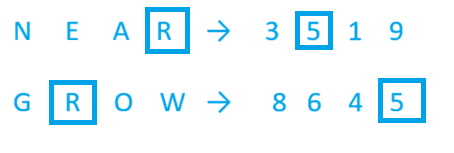
In a certain code language, ‘NEAR’ is coded as ‘3519’ and ‘GROW’ is coded as ‘8645’. What is the code for ‘R’ in that language?

  1. AOption (a)

    6

  2. BOption (b)

    8

  3. COption (c)

    9

  4. DOption (d)

    5

View answer & explanation

Correct answer

Answer: (d)D.

5

Why this answer is correct

The logic followed here is:

Given:

NEAR → 3519

GROW → 8645

So, R is coded as 5

Hence, the correct answer is "Option 4".

Question 10

Below are given two sets of numbers. In each set of numbers, a certain mathematical operation on the first number results in the second number. Similarly, a certain mathematical operation on the second number results in the third number, and so on. Which of the given options follows the same set of operations as in the question?

(NOTE: A two-/three-digit number cannot be broken into individual digits for operations, e.g. if 37 is followed by 10, the operation cannot be 3 + 7, as a two-digit number cannot be broken into individual digits.)

8 – 16 – 26 – 13 ; 5 – 10 – 20 – 10

  1. AOption (a)

    24 – 48 – 68 – 34

  2. BOption (b)

    12 – 24 – 34 – 17

  3. COption (c)

    36 – 72 – 144 – 72

  4. DOption (d)

    34 – 68 – 78 – 156

View answer & explanation

Correct answer

Answer: (b)B.

12 – 24 – 34 – 17

Why this answer is correct

The logic followed here is:

Logic: Multiply by 2 → Multiply by 2 → Divide by 2

For, 8 → 16 → 26 → 13

⇒ 8 × 2 = 16

⇒ 16 + 10 = 26

⇒ 26 ÷ 2 = 13

Similarly, 5 → 10 → 20 → 10

⇒ 5 × 2 = 10

⇒ 10 × 2 = 20

⇒ 20 ÷ 2 = 10

Now, applying the same logic to options:

Option 1) 24 → 48 → 68 → 34

⇒ 24 × 2 = 48

⇒ 48 + 20 = 68 

Option 2) 12 → 24 → 34 → 17

⇒ 12 × 2 = 24

⇒ 24 + 10 = 34

⇒ 34 ÷ 2 = 17 

Option 3) 36 → 72 → 144 → 72

⇒ 36 × 2 = 72

⇒ 72 × 2 = 144

⇒ 144 ÷ 2 = 72 

Option 4) 34 → 68 → 78 → 156

⇒ 34 × 2 = 68

⇒ 68 + 10 = 78

⇒ 78 × 2 = 156 

Hence, the correct answer is Option 2.

Question 11

Which of the following dynasties is associated with the Thousand Pillars Temple at Warangal built in the 12th century?

  1. AOption (a)

    Rashtrakuta dynasty

  2. BOption (b)

    Hoysala dynasty

  3. COption (c)

    Kakatiya dynasty

  4. DOption (d)

    Chalukya dynasty

View answer & explanation

Correct answer

Answer: (c)C.

Kakatiya dynasty

Why this answer is correct

The correct answer is Kakatiya dynasty.

Key Points

  • The Thousand Pillar Temple, also known as the Rudreshwara Swamy Temple, is a historic Hindu temple located in Hanamkonda town near Warangal in the state of Telangana, India.
  • It was constructed in the year 1163 AD during the reign of the Kakatiya dynasty. The construction was commissioned by the ruler King Rudra Deva. Hence, the statement regarding its association with the Kakatiya dynasty is correct.
  • The temple is a classic example of Kakatiya architecture, which reached its zenith during the 12th century. It is built in the Vesara style and is famous for its intricate carvings and perforated stone screens.
  • It is a Trikutalaya, which means it consists of three shrines dedicated to three different deities: Lord Shiva, Lord Vishnu, and Lord Surya (the Sun God). Hence, the statement about it being a triple shrine is correct.
  • The temple is supported by one thousand pillars, which are intricately carved but positioned in a way that they never obstruct the view of the deities from any point in the temple.
  • A massive monolithic Nandi (the sacred bull of Shiva) carved out of a single black basalt stone is placed at the entrance, reflecting the artistic brilliance of the Kakatiya era.

Additional Information

  • Kakatiya Dynasty (1083–1323 AD):
  • This dynasty ruled the eastern Deccan region, comprising modern-day Telangana and Andhra Pradesh.
  • Their capital was initially Hanamkonda and later shifted to Orugallu (modern Warangal).
  • Notable rulers include Ganapati Deva, Rani Rudrama Devi, and Prataparudra. They were known for constructing massive irrigation tanks and grand temples like the Ramappa Temple (a UNESCO World Heritage Site).
  • Rashtrakuta Dynasty (753–982 AD):
  • They ruled large parts of the Indian subcontinent between the 8th and 10th centuries.
  • Their most famous architectural achievement is the Kailasa Temple at Ellora (Maharashtra), which is a rock-cut monolithic structure.
  • Hoysala Dynasty (1006–1346 AD):
  • Based in modern-day Karnataka, the Hoysalas are famous for their unique star-shaped temple plans.
  • Major examples of their work include the Hoysaleswara Temple at Halebidu and the Chennakesava Temple at Belur, built primarily in the 12th and 13th centuries.
  • Chalukya Dynasty:
  • The Badami Chalukyas (6th-8th century) and the Western Chalukyas of Kalyani (10th-12th century) were major powers in the Deccan.
  • They were pioneers of the Vesara style of architecture, with significant sites located in Aihole, Badami, and Pattadakal.

Important Points

  • Architectural Features: The Thousand Pillar Temple was built using sandstone for the main structure, while the decorative elements and the Nandi bull were made from black basalt. The pillars are highly polished, giving them a mirror-like finish.
  • Historical Significance: The temple was desecrated during the invasion of the Deccan by the Delhi Sultanate (led by Alauddin Khilji and later Ghiyasuddin Tughlaq) in the 14th century.
  • Cultural Impact: The Kakatiyas promoted the Telugu language and Shaivism. The Thousand Pillar Temple remains a primary pilgrimage and tourist destination in South India, showcasing the medieval engineering marvels of the region.

Question 12

The breadth of a rectangular field is 2/3 of its length. Its area is 600 m2. Find the cost of fencing it all around at the cost of ₹200/m.

  1. AOption (a)

    ₹26,000

  2. BOption (b)

    ₹30,000

  3. COption (c)

    ₹20,000

  4. DOption (d)

    ₹32,000

View answer & explanation

Correct answer

Answer: (c)C.

₹20,000

Why this answer is correct

Shortcut Trick

⇒ Ratio L:B = 3:2

⇒ Let L = 3x, B = 2x ⇒ Area = 6x² = 600

⇒ x² = 100 ⇒ x = 10

⇒ L = 30, B = 20 ⇒ Perimeter = 2(50) = 100

⇒ Cost = 100 × 200 = 20000

∴ Answer = ₹20000

Alternate Method

Given:

Breadth = (2/3) Length

Area = 600 m2

Cost = ₹200/m

Formula:

Area = L × B

Perimeter = 2(L + B)

Calculation:

⇒ Let Length = L ⇒ Breadth = (2/3)L

⇒ L × (2/3)L = 600

⇒ (2/3)L² = 600

⇒ L² = 900 ⇒ L = 30 m

⇒ B = (2/3)×30 = 20 m

⇒ Perimeter = 2(30 + 20) = 100 m

⇒ Cost = 100 × 200 = 20000

Final Answer: ₹20000

Additional Information

1. Ratio Method: Convert fraction into ratio form

2. Rectangle: Area = L × B

3. Perimeter: 2(L + B)

4. Fencing Cost: Perimeter × rate

Question 13

A, B, C, D, E and F live on six different floors of the same building. The lowermost floor in the building is numbered 1, the floor above it is numbered 2 and so on till the topmost floor, which is numbered 6.

Only two people live below C. Only two people live between B and C. A lives above E but below C. F does not live above D.

Who lives immediately below B?

  1. AOption (a)

    D

  2. BOption (b)

    C

  3. COption (c)

    A

  4. DOption (d)

    F

View answer & explanation

Correct answer

Answer: (a)A.

D

Why this answer is correct

Given: A, B, C, D, E and F live on six different floors of the same building. 

The lowermost floor in the building is numbered 1, the floor above it is numbered 2 and so on till the topmost floor, which is numbered 6.

Only two people live below C.

Only two people live between B and C.

A lives above E but below C.

F does not live above D.

FloorPerson
6B
5D
4F
3C
2A
1E

Now, person immediately below B: D

Hence, the correct answer is Option 1.

Question 14

If 3x + 2y = 10 and 2xy = 3 then find the postive value of 3x – 2y.

  1. AOption (a)

    8

  2. BOption (b)

    6

  3. COption (c)

    10

  4. DOption (d)

    12

View answer & explanation

Correct answer

Answer: (a)A.

8

Why this answer is correct

Shortcut Trick

⇒ Use identity: (3x + 2y)2 − (3x − 2y)2 = 24xy

⇒ 100 − (3x − 2y)2 = 24×(3/2) = 36

⇒ (3x − 2y)2 = 64

⇒ 3x − 2y = 8 (positive)

∴ Answer = 8

Alternate Method

Given:

3x + 2y = 10

2xy = 3

Formula:

(a + b)2 − (a − b)2 = 4ab

Calculation:

⇒ (3x + 2y)2 = 100

⇒ Using identity:

(3x + 2y)2 − (3x − 2y)2 = 4×(3x×2y)

⇒ 100 − (3x − 2y)2 = 24xy

⇒ 24xy = 24×(3/2) = 36

⇒ 100 − (3x − 2y)2 = 36

⇒ (3x − 2y)2 = 64

⇒ 3x − 2y = ±8

⇒ Positive value = 8

Final Answer: 8

Additional Information

1. Identity: (a+b)2 − (a−b)2 = 4ab

2. Trick: Use square identity to avoid solving variables

3. Product Given: xy helps eliminate variables

4. Positive Value: Take only + root

Question 15

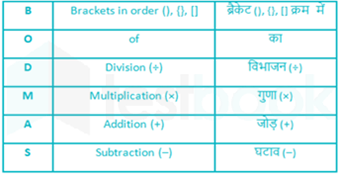
Evaluate: (-9) - (-60) ÷ (-6) + (-2) × 9

  1. AOption (a)

    39

  2. BOption (b)

    -37

  3. COption (c)

    36

  4. DOption (d)

    40

View answer & explanation

Correct answer

Answer: (b)B.

-37

Why this answer is correct

Shortcut Trick

Solve ÷ and × first:

⇒ (−60) ÷ (−6) = 10, (−2) × 9 = −18

⇒ Expression = −9 − 10 − 18

⇒ = −37

∴ Answer = −37

Alternate Method

Given:

(−9) − (−60) ÷ (−6) + (−2) × 9

Concept Used:

BODMAS rule

Calculation:

⇒ (−9) − 10 + (−2) × 9

⇒ (−9) − 10 − 18

⇒ −19 − 18

⇒ −37

∴ The correct answer is −37.

Additional Information

Sign Rule: − ÷ − = +, − × + = −

BODMAS: Solve Division and Multiplication first

Common Mistake: Wrong sign handling leads to errors

Shortcut Tip: Simplify signs first, then calculate

Question 16

Which of the following programs aims at self-employment for the rural poor?

  1. AOption (a)

    Mahatma Gandhi National Rural Employment Guarantee Act

  2. BOption (b)

    Deendayal Antyodaya Yojana

  3. COption (c)

    National Rural Health Mission

  4. DOption (d)

    Pradhan Mantri Awas Yojana

View answer & explanation

Correct answer

Answer: (b)B.

Deendayal Antyodaya Yojana

Why this answer is correct

The correct answer is Deendayal Antyodaya Yojana.

Key Points

  • Deendayal Antyodaya Yojana - National Rural Livelihoods Mission (DAY-NRLM) is a flagship program launched by the Ministry of Rural Development in June 2011. It was originally launched as Aajeevika - National Rural Livelihoods Mission and later renamed in 2015. Hence, statement 2 is correct.
  • The primary objective of the program is to alleviate rural poverty by creating efficient and effective institutional platforms for the rural poor, enabling them to increase household income through sustainable livelihood enhancements and improved access to financial services.
  • It focuses on promoting self-employment and organization of the rural poor into Self Help Groups (SHGs). This helps in building the capacities of the poor and providing them with skills and financial resources to start their own micro-enterprises.
  • The Mahatma Gandhi National Rural Employment Guarantee Act (MGNREGA) is designed to provide guaranteed wage employment for at least 100 days in a financial year to unskilled manual laborers; it is not primarily a self-employment scheme. Hence, statement 1 is incorrect.
  • The National Rural Health Mission (NRHM) was launched in April 2005 to provide accessible, affordable, and quality healthcare to the rural population, particularly the vulnerable sections. It does not focus on self-employment. Hence, statement 3 is incorrect.
  • The Pradhan Mantri Awas Yojana (PMAY), specifically the Gramin (Rural) component launched in 2016, aims to provide pucca houses with basic amenities to all houseless householders and those living in kutcha houses. It is a housing scheme, not a self-employment program. Hence, statement 4 is incorrect.

Additional Information

  • Evolution of DAY-NRLM: The program succeeded the Swarnajayanti Gram Swarozgar Yojana (SGSY). It is supported by the World Bank and is one of the world's largest initiatives to improve the livelihoods of the poor. It covers 28 States and 8 Union Territories across India.
  • MGNREGA Features: Enacted in September 2005, this Act provides a legal guarantee for work. If work is not provided within 15 days of application, the applicant is entitled to an unemployment allowance. At least one-third of the beneficiaries must be women.
  • PMAY-Gramin Details: The scheme targets the construction of 2.95 crore houses. The cost-sharing ratio between the Central and State governments is 60:40 in plain areas and 90:10 for North Eastern and Hilly States.
  • NRHM Objectives: It seeks to reduce the Infant Mortality Rate (IMR) and Maternal Mortality Rate (MMR). It introduced the Accredited Social Health Activist (ASHA), a trained female community health activist, to act as an interface between the community and the public health system.

Important Points

  • Core Pillars of DAY-NRLM: The scheme relies on social mobilization, financial inclusion, and sustainable livelihoods. It encourages universal social mobilization by ensuring at least one woman member from each rural poor household is brought into the SHG network.
  • Livelihood Diversification: Under DAY-NRLM, the poor are encouraged to pursue farm (agriculture, livestock, fisheries) and non-farm (handicrafts, services, retail) occupations to ensure year-round income.
  • Interest Subvention: The scheme provides interest subvention to SHG members who avail of bank loans, reducing the cost of credit and encouraging entrepreneurship among rural women.
  • Identification of Beneficiaries: Unlike many schemes that use the BPL (Below Poverty Line) list, DAY-NRLM uses the Socio-Economic and Caste Census (SECC) 2011 data and a process called Participatory Identification of Poor (PIP) to identify target households.

Question 17

There are 45 members in group A, 31 members in group B and 48 members in group C. All the members of these groups went to a restaurant. The average amounts spent on each member of groups A, B and C are ₹295, ₹311 and ₹233, respectively. The overall average amount (in ₹) spent per member is:

  1. AOption (a)

    275

  2. BOption (b)

    276

  3. COption (c)

    272

  4. DOption (d)

    273

View answer & explanation

Correct answer

Answer: (a)A.

275

Why this answer is correct

Shortcut Trick

Total = 45×295 + 31×311 + 48×233

⇒ = 13275 + 9641 + 11184 = 34100

Total members = 45 + 31 + 48 = 124

⇒ Average = 34100 ÷ 124 = 275

∴ Answer = 275

Alternate Method

Given:

Group A: 45 members, avg = 295

Group B: 31 members, avg = 311

Group C: 48 members, avg = 233

Concept Used:

Overall Average = Total Amount ÷ Total Members

Calculation:

⇒ Total of A = 45 × 295 = 13275

⇒ Total of B = 31 × 311 = 9641

⇒ Total of C = 48 × 233 = 11184

⇒ Total amount = 13275 + 9641 + 11184 = 34100

⇒ Total members = 45 + 31 + 48 = 124

⇒ Average = 34100 ÷ 124 = 275

∴ Overall average = 275

Additional Information

Weighted Average: Multiply each average with its frequency

Formula: Average = Total Sum ÷ Total Count

Shortcut: Add all group totals first, divide once

Tip: Avoid dividing separately for each group

Question 18

Refer to the following letter and symbol series and answer the question. Counting to be done from left to right only.

(Left) O ? Q ! R + S – T $ U * V / A P < W = X : (Right)

How many such letters are there, each of which is immediately preceded by another letter and also immediately followed by a symbol$?

  1. AOption (a)

    THREE

  2. BOption (b)

    FOUR

  3. COption (c)

    ONE

  4. DOption (d)

    TWO

View answer & explanation

Correct answer

Answer: (c)C.

ONE

Why this answer is correct

The logic followed here is:

Given: (Left) O ? Q ! R + S – T $ U * V / A P < W = X : (Right)

Now, we need letters which are immediately preceded by a letter and also immediately followed by a symbol.

So, Needed pattern is: Letter - Letter - Symbol

(Left) O ? Q ! R + S – T $ U * V / A P < W = X : (Right)

Now, Total = 1

Hence, the correct answer is Option 3.

Question 19

As per the World Economic Outlook January 2026, by the International Monetary Fund, global economic expansion in 2027, is expected to be which of the following rates?

  1. AOption (a)

    3.2 percent

  2. BOption (b)

    2.9 percent

  3. COption (c)

    4.0 percent

  4. DOption (d)

    3.5 percent

View answer & explanation

Correct answer

Answer: (a)A.

3.2 percent

Why this answer is correct

The correct answer is 3.2 percent.

Key Points

  • The International Monetary Fund (IMF), in its World Economic Outlook (WEO) update released in January 2026, has projected that the global economic expansion for the year 2027 will be 3.2 percent.
  • This forecast indicates a steady growth trajectory for the global economy, maintaining a similar pace as projected for 2025 and 2026, which also hovered around the 3.1 to 3.2 percent mark.
  • The 3.2 percent growth rate for 2027 is driven by the resilient performance of Emerging Market and Developing Economies, which are expected to grow at a faster rate compared to Advanced Economies.
  • The report suggests that the global economy has moved past the significant inflationary pressures of the early 2020s, with monetary policy normalization expected to be well underway by 2027.
  • According to the IMF, the stability in growth is attributed to improved supply-side conditions and the continued integration of Artificial Intelligence (AI) into the labor markets of high-income nations.

Additional Information

  • The International Monetary Fund (IMF):
  • The IMF is a major international financial institution, headquartered in Washington, D.C., consisting of 190 member countries.
  • It was conceived in July 1944 at the United Nations Bretton Woods Conference in the United States.
  • The primary mission of the IMF is to ensure the stability of the international monetary system, including the system of exchange rates and international payments.
  • World Economic Outlook (WEO):
  • The WEO is a comprehensive report published by the IMF twice a year, typically in April and October, with smaller "updates" published in January and July.
  • It provides detailed analysis and forecasts for global growth, inflation, and trade, serving as a key reference for policymakers and economists worldwide.
  • The reports use Gross Domestic Product (GDP) based on Purchasing Power Parity (PPP) weights to aggregate global and regional growth figures.
  • Economic Classifications:
  • Advanced Economies: These include the United States, Euro Area, Japan, and the United Kingdom. These regions often see lower but more stable growth rates.
  • Emerging Market and Developing Economies: This group includes major players like India and China. India has consistently been one of the fastest-growing major economies in these reports.
  • Key Economic Indicators:
  • Global Inflation: The IMF tracks headline and core inflation. By 2027, global headline inflation is projected to align closer to central bank targets.
  • Fiscal Policy: The WEO often emphasizes the need for fiscal consolidation to manage the rising public debt levels across various nations.

Important Points

  • Projected Trends: The January 2026 update highlights that while growth is steady at 3.2 percent, the medium-term growth prospects remain lower than the historical average of 3.8 percent seen between 2000 and 2019.
  • Risks to Forecast: Potential risks to the 2027 expansion include geopolitical tensions, fluctuations in commodity prices (such as crude oil), and potential disruptions in global supply chains.
  • Managing Director: As of the report period, the IMF is led by its Managing Director, a position held by Kristalina Georgieva (who started her term in 2019).
  • Comparison with World Bank: Similar to the IMF, the World Bank also releases the Global Economic Prospects report, though their methodologies and specific GDP growth numerical values may vary slightly based on different base years and calculation methods.

Question 20

Which Schedule of the Indian Constitution deals with the allocation of seats in the Rajya Sabha to States and Union Territories?

  1. AOption (a)

    Fourth Schedule

  2. BOption (b)

    Second Schedule

  3. COption (c)

    First Schedule

  4. DOption (d)

    Sixth Schedule

View answer & explanation

Correct answer

Answer: (a)A.

Fourth Schedule

Why this answer is correct

The correct answer is Fourth Schedule.

Key Points

  • The Fourth Schedule of the Constitution of India deals with the allocation of seats in the Rajya Sabha (the Council of States) to the various States and Union Territories. Hence, the first option is correct.
  • The allocation of these seats is determined based on the population of each state. Consequently, the number of representatives varies from state to state; for example, Uttar Pradesh has the highest representation with 31 seats, while smaller states like Sikkim have only 1 seat.
  • This schedule is linked with Article 4(1) and Article 80(2) of the Indian Constitution, which mandate the structure and composition of the upper house of Parliament.
  • The Rajya Sabha currently has a total of 245 members, although the maximum strength is fixed at 250. Out of these, 233 members are representatives of the States and Union Territories, and 12 members are nominated by the President for their contributions to art, literature, science, and social services.
  • Among the Union Territories, only Delhi (3 seats), Puducherry (1 seat), and Jammu & Kashmir (4 seats) have representation in the Rajya Sabha because their population sizes are large enough to warrant it.

Additional Information

  • First Schedule:
  • This schedule contains the names of the States and Union Territories along with their territorial jurisdiction and extent.
  • It currently lists 28 States and 8 Union Territories following the Jammu and Kashmir Reorganisation Act, 2019 and the merger of Dadra and Nagar Haveli and Daman and Diu in 2020.
  • Second Schedule:
  • It lists the provisions relating to the emoluments, allowances, and privileges of high-ranking officials.
  • This includes the President of India, Governors of States, Speaker and Deputy Speaker of the Lok Sabha, Chairman and Deputy Chairman of the Rajya Sabha, and Judges of the Supreme Court and High Courts.
  • Sixth Schedule:
  • It contains provisions for the administration of tribal areas in the four northeastern states of Assam, Meghalaya, Tripura, and Mizoram.
  • It allows for the creation of Autonomous District Councils (ADCs) to safeguard the rights of tribal communities and manage land, forests, and local customs.
  • Seventh Schedule:
  • This schedule deals with the division of powers between the Union and the States through three lists: the Union List (currently 100 subjects), the State List (currently 61 subjects), and the Concurrent List (currently 52 subjects).

Important Points

  • The Rajya Sabha is known as the Permanent House because it is not subject to dissolution.
  • Members of the Rajya Sabha are elected for a term of 6 years, and one-third of the members retire every second year.
  • The election process involves the elected members of the Legislative Assemblies of the States and Union Territories using the system of proportional representation by means of a single transferable vote.
  • The Vice-President of India serves as the ex-officio Chairman of the Rajya Sabha.
  • The Representation of the People Act, 1951 governs various aspects of the election and functioning of the members in accordance with the Constitution.

Question 21

Which institution formed by Pandit Birju Maharaj focuses on imparting training in the field of Kathak and related disciplines?

  1. AOption (a)

    Kalashram

  2. BOption (b)

    Satrang Kala

  3. COption (c)

    Kala Kendra

  4. DOption (d)

    Natya Vriksha

View answer & explanation

Correct answer

Answer: (a)A.

Kalashram

Why this answer is correct

The correct answer is Kalashram.

Key Points

  • Kalashram is the world-renowned institution founded by the Kathak maestro Pandit Birju Maharaj in New Delhi.
  • The primary focus of this institution is to impart training in the field of Kathak dance, along with other associated disciplines like Yoga, Painting, Vocal Music, and the playing of musical instruments.
  • Pandit Birju Maharaj established this institute to preserve and promote the Kalka-Bindadin Gharana of Lucknow, which is characterized by its graceful movements and intricate footwork.
  • The institution reflects the philosophy of Birju Maharaj, which treats dance as a holistic art form integrated with spiritual and physical well-being.
  • The training at Kalashram follows the traditional Guru-Shishya Parampara, ensuring the authentic transmission of Kathak techniques to future generations.

Additional Information

  • Pandit Birju Maharaj (born Brijmohan Nath Mishra) was born on 4 February 1938 and passed away on 17 January 2022. He was a legendary figure in Indian classical dance.
  • He belonged to the Lucknow "Kalka-Bindadin" Gharana, a lineage that has produced some of the greatest Kathak dancers in India.
  • Birju Maharaj was a multi-talented artist; besides being a dancer, he was a singer, composer, and poet. He was proficient in playing the Tabla, Pakhawaj, and Dholak.
  • In recognition of his immense contribution to the arts, he was awarded the Padma Vibhushan, India's second-highest civilian award, in 1986.
  • He also served as the Head of Faculty and Director at the Kathak Kendra (National Institute of Kathak Dance) in New Delhi for many years before founding Kalashram.
  • Kathak is one of the eight major forms of Indian classical dance. Its origin is attributed to the traveling storytellers of ancient Northern India, known as Kathakars.

Important Points

  • Global Reach: Pandit Birju Maharaj took Kathak to the global stage, performing in numerous countries and establishing a worldwide following.
  • Choreography in Cinema: He contributed significantly to Indian Cinema by choreographing iconic dance sequences in movies like Shatranj Ke Khilari (directed by Satyajit Ray), Devdas, Bajirao Mastani, and Vishwaroopam.
  • Awards and Honors: Apart from the Padma Vibhushan, he received the Sangeet Natak Akademi Award in 1964, the Kalidas Samman, and a National Film Award for Best Choreography in 2012.
  • Lineage: He was the son and disciple of Jagannath Maharaj, popularly known as Acchan Maharaj. His uncles were the famous Lachhu Maharaj and Shambhu Maharaj.
  • Artistic Features: Kathak is distinguished by its Chakkars (vertical spins), Tatkar (footwork), and Abhinaya (expressional dance), all of which were mastered and taught by Birju Maharaj at Kalashram.

Question 22

In the field of e-commerce and financial trading, which application of computers is essential for analyzing massive volumes of rapidly changing market data and detecting complex patterns to inform investment decisions?

  1. AOption (a)

    Data Encryption and Security Software

  2. BOption (b)

    Real-time Predictive Analytics

  3. COption (c)

    Inventory Management Systems

  4. DOption (d)

    Word Processing and Desktop Publishing

View answer & explanation

Correct answer

Answer: (b)B.

Real-time Predictive Analytics

Why this answer is correct

The correct answer is Real-time Predictive Analytics.

Key Points

  • Real-time Predictive Analytics is the use of data, statistical algorithms, and machine learning techniques to identify the likelihood of future outcomes based on historical and current data. In e-commerce and finance, it is essential for processing big data at high speeds.
  • In the context of financial trading, these systems analyze massive volumes of rapidly changing market data, including stock prices, currency fluctuations, and trading volumes, to execute trades in milliseconds.
  • The primary function of this technology is to detect complex patterns and market trends that are invisible to human analysts, allowing institutional investors to make informed investment decisions and manage risk effectively.
  • In e-commerce, Predictive Analytics is used for dynamic pricing, where prices of products change in real-time based on consumer demand, competitor pricing, and inventory levels.
  • This technology relies on high-performance computing and cloud-based infrastructures to ensure that data processing happens with minimal latency, which is critical for high-frequency trading (HFT).

Additional Information

  • Data Encryption and Security Software: This involves cryptographic protocols like AES-256 or SSL/TLS to protect financial transactions and user data from cyber threats. While critical for trust in e-commerce, its application is security, not market analysis.
  • Inventory Management Systems: These are software applications used by retailers to track stock levels, orders, sales, and deliveries. They ensure supply chain efficiency but do not possess the analytical capabilities to inform investment decisions in trading.
  • Word Processing and Desktop Publishing: These tools, such as Microsoft Word or Adobe InDesign, are used for creating documents, reports, and marketing brochures. They are administrative tools and have no function in real-time data analysis or automated trading.
  • Global Adoption: Real-time analytics is widely used in countries like the USA, United Kingdom, and India to power fintech applications and stock exchange operations.

Important Points

  • Algorithmic Trading: This refers to computer-programmed trading that follows a defined set of instructions. It currently accounts for over 70% of the trading volume in US equity markets.
  • Sentiment Analysis: A subset of predictive analytics where Natural Language Processing (NLP) is used to scan news articles, social media, and financial reports to determine market sentiment (bullish or bearish).
  • Big Data Characteristics: The data analyzed in financial trading is often characterized by the three Vs: Volume (large scale), Velocity (high speed), and Variety (different formats like numerical, text, and social media feeds).
  • Historical Context: The move toward electronic trading and predictive modeling accelerated in the 2000s, drastically reducing the spreads and increasing the liquidity of global markets.

Question 23

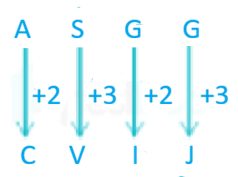
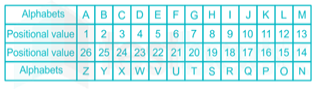
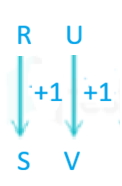
SGYU is related to UJAX in a certain way based on the English alphabetical order. In the same way, ASGG is related to CVIJ. To which of the following options is GBMP related, following the same logic?

  1. AOption (a)

    IEOS

  2. BOption (b)

    SOMK

  3. COption (c)

    SOMI

  4. DOption (d)

    EIKO

View answer & explanation

Correct answer

Answer: (a)A.

IEOS

Why this answer is correct

The logic followed here is:

For, SGYU → UJAX

Now, ASGG → CVIJ

Now, applying the same logic for GBMP:

So, GBMP → IEOS

Hence, the correct answer is Option 1.

Question 24

Which of the following types of weathering is primarily responsible for the formation of karst landscapes?

  1. AOption (a)

    Mechanical weathering

  2. BOption (b)

    Biological weathering

  3. COption (c)

    Chemical weathering

  4. DOption (d)

    Thermal weathering

View answer & explanation

Correct answer

Answer: (c)C.

Chemical weathering

Why this answer is correct

The correct answer is Chemical weathering.

Key Points

  • Chemical weathering is the fundamental process responsible for the development of karst landscapes. This type of weathering involves the chemical transformation of rock minerals into new compounds, often leading to the dissolution of the rock. Hence, the statement regarding chemical weathering being the primary cause is correct.
  • The specific chemical process involved is carbonation. When rainwater passes through the atmosphere and soil, it absorbs carbon dioxide (CO2), forming a weak solution of carbonic acid.
  • This acidic water reacts with soluble rocks, most notably limestone (which is composed of calcium carbonate), dolomite, and gypsum. The reaction converts insoluble calcium carbonate into soluble calcium bicarbonate, which is then carried away in solution.
  • As the rock dissolves over thousands of years, it creates unique surface and sub-surface features such as sinkholes (also known as dolines), caves, caverns, and disappearing streams.
  • The formation of karst requires specific conditions: the presence of highly jointed, dense, and thinly bedded soluble rocks near the surface, along with moderate to heavy rainfall to sustain the dissolution process.

Additional Information

  • Mechanical Weathering: Also known as physical weathering, it refers to the physical disintegration of rocks into smaller fragments without any change in their chemical makeup. Common processes include frost wedging, abrasion, and pressure release. While it breaks down rocks, it does not produce the dissolution features seen in karst. Hence, the statement regarding mechanical weathering forming karst is incorrect.
  • Biological Weathering: This is the breakdown of rocks caused by living organisms. For example, plant roots may grow into cracks and exert pressure, or lichens and bacteria may produce organic acids that slowly corrode minerals. It often acts in tandem with chemical weathering but is not the primary architect of karst. Hence, the statement regarding biological weathering as the primary cause is incorrect.
  • Thermal Weathering: This occurs due to expansion and contraction of rock minerals resulting from temperature fluctuations. It is most prevalent in arid and desert regions where the diurnal temperature range is high. Hence, the statement regarding thermal weathering forming karst is incorrect.
  • Geographic Distribution: Famous karst regions include the Karst Plateau in Slovenia (from which the name originates), the Yucatán Peninsula in Mexico, and the Ha Long Bay in Vietnam. In India, karst features are prominent in the Bastar district of Chhattisgarh (Kotumsar caves) and parts of the Himalayas.

Important Points

  • Speleothems: These are mineral deposits formed in caves as a result of chemical precipitation. The most common are stalactites (hanging from the ceiling), stalagmites (rising from the floor), and pillars (formed when the two meet).
  • Uvalas and Poljes: In advanced stages of karst topography, individual sinkholes may coalesce to form larger depressions called uvalas. Extremely large, flat-bottomed depressions are known as poljes, which can cover several square kilometers.
  • Hydrogeology: Karst aquifers are vital sources of groundwater, providing water for millions of people worldwide. However, they are highly vulnerable to pollution because surface water can enter the underground system rapidly through sinkholes without significant filtration.
  • Climate Influence: Chemical weathering is significantly more effective in hot and humid climates. The rate of rock dissolution increases with higher temperatures and greater water availability.

Question 25

Based on the English alphabetical order, three of the following four are alike in a certain way and thus form a group. Which is the one that does not belong to that group?

(Note: The odd man out is not based on the number of consonants/vowels or their position in the letter cluster)

  1. AOption (a)

    HKN

  2. BOption (b)

    QTW

  3. COption (c)

    ILN

  4. DOption (d)

    JMP

View answer & explanation

Correct answer

Answer: (c)C.

ILN

Why this answer is correct

The logic followed here is based on the alphabetical positional difference between consecutive letters in each cluster:

Option 1: HKN

Option 2: QTW

Option 3: ILN

Option 4: JMP

Thus, ILN is different from the rest.

Hence, the odd one out is Option 3.

Question 26

Sneha starts from Point Q, walks 5 km East, turns left and walks 7 km, turns right and walks 3 km, turns right and walks 7 km, then turns left and walks 2 km. How far and in which direction is she from Point Q? (All turns are 90-degree turns only unless specified.)

  1. AOption (a)

    10 km towards East

  2. BOption (b)

    2 km towards West

  3. COption (c)

    7 km towards North

  4. DOption (d)

    5 km towards South

View answer & explanation

Correct answer

Answer: (a)A.

10 km towards East

Why this answer is correct

Given:

Sneha starts from Q → 5 km East

She turns left → 7 km North

She turns right → 3 km East

She turns right → 7 km South

She turns left → 2 km East


So, Sneha is 10 km East from starting point.

Hence, the correct answer is Option 1.

Question 27

Under the Pradhan Mantri Fasal Bima Yojana (PMFBY), what is the premium rate paid by farmers for annual commercial and horticultural crops?

  1. AOption (a)

    2% of the sum insured

  2. BOption (b)

    3% of the sum insured

  3. COption (c)

    7% of the sum insured

  4. DOption (d)

    5% of the sum insured

View answer & explanation

Correct answer

Answer: (d)D.

5% of the sum insured

Why this answer is correct

The correct answer is 5% of the sum insured.

Key Points

  • The Pradhan Mantri Fasal Bima Yojana (PMFBY) was launched on 18th February 2016 by Prime Minister Narendra Modi to provide financial support to farmers suffering crop loss/damage arising out of unforeseen events.
  • Under this scheme, there is a uniform premium of only 2% to be paid by farmers for all Kharif crops. This is the standard rate for food crops and oilseeds during the monsoon season.
  • For all Rabi crops, the premium to be paid by the farmers is 1.5%. This lower rate is applicable for the winter cropping season.
  • In the case of annual commercial and annual horticultural crops, the premium to be paid by farmers is 5% of the sum insured. Hence, the statement regarding the 5% rate for commercial crops is correct.
  • The balance premium (the difference between the actual premium rate and the rate paid by farmers) is paid by the Government (shared equally by the Central and State Governments) to provide the full insured amount to the farmers.

Additional Information

  • Objectives of PMFBY:
  • To provide insurance coverage and financial support to the farmers in the event of failure of any of the notified crops as a result of natural calamities, pests, and diseases.
  • To stabilize the income of farmers to ensure their continuance in farming.
  • To encourage farmers to adopt innovative and modern agricultural practices.
  • To ensure the flow of credit to the agriculture sector.
  • Scheme Administration:
  • The scheme is administered by the Ministry of Agriculture and Farmers Welfare, Government of India.
  • It replaced the National Agricultural Insurance Scheme (NAIS) and the Modified National Agricultural Insurance Scheme (MNAIS) to remove their inherent drawbacks.
  • Coverage and Scope:
  • The scheme covers Yield Losses (standing crops), Prevented Sowing/Planting, and Post-Harvest Losses (up to a maximum period of 14 days from harvesting).
  • It also includes Localized Calamities such as hailstorms, landslides, and inundation affecting isolated farms in the notified area.
  • Since Kharif 2020, the scheme has been made voluntary for all farmers, whereas earlier it was compulsory for loanee farmers.

Important Points

  • Technology Integration: The scheme promotes the use of modern technology like Smartphones for capturing and uploading data of crop cutting to reduce the delay in claim payment to farmers. Remote Sensing and Drones are also utilized for estimation of crop losses.
  • Premium Subsidy Sharing: The Central Government and State Governments share the premium subsidy on a 50:50 basis, except for the North-Eastern States, where the sharing ratio is 90:10 (since 2020) to encourage higher penetration in these regions.
  • Exclusions: Risks like war, nuclear risks, malicious damage, and other preventable risks are generally excluded from the insurance coverage.
  • Implementation Agency: PMFBY is implemented by the Agriculture Insurance Company of India (AIC) and several private insurance companies empanelled by the government based on competitive bidding.
  • Numerical Data: Since its inception, the scheme has covered over 30 crore farmer applications and has paid out claims worth billions of rupees, significantly improving the social security net for the Indian farming community.

Question 28

Which leader famously declared 'Swaraj is my birth right and I shall have it' during the Extremist Phase of the Indian National Movement?

  1. AOption (a)

    Bal Gangadhar Tilak

  2. BOption (b)

    Bipin Chandra Pal

  3. COption (c)

    Aurobindo Ghose

  4. DOption (d)

    Lala Lajpat Rai

View answer & explanation

Correct answer

Answer: (a)A.

Bal Gangadhar Tilak

Why this answer is correct

The correct answer is Bal Gangadhar Tilak.

Key Points

  • Bal Gangadhar Tilak was the leader who famously declared "Swaraj is my birthright and I shall have it" in 1916. This slogan became a rallying cry for millions of Indians during the struggle for independence. Hence, the first option is correct.
  • He was a prominent figure in the Extremist Phase (1905-1919) of the Indian National Movement. Unlike the Moderates, Tilak advocated for self-rule (Swaraj) rather than mere constitutional reforms.
  • Tilak earned the title "Lokmanya", which translates to "accepted by the people as their leader". The British colonial authorities referred to him as the "Father of Indian Unrest", a term coined by Valentine Chirol.
  • He utilized journalism as a tool for political education, publishing two newspapers: Kesari in Marathi and The Mahratta in English. Through these, he criticized the British Government and spread nationalist ideas.
  • To bridge the gap between the masses and the political movement, he popularized the Ganpati Festival in 1893 and the Shivaji Festival in 1895 in Maharashtra.

Additional Information

  • Bipin Chandra Pal: Known as the "Father of Revolutionary Thoughts in India", he was a key part of the Lal-Bal-Pal triumvirate. He played a major role in the Swadeshi Movement following the Partition of Bengal in 1905 and advocated for the boycott of British goods. Hence, the second option is incorrect.
  • Lala Lajpat Rai: Popularly known as "Punjab Kesari" or the "Lion of Punjab", he was another pillar of the Extremist faction. He founded the Punjab National Bank and was a leading figure in the protest against the Simon Commission in 1928, where he suffered fatal injuries during a lathi charge. Hence, the fourth option is incorrect.
  • Aurobindo Ghose: An intellectual leader of the Extremist Phase, he emphasized the concept of Passive Resistance. He later retired from active politics and moved to Pondicherry to focus on spirituality and yoga, writing famous works like "The Life Divine" and "Savitri". Hence, the third option is incorrect.
  • Extremist Phase (1905-1919): This period marked a shift from the Moderates' policy of "Prayers, Petitions, and Protests" to more radical methods including Swadeshi, Boycott, and National Education. The Surat Split of 1907 saw the formal separation of the Moderates and Extremists within the Indian National Congress.

Important Points

  • Home Rule Movement: In April 1916, Bal Gangadhar Tilak launched the Indian Home Rule League at Belgaum. He worked alongside Annie Besant to demand Self-Government for India within the British Empire.
  • Lucknow Pact: Tilak played a crucial role in the 1916 Lucknow Session, where he was instrumental in the Lucknow Pact between the Indian National Congress and the Muslim League, as well as the reunion of Moderates and Extremists.
  • Literary Works: While serving a six-year prison term in Mandalay (Burma) from 1908 to 1914, Tilak wrote "Gita Rahasya", an interpretation of the Bhagavad Gita focused on Karma Yoga (the path of action). He also authored "The Arctic Home in the Vedas", where he proposed a theory about the origin of the Aryans.

Question 29

Solve the system of equations below for X, Y and Z:

X + 2Y + 4Z = 12

2X + 2Y + 3Z = 10

3X + 2Y + Z = 8

  1. AOption (a)

    X = −2, Y = −1, Z = 4

  2. BOption (b)

    X = 0, Y = 2, Z = 2

  3. COption (c)

    X = −2, Y = 7, Z = 0

  4. DOption (d)

    X = −2, Y = 1, Z = 3

View answer & explanation

Correct answer

Answer: (c)C.

X = −2, Y = 7, Z = 0

Why this answer is correct

Shortcut Trick

Subtract (2)−(1): X − Z = −2

Subtract (3)−(2): X − 2Z = −2

⇒ Subtract both ⇒ Z = 0

⇒ Then X = −2

⇒ Put in (1): Y = 7

∴ Answer: X = −2, Y = 7, Z = 0

Alternate Method

Given:

X + 2Y + 4Z = 12

2X + 2Y + 3Z = 10

3X + 2Y + Z = 8

Concept Used:

Elimination method

Calculation:

⇒ (2X + 2Y + 3Z) − (X + 2Y + 4Z) = 10 − 12

⇒ X − Z = −2

⇒ (3X + 2Y + Z) − (2X + 2Y + 3Z) = 8 − 10

⇒ X − 2Z = −2

⇒ (X − Z) − (X − 2Z) = −2 − (−2)

⇒ Z = 0

⇒ X − Z = −2

⇒ X = −2

⇒ X + 2Y + 4Z = 12

⇒ −2 + 2Y + 0 = 12

⇒ 2Y = 14

⇒ Y = 7

∴ The correct answer is X = −2, Y = 7, Z = 0.

Additional Information

Elimination Trick: Subtract equations to cancel common terms

Efficiency: Always target same coefficients (here 2Y cancels)

Check: Substitute back to verify solution

Tip: Reduce system to 2 variables first, then solve

Question 30

Calculate the median (rounded to two decimal places) from the following data:

Marks0 -1010 – 3030 - 6060 – 8080 - 90
Number of students91934126

Total frequency N = 80

  1. AOption (a)

    40.59

  2. BOption (b)

    33.14

  3. COption (c)

    37.06

  4. DOption (d)

    36.27

View answer & explanation

Correct answer

Answer: (a)A.

40.59

Why this answer is correct

Shortcut Trick

N = 80 ⇒ N/2 = 40

Cumulative freq: 9, 28, 62 → Median class = 30–60

⇒ Use formula: Median = L + [(N/2 − cf)/f] × h

⇒ = 30 + [(40 − 28)/34] × 30

⇒ = 30 + (12/34)×30 ≈ 30 + 10.59

∴ Answer ≈ 40.59

Alternate Method

Given:

Total frequency (N) = 80

Concept Used:

Median = L + [(N/2 − cf) ÷ f] × h

Calculation:

⇒ N/2 = 80 ÷ 2 = 40

⇒ Cumulative frequency:

0–10 → 9

10–30 → 9+19 = 28

30–60 → 28+34 = 62

⇒ Median class = 30–60

⇒ L = 30, cf = 28, f = 34, h = 30

⇒ Median = 30 + [(40 − 28) ÷ 34] × 30

⇒ = 30 + (12 ÷ 34) × 30

⇒ = 30 + 10.59

⇒ = 40.59

∴ Median = 40.59

Additional Information

Median Class: Class where cumulative frequency just exceeds N/2

Formula: Median = L + [(N/2 − cf) ÷ f] × h

Class Width: h = Upper limit − Lower limit

Shortcut Tip: Quickly find median class using cumulative frequency

Question 31

The HCF of two numbers is 104 and their LCM is 1040. If one of the numbers is 208, what is the sum of the two numbers?

  1. AOption (a)

    728

  2. BOption (b)

    732

  3. COption (c)

    736

  4. DOption (d)

    724

View answer & explanation

Correct answer

Answer: (a)A.

728

Why this answer is correct

Shortcut Trick

Second Number = (HCF × LCM) ÷ First Number

Second Number = (104 × 1040) ÷ 208

As 208 = 104 × 2, Second Number = 1040 ÷ 2 = 520

Sum = 208 + 520 = 728

∴ Answer = 728

Alternate Method 

Given:

HCF of two numbers = 104

LCM of two numbers = 1040

One of the numbers (a) = 208

Formula used:

Product of two numbers = HCF × LCM

Sum of numbers = a + b

Num 1: 208 + Num 2: 520 Sum = 728 Product Relation: 208 × 520 = 104 × 1040

Calculations:

Let the second number be b.

⇒ 208 × b = 104 × 1040

⇒ b = (104 × 1040) ÷ 208

⇒ b = 108160 ÷ 208

⇒ b = 520

⇒ Sum = 208 + 520 = 728

∴ The correct answer is 728.

Additional Information

Product Property

For any two numbers a and b, the product of the numbers is always equal to the product of their HCF and LCM: a × b = HCF(a, b) × LCM(a, b).

HCF and LCM of Fractions

HCF = (HCF of Numerators) ÷ (LCM of Denominators) and LCM = (LCM of Numerators) ÷ (HCF of Denominators).

Co-prime Numbers

If two numbers are co-prime, their HCF is 1 and their LCM is simply the product of the two numbers.

Factor Property

The HCF of a group of numbers is always a factor of their LCM. If HCF does not divide LCM, such a set of numbers cannot exist.

Question 32

Ashish has ₹1404 with him. He divides this amount between his two sons, Arun and Mahesh, and asks them to invest their respective shares at a compound interest rate of 8% per annum, compounded annually. It is observed that Arun’s investment amounts to the same value after 17 years as Mahesh’s investment does after 18 years. How much (in ₹) did Ashish give to Mahesh?

  1. AOption (a)

    829

  2. BOption (b)

    675

  3. COption (c)

    525

  4. DOption (d)

    729

View answer & explanation

Correct answer

Answer: (b)B.

675

Why this answer is correct

Shortcut Trick

⇒ Let Arun = A, Mahesh = M

⇒ A(1.08)17 = M(1.08)18

⇒ ⇒ A = M × 1.08

⇒ Total = A + M = 1404 ⇒ 1.08M + M = 1404

⇒ 2.08M = 1404 ⇒ M = 1404 / 2.08 = 675

∴ Answer = 675

Alternate Method

Given:

Total amount = 1404

Rate = 8% per annum

Arun after 17 years = Mahesh after 18 years

Formula:

Amount = P(1 + r/100)n

Calculation:

⇒ A(1.08)17 = M(1.08)18

⇒ Divide both sides by (1.08)17

⇒ A = M × 1.08

⇒ A + M = 1404

⇒ 1.08M + M = 1404

⇒ 2.08M = 1404

⇒ M = 1404 / 2.08 = 675

Final Answer: 675

Additional Information

1. Compound Interest: A = P(1 + r/100)n

2. Equal Amount Trick: Divide powers to simplify

3. Ratio: A : M = 1.08 : 1

4. Faster Method: Use direct proportional relation

Question 33

Which of the following letter-number clusters will replace the question mark “?” in the given series to make it logically complete?

TVA 7, QSX 10, NPU 13, KMR 16, ?

  1. AOption (a)

    HJO 19

  2. BOption (b)

    IKP 21

  3. COption (c)

    HKQ 19

  4. DOption (d)

    HIM 20

View answer & explanation

Correct answer

Answer: (a)A.

HJO 19

Why this answer is correct

The logic followed here is:

So, 'HJO 19' will replace the question mark in the given series.

Hence, the correct answer is "Option 1".

Question 34

Which Article of the Indian Constitution mandates the provision of humane working conditions and maternity relief?

  1. AOption (a)

    Article 41

  2. BOption (b)

    Article 42

  3. COption (c)

    Article 44

  4. DOption (d)

    Article 48

View answer & explanation

Correct answer

Answer: (b)B.

Article 42

Why this answer is correct

The correct answer is Article 42.

Key Points

  • Article 42 of the Constitution of India specifically mandates that the State shall make provisions for securing just and humane conditions of work and for maternity relief.
  • This article is a part of the Directive Principles of State Policy (DPSP), which are contained in Part IV of the Constitution, spanning from Article 36 to Article 51.
  • The primary objective of Article 42 is to ensure that the working environment for employees is safe, healthy, and respectful of human dignity, while also providing necessary support to women workers during and after pregnancy.
  • It reflects the Socialist Principles of the Indian Constitution, aiming to bridge the gap between the capital and labor by protecting the welfare of the workforce.
  • The State is expected to apply these principles while making laws and policies, although they are non-justiciable in a court of law, meaning they cannot be legally enforced like Fundamental Rights.

Additional Information

  • Article 41: This article provides for the right to work, to education, and to public assistance in certain cases such as unemployment, old age, sickness, and disablement. It ensures that the State, within the limits of its economic capacity, makes effective provisions for these rights.
  • Article 44: This article directs the State to endeavor to secure for the citizens a Uniform Civil Code (UCC) throughout the territory of India. It aims to replace personal laws based on the scriptures and customs of each major religious community with a common set of laws governing every citizen.
  • Article 48: This article deals with the organization of agriculture and animal husbandry. It directs the State to organize these sectors on modern and scientific lines and, in particular, to take steps for preserving and improving the breeds, and prohibiting the slaughter of cows and calves and other milch and draught cattle.
  • Directive Principles of State Policy (DPSP): These were borrowed from the Irish Constitution. They serve as guidelines to the Central and State governments of India, to be kept in mind while framing laws and policies.

Important Points

  • Maternity Benefit Act, 1961: To give effect to the provisions of Article 42, the Parliament of India enacted the Maternity Benefit Act in 1961. This act regulates the employment of women in certain establishments for certain periods before and after childbirth and provides for maternity benefits and certain other benefits.
  • 2017 Amendment: The Maternity Benefit (Amendment) Act, 2017 significantly increased the duration of paid maternity leave available for women employees from the existing 12 weeks to 26 weeks for the first two children.
  • Applicability: The Maternity Benefit Act applies to all establishments employing 10 or more persons, including factories, mines, plantations, and shops.
  • Crèche Facility: Under the 2017 amendment, every establishment having 50 or more employees is required to have a crèche facility within a prescribed distance.
  • International Standards: These provisions align with the standards set by the International Labour Organization (ILO), specifically the Maternity Protection Convention.

Question 35

If 1 is added to each odd digit and 2 is subtracted from each even digit in the number 4528173, how many digits will appear more than once in the new number thus formed?

  1. AOption (a)

    Three

  2. BOption (b)

    Two

  3. COption (c)

    One

  4. DOption (d)

    None

View answer & explanation

Correct answer

Answer: (b)B.

Two

Why this answer is correct

Given number: 4528173

Logic:

Add 1 to each odd digit

Subtract 2 from each even digit

Original number: 4 5 2 8 1 7 3

DigitTypeOperationNew Digit
4Even4 − 22
5Odd5 + 16
2Even2 − 20
8Even8 − 26
1Odd1 + 12
7Odd7 + 18
3Odd3 + 14

New number: 2 6 0 6 2 8 4

Digits appearing more than once: 2 and 6 → total 2 digits

Hence, the correct answer is Option 2.

Question 36

Evaluate: (-9) - (-56) ÷ (-8) + (-4) × 6

  1. AOption (a)

    42

  2. BOption (b)

    43

  3. COption (c)

    39

  4. DOption (d)

    -40

View answer & explanation

Correct answer

Answer: (d)D.

-40

Why this answer is correct

Shortcut Trick

⇒ Follow BODMAS → divide & multiply first

⇒ (−56) ÷ (−8) = 7

⇒ (−4) × 6 = −24

⇒ Expression = −9 − 7 − 24 = −40

∴ Answer = −40

Alternate Method

Given:

(−9) − (−56) ÷ (−8) + (−4) × 6

Formula:

BODMAS → Division and Multiplication first

Calculation:

⇒ (−56) ÷ (−8) = 7

⇒ (−4) × 6 = −24

⇒ Substitute:

⇒ −9 − 7 − 24

⇒ = −16 − 24 = −40

Final Answer: −40

Additional Information

1. BODMAS: Order → Bracket, Division, Multiplication, Addition, Subtraction

2. Sign Rules: (−) ÷ (−) = +, (−) × (+) = −

3. Simplification: Solve stepwise

4. Negative Numbers: Keep track of signs carefully

Question 37

If A’s salary is 13% more than that of B, then by what per cent is B’s salary less than that of A? (Give your answer correct to two decimal places.)

  1. AOption (a)

    0.1422

  2. BOption (b)

    0.115

  3. COption (c)

    0.1472

  4. DOption (d)

    0.105

View answer & explanation

Correct answer

Answer: (b)B.

0.115

Why this answer is correct

Shortcut Trick

⇒ If A is 13% more than B ⇒ A = 113, B = 100

⇒ % less of B from A = (13 / 113) × 100

⇒ ≈ 11.50%

∴ Answer = 0.115

Alternate Method

Given:

A is 13% more than B

Formula:

% decrease = (Difference / Larger value) × 100

Calculation:

⇒ Let B = 100

⇒ A = 113

⇒ Difference = 113 − 100 = 13

⇒ % less = (13 / 113) × 100

⇒ = 11.5044 ≈ 11.50%

Final Answer: 0.115

Additional Information

1. Important Rule: % increase and % decrease are not equal

2. Base Change: Always divide by the new base

3. Shortcut: x% more ⇒ decrease = x/(100+x) × 100

4. Example: 13/(113) × 100

Question 38

100 men have provisions for 27 days. If 46 men have left, for how many days the same provisions would last for the remaining men?

  1. AOption (a)

    54

  2. BOption (b)

    50

  3. COption (c)

    48

  4. DOption (d)

    52

View answer & explanation

Correct answer

Answer: (b)B.

50

Why this answer is correct

Shortcut Trick

⇒ Total work = Men × Days = 100 × 27 = 2700

⇒ Remaining men = 100 − 46 = 54

⇒ Days = 2700 / 54 = 50

∴ Answer = 50 days

Alternate Method

Given:

100 men → 27 days

Remaining men = 54

Formula:

Men × Days = Constant

Calculation:

⇒ Total provisions = 100 × 27 = 2700 man-days

⇒ Days for 54 men = 2700 / 54

⇒ = 50 days

Final Answer: 50 days

Additional Information

1. Concept: Work = Men × Days

2. Inverse Relation: More men ⇒ fewer days

3. Unit: Man-days

4. Shortcut: Multiply first, then divide

Question 39

Seven people B, C, O, P, Q, R and S are sitting around a circular table facing the center of the table. S sits to the immediate right of Q. C sits to the immediate right of R. C sits second to the left of B. O sits third to the left of S. Who sits fourth to the right of P?

  1. AOption (a)

    Q

  2. BOption (b)

    B

  3. COption (c)

    R

  4. DOption (d)

    O

View answer & explanation

Correct answer

Answer: (b)B.

B

Why this answer is correct

Given: Seven people B, C, O, P, Q, R and S are sitting around a circular table facing the center of the table.

 S sits to the immediate right of Q.

C sits to the immediate right of R.

C sits second to the left of B.

O sits third to the left of S.

So, B sits fourth to the right of P.

Hence, the correct answer is "Option 2".

Question 40

A typist takes 40 minutes to type 2 pages. How long (in minutes) will he take to type 95 pages?

  1. AOption (a)

    1890

  2. BOption (b)

    1905

  3. COption (c)

    1900

  4. DOption (d)

    1910

View answer & explanation

Correct answer

Answer: (c)C.

1900

Why this answer is correct

Shortcut Trick

⇒ 2 pages → 40 min ⇒ 1 page → 20 min

⇒ 95 pages → 95 × 20 = 1900 min

∴ Answer = 1900 minutes

Alternate Method

Given:

2 pages → 40 minutes

Formula:

Time ∝ Pages

Calculation:

⇒ Time for 1 page = 40 / 2 = 20 minutes

⇒ Time for 95 pages = 95 × 20 = 1900 minutes

Final Answer: 1900 minutes

Additional Information

1. Direct Proportion: More pages ⇒ more time

2. Unitary Method: First find value for 1 unit

3. Constant Speed: Same typing speed assumed

4. Shortcut: Divide then multiply

Question 41

Seven boxes, K, L, O, P, S, T and W are kept one over the other but not necessarily in the same order. Only three boxes are kept below T. Only one box is kept between O and T. Only two boxes are kept between T and W. Only W is kept above O. S is kept immediately below O. L is kept at one of the places above K and at one of the places below P. How many boxes are kept between T and L?

  1. AOption (a)

    Three

  2. BOption (b)

    Two

  3. COption (c)

    One

  4. DOption (d)

    Four

View answer & explanation

Correct answer

Answer: (c)C.

One

Why this answer is correct

Given: Seven boxes K, L, O, P, S, T and W are kept one over the other.

Only three boxes are kept below T.

Only one box is kept between O and T.

Only two boxes are kept between T and W.

Only W is kept above O.

S is kept immediately below O.

L is kept above K and below P.

PositionBox
7W
6O
5S
4T
3P
2L
1K

Now, boxes between T and L: 1

Hence, the correct answer is Option 3.

Question 42

In a certain code language,

V @ I means ‘ V is the husband of I',

V + I means ‘ V is the daughter of I',

V x I means ‘ V is the father of I', and

V - I means ‘ V is the mother of I'.

Based on the above, how is K related to R, if ‘R + J @ K + C '?

  1. AOption (a)

    Son

  2. BOption (b)

    Brother

  3. COption (c)

    Mother

  4. DOption (d)

    Sister

View answer & explanation

Correct answer

Answer: (c)C.

Mother

Why this answer is correct

Family Chart:

Decoding the Symbols:

Symbol@+×−
MeaningHusbandDaughterFatherMother

Given: R + J @ K + C

It means: R is the daughter of J, J is the husband of K, K is the daughter of C.


Hence, K is mother of R

Hence, the correct answer is "Option 3".

Question 43

If 4 : 12 :: 2.1 : x and 9 : 36 :: 8 : y, what is the ratio of x to y?

  1. AOption (a)

    61 : 321

  2. BOption (b)

    64 : 318

  3. COption (c)

    67 : 330

  4. DOption (d)

    63 : 320

View answer & explanation

Correct answer

Answer: (d)D.

63 : 320

Why this answer is correct

Shortcut Trick

4:12 = 1:3 ⇒ 2.1:x = 1:3 ⇒ x = 6.3

9:36 = 1:4 ⇒ 8:y = 1:4 ⇒ y = 32

⇒ x:y = 6.3:32

⇒ Multiply by 10 ⇒ 63:320

∴ Answer = 63 : 320

Alternate Method

Given:

4 : 12 :: 2.1 : x

9 : 36 :: 8 : y

Concept Used:

a : b :: c : d ⇒ a/b = c/d

Calculation:

⇒ 4/12 = 2.1/x

⇒ 1/3 = 2.1/x

⇒ x = 2.1 × 3 = 6.3

⇒ 9/36 = 8/y

⇒ 1/4 = 8/y

⇒ y = 8 × 4 = 32

⇒ x : y = 6.3 : 32

⇒ Multiply both by 10

⇒ = 63 : 320

∴ Ratio = 63 : 320

Additional Information

Proportion Rule: a : b :: c : d ⇒ ad = bc

Simplification: Reduce ratios before solving

Decimal Handling: Multiply to remove decimals

Shortcut Tip: Convert ratios to simplest form first

Question 44

Which of the following letter-number clusters will replace the question mark “?” in the given series to make it logically complete?

LEV 16, IBS 20, FYP 24, CVM 28, ?

  1. AOption (a)

    ZSJ 32

  2. BOption (b)

    ZRH 35

  3. COption (c)

    ATK 33

  4. DOption (d)

    ZTL 32

View answer & explanation

Correct answer

Answer: (a)A.

ZSJ 32

Why this answer is correct

The logic followed here is:

So, 'ZSJ 32' will replace the question mark in the given series.

Hence, the correct answer is "Option 1".

Question 45

Read the given statements and conclusions carefully. Assuming that the information given in the statements is true, even if it appears to be at variance with commonly known facts, decide which of the given conclusion(s) logically follow(s) from the statements.

Statements:

All pigs are jackals. All pigs are cats. All elephants are cats.

Conclusions:

(I) All elephants are jackals.

(II) Some cats are jackals.

  1. AOption (a)

    Neither conclusion (I) nor (II) follows.

  2. BOption (b)

    Only conclusion (II) follows.

  3. COption (c)

    Both conclusions (I) and (II) follow.

  4. DOption (d)

    Only conclusion (I) follows.

View answer & explanation

Correct answer

Answer: (b)B.

Only conclusion (II) follows.

Why this answer is correct

Given Statements:

All pigs are jackals.

All pigs are cats.

All elephants are cats.

The least possible Venn diagram shows:

Conclusions:

(I) All elephants are jackals

This does not follow because elephants are only given inside cats, and there is no link between cats and jackals. So this is false.

(II) Some cats are jackals

Since all pigs are cats and also all pigs are jackals, pigs form a common subset of cats and jackals.

So, some cats are definitely jackals. Hence this follows.

Therefore, only conclusion (II) follows.

Hence, the correct answer is "Option 2".

Question 46

Find the mode of the following distribution.

Class interval10-1515-2020-2525-3030-3535-40
Frequency304872362418
  1. AOption (a)

    22

  2. BOption (b)

    24.25

  3. COption (c)

    25

  4. DOption (d)

    22.5

View answer & explanation

Correct answer

Answer: (a)A.

22

Why this answer is correct

Shortcut Trick

Highest freq = 72 ⇒ Modal class = 20–25

⇒ l = 20, f1=72, f0=48, f2=36, h=5

⇒ Mode = 20 + [(72−48)/(2×72−48−36)]×5

⇒ = 20 + (24/60)×5 = 20 + 2

∴ Answer = 22

Alternate Method

Given:

Modal class = class with highest frequency = 20–25

Concept Used:

Mode = l + [(f1 − f0) ÷ (2f1 − f0 − f2)] × h

Calculation:

⇒ l = 20, h = 5

⇒ f1 = 72, f0 = 48, f2 = 36

⇒ Mode = 20 + [(72 − 48) ÷ (2×72 − 48 − 36)] × 5

⇒ = 20 + [24 ÷ (144 − 84)] × 5

⇒ = 20 + (24 ÷ 60) × 5

⇒ = 20 + 2

⇒ = 22

∴ Mode = 22

Additional Information

Modal Class: Class with highest frequency

Formula: Mode = l + [(f1 − f0) ÷ (2f1 − f0 − f2)] × h

Class Width: h = upper − lower limit

Shortcut Tip: Always identify modal class first

Question 47

HEGK is related to DBEJ in a certain way based on the English alphabetical order. In the same way, ILNP is related to EILO. To which of the following is FMRT related, following the same logic?

  1. AOption (a)

    AIOS

  2. BOption (b)

    CKQS

  3. COption (c)

    BJPS

  4. DOption (d)

    DLRS

View answer & explanation

Correct answer

Answer: (c)C.

BJPS

Why this answer is correct

The logic followed here is:

For, HEGK → DBEJ

Now, ILNP → EILO

Now, applying the same logic for FMRT:

So, FMRT → BJPS

Hence, the correct answer is Option 3.

Question 48

If the ratio of the ages of A and B is 3 : 5, the ratio of the ages of B and C is 2 : 3, and the ratio of the ages of C and D is 3 : 4, what is the ratio of the ages of A and D?

  1. AOption (a)

    3 : 13

  2. BOption (b)

    5 : 11

  3. COption (c)

    3 : 10

  4. DOption (d)

    7 : 10

View answer & explanation

Correct answer

Answer: (c)C.

3 : 10

Why this answer is correct

Shortcut Trick

A:B = 3:5, B:C = 2:3, C:D = 3:4

⇒ Make B same ⇒ LCM(5,2)=10

⇒ A:B = 6:10, B:C = 10:15

⇒ Now C same ⇒ C:D = 15:20

⇒ A:B:C:D = 6:10:15:20

⇒ A:D = 6:20 = 3:10

∴ Answer = 3 : 10

Alternate Method

Given:

A : B = 3 : 5

B : C = 2 : 3

C : D = 3 : 4

Concept Used:

Chain ratio method

Calculation:

⇒ A : B = 3 : 5

⇒ B : C = 2 : 3

⇒ Make B equal (LCM of 5 and 2 = 10)

⇒ A : B = 6 : 10

⇒ B : C = 10 : 15

⇒ So A : B : C = 6 : 10 : 15

⇒ C : D = 3 : 4

⇒ Make C equal (LCM of 15 and 3 = 15)

⇒ C : D = 15 : 20

⇒ Final ratio A : B : C : D = 6 : 10 : 15 : 20

⇒ A : D = 6 : 20 = 3 : 10

∴ Ratio of A and D = 3 : 10

Additional Information

Chain Ratio: Equalize common terms step by step

LCM Trick: Use LCM to match middle terms

Final Ratio: Extract only required terms

Shortcut Tip: Always align ratios before combining

Question 49

If ‘A’ stands for ‘÷’, ‘B’ stands for ‘×’, ‘C’ stands for ‘+’ and ‘D’ stands for ‘−’, then what will come in place of the question mark (?) in the following equation?

25 A 5 B 7 C 9 D 2 = ?

  1. AOption (a)

    41

  2. BOption (b)

    40

  3. COption (c)

    43

  4. DOption (d)

    42

View answer & explanation

Correct answer

Answer: (d)D.

42

Why this answer is correct

BODMAS Table: 

Given equation: 25 A 5 B 7 C 9 D 2 = ?

Now, replacing the symbols with their meanings ‘A = ÷’, ‘B = ×’, ‘C = +’, ‘D = −’, then:

⇒ 25 ÷ 5 × 7 + 9 − 2

⇒ (25 ÷ 5) × 7 + 9 − 2

⇒ 5 × 7 + 9 − 2

⇒ 35 + 9 − 2

⇒ 44 − 2

⇒ 42

Hence, the correct answer is "Option 4".

Question 50

Which feature primarily differentiates spreadsheet software from word processing software?

  1. AOption (a)

    Ability to format text

  2. BOption (b)

    Calculation using formulas

  3. COption (c)

    Ability to change font and size

  4. DOption (d)

    Creating slides

View answer & explanation

Correct answer

Answer: (b)B.

Calculation using formulas

Why this answer is correct

The correct answer is Calculation using formulas.

Key Points

  • Calculation using formulas is the defining characteristic of spreadsheet software. While both word processors and spreadsheets can store data, only spreadsheets are built with a calculation engine that can process mathematical, statistical, and logical data through formulas and functions. Hence, this statement is correct.
  • The ability to format text, such as making it bold or changing colors, is a feature present in both Microsoft Word (word processor) and Microsoft Excel (spreadsheet). Because it is a shared feature, it does not serve as a primary differentiator. Hence, this statement is incorrect.
  • The ability to change font and size is a basic functional requirement for almost all Office Productivity Tools. Users can adjust typography in both spreadsheets and word processing documents to improve readability. Hence, this statement is incorrect.
  • Creating slides is the primary application of presentation software, such as Microsoft PowerPoint or Google Slides. It involves visual storytelling rather than the document-heavy focus of word processors or the data-heavy focus of spreadsheets. Hence, this statement is incorrect.

Additional Information

  • Spreadsheet Software:
  • Structure: It is organized into a grid of rows (identified by numbers) and columns (identified by alphabetical letters). The intersection of a row and a column is known as a cell.
  • Core Functions: It is used for data analysis, financial modeling, and budgeting. Examples include Microsoft Excel, Google Sheets, and Lotus 1-2-3.
  • Features: It supports automatic recalculation. When a value in a referenced cell is changed, the formula automatically updates the result.
  • Data Visualization: Spreadsheets can convert numerical data into charts, graphs, and pivot tables for better analytical insights.
  • Word Processing Software:
  • Structure: It provides a blank page (canvas) layout primarily designed for text entry and paragraph formatting.
  • Core Functions: It is used for creating letters, reports, theses, and legal documents. Common examples are Microsoft Word, Apple Pages, and Google Docs.
  • Features: It includes advanced typography tools, spell check, grammar correction, thesaurus, and mail merge capabilities for mass correspondence.

Important Points

  • Historical Context: The first electronic spreadsheet was VisiCalc, released in 1979 for the Apple II computer, which revolutionized business accounting.
  • File Extensions: Spreadsheet files typically use extensions like .xlsx, .xls, or .csv (Comma Separated Values), whereas word processing files use .docx, .doc, or .pdf.
  • Data Handling: While a word processor treats a number as a piece of text, a spreadsheet treats a number as a value that can be manipulated through operators such as addition, subtraction, multiplication, and division.
  • Interoperability: Modern Office Suites allow integration, where a spreadsheet table can be embedded into a word document or a presentation slide while maintaining its dynamic calculation properties.

Question 51

The Land Boundary Agreement with Bangladesh was constitutionalized through which Constitutional Amendment?

  1. AOption (a)

    Ninety-Seventh Amendment

  2. BOption (b)

    Ninety-Eighth Amendment

  3. COption (c)

    One Hundredth Amendment

  4. DOption (d)

    One Hundred and First Amendment

View answer & explanation

Correct answer

Answer: (c)C.

One Hundredth Amendment

Why this answer is correct

The correct answer is One Hundredth Amendment.

Key Points

  • The One Hundredth Amendment Act, 2015 of the Constitution of India was enacted to give effect to the acquiring of certain territories by India and the transfer of certain other territories to Bangladesh. This was done in pursuance of the Land Boundary Agreement (LBA) of 1974 and its Protocol of 2011. Hence, the option regarding the One Hundredth Amendment is correct.
  • Through this amendment, India transferred 111 enclaves (covering approximately 17,160 acres) to Bangladesh, while Bangladesh transferred 51 enclaves (covering approximately 7,110 acres) to India. This exchange of enclaves (also known as Chitmahals) resolved a decades-old border dispute.
  • The amendment modified the First Schedule of the Constitution of India, which defines the territorial extent of the states and union territories. The changes specifically impacted the territories of four Indian states: West Bengal, Assam, Meghalaya, and Tripura.
  • The Land Boundary Agreement was originally signed on May 16, 1974, by Prime Ministers Indira Gandhi and Sheikh Mujibur Rahman. However, it required a constitutional amendment in India because the Supreme Court had ruled in the Berubari Union case (1960) that any cession of Indian territory to a foreign nation requires an amendment under Article 368.

Additional Information

  • Ninety-Seventh Amendment (2011):
  • This amendment gave constitutional status and protection to co-operative societies.
  • It made the right to form co-operative societies a fundamental right under Article 19(1)(c).
  • It inserted a new Directive Principle of State Policy (Article 43B) for the promotion of co-operative societies and added Part IXB to the Constitution.
  • Ninety-Eighth Amendment (2012):
  • It provided for special provisions for the Hyderabad-Karnataka region of the state of Karnataka.
  • It inserted Article 371J to empower the Governor of Karnataka to take steps for the development of this backward region, including the creation of a separate development board and equitable allocation of funds.
  • One Hundred and First Amendment (2016):
  • This amendment paved the way for the introduction of the Goods and Services Tax (GST) in India.
  • It replaced various indirect taxes levied by the Central and State Governments with a single unified tax system to create a common national market.
  • It led to the insertion of Articles 246A, 269A, and 279A (relating to the GST Council).

Important Points

  • Humanitarian Aspect: The 100th Amendment was significant not just for geopolitics but for human rights. Around 51,000 residents living in these enclaves were previously "stateless" and lacked access to basic government services. Post-amendment, they were given the choice of citizenship in either India or Bangladesh.
  • Un-demarcated Boundary: Besides the exchange of enclaves, the agreement also settled the demarcation of a 6.1-kilometer un-demarcated border stretch and the issue of adverse possessions (territories occupied by one country but legally belonging to another).
  • Ratification: The Constitution (100th Amendment) Bill was passed by the Rajya Sabha on May 6, 2015, and by the Lok Sabha on May 7, 2015, reflecting a rare political consensus in the Parliament of India.

Question 52

Which of the following is the primary objective to promote the 'Ultra Mega Power Projects' (UMPP) initiative in India?

  1. AOption (a)

    Rooftop solar systems in rural areas

  2. BOption (b)

    Small-scale solar plants

  3. COption (c)

    Wind farms in rural areas

  4. DOption (d)

    High-capacity coal-based power plants

View answer & explanation

Correct answer

Answer: (d)D.

High-capacity coal-based power plants

Why this answer is correct

The correct answer is High-capacity coal-based power plants.

Key Points

  • The primary objective of the Ultra Mega Power Projects (UMPP) initiative is to develop high-capacity coal-based power plants, each having a capacity of approximately 4,000 MW or more.
  • These projects are designed to deliver power at minimum cost to consumers through economies of scale and the use of supercritical technology.
  • The initiative was launched by the Ministry of Power, Government of India, in association with the Power Finance Corporation (PFC), which acts as the nodal agency and bid process coordinator.
  • The UMPP model involves International Competitive Bidding (ICB) to select developers who can build, own, and operate these massive energy infrastructures.
  • Regarding the options provided in the question:
  • Rooftop solar systems in rural areas: This refers to decentralized renewable energy initiatives like the PM-KUSUM or Grid-Connected Rooftop Solar Scheme, not UMPP. Hence, this statement is incorrect.
  • Small-scale solar plants: These are typically handled under the National Solar Mission for localized energy needs. Hence, this statement is incorrect.
  • Wind farms in rural areas: Wind energy development is governed by the National Offshore Wind Energy Policy and other renewable targets, distinct from the coal-centric UMPP. Hence, this statement is incorrect.
  • High-capacity coal-based power plants: This is the core definition and objective of the Ultra Mega Power Projects to ensure energy security for the country. Hence, this statement is correct.

Additional Information

  • History and Launch: The UMPP scheme was initiated in 2005-06 to facilitate rapid capacity addition in the Indian power sector and to attract private investment.
  • Types of UMPPs:
  • Pit-head projects: Located near coal mines, where coal is transported via conveyor belts (e.g., Sasan in Madhya Pradesh).
  • Coastal projects: Located at coastal locations to utilize imported coal arriving via sea routes (e.g., Mundra in Gujarat).
  • Mechanism of Development: For each project, a Special Purpose Vehicle (SPV) is incorporated as a wholly-owned subsidiary of PFC. This SPV is responsible for obtaining environmental clearances, land acquisition, and water allocation before handing over the project to the successful bidder.
  • Key Examples:
  • Mundra UMPP: Located in Gujarat, developed by Tata Power (Coastal).
  • Sasan UMPP: Located in Madhya Pradesh, developed by Reliance Power (Pit-head).
  • Krishnapatnam UMPP: Located in Andhra Pradesh (Coastal).
  • Tilaiya UMPP: Located in Jharkhand (Pit-head).
  • Features and Technology: UMPPs utilize supercritical technology, which operates at higher pressures and temperatures, leading to higher efficiency and lower carbon dioxide emissions per unit of electricity generated compared to subcritical plants.

Important Points

  • Tariff-Based Bidding: The developers are selected based on the lowest levelized tariff offered over a period of 25 years, ensuring competitive pricing for state distribution companies (DISCOMs).
  • Regulatory Framework: These projects fall under the Electricity Act, 2003, and the National Electricity Policy, which aim to provide "Power for All" across the Indian territory.
  • Current Status: While several UMPPs were planned, some faced delays due to issues in coal block allocations, environmental concerns, and changes in international coal prices (especially for coastal projects).
  • Data and Impact: A single 4,000 MW project can cater to the electricity needs of multiple states, significantly bridging the peak demand-supply gap in the national grid.

Question 53

Priyanshi wants to solve the expression:

3.6+54×2.4−123.6 + \frac{5}{4} \times 2.4 - \frac{1}{2}

What is the value of the expression?

  1. AOption (a)

    6.1

  2. BOption (b)

    6.5

  3. COption (c)

    7.5

  4. DOption (d)

    7.1

View answer & explanation

Correct answer

Answer: (a)A.

6.1

Why this answer is correct

Shortcut Trick

(5/4)×2.4 = 1.25×2.4 = 3

⇒ Expression = 3.6 + 3 − 0.5

⇒ = 6.6 − 0.5 = 6.1

∴ Answer = 6.1

Alternate Method

Given:

3.6 + (5 ÷ 4) × 2.4 − (1 ÷ 2)

Concept Used:

BODMAS rule

Calculation:

⇒ (5 ÷ 4) × 2.4 = 1.25 × 2.4 = 3

⇒ 3.6 + 3 − 0.5

⇒ = 6.6 − 0.5

⇒ = 6.1

∴ The correct answer is 6.1

Additional Information

BODMAS: Solve multiplication/division before addition/subtraction

Fraction to Decimal: 5/4 = 1.25, 1/2 = 0.5

Shortcut: Simplify multiplication first to reduce steps

Tip: Convert fractions to decimals for faster calculation

Question 54

What is the primary purpose of the Deen Dayal Upadhyaya Grameen Kaushalya Yojana (DDU-GKY)?

  1. AOption (a)

    To skill rural youth and promote wage employment opportunities

  2. BOption (b)

    To supply subsidised agricultural inputs to farmers

  3. COption (c)

    To provide free food to rural households

  4. DOption (d)

    To offer old-age pensions in villages

View answer & explanation

Correct answer

Answer: (a)A.

To skill rural youth and promote wage employment opportunities

Why this answer is correct

The correct answer is To skill rural youth and promote wage employment opportunities.

Key Points

  • The Deen Dayal Upadhyaya Grameen Kaushalya Yojana (DDU-GKY) was launched on 25th September 2014 by the Ministry of Rural Development (MoRD). The primary objective is to transform rural poor youth into an economically independent and globally relevant workforce.
  • It is a placement-linked skill training program that targets rural youth between the age of 15 and 35 years. For vulnerable groups like women, persons with disabilities (PWDs), and SC/ST candidates, the upper age limit is relaxed up to 45 years.
  • The scheme is a critical part of the National Rural Livelihoods Mission (NRLM), focusing on adding diversity to the incomes of rural poor families and catering to the career aspirations of rural youth. Hence, the statement regarding skilling rural youth for wage employment is correct.
  • DDU-GKY uniquely mandates that at least 70% of the trained candidates must be guaranteed placement with a minimum salary of ₹6,000 per month (or as per the minimum wages, whichever is higher). This ensures the scheme is outcome-oriented rather than just focusing on training.
  • The scheme follows a three-tier implementation model, involving the Ministry of Rural Development at the national level, State Rural Livelihood Missions (SRLM) or State Skills Missions, and Project Implementing Agencies (PIAs) which are typically private or public sector training providers.

Additional Information

  • Evolution of the Scheme: DDU-GKY is the successor to the Swarnjayanti Gram Swarozgar Yojana-Special Projects (SGSY-SP). It was revamped to focus specifically on wage employment in the formal sector rather than self-employment, which was the focus of earlier iterations.
  • Funding Pattern: The funding for DDU-GKY is shared between the Central Government and the State Governments in a 60:40 ratio. However, for North-Eastern States, Himachal Pradesh, and Uttarakhand, the funding ratio is 90:10.
  • Social Inclusion: To ensure the benefits reach the most marginalized, the scheme mandates earmarked coverage for specific groups: 50% for SC/ST, 15% for Minorities, and 33% for Women.
  • Geographical Coverage: The scheme is implemented across all states and Union Territories of India. It specifically targets rural areas as defined by the Census of India.
  • International Standards: The training provided under DDU-GKY is aligned with the National Skills Qualification Framework (NSQF), ensuring that the skills gained by the rural youth are recognized by employers across the country and even internationally.

Important Points

  • Champion Employers: The program identifies "Champion Employers" who can provide training and career progression for at least 10,000 candidates over a 2-year period. This partnership helps in scaling up the impact of the yojana.
  • Alumni Support: DDU-GKY provides post-placement support to candidates, such as migration support centers, to help rural youth adjust to urban work environments after their placement.
  • Global Outlook: By 2020, India was predicted to have a surplus of 55 million working-age people, while the rest of the world faced a shortage. DDU-GKY aims to leverage this demographic dividend by preparing youth for global employment opportunities.

Question 55

WXPL is related to VZMP in a certain way based on the English alphabetical order. In the same way, ZUQH is related to YWNL. To which of the following is TRKF related, following the same logic?

  1. AOption (a)

    RTFL

  2. BOption (b)

    SUGK

  3. COption (c)

    STHJ

  4. DOption (d)

    UPNB

View answer & explanation

Correct answer

Answer: (c)C.

STHJ

Why this answer is correct

The logic followed here is:

For, WXPL → VZMP

Now, ZUQH → YWNL

Now, applying the same logic for TRKF:

So, TRKF → STHJ

Hence, the correct answer is Option 3.

Question 56

In which of the following states did the Chhau dance originate?

  1. AOption (a)

    Jharkhand

  2. BOption (b)

    Uttarakhand

  3. COption (c)

    Punjab

  4. DOption (d)

    Haryana

View answer & explanation

Correct answer

Answer: (a)A.

Jharkhand

Why this answer is correct

The correct answer is Jharkhand.

Key Points

  • Chhau dance is a formidable semi-classical Indian dance with martial, tribal, and folk traditions, which found its primary origin in the Seraikella region of Jharkhand. Hence, the statement regarding Jharkhand is correct.
  • This dance form is deeply rooted in the local culture and is primarily performed by male dancers from families of traditional artists or from local communities.
  • In 2010, UNESCO inscribed Chhau dance on the Representative List of the Intangible Cultural Heritage of Humanity, recognizing its cultural significance and unique artistic expression.
  • The dance is traditionally performed during the spring festival known as Chaitra Parva, which typically falls in the month of April and lasts for thirteen days.
  • It is characterized by its vigorous movements, acrobatics, and athleticism, which are derived from martial arts techniques (specifically Parikhanda) and mock combat.

Additional Information

  • Regional Variations: There are three distinct styles of Chhau named after the locations where they are performed:
  • Seraikella Chhau: Developed in the Seraikella Kharsawan district of Jharkhand. This style is known for its sophisticated use of masks to depict characters.
  • Purulia Chhau: Developed in the Purulia district of West Bengal. This style also uses masks, which are typically larger and more theatrical than the Seraikella variety.
  • Mayurbhanj Chhau: Developed in the Mayurbhanj district of Odisha. Unlike the other two, this style does not use masks, relying instead on facial expressions and body movements.
  • Themes and Narratives: The dance performances usually depict episodes from great Hindu epics such as the Ramayana and Mahabharata, as well as stories from the Puranas and other Indian literature.
  • Musical Accompaniment: The music is based on folk melodies and is played on traditional instruments such as the Dhol (a cylindrical drum), Dhumsa (a large kettle drum), and Mohuri (a reed instrument similar to the shehnai).
  • Costumes and Masks: The masks are a central feature in the Jharkhand and West Bengal traditions, crafted by local artisans using clay, paper-mâché, and cloth. They are painted in vibrant colors to represent gods, goddesses, demons, and animals.

Important Points

  • Uttarakhand: This state is famous for folk dances like Chholiya, which is a martial art dance performed during marriages and other celebrations. However, it is not the place of origin for Chhau. Hence, the statement regarding Uttarakhand is incorrect.
  • Punjab: The state of Punjab is world-renowned for the Bhangra and Giddha dance forms, which are energetic folk dances associated with the harvest season (Vaisakhi). These are distinct from the semi-classical nature of Chhau. Hence, the statement regarding Punjab is incorrect.
  • Haryana: Folk dances such as Loor, Phag, and Dhamal are native to Haryana. These dances are mostly related to agriculture and seasonal festivals like Holi. Hence, the statement regarding Haryana is incorrect.
  • Cultural Impact: Chhau serves as a powerful medium for social cohesion, bringing together people from different social strata and ethnic backgrounds to participate in the performance and the festivities of Chaitra Parva.
  • Modern Status: Today, Chhau is recognized as one of the classical-adjacent dances of India, and the Sangeet Natak Akademi provides significant support for its preservation and promotion across Jharkhand, Odisha, and West Bengal.

Question 57

Find the area of the rectangle with length 10 cm and width 5\sqrt5 cm. (Round off the answer to 2 decimal places.)

  1. AOption (a)

    18.52 sq. cm.

  2. BOption (b)

    17.58 sq. cm.

  3. COption (c)

    22.36 sq. cm.

  4. DOption (d)

    15.98 sq. cm.

View answer & explanation

Correct answer

Answer: (c)C.

22.36 sq. cm.

Why this answer is correct

Shortcut Trick

Area = l × b = 10 × √5

⇒ √5 ≈ 2.236

⇒ Area ≈ 10 × 2.236 = 22.36

∴ Answer = 22.36 cm2

Alternate Method

Given:

Length = 10 cm

Width = √5 cm

Concept Used:

Area of rectangle = Length × Width

10  √5

Calculation:

⇒ Area = 10 × √5

⇒ √5 ≈ 2.236

⇒ Area ≈ 10 × 2.236 = 22.36 cm2

∴ Area ≈ 22.36 cm2

Additional Information

Rectangle Area: A = l × b

Square Root Approx: √5 ≈ 2.236

Rounding Rule: Round to 2 decimal places

Shortcut Tip: Memorize common √ values for speed

Question 58

Based on the English alphabetical order, three of the following four letter cluster pairs are alike in a certain way and thus form a group. Which is the one that does not belong to that group?

(Note: The odd man out is not based on the number of consonants/vowels or their position in the letter cluster)

  1. AOption (a)

    EH-FI

  2. BOption (b)

    LO-PS

  3. COption (c)

    AD-BE

  4. DOption (d)

    RU-SV

View answer & explanation

Correct answer

Answer: (b)B.

LO-PS

Why this answer is correct

The logic followed here is based on the alphabetical positional difference between corresponding letters in each pair:

Option 1: EH − FI

Option 2: LO − PS

Option 3: AD − BE

Option 4: RU − SV

Thus, LO-PS is different from the rest.

Hence, the odd one out is Option 2.

Question 59

As per the 2025 Global Gender Gap Index, what rank did India secure among 148 countries?

  1. AOption (a)

    136

  2. BOption (b)

    138

  3. COption (c)

    132

  4. DOption (d)

    131

View answer & explanation

Correct answer

Answer: (d)D.

131

Why this answer is correct

The correct answer is 131.

Key Points

  • The Global Gender Gap Index for the year 2025 (based on the latest comparative assessments of 148 nations) placed India at the 131st rank, reflecting the nation's ongoing challenges and progress in achieving gender parity.
  • The index is an annual publication released by the World Economic Forum (WEF), an international non-governmental organization based in Cologny, Geneva, Switzerland.
  • The report evaluates countries across four critical dimensions: Economic Participation and Opportunity, Educational Attainment, Health and Survival, and Political Empowerment.
  • In the 2025 assessment involving 148 countries, India showed slight fluctuations compared to the previous years (such as 129th in 2024), highlighting specific gaps in Economic Participation and Health metrics.
  • The Global Gender Gap Index scores range from 0 to 1, where 1 represents full gender parity and 0 represents complete imparity; the 131st rank indicates that India has a significant journey ahead to close the gender gap.

Additional Information

  • History and Origin: The Global Gender Gap Index was first introduced by the World Economic Forum in 2006. It was designed to measure gender-based gaps in access to resources and opportunities in countries rather than the actual level of the resources available.
  • Top Performers: Historically, Nordic countries like Iceland, Norway, and Finland have consistently topped the index. Iceland has been the most gender-equal country in the world for over a decade, having closed more than 90% of its gender gap.
  • The Four Pillars of Assessment:
  • Economic Participation and Opportunity: This includes indicators like labour force participation rates, wage equality for similar work, and the ratio of women in senior-level positions.
  • Educational Attainment: This measures the gap between women’s and men’s access to primary, secondary, and tertiary education levels.
  • Health and Survival: This pillar looks at the sex ratio at birth and healthy life expectancy.
  • Political Empowerment: This measures the ratio of women in parliament, ministerial positions, and the number of years with a female head of state.
  • India's Context: While India often performs relatively well in Political Empowerment due to historical leadership roles and local government reservations, it consistently lags in Health and Survival and Economic Participation, where the female labour force participation rate (LFPR) remains a point of concern.
  • Comparison with Other Indices: The Global Gender Gap Index is distinct from the Gender Inequality Index (GII), which is published by the United Nations Development Programme (UNDP). The GII also considers reproductive health and maternal mortality rates, where India ranked 108th in the 2022 report (released in 2024).

Important Points

  • Data and Trends: According to WEF reports, at the current rate of progress, it will take approximately 131 to 134 years to reach full global gender parity.
  • Global Coverage: The index has grown from 115 countries in 2006 to 148 countries in the 2025 cycle, making it one of the most comprehensive benchmarks for gender equality worldwide.
  • SDG 5: The findings of this index are crucial for monitoring progress toward Sustainable Development Goal 5 (SDG 5), which aims to achieve gender equality and empower all women and girls by the year 2030.
  • Policy Influence: Governments use this data to draft legislation, such as the Women's Reservation Bill (Nari Shakti Vandan Adhiniyam) passed in India in September 2023, which seeks to reserve 33% of seats in the Lok Sabha and state assemblies for women.

Question 60

Refer to the following letter, symbol series and answer the question. Counting to be done from left to right only

(Left) B R © # # # W & S @ Z @ @ A & L @ @ I © O © (Right)

How many such letters are there each of which is immediately preceded by a letter and also immediately followed by a symbol?

  1. AOption (a)

    1

  2. BOption (b)

    3

  3. COption (c)

    0

  4. DOption (d)

    2

View answer & explanation

Correct answer

Answer: (a)A.

1

Why this answer is correct

The logic followed here is:

Given: (Left) B R © # # # W & S @ Z @ @ A & L @ @ I © O © (Right)

Now, we need letters which are immediately preceded by a letter and also immediately followed by a symbol.

So, Needed pattern is: Letter - Letter - Symbol

(Left) B R © # # # W & S @ Z @ @ A & L @ @ I © O © (Right)

Now, Total = 1.

Hence, the correct answer is Option 1.

Question 61

If 2cosecA=3secA, then find the value of (1−cos⁡A)(1+cos⁡A)(1−sin⁡A)(1+sin⁡A)\frac{(1 - \cos A)(1 + \cos A)}{(1 - \sin A)(1 + \sin A)}.

  1. AOption (a)

    413\frac{4}{\sqrt{13}}

  2. BOption (b)

    23\frac{2}{3}

  3. COption (c)

    139\frac{\sqrt{13}}{9}

  4. DOption (d)

    49\frac{4}{9}

View answer & explanation

Correct answer

Answer: (d)D.

49\frac{4}{9}

Why this answer is correct

Shortcut Trick

⇒ 2/sinA = 3/cosA

⇒ 2cosA = 3sinA

⇒ tanA = 2/3

⇒ Given expression:

= (1 − cos²A)/(1 − sin²A)

= sin²A / cos²A = tan²A

⇒ tan²A = (2/3)² = 4/9

Final Answer: 4/9

Alternate Method

Given:

2cosecA = 3secA

Formula:

cosecA = 1/sinA, secA = 1/cosA

1 − cos²A = sin²A, 1 − sin²A = cos²A

Calculation:

⇒ (1−cosA)(1+cosA) = 1 − cos²A = sin²A

⇒ (1−sinA)(1+sinA) = 1 − sin²A = cos²A

⇒ Expression = sin²A / cos²A = tan²A

⇒ Given: 2cosecA = 3secA

⇒ 2/sinA = 3/cosA ⇒ 2cosA = 3sinA

⇒ tanA = 2/3

⇒ tan²A = (2/3)² = 4/9

∴ Answer = 4/9

Additional Information

1. Identity: (1−a)(1+a) = 1−a²

2. Trig Identity: sin²A + cos²A = 1

3. Ratio: tanA = sinA/cosA

4. Trick: Reduce expression first, then substitute

Question 62

Which of the following Acts was enacted by the British Parliament to regulate the administration of the British East India Company’s territories in India, particularly in Bengal?

  1. AOption (a)

    Pitt’s India Act, 1784

  2. BOption (b)

    Government of India Act, 1858

  3. COption (c)

    Regulating Act, 1773

  4. DOption (d)

    Charter Act, 1813

View answer & explanation

Correct answer

Answer: (c)C.

Regulating Act, 1773

Why this answer is correct

The correct answer is Regulating Act, 1773.

Key Points

  • The Regulating Act of 1773 was the first major step taken by the British Parliament to control and regulate the affairs of the East India Company in India. It recognized for the first time the political and administrative functions of the Company.
  • This Act designated the Governor of Bengal as the Governor-General of Bengal and created an Executive Council of four members to assist him. Lord Warren Hastings was the first such Governor-General. Hence, the statement regarding regulation of Bengal's administration is correct.
  • It provided for the establishment of a Supreme Court at Calcutta in the year 1774, comprising one Chief Justice and three other judges. Sir Elijah Impey was appointed as the first Chief Justice.
  • The Act prohibited the servants of the Company from engaging in any private trade or accepting presents and bribes from the "natives," aiming to curb corruption within the administration.
  • It strengthened the control of the British Government over the Company by requiring the Court of Directors (the governing body of the Company) to report on its revenue, civil, and military affairs in India.

Additional Information

  • Pitt’s India Act, 1784:
  • This Act was passed to rectify the defects of the Regulating Act of 1773. It established a system of double government by creating a Board of Control to manage political affairs while the Court of Directors managed commercial affairs.
  • For the first time, the Company’s territories in India were called the “British possessions in India.”
  • Charter Act, 1813:
  • This Act ended the monopoly of the East India Company over trade in India, except for trade in tea and trade with China.
  • It allotted an annual sum of one lakh rupees for the promotion of education and knowledge of sciences among the inhabitants of British India.
  • Government of India Act, 1858:
  • Enacted in the wake of the Revolt of 1857, this Act abolished the East India Company and transferred the powers of government, territories, and revenues to the British Crown.
  • The designation of the Governor-General of India was changed to the Viceroy of India. Lord Canning became the first Viceroy.

Important Points

  • The Regulating Act of 1773 laid the foundations of central administration in India by making the Governors of Bombay and Madras presidencies subordinate to the Governor-General of Bengal.
  • Prior to this Act, the three Presidencies (Bengal, Bombay, and Madras) were independent of one another.
  • The Executive Council members under the 1773 Act were Philip Francis, Richard Barwell, John Clavering, and George Monson.
  • While the Act was a landmark, it had flaws, such as the lack of clarity between the jurisdiction of the Governor-General-in-Council and the Supreme Court, which eventually led to the passage of the Act of Settlement in 1781 and Pitt's India Act in 1784.

Question 63

A man sold an article for ₹234 by first giving a d% discount on its marked price, and then another discount having the same nominal value (in ₹) as that of the first discount. If the marked price of the article is ₹1,800, then what is the value of d?

  1. AOption (a)

    43.5

  2. BOption (b)

    38.1

  3. COption (c)

    41.9

  4. DOption (d)

    47

View answer & explanation

Correct answer

Answer: (a)A.

43.5

Why this answer is correct

Shortcut Trick

⇒ Let first discount = x

⇒ Second discount also = x

⇒ SP = 1800 − 2x = 234

⇒ 2x = 1800 − 234 = 1566 ⇒ x = 783

⇒ d% = (783/1800) × 100 = 43.5%

∴ Answer = 43.5%

Alternate Method

Given:

Marked price = 1800

Selling price = 234

Two discounts of equal value

Formula:

Discount = MP × d/100

Calculation:

⇒ Let discount = (d/100) × 1800 = 18d

⇒ After first discount:

Price = 1800 − 18d

⇒ Second discount = same value = 18d

⇒ Final SP = 1800 − 18d − 18d = 1800 − 36d

⇒ 1800 − 36d = 234

⇒ 36d = 1566

⇒ d = 1566 / 36 = 43.5

Final Answer: 43.5%

Additional Information

1. Important: Same discount value (₹), not %

2. Linear Reduction: Direct subtraction works

3. Shortcut: SP = MP − 2×discount

4. Conversion: Value to percentage

Question 64

What is the primary purpose of the Sustainable Development Goals – National Indicator Framework Progress Report, 2025?

  1. AOption (a)

    To allocate national funds for SDG projects

  2. BOption (b)

    To conduct environmental fieldwork

  3. COption (c)

    To monitor national-level progress of the 17 SDGs

  4. DOption (d)

    To compare Indian SDGs with other countries

View answer & explanation

Correct answer

Answer: (c)C.

To monitor national-level progress of the 17 SDGs

Why this answer is correct

The correct answer is To monitor national-level progress of the 17 SDGs.

Key Points

  • The primary objective of the Sustainable Development Goals – National Indicator Framework (NIF) Progress Report is to provide a systematic and data-driven assessment of India's progress towards the 17 Sustainable Development Goals and their associated 169 targets.
  • The Ministry of Statistics and Programme Implementation (MoSPI) serves as the nodal agency for developing and maintaining the National Indicator Framework, which was first circulated in 2018 and is refined annually.
  • The report acts as a tracking tool to identify achievements, challenges, and gaps in policy implementation at the national level, ensuring that the development trajectory aligns with the 2030 Agenda. Hence, statement 3 is correct.
  • While resource mobilization is important for SDGs, the specific purpose of the NIF Progress Report is monitoring and reporting, not the direct allocation of national funds for projects. Hence, statement 1 is incorrect.
  • The framework relies on existing administrative data, national surveys, and census information rather than conducting primary environmental fieldwork as its main function. Hence, statement 2 is incorrect.
  • Though international comparisons are conducted by the United Nations (e.g., Sustainable Development Report), the National Indicator Framework is specifically designed to reflect national priorities and internal progress within India. Hence, statement 4 is incorrect.

Additional Information

  • Sustainable Development Goals (SDGs): Also known as the Global Goals, they were adopted by the United Nations in September 2015 as a universal call to action to end poverty, protect the planet, and ensure peace and prosperity by the year 2030.
  • Structure of NIF: The National Indicator Framework consists of nearly 280+ indicators (the number varies with annual refinements) that translate the global targets into measurable units relevant to the Indian socio-economic context.
  • NITI Aayog's Role: While MoSPI handles the statistical framework and data management, NITI Aayog is responsible for the overall coordination and implementation of SDGs in India, including the publication of the SDG India Index, which ranks States and Union Territories.
  • Key Themes: The 17 SDGs cover a wide range of issues, including No Poverty (Goal 1), Zero Hunger (Goal 2), Quality Education (Goal 4), Gender Equality (Goal 5), and Climate Action (Goal 13).
  • Data Sources: The progress report utilizes data from major sources such as the National Family Health Survey (NFHS), Periodic Labour Force Survey (PLFS), and various Ministry-level administrative databases.

Important Points

  • Institutional Mechanism: India has established a High-Level Steering Committee chaired by the Chief Statistician of India to oversee the refinement of indicators within the NIF.
  • Evolution of Indicators: The NIF is a dynamic document; for instance, in the 2024-2025 cycle, new indicators related to digital economy and advanced healthcare may be integrated to reflect modern technological advancements.
  • Global Reporting: The data generated through the NIF also helps India in preparing its Voluntary National Review (VNR), which is presented at the United Nations High-Level Political Forum (HLPF).
  • Localization of SDGs: Beyond the national level, the NIF encourages the creation of State Indicator Frameworks (SIF) and District Indicator Frameworks (DIF) to ensure progress reaches the grassroots level across the 700+ districts of India.

Question 65

Read the given statements and conclusions carefully. You have to take the given statements to be true even if they seem to be at variance from commonly known facts. You have to decide which conclusion/s logically follow/s from the given statements.

Statements:

All carrots are peas. All peas are onions. No pea is a tomato.

Conclusions:

(I) No onion is a tomato.

(II) No carrot is a tomato.

  1. AOption (a)

    Only conclusion I follows.

  2. BOption (b)

    Both conclusions I and II follow.

  3. COption (c)

    Only conclusion II follows.

  4. DOption (d)

    Neither conclusion I nor II follows.

View answer & explanation

Correct answer

Answer: (c)C.

Only conclusion II follows.

Why this answer is correct

Given Statements:

All carrots are peas.

All peas are onions.

No pea is a tomato.

The least possible Venn diagram shows:

Conclusions:

(I) No onion is a tomato

This does not necessarily follow because only peas are stated to have no relation with tomatoes. Onions may include elements outside peas, so they may or may not be tomatoes. Hence, this conclusion does not follow.

(II) No carrot is a tomato

All carrots are inside peas, and no pea is a tomato. Therefore, carrots cannot be tomatoes. Hence, this conclusion follows.

Therefore, only conclusion II follows.

Hence, the correct answer is "Option 3".

Question 66

Which among the following statements is INCORRECT related to the Right to Information Act, 2005?

  1. AOption (a)

    It covers all constitutional authorities, including the President and the Supreme Court.

  2. BOption (b)

    All the non-governmental organizations (NGOs) that are financed by the government come under the purview of RTI Act.

  3. COption (c)

    The Act mandates that the information be provided within 30 days of the request in normal cases.

  4. DOption (d)

    The Central Information Commission is a constitutional body.

View answer & explanation

Correct answer

Answer: (d)D.

The Central Information Commission is a constitutional body.

Why this answer is correct

The correct answer is The Central Information Commission is a constitutional body..

Key Points

  • The Right to Information (RTI) Act, 2005 defines "Public Authority" under Section 2(h), which includes any body or institution of self-government established or constituted by or under the Constitution. This ensures it covers all constitutional authorities, including the President, the Supreme Court, and the High Courts. Hence, the statement "It covers all constitutional authorities, including the President and the Supreme Court" is correct.
  • The scope of the RTI Act extends to Non-Governmental Organizations (NGOs) that are substantially financed, directly or indirectly, by funds provided by the appropriate Government. This is mandated to ensure transparency in organizations utilizing public money. Hence, the statement "All the non-governmental organizations (NGOs) that are financed by the government come under the purview of RTI Act" is correct.
  • According to Section 7(1) of the Act, a Public Information Officer (PIO) is required to provide the requested information within 30 days of the receipt of the request in normal circumstances. If the information sought concerns the life or liberty of a person, it must be provided within 48 hours. Hence, the statement "The Act mandates that the information be provided within 30 days of the request in normal cases" is correct.
  • The Central Information Commission (CIC) was established under the provisions of the Right to Information Act, 2005. Since it was created by an Act of Parliament and not mentioned in the original text of the Constitution of India, it is a statutory body, not a constitutional body. Hence, the statement "The Central Information Commission is a constitutional body" is incorrect.

Additional Information

  • The Right to Information Act was enacted in June 2005 and came into full force on 12 October 2005. It replaced the erstwhile Freedom of Information Act, 2002 to provide a more robust framework for citizens to secure access to information under the control of public authorities.
  • The Central Information Commission (CIC) consists of the Chief Information Commissioner and not more than ten Central Information Commissioners. They are appointed by the President of India on the recommendation of a committee consisting of the Prime Minister (as Chairperson), the Leader of Opposition in the Lok Sabha, and a Union Cabinet Minister nominated by the Prime Minister.
  • The primary objective of the RTI Act is to empower citizens, promote transparency and accountability in the working of the Government, contain corruption, and make our democracy work for the people in a real sense. It applies to both the Central and State Governments (except for certain intelligence and security organizations).
  • In 2019, the RTI (Amendment) Act was passed, which changed the tenure and salary structures of the Information Commissioners. Under the 2019 amendment, the Central Government now notifies the term of office and determines the salaries and allowances, which were previously fixed by the original 2005 Act.

Important Points

  • Exemptions from Disclosure: Under Section 8 of the RTI Act, certain categories of information are exempt from disclosure, such as information that would prejudicially affect the sovereignty and integrity of India, security, strategic, scientific or economic interests of the State, or relation with foreign States.
  • First Appeal: If a citizen does not receive a decision within the specified 30 days or is aggrieved by the decision of the PIO, they can file a First Appeal under Section 19(1) to an officer senior in rank to the PIO within 30 days.
  • Second Appeal: A Second Appeal can be filed under Section 19(3) against the decision of the First Appellate Authority before the Central Information Commission or the State Information Commission within 90 days.
  • Penalties: The Commission can impose a penalty of Rs. 250 per day (up to a maximum of Rs. 25,000) on a PIO who has failed to accept an application or delayed providing information without reasonable cause.

Question 67

At what rate (in percentage) per year will a sum of money 5 times itself in 20 years on simple interest?

  1. AOption (a)

    18

  2. BOption (b)

    22

  3. COption (c)

    40

  4. DOption (d)

    20

View answer & explanation

Correct answer

Answer: (d)D.

20

Why this answer is correct

Shortcut Trick

⇒ Amount = 5P ⇒ Interest = 4P

⇒ Time = 20 years

⇒ Rate = (100 × 4) / 20 = 20%

∴ Answer = 20%

Alternate Method

Given:

Amount = 5P

Time = 20 years

Formula:

SI = (P × R × T) / 100

Amount = P + SI

Calculation:

⇒ SI = 5P − P = 4P

⇒ 4P = (P × R × 20) / 100

⇒ Cancel P

⇒ 4 = (20R) / 100

⇒ R = (4 × 100) / 20 = 20%

Final Answer: 20%

Additional Information

1. Simple Interest: SI = (P×R×T)/100

2. Shortcut: If amount = nP ⇒ SI = (n−1)P

3. Direct Formula: R = (100 × SI/P) / T

4. Faster Method: Use ratio directly

Question 68

Two parallel lines AB ∥ CD are cut by a transversal line PQ, as shown in the figure. If the angle ∠PMB=55° then find the angle ∠CNM.

  1. AOption (a)

    55°

  2. BOption (b)

    75°

  3. COption (c)

    60°

  4. DOption (d)

    125°

View answer & explanation

Correct answer

Answer: (d)D.

125°

Why this answer is correct

Shortcut Trick

⇒ AB ∥ CD ⇒ corresponding angles are equal

⇒ ∠PMB = 55° ⇒ corresponding angle at N = 55°

⇒ ∠CNM is a linear pair with 55°

⇒ ∠CNM = 180 − 55 = 125°

∴ Answer = 125°

Alternate Method

Given:

AB ∥ CD

∠PMB = 55°

Formula:

Corresponding angles are equal

Linear pair sum = 180°

    A B C D P Q M N   55°

Calculation:

⇒ ∠PMB = 55°

⇒ Corresponding angle at N = 55°

⇒ ∠CNM + 55° = 180°

⇒ ∠CNM = 125°

Final Answer: 125°

Additional Information

1. Corresponding Angles: Equal for parallel lines

2. Linear Pair: Sum = 180°

3. Transversal: Line cutting two parallels

4. Key Idea: Use parallel line properties

Question 69

The average marks of 17 students in a class is 40. If the marks of each student are doubled, find the new average.

  1. AOption (a)

    40

  2. BOption (b)

    17

  3. COption (c)

    80

  4. DOption (d)

    34

View answer & explanation

Correct answer

Answer: (c)C.

80

Why this answer is correct

Shortcut Trick

Property: If each observation in a data set is multiplied by a constant 'k', the average is also multiplied by 'k'.

Here, Old Average = 40 and marks are doubled (k = 2).

New Average = Old Average × 2

New Average = 40 × 2 = 80

∴ Answer = 80

Alternate Method 

Given:

Number of students = 17

Average marks of 17 students = 40

Condition: Marks of each student are doubled.

Formula used:

Average = Sum of all observations ÷ Number of observations

Sum = Average × Number of observations

Initial Avg: 40 Doubled (×2) New Avg: 80 Number of Students = 17 (Constant)

Calculations:

Initial total marks of 17 students = 17 × 40 = 680

⇒ If marks of each student are doubled, the new total marks = 680 × 2

⇒ New total marks = 1360

⇒ New Average = New total marks ÷ Number of students

⇒ New Average = 1360 ÷ 17

⇒ New Average = 80

∴ The correct answer is 80 (Option 3).

Additional Information

Addition/Subtraction Property

If a constant 'k' is added to or subtracted from each observation, the new average becomes (Old Average + k) or (Old Average − k).

Division Property

If each observation is divided by a non-zero constant 'k', the new average becomes (Old Average ÷ k).

Weighted Average

When two groups with averages A1 and A2 and sizes n1 and n2 are combined, Weighted Avg = (n1A1 + n2A2) ÷ (n1 + n2).

Question 70

ABCD is a rhombus such that ∠ACB = 50°. The value of ∠ADB is:

  1. AOption (a)

    50º

  2. BOption (b)

    60º

  3. COption (c)

    40º

  4. DOption (d)

    70º

View answer & explanation

Correct answer

Answer: (c)C.

40º

Why this answer is correct

Shortcut Trick

AC bisects ∠C ⇒ ∠C = 2×50° = 100°

⇒ Adjacent ∠D = 180° − 100° = 80°

⇒ BD bisects ∠D

⇒ ∠ADB = 80° ÷ 2 = 40°

∴ Answer = 40°

Alternate Method

Given:

ABCD is a rhombus

∠ACB = 50°

Concept Used:

Diagonals bisect angles, adjacent angles supplementary

   A D C B  50°

Calculation:

⇒ AC bisects ∠C ⇒ ∠C = 2 × 50° = 100°

⇒ ∠D = 180° − 100° = 80°

⇒ BD bisects ∠D

⇒ ∠ADB = 80° ÷ 2 = 40°

∴ ∠ADB = 40°

Additional Information

Rhombus: All sides equal

Diagonal Property: Diagonals bisect vertex angles

Angle Sum: Adjacent angles = 180°

Tip: Always label vertices in diagram for clarity

Question 71

What should come in place of ‘?’ in the given series?

21 22 26 35 51 ?

  1. AOption (a)

    74

  2. BOption (b)

    76

  3. COption (c)

    78

  4. DOption (d)

    79

View answer & explanation

Correct answer

Answer: (b)B.

76

Why this answer is correct

The logic followed here is:

thus, "76" will replace the question mark in the given series.

Hence, the correct option is "Option 2".

Question 72

Polaroid glass is used in photographic cameras because:

  1. AOption (a)

    it improves the resolution of camera

  2. BOption (b)

    it improves image processing

  3. COption (c)

    it helps in auto focus of the lens

  4. DOption (d)

    it reduces the light intensity to half on account of polarisation

View answer & explanation

Correct answer

Answer: (d)D.

it reduces the light intensity to half on account of polarisation

Why this answer is correct

The correct answer is it reduces the light intensity to half on account of polarisation.

Key Points

  • Polaroid glass is a material that allows light waves of a specific polarization to pass through while blocking light waves of other polarizations. It is a synthetic plastic sheet used as an optical filter.
  • When unpolarized light (light vibrating in all possible planes perpendicular to the direction of propagation) enters a Polaroid, only the components of the electric field parallel to the transmission axis are allowed to pass.
  • Statistically, for unpolarized light, the average value of the vibration components in any direction is equal. Therefore, the Polaroid effectively reduces the light intensity to half (50%) of its original value. Hence, the statement regarding intensity reduction is correct.
  • In photographic cameras, this reduction in intensity and the filtering of specific planes of light help in eliminating glare and reflections from non-metallic surfaces like water or glass.
  • The use of Polaroids does not directly improve the resolution of the camera; resolution is primarily a function of the aperture size and the wavelength of light (diffraction limit). Hence, statement 1 is incorrect.
  • Image processing is a digital application performed by the camera's processor after the light is captured by the sensor; it is not a physical property of the glass filter. Hence, statement 2 is incorrect.
  • Modern auto-focus systems in digital cameras often require a Circular Polarizer (CPL) because a simple linear Polaroid can actually interfere with the beam-splitting mirrors used for phase-detection auto-focus. Hence, statement 3 is incorrect.

Additional Information

  • Polarization of Light: This is a property applying to transverse waves that specifies the geometrical orientation of the oscillations. In a transverse wave, the direction of the oscillation is perpendicular to the direction of motion of the wave.
  • Invention: The modern Polaroid filter was invented by Edwin H. Land in 1932. He founded the Polaroid Corporation to commercialize this technology for various applications, including sunglasses and headlights.
  • Applications in Photography: Photographers use polarizing filters to darken skies, manage reflections, and suppress glare from the surface of lakes or the sea. It increases color saturation by removing the "whitish" glare from unpolarized reflections.
  • Types of Polarizers:
  • Linear Polarizers: Used mainly in microscopy and older film cameras.
  • Circular Polarizers (CPL): These consist of a linear polarizer followed by a quarter-wave plate. They are essential for DSLR and mirrorless cameras to ensure light does not confuse the metering and auto-focus sensors.
  • Brewster's Law: This law states that maximum polarization of light occurs when it is reflected from a surface at a specific angle (Brewster’s angle), such that the reflected and refracted rays are 90 degrees apart. Polaroid sunglasses are specifically designed to block this horizontally polarized light reflected from roads or water.

Important Points

  • Mathematical Representation: According to Malus' Law, when completely polarized light is incident on an analyzer, the intensity II of the light transmitted is given by I=I0cos⁡2θI = I_0 \cos^2 \theta, where I0I_0 is the initial intensity and θ\theta is the angle between the light's polarization direction and the axis of the analyzer.
  • For unpolarized light, the transmitted intensity is always 1/2I01/2 I_0 because the average value of cos⁡2θ\cos^2 \theta over a full cycle is 0.50.5.
  • Data and Facts: Polaroids are widely used in 3D movies. One lens of the 3D glasses is polarized vertically and the other horizontally (or via circular polarization) to ensure each eye sees a slightly different image, creating the depth effect.
  • Location of Use: Besides cameras, Polaroid materials are found in LCD screens (Liquid Crystal Displays) of calculators, watches, and smartphones to control light emission.

Question 73

The primary "food" or energy source produced by the plant during photosynthesis is a type of:

  1. AOption (a)

    Mineral

  2. BOption (b)

    Protein

  3. COption (c)

    Vitamin

  4. DOption (d)

    Carbohydrate

View answer & explanation

Correct answer

Answer: (d)D.

Carbohydrate

Why this answer is correct

The correct answer is Carbohydrate.

Key Points

  • Photosynthesis is the biological process by which green plants, algae, and certain bacteria convert light energy into chemical energy. This process is the primary way that energy enters the biosphere.
  • The main "food" produced during this process is Glucose, which is a type of Carbohydrate. Specifically, it is a monosaccharide or simple sugar with the chemical formula C6H12O6.
  • During photosynthesis, plants take in Carbon dioxide (CO2) from the air and Water (H2O) from the soil. Using the energy from sunlight, they transform these inorganic molecules into organic energy-rich carbohydrates.
  • The process takes place primarily in the leaves of the plant, within specialized cellular structures called chloroplasts. These organelles contain chlorophyll, the green pigment responsible for absorbing light.
  • The chemical equation representing this reaction is: 6CO2 + 6H2O + Light Energy → C6H12O6 + 6O2. This shows that for every molecule of glucose produced, six molecules of oxygen are released into the atmosphere as a byproduct.

Additional Information

  • Types of Carbohydrates in Plants:
  • Glucose: The immediate product of photosynthesis used for cellular respiration to provide ATP (energy) for the plant.
  • Starch: Since glucose is soluble in water, plants convert excess glucose into starch (a complex carbohydrate) for long-term energy storage in roots, tubers, and seeds.
  • Cellulose: Another complex carbohydrate produced from glucose that forms the structural component of the plant cell wall, providing rigidity and strength.
  • Other Biomolecules (Incorrect Options):
  • Proteins: While plants do synthesize proteins, they are not the primary product of photosynthesis. Proteins are made from amino acids, which require nitrogen absorbed from the soil in the form of nitrates.
  • Minerals: These are inorganic elements like Magnesium, Potassium, and Phosphorus that plants absorb from the soil; they are not "produced" by the plant but are essential for enzymatic functions.
  • Vitamins: Plants synthesize various vitamins (like Vitamin C and A) as organic micronutrients for their own metabolic processes, but these are not the primary energy source.
  • The Role of Chlorophyll:
  • Chlorophyll a and b are the most common types of pigments found in terrestrial plants. They absorb light most efficiently in the blue and red wavelengths of the visible spectrum, while reflecting green light.
  • Environmental Factors:
  • The rate of photosynthesis is influenced by several factors including light intensity, carbon dioxide concentration, and temperature (optimum usually between 25°C to 35°C).
  • The discovery of the Calvin Cycle (the dark reaction) in the mid-20th century by Melvin Calvin explained how plants turn CO2 into carbohydrates.

Important Points

  • Autotrophs: Plants are known as photoautotrophs because they manufacture their own food using light. They form the first trophic level in almost every food chain.
  • Oxygen Cycle: Photosynthesis is crucial for maintaining atmospheric oxygen levels. It is estimated that marine plants (phytoplankton) produce between 50% to 80% of the Earth's oxygen.
  • Carbon Sequestration: By absorbing CO2, plants play a vital role in mitigating climate change and the greenhouse effect.
  • Phloem Transport: Once produced, the carbohydrates (usually in the form of sucrose) are transported from the leaves to other parts of the plant through the vascular tissue called phloem.

Question 74

The Satluj, Beas, Ravi, Chenab and Jhelum merge into which river system near Mithankot?

  1. AOption (a)

    Godavari

  2. BOption (b)

    Ganga

  3. COption (c)

    Brahmaputra

  4. DOption (d)

    Indus

View answer & explanation

Correct answer

Answer: (d)D.

Indus

Why this answer is correct

The correct answer is Indus.

Key Points

  • The Indus River is one of the primary river systems of South Asia, and it receives the waters of the five major Punjab rivers—the Jhelum, Chenab, Ravi, Beas, and Satluj. These rivers collectively join at a location called Panjnad before finally merging into the Indus main stem near Mithankot in Pakistan. Hence, the statement regarding their merger into the Indus system is correct.
  • The Indus River originates in the northern slopes of the Kailash Range in Tibet, near Lake Mansarovar, at an elevation of about 5,180 meters. It is one of the longest rivers in the world, with a total length of approximately 2,880 km (of which 1,114 km is in India).
  • The Satluj, Beas, Ravi, Chenab, and Jhelum are the main left-bank tributaries. The Jhelum joins the Chenab near Trimmu, the Ravi joins the Chenab, and the Beas joins the Satluj near Hari-ke-Pattan in India. Eventually, the Satluj and Chenab merge to form the Panjnad River.
  • The confluence at Mithankot marks the point where the Indus becomes a massive water body, carrying the combined discharge of the Himalayan snow-fed rivers towards the Arabian Sea.

Additional Information

  • The Indus Waters Treaty (1960): This is a water-distribution treaty between India and Pakistan, brokered by the World Bank. Signed on September 19, 1960, it gives India control over the three "eastern rivers"—the Beas, Ravi, and Satluj—while Pakistan receives the waters of the three "western rivers"—the Indus, Chenab, and Jhelum.
  • River Jhelum: It rises from a spring at Verinag situated at the foot of the Pir Panjal in the south-eastern part of the valley of Kashmir. It flows through Srinagar and the Wular Lake before entering Pakistan.
  • River Chenab: It is the largest tributary of the Indus. It is formed by two streams, the Chandra and the Bhaga, which join at Tandi near Keylong in Himachal Pradesh. It is also known as Chandrabhaga.
  • River Satluj: It originates in the Rakas Lake near Mansarovar in Tibet at an altitude of 4,555 meters, where it is known as Langchen Khambab. It enters India through the Shipki La pass.
  • River Beas: It originates from the Beas Kund near the Rohtang Pass at an elevation of 4,000 meters. It is the only tributary of the Indus that flows entirely within India.

Important Points

  • Drainage Basin: The Indus basin extends over an area of 1,165,000 sq. km. In India, it covers the states/UTs of Ladakh, Jammu and Kashmir, Himachal Pradesh, Punjab, and part of Rajasthan and Haryana.
  • Geographical Features: The river creates spectacular gorges, such as the Gilgit Gorge in Jammu and Kashmir, which is over 5,000 meters deep. It finally discharges into the Arabian Sea east of Karachi.
  • Historical Significance: The Indus Valley Civilization, one of the world's earliest urban civilizations, flourished around 3300–1300 BCE along the fertile plains of the Indus River and its tributaries.
  • Other Tributaries: Besides the five main rivers, the Indus receives other Himalayan tributaries such as the Shyok, the Gilgit, the Zanskar, the Hunza, the Nubra, and the Shigar. From the west, it is joined by the Kabul, Khurram, and Gomal rivers.

Question 75

Which of the following components of Windows provides quick access to frequently used applications and system settings?

  1. AOption (a)

    Desktop Wallpaper

  2. BOption (b)

    Disk Cleanup

  3. COption (c)

    Taskbar

  4. DOption (d)

    Recycle Bin

View answer & explanation

Correct answer

Answer: (c)C.

Taskbar

Why this answer is correct

The correct answer is Taskbar.

Key Points

  • The Taskbar is an element of the graphical user interface (GUI) which, in Microsoft Windows, is located at the bottom of the screen by default. It allows users to locate and launch programs through the Start button or view any program that is currently open. Hence, this option is correct.
  • It provides quick access to frequently used applications because users can pin their favorite apps directly onto it. This allows for single-click launching without navigating through the full app list.
  • The Taskbar houses the Notification Area (also known as the System Tray), which displays system settings such as the date and time, battery status, network connectivity, and volume control.
  • Introduced first with Windows 95, the Taskbar has evolved significantly in versions like Windows 10 and Windows 11, adding features like Task View, Search/Cortana, and Widgets.
  • It serves as a multitasking hub, allowing users to switch between multiple active windows efficiently by clicking on the corresponding app icon.

Additional Information

  • Desktop Wallpaper:
  • This refers to the background image or decorative digital image used on the Desktop area of the screen.
  • Its primary function is aesthetic and personalization; it does not provide functional access to system settings or applications. Hence, this statement is incorrect.
  • Common file formats for wallpaper include .jpg, .png, and .bmp.
  • Disk Cleanup:
  • This is a maintenance utility included in Microsoft Windows designed to free up disk space on a computer's hard drive.
  • It works by scanning the drive for temporary files, cached data, and unnecessary system files that can be safely deleted. Hence, this statement is incorrect.
  • It helps in improving system performance but is an administrative tool rather than an interface for quick app access.
  • Recycle Bin:
  • The Recycle Bin is a directory where deleted files or folders are temporarily stored before being permanently erased.
  • It allows users to restore files that were accidentally deleted to their original location. Hence, this statement is incorrect.
  • In Windows, it is represented by an icon on the Desktop, and its storage capacity can be configured by the user.

Important Points

  • Taskbar Customization: Users can relocate the taskbar to the left, right, or top of the screen (though Windows 11 has restricted some of these positions).
  • Shortcuts: Pressing the Windows Key + T allows users to cycle through the apps on the Taskbar using the keyboard.
  • System Tray Icons: These often include background processes such as Antivirus software, OneDrive synchronization, and Bluetooth settings.
  • Jump Lists: Right-clicking an icon on the Taskbar opens a Jump List, providing shortcuts to recently opened files or specific tasks within that application.
  • Auto-hide: For users who prefer more screen real estate, Windows provides an option to auto-hide the taskbar, making it appear only when the mouse pointer hovers over the edge.

Question 76

Which of the following parts of the Indian Constitution deals with the Official Languages of the Indian Union?

  1. AOption (a)

    Part XV

  2. BOption (b)

    Part XX

  3. COption (c)

    Part XVI

  4. DOption (d)

    Part XVII

View answer & explanation

Correct answer

Answer: (d)D.

Part XVII

Why this answer is correct

The correct answer is Part XVII.

Key Points

  • Part XVII of the Constitution of India contains the provisions relating to the Official Languages of the Union and the states.
  • It encompasses Articles 343 to 351 and is divided into four distinct chapters covering the Language of the Union, Regional Languages, Language of the Supreme Court and High Courts, and Special Directives.
  • Article 343 explicitly states that the Official Language of the Union shall be Hindi in Devanagari script, while the form of numerals to be used for official purposes shall be the international form of Indian numerals.
  • The Constitution originally provided for the use of the English language for all official purposes of the Union for a period of 15 years from the date of its commencement (i.e., until January 25, 1965).
  • Under Article 344, the President of India is mandated to constitute a Commission at the expiration of five years from the commencement of the Constitution, and thereafter at the expiration of ten years, to make recommendations regarding the progressive use of Hindi.

Additional Information

  • Part XV:
  • This part deals with Elections and contains Articles 324 to 329A.
  • It provides for the establishment of the Election Commission of India, which is responsible for the direction and control of Parliamentary and State Legislature elections.
  • It also mentions the principle of Adult Suffrage, ensuring every citizen above the age of 18 has the right to vote.
  • Part XVI:
  • This part consists of Special Provisions Relating to Certain Classes, covering Articles 330 to 342.
  • It includes reservations for Scheduled Castes (SC) and Scheduled Tribes (ST) in the Lok Sabha and State Legislative Assemblies.
  • It also defines the National Commission for Scheduled Castes and the National Commission for Scheduled Tribes.
  • Part XX:
  • This part contains a single Article 368, which grants Parliament the power to amend the Constitution.
  • It outlines the procedure for amendments, which may require a simple majority, special majority, or special majority with ratification by half of the states, depending on the nature of the provision.
  • Official Languages Act, 1963:
  • Since Hindi could not completely replace English by 1965, this Act was passed to provide for the continued use of English for official purposes of the Union and for use in Parliament indefinitely.

Important Points

  • Eighth Schedule: This schedule of the Indian Constitution lists the 22 official languages recognized by the state. Initially, there were 14 languages, but others were added through various Constitutional Amendment Acts (e.g., 21st, 71st, and 92nd Amendments).
  • Classical Languages: Apart from official languages, the Government of India grants the status of Classical Language to those with high antiquity. Currently, six languages hold this status: Tamil (2004), Sanskrit (2005), Kannada (2008), Telugu (2008), Malayalam (2013), and Odia (2014).
  • Article 351: This article contains a Special Directive for the development of the Hindi language, directing the Union to promote the spread of Hindi so that it may serve as a medium of expression for all elements of the composite culture of India.
  • Article 348: It specifies that until Parliament provides otherwise, all proceedings in the Supreme Court and every High Court, as well as the authoritative texts of all Bills, Acts, and Ordinances, shall be in the English language.

Question 77

Stand Up India Scheme was launched in which of the following years?

  1. AOption (a)

    2019

  2. BOption (b)

    2016

  3. COption (c)

    2014

  4. DOption (d)

    2015

View answer & explanation

Correct answer

Answer: (b)B.

2016

Why this answer is correct

The correct answer is 2016.

Key Points

  • The Stand Up India Scheme was officially launched by Prime Minister Narendra Modi on 5th April 2016. The launch event took place in Noida, Uttar Pradesh.
  • The primary objective of this scheme is to promote entrepreneurship at the grassroots level, specifically focusing on economic empowerment and job creation among Scheduled Castes (SC), Scheduled Tribes (ST), and Women entrepreneurs.
  • The scheme facilitates bank loans between Rs. 10 lakh and Rs. 1 crore to at least one SC or ST borrower and at least one woman borrower per bank branch of all Scheduled Commercial Banks.
  • It is specifically designed for setting up Greenfield enterprises, which refers to the first-time venture of the beneficiary in the manufacturing, services, agri-allied activities, or trading sector.
  • The Department of Financial Services (DFS), under the Ministry of Finance, is the nodal agency governing the implementation of this scheme across the country.

Additional Information

  • Eligibility and Ownership: To benefit from the scheme, the entrepreneur must be above 18 years of age. In the case of non-individual enterprises, at least 51% of the shareholding and controlling stake must be held by either an SC/ST or Woman entrepreneur.
  • Loan Repayment and Moratorium: The loan provided under the scheme is repayable in 7 years, and the maximum permissible moratorium period is 18 months.
  • Margin Money: Initially, the scheme required the borrower to provide 25% margin money. However, to make the scheme more accessible, the Government of India later reduced the margin money requirement to 15% of the project cost.
  • Support Ecosystem: The scheme is supported by the Small Industries Development Bank of India (SIDBI) and the National Bank for Agriculture and Rural Development (NABARD). The Stand Up Mitra portal was created to provide a digital interface for applicants to access loans and handholding support.
  • Extension of the Scheme: Recognizing its impact on financial inclusion, the Union Budget has extended the Stand Up India Scheme up to the year 2025 to continue fostering an entrepreneurial culture among underserved sections of society.

Important Points

  • Context of Other Years:
  • In 2014, the government launched the Pradhan Mantri Jan Dhan Yojana (PMJDY) on 28th August, which is the world's largest financial inclusion initiative.
  • In 2015, several major schemes were introduced, including the Pradhan Mantri Mudra Yojana (PMMY) on 8th April and the Digital India campaign on 1st July.
  • In 2019, the Pradhan Mantri Kisan Samman Nidhi (PM-KISAN) was launched to provide income support to all landholding farmers' families in India.
  • Credit Guarantee: To encourage banks to lend, the government created the Credit Guarantee Fund for Stand Up India (CGFSI), which provides a guarantee for the loans granted under the scheme, thereby reducing the risk factor for financial institutions.
  • Impact Data: Since its inception in 2016, the scheme has sanctioned over Rs. 40,000 crore to more than 1.8 lakh accounts, significantly boosting women empowerment and financial independence in rural and urban India.

Question 78

Who was the chief guest at the inauguration of the 58th Inter-IIT Sports Meet at IIT Hyderabad?

  1. AOption (a)

    Saina Nehwal

  2. BOption (b)

    BVR Mohan Reddy

  3. COption (c)

    Pullela Gopichand

  4. DOption (d)

    Prof B S Murty

View answer & explanation

Correct answer

Answer: (a)A.

Saina Nehwal

Why this answer is correct

The correct answer is Saina Nehwal.

Key Points

  • Saina Nehwal, one of India's most accomplished badminton players, was the chief guest at the inauguration of the 58th Inter-IIT Sports Meet held at IIT Hyderabad.
  • The Inter-IIT Sports Meet is an annual sporting event that brings together students from various Indian Institutes of Technology (IITs) across the country.
  • The event promotes sportsmanship, teamwork, leadership, and physical fitness among students.
  • Saina Nehwal inspired the participants by emphasizing the importance of discipline, dedication, and perseverance in achieving success.
  • Hence, Saina Nehwal was the chief guest at the inauguration of the 58th Inter-IIT Sports Meet.

Additional Information

  • Saina Nehwal became the first Indian badminton player to win an Olympic medal, securing a bronze medal at the 2012 London Olympics.
  • She was ranked World No. 1 in women's singles badminton in 2015, becoming the first Indian woman to achieve this feat.
  • She has won several major international titles, including the Commonwealth Games Gold Medal and multiple BWF Super Series titles.
  • Saina has been honoured with prestigious awards such as the Arjuna Award, Rajiv Gandhi Khel Ratna, Padma Shri, and Padma Bhushan.
  • IIT Hyderabad, established in 2008, is one of India's leading institutes for technology, innovation, and research.

Important Points

  • The Inter-IIT Sports Meet is one of the oldest and largest inter-collegiate sporting events in India.
  • Students from IITs compete in various sports including athletics, badminton, basketball, cricket, football, hockey, swimming, tennis, and volleyball.
  • The event serves as a platform for fostering inter-institutional collaboration and holistic development beyond academics.

Question 79

Which action connected with the new rifle system offended the religious beliefs of Indian sepoys and became a major cause of discontent in 1857?

  1. AOption (a)

    Imposing a ban on temple entry

  2. BOption (b)

    Mandating Sunday church attendance for all soldiers

  3. COption (c)

    Prohibiting religious processions in army cantonments

  4. DOption (d)

    Forcing sepoys to bite cartridges greased with animal fat

View answer & explanation

Correct answer

Answer: (d)D.

Forcing sepoys to bite cartridges greased with animal fat

Why this answer is correct

The correct answer is Forcing sepoys to bite cartridges greased with animal fat.

Key Points

  • The immediate cause of the Revolt of 1857 was the introduction of the Enfield P-53 Rifle in the British East India Company's army. The cartridges for this new rifle were rumored to be greased with animal fat, specifically from cows and pigs.
  • To load the rifle, soldiers (sepoys) were required to bite off the top of the cartridge before inserting it into the muzzle. This action directly violated the religious tenets of both Hindu and Muslim soldiers.
  • For Hindus, the cow is considered a sacred animal, and consuming or touching its fat was seen as a grave sin and a loss of caste. For Muslims, the pig is considered Haram (forbidden), and contact with its fat was religiously offensive.
  • This perceived attempt at forced conversion or defilement of their faith led to widespread suspicion that the British were trying to destroy the traditional religions of India to facilitate the spread of Christianity.
  • The first major act of defiance occurred on March 29, 1857, at Barrackpore, where Mangal Pandey of the 34th Native Infantry attacked his British officers, refusing to use the greased cartridges. This event served as a catalyst for the larger rebellion.

Additional Information

  • Political Causes: The aggressive expansion policies of Lord Dalhousie, particularly the Doctrine of Lapse, caused resentment among Indian royalty. States like Satara (1848), Jhansi (1853), and Nagpur (1854) were annexed when their rulers died without a natural male heir. The annexation of Awadh in 1856 on grounds of "maladministration" further angered the sepoys, many of whom hailed from that region.
  • Military Grievances: Indian sepoys faced systemic discrimination, including lower pay compared to British soldiers and limited opportunities for promotion. The General Service Enlistment Act of 1856, passed by Lord Canning, required sepoys to serve overseas if needed, which crossed the "black waters" (Kala Pani) and was believed to cause a loss of caste for Hindus.
  • Social and Religious Reforms: British initiatives like the Abolition of Sati (1829), the Hindu Widows' Remarriage Act (1856), and the promotion of Western education were viewed by conservative sections of society as an interference in Indian social customs and religious life.
  • Economic Exploitation: The high land revenue demands under the Ryotwari and Mahalwari systems, coupled with the destruction of traditional Indian handicrafts due to the influx of British manufactured goods, led to widespread poverty and rural indebtedness.

Important Points

  • Timeline of the Revolt: While the Barrackpore incident happened in March, the formal outbreak of the revolt began on May 10, 1857, in Meerut. The rebellious soldiers marched to Delhi and proclaimed the aging Mughal Emperor, Bahadur Shah Zafar, as the Emperor of Hindustan.
  • Key Centers and Leaders:
  • Delhi: Led by General Bakht Khan (nominal head Bahadur Shah Zafar).
  • Kanpur: Led by Nana Saheb (the adopted son of Peshwa Baji Rao II) and Tantia Tope.
  • Lucknow: Led by Begum Hazrat Mahal.
  • Jhansi: Led by Rani Lakshmibai, who fought valiantly against Sir Hugh Rose.
  • Bihar (Arrah): Led by the elderly zamindar Kunwar Singh.
  • Consequences: The revolt led to the end of the East India Company's rule. Under the Government of India Act 1858, the administration of India was transferred directly to the British Crown. Lord Canning became the first Viceroy of India, and the office of the Secretary of State for India was created.

Question 80

₹6320 is divided among A, B, C, and D in such a way that the shares of A and B, B and C, and C and D are in the ratios of 2 : 3, 4 : 5, and 10 : 3 respectively. The share of A (in ₹) is:

  1. AOption (a)

    1350

  2. BOption (b)

    1400

  3. COption (c)

    1280

  4. DOption (d)

    1190

View answer & explanation

Correct answer

Answer: (c)C.

1280

Why this answer is correct

Shortcut Trick

A:B = 2:3, B:C = 4:5 ⇒ make B same (LCM=12)

⇒ A:B = 8:12, B:C = 12:15 ⇒ A:B:C = 8:12:15

⇒ C:D = 10:3 ⇒ make C=30 ⇒ multiply by 2

⇒ A:B:C:D = 16:24:30:9

⇒ Total = 79 parts

⇒ A = (16/79)×6320 = 1280

∴ Answer = 1280

Alternate Method

Given:

A : B = 2 : 3

B : C = 4 : 5

C : D = 10 : 3

Concept Used:

Chain ratio method

Calculation:

⇒ A : B = 2 : 3

⇒ B : C = 4 : 5

⇒ Make B equal (LCM of 3 and 4 = 12)

⇒ A : B = 8 : 12

⇒ B : C = 12 : 15

⇒ So A : B : C = 8 : 12 : 15

⇒ C : D = 10 : 3

⇒ Make C equal (LCM of 15 and 10 = 30)

⇒ A : B : C = 16 : 24 : 30

⇒ C : D = 30 : 9

⇒ Final ratio A : B : C : D = 16 : 24 : 30 : 9

⇒ Total parts = 16 + 24 + 30 + 9 = 79

⇒ Share of A = (16 ÷ 79) × 6320

⇒ = 1280

∴ Share of A = 1280

Additional Information

Chain Ratio: Equalize common terms stepwise

LCM Trick: Use LCM to match ratios

Division Rule: Share = (Part ÷ Total) × Amount

Shortcut Tip: Combine ratios before calculating share

Question 81

Which type of receptors in the human body are responsible for detecting taste?

  1. AOption (a)

    Gustatory receptors

  2. BOption (b)

    Auditory receptors

  3. COption (c)

    Thermo receptors

  4. DOption (d)

    Olfactory receptors

View answer & explanation

Correct answer

Answer: (a)A.

Gustatory receptors

Why this answer is correct

The correct answer is Gustatory receptors.

Key Points

  • Gustatory receptors are the specialized sensory receptors responsible for detecting taste. They are primarily located on the tongue within structures known as taste buds. Hence, the statement regarding Gustatory receptors is correct.
  • These receptors function by reacting to chemical stimuli dissolved in saliva. When we eat, the molecules in food bind to these receptors, sending neural impulses to the brain to interpret flavors.
  • Auditory receptors, also known as hair cells, are located in the inner ear (specifically the cochlea). Their primary function is to detect sound vibrations and convert them into electrical signals for the auditory nerve. Hence, the statement regarding Auditory receptors is incorrect.
  • Thermo receptors are sensory nerve endings that respond to changes in temperature. They are widely distributed throughout the skin and mucous membranes to help the body maintain homeostasis. Hence, the statement regarding Thermo receptors is incorrect.
  • Olfactory receptors are located in the upper part of the nasal cavity. They are responsible for the sense of smell by detecting volatile chemical substances in the air. Hence, the statement regarding Olfactory receptors is incorrect.

Additional Information

  • The Sense of Taste (Gustation):
  • The location of taste receptors is not limited to the tongue; they are also found on the soft palate, upper esophagus, cheek, and epiglottis.
  • Humans typically have between 2,000 and 10,000 taste buds. Each taste bud contains 50 to 100 gustatory receptor cells.
  • The functions of these receptors include helping the organism identify nutrients and avoid toxic substances, which often have a bitter taste.
  • The Five Basic Tastes:
  • Sweet: Usually triggered by carbohydrates like glucose and fructose.
  • Sour: Detected when hydrogen ions from acids (like citric acid in lemons) enter the receptor cells.
  • Salty: Primarily produced by sodium chloride (table salt).
  • Bitter: Often a warning sign, as many poisonous plants contain alkaloids that taste bitter.
  • Umami: A savory taste associated with glutamate, commonly found in meat, cheese, and soy sauce.
  • Interconnected Senses:
  • The sense of taste is closely linked to the sense of smell. Approximately 80% of what we perceive as flavor is actually derived from olfactory stimuli. This is why food often tastes bland when a person has a blocked nose due to a cold.

Important Points

  • Age and Perception: The number of functional gustatory receptors decreases with age. Most people start to lose some of their taste buds around the age of 50, which can lead to a reduced appetite in elderly individuals.
  • Neural Pathways: Information from the taste buds is carried to the brain via three cranial nerves: the Facial nerve (VII), the Glossopharyngeal nerve (IX), and the Vagus nerve (X). These signals reach the gustatory cortex in the parietal lobe of the brain.
  • Photoreceptors: Another key type of receptor in the human body is the photoreceptor (rods and cones), located in the retina of the eye, which are responsible for vision.
  • Clinical Significance: A complete loss of the sense of taste is called ageusia, while a reduced ability to taste is known as hypogeusia. These conditions can be caused by deficiencies (like Zinc), medications, or neurological disorders.

Question 82

In the following number-pairs, the second number is obtained by applying certain mathematical operations to the first number. Select the set in which the numbers are related in the same way as are the numbers of the following sets.

(NOTE : Operations should be performed on the whole numbers, without breaking down the numbers into its constituent digits. E.g. 13 – Operations on 13 such as adding / subtracting /multiplying etc. to 13 can be performed. Breaking down 13 into 1 and 3 and then performing mathematical operations on 1 and 3 is not allowed)

17, 67

22, 87

  1. AOption (a)

    25, 99

  2. BOption (b)

    24, 99

  3. COption (c)

    25, 98

  4. DOption (d)

    24, 98

View answer & explanation

Correct answer

Answer: (a)A.

25, 99

Why this answer is correct

The logic followed here is:

Logic: Second number = (First number × 4) − 1

17 → 67

⇒ 17 × 4 = 68

⇒ 68 − 1 = 67

22 → 87

⇒ 22 × 4 = 88

⇒ 88 − 1 = 87

Now, applying the same logic to the options:

Option 1) 25, 99

⇒ 25 × 4 = 100

⇒ 100 − 1 = 99

Option 2) 24, 99

⇒ 24 × 4 = 96

⇒ 96 + 3 = 99 

Option 3) 25, 98

⇒ 25 × 4 = 100

⇒ 100 − 2 = 98 

Option 4) 24, 98

⇒ 24 × 4 = 96

⇒ 96 + 2 = 98 

Hence, the correct answer is Option 1.

Question 83

A man can row 8 km/hr in still water while speed of current is 3 km/hr. How much time (in hours) will he take to row 11 km downstream and 15 km upstream?

  1. AOption (a)

    6

  2. BOption (b)

    4

  3. COption (c)

    3

  4. DOption (d)

    5

View answer & explanation

Correct answer

Answer: (b)B.

4

Why this answer is correct

Shortcut Trick

Downstream speed = 8 + 3 = 11 km/hr

⇒ Upstream speed = 8 − 3 = 5 km/hr

⇒ Time = (11/11) + (15/5)

⇒ = 1 + 3 = 4 hr

∴ Answer = 4 hours

Alternate Method

Given:

Speed in still water = 8 km/hr

Speed of current = 3 km/hr

Distance downstream = 11 km

Distance upstream = 15 km

Concept Used:

Downstream speed = u + v

Upstream speed = u − v

Time = Distance ÷ Speed

Calculation:

⇒ Downstream speed = 8 + 3 = 11 km/hr

⇒ Time downstream = 11 ÷ 11 = 1 hr

⇒ Upstream speed = 8 − 3 = 5 km/hr

⇒ Time upstream = 15 ÷ 5 = 3 hr

⇒ Total time = 1 + 3 = 4 hr

∴ Total time = 4 hours

Additional Information

Downstream: Speed = u + v

Upstream: Speed = u − v

Time Formula: Time = Distance ÷ Speed

Shortcut Tip: Calculate speeds first, then apply directly

Question 84

According to the World Health Organization (WHO) in 2025, which pollutant was identified as the primary cause of increased respiratory illnesses due to air pollution?

  1. AOption (a)

    Ozone (O3)

  2. BOption (b)

    Carbon monoxide (CO)

  3. COption (c)

    Particulate matter (PM2.5)

  4. DOption (d)

    Sulphur dioxide (SO2)

View answer & explanation

Correct answer

Answer: (c)C.

Particulate matter (PM2.5)

Why this answer is correct

The correct answer is Particulate matter (PM2.5).

Key Points

  • Particulate Matter (PM2.5) consists of fine inhalable particles with diameters that are generally 2.5 micrometers and smaller. These are significant because they are small enough to penetrate deep into the gas-exchange regions of the lungs and enter the bloodstream.
  • According to the World Health Organization (WHO) in 2025, PM2.5 continues to be the most dangerous pollutant for human health, responsible for millions of premature deaths globally due to respiratory infections, lung cancer, and cardiovascular diseases.
  • The WHO Global Air Quality Guidelines provide clear evidence of the damage air pollution inflicts on human health, at even lower concentrations than previously understood, particularly highlighting the morbidity associated with fine particulate matter.
  • These particles originate from various sources, including power plants, industrial processes, vehicle exhausts, and biomass burning. Because they remain suspended in the air for long periods and can travel great distances, they pose a transboundary health risk.
  • Clinical studies associated with the 2025 report indicate that long-term exposure to PM2.5 is a primary driver for the increased incidence of Chronic Obstructive Pulmonary Disease (COPD) and Asthma exacerbations across urban populations.

Additional Information

  • Ozone (O3): Unlike the protective layer in the stratosphere, Ground-level Ozone is a harmful air pollutant. It is not emitted directly but is created by chemical reactions between oxides of nitrogen (NOx) and volatile organic compounds (VOCs) in the presence of sunlight. It is a major component of smog and triggers chest pain, coughing, and throat irritation.
  • Carbon Monoxide (CO): A colorless, odorless gas that is produced by the incomplete combustion of carbon-based fuels. When inhaled, it binds to hemoglobin in the blood more effectively than oxygen, reducing the amount of oxygen reaching the body's organs and tissues, which can be fatal in high concentrations.
  • Sulphur Dioxide (SO2): Primarily produced from the burning of fossil fuels (coal and oil) and the smelting of mineral ores. It contributes to the formation of acid rain and can cause bronchoconstriction and increased asthma symptoms.
  • Nitrogen Dioxide (NO2): This gas is part of a group of highly reactive gases known as oxides of nitrogen. It is primarily expelled from motor vehicle engines and power plants. High concentrations can inflame the airways and reduce lung function.

Important Points

  • Air Quality Index (AQI): This is a numerical scale used by government agencies to communicate to the public how polluted the air currently is or how polluted it is forecast to become. As the AQI increases, an increasingly large percentage of the population is likely to experience severe adverse health effects.
  • WHO Guidelines (2021/2025 Update): The recommended annual mean level for PM2.5 is 5 µg/m³. This target is set to minimize health risks, though many developing countries and industrial hubs frequently record values exceeding 50 µg/m³.
  • Vulnerable Groups: The impact of air pollution is not uniform; children, the elderly, and people with pre-existing heart or lung conditions are at a significantly higher risk of complications from PM2.5 exposure.
  • National Clean Air Programme (NCAP): In the context of India, this initiative aims to achieve a 20% to 30% reduction in particulate matter concentrations by 2024-2026 compared to 2017 levels, focusing on non-attainment cities.

Question 85

If α and β are roots of the quadratic equation 2x² -  3x + 5 = 0 find the value of α² + β² 

  1. AOption (a)

    174\frac{17}{4}

  2. BOption (b)

    74\frac{7}{4}

  3. COption (c)

    −134-\frac{13}{4}

  4. DOption (d)

    −114-\frac{11}{4}

View answer & explanation

Correct answer

Answer: (d)D.

−114-\frac{11}{4}

Why this answer is correct

Shortcut Trick

For ax²+bx+c=0:

⇒ α+β = 3/2, αβ = 5/2

⇒ α²+β² = (α+β)² − 2αβ

⇒ = (3/2)² − 2×(5/2)

⇒ = 9/4 − 5 = −11/4

∴ Answer = −11/4

Alternate Method

Given:

2x² − 3x + 5 = 0

Concept Used:

Sum of roots = −b/a

Product of roots = c/a

α² + β² = (α+β)² − 2αβ

Calculation:

⇒ α + β = 3/2

⇒ αβ = 5/2

⇒ α² + β² = (α+β)² − 2αβ

⇒ = (3/2)² − 2×(5/2)

⇒ = 9/4 − 10/2

⇒ = 9/4 − 20/4

⇒ = −11/4

∴ α² + β² = −11/4

Additional Information

Sum of Roots: α+β = −b/a

Product of Roots: αβ = c/a

Identity: α²+β² = (α+β)² − 2αβ

Shortcut Tip: Avoid solving roots directly

Question 86

Which of the following languages is NOT included in the Eighth Schedule of the Indian Constitution?

  1. AOption (a)

    Sanskrit

  2. BOption (b)

    Urdu

  3. COption (c)

    Nepali

  4. DOption (d)

    English

View answer & explanation

Correct answer

Answer: (d)D.

English

Why this answer is correct

The correct answer is English.

Key Points

  • The Eighth Schedule to the Constitution of India lists the official languages of the Republic of India. Currently, it consists of 22 languages.
  • Sanskrit is one of the original 14 languages that were included in the Eighth Schedule at the commencement of the Constitution in 1950. Sanskrit is also recognized as a Classical Language of India. Hence, the statement regarding Sanskrit being included is correct.
  • Urdu was also among the original 14 languages included in the Eighth Schedule in 1950. It is widely spoken across various parts of India, particularly in states like Telangana, Uttar Pradesh, and Bihar. Hence, the statement regarding Urdu being included is correct.
  • Nepali was added to the Eighth Schedule by the 71st Amendment Act in the year 1992, along with Konkani and Manipuri. It is primarily spoken in the state of Sikkim and the Darjeeling district of West Bengal. Hence, the statement regarding Nepali being included is correct.
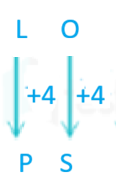
  • English is NOT included in the Eighth Schedule of the Indian Constitution. While English is an official language for the transaction of business in the Parliament and for communication between the Union and States under Article 343, it does not have a place in the list of 22 scheduled languages. Hence, the statement regarding English NOT being included is correct.

Additional Information

  • Evolution of the Eighth Schedule:
  • Initially, there were only 14 languages: Assamese, Bengali, Gujarati, Hindi, Kannada, Kashmiri, Malayalam, Marathi, Odia, Punjabi, Sanskrit, Tamil, Telugu, and Urdu.
  • The 21st Constitutional Amendment Act of 1967 added Sindhi as the 15th language.
  • The 71st Constitutional Amendment Act of 1992 added Konkani, Manipuri, and Nepali.
  • The 92nd Constitutional Amendment Act of 2003 (which came into force in 2004) added four more languages: Bodo, Dogri, Maithili, and Santhali, bringing the total count to 22.
  • Official Language vs. Scheduled Language:
  • Article 343 declares Hindi in Devanagari script as the Official Language of the Union. English was permitted to be used for official purposes for a period of 15 years, but the Official Languages Act, 1963, allowed for its continued use indefinitely.
  • While English is the official language of states like Nagaland and Mizoram, it remains absent from the Eighth Schedule.
  • Significance of Inclusion:
  • Languages in this schedule are represented on the Official Languages Commission. Candidates appearing for Union Public Service Commission (UPSC) examinations can opt to take the exam in any of these 22 languages.
  • The Government of India is under an obligation to take measures for the development of these languages.

Important Points

  • Classical Languages: Apart from the Eighth Schedule, the Government of India grants the status of "Classical Language" to certain languages that have a high antiquity of early texts and a recorded history over a period of 1500-2000 years. Currently, these include Tamil (2004), Sanskrit (2005), Kannada (2008), Telugu (2008), Malayalam (2013), and Odia (2014).
  • Demands for Inclusion: There are persistent demands to include more languages like Tulu, Rajasthani, and Bhojpuri in the Eighth Schedule. Decisions on these are usually based on the recommendations of committees like the Pahwa Committee (1996) and the Sitakant Mohapatra Committee (2003).
  • Article 351: This article provides a Directive for the development of the Hindi language, stating that it should draw its vocabulary primarily from Sanskrit and secondarily from other languages mentioned in the Eighth Schedule.

Question 87

What should come in place of ‘?’ in the given series?

81 80 76 67 51 ?

  1. AOption (a)

    25

  2. BOption (b)

    27

  3. COption (c)

    26

  4. DOption (d)

    24

View answer & explanation

Correct answer

Answer: (c)C.

26

Why this answer is correct

The logic followed here is:

thus, "26" will replace the question mark in the given series.

Hence, the correct option is "Option 3".

Question 88

The Trans-Siberian Railways major rail route of Russia runs from St. Petersburg in the west to _______ on the Pacific Coast in the east.

  1. AOption (a)

    Vladivostok

  2. BOption (b)

    Novosibirsk

  3. COption (c)

    Moscow

  4. DOption (d)

    Irkutask

View answer & explanation

Correct answer

Answer: (a)A.

Vladivostok

Why this answer is correct

The correct answer is Vladivostok.

Key Points

  • The Trans-Siberian Railway is the longest railway system in the world, stretching across the vast expanse of Russia. It is a massive network that connects European Russia with the Russian Far East.
  • The major route of this railway begins at St. Petersburg in the west, passes through Moscow, and reaches its eastern terminus at Vladivostok on the Pacific Coast.
  • The construction of this monumental project began in 1891 under the reign of Tsar Alexander III and was completed in 1916. It covers a total distance of approximately 9,289 kilometers (5,772 miles).
  • The railway was designed to serve several functions, including military transport, administrative control of distant territories, and the economic development of the Siberian region.
  • It crosses eight time zones and passes through various geographic features, including the Ural Mountains, the Siberian taiga, and runs along the shores of Lake Baikal.

Additional Information

  • Novosibirsk: This city is a major stop on the Trans-Siberian route. Founded in 1893 specifically as a crossing point for the railway over the Ob River, it has grown into the third-largest city in Russia and is known as the "Capital of Siberia."
  • Moscow: While the route historically starts in St. Petersburg, Moscow serves as the primary hub where many travelers begin their journey. It acts as the central junction connecting the Trans-Siberian with other European rail networks.
  • Irkutsk: Located near the southern tip of Lake Baikal, Irkutsk is often called the "Paris of Siberia" due to its historic architecture. It is a critical cultural and economic center in Eastern Siberia along the rail line.
  • Branches of the Railway: Besides the main line to Vladivostok, the network includes the Trans-Manchurian line and the Trans-Mongolian line, which provide rail links to Beijing, China, and Ulaanbaatar, Mongolia.
  • Economic Impact: The railway allows for the large-scale export of natural resources such as timber, coal, and minerals from Siberia to both European and Asian markets.

Important Points

  • Vladivostok: The name of the city literally means "Ruler of the East." It is a vital deep-water port on the Sea of Japan and serves as the home base for the Russian Navy's Pacific Fleet.
  • Technical Feats: The railway is fully electrified since 2002, allowing for more efficient transport of heavy freight. It involves crossing massive rivers like the Volga, Irtysh, Ob, Yenisei, and Amur via lengthy railway bridges.
  • Global Logistics: In the modern era, the Trans-Siberian is a key component of the "New Silk Road" or the Eurasian Land Bridge, facilitating container traffic between East Asia and Europe as an alternative to sea routes through the Suez Canal.
  • Tourism: The route is a world-famous tourist attraction, with the journey from Moscow to Vladivostok typically taking about six to seven days of continuous travel.

Question 89

In a certain code language, ‘MEAT’ is coded as ‘5267’ and ‘TIME’ is coded as ‘5362’. What is the code for ‘I’ in the given code language?

  1. AOption (a)

    2

  2. BOption (b)

    3

  3. COption (c)

    5

  4. DOption (d)

    6

View answer & explanation

Correct answer

Answer: (b)B.

3

Why this answer is correct

The logic followed here is:

Given:

MEAT → 5267

TIME → 5362

Hence, I = 3

Hence, the correct answer is "Option 2".

Question 90

Refer to the following letter, number, symbol series and answer the question. (All numbers are single-digit numbers only) (Counting to be done from left to right only)

(Left) Z Q Y 7 * 9 E D V Z R X 4 * N G T B 3 X A T 4 H (Right)

How many such symbols are there, each of which is immediately preceded by a number and also immediately followed by a letter?

  1. AOption (a)

    Two

  2. BOption (b)

    Three

  3. COption (c)

    One

  4. DOption (d)

    None

View answer & explanation

Correct answer

Answer: (c)C.

One

Why this answer is correct

The logic followed here is:

Given: (Left) Z Q Y 7 * 9 E D V Z R X 4 * N G T B 3 X A T 4 H (Right)

Now, we need symbols which are immediately preceded by a number and also immediately followed by a letter.

So, Needed pattern is: Number - Symbol - Letter

(Left) Z Q Y 7 * 9 E D V Z R X 4 * N G T B 3 X A T 4 H (Right)

Now, Total = 1

Hence, the correct answer is Option 3.

Question 91

In a certain code language,

A + B means ‘A is the mother of B’

A – B means ‘A is the brother of B’

A × B means ‘A is the wife of B’

A % B means ‘A is the father of B’

A # B means ‘A is the daughter of B’

Based on the above, how is G related to Q if ‘G – C + D # L % Q’?

  1. AOption (a)

    Mother’s brother

  2. BOption (b)

    Wife’s brother

  3. COption (c)

    Sister’s husband

  4. DOption (d)

    Sister’s daughter

View answer & explanation

Correct answer

Answer: (a)A.

Mother’s brother

Why this answer is correct

Family Chart:

Decoding the Symbols:

Symbol+−×%#
MeaningMotherBrotherWifeFatherDaughter

Given: G − C + D # L % Q

It means: G is the brother of C, C is the mother of D, D is the daughter of L, L is the father of Q.

Hence, G is related to Q as Mother’s brother.

Hence, the correct answer is "Option 1".

Question 92

In this question, a question is followed by two statements numbered (I) and (II). You have to decide whether the data provided in the statements are sufficient to answer the question. Read both the statements and decide the appropriate answer.

Q. Five people – Riya, Meena, Tanu, Sunita, and Kavita – are sitting in a row facing north.

Who is sitting exactly in the middle of the row?

(I) Tanu sits immediately to the right of Meena, and Sunita sits immediately to the right of Tanu.

(II) Riya is at one of the ends, and Kavita sits immediately to the left of Riya.

  1. AOption (a)

    Both statements I and II together (and not statement I alone or statement II alone) are sufficient to answer the question

  2. BOption (b)

    Data in Statement I alone is sufficient to answer the question while data in Statement II is not

  3. COption (c)

    Both statements I and II together are NOT sufficient to answer the question

  4. DOption (d)

    Data in Statement II alone is sufficient to answer the question while data in Statement I is not

View answer & explanation

Correct answer

Answer: (a)A.

Both statements I and II together (and not statement I alone or statement II alone) are sufficient to answer the question

Why this answer is correct

Given:

Five people – Riya, Meena, Tanu, Sunita, and Kavita – are sitting in a row facing north.

We need to find who is sitting exactly in the middle (3rd position).

Now,

Statement (I):

Tanu sits immediately to the right of Meena, and Sunita sits immediately to the right of Tanu.

⇒ Meena – Tanu – Sunita form a block of three consecutive seats

⇒ But Riya and Kavita positions are not fixed

⇒ Middle position cannot be uniquely identified

⇒ Statement I alone is not sufficient

Statement (II):

Riya is at one of the ends, and Kavita sits immediately to the left of Riya

⇒ If Riya is at an end, Kavita cannot be immediately left of Riya (since left side is undefined at extreme left or right depending on position ambiguity)

⇒ Even if interpreted, remaining people positions are still not fixed uniquely

⇒ Statement II alone is not sufficient

Now, combining (I) and (II):

From (I): Meena – Tanu – Sunita are consecutive

From (II): Riya is at one of the ends, and Kavita sits immediately to the left of Riya.

Now, possible arrangement becomes fixed as:

Meena – Tanu – Sunita – Kavita – Riya 

So, middle position (3rd) is Sunita 

Thus, both statements together are sufficient.

Hence, the correct answer is "Option 1".

Question 93

Whom among the following deities is the traditional dance of Karnataka Dollu Kunitha associated with?

  1. AOption (a)

    Lord Vishnu

  2. BOption (b)

    Lord Ganesha

  3. COption (c)

    Lord Shiva

  4. DOption (d)

    Lord Brahma

View answer & explanation

Correct answer

Answer: (c)C.

Lord Shiva

Why this answer is correct

The correct answer is Lord Shiva.

Key Points

  • Dollu Kunitha is a major popular drum dance of Karnataka, specifically associated with the worship of Lord Shiva in the form of Sri Beereshwara.
  • It is primarily performed by the Kuruba community, a shepherd community residing in the North Karnataka and Old Mysore regions.
  • The dance is named after the Dollu, a large, heavy percussion instrument made from a hollowed wooden core and covered with sheep or goat skin on both sides.
  • Performance characteristics include 10 to 12 performers who wear the drums around their necks and play rhythmic patterns while moving in complex choreographic formations such as circles and semi-circles.
  • The performance usually consists of a priest or a lead singer who narrates the epic of Beereshwara through oral traditions, followed by high-energy drumming and jumping movements.

Additional Information

  • Mythological Origin: According to legend, a demon named Dolasura worshipped Lord Shiva and asked for the boon of immortality; when denied, he requested that Shiva reside in his stomach. Shiva complied but eventually had to kill the demon to emerge. He used the demon's skin to make the first Dollu drum, which is why the dance is dedicated to him.
  • Geographical Spread: While popular throughout Karnataka, the dance is most prominent in districts like Shimoga, Chitradurga, Tumkur, and Belgaum.
  • Occasions: It is performed during religious festivals, village fairs (Jathre), and important state functions like the Mysuru Dasara.
  • Musical Elements: The rhythms are controlled by Cymbals (Tala) and a flute (Maurya). The speed of the drumming increases as the performance progresses, reaching a crescendo that tests the physical endurance of the dancers.
  • Social Significance: Beyond its religious roots, Dollu Kunitha serves as a symbol of social unity and physical prowess among the rural folk of the Deccan Plateau.

Important Points

  • Other Folk Dances of Karnataka:
  • Yakshagana: A traditional theater form that combines dance, music, dialogue, costume, and stage techniques with a unique style and form.
  • Kamsale: A unique folk art performed by the devotees of Lord Mahadeshwara, utilizing a brass percussion instrument.
  • Suggi Kunitha: A harvest dance performed by the farming community (Halakki Vokkaligas) during the spring season.
  • Goravara Kunitha: A dance dedicated to Lord Mailara Linga, characterized by performers wearing bear-skin caps.
  • Lord Shiva's Roles: In Indian culture, Shiva is known as Nataraja (the King of Dance). Most traditional dances in India, whether classical or folk, find their spiritual roots in Shaivism.
  • Modern Adaptations: In the 21st century, Dollu Kunitha has evolved from a purely religious ritual into a cultural performance showcased in international festivals to represent Indian heritage.

Question 94

Rupesh’s salary is ₹18000 per month. He spends ₹5000 on house rent, ₹2500 on bills and the rest of the amount is his monthly savings. Find his savings (in ₹) in a year, if in the month of his birthday, he spent his complete monthly saving for birthday celebration.

  1. AOption (a)

    94500

  2. BOption (b)

    105000

  3. COption (c)

    115500

  4. DOption (d)

    126000

View answer & explanation

Correct answer

Answer: (c)C.

115500

Why this answer is correct

Shortcut Trick

Monthly saving = 18000 − 5000 − 2500 = 10500

⇒ 12 months saving = 10500 × 12

⇒ One month spent ⇒ 11 months saving

⇒ = 10500 × 11 = 115500

∴ Answer = 115500

Alternate Method

Given:

Salary = ₹18000/month

Rent = ₹5000

Bills = ₹2500

Concept Used:

Savings = Income − Expenses

Calculation:

⇒ Monthly savings = 18000 − 5000 − 2500

⇒ = 10500

⇒ Total months = 12

⇒ One month saving spent ⇒ effective months = 11

⇒ Annual savings = 10500 × 11

⇒ = 115500

∴ Total savings in a year = ₹115500

Additional Information

Savings Formula: Savings = Income − Expenses

Annual Saving: Monthly saving × number of months

Adjustment: Deduct months where saving is spent

Shortcut Tip: Calculate monthly saving first

Question 95

6 is related to 80 following a certain logic. Following the same logic, 12 is related to 140. To which of the following is 24 related, following the same logic?

(NOTE: Operations should be performed on the whole numbers, without breaking down the numbers into their constituent digits. E.g. 13 – Operations on 13 such as adding/ subtracting /multiplying to 13 can be performed. Breaking down 13 into 1 and 3 and then performing mathematical operations on 1 and 3 is not allowed.)

  1. AOption (a)

    260

  2. BOption (b)

    290

  3. COption (c)

    280

  4. DOption (d)

    270

View answer & explanation

Correct answer

Answer: (a)A.

260

Why this answer is correct

The logic followed here is:

Logic: Second number = (First number × 10) + 20

So, 6 ⇒ 80

6 × 10 + 20 = 60 + 20 = 80 (2nd number)

12 ⇒ 140

12 × 10 + 20 = 120 + 20 = 140 (2nd number)

Similarly, 24 ⇒ ?

24 × 10 + 20 = 240 + 20 = 260 (2nd number)

Hence, the correct answer is Option 1.

Question 96

Which of the following Articles of the Constitution of India authorises Parliament to alter the applicability of Fundamental Rights with respect to members of the Armed Forces and the forces entrusted with the maintenance of public order?

  1. AOption (a)

    Article 33

  2. BOption (b)

    Article 35

  3. COption (c)

    Article 45

  4. DOption (d)

    Article 42

View answer & explanation

Correct answer

Answer: (a)A.

Article 33

Why this answer is correct

The correct answer is Article 33.

Key Points

  • Article 33 of the Constitution of India empowers the Parliament to restrict or abrogate the Fundamental Rights of the members of the Armed Forces, paramilitary forces, police forces, intelligence agencies, and analogous forces.
  • The primary objective of Article 33 is to ensure the proper discharge of their duties and the maintenance of discipline among them, which is vital for national security and public order.
  • This power to make laws under Article 33 is conferred exclusively on the Parliament and not on the State Legislatures.
  • Any law made by Parliament under this article cannot be challenged in any court on the ground of contravention of any of the Fundamental Rights guaranteed by Part III of the Constitution.
  • The scope of "members of the armed forces" under Article 33 also covers non-combatant employees such as barbers, carpenters, mechanics, cooks, tailors, and others who are part of the establishment.

Additional Information

  • Article 35:
  • It provides that the power to make laws, to give effect to certain specified Fundamental Rights, shall vest only in the Parliament and not in the state legislatures.
  • This ensures uniformity throughout India regarding the nature of those fundamental rights and the punishment for their infringement.
  • Article 42:
  • This article is part of the Directive Principles of State Policy (DPSP) under Part IV.
  • It directs the State to make provisions for securing just and humane conditions of work and for maternity relief.
  • Article 45:
  • Originally, it provided for free and compulsory education for all children until they complete the age of 14 years.
  • After the 86th Constitutional Amendment Act, 2002, its scope was changed to provide early childhood care and education for all children until they complete the age of six years.

Important Points

  • Parliamentary Acts: Under the powers of Article 33, the Parliament has enacted various legislations such as the Army Act (1950), the Navy Act (1950), the Air Force Act (1950), the Police Forces (Restriction of Rights) Act (1966), and the Border Security Force Act.
  • Restriction on Freedom: These acts impose restrictions on their freedom of speech, right to form associations, right to be members of trade unions or political associations, and right to communicate with the press.
  • Court Martials: Article 33 also facilitates the exclusion of court-martials (tribunals established under military law) from the writ jurisdiction of the Supreme Court and the High Courts under Article 32 and Article 226 respectively, except where specified.
  • Public Order: The mention of "forces entrusted with the maintenance of public order" specifically refers to police forces and state armed police, ensuring they remain neutral and disciplined during internal security duties.

Question 97

The process of fixing inorganic CO2 into an organic form (sugar) is carried out in which of the following phases during photosynthesis?

  1. AOption (a)

    Light-dependent phase

  2. BOption (b)

    Glycolysis

  3. COption (c)

    Calvin-Benson cycle

  4. DOption (d)

    Kreb’s cycle

View answer & explanation

Correct answer

Answer: (c)C.

Calvin-Benson cycle

Why this answer is correct

The correct answer is Calvin-Benson cycle.

Key Points

  • The process of converting inorganic carbon dioxide (CO2) into organic compounds like sugar (glucose) is known as carbon fixation, which occurs specifically during the Calvin-Benson cycle.
  • This cycle is also referred to as the light-independent phase or the dark reaction of photosynthesis because it does not directly require light to proceed, although it depends on the products of the light-dependent reactions.
  • The Calvin-Benson cycle takes place in the stroma of the chloroplast, the fluid-filled space surrounding the thylakoid membranes.
  • It was discovered by Melvin Calvin, Andrew Benson, and James Bassham in 1950 at the University of California, Berkeley, using radioactive carbon-14 to trace the path of carbon.
  • The cycle utilizes the chemical energy stored in ATP and the reducing power of NADPH, both of which are generated during the light-dependent phase, to facilitate the synthesis of hexose sugars.
  • The primary enzyme responsible for the first step of carbon fixation is RuBisCO (Ribulose-1,5-bisphosphate carboxylase/oxygenase), which is widely considered the most abundant protein on Earth.

Additional Information

  • Light-dependent phase:
  • This phase occurs in the thylakoid membranes of the chloroplast.
  • It involves the absorption of light by pigments like chlorophyll a and b, leading to the photolysis of water and the release of oxygen as a byproduct.
  • The main function is to convert solar energy into chemical energy in the form of ATP and NADPH.
  • Glycolysis:
  • This is a metabolic pathway that occurs in the cytoplasm of the cell, not in the chloroplast.
  • It is the first step of cellular respiration where one molecule of glucose (a 6-carbon sugar) is broken down into two molecules of pyruvate (a 3-carbon compound).
  • It produces a net gain of 2 ATP and 2 NADH molecules and can occur in both aerobic and anaerobic conditions.
  • Kreb’s cycle:
  • Also known as the Citric Acid Cycle or TCA cycle, it occurs in the matrix of the mitochondria.
  • It is part of aerobic respiration and involves the oxidation of acetyl-CoA derived from carbohydrates, fats, and proteins.
  • The cycle releases CO2 as a waste product (the opposite of fixation) and generates high-energy carriers like NADH and FADH2 for the electron transport chain.

Important Points

  • The Calvin Cycle consists of three main stages:
  1. Carbon Fixation: CO2 binds with Ribulose-1,5-bisphosphate (RuBP) to form 3-phosphoglycerate (3-PGA).
  2. Reduction: ATP and NADPH are used to convert 3-PGA into Glyceraldehyde-3-phosphate (G3P), which is the precursor to glucose.
  3. Regeneration: Some G3P molecules are used to regenerate RuBP so the cycle can continue, requiring additional ATP.
  • Plants that use only the Calvin cycle for carbon fixation are called C3 plants (e.g., rice, wheat, soybeans) because the first stable product is a 3-carbon molecule.
  • In dry or hot environments, some plants have evolved alternative pathways like C4 (e.g., maize, sugarcane) or CAM (e.g., cacti, pineapples) to minimize photorespiration and conserve water while fixing carbon.

Question 98

C, D, N, O, P and Q live on six different floors of the same building. The lowermost floor in the building is numbered 1, the floor above it is numbered 2 and so on, till the topmost floor, which is numbered 6. O lives immediately above D. Only Q lives above P. Only two people live between C and N. C lives on an odd-numbered floor. Who lives on the bottommost floor?

  1. AOption (a)

    C

  2. BOption (b)

    N

  3. COption (c)

    D

  4. DOption (d)

    P

View answer & explanation

Correct answer

Answer: (a)A.

C

Why this answer is correct

Given: C, D, N, O, P and Q live on six different floors of the same building.

The lowermost floor in the building is numbered 1, the floor above it is numbered 2 and so on, till the topmost floor, which is numbered 6.

O lives immediately above D.

Only Q lives above P.

Only two people live between C and N.

C lives on an odd-numbered floor.

FloorPerson
6Q
5P
4N
3O
2D
1C

Now, bottommost floor (Floor 1) = C

Hence, the correct answer is Option 1.

Question 99

LAN is often used in schools and offices. This abbreviation expands to:

  1. AOption (a)

    Long Access Network

  2. BOption (b)

    Linked Access Node

  3. COption (c)

    Large Area Network

  4. DOption (d)

    Local Area Network

View answer & explanation

Correct answer

Answer: (d)D.

Local Area Network

Why this answer is correct

The correct answer is Local Area Network.

Key Points

  • A Local Area Network (LAN) is a collection of devices connected together in one physical location, such as a residence, office building, school, or university campus.
  • It is characterized by its limited geographical range, which typically spans from 100 meters to 2 kilometers. Because of this small radius, data transfer rates are significantly higher, ranging from 10 Mbps to 10 Gbps.
  • LANs are usually privately owned by an organization or an individual, meaning the setup and maintenance are managed internally rather than by a public telecommunications provider.
  • The primary function of a LAN is to facilitate resource sharing among users, such as sharing a single printer, scanner, software applications, or centralized data storage.
  • Most modern LANs use Ethernet cables or Wi-Fi (Wireless LAN) for connectivity. The IEEE 802.3 standard governs wired Ethernet, while IEEE 802.11 governs wireless connections.

Additional Information

  • Personal Area Network (PAN):
  • This is the smallest type of network, typically used for communication among personal devices within a range of about 10 meters.
  • Common examples include connecting a smartphone to a Bluetooth headset or a laptop to a wireless mouse.
  • Metropolitan Area Network (MAN):
  • A MAN covers a larger geographical location than a LAN but smaller than a WAN, such as an entire city or a large campus.
  • It often connects multiple LANs within a city and is frequently used by cable TV networks or Internet Service Providers (ISPs) to provide city-wide connectivity.
  • Wide Area Network (WAN):
  • A WAN extends over a large geographical area, such as a country, a continent, or the entire globe.
  • The Internet is the most prominent example of a public WAN. It uses satellites, fiber optic cables, and leased lines for transmission.
  • Network Topologies:
  • LANs are often organized using specific layouts called topologies, such as Star (where all devices connect to a central switch), Bus (where devices share a single cable), and Ring (where devices are connected in a circle).
  • The Star topology is the most common in modern offices because if one cable fails, the rest of the network remains functional.

Important Points

  • Hardware Components: A LAN requires several features and hardware pieces to function, including Network Interface Cards (NIC), Hubs, Switches, and Routers. A Switch is generally preferred over a Hub because it directs data packets specifically to the destination device, reducing network congestion.
  • Security: Since LANs are private, they are generally more secure than public networks. However, they are still protected by firewalls and encryption protocols to prevent unauthorized access from the outside world.
  • WLAN (Wireless LAN): This is a type of LAN that uses radio waves instead of physical wires. It was revolutionized in the year 1997 with the release of the first 802.11 standard, allowing for mobility within a location.
  • Cost and Maintenance: The initial cost of setting up a LAN is relatively low. Because the distance is short, expensive amplifiers or repeaters are rarely needed, making it cost-effective for small businesses and home users.

Question 100

Seven people, B, C, O, P, Q, R and S, are sitting in a straight line, facing north. Only four people sit to the right of S. B sits immediately to the left of P. Only three people sit between P and C, none of whom sit on the extreme ends. R sits immediately to the right of Q. How many people sit between O and R?

  1. AOption (a)

    Zero

  2. BOption (b)

    Two

  3. COption (c)

    Three

  4. DOption (d)

    One

View answer & explanation

Correct answer

Answer: (d)D.

One

Why this answer is correct

Given: Seven people B, C, O, P, Q, R and S are sitting in a row facing north.

Only four people sit to the right of S.

B sits immediately to the left of P.

Only three people sit between P and C, none of whom sit on the extreme ends.

R sits immediately to the right of Q.

So, there is 1 person between O and R.

Hence, the correct answer is "Option 4".

100 questions in the full paper