Previous Year Paper

RRB NTPC (Graduate) CBT-I Official Paper (Held On: 17 Mar, 2026 Shift 3) (Previous Year Paper)

Held in 2026

100 questions90 minutes
With answers
Free

Paper last updated:

Practise under exam conditions

Take this paper as a timed mock test. Review your answers after you submit.

Attempt timed test

Questions & answers

Read the paper at your pace. Open an explanation when you need it.

Question 1

The radius of a solid cylinder is 12 cm, and its height is 25 cm. A three-dimensional sector with a sector angle of 45o is removed from it, all along the height of the cylinder. What is the volume (in cm3) of the larger piece of the cylinder?

  1. AOption (a)

    3200 π\pi

  2. BOption (b)

    3250 π\pi

  3. COption (c)

    3150 π\pi

  4. DOption (d)

    3000 π\pi

View answer & explanation

Correct answer

Answer: (c)C.

3150 π\pi

Why this answer is correct

Shortcut Trick

Removed part = 45° out of 360° ⇒ removed = 1/8

Remaining volume = 7/8 of cylinder

Total volume = πr2h = π × 122 × 25 = 3600π

Required = 7/8 × 3600π = 3150π

∴ Answer = 3150π

Alternate Method

45° r = 12 cm

Given:

r = 12 cm, h = 25 cm, angle = 45°

Formula:

Volume of cylinder = πr2h

Sector volume = (θ/360) × πr2h

Calculations:

⇒ Total volume = π × 122 × 25 = 3600π

⇒ Removed volume = (45/360) × 3600π = 1/8 × 3600π = 450π

⇒ Remaining = 3600π − 450π = 3150π

Final Answer: 3150π cm3

Additional Information

Volume of Cylinder: πr2h → depends on base area and height.

Sector of Cylinder: Fraction = θ/360 → same fraction applies to volume.

Mensuration Shortcut: Always find fraction removed first to save time.

Angle Conversion: 45° = 1/8 of full circle (360°).

Question 2

World Mental Health Day 2025 (10 October) focused on which theme/campaign message, observed internationally and in India?

  1. AOption (a)

    Youth and Well-being

  2. BOption (b)

    Mental Health at Work

  3. COption (c)

    Universal Right to Care

  4. DOption (d)

    Mental health in humanitarian emergencies

View answer & explanation

Correct answer

Answer: (d)D.

Mental health in humanitarian emergencies

Why this answer is correct

The correct answer is Mental health in humanitarian emergencies.

Key Points

  • The World Mental Health Day theme for 10 October 2025 is "Access to Services - Mental Health in Catastrophes and Emergencies".
  • This theme emphasizes protecting mental well-being during crises (natural disasters, conflicts, pandemics) and the urgent need to provide psychological support to affected populations

Additional Information

  • India's Mental Health Initiatives:
  • National Mental Health Programme (NMHP): Launched in 1982 to ensure the availability of mental health services.
  • Mental Healthcare Act, 2017: This act provides a legal framework to protect the rights of persons with mental illness and decriminalizes suicide attempts.
  • Tele-MANAS: Launched during the Union Budget 2022-23, the Tele-Mental Health Assistance and Networking Across States initiative provides 24/7 free counseling services across the country.

Important Points

  • Global Statistics: According to the World Health Organization (WHO), nearly 1 in 7 adolescents (aged 10-19 years) globally experience a mental disorder, yet these remain largely unrecognized and untreated.
  • The Green Ribbon: The Green Ribbon is the international symbol for mental health awareness. People wear it on 10 October to show support for the millions of people living with mental health challenges.
  • SDG Target 3.4: Under the Sustainable Development Goals (SDGs), the United Nations aims to reduce premature mortality from non-communicable diseases by one-third through prevention and treatment and promote mental health and well-being by 2030.
  • Kiran Helpline: The Ministry of Social Justice and Empowerment in India launched the Kiran helpline (1800-599-0019) in September 2020 to provide mental health rehabilitation services.

Question 3

Which of the following is correct about Hibernation mode in computers?

  1. AOption (a)

    Uses maximum power

  2. BOption (b)

    Uses minimum power

  3. COption (c)

    Uses supreme power

  4. DOption (d)

    Uses extreme power

View answer & explanation

Correct answer

Answer: (b)B.

Uses minimum power

Why this answer is correct

The correct answer is Uses minimum power.

Key Points

  • Hibernation is a specific power management mode in computer operating systems that saves the current state of the system to the Hard Disk or Solid State Drive (SSD) before completely powering off.
  • Unlike Sleep Mode, which keeps the system state in the Random Access Memory (RAM) and requires a continuous supply of electricity, Hibernation allows the computer to be fully turned off, meaning it uses minimum power (essentially zero) while preserving open documents and running applications. Hence, the statement regarding minimum power is correct.
  • When a computer enters Hibernation, it writes the contents of its RAM into a file on the storage drive, often named hiberfil.sys in Windows environments.
  • This mode is particularly useful for laptop users who need to save their battery life for an extended period without losing their active workspace or closing their programs.
  • The primary function of Hibernation is to provide a middle ground between Sleep Mode (fast wake-up but uses battery) and Shut Down (no power use but loses all open work).

Additional Information

  • Sleep Mode vs. Hibernation:
  • In Sleep Mode, the computer enters a low-power state, but the RAM remains powered to keep the data "volatile." This allows for a near-instant wake-up time, usually within 2 to 5 seconds.
  • In Hibernation, the wake-up time is longer (typically 20 to 40 seconds) because the system must read the saved data back from the Hard Drive into the RAM.
  • Hybrid Sleep:
  • This is a combination of Sleep and Hibernation designed primarily for desktop computers. It saves the state to both the RAM and the Hard Disk, ensuring that if a power failure occurs, the data is still safe on the disk.
  • Storage Requirements:
  • To enable Hibernation, the computer must have enough free disk space to accommodate a file equal to the size of the installed RAM (e.g., if you have 8GB of RAM, you need at least 8GB of disk space).
  • Historical Context:
  • The Hibernate feature became widely popular with the release of Windows 95 (OSR2) and Windows 98, significantly improving mobile computing efficiency for early notebook users.

Important Points

  • Power Outages: One of the greatest features of Hibernation is that it protects your data against unexpected power loss. Since the state is stored on a non-volatile storage medium, even if the battery dies or the plug is pulled, your data remains intact.
  • Hardware Wear: On older Hard Disk Drives (HDDs), frequent hibernating might involve significant mechanical read/write actions, but on modern SSDs, this process is highly efficient, though it does contribute to the Total Bytes Written (TBW) metric over a number of years.
  • Modern Standby: In newer Windows 10 and Windows 11 devices, a feature called Modern Standby (S0 Low Power Idling) is replacing traditional sleep/hibernate to allow the PC to stay connected to the internet and receive notifications while in a low-power state.
  • When to use: It is recommended to use Hibernation if you will not be using your laptop for more than 2 or 3 hours, or if you want to keep your current state but have no access to a charging port.

Question 4

The Battle of Wandiwash was fought between:

  1. AOption (a)

    British and French

  2. BOption (b)

    Portuguese and French

  3. COption (c)

    British and Portuguese

  4. DOption (d)

    Dutch and Portuguese

View answer & explanation

Correct answer

Answer: (a)A.

British and French

Why this answer is correct

The correct answer is British and French.

Key Points

  • The Battle of Wandiwash was a decisive battle in Indian history, fought on January 22, 1760.
  • It was a major confrontation between the British East India Company and the French East India Company.
  • The British forces were led by Sir Eyre Coote, while the French forces were commanded by the Comte de Lally.
  • This battle was the turning point of the Third Carnatic War (1758–1763), which was the Indian theater of the global Seven Years' War fought between Britain and France.
  • The British emerged victorious, effectively ending French colonial ambitions in India and paving the way for British supremacy over the Indian subcontinent.

Additional Information

  • The Carnatic Wars:
  • These were a series of three military conflicts in the middle of the 18th century on the Indian subcontinent.
  • The conflicts involved numerous nominally independent rulers and their vassals, struggles for succession and territory, and included a diplomatic and military struggle between the French East India Company and the British East India Company.
  • The wars were mainly fought in the territories of the Nizam of Hyderabad and the Carnatic region (modern-day Tamil Nadu and Andhra Pradesh).
  • Treaty of Paris (1763):
  • The Seven Years' War ended with the signing of the Treaty of Paris in 1763.
  • According to the treaty, the French factories (trading posts) in India, such as Pondicherry and Chandernagore, were restored to France.
  • However, the French were prohibited from fortifying these settlements or maintaining large armies in India, which ensured British dominance.
  • Key Figures:
  • Sir Eyre Coote: A British soldier who gained fame for his role in the Battle of Wandiwash and later became the Commander-in-Chief of the British forces in India.
  • Comte de Lally: A French general of Irish descent who was later executed in France for his failure in the Indian campaign.

Important Points

  • Location: The battle took place at Wandiwash, which is now known as Vandavasi, located in the Tiruvannamalai district of Tamil Nadu, India.
  • Military Strength: The British army consisted of approximately 1,900 European troops and 2,100 Indian sepoys, while the French army had around 2,250 European troops and 1,300 Indian allies.
  • Consequences for Other Powers:
  • Portuguese: By the 18th century, Portuguese influence in India was largely confined to Goa, Daman, and Diu. They were not major participants in the Carnatic Wars.
  • Dutch: The Dutch power in India had already been significantly weakened following their defeat by the British in the Battle of Chinsurah (also known as the Battle of Biderra) in 1759.
  • Impact on French Settlements: Following the defeat at Wandiwash, the French capital of Pondicherry was besieged and fell to the British in January 1761, marking the complete collapse of French political power in India.

Question 5

After the Government merged 29 labour laws into four Labour Codes in November 2025, the provision permitting women to work in all establishments including night shifts falls under which of the following Codes?

  1. AOption (a)

    The Code on Social Security, 2020

  2. BOption (b)

    The Industrial Relations Code, 2020

  3. COption (c)

    The Occupational Safety, Health and Working Conditions Code, 2020

  4. DOption (d)

    The Code on Wages, 2019

View answer & explanation

Correct answer

Answer: (c)C.

The Occupational Safety, Health and Working Conditions Code, 2020

Why this answer is correct

The correct answer is The Occupational Safety, Health and Working Conditions Code, 2020.

Key Points

  • The Occupational Safety, Health and Working Conditions Code, 2020 is the specific legislation that provides for the employment of women in all establishments for all types of work. This includes permitting women to work during night shifts, which is defined as the period between 7 PM and 6 AM. Hence, the statement regarding women working in night shifts falls under this code.
  • Under this code, the Government mandates that if a woman is required to work at night, the employer must ensure adequate safety, health, and welfare facilities. Furthermore, the prior consent of the woman worker is a mandatory requirement before assigning her to a night shift.
  • This code is a massive reform that consolidates and replaces 13 central labour laws, including the Factories Act, 1948, the Mines Act, 1952, and the Contract Labour (Regulation and Abolition) Act, 1970.
  • The primary objective of this code is to regulate the health and safety conditions of workers in establishments with 10 or more workers and in all mines and docks, ensuring a standardized environment across India.

Additional Information

  • The Code on Wages, 2019:
  • This was the first code to be passed by Parliament in August 2019. It replaced four existing laws: the Payment of Wages Act, 1936, the Minimum Wages Act, 1948, the Payment of Bonus Act, 1965, and the Equal Remuneration Act, 1976.
  • It ensures that there is no discrimination on the ground of gender in matters relating to wages and recruitment for the same work or work of a similar nature.
  • The Industrial Relations Code, 2020:
  • This code consolidates three functional central labour laws: the Trade Unions Act, 1926, the Industrial Employment (Standing Orders) Act, 1946, and the Industrial Disputes Act, 1947.
  • It aims to improve business efficiency by increasing the threshold for retrenchment and closure in industrial establishments from 100 to 300 workers without requiring prior government permission.
  • The Code on Social Security, 2020:
  • This code replaces nine laws, including the Employees’ Provident Fund Act, 1952, and the Maternity Benefit Act, 1961.
  • A significant feature of this code is the universalization of social security benefits, extending coverage to unorganized workers, gig workers, and platform workers for the first time in India.
  • Broad Labour Reform Context:
  • The Government of India decided to amalgamate 29 central labour laws into four Labour Codes based on the recommendations of the Second National Commission on Labour (2002).
  • The goal of these reforms is to provide ease of doing business while ensuring worker protection and transparency through digitalization and simplified compliance.

Important Points

  • Empowerment of Women: By allowing women to work in all sectors (including hazardous processes with safeguards), the OSH Code 2020 removes traditional barriers that limited female labor force participation.
  • Annual Health Check-up: The OSH Code introduces a provision for a free annual health check-up for workers above a certain age (usually 45 years) in specific establishments, enhancing the preventive healthcare framework for the workforce.
  • Inter-State Migrant Workers: The code provides specific benefits for migrant workers, including a journey allowance and the "One Nation, One Ration Card" facility to ensure food security when they move across state boundaries for employment.

Question 6

In a certain code language, ‘WEAR’ is coded as ‘8246’ and ‘CAST’ is coded as ‘3851’.

What is the code for 'A’ in the given code language?

  1. AOption (a)

    3

  2. BOption (b)

    4

  3. COption (c)

    8

  4. DOption (d)

    1

View answer & explanation

Correct answer

Answer: (c)C.

8

Why this answer is correct

The logic followed here is:

Given:

WEAR → 8246

CAST → 3851

Hence, the code for A is 8.

Hence, the correct answer is Option 3.

Question 7

Ustad Ahmad Lahori is renowned as the chief architect of which UNESCO World Heritage Site?

  1. AOption (a)

    Fatehpur Sikri, Agra

  2. BOption (b)

    Humayun's Tomb, Delhi

  3. COption (c)

    Taj Mahal, Agra

  4. DOption (d)

    Jaisalmer Fort, Rajasthan

View answer & explanation

Correct answer

Answer: (c)C.

Taj Mahal, Agra

Why this answer is correct

The correct answer is Taj Mahal, Agra.

Key Points

  • Ustad Ahmad Lahori is celebrated as the chief architect of the Taj Mahal, one of the most iconic structures of Mughal architecture. He was a master builder in the court of Emperor Shah Jahan and is often credited with the creative vision behind this UNESCO World Heritage Site.
  • The Taj Mahal was commissioned by Emperor Shah Jahan in the year 1631 to house the tomb of his favorite wife, Mumtaz Mahal. It also serves as the final resting place for the Emperor himself.
  • Construction of the Taj Mahal complex is believed to have begun in 1632. The main mausoleum was completed in 1648, while the surrounding buildings and gardens were finished by 1653.
  • Ahmad Lahori is also traditionally credited as the architect of the Red Fort (Lal Qila) in Delhi, showing his significant influence on the Golden Age of Mughal building projects.
  • The monument was designated as a UNESCO World Heritage Site in 1983 for being "the jewel of Muslim art in India and one of the universally admired masterpieces of the world's heritage."

Additional Information

  • Fatehpur Sikri, Agra:
  • Founded in 1571 by Emperor Akbar, it served as the capital of the Mughal Empire until 1585.
  • It is famous for the Buland Darwaza (Gate of Magnificence), which was built to commemorate Akbar's victory over Gujarat.
  • The architectural style is a blend of Hindu and Muslim traditions. Hence, this option is incorrect regarding Ustad Ahmad Lahori.
  • Humayun's Tomb, Delhi:
  • Commissioned by Humayun's first wife, Empress Bega Begum (also known as Haji Begum), in 1558.
  • The chief architect was Mirak Mirza Ghiyas, a Persian designer.
  • It was the first garden-tomb on the Indian subcontinent and inspired the design of the Taj Mahal. Hence, this option is incorrect.
  • Jaisalmer Fort, Rajasthan:
  • Built in 1156 AD by the Bhati Rajput ruler Rawal Jaisal.
  • It is known as the Sonar Quila or Golden Fort because of its yellow sandstone walls that shimmer like gold in the sunlight.
  • It is one of the few "living forts" in the world, as a portion of the city's population still resides inside. Hence, this option is incorrect.

Important Points

  • Architectural Features: The Taj Mahal is renowned for its perfect symmetry, the use of white Makrana marble, and the Pietra Dura (parchin kari) inlay work using semi-precious stones.
  • The Charbagh: The complex features a 300-meter square Charbagh (Mughal garden), which uses raised pathways that divide each of the four quarters of the garden into 16 sunken flowerbeds.
  • Global Recognition: In 2007, the Taj Mahal was declared a winner of the New 7 Wonders of the World (2000–2007) initiative.
  • Material Sourcing: While the marble came from Rajasthan, Jasper was sourced from Punjab, Jade and Crystal from China, Turquoise from Tibet, and Lapis Lazuli from Afghanistan.

Question 8

An object is placed between the focus and the pole of a concave mirror. The image formed is _______.

  1. AOption (a)

    virtual and inverted

  2. BOption (b)

    real and inverted

  3. COption (c)

    virtual and upright

  4. DOption (d)

    real and upright

View answer & explanation

Correct answer

Answer: (c)C.

virtual and upright

Why this answer is correct

The correct answer is virtual and upright.

Key Points

  • When an object is placed between the pole (P) and the principal focus (F) of a concave mirror, the light rays originating from the object diverge after reflection from the mirror surface.
  • Since the reflected rays are diverging, they do not intersect in front of the mirror to form a real image. Instead, when these rays are produced backwards, they appear to meet at a point behind the mirror.
  • The nature of the image formed in this specific case is virtual, meaning it cannot be projected onto a screen.
  • The orientation of the image is upright (also known as erect), which means it is in the same vertical direction as the object.
  • Regarding the size, the image is magnified or enlarged, being significantly larger than the actual object.
  • This is the unique position for a concave mirror where it acts as a magnifying glass, producing a virtual and upright image instead of the usual real and inverted images produced at other positions.

Additional Information

  • Concave Mirror (Converging Mirror):
  • A concave mirror is a spherical mirror with an inward-curving reflecting surface. It is often called a converging mirror because it tends to collect light that falls on it, refocusing parallel incoming rays to a focus.
  • The focal length (f) of a concave mirror is considered negative according to the Cartesian sign convention.
  • The relationship between the radius of curvature (R) and focal length (f) is given by the formula R = 2f.
  • Applications/Uses of this Property:
  • Shaving Mirrors: Men use concave mirrors to see a magnified and upright image of the face for a better shave.
  • Dentists' Mirrors: Dentists use these mirrors to see enlarged images of the teeth of patients while keeping the mirror very close (within the focal length).
  • Makeup Mirrors: Used to provide a clear, upright, and enlarged view of facial features.
  • Image Characteristics at Different Positions:
  • At Infinity: The image is formed at the Focus (F); it is real, inverted, and highly diminished.
  • Beyond C (Center of Curvature): The image is formed between F and C; it is real, inverted, and diminished.
  • At C: The image is formed at C; it is real, inverted, and of the same size as the object.
  • Between C and F: The image is formed beyond C; it is real, inverted, and enlarged.
  • At F: The image is formed at infinity; it is real, inverted, and highly enlarged.

Important Points

  • Real vs Virtual Image: A real image is formed when light rays actually meet at a point after reflection, whereas a virtual image is formed when light rays only appear to diverge from a point. Real images are always inverted in mirrors, while virtual images are always upright.
  • Mirror Formula: The position of the image can be calculated using the mirror formula: 1/f = 1/v + 1/u, where v is the image distance, u is the object distance, and f is the focal length.
  • Magnification (m): It is the ratio of the height of the image to the height of the object. For virtual images in a mirror, the magnification value is positive.

Question 9

In this question, a question is followed by two statements numbered (I) and (II). You have to decide whether the data provided in the statements are sufficient to answer the question. Read both the statements and decide the appropriate answer.

Question:

Among 5 trees, L, M, N, T and V each having a different height, which tree is the shortest?

Statements:

(I) N is taller than L.

(II) V is taller than N. M is only shorter than one tree.

  1. AOption (a)

    Both statements I and II together (and not statement 1 alone or statement II alone) are sufficient to answer the question

  2. BOption (b)

    Both statements I and II together are NOT sufficient to answer the question

  3. COption (c)

    Data in Statement II alone is sufficient to answer the question while data in statement I is not

  4. DOption (d)

    Data in Statement I alone is sufficient to answer the question while data in statement II is not

View answer & explanation

Correct answer

Answer: (b)B.

Both statements I and II together are NOT sufficient to answer the question

Why this answer is correct

Given Statements:

I. N is taller than L.

II. V is taller than N. M is only shorter than one tree.

Analysis:

Statement I alone → Not sufficient

(Only tells N > L, no full order of all 5 trees, so shortest cannot be identified)

Statement II alone → Not sufficient

(V > N is given and M is second tallest, but relation between L, N, T is unknown, so shortest cannot be identified)

Now, combining I and II:

From II:

V is taller than N

M is only shorter than one tree → M is second tallest

So, M cannot be shortest.

From I:

N > L → L is below N

So, even after combining both statements, we cannot determine the shortest tree.

Hence, the correct answer is "Option 2".

Question 10

Each of F, G, H, L, M, N and O has an exam on a different day of a week starting from Monday and ending on Sunday of the same week.

G has exam on Friday. Only two people have exams between M and G. Only four people have exams between F and M. N has exam immediately after O. L doesn’t have exam on Monday.

How many people have exams between L and H?

  1. AOption (a)

    Four

  2. BOption (b)

    Three

  3. COption (c)

    Two

  4. DOption (d)

    One

View answer & explanation

Correct answer

Answer: (a)A.

Four

Why this answer is correct

Given: F, G, H, L, M, N and O have exams on different days from Monday to Sunday.

G has exam on Friday.

Only two people have exams between M and G.

Only four people have exams between F and M.

N has exam immediately after O.

L doesn’t have exam on Monday.

DayPerson
MondayH
TuesdayM
WednesdayO
ThursdayN
FridayG
SaturdayL
SundayF

Now, There are four people between L and H.

Hence, the correct answer is Option 1.

Question 11

The value of [0.72−0.420.33] is:\text{The value of } \left[ \frac{0.7^2 - 0.4^2}{0.33} \right] \text{ is:}

  1. AOption (a)

    0.65

  2. BOption (b)

    1.5

  3. COption (c)

    2

  4. DOption (d)

    1

View answer & explanation

Correct answer

Answer: (d)D.

1

Why this answer is correct

Shortcut Trick

Use a2 − b2 = (a − b)(a + b)

⇒ (0.7 − 0.4)(0.7 + 0.4) = 0.3 × 1.1 = 0.33

⇒ 0.33 ÷ 0.33 = 1

∴ Answer = 1

Alternate Method

Given:

Expression = (0.72 − 0.42) ÷ 0.33

Formula:

a2 − b2 = (a − b)(a + b)

Calculations:

⇒ 0.72 = 0.49

⇒ 0.42 = 0.16

⇒ 0.49 − 0.16 = 0.33

⇒ 0.33 ÷ 0.33 = 1

Final Answer: 1

Additional Information

Identity: a2 − b2 = (a − b)(a + b)

Decimal Tip: Convert into fractions if calculation becomes complex.

Speed Trick: Always check identities before squaring numbers.

Approximation Check: Numerator ≈ denominator ⇒ answer near 1.

Question 12

Which among the following regions saw the Bundela's uprising in 1842?

  1. AOption (a)

    Jabalpur

  2. BOption (b)

    Vizianagram

  3. COption (c)

    Saurashtra

  4. DOption (d)

    Ganjam

View answer & explanation

Correct answer

Answer: (a)A.

Jabalpur

Why this answer is correct

The correct answer is Jabalpur.

Key Points

  • The Bundela Uprising of 1842 was a significant armed rebellion against the British East India Company in Central India.
  • The uprising was primarily centered in the Sagar-Narmada territories, which encompasses regions like Jabalpur, Sagar, Damoh, Narsinghpur, and Hoshangabad. Hence, the region of Jabalpur saw the uprising in 1842.
  • The rebellion was led by prominent local landlords and chieftains, most notably Madhukar Shah of Narhut and Jawahar Singh Bundela of Chandrapur.
  • The primary cause of the revolt was the oppressive land revenue policy and the high tax assessments (the Malguari system) imposed by the British after they annexed the Saugor and Nerbudda territories from the Marathas in 1818.
  • Other leaders like Delan Shah, a Gond chief from Narsinghpur, also joined the movement, making it a combined effort of Bundela and Gond tribes against British exploitation.

Additional Information

  • Vizianagram:
  • This region is located in the modern-day state of Andhra Pradesh.
  • It was the site of a revolt in 1794 when the Raja of Vizianagram, Vizieram Rauze, rose against the British East India Company after they attempted to disband his troops and demanded a huge tribute.
  • This event is historically distinct from the Bundela uprising and occurred nearly 50 years earlier.
  • Saurashtra:
  • Located in Gujarat, this region saw various resistances against the British, such as the Vheras uprising between 1818 and 1820.
  • The Bundelas were not geographically associated with Saurashtra, as their influence was concentrated in Central India (modern Madhya Pradesh and Uttar Pradesh).
  • Ganjam:
  • Located in Odisha, Ganjam was the center of multiple uprisings, including the Ganjam Rebellion led by Dhananjaya Bhanja, the Raja of Gumsur, in 1835-37.
  • Another notable movement in this region was the Savara Rebellion (1853-1856). These events were unrelated to the Bundela ethnic group or the 1842 timeline of the Sagar-Narmada territories.

Important Points

  • Consequences: The British authorities, under Lord Ellenborough, used military force to suppress the Bundela Uprising. By 1843, the main leaders were captured or surrendered. Madhukar Shah was executed by the British, becoming a local martyr.
  • Geopolitical Impact: Although the 1842 rebellion was localized, it reflected the deep-seated resentment against British interference in traditional land-holding systems. It is often seen by historians as a precursor to the Great Revolt of 1857 in Central India.
  • Administrative Changes: Following the unrest, the British were forced to make some administrative adjustments to the revenue collection system in the Sagar-Narmada territories to prevent further mass dissatisfaction.
  • Role of Forest Tribes: The 1842 movement was unique because it bridged the gap between the Bundela ruling class and the tribal Gonds, demonstrating a unified front against colonial rule in the Vindhyan and Satpura ranges.

Question 13

What trend is noted in the share of agriculture in GDP from 1950–51 to 2016–17?

  1. AOption (a)

    Continuous decline with rebounds

  2. BOption (b)

    Significant reduction

  3. COption (c)

    Moderate growth with fluctuations

  4. DOption (d)

    Sharp rise and quick fall

View answer & explanation

Correct answer

Answer: (b)B.

Significant reduction

Why this answer is correct

The correct answer is Significant reduction.

Key Points

  • The share of agriculture and allied sectors in India’s Gross Domestic Product (GDP) has witnessed a Significant reduction over the decades, dropping from approximately 51.8% in 1950-51 to about 15.4% to 17.4% by 2016-17. This reflects the structural transformation of the Indian economy from agrarian to service-oriented.
  • In the early years of independence (1950s), agriculture was the backbone of the economy, providing the majority of national income and employment. However, as the Industrial (Secondary) and Service (Tertiary) sectors grew at much higher rates, the relative contribution of agriculture naturally declined.
  • The trend of Significant reduction does not imply a decrease in total agricultural production; in fact, India’s food grain production increased from about 50 million tonnes in 1950 to over 275 million tonnes by 2016-17. The decline is strictly in terms of its percentage share in the overall GDP.
  • During the Planning Era, especially after the Second Five-Year Plan, the focus shifted toward heavy industries, and later, after the 1991 Liberalization, toward the Service Sector, which accelerated the shrinking share of the primary sector.

Additional Information

  • Sectoral Composition of GDP:
  • The Primary Sector (Agriculture, Mining, Fishing) share has decreased consistently.
  • The Secondary Sector (Manufacturing, Electricity, Construction) saw moderate growth but has remained relatively stagnant compared to services.
  • The Tertiary Sector (Services, Trade, Transport, Communication) has seen an explosive rise, contributing more than 53% of the GDP in 2016-17.
  • Employment vs. GDP Contribution:
  • There is a major disparity in India where agriculture contributes only about 15-17% to GDP but still employs nearly 43-49% of the total workforce as of 2016.
  • This phenomenon is often termed "disguised unemployment," where more people are engaged in agriculture than are actually required for the current level of production.
  • The Green Revolution (1960s):
  • The introduction of High Yielding Variety (HYV) seeds, better irrigation, and fertilizers under the leadership of M.S. Swaminathan significantly boosted productivity but did not stop the declining trend of agriculture’s share in GDP relative to other booming sectors.
  • Economic Liberalization 1991:
  • The LPG (Liberalization, Privatization, and Globalization) reforms opened the economy, leading to a surge in Information Technology (IT) and Banking, which further overshadowed the agricultural contribution.

Important Points

  • Gross Value Added (GVA): Recent economic data uses GVA at basic prices to measure sectoral performance. In 2016-17, the GVA growth for agriculture was around 6.3%, though its total share remained low.
  • Data Collection: The Central Statistics Office (CSO), under the Ministry of Statistics and Programme Implementation (MoSPI), is the nodal agency responsible for calculating these GDP figures and sectoral shares.
  • Engel’s Law: This economic principle suggests that as family income rises, the proportion of income spent on food declines, even if absolute expenditure on food rises. This contributes to the long-term decline of the agricultural sector’s share in a developing economy’s GDP.

Question 14

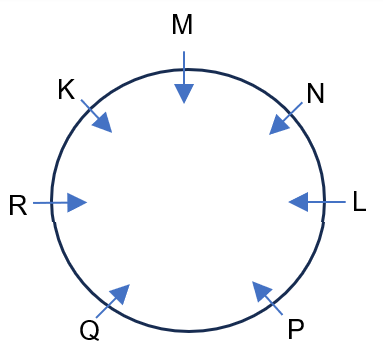
Seven people, K, L, M, N, P, Q and R, are sitting around a circular table facing the centre of the table but not necessarily in the same order. Q sits third to the left of N. M sits second to the left of R. N is the immediate neighbour of both L and M. K is not an immediate neighbour of Q. How many people sit between P and M when counted from the right of P?

  1. AOption (a)

    Four

  2. BOption (b)

    One

  3. COption (c)

    Three

  4. DOption (d)

    Two

View answer & explanation

Correct answer

Answer: (d)D.

Two

Why this answer is correct

Given: K, L, M, N, P, Q and R are sitting around a circular table facing the centre.

Q sits third to the left of N.

M sits second to the left of R.

N is the immediate neighbour of both L and M.

K is not an immediate neighbour of Q.

Now, counting from the right of P (counter-clockwise), the people between P and M are: L and N → 2 people.

Hence, the correct answer is "Option 4".

Question 15

Refer to the following letter, symbol series and answer the question. Counting to be done from left to right only.

(Left) L U & P % F A & D $ # K Q * M Ω Y @ E T * £ R (Right)

How many such symbols are there, each of which is immediately preceded by a letter and also immediately followed by another symbol$?

  1. AOption (a)

    Two

  2. BOption (b)

    Three

  3. COption (c)

    One

  4. DOption (d)

    None

View answer & explanation

Correct answer

Answer: (a)A.

Two

Why this answer is correct

Given: (Left) L U & P % F A & D $ # K Q * M Ω Y @ E T * £ R (Right)

Now,

Symbols, which are immediately preceded by a letter and also immediately followed by another symbol.

So, Needed pattern is: Letter - Symbol - Symbol.

(Left) L U & P % F A & D $ # K Q * M Ω Y @ E T * £ R (Right)

Only two symbols satisfy the condition.

Hence, the correct answer is 'Option 1'.

Question 16

Which of the following ports have NOT been identified for Port Modernization and Maritime Infrastructure Expansion under the Maritime Amrit Kaal Vision 2047 (MAKV 2047)?

  1. AOption (a)

    Panaji Port

  2. BOption (b)

    Deendayal Port Authority (Kandla)

  3. COption (c)

    V.O Chidambaranar Port Authority (Tuticorin)

  4. DOption (d)

    Paradip Port Authority

View answer & explanation

Correct answer

Answer: (a)A.

Panaji Port

Why this answer is correct

The correct answer is Panaji Port.

Key Points

  • The Maritime Amrit Kaal Vision 2047 (MAKV 2047) is a comprehensive roadmap launched by Prime Minister Narendra Modi in October 2023 during the Global Maritime India Summit to transform India's maritime sector over the next 25 years.
  • The vision identifies several Major Port Authorities for massive modernization and infrastructure expansion to create "Mega Ports" with a capacity exceeding 300 to 500 MTPA. Deendayal Port Authority (Kandla) in Gujarat is a primary site identified for such expansion due to its strategic location and existing high cargo throughput. Hence, the statement regarding Deendayal Port is correct as it is identified for expansion.
  • V.O. Chidambaranar Port Authority (Tuticorin) in Tamil Nadu has been specifically identified for development as a Green Hydrogen Hub and for significant capacity expansion under the 2047 vision. Hence, the statement regarding V.O. Chidambaranar Port is correct.
  • Paradip Port Authority in Odisha is another critical major port identified for modernization to become a world-class mega port, aiming to handle vast volumes of coal and iron ore to support the industrial growth of Eastern India. Hence, the statement regarding Paradip Port is correct.
  • Panaji Port, located in Goa, is classified as a minor/non-major port and is under the jurisdiction of the State Government (Goa Maritime Board). While the MAKV 2047 covers the entire maritime ecosystem, the primary infrastructure expansion and port modernization targets for "Mega Port" status focus on the 12 Major Port Authorities under the Union Government. Panaji Port is not among the primary Major Port Authorities identified for the 10,000 MTPA capacity goal. Hence, Panaji Port is the correct option as it is NOT a Major Port Authority identified for this specific expansion.

Additional Information

  • Maritime Amrit Kaal Vision 2047 Goals: The initiative aims to increase the total port capacity of India from the current levels to approximately 10,000 Million Tonnes Per Annum (MTPA) by the year 2047. It focuses on port-led development, reducing logistics costs, and enhancing the Ease of Doing Business in the maritime sector.
  • Development of Mega Ports: Under this vision, India aims to develop at least two ports with a capacity of 1,000 MTPA and several others with 500 MTPA capacity. Vizhinjam Port in Kerala and Vadhavan Port in Maharashtra are also pivotal to this transshipment and mega-port strategy.
  • Green Port Initiative (Harit Sagar): A significant pillar of the MAKV 2047 is the "Harit Sagar" guidelines, which aim to achieve Zero Carbon Emission at Indian ports. The vision includes the installation of renewable energy sources, green hydrogen production, and the adoption of LNG/Electric-powered vessels at Major Ports.
  • Logistics and Technology: The vision integrates the National Logistics Portal (Marine) and the Sagar-Setu mobile app to digitize maritime trade. It aims to reduce the "turnaround time" of ships to match global standards of less than 24 hours.
  • Investment and Employment: The roadmap envisions an investment of over Rs. 80 lakh crore in the maritime sector, which is expected to create millions of jobs and significantly boost India's GDP through increased maritime trade.

Important Points

  • Major Ports vs. Minor Ports: In India, there are 12 Major Ports governed by the Major Port Authorities Act, 2021, and over 200 Minor/Intermediate Ports governed by state maritime boards. The Ministry of Ports, Shipping and Waterways directly oversees the Major Ports, which are the primary focus of the Amrit Kaal Vision for infrastructure scaling.
  • Maritime India Summit 2023: This event served as the launchpad for the vision, attracting global investors and resulting in hundreds of Memorandums of Understanding (MoUs) worth billions of dollars to enhance connectivity and maritime infrastructure.

Question 17

Which Article authorizes the State to make special provisions for the welfare of women and children?

  1. AOption (a)

    Article 19(5)

  2. BOption (b)

    Article 23(2)

  3. COption (c)

    Article 15(3)

  4. DOption (d)

    Article 16(2)

View answer & explanation

Correct answer

Answer: (c)C.

Article 15(3)

Why this answer is correct

The correct answer is Article 15(3).

Key Points

  • Article 15(3) of the Constitution of India specifically empowers the State to make any special provisions for the welfare and protection of women and children.
  • This clause acts as a vital exception to the general rule of non-discrimination established in Article 15(1) and Article 15(2), which prohibits the State from discriminating against any citizen on grounds only of religion, race, caste, sex, place of birth, or any of them.
  • The logic behind Article 15(3) is the concept of protective discrimination or affirmative action; it recognizes that women and children have unique social and physical positions that may require special legal safeguards.
  • This constitutional provision has enabled the government to implement various welfare measures, such as the reservation of seats for women in local self-government bodies (Panchayats and Municipalities) and the enactment of specialized laws like the Maternity Benefit Act.
  • It also provides the legal foundation for the free education of children and other social security schemes directed toward their growth and safety.

Additional Information

  • Article 19(5):
  • This article pertains to the Right to Freedom and allows the State to impose reasonable restrictions on the exercise of the rights to move freely and reside in any part of India.
  • Such restrictions can be imposed in the interest of the general public or for the protection of the interests of any Scheduled Tribe.
  • Article 23(2):
  • While Article 23(1) prohibits traffic in human beings and begar (forced labor), Article 23(2) provides an exception.
  • It permits the State to impose compulsory service for public purposes, such as military training or social service, provided the State does not discriminate on grounds of religion, race, caste, or class.
  • Article 16(2):
  • This article is a component of the Right to Equality regarding public employment.
  • It mandates that no citizen shall, on grounds only of religion, race, caste, sex, descent, place of birth, residence, or any of them, be ineligible for, or discriminated against in respect of, any employment or office under the State.

Important Points

  • The Fundamental Rights are enshrined in Part III of the Indian Constitution, ranging from Article 12 to 35.
  • The Right to Equality encompasses Articles 14 to 18, which aim to establish social and legal equality in India.
  • Article 15(3) was heavily cited during the formulation of the Right of Children to Free and Compulsory Education (RTE) Act, 2009, which ensures that every child aged 6 to 14 years has a right to formal schooling.
  • The Supreme Court of India has consistently upheld that laws favoring women, such as those related to sexual harassment at the workplace or domestic violence protection, are constitutionally valid under the umbrella of Article 15(3).
  • The 73rd and 74th Constitutional Amendment Acts of 1992, which mandated one-third reservation for women in local bodies, draw their functional authority from the spirit of this article.

Question 18

The discovery of the atomic nucleus was made through which experiment?

  1. AOption (a)

    Gold foil experiment

  2. BOption (b)

    Canal ray experiment

  3. COption (c)

    Cathode ray experiment

  4. DOption (d)

    Oil drop experiment

View answer & explanation

Correct answer

Answer: (a)A.

Gold foil experiment

Why this answer is correct

The correct answer is Gold foil experiment.

Key Points

  • The discovery of the atomic nucleus was the result of the alpha-particle scattering experiment, famously known as the Gold foil experiment, conducted by Ernest Rutherford and his team in 1911.
  • In this experiment, high-energy alpha particles (doubly charged helium ions) were bombarded onto a very thin sheet of gold foil, which was approximately 1000 atoms thick.
  • Rutherford observed that most of the alpha particles passed straight through the foil without any deflection, leading to the conclusion that most of the space inside an atom is empty.
  • He noticed that a small fraction of the particles were deflected by small angles, and a very tiny number (about 1 in 12,000) rebounded back, suggesting a 180-degree deflection.
  • Based on these observations, Rutherford concluded that the positive charge and nearly all the mass of the atom are concentrated in a very small, dense region at the center, which he named the nucleus. Hence, the statement regarding the discovery via the Gold foil experiment is correct.

Additional Information

  • Cathode Ray Experiment:
  • This experiment was conducted by J.J. Thomson in 1897 using a vacuum tube.
  • It led to the discovery of electrons, the first subatomic particles to be identified.
  • Thomson proved that cathode rays consisted of negatively charged particles, which he originally called "corpuscles."
  • Canal Ray Experiment:
  • Performed by Eugen Goldstein in 1886, this experiment involved the use of a perforated cathode in a discharge tube.
  • He discovered positive rays (canal rays) moving in the opposite direction to cathode rays.
  • This discovery eventually led to the identification of the proton, which carries a positive charge.
  • Oil Drop Experiment:
  • Conducted by Robert Millikan and Harvey Fletcher in 1909 at the University of Chicago.
  • The primary purpose was to measure the elementary electronic charge.
  • They determined the charge of a single electron to be approximately 1.602 x 10^-19 Coulombs.
  • Malleability of Gold:
  • Gold was specifically chosen for Rutherford's experiment because it is the most malleable metal.
  • This property allowed the researchers to create a foil so thin that it was only a few hundred nanometers thick, ensuring that the alpha particles interacted with only a few layers of atoms.

Important Points

  • Rutherford’s Atomic Model:
  • Following the discovery, Rutherford proposed a nuclear model of the atom, where electrons revolve around the nucleus in circular paths called orbits, similar to planets revolving around the sun.
  • He stated that the nucleus is extremely small; the radius of the nucleus is about 10^-15 meters, while the radius of the atom is about 10^-10 meters.
  • Limitations:
  • A major drawback of Rutherford's model was its inability to explain atomic stability. According to classical electromagnetic theory, an accelerating charged particle (the electron) should radiate energy and eventually collapse into the nucleus.
  • This limitation was later addressed by Niels Bohr in 1913 with the introduction of discrete energy levels or shells.

Question 19

Based on the English alphabetical order, three of the following four are alike in a certain way and thus form a group. Which is the one

that does not belong to that group?

(Note: The odd one out is not based on the number of consonants/vowels or their position in the letter cluster.)

  1. AOption (a)

    ECH

  2. BOption (b)

    KFN

  3. COption (c)

    MKP

  4. DOption (d)

    WUZ

View answer & explanation

Correct answer

Answer: (b)B.

KFN

Why this answer is correct

The logic followed here is:

Option 1) ECH

Option 2) KFN

Option 3) MKP

Option 4) WUZ

Now, KFN  follows a different pattern.

Hence, the correct answer is Option 2.

Question 20

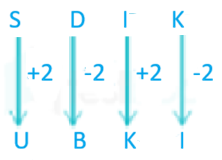
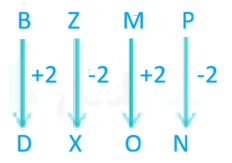
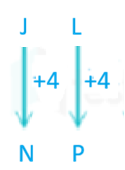
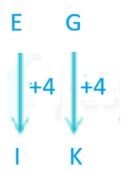
MUNI is related to OSPG in a certain way based on the English alphabetical order. In the same way, SDIK is related to UBKI. To which of the following is BZMP related, following the same logic?

  1. AOption (a)

    DXON

  2. BOption (b)

    EYPO

  3. COption (c)

    DXNQ

  4. DOption (d)

    CWNM

View answer & explanation

Correct answer

Answer: (a)A.

DXON

Why this answer is correct

The logic followed here is:

For, MUNI → OSPG

For, SDIK → UBKI

Now, apply to BZMP:

So, BZMP → DXON

Hence, the correct answer is Option 1.

Question 21

The Rashtrakutas were primarily known for which architectural marvel?

  1. AOption (a)

    Brihadeeswara Temple

  2. BOption (b)

    Konark Sun Temple at Konark

  3. COption (c)

    Sanchi Stupa

  4. DOption (d)

    Kailasa Temple at Ellora

View answer & explanation

Correct answer

Answer: (d)D.

Kailasa Temple at Ellora

Why this answer is correct

The correct answer is Kailasa Temple at Ellora.

Key Points

  • The Rashtrakutas were a powerful dynasty that ruled large parts of the Indian subcontinent between the 8th and 10th centuries.
  • The Kailasa Temple, located in Cave 16 of the Ellora Caves in Sambhaji Nagar (formerly Aurangabad), Maharashtra, is considered their greatest architectural achievement.
  • It was commissioned by the Rashtrakuta King Krishna I (reigned 756–774 AD) during the 8th century.
  • The temple is a monolithic structure, which means it was carved out of a single massive basalt cliff. Unlike traditional buildings that are constructed from the ground up, this temple was carved using a top-down excavation method.
  • The architecture of the temple follows the Dravidian style, characterized by its Gopuram (monumental entrance tower) and complex Vimana (temple tower).

Additional Information

  • Rashtrakuta Dynasty:
  • The dynasty was founded by Dantidurga in 753 AD after he overthrew the Chalukyas of Badami.
  • Their capital was established at Manyakheta (modern-day Malkhed in Karnataka).
  • Famous rulers include Amoghavarsha I, who was a great patron of literature and wrote the Kavirajamarga, the earliest available work on rhetoric, poetics, and grammar in the Kannada language.
  • Brihadeeswara Temple:
  • Located in Thanjavur, Tamil Nadu, this temple was built by the Chola emperor Rajaraja I in 1010 AD.
  • It is an outstanding example of Chola architecture and is dedicated to Lord Shiva.
  • Konark Sun Temple:
  • Situated in Puri, Odisha, this 13th-century marvel was built by King Narasimhadeva I of the Eastern Ganga Dynasty.
  • It is designed in the shape of a colossal chariot with 24 wheels pulled by seven horses, dedicated to the Sun God (Surya).
  • Sanchi Stupa:
  • Located in Madhya Pradesh, it is one of the oldest stone structures in India, originally commissioned by the Mauryan Emperor Ashoka in the 3rd century BC.
  • It serves as a major center for Buddhist pilgrimage and architecture.

Important Points

  • The Ellora Caves consist of 34 monasteries and temples extending over a distance of more than 2 kilometers. These include 17 Hindu, 12 Buddhist, and 5 Jain caves, demonstrating the religious harmony of ancient India.
  • The Kailasa Temple was designed to represent Mount Kailash, the celestial abode of Lord Shiva.
  • The temple complex includes massive stone sculptures depicting scenes from the Ramayana and the Mahabharata, as well as a famous relief showing the demon king Ravana attempting to lift Mount Kailash.
  • The Ellora Caves were designated as a UNESCO World Heritage Site in 1983 due to their cultural and historical significance.
  • It is estimated that over 200,000 tonnes of rock were excavated to create the Kailasa Temple, a feat that showcases the advanced engineering skills of the Rashtrakuta era artisans.

Question 22

Below are given two sets of numbers. In each set of numbers, a certain mathematical operation on the first number results in the second number. Similarly, certain mathematical operations on the second number result in the third number and so on. Which of the given options follows the same set of operations as in question?

(NOTE – A two/three-digit number cannot be broken into individual digits for operations, e.g., if 37 is followed by 10, the operation cannot be 3+7 as a two-digit number cannot be broken into individual digits.)

25 – 40 – 65 – 100; 70 – 85 – 110 – 145

  1. AOption (a)

    50 – 65 – 90 – 125

  2. BOption (b)

    15 – 30 – 65 – 90

  3. COption (c)

    95 – 110 – 130 – 170

  4. DOption (d)

    65 – 80 – 105 – 150

View answer & explanation

Correct answer

Answer: (a)A.

50 – 65 – 90 – 125

Why this answer is correct

The logic followed here is:

Logic: Each step increases by a fixed alternating pattern of +15, +25, +35.

Now verify the given sets:

For, 25 – 40 – 65 – 100

⇒ 25 + 15 = 40

⇒ 40 + 25 = 65

⇒ 65 + 35 = 100

For, 70 – 85 – 110 – 145

⇒ 70 + 15 = 85

⇒ 85 + 25 = 110

⇒ 110 + 35 = 145

Now, checking the options:

Option 1) 50 – 65 – 90 – 125

⇒ 50 + 15 = 65

⇒ 65 + 25 = 90

⇒ 90 + 35 = 125 

Option 2) 15 – 30 – 65 – 90

⇒ 15 + 15 = 30

⇒ 30 + 25 = 55 ≠ 65 

Option 3) 95 – 110 – 130 – 170

⇒ 95 + 15 = 110

⇒ 110 + 25 = 135 ≠ 130 

Option 4) 65 – 80 – 105 – 150

⇒ 65 + 15 = 80

⇒ 80 + 25 = 105

⇒ 105 + 35 = 140 ≠ 150 

Hence, the correct answer is Option 1.

Question 23

Which of the given letter-number clusters will replace the question mark (?) in the following series to make it logically complete?

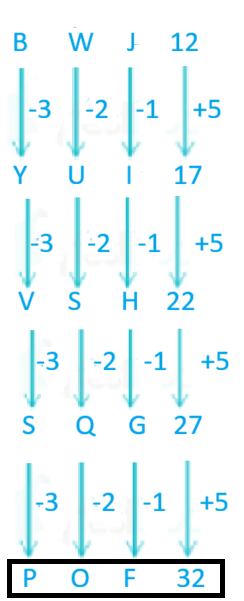
DRJ 50 WKC 45 PDV 40 IWO 35 ?

  1. AOption (a)

    LEF 30

  2. BOption (b)

    AJD 32

  3. COption (c)

    BPH 30

  4. DOption (d)

    CJE 35

View answer & explanation

Correct answer

Answer: (c)C.

BPH 30

Why this answer is correct

The logic followed here is:

So, 'BPH 30' will replace the question mark in the given series.

Hence, the correct answer is "Option 3".

Question 24

Two taps can fill a cistern in 4 hours and 31 hours respectively. A third tap can empty it in 31 hours. How long (in hours) will it take to fill one-fourth of the empty cistern, if all of them are opened together?

  1. AOption (a)

    4

  2. BOption (b)

    1

  3. COption (c)

    3

  4. DOption (d)

    2

View answer & explanation

Correct answer

Answer: (b)B.

1

Why this answer is correct

Shortcut Trick

Net work = 1/4 + 1/31 − 1/31 = 1/4

⇒ Only first tap remains effective

⇒ Time for full tank = 4 hr

⇒ Time for 1/4 tank = 1 hr

∴ Answer = 1

Alternate Method

Given:

Tap A = 4 hr, Tap B = 31 hr, Tap C (empty) = 31 hr

Formula:

Net rate = 1/4 + 1/31 − 1/31

Calculations:

⇒ Net rate = 1/4

⇒ Time for full tank = 4 hr

⇒ Time for 1/4 tank = 4 × 1/4 = 1 hr

Final Answer: 1 hour

Additional Information

Work Rate: Rate = Work ÷ Time

Pipe Concept: Filling = positive, Emptying = negative

Shortcut Tip: Same time pipes cancel each other

Unit Work: Assume total work = 1 for easy calculation

Question 25

Which of the following international bodies oversaw the Treaty on Cybersecurity in October 2025?

  1. AOption (a)

    World Bank

  2. BOption (b)

    UNESCO

  3. COption (c)

    NATO

  4. DOption (d)

    United Nations

View answer & explanation

Correct answer

Answer: (d)D.

United Nations

Why this answer is correct

The correct answer is United Nations.

Key Points

  • The United Nations (UN) is the primary international organization responsible for facilitating the creation of a global Treaty on Cybersecurity and Cybercrime. In August 2024, the United Nations Ad Hoc Committee finalized the first-ever global treaty to combat cybercrime, which is expected to be formally adopted by the General Assembly in the 2024-2025 session.
  • The treaty aims to strengthen international cooperation in the investigation and prosecution of crimes involving computer systems, including data theft, hacking, and online exploitation. This oversight by the United Nations ensures that the framework respects international law and the sovereignty of member nations.
  • The United Nations Office on Drugs and Crime (UNODC) serves as the secretariat for the treaty negotiations. This body provides the necessary technical assistance and platform for all 193 member states to negotiate terms that balance security with human rights and privacy.
  • The process for this treaty was initiated by the General Assembly Resolution 74/247, which established an open-ended Ad Hoc Committee to elaborate a comprehensive international convention on countering the use of information and communications technologies (ICTs) for criminal purposes.
  • By October 2025, the implementation phase and the formalization of global standards under the United Nations umbrella provide a unified legal basis for countries that previously lacked specific cybersecurity legislation.

Additional Information

  • World Bank:
  • Established in 1944 at the Bretton Woods Conference, the World Bank is an international financial institution.
  • While it provides financial support and technical assistance for digital infrastructure and cyber resilience in developing nations, it does not have the mandate to oversee or draft international legal treaties on security.
  • UNESCO:
  • The United Nations Educational, Scientific and Cultural Organization was founded in 1945.
  • It focuses on promoting peace through education and ethics in artificial intelligence. While it advocates for digital literacy and internet universality, it is not the governing body for cybersecurity treaties.
  • NATO:
  • The North Atlantic Treaty Organization is a political and military alliance established in 1949.
  • Although NATO considers cyber defense a part of its collective defense (Article 5), its jurisdiction is limited to its 32 member states and does not oversee global treaties for the entire international community.
  • United Nations (UN) Structure:
  • The UN consists of six principal organs, including the General Assembly and the Secretariat.
  • It is the only body with the global legitimacy to host negotiations that involve both the Global North and the Global South, ensuring that developing countries have a voice in the digital governance framework.

Important Points

  • The Budapest Convention (2001): Before the UN treaty, the Council of Europe's Budapest Convention was the primary instrument for international cybercrime cooperation. However, many nations, including India and Russia, did not sign it due to concerns over data sovereignty.
  • Cyber Diplomacy: The role of the United Nations in 2025 reflects the shift toward cyber diplomacy, where digital security is treated with the same diplomatic weight as nuclear non-proliferation or climate change.
  • Data Privacy: A key challenge during the UN negotiations was ensuring that the treaty would not be used by authoritarian regimes to suppress dissent or violate human rights under the guise of cybersecurity.
  • Technical Assistance: The UN framework emphasizes providing technical expertise to lower-income countries to help them build robust CERTs (Computer Emergency Response Teams) and National Cybersecurity Strategies.

Question 26

The average of 5 numbers is 20. If one number is excluded, the average of the remaining numbers is 18. What is the excluded number?

  1. AOption (a)

    32

  2. BOption (b)

    28

  3. COption (c)

    25

  4. DOption (d)

    30

View answer & explanation

Correct answer

Answer: (b)B.

28

Why this answer is correct

Shortcut Trick

Total of 5 numbers = 5 × 20 = 100

Total of remaining 4 numbers = 4 × 18 = 72

⇒ Excluded number = 100 − 72 = 28

∴ Answer = 28

Alternate Method

Given:

Average of 5 numbers = 20

Average of 4 numbers = 18

Formula:

Sum = Average × Number of terms

Calculations:

⇒ Sum of 5 numbers = 20 × 5 = 100

⇒ Sum of 4 numbers = 18 × 4 = 72

⇒ Excluded number = 100 − 72 = 28

Final Answer: 28

Additional Information

Average Formula: Average = Sum ÷ Number of terms

Sum Concept: Sum = Average × Count

Shortcut Tip: Difference of sums gives missing value directly

Exam Hack: Avoid listing numbers, directly use totals

Question 27

Which file type is most suitable for storing structured data that can be imported into spreadsheet applications?

  1. AOption (a)

    .mp4

  2. BOption (b)

    .exe

  3. COption (c)

    .png

  4. DOption (d)

    .csv

View answer & explanation

Correct answer

Answer: (d)D.

.csv

Why this answer is correct

The correct answer is .csv.

Key Points

  • The .csv (Comma Separated Values) file format is a plain text file that uses a specific delimiter (typically a comma) to separate values, making it the most suitable format for storing structured data.
  • Each line of the file corresponds to a data record, and each record consists of one or more fields, which allows it to be easily interpreted as tabular data by applications like Microsoft Excel, Google Sheets, and LibreOffice Calc.
  • One of its primary functions is to facilitate the exchange of data between different platforms or software that might otherwise be incompatible, as it does not contain complex formatting or macros.
  • Because it is human-readable and lightweight, it is widely used in Data Science and software development for exporting and importing large databases or datasets.
  • In a spreadsheet application, importing a .csv file automatically populates the rows and columns based on the line breaks and commas present in the text file.

Additional Information

  • .mp4 (MPEG-4 Part 14):
  • This is a digital multimedia container format most commonly used to store video and audio data.
  • It can also store other data such as subtitles and still images, utilizing lossy compression to maintain high quality while keeping the file size relatively small.
  • It is based on the QuickTime File Format and is widely supported across smartphones, computers, and streaming services.
  • .exe (Executable File):
  • An .exe file is a common file extension for a program that can be executed or run by the Microsoft Windows operating system.
  • It contains binary machine code that the CPU interprets to perform specific functions or launch software applications.
  • Unlike data files, executable files are not meant to be read by humans but are essential for installing and running programs on a PC.
  • .png (Portable Network Graphics):
  • This is a raster-graphics file format that supports lossless data compression.
  • It was created as an improved, non-patented replacement for Graphics Interchange Format (GIF) and is the most used lossless image compression format on the Internet.
  • Key features include support for transparency (alpha channels) and 24-bit RGB color palettes, making it ideal for web design and logos.

Important Points

  • Data Delimiters: While the "C" in CSV stands for Comma, some regions or organisations use different delimiters such as semicolons (;) or tabs (\t) to avoid confusion with numerical values that use commas as decimal separators.
  • Structure vs. Formatting: A CSV file only stores the raw data; it cannot save cell colors, font styles, formulas, or merged cells. For these features, users must save the file in proprietary formats like .xlsx.
  • Historical Context: The CSV format has existed since the early days of business computing in the 1970s, long before the standardisation of modern spreadsheet software, proving its longevity and reliability.
  • Applications in Web: Many government agencies and open data portals provide reports and indices in CSV format to ensure the transparency and accessibility of public data for researchers.

Question 28

Refer to the following letter, number and symbol series and answer the question that follows.

(NOTE: All numbers are single-digit numbers only.)

(Left) @ © € E 8 9 X © 7 6 9 4 S N % $ 2 © 1 # O N (Right)

If all the numbers are dropped from the series, which of the following will be eighth from the left$?

  1. AOption (a)

    N

  2. BOption (b)

    S

  3. COption (c)

    %

  4. DOption (d)

    @

View answer & explanation

Correct answer

Answer: (a)A.

N

Why this answer is correct

Given: (Left) @ © € E 8 9 X © 7 6 9 4 S N % $ 2 © 1 # O N (Right)

Now,

We need to remove all the numbers and then find the 8th element from the left.

After removing numbers (8, 9, 7, 6, 9, 4, 2, 1), the series becomes:  @ © € E X © S N % $ © # O N

Now, count from the left:  @ © € E X © S N % $ © # O N

So, the 8th element is N.

Hence, the correct answer is 'Option 1'.$

Question 29

Walking at 47\frac{4}{7} of his normal speed from his home, Lakshya is 15 minutes late in reaching his office. The usual time taken by him to cover the distance between his home and his office is

  1. AOption (a)

    16 minutes

  2. BOption (b)

    29 minutes

  3. COption (c)

    23 minutes

  4. DOption (d)

    20 minutes

View answer & explanation

Correct answer

Answer: (d)D.

20 minutes

Why this answer is correct

Shortcut Trick

Speed ratio = 4 : 7 ⇒ Time ratio = 7 : 4

Extra time = 3 parts = 15 min

⇒ 1 part = 5 min

⇒ Normal time = 4 parts = 20 min

∴ Answer = 20 minutes

Alternate Method

Given:

Reduced speed = 4/7 of normal

Delay = 15 min

Formula:

Time ∝ 1/Speed

Calculations:

⇒ Let normal speed = 7, reduced speed = 4

⇒ Time ratio = 7/4

⇒ Difference = 7T/4 − T = 3T/4 = 15

⇒ T = 20 min

Final Answer: 20 minutes

Additional Information

Speed-Time Relation: Speed × Time = Distance

Inverse Relation: Time ∝ 1/Speed

Ratio Trick: Convert speed ratio to time ratio by inverse

Exam Shortcut: Use parts method for quick solving

Question 30

According to Article 243Q, the level of municipality for a transitional area will be designated as a _________.

  1. AOption (a)

    Municipal Council

  2. BOption (b)

    Municipal Corporation

  3. COption (c)

    Nagar Panchayat

  4. DOption (d)

    Township

View answer & explanation

Correct answer

Answer: (c)C.

Nagar Panchayat

Why this answer is correct

The correct answer is Nagar Panchayat.

Key Points

  • Article 243Q of the Constitution of India mandates the constitution of three types of municipalities in every State.
  • A Nagar Panchayat (by whatever name called) is constituted for a transitional area, which is an area in transition from a rural area to an urban area.
  • A Municipal Council is constituted for a smaller urban area.
  • A Municipal Corporation is constituted for a larger urban area.
  • The Governor of a State, by public notification, specifies whether an area is a transitional area, a smaller urban area, or a larger urban area based on factors such as population, density of population, revenue generated for local administration, percentage of employment in non-agricultural activities, and economic importance.
  • The 74th Amendment Act of 1992 added Part IX-A to the Constitution, which deals with the administration of Municipalities.

Additional Information

  • 74th Constitutional Amendment Act, 1992:
  • This Act came into force on June 1, 1993.
  • It aimed at revitalizing and strengthening urban local bodies (ULBs) so that they function effectively as units of self-government.
  • It inserted the Twelfth Schedule into the Constitution, which contains 18 functional items placed under the purview of municipalities.
  • Composition of Municipalities (Article 243R):
  • All seats in a municipality are filled by persons chosen by direct election from the territorial constituencies in the municipal area.
  • Each municipal area is divided into territorial constituencies known as wards.
  • Reservation of Seats (Article 243T):
  • Seats are reserved for Scheduled Castes (SC) and Scheduled Tribes (ST) in every municipality in proportion to their population.
  • Not less than one-third (1/3) of the total number of seats are reserved for women (including the number of seats reserved for SC/ST women).
  • Duration of Municipalities (Article 243U):
  • The municipality has a fixed term of 5 years from the date appointed for its first meeting.
  • In case of dissolution, elections to constitute a new municipality must be completed within a period of 6 months.

Important Points

  • State Election Commission (Article 243ZA):
  • The superintendence, direction, and control of the preparation of electoral rolls and the conduct of all elections to the municipalities are vested in the State Election Commission.
  • State Finance Commission (Article 243Y):
  • The Finance Commission constituted under Article 243-I (for Panchayats) also reviews the financial position of the municipalities and makes recommendations to the Governor regarding the distribution of taxes, duties, tolls, and fees between the State and the Municipalities.
  • District Planning Committee (Article 243ZD):
  • Every State must constitute a District Planning Committee at the district level to consolidate the plans prepared by the Panchayats and the Municipalities in the district.
  • Metropolitan Planning Committee (Article 243ZE):
  • In every metropolitan area (an area having a population of 10 lakh or more), a Metropolitan Planning Committee must be constituted to prepare a draft development plan for the metropolitan area as a whole.

Question 31

Evaluate: 16 + 18 ÷ 6 - 2 × 4

  1. AOption (a)

    13

  2. BOption (b)

    10

  3. COption (c)

    11

  4. DOption (d)

    14

View answer & explanation

Correct answer

Answer: (c)C.

11

Why this answer is correct

Shortcut Trick

Apply BODMAS: do ÷ and × first

18 ÷ 6 = 3 and 2 × 4 = 8

Expression becomes: 16 + 3 − 8

Now solve left to right: 19 − 8 = 11

∴ Answer = 11

Alternate Method

Given:

Expression: 16 + 18 ÷ 6 − 2 × 4

Formula used:

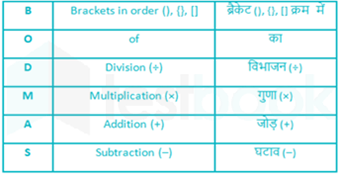
BODMAS rule: Brackets → Orders → Division → Multiplication → Addition → Subtraction

Calculations:

⇒ 16 + 18 ÷ 6 − 2 × 4

⇒ 16 + 3 − 8

⇒ 19 − 8 = 11

∴ The correct answer is 11.

Additional Information

BODMAS Rule

Order of operations: Brackets → Orders → Division → Multiplication → Addition → Subtraction.

Division and Multiplication Priority

Division and multiplication have equal priority and are solved left to right.

Addition and Subtraction Rule

After ÷ and ×, perform + and − from left to right.

Common Mistake

Solving left to right directly without applying BODMAS leads to wrong answers.

Question 32

In a certain code language,

X + Y means ‘X is the husband of Y’,

X – Y means ‘X is the mother of Y’,

X × Y means ‘X is the brother of Y’ and

X ÷ Y means ‘X is the father of Y’.

Based on the above information, how is P related to T if ‘P + Q – R × S ÷ T’?

  1. AOption (a)

    Mother's father

  2. BOption (b)

    Mother's brother

  3. COption (c)

    Father's father

  4. DOption (d)

    Father's brother

View answer & explanation

Correct answer

Answer: (c)C.

Father's father

Why this answer is correct

Family Chart:

Decoding the Symbols:

Symbol+−×÷
MeaningHusbandMotherBrotherFather

Given: P + Q − R × S ÷ T

It means: P is the husband of Q, Q is the mother of R, R is the brother of S, S is the father of T.


⇒ Therefore P is T’s father’s father.

Hence, the correct answer is "Option 3".

Question 33

In a certain code language, ‘LIME’ is coded as ‘4839’ and ‘TIME’ is coded as ‘9324’. What is the code for ‘T’ in the given code language?

  1. AOption (a)

    9

  2. BOption (b)

    3

  3. COption (c)

    2

  4. DOption (d)

    4

View answer & explanation

Correct answer

Answer: (c)C.

2

Why this answer is correct

The logic followed here is:

Given:

LIME → 4839

TIME → 9324

So, T → 2

Hence, the correct answer is Option 3.

Question 34

Based on the English alphabetical order, three of the following four letter cluster pairs are alike in a certain way and thus form a group. Which is the one that does not belong to that group?

(Note: The odd man out is not based on the number of consonants/vowels or their position in the letter cluster)

  1. AOption (a)

    TU-WX

  2. BOption (b)

    JL-NP

  3. COption (c)

    EG-IK

  4. DOption (d)

    CE-GI

View answer & explanation

Correct answer

Answer: (a)A.

TU-WX

Why this answer is correct

The logic followed here is:

Now, checking all options:

Option 1) TU → WX

Option 2) JL → NP

Option 3) EG → IK

Option 4) CE → GI

Now, Only TU → WX follows different pattern.

Hence, the correct answer is Option 1.

Question 35

At present, Vanraj is three times as old as his son, and his daughter is 3 years younger than the son. If the sum of the ages of these three people 3 years ago was 58 years, then Vanraj's present age (in years) is:

  1. AOption (a)

    42

  2. BOption (b)

    36

  3. COption (c)

    45

  4. DOption (d)

    33

View answer & explanation

Correct answer

Answer: (a)A.

42

Why this answer is correct

Shortcut Trick

Let son = x, then father = 3x and daughter = x − 3

3 years ago total: (3x − 3) + (x − 3) + (x − 6)

Total = 5x − 12 = 58

5x = 70 ⇒ x = 14

∴ Answer = 42

Alternate Method

Given:

Vanraj = 3 × son

Daughter = son − 3

Sum of ages 3 years ago = 58

Formula used:

Total age = sum of individual ages

Father = 3x Son = x Daughter = x−3 3 years ago total = 58

Calculations:

⇒ Let son = x

⇒ Father = 3x, Daughter = x − 3

⇒ 3 years ago: (3x − 3) + (x − 3) + (x − 6) = 58

⇒ 5x − 12 = 58

⇒ 5x = 70 ⇒ x = 14

⇒ Vanraj = 3x = 42

∴ The correct answer is 42.

Additional Information

Age Reduction Concept

If age decreases by n years, subtract n from each person's present age.

Linear Equation Method

Form one equation using given conditions and solve for unknown variable.

Family Age Problems

Use relations like father = multiple of son to simplify quickly.

Shortcut Insight

Total reduction after 3 years = 3 persons × 3 = 9 years.

Question 36

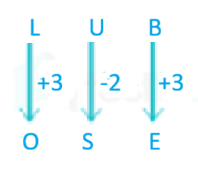
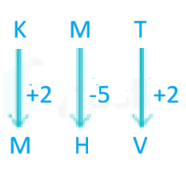
Select the pair which follows the same pattern as that followed by the two sets of pairs given below. Both pairs follow the same pattern.

LUB : OSE

RQH : UOK

  1. AOption (a)

    GOQ : LMV

  2. BOption (b)

    XMN : AKQ

  3. COption (c)

    KMT : MHV

  4. DOption (d)

    KGY : OBC

View answer & explanation

Correct answer

Answer: (b)B.

XMN : AKQ

Why this answer is correct

The logic followed here is:

For, LUB → OSE

For,  RQH → UOK

Now, checking all options:

Option 1) GOQ → LMV

Option 2) XMN → AKQ

Option 3) KMT → MHV

Option 4) KGY → OBC

Hence, the correct answer is Option 2.

Question 37

Ashoka was the viceroy of which region under his father Bindusara’s reign?

  1. AOption (a)

    Tosali

  2. BOption (b)

    Patliputra

  3. COption (c)

    Saurashtra

  4. DOption (d)

    Ujjain

View answer & explanation

Correct answer

Answer: (d)D.

Ujjain

Why this answer is correct

The correct answer is Ujjain.

Key Points

  • Ashoka, one of the greatest emperors of ancient India, served as the Viceroy (Governor) of Ujjain (the capital of the Avanti province) during the reign of his father, Bindusara.
  • As a prince, he was also sent to Taxila (Takshashila) to suppress a major revolt against the central Mauryan administration, where he demonstrated exceptional military and diplomatic skills. Hence, the statement regarding his viceroyship in Ujjain is correct.
  • Ujjain was a highly strategic and commercial hub in central India, connecting the trade routes between the Gangetic Valley and the western coast, making it a crucial administrative post for a royal prince.
  • His tenure in Ujjain is historically significant because it was there that he reportedly met Devi, the daughter of a trader from Vidisha, who later became his wife and gave birth to his children, Mahinda and Sanghamitta.
  • The experience gained by Ashoka while governing provinces like Ujjain and Taxila prepared him for the complex administrative challenges he would face after ascending the throne in 268 BCE.

Additional Information

  • Bindusara (r. 297 – 273 BCE):
  • He was the son of Chandragupta Maurya and the second ruler of the Mauryan Dynasty.
  • Known by the title Amitraghata (Slayer of Foes), he maintained the vast empire inherited from his father and kept friendly relations with Hellenic kingdoms.
  • Patliputra:
  • Located near modern-day Patna, it served as the imperial capital of the Mauryan Empire.
  • While Bindusara ruled the empire from this central seat of power, his sons were appointed as Kumaramatyas (Princely Viceroys) in distant provinces.
  • Tosali:
  • It was the provincial capital of the Kalinga region.
  • This region only became a formal part of the Mauryan Empire after Ashoka conquered it in the Kalinga War around 261 BCE, which took place years after his father's death.
  • Saurashtra:
  • This western region (modern Gujarat) was managed by local governors such as Pushyagupta under Chandragupta Maurya and Tushaspa (a Yavana/Greek) under Ashoka.
  • It was famous for the construction of the Sudarsana Lake, an important irrigation project of that era.

Important Points

  • Succession Struggle: After the death of Bindusara in 273 BCE, a war of succession broke out between Ashoka and his brothers (notably Susima). According to Buddhist traditions like the Mahavamsa, Ashoka emerged victorious and was formally crowned in 268 BCE.
  • Mauryan Administrative Divisions: The empire was divided into four main provinces: Uttarapatha (Taxila), Avantiratha (Ujjain), Dakshinapatha (Suvarnagiri), and Prachyapatha (Tosali, after the Kalinga conquest).
  • Inscriptions and Sources: Much of what we know about Ashoka's early life and administration comes from the Edits of Ashoka, the Ashokavadana, and Dipavamsa. These texts highlight his transition from Chanda Ashoka (Fierce Ashoka) to Dharma Ashoka (Pious Ashoka).
  • Geographical Extent: Under Bindusara, the empire spanned almost the entire Indian subcontinent, excluding the far south (Tamil regions) and Kalinga on the eastern coast.

Question 38

A, B and C together can complete a certain work in 40 days. B and C together can complete the same work in 72 days. B is 50% more efficient than A. A, B and C work together for 16 days. B alone will complete the remaining work in:

  1. AOption (a)

    34 days

  2. BOption (b)

    35 days

  3. COption (c)

    38 days

  4. DOption (d)

    36 days

View answer & explanation

Correct answer

Answer: (d)D.

36 days

Why this answer is correct

Shortcut Trick

Total Work = LCM(40, 72) = 360 units.

Efficiency (A+B+C) = 9, Efficiency (B+C) = 5.

Efficiency A = 9 − 5 = 4; Efficiency B = 1.5 × 4 = 6.

Remaining work after 16 days = 360 − (16 × 9) = 360 − 144 = 216 units.

Time taken by B = 216 ÷ 6 = 36 days.

∴ Answer = 36 days

Alternate Method

Given:

Days taken by (A+B+C) = 40 days

Days taken by (B+C) = 72 days

Efficiency of B = 50% more than A

Formula used:

Total Work = LCM of all given days

Efficiency = Total Work ÷ Number of Days

PersonNumber of DaysTotal WorkEfficiency
A + B + C403609
B + C725

Efficiency of A = Efficiency (A+B+C) − Efficiency (B+C)

Efficiency of A = 9 − 5 = 4

Calculations:

Efficiency of B = 150% of A = (150/100) × 4 = 6

⇒ Work done by (A+B+C) in 16 days = 16 × 9 = 144 units

⇒ Remaining work = 360 − 144 = 216 units

⇒ Days taken by B alone = 216 ÷ 6 = 36 days

∴ The correct answer is 36 days.

Additional Information

Efficiency and Time Relationship

Efficiency is inversely proportional to the time taken to complete a work. If the efficiency ratio of A:B is x:y, then the time ratio taken by them is y:x.

Work and Wages

Wages are always distributed in the ratio of the work done by individuals. If they work for the same duration, wages are distributed in the ratio of their efficiencies.

Combined Work Formula

If A can do a work in 'a' days and B in 'b' days, then together they can do it in (a × b) ÷ (a + b) days.

Question 39

What should come in place of ‘?’ in the given series?

7 11 19 31 47 ?

  1. AOption (a)

    69

  2. BOption (b)

    63

  3. COption (c)

    67

  4. DOption (d)

    65

View answer & explanation

Correct answer

Answer: (c)C.

67

Why this answer is correct

The logic followed here is:

So, '67' will replace the question mark in the given series.

Hence, the correct answer is "Option 3".

Question 40

P sells an item to Q at 30% profit. Q sells the same item to R at 52% loss. If R paid ₹ 3900 for the item, then at what price (in ₹) is the item purchased by P?

  1. AOption (a)

    6253

  2. BOption (b)

    6252

  3. COption (c)

    6250

  4. DOption (d)

    6248

View answer & explanation

Correct answer

Answer: (c)C.

6250

Why this answer is correct

Shortcut Trick

Use reverse multiplying factors

Q to R: 52% loss ⇒ multiply by 48/100

P to Q: 30% profit ⇒ multiply by 130/100

3900 = CP × 130/100 × 48/100

CP = 3900 × 100 × 100 ÷ (130 × 48) = 6250

∴ Answer = 6250

Alternate Method

Given:

P → Q : 30% profit

Q → R : 52% loss

R paid = 3900

Formula used:

Selling Price = Cost Price × (1 ± percentage/100)

P (CP = x) Q R (3900) +30% −52%

Calculations:

⇒ Let CP of P = x

⇒ SP to Q = x × 130/100

⇒ SP to R = x × 130/100 × 48/100

⇒ x × 130 × 48 / 10000 = 3900

⇒ x = 3900 × 10000 / (130 × 48)

⇒ x = 6250

∴ The correct answer is 6250.

Additional Information

Multiplying Factor Method

Profit: multiply by (100 + profit)% ÷ 100, Loss: multiply by (100 − loss)% ÷ 100.

Successive Change

Net change = a + b + (a × b)/100 where a and b are % changes.

Reverse Calculation

To find original CP, divide final value by all multiplying factors.

Common Shortcut

Combine factors directly instead of stepwise calculation to save time.

Question 41

Amit invested the same sum at simple and compound interest (compounded annually) for 2 years at 4% per annum. The difference between the compound interest and the simple interest is ₹47. Find the sum (in ₹) invested in each case.

  1. AOption (a)

    29,725

  2. BOption (b)

    28,625

  3. COption (c)

    29,375

  4. DOption (d)

    28,475

View answer & explanation

Correct answer

Answer: (c)C.

29,375

Why this answer is correct

Shortcut Trick

For 2 years: CI − SI = P × (r/100)2

Here r = 4%

Difference = P × (4/100)2 = P × 16/10000

47 = P × 16/10000

P = 47 × 10000 ÷ 16 = 29375

∴ Answer = 29375

Alternate Method

Given:

Rate = 4% per annum

Time = 2 years

CI − SI = 47

Formula used:

CI − SI (2 years) = P × (r/100)2

 Start (P) Year 1 Year 2 4% 4%

Calculations:

⇒ 47 = P × (4/100)2

⇒ 47 = P × 16/10000

⇒ P = 47 × 10000 ÷ 16

⇒ P = 29375

∴ The correct answer is 29375.

Additional Information

CI Formula

Amount = P × (1 + r/100)t

SI Formula

SI = P × r × t ÷ 100

Shortcut (2 Years)

CI − SI = P × (r/100)2

Key Insight

Difference arises due to interest on interest in second year.

Question 42

The FAO Food Price Index (FFPI), which monitors monthly fluctuations in the global prices of a basket of internationally traded food commodities, averaged how many points in December 2025?

  1. AOption (a)

    124.3 points

  2. BOption (b)

    128.6 points

  3. COption (c)

    130.1 points

  4. DOption (d)

    120.5 points

View answer & explanation

Correct answer

Answer: (a)A.

124.3 points

Why this answer is correct

The correct answer is 124.3 points.

Key Points

  • The FAO Food Price Index (FFPI) is a measure of the monthly change in international prices of a basket of food commodities. It reached an average of 124.3 points in December 2025, reflecting the global supply and demand dynamics of that period.
  • The index is calculated as the average of five commodity group price indices, which are weighted based on the average export shares of each group for the 2014-2016 period.
  • The base period for the FFPI is currently 2014-2016, where the index value is set to 100. Any value above 100 indicates an increase in prices relative to that base period. Hence, the mention of 124.3 points represents a 24.3% increase over the base.
  • The FFPI serves as a crucial indicator for global food security and inflationary trends. It helps the United Nations and various governments monitor food price volatility, which can impact low-income countries and vulnerable populations.
  • Monthly fluctuations in the index are often driven by factors such as weather patterns, geopolitical conflicts, changes in energy costs (which affect production and transport), and currency exchange rates.

Additional Information

  • Composition of the Index:
  • Cereal Price Index: This index tracks the prices of major grains including wheat, maize (corn), and rice. It is a significant component of the overall FFPI as cereals are staple foods globally.
  • Vegetable Oil Price Index: It monitors the international prices of palm oil, soy oil, sunflower oil, and rapeseed oil.
  • Dairy Price Index: This includes the prices of butter, whole milk powder (WMP), skim milk powder (SMP), and cheese.
  • Meat Price Index: It covers the prices of poultry, bovine (beef), pig, and ovine (lamb) meat.
  • Sugar Price Index: This tracks the International Sugar Agreement prices and reflects global sugar trade dynamics.
  • Organization Profile:
  • The Food and Agriculture Organization (FAO) is a specialized agency of the United Nations that leads international efforts to defeat hunger.
  • It was founded on 16 October 1945, a date now celebrated annually as World Food Day.
  • The headquarters of the FAO is located in Rome, Italy.
  • As of 2024, the organization has 194 Member Nations, two associate members, and one member organization, the European Union.

Important Points

  • Historical Context: The FFPI was first introduced by the FAO in 1996 as a public good to help monitor developments in the global agricultural commodity markets.
  • Economic Impact: High food prices or extreme volatility can lead to social unrest and economic instability, particularly in import-dependent nations. For instance, the spikes in 2008 and 2011 led to significant global food crises.
  • Data Collection: The FAO collects price data from various international markets and trading hubs to ensure the index remains a reliable and unbiased representation of the global market.
  • Reports: The FAO releases the Food Outlook report twice a year (usually in June and November), providing a detailed analysis of market trends and forecasts for major food groups.

Question 43

In which year was Tamil given the status of classical language by the Constitution of India?

  1. AOption (a)

    2004

  2. BOption (b)

    2002

  3. COption (c)

    2005

  4. DOption (d)

    2003

View answer & explanation

Correct answer

Answer: (a)A.

2004

Why this answer is correct

The correct answer is 2004.

Key Points

  • Tamil was the first language in India to be officially accorded the status of a Classical Language.
  • The announcement was made by the Government of India in October 2004 following a long-standing demand from scholars and the state government.
  • To be categorized as a Classical Language, the language must possess high antiquity of its early texts/recorded history over a period of 1500–2000 years.
  • The criteria also specify that the literary tradition must be original and not borrowed from another speech community, which Tamil fulfills through its Sangam literature.
  • The recognition was formalized through a notification by the Ministry of Home Affairs on October 12, 2004, marking a significant milestone for Dravidian languages.

Additional Information

  • Following Tamil, several other languages have been granted Classical status based on their historical and literary significance:
  • Sanskrit was declared a classical language in 2005.
  • Both Telugu and Kannada were granted the status in 2008.
  • Malayalam was added to the list in 2013.
  • Odia became the sixth language to receive the honor in 2014.
  • In a historic decision in October 2024, the Union Cabinet, chaired by Prime Minister Narendra Modi, approved the inclusion of five more languages: Marathi, Pali, Prakrit, Assamese, and Bengali.
  • The Ministry of Education provides various benefits for these languages, including two major International Awards for eminent scholars and the establishment of a Centre of Excellence for Studies in Classical Languages.
  • The University Grants Commission (UGC) also creates a certain number of Professional Chairs in Central Universities for these recognized languages to promote research and teaching.

Important Points

  • The Expert Advisory Committee of the Sahitya Akademi plays a crucial role in examining proposals for Classical Language status before they are recommended to the Cabinet.
  • Tamil is part of the Dravidian language family and is one of the longest-surviving classical languages in the world, with recorded history spanning over 2,000 years.
  • Apart from India, Tamil holds official status in Sri Lanka and Singapore, and it is widely spoken in the Indian State of Tamil Nadu and the Union Territory of Puducherry.
  • The Sangam period (approximately 300 BCE to 300 CE) produced a vast body of Tamil literature, including the famous Tolkappiyam (grammar) and Eight Anthologies (Ettuthokai), which served as a primary basis for its classical claim.

Question 44

L, M, N, D, E and F live on six different floors of the same building. The lowermost floor in the building is numbered 1, the floor above it is numbered 2 and so on till the topmost floor is numbered 6. L lives on an even numbered floor, but not on floor number 4. Only two people live between L and E. D lives on an odd numbered floor, but not on the lowermost floor. Only two people live between D and N. F lives immediately below D. Who lives immediately above M?

  1. AOption (a)

    F

  2. BOption (b)

    E

  3. COption (c)

    N

  4. DOption (d)

    D

View answer & explanation

Correct answer

Answer: (c)C.

N

Why this answer is correct

Given: L, M, N, D, E and F live on six different floors of the same building.

The lowermost floor is numbered 1 and the topmost floor is numbered 6.

L lives on an even numbered floor, but not on floor number 4.

Only two people live between L and E.

D lives on an odd numbered floor, but not on the lowermost floor.

Only two people live between D and N.

F lives immediately below D.

FloorPerson
6L
5D
4F
3E
2N
1M

Now, the person immediately above M is N.

Hence, the correct answer is Option 3.

Question 45

Which aspect of Hindu religion is reflected through the Raut Nacha dance form in Chhattisgarh ?

  1. AOption (a)

    Stories of Goddess Parvati

  2. BOption (b)

    Epics of Lord Rama

  3. COption (c)

    Memories of Lord Krishna

  4. DOption (d)

    Legends of Lord Shiva

View answer & explanation

Correct answer

Answer: (c)C.

Memories of Lord Krishna

Why this answer is correct

The correct answer is Memories of Lord Krishna.

Key Points

  • Raut Nacha is a traditional folk dance performed by the Yadav/Yadu (also known as Raut) community in the state of Chhattisgarh, India.
  • This dance form is deeply rooted in the devotion to Lord Krishna and reflects the warrior spirit and cultural heritage of the cowherd community, who consider themselves descendants of the Yaduvanshi lineage.
  • The performance is a symbolic representation of the victory of good over evil, specifically commemorating the battle between Lord Krishna and the demon king Kansa. Hence, the option "Memories of Lord Krishna" is correct.
  • The dance is traditionally performed during the period following Diwali, specifically on the auspicious day of Dev Uthani Ekadashi (the 11th day of the Shukla Paksha in the month of Kartik), which is believed to be the time when the gods awaken from their sleep.
  • Performers wear colorful, vibrant costumes and carry decorated sticks or shields, performing synchronized steps and rhythmic movements to the beat of traditional instruments like the Mandhar (drum).

Additional Information

  • Location and Popularity: While performed across rural Chhattisgarh, the city of Bilaspur is famous for hosting the Raut Nacha Mahotsav annually since 1978. This festival draws thousands of participants and spectators, showcasing the cultural richness of the region.
  • Significance of Dohas: A unique feature of the dance is the recitation of Dohas (rhyming couplets). These couplets often contain philosophical meanings, moral lessons, or praises of Lord Krishna and the ancestors.
  • Other Options Context:
  • Stories of Goddess Parvati: These are typically central to dances like Gaur Maria or regional Teej celebrations, but not the primary focus of Raut Nacha. Hence, this statement is incorrect.
  • Epics of Lord Rama: The life of Lord Rama is celebrated through Ramleela and Sua Nacha (partially) but Raut Nacha specifically honors Krishna. Hence, this statement is incorrect.
  • Legends of Lord Shiva: While Chhattisgarh has many Shaivite traditions, Raut Nacha is strictly a Vaishnavite (Krishna-centric) folk form. Hence, this statement is incorrect.
  • Traditional Instruments: The dance is accompanied by the Dhol, Nagada, Singi (trumpet), and flutes, creating a high-energy atmosphere.

Important Points

  • Cultural Identity: The dance serves as a social gathering tool for the Raut community to strengthen communal bonds and pass down ancestral stories to the younger generation.
  • Attire Details: The dancers often wear waistcoats, ghungroos (bells) on their ankles, and headgears decorated with peacock feathers, which is a direct symbolism of Lord Krishna.
  • Evolution: Over the years, the dance has evolved from a purely religious ritual to a performing art that represents the identity of the state of Chhattisgarh at national level events like the Republic Day Parade in New Delhi.

Question 46

At what rate (in percentage, rounded off to two decimal place) per year will a sum of money 5 times itself in 24 years on simple interest?

  1. AOption (a)

    14.67

  2. BOption (b)

    18.67

  3. COption (c)

    33.34

  4. DOption (d)

    16.67

View answer & explanation

Correct answer

Answer: (d)D.

16.67

Why this answer is correct

Shortcut Trick

Amount becomes 5P ⇒ Interest = 4P

SI = (P × R × T) ÷ 100 = 4P

⇒ (R × 24) ÷ 100 = 4

⇒ R = (4 × 100) ÷ 24 = 16.67%

∴ Answer = 16.67%

Alternate Method

Given:

Amount = 5P

Time = 24 years

Formula:

SI = (P × R × T) ÷ 100

Calculations:

⇒ Interest = 5P − P = 4P

⇒ 4P = (P × R × 24) ÷ 100

⇒ 4 = (R × 24) ÷ 100

⇒ R = (4 × 100) ÷ 24 = 16.67%

Final Answer: 16.67%

Additional Information

Simple Interest: SI = (P × R × T) ÷ 100

Amount Relation: A = P + SI

Growth Concept: 5 times means 4P interest

Exam Trick: Cancel P early to simplify calculation

Question 47

Jhunjhunu and Alwar districts are known for the production of which minerals?

  1. AOption (a)

    Bauxite

  2. BOption (b)

    Gold

  3. COption (c)

    Mica

  4. DOption (d)

    Copper

View answer & explanation

Correct answer

Answer: (d)D.

Copper

Why this answer is correct

The correct answer is Copper.

Key Points

  • The districts of Jhunjhunu and Alwar in the state of Rajasthan are premier regions for the mining and production of Copper in India.
  • Jhunjhunu is home to the world-famous Khetri Copper Complex, which is one of the most significant copper-producing belts in the country.
  • In Alwar, the Kho-Dariba area is well-known for its rich deposits of copper ore, contributing significantly to the state's mineral wealth.
  • Bauxite is the primary ore for Aluminum. In India, it is largely found in Odisha, Gujarat, and Jharkhand. It is not the major mineral associated with the Jhunjhunu or Alwar districts. Hence, the statement regarding Bauxite is incorrect.
  • Gold deposits in Rajasthan are primarily located in the Anandpur Bhukia and Jagpura areas of the Banswara district. While small traces might exist elsewhere, it is not the defining mineral for Jhunjhunu or Alwar. Hence, the statement regarding Gold is incorrect.
  • Mica is largely produced in Bhilwara, Ajmer, and Tonk districts of Rajasthan. Bhilwara is often referred to as the Mica City of Rajasthan. It is not the primary mineral found in the specified districts of the question. Hence, the statement regarding Mica is incorrect.
  • Copper is a non-ferrous base metal that is highly ductile and has excellent electrical conductivity. The Khetri-Singhana belt in Jhunjhunu and Kho-Dariba in Alwar are the centers of its extraction. Hence, the statement regarding Copper is correct.

Additional Information

  • Mineral Wealth of Rajasthan: Rajasthan is known as the "Museum of Minerals" because it produces about 81 different varieties of minerals. It has a monopoly in the production of Zinc, Lead, Wollastonite, and Selenite.
  • Characteristics of Copper:
  • Uses: It is extensively used in the electrical industry for making wires, transformers, and generators due to its high conductivity. It is also used in plumbing, industrial machinery, and for creating alloys like Brass (Copper + Zinc) and Bronze (Copper + Tin).
  • Location: Major copper reserves in India are located in Madhya Pradesh (Balaghat), Rajasthan (Jhunjhunu and Alwar), and Jharkhand (Singhbhum).
  • Age: Copper mining in the Khetri region has historical roots dating back to the Mauryan period and has been active for over 2000 years.
  • Hindustan Copper Limited (HCL): This is a Public Sector Undertaking (PSU) under the Ministry of Mines, Government of India. It was incorporated in the year 1967. It manages the Khetri Copper Complex (KCC) in Rajasthan.

Important Points

  • Khetri Copper Complex: Located in Jhunjhunu, it includes the Khetri, Kolihan, Banwas, and Chandmari mines. It is a major hub for integrated copper production, including smelting and refining.
  • Global Context: Chile is the world's largest producer of copper. While India has significant reserves, it still imports a portion of its copper requirements to meet the high demand in the electronics and infrastructure sectors.
  • Geological Feature: The copper deposits in Rajasthan are mostly found in the Aravalli Range, which is one of the oldest fold mountain systems in the world, formed during the Proterozoic Eon.

Question 48

Which pair of keyboard shortcuts is used to quickly copy and paste text?

  1. AOption (a)

    Ctrl + F and Ctrl + C

  2. BOption (b)

    Ctrl + Tab and Ctrl + S

  3. COption (c)

    Ctrl + F and Ctrl + S

  4. DOption (d)

    Ctrl + C and Ctrl + V

View answer & explanation

Correct answer

Answer: (d)D.

Ctrl + C and Ctrl + V

Why this answer is correct

The correct answer is Ctrl + C and Ctrl + V.

Key Points

  • Ctrl + C and Ctrl + V: This pair represents the standard keyboard shortcuts in almost all Graphical User Interfaces (GUIs) for performing the copy and paste operations. Ctrl + C is used to duplicate the selected data to the Clipboard, while Ctrl + V is used to insert that data into a specific location. Hence, this option is correct.
  • Function of Copy (Ctrl + C): When a user selects a piece of text, image, or file and presses Ctrl + C, the computer stores a reference or the actual data in a temporary storage area known as the Clipboard. This allows the original content to remain in its place while creating a replica.
  • Function of Paste (Ctrl + V): The paste command retrieves whatever is currently stored in the system clipboard and places it at the cursor's location. This function can be used multiple times to create several copies of the same item until a new item is copied.
  • Origin: These commands were popularized by Larry Tesler while working at Xerox PARC in the 1970s. They became industry standards with the rise of Apple Macintosh and Microsoft Windows operating systems.
  • Efficiency: Using these keyboard shortcuts significantly increases productivity compared to using a mouse to navigate through "Edit" menus or right-click context menus.

Additional Information

  • Ctrl + F and Ctrl + C: In this pair, Ctrl + F is the shortcut for Find, which opens a search box to locate specific text within a document or webpage. Ctrl + C is for Copy. While both are useful, they do not function together as a "copy-paste" pair. Hence, this option is incorrect.
  • Ctrl + Tab and Ctrl + S: Ctrl + Tab is a navigation shortcut used to switch between open tabs in web browsers like Google Chrome or Mozilla Firefox. Ctrl + S is the Save command, used to commit changes to a file on the hard drive. Hence, this option is incorrect.
  • Ctrl + F and Ctrl + S: This combination links the Find utility and the Save command. It is often used during editing but does not involve duplicating or moving text. Hence, this option is incorrect.
  • Clipboard Management: Modern versions of Windows 10 and Windows 11 have introduced Windows + V, which allows users to view their Clipboard History, enabling them to choose from several previously copied items rather than just the most recent one.
  • Cut Command (Ctrl + X): Often confused with copy, Ctrl + X removes the selected text from its original position and places it on the Clipboard. This is used for "moving" text rather than "duplicating" it.

Important Points

  • Universal Compatibility: These shortcuts work across various platforms, including Microsoft Word, Excel, PowerPoint, and most web browsers.
  • macOS Variants: On Apple computers, the Command (⌘) key is used instead of Control. Therefore, Copy is Command + C and Paste is Command + V.
  • Undo and Redo: To complement copy-paste, users frequently use Ctrl + Z for Undo (reversing an action) and Ctrl + Y (or Ctrl + Shift + Z) for Redo.
  • Select All: Before copying large amounts of text, users often use Ctrl + A to Select All content within a window or text box.

Question 49

If x+118x=3, then the value of 18x3+1324x3 is:\text{If } x + \frac{1}{18x} = 3, \text{ then the value of } 18x^3 + \frac{1}{324x^3} \text{ is:}

  1. AOption (a)

    431

  2. BOption (b)

    465

  3. COption (c)

    491

  4. DOption (d)

    477

View answer & explanation

Correct answer

Answer: (d)D.

477

Why this answer is correct

Shortcut Trick

Given x + 1/(18x) = 3

Cube both sides:

⇒ (x + 1/(18x))3 = 27

⇒ x3 + 1/(5832x3) + 3(x × 1/(18x))(x + 1/(18x)) = 27

⇒ x3 + 1/(5832x3) + 3(1/18)(3) = 27

⇒ x3 + 1/(5832x3) + 1/2 = 27

⇒ x3 + 1/(5832x3) = 26.5

⇒ Multiply by 18:

⇒ 18x3 + 1/(324x3) = 18 × 26.5 = 477

∴ Answer = 477

Alternate Method

Given:

x + 1/(18x) = 3

Formula:

(a + b)3 = a3 + b3 + 3ab(a + b)

Calculations:

⇒ Let a = x, b = 1/(18x)

⇒ ab = 1/18

⇒ (x + 1/(18x))3 = x3 + 1/(5832x3) + 3 × (1/18) × 3

⇒ 27 = x3 + 1/(5832x3) + 1/2

⇒ x3 + 1/(5832x3) = 53/2

⇒ Multiply by 18:

⇒ 18x3 + 1/(324x3) = 18 × 53/2 = 477

Final Answer: 477

Additional Information

Identity: (a + b)3 = a3 + b3 + 3ab(a + b)

Key Step: Find ab before applying identity

Exam Trick: Multiply at the end to match required form

Power Handling: Carefully cube denominator values

Question 50

Which volcano type is also known as a stratovolcano due to its layered structure?

  1. AOption (a)

    Shield volcano

  2. BOption (b)

    Composite volcano

  3. COption (c)

    Cinder cone volcano

  4. DOption (d)

    Fissure volcano

View answer & explanation

Correct answer

Answer: (b)B.

Composite volcano

Why this answer is correct

The correct answer is Composite volcano.

Key Points

  • A Composite volcano, also known as a stratovolcano, is a tall, conical volcano built up by many layers (strata) of hardened lava, tephra, pumice, and volcanic ash.
  • These volcanoes are characterized by a steep profile and periodic explosive eruptions and effusive eruptions, although some have exhibited collapsed craters called calderas.
  • The magma forming this type of volcano is typically intermediate to high in silica content (andesitic, dacitic, or rhyolitic), which makes it more viscous (thick) than the basaltic magma found in shield volcanoes.
  • Due to high viscosity, the lava travels short distances from the vent before cooling and hardening, which contributes to the conical shape and steep slopes of the stratovolcano.
  • Famous examples of composite volcanoes include Mount Fuji in Japan, Mount Rainier and Mount St. Helens in the United States, and Mount Vesuvius in Italy.
  • These volcanoes are most commonly found along subduction zones, where one tectonic plate is being pushed beneath another, such as along the Pacific Ring of Fire.

Additional Information

  • Shield Volcano:
  • A Shield volcano is a type of volcano usually built almost entirely of fluid basaltic lava flows.
  • They are named for their large size and low profile, resembling a warrior's shield lying on the ground.
  • The low viscosity of the lava allows it to flow over great distances, creating broad, gentle slopes.
  • The Hawaiian Islands are composed of a chain of shield volcanoes, including Mauna Loa and Kilauea.
  • Cinder Cone Volcano:
  • Cinder cones are the simplest type of volcano, built from particles and blobs of congealed lava ejected from a single vent.
  • As the gas-charged lava is blown violently into the air, it breaks into small fragments that solidify and fall as cinders (tephra) around the vent to form a circular or oval cone.
  • Most cinder cones have a bowl-shaped crater at the summit and rarely rise more than a thousand feet above their surroundings.
  • An example is Parícutin in Mexico, which grew out of a cornfield in 1943.
  • Fissure Volcano:
  • A Fissure volcano or vent is a linear volcanic vent through which lava erupts, usually without any explosive activity.
  • The vent is usually a few meters wide but may be many kilometers long.
  • Fissure vents can cause large flood basalts and are common in Iceland and along mid-ocean ridges.

Important Points

  • Ring of Fire: A 40,000 km horseshoe-shaped basin in the Pacific Ocean where a large number of earthquakes and volcanic eruptions occur. It contains approximately 75% of the world's active volcanoes.
  • Pyroclastic Flow: A fast-moving current of hot gas and volcanic matter (collectively known as tephra) that moves away from a volcano reaching speeds of up to 700 km/h. This is a common and deadly feature of composite volcano eruptions.
  • Magma vs. Lava: Magma is the molten rock stored underground, while Lava is the term for magma once it reaches the surface through a volcanic vent.
  • Volcanic Explosivity Index (VEI): A relative measure of the explosiveness of volcanic eruptions, ranging from 0 to 8. Stratovolcanoes typically score higher on this index compared to shield volcanoes.

Question 51

Three positive integers a, b, and c satisfy: gcd(a, b)=12, gcd(b, c)=18, gcd(c, a)=6. If a+b+c=6k for some positive integer k, then the minimum possible value of k is:

  1. AOption (a)

    10

  2. BOption (b)

    12

  3. COption (c)

    11

  4. DOption (d)

    9

View answer & explanation

Correct answer

Answer: (c)C.

11

Why this answer is correct

Shortcut Trick

Take minimum structure using primes:

12 = 22 × 3, 18 = 2 × 32, 6 = 2 × 3

Assign: a = 22×3, b = 22×32, c = 2×32

⇒ a = 12, b = 36, c = 18

⇒ Sum = 66 = 6k ⇒ k = 11

∴ Answer = 11

Alternate Method

Given:

gcd(a, b) = 12, gcd(b, c) = 18, gcd(c, a) = 6

Prime Factorization:

12 = 22 × 3

18 = 2 × 32

6 = 2 × 3

Construction:

⇒ a must contain 22 and 3

⇒ b must contain 22 and 32

⇒ c must contain 2 and 32

Minimum values:

⇒ a = 12, b = 36, c = 18

Calculations:

⇒ Sum = 12 + 36 + 18 = 66

⇒ 66 = 6k ⇒ k = 11

Final Answer: 11

Additional Information

GCD Rule: gcd takes minimum powers of primes

LCM Insight: LCM takes maximum powers

Construction Trick: Assign minimum values satisfying all gcd conditions

Exam Tip: Always use prime factorization in gcd problems

Question 52

If 1 is added to each odd digit and 2 is subtracted from each even digit in the number 5267341, which of the following digits will be second from the left end in the new number thus formed?

  1. AOption (a)

    4

  2. BOption (b)

    0

  3. COption (c)

    2

  4. DOption (d)

    6

View answer & explanation

Correct answer

Answer: (b)B.

0

Why this answer is correct

Given number: 5267341

Logic:

Add 1 to each odd digit

Subtract 2 from each even digit

Original number: 5 2 6 7 3 4 1

DigitTypeOperationNew Digit
5Odd5 + 16
2Even2 − 20
6Even6 − 24
7Odd7 + 18
3Odd3 + 14
4Even4 − 22
1Odd1 + 12

New number: 6 0 4 8 4 2 2

Now, second from the left = 0

Hence, the correct answer is Option 2.

Question 53

In which year was the Padhe Bharat Badhe Bharat (PBBB) scheme launched?

  1. AOption (a)

    2007

  2. BOption (b)

    2018

  3. COption (c)

    2014

  4. DOption (d)

    2010

View answer & explanation

Correct answer

Answer: (c)C.

2014

Why this answer is correct

The correct answer is 2014.

Key Points

  • The Padhe Bharat Badhe Bharat (PBBB) scheme was officially launched in 2014 as a nationwide sub-programme of the Sarva Shiksha Abhiyan (SSA).
  • The primary objective of the scheme is to improve the reading, writing, and mathematical skills of children in Class I and Class II.
  • It was introduced by the Ministry of Human Resource Development (now known as the Ministry of Education) to ensure that every child attains foundational literacy and numeracy.
  • The program recognizes that the first few years of primary education are critical for a child's future learning outcomes and focuses on building a strong foundation in language and arithmetic.
  • The scheme provides a framework for States and Union Territories to implement effective classroom practices and teacher training modules specifically designed for early graders.

Additional Information

  • Twin Tracks of PBBB:
  • The scheme operates on two main tracks: Early Reading and Writing with Comprehension (ERWC) and Early Mathematics (EM).
  • ERWC focuses on enabling children to read with understanding and express themselves in writing.
  • EM is designed to help children understand reasoning, numbers, shapes, and measurement through activity-based learning.
  • Integration with Samagra Shiksha:
  • Following the reorganization of educational schemes, Padhe Bharat Badhe Bharat has been subsumed under the Samagra Shiksha Abhiyan, which is an integrated scheme for school education from Pre-school to Class XII.
  • This integration ensures a seamless transition and continuous monitoring of learning levels across all stages of school education in India.
  • Related Initiatives:
  • In 2021, the government launched the NIPUN Bharat Mission (National Initiative for Proficiency in Reading with Understanding and Numeracy).
  • NIPUN Bharat aims to achieve the goal of universal foundational literacy and numeracy for every child by the end of Grade 3 by the year 2026-27.
  • These missions align with the goals of the National Education Policy (NEP) 2020, which prioritizes foundational learning.
  • Target Beneficiaries and Impact:
  • The scheme targets children in the age group of 6 to 8 years studying in government and government-aided schools across the country.
  • It emphasizes the use of pedagogical tools and print-rich environments in schools to make learning more engaging and effective for young learners.

Important Points

  • The scheme encourages the use of Mother Tongue or Home Language as the medium of instruction in early years to bridge the gap between home and school environments.
  • Monitoring of the scheme is done through the Project Approval Board (PAB) of the Ministry of Education, which reviews the progress made by different States annually.
  • Special focus is given to District-level implementation and the creation of Teacher Resource Material to help educators handle multi-grade and multi-level classrooms efficiently.

Question 54

Select the set in which the numbers are related in the same way as are the numbers of the following sets.

(NOTE : Operations should be performed on the whole numbers, without breaking down the numbers into their constituent digits. E.g. 13 – Operations on 13 such as adding / subtracting / multiplying etc. to 13 can be performed. Breaking down 13 into 1 and 3 and then performing mathematical operations on 1 and 3 is not allowed.)

(9,11,24)

(15,14,27)

  1. AOption (a)

    (2,11,31)

  2. BOption (b)

    (18,2,12)

  3. COption (c)

    (23,1,31)

  4. DOption (d)

    (26,6,12)

View answer & explanation

Correct answer

Answer: (a)A.

(2,11,31)

Why this answer is correct

The logic followed here is:

Logic: 2nd number = (1st number + 3rd number) ÷ 3

(9,11,24)

(9 + 24) ÷ 3 = 33 ÷ 3 = 11 (2nd number)

(15,14,27)

(15 + 27) ÷ 3 = 42 ÷ 3 = 14 (2nd number)

Option (1): (2,11,31)

(2 + 31) ÷ 3 = 33 ÷ 3 = 11 ⇒ 2nd number (True)

Hence, the correct answer is option (1).

Question 55

The speeds of two vehicles are 20 km/h and 45 km/h. Find the mean proportional between the two speeds.

  1. AOption (a)

    25 km/h

  2. BOption (b)

    35 km/h

  3. COption (c)

    32 km/h

  4. DOption (d)

    30 km/h

View answer & explanation

Correct answer

Answer: (d)D.

30 km/h

Why this answer is correct

Shortcut Trick

Mean proportional of two numbers a and b = √(a × b)

Given speeds: a = 20 and b = 45

Mean proportional = √(20 × 45)

Mean proportional = √900 = 30 km/h

∴ Answer = 30 km/h

Alternate Method 

Given:

Speed of first vehicle (a) = 20 km/h

Speed of second vehicle (b) = 45 km/h

Formula used:

If x is the mean proportional between a and b, then a : x :: x : b

⇒ x2 = a × b

 20 km/h (a) Mean Proportional (x) 30 km/h 45 km/h (b) Ratio: 20 : x = x : 45

Calculations:

Let the mean proportional be x.

⇒ x = √(20 × 45)

⇒ x = √(4 × 5 × 5 × 9)

⇒ x = 2 × 5 × 3

⇒ x = 30 km/h

∴ The correct answer is 30 km/h (Option 4).

Additional Information

Third Proportional

If a, b, and c are in continued proportion, then c is the third proportional to a and b, where c = b2 ÷ a.

Fourth Proportional

If four numbers a, b, c, and d are in proportion (a:b = c:d), then d is the fourth proportional, where d = (b × c) ÷ a.

Duplicate Ratio

The duplicate ratio of two numbers a and b is the ratio of their squares, expressed as a2 : b2.

Compound Ratio

For two ratios a:b and c:d, the compound ratio is calculated by multiplying the antecedents and the consequents, given by (a × c) : (b × d).

Question 56

Refer to the following number, symbol series and answer the question. Counting to be done from left to right only. All numbers are single digit numbers only.

(Left) ^ 5 % 5 \ 6 # + # + 1 6 ? # 6 & 7 & 9 < % (Right)

How many such numbers are there, each of which is immediately preceded by a symbol and also immediately followed by a symbol?

  1. AOption (a)

    Five

  2. BOption (b)

    Seven

  3. COption (c)

    Six

  4. DOption (d)

    Four

View answer & explanation

Correct answer

Answer: (c)C.

Six

Why this answer is correct

Given: (Left) ^ 5 % 5 \ 6 # + # + 1 6 ? # 6 & 7 & 9 < % (Right)

Now,

Numbers, which are immediately preceded by a symbol and also immediately followed by a symbol.

So, Needed pattern is: Symbol - Number - Symbol.

(Left) ^ 5 % 5 \ 6 # + # + 1 6 ? # 6 & 7 & 9 < % (Right)

Total such numbers = 6

Hence, the correct answer is 'Option 3'.

Question 57

In November 2025, which company delivered the human-rated Vikas engine to ISRO for the Gaganyaan mission?

  1. AOption (a)

    Bharat Electronics

  2. BOption (b)

    Godrej Aerospace

  3. COption (c)

    ISRO

  4. DOption (d)

    HAL

View answer & explanation

Correct answer

Answer: (b)B.

Godrej Aerospace

Why this answer is correct

The correct answer is Godrej Aerospace.

Key Points

  • Godrej Aerospace, a unit of Godrej & Boyce, successfully delivered the first human-rated Vikas engine to the Indian Space Research Organisation (ISRO) in November 2025 for the Gaganyaan mission.
  • The Vikas engine is a high-thrust liquid-fueled rocket engine that powers the second stage (L110) of the Launch Vehicle Mark-3 (LVM3), which is India's heaviest satellite launch vehicle.
  • The human-rated version of the engine is specifically modified to meet the safety standards required for carrying astronauts into space, involving enhanced reliability and redundancy systems.
  • Godrej Aerospace has been a trusted industrial partner of ISRO since 1985, contributing to major programs such as Chandrayaan, Mangalyaan, and the Polar Satellite Launch Vehicle (PSLV).
  • The engine was manufactured at the company's advanced facility in Vikhroli, Mumbai, Maharashtra, highlighting the role of the private sector in India's growing space economy.

Additional Information

  • Gaganyaan Mission:
  • This is India's first crewed orbital spacecraft mission, intended to send a three-member crew to an altitude of 400 km for a period of 3 days.
  • The mission aims to demonstrate human spaceflight capability and ensure the safe return of the astronauts to Earth, specifically landing in Indian sea waters.
  • Vikas Engine Technical Details:
  • The engine was originally developed by the Liquid Propulsion Systems Centre (LPSC) in the 1970s, based on the French Viking engine technology.
  • It generates a nominal thrust of approximately 800 kN (kilo-Newtons) and uses Unsymmetrical Dimethylhydrazine (UDMH) as fuel and Nitrogen Tetroxide (N2O4) as the oxidizer.
  • Role of Other Organisations:
  • Hindustan Aeronautics Limited (HAL): This public sector undertaking (PSU) is responsible for manufacturing the Crew Module and the structural hardware of the LVM3 rocket.
  • Bharat Electronics (BEL): This organization provides critical avionics, cockpit display systems, and communication equipment for the mission.
  • ISRO (Indian Space Research Organisation): Established in 1969, it serves as the lead national space agency overseeing the design, testing, and execution of the Gaganyaan project.

Important Points

  • Human-Rating Process: For a rocket engine to be human-rated, it must undergo static fire tests for a duration longer than the actual flight time to ensure it can withstand vibrations and thermal stresses without failure.
  • Safety Margins: The human-rated Vikas engine features a margin of safety that is significantly higher than standard satellite launch engines to minimize the risk to human life.
  • Strategic Impact: The successful delivery by a private company like Godrej Aerospace aligns with the Government of India's vision of Atmanirbhar Bharat and the opening of the space sector to private industries through IN-SPACe.
  • Launch Vehicle Structure: The LVM3 rocket consists of two S200 solid rocket boosters, a core liquid L110 stage (using two Vikas engines), and a C25 cryogenic upper stage.

Question 58

Read the given statements and conclusions carefully. Assuming that the information given in the statements is true, even if it appears to be at variance with commonly known facts, decide which of the given conclusion(s) logically follow(s) from the statements.

Statements:

All rabbits are yaks. All yaks are whales. No whale is a shark.

Conclusions:

(I) No rabbit is a shark.

(II) Some whales are rabbits.

  1. AOption (a)

    Both conclusions (I) and (II) follow.

  2. BOption (b)

    Only conclusion (II) follows.

  3. COption (c)

    Neither conclusion (I) nor (II) follows.

  4. DOption (d)

    Only conclusion (I) follows.

View answer & explanation

Correct answer

Answer: (a)A.

Both conclusions (I) and (II) follow.

Why this answer is correct

Given Statements:

All rabbits are yaks.

All yaks are whales.

No whale is a shark.

The least possible Venn diagram for the given statement is: 

Conclusions:

I. No rabbit is a shark → True (Rabbits are inside Yaks and Yaks are inside Whales, and no whale is a shark, so rabbits also cannot be sharks).

II. Some whales are rabbits → True (Since all rabbits are yaks and all yaks are whales, rabbits exist inside whales, so some whales are rabbits).

So, both conclusion I and II follow.

Hence, the correct answer is "Option 1".

Question 59

A circle has a radius of 7 cm. Calculate the length of an arc that subtends a central angle of 240°. (Give your answer in cm, rounded up to two decimal places; Use π = 22/7)

  1. AOption (a)

    27.33 cm

  2. BOption (b)

    28.67 cm

  3. COption (c)

    31.33 cm

  4. DOption (d)

    29.33 cm

View answer & explanation

Correct answer

Answer: (d)D.

29.33 cm

Why this answer is correct

Shortcut Trick

Total circumference of the circle (r = 7 cm) = 2 × 22/7 × 7 = 44 cm.

Arc angle ratio = 240° ÷ 360° = 2/3.

Arc length = 2/3 × 44 = 88/3 = 29.33 cm.

∴ Answer = 29.33 cm

Alternate Method


Given:

Radius (r) = 7 cm

Central Angle (θ) = 240°

Use π = 22/7

Formula used:

Length of Arc = (θ ÷ 360°) × 2πr

 r = 7 cm 240° Arc Length (L) ≈ 29.33 cm

Calculations:

Length of Arc = (240° ÷ 360°) × 2 × (22/7) × 7

⇒ Length of Arc = (2/3) × 44

⇒ Length of Arc = 88/3

⇒ Length of Arc ≈ 29.333...

∴ The correct answer is 29.33 cm.

Additional Information

Area of a Sector

The area of a sector with central angle θ is given by Area = (θ ÷ 360°) × πr2.

Perimeter of a Sector

The total boundary of a sector includes the arc and the two radii. Perimeter = Arc Length + 2r.

Arc Length in Radians

If the central angle θ is measured in radians, the arc length s is simply calculated as s = r × θ.

Circumference and Diameter

The full circumference of a circle is 2πr or πd, where d is the diameter (2r).

Question 60

The monthly incomes of A and B are in the ratio 4 : 5, and their monthly expenditures are in the ratio 3 : 4. A saves ₹10,000 while B saves ₹12,000, find the monthly income of A (in ₹)

  1. AOption (a)

    15,000

  2. BOption (b)

    16,000

  3. COption (c)

    14,000

  4. DOption (d)

    13,000

View answer & explanation

Correct answer

Answer: (b)B.

16,000

Why this answer is correct

Shortcut Trick

Income = 4x, 5x and Expenditure = 3y, 4y

Savings: 4x − 3y = 10000 and 5x − 4y = 12000

Multiply: (1)×4 ⇒ 16x − 12y = 40000, (2)×3 ⇒ 15x − 12y = 36000

Subtract ⇒ x = 4000

Income of A = 4x = 16000

∴ Answer = 16000

Alternate Method

Given:

Income ratio A:B = 4 : 5

Expenditure ratio A:B = 3 : 4

Savings of A = 10000, B = 12000

Formula used:

Savings = Income − Expenditure

A: 4x − 3y B: 5x − 4y = 10000 = 12000

Calculations:

⇒ 4x − 3y = 10000 ...(1)

⇒ 5x − 4y = 12000 ...(2)

⇒ Multiply (1) by 4: 16x − 12y = 40000

⇒ Multiply (2) by 3: 15x − 12y = 36000

⇒ Subtract ⇒ x = 4000

⇒ Income of A = 4x = 16000

∴ The correct answer is 16000.

Additional Information

Savings Formula

Savings = Income − Expenditure

Ratio Assumption

Assume variables (x, y) based on given ratios to simplify equations.

Elimination Technique

Multiply equations to equalize coefficients and subtract.

Exam Tip

Use cross multiplication for faster solving in ratio-based problems.

Question 61

Girish scored 831 marks in an examination and was 72 marks short of 35% of maximum marks. In the same examination, his friend scored 774 marks. What is the percentage of marks scored by his friend?

  1. AOption (a)

    28%

  2. BOption (b)

    32%

  3. COption (c)

    30%

  4. DOption (d)

    34%

View answer & explanation

Correct answer

Answer: (c)C.

30%

Why this answer is correct

Shortcut Trick

831 is 72 less than 35% of total

⇒ 35% of total = 831 + 72 = 903

⇒ Total = 903 × 100 ÷ 35 = 2580

Friend % = 774 × 100 ÷ 2580

= 30%

∴ Answer = 30%

Alternate Method

Given:

Girish marks = 831

Short by 72 from 35% of total

Friend marks = 774

Formula used:

Percentage = (Marks obtained × 100) ÷ Total marks

Total Marks = 2580 35% = 903 Girish = 831

Calculations:

⇒ 35% of total = 831 + 72 = 903

⇒ Total marks = 903 × 100 ÷ 35 = 2580

⇒ Friend percentage = 774 × 100 ÷ 2580

⇒ = 30%

∴ The correct answer is 30%.

Additional Information

Percentage Formula

Percentage = (Part ÷ Whole) × 100

Reverse Percentage

If x is y% of total, then total = x × 100 ÷ y

Shortcut Insight

Always first convert given condition into exact percentage value.

Exam Tip

Avoid decimals by keeping fraction form till final step.

Question 62

Canary Current occurs in which of the following oceans?

  1. AOption (a)

    Pacific Ocean

  2. BOption (b)

    Atlantic Ocean

  3. COption (c)

    Indian Ocean

  4. DOption (d)

    Southern Ocean

View answer & explanation

Correct answer

Answer: (b)B.

Atlantic Ocean

Why this answer is correct

The correct answer is Atlantic Ocean.

Key Points

  • The Canary Current is a prominent wind-driven surface current that is part of the North Atlantic Ocean circulation system.
  • It is categorized as a cold ocean current because it carries cooler water from higher latitudes toward the equator.
  • The current flows in a southward direction along the western coast of Africa, stretching from approximately 30°N to 10°N. Its flow path passes the Canary Islands, from which it derives its name.
  • It represents the eastern boundary current of the North Atlantic Subtropical Gyre. It originates where the North Atlantic Drift (an extension of the Gulf Stream) turns south as it nears the European coast.
  • This current is vital for global climate regulation as it helps in the heat exchange between the polar regions and the tropics.

Additional Information

  • Pacific Ocean Currents: This ocean features major currents such as the Kuroshio Current (warm) near Japan, the California Current (cold) along the North American coast, and the Humboldt Current (cold) along the South American coast.
  • Atlantic Ocean Currents: Besides the Canary Current, this ocean includes the Gulf Stream (warm), which influences the climate of Western Europe, the Benguela Current (cold) off the coast of South Africa, and the Brazil Current (warm).
  • Indian Ocean Currents: These are unique because they change direction based on the seasonal monsoon winds. Notable currents include the Agulhas Current (warm) and the West Australian Current (cold).
  • Southern Ocean: The primary feature here is the Antarctic Circumpolar Current (ACC). It is the only current that flows completely around the globe without being blocked by landmasses, moving from west to east.

Important Points

  • Ecological Importance: The Canary Current is associated with major coastal upwelling. Upwelling brings nutrient-rich, cold deep waters to the surface, supporting one of the most productive fisheries in the world near Morocco, Mauritania, and Senegal.
  • Climatic Impact: Because it is a cold current, it cools the air above it, leading to high atmospheric stability. This inhibits rainfall, contributing significantly to the aridity of the Sahara Desert along the West African coastline.
  • Navigation and History: Historically, the Canary Current and the associated Trade Winds were crucial for maritime exploration, including the voyages of Christopher Columbus toward the Americas in 1492.
  • Temperature Characteristics: The surface temperatures of the current typically range between 18°C and 22°C, which is notably cooler than the tropical waters further out in the Atlantic.

Question 63

A, B, C, D, E, F and G are sitting around a circular table facing the centre, but not necessarily in the same order. Only two people sit between B and D when counted from the right of B. Only three people sit between E and C when counted from the right of C. D sits to the immediate right of C. F sits to the immediate right of A.

Match each of the persons in Column I to their neighbour to the immediate left in Column II and select the correct answer from the given options.

Column I (Boy)Column II (Neighbour to his immediate left )
i. G(W) G
ii. E(X) D
iii. A(Y) F
iv. C(Z) B
  1. AOption (a)

    i-Z, ii-Y, iii-X, iv-W

  2. BOption (b)

    i-X, ii-W, iii-Z, iv-Y

  3. COption (c)

    i-W, ii-Y, iii-Z, iv-X

  4. DOption (d)

    i-Y, ii-W, iii-Z, iv-X

View answer & explanation

Correct answer

Answer: (a)A.

i-Z, ii-Y, iii-X, iv-W

Why this answer is correct

Given: A, B, C, D, E, F and G are sitting around a circular table facing the centre.

D sits to the immediate right of C.

Only three people sit between E and C when counted from the right of C.

Only two people sit between B and D when counted from the right of B.

F sits to the immediate right of A.

Now, immediate left neighbour (clockwise direction):

i. G → B → (Z)

ii. E → F → (Y)

iii. A → D → (X)

iv. C → G → (W)

So, i-Z, ii-Y, iii-X, iv-W

Hence, the correct answer is "Option 1".

Question 64

Which of the following letter-number clusters will replace the question mark “?” in the given series to make it logically complete?

BWJ 12, YUI 17, VSH 22, SQG 27, ?

  1. AOption (a)

    PND 32

  2. BOption (b)

    POF 32

  3. COption (c)

    ROD 32

  4. DOption (d)

    QOE 33

View answer & explanation

Correct answer

Answer: (b)B.

POF 32

Why this answer is correct

The logic followed here is:

So, 'POF 32' will replace the question mark in the given series.

Hence, the correct answer is "Option 2".

Question 65

Which of the following statements is INCORRECT with respect to Indian socio-political movements and their leaders?

  1. AOption (a)

    The Self-Respect Movement was launched by E. V. Ramasamy.

  2. BOption (b)

    The Home Rule League was founded by Aurobindo Ghosh.

  3. COption (c)

    The Poona Sarvajanik Sabha was associated with Mahadev Govind Ranade.

  4. DOption (d)

    The Abhinav Bharat Society was founded by Vinayak Damodar Savarkar.

View answer & explanation

Correct answer

Answer: (b)B.

The Home Rule League was founded by Aurobindo Ghosh.

Why this answer is correct

The correct answer is The Home Rule League was founded by Aurobindo Ghosh.

Key Points

  • The Self-Respect Movement was an influential dynamic social movement aimed at destroying the contemporary Hindu social order and creating a new, rational society without caste, religion, and God, which was indeed launched by E. V. Ramasamy (also known as Periyar) in 1925. Hence, statement 1 is correct.
  • The Home Rule League was actually founded by Bal Gangadhar Tilak and Annie Besant in 1916 to demand self-government for India within the British Empire; Aurobindo Ghosh was a prominent revolutionary and philosopher but was not the founder of this league. Hence, statement 2 is incorrect.
  • The Poona Sarvajanik Sabha was a socio-political organization in British India which started with the aim of working as a mediating body between the government and people of India, and it was founded in 1870 by Mahadev Govind Ranade along with Ganesh Vasudeo Joshi and S. H. Chiplunkar. Hence, statement 3 is correct.
  • The Abhinav Bharat Society (Young India Society) was a secret revolutionary society founded by Vinayak Damodar Savarkar and his brother Ganesh Damodar Savarkar in 1904. Hence, statement 4 is correct.

Additional Information

  • Home Rule Movement (1916):
  • This movement was carried out through two separate leagues. Bal Gangadhar Tilak set up his league in April 1916 at Belgaum, covering Maharashtra (excluding Bombay), Karnataka, Central Provinces, and Berar.
  • Annie Besant set up her league in September 1916 at Adyar, near Madras, and it covered the rest of India.
  • The main objective was to attain Home Rule or Self-Government for India on the lines of Dominion Status.
  • Self-Respect Movement:
  • Originating in Tamil Nadu, this movement focused on the rights of the non-Brahmin castes.
  • Periyar advocated for women's rights and the use of Tamil language pride as a tool for social liberation.
  • Abhinav Bharat Society:
  • Initially started as Mitra Mela in Nasik in 1899, it was renamed in 1904.
  • It was inspired by Giuseppe Mazzini's "Young Italy".
  • The organization was involved in the assassination of A.M.T. Jackson, the district magistrate of Nasik, in 1909.
  • Poona Sarvajanik Sabha:
  • It provided a platform for the rising middle class in Maharashtra to express their grievances against the British agrarian policies.
  • It is considered a precursor to the Indian National Congress (founded in 1885).

Important Points

  • Aurobindo Ghosh: He was a key figure in the Swadeshi Movement and was arrested in the Alipore Bomb Case in 1908. He later moved to Pondicherry in 1910 to pursue spiritual paths and founded the Sri Aurobindo Ashram.
  • Vinayak Damodar Savarkar: He wrote the famous book "The Indian War of Independence 1857" while in London, which analyzed the 1857 revolt as a unified nationalist uprising.
  • Mahadev Govind Ranade: Known as the "Justice Ranade", he was a founding member of the Indian National Congress and also a leader of the Prarthana Samaj.
  • Annie Besant: Apart from the Home Rule League, she was the first woman president of the Indian National Congress, presiding over the Calcutta session in 1917.

Question 66

A chemical engineer designs a cylindrical reaction vessel with inner radius 15 cm and height 40 cm. Inside this vessel, three identical cylindrical cooling tubes (each with radius 4 cm and same height as the vessel) are installed vertically. If the remaining space is filled to 75% capacity with reactive solution, what volume of solution (in liters) does the vessel contain? (Use π = 3.14) (Round your answer off to two decimal places.)

  1. AOption (a)

    17.42 liters

  2. BOption (b)

    18.15 liters

  3. COption (c)

    16.67 liters

  4. DOption (d)

    19.33 liters

View answer & explanation

Correct answer

Answer: (c)C.

16.67 liters

Why this answer is correct

Shortcut Trick

Net volume = Vessel − 3 tubes

= πh(R2 − 3r2) = 3.14 × 40 × (225 − 48)

= 3.14 × 40 × 177 = 22231.2 cm3

75% filled ⇒ 22231.2 × 0.75 = 16673.4 cm3

Convert to liters: 16673.4 ÷ 1000 = 16.67 L

∴ Answer = 16.67 L

Alternate Method

Given:

Vessel radius = 15 cm, height = 40 cm

Tube radius = 4 cm, number = 3

Filled = 75%

Formula used:

Volume of cylinder = πr2h

Main Cylinder (R=15) 3 tubes (r=4)

Calculations:

⇒ Vessel volume = 3.14 × 152 × 40 = 3.14 × 225 × 40 = 28260

⇒ One tube volume = 3.14 × 42 × 40 = 3.14 × 16 × 40 = 2009.6

⇒ Three tubes = 2009.6 × 3 = 6028.8

⇒ Remaining volume = 28260 − 6028.8 = 22231.2

⇒ 75% filled = 22231.2 × 75/100 = 16673.4 cm3

⇒ In liters = 16673.4 ÷ 1000 = 16.67 L

∴ The correct answer is 16.67 L.

Additional Information

Cylinder Volume

Volume = πr2h

Net Volume Concept

Subtract internal solid volumes from total container volume.

Unit Conversion

1000 cm3 = 1 liter

Percentage Fill

Actual volume = Total usable volume × (percentage ÷ 100)

Question 67

Simplify:

(4+4cot⁡2A)tan⁡A(3+3tan⁡2A)cosecA\frac{(4 + 4 \cot^2 A) \tan A}{(3 + 3 \tan^2 A) cosec A}

  1. AOption (a)

    4cos⁡A3\frac{4 \cos A}{3}

  2. BOption (b)

    cos⁡A3\frac{\cos A}{3}

  3. COption (c)

    sin⁡A3\frac{\sin A}{3}

  4. DOption (d)

    4sin⁡A3\frac{4 \sin A}{3}

View answer & explanation

Correct answer

Answer: (a)A.

4cos⁡A3\frac{4 \cos A}{3}

Why this answer is correct

Shortcut Trick

Use identities: 1 + cot2A = cosec2A and 1 + tan2A = sec2A

Numerator = 4(1 + cot2A) tan A = 4 cosec2A tan A

Denominator = 3(1 + tan2A) cosec A = 3 sec2A cosec A

Expression = (4/3) × (cosec2A / cosec A) × (tan A / sec2A)

= (4/3) × cosec A × (sin A cos A) = (4/3) cos A

∴ Answer = (4/3) cos A

Alternate Method

Given:

((4 + 4 cot2A) tan A) ÷ ((3 + 3 tan2A) cosec A)

Formula used:

1 + cot2A = cosec2A

1 + tan2A = sec2A

tan A = sin A / cos A, sec A = 1 / cos A, cosec A = 1 / sin A

Calculations:

⇒ (4 + 4 cot2A) = 4(1 + cot2A) = 4 cosec2A

⇒ (3 + 3 tan2A) = 3(1 + tan2A) = 3 sec2A

⇒ Expression = (4 cosec2A tan A) ÷ (3 sec2A cosec A)

⇒ = (4/3) × (cosec A) × (tan A / sec2A)

⇒ tan A = sin A / cos A, sec2A = 1 / cos2A

⇒ tan A / sec2A = sin A cos A

⇒ Final = (4/3) × cosec A × sin A cos A = (4/3) cos A

∴ The correct answer is (4/3) cos A.

Additional Information

Pythagorean Identities

1 + tan2A = sec2A and 1 + cot2A = cosec2A

Reciprocal Identities

sec A = 1/cos A, cosec A = 1/sin A

Conversion Tip

Convert all terms into sin and cos for easy cancellation.

Exam Strategy

Factor common terms before applying identities to save time.

Question 68

Read the given statements and conclusions carefully. Assuming that the information given in the statements is true, even if it appears to be at variance with commonly known facts, decide which of the given conclusions logically follow(s) from the statements.

Statements:

All flats are villas. All villas are apartments. Some apartments are buildings.

Conclusions:

(I) All flats are apartments.

(II) Some villas are buildings.

  1. AOption (a)

    Only conclusion (II) follows

  2. BOption (b)

    Only conclusion (I) follows

  3. COption (c)

    Both conclusions (I) and (II) follow

  4. DOption (d)

    Neither conclusion (I) nor (II) follows

View answer & explanation

Correct answer

Answer: (b)B.

Only conclusion (I) follows

Why this answer is correct

Given Statements:

All flats are villas.

All villas are apartments.

Some apartments are buildings.

The least possible Venn diagram for the given statement is: 

Conclusions:

I. All flats are apartments → True (Since all flats are villas and all villas are apartments, flats are definitely inside apartments).

II. Some villas are buildings → Not necessarily true (We only know some apartments are buildings, but there is no definite link that villas overlap with buildings, so this cannot be concluded).

So, only conclusion (I) follows.

Hence, the correct answer is "Option 2".

Question 69

B, C, N, V, X and Z live on six different floors of the same building. The lowermost floor in the building is numbered 1, the floor above it, number 2 and so on till the topmost floor is numbered 6.

N lives on an odd numbered floor but not 5. The sum of floors on which N and Z live is 5. Only 3 people live between Z and X. C lives immediately above V. How many people live below Z?

  1. AOption (a)

    2

  2. BOption (b)

    4

  3. COption (c)

    1

  4. DOption (d)

    3

View answer & explanation

Correct answer

Answer: (c)C.

1

Why this answer is correct

Given: B, C, N, V, X and Z live on six different floors of the same building. The lowermost floor is numbered 1 and the topmost floor is numbered 6.

N lives on an odd numbered floor but not 5.

The sum of floors of N and Z is 5.

Only 3 people live between Z and X.

C lives immediately above V.

FloorPerson
6X
5C
4V
3N
2Z
1B

Now, people below Z (floor 2) = B → 1 person.

Hence, the correct answer is Option 3.

Question 70

If the central angle of a sector of a circle with radius 8 units is 45°, then find the length (in units) of the arc forming the sector. (Use pi = 22/7 )

  1. AOption (a)

    227\frac{22}{7}

  2. BOption (b)

    187\frac{18}{7}

  3. COption (c)

    367\frac{36}{7}

  4. DOption (d)

    447\frac{44}{7}

View answer & explanation

Correct answer

Answer: (d)D.

447\frac{44}{7}

Why this answer is correct

Shortcut Trick

Arc length = (θ/360) × 2πr

= (45/360) × 2 × (22/7) × 8

= (1/8) × 16 × (22/7)

= 2 × (22/7) = 44/7

∴ Answer = 44/7

Alternate Method

Given:

Radius r = 8 units

Central angle θ = 45°

π = 22/7

Formula used:

Arc length = (θ/360) × 2πr

r = 8 45° Arc of sector

Calculations:

⇒ Arc length = (45/360) × 2 × (22/7) × 8

⇒ = (1/8) × 16 × (22/7)

⇒ = 2 × (22/7)

⇒ = 44/7 

∴ The correct answer is 44/7 units.

Additional Information

Arc Length Formula

Arc = (θ/360) × 2πr

Full Circle

When θ = 360°, arc length = 2πr (circumference).

Radian Formula

Arc = rθ when θ is in radians.

Sector Proportion

Arc length is proportional to central angle θ.

Question 71

Evaluate: (-9) - (-56) ÷ (-14) + (-4) × 6

  1. AOption (a)

    39

  2. BOption (b)

    40

  3. COption (c)
    • 37
  4. DOption (d)

    36

View answer & explanation

Correct answer

Answer: (c)C.
  • 37

Why this answer is correct

Shortcut Trick

Apply BODMAS:

⇒ (-56) ÷ (-14) = 4

⇒ (-4) × 6 = -24

⇒ Expression = -9 - 4 - 24

⇒ = -37

∴ Answer = -37

Alternate Method

Given:

(-9) - (-56) ÷ (-14) + (-4) × 6

Formula:

BODMAS Rule: Division → Multiplication → Addition/Subtraction

Calculations:

⇒ (-56) ÷ (-14) = 4

⇒ (-4) × 6 = -24

⇒ Substitute:

⇒ -9 - 4 + (-24)

⇒ = -9 - 4 - 24

⇒ = -37

Final Answer: -37

Additional Information

BODMAS Rule: Brackets → Orders → Division → Multiplication → Addition → Subtraction

Sign Rule: (-) ÷ (-) = +, (-) × (+) = -

Shortcut Tip: Solve division & multiplication first

Exam Trick: Handle signs carefully to avoid errors

Question 72

The Preamble primarily serves as which of the following?

  1. AOption (a)

    A schedule to the Constitution

  2. BOption (b)

    A guiding principle for interpretation

  3. COption (c)

    A financial guideline

  4. DOption (d)

    An enforceable part of law

View answer & explanation

Correct answer

Answer: (b)B.

A guiding principle for interpretation

Why this answer is correct

The correct answer is A guiding principle for interpretation.

Key Points

  • The Preamble of the Constitution of India serves as an introductory statement that sets out the guiding purpose, principles, and philosophy of the document. It is not an enforceable part of law in the sense that one cannot sue the government solely based on the Preamble, but it acts as a guiding principle for interpretation when the language of other articles is found to be ambiguous.
  • In the Berubari Union case (1960), the Supreme Court held that the Preamble is the "key to open the minds of the makers" of the Constitution. However, at that time, the court concluded it was not technically a part of the Constitution.
  • This view was later corrected in the landmark Kesavananda Bharati vs. State of Kerala case (1973), where the Supreme Court ruled that the Preamble is indeed an integral part of the Constitution. It emphasized that the Constitution should be read and interpreted in the light of the grand and noble vision expressed in the Preamble.
  • The Preamble is non-justiciable, meaning its provisions are not enforceable in a court of law. It does not grant any substantive power to the three organs of government (Legislature, Executive, and Judiciary), nor does it limit their powers. Instead, it provides the ideological framework for the Fundamental Rights and Directive Principles of State Policy.
  • The Preamble is based on the 'Objective Resolution', which was moved by Pandit Jawaharlal Nehru on December 13, 1946, and adopted by the Constituent Assembly on January 22, 1947.

Additional Information

  • Components of the Preamble: It reveals the source of authority of the Constitution, which lies with the "People of India". It also states the date of its adoption as November 26, 1949. This day is celebrated annually as Constitution Day or Samvidhan Divas.
  • Amendments: The Preamble has been amended only once so far by the 42nd Constitutional Amendment Act in 1976. This amendment added three new words: Socialist, Secular, and Integrity.
  • Objectives: The Preamble outlines four main objectives to be secured for all citizens: Justice (Social, Economic, and Political), Liberty (of thought, expression, belief, faith, and worship), Equality (of status and opportunity), and Fraternity (assuring the dignity of the individual and the unity and integrity of the Nation).
  • Nature of Indian State: It declares India to be a Sovereign, Socialist, Secular, Democratic, and Republic. The term 'Sovereign' implies that India is neither a dependency nor a dominion of any other nation but an independent state.
  • Global Inspiration: The practice of having a Preamble was first introduced in the Constitution of the USA. Many democratic countries, including India, followed this tradition to provide a summary of their constitutional values.

Important Points

  • Legal Status: While the Preamble is part of the Constitution, it can be amended under Article 368, provided that the 'Basic Structure' of the Constitution, as defined in the Kesavananda Bharati case, is not destroyed.
  • Not a Schedule: A Schedule to the Constitution is an appendix that contains additional details not mentioned in the main articles (such as First Schedule for States and Union Territories). The Preamble is an introduction, not a Schedule. Hence, statement 1 is incorrect.
  • Not a Financial Guideline: Financial guidelines in India are governed by specific articles like Article 112 (Annual Financial Statement/Budget) and the recommendations of the Finance Commission (under Article 280). The Preamble does not provide financial guidelines. Hence, statement 3 is incorrect.
  • Enforceability: Since the Preamble is non-justiciable, it is not an enforceable part of law like Fundamental Rights (Part III). Its role is strictly interpretive. Hence, statement 4 is incorrect.
  • Historical Context: The Preamble was enacted after the rest of the Constitution was already enacted to ensure it was in conformity with the provisions of the document.

Question 73

There are 42 members in group A, 14 members in group B and 21 members in group C. All the members of these groups went to a restaurant. The average amounts spent on each member of groups A, B and C are ₹275, ₹430 and ₹498, respectively. The overall average amount (in ₹) spent per member is:

  1. AOption (a)

    364

  2. BOption (b)

    366

  3. COption (c)

    365

  4. DOption (d)

    369

View answer & explanation

Correct answer

Answer: (a)A.

364

Why this answer is correct

Shortcut Trick

Use weighted average:

⇒ Total members = 42 + 14 + 21 = 77

⇒ Ratio = 42:14:21 = 6:2:3

⇒ Weighted avg = (6×275 + 2×430 + 3×498) ÷ 11

⇒ = (1650 + 860 + 1494) ÷ 11 = 4004 ÷ 11 = 364

∴ Answer = 364

Alternate Method

Given:

A: 42 members, avg = 275

B: 14 members, avg = 430

C: 21 members, avg = 498

Formula:

Overall avg = (Σ (n × avg)) ÷ Σ n

Calculations:

⇒ Total amount A = 42 × 275 = 11550

⇒ Total amount B = 14 × 430 = 6020

⇒ Total amount C = 21 × 498 = 10458

⇒ Total amount = 11550 + 6020 + 10458 = 28028

⇒ Total members = 77

⇒ Average = 28028 ÷ 77 = 364

Final Answer: 364

Additional Information

Weighted Average: (Σ nixi) ÷ Σ ni

Ratio Trick: Simplify group sizes before multiplying

Exam Tip: Use ratio method to reduce calculation load

Concept: Larger group impacts average more

Question 74

Which scheme launched in 2000 aims at reducing rural poverty by increasing rural connectivity?

  1. AOption (a)

    Pradhan Mantri Gram Sadak Yojana

  2. BOption (b)

    Swarna Jayanti Shahari Rozgar Yojana

  3. COption (c)

    Bharatmala Pariyojana

  4. DOption (d)

    Swaranjayanti Gram Swarozgar Yojana

View answer & explanation

Correct answer

Answer: (a)A.

Pradhan Mantri Gram Sadak Yojana

Why this answer is correct

The correct answer is Pradhan Mantri Gram Sadak Yojana.

Key Points

  • The Pradhan Mantri Gram Sadak Yojana (PMGSY) was launched on 25th December 2000 by the then Prime Minister Atal Bihari Vajpayee. The primary objective of the scheme is to provide all-weather road connectivity to unconnected habitations in rural areas.
  • The scheme aims to reduce rural poverty by facilitating better access to economic and social services, thereby increasing agricultural income and employment opportunities in rural India.
  • Initially, it was a 100% Centrally Sponsored Scheme. However, following the recommendations of the 14th Finance Commission, the funding pattern was modified to a ratio of 60:40 between the Centre and States (and 90:10 for North-Eastern and Himalayan States).
  • The Ministry of Rural Development is the nodal ministry responsible for the implementation and monitoring of this nationwide plan. The scheme targets habitations with a population of 500 and above in plain areas and 250 and above in hilly, tribal, and desert areas.
  • It specifically focuses on constructing all-weather roads, which include necessary culverts and cross-drainage structures that are operable throughout the year, including the monsoon season.

Additional Information

  • Swaranjayanti Gram Swarozgar Yojana (SGSY):
  • Launched in April 1999, this was a holistic program covering all aspects of self-employment such as organization of the poor into Self Help Groups (SHGs), training, credit, and marketing.
  • It was later restructured into the National Rural Livelihoods Mission (NRLM) in 2011.
  • Swarna Jayanti Shahari Rozgar Yojana (SJSRY):
  • This scheme was launched on 1st December 1997 to provide gainful employment to the unemployed and underemployed urban poor.
  • It focused on encouraging self-employment and provision of wage employment, specifically within urban local bodies.
  • Bharatmala Pariyojana:
  • Launched in 2017, this is a centrally-sponsored and funded Road and Highways project of the Government of India.
  • It focuses on optimizing the efficiency of freight and passenger movement across the country by bridging critical infrastructure gaps through Economic Corridors, Inter-corridors, and Feeder Routes.
  • Rural Connectivity and Poverty Alleviation:
  • Increased connectivity directly impacts the Human Development Index (HDI) of a region by improving the reach of healthcare workers and educational facilities to remote villages.
  • Studies indicate that for every 1 crore rupees invested in rural roads, a significant number of people are lifted above the poverty line due to improved market linkages.

Important Points

  • PMGSY Phase-II: Launched in May 2013, this phase focused on the up-gradation of 50,000 km of the existing Rural Road Network to improve overall efficiency.
  • PMGSY Phase-III: Approved in 2019, it involves consolidation of 1,25,000 km through Routes and Major Rural Links that connect habitations to Gramin Agricultural Markets (GrAMs), Higher Secondary Schools, and Hospitals.
  • Technological Integration: The government uses the OMMAS (Online Management, Monitoring and Accounting System) GIS system to track the progress of road construction and ensure transparency.
  • Use of Waste Material: Under PMGSY, there is a push for using Green Technology and non-conventional materials like Waste Plastic, Cold Mix Technology, and Fly Ash in road construction to promote environmental sustainability.

Question 75

Which university signed a Memorandum of Understanding with the Defence Research and Development Organisation on 22 December 2025 to strengthen collaboration in defence and internal security research?

  1. AOption (a)

    Central University of Police Studies

  2. BOption (b)

    National Defence University

  3. COption (c)

    Rashtriya Raksha University

  4. DOption (d)

    Indian Institute of National Security Studies

View answer & explanation

Correct answer

Answer: (c)C.

Rashtriya Raksha University

Why this answer is correct

The correct answer is Rashtriya Raksha University.

Key Points

  • Rashtriya Raksha University (RRU), which is an Institution of National Importance, signed a Memorandum of Understanding (MoU) with the Defence Research and Development Organisation (DRDO) on 22 December to enhance cooperation in security research.
  • The primary aim of this MoU is to create a robust framework for collaborative research, innovation, and technology development specifically tailored for internal security and national defence needs.
  • This collaboration focuses on utilizing the academic expertise of RRU in policing and cybersecurity alongside the technological prowess of DRDO laboratories to address emerging threats.
  • The partnership facilitates the exchange of faculty, scientists, and researchers between the two organizations to promote a culture of indigenous development in line with the Atmanirbhar Bharat initiative.
  • Under this agreement, joint training programs and specialized workshops are planned to be conducted at the RRU campus in Gujarat, focusing on electronic warfare, surveillance systems, and forensic sciences.

Additional Information

  • Rashtriya Raksha University (RRU):
  • It was established by the Government of India through the Rashtriya Raksha University Act, 2020.
  • The university is located in Lavad, Gandhinagar, Gujarat, and serves as a specialized institution for national security and police education.
  • It operates under the Ministry of Home Affairs and provides education in areas like coastal security, cyber defense, and strategic studies.
  • Defence Research and Development Organisation (DRDO):
  • DRDO is the R&D wing of the Ministry of Defence, headquartered in New Delhi.
  • It was formed in 1958 and currently consists of a network of over 50 laboratories engaged in developing defence technologies covering various fields like aeronautics, armaments, and missile systems.
  • The current Chairman of DRDO (as of 2024) is Dr. Samir V. Kamat.
  • Collaboration Scope:
  • The collaboration between academic institutions and DRDO is a strategic move to integrate cutting-edge research into the production line for the Indian Armed Forces.
  • Such MoUs help in bridging the gap between theoretical security studies and practical hardware/software solutions required by intelligence agencies and law enforcement.

Important Points

  • The 22 December signing highlights the strategic calendar of the Ministry of Defence in fostering academic-industrial linkages.
  • Internal Security Research: This includes the development of non-lethal weapons, AI-based surveillance, and counter-insurgency tools which are vital for the Central Armed Police Forces (CAPFs).
  • Year 2025 Context: The ongoing focus for the year 2025 and beyond remains the modernization of security infrastructure and reducing dependency on foreign imports for security technology.
  • Location Benefits: Being in Gujarat, RRU benefits from the state's growing industrial ecosystem, allowing for easier prototyping and testing of security solutions developed in partnership with DRDO.

Question 76

The arithmetic mean of 10 observations is 6 and the sum of nine of the observations is 49. Find the tenth observation.

  1. AOption (a)

    10

  2. BOption (b)

    11

  3. COption (c)

    9

  4. DOption (d)

    13

View answer & explanation

Correct answer

Answer: (b)B.

11

Why this answer is correct

Shortcut Trick

Total sum of 10 observations = 10 × 6 = 60

Sum of first 9 observations = 49

Tenth observation = Total sum − Sum of 9 observations

Tenth observation = 60 − 49 = 11

∴ Answer = 11

Alternate Method 

Given:

Mean of 10 observations = 6

Sum of 9 observations = 49

Formula used:

Arithmetic Mean = Sum of observations ÷ Number of observations

Total Sum = Average × Number of terms

Sum of 9 items = 49 10th = ? Total Sum (10 × 6) = 60 Observation Distribution

Calculations:

Sum of 10 observations = 6 × 10

⇒ Total Sum = 60

Let the tenth observation be x.

⇒ Sum of 9 observations + x = 60 ⇒ 49 + x = 60 ⇒ x = 60 − 49 ⇒ x = 11

∴ The correct answer is 11.

Additional Information

Combined Mean

The mean of two groups combined is calculated as: Xcombined = (n1x1 + n2x2) ÷ (n1 + n2).

Effect of Constant Addition

If a constant value k is added to every observation, the new mean becomes Old Mean + k.

Weighted Mean

When observations have different weights (w), Mean = ∑wixi ÷ ∑wi.

Correcting Incorrect Mean

Correct Sum = Incorrect Sum − Incorrect Value + Correct Value. Correct Mean = Correct Sum ÷ n.

Question 77

What is the amount of heat per unit mass transferred during change of state of a substance called?

  1. AOption (a)

    Latent heat

  2. BOption (b)

    Induced heat

  3. COption (c)

    Thermal heat

  4. DOption (d)

    Specific heat

View answer & explanation

Correct answer

Answer: (a)A.

Latent heat

Why this answer is correct

The correct answer is Latent heat.

Key Points

  • Latent heat is defined as the amount of heat energy per unit mass absorbed or released by a substance during a change of state (phase) such as from solid to liquid or liquid to gas, without changing its temperature.
  • The physical significance of latent heat is that the energy supplied is used to overcome the intermolecular forces of attraction between molecules rather than increasing the kinetic energy of the particles. Hence, the temperature remains constant throughout the phase transition.
  • The mathematical formula for latent heat is Q = mL, where Q is the amount of heat transferred, m is the mass of the substance, and L is the specific latent heat.
  • The SI unit of latent heat is Joule per kilogram (J/kg), although it is often expressed in calories per gram (cal/g) in older scientific literature.
  • There are two primary types of latent heat: Latent heat of fusion (involved in melting or freezing) and Latent heat of vaporization (involved in boiling or condensation).

Additional Information

  • Specific Heat: This refers to the amount of heat required to raise the temperature of one unit mass of a substance by one degree Celsius (or one Kelvin). Unlike latent heat, specific heat involves a change in temperature but no change in phase. The SI unit is J/kg·K.
  • Thermal Heat (Internal Energy): Often refers to the total energy contained within a thermodynamic system, including both kinetic energy of molecular motion and potential energy of molecular arrangement.
  • Sensible Heat: This is the thermal energy whose transfer to or from a substance results in a change of temperature that can be "sensed" by a thermometer. This is distinct from latent heat which does not affect the thermometer reading during the change of state.
  • Applications: The concept of latent heat explains why steam at 100 degrees Celsius causes more severe burns than boiling water at the same temperature, as steam carries additional latent heat of vaporization. It also explains how sweating cools the human body through the evaporation of water.

Important Points

  • Latent Heat of Fusion of Ice: For water, the latent heat required to turn ice into liquid water is approximately 3.34 × 10^5 J/kg (or 80 cal/g).
  • Latent Heat of Vaporization of Water: To turn liquid water into steam at its boiling point, the energy required is approximately 22.6 × 10^5 J/kg (or 540 cal/g).
  • Phase Change Direction: When a substance changes from a high-energy state to a lower-energy state (e.g., gas to liquid), latent heat is released into the surroundings. Conversely, absorbing latent heat leads to a higher-energy state.
  • Numerical Value: In calculations, if 1 kg of ice at 0°C is converted to water at 0°C, the numerical value of heat absorbed is exactly equal to the latent heat of fusion.

Question 78

A data scientist finds that the mean proportional between two experimental values 18 and 32 needs to be increased by 25% for optimal model performance. If this new increased value becomes the mean proportional between 18 and another value y, what is y?

  1. AOption (a)

    54

  2. BOption (b)

    50

  3. COption (c)

    48

  4. DOption (d)

    45

View answer & explanation

Correct answer

Answer: (b)B.

50

Why this answer is correct

Shortcut Trick

Mean proportional = √(18 × 32) = √576 = 24

⇒ Increased by 25% = 24 × 1.25 = 30

⇒ New mean: √(18y) = 30

⇒ 18y = 900 ⇒ y = 50

∴ Answer = 50

Alternate Method

Given:

a = 18, b = 32

Formula:

Mean proportional = √(ab)

Calculations:

⇒ Mean = √(18 × 32) = √576 = 24

⇒ Increased value = 24 + 25% of 24 = 24 + 6 = 30

⇒ Now 30 = √(18y)

⇒ 302 = 18y

⇒ 900 = 18y

⇒ y = 900 ÷ 18 = 50

Final Answer: 50

Additional Information

Mean Proportional: x = √(ab)

Geometric Mean: Same as mean proportional for two numbers

Percentage Increase: New = Original × (1 + %/100)

Exam Tip: Square both sides to remove square root quickly

Question 79

Select the set in which the numbers are related in the same way as are the numbers of the following sets.

(NOTE: Operations should be performed on the whole numbers, without breaking down the numbers into its constituent digits. E.g. 13 – Operations on 13 such as adding/subtracting/multiplying etc. to 13 can be performed. Breaking down 13 into 1 and 3 and then performing mathematical operations on 1 and 3 is not allowed.)

(8, 128, 2)

(9, 243, 3)

  1. AOption (a)

    (11, 331, 5)

  2. BOption (b)

    (6, 216, 3)

  3. COption (c)

    (10, 500, 4)

  4. DOption (d)

    (7, 343, 7)

View answer & explanation

Correct answer

Answer: (d)D.

(7, 343, 7)

Why this answer is correct

The logic followed here is:

Logic: second number = (first number)² × third number

For, (8, 128, 2)

⇒ 8² = 64

⇒ 64 × 2 = 128

For, (9, 243, 3)

⇒ 9² = 81

⇒ 81 × 3 = 243

Now, checking the options:

Option 1) (11, 331, 5)

⇒ 11² = 121

⇒ 121 × 5 = 605 ≠ 331

Option 2) (6, 216, 3)

⇒ 6² = 36

⇒ 36 × 3 = 108 ≠ 216

Option 3) (10, 500, 4)

⇒ 10² = 100

⇒ 100 × 4 = 400 ≠ 500

Option 4) (7, 343, 7)

⇒ 7² = 49

⇒ 49 × 7 = 343

Hence, the correct answer is Option 4.

Question 80

Where is Recycle Bin located?

  1. AOption (a)

    Start Menu

  2. BOption (b)

    Control Panel

  3. COption (c)

    Taskbar

  4. DOption (d)

    Desktop

View answer & explanation

Correct answer

Answer: (d)D.

Desktop

Why this answer is correct

The correct answer is Desktop.

Key Points

  • The Recycle Bin is a directory where deleted files or folders are temporarily stored in every version of Microsoft Windows since Windows 95.
  • By default, the Recycle Bin is located on the Desktop of the computer, appearing as an icon resembling a wastepaper basket. Hence, the option Desktop is correct.
  • Its primary function is to allow users to recover files that have been deleted accidentally. When a file is deleted from the Hard Disk Drive (HDD) or Solid State Drive (SSD), it is moved to this folder instead of being immediately erased.
  • The location of the Recycle Bin can also be accessed via File Explorer by typing "Recycle Bin" in the address bar or looking under the Desktop branch in the navigation pane.
  • Users can perform two main actions: Restore (which moves the file back to its original location) or Empty Recycle Bin (which permanently removes the files to free up storage space).

Additional Information

  • Storage Management: The Recycle Bin uses a specific percentage of each partition on the hard drive. Users can customize this numerical value by right-clicking the icon and selecting Properties.
  • Bypassing the Bin: If a user wants to delete a file permanently without sending it to the Desktop bin, they can use the keyboard shortcut Shift + Delete. This action removes the file from the File Allocation Table immediately.
  • Storage Sense: In modern versions like Windows 10 and Windows 11, a feature called Storage Sense can be configured to automatically empty the Recycle Bin after a certain number of days (e.g., 30 days) to maintain system efficiency.
  • Visual Indicators: The icon of the Recycle Bin changes its appearance based on its contents; it shows a "full" basket when it contains files and an "empty" basket when it is clear.
  • Cross-Platform Examples: While Windows uses the term Recycle Bin, Apple’s macOS uses the term Trash, and various Linux distributions (like Ubuntu) refer to it as Rubbish Bin or simply Trash.

Important Points

  • Limitations: Files deleted from removable media like USB Flash Drives or SD Cards generally do not go to the Recycle Bin; they are deleted permanently.
  • Network Drives: Files deleted from mapped network drives are also typically bypassed and not stored in the local Recycle Bin.
  • File Size: If a file is larger than the maximum allocated capacity of the Recycle Bin, Windows will prompt the user to delete it permanently instead of moving it to the bin.
  • Visibility: Users can hide or show the icon on the Desktop by navigating to Settings > Personalization > Themes > Desktop Icon Settings.

Question 81

Which Articles in the Constitution of India deal with citizenship at the time of its commencement?

  1. AOption (a)

    Articles 12 to 18

  2. BOption (b)

    Articles 1 to 4

  3. COption (c)

    Articles 5 to 11

  4. DOption (d)

    Articles 14 to 24

View answer & explanation

Correct answer

Answer: (c)C.

Articles 5 to 11

Why this answer is correct

The correct answer is Articles 5 to 11.

Key Points

  • Part II of the Constitution of India contains Articles 5 to 11, which specifically deal with citizenship at the time of the commencement of the Constitution on January 26, 1950.
  • Article 5 provides for citizenship by domicile. It states that any person who had their domicile in the territory of India and was born in India, or either of whose parents were born in India, or who had been ordinarily resident in India for not less than 5 years immediately preceding the commencement, shall be a citizen.
  • Article 6 grants citizenship rights to certain persons who migrated to India from Pakistan. If they migrated before July 19, 1948, and had been ordinarily resident in India since then, they were deemed citizens.
  • Article 7 deals with the rights of citizenship of certain migrants to Pakistan. It states that a person who migrated to Pakistan after March 1, 1947, but returned to India under a permit for resettlement, could become a citizen.
  • Article 8 addresses the citizenship rights of persons of Indian origin residing outside India (other than Pakistan). Such individuals could become citizens if they registered with the Diplomatic or Consular representative of India in the country where they were residing.
  • Article 9 clarifies that no person shall be a citizen of India if they have voluntarily acquired the citizenship of any foreign State.

Additional Information

  • Articles 1 to 4: These articles fall under Part I of the Constitution and deal with the Union and its Territory, including the name and territory of the Union and the formation of new states.
  • Articles 12 to 35: These articles comprise Part III of the Constitution, focusing on Fundamental Rights. Articles 12 to 18 specifically cover the definition of the "State" and the Right to Equality, such as the Abolition of Untouchability (Article 17) and Abolition of Titles (Article 18).
  • Articles 14 to 24: This range covers several Fundamental Rights, including the Right to Equality (Articles 14-18), Right to Freedom (Articles 19-22), and Right against Exploitation (Articles 23-24).
  • Single Citizenship: Unlike the USA, where citizens have both state and federal citizenship, India follows the principle of Single Citizenship, a feature borrowed from the British Constitution (UK) to promote national unity.
  • The Citizenship Act, 1955: While the Constitution identified citizens at its commencement, the Parliament of India enacted the Citizenship Act in 1955 to regulate the acquisition and termination of citizenship after 1950.

Important Points

  • Article 10: It ensures the continuance of the rights of citizenship. Every person who is or is deemed to be a citizen of India under Articles 5 to 8 shall continue to be such a citizen, subject to the provisions of any law made by Parliament.
  • Article 11: This article gives plenary power to the Parliament to regulate the right of citizenship by law. It states that nothing in the preceding articles shall derogate from the power of Parliament to make any provision with respect to the acquisition and termination of citizenship.
  • Commencement Date: While most of the Constitution was adopted on January 26, 1950, the provisions relating to citizenship (Articles 5, 6, 7, 8, and 9) came into force earlier, on November 26, 1949.
  • Acquisition Methods: Under the 1955 Act, citizenship can be acquired through five ways: Birth, Descent, Registration, Naturalization, and Incorporation of Territory.
  • Loss of Citizenship: The 1955 Act also prescribes three ways of losing citizenship: Renunciation, Termination, and Deprivation.

Question 82

FKEP is related to EIBL in a certain way based on the English alphabetical order. In the same way, JMHT is related to IKEP. To which of the following is PQNW related, following the same logic?

  1. AOption (a)

    OOKS

  2. BOption (b)

    OPJS

  3. COption (c)

    OQKT

  4. DOption (d)

    OOLS

View answer & explanation

Correct answer

Answer: (a)A.

OOKS

Why this answer is correct

The logic followed here is:

For, FKEP → EIBL

For, JMHT → IKEP

Now, applying the same logic to PQNW:

So, PQNW → OOKS

Hence, the correct answer is Option 1.

Question 83

Consider the following pairs.

Article Provision

  1. 63 The Vice-President of India

  2. 64 The Vice-President to be ex-officio Chairman of the Council of States

  3. 65 The Vice-President to act as President during the absence of the President

  4. 66 Election of Vice-President

Which of the above pairs is/are correctly matched?

  1. AOption (a)

    1 and 2 only

  2. BOption (b)

    2, 3 and 4 only

  3. COption (c)

    1, 2 and 3 only

  4. DOption (d)

    1, 2, 3 and 4

View answer & explanation

Correct answer

Answer: (d)D.

1, 2, 3 and 4

Why this answer is correct

The correct answer is 1, 2, 3 and 4.

Key Points

  • Article 63 of the Constitution of India states that there shall be a Vice-President of India. This establishes the second-highest constitutional office in the country, following the President. Hence, statement 1 is correct.
  • Article 64 specifies that the Vice-President shall be the ex-officio Chairman of the Council of States (Rajya Sabha). It also mandates that the Vice-President shall not hold any other office of profit during their tenure. Hence, statement 2 is correct.
  • Article 65 outlines the functions of the Vice-President to act as President or to discharge his functions during casual vacancies in the office of the President (due to death, resignation, or removal) or during the absence of the President (due to illness or any other cause). During such periods, the Vice-President enjoys all the powers and immunities of the President. Hence, statement 3 is correct.
  • Article 66 details the Election of the Vice-President. It stipulates that the Vice-President is elected by the members of an Electoral College consisting of the members of both Houses of Parliament (Lok Sabha and Rajya Sabha) in accordance with the system of proportional representation by means of the single transferable vote. Hence, statement 4 is correct.

Additional Information

  • Eligibility Qualifications: To be eligible for election as Vice-President under Article 66(3), a person must be a citizen of India, have completed the age of 35 years, and must be qualified for election as a member of the Council of States (Rajya Sabha).
  • Term of Office: According to Article 67, the Vice-President holds office for a term of 5 years from the date on which he enters his office. He can resign by writing to the President or can be removed by a resolution of the Rajya Sabha.
  • Election Disputes: All doubts and disputes arising out of or in connection with the election of a Vice-President are inquired into and decided by the Supreme Court of India, whose decision is final as per Article 71.
  • Oath or Affirmation: Under Article 69, every Vice-President, before entering upon his office, must make and subscribe to an oath or affirmation before the President or some person appointed in that behalf by him.

Important Points

  • Removal Process: The Vice-President can be removed from office by a resolution of the Council of States passed by a majority of all the then members (effective majority) and agreed to by the House of the People (Lok Sabha). A 14 days' notice must be given before moving such a resolution.
  • No Salary for Vice-President Role: Interestingly, the Constitution does not provide a salary for the Vice-President in that capacity. He receives a salary in his capacity as the ex-officio Chairman of the Rajya Sabha. When he acts as the President, he receives the salary and allowances of the President.
  • Succession: Unlike the American Vice-President who becomes the President for the remainder of the term when the office falls vacant, the Indian Vice-President only acts as President until a new President is elected, which must happen within 6 months.

Question 84

A shopkeeper fixes the marked price of an item 180% above its cost price. What percentage of discount on marked price should be allowed to gain 152%?

  1. AOption (a)

    7%

  2. BOption (b)

    8%

  3. COption (c)

    10%

  4. DOption (d)

    9%

View answer & explanation

Correct answer

Answer: (c)C.

10%

Why this answer is correct

Shortcut Trick

Let CP = 100

⇒ MP = 280 (180% above)

⇒ SP for 152% gain = 252

⇒ Discount = (280 − 252) ÷ 280 × 100 = 10%

∴ Answer = 10%

Alternate Method

Given:

Marked price = 180% above CP

Gain = 152%

Formula:

MP = CP × (1 + 180/100)

SP = CP × (1 + 152/100)

Calculations:

⇒ Let CP = 100

⇒ MP = 100 × 2.8 = 280

⇒ SP = 100 × 2.52 = 252

⇒ Discount = MP − SP = 28

⇒ Discount % = (28 ÷ 280) × 100 = 10%

Final Answer: 10%

Additional Information

Marked Price: MP = CP × (1 + markup%)

Selling Price: SP = CP × (1 + gain%)

Discount %: (MP − SP) ÷ MP × 100

Exam Trick: Always assume CP = 100 for fast calculation

Question 85

What should come in place of ‘?’ in the given series?

81 79 76 71 64 ?

  1. AOption (a)

    51

  2. BOption (b)

    53

  3. COption (c)

    55

  4. DOption (d)

    54

View answer & explanation

Correct answer

Answer: (b)B.

53

Why this answer is correct

The logic followed here is:

So, '53' will replace the question mark in the given series.

Hence, the correct answer is "Option 2".

Question 86

Which Vedic text, composed around 1000 BCE, contains 1028 hymns dedicated to various deities?

  1. AOption (a)

    Yajur Veda

  2. BOption (b)

    Rig Veda

  3. COption (c)

    Atharva Veda

  4. DOption (d)

    Sama Veda

View answer & explanation

Correct answer

Answer: (b)B.

Rig Veda

Why this answer is correct

The correct answer is Rig Veda.

Key Points

  • The Rig Veda is the oldest of the four Vedas and is a foundational text of Hinduism. It consists of 1,028 hymns (known as Suktas) that are organized into 10 books called Mandalas. Hence, option 2 is the correct answer.
  • Historically, it was composed in Archaic Sanskrit between approximately 1500 BCE and 1000 BCE in the Sapta-Sindhu (Land of Seven Rivers) region, which corresponds to modern-day Northwest India and Pakistan.
  • The hymns are primarily dedicated to various Rigvedic deities, such as Indra (the God of thunder and war), Agni (the God of fire), and Soma (the God of the sacred drink). Indra is the most frequently mentioned deity with nearly 250 hymns dedicated to him.
  • The text provides deep insights into the Early Vedic Period, covering aspects of social, political, and religious life. It was preserved for centuries through an oral tradition of chanting before being committed to writing.

Additional Information

  • Yajur Veda:
  • This Veda is primarily known as the Veda of Rituals or Sacrificial Prayers. It contains the mantras and prose formulas required by priests to perform Yajnas (sacrifices).
  • It is divided into two parts: the Shukla Yajur Veda (White/Pure) and the Krishna Yajur Veda (Black/Dark). Hence, statement 1 is incorrect regarding the 1028 hymns.
  • Sama Veda:
  • Known as the Veda of Melodies, it is a collection of verses mostly taken from the Rig Veda but set to musical tunes.
  • It serves as the root of Indian Classical Music and dance. It contains 1,549 verses, of which only 75 are original. Hence, statement 4 is incorrect.
  • Atharva Veda:
  • Commonly referred to as the Veda of Magical Formulas, it was composed much later than the other three.
  • It contains charms, spells, and incantations to ward off evils and diseases, along with early concepts of medicine and botany. Hence, statement 3 is incorrect.
  • Brahmanas and Upanishads:
  • Each Veda is accompanied by Brahmanas (prose explanations of rituals) and Upanishads (philosophical texts). The Aitareya and Kaushitaki Brahmanas are associated with the Rig Veda.

Important Points

  • Gayatri Mantra: One of the most famous Hindu prayers, dedicated to the solar deity Savitr, is found in the 3rd Mandala of the Rig Veda.
  • Purusha Sukta: Found in the 10th Mandala, this hymn describes the creation of the universe and mentions the four Varnas (social classes) for the first time in history.
  • UNESCO Recognition: In the year 2007, the Rig Veda was included in the UNESCO Memory of the World Register due to its immense cultural and historical value as one of the oldest living traditions in the world.
  • Hotri: The priest specifically associated with the recitation of Rigvedic hymns during sacrificial ceremonies is known as the Hotri.

Question 87

20% of a number is more than 20% of 620 by 220. The number is:

  1. AOption (a)

    1820

  2. BOption (b)

    1570

  3. COption (c)

    1720

  4. DOption (d)

    1770

View answer & explanation

Correct answer

Answer: (c)C.

1720

Why this answer is correct

Shortcut Trick

20% of number − 20% of 620 = 220

20% common ⇒ 0.2 (x − 620) = 220

⇒ x − 620 = 220 ÷ 0.2 = 1100

⇒ x = 1100 + 620 = 1720

∴ Answer = 1720

Alternate Method

Given:

20% of number is 220 more than 20% of 620

Formula used:

Percentage = value × (percent ÷ 100)

0.2x 0.2 × 620 Difference = 220

Calculations:

⇒ 0.2x − 0.2 × 620 = 220

⇒ 0.2(x − 620) = 220

⇒ x − 620 = 220 ÷ 0.2

⇒ x − 620 = 1100

⇒ x = 1720

∴ The correct answer is 1720.

Additional Information

Common Percentage Factor

If same % appears, take it common: a% of x − a% of y = a%(x − y)

Percentage to Decimal

20% = 20/100 = 0.2

Reverse Operation

To remove percentage, divide by decimal value.

Exam Tip

Always factor common percentage first to simplify quickly.

Question 88

The Sattvic diet specifically includes which type of grain?

  1. AOption (a)

    Red rice and unpolished rice

  2. BOption (b)

    Highly refined flour

  3. COption (c)

    Polished white rice

  4. DOption (d)

    Sugary breakfast cereals

View answer & explanation

Correct answer

Answer: (a)A.

Red rice and unpolished rice

Why this answer is correct

The correct answer is Red rice and unpolished rice.

Key Points

  • The Sattvic diet is a high-fiber, low-fat vegetarian diet that emphasizes pure, natural, and wholesome foods to promote mental clarity and physical health.
  • Red rice and unpolished rice are specifically included in this diet because they are unprocessed and retain their natural Prana (life force). These grains provide sustained energy and are considered easy to digest. Hence, the first option is correct.
  • The diet is rooted in Ayurvedic principles and categorizes food based on the three Gunas (qualities): Sattva (purity), Rajas (passion), and Tamas (darkness/lethargy).
  • Highly refined flour (often known as Maida) is strictly avoided in a Sattvic lifestyle as it is considered Tamasic. It undergoes heavy processing that strips away all nutrients and fiber. Hence, the second option is incorrect.
  • Polished white rice is generally discouraged because the polishing process removes the husk, bran, and germ, which contain vital minerals and vitamins. Hence, the third option is incorrect.
  • Sugary breakfast cereals are categorized as Rajasic or Tamasic due to their high sugar content, artificial preservatives, and colors, which cause agitation or dullness in the mind. Hence, the fourth option is incorrect.

Additional Information

  • Three Types of Diet in Yoga:
  • Sattvic Diet: Includes fresh fruits, vegetables, whole grains, legumes, nuts, seeds, honey, and organic dairy. It is intended to build Ojas (vitality) and maintain a calm state of mind.
  • Rajasic Diet: Consists of spicy, salty, sour, and pungent foods like chili, onion, garlic, coffee, and tea. It stimulates restlessness and activity.
  • Tamasic Diet: Includes meat, fish, alcohol, stale food, overripe food, and chemically processed items. It leads to laziness, confusion, and lethargy.
  • Nutritional Benefits of Unpolished Grains:
  • Red rice is rich in anthocyanins (antioxidants), iron, and zinc. It helps in blood sugar regulation and heart health.
  • Unpolished rice (Brown rice) retains Vitamin B1 (Thiamine), Vitamin B3 (Niacin), and Vitamin B6, which are essential for neurological functions.
  • Application in Modern Wellness: The Sattvic diet is widely adopted in Yoga retreats and Ayurvedic centers globally to detoxify the body and improve digestion (Agni).

Important Points

  • Historical Context: The concept of the Sattvic diet is detailed in the Bhagavad Gita (Chapter 17, Verses 8-10), where food that increases longevity, purity, strength, and happiness is defined as Sattvic.
  • Key Grains: Apart from Red rice, other Sattvic grains include Barley (Yava), Wheat, Oats, Millets, and Quinoa, provided they are consumed in their whole form.
  • Preparation Rule: For a food item to remain Sattvic, it should ideally be consumed within 3 to 4 hours of being cooked. Reheating or consuming leftovers turns the food Tamasic.
  • Country of Origin: This dietary system originated in Ancient India and is an integral part of the Sanskrit literature on Hatha Yoga.

Question 89

In a certain code language,

A + B means ‘A is the sister of B’

A - B means ‘A is the husband of B’

A × B means ‘A is the mother of B’

A ÷ B means ‘A is the father of B’.

Based on the above, how is P related to M if ‘P - R × S + T ÷ M’?

  1. AOption (a)

    Father’s father

  2. BOption (b)

    Sister’s husband

  3. COption (c)

    Father’s brother

  4. DOption (d)

    Mother’s father

View answer & explanation

Correct answer

Answer: (a)A.

Father’s father

Why this answer is correct

Family Chart:

Decoding the Symbols:

Symbol+−×÷
MeaningSisterHusbandMotherFather

Given: P − R × S + T ÷ M

It means: P is the husband of R, R is the mother of S, S is the sister of T, T is the father of M.

⇒ Therefore P is M’s father’s father.

Hence, the correct answer is "Option 1".

Question 90

Which of the following is not a quadratic equation?

  1. AOption (a)

    x² + 2x + 1 = 0

  2. BOption (b)

    3x² – 5x + 2 = 0

  3. COption (c)

    x(x – 3) = 2

  4. DOption (d)

    (x – 1)(x + 2) = x² + 3

View answer & explanation

Correct answer

Answer: (d)D.

(x – 1)(x + 2) = x² + 3

Why this answer is correct

Shortcut Trick

Check degree after simplification

(x − 1)(x + 2) = x2 + x − 2

Given: x2 + x − 2 = x2 + 3

Cancel x2 ⇒ x − 2 = 3

⇒ x − 5 = 0 (linear, not quadratic)

∴ Answer = Option 4

Alternate Method

Given:

Check which equation is NOT quadratic

Formula used:

Quadratic equation: ax2 + bx + c = 0 (a ≠ 0)

Simplify each equation Check highest power of x

Calculations:

⇒ Option 1: x2 + 2x + 1 = 0 → quadratic

⇒ Option 2: 3x2 − 5x + 2 = 0 → quadratic

⇒ Option 3: x(x − 3) = 2 ⇒ x2 − 3x − 2 = 0 → quadratic

⇒ Option 4: (x − 1)(x + 2) = x2 + 3

⇒ x2 + x − 2 = x2 + 3

⇒ x − 5 = 0 → linear

∴ The correct answer is Option 4.

Additional Information

Quadratic Equation

Form: ax2 + bx + c = 0 where a ≠ 0

Linear Equation

Form: ax + b = 0 (degree = 1)

Key Concept

Always simplify both sides before identifying degree.

Exam Tip

Cancel common highest power terms to check true degree.

Question 91

The marks scored by 100 students in Mathematics examination are given by the following table. Find the mode of this data (up to 2 decimal places).

Marks scored35 - 4445 - 5455 - 6465 - 7475 - 8485 - 94
No. of students10203025105
  1. AOption (a)

    61.17

  2. BOption (b)

    61.67

  3. COption (c)

    55.44

  4. DOption (d)

    60.56

View answer & explanation

Correct answer

Answer: (a)A.

61.17

Why this answer is correct

Shortcut Trick

Modal class = 55 − 64 (highest freq = 30)

l = 54.5, h = 10, f1 = 30, f0 = 20, f2 = 25

Mode = l + [(f1 − f0) / (2f1 − f0 − f2)] × h

= 54.5 + [(30−20)/(60−20−25)] × 10

= 54.5 + (10/15) × 10 = 54.5 + 6.67

∴ Answer = 61.17

Alternate Method

Given:

Grouped data of marks :contentReference[oaicite:0]{index=0}

Formula used:

Mode = l + [(f1 − f0) / (2f1 − f0 − f2)] × h

Modal Class = 55 − 64 Highest Frequency = 30

Calculations:

⇒ Modal class = 55 − 64

⇒ l = 54.5, h = 10

⇒ f1 = 30, f0 = 20, f2 = 25

⇒ Mode = 54.5 + [(30 − 20) / (60 − 20 − 25)] × 10

⇒ = 54.5 + (10 / 15) × 10

⇒ = 54.5 + 6.67 = 61.17

∴ The correct answer is 61.17.

Additional Information

Modal Class

Class interval with highest frequency.

Class Boundary

Lower boundary = lower limit − 0.5 for continuous data.

Grouped Data Mode Formula

Mode = l + [(f1 − f0) / (2f1 − f0 − f2)] × h

Exam Tip

Always convert class intervals into continuous form before applying formula.

Question 92

Mr. Q travelled 336 km, 925 km and 432 km at a speed of 24 km/hr, 5 km/hr and 12 km/hr, respectively. Find his average speed in km/hr.

  1. AOption (a)

    8462358 \frac{46}{235}

  2. BOption (b)

    7472357 \frac{47}{235}

  3. COption (c)

    7482357 \frac{48}{235}

  4. DOption (d)

    7512357 \frac{51}{235}

View answer & explanation

Correct answer

Answer: (c)C.

7482357 \frac{48}{235}

Why this answer is correct

Shortcut Trick

Total Distance = 336 + 925 + 432 = 1693 km

Total Time = (336 ÷ 24) + (925 ÷ 5) + (432 ÷ 12)

Total Time = 14 + 185 + 36 = 235 hr

Average Speed = Total Distance ÷ Total Time = 1693 ÷ 235

Average Speed =7482357 \frac{48}{235}km/hr

∴ Answer = 7482357 \frac{48}{235}

Alternate Method 

Given:

D1 = 336 km, S1 = 24 km/hr

D2 = 925 km, S2 = 5 km/hr

D3 = 432 km, S3 = 12 km/hr

Formula used:

Average Speed = Total Distance ÷ Total Time

Time = Distance ÷ Speed

336 km 925 km 432 km 24 km/hr 5 km/hr 12 km/hr Total Distance = 1693 km Total Time = 235 hr

Calculations:

Total Distance = 336 + 925 + 432 = 1693 km

⇒ Time taken for segment 1 (t1) = 336 ÷ 24 = 14 hr

⇒ Time taken for segment 2 (t2) = 925 ÷ 5 = 185 hr

⇒ Time taken for segment 3 (t3) = 432 ÷ 12 = 36 hr

⇒ Total Time = 14 + 185 + 36 = 235 hr

⇒ Average Speed = 1693 ÷ 235 = 7482357 \frac{48}{235} km/hr

∴ The correct answer is 7482357 \frac{48}{235} (Option 3).

Additional Information

Average Speed for Equal Distances

If a person covers two equal distances at speeds x and y, then the average speed = 2xy ÷ (x + y).

Relative Speed Concept

When two objects move in opposite directions, relative speed = S1 + S2. If they move in the same direction, relative speed = S1 − S2.

Unit Conversion

To convert km/hr to m/s, multiply by 5/18. To convert m/s to km/hr, multiply by 18/5.

Question 93

If ‘A’ stands for ‘÷’, ‘B’ stands for ‘×’, ‘C’ stands for ‘+’, and ‘D’ stands for ‘−’, what will come in place of the question mark (?) in the following equation?

18 A 2 B 5 C 7 D 9 = ?

  1. AOption (a)

    40

  2. BOption (b)

    41

  3. COption (c)

    42

  4. DOption (d)

    43

View answer & explanation

Correct answer

Answer: (d)D.

43

Why this answer is correct

BODMAS Table: 

Given expression: 18 A 2 B 5 C 7 D 9 = ?

Now, if the operations are interchanged as: A → ÷, B → ×, C → +, D → −

⇒ 18 ÷ 2 × 5 + 7 − 9 = ?

⇒ 9 × 5 + 7 − 9 = ?

⇒ 45 + 7 − 9 = ?

⇒ 52 − 9 = 43

Hence, the correct answer is "Option 4".

Question 94

Which Constitutional provision empowers the Government of India to give directions to a State in certain matters?

  1. AOption (a)

    Article 265

  2. BOption (b)

    Article 256

  3. COption (c)

    Article 248

  4. DOption (d)

    Article 262

View answer & explanation

Correct answer

Answer: (b)B.

Article 256

Why this answer is correct

The correct answer is Article 256.

Key Points

  • Article 256 of the Constitution of India explicitly outlines the obligation of States and the Union. It stipulates that the executive power of every State must be exercised in a manner that ensures compliance with the laws made by Parliament and any existing laws that apply in that State.
  • It further empowers the Government of India to extend its executive power to the giving of such directions to a State as may appear necessary to the Union government for that purpose. Hence, the statement regarding Article 256 is correct.
  • This provision is a crucial part of the Administrative Relations between the Union and the States, ensuring that the Union's legislative supremacy is backed by executive control to maintain national uniformity and legal integrity.
  • If a State fails to comply with any directions given by the Union under this Article, it may trigger Article 365, which allows the President to hold that a situation has arisen in which the Government of the State cannot be carried on in accordance with the provisions of the Constitution.

Additional Information

  • Article 265:
  • This article states that no tax shall be levied or collected except by authority of law.
  • It acts as a safeguard against arbitrary taxation by the executive, ensuring that every tax imposed on citizens has a valid legislative basis passed by the Parliament or State Legislature.
  • Article 248:
  • This article deals with the Residuary powers of legislation.
  • It grants Parliament the exclusive power to make any law with respect to any matter not enumerated in the Concurrent List or State List.
  • In the context of India, unlike the USA or Australia, the residuary powers are vested in the Union Government rather than the States.
  • Article 262:
  • This provision relates to the Adjudication of disputes relating to waters of inter-State rivers or river valleys.
  • It empowers Parliament to provide by law for the adjudication of any dispute or complaint with respect to the use, distribution, or control of the waters of any inter-State river.
  • Under this, the Inter-State River Water Disputes Act, 1956 was enacted, leading to the creation of various Tribunals (e.g., Cauvery Water Disputes Tribunal).

Important Points

  • Part XI of the Constitution:
  • The Administrative Relations between the Union and States are covered from Article 256 to 263.
  • While Article 256 deals with general directions, Article 257 specifically allows the Union to give directions regarding the construction and maintenance of means of communication declared to be of national or military importance.
  • Constitutional Framework:
  • India follows a Federal system with a Unitary bias. Provisions like Article 256 and Article 365 highlight the quasi-federal nature of the Indian Constitution, as noted by K.C. Wheare.
  • The Sarkaria Commission (1983) and Punchhi Commission (2007) have extensively studied these Center-State relations to ensure that the Union's power to give directions is used sparingly and not for political subversion of State Governments.

Question 95

Which mountain range encompasses the Kashmir, Kangra, and Kullu valleys within the Himalayas?

  1. AOption (a)

    Vindhya

  2. BOption (b)

    Great Himalayas

  3. COption (c)

    Aravalli

  4. DOption (d)

    Lesser Himalayas

View answer & explanation

Correct answer

Answer: (d)D.

Lesser Himalayas

Why this answer is correct

The correct answer is Lesser Himalayas.

Key Points

  • The Lesser Himalayas, also widely known as the Himachal, is the mountain range that encompasses the famous Kashmir, Kangra, and Kullu valleys.
  • This range lies to the south of the Great Himalayas and is characterized by its highly compressed and altered rocks, with an altitude varying between 3,700 and 4,500 meters.
  • The Pir Panjal range forms the longest and the most important range within the Lesser Himalayas, while the Dhauladhar and the Mahabharat ranges are also very prominent.
  • The Kashmir valley is located between the Great Himalayas and the Pir Panjal range, providing a unique geographical setting known for its scenic beauty.
  • The Kangra and Kullu valleys are situated in the state of Himachal Pradesh and are renowned for their alpine meadows and apple orchards.
  • This specific region of the Himalayas is well known for its numerous hill stations, such as Shimla, Mussoorie, and Nainital, which attract millions of tourists annually.

Additional Information

  • Great Himalayas (Himadri):
  • This is the northernmost and highest range of the Himalayas, with an average height of about 6,000 meters.
  • It contains some of the world's highest peaks, including Mount Everest (8,848.86 meters) and Kanchenjunga.
  • The core of this part of Himalayas is composed of granite, and it is perennially snow-bound.
  • Vindhya Range:
  • Located in Central India, this range acts as a geographical barrier between North India and South India.
  • It is a complex, discontinuous chain of mountain ridges, hill ranges, and plateau escarpments, primarily situated in Madhya Pradesh.
  • Aravalli Range:
  • This is one of the oldest fold mountain systems in the world, dating back to the Proterozoic era.
  • It runs approximately 670 km in a south-west direction, starting near Delhi, passing through southern Haryana and Rajasthan, and ending in Gujarat.
  • The highest peak of the Aravalli range is Guru Shikhar at 1,722 meters, located in Mount Abu.
  • Shiwaliks:
  • This is the outermost range of the Himalayas, with an altitude varying between 900 and 1,100 meters.
  • The longitudinal valleys lying between the Lesser Himalaya and the Shiwaliks are known as Duns, such as Dehra Dun, Kotli Dun, and Patli Dun.

Important Points

  • The Himalayas are geologically young and structurally fold mountains that stretch over the northern borders of India.
  • They represent one of the most rugged mountain barriers in the world, covering a distance of about 2,400 km in an arc shape.
  • The width of the Himalayas varies from 400 km in Kashmir to 150 km in Arunachal Pradesh.
  • The Kashmir Valley is specifically famous for Karewa formations, which are thick deposits of glacial clay and other materials, ideal for the cultivation of Saffron (Zafran).
  • The Kullu Valley is also referred to as the "Valley of Gods" and is situated on the banks of the Beas River.

Question 96

What was the official theme of National Voters' Day 2026, observed on 25 January across India to recognise voters and promote democratic engagement?

  1. AOption (a)

    Citizen First, Nation Always

  2. BOption (b)

    Vote for Democracy

  3. COption (c)

    Power to the People

  4. DOption (d)

    My India, My Vote

View answer & explanation

Correct answer

Answer: (d)D.

My India, My Vote

Why this answer is correct

The correct answer is My India, My Vote.

Key Points

  • National Voters' Day is observed on January 25th across India to honour voters, encourage youth participation, and strengthen democratic values, and promote universal adult suffrage.
  • The theme for National Voters' Day 2026 is "My India, My Vote" with a tagline of Citizen at the Heart of Indian Democracy.
  • The ECI has introduced multiple reforms to strengthen India’s electoral integrity. SVEEP has boosted voter education, and ECINET has supported global technology sharing.
  • cVIGIL has enabled quick reporting of violations. 100% webcasting at polling stations has enhanced transparency. EPIC delivery has been fast-tracked to 15 days.

Additional Information

  • Constitutional Background: The Election Commission of India is a permanent and independent body established by the Constitution of India directly to ensure free and fair elections. Article 324 to 329 of the Constitution deals with the powers, function, tenure, and eligibility of the commission and its members.
  • Voting Age Reduction: Originally, the voting age in India was 21 years. However, it was reduced to 18 years by the 61st Constitutional Amendment Act, 1988, which came into force in 1989 under the government of Rajiv Gandhi.
  • Evolution of Themes: Since 2011, when the first National Voters' Day was celebrated under the leadership of then Prime Minister Manmohan Singh, the ECI has adopted various themes such as 'Nothing Like Voting, I Vote for Sure' (used in 2023 and 2024) to resonate with the electoral climate of the country.
  • Election Commission Structure: The commission currently consists of one Chief Election Commissioner (CEC) and two Election Commissioners (EC). They are appointed by the President of India and have a tenure of 6 years or up to the age of 65 years, whichever is earlier.
  • First Chief Election Commissioner: The first person to hold the office of CEC was Sukumar Sen, who presided over the historic 1951-52 General Elections, the first-ever democratic exercise in independent India.

Important Points

  • EPIC: On National Voters' Day, new voters are felicitated and handed over their Elector Photo Identity Card (EPIC). The e-EPIC, a non-editable secure PDF version of the EPIC, was launched to facilitate faster delivery and easy accessibility.
  • Systematic Voters' Education and Electoral Participation (SVEEP): This is the flagship program of the ECI for voter education, spreading voter awareness, and promoting voter literacy in India. It is the primary vehicle through which NVD objectives are achieved.
  • National Voter Service Portal (NVSP): To provide single-window services to electors, the ECI launched NVSP, allowing citizens to register, update details, and search for their names in the Electoral Roll digitally.

Question 97

In 2025, who was named FIFA Men’s Player of the Year at the FIFA Best Football Awards held in Doha, Qatar?

  1. AOption (a)

    Erling Haaland

  2. BOption (b)

    Lionel Messi

  3. COption (c)

    Ousmane Dembélé

  4. DOption (d)

    Kylian Mbappé

View answer & explanation

Correct answer

Answer: (c)C.

Ousmane Dembélé

Why this answer is correct

The correct answer is Ousmane Dembélé.

Key Points

  • Ousmane Dembélé (France/Paris Saint-Germain) was named the 2025 FIFA Men’s Player of the Year at The Best FIFA Football Awards held in Doha, Qatar.
  • He won top honors over finalists including Kylian Mbappé and Lamine Yamal, with the announcement taking place in December 2025.

Additional Information

  • The Best FIFA Football Awards: This ceremony was established in 2016 by FIFA after the organization ended its partnership with France Football regarding the Ballon d'Or. It aims to revive the FIFA World Player of the Year award.
  • Voting Mechanism: The winners are decided by an international jury comprising the current captains of all men’s/women's national teams, the current coaches of all men’s/women's national teams, one specialist journalist from each territory represented by a national team, and fans registered on FIFA.com. Each group holds a 25% weightage in the final tally.
  • Erling Haaland: The Manchester City striker was a strong contender due to his Premier League and Champions League exploits in 2023 and 2024, finishing as one of the top scorers in Europe.
  • Lionel Messi: Despite moving to Inter Miami in the USA, Messi remained in the top three finalists due to his continued influence on the Argentina national team and his record-extending previous wins in 2022 and 2023.
  • Location (Doha): Choosing Doha, Qatar as the host city for the 2025 ceremony highlights West Asia's growing influence in global sports governance and infrastructure.

Important Points

  • Historical Context: Since the inception of "The Best" in 2016, the award has been dominated by Cristiano Ronaldo, Robert Lewandowski, and Lionel Messi
  • Women's Category: Alongside the men's award, Aitana Bonmatí was a primary highlight in the women's category for the year, continuing her dominance in the sport with Spain and FC Barcelona.
  • Award Criteria: Unlike the Ballon d'Or, which often focuses on the calendar year, The Best FIFA Awards often align with the European football season, making the 2023-2024 statistics vital for the January 2025 announcement.
  • Transfer Impact: Kylian Mbappé's move to Real Madrid in 2024 is cited as a major factor that boosted his global profile and voting points among international captains and coaches.

Question 98

Pawan starts from Point A and drives 25 km towards North. He then takes a right turn, drives 15 km, turns right and drives 32 km. He then takes a right turn and drives 26 km. He takes a final right turn, drives 7 km and stops at Point P. How far (shortest distance) and towards which direction should he drive in order to reach Point A again? (All turns are 90 degrees turns only unless specified)

  1. AOption (a)

    11 km to the west

  2. BOption (b)

    10 km to the east

  3. COption (c)

    11 km to the east

  4. DOption (d)

    10 km to the west

View answer & explanation

Correct answer

Answer: (c)C.

11 km to the east

Why this answer is correct

Given:

Pawan starts from A and drives 25 km North.

He turns right → 15 km East.

He turns right → 32 km South.

He turns right → 26 km West.

He turns right → 7 km North and reaches P.


To reach A from P → move 11 km East.

Hence, the correct answer is Option 3.

Question 99

Manila hemp is found in ________.

  1. AOption (a)

    Malaysia

  2. BOption (b)

    Indonesia

  3. COption (c)

    Philippines

  4. DOption (d)

    Japan

View answer & explanation

Correct answer

Answer: (c)C.

Philippines

Why this answer is correct

The correct answer is Philippines.

Key Points

  • Manila hemp is a type of fiber obtained from the leaves of the Abaca plant (scientifically known as Musa textilis). It is native to the Philippines, which is the primary location where it is found and cultivated.
  • Despite its name, it is not actually hemp; rather, it belongs to the Musaceae family, the same family as the banana plant. It was named Manila hemp because Manila, the capital of the Philippines, was the major port for its export during the 19th century.
  • The Philippines is the world’s leading producer of this fiber, accounting for approximately 85% to 90% of the total global production. The plant thrives in the country’s volcanic soil and tropical climate.
  • The fiber is extracted from the leaf stalks or sheaths of the plant. It is renowned for being one of the strongest natural fibers in the world, characterized by its durability and flexibility.
  • In the Philippines, major cultivation areas include the Bicol Region, Davao, and parts of Leyte and Samar. The industry provides a livelihood for thousands of farmers in these regions.

Additional Information

  • Physical Characteristics and Features:
  • The Abaca plant grows to an average height of 12 to 25 feet. The fibers extracted can reach lengths of up to 3 meters.
  • The most notable feature of Manila hemp is its high tensile strength and its unique resistance to saltwater damage. This makes it superior to other natural fibers for maritime applications.
  • It is buoyant and biodegradable, making it an environmentally friendly alternative to synthetic fibers like nylon or polyester.
  • Applications and Uses:
  • Historically, its primary use was in making marine ropes, hawsers, and fishing nets due to its resistance to corrosion in water.
  • In modern times, it is widely used in the production of specialty papers, such as banknotes (including the Philippine Peso and Japanese Yen), tea bags, filter paper, and high-quality envelopes.
  • It is also used in the automotive industry as a composite material for exterior parts to reduce weight and improve sustainability.
  • Global Production and Trade:
  • While the Philippines is the top producer, Ecuador is the second-largest producer of Abaca, having started cultivation in the 1960s.
  • Major importing countries of Manila hemp include Japan, the United Kingdom, the United States, and Germany, primarily for industrial and manufacturing purposes.
  • Growth Environment:
  • The plant requires a warm, humid climate with abundant rainfall distributed throughout the year. It does not grow well in areas prone to drought or standing water, requiring well-drained soil.

Important Points

  • The Philippine Fiber Industry Development Authority (PhilFIDA) is the government agency responsible for the promotion and development of the Abaca industry in the Philippines.
  • During World War II, the supply of Manila hemp was a strategic concern for the Allied Forces because of its critical importance in naval operations.
  • Innovations in biotechnology are currently being applied to Abaca to create virus-resistant varieties to protect the crop from Bunchy Top Virus, which has affected yields in certain provinces.

Question 100

A man bought two types of chocolates, one at ₹8 for 9 chocolates and the other at ₹8 per chocolate. He purchased an equal number of each type and sold all the chocolates at ₹8 per piece. Find his percentage profit.

  1. AOption (a)

    80%

  2. BOption (b)

    84%

  3. COption (c)

    78%

  4. DOption (d)

    82%

View answer & explanation

Correct answer

Answer: (a)A.

80%

Why this answer is correct

Shortcut Trick

Cost per chocolate: type1 = 8/9, type2 = 8

Equal number ⇒ average CP = (8/9 + 8) ÷ 2 = 40/9

SP = 8

Profit = 8 − 40/9 = 32/9

Profit% = (32/9) ÷ (40/9) × 100 = 80%

∴ Answer = 80%

Alternate Method

Given:

Type 1: ₹8 for 9 chocolates ⇒ CP per chocolate = 8/9

Type 2: ₹8 per chocolate

Equal number of chocolates

Selling price per chocolate = ₹8

Formula used:

Profit% = (Profit ÷ Cost Price) × 100

CP₁ = 8/9 CP₂ = 8 Equal quantity SP = 8

Calculations:

⇒ Average CP = (8/9 + 8) ÷ 2 = (8/9 + 72/9) ÷ 2 = 80/9 ÷ 2 = 40/9

⇒ SP = 8

⇒ Profit = 8 − 40/9 = 32/9

⇒ Profit% = (32/9) ÷ (40/9) × 100

⇒ = (32/40) × 100 = 80%

∴ The correct answer is 80%.

Additional Information

Weighted Average Concept

If quantities are equal, average cost = simple average of individual costs.

Unitary Method

Convert bulk price into per unit price before solving.

Profit Formula

Profit% = (SP − CP) ÷ CP × 100

Exam Shortcut

When quantities are equal, avoid LCM and directly average CPs.

100 questions in the full paper