reduce logistics cost for domestic cargo and EXIM cargo
Why this answer is correct
The correct answer is to reduce logistics costs for domestic cargo and EXIM cargo
Key Points
The Sagarmala Project is an initiative by the Government of India aimed at promoting port-led development in the country.
The Sagarmala Project is a strategic initiative launched by the Government of India in 2015, aimed at transforming India’s logistics sector through port-led development.
It seeks to leverage India’s 7,500 km coastline and maritime assets for economic growth
The key objectives of the project:
Enhancing Port Connectivity: Improve the infrastructure and connectivity to ports to facilitate the smooth movement of goods.
Reducing Logistics Costs:
The project focuses on reducing the logistics cost for both domestic cargo and Export-Import (EXIM) cargo, making Indian exports more competitive globally.
Port Modernization: Modernizing existing ports and developing new ports to accommodate larger vessels and improve operational efficiency.
Coastal Economic Zones: Developing coastal economic zones and promoting industries along the coastline to create jobs and boost the economy.
Question 4
After passing a Money Bill in the Lok Sabha, the Rajya Sabha can return the bill to the Lok Sabha within a maximum of ______ days.
Rajya Sabha can detain the money bill for the maximum period of 14 days only.
A money bill can only be introduced in Lok Sabha, not in the Rajya sabha. It is introduced only by the minister on the recommendation of the President.
It cannot be amended or rejected by Rajya Sabha and Rajya sabha should return the bill with or without recommendation. The recommendation can be accepted or rejected by Lok Sabha.
It is transmitted to Rajya Sabha after the certification of the Speaker and there is no provision of joint sittings in matters of a money bill.
Additional Information
Bill
Provision
Ordinary bill
- It can be introduced in both Rajya Sabha and Lok Sabha and by either minister or a private member of parliament. - It can be amended or rejected by Rajya sabha and can be detained for a period of 6 months. - It is the bill concerned about any matter other than financial subjects. - It is having the provision of joint sittings in case of deadlock and can be returned by the President for further consideration.
Money bill (Article 110)
- It is concerned with financial matters like taxation, public expenditure, etc. - It can only introduce in Lok Sabha by the minister with the recommendation of the President. - Rajya Sabha can detain the bill for 14 days and should return the bill with or without recommendation. The recommendations are not binding on Lok Sabha. - It is having no provision of joint sitting and the President cannot return the bill.
Financial bill I (Article 117 {1})
- Financial bill is those which concerns with fiscal matters like revenue and expenditure. - This contains matters related to Article 110 and other general legislation also. - It can be introduced only in Lok Sabha after the recommendation of the President.
Financial bill II (Article 117 {3})
- This bill contains a matter of expenditure from the consolidated fund of India. - It is governed as same as ordinary bills. - It cannot be passed by either house of Parliament unless the President has recommended to that House the consideration of the bill.
Constitutional amendment bill (Article 368)
- It only concerned with the amendment of the provisions of the constitution. - It can be introduced in either house of the parliament and does not require the permission of the President. - It must be passed in each house by the special majority and separately. - It is having no provision of joint sitting and the President cannot hold or return the bill.
Question 5
Government of India accounts are kept in three parts. Which of the following is NOT one of the three?
Cooperative fund is NOT one of the three main funds of the Government of India.
A Cooperative Fund generally refers to funds that are managed by cooperative societies or cooperative institutions.
These funds are used for the financial management and operations of cooperative organizations, which are member-owned and operated entities aimed at mutual benefit
The fund can be generated from membership fees, savings and contributions of members, profits from cooperative business activities, government grants, or loans.
Additional Information
The accounts of the Government of India are maintained in three parts, which are:
Public Account:
This includes transactions where the government acts as a banker.
It deals with funds like provident funds, small savings, etc., where the government holds money on behalf of others.
Consolidated Fund:
This is the most important account and contains all revenues (like taxes) and loans raised by the government.
All government expenditures are made from this fund, and no amount can be withdrawn without the approval of Parliament.
Contingency Fund:
This fund is used to meet unforeseen expenditures.
The fund is at the disposal of the President of India to make urgent payments, subject to later approval by the Parliament.
Question 6
Sam told Jamie, "I am the only son of your sister's husband". How is Sam related to Jamie?
Calories are the unit of measurement used to quantify the amount of energy the human body requires and expends.
It represents the amount of energy obtained from food and beverages and the energy consumed by the body for various physical activities and metabolic processes.
Additional Information
Erg:
A unit of energy in the centimetre-gram-second (CGS) system, but it is very small and not commonly used for measuring energy in biological systems.
Ohm:
A unit of electrical resistance, not related to energy or the human body's energy needs.
Joule:
The SI unit of energy. While joules can measure energy, calories are more commonly used to express the energy content of food and the energy requirement of the human body. (1 calorie = 4.184 joules).
Question 10
If Seenu covers a distance of 15.5 km in 5 hours, then the distance covered by him in 6 hours is:
A wide area network (WAN) is a large computer network that connects groups of computers over large distances.
WANs are often used by large businesses to connect their office networks; each office typically has its own local area network or LAN, and these are LANs connected via a WAN. These long connections may be formed in several different ways, including leased lines, VPNs, or IP tunnels.
The Internet itself is considered a WAN.
Additional Information
LAN:
It stands for Local Area Network.
A local area network (LAN) consists of a series of computers linked together to form a network in a circumscribed location.
The computers in a LAN connection to each other via TCP/IP ethernet or Wi-Fi.
A LAN is normally exclusive to an organization, such as a school, office, association, or church.
MAN:
It stands for metropolitan area network.
The word MAN refers to merging several local area networks (LANs) in a city into a single, more extensive network that may connect to a vast area network efficiently.
A MAN is larger than a LAN but smaller than a WAN.
The theme of the United Nations Day Concert 2020 was Potential in Diversity.
This theme highlighted the importance of embracing and celebrating the world's rich diversity, including cultural, ethnic, and linguistic differences.
It emphasized the belief that by recognizing and valuing our differences, we can create a more inclusive and harmonious future for all.
Additional Information
The Future We Want: This theme is often used by the United Nations to discuss sustainable development goals and the aspirations of people around the world for a better future. However, it was not the specific theme of the 2020 concert.
Greening the Blue: This theme is related to environmental sustainability and the protection of our oceans.
It is often used in discussions about climate change and marine conservation.
While it's a relevant topic for the United Nations, it was not the theme of the 2020 concert.
Health for All – Everyone, Everywhere: This theme is associated with the United Nations' commitment to universal healthcare and ensuring that everyone has access to quality healthcare services.
It is a crucial global health goal, but it was not the specific theme of the 2020 concert.
Question 16
Which of the following movements was NOT lead by Mahatma Gandhi?
The British government had imposed a significant increase in land revenue on farmers in Bardoli, Gujarat.
This led to widespread discontent among the farmers.
The Bardoli Satyagraha of 1928 was led by Sardar Vallabhbhai Patel.
Although Mahatma Gandhi provided support and strategic guidance, the direct leadership of the movement was under Patel.
Additional Information
Kheda Satyagraha (1918)
A severe famine struck the Kheda district of Gujarat, leading to crop failures and widespread poverty.
The British government refused to provide any relief to the affected farmers.
Gandhi arrived in Kheda to assess the situation and galvanise the farmers into action.
He encouraged them to refuse to pay taxes until they received adequate relief.
The Kheda Satyagraha was another victory for Gandhi.
The British government was forced to grant tax relief to the farmers, demonstrating the power of non-violent resistance.
Passive Resistance Campaigns (1906)
The British government had introduced discriminatory laws against Indian immigrants in South Africa, particularly the Transvaal.
These laws limited the rights of Indians and subjected them to racial segregation.
Gandhi led a series of passive resistance campaigns against these discriminatory laws.
He encouraged Indians to refuse to obey unjust laws and to suffer the consequences peacefully.
While the passive resistance campaigns in South Africa did not immediately achieve their goals, they helped to raise awareness of the plight of Indians and laid the foundation for Gandhi's later struggles for independence in India
Quit India Movement, 1942:
Mahatma Gandhi Led this movement
The Quit India Movement was a significant mass movement launched by Mahatma Gandhi on August 8, 1942, during World War II.
The primary goal was to demand an end to British rule in India. Gandhi gave the famous "Do or Die" speech in Mumbai (then Bombay), urging Indians to do everything possible, non-violently, to drive the British out of India.
The movement saw widespread civil disobedience and protests, with major impacts including the arrest of Gandhi and other leaders, violent suppression by the British, and a surge in nationalist sentiment among Indians.
Question 17
If A#B means 'A is the brother of B', A^B means 'A is the daughter of B', AB means 'A is the aunt of B' and A%B means 'A is the mother of B', then, how is Z related to G in SG%U^Z#X?
One of the most successful open-source products is the Linux operating system, an open-source Unix-like operating system, and its derivative Android, an operating system for mobile devices.
In some industries, open-source software is the norm.
Additional Information
MS-DOS- DOS is a CUI type of Operating System. DOS is a single-tasking, single-user operating system with a command-line interface.
iOS- Apple iOS is the operating system for iPhone, iPad, and other Apple mobile devices. Apple iOS is designed for easy, seamless networking between a range of Apple products.
Windows- The Windows operating system (Windows OS) for desktop PCs is more formally called Microsoft Windows and is actually a family of operating systems for personal computers. Windows has traditionally dominated the personal computer world, running, by some estimates, more than 75 percent of all personal computers.
Hence, Linux is an open-source operating system.
Question 23
Read the given statements and conclusions carefully and decide which of the conclusions logically follow(s) from the statements.
Statements:
Some of the topics taught by a professor in a college course are Socialism, Panchayats and Caste System.
None of the topics like Gender and Child Psychology are taught by the professor.
All the topics taught by the professor, except the topic Indian Education, are very graspable and motivating.
Conclusions:
The professor teaches the topic Gender in a very comprehensible manner.
The topics Child Psychology and Indian Education are not taught by the professor.
The topic Indian Education taught by the professor is not very comprehensible.
Some of the topics taught by a professor in a college course are Socialism, Panchayats, and Caste System.
None of the topics like Gender and Child Psychology are taught by the professor.
All the topics taught by the professor, except the topic Indian Education, are very graspable and motivating.
Conclusions:
I. The professor teaches the topic Gender in a very comprehensible manner - False (Because the statement clearly mentions that the topic Gender is not taught by the professor).
II. The topics Child Psychology and Indian Education are not taught by the professor - False (Because the statement mentions that the professor does not teach Child Psychology, but the topic Indian Education is taught by the professor).
III. The topic Indian Education taught by the professor is not very comprehensible - True (Because the statement mentions that all topics taught by the professor, except Indian Education, are very graspable and motivating, implying that Indian Education is not very comprehensible).
So, Only conclusion III follows.
Hence, the correct answer is Option 3.
Question 24
Which of the following Central Nodal Agencies has been identified to channelise subsidy for PMAY (Urban)?
. The National Housing Bank (NHB) is the Central Nodal Agency responsible for channelling subsidies for the Pradhan Mantri Awas Yojana (Urban) (PMAY-U).
It plays a crucial role in implementing the scheme by providing financial assistance to various stakeholders, including state governments, urban local bodies, and housing finance companies.
Additional Information
CNA: While there are various Central Nodal Agencies (CNAs) for different government schemes, CNA is not specifically identified as the CNA for PMAY (Urban).
SCB: SCB likely refers to the State Cooperative Bank. State Cooperative Banks are regional financial institutions that primarily cater to the needs of cooperative societies and rural areas.
NABARD: NABARD is the National Bank for Agriculture and Rural Development.
It is a specialized financial institution that focuses on providing credit and other financial services to rural areas and promoting agricultural development.
Question 25
When 0.36 is written in its simplest fractional form, the sum of the numerator and the denominator is:
Sachin Tendulkar is the sixth Indian cricketer officially inducted into the ICC Hall of Fame in 2019.
Allan Donald from South Africa and Cathryn Fitzpatrick from Australia also honoured the ICC Hall of Fame in 2019.
Sachin Tendulkar
Sachin Tendulkar is an Indian former International cricketer and the greatest batsman in all-time history.
His nickname is 'Little Master' and 'Master Blaster'.
In International Cricket history, he is the highest run-scorer of all time.
He is the record holder for the most runs in both ODI and test cricket.
He is the first batsman to score a Double Century in a One Day International.
He was the member of Parliament (27th April 2012- 26th April 2018) nominated by the President of India and became the first active sportsperson and cricketer to have been nominated.
He awarded the honorary rank of Group Captain by the Indian Air Force and he was also the first sportsperson and the first person without an aviation background.
The autobiography of Sachin is "Play it my way".
Important Points
Headquarter of ICC - Dubai, UAE
Founded - 15th June 1909
Chairman of ICC - Greg Barclay
CEO of ICC - Manu Sawhney
ICC Men World Cup Champions 2019 - England
ICC Men T-20 World Cup Champions 2016 - West Indies
ICC Men World Cup 2023 Venue - India
ICC Men T-20 World Cup 2021 Venue - India
ICC Women World Cup Champions 2017 - England
ICC Women T-20 World Cup Champions 2020 - Australia
ICC Women World Cup 2021 Venue- New Zealand
ICC Women T-20 World Cup 2023 Venue - South Africa
ICC Under-19 Men World Cup Champions 2020 - Bangladesh
ICC Under-19 Men World Cup 2022 Venue - West Indies
Sourav Ganguly is the current BCCI President.
Question 31
A mixture contains alcohol and water in the ratio of 5 ∶ 4. If 9 litres of water is added to the mixture, the ratio of alcohol to water becomes 4 ∶ 5. Find the quantity of alcohol in the mixture.
In a right circular cylinder, the ratio of curved surface area to total surface area = 3 ∶ 7
Formula used:
Curved Surface Area (CSA) = 2πrh
Total Surface Area (TSA) = 2πrh + 2πr2
Ratio of CSA to TSA = 3/7
Calculations:
2πrh+2πr22πrh=73
⇒ rh+r2rh=73
⇒ 7rh = 3(rh + r2)
⇒ 7rh = 3rh + 3r2
⇒ 7rh - 3rh = 3r2
⇒ 4rh = 3r2
⇒ 4h = 3r
⇒ h/r = 3/4
∴ The correct answer is option 3.
Question 34
Ranga and Raju together can complete a task in 6 days. If Ranga alone can complete the same task in 18 days, then how many days will Raju take to complete the task?
Kamarupa is an ancient Indian state that corresponds to the present-day state of Assam in northeastern India
Kamarupa was ruled by multiple dynasties from around 350 to the mid-12th century.
It was a feudatory state of the Gupta empire in the 6th century, but later became an independent kingdom.
The region was also known as Pragjyotishpur due to the astrology practices that were prevalent there.
The Ahom tribe of northern Myanmar (Burma) referred to the region as Assam, and this name eventually became more widely used than Kamarupa.
Kamarupa was a center for the evolution of Tantric Hinduism, including at the Kamakhya temple complex in Guwahati.
The Kamrup region is located in western Assam between the Manas and Barnadi rivers. It was the capital region of two of the three dynasties of Kamarupa.
Question 37
In a frequency distribution, if the mid-value of the class is 35 and the value of the lower boundary is 30, then the value of its upper boundary is:
The correct answer is Damodar Valley Corporation in 1958.
Key Points
The Damodar Valley Corporation (DVC) was established in 1948, not in 1958, making option 3 incorrect.
DVC is one of the oldest multipurpose river valley projects in India and it operates in the Damodar River area.
The corporation manages activities related to flood control, irrigation, and power generation.
DVC has played a critical role in the development of the states of West Bengal and Jharkhand.
Additional Information
Oil and Natural Gas Corporation (ONGC)
ONGC was established on 14th August 1956.
It is a multinational crude oil and gas corporation and is the largest oil and gas exploration and production company in India.
ONGC operates under the administrative control of the Ministry of Petroleum and Natural Gas.
It contributes around 70% to India’s domestic production of crude oil.
Airports Authority of India (AAI)
AAI was constituted by an Act of Parliament and came into existence on 1st April 1995.
It is responsible for creating, upgrading, maintaining, and managing civil aviation infrastructure in India.
AAI manages a total of 125 airports, including 11 international airports.
It also provides Air Traffic Management (ATM) services over Indian airspace and adjoining oceanic areas.
Balmer Lawrie & Co. Ltd.
Balmer Lawrie was established in 1867.
It is a public sector company under the Ministry of Petroleum & Natural Gas.
The company operates in various business segments such as Industrial Packaging, Logistics, and Travel & Vacations.
Balmer Lawrie is known for its high ethical standards and governance practices.
Question 40
Read the given statement and courses of action carefully and decide which of the courses of action logically follow(s) from the statement.
Statement:
The recent survey has revealed that the construction activity for the metro in the city has increased air-pollution in the short-term by 30%.
Courses of Action:
The construction of the metro should be put to a halt in the city.
The government must seek over-the-counter measures like screening the whole construction site to check the spread of air pollution caused by the construction of the metro.
Dust from construction activity should be controlled by using fine water sprays to dampen down the site.
Statement: The recent survey has revealed that the construction activity for the metro in the city has increased air-pollution in the short-term by 30%.
Course of Action:
I. The construction of the metro should be put to a halt in the city - False (Because halting the construction may not be a feasible solution due to the long-term benefits of the metro project. It's better to find ways to mitigate the pollution.)
II. The government must seek over-the-counter measures like screening the whole construction site to check the spread of air pollution caused by the construction of the metro - True (Because this is a practical approach to control the spread of pollution without stopping the construction activity.)
III. Dust from construction activity should be controlled by using fine water sprays to dampen down the site - True (Because this is a common and effective method to control dust and minimize air pollution at construction sites.)
So, Only II and III follow.
Hence, the correct answer is "Option 4".
Question 41
Which of the following letters is 5th to the right of the 12th letter from the left of the English alphabet when written starting from the left to right?
The record for winning the overall maximum National Film Awards is held by Satyajit Ray.
He won a total of 32 National Film Awards in various categories, making him one of the most celebrated filmmakers in Indian cinema.
His films have been recognized for their artistic and technical excellence.
He worked across various genres, including drama, fantasy, and thrillers. His films, such as "Charulata,""Shatranj Ke Khilari," and "Ghare-Baire," are notable for their depth and cinematic craftsmanship.
Additional Information
The National Film Awards is the most prominent film award ceremony in India.
The National Film Awards, established in 1954, have been administered since 1973 by the Directorate of Film Festivals, Government of India, along with the International Film Festival of India and Indian Panorama.
The event is organized by the Directorate of Film Festivals, which comes under the Ministry of Information and Broadcasting.
The correct answer is Echinochloa crusgalli(barnyard grass)
Key Points
Echinochloa crusgalli (Barnyard Grass)
The major weed of the rice crop in India is Echinochloa crusgalli (barnyard grass)
This is a fast-growing annual grass that thrives in wet conditions, making it particularly problematic in rice fields.
It has broad leaves and can grow up to 1.5 meters tall.
Barnyard grass competes aggressively with rice for nutrients, water, and light.
It can significantly reduce rice yields by 30-50% if not controlled.
It can also harbour pests and diseases that affect rice crops.
Integrated weed management practices, including cultural practices (like crop rotation and proper planting dates), mechanical control (such as hand weeding), and herbicides, are commonly used to manage this weed.
Additional Information
Phalaris minor (Small Canary Grass)
Phalaris minor is a perennial grass that is also prevalent in various cropping systems in India.
It can grow in a variety of soil types and conditions.
While it can be a weed in rice, its primary impact is more significant in wheat and barley crops.
It competes for resources but is generally less competitive with rice compared to barnyard grass.
Similar to barnyard grass, control measures include cultural practices, mechanical weeding, and herbicides.
Elymus repens (Quackgrass)
Quackgrass is a perennial grass known for its extensive rhizome system, allowing it to spread aggressively.
It is less common in rice fields in India compared to other crops.
While it can reduce yields, its prevalence is generally lower than that of barnyard grass in rice.
Effective management includes cultural practices to disrupt its growth, mechanical removal, and targeted herbicide applications.
Parthenium hysterophorus (Congress Grass)
This is an invasive herbaceous plant that can grow in a variety of environments and is known for its white flowers and ragged leaves.
While Congress grass can affect many crops by competing for resources and causing allergic reactions in humans,
it is not a major weed in rice fields specifically.
Its impact is more noticeable in other agricultural settings and wastelands.
Management strategies include manual removal, controlled grazing, and herbicide use.
Question 45
If 2xy cosθ + (x2 - y2)sinθ = x2 + y2, then the value of tanθ is:
The title of the founder of Himachal Pradesh is often attributed to Dr. Yashwant Singh Parmar.
He was a prominent leader and the first Chief Minister of Himachal Pradesh, serving from 1952 to 1963.
Dr. Parmar played a significant role in advocating for the creation of Himachal Pradesh as a separate state.
Himachal Pradesh was officially formed on March 15, 1948, as a result of the merger of several princely states.
Dr. Parmar was instrumental in bringing together these regions and unifying them under a single administrative framework.
After the state was established, Dr. Parmar became its first Chief Minister.
During his tenure, he focused on the development of infrastructure, education, and agriculture in the region, laying the groundwork for the state's future growth.
Question 49
How many minutes will Chandu take to cover a distance of 600 m, if he runs at a speed of 30 km/h?
A person who has a monthly per capita consumption expenditure of less than ₹1,407 living in the urban areas should be considered poor.
Why this answer is correct
The correct answer is A person who has a monthly per capita consumption expenditure of less than ₹1,407 living in the urban areas should be considered poor.
Key Points
The Rangarajan Committee was set up in 2012 to review the existing poverty line in India and suggest a new method to measure poverty.
According to the 2014 Rangarajan Committee, a person with a monthly per capita consumption expenditure of less than ₹1,407 in urban areas should be considered poor.
The committee's recommendations were based on a broader definition of poverty that included essential non-food requirements such as healthcare, education, and transportation.
This new poverty line was considered to be more realistic as it better reflected the increased cost of living in both rural and urban areas.
Additional Information
Rangarajan Committee
The Rangarajan Committee was chaired by C. Rangarajan, a former Reserve Bank of India (RBI) governor.
The committee was tasked with reviewing the existing poverty estimation methodology and recommending a new methodology to measure poverty in India.
The committee proposed a poverty line based on the consumption expenditure required to meet basic needs, including food, education, health, housing, and transportation.
Poverty Line
The poverty line is the minimum level of income deemed adequate in a particular country. In India, it is calculated based on the per capita consumption expenditure required to meet basic needs.
Historically, the poverty line in India was determined based on the cost of a minimum calorie intake, but this method was criticized for being too narrow and not reflecting the true cost of living.
Monthly Per Capita Consumption Expenditure (MPCE)
MPCE refers to the average monthly expenditure of an individual. It is used as a measure to determine the poverty line.
The MPCE includes expenses on food, clothing, rent, transportation, healthcare, education, and other essential services.
Poverty Estimation in India
Poverty estimation in India has undergone several revisions, with different committees recommending different methodologies based on changing economic conditions and living standards.
Notable committees include the Planning Commission, the Tendulkar Committee (2009), and the Rangarajan Committee (2014).
Each committee has contributed to refining the definition and measurement of poverty to ensure more accurate and comprehensive estimates.
Question 52
Which of the following is a greenish yellow gas with a characteristic smell at room temperature?
Chlorine is a greenish-yellow gas at room temperature and atmospheric pressure while gases like hydrogen, nitrogen, and oxygen are colourless.
Chlorine is a chemical element with symbol Cl and atomic number 17.
The second-lightest of the halogens, it appears between fluorine and bromine in the periodic table and its properties are mostly intermediate between them
Usage
Sodium and chlorine react with each other in order to create a product that is common to almost all in the world: sodium chloride(table salt):
2Na(s) + Cl2(g) ——> 2NaCl(s)
It is easy to see why this reaction happens so rapidly when we look at it at the atomic level: sodium has one electron in its outermost (valence) shell, while chlorine has seven electrons in its valence shell.
When a sodium atom passes an electron to a chlorine atom, which forms a sodium cation (Na+) and a chloride anion (Cl-), all ions have full valence shells and are energetically more stable.
The reaction is highly exothermic, creating a bright yellow light and a lot of heat energy.
Additional Information
Iodine:
Iodine typically appears as a solid (grayish or purplish-black) at room temperature but sublimates into a violet gas when heated.
It does not have the characteristic greenish-yellow color of chlorine.
Hydrogen Sulphide:
Hydrogen sulfide (H₂S) is a colorless gas known for its strong odor of rotten eggs.
Carbon Monoxide:
Carbon monoxide (CO) is a colorless, odorless gas that is produced from incomplete combustion of carbon-containing fuels.
It does not have a characteristic smell and is very dangerous when inhaled due to its ability to prevent oxygen transport in the bloodstream.
Question 53
The normal tenure of the Comptroller and Auditor General (CAG) of India is ______ years.
Constitutional Body: Article 148 provides for an independent office of the CAG.
It is the supreme audit institution of India.
Appointment:
Appointed by the President of India by a warrant under his hand and seal.
Tenure:
A period of six years or up to the age of 65 years, whichever is earlier.
Removal:
CAG can be removed by the President on the same grounds and in the same manner as a judge of the Supreme Court.
He does not hold his office till the pleasure of the President.
Hence, option 1 is correct.
Additional Information
Profile in Brief:
Head of the Indian Audit and Accounts Department - created in 1753.
Guardian of the public purse and controls the entire financial system of the country at both the levels–the Centre and the state.
One of the bulwarks of the democratic system of government in India.
The others being the Supreme Court, the Election Commission, and the Union Public Service Commission.
The accountability of the executive (i.e. Council of Ministers) to the Parliament in the sphere of financial administration is secured through audit reports of the CAG.
Important Points
Girish Chandra Murmu has been appointed the Comptroller and Auditor General of India (CAG).
He has replaced Rajiv Mehrishi and will have a tenure up to 20th November 2024.
Mizoram is known as the "Land of rolling mountains" because it has a huge number of mountains.
It is also known as the "Molasses Basin". The state is made up of soft, unconsolidated deposits.
Mizoram's mountainous geography contains many foreland basins, which are valley-type depressions that run parallel to mountains.
When unconsolidated deposits fill up these depressions, it is called the Molasses Basin.
Additional Information Tripura
It is a state in northeast India.
It's bordered by Bangladesh, Mizoram, and Assam, and is a hilly region with a surface area of 10,486 square kilometres.
Nagaland
It is a state in northeast India, bordering Myanmar.
It's a mountainous state with a land area of 16,579 square kilometres.
Nagaland is one of India's smaller states.
Important Points
Molasses basin
The Molasses basin is a foreland basin, to the north of the Alps.
It is formed during the Oligocene and Miocene epochs.
The basin formed as a result of the flexure of the European plate under the weight of the Orogenic wedge of the Alps that was forming to the south.
In geology, the name "Molasses basin" is also used in a general sense for a synorogenic (formed contemporaneously with the orogen) foreland basin of the type north of the Alps.
Question 56
Four words have been given, out of which three are alike in some manner and one is different. Select the odd one.
This grand gateway was built by Akbar in 1576 as part of the Fatehpur Sikri complex to commemorate his victory over Gujarat.
It is one of the highest gateways in the world and reflects Akbar's architectural style.
So it is not built by Shah Jahan
Additional Information
Shalimar Gardens:
These gardens were commissioned by Shah Jahan in 1630 in Lahore (now in Pakistan).
The Shalimar Garden is one of the finest examples of Mughal garden design, also known as "Charbagh" (four-part garden).
Red Fort (Delhi):
It is situated on the Banks of River Yamuna.
The fort was designated a UNESCO World Heritage site in 2007.
Indo-Islamic and Mughal architectural styles are present in the Red Fort Complex.
Ustad Ahmad Lahauri was the architect of the Red Fort.
Red Fort is the fusion of the Timurids and the Persians architectural styles.
Shah Jahan commissioned construction of the Red Fort on 12 May 1638, when he decided to shift his capital from Agra to Delhi.
It was built by the Mughal Emperor Shah Jahan.
Jama Masjid (Delhi):
It was dedicated to his daughter, Jahanara Begum.
Jama Masjid is also known as the 'Friday mosques'.
Jama Masjid is one of the largest mosques in India.
The Jama Masjid is built mainly of red sandstone and marble that stand as a testimony to the magnificent Mughal architecture.
It has a fountain at the centre and is supported by four kiosks in the courtyard.
The interior walls have scriptures in the Persian style praising Shah Jahan and Jahan Ara.
The inlaid panels of work here are quite similar to that of the Taj Mahal and are common to all the monuments and structures built by the Mughals in Agra.
The Tomb of Salim Chisti is a part of the mosque compound.
Fani was a powerful tropical cyclone that formed in the Bay of Bengal in May 2019.
It reached a peak intensity of a Category 5 cyclone on the Saffir-Simpson scale and caused significant damage in parts of India,
particularly in Odisha, where it made landfall.
Tropical cyclones like Fani are characterized by low-pressure systems that form over warm ocean waters,
featuring strong winds, heavy rainfall, and the potential for storm surges along coastal areas.
Additional Information
Polar Cyclone:
Polar cyclones are low-pressure systems that form in polar regions, characterized by cold temperatures and a lack of warm water.
They are usually associated with winter weather and can bring strong winds and heavy snowfall.
These cyclones are less intense than tropical cyclones and are typically found in areas like the Arctic and Antarctic.
Non-Polar Cyclone:
The term "non-polar cyclone" is not a standard meteorological term but can refer to any cyclone that does not originate in polar regions,4
including mid-latitude cyclones and tropical cyclones.
Non-polar cyclones, particularly mid-latitude cyclones, form in temperate zones and can bring varied weather,
including rain, snow, and strong winds, influenced by the interaction of warm and cold air masses.
Mesocyclone:
A mesocyclone is a localized, rotating updraft within a convective storm, particularly associated with severe thunderstorms.
Mesocyclones can be precursors to tornadoes.
These cyclones typically occur in the context of severe weather events, where they may cause heavy rain, hail, and tornadoes.
They are smaller in scale compared to tropical and polar cyclones.
Question 61
The mean of three numbers is 53. The range of this data set is 28 while the difference between the two smallest numbers is 8. The greatest of the three numbers is:
Mohenjo-daro is the Indus Valley Civilization town that literally translates to "mound of the dead.
After a year of discovery of the of Harappa, the archaeological site of Mohenjo-Daro was recognized in 1922.
Mohenjo-Daro was developed around 3,000 BCE from the prehistoric Indus culture and it was among the largest cities of the ancient Indus Valley Civilization.
The urban planning and the unmatched civil engineering made it the most advanced and remarkably sophisticated city of its time.
Mohenjo-Daro does mean 'Mound of the dead'.
The modern name for the site has been interpreted as "Mound of the Dead Men" in Sindh interpreted as "Mound of the Dead Men" in Sindhi.
<br>
Question 63
What is the value of 72 × [2 + {2 (11 + 4 - 2)}] - 2
The exoplanet considered a close cousin of Earth and often referred to as 'Earth 2.0' is Kepler-452b
Kepler-452b is located about 1,400 light-years away in the constellation Cygnus.
It orbits a star that is similar to our Sun and lies in the habitable zone, where conditions may allow for liquid water to exist, making it a candidate for hosting life.
Kepler-452b is roughly 1.6 times the size of Earth, making it a super-Earth.
Its size suggests that it could have a similar rocky composition, which is why it is often referred to as "Earth 2.0."
Additional Information
Europa-31:
Europa-31 does not refer to a specific known exoplanet;
however, Europa is one of Jupiter's moons and is a prime candidate in the search for extraterrestrial life due to its subsurface ocean beneath an icy crust.
Scientists believe that the conditions in Europa's ocean could support life, making it an important focus for astrobiological research.
Neptune:
Neptune is classified as an ice giant and is the eighth planet in our Solar System, well-known for its striking blue colour due to methane in its atmosphere.
Neptune has 14 known moons, with Triton being the largest and most significant, exhibiting geysers that suggest geological activity. It also has a faint ring system.
Pluto:
Pluto was reclassified as a dwarf planet in 2006 by the International Astronomical Union (IAU), primarily due to its size and the fact that it does not clear its orbital path.
Pluto has a complex surface with mountains, plains, and possible ice volcanoes.
Its atmosphere, primarily composed of nitrogen, can expand and contract as it orbits the Sun, leading to interesting seasonal changes.
Question 65
Which of the following is NOT in the list of five Sikh Takhts?
The correct answer is Shri Rakab Ganj Sahib, New Delhi
Key Points
In Sikhism, the Takhts are the five highest seats of authority and are considered significant spiritual and historical centers.
Each Takht has its own unique importance and history
Shri Rakab Ganj Sahib is a significant religious site within Sikhism, it is not classified as one of the five Takhts, which serve as the central authoritative bodies for decision-making and governance within the Sikh community.
Shri Rakab Ganj Sahib is located in New Delhi.
It is an important Gurdwara that commemorates the martyrdom of Guru Tegh Bahadur Ji, the ninth Guru, who was executed for defending the religious freedom of Hindus against Mughal oppression.
Additional Information
Sri Akal Takht Sahib:
Location: Amritsar, Punjab
The Akal Takht is the highest of the five Takhts and serves as the spiritual and temporal authority of Sikhism.
It was established by Guru Hargobind Ji, the sixth Guru, in 1606.
The Akal Takht is closely associated with the Golden Temple (Harmandir Sahib) and represents the central place for making important decisions affecting the Sikh community.
Sri Keshgarh Sahib:
Location: Anandpur Sahib, Punjab
This Takht was established by Guru Gobind Singh Ji, the tenth Guru, in 1709.
It is the birthplace of the Khalsa, the collective body of initiated Sikhs.
Keshgarh Sahib is a site of immense historical importance, especially regarding the formation of the Khalsa Panth.
Sri Damdama Sahib:
Location: Talwandi Sabo, Bathinda, Punjab
This Takht is where Guru Gobind Singh Ji compiled the Zafarnama (a letter of victory) and finalized the Guru Granth Sahib.
It is also where the Guru spent significant time during his life, making it an important place for Sikhs.
Sri Patna Sahib:
Location: Patna, Bihar
This Takht is the birthplace of Guru Gobind Singh Ji.
It holds significant historical and religious importance, as it is associated with the life of the tenth Guru and the establishment of the Khalsa.
Sri Hazur Sahib:
Location: Nanded, Maharashtra
This Takht is where Guru Gobind Singh Ji passed away in 1708.
It is a major pilgrimage site for Sikhs and is where the Guru declared the Guru Granth Sahib as the eternal Guru of the Sikhs.
Question 66
China is planning to launch its own 'artificial moon' in ______.
In 2018, it was reported that China is working on launching an artificial moon over the city of Chengdu, in the Sichuan province.
This project involves a satellite designed to reflect sunlight, potentially replacing streetlights and providing illumination to urban areas at night.
The artificial moon is expected to be eight times brighter than the real moon and could light up an area of 10 to 80 kilometres in diameter.
The artificial moon is essentially a satellite equipped with a reflective coating that can reflect sunlight onto specific areas of the Earth.
The idea is to position the satellite to direct light to designated urban regions during nighttime, potentially replacing conventional streetlights.
By providing additional nighttime illumination, the artificial moon could reduce energy consumption in urban areas by reducing the need for streetlights.
The project claims that it could save an estimated $170 million annually in electricity costs for Chengdu alone.
Question 67
The simple interest on a certain sum for 5 years at 13% per annum is ₹650. The sum is:
The country that launched the world's first quantum satellite to establish hack-proof communication is China
China launched the world's first quantum satellite named "Micius" in August 2016.
This satellite is designed to develop highly secure quantum communication networks that are theoretically impossible to hack, utilizing the principles of quantum cryptography.
Quantum communication uses the principles of quantum mechanics, specifically quantum entanglement and quantum key distribution (QKD), to enable highly secure communication channels.
Unlike classical encryption methods, which can be intercepted and decoded with powerful computers, quantum keys cannot be copied or intercepted without disturbing the system.
If a hacker attempts to eavesdrop, the quantum state of the communication would collapse, immediately alerting the parties involved.
Micius successfully conducted a series of landmark experiments, including the distribution of entangled particles between the satellite and ground stations over a distance of 1,200 kilometres, setting a record for the farthest quantum communication link.
It also demonstrated quantum teleportation—the ability to transfer quantum states between particles over long distances, a phenomenon that could revolutionize secure communications.
The satellite also enabled quantum-encrypted video conferencing between two cities, Beijing and Vienna, establishing secure communication through quantum key distribution.
Changing India: The book is released by former PM Manmohan Singh.
In this book, he describes his journey from economist to the politician.
Some facts about Manmohan Sing:
He is an Indian economist and politician who served as the Prime Minister of India from 2004 to 2014.
He became the first PM after Jawahar Lal Nehru to be re-elected after completing his five-year tenure.
Now our present PM Narendra Modi become the third PM of India who was re-elected after completing his tenure.
He was the 15th Governor of the Reserve Bank of India.
Question 76
Munni walked from the park 75 m to the west, 25 m to the north, 35 m to the east and then 25 m to the south. She stopped at this point to buy bangles from the bangle stall. She walked again 35 m to the south. How far and in which direction is the park from the bangle stall?
Both Sparrow and Pigeon are subsets of Birds, and they do not overlap with each other, as they are distinct types of birds.
Hence, the correct answer is "Option 2".
Question 78
A man sells a car to his friend at a loss of 20%. Then, the friend sells it for ₹58,000 at a profit to 30%. The original cost price of the car (to the nearest integral value) was:
Vandana Shiva is a renowned environmental activist, author, and food sovereignty advocate from India.
She is known for her opposition to corporate-led globalization and her work in promoting organic farming and biodiversity.
Despite her significant contributions to environmental activism, she has not been awarded the Goldman Environmental Prize.
The Goldman Environmental Prize, also known as the "Green Nobel Prize," honors grassroots environmental activists, and while Shiva has received numerous accolades, this is not one of them.
Additional Information
Goldman Environmental Prize:
Often referred to as the "Green Nobel Prize," it was established in 1989 by philanthropists Richard and Rhoda Goldman.
The prize is awarded annually to grassroots environmental activists from six continental regions: Africa, Asia, Europe, Islands and Island Nations, North America, and South and Central America.
It recognizes individuals who have made significant efforts to protect and enhance the natural environment, often at great personal risk.
Winners receive a monetary prize and international recognition for their environmental work.
Ramesh Agrawal:
Ramesh Agrawal, an Indian environmental activist, won the Goldman Environmental Prize in 2014.
He was recognized for his efforts in helping villagers fight against coal mining in Chhattisgarh, India.
His activism led to the cancellation of several coal mining projects, protecting the environment and the health of local communities.
Champa Devi Shukla:
Champa Devi Shukla is an Indian activist who, along with Rashida Bee, won the Goldman Environmental Prize in 2004.
She was honored for her work in seeking justice for the victims of the 1984 Bhopal gas tragedy.
Her efforts have focused on holding corporations accountable and advocating for environmental justice.
Medha Patkar:
Medha Patkar is a prominent Indian social activist known for her role in the Narmada Bachao Andolan (Save Narmada Movement).
She has been a leading voice against large dam projects on the Narmada River, highlighting their environmental and social impacts.
While she has received numerous awards for her activism, she has not been a recipient of the Goldman Environmental Prize.
The nationwide scheme was launched by the Ministry of Environment and Forests, Government of India in 1991 through Gazette Notification no. 71, for easy identification of environment-friendly products present in the market.
The Bureau of Indian Standards (BIS) issues the certification mark to eco-friendly products.
Logo - The Earthen Pot is chosen as the logo for the scheme due to the following reasons
Made up of renewable source
Does not produce hazardous waste
Consumes little energy in making
Every section of society can relate to it, thus the message can be spread more efficiently
Additional Information
Objectives
To provide an incentive for manufacturers and importers to reduce the usage of products that have an adverse effect on the environment.
To reward genuine initiatives taken by companies in order to reduce the adverse environmental impact of their products.
To assist consumers to become environmentally responsible in their daily lives by providing information to take account of environmental factors in their purchase decisions.
To encourage citizens to purchase products that have less harmful environmental impacts.
To improve the quality of the environment and to encourage the sustainable management of resources.
Criteria - The product should have the following features to qualify for the eco mark:
The product must be substantially less pollution-causing than other comparable products in production, usage and disposal.
Should be recyclable and made from recycled products or bio-degradable materials.
The product should make a significant contribution to saving non-renewable resources.
The product must contribute to a reduction of the adverse primary criteria which has the highest environmental impact associated with the use of the product, and which will be specifically set for each of the product categories.
Question 84
Which part of the Constitution of India has been influenced by the German Constitution?
The correct answer is the Suspension of fundamental rights during Emergency
Key Points
Suspension of Fundamental Rights
The feature of suspending Fundamental Rights during an Emergency was taken from the Weimar Constitution of Germany
Articles 352–360 :
These articles in Part XVIII of the Constitution outline the Emergency provisions..
National, State, and Financial Emergencies
The Indian Constitution, like the German Constitution, has provisions for national and state emergencies, as well as financial emergencies.
The Indian Constitution was also influenced by other sources, including:
The Nehru Report and the Cabinet Mission Plan
The Universal Declaration of Human Rights
Principles of natural justice
Parliamentary debates
Judicial decisions
Conventions
Additional Information
Single citizenship
The concept of single citizenship in India was inspired by the British Constitution, and the procedure for amending the Constitution was adopted from the South African Constitution
Federal System in India:
India follows a federal system of governance, as outlined in the Constitution of India.
This system is a balance between a strong central government and regional or state governments.
The federal system in India is quasi-federal, meaning it is not a true federation like the United States but has features that resemble a federal structure with a strong central authority.
Amendment of the Constitution of India:
The Constitution of India is a living document, which means it can be amended to address changing circumstances.
Article 368 of the Constitution deals with the process of amendments.
The procedure to amend the Constitution is not simple and varies based on the nature of the amendment.
Question 85
Out of the letter-clusters given below, four are alike in some manner and one is different. Select the odd one.
The logic followed here is: 1st letter + 5 = 2nd letter
AF ⇒ A + 5 = F(6)
EJ ⇒ E + 5 = J(10)
IN ⇒ I + 5 = N(14)
MR ⇒ M + 5 = R(18)
QU ⇒ Q + 4 = Q(17)
Thus, QU is odd one.
Hence, the correct answer is "QU".
Question 86
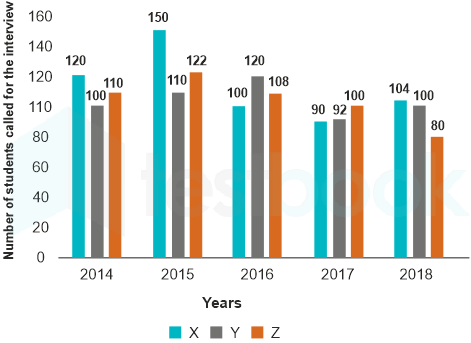
Observe the bar graph below and answer the question. The bar graph shows the data for the years 2014 to 2018 of the number of students who were called for a job interview of a certain company. The interview was for the post of HR and the students were from three different institutes X, Y and Z.
What is the ratio of the average number of students called for the interview from the institute X during the period 2014 to 2016 to the average number of students from the institute Y called for the interview during the same period?
Number of students called for interview (from graph):
Institute X (2014-2016): 120, 150, 100
Institute Y (2014-2016): 100, 110, 120
Formula used:
Average = Sum of values / Number of values
Ratio = Average of X / Average of Y
Calculations:
Average for X (2014-2016) = (120 + 150 + 100) / 3
⇒ Average for X = 370 / 3
Average for Y (2014-2016) = (100 + 110 + 120) / 3
⇒ Average for Y = 330 / 3
Ratio = 370 / 330
⇒ Ratio = 37:33
∴ The ratio is approximately 37:33.
Question 87
Observe the table below and answer the question. The table shows the number of candidates who attended interviews from 2012 to 2016, for the post of PO in State Bank of India from five different states of India.
States →
Bihar
UP
M.P
Punjab
Kerala
Years ↓
2012
410
300
250
280
440
2013
500
400
280
320
400
2014
450
450
240
260
350
2015
320
500
400
400
380
2016
500
430
540
350
420
What is the average number of candidates who attended the interview from the state of Kerala for all the years?
Number of candidates who attended the interview from Kerala:
2012: 440
2013: 400
2014: 350
2015: 380
2016: 420
Formula used:
Average = Sum of values / Number of years
Calculations:
Sum = 440 + 400 + 350 + 380 + 420
⇒ Sum = 1990
Average = 1990 / 5
⇒ Average = 398
∴ The average number of candidates from Kerala for all the years is 398.
Question 88
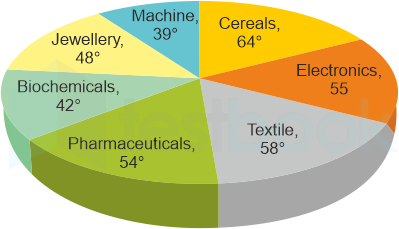
Observe the pie chart below and answer the question. The pie chart shows the spending of a country on importing various products from neighbouring countries during a particular year.
If the total amount spent on import during the year was ₹8 crore, then what was the approximate amount spent on textile and cereals?
Amount spent on an item = (Item angle / Total angle) × Total amount spent
Calculations:
Textile amount = (58 / 360) × 8 crore
⇒ Textile amount = 1.29 crore
Cereals amount = (64 / 360) × 8 crore
⇒ Cereals amount = 1.42 crore
Total amount spent on textile and cereals = 1.29 + 1.42
⇒ Total = 2.71 crore
∴ The approximate amount spent on textile and cereals is ₹2.71 crore.
Question 89
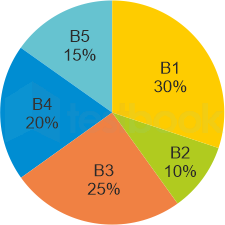
Observe the pie chart below and answer the question. The pie-chart shows the percentage distribution of the sales of school bags from five branches B1, B2, B3, B4 and B5 of a company.
What is the central angle of the sector corresponding to the sales of school bags from branch B3 of the company?
If a cube having a side of 8 cm is divided into smaller cubes each having a side of 2 cm, then what will be the total number of smaller cubes each having a side of 2 cm?
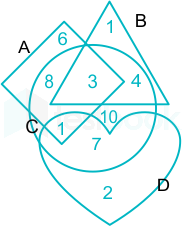
The following figure is a combination of 4 figures, A (rhombus), B (triangle), C (circle) and D (heart). Figure A represents the number of people who like to read book W. Figure B represents people who like to read book X. Figure C and D represent people who like to read books Y and Z respectively.
How many people like to read either book W or book X but not both?
1. Some thrones are both starks and dragons. - This is not necessarily true since we know some starks are thrones, but we can't definitively conclude that any of those thrones are dragons.
2. Some starks are neither thrones nor dragons. - This is possible; there could be starks that do not fall into either category.
3. Some thrones are not dragons but they are starks. - This can be concluded since we know some starks are thrones and not all starks are dragons.
4. All starks are either thrones or dragons. - This cannot be concluded based on the statements given; we only know that some starks are thrones, not that all starks are covered by these two categories.
So, "All starks are either thrones or dragons" CANNOT be concluded from the statements.
Hence, the correct answer is "All starks are either thrones or dragons".