Previous Year Paper

RRB NTPC CBT-I Official Paper (Held On: 8 Mar 2021 Shift 2) (Previous Year Paper)

Held in 2021

100 questions90 minutes
With answers
Free

Paper last updated:

Practise under exam conditions

Take this paper as a timed mock test. Review your answers after you submit.

Attempt timed test

Questions & answers

Read the paper at your pace. Open an explanation when you need it.

Question 1

Which among the following countries quit "UNESCO" in 2019?

  1. AOption (a)

    USA & Russia

  2. BOption (b)

    UAE & Libya

  3. COption (c)

    Israel & USA

  4. DOption (d)

    Israel & Iran

View answer & explanation

Correct answer

Answer: (c)C.

Israel & USA

Why this answer is correct

The correct answer is Israel & USA.

Key Points

  • In 2019, both Israel and the United States officially quit UNESCO.
  • The decision to withdraw was primarily influenced by the perception that UNESCO exhibited anti-Israel bias.
  • Both countries had announced their intention to leave in 2017, with the withdrawal becoming effective at the end of 2018, officially recognized in 2019.
  • The departure marked a significant shift in their engagement with the UN cultural agency, impacting UNESCO's funding and geopolitical dynamics.

Additional Information

  • UNESCO
  • UNESCO stands for the United Nations Educational, Scientific and Cultural Organization.
  • It was established in 1945 with the aim of promoting peace and security through international collaboration in education, science, culture, and communication.
  • UNESCO's activities include World Heritage Site designation, the promotion of cultural diversity, and the facilitation of scientific research.
  • It operates globally, with 193 member states working together to foster collaboration and knowledge sharing.
  • Reasons for Withdrawal
  • Both the USA and Israel cited a perceived anti-Israel bias in UNESCO's decisions and resolutions.
  • One of the key points of contention was the designation of Hebron and the Tomb of the Patriarchs as Palestinian World Heritage sites, which both nations viewed as an affront to Jewish historical claims.
  • Financial implications also played a role. The USA had previously suspended funding to UNESCO in 2011 after the organization admitted Palestine as a full member.
  • Impact of the Withdrawal
  • The withdrawal of the USA and Israel from UNESCO resulted in a significant reduction in funding, given that the USA was one of the largest contributors.
  • This reduction in funding affected various UNESCO programs and initiatives worldwide.
  • The departure also highlighted the broader geopolitical tensions influencing international organizations and their operations.

Question 2

What kind of storage is RAM?

  1. AOption (a)

    Tertiary

  2. BOption (b)

    Secondary

  3. COption (c)

    Primary

  4. DOption (d)

    Offline

View answer & explanation

Correct answer

Answer: (c)C.

Primary

Why this answer is correct

The correct answer is Primary.

Key Points

  • RAM (Random Access Memory) is a type of primary storage in a computer system, which means it is directly accessible by the CPU.
  • RAM is used to store data and machine code currently being used, allowing for quick read and write access.
  • It is volatile memory, meaning it loses its contents when the power is turned off.
  • Primary storage like RAM is crucial for the system's performance as it determines the speed and efficiency of task execution.

Additional Information

  • Tertiary Storage
  • Tertiary storage involves storage devices like tape libraries or optical jukeboxes, which are used for large volumes of data that are not frequently accessed.
  • It is slower and less expensive compared to primary and secondary storage, typically used for archival and backup purposes.
  • Secondary Storage
  • Secondary storage includes devices like hard drives, SSDs, and USB drives, which are non-volatile and used for storing data long-term.
  • This type of storage is slower than primary storage but offers higher capacity for data storage.
  • Primary Storage
  • Primary storage, such as RAM and cache memory, is directly accessible by the CPU.
  • It is faster but more expensive compared to secondary and tertiary storage, and is used to store data that is actively being processed.
  • Offline Storage
  • Offline storage refers to storage media that must be manually connected or inserted into a system, such as external hard drives, CDs, or DVDs.
  • It is often used for data backup and transfer purposes.

Question 3

If x = 2 + √5, then the value of (x−1x)3{\left( {x - \frac{1}{x}} \right)^3}  is:

  1. AOption (a)

    8

  2. BOption (b)

    64

  3. COption (c)

    2√5

  4. DOption (d)

    125

View answer & explanation

Correct answer

Answer: (b)B.

64

Why this answer is correct

Shortcut Trick

If x = √a + √b and a − b = 1, then 1/x = √a − √b.

Here x = √5 + 2, and (√5)2 − 22 = 5 − 4 = 1.

⇒ 1/x = √5 − 2

⇒ x − 1/x = (√5 + 2) − (√5 − 2) = 4

⇒ (x − 1/x)3 = 43 = 64

∴ The correct answer is 64.

Alternate Method

Given:

x = 2 + √5

To find:

(x − 1/x)3

Calculations:

⇒ 1/x = 1 / (2 + √5)

To rationalize the denominator, multiply the numerator and denominator by the conjugate (2 − √5):

⇒ 1/x = (2 − √5) / [(2 + √5)(2 − √5)]

Using the algebraic identity (a + b)(a − b) = a2 − b2:

⇒ 1/x = (2 − √5) / [22 − (√5)2]

⇒ 1/x = (2 − √5) / (4 − 5)

⇒ 1/x = (2 − √5) / (−1)

⇒ 1/x = −2 + √5

⇒ 1/x = √5 − 2

Now, calculate the value of (x − 1/x):

⇒ x − 1/x = (2 + √5) − (√5 − 2)

⇒ x − 1/x = 2 + √5 − √5 + 2

⇒ x − 1/x = 4

Finally, compute the cube of the result:

⇒ (x − 1/x)3 = 43

⇒ (x − 1/x)3 = 64

∴ The correct answer is 64.

Additional Information

Rationalization of Surds

To rationalize a fraction with a denominator of the form √a + √b, multiply both numerator and denominator by its conjugate √a − √b to eliminate the square root from the base.

Difference of Squares Identity

The product of the sum and difference of two terms is given by the algebraic formula: (a + b)(a − b) = a2 − b2.

Reciprocal Shortcut for Surds

If x = √a + √b and the difference between their squares is 1 (i.e., a − b = 1), then its reciprocal can be directly written as 1/x = √a − √b.

Question 4

What is the contribution of nuclear power in India to the country's overall electricity generation supply?

  1. AOption (a)

    20 - 25%

  2. BOption (b)

    35 - 40%

  3. COption (c)

    Less than 5%

  4. DOption (d)

    10 - 15%

View answer & explanation

Correct answer

Answer: (c)C.

Less than 5%

Why this answer is correct

The correct answer is Less than 5%.

Key Points

  • Nuclear power contributes less than 5% to India's total electricity generation.
  • This is relatively small compared to other sources such as coal, which forms a major part of the energy mix.
  • India has been expanding its nuclear power infrastructure but it still forms a minor part of the energy portfolio.
  • Nuclear energy is considered a clean energy source as it does not produce greenhouse gases during operation.

Additional Information

  • Nuclear Power
  • Nuclear power is the use of nuclear reactions that release nuclear energy to generate heat, which most frequently is then used in steam turbines to produce electricity in a nuclear power plant.
  • The term includes nuclear fission, nuclear decay, and nuclear fusion.
  • India's nuclear power plants are primarily located in states like Maharashtra, Tamil Nadu, and Rajasthan.
  • The Nuclear Power Corporation of India Limited (NPCIL) is the government-owned corporation responsible for the generation of nuclear power for electricity.
  • Electricity Generation in India
  • India's electricity generation mix is heavily reliant on coal, which accounts for around 70% of the total generation.
  • Renewable energy sources such as wind, solar, and hydro also contribute significantly.
  • Natural gas and diesel are other sources of electricity generation, though they form a smaller portion compared to coal and renewables.
  • Efforts are ongoing to increase the share of renewable energy in the generation mix to reduce carbon emissions and dependence on fossil fuels.
  • Environmental Impact of Nuclear Energy
  • Nuclear energy is considered environmentally friendly because it produces no greenhouse gas emissions during operation.
  • However, nuclear waste disposal and the potential for accidents (e.g., Fukushima, Chernobyl) are major concerns.
  • The spent fuel from nuclear reactors is highly radioactive and requires secure, long-term storage solutions.
  • Despite these challenges, nuclear energy remains a key component in the global strategy to combat climate change due to its low carbon footprint.

Question 5

Which of the following pairs (Species - Category) is correct with respect to India?

  1. AOption (a)

    Asiatic Elephant - Endemic

  2. BOption (b)

    Black Buck - Rare

  3. COption (c)

    Great Hornbill - Vulnerable

  4. DOption (d)

    Nicobar Pigeon - Endangered

View answer & explanation

Correct answer

Answer: (c)C.

Great Hornbill - Vulnerable

Why this answer is correct

The correct answer is Great Hornbill - Vulnerable.

Key Points

  • The Great Hornbill (Buceros bicornis) is classified as Vulnerable on the IUCN Red List of Threatened Species.
  • It is found in the forests of India and Southeast Asia, with India being one of its significant habitats.
  • The species faces threats from habitat loss due to deforestation and hunting for its casque and feathers.
  • Conservation efforts are being made to protect its habitat and mitigate hunting pressures through wildlife protection laws and awareness campaigns.

Additional Information

  • IUCN Red List of Threatened Species
  • The International Union for Conservation of Nature (IUCN) Red List is a critical indicator of the health of the world's biodiversity.
  • It provides information and analyses on the status, trends, and threats to species in order to inform and catalyze action for biodiversity conservation.
  • Species are classified into categories such as Extinct, Extinct in the Wild, Critically Endangered, Endangered, Vulnerable, Near Threatened, and Least Concern based on their risk of extinction.
  • Endemic Species
  • Endemic species are those that are found in a particular region or location and nowhere else in the world.
  • For example, the Asiatic Lion is endemic to the Gir Forest in India.
  • Rare Species
  • Rare species are those with small population sizes and are not necessarily at immediate risk of extinction but could become endangered in the near future.
  • Conservation efforts are essential to ensure that these species do not move towards becoming endangered or extinct.
  • Vulnerable Species
  • Vulnerable species are those that are at a high risk of endangerment in the wild.
  • This category is assigned based on factors such as rapid population decline, limited geographic range, or other threats.
  • Endangered Species
  • Endangered species are those that are at a very high risk of extinction in the wild.
  • These species require significant conservation efforts to prevent their extinction.

Question 6

Select the term that will come next in the following series.

AZYB, EVUF, IRQJ, MNMN, ?

  1. AOption (a)

    QJIR

  2. BOption (b)

    QJIS

  3. COption (c)

    QIJR

  4. DOption (d)

    PJIR

View answer & explanation

Correct answer

Answer: (a)A.

QJIR

Why this answer is correct

The logic followed here is:

Hence, "Option 1" is the correct answer.

Question 7

The product of the LCM and HCF of two positive numbers is 28 and their difference is 3. The numbers are:

  1. AOption (a)

    4 and 7

  2. BOption (b)

    3 and 5

  3. COption (c)

    5 and 6

  4. DOption (d)

    7 and 5

View answer & explanation

Correct answer

Answer: (a)A.

4 and 7

Why this answer is correct

Given:

LCM × HCF = 28

Difference of numbers = 3

Formula Used:

Let the numbers be a and b.

a - b = 3

LCM(a, b) × HCF(a, b) = a × b

Calculation:

Let the numbers be a and b such that a > b.

Given that a - b = 3

Also, a × b = 28 (since LCM × HCF = 28)

Substitute a = b + 3 into the equation a × b = 28:

(b + 3) × b = 28

b2 + 3b = 28

b2 + 3b - 28 = 0

Solving the quadratic equation b2 + 3b - 28 = 0:

Using formula,

x=−b±b2−4ac2ax = {-b \pm \sqrt{b^2-4ac} \over 2a}

b = [-3 ± √(32 - 4 × 1 × -28)] / 2 × 1

b = [-3 ± √(9 + 112)] / 2

b = [-3 ± √121] / 2

b = [-3 ± 11] / 2

⇒ b = (11 - 3) / 2 or b = (-11 - 3) / 2

⇒ b = 8 / 2 or b = -14 / 2

⇒ b = 4 or b = -7 (not possible as b must be positive)

Thus, b = 4.

Therefore, a = b + 3 = 4 + 3 = 7.

The numbers are 4 and 7.

Question 8

For two events A and B, P(A) = 13 \frac{1}{3}, P(B) = 14 \frac{1}{4} and P(A ∪ B) = 12 \frac{1}{2}.  P(AB)=?P\left( {\frac{A}{B}} \right) = ?

  1. AOption (a)

    13\frac{1}{3}

  2. BOption (b)

    14\frac{1}{4}

  3. COption (c)

    12\frac{1}{2}

  4. DOption (d)

    1

View answer & explanation

Correct answer

Answer: (a)A.

13\frac{1}{3}

Why this answer is correct

Given:

P(A) = (1/3)

P(B) = (1/4)

P(A ∪ B) = (1/2)

Formula Used:

P(A ∪ B) = P(A) + P(B) - P(A ∩ B)

P(A ∩ B) = P(A) + P(B) - P(A ∪ B)

P(A|B) = P(A ∩ B) / P(B)

Calculation:

P(A ∪ B) = P(A) + P(B) - P(A ∩ B)

(1/2) = (1/3) + (1/4) - P(A ∩ B)

(1/2) = (4/12) + (3/12) - P(A ∩ B)

(1/2) = (7/12) - P(A ∩ B)

⇒ P(A ∩ B) = (7/12) - (6/12)

⇒ P(A ∩ B) = (1/12)

P(A|B) = P(A ∩ B) / P(B)

⇒ P(A|B) = (1/12) / (1/4)

⇒ P(A|B) = (1/12) × (4/1)

⇒ P(A|B) = (4/12)

⇒ P(A|B) = (1/3)

The correct answer is option 1.

Question 9

The value of 12+[(25÷15)−(14×8)]−9×412 + \left[ {\left( {25 \div \frac{1}{5}} \right) - \left( {14 \times 8} \right)} \right] - 9 \times 4  is:

  1. AOption (a)

    -11

  2. BOption (b)

    13

  3. COption (c)

    25

  4. DOption (d)

    -4

View answer & explanation

Correct answer

Answer: (a)A.

-11

Why this answer is correct

Given:

Expression: 12 + [ {( {25 ÷ (1)/(5)} ) - ( {14 × 8} )} ] - 9 × 4

Formula Used:

Order of Operations (BODMAS/BIDMAS): Brackets, Orders (i.e. powers and square roots, etc.), Division and Multiplication, Addition and Subtraction.

Calculation:

Step 1: Calculate inside the brackets first:

25 ÷ (1/5) = 25 × 5 = 125

14 × 8 = 112

Now, substitute these values back into the expression:

⇒ 12 + [ {125 - 112} ] - 9 × 4

Step 2: Simplify inside the brackets:

⇒ 12 + [13] - 9 × 4

Step 3: Perform multiplication:

⇒ 12 + 13 - 36

Step 4: Perform addition and subtraction:

⇒ 25 - 36

⇒ -11

The correct answer is option 1: -11

Question 10

"Rail Sahyog web portal" launched by Indian railway is meant for:

  1. AOption (a)

    Grievance redressal

  2. BOption (b)

    Provide basic amenities i.e. toilet, dustbin etc.

  3. COption (c)

    Ticket Reservation

  4. DOption (d)

    Real-time train running status

View answer & explanation

Correct answer

Answer: (b)B.

Provide basic amenities i.e. toilet, dustbin etc.

Why this answer is correct

The correct answer is Provide basic amenities i.e. toilet, dustbin etc..

Key Points

  • The "Rail Sahyog" web portal was launched by the Indian Railways to provide a platform for the corporates and PSUs to contribute towards the creation and maintenance of passenger amenities at railway stations.
  • It focuses on providing basic amenities like toilets, dustbins, benches, and water kiosks at railway stations across India.
  • The portal aims to enhance the passenger experience by improving the infrastructure and cleanliness at railway stations.
  • It allows corporate entities to undertake CSR (Corporate Social Responsibility) activities in collaboration with Indian Railways for the betterment of railway infrastructure.

Additional Information

  • Grievance Redressal
  • Grievance redressal mechanisms are used to address complaints and grievances from the public regarding services provided by an organization.
  • Indian Railways has separate portals and helplines like the 'RailMadad' app for addressing grievances and complaints.
  • Ticket Reservation
  • Ticket reservation systems allow passengers to book tickets for train journeys in advance.
  • Indian Railways uses platforms like IRCTC (Indian Railway Catering and Tourism Corporation) for ticket booking and reservation services.
  • Real-time Train Running Status
  • Real-time train running status provides live updates on the current location and expected arrival/departure times of trains.
  • Platforms like 'NTES' (National Train Enquiry System) and various mobile applications offer real-time train tracking services.

Question 11

The sum of the digits of the smallest number which, when divided by 18, 21, 25 and 39 leaves a remainder of 3 in each case is:

  1. AOption (a)

    21

  2. BOption (b)

    39

  3. COption (c)

    18

  4. DOption (d)

    25

View answer & explanation

Correct answer

Answer: (a)A.

21

Why this answer is correct

Shortcut Trick

The smallest required number N = LCM(18, 21, 25, 39) + 3

LCM(18, 21, 25, 39) = 2 × 32 × 52 × 7 × 13 = 40950

N = 40950 + 3 = 40953

Sum of digits of N = 4 + 0 + 9 + 5 + 3 = 21

∴ The correct answer is 21.

Alternate Method

Given:

Divisors = 18, 21, 25, and 39

Remainder in each case = 3

Concept Used:

The smallest number which, when divided by a, b, c leaves a remainder r in each case is given by the formula: LCM(a, b, c) + r.

Calculations:

⇒ Prime factorization of 18 = 2 × 32

⇒ Prime factorization of 21 = 3 × 7

⇒ Prime factorization of 25 = 52

⇒ Prime factorization of 39 = 3 × 13

⇒ LCM = Highest powers of all prime factors = 2 × 32 × 52 × 7 × 13

⇒ LCM = 2 × 9 × 25 × 7 × 13

⇒ LCM = 50 × 9 × 91

⇒ LCM = 450 × 91 = 40950

⇒ Required number = 40950 + 3 = 40953

⇒ Sum of digits of the number = 4 + 0 + 9 + 5 + 3 = 21

∴ The correct answer is 21.

Additional Information

LCM and Remainder Rule 1

The smallest number leaving a remainder 'r' when divided by a, b, c is calculated as LCM(a, b, c) + r.

LCM and Remainder Rule 2

The smallest number leaving remainders x, y, z when divided by a, b, c respectively is LCM(a, b, c) − K, where K = (a − x) = (b − y) = (c − z).

HCF and Remainder Rule

The largest number dividing a, b, c leaving a remainder 'r' in each case is calculated as HCF(a−r, b−r, c−r).

Divisibility by 9

A number is divisible by 9 if the sum of its digits is a multiple of 9. The remainder when any number is divided by 9 is exactly equal to the remainder when its sum of digits is divided by 9.

Question 12

Which of the following rivers is NOT the tributary of Ganga?

  1. AOption (a)

    Yamuna

  2. BOption (b)

    Son

  3. COption (c)

    Gomati

  4. DOption (d)

    Indravati

View answer & explanation

Correct answer

Answer: (d)D.

Indravati

Why this answer is correct

The correct answer is Indravati.

Key Points

  • Indravati is a tributary of the Godavari River, not the Ganga.
  • The Indravati River originates from the Dandakaranya range in the Kalahandi district of Odisha.
  • It flows through the states of Odisha, Chhattisgarh, and Maharashtra before merging with the Godavari River.
  • The river is known for its significant contribution to the Godavari basin and serves as an important water source for the regions it traverses.

Additional Information

  • Yamuna
  • The Yamuna is the second-largest tributary of the Ganga and is one of the most important rivers in northern India.
  • It originates from the Yamunotri Glacier in the Himalayas.
  • The river passes through several states, including Uttarakhand, Himachal Pradesh, Haryana, Delhi, and Uttar Pradesh, before merging with the Ganga at Prayagraj (Allahabad).
  • Son
  • The Son River is a major southern tributary of the Ganga.
  • It originates from the Amarkantak Plateau in Madhya Pradesh.
  • The river flows through Madhya Pradesh, Uttar Pradesh, and Bihar before joining the Ganga near Patna.
  • Gomati
  • The Gomati River is another important tributary of the Ganga.
  • It originates from Gomat Taal (Fulhar Lake) in Pilibhit, Uttar Pradesh.
  • The river flows entirely through Uttar Pradesh, passing through cities like Lucknow, before merging with the Ganga near Saidpur, Jaunpur district.
  • Indravati
  • The Indravati River is a significant tributary of the Godavari River.
  • It originates from the Dandakaranya range in Kalahandi district, Odisha.
  • The river flows through Odisha, Chhattisgarh, and Maharashtra before joining the Godavari River at Bhadrachalam in Telangana.
  • Indravati is known for its scenic beauty and hydroelectric projects, like the Indravati Dam.

Question 13

Who is the author of the book "Economic Nightmare of India: its cause and cure"?

  1. AOption (a)

    Charan Singh

  2. BOption (b)

    Amiya Kumar Bagchi

  3. COption (c)

    Abhijit Banerjee

  4. DOption (d)

    Raghuram Rajan

View answer & explanation

Correct answer

Answer: (a)A.

Charan Singh

Why this answer is correct

The correct answer is Charan Singh.

Key Points

  • Charan Singh was a prominent Indian politician and served as the 5th Prime Minister of India.
  • He is known for his significant contributions to the agricultural sector and for being a strong advocate of farmers' rights.
  • Charan Singh authored the book "Economic Nightmare of India: Its Cause and Cure" to address the economic issues faced by India and propose solutions.
  • His insights in the book are based on his extensive experience and deep understanding of India's socio-economic conditions, particularly in rural areas.

Additional Information

  • Economic Policies:
  • Economic policies refer to the actions that governments take in the economic field. It covers the systems for setting levels of taxation, government budgets, the money supply, and interest rates.
  • Charan Singh's book critiques existing economic policies and offers alternative approaches to improve India's economic situation.
  • Agricultural Sector:
  • The agricultural sector is a crucial part of India's economy, providing employment to a significant portion of the population.
  • Charan Singh, being an advocate for farmers, addressed the challenges faced by this sector and proposed measures to enhance productivity and sustainability.
  • Rural Development:
  • Rural development involves improving the quality of life and economic well-being of people living in relatively isolated and sparsely populated areas.
  • In his book, Charan Singh emphasized the importance of rural development for the overall progress of the country.
  • Economic Reforms:
  • Economic reforms refer to changes in policies and regulations to improve economic efficiency and growth.
  • Charan Singh's work includes discussions on necessary economic reforms to address India's economic challenges effectively.

Question 14

A maximum of how money pieces of 34.6 cm can be cut from a 658 cm long rod?

  1. AOption (a)

    21

  2. BOption (b)

    19

  3. COption (c)

    15

  4. DOption (d)

    17

View answer & explanation

Correct answer

Answer: (b)B.

19

Why this answer is correct

Given:

Length of the rod = 658 cm.

Length of each piece to be cut = 34.6 cm.

Formula Used:

Maximum number of pieces = Total length of the rod / Length of each piece

Calculation:

Maximum number of pieces = 658 / 34.6

⇒ Maximum number of pieces = 65834.6\frac{658}{34.6}

⇒ Maximum number of pieces = 19

The maximum number of pieces that can be cut from a 658 cm long rod is 19.

Question 15

If x + y = 9 and xy = 18, then the value of x2 + y2 is:

  1. AOption (a)

    36

  2. BOption (b)

    18

  3. COption (c)

    45

  4. DOption (d)

    12

View answer & explanation

Correct answer

Answer: (c)C.

45

Why this answer is correct

Given:

If x + y = 9 and xy = 18

Formula Used:

x2+y2=(x+y)2−2xyx^2 + y^2 = (x + y)^2 - 2xy

Calculation:

x + y = 9

xy = 18

x2+y2=(x+y)2−2xyx^2 + y^2 = (x + y)^2 - 2xy

⇒ x2+y2=92−2×18x^2 + y^2 = 9^2 - 2 × 18

⇒ x2 + y2 = 81 - 36

⇒ x2 + y2 = 45

The value of x2 + y2 is 45.

Question 16

If 5n=625\sqrt {{5^n}} = 625, then the value of n is:

  1. AOption (a)

    9

  2. BOption (b)

    6

  3. COption (c)

    8

  4. DOption (d)

    7

View answer & explanation

Correct answer

Answer: (c)C.

8

Why this answer is correct

Given:

5n=625\sqrt {{5^n}} = 625

Formula Used:

x=x1/2\sqrt{x} = x^{1/2}

a^m = b \implies m = \log_a b

Calculation:

5n=625\sqrt {{5^n}} = 625

(5n)(1/2) = 625

5(n/2) = 625

625 = 54

So, 5(n/2) = 54

⇒ n/2 = 4

⇒ n = 8

The value of n is 8.

Question 17

Who among the following has been conferred the Padma Vibhushan award in 2021 in the field of medicine?

  1. AOption (a)

    Sudarshan Sahoo

  2. BOption (b)

    B Monaappa Hegde

  3. COption (c)

    B. B. Lal

  4. DOption (d)

    Narinder Singh Kapany

View answer & explanation

Correct answer

Answer: (b)B.

B Monaappa Hegde

Why this answer is correct

The correct answer is B. Monaappa Hegde.

Key Points

  • Dr. B. Monaappa Hegde is a renowned medical professional recognized for his contributions to the field of medicine.
  • He was conferred with the Padma Vibhushan award in 2021, which is one of the highest civilian awards in India.
  • The Padma Vibhushan is awarded for "exceptional and distinguished service" in any field including service rendered by Government servants.
  • Dr. Hegde has significantly contributed to the advancement of medical science and healthcare in India.

Additional Information

  • Padma Awards
  • The Padma Awards are one of the highest civilian honors of India announced annually on the eve of Republic Day.
  • They are given in three categories: Padma Vibhushan (for exceptional and distinguished service), Padma Bhushan (distinguished service of higher order), and Padma Shri (distinguished service).
  • The awards seek to recognize achievements in all fields of activities or disciplines where an element of public service is involved.
  • The nomination process is open to the public, and the awards are conferred by the President of India.
  • Medical Contributions
  • Contributions to the field of medicine include advancements in medical research, improved patient care, and innovations in medical treatments.
  • Recipients of the Padma Vibhushan in medicine often have a significant impact on public health policies and practices.
  • These contributions can also include the development of new medical procedures, therapies, or technologies.
  • Other Notable Recipients in 2021
  • Sudarshan Sahoo - He was awarded the Padma Vibhushan for his contributions to art.
  • B. B. Lal - He was recognized for his work in archaeology.
  • Narinder Singh Kapany - Known as the father of fiber optics, he was honored for his contributions to science and technology.

Question 18

If 1+x121=1211\sqrt {1 + \frac{x}{{121}}} = \frac{{12}}{{11}}, then the value of x is;

  1. AOption (a)

    48

  2. BOption (b)

    23

  3. COption (c)

    26

  4. DOption (d)

    75

View answer & explanation

Correct answer

Answer: (b)B.

23

Why this answer is correct

Given:

1+x121=1211\sqrt {1 + \frac{x}{{121}}} = \frac{{12}}{{11}}

Formula Used:

Squaring both sides of the equation to eliminate the square root.

Calculation:

Squaring both sides:

⇒ (1+x121)2=(1211)2\left(\sqrt{1 + \frac{x}{121}}\right)^2 = \left(\frac{12}{11}\right)^2

⇒ 1+x121=1441211 + \frac{x}{121} = \frac{144}{121}

Subtract 1 from both sides:

⇒ x121=144121−1\frac{x}{121} = \frac{144}{121} - 1

Express 1 as a fraction with the same denominator:

⇒ x121=144121−121121\frac{x}{121} = \frac{144}{121} - \frac{121}{121}

⇒ x121=23121\frac{x}{121} = \frac{23}{121}

Multiply both sides by 121:

⇒ x = 23

The value of x is 23.

Question 19

The circumference of a circle is equal to the perimeter of an equilateral triangle. If the radius of the circle is 21 cm. What is the length of the side of the equilateral triangle?

  1. AOption (a)

    55 cm

  2. BOption (b)

    33 cm

  3. COption (c)

    22 cm

  4. DOption (d)

    44 cm

View answer & explanation

Correct answer

Answer: (d)D.

44 cm

Why this answer is correct

Given:

Radius of the circle = 21 cm

The circumference of the circle is equal to the perimeter of an equilateral triangle.

Formula Used:

Circumference of a circle = 2πr

Perimeter of an equilateral triangle = 3 × side

Calculation:

The circumference of the circle: ⇒ 2π × 21

Using π ≈ 22/7:

⇒ 2 × (22/7) × 21

⇒ 2 × 22 × 3

⇒ 132 cm

The perimeter of the equilateral triangle is equal to the circumference of the circle:

⇒ 3 × side = 132

Solving for side:

⇒ side = 132 / 3

⇒ side = 44 cm

The length of the side of the equilateral triangle is 44 cm.

Question 20

Name the robot introduced by Chennai traffic police for traffic management in January 2019?

  1. AOption (a)

    Roadeo

  2. BOption (b)

    KITT

  3. COption (c)

    Robocop

  4. DOption (d)

    Gerty

View answer & explanation

Correct answer

Answer: (a)A.

Roadeo

Why this answer is correct

The correct answer is Roadeo.

Key Points

  • Roadeo is a robot introduced by the Chennai traffic police for traffic management.
  • It was deployed in January 2019 to help manage traffic and assist pedestrians.
  • The robot is designed to enhance the efficiency of traffic management in the city.
  • Roadeo can interact with people and provide important traffic-related information.

Additional Information

  • Robots in Traffic Management:
  • Robots like Roadeo are used to assist traffic police in managing traffic congestion and ensuring road safety.
  • They are equipped with cameras, sensors, and communication systems to monitor and manage traffic flow.
  • Traffic Management:
  • It involves the efficient movement of vehicles and pedestrians to ensure safety and reduce congestion.
  • Advanced technologies such as AI, IoT, and robotics are increasingly being used for better traffic management.
  • Chennai Traffic Police:
  • The Chennai traffic police are responsible for maintaining traffic discipline in the city of Chennai.
  • They implement various measures and use technology to manage the growing traffic in the city.
  • Technological Innovations:
  • Technological innovations like Roadeo help address urban challenges such as traffic congestion.
  • These innovations aim to improve the quality of life by providing smart solutions to everyday problems.

Question 21

Which state government declared "Pakke Paga Hornbill Festival" as a state festival?

  1. AOption (a)

    Arunachal Pradesh

  2. BOption (b)

    Meghalaya

  3. COption (c)

    Andhra Pradesh

  4. DOption (d)

    Odisha

View answer & explanation

Correct answer

Answer: (a)A.

Arunachal Pradesh

Why this answer is correct

The correct answer is Arunachal Pradesh.

Key Points

  • The Pakke Paga Hornbill Festival is an annual event celebrated in the Pakke Tiger Reserve in Arunachal Pradesh.
  • The festival highlights the rich biodiversity and cultural heritage of Arunachal Pradesh and aims to promote conservation.
  • It was declared a state festival by the Arunachal Pradesh government to boost eco-tourism and environmental awareness.
  • The festival features activities such as bird-watching, tribal dances, and local crafts, providing an immersive experience of the region's natural and cultural wealth.

Additional Information

  • Pakke Tiger Reserve
  • Located in the East Kameng district of Arunachal Pradesh, Pakke Tiger Reserve is known for its rich biodiversity.
  • The reserve is home to several endangered species including the Bengal tiger, Asian elephant, and various hornbill species.
  • Pakke Tiger Reserve is a significant area for the conservation of hornbills, which are culturally important to the local Nyishi tribe.
  • Hornbills
  • Hornbills are large, long-lived birds characterized by their long, down-curved bill which is frequently brightly colored.
  • They play a crucial role in the ecosystem as seed dispersers, aiding in forest regeneration.
  • In Arunachal Pradesh, hornbills hold cultural significance and are often featured in local folklore and traditions.
  • Eco-tourism
  • Eco-tourism is a form of sustainable travel that supports the conservation of natural areas and the well-being of local people.
  • It focuses on environmentally responsible travel to natural areas, promoting conservation efforts and providing educational experiences.
  • Eco-tourism initiatives like the Pakke Paga Hornbill Festival help raise awareness about the importance of preserving biodiversity.
  • Arunachal Pradesh
  • Arunachal Pradesh is a state in Northeast India known for its pristine landscapes, diverse tribes, and rich cultural heritage.
  • It is bordered by Bhutan, China, and Myanmar, and features a range of ecosystems from the eastern Himalayas to tropical rainforests.
  • The state government actively promotes cultural festivals and eco-tourism to boost the local economy and conservation efforts.

Question 22

Select the term that will come next in the following series.

31J, 29F, 31M, 30A, 31M, 30J, ?

  1. AOption (a)

    29J

  2. BOption (b)

    31J

  3. COption (c)

    32P

  4. DOption (d)

    33K

View answer & explanation

Correct answer

Answer: (b)B.

31J

Why this answer is correct

The logic followed here is:

Hence, "Option 2" is the correct answer.

Question 23

Proposed Nuclear Power Plant will be established at _______ district of Madhya Pradesh.

  1. AOption (a)

    Mandla

  2. BOption (b)

    Khandwa

  3. COption (c)

    Neemach

  4. DOption (d)

    Betul

View answer & explanation

Correct answer

Answer: (a)A.

Mandla

Why this answer is correct

The correct answer is Mandla.

Key Points

  • The proposed nuclear power plant in Madhya Pradesh is set to be established in the Mandla district.
  • Mandla is known for its natural resources and has been identified as a suitable location for nuclear energy production.
  • The establishment of the nuclear power plant is expected to boost the local economy and provide job opportunities.
  • This project is part of India's strategy to increase its nuclear power capacity to meet its growing energy demands.

Additional Information

  • Nuclear Power in India
  • India is one of the few countries with nuclear power capabilities, which plays a significant role in its energy sector.
  • The Department of Atomic Energy (DAE) is responsible for nuclear technology development, including power generation.
  • Nuclear power is seen as a clean and efficient source of energy, crucial for reducing carbon emissions and dependency on fossil fuels.
  • India's nuclear power program includes both indigenous reactors and collaborations with other countries for advanced reactor technologies.
  • Benefits of Nuclear Power
  • Nuclear power provides a stable and reliable source of energy, unlike some renewable sources that can be intermittent.
  • It has a low carbon footprint compared to traditional fossil fuel-based power generation.
  • Advancements in nuclear technology continue to improve the safety and efficiency of nuclear reactors.
  • Nuclear energy can support large-scale industrial and urban development by providing consistent power supply.
  • Challenges of Nuclear Power
  • Safety concerns, including the risk of nuclear accidents, are a major challenge in the nuclear power industry.
  • Disposal of nuclear waste remains a critical issue due to its long-term environmental impact.
  • High initial costs for building nuclear power plants can be a financial burden.
  • Public perception and opposition to nuclear power can hinder the development of new projects.

Question 24

In Internet technology, what does DNS stand for?

  1. AOption (a)

    Divided Name System

  2. BOption (b)

    Dynamic Name System

  3. COption (c)

    Domain Name System

  4. DOption (d)

    Distributed Name System

View answer & explanation

Correct answer

Answer: (c)C.

Domain Name System

Why this answer is correct

The correct answer is Domain Name System.

Key Points

  • Domain Name System (DNS) is a hierarchical and decentralized naming system used to identify computers, services, and other resources reachable through the Internet or other Internet Protocol (IP) networks.
  • It translates more readily memorized domain names to the numerical IP addresses needed for locating and identifying computer services and devices with the underlying network protocols.
  • DNS is an essential component of the functionality of the Internet, as it provides a worldwide, distributed directory service.
  • It was introduced to provide an easier way to access websites without having to remember complex numeric IP addresses.

Additional Information

  • IP Address
  • An IP address is a unique string of characters that identifies each computer using the Internet Protocol to communicate over a network.
  • IP addresses are used to locate and identify a device on the network.
  • They come in two versions: IPv4 (e.g., 192.168.1.1) and IPv6 (e.g., 2001:0db8:85a3:0000:0000:8a2e:0370:7334).
  • Top-Level Domain (TLD)
  • A Top-Level Domain (TLD) is the last segment of the domain name, the part that follows immediately after the "dot" symbol.
  • Examples include .com, .org, .net, .edu, and country-specific TLDs like .in, .us, .uk.
  • DNS Server
  • A DNS server is a server that contains a database of public IP addresses and their associated hostnames, and in most cases, serves to resolve or translate those names to IP addresses as requested.
  • There are different types of DNS servers: primary, secondary, authoritative, and caching servers.
  • DNS Resolver
  • A DNS resolver, also known as a DNS lookup, is the process by which a DNS client (usually a web browser) requests the IP address associated with a domain name.
  • It is the starting point for any DNS query and is responsible for tracking down the requested information.

Question 25

Read the given statement and conclusions carefully and decide which of the conclusions logically follow(s) from the statement.

Statement:

The rapid growth in the consumption of petrol and diesel may lead to scarcity of fuel in near future.

Conslusions:

I. There will be only electric vehicles in the future

II. Other fuel options have to be created to tackle the problem of fuel scarcity.

  1. AOption (a)

    Both I and II follow.

  2. BOption (b)

    Only II follows.

  3. COption (c)

    Only I follows.

  4. DOption (d)

    Neither I nor II follows

View answer & explanation

Correct answer

Answer: (b)B.

Only II follows.

Why this answer is correct

Given,

Statement:

The rapid growth in the consumption of petrol and diesel may lead to scarcity of fuel in near future.

Conclusions:

I. There will be only electric vehicles in the future - False (Because, the statement does not provide any information regarding the complete transition to electric vehicles. It only mentions the potential scarcity of petrol and diesel.)

II. Other fuel options have to be created to tackle the problem of fuel scarcity - True (Because, the statement implies that due to the rapid consumption of petrol and diesel leading to scarcity, alternative fuel options would be necessary to address this issue.)

So, Only conclusion II follows.

Hence, the correct answer is "Option 2".

Question 26

Two boys Rishi and Vamsi start at the same time to ride from Lucknow to Kanpur that is 95 km away. Rishi travels 5 km/h slower than Vamsi. Vamsi reaches Kanpur and immediately start to travel back. On his return journey he meets Rishi who is 25 km away from Kanpur.

Find Rishi's speed.

  1. AOption (a)

    7 km/h

  2. BOption (b)

    5 km/h

  3. COption (c)

    8 km/h

  4. DOption (d)

    6 km/h

View answer & explanation

Correct answer

Answer: (a)A.

7 km/h

Why this answer is correct

Given:

Distance from Lucknow to Kanpur = 95 km

Rishi travels 5 km/h slower than Vamsi

Vamsi meets Rishi 25 km away from Kanpur on his return journey

Formula Used:

Speed = Distance / Time

Calculation:

Let Vamsi's speed be V + 5 km/h.

Then, Rishi's speed = V km/h

Distance traveled by Vamsi to Kanpur = 95 km

Total distance traveled by Vamsi = 95 + 25 = 120 km

Distance traveled by Rishi when they meet = 95 - 25 = 70 km

Time taken by Vamsi to travel 120 km on his return journey = 120/(V + 5) hours

Time taken for Rishi to travel 70 km = 70/V hours

Since time taken by both are same,

Using Speed = Distance / Time:

70 / v = 120/(V + 5)

70(V + 5) = 120V

120V - 70V = 350

50V = 350

V = 350/50 = 7 kmph

Rishi's speed = 7 km/h

The correct answer is option 1.

Question 27

Select the number than can replace the question mark (?) in the following series.

3, 3, 9, 15, 33, ?, 129, 255, 513, 1023

  1. AOption (a)

    89

  2. BOption (b)

    63

  3. COption (c)

    73

  4. DOption (d)

    97

View answer & explanation

Correct answer

Answer: (b)B.

63

Why this answer is correct

The logic followed here is:

Hence, "Option 2" is the correct answer.

Alternate Method

Question 28

Which of the following organisation completed the 50th year of their establishment in 2019?

  1. AOption (a)

    HAL

  2. BOption (b)

    BARC

  3. COption (c)

    DRDO

  4. DOption (d)

    ISRO

View answer & explanation

Correct answer

Answer: (d)D.

ISRO

Why this answer is correct

The correct answer is ISRO.

Key Points

  • The Indian Space Research Organisation (ISRO) was founded on August 15, 1969, by Dr. Vikram Sarabhai, who is considered the father of the Indian space program.
  • ISRO's primary objective is to advance space technology and use its applications for various national tasks.
  • Over the past 50 years, ISRO has achieved numerous milestones, including the Mars Orbiter Mission (Mangalyaan), which made India the first country to reach Mars orbit in its first attempt.
  • ISRO has developed several satellite launch vehicles like the Polar Satellite Launch Vehicle (PSLV) and the Geosynchronous Satellite Launch Vehicle (GSLV) to place satellites into orbit.

Additional Information

  • ISRO (Indian Space Research Organisation)
  • ISRO is the space agency of the Government of India, headquartered in Bengaluru.
  • It was established to harness space technology for national development while pursuing space science research and planetary exploration.
  • ISRO has launched various satellites for communication, earth observation, and navigation purposes.
  • Notable missions include the Chandrayaan missions to the Moon and the Mars Orbiter Mission (Mangalyaan).
  • HAL (Hindustan Aeronautics Limited)
  • Established in 1940, HAL is an Indian state-owned aerospace and defense company based in Bengaluru.
  • It is involved in the design, fabrication, and assembly of aircraft, jet engines, helicopters, and their components.
  • HAL has played a crucial role in the development of India's aerospace industry.
  • BARC (Bhabha Atomic Research Centre)
  • BARC is India's premier nuclear research facility headquartered in Mumbai.
  • It was established in 1954 and is responsible for carrying out research and development in nuclear science and engineering.
  • BARC's work includes the development of nuclear reactors, fuel cycle technologies, and radiation technologies.
  • DRDO (Defence Research and Development Organisation)
  • DRDO is an agency under the Ministry of Defence, responsible for developing technology for use by the Indian military.
  • Established in 1958, DRDO works on various areas including aeronautics, armaments, electronics, land combat engineering, and naval systems.
  • DRDO has been instrumental in developing indigenous defense technologies such as the Agni and Prithvi missile series.

Question 29

Select the Venn diagram that best represents the relationship between the following classes.

Coca Cola, Wine, Soft drink.

  1. AOption (a)

  2. BOption (b)

  3. COption (c)

  4. DOption (d)

View answer & explanation

Correct answer

Answer: (d)D.

Why this answer is correct

The diagram that best represents the relationship between Coca Cola, Wine, and Soft drink is shown below :

Coca cola is a subset of soft drink category.

Wine is different from soft drink category.

Hence, "Option 4" is the correct answer.

Question 30

India's first Genetic Bank for Wildlife Conservation is located at:

  1. AOption (a)

    Cochin

  2. BOption (b)

    Ahmedabad

  3. COption (c)

    Hyderabad

  4. DOption (d)

    Bengaluru

View answer & explanation

Correct answer

Answer: (c)C.

Hyderabad

Why this answer is correct

The correct answer is Hyderabad.

Key Points

  • India's first Genetic Bank for Wildlife Conservation is located in Hyderabad.
  • It is established at the Centre for Cellular and Molecular Biology (CCMB).
  • The genetic bank aims at preserving the genetic material of endangered species of animals, birds, and reptiles.
  • This initiative is crucial for biodiversity conservation and research in India.

Additional Information

  • Genetic Bank
  • A genetic bank is a type of biorepository which preserves genetic material.
  • In the context of wildlife, it involves the collection and storage of genetic material like DNA, RNA, and gametes (sperm and eggs).
  • This genetic material can be used for research, breeding programs, and to revive species that are endangered or extinct.
  • Centre for Cellular and Molecular Biology (CCMB)
  • Located in Hyderabad, CCMB is one of the premier research institutes in India.
  • It operates under the aegis of the Council of Scientific and Industrial Research (CSIR).
  • CCMB focuses on high-quality basic research in the areas of modern biology.
  • Biodiversity Conservation
  • Biodiversity conservation refers to the protection, preservation, management, and restoration of natural habitats and their ecological communities.
  • This includes efforts to protect species from extinction and to preserve genetic diversity within species.
  • It is essential for maintaining ecosystem services, resilience, and overall environmental health.
  • Endangered Species
  • Endangered species are those that are at risk of extinction due to a sudden rapid decrease in their population or a loss of their habitat.
  • Conservation efforts for endangered species include habitat preservation, legal protection, and breeding programs.
  • The genetic bank plays a pivotal role in these conservation efforts by preserving the genetic diversity of these species.

Question 31

Who is the first full time female Defence Minister of India?

  1. AOption (a)

    Nirmala Sitharaman

  2. BOption (b)

    Smriti Irani

  3. COption (c)

    Menaka Gandhi

  4. DOption (d)

    Sushma Swaraj

View answer & explanation

Correct answer

Answer: (a)A.

Nirmala Sitharaman

Why this answer is correct

The correct answer is Nirmala Sitharaman.

Key Points

  • Nirmala Sitharaman became the first full-time female Defence Minister of India on September 3, 2017.
  • Prior to her appointment as Defence Minister, she served as the Minister of State for Finance and Corporate Affairs.
  • She was also the second woman to hold the Defence Minister post after Indira Gandhi, who held the position as an additional charge.
  • Under her tenure, significant decisions were made regarding the modernization and strengthening of the Indian Defence forces.

Additional Information

  • Defence Minister of India
  • The Defence Minister is a high-ranking cabinet position in the Government of India, responsible for the country's defense and armed forces.
  • The role involves overseeing the Ministry of Defence and ensuring the security and defense readiness of the nation.
  • Key responsibilities include policy formulation, budget allocation, international defense cooperation, and modernization of the armed forces.
  • The Defence Minister plays a critical role in strategic decisions during conflicts and wars, as well as in peace-time defense planning.
  • Nirmala Sitharaman's Contributions
  • During her tenure, she took several initiatives to boost the morale and operational capabilities of the armed forces.
  • She focused on indigenization and self-reliance in defense production through initiatives like 'Make in India'.
  • Her period saw the approval of significant defense acquisitions and modernization projects.
  • She also emphasized the welfare of soldiers and veterans, introducing various schemes and policies for their benefit.
  • Other Notable Female Ministers in India
  • Indira Gandhi: The first woman Prime Minister of India who also held the Defence portfolio as an additional charge.
  • Sushma Swaraj: Served as the Minister of External Affairs from 2014 to 2019, the second woman to hold this position after Indira Gandhi.
  • Smriti Irani: Held various cabinet positions including Minister of Human Resource Development and Minister of Textiles.

Question 32

Which one of the following is addressed as "Alfalfa"?

  1. AOption (a)

    Fossils

  2. BOption (b)

    Memel

  3. COption (c)

    Sativa

  4. DOption (d)

    Fish

View answer & explanation

Correct answer

Answer: (c)C.

Sativa

Why this answer is correct

The correct answer is Sativa.

Key Points

  • Alfalfa, also known by its scientific name Medicago sativa, is a perennial flowering plant in the legume family.
  • It is widely cultivated as an important forage crop in many countries around the world.
  • Alfalfa is known for its high protein content and is often used as feed for livestock such as cattle and horses.
  • It has deep roots that help it absorb nutrients from the soil, making it a valuable crop for improving soil health.

Additional Information

  • Forage Crops
  • Forage crops are plants that are grown specifically to be grazed by livestock or conserved as hay or silage.
  • Examples include alfalfa, clover, and various grasses.
  • These crops play a crucial role in sustainable agriculture by providing feed for animals and improving soil health.
  • Legume Family
  • The legume family, or Fabaceae, includes plants that are known for their ability to fix nitrogen in the soil through symbiotic relationships with bacteria.
  • This ability makes legumes important for crop rotation and soil fertility.
  • Common legumes include beans, lentils, peas, and alfalfa.
  • Soil Health
  • Soil health refers to the continued capacity of soil to function as a vital living ecosystem that sustains plants, animals, and humans.
  • Healthy soil is essential for producing food, fiber, and other natural resources.
  • Practices such as crop rotation, cover cropping, and reduced tillage help maintain and improve soil health.
  • Livestock Feed
  • Livestock feed includes any food given to domestic animals in the course of animal husbandry.
  • Feeds are classified as either concentrates (high in energy and protein) or roughages (high in fiber).
  • Alfalfa, due to its high protein content, is often used as a concentrate in livestock diets.

Question 33

In India, impeachment process is NOT applicable to _____ for removal from office.

  1. AOption (a)

    Chief Justice of India

  2. BOption (b)

    President of India

  3. COption (c)

    Supreme Court Judge

  4. DOption (d)

    the Prime Minister

View answer & explanation

Correct answer

Answer: (d)D.

the Prime Minister

Why this answer is correct

The correct answer is the Prime Minister.

Key Points

  • In India, the impeachment process is applicable to the President, Chief Justice of India, and Supreme Court Judges but not to the Prime Minister.
  • The Prime Minister can be removed by a vote of no confidence in the Lok Sabha, rather than through impeachment.
  • The President of India can be impeached for violation of the Constitution as per Article 61 of the Indian Constitution.
  • Supreme Court Judges, including the Chief Justice of India, can be removed by impeachment for proven misbehavior or incapacity as per Article 124(4) of the Indian Constitution.

Additional Information

  • Impeachment Process
  • The impeachment process is a formal procedure used to remove high-ranking officials from office for misconduct or violation of the Constitution.
  • In India, this process is detailed in Articles 61 and 124 of the Indian Constitution for the President and Supreme Court Judges respectively.
  • For the President, either House of Parliament can initiate the impeachment process by leveling charges, which must be signed by at least one-fourth of the total members of that House.
  • For Supreme Court Judges, the process involves a detailed investigation by a committee formed by the Parliament, and the motion for removal must be passed by both Houses of Parliament with a two-thirds majority.
  • Vote of No Confidence
  • A Vote of No Confidence is a parliamentary motion used to remove the Prime Minister and the Council of Ministers from office.
  • If a majority of members in the Lok Sabha (the lower house of India's Parliament) vote against the Prime Minister, they must resign.
  • This mechanism ensures that the Prime Minister retains the confidence of the majority of the Lok Sabha members to govern.
  • Chief Justice of India and Supreme Court Judges Removal
  • The removal process for Supreme Court Judges, including the Chief Justice of India, is outlined in Article 124(4) of the Constitution.
  • Judges can be removed on grounds of "proven misbehavior" or "incapacity".
  • The process involves a detailed investigation by a committee of three judges of the Supreme Court, a judge of a High Court, and a distinguished jurist.
  • If the charges are substantiated, the motion for removal must be passed by both Houses of Parliament with a two-thirds majority of those present and voting.

Question 34

Which state topped "Khelo India Youth Games" in 2020?

  1. AOption (a)

    Maharashtra

  2. BOption (b)

    Tamil Nadu

  3. COption (c)

    Punjab

  4. DOption (d)

    Andhra Pradesh

View answer & explanation

Correct answer

Answer: (a)A.

Maharashtra

Why this answer is correct

The correct answer is Maharashtra.

Key Points

  • Maharashtra topped the "Khelo India Youth Games" in 2020 with a total of 256 medals.
  • The state won 78 gold, 77 silver, and 101 bronze medals.
  • The Khelo India Youth Games is a national-level multidisciplinary grassroots games held in India.
  • The event aims to promote sports and fitness among youth, identifying and nurturing young talent.

Additional Information

  • Khelo India Youth Games (KIYG)
  • It is an initiative by the Government of India to revive the sports culture in India at the grassroots level.
  • It aims to build a strong framework for all sports played in our country and establish India as a great sporting nation.
  • The first edition of KIYG was held in 2018 in New Delhi.
  • The KIYG includes sports such as archery, athletics, badminton, basketball, boxing, cycling, football, gymnastics, hockey, judo, kabaddi, kho-kho, shooting, swimming, table tennis, tennis, volleyball, weightlifting, and wrestling.
  • Medal Tally Importance
  • The medal tally is a table that displays the number of medals won by participants from various states or countries.
  • It is crucial for evaluating the performance of states and helps in identifying areas requiring more focus and improvement.
  • The tally includes gold, silver, and bronze medals, contributing to the overall ranking of the participating teams.
  • A high medal tally indicates a strong sports infrastructure and effective training programs in the respective state.
  • Sports Infrastructure
  • Sports infrastructure includes facilities like stadiums, sports complexes, and training centers.
  • Quality infrastructure is essential for nurturing talent and providing athletes with the best possible training and competition environment.
  • Investment in sports infrastructure is crucial for the development and promotion of sports at both grassroots and elite levels.
  • States with better infrastructure tend to perform better in national and international competitions.
  • Talent Identification and Nurturing
  • Identifying young talent early is crucial for their development into elite athletes.
  • Programs like Khelo India are designed to scout and nurture young talents across various sports disciplines.
  • Providing these young athletes with proper coaching, nutrition, and exposure to competitions is essential for their growth.
  • Successful talent nurturing contributes to the overall sports culture and excellence of a nation.

Question 35

Who was the 1st Indian woman to preside over Indian National Congress?

  1. AOption (a)

    Vijaya Laxmi Pandit

  2. BOption (b)

    Rajkumari Amrit Kaur

  3. COption (c)

    Annie Besant

  4. DOption (d)

    Sarojini Naidu

View answer & explanation

Correct answer

Answer: (d)D.

Sarojini Naidu

Why this answer is correct

The correct answer is Sarojini Naidu.

Key Points

  • Sarojini Naidu was the first Indian woman to preside over the Indian National Congress.
  • She was elected as the president of the Congress session in 1925 at Kanpur.
  • Sarojini Naidu is also known as the "Nightingale of India" due to her contributions to poetry.
  • She played a significant role in India's struggle for independence and was a follower of Mahatma Gandhi's ideas of non-violence and civil disobedience.

Additional Information

  • Indian National Congress (INC)
  • Founded in 1885, the Indian National Congress is one of the two major political parties in India.
  • It played a crucial role in the Indian independence movement against British rule.
  • The INC was the party of prominent leaders like Mahatma Gandhi, Jawaharlal Nehru, and Sardar Patel, who led the country to independence in 1947.
  • Post-independence, the INC became the dominant political party in India for several decades.
  • Role of Women in Indian National Congress
  • Women played a significant role in the Indian independence movement and in the Indian National Congress.
  • Leaders like Sarojini Naidu, Annie Besant, and Vijaya Lakshmi Pandit were pioneers in advocating for women's rights and participation in politics.
  • The involvement of women in the INC helped in mobilizing a large section of society for the cause of independence.
  • Post-independence, women leaders continued to play important roles in Indian politics and governance.
  • Sarojini Naidu's Contributions
  • Sarojini Naidu was not only a political leader but also a celebrated poet.
  • Her poetry includes themes of love, nature, and Indian patriotism. She was a part of the Indian Renaissance movement.
  • Naidu was also involved in social work, focusing on issues like women's empowerment, education, and healthcare.
  • She was appointed the first woman Governor of an Indian state (United Provinces, now Uttar Pradesh) after independence.

Question 36

Which state inaugurated "One Family One Job Scheme" in Jan, 2019?

  1. AOption (a)

    Haryana

  2. BOption (b)

    Delhi

  3. COption (c)

    Sikkim

  4. DOption (d)

    Gujarat

View answer & explanation

Correct answer

Answer: (c)C.

Sikkim

Why this answer is correct

The correct answer is Sikkim.

Key Points

  • The "One Family One Job" scheme was inaugurated by the state government of Sikkim in January 2019.
  • This scheme aims to provide employment to one member of each family who does not have a government job.
  • The initiative was launched by the then Chief Minister of Sikkim, Pawan Kumar Chamling.
  • Under this scheme, around 20,000 youths were initially given appointment letters for various jobs in different departments of the state government.

Additional Information

  • One Family One Job Scheme:
  • The scheme was introduced to tackle unemployment in the state of Sikkim by ensuring that at least one member from each family secures a government job.
  • The scheme targets families where no one has a government job and aims to reduce the economic disparity by providing steady employment.
  • The scheme was part of a broader initiative to uplift the socio-economic status of the residents of Sikkim.
  • This job scheme is considered a significant move towards inclusive growth and development in the state.
  • Employment Schemes in India:
  • Mahatma Gandhi National Rural Employment Guarantee Act (MGNREGA):
  • MGNREGA is an Indian labor law and social security measure that aims to guarantee the 'right to work'.
  • It aims to enhance livelihood security in rural areas by providing at least 100 days of wage employment in a financial year to every household whose adult members volunteer to do unskilled manual work.
  • Pradhan Mantri Kaushal Vikas Yojana (PMKVY):
  • PMKVY is a flagship scheme of the Ministry of Skill Development & Entrepreneurship (MSDE) implemented by National Skill Development Corporation.
  • The objective of this scheme is to enable a large number of Indian youth to take up industry-relevant skill training that will help them in securing a better livelihood.
  • Deen Dayal Upadhyaya Grameen Kaushalya Yojana (DDU-GKY):
  • DDU-GKY is a placement-linked skill training initiative of the Ministry of Rural Development (MoRD), Government of India.
  • The scheme aims to transform rural poor youth into an economically independent and globally relevant workforce.

Question 37

In which year "Ibadat - Khana (House of Worship) was erected by Akbar?

  1. AOption (a)

    1679

  2. BOption (b)

    1675

  3. COption (c)

    1575

  4. DOption (d)

    1579

View answer & explanation

Correct answer

Answer: (c)C.

1575

Why this answer is correct

The correct answer is 1575.

Key Points

  • Akbar was the third Mughal emperor, who reigned from 1556 to 1605.
  • The Ibadat Khana, or House of Worship, was established by Akbar in 1575 at Fatehpur Sikri.
  • Akbar built the Ibadat Khana to hold religious discussions and debates among scholars from different religions.
  • The creation of the Ibadat Khana was part of Akbar's efforts to promote religious tolerance and syncretism in his empire.

Additional Information

  • Fatehpur Sikri:
  • Fatehpur Sikri is a city in the Agra District of Uttar Pradesh, India. It was founded by Emperor Akbar in 1571 and served as the Mughal Empire's capital from 1571 to 1585.
  • The city is known for its stunning architecture, which includes the Buland Darwaza, Jama Masjid, and Panch Mahal.
  • Fatehpur Sikri is a UNESCO World Heritage Site and is a popular tourist destination.
  • Din-i Ilahi:
  • Din-i Ilahi was a syncretic religion propounded by Akbar in 1582, intending to merge the best elements of the religions of his empire.
  • It combined elements of Islam, Hinduism, Zoroastrianism, Christianity, and Jainism, among others.
  • The religion did not have a holy book or clergy and was more of a moral and ethical code than a traditional religion.
  • Akbar's Religious Policies:
  • Akbar is known for his policy of Sulh-e-Kul, or "universal peace," which advocated for tolerance and harmony among different religious communities.
  • He abolished the jizya (a tax levied on non-Muslims) and invited scholars of various religions to his court for discussions.
  • His religious policies were aimed at creating a more unified and harmonious empire.
  • Mughal Architecture:
  • The Mughal era is known for its significant contributions to architecture, with a unique blend of Persian, Indian, and Islamic styles.
  • Some of the most famous Mughal architectural achievements include the Taj Mahal, Red Fort, and Humayun's Tomb.
  • Fatehpur Sikri itself is a prime example of Mughal architecture, with its grand palaces, mosques, and public buildings.

Question 38

Who is the chairperson of National Green Tribunal of India as a December 2020?

  1. AOption (a)

    Umesh Dattatraya Salvi

  2. BOption (b)

    Adarsh Kumar Goel

  3. COption (c)

    Lokeshwar Singh Panta

  4. DOption (d)

    Swatanter Kumar

View answer & explanation

Correct answer

Answer: (b)B.

Adarsh Kumar Goel

Why this answer is correct

The correct answer is Adarsh Kumar Goel.

Key Points

  • Adarsh Kumar Goel is the current chairperson of the National Green Tribunal (NGT) as of December 2020.
  • He was appointed as the chairperson of NGT on July 6, 2018.
  • Justice Adarsh Kumar Goel is a former judge of the Supreme Court of India.
  • He has played a significant role in various landmark judgments concerning environmental issues in India.

Additional Information

  • National Green Tribunal (NGT)
  • Established on October 18, 2010, under the National Green Tribunal Act 2010, NGT is a specialized body equipped with the necessary expertise to handle environmental disputes involving multi-disciplinary issues.
  • The principal bench of NGT is located in New Delhi, with zonal benches in Pune (West), Bhopal (Central), Chennai (South), and Kolkata (East).
  • The objective of NGT is to provide effective and expeditious disposal of cases relating to environmental protection and conservation of forests and other natural resources.
  • NGT aims to enforce legal rights relating to the environment and give relief and compensation for damages to persons and property.
  • Role of NGT in Environmental Protection
  • NGT plays a critical role in reducing the burden of litigation in higher courts on environmental matters.
  • It ensures the effective implementation of environmental laws and policies.
  • NGT has the power to hear all civil cases relating to environmental issues and questions linked to the implementation of laws listed in Schedule I of the NGT Act.
  • It can provide relief, compensation, and restitution of property damaged, and measures for restitution of the environment.
  • Environmental Jurisprudence in India
  • India's environmental jurisprudence is enriched by various landmark judgments which have emphasized the importance of sustainable development and environmental conservation.
  • The judiciary in India has been proactive in addressing environmental concerns and has established the right to a clean and healthy environment as a fundamental right under Article 21 of the Indian Constitution.
  • Key judgments like the Vellore Citizens Welfare Forum case and the Ganga Pollution case have set significant precedents in environmental law.

Question 39

There are 917 students in a college out of whom 535 are boys.

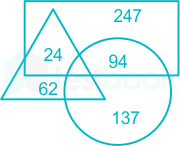
In the diagram, the triangle represents 134 students studying in English medium and the circle represents 279 students in science stream. Girls are represented by the rectangle. Partial information regarding the break up of the students and their choice of medium and stream is included in the diagram.

Calculate how many boys are studying in science stream in the English medium.

  1. AOption (a)

    31

  2. BOption (b)

    57

  3. COption (c)

    43

  4. DOption (d)

    153

View answer & explanation

Correct answer

Answer: (a)A.

31

Why this answer is correct

The region that best represents the number of boys who are studying in science stream and in the English medium is shown below:

Here, the marked area shows the number of boys who are studying in science stream and in the English medium.

According to the question:

Total students in a college = 917

Total Boys in a college = 535

Total Girls in a college = (917 - 535) = 382

Total Girls (Rectangle) = (24 + 94 + 247) = 365

So, we get

Girls = 365 + B

382 = 365 + B

B = 17 ------ (1)

And,

Total students studying in the science stream = 279

A + B = 279 - 137 - 94

A + B = 48  ------- (2)

Thus, from (1) and (2) we get,

A + 17 = 48

A = 31

So, the number of boys who are studying in science stream in the English medium ⇒ 31

Hence, "Option 1" is the correct answer.

Confusion Points'A + B' in the figure can be calculated either wise i.e. either from the science stream or English medium.

Total students studying in the English medium = 134

A + B = 134 - 62 - 24

A + B = 48

Question 40

Which of the following plantations helps in the prevention of soil erosion in desert?

  1. AOption (a)

    Shelter belts

  2. BOption (b)

    Agro forest

  3. COption (c)

    Strip cropping

  4. DOption (d)

    Contour ploughing

View answer & explanation

Correct answer

Answer: (a)A.

Shelter belts

Why this answer is correct

The correct answer is Shelter belts.

Key Points

  • Shelter belts are rows of trees or shrubs planted to protect an area from strong winds and erosion.
  • These belts help in reducing the velocity of the wind, which prevents soil erosion in desert areas.
  • They act as barriers that trap moving soil particles and reduce the amount of soil transported by wind.
  • Shelter belts also improve the microclimate of the area, making it more suitable for other vegetation and agricultural activities.

Additional Information

  • Agroforestry
  • Agroforestry involves integrating trees and shrubs into agricultural landscapes to enhance biodiversity, reduce erosion, and improve soil health.
  • While beneficial for soil conservation, it is not specifically designed for preventing soil erosion in desert areas.
  • Strip Cropping
  • Strip cropping involves growing crops in strips or bands to reduce soil erosion and improve soil fertility.
  • This technique is more commonly used in hilly or sloped areas rather than deserts.
  • Contour Ploughing
  • Contour ploughing is the practice of ploughing along the contour lines of a slope to reduce soil erosion.
  • It is particularly effective in hilly and sloped regions but not specifically designed for desert areas.

Question 41

Which of the following monuments is NOT located in the state of Madhya Pradesh?

  1. AOption (a)

    Bhandhavgarh Fort

  2. BOption (b)

    Gwalior Fort

  3. COption (c)

    Janjira Fort

  4. DOption (d)

    Asirgarh Fort

View answer & explanation

Correct answer

Answer: (c)C.

Janjira Fort

Why this answer is correct

The correct answer is Janjira Fort.

Key Points

  • Janjira Fort, also known as Murud-Janjira, is located in the Raigad district of Maharashtra, not in Madhya Pradesh.
  • This fort is situated on an island off the coastal village of Murud, hence the name Murud-Janjira.
  • The fort is renowned for being one of the strongest marine forts of India, having withstood several attacks over the centuries.
  • The fort has a unique architecture with high walls and bastions, and it was originally built by the Siddis, a Muslim dynasty of Indian origin.

Additional Information

  • Bhandhavgarh Fort
  • Located in the Umaria district of Madhya Pradesh, Bhandhavgarh Fort is situated within the Bhandhavgarh National Park.
  • It is one of the oldest forts in India, believed to be over 2,000 years old.
  • The fort offers panoramic views of the surrounding national park and is historically significant for its association with various dynasties that ruled the region.
  • Gwalior Fort
  • Gwalior Fort is situated in Gwalior, Madhya Pradesh and is considered one of the most impenetrable fortresses in India.
  • The fort has a rich history and features several palaces, temples, and water tanks within its premises.
  • It is known for its stunning architecture and has been a part of various historical events in Indian history.
  • Asirgarh Fort
  • Located in the Burhanpur district of Madhya Pradesh, Asirgarh Fort is often referred to as the "key to the Deccan" due to its strategic position.
  • The fort is perched on a hill and offers a commanding view of the surrounding region, making it a vital military outpost historically.
  • The fort has three main parts: Asirgarh, Karmargarh, and Malaygarh, each with its own distinct features.

Question 42

If 45% of a number is 15 less than 70% of that number, then the number is:

  1. AOption (a)

    40

  2. BOption (b)

    50

  3. COption (c)

    60

  4. DOption (d)

    70

View answer & explanation

Correct answer

Answer: (c)C.

60

Why this answer is correct

Given:

45% of a number is 15 less than 70% of that number.

Formula Used:

Let the number be xxxxxxx .

45% of xxxxxxx = 0.45x

70% of xxxxxxx = 0.70x

Calculation:

According to the problem:

0.45x = 0.70x - 15

⇒ 0.45x - 0.70x = -15

⇒ -0.25x = -15

⇒ x = 15 / 0.25

⇒ x = 60

The number is 60.

Question 43

Which of the following is NOT a part of human excretory System?

  1. AOption (a)

    Bronchiole

  2. BOption (b)

    Glomerulus

  3. COption (c)

    Collecting duct

  4. DOption (d)

    Bowman's capsule

View answer & explanation

Correct answer

Answer: (a)A.

Bronchiole

Why this answer is correct

The correct answer is Bronchiole.

Key Points

  • The bronchiole is a part of the respiratory system, not the excretory system.
  • Bronchioles are small airways in the lungs that lead to the alveoli where gas exchange occurs.
  • The excretory system primarily involves organs like kidneys, ureters, bladder, and urethra.
  • Key components of the human excretory system include the glomerulus, collecting duct, and Bowman's capsule.

Additional Information

  • Glomerulus
  • The glomerulus is a network of capillaries located at the beginning of a nephron in the kidney.
  • It performs the first step of filtering blood to form urine.
  • Collecting Duct
  • The collecting duct is a series of tubules and ducts that connect the nephrons to the ureter.
  • It plays a crucial role in the concentration and transport of urine.
  • Bowman's Capsule
  • The Bowman's capsule is a cup-like sac at the beginning of the tubular component of a nephron.
  • It encloses the glomerulus and performs the initial filtration of blood.
  • Excretory System
  • The human excretory system is responsible for removing waste products and excess substances from the bloodstream.
  • It includes organs such as kidneys, ureters, bladder, and urethra.
  • The kidneys filter blood to produce urine, which is then transported through the ureters to the bladder and expelled via the urethra.

Question 44

In which Amendment act of Indian constitution is the Goods and Services Tax introduced?

  1. AOption (a)

    103

  2. BOption (b)

    122

  3. COption (c)

    105

  4. DOption (d)

    101

View answer & explanation

Correct answer

Answer: (d)D.

101

Why this answer is correct

The correct answer is 101.

Key Points

  • The Goods and Services Tax (GST) was introduced in India through the 101st Amendment Act of the Constitution of India.
  • This amendment received the assent of the President on 8th September 2016 and was implemented on 1st July 2017.
  • GST is a comprehensive, multi-stage, destination-based tax that is levied on every value addition.
  • It is a single tax on the supply of goods and services, right from the manufacturer to the consumer.

Additional Information

  • Goods and Services Tax (GST)
  • GST is an indirect tax that has replaced many indirect taxes in India such as the excise duty, VAT, services tax, etc.
  • It is a single comprehensive tax levied on all goods and services (except a few) across India.
  • GST is divided into three types: CGST (Central Goods and Services Tax), SGST (State Goods and Services Tax), and IGST (Integrated Goods and Services Tax).
  • CGST and SGST are levied on intra-state supplies, whereas IGST is levied on inter-state supplies.
  • 101st Constitutional Amendment Act
  • This act introduced the Goods and Services Tax (GST) in India.
  • The GST Council was constituted to make recommendations to the Union and the States on important issues related to GST.
  • The GST Council is chaired by the Union Finance Minister and includes the Minister of State for Finance and the Finance Ministers of all the States.
  • The act aims to simplify the tax structure by subsuming multiple indirect taxes into a single tax.
  • GST Council
  • The GST Council is a constitutional body for making recommendations to the Union and State Governments on issues related to GST.
  • It is chaired by the Union Finance Minister and consists of the Union Minister of State for Finance and the Finance Ministers of all States.
  • The council is responsible for deciding the tax rates, exemptions, threshold limits, and other important aspects of GST.

Question 45

What is the colour code of the dustbin in which non-biodegradable wastes are kept?

  1. AOption (a)

    Green

  2. BOption (b)

    Blue

  3. COption (c)

    Red

  4. DOption (d)

    Yellow

View answer & explanation

Correct answer

Answer: (b)B.

Blue

Why this answer is correct

The correct answer is Blue.

Key Points

  • Blue dustbins are specifically designated for non-biodegradable wastes.
  • Non-biodegradable wastes include items such as plastics, metals, and electronic waste which do not decompose naturally.
  • Using blue bins helps in the segregation of waste, which is crucial for effective waste management and recycling processes.
  • Proper segregation of waste into blue bins ensures that non-biodegradable materials can be processed and recycled, reducing environmental pollution.

Additional Information

  • Non-Biodegradable Waste:
  • These are wastes that cannot be broken down naturally by microorganisms. They include plastics, metals, and chemicals.
  • Non-biodegradable waste is harmful to the environment as it can persist for years without decomposing.
  • Such wastes require special handling and recycling processes to minimize their environmental impact.
  • Biodegradable Waste:
  • This type of waste can be decomposed naturally by microorganisms.
  • Examples include food waste, garden waste, and paper products.
  • Biodegradable waste is typically disposed of in green bins and can be composted to produce useful organic matter.
  • Waste Segregation:
  • Segregation of waste is the process of separating wet waste (biodegradable) and dry waste (non-biodegradable).
  • Effective waste segregation helps in the efficient recycling and disposal of waste materials.
  • It reduces the burden on landfills and contributes to environmental conservation.
  • Recycling:
  • Recycling involves converting waste materials into new products to prevent waste of potentially useful materials.
  • It reduces the consumption of fresh raw materials, thereby conserving natural resources.
  • Recycling also helps to reduce energy usage, air and water pollution, and greenhouse gas emissions.

Question 46

A sum becomes its double in 8 years. The annual rate of simple interest is:

  1. AOption (a)

    912%9\frac{1}{2}\%

  2. BOption (b)

    1212%12\frac{1}{2}\%

  3. COption (c)

    10%

  4. DOption (d)

    8%

View answer & explanation

Correct answer

Answer: (b)B.

1212%12\frac{1}{2}\%

Why this answer is correct

Given:

Time (T) = 8 years

Final Amount (A) = 2 × Principal (P)

Formula Used:

Simple Interest (SI) = P × R × T / 100

Final Amount (A) = Principal (P) + Simple Interest (SI)

Calculation:

Given that A = 2P, we know:

2P = P + (P × R × 8 / 100)

⇒ 2P = P + (8PR / 100)

⇒ 2P - P = 8PR / 100

⇒ P = 8PR / 100

⇒ 100 = 8R

⇒ R = 100 / 8

⇒ R = 12.5%

The annual rate of simple interest is 12.5%.

Question 47

Select the option in which the numbers are related in the same way as are the numbers in the given sets.

(16, 169, 3), (18, 121, 7), (21, 361, 2), (6, 4, 4)

  1. AOption (a)

    (8, 4, 2)

  2. BOption (b)

    (15, 121, 3)

  3. COption (c)

    (13, 16, 9)

  4. DOption (d)

    (17, 142, 5)

View answer & explanation

Correct answer

Answer: (c)C.

(13, 16, 9)

Why this answer is correct

The logic followed here is:

Logic: (1st number - 3rd number)2 = 2nd number.

Now,

For, (16, 169, 3)

⇒ (16 - 3)2 = 132 = 169.

For, (18, 121, 7)

⇒ (18 - 7)2 = 112 = 121.

For, (21, 361, 2)

⇒ (21 - 2)2 = 192 = 361.

For, (6, 4, 4)

⇒ (6 - 4)2 = 22 = 4.

Similarly, For (13, 16, 9)

⇒ (13 - 9)2 = 42 = 16.

Hence, the correct answer is "Option 3".

Question 48

There are five books - Biology, Chemistry, History, Maths and Physics - stacked vertically on a shelf. The colours of their covers, (not necessarily in the given order), are black, blue, red, white and yellow. The Chemistry book and the yellow book are at the extremes. The Physics book is not in the middle. The blue book and the Biology book are separated by two books. The Maths book is white and is not the second from either end. The subject of the black book is biology. The blue book is a neighbour of the red Physics book. Which of the following is one of the possible combinations?

  1. AOption (a)

    Maths - White - Number 4 from the left

  2. BOption (b)

    Physics - Red - Number 3 from the left

  3. COption (c)

    Chemistry - Blue - Number 1 from the left

  4. DOption (d)

    Chemistry - Yellow - Number 5 from the left

View answer & explanation

Correct answer

Answer: (c)C.

Chemistry - Blue - Number 1 from the left

Why this answer is correct

Given: There are five books - Biology, Chemistry, History, Maths and Physics - stacked vertically on a shelf. The colours of their covers are black, blue, red, white and yellow. 

1) The Chemistry book and the yellow book are at the extremes. 

2) Maths book is white and is not the second from either end. 

As it is mentioned "The Chemistry book and the yellow book", implies these are two separate books.

Case 1Case 2
BooksColourBooksColour
ChemistryYellow
MathsWhiteMathsWhite
YellowChemistry

3) The blue book and the Biology book are separated by two books. 

4) The blue book is a neighbour of the red Physics book.

5) The subject of the black book is biology. 

As after positioning all the books, only one position is left which will be occupied by the only book left i.e. History book.

Case 1Case 2
BooksColourBooksColour
ChemistryBlueHistoryYellow
PhysicsRedBiologyBlack
MathsWhiteMathsWhite
BiologyBlackPhysicsRed
HistoryYellowChemistryBlue

Thus, according to the final arrangement:

Option 1) Maths - White - Number 4 from the left ⇒ Incorrect as Maths - White is positioned at the center in all the cases. 

Option 2) Physics - Red - Number 3 from the left ⇒ Incorrect as Physics - Red is second from either end in all the cases. 

Option 3) Chemistry - Blue - Number 1 from the left ⇒ Correct as Chemistry - Blue in number 1 from the left only in one case i.e. in case 3.

Option 4) Chemistry - Yellow - Number 5 from the left ⇒ Incorrect as Chemistry's book cover is of blue colour instead of yellow colour.

Hence, "Option 3" is the correct answer.

Question 49

As a December 2020, who is the Lieutenant Governor of Ladakh?

  1. AOption (a)

    Radha Krishna Mathur

  2. BOption (b)

    Satya Pal Malik

  3. COption (c)

    Manoj Sinha

  4. DOption (d)

    Rigzin Samphel

View answer & explanation

Correct answer

Answer: (a)A.

Radha Krishna Mathur

Why this answer is correct

The correct answer is Radha Krishna Mathur.

Key Points

  • Radha Krishna Mathur was appointed as the first Lieutenant Governor of the Union Territory of Ladakh on October 31, 2019.
  • He is a retired IAS officer of the Tripura cadre from the 1977 batch and has served in various capacities in the Government of India.
  • Before his appointment as the Lieutenant Governor of Ladakh, he served as the Chief Information Commissioner of India.
  • His appointment marked the official bifurcation of the state of Jammu and Kashmir into two Union Territories: Jammu & Kashmir and Ladakh.

Additional Information

  • Union Territory of Ladakh
  • Ladakh was officially declared a Union Territory on October 31, 2019, following the abrogation of Article 370 by the Government of India.
  • Ladakh is divided into two districts: Leh and Kargil.
  • The Union Territory is known for its unique culture, beautiful landscapes, and strategic importance given its location bordering China and Pakistan.
  • The administration of Ladakh is directly under the control of the Central Government of India.
  • Article 370
  • Article 370 of the Indian Constitution granted special autonomous status to the state of Jammu and Kashmir.
  • On August 5, 2019, the President of India issued a constitutional order abrogating Article 370, thus revoking the special status of Jammu and Kashmir.
  • This move led to the reorganization of the state into two Union Territories: Jammu & Kashmir and Ladakh.
  • The abrogation of Article 370 has been a subject of significant political and public debate in India and internationally.
  • Chief Information Commissioner of India
  • The Chief Information Commissioner (CIC) is the head of the Central Information Commission, an apex body established under the Right to Information Act, 2005.
  • The CIC is responsible for addressing complaints and appeals pertaining to the Right to Information (RTI) Act.
  • The role of the CIC is crucial in ensuring transparency and accountability in the functioning of public authorities in India.
  • The CIC has the authority to order disclosure of information and impose penalties on public authorities for non-compliance with the RTI Act.

This source code provides a detailed solution to the question, highlighting key points about Radha Krishna Mathur and additional information about related terminologies and context.

Question 50

Find the total no of triangles in the given figure.

  1. AOption (a)

    15

  2. BOption (b)

    13

  3. COption (c)

    12

  4. DOption (d)

    10

View answer & explanation

Correct answer

Answer: (d)D.

10

Why this answer is correct

The total number of triangles in the given figure is shown below:

Thus, as marked there are a total of 10 triangles.

Hence, "Option 4" is the correct answer.

Question 51

Two cards are drawn from a pack of 52 cards. The probability that out of 2 cards, one card is red and one card is black is:

  1. AOption (a)

    1325\frac{{13}}{{25}}

  2. BOption (b)

    2651\frac{{26}}{{51}}

  3. COption (c)

    2551\frac{{25}}{{51}}

  4. DOption (d)

    12\frac{{1}}{{2}}

View answer & explanation

Correct answer

Answer: (b)B.

2651\frac{{26}}{{51}}

Why this answer is correct

Given:

Total number of cards = 52

Number of red cards = 26

Number of black cards = 26

Number of ways to draw 2 cards from 52 = (522)\binom{52}{2}

Formula Used:

The probability of an event = (Number of favorable outcomes) / (Total number of possible outcomes)

Calculation:

Number of ways to draw 1 red card and 1 black card:

Number of ways to draw 1 red card from 26 red cards = (261)\binom{26}{1}

Number of ways to draw 1 black card from 26 black cards = (261)\binom{26}{1}

Total number of favorable outcomes = (261)×(261)\binom{26}{1} \times \binom{26}{1}

Number of ways to draw 2 cards from 52:

Total number of possible outcomes = (522)\binom{52}{2}

(nr)=n!r!(n−r)!\binom{n}{r} = \frac{n!}{r!(n-r)!}

(261)=26\binom{26}{1} = 26

(522)=52!2!(52−2)!=52×512×1=1326\binom{52}{2} = \frac{52!}{2!(52-2)!} = \frac{52 \times 51}{2 \times 1} = 1326

Number of favorable outcomes = 26 × 26 = 676

The probability of drawing 1 red card and 1 black card:

Probability=Number of favorable outcomesTotal number of possible outcomes \text{Probability} = \frac{\text{Number of favorable outcomes}}{\text{Total number of possible outcomes}}

Probability=6761326 \text{Probability} = \frac{676}{1326}

Simplifying the fraction:

Probability=6761326=2651 \text{Probability} = \frac{676}{1326} = \frac{26}{51}

The probability that out of 2 cards, one card is red and one card is black is 2651\frac{26}{51} .

Question 52

A and B together can complete a piece of work in 16 days. If A alone can complete the same work in 24 days, in how many days can B alone complete that work?

  1. AOption (a)

    42

  2. BOption (b)

    40

  3. COption (c)

    46

  4. DOption (d)

    48

View answer & explanation

Correct answer

Answer: (d)D.

48

Why this answer is correct

Given:

A and B together can complete a piece of work in 16 days.

A alone can complete the same work in 24 days.

Formula Used:

Work Rate of A and B together = 1 / Total days taken by A and B together

Work Rate of A = 1 / Total days taken by A

Work Rate of B = Work Rate of A and B together - Work Rate of A

Days taken by B alone = 1 / Work Rate of B

Calculation:

Work Rate of A and B together = 1 / 16

Work Rate of A = 1 / 24

Work Rate of B = (1 / 16) - (1 / 24)

⇒ Work Rate of B = (3 - 2) / 48

⇒ Work Rate of B = 1 / 48

Days taken by B alone = 1 / (1 / 48)

⇒ Days taken by B alone = 48 days

The correct answer is option 4.

Question 53

If x2 + 25y2 = 10xy, then x ∶ y = ?

  1. AOption (a)

    1 ∶ 5

  2. BOption (b)

    5 ∶ 1

  3. COption (c)

    2 ∶ 3

  4. DOption (d)

    3 ∶ 5

View answer & explanation

Correct answer

Answer: (b)B.

5 ∶ 1

Why this answer is correct

Given:

x2 + 25y2 = 10xy

Formula Used:

To solve for x ∶ y, use algebraic manipulation.

Calculation:

Rearrange the equation:

x2 + 25y2 - 10xy = 0

Divide by y2 in the equation,

(x/y)2 + 25 - 10(x/y) = 0

This is a quadratic equation in terms of x/y:

Let z = x/y

Then the equation becomes:

z2 + 25 - 10z = 0

⇒ z2 - 10z + 25 = 0

We solve this quadratic equation using the quadratic formula:

z = (10 ± √(100 - 100)) / 2

⇒ z = (10 ± 0) / 2

⇒ z = 5

Thus, x/y = 5

The ratio x ∶ y is 5 ∶ 1.

Question 54

Cyclone "Pabuk" originated in which region?

  1. AOption (a)

    Gulf of Thailand

  2. BOption (b)

    Archipelago

  3. COption (c)

    Andaman & Nicobar Islands

  4. DOption (d)

    Bay of Bengal

View answer & explanation

Correct answer

Answer: (a)A.

Gulf of Thailand

Why this answer is correct

The correct answer is Gulf of Thailand.

Key Points

  • Cyclone Pabuk originated in the Gulf of Thailand in early January 2019.
  • Pabuk was the first tropical storm to strike Thailand in nearly 30 years during the winter season.
  • The name "Pabuk" was given by Laos, and it refers to a large freshwater fish found in the Mekong River.
  • Pabuk caused significant damage in Thailand and later moved towards the Andaman Sea and the Bay of Bengal.

Additional Information

  • Tropical Cyclone
  • A tropical cyclone is a rapidly rotating storm system characterized by a low-pressure center, a closed low-level atmospheric circulation, strong winds, and a spiral arrangement of thunderstorms that produce heavy rain and/or squalls.
  • They are known as hurricanes in the Atlantic Ocean and northeastern Pacific, typhoons in the northwestern Pacific, and cyclones in the South Pacific and Indian Ocean.
  • Tropical cyclones derive their energy from the evaporation of seawater, which subsequently condenses into clouds and rain when moist air rises and cools to saturation.
  • Gulf of Thailand
  • The Gulf of Thailand is a shallow inlet of the South China Sea, bordered by Thailand, Cambodia, and Vietnam.
  • It is known for its relatively calm waters and is a key area for Thailand's fishing and tourism industries.
  • The gulf has several important ports, including Bangkok and Sattahip, and is a significant region for maritime activities.
  • Andaman Sea
  • The Andaman Sea is a marginal sea of the northeastern Indian Ocean, separated from the Bay of Bengal by the Andaman and Nicobar Islands and Burma.
  • It is known for its rich biodiversity and is a crucial region for marine life and coral reefs.
  • The Andaman Sea is also a significant route for maritime trade and navigation between the Indian Ocean and the Pacific Ocean.
  • Bay of Bengal
  • The Bay of Bengal is the northeastern part of the Indian Ocean, bounded by India, Bangladesh, Myanmar, and the Andaman and Nicobar Islands.
  • It is the largest bay in the world and plays a crucial role in the climatic conditions of the region, particularly the monsoon seasons.
  • The bay is also known for frequent cyclones and severe weather events, especially during the pre-monsoon and post-monsoon periods.

Question 55

Spao Dance belongs from the _______ region of India.

  1. AOption (a)

    Ladakh

  2. BOption (b)

    Saurashtra

  3. COption (c)

    Kutch

  4. DOption (d)

    Bundelkhand

View answer & explanation

Correct answer

Answer: (a)A.

Ladakh

Why this answer is correct

The correct answer is Ladakh.

Key Points

  • Spao Dance is a traditional folk dance from the Ladakh region of India.
  • This dance form is performed during various festivals and cultural celebrations in Ladakh.
  • Spao Dance involves intricate footwork and synchronized group movements.
  • The dancers often wear traditional Ladakhi attire, which includes colorful robes and headgear.

Additional Information

  • Ladakh
  • Ladakh is a region in the northern part of India, known for its stunning landscapes and rich cultural heritage.
  • It was a part of the Indian state of Jammu and Kashmir until 2019, after which it became a separate Union Territory.
  • The culture of Ladakh is influenced by Tibetan Buddhism, and many festivals and rituals reflect this influence.
  • Important festivals in Ladakh include Losar (New Year), Hemis, and Ladakh Festival, where traditional dances like Spao Dance are performed.
  • Saurashtra
  • Saurashtra is a region in the western part of India, located in the state of Gujarat.
  • It is known for its rich history, including the ancient city of Junagadh.
  • The region's culture includes various folk dances like Garba and Raas.
  • Kutch
  • Kutch is a district in Gujarat, known for its white salt desert, the Rann of Kutch.
  • The region hosts the Rann Utsav, a cultural festival showcasing local crafts, music, and dance.
  • Popular dances from Kutch include Dandiya Raas and Garba.
  • Bundelkhand
  • Bundelkhand is a region in central India, spanning parts of Uttar Pradesh and Madhya Pradesh.
  • It is known for its historical forts, palaces, and rich cultural heritage.
  • Folk dances such as Rai and Diwari are popular in this region.

Question 56

In a certain code language, SUCCESS is written as HVXDVTH and LOVELY is written as OPEFOZ. How will EXTREME be written as in that language?

  1. AOption (a)

    YVVHVNV

  2. BOption (b)

    VYUHGHL

  3. COption (c)

    VUYSVNV

  4. DOption (d)

    VYGSVNV

View answer & explanation

Correct answer

Answer: (d)D.

VYGSVNV

Why this answer is correct

The logic followed here is:

SUCCESS is written as HVXDVTH

And,

LOVELY is written as OPEFOZ

Similarly,

EXTREME will be written as

Hence, "Option 4" is the correct answer.

Question 57

A business man sold two flats for Rs. 8,25,000 each. On one he gains 9% while on the other he loses 9%. Then how much is his gain or loss in the whole transaction?

  1. AOption (a)

    0.18% loss

  2. BOption (b)

    0.96% profit

  3. COption (c)

    0.75% profit

  4. DOption (d)

    0.81% loss

View answer & explanation

Correct answer

Answer: (d)D.

0.81% loss

Why this answer is correct

Given:

Selling price of each flat = Rs. 8,25,000

Gain on one flat = 9%

Loss on the other flat = 9%

Formula Used:

Loss Percentage when a gain and loss of same percentage occurs:

Loss%=(Common Gain/Loss Percentage10)2Loss \% = \left( \frac{Common\ Gain/Loss\ Percentage}{10} \right)^2

Calculation:

Given common gain/loss percentage = 9%

Loss Percentage:

Loss%=(910)2Loss \% = \left( \frac{9}{10} \right)^2

⇒ Loss % = (0.9)2

⇒ Loss % = 0.81%

The overall loss in the whole transaction is 0.81%.

Question 58

Select the number that will come next in the following series.

5040, 840, 168, 42, 14, ?

  1. AOption (a)

    7

  2. BOption (b)

    5

  3. COption (c)

    2

  4. DOption (d)

    6

View answer & explanation

Correct answer

Answer: (a)A.

7

Why this answer is correct

The logic followed here is:

Hence, "Option 1" is the correct answer.

Question 59

Two numbers are in the ratio of 5 ∶ 4 and their LCM is 120. The numbers are:

  1. AOption (a)

    40 and 32

  2. BOption (b)

    30 and 24

  3. COption (c)

    10 and 8

  4. DOption (d)

    15 and 12

View answer & explanation

Correct answer

Answer: (b)B.

30 and 24

Why this answer is correct

Given:

Ratio of the numbers = 5 ∶ 4

LCM of the numbers = 120

Formula Used:

If two numbers a and b are in the ratio m:n , then the numbers can be written as am and bn .

Calculation:

Let the numbers be 5x and 4x .

LCM of 5x and 4x is 120.

LCM of 5x and 4x = LCM(5, 4) × x

LCM(5, 4) = 20

⇒ 20x = 120

⇒ x = 120 / 20

⇒ x = 6

Therefore, the numbers are:

5x = 5 × 6 = 30

4x = 4 × 6 = 24

The correct answer is option 2: 30 and 24.

Question 60

Find the equation of the straight line passing through the points (0, 2) and (1, -3).

  1. AOption (a)

    2x - 3y - 3 = 0

  2. BOption (b)

    5x + y - 2 = 0

  3. COption (c)

    2x + 3y + 3 = 0

  4. DOption (d)

    5x + y + 2 = 0

View answer & explanation

Correct answer

Answer: (b)B.

5x + y - 2 = 0

Why this answer is correct

Given:

Points: (0, 2) and (1, -3)

Formula Used:

The equation of a straight line passing through two points (x1, y1) and (x2, y2) is given by:

y−y1=y2−y1x2−x1(x−x1)y - y_1 = \frac{y_2 - y_1}{x_2 - x_1}(x - x_1)

Calculation:

Using the points (0, 2) and (1, -3):

x1 = 0 , y1 = 2

x2 = 1 , y2 = -3

y2−y1x2−x1=−3−21−0=−51=−5\frac{y_2 - y_1}{x_2 - x_1} = \frac{-3 - 2}{1 - 0} = \frac{-5}{1} = -5

So, the equation of the line is:

y−2=−5(x−0)y - 2 = -5(x - 0)

⇒ y - 2 = -5x

⇒ y = -5x + 2

Rewriting in standard form:

⇒ 5x + y - 2 = 0

The correct answer is option 2.

Question 61

Rio De Janeiro is named by _______ as world capital of architecture for 2020?

  1. AOption (a)

    UNO

  2. BOption (b)

    IMF

  3. COption (c)

    UNICEF

  4. DOption (d)

    UNESCO

View answer & explanation

Correct answer

Answer: (d)D.

UNESCO

Why this answer is correct

The correct answer is UNESCO.

Key Points

  • UNESCO stands for the United Nations Educational, Scientific and Cultural Organization.
  • UNESCO is responsible for coordinating international cooperation in education, science, culture, and communication.
  • In 2018, UNESCO launched the initiative of designating a World Capital of Architecture to celebrate architecture and urban planning.
  • Rio De Janeiro was named the World Capital of Architecture for 2020, highlighting its rich architectural heritage and its role in global architectural innovation.

Additional Information

  • United Nations Educational, Scientific and Cultural Organization (UNESCO)
  • Founded in 1945, UNESCO aims to build peace through international cooperation in Education, the Sciences, and Culture.
  • UNESCO’s programs contribute to the achievement of the Sustainable Development Goals defined in Agenda 2030, adopted by the UN General Assembly in 2015.
  • UNESCO operates worldwide to provide education, preserve cultural heritage, and promote freedom of expression.
  • The organization is known for its World Heritage program, which identifies and protects cultural and natural heritage around the world considered to be of outstanding value to humanity.
  • International Monetary Fund (IMF)
  • The IMF is an organization of 190 countries, working to foster global monetary cooperation, secure financial stability, facilitate international trade, promote high employment and sustainable economic growth, and reduce poverty around the world.
  • It was established in 1944 during the Bretton Woods Conference.
  • The IMF provides financial assistance and advice to member countries.
  • It also monitors the global economy and provides economic forecasts and analysis.
  • United Nations International Children's Emergency Fund (UNICEF)
  • UNICEF is a United Nations agency responsible for providing humanitarian and developmental aid to children worldwide.
  • The agency is among the most widespread and recognizable social welfare organizations in the world, with a presence in 192 countries and territories.
  • UNICEF's programs emphasize developing community-level services to promote the health and well-being of children.
  • It was created in December 1946 to provide emergency food and healthcare to children in countries that had been devastated by World War II.
  • United Nations Organization (UNO)
  • The United Nations is an international organization founded in 1945 and currently made up of 193 Member States.
  • The mission and work of the United Nations are guided by the purposes and principles contained in its founding Charter.
  • Due to the powers vested in its Charter and its unique international character, the UN can take action on the issues confronting humanity in the 21st century, such as peace and security, climate change, sustainable development, human rights, disarmament, terrorism, humanitarian and health emergencies, gender equality, governance, and food production.
  • The UN also provides a forum for its members to express their views in the General Assembly, the Security Council, the Economic and Social Council, and other bodies and committees.

Question 62

Which two signs are to be interchanged to make the given equation correct?

36 - 3 ÷ 3 + 2 × 4 = 34

  1. AOption (a)
    • and +
  2. BOption (b)
    • and ÷
  3. COption (c)
    • and ×
  4. DOption (d)

    ÷ and -

View answer & explanation

Correct answer

Answer: (c)C.
  • and ×

Why this answer is correct

Given : 36 - 3 ÷ 3 + 2 × 4 = 34

According to the question, after replacing the signs :

Option 1) - and +

36 - 3 ÷ 3 + 2 × 4 = 34 ⇒ 36 + 3 ÷ 3 - 2 × 4 = 34

⇒ 36 + 3 ÷ 3 - 2 × 4 = 34

⇒ 36 + 1 - 2 × 4 = 34

⇒ 36 + 1 - 8 = 34

⇒ 37 - 8 = 34

⇒ 29 ≠ 34 (LHS ≠ RHS)

Option  2) + and ÷

36 - 3 ÷ 3 + 2 × 4 = 34 ⇒ 36 - 3 + 3 ÷ 2 × 4 = 34

⇒ 36 - 3 + 3 ÷ 2 × 4 = 34

⇒ 36 - 3 + 1.5 × 4 = 34

⇒ 36 + 60 - 3 = 34

⇒ 96 - 3 = 34 

⇒ 93 ≠ 34 (LHS ≠ RHS)

Option  3) - and ×

36 - 3 ÷ 3 + 2 × 4 = 34 ⇒ 36 × 3 ÷ 3 + 2 - 4 = 34

⇒ 36 × 3 ÷ 3 + 2 - 4 = 34

⇒ 36 × 1 + 2 - 4 = 34

⇒ 36 + 2 - 4 = 34

⇒ 38 - 4 = 34

⇒ 34 = 34 (LHS = RHS)

Option  4) ÷ and -

36 - 3 ÷ 3 + 2 × 4 = 34 ⇒ 36 ÷ 3 - 3 + 2 × 4 = 34

⇒ 36 ÷ 3 - 3 + 2 × 4 = 34

⇒ 12 - 3 + 2 × 4 = 34

⇒ 12 + 8 - 3 = 34

⇒ 20 - 3 = 34

⇒ 17 ≠ 34 (LHS ≠ RHS)

Hence, "Option 3" is the correct answer.

Question 63

The ratio of water and milk in a 72 L of mixture is 4 ∶ 5. Then what amount of milk is to be added to this mixture to make the ratio 3 ∶ 6?

  1. AOption (a)

    12 L

  2. BOption (b)

    24 L

  3. COption (c)

    36 L

  4. DOption (d)

    72 L

View answer & explanation

Correct answer

Answer: (b)B.

24 L

Why this answer is correct

Given:

Initial mixture volume = 72 L

Initial water to milk ratio = 4:5

Desired water to milk ratio = 3:6

Formula Used:

Water in the mixture = (Initial ratio part of water / Total parts of the mixture) × Total volume

Milk in the mixture = (Initial ratio part of milk / Total parts of the mixture) × Total volume

New milk amount required = Desired milk ratio part × (Total volume + Added milk)

Calculation:

Initial water parts = 4

Initial milk parts = 5

Total parts = 4 + 5 = 9

Water in the mixture = (4 / 9) × 72

Water in the mixture = 32 L

Milk in the mixture = (5 / 9) × 72

Milk in the mixture = 40 L

Desired ratio = 3:6 (which simplifies to 1:2)

Let x be the amount of milk to be added.

New total volume = 72 + x

New milk volume = 40 + x

Desired ratio for water to milk is 1:2

Water / Milk = 1/2

32 / (40 + x) = 1 / 2

Cross-multiplying:

⇒ 2 × 32 = 40 + x

⇒ 64 = 40 + x

⇒ x = 64 - 40

⇒ x = 24

The amount of milk to be added to this mixture to make the ratio 3:6 is 24 L.

Question 64

In a certain code language, BRIDE is written as FVMHI. How will SINGLE be written as in that language?

  1. AOption (a)

    WMRJPO

  2. BOption (b)

    WMRKPI

  3. COption (c)

    WNRKPI

  4. DOption (d)

    WMRJPK

View answer & explanation

Correct answer

Answer: (b)B.

WMRKPI

Why this answer is correct

The logic followed here is:

BRIDE is written as FVMHL

Similarly,

SINGLE will be written as

Hence, "Option 2" is the correct answer.

Question 65

Which of the following territorial disputes is going on between India and Nepal?

  1. AOption (a)

    Senkaku

  2. BOption (b)

    Sino

  3. COption (c)

    Kuril

  4. DOption (d)

    Kalapani

View answer & explanation

Correct answer

Answer: (d)D.

Kalapani

Why this answer is correct

The correct answer is Kalapani.

Key Points

  • Kalapani is a region located in the easternmost corner of Uttarakhand, India.
  • The area is claimed by Nepal, which argues that it lies to the east of the Kali River, according to the Sugauli Treaty of 1815 signed between the British East India Company and Nepal.
  • India, on the other hand, claims that the river marking the boundary is the one originating from the Limpiyadhura region, which puts Kalapani within Indian territory.
  • The dispute escalated in 2019 when India published a new political map following the bifurcation of Jammu and Kashmir, showing Kalapani as part of its territory.

Additional Information

  • Senkaku Islands Dispute:
  • The Senkaku Islands are a group of uninhabited islands in the East China Sea, which are disputed between China, Taiwan, and Japan.
  • Japan currently administers the islands, but both China and Taiwan claim sovereignty over them.
  • The dispute is rooted in historical claims and has significant implications for fishing rights and potential underwater oil reserves.
  • Sino-Indian Border Dispute:
  • The Sino-Indian border dispute involves large areas of territory along the Himalayan border between China and India.
  • The main disputed areas are Aksai Chin (administered by China but claimed by India) and Arunachal Pradesh (administered by India but claimed by China).
  • The dispute led to the Sino-Indian War in 1962 and continues to be a source of tension between the two countries.
  • Kuril Islands Dispute:
  • The Kuril Islands dispute is between Russia and Japan over sovereignty of the southernmost islands in the Kuril chain.
  • These islands were taken by the Soviet Union at the end of World War II, but Japan claims they are part of its Northern Territories.
  • The dispute has prevented the two countries from signing a formal peace treaty to end World War II hostilities.

Question 66

In which year Sir William Jones founded "Asiatic Society of Bengal"?

  1. AOption (a)

    1884

  2. BOption (b)

    1784

  3. COption (c)

    1848

  4. DOption (d)

    1748

View answer & explanation

Correct answer

Answer: (b)B.

1784

Why this answer is correct

The correct answer is 1784.

Key Points

  • Sir William Jones founded the Asiatic Society of Bengal in 1784.
  • The society was established in Kolkata (then Calcutta), which was the capital of British India at the time.
  • The aim of the society was to promote and further the research and knowledge of the Asian continent in various fields such as literature, arts, science, and more.
  • The society played a crucial role in the study and understanding of Indian culture, languages, and history.

Additional Information

  • Sir William Jones
  • He was a British philologist, orientalist, and jurist who is best known for his proposition of the existence of a relationship among European and Indian languages, which later led to the development of the concept of the Indo-European language family.
  • He arrived in Calcutta in 1783 to serve as a judge of the Supreme Court of Judicature at Fort William.
  • His passion for Asian studies led him to establish the Asiatic Society of Bengal.
  • Jones was proficient in numerous languages including Latin, Greek, French, and Sanskrit.
  • Asiatic Society of Bengal
  • The society was originally named "Asiatick Society" and later renamed as the "Asiatic Society of Bengal".
  • The society's main objective was to inquire into the history, antiquities, arts, sciences, and literature of Asia.
  • It became a premier institution for the study and research of the rich heritage of India and Asia.
  • The society published numerous journals and books that contributed significantly to the study of Asian cultures and civilizations.
  • Kolkata (Calcutta)
  • Kolkata, formerly known as Calcutta, was the capital of British India from 1772 to 1911.
  • It is located on the east bank of the Hooghly River in the Indian state of West Bengal.
  • The city played a key role in the cultural and intellectual renaissance of India during the 19th and early 20th centuries.
  • Kolkata remains an important cultural, commercial, and educational hub in India today.

Question 67

The value of 579÷413×6914+79×185\frac{7}{9} \div 4\frac{1}{3} \times 6\frac{9}{{14}} + \frac{7}{9} \times 18 is:

  1. AOption (a)

    216821\frac{6}{8}

  2. BOption (b)

    227622\frac{7}{6}

  3. COption (c)

    226722\frac{6}{7}

  4. DOption (d)

    218621\frac{8}{6}

View answer & explanation

Correct answer

Answer: (c)C.

226722\frac{6}{7}

Why this answer is correct

Given:

Expression: 579÷413×6914+79×185\frac{7}{9} \div 4\frac{1}{3} \times 6\frac{9}{{14}} + \frac{7}{9} \times 18

Formula used:

Convert mixed fractions to improper fractions and follow the BODMAS rule.

Calculation:

Step 1: Convert mixed fractions:

5 79\dfrac{7}{9} = 529\dfrac{52}{9}

4 13\dfrac{1}{3} = 133\dfrac{13}{3}

6 914\dfrac{9}{14} = 9314\dfrac{93}{14}

Step 2: Apply BODMAS rule:

(529)÷(133)×(9314)+(79)×18(\dfrac{52}{9}) ÷ (\dfrac{13}{3}) × (\dfrac{93}{14}) + (\dfrac{7}{9}) \times 18

⇒ 529×313×9314+79×18\dfrac{52}{9} \times \dfrac{3}{13} \times \dfrac{93}{14} + \dfrac{7}{9} \times 18

⇒ 31×27+79×18\dfrac{31 \times 2}{7} + \dfrac{7}{9} \times 18

⇒ 627+14\dfrac{62}{7} + 14

⇒ 160/7 = 226722\frac{6}{7}

∴ The value of the expression is 226722\frac{6}{7}.

Question 68

In how many years will a sum of money double itself at 6.25% per annum simple interest?

  1. AOption (a)

    16

  2. BOption (b)

    15

  3. COption (c)

    19

  4. DOption (d)

    12

View answer & explanation

Correct answer

Answer: (a)A.

16

Why this answer is correct

Given:

Rate of interest (R) = 6.25% per annum

Sum of money doubles itself.

Formula Used:

Simple Interest (SI) = (P × R × T) / 100

Where P is the principal amount, R is the rate of interest, and T is the time in years.

Since the sum doubles, SI = P (Principal)

Calculation:

Given, SI = P

Using the formula:

P=P×R×T100P = \frac{P × R × T}{100}

Substitute the values:

P=P×6.25×T100P = \frac{P × 6.25 × T}{100}

Divide both sides by P:

1=6.25×T1001 = \frac{6.25 × T}{100}

Multiply both sides by 100:

100=6.25T100 = 6.25T

Divide both sides by 6.25:

T=1006.25T = \frac{100}{6.25}

Calculate:

T=16T = 16

The sum of money will double itself in 16 years.

Question 69

If sinθ + cosθ = √3 cos (90 - θ) then tanθ = ?

  1. AOption (a)

    2−1\sqrt {2 - 1}

  2. BOption (b)

    13−1\frac{1}{{\sqrt 3 - 1}}

  3. COption (c)

    3−1\sqrt 3 - 1

  4. DOption (d)

    12−1\frac{1}{{\sqrt 2 - 1}}

View answer & explanation

Correct answer

Answer: (b)B.

13−1\frac{1}{{\sqrt 3 - 1}}

Why this answer is correct

Given:

sin⁡θ+cos⁡θ=3cos⁡(90∘−θ)\sin\theta + \cos\theta = \sqrt{3} \cos(90^\circ - \theta)

Formula Used:cos⁡(90∘−θ)=sin⁡θ\cos(90^\circ - \theta) = \sin\theta

tan⁡θ=sin⁡θcos⁡θ \tan\theta = \frac{\sin\theta}{\cos\theta}

Calculation:

Given equation: sin⁡θ+cos⁡θ=3cos⁡(90∘−θ)\sin\theta + \cos\theta = \sqrt{3} \cos(90^\circ - \theta)

⇒sin⁡θ+cos⁡θ=3sin⁡θ\Rightarrow \sin\theta + \cos\theta = \sqrt{3} \sin\theta

⇒cos⁡θ=3sin⁡θ−sin⁡θ\Rightarrow \cos\theta = \sqrt{3} \sin\theta - \sin\theta

⇒cos⁡θ=sin⁡θ(3−1)\Rightarrow \cos\theta = \sin\theta (\sqrt{3} - 1)

⇒cos⁡θsin⁡θ=3−1\Rightarrow \frac{\cos\theta}{\sin\theta} = \sqrt{3} - 1

⇒cot⁡θ=3−1\Rightarrow \cot\theta = \sqrt{3} - 1

⇒tan⁡θ=13−1\Rightarrow \tan\theta = \frac{1}{\sqrt{3} - 1}

The correct answer is option 2.

Question 70

Who was the only person who remained president of the Indian National Congress for 6 years continuously before Independence of India?

  1. AOption (a)

    Acharya J. B. Kriplani

  2. BOption (b)

    Purushutam Das Tondon

  3. COption (c)

    S. C. Bose

  4. DOption (d)

    Maulana Abul Kalam Azad

View answer & explanation

Correct answer

Answer: (d)D.

Maulana Abul Kalam Azad

Why this answer is correct

The correct answer is Maulana Abul Kalam Azad.

Key Points

  • Maulana Abul Kalam Azad was an Indian scholar and senior leader of the Indian National Congress during the Indian independence movement.
  • He served as the President of the Indian National Congress for an extended period, specifically from 1940 to 1946.
  • Azad was one of the prominent leaders who advocated for Hindu-Muslim unity and played a crucial role in the freedom struggle against British rule.
  • He was a close confidant of Mahatma Gandhi and a firm believer in the principles of non-violence and civil disobedience.

Additional Information

  • Indian National Congress (INC)
  • The Indian National Congress is one of the two major political parties in India, founded in 1885. It was the principal leader of the Indian independence movement.
  • The INC played a pivotal role in the freedom struggle, advocating for civil rights and self-rule, and later became the ruling party of independent India.
  • Key leaders of the INC included figures such as Mahatma Gandhi, Jawaharlal Nehru, Sardar Vallabhbhai Patel, and Maulana Abul Kalam Azad.
  • Maulana Abul Kalam Azad's Contributions
  • Azad was a scholar, writer, and a prominent advocate for education. He was instrumental in the establishment of the Indian Institutes of Technology and the foundation of the University Grants Commission (UGC).
  • He served as India's first Minister of Education from 1947 to 1958 and was responsible for shaping the educational landscape of modern India.
  • Azad was a proponent of the idea that education should be accessible to all, and he worked tirelessly to improve literacy rates and educational standards in the country.
  • INC Presidents Pre-Independence
  • Several prominent leaders served as the President of the INC before India's independence, including Dadabhai Naoroji, Gopal Krishna Gokhale, Bal Gangadhar Tilak, and Motilal Nehru.
  • Each of these leaders contributed significantly to the freedom struggle and the shaping of India's political and social landscape.
  • Hindu-Muslim Unity
  • One of the core principles advocated by Maulana Azad was the unity between Hindus and Muslims, which he believed was essential for the success of the independence movement.
  • Despite the communal tensions, Azad consistently promoted the idea of a united India where people of different religions could coexist peacefully.

Question 71

The value of 42.425 + 6.526 - 15.31 + 0.098 is:

  1. AOption (a)

    33.786

  2. BOption (b)

    33.739

  3. COption (c)

    33.483

  4. DOption (d)

    33.836

View answer & explanation

Correct answer

Answer: (b)B.

33.739

Why this answer is correct

Given:

The value of 42.425 + 6.526 - 15.31 + 0.098 is:

Formula Used:

Basic arithmetic operations: Addition and Subtraction

Calculation:

Perform the operations step by step:

⇒ 42.425 + 6.526 = 48.951

⇒ 48.951 - 15.31 = 33.641

⇒ 33.641 + 0.098 = 33.739

The correct answer is option 2.

Question 72

If the distance between two points (x, 7) and (1, 15) is 10 units, then the possible values of x = ?

  1. AOption (a)

    4, 5

  2. BOption (b)

    7, -5

  3. COption (c)

    3, 7

  4. DOption (d)

    5, -7

View answer & explanation

Correct answer

Answer: (b)B.

7, -5

Why this answer is correct

Given:

Coordinates of the first point: (x, 7)

Coordinates of the second point: (1, 15)

Distance between the points: 10 units

Formula Used:

Distance formula between two points (x1, y1) and (x2, y2) :

(x2−x1)2+(y2−y1)2\sqrt{(x_2 - x_1)^2 + (y_2 - y_1)^2}

Calculation:

Using the distance formula:

(1−x)2+(15−7)2=10\sqrt{(1 - x)^2 + (15 - 7)^2} = 10

We know 15 - 7 = 8, so the equation becomes:

(1−x)2+82=10\sqrt{(1 - x)^2 + 8^2} = 10

(1−x)2+64=10\sqrt{(1 - x)^2 + 64} = 10

Squaring both sides:

(1 - x)2 + 64 = 102

⇒ (1 - x)2 + 64 = 100

⇒ (1 - x)2 = 100 - 64

⇒ (1 - x)2 = 36

Taking the square root of both sides:

1 - x = ±6

So we have two cases:

Case 1: 1 - x = 6

⇒ 1 - 6 = x

⇒ x = -5

Case 2: 1 - x = -6

⇒ 1 + 6 = x

⇒ x = 7

The possible values of x are 7 and -5.

Question 73

If the ratio of the areas of two squares is 169 ∶ 196, then the ratio of their perimeters is:

  1. AOption (a)

    13 ∶ 14

  2. BOption (b)

    196 ∶ 169

  3. COption (c)

    14 ∶ 13

  4. DOption (d)

    169 ∶ 196

View answer & explanation

Correct answer

Answer: (a)A.

13 ∶ 14

Why this answer is correct

Given:

The ratio of the areas of two squares is 169 ∶ 196.

Formula Used:

Area of a square = side2

Perimeter of a square = 4 × side

Ratio of areas = (side1)2 / (side2)2

Ratio of perimeters = side1 / side2

Calculation:

Let the sides of the squares be a and b.

Given that the ratio of the areas is 169 ∶ 196:

a2b2=169196 \frac{a^2}{b^2} = \frac{169}{196}

Taking the square root on both sides:

ab=169196 \frac{a}{b} = \frac{\sqrt{169}}{\sqrt{196}}

⇒ ab=1314\frac{a}{b} = \frac{13}{14}

Therefore, the ratio of their perimeters is:

⇒ 13 ∶ 14

The correct answer is option 1.

Question 74

Against which Act did Gandhiji decide to fight and start a Satyagraha?

  1. AOption (a)

    Rowlatt Act (1919)

  2. BOption (b)

    Vernacular Press Act (1878)

  3. COption (c)

    Government of India Act (1858)

  4. DOption (d)

    Regulating Act (1773)

View answer & explanation

Correct answer

Answer: (a)A.

Rowlatt Act (1919)

Why this answer is correct

The correct answer is Rowlatt Act (1919).

Key Points

  • The Rowlatt Act was officially known as the Anarchical and Revolutionary Crimes Act of 1919.
  • It was passed by the Imperial Legislative Council in Delhi on 18 March 1919.
  • The Act allowed certain political cases to be tried without juries and permitted internment of suspects without trial.
  • It was seen as a repressive measure and led to widespread anger and discontent among Indians, becoming a catalyst for the Non-Cooperation Movement led by Mahatma Gandhi.

Additional Information

  • Vernacular Press Act (1878)
  • This Act was enacted by the British government to curtail the freedom of the Indian-language press.
  • It was introduced by Lord Lytton, then Viceroy of India, and was aimed at preventing the vernacular press from expressing criticism of British policies.
  • The Act was seen as draconian and was repealed in 1881 by Lord Ripon.
  • Government of India Act (1858)
  • This Act was passed by the British Parliament in response to the Indian Rebellion of 1857.
  • It marked the end of the East India Company's rule in India and transferred control of India to the British Crown.
  • The Act provided for the appointment of a Secretary of State for India and established the office of the Viceroy of India.
  • Regulating Act (1773)
  • This Act was the first attempt by the British government to regulate the affairs of the East India Company in India.
  • It established a system of dual control by the British government and the company.
  • The Act also created the office of the Governor-General of Bengal, with Warren Hastings being the first to hold the position.

Question 75

Which part of seeds forms root on germination?

  1. AOption (a)

    Radicle

  2. BOption (b)

    Epicotyl

  3. COption (c)

    Plumule

  4. DOption (d)

    Cotyledon

View answer & explanation

Correct answer

Answer: (a)A.

Radicle

Why this answer is correct

The correct answer is Radicle.

Key Points

  • The radicle is the first part of a seedling to emerge from the seed during the process of germination.
  • It develops into the primary root, anchoring the plant and absorbing water and nutrients from the soil.
  • The radicle grows downward, exhibiting positive geotropism, which means it grows in the direction of gravitational pull.
  • The health and vigor of the radicle are crucial for the establishment and growth of the seedling.

Additional Information

  • Epicotyl:
  • বীজপত্রাধিকাণ্ডIt is responsible for the shoot growth and eventually forms the stem and leaves.
  • Plumule:
  • The plumule is the part of the seed embryo that develops into the shoot bearing the first true leaves of a plant.
  • It grows upwards, exhibiting negative geotropism, growing away from the gravitational pull.
  • Cotyledon:
  • Cotyledons are the seed leaves present in the embryo of a seed.
  • They provide nutrients to the seedling during its initial stages of growth before true leaves develop and photosynthesis begins.

Question 76

If 2 men or 3 women can finish a piece of work in 15 days. In how many days can 6 men and 9 women together do the same piece of work?

  1. AOption (a)

    3133\frac{1}{3}

  2. BOption (b)

    2122\frac{1}{2}

  3. COption (c)

    6136\frac{1}{3}

  4. DOption (d)

    4124\frac{1}{2}

View answer & explanation

Correct answer

Answer: (b)B.

2122\frac{1}{2}

Why this answer is correct

Given:

2 men or 3 women can finish a piece of work in 15 days.

Formula Used:

Work done by 1 man in 1 day = Work done by 2 men in 15 days / 2

Work done by 1 woman in 1 day = Work done by 3 women in 15 days / 3

Work done by 6 men and 9 women in 1 day = 6 × (Work done by 1 man in 1 day) + 9 × (Work done by 1 woman in 1 day)

Time taken by 6 men and 9 women to finish the work = Total work / (Work done by 6 men and 9 women in 1 day)

Calculation:

Work done by 2 men in 15 days = 1

Work done by 1 man in 1 day = 1 / (2 × 15)

Work done by 1 man in 1 day = 1 / 30

Work done by 3 women in 15 days = 1

Work done by 1 woman in 1 day = 1 / (3 × 15)

Work done by 1 woman in 1 day = 1 / 45

Work done by 6 men in 1 day = 6 × (1 / 30)

Work done by 6 men in 1 day = 6 / 30

Work done by 6 men in 1 day = 1 / 5

Work done by 9 women in 1 day = 9 × (1 / 45)

Work done by 9 women in 1 day = 9 / 45

Work done by 9 women in 1 day = 1 / 5

Work done by 6 men and 9 women in 1 day = 1 / 5 + 1 / 5

Work done by 6 men and 9 women in 1 day = 2 / 5

Time taken by 6 men and 9 women to finish the work = 1 / (2 / 5)

Time taken by 6 men and 9 women to finish the work = 5 / 2

Time taken by 6 men and 9 women to finish the work = 2.5 days

Therefore, 6 men and 9 women together can finish the work in 2.5 days.

Question 77

Pick the odd one out.

  1. AOption (a)

    Reptile

  2. BOption (b)

    Mammal

  3. COption (c)

    Man

  4. DOption (d)

    Avian

View answer & explanation

Correct answer

Answer: (c)C.

Man

Why this answer is correct

The logic followed here is:

ReptileClass of animals
MammalClass of animals
ManIndividual
AvianClass of animals


Reptile, Mammal, Avian all are Classes of animals,

Whereas,

Man is an individual and not a class of animals.

Hence, the correct answer is "Man".

Question 78

Which woman football player won 'Ballon d'Or Award 2019'?

  1. AOption (a)

    Dzsenifer Marozsan

  2. BOption (b)

    Megan Rapinoe

  3. COption (c)

    Carli Lloyd

  4. DOption (d)

    Hope Solo

View answer & explanation

Correct answer

Answer: (b)B.

Megan Rapinoe

Why this answer is correct

The correct answer is Megan Rapinoe.

Key Points

  • Megan Rapinoe is an American professional soccer player who plays as a winger and captains OL Reign in the National Women's Soccer League (NWSL).
  • She won the Ballon d'Or Féminin in 2019, which is awarded to the best female footballer in the world.
  • Rapinoe is known for her exceptional skill, leadership on the field, and her advocacy for social justice issues.
  • In 2019, she also won the Golden Boot and the Golden Ball at the FIFA Women's World Cup, where she helped lead the United States to victory.

Additional Information

  • Ballon d'Or Féminin
  • The Ballon d'Or Féminin is an annual football award presented by France Football.
  • It honors the best female footballer in the world and was first awarded in 2018.
  • The award is part of the Ballon d'Or awards, which also include the Ballon d'Or for the best male footballer.
  • It is considered one of the most prestigious individual awards in women's football.
  • Golden Boot
  • The Golden Boot is awarded to the top goalscorer of a tournament or league.
  • At the FIFA Women's World Cup, it is given to the player who scores the most goals during the tournament.
  • If there is a tie, the award goes to the player with the most assists.
  • Golden Ball
  • The Golden Ball is awarded to the best player of a tournament, as voted by journalists, coaches, and team captains.
  • At the FIFA Women's World Cup, it recognizes the most outstanding player throughout the competition.
  • Megan Rapinoe's Advocacy
  • Rapinoe is well-known for her activism and advocacy for equal pay, LGBTQ+ rights, and racial justice.
  • She has used her platform to speak out against discrimination and has been a vocal advocate for gender equality in sports.
  • Rapinoe's influence extends beyond the football field, making her a significant figure in both sports and social justice movements.

Question 79

If 3 cotθ = tanθ then principal value of θ is

  1. AOption (a)

    π4\frac{\pi }{4}

  2. BOption (b)

    π6\frac{\pi }{6}

  3. COption (c)

    π3\frac{\pi }{3}

  4. DOption (d)

    π2\frac{\pi }{2}

View answer & explanation

Correct answer

Answer: (c)C.

π3\frac{\pi }{3}

Why this answer is correct

Given:

3 cotθ = tanθ

Formula Used:

cot⁡θ=1tan⁡θ\cot \theta = \frac{1}{\tan \theta}

Calculation:

Let's start with the given equation:

3cot⁡θ=tan⁡θ3 \cot \theta = \tan \theta

Using the identity cot⁡θ=1tan⁡θ\cot \theta = \frac{1}{\tan \theta} :

3(1tan⁡θ)=tan⁡θ3 \left(\frac{1}{\tan \theta}\right) = \tan \theta

Multiply both sides by tan⁡θ\tan \theta :

3=tan⁡2θ3 = \tan^2 \theta

Taking the square root of both sides:

tan⁡θ=3\tan \theta = \sqrt{3}

The principal value of \theta where tan⁡θ=3\tan \theta = \sqrt{3} is:

θ=π3\theta = \frac{\pi}{3}

The correct answer is option 3.

Question 80

If the cost price is 92% of the selling price, then the percentage profit is:

  1. AOption (a)

    5.65

  2. BOption (b)

    6.70

  3. COption (c)

    7.25

  4. DOption (d)

    8.70

View answer & explanation

Correct answer

Answer: (d)D.

8.70

Why this answer is correct

Given:

Cost Price (CP) = 92% of Selling Price (SP)

Formula Used:

Percentage Profit=(SP−CP)CP×100Percentage\ Profit = \frac{(SP - CP)}{CP} \times 100

Calculation:

Let Selling Price (SP) = 100

Cost Price (CP) = 92% of SP = 92

Profit = SP - CP

Profit = 100 - 92

Profit = 8

Percentage Profit = 892×100\frac{8}{92} \times 100

Percentage Profit = 80092\frac{800}{92}

Percentage Profit ≈ 8.7%

The percentage profit is 8.7%.

Question 81

Which of the following can produce a virtual image larger than the object?

  1. AOption (a)

    Concave mirror

  2. BOption (b)

    Plane mirror

  3. COption (c)

    Concave lens

  4. DOption (d)

    Convex mirror

View answer & explanation

Correct answer

Answer: (a)A.

Concave mirror

Why this answer is correct

The correct answer is Concave mirror.

Key Points

  • A concave mirror can produce a virtual image larger than the object when the object is placed between the focal point and the mirror.
  • The virtual image formed by a concave mirror is upright and magnified compared to the object.
  • In a concave mirror, the magnification increases as the object moves closer to the mirror within the focal point range.
  • This property of concave mirrors is utilized in devices such as makeup mirrors and shaving mirrors, where a larger, upright image is desirable.

Additional Information

  • Concave Mirror:
  • A concave mirror is a type of spherical mirror where the reflective surface bulges inward, resembling a portion of the interior of a sphere.
  • It converges light rays that are parallel to its principal axis, focusing them at a point known as the focal point.
  • Depending on the object's position relative to the focal point, concave mirrors can produce both real and virtual images.
  • Applications include telescopes, headlights, and reflecting telescopes.
  • Plane Mirror:
  • A plane mirror has a flat reflective surface.
  • It always produces a virtual image that is the same size as the object and is upright and laterally inverted (left-right inverted).
  • Plane mirrors are commonly used in everyday life, such as in bathrooms and dressing rooms.
  • Concave Lens:
  • A concave lens is a lens that is thinner at the center than at the edges.
  • It diverges light rays that pass through it, spreading them outwards.
  • Concave lenses always produce virtual, upright, and reduced images.
  • They are used in devices like eyeglasses for nearsightedness and in some optical instruments.
  • Convex Mirror:
  • A convex mirror has a reflective surface that bulges outward.
  • It diverges light rays, spreading them outward.
  • Convex mirrors always produce virtual, upright, and reduced images.
  • Common applications include vehicle side mirrors and security mirrors.

Question 82

A statement is given followed by two arguments. Decide which of the arguments is/are strong with respect to the statement.

Statement:

Everyone should read newspaper daily.

Arguments:

I. Yes, because it will help knowing about what is happening around and increasing general awareness.

II. No, because not everyone prepares for competitive exams.

  1. AOption (a)

    Only Argument I is strong.

  2. BOption (b)

    Neither I nor II is strong.

  3. COption (c)

    Only Argument II is strong.

  4. DOption (d)

    Both I and II are strong.

View answer & explanation

Correct answer

Answer: (a)A.

Only Argument I is strong.

Why this answer is correct

Given:

Statement :

Everyone should read newspaper daily.

Now,

Arguments :

I. Yes, because it will help knowing about what is happening around and increasing general awareness - True (This argument is strong because reading newspapers can enhance one's knowledge of current events and general awareness, which is beneficial not only for competitive exams but also for informed citizenship and understanding the world.).

II. No, because not everyone prepares for competitive exams - False (This argument is weak. While it is true that not everyone prepares for competitive exams, reading newspapers serves purposes beyond exam preparation, such as staying informed and building knowledge on various topics. Therefore, the argument lacks strength.).

So, Only Argument I is strong.

Hence, the correct answer is "Option 1".

Question 83

The concentration of carbon dioxide in the atmosphere is approximately _______.

  1. AOption (a)

    3.34%

  2. BOption (b)

    0.054%

  3. COption (c)

    0.38%

  4. DOption (d)

    0.03%

View answer & explanation

Correct answer

Answer: (d)D.

0.03%

Why this answer is correct

The correct answer is 0.0003.

Key Points

  • The concentration of carbon dioxide (CO2) in Earth's atmosphere is approximately 0.0003 or 0.03%.
  • CO2 is a trace gas that plays a significant role in the Earth's carbon cycle and in maintaining the planet's temperature.
  • Despite its relatively low concentration, CO2 is a potent greenhouse gas, contributing to global warming and climate change.
  • The concentration of CO2 in the atmosphere has been rising due to human activities such as fossil fuel burning and deforestation.

Additional Information

  • Greenhouse Gases:
  • Greenhouse gases (GHGs) are gases that trap heat in the atmosphere. They include carbon dioxide (CO2), methane (CH4), nitrous oxide (N2O), and fluorinated gases.
  • These gases allow sunlight to enter the atmosphere freely. When sunlight strikes the Earth's surface, it can be reflected back towards space as infrared radiation (heat). GHGs absorb this infrared radiation and trap the heat in the atmosphere.
  • This process is known as the greenhouse effect and is essential for maintaining the Earth's temperature.
  • Carbon Cycle:
  • The carbon cycle is the process through which carbon is exchanged between the Earth's oceans, soil, rocks, and living organisms.
  • It involves several key processes: photosynthesis, respiration, decomposition, oceanic absorption, and volcanic activity.
  • Human activities, especially the burning of fossil fuels and deforestation, have significantly altered the natural carbon cycle, leading to increased atmospheric CO2 levels.
  • Global Warming:
  • Global warming refers to the long-term rise in Earth's average surface temperature due to human activities, primarily the emission of greenhouse gases.
  • The burning of fossil fuels, deforestation, and industrial processes have increased concentrations of greenhouse gases in the atmosphere.
  • Consequences of global warming include rising sea levels, changing precipitation patterns, more extreme weather events, and impacts on biodiversity and ecosystems.
  • Climate Change:
  • Climate change encompasses global warming, but refers to the broader range of changes that are happening to our planet. These include rising sea levels, shrinking mountain glaciers, accelerating ice melt in Greenland, Antarctica and the Arctic, and shifts in flower/plant blooming times.
  • Climate change is driven by both natural processes and human activities. The current trend of rapid climate change is largely attributed to human activities since the Industrial Revolution.

Question 84

How many bytes are equal to 1 kilo byte in Binary system?

  1. AOption (a)

    1042 Bytes

  2. BOption (b)

    1012 Bytes

  3. COption (c)

    1048 Bytes

  4. DOption (d)

    1024 Bytes

View answer & explanation

Correct answer

Answer: (d)D.

1024 Bytes

Why this answer is correct

The correct answer is 1024 Bytes.

Key Points

  • In the binary system, a kilobyte (KB) is equal to 1024 bytes.
  • This is because the binary system is base-2, and 1024 is 210.
  • The term "kilobyte" is often abbreviated as KB.
  • 1024 bytes is the smallest unit larger than a byte that is used in computing to measure data sizes.

Additional Information

  • Byte
  • A byte is a unit of digital information that consists of 8 bits.
  • It is the basic addressable element in many computer architectures.
  • Bytes are used to encode a single character of text in a computer.
  • Binary System
  • The binary system is a base-2 numeral system.
  • It uses only two symbols: 0 and 1.
  • Each digit in the binary system is referred to as a bit.
  • Multiple Units in Binary System
  • 1 Kilobyte (KB) = 1024 Bytes
  • 1 Megabyte (MB) = 1024 Kilobytes
  • 1 Gigabyte (GB) = 1024 Megabytes
  • 1 Terabyte (TB) = 1024 Gigabytes
  • Usage in Computing
  • Data storage and memory are often measured in bytes and its multiples.
  • Understanding these units is crucial for managing data effectively.

Question 85

Ramu borrows Rs. 64,000 at 25% per annum compound interest. At the end of every year he pays Rs. 3,200 as part of repayment. How much does he still owe after 3 such instalments?

  1. AOption (a)

    Rs. 1,12,500

  2. BOption (b)

    Rs. 12,800

  3. COption (c)

    Rs. 1,12,800

  4. DOption (d)

    Rs. 12,500

View answer & explanation

Correct answer

Answer: (c)C.

Rs. 1,12,800

Why this answer is correct

Given:

Principal (P) = Rs. 64,000

Rate of interest (R) = 25% per annum

Installment paid at the end of each year = Rs. 3,200

Formula Used:

Compound Interest formula: A=P(1+R100)nA = P \left(1 + \frac{R}{100}\right)^n

Where:

A = Amount after n years

P = Principal amount

R = Rate of interest per annum

n = Number of years

Calculation:

After 1st year:

A1 = 64,000 × (1 + 25/100)

A1 = 64,000 × 1.25

A1 = 80,000

Amount after 1st installment:

Amount owed = 80,000 - 3,200

Amount owed = 76,800

After 2nd year:

A2 = 76,800 × (1 + 25/100)

A2 = 76,800 × 1.25

A2 = 96,000

Amount after 2nd installment:

Amount owed = 96,000 - 3,200

Amount owed = 92,800

After 3rd year:

A3 = 92,800 × (1 + 25/100)

A3 = 92,800 × 1.25

A3 = 1,16,000

Amount after 3rd installment:

Amount owed = 1,16,000 - 3,200

Amount owed = 1,12,800

The correct answer is option 3, Rs. 1,12,800.

Study the given line graph and answer the question that follows.

The line graph shows the percentage of candidates qualified in different years from 1994 to 2000.

Question 86

If the number of candidates qualified in 1994 was 35490, then total number of candidates in that year was:

  1. AOption (a)

    101440

  2. BOption (b)

    101400

  3. COption (c)

    111440

  4. DOption (d)

    111400

View answer & explanation

Correct answer

Answer: (b)B.

101400

Why this answer is correct

Given:

Percentage of candidates qualified in 1994 = 35%

Number of candidates qualified in 1994 = 35490

Formula used:

Total candidates = Qualified CandidatesPercentage\dfrac{Qualified\ Candidates}{Percentage} × 100

Calculation:

Total candidates = 3549035\dfrac{35490}{35} × 100

⇒ 3549035=1014\dfrac{35490}{35} = 1014

⇒ Total candidates = 1014 × 100 = 101400

∴ The correct answer is 101400.

Question 87

The total number of candidates qualified in 1997 and 1999 together was 53590 and the number of candidates appeared in 1999 was 43060. Candidates qualified in 1997 are what percentage (approximately) of the candidates qualified in 1999?

  1. AOption (a)

    120%

  2. BOption (b)

    155%

  3. COption (c)

    160%

  4. DOption (d)

    149%

View answer & explanation

Correct answer

Answer: (d)D.

149%

Why this answer is correct

Given:

Total number of candidates qualified in 1997 and 1999 = 53590

Number of candidates appeared in 1999 = 43060

Percentage of candidates qualified in 1999 = 50%

Formula used:

Qualified candidates in 1999 = Percentage100×Appeared Candidates\dfrac{Percentage}{100} \times Appeared\ Candidates

Qualified candidates in 1997 = Total qualified in 1997 and 1999 - Qualified candidates in 1999

Required percentage = Qualified Candidates in 1997Qualified Candidates in 1999\dfrac{Qualified\ Candidates\ in\ 1997}{Qualified\ Candidates\ in\ 1999} × 100

Calculation:

Qualified candidates in 1999 = 50100×43060=21530\dfrac{50}{100} \times 43060 = 21530

Qualified candidates in 1997 = 53590 - 21530 = 32060

Required percentage = 3206021530×100\dfrac{32060}{21530} \times 100

⇒ 3206021530×100≈148.9%\dfrac{32060}{21530} \times 100 \approx 148.9\%

∴ The candidates qualified in 1997 are approximately 149% of the candidates qualified in 1999.

Question 88

Which of the following statements about the line graph CANNOT be inferred?

  1. AOption (a)

    The number of candidates qualifying in 1995 is the same as the number of candidates qualifying in 1999.

  2. BOption (b)

    The highest percentage of candidates qualified in the year 2000.

  3. COption (c)

    The lowest percentage of candidates qualified in the year 1994.

  4. DOption (d)

    The percentage of candidates qualifying has risen in 4 periods and fallen in 2 periods between 1994 and 2000.

View answer & explanation

Correct answer

Answer: (a)A.

The number of candidates qualifying in 1995 is the same as the number of candidates qualifying in 1999.

Why this answer is correct

Given:

Options provided based on line graph.

Analysis:

The number of candidates qualifying in 1995 (60%) is not the same as the number of candidates qualifying in 1999 (50%). This can not be inferred from the graph.

The highest percentage of candidates qualifying is in the year 2000 (80%). This can be inferred from the graph.

The lowest percentage of candidates qualifying is in the year 1994 (35%). This can be inferred from the graph.

The percentage of candidates qualifying has risen in 4 periods and fallen in 2 periods between 1994 and 2000. This can also be inferred from the graph (Risen in 1994-1995, 1996-1997, 1998-1999, 1999-2000; Fallen in 1995-1996, 1997-1998).

∴ The correct answer is option 1.

Question 89

In which of the periods given in the options, is the absolute difference between the percentage of candidates qualified the maximum?

  1. AOption (a)

    1995 and 1997

  2. BOption (b)

    1996 and 1999

  3. COption (c)

    1995 and 1996

  4. DOption (d)

    1994 and 1995

View answer & explanation

Correct answer

Answer: (d)D.

1994 and 1995

Why this answer is correct

Given:

We need to calculate the absolute difference in percentage of candidates qualified between the given periods in the options.

Options:

1995 and 1997: |70% - 60%| = 10%

1996 and 1999: |50% - 50%| = 0%

1995 and 1996: |50% - 60%| = 10%

1994 and 1995: |60% - 35%| = 25%

Conclusion:

The period with the maximum absolute difference is 1994 and 1995 with a difference of 25%.

Question 90

In a code language, PERMANENT is written as RFPNBMTOE and AUTHORITY is written as TVARPHYUI. How will ESTABLISH be written in the same code language?

  1. AOption (a)

    TTELCAITH

  2. BOption (b)

    TTELCAHTI

  3. COption (c)

    FTUBCMJTJ

  4. DOption (d)

    TTEACLHTI

View answer & explanation

Correct answer

Answer: (b)B.

TTELCAHTI

Why this answer is correct

The logic followed here is:

PERMANENT is written as RFPNBMTOE

And,

AUTHORITY is written as TVARPHYUI

Similarly,

ESTABLISH is written as

Hence, "Option 2" is the correct answer.

Question 91

Rita, Saroj, Pawan, Vijay and Anoop are sitting around a circular table facing towards the centre. Pawan is sitting immediately left of Saroj and second to the right of Anoop. Rita is sitting immediately left of Pawan.

Who is sitting immediately right of Vijay?

  1. AOption (a)

    Pawan

  2. BOption (b)

    Rita

  3. COption (c)

    Anoop

  4. DOption (d)

    Saroj

View answer & explanation

Correct answer

Answer: (c)C.

Anoop

Why this answer is correct

Given: Rita, Saroj, Pawan, Vijay and Anoop are sitting around a circular table facing towards the centre. 

1) Pawan is sitting immediately left of Saroj and second to the right of Anoop.

  1. Rita is sitting immediately left of Pawan.

After positioning Rita only one position is left which will be occupied by the only person left i.e. Vijay.

Thus, according to the final arrangement Anoop is sitting immediately right of Vijay.

Hence, "Option 3" is the correct answer.

Question 92

Select the option in which the numbers are related in the same way as are the numbers in the given sets.

(343, 36, 13), (64, 16, 8), (27, 25, 8)

  1. AOption (a)

    (216, 64, 14)

  2. BOption (b)

    (28, 25, 8)

  3. COption (c)

    (63, 37, 14)

  4. DOption (d)

    (81, 27, 12)

View answer & explanation

Correct answer

Answer: (a)A.

(216, 64, 14)

Why this answer is correct

The logic followed here is:

Logic: (**∛**1st number + **√**2nd number) = 3rd number.

Now,

For, (343, 36, 13)

⇒ (∛343  + √36)

= 7 + 6 = 13.

For, (64, 16, 8)

⇒ (∛64 + √16)

= 4 + 4 = 8.

For, (27, 25, 8)

⇒ (∛27 + √25)

= 3 + 5 = 8.

Similarly, for (216, 64, 14)

⇒ (∛216 + √64)

= 6 + 8 = 14.

Hence, the correct answer is "Option 1".

Question 93

Read the given statements and conclusions carefully. Assuming that the information given in the statements is True, even if it appears to be at variance with commonly known facts, decide which of the given conclusions logically follow(s) from the statements.

Statements:

Some questions are answers.

All answers are paragraphs.

Some paragraphs are essay.

Conclusions:

  1. Some questions are essay.
  2. Some questions are paragraphs.
  1. AOption (a)

    Only conclusion 1 follows.

  2. BOption (b)

    Only conclusion 2 follows.

  3. COption (c)

    Neither 1 nor 2 follows.

  4. DOption (d)

    Both 1 and 2 follow.

View answer & explanation

Correct answer

Answer: (b)B.

Only conclusion 2 follows.

Why this answer is correct

The possible Venn diagram for the given statements is as shown below :

Conclusions:

1. Some questions are essay → Does not follow (As some questions are answers, all answers are paragraphs and some paragraphs are essay. So it is possible but not definite.) 2. Some questions are paragraphs → Follow (As some questions are answers and all answers are paragraphs. As whole answers comes in paragraphs and has some part common with questions, therefore it is true.)

∴ Here, Only conclusion 2 follows.​

Hence, the correct answer is "Option 2"

Question 94

A, B, C, D, E are five events to be held on the stage from Monday to Saturday, one event per day with a day off in between, but not necessarily in the same order. Event C is to be held on the day immediately following event D. There is a holiday between A and E. There is a gap of 2 days between E and C. Event B is not to be held on the last day and the holiday is not on Tuesday or Thursday. Select the option that will give the correct order of events, ignoring the day of holiday.

  1. AOption (a)

    BDCEA

  2. BOption (b)

    AEBDC

  3. COption (c)

    AEDCB

  4. DOption (d)

    BDCAE

View answer & explanation

Correct answer

Answer: (d)D.

BDCAE

Why this answer is correct

Given: There are five events: A, B, C, D, and E, which are to be held from Monday to Saturday, with one event scheduled each day. There will be one day of break between these events.

  1. C is scheduled immediately after D.

2) There is a two-day gap between E and C.

Week DayEvents
Case 1Case 2
MondayD
TuesdayCD
WednesdayC
Thursday
FridayE
SaturdayE
  1. There is a break between A and E.
Week DayEvents
Case 1Case 2
MondayD
TuesdayCD
WednesdayAC
ThursdayBreakA
FridayEBreak
SaturdayE
  1. B is not to be scheduled on the last day, and the break day should not be on Tuesday or Thursday.

As there is no possible position for event B in case 1, therefore is eliminated.

Week DayEvents
Case 2
MondayB
TuesdayD
WednesdayC
ThursdayA
FridayBreak
SaturdayE

Thus, according to the final arrangement, ignoring the break day, 'BDCAE' represents the correct order of events.

Hence, "Option 4" is the correct answer.

Question 95

You are given the following three statements:

(1) All doctors are engineers.

(2) No engineer is an advocate.

(3) Some advocates are teachers.

Which of the following conclusions is/are correct?

(A) Some engineers are advocates.

(B) No advocate is a doctor.

(C) Some teachers are advocates.

  1. AOption (a)

    C alone

  2. BOption (b)

    A and C

  3. COption (c)

    A, B and C

  4. DOption (d)

    B and C

View answer & explanation

Correct answer

Answer: (d)D.

B and C

Why this answer is correct

The possible Venn diagram for the given statements is as shown below :

Conclusions:

(A) Some engineers are advocates → Does not follow (As no engineer is an advocate. As direct relation given between engineers and advocates, therefore it is false.)

(B) No advocate is a doctor → Follow (As all doctors are engineers and no engineer is an advocate. As whole doctors comes in engineers and direct relation given between engineers and advocates, therefore it is true.)

(C) Some teachers are advocates → Follow (As some advocates are teachers. As Advocates has some part common with teachers, therefore it is true.)

∴ Here, Both conclusion B and C follows.​

Hence, the correct answer is "Option 4"

Question 96

As a guest enters the hotel, the doorman tells him, "Sir, this is the layout map of the common facilities like sauna, walking track, billiards room, swimming pool etc."

Which of the following assumptions is/are implicit in this statement?

I. The guest may like to use some of the facilities.

II. The doorman gets a cut of the revenue generated through facilities which are paid services.

  1. AOption (a)

    Both I and II are implicit.

  2. BOption (b)

    Neither I not II is implicit.

  3. COption (c)

    Only assumption II is implicit.

  4. DOption (d)

    Only assumption I is implicit.

View answer & explanation

Correct answer

Answer: (d)D.

Only assumption I is implicit.

Why this answer is correct

Given statement: As a guest enters the hotel, the doorman tells him, "Sir, this is the layout map of the common facilities like sauna, walking track, billiards room, swimming pool etc."

Assumptions:

I. The guest may like to use some of the facilities ⇒ Implicit

From the given statement it can be said that, doorman is providing a layout map of the facilities, which suggests that he assumes the guest might be interested in using them.

II. The doorman gets a cut of the revenue generated through facilities which are paid services ⇒ Not Implicit

From the given statement it can be said that, no phrase is directly indicated or suggest that the doorman is financially benefitting from the guest using facilities. 

Thus, Only assumption I is implicit.

Hence, "Option 4" is the correct answer.

Question 97

Eight persons A, B, C, D, E, F, G and H are sitting on a rectangular table facing away from the center not necessarily in the same order. Two persons are there between A and G. G is sitting on one of the shorter sides of the rectangular shaped table. C is sitting on one of the corners and is not a neighbour of B or D. H is sitting third to the left of G. B is sitting on a longer side of the table and is immediate neighbour of E.

If B is sitting to the left of D, who is sitting opposite D?

  1. AOption (a)

    C

  2. BOption (b)

    A

  3. COption (c)

    F

  4. DOption (d)

    G

View answer & explanation

Correct answer

Answer: (d)D.

G

Why this answer is correct

Given: Eight persons A, B, C, D, E, F, G and H are sitting on a rectangular table facing away from the center.

1) Two persons are there between A and G. 

  1. Two persons are there between A and G. G is sitting on one of the shorter sides of the rectangular shaped table. 

3) H is sitting third to the left of G.

4) C is sitting on one of the corners and is not a neighbour of B or D.

5) B is sitting on a longer side of the table and is immediate neighbour of E.

As position of B is not known yet, therefore there are two possible positions for B.

As after positioning C, B, D, and E only one position is left which will be occupied by the only person left i.e. F.

Case 1)

Case 2)

So, according to the question if B is sitting to the left of D then:

As in case 1 'B' is second to the right of D, therefore is eliminated. 

Case 2)

Thus, according to the final arrangement G is sitting opposite D.

Hence, "Option 4" is the correct answer.

Question 98

Pick the odd one out.

Pull, Drive, Cut, Slip

  1. AOption (a)

    Cut

  2. BOption (b)

    Drive

  3. COption (c)

    Pull

  4. DOption (d)

    Slip

View answer & explanation

Correct answer

Answer: (d)D.

Slip

Why this answer is correct

The logic followed here is:

PullAction
DriveAction
CutAction
SlipAccident


Pull, Drive, Cut all are Actions,

Whereas,

Slip is an Accident.

Hence, the correct answer "Option 4".

Question 99

A to D are sitting in a row not necessarily in the same order. Two of them are facing in one direction and the other two are facing in the opposite direction. B and D are the extremes and face the North. A is facing the same direction as his neighbour on his left. D is to the left of A. What is the order of seating from left to right?

  1. AOption (a)

    BCAD

  2. BOption (b)

    DACB

  3. COption (c)

    DCAB

  4. DOption (d)

    BACD

View answer & explanation

Correct answer

Answer: (d)D.

BACD

Why this answer is correct

Given: A to D are sitting in a row. Two of them are facing in one direction and the other two are facing in the opposite direction.

1) B and D are the extremes and face the North.

As B and D both faces north and it is given that equal number of people faces north and south, therefore the rest will be facing south.

2) D is to the left of A.

3) A is facing the same direction as his neighbour on his left.

After positioning A, only one position is left which will be occupied by the only left i.e. C.

Thus, according to the final arrangement 'BACD' is the order of seating from left to right.

Hence, "Option 4" is the correct answer.

Question 100

If 'A + B' means 'A is the brother of B',

'A - B' means 'A is the sister of B',

'A × B' means 'A is the father of B',

then which of the following shows that 'L is the father of K'?

  1. AOption (a)

    N + K - F × L

  2. BOption (b)

    F - L + N × K

  3. COption (c)

    K - N × L + F

  4. DOption (d)

    L × W - K + F

View answer & explanation

Correct answer

Answer: (d)D.

L × W - K + F

Why this answer is correct

Decoding symbols:

A is
Symbol+–×
MeaningBrotherSisterFather
to B

So, checking each option one by one

Option 1) N + K - F × L → N is the brother of K who is the sister of F who is the father L.

Here, L is the child of F.

Option 2) F - L + N × K → F is the sister of L who is the brother of N who is the father K.

Here, L is the sister of F.

Option 3) K - N × L + F → K is the sister of N who is the father of L who is the brother F.

Here, L is the sister of F.

Option 4) L × W - K + F → L is the father of W who is the sister of F who is the brother L.

Here, L is the father of F.

Hence, the correct answer is "Option 4"

100 questions in the full paper