Previous Year Paper

RRB NTPC CBT-I Official Paper (Held On: 8 Mar 2021 Shift 1) (Previous Year Paper)

Held in 2021

100 questions90 minutes
With answers
Free

Paper last updated:

Practise under exam conditions

Take this paper as a timed mock test. Review your answers after you submit.

Attempt timed test

Questions & answers

Read the paper at your pace. Open an explanation when you need it.

Question 1

Find the least number that on being divided by 5, 6, 8, 9 and 12 leaves 4 as the remainder in each case.

  1. AOption (a)

    364

  2. BOption (b)

    366

  3. COption (c)

    368

  4. DOption (d)

    360

View answer & explanation

Correct answer

Answer: (a)A.

364

Why this answer is correct

Given:

Divisors: 5, 6, 8, 9, and 12

Remainder = 4

Formula used:

Let the least number be N. According to the problem:

N = LCM(5, 6, 8, 9, 12) + 4

Calculations:

First, we need to find the LCM of 5, 6, 8, 9, and 12:

Factors:

 5 = 5

 6 = 2 × 3

  8 = 23

  9 = 3212 = 2<sup>2 × 3</sup>

LCM = 23 × 32 × 5

⇒ LCM = 8 × 9 × 5 = 360

⇒ N = 360 + 4 = 364

∴ The least number is 364.

Question 2

In how many years will a sum of ₹4,000 be increased to ₹4,840 at 10% compound interest per annum?

  1. AOption (a)

    4

  2. BOption (b)

    6

  3. COption (c)

    2

  4. DOption (d)

    1

View answer & explanation

Correct answer

Answer: (c)C.

2

Why this answer is correct

Given:

Principal (P) = ₹4,000

Amount (A) = ₹4,840

Rate (r) = 10%

Formula used:

A = P × (1 + r/100)t

Calculations:

⇒ 4840 = 4000 × (1 + 10/100)t

⇒ 4840/4000 = (1.10)t

⇒ 1.21 = (1.10)t

Taking log on both sides:

⇒ log(1.21) = t × log(1.10)

⇒ t = log(1.21)/log(1.10)

⇒ t ≈ 2

∴ The time required is approximately 2 years.

Question 3

Select the option that is different from the rest.

  1. AOption (a)

    Steel

  2. BOption (b)

    Copper

  3. COption (c)

    Gold

  4. DOption (d)

    Aluminum

View answer & explanation

Correct answer

Answer: (a)A.

Steel

Why this answer is correct

The logic followed here is:

SteelAlloy
CopperMetal
GoldMetal
AluminumMetal


Copper, Gold, Aluminum all are Metals,

Whereas,

Steel is an Alloy..

Hence, the correct answer is "Steel".

Question 4

The LCM of (a3 + b3) and (a4 - b4) is:

  1. AOption (a)

    (a + b) (a2 + ab + b2)

  2. BOption (b)

    (a3 + b3) (a2 - b2) (a - b)

  3. COption (c)

    (a3 + b3) (a2 + b2) (a + b)

  4. DOption (d)

    (a3 + b3) (a2 + b2) (a - b)

View answer & explanation

Correct answer

Answer: (d)D.

(a3 + b3) (a2 + b2) (a - b)

Why this answer is correct

Given:

Expression 1: a3 + b3

Expression 2: a4 - b4

Formula used:

a3 + b3 = (a + b)(a2 - ab + b2)

a4 - b4 = (a2 + b2)(a + b)(a - b)

Calculations:

  1. Factor the expressions:

⇒ a3 + b3 = (a + b)(a2 - ab + b2)

⇒ a4 - b4 = (a2 + b2)(a + b)(a - b)

  1. Identify the common factors:

Common factor = (a + b)

  1. Determine the LCM:

LCM = (a + b)(a2 - ab + b2)(a2 + b2)(a - b)

            (a3 + b3)(a2 + b2)(a - b)

∴ The LCM of (a3 + b3) and (a4 - b4) is  (a3 + b3)(a2 + b2)(a - b)

Question 5

The radius and height of a cylinder are 28 cm and 40 cm, respectively. Find its volume.

  1. AOption (a)

    86240 cm3

  2. BOption (b)

    689920 cm3

  3. COption (c)

    98560 cm3

  4. DOption (d)

    1760 cm3

View answer & explanation

Correct answer

Answer: (c)C.

98560 cm3

Why this answer is correct

Given:

Radius (r) = 28 cm

Height (h) = 40 cm

Formula used:

Volume (V) = πr2h

Calculations:

⇒ V = (22/7) × (28)2 × 40

⇒ V = (22/7) × 784 × 40

⇒ V = (22/7) × 31360

⇒ V = (22 × 31360) / 7

⇒ V = 689920 / 7

⇒ V = 98560 cm3

∴ The volume of the cylinder is 98560 cm3.

Question 6

The value of tan⁡85∘−tan⁡25∘1+tan⁡85∘;tan⁡25∘\frac{{\tan 85^\circ - \tan25^\circ }}{{1 + \tan85^\circ ;\tan25^\circ }} is:

  1. AOption (a)

    13\frac{1}{{\sqrt 3 }}

  2. BOption (b)

    0

  3. COption (c)

    1

  4. DOption (d)

    3{{\sqrt 3 }}

View answer & explanation

Correct answer

Answer: (d)D.

3{{\sqrt 3 }}

Why this answer is correct

Given:

Expression: (tan 85° - tan 25°) / (1 + tan 85° × tan 25°)

Formula used:

tan(A - B) = (tan A - tan B) / (1 + tan A × tan B)

Where A = 85° and B = 25°.

Calculations:

⇒ The expression can be rewritten using the formula:

⇒ (tan 85° - tan 25°) / (1 + tan 85° × tan 25°) = tan(85° - 25°)

⇒ = tan(60°)

⇒ tan(60°) = √3

∴ The value of (tan 85° - tan 25°) / (1 + tan 85° × tan 25°) is √3.

Question 7

An asset that the borrower owns and uses this as a guarantee to a lender until the loan is repaid is called:

  1. AOption (a)

    Interest

  2. BOption (b)

    Credit

  3. COption (c)

    Debit

  4. DOption (d)

    Collateral

View answer & explanation

Correct answer

Answer: (d)D.

Collateral

Why this answer is correct

The correct answer is Collateral.

Key Points

  • Collateral is an asset that a borrower offers to a lender as security for a loan.
  • If the borrower defaults on the loan, the lender has the right to seize the collateral to recover the loan amount.
  • Collateral helps reduce the risk for the lender, making it easier for borrowers to get loans.
  • Common forms of collateral include real estate, vehicles, and equipment.

Additional Information

  • Interest
  • Interest is the cost of borrowing money, typically expressed as an annual percentage of the loan amount.
  • It is the amount a lender charges for the use of their money or the amount earned on an investment.
  • Credit
  • Credit is the ability to borrow money or access goods or services with the understanding that you will pay later.
  • It is often measured by a credit score, which helps lenders evaluate the creditworthiness of a borrower.
  • Debit
  • Debit refers to a deduction from a bank account balance, typically due to a transaction or withdrawal.
  • In accounting, it is an entry on the left side of a ledger, representing an increase in assets or a decrease in liabilities.

Question 8

The compound interest on ₹20,000 in 2 years at a 4% per year, the interest being compounded half-yearly, will be:

  1. AOption (a)

    ₹1,842.64

  2. BOption (b)

    ₹1,700

  3. COption (c)

    ₹1,648.64

  4. DOption (d)

    ₹1,500

View answer & explanation

Correct answer

Answer: (c)C.

₹1,648.64

Why this answer is correct

Given:

Principal (P) = ₹20,000

Rate of interest (R) = 4% per annum

Time (T) = 2 years

Interest is compounded half-yearly

Formula used:

Amount (A) for compound interest compounded half-yearly is given by:

A = P × (1 + R/2 × 100)2T

Where, R/2 is the rate per half year and 2T is the number of half years.

Compound Interest (CI) = A - P

Calculation:

Substitute the values:

A = 20,000 × (1 + 4/2 × 100)4

A = 20,000 × (1 + 2/100)4

A = 20,000 × (1.02)4

A = 20,000 × 1.08243216 = ₹21,648.64

Calculate Compound Interest (CI):

CI = A - P = ₹21,648.64 - ₹20,000 = ₹1,648.64

∴ The compound interest is ₹1,648.64.

Question 9

Privatisation of the public sector undertakings by selling off part of the equity of PSUs to the public is known as:

  1. AOption (a)

    Globalisation

  2. BOption (b)

    Industrialisation

  3. COption (c)

    Liberalisation

  4. DOption (d)

    Disinvestment

View answer & explanation

Correct answer

Answer: (d)D.

Disinvestment

Why this answer is correct

The correct answer is Disinvestment.

Key Points

  • Disinvestment refers to the process of selling off a portion of the government’s stake in public sector undertakings (PSUs) to private entities or the general public.
  • The objective behind disinvestment is to reduce the financial burden on the government, improve public finances, and encourage private ownership.
  • Disinvestment helps in improving the efficiency of PSUs as it brings in private management practices and accountability.
  • It is also used as a tool to raise funds for specific developmental projects and to meet the fiscal deficit.

Additional Information

  • Globalisation:
  • Globalisation refers to the process of increasing interdependence and connectivity between countries through the exchange of goods, services, information, and culture.
  • It leads to the integration of markets, economies, and societies across the world.
  • Industrialisation:
  • Industrialisation is the process of transforming an economy from primarily agricultural-based to one that is based on the manufacturing of goods.
  • It involves the development of industries and infrastructure, leading to economic growth and development.
  • Liberalisation:
  • Liberalisation refers to the process of eliminating or reducing government restrictions and regulations in an economy to encourage the free flow of goods, services, and capital.
  • It aims to create a more competitive and efficient market environment.
  • Privatisation:
  • Privatisation is the transfer of ownership, management, and control of a public sector enterprise to the private sector.
  • It aims to improve efficiency, reduce public sector borrowing requirements, and encourage investment and innovation.

Question 10

Under which dynasty the rulers wrote their achievements in prashasti ?

  1. AOption (a)

    Gupta dynasty

  2. BOption (b)

    Rajput dynasty

  3. COption (c)

    Khilji dynasty

  4. DOption (d)

    Mughal dynasty

View answer & explanation

Correct answer

Answer: (a)A.

Gupta dynasty

Why this answer is correct

The correct answer is Gupta dynasty.

Key Points

  • The rulers of the Gupta dynasty were known for writing their achievements in prashasti (inscriptions).
  • Prashasti is a Sanskrit word meaning "in praise of". It is a genre of inscriptions that were used to extol the achievements and virtues of rulers.
  • The Gupta period (circa 320-550 CE) is often referred to as the Golden Age of India due to its significant achievements in art, science, and literature.
  • One of the most famous prashastis from the Gupta era is the Allahabad Pillar Inscription, composed by Harisena, which details the achievements of Samudragupta.

Additional Information

  • Prashasti:
  • Prashasti is derived from the Sanskrit word 'praśaṃsā', which means praise or admiration.
  • These inscriptions were written by court poets or officials and were often inscribed on pillars, rocks, and temple walls.
  • They were used to legitimize the rule of the king by highlighting his military conquests, administrative abilities, and patronage of religion and arts.
  • Gupta Dynasty:
  • The Gupta dynasty was founded by Maharaja Sri Gupta around 240-280 CE, but it reached its zenith under rulers like Chandragupta I, Samudragupta, and Chandragupta II.
  • The period saw the flourishing of classical Indian culture, including remarkable contributions to literature, science, mathematics, astronomy, and philosophy.
  • Famous scholars of this era include Kalidasa, Aryabhata, and Varahamihira.
  • The Guptas are also known for their architectural achievements, including the construction of the Iron Pillar of Delhi and numerous temples.
  • Allahabad Pillar Inscription:
  • This is one of the most important sources of information about the Gupta dynasty, especially the reign of Samudragupta.
  • It was composed by Harisena, the court poet of Samudragupta, and provides a detailed account of his conquests and governance.
  • The inscription is on an Ashokan pillar in Allahabad and is written in classical Sanskrit prose and verse.

Question 11

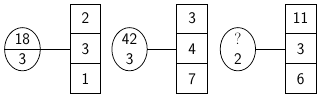
The rectangle represents a set of calculations that are common across all the given equations. Identify the calculations involved and solve the fourth equation on the same basis:

  1. AOption (a)

    ab(a+b)\frac{{ab}}{{(a + b)}}

  2. BOption (b)

    (ab+1)a\frac{{(ab + 1)}}{{a}}

  3. COption (c)

    (ab+1)(a−b)\frac{{(ab + 1)}}{{(a - b)}}

  4. DOption (d)

    (a+b)(ab−1)\frac{{(a + b)}}{{(ab - 1)}}

View answer & explanation

Correct answer

Answer: (c)C.

(ab+1)(a−b)\frac{{(ab + 1)}}{{(a - b)}}

Why this answer is correct

The logic followed here is:

⇒ (7×3+1)(7−3)\frac{{(7 \times 3 + 1)}}{{(7 - 3)}} ⇒ (21+1)(4)\frac{{(21 + 1)}}{{(4)}} ⇒ (22)(4)\frac{{(22)}}{{(4)}} ⇒ 112\frac{{11}}{{2}}

 ⇒ (6×2+1)(6−2)\frac{{(6 \times 2 + 1)}}{{(6 - 2)}} ⇒ (12+1)4\frac{{(12 + 1)}}{{4}} ⇒ 134\frac{{13}}{{4}}

⇒ (5×3+1)(5−3)\frac{{(5 \times 3 + 1)}}{{(5 - 3)}} ⇒ (15+1)2\frac{{(15 + 1)}}{{2}} ⇒ 162\frac{{16}}{{2}} ⇒ 8

Similarly,

 ⇒ (ab+1)(a−b)\frac{{(ab + 1)}}{{(a - b)}}

Hence, "Option 3" is the correct answer.

Question 12

Chholiya dance form is associated with _____ state.

  1. AOption (a)

    Haryana

  2. BOption (b)

    Rajasthan

  3. COption (c)

    Bihar

  4. DOption (d)

    Uttarakhand

View answer & explanation

Correct answer

Answer: (d)D.

Uttarakhand

Why this answer is correct

The correct answer is Uttarakhand.

Key Points

  • Chholiya is a traditional dance form originating from the Kumaon region of Uttarakhand, India.
  • It is primarily performed during wedding processions, as well as other festive occasions and religious ceremonies.
  • The dance involves intricate swordplay and is performed by men dressed in traditional warrior attire, symbolizing the valor and martial spirit of the Kumaoni people.
  • Chholiya is accompanied by traditional musical instruments like the drums (dhol) and brass instruments (bhankora and ransingha), adding to its energetic and vibrant nature.

Additional Information

  • Uttarakhand
  • Uttarakhand, also known as the "Land of the Gods," is a state in northern India known for its natural beauty and religious significance.
  • The state is home to important pilgrimage sites such as Haridwar, Rishikesh, Kedarnath, Badrinath, and the source of the Ganges River, the Gangotri Glacier.
  • Uttarakhand is divided into two regions: Garhwal and Kumaon, each with its own distinct cultural and historical heritage.
  • The state is also known for its adventure tourism, offering activities such as trekking, mountaineering, river rafting, and skiing.
  • Traditional Dance Forms of India
  • India is home to a diverse range of traditional dance forms, each originating from different regions and reflecting the unique cultural heritage of those areas.
  • Some well-known classical dance forms include Bharatanatyam (Tamil Nadu), Kathak (North India), Kathakali (Kerala), Odissi (Odisha), and Manipuri (Manipur).
  • Folk dances also play a significant role in Indian culture, with each state having its own traditional dances, such as Bhangra (Punjab), Garba (Gujarat), Bihu (Assam), and Lavani (Maharashtra).
  • These dance forms are often performed during festivals, celebrations, and rituals, showcasing the rich cultural diversity of India.
  • Kumaon Region
  • The Kumaon region is one of the two administrative divisions of Uttarakhand, the other being Garhwal.
  • It comprises six districts: Almora, Bageshwar, Champawat, Nainital, Pithoragarh, and Udham Singh Nagar.
  • The region is known for its picturesque landscapes, including the Nainital Lake, the hill station of Almora, and the Pithoragarh Valley.
  • Kumaon has a rich cultural heritage, with traditional crafts, music, and dance forms that have been passed down through generations.

Question 13

Which option can best describe equinox?

  1. AOption (a)

    South pole is titled towards sun.

  2. BOption (b)

    Earth is going around the sun.

  3. COption (c)

    Neither of the poles is titled towards sun.

  4. DOption (d)

    North pole is titled towards sun.

View answer & explanation

Correct answer

Answer: (c)C.

Neither of the poles is titled towards sun.

Why this answer is correct

The correct answer is Neither of the poles is tilted towards the sun.

Key Points

  • Equinox occurs twice a year, around March 20th and September 22nd, when the sun is directly above the equator.
  • During an equinox, day and night are approximately equal in length all over the world.
  • The term "equinox" comes from the Latin words "aequus" (equal) and "nox" (night), signifying equal day and night.
  • Equinoxes mark the change of seasons: the March equinox signals the start of spring in the Northern Hemisphere and autumn in the Southern Hemisphere, while the September equinox signals the start of autumn in the Northern Hemisphere and spring in the Southern Hemisphere.

Additional Information

  • Solstice
  • A solstice occurs when the sun reaches its highest or lowest point in the sky at noon, resulting in the longest or shortest days of the year.
  • The summer solstice occurs around June 21st, marking the longest day of the year in the Northern Hemisphere and the shortest in the Southern Hemisphere.
  • The winter solstice occurs around December 21st, marking the shortest day of the year in the Northern Hemisphere and the longest in the Southern Hemisphere.
  • Earth's Axis Tilt
  • The Earth is tilted on its axis by approximately 23.5 degrees.
  • This tilt is responsible for the changing seasons as the Earth orbits around the sun.
  • During different times of the year, either the Northern Hemisphere or the Southern Hemisphere is tilted towards the sun, resulting in seasonal variations.
  • Orbital Mechanics
  • The Earth's orbit around the sun is elliptical, meaning it is not a perfect circle but slightly elongated.
  • This elliptical orbit also contributes to the variation in solar energy received by different parts of the Earth throughout the year.
  • Daylight Duration
  • Daylight duration varies depending on your latitude and the time of the year.
  • During equinoxes, the duration of daylight and night is nearly equal worldwide.
  • In contrast, during solstices, the variation in daylight duration is most extreme.

Question 14

Which treaty was imposed by the five nuclear Weapon powers and five permanent members of the UN Security Council on the rest of the World in 1968?

  1. AOption (a)

    Comprehensive Test Ban Treaty

  2. BOption (b)

    Non Aligned Treaty

  3. COption (c)

    North Atlantic Treaty Organization

  4. DOption (d)

    Non-Proliferation Treaty

View answer & explanation

Correct answer

Answer: (d)D.

Non-Proliferation Treaty

Why this answer is correct

The correct answer is Non-Proliferation Treaty.

Key Points

  • The Non-Proliferation Treaty (NPT) was signed on July 1, 1968, and entered into force on March 5, 1970.
  • The treaty aims to prevent the spread of nuclear weapons and promote peaceful uses of nuclear energy.
  • It is a landmark international treaty with 191 member states, making it one of the most widely adhered-to arms control agreements.
  • The NPT establishes a framework for nuclear disarmament and non-proliferation, and it has three main pillars: non-proliferation, disarmament, and the right to peacefully use nuclear technology.

Additional Information

  • Comprehensive Test Ban Treaty (CTBT)
  • The CTBT is a treaty that bans all nuclear explosions for both civilian and military purposes.
  • It was adopted by the United Nations General Assembly on September 10, 1996, but has not yet entered into force as it requires ratification by specific states.
  • The treaty aims to impede the development of nuclear weapons and promote nuclear disarmament and non-proliferation.
  • Non-Aligned Movement (NAM)
  • The Non-Aligned Movement is a group of states that are not formally aligned with or against any major power bloc.
  • Founded in 1961 in Belgrade, it was a product of the Cold War era's geopolitical tensions.
  • The movement advocates for national sovereignty, territorial integrity, and the opposition to colonialism, imperialism, and neocolonialism.
  • North Atlantic Treaty Organization (NATO)
  • NATO is a military alliance established on April 4, 1949, through the North Atlantic Treaty (also known as the Washington Treaty).
  • The organization constitutes a system of collective defense whereby its independent member states agree to mutual defense in response to an attack by any external party.
  • NATO's primary purpose is to safeguard the freedom and security of its members through political and military means.

Question 15

Which is the incorrect statement with regard to ultrasound waves?

  1. AOption (a)

    Ultrasound cannot be reflected back from defective locations

  2. BOption (b)

    They are high frequency waves

  3. COption (c)

    They travel among well-defined paths even in the presence of obstacles

  4. DOption (d)

    They are used in industries and for medical purposes

View answer & explanation

Correct answer

Answer: (a)A.

Ultrasound cannot be reflected back from defective locations

Why this answer is correct

The correct answer is Ultrasound cannot be reflected back from defective locations.

Key Points

  • Ultrasound waves are indeed high-frequency waves, typically above 20,000 Hz, which is higher than the upper audible limit of human hearing.
  • Ultrasound waves have the ability to travel along well-defined paths even when obstacles are present, which makes them useful in various applications.
  • Ultrasound waves are widely used in medical imaging (like sonography) and industrial applications (like non-destructive testing) to detect defects or for imaging purposes.
  • Contrary to Option 1, ultrasound waves can be reflected back from defective locations; this property is used in medical diagnostics and industrial flaw detection.

Additional Information

  • Ultrasound Waves
  • Ultrasound waves are sound waves with frequencies higher than the audible range for humans (greater than 20 kHz).
  • They are used in various fields such as medical imaging (ultrasound scans), industrial non-destructive testing, and even in cleaning processes.
  • In medical imaging, ultrasound waves are used to create images of the internal organs and tissues. This is done by sending high-frequency sound waves into the body and measuring the echoes that bounce back.
  • In industry, ultrasound waves are used for detecting flaws in materials, measuring thickness, and cleaning delicate components.
  • Reflection of Ultrasound Waves
  • The principle of reflection of ultrasound waves is used in various applications like medical ultrasonography and industrial flaw detection.
  • When ultrasound waves encounter a boundary between two different materials, some of the waves are reflected back to the source. The time taken for the waves to return is used to determine the distance and the nature of the boundary.
  • This property is particularly useful in identifying and locating defects within materials, such as cracks or voids.
  • Path of Ultrasound Waves
  • Ultrasound waves travel in well-defined paths, and their direction can be controlled using specialized equipment.
  • This property is exploited in ultrasound imaging, where the waves are directed to specific parts of the body to create detailed images.
  • In industrial applications, this allows for precise inspection of materials and components.

Question 16

Eight people, namely A, B, C, D, E, F, G and H are sitting around a dining table. D is the brother of E. G's wife F. B is A's wife. C is married to H. A is C's brother. F is the father-in-law of B. C is the father of his only son D. How is A related to D?

  1. AOption (a)

    Son

  2. BOption (b)

    Father

  3. COption (c)

    Mother's father

  4. DOption (d)

    Paternal Uncle

View answer & explanation

Correct answer

Answer: (d)D.

Paternal Uncle

Why this answer is correct

Given: Eight people, namely A, B, C, D, E, F, G and H are sitting around a dining table.

1) D is the brother of E. 

  1. C is the father of his only son D.

3) C is married to H.

4) A is C's brother.

5) B is A's wife.

6) F is the father-in-law of B.

Thus, A is D's paternal uncle.

Hence, the correct answer is "Option 4"

Question 17

The most common isotopes used in a nuclear weapon are of:

  1. AOption (a)

    Uranium and plutonium

  2. BOption (b)

    Uranium and lithium

  3. COption (c)

    Deuterium and lithium

  4. DOption (d)

    Deuterium and plutonium

View answer & explanation

Correct answer

Answer: (a)A.

Uranium and plutonium

Why this answer is correct

The correct answer is Uranium and plutonium.

Key Points

  • Uranium-235 and Plutonium-239 are the most common isotopes used in nuclear weapons.
  • Uranium-235 is highly fissile, making it suitable for use in nuclear reactors and weapons.
  • Plutonium-239 is produced in nuclear reactors from Uranium-238 and is also fissile.
  • These isotopes undergo nuclear fission, a process that releases a tremendous amount of energy used in nuclear explosions.

Additional Information

  • Isotopes:
  • Isotopes are variants of a particular chemical element which differ in neutron number, and consequently in nucleon number.
  • All isotopes of a given element have the same number of protons but different numbers of neutrons in each atom.
  • Nuclear Fission:
  • Nuclear fission is a reaction in which the nucleus of an atom splits into two or more smaller nuclei, along with the release of energy.
  • This process is used in nuclear reactors and nuclear weapons.
  • Fission of heavy elements such as Uranium-235 and Plutonium-239 releases a large amount of energy.
  • Uranium-235:
  • Uranium-235 is an isotope of uranium making up about 0.72% of natural uranium.
  • Unlike the predominant isotope uranium-238, it is fissile, meaning it can sustain a chain reaction of nuclear fission.
  • Plutonium-239:
  • Plutonium-239 is an isotope of plutonium.
  • It is a key fissile isotope used in the production of nuclear weapons and in some nuclear reactors.
  • It is produced by exposing uranium-238 to neutron radiation in a reactor.

Question 18

In a code language, SHIFT is written as VKLIW and LIFT is written as OLIW. How will JOB be written as in that code language?

  1. AOption (a)

    MRE

  2. BOption (b)

    NSF

  3. COption (c)

    OSG

  4. DOption (d)

    LQD

View answer & explanation

Correct answer

Answer: (a)A.

MRE

Why this answer is correct

The logic followed here is:

SHIFT is written as VKLIW

And,

LIFT is written as OLIW

Similarly,

JOB will be written as


Hence, "Option 1" is the correct answer.

Question 19

By selling an article for ₹1,600, a person lost 20%. For what amount should he sell it to make a profit of 20%?

  1. AOption (a)

    ₹4,000

  2. BOption (b)

    ₹2,400

  3. COption (c)

    ₹3,600

  4. DOption (d)

    ₹1,200

View answer & explanation

Correct answer

Answer: (b)B.

₹2,400

Why this answer is correct

Given:

Selling Price (SP) = ₹1,600

Loss Percentage = 20%

Formula used:

Cost Price (CP) = SP / (1 - Loss Percentage)

Calculations:

  1. Calculate Cost Price:

⇒ CP = 1600 / (1 - 0.20)

⇒ CP = 1600 / 0.80

⇒ CP = 2000

  1. To find Selling Price for a Profit of 20%:

Formula: Selling Price for Profit = CP × (1 + Profit Percentage)

⇒ Selling Price = 2000 × (1 + 0.20)

⇒ Selling Price = 2000 × 1.20

⇒ Selling Price = 2400

∴ To make a profit of 20%, the article should be sold for ₹2,400.

Question 20

Write the name of the supercomputer developed by Tata Group in 2007.

  1. AOption (a)

    PARAM

  2. BOption (b)

    Cray 3

  3. COption (c)

    EKA

  4. DOption (d)

    HITAC S-300

View answer & explanation

Correct answer

Answer: (c)C.

EKA

Why this answer is correct

The correct answer is EKA.

Key Points

  • EKA is a supercomputer developed by the Tata Group in 2007.
  • The name EKA means "one" in Sanskrit, symbolizing its top position at the time of its development.
  • EKA was ranked as the fastest supercomputer in India and the fourth fastest in the world upon its launch.
  • It was developed by the Computational Research Laboratories (CRL), a subsidiary of Tata Sons.

Additional Information

  • PARAM
  • PARAM is a series of supercomputers built by the Centre for Development of Advanced Computing (C-DAC) in India.
  • The first machine in the series, PARAM 8000, was released in 1991.
  • PARAM stands for "Parallel Machine".
  • Cray 3
  • The Cray-3 was a vector supercomputer designed by Cray Research.
  • It was known for its innovative use of gallium arsenide semiconductors to achieve higher speeds.
  • Development of the Cray-3 started in the 1980s, but it faced several challenges and was not as commercially successful as anticipated.
  • HITAC S-300
  • HITAC S-300 is a supercomputer developed by the Japanese company Hitachi.
  • It was known for its high performance and reliability in various computational tasks.

Question 21

By selling a book at ₹125, Ram earns a profit equal to 25\frac{2}{5}th of the selling price. Find the cost price of the book (in ₹).

  1. AOption (a)

    75

  2. BOption (b)

    50

  3. COption (c)

    100

  4. DOption (d)

    30

View answer & explanation

Correct answer

Answer: (a)A.

75

Why this answer is correct

Given:

Selling Price (SP) = ₹125

Profit = (2/5) × SP

Formula used:

Cost Price (CP) = SP - Profit

Calculations:

  1. Calculate Profit:

⇒ Profit = (2/5) × 125

⇒ Profit = 50

  1. Calculate Cost Price:

⇒ CP = SP - Profit

⇒ CP = 125 - 50

⇒ CP = 75

∴ The cost price of the book is ₹75.

Question 22

The surface area of a sphere whose radius is 21 m is:

  1. AOption (a)

    11088 m2

  2. BOption (b)

    1100 m2

  3. COption (c)

    5544 m2

  4. DOption (d)

    1000 m2

View answer & explanation

Correct answer

Answer: (c)C.

5544 m2

Why this answer is correct

Given:

Radius (r) = 21 m

Formula used:

Surface Area (SA) = 4πr2

Calculations:

  1. Calculate r2:

⇒ r2 = 212 = 441

  1. Calculate Surface Area:

⇒ SA = 4 × π × 441

⇒ SA = 4 × (22/7) × 441

⇒ SA = (88/7) × 441

⇒ SA = 38808 / 7

⇒ SA = 5544 m2

∴ The surface area of the sphere is 5544 m2.

Question 23

If ₹825 is divided into three parts in a proportion of 13\frac{1}{3} ∶ 49\frac{4}{9} ∶ 34\frac{3}{4}, then the first part will be:

  1. AOption (a)

    ₹190

  2. BOption (b)

    ₹204

  3. COption (c)

    ₹210

  4. DOption (d)

    ₹180

View answer & explanation

Correct answer

Answer: (d)D.

₹180

Why this answer is correct

Given:

Total Amount = ₹825

Proportions: 1/3 : 4/9 : 3/4

Calculations:

  1. Find LCM of denominators (3, 9, 4): LCM = 36
  2. Convert fractions to have a denominator of 36:

⇒ 1/3 = 12/36

⇒ 4/9 = 16/36

⇒ 3/4 = 27/36

  1. Total parts = 12 + 16 + 27 = 55
  2. Value of each part = 825 / 55 = 15
  3. First part = 12 parts = 12 × 15 = 180

∴ The first part will be ₹180.

Question 24

Study the given pattern carefully and select the number that can replace the question mark (?) in it.

  1. AOption (a)

    1432

  2. BOption (b)

    1436

  3. COption (c)

    1442

  4. DOption (d)

    1545

View answer & explanation

Correct answer

Answer: (a)A.

1432

Why this answer is correct

The logic followed here is:

Hence, "Option 1" is the correct answer.

Question 25

Find the greatest number of three digits which is exactly divisible by 6, 8, 10 and 16.

  1. AOption (a)

    720

  2. BOption (b)

    960

  3. COption (c)

    240

  4. DOption (d)

    480

View answer & explanation

Correct answer

Answer: (b)B.

960

Why this answer is correct

Given:

Numbers: 6, 8, 10, 16

Step 1: Finding the LCM

Prime Factorization:

 6 = 2 × 3

  8 = 2³

 10 = 2 × 5

 16 = 2⁴

LCM = 24 × 31 × 51 = 16 × 3 × 5

Calculations:

 16 × 3 = 48

 48 × 5 = 240

Step 2: Finding the Largest Three-Digit Number

Largest three-digit number = 999

Step 3: Checking for Divisibility

999 ÷ 240 ≈ 4.1625

Integer part = 4

Greatest number = 4 × 240 = 960

∴ The greatest three-digit number that is exactly divisible by 6, 8, 10, and 16 is 960.

Question 26

According to the 2011 census which city of India has the second largest population?

  1. AOption (a)

    Bangaluru

  2. BOption (b)

    Mumbai

  3. COption (c)

    Chennai

  4. DOption (d)

    Delhi

View answer & explanation

Correct answer

Answer: (d)D.

Delhi

Why this answer is correct

The correct answer is Delhi.

Key Points

  • According to the 2011 census, Delhi is the second most populous city in India after Mumbai.
  • Delhi had a population of approximately 11 million in 2011, making it a major urban hub in India.
  • Delhi is also the capital city of India and has significant political, cultural, and historical importance.
  • The National Capital Territory (NCT) of Delhi includes New Delhi, which is the seat of all three branches of the Government of India.

Additional Information

  • 2011 Census of India
  • The 2011 Census of India was the 15th National Census since 1871.
  • It was conducted by the Census Commissioner of India and was the largest administrative exercise in the world.
  • The census provides demographic data such as population size, distribution, density, and various socio-economic indicators.
  • The data collected helps in policy formulation, planning, and administration in various sectors like health, education, and infrastructure.
  • Population Density
  • Population density is calculated as the number of people per unit area, typically per square kilometer.
  • High population density areas often face challenges such as congestion, pollution, and strain on infrastructure and resources.
  • Delhi has one of the highest population densities among Indian cities, which impacts its urban planning and resource management.
  • Urbanization in India
  • Urbanization refers to the increasing population in urban areas compared to rural areas.
  • Factors contributing to urbanization include economic opportunities, better infrastructure, and improved living standards.
  • Delhi is a prime example of rapid urbanization, attracting people from various regions for employment and better living conditions.
  • National Capital Territory (NCT) of Delhi
  • The NCT of Delhi includes not just Delhi city but also New Delhi, the capital of India.
  • New Delhi hosts the central administrative functions of the Indian government, including the Parliament House, Rashtrapati Bhavan, and the Supreme Court.
  • The NCT is divided into multiple districts and is governed by its own legislative assembly and Chief Minister.

Question 27

The product of 0.27 and 3.54 is less than 5.743 by how much?

  1. AOption (a)

    5.742

  2. BOption (b)

    0.7558

  3. COption (c)

    4.7872

  4. DOption (d)

    3.89

View answer & explanation

Correct answer

Answer: (c)C.

4.7872

Why this answer is correct

Given:

Values: 0.27 and 3.54

Comparison Value: 5.743

Calculations:

  1. Calculate the product:

⇒ 0.27 × 3.54 = 0.9558

  1. Subtract the product from 5.743:

⇒ 5.743 - 0.9558 = 4.7872

∴ The product of 0.27 and 3.54 is less than 5.743 by 4.7872.

Question 28

Who among the following scripted history as he became the youngest ever test captain as of September 2019?

  1. AOption (a)

    Tatenda Taibu

  2. BOption (b)

    Sachin Tendulakar

  3. COption (c)

    Rashid Khan

  4. DOption (d)

    Rahul Dravid

View answer & explanation

Correct answer

Answer: (c)C.

Rashid Khan

Why this answer is correct

The correct answer is Rashid Khan.

Key Points

  • Rashid Khan became the youngest ever Test captain in cricket history as of September 2019.
  • He achieved this milestone at the age of 20 years and 350 days.
  • Rashid Khan is an Afghan cricketer known for his exceptional leg-spin bowling skills.
  • He led the Afghanistan national cricket team against Bangladesh in a one-off Test match in September 2019.

Additional Information

  • Test Cricket:
  • Test cricket is the longest form of the sport of cricket and is considered its highest standard.
  • It is played between teams representing their countries over a period of up to five days.
  • A Test match consists of four innings (two per team), and it requires a high level of skill and endurance.
  • Captaincy in Cricket:
  • The captain is the leader of the team both on and off the field.The captain's responsibilities include setting field placements, making bowling changes, and motivating the team.
  • Effective captaincy requires tactical awareness, leadership skills, and the ability to make quick decisions under pressure.
  • Leg-Spin Bowling:
  • Leg-spin is a type of bowling in cricket where the ball spins from the leg side to the off side for a right-handed batsman.
  • It is considered one of the most difficult bowling techniques to master due to the wrist action involved.
  • Rashid Khan is renowned for his leg-spin, which has made him a key player in various T20 leagues around the world.
  • Afghanistan National Cricket Team:
  • The Afghanistan national cricket team represents Afghanistan in international cricket.
  • The team has made significant progress since gaining Full Member status of the International Cricket Council (ICC) in 2017.
  • Afghanistan is known for producing talented cricketers who have excelled in various formats of the game.

Question 29

What types of mountains are created when large areas are broken and displaced vertically?

  1. AOption (a)

    Volcanic mountains

  2. BOption (b)

    Range

  3. COption (c)

    Block mountains

  4. DOption (d)

    Fold mountains

View answer & explanation

Correct answer

Answer: (c)C.

Block mountains

Why this answer is correct

The correct answer is Block mountains.

Key Points

  • Block mountains, also known as horst mountains, are formed due to the faulting and fracturing of the Earth's crust.
  • These mountains form when large areas or blocks of the Earth's crust are uplifted and tilted, often due to tectonic forces.
  • Examples of block mountains include the Sierra Nevada in the USA and the Harz Mountains in Germany.
  • The uplifted blocks are called horsts, while the lowered blocks are termed grabens.

Additional Information

  • Volcanic Mountains
  • Volcanic mountains are formed due to volcanic activity, where magma from beneath the Earth's crust erupts to the surface.
  • These mountains typically have a conical shape with a crater at the summit.
  • Examples include Mount Fuji in Japan and Mount St. Helens in the USA.
  • Range
  • A range refers to a series of mountains or hills connected by high ground.
  • Ranges can be composed of various types of mountains including block, fold, and volcanic mountains.
  • Examples include the Rocky Mountains and the Himalayas.
  • Fold Mountains
  • Fold mountains are formed by the folding of Earth's crust due to tectonic activity.
  • They are characterized by complex folded structures and are typically very high.
  • Examples include the Himalayas in Asia and the Alps in Europe.
  • Faulting and Fracturing
  • Faulting occurs when there is a break or crack in the Earth's crust where blocks of land move relative to each other.
  • This movement can create various landforms, including block mountains.
  • Fracturing refers to the breaking of rocks without significant movement, often preceding faulting.

Question 30

Which part of desert plants such as cactus performs the process of photosynthesis?

  1. AOption (a)

    Roots

  2. BOption (b)

    Leaves

  3. COption (c)

    Spines

  4. DOption (d)

    Stem

View answer & explanation

Correct answer

Answer: (d)D.

Stem

Why this answer is correct

The correct answer is Stem.

Key Points

  • In desert plants like cacti, the stem is the primary site of photosynthesis. This adaptation helps the plant conserve water.
  • The stems of these plants are thick and fleshy, allowing them to store water for long periods.
  • The stems contain chlorophyll, which is essential for the photosynthesis process, allowing them to produce food.
  • Leaves in cacti are modified into spines to reduce water loss and protect the plant from herbivores.

Additional Information

  • Photosynthesis
  • Photosynthesis is the process by which green plants, algae, and some bacteria convert light energy into chemical energy stored in glucose.
  • The general equation for photosynthesis is 6CO₂ + 6H₂O + light energy → C₆H₁₂O₆ + 6O₂.
  • Chlorophyll, the green pigment found in plant cells, plays a crucial role in capturing light energy.
  • Photosynthesis typically occurs in the leaves of plants, but in desert plants like cacti, it occurs in the stem.
  • Adaptations of Desert Plants
  • Desert plants have evolved a variety of adaptations to survive in arid environments.
  • Some common adaptations include thick, fleshy stems for water storage, spines instead of leaves to reduce water loss, and deep root systems to access groundwater.
  • The thick cuticle on the surface of these plants helps minimize water loss through evaporation.
  • Many desert plants also have CAM (Crassulacean Acid Metabolism) photosynthesis, which allows them to open their stomata at night to reduce water loss.

Question 31

The fibres, such as nylon and polyester, that are made from chemical substances are called:

  1. AOption (a)

    Silk

  2. BOption (b)

    Synthetic fibres

  3. COption (c)

    Wool

  4. DOption (d)

    Natural fibres

View answer & explanation

Correct answer

Answer: (b)B.

Synthetic fibres

Why this answer is correct

The correct answer is Synthetic fibres.

Key Points

  • Synthetic fibres are man-made fibres produced from chemical substances.
  • These fibres are designed to mimic the properties of natural fibres such as cotton, wool, and silk.
  • Examples of synthetic fibres include nylon, polyester, acrylic, and spandex.
  • Synthetic fibres are known for their durability, strength, and resistance to wrinkles and shrinkage.

Additional Information

  • Silk
  • Silk is a natural protein fibre produced by silkworms.
  • It is known for its softness, lustre, and luxurious feel.
  • Silk is commonly used in the production of clothing, accessories, and textiles.
  • Wool
  • Wool is a natural fibre obtained from the fleece of sheep and other animals like goats and rabbits.
  • It is renowned for its warmth, elasticity, and moisture-wicking properties.
  • Wool is widely used in the manufacturing of winter clothing, blankets, and carpets.
  • Natural fibres
  • Natural fibres are fibres derived from plants, animals, or minerals.
  • Examples include cotton, linen, jute, wool, and silk.
  • These fibres are biodegradable and environmentally friendly.
  • They are used in a variety of applications, including clothing, home textiles, and industrial products.

Question 32

Which of the following is NOT a PSU?

  1. AOption (a)

    BSNL

  2. BOption (b)

    SAIL

  3. COption (c)

    ONGC

  4. DOption (d)

    GAIL

View answer & explanation

Correct answer

Answer: (a)A.

BSNL

Why this answer is correct

The correct answer is BSNL.

Key Points

  • BSNL stands for Bharat Sanchar Nigam Limited.
  • It is a government-owned telecommunications service provider in India.
  • BSNL was incorporated on 15th September 2000.
  • It is headquartered in New Delhi, India.

Additional Information

  • SAIL (Steel Authority of India Limited)
  • SAIL is one of the largest state-owned steel-making companies based in New Delhi, India.
  • It is a Public Sector Undertaking (PSU) owned by the Government of India.
  • SAIL was founded in 1954 and operates several steel plants across India.
  • ONGC (Oil and Natural Gas Corporation)
  • ONGC is a multinational oil and gas company headquartered in New Delhi, India.
  • It is a Public Sector Undertaking (PSU) under the administrative control of the Ministry of Petroleum and Natural Gas.
  • ONGC was founded on 14th August 1956.
  • GAIL (Gas Authority of India Limited)
  • GAIL is the largest state-owned natural gas processing and distribution company in India.
  • It is a Public Sector Undertaking (PSU) under the Ministry of Petroleum and Natural Gas.
  • GAIL was established in August 1984.

Question 33

A huge system of billions of stars and cloud of dust and gases is known as:

  1. AOption (a)

    Universe

  2. BOption (b)

    World

  3. COption (c)

    Galaxy

  4. DOption (d)

    Constellation

View answer & explanation

Correct answer

Answer: (c)C.

Galaxy

Why this answer is correct

The correct answer is Galaxy.

Key Points

  • A galaxy is a massive, gravitationally bound system that consists of stars, stellar remnants, interstellar gas, dust, and dark matter.
  • The term galaxy is derived from the Greek word "galaxias," which means "milky," a reference to the Milky Way galaxy.
  • Galaxies can contain billions or even trillions of stars and can range in size from a few thousand to several hundred thousand light-years in diameter.
  • There are various types of galaxies, including spiral galaxies, elliptical galaxies, and irregular galaxies.

Additional Information

  • Universe
  • The Universe encompasses all of space and time, and contains all of the galaxies, stars, and planets.
  • It is believed to have begun with the Big Bang approximately 13.8 billion years ago.
  • It is constantly expanding, and its vastness is beyond human comprehension.
  • World
  • The term "world" usually refers to the Earth and all life on it.
  • It can also be used to denote a particular area or domain, such as the "world of science" or "world of music".
  • Constellation
  • A constellation is a group of stars that forms a recognizable pattern in the night sky.
  • These patterns are often named after mythological figures, animals, or objects.
  • There are 88 recognized constellations in modern astronomy.

Question 34

Which is the smallest bone of the human body?

  1. AOption (a)

    Femur

  2. BOption (b)

    Stapes

  3. COption (c)

    Humerus

  4. DOption (d)

    Malleus

View answer & explanation

Correct answer

Answer: (b)B.

Stapes

Why this answer is correct

The correct answer is Stapes.

Key Points

  • The stapes is the smallest bone in the human body.
  • It is located in the middle ear and is involved in the process of hearing.
  • The stapes transmits sound vibrations from the incus to the oval window, a membrane-covered opening to the inner ear.
  • It is one of the three auditory ossicles in the middle ear, the other two being the malleus and the incus.

Additional Information

  • Femur
  • The femur, or thigh bone, is the longest and strongest bone in the human body.
  • It extends from the hip to the knee and supports the weight of the body in all activities.
  • Humerus
  • The humerus is the long bone in the upper arm.
  • It runs from the shoulder to the elbow and is crucial for arm movement.
  • Malleus
  • The malleus, also known as the hammer, is one of the three small bones in the middle ear.
  • It transmits sound vibrations from the eardrum to the incus.
  • Auditory Ossicles
  • The auditory ossicles are a chain of three small bones (malleus, incus, and stapes) located in the middle ear.
  • They play a key role in the process of hearing by transmitting sound waves from the air to the fluid-filled cochlea in the inner ear.

Question 35

Who founded Natal Indian Congress to fight against racial discrimination?

  1. AOption (a)

    Vallabhbhai Patel

  2. BOption (b)

    Subhash Chandra Bose

  3. COption (c)

    Jawaharlal Nehru

  4. DOption (d)

    Mahatma Gandhi

View answer & explanation

Correct answer

Answer: (d)D.

Mahatma Gandhi

Why this answer is correct

The correct answer is Mahatma Gandhi.

Key Points

  • Mahatma Gandhi founded the Natal Indian Congress (NIC) in 1894 to fight against racial discrimination and promote the rights of the Indian community in South Africa.
  • The NIC played a crucial role in organizing the Indian community and laid the foundation for future resistance against unjust laws.
  • Under Gandhi's leadership, the NIC employed non-violent resistance strategies, which later became a hallmark of Gandhi's activism.
  • The formation of the NIC marked the beginning of Gandhi's long journey as a prominent leader in the struggle for civil rights and independence.

Additional Information

  • Mahatma Gandhi
  • Mohandas Karamchand Gandhi, commonly known as Mahatma Gandhi, was born on October 2, 1869, in Porbandar, India.
  • He is renowned for his philosophy of non-violence (Ahimsa) and his role in leading India to independence from British rule.
  • Gandhi's methods of civil disobedience and non-violent protest inspired movements for civil rights and freedom across the world.
  • He is often referred to as the "Father of the Nation" in India.
  • Natal Indian Congress (NIC)
  • The Natal Indian Congress was established in 1894 in the Natal colony of South Africa.
  • Its primary objective was to fight against discriminatory laws and practices faced by the Indian community in South Africa.
  • The NIC became a platform for the Indian community to voice their grievances and seek justice through legal and political means.
  • The organization played a significant role in mobilizing the Indian population and laid the groundwork for future civil rights movements.
  • Racial Discrimination in South Africa
  • During the late 19th and early 20th centuries, Indian immigrants in South Africa faced severe racial discrimination and were subjected to unjust laws and practices.
  • These included restrictions on movement, property ownership, and employment opportunities for the Indian community.
  • The NIC, under Gandhi's leadership, sought to challenge these discriminatory laws through legal action and peaceful protest.
  • Gandhi's experiences in South Africa significantly shaped his approach to civil rights and non-violent resistance.
  • Non-violent Resistance
  • Non-violent resistance, also known as passive resistance or Satyagraha, was a key strategy employed by Gandhi and the NIC.
  • Satyagraha is based on the principles of truth and non-violence and involves peaceful protest and civil disobedience against unjust laws.
  • Gandhi's use of non-violent resistance in South Africa laid the foundation for his later campaigns in India, including the struggle for independence from British rule.
  • This method of resistance has inspired numerous movements for civil rights and social justice around the world.

Question 36

Select the option that is different from the rest.

  1. AOption (a)

    Bray

  2. BOption (b)

    Dialogue

  3. COption (c)

    Roar

  4. DOption (d)

    Bark

View answer & explanation

Correct answer

Answer: (b)B.

Dialogue

Why this answer is correct

The logic followed here is:

BraySound made by a donkey
DialogueConversation between two or more people
RoarSound made by a lion
BarkSound made by a dog


Bray, Roar, Bark all are sounds made by animals,

Whereas,

Dialogue is a type of conversation and not a sound made by an animal.

Hence, the correct answer is "Dialogue".

Question 37

Sitesh and Suresh are maternal cousins. The mother of Suresh, Gita has a daughter Samiksha. Anjali is Samiksha's paternal aunt. How is Anjali related to Gita?

  1. AOption (a)

    Husband's sister

  2. BOption (b)

    Paternal Aunt

  3. COption (c)

    Brother's wife

  4. DOption (d)

    Mother's sister

View answer & explanation

Correct answer

Answer: (a)A.

Husband's sister

Why this answer is correct

1) The mother of Suresh, Gita has a daughter Samiksha. 

2) Anjali is Samiksha's paternal aunt.

3) Sitesh and Suresh are maternal cousins. 

Thus, Anjali is Gita's sister-in-law of husband's sister.

Hence, the correct answer is "Option 1"

Question 38

In which language did Aryabhata write the book titled Aryabhatiyam?

  1. AOption (a)

    Telugu

  2. BOption (b)

    Sanskrit

  3. COption (c)

    Tamil

  4. DOption (d)

    Hindi

View answer & explanation

Correct answer

Answer: (b)B.

Sanskrit

Why this answer is correct

The correct answer is Sanskrit.

Key Points

  • Aryabhatiyam is an ancient Indian mathematical and astronomical treatise.
  • It was written by the mathematician and astronomer Aryabhata in the 5th century AD.
  • The text is composed in Sanskrit, which was the scholarly language of ancient India.
  • Aryabhatiyam covers topics such as arithmetic, algebra, plane trigonometry, and spherical trigonometry, and continues to be a significant work in the history of mathematics.

Additional Information

  • Sanskrit:
  • Sanskrit is an ancient Indo-European language of India in which the oldest scriptures of Hinduism, the Vedas, were composed.
  • It is known for its rich literary tradition and has been used in various scholarly and religious texts throughout Indian history.
  • Modern Indian languages like Hindi, Marathi, Bengali, and many others have evolved from or have been influenced by Sanskrit.
  • Sanskrit is also used in classical music, dance, and other cultural expressions in India.
  • Aryabhata:
  • Aryabhata was an Indian mathematician and astronomer who lived during the 5th century AD.
  • He is best known for his work Aryabhatiyam, which includes various innovations in mathematics and astronomy.
  • Aryabhata introduced the concept of zero and place value system, which are fundamental to modern mathematics.
  • He also calculated the value of pi (π) and explained the concept of the Earth's rotation, which were groundbreaking contributions at the time.
  • Aryabhatiyam:
  • The Aryabhatiyam is divided into four chapters: Gitikapada (cosmology), Ganitapada (mathematics), Kalakriyapada (time calculations), and Golapada (spherical astronomy).
  • The text uses a decimal place value system and includes various methods for solving algebraic equations.
  • It also discusses the motion of celestial bodies and eclipses, reflecting Aryabhata's deep understanding of astronomy.
  • Aryabhatiyam has been studied and commented upon by various scholars over the centuries, making it a cornerstone of Indian mathematical and astronomical tradition.

Question 39

Study the given pattern carefully and select the number that can replace the question mark (?) in it.

  1. AOption (a)

    6

  2. BOption (b)

    8

  3. COption (c)

    12

  4. DOption (d)

    10

View answer & explanation

Correct answer

Answer: (c)C.

12

Why this answer is correct

The logic followed here is:

⇒ 6 × 8 = 4 × 12

⇒ 48 = 48 (LHS = RHS)

And,

⇒ 3 × 8 = 6 × 4

⇒ 24 = 24 (LHS = RHS)

Similarly,

⇒ 3 × ? = 4 × 9

⇒ ? = 36 ÷ 3

⇒ ? = 12

Hence, "Option 3" is the correct answer.

Question 40

Blood pressure is the force:

  1. AOption (a)

    inside the veins

  2. BOption (b)

    inside the artery during ventricular diastole

  3. COption (c)

    inside the artery during ventricular systole

  4. DOption (d)

    that blood exerts against the wall of a vessel

View answer & explanation

Correct answer

Answer: (d)D.

that blood exerts against the wall of a vessel

Why this answer is correct

The correct answer is that blood exerts against the wall of a vessel.

Key Points

  • Blood pressure is a crucial vital sign and provides essential information about the health of the cardiovascular system.
  • It is measured using a device called a sphygmomanometer.
  • There are two components of blood pressure: systolic pressure (when the heart contracts) and diastolic pressure (when the heart relaxes).
  • Normal blood pressure is typically around 120/80 mmHg, but it can vary based on various factors like age, activity, and health conditions.

Additional Information

  • Blood Pressure
  • It is the pressure exerted by circulating blood upon the walls of blood vessels.
  • When the heart beats, it pumps blood into the arteries, creating pressure against the walls of the arteries.
  • This pressure is highest during ventricular systole (when the heart contracts) and lowest during ventricular diastole (when the heart relaxes).
  • Systolic and Diastolic Pressure
  • Systolic Pressure: The pressure in the arteries when the heart beats and fills them with blood. It is the higher of the two readings.
  • Diastolic Pressure: The pressure in the arteries when the heart rests between beats and refills with blood. It is the lower of the two readings.
  • Hypertension and Hypotension
  • Hypertension: High blood pressure, typically defined as a systolic pressure of 130 mmHg or higher or a diastolic pressure of 80 mmHg or higher.
  • Hypotension: Low blood pressure, typically defined as a systolic pressure lower than 90 mmHg or a diastolic pressure lower than 60 mmHg.
  • Measuring Blood Pressure
  • Blood pressure is measured using a sphygmomanometer, which includes an inflatable cuff to restrict blood flow and a mercury or aneroid manometer to measure the pressure.
  • The cuff is inflated around the upper arm and then gradually deflated while listening to the arterial blood flow sounds (Korotkoff sounds) using a stethoscope.

Question 41

Which of the following began with a revolt of the military soldiers at Meerut, soon became widespread and posed a grave challenge to the British rule?

  1. AOption (a)

    Battle of Panipat (1761)

  2. BOption (b)

    The Indian Mutiny (1857)

  3. COption (c)

    Quit India Movement (1942)

  4. DOption (d)

    Battle of Plassey (1757)

View answer & explanation

Correct answer

Answer: (b)B.

The Indian Mutiny (1857)

Why this answer is correct

The correct answer is The Indian Mutiny (1857).

Key Points

  • The Indian Mutiny of 1857 began with a revolt of the military soldiers at Meerut.
  • The mutiny quickly spread to other parts of India, including Delhi, Kanpur, and Lucknow, posing a grave challenge to British rule.
  • The rebellion was characterized by widespread civilian participation, making it one of the first major movements against British colonial rule.
  • The revolt had various causes, including political, economic, social, and military grievances against the British East India Company.

Additional Information

  • Battle of Panipat (1761)
  • The Battle of Panipat was fought between the Maratha Empire and the Durrani Empire led by Ahmad Shah Abdali.
  • It was one of the largest and bloodiest fought battles in the 18th century.
  • This battle marked the end of the Maratha Empire's expansion.
  • The loss weakened the Maratha Empire considerably and paved the way for British dominance in India.
  • Quit India Movement (1942)
  • The Quit India Movement was launched by Mahatma Gandhi on August 8, 1942, during World War II.
  • The movement aimed at demanding an end to British rule in India.
  • It was marked by mass protests, strikes, and acts of civil disobedience.
  • Despite being suppressed by the British, the movement played a crucial role in India's struggle for independence.
  • Battle of Plassey (1757)
  • The Battle of Plassey was fought between the British East India Company and the Nawab of Bengal, Siraj-ud-Daulah.
  • It took place on June 23, 1757, and ended in a decisive victory for the British East India Company.
  • This battle marked the beginning of British colonial rule in India.
  • The victory was aided by the betrayal of Siraj-ud-Daulah's commander, Mir Jafar.

Question 42

Solve the following.

777\frac{7}{{77}} × 7777077 = ?

  1. AOption (a)

    707077

  2. BOption (b)

    707007

  3. COption (c)

    707070

  4. DOption (d)

    7007007

View answer & explanation

Correct answer

Answer: (b)B.

707007

Why this answer is correct

Given:

Expression: (7/77) × 7777077

Calculations:

  1. Simplify (7/77):

⇒ 7/77 = 1/11

  1. Substitute back into the expression:

⇒ (1/11) × 7777077

  1. Calculate:

⇒ 7777077 ÷ 11

⇒ 7777077 ÷ 11 = 707007

∴ The result of (7/77) × 7777077 is 707007.

Question 43

If the word 'HONEST' is coded as IPOFTU, then how will the word 'SISTER' be coded?

  1. AOption (a)

    FTUIPO

  2. BOption (b)

    JUJTFS

  3. COption (c)

    RITSES

  4. DOption (d)

    TJTUFS

View answer & explanation

Correct answer

Answer: (d)D.

TJTUFS

Why this answer is correct

The logic followed here is:

'HONEST' is coded as IPOFTU

Similarly,

'SISTER' will be coded as

Hence, "Option 4" is the correct answer.

Question 44

The materials through which objects can be seen but not clearly are called ______ materials.

  1. AOption (a)

    opaque

  2. BOption (b)

    translucent

  3. COption (c)

    transparent

  4. DOption (d)

    lustre

View answer & explanation

Correct answer

Answer: (b)B.

translucent

Why this answer is correct

The correct answer is translucent.

Key Points

  • Translucent materials allow light to pass through them, but not enough to see through them clearly.
  • Examples of translucent materials include frosted glass, tracing paper, and some plastics.
  • Translucent materials scatter light, which is why objects behind them appear blurred.
  • Translucent materials are often used in applications where it is necessary to diffuse light, such as in lampshades or privacy windows.

Additional Information

  • Opaque Materials
  • Opaque materials do not allow light to pass through them at all. Objects on the other side cannot be seen.
  • Examples include wood, metal, and stone.
  • Opaque materials are used where light blockage is required, such as in walls and doors.
  • Transparent Materials
  • Transparent materials allow light to pass through them without scattering, so objects can be seen clearly through them.
  • Examples include clear glass, clean water, and some plastics.
  • Transparent materials are used in applications where clear visibility is needed, such as in windows and lenses.
  • Lustre
  • Lustre refers to the way light interacts with the surface of a material, often giving it a shiny or glossy appearance.
  • It is commonly used to describe the surface quality of minerals and metals.
  • Materials with high lustre include polished metals and gemstones.

Question 45

If FHB = 36644, then DAG will be equal to:

  1. AOption (a)

    16212

  2. BOption (b)

    16332

  3. COption (c)

    16444

  4. DOption (d)

    16149

View answer & explanation

Correct answer

Answer: (d)D.

16149

Why this answer is correct

The logic followed here is:

FHB = 36644

Similarly,

DAG = ?

Hence, "Option 4" is the correct answer.

Question 46

A and B entered into a partnership investing ₹20,000 and ₹16,000, respectively. After 3  months, C joined them with an investment of ₹15,000. What will be B's share in a half yearly profit of ₹4,100?

  1. AOption (a)

    ₹1,508

  2. BOption (b)

    ₹4,200

  3. COption (c)

    ₹5,000

  4. DOption (d)

    ₹2,000

View answer & explanation

Correct answer

Answer: (a)A.

₹1,508

Why this answer is correct

Given:

A’s investment = ₹20,000

B’s investment = ₹16,000

C’s investment = ₹15,000 (joined after 3 months)

Total profit for 6 months = ₹4,100

Formula used:

The share of profit is distributed based on the ratio of the product of investment and time. Each partner’s share is proportional to their total contribution (Investment × Time).

Calculation:

Step 1: Calculate the effective investment for each partner over 6 months:

A’s investment for 6 months = ₹20,000 × 6 = ₹1,20,000

B’s investment for 6 months = ₹16,000 × 6 = ₹96,000

C’s investment for 3 months = ₹15,000 × 3 = ₹45,000

Total effective investment = 1,20,000 + 96,000 + 45,000 = ₹2,61,000

Step 2: B's share of the profit:

B's ratio of investment = 96,0002,61,000\dfrac{96,000}{2,61,000}

⇒ B's share of profit = 96,0002,61,000×4,100\dfrac{96,000}{2,61,000} \times 4,100

⇒ B's share = ₹1,508.43

∴ B's share in the half-yearly profit is ₹1,508 (approximately).

Question 47

The median of 7, 14, 13, 12, 20, 11, 15 and 8 is:

  1. AOption (a)

    12

  2. BOption (b)

    11

  3. COption (c)

    12.5

  4. DOption (d)

    11.5

View answer & explanation

Correct answer

Answer: (c)C.

12.5

Why this answer is correct

Given Numbers:

7, 14, 13, 12, 20, 11, 15, 8

Step 1: Arrange in Ascending Order:

7, 8, 11, 12, 13, 14, 15, 20

Step 2: Determine the Median:

Two middle numbers: 12 and 13

Step 3: Calculate the Median:

Median = (12 + 13) / 2 = 25 / 2 = 12.5

∴ The median of the given numbers is 12.5.

Question 48

Which cricket player received the Padma Bhushan Award 2018?

  1. AOption (a)

    Virat Kohli

  2. BOption (b)

    Ravindra Jadeja

  3. COption (c)

    Mahendra Singh Dhoni

  4. DOption (d)

    Rohit Sharma

View answer & explanation

Correct answer

Answer: (c)C.

Mahendra Singh Dhoni

Why this answer is correct

The correct answer is Mahendra Singh Dhoni.

Key Points

  • Mahendra Singh Dhoni, commonly known as MS Dhoni, is a former Indian cricketer and captain of the Indian national team.
  • Under his captaincy, India won the 2007 ICC World Twenty20, the 2010 and 2016 Asia Cups, the 2011 ICC Cricket World Cup, and the 2013 ICC Champions Trophy.
  • Dhoni is known for his exceptional wicket-keeping skills and is considered one of the best finishers in limited-overs cricket.
  • In recognition of his contributions to Indian cricket, Dhoni was awarded the Padma Bhushan, India's third-highest civilian award, in 2018.

Additional Information

  • Padma Bhushan
  • The Padma Bhushan is the third-highest civilian award in the Republic of India, preceded by the Bharat Ratna and the Padma Vibhushan and followed by the Padma Shri.
  • Instituted in 1954, the award is given for "distinguished service of a high order" without distinction of race, occupation, position, or sex.
  • The recommendations for the award are made by the Padma Awards Committee, constituted by the Prime Minister of India.
  • The awardees are announced on Republic Day (26th January) every year.
  • MS Dhoni's Career
  • MS Dhoni made his debut in international cricket in December 2004 and quickly established himself as a key player in the Indian team.
  • He became the captain of the Indian team in 2007 and led India to numerous victories in all formats of the game.
  • Dhoni is known for his calm demeanor, strategic acumen, and leadership qualities.
  • He retired from international cricket on 15 August 2020 but continues to play in the Indian Premier League (IPL).
  • Other Notable Awards
  • Dhoni has been honored with several other prestigious awards, including the Rajiv Gandhi Khel Ratna in 2007 and the Padma Shri in 2009.
  • He was also named the ICC ODI Player of the Year in 2008 and 2009.

Question 49

Which of the following rail networks is the fourth largest network in the world?

  1. AOption (a)

    China

  2. BOption (b)

    U.S.A

  3. COption (c)

    India

  4. DOption (d)

    Russia

View answer & explanation

Correct answer

Answer: (c)C.

India

Why this answer is correct

The correct answer is India.

Key Points

  • India boasts the fourth largest rail network in the world, spanning over 67,368 kilometers.
  • Indian Railways is one of the largest employers globally, with over 1.4 million employees.
  • The Indian rail network operates around 13,169 passenger trains and 8,479 freight trains daily.
  • It plays a crucial role in connecting various parts of the country, facilitating the movement of people and goods efficiently.

Additional Information

  • Indian Railways
  • Indian Railways is a state-owned national railway system of India, which is managed by the Ministry of Railways.
  • It was founded in 1853 and has since grown to become one of the largest rail networks in the world.
  • The railways offer a range of services including long-distance and suburban rail systems, as well as freight services.
  • Indian Railways is divided into 18 zones, each headed by a general manager.
  • Railway Zones
  • The Indian Railways is divided into various zones and divisions to manage its operations efficiently.
  • Some of the major zones include Northern Railway, Western Railway, Eastern Railway, and Southern Railway.
  • Each zone is further divided into divisions, each headed by a Divisional Railway Manager (DRM).
  • Modernization and Expansion
  • Indian Railways is continuously working on modernizing its infrastructure, including electrification of tracks, upgrading signaling systems, and introducing high-speed trains.
  • Projects like the Dedicated Freight Corridor (DFC) aim to enhance the efficiency and capacity of freight transportation.
  • Initiatives like the introduction of Vande Bharat Express, a semi-high-speed train, are part of the modernization efforts.
  • Challenges and Future Plans
  • Despite its vast network, Indian Railways faces challenges such as maintaining infrastructure, ensuring safety, and improving passenger amenities.
  • Future plans include the development of high-speed rail corridors, increasing the network's reach to remote areas, and adopting more eco-friendly technologies.
  • The Indian government is also exploring public-private partnerships (PPPs) to bring in investment and expertise for the railways' development.

Question 50

Panini was a famous Sanskrit ______.

  1. AOption (a)

    novelist

  2. BOption (b)

    poet

  3. COption (c)

    writer

  4. DOption (d)

    grammarian

View answer & explanation

Correct answer

Answer: (d)D.

grammarian

Why this answer is correct

The correct answer is grammarian.

Key Points

  • Panini was an ancient Sanskrit philologist, grammarian, and a revered scholar of Vedic texts.
  • He is most famous for his work "Ashtadhyayi," which is a comprehensive treatise on Sanskrit grammar.
  • Panini's analysis of Sanskrit is considered one of the greatest intellectual achievements in human history.
  • He lived in ancient India, around the 4th century BCE, and his work significantly influenced both Indian and Western grammatical traditions.

Additional Information

  • Ashtadhyayi
  • It is Panini's most famous work and consists of eight chapters (hence the name Ashtadhyayi).
  • The treatise is a detailed and scientific analysis of Sanskrit grammar, comprising around 4000 sutras (rules).
  • Ashtadhyayi laid down the rules for Sanskrit morphology, phonetics, and syntax.
  • The work is not only a guide to Sanskrit grammar but also a linguistic and philosophical document that has influenced many other fields.
  • Philology
  • Philology is the study of language in written historical sources; it is a combination of literary studies, history, and linguistics.
  • It includes the study of texts and their historical context, the development of languages, and the relationship between languages.
  • Panini's work is a cornerstone in the field of philology, especially in the study of classical languages like Sanskrit.
  • Vedic Texts
  • Vedic texts are the ancient scriptures of Hinduism, composed in early Sanskrit.
  • They include the four Vedas (Rigveda, Samaveda, Yajurveda, and Atharvaveda) and their associated texts like Brahmanas, Aranyakas, and Upanishads.
  • Panini's work on grammar helped in the understanding and interpretation of these complex and ancient texts.

Question 51

Who has been appointed by the United Nations Development programme (UNDP) as its Goodwill Ambassador in the year 2019?

  1. AOption (a)

    Padma Lakshmi

  2. BOption (b)

    Priyanka Chopra

  3. COption (c)

    Hima Das

  4. DOption (d)

    Amitabh Bachchan

View answer & explanation

Correct answer

Answer: (a)A.

Padma Lakshmi

Why this answer is correct

The correct answer is Padma Lakshmi.

Key Points

  • Padma Lakshmi was appointed as a Goodwill Ambassador by the United Nations Development Programme (UNDP) in the year 2019.
  • She is an internationally renowned author, activist, actress, and model.
  • Padma Lakshmi has been a strong advocate for women's rights and the fight against hunger and poverty.
  • As a Goodwill Ambassador, she works to raise awareness and mobilize support for the UNDP's work, including the Sustainable Development Goals (SDGs).

Additional Information

  • United Nations Development Programme (UNDP)
  • UNDP is the United Nations' global development network.
  • It advocates for change and connects countries to knowledge, experience, and resources to help people build a better life.
  • UNDP operates in nearly 170 countries and territories, working with nations on their own solutions to global and national development challenges.
  • It focuses on issues such as poverty reduction, HIV/AIDS, democratic governance, energy and environment, and social development.
  • Goodwill Ambassadors
  • Goodwill Ambassadors are celebrities and public figures appointed by various United Nations agencies to advocate for their causes.
  • They use their fame and influence to draw attention to important global issues and mobilize support.
  • Goodwill Ambassadors engage in public advocacy, fundraising, and awareness campaigns.
  • They often participate in field visits to witness the impact of the UN's work and share their experiences with the public.
  • Sustainable Development Goals (SDGs)
  • The SDGs are a collection of 17 global goals set by the United Nations General Assembly in 2015.
  • They are designed to be a "blueprint to achieve a better and more sustainable future for all" by 2030.
  • The SDGs address global challenges, including poverty, inequality, climate change, environmental degradation, peace, and justice.
  • Each goal has specific targets to be achieved, and progress is monitored through a set of indicators.

Question 52

In which generation of computers were FORTRAN and COBOL languages first used?

  1. AOption (a)

    I Generation

  2. BOption (b)

    II Generation

  3. COption (c)

    IV Generation

  4. DOption (d)

    V Generation

View answer & explanation

Correct answer

Answer: (b)B.

II Generation

Why this answer is correct

The correct answer is II Generation.

Key Points

  • FORTRAN (Formula Translation) and COBOL (Common Business-Oriented Language) were first used during the second generation of computers.
  • The second generation of computers ranged from the mid-1950s to the mid-1960s.
  • This generation of computers used transistors instead of vacuum tubes, which made them smaller, faster, more reliable, and more energy-efficient.
  • High-level programming languages like FORTRAN and COBOL allowed for more complex and sophisticated programming compared to the machine and assembly languages used in the first generation.

Additional Information

  • FORTRAN (Formula Translation)
  • It was developed by IBM in the 1950s for scientific and engineering calculations.
  • FORTRAN is considered one of the oldest high-level programming languages.
  • It introduced concepts such as loops and conditional statements, making programming more efficient and less error-prone.
  • FORTRAN has been continuously updated and is still in use today for high-performance computing tasks.
  • COBOL (Common Business-Oriented Language)
  • COBOL was developed in the late 1950s and early 1960s, primarily for business, finance, and administrative systems.
  • It was designed to be readable by humans, making it easier for managers and programmers to understand and modify code.
  • COBOL is known for its strong data-processing capabilities and is still used in many legacy systems, particularly in the banking and financial sectors.
  • Despite being considered outdated by some, COBOL remains important for maintaining and updating older software systems.
  • Second Generation of Computers
  • This generation began with the invention of the transistor in 1947 by Bell Laboratories, which replaced the bulky and less efficient vacuum tubes used in the first generation of computers.
  • Second-generation computers were smaller, faster, more reliable, and more energy-efficient than their predecessors.
  • They also saw the development of more sophisticated operating systems and the introduction of high-level programming languages like FORTRAN and COBOL.
  • These advancements allowed for more complex and efficient programming, paving the way for future generations of computers.

Question 53

Which of the following are called the amphibians of the plant kingdom?

  1. AOption (a)

    Bryophytes

  2. BOption (b)

    Gymnosperm

  3. COption (c)

    Thallophytes

  4. DOption (d)

    Pteridophytes

View answer & explanation

Correct answer

Answer: (a)A.

Bryophytes

Why this answer is correct

The correct answer is Bryophytes.

Key Points

  • Bryophytes are considered the first group of plants to show a significant step from aquatic to terrestrial life.
  • They are non-vascular plants, meaning they do not have specialized tissues for water and nutrient transport.
  • Bryophytes include mosses, liverworts, and hornworts, and they typically inhabit moist environments.
  • These plants play a crucial role in preventing soil erosion and maintaining soil moisture.

Additional Information

  • Gymnosperms
  • These are seed-producing plants that do not form flowers. Their seeds are not enclosed within a fruit.
  • Examples include conifers like pine, spruce, and fir.
  • Gymnosperms have vascular tissues, which help in the transport of water and nutrients.
  • They are primarily found in temperate and boreal forests.
  • Thallophytes
  • This group includes algae, fungi, and lichens.
  • They are non-vascular plants and do not show any differentiation into roots, stems, or leaves.
  • Thallophytes are primarily aquatic and play a significant role in aquatic ecosystems.
  • They are important for their role in photosynthesis, nutrient cycling, and as a food source for various organisms.
  • Pteridophytes
  • These are vascular plants that reproduce via spores and do not produce seeds or flowers.
  • They include ferns, horsetails, and club mosses.
  • Pteridophytes have well-differentiated structures like roots, stems, and leaves.
  • They are typically found in moist and shaded environments.

Question 54

Which article of the Indian Constitution lays down Directive Principles of State Policy on promotion of International Peace and Security?

  1. AOption (a)

    Article 51

  2. BOption (b)

    Article 15

  3. COption (c)

    Article 14

  4. DOption (d)

    Article 31

View answer & explanation

Correct answer

Answer: (a)A.

Article 51

Why this answer is correct

The correct answer is Article 51.

Key Points

  • Article 51 of the Indian Constitution lays down the Directive Principles of State Policy on the promotion of international peace and security.
  • Article 51 is part of Part IV of the Indian Constitution which deals with the Directive Principles of State Policy (DPSP).
  • The Directive Principles are guidelines for the framing of laws by the government. These principles are not enforceable by any court, but they are considered fundamental in the governance of the country.
  • Article 51 aims to promote international peace and security, maintain just and honorable relations between nations, foster respect for international law and treaty obligations, and encourage the settlement of international disputes by arbitration.

Additional Information

  • Directive Principles of State Policy (DPSP)
  • The Directive Principles of State Policy are borrowed from the Irish Constitution and are enumerated in Part IV of the Indian Constitution from Articles 36 to 51.
  • They act as guidelines to the central and state governments of India, to be kept in mind while framing laws and policies.
  • These principles aim to create social and economic conditions under which citizens can lead a good life.
  • They also aim to establish social and economic democracy through a welfare state.
  • Article 14
  • Article 14 of the Indian Constitution guarantees equality before the law and equal protection of the laws within the territory of India.
  • This means that every person, whether a citizen or a foreigner, will be treated equally before the law.
  • Article 15
  • Article 15 prohibits discrimination on grounds of religion, race, caste, sex, or place of birth.
  • This is to ensure that the state treats all individuals equally, without any prejudice.
  • Article 31
  • Article 31, which dealt with the right to property, was repealed by the 44th Amendment Act of 1978.
  • The right to property is no longer a fundamental right but is now a constitutional right under Article 300A.

Question 55

Find the positive value of

12+12+12+...\sqrt {12 + \sqrt {12 + \sqrt {12 + } } } ...

  1. AOption (a)

    2

  2. BOption (b)

    3

  3. COption (c)

    12

  4. DOption (d)

    4

View answer & explanation

Correct answer

Answer: (d)D.

4

Why this answer is correct

Given Expression:

√{12 + √{12 + √{12 + ...}}}

Step 1: Let x represent the expression:

x = √{12 + x}

Step 2: Square Both Sides:

x² = 12 + x

Step 3: Rearrange the Equation:

x² - x - 12 = 0

Step 4: Solve the Quadratic Equation:

x = [1 ± √(1² - 4 × 1 × -12)] / (2 × 1)

x = [1 ± √(1 + 48)] / 2

x = [1 ± √49] / 2

x = [1 ± 7] / 2

Calculate the Roots:

Positive Root: x = (1 + 7) / 2 = 8 / 2 = 4

Negative Root: x = (1 - 7) / 2 = -6 / 2 = -3

∴ The positive value is 4.

Question 56

The approach to development that combines economic growth with ecological responsibility is known as:

  1. AOption (a)

    Sustainable development

  2. BOption (b)

    Economic development

  3. COption (c)

    Human development

  4. DOption (d)

    Social development

View answer & explanation

Correct answer

Answer: (a)A.

Sustainable development

Why this answer is correct

The correct answer is Sustainable development.

Key Points

  • Sustainable development aims to balance economic growth with environmental protection, ensuring that natural resources are used responsibly and conserved for future generations.
  • This approach incorporates the principles of ecological responsibility and seeks to minimize environmental degradation.
  • It emphasizes the importance of meeting the needs of the present without compromising the ability of future generations to meet their own needs.
  • Sustainable development integrates economic, social, and environmental considerations into policy-making and business practices.

Additional Information

  • Economic Development
  • Economic development refers to the improvement in economic indicators such as GDP, income levels, and employment rates.
  • It focuses primarily on economic growth and the increase in the standard of living.
  • While it is essential for a country's progress, it does not necessarily address environmental sustainability or equitable resource distribution.
  • Human Development
  • Human development is a concept that considers the well-being of individuals and communities, focusing on health, education, and living standards.
  • The Human Development Index (HDI) is commonly used to measure a country's human development.
  • While it encompasses broader aspects of well-being, it does not explicitly integrate environmental sustainability.
  • Social Development
  • Social development involves improving the social well-being of individuals and communities.
  • It focuses on aspects such as education, healthcare, social justice, and community development.
  • Social development initiatives often aim to reduce inequalities and enhance social cohesion.

Question 57

Muneer walked from his school, 85 m west, 45 m north, 25 m east and then, 45 m south. He stopped at this point to issue books from library. How far and in which direction is Muneer's school from the library?

  1. AOption (a)

    60 m, east

  2. BOption (b)

    60 m, west

  3. COption (c)

    55 m, west

  4. DOption (d)

    60 m, south

View answer & explanation

Correct answer

Answer: (a)A.

60 m, east

Why this answer is correct

Given: 

Muneer walked from his school, 85 m west, 45 m north, 25 m east and then, 45 m south.

He stopped at this point to issue books from library. 

Thus, Muneer's school is (85m - 25m) 60m away from the library in the east direction.

Hence, "Option 1" is the correct answer.

Question 58

The Brihadisvara temple is in which state of India?

  1. AOption (a)

    Madhya Pradesh

  2. BOption (b)

    Tamil Nadu

  3. COption (c)

    Rajasthan

  4. DOption (d)

    Uttar Pradesh

View answer & explanation

Correct answer

Answer: (b)B.

Tamil Nadu

Why this answer is correct

The correct answer is Tamil Nadu.

Key Points

  • The Brihadisvara temple is located in Thanjavur, Tamil Nadu.
  • It was built by the Chola emperor Raja Raja Chola I between 1003 and 1010 AD.
  • The temple is part of the UNESCO World Heritage Site known as the "Great Living Chola Temples".
  • The temple is a fine example of Dravidian architecture and is renowned for its massive tower (Vimana), which stands at about 66 meters.

Additional Information

  • Dravidian Architecture:
  • This architectural style originated in Southern India and is characterized by its pyramid-shaped towers called Vimanams.
  • The structures typically include large gopurams (gateway towers), pillared halls, and intricately carved stone sculptures.
  • Dravidian architecture is also known for its use of granite, which is locally available in Tamil Nadu.
  • Chola Dynasty:
  • The Chola dynasty was one of the longest-ruling dynasties in the history of Southern India, with significant contributions to Indian art, architecture, and culture.
  • The Cholas are known for their military prowess and naval dominance.
  • They ruled over parts of Tamil Nadu, Karnataka, Kerala, and Andhra Pradesh, and even extended their influence to Southeast Asia.
  • UNESCO World Heritage Sites:
  • The Great Living Chola Temples include the Brihadisvara Temple at Thanjavur, the Brihadisvara Temple at Gangaikonda Cholapuram, and the Airavatesvara Temple at Darasuram.
  • These temples are recognized for their architectural brilliance, intricate sculptures, and historical significance.
  • Being part of the UNESCO World Heritage list ensures that these sites are protected and preserved for future generations.
  • Raja Raja Chola I:
  • He was one of the greatest rulers of the Chola dynasty and is credited with establishing a strong administrative system.
  • His reign marked the peak of Chola power, with extensive military conquests and cultural development.
  • Under his rule, the Chola dynasty saw significant advancements in art, architecture, and literature.

Question 59

Which bank was set up as an apex body to coordinate the activities of all institutions involved in rural financing?

  1. AOption (a)

    NABARD

  2. BOption (b)

    Cooperative banks

  3. COption (c)

    Cooperative societies

  4. DOption (d)

    The poor women banks

View answer & explanation

Correct answer

Answer: (a)A.

NABARD

Why this answer is correct

The correct answer is NABARD.

Key Points

  • NABARD stands for National Bank for Agriculture and Rural Development.
  • It was established on 12 July 1982 by a special act of the Indian Parliament.
  • NABARD functions as an apex body to provide and regulate credit for the promotion of agriculture, small-scale industries, cottage and village industries, handicrafts, and other rural crafts.
  • It plays a crucial role in the development and implementation of policies related to rural financing and sustainable development.

Additional Information

  • Cooperative Banks
  • These are small-sized units organized in the cooperative sector which operate both in urban and rural areas.
  • They primarily serve the needs of small and marginal farmers, agricultural laborers, and small entrepreneurs.
  • Cooperative banks function based on the cooperative principles of mutual help and solidarity.
  • Cooperative Societies
  • These are voluntary associations of individuals who come together to achieve a common economic objective.
  • They work on the principle of mutual help and are generally involved in activities like agriculture, credit, production, and distribution.
  • They aim to provide services to their members rather than to earn profits.
  • The Poor Women Banks
  • These are specialized financial institutions aimed at providing credit and financial services to poor women, especially in rural areas.
  • They focus on empowering women through financial inclusion and economic independence.
  • Examples include self-help groups (SHGs) and microfinance institutions (MFIs) that operate with a similar objective.

This source code provides a detailed explanation of why NABARD is the correct answer and additional information about the other options, highlighting their roles and functions.

Question 60

An introductory statement in a constitution that states the reasons and guiding values of the constitution is called:

  1. AOption (a)

    Preamble

  2. BOption (b)

    Clause

  3. COption (c)

    Fundamental rights

  4. DOption (d)

    Article

View answer & explanation

Correct answer

Answer: (a)A.

Preamble

Why this answer is correct

The correct answer is Preamble.

Key Points

  • The Preamble is an introductory statement in a constitution that states the reasons and guiding values of the document.
  • It serves as a brief introduction to the principles and philosophy underlying the constitution.
  • The Preamble reflects the vision and objectives that the constitution aims to achieve.
  • In many countries, the Preamble is considered a key component as it sets the tone and purpose of the constitution.

Additional Information

  • Clause:
  • A clause in a constitution refers to a specific provision or section that addresses a particular point or issue.
  • Clauses are often used to detail the powers, duties, and rights within the constitution.
  • Fundamental Rights:
  • Fundamental rights are the basic human rights guaranteed to all citizens by the constitution.
  • These rights are essential for the protection of individual liberties and the promotion of social justice.
  • Article:
  • An article in a constitution is a major division that sets out specific laws or principles.
  • Articles are used to systematically organize the content of the constitution into manageable sections.

Question 61

Sonar is a device that uses ultrasonic waves to measure the distance, direction and speed of objects _____.

  1. AOption (a)

    on land

  2. BOption (b)

    underwater

  3. COption (c)

    in air

  4. DOption (d)

    in space

View answer & explanation

Correct answer

Answer: (b)B.

underwater

Why this answer is correct

The correct answer is underwater.

Key Points

  • Sonar stands for Sound Navigation and Ranging.
  • It is a technique that uses sound propagation to navigate, communicate, or detect objects underwater.
  • Sonar is commonly used in submarines and ships to detect underwater hazards, other vessels, and for navigation.
  • It can determine the distance, direction, and speed of underwater objects by analyzing the reflected sound waves.

Additional Information

  • Ultrasonic Waves:
  • These are sound waves with frequencies higher than the audible range for humans (>20 kHz).
  • Ultrasonic waves are used in various applications, including medical imaging (ultrasound), industrial nondestructive testing, and sonar.
  • Echo:
  • An echo is a reflection of sound that arrives at the listener some time after the direct sound.
  • In sonar, the time interval between the emission of a sound pulse and the reception of its echo is used to calculate the distance to an object.
  • Active vs. Passive Sonar:
  • Active Sonar: Sends out a sound wave and listens for the echo to determine the location of an object.
  • Passive Sonar: Listens for sounds made by other objects (e.g., submarines) without emitting its own sound waves.
  • Applications of Sonar:
  • Military: Submarine detection, underwater navigation, mine detection.
  • Commercial: Fishing industry for locating schools of fish, oil exploration.
  • Scientific: Oceanographic research, studying marine life, and mapping the seafloor.

Question 62

A 100-m-long train passes an electric post in 6 seconds. The speed of the train is: 

  1. AOption (a)

    60 km/h

  2. BOption (b)

    50 km/h

  3. COption (c)

    6016\frac{1}{6} km/h

  4. DOption (d)

    1616\frac{1}{6} km/h

View answer & explanation

Correct answer

Answer: (a)A.

60 km/h

Why this answer is correct

Given:

Distance (Length of Train) = 100 meters

Time = 6 seconds

Formula used:

Speed = Distance / Time

Calculations:

⇒ Speed = 100 / 6 = 16.67 m/s

Convert to km/h:

⇒ Speed = 16.67 × 3.6 = 60 km/h

∴ The speed of the train is 16.67 m/s or 60 km/h.

Question 63

If the length of the diagonals of a rhombus are 32 cm and 24 cm, then the length of each side of the rhombus will be:

  1. AOption (a)

    30 cm

  2. BOption (b)

    10 cm

  3. COption (c)

    40 cm

  4. DOption (d)

    20 cm

View answer & explanation

Correct answer

Answer: (d)D.

20 cm

Why this answer is correct

Given:

Diagonal 1 = 32 cm

Diagonal 2 = 24 cm

Formula used:

Pythagorean theorem: Side² = (Half of Diagonal 1)² + (Half of Diagonal 2)²

Calculations:

  1. Half of Diagonal 1 = 32 / 2 = 16 cm
  2. Half of Diagonal 2 = 24 / 2 = 12 cm
  3. Apply the Pythagorean theorem:

Side² = 16² + 12²

⇒ Side² = 256 + 144 = 400

⇒ Side = √400 = 20 cm

∴ The length of each side of the rhombus is 20 cm.

Question 64

Which of the following soil types is rich in soil nutrients such as calcium carbonate, magnesium, potash and lime?

  1. AOption (a)

    Black soil

  2. BOption (b)

    Laterite soil

  3. COption (c)

    Yellow soil

  4. DOption (d)

    Red soil

View answer & explanation

Correct answer

Answer: (a)A.

Black soil

Why this answer is correct

The correct answer is Black soil.

Key Points

  • Black soil is also known as Regur soil and is predominantly found in the Deccan Plateau region including Maharashtra, Madhya Pradesh, Gujarat, Andhra Pradesh, and Tamil Nadu.
  • This soil is rich in soil nutrients such as calcium carbonate, magnesium, potash, and lime which make it highly fertile and suitable for growing cotton and other crops.
  • The soil has a high clay content, which helps in retaining moisture, making it ideal for dry farming.
  • Black soil is known for its dark color which is attributed to the presence of various iron compounds and organic matter.

Additional Information

  • Laterite Soil
  • Laterite soil is rich in iron and aluminum but generally poor in nitrogen, phosphorus, and potassium.
  • This soil is typically found in areas with high temperatures and heavy rainfall, such as the Western Ghats and parts of Odisha, Karnataka, and Kerala.
  • It is characterized by its reddish color due to the high iron oxide content.
  • Laterite soil is used for plantation crops like tea, coffee, rubber, and cashew nuts.
  • Yellow Soil
  • Yellow soil is derived from the weathering of ancient crystalline rocks and is found in areas with high rainfall.
  • The yellow color is due to the presence of hydrated iron oxides.
  • This soil is generally poor in organic matter, nitrogen, and phosphorus but is suitable for growing rice, millets, and pulses.
  • Red Soil
  • Red soil is rich in iron oxide, which gives it its characteristic red color.
  • It is found in areas of low rainfall and is poor in nitrogen, phosphorus, and humus but rich in potassium.
  • Red soil is suitable for growing crops like cotton, wheat, pulses, tobacco, and oilseeds.

Question 65

Solve the following.

(28.4)2−;(24.4)2(28.4−24.4)\frac{{{{\left( {28.4} \right)}^2} - ;{{\left( {24.4} \right)}^2}}}{{\left( {28.4 - 24.4} \right)}} = ?

  1. AOption (a)

    52.8

  2. BOption (b)

    8

  3. COption (c)

    52

  4. DOption (d)

    4

View answer & explanation

Correct answer

Answer: (a)A.

52.8

Why this answer is correct

Given:

Expression: (28.4² - 24.4²) / (28.4 - 24.4)

Formula used:

Difference of Squares: a² - b² = (a - b)(a + b)

Calculations:

  1. Apply the formula:

(28.4² - 24.4²) = (28.4 - 24.4)(28.4 + 24.4)

  1. Substitute the values:

⇒ = (28.4 - 24.4)(28.4 + 24.4) / (28.4 - 24.4)

⇒ = 4 × (28.4 + 24.4) / 4

  1. Cancel the common factor:

⇒ = 28.4 + 24.4

  1. Add the values:

⇒ = 52.8

∴ The result is 52.8.

Question 66

After how many years (approximately) of debate, the Constitution of India was signed?

  1. AOption (a)

    3

  2. BOption (b)

    2

  3. COption (c)

    4

  4. DOption (d)

    5

View answer & explanation

Correct answer

Answer: (a)A.

3

Why this answer is correct

The correct answer is 3 years.

Key Points

  • The Constituent Assembly of India was formed in 1946 to draft the Constitution of India.
  • The drafting process was led by Dr. B.R. Ambedkar, who is often referred to as the "Father of the Indian Constitution."
  • The Assembly took approximately 3 years to debate and finalize the Constitution.
  • The Constitution was finally adopted on 26th November 1949 and came into effect on 26th January 1950.

Additional Information

  • Constituent Assembly:
  • The Constituent Assembly was a body of elected representatives tasked with drafting the Constitution of India.
  • It was formed in 1946 following the Cabinet Mission Plan.
  • The Assembly had 299 members representing various regions and communities of India.
  • Dr. B.R. Ambedkar:
  • Dr. Bhimrao Ramji Ambedkar was an Indian jurist, economist, and social reformer.
  • He was the Chairman of the Drafting Committee of the Constituent Assembly.
  • He played a crucial role in framing the Indian Constitution and advocating for social justice.
  • Adoption and Enactment:
  • The Constitution was adopted on 26th November 1949.
  • It came into effect on 26th January 1950, which is celebrated as Republic Day in India.
  • The date 26th January was chosen to honor the declaration of Purna Swaraj (complete independence) by the Indian National Congress in 1930.

Question 67

Select the option in which the words share the same relationship as that shared by the given pair of words.

Vitamin D : Rickets

  1. AOption (a)

    Vitamin C : Thyroid

  2. BOption (b)

    Iron : Anemia

  3. COption (c)

    Bacteria : Cholera

  4. DOption (d)

    Aspirin : Pain

View answer & explanation

Correct answer

Answer: (b)B.

Iron : Anemia

Why this answer is correct

The logic followed here is:

Logic: Diseases caused by Vitamin deficiencies.

Here,

Vitamin D : Rickets → Rickets is a disease caused by deficiencies of Vitamin D.

Similarly,

Iron : Anemia → Anemia is a disease caused by deficiencies of Iron.

Hence, the correct answer is "Option 2".

Question 68

Study the given pattern carefully and select the number that can replace the question mark (?) in it.

  1. AOption (a)

    11

  2. BOption (b)

    22

  3. COption (c)

    40

  4. DOption (d)

    68

View answer & explanation

Correct answer

Answer: (c)C.

40

Why this answer is correct

The logic followed here is:

⇒ 18 ÷ 3 = 2 + 3 + 1

⇒ 6 = 6 (LHS = RHS)

And,

⇒ 42 ÷ 3 = 3 + 4 + 7

⇒ 14 = 14 (LHS = RHS)

Similarly,

⇒ ? ÷ 2 = 11 + 3 + 6

⇒ ? = 20 × 2

⇒ ? = 40

Hence, "Option 3" is the correct answer.

Question 69

ABC is a right-angled triangle, right angled at C. If A = 60° and AC = 203\sqrt 3  units, then find AB.

  1. AOption (a)

    203\sqrt 3  units

  2. BOption (b)

    40 units

  3. COption (c)

    3\sqrt 3  units

  4. DOption (d)

    403\sqrt 3  units

View answer & explanation

Correct answer

Answer: (d)D.

403\sqrt 3  units

Why this answer is correct

Given:

Right-angled triangle ABC, right-angled at C

Angle A = 60°, AC = 20√3 units

Formula used:

Cosine ratio: cos(θ) = Adjacent / Hypotenuse

Calculations:

  1. Apply the cosine ratio:

cos(60°) = AC / AB

  1. Substitute the known values:

1/2 = 20√3 / AB

  1. Solve for AB:

AB = 2 × 20√3 = 40√3 units

∴ The length of AB is 40√3 units.

Question 70

In a code language, GOOFY is written as EMMDW. 

How will EMMA be written as in that code language?

  1. AOption (a)

    CKKY

  2. BOption (b)

    BJJA

  3. COption (c)

    BJJY

  4. DOption (d)

    CKKA

View answer & explanation

Correct answer

Answer: (a)A.

CKKY

Why this answer is correct

The logic followed here is:

GOOFY is written as EMMDW

Similarly,

EMMA will be written as

Hence, "Option 1" is the correct answer.

Question 71

Tools, machines, building, etc. that are required for production are called:

  1. AOption (a)

    Fixed capital

  2. BOption (b)

    Working capital

  3. COption (c)

    Physical capital

  4. DOption (d)

    Human capital

View answer & explanation

Correct answer

Answer: (a)A.

Fixed capital

Why this answer is correct

The correct answer is Fixed capital.

Key Points

  • Fixed capital refers to the assets and resources that are used over a long period in the production process.
  • These assets include tools, machines, buildings, and other equipment necessary for production.
  • Fixed capital is not consumed or changed during the production process but is used repeatedly.
  • Examples of fixed capital include machinery, factories, and vehicles.

Additional Information

  • Working Capital
  • It refers to the funds used for the day-to-day operations of a business.
  • This includes cash, inventory, and other short-term assets that are used and replenished regularly.
  • Working capital is crucial for maintaining the liquidity and operational efficiency of a business.
  • Physical Capital
  • This term broadly refers to all man-made resources used in the production process, including both fixed and working capital.
  • Physical capital includes buildings, machinery, tools, and other equipment.
  • Human Capital
  • It refers to the knowledge, skills, and experience possessed by individuals that contribute to economic value.
  • Investing in human capital involves education, training, and health improvements.
  • Human capital is essential for enhancing productivity and efficiency in the workforce.

Question 72

Normally, A QWERTY keyboard has ______ keys.

  1. AOption (a)

    98

  2. BOption (b)

    100

  3. COption (c)

    120

  4. DOption (d)

    104

View answer & explanation

Correct answer

Answer: (d)D.

104

Why this answer is correct

The correct answer is 104.

Key Points

  • A standard QWERTY keyboard typically has 104 keys.
  • The layout includes alphabetic keys, numeric keys, function keys, and a number pad.
  • QWERTY refers to the first six letters on the top row of the alphabetic section on the keyboard.
  • The QWERTY layout was designed in the 1870s by Christopher Sholes, the inventor of the typewriter.

Additional Information

  • QWERTY Keyboard
  • The QWERTY keyboard is the most common modern-day keyboard layout.
  • It was designed to prevent mechanical jams in early typewriters by spacing out commonly used letter pairings.
  • Despite the existence of more efficient keyboard layouts (such as Dvorak), QWERTY remains the most popular due to historical adoption.
  • QWERTY keyboards are used in most English-speaking countries and many other regions worldwide.
  • Function Keys
  • Function keys are the keys labeled F1 to F12 and are located at the top of the keyboard.
  • They are used to perform special actions, like refreshing a page (F5) or entering the BIOS setup (F2 or Del).
  • The specific function of these keys can vary depending on the operating system and the application being used.
  • Numeric Keypad
  • The numeric keypad is a set of keys on the right side of the keyboard, usually arranged in a grid.
  • It includes numbers from 0 to 9, basic arithmetic operators, and a decimal point.
  • It's primarily used for quick data entry and calculations, especially in accounting and finance applications.

Question 73

If x + 1x\frac{1}{x} = 26, then the value of x2 + 1x2\frac{1}{x^2}  =?

  1. AOption (a)

    2

  2. BOption (b)

    24

  3. COption (c)

    674

  4. DOption (d)

    676

View answer & explanation

Correct answer

Answer: (c)C.

674

Why this answer is correct

Given:

x + 1/x = 26

Formula used:

x² + 1/x² = (x + 1/x)² - 2

Calculations:

  1. Apply the formula:

x² + 1/x² = 26² - 2

  1. Calculate:

x² + 1/x² = 676 - 2 = 674

∴ The value of x² + 1/x² is 674.

Question 74

The mean of 22, 35, 15, 75, 66, 50, 52, 36, 70, 86 and 10 is:

  1. AOption (a)

    57

  2. BOption (b)

    51

  3. COption (c)

    47

  4. DOption (d)

    46.5

View answer & explanation

Correct answer

Answer: (c)C.

47

Why this answer is correct

Given Numbers:

22, 35, 15, 75, 66, 50, 52, 36, 70, 86, 10

Calculations:

  1. Sum of the numbers:

22 + 35 + 15 + 75 + 66 + 50 + 52 + 36 + 70 + 86 + 10 = 517

  1. Number of values = 11
  2. Mean = Sum of the numbers / Total number of values

⇒ Mean = 517 / 11 = 47

∴ The mean of the given numbers is 47.

Question 75

The HCF of 716\frac{7}{16}, 924\frac{9}{24} and 1164\frac{11}{64} is:

  1. AOption (a)

    1

  2. BOption (b)

    192

  3. COption (c)

    69

  4. DOption (d)

    1192\frac{1}{192}

View answer & explanation

Correct answer

Answer: (d)D.

1192\frac{1}{192}

Why this answer is correct

7/16, 9/24, 11/64

Step 1: Identify Numerators and Denominators

Numerators: 7, 9, 11

Denominators: 16, 24, 64

Step 2: Find the HCF of Numerators

HCF of 7, 9, 11 = 1 (since they have no common factors)

Step 3: Find the LCM of Denominators

LCM of 16, 24, 64 = 192

Step 4: Apply the Formula

HCF of Fractions = HCF of Numerators / LCM of Denominators

⇒ HCF = 1/192

∴ The HCF of the given fractions is 1/192.

Question 76

In the equations below, the function of → remains unchanged. What does the question mark stand for in the fourth equation?

I. 9 → 3 = 32

II. 6 → 7 = 47

III. 13 → 3 = 44

IV. 12 → 3 = ?

  1. AOption (a)

    15

  2. BOption (b)

    36

  3. COption (c)

    4

  4. DOption (d)

    41

View answer & explanation

Correct answer

Answer: (d)D.

41

Why this answer is correct

The logic followed here is:

I. 9 → 3 = 32

⇒ (9 × 3) + 5 = 32

⇒ 27 + 5 = 32

⇒ 32 = 32 (LHS = RHS)

II. 6 → 7 = 47

⇒ (6 × 7) + 5 = 47

⇒ 42 + 5 = 47

⇒ 47 = 47 (LHS = RHS)

III. 13 → 3 = 44

⇒ (13 × 3) + 5 = 44

⇒ 39 + 5 = 44

⇒ 44 = 44 (LHS = RHS)

Similarly,

IV. 12 → 3 = ?

⇒ (12 × 3) + 5 = ?

⇒ 36 + 5 = ?

⇒ 41 = ?

Hence, "Option 4" is the correct answer.

Question 77

The 15th Pravasi Bhartiya Diwas (2019) was organised at:

  1. AOption (a)

    Ahmedabad

  2. BOption (b)

    Varanasi

  3. COption (c)

    Bengaluru

  4. DOption (d)

    Marina Bay Sands

View answer & explanation

Correct answer

Answer: (b)B.

Varanasi

Why this answer is correct

The correct answer is Varanasi.

Key Points

  • The 15th Pravasi Bharatiya Divas (PBD) was held from 21st to 23rd January 2019 in Varanasi, Uttar Pradesh.
  • The theme for the 2019 event was "Role of Indian Diaspora in building a New India."
  • Prime Minister Narendra Modi inaugurated the event and held discussions with the Indian diaspora on various issues.
  • Varanasi, one of the oldest living cities in the world, was chosen to showcase the rich cultural heritage and the development taking place in India.

Additional Information

  • Pravasi Bharatiya Divas (PBD)
  • PBD is celebrated once every two years to mark the contribution of the Overseas Indian community to the development of India.
  • The convention provides a platform for the Indian diaspora to engage with the government and people of the land of their ancestors.
  • The event is aimed at strengthening the engagement of the overseas Indian community with the Government of India and reconnecting them with their roots.
  • The date, January 9, was chosen to commemorate the return of Mahatma Gandhi from South Africa to India in 1915, which led to the start of India's freedom struggle.
  • Varanasi
  • Varanasi, also known as Kashi or Benares, is a city on the banks of the river Ganges in Uttar Pradesh, India.
  • It is one of the seven sacred cities (Sapta Puri) in Hinduism and Jainism, and played an important role in the development of Buddhism.
  • Varanasi is famous for its ghats, the steps leading down to the river, which are used for bathing, rituals, and religious ceremonies.
  • The city is also known for its silk weaving, producing beautiful Banarasi sarees that are highly valued across India.

Question 78

A sum fetched a total simple interest of ₹4,500 at the rate of 9% per annum in 5 years. What was the sum?

  1. AOption (a)

    ₹9,500

  2. BOption (b)

    ₹9,000

  3. COption (c)

    ₹8,900

  4. DOption (d)

    ₹10,000

View answer & explanation

Correct answer

Answer: (d)D.

₹10,000

Why this answer is correct

Given:

Simple Interest (SI) = ₹4,500

Rate of Interest (R) = 9% per annum

Time (T) = 5 years

Formula used:

SI = (P × R × T) / 100

Calculations:

  1. Substitute the known values:

4500 = (P × 9 × 5) / 100

  1. Simplify:

4500 = (45P) / 100

450000 = 45P

  1. Solve for P:

P = 450000 / 45 = 10000

∴ The sum (principal) was ₹10,000.

Question 79

If 5 men or 9 children can finish a task in 92 days, then how much time will 20 men and 10 children take to finish the same task?

  1. AOption (a)

    18 days

  2. BOption (b)

    27 days

  3. COption (c)

    36 days

  4. DOption (d)

    9 days

View answer & explanation

Correct answer

Answer: (a)A.

18 days

Why this answer is correct

Given:

5 men or 9 children can finish a task in 92 days.

Step 1: Find the work done by 1 man and 1 child in a day:

Work done by 1 man in 1 day = 1 / (5 × 92) = 1/460

Work done by 1 child in 1 day = 1 / (9 × 92) = 1/828

Step 2: Find the work done by 20 men and 10 children in 1 day:

Work done by 20 men = 20 × 1/460 = 1/23

Work done by 10 children = 10 × 1/828 = 5/414

Total work done in 1 day = 1/23 + 5/414 = 23/414

Step 3: Calculate the total time:

Total time = 414 / 23 = 18 days

∴ The total time taken by 20 men and 10 children to finish the task is 18 days.

Question 80

Find the smallest whole number whose 60% is more than 6.

  1. AOption (a)

    7

  2. BOption (b)

    11

  3. COption (c)

    10

  4. DOption (d)

    6

View answer & explanation

Correct answer

Answer: (b)B.

11

Why this answer is correct

Given:

We need to find the smallest whole number whose 60% is more than 6.

Step 1: Set up the equation:

0.60 × x > 6

Step 2: Solve for x:

x > 6 / 0.60 = 10

Step 3: The smallest whole number greater than 10 is 11.

∴ The smallest whole number is 11.

Question 81

Which of the following is NOT a source of the Indian Constitution?

  1. AOption (a)

    Constitution of Ireland

  2. BOption (b)

    Constitution of France

  3. COption (c)

    Constitution of Denmark

  4. DOption (d)

    Constitution of U.S.A

View answer & explanation

Correct answer

Answer: (c)C.

Constitution of Denmark

Why this answer is correct

The correct answer is Constitution of Denmark.

Key Points

  • The Indian Constitution has borrowed several features from various other constitutions of the world to create a comprehensive document.
  • From the Constitution of Ireland, we adopted the Directive Principles of State Policy.
  • The Constitution of France influenced the ideals of Liberty, Equality, and Fraternity which are enshrined in the Preamble.
  • The Constitution of the U.S.A provided the framework for the Fundamental Rights, the federal structure of government, and the independence of the judiciary.

Additional Information

  • Constitution of Ireland
  • The Directive Principles of State Policy in the Indian Constitution were borrowed from the Irish Constitution.
  • These principles provide guidelines for the creation of a just society in India and are considered fundamental in the governance of the country.
  • They are non-justiciable, meaning they cannot be enforced by any court, but they are fundamental in the governance of the country and aim to create social and economic conditions under which citizens can lead a good life.
  • Constitution of France
  • The ideals of Liberty, Equality, and Fraternity were taken from the French Constitution and are included in the Preamble of the Indian Constitution.
  • These principles were inspired by the French Revolution and emphasize the importance of individual freedom, equality before the law, and brotherhood among people.
  • Constitution of the U.S.A
  • The Indian Constitution borrowed the concept of Fundamental Rights from the U.S. Constitution.
  • The structure of federalism, with a clear demarcation of powers between the central and state governments, was also adopted from the U.S. model.
  • The idea of an independent judiciary, with the power of judicial review, was another significant feature borrowed from the U.S. Constitution.
  • Constitution of Denmark
  • The Constitution of Denmark has not been a direct source for any specific part of the Indian Constitution.
  • While the Indian Constitution is influenced by various global constitutions, Denmark's constitution does not have a direct influence on the Indian legal framework.

Question 82

The difference between the compound interest and the simple interest on a certain amount at a rate of interest of 5% per annum for 2 years is ₹25. Find the amount.

  1. AOption (a)

    ₹7,500

  2. BOption (b)

    ₹8,500

  3. COption (c)

    ₹9,000

  4. DOption (d)

    ₹10,000

View answer & explanation

Correct answer

Answer: (d)D.

₹10,000

Why this answer is correct

Given:

The difference between Compound Interest (CI) and Simple Interest (SI) = ₹25

Rate of Interest (R) = 5% per annum

Time (T) = 2 years

Formula used:

Difference between CI and SI for 2 years:

Difference = P × (R/100)2

Where P = Principal (the amount to be found).

Calculations:

  1. Substitute the values in the formula:

25 = P × (5/100)2

  1. Simplify the equation:

25 = P × (25/10000)

⇒ 25 = P × 0.0025

  1. Solve for P:

P = 25 / 0.0025 = 10,000

∴ The amount (P) is ₹10,000.

Question 83

X and Y together can finish a task in 3 days, Y and Z together in 6 days, and X and Z together in 9 days. If all work together then the task will be finished in ______.

  1. AOption (a)

    18 days

  2. BOption (b)

    3611\frac{{36}}{{11}} days

  3. COption (c)

    118\frac{{1}}{{18}} days

  4. DOption (d)

    1136\frac{{11}}{{36}} days

View answer & explanation

Correct answer

Answer: (b)B.

3611\frac{{36}}{{11}} days

Why this answer is correct

Given:

X and Y together can finish the task in 3 days

Y and Z together can finish the task in 6 days

X and Z together can finish the task in 9 days

Let the total work be 1 unit.

Work done per day by:

(X + Y) = 1/3

(Y + Z) = 1/6

(X + Z) = 1/9

Step 1: Add all the equations:

(X + Y) + (Y + Z) + (X + Z) = 1/3 + 1/6 + 1/9

⇒ 2X + 2Y + 2Z = LCM(3, 6, 9) = 18

⇒ 2X + 2Y + 2Z = (6 + 3 + 2) / 18 = 11/18

Step 2: Divide by 2 to find (X + Y + Z):

X + Y + Z = (11/18) / 2 = 11/36

Step 3: Find the number of days:

Work done by X, Y, and Z together in 1 day = 11/36

So, the total number of days required = 1 / (11/36) = 36/11

∴ The task will be finished in 36/11 days.

Question 84

The mean of 8 number is 37. If one of the number is excluded, the mean gets reduced by 2. The excluded number is:

  1. AOption (a)

    35

  2. BOption (b)

    51

  3. COption (c)

    39

  4. DOption (d)

    41

View answer & explanation

Correct answer

Answer: (b)B.

51

Why this answer is correct

Given:

The mean of 8 numbers = 37

When one number is excluded, the mean of the remaining 7 numbers = 37 - 2 = 35

Step 1: Find the total sum of 8 numbers:

Total sum = Mean × Number of values = 37 × 8 = 296

Step 2: Find the total sum of the remaining 7 numbers:

Total sum of 7 numbers = Mean × Number of values = 35 × 7 = 245

Step 3: Find the excluded number:

Excluded number = Total sum of 8 numbers - Total sum of 7 numbers

⇒ Excluded number = 296 - 245 = 51

∴ The excluded number is 51.

Question 85

The difference between the place value of 8 and 6 in the number 786392 is:

  1. AOption (a)

    8000

  2. BOption (b)

    7400

  3. COption (c)

    6000

  4. DOption (d)

    74000

View answer & explanation

Correct answer

Answer: (d)D.

74000

Why this answer is correct

Given Number: 786392

Step 1: Find the place value of 8:

The place value of 8 in 786392 is 80000 (as 8 is in the ten-thousands place).

Step 2: Find the place value of 6:

The place value of 6 in 786392 is 6000 (as 6 is in the thousands place).

Step 3: Calculate the difference:

Difference = 80000 - 6000 = 74000

∴ The difference between the place value of 8 and 6 is 74000.

Question 86

Study the following pie chart carefully which shows the monthly expenditure (in ₹) of a family.

If total amount spent on monthly expenditure during the month was ₹45,000, then what was the amount (in ₹) spent on education and health taken together (to the nearest thousand)?

  1. AOption (a)

    13,000

  2. BOption (b)

    11,000

  3. COption (c)

    17,000

  4. DOption (d)

    15,000

View answer & explanation

Correct answer

Answer: (d)D.

15,000

Why this answer is correct

Given:

Total monthly expenditure = ₹45,000

Education = 2.5 parts

Health = 2 parts

Formula used:

Total amount spent on Education and Health together = (Education+Health)Totalparts×Totalexpenditure\dfrac{(Education + Health)}{Total parts} \times Total expenditure 

Calculation:

Total parts = 3.5 (Food) + 2.3 (House rent) + 2.5 (Education) + 2 (Health) + 1.9 (Entertainment) + 1 (Fuel) + 0.5 (Bill payment) = 13.7

Amount spent on Education and Health = (2.5+2)13.7×45,000\dfrac{(2.5 + 2)}{13.7} \times 45,000

⇒ 4.513.7×45,000=14,781.75\dfrac{4.5}{13.7} \times 45,000 = 14,781.75

⇒ Amount ≈ ₹15,000 (to the nearest thousand)

∴ The amount spent on education and health together is ₹15,000.

Question 87

Study the graph of the production of computers by three companies A, B and C over the years. What is the ratio of the production by company C in 2017 to that by company B in 2014?

  1. AOption (a)

    11 ∶ 9

  2. BOption (b)

    9 ∶ 8

  3. COption (c)

    9 ∶ 11

  4. DOption (d)

    8 ∶ 9

View answer & explanation

Correct answer

Answer: (d)D.

8 ∶ 9

Why this answer is correct

Given:

Production by company C in 2017 = 40 lakh computers

Production by company B in 2014 = 45 lakh computers

Step 1: Calculate the ratio of production:

Ratio = (Production by company C in 2017) / (Production by company B in 2014)

Ratio = 40 / 45

Step 2: Simplify the ratio:

To simplify, divide both numbers by their greatest common divisor (GCD), which is 5:

Ratio = (40 ÷ 5) / (45 ÷ 5) = 8 / 9

∴ The ratio of production by company C in 2017 to that by company B in 2014 is 8:9.

Question 88

The given bar graph shows the number of motorbikes (in thousand) manufactured in 5 different motorbike factories M1, M2, M3, M4 and M5 in the years 2018 and 2019.


Which of the following statements is NOT true?

  1. AOption (a)

    Total production of M1, M2 and M3 for 2018 is the same as 2019.

  2. BOption (b)

    Production of M3 in 2019 is exactly the same as production for 2018.

  3. COption (c)

    Average production of M1, M2 and M3 in 2019 is greater than average production of M1, M2 and M3 in 2018.

  4. DOption (d)

    Total production of M4 and M5 for 2019 is greater than that of 2018

View answer & explanation

Correct answer

Answer: (c)C.

Average production of M1, M2 and M3 in 2019 is greater than average production of M1, M2 and M3 in 2018.

Why this answer is correct

Given:

The bar graph shows the number of motorbikes (in thousand) manufactured by five factories (M1, M2, M3, M4, M5) in 2018 and 2019.

From the graph:

 M1 (2018) = 56, M1 (2019) = 58

 M2 (2018) = 60, M2 (2019) = 58

 M3 (2018) = 52, M3 (2019) = 52

 M4 (2018) = 56, M4 (2019) = 48

 M5 (2018) = 62, M5 (2019) = 60

Statement 1: Total production of M1, M2, and M3 for 2018 is the same as 2019

2018 Total (M1 + M2 + M3) = 56 + 60 + 52 = 168

2019 Total (M1 + M2 + M3) = 58 + 58 + 52 = 168

Conclusion: This statement is true.

Statement 2: Production of M3 in 2019 is exactly the same as in 2018

M3 (2018) = 52

M3 (2019) = 52

Conclusion: This statement is true.

Statement 3: Average production of M1, M2, and M3 in 2019 is greater than in 2018

2018 Average = (168 / 3) = 56

2019 Average = (168 / 3) = 56

Conclusion: This statement is false because the averages are the same.

Statement 4: Total production of M4 and M5 in 2019 is greater than in 2018

2018 Total (M4 + M5) = 56 + 62 = 118

2019 Total (M4 + M5) = 48 + 60 = 108

Conclusion: This statement is false because the total in 2019 is less than in 2018.

Final Conclusion: The statement that is not true is statement 3.

Question 89

The given bar graph shows the profit made by a software company (in Million $) from 2013 to 2018.

The profit made by the company in 2017-18 was approximately what percentage of the average profit over the period under review which means 2013-18$?

  1. AOption (a)

    200%

  2. BOption (b)

    107%

  3. COption (c)

    85%

  4. DOption (d)

    90%

View answer & explanation

Correct answer

Answer: (b)B.

107%

Why this answer is correct

Given Data:

Profits for the years 2013-14 to 2017-18 (in million $): 300, 380, 290, 310, 350

Step 1: Calculate the Total Profit

Total Profit = 300 + 380 + 290 + 310 + 350 = 1630 million $

Step 2: Calculate the Average Profit

Average Profit = 1630 / 5 = 326 million $

Step 3: Calculate the percentage of the profit in 2017-18 compared to the average profit

Percentage = (350 / 326) × 100 ≈ 107.36%

∴ The profit in 2017-18 was approximately 107% of the average profit over the period 2013-18.$

Question 90

Study the given pattern carefully and select the number that can replace the question mark (?) in it.

536
11714
?2040
  1. AOption (a)

    32

  2. BOption (b)

    16

  3. COption (c)

    20

  4. DOption (d)

    12

View answer & explanation

Correct answer

Answer: (a)A.

32

Why this answer is correct

The logic followed here is: 

⇒ (3 + 7) × 2 = 20

⇒ 10 × 2 = 20

⇒ 20 = 20 (LHS = RHS)

And,

⇒ (6 + 14) × 2 = 40

⇒ 20 × 2 = 40

⇒ 40 = 40 (LHS = RHS)

Similarly,

⇒ (5 + 11) × 2 = ?

⇒ 16 × 2 = ?

⇒ 32 = ?

Hence, "Option 1" is the correct answer.

Question 91

Select the option that is different from the rest.

  1. AOption (a)

    Club

  2. BOption (b)

    Spade

  3. COption (c)

    Gold

  4. DOption (d)

    Diamond

View answer & explanation

Correct answer

Answer: (c)C.

Gold

Why this answer is correct

The logic followed here is:

ClubSuit
SpadeSuit
GoldMetal
DiamondSuit


Club, Spade, Diamond all are suits in a deck of cards,

Whereas,

Gold is a metal and does not belong to the category of card suits.

Hence, the correct answer is "Gold".

Question 92

Select the option that correctly represents the given classes.

Rose, Lily, Water

  1. AOption (a)

  2. BOption (b)

  3. COption (c)

  4. DOption (d)

View answer & explanation

Correct answer

Answer: (a)A.

Why this answer is correct

The diagram that best represents the relationship between Rose, Lily, and Water is shown below :

Rose and lily are different types of flowers.

Water is different from rose and lily category.

Hence, "Option 1" is the correct answer.

Question 93

Read the given statements and conclusions carefully and decide which of the conclusions logically follow(s) from the statements.

Statements:

(i) Some of the topics taught by my teacher are light, sound and electricity.

(ii) None of the topics of magnetism and waves are taught by my teacher.

(iii) All the topics taught by my teacher, except thermodynamics, are very comprehensible and interesting.

Conclusions:

(i) My teacher teaches the topic sound in a very interesting manner.

(ii) Magnetism and thermodynamics are not taught by my teacher.

(iii) The topic waves taught by my teacher is not very comprehensible.

  1. AOption (a)

    Only conclusion (i) and (ii) follow.

  2. BOption (b)

    Only conclusion (i) follows.

  3. COption (c)

    Only conclusion (iii) follows.

  4. DOption (d)

    Only conclusion (i) and (iii) follow.

View answer & explanation

Correct answer

Answer: (b)B.

Only conclusion (i) follows.

Why this answer is correct

Given,

Statement:

(i) Some of the topics taught by my teacher are light, sound, and electricity.

(ii) None of the topics of magnetism and waves are taught by my teacher.

(iii) All the topics taught by my teacher, except thermodynamics, are very comprehensible and interesting.

Conclusions:

(i) My teacher teaches the topic sound in a very interesting manner - True (Because, the statement (iii) mentions that all topics taught by the teacher except thermodynamics are very comprehensible and interesting. Since sound is taught by the teacher, it is interesting.)

(ii) Magnetism and thermodynamics are not taught by my teacher - False (Because, while magnetism is explicitly mentioned as not taught in statement (ii), thermodynamics is taught but not comprehensible and interesting.)

(iii) The topic waves taught by my teacher is not very comprehensible - False (Because, waves are not taught by the teacher as per statement (ii).)

So, Only conclusion (i) follows.

Hence, the correct answer is "Option 2".

Question 94

Study the given pattern carefully and select the number that can replace the question mark (?) in it.

  1. AOption (a)

    4

  2. BOption (b)

    50

  3. COption (c)

    15

  4. DOption (d)

    25

View answer & explanation

Correct answer

Answer: (b)B.

50

Why this answer is correct

The logic followed here is: 


And,

Similarly,

Hence, "Option 2" is the correct answer.

Question 95

Select the option that CANNOT be concluded from the statements given below.

Statement 1: All snakes are pizza.

Statement 2: Some pizzas are tea.

Statement 3: Some snakes are tea.

  1. AOption (a)

    Some tea are not snake but they are pizza.

  2. BOption (b)

    All pizzas are either tea or snake.

  3. COption (c)

    Some tea are both pizza and snake.

  4. DOption (d)

    Some pizzas are neither tea nor snake.

View answer & explanation

Correct answer

Answer: (b)B.

All pizzas are either tea or snake.

Why this answer is correct

The possible Venn diagram for the given statements is as shown below :

Conclusions:

Option 1) Some tea are not snake but they are pizza → Follow (As some snakes are tea and some pizzas are tea. As whole snakes comes in pizzas and have some part common with tea, therefore it is true.)

Option 2) All pizzas are either tea or snake → Does not follow (As all snakes are pizza and some pizzas are tea. As whole snakes comes in pizzas and have some part common with tea, therefore pizzas has some part common with both snakes and tea simultaneously thus it is false.)

Option 3) Some tea are both pizza and snake → Follow (As some pizzas are tea and some snakes are tea. As both snakes and pizzas have some part common with tea, therefore it is true.)

Option 4) Some pizzas are neither tea nor snake → Follow (As all snakes are pizza and some pizzas are tea. As whole snakes comes in pizzas and have some part common with tea, therefore pizzas has some part common with both snakes and tea simultaneously thus it is true.)

∴ Here, Only conclusion "All pizzas are either tea or snake" does not follows.​

Hence, the correct answer is "Option 2"

Question 96

Read the given statement and the courses of action carefully and decide which of the courses of action logically follow(s) from the statement.

Statement: There are chances that the dinner consumed by the students today was contaminated by typhoid causing bacteria.

Courses of Action:

(i) Some medical help must be immediately sought for the students.

(ii) Students must be asked to prepare well for exams.

(iii) The remainder of dinner (if any) must be thrown away.

  1. AOption (a)

    Only action (iii) follows.

  2. BOption (b)

    All the actions (i), (ii) and (iii) follow.

  3. COption (c)

    Only action (i) and (ii) follow.

  4. DOption (d)

    Only action (i) and (iii) follow.

View answer & explanation

Correct answer

Answer: (d)D.

Only action (i) and (iii) follow.

Why this answer is correct

Given:

Statement: There are chances that the dinner consumed by the students today was contaminated by typhoid causing bacteria.

Courses of Action:

I. Some medical help must be immediately sought for the students - True (Because, seeking medical help is essential to ensure the health and safety of the students and to address any potential infections promptly).

II. Students must be asked to prepare well for exams - False (Because, this action is unrelated to the immediate health concern posed by the contaminated dinner).

III. The remainder of dinner (if any) must be thrown away - True (Because, disposing of the potentially contaminated food will prevent any further consumption and potential spread of the bacteria).

So, Only actions I and III follow.

Hence, the correct answer is "Option 4".

Question 97

Select the option that will fill in the blank and complete the given series.

4, 6, 10, 16, 24, __, 46, 60

  1. AOption (a)

    30

  2. BOption (b)

    36

  3. COption (c)

    34

  4. DOption (d)

    42

View answer & explanation

Correct answer

Answer: (c)C.

34

Why this answer is correct

The logic followed here is:

Hence, "Option 3" is the correct answer.

Question 98

The following figure is a combination of 4 figures, A (rhombus), B (triangle), C (circle) and D (heart). Figure A represents number of people who like to read classical novels. Figure B represents people who like to read fictional novels. Figure C and D represents people who like to read biographies and fantasy novels, respectively. How many people like to read only biographies or only classical novels?

  1. AOption (a)

    12

  2. BOption (b)

    8

  3. COption (c)

    27

  4. DOption (d)

    18

View answer & explanation

Correct answer

Answer: (a)A.

12

Why this answer is correct

The region that best represents the number of people who like to read only biographies or only classical novels is shown below:

Here, the marked area shows the number of people who like to read only biographies or only classical novels.

So, the number of people who like to read only biographies or only classical novels ⇒ (2 + 10) = 12

Hence, "Option 1" is the correct answer.

Question 99

Select the option that is related to the third term in the same way as the second term is related to the first term.

Winter : Summer :: Freeze : ?

  1. AOption (a)

    Evaporate

  2. BOption (b)

    Sweat

  3. COption (c)

    Ice 

  4. DOption (d)

    Melt

View answer & explanation

Correct answer

Answer: (d)D.

Melt

Why this answer is correct

The logic followed here is:

Logic: Opposites.

Here,

Winter : Summer → Winter is opposite to  Summer.

Similarly,

Freeze : Melt → Freeze is opposite to Melt.

Hence, the correct answer is "Option 4".

Question 100

Study the given pattern carefully and select the number that can replace the question mark (?) in it.

  1. AOption (a)

    12

  2. BOption (b)

    6

  3. COption (c)

    5

  4. DOption (d)

    3

View answer & explanation

Correct answer

Answer: (d)D.

3

Why this answer is correct

The logic followed here is:

⇒ 42 + 32 = 13 + 12

⇒ 16 + 9 = 25

⇒ 25 = 25 (LHS = RHS)

And,

⇒ 22 + 92 = 25 + 60

⇒ 4 + 81 = 85

⇒ 85 = 85 (LHS = RHS)

Similarly,

⇒ 52 + ?2 = 19 + 15

⇒ ? = √(34 - 25)

⇒ ? = √9

⇒ ? = 3

Hence, "Option 4" is the correct answer.

100 questions in the full paper