Previous Year Paper

RRB NTPC CBT-I Official Paper (Held On: 8 April 2021 Shift 2) (Previous Year Paper)

Held in 2021

100 questions90 minutes
With answers
Free

Paper last updated:

Practise under exam conditions

Take this paper as a timed mock test. Review your answers after you submit.

Attempt timed test

Questions & answers

Read the paper at your pace. Open an explanation when you need it.

Question 1

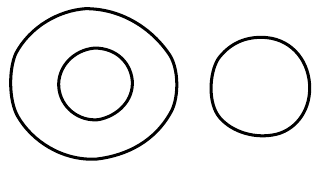
Select the Venn diagram that best represents the relationship between the given set of classes.

Blood, Skeleton, Bones

  1. AOption (a)

  2. BOption (b)

  3. COption (c)

  4. DOption (d)

View answer & explanation

Correct answer

Answer: (d)D.

Why this answer is correct

Given: Blood, Skeleton, Bones

Bones is a part of Skeleton.

Blood is entirely separate from both Bones and Skeleton, as it is a fluid and not structurally related.

The best possible Venn diagram is as follows:

Hence, the correct answer is "Option 4".

Question 2

The Iqta system was introduced by _____ in Delhi sultanate in institutional form.

  1. AOption (a)

    Gayasuddhin balban

  2. BOption (b)

    Iltutmish

  3. COption (c)

    Aram Shah

  4. DOption (d)

    Qutb-ub-din Aibak

View answer & explanation

Correct answer

Answer: (b)B.

Iltutmish

Why this answer is correct

The correct answer is Shamsuddin Iltutmish.

Key Points

  • The Iqta System or Iqtadari System was introduced by Shamsuddin Iltutmish of the Delhi Sultanate.
  • The Iqtadari System was a powerful instrument for centralisation.
  • The Iqtadari System was based on the division of territories between Sultans and Nobility.
  • The land was divided into small tracts and given to the nobles, the officers, and the soldiers.
  • The areas directly under Sultan came to be known as Khalisa and the rest of the areas were known as Iqra.

Additional Information

  • Regin of Iltumish - 1211-1236 AD.
  • Iltumish was son-in-law of Aibak.
  • He was a Turkic slave.
  • He was the greatest of the Slave rulers of Delhi.
  • The Slave dynasty was established by Qutb-us-din Aibak.
  • Dynasty lasted from 1206 to 1290.
  • It was the first of the dynasties to rule as Sultanate in Delhi.
  • This dynasty was succeeded by Khilji Dynasty.

Question 3

Study the given pattern carefully and select the number that can replace the question mark (?) in it.

  1. AOption (a)

    90

  2. BOption (b)

    92

  3. COption (c)

    100

  4. DOption (d)

    81

View answer & explanation

Correct answer

Answer: (d)D.

81

Why this answer is correct

The logic followed here is: Squares of number.

Hence, the correct answer is "81".

Question 4

In which plateau is the city of Hyderabad located?

  1. AOption (a)

    Meghalaya plateau

  2. BOption (b)

    Deccan

  3. COption (c)

    Chota Nagpur

  4. DOption (d)

    Malwa

View answer & explanation

Correct answer

Answer: (b)B.

Deccan

Why this answer is correct

The correct answer is Deccan

Key Points

  • The city of Hyderabad is located in the Deccan Plateau
  • The Deccan Plateau is a large triangular plateau in South India that covers parts of eight states, including Telangana, Maharashtra, Andhra Pradesh, Karnataka, Kerala, and Tamil Nadu.
  • The plateau is surrounded by the Western Ghats and the Eastern Ghats to the east and west, and the Satpura and Vindhya Ranges to the north.
  • The Deccan Plateau is home to many historical sites, including the Ajanta and Ellora caves, and the temples at Hampi


Additional Information

  • Meghalaya plateau​
  • Meghalaya Plateau is an extension of Indian Peninsular Plateau.
  • Traditionally, the Meghalaya plateau is divided into Garo, Khasi and Jaintia Hills.
  • The region east of the Dhansiri River and west of the Singimari River is approximately 400 km long with an average width of 40 km, covering an area of 35,291 km2.
  • From the South-West monsoon, this region receives maximum rainfall.
  • Chota Nagpur
  • The Chotanagpur plateau represents the north-eastern projection of the Indian Peninsula.
  • The Chotonagpur plateau is primarily composed of archaeon rocks of granite and gneiss etc.
  • Mostly in Jharkhand, the northern part of Chhatisgarh and Purulia district of West Bengal.
  • The average height of the plateau is 700 m above sea level.
  • This plateau is composed mainly of Gondwana rocks.
  • The Damodar River flows through the middle of this region in a rift valley from west to east. In this region Gondwana coal fields are found which provide the bulk of coal in India.
  • Malwa​
  • Malwa Plateau is primarily located in the state of Madhya Pradesh.
  • The plateau is bounded by the Aravalli Range to the northwest, the Vindhya Range to the south, and the Bundelkhand region to the east.
  • It is known for its rich history and was a significant part of the ancient Avanti Mahajanapada.
  • The region is also notable for its black cotton soil, known as Regur, which is highly suitable for cotton cultivation.
  • Malwa Plateau is rich in mineral resources and has significant deposits of coal and limestone.

Question 5

Which of the following mixtures is used to purify Gold?

  1. AOption (a)

    Aerosol

  2. BOption (b)

    Nessler's Reagent

  3. COption (c)

    Liquor Ammonia

  4. DOption (d)

    Aqua regia

View answer & explanation

Correct answer

Answer: (d)D.

Aqua regia

Why this answer is correct

The correct answer is Aqua regia

Key Points

  • Aqua regia is the mixture used to purify gold.
  • It is a mixture of three parts hydrochloric acid to one part nitric acid.
  • The acid mixture aqua regia, or royal water, dissolves gold and is used to purify scrap alloy containing gold.
  • Aqua regia is a mixture of hydrochloric acid and nitric acid in a 3:1 ratio.
  • Nitric acid is a nitrogen oxoacid of formula HNO3 in which the nitrogen atom is bonded to a hydroxy group and by equivalent bonds to the remaining two oxygen atoms.

Additional Information

  • Aerosol
  • ​It is a suspension of fine solid particles or liquid droplets in a gas.
  • Examples: Fog, mist, smoke, and sprays.
  • Uses:
  • In sprays (e.g., deodorants, insecticides).
  • Delivery of medicines (e.g., inhalers for asthma).
  • Environmental studies (e.g., studying pollution).
  • Nessler's Reagent​
  • The Chemical Composition is  potassium tetraiodomercurate
  • It is Used to test for the presence of ammonia (NH₃) or ammonium ions (NH+4)(NH+4)(NH+4)(NH+4)(NH+4)(NH4+) (NH_4^+)
  • Nessler's reagent gives a brown precipitate or yellow coloration when it reacts with ammonia, indicating its presence.
  • Liquor Ammonia
  • ​It is a solution of ammonia gas dissolved in water, also called aqueous ammonia)

Unknown node type: strongUnknown node type: strongUnknown node type: strongUnknown node type: strongUnknown node type: strong)Unknown node type: strongUnknown node type: strongUnknown node type: strongUnknown node type: strongUnknown node type: strong)Unknown node type: strongUnknown node type: strongUnknown node type: strongUnknown node type: strongUnknown node type: strong)Unknown node type: strongUnknown node type: strongUnknown node type: strongUnknown node type: strongUnknown node type: strong)Unknown node type: strongUnknown node type: strongUnknown node type: strongUnknown node type: strongUnknown node type: strong) (NH_3  in water)\text{ in water})

  • Uses:
  • As a cleaning agent due to its ability to dissolve grease and grime.
  • In the textile and dye industry.
  • As a reagent in laboratories.

Question 6

Mechi, a trans-boundary river flowing through India and Nepal is a tributary of _____river.

  1. AOption (a)

    Gandak

  2. BOption (b)

    Godavari

  3. COption (c)

    Ganga

  4. DOption (d)

    Mahananda

View answer & explanation

Correct answer

Answer: (d)D.

Mahananda

Why this answer is correct

The correct answer is Mahananda.

Key Points

  • The Mechi River is a trans-boundary river that flows through India and Nepal.
  • It is a tributary of the Mahananda River, which is one of the major rivers in the eastern part of the Indian subcontinent.
  • The Mahananda River itself is a tributary of the Ganges River, which is one of the largest river systems in India.
  • The Mechi River plays a significant role in the irrigation and agriculture of the regions it flows through, particularly in the Indian state of Bihar and the eastern part of Nepal.

Additional Information

  • Gandak River:
  • The Gandak River, also known as the Narayani in Nepal, is a major river in Nepal and the Indian states of Bihar and Uttar Pradesh.
  • It is a tributary of the Ganges River and is known for its rich biodiversity.
  • Godavari River:
  • The Godavari River is the second longest river in India, running across the states of Maharashtra, Telangana, Andhra Pradesh, Chhattisgarh, Madhya Pradesh, Odisha, Karnataka, and Puducherry.
  • It is often referred to as the 'Dakshina Ganga' or 'Ganga of the South'.
  • Ganga River:
  • The Ganga River is one of the most important and sacred rivers in India, flowing through the northern regions of the country.
  • It is the longest river in India and holds significant cultural, spiritual, and economic importance.
  • Mahananda River:
  • The Mahananda River originates from the Himalayas in Darjeeling, India, and flows through the Indian states of West Bengal and Bihar as well as the country of Nepal.
  • It merges with the Ganges River, making it an essential river in the eastern part of India for agriculture and other purposes.

Question 7

Short sightedness is also called as______.

  1. AOption (a)

    Ametropia

  2. BOption (b)

    Hypermetropia

  3. COption (c)

    Presbiopia

  4. DOption (d)

    Myopia

View answer & explanation

Correct answer

Answer: (d)D.

Myopia

Why this answer is correct

The correct answer is Myopia

Key Points

  • Myopia is a disease in which the patient cannot see distant objects clearly.
  • In myopia, the eyeball is too long for the normal focusing power of the eye.
  • As a result, images of distant objects appear blurred.
  • The nearsighted (myopic) eye converges rays from a distant object in front of the retina; thus, they are diverging when they strike the retina, producing a blurry image.
  • Myopia is a condition in which the individual can focus only on nearby objects.
  • This is why it is called Nearsightedness.
  • A concave lens (minus powered) is placed in front of a myopic eye, moving the image back to the retina and clarifying the image.

Additional Information

  • Ametropia:
  • It is a general term for refractive errors in the eye where images do not focus properly on the retina, causing blurred vision.
  • Types: Includes myopia (nearsightedness), hypermetropia (farsightedness), and astigmatism.
  • It is Treated with eyeglasses, contact lenses, or refractive surgeries like LASIK.
  • Hypermetropia (Farsightedness):
  • It is a condition where distant objects are seen clearly, but near objects appear blurred due to the eyeball being too short or the lens having insufficient power.
  • Cause: Light rays focus behind the retina instead of directly on it.
  • Correction: Requires convex lenses to focus light correctly on the retina.
  • Presbyopia:
  • It is an age-related loss of the eye's ability to focus on near objects due to decreased elasticity of the lens.
  • It typically begins after age 40.
  • It is Treated with reading glasses, bifocal lenses, or multifocal lenses.

Question 8

The ratio of the market price to the cost price of an article is 5 : 3. If the selling price of that article is ₹3645 and the shopkeeper gave two successive discounts of 25% and 10% on the marked price, then what is the profit or loss percent during this transaction?

  1. AOption (a)

    profit 10%

  2. BOption (b)

    loss 15%

  3. COption (c)

    loss 15.5%

  4. DOption (d)

    profit 12.5%

View answer & explanation

Correct answer

Answer: (d)D.

profit 12.5%

Why this answer is correct

Given:

The ratio of the market price to the cost price of an article is 5:3.

Selling price (SP) = ₹3645

Two successive discounts = 25% and 10%

Formula used:

Market Price (MP) = Cost Price (CP) × 53\dfrac{5}{3}

Selling Price (SP) = MP × (1 - Discount1) × (1 - Discount2)

Profit or Loss % = SP−CPCP×100\dfrac{SP - CP}{CP} \times 100

Calculations:

Let the Cost Price (CP) be ₹x.

Market Price (MP) = ₹x × 53\dfrac{5}{3} = 5x3\dfrac{5x}{3}

Given Selling Price (SP) = ₹3645

5x3\dfrac{5x}{3} × (1 - 0.25) × (1 - 0.10) = ₹3645

⇒ 5x3\dfrac{5x}{3} × 0.75 × 0.90 = ₹3645

⇒ 5x3×0.675=3645\dfrac{5x}{3} \times 0.675 = 3645

⇒ 5x×0.6753=3645\dfrac{5x \times 0.675}{3} = 3645

⇒ 3x×0.6753=3645×35\dfrac{3x \times 0.675}{3} = \dfrac{3645 \times 3}{5}

⇒ 0.675x=21870.675x = 2187

⇒ x=21870.675x = \dfrac{2187}{0.675}

⇒ x=3240x = 3240

Cost Price (CP) = ₹3240

Selling Price (SP) = ₹3645

Profit = SP - CP = ₹3645 - ₹3240 = ₹405

Profit % = 4053240×100 \dfrac{405}{3240} \times 100

⇒ Profit % = 12.5%

∴ The correct answer is option (4).

Question 9

Which of the following is not one of the three business check posts between India and China?

  1. AOption (a)

    Khyber Pass

  2. BOption (b)

    Shipki La Pass

  3. COption (c)

    Nathula Pass

  4. DOption (d)

    Lipulekh Pass

View answer & explanation

Correct answer

Answer: (a)A.

Khyber Pass

Why this answer is correct

The correct answer is Khyber Pass

Key Points

  • The Khyber Pass is located between Pakistan and Afghanistan, not India and China.
  • It has historical significance as a major trade route but does not serve as a business checkpost between India and China.
  • It Connects Peshawar (Pakistan) to Jalalabad (Afghanistan).
  • It is part of the ancient Silk Road trade network

Additional Information

  • Shipki La Pass (Himachal Pradesh)
  • The Shipki La Pass is located in the Himalayan Range in the state of Himachal Pradesh (Kinnaur).
  • It is a Second Border post-trade with Tibet (China) after Nathu La.
  • Sutlej River enters India (from Tibet) near this pass.
  • Nathula Pass (Sikkim):
  • Nathu La is a mountain pass in the Dongkya Range of the Himalayas between China's Yadong County in Tibet, and the Indian states of Sikkim.
  • But minor touch of Bengal in South Asia.
  • The pass, at 4,310 m, connects the towns of Kalimpong and Gangtok to the villages and towns of the lower Chumbi Valley
  • Lipulekh Pass (Uttarakhand)
  • Lipulekh Pass is in the state of Uttarakhand.
  • Lipulekh is a Himalayan pass on the border between Uttarakhand, India, and Tibet, China.
  • This pass is a vital border pass for trade with China.
  • The southern side of the pass is controlled by India but claimed by Nepal.

Question 10

What is 7.16 hours in hours, minutes and seconds?

  1. AOption (a)

    7 hours, 16 minutes

  2. BOption (b)

    7 hours, 10 minutes, 6 seconds

  3. COption (c)

    7 hours, 9 minutes, 36 seconds

  4. DOption (d)

    7 hours, 6 minutes, 10seconds

View answer & explanation

Correct answer

Answer: (c)C.

7 hours, 9 minutes, 36 seconds

Why this answer is correct

In 7.16 hours 

Here, 7 shows hours and

0.16 convert for minutes multiplied by 60

⇒ 0.16 × 60 = 9.6

here 9 shows minutes then 

0.6 convert for seconds multiplied by 60

⇒ 0.6 × 60 = 36

Here, 36 shows seconds.

So, 7.16 hours in hours, minutes and seconds is 7 hours, 9 minutes, 36 seconds.

Hence, the correct answer is "Option (3)".

Question 11

out of the four letter-clusters listed, three are alike in some manner and one is different. Select the odd one.

  1. AOption (a)

    BDF

  2. BOption (b)

    DFH

  3. COption (c)

    OPR

  4. DOption (d)

    JLN

View answer & explanation

Correct answer

Answer: (c)C.

OPR

Why this answer is correct

The logic followed here is:

1)  BDF

2)  DFH

3)  OPR

4)  JLN

Thus, OPR is odd one.

Hence, the correct answer is "OPR".

Question 12

If every 3rd letter from left to right of English alphabet is deleted, then what would be the 12th letter from right in the new series obtained?

  1. AOption (a)

    J

  2. BOption (b)

    S

  3. COption (c)

    K

  4. DOption (d)

    T

View answer & explanation

Correct answer

Answer: (a)A.

J

Why this answer is correct

As per the given information;

Alphabets in reverse order: A B C D E F G H I J K L M N O P Q R S T U V W X Y Z

  • Delete every 3rd letter from left to right:

(After deleting every 3rd letter) A B D E G H J K M N P Q S T V W Y Z

  • The 12th letter from the right end in the new series:

(Left) A B D E G H J K M N P Q S T V W Y Z  (Right)

12th letter from the right = J

Therefore, the 12th letter from the right end in the new series is 'J'.

Hence, the correct answer is "J".

Question 13

What is Vidyanjali project?

  1. AOption (a)

    Volunteers in government schools to help scholastic work

  2. BOption (b)

    Provision for tuition from class 1-8

  3. COption (c)

    Computer-aided instruction in government schools

  4. DOption (d)

    Giving free uniform and clothes to government school children

View answer & explanation

Correct answer

Answer: (a)A.

Volunteers in government schools to help scholastic work

Why this answer is correct

The correct answer is Volunteers in government schools to help scholastic work

Key Points

  • Vidyanjali Yojana: 
  • The Vidyanjali Project is an initiative by the Ministry of Education, Government of India, aimed at strengthening community and private sector involvement in government schools.
  • It primarily focuses on leveraging volunteers to support the holistic development of students.
  • ​The Central Government has launched ‘Vidyanjali’, a School Volunteer programme on 16th June 2016 and issued necessary guidelines.
  • Vidyanjali is an initiative to involve people from the Indian Diaspora, retired teachers, retired government officials including retired defence personnel, retired professionals and women who are homemakers, having graduation degree to strengthen co-scholastic activities in schools such as reading in Government run elementary schools through the services of volunteers across the country under the overall aegis of the Sarva Shiksha Abhiyan (SSA).
  • It will not replace the regular and professionally qualified teachers in the government schools.
  • The volunteer's responsibility is towards the overall development of the child, not academics.
  • The volunteer service will be used in developing skills like public speaking, creative writing, counselling, music and dance.

Additional Information

  • Other educational apps by Union Government:
  • Diksha App:
  • It is a national platform for school education, an initiative of the National Council for Education, Research, and Training.
  • It will help teachers to create training content, profile, in-class resources, and assessment aids and connect with the teacher community​
  • English App:​
  • Union Minister of Education RameshPokhriyal Nishank launched EnglishPro, a free mobile app, developed by the English and Foreign Languages University, Hyderabad.
  • The App has been developed by University Social Responsibility (USR) is the first-of-its-kind initiative by any university in the country and will help learners develop Indian English Pronunciation in the unique “Indian” way.
  • It is an educational resource for teachers, students, and people from varied backgrounds.
  • This app is a good hand-maid to the “skilling” of youth.
  • It tries to achieve the objectives of the interconnected measures by the Government — Skill India and Digital India.

Question 14

Study the given pattern carefully and select the number from the given options that can replace the question mark (?) in it.

  1. AOption (a)

    8

  2. BOption (b)

    4

  3. COption (c)

    6

  4. DOption (d)

    2

View answer & explanation

Correct answer

Answer: (c)C.

6

Why this answer is correct

The logic followed here is:

Figure 1: (4 + 2 + 9) / 3 = 15 / 3 = 5

Figure 2: (17 + 6 + 1) / 3 = 24 / 3 = 8

Similarly, figure 3: (5 + 9 + 4) / 3 = 18 / 3 = 6

Hence, the correct answer is "6".

Question 15

Who was the first Indian Director of the Indian Institute of Science, Bangalore?

  1. AOption (a)

    Morris Travers

  2. BOption (b)

    Subramanyan Chandrashekhar

  3. COption (c)

    APJ Abdul Kalam

  4. DOption (d)

    C V Raman

View answer & explanation

Correct answer

Answer: (d)D.

C V Raman

Why this answer is correct

The correct answer is C V Raman

Key Points

  • Sir Chandrasekhara Venkata Raman was the first Indian Director of the Indian Institute of Science (IISc) in Bangalore, taking the role in 1934.
  • At the time, Raman was a celebrated physicist and Nobel laureate.
  • Founders: Jamsetji Tata, Krishnaraja Wadiyar IV, and the Government of India
  • First Director: Morris W Travers, who began organizing the institute in 1906
  • Current Director: Anurag Kumar
  • Founder's Day: March 3, a day to celebrate the vision and munificence of Jamsetji Tata

Additional Information

  • C V Raman
  • Sir C.V.Raman awarded with Nobel Prize in Physics in 1930.
  • He discovered that when light traverses in transparent material then some of the light changes its wavelength and amplitude.
  • This phenomenon of scattering of light is known as the Raman effect.
  • He was the first non-white, Indian or Asian person to receive Noel Prize in the field of Physics.
  • He and his student K.S. Krishnan discovered Raman effect on 28 February 1928 which is celebrated as National Science Day by the Government of India in commemoration of the discovery.
  • The Nobel Prize is given yearly by the Royal Swedish Academy for those who have made contributions in the field of physics for the whole of mankind.
  • It was established by the will of Alfred Nobel in 1895.
  • Since 1901, the Nobel Prize has been awarded in the fields of physics, chemistry, physiology or medicine, literature and peace, while a memorial prize in economic sciences was added in 1968.

Question 16

Simplify (2+32−3)2{\left( {\frac{{2 + \sqrt 3 }}{{2 - \sqrt 3 }}} \right)^2}.

  1. AOption (a)

    48

  2. BOption (b)

    163\frac{{16}}{3}

  3. COption (c)

    97−56397 - 56\sqrt 3

  4. DOption (d)

    97+56397 + 56\sqrt 3

View answer & explanation

Correct answer

Answer: (d)D.

97+56397 + 56\sqrt 3

Why this answer is correct

Given:

(2+32−3)2\left( \dfrac{2 + \sqrt{3}}{2 - \sqrt{3}} \right)^2

Formula used:

(a+ba−b)2=(a+b)2(a−b)2\left( \dfrac{a + b}{a - b} \right)^2 = \dfrac{(a + b)^2}{(a - b)^2}

Calculation:

(2+32−3)2\left( \dfrac{2 + \sqrt{3}}{2 - \sqrt{3}} \right)^2

⇒ (2+3)2(2−3)2\dfrac{(2 + \sqrt{3})^2}{(2 - \sqrt{3})^2}

⇒ 4+43+34−43+3\dfrac{4 + 4\sqrt{3} + 3}{4 - 4\sqrt{3} + 3}

⇒ 7+437−43\dfrac{7 + 4\sqrt{3}}{7 - 4\sqrt{3}}

⇒ (7+43)2(7−43)(7+43)\dfrac{(7 + 4\sqrt{3})^2}{(7 - 4\sqrt{3})(7 + 4\sqrt{3})}

⇒ 49+563+4849−(43)2\dfrac{49 + 56\sqrt{3} + 48}{49 - (4\sqrt{3})^2}

⇒ 97+56349−48\dfrac{97 + 56\sqrt{3}}{49 - 48}

⇒ 97+5631\dfrac{97 + 56\sqrt{3}}{1}

⇒ 97 + 56356\sqrt{3}

∴ The correct answer is option (4).

Question 17

A and B working together can complete a work in 10 days. C alone can complete the same work in 14 days. If A, B and C work together, then how many days will they take to complete three-fifth of the same work?

  1. AOption (a)

    73\frac{7}{3}

  2. BOption (b)

    3

  3. COption (c)

    72\frac{7}{2}

  4. DOption (d)

    356\frac{35}{6}

View answer & explanation

Correct answer

Answer: (c)C.

72\frac{7}{2}

Why this answer is correct

Given:

A and B working together can complete a work in 10 days.

C alone can complete the same work in 14 days.

We need to find how many days A, B, and C together will take to complete three-fifth of the same work.

Formula used:

Work rate of A and B together = 1/10 work/day

Work rate of C = 1/14 work/day

Work rate of A, B, and C together = (1/10 + 1/14) work/day

Time taken to complete three-fifth of the work = (3/5) / (Work rate of A, B, and C together)

Calculation:

Work rate of A, B, and C together = 1/10 + 1/14

⇒ Work rate of A, B, and C together = (7/70 + 5/70)

⇒ Work rate of A, B, and C together = 12/70

⇒ Work rate of A, B, and C together = 6/35 work/day

Time taken to complete three-fifth of the work = (3/5) / (6/35)

⇒ Time taken to complete three-fifth of the work = (3/5) × (35/6)

⇒ Time taken to complete three-fifth of the work = 21/6

⇒ Time taken to complete three-fifth of the work = 7/2

⇒ Time taken to complete three-fifth of the work = 3.5 days

∴ The correct answer is option 3 :  7/2.

Question 18

What are the value of x in the following equation?

32x+1 - 3x = 3x+3 - 32

  1. AOption (a)

    4, -1

  2. BOption (b)

    3, -1

  3. COption (c)

    2, -1

  4. DOption (d)

    4, -2

View answer & explanation

Correct answer

Answer: (c)C.

2, -1

Why this answer is correct

Shortcut Trick

Substitute 3x = y to convert the exponential equation into a quadratic equation.

3(3x)2 − 3x = 27(3x) − 9 ⇒ 3y2 − 28y + 9 = 0.

Factorize: (3y − 1)(y − 9) = 0 ⇒ y = 1/3 or y = 9.

If 3x = 3−1, then x = −1; if 3x = 32, then x = 2.

∴ The correct answer is 2, −1.

Alternate Method

Given: 32x+1 − 3x = 3x+3 − 32

Formula Used: am+n = am × an and amn = (am)n

⇒ 32x × 31 − 3x = 3x × 33 − 9

⇒ 3 × (3x)2 − 3x = 27 × 3x − 9

⇒ Let 3x = t

⇒ 3t2 − t = 27t − 9

⇒ 3t2 − 28t + 9 = 0

⇒ 3t2 − 27t − t + 9 = 0

⇒ 3t(t − 9) − 1(t − 9) = 0

⇒ (3t − 1)(t − 9) = 0

⇒ t = 1/3 or t = 9

⇒ 3x = 3−1 or 3x = 32

⇒ x = −1 or x = 2

∴ The correct answer is 2, −1.

Additional Information

Laws of Indices

Key rules include am × an = am+n and (am)n = amn. When bases are the same, exponents can be equated.

Negative Exponents

A negative power signifies the reciprocal of the base: a−n = 1/an.

Quadratic Roots

The roots of ax2 + bx + c = 0 can be found using factorization or the quadratic formula x = (−b ± √(b2 − 4ac)) / 2a.

Question 19

Gujjo is Umra's mother. Munni is Summo's mother. Shahid is Hifzan's father. Munni is Hifzan's paternal aunt and Umra's maternal aunt. How is Gujjo related to Shahid?

  1. AOption (a)

    Brother's Daughter

  2. BOption (b)

    Brother's Wife

  3. COption (c)

    Sister's Daughter

  4. DOption (d)

    Sister

View answer & explanation

Correct answer

Answer: (d)D.

Sister

Why this answer is correct

Family Chart:

Given: Gujjo is Umra's mother. Munni is Summo's mother. Shahid is Hifzan's father. Munni is Hifzan's paternal aunt and Umra's maternal aunt.

So, Gujjo is 'Sister' of Shahid.

Hence, the correct answer is "Sister".

Question 20

With which economical revolution in India, M.S.Swaminathan is associated?

  1. AOption (a)

    Green Revolution

  2. BOption (b)

    Yellow Revolution 

  3. COption (c)

    Pink Revolution

  4. DOption (d)

    White Revolution

View answer & explanation

Correct answer

Answer: (a)A.

Green Revolution

Why this answer is correct

The correct answer is the Green Revolution

Key Points

  • M.S. Swaminathan is the Indian father of the Green Revolution.
  • Mankombu Sambasivan Swaminathan is an Indian agronomist, agricultural scientist, plant geneticist, administrator, and humanitarian.
  • Swaminathan is known as the Father of India's Green Revolution, for his contributions to the development of high-yielding varieties of wheat.
  • He coined the term 'Evergreen Revolution' in 1990 to describe his vision of 'productivity in perpetuity without associated ecological harm'
  • He founded the MS Swaminathan Research Foundation, the pioneer organization behind the ”evergreen revolution”.

Additional Information 

Name of the RevolutionFieldFather of the Revolution
Green RevolutionAgricultureDr. M.S. Swaminathan
White Revolution or Operation floodMilk/ Dairy productsDr. Varghese Kurien
Blue RevolutionFish and AquaDr. Arun Krishnan, Dr. Harilal Chaudhari
Golden RevolutionFruits, Honey, HorticultureNirpakh Tutaj
Silver RevolutionEggsIndira Gandhi
Yellow RevolutionOil SeedsSam Pitroda
Pink RevolutionPharmaceuticals, Prawns, OnionDurgesh Patel
Brown RevolutionLeather, CocoHiralal Chaudri
Red RevolutionMeat, TomatoVishal Tडूटewari
Golden Fibre RevolutionJute
Evergreen RevolutionOverall Production of Agriculture.M.S. Swaminathan
Black RevolutionPetroleum
Silver Fiber RevolutionCotton
Round RevolutionPotato
Protein RevolutionAgriculture (Higher Production)
Grey RevolutionFertilizers

Question 21

A typewriter-like tool, which is used to send data or commands to the computer is called:

  1. AOption (a)

    Optical Character Reader (OCR)

  2. BOption (b)

    Joystick

  3. COption (c)

    Mouse

  4. DOption (d)

    Keyboard

View answer & explanation

Correct answer

Answer: (d)D.

Keyboard

Why this answer is correct

The correct answer is Keyboard

Key Points

  • A keyboard is a typewriter-like tool that is used to send data or commands to a computer
  • A keyboard is an input device that allows users to type text, numbers, and symbols, and enter commands into a computer.
  • It is the primary device for entering text and is modeled after the typewriter keyboard.
  • Keyboards are arranged in a specific layout, such as QWERTY or DVORAK.

Additional Information

  • Optical Character Reader (OCR)
  • It is an input device that is used to read a printed text similar to the scanner, but the method of reading and the type of output generated is different.
  • The format to be fed to the OCR is predefined and can’t be used as an ordinary scanner.
  • OCR, unlike a scanner, scans the text optically, character by character, converts them into machine-readable digital code instead of creating high-resolution images, and stores the text on the system memory.
  • Joystick
  • Just like a mouse, a Joystick is also a pointing device, which is used to travel the cursor position on a display.
  • It is a perpendicular stick having a spherical ball at both lower and upper ends.
  • The spherical ball connected to the circuit having sensors moves in a socket.
  • The joystick controller can be traversed in all directions.
  • The functionality of the joystick is just like a mouse.
  • Its applications are generally in Computer-Aided Designing (CAD) and playing computer games.
  • Mouse
  • It is the most commonly used pointing device.
  • It is a very famous cursor-control device and the earlier versions of it were built over a small palm-size box with a round ball at its base, which tracks the movement of the mouse and feeds digital signals to the CPU when the mouse buttons are pressed.
  • Currently, the mouse has a sensor at the bottom to detect cursor position.

Question 22

Which company lunched India's first social mobile wallet "Udio"?

  1. AOption (a)

    Twitter

  2. BOption (b)

    Transerv

  3. COption (c)

    Facebook

  4. DOption (d)

    Oxigen

View answer & explanation

Correct answer

Answer: (b)B.

Transerv

Why this answer is correct

The correct answer is Transerv

Key Points

  • India's first social mobile wallet, "Udio", was launched by TranServ, a leading digital payment solutions provider.
  • It allowed users to send, receive, and share money within their social network, making payments interactive and user-friendly.
  • Udio integrated a prepaid card that could be used for online and offline transactions.
  • Apart from peer-to-peer transfers, it enabled bill payments, mobile recharges, and other financial transactions.

Additional Information

  • Twitter
  • A microblogging platform where users post short updates called tweets (up to 280 characters).
  • Uses:
  • Sharing news, opinions, and updates in real-time.
  • Networking, marketing, and engaging with communities.
  • **Founders:**Jack Dorsey
  • Founded: March 2006.
  • Headquarters: San Francisco, USA.
  • Facebook
  • A social networking platform designed for connecting with friends, family, and communities.
  • Uses:
  • Sharing photos, videos, and posts.
  • Creating pages and groups for businesses, hobbies, or causes.
  • Marketplace for buying/selling locally.
  • Founder:
  • Mark Zuckerberg (primary founder and CEO).
  • Founded: February 2004, initially as "TheFacebook."
  • Headquarters: Menlo Park, California, USA.
  • Oxigen
  • A digital wallet and payment solution provider in India.
  • Uses:
  • Mobile recharges and bill payments.
  • Money transfers and remittances.
  • Merchant transactions through its wallet.
  • Founders:
  • Pramod Saxena
  • Founded: 2004.
  • Headquarters: Gurgaon, India

Question 23

Which freedom fighter popularized the term "Satyameva Jayate" from the Mundaka Upanishad?

  1. AOption (a)

    Subhash Chandra Bose

  2. BOption (b)

    Madan Mohan Malviya

  3. COption (c)

    Mahatma Gandhi

  4. DOption (d)

    Swami Vivekananda 

View answer & explanation

Correct answer

Answer: (b)B.

Madan Mohan Malviya

Why this answer is correct

The correct answer is Madan Mohan Malviya

Key Points

  • The term "Satyameva Jayate" (Truth Alone Triumphs), taken from the Mundaka Upanishad, was popularized by Mahatma Gandhi, one of India's most prominent freedom fighters.
  • The phrase emphasizes the power and importance of truth.
  • It became a guiding principle for Gandhi's philosophy of Satyagraha (nonviolent resistance).
  • Later, "Satyameva Jayate" was adopted as the national motto of India and is inscribed on the State Emblem of India.

Additional Information

  • Pandit Madan Mohan Malaviya
  • ​He was a great Indian scholar, educationist and leader of the Indian National Movement.
  • He got the title 'Pandit' and 'Mahamana (a great soul)' due to his wondrous works.
  • He led the foundation of Hindu Mahasabha and co-founded the Banaras Hindu University.
  • He remained the Vice-Chancellor of BHU between 1919 and 1938.
  • He was associated with several newspapers. In 1919, he set up 'The Leader,' a popular English newspaper.
  • Between 1924 to 1946, he worked as the chairman of the Hindustan Times.
  • He was awarded the greatest civilian award, the Bharat Ratna, posthumously on 24th December 2014.

Question 24

Two car leave city A at 8:30 an and 8:45 am respectively for city B. The cars move at a speed of 45km/h and 54 km/h respectively. How many kilometers away from city A will the two cars be together?

  1. AOption (a)

    67.5

  2. BOption (b)

    40.5

  3. COption (c)

    55.2

  4. DOption (d)

    45

View answer & explanation

Correct answer

Answer: (a)A.

67.5

Why this answer is correct

Shortcut Trick

Speed Ratio of Car 1 and Car 2 = 45 : 54 = 5 : 6

Time Ratio for constant distance = 6 : 5 (Inverse of Speed)

Difference in time units = 6 − 5 = 1 unit = 15 minutes = 1/4 hour

Actual time for Car 2 = 5 units × 1/4 hour = 1.25 hours

Meeting Distance = Speed of Car 2 × Time = 54 × 1.25 = 67.5 km

∴ The correct answer is 67.5 km.

Alternate Method

Given:

Speed of Car 1 = 45 km/h at 8:30 am

Speed of Car 2 = 54 km/h at 8:45 am

Time difference = 15 minutes = 1/4 hour

Formula Used:

Distance = Speed × Time

Relative Speed (Same direction) = Speed2 − Speed1

Calculations:

⇒ Distance covered by Car 1 in 15 minutes = 45 × (15/60) = 45 × 1/4 = 11.25 km

⇒ Relative Speed = 54 − 45 = 9 km/h

⇒ Time taken by Car 2 to catch Car 1 = Initial gap ÷ Relative speed

⇒ Time = 11.25 ÷ 9 = 1.25 hours

⇒ Distance from A = Speed of Car 2 × Time = 54 × 1.25

⇒ Distance = 67.5 km

∴ The correct answer is 67.5 km.

Additional Information

Relative Speed Concept

When two objects move in the same direction, relative speed = S1 − S2. In the opposite direction, relative speed = S1 + S2.

Meeting Distance Formula

Meeting distance from the starting point = (S1 × S2 × Δt) ÷ (S2 − S1), where Δt is the time gap between starts.

Unit Conversion

To convert km/h to m/s, multiply by 5/18. To convert m/s to km/h, multiply by 18/5.

Question 25

Study the given pattern carefully and select the number that can replace the question mark (?) in it.

  1. AOption (a)

    15

  2. BOption (b)

    9

  3. COption (c)

    36

  4. DOption (d)

    13

View answer & explanation

Correct answer

Answer: (d)D.

13

Why this answer is correct

The logic followed here is: (Number of sides in outer figure × Number of sides in inner figure) + 1 = Number.

Figure 1): Outer figure(Pentagon) = 5 (Number of sides); Inner figure (Square) = 4 (Sides) ⇒ 5 × 4 + 1 = 21

Figure 2): Outer figure(Hexagon) = 6 (Number of sides); Inner figure (Rhombus) = 4 (Sides) ⇒ 6 × 4 + 1 = 25

Figure 3): Outer figure(Triangle) = 3 (Number of sides); Inner figure (Pentagon) = 5 (Sides) ⇒ 3 × 5 + 1 = 16

Figure 4): Outer figure(Square) = 4 (Number of sides); Inner figure (Square) = 3 (Triangle) ⇒ 4 × 3 + 1 = 13

Hence, the correct answer is "13".

Question 26

What is the ratio of the surface areas of two spheres, if their volumes are in the ratio 8 : 27?

  1. AOption (a)

    8 : 27

  2. BOption (b)

    4 : 9

  3. COption (c)

    2 : 3

  4. DOption (d)

    4 : 3

View answer & explanation

Correct answer

Answer: (b)B.

4 : 9

Why this answer is correct

Given:

The ratio of volumes of two spheres = 8 : 27

Formula used:

Volume of a sphere = (4/3)πr3

Surface area of a sphere = 4πr2

Let the radii of the two spheres be r1 and r2 respectively.

If their volumes are in the ratio 8 : 27, then

(r1/r2)3 = 8/27

Calculations:

⇒ (r1/r2) = (8/27)1/3

⇒ (r1/r2) = 2/3

The ratio of the surface areas of the spheres is given by:

(Surface area of sphere 1) / (Surface area of sphere 2) = (4πr12) / (4πr22)

⇒ (r12) / (r22)

⇒ (2/3)2

⇒ 4/9

∴ The correct answer is option (2).

Question 27

Which party formed the government in the state of Panjab in Provincial election of 1937 under British-India rule?

  1. AOption (a)

    Unionist party

  2. BOption (b)

    Muslim league

  3. COption (c)

    Krishak Praja party

  4. DOption (d)

    Indian national Congress

View answer & explanation

Correct answer

Answer: (a)A.

Unionist party

Why this answer is correct

The correct answer is the Unionist party

Key Points

  • In the 1937 Provincial Elections under the Government of India Act, 1935, the Unionist Party formed the government in Punjab.
  • Unionist Party:
  • The party was a coalition of landlords, primarily Hindu, Muslim, and Sikh rural elites.
  • It was led by Sir Sikandar Hayat Khan.
  • The Unionist Party's primary focus was on agrarian reforms and communal harmony.

Additional Information

  • Provincial elections were held in British India in the winter of 1936-37 as mandated by the Government of India Act 1935.
  • Elections were held in 11 provinces - Madras, Central Provinces, Bihar, Orissa, United Provinces, Bombay Presidency, Assam, NWFP, Bengal, Punjab, and Sindh.
  • The final results of the elections were declared in February 1937. The INC emerged in power in eight of the provinces - the exceptions being Punjab and Sindh.
  • It got a majority in all provinces, except in Bengal, Assam, Punjab, Sindh and the NWFP, and emerged as the largest party in Bengal, Assam and the NWFP.
  • Out of the total 11 provinces, Congress formed ministries in 8 provinces- Madras, UP, Bombay, Central Provinces, Bihar, Orissa, Assam and NWFP. In 2 of the provinces, Punjab and Sind, Congress was in coalition with regional parties.
  • In Bengal, although Muslim League was the single largest party, but did not have a majority. The All-India Muslim League was unable to create a government in any of the provinces.
  • In Bengal, Congress was the largest party (with 52 seats). But the Krishak Praja Party of A. K. Fazlul Huq (with 36 seats) was able to form a coalition government.

Question 28

Select the option that can replace the question mark (?) in the following series.

K11;;15O;;;S19;;23W;A1;;??\frac{K}{{11}};;\frac{{15}}{O};;;\frac{S}{{19}};;\frac{{23}}{W};\frac{A}{1};;\frac{?}{?}

  1. AOption (a)

    E5\frac{E}{5}

  2. BOption (b)

    5E\frac{5}{E}

  3. COption (c)

    6E\frac{6}{E}

  4. DOption (d)

    5F\frac{5}{F}

View answer & explanation

Correct answer

Answer: (b)B.

5E\frac{5}{E}

Why this answer is correct

The logic follows here is:

So, 5/E will complete the series.

Hence, the correct answer is "Option 2".

Question 29

Who among the following is considered as the first Law Officer of Government of India?

  1. AOption (a)

    Solicitor-General

  2. BOption (b)

    Senior most Advocate of Supreme Court

  3. COption (c)

    Attorney - General

  4. DOption (d)

    Chief Justice of India

View answer & explanation

Correct answer

Answer: (c)C.

Attorney - General

Why this answer is correct

The correct answer is Attorney General.

  • The Attorney General of India is the highest law officer in the country.
  • He is the first Law officer of India
  • He is the chief legal advisor to the government and is the primary lawyer in the Supreme Court of India.
  • His duty is to give advice to the Government of India upon such legal matters, which are referred to him by the President.
  • He appears before the Supreme Court and various high courts in cases involving the Government of India.
  • He should have the qualification to be a judge of the Supreme Court.
  • He is appointed by the President and holds the office during the pleasure of the President.
  • He is removed from his office by the President.
  • The term of office of the  Attorney General of India is not fixed by the Constitution.
  • He is not a member of the Cabinet.
  • He has the right to speak in either House of the Parliament, but he has no right to vote.​
  • The current Attorney General of India - R. Venkataramani
  • The first Attorney General of India - M. C. Setalwad.
  • The longest-serving Attorney General of India - M. C. Setalwad.
  • Article 76 - Provides the office of Attorney General of India.

Question 30

Mean of the numbers 2, 4, 5, 8, 2 and 3 is m. The numbers 4, 3, 3, 5, m, 3 and p have mean m + 1, median q and mode r.

What is the value of (p + q - r)?

  1. AOption (a)

    20

  2. BOption (b)

    13

  3. COption (c)

    14

  4. DOption (d)

    21

View answer & explanation

Correct answer

Answer: (c)C.

14

Why this answer is correct

Given:

Mean of the numbers 2, 4, 5, 8, 2, and 3 is m.

The numbers 4, 3, 3, 5, m, 3, and p have mean m + 1, median q, and mode r.

Formula used:

Mean = (Sum of all values) / (Number of values)

Calculation:

Mean of 2, 4, 5, 8, 2, 3:

⇒ m = (2 + 4 + 5 + 8 + 2 + 3) / 6

⇒ m = 24 / 6

⇒ m = 4

Mean of 4, 3, 3, 5, 4, 3, p = m + 1:

⇒ (4 + 3 + 3 + 5 + 4 + 3 + p) / 7 = 5

⇒ (22 + p) / 7 = 5

⇒ 22 + p = 35

⇒ p = 13

Median of 4, 3, 3, 5, 4, 3, 13:

Sorted list: 3, 3, 3, 4, 4, 5, 13

⇒ q = 4

Mode of 4, 3, 3, 5, 4, 3, 13:

⇒ r = 3

Value of (p + q - r):

⇒ (13 + 4 - 3)

⇒ 14

∴ The correct answer is option (3).

Question 31

What is the value of 32123÷315313\frac{{21}}{{23}} \div 3\frac{{15}}{{31}}?

  1. AOption (a)

    187138\frac{{187}}{{138}}

  2. BOption (b)

    2

  3. COption (c)

    3

  4. DOption (d)

    155138\frac{{155}}{{138}}

View answer & explanation

Correct answer

Answer: (d)D.

155138\frac{{155}}{{138}}

Why this answer is correct

Given:

Expression: 32123÷315313\frac{{21}}{{23}} \div 3\frac{{15}}{{31}}

Formula Used:

Convert mixed fractions to improper fractions: abc=a×c+bca\frac{b}{c} = \frac{{a \times c + b}}{c}

Division of fractions: ab÷cd=ab×dc\frac{a}{b} \div \frac{c}{d} = \frac{a}{b} \times \frac{d}{c}

Calculation:

Convert the mixed fractions to improper fractions:

32123=3×23+2123=69+2123=90233\frac{{21}}{{23}} = \frac{{3 \times 23 + 21}}{{23}} = \frac{{69 + 21}}{{23}} = \frac{{90}}{{23}}

31531=3×31+1531=93+1531=108313\frac{{15}}{{31}} = \frac{{3 \times 31 + 15}}{{31}} = \frac{{93 + 15}}{{31}} = \frac{{108}}{{31}}

Expression: 32123÷315313\frac{{21}}{{23}} \div 3\frac{{15}}{{31}}

⇒ 9023÷10831=9023×31108\frac{{90}}{{23}} \div \frac{{108}}{{31}} = \frac{{90}}{{23}} \times \frac{{31}}{{108}}

⇒ 90÷1823×31108÷18=523×316\frac{{90 \div 18}}{{23}} \times \frac{{31}}{{108 \div 18}} = \frac{{5}}{{23}} \times \frac{{31}}{{6}}

⇒ 5×3123×6=155138\frac{{5 \times 31}}{{23 \times 6}} = \frac{{155}}{{138}}

∴ The correct answer is option 4.

Question 32

_____was Bairam Khan's son, who became an important person in Akbar's court.

  1. AOption (a)

    Amir Khusrow

  2. BOption (b)

    Abdul Rahim Khan-i-Khanan

  3. COption (c)

    Birbal

  4. DOption (d)

    Abul Fazl

View answer & explanation

Correct answer

Answer: (b)B.

Abdul Rahim Khan-i-Khanan

Why this answer is correct

The correct answer is Abdul Rahim Khan-i-Khanan

Key Points

  • Abdul Rahim Khan-i-Khanan was Bairam Khan's son, who became an important person in Akbar's court.
  • He was an eminent scholar of Sanskrit, Hindi and Rajasthani alongside Persian, Arabic and Turki.
  • He was one of the nine important rank holders of Navratnas from the court of Mughal emperor Akbar.
  • He was the son of Bairam Khan mentor and guardian of Akbar.
  • He translated Baburnama into Persian and also wrote two astrology books in  Sanskrit named Khetakautukam, and Dwatrimshadyogavali.

Additional Information

  • Amir Khusrow​
  • Amir Khusro was a famous musician in the court of Alauddin Khalji (Lived in the courts of as many as 7 different rulers of the Delhi Sultanate)
  • .Amīr Khusrau was a Sufi singer, poet, and scholar from India.
  • Khusrau is also referred to as the "Voice of India" or "Parrot of India"
  • Sitar is said to have been invented by Amir Khusrow.
  • His work Khaliq-e-bari, which is known as the oldest printed dictionary in the world deals with Hindi and Persian words.
  • Birbal
  • The real name of Birbal was Mahesh Das.
  • Mahesh Das was a skilled poet and is known for his charismatic wit and humour.
  • Birbal was a trusty advisor.
  • The Emperor conferred on him with the title Birbal.
  • Birbal had a close association with Mughal Emperor Akbar and was one of his most important courtiers, part of a group called the navaratnas (nine jewels).
  • Stories of Akbar and Birbal are extremely popular in India.
  • Abul Fazl
  • ​Abul Fazl, was an Indian writer, historian, and politician who served as the grand vizier of the Mughal Empire from his appointment in 1579, until his death in 1602.
  • His notable works include the Akbarnama, Ain-i-Akbari, and a Persian translation of the Bible
  • Abul Fazl wrote a three-volume history of Akbar's reign titled, Akbarnama.
  • The first volume dealt with Akbar's ancestors and the second volume recorded the events of Akbar's reign.
  • The Ain-i-Akbari is the third book in the Akbarnama written during the reign of the Mughal Emperor, Akbar.

Question 33

Which of the following areas have an uplifted region and saline sandy flats and swamps?

  1. AOption (a)

    Ganga Brahmaputra Delta

  2. BOption (b)

    Rann of Kutch

  3. COption (c)

    Malabar Coast

  4. DOption (d)

    Konkan Coast

View answer & explanation

Correct answer

Answer: (b)B.

Rann of Kutch

Why this answer is correct

The correct answer is Rann of Kutch

Key Points

  • The Rann of Kutch is a vast salt marsh area located in the state of Gujarat, India.
  • It is known for its uplifted regions, saline sandy flats, and swamps, particularly the Great Rann and Little Rann.
  • It is a significant feature of the region's geography, with a harsh, arid climate and seasonal variations
  • where it becomes flooded during the monsoon season, creating a swampy environment.

Additional Information

  • Western Coastal Plain:
  • It lies between the Western ghats and the Arabian Sea.
  • It extends from Rann of Kutch to Kanyakumari.
  • It is narrower than the Eastern coastal plains.
  • It is divided into 4 parts:
  • Kutch and Kathiawar coast - Extends from Rann of Kutch to Daman
  • Konkan Coast (northern part) - Extends from Daman to Goa.
  • Kanada Coast (central part) - Extends from Goa to Mangalore.
  • Malabar Coast (southern part) - Extends from Mangalore to Kanyakumari.
  • Eastern Coastal Plain:
  • It lies between the Eastern Ghats and the Bay of Bengal.
  • It extends from West Bengal to Tamil Nadu.
  • The deltas of Mahanadi, Krishna, Godaveri, Cauvery River are present here.
  • It is divided into 3 parts:
  • Utkal Coast - Extends between Chilka Lake and Kolleru Lake.
  • Andhra Coast/Northern Circars - Extends between Kolleru Lake and Pulicat Lake.
  • Coromandel Coast - Extends between Pulicat Lake and Kanyakumari.
  • Both, the western and eastern coastal plains join at Kanyakumari.​

Question 34

If A is 70% more than B, then B is what percent less than A?

  1. AOption (a)

    3711737\frac{1}{{17}}

  2. BOption (b)

    58141758\frac{14}{{17}}

  3. COption (c)

    4131741\frac{3}{{17}}

  4. DOption (d)

    3841738\frac{4}{{17}}

View answer & explanation

Correct answer

Answer: (c)C.

4131741\frac{3}{{17}}

Why this answer is correct

Given:

If A is 70% more than B, then B is what percent less than A?

Formula used:

If A is x% more than B, then B is x(100+x)×100\dfrac{x}{(100+x)} \times 100% less than A.

Calculation:

Here, A is 70% more than B.

⇒ B is 70(100+70)×100\dfrac{70}{(100+70)} \times 100% less than A.

⇒ B is 70170×100\dfrac{70}{170} \times 100% less than A.

⇒ B is 7000170\dfrac{7000}{170}% less than A.

⇒ B is 41317\dfrac{3}{17}% less than A.

∴ The correct answer is option (3).

Question 35

An article is sold to Mr. X at a profit of 20%. Mr. X sells it to Mr. Y at profit of 25%. If Mr. Y pays ₹225 for the article, them what was the cost price for the original seller?

  1. AOption (a)

    ₹150

  2. BOption (b)

    ₹275

  3. COption (c)

    ₹250

  4. DOption (d)

    ₹200

View answer & explanation

Correct answer

Answer: (a)A.

₹150

Why this answer is correct

Given:

An article is sold to Mr. X at a profit of 20%. Mr. X sells it to Mr. Y at a profit of 25%. Mr. Y pays ₹225 for the article.

Formula used:

Let the cost price for the original seller be ₹C.

Cost price for Mr. X = C × 1.20

Selling price for Mr. X (which is cost price for Mr. Y) = C × 1.20 × 1.25

Calculation:

Mr. Y pays ₹225 for the article, so:

225 = C × 1.20 × 1.25

⇒ 225 = C × 1.50

⇒ C = 225 / 1.50

⇒ C = 150

∴ The correct answer is option (1).

Question 36

Who among the following was the first Indian member of The British Parliament?

  1. AOption (a)

    Lokmanya Tilak

  2. BOption (b)

    Dr. Sarvepalli Radhakrishnan

  3. COption (c)

    Dadabhai Naoroji

  4. DOption (d)

    Dr. Rajendra Prasad

View answer & explanation

Correct answer

Answer: (c)C.

Dadabhai Naoroji

Why this answer is correct

The correct answer is Dadabhai Naoroji

Key Points

  • Dadabhai Naoroji was the first Indian to become a member of the British Parliament.
  • He was elected for the Liberal Party in Finsbury Central at the 1892 general election, was the first British Indian MP.
  • Dadabhai Naoroji was popularly known as 'The Grand Old Man of India'.
  • He was also an intellectual and educator.
  • For the betterment of his countrymen, he founded the Dnyan (Gyan) Prasarak Mandali to educate women.

Additional Information

  • The British Parliament is the supreme legislative body in the United Kingdom, comprising two houses and responsible for making laws, scrutinizing the government, and representing the interests of the people.
  • East india company was incorporated in England in 1600 and eventually becoming British.
  • East India Company was disbanded in 1874.
  • It was established to engage in trade with the East Indies and later, East Asia, in the Indian Ocean region.
  • The British East India Company first arrived in India as a spice dealer.
  • Other from that, their main commodities were opium, silk, cotton, indigo dye, and tea.
  • On August 24, 1608, they arrived in the Indian subcontinent at the port of Surat.

Question 37

The friction in liquids is called:

  1. AOption (a)

    Viscosity

  2. BOption (b)

    Morbidity

  3. COption (c)

    Rigidity

  4. DOption (d)

    Rancidity

View answer & explanation

Correct answer

Answer: (a)A.

Viscosity

Why this answer is correct

The correct answer is Viscosity

Key Points

  • Viscosity: It is the property of a fluid, by virtue of which it opposes the relative motion between its different layers is known as viscosity.
  • This force is known as the viscous force.
  • Mathematically, F=−ηAdvdx;F = - η A\frac{{dv}}{{dx}};
  • where, η = coefficient of viscosity, A = area, dv/dx = velocity gradient.
  • Viscosity is caused by cohesion between the molecules of a liquid and the exchange of molecular momentum between fluid layers.
  • As temperature increases, the distance between the molecules increases, which decreases the cohesive force.

Additional Information

  • The SI unit of viscosity is the poiseuille (Pl), but it can also be measured in Nsm-2 or Pa s.
  • The frictional force exerted by fluids on a solid object is called drag.
  • Drag is caused by the difference in velocity between the fluid and the object.
  • There are several types of drag, including skin friction drag and pressure drag

Question 38

Find the sum for which the difference in the compound interest compounded annually and the simple interest for 3 years at 5% p.a. is ₹244.

  1. AOption (a)

    ₹32,250

  2. BOption (b)

    ₹35,000

  3. COption (c)

    ₹31,500

  4. DOption (d)

    ₹32,000

View answer & explanation

Correct answer

Answer: (d)D.

₹32,000

Why this answer is correct

Given:

Time (t) = 3 years

Rate (r) = 5% per annum

Difference in compound interest and simple interest = ₹244

Formula used:

Simple Interest (SI) = P×r×t100\dfrac{P \times r \times t}{100}

Compound Interest (CI) =  P(1+r100)t−P\ P \left( 1 + \dfrac{r}{100} \right)^t - P

Difference = CI - SI

Calculation:

Let the principal amount be P.

SI = P×5×3100\dfrac{P \times 5 \times 3}{100} = 15P100\dfrac{15P}{100}

CI =  P(1+5100)3−P\ P \left( 1 + \dfrac{5}{100} \right)^3 - P

CI =  P(1.05)3−P\ P \left( 1.05 \right)^3 - P

CI =  P(1.157625)−P\ P \left( 1.157625 \right) - P

CI =  1.157625P−P\ 1.157625P - P

CI =  0.157625P\ 0.157625P

Difference = CI - SI

244 =  0.157625P−15P100\ 0.157625P - \dfrac{15P}{100}

244 =  0.157625P−0.15P\ 0.157625P - 0.15P

244 =  0.007625P\ 0.007625P

⇒ P = 2440.007625\dfrac{244}{0.007625}

⇒ P = ₹32,000

∴ The correct answer is option (4).

Question 39

Which bank was formed after the merger of The Bank of Madras, Bank of Calcutta and bank of Bombay?

  1. AOption (a)

    Canara Bank

  2. BOption (b)

    Central Bank of India

  3. COption (c)

    Indian Bank

  4. DOption (d)

    Imperial Bank of India

View answer & explanation

Correct answer

Answer: (d)D.

Imperial Bank of India

Why this answer is correct

The correct answer is Imperial Bank Of India

Key Points

  • The Imperial Bank of India was founded by J. M. Keynes on 27 January 1921.
  • The Imperial Bank was formed as a joint-stock bank in January 1921 by amalgamating the Presidency Banks of Bombay, Calcutta, and Madras.
  • It was one of the oldest and largest banks in the Indian sub-continent.
  • Initially, it acted as Central Bank for British India, before the establishment of the Reserve Bank of India in 1935.
  • On 30 April 1955, the Imperial Bank of India was renamed the State Bank of India.

Additional Information

  • Canara Bank:
  • It was Founded in 1906 by S. Ramanathan Chettiar in Mangalore, Karnataka, making it one of India's oldest public sector banks.
  • It Offers a wide range of banking services, including personal, business, and corporate banking, along with investment and insurance services.
  • Canara Bank has a strong domestic and international presence with numerous branches across India and branches in several countries globally.
  • Central Bank of India:
  • It was Founded in 1911 by Sir Sorabji Pochkhanawala, it was the first Indian commercial bank to be owned and managed entirely by Indians.
  • It Provides personal banking, corporate banking, and agricultural banking services, including loans, savings accounts, and wealth management.
  • The bank is headquartered in Mumbai, Maharashtra, and it has a vast network of branches throughout India.
  • Indian Bank:
  • It was Founded in 1907 in Chennai, Tamil Nadu, it has played a significant role in the growth of the Indian banking sector.
  • It offers a full spectrum of banking services, including retail, corporate banking, and government services, along with specialized services in agricultural financing.
  • In 2020, Allahabad Bank merged with Indian Bank, significantly expanding its network and customer base.

Question 40

Who was the guest of Honour for First Republic day parade of India?

  1. AOption (a)

    President of Indonesia

  2. BOption (b)

    President of USA

  3. COption (c)

    President of South Africa

  4. DOption (d)

    President of Pakistan

View answer & explanation

Correct answer

Answer: (a)A.

President of Indonesia

Why this answer is correct

The correct answer is President of Indonesia

Key Points

  • Sukarno was the chief guest at the first Republic Day celebration of India in 1950.
  • Sukarno was the first President of Indonesia and a prominent leader in the Indonesian struggle for independence from the Dutch colonial rule.
  • The invitation of Sukarno as the chief guest underscored the close relations between India and Indonesia, both of which were newly independent nations at the time.
  • The first Republic Day celebration marked the adoption of the Constitution of India and the transition of India from a British Dominion to a republic.

Additional Information

  • The Constitution of India was adopted by the Constituent Assembly on 26th November 1949 and came into effect on 26th January 1950.
  • It lays down the framework defining fundamental political principles, establishes the structure, procedures, powers, and duties of government institutions, and sets out fundamental rights, directive principles, and the duties of citizens.
  • The Constitution of India is the longest written constitution of any country in the world.
  • It declares India a sovereign, socialist, secular, and democratic republic, assuring its citizens justice, equality, and liberty, and endeavors to promote fraternity.
  • The Republic Day is celebrated every year on 26th January to honor the date on which the Constitution of India came into effect.

Question 41

Chainsoo is a famous food preparation of the state of_____.

  1. AOption (a)

    Arunachal Pradesh

  2. BOption (b)

    Telangana

  3. COption (c)

    Maharashtra

  4. DOption (d)

    Uttarakhand

View answer & explanation

Correct answer

Answer: (d)D.

Uttarakhand

Why this answer is correct

The correct answer is Uttarakhand

Key Points

  • Chainsoo is a famous food preparation of the state of Uttarakhand
  • Chainsoo is a traditional, protein-rich, and flavorful lentil dish from Uttarakhand.
  • It's made by roasting black gram lentils, grinding them into a powder, and cooking them with spices in an iron pot.
  • Chainsoo is also known as Chaunsa.
  • Chainsoo is usually eaten with steamed rice, roti, or mandua ki roti, and can be paired with raita, pickle, or salad.
  • Chainsoo originated in the Kumaon region of Uttarakhand.

Additional Information

  • Famous Food of Other States
  • Telangana:
  • Hyderabadi Biryani: A famous rice dish made with marinated meat (chicken, mutton, or beef), basmati rice, and a blend of aromatic spices.
  • Saddhya: A traditional vegetarian feast served during festivals and special occasions, often including rice, curries, and sweets.
  • Sarva Pindi: A savory rice pancake made with rice flour, spices, and vegetables, fried until crispy.
  • Pesarattu: A green gram pancake, often served with chutneys and curry.
  • Khubani ka Meetha: A dessert made with dried apricots, sugar, and a touch of cardamom.
  • Maharashtra:
  • Puran Poli: A sweet flatbread stuffed with a mixture of jaggery and split yellow gram (chana dal).
  • Vada Pav: A popular street food consisting of a spiced potato fritter (vada) served in a bun (pav).
  • Misal Pav: A spicy curry made with sprouted lentils, served with pav (bread).
  • Bhel Puri: A popular snack made with puffed rice, vegetables, and tamarind sauce.
  • Poha: Flattened rice cooked with mustard seeds, turmeric, onions, and peanuts.
  • Arunachal Pradesh:
  • Thukpa: A Tibetan-style noodle soup made with vegetables or meat. It's hearty and often served with spices and herbs.
  • Momos: Dumplings filled with vegetables or meat, typically steamed or fried.
  • Pasa: A traditional fish soup made with fish, herbs, and spices, commonly served with rice.
  • Apong: A local rice beer that is widely consumed in the state.

Question 42

If mean of the following distribution is 26, then what is the value of k?

class0-1010-2020-3030-4040-50
Frequency810k612
  1. AOption (a)

    8

  2. BOption (b)

    1

  3. COption (c)

    4

  4. DOption (d)

    10

View answer & explanation

Correct answer

Answer: (c)C.

4

Why this answer is correct

Given:

Mean of the distribution = 26

ClassFrequency
0-108
10-2010
20-30k
30-406
40-5012

Formula used:

Mean = ∑fi⋅xi∑fi\dfrac{\sum f_i \cdot x_i}{\sum f_i}

Where xixixixixi

  is the midpoint of each class interval.

Calculations:

Midpoints of classes are:

0-10: 5, 10-20: 15, 20-30: 25, 30-40: 35, 40-50: 45

Calculating the sum of frequencies and sum of (frequency × midpoint):

Sum of frequencies: 8 + 10 + k + 6 + 12

Sum of (frequency × midpoint):

(8 × 5) + (10 × 15) + (k × 25) + (6 × 35) + (12 × 45)

Mean = 26

26 = (8×5)+(10×15)+(k×25)+(6×35)+(12×45)8+10+k+6+12\dfrac{(8×5) + (10×15) + (k×25) + (6×35) + (12×45)}{8 + 10 + k + 6 + 12}

⇒ 26 = 40+150+25k+210+54036+k\dfrac{40 + 150 + 25k + 210 + 540}{36 + k}

⇒ 26(36 + k) = 940 + 25k

⇒ 936 + 26k = 940 + 25k

⇒ 936 + k = 940

⇒ k = 4

∴ The correct answer is option 3.

Question 43

Permanent hardness of water can be removed by adding____.

  1. AOption (a)

    Bleaching Powder

  2. BOption (b)

    Potassium Permanganate

  3. COption (c)

    Washing Soda

  4. DOption (d)

    Chlorine

View answer & explanation

Correct answer

Answer: (c)C.

Washing Soda

Why this answer is correct

The correct answer is Washing Soda

Key Points

  • Permanent hardness of water is caused by the presence of dissolved calcium and magnesium salts, such as calcium sulfate and magnesium chloride,
  • which do not get removed easily by boiling.
  • Washing Soda (also known as sodium carbonate, Na₂CO₃) can be added to hard water to remove permanent hardness by precipitating out the calcium and magnesium ions as insoluble salts (calcium carbonate and magnesium carbonate).
  • Washing soda reacts with the calcium and magnesium salts in hard water to form insoluble carbonates, which can then be removed by filtration.

Additional Information

  • Permanent hardness is not removed by boiling.
  • Ion-exchange method:
  • ​This method is also called the zeolite/permutit process.
  • In this method, the permanent hardness of water is removed by using resins.
  • Ca++/Mg++ ions are exchanged with Cl–, SO4-2 ions are exchanged with anion exchange resin (RNH2OH). Demineralized water is formed in this process.
  • Hydrated sodium aluminium silicate is zeolite/permutit.
  • For the sake of simplicity, sodium aluminium silicate (NaAlSiO4) can be written as NaZ.
  • When this is added to hard water, exchange reactions take place.

Question 44

Circles are inscribed and circumscribed to a triangle whose sides are 3 cm, 4 cm and 5 cm. What is the ratio of radius of the in-circle to that of the circumcircle?

  1. AOption (a)

    2 : 5

  2. BOption (b)

    3 : 5

  3. COption (c)

    1 : 5

  4. DOption (d)

    5 : 2

View answer & explanation

Correct answer

Answer: (a)A.

2 : 5

Why this answer is correct

Given:

Triangle sides: 3 cm, 4 cm, 5 cm.

Formula used:

Inradius (r) = (a + b - c) ÷ 2

Circumradius (R) = c ÷ 2

Calculations:

Calculate Inradius.

r = (3 + 4 - 5) ÷ 2

⇒ r = 2 ÷ 2

⇒ r = 1 cm

Calculate Circumradius.

R = 5 ÷ 2

⇒ R = 2.5 cm

Calculate the Ratio r/R.

r/R = 1 ÷ 2.5

⇒ r/R = 2 ÷ 5

Answer:

The ratio of the radius of the in-circle to that of the circumcircle is 2 : 5.

Question 45

In economics terminology, NSDL stands for :

  1. AOption (a)

    National Securities Depositories Limited

  2. BOption (b)

    National Stock Development Limited

  3. COption (c)

    National Shares Depositories Limited

  4. DOption (d)

    National Securities Development Limited

View answer & explanation

Correct answer

Answer: (a)A.

National Securities Depositories Limited

Why this answer is correct

The correct answer is National Securities Depositories Limited

Key Points

  • In economics, NSDL stands for National Securities Depository Limited
  • National Securities Depositories Limited (NSDL) is the first and largest depository presently operational in India.
  • The enactment of the Depositories Act in August 1996 paved the way for the establishment of NSDL.
  • It was established in August 1996
  • It was promoted as a joint venture of the IDBI, UTI, and the National Stock Exchange.
  • Its tag line −Technology, Trust and Reach.
  • It is a state-of-the-art infrastructure that handles most of the securities held and settled in dematerialized form in the Indian capital market.
  • The Central Depository Services Limited (CDSL) is the second depository to commence operations and was promoted by the Bombay Stock Exchange and the Bank of India.
  • Both these national-level depositories operate through intermediaries who are electronically connected to the depository and serve as contact points with the investors and are called depository participants.
  • Mr G. V. Nageswara Rao is Managing Director & CEO of National Securities Depository Limited

Additional Information

  • Central Depositories in India
  • There are two main central depositories in India.
  • NSDL (National Security Depository Limited)
  • CSDL (Central Depository Services Limited)
  • The main shareholders of NSDL are:
  • Axis Bank Limited
  • Deutsche Bank
  • HSBC
  • Citibank
  • HDFC Bank
  • Standard Chartered Bank
  • Dena Bank
  • Oriental Bank of Commerce
  • State Bank of India (SBI)
  • Canara Bank

Question 46

Three different traffic signals change lights every 72, 108 and 48 seconds respectively. If the lights change simultaneously at 9:30:00 am, then at what will they change next simultaneously?

  1. AOption (a)

    9:36:12 am

  2. BOption (b)

    9:37:12 am

  3. COption (c)

    9:44:24 am

  4. DOption (d)

    9:37:20 am

View answer & explanation

Correct answer

Answer: (b)B.

9:37:12 am

Why this answer is correct

Given:

Three different traffic signals change lights every 72, 108, and 48 seconds respectively.

Lights change simultaneously at 9:30:00 am.

Formula used:

To find the next time they change simultaneously, we need to calculate the Least Common Multiple (LCM) of the three time intervals.

Calculations:

LCM of 72, 108, and 48.

First, find the prime factors:

72 = 23 × 32

108 = 22 × 33

48 = 24 × 31

LCM is found by taking the highest power of each prime factor:

LCM = 24 × 33

⇒ LCM = 16 × 27

⇒ LCM = 432 seconds

Convert 432 seconds to minutes and seconds:

432 seconds = 7 minutes and 12 seconds

9:30:00 am + 7 minutes 12 seconds = 9:37:12 am

∴ The correct answer is option (2).

Question 47

If x% of 10.8 is equal to 32.4, then the value of x is:

  1. AOption (a)

    30

  2. BOption (b)

    300

  3. COption (c)

    3

  4. DOption (d)

    100

View answer & explanation

Correct answer

Answer: (b)B.

300

Why this answer is correct

Given:

x% of 10.8 is equal to 32.4.

Formula Used:

x% of a number y is given by (x/100) × y .

Calculation:

x% of 10.8 = 32.4

⇒ (x/100) × 10.8 = 32.4

⇒ x/100 = 32.4 / 10.8

⇒ x/100 = 3

⇒ x = 3 × 100

⇒ x = 300

The value of x is 300.

Question 48

Sriharikota, one of the two space launch stations in India is located in:

  1. AOption (a)

    Kerala

  2. BOption (b)

    Tamil Nadu

  3. COption (c)

    Andhra Pradesh

  4. DOption (d)

    Karnataka

View answer & explanation

Correct answer

Answer: (c)C.

Andhra Pradesh

Why this answer is correct

The correct answer is Andhra Pradesh

Key Points

  • About Sriharikota:
  • Sriharikota is a Barrier Island off the Bay of Bengal coast located in the Shar Project settlement of the Nellore district in Andhra Pradesh.
  • The Satish Dhawan Space Centre is located here in Sriharikota, one of the two satellite launch centers in India.
  • The first station is The Thumba Equatorial Rocket Launching Station for Polar Satellite Launch Vehicle (PSLV) in Thiruvananthapuram, Kerala.
  • The second one is the Geosynchronous Satellite Launch Vehicle (GSLV) from Sriharikota, Andhra Pradesh.
  • It is partly situated in Sullurpeta Mandal and located in Tada Mandal in Nellore district in Andhra Pradesh.
  • Sriharikota separates Pulicat Lake from the Bay of Bengal.
  • The nearest railway station and town are Sullurpeta which is 16 km west of Sriharikota.

Additional Information

About Satish Dhawan Space Centre:

  • It is a Rocket Launch center (spaceport) operated by the Indian Space Research Organisation (ISRO).
  • Sriharikota Range was renamed after ISRO's former chairman Satish Dhawan in 2002.
  • The SDSC centre became operational in 1971 when the First RH-125 Sounding Rocket was launched from this space center.

Question 49

On which island do the Mishing tribes live?

  1. AOption (a)

    Minicoy

  2. BOption (b)

    Majuli Island

  3. COption (c)

    Lakshadweep

  4. DOption (d)

    Andaman Island

View answer & explanation

Correct answer

Answer: (b)B.

Majuli Island

Why this answer is correct

The correct answer is Majuli Island

Key Points

  • The Mishing tribes live on Majuli Island in Assam, India
  • Majuli Island is a river island located in Assam along the bank of river Brahmaputra.
  • It became the first river island to be made a district in 2016.
  • It is mostly inhabited by the Mishing tribal people.
  • Historically, it has been the hub of the Assamese neo-Vaishnavite culture.
  • It is the world’s largest mid river delta system.

Additional Information

  • Minicoy Island is separated from the Lakshadweep by Nine degrees Channel.
  • The Union Territory of Lakshadweep is formed by islands like Kalpeni and Suheli Par, and Maliku Atoll and Amindivi.
  • It is so named because it lies on the 9-degree line of Latitude to the north of the equator.
  • The Ten-degree channel separates the Andaman group from Nicobar.
  • Duncan passage lies between South Andaman and Little Andaman group.
  • Eight Degree Channel separates the islands of Minicoy and Maldives.

Question 50

35\frac{3}{5} of a number is 10 more than 12\frac{1}{2} of the second number. If 8 is subtracted form 37\frac{3}{7} of the number, then it becomes 4 less than 12\frac{1}{2} of the second number. What is the sum of  two numbers?

  1. AOption (a)

    54

  2. BOption (b)

    55

  3. COption (c)

    57

  4. DOption (d)

    56

View answer & explanation

Correct answer

Answer: (c)C.

57

Why this answer is correct

Given:

3/5 of a number = 1/2 of the second number + 10

3/7 of the number - 8 = 1/2 of the second number - 4

Formula used:

Set up equations based on the given conditions.

Calculations:

Step 1:

3/5 × A = 1/2 × B + 10

⇒ B = (6/5 × A) - 20

Step 2:

3/7 × A - 8 = 1/2 × B - 4

⇒ 3/7 × A - 8 = 3/5 × A - 14

Step 3:

3/7 × A - 3/5 × A = -14 + 8

⇒ -6/35 × A = -6

⇒ A = 35

Step 4:

B = (6/5 × 35) - 20 = 42 - 20 = 22

Answer:

Sum of two numbers = 35 + 22 = 57

Question 51

Qila Mubarak monument is situated in_____.

  1. AOption (a)

    Punjab

  2. BOption (b)

    Haryana

  3. COption (c)

    Rajasthan

  4. DOption (d)

    Uttar Pradesh

View answer & explanation

Correct answer

Answer: (a)A.

Punjab

Why this answer is correct

The correct answer is Punjab

Key Points

  • Qila Mubarak, is a historical monument in the heart of the city of Bathinda in Punjab, India.
  • It is recognised as monument of national importance and maintained by Archaeological Survey of India.
  • It has been in existence from 1100 to 1200 AD in its current place and is the oldest surviving fort in India
  • It was here that Razia Sultan, the first woman to take charge of the Delhi throne was incarcerated upon her defeat and dethroned.

Additional InformationRazia Sultana Born: 1205 ​Reign: 1236 – 1240

  • She was Iltutmish’s daughter.
  • She is also the first and last Muslim woman to rule over Delhi.
  • She was defeated by Malik Ikhtiar-ud-din Altunia, the governor of Bathinda.
  • After which sultana was prisoned at Qila Mubarak fort.
  • She later married to Malik Ikhtiar-ud-din Altunia.
  • She was reportedly killed by her brother’s forces.
  • She was succeeded by her brother Muizuddin Bahram Shah

Question 52

Consider the given statement and decide which of the given assumption is/are implicit in the statement.

Statement:

Vikansh could not solve his math problem today because Gavaskar is absent from school.

Assumptions:

L. Usually, Vikansh can solve his math problems himself.

M. Usually, Gavaskar helps Vikansh solve his math problems.

  1. AOption (a)

    Both the assumptions are implicit.

  2. BOption (b)

    Only Assumption L is implicit.

  3. COption (c)

    Either Assumption L or M is implicit.

  4. DOption (d)

    Only Assumption M is implicit.

View answer & explanation

Correct answer

Answer: (d)D.

Only Assumption M is implicit.

Why this answer is correct

Given Statement: Vikansh could not solve his math problem today because Gavaskar is absent from school.

Now, 

Assumptions:

L. Usually, Vikansh can solve his math problems himself - Not Implicit (The statement does not indicate that Vikansh usually solves math problems on his own; it only mentions his inability to solve the problem due to Gavaskar's absence.)

M. Usually, Gavaskar helps Vikansh solve his math problems - Implicit (The statement suggests that Gavaskar's absence is the reason Vikansh could not solve his math problem, implying that Gavaskar usually helps him.)

Here, Only assumption M is implicit.

Hence, the correct answer is "Option 4".

Question 53

Four years ago, the ratio of the age of Ram to that of Shyam was 13 : 9. Eight years from now, their ages will be in the ratio 4 : 3. The difference (in years) between their present ages is:

  1. AOption (a)

    16

  2. BOption (b)

    17

  3. COption (c)

    19

  4. DOption (d)

    18

View answer & explanation

Correct answer

Answer: (a)A.

16

Why this answer is correct

Given:

Four years ago, the ratio of the age of Ram to that of Shyam was 13:9.

Eight years from now, their ages will be in the ratio 4:3.

Formula used:

Let the present ages of Ram and Shyam be R and S years respectively.

Four years ago:

R−4S−4=139\dfrac{R-4}{S-4} = \dfrac{13}{9}

Eight years from now:

R+8S+8=43\dfrac{R+8}{S+8} = \dfrac{4}{3}

Calculations:

From the first equation:

⇒ 9(R - 4) = 13(S - 4)

⇒ 9R - 36 = 13S - 52

⇒ 9R - 13S = -16 ... (i)

From the second equation:

⇒ 3(R + 8) = 4(S + 8)

⇒ 3R + 24 = 4S + 32

⇒ 3R - 4S = 8 ... (ii)

Solving equations (i) and (ii):

Multiply equation (ii) by 3:

⇒ 9R - 12S = 24 ... (iii)

Subtract equation (i) from equation (iii):

⇒ (9R - 12S) - (9R - 13S) = 24 - (-16)

⇒ 9R - 12S - 9R + 13S = 40

⇒ S = 40

Substitute S = 40 in equation (ii):

⇒ 3R - 4(40) = 8

⇒ 3R - 160 = 8

⇒ 3R = 168

⇒ R = 56

The difference between their present ages:

⇒ 56 - 40 = 16

∴ The correct answer is option (1).

Question 54

If 1.5X = 0.05Y, then the value of Y−XY+X\frac{{Y - X}}{{Y + X}} is closest to:

  1. AOption (a)

    0.194

  2. BOption (b)

    0.5

  3. COption (c)

    0.935

  4. DOption (d)

    0.94

View answer & explanation

Correct answer

Answer: (c)C.

0.935

Why this answer is correct

Given:

1.5 × X = 0.05 × Y

Formula used:

(Y - X) ÷ (Y + X)

Calculations:

Step 1:

1.5 × X = 0.05 × Y

⇒ Y = (1.5 ÷ 0.05) × X

⇒ Y = 30 × X

Step 2:

(Y - X) ÷ (Y + X) = (30X - X) ÷ (30X + X)

⇒ (29X) ÷ (31X)

⇒ 29 ÷ 31

⇒ ≈ 0.9355

Answer:

The value of (Y - X) ÷ (Y + X) is approximately 0.9355.

Question 55

Silver revolution is concerned with:

  1. AOption (a)

    Metal 

  2. BOption (b)

    Egg

  3. COption (c)

    Agriculture

  4. DOption (d)

    Milk

View answer & explanation

Correct answer

Answer: (b)B.

Egg

Why this answer is correct

The correct answer is Egg Production.

Key Points Silver Revolution is related to Egg Production.

  • It refers to the period in which the egg production rises considerably.
  • It was done with the help of medical science and a diet rich in protein for the hens.
  • It was like green and the white revolution in India.
  • It was started in 1969-1978.

Additional Information

ProductionRevolutionFather of revolutions
EggSilverIndira Gandhi
MilkWhiteVerghese Kurien
MeatRedVishal Tewari
Agriculturalwheat, rice, cows, and sheepDr. Carl Sauer
Metalcopper, bronze, and ironHomer
FruitsGoldenNirpakh Tutaj

Question 56

Without assuming anything beyond the given information, select the correct nature of relationship between the two statements.

Statements:

I. Country X has started a war with country Y during the start of the year.

II. Country Y has lost the lives of so many soldiers over the year.

  1. AOption (a)

    Statement I is the effect and Statement II is its immediate and principal cause. 

  2. BOption (b)

    Statement II is the effect and Statement I is its immediate and principal cause.

  3. COption (c)

    Both the statements are the effects of some independent causes.

  4. DOption (d)

    Both the statements are the effects of some common causes.

View answer & explanation

Correct answer

Answer: (b)B.

Statement II is the effect and Statement I is its immediate and principal cause.

Why this answer is correct

Statements:

I. Country X has started a war with Country Y during the start of the year.

II. Country Y has lost the lives of so many soldiers over the year.

Statement I is the cause, it would mean that the war initiated by Country X at the start of the year led to the significant loss of soldiers in Country Y over the year. This is a logical cause-effect relationship, as wars generally result in casualties.

Statement II is the cause, it would mean that the loss of soldiers in Country Y prompted Country X to start the war. However, this is implausible because soldier casualties are typically the result of war, not its cause.

Therefore, Statement II is the effect, and Statement I is its immediate and principal cause.

Hence, the correct answer is "Option 2".

Question 57

Sleeping sickness is caused by:

  1. AOption (a)

    Mosquito

  2. BOption (b)

    House fly

  3. COption (c)

    Sand Fly

  4. DOption (d)

    Tsetse Fly

View answer & explanation

Correct answer

Answer: (d)D.

Tsetse Fly

Why this answer is correct

The correct answer is Tsetse Fly

Key Points 

  • The sleeping sickness is caused by microscopic parasites of the species Trypanosoma brucei.
  • It is transmitted by the tsetse fly (Glossina species), which is found only in sub-Saharan Africa.
  • Trypanosoma, any member of a genus (Trypanosoma) of parasitic zooflagellate protozoans belonging to the order Kinetoplastida.
  • The adult trypanosomes are mainly blood parasites of vertebrates, especially fishes, birds, and mammals.
  • Most species require an intermediate host (often an insect or a leech) to complete their life cycle.
  • The other species of trypanosomes induce economically important diseases of livestock nagana, surra, mal de caderas, and dourine.

Additional Information

  • Mosquito-borne diseases: Are those that are caused by the bite of mosquitoes, e.g. Dengue (Aedes Egypti mosquito), Malaria (Anopheles mosquito), West Nile fever, etc.
  • Sandfly: it causes Leishmaniasis caused by the Leishmania parasite which is spread by the bite of sand fly.
  • Housefly: are capable of acting as vectors for diseases such as diarrhea, typhoid, and cholera.

Question 58

The difference between two numbers which are in the ratio 5 : 3 is 50. What is the product of the numbers?

  1. AOption (a)

    9975

  2. BOption (b)

    8575

  3. COption (c)

    1035

  4. DOption (d)

    9375

View answer & explanation

Correct answer

Answer: (d)D.

9375

Why this answer is correct

Given:

The difference between two numbers which are in the ratio 5 : 3 is 50.

Formula used:

If the numbers are in the ratio 5 : 3 and their difference is 50, let the numbers be 5x and 3x.

Given: 5x - 3x = 50

Calculation:

⇒ 2x = 50

⇒ x = 25

The numbers are 5x and 3x.

⇒ 5x = 5 × 25 = 125

⇒ 3x = 3 × 25 = 75

The product of the numbers is:

⇒ 125 × 75 = 9375

∴ The correct answer is option (4).

Question 59

The final approval of Five year plans in India is done by:

  1. AOption (a)

    Planning Commission 

  2. BOption (b)

    Reserve Bank of India

  3. COption (c)

    Finance Ministry

  4. DOption (d)

    National Development Council

View answer & explanation

Correct answer

Answer: (d)D.

National Development Council

Why this answer is correct

The correct answer National Development Council. ​

Key Points

  • The National Development Council is the final approval authority for the five-year plans.
  • It is headed by the Prime Minister and consists of Union Cabinet Ministers, Chief Ministers or representatives of all States and Union Territories and members of NITI Aayog.
  • The Planning Commission was an institution of the Government of India, which formulated the Five Year Plans of India.
  • In 2014, Prime Minister Shri Narendra Modi announced the dissolution of the Planning Commission and its replacement by a new body called NITI Aayog.​

Additional Information 

  • Finance ministry or Ministry of Finance is a ministry which concerns itself with taxation, financial legislation, financial institutions, capital markets, centre and state finances, and the Union Budget.
  • Current Finance Minister of India - Nirmala Sitharaman
  • Minister of State for Finance - Dr. Bhagwat Kishanrao Karad, Shri Pankaj Chaudhary
  • ​International Monetary Fund (IMF) was initiated in 1944 at the Bretton Woods Conference. Headquartered in Washington, D.C.

Important Points

  • The Ministry of Finance is a ministry that deals with taxation, financial law, financial institutions, capital markets, central and state finances, and the central budget.

Question 60

If triangle ABC is a right angled isosceles triangle, right angled at B, then find the value of 

sin⁡(A−C)+sin⁡(A+C)−2sin⁡Bcot⁡A+cot⁡B+cot⁡C\frac{{\sin (A - C) + \sin (A + C) - 2\sin B}}{{\cot A + \cot B + \cot C}}

  1. AOption (a)

    −12- \frac{1}{2}

  2. BOption (b)

    12\frac{1}{2}

  3. COption (c)

    0

  4. DOption (d)

    32 \frac{3}{2}

View answer & explanation

Correct answer

Answer: (a)A.

−12- \frac{1}{2}

Why this answer is correct

Given:

If triangle ABC is a right-angled isosceles triangle, right-angled at B, then find the value of sin⁡(A−C)+sin⁡(A+C)−2sin⁡Bcot⁡A+cot⁡B+cot⁡C\dfrac{\sin (A - C) + \sin (A + C) - 2\sin B}{\cot A + \cot B + \cot C}

Formula used:

For a right-angled isosceles triangle:

A = C = 45° and B = 90°

Calculation:

sin⁡(A−C)+sin⁡(A+C)−2sin⁡Bcot⁡A+cot⁡B+cot⁡C\dfrac{\sin (A - C) + \sin (A + C) - 2\sin B}{\cot A + \cot B + \cot C}

Substitute the values:

A = 45°, B = 90°, C = 45°

⇒ sin⁡(45°−45°)+sin⁡(45°+45°)−2sin⁡90°cot⁡45°+cot⁡90°+cot⁡45°\dfrac{\sin (45° - 45°) + \sin (45° + 45°) - 2\sin 90°}{\cot 45° + \cot 90° + \cot 45°}

⇒ sin⁡0°+sin⁡90°−2×11+0+1\dfrac{\sin 0° + \sin 90° - 2 \times 1}{1 + 0 + 1}

⇒ 0+1−21+0+1\dfrac{0 + 1 - 2}{1 + 0 + 1}

⇒ −12\dfrac{-1}{2}

∴ The correct answer is option 1.

Question 61

391 boys and 323 girls are distributed in groups in such a manner that each group has equal number of members and that the groups have either only boys or only girls. What is the minimum number of groups?

  1. AOption (a)

    17

  2. BOption (b)

    19

  3. COption (c)

    42

  4. DOption (d)

    23

View answer & explanation

Correct answer

Answer: (c)C.

42

Why this answer is correct

Given:

Number of boys = 391

Number of girls = 323

Formula used:

To find the minimum number of groups, we need to find the Greatest Common Divisor (GCD) of the number of boys and the number of girls.

Calculation:

GCD of 391 and 323

Using the Euclidean algorithm:

391 ÷ 323 = 1 remainder 68

323 ÷ 68 = 4 remainder 51

68 ÷ 51 = 1 remainder 17

51 ÷ 17 = 3 remainder 0

GCD = 17

⇒ Minimum number of groups = (391 ÷ 17) + (323 ÷ 17)

⇒ Minimum number of groups = 23 + 19

⇒ Minimum number of groups = 42

∴ The correct answer is option (3).

Question 62

A fence is constructed along the diagonal of a square field. What is the length of the fence (in km) if the area of the square field is 2km2?

  1. AOption (a)

    5

  2. BOption (b)

    4

  3. COption (c)

    3

  4. DOption (d)

    2

View answer & explanation

Correct answer

Answer: (d)D.

2

Why this answer is correct

Given:

Area of the square field = 2 km2

Formula used:

Diagonal (d) of a square = √2 × side

Area of the square = side2

Calculation:

Side2 = 2 km2

⇒ Side = √2 km

Diagonal (d) = √2 × √2 km

⇒ Diagonal (d) = 2 km

∴ The correct answer is option (4).

Question 63

Simplify 1.45‾+0.312‾−1.112‾1.\overline {45} + 0.3\overline {12} - 1.11\overline 2 .

  1. AOption (a)

    1320\frac{{13}}{{20}}

  2. BOption (b)

    374495\frac{{374}}{{495}}

  3. COption (c)

    589900\frac{{589}}{{900}}

  4. DOption (d)

    163300\frac{{163}}{{300}}

View answer & explanation

Correct answer

Answer: (c)C.

589900\frac{{589}}{{900}}

Why this answer is correct

Given:

Simplify 1.45‾+0.312‾−1.112‾1.\overline{45} + 0.3\overline{12} - 1.11\overline{2}

Formula used:

Converting repeating decimals to fractions

Calculation:

Let x = 1.454545...

⇒ 100x = 145.454545...

⇒ 100x - x = 145.454545... - 1.454545...

⇒ 99x = 144

⇒ x = 144 / 99

⇒ x = 16 / 11

Let y = 0.312312...

⇒ 1000y = 312.312312...

⇒ 1000y - 10y = 312.312312... - 3.12312...

⇒ 990y = 309.189

⇒ y = 309 / 990

⇒ y = 103 / 330

Let z = 1.112222...

⇒ 1000z = 1112.2222...

⇒ 1000z - 10z = 1112.2222... - 11.2222...

⇒ 990z = 1101

⇒ z = 1101 / 990

⇒ z = 37 / 33

Combining the fractions:

⇒1611+103330−3733 \frac{16}{11} + \frac{103}{330} - \frac{37}{33}

⇒480+103−370330 \frac{480 + 103 - 370}{330}

⇒ 213330\frac{213}{330}

⇒213330 \frac{213}{330}

⇒213495\frac{213}{495}

⇒ 589900\frac{589}{900}

∴ The correct answer is option (3).

Question 64

Ram and Shyam can complete a work in 12 and 18 days respectively. They worked together and received ₹15,000 for doing the work. How much money did they receive individually?

  1. AOption (a)

    Ram = ₹10,000 and Shyam = ₹5,000

  2. BOption (b)

    Ram = ₹9,000 and Shyam = ₹6,000

  3. COption (c)

    Ram = ₹7,000 and Shyam = ₹8,000

  4. DOption (d)

    Ram = ₹6,000 and Shyam = ₹9,000

View answer & explanation

Correct answer

Answer: (b)B.

Ram = ₹9,000 and Shyam = ₹6,000

Why this answer is correct

Given:

Ram can complete the work in 12 days

Shyam can complete the work in 18 days

Total payment = ₹15,000

Formula used:

Work done by Ram in one day = 1/12

Work done by Shyam in one day = 1/18

Share of payment is proportional to the work done

Calculation:

Work done by Ram in one day = 1/12

Work done by Shyam in one day = 1/18

Total work done in one day = 1/12 + 1/18

⇒ Total work done in one day = 3/36 + 2/36

⇒ Total work done in one day = 5/36

Ram's share of work = (1/12) / (5/36)

⇒ Ram's share = (1/12) × (36/5)

⇒ Ram's share = 3/5

Shyam's share of work = (1/18) / (5/36)

⇒ Shyam's share = (1/18) × (36/5)

⇒ Shyam's share = 2/5

Total payment = ₹15,000

Ram's payment = 3/5 × 15000

⇒ Ram's payment = ₹9,000

Shyam's payment = 2/5 × 15000

⇒ Shyam's payment = ₹6,000

∴ The correct answer is option (2).

Question 65

Find the value of the expression

24 + 13 - 5 {45 ÷ (17 - 2)}.

  1. AOption (a)

    21

  2. BOption (b)

    22

  3. COption (c)

    25

  4. DOption (d)

    26

View answer & explanation

Correct answer

Answer: (b)B.

22

Why this answer is correct

Given:

24 + 13 - 5 {45 ÷ (17 - 2)}

Formula used:

BODMAS rule (Bracket, Order, Division and Multiplication, Addition and Subtraction)

Calculation:

24 + 13 - 5 {45 ÷ (17 - 2)}

⇒ 24 + 13 - 5 {45 ÷ 15}

⇒ 24 + 13 - 5 {3}

⇒ 24 + 13 - 15

⇒ 37 - 15

⇒ 22

∴ The correct answer is option 2.

Question 66

Which article empowers the Indian parliament to include in or exclude caste, race, tribes from the list of Schedule castes?

  1. AOption (a)

    Article 341

  2. BOption (b)

    Article 200

  3. COption (c)

    Article 241

  4. DOption (d)

    Article 43

View answer & explanation

Correct answer

Answer: (a)A.

Article 341

Why this answer is correct

The correct answer is Article 341

Key Points

  • The constitutional authority, vested with the power of declaring castes and tribes as the Scheduled Castes and Scheduled Tribes, is the President of India.
  • Article 341 deals with the above provision in the Indian Constitution,
  • Article-341 empowers the President to include the names of various castes and tribes in a special list.​
  • There are two main provisions in this article:
  • The first clause states that the President can include a caste in a Scheduled Caste and a Scheduled Tribe through public notification of a State or Union Territory.
  • The second clause states that the Indian Parliament can, by public notification of the President, remove any caste or community included in the Scheduled Castes or Tribes from this list.

Additional Information

  • Article 200: Assent to Bills
  • It is Concerned with The Governor's role in the legislative process.
  • Provisions:
  • After a bill is passed by the State Legislature, it is presented to the Governor for approval.
  • The Governor can:
  • Assent to the bill, making it a law.
  • Withhold assent, effectively rejecting the bill.
  • Return the bill to the legislature for reconsideration (except money bills).
  • Reserve the bill for the consideration of the President if it is a matter of national importance or conflicts with central laws.
  • If the President approves a reserved bill, it becomes law.
  • Article 241: High Courts for Union Territories
  • It is Concerned with Jurisdiction of High Courts in Union Territories (UTs).
  • Provisions:
  • Parliament may establish High Courts for Union Territories or extend the jurisdiction of a State High Court to a Union Territory.
  • Delhi has its own High Court (Delhi High Court).
  • Other UTs fall under the jurisdiction of nearby State High Courts (e.g., Chandigarh under Punjab and Haryana High Court).
  • Article 43: Directive Principles of State Policy (DPSP)
  • It is Concerned with Promotion of cottage industries and social welfare.
  • Provisions:
  • The State shall endeavour to:
  • Provide a living wage and decent working conditions for all workers.
  • Encourage the promotion of cottage industries on an individual or cooperative basis in rural areas.
  • Objective: To ensure economic and social welfare and improve the standard of living of the working population.

Question 67

The first Foreign Minister of independent India was:

  1. AOption (a)

    V. V. Giri

  2. BOption (b)

    Baldev Singh

  3. COption (c)

    Jawahar Lal Nehru

  4. DOption (d)

    Dr. Sarvepalli Radhakrishnan

View answer & explanation

Correct answer

Answer: (c)C.

Jawahar Lal Nehru

Why this answer is correct

The correct answer is Jawaharlal Nehru.

Key Points

  • Jawaharlal Nehru was the first Foreign Minister of Free India, serving concurrently as Prime Minister.
  • He played a pivotal role in shaping India's foreign policy post-independence.
  • Nehru was a key architect of the Non-Aligned Movement, promoting a policy of neutrality during the Cold War.
  • He emphasized the importance of maintaining good relations with neighboring countries and other newly independent nations.
  • His tenure saw the establishment of India's diplomatic relations with many countries around the world.

Additional Information

  • V. V. Giri​
  • Varahagiri Venkata Giri 10 August 1894 — 24 June 1980 was an Indian politician and activist from Berhampur in Odisha.
  • Giri was honoured by the Government of India with the Bharat Ratna in 1975. Giri died on 24 June 1980.
  • Giri was elected the third vice president of India on 13 May 1967, a post he held for nearly two years till 3 May 1969.
  • Giri was the first vice president to not complete his full term in office on account of being elevated to the office of the president and was the third vice president to be elected to the presidency.
  • The 4th President of India from 24 August 1969 to 24 August 1974 and 3rd vice president of India from 13 May 1967 to 3 May 1969.
  • Baldev Singh
  • The first Defence Minister of independent India was Baldev Singh.
  • Baldev Singh was an Indian Sikh political leader, he was an Indian independence movement leader and the first Defence Minister of India.
  • Moreover, he represented the Punjabi Sikh community in the processes of negotiations that resulted in the independence of India, as well as the Partition of India in 1947.
  • After independence, Baldev Singh was chosen to become the first Minister of Defence, hence becoming the "First Sikh Defence Minister" of any country in the world, and served in this post during the first Kashmir war between India and Pakistan.
  • He is addressed often with the title of Sardar, which in Punjabi and Hindi means leader or chief.
  • Dr. Sarvepalli Radhakrishnan​
  • Sarvepalli Radhakrishnan was an Indian philosopher and statesman and was the First vice president of India (1952–1962) and the second president of India from 1962 to 1967
  • He was one of India's most distinguished twentieth-century scholars of comparative religion and philosophy, his academic appointments included professor of Philosophy at the University of Mysore (1918-1921), the King George V Chair of Mental and Moral Science at the University of Calcutta (1921–1932) and Spalding Professor of Eastern religion and ethics at university of oxford (1936–1952).
  • Radhakrishnan was awarded several high awards during his life, including a knighthood in 1931, the Bharat Ratna, the highest civilian award in India, in 1954, and honorary membership of the British Royal Order of Merit in 1963.
  • He was also one of the founders of Helpage India, a non-profit organisation for the elderly underprivileged in India.
  • Radhakrishnan believed that "teachers should be the best minds in the country".
  • Since 1962, his birthday is being celebrated in India as Teacher’s day on 5 September.

Question 68

Which state under Article 371A has a special status?

  1. AOption (a)

    Goa

  2. BOption (b)

    Jammu and Kashmir

  3. COption (c)

    Nagaland

  4. DOption (d)

    Puducherry

View answer & explanation

Correct answer

Answer: (c)C.

Nagaland

Why this answer is correct

The Correct Answer is Nagaland.

Key Points

  • Article 371 (a) makes special provisions for the state of Nagaland.
  • It takes care of the tribal interests, religious and social customs, and traditions of Nagaland.
  • Article 371A of the Constitution mainly states that no act of Parliament would apply to the state of Nagaland in a matter relating to religious or social practices of Nagas, Naga customary law, and procedure, administration of civil or criminal justice involving decisions according to Naga customary law and ownership and transfer of land and its resources.
  • The Legislative Assembly of Nagaland must pass a resolution for an act to apply to the state.
  • The governor is given special responsibilities for law and order in the state as well.

Additional Information

  • States that have special provisions under Article 371(A-J):
  • | Article 371 | Maharashtra and Gujarat. Governors of the states of Maharashtra and Gujarat are given special responsibilities to set up development boards in regions such as Vidarbha, Marathwada, Kutchh, etc. | | --- | --- | | Article 371B | Assam. According to the special provision under Article 371B, the president may provide for the Constitution and functions of a committee of Legislative Assembly of the state consisting of members elected from the tribal areas of Assam. | | Article 371C | Manipur. The special provision under Article 371C in the case of Manipur is similar to 371B for Assam. | | Article 371D & E | Andhra Pradesh. Article 371D, which was added to the Constitution in 1974, provides equitable opportunities and facilities for the people of the state and safeguards their rights in matters of employment and education. | | Article 371F | Sikkim. Article 371F was incorporated into the Constitution in 1975. It states that the Legislative Assembly shall consist of not less than 30 members. | | Article 371G | Mizoram. The Legislative Assembly of the state of Mizoram must consist of not less than 40 members. | | Article 371H | Arunachal Pradesh. The Legislative Assembly of the state of Arunachal Pradesh must consist of not less than 30 members. | | Article 371I | Goa. The Legislative Assembly of the state of Goa must consist of not less than 30 members. | | Article 371J | grants special status to six backward districts of the Hyderabad-Karnataka region. |

Question 69

What is the value of

9 + 9 × 9 ÷ (9 × 9) × 9?

  1. AOption (a)

    81

  2. BOption (b)

    738

  3. COption (c)

    1458

  4. DOption (d)

    18

View answer & explanation

Correct answer

Answer: (d)D.

18

Why this answer is correct

Given: 9 + 9 × 9 ÷ (9 × 9) × 9?

the value of 9 + 9 × 9 ÷ (9 × 9) × 9?

? = 9 + 9 × 9 ÷ 81 × 9

? = 9 + 9 = 18

Hence, the correct answer is 18.

Question 70

Out of the four letter-cluster listed, three are alike in some manner and one is different. Select the odd one.

  1. AOption (a)

    WZI

  2. BOption (b)

    HJK

  3. COption (c)

    QTA

  4. DOption (d)

    DGE

View answer & explanation

Correct answer

Answer: (b)B.

HJK

Why this answer is correct

The logic followed here is:

1)  WZI

2)  HJK

3)  QTA

4)  DGE

Hence, the correct answer is "HJK".

Question 71

Select the option that can replace the question mark (?) in the following series.

X90D, T135H, P180L, L225P, H270T,?

  1. AOption (a)

    E315Y

  2. BOption (b)

    D325X

  3. COption (c)

    D315X

  4. DOption (d)

    C315X

View answer & explanation

Correct answer

Answer: (c)C.

D315X

Why this answer is correct

The logic followed here is:

Hence, the correct answer is "D315X".

Question 72

Which of the following best describes the dance form 'Gotipua'?

  1. AOption (a)

    Story of Krishna told in pat-Chitras

  2. BOption (b)

    Masked dance of Chhattisgarh

  3. COption (c)

    Girls dancing Bharatnatyam in a temple

  4. DOption (d)

    Dance by young boys in Odisha

View answer & explanation

Correct answer

Answer: (d)D.

Dance by young boys in Odisha

Why this answer is correct

The correct answer is Dance by young boys in Odisha

Key Points

  • Gotipua
  • It is a traditional dance form in the state of Odisha, India, and the precursor of Odissi classical dance.
  • It has been performed in Orissa for centuries by young boys, who dress as women to praise Jagannath and Krishna.
  • It is popularly known as Bandha Nritya.
  • The dance is executed by a group of boys who perform acrobatic figures inspired by the life of Radha and Krishna.
  • The boys begin to learn the dance at an early age until adolescence when their androgynous appearance changes.
  • In the Odia language, Gotipua means "single boy".
  • Raghurajpur, Odisha (near Puri) is a historic village known for its Gotipua dance troupes.
  • The dance of the Gotipuas is accompanied by traditional Odissi music with the primary percussion being the Mardala(Percussive Instrument).

Additional Information

  • Odissi Dance
  • ​The Maharis are the primary custodians of the Odissi Dance.
  • They were known as the temple dancers.
  • However, it is believed that the purity of the Odissi dance form began to deteriorate when royal patrons started employing Maharis for dance performances in the royal court.
  • Odissi Dance Costume
  • Female dancers typically adorn brightly colored saris, usually made of local silk, embellished with traditional and local designs.
  • Odissi Instruments and Music
  • A unique feature of this dance form is that it incorporates Indian ragas, from both the south and north, reflecting the exchange of artistic ideas and performance arts between the two regions of India.
  • The musical accompaniment includes instruments like tabla, pakhawaj, harmonium, cymbals, violin, flute, sitar, and Swarmandal.
  • Famous Epics related to Odissi Dance
  • Abhinaya Darpana Prakasha by Jadunath Sinha
  • Abhinaya Chandrika by Rajmani Patra

Question 73

If A means 'subtraction', B means 'addition', C means 'division' and D means 'multiplication', then find the value of 

48 B 24 C 12 D 3 A 4.

  1. AOption (a)

    46

  2. BOption (b)

    146

  3. COption (c)

    50

  4. DOption (d)

    2

View answer & explanation

Correct answer

Answer: (c)C.

50

Why this answer is correct

Given Equation: 48 B 24 C 12 D 3 A 4 = ?

BODMAS Rule:

Decoding the given information:

AlphabetABCD
Meaning-+÷×


Now replacing the sign from left to right using BODMAS Rule, we get:

⇒ 48 + 24 ÷ 12 × 3 - 4 = ?

⇒ 48 + 2 × 3 - 4 = ?

⇒ 48 + 6 - 4 = ?

⇒ 54 - 4 = 50.

Hence, the correct option is "Option 3".

Question 74

Which inter planetary spacecraft travelling since 2011 from earth reached Jupiter in July 2016?

  1. AOption (a)

    Juno

  2. BOption (b)

    Voyager 2

  3. COption (c)

    Dawn

  4. DOption (d)

    Rosetta

View answer & explanation

Correct answer

Answer: (a)A.

Juno

Why this answer is correct

The correct answer is Juno

Key Points

  • The Juno spacecraft arrived at Jupiter in July 2016 after launching from Earth in 2011
  • The Juno spacecraft was launched on August 5, 2011 from Cape Canaveral, Florida by an Atlas V rocket.
  • The spacecraft traveled 1.7 billion miles over five years to reach Jupiter.
  • Juno arrived at Jupiter on July 4, 2016.
  • Juno settled into a 53-day polar orbit around Jupiter.
  • Juno's mission was to study Jupiter's atmosphere and magnetosphere.
  • Juno's discoveries included: 
  • An atmospheric weather layer that extends far beyond its water clouds
  • A deep interior with a dilute heavy element core

Additional Information

  • Jupiter​
  • The largest planet in our solar system by far is Jupiter.
  • Which beats out all the other planets in both mass and volume.
  • Jupiter’s mass is more than 300 times that of Earth, and its diameter, at 140,000 km, is about 11 times Earth’s diameter.
  • Jupiter's Great Red Spot, even at its current diminished size, spans 15,900, just over a full Earth diameter.
  • Jupiter is 2½ times more massive than the rest of the planets in the solar system combined.
  • Despite its bulk, though, Jupiter has a fast rotation period of just 10 hours.

Question 75

Who killed General Dyer, who was responsible for Jallianwala Bagh Massacre?

  1. AOption (a)

    Chandrasekhar Azad

  2. BOption (b)

    Sardar Udham Singh

  3. COption (c)

    Bhagat Singh

  4. DOption (d)

    Surya Sen

View answer & explanation

Correct answer

Answer: (b)B.

Sardar Udham Singh

Why this answer is correct

The correct answer is Sardar Udham Singh

Key Points

  • General Dyer: 
  • General Michael O'Dyer, had deputed Brigadier-General Reginald Dyer to restore “law and order” in the Punjab province.
  • General Reginald Dyer opened fire on the people who gathered at the Jallianwala Bagh (Punjab) on 13th April 1919.
  • On March 13, 1940, Udham Singh shot General Michael O'Dwyer at Caxton Hall, London, who ordered the Jallianwala Bagh massacre.​
  • Revenge took by Udham Singh:
  • Udham Singh was born on December 26, 1899, in the Sangrur district of Punjab.
  • He was present at Jallianwala Bagh when Massacre took place on April 13, 1919, and was deeply moved by the mishap.
  • After that, he went to Africa to work as a labourer and from there moved to the USA.
  • In the USA, he worked with the Ghadar Party.
  • He returned back to India after being called by Bhagat Singh in 1927 but was arrested here because of being involved in the activities of the Ghadar Party.
  • He was released in 1931, went to Germany and to England in 1933.
  • On March 13, 1940, Michael O'Dwyer was attending a meeting of the East India Association and Central Asian Society, of which Udham Singh was also a part.
  • As soon as the meeting concluded Udham Singh shot O'Dwyer dead.

Thus, Udham Singh assassinated General Dyer.

Additional Information

Jallianwalla bagh incident:

  • The Jallianwalla bagh incident is also known as the Massacre of Amritsar.
  • The incident took place on April 13, 1919, on Baisakhi day.
  • There was dissatisfaction against Rowalatt Act that led to mass agitation.
  • The government was determined to suppress the mass.
  • A large crowd was gathered in the Amristar on 13 April 1919 at Amristar in Jallianwalla Bagh, to protest against the arrest of their popular leaders Dr. Saif-ud-din Kichlu and Dr.Satyapal.
  • Brig. Gen. Reginald Edward Harry Dyer the military command of Amritsar wants to terrorize the people of Amritsar into complete submission.
  • Dyer and his soldiers arrived and sealed off the exit.
  • Without warning, the troops opened fire on the crowd, reportedly shooting hundreds of rounds until they ran out of ammunition.
  • According to one official report, an estimated 379 people were killed, and about 1,200 more were wounded.

Question 76

With respect to Internet, the full-form of ISP is:

  1. AOption (a)

    Internet Service Provider

  2. BOption (b)

    Internet Security Provision 

  3. COption (c)

    Individual Service Provider

  4. DOption (d)

    Individual Security Provision 

View answer & explanation

Correct answer

Answer: (a)A.

Internet Service Provider

Why this answer is correct

The correct answer is Internet Service Provider.

Key Points

  • Internet Service Provider
  • An Internet service provider (ISP) is an organization that provides a myriad of services for accessing, using, or participating in the Internet.
  • ​Internet service providers can be organized in various forms, such as commercial, community-owned, non-profit, or otherwise privately owned.
  • Internet services typically provided by ISPs can include Internet access, Internet transit, domain name registration, web hosting, Usenet service, and colocation.
  • An ISP typically serves as the access point or the gateway that provides a user, access to everything available on the Internet.

Additional Information

  • Domain Name System
  • The Domain Name System (DNS) is a hierarchical and decentralized naming system for computers, services, or other resources connected to the Internet or a private network.
  • It associates various information with domain names assigned to each of the participating entities.
  • Most prominently, it translates more readily memorized domain names to the numerical IP addresses needed for locating and identifying computer services and devices with the underlying network protocols.

Question 77

United Nation Development Programme (UNDP) was founded in the year____.

  1. AOption (a)

    1965

  2. BOption (b)

    1945

  3. COption (c)

    1960

  4. DOption (d)

    1955

View answer & explanation

Correct answer

Answer: (a)A.

1965

Why this answer is correct

The correct answer is 1965

Key Points

  • UNDP:
  • It stands for United Nations Development Programme.
  • UNDP is a specialized agency of United Nations established in 1965 and its headquarters are located in New York City, USA.
  • It was formed by merging Emerging Programme for Technical Assistance & Special Fund and The Economic and Social Council.
  • It works as a capacity development agency in association with various nations to help them achieve Sustainable Development Goals.
  • It works in 170 countries and territories to eradicate poverty and reduce inequality. It helps countries to develop policies, leadership skills, partnering abilities, institutional capabilities, and to build resilience to achieve the Sustainable Development Goals.

Additional Information

  • The United Nations Development Program released its first Human Development Report in 1990.
  • Human Development Report focuses on the quality of human life rather than only on the richness of the people.
  • Following are the major indices included in the HDR:
  • Human Development Index.
  • Gender Development Index.
  • Gender Inequality Index.
  • Multidimensional Poverty Index.
  • Human Development Index was developed by Mahboob-ul-Haq (Pakistan) and Amartya Sen (India) and both were awarded the Nobel Prize for this.
  • It is based on the merging of the United Nations Expanded Programme of Technical Assistance, created in 1949, and the United Nations Special Fund, established in 1958.
  • UNDP, as we know it now, was established in 1966 by the General Assembly of the United Nations.
  • Headquarters: New York, United States
  • Objective: UNDP’s mandate is to end poverty, build democratic governance, rule of law, and inclusive institutions. It advocates for change and connects countries to knowledge, experience, and resources to help people build a better life.
  • Administrator of the United Nations Development Programme: Achim Steiner (As of Jan 2022) of Germany as the new Administrator of UNDP for a term of four years.

Question 78

Read the given statement and conclusions carefully and decide which of the conclusions logically follow(s) from the statement.

Statement:

A 'Well done' is better than a 'Well said'.

Conclusions:

L. One must say 'well done' to people when they do something good.

M. Actions level greater impact on others than speeches.

  1. AOption (a)

    Both the conclusion follow.

  2. BOption (b)

    Either conclusion L or M follows. 

  3. COption (c)

    Only conclusion M follows.

  4. DOption (d)

    Only conclusion L follows.

View answer & explanation

Correct answer

Answer: (c)C.

Only conclusion M follows.

Why this answer is correct

Given,

Statement:

A 'Well done' is better than a 'Well said'.

Conclusions:

L. One must say 'well done' to people when they do something good - False (Because, the statement emphasizes the value of actions over words, but it does not necessarily imply that one must say 'well done' to others).

M. Actions have a greater impact on others than speeches - True (Because, the statement suggests that 'Well done' (an action) is better than 'Well said' (a speech), indicating that actions are more impactful).

So, Only conclusion M follows.

Hence, the correct answer is "Option 3".

Question 79

From the top and the bottom of 200 m high building, the angles of elevation of the top of a tower are 30o and 45o respectively. What is the height (in m) of the tower?

  1. AOption (a)

    100(3+1)100\left( {\sqrt 3 + 1} \right)

  2. BOption (b)

    1003(3−1)100\sqrt 3 \left( {\sqrt 3 - 1} \right)

  3. COption (c)

    1003(3+1)100\sqrt 3 \left( {\sqrt 3 + 1} \right)

  4. DOption (d)

    300(3+1)300\left( {\sqrt 3 + 1} \right)

View answer & explanation

Correct answer

Answer: (c)C.

1003(3+1)100\sqrt 3 \left( {\sqrt 3 + 1} \right)

Why this answer is correct

Given:

From the top and the bottom of a 200 m high building, the angles of elevation of the top of a tower are 30° and 45° respectively.

Formula used:

tan θ = opposite / adjacent

Calculations:

From the bottom of the building:

tan 45° = H / D

⇒ 1 = H / D

⇒ D = H

From the top of the building:

tan 30° = (H - 200) / D

⇒ 1 / √3 = (H - 200) / H

⇒ H / √3 = H - 200

⇒ H - H / √3 = 200

⇒ H (1 - 1 / √3) = 200

⇒ H = 200 × √3 / (√3 - 1)

Rationalize the denominator:

⇒ H = 200 × √3 (√3 + 1) / [(√3 - 1)(√3 + 1)]

⇒ H = 200 × √3 (√3 + 1) / (3 - 1)

⇒ H = 100 × √3 (√3 + 1)

Answer:

The height of the tower is 100√3 (√3 + 1) meters.

Question 80

If the salary of an employee is increased by 15% and subsequently reduced by 15%, then what will be the overall percentage reduction in the salary?

  1. AOption (a)

    2.25

  2. BOption (b)

    3.25

  3. COption (c)

    2.75

  4. DOption (d)

    2.50

View answer & explanation

Correct answer

Answer: (a)A.

2.25

Why this answer is correct

Given:

Initial Salary = S

Salary increased by 15%

Salary subsequently reduced by 15%

Formula used:

Final Salary = Initial Salary × (1 + Increase%) × (1 - Reduction%)

Calculations:

Final Salary = S × 1.15 × 0.85

⇒ Final Salary = S × 0.9775

⇒ Reduction = S - 0.9775S = 0.0225S

⇒ Reduction Percentage = 2.25%

Answer:

The overall percentage reduction in the salary is 2.25%.

Question 81

The securities and exchange board of India was established in_____.

  1. AOption (a)

    1992

  2. BOption (b)

    1999

  3. COption (c)

    1966

  4. DOption (d)

    1940

View answer & explanation

Correct answer

Answer: (a)A.

1992

Why this answer is correct

The correct answer is 1992

Key Points

  • The Securities and Exchange Board of India (SEBI) is the regulatory body for the securities and commodity markets in India under the jurisdiction of the Ministry of Finance, Government of India.
  • The Securities and Exchange Board of India was constituted as a non-statutory body on April 12, 1988, through a resolution of the Government of India.
  • The Securities and Exchange Board of India was established as a statutory body in the year 1992 and the provisions of the Securities and Exchange Board of India Act, 1992 (15 of 1992) came into force on January 30, 1992.
  • The Securities and Exchange Board of India (SEBI) was first established in 1988 as a non-statutory body to regulate the securities market.
  • The basic function of the Securities and Exchange Board of India is to protect the interests of investors in securities and to promote and regulate the securities market.
  • It monitors and regulates the Indian capital and securities market by framing rules and guidelines, protecting the interests of investors.
  • SEBI was constituted in April 1988 as the regulator of capital markets in India under a resolution of the Government of India.

Additional Information

  • The headquarters of SEBI is situated at Bandra Kurla Complex in Mumbai.
  • The regional offices of SEBI are located in Ahmedabad, Kolkata, Chennai, and Delhi.
  • The SEBI is managed by its members, which consists of the following:
  • The chairman is nominated by the Union Government of India.
  • Two members, i.e., Officers from the Union Finance Ministry.
  • One member from the Reserve Bank of India.
  • The remaining five members are nominated by the Union Government of India, out of them at least three shall be whole-time members.​​

Question 82

In the given figure, AB and CD are parallel lines. O is a point such that angle CDO = 70° and angle DOB = 100°. Find angle ABO.

  1. AOption (a)

    60°

  2. BOption (b)

    80°

  3. COption (c)

    50°

  4. DOption (d)

    30°

View answer & explanation

Correct answer

Answer: (d)D.

30°

Why this answer is correct

Given:

 AB and CD are parallel lines.

  • Point O such that:
  • ∠CDO = 70°
  • ∠DOB = 100°

Formula used:

Sum of angles on a straight line = 180°

Properties of corresponding angles for parallel lines.

Sum of angles in a triangle = 180°

Calculations:

Calculate ∠POB

∠POQ + ∠POB = 180° (Linear Pair)

100° + ∠POB = 180°

∠POB = 180° - 100° = 80°

Identify Corresponding Angles

Since AB || CD and PQ is a transversal, ∠POB = ∠QOD

Therefore, ∠QOD = 80°

 Calculate ∠Q in Triangle QOD

 Sum of angles in triangle QOD = 180°

∠QOD + ∠CDO + ∠Q = 180°

80° + 70° + ∠Q = 180°

∠Q = 180° - 150° = 30°

Now  ∠DQO = ∠OBA   [ Alternate angle ]

  ∠DQO = ∠ABO = 30°

Answer:

The measure of ∠ABO is 30°.

Question 83

what is the value of k in the following Arithmetic progression?

15 + 13 + 11 + 9 +.....+ k = -105

  1. AOption (a)

    7

  2. BOption (b)

    -21

  3. COption (c)

    -5

  4. DOption (d)

    -25

View answer & explanation

Correct answer

Answer: (d)D.

-25

Why this answer is correct

Given:

Arithmetic Progression: 15, 13, 11, 9, ..., k

Sum of terms = -105

Formula used:

Sum of n terms of AP: S = n/2 × (a + l)

Where,

 a = first term

 l = last term (k)

 S = sum of terms

Calculations:

S = n/2 × (15 + k) = -105

⇒ n × (15 + k) = -210

Last term formula: k = a + (n - 1)d

Given, a = 15 and common difference d = -2

⇒ k = 15 + (n - 1)(-2)

⇒ k = 17 - 2n

Substitute k into the sum equation:

n × (15 + 17 - 2n) = -210

⇒ n × (32 - 2n) = -210

⇒ 32n - 2n² = -210

⇒ 2n² - 32n - 210 = 0

⇒ n² - 16n - 105 = 0

Solve the quadratic equation:

n = [16 ± √(256 + 420)] / 2

⇒ n = [16 ± √676] / 2

⇒ n = [16 ± 26] / 2

⇒ n = 21 or n = -5

⇒ n = 21

Find k using n = 21:

k = 17 - 2×21 = -25

Answer:

The value of k is -25.

Question 84

Who was considered as 'father of All Indian Services'?

  1. AOption (a)

    Lala Lajpat Rai

  2. BOption (b)

    Lal Bahadur Shastri

  3. COption (c)

    Sardar Vallabhbhai Patel

  4. DOption (d)

    Dr. Sarvepalli Radhakrishnan

View answer & explanation

Correct answer

Answer: (c)C.

Sardar Vallabhbhai Patel

Why this answer is correct

The correct answer is Sardar Vallabhbhai Patel

Key Points

  • The person considered as the 'Father of All Indian Services' is Sardar Vallabhbhai Patel.
  • Sardar Patel played a pivotal role in the formation of the Indian Administrative Service (IAS) after independence.
  • Sardar Patel was born on 31st October 1875 in Nadiad, Gujarat.
  • He was the first Home Minister and Deputy Prime Minister of India.
  • He played an important role in the integration of many Indian princely states to make an Indian federation.
  • At the time of independence, Sardar Patel played a key role in convincing several princely states to align with the Indian Union.
  • He also worked hard as a social leader for the Independence of India.
  • Women of Bardoli bestowed the title ‘Sardar’ on Vallabhbhai Patel, which means ‘a Chief or a Leader’.
  • He is recognized as the real unifier of India for his colossal contribution to integrate and make India a united (Ek Bharat) and an independent nation.
  • He requested the people of India to live together by uniting in order to create Shresth Bharat (Foremost India).
  • He is also remembered as the ‘Patron saint of India’s civil servants’ as he established the modern all-India services system.

Additional Information

  • Lala Lajpat Rai​
  • He founded the National School at Lahore.
  • He presided over the AITUC in 1920 AD.
  • He boycotted the Simon Commission and demonstrated against it at Lahore, during which he was brutally assaulted by the police and he subsequently succumbed to his injuries.
  • He was called the Sher-e-Punjab (Lion of Punjab).
  • He was inspired by Mahatma Hansraj.
  • He was the President of the special session of the Congress at Calcutta, 1920 AD.
  • He opposed the withdrawal of the Non-Cooperation Movement in 1922 AD.
  • He founded Swaraj Party with Motilal Nehru and C.R. Das.
  • He was the editor of Bande Matram, Punjab and The People.
  • Dr. Sarvepalli Radhakrishnan
  • Sarvepalli Radhakrishnan was an Indian philosopher and statesman and was the First vice president of India (1952–1962) and the second president of India from 1962 to 1967
  • He was one of India's most distinguished twentieth-century scholars of comparative religion and philosophy, his academic appointments included professor of Philosophy at the University of Mysore (1918-1921), the King George V Chair of Mental and Moral Science at the University of Calcutta (1921–1932) and Spalding Professor of Eastern religion and ethics at university of oxford (1936–1952).
  • Radhakrishnan was awarded several high awards during his life, including a knighthood in 1931, the Bharat Ratna, the highest civilian award in India, in 1954, and honorary membership of the British Royal Order of Merit in 1963.
  • Lal Bahadur Shastri​
  • Lal Bahadur Shastri was born on October 2, 1904, at Mughalsarai, a small railway town seven miles from Varanasi in Uttar Pradesh.
  • He held the Prime Minister's office from 9 June 1964 to 11 January 1966.
  • He supported and promoted the White Revolution and Green Revolution.
  • He was the key person in setting up the Food Corporation of India.
  • He led India in the India-Pakistan War in 1965.
  • He died in Tashkent, Uzbekistan (then the Soviet Union) on 11 January 1966, one day after signing a peace treaty (Tashkent Agreement) to end the 1965 Indo-Pakistan War.

Question 85

The metro City which hasn't undergone a name change since independence is_____.

  1. AOption (a)

    Calcutta

  2. BOption (b)

    Delhi

  3. COption (c)

    Chennai

  4. DOption (d)

    Mumbai

View answer & explanation

Correct answer

Answer: (b)B.

Delhi

Why this answer is correct

The correct answer is Delhi

Key Points

  • Delhi is the only metro city whose name has not undergone a formal change since India's independence in 1947.
  • It has been a center of power for various dynasties, including the Mughals and British India, which declared it the capital in 1911.
  • As the capital of India, it is the seat of the President, Prime Minister, and other critical national offices.
  • Delhi has retained its name throughout history, even though it has been known by other names like Indraprastha and Shahjahanabad in earlier periods.

Additional Information

  • Facts About Delhi:
  • Delhi is the national capital of India and houses key government institutions, including the Parliament, Rashtrapati Bhavan, and the Supreme Court.
  • Delhi has been the capital of several ancient empires, including the Delhi Sultanate and the Mughal Empire.
  • Monuments like the Qutub Minar, Red Fort, India Gate, and Humayun's Tomb highlight its rich history.
  • It is located on the banks of the Yamuna River and shares its borders with Haryana and Uttar Pradesh.
  • Cultural Hub:
  • Delhi is known for its vibrant mix of cultures, reflecting India's diversity.
  • The city hosts significant festivals and events, including the Republic Day Parade and the Delhi International Arts Festival.

Important Points 

  • Calcutta was renamed Kolkata in 2001.
  • Madras was renamed Chennai in 1996.
  • Bombay was renamed Mumbai in 1995.

Question 86

The bar graph given below shows that sale of wireless mouse (in thousand numbers) by five different shops A, B, C, D and E in the years 2017 and 2018.

Based on the data provided above, which of the following statements is TRUE?

  1. AOption (a)

    In 2017, only 2 shops recorded sales which was higher than the average sales of all shops for that year.

  2. BOption (b)

    In 2018, only 3 shops recorded sales which was lower than the average sales of all shops for that year.

  3. COption (c)

    The average sales by all the shops (in thousand numbers) for the year 2017 is 90.

  4. DOption (d)

    The average sales by all the shops (in thousand numbers) was higher in 2018 than in 2017.

View answer & explanation

Correct answer

Answer: (a)A.

In 2017, only 2 shops recorded sales which was higher than the average sales of all shops for that year.

Why this answer is correct

Given:

The sales data for wireless mouse (in thousand numbers) is as follows:

2017: A = 85, B = 90, C = 75, D = 80, E = 70.

2018: A = 90, B = 85, C = 80, D = 70, E = 75.

Calculation:

Average sales in 2017 = (85 + 90 + 75 + 80 + 70) ÷ 5 = 400 ÷ 5 = 80.

Average sales in 2018 = (90 + 85 + 80 + 70 + 75) ÷ 5 = 400 ÷ 5 = 80.

Analysis of Statements:

  1. In 2017, shops with sales higher than the average (80): A (85), B (90). Number of shops = 2. This statement is TRUE.
  2. In 2018, shops with sales lower than the average (80): D (70), E (75). Number of shops = 2, not 3. This statement is FALSE.
  3. The average sales in 2017 is 80, not 90. This statement is FALSE.
  4. The average sales in 2018 and 2017 are equal (80). This statement is FALSE.

∴ Option 1 is correct.

Question 87

Study the graph of the production of grinders by three different companies, namely A, B and C over the years.

What is the ratio of total production of grinders for the years 5 and 6 by C to total production of grinders for the years 5 and 6 by A?

  1. AOption (a)

    19 : 17

  2. BOption (b)

    17 : 15

  3. COption (c)

    17 : 19

  4. DOption (d)

    15 : 17

View answer & explanation

Correct answer

Answer: (b)B.

17 : 15

Why this answer is correct

Given:

The corrected production data is as follows:

Production by C in Year 5 = 30, Year 6 = 55.

Production by A in Year 5 = 35, Year 6 = 40.

We need to find the ratio of the total production of grinders for years 5 and 6 by C to the total production of grinders for years 5 and 6 by A.

Calculation:

Total production of grinders by C for years 5 and 6:

⇒ 30 + 55 = 85.

Total production of grinders by A for years 5 and 6:

⇒ 35 + 40 = 75.

Ratio of total production of C to A for years 5 and 6:

⇒ 85 : 75.

Simplify the ratio:

⇒ (85 ÷ 5) : (75 ÷ 5) = 17 : 15.

∴ The correct answer is 17 : 15.

Question 88

The following table shows the marks obtained by two students A and B in different subjects.

SubjectAMaximum MarksBMaximum Marks
Mathematics42503550
Physics45503350
Chemistry40504050
Biology33504250

What is the difference between the aggregate percentage marks of A and B?

  1. AOption (a)

    1%

  2. BOption (b)

    2%

  3. COption (c)

    5%

  4. DOption (d)

    4%

View answer & explanation

Correct answer

Answer: (c)C.

5%

Why this answer is correct

Given:

SubjectAMaximum MarksBMaximum Marks
Mathematics42503550
Physics45503350
Chemistry40504050
Biology33504250

What is the difference between the aggregate percentage marks of A and B?

Formula used:

Aggregate Percentage = (Total Obtained Marks / Total Maximum Marks) × 100

Calculations:

 Calculate Total Obtained Marks

 Student A: 42 (Mathematics) + 45 (Physics) + 40 (Chemistry) + 33 (Biology) = 160

 Student B: 35 (Mathematics) + 33 (Physics) + 40 (Chemistry) + 42 (Biology) = 150

 Calculate Total Maximum Marks

 Total subjects = 4

 Total Maximum Marks = 4 × 50 = 200

 Calculate Aggregate Percentage

 Student A: (160 / 200) × 100 = 80%

 Student B: (150 / 200) × 100 = 75%

 Calculate Difference

Difference = 80% - 75% = 5%

Answer:

The difference between the aggregate percentage marks of A and B is 5%.

Question 89

In the following table, production of corn (in tonnes) of three different states Kashmir, Kerala and Up over the years 2014 and 2017 is shown.

Years
States2014201520162017
Kashmir8.26.84.27
Kerala7.66.255.4
U.P7.275.85.6

What is the difference between the total production of corn (in tonnes) by all the three states in the years 2016 and 2017?

  1. AOption (a)

    5

  2. BOption (b)

    6

  3. COption (c)

    1

  4. DOption (d)

    3

View answer & explanation

Correct answer

Answer: (d)D.

3

Why this answer is correct

Given:

Years
States2014201520162017
Kashmir8.26.84.27
Kerala7.66.255.4
U.P7.275.85.6

Formula used:

Total Production = Sum of productions by all states in a given year

Difference = Total Production in 2017 - Total Production in 2016

Calculations:

Calculate total production in 2016.

Total (2016) = 4.2 (Kashmir) + 5 (Kerala) + 5.8 (U.P) = 15 tonnes

 Calculate total production in 2017.

Total (2017) = 7 (Kashmir) + 5.4 (Kerala) + 5.6 (U.P) = 18 tonnes

Find the difference between the two years.

Difference = 18 - 15 = 3 tonnes

Answer:

The difference between the total production of corn by all three states in the years 2016 and 2017 is 3 tonnes.

Question 90

Study the given pattern carefully and select the number from the given options that can replace the question mark(?) in it.

  1. AOption (a)

    22

  2. BOption (b)

    15

  3. COption (c)

    24

  4. DOption (d)

    5

View answer & explanation

Correct answer

Answer: (d)D.

5

Why this answer is correct

The logic followed here is:

Logic is: (Product of lower number + 2 = Upper number)

Figure 1: (6 × 4) + 2 = 26

Figure 2: (5 × 3) + 2 = 17

Similarly, Figure 3: (3 × 1) + 2 = 5

Hence, the correct answer is "5".

Question 91

Study the given pattern carefully and select the number that can replace the question mark(?)in it.

  1. AOption (a)

    36

  2. BOption (b)

    40

  3. COption (c)

    25

  4. DOption (d)

    50

View answer & explanation

Correct answer

Answer: (a)A.

36

Why this answer is correct

The logic followed here is:

5 → 52 = 25

6 → 62 = 36

7 → 72 = 49

9 → 92 = 81

Hence, the correct answer is "36".

Question 92

Select an option which is different from the rest.

  1. AOption (a)

    Fever

  2. BOption (b)

    Yellow fever

  3. COption (c)

    Influenza

  4. DOption (d)

    Small pox

View answer & explanation

Correct answer

Answer: (a)A.

Fever

Why this answer is correct

The logic followed here is:

FeverGeneral Symptom
Yellow feverSpecific Disease
InfluenzaSpecific Disease
Small poxSpecific Disease


Yellow fever, Influenza, Small pox all are specific diseases,

Whereas,

Fever is a general symptom and not a specific disease.

Hence, the correct answer is "Fever".

Question 93

Read the given statements and conclusions carefully. Assuming that the information given in the statements is true, even if it appears to be at variance with commonly known facts, decide which of the given conclusions logically follow(s) from the statements.

Statements:

I. All children are bottles.

II. No bottles are intelligent.

Conclusions:

I. All bottles are intelligent.

II. No children are intelligent.

  1. AOption (a)

    Both I and II follow.

  2. BOption (b)

    Neither I nor II follows.

  3. COption (c)

    Only conclusion I follows.

  4. DOption (d)

    Only conclusion II follows.

View answer & explanation

Correct answer

Answer: (d)D.

Only conclusion II follows.

Why this answer is correct

Statements:

I. All children are bottles.

II. No bottles are intelligent.

The least possible Venn diagram:

Conclusions:

I. All bottles are intelligent. - False (because No bottles are intelligent given. So, All bottles are intelligent it is not definite)

II. No children are intelligent. - True (because All children are bottles and No bottles are intelligent given. So, No children are intelligent it is definite)

Hence, the correct answer is "Only conclusion II follows."

Question 94

In a code language, PUN is written as 'OQTVMO' and BOB is written 'ACNPAC', How will LIE be written as in that language?

  1. AOption (a)

    KOLPGY

  2. BOption (b)

    OSJKCG

  3. COption (c)

    KMHJDF

  4. DOption (d)

    RSIJFG

View answer & explanation

Correct answer

Answer: (c)C.

KMHJDF

Why this answer is correct

The logic followed here is:

PUN is written as 'OQTVMO'

BOB is written 'ACNPAC',

Similarly, LIE will be written as:

Hence, the correct answer is "KMHJDF".

Question 95

P, Q, R, S and T are five friends. Q is elder to S but shorter than R. P is taller than R but shorter than T. T is elder to S. P is younger to S but taller than S. R is shorter than T but elder to Q.

Whose height and age are most and least respectively?

  1. AOption (a)

    P and T

  2. BOption (b)

    Q and P

  3. COption (c)

    P and S

  4. DOption (d)

    T and P

View answer & explanation

Correct answer

Answer: (d)D.

T and P

Why this answer is correct

Given: P, Q, R, S and T are five friends.

  1. Q is elder to S but shorter than R.

Length: R > Q

Age: Q > S

  1. P is taller than R but shorter than T.

Length: T > P > R > Q

  1. T is elder to S.

Age:

Q / T > S 

  1. P is younger to S but taller than S.

Age:

Q / T > S > P 

Length:

P > S

T > P > R > Q


  1. R is shorter than T but elder to Q.

Age:

R > Q / T > S > P 

Length:

T > P > R > Q > S    ----------- (i)

T > P > Q > R > S    ----------- (ii)

From all the conditions:

T's height and P's age are most and least respectively.

Hence, the correct answer is "T and P".

Question 96

Study the given pattern carefully and select the number from the given options that can replace the question mark(?) in it.

  1. AOption (a)

    4

  2. BOption (b)

    1

  3. COption (c)

    2

  4. DOption (d)

    3

View answer & explanation

Correct answer

Answer: (a)A.

4

Why this answer is correct

The logic followed here is: Product of top-left, top-right and bottom-middle (in triangle) = Product of bottom-left, bottom-right and top-middle (in triangle).

Figure 1: 6 × 4 × 1 = 4 × 3 × 2 ⇒ 24 = 24

Figure 2: 6 × 8 × 4 = 8 × 8 × 3 ⇒ 192 = 192

Figure 3: 5 × 9 × ? = 12 × 5 × 3 

⇒ 45 × ? = 180

⇒ ? = 180 / 45 = 4

Hence, the correct answer is "4".

Question 97

Joey is Angela's brother. Angela got married to Ross. Geller is Ross's brother's son. Gunther is the father of Geller's father.

How is Angela related to Gunther?

  1. AOption (a)

    Brother's wife

  2. BOption (b)

    Brother's Daughter

  3. COption (c)

    Son's Wife

  4. DOption (d)

    Son's Daughter

View answer & explanation

Correct answer

Answer: (c)C.

Son's Wife

Why this answer is correct

Family Chart:

Given: Joey is Angela's brother. Angela got married to Ross. Geller is Ross's brother's son. Gunther is the father of Geller's father.

Here we do not know the gender of Angela and Ross. 

But based on options we can assume Angela will be female and Ross will be male.

So, Angela is 'Son's wife' of Gunther.

Hence, the correct answer is "Son's wife".

Question 98

Select the Venn diagram that best represents the relationship between the given set of classes.

Badminton, Ball, Sport

  1. AOption (a)

  2. BOption (b)

  3. COption (c)

  4. DOption (d)

View answer & explanation

Correct answer

Answer: (a)A.

Why this answer is correct

Given: Badminton, Ball, Sport

Badminton is a type of Sport.

Badminton does not use a ball.

The best possible Venn diagram is as follows:

Hence, the correct answer is "Option 1".

Question 99

In a code language, AROMA is written as ‘@%U@',ELE is written as 'DD#' and ROSE is written as '\%D^’ .How will MAREO be written as in that language?

  1. AOption (a)

    U^%SD   

  2. BOption (b)

    @U%D  

  3. COption (c)

    @#U%%  

  4. DOption (d)

    ^U%DD

View answer & explanation

Correct answer

Answer: (b)B.

@U%D  

Why this answer is correct

The logic followed here is:

From the diagram: code for 'RO' = '% $'

Code for 'E' = 'D'

Code for 'M' = 'U'

Code for 'A' = '@'

Code for 'L' = '#'

Code for 'S' = '^'

Thus, MAREO will be written as '@U%$D'.

Hence, the correct answer is "@U%$D".$

Question 100

Select the number that can replace the question mark(?) in the following series.

9, 20, 42, 86, 174, 350, ?

  1. AOption (a)

    612

  2. BOption (b)

    600

  3. COption (c)

    702

  4. DOption (d)

    720

View answer & explanation

Correct answer

Answer: (c)C.

702

Why this answer is correct

The logic followed here is:

Hence, the correct answer is "702".

100 questions in the full paper