Previous Year Paper

RRB NTPC CBT-I Official Paper (Held On: 7 Mar 2021 Shift 1) (Previous Year Paper)

Held in 2021

100 questions90 minutes
With answers
Free

Paper last updated:

Practise under exam conditions

Take this paper as a timed mock test. Review your answers after you submit.

Attempt timed test

Questions & answers

Read the paper at your pace. Open an explanation when you need it.

Question 1

In July 2019, which tennis player was conferred Arjuna Award (of 2018) by the Ministry of Youth Affairs and Sports? 

  1. AOption (a)

    Ramesh Krishnan

  2. BOption (b)

    Rohan Bopanna

  3. COption (c)

    Mahesh Bhupathi 

  4. DOption (d)

    Yukti Bhambri 

View answer & explanation

Correct answer

Answer: (b)B.

Rohan Bopanna

Why this answer is correct

The correct answer is Rohan Bopanna.

Key Points

  • In July 2019, tennis player Rohan Bopanna was conferred the Arjuna Award (of 2018) by the Ministry of Youth Affairs and Sports.
  • Rohan Bopanna is an Indian professional tennis player who specializes in doubles.
  • Bopanna has been a part of the Indian Davis Cup team and competed in the 2012 and 2016 Olympics.
  • He is also known for his partnership with Aisam-ul-Haq Qureshi of Pakistan, together known as the IndoPak Express.
  • Bopanna has won 26 ATP Tour doubles titles, including two major titles, at the 2017 French Open and the 2024 Australian Open.
  • He was a long-time member of the Indian Davis Cup team, representing the country from 2002 to 2023.
  • He also represented India at the 2012 London and 2016 Rio Olympics, showcasing his international presence​

 Additional Information

  • The Arjuna Award was instituted in 1961 by the Government of India.
  • It aims to recognize and reward athletes for their outstanding achievements in national sports, promoting excellence, dedication, and sportsmanship.
  • The award is given to athletes who demonstrate consistent performance at both national and international levels over the previous four years.
  • Additionally, athletes are recognized for their leadership, discipline, and sportsmanship.
  • The Arjuna Award includes a bronze statue of Arjuna, a certificate, a ceremonial blazer, and a cash prize of ₹15 lakh.
  • Athletes from a wide range of sports disciplines are eligible, including Olympic sports, Paralympic sports, indigenous games, and non-Olympic sports.
  • Achievements in both individual and team events are considered.
  • The award is presented annually by the President of India during a special ceremony held at the Rashtrapati Bhavan.
Question 2

Four options have been given, out of which three are alike in some manner and one is different. Select the odd one.

  1. AOption (a)

    CDXW

  2. BOption (b)

    OPML

  3. COption (c)

    HISR

  4. DOption (d)

    EFVU

View answer & explanation

Correct answer

Answer: (b)B.

OPML

Why this answer is correct

The logic followed here is:

Option 1) CDXW

Option 2) OPML

Option 3) HISR


Option 4) EFVU

Hence, the correct answer is "Option 2".

Question 3

Aerated drinks such as soda water contain which gas as solute? 

  1. AOption (a)

    Carbon dioxide

  2. BOption (b)

    Nitrogen

  3. COption (c)

    Hydrogen

  4. DOption (d)

    Oxygen

View answer & explanation

Correct answer

Answer: (a)A.

Carbon dioxide

Why this answer is correct

The correct answer is Carbon dioxide.

Key Points

  • Aerated drinks such as soda water contain carbon dioxide as the solute.
  • When carbon dioxide is dissolved in water, it forms carbonic acid, giving the drink a tangy taste.
  • Carbon dioxide is responsible for the fizz in soda due to its release when pressure is reduced (like when a bottle is opened).
  • Carbon dioxide is non-toxic and gives carbonated drinks their characteristic effervescence.

Additional Information

  • Aeration Process: Aeration is the process of dissolving gases like carbon dioxide into liquid under pressure, which increases the solubility of the gas in the liquid.
  • Carbonic Acid: When carbon dioxide dissolves in water, it forms a weak acid called carbonic acid (H₂CO₃), which contributes to the slight sour taste of carbonated beverages.
  • Effervescence: This refers to the bubbles formed by the release of carbon dioxide when the pressure is reduced. In aerated drinks, this release occurs when a bottle or can is opened.
  • Carbonation: The process of dissolving carbon dioxide into a liquid, typically under high pressure, to create fizzy drinks like soda water, soft drinks, and sparkling water.

Question 4

What is the importance of 22 July 1947? 

  1. AOption (a)

    National song adopted

  2. BOption (b)

    Present National flag adopted

  3. COption (c)

    Leaders' discussion for selection of national anthem 

  4. DOption (d)

    Session pre independence

View answer & explanation

Correct answer

Answer: (b)B.

Present National flag adopted

Why this answer is correct

The correct answer is Present National flag adopted.

Key Points

  • On 22 July 1947, the Constituent Assembly of India adopted the present National Flag of India.
  • The flag consists of three horizontal stripes: saffron at the top, white in the middle, and green at the bottom, with a navy blue Ashoka Chakra in the center of the white band.
  • The Ashoka Chakra has 24 spokes and represents justice, progress, and dharma (righteousness).
  • The flag became the official flag of independent India after 15 August 1947.

Additional Information

  • Symbolism of Colors:
  • Saffron: Symbolizes courage, sacrifice, and the spirit of renunciation.
  • White: Represents peace, truth, and purity.
  • Green: Stands for faith, fertility, and the growth of the land.
  • Ashoka Chakra: The navy blue wheel in the center is derived from the Lion Capital of Ashoka and symbolizes the eternal wheel of law (dharma). It also reflects progress and righteousness.
  • Historical Background: The design of the current national flag is based on the Swaraj Flag, which was the flag of the Indian National Congress and was first designed by Pingali Venkayya in 1921.
  • Legal Provisions: The display and use of the National Flag are governed by the Flag Code of India, which lays down rules regarding its correct usage and respectful handling.

Question 5

When is the Constitution Day celebrated in India? 

  1. AOption (a)

    26th November

  2. BOption (b)

    24th January

  3. COption (c)

    15th August

  4. DOption (d)

    26th January

View answer & explanation

Correct answer

Answer: (a)A.

26th November

Why this answer is correct

The correct answer is 26th November.

Key Points

  • Constitution Day, also known as Samvidhan Divas, is celebrated in India on 26th November every year.
  • It marks the day in 1949 when the Constituent Assembly of India adopted the Constitution, which came into effect on 26th January 1950.
  • The day is observed to honor the architects of the Indian Constitution, especially Dr. B.R. Ambedkar, the chairman of the Drafting Committee.
  • Constitution Day was first celebrated in 2015 to commemorate the 125th birth anniversary of Dr. B.R. Ambedkar.

Additional Information

  • Adoption of the Constitution: The Constitution of India was adopted on 26th November 1949 but came into effect on 26th January 1950, a day now celebrated as Republic Day.
  • Constitution of India: It is the supreme law of India, providing the framework that defines the fundamental political principles, establishes the structure, procedures, and duties of government institutions, and outlines the rights and duties of citizens.
  • Drafting Committee: The Constitution was drafted by the Constituent Assembly, and Dr. B.R. Ambedkar was the chairman of the Drafting Committee. The drafting process took nearly three years to complete.
  • Significance of Constitution Day: It serves as a reminder of the values enshrined in the Constitution, such as justice, liberty, equality, and fraternity, and reinforces the importance of civic responsibilities among citizens.

Question 6

If 0.75 ∶ x ∶ ∶ 5 ∶ 8, then x is equal to: 

  1. AOption (a)

    2.21

  2. BOption (b)

    1.21

  3. COption (c)

    2.20

  4. DOption (d)

    1.20

View answer & explanation

Correct answer

Answer: (d)D.

1.20

Why this answer is correct

Given:

Proportion: 0.75 ∶ x ∶∶ 5 ∶ 8

Formula used:

In a proportion, the product of the means is equal to the product of the extremes:

Calculation:

0.75 ∶ x ∶∶ 5 ∶ 8

⇒ 0.75 × 8 = 5 × x

⇒ 6 = 5x

⇒ x = 6 / 5

⇒ x = 1.2

∴ The value of x is 1.2.

Question 7

Four words have been given, out of which three are alike in some manner and one is different. Select the odd one. 

  1. AOption (a)

    ICC World Cup 

  2. BOption (b)

    Olympic Games

  3. COption (c)

    Asian Games

  4. DOption (d)

    Commonwealth Games 

View answer & explanation

Correct answer

Answer: (a)A.

ICC World Cup 

Why this answer is correct

The logic followed here is:

ICC World CupCricket
Olympic GamesMulti-sport event
Asian GamesMulti-sport event
Commonwealth GamesMulti-sport event


Olympic Games, Asian Games, Commonwealth Games all are Multi-sport events,

Whereas,

ICC World Cup is a Cricket tournament.

Hence, the correct answer is "ICC World Cup".

Question 8

National Education Day is observed on 11 November to celebrate the birthday of which Indian leader? 

  1. AOption (a)

    Sarvepalli Radhakrishnan 

  2. BOption (b)

    APJ Abdul Kalam 

  3. COption (c)

    Subhas Chandra Bose

  4. DOption (d)

    Maulana Abul Kalam Azad

View answer & explanation

Correct answer

Answer: (d)D.

Maulana Abul Kalam Azad

Why this answer is correct

The correct answer is Maulana Abul Kalam Azad.

Key Points

  • National Education Day is observed annually on 11 November to commemorate the birthday of Maulana Abul Kalam Azad, an Indian scholar, freedom fighter, and the first Education Minister of independent India.
  • Maulana Abul Kalam Azad played a key role in laying the foundation of India's education system and promoting universal education in the country.
  • He was a strong advocate of primary education for all children up to the age of 14, regardless of caste, religion, or gender.
  • Azad’s contributions led to the establishment of various educational institutions, including the Indian Institutes of Technology (IITs) and the University Grants Commission (UGC).

Additional Information

  • Role as Education Minister: Maulana Abul Kalam Azad served as the first Education Minister of independent India from 1947 to 1958 and worked tirelessly to promote the importance of education in the country.
  • Educational Reforms: Azad's tenure saw the establishment of prominent institutions such as the Indian Institutes of Technology (IITs), Indian Council for Cultural Relations (ICCR), and the University Grants Commission (UGC) to support higher education and cultural exchange.
  • Vision for Education: Azad believed that education was the most powerful tool for social upliftment and national integration, and he strongly emphasized the need for scientific and technical education.
  • Legacy: In recognition of his immense contribution to education, 11 November was declared National Education Day by the Government of India in 2008 to highlight the importance of education and to honor Maulana Azad's vision for a progressive and educated nation.

Question 9

The ratio of two numbers is 5 ∶ 3 and their sum is 560. Find the value of the smaller of the two numbers. 

  1. AOption (a)

    230

  2. BOption (b)

    221

  3. COption (c)

    210

  4. DOption (d)

    200

View answer & explanation

Correct answer

Answer: (c)C.

210

Why this answer is correct

Given:

The ratio of two numbers = 5 ∶ 3

Their sum = 560

Formula Used:

Let the two numbers be 5x and 3x.

Sum of the numbers = 5x + 3x = 8x

Given sum = 560

Calculation:

5x + 3x = 560

⇒ 8x = 560

⇒ x = 560 / 8

⇒ x = 70

Smaller number = 3x

⇒ 3 × 70

⇒ 210

The value of the smaller of the two numbers is 210.

Question 10

The Thal Heavy Water Plant was commissioned in ______. 

  1. AOption (a)

    1988

  2. BOption (b)

    1990

  3. COption (c)

    1989

  4. DOption (d)

    1987

View answer & explanation

Correct answer

Answer: (d)D.

1987

Why this answer is correct

The correct answer is 1987.

Key Points

  • The Thal Heavy Water Plant was commissioned in the year 1987.
  • The plant is located at Thal, Maharashtra, and plays a crucial role in India's nuclear power program by supplying heavy water (D₂O), which is used as a moderator and coolant in nuclear reactors.
  • The Thal plant is operated by the Heavy Water Board (HWB), under the Department of Atomic Energy, Government of India.
  • Heavy water is essential for the functioning of certain types of nuclear reactors, especially the Pressurized Heavy Water Reactors (PHWRs) used in India.

Additional Information

  • Heavy Water: It is a form of water where the hydrogen atoms (H) are replaced by deuterium (D), a heavier isotope of hydrogen, making the chemical formula D₂O instead of H₂O.
  • Importance in Nuclear Reactors: Heavy water is used as a neutron moderator in nuclear reactors to slow down neutrons so they can sustain a chain reaction in the nuclear fission process.
  • Heavy Water Board (HWB): The HWB is responsible for the production of heavy water in India, with plants across the country contributing to India’s strategic nuclear program.
  • Thal Plant Contributions: Apart from heavy water production, the Thal Heavy Water Plant has also contributed to the development of technologies related to isotope separation and other nuclear-related processes.

Question 11

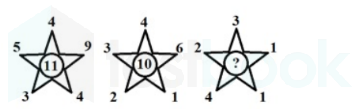
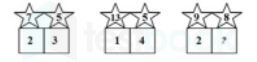
Study the given pattern carefully and select the number from among the given options that can replace the question mark (?).

  1. AOption (a)

    5

  2. BOption (b)

    4

  3. COption (c)

    7

  4. DOption (d)

    6

View answer & explanation

Correct answer

Answer: (b)B.

4

Why this answer is correct

The logic followed here is: The sum of all numbers = prime number

From 1st figure: 7 + 5 + 2 + 3 = 17

From 2nd figure: 13 + 5 + 1 + 4 = 23

From 3rd figure: 9 + 8 + 2 + 4 = 23

Hence, the correct answer is "Option 2".

Question 12

In Aditya - L1, the first Indian mission to study the Sun, what does L1 stand for? 

  1. AOption (a)

    Lagrangian point 1

  2. BOption (b)

    Laboratory point 1

  3. COption (c)

    Lower point 1

  4. DOption (d)

    Line point 1

View answer & explanation

Correct answer

Answer: (a)A.

Lagrangian point 1

Why this answer is correct

The correct answer is Lagrangian point 1.

Key Points

  • In Aditya-L1, the first Indian mission to study the Sun, L1 stands for Lagrange point 1.
  • L1 in Aditya-L1 stands for Lagrange point 1, a stable point in space located between the Earth and the Sun, about 1.5 million kilometers from Earth.
  • Reason for Location
  • Stable position: The gravitational forces of the Earth and Sun balance out, allowing the spacecraft to maintain a steady orbit.
  • Continuous viewing: The spacecraft can continuously observe the Sun without interruptions from eclipses or occultations.

Additional Information

  • The Aditya-L1 spacecraft was launched on September 2, 2023, and was inserted into its halo orbit around the L1 point on January 6, 2024.
  • The Aditya-L1 mission is India's first space-based solar observatory, aimed at studying the Sun's chromosphere, photosphere, and corona to understand the dynamics of the Sun's atmosphere.
  • The mission has a projected life of five years.
  • Payloads:
  • Solar Ultraviolet Imaging Telescope (SUIT): Captures images of the Sun's photosphere and chromosphere.
  • L1 Orbiting X-ray Spectrometer (HEL1OS): Studies X-ray flares from the Sun.
  • Magnetometer: Measures interplanetary magnetic fields at L1.
  • Collaboration: Science payloads were developed by Indian laboratories in collaboration with ISRO.
  • Objective: The mission will help us understand the thermal and magnetic phenomena of the Sun, which can cause disturbances in near-Earth space.

Question 13

If each element of a matrix is zero, then the matrix is: 

  1. AOption (a)

    scalar 

  2. BOption (b)

    identity 

  3. COption (c)

    square

  4. DOption (d)

    null

View answer & explanation

Correct answer

Answer: (d)D.

null

Why this answer is correct

Given:

If each element of a matrix is zero, then the matrix is:

Formula Used:

A matrix where every element is zero is called a null matrix.

Calculation:

Each element of the matrix is 0.

Therefore, the matrix is a null matrix.

The correct answer is option 4.

Question 14

The upward and downward growth of shoots and roots, respectively, in response to the pull of earth or gravity, is called: 

  1. AOption (a)

    phototropism

  2. BOption (b)

    geotropism

  3. COption (c)

    chemotropism 

  4. DOption (d)

    hydrotropism

View answer & explanation

Correct answer

Answer: (b)B.

geotropism

Why this answer is correct

The correct answer is geotropism.

Key Points

  • Geotropism refers to the growth of plant organs in response to gravity. It is also known as gravitropism.
  • The shoots of plants exhibit negative geotropism, meaning they grow upward, away from the pull of gravity.
  • The roots exhibit positive geotropism, growing downward, in the direction of the gravitational pull.
  • This growth response helps plants maintain stability and efficiently access water and nutrients from the soil.

Additional Information

  • Phototropism: This refers to a plant's growth in response to light. Shoots typically exhibit positive phototropism, growing towards light sources, while roots generally exhibit negative phototropism, growing away from light.
  • Chemotropism: It refers to a plant's growth response to chemical stimuli. For example, the growth of pollen tubes toward ovules during fertilization is chemotropic.
  • Hydrotropism: This refers to a plant's growth in response to moisture. Roots generally exhibit positive hydrotropism, growing towards areas with higher water concentration.
  • Importance of Geotropism: Geotropism is essential for plant orientation and resource acquisition, ensuring that roots grow towards nutrients and shoots grow towards sunlight for photosynthesis.

Question 15

Which among the following micronutrients is essential for the normal functioning of the thyroid gland? 

  1. AOption (a)

    Iodine

  2. BOption (b)

    Potassium 

  3. COption (c)

    Iron 

  4. DOption (d)

    Calcium 

View answer & explanation

Correct answer

Answer: (a)A.

Iodine

Why this answer is correct

The correct answer is Iodine.

Key Points

  • Iodine is a crucial micronutrient required for the normal functioning of the thyroid gland.
  • The thyroid gland uses iodine to produce the hormones thyroxine (T4) and triiodothyronine (T3), which regulate various metabolic processes in the body.
  • A deficiency of iodine can lead to thyroid-related disorders such as goiter (enlarged thyroid gland) and hypothyroidism (reduced production of thyroid hormones).
  • Iodized salt and iodine-rich foods like seafood, dairy products, and eggs are important dietary sources of this essential nutrient.

Additional Information

  • Thyroid Gland: It is a butterfly-shaped gland located in the neck. It produces hormones that regulate metabolism, energy production, and body temperature.
  • Thyroid Hormones: The two main thyroid hormones, thyroxine (T4) and triiodothyronine (T3), play a key role in controlling the body's metabolic rate, heart function, and development.
  • Iodine Deficiency Disorders (IDDs): Lack of iodine in the diet can cause conditions such as goiter, cretinism (in children), and hypothyroidism. Severe iodine deficiency during pregnancy can lead to developmental delays in children.
  • Prevention: Iodized salt is a simple and effective way to prevent iodine deficiency, ensuring the normal functioning of the thyroid gland and preventing IDDs.

Question 16

Find the value of sin 420°

  1. AOption (a)

    32{ \sqrt {3} \over 2}

  2. BOption (b)

    13{1 \over \sqrt {3} }

  3. COption (c)

    23{2 \over \sqrt{3} }

  4. DOption (d)

    32{3 \over \sqrt{2} }

View answer & explanation

Correct answer

Answer: (a)A.

32{ \sqrt {3} \over 2}

Why this answer is correct

Given:

The angle is 420º.

Formula Used:

sin(θ) = sin(θ + 360º×n)

Calculation:

420º can be reduced to an equivalent angle between 0º and 360º:

⇒ 420º - 360º = 60º

Now, find the value of sin(60º)

sin(60º) = √3/2

∴ The correct answer is √3/2.

Question 17

The inner walls of the small intestine have thousands of finger-like outgrowths. These are called: 

  1. AOption (a)

    myomas

  2. BOption (b)

    villi 

  3. COption (c)

    bronchi

  4. DOption (d)

    lumps

View answer & explanation

Correct answer

Answer: (b)B.

villi 

Why this answer is correct

The correct answer is villi.

Key Points

  • The inner walls of the small intestine are lined with thousands of tiny, finger-like projections called villi.
  • Villi increase the surface area of the intestinal lining, enhancing nutrient absorption from digested food.
  • Each villus contains capillaries and lacteals (lymphatic vessels), which help transport absorbed nutrients and fats to the bloodstream.
  • The presence of villi is crucial for efficient digestion and absorption, playing a significant role in overall nutrient uptake in the body.

Additional Information

  • Structure of Villi: Each villus is approximately 0.5-1.5 mm in length and is covered with epithelial cells called enterocytes, which are involved in nutrient absorption.
  • Microvilli: On the surface of each villus, there are even smaller projections called microvilli that form a brush border, further increasing the absorptive surface area.
  • Digestive Process: As food passes through the small intestine, nutrients are broken down and absorbed into the bloodstream through the villi, which is essential for providing energy and nutrients to the body.
  • Disorders Related to Villi: Conditions such as celiac disease can damage villi, leading to malabsorption of nutrients and various gastrointestinal symptoms.

Question 18

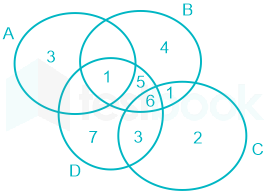
The following diagram is a combination of four figures, A, B, C and D. Figure A represents the number of people who drink tea. Figure B represents the number of people who drink coffee. Figure C represents the number of people who drink milk. Figure D represents the number of people who drink cold drinks. 

How many people do not drink coffee or milk? 

  1. AOption (a)

    15

  2. BOption (b)

    12

  3. COption (c)

    20

  4. DOption (d)

    10

View answer & explanation

Correct answer

Answer: (d)D.

10

Why this answer is correct

According to the given Venn diagram:

The shaded area shows the "people do not drink coffee or milk".

So, the total number of 'people do not drink coffee or milk' = 7 + 3 = 10.

Hence, the correct answer is "10".

Question 19

At the time of Independence, British India consisted of ____ princely states. 

  1. AOption (a)

    565

  2. BOption (b)

    500

  3. COption (c)

    582

  4. DOption (d)

    592

View answer & explanation

Correct answer

Answer: (a)A.

565

Why this answer is correct

The correct answer is 565

Key Points

  • At the time of India's Independence in 1947, British India consisted of approximately 565 princely states.
  • These princely states were semi-autonomous regions ruled by local kings or princes under the suzerainty of the British Crown.
  • The princely states varied in size and population, with some being quite large and others being very small.
  • The process of integrating these princely states into the newly independent India was a significant political challenge during the transition to independence.

Additional Information

  • Integration of Princely States: The integration was primarily managed by Sardar Vallabhbhai Patel, the first Deputy Prime Minister and Home Minister of India, who played a crucial role in persuading many princely states to join the Indian Union.
  • Instrument of Accession: Princely states were given the option to join India or Pakistan, and those that chose to join India had to sign an Instrument of Accession to officially merge with the Indian Union.
  • Historical Context: The princely states had varying degrees of allegiance to the British, and their rulers often had different aspirations regarding independence, making the integration process complex.
  • Legacy: The integration of the princely states significantly shaped the political landscape of modern India, influencing regional governance and representation in the Indian political framework.

Question 20

What is the compound interest of Rs. 2,800 for 112{1 \over 2} years at 10% per annum compounded half-yearly?

  1. AOption (a)

    Rs. 436.75

  2. BOption (b)

    Rs. 441.35

  3. COption (c)

    Rs. 420.00

  4. DOption (d)

    Rs. 434.00

View answer & explanation

Correct answer

Answer: (b)B.

Rs. 441.35

Why this answer is correct

Given:

Principal (P) = Rs. 2800

Time (T) = 11/2 years = 3 half-years

Rate (R) = 10% per annum = 5% per half-year

Formula Used:

Compound Interest (CI) = P (1 + R/100)n - P

Calculation:

Principal (P) = 2800

Rate (R) = 5% per half-year

Number of half-years (n) = 3

CI = P (1 + R/100)n - P

CI = 2800 (1 + 5/100)3 - 2800

CI = 2800 (1 + 0.05)3 - 2800

CI = 2800 (1.05)3 - 2800

CI = 2800 ×  1.158 - 2800

CI = 3241.35 - 2800

CI = 441.35

The correct answer is option 2.

Question 21

A programme or piece of code that is loaded onto a person's computer without his/her knowledge and runs against his/her wishes is a type of malware called:

  1. AOption (a)

    Virus 

  2. BOption (b)

    Trojan Horse 

  3. COption (c)

    Spyware

  4. DOption (d)

    Zeus

View answer & explanation

Correct answer

Answer: (a)A.

Virus 

Why this answer is correct

The correct answer is Virus.

Key Points

  • A program or piece of code loaded onto a computer without the user's knowledge and runs against their wishes is called a computer virus.
  • Definition: A virus is a type of malware that infects a system without the user's consent.
  • Spread: It can spread through malicious email attachments, corrupted downloads, or exploiting software vulnerabilities.
  • Actions: Viruses can steal personal data, delete files, or take control of a system.
  • Replication: They can replicate and infect other computers.
  • Stealth: Viruses often use stealth techniques to evade detection by antivirus software.
  • Prevention: Use firewalls, anti-malware software, avoid suspicious links or attachments, and block pop-ups.

Additional Information

  • A Trojan Horse is a type of malware that disguises itself as a legitimate program to deceive users.
  • Spyware: This malware secretly monitors user activity, collecting information such as browsing habits, personal data, and login credentials without the user’s consent.
  • Zeus: A specific type of Trojan horse that targets Windows machines, known for stealing banking information and conducting fraudulent online transactions.
  • Prevention: To protect against Trojans, it is essential to use reputable antivirus software, avoid downloading unknown files, and be cautious with email attachments and links.

Question 22

Simplify the following. 

1 + 37{3 \over 7} × [ 6 + 8 × (3 - 2)] + {(15{1 \over 5} ÷ 725{7 \over 25}) - (37{3 \over 7} + 414{4 \over 14})}

  1. AOption (a)

    5

  2. BOption (b)

    4

  3. COption (c)

    7

  4. DOption (d)

    6

View answer & explanation

Correct answer

Answer: (c)C.

7

Why this answer is correct

Given:

Expression: 1 + (3/7) × [6 + 8 × (3 - 2)] + {(1/5 ÷ 7/25) - (3/7 + 4/14)}

Steps to simplify:

Step 1: Simplify inside the brackets:

(3 - 2) = 1

8 × 1 = 8

6 + 8 = 14

Step 2: Multiply by (3/7):

⇒ (3/7) × 14 = 6

Step 3: Simplify the fractional division inside the curly braces:

(1/5 ÷ 7/25) = (1/5) × (25/7) = 5/7

Step 4: Simplify the addition and subtraction:

(3/7 + 4/14) = (3/7) + (2/7) = 5/7

⇒ {5/7 - 5/7} = 0

Step 5: Add all the terms together:

1 + 6 + 0 = 7

∴ The simplified value is 7.

Question 23

Eleanor Roosevelt, who was the chairperson of UDHR, belonged to which country? 

  1. AOption (a)

    Australia 

  2. BOption (b)

    USA

  3. COption (c)

    New Zealand 

  4. DOption (d)

    UK

View answer & explanation

Correct answer

Answer: (b)B.

USA

Why this answer is correct

The correct answer is USA.

Key Points

  • Eleanor Roosevelt was an American politician, diplomat, and activist who served as the chairperson of the United Nations Commission on Human Rights.
  • She played a crucial role in drafting the Universal Declaration of Human Rights (UDHR), which was adopted by the United Nations General Assembly in 1948.
  • Her leadership and advocacy for human rights were pivotal in shaping international human rights standards.
  • Eleanor Roosevelt is often regarded as one of the most influential women in American history, known for her commitment to social justice and equality.

Additional Information

  • Early Life: Eleanor Roosevelt was born on October 11, 1884, in New York City and came from a prominent family. She was educated in private schools and traveled extensively.
  • Political Career: She served as the First Lady of the United States from 1933 to 1945, during her husband Franklin D. Roosevelt's presidency, where she redefined the role of the First Lady by actively engaging in political and social issues.
  • She was appointed to the UN General Assembly in 1946 by President Harry S. Truman.
  • Human Rights Advocacy: After her husband's death, she continued to advocate for civil rights, women's rights, and international human rights, serving as a delegate to the United Nations.
  • Legacy: Eleanor Roosevelt's contributions to human rights are celebrated globally, and her work on the UDHR remains a cornerstone of modern human rights law.

Question 24

A frequent polygon is drawn using ________. 

  1. AOption (a)

    midpoint of classes and frequencies 

  2. BOption (b)

    end point of classes and frequencies 

  3. COption (c)

    lower boundaries of classes greater than cumulative frequencies 

  4. DOption (d)

    upper boundaries of classes less than cumulative frequencies 

View answer & explanation

Correct answer

Answer: (a)A.

midpoint of classes and frequencies 

Why this answer is correct

Given:

A frequent polygon is drawn using ________.

Options:

  1. midpoint of classes and frequencies

  2. end point of classes and frequencies

  3. lower boundaries of classes greater than cumulative frequencies

  4. upper boundaries of classes less than cumulative frequencies

Formula Used:

A frequent polygon is constructed by plotting the midpoints of each class interval on the x-axis against the corresponding frequencies on the y-axis and then connecting the points with straight lines.

Calculation:

To construct a frequent polygon:

  1. Identify the midpoint of each class interval.
  2. Plot these midpoints on the x-axis.
  3. Plot the corresponding frequencies on the y-axis.
  4. Connect the points with straight lines.

Since the question asks for the method used to draw a frequent polygon, we use the midpoint of classes and frequencies.

The correct answer is option 1.

Question 25

Simplify: 

0.077 ÷ 7 - 0.005 ÷ 5

  1. AOption (a)

    0.01

  2. BOption (b)

    0.001

  3. COption (c)

    0.00001

  4. DOption (d)

    0.0001

View answer & explanation

Correct answer

Answer: (a)A.

0.01

Why this answer is correct

Given:

Simplify: 0.077 ÷ 7 - 0.005 ÷ 5

Formula Used:

Division and Subtraction of Decimal Numbers

Calculation:

0.077 ÷ 7 - 0.005 ÷ 5

⇒ (0.077 / 7) - (0.005 / 5)

⇒ 0.011 - 0.001

⇒ 0.01

The correct answer is option 1.

Question 26

________ dam on the river Congo has the capacity to produce up to 40,000 MW of electric power. 

  1. AOption (a)

    Akosombo 

  2. BOption (b)

    Bloemhof

  3. COption (c)

    Kouga 

  4. DOption (d)

    Inga

View answer & explanation

Correct answer

Answer: (d)D.

Inga

Why this answer is correct

The correct answer is Inga.

Key Points

  • The Inga Dam is located on the Congo River in the Democratic Republic of the Congo.
  • It has the capacity to produce up to 40,000 MW of electric power, making it one of the largest hydroelectric power stations in the world.
  • The dam is a key component of the country’s energy infrastructure and has the potential to supply electricity to several neighboring countries.
  • Inga's hydroelectric projects are vital for meeting the energy demands of the region and fostering economic development.

Additional Information

  • Inga I and II: The dam comprises two major phases, Inga I and Inga II, which were commissioned in the 1970s and 1980s, respectively. Together, they currently produce about 1,700 MW of power.
  • Future Plans: There are ambitious plans for the Inga III project, which aims to significantly increase power generation capacity and expand regional electricity access.
  • Hydropower Significance: The Congo River is one of the most powerful rivers in the world, with a massive potential for hydropower generation, contributing to sustainable energy solutions in Africa.
  • Environmental Concerns: While the Inga Dam offers substantial energy potential, its construction and expansion face criticism regarding environmental impact and displacement of local communities.

Question 27

Find the median of the following values. 

5, 10, 3, 7, 2, 9, 6, 2 and 11

  1. AOption (a)

    4

  2. BOption (b)

    7

  3. COption (c)

    6

  4. DOption (d)

    5

View answer & explanation

Correct answer

Answer: (c)C.

6

Why this answer is correct

Given:

Values: 5, 10, 3, 7, 2, 9, 6, 2, and 11

Formula Used:

Median = Middle value in an ordered list of numbers

Calculation:

Step 1: Arrange the values in ascending order:

2, 2, 3, 5, 6, 7, 9, 10, 11

Step 2: Find the middle value:

Since there are 9 values, the middle value is the 5th value in the ordered list.

Middle value = 6

The median of the given values is 6.

Question 28

Simplify the following. 

4.2×4.2−1.9×1.92.3×6.1{4.2 \times 4.2 - 1.9 \times 1.9 \over 2.3 \times 6.1}

  1. AOption (a)

    3

  2. BOption (b)

    2

  3. COption (c)

    1

  4. DOption (d)

    4

View answer & explanation

Correct answer

Answer: (c)C.

1

Why this answer is correct

Given:

Simplify the following expression: 4.2×4.2−1.9×1.92.3×6.1\frac{4.2 × 4.2 - 1.9 × 1.9}{2.3 × 6.1}

Formula Used:

Use the algebraic identity: a2−b2=(a+b)(a−b)a^{2} - b^{2} = (a + b)(a - b)

Calculation:

Let a = 4.2 and b = 1.9

Numerator: 4.22−1.924.2^{2} - 1.9^{2}

Denominator: 2.3 × 6.1

Using the identity a2−b2=(a+b)(a−b)a^{2} - b^{2} = (a + b)(a - b)

Numerator: (4.2 + 1.9)(4.2 - 1.9)

⇒ (6.1)(2.3)

Denominator: 2.3 × 6.1

⇒ Numerator/Denominator = (6.1)(2.3)(2.3)(6.1)\frac{(6.1)(2.3)}{(2.3)(6.1)}

⇒ 1

The correct answer is option 3.

Question 29

Who has been elected as the chairman of the Audit Bureau of Circulations (ABC) for the year 2020-21? 

  1. AOption (a)

    Devendra V Darda

  2. BOption (b)

    Smriti Irani 

  3. COption (c)

    Arvind Kejriwal 

  4. DOption (d)

    Hardeep Singh Puri

View answer & explanation

Correct answer

Answer: (a)A.

Devendra V Darda

Why this answer is correct

The correct answer is Devendra V Darda.

Key Points

  • Devendra V Darda was elected as the chairman of the Audit Bureau of Circulations (ABC) for the year 2020-2021.
  • Position: Managing Director of Lokmat Media Group.
  • Industry Experience: Darda has served on several media industry bodies, including INS (Indian Newspaper Society) and IFRA (International Newspaper Association).
  • Education Contributions: He is the president of various educational institutions in Yavatmal, Maharashtra.
  • Sports Involvement: He is also on the managing committee of the Western India Football Association.

Additional Information

  • Purpose: The ABC is a non-profit organization that audits and certifies the circulation of newspapers and magazines to ensure transparency and accuracy in reported circulation figures.
  • Functions:
  • Circulation Audits: Conducts yearly audits of newspapers and periodicals to verify their circulation figures.
  • Certification: Issues certificates for audited publications, allowing them to be listed on the Central Media List, which grants access to public sector advertisement rates.
  • Industry Standards: Provides industry-agreed standards for measuring media brands to promote consistency and credibility.
  • Foundation: It was established in 1948 by representatives from the advertising and publishing industries to provide a reliable means for verifying circulation numbers.

Question 30

In the context of web pages, what does SEO stands for? 

  1. AOption (a)

    Slack Engine Optimisation 

  2. BOption (b)

    Search Engine Optimisation 

  3. COption (c)

    Slack Editing Optimisation 

  4. DOption (d)

    Search Editing Optimisation 

View answer & explanation

Correct answer

Answer: (b)B.

Search Engine Optimisation 

Why this answer is correct

The correct answer is Search Engine Optimisation.

Key Points

  • SEO is the practice of enhancing web pages to increase their visibility in search engine results.
  • The primary goal of SEO is to attract organic traffic from search engines like Google, Bing, and Yahoo.
  • SEO involves various techniques, including keyword research, on-page optimization, and backlink building.
  • Effective SEO strategies can lead to higher search rankings, increased website traffic, and improved user engagement.

Additional Information

  • On-Page SEO: This includes optimizing content, HTML tags (like title and meta tags), and internal linking to improve the relevance and quality of a webpage.
  • Off-Page SEO: Involves strategies implemented outside the website to improve its position in search rankings, such as building backlinks and social media marketing.
  • Technical SEO: Focuses on improving the technical aspects of a website, like site speed, mobile-friendliness, and secure connections (HTTPS), to enhance the user experience and search engine crawlability.
  • SEO Tools: Various tools are available to help with SEO analysis and tracking, including Google Analytics, SEMrush, and Ahrefs, which provide insights into keyword performance and site health.

Question 31

A political party can be recognised as a national party if it secures ___ of the valid votes in any four states in general or state assembly elections and in addition it wins 4 Lok Sabha seat from any state or states. 

  1. AOption (a)

    7%

  2. BOption (b)

    8%

  3. COption (c)

    9%

  4. DOption (d)

    6%

View answer & explanation

Correct answer

Answer: (d)D.

6%

Why this answer is correct

The correct answer is 6%.

Key Points

  • A political party can be recognized as a national party in India if it secures at least 6% of the valid votes in any four states during general or state assembly elections.
  • In addition to the vote percentage, the party must win 4 Lok Sabha seats from any state or states.
  • This recognition allows the party to avail certain benefits, including the allocation of a common symbol and access to public funding for elections.
  • The criteria for national party recognition are outlined by the Election Commission of India, ensuring a fair and transparent electoral process.

Additional Information

  • Political Party Types: In India, parties can be classified as national parties, state parties, or registered unrecognized parties based on their electoral performance and organizational structure.
  • State Party Recognition: For a party to be recognized as a state party, it must secure at least 6% of the valid votes in a state assembly election or win 2 Lok Sabha seats
  • Impact of Recognition**: Recognition as a national or state party enhances a party's credibility and can significantly affect its ability to mobilize resources and attract voters.**
  • Current National Parties**: Some of the recognized national parties in India include the Indian National Congress (INC), Bharatiya Janata Party (BJP), and the Communist Party of India (CPI).**

Question 32

Name the strait which separates Tamil Nadu of India and Mannar of Sri Lanka. 

  1. AOption (a)

    Hudson strait

  2. BOption (b)

    Bass strait 

  3. COption (c)

    Sunda strait 

  4. DOption (d)

    Palk strait 

View answer & explanation

Correct answer

Answer: (d)D.

Palk strait 

Why this answer is correct

The correct answer is Palk strait.

Key Points

  • The Palk Strait is a body of water that separates the southeastern coast of Tamil Nadu in India from the Mannar region of Sri Lanka.
  • It is approximately 40-85 kilometers wide, connecting the Bay of Bengal to the Gulf of Mannar.
  • The strait is named after the ancient Palk Bay, a shallow bay located to the east of the strait.
  • Palk Strait is significant for regional trade, fishing, and has a rich marine biodiversity.

Additional Information

  • Geographical Importance: The Palk Strait serves as a crucial shipping route for vessels traveling to and from the ports of India and Sri Lanka.
  • Historical Context: The strait has historical significance as it is believed to have been crossed by Lord Rama during the epic Ramayana, leading to the construction of the Ram Setu or Adam's Bridge.
  • Environmental Concerns: The Palk Strait is home to various marine species, including endangered species like the dugong. Conservation efforts are essential to protect this biodiversity.
  • Disputes and Agreements: There have been discussions and disputes over fishing rights and maritime boundaries in the Palk Strait, necessitating bilateral agreements between India and Sri Lanka.

Question 33

Which year's budget was called a Black Budget of India? 

  1. AOption (a)

    2004-05

  2. BOption (b)

    1973-74

  3. COption (c)

    1970-71

  4. DOption (d)

    2013-14

View answer & explanation

Correct answer

Answer: (b)B.

1973-74

Why this answer is correct

The correct answer is 1973-74.

Key Points

  • The budget referred to as the "Black Budget" of India was the 1973-74 Union Budget.
  • Fiscal Deficit: Known as the "Black Budget" due to a high fiscal deficit of ₹550 crore.
  • Presented by: Yashwantrao B Chavan, the Finance Minister at the time.
  • Date: February 28, 1973.
  • Context: Introduced during severe financial difficulties and economic turmoil in India.

Additional Information

  • The Union Budget is an annual financial statement that the Government of India presents to outline its estimated revenue and expenditure for the coming fiscal year.
  • Traditionally presented by the Finance Minister of India in February. The budget session is usually held in Parliament.
  • Landmark Budgets: 
  • Black Budget (1973-74): Known for its high fiscal deficit.
  • Epochal Budget (1991): Marked the beginning of economic liberalization.
  • Carrot and Stick Budget (1986): Introduced the MODVAT system.

Question 34

x% of 12.8 = 38.4. Find  the value of x. 

  1. AOption (a)

    0.3

  2. BOption (b)

    3

  3. COption (c)

    305

  4. DOption (d)

    300

View answer & explanation

Correct answer

Answer: (d)D.

300

Why this answer is correct

Given:

x% of 12.8 = 38.4

Formula Used:

x% of a number = (x/100) × number

Calculation:

x% of 12.8 = 38.4

(x/100) × 12.8 = 38.4

⇒ x/100 = 38.4 / 12.8

⇒ x/100 = 3

⇒ x = 3 × 100

⇒ x = 300

The value of x is 300.

Question 35

What should be added to 21.707 to get 29.053?

  1. AOption (a)

    7.676

  2. BOption (b)

    7.466

  3. COption (c)

    7.346

  4. DOption (d)

    7.576

View answer & explanation

Correct answer

Answer: (c)C.

7.346

Why this answer is correct

Given question: What should be added to 21.707 to get 29.053? 1) 7.676 2) 7.466 3) 7.346 4) 7.576 5) The correct answer is option 3

Given:

Initial value = 21.707

Final value = 29.053

Formula Used:

Required value = Final value - Initial value

Calculation:

Required value = 29.053 - 21.707

⇒ Required value = 7.346

The value that should be added to 21.707 to get 29.053 is 7.346.

Question 36

Find the value of 860% of 50 ÷ 50% of 860.

  1. AOption (a)

    1

  2. BOption (b)

    25

  3. COption (c)

    17.2

  4. DOption (d)

    0

View answer & explanation

Correct answer

Answer: (a)A.

1

Why this answer is correct

Given:

860% of 50

50% of 860

Formula Used:

Percentage of a number = (Percentage × Number) / 100

Calculation:

860% of 50 = (860 × 50) / 100

⇒ 860% of 50 = 43000 / 100

⇒ 860% of 50 = 430

50% of 860 = (50 × 860) / 100

⇒ 50% of 860 = 43000 / 100

⇒ 50% of 860 = 430

860% of 50 ÷ 50% of 860 = 430 ÷ 430

⇒ 860% of 50 ÷ 50% of 860 = 1

The correct answer is option 1.

Question 37

Select the number that can replace the question mark (?) in the following series. 

2, 5, 11, 20, 32, 47, 65, ?

  1. AOption (a)

    72

  2. BOption (b)

    73

  3. COption (c)

    77

  4. DOption (d)

    86

View answer & explanation

Correct answer

Answer: (d)D.

86

Why this answer is correct

The logic followed here is:

Hence, the correct answer is "Option 4".

Question 38

2 chairs and 1 table cost Rs. 880, while 1 chair and 2 tables cost Rs. 980. Find the cost of each.  

  1. AOption (a)

    Rs. 195 and Rs. 295

  2. BOption (b)

    Rs. 280 and Rs. 380

  3. COption (c)

    Rs. 185 and Rs. 285 

  4. DOption (d)

    Rs. 260 and Rs. 360

View answer & explanation

Correct answer

Answer: (d)D.

Rs. 260 and Rs. 360

Why this answer is correct

Given:

Cost of 2 chairs and 1 table = Rs. 880

Cost of 1 chair and 2 tables = Rs. 980

Formula Used:

Let the cost of 1 chair be Rs. C and the cost of 1 table be Rs. T.

2C + T = 880

C + 2T = 980

Calculation:

From the first equation:

2C + T = 880       (1)

From the second equation:

C + 2T = 980       (2)

Multiply equation (2) by 2:

⇒ 2C + 4T = 1960       (3)

Subtract equation (1) from equation (3):

⇒ (2C + 4T) - (2C + T) = 1960 - 880

⇒ 3T = 1080

⇒ T = 1080 / 3

⇒ T = 360

Substitute the value of T in equation (1):

⇒ 2C + 360 = 880

⇒ 2C = 880 - 360

⇒ 2C = 520

⇒ C = 520 / 2

⇒ C = 260

The cost of each chair is Rs. 260 and the cost of each table is Rs. 360.

Question 39

All trigonometric functions are periodic. What is the period of cos x?

  1. AOption (a)

    π 

  2. BOption (b)

    2 π 

  3. COption (c)

    π3{\pi \over 3}

  4. DOption (d)

    π2{\pi \over 2}

View answer & explanation

Correct answer

Answer: (b)B.

2 π 

Why this answer is correct

Given:

All trigonometric functions are periodic.

Formula Used:

The period of the cosine function is 2π  .

Calculation:

We know that the cosine function repeats its values every 2π.

Thus, the period of cos⁡(x)\cos(x) is: 2π2π

The period of cos(x) is 2π .

Question 40

Four words have been given, out off which three are alike in some manner and one is different. Select the odd one. 

  1. AOption (a)

    Draw

  2. BOption (b)

    Toss

  3. COption (c)

    Win 

  4. DOption (d)

    Lose

View answer & explanation

Correct answer

Answer: (b)B.

Toss

Why this answer is correct

The logic followed here is:

DrawOutcome
TossAction
WinOutcome
LoseOutcome


Draw, Win, Lose all are Outcomes,

Whereas,

Toss is an Action.

Hence, the correct answer is "Toss".

Question 41

After deducting a commission of 10% on the marked price, a T.V. set costs Rs. 9,090. What is the marked price? 

  1. AOption (a)

    Rs. 10,000.00

  2. BOption (b)

    Rs. 10,100.00

  3. COption (c)

    Rs. 10,074.75

  4. DOption (d)

    Rs. 10,010.00

View answer & explanation

Correct answer

Answer: (b)B.

Rs. 10,100.00

Why this answer is correct

Given:

After deducting a commission of 10% on the marked price, a T.V. set costs Rs. 9,090.

Formula Used:

Let the marked price be M.

Cost after commission = Marked Price - Commission

Commission = 10% of Marked Price = 0.10 × M

Cost after commission = M - 0.10 × M

Cost after commission = 0.90 × M

Calculation:

Given, Cost after commission = Rs. 9,090

0.90 × M = 9,090

⇒ M = 9,090 / 0.90

⇒ M = 10,100

The marked price is Rs. 10,100.

Question 42

Read the given statements and decide which of the conclusions given in the option logically follow from the statements. 

Statements: 

  1. All bats are bangles. 
  2. Some baskets are bangles but not bats. 
  3. Not all baskets are bangles.
  1. AOption (a)

    Some baskets are both bats and bangles. 

  2. BOption (b)

    Some bats are neither baskets nor bangles. 

  3. COption (c)

    Some bangles are neither bats nor baskets. 

  4. DOption (d)

    Some baskets are neither bangles nor bats. 

View answer & explanation

Correct answer

Answer: (d)D.

Some baskets are neither bangles nor bats. 

Why this answer is correct

Given,

Statements:

  1. All bats are bangles.
  2. Some baskets are bangles but not bats.
  3. Not all baskets are bangles.

Conclusions:

I. Some baskets are both bats and bangles. - False (Because, the statements do not provide any evidence to support the claim that some baskets are both bats and bangles. In fact, it is specified that some baskets are bangles but not bats.)

II. Some bats are neither baskets nor bangles. - False (Because, according to the statements, all bats are bangles, so it is not possible for some bats to be neither baskets nor bangles.)

III. Some bangles are neither bats nor baskets. - False (Because, according to the statements, All bats are bangles gives some bats are bangles but no definite information given about the remaining part, and since some baskets are bangles but not bats)

IV. Some baskets are neither bangles nor bats. - True (Because, the statement "Not all baskets are bangles" implies that there are some baskets that are neither bangles nor bats.)

Hence, the correct answer is "Option 4".

Question 43

Find the value of 

18 - [ 6 ÷ 3 × { 8 - (10 × 12{1 \over 2})}].

  1. AOption (a)

    8

  2. BOption (b)

    12

  3. COption (c)

    6

  4. DOption (d)

    10

View answer & explanation

Correct answer

Answer: (b)B.

12

Why this answer is correct

Given:

Expression to evaluate: 18 - [ 6 ÷ 3 × { 8 - (10 × {1 1⁄2})}].

Formula Used:

Order of operations (PEMDAS/BODMAS): Parentheses/Brackets, Exponents/Orders, Multiplication and Division (from left to right), Addition and Subtraction (from left to right).

Calculation:

Evaluate the innermost parentheses first:

10 × {1 1⁄2} = 10 × 0.5

⇒ 10 × 0.5 = 5

Next, evaluate the expression inside the curly brackets:

8 - 5

⇒ 8 - 5 = 3

Now, evaluate the expression inside the square brackets:

6 ÷ 3 × 3

⇒ 6 ÷ 3 = 2

⇒ 2 × 3 = 6

Finally, subtract the result from 18:

18 - 6

⇒ 18 - 6 = 12

The correct answer is option 2.

Question 44

Sarva Shiksha Abhiyan (SSA) aims to provide useful and relevant elementary education for all children in the age group of ____ years. 

  1. AOption (a)

    14 - 17

  2. BOption (b)

    1 - 3

  3. COption (c)

    3 - 6

  4. DOption (d)

    6 - 14

View answer & explanation

Correct answer

Answer: (d)D.

6 - 14

Why this answer is correct

The correct answer is 6 - 14.

Key Points

  • Sarva Shiksha Abhiyan (SSA) is a flagship program launched by the Government of India aimed at the universalization of elementary education.
  • The SSA focuses on providing education to all children in the age group of 6 to 14 years, ensuring that they receive quality education.
  • Launch Year: Started in 2001, pioneered by Atal Bihari Vajpayee, the former Prime Minister of India.
  • The program emphasizes the importance of free and compulsory education as mandated by the Right to Education Act, 2009.
  • SSA aims to bridge gaps in access to education, improve the quality of learning, and enhance the infrastructure of schools across India.

Additional Information

  • Objectives: The primary objectives of SSA include increasing enrollment, improving retention rates, and enhancing learning outcomes for children.
  • Implementation: SSA is implemented through various strategies, including the establishment of new schools, training teachers, and providing necessary learning materials.
  • Inclusive Education: The program emphasizes inclusivity, aiming to provide education to marginalized and disadvantaged groups, including children with disabilities.
  • Monitoring and Evaluation: The effectiveness of SSA is monitored through various assessment mechanisms, including regular audits and surveys to track progress in enrollment and learning achievements.
  • Significance: It is the Government of India's flagship program for achieving Universalization of Elementary Education (UEE), making education a Fundamental Right as per the 86th amendment to the Constitution.

Question 45

The full form of IBM in IBM Corporation is: 

  1. AOption (a)

    International Broadcasting Machines 

  2. BOption (b)

    Indian Business Machines 

  3. COption (c)

    Indian Broadcasting Machines

  4. DOption (d)

    International Business Machines 

View answer & explanation

Correct answer

Answer: (d)D.

International Business Machines 

Why this answer is correct

The correct answer is International Business Machines.

Key Points

  • IBM Corporation is one of the world's largest technology and consulting companies, known for its innovation in computing technology.
  • The full form of IBM stands for International Business Machines, reflecting its global outreach and emphasis on business solutions.
  • Founded in 1911, IBM originally started as a company that manufactured machinery for business applications.
  • IBM has played a crucial role in the development of computer technology, including hardware, software, and services.

Additional Information

  • Historical Context: IBM was established as the Computing-Tabulating-Recording Company (CTR) through the merger of four companies and was renamed International Business Machines in 1924.
  • Product Range: IBM offers a wide range of products and services, including cloud computing, artificial intelligence, hardware, and software solutions.
  • Research and Development: IBM has a strong focus on R&D, leading to numerous patents and innovations in various fields, including quantum computing.
  • Corporate Social Responsibility: IBM is also known for its commitment to corporate social responsibility and sustainability initiatives worldwide.

Question 46

In which city is the tomb of Emperor Akbar situated? 

  1. AOption (a)

    Chennai

  2. BOption (b)

    Chandigarh 

  3. COption (c)

    Varanasi 

  4. DOption (d)

    Agra

View answer & explanation

Correct answer

Answer: (d)D.

Agra

Why this answer is correct

The correct answer is Agra

Key Points

  • The tomb of Emperor Akbar is located in Agra, India, specifically in a town called Sikandra.
  • Constructed in the late 16th century, Akbar's tomb is a significant example of Mughal architecture.
  • The tomb complex is spread over an area of 119 acres and is surrounded by beautiful gardens.
  • It reflects a harmonious blend of Persian, Indian, and Islamic architectural styles.

Additional Information

  • Historical Significance: Akbar, the third Mughal emperor, reigned from 1556 to 1605 and is known for his policy of religious tolerance and efforts to unify the diverse populations of India.
  • Architectural Features: The tomb features a stunning entrance gate, intricate carvings, and inlaid work using semi-precious stones.
  • Visitation: The tomb is a popular tourist destination, attracting visitors for its historical significance and architectural beauty.
  • UNESCO World Heritage Site: The site is part of the Agra city area, which also includes other famous monuments like the Taj Mahal and Agra Fort, both of which are UNESCO World Heritage Sites.

Question 47

X is the mother-in-law of Y and Z. P is the daughter of N who is the husband of Z. How is N related to X?

  1. AOption (a)

    Son 

  2. BOption (b)

    Father 

  3. COption (c)

    Son in Law

  4. DOption (d)

    Brother

View answer & explanation

Correct answer

Answer: (a)A.

Son 

Why this answer is correct

Family chart:

Given:

X is the mother-in-law of Y and Z. This means Y and Z are married to X's children.

P is the daughter of N who is the husband of Z.

So, N is the 'Son' of X.

Hence, the correct answer is "Option 1".

Question 48

If x = 9+19−1{\sqrt 9 + 1 \over \sqrt 9 - 1} and y = 16+116−1{\sqrt 16 + 1 \over \sqrt 16 - 1}, then the value of (x2 - y2) is:

  1. AOption (a)

    989 \over 8

  2. BOption (b)

    11911 \over 9

  3. COption (c)

    767 \over 6

  4. DOption (d)

    656 \over 5

View answer & explanation

Correct answer

Answer: (b)B.

11911 \over 9

Why this answer is correct

Given:

x = (√9 + 1) / (√9 - 1) and y = (√16 + 1) / (√16 - 1)

Formula used:

x² - y² = (x - y)(x + y)

Calculation:

Step 1: Simplify x:

x = (√9 + 1) / (√9 - 1) = (3 + 1) / (3 - 1) = 4 / 2 = 2

Step 2: Simplify y:

y = (√16 + 1) / (√16 - 1) = (4 + 1) / (4 - 1) = 5 / 3

Step 3: Calculate x² - y²:

⇒ x² - y² = (2)² - (5/3)²

⇒ x² - y² = 4 - (25 / 9)

⇒ x² - y² = 36/9 - 25/9 = 11/9

∴ The value of (x² - y²) is 11/9.

Question 49

Select the Venn diagram that best represents the relationship between the given set of classes. 

Tea, Beverage, Cup

  1. AOption (a)

  2. BOption (b)

  3. COption (c)

  4. DOption (d)

View answer & explanation

Correct answer

Answer: (d)D.

Why this answer is correct

According to the given words:

Tea is a type of beverage, while a cup is a container used for various beverages, including tea.

  • Beverage: Large circle.
  • Tea: Smaller circle inside the "Beverage" circle.
  • Cup: Separate circle, overlapping with "Beverage" (indicating cups can hold beverages but are not beverages themselves).


Hence, the correct answer is "Option 4".

Question 50

When did the Government of India launch Direct Benefit Transfer (DBT)? 

  1. AOption (a)

    1 January 2016. 

  2. BOption (b)

    1 January 2015.

  3. COption (c)

    1 January 2014.

  4. DOption (d)

    1 January 2013.

View answer & explanation

Correct answer

Answer: (d)D.

1 January 2013.

Why this answer is correct

The correct answer is 1 January 2013.

Key Points

  • The Government of India launched Direct Benefit Transfer (DBT) on January 1, 2013.
  • The program initially began in 43 districts.
  • The first official inauguration took place in Gollaprolu, East Godavari district on January 6, 2013.
  • The national expansion occurred on December 12, 2014, covering 300 districts and 34 other schemes.
  • The Direct Benefit Transfer program is a significant initiative by the Government of India aimed at reforming the delivery of welfare benefits, making it more efficient, transparent, and accountable.

Additional Information

  • The Direct Benefit Transfer (DBT) program in India has several key features aimed at enhancing the efficiency and effectiveness of government welfare schemes.
  • Direct Cash Transfers: DBT facilitates the direct transfer of benefits to the bank accounts of beneficiaries, minimizing the intermediaries involved in the process. This helps ensure that the benefits reach the intended recipients without delays or leakages.
  • JAM Trinity: The program leverages the JAM (Jan Dhan, Aadhaar, and Mobile) framework to enable seamless transfers.
  • an Dhan: Refers to the financial inclusion initiative that provides every citizen with access to a bank account.
  • Aadhaar: The unique identification number that helps in verifying the identity of beneficiaries.
  • Mobile: Ensures that the transfer process is accessible and can be monitored through mobile technology.
  • Targeting and Transparency: DBT aims to ensure that subsidies and benefits are accurately targeted at deserving beneficiaries. This reduces fraud and enhances transparency in the delivery of services.
  • Reduction of Leakages: By transferring funds directly to beneficiaries, DBT helps in minimizing the diversion and misuse of funds, thus reducing corruption and leakages that have historically plagued many government schemes.
  • Increased Accountability: The use of technology in the DBT program fosters a greater sense of accountability among government officials and ensures that the funds are used for their intended purpose.
  • Implementation through NPCI: Transactions under the DBT program are processed through the National Payments Corporation of India (NPCI), which ensures a reliable and efficient payment mechanism.

Question 51

A jelly-like substance between the nucleus and the cell membrane is called: 

  1. AOption (a)

    Protoplasm 

  2. BOption (b)

    Chloroplast 

  3. COption (c)

    Cytoplasm 

  4. DOption (d)

    Nucleolus

View answer & explanation

Correct answer

Answer: (c)C.

Cytoplasm 

Why this answer is correct

The correct answer is Cytoplasm.

Key Points

  • Cytoplasm is the jelly-like substance that fills the interior of a cell, lying between the cell membrane and the nucleus.
  • It is composed mainly of water, salts, and organic molecules, providing a medium for various cellular processes.
  • Cytoplasm contains organelles, which are specialized structures that perform distinct functions within the cell.
  • It plays a crucial role in cell metabolism, transport of materials, and the overall maintenance of cell structure.

Additional Information

  • Protoplasm: This term refers to the living content of a cell, including both the cytoplasm and the nucleoplasm, which is the substance within the nucleus.
  • Chloroplast: These are organelles found in plant cells that conduct photosynthesis, converting light energy into chemical energy.
  • Nucleolus: A dense structure found within the nucleus, responsible for producing ribosomes, which are essential for protein synthesis.
  • Functions of Cytoplasm: It assists in cell division, supports the cell’s shape, and enables the movement of materials around the cell, ensuring that organelles are properly positioned.

Question 52

Giri can complete a piece of work in 6 days. With the help of her friend, she complete it in 4 days. In how many days can her friend complete the work done? 

  1. AOption (a)

    10

  2. BOption (b)

    16

  3. COption (c)

    14

  4. DOption (d)

    12

View answer & explanation

Correct answer

Answer: (d)D.

12

Why this answer is correct

Given:

Giri can complete a piece of work in 6 days.

With the help of her friend, she completes it in 4 days.

Formula Used:

Work Rate of Giri = 1/6

Work Rate of Giri and Friend together = 1/4

Work Rate of Friend = Combined Work Rate - Giri's Work Rate

Calculation:

Work Rate of Giri = 1/6

Work Rate of Giri and Friend together = 1/4

Work Rate of Friend = (1/4) - (1/6)

⇒14−16=3−212=112 \Rightarrow \frac{1}{4} - \frac{1}{6} = \frac{3 - 2}{12} = \frac{1}{12}

Time taken by Friend alone to complete the work = 12 days

The correct answer is option 4.

Question 53

Two intersecting circles are said to be orthogonal if the angle between them is a/an ________. 

  1. AOption (a)

    straight angle 

  2. BOption (b)

    right angle 

  3. COption (c)

    acute angle

  4. DOption (d)

    obtuse angle

View answer & explanation

Correct answer

Answer: (b)B.

right angle 

Why this answer is correct

Given:

Two intersecting circles are said to be orthogonal if the angle between them is a/an ________.

Formula Used:

Orthogonal circles intersect at a right angle.

Calculation:

Orthogonal circles intersect at a right angle, which is 90 degrees.

The correct answer is option 2.

Question 54

Who composed the famous Tamil epic 'Manimekalai'? 

  1. AOption (a)

    Nathakuthanaar 

  2. BOption (b)

    Tirotakkatevar

  3. COption (c)

    Sattanar

  4. DOption (d)

    Ilango Adigal

View answer & explanation

Correct answer

Answer: (c)C.

Sattanar

Why this answer is correct

The correct answer is Sattanar.

Key Points

  • Sattanar is credited with composing the Tamil epic 'Manimekalai', which is a significant work in Tamil literature.
  • The epic is a sequel to the earlier Tamil epic 'Silappathikaram', also a renowned literary work.
  • 'Manimekalai' explores themes of love, morality, and the pursuit of knowledge, and is centered around the life of a Buddhist heroine.
  • The text is celebrated for its poetic beauty and philosophical depth, contributing to the rich heritage of Tamil literature.

Additional Information

  • Historical Context**: 'Manimekalai' was written in the 5th to 6th century CE during the Sangam period, a time noted for its cultural and literary advancements in Tamil Nadu.**
  • Plot Overview**: The epic follows the story of Manimekalai, the daughter of Kannagi, who embarks on a journey to seek enlightenment and is ultimately led to embrace Buddhism.**
  • Literary Significance**: 'Manimekalai' is considered one of the five great epics of Tamil literature, known for its exploration of social issues and the human experience.**
  • Philosophical Themes**: The work delves into Buddhist philosophy, ethics, and the importance of compassion and self-realization, making it a timeless classic in Indian literature.**

Question 55

The ratio of two numbers is 3 ∶ 4 and their L.C.M is 180. What is the larger of the two numbers? 

  1. AOption (a)

    45

  2. BOption (b)

    15

  3. COption (c)

    60

  4. DOption (d)

    20

View answer & explanation

Correct answer

Answer: (c)C.

60

Why this answer is correct

Given:

The ratio of two numbers = 3 ∶ 4

Their L.C.M = 180

Formula Used:

L.C.M. of two numbers = (Product of the numbers) / (G.C.M. of the numbers)

Calculation:

Let the two numbers be 3x and 4x.

The product of the numbers = 3x × 4x = 12x2

L.C.M. of the numbers = 180

⇒ 180 = (12x2) / (G.C.M. of 3x and 4x)

Since 3 and 4 are co-prime, G.C.M. of 3x and 4x = x

⇒ 180 = (12x2) / x

⇒ 180 = 12x

⇒ x = 180 / 12

⇒ x = 15

The larger number = 4x

⇒ 4 × 15 = 60

The larger of the two numbers is 60.

Question 56

Select a term from the following options that is related to term 3 in the same ways as term 2 is related to term 1. 

Kite : Fly : : Dice : ?

  1. AOption (a)

    Pair

  2. BOption (b)

    Face

  3. COption (c)

    Ludo

  4. DOption (d)

    Roll

View answer & explanation

Correct answer

Answer: (d)D.

Roll

Why this answer is correct

The logic followed here is:

Logic: Actions associated with objects.

Here,

Kite : Fly → Kite is an object associated with the action Fly.

Similarly,

Dice : Roll → Dice is an object associated with the action Roll.

Hence, the correct answer is "Option 4".

Question 57

National Social Assistance Programme (NSAP) came into effect on 15 August. Identify the year, 

  1. AOption (a)

    1995

  2. BOption (b)

    1994

  3. COption (c)

    1993

  4. DOption (d)

    1992

View answer & explanation

Correct answer

Answer: (a)A.

1995

Why this answer is correct

The correct answer is 1995.

Key Points

  • The National Social Assistance Programme (NSAP) came into effect on 15 August, 1995.
  • Announcement: The program was announced by the Prime Minister on July 28, 1995.
  • Purpose: Launched to provide social assistance to poor households in cases of old age, death of the breadwinner, and maternity.
  • Implementation: The NSAP is implemented in both urban and rural areas across all states and union territories in India.

Additional Information 

  • Schemes under NSAP:
  • Indira Gandhi National Old Age Pension Scheme (IGNOAPS)
  • Indira Gandhi National Widow Pension Scheme (IGNWPS)
  • Indira Gandhi National Disability Pension Scheme (IGNDPS)
  • National Family Benefit Scheme (NFBS)
  • Annapurna Scheme

Question 58

Find the value of sin (5π3{5 \pi \over 3}).

  1. AOption (a)

    −32{- \sqrt 3 \over 2}

  2. BOption (b)

    32{\sqrt 3 \over 2}

  3. COption (c)

    12{ 1 \over \sqrt 2}

  4. DOption (d)

    121 \over 2

View answer & explanation

Correct answer

Answer: (a)A.

−32{- \sqrt 3 \over 2}

Why this answer is correct

Shortcut Trick

Convert the radian angle to degrees: 5π/3 = 5 × 60° = 300°.

300° lies in the IV Quadrant, where the sine function is negative.

The reference angle is 360° − 300° = 60°.

sin(300°) = −sin(60°) = −√3/2.

∴ The correct answer is −√3/2.

Alternate Method

Given: Angle θ = 5π/3

Formula Used: sin(2π − α) = −sin(α)

⇒ θ = 5π/3 = 5 × (180°/3) = 300°

⇒ sin(300°) = sin(360° − 60°)

⇒ Using the reduction identity sin(360° − A) = −sin A

⇒ sin(300°) = −sin(60°)

⇒ We know that sin(60°) = √3/2

⇒ sin(300°) = −√3/2

∴ The correct answer is −√3/2.

Additional Information

ASTC Rule (All Silver Tea Cups)

It determines the sign of trigonometric ratios: Quadrant I (All positive), Quadrant II (Sine/Cosec positive), Quadrant III (Tan/Cot positive), Quadrant IV (Cos/Sec positive).

Periodicity of Sine

Sine is a periodic function with a period of 2π. Thus, sin(2nπ + θ) = sin θ for any integer n.

Reference Angle

The acute angle α that the terminal side makes with the x-axis. In Quadrant IV, α = 360° − θ or 2π − θ.

Question 59

In the context of climate change, what is the full form of GHGs? 

  1. AOption (a)

    Green Hydrogen Gases

  2. BOption (b)

    Gripped House Gases

  3. COption (c)

    Greenhouse Gases

  4. DOption (d)

    Grey House Gases

View answer & explanation

Correct answer

Answer: (c)C.

Greenhouse Gases

Why this answer is correct

The correct answer is Greenhouse Gases.

Key Points

  • Definition: Greenhouse gases (GHGs) are gases in Earth's atmosphere that trap heat, leading to the greenhouse effect and contributing to global warming.
  • Common GHGs include carbon dioxide (CO2), methane (CH4), nitrous oxide (N2O), and fluorinated gases.
  • The increase in GHG concentrations in the atmosphere is primarily due to human activities such as burning fossil fuels, deforestation, and industrial processes.
  • Mitigating GHG emissions is crucial for combating climate change and involves transitioning to renewable energy sources, enhancing energy efficiency, and implementing sustainable land use practices.

Additional Information

  • Greenhouse Effect: This natural process occurs when GHGs absorb and emit infrared radiation, trapping heat in the atmosphere and maintaining Earth's temperature.
  • Global Warming Potential (GWP): This metric measures the impact of different GHGs on global warming over a specific time frame compared to CO2. For example, methane has a GWP of 25 over 100 years.
  • International Agreements: Efforts to reduce GHG emissions are guided by international agreements like the Kyoto Protocol and the Paris Agreement, which aim to limit global temperature rise.
  • Adaptation Strategies: In addition to mitigation, countries are developing adaptation strategies to cope with the impacts of climate change, such as rising sea levels, extreme weather events, and biodiversity loss.

Question 60

A is twice as fast as B and B is thrice as fast as C. The journey covered by C in 54 minutes will be covered by A in how many minutes? 

  1. AOption (a)

    30 min

  2. BOption (b)

    9 min

  3. COption (c)

    27 min

  4. DOption (d)

    18 min

View answer & explanation

Correct answer

Answer: (b)B.

9 min

Why this answer is correct

Given:

A is twice as fast as B and B is thrice as fast as C.

Journey covered by C in 54 minutes.

Formula Used:

Time taken by A = (Speed of C / Speed of A) × Time taken by C

Calculation:

Speed of B = 3 × Speed of C

Speed of A = 2 × Speed of B = 2 × 3 × Speed of C = 6 × Speed of C

Time taken by A = (Speed of C / Speed of A) × Time taken by C

Time taken by A = (Speed of C / 6 × Speed of C) × 54

Time taken by A = (1/6) × 54

⇒ Time taken by A = 9 minutes

The correct answer is 9 minutes.

Question 61

When did the British enact the Inland Emigration Act? 

  1. AOption (a)

    1861

  2. BOption (b)

    1859

  3. COption (c)

    1857

  4. DOption (d)

    1856

View answer & explanation

Correct answer

Answer: (b)B.

1859

Why this answer is correct

The correct answer is 1859.

Key Points

  • The Inland Emigration Act was enacted by the British government in India in 1859 as a response to social unrest and the need for better control over the movement of laborers.
  • The act aimed to regulate the emigration of laborers from one province to another within India, particularly from agricultural areas to the plantations.
  • It required individuals to obtain permission from the British authorities before migrating, thereby restricting their freedom to move.
  • The act was part of broader policies that the British implemented to manage labor and maintain control over resources during colonial rule.

Additional Information

  • Background: The Inland Emigration Act came in the wake of the Indian Rebellion of 1857, which highlighted the need for the British to tighten their grip on labor and migration patterns.
  • Labor Conditions: Many laborers faced harsh conditions in plantations, and the act aimed to prevent them from seeking better opportunities elsewhere.
  • Subsequent Acts: The act laid the foundation for future laws regulating labor migration, such as the Indian Emigration Act of 1883, which further addressed issues related to labor movement.
  • Impact on Society: The Inland Emigration Act is often cited as an example of colonial policies that restricted the rights and freedoms of Indian laborers during British rule.

Question 62

In October 2019, who among the following cricketers became the first Indian cricketer to play 100 Twenty20 International matches?

  1. AOption (a)

    MS Dhoni

  2. BOption (b)

    Mithali Raj

  3. COption (c)

    Harmanpreet Kaur

  4. DOption (d)

    Rohit Sharma

View answer & explanation

Correct answer

Answer: (c)C.

Harmanpreet Kaur

Why this answer is correct

The correct answer is Harmanpreet Kaur.

Key Points

  • Cricketer: Harmanpreet Kaur.
  • Achievement: Became the first Indian cricketer to play 100 Twenty20 International matches.
  • Date: Achieved this milestone in October 2019.
  • Role: Kaur is an all-rounder and captain of the India women's national team in all formats.

Additional Information

  • Harmanpreet Kaur, a prominent figure in Indian women's cricket, has received several awards and accolades for her contributions to the sport. 
  • Kaur received the Arjuna Award from the Ministry of Youth Affairs and Sports, recognizing her outstanding performance in national sports. This award is given to athletes who have shown excellence in their respective fields and contributed to the promotion of sports in India.
  • Outstanding Woman Cricketer of the Year (2017)
  • Kaur was named the ICC Women's T20I Cricketer of the Year for her exceptional performance in 2018 and 2019. She scored over 500 runs in T20Is during this period, showcasing her skills and consistency.
  • In 2020, she was honored with the Maharashtra Gaurav Puraskar, recognizing her achievements in sports and her contribution to elevating women's cricket in Maharashtra.
  • Kaur was awarded the Padma Shri, India's fourth highest civilian award, in 2020 for her exceptional contribution to sports, marking a significant milestone in her career.
  • Leading Run-scorer in ICC Women's World Cup (2017)

Question 63

Kishore plans to tile his kitchen floor with square tiles. Each side of the tile is 10 cm. The kitchen is 2.4 m long and 1.6 m wide. How many tiles will Kishore need? 

  1. AOption (a)

    383

  2. BOption (b)

    385

  3. COption (c)

    382

  4. DOption (d)

    384

View answer & explanation

Correct answer

Answer: (d)D.

384

Why this answer is correct

Given:

Side of each tile = 10 cm

Length of the kitchen = 2.4 m = 240 cm

Width of the kitchen = 1.6 m = 160 cm

Formula Used:

Number of tiles required = (Area of the kitchen floor) / (Area of one tile)

Calculation:

Area of the kitchen floor = Length × Width

Area of the kitchen floor = 240 cm × 160 cm

Area of the kitchen floor = 38400 cm2

Area of one tile = Side × Side

Area of one tile = 10 cm × 10 cm

Area of one tile = 100 cm2

Number of tiles required = (Area of the kitchen floor) / (Area of one tile)

Number of tiles required = 38400 cm2 / 100 cm2

⇒ Number of tiles required = 384

The correct answer is option 4.

Question 64

When was the Indian Official Secrets Act passed which restricted the freedom of the press? 

  1. AOption (a)

    1904

  2. BOption (b)

    1903

  3. COption (c)

    1907

  4. DOption (d)

    1905

View answer & explanation

Correct answer

Answer: (a)A.

1904

Why this answer is correct

The correct answer is 1904.

Key Points

  • The Indian Official Secrets Act was enacted in 1904 as a measure to curb dissent and restrict the freedom of the press in colonial India.
  • The act criminalized the unauthorized disclosure of official secrets, thereby limiting journalists' ability to report on government activities.
  • It was a tool used by the British authorities to suppress any form of opposition and maintain control over information dissemination.
  • The act has undergone amendments and remains a significant law in India, raising debates about press freedom and state security.

Additional Information

  • Historical Context: The act was passed during a time of rising nationalist sentiments in India, where the British sought to quell any potential uprising through restrictive laws.
  • Provisions of the Act: It included penalties for espionage and the disclosure of official information deemed sensitive, impacting not only journalists but also ordinary citizens.
  • Contemporary Relevance: The Indian Official Secrets Act continues to be relevant today, often cited in discussions about the balance between national security and the right to information.
  • Criticism: Over the years, the act has faced criticism for being misused to silence critics of the government and curtail the rights of the press.

Question 65

If you arrange the following words in the order in which they appear in an English dictionary, then which word would come last? 

  1. AOption (a)

    Acacia

  2. BOption (b)

    About

  3. COption (c)

    Accent

  4. DOption (d)

    Abuse

View answer & explanation

Correct answer

Answer: (c)C.

Accent

Why this answer is correct

The correct Dictionary order is:

2. About 4. Abuse

  1. Acacia
  2. Accent

So, the word 'Accent' comes last.

Hence, the correct answer is "Option 3".

Question 66

In certain code language, 'FLOW' is written as 'DJMU'. How will 'WING' be written as in that language? 

  1. AOption (a)

    UHMF

  2. BOption (b)

    UGLE

  3. COption (c)

    NQHG

  4. DOption (d)

    UFKD

View answer & explanation

Correct answer

Answer: (b)B.

UGLE

Why this answer is correct

The logic followed here is :-

  • 'FLOW' is written as 'DJMU'

Similarly,

  • 'WING' be written as

​


Hence, the correct answer is "Option 2".

Question 67

In which conference were The World Bank and its sister institution the International Monetary Fund created by the United Nations? 

  1. AOption (a)

    Atlantic Conference

  2. BOption (b)

    U. N. Conference on Trade and Employment 

  3. COption (c)

    International Conference on Financing for Development

  4. DOption (d)

    Bretton Woods Conference 

View answer & explanation

Correct answer

Answer: (d)D.

Bretton Woods Conference 

Why this answer is correct

The correct answer is Bretton Woods Conference.

Key Points

  • The Bretton Woods Conference took place in July 1944, in Bretton Woods, New Hampshire, USA.
  • It was attended by representatives from 44 nations, who aimed to establish a framework for international economic cooperation post-World War II.
  • The conference resulted in the creation of the International Monetary Fund (IMF) and the World Bank to promote global economic stability and development.
  • The institutions were designed to facilitate international trade, reduce poverty, and foster sustainable economic growth among member countries.

Additional Information

  • Objectives of the IMF: The IMF was created to ensure the stability of the international monetary system by providing financial assistance to countries facing balance of payments problems.
  • World Bank's Role: The World Bank's primary focus is on providing long-term loans and grants to developing countries for development projects, aimed at reducing poverty and promoting economic progress.
  • Impact of Bretton Woods: The Bretton Woods system established fixed exchange rates tied to the US dollar, which lasted until the early 1970s, significantly influencing global trade and economics.
  • Legacy: The conference laid the groundwork for modern economic institutions and has shaped international economic policy for decades.

Question 68

Which flagship programme guarantees 100 days of wage employment in a year to every household?

  1. AOption (a)

    Mahatama Gandhi National Rural Employment Guarantee Act (MGNREGA) 

  2. BOption (b)

    Pradhan Mantri Jan Dhan Yojana (PMJDY)

  3. COption (c)

    Pradhan Mantri Kaushal VIkas Yojana (PMKVY)

  4. DOption (d)

    Sarva Shiksha Abhiyan (SSA)

View answer & explanation

Correct answer

Answer: (a)A.

Mahatama Gandhi National Rural Employment Guarantee Act (MGNREGA) 

Why this answer is correct

The correct answer is Mahatma Gandhi National Rural Employment Guarantee Act (MGNREGA).

Key Points

  • MGNREGA was enacted in 2005 and is one of the largest public works programmes in the world.
  • The act guarantees 100 days of wage employment in a financial year to every rural household whose adult members volunteer to do unskilled manual work.
  • The programme aims to enhance livelihood security in rural areas and improve the purchasing power of rural households.
  • MGNREGA also focuses on creating durable assets in rural areas, such as roads, canals, and ponds, thus contributing to rural development.

Additional Information

  • Objectives: The primary objective of MGNREGA is to provide a safety net for rural households by guaranteeing employment and improving their livelihoods.
  • Implementation: The act is implemented through a decentralized system, with local self-governments playing a significant role in planning and executing works.
  • Launched in 2006 in Uttar Pradesh, primarily implemented by gram panchayats (village councils).
  • Unemployment Allowance: If work is not provided within 15 days of applying, applicants are entitled to an unemployment allowance.
  • Impact: MGNREGA has led to a reduction in rural poverty, improved social equity, and enhanced rural infrastructure.
  • Monitoring: The programme includes provisions for transparency and accountability, with social audits and public disclosures to ensure effective implementation.

Question 69

Study the given grid carefully and select the number from among the given options that can replace the question mark (?). 

251
1497
?812
  1. AOption (a)

    12

  2. BOption (b)

    20

  3. COption (c)

    4

  4. DOption (d)

    16

View answer & explanation

Correct answer

Answer: (d)D.

16

Why this answer is correct

The logic followed here is: 

Row wise Operation: (2nd number + 3rd number) - (Difference of 2nd and 3rd number) = 1st number

Row 1 ⇒ (5 + 1) - (5 - 1) = 6 - 4 = 2

Row 2 ⇒ (9 + 7) - (9 - 7) = 16 - 2 = 14

Row 3 ⇒ (8 + 12) - (12 - 8) = 20 - 4 = 16

Hence, the correct answer is "Option 4".

Question 70

For a person with Hypermetropia or far-sightedness, the near point, is ______ farther away from the normal near point. 

  1. AOption (a)

    24 cm 

  2. BOption (b)

    25 cm

  3. COption (c)

    27 cm

  4. DOption (d)

    26 cm

View answer & explanation

Correct answer

Answer: (b)B.

25 cm

Why this answer is correct

The correct answer is 25 cm.

Key Points

  • Hypermetropia, also known as far-sightedness, is a common vision condition where distant objects can be seen more clearly than near objects.
  • In hypermetropia, the near point of vision is farther away than the normal near point, which is typically around 25 cm for a person with normal vision.
  • This condition occurs when the eye is too short, or the cornea has too little curvature, preventing light rays from focusing correctly on the retina.
  • People with hypermetropia may experience difficulty in reading or performing close-up tasks without corrective lenses.

Additional Information

  • Symptoms: Common symptoms of hypermetropia include eye strain, headaches, and difficulty focusing on nearby objects.
  • Correction: Hypermetropia can be corrected with prescription eyeglasses or contact lenses that are convex, which help focus light onto the retina.
  • Prevalence: This condition can occur in people of all ages but is more common in younger children and can decrease with age as the eye's lens becomes less flexible.
  • Diagnosis: An eye examination by an optometrist or ophthalmologist is necessary to diagnose hypermetropia and determine the appropriate corrective measures.

Question 71

In the context of inflation, what does CPI mean? 

  1. AOption (a)

    Capital Price Index

  2. BOption (b)

    Customer Price Index

  3. COption (c)

    Consumer Price Index

  4. DOption (d)

    Charity Price Index

View answer & explanation

Correct answer

Answer: (c)C.

Consumer Price Index

Why this answer is correct

The correct answer is Consumer Price Index.

Key Points

  • CPI stands for Consumer Price Index. Here are some details about the CPI:
  • The Consumer Price Index (CPI) measures the average change over time in the prices paid by consumers for a representative basket of goods and services.
  • The CPI tracks price changes for a variety of consumer essentials, including:
  • Food
  • Housing
  • Transportation
  • Medical care
  • Other daily living expenses
  • Price data is collected at regular intervals.
  • Weighting diagrams represent consumption patterns, assigning weights to products based on their share of household spending.

Additional Information

  • Governments and central banks utilize the CPI to target inflation and monitor price stability.
  • The CPI helps in indexing dearness allowances for employees and adjusting tax brackets.
  • Businesses and individuals use the CPI to adjust wages and rents.

Question 72

Who said, "The only hope of India is from the masses. The upper classes are physically and morally dead." 

  1. AOption (a)

    Swami Vivekananda 

  2. BOption (b)

    Aurobindo Ghose 

  3. COption (c)

    Bal Gangadhar Tilak

  4. DOption (d)

    Bipin Chandra Pal

View answer & explanation

Correct answer

Answer: (a)A.

Swami Vivekananda 

Why this answer is correct

The correct answer is Swami Vivekananda 

Key Points

  • The quote, "The only hope of India is from the masses. The upper classes are physically and morally dead," was said by Swami Vivekananda.
  • Vision for India: He believed that the true strength and hope for India's future lay in the common people, emphasizing their potential to bring about change and sacrifice for freedom.
  • Critique of Upper Classes: Vivekananda criticized the upper classes of society, suggesting they lacked the vitality and moral integrity needed to lead the nation towards independence.
  • Role of the Masses: His statement reflects the realization that the masses would be crucial in the struggle for India's freedom, highlighting their ability to mobilize and act for the nation’s cause.

Additional Information

  • Swami Vivekananda:
  • Born on January 12, 1863, in Kolkata, India, as Narendranath Datta.
  • Education: He was an excellent student with a strong interest in spirituality and philosophy, influenced by his early studies in Hindu scriptures and Western philosophy.
  • Spiritual Awakening: Vivekananda experienced a profound spiritual awakening after meeting Sri Ramakrishna, who became his guru and mentor.
  • World Parliament of Religions: Gained international fame at the World Parliament of Religions in Chicago in 1893, where he spoke on the universality of religions and the need for interfaith dialogue.
  • Founded the Ramakrishna Mission in 1897, which focuses on social service, education, and promoting spiritual awareness.
  • Literary Contributions: Authored several influential books, including "Raja Yoga," "Karma Yoga," and "Jnana Yoga," which outline his spiritual teachings and philosophy.
  • Passed away at the young age of 39 on January 19, 1902, leaving a lasting impact on spirituality and social reform in India.

Question 73

If 5{\sqrt 5}n = 5, then n = ?

  1. AOption (a)

    5

  2. BOption (b)

    4

  3. COption (c)

    3

  4. DOption (d)

    2

View answer & explanation

Correct answer

Answer: (d)D.

2

Why this answer is correct

Given:

5n=5\sqrt{5^n} = 5


Calculation:

5n=5\sqrt{5^n} = 5

Squaring both side,

⇒ 5n = 52

⇒ n = 2

The correct answer is option 4 (n = 2).

Question 74

Which among the following was NOT a part of the ancient supercontinent called Gondwanaland?

  1. AOption (a)

    South Africa 

  2. BOption (b)

    India 

  3. COption (c)

    France 

  4. DOption (d)

    Australia 

View answer & explanation

Correct answer

Answer: (c)C.

France 

Why this answer is correct

The correct answer is France

Key Points

  • Gondwanaland was a vast ancient supercontinent that existed during the Late Paleozoic and Early Mesozoic eras, approximately 600 million to 180 million years ago.
  • The supercontinent included landmasses that are now part of several continents, such as South Africa, India, and Australia.
  • France, being located in the northern hemisphere, was part of the supercontinent Laurasia, which formed in conjunction with Gondwanaland.
  • The breakup of Gondwanaland led to the formation of modern continents and significantly influenced the geological and biological evolution of the Earth.

Additional Information

  • Components of Gondwanaland: Gondwanaland included several major landmasses, including present-day Africa, South America, Antarctica, India, and Australia.
  • Geological Significance: The study of Gondwanaland helps scientists understand plate tectonics, continental drift, and the historical climate change.
  • Gondwanaland collided with Laurasia in the late Paleozoic era, which led to the formation of the Variscan mountain range.

Question 75

Dandi March was a journey of _______ miles (approximately) on foot to the salt mines in Gujarat. 

  1. AOption (a)

    280

  2. BOption (b)

    240

  3. COption (c)

    250

  4. DOption (d)

    300

View answer & explanation

Correct answer

Answer: (b)B.

240

Why this answer is correct

The correct answer is 240 miles

Key Points

  • The Dandi March, also known as the Salt March, was a significant event in the Indian independence movement led by Mahatma Gandhi in 1930.
  • The march covered a distance of approximately 240 miles from Sabarmati Ashram in Ahmedabad to the coastal village of Dandi.
  • The journey took 24 days, starting on March 12, 1930, and concluding on April 6, 1930.
  • During the march, Gandhi and his followers protested against the British salt monopoly and the salt tax imposed on Indians.

Additional Information

  • Historical Context: The Dandi March was part of the larger Civil Disobedience Movement, which aimed to resist British laws peacefully.
  • Impact on Indian Independence: The march galvanized Indian citizens against British rule, inspiring mass participation in the struggle for independence.
  • Gandhi's Philosophy: The march exemplified Gandhi's philosophy of non-violence (Ahinsa) and civil disobedience.
  • Legacy: The Dandi March is remembered as a pivotal moment in India's fight for freedom and is celebrated annually as Salt Satyagraha Day.

Question 76

Select the option in which the words share the same relationship as they shared by the given pair of words. 

Ankle : Feet

  1. AOption (a)

    Knee : Calf

  2. BOption (b)

    Wrist : Palm

  3. COption (c)

    Finger : Thumb 

  4. DOption (d)

    Elbow : Hand

View answer & explanation

Correct answer

Answer: (b)B.

Wrist : Palm

Why this answer is correct

The logic followed here is:

Logic: Body part relationships.

Here,

Ankle : Feet → Ankle is a part of the Feet.

Similarly,

Wrist : Palm → Wrist is a part of the Palm.

Hence, the correct answer is "Option 2".

Question 77

In which country is the largest natural hot spring, 'Frying Pan Lake', located? 

  1. AOption (a)

    New Zealand 

  2. BOption (b)

    Iceland

  3. COption (c)

    Indonesia

  4. DOption (d)

    Turkey

View answer & explanation

Correct answer

Answer: (a)A.

New Zealand 

Why this answer is correct

The correct answer is New Zealand.

Key Points

  • Frying Pan Lake is located in Wai-O-Tapu, a geothermal area near Rotorua on the North Island of New Zealand.
  • It is recognized as the largest natural hot spring in the world, with a surface temperature that can reach up to 74°C (165°F).
  • The lake is known for its stunning blue-green color, which is caused by the presence of dissolved minerals, primarily silica.
  • Frying Pan Lake is a significant attraction for tourists, showcasing the geothermal activity and unique landscapes of the region.

Additional Information

  • Geothermal Features: The area around Frying Pan Lake is known for its geothermal features, including hot springs, mud pools, and fumaroles.
  • Tourism: The lake and its surroundings are part of the Wai-O-Tapu Thermal Wonderland, attracting thousands of visitors interested in natural wonders and geothermal phenomena.
  • Ecological Significance: The high temperatures and unique chemical composition create a distinctive environment that supports specialized microbial life.
  • Historical Context: The Maori people have inhabited the region for centuries, and the geothermal features are integral to their culture and traditions.

Question 78

Raju is standing away from Karthik at a distance of 300 m. Raju starts running and Karthik chases him. Raju and Karthik run at the rate of 10 km and 12 km per hour respectively. What is the distance between them after 6 minutes? 

  1. AOption (a)

    150 m

  2. BOption (b)

    50 m

  3. COption (c)

    100 m

  4. DOption (d)

    200 m

View answer & explanation

Correct answer

Answer: (c)C.

100 m

Why this answer is correct

Shortcut Trick

Relative Speed = 12 − 10 = 2 km/hr.

Distance reduced in 6 min = Speed × Time = 2 × (6/60) km = 0.2 km = 200 m.

Final distance = Initial distance − Distance reduced = 300 − 200 = 100 m.

∴ The correct answer is 100 m.

Alternate Method

Given:

Speed of Raju = 10 km/hr

Speed of Karthik = 12 km/hr

Initial gap = 300 m

Time = 6 minutes

Calculations:

⇒ Speed of Raju in m/min = 10 × (1000/60) = 500/3 m/min

⇒ Speed of Karthik in m/min = 12 × (1000/60) = 200 m/min

⇒ Distance covered by Raju in 6 min = (500/3) × 6 = 1000 m

⇒ Distance covered by Karthik in 6 min = 200 × 6 = 1200 m

⇒ Total distance of Raju from starting point = 300 + 1000 = 1300 m

⇒ Final distance between them = 1300 − 1200 = 100 m

∴ The correct answer is 100 m.

Additional Information

Relative Speed (Same Direction)

When two objects move in the same direction, the relative speed is the difference of their speeds: SR = |S1 − S2|.

Relative Speed (Opposite Direction)

When two objects move toward each other or in opposite directions, the relative speed is the sum of their speeds: SR = S1 + S2.

Unit Conversion

To convert km/hr to m/s, multiply by 5/18. To convert m/s to km/hr, multiply by 18/5.

Question 79

176+2401{\sqrt{176+\sqrt{2401}}} is equal to:

  1. AOption (a)

    15

  2. BOption (b)

    19

  3. COption (c)

    21

  4. DOption (d)

    17

View answer & explanation

Correct answer

Answer: (a)A.

15

Why this answer is correct

Given:

√176+√2401√{176 + √{2401}}

Formula Used:

To solve this, we use the property of square roots and perfect squares.

Calculation:

√2401 = 49

So, the expression becomes:

√{176 + 49}

176 + 49 = 225

Thus, the expression becomes:

√{225}

√{225} = 15

So, 176+2401{\sqrt{176+\sqrt{2401}}} is equal to 15.

Question 80

If a cube of 15 cm side is divided into smaller cubes of 3 cm side, then how many smaller cubes will be formed? 

  1. AOption (a)

    64

  2. BOption (b)

    100

  3. COption (c)

    125

  4. DOption (d)

    27

View answer & explanation

Correct answer

Answer: (c)C.

125

Why this answer is correct

Given:

Side of the large cube = 15 cm

Side of the smaller cube = 3 cm

Formula Used:

Number of smaller cubes = (Side of the large cube / Side of the smaller cube)3

Calculation:

Number of smaller cubes = (15 / 3)3

⇒ Number of smaller cubes = 53

⇒ Number of smaller cubes = 125

The number of smaller cubes formed is 125.

Question 81

If ΔABC PQ‾\overline{PQ} || AB‾\overline{AB}. P and Q are on BC and CA respectively. If CQ ∶ QA = 1 ∶ 3 and CP = 4, then what is the value of BC?

  1. AOption (a)

    16

  2. BOption (b)

    8

  3. COption (c)

    12

  4. DOption (d)

    4

View answer & explanation

Correct answer

Answer: (a)A.

16

Why this answer is correct

Given:

ΔABC with PQ‾∥AB‾Δ ABC\ with\ \overline{PQ} \parallel \overline{AB} . Points P and Q are on BC and CA respectively.

CQ ∶ QA = 1 ∶ 3

CP = 4

Formula Used:

In similar triangles, the ratio of corresponding sides is equal.

CQQA=CPPB\frac{CQ}{QA} = \frac{CP}{PB}

Calculation:

Given: CQQA=1:∶:3\frac{CQ}{QA} = 1 : \text{∶} : 3

Let CQ = x and QA = 3x

Total length of CA = CQ + QA = x + 3x = 4x

Since PQ‾∥AB‾\overline{PQ} \parallel \overline{AB} , triangles Δ  CPQ and Δ CAB are similar.

Therefore, the ratio of corresponding sides is equal:

CPPB=CQQA\frac{CP}{PB} = \frac{CQ}{QA}

4PB=13\frac{4}{PB} = \frac{1}{3}


⇒ PB = 12

Total length of BC = BP + PC = 12 + 4 = 16

The value of BC is 16.

Question 82

The H.C.F of three numbers is 15. If they are in the ratio 1 ∶ 2 ∶ 3, then find the numbers. 

  1. AOption (a)

    15, 20, 25

  2. BOption (b)

    30, 35, 45

  3. COption (c)

    15, 25, 35

  4. DOption (d)

    15, 30, 45

View answer & explanation

Correct answer

Answer: (d)D.

15, 30, 45

Why this answer is correct

Given:

H.C.F of three numbers = 15

Ratio of the numbers = 1 ∶ 2 ∶ 3

Formula Used:

Numbers = H.C.F × Ratio

Calculation:

Let the numbers be 15x, 30x, 45x where x is a common factor.

Since the H.C.F is 15, we take x = 1.

Therefore, the numbers are:

15 × 1 = 15

30 × 1 = 30

45 × 1 = 45

The numbers are 15, 30, and 45.

Question 83

Tanjore paintings originated in the time of which dynasty? 

  1. AOption (a)

    Chandelas 

  2. BOption (b)

    Mughals

  3. COption (c)

    Kaushalas

  4. DOption (d)

    Cholas

View answer & explanation

Correct answer

Answer: (d)D.

Cholas

Why this answer is correct

The correct answer is Cholas.

Key Points

  • Tanjore paintings are a form of classical South Indian painting that originated in Tanjore, a city in Tamil Nadu, during the Chola dynasty (around the 9th to 12th centuries).
  • The Chola dynasty was known for its rich contributions to art, architecture, and culture, significantly influencing the development of Tanjore paintings.
  • Tanjore paintings are characterized by their rich colors, intricate details, and use of gold foil, which adds a unique luminosity to the artwork.
  • This traditional art form typically depicts Hindu deities, religious themes, and scenes from mythology, reflecting the spiritual and cultural ethos of the time.
  • In 2007, awarded Geographical Indication (GI) rights by the Government of India.

Additional Information

  • Techniques and Materials: Tanjore paintings are made using a technique that involves applying a base layer of wood or canvas followed by the use of natural pigments and gold leaf for embellishment.
  • Patronage: The art form flourished under the patronage of the Chola rulers, who supported artists and craftsmen, helping to preserve and promote the artistic heritage of the region.
  • Contemporary Revival: In recent years, there has been a revival of interest in Tanjore paintings, with artists and artisans working to keep the tradition alive while also incorporating modern themes and techniques.
  • Cultural Significance: Tanjore paintings are not only valued for their aesthetic beauty but also serve as important cultural artifacts, reflecting the historical and spiritual narratives of South India.

Question 84

The new version of the Akash surface-to-air defence missile 'Akash 1S' is fitted with: 

  1. AOption (a)

    a new indigenously - developed command guidance programme 

  2. BOption (b)

    a new indigenously - developed propeller 

  3. COption (c)

    a new indigenously - developed actuator 

  4. DOption (d)

    a new indigenously - developed seeker

View answer & explanation

Correct answer

Answer: (d)D.

a new indigenously - developed seeker

Why this answer is correct

The correct answer is a new indigenously-developed seeker.

Key Points

  • The Akash 1S missile is an upgraded version of the original Akash surface-to-air missile system developed by DRDO (Defence Research and Development Organisation) in India.
  • The new seeker technology enhances the missile's target acquisition and tracking capabilities, making it more effective against various aerial threats.
  • This missile can engage multiple targets simultaneously, providing an efficient air defense mechanism for the Indian Armed Forces.
  • The introduction of indigenous components reflects India's commitment to self-reliance in defense manufacturing, reducing dependency on foreign technologies.
  • First test-fired in 2019 with successful trial results.

Additional Information

  • Missile Specifications: The Akash missile system has a range of approximately 25 km and can engage aerial targets at altitudes up to 18,000 meters.
  • Command and Control: It is equipped with a command and control system that allows it to operate effectively as part of a networked air defense system, providing real-time data to operators.
  • Previous Versions: The earlier version, Akash 1, has been successfully deployed and used in various military exercises, proving its effectiveness as a surface-to-air missile system.
  • Future Developments: Ongoing upgrades and improvements in missile technology, such as the Akash 1S, indicate a focus on enhancing India’s air defense capabilities in response to evolving threats.

Question 85

The following graph shows the production of arm chairs by three companies X, Y and Z, over 6 years.. Based on the graph answer the question given below. 


What is the percentage decrease in the production of arm chairs by company Z from 2013 to 2017?

  1. AOption (a)

    66.66%

  2. BOption (b)

    40%

  3. COption (c)

    60%

  4. DOption (d)

    50%

View answer & explanation

Correct answer

Answer: (b)B.

40%

Why this answer is correct

Given:

Production of armchairs by Company Z in 2013 = 50 lakhs

Production of armchairs by Company Z in 2017 = 30 lakhs

Formula used:

Percentage decrease = ((Initial value - Final value) / Initial value) × 100

Calculation:

⇒ Percentage decrease = ((50 - 30) / 50) × 100

⇒ Percentage decrease = (20 / 50) × 100

⇒ Percentage decrease ≈ 40%

∴ The percentage decrease in the production of armchairs by Company Z from 2013 to 2017 is 40%.

Question 86

The following bar graph shows the profit made by a software company (in million $) from 2012 to 2018. Based on the bar graph answer the question given below. 

What is the ratio of the number of years in which the profits are above average to those in which the profits are below average?

  1. AOption (a)

    5 ∶ 8

  2. BOption (b)

    3 ∶ 2

  3. COption (c)

    1 ∶ 2

  4. DOption (d)

    2 ∶ 3

View answer & explanation

Correct answer

Answer: (d)D.

2 ∶ 3

Why this answer is correct

Given:

The profits (in million $) from 2012-13 to 2017-18 are:

2012-13: 300

2013-14: 380

2014-15: 290

2016-17: 310

2017-18: 350

Formula used:

Average profit = (Sum of all profits) / Number of years

Calculation:

⇒ Average profit = (300 + 380 + 290 + 310 + 350) / 5

⇒ Average profit = 1630 / 5 = 326 million $

Years with above-average profits: 2013-14, 2017-18 (2 years)

Years with below-average profits: 2012-13, 2014-15, 2016-17 (3 years)

⇒ The ratio of the number of years with above-average profits to those with below-average profits is 2:3.

Question 87

The following bar graph shows the sales of a computer (in thousands) from five different shops, S1, S2, S3, S4 and S5, in 2017 and 2018. Based on the bar graph answer the question given below. 


What is the approximate percentage of the total sales from shop S2 for both the years, to the total sales from shop S3 for both the years?

  1. AOption (a)

    100%

  2. BOption (b)

    120%

  3. COption (c)

    113%

  4. DOption (d)

    150%

View answer & explanation

Correct answer

Answer: (c)C.

113%

Why this answer is correct

Given:

Sales from Shop S2 in 2017 = 90, Sales from Shop S2 in 2018 = 85

Sales from Shop S3 in 2017 = 75, Sales from Shop S3 in 2018 = 80

Formula used:

Percentage = (Total sales from S2 / Total sales from S3) × 100

Calculation:

Total sales from S2 = 90 + 85 = 175

Total sales from S3 = 80 + 75 = 155

⇒ Percentage = (175 / 155) × 100

⇒ Percentage = 1.129 × 100 = 112.9%

∴ The approximate percentage is 113%.

Question 88

The following pie chart shows the spending of a company (Rs. in crores) on the import of various products during a particular year. Based on the circle graph answer the question given below. 


If the amount spent importing only cereals during the year was Rs. 5 crores, then what was total approximate amount spend on importing all the various products in that year?

  1. AOption (a)

    Rs. 20.23 crores 

  2. BOption (b)

    Rs. 18.67 crores 

  3. COption (c)

    Rs. 21.23 crores 

  4. DOption (d)

    Rs. 24.57 crores

View answer & explanation

Correct answer

Answer: (d)D.

Rs. 24.57 crores

Why this answer is correct

Given:

Amount spent on importing only cereals = ₹5 crores

Cereals represent 3.5 units on the pie chart.

Formula used:

Total Expenditure = Total units × Value per unit

Calculations:

⇒ Value of one unit = ₹5 crores / 3.5 units = ₹1.42857 crores per unit

Adding up all units in the pie chart:

Pharmaceuticals = 2.0 units

Biochemicals = 1.9 units

Cereals = 3.5 units

Jewelry = 3.0 units

Textiles = 2.5 units

Electronics = 2.3 units

Machine = 2.0 units

Total units = 2.0 + 1.9 + 3.5 + 3.0 + 2.5 + 2.3 + 2.0 = 17.2 units

⇒ Total expenditure = 17.2 units × ₹1.42857 crores per unit = ₹24.5714 crores

∴ The total approximate amount spent on importing all the various products in that year is ₹24.57 crores.

Question 89

Read the given statements and conclusions carefully and decide which of the conclusions logically follow(s) from the statements. 

Statements: 

I. Some of the beverages sold at this cafeteria are coffee. 

II. None of the beverages sold are tea. 

III. All the beverages sold at this cafeteria are very aromatic and tasty. 

Conclusions: 

(i) Every coffee sold at this cafeteria is very aromatic. 

(ii) Some espressos sold at this cafeteria are cappuccinos. 

(iii) Some of the tea sold at this cafeteria is not aromatic.

  1. AOption (a)

    Only conclusion (i) follows. 

  2. BOption (b)

    Only conclusions (i) and (ii) follow. 

  3. COption (c)

    Only conclusion (iii) follows. 

  4. DOption (d)

    Only conclusion (i) and (iii) follow.

View answer & explanation

Correct answer

Answer: (a)A.

Only conclusion (i) follows. 

Why this answer is correct

Given,

Statements:

I. Some of the beverages sold at this cafeteria are coffee. 

II. None of the beverages sold are tea. 

III. All the beverages sold at this cafeteria are very aromatic and tasty. 

Conclusions:

(i) Every coffee sold at this cafeteria is very aromatic. - True (Because statement III mentions that all beverages sold at the cafeteria are very aromatic and tasty, and since some beverages are coffee, every coffee must be aromatic.)

(ii) Some espressos sold at this cafeteria are cappuccinos. - False (Because, there is no information provided about espressos or cappuccinos in the statements).

(iii) Some of the tea sold at this cafeteria is not aromatic. - False (Because, statement II mentions that none of the beverages sold are tea, so no tea is sold at all).

So, Only conclusion (i) follows.

Hence, the correct answer is "Option 1".

Question 90

Study the given pattern carefully and select the number that can replace the question mark (?) in it. 

  1. AOption (a)

    12

  2. BOption (b)

    6

  3. COption (c)

    1

  4. DOption (d)

    9

View answer & explanation

Correct answer

Answer: (c)C.

1

Why this answer is correct

The logic followed here is: Addition of top 3 numbers - subtraction of bottom 2 numbers = middle number

Figure 1: 5 + 4 + 9 - (3 + 4) = 18 - 7 = 11

Figure 2: 3 + 4 + 6 - (2 + 1) = 13 - 3 = 10

Figure 3: 2 + 3 + 1 - (4 + 1) = 6 - 5 = 1

Hence, the correct answer is "Option 3".

Question 91

You were travelling in a bus when a lady you met told you, "You are the father of my eldest daughter's maternal aunt's youngest sister." How are you related to that lady? 

  1. AOption (a)

    Brother 

  2. BOption (b)

    Cousin 

  3. COption (c)

    Uncle 

  4. DOption (d)

    Father

View answer & explanation

Correct answer

Answer: (d)D.

Father

Why this answer is correct

Family chart:

Given: You were travelling in a bus when a lady you met told you, "You are the father of my eldest daughter's maternal aunt's youngest sister."

  1. Eldest daughter: The lady has a daughter.
  2. Maternal aunt: This means the eldest daughter's mother's sister (which is the lady herself, since she is speaking).
  3. Youngest sister: This refers to the youngest sister of the lady (the mother of the eldest daughter).

Family tree:

So, if you are the father of the lady's youngest sister, that makes you the lady's husband.

Hence, the correct answer is "Option 4".

Question 92

Study the given pattern carefully and select the number that can replace the question mark (?) in it. 

  1. AOption (a)

    20

  2. BOption (b)

    40

  3. COption (c)

    15

  4. DOption (d)

    25

View answer & explanation

Correct answer

Answer: (a)A.

20

Why this answer is correct

The logic followed here is:

Sum of all outer number ÷ 2 = Middle number

Figure 1: (6 + 3 + 4 + 5) ÷ 2 = 18 ÷ 2 = 9

Figure 2: (4 + 8 + 11 + 3) ÷ 2 = 26 ÷ 2 = 13

Figure 3: (12 + 10 + 13 + 5) ÷ 2 = 40 ÷ 2 = 20

Hence, the correct answer is "Option 1".

Question 93

Roopa walked from her office 20 metres towards the north, 50 metres towards the east, 25 metres towards the north, and then 50 metres towards the west. She stopped at this point to visit a friend at her house. She again walked 30 metres towards the east. How far and in which direction is Roopa's office from her friend's house? 

  1. AOption (a)

    45 metres, South

  2. BOption (b)

    45 meters, North

  3. COption (c)

    30 meters, East

  4. DOption (d)

    25 meters, West

View answer & explanation

Correct answer

Answer: (a)A.

45 metres, South

Why this answer is correct

Given: 

  1. Roopa walked from her office 20 metres towards the north,
  2. 50 metres towards the east, 25 metres towards the north,
  3. and then 50 metres towards the west.
  4. She stopped at this point to visit a friend at her house.
  5. She again walked 30 metres towards the east.

Now, Roopa's office is 45 metres, South direction from her friend's house. 

Hence, the correct answer is "Option 1".

Question 94

The 

represents a set of calculations that are common across all the given equations. Identify the calculations involved and solve the fourth equation on the same basis: 

  1. AOption (a)

    14

  2. BOption (b)

    11

  3. COption (c)

    3

  4. DOption (d)

    10

View answer & explanation

Correct answer

Answer: (d)D.

10

Why this answer is correct

The logic followed here is: (1st number ÷ 2) × 2nd number + 1 = Number

I. (4 ÷ 2) × 5 + 1 = 11

II. (4 ÷ 2) × 8 + 1 = 17

III. (2 ÷ 2) × 9 + 1 = 10

IV. (6 ÷ 2) × 3 + 1 = 10

Hence, the correct answer is "Option 4".

Question 95

In a certain code language, 'DEN' is written as 'GHQ' and 'MEN' is written as 'PHQ'. How will 'BOX' be written as in that code language? 

  1. AOption (a)

    DQZ

  2. BOption (b)

    ERZ

  3. COption (c)

    FSB

  4. DOption (d)

    ERA

View answer & explanation

Correct answer

Answer: (d)D.

ERA

Why this answer is correct

The logic followed here is :-

  • 'DEN' is written as 'GHQ'

and

  • 'MEN' is written as 'PHQ'

Similarly,

  • 'BOX' : ?


Hence, the correct answer is "ERA".

Question 96

If 'x' means '÷', '-' means '×', '÷' means '+' and '+' means '-', then find the value of the given expression. 

( 4 - 12 ÷ 16) × 8 + 5

  1. AOption (a)

    23

  2. BOption (b)

    15

  3. COption (c)

    3

  4. DOption (d)

    9

View answer & explanation

Correct answer

Answer: (c)C.

3

Why this answer is correct

Given Equation: (4 - 12 ÷ 16) × 8 + 5

BODMAS Rule:

Decoding the given information:

SymbolMeaning
x÷
-×
÷+
+-


Now replacing the sign from left to right using BODMAS Rule, we get:

⇒ (4 × 12 + 16) ÷ 8 - 5

⇒ (48 + 16) ÷ 8 - 5

⇒ 64 ÷ 8 - 5

⇒ 8 - 5 = 3

Hence, the correct option is "Option 3".

Question 97

Study the given pattern carefully and select the number that can replace the question mark (?) in it. 

  1. AOption (a)

    26

  2. BOption (b)

    12

  3. COption (c)

    17

  4. DOption (d)

    20

View answer & explanation

Correct answer

Answer: (c)C.

17

Why this answer is correct

The logic followed here is:

Figure 1: 18 - (8 - 7) = 18 - 1 = 17

Figure 2: 22 - (15 - 7) = 22 - 8 = 14

Figure 3: 18 - (14 - 13) = 18 - 1 = 17

Hence, the correct answer is "Option 3".

Question 98

Read the given statement and courses of action carefully and decide which of the courses of action logically follow(s) from the statement. 

Statements: 

An epidemic disease has spread in an XYZ area due to contaminated water in a nearby pond. 

Courses of Action: 

(i) Awareness of preventive measures regarding the spread of that disease must be communicated in that area and in the area nearby. 

(ii) The people of XYZ area must be shifted to other areas populated with healthy people. 

(iii) The contaminated water body must be treated.

  1. AOption (a)

    Only actions (i) and (ii) follow. 

  2. BOption (b)

    Action (i), (ii) and (iii) follow. 

  3. COption (c)

    Only action (ii) follows. 

  4. DOption (d)

    Only actions (i) and (iii) follow.

View answer & explanation

Correct answer

Answer: (d)D.

Only actions (i) and (iii) follow.

Why this answer is correct

Given:

Statement: An epidemic disease has spread in an XYZ area due to contaminated water in a nearby pond.

Course of Action:

I. Awareness of preventive measures regarding the spread of that disease must be communicated in that area and in the area nearby - True (Because, raising awareness can help prevent further spread of the disease and educate the community on how to protect themselves.)

II. The people of XYZ area must be shifted to other areas populated with healthy people - False (Because, relocating the population does not address the root cause of the epidemic and is impractical in the short term.)

III. The contaminated water body must be treated - True (Because, treating the contaminated water source will directly address the cause of the disease and help in controlling the outbreak.)

So, Courses of Action I and III follow.

Hence, the correct answer is "Option 4".

Question 99

In the equation below, the function of the rectangle remains unchanged. Select the option that can replace the question mark (?) in the fourth equation. 

  1. AOption (a)

    (ab + 1) / b

  2. BOption (b)

    (ab + 1) / a

  3. COption (c)

    ab / (a + b) 

  4. DOption (d)

    (a - b) / ab

View answer & explanation

Correct answer

Answer: (b)B.

(ab + 1) / a

Why this answer is correct

The logic followed here is: (1st number × 2nd Number + 1) / 1st number  

Hence, the correct answer is "Option 2".

Question 100

A man purchased a fan which had a printed price of Rs. 200. If he received two successive discount of 30% and 20%, then how much did he pay for the fan?

  1. AOption (a)

    Rs. 112

  2. BOption (b)

    Rs. 115

  3. COption (c)

    Rs. 90

  4. DOption (d)

    Rs. 108

View answer & explanation

Correct answer

Answer: (a)A.

Rs. 112

Why this answer is correct

Given:

Printed price of the fan = Rs. 200

First discount = 30%

Second discount = 20%

Formula Used:

Effective price after successive discounts = Original price × (1 - First discount) × (1 - Second discount)

Calculation:

First discount = 30% = 30/100 = 0.30

Second discount = 20% = 20/100 = 0.20

Effective price after first discount = 200 × (1 - 0.30)

⇒ Effective price after first discount = 200 × 0.70

⇒ Effective price after first discount = 140

Effective price after second discount = 140 × (1 - 0.20)

⇒ Effective price after second discount = 140 × 0.80

⇒ Effective price after second discount = 112

The man paid Rs. 112 for the fan.

100 questions in the full paper