Previous Year Paper

RRB NTPC CBT-I Official Paper (Held On: 7 April 2021 Shift 2) (Previous Year Paper)

Held in 2021

100 questions90 minutes
With answers
Free

Paper last updated:

Practise under exam conditions

Take this paper as a timed mock test. Review your answers after you submit.

Attempt timed test

Questions & answers

Read the paper at your pace. Open an explanation when you need it.

Question 1

Which of the following is INCORRECT?

  1. AOption (a)

    Reciprocal of 1 is 1.

  2. BOption (b)

    Commutative property holds in the set of natural numbers under addition.

  3. COption (c)

    Every rational number is a whole number.

  4. DOption (d)

    1 is the multiplicative identity of rational numbers.

View answer & explanation

Correct answer

Answer: (c)C.

Every rational number is a whole number.

Why this answer is correct

Calculation:

Option 1: Reciprocal of 1 is 1.

Reciprocal of 1 = 1/1 = 1

This is correct.

Option 2: Commutative property holds in the set of natural numbers under addition.

a + b = b + a for any natural numbers a and b.

This is correct.

Option 3: Every rational number is a whole number.

Whole numbers: {0, 1, 2, 3, ...}

Rational numbers: Any number that can be expressed as a fraction p/q where p and q are integers and q ≠ 0.

Not every rational number is a whole number. For example, 1/2 is a rational number but not a whole number.

This is incorrect.

Option 4: 1 is the multiplicative identity of rational numbers.

a × 1 = a for any rational number a.

This is correct.

The answer is option 3.

Question 2

Which earthquake waves involve transverse displacement?

  1. AOption (a)

    S-Waves

  2. BOption (b)

    L-Waves

  3. COption (c)

    Rayleigh surface waves

  4. DOption (d)

    P-Waves

View answer & explanation

Correct answer

Answer: (a)A.

S-Waves

Why this answer is correct

The correct answer is S- Waves

Key Points

  • S waves (Secondary waves):
  • Also known as shear waves.
  • Transverse waves that travel through the Earth's interior.
  • They cause particles to move perpendicular to the direction of wave propagation.
  • Can only travel through solids.
  • Slower than P waves.
  • Second waves to be recorded by seismographs.

Additional Information

  • L waves (Love waves):
  • Surface waves that travel along the Earth's surface.
  • Named after A.E.H. Love, who mathematically described their behavior.
  • They cause particles to move in a horizontal, side-to-side motion.
  • Slower than P and S waves.
  • Responsible for the most significant damage during an earthquake
  • P waves (Primary waves):
  • Also known as compressional waves.
  • Longitudinal waves that travel through the Earth's interior.
  • They cause particles to compress and expand in the same direction as the wave travels.
  • Can travel through solid, liquid, and gas.
  • Fastest seismic waves.
  • First waves to be recorded by seismographs.
  • R waves:
  • Also known as the Rayleigh wave.
  • It has both compressional and shear motions.
  • These waves result from the interaction of P-waves and vertically polarized S-waves with the surface and can exist in any solid medium.

Question 3

In which of the following districts of Uttarakhand, glacier burst took place on 7th Feb,2021 which damaged the Rishiganga dam on Alaknanda River?

  1. AOption (a)

    Uttarkashi

  2. BOption (b)

    Rudraprayag

  3. COption (c)

    Tehri Garhwal

  4. DOption (d)

    Chamoli

View answer & explanation

Correct answer

Answer: (d)D.

Chamoli

Why this answer is correct

The correct answer is Chamoli

Key Points

  • A glacial break in the Tapovan-Reni area of the Chamoli District of Uttarakhand led to a massive Flash Flood in Dhauli Ganga and Alaknanda Rivers.
  • It occurred in river Rishi Ganga due to the falling of a portion of the Nanda Devi glacier in the river which exponentially increased the volume of water.
  • Major Power Projects Affected:
  • Rishi Ganga Power Project
  • Tapovan Vishnugad Hydropower Project on the Dhauliganga

Additional Information

  • The source of the Alaknanda River is the confluence of Satopanth Glacier and Bhagirathi Kharak Glacier.
  • The Alaknanda is a Himalayan river in the Indian state of Uttarakhand and one of the two headstreams of the Ganges, the major river of Northern India, and the holy river of Hinduism.
  • In hydrology, the Alaknanda is considered the source stream of the Ganges on account of its greater length and discharge; however, in Hindu tradition and culture, the other headstream, the Bhagirathi, is considered the source stream.
  • The five main tributaries joining with Alaknanda in order include Dhauliganga, Nandakini, Pindar, Mandakini, and Bhagirathi all rising in the northern mountainous regions of Uttarakhand.
  • After the last tributary merging at Devprayag the river is known as the Ganges. The Alaknanda contributes a significantly larger portion to the flow of the Ganges than the Bhagirathi.

Question 4

ROM is composed of:

  1. AOption (a)

    integrated circuits

  2. BOption (b)

    photoelectric cells

  3. COption (c)

    semiconductors 

  4. DOption (d)

    magnetic tapes

View answer & explanation

Correct answer

Answer: (a)A.

integrated circuits

Why this answer is correct

The correct answer is integrated circuits

Key Points

  • ROM (Read-Only Memory) is composed of integrated circuits
  • ROM is a stored array of binary data which can be read only, but not changed.
  • Integrated circuits (ICs) are the fundamental building blocks of modern electronics.
  • They are tiny chips that contain a large number of electronic components, such as transistors, resistors, and capacitors, all interconnected on a single piece of semiconductor material.

Additional Information

  • Photoelectric Cells
  • convert light energy into electrical energy:
  • When light strikes a photoelectric cell, it releases electrons, generating an electric current.
  • It is Used in solar panels, light sensors, cameras, and other devices that rely on light detection.
  • Solar panels utilize arrays of photoelectric cells to harness solar energy and convert it into electricity.
  • Semiconductors
  • ​Semiconductors have electrical conductivity between conductors (like metals) and insulators.
  • They are the foundation of transistors, diodes, and integrated circuits,
  • which are the building blocks of computers, smartphones, and many other electronic devices.
  • By adding impurities (doping), semiconductors can be tailored to have specific electrical properties,
  • such as p-type (electron-deficient) or n-type (electron-rich).
  • Magnetic Tapes
  • Store data magnetically:
  • Magnetic tapes use a thin plastic strip coated with a magnetic material to record data.
  • High storage capacity:
  • Can store large amounts of data at a relatively low cost.
  • Sequential access:
  • Data is accessed sequentially, meaning it takes time to read data from a specific location on the tape

Question 5

The ratio of the sums of money Arun and Ahaan had is 9 : 5. If Arun gives ₹ 12 from his share to Ahaan, then the ratio will change to 4 : 3. How much money did Arun have initially?

  1. AOption (a)

    ₹ 108

  2. BOption (b)

    ₹ 126

  3. COption (c)

    ₹ 144 

  4. DOption (d)

    ₹ 90

View answer & explanation

Correct answer

Answer: (a)A.

₹ 108

Why this answer is correct

Shortcut Trick

Initial Ratio (Arun : Ahaan) = 9 : 5 (Total = 14 units)

Final Ratio after transfer = 4 : 3 = 8 : 6 (Total = 14 units, balanced)

Difference in Arun's share = 9 − 8 = 1 unit

Given that 1 unit = ₹ 12

Arun's initial amount = 9 units = 9 × 12 = ₹ 108

∴ The correct answer is ₹ 108.

Alternate Method

Given:

Initial ratio of money = 9 : 5

Amount transferred = ₹ 12

Final ratio = 4 : 3

Formula Used:

Final Value = Initial Value − Transfer Amount (for Giver)

Final Value = Initial Value + Transfer Amount (for Receiver)

Calculations:

⇒ Let the money Arun and Ahaan had be 9x and 5x respectively.

⇒ According to the problem: (9x − 12) / (5x + 12) = 4 / 3

⇒ 3 × (9x − 12) = 4 × (5x + 12)

⇒ 27x − 36 = 20x + 48

⇒ 27x − 20x = 48 + 36

⇒ 7x = 84

⇒ x = 12

⇒ Arun's initial money = 9x = 9 × 12 = ₹ 108

∴ The correct answer is ₹ 108.

Additional Information

Concept of Total Invariance

In problems where an amount is transferred from one person to another within the same group, the total sum of money remains constant. Equalizing the total units in the ratios makes solving much faster.

Cross-Product Method

For ratio changes with specific values added or subtracted, the cross-product of ratio terms and constant values can be used to find the value of one unit directly: (9 × 3 − 5 × 4) units = (4 × 12 − 3 × (−12)).

Ratio Scaling

Multiplying or dividing both terms of a ratio by the same non-zero number does not change the ratio. This is essential for balancing unit totals across different stages of a problem.

Question 6

Sabiha purchased 240 cups for her shop at ₹ 8 each. During transportation, 24 cups got damaged, and she sold the remaining cups at ₹ 12 each. Find her overall percentage profit.

  1. AOption (a)

    45%

  2. BOption (b)

    30%

  3. COption (c)

    35%

  4. DOption (d)

    40%

View answer & explanation

Correct answer

Answer: (c)C.

35%

Why this answer is correct

Given:

Total number of cups purchased = 240

Cost price of each cup = ₹ 8

Number of cups damaged = 24

Selling price of each remaining cup = ₹ 12

Formula Used:

Total Cost Price (CP) = Number of cups purchased × Cost price per cup

Total Selling Price (SP) = Number of cups sold × Selling price per cup

Profit = SP - CP

Percentage Profit = (Profit / CP) × 100

Calculation:

Total Cost Price (CP) = 240 × 8

⇒ CP = 1920

Number of cups sold = 240 - 24

⇒ Number of cups sold = 216

Total Selling Price (SP) = 216 × 12

⇒ SP = 2592

Profit = SP - CP

⇒ Profit = 2592 - 1920

⇒ Profit = 672

Percentage Profit = (Profit / CP) × 100

⇒ Percentage Profit = (672 / 1920) × 100

⇒ Percentage Profit = 0.35 × 100

⇒ Percentage Profit = 35%

The overall percentage profit is 35%.

Question 7

Which of the following State government approved the bill that will provide 75% reservation in the private sector jobs with a gross salary of upto ₹50,000 per month to the people of the state in March, 2021?

  1. AOption (a)

    Tamilnadu

  2. BOption (b)

    Haryana

  3. COption (c)

    Uttar Pradesh

  4. DOption (d)

    Punjab

View answer & explanation

Correct answer

Answer: (b)B.

Haryana

Why this answer is correct

The correct answer is Haryana

Key Points

  • Haryana Governor Satyadeo Narain Arya has given assent to the Bill providing 75 per cent reservation in the private sector to job seekers from the state.
  • The Haryana Assembly had passed the Bill in 2020.
  • The Haryana State Employment of Local Candidates Bill, 2020 provides quota for local people in private sector jobs that offer a salary of less than Rs 50,000 a month.
  • The quota will initially apply for 10 years.
  • The Bill covers private companies, societies, trusts and partnership firms in the state.
  • It provides for training to eligible local candidates when qualified people are not available.
  • It defines local candidates as those domiciled in the state.
  • For the domicile status, a person should be born in Haryana or have lived there for at least 15 years.

Additional Information

  • After Haryana,
  • In March 2021, the Jharkhand government announced 75% reservation in private sector jobs with a salary of up to Rs 30,000 for locals.
  • The Jharkhand State Employment of Local Candidates Bill, 2021 will treat shops, establishments, mines, enterprises, industries, companies, societies, trusts, Limited Liability Partnership firms and any person employing ten or more persons as the private sector and an entity.
  • Every employer needs to register employees on a designated portal who are receiving gross monthly salary or wages not more than Rs 30, 000 — or as notified by the government from time to time.
  • The bill also says that no local candidate will be eligible to avail 75 per cent benefit without registering herself in the designated portal.
  • The bill defines a local candidate as a person who belongs to Jharkhand and is registered on the designated portal.
  • The employer may claim exemption where an adequate number of local candidates of the desired skill qualification or proficiency are not available.
  • In contravention of recruiting local candidates, the penalty will fall in the bracket of Rs 50, 000 to Rs 2 lakh and Rs 5000 per day in case the contravention continues and the same is applicable in case the company flouts the exemption rules.

Question 8

Select the number that can replace both the instances of '*' in the following equation to make it correct.

\(\left(\frac{}{21}\right) \times\left(\frac{}{189}\right)=1\)

  1. AOption (a)

    21

  2. BOption (b)

    4848

  3. COption (c)

    63

  4. DOption (d)

    147

View answer & explanation

Correct answer

Answer: (c)C.

63

Why this answer is correct

Given:

Equation: \(\left(\frac{}{21}\right) ×\left(\frac{}{189}\right)=1\)

Formula Used:

To find the value of * which satisfies the equation.

Calculation:

Let * = x

Equation: (x21)×(x189)=1(\frac{x}{21}) × (\frac{x}{189}) = 1

⇒ x221×189=1\frac{x^2}{21 × 189} = 1

⇒ x2 = 21 × 189

⇒ x2 = 3969

⇒ x = √3969

⇒ x = 63

The correct answer is option 3.

Question 9

If pq is a two-digit number, then pq - qp will be completely divisible by:

  1. AOption (a)

    7

  2. BOption (b)

    6

  3. COption (c)

    5

  4. DOption (d)

    9

View answer & explanation

Correct answer

Answer: (d)D.

9

Why this answer is correct

Given:

pq is a two-digit number.

Formula Used:

The difference between pq and qp is given by 10p + q - (10q + p).

Calculation:

Let pq be represented as 10p + q, and qp be represented as 10q + p.

Then, pq - qp = (10p + q) - (10q + p)

⇒ 10p + q - 10q - p

⇒ 9p - 9q

⇒ 9(p - q)

Since 9(p - q) is clearly divisible by 9, pq - qp is completely divisible by 9.

The correct answer is option 4.

Question 10

Who was the UNO's first Secretary-General from the African continent?

  1. AOption (a)

    Dag Hammarskjöld

  2. BOption (b)

    Winston Churchill

  3. COption (c)

    Boutros Boutros-Ghali

  4. DOption (d)

    Kurt Waldheim

View answer & explanation

Correct answer

Answer: (c)C.

Boutros Boutros-Ghali

Why this answer is correct

The correct answer is Boutros Boutros-Ghali

Key Points

  • Boutros Boutros-Ghali was the first African and Arab to serve as the Secretary-General of the United Nations (UN)
  • Boutros Boutros Ghali
  • ​He became the sixth Secretary-General of the United Nations on 1 January 1992.
  • He served till 1996.
  • At the time of his appointment by the General Assembly on 3 December 1991, he had been Deputy Prime Minister for Foreign Affairs of Egypt.

Additional Information

  • Winston Churchill​
  • Winston Churchill was the Prime Minister of England when Cripps Mission arrived in India in the year 1942.
  • Winston Churchill was Prime Minister of the United Kingdom from 1940 to 1945, during the Second World War, and again from 1951 to 1955. Apart from two years between 1922 and 1924.
  • Sir Winston Leonard Spencer Churchill was a British statesman, army officer, and writer.
  • Dag Hammarskjöld  
  • He was a Swedish economist, diplomat
  • He is remembered for his significant contributions to international peace and diplomacy.
  • He Served as the UN Secretary-General from April 1953 until his death in September 1961.
  • He is known for his proactive role in mediating conflicts, particularly during the Cold War era.
  • Kurt Waldheim
  • ​He was an Austrian diplomat, politician
  • The fourth Secretary-General of the United Nations.
  • He was Re-elected for a second term in 1976.
  • He focused on promoting peace during a period marked by Cold War tensions, decolonization, and global economic challenges.

Question 11

Who advised Gandhiji to travel around British India, getting to know the land and its people?

  1. AOption (a)

    Gopal Krishna Gokhale

  2. BOption (b)

    Bipin Chandra Pal

  3. COption (c)

    Bal Gangadhar Tilak

  4. DOption (d)

    Womesh Chandra Bonnerjee

View answer & explanation

Correct answer

Answer: (a)A.

Gopal Krishna Gokhale

Why this answer is correct

The correct answer is Gopal Krishna Gokhale.

Key Points

  • Gopal Krishna Gokhale advised Mahatma Gandhi to decide to travel throughout India for a year, getting to know the land and its people since arriving in India from South Africa in 1915.
  • During the Indian Independence Movement, Gopal Krishna Gokhale was an Indian liberal political leader and a social reformer.
  • He was a senior leader of the National Indian Congress and the founder of the Indian Servants Society.
  • In the formative years of this latter, Gokhale was famously a mentor to Mahatma Gandhi.
  • Gokhale visited South Africa in 1912, at the invitation of Gandhi.
  • As a young barrister, Gandhi came back from his struggles in South Africa against the Empire and received personal advice from Gokhale, including awareness and understanding of India and the problems facing common Indians.
  • By 1931, as the leader of the Indian Independence Movement, Gandhi emerged.

Additional Information

  • Bal Gangadhar Tilak raised the slogan, “Swaraj is my birthright and I shall have it!”.
  • The word Swarajya was first coined by Bal Gangadhar Tilak.
  • Bal Gangadhar Tilak was also known as Lokmanya Tilak.
  • He established a prominent organization Deccan Education Society to promote modern learning.
  • He also established Fergusson College in Pune.
  • Womesh Chandra Bonnerjee​
  • Womesh Chandra Bonnerjee was an Indian barrister.
  • He was a moderate and co-founder of the Indian National Congress.
  • Moderates believed in the efficacy of peaceful and constitutional agitation.
  • Unlike extremists, moderates followed the principles of peace, prayer and protest.
  • Extremists, however, were radical in their approach and believed in militant methods.
  • He was the first president of the Indian National Congress.
  • Bipin Chandra Pal, (1858-1932, Calcutta):
  • He was an extremist who played an important role in concepts of Swadeshi and Swaraj, forte of the extremist group within the Indian National Congress.
  • Aurobindo Ghose referred to Bipin Chandra Pal as 'one of the mightiest prophets of nationalism.
  • He started the weekly 'Paridarshak' and later started 'New India' to propagate his idea of Nationalism.

Question 12

Who was the first Indian native ruler to accept the system of Subsidiary Alliance?

  1. AOption (a)

    Gaikwad of Baroda

  2. BOption (b)

    Dalip Singh of Punjab

  3. COption (c)

    Nizam of Hyderabad

  4. DOption (d)

    Scindia of Gwalior

View answer & explanation

Correct answer

Answer: (c)C.

Nizam of Hyderabad

Why this answer is correct

The correct answer is Nizam of Hyderabad

Key Points

  • The Nizam of Hyderabad of India was the first to accept the Subsidiary Alliance of Lord Wellesley.
  • Subsidiary Alliance was a system devised by Lord Wellesley in 1798.
  • All those who entered into such an alliance with the British had to accept certain terms and conditions:
  • The British would be responsible for protecting their ally from external and internal threats to their power.
  • In the territory of the ally, a British armed contingent would be stationed.
  • The ally would have to provide the resources for maintaining this contingent.
  • The ally could enter into agreements with other rulers or engage in warfare only with the permission of the British.
  • Under this system, the Nawab of Awadh was forced to give over half of his territory to the Company in 1801, as he failed to pay for the “subsidiary forces

Additional Information

  • Lord Wellesley 
  • He became the Governor General and built a massive palace, Government House, for himself in Calcutta.
  • He was a Governor-General of India between 1798 and 1805.
  • Lord Wellesley was appointed Governor General of Bengal in 1798 at the age of 37.
  • He had two main objectives in India
  • To make the East India Company the supreme and sovereign power in India.
  • To increase the area under the control of the company.
  • Its second major goal was to eliminate French influence in India and to prevent potential regional expansion of France into India.
  • Madras Presidency was formed during the tenure of Lord Wellesley.
  • Fort William College was set up by Lord Wellesley in 1800 for the training of civil servants of the Company in languages and customs of Indians
  • Censorship of Press Act, 1799 was enacted by Lord Wellesley, anticipating the French invasion of India.

Question 13

International Fund for Agricultural Development (IFAD) was created in _________ for rural poverty reduction in developing Countries.

  1. AOption (a)

    1990

  2. BOption (b)

    1977

  3. COption (c)

    1980 

  4. DOption (d)

    1995

View answer & explanation

Correct answer

Answer: (b)B.

1977

Why this answer is correct

The correct answer is 1977

Key Points

  • IFAD (International Fund for Agricultural Development):
  • Established: 1977
  • Headquarters: Rome, Italy
  • IFAD focuses on rural poverty reduction.
  • It provides grants and low-interest loans for projects and programs that improve the economic conditions of the rural poor, including farmers, artisans, and indigenous peoples.
  • IFAD supports agricultural development, improving the productivity of small farms, better management of natural resources, and more.

Additional Information

  • About rural poverty​
  • Limited Access to Resources
  • Rural areas often lack access to essential resources like quality education, healthcare, and infrastructure, leading to a cycle of poverty.
  • Dependence on Agriculture
  • A significant portion of the rural population depends on agriculture for livelihood, which is often affected by unpredictable weather, lack of irrigation, and fluctuating market prices.
  • Unemployment and Underemployment
  • Rural areas face limited employment opportunities, leading to seasonal unemployment or underemployment, further aggravating poverty levels.
  • Social Inequalities
  • Issues like caste-based discrimination, gender inequality, and lack of land ownership rights often restrict opportunities for marginalized groups in rural areas, perpetuating poverty.

Question 14

The unit of magnetic flux' is:

  1. AOption (a)

    Farad 

  2. BOption (b)

    Henry

  3. COption (c)

    Weber

  4. DOption (d)

    Pascal

View answer & explanation

Correct answer

Answer: (c)C.

Weber

Why this answer is correct

The correct answer is Weber

Key Points

  • The unit of magnetic flux is Weber.
  • It is a vector quantity.
  • Magnetic flux: 
  • The number of magnetic field lines passing a surface area normally is called magnetic flux. It is denoted by φ.
  • Magnetic flux is mathematically equal to the dot product of the magnetic field and area vector through which it is passing.
  • Magnetic flux (φ) = B. A
  • Where B is the magnetic field and A is area vector
  • The SI unit of area is m2 and the SI unit of the magnetic field is the tesla (T).

Additional Information

  • Farad (F)
  • Unit of Capacitance
  • It measures the ability of a system to store an electric charge.
  • Henry (H)
  • Unit of Inductance
  • It measures the property of an electrical circuit that opposes a change in the current flowing through it.
  • Pascal (Pa)
  • Unit of Pressure
  • It measures force per unit area.
  • SI Unit: Pascal (1 Pa = 1 N/m²)

Important Points

SYMBOLUNITQUANTITY
EV/mElectric field Strength
HA/mMagnetic field strength
DC/m2Electric flux density
BTMagnetic flux density
JA/m2Electric current density
KV/m2Magnetic current density

Question 15

ISRO launched a Satellite named as ________ developed by DRDO to monitor Indian Ocean region in Feb, 2021.

  1. AOption (a)

    Sindhu Prahari

  2. BOption (b)

    Sindhu Darshi

  3. COption (c)

    Sindhu Kawach

  4. DOption (d)

    Sindhu Netra

View answer & explanation

Correct answer

Answer: (d)D.

Sindhu Netra

Why this answer is correct

The correct answer is Sindhu Netra .

Key Points

  • The Sindhu Netra satellite has been developed by the young scientists of the Defence Research and Development Organisation (DRDO).
  • ISRO launched the 'Sindhu Netra' satellite using, PSLV-C51 from the Satish Dhawan Space Centre in Sriharikota in Andhra Pradesh on 28 February 2021.
  • It is capable of automatically identifying the warships and merchant ships operating in the Indian Ocean region.
  • The satellite was launched using the PSLV-C51.
  • The satellite monitors the activities of merchant ships and military warships in the Indian Ocean Region (IOR).
  • It can automatically identify these ships and communicate with ground systems

Important Points

  • India’s Polar Satellite Launch Vehicle PSLV-C51 also launched Amazonia-1 along with 18 co-passenger satellites from Satish Dhawan Space Centre SHAR, Sriharikota.
  • Amazônia-1 or SSR-1 is the first Earth observation satellite developed by Brazil and launched by NSIL with the help of ISRO.
  • It is the 1st dedicated commercial mission of NewSpace India Limited (NSIL), a GoI company under the Space Department

Additional Information

  • DRDO
  • DRDO stands for Defence Research and Development Organisation.
  • Headquarters: New Delhi
  • Founded: 1958
  • Motto : Balasya Mulam Vigyanam (Strength's Origin is in Science)
  • Chairperson: Dr Samir V Kamat

Question 16

Himalayas are divided into:

  1. AOption (a)

    Satpura, Sahyadri and Himadri

  2. BOption (b)

    Himachal, Sahyadri and Shivalik

  3. COption (c)

    Himadri, Vindhyas and Shivalik

  4. DOption (d)

    Himachal, Himadri and Shivalik

View answer & explanation

Correct answer

Answer: (d)D.

Himachal, Himadri and Shivalik

Why this answer is correct

The correct answer is Himachal, Himadri and Shivalik.

Key Points

Sub Divisions of the Himalayas

  • It is a series of parallel mountain ranges extending along the North-West to the South-East direction to the north of the Indian peninsula.
  • The Himalayas are separated and these ranges are separated by longitudinal valleys they are:
  • Trans-Himalayas
  • The Greater Himalayas or Himadri
  • The Lesser Himalayas or Himachal
  • Shivalik or the Outer Himalayas
  • The Eastern Hills or Purvanchal.
  • They are also separated according to the region they are:
  • Punjab Himalayas- it is situated between Indus and Sutlej rivers.
  • Kumaon Himalayas- it is located between Sutlej and Kali rivers.
  • Nepal Himalayas- it is located between Kali and Teesta rivers.
  • Sikkim Himalayas- it is located between Kosi and Teesta rivers.
  • Assam Himalayas- it is located between Teesta and Dihang rivers.

Question 17

The greatest number that divides 155 and 307 leaving remainders 5 and 7, respectively, is:

  1. AOption (a)

    15

  2. BOption (b)

    25

  3. COption (c)

    30

  4. DOption (d)

    150

View answer & explanation

Correct answer

Answer: (d)D.

150

Why this answer is correct

Given:

Number 1 = 155, Remainder 1 = 5

Number 2 = 307, Remainder 2 = 7

Formula Used:

Required number = HCF of (Number 1 - Remainder 1) and (Number 2 - Remainder 2)

Calculation:

Number 1 - Remainder 1 = 155 - 5 = 150

Number 2 - Remainder 2 = 307 - 7 = 300

We need to find the HCF of 150 and 300.

Prime factorization of 150 = 2 × 3 × 52

Prime factorization of 300 = 22 × 3 × 52

HCF is the product of the smallest power of all prime factors involved.

HCF = 21 × 31 × 52

HCF = 2 × 3 × 25

HCF = 150

The greatest number that divides 155 and 307 leaving remainders 5 and 7, respectively, is 150.

Question 18

As per estimates by NSO, India's GDP is estimated to grow by ________ in FY21.

  1. AOption (a)

    -7.7%

  2. BOption (b)

    -5.5%

  3. COption (c)

    4.5%

  4. DOption (d)

    2.5%

View answer & explanation

Correct answer

Answer: (a)A.

-7.7%

Why this answer is correct

The correct answer is -7.7%.

Key Points

  • NSO
  • National Statistical Office
  • NSO is the central statistical agency of the Government mandated under the Statistical Services Act 1980 under the Ministry of Statistics and Programme Implementation.
  • It is responsible for the development of arrangements for providing statistical information services to meet the needs of the Government and other users for information on which to base policy, planning, monitoring and management decisions.
  • The services include collecting, compiling and disseminating official statistical information.
  • All business operations in NSO are done in compliance with international standards, procedures and best practices.
  • GDP
  • Gross Domestic Product (GDP) is the final monetary value of all final goods and services produced in a country in a year.
  • Real gross domestic product is the inflation-adjusted value of the goods and services in a country.
  • GDP at market prices has always increased year on year since last decade. Though the growth rate declined, it has never become negative.

Question 19

The Headquarter of International Renewable Energy Agency is situated at _________

  1. AOption (a)

    Singapore

  2. BOption (b)

    Abu Dhabi

  3. COption (c)

    Jakarta

  4. DOption (d)

    Jeddah

View answer & explanation

Correct answer

Answer: (b)B.

Abu Dhabi

Why this answer is correct

The correct answer is Abu Dhabi.

Key Points

  • The International Renewable Energy Agency (IRENA) is an intergovernmental organization that promotes the widespread adoption and sustainable use of all forms of renewable energy.
  • IRENA's mission is to accelerate the transition to a sustainable energy future by fostering international cooperation, providing policy advice and technology support, and conducting research and analysis on renewable energy.
  • It serves as a platform for international cooperation and a repository of policy, technology, resource, and financial knowledge on renewable energy.
  • IRENA works with its member countries to improve their renewable energy policies and strategies, and to help them achieve their renewable energy targets.
  • It also provides data and statistics on renewable energy sources, technologies, and markets.

Additional Information

  • IRENA was officially founded in 2009 and its headquarters are located in Abu Dhabi, United Arab Emirates.
  • The organization has over 160 member countries and the European Union, with many more countries in the process of becoming members.
  • IRENA provides a range of resources including reports, toolkits, and databases to support the development and deployment of renewable energy worldwide.
  • It also organizes events and workshops to facilitate knowledge exchange and capacity building among its member states.

Question 20

From among the options, select the Venn diagram which correctly depicts the relationship between the following three classes.

Animal, fish, plant

  1. AOption (a)

  2. BOption (b)

  3. COption (c)

  4. DOption (d)

View answer & explanation

Correct answer

Answer: (d)D.

Why this answer is correct

Given: Animal, fish, plant

All fish are animals.

No plants are animals or fish.

The best possible Venn diagram:

Hence, the correct answer is "Option 4".

Question 21

Select the option that is related to the third term in the same way as the second term is related to the first term.

Man : Mammals :: Snake : ?

  1. AOption (a)

    Poisonous

  2. BOption (b)

    Birds

  3. COption (c)

    Python

  4. DOption (d)

    Reptiles

View answer & explanation

Correct answer

Answer: (d)D.

Reptiles

Why this answer is correct

The logic followed here is:

Logic: Classification of animals.

Here,

Man : Mammals → Man belongs to the class Mammals.

Similarly,

Snake : Reptiles → Snake belongs to the class Reptiles.

Hence, the correct answer is "Option 4".

Question 22

The deepest lake of the world is  ________.

  1. AOption (a)

    Crater 

  2. BOption (b)

    Tanganyika

  3. COption (c)

    Nyasa

  4. DOption (d)

    Baikal

View answer & explanation

Correct answer

Answer: (d)D.

Baikal

Why this answer is correct

The correct answer is Baikal.

Key Points

  • Baikal​
  • Baikal lake one of the deepest lakes in the world.
  • It remains frozen for half of the year from January till May.
  • It is located in the mountainous region of Siberia, Russia north of Mongoloid boundary.
  • It is a freshwater lake and its depth is 1700m.
  • It is also known as the Galapagos of Russia

 Additional Information

  • Lakes are large area filled with water.
  • They can be natural (Dal Lake) or man-made (Guru Gobind Sagar).
  • Natural lakes are formed by the action of rivers, winds and glaciers.
  • For example, the freshwater lakes of the Himalayan region are glacial in origin.
  • The damming of the rivers for the generation of hydel power also leads to the formation of lakes such as Guru Gobind Sagar (Bhakra Nangal Project).
  • Lakes can be freshwater (Dal Lake), saline (Sambhar Lake) or brackish (Chilka lake)

Question 23

1192 - 1112 is a/an:

  1. AOption (a)

    Prime number

  2. BOption (b)

    Perfect number

  3. COption (c)

    Square number

  4. DOption (d)

    Composite number

View answer & explanation

Correct answer

Answer: (d)D.

Composite number

Why this answer is correct

Given:

1192 - 1112

Formula Used:

a2 - b2 = (a - b)(a + b)

Calculation:

1192 - 1112 = (119 - 111)(119 + 111)

⇒ 8 × 230 = 1840

1840 is not a prime number.

1840 is not a square number

1840 is not a perfect number

1840 = 2 × 2 × 2 × 2 × 5 × 23

1840 has factors other than 1 and itself.

Therefore, 1840 is a composite number.

The correct answer is option 4.

Question 24

Two numbers are in the ratio of 4 : 5. If the sum of numbers is 63, find the numbers?

  1. AOption (a)

    18 and 45

  2. BOption (b)

    30 and 33

  3. COption (c)

    27 and 36

  4. DOption (d)

    28 and 35

View answer & explanation

Correct answer

Answer: (d)D.

28 and 35

Why this answer is correct

Given:

The ratio of two numbers = 4 : 5

The sum of the numbers = 63

Formula Used:

If the ratio of two numbers is a : b and their sum is S , then the numbers are

(a×Sa+b)and(b×Sa+b).\left(\frac{a \times S}{a + b}\right) and \left(\frac{b \times S}{a + b}\right) .

Calculation:

Let the numbers be 4x and 5x.

Their sum: 4x + 5x = 63

⇒ 9x = 63

⇒ x = 63/9

⇒ x = 7

First number = 4x = 4 × 7 = 28

Second number = 5x = 5 × 7 = 35

The numbers are 28 and 35.

Question 25

Read the given statements and conclusions carefully. Assuming that the information given in the statements is true, even if it appears to be at variance with commonly known facts, decide which of the given conclusions logically follow(s) from the statements.

Statements :

Some boys are horses.

Some horses are flowers.

Conclusions :

I. Some boys are flowers.

II. No flower is a horse.

  1. AOption (a)

    Only conclusion I follows.

  2. BOption (b)

    Both I and II follow.

  3. COption (c)

    Neither I nor II follows.

  4. DOption (d)

    Only conclusion II follows.

View answer & explanation

Correct answer

Answer: (c)C.

Neither I nor II follows.

Why this answer is correct

Statements :

Some boys are horses.

Some horses are flowers.

The possible Venn diagram is as follows,

Conclusions :

I. Some boys are flowers. - False (Because, there is no direct relation between boys and flowers so it can be possible but not definite)

II. No flower is a horse. - False (Because, Some horses are flowers given. So, some flower are horse it is definite but No flower is a horse it is not possible)

Hence, the correct answer is "Neither I nor II follows".

Question 26

Who laid the foundation stone of the world-famous Swarna Mandir (Golden Temple)?

  1. AOption (a)

    Muhammad Iqbal

  2. BOption (b)

    Mahmud-ul-Hasan

  3. COption (c)

    Ashraf Ali Thanvi

  4. DOption (d)

    Hazrat Mian Mir ji

View answer & explanation

Correct answer

Answer: (d)D.

Hazrat Mian Mir ji

Why this answer is correct

The correct answer is Hazrat Mian Mir ji.

Key Points

  • The Golden Temple is a Gurdwara located in Amritsar, Punjab.
  • The Temple preeminent spiritual site of Sikhism.
  • The Temple is also known as Harmandir Sahib.
  • The Gurdwara is built around a man-made pool that was completed by the fourth Sikh Guru Guru Ram Das in 1577.
  • In 1589, the fifth Guru of Sikhism Guru Arjan, requested Sai Mir Mian Mohammed, a Muslim Pir of Lahore, to lay its foundation stone.

 Additional Information

  • Guru Arjan placed a copy of the Adi Granth in Harmandir Sahib in 1604.
  • Maharaja Ranjit Singh rebuilt it in marble and copper in 1809 and overlaid the sanctum with gold foil in 1830. Hence, this has led to the name the Golden Temple.

Question 27

The first undersea tunnel of India will be in _______ by the year 2023.

  1. AOption (a)

    Mumbai

  2. BOption (b)

    Kochi

  3. COption (c)

    Chennai

  4. DOption (d)

    Kanyakumari

View answer & explanation

Correct answer

Answer: (a)A.

Mumbai

Why this answer is correct

The correct answer is Mumbai.

Key Points

  • Mumbai will have the first undersea tunnel in India by the year 2023 which will part of the Coastal Road Project of the city.
  • The undersea tunnels will be built as a part of the Mumbai Coastal Road Project which comprises the land-filled roads on the areas that are reclaimed from the sea, tunnels, bridges.

 Additional Information

  • The Mumbai Coastal Highway Project will construct two tunnels. The length of the tunnel is 2.07 km, of which 1 km is located under the sea.
  • This is India's first undersea road tunnel. It will pass through the Arabian Sea near Gilgaon Chopati.
  • The tunnel will start from Priyadarshani Park and end at Netaji Subhash Road on Marine Drive. It will be built at a depth of 20m below the seabed.
  • The total cost of the project is 279.844 crore rupees. Each tunnel will be completed in 8 to 9 months. It was built by India's largest tunnel boring machine.
  • Mumbai Coastal Highway Project: This is a 10.58 km long road project, starting from Marine Drive and ending at the Worli end of the Bandra-Worli Sea Link.
  • It consists of landfilled roads, bridges, and tunnels. The project was launched under the plan of a toll-free highway connecting South Mumbai and North Mumbai. This will also reduce the burden of urban traffic.

Question 28

The Indian wild ass is found in:

  1. AOption (a)

    Kerala

  2. BOption (b)

    Gujarat

  3. COption (c)

    Rajasthan

  4. DOption (d)

    Odisha

View answer & explanation

Correct answer

Answer: (b)B.

Gujarat

Why this answer is correct

The correct answer is Gujarat.

Key Points

  • The Wild Ass Sanctuary, also known as the Indian Wild Ass Sanctuary, is located in the Little Rann of Kutch.
  • It is the largest wildlife sanctuary in India, dedicated to the protection of the Indian wild ass (Ghudkhur).
  • This sanctuary is crucial for the survival of this endangered species.
  • It also supports a wide range of fauna including flamingos and other migratory birds.
  • The unique ecosystem of salt marshes provides a critical habitat for various species.

 Additional Information

  • Gir Forest National Park is primarily known for Asiatic lions, not wild asses.
  • Barda Wildlife Sanctuary focuses on a variety of species but is not specifically known for wild asses.
  • Ratanmahal Sloth Bear Sanctuary is known for sloth bears rather than wild asses.

Question 29

A shopkeeper divided a sum of ₹250,000 between his three sons in a proportion of 30%, 45% and 25% respectively. How much did each son inherit?

  1. AOption (a)

    ₹75,000, ₹1,12,500 and ₹62,500

  2. BOption (b)

    ₹75,000, ₹1,12,000 and ₹63,000

  3. COption (c)

    ₹75,000, ₹1,13,500 and ₹61,500

  4. DOption (d)

    ₹75,000, ₹1,14,500 and ₹60,500

View answer & explanation

Correct answer

Answer: (a)A.

₹75,000, ₹1,12,500 and ₹62,500

Why this answer is correct

Given:

Total sum = ₹250,000

Proportions: 30%, 45%, 25%

Formula Used:

Amount for each son = Total sum × Proportion

Calculation:

Amount for the first son:

⇒ ₹250,000 × 30%

⇒ ₹250,000 × 0.30

⇒ ₹75,000

Amount for the second son:

⇒ ₹250,000 × 45%

⇒ ₹250,000 × 0.45

⇒ ₹112,500

Amount for the third son:

⇒ ₹250,000 × 25%

⇒ ₹250,000 × 0.25

⇒ ₹62,500

Each son inherits: ₹75,000, ₹112,500, and ₹62,500.

The correct answer is option 1.

Question 30

Which of the following parts/provisions of the Constitution of India CANNOT be amended?

  1. AOption (a)

    Judicial review

  2. BOption (b)

    Preamble to the Constitution

  3. COption (c)

    Directive Principles of State Policy

  4. DOption (d)

    Fundamental rights

View answer & explanation

Correct answer

Answer: (a)A.

Judicial review

Why this answer is correct

The correct answer is Judicial review.

Key Points

  • Judicial review
  • Judicial Review means the power of the Supreme Court (or High Courts) to examine the constitutionality of any law if the Court arrives at the conclusion that the law is inconsistent with the provisions of the Constitution, such a law is declared unconstitutional and inapplicable.
  • In other words, judicial review is the power of the judiciary to examine the constitutionality of legislative enactments and executive orders of both the Central and State governments.

 Additional Information

  • Preamble is the introduction or preface to the constitution,
  • The Preamble to the India Constitution was last amended in 1976.
  • It was amended by the 42nd amendment act of 1976.
  • 42nd amendment act was passed during the time of Indira Gandhi government.
  • By the 42nd amendment act three new words, Socialist, secular, and integrity were inserted to the preamble.
  • The 42nd amendment act of 1976 is known as 'mini-constitution.
  • The preamble has been amended only once after its formation.
  • The preamble of the Indian constitution is borrowed from American constitution.
  • Directive Principles of State Policy 
  • The Directive Principle of State Policy is enumerated in Part IV of the Constitution.
  • It is mentioned under Articles 36 to 51.
  • The Directive Principles are non-justiciable in nature, that are not legally enforceable by courts for their violation.
  • The idea is borrowed from the Irish Constitution of 1937, which had copied it from the Spanish Constitution.
  • The Directive Principles of State Policy are the guidelines or principles that the state should keep in mind while formulating policies and enacting laws. Directive Principles of State Policy are meant for the protection of rights.
  • These are the constitutional instruction or recommendations to the legislature, executive, and administrative manner.
  • It resembles the 'Instrument of Instructions' present in the Government of India Act of 1935.
  • Fundamental rights
  • The fundamental rights are enshrined in PART III of the constitution from Articles 12 to 35.
  • The fundamental rights are meant to promote the ideal of Political Democracy.
  • The Fundamental Rights are guaranteed and protected by the Constitution.
  • There are 6 Fundamental Rights 
Fundamental RightsArticles
Right to equality14-18
Right to freedom19-22
Right against exploitation23-24
Right to freedom of religion25-28
Cultural and educational rights29-30
Right to constitutional remedies32
  • Judiciary(Supreme Court and High Courts) is the guardian of fundamental rights. The Supreme Court(Under Article 32) and the High Courts(Under Article 226) can issue the writs.

Question 31

A man travelling in a train notices that he can count 21 telephone posts in 1 min. If the poles are 50 m apart, then at what speed is the train travelling?

  1. AOption (a)

    50 km/h

  2. BOption (b)

    21 km/h

  3. COption (c)

    60 km/h

  4. DOption (d)

    65 km/h

View answer & explanation

Correct answer

Answer: (c)C.

60 km/h

Why this answer is correct

Shortcut Trick

Number of gaps between 21 telephone posts = 21 − 1 = 20 gaps.

Total distance covered = 20 × 50 m = 1000 m = 1 km.

Time taken = 1 min = 1/60 hour.

Speed of the train = Distance ÷ Time = 1 ÷ (1/60) = 60 km/h.

∴ The correct answer is 60 km/h.

Alternate Method

Given:

Number of posts = 21

Distance between two consecutive posts = 50 m

Time duration = 1 min

Formula Used:

Speed = Distance ÷ Time

To convert speed from m/s to km/h, multiply by 18/5.

Calculations:

⇒ Total distance = (Number of posts − 1) × Distance between poles

⇒ Total distance = (21 − 1) × 50 = 20 × 50 = 1000 m

⇒ Time taken = 1 min = 60 seconds

⇒ Speed of the train in m/s = 1000 ÷ 60 = 50/3 m/s

⇒ Speed of the train in km/h = (50/3) × (18/5)

⇒ Speed = 10 × 6 = 60 km/h

∴ The correct answer is 60 km/h.

Additional Information

Unit Conversion

To convert km/h to m/s, multiply by 5/18. To convert m/s to km/h, multiply by 18/5.

Distance between 'n' items

If 'n' items are placed in a straight line at equal intervals of 'd', the total distance between the first and last item is (n − 1) × d.

Basic Speed Formula

Speed is defined as the distance traveled per unit of time. Formula: Speed = Distance / Time.

Question 32

Select the option that is related to the third term in the same way as the second term is related to the first term.

Dog : Pup :: Man : ?

  1. AOption (a)

    Daughter

  2. BOption (b)

    Son

  3. COption (c)

    Child

  4. DOption (d)

    Male

View answer & explanation

Correct answer

Answer: (c)C.

Child

Why this answer is correct

The logic followed here is:

Logic: Relationship between animal and its young one.

Here,

Dog : Pup → Pup is the young one of Dog.

Similarly,

Man : Child → Child is the young one of Man.

Hence, the correct answer is "Option 3".

Question 33

The Gatimaan Express connects Jhansi to:

  1. AOption (a)

    New Delhi

  2. BOption (b)

    Anand Vihar

  3. COption (c)

    Agra Cantt.

  4. DOption (d)

    Hazrat Nizamuddin

View answer & explanation

Correct answer

Answer: (d)D.

Hazrat Nizamuddin

Why this answer is correct

The correct answer is Hazrat Nizamuddin.

Key Points

  • The current fastest train in India is the Gatimaan Express with a top speed of 160 km/h (99 mph), which only runs between Delhi and Jhansi.
  • The train takes 265 minutes to cover the 403 km journey from Hazrat Nizamuddin to Jhansi Junction railway station.
  • Prior to the 2014 general election, the two major national parties (Bharatiya Janata Party and Indian National Congress(INC)) pledged to introduce high-speed rail.

About Gatimaan Express

  • Avg Speed: 91 km/h (57 mph)
  • Start: Hazrat Nizamuddin Delhi (NZM)
  • End: Jhansi
  • Distance travelled: 403 km (250 mi)
  • Operating speed: Max: 160 km/h (99 mph)

Additional Information

  • Vande Bharat Express, also known as Train 18, is an Indian higher-speed intercity electric multiple units.
  • India's longest train journey begins at Dibrugarh in Assam and ends at the country's southernmost point Kanyakumari, in Tamil Nadu.
  • Along the way, the Dibrugarh-Kanyakumari Vivek Express covers a distance of 4,286 km.
  • A five-day journey that sees the passengers traverse through nine Indian states.
  • Shatabdi Express trains are a series of fast passenger trains operated by Indian Railways to connect Metro cities.
  • With other Major cities for tourism, pilgrimage & business purposes.
  • Shatabdi Express are day trains and they return to the station of origin the same day.

Question 34

If 69 - 26 = 66; 86 - 34 = 60; 35 - 28 = 31, then 77 - 21 = ?

  1. AOption (a)

    56

  2. BOption (b)

    35

  3. COption (c)

    47

  4. DOption (d)

    51

View answer & explanation

Correct answer

Answer: (d)D.

51

Why this answer is correct

The logic follows here is:

Logic: Product of 1st number + Product of 2nd number = Number.

Now,

69 - 26 = 66 

→ (6 × 9) + (2 × 6)

→ 54 + 12 = 66.

86 - 34 = 60 

→ (8 × 6) + (3 × 4)

→ 48 + 12 = 60.

35 - 28 = 31

→ (3 × 5) + (2 × 8)

→ 15 + 16 = 31.

Similarly, for 77 - 21 = ?

→ (7 × 7) + (2 × 1)

→ 49 + 2 = 51.

Hence, the correct answer is "Option 4".

Question 35

ENIAC, the first general-purpose electronic computer, stands for:

  1. AOption (a)

    Electronic Numerical Integrated Automatic Computer

  2. BOption (b)

    Electronic Network Interactive Analytic Computer

  3. COption (c)

    Electronic Numerical Integrator and Computer

  4. DOption (d)

    Electronic Network Integrated Analytical Computer

View answer & explanation

Correct answer

Answer: (c)C.

Electronic Numerical Integrator and Computer

Why this answer is correct

The correct answer is Electronic Numerical Integrator and Computer.

Key Points

  • In the year 1945, the first electronic general-purpose and digital computer, ENIAC was introduced.
  • The full form of the ENIAC is Electronic Numerical Integrator and Computer.
  • ENIAC was first used by the US Army's Ballistic research.

 Additional Information

  • First-generation computer: In the first-generation computer, the technology used is a vacuum tube. It is made of glass and was very much fragile.
  • Second-generation computer: In the second-generation computer, the technology used is a transistor. The material used behind the transistor is made of a semiconductor.
  • Third-generation computer: In the third-generation computer, the technology used is an IC or Integrated Circuit. In this generation, high-level language is used.
  • Fourth-generation computer: In the fourth-generation computer, the technology used is VLSI and microprocessor.
  • Fifth-generation computer: In the fifth-generation computer, the technology used is ULSI technology.

Question 36

The word CORPORATION has been coded using 4 different codes.

Code 1: XLIKLIZGRLM

Code 2: DNSOPQBSJNO

Code 3: XJMKJMVODJI

Code 4: BPQQNSBSJNO

Which of the following codes is used to write the word ROUTES as SNVSFR?

  1. AOption (a)

    Code 1

  2. BOption (b)

    Code 2

  3. COption (c)

    Code 4

  4. DOption (d)

    Code 3

View answer & explanation

Correct answer

Answer: (b)B.

Code 2

Why this answer is correct

The logic followed here is:

Given word: CORPORATION 

The word CORPORATION has been coded using 4 different codes.

Code 1: XLIKLIZGRLM 

Logic: Letters are coded by its opposite letter.

Code 2: DNSOPQBSJNO

Logic: Letters are increasing or decreasing by 1 alternatively (+1, -1).

Code 3: XJMKJMVODJI

Logic: Letters are decreasing by 5 (Letters - 5).

Code 4: BPQQNSBSJNO

Logic: Before Middle letter R, all letters are decreasing or increasing by 1 and after middle letter R, all letters are increasing or decreasing by 1.

Then the word ROUTES as SNVSFR:


Thus, code 2 is used to write the word ROUTES as SNVSFR.

Hence, the correct answer is "Code 2".

Question 37

Which of the following plants has specialised tissue for the conduction of water and other substances from one part of the plant body to another?

  1. AOption (a)

    Riccia

  2. BOption (b)

    Chara

  3. COption (c)

    Moss

  4. DOption (d)

    Marsilea

View answer & explanation

Correct answer

Answer: (d)D.

Marsilea

Why this answer is correct

The correct answer is Marsilea.

Key Points

  • Marsilea:
  • A genus of aquatic ferns with clover-shaped leaves that float on water surfaces. They reproduce via spores contained within specialized structures called sporocarps.

Additional Information

  • Riccia:
  • A genus of small, thalloid liverworts that lack true leaves or stems. They grow in moist habitats and reproduce through spores produced in capsules called sporangia.
  • Chara:
  • A genus of green algae commonly known as stoneworts due to their calcified cell walls. They inhabit freshwater bodies and play a crucial role in aquatic ecosystems.
  • Moss:
  • A diverse group of non-vascular plants that lack true roots, stems, and leaves. They play a vital role in soil formation, water retention, and nutrient cycling in various ecosystems

Question 38

Three pieces of aluminium rod of different lengths, 44 cm, 22 cm and 55 cm respectively, are given to a boy. He has to cut them into rods of same length such that no aluminium waste is left. The maximum length (in cm) of such rod will be:

  1. AOption (a)

    22 cm

  2. BOption (b)

    11 cm

  3. COption (c)

    5.5 cm

  4. DOption (d)

    16.5 cm

View answer & explanation

Correct answer

Answer: (b)B.

11 cm

Why this answer is correct

Given:

Three pieces of aluminium rod of lengths: 44 cm, 22 cm, and 55 cm.

Formula Used:

To find the maximum length of the rod such that no aluminium waste is left, we need to find the highest common factor (HCF) of the given lengths.

Calculation:

First, we find the HCF of 44, 22, and 55.

Prime factorization:

44 = 2 × 2 × 11

22 = 2 × 11

55 = 5 × 11

The common factor is 11.

So, the HCF of 44, 22, and 55 is 11.

The maximum length of such rod will be 11 cm.

Question 39

Deepak is the father of Raj. Hema is the sister of Anil. Raj is the son of Hema. How is Deepak related to Hema?

  1. AOption (a)

    Father

  2. BOption (b)

    Son

  3. COption (c)

    Husband

  4. DOption (d)

    Brother

View answer & explanation

Correct answer

Answer: (c)C.

Husband

Why this answer is correct

Family Chart:

Given: Deepak is the father of Raj. Hema is the sister of Anil. Raj is the son of Hema. 

So, Deepak is 'Husband' of Hema.

Hence, the correct answer is "Husband".

Question 40

How many kilometres are there in 1 mm?

  1. AOption (a)

    0.0000001

  2. BOption (b)

    0.000001

  3. COption (c)

    Both 1100000\frac{1}{100000} and 0.000001

  4. DOption (d)

    1100000\frac{1}{100000}

View answer & explanation

Correct answer

Answer: (b)B.

0.000001

Why this answer is correct

Given:

We need to convert 1 mm to km.

Formula Used:

1 km = 1000000 mm

Calculation:

1 mm = 11000000\frac{1}{1000000} km

⇒ 1 mm = 0.000001 km

The correct answer is option 2.

Question 41

Which of the following rational numbers have a non-terminating decimal expansion?

  1. AOption (a)

    111000\frac{11}{1000}

  2. BOption (b)

    232352\frac{23}{2^3 5^2}

  3. COption (c)

    19225775\frac{19}{2^2 5^7 7^5}

  4. DOption (d)

    422×52\frac{4^2}{2 \times 5^2}

View answer & explanation

Correct answer

Answer: (c)C.

19225775\frac{19}{2^2 5^7 7^5}

Why this answer is correct

Given:

We need to determine which rational number has a non-terminating decimal expansion.

Formula Used:

A rational number has a non-terminating decimal expansion if its denominator (after simplification) has a prime factor other than 2 or 5.

Calculation:

  1. 111000\frac{11}{1000}

Denominator = 1000 = 23×532^3 \times 5^3

Prime factors of the denominator are 2 and 5.

It has a terminating decimal expansion.

  1. 232352\frac{23}{2^3 5^2}

Denominator = 23×522^3 \times 5^2

Prime factors of the denominator are 2 and 5.

It has a terminating decimal expansion.

  1. 19225775\frac{19}{2^2 5^7 7^5}

Denominator = 22×57×752^2 \times 5^7 \times 7^5

Prime factors of the denominator include 7 (other than 2 and 5).

It has a non-terminating decimal expansion.

  1. 422×52\frac{4^2}{2 \times 5^2}

Denominator = 2×522 \times 5^2

Prime factors of the denominator include 2 and 5

It has a terminating decimal expansion.

∴ The correct answer is option (3).

Question 42

The Swadeshi Movement started in India during the:

  1. AOption (a)

    Champaran Satyagraha of Gandhi

  2. BOption (b)

    protest against Rowlatt Act

  3. COption (c)

    first Non-Cooperation Movement of 1919-22

  4. DOption (d)

    anti-Bengal partition agitation

View answer & explanation

Correct answer

Answer: (d)D.

anti-Bengal partition agitation

Why this answer is correct

The correct answer is anti-Bengal partition agitation.

Key Points

  • The Swadeshi Movement, proclaimed on August 7, 1905, at the Calcutta Town Hall, in Bengal.
  • When Lord Curzon, then Viceroy of India, announced the partition of Bengal in July 1905, Indian National Congress, initiated the Swadeshi movement in Bengal.
  • Swadeshi movement was launched as a protest movement which also gave a lead to the Boycott movement in the country.
  • Bal Gangadhar Tilak, Bipin Chandra Pal, Lala Lajpat Rai are the key people in swadeshi movement
  • The two main goals of this movement were the use of Swadeshi goods and the boycott of foreign-made goods
  • It was in the 1906 Calcutta session, headed by Dada Bhai Naoroji, the resolution of Swadeshi was adopted.

 Additional Information

  • Champaran Satyagraha of Gandhi
  • The Champaran Satyagraha of 1917 was the first Satyagraha movement led by Gandhi in India and is considered a historically important revolt in the Indian Independence Movement.
  • It was a farmer's uprising that took place in the Champaran district of Bihar, India, during the British colonial period.
  • The farmers were protesting against having to grow indigo with barely any payment for it.
  • Farmer of Champaran used to follow the teen Kathia system.
  • When Gandhi returned to India from South Africa in 1915 and saw peasants in northern India oppressed by indigo planters, he tried to use the same methods that he had used in South Africa to organize mass uprisings by people to protest against injustice.
  • Champaran Satyagraha was the first popular satyagraha movement.
  • The Champaran Satyagraha gave direction to India's youth and freedom struggle, which was tottering between moderates who prescribed Indian participation within the British colonial system, and the extremists from Bengal who advocated the use of violent methods to topple the British colonialists in India.
  • Under Colonial-era laws, many tenant farmers were forced to grow some indigo on a portion of their land as a condition of their tenancy. This indigo was used to make dye.
  • The Germans had invented a cheaper artificial dye so the demand for indigo fell.
  • Some tenants paid more rent in return for being let off having to grow indigo. However, during the First World War, the German dye ceased to be available and so indigo became profitable again.
  • Thus many tenants were once again forced to grow it on a portion of their land- as was required by their lease. Naturally, this created much anger and resentment.
  • Raj Kumar Shukla who was an indigo cultivator persuaded Mahatma Gandhi to go to Champaran and hence, the Champaran Satyagraha began.
  • Gandhiji arrived in Champaran on 10 April 1917 with a team of eminent lawyers i.e.Brajkishore Prasad, Rajendra Prasad, Anugrah Narayan Sinha and  Acharya Kripalani.
  • ​Rowlatt Act
  • During the reign of Viceroy Lord Chelmsford, a sedition committee was appointed by the government in 1918 with Justice Rowlatt which made certain recommendations to curb the seditious activities in India.
  • The Rowlatt Act 1919, gave unbridled powers to the government to arrest and imprison suspects, without trial.
  • This act called for " No Appeal, No Vakil, No Dalil." The act also called the ' Black Act '.
  • Gandhiji opposed this law and decided to fight against this act.
  • Gandhiji gave a call for Satyagraha on April 6, 1919. He was arrested on 8 April 1919.
  • This act caused a wave of anger among the people.
  • Non-cooperation Movement:
  • The Non-cooperation movement by Gandhiji was followed from September 1920 to February 1922.
  • Jallianwala Bagh Massacre in Amritsar in 1919 was one of the major reasons for the start of the Non-cooperation movement.
  • The Chauri Chaura incident occurred at Chauri Chaura in the Gorakhpur district (Uttar Pradesh) on  4 February 1922, when a large group of protesters, participating in the Non-cooperation movement, clashed with police, who opened fire.
  • As the incident turned violent Mahatma Gandhi called off the ‘Non-cooperation Movement’ on 12 February 1922, as a direct result of this incident.
  • Lord Edwin Montagu (1917-22) was the Secretary of state for India during the launch of the non-cooperation movement.

Question 43

Select the word from the options that is similar to the given set of words in a certain way.

Bokaro, Bhilai, Rourkela, ?

  1. AOption (a)

    Kanpur

  2. BOption (b)

    Baroda

  3. COption (c)

    Lucknow

  4. DOption (d)

    Durgapur

View answer & explanation

Correct answer

Answer: (d)D.

Durgapur

Why this answer is correct

Bokaro, Bhilai, Rourkela all are steel cities in India.

Similarly,

'Durgapur' is also a steel city in India.

Hence, the correct answer is "Durgapur".

Question 44

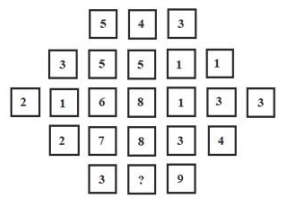
Select the number that can replace the question mark (?) in the following figure.

  1. AOption (a)

    4

  2. BOption (b)

    5

  3. COption (c)

    9

  4. DOption (d)

    6

View answer & explanation

Correct answer

Answer: (d)D.

6

Why this answer is correct

The logic followed here is: Addition of all left and right numbers  / 2 = middle number.

Level 1: 5, 4, 3 → (5 + 3) ÷ 2 = 8 ÷ 2 = 4

Level 2: 3, 5, 5, 1, 1 → (3 + 5 + 1 + 1) ÷ 2 = 10 ÷ 2 = 5

Level 3: 2, 1, 6, 8, 1, 3, 3 → (2 + 1 + 6 + 1 + 3 + 3) ÷ 2 = 16 ÷ 2 = 8

Level 4: 2, 7, 8, 3, 4 → (2 + 7 + 3 + 4) ÷ 2 = 16 ÷ 2 = 8

Level 5: 3, ?, 9 → (3 + 9) ÷ 2 = 12 ÷ 2 = 6

Hence, the correct answer is "6".

Question 45

Who is appointed as CEO of newly formed SANSAD TV after merging the Lok Sabha TV and Rajya Sabha TV?

  1. AOption (a)

    Shashi Shekhar Vempati

  2. BOption (b)

    Surya Prakash

  3. COption (c)

    Om Birla

  4. DOption (d)

    Ravi Kapoor

View answer & explanation

Correct answer

Answer: (d)D.

Ravi Kapoor

Why this answer is correct

The correct answer is Ravi Kapoor.

Key Points

  • Prime Minister Narendra Modi will launch Sansad TV, a new channel formed by merging the Lok Sabha TV and Rajya Sabha TV, on September 15, 2021.
  • Veteran Congress leader Karan Singh, economist Bibek Debroy, NITI Aayog CEO Amitabh Kant, and advocate Hemant Batra will host different shows on this new channel.
  • When Parliament is in session, Sansad TV will have two channels.

Question 46

Which amendment converted the right to property from a fundamental right to a simple legal right under article 300A?

  1. AOption (a)

    44th Amendment

  2. BOption (b)

    46th Amendment

  3. COption (c)

    42nd Amendment

  4. DOption (d)

    40th Amendment

View answer & explanation

Correct answer

Answer: (a)A.

44th Amendment

Why this answer is correct

The correct answer is 44th Amendment.

Key Points

  • 44th Amendment
  • The 44th Amendment of 1978 removed the right to property from the list of fundamental rights. A new provision, Article 300-A, was added to the constitution, which provided that “no person shall be deprived of his property save by authority of law”.

Additional Information

  • ​46th Amendment
  • Brought about some uniformity in tax rates on certain items.
  • 42nd Amendment
  • Raised the tenure of Lok Sabha and state legislative assemblies from 5 to 6 years.
  • 40th Amendment
  • Limits of the territorial waters, the continental shelf, the exclusive economic zone (EEZ) and the maritime zones of India.

Question 47

Ram has a brother Anil, Ram is the son of Gopal. Anila is Gopal's wife. Nandu is Gopal's father. How is Anil related to Nandu?

  1. AOption (a)

    Brother's Son

  2. BOption (b)

    Father's Father

  3. COption (c)

    Father's Brother

  4. DOption (d)

    Son's Son

View answer & explanation

Correct answer

Answer: (d)D.

Son's Son

Why this answer is correct

Family Chart:

Given: Ram has a brother Anil, Ram is the son of Gopal. Anila is Gopal's wife. Nandu is Gopal's father.


So, Anil is 'Son's Son' of Nandu.

Hence, the correct answer is "Son's Son".

Question 48

Read the given data and answer the question that follows.

2, 5, 15, 25, 20, 12, 8, 7, 6, 16, 21, 17, 30, 32, 23, 40, 51, 15, 2, 9, 57, 19, 25

If the given data is grouped in the classes 0-5, 5-10, 10-15, and so on, then what will be the frequency of the class 20-25?

  1. AOption (a)

    5

  2. BOption (b)

    2

  3. COption (c)

    4

  4. DOption (d)

    3

View answer & explanation

Correct answer

Answer: (d)D.

3

Why this answer is correct

Given:

Data: 2, 5, 15, 25, 20, 12, 8, 7, 6, 16, 21, 17, 30, 32, 23, 40, 51, 15, 2, 9, 57, 19, 25

Classes: 0-5, 5-10, 10-15, 15-20, 20-25, ...

Formula Used:

Frequency of a class = Number of data points within the class range

Calculation:

Class 20-25 includes the numbers that fall within the range 20 to 24.99.

Data points within the range 20-25: 20, 21, 23

Frequency = Number of data points in the class 20-25 = 3

The frequency of the class 20-25 is 3.

Question 49

By selling a table for Rs. 330, a trader gains 10%. Find the cost price of the table.

  1. AOption (a)

    Rs. 200

  2. BOption (b)

    Rs. 300

  3. COption (c)

    Rs. 100

  4. DOption (d)

    Rs. 2400

View answer & explanation

Correct answer

Answer: (b)B.

Rs. 300

Why this answer is correct

Given:

Selling price of the table (SP) = Rs. 330

Gain = 10%

Formula Used:

Cost Price (CP) = SP1+Gain100\frac{SP}{1 + \frac{Gain}{100}}

Calculation:

Gain = 10%

⇒ Gain = 10/100 = 0.1

CP = 3301+0.1\frac{330}{1 + 0.1}

⇒ CP = 3301.1\frac{330}{1.1}

⇒ CP = 300

The cost price of the table is Rs. 300.

Question 50

The area of a rectangle with a length of 121 m is the same as that of a square with a side of 44 m. Find the width of the rectangle.

  1. AOption (a)

    15 m

  2. BOption (b)

    14 m

  3. COption (c)

    17 m

  4. DOption (d)

    16 m

View answer & explanation

Correct answer

Answer: (d)D.

16 m

Why this answer is correct

Shortcut Trick

Area of square = 44 × 44

Area of rectangle = 121 × Width

Width = (44 × 44) ÷ 121

Width = (4 × 11 × 4 × 11) ÷ (11 × 11) = 4 × 4 = 16 m

∴ The correct option is D.

Alternate Method

Given:

Length of rectangle (L) = 121 m

Side of square (a) = 44 m

Formula Used:

Area of rectangle = Length × Width

Area of square = Side2

Square Side = 44 m

Rectangle Length = 121 m W Area of Rectangle = Area of Square

Calculations:

⇒ Area of square = 44 × 44 = 1936 m2

⇒ Area of rectangle = Area of square

⇒ 121 × Width = 1936

⇒ Width = 1936 ÷ 121

⇒ Width = 16 m

∴ The correct option is D.

Additional Information

Perimeter and Diagonal Formulas

Perimeter of rectangle = 2 × (Length + Width) and Diagonal = √(Length2 + Width2).

Square Properties

Perimeter of square = 4 × Side and Diagonal = Side × √2.

Area Conversion

To find a missing dimension when areas are equal, equate the products and solve: L1 × W1 = L2 × W2.

Question 51

The mean of x and y is 400, and the ratio of x to y is 3 ∶ 7. What is the value of y - x?

  1. AOption (a)

    230

  2. BOption (b)

    130

  3. COption (c)

    800

  4. DOption (d)

    320

View answer & explanation

Correct answer

Answer: (d)D.

320

Why this answer is correct

Given:

The mean of x and y is 400.

The ratio of x to y is 3 ∶ 7.

Formula Used:

Mean = x+y2\frac{x + y}{2}

Ratio: xy=37\frac{x}{y} = \frac{3}{7}

Calculation:

Let the values be x = 3k and y = 7k.

Mean = x+y2\frac{x + y}{2}

⇒ 400 = 3k+7k2\frac{3k + 7k}{2}

⇒ 400 = 10k/2

⇒ 400 = 5k

⇒ k = 80

Therefore, x = 3k = 3 × 80 = 240

And y = 7k = 7 × 80 = 560

Value of y - x = 560 - 240 = 320

The correct answer is option 4.

Question 52

Which among the following organisations is the best example of an agreement between oligopolists?

  1. AOption (a)

    UNESCO

  2. BOption (b)

    WHO

  3. COption (c)

    OPEC

  4. DOption (d)

    UNO

View answer & explanation

Correct answer

Answer: (c)C.

OPEC

Why this answer is correct

The correct answer is OPEC.

Key Points

  • OPEC​
  • OPEC is a permanent intergovernmental organization of 13 oil-exporting developing nations.
  • OPEC's objective is to co-ordinate and unify petroleum policies among Member Countries.
  • It was created at the Baghdad Conference in September 1960, by Iran, Iraq, Kuwait, Saudi Arabia, and Venezuela (founding members).
  • OPEC is headquartered in Vienna, Austria.
  • The last country to exit OPEC was Ecuador on 1 January 2020.
  • Member Countries of OPEC are:
  • | Algeria | Kuwait | | --- | --- | | Angola | Libya | | Congo | Nigeria | | Equatorial Guinea | Saudi Arabi | | Gabon | United Arab Emirates | | Iran | Venezuela | | Iraq | Baghdad |

Additional Information

  • UNESCO
  • The United Nations Educational, Scientific and Cultural Organization focuses on everything from teacher training to helping improve education worldwide to protecting important historical and cultural sites around the world.
  • UNESCO preserves 1073 World Heritage sites in 167 countries.
  • UNESCO's Headquarters in Paris, France
  • The Organization has 193 Members and 11 Associate Members.
  • There are a total of 43 world heritage site in India:
  • The most recent sites listed were Santiniketan and the Sacred Ensembles of the Hoysalas, in 2023.​
  • The most recent addition in the list of UNESCO WHS is Charaideo Maidams, Assam.
  • Cultural (30)
  • Agra Fort (1983)
  • Ajanta Caves (1983)
  • Archaeological Site of Nalanda Mahavihara at Nalanda, Bihar (2016)
  • Buddhist Monuments at Sanchi (1989)
  • Champaner-Pavagadh Archaeological Park (2004)
  • Chhatrapati Shivaji Terminus (formerly Victoria Terminus) (2004)
  • Churches and Convents of Goa (1986)
  • Elephanta Caves (1987)
  • Ellora Caves (1983)
  • Fatehpur Sikri (1986)
  • Great Living Chola Temples (1987,2004)
  • Group of Monuments at Hampi (1986)
  • Group of Monuments at Mahabalipuram (1984)
  • Group of Monuments at Pattadakal (1987)
  • Hill Forts of Rajasthan (2013)
  • Historic City of Ahmadabad (2017)
  • Humayun's Tomb, Delhi (1993)
  • Jaipur City, Rajasthan (2019)
  • Khajuraho Group of Monuments (1986)
  • Mahabodhi Temple Complex at Bodh Gaya (2002)
  • Mountain Railways of India (1999,2005,2008)
  • Qutb Minar and its Monuments, Delhi (1993)
  • Rani-ki-Vav (the Queen’s Stepwell) at Patan, Gujarat (2014)
  • Red Fort Complex (2007)
  • Rock Shelters of Bhimbetka (2003)
  • Sun Temple, Konârak (1984)
  • Taj Mahal (1983)
  • The Architectural Work of Le Corbusier, an Outstanding Contribution to the Modern Movement (2016)
  • The Jantar Mantar, Jaipur (2010)
  • Victorian Gothic and Art Deco Ensembles of Mumbai (2018)
  • Natural (7)
  • Great Himalayan National Park Conservation Area (2014)
  • Kaziranga National Park (1985)
  • Keoladeo National Park (1985)
  • Manas Wildlife Sanctuary (1985)
  • Nanda Devi and Valley of Flowers National Parks (1988,2005)
  • Sundarbans National Park (1987)
  • Western Ghats (2012)
  • Mixed (1)
  • Khangchendzonga National Park

Question 53

The ratio of the length of a tree to its shadow is 1 ∶ 13\frac{1}{\sqrt{3}}. The angle of the sun's elevation is:

  1. AOption (a)

    75°

  2. BOption (b)

    45°

  3. COption (c)

    60°

  4. DOption (d)

    30°

View answer & explanation

Correct answer

Answer: (c)C.

60°

Why this answer is correct

Given:

The ratio of the length of a tree to its shadow is 1 ∶ 13\frac{1}{\sqrt{3}}.

Formula Used:

tan(θ) = Length of the tree / Length of the shadow

Calculation:

Let the length of the tree be L and the length of the shadow be S.

According to the given ratio,

L / S = 1 / 13\frac{1}{\sqrt{3}}

L / S = √3

tan(θ) = L / S

tan(θ) = √3

⇒ θ = 60º

The angle of the sun's elevation is 60º.

Question 54

If the letters of an English alphabet are written in the reverse order, which letter will be the 5th to the right of the 13th letter from the left?

  1. AOption (a)

    I

  2. BOption (b)

    L

  3. COption (c)

    J

  4. DOption (d)

    K

View answer & explanation

Correct answer

Answer: (a)A.

I

Why this answer is correct

According to the given information:

English alphabet:-

A B C D E F G H I J K L M N O P Q R S T U V W X Y Z. 

English alphabet are written in reverse order.

Z Y X W V U T S R Q P O N M L K J I H G F E D C B A.

The 13th letter from the left = N,

Z Y X W V U T S R Q P O N M L K J I H G F E D C B A.

Then the 5th to the right of the 13th letter from the left = I

Z Y X W V U T S R Q P O N M L K J I H G F E D C B A.

Hence, the correct answer is "I".

Question 55

Kumar lent an amount to Arif at a simple interest rate of 10% p.a. for 3 years, and Arif lent this amount to Naresh at a simple interest rate of 20% p.a. for 3 years. If the interest Arif received was Rs. 1,560 after 3 years, then what was the amount that Kumar had lent to Arif?

  1. AOption (a)

    Rs. 6,200

  2. BOption (b)

    Rs. 5,200

  3. COption (c)

    Rs. 5,400

  4. DOption (d)

    Rs. 5,600

View answer & explanation

Correct answer

Answer: (b)B.

Rs. 5,200

Why this answer is correct

Given:

Kumar lent an amount to Arif at a simple interest rate of 10% p.a. for 3 years.

Arif lent this amount to Naresh at a simple interest rate of 20% p.a. for 3 years.

Interest Arif received from Naresh = Rs. 1,560 after 3 years.

Formula Used:

Simple Interest (SI) = Principal (P) × Rate (R) × Time (T) / 100

Calculation:

Let the amount Kumar lent to Arif be Rs. P.

Arif lent this amount to Naresh at a simple interest rate of 20% p.a. for 3 years.

Interest Arif received = Interest Arif received from Naresh - Interest Arif gave to Kumar

Interest Arif received from Naresh = (P × 20 × 3) / 100

Interest Arif gave to Kumar = (P × 10 × 3) / 100

⇒ Interest Arif received = (P × 20 × 3) / 100 - (P × 10 × 3) / 100

⇒ 1,560 = 30P / 100

⇒ P = 156,000 / 30

⇒ P = 5200

So, the amount Kumar lent to Arif was Rs. 5200.

Question 56

The Helmand province of Afghanistan is famous for cultivation of:

  1. AOption (a)

    rice

  2. BOption (b)

    wheat

  3. COption (c)

    tea

  4. DOption (d)

    opium

View answer & explanation

Correct answer

Answer: (d)D.

opium

Why this answer is correct

The correct answer is opium.

Key Points

  • Helmand:
  • It is located in Southern Afghanistan.
  • It is the largest province by area.
  • Lashkargah serves as the provincial capital.
  • The Helmand River flows through the mainly desert region of the province, providing water used for irrigation.
  • The Kajaki Dam, which is one of Afghanistan’s major reservoirs, is located in the Kajaki district.
  • Helmand is believed to be one of the world’s largest opium-producing regions, responsible for around 42% of the world’s total production.
  • It has been considered to be Afghanistan’s “most dangerous” province.

Question 57

The number of balls of radius 2 cm that can be made from a solid sphere of radius 4 cm is:

  1. AOption (a)

    8

  2. BOption (b)

    16

  3. COption (c)

    36

  4. DOption (d)

    64

View answer & explanation

Correct answer

Answer: (a)A.

8

Why this answer is correct

Given:

Radius of the large solid sphere = 4 cm

Radius of each small ball = 2 cm

We need to determine the number of small balls that can be made.

Formula used:

The volume of a sphere is given by:

Volume = (4/3) × π × r³

The number of small balls can be determined by:

Number of balls = (Volume of large sphere) / (Volume of one small ball)

Calculations:

Step 1: Calculate the volume of the large sphere

Volume of the large sphere:

V (large) = (4/3) × π × (4)³

V (large) = (4/3) × π × 64

V (large) = (256/3) × π cm³

Step 2: Calculate the volume of one small ball

Volume of one small ball:

V (small) = (4/3) × π × (2)³

V (small) = (4/3) × π × 8

V (small) = (32/3) × π cm³

Step 3: Calculate the number of small balls

Number of balls = (V large) / (V small)

Number of balls = [(256/3) × π] / [(32/3) × π]

Cancel out (1/3) and π:

Number of balls = 256 / 32

Number of balls = 8

The number of balls that can be made is 8.

Question 58

Histogram is used to find:

  1. AOption (a)

    median graphically

  2. BOption (b)

    arithmetic mean graphically

  3. COption (c)

    Median, mode and mean graphically

  4. DOption (d)

    mode graphically

View answer & explanation

Correct answer

Answer: (d)D.

mode graphically

Why this answer is correct

Explanation:

  1. A histogram is a graphical representation of the distribution of a dataset. It consists of bars that represent the frequency of data in different intervals.
  2. A histogram is particularly useful for estimating the mode graphically, as the highest bar represents the modal class (the class with the highest frequency).
  3. While median and mean can be calculated using other statistical methods, they are not directly determined using a histogram.

∴ The correct answer is option 4.

Question 59

Which of the following equations is INCORRECT?

  1. AOption (a)

    13 - 7 + 8 × 9 + 63 ÷ 7 = 86 

  2. BOption (b)

    9 × 4 + (12 + 2) - 30 ÷ 3 = 40

  3. COption (c)

    8 × 3 + 63 ÷ 9 - 6 = 25

  4. DOption (d)

    42 ÷ 6 + (2 × 5) × 1 + 9 = 26

View answer & explanation

Correct answer

Answer: (a)A.

13 - 7 + 8 × 9 + 63 ÷ 7 = 86 

Why this answer is correct

Given:

We need to determine which of the given equations is incorrect.

Formula Used:

We will evaluate each equation step by step using the order of operations (BODMAS/BIDMAS): Brackets, Orders (i.e., powers and square roots, etc.), Division and Multiplication, Addition and Subtraction.

Calculation:

Option 1: 13 - 7 + 8 × 9 + 63 ÷ 7 = 86

⇒ 13 - 7 + 72 + 9

⇒ 6 + 72 + 9

⇒ 78 + 9

⇒ 87 ≠ 86

Option 2: 9 × 4 + (12 + 2) - 30 ÷ 3 = 40

⇒ 9 × 4 + 14 - 10

⇒ 36 + 14 - 10

⇒ 50 - 10

⇒ 40

Option 3: 8 × 3 + 63 ÷ 9 - 6 = 25

⇒ 24 + 7 - 6

⇒ 31 - 6

⇒ 25

Option 4: 42 ÷ 6 + (2 × 5) × 1 + 9 = 26

⇒ 7 + 10 + 9

⇒ 17 + 9

⇒ 26

The correct answer is option 1.

Question 60

The Hasdeo Valley in Chhattisgarh is famous for _______ mines.

  1. AOption (a)

    silver

  2. BOption (b)

    coal

  3. COption (c)

    silicon

  4. DOption (d)

    panna

View answer & explanation

Correct answer

Answer: (b)B.

coal

Why this answer is correct

The correct answer is coal.

Key Points

  • The Hasdeo Valley in Chhattisgarh is famous for its coal mines.
  • This region holds significant coal reserves, making it a major coal-producing area in India.
  • The presence of these coal mines has contributed to the state's industrial growth and energy production.
  • However, the expansion of mining activities in the Hasdeo Valley has also raised concerns about environmental impacts and the displacement of local communities.

Question 61

Name the person who had a major influence in the field of Algebra in India.

  1. AOption (a)

    Charaka

  2. BOption (b)

    Aryabhata

  3. COption (c)

    Brahmagupta

  4. DOption (d)

    Varahamihira

View answer & explanation

Correct answer

Answer: (b)B.

Aryabhata

Why this answer is correct

The correct answer is Aryabhata.

Key Points

  • Aryabhata
  • Aryabhata went to Kusumapura,Pataliputra  for advanced studies.
  • The Pataliputra was the ancient name of Patna
  • Udayin was the founder of Pataliputra.
  • Aryabhata, the first satellite built by India was named after him.
  • Takshila is considered as the World's first university.
  • Kaushambi was the capital of the Vatsa kingdom.
  • Situated in Uttar Pradesh it is located on the Yamuna River well known for Buddhist Culture and Mauryan Empire.

 Additional Information

  • Charaka
  • He was the court physician of Kaniska. Hence, Option 1 is correct.
  • Charaka was one of the principal contributors to Ayurveda medicine in ancient India.
  • He is best known for his work Charaka Samhita.
  • Brahmagupta (D)
  • Brahmagupta was born in 598 CE.
  • He was an Indian mathematician and astronomer who wrote the "Brahmasphutasiddhanta."
  • This work includes rules for arithmetic operations with zero and negative numbers.
  • Varahamihira
  • Varahmihira was an Indian astronomer, mathematician, and astrologer who lived in Ujjain.
  • He was born in Avanti region, roughly corresponding to modern-day Malwa. He lived around 550 C.E.

Question 62

Five persons Bhanu, Chavvi, Neel, Kunal and Deepika are sitting around a circular table. All are facing the centre. Bhanu is to the right of Chavvi. Neel is to the left of Deepika and between Kunal and Deepika. Who is to the left of Kunal?

  1. AOption (a)

    Neel 

  2. BOption (b)

    Deepika

  3. COption (c)

    Chavvi

  4. DOption (d)

    Bhanu

View answer & explanation

Correct answer

Answer: (d)D.

Bhanu

Why this answer is correct

Given: Five persons Bhanu, Chavvi, Neel, Kunal and Deepika are sitting around a circular table. All are facing the centre.

  1. Neel is to the left of Deepika and between Kunal and Deepika.

2) Bhanu is to the right of Chavvi.

So, Bhanu is to the left of Kunal.

Hence, the correct answer is "Bhanu".

Question 63

A can finish a task in 20 days and B can finish the same task in half the time taken by A. Working together, what part of the task can they finish in a day?

  1. AOption (a)

    26\frac{2}{6}

  2. BOption (b)

    118\frac{1}{18}

  3. COption (c)

    320\frac{3}{20}

  4. DOption (d)

    12\frac{1}{2}

View answer & explanation

Correct answer

Answer: (c)C.

320\frac{3}{20}

Why this answer is correct

Given:

A can finish a task in 20 days.

B can finish the same task in half the time taken by A, i.e., in 10 days.

Formula Used:

Work done by A in 1 day = 1/20

Work done by B in 1 day = 1/10

Work done by A and B together in 1 day = Work done by A in 1 day + Work done by B in 1 day

Calculation:

Work done by A in 1 day = 1/20

Work done by B in 1 day = 1/10

Work done by A and B together in 1 day

⇒ (1/20) + (1/10)

⇒ (1/20) + (2/20)

⇒ (3/20)

The part of the task that A and B can finish in a day is 3/20.

Question 64

Which of the following statements is correct?

  1. The angle between two tangents to a circle may be 0°.
  2. If a transversal intersects two lines such that a pair of alternate interior angles is equal, then the two lines are parallel.
  3. The tangents at the endpoints of the diameter of a circle are perpendicular.
  1. AOption (a)

    Only 1

  2. BOption (b)

    Only 2

  3. COption (c)

    Both 1 and 2, but not 3

  4. DOption (d)

    Only 3

View answer & explanation

Correct answer

Answer: (c)C.

Both 1 and 2, but not 3

Why this answer is correct

Calculation:

Statement I: The angle between two tangents to a circle may be 0°.

If you consider two tangents drawn to a circle at the same point on the circumference, they will coincide, meaning they lie on top of each other. In this case, the angle between them is 0°.

Therefore, the statement is correct.

Statement II:  If a transversal intersects two lines such that a pair of alternate interior angles is equal, then the two lines are parallel.

This is a basic property of parallel lines and a transversal. If alternate interior angles are equal, the lines are parallel.

Therefore, the statement is correct.

Statement III: The tangents at the endpoints of the diameter of a circle are perpendicular.

The tangents at the endpoints of the diameter of a circle are parallel, not perpendicular.

Therefore, the statement is incorrect.

Hence, Both 1 and 2, but not 3 is the correct answer.

Question 65

Study the diagram given below and answer the question that follows.

What number of students have sketch colours, crayons as well as pencil colours?

  1. AOption (a)

    5

  2. BOption (b)

    7

  3. COption (c)

    9

  4. DOption (d)

    3

View answer & explanation

Correct answer

Answer: (d)D.

3

Why this answer is correct

According to the given information:

The shaded part represents number of students have sketch colours, crayons as well as pencil colours.

So, number of students have sketch colours, crayons as well as pencil colours = 3

Hence, the correct answer is "3".

Question 66

Find the cost of carpeting a 15-m-long and 11-m-wide room with a 75-cm-wide carpet, if the price of the carpet is ₹13 per meter (not considering the cost of labour).

  1. AOption (a)

    ₹2,960

  2. BOption (b)

    ₹2,760

  3. COption (c)

    ₹2,660

  4. DOption (d)

    ₹2,860

View answer & explanation

Correct answer

Answer: (d)D.

₹2,860

Why this answer is correct

Given:

Length of the room = 15 m

Width of the room = 11 m

Width of the carpet = 75 cm = 0.75 m

Price of the carpet = ₹13 per meter

Formula Used:

Cost of carpeting = Area of the room / Width of the carpet × Price per meter

Calculation:

Area of the room = Length × Width

Area of the room = 15 m × 11 m

Area of the room = 165 m2

Carpet needed (in meters) = Area of the room / Width of the carpet

Carpet needed = 165 m2 / 0.75 m

Carpet needed = 220 m

Cost of carpeting = Carpet needed × Price per meter

⇒ Cost of carpeting = 220 m × ₹13/m

⇒ Cost of carpeting = ₹2,860

The cost of carpeting the room is ₹2,860.

Question 67

A man rides his bicycle for 10 km at an average speed of 12 km/h and further travels 12 km at an average speed of 10 km/h. What is his approximate average speed for the entire trip?

  1. AOption (a)

    8.10 km/h

  2. BOption (b)

    8.19 km/h

  3. COption (c)

    10.8 km/h

  4. DOption (d)

    8 km/h

View answer & explanation

Correct answer

Answer: (c)C.

10.8 km/h

Why this answer is correct

Given:

Distance for the first part = 10 km.

Speed for the first part = 12 km/h.

Distance for the second part = 12 km.

Speed for the second part = 10 km/h.

Formula Used:

Average speed = Total distance travelled / Total time

Calculation:

Time taken for the first part = 10 / 12

Time taken for the first part = 5/6 hours

Time taken for the second part = 12 / 10

Time taken for the second part = 6/5 hours

Total Distance = 10 km + 12 km = 22 km

Total Time = (5/6) + (6/5)

Total Time = (25/30) + (36/30)

Total Time = 61/30 hours

Average Speed = 22 / (61/30)

Average Speed = 22 × (30/61)

Average Speed ≈ 10.8 km/h

The average speed for the entire trip is approximately 10.8 km/h.

Question 68

Who among the following persuaded Gandhiji not to restrict the protest of salt march to men alone?

  1. AOption (a)

    Kasturba Gandhi

  2. BOption (b)

    Sarojni Naidu

  3. COption (c)

    Kamla Nehru

  4. DOption (d)

    Kamladevi Chattopadhyay

View answer & explanation

Correct answer

Answer: (d)D.

Kamladevi Chattopadhyay

Why this answer is correct

The correct answer is Kamladevi Chattopadhyay.

Key Points

  • The Salt March was a significant event in the Indian independence movement led by Mahatma Gandhi.
  • It commenced on March 12, 1930, and was a direct action campaign of tax resistance and nonviolent protest against the British salt monopoly.
  • The march lasted for 24 days, covering a distance of 240 miles from Sabarmati Ashram to the coastal village of Dandi.
  • Upon reaching Dandi on April 6, 1930, Gandhi defied the salt laws by making salt from seawater, sparking widespread acts of civil disobedience against British rule.

 Additional Information

  • The Salt March is also known as the Dandi March or the Salt Satyagraha.
  • This event was a pivotal turning point in the Indian independence struggle and helped galvanize the Indian population against British colonial rule.
  • Gandhi's leadership and the nonviolent approach inspired many future movements for civil rights and freedom across the world.
  • The march demonstrated the power of mass mobilization and nonviolent resistance in challenging oppressive systems.

Question 69

If 5−15+1=a+b5\frac{\sqrt{5}-1}{\sqrt{5}+1}=a+b \sqrt{5}, then find the value of a and b.

  1. AOption (a)

    a=−52,b=0a=\frac{-\sqrt{5}}{2}, b=0

  2. BOption (b)

    a=0, b=−52\mathrm{a}=0, \mathrm{~b}=\frac{-\sqrt{5}}{2}

  3. COption (c)

    a = 0, b = 0

  4. DOption (d)

    a=32, b=(−12)\mathrm{a}=\frac{3}{2}, \mathrm{~b}=\left(-\frac{1}{2}\right)

View answer & explanation

Correct answer

Answer: (d)D.

a=32, b=(−12)\mathrm{a}=\frac{3}{2}, \mathrm{~b}=\left(-\frac{1}{2}\right)

Why this answer is correct

Given:

5−15+1=a+b5\frac{\sqrt{5}-1}{\sqrt{5}+1}=a+b \sqrt{5}

Formula Used:

a−bc−d=a−bc−d×c+dc+d\frac{a-b}{c-d}=\frac{a-b}{c-d}×\frac{c+d}{c+d}

Calculation:

LHS:

√(5)−1√(5)+1=(√(5)−1)×(√(5)−1)(√(5)+1)×(√(5)−1)\frac{√(5)-1}{√(5)+1}=\frac{(√(5)-1)×(√(5)-1)}{(√(5)+1)×(√(5)-1)}

⇒ (5)2−25+1(5)2−1\frac{(\sqrt5)^2-2\sqrt5+1}{(\sqrt5)^2-1}

⇒ 5−2√(5)+15−1\frac{5-2√(5)+1}{5-1}

⇒ 6−2√(5)4\frac{6-2√(5)}{4}

⇒ 64−2√(5)4\frac{6}{4}-\frac{2√(5)}{4}

⇒ 32−√(5)2\frac{3}{2}-\frac{√(5)}{2}

Comparing with RHS:

⇒ a=32,b=−12a=\frac{3}{2}, b=\frac{-1}{2}

The correct answer is option 4.

Question 70

Subhash Chandra Bose was re-elected as the President of INC at the Tripuri Session in 1939 by defeating Gandhiji's candidate:

  1. AOption (a)

    S Radhakrishnan

  2. BOption (b)

    Pattabhi Sitaramayya

  3. COption (c)

    Lal Bahadur Shastri

  4. DOption (d)

    Sardar Vallabhbhai Patel

View answer & explanation

Correct answer

Answer: (b)B.

Pattabhi Sitaramayya

Why this answer is correct

The correct answer is Pattabhi Sitaramayya.

Key Points

Tripuri Session of Indian National Congress, 1939:

  • Gandhiji selected Bhogaraju Pattabhi Sitaramayya, in the Tripuri session (1939) for the presidentship of Indian National Congress against S.C. Bose.
  • Bose won the election by 203 votes.
  • Total number of votes in favour of Subhas Chandra Bose was 1580 and Pattabhi Sitaramayya secured 1377 votes.
  • After that Gandhiji and his followers decided to oppose Bose and 12 members of Congress Working Committee resigned together.
  • Later Jawahar Lal Nehru also decided to resign.
  • Subhash Chandra Bose also discussed the country's economic development through planning and was instrumental in later establishing a National Planning Committee.
  • The session passed a resolution declaring that the Congress would provide moral support to those protesting the governance of the princely states.
  • The international situation deteriorated in the months that followed, with clear indications that Europe was on the verge of war.
  • The issue was that Gandhi and Bose were ideologically on opposing sides. Gandhi was unwilling to lead a Congress struggle along Bose's radical lines, just as Bose was unwilling to compromise on his ideas.

Question 71

Vijaya Bank and Dena Bank are merged with which of the following banks?

  1. AOption (a)

    Bank of Baroda

  2. BOption (b)

    Punjab National bank

  3. COption (c)

    Canara Bank

  4. DOption (d)

    State Bank of India

View answer & explanation

Correct answer

Answer: (a)A.

Bank of Baroda

Why this answer is correct

The correct answer is Bank of Baroda.

Key Points

  • Vijaya Bank and Dena Bank were merged with Bank of Baroda with effect from April 1, 2019.
  • This is the first-ever three-way merger in Indian banking.
  • After amalgamation, BOB became India's third-largest bank.
  • Dena Bank said that its shareholders will receive 110 equity shares of Bank of Baroda of face value Rs. 2 for every 1,000 shares they held.
  • Vijaya Bank shareholders will get 402 equity shares of Bank of Baroda for every 1,000 shares they held​.
  • Bank of Baroda (BOB) established on July 20, 1908.
  • Headquarters: Vadodara

 Additional Information

  • Punjab National Bank:
  • It commenced its operations on April 12, 1895, from Lahore.
  • Founder: Lala Lajpat Rai.
  • Tag Line: The Name You Can Bank Upon.
  • During the long history of the Bank, 9 banks have been merged with Punjab National Bank
  • The financial year 2019- 20 was significant in view of the announcement of amalgamation of Public sector Banks wherein Oriental Bank of Commerce and United Bank of India amalgamated with Punjab National Bank with effect from April 1, 2020.
  • Products: Consumer Banking, Corporate Banking, Finance and Insurance, Investment Banking, Mortgage Loans, etc.
  • Headquarters: New Delhi.

Question 72

Under the Pradhan Mantri Shram Yogi Maan-dhan (PM-SYM) Yojana, a monthly pension of _______ rupees will be provided to the employees of unorganised sector after 60 years of age.

  1. AOption (a)

    3000

  2. BOption (b)

    2000

  3. COption (c)

    4000

  4. DOption (d)

    5000

View answer & explanation

Correct answer

Answer: (a)A.

3000

Why this answer is correct

The correct answer is 3000.

Key Points

Pradhan Mantri Shram Yogi Maan-Dhan:

  • It is a central government scheme meant for old age protection and social security of Unorganised Workers (UW).
  • Unorganised Workers (UW) are mostly engaged as rickshaw pullers, street vendors, mid-day meal workers, head loaders, brick kiln workers, cobblers, rag pickers, domestic workers, washermen, home-based workers, own-account workers, agricultural workers, construction workers, beedi workers, handloom workers, leather workers, audio-visual workers or in similar other occupations.
  • There are an estimated 42 crore, such unorganised workers, in the country.
  • Eligibility:
  • Should be an unorganised worker (UW).
  • Belong to the list of professions listed by the government.
  • Entry age between 18 and 40 years.
  • Monthly Income Rs 15000 or below.
  • Should not be:
  • Engaged in Organized Sector (membership of EPF/NPS/ESIC).
  • An income taxpayer
  • He/ She should possess an Aadhar card Savings Bank Account / Jan Dhan account number with IFSC.
  • Features:
  • It is a voluntary and contributory pension scheme, under which the subscriber would receive a minimum assured pension of Rs 3000/- per month after attaining the age of 60 years and if the subscriber dies, the spouse of the beneficiary shall be entitled to receive 50% of the pension as family pension.
  • Family pension is applicable only to spouses.
  • Payment of pension by LIC.
  • The Central Government will also give an equal matching contribution in his pension account.

Question 73

Global weather forecasting is done using:

  1. AOption (a)

    supercomputers

  2. BOption (b)

    hybrid computers

  3. COption (c)

    minicomputers

  4. DOption (d)

    microcomputers

View answer & explanation

Correct answer

Answer: (a)A.

supercomputers

Why this answer is correct

The correct answer is supercomputers.

Key Points

 A Brief History of Computer Types

  • Supercomputers
  • Established: Early 1960s
  • Example: CDC 6600 (1964)
  • Significance: Designed for high-performance computing tasks, such as weather forecasting and scientific simulations.

Additional Information

  • Hybrid Computers
  • Established: 1960s
  • Example: HYDAC (1969)
  • Significance: Combined analog and digital components for specific applications like real-time control systems.
  • Minicomputers
  • Established: Mid-1960s
  • Example: PDP-8 (1965)
  • Significance: Smaller and less expensive than mainframes, popular for scientific and engineering tasks.
  • Microcomputers
  • Established: Early 1970s
  • Example: Altair 8800 (1975)
  • Significance: The advent of personal computers, revolutionizing computing for individuals and businesses.

Question 74

Who among the following was the Speaker of the Second Lok Sabha?

  1. AOption (a)

    Bali Ram Bhagat

  2. BOption (b)

    K. S. Hegde

  3. COption (c)

    Bal Ram Jakhar

  4. DOption (d)

    M. Ananthasayanam Ayyangar

View answer & explanation

Correct answer

Answer: (d)D.

M. Ananthasayanam Ayyangar

Why this answer is correct

The correct answer is M. Ananthasayanam Ayyangar.

Key Points

  • Ganesh Vasudev Mavalankar was the first speaker of the Lok Sabha.
  • M. Ananthasayanam Ayyangar was the second speaker of the Lok Sabha
  • He was born into a Marathi family in Baroda on 27th November 1888.
  • He was also appointed as the secretary of the Gujarat Sabha in 1916.
  • He was a member of the Indian National Congress.
  • He played a prominent role in the Kheda campaign.
  • He was the founder and as well as the President of the Ahmedabad Education Society.
  • He was also appointed as the President of the Gujarat Vernacular society.
  • He was made the speaker of the provincial Parliament formed on November 26th, 1949, and also became the first speaker of the Lok Sabha constituted in 1952.
  • He was also known as the father of the Lok Sabha by Jawaharlal Nehru.

 Additional Information

  • ​The presiding officer of Lok Sabha is the speaker.
  • He is elected by the members of the Lok Sabha from among themselves.
  • The Speaker presides over the meeting with the House; maintains order in the House and conducts the business of the House in accordance with the Rules of the House.
  • The Speaker has to vacate his office if he ceases to be a member of the House.
  • The Speaker’s salary and allowances are determined by the Parliament and these are charges on the Consolidated Fund of India.
  • The First Lok Sabha was constituted on 17 April 1952 after India's first general election.
  • The first speaker of the Lok Sabha was an independence activist and was the President of the Central Legislative Assembly from 1946 to 1947.

Question 75

Which of the following is the location of the asthenosphere?

  1. AOption (a)

    Above the lithosphere

  2. BOption (b)

    Below the lithosphere

  3. COption (c)

    Below the atmosphere 

  4. DOption (d)

    Above the atmosphere

View answer & explanation

Correct answer

Answer: (b)B.

Below the lithosphere

Why this answer is correct

The correct answer is Below the lithosphere.

Key Points

LayerRangeFeature
Troposphere0 to 12 km- The lowest layer of Earth's atmosphere. - The troposphere contains roughly 80% of the mass of Earth's atmosphere. - It is the layer where most of Earth's weather takes place.
Stratosphere12 to 50 km- It contains the ozone layer, which is the part of Earth's atmosphere that contains relatively high concentrations of that gas. - Temperature Inversion (temperatures rise with increasing altitude) is seen in this layer. - This rise in temperature is caused by the absorption of ultraviolet radiation (UV) radiation from the Sun by the ozone layer, which restricts turbulence and mixing.
Mesosphere50 to 80 km- It is the coldest place on Earth and has an average temperature around −85 °C - It is also the layer where most meteors burn up upon atmospheric entrance.
Thermosphere80 to 700 km- The lower part of the thermosphere, from 80 to 550 kilometres above Earth's surface, contains the ionosphere. - The ionosphere is used for Radio Communication. - The temperature of the thermosphere gradually increases with height(Temperature Inversion) - The International Space Station orbits in this layer, between 350 and 420 km.
Exosphere700 to 10,000 km- The outermost layer of Earth's atmosphere. - Contains most of the satellites orbiting Earth.

Question 76

In mixture A, there is 5 L of syrup in 6 L of water. In mixture B, there is 3.5 L of syrup in 5.5 L of water. In which of the two mixtures is the concentration of syrup greater?

  1. AOption (a)

    more information is required to be able to determine where the concentration of syrup is more

  2. BOption (b)

    the concentration of syrup is same in both A and B

  3. COption (c)

    A

  4. DOption (d)

    B

View answer & explanation

Correct answer

Answer: (c)C.

A

Why this answer is correct

Given:

In mixture A, there is 5 L of syrup in 6 L of water.

In mixture B, there is 3.5 L of syrup in 5.5 L of water.

Formula Used:

Concentration of syrup = (Volume of syrup) / (Total volume of mixture)

Calculation:

For mixture A:

Total volume of mixture A = 5 L + 6 L = 11 L

Concentration of syrup in mixture A = 5 / 11

For mixture B:

Total volume of mixture B = 3.5 L + 5.5 L = 9 L

Concentration of syrup in mixture B = 3.5 / 9

Comparing the concentrations:

Concentration of syrup in mixture A = 511\frac{5}{11} ≈ 0.4545

Concentration of syrup in mixture B = 3.59\frac{3.5}{9} ≈ 0.3889

Since 0.4545 > 0.3889, the concentration of syrup is greater in mixture A.

Question 77

What is the densest substance on Earth?

  1. AOption (a)

    Osmium

  2. BOption (b)

    Copper

  3. COption (c)

    Steel 

  4. DOption (d)

    Platinum

View answer & explanation

Correct answer

Answer: (a)A.

Osmium

Why this answer is correct

The correct answer is Osmium.

Key Points

  • Osmium
  • Atomic Number: 76
  • Symbol: Os
  • Group: 8
  • Period: 6
  • Block: d-block
  • Electron Configuration: [Xe]4f14 5d6 6s2
  • Melting Point: 3033 °C
  • Boiling Point: 5012 °C
  • Density: 22.59 g/cm3
  • Electronegativity: 2.2

Additional Information

  • Copper
  • Atomic Number: 29
  • Symbol: Cu
  • Group: 11
  • Period: 4
  • Block: d-block
  • Electron Configuration: [Ar]3d10 4s1
  • Melting Point: 1084.62 °C
  • Boiling Point: 2562 °C
  • Density: 8.96 g/cm3
  • Electronegativity: 1.9
  • Steel
  • Alloy of Iron and Carbon: Steel is primarily composed of iron, with carbon content typically ranging from 0.002% to 2.1%.
  • Other Alloying Elements: It often includes other elements like manganese, chromium, nickel, molybdenum, and vanadium to enhance its properties.
  • Varieties: There are numerous types of steel, each with specific characteristics and applications due to variations in composition and processing.
  • Platinum
  • Atomic Number: 78
  • Symbol: Pt
  • Group: 10
  • Period: 6
  • Block: d-block
  • Electron Configuration: [Xe]4f14 5d9 6s1
  • Melting Point: 1768.3 °C
  • Boiling Point: 3825 °C
  • Density: 21.45 g/cm3
  • Electronegativity: 2.2

Question 78

The sum of two numbers is 15. If the sum of their reciprocals is 310\frac{3}{10} then find the two numbers?

  1. AOption (a)

    6, 9

  2. BOption (b)

    -5, 20

  3. COption (c)

    7, 8

  4. DOption (d)

    5, 10

View answer & explanation

Correct answer

Answer: (d)D.

5, 10

Why this answer is correct

Given:

The sum of two numbers = 15

The sum of their reciprocals = 3/10

Formula Used:

Let the two numbers be x and y.

Then, x + y = 15 ... (i)

1x+1y=310\frac{1}{x} + \frac{1}{y} = \frac{3}{10}

x+yxy=310\frac{x + y}{xy} = \frac{3}{10} ... (ii)

Calculation:

From equation (i), we have:

x + y = 15

From equation (ii), we have:

15xy=310\frac{15}{xy} = \frac{3}{10}

⇒ 15 × 10 = 3xy

⇒ 150 = 3xy

⇒ xy = 50

The two numbers are the roots of the quadratic equation:

t2 - (x + y)t + xy = 0

t2 - 15t + 50 = 0

Solving this quadratic equation:

t = 15±152−4×502\frac{15 \pm \sqrt{15^2 - 4 × 50}}{2}

t = 15±225−2002\frac{15 \pm \sqrt{225 - 200}}{2}

t = 15±252\frac{15 \pm \sqrt{25}}{2}

t = 15±52\frac{15 \pm 5}{2}

t = 10 or t = 5

Thus, the two numbers are 5 and 10.

Question 79

If + means -, - means ÷ , ÷ means ×, × means +, then what is the value of 125 - 5 × 10 ÷ 13 + 28 = ?

  1. AOption (a)

    140

  2. BOption (b)

    129

  3. COption (c)

    127

  4. DOption (d)

    133

View answer & explanation

Correct answer

Answer: (c)C.

127

Why this answer is correct

Given: 125 - 5 × 10 ÷ 13 + 28 = ?

Decoding the given information:

Symbol+-×÷
Means-÷+×


Now replacing the sign from left to right using BODMAS Rule, we get:

⇒ 125 ÷ 5 + 10 × 13 - 28

⇒ 25 + 10 × 13 - 28

⇒ 25 + 130 - 28

⇒ 155 - 28

⇒ 127

Hence, the correct answer is Option 3.

Question 80

Which committee was related to the policies and programme for agriculture?

  1. AOption (a)

    Charan Singh Committee

  2. BOption (b)

    Ramamurthy Committee

  3. COption (c)

    Bhanu Pratap Singh Committee

  4. DOption (d)

    Yashpal Committee

View answer & explanation

Correct answer

Answer: (c)C.

Bhanu Pratap Singh Committee

Why this answer is correct

The correct answer is Bhanu Pratap Singh Committee.

Key Points

  • Bhanu Pratap Singh Committee
  • Focus: Agricultural Development
  • This committee, established in 1991, aimed to revitalize Indian agriculture.
  • Its recommendations emphasized a shift towards sustainable and eco-friendly farming practices.
  • This included a strong push for organic farming, reducing reliance on chemical fertilizers and pesticides, and promoting the use of natural resources like rainwater harvesting.
  • The committee also stressed the importance of empowering farmers through education, access to technology, and fair market prices for their produce.

Additional Information

  • Charan Singh Committee
  • Focus: Land Reforms
  • This committee, formed in 1972, focused on addressing the issue of land ownership and distribution in India.
  • Its recommendations aimed to correct historical injustices and ensure equitable access to land resources.
  • Abolition of intermediaries: Eliminating feudal systems and granting land rights directly to cultivators.
  • Land ceiling: Imposing limits on land ownership to prevent excessive concentration of land in the hands of a few.
  • Land redistribution: Redistributing surplus land from large landowners to landless farmers and marginal farmers.
  • Security of tenure: Providing legal protection to tenants and ensuring their rights to land cultivation.
  • Ramamurthy Committee
  • Focus: Higher Education
  • Key Recommendations: Established in 1985, this committee aimed to restructure and revitalize higher education in India. Its key recommendations included:
  • National Education Policy: The committee strongly advocated for a comprehensive National Education Policy to guide the development of higher education.
  • Decentralization: Promoting autonomy for universities and institutions to foster innovation and cater to regional needs.
  • Vocational Education: Emphasizing the importance of vocational and technical education to meet the demands of the job market.
  • Quality Improvement: Focus on improving the quality of teaching, research, and infrastructure in higher education institutions.
  • Yashpal Committee
  • Focus: Education
  • Key Recommendations: This committee, formed in 1993, focused on reforming the entire education system in India. Its key recommendations emphasized:
  • Child-Centered Learning: Shifting the focus from rote learning to a more holistic and child-centered approach.
  • Vocational Education: Integrating vocational training with academic education to equip students with practical skills.
  • Continuous and Comprehensive Evaluation: Moving away from a rigid examination system towards a more comprehensive assessment of student learning.
  • Teacher Training: Improving the quality of teacher training programs to enhance teaching effectiveness.

Question 81

Find the median and the mode for the following set of numbers.

2, 2, 3, 5, 5, 5, 6, 8, 9

  1. AOption (a)

    Median = 0, Mode = 9

  2. BOption (b)

    Median = 5, Mode = 5

  3. COption (c)

    Median = 5, Mode = 2

  4. DOption (d)

    Median = 2, Mode = 5

View answer & explanation

Correct answer

Answer: (b)B.

Median = 5, Mode = 5

Why this answer is correct

Given:

Set of numbers: 2, 2, 3, 5, 5, 5, 6, 8, 9

Formula Used:

Median: The middle value in a list of numbers.

Mode: The number that appears most frequently in a list of numbers.

Calculation:

To find the Median:

First, arrange the numbers in ascending order (already arranged): 2, 2, 3, 5, 5, 5, 6, 8, 9

Since there are 9 numbers, the median is the 5th number.

Median = 5

To find the Mode: Count the frequency of each number

Mode: The number that appears most frequently in a list of numbers.

The number with the highest frequency is 5.

Mode = 5

The correct answer is option 2:

Question 82

Parichakali is a popular folk dance of _______

  1. AOption (a)

    Lakshadweep

  2. BOption (b)

    Andhra Pradesh

  3. COption (c)

    Karnataka

  4. DOption (d)

    Tamilnadu

View answer & explanation

Correct answer

Answer: (a)A.

Lakshadweep

Why this answer is correct

The correct answer is Lakshadweep.

Key Points

  • Parichakali 
  • It is a popular folk dance in Lakshwadeep.
  • Kol refers to stick and Paricha means shield.
  • The dancers enact fight scenes while holding wooden mock weapons.
  • The performance begins slowly but gradually increases in tempo until it reaches a frenzy-like climax.
  • The dancers move in a circle, striking small sticks and using unique moves to keep time.
  • As the dance progresses, the circle widens and contracts.

Additional Information

DancesTribes or Community and its significancePlace of origin
BurrakathaBurrakatha or Jangam Katha is a form of dance narration from Andhra Pradesh. In Burrakatha a single performer narrates stories from the Puranas.Andhra Pradesh
Butta BommaluButta Bommalu means basket toys and is a popular dance from the West Godavari district of Andhra Pradesh. Butta Bommalu dancers wear the mask of different characters resembling toys and performed with non-verbal music.Andhra Pradesh
KaikottikaliKaikottikali is a popular temple dance of Kerala. Kaikottikali is performed by both men and women at the time of Onam to celebrate the rich harvest. Kaikottikali similar variants are Airukali and Tattamakali dance.Kerala
PadayaniPadayami is a martial art dance performed in temples of southern Kerala. Padayami means rows of infantry in which the dancers wear masks known as Kolams.Kerala
Kolkali-ParichakaliKolkali-Parichakali is a martial arts dance in the sothern Karala and Lakshwadeep. Kolkali-Parichakali means stick and shield, dancers use the mock weapon to enact fight sequence.Kerala, Lakshwa

Question 83

Read the given statements and conclusions carefully. Assuming that the information given in the statements is true, even if it appears to be at variance with commonly known facts, decide which of the given conclusions logically follow(s) from the statements.

Statements:

I. Some P are Q.

II. No Q is R.

Conclusions:

I. No P is R.

II. Some P are not R.

III. Some Q are P.

  1. AOption (a)

    All conclusions follows 

  2. BOption (b)

    Only conclusion I follows

  3. COption (c)

    Both conclusions II and III follows

  4. DOption (d)

    Both conclusions I and III follows

View answer & explanation

Correct answer

Answer: (c)C.

Both conclusions II and III follows

Why this answer is correct

Given Statements:

I. Some P are Q.

II. No Q is R.

The possible Venn diagram is as follows,

Conclusions:

I. No P is R. - False (because there is no direct relation between P and R so it can be possible but not definite)

II. Some P are not R. - True (because, Some P are Q and No Q is R. So Some P are not R it is definite)

III. Some Q are P. - True (because, Some P are Q given. So Some Q are P it is definite)

Hence, the correct answer is "Both conclusions II and III follows".

Question 84

Who was the first Indian to win the Pulitzer Prize?

  1. AOption (a)

    Gobind Behari Lal

  2. BOption (b)

    Jhumpa Lahiri

  3. COption (c)

    Siddhartha Mukherjee

  4. DOption (d)

    Geeta Anand

View answer & explanation

Correct answer

Answer: (a)A.

Gobind Behari Lal

Why this answer is correct

The correct answer is Gobind Behari Lal.

Key Points

Pulitzer prize:

  • The  Pulitzer Award was established in 1917, named in honour of newspaper publisher Joseph Pulitzer.
  • The awards were instituted according to Pulitzer’s will, framed in 1904, where he made a provision for the establishment of the Pulitzer Prizes as an incentive to excellence.
  • In his will, Pulitzer bestowed an endowment on Columbia of $2,000,000 for the establishment of a School of Journalism, one-fourth of which was to be “applied to prizes or scholarships for the encouragement of public service, public morals, American literature, and the advancement of education.”
  • It is administered by Columbia University and is awarded for newspaper, magazine and online journalism, photojournalism and literature annually across 22 categories.
  • Each winner receives a certificate and a US$15,000 cash award.
  • The winner in the public service category is awarded a gold medal.

Indians who have won the Pulitzer:

  • Gobind Behari Lal (1937)
  • Geeta Anand
  • Sanghamitra Kalita
  • Siddhartha Mukherjee
  • Channi Anand, Mukhtar Khan (2020)
  • Danish Siddiqui, Adnan Abidi, Sanna Irshad Mattoo and Amit Dave (2022)

Question 85

In Feb, 2021, ISRO launched a satellite Amazonia-1 of ______ on board PSLV-C51 rocket from Sriharikota.

  1. AOption (a)

    Argentina

  2. BOption (b)

    Srilanka

  3. COption (c)

    Brazil

  4. DOption (d)

    Peru

View answer & explanation

Correct answer

Answer: (c)C.

Brazil

Why this answer is correct

The correct answer is Brazil.

Key Points

  • ISRO is going to launch the Brazilian satellite Amazonia-1 from the Satish Dhawan Space Centre in Sriharikota in Andhra Pradesh on 28 February 2021.
  • Along with Amazonia-1, 18 other co-passenger satellites will also be onboard the Polar Satellite Launch Vehicle (PSLV-C51).
  • PSLV-C51/Amazonia-1 is the 1st dedicated commercial mission of NewSpace India Limited (NSIL), a GoI company under the Space Department.

Question 86

The given graph shows the sales of hard drives (in thousand numbers) from five different shops S1, S2, S3, S4, S5 in the years 2016 and 2017.

What is the ratio of total sales in all the shops in 2016 to that of the total sales in all the shops in 2017?

  1. AOption (a)

    31 : 42

  2. BOption (b)

    26 : 37

  3. COption (c)

    45 : 80

  4. DOption (d)

    74 : 52

View answer & explanation

Correct answer

Answer: (b)B.

26 : 37

Why this answer is correct

Given:

The sales of hard drives (in thousand numbers) for five shops (S1, S2, S3, S4, S5) in the years 2016 and 2017:

Shop2016 Sales2017 Sales
S14580
S25876
S36284
S44060
S55570

Formula used:

To find the ratio of total sales in 2016 to total sales in 2017:

Ratio = Total sales in 2016Total sales in 2017\frac{\text{Total sales in 2016}}{\text{Total sales in 2017}}

Calculations:

Total sales in 2016 = 45 + 58 + 62 + 40 + 55 = 260

Total sales in 2017 = 80 + 76 + 84 + 60 + 70 = 370

Ratio = 260370\frac{260}{370} =  2637\frac{26}{37}

The ratio of total sales in all shops in 2016 to that of 2017 is 26:37.

Question 87

Study the following line graph carefully which shows the production of two companies X and Y over the years.

In 2016, the production of company X is approximately what percent of that in 2013?

  1. AOption (a)

    130%

  2. BOption (b)

    112%

  3. COption (c)

    75%

  4. DOption (d)

    133%

View answer & explanation

Correct answer

Answer: (d)D.

133%

Why this answer is correct

Given:

The production of company X in the years 2013 and 2016 (from the line graph):

YearProduction of Company X (in lakh units)
20136
20168

Formula used:

To calculate the percentage of production in 2016 compared to 2013:

Percentage = (Production in 2016Production in 2013)×100\left(\frac{\text{Production in 2016}}{\text{Production in 2013}}\right) \times 100

Calculations:

Production in 2016 = 8 lakh units

Production in 2013 = 6 lakh units

Substitute into the formula:

Percentage = (86)×100\left(\frac{8}{6}\right) \times 100

⇒ Percentage = 8006=133.33%\frac{800}{6} = 133.33\% ≈ 133%

The production of company X in 2016 is approximately 133% of that in 2013.

Question 88

The following table shows the number of students that appeared and were selected in the entrance exam of the department of engineering of a certain university from 5 different cities A, B, C, D and E.

In which of the following cities has there been the minimum percentage of selection in the entrance exam of the university?

CityAppearedSelected
A28001900
B30001800
C28001950
D24002000
E26001700
  1. AOption (a)

    C

  2. BOption (b)

    B

  3. COption (c)

    A

  4. DOption (d)

    E

View answer & explanation

Correct answer

Answer: (b)B.

B

Why this answer is correct

Formula used:

Percentage of selection = (SelectedAppeared)×100\left(\frac{\text{Selected}}{\text{Appeared}}\right) \times 100

Calculations:

For City A:

Percentage = (19002800)×100=67.86%\left(\frac{1900}{2800}\right) \times 100 = 67.86\%

For City B:

Percentage = (18003000)×100=60%\left(\frac{1800}{3000}\right) \times 100 = 60\%

For City C:

Percentage = (19502800)×100=69.64%\left(\frac{1950}{2800}\right) \times 100 = 69.64\%

For City D:

Percentage = (20002400)×100=83.33%\left(\frac{2000}{2400}\right) \times 100 = 83.33\%

For City E:

Percentage = (17002600)×100=65.38%\left(\frac{1700}{2600}\right) \times 100 = 65.38\%

The minimum percentage of selection is in City B with 60%.

Question 89

The given bar graph shows the total number of different types of electronic devices P, Q, R, S, T (in lakh) imported by the government of India in 2017 and 2018. Study the graph carefully and answer the following question.

The average import of P and R types of electronic devices in 2018 was equal to the import of which type in 2017?

  1. AOption (a)

    P and Q

  2. BOption (b)

    Q only

  3. COption (c)

    S only

  4. DOption (d)

    P only

View answer & explanation

Correct answer

Answer: (c)C.

S only

Why this answer is correct

Given:

The imports of different types of electronic devices (P, Q, R, S, T) in the years 2017 and 2018:

Device Type2017 Import (in lakhs)2018 Import (in lakhs)
P2538
Q4535
R2028
S3340
T3620

Formula used:

The average of two numbers is given by:

Average = Sum of valuesNumber of values\frac{\text{Sum of values}}{\text{Number of values}}

Calculations:

Find the average import of devices P and R in 2018

Import of P in 2018 = 38 lakh

Import of R in 2018 = 28 lakh

Average import = 38+282=662=33,lakh\frac{38 + 28}{2} = \frac{66}{2} = 33 , \text{lakh}

Compare the average with the imports in 2017

From the table, imports in 2017:

P = 25 lakh, Q = 45 lakh, R = 20 lakh, S = 33 lakh, T = 36 lakh

It is observed that the average (33 lakh) matches the import of device S in 2017.

Question 90

From among the options, select the Venn diagram which correctly depicts the relationship between the following three classes.

Walk, Crawl, Movement.

  1. AOption (a)

  2. BOption (b)

  3. COption (c)

  4. DOption (d)

View answer & explanation

Correct answer

Answer: (d)D.

Why this answer is correct

Given: Walk, Crawl, Movement

Walk and Crawl are part of Movement, but they do not overlap with each other.

The best possible Venn diagram:

Hence, the correct answer is "Option 4".

Question 91

Out of the four letter-clusters listed, three are alike in some manner and one is different. Select the odd one.

  1. AOption (a)

    WTXV

  2. BOption (b)

    EBFA

  3. COption (c)

    JGKF

  4. DOption (d)

    PMQL

View answer & explanation

Correct answer

Answer: (a)A.

WTXV

Why this answer is correct

The logic followed here is:

Option 1) WTXV

Option 2) EBFA

Option 3) JGKF

Option 4) PMQL

Hence, the correct answer is "WTXV".

Question 92

How will you write 1.11 hours in hours, minutes and seconds?

  1. AOption (a)

    1 hour, 6 minutes, 36 Seconds

  2. BOption (b)

    1 hour, 10 minutes, 10 seconds

  3. COption (c)

    1 hour, 10 minutes, 1 seconds

  4. DOption (d)

    1 hour, 11 minutes

View answer & explanation

Correct answer

Answer: (a)A.

1 hour, 6 minutes, 36 Seconds

Why this answer is correct

Given : 1.11 hours

So, 1.11 hours can be written as:

1.11 hours ⇒ 1 hour + 0.11 hours

Now, Converting hours to minutes:

1 hour = 60 min

0.11 hrs = 60 × 0.11 ⇒ 6.6 min

Here, 6.6 min can be written as → 6 min + 0.6 min

Now, Converting minutes to seconds:

1 min = 60 sec

0.6 min = 60 × 0.6 ⇒ 36 sec

Thus, 1.11 hours can be written as 1 hour, 6 minutes, 36 seconds.

Hence, "Option 1" is the correct answer.

Question 93

Out of the four letter-clusters listed, three are alike in some manner and one is different. Select the odd one.

  1. AOption (a)

    XU

  2. BOption (b)

    QA

  3. COption (c)

    NK

  4. DOption (d)

    GD

View answer & explanation

Correct answer

Answer: (b)B.

QA

Why this answer is correct

The logic followed here is:

Thus, QA is the odd one.

Hence, the correct answer is "QA".

Question 94

Select the number that can replace the question mark (?) in the following series.

3, 6, 12, 21, 33, 48, ?

  1. AOption (a)

    65 

  2. BOption (b)

    56

  3. COption (c)

    66

  4. DOption (d)

    53

View answer & explanation

Correct answer

Answer: (c)C.

66

Why this answer is correct

The logic followed here is:

Hence, the correct answer is "66".

Question 95

In certain code language, PETAL is coded as 11 - 22 - 7 - 26 - 15. How will UNDER be coded in that language?

  1. AOption (a)

    6-14-4-22-9

  2. BOption (b)

    6-13-23-5-18 

  3. COption (c)

    6-14-4-22-18

  4. DOption (d)

    6-13-23-22-9

View answer & explanation

Correct answer

Answer: (d)D.

6-13-23-22-9

Why this answer is correct

The logic followed here is:

PETAL is coded as 11 - 22 - 7 - 26 - 15

Similarly, UNDER will be coded as:

Hence, the correct answer is "6-13-23-22-9".

Question 96

Select the option that is related to the third term in the same way as the second term is related to the first term.

Madhya Pradesh: Bhopal :: Rajasthan : ?

  1. AOption (a)

    Udaipur

  2. BOption (b)

    Jodhpur

  3. COption (c)

    Kota

  4. DOption (d)

    Jaipur

View answer & explanation

Correct answer

Answer: (d)D.

Jaipur

Why this answer is correct

The logic followed here is:

Logic: Capital cities of Indian states.

Here,

Madhya Pradesh : Bhopal → Bhopal is the capital city of Madhya Pradesh.

Similarly,

Rajasthan : Jaipur → Jaipur is the capital city of Rajasthan.

Hence, the correct answer is "Option 4".

Question 97

Adhaar and Pan are sisters who have Parliament as their mother. Money has two brothers, Coin and Notes. Parliament's husband News is also the father of Money. How is Pan related to Money?

  1. AOption (a)

    Sister

  2. BOption (b)

    Paternal aunt

  3. COption (c)

    Brother

  4. DOption (d)

    Maternal aunt

View answer & explanation

Correct answer

Answer: (a)A.

Sister

Why this answer is correct

Family Chart:

Given: 

Adhaar and Pan are sisters who have Parliament as their mother.

Parliament's husband News is also the father of Money.

Money has two brothers, Coin and Notes. 


So, Pan is 'Sister' of Money.

Hence, the correct answer is "Sister".

Question 98

If ÷ means +, - means ÷, × means - and + means ×, then what is the value of 62 ÷ 8 - 4 × 12 + 4 = ?

  1. AOption (a)

    6

  2. BOption (b)

    26

  3. COption (c)

    16

  4. DOption (d)

    116\frac{1}{16}

View answer & explanation

Correct answer

Answer: (c)C.

16

Why this answer is correct

Given: 62 ÷ 8 - 4 × 12 + 4 = ?

Decoding the given information:

Symbol÷-×+
Means+÷-×


Now replacing the sign from left to right using BODMAS Rule, we get:

⇒ 62 + 8 ÷ 4 - 12 × 4

⇒ 62 + 2 - 12 × 4

⇒ 62 + 2 - 48

⇒ 62  + - 46

⇒ 16

Hence, the correct answer is "Option 3".

Question 99

Pointing to a man standing in front of Mohan, Mohan said, "He is the father of my mother's daughter, his daughter is the granddaughter of my grandfather." How is that man related to Mohan?

  1. AOption (a)

    Father 

  2. BOption (b)

    Grandfather

  3. COption (c)

    Uncle

  4. DOption (d)

    Brother

View answer & explanation

Correct answer

Answer: (a)A.

Father 

Why this answer is correct

Family Chart:

Given: Pointing to a man standing in front of Mohan, Mohan said, "He is the father of my mother's daughter, his daughter is the granddaughter of my grandfather." 

So, that man is the 'Father' of Mohan.

Hence, the correct answer is "Father".

Question 100

Arrange the following words in the order in which they would appear in an English language dictionary.

  1. Scenery, 2. Science, 3. Scandal, 4. School, 5. Scatter
  1. AOption (a)

    5, 3, 4, 2, 1

  2. BOption (b)

    3, 5, 1, 4, 2

  3. COption (c)

    5, 3, 2, 1, 4

  4. DOption (d)

    3, 5, 4, 1, 2

View answer & explanation

Correct answer

Answer: (b)B.

3, 5, 1, 4, 2

Why this answer is correct

The correct Dictionary order is:

  1. Scandal
  2. Scatter
  3. Scenery
  4. School
  5. Science

So, the correct order is: '3, 5, 1, 4, 2'.

Hence, the correct answer is "Option 2".

100 questions in the full paper