Previous Year Paper

RRB NTPC CBT-I Official Paper (Held On: 6 April 2021 Shift 2) (Previous Year Paper)

Held in 2021

100 questions90 minutes
With answers
Free

Paper last updated:

Practise under exam conditions

Take this paper as a timed mock test. Review your answers after you submit.

Attempt timed test

Questions & answers

Read the paper at your pace. Open an explanation when you need it.

Question 1

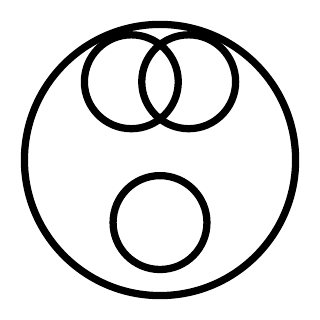
In the given figure A, B and C are three points on a circle. If AB = 3 cm and BC = 4 cm, then the measure of the radius of the circle is:

  1. AOption (a)

    3 cm

  2. BOption (b)

    5 cm

  3. COption (c)

    727\over2 cm

  4. DOption (d)

    525\over2 cm

View answer & explanation

Correct answer

Answer: (d)D.

525\over2 cm

Why this answer is correct

Given:

AB = 3 cm

BC = 4 cm

Formula used:

In a right-angled triangle, the hypotenuse (AC) can be calculated using Pythagoras' theorem:

AC = √(AB2 + BC2)

The diameter of the circle is equal to the hypotenuse AC.

Radius (r) = AC ÷ 2

Calculation:

AC = √(32 + 42)

AC = √(9 + 16)

AC = √25

AC = 5 cm

Radius (r) = AC ÷ 2 = 5 ÷ 2 = 2.5 or 5/2

Final Answer:

Radius of the circle is 5/2 cm.

Question 2

On what sum will the compound interest, at the rate of 12121\over2% per annum for 2 years compounded annually, be ₹6,800?

  1. AOption (a)

    ₹27,260

  2. BOption (b)

    ₹25,600

  3. COption (c)

    ₹27,200

  4. DOption (d)

    ₹54,400

View answer & explanation

Correct answer

Answer: (b)B.

₹25,600

Why this answer is correct

Given:

Compound Interest (CI) = ₹6,800

Rate (r) = 121/2% per annum

Time (t) = 2 years

Formula used:

CI = P(1+r100)t−1(1+\frac{r}{100})^t - 1

Calculation:

6800 = P(1+252×100)2−1(1+\frac{25}{2 \times 100})^2 - 1

⇒ 6800 = P(1+25200)2−1(1+\frac{25}{200})^2 - 1

⇒ 6800 = P(1+0.125)2−1(1+0.125)^2 - 1

⇒ 6800 = P(1.125)2−1(1.125)^2 - 1

⇒ 6800 = P1.265625−11.265625 - 1

⇒ 6800 = P0.2656250.265625

⇒ P = 68000.265625\frac{6800}{0.265625}

⇒ P = ₹25,600

∴ The correct answer is option 2.

Question 3

If a - b = 5 and a3 - b3 = 5, then what will be the value of ab ?

  1. AOption (a)

    -26326\over3

  2. BOption (b)

    8

  3. COption (c)

    -8

  4. DOption (d)

    26326\over3

View answer & explanation

Correct answer

Answer: (c)C.

-8

Why this answer is correct

Given:

If a - b = 5 and a3 - b3 = 5

Formula used:

a3 - b3 = (a - b)(a2 + ab + b2)

Calculations:

a3 - b3 = 5

⇒ (a - b)(a2 + ab + b2) = 5

⇒ 5(a2 + ab + b2) = 5

⇒ a2 + ab + b2 = 1

Now, (a - b)2 = a2 - 2ab + b2

⇒ 25 = a2 - 2ab + b2

We have two equations:

  1. a2 + ab + b2 = 1

  2. a2 - 2ab + b2 = 25

Subtracting the second equation from the first:

⇒ (a2 + ab + b2) - (a2 - 2ab + b2) = 1 - 25

⇒ 3ab = -24

⇒ ab = -8

∴ The correct answer is option (3).

Question 4

Swaraj was the goal of India's political efforts. This goal was announced by Dadabhai Naoroji at the:

  1. AOption (a)

    Calcutta Session 1886

  2. BOption (b)

    Bombay Session 1889

  3. COption (c)

    Calcutta Session 1906

  4. DOption (d)

    Lahore Session 1885

View answer & explanation

Correct answer

Answer: (c)C.

Calcutta Session 1906

Why this answer is correct

The correct answer is Calcutta Session 1906

Key Points

  • Dadabhai Naoroji, one of the key leaders in the Indian freedom struggle and a prominent member of the Indian National Congress (INC),
  • first explicitly announced "Swaraj" (self-rule) as the goal of India’s political efforts at the Calcutta Session 1906.
  • Swaraj was envisioned as a movement to achieve self-governance and political autonomy for India under British rule, and Dadabhai Naoroji argued that it was a legitimate goal for the Indian people.
  • He highlighted the economic exploitation of India by the British and called for Indian participation in governance and the eventual self-rule of the country.
  • Although the term “Swaraj” gained more prominence later, particularly with Bal Gangadhar Tilak and
  • other leaders like Gopal Krishna Gokhale and Lala Lajpat Rai, Naoroji's advocacy for Swaraj at the 1889 session laid an early foundation for the broader independence movement.

Additional Information

  • Calcutta Session 1886
  • The main focus of the Calcutta Session of 1886 was to address the growing political concerns about India's governance under British rule.
  • It marked the first session where the Indian National Congress (INC) officially presented the demand for self-government (though not the full concept of Swaraj).
  • The Congress passed a resolution calling for constitutional reforms that would allow for Indian representation in governance.
  • This session was presided over by Womesh Chunder Bonnerjee, who was the first president of the INC.
  • Lahore Session 1885
  • The Lahore Session of 1885 was the first-ever session of the Indian National Congress (INC),
  • and it is significant because it marked the official founding of the INC.
  • The session was presided over by Womesh Chunder Bonnerjee and was attended by many prominent leaders of the time.
  • The INC’s primary goal at this stage was to build a platform for Indian voices to be heard in the British-controlled administration.

Question 5

A semicircle has been drawn on the length of a rectangle. The area of the shaded region in the figure is:

  1. AOption (a)

    77 cm2

  2. BOption (b)

    14 cm2

  3. COption (c)

    129 cm2

  4. DOption (d)

    63 cm2

View answer & explanation

Correct answer

Answer: (d)D.

63 cm2

Why this answer is correct

Given:

Length of rectangle = 14 cm

Width of rectangle = 10 cm

Radius of semicircle = 14 ÷ 2 = 7 cm

Formula used:

Area of shaded region = Area of rectangle - Area of semicircle

Area of rectangle = Length × Width

Area of semicircle = (1/2) × π × r2

Calculation:

Area of rectangle = 14 × 10 = 140 cm2

Area of semicircle = (1/2) × (22/7) × 7 × 7

⇒ Area of semicircle = 77 cm2

Area of shaded region = 140 - 77

⇒ Area of shaded region = 63 cm2

Result:

The area of the shaded region is 63 cm2.

Question 6

A and B together can finish a task in 24 days. They worked at it for 18 days and then C finished the remaining work in 10 days. In how many days can A, B and C together finish the task

  1. AOption (a)

    32 days

  2. BOption (b)

    15 days

  3. COption (c)

    34 days

  4. DOption (d)

    24 days

View answer & explanation

Correct answer

Answer: (b)B.

15 days

Why this answer is correct

Given:

A and B together can finish a task in 24 days. They worked at it for 18 days and then C finished the remaining work in 10 days.

Formula used:

Work = Rate × Time

Calculation:

Let's assume the total work is 1 unit.

Work done by A and B together in 1 day = 1/24

Work done by A and B together in 18 days = 18 × (1/24) = 3/4

Remaining work = 1 - 3/4 = 1/4

Work done by C in 10 days = 1/4

Work done by C in 1 day = (1/4)/10 = 1/40

Work done by A, B, and C together in 1 day = (1/24) + (1/40)

To combine these fractions, we find the common denominator:

1/24 + 1/40 = (5 + 3) / 120 = 8/120 = 1/15

⇒ A, B, and C together can finish the task in 15 days

∴ The correct answer is option 2.

Question 7

Select the number that can replace the question mark (?) in the following series.

35, 48, 63, 80, ?

  1. AOption (a)

    99

  2. BOption (b)

    100

  3. COption (c)

    96

  4. DOption (d)

    90

View answer & explanation

Correct answer

Answer: (a)A.

99

Why this answer is correct

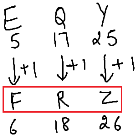
The logic followed here is:

Hence, "Option 1" is the correct answer.

Question 8

In a certain code language, Book is written as 4662, COAL is written as 3617 and COKE is written as 3625. How will LOCK be written as in that language?

  1. AOption (a)

    3236

  2. BOption (b)

    2336

  3. COption (c)

    6323

  4. DOption (d)

    7632

View answer & explanation

Correct answer

Answer: (d)D.

7632

Why this answer is correct

The logic followed here is:

Book is written as 4662

COAL is written as 3617

COKE is written as 3625

So, it can be clearly seen that each letter is assigned specific numbers at the same position as position of the letter within the word, therefore LOCK can be written as:

Thus, LOCK is written as 7632.

Hence, "Option 4" is the correct answer.

Question 9

The Maasai tribes inhabit:

  1. AOption (a)

    Antarctica

  2. BOption (b)

    North America

  3. COption (c)

    Africa

  4. DOption (d)

    Europe

View answer & explanation

Correct answer

Answer: (c)C.

Africa

Why this answer is correct

The correct answer is Africa

Key Points

  • The Maasai are located near the African Great Lakes region and the national game parks of East Africa.
  • They originated in the Nile Valley and migrated south around the 15th century.
  • The Maasai speak the Maasai language, which is related to Dinka, Kalenjin, and Nuer.
  • Most Maasai also speak the official languages of Kenya and Tanzania, which are Swahili and English.
  • The Maasai practice a mix of animism, Christianity, and traditional beliefs.
  • They have a deep respect for nature and believe in the natural world's connection to their spiritual lives.

Additional Information

  • Other Notable Tribes of Africa:
  • Zulu
  • Location: Primarily in South Africa.
  • The Zulu are one of the largest ethnic groups in South Africa.
  • Known for their warrior tradition, vibrant dances, music, and crafts, the Zulu played a major role in the country's history, particularly during the reign of King Shaka Zul
  • ​​Himba
  • Location: Mainly in Namibia and parts of Angola.
  • The Himba are a semi-nomadic tribe known for their unique red ochre body paint, elaborate hairstyles, and traditional way of life, which is centred around cattle herding.​​
  • San (Bushmen)
  • Location: Mainly in Botswana, Namibia, and South Africa.
  • The San people are some of the earliest inhabitants of Southern Africa.
  • They are famous for their hunter-gatherer lifestyle, ancient rock art, and deep knowledge of nature and survival.

Question 10

What is the name of the Automatic Fare Collection Gating System launched by PM Narendra Modi in March 2019 while inaugurating Phase 1 of the Ahmedabad Metro train service? 

  1. AOption (a)

    AYSUSHMAN BHARAT YOJANA

  2. BOption (b)

    TRAIN

  3. COption (c)

    SWAGAT

  4. DOption (d)

    AUTO

View answer & explanation

Correct answer

Answer: (c)C.

SWAGAT

Why this answer is correct

The correct answer is SWAGAT

Key Points

  • The correct name of the Automatic Fare Collection Gating System launched by PM Narendra Modi in March 2019 during the inauguration of Phase 1 of the Ahmedabad Metro train service is SWAGAT.
  • SWAGAT (Smart and Widespread Automated Gate Access Terminal) is designed to provide seamless and efficient fare collection for passengers.
  • The SWAGAT system is designed to automate the fare collection process at metro stations, offering a smoother, quicker, and more efficient travel experience for passengers.
  • SWAGAT uses contactless smart cards and QR code-based ticketing for quick access through the fare gates.

Additional Information

  • Ayushman Bharat Yojana
  • This is a national health insurance scheme launched by the Government of India, aimed at providing affordable healthcare to the underprivileged.
  • Ayushman Bharat provides health coverage of up to ₹5 lakh per family per year for secondary and tertiary care hospitalization.

Question 11

Who is called as the architect of Indian planning?

  1. AOption (a)

    Ghanshyam Das Birla

  2. BOption (b)

    Jamnalal Bajaj

  3. COption (c)

    P.C. Mahalanobis

  4. DOption (d)

    Jawahar Lal Nehru

View answer & explanation

Correct answer

Answer: (c)C.

P.C. Mahalanobis

Why this answer is correct

The correct answer is P.C. Mahalanobis.

Key Points 

  • P.C. Mahalanobis:
  • He is considered the father of modern statistics in India.
  • He founded the Indian Statistical Institute.
  • He is also known as the Architect of Indian Planning.
  • Mahalanobis's model of the second five-year plan focused on Rapid industrialization and strengthening the public sector.

Additional Information

  • Ghanshyam Das Birla
  • Founder of the Birla Group, one of India’s largest industrial conglomerates, with interests in textiles, cement, chemicals, and more.
  • Made significant contributions to education, healthcare, and social causes.
  • Played a major role in building educational institutions such as Birla Institute of Technology and Science (BITS Pilani).
  • Jamnalal Bajaj
  • Founder of the Bajaj Group, a prominent industrial conglomerate.
  • Made significant contributions to Indian manufacturing, especially in the automotive and electrical sectors.
  • A close associate of Mahatma Gandhi and a supporter of the Indian independence movement.
  • Jawaharlal Nehru
  • ​The first Prime Minister of independent India (1947–1964), overseeing its transition from a colony to a republic.
  • Promoted the establishment of educational institutions, such as the Indian Institutes of Technology (IITs).
  • Played a key role in shaping India’s foreign policy and establishing the Non-Aligned Movement

Question 12

Please read the following information carefully and answer the question that follows.

Richa, Rohini, Roli, Roshen and Rita are five friends. Each one of them has eight balls. Rohini gives three balls to Roshen, who gives five balls to Richa. Richa gives four balls to Roli, who in turn gives three balls to Rita. Rita gives two balls each to Roshen and Rohini.

After the final distribution, how many balls are there in total with all five friends?

  1. AOption (a)

    36

  2. BOption (b)

    48

  3. COption (c)

    40

  4. DOption (d)

    35

View answer & explanation

Correct answer

Answer: (c)C.

40

Why this answer is correct

Given: Richa, Rohini, Roli, Roshen and Rita are five friends.

1) Each one of them has eight balls.

FriendsRichaRohiniRoliRoshenRita
Balls88888

2) Rohini gives three balls to Roshen, who gives five balls to Richa.

FriendsRichaRohiniRoliRoshenRita
Balls88888
Rohini gives three balls to Roshen(-3)(+3)
Balls after operation858118
Roshen, who gives five balls to Richa(+5)(-5)
Balls after operation135868

3) Richa gives four balls to Roli, who in turn gives three balls to Rita. 


FriendsRichaRohiniRoliRoshenRita
Balls88888
Rohini gives three balls to Roshen(-3)(+3)
Balls after operation858118
Roshen, who gives five balls to Richa(+5)(-5)
Balls after operation135868
Richa gives four balls to Roli(-4)(+4)
Balls after operation951268
Roli, who in turn gives three balls to Rita(-3)(+3)
Balls after operation959611

4) Rita gives two balls each to Roshen and Rohini.

FriendsRichaRohiniRoliRoshenRita
Balls88888
Rohini gives three balls to Roshen(-3)(+3)
Balls after operation858118
Roshen, who gives five balls to Richa(+5)(-5)
Balls after operation135868
Richa gives four balls to Roli(-4)(+4)
Balls after operation951268
Roli, who in turn gives three balls to Rita(-3)(+3)
Balls after operation959611
Rita gives two balls each to Roshen and Rohini(+2)(+2)(-4)
Final number of balls left97987

Thus, After the final distribution (9 + 7 + 9 + 8 + 7) = 40 balls are there in total with all five friends.

Hence, "Option 3" is the correct answer.

Alternate MethodInitial Distribution: Each friend starts with 8 balls.

Total initial number of balls: 8 × 5 = 40

Final Distribution: The redistribution of balls involves friends exchanging balls, but no balls are added or removed from the group. Therefore, the total number of balls remains unchanged.

Therefore, the total number of balls with all five friends after the final distribution is still 40.

Question 13

As of December 2020, who is the Prime Minister of Australia?

  1. AOption (a)

    Jon Sandberg

  2. BOption (b)

    Scott Morrison

  3. COption (c)

    Peter Herald

  4. DOption (d)

    Bill Shorten

View answer & explanation

Correct answer

Answer: (b)B.

Scott Morrison

Why this answer is correct

The correct answer is Scott Morrison

Key Points

  • Scott Morrison served as the Prime Minister of Australia from August 24, 2018, to May 23, 2022.
  • As of December 2020, he was still holding this position. He is a member of the Liberal Party of Australia.
  • Scott Morrison became the 30th Prime Minister of Australia after winning a leadership spill within the Liberal Party in August 2018, succeeding Malcolm Turnbull.
  • He led the Liberal-National Coalition government during his tenure.

Additional Information

  • Bill Shorten
  • Leader of the Australian Labor Party (2013–2019).
  • Served as a Member of Parliament for the division of Maribyrnong since 2007.
  • Former Minister for the National Disability Insurance Scheme and Government Services.

Question 14

A bag contains balls numbered 1, 2, 3 ........ 30. One ball is drawn from the bag at random . What is the probability that the number on the ball drawn is divisible by 4 or 6?

  1. AOption (a)

    1151\over15

  2. BOption (b)

    3103\over10

  3. COption (c)

    252\over5

  4. DOption (d)

    131\over3

View answer & explanation

Correct answer

Answer: (d)D.

131\over3

Why this answer is correct

Given:

Numbers on the balls: 1, 2, 3, ..., 30

We need to find the probability that the number is divisible by 4 or 6.

Formula used:

Probability = (Favorable outcomes) / (Total outcomes)

Calculation:

Total outcomes = 30 (numbers from 1 to 30)

Numbers divisible by 4: 4, 8, 12, 16, 20, 24, 28

Total = 7

Numbers divisible by 6: 6, 12, 18, 24, 30

Total = 5

Common numbers divisible by both 4 and 6 (LCM = 12): 12, 24

Total = 2

Favorable outcomes = Numbers divisible by 4 + Numbers divisible by 6 - Common numbers

= 7 + 5 - 2 = 10

Probability = 10 / 30 = 1 / 3

Result:

The probability is 1/3 (Option 4).

Question 15

If in a coding system 34 - 23 = 17, 74 - 61 = 35 and 82 - 36 = 25, then find the value of 69 - 42.

  1. AOption (a)

    62

  2. BOption (b)

    48

  3. COption (c)

    21

  4. DOption (d)

    60

View answer & explanation

Correct answer

Answer: (d)D.

60

Why this answer is correct

The logic followed here is:

34 - 23 = 17

(3 × 4) + (2 + 3) = 17

12 + 5 = 17

17 = 17 (LHS = RHS)

74 - 61 = 35

(7 × 4) + (6 + 1) = 35

28 + 7 = 35

35 = 35 (LHS = RHS)

And,

82 - 36 = 25

(8 × 2) + (3 + 6) = 25

16 + 9 = 25

25 = 25 (LHS = RHS)

Similarly,

69 - 42

(6 × 9) + (4 + 2) = ?

54 + 6 = ?

60 = ?

Hence, "Option 4" is the correct answer.

Question 16

When is 'Human Rights Day' annually observed around the world?

  1. AOption (a)

    2nd October

  2. BOption (b)

    20th December

  3. COption (c)

    10th  December

  4. DOption (d)

    23rd March

View answer & explanation

Correct answer

Answer: (c)C.

10th  December

Why this answer is correct

The correct answer is 10th  December.

Key Points

Every year on December 10th, Human Rights Day commemorates the adoption of the Universal Declaration of Human Rights by the United Nations General Assembly in 1948 (UDHR).

  • The Universal Declaration of Human Rights (UDHR) is a landmark declaration that declares that everyone has intrinsic rights as a human being, regardless of race, colour, religion, sex, language, political or other opinions, national or social origin, property, birth, or other position.
  • It is the most translated document in the world, having been translated into over 500 languages.
  • This year’s Human Rights Day theme relates to “Equality” and article 1 of the UDHR – “All human beings are born free and equal in dignity and rights”.
  • The principles of equality and non-discrimination are at the heart of human rights.

Question 17

Who was appointed as India's first Lokpal (anti-corruption ombudsman) in March 2019?

  1. AOption (a)

    Pinaki Chandra Ghose

  2. BOption (b)

    Amit Shah

  3. COption (c)

    Dalbir Singh

  4. DOption (d)

    KPS Menon

View answer & explanation

Correct answer

Answer: (a)A.

Pinaki Chandra Ghose

Why this answer is correct

The correct answer is Pinaki Chandra Ghose.

Key Points

  • Pinaki Chandra Ghose became the first Lokpal of India.
  • Pinaki Chandra Ghose was the first Lokpal of India since 23rd March 2019 to 2023
  • He is a retired judge of the Supreme Court of India.

 Additional Information

  • A Lokpal is an anti-corruption authority or body of ombudsman who represents the public interest in the Republic of India.
  • The Lokpal has jurisdiction over the central government to inquire into allegations of corruption against its public functionaries and for matters connected to corruption.
  • The Lokpal is responsible for enquiring into corruption charges at the national level while the Lokayukta performs the same function at the state level.
  • The Lokpal consists of a Chairperson and eight members. Four of the judicial members have been former Chief Justices of different High Courts and the four non-judicial members have been from All India Services/Central Services.

Question 18

A father is twice as old as his son. Twenty years ago, the age of the father was 12 times his son's age at that time. Difference in the present ages (in years) of the father and son is:

  1. AOption (a)

    44

  2. BOption (b)

    2

  3. COption (c)

    12

  4. DOption (d)

    22

View answer & explanation

Correct answer

Answer: (d)D.

22

Why this answer is correct

Given:

A father is twice as old as his son. Twenty years ago, the age of the father was 12 times his son's age at that time.

Formula used:

Let the present age of the son be x years.

Then, the present age of the father will be 2x years.

Twenty years ago, the age of the son was (x - 20) years and the age of the father was (2x - 20) years.

According to the given condition:

2x - 20 = 12(x - 20)

Calculation:

2x - 20 = 12(x - 20)

⇒ 2x - 20 = 12x - 240

⇒ 240 - 20 = 12x - 2x

⇒ 220 = 10x

⇒ x = 22

The present age of the son is 22 years.

The present age of the father is 2x = 2 × 22 = 44 years.

Difference in the present ages = 44 - 22 = 22 years.

∴ The correct answer is option (4).

Question 19

A man sells a washing machine for ₹21,600 gaining thereby 8%. At what price should he sell it to gain 20%? 

  1. AOption (a)

    ₹24,000

  2. BOption (b)

    ₹26,000

  3. COption (c)

    ₹23,200

  4. DOption (d)

    ₹28,000

View answer & explanation

Correct answer

Answer: (a)A.

₹24,000

Why this answer is correct

Given:

Selling Price (SP) = ₹21,600

Gain Percentage = 8%

Formula used:

Cost Price (CP) = SP(1+Gain%100)\dfrac{SP}{(1 + \dfrac{Gain \%}{100})}

New Selling Price (SPnew) = CP × (1 + NewGain%100\dfrac{New Gain \%}{100})

Calculation:

CP = 21600(1+8100)\dfrac{21600}{(1 + \dfrac{8}{100})}

⇒ CP = 216001.08\dfrac{21600}{1.08}

⇒ CP = ₹20,000

SPnew = 20000 × (1 + 20100\dfrac{20}{100})

⇒ SPnew = 20000 × 1.20

⇒ SPnew = ₹24,000

∴ The correct answer is option (1).

Question 20

Which of the following is an output device?

  1. AOption (a)

    Printer

  2. BOption (b)

    MICR(Magnetic Ink Character Recognition)

  3. COption (c)

    OCR(Optical Character Readers)

  4. DOption (d)

    Mouse

View answer & explanation

Correct answer

Answer: (a)A.

Printer

Why this answer is correct

The correct answer is Printer.

Key Points

  • An output device is a piece of computer hardware that receives data from a computer and then translates that data into another form. That form may be audio, visual, textual, or hard copy such as a printed document.
  • The key distinction between an input device and an output device is that an input device sends data to the computer, whereas an output device receives data from the computer.
  • Computer speakers are hardware devices that transform the signal from the computer's sound card into audio. Speakers create sound using internal amplifiers that vibrate at different frequencies according to data from the computer. This produces sound.

Additional Information

  • Input devices take input from the users or from surroundings and convert them into a form a computer can understand.
  • A camera takes images and converts them to machine-readable form.
  • A microphone detects sounds and converts them to machine-readable form.
  • An OCR or Optical Character Reader converts an image of text into a machine-readable text format.

Question 21

Pointing to a man in a photograph, Laxman said. "He is the only son of my mother's father". How is Laxman related to that man?

  1. AOption (a)

    Sister's Son

  2. BOption (b)

    Son

  3. COption (c)

    Brother

  4. DOption (d)

    Brother's Son

View answer & explanation

Correct answer

Answer: (a)A.

Sister's Son

Why this answer is correct

Given: Pointing to a man in a photograph, Laxman said. "He is the only son of my mother's father".

As Laxman's gender is not known yet, therefore Laxman can be either male or a female.

So, Laxman is man's nephew i.e. sister's son or niece i.e. sister's daughter. As out of all the options, 'Sister's son' is given.

Therefore, Laxman is the man's nephew i.e. sister's son.

Hence, the correct answer is "Option 1".

Question 22

Solve the following.

2 - [(-5) × (-4) - (3 - 5)] = ?

  1. AOption (a)

    -20

  2. BOption (b)

    -8

  3. COption (c)

    8

  4. DOption (d)

    20

View answer & explanation

Correct answer

Answer: (a)A.

-20

Why this answer is correct

Given:

2 - [(-5) × (-4) - (3 - 5)] = ?

Formula used:

Order of operations (BODMAS/BIDMAS): Brackets, Orders (i.e. powers and square roots, etc.), Division and Multiplication, Addition and Subtraction

Calculation:

2 - [(-5) × (-4) - (3 - 5)] = ?

⇒ 2 - [(20) - (-2)]

⇒ 2 - [20 + 2]

⇒ 2 - 22

⇒ -20

∴ The correct answer is option (1).

Question 23

With which of the following countries did India sign a Memorandum of Understanding (MoU) to cooperate in the field of anti-microbial resistance in year 2009?

  1. AOption (a)

    USA

  2. BOption (b)

    Japan

  3. COption (c)

    Sweden

  4. DOption (d)

    Russia

View answer & explanation

Correct answer

Answer: (c)C.

Sweden

Why this answer is correct

The correct answer is Sweden.

Additional Information

  • The MoU aimed to enhance cooperation between the two nations in the field of healthcare and public health, with a specific focus on antimicrobial resistance. The agreement aimed to share knowledge, develop innovative preventive measures, and collaborate on joint activities to address this growing global health concern.
  • The MoU aimed to strengthen cooperation between the two countries in the field of healthcare and public health, with a specific focus on AMR. This collaboration would involve sharing knowledge and expertise, developing innovative preventive measures, and working together on joint initiatives to address this pressing global health issue.
  • By signing this MoU, India and the partner country committed to working together to combat AMR and ensure the continued effectiveness of antimicrobial drugs.
  • However, the specific country with which India signed this MoU in 2009 is not provided in the prompt. To get this information, you might need to refer to specific government records or health organization reports from that time.

Question 24

The number of prime numbers less than 20 is:

  1. AOption (a)

    7

  2. BOption (b)

    10

  3. COption (c)

    9

  4. DOption (d)

    8

View answer & explanation

Correct answer

Answer: (d)D.

8

Why this answer is correct

Given:

The number of prime numbers less than 20 is:

Formula used:

Prime numbers are numbers greater than 1 that have no divisors other than 1 and themselves.

Calculation:

Prime numbers less than 20 are: 2, 3, 5, 7, 11, 13, 17, 19

⇒ Total count = 8

∴ The correct answer is option (4).

Question 25

The least multiple of 14 which when divided by 6, 8, 12 leaves remainder 4, 6 and 10 respectively, is:

  1. AOption (a)

    70

  2. BOption (b)

    40

  3. COption (c)

    46

  4. DOption (d)

    336

View answer & explanation

Correct answer

Answer: (a)A.

70

Why this answer is correct

Calculation:

Understanding the Problem

We need the least multiple of 14 that satisfies the following conditions:

When divided by 6, remainder = 4.

When divided by 8, remainder = 6.

When divided by 12, remainder = 10.

We observe that remainder + divisor gives us a multiple of the divisor.

Convert Conditions to Equations

For 6: x ≡ 4 (mod 6) → x = 6k + 4

For 8: x ≡ 6 (mod 8) → x = 8m + 6

For 12: x ≡ 10 (mod 12) → x = 12n + 10

Solve the Congruences

From x ≡ 4 (mod 6) and x ≡ 6 (mod 8):

6k + 4 ≡ 6 (mod 8).

Start with x = 6k + 4.

Substitute into x ≡ 6 (mod 8):

Simplify: 6k ≡ 2 (mod 8).

Divide through by 2: 3k ≡ 1 (mod 4).

Solution: k ≡ 3 (mod 4) → k = 4t + 3.

Substitute k back into x = 6k + 4:

x = 6(4t + 3) + 4 = 24t + 22.

Thus, x ≡ 22 (mod 24).

Combine with x ≡ 10 (mod 12):

12n + 10 ≡ 22 (mod 24).

From x = 12n + 10, substitute into x ≡ 22 (mod 24):

Simplify: 12n ≡ 12 (mod 24).

Divide through by 12: n ≡ 1 (mod 2) → n = 2s + 1.

Substitute n back into x = 12n + 10:

x = 12(2s + 1) + 10 = 24s + 22.

Thus, x ≡ 22 (mod 24).

Ensure x is a Multiple of 14

We test values of x = 24s + 22 for divisibility by 14:

For s = 1: x = 24(1) + 22 = 46 (not divisible by 14).

For s = 2: x = 24(2) + 22 = 70 (divisible by 14).

Final Answer:

The least multiple of 14 that satisfies all conditions is 70.

Question 26

_______ are not shifted to others and are levied on the income or profits of the person who pays them.

  1. AOption (a)

    Sales tax

  2. BOption (b)

    Indirect taxes

  3. COption (c)

    Goods and services tax

  4. DOption (d)

    Direct taxes

View answer & explanation

Correct answer

Answer: (d)D.

Direct taxes

Why this answer is correct

The correct answer is Direct taxes.

Key Points

Direct Tax:- 

  • Direct tax is a type of tax where the incidence and impact of taxation fall on the same entity.
  • The burden of direct taxation cannot be passed from one person to another.
  • These are primarily income or wealth taxes.
  • Direct taxes include income tax, corporate tax, property tax, inheritance tax, and gift tax.

 Additional Information

  • Indirect Taxes
  • Indirect taxes are those taxes that are imposed on goods and services rather than on income or profits.
  • Examples of indirect taxes include Goods and Services Tax (GST), excise duties, customs duties, and Value Added Tax (VAT).
  • These taxes are typically included in the price of goods and services and are paid by the consumer.
  • Goods and services tax 
  • The Goods and Services Tax (GST) was introduced in India on 1st July 2017.
  • It is a comprehensive, multi-stage, destination-based tax that is levied on every value addition.
  • GST is categorized into three types: CGST (Central Goods and Services Tax), SGST (State Goods and Services Tax), and IGST (Integrated Goods and Services Tax).
  • The introduction of GST has replaced many indirect taxes previously levied by the Central and State governments.
  • GST aims to create a single, unified Indian market to make the economy stronger and more efficient.

Question 27

Ages of Keshav and Vipul are in the ratio 9 : 10. Twelve years hence their ages will be in the ratio 13 : 14. Keshav's present age is:

  1. AOption (a)

    39 years

  2. BOption (b)

    30 years

  3. COption (c)

    42 years

  4. DOption (d)

    27 years

View answer & explanation

Correct answer

Answer: (d)D.

27 years

Why this answer is correct

Given:

Ratio of ages of Keshav and Vipul = 9 : 10

After 12 years, ratio of their ages = 13 : 14

Formula used:

Let Keshav's and Vipul's present ages be 9x and 10x respectively.

After 12 years: (9x + 12) ÷ (10x + 12) = 13 ÷ 14

Calculation:

⇒ 14(9x + 12) = 13(10x + 12)

⇒ 126x + 168 = 130x + 156

⇒ 4x = 12

⇒ x = 3

Keshav's present age = 9x = 9 × 3 = 27 years

∴ Keshav's present age is 27 years.

Question 28

For a given fraction, how many equivalent fractions can be formed?

  1. AOption (a)

    Infinite

  2. BOption (b)

    Only 1

  3. COption (c)

    Only 3

  4. DOption (d)

    Only 2

View answer & explanation

Correct answer

Answer: (a)A.

Infinite

Why this answer is correct

Given:

For a given fraction

Formula used:

Equivalent fractions are formed by multiplying the numerator and the denominator by the same non-zero integer.

Calculation:

The number of equivalent fractions that can be formed is infinite.

∴ The correct answer is option 1.

Question 29

Select the number that can replace the question mark(?) in the following series.

1728, 2744, 4096, ?, 8000

  1. AOption (a)

    4913

  2. BOption (b)

    4464

  3. COption (c)

    6859

  4. DOption (d)

    5832

View answer & explanation

Correct answer

Answer: (d)D.

5832

Why this answer is correct

The logic followed here is:

Hence, "Option 4" is the correct answer.

Question 30

What is the balcony-shaped structure on stupa known as?

  1. AOption (a)

    Yashti

  2. BOption (b)

    Anda

  3. COption (c)

    Harmika

  4. DOption (d)

    Chhatri

View answer & explanation

Correct answer

Answer: (c)C.

Harmika

Why this answer is correct

The correct answer is Harmika.

Key Points

  • Harmika:
  • The Harmika is a square railing or enclosure situated at the very top of a stupa, symbolizing the domain of the gods and the Buddhist heavens. It often contains a small platform for ritual offerings.

Additional Information

  • Yashti:
  • The Yashti, or spire, is the mast that rises from the Harmika and is topped with a series of discs or umbrellas called chattras, representing different levels of enlightenment or the tiers of heaven.
  • Anda:
  • The Anda, also known as the dome, is the main hemispherical mound of the stupa, representing the universe. It typically contains relics of the Buddha or other saints.
  • Chhatri:
  • The Chhatri is a decorative pavilion or umbrella-like structure placed atop the Yashti, symbolizing protection, royalty, and honor within Buddhist architecture.

Question 31

Kurt Waldheim, the fourth UN secretary General was the former president of ____________.

  1. AOption (a)

    Austria

  2. BOption (b)

    Mexico

  3. COption (c)

    Argentina

  4. DOption (d)

    Spain

View answer & explanation

Correct answer

Answer: (a)A.

Austria

Why this answer is correct

The correct answer is Austria.

Key Points 

  • The United nation organization
  • The United Nations is an International organization founded in 1945. It is currently made up of 193 Member states.
  • The Mission and work of the United Nations are guided by the purposes and principles contained in its Founding Charter.
  • Due to the powers vested in the Charter and its Unique International character, the United Nations can take action on these issues confronting Humanity in the 21st Century, such as peace and security, climate change, sustainable development, human rights, disarmament, terrorism, humanitarian and health emergencies, gender equality, governance, food production, etc.
  • UNO Headquarter is located in New York, United States.
  • Antonio Guterres serving as the Ninth Secretary-General of the United Nations. A member of the Portuguese Socialist Party, he served as Prime Minister of Portugal from 1995 to 2002.
  • The Main Organs of the UN are the General Assembly, the Security Council, the Economic and Social Council, the Trusteeship Council, the International Court of Justice, and the UN Secretariat.
  • The Five Permanent Members of the UN are- China, France, Russian Federation, The United Kingdom, and the United States, and Ten Non-Permanent Members elected for Every two-year terms by the General Assembly.

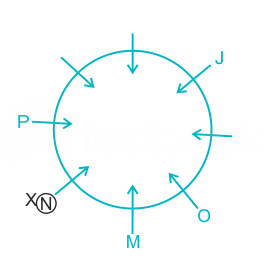
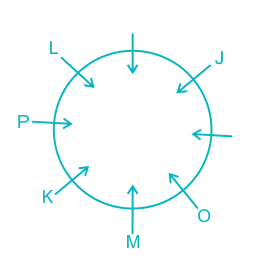
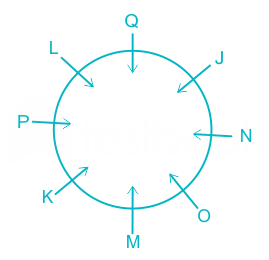
Question 32

J, K, L, M, N, O, P and Q are sitting in a circle, facing the centre. O is sitting to the immediate right of M and second to the left of J. P is sitting second to the left of M, who is not sitting next to N. K is sitting next to P and L is not sitting next to either M or J. N is sitting third to the right of K.

Who is sitting to the immediate right of J?

  1. AOption (a)

    O

  2. BOption (b)

    Q

  3. COption (c)

    N

  4. DOption (d)

    K

View answer & explanation

Correct answer

Answer: (b)B.

Q

Why this answer is correct

Given: J, K, L, M, N, O, P and Q are sitting in a circle, facing the centre.

1) O is sitting to the immediate right of M and second to the left of J.

2) P is sitting second to the left of M, who is not sitting next to N.

3) K is sitting next to P and L is not sitting next to either M or J.

  1. N is sitting third to the right of K.

After positioning N only one position is left which will be occupied by the only person left i.e. Q.

Thus, Q is sitting to the immediate right of J.

Hence, "Option 2" is the correct answer.

Question 33

The HCF of 15, 25 and 42 is:

  1. AOption (a)

    1

  2. BOption (b)

    27

  3. COption (c)

    1050

  4. DOption (d)

    82

View answer & explanation

Correct answer

Answer: (a)A.

1

Why this answer is correct

Given:

The HCF of 15, 25, and 42

Formula used:

HCF is found by determining the highest common factor that divides all numbers.

Calculation:

Factors of 15 = 1, 3, 5, 15

Factors of 25 = 1, 5, 25

Factors of 42 = 1, 2, 3, 6, 7, 14, 21, 42

Common factors of 15, 25, and 42 = 1

⇒ HCF = 1

∴ The correct answer is option (1).

Question 34

If × means subtraction, - means addition, + means division and ÷ means multiplication, then find the value of 

91 + 13 - 11 ÷ 3  × 15.

  1. AOption (a)

    55

  2. BOption (b)

    65

  3. COption (c)

    11

  4. DOption (d)

    25

View answer & explanation

Correct answer

Answer: (d)D.

25

Why this answer is correct

Decoding the given information:

SIgn×-+÷
Meaning-+÷×

Given Equation: 91 + 13 - 11 ÷ 3  × 15.

Now replacing the sign from left to right using BODMAS Rule, we get:

⇒ 91 ÷ 13 + 11 × 3 - 15

⇒ 7 + 11 × 3 - 15

⇒ 7 + 33 - 15

⇒ 40 - 15

⇒ 25

Hence, the correct option is "Option 4".

Question 35

Identify the incorrect statement about mammals.

  1. AOption (a)

    Normally mammals have hair.

  2. BOption (b)

    Some mammals lay eggs

  3. COption (c)

    Heart is three chambered.

  4. DOption (d)

    Mammary gland is present to feed young ones

View answer & explanation

Correct answer

Answer: (c)C.

Heart is three chambered.

Why this answer is correct

The correct answer is Heart is three chambered.

Key Points

  • Mammals are distinguished by several unique characteristics that are not found in other animal classes.
  • The most unique mammalian characteristic is the presence of milk-producing glands (mammary glands) by which the young ones are nourished.
  • They have two pairs of limbs, adapted for walking, running, climbing, burrowing, swimming or flying.
  • The skin of mammals is unique in possessing hair.
  • External ears or pinnae are present.
  • Different types of teeth are present in the jaw.

Explanation:

  • A four-chambered heart: Although mammals have a four-chambered heart, so do birds and crocodilians, so it is not unique to mammals.
  • Giving birth to live young (viviparous): Many mammals are viviparous, but some mammals like monotremes (e.g., the platypus and echidna) lay eggs. Additionally, some reptiles and fish also give birth to live young.
  • Parental care of offspring: Many animals, including birds, reptiles, and some fish, exhibit parental care, so this trait is not exclusive to mammals.
  • Having glands to produce nourishing milk for offspring: This characteristic is unique to mammals. Mammary glands produce milk to feed and nourish their young, which is a defining trait of the class Mammalia.

Question 36

Which of the following rights does the MGNREGA Scheme guarantee?

  1. AOption (a)

    Right to freedom

  2. BOption (b)

    Right to work

  3. COption (c)

    Right to speech

  4. DOption (d)

    Right to information

View answer & explanation

Correct answer

Answer: (b)B.

Right to work

Why this answer is correct

The correct answer is Right to work.

Key Points

Mahatma Gandhi National Rural Employment Guarantee Act (MGNREGA):

  • The Indian Parliament passed NREGA in August 2005.
  • It came into force on February 2, 2006.
  • On 2nd October 2009, the act NREGA was renamed MGNREGA.

 Additional Information

Right to Work: 

  • Unlike earlier employment guarantee schemes, the act aims at addressing the causes of chronic poverty through a rights-based framework.
  • At least one-third of beneficiaries have to be women.
  • Wages must be paid according to the statutory minimum wages specified for agricultural labourers in the state under the Minimum Wages Act, 1948.
  • The scheme was introduced as a social measure that guarantees “the right to work”.
  • The key tenet of this social measure and labour law is that the local government will have to legally provide at least 100 days of wage employment in rural India to enhance their quality of life.

Question 37

Mirabai was a Rajput princess from:

  1. AOption (a)

    Satara

  2. BOption (b)

    Bijapur

  3. COption (c)

    Mewar

  4. DOption (d)

    Merta

View answer & explanation

Correct answer

Answer: (d)D.

Merta

Why this answer is correct

The correct answer is Merta.

Key Points

Mirabai

  • Meerabai was a 16th-century Hindu mystic poet and devotee of Krishna.
  • She was born in the Kudki village of Pali Distrct.
  • She was married to Bhojraj Singh Sisodia (c. 1495–1526).
  • He was the eldest son of Rana Sanga, ruler of Mewar.
  • She is a celebrated Bhakti saint, particularly in the North Indian Hindu tradition.
  • She was widely known and a cherished figure in the Bhakti movement culture by about 1600 CE.
  • Many poems attributed to Meera were likely composed later by others who admired Meera.
  • One of her most popular compositions remains "Paayoji Maine Ram Ratan dhan paayo".
  • There are no surviving manuscripts of her poetry from her time and the earliest records with two poems credited to her are from the early 18th century, more than 150 years after she died.

Question 38

Gunjan, Sameer, Jack, Madhur and Shweta are teachers in a school. Sameer teaches English, Computers and Science. Madhur teaches English, Mathematics and Science. Music and Mathematics are taught by Gunjan and Jack. Shweta does not teach Mathematics, Science and Music. Gunjan and Shweta teach Computers and English also. Shweta is the only teacher for Social Studies in the school. 

How many subjects are taught by the teachers in total?

  1. AOption (a)

    5

  2. BOption (b)

    6

  3. COption (c)

    7

  4. DOption (d)

    4

View answer & explanation

Correct answer

Answer: (b)B.

6

Why this answer is correct

Given: Gunjan, Sameer, Jack, Madhur and Shweta are teachers in a school.

1) Sameer teaches English, Computers and Science.

  1. Madhur teaches English, Mathematics and Science. 
Subjects ⇒ Teachers ⬇EnglishComputerScienceMathematics
Gunjan✔✔✔
Sameer
Jack
Madhur✔✔✔
Shweta

3) Music and Mathematics are taught by Gunjan and Jack.

4) Shweta does not teach Mathematics, Science and Music. 

Subjects ⇒ Teachers ⬇EnglishComputerScienceMathematicsMusic
Gunjan✔✔✔✔
Sameer
Jack✔
Madhur✔✔✔
Shweta×××

5) Gunjan and Shweta teach Computers and English also.

  1. Shweta is the only teacher for Social Studies in the school.
Subjects ⇒ Teachers ⬇EnglishComputerScienceMathematicsMusicSocial Studies
Gunjan✔✔✔✔
Sameer
Jack✔
Madhur✔✔✔
Shweta✔✔×××✔

Thus, according to the final arrangement there are 6 subjects which are taught by the teachers in total.

Hence, "Option 2" is the correct answer.

Question 39

Who is the first batsman to score double Century in his 100th International Test?

  1. AOption (a)

    Brian Lara

  2. BOption (b)

    Joe Root

  3. COption (c)

    Sachin Tendulkar

  4. DOption (d)

    Ricky Ponting

View answer & explanation

Correct answer

Answer: (b)B.

Joe Root

Why this answer is correct

The correct answer is Joe Root.

Key Points

  • ICC headquarters is located in Dubai, United Arab Emirates.
  • The ICC is the global governing body for cricket.
  • Representing 104 members, the ICC governs and administrates the game and works with our members to grow the sport.
  • The ICC is also responsible for the staging of all ICC Events.
  • The ICC presides over the ICC Code of Conduct, playing conditions, the Decision Review System, and other ICC regulations.
  • Through the Anti-Corruption Unit, it coordinates action against corruption and match-fixing.
  • It was established in 1909 by the representatives of England, Australia, and South Africa as Imperial Cricket Conference.
  • The current ICC chairman is Greg Barclay and Geoff Allardice is the Chief Executive Officer.

Question 40

A can finish a task in 18 days and B can finish the same task in 15 days. They started working together but B left 7 days before the task finished. For how many days did A and B work together?

  1. AOption (a)

    8

  2. BOption (b)

    12

  3. COption (c)

    7

  4. DOption (d)

    5

View answer & explanation

Correct answer

Answer: (d)D.

5

Why this answer is correct

Given:

A can finish the task in 18 days.

B can finish the task in 15 days.

B left 7 days before the task was completed.

Calculation:

Calculate the combined work rate of A and B:

A can finish the task in 18 days, so A's work rate is 1/18 of the task per day.

B can finish the task in 15 days, so B's work rate is 1/15 of the task per day.

Combined work rate of A and B = 1/18 + 1/15 = (5 + 6) / 90 = 11/90 of the task per day.

Calculate the remaining work done by A alone:

Since B left 7 days before the task finished, A worked alone for 7 days.

A's work rate per day = 1/18

Work done by A in 7 days = 7 × (1/18) = 7/18 of the task.

Calculate the work done by A and B together:

Total work to be done = 1 task

Work done by A alone = 7/18 of the task

Work done by A and B together = 1 - 7/18 = 11/18 of the task.

Calculate the number of days A and B worked together:

Work done by A and B together per day = 11/90 of the task

Number of days A and B worked together = (Work done by A and B together) / (Combined work rate of A and B)

Number of days A and B worked together = (11/18) / (11/90) = 5 days

Therefore, A and B worked together for 5 days.

Question 41

Which of the following schemes is subsumed in the Ayushman Bharat - National Health Protection Mission?

  1. AOption (a)

    Senior Citizen Health Insurance scheme (SCHIS)

  2. BOption (b)

    Aam Aadmi Bima Yojana (AABY)

  3. COption (c)

    Universal Health Insurance scheme(UHIS)

  4. DOption (d)

    Janashree Bima Yojana (JBY)

View answer & explanation

Correct answer

Answer: (a)A.

Senior Citizen Health Insurance scheme (SCHIS)

Why this answer is correct

The correct answer is Senior Citizen Health Insurance scheme (SCHIS).

Key Points

  • Ayushman Bharat Yojana is a health scheme of the Government of India, which was implemented across India on September 23, 2018.
  • The objective of this scheme is to provide health insurance to economically weaker families (BPL holders).
  • Cashless health insurance of up to Rs 5 lakh will be provided to every family covered under this.
  • 10 crore BPL holder families (about 50 crore people) will be able to directly benefit from this scheme.
  • Apart from this, there is a plan to bring the remaining population also under this scheme.
  • Ayushman Bharat scheme is made up of two components:
  • Pradhan Mantri Jan Arogya Yojana (PMJAY): This scheme provides cashless health insurance up to Rs 5 lakh to BPL families.
  • National Health Protection Scheme (NHPS): This scheme aims to provide health insurance to all Indian citizens.

Question 42

Which section of the Constitution of India discusses about the responsibility of states towards international peace and security?

  1. AOption (a)

    Directive Principles of state Policy

  2. BOption (b)

    Fundamental Duties

  3. COption (c)

    Preamble

  4. DOption (d)

    Fundamental Rights

View answer & explanation

Correct answer

Answer: (a)A.

Directive Principles of state Policy

Why this answer is correct

The correct answer is Directive Principles of state Policy.

Key Points

  • Directive Principles of state Policy
  • The Directive Principles of State Policy (DPSP), outlined in Part IV of the Indian Constitution (Articles 36-51), are non-justiciable in nature.
  • This means that they are not enforceable by any court.
  • However, they are fundamental in the governance of the country and it is the duty of the state to apply these principles in making laws.
  • The DPSP, though not enforceable, serve as a guide to the legislative and executive branches of the government when they create policies and laws.
  • They aim to establish a welfare state where justice and equality are prevalent.
  • Despite their non-justiciable nature, the principles hold significant influence on the interpretation of the Constitution and the legislation.
  • This is because they reflect the ambitions and values that the Constitution strives to uphold.
  • Please note that while these principles are not enforceable by courts, they significantly shape India's governance and legal discourse.
  • The Constitution itself declares that it is the responsibility of the State to apply these principles in law-making and policy design.
  • This provides them with a considerable indirect impact on legislation and governance.

Additional Information

  • Fundamental D uties
  • In the Constitution of India, fundamental duties are mentioned in Article 51A.
  • There was no list of fundamental duties in the original constitution.
  • Fundamental duties were added to the Indian constitution by the 42nd Constitutional Amendment Act 1976 on the recommendation of the Sardar Swarn Singh committee.
  • the 42nd constitutional amendment added Part IV A and Article 51A to the Indian constitution.
  • Initially, there were only 10 fundamental duties in the constitution.
  • The 86th Constitutional Amendment Act 2002 added one more fundamental duty to the constitution.
  • Currently, there are 11 fundamental  duties in the Indian constitution.
  • ​Preamble
  • The Preamble to the Indian Constitution was inspired by the Preamble of the Constitution of the USA.
  • The Preamble is a part of the Indian constitution which, gives us fundamental values and highlights of the Constitution.
  • Keywords in the Preamble​Sovereign, Socialist, Secular, Democratic, Republic, Justice, Liberty, Equality, and Fraternity.
  • The ideals behind the Preamble were laid down by Jawaharlal Nehru’s Objectives Resolution, adopted by the Constituent Assembly on January 22, 1947.
  • Fundamental Rights
  • The fundamental rights are enshrined in PART III of the constitution from Articles 12 to 35.
  • The fundamental rights are meant to promote the ideal of Political Democracy.
  • The Fundamental Rights are guaranteed and protected by the Constitution.
  • There are 6 Fundamental Rights 
Fundamental RightsArticles
Right to equality14-18
Right to freedom19-22
Right against exploitation23-24
Right to freedom of religion25-28
Cultural and educational rights29-30
Right to constitutional remedies32
  • Judiciary(Supreme Court and High Courts) is the guardian of fundamental rights. The Supreme Court(Under Article 32) and the High Courts(Under Article 226) can issue the writs.

Question 43

Who wrote the epic 'Buddhacharitam'?

  1. AOption (a)

    Gautama Buddha

  2. BOption (b)

    Ashvaghosha

  3. COption (c)

    Nagarjuna

  4. DOption (d)

    Hemchandra

View answer & explanation

Correct answer

Answer: (b)B.

Ashvaghosha

Why this answer is correct

The correct answer is Ashvaghosha.

Key Points

  • Buddhacharitam, also spelled Buddhacharita is an epic poem on the life of Buddha from his birth until his entry into Parinirvana is written by Sanskrit poet Ashvagosha.
  • It is one of the finest examples of Buddhist literature.
  • The author, who lived in northern India in the 1st–2nd century CE, created a loving account of the Buddha’s life and teachings.
  • His work also reflects a vast knowledge of Indian mythology and of pre-Buddhist philosophies, and a court poet’s interest in love, battle, and statecraft.
  • The first half of the poem remains intact in Sanskrit, but all 28 chapters are preserved in Chinese (5th century) and Tibetan translations.

 Additional Information

  • Gautama Buddha​
  • Siddhartha Gautama was born in 563 BCE in Lumbini, Shakya Republic (present-day Nepal) (according to Buddhist tradition).
  • The Buddha was born into an aristocratic family in the Shakya clan but eventually renounced lay life.
  • According to Buddhist tradition, after several years of mendicancy, meditation, and asceticism, he awakened to understand the mechanism which keeps people trapped in the cycle of rebirth.
  • The Buddha then traveled throughout the Ganges plain teaching and building a religious community.
  • He taught a middle way between sensual indulgence and the severe asceticism found in the Indian sramaṇa movement.
  • He taught a training of the mind that included ethical training, self-restraint, and meditative practices such as jhana and mindfulness.
  • The Buddha also critiqued the practices of Brahmin priests, such as animal sacrifice and the caste system.
  • He died in 483 BCE or 400 BCE (aged 80).
  • Ashvaghosha
  • Ashvaghosha was a poet in the court of King Kanishka.
  • Ashvaghosha and other Buddhist scholars from Kanishka's period (around 1900 years ago) began writing in Sanskrit.
  • Earlier Buddha's teachings were in the common man's language (Prakrit) but later kings changed the practice gradually to the needs of the time.
  • He was a Buddhist writer and was very famous among Buddhist writers.
  • He wrote Buddhacharita which is the biography of Buddha.
  • It is written in the Sanskrit language.
  • He also wrote Sutralankar.

Question 44

Which judgment laid the Doctrine of Basic structure of the constitution?

  1. AOption (a)

    Golaknath case

  2. BOption (b)

    Kesavananda Bharati case

  3. COption (c)

    Indra Sawhney case

  4. DOption (d)

    Shankari Prasad case

View answer & explanation

Correct answer

Answer: (b)B.

Kesavananda Bharati case

Why this answer is correct

The correct answer is Kesavananda Bharati case.

Key Points

  • The preamble is an introductory and declarative statement that outlines the document's thing and underpinning gospel.
  • It was decided by two important Supreme court judgments popularly known as, the Berubari Union Case( 1960) and the Kesavananda Bharati case( 1973).
  • still, Preamble is the part of the Indian Constitution.
  • The Preamble defines the Constitution's abecedarian association.
  • In a court of law, the preamble is neither enforceable nor defendable.

 Additional Information

  • Amendments to the Preamble:
  • The Preamble was amended only formerly by the 42nd Amendment of 1976.
  • The Amendment added the terms Socialist, temporal, and Integrity in the Preamble.
  • Socialist: It's intended to insure profitable justice and the elimination of inequality in income and standard of life.
  • Secularism implies equivalency of all persuasions and religious forbearance and doesn't identify any state religion.
  • The word integrity ensures one of the major points and objects of the preamble icing the fraternity and concinnity of the state.
  • Article 368 emphasizes that because the preamble is a part of the Indian constitution, it can be amended except for the introductory structure.

Question 45

If the sum of the squares of roots of the polynomial x2 + 8x + 15k is 34, then what will be the value of k?

  1. AOption (a)

    1

  2. BOption (b)

    -1

  3. COption (c)

    2

  4. DOption (d)

    3

View answer & explanation

Correct answer

Answer: (a)A.

1

Why this answer is correct

Given:

If the sum of the squares of roots of the polynomial x2 + 8x + 15k is 34, find the value of k.

Formula used:

Let the roots be α and β. According to the given polynomial, the sum of the squares of the roots is given by:

α2 + β2 = (α + β)2 - 2αβ

Calculation:

Given that the sum of the squares of the roots is 34:

⇒ (α + β)2 - 2αβ = 34

From the polynomial x2 + 8x + 15k:

Sum of the roots (α + β) = -8

Product of the roots (αβ) = 15k

⇒ (-8)2 - 2(15k) = 34

⇒ 64 - 30k = 34

⇒ 64 - 34 = 30k

⇒ 30 = 30k

⇒ k = 1

∴ The correct answer is option 1.

Question 46

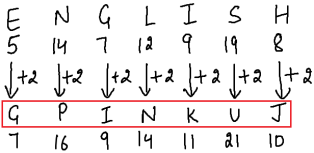
In a certain code language, COMPUTER is written as EQORWVGT. How will ENGLISH be written as in that language?

  1. AOption (a)

    GPINKUJ

  2. BOption (b)

    GUKNIPL

  3. COption (c)

    ULKINGP

  4. DOption (d)

    JUKNIPG

View answer & explanation

Correct answer

Answer: (a)A.

GPINKUJ

Why this answer is correct

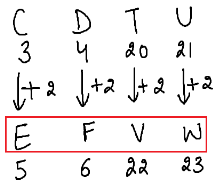
The logic followed here is:

COMPUTER is written as EQORWVGT

And,

ENGLISH is written as

Hence, "Option 1" is the correct answer.

Question 47

In which of the following years were Regional Rural Banks established?

  1. AOption (a)

    1980

  2. BOption (b)

    1972

  3. COption (c)

    1960

  4. DOption (d)

    1975

View answer & explanation

Correct answer

Answer: (d)D.

1975

Why this answer is correct

The correct answer is 1975.

Key Points

 Regional Rural Banks(RRBs) are sponsored by Nationalised Commercial Banks.

  • RRBs were established with the provisions of the Regional Rural Banks Act 1976.
  • RRBs were conceptualized by the Narasimham Working Group in 1975.
  • RRBs came into existence with an objective to develop Rural economy by the development of Agriculture, Trade, and Commerce in Rural Areas.
  • The target group of the RRBs is
  • Small and Marginal Farmers
  • Agricultural laborers,
  • Artisans, and
  • Small Entrepreneurs,

 Additional Information

  • RRBs are jointly owned by 
  • Central Government with 50% share
  • Concerned State Government with 15% share
  • Sponsor Banks with 35% share
  • Presently there are 12 Nationalised commercial Banks.

Question 48

One third of one fourth of two seventh of 12 is:

  1. AOption (a)

    272\over7

  2. BOption (b)

    14

  3. COption (c)

    727\over2

  4. DOption (d)

    32732\over7

View answer & explanation

Correct answer

Answer: (a)A.

272\over7

Why this answer is correct

Given:

We need to calculate: One third of one fourth of two seventh of 12.

Calculation:

Step 1: Express the statement mathematically:

⇒ (1/3) × (1/4) × (2/7) × 12

Step 2: Simplify step-by-step:

⇒ (1 × 1 × 2 × 12) ÷ (3 × 4 × 7)

⇒ 24 ÷ 84

⇒ 24 ÷ 84 = 2 ÷ 7

Conclusion:

The final result is 2/7.

Question 49

A bag contains balls numbered 1, 2, 3, ........ 20. One ball is drawn from the bag at randon. What is the probability that the number on the ball drawn is divisible by 3 or 5?

  1. AOption (a)

    121\over2

  2. BOption (b)

    252\over5

  3. COption (c)

    9209\over20

  4. DOption (d)

    1101\over10

View answer & explanation

Correct answer

Answer: (c)C.

9209\over20

Why this answer is correct

Given:

A bag contains balls numbered 1, 2, 3, ........ 20. One ball is drawn from the bag at random. What is the probability that the number on the ball drawn is divisible by 3 or 5?

Formula used:

Probability (P) = (Number of favorable outcomes) / (Total number of outcomes)

Calculation:

Numbers between 1 and 20 divisible by 3: 3, 6, 9, 12, 15, 18

Numbers between 1 and 20 divisible by 5: 5, 10, 15, 20

Numbers between 1 and 20 divisible by 3 or 5: 3, 5, 6, 9, 10, 12, 15, 18, 20

Count of numbers divisible by 3 or 5: 9

Total numbers: 20

⇒ P = 9 / 20

∴ The correct answer is option (3).

Question 50

Solve the following.

17.6 + 1.76 + 0.176 + 0.0176 + 0.00176 = ?

  1. AOption (a)

    19.55556

  2. BOption (b)

    19.55336

  3. COption (c)

    19.55356

  4. DOption (d)

    19.55536

View answer & explanation

Correct answer

Answer: (d)D.

19.55536

Why this answer is correct

Given:

17.6 + 1.76 + 0.176 + 0.0176 + 0.00176 = ?

Formula used:

Simple addition of decimal numbers

Calculation:

17.6 + 1.76 + 0.176 + 0.0176 + 0.00176 = ?

⇒ 17.6 + 1.76 = 19.36

⇒ 19.36 + 0.176 = 19.536

⇒ 19.536 + 0.0176 = 19.5536

⇒ 19.5536 + 0.00176 = 19.55536

∴ The correct answer is option (4).

Question 51

Patients suffering from which of the following diseases can donate eyes?

  1. AOption (a)

    Rabies

  2. BOption (b)

    Cholera

  3. COption (c)

    Diabetes

  4. DOption (d)

    Tetanus

View answer & explanation

Correct answer

Answer: (c)C.

Diabetes

Why this answer is correct

The correct answer is Diabetes.

Key Points

  • Diabetes Mellitus
  • Glucose is an essential energy source for the cells that make up the muscles and tissues.
  • It's also the brain's main source of fuel.
  • DM is due to the incapability of beta cells (β cells) in the pancreas to produce adequate insulin or ineffective insulin utilization by cells in the body.
  • Symptoms
  • Excessive thirst
  • Excessive Hungry
  • Excessive Urination
  • Unexplained weight loss
  • Fatigue
  • Irritability
  • Lethargy
  • Blur vision
  • Low wound healing
  • Presence of ketones in the urine.
  • Type
  • Type 1 Diabetes Mellitus
  • Type 2 Diabetes Mellitus
  • | Description | Type 1 | Type2 | | --- | --- | --- | | Onset | Sudden | Gradual | | Age at onset | Any age mostly young | Adults | | Body habitues | Thin or normal | Often obes | | Ketoacidosis | Common | Rare | | Autoantibodies | Present | Absent | | Endogenous insulin | Low or absent | Normal decreased or increased | | Prevalence | Less | More | | Insulin therapy | Required | May or may not be required Can manage  on oral medication & lifestyle modification |

Investigation 

InvestigationFinding
HBA1C6.5% or Higher indicates- diabetes 5.7% to 6.4% - Preedibetes Below 5.7% - Normal
Random Blood sugar200 milligrams or more - Diabetes
Fasting blood sugarLess than 100 mg/dL- Normal 100 to 125 mg/dL - Prediabetes 126 mg/dL  - Diabetes
Glucose tolerance testLess than 140mg/dL- Normal 140 to 199 mg/dL- Prediabetes More than 200mg/dL- Diabetes
Urine AnalysisKetone present

Management

  • Lifestyle modification
  • Healthy diet - includes protein, high fiber
  • Avoid sweeteners and  artificial sweeteners
  • Exercise for at least 30 mins
  • Insulin therapy
  • Surgical management 
  • Bariatric Surgery
  • Pancreas Transplantation
  • Insulin Types
  • Short-acting or regular insulin
  • Rapid-acting insulin
  • Long-acting insulin
  • Complication
  • Cardiomyopathy
  • Neuropathy
  • Nephropathy
  • Retinopathy
  • Fungal or bacterial infection
  • Diabetic Ketoacidosis

Question 52

Which of the following is an example of the binary number system?

  1. AOption (a)

    009

  2. BOption (b)

    89056

  3. COption (c)

    100101

  4. DOption (d)

    ABCDE

View answer & explanation

Correct answer

Answer: (c)C.

100101

Why this answer is correct

The correct answer is 100101.

Key Points

  • binary number system
  • The base of each number system is also called the radix. The radix of a decimal number is ten, and the radix of binary is two.
  • The radix determines how many different symbols are required in order to flesh out a number system. In our decimal number system, we’ve got 10 numeral representations for values between nothing and ten somethings: 0, 1, 2, 3, 4, 5, 6, 7, 8, and 9.
  • Each of those symbols represents a very specific, standardized value.
  • In binary we’re only allowed two symbols: 0 and 1. But using those two symbols we can create any number that a decimal system can.

Question 53

Select the option that is related to the third term in the same way as the second term is related to the first term.

Gas : Cylinder :: Water : ?

  1. AOption (a)

    Tank

  2. BOption (b)

    Pipe

  3. COption (c)

    Well

  4. DOption (d)

    Drink

View answer & explanation

Correct answer

Answer: (a)A.

Tank

Why this answer is correct

The logic followed here is:

Logic: Storage containers for substances.

Here,

Gas : Cylinder  → Gas is stored in a Cylinder.

Similarly,

Water : Tank → Water is stored in a Tank.

Hence, the correct answer is "Option 1".

Question 54

Medicines that stop the growth of disease causing microorganisms are called:

  1. AOption (a)

    antibodies

  2. BOption (b)

    antibiotics

  3. COption (c)

    anaesthetics

  4. DOption (d)

    analgesic

View answer & explanation

Correct answer

Answer: (b)B.

antibiotics

Why this answer is correct

The correct answer is antibiotics.

Key Points

  • Microorganisms are small organisms and are not seen by the naked eye.
  • It is visible only under a microscope.
  • It is unicellular and can inhabit a variety of habitats, such as air, water, and soil.
  • The microorganism is classified into algae, bacteria, fungi, and protozoa.

Algae:

  • It is unicellular.
  • It is thallus-like in appearance and green.
  • It is the major producer and can form its food.
  • It lives in freshwater, marine water, and brackish water.

Bacteria:

  • It is unicellular.
  • It is simple but performs many complex functions.
  • It can survive in unfavorable conditions such as hot springs.
  • It is aerobic, anaerobic, autotrophic, and chemoheterotrophic.

Fungi:

  • It is unicellular,  like yeast.
  • It inhabits the soil and also grows as epiphytes on plants.
  • It can cause diseases in humans as well as plants.
  • It is saprophytic and feeds on dead and decaying matter.

Protozoa:

  • It is water-living.
  • It is heterotrophic and parasitic.
  • It has cilia and flagella for locomotion.

 Additional Information

Classification of microbes

Question 55

The process of conversion of sugar into alcohol is known as :

  1. AOption (a)

    condensation

  2. BOption (b)

    decantation

  3. COption (c)

    fermentation

  4. DOption (d)

    sedimentation

View answer & explanation

Correct answer

Answer: (c)C.

fermentation

Why this answer is correct

The correct answer is fermentation.

Key Points

  • Fermentation
  • Alcoholic fermentation is a biological process in which sugars like glucose are converted into ethanol and carbon dioxide in the absence of oxygen.
  • During this process, triose phosphate (glyceraldehyde-3-phosphate) acts as the electron donor.
  • The electrons are eventually transferred to acetaldehyde, which acts as the electron acceptor, resulting in the formation of ethanol.
  • Oxygen is not involved in alcoholic fermentation, and pyruvic acid is not the final electron acceptor in this process.
  • Explanation:
    1. there is no electron donor: This is incorrect because triose phosphate acts as the electron donor.
    1. oxygen is the electron acceptor: This is incorrect because oxygen is not involved in anaerobic processes like alcoholic fermentation.
    1. triose phosphate is the electron donor, while acetaldehyde is the electron acceptor: This is correct. In alcoholic fermentation, electrons are transferred from triose phosphate to acetaldehyde, forming ethanol.
    1. triose phosphate is the electron donor, while pyruvic acid is the electron acceptor: This is incorrect. Pyruvic acid is converted into acetaldehyde, which then acts as the electron acceptor.
  • Image unavailable

Question 56

Solve the following.

70+5×2÷10+15−1025×6+2=?{70 + 5 \times2 \div 10+15-10\over 25 \times 6+2} = ?

  1. AOption (a)

    5185\over 18

  2. BOption (b)

    121\over2

  3. COption (c)

    195019\over50

  4. DOption (d)

    5311453\over 114

View answer & explanation

Correct answer

Answer: (b)B.

121\over2

Why this answer is correct

Given:

70+5×2÷10+15−1025×6+2\dfrac{70 + 5 \times 2 \div 10 + 15 - 10}{25 \times 6 + 2} = ?

Formula used:

Order of operations (PEMDAS/BODMAS)

Calculation:

70+5×2÷10+15−1025×6+2\dfrac{70 + 5 \times 2 \div 10 + 15 - 10}{25 \times 6 + 2} = ?

⇒ 70+1+15−10150+2\dfrac{70 + 1 + 15 - 10}{150 + 2}

⇒ 76152\dfrac{76}{152}

⇒ 12\dfrac{1}{2}

∴ The correct answer is option (2).

Question 57

Who died while playing chaugan?

  1. AOption (a)

    Iltutmish

  2. BOption (b)

    Qutubuddin Aibak

  3. COption (c)

    Alauddin Khilji

  4. DOption (d)

    Firoz Tughluq

View answer & explanation

Correct answer

Answer: (b)B.

Qutubuddin Aibak

Why this answer is correct

The correct answer is Qutubuddin Aibak.

Key Points

  • Qutubuddin Aibak​
  • Qutubuddin Aibak was the founder of the Slave dynasty.
  • He won Kalinjar Fort from Parimaldev in 1202 AD.
  • Illtutmish was Son in law and slave of Qutubuddin Aibak.
  • Illtutmish was the most powerful king of the Slave dynasty.
  • Slave dynasty last from 1206 – 1290 AD.

 Additional Information

  • Iltutmish​
  • Shamsuddin Iltutmish (1211-36 AD) was the first Ilbari ruler.
  • Iltutmish is considered the real founder of the Delhi Sultanate.
  • At the time of Qutbuddin Aibak's death, he was the governor of Badaun.
  • Aibuq had made Iltutmish the Iqtedar (Subedar) of Badaun.
  • The nobles of Delhi, especially Shah Ismail, invited Iltutmish, the governor of Badaun, to sit on the throne of Delhi, which he immediately accepted.
  • In June 1211, Iltutmish became the Sultan by defeating Aramshah and the rebels in the field of Jud (Bagh-i-Jud).
  • First of all, Dr. Arnold expressed the opinion that 'Iltutmish was the usurper of the throne of Delhi.
  • Ala-ud-din Khilji (1296-1316 A.D.)
  • In 1296 A.D. Ala-ud-din Khilji succeeded Jalal-ud-din Firoz Khilji and ascended the throne.
  • Ala-ud-din Khilji Invasions in the North- captured Ranthambore and killed Hamir Deva its ruler and  also captured Malwa, Chittor, Dhar, Mandu, Ujjain, Marwar, Chanderi and Jalor.
  • Ala-ud-din Khilji Invasions in the South - was the first Sultan who attacked South India and sent general Malik Kafur against the rulers of the south. Prataprudra-II of Warangal, Ramachandra Deva, the Yadava king of Devagiri, and Vira Ballala-III the Hoysala king were defeated.
  • The domestic Policies of Alauddin Khilji Ala-ud-din followed -the Divine Right Theory of Kingship, introduced four ordinances to prevent repeated revolts; impounded pious grants and free grants of lands; restructured the spy system; banned social parties and wine; introduced a permanent standing army; started the system of branding of horses and a descriptive roster of individual soldiers to inhibit corruption; fixed the prices of necessary commodities which were below the normal market rates; strictly prohibited black marketing. Revenue was collected in cash and not in kind; followed discriminatory policies towards the Hindus and imposed the Jizya, a grazing tax and a house tax on the Hindu community.
  • He was the first to bring the standing army system.
  • He constructed Alai Darwaza, the Palace of a thousand pillars and the Fort of Siri.
  • Firoz Tughluq
  • Firoz Tughluq, who ruled the Delhi Sultanate in the 14th century, implemented several measures to improve agriculture in his kingdom.
  • Let's examine each option to understand why 4) is the correct answer.
  • He caused the estimate of the annual income from land revenue of the territory directly under the state:
  • The wording of this option suggests that Firoz Tughluq caused an estimate of the annual income from land revenue to be made.
  • While it doesn't explicitly state the purpose or outcome of this estimate, it implies a focus on revenue generation rather than directly improving agriculture.
  • This measure doesn't involve implementing agricultural reforms or initiatives but instead pertains to financial assessment.
  • As a result, this measure is not directly related to improving agriculture, making it the correct answer choice.

Question 58

In March 2019, Indian Space Research Organization (ISRO) and France space agency CNES signed an agreement in Bengaluru to develop which of the following systems?

  1. AOption (a)

     Reusable launch vehicle

  2. BOption (b)

    Space-based Maritime Surveillance System

  3. COption (c)

    National Remote Sensing System

  4. DOption (d)

    ISRO Inertial System

View answer & explanation

Correct answer

Answer: (b)B.

Space-based Maritime Surveillance System

Why this answer is correct

The correct answer is Space-based Maritime Surveillance System.

Key Points

  • The Indian Space Research Organization (ISRO) was established in 1969. Its primary aim is to harness space technology for national development, while pursuing space science research and planetary exploration.
  • ISRO has made significant contributions to space technology, including the development of indigenous satellites, launching vehicles, and contributing to global space science and exploration.

Additional Information

  • Vikram Sarabhai:
  • Considered the father of the Indian space program, Vikram Sarabhai was instrumental in establishing ISRO.
  • Chandrayaan and Mangalyaan Missions:
  • ISRO's notable missions include Chandrayaan-1, India's first lunar probe, and Mangalyaan (Mars Orbiter Mission), making India the first Asian nation to reach Martian orbit and the first nation in the world to do so in its first attempt.
  • Gaganyaan Mission:
  • ISRO is working on Gaganyaan, its first manned space mission, aiming to demonstrate human spaceflight capability.

Question 59

Which of the following monuments is NOT situated in Delhi?

  1. AOption (a)

    Panch Mahal

  2. BOption (b)

    Red Fort

  3. COption (c)

    Agrasen Ki Baoli

  4. DOption (d)

    Qutub Minar

View answer & explanation

Correct answer

Answer: (a)A.

Panch Mahal

Why this answer is correct

The correct answer is Panch Mahal.

Key Points

  • Panch Mahal:
  • The Panch Mahal in Fatehpur Sikri, Uttar Pradesh, was built by Mughal Emperor Akbar in the late 16th century, around 1571-1585.
  • This five-story palace, with its diminishing tiers and open-pillared design, was intended for the royal family and was used as a venue for leisure and court meetings.

Additional Information

  • Red Fort:
  • The Red Fort, or Lal Qila, in Delhi was commissioned by Mughal Emperor Shah Jahan in 1638 and completed in 1648.
  • This massive red sandstone fort served as the main residence of the Mughal emperors for around 200 years and is renowned for its intricate architecture, with features such as the Diwan-i-Aam and Diwan-i-Khas.
  • Agrasen Ki Baoli:
  • ​Agrasen Ki Baoli, also known as Agrasen's Stepwell, is an ancient stepwell located in the heart of New Delhi.
  • Its origins are traditionally attributed to King Agrasen and believed to have been rebuilt in the 14th century by the Agrawal community during the Tughlaq period, showcasing intricate stone carvings on its 108 steps.
  • Qutub Minar:
  • ​The Qutub Minar in Delhi is a UNESCO World Heritage Site that was commissioned by Qutb-ud-din Aibak, the founder of the Mamluk Dynasty, in 1192 and completed by his successor Iltutmish in 1220.
  • Standing at 73 meters, it is the tallest brick minaret in the world and features remarkable Indo-Islamic architecture with detailed carvings and inscriptions.

Question 60

Read the given statement and conclusions carefully and decide which of the conclusions logically follow(s) from the statement.

Statement:

People of Kerala cook many dishes in coconut oil.

Conclusions:

  1. Coconut oil is the main cooking oil of the country.
  2. Kerala is a big consumer of coconut oil.
  1. AOption (a)

    Either conclusion 1 or 2 follow.

  2. BOption (b)

    Only conclusion 1 follows.

  3. COption (c)

    Both conclusions 1 and 2 follow.

  4. DOption (d)

    Only conclusion 2 follows.

View answer & explanation

Correct answer

Answer: (d)D.

Only conclusion 2 follows.

Why this answer is correct

Given,

Statement:

People of Kerala cook many dishes in coconut oil.

Conclusions:

I. Coconut oil is the main cooking oil of the country - False (Because, the statement only mentions the people of Kerala, not the entire country).

II. Kerala is a big consumer of coconut oil - True (Because, the statement indicates that people of Kerala cook many dishes in coconut oil, suggesting significant consumption).

So, Only conclusion II follows.

Hence, the correct answer is "Option 4".

Question 61

Where does River Pindar join Alaknanda?

  1. AOption (a)

    Devprayag

  2. BOption (b)

    Rudraprayag

  3. COption (c)

    Vishnuprayag

  4. DOption (d)

    Karnaprayag

View answer & explanation

Correct answer

Answer: (d)D.

Karnaprayag

Why this answer is correct

The correct answer is Karnaprayag.

Key Points

  • Karnaprayag:
  • ​Karnaprayag is a town in the Chamoli district of Uttarakhand, India, where the Alaknanda River meets the Pindar River.
  • This confluence is one of the Panch Prayag (five sacred confluences) of the Alaknanda River.
  • No specific year of establishment is noted, as it is a natural confluence with immense religious significance in Hindu mythology, particularly associated with Karna from the Mahabharata.

Additional Information

  • Devprayag:
  • ​ Devprayag is a town in the Tehri Garhwal district of Uttarakhand, India, where the Alaknanda River meets the Bhagirathi River to form the Ganges River.
  • This confluence is a deeply revered site and marks the beginning of the holy Ganges.
  • The town and its confluence have been significant since ancient times, with numerous references in religious texts without a specific year of establishment.
  • Rudraprayag:
  • ​ Rudraprayag is located in the Rudraprayag district of Uttarakhand, India, where the Alaknanda River merges with the Mandakini River.
  • This is also one of the Panch Prayag and holds significant religious importance, with no specific year of establishment being documented, as it has been a site of pilgrimage and devotion for centuries.
  • Vishnuprayag:
  • Vishnuprayag is found in the Chamoli district of Uttarakhand, India, where the Alaknanda River meets the Dhauliganga River.
  • This confluence is the first of the Panch Prayag encountered as the rivers flow downstream and holds great spiritual significance in Hinduism, associated with the deity Vishnu.
  • As with other prayags, it is a natural confluence without a specific year of establishment, significant since ancient times.

Question 62

The Ural Mountains separate ________ and ____________.

  1. AOption (a)

    Africa, India

  2. BOption (b)

    North America, South America 

  3. COption (c)

    Africa, Europe

  4. DOption (d)

    Asia, Europe

View answer & explanation

Correct answer

Answer: (d)D.

Asia, Europe

Why this answer is correct

The correct answer is Asia, Europe.

Key Points

  • The Ural Mountains are also known as the Urals or Russian Uralskie Gory.
  • Ural Mountain range is spread over north to south through Russia, from the coast of the Arctic Ocean to the river Ural and northwestern Kazakhstan.
  • The eastern part of this mountain is considered as the boundary between Europe and Asia.
  • The mountain range stretched over 2,500 kilometers (1,550 miles).
  • It passes through the Arctic tundra to the north and through forested and semi-desert landscapes to the south.
  • Mount Narodnaya (6,217 feet [1,895 meters]) is the highest peak of this mountain range.
  • The Urals are divided into five parts: Southern, Middle, Northern, Pre-Polar (the highest), and Polar.

 Additional Information

Asia is the largest continent in the world.

  • The highest place on earth is Mount Everest and the lowest place on earth is Dead Seashore both are part of the Asia Continent.
  • Asia is divided into 49 countries.
  • Caspian lake is the world's largest lake is located in Asia.
  • The Yangtze Kiang is the longest river in Asia.
  • The largest island of Asia is Borneo.
  • The largest desert in Asia is the Gobi.
  • Japan is the most industrialized nation in Asia.

Europe is the sixth-largest continent in the world.

  • It includes 50 countries and parts of the peninsula of Eurasia.
  • Greenland is the world's largest island belong to Denmark, is located in Europe.

Question 63

A train travelling at a speed of 84 Km/h passes a post in 9 seconds and a platform in 30 seconds. What is the length of the platform?

  1. AOption (a)

    500 m

  2. BOption (b)

    540 m

  3. COption (c)

    480 m

  4. DOption (d)

    490 m

View answer & explanation

Correct answer

Answer: (d)D.

490 m

Why this answer is correct

Given:

A train travelling at a speed of 84 Km/h passes a post in 9 seconds and a platform in 30 seconds.

Formula used:

Speed = Distance / Time

Calculation:

Speed of train = 84 Km/h = 84 × (1000/3600) m/s = 23.33 m/s

Length of the train (Lt) = Speed × Time to pass the post

⇒ Lt = 23.33 × 9 = 210 m

Total distance covered when passing the platform = Speed × Total time

⇒ Distance = 23.33 × 30 = 700 m

Length of the platform (Lp) = Total distance - Length of the train

⇒ Lp = 700 - 210 = 490 m

∴ The correct answer is option (4).

Question 64

The first web browser developed by the National Center for Supercomputing Application was:

  1. AOption (a)

    Opera

  2. BOption (b)

    Mosaic

  3. COption (c)

    Mozilla Firefox

  4. DOption (d)

    Netscape

View answer & explanation

Correct answer

Answer: (b)B.

Mosaic

Why this answer is correct

The correct answer is Mosaic.

Key Points

  • Mosaic was the first web browser to display images inline with text, making it a revolutionary tool for the web.
  • It was developed at the National Center for Supercomputing Applications (NCSA) at the University of Illinois Urbana-Champaign.
  • Mosaic was released in 1993 and played a significant role in popularizing the World Wide Web.
  • Its user-friendly interface and ability to integrate multimedia elements were pioneering features at the time.

Additional Information

  • Opera
  • Opera is a web browser developed by the Norwegian company Opera Software.
  • It was first released in 1995 and is known for its speed and security features.
  • Opera includes a built-in ad blocker, VPN, and other privacy features.
  • Mozilla Firefox
  • Mozilla Firefox is an open-source web browser developed by the Mozilla Foundation.
  • It was first released in 2002 and is known for its customization options and support for a wide range of extensions.
  • Firefox is committed to user privacy and security.
  • Netscape
  • Netscape Navigator was a popular web browser in the 1990s developed by Netscape Communications Corporation.
  • It was the first commercial web browser and played a major role in the early growth of the internet.
  • Netscape was eventually overtaken by Internet Explorer and other browsers.

Question 65

A fruit seller sells 16 oranges for ₹42 thereby gaining 25%. How many oranges did he buy for ₹42?

  1. AOption (a)

    20

  2. BOption (b)

    18

  3. COption (c)

    22

  4. DOption (d)

    21

View answer & explanation

Correct answer

Answer: (a)A.

20

Why this answer is correct

Given:

A fruit seller sells 16 oranges for ₹42 thereby gaining 25%.

Formula used:

Selling Price (SP) = ₹42

Gain = 25%

Number of oranges sold = 16

Cost Price (CP) = SP / (1 + Gain%)

CP of 16 oranges = CP

CP of 1 orange = CP / 16

Number of oranges bought for ₹42 = ₹42 / CP of 1 orange

Calculation:

SP = ₹42

Gain% = 25%

⇒ CP = SP / (1 + 25%)

⇒ CP = 42 / 1.25

⇒ CP = ₹33.6

CP of 16 oranges = ₹33.6

CP of 1 orange = ₹33.6 / 16

⇒ CP of 1 orange = ₹2.1

Number of oranges bought for ₹42 = 42 / 2.1

⇒ Number of oranges bought for ₹42 = 20

∴ The correct answer is option (1).

Question 66

Select the option that is related to the third term in the same way as the second term is related to the first term.

BOW : CPX :: EQY : ?

  1. AOption (a)

    FPX

  2. BOption (b)

    FIZ

  3. COption (c)

    FRZ

  4. DOption (d)

    FIX

View answer & explanation

Correct answer

Answer: (c)C.

FRZ

Why this answer is correct

The logic followed here is:

BOW : CPX

And,

EQY : ?

Hence, "Option 3" is the correct answer.

Question 67

65% of the first number is 130 and 40% of the second number is 100. The ratio of the first number to the second number is :

  1. AOption (a)

    1 : 2

  2. BOption (b)

    4 : 5

  3. COption (c)

    5 : 8

  4. DOption (d)

    8 : 5

View answer & explanation

Correct answer

Answer: (b)B.

4 : 5

Why this answer is correct

Given:

65% of the first number = 130

40% of the second number = 100

Calculation:

Find the first number

65% of the first number = 130

⇒ (65/100) × First Number = 130

⇒ First Number = (130 × 100) / 65

⇒ First Number = 200

Find the second number

40% of the second number = 100

⇒ (40/100) × Second Number = 100

⇒ Second Number = (100 × 100) / 40

⇒ Second Number = 250

Find the ratio of the first number to the second number

Ratio = First Number : Second Number

⇒ Ratio = 200 : 250

⇒ Simplify by dividing both terms by 50:

⇒ Ratio = 4 : 5

Final Answer:

The ratio of the first number to the second number is 4 : 5.

Question 68

What is the LCM of 16,14{1\over 6}, {1\over 4}  and 121\over2  ?

  1. AOption (a)

    121\over 2

  2. BOption (b)

    1

  3. COption (c)

    161\over6

  4. DOption (d)

    1121\over12

View answer & explanation

Correct answer

Answer: (a)A.

121\over 2

Why this answer is correct

Given:

LCM of 1/6, 1/4, and 1/2

Formula used:

LCM of fractions = LCM of numerators / HCF of denominators

Calculation:

Numerators: 1, 1, 1

Denominators: 6, 4, 2

LCM of numerators = 1

HCF of denominators:

HCF(6, 4, 2)

Prime factors of 6 = 2 × 3

Prime factors of 4 = 2 × 2

Prime factors of 2 = 2

Common factors = 2

HCF = 2

⇒ LCM of fractions = 1 / 2

∴ The correct answer is option 1.

Question 69

Who is appointed as the Deputy Election commissioner in the Election commission of India in January, 2021?

  1. AOption (a)

    Rajiv Kumar

  2. BOption (b)

    Sunil Arora

  3. COption (c)

    Umesh Sinha

  4. DOption (d)

    Sushil Chandra

View answer & explanation

Correct answer

Answer: (c)C.

Umesh Sinha

Why this answer is correct

The correct answer is Umesh Sinha.

Key Points

  • Umesh Sinha was appointed as the Deputy Election Commissioner in the Election Commission of India in January 2021.
  • He is a senior officer in the Indian Administrative Services (IAS).
  • Umesh Sinha has previously served in various capacities within the Election Commission, contributing to the electoral process in India.
  • His appointment was part of the regular bureaucratic process to ensure the smooth functioning of the Election Commission.

Additional Information

  • Election Commission of India
  • The Election Commission of India is an autonomous constitutional authority responsible for administering election processes in India at both the national and state levels.
  • It administers elections to the Lok Sabha, Rajya Sabha, and State Legislative Assemblies, as well as the offices of the President and Vice President in the country.
  • The body was established on January 25, 1950, and operates under the authority of the Constitution per Article 324.
  • It ensures the conduct of free and fair elections in India, a fundamental aspect of the democratic process.
  • Deputy Election Commissioner
  • The Deputy Election Commissioner is a senior position within the Election Commission of India.
  • The role includes assisting the Chief Election Commissioner and other Election Commissioners in the discharge of their duties.
  • The Deputy Election Commissioners are usually appointed from the Indian Administrative Service (IAS) or equivalent services.
  • They play a crucial role in managing the logistical and administrative aspects of elections in the country.
  • Indian Administrative Service (IAS)
  • The IAS is one of the premier civil services in India.
  • It is part of the executive branch of the Government of India and provides administrative functions in various capacities across the country.
  • IAS officers hold key positions in the Union government, state governments, and public-sector undertakings.
  • The recruitment to IAS is done through the highly competitive Civil Services Examination conducted by the Union Public Service Commission (UPSC).

Question 70

Abdul earned ₹12,600 as simple interest on ₹70,000 at the rate of 12% per annum in a certain period. Find the period.

  1. AOption (a)

    232\over 3 years

  2. BOption (b)

    15 years

  3. COption (c)

    323\over2 years

  4. DOption (d)

    3 years

View answer & explanation

Correct answer

Answer: (c)C.

323\over2 years

Why this answer is correct

Given:

Principal (P) = ₹70,000

Simple Interest (SI) = ₹12,600

Rate (R) = 12% per annum

Formula used:

SI = P × R × T / 100

Where, T = time in years

Calculation:

12,600 = 70,000 × 12 × T / 100

⇒ 12,600 = 8,400 × T

⇒ T = 12,600 / 8,400

⇒ T = 1.5 years or 323\over2  years 

∴ The correct answer is option (3).

Question 71

John and Joseph have ₹19,000 and ₹26,000 respectively with them. If Joseph gives ₹1,000 to john, then the ratio of the amount with john and that with Joseph is:

  1. AOption (a)

    19 : 26

  2. BOption (b)

    2 : 3

  3. COption (c)

    4 : 5

  4. DOption (d)

    20 : 27

View answer & explanation

Correct answer

Answer: (c)C.

4 : 5

Why this answer is correct

Given:

John's initial amount = ₹19,000

Joseph's initial amount = ₹26,000

Joseph gives John = ₹1,000

Formula used:

New Amount with John = John's initial amount + Amount given by Joseph

New Amount with Joseph = Joseph's initial amount - Amount given to John

Ratio = New Amount with John : New Amount with Joseph

Calculation:

New Amount with John = 19,000 + 1,000

New Amount with John = 20,000

New Amount with Joseph = 26,000 - 1,000

New Amount with Joseph = 25,000

⇒ Ratio = 20,000 : 25,000

⇒ Ratio = 20 : 25

⇒ Ratio = 4 : 5

∴ The correct answer is option (3).

Question 72

Solve the following.

1446×1218×132484=?{\sqrt{144}\over 6} \times {\sqrt{121}\over 8}\times{132 \over\sqrt{484}}=?

  1. AOption (a)

    343\over 4

  2. BOption (b)

    4

  3. COption (c)

    33233\over2

  4. DOption (d)

    15536155\over36

View answer & explanation

Correct answer

Answer: (c)C.

33233\over2

Why this answer is correct

Given:

(√144 ÷ 6) × (√121 ÷ 8) × (132 ÷ √484)

Calculation:

Simplify the square roots:

  • √144 = 12
  • √121 = 11
  • √484 = 22

Substitute the values:

(12 ÷ 6) × (11 ÷ 8) × (132 ÷ 22)

Simplify each term:

  • 12 ÷ 6 = 2
  • 11 ÷ 8 = 11/8
  • 132 ÷ 22 = 6

Multiply the terms:

2 × (11 ÷ 8) × 6

Combine step-by-step:

2 × 6 = 12

Now multiply 12 with (11 ÷ 8):

12 × (11 ÷ 8) = 132 ÷ 8 = 33 ÷ 2

Conclusion:

The final answer is Option 3: 33/2.

Question 73

Select the option that is related to the third term in the same way as the second term is related to the first term.

Second : Minute :: Day : ?

  1. AOption (a)

    Week

  2. BOption (b)

    Night

  3. COption (c)

    Hour

  4. DOption (d)

    Season

View answer & explanation

Correct answer

Answer: (a)A.

Week

Why this answer is correct

The logic followed here is:

Logic: Units of Time.

Here,

Second : Minute  → Second is a smaller unit of time within a Minute.

Similarly,

Day : Week → Day is a smaller unit of time within a Week.

Hence, the correct answer is "Option 1".

Question 74

Leech belongs to the phylum: 

  1. AOption (a)

    annelida

  2. BOption (b)

    platyhelminthes

  3. COption (c)

    mollusca

  4. DOption (d)

    protochordata

View answer & explanation

Correct answer

Answer: (a)A.

annelida

Why this answer is correct

The correct answer is annelida.

Key Points

  • Leeches are segmented worms and belong to the phylum Annelida.
  • They are characterized by their elongated, cylindrical bodies divided into segments.
  • Leeches have a coelom, a body cavity lined with mesoderm, which is a distinguishing feature of annelids.
  • They possess setae (small bristle-like structures) and parapodia which aid in locomotion, though these are reduced in leeches.

Additional Information

  • Phylum Annelida:
  • Annelids are commonly known as segmented worms due to their segmented body structure.
  • They include earthworms, leeches, and marine worms.
  • Annelids have a true coelom, which is a fluid-filled body cavity completely lined by tissue derived from mesoderm.
  • Their body is divided into segments, each segment containing a portion of the nervous system, excretory organs, and muscle blocks.
  • Phylum Platyhelminthes:
  • Platyhelminthes are commonly known as flatworms, including planarians, flukes, and tapeworms.
  • They are characterized by their flattened body shape and lack of a coelom (acoelomate condition).
  • They have bilateral symmetry and a simple digestive system with only one opening.
  • Phylum Mollusca:
  • Molluscs include snails, clams, squids, and octopuses.
  • They have a soft body, often protected by a hard shell made of calcium carbonate.
  • Molluscs have a true coelom and a complex organ system, including a well-developed nervous system and circulatory system.
  • Phylum Protochordata:
  • Protochordates include animals like tunicates and lancelets that possess a notochord at some stage of their life cycle.
  • They are considered to be the primitive relatives of vertebrates.
  • Protochordates have a simple body plan with a notochord, dorsal nerve cord, and pharyngeal slits.

Question 75

In which of the following years did the Constitution of India, through the 86th amendment, introduce Article 21-A to provide free and compulsory education to all children in the age group of 6 to 14 years as a Fundamental Right?

  1. AOption (a)

    2010

  2. BOption (b)

    2002

  3. COption (c)

    2004

  4. DOption (d)

    2008

View answer & explanation

Correct answer

Answer: (b)B.

2002

Why this answer is correct

The correct answer is 2002.

Key Points

  • The 86th Amendment Act, 2002, inserted Article 21-A in the Constitution of India.
  • Article 21-A provides for free and compulsory education to all children in the age group of 6 to 14 years as a Fundamental Right.
  • This amendment also introduced a new provision under Article 45 to provide early childhood care and education for all children until they complete the age of six years.
  • Additionally, the amendment added a new Fundamental Duty under Article 51A, making it the duty of every parent or guardian to provide opportunities for education to their child or ward between the ages of six and fourteen years.

Additional Information

  • Article 21-A
  • Article 21-A was introduced by the 86th Amendment Act, 2002.
  • This article mandates the state to provide free and compulsory education to all children aged 6 to 14 years in a manner determined by the state.
  • It is a significant step towards ensuring that every child has access to basic education, which is essential for their overall development and future opportunities.
  • Fundamental Right
  • Fundamental Rights are the basic human rights enshrined in the Constitution of India, which are guaranteed to all citizens.
  • They are enforceable by the courts, subject to specific restrictions.
  • Article 21-A is one such right that ensures the right to education for children.
  • 86th Amendment Act, 2002
  • This amendment was a milestone in the Indian education system as it made education a Fundamental Right for children.
  • It emphasized the importance of providing education to children as a means to empower them and ensure their right to a better future.
  • Early Childhood Care and Education
  • Article 45 emphasizes the state's responsibility to provide early childhood care and education for all children until they complete the age of six years.
  • This provision aims to prepare young children for formal schooling and ensures their holistic development.

Question 76

Solve the following.

2 sin2 30º + cos2 60º - 34{3\over4} cot2 30º = ?

  1. AOption (a)

    -1

  2. BOption (b)

    121\over2

  3. COption (c)

    −32-3\over2

  4. DOption (d)

    0

View answer & explanation

Correct answer

Answer: (c)C.

−32-3\over2

Why this answer is correct

Given:

2 sin2 30º + cos2 60º - (3/4) cot2 30º = ?

Formula used:

sin 30º = 1/2, cos 60º = 1/2, cot 30º = √3

Calculation:

2 sin2 30º + cos2 60º - (3/4) cot2 30º = ?

⇒ 2 (1/2)2 + (1/2)2 - (3/4) (√3)2

⇒ 2 (1/4) + (1/4) - (3/4) (3)

⇒ 1/2 + 1/4 - 9/4

⇒ 2/4 + 1/4 - 9/4

⇒ 3/4 - 9/4

⇒ -6/4

⇒ -3/2

∴ The correct answer is option (3).

Question 77

To which of the following countries does the present Secretary General of UN belong?

  1. AOption (a)

    USA

  2. BOption (b)

    Portugal

  3. COption (c)

    India

  4. DOption (d)

    South Korea

View answer & explanation

Correct answer

Answer: (b)B.

Portugal

Why this answer is correct

The correct answer is Portugal.

Key Points

  • The current Secretary-General of the United Nations is António Guterres.
  • António Guterres has been serving as the Secretary-General since January 1, 2017.
  • He was the Prime Minister of Portugal from 1995 to 2002 before becoming the UN Secretary-General.
  • António Guterres was re-elected for a second term as the Secretary-General of the UN, which started on January 1, 2022 and will end on December 31, 2026.

Additional Information

  • United Nations (UN)
  • The United Nations is an international organization founded in 1945 after the Second World War by 51 countries committed to maintaining international peace and security, developing friendly relations among nations, and promoting social progress, better living standards, and human rights.
  • The UN has 193 member states and its headquarters is located in New York City, USA.
  • The main organs of the UN are the General Assembly, the Security Council, the International Court of Justice, the Secretariat, the Economic and Social Council, and the Trusteeship Council.
  • Secretary-General of the United Nations
  • The Secretary-General is the head of the United Nations Secretariat, which is one of the principal organs of the UN, and acts as the de facto spokesperson and leader of the UN.
  • The Secretary-General is appointed by the General Assembly upon the recommendation of the Security Council.
  • The role of the Secretary-General is to promote international peace and security, mediate international disputes, and oversee the operations of the UN.
  • The term of office for the Secretary-General is five years, with the possibility of being re-elected for an additional term.
  • António Guterres
  • António Guterres was born on April 30, 1949, in Lisbon, Portugal.
  • He served as the Prime Minister of Portugal from 1995 to 2002.
  • Before becoming the Secretary-General of the UN, he was the United Nations High Commissioner for Refugees (UNHCR) from 2005 to 2015.
  • Guterres is known for his efforts in advocating for human rights, sustainable development, and addressing global challenges such as climate change and refugee crises.

Question 78

Who established 'Satya Sodhak Samaj'?

  1. AOption (a)

    BR Ambedkar

  2. BOption (b)

    Mahatma Gandhi

  3. COption (c)

    Shantaram Tambhakhu

  4. DOption (d)

    Jyotiba Phule

View answer & explanation

Correct answer

Answer: (d)D.

Jyotiba Phule

Why this answer is correct

The correct answer is Jyotiba Phule.

Key Points

  • Jyotiba Phule, also known as Jyotirao Govindrao Phule, was a social reformer, thinker, and writer from Maharashtra, India.
  • He founded the 'Satya Sodhak Samaj' (Society of Seekers of Truth) in 1873 to fight against the social injustices prevalent in the society.
  • The primary aim of the Samaj was to liberate the Shudras and Ati Shudras and to prevent their exploitation by the upper caste Brahmins.
  • Phule, along with his wife Savitribai Phule, worked tirelessly for the education of women and lower castes and fought against untouchability and caste discrimination.

Additional Information

  • Jyotiba Phule
  • Born on 11 April 1827 in Satara, Maharashtra, Jyotiba Phule was a prominent social reformer of the 19th century.
  • He is also known for his efforts in the field of education, especially for women and the lower castes, who were deprived of educational opportunities.
  • Jyotiba Phule and his wife Savitribai Phule are considered pioneers of women's education in India. They started the first school for girls in Pune in 1848.
  • Phule's contribution to the anti-caste movement and his efforts to abolish untouchability and the caste system have had a lasting impact on Indian society.
  • Satya Sodhak Samaj
  • The Satya Sodhak Samaj was established by Jyotiba Phule on 24 September 1873 in Pune, Maharashtra.
  • Its main objective was to promote social equality and to fight against the caste system and Brahmanical supremacy.
  • The Samaj advocated for the rights of women and lower castes, encouraging them to educate themselves and become self-reliant.
  • It also focused on providing social and economic assistance to the marginalized sections of society, including women, Shudras, and Ati Shudras.
  • Caste System in India
  • The caste system is a hierarchical social stratification system prevalent in India, where people are divided into different social groups (castes) based on their birth.
  • The four main categories (varnas) in the traditional caste system are Brahmins (priests and teachers), Kshatriyas (warriors and rulers), Vaishyas (traders and agriculturists), and Shudras (laborers and service providers).
  • Below these varnas are the Ati Shudras or Dalits, who were considered "untouchable" and faced severe social discrimination and exclusion.
  • Reformers like Jyotiba Phule, along with movements like the Satya Sodhak Samaj, played a crucial role in challenging the caste system and advocating for social justice and equality.

Question 79

The area of four side walls of a cubical box is 36 cm2. Its edge is:

  1. AOption (a)

    6\sqrt6 cm

  2. BOption (b)

    3 cm

  3. COption (c)

    9 cm

  4. DOption (d)

    6 cm

View answer & explanation

Correct answer

Answer: (b)B.

3 cm

Why this answer is correct

Given:

The area of four side walls of a cubical box is 36 cm2.

Formula used:

Area of four side walls of a cubical box = 4 × (edge2)

Calculation:

4 × (edge2) = 36

⇒ edge2 = 36 / 4

⇒ edge2 = 9

⇒ edge = √9

⇒ edge = 3 cm

∴ The correct answer is option 2.

Question 80

Four words have been given, out of which three are alike in some manner and one is different. Select the odd one.

  1. AOption (a)

    Phosphorus

  2. BOption (b)

    Nitrogen

  3. COption (c)

    Potassium

  4. DOption (d)

    Manure

View answer & explanation

Correct answer

Answer: (d)D.

Manure

Why this answer is correct

Give solution in the given format:

The logic followed here is:

PhosphorusChemical element
NitrogenChemical element
PotassiumChemical element
ManureNo Chemical element


Phosphorus, Nitrogen and Potassium are Chemical element expect Manure

Hence, the correct answer is "Manure".

Question 81

Who among the following is the chairman of the National Development Council (NDC)?

  1. AOption (a)

    President of India

  2. BOption (b)

     Finance Minister of India

  3. COption (c)

    Prime Minister of India

  4. DOption (d)

    Vice President of India

View answer & explanation

Correct answer

Answer: (c)C.

Prime Minister of India

Why this answer is correct

The correct answer is Prime Minister of India.

Key Points

  • The National Development Council (NDC) is presided over by the Prime Minister of India.
  • It was established in 1952 to strengthen and mobilize the effort and resources of the nation in support of the Plan.
  • The NDC includes all Chief Ministers of the States and Union Territories, along with members of the Planning Commission.
  • The main function of the NDC is to act as a bridge between the central and state governments for the implementation of the five-year plans.

Additional Information

  • National Development Council (NDC)
  • The NDC is an apex body for decision-making and deliberations on development matters in India.
  • It was created to ensure balanced and rapid development of all parts of the country.
  • The council reviews the working of the National Plan from time to time and recommends measures to achieve aims and targets set out in the Plan.
  • The NDC also considers important questions of social and economic policy affecting national development.
  • Planning Commission
  • The Planning Commission was an institution in the Government of India, which formulated India's Five-Year Plans, among other functions.
  • It was established in March 1950 by a resolution of the Government of India.
  • The Planning Commission was dissolved in 2014 and replaced by the NITI Aayog (National Institution for Transforming India).
  • NITI Aayog
  • NITI Aayog is a policy think tank of the Government of India, established with the aim to achieve sustainable development goals and to enhance cooperative federalism by fostering the involvement of State Governments in the economic policy-making process using a bottom-up approach.
  • The Prime Minister of India is the Chairperson of NITI Aayog.
  • NITI Aayog replaced the Planning Commission, which followed a top-down model.

Question 82

Given data is arranged in an ascending order. If the median is 10, then find the vale of p.

3, 5, 6, 2p + 3, 3p + 2, 15, 25, 51.

  1. AOption (a)

    2

  2. BOption (b)

    3

  3. COption (c)

    38

  4. DOption (d)

    27.5

View answer & explanation

Correct answer

Answer: (b)B.

3

Why this answer is correct

Given:

The data is arranged in ascending order: 3, 5, 6, (2p + 3), (3p + 2), 15, 25, 51.

The median is given as 10.

Calculation:

Understanding the median:

When the data is arranged in ascending order, the median is the middle value. If there is an even number of observations, the median is the average of the two middle values.

Count the total number of terms:

The total number of terms = 8 (even).

Middle terms:

The two middle terms are the 4th and 5th terms in the given data.

  • 4th term = (2p + 3)
  • 5th term = (3p + 2)

Median formula for even number of terms:

Median = (4th term + 5th term) ÷ 2

Given that the median is 10:

(2p + 3 + 3p + 2) ÷ 2 = 10

Simplify the equation:

(2p + 3p + 3 + 2) ÷ 2 = 10

(5p + 5) ÷ 2 = 10

Solve for p:

Multiply both sides by 2:

5p + 5 = 20

5p = 20 - 5

5p = 15

p = 15 ÷ 5

p = 3

Conclusion:

The value of p is 3.

Question 83

Which is the only non-metal present in liquid state at room temperature?

  1. AOption (a)

    Iodine

  2. BOption (b)

    Bromine

  3. COption (c)

    Fluorine

  4. DOption (d)

    Chlorine

View answer & explanation

Correct answer

Answer: (b)B.

Bromine

Why this answer is correct

The correct answer is Bromine.

Key Points

  • Bromine is the only non-metal that exists in a liquid state at room temperature.
  • Bromine is denoted by the chemical symbol Br.
  • It has a reddish-brown color and emits a pungent odor.
  • Bromine is used in various industries, including flame retardants, water treatment, and photography.

Additional Information

  • Iodine
  • Iodine is a solid at room temperature and has a characteristic purple-black color.
  • It is used in medical applications, particularly as an antiseptic, and in the production of iodized salt.
  • Fluorine
  • Fluorine is a gas at room temperature and is highly reactive and toxic.
  • It is used in the production of fluoride compounds, which are used in dental care products and in the manufacture of Teflon.
  • Chlorine
  • Chlorine is also a gas at room temperature, known for its strong, pungent smell.
  • It is widely used in water purification, disinfection, and in the production of various chemicals.

Question 84

One can find ______ in South India having its peak named Doddabetta.

  1. AOption (a)

    Anamalai Hills

  2. BOption (b)

    Jaintia Hills

  3. COption (c)

    Nilgiri Hills

  4. DOption (d)

    Cardamom Hills

View answer & explanation

Correct answer

Answer: (c)C.

Nilgiri Hills

Why this answer is correct

The correct answer is Nilgiri Hills.

Key Points

  • Nilgiri Hills are a range of mountains with at least 24 peaks above 2,000 meters (6,600 ft), in the Western Ghats of India.
  • The highest peak in the Nilgiri Hills is Doddabetta, which stands at an elevation of 2,637 meters (8,650 ft).
  • The name "Nilgiri" translates to "Blue Mountains" in English, which is derived from the blue haze created by the dense forests that cover these hills.
  • The Nilgiri Hills are known for their rich biodiversity and are home to several endemic species of flora and fauna.

Additional Information

  • Doddabetta:
  • Doddabetta is the highest mountain in the Nilgiri Hills and is the fourth highest peak in South India.
  • It is a popular tourist destination, offering panoramic views of the surrounding regions.
  • The peak is located approximately 9 km from Ooty, a prominent hill station in Tamil Nadu.
  • There is an observatory at the top of Doddabetta with a telescope for visitors to enjoy the scenic beauty.
  • Western Ghats:
  • The Western Ghats are a mountain range that runs parallel to the western coast of the Indian peninsula.
  • They are recognized as one of the world's eight "hottest hotspots" of biological diversity.
  • The Western Ghats are home to numerous endemic species of plants and animals, making them a significant area for conservation.
  • They stretch from Gujarat in the north to Tamil Nadu in the south, covering a distance of around 1,600 km.
  • Biodiversity in Nilgiri Hills:
  • The Nilgiri Hills boast a rich variety of flora and fauna, including several species that are unique to this region.
  • Some of the notable fauna include the Nilgiri tahr, Nilgiri langur, and the Indian elephant.
  • The region is also known for its tea plantations and eucalyptus forests.
  • The Nilgiri Biosphere Reserve, established in 1986, encompasses the Nilgiri Hills and is part of the UNESCO World Network of Biosphere Reserves.

Question 85

Dibru-Saikhowa bio-reserve is situated in:

  1. AOption (a)

    Sikkim

  2. BOption (b)

    Nagaland

  3. COption (c)

    West Bengal

  4. DOption (d)

    Assam

View answer & explanation

Correct answer

Answer: (d)D.

Assam

Why this answer is correct

The correct answer is Assam.

Key Points

  • Dibru-Saikhowa is a national park as well as a biosphere reserve located in the Tinsukia district of Assam, India.
  • The biosphere reserve covers an area of approximately 765 square kilometers, making it one of the largest in Assam.
  • It is known for its rich biodiversity, including many endangered species of flora and fauna.
  • The park is situated on the floodplains of the Brahmaputra River, which contributes to its unique ecosystem.

Additional Information

  • Biosphere Reserve
  • A biosphere reserve is a designated area meant to promote sustainable development by integrating ecological, social, and economic dimensions.
  • It typically includes core areas, buffer zones, and transition zones to balance conservation efforts with human activity.
  • Biosphere reserves are recognized by UNESCO and part of its Man and the Biosphere (MAB) Programme.
  • Endangered Species in Dibru-Saikhowa
  • The park is home to several endangered species like the Bengal tiger, Asian elephant, and Hoolock gibbon.
  • It also hosts various species of migratory birds, making it a popular spot for bird-watching.
  • Flora and Fauna
  • The park features a range of habitats, including grasslands, wetlands, and forests.
  • This diversity supports a wide array of plant and animal species, contributing to its ecological richness.
  • Brahmaputra River
  • The Brahmaputra River is one of the major rivers in India, flowing through Tibet, India, and Bangladesh.
  • Its floodplains create fertile lands and unique ecosystems that support a variety of wildlife.

Question 86

Observe the table below and answer the question that follows

The table show marks in percentage obtained by seven students in six different subjects. Maximum Marks for each subject is shown in brackets.

studentMaths (150)Chemistry (130)Physics (120)Geography (100)History (60)Computer Sc. (40)
A905090607080
B1008080408070
C906070709070
D806580806060
E806585955090
F707565854060
G653550778080


How many students have obtained 60% or above marks in all the subjects?

  1. AOption (a)

    2

  2. BOption (b)

    1

  3. COption (c)

    4

  4. DOption (d)

    3

View answer & explanation

Correct answer

Answer: (a)A.

2

Why this answer is correct

Given:

Subject Maximum Marks:

Maths = 150, Chemistry = 130, Physics = 120, Geography = 100, History = 60, Computer Science = 40

Calculation:

Checking each student’s scores:

A: Maths = 90, Chemistry = 50, Physics = 90, Geography = 60, History = 70, Computer Science = 80

⇒ A did not meet the 60% requirement in Chemistry.

B: Maths = 100, Chemistry = 80, Physics = 80, Geography = 40, History = 80, Computer Science = 70

⇒ B did not meet the 60% requirement in Geography.

C: Maths = 90, Chemistry = 60, Physics = 70, Geography = 70, History = 90, Computer Science = 70

⇒ C met the 60% requirement in all subjects.

D: Maths = 80, Chemistry = 65, Physics = 80, Geography = 80, History = 60, Computer Science = 60

⇒ D met the 60% requirement in all subjects.

E: Maths = 80, Chemistry = 65, Physics = 85, Geography = 95, History = 50, Computer Science = 90

⇒ E did not meet the 60% requirement in History.

F: Maths = 70, Chemistry = 75, Physics = 65, Geography = 85, History = 40, Computer Science = 60

⇒ F did not meet the 60% requirement in History.

G: Maths = 65, Chemistry = 35, Physics = 50, Geography = 77, History = 80, Computer Science = 80

⇒ G did not meet the 60% requirement in Chemistry, and Physics.

∴ Only C and D obtained 60% and above marks in all subjects.

Question 87

Observe the table below and answer the question that follows

The table show marks in percentage obtained by seven students in six different subjects. Maximum Marks for each subject is shown in brackets.

studentMaths (150)Chemistry (130)Physics (120)Geography (100)History (60)Computer Sc. (40)
A905090607080
B1008080408070
C906070709070
D806580806060
E806585955090
F707565854060
G653550778080


What was the aggregate of marks obtained by student C in all the subjects?

  1. AOption (a)

    448

  2. BOption (b)

    449

  3. COption (c)

    425

  4. DOption (d)

    419

View answer & explanation

Correct answer

Answer: (b)B.

449

Why this answer is correct

Given:

The table shows marks in percentage obtained by students in six subjects, with maximum marks as follows:

Maths = 150

Chemistry = 130

Physics = 120

Geography = 100

History = 60

Computer Science = 40

 Aggregate marks obtained by student C

Calculation:

Marks obtained by C:

Maths = 90% of 150 = (90 ÷ 100) × 150 = 135

Chemistry = 60% of 130 = (60 ÷ 100) × 130 = 78

Physics = 70% of 120 = (70 ÷ 100) × 120 = 84

Geography = 70% of 100 = (70 ÷ 100) × 100 = 70

History = 90% of 60 = (90 ÷ 100) × 60 = 54

Computer = 70% of 40 = (70 ÷ 100) × 40 = 28

⇒ Total Marks = 135 + 78 + 84 + 70 + 54 + 28 = 449

∴ Aggregate marks obtained by Student C = 449

Question 88

Observe the table below and answer the question that follows

The table show marks in percentage obtained by seven students in six different subjects. Maximum Marks for each subject is shown in brackets.

studentMaths (150)Chemistry (130)Physics (120)Geography (100)History (60)Computer Sc. (40)
A905090607080
B1008080408070
C906070709070
D806580806060
E806585955090
F707565854060
G653550778080


What is the overall percentage of student G?

  1. AOption (a)

    90.50%

  2. BOption (b)

    62%

  3. COption (c)

    60%

  4. DOption (d)

    49%

View answer & explanation

Correct answer

Answer: (c)C.

60%

Why this answer is correct

Overall percentage of student G

Calculation:

Marks obtained by G:

Maths = 65% of 150 = (65 ÷ 100) × 150 = 97.5

Chemistry = 35% of 130 = (35 ÷ 100) × 130 = 45.5

Physics = 50% of 120 = (50 ÷ 100) × 120 = 60

Geography = 77% of 100 = (77 ÷ 100) × 100 = 77

History = 80% of 60 = (80 ÷ 100) × 60 = 48

Computer = 80% of 40 = (80 ÷ 100) × 40 = 32

⇒ Total Marks = 97.5 + 45.5 + 60 + 77 + 48 + 32 = 360

⇒ Total Maximum Marks = 150 + 130 + 120 + 100 + 60 + 40 = 600

⇒ Overall Percentage = (360 ÷ 600) × 100 = 60%

∴ Overall percentage of Student G = 60%

Question 89

Observe the table below and answer the question that follows

The table show marks in percentage obtained by seven students in six different subjects. Maximum Marks for each subject is shown in brackets.

studentMaths (150)Chemistry (130)Physics (120)Geography (100)History (60)Computer Sc. (40)
A905090607080
B1008080408070
C906070709070
D806580806060
E806585955090
F707565854060
G653550778080


What is the approximate average percentage marks obtained by all the seven students in physics?

  1. AOption (a)

    89%

  2. BOption (b)

    70%

  3. COption (c)

    62%

  4. DOption (d)

    74%

View answer & explanation

Correct answer

Answer: (d)D.

74%

Why this answer is correct

Approximate average percentage marks in Physics

Calculation:

Physics Marks:

A = 120 × 90% = 108 

B = 120 × 80% = 96

C = 120 × 70% = 84

D = 120 × 80% = 96

E = 120 × 85% = 102 

F = 120 × 65% = 78 

G = 120 × 50% = 60 

⇒ Total = 108 + 96 + 84 + 96 + 102 + 78 + 60 = 624

⇒ Average = 624 ÷ 7 = 89.14

⇒ Average percentage marks = 89.14 × 100/120 = 74.28% ≈ 74%

∴ Average percentage marks in Physics ≈ 74%

Question 90

At a dinner party some people served themselves only fish and some only meat. Some were vegetarians who did not serve either. The remaining people served both fish and meat. Select the Venn diagram that best represents the above scenario.

  1. AOption (a)

  2. BOption (b)

  3. COption (c)

  4. DOption (d)

View answer & explanation

Correct answer

Answer: (c)C.

Why this answer is correct

The diagram that best represents the given scenario is shown below :

Thus, option figure 3 represents the given scenario.

Hence, "Option 3" is the correct answer.

Question 91

How many pens are coal?

  1. AOption (a)

    8

  2. BOption (b)

    9

  3. COption (c)

    6

  4. DOption (d)

    7

View answer & explanation

Correct answer

Answer: (c)C.

6

Why this answer is correct

According to the given Venn diagram:

The shaded region represents the number of pens which are coal.

So, the number of pens which are coal → (2 + 4) = 6

Hence, the correct answer is "Option 3".

Question 92

Select the option that is related to the third term in the same way as the second term is related to the first term.

Gold : Mine :: Petroleum : ?

  1. AOption (a)

    Station

  2. BOption (b)

    Tank

  3. COption (c)

    Well

  4. DOption (d)

    Pump

View answer & explanation

Correct answer

Answer: (c)C.

Well

Why this answer is correct

The logic followed here is:

Logic: Source and Extraction.

Here,

Gold : Mine → Gold is extracted from a Mine.

Similarly,

Petroleum : Well → Petroleum is extracted from a Well.

Hence, the correct answer is "Option 3".

Question 93

Select the option that is related to the third term in the same way as the second term is related to the first term.

GHST : IJUV :: CDTU : ?

  1. AOption (a)

    EFUW

  2. BOption (b)

    BCST

  3. COption (c)

    DEWX

  4. DOption (d)

    EFVW

View answer & explanation

Correct answer

Answer: (d)D.

EFVW

Why this answer is correct

The logic followed here is:

GHST : IJUV

And,

CDTU : ?

Hence, "Option 4" is the correct answer.

Question 94

Read the given statements and conclusions carefully. Assuming that the information given in the statements is true, even if it appears to be at variance with commonly known facts, decide which of the given conclusions logically follow(s) from the statements.

Statements:

  1. All blue are black.
  2. Some black are crows.
  3. No crow is brown.

Conclusions:

  1. No blue is a crow.
  2. All crows are black.
  3. No brown is a crow.
  1. AOption (a)

    Only conclusion 3 follows.

  2. BOption (b)

    Only conclusion 1 follows.

  3. COption (c)

    Both conclusions 2 and 3 follow.

  4. DOption (d)

    Both conclusions 1 and 2 follow.

View answer & explanation

Correct answer

Answer: (a)A.

Only conclusion 3 follows.

Why this answer is correct

The least possible Venn diagram for the given statements is as shown below :

Conclusions:

I. No blue is a crow → Does not follow (As all blue are black, some black are crows and no crow is brown. As no direct relation is given between blue and crow, therefore it is false.)

II. All crows are black → Follow (As some black are crows. So it is possible but not definite.)

III. No brown is a crow → Does not follow (As no crow is brown. As direct relation is given between crow and brown, therefore it is true.)

∴ Here, Only conclusion 3 follows.​

Hence, the correct answer is "Option 1".

Question 95

On the basis of the information given, answer the question that follows.

Sahil and Manish play Ludo and Cricket. Manish and Shalini play Cricket and Badminton. Raja, Tarun and Shalini play Badminton and Kabaddi. Shalini and Sahil play Badminton and Kabaddi.

Who plays Badminton, Cricket and Kabaddi but NOT Ludo?

  1. AOption (a)

    Sahil

  2. BOption (b)

    Manish

  3. COption (c)

    Tarun

  4. DOption (d)

    Shalini

View answer & explanation

Correct answer

Answer: (d)D.

Shalini

Why this answer is correct

Given:

1) Sahil and Manish play Ludo and Cricket.

Sports ⇒ Person ⬇LudoCricket
Sahil✔✔
Manish✔✔

2) Manish and Shalini play Cricket and Badminton.

Sports ⇒ Person ⬇LudoCricketBadminton
Sahil✔✔
Manish✔✔
Shalini✔✔

3) Tarun and Shalini play Badminton and Kabaddi.

Sports ⇒ Person ⬇LudoCricketBadmintonKabaddi
Sahil✔✔
Manish✔✔
Shalini✔✔✔
Tarun✔✔

4) Shalini and Sahil play Badminton and Kabaddi.

Sports ⇒ Person ⬇LudoCricketBadmintonKabaddi
Sahil✔✔✔✔
Manish✔✔
Shalini✔✔✔
Tarun✔✔

Thus, according to the final arrangement Shalini plays Badminton, Cricket and Kabaddi but NOT Ludo.

Hence, "Option 4" is the correct answer.

Question 96

Select the Venn diagram that best represents the relationship between the given set of classes.

school, classroom, blackboard.

  1. AOption (a)

  2. BOption (b)

  3. COption (c)

  4. DOption (d)

View answer & explanation

Correct answer

Answer: (a)A.

Why this answer is correct

The diagram that best represents the relationship between school, classroom, and blackboard is shown below :

Blackboard is a subset of classroom

Classroom is a subset of school.

Hence, "Option 1" is the correct answer.

Question 97

Please read the following information carefully and answer the question that follows.

In a group of 140 people, 75 love to watch cricket and 60 love to watch football. There are 35 people who love to watch both the sports.

How many people love to watch at least one sport?

  1. AOption (a)

    110

  2. BOption (b)

    95

  3. COption (c)

    100

  4. DOption (d)

    90

View answer & explanation

Correct answer

Answer: (c)C.

100

Why this answer is correct

Given: Group of 140 people.

1) 75 love to watch cricket and 60 love to watch football.

2) There are 35 people who love to watch both the sports.

So, People love to watch at least one sport → (40 + 35 + 25) = 100

Hence, "Option 3" is the correct answer.

Question 98

How will you write 3.42 hours in hours, minutes and seconds?

  1. AOption (a)

    3 hours, 40 minutes, 20 seconds

  2. BOption (b)

    3 hours, 25 minutes, 12 Seconds

  3. COption (c)

    3 hours, 40 minutes, 2 seconds

  4. DOption (d)

    3 hours, 42 minutes

View answer & explanation

Correct answer

Answer: (b)B.

3 hours, 25 minutes, 12 Seconds

Why this answer is correct

Given : 3.42 hours

So, 3.42 hours can be written as:

3.42 hours ⇒ 3 hours + 0.42 hours

Now, Converting hours to minutes:

1 hour = 60 min

0.42 hrs = 60 × 0.42 ⇒ 25.2 min

Here, 25.2 min can be written as → 25 min + 0.2 min

Now, Converting minutes to seconds:

1 min = 60 sec

0.2 min = 60 × 0.2 ⇒ 12 sec

Thus, 3.42 hours can be written as 3 hours, 25 minutes, 12 seconds.

Hence, "Option 2" is the correct answer.

Question 99

Four words have been given, out of which three are alike in some manner and one is different. Select the odd one.

  1. AOption (a)

    Green

  2. BOption (b)

    Black

  3. COption (c)

    Yellow

  4. DOption (d)

    Red

View answer & explanation

Correct answer

Answer: (b)B.

Black

Why this answer is correct

The logic followed here is:

GreenRainbow color
BlackNot a rainbow color
YellowRainbow color
RedRainbow color


Green, Yellow, Red all are colors present in a rainbow,

Whereas,

Black is not a color of the rainbow.

Hence, the correct answer is "Black".

Question 100

In a certain code language, ARITHEMATIC is written as MATICEHTIRA. How will ALGEBRA be written as in that language?

  1. AOption (a)

    ARBEGLA

  2. BOption (b)

    GLAEBRA

  3. COption (c)

    ALGEARB

  4. DOption (d)

    BRAEGLA

View answer & explanation

Correct answer

Answer: (d)D.

BRAEGLA

Why this answer is correct

The logic followed here is:

ARITHEMATIC is written as MATICEHTIRA

And,

ALGEBRA is written as

Hence, "Option 4" is the correct answer.

100 questions in the full paper