Previous Year Paper

RRB NTPC CBT-I Official Paper (Held On: 5 April 2021 Shift 1) (Previous Year Paper)

Held in 2021

100 questions90 minutes
With answers
Free

Paper last updated:

Practise under exam conditions

Take this paper as a timed mock test. Review your answers after you submit.

Attempt timed test

Questions & answers

Read the paper at your pace. Open an explanation when you need it.

Question 1

Four letter-pairs have been given, out of which three are alike in some manner and one is different. Select the odd one.

  1. AOption (a)

    Z-F

  2. BOption (b)

    M-Q

  3. COption (c)

    Y-C

  4. DOption (d)

    B-F

View answer & explanation

Correct answer

Answer: (a)A.

Z-F

Why this answer is correct

The logic followed here is:

Option 1) Z-F

Option 2) M-Q

Option 3) Y-C

Option 4) B-F

Thus, out of all the options, 'Z-F' is the odd one out.

Hence, "Option 1" is the correct answer.

Question 2

'The Origin of Species' was written by:

  1. AOption (a)

    Plato

  2. BOption (b)

    Aristotle

  3. COption (c)

    Confucius

  4. DOption (d)

    Charles Darwin

View answer & explanation

Correct answer

Answer: (d)D.

Charles Darwin

Why this answer is correct

The correct answer is Charles Darwin

Key Points

  • Charles Darwin wrote On the Origin of Species.
  • On the Origin of Species by Means of Natural Selection, or the Preservation of Favoured Races in the Struggle for Life was published on November 24, 1859 and is considered one of the most influential works in scientific history.
  • In this groundbreaking book, Charles Darwin outlined his theory of evolution by natural selection, which posits that species evolve over time through the survival and reproduction of organisms with advantageous traits.
  • This theory became the cornerstone of modern evolutionary biology, challenging traditional views of creation and fundamentally altering our understanding of the natural world and the diversity of life.

Question 3

Which of the following was the capital of the kingdom Magadh?

  1. AOption (a)

    Kaushambi

  2. BOption (b)

    Ujjain

  3. COption (c)

    Vaishali

  4. DOption (d)

    Rajgir

View answer & explanation

Correct answer

Answer: (d)D.

Rajgir

Why this answer is correct

The correct answer is Rajgir

Key Points

  • Rajgir, now in Bihar, was the first capital of the ancient kingdom of Magadha:
  • The capital was later moved to Pataliputra, which is now Patna. King Udayin shifted the capital from Rajgir to Pataliputra because of its central location.
  • Magadha was located in the upper and lower parts of the Gangetic valley, on the mainland route between west and east India.
  • The region was surrounded by rivers on three sides, the Ganga, Son, and Champa.
  • Notable people
  • Lord Buddha and Lord Mahavira taught in Rajgir in the 5th and 6th century BC. The 20th Jain guru, Tirthankar Munisuvrata, was born in Rajgir.
  • The common languages of Magadha were Sanskrit, Magadhi Prakrit, and Ardhamagadhi Prakrit.
  • The religions of Magadha were historical Vedic religion, Buddhism, and Jainism.
  • The demonym of Magadha was Māgadhī

Question 4

What is the full form of DOS?

  1. AOption (a)

    Device Outsourcing System

  2. BOption (b)

    Disk Operating System

  3. COption (c)

    Different Operating System

  4. DOption (d)

    Device Operating System

View answer & explanation

Correct answer

Answer: (b)B.

Disk Operating System

Why this answer is correct

The correct  answer is the Disk Operating System

Key Points

  • DOS stands for Disk Operating System. It's an acronym that's used for a variety of operating systems, including:
  • PC-DOS: The version of DOS supplied for IBM Personal Computers
  • MS-DOS: The version of DOS used for all other compatible personal computers
  • DOS/360: A mainframe operating system from 1966
  • DOS is a platform-independent acronym that predates the IBM PC.
  • It's considered one of the oldest types of operating systems.

Question 5

A book is purchased for ₹1,000 and then sold for ₹1,200. Find the gain percentage.

  1. AOption (a)

    20%

  2. BOption (b)

    10%

  3. COption (c)

    15%

  4. DOption (d)

    25%

View answer & explanation

Correct answer

Answer: (a)A.

20%

Why this answer is correct

Given:

Cost Price (C.P.) = ₹1,000

Selling Price (S.P.) = ₹1,200

Formula Used:

Gain = S.P. - C.P.

Gain Percentage = (Gain / C.P.) × 100

Calculation:

Gain = 1200 - 1000 = 200

Gain Percentage = (200 / 1000) × 100

⇒ Gain Percentage = 20%

The gain percentage is 20%.

Question 6

Who presides over the first meeting of a newly constituted Lok Sabha?

  1. AOption (a)

    Prime Minister

  2. BOption (b)

    Speaker

  3. COption (c)

    Protem Speaker

  4. DOption (d)

    President

View answer & explanation

Correct answer

Answer: (c)C.

Protem Speaker

Why this answer is correct

The correct answer is Protem Speaker

Key Points

  • When a new Lok Sabha (the lower house of India's Parliament) is constituted following general elections, the Protem Speaker presides over the first meeting.
  • The role of the Protem Speaker is temporary and primarily to administer the oath of office to the newly elected members and to oversee the election of the new Speaker of the Lok Sabha.
  • Once the new Speaker is elected, they then take over the responsibilities of presiding over the meetings of the Lok Sabha.

Question 7

Which Ashokan Rock Edict mentions of Ashoka's triumph in Kalinga?

  1. AOption (a)

    Fourth

  2. BOption (b)

    First

  3. COption (c)

    Thirteenth

  4. DOption (d)

    Tenth

View answer & explanation

Correct answer

Answer: (c)C.

Thirteenth

Why this answer is correct

The correct answer is Thirteenth

Key Points

  • The Thirteenth Rock Edict of Ashoka is the one that mentions his triumph in Kalinga.
  • It describes the war and Ashoka's triumph over the Greek kings Antiochus, Ptolemy, Magas, Antigonus, and Alexander
  • It also mentions the Pandyas and Cholas
  • It expresses Ashoka's remorse for the violence and suffering caused by the war
  • It pleads for conquest through Dhamma instead of war
  • It is crucial for understanding the Ashokan Dhamma policy ..
  • Ashoka was the third monarch of the Maurya Empire. He converted to Buddhism and renounced violence after the Kalinga war.
  • Ashoka's edicts were inscribed on rocks and pillars in India, Nepal, Pakistan, and Afghanistan.
  • Some of the places in India where Ashoka's edicts were found include:
  • Kalsi, Uttarakhand
  • Sopara, Maharashtra
  • Mount Girnar, Gujarat
  • Yerragudi, Andhra Pradesh
  • Dhauli, Odisha
  • Jaugada, Odisha

Question 8

Which of the following is the longest line of latitude on the globe?

  1. AOption (a)

    Equator

  2. BOption (b)

    The Arctic Circle

  3. COption (c)

    Tropic of Cancer

  4. DOption (d)

    Tropic of Capricorn

View answer & explanation

Correct answer

Answer: (a)A.

Equator

Why this answer is correct

The correct answer is the Equator

Key Points

  • The equator is the longest line of latitude on the globe:
  • The equator is the longest line of latitude because it is centered at the Earth's circumference, at 0° latitude.
  • It is an imaginary circle that divides the Earth into the Northern and Southern Hemispheres.
  • The equator is approximately 24,901 miles long.
  • Lines of latitude are imaginary lines that measure degrees north and south of the equator.
  • All parallels north of the equator are called north latitudes, and all parallels south of the equator are called south latitudes.

Additional Information

  • Tropic of Cancer
  • The Tropic of Cancer is located at 23.5° north of the equator.
  • It passes through India, including the districts of Purulia, Bankura, Barddhman, and Nadia, and the state of Tripura.
  • Tropic of Capricorn
  • The Tropic of Capricorn is located at 23.5° south of the equator.
  • It is the southernmost latitude where the sun can appear directly overhead.
  • Arctic Circle
  • The Arctic Circle is located at 66.5° north of the equator.
  • It passes through the Arctic Ocean, the Scandinavian Peninsula, North Asia, Northern America, and Greenland.

Question 9

The compound ratio of 1 : 2, 3 : 10 and 10 : 21 is:

  1. AOption (a)

    14 : 1 

  2. BOption (b)

    1 : 7 

  3. COption (c)

    1 : 14

  4. DOption (d)

    7 : 1

View answer & explanation

Correct answer

Answer: (c)C.

1 : 14

Why this answer is correct

Given:

The ratios are 1 : 2, 3 : 10, and 10 : 21.

Formula Used:

Compound Ratio = Product of Numerators : Product of Denominators

Calculation:

Numerators: 1, 3, 10

Denominators: 2, 10, 21

Product of Numerators = 1 × 3 × 10

Product of Numerators = 30

Product of Denominators = 2 × 10 × 21

Product of Denominators = 420

Compound Ratio = 30 : 420

Simplify the ratio:

⇒ 30 / 30 : 420 / 30

⇒ 1 : 14

The compound ratio of 1 : 2, 3 : 10, and 10 : 21 is 1 : 14.

The correct answer is option 3.

Question 10

Study the given pattern carefully and select the number from the given options that can replace the question mark (?) in it.

31811
122418
?1214
  1. AOption (a)

    20

  2. BOption (b)

    16

  3. COption (c)

    10

  4. DOption (d)

    18

View answer & explanation

Correct answer

Answer: (d)D.

18

Why this answer is correct

The logic followed here is:

(24 - 18) × 2 = 12

6 × 2 = 12

12 = 12 (LHS = RHS)

And,

(18 - 11) × 2 = 14

7 × 2 = 14

14 = 14 (LHS = RHS)

Similarly,

(12 - 3) × 2 = ?

9 × 2 = ?

18 = ?

Hence, "Option 4" is the correct answer.

Question 11

Study the given pattern carefully and select the number from among the given options that can replace the question mark (?) in the third figure. 

  1. AOption (a)

    6

  2. BOption (b)

    7

  3. COption (c)

    2

  4. DOption (d)

    8

View answer & explanation

Correct answer

Answer: (b)B.

7

Why this answer is correct

The logic followed here is:

(8 + 5 + 2) - (4 + 6) = 5

15 - 10 = 5 

5 = 5 (LHS = RHS)

And,

(3 + 7 + 9) - (6 + 4) = 9

19 - 10 = 9

9 = 9 (LHS = RHS)

Similarly,

(8 + 4 + 1) - (2 + 4) = ?

13 - 6 = ?

7 = ?

Hence, "Option 2" is the correct answer.

Question 12

Who is considered to be the 'father of modern science'?

  1. AOption (a)

    CV Raman

  2. BOption (b)

    Vikram Sarabhai

  3. COption (c)

    Galileo Galilei

  4. DOption (d)

    Stephen Hawking

View answer & explanation

Correct answer

Answer: (c)C.

Galileo Galilei

Why this answer is correct

The correct answer is Galileo Galilei

Key Points

  • Galileo Galilei (1564-1642) is often referred to as the "father of modern science":
  • Galileo made significant contributions to many fields, including physics, astronomy, cosmology, mathematics, and philosophy.
  • He pioneered the experimental scientific method and was the first to use a refracting telescope to make important astronomical discoveries.
  • Galileo invented an improved telescope and other tools, including the thermoscope and various military compasses.
  • Galileo's observations included:
  • The moons of Jupiter
  • The rings of Saturn
  • The phases of Venus
  • Sunspots
  • The rugged lunar surface
  • Heliocentric universe
  • Galileo championed a heliocentric universe, which brought him into conflict with the Catholic Church.
  • In 1633, he was forced to recant and placed under house arrest for the rest of his life.
  • Galileo has also been called the "father of observational astronomy" and the "father of modern physics".

Additional Information

  • C.V. Raman
  • He was an Indian physicist who made groundbreaking contributions to the understanding of light.
  • He is best known for the Raman Effect, for which he was awarded the Nobel Prize in Physics in 1930.
  • The Raman Effect explains how light scatters when passing through a medium and has had a significant impact on the field of spectroscopy.
  • Vikram Sarabhai
  • He Known as the father of the Indian space program, Vikram Sarabhai was instrumental in establishing the Indian Space Research Organisation (ISRO).
  • He played a key role in India's space exploration efforts, and his vision helped India develop its own satellite and space missions.
  • He is also known for his work in the development of science and technology in India.
  • Stephen Hawking
  • Stephen Hawking was a world-renowned British theoretical physicist and cosmologist.
  • His work on black holes, the Big Bang theory, and his book "A Brief History of Time" brought complex scientific concepts to the general public.
  • Hawking made significant contributions to the understanding of the nature of the universe, particularly in relation to general relativity and quantum mechanics.

Question 13

The value of 1+ tan2θ1+ cot2θ\frac{{1 + {{\ tan }^2}\theta }}{{1 +{{\ cot }^2}\theta }} is:

  1. AOption (a)

    cot2 θ

  2. BOption (b)

    sec2 θ

  3. COption (c)

    tan2 θ

  4. DOption (d)

    cosec2 θ

View answer & explanation

Correct answer

Answer: (c)C.

tan2 θ

Why this answer is correct

Given:

The expression is: 1+tan⁡2θ1+cot⁡2θ\dfrac{1 + \tan^2 \theta}{1 + \cot^2 \theta}

Formula Used:

We know the trigonometric identity: 1+tan⁡2θ=sec⁡2θ1 + \tan^2 \theta = \sec^2 \theta and 1+cot⁡2θ=csc⁡2θ1 + \cot^2 \theta = \csc^2 \theta

Calculation:

Substitute the identities into the given expression:

1+tan⁡2θ1+cot⁡2θ=sec⁡2θcsc⁡2θ\dfrac{1 + \tan^2 \theta}{1 + \cot^2 \theta} = \dfrac{\sec^2 \theta}{\csc^2 \theta}

Now, express sec⁡θ and (csc⁡θ) \sec \theta \ and \ ( \csc \theta ) in terms of sin⁡θ \sin \theta and cos⁡θ \cos \theta :

sec⁡2θ=1cos⁡2θ andcsc⁡2θ=1sin⁡2θ\sec^2 \theta = \dfrac{1}{\cos^2 \theta}\ and \csc^2 \theta = \dfrac{1}{\sin^2 \theta}

So, the expression becomes:

1cos⁡2θ1sin⁡2θ=sin⁡2θcos⁡2θ\dfrac{\frac{1}{\cos^2 \theta}}{\frac{1}{\sin^2 \theta}} = \dfrac{\sin^2 \theta}{\cos^2 \theta}

sin⁡2θcos⁡2θ=tan⁡2θ\dfrac{\sin^2 \theta}{\cos^2 \theta} = \tan^2 \theta

The value of the expression is: tan⁡2θ\tan^2 \theta

Question 14

A raw data is in ascending order i.e. 3, 4, 8, x, x +1, 12, 14, 15. If the median of this data is 9.5, then the value of x is:

  1. AOption (a)

    4

  2. BOption (b)

    11

  3. COption (c)

    7

  4. DOption (d)

    9

View answer & explanation

Correct answer

Answer: (d)D.

9

Why this answer is correct

Given:

The raw data in ascending order: 3, 4, 8, x, x + 1, 12, 14, 15

Median of the data = 9.5

Formula Used:

Median of an even number of observations = (n/2)th observation + ((n/2) + 1)th observation) / 2

Calculation:

Number of observations (n) = 8

n/2 = 4, so the 4th and 5th observations are x and (x + 1) respectively.

Median = (x + (x + 1)) / 2

Given that the median is 9.5:

⇒ (x + (x + 1)) / 2 = 9.5

⇒ (2x + 1) / 2 = 9.5

⇒ 2x + 1 = 9.5 × 2

⇒ 2x + 1 = 19

⇒ 2x = 19 - 1

⇒ 2x = 18

⇒ x = 18 / 2

⇒ x = 9

The value of x is 9.

Question 15

What is the speed of a man, in km\h, who takes 10 min to run a distance of 1000 m?

  1. AOption (a)

    2 km/h

  2. BOption (b)

    8 km/h

  3. COption (c)

    4 km/h

  4. DOption (d)

    6 km/h

View answer & explanation

Correct answer

Answer: (d)D.

6 km/h

Why this answer is correct

Given:

Distance = 1000 m

Time = 10 min

Formula Used:

Speed (km/h) = Distance(km)Time(h)\frac{Distance (km)}{Time (h)}

Calculation:

Convert distance to km: 1000 m = 1 km

Convert time to hours: 10 min = 1060\frac{10}{60} h = 16\frac{1}{6} h

Speed (km/h) = 1km16h\frac{1 km}{\frac{1}{6} h}

⇒ Speed = 1 km × 61\frac{6}{1} h

⇒ Speed = 6 km/h

The correct answer is option 4: 6 km/h

Question 16

If 1.75 : x :: 5 : 8, then the value of x is:

  1. AOption (a)

    2

  2. BOption (b)

    2.5

  3. COption (c)

    2.2

  4. DOption (d)

    2.8

View answer & explanation

Correct answer

Answer: (d)D.

2.8

Why this answer is correct

Given:

1.75x=58\frac{1.75}{x} = \frac{5}{8}

Formula Used:

ab=cd\frac{a}{b} = \frac{c}{d}

Calculation:

Using the proportion formula:

1.75x=58\frac{1.75}{x} = \frac{5}{8}

Cross multiplying to solve for x:

⇒ 1.75×8=5×x1.75 \times 8 = 5 \times x

⇒ 14=5x14 = 5x

Solving for x:

⇒ x=145x = \frac{14}{5}

⇒ x=2.8x = 2.8

The value of x is 2.8

Question 17

What is the HCF of 12\frac{1}{2} and 34\frac{3}{4}?

  1. AOption (a)

    34\frac{3}{4}

  2. BOption (b)

    43\frac{4}{3}

  3. COption (c)

    14\frac{1}{4}

  4. DOption (d)

    12\frac{1}{2}

View answer & explanation

Correct answer

Answer: (c)C.

14\frac{1}{4}

Why this answer is correct

Given:

Fraction 1 = 12\frac{1}{2}

Fraction 2 = 34\frac{3}{4}

Formula Used:

HCF of fractions = HCF of numeratorsLCM of denominators\frac{HCF\ of\ numerators}{LCM\ of\ denominators}

Calculation:

Numerators: 1, 3

Denominators: 2, 4

HCF of numerators = HCF(1, 3) = 1

LCM of denominators = LCM(2, 4) = 4

HCF of fractions = 14\frac{1}{4}

The HCF of 12\frac{1}{2} and 34\frac{3}{4} is 14\frac{1}{4}.

Question 18

What will be the compound interest on ₹1,000 at 20% per annum for 1 year compounded half-yearly?

  1. AOption (a)

    ₹220

  2. BOption (b)

    ₹110

  3. COption (c)

    ₹210

  4. DOption (d)

    ₹200

View answer & explanation

Correct answer

Answer: (c)C.

₹210

Why this answer is correct

Given:

Principal (P) = ₹1,000

Rate of interest (R) = 20% per annum

Time (T) = 1 year

Compounded half-yearly

Formula Used:

Compound Interest (CI) = P (1 + (R / (2 × 100)))(2T) - P

Calculation:

Rate for half year = R / 2 = 20% / 2 = 10% = 0.10

Number of half years = 2T = 2 × 1 = 2

Amount (A) = 1000 (1 + 0.10)2

⇒ A = 1000 (1 + 0.10)2

⇒ A = 1000 (1.10)2

⇒ A = 1000 (1.21)

⇒ A = 1210

Compound Interest (CI) = A - P

⇒ CI = 1210 - 1000

⇒ CI = 210

The compound interest on ₹1,000 at 20% per annum for 1 year compounded half-yearly is ₹210.

Question 19

What type of trees are found in mountain forests in India?

  1. AOption (a)

    Ash

  2. BOption (b)

    Chir

  3. COption (c)

    Maple

  4. DOption (d)

    Cactus

View answer & explanation

Correct answer

Answer: (b)B.

Chir

Why this answer is correct

The correct answer is Chir

Key Points

  • In the mountain forests of India, particularly in the Himalayan region, the Chir Pine (Pinus roxburghii) is commonly found.
  • This species is well-suited to the temperate and sub-temperate zones of the mountain ranges.
  • It is one of the dominant trees in the lower and middle elevations of the Himalayan forests.

Additional Information

  • Ash: Ash trees are generally found in temperate regions but are not as common in Indian mountain forests.
  • Maple: Maple trees, while found in some parts of the world, are not typical in Indian mountain forests.
  • Cactus: Cactus is primarily found in arid and desert regions, not in mountain forests.

Question 20

A alone can finish a task in 10 days and B alone can finish the same task in 20 days. In how many days can A and B working together finish the task?

  1. AOption (a)

    6 days

  2. BOption (b)

    6136\frac{1}{3}days

  3. COption (c)

    6236\frac{2}{3}days

  4. DOption (d)

    6126\frac{1}{2}days

View answer & explanation

Correct answer

Answer: (c)C.

6236\frac{2}{3}days

Why this answer is correct

Given:

A alone can finish a task in 10 days.

B alone can finish the same task in 20 days.

Formula Used:

Work together = (1 / A's time) + (1 / B's time)

Time taken to complete the task together = 1 / Work together

Calculation:

Work done by A in 1 day = 1 / 10

Work done by B in 1 day = 1 / 20

Work done by A and B together in 1 day = 1 / 10 + 1 / 20

⇒110+120=220+120=320⇒ \frac{1}{10} + \frac{1}{20} = \frac{2}{20} + \frac{1}{20} = \frac{3}{20}

Time taken to complete the task together = (1320)(\frac{1}{\frac{3}{20}})

⇒203=623⇒ \frac{20}{3} = 6 \frac{2}{3}

Time taken by A and B working together to finish the task is (623)(6 \frac{2}{3})  days.

Question 21

Select the number that can replace the question mark (?) in the following series.

4, 7, 13, 22, 34, 49, ?

  1. AOption (a)

    77

  2. BOption (b)

    64

  3. COption (c)

    73

  4. DOption (d)

    67

View answer & explanation

Correct answer

Answer: (d)D.

67

Why this answer is correct

The logic followed here is:

Hence, "Option 4" is the correct answer.

Question 22

What is the amount of annual health benefit cover to be provided per family under the 'Ayushman Bharat' scheme of the Government of India?

  1. AOption (a)

    ₹3 lakh

  2. BOption (b)

    ₹1 lakh

  3. COption (c)

    ₹5 lakh

  4. DOption (d)

    ₹10 lakh

View answer & explanation

Correct answer

Answer: (c)C.

₹5 lakh

Why this answer is correct

The correct answer is 5 lakh

Key Points

  • The annual health benefit cover per family under the Ayushman Bharat Pradhan Mantri Jan Arogya Yojana (AB PM-JAY) is ₹5 lakh:
  • All senior citizens aged 70 and above receive a health coverage of ₹5 lakh per family, regardless of their income.
  • Senior citizens in families already covered by AB PM-JAY receive an additional top-up cover of up to ₹5 lakh per year.
  • AB PM-JAY is India's largest health assurance scheme, providing health coverage for secondary and tertiary care hospitalization. It covers:
  • All pre-existing conditions from day one
  • Pre- and post-hospitalization expenses
  • Cashless and paperless access to services at empanelled hospitals
  • Free drugs, diagnostics, food, and lodging
  • AB PM-JAY is fully funded by the Government, with the cost of implementation shared between the Central and State Governments.
  • To be eligible for AB PM-JAY, you must meet certain criteria, including:
  • Being from the SC/ST category
  • Having a household where no member aged above 16 earns more than ₹2.5 lakh
  • Having an annual income of up to ₹5 lakh

Question 23

According to Census 2011, which is the third most populous state of India?

  1. AOption (a)

    Madhya Pradesh

  2. BOption (b)

    Bihar

  3. COption (c)

    West Bengal

  4. DOption (d)

    Maharashtra 

View answer & explanation

Correct answer

Answer: (b)B.

Bihar

Why this answer is correct

The correct answer is Bihar

Key Points

  • According to the 2011 census, Bihar is the third most populated state in India, with a population of 104,099,452.
  • This is 8.6% of the total population of India.
  • Here are the populations of the top three most populated states in India as of 2011:
  • Uttar Pradesh
  • The most populated state with a population of 199,581,477
  • Maharashtra
  • The second most populated state with a population of 112,374,333
  • Bihar
  • The third most populated state with a population of 104,099,452

Question 24

Find the value of 1+31−3+1−31+3\frac{{1 + \sqrt 3 }}{{1 - \sqrt 3 }} + \frac{{1 - \sqrt 3 }}{{1 + \sqrt 3 }}.

  1. AOption (a)

    -23\sqrt 3

  2. BOption (b)

    23\sqrt 3

  3. COption (c)

    -4

  4. DOption (d)

    4

View answer & explanation

Correct answer

Answer: (c)C.

-4

Why this answer is correct

Given:

1+31−3+1−31+3\frac{1 + \sqrt{3}}{1 - \sqrt{3}} + \frac{1 - \sqrt{3}}{1 + \sqrt{3}}

Formula Used:

To simplify the expression, rationalize both terms.

Calculation:

First, simplify the first fraction:

1+31−3\frac{1 + \sqrt{3}}{1 - \sqrt{3}}  by multiplying numerator and denominator by (1+3)(1 + \sqrt{3})

⇒ (1+3)2(1−3)(1+3)\frac{(1 + \sqrt{3})^2}{(1 - \sqrt{3})(1 + \sqrt{3})}

⇒ 1+23+312−(3)2\frac{1 + 2\sqrt{3} + 3}{1^2 - (\sqrt{3})^2}

⇒ 4+231−3=4+23−2=−2−3\frac{4 + 2\sqrt{3}}{1 - 3} = \frac{4 + 2\sqrt{3}}{-2} = -2 - \sqrt{3}

Next, simplify the second fraction:

1−31+3\frac{1 - \sqrt{3}}{1 + \sqrt{3}} by multiplying numerator and denominator by (1−3)(1 - \sqrt{3})

⇒ (1−3)2(1+3)(1−3)\frac{(1 - \sqrt{3})^2}{(1 + \sqrt{3})(1 - \sqrt{3})}

⇒ 1−23+312−(3)2\frac{1 - 2\sqrt{3} + 3}{1^2 - (\sqrt{3})^2}

⇒ 4−231−3=4−23−2=−2+3\frac{4 - 2\sqrt{3}}{1 - 3} = \frac{4 - 2\sqrt{3}}{-2} = -2 + \sqrt{3}

Now, add the two simplified results:

⇒ (−2−3)+(−2+3)(-2 - \sqrt{3}) + (-2 + \sqrt{3})

⇒−2−3−2+3 -2 - \sqrt{3} - 2 + \sqrt{3}

⇒ -4

The value of the expression is -4.

Question 25

Without assuming anything beyond the information given, select the correct nature of relationship between the two statements A and B.

Statements:

A. Mango production has reduced by half as compared to last year.

B. The price of mangoes in the market has risen up.

  1. AOption (a)

    Both statements A and B are effects to independent causes.

  2. BOption (b)

    Statement B is the cause and statement A is its effect.

  3. COption (c)

    Statement A is the cause and statement B is its effect.

  4. DOption (d)

    Both statements A and B are independent causes.

View answer & explanation

Correct answer

Answer: (c)C.

Statement A is the cause and statement B is its effect.

Why this answer is correct

Statements:

A. Mango production has reduced by half as compared to last year.

B. The price of mangoes in the market has risen up.

Statement A: "Mango production has reduced by half as compared to last year, the reduction in mango production (Statement A) is the cause that has led to the rise in the price of mangoes in the market (Statement B).

When the supply of a product decreases (as stated in Statement A), it typically leads to an increase in the price of that product (as stated in Statement B). This is a classic example of the law of supply and demand.

Therefore, Statement A is the cause and statement B is its effect.

Hence, the correct answer is "Option 3".

Question 26

Who is one of the founders of the Red Cross society?

  1. AOption (a)

    Von Herring'

  2. BOption (b)

    Carolina Millan

  3. COption (c)

    Jean Henry Dunant

  4. DOption (d)

    B Skinner

View answer & explanation

Correct answer

Answer: (c)C.

Jean Henry Dunant

Why this answer is correct

The correct answer is Jean Henry Dunant

Key Points

  • Jean Henry Dunant was one of the founders of the International Red Cross.
  • He was a Swiss businessman and social activist who is credited with the idea of creating an organization that would offer neutral assistance to wounded soldiers on the battlefield.
  • His experience witnessing the aftermath of the Battle of Solferino in 1859 led him to propose the formation of a neutral organization to aid the wounded, regardless of their affiliation.

Dunant's efforts resulted in the founding of the International Committee of the Red Cross (ICRC) in 1863, and he was awarded the first Nobel Peace Prize in 1901 for his humanitarian work.

Additional Information

  • Von Herring
  • There is no notable figure named Von Herring associated with the founding of the Red Cross. This name might be confused with others, but it is not relevant to the establishment of the organization.
  • Carolina Millan
  • Carolina Millan is not a recognized figure in the founding of the Red Cross. There is no historical record of her involvement with the creation of the Red Cross society.
  • B. Skinner
  • B.F. Skinner was an American psychologist, best known for his work in the field of behaviorism, particularly in operant conditioning. He had no connection to the founding of the Red Cross. Skinner’s contributions are in psychology and education, not humanitarian organizations.

Question 27

In February 2021, who is appointed as Assistant Secretary-General and Head of the New York office of the UNEP?

  1. AOption (a)

    Mandeep Kang

  2. BOption (b)

    Ligia Noronha

  3. COption (c)

    Vimal Kumar

  4. DOption (d)

    Naresh Chandra

View answer & explanation

Correct answer

Answer: (b)B.

Ligia Noronha

Why this answer is correct

The correct answer is Ligia Noronha

Key Points

  • In February 2021, Ligia Noronha was appointed as the Assistant Secretary-General and Head of the New York office of the United Nations Environment Programme (UNEP).
  • She is an Indian economist and environmental expert with a long career in sustainable development and environmental policy.
  • In this role, she oversees UNEP's activities in New York and represents the organization at the United Nations.

Additional Information

  • Naresh Chandra
  • Naresh Chandra is a well-known figure in Indian administrative and diplomatic circles but is not the person appointed as the Assistant Secretary-General and Head of the New York office of UNEP in February 2021.

Question 28

The sum of the roots of the equation x2 - 11x + 30 = 0 is:

  1. AOption (a)

    30

  2. BOption (b)

    11

  3. COption (c)

    15

  4. DOption (d)

    1 

View answer & explanation

Correct answer

Answer: (b)B.

11

Why this answer is correct

Given:

Equation: x2 - 11x + 30 = 0

Formula Used:

Sum of the roots of the quadratic equation ax2 + bx + c = 0 is given by: -b/a

Calculation:

Here, a = 1, b = -11

Sum of the roots = -(-11) / 1

⇒ Sum of the roots = 11

The sum of the roots of the equation x2 - 11x + 30 = 0 is 11.

Question 29

The demand for Pakistan was made in ______ at Lahore Session of the Muslim League.

  1. AOption (a)

    1936

  2. BOption (b)

    1940

  3. COption (c)

    1932

  4. DOption (d)

    1942

View answer & explanation

Correct answer

Answer: (b)B.

1940

Why this answer is correct

The correct answer is 1940

Key Points

  • The demand for Pakistan was made at the Lahore Session of the Muslim League in 1940:
  • The Muslim League passed the resolution on March 23, 1940
  • The resolution demanded the creation of a separate state of Pakistan for Muslims to practice their religion freely
  • The resolution was based on the "two nation" theory of Jinnah
  • The resolution was drafted by Sikandar Hayat Khan and presented by Fazlul Huq, the Chief Minister of Bengal
  • Significance: The resolution eventually led to the creation of Pakistan in 1947

Question 30

A line passes through two points (3, 4) and (4, 5). What is the angle of the slope of this line?

  1. AOption (a)

    75º

  2. BOption (b)

    60º

  3. COption (c)

    30º

  4. DOption (d)

    45º

View answer & explanation

Correct answer

Answer: (d)D.

45º

Why this answer is correct

Given:

Point 1 (x₁, y₁) = (3, 4)

Point 2 (x₂, y₂) = (4, 5)

Formula Used:

Slope (m) = (y₂ - y₁) / (x₂ - x₁)

Angle of the slope (θ) = tan⁻¹(m)

Calculation:

Slope (m) = (5 - 4) / (4 - 3) = 1 / 1 = 1

Angle of the slope (θ) = tan⁻¹(1)

⇒ θ = 45°

The angle of the slope of the line is 45°.

Question 31

The LCM and HCF of two numbers are 60 and 3, respectively. If the first number is 12, then the second number is:

  1. AOption (a)

    20

  2. BOption (b)

    10

  3. COption (c)

    15

  4. DOption (d)

    25

View answer & explanation

Correct answer

Answer: (c)C.

15

Why this answer is correct

Given:

LCM of two numbers = 60

HCF of two numbers = 3

First number = 12

Formula Used:

LCM × HCF = First Number × Second Number

Calculation:

Let the second number be x.

According to the formula:

LCM × HCF = First Number × Second Number

⇒ 60 × 3 = 12 × x

⇒ 180 = 12x

⇒ x = 180 / 12

⇒ x = 15

The second number is 15.

Question 32

________ has become the first country in the world to receive vaccines acquired through the United Nations-backed COVAX initiative.

  1. AOption (a)

    Bhutan

  2. BOption (b)

    Ghana

  3. COption (c)

    Nigeria

  4. DOption (d)

    Sudan

View answer & explanation

Correct answer

Answer: (b)B.

Ghana

Why this answer is correct

The correct answer is Ghana

Key Points

  • Ghana became the first country in the world to receive vaccines acquired through the UN-backed COVAX initiative. On February 24, 2021, Ghana received its first shipment of COVID-19 vaccines, marking a significant milestone in the global effort to distribute vaccines to low- and middle-income countries.
  • The vaccines were delivered under the COVAX facility, which aims to ensure fair and equitable access to COVID-19 vaccines worldwide.

Additional Information

  • Bhutan
  • Bhutan was one of the first countries to start its vaccination campaign using COVAX and donated vaccines from India. While it was among the first countries to roll out vaccinations, it was Ghana that became the first to receive vaccines directly through the COVAX initiative.
  • Nigeria
  • Nigeria, one of the largest countries in Africa, also received its first batch of COVID-19 vaccines through the COVAX initiative in March 2021. However, Ghana received its vaccines earlier in February.
  • Sudan
  • Sudan received COVID-19 vaccines later than Ghana, also through the COVAX initiative, but it was not the first to receive vaccines.

Question 33

'Pataca' is the currency of which country?

  1. AOption (a)

    Macau

  2. BOption (b)

    Panama

  3. COption (c)

    Laos

  4. DOption (d)

    Mexico

View answer & explanation

Correct answer

Answer: (a)A.

Macau

Why this answer is correct

The correct answer is Macau

Key Points

  • The pataca (MOP) is the official currency of Macau, a Special Administrative Region (SAR) of China.
  • The currency is issued by the Banco Nacional Ultramarino (BNU) and is used for everyday transactions in Macau.
  • The pataca is abbreviated as MOP or sometimes written as MOP$.

Additional Information

  • Panama: The currency of Panama is the Balboa (PAB), although the U.S. dollar is also widely used.
  • Laos: The currency of Laos is the Kip (LAK).
  • Mexico: The currency of Mexico is the Peso (MXN).

Question 34

Which technology is used to provide high speed internet access over traditional modem lines?

  1. AOption (a)

    ADSL

  2. BOption (b)

    LAN

  3. COption (c)

    VDU

  4. DOption (d)

    Routers

View answer & explanation

Correct answer

Answer: (a)A.

ADSL

Why this answer is correct

The correct answer is ADSL

Key Points

  • Asymmetric digital subscriber line (ADSL) is the technology that provides high-speed internet access over traditional modem lines:
  • ADSL is a type of digital subscriber line (DSL) technology that uses existing copper telephone lines to transmit data at high speeds.
  • ADSL can provide broadband connections that are always on and continuously available.
  • It can also transmit more than 6 Mbps to a subscriber, which is enough for video-on-demand, internet access, and LAN access.
  • Comparison to other DSL technologies
  • ADSL is different from symmetric digital subscriber line (SDSL), which offers equal speeds for both directions.
  • ADSL provides faster download speeds than upload speeds.
  • Other types of modems
  • Other types of modems include cable modems and fiber-optic modems.
  • Each type of modem has its own set of features and benefits.

Additional Information

  • LAN (Local Area Network)
  • A Local Area Network (LAN) is a network of computers and other devices that are connected within a limited geographical area, such as a home, office, or campus.
  • Purpose: LANs allow devices to share resources like files, printers, and internet connections within a small area.
  • Key Feature: LANs are typically high-speed networks that operate over short distances, such as within a building or a group of buildings.
  • VDU (Visual Display Unit)
  • A Visual Display Unit (VDU) refers to any device that displays output from a computer or other electronic systems.
  • This term typically refers to monitors or screens used to show visual information.
  • Purpose: VDUs are used to present visual data from the computer, such as text, images, and videos, for the user to interact with.
  • Key Feature: VDUs are an integral part of the user interface of computing devices.
  • Routers
  • A router is a networking device that forwards data packets between computer networks, commonly used to connect local networks (such as LANs) to the internet or other larger networks.
  • Purpose: Routers determine the best path for data to travel across networks, ensuring efficient and correct data delivery.
  • Key Feature: Routers typically operate at Layer 3 (Network layer) of the OSI model, handling IP addressing and routing protocols.

Question 35

Select the alphanumeric-cluster that can replace the question mark (?) in the following series.

2Y28, 7T23, 12O18, ?, 22E8, 27Z3

  1. AOption (a)

    16J12

  2. BOption (b)

    17J15

  3. COption (c)

    17H13

  4. DOption (d)

    17J13

View answer & explanation

Correct answer

Answer: (d)D.

17J13

Why this answer is correct

The logic followed here is:

​

Hence, "Option 4" is the correct answer.

Question 36

Name the capital of the Union Territory of Dadra and Nagar Haweli.

  1. AOption (a)

    Kavaratti

  2. BOption (b)

    Pondicherry

  3. COption (c)

    Port Blair

  4. DOption (d)

    Silvassa

View answer & explanation

Correct answer

Answer: (d)D.

Silvassa

Why this answer is correct

The correct answer is Silvassa

Key Points

  • Silvassa is the capital of the Union Territory of Dadra and Nagar Haveli.
  • Silvassa is located on the banks of the Daman Ganga river, bordering the state of Gujarat.
  • It serves as the administrative headquarters of the Union Territory of Dadra and Nagar Haveli and Daman and Diu.
  • The region plays an important economic role, with a predominantly agricultural economy in the area.
  • The union territory of Dadra and Nagar Haveli is made up of two separate geographic entities: Dadra and Nagar Haveli.
  • Dadra is a smaller enclave surrounded by Gujarat, while Nagar Haveli is wedged between the states of Maharashtra and Gujarat.

Question 37

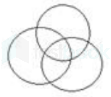
Select the Venn diagram that best represents the relationship between the following classes.

Parent, Teacher, Female.

  1. AOption (a)

  2. BOption (b)

  3. COption (c)

  4. DOption (d)

View answer & explanation

Correct answer

Answer: (d)D.

Why this answer is correct

The diagram that best represents the relationship between Parent, Teacher, and Female is shown below :

A teacher can be both a parent and female.

A Parent can be both teacher and female.

A female can be both teacher and parent.

Hence, "Option 4" is the correct answer.

Question 38

The value of 24 + 13 - 5 × 12\frac{1}{2} × 10 - {45 ÷ (17 - 2)} is:

  1. AOption (a)

    -7

  2. BOption (b)

    11

  3. COption (c)

    18

  4. DOption (d)

    9

View answer & explanation

Correct answer

Answer: (d)D.

9

Why this answer is correct

Given:

Expression: 24 + 13 - 5 × 12\frac{1}{2} × 10 - 45 ÷ (17 - 2)

Formula Used:

Follow the BODMAS rule (Bracket, Order, Division, Multiplication, Addition, Subtraction) for solving the expression.

Calculation:

First, solve the expression inside the brackets:

17 - 2 = 15

Now the expression becomes: 24 + 13 - 5 × 12\frac{1}{2} × 10 - 45 ÷ 15

Next, solve multiplication and division from left to right:

5 × 12\frac{1}{2} = 2.5

2.5 × 10 = 25

45 ÷ 15 = 3

Now, the expression becomes: 24 + 13 - 25 - 3

Finally, solve addition and subtraction from left to right:

24 + 13 = 37

37 - 25 = 12

12 - 3 = 9

The value of the expression is 9.

Question 39

What is the folk dance of Puducherry?

  1. AOption (a)

    Kapalik

  2. BOption (b)

    Karga

  3. COption (c)

    Garadi

  4. DOption (d)

    Sattariya

View answer & explanation

Correct answer

Answer: (c)C.

Garadi

Why this answer is correct

The correct answer is Garadi

Key Points

  • Garadi dance is the most popular folk dance in the Puducherry union territory of India.
  • The Garadi dance is related to the Hindu epic Ramayana, this dance is performed at Villanur Temple in Puducherry.
  • The dance is often accompanied by singing and drumming, and it is typically performed to invoke blessings from the gods.
  • The dance is usually performed for five to eight hours.
  • Dancers wear vanar masks, carry sticks, and wear ten iron rings called anjali on each leg.

Additional Information

  • Kapalik:
  • Kapalik is a form of the Pandvani dance, a traditional folk dance of Chhattisgarh, India.
  • Kapalik is characterized by men performing and singing episodes from the Mahabharata to an audience.
  • Sattriya: 
  • Sattriya is a classical Indian dance form that originated in the Vaishnavite monasteries of Assam, India.
  • It is known for its religious significance, graceful movements, intricate footwork, and expressive hand gestures.
  • The dance was created in the 15th century by Mahapurusha Sankaradeva, a Vaishnava saint and reformer, as a way to spread the Vaishnava faith.
  • Karga:​
  • Karaga is one of the oldest and widely celebrated festivals of Indian State Karnataka.
  • Karaga is the festival of the Thigala community which celebrated in the first month of the Hindu lunar calendar.
  • Karaga is a folk dance form of Karnataka, which is dedicated to the goddess Draupadi.
  • This annual festival celebrates the feminine power.

Question 40

Four words have been given, out of which three are alike in some manner and one is different. Select the odd one.

  1. AOption (a)

    String

  2. BOption (b)

    Drums

  3. COption (c)

    Guitar

  4. DOption (d)

    Trumpet

View answer & explanation

Correct answer

Answer: (a)A.

String

Why this answer is correct

The logic followed here is:

StringPart of a musical instrument
DrumsMusical instrument
GuitarMusical instrument
TrumpetMusical instrument


Drums, Guitar, Trumpet are all musical instruments,

Whereas,

String is just a part of a musical instrument.

Hence, the correct answer is String.

Question 41

Where is the headquarters of United Nations System Staff College located?

  1. AOption (a)

    Berlin

  2. BOption (b)

    Turin

  3. COption (c)

    London

  4. DOption (d)

    Washington

View answer & explanation

Correct answer

Answer: (b)B.

Turin

Why this answer is correct

The correct answer is Turin

Key Points

  • The United Nations System Staff College (UNSSC) is headquartered in Turin, Italy.
  • The UNSSC provides learning and training opportunities for staff working in various UN organizations, helping them to enhance their skills and improve their effectiveness in delivering the UN's global mission.

Additional Information

  • Berlin
  • Berlin is the capital of Germany and a major international city known for its political, cultural, and economic significance. However, Berlin is not the location of the United Nations System Staff College (UNSSC).
  • The city hosts other international organizations and institutions, but the UNSSC is based in Turin, Italy, not Berlin.
  • London
  • London is the capital of the United Kingdom and is home to several international organizations and UN-related bodies, such as the UN Environment Programme (UNEP) European office and the International Maritime Organization (IMO).
  • However, it is not the headquarters of the United Nations System Staff College (UNSSC), which is located in Turin, Italy.
  • Washington, D.C.
  • Washington, D.C. is the capital of the United States and hosts several major international institutions, including the World Bank and the International Monetary Fund (IMF). However, it is not the location of the UNSSC. The UNSSC operates out of Turin, Italy, and focuses on capacity building and training for UN staff.

Question 42

What is the full form of RDRAM?

  1. AOption (a)

    Read Disc Random Access Memory

  2. BOption (b)

    Rambus Dynamic Random Access Memory

  3. COption (c)

    Removable Disc Read Access Module

  4. DOption (d)

    Read Dynamic Random Arrays Material 

View answer & explanation

Correct answer

Answer: (b)B.

Rambus Dynamic Random Access Memory

Why this answer is correct

The correct answer is Rambus Dynamic Random Access Memory

Key Points

  • RDRAM stands for Rambus Dynamic Random Access Memory.
  • It was a type of RAM (Random Access Memory) that was developed by Rambus in the 1990s and early 2000s.
  • RDRAM was known for its high bandwidth interface and fast data transfer speeds.
  • It was used in video game consoles and PCs but has since been largely replaced by newer technologies.
  • Here are some more details about RDRAM:
  • RDRAM was a serial memory bus that used the processor's memory bus timing frequency instead of the motherboard clock.
  • RDRAM was developed to replace other types of memory, such as synchronous dynamic random access memory (SDRAM).
  • RDRAM competed with DDR SDRAM but lost out on price and performance.
  • RDRAM was succeeded by Concurrent Rambus DRAM (CRDRAM) and Direct Rambus DRAM (DRDRAM).
  • DRDRAM was expected to become the standard for PC memory and graphics memory, but was no longer supported in new personal computers by around 2003.

Question 43

Select the Venn diagram that best represents the relationship between the following classes.

Table, Chair, Cupboard

  1. AOption (a)

  2. BOption (b)

  3. COption (c)

  4. DOption (d)

View answer & explanation

Correct answer

Answer: (b)B.

Why this answer is correct

The diagram that best represents the relationship between Table, Chair, and Cupboard is shown below :

Table, Chair, and Cupboard are three different types of furniture.

Hence, "Option 2" is the correct answer.

Question 44

Pradhan Mantri Jan Dhan Yojana was launched on:

  1. AOption (a)

    28th Aug 2015

  2. BOption (b)

    15th​ Aug 2015

  3. COption (c)

    28th​ Aug 2014

  4. DOption (d)

    15th ​Aug 2014

View answer & explanation

Correct answer

Answer: (c)C.

28th​ Aug 2014

Why this answer is correct

The correct answer is 28th Aug 2014

Key Points

  • Pradhan Mantri Jan Dhan Yojana (PMJDY) was launched by Prime Minister Narendra Modi on 15th August 2014, as a national mission to ensure financial inclusion by providing access to financial services such as bank accounts, credit, insurance, and pension for all households in India.
  • The scheme aimed to bring unbanked citizens into the formal banking system.
  • Objectives:
  • Financial Inclusion: To bring all households under the formal financial system, ensuring they have access to banking services, including savings accounts, credit, insurance, and pensions.
  • Access to Financial Services: By providing bank accounts, the scheme ensures that everyone, especially those from the economically weaker sections, have access to basic financial services.
  • Direct Benefit Transfer (DBT): It allows for direct transfer of subsidies, welfare benefits, and government funds into the bank accounts of beneficiaries, which reduces leakages and ensures transparency.
  • Insurance and Pension: Under PMJDY, individuals are eligible for government-backed life insurance (Rupay card linked) and pension schemes, like Atal Pension Yojana.
  • Features:
  • Zero Balance Account: The accounts under PMJDY can be opened with zero balance, making it easy for even the poorest families to open a bank account.
  • Rupay Debit Card: Each account holder is provided with a Rupay debit card, enabling them to withdraw money from ATMs, make purchases, and access other banking services.
  • Overdraft Facility: After satisfactory operation of the account for six months, eligible customers can avail an overdraft facility of up to ₹10,000.
  • Financial Literacy: The scheme also focuses on spreading financial literacy among the people so they can fully benefit from the financial services available.
  • Access to Insurance: The scheme provides access to life insurance (₹30,000) and accidental insurance (₹2 lakh) through the linked Rupay card.

Question 45

Read the given statements and conclusions carefully. Assuming that the information given in the statements is true, even if it appears to be at variance with commonly known facts, decide which of the given conclusions logically follows(s) from the statements.

Statements:

  1. Some chairs are tables.
  2. All books are tables.

Conclusion:

  1. Some books are chairs.
  2. Some tables are chairs.
  1. AOption (a)

    Both conclusions 1 and 2 follow.

  2. BOption (b)

    Neither conclusion 1 and 2 follows.

  3. COption (c)

    Only conclusion 1 follow.

  4. DOption (d)

    Only conclusion 2 follow.

View answer & explanation

Correct answer

Answer: (d)D.

Only conclusion 2 follow.

Why this answer is correct

The least possible Venn diagram for the given statements is as shown below :

Conclusions:

I. Some books are chairs → Does not follow (As some chairs are tables and all books are tables. So it is possible but not definite.)

II. Some tables are chairs → Follow (As some chairs are tables. As chairs has some part common with tables, therefore it is true.)

∴ Here, Only conclusion 2 follow.

Hence, "Option 4" is the correct answer.

Question 46

What is the mean of the first five prime numbers?

  1. AOption (a)

    5.8

  2. BOption (b)

    5.5

  3. COption (c)

    5.6

  4. DOption (d)

    5.7

View answer & explanation

Correct answer

Answer: (c)C.

5.6

Why this answer is correct

Given:

The first five prime numbers are: 2, 3, 5, 7, 11.

Formula Used:

Mean = Sum of the numbers / Total count of numbers

Calculation:

Sum of the first five prime numbers = 2 + 3 + 5 + 7 + 11

Sum = 28

Total count of numbers = 5

Mean = 28 / 5

⇒ Mean = 5.6

The mean of the first five prime numbers is 5.6.

Question 47

________ was the first artificial satellite launched by the Soviet Union in 1957.

  1. AOption (a)

    Sputnik-1

  2. BOption (b)

    RISAT-1

  3. COption (c)

    Bhaskara

  4. DOption (d)

    Cartosat-2

View answer & explanation

Correct answer

Answer: (a)A.

Sputnik-1

Why this answer is correct

The correct answer is Sputnik-1

Key Points

  • Sputnik-1 was the first artificial satellite launched by the Soviet Union on October 4, 1957.
  • It marked the beginning of the Space Age and the start of the Space Race between the United States and the Soviet Union.
  • The launch of Sputnik-1 was a major milestone in space exploration and had a profound impact on science, technology, and global geopolitics.

Additional Information

  • RISAT-1: RISAT-1 is an Indian radar imaging satellite launched by the Indian Space Research Organisation (ISRO) in 2012.
  • Bhaskara: Bhaskara is the name of a series of Indian Earth observation satellites launched by ISRO in the 1970s and 1980s, but not the first artificial satellite.
  • Cartosat-2: Cartosat-2 is a satellite used for cartographic applications, launched by ISRO in 2007.

Question 48

A circle x2 + y2 = a2 passes through a point (0, 4). What is the value of a?

  1. AOption (a)

    5

  2. BOption (b)

    4

  3. COption (c)

    8

  4. DOption (d)

    6

View answer & explanation

Correct answer

Answer: (b)B.

4

Why this answer is correct

Given:

The circle equation is x2 + y2 = a2.

The circle passes through the point (0, 4).

Formula Used:

To find the radius of the circle, we use the distance formula from the center (0, 0) to the point (0, 4):

Distance = (x2+y2)( \sqrt{x^2 + y^2} )

Calculation:

Given point (0, 4), substitute x = 0 and y = 4 in the distance formula:

Distance = (02+42) ( \sqrt{0^2 + 4^2} )

Distance = 4

Thus, the radius (a) of the circle is 4.

The correct answer is option 2.

Question 49

The simple interest on a sum of money borrowed is ₹10 at the rate of 10% p.a for 10 years. How much is the sum of money borrowed?

  1. AOption (a)

    ₹1,000

  2. BOption (b)

    ₹100

  3. COption (c)

    ₹10,000

  4. DOption (d)

    ₹10

View answer & explanation

Correct answer

Answer: (d)D.

₹10

Why this answer is correct

Given:

Simple Interest (SI) = ₹10

Rate (R) = 10% p.a

Time (T) = 10 years

Formula Used:

Simple Interest (SI) = (Principal (P) × Rate (R) × Time (T)) / 100

Calculation:

Given, SI = ₹10, R = 10% p.a, T = 10 years

We need to find the Principal (P)

Using the formula:

SI = (P × R × T) / 100

⇒ 10 = (P × 10 × 10) / 100

⇒ 10 = (P × 100) / 100

⇒ 10 = P

Therefore, the sum of money borrowed is ₹10.

The correct answer is option 4.

Question 50

A group of six persons has to be formed from among the Post Graduate Teachers (PGTs) P, Q, R, S and T and Trained Graduate Teachers (TGTs) A, B, C, D and E. There are some conditions of the persons for group formation.

B will join the group only with C.

A will not join with E or Q. D will not join with R.

Which of the following groups is possible?

  1. AOption (a)

    PQRBCD

  2. BOption (b)

    PRSABE

  3. COption (c)

    RSTBCD

  4. DOption (d)

    PQSBCE

View answer & explanation

Correct answer

Answer: (d)D.

PQSBCE

Why this answer is correct

Given: A group of six persons has to be formed from among the Post Graduate Teachers (PGTs) P, Q, R, S and T and Trained Graduate Teachers (TGTs) A, B, C, D and E.

There are some conditions of the persons for group formation:

Condition I: B will join the group only with C. 

Condition II: A will not join with E or Q. 

Condition III: D will not join with R.

So, checking each option one by one:

Option 1) PQRBCD → Incorrect

Here, Condition III i.e. D will not join with R does not follow.

Option 2) PRSABE → Incorrect

Here, Condition II i.e. A will not join with E or Q does not follow.

Option 3) RSTBCD → Incorrect

Here, Condition III i.e. D will not join with R does not follow.

Option 4) PQSBCE → Correct

Here, all the conditions are followed.

Hence, "Option 4" is the correct answer.

Question 51

If the area of a square is 1225 cm2, then what will be the perimeter of the square?

  1. AOption (a)

    140 cm

  2. BOption (b)

    150 cm

  3. COption (c)

    120 cm 

  4. DOption (d)

    130 cm 

View answer & explanation

Correct answer

Answer: (a)A.

140 cm

Why this answer is correct

Given:

Area of the square = 1225 cm2

Formula Used:

Perimeter of a square = 4 × side length

Side length of square = √(Area)

Calculation:

Side length of square = √1225

⇒ Side length = 35 cm

Perimeter = 4 × 35

⇒ Perimeter = 140 cm

The perimeter of the square is 140 cm.

Question 52

The system of scientific naming Organism was introduced by:

  1. AOption (a)

    Alexis Carrel

  2. BOption (b)

    Carolus Linnaeus

  3. COption (c)

    Angel Cabrera

  4. DOption (d)

    George Caley

View answer & explanation

Correct answer

Answer: (b)B.

Carolus Linnaeus

Why this answer is correct

The correct answer is Carolus Linnaeus.

Key Points

  • Carolus Linnaeus, also known as Carl von Linné, was a Swedish botanist, physician, and zoologist.
  • He is known as the "father of modern taxonomy" for his work in categorizing and naming organisms.
  • Linnaeus developed the binomial nomenclature system, which is the formal system of naming species using two Latin names: the genus name and the species identifier.
  • His most famous work, "Systema Naturae," laid the foundation for the hierarchical classification of nature.

Additional Information

  • Scientific Naming
  • Scientific naming, also known as binomial nomenclature, is a formal system of naming species of living things by giving each a name composed of two parts.
  • The first part of the name identifies the genus to which the species belongs, while the second part identifies the species within the genus.
  • This system was developed by Carolus Linnaeus in the 18th century and is still used today.
  • For example, the scientific name for humans is "Homo sapiens," where "Homo" is the genus and "sapiens" is the species.
  • Binomial Nomenclature
  • Binomial nomenclature is the formal naming system for living organisms that uses two names: the genus name and the species name.
  • This system ensures that each species has a unique and universally accepted name.
  • The names are usually derived from Latin or Greek, and they are italicized or underlined to set them apart from common names.
  • This system helps in accurately identifying and categorizing organisms, reducing confusion caused by common names.
  • Taxonomy
  • Taxonomy is the science of classifying organisms to construct internationally shared classification systems with each organism placed into more and more inclusive groupings.
  • Modern taxonomy categorizes organisms into hierarchical groups such as Kingdom, Phylum, Class, Order, Family, Genus, and Species.
  • The goal of taxonomy is to identify and name species and to arrange species into a classification system that reflects their evolutionary relationships.
  • Taxonomists use morphological, genetic, and behavioral data to identify, describe, and classify organisms.
  • Systema Naturae
  • "Systema Naturae" is one of the major works of Carolus Linnaeus, first published in 1735.
  • In this work, Linnaeus introduced his system of binomial nomenclature.
  • The book categorized all known plants and animals into hierarchical groups based on shared physical characteristics.
  • "Systema Naturae" laid the groundwork for the modern classification of living organisms and has had a lasting impact on the field of biology.

Question 53

Select the option that is related to the third term in the same way as the second term is related to the first term.

Horse : Stable :: Rabbit : ?

  1. AOption (a)

    Burrow

  2. BOption (b)

    Palace

  3. COption (c)

    Nest

  4. DOption (d)

    Den

View answer & explanation

Correct answer

Answer: (a)A.

Burrow

Why this answer is correct

The logic followed here is:

Logic: Places where animals are kept.

Here,

Horse : Stable → Stable is a place where Horse is kept.

Similarly,

Rabbit : Burrow → Burrow is a place where Rabbit is kept.

Hence, the correct answer is "Option 1".

Question 54

Following the order of operations, the value of 81 - [20 + 7 × (30 - 3 × 9)] is:

  1. AOption (a)

    30

  2. BOption (b)

    20

  3. COption (c)

    0

  4. DOption (d)

    40

View answer & explanation

Correct answer

Answer: (d)D.

40

Why this answer is correct

Given:

Expression: 81 - [20 + 7 × (30 - 3 × 9)]

Formula Used:

Order of Operations: Parentheses, Exponents, Multiplication and Division (from left to right), Addition and Subtraction (from left to right)

Calculation:

Step by step calculation:

⇒ 81 - [20 + 7 × (30 - 3 × 9)]

First, solve the innermost parentheses:

⇒ 81 - [20 + 7 × (30 - 27)]

⇒ 81 - [20 + 7 × 3]

Next, solve the multiplication:

⇒ 81 - [20 + 21]

Then, solve the addition inside the brackets:

⇒ 81 - 41

Finally, solve the subtraction:

⇒ 40

The correct answer is option 4.

Question 55

Which of the following real numbers has the maximum value? 2,33,44\sqrt 2 ,\sqrt[3]{3},\sqrt[4]{4}  and 56\sqrt[6]{5}

  1. AOption (a)

    56\sqrt[6]{5}

  2. BOption (b)

    44\sqrt[4]{4}

  3. COption (c)

    2\sqrt 2

  4. DOption (d)

    33\sqrt[3]{3}

View answer & explanation

Correct answer

Answer: (d)D.

33\sqrt[3]{3}

Why this answer is correct

Given:

Real numbers:  2,33,44\sqrt 2 ,\sqrt[3]{3},\sqrt[4]{4}  and 56\sqrt[6]{5}

Formula Used:

Compare the values of each real number to find the maximum value.

Calculation:

Calculate each value:

(2=21/2)(\sqrt{2} = 2^{1/2})

(33=31/3)(\sqrt[3]{3} = 3^{1/3})

(44=41/4)(\sqrt[4]{4} = 4^{1/4})

(56=51/6)(\sqrt[6]{5} = 5^{1/6})

Approximate each value:

(2≈1.414)(\sqrt{2} \approx 1.414)

(33≈1.442)(\sqrt[3]{3} \approx 1.442)

(44≈1.414)(\sqrt[4]{4} \approx 1.414)

(56≈1.379)(\sqrt[6]{5} \approx 1.379)

Compare the values:

1.414, 1.442, 1.414, 1.379

The maximum value is (33)(\sqrt[3]{3}).

The correct answer is option 4.

Question 56

What is the LCM of 310\frac{3}{{10}} and 25\frac{2}{{5}} ?

  1. AOption (a)

    325\frac{3}{{25}}

  2. BOption (b)

    34\frac{3}{{4}}

  3. COption (c)

    65\frac{6}{{5}}

  4. DOption (d)

    56\frac{5}{{6}}

View answer & explanation

Correct answer

Answer: (c)C.

65\frac{6}{{5}}

Why this answer is correct

Given:

First fraction = (310)(\frac{3}{10}),

Second fraction =(25) (\frac{2}{5})

Formula Used:

LCM of fractions = (LCM of numeratorsGCD of denominators)(\frac{\text{LCM of numerators}}{\text{GCD of denominators}})

Calculation:

Numerators: 3 and 2

Denominators: 10 and 5

LCM of numerators (3 and 2) = 6

GCD of denominators (10 and 5) = 5

LCM of (310)and(25) (\frac{3}{10}) and (\frac{2}{5})

⇒ 65\frac{6}{5}

The correct answer is option 3.

Question 57

In which state can one find the Himalayan Yew?

  1. AOption (a)

    Arunachal Pradesh

  2. BOption (b)

    Uttarakhand

  3. COption (c)

    Sikkim

  4. DOption (d)

    Jammu & Kashmir

View answer & explanation

Correct answer

Answer: (a)A.

Arunachal Pradesh

Why this answer is correct

The correct answer is Arunachal Pradesh.

Key Points

  • The Himalayan Yew is a species of tree found in the Himalayan region, particularly in the state of Arunachal Pradesh.
  • This tree is known for its medicinal properties, particularly its bark and leaves, which contain taxol, a compound used in cancer treatment.
  • It is found at an altitude of 2,000 to 3,500 meters in the Himalayas.
  • The species is under threat due to over-exploitation and habitat destruction, leading to its status as an endangered species.

Additional Information

  • Himalayan Yew
  • The Himalayan Yew (Taxus wallichiana) is a coniferous tree species in the family Taxaceae.
  • It is an important medicinal plant due to its content of taxol, a compound used in chemotherapy for cancer treatment.
  • The tree has a slow growth rate and can live for hundreds of years, making conservation efforts crucial for its survival.
  • Overharvesting for medicinal purposes and habitat loss due to deforestation are major threats to the species.
  • Conservation Efforts
  • Efforts to conserve the Himalayan Yew include sustainable harvesting practices and habitat protection.
  • Various organizations and governments are working to raise awareness about the importance of conserving this species.
  • Ex-situ conservation methods, such as cultivating the tree in botanical gardens and nurseries, are also being implemented.
  • International regulations, like the Convention on International Trade in Endangered Species (CITES), help control the trade of endangered species like the Himalayan Yew.

Question 58

The word JUNCTION has been coded using 4 different codes.

Code 1: QFMXGRLM

Code 2: LYTKDUCD

Code 3: KWQGYOVV

Code 4: LWPEVKQP

Which of the following codes is used to write the word CUSTOMER as XFHGLNVI?

  1. AOption (a)

    Code 3

  2. BOption (b)

    Code 2

  3. COption (c)

    Code 4

  4. DOption (d)

    Code 1

View answer & explanation

Correct answer

Answer: (d)D.

Code 1

Why this answer is correct

The logic followed here is:

JUNCTION has been coded using 4 different codes:

Code 1: QFMXGRLM

The logic followed here is: Immediate opposite letters according to the English alphabetic series is written.

Code 2: LYTKDUCD

The logic followed here is: Even number series is added to the position value according to the English alphabetic series.

Code 3: KWQGYOVV

The logic followed here is: Increasing number series is added to the position value according to the English alphabetic series.

Code 4: LWPEVKQP

The logic followed here is: (2) is added to the position value according to the English alphabetic series.

So, to write the word CUSTOMER as XFHGLNVI:

The logic followed here is: Immediate opposite letters according to the English alphabetic series is written.

Thus, to write the word CUSTOMER as XFHGLNVI, logic of Code 1 is followed here.

Hence, "Option 4" is the correct answer.

Question 59

Which tissue is responsible for transportation of water in plants?

  1. AOption (a)

    Chloroplast

  2. BOption (b)

    Ribosome

  3. COption (c)

    Xylem

  4. DOption (d)

    Cytoplasm

View answer & explanation

Correct answer

Answer: (c)C.

Xylem

Why this answer is correct

The correct answer is Xylem.

Key Points

  • Xylem is a type of vascular tissue in plants responsible for the transportation of water and nutrients from the roots to the rest of the plant.
  • Xylem consists of various specialized cells including tracheids, vessel elements, xylem parenchyma, and xylem fibers.
  • The main function of xylem is to provide mechanical support and facilitate the upward movement of water through capillary action and transpiration pull.
  • Xylem tissues are found in all vascular plants including angiosperms, gymnosperms, and ferns, playing a critical role in plant growth and survival.

Additional Information

  • Chloroplast
  • Chloroplasts are the organelles in plant cells responsible for photosynthesis.
  • They contain the pigment chlorophyll, which captures light energy to convert carbon dioxide and water into glucose and oxygen.
  • Chloroplasts are found in the cells of the green parts of plants, mainly in leaves.
  • They play no role in the transportation of water but are crucial for the production of energy and organic molecules through photosynthesis.
  • Ribosome
  • Ribosomes are molecular machines found within all living cells, responsible for synthesizing proteins.
  • They read messenger RNA (mRNA) sequences and translate them into polypeptide chains, which are then folded into functional proteins.
  • Ribosomes can be found floating freely in the cytoplasm or attached to the endoplasmic reticulum.
  • They are not involved in water transport but are essential for cell function and growth due to their role in protein synthesis.
  • Cytoplasm
  • The cytoplasm is the jelly-like substance within the cell membrane that contains all cell organelles and cell parts.
  • It is composed mainly of water, salts, and proteins and is the site of many metabolic processes.
  • The cytoplasm provides a medium for molecular transport within the cell but does not play a direct role in the transport of water in plants.
  • It supports and suspends organelles and cellular molecules, facilitating biochemical reactions.

Question 60

In which state of India can we find the preserved Buddhist caves called 'Karla'?

  1. AOption (a)

    Maharashtra

  2. BOption (b)

    Uttar Pradesh

  3. COption (c)

    Karnataka

  4. DOption (d)

    Bihar

View answer & explanation

Correct answer

Answer: (a)A.

Maharashtra

Why this answer is correct

The correct answer is Maharashtra.

Key Points

  • The Karla Caves are a complex of ancient Buddhist Indian rock-cut caves located at Karli near Lonavala, Maharashtra.
  • These caves are among the oldest examples of rock-cut architecture in India, dating back to the 2nd century BCE.
  • The Karla Caves were an important center of Buddhism in Western India and were used as a place for prayer and meditation.
  • The caves house one of the largest Chaityagrihas (prayer halls) constructed by the Buddhists, which is adorned with intricate carvings and sculptures.

Additional Information

  • Buddhist Caves:
  • Buddhist caves are rock-cut structures created by ancient Buddhists, often used as monasteries (viharas) and prayer halls (chaityas).
  • These caves are found throughout India and are known for their intricate carvings, sculptures, and architecture.
  • They often contain stupas, which are mound-like structures containing relics, and serve as places of meditation and worship.
  • Chaityagrihas:
  • A Chaityagriha is a type of Buddhist prayer hall with a stupa at one end.
  • It was used for congregational worship and is characterized by an apsidal (semi-circular) end and a high vaulted ceiling.
  • The Karla Caves contain one of the largest and most well-preserved Chaityagrihas in India.
  • Rock-Cut Architecture:
  • Rock-cut architecture involves carving structures directly into natural rock formations.
  • This architectural style is prevalent in various ancient cultures, including Indian, Egyptian, and Nabataean.
  • In India, rock-cut architecture is prominently found in Buddhist, Hindu, and Jain cave temples.
  • Maharashtra:
  • Maharashtra is a state in western India known for its rich cultural heritage and historical significance.
  • The state is home to several important historical and archaeological sites, including the Ajanta and Ellora Caves, which are also examples of rock-cut architecture.
  • Maharashtra has been a significant center for various religions, including Buddhism, Hinduism, and Jainism.

Question 61

Which of the following was concerned with center-state relations?

  1. AOption (a)

    Thakkar Commission

  2. BOption (b)

    Sarkaria Commission

  3. COption (c)

    Srikrishna Commission

  4. DOption (d)

    Malimath Committee

View answer & explanation

Correct answer

Answer: (b)B.

Sarkaria Commission

Why this answer is correct

The correct answer is Sarkaria Commission.

Key Points

  • The Sarkaria Commission was set up in 1983 by the Government of India.
  • The primary objective of the commission was to examine and review the working of the existing arrangements between the Centre and the States in the country.
  • The commission was headed by Justice R.S. Sarkaria, a retired judge of the Supreme Court of India.
  • The commission submitted its report in 1988, which contained recommendations to improve Centre-State relations.

Additional Information

  • Thakkar Commission
  • The Thakkar Commission was set up in 1984 to investigate the assassination of Prime Minister Indira Gandhi.
  • It was headed by Justice M.P. Thakkar.
  • The commission's report highlighted the lapses in the security arrangements for Indira Gandhi.
  • Srikrishna Commission
  • The Srikrishna Commission was set up in 1993 to investigate the causes of the Bombay riots that occurred in December 1992 and January 1993.
  • It was headed by Justice B.N. Srikrishna.
  • The commission's report indicted several political leaders and police officials for their role in the riots.
  • Malimath Committee
  • The Malimath Committee was set up in 2000 to suggest reforms in the criminal justice system in India.
  • It was headed by Justice V.S. Malimath.
  • The committee's report made several recommendations to improve the efficiency and effectiveness of the criminal justice system.

Question 62

The value of (cosecθ + cotθ) × (1 - cosθ) is:

  1. AOption (a)

    secθ 

  2. BOption (b)

    cosθ 

  3. COption (c)

    cosecθ 

  4. DOption (d)

    sinθ 

View answer & explanation

Correct answer

Answer: (d)D.

sinθ 

Why this answer is correct

Given:

Expression: (cosec θ + cot θ) × (1 - cos θ)

Formula Used:

cosec θ = 1/sin θ, cot θ = cos θ/sin θ

Calculation:

We can simplify the expression step by step:

(cosec θ + cot θ) = (1/sin θ) + (cos θ/sin θ)

Factor out 1/sin θ:

= (1 + cos θ) / sin θ

Now, substitute this into the original expression:

((1 + cos θ) / sin θ) × (1 - cos θ)

Now simplify the entire expression:

⇒ (1 + cos θ) × (1 - cos θ) / sin θ

Using the identity: (1 + cos θ)(1 - cos θ) = 1 - cos² θ = sin² θ

⇒ sin² θ / sin θ

⇒ sin θ

The value of (cosec θ + cot θ) × (1 - cos θ) is sin θ.

Question 63

The fabric that became a symbol of India's freedom struggle is:

  1. AOption (a)

    Khadi

  2. BOption (b)

    Polyester

  3. COption (c)

    Wool

  4. DOption (d)

    Silk

View answer & explanation

Correct answer

Answer: (a)A.

Khadi

Why this answer is correct

The correct answer is Khadi.

Key Points

  • Khadi is a hand-spun and hand-woven cloth primarily made out of cotton, but it can also include silk and wool.
  • It became a symbol of self-reliance and resistance against British colonial rule in India under the leadership of Mahatma Gandhi.
  • Gandhi promoted Khadi as part of the Swadeshi movement, urging Indians to boycott British goods and revive Indian cottage industries.
  • Khadi is not just a piece of cloth; it represents the spirit of Indian independence, self-sufficiency, and national pride.

Additional Information

  • Swadeshi Movement:
  • Launched in 1905, the Swadeshi movement was a part of the Indian independence movement and an economic strategy aimed at removing British Empire from power and improving economic conditions in India by following the principles of swadeshi (self-sufficiency).
  • The movement involved boycotting British products and the revival of domestic products and production processes.
  • Mahatma Gandhi:
  • Mohandas Karamchand Gandhi, commonly known as Mahatma Gandhi, was an Indian lawyer, anti-colonial nationalist, and political ethicist who employed nonviolent resistance to lead the successful campaign for India's independence from British rule.
  • He introduced the concept of Satyagraha and emphasized the importance of self-reliance, simplicity, and non-violence.
  • Cottage Industry:
  • A cottage industry is a small-scale, decentralized manufacturing business often operated out of a home rather than a purpose-built facility.
  • Products and services created by cottage industries are often unique and distinctive given the fact that they are usually not mass-produced.
  • Khadi and Village Industries Commission (KVIC):
  • KVIC is a statutory body established by an Act of Parliament in 1956.
  • Its objective is to plan, promote, facilitate, organize and assist in the establishment and development of khadi and village industries in the rural areas in coordination with other agencies engaged in rural development wherever necessary.

Question 64

Four words have been given, out of which three are alike in some manner and one is different. Select the odd one.

  1. AOption (a)

    Comedy

  2. BOption (b)

    Action

  3. COption (c)

    Romance

  4. DOption (d)

    Movie

View answer & explanation

Correct answer

Answer: (d)D.

Movie

Why this answer is correct

The logic followed here is:

ComedyGenre
ActionGenre
RomanceGenre
MovieType


Comedy, Action, Romance all are genres of movies,

Whereas,

Movie is a type of entertainment that encompasses various genres.

Hence, the correct answer is "Movie".

Question 65

Which is the only Indian state to share its boundary with the state of Sikkim?

  1. AOption (a)

    Assam

  2. BOption (b)

    West Bengal

  3. COption (c)

    Mizoram

  4. DOption (d)

    Odisha

View answer & explanation

Correct answer

Answer: (b)B.

West Bengal

Why this answer is correct

The correct answer is West Bengal.

Key Points

  • Sikkim is a state in northeastern India, bordered by Bhutan, Tibet, and Nepal.
  • The only Indian state that shares its boundary with Sikkim is West Bengal.
  • West Bengal lies to the south of Sikkim and provides the primary access route to this landlocked state.
  • Sikkim is one of the smallest states in India, both in terms of area and population.

Additional Information

  • Geographical Location of Sikkim
  • Sikkim is located in the Eastern Himalayas and is known for its biodiversity, including alpine and subtropical climates.
  • It is the least populous and second smallest among the Indian states.
  • Neighboring Countries
  • Sikkim shares international borders with Bhutan to the east, Tibet to the north and northeast, and Nepal to the west.
  • Connectivity and Access
  • The main access to Sikkim is through the state of West Bengal, particularly via the town of Siliguri which acts as a gateway.
  • National Highway 10 (NH10) connects Sikkim to the rest of India through West Bengal.
  • Capital and Major Cities
  • Gangtok is the capital and the largest city of Sikkim.
  • Other notable towns include Namchi, Gyalshing, and Mangan.

Question 66

The normal systolic pressure of human blood is:

  1. AOption (a)

    110 mmHg

  2. BOption (b)

    120 mmHg

  3. COption (c)

    80 mmHg

  4. DOption (d)

    130 mmHg

View answer & explanation

Correct answer

Answer: (b)B.

120 mmHg

Why this answer is correct

The correct answer is 120 mmHg.

Key Points

  • The normal systolic blood pressure in a human adult is typically around 120 mmHg.
  • Systolic pressure is the pressure in the arteries when the heart beats and fills them with blood.
  • It is the higher of the two blood pressure measurements, the other being diastolic pressure.
  • Maintaining a systolic pressure of around 120 mmHg is important for overall cardiovascular health.

Additional Information

  • Blood Pressure Measurements:
  • Blood pressure is measured in millimeters of mercury (mmHg) and recorded with two numbers: systolic pressure over diastolic pressure (e.g., 120/80 mmHg).
  • Systolic Pressure: The first number (higher value) indicates the pressure in the arteries when the heart beats.
  • Diastolic Pressure: The second number (lower value) indicates the pressure in the arteries when the heart rests between beats.
  • Normal Ranges:
  • A normal blood pressure reading for adults is typically around 120/80 mmHg.
  • High blood pressure (hypertension) is generally defined as a reading above 140/90 mmHg.
  • Low blood pressure (hypotension) is generally defined as a reading below 90/60 mmHg.
  • Importance of Maintaining Normal Blood Pressure:
  • Maintaining a normal blood pressure is crucial for preventing heart disease, stroke, and other health issues.
  • High blood pressure can damage arteries and organs over time, leading to serious health complications.
  • Regular monitoring and a healthy lifestyle, including a balanced diet, regular exercise, and stress management, can help maintain normal blood pressure.

Question 67

Who appoints the chief justice and other judges of the Supreme Court of India?

  1. AOption (a)

    Prime Minister

  2. BOption (b)

    President 

  3. COption (c)

    Speaker

  4. DOption (d)

    Vice President

View answer & explanation

Correct answer

Answer: (b)B.

President 

Why this answer is correct

The correct answer is President.

Key Points

  • The President of India appoints the Chief Justice and other judges of the Supreme Court of India.
  • The appointment is made under Article 124 of the Indian Constitution.
  • It requires consultation with other judges of the Supreme Court and High Courts as the President may deem necessary.
  • The Chief Justice of India plays a significant role in the appointment process of other judges of the Supreme Court.

Additional Information

  • Article 124 of the Indian Constitution
  • Article 124 of the Indian Constitution deals with the establishment and constitution of the Supreme Court.
  • It states that every Judge of the Supreme Court shall be appointed by the President by warrant under his hand and seal after consultation with such judges of the Supreme Court and of the High Courts in the States as the President may deem necessary.
  • The Chief Justice of India is appointed by the President after consultation with such judges of the Supreme Court and High Courts as the President may deem necessary.
  • Other judges of the Supreme Court are appointed by the President after consultation with the Chief Justice of India and such other judges of the Supreme Court and High Courts as the President may deem necessary.
  • Role of Chief Justice of India (CJI)
  • The Chief Justice of India (CJI) is the head of the judiciary system in India and the Supreme Court.
  • The CJI advises the President on the appointment of other judges to the Supreme Court.
  • The CJI is also responsible for the allocation of cases and the appointment of constitutional benches that deal with important matters of law.
  • The CJI's role is crucial in maintaining the independence and integrity of the judiciary.
  • Consultative Process
  • The President of India consults with senior judges of the Supreme Court and High Courts before making appointments.
  • This consultative process ensures that the appointments are made based on merit and the experience of the judges.
  • The process is designed to maintain the independence of the judiciary and to prevent any undue influence from the executive branch of the government.

Question 68

Select the Venn diagram that best represents the relationship between the following classes.

Mammals, Amphibians, Blue Whale.

  1. AOption (a)

  2. BOption (b)

  3. COption (c)

  4. DOption (d)

View answer & explanation

Correct answer

Answer: (c)C.

Why this answer is correct

The diagram that best represents the relationship between Mammals, Amphibians, and Blue Whale is shown below :

Blue Whale is a subset of Mammals.

Mammals and Amphibians are two different sets.

Hence, "Option 3" is the correct answer.

Question 69

What is a Visual Display Unit (VDU)?

  1. AOption (a)

    Monitor

  2. BOption (b)

    Storage unit

  3. COption (c)

    System memory

  4. DOption (d)

    Server

View answer & explanation

Correct answer

Answer: (a)A.

Monitor

Why this answer is correct

The correct answer is Monitor.

Key Points

  • A Visual Display Unit (VDU) is commonly referred to as a monitor or screen.
  • It is an output device that displays images generated by the computer's video adapter.
  • VDUs are crucial for providing visual feedback to the user, allowing interaction with the computer system.
  • Modern monitors use technologies like LCD, LED, and OLED to provide clear and vivid displays.

Additional Information

  • Monitor (VDU)
  • A monitor is an electronic visual display for computers.
  • The monitor comprises the display device, circuitry, and an enclosure.
  • Most modern monitors use Liquid Crystal Display (LCD) technology, while older ones used Cathode Ray Tube (CRT) technology.
  • The display resolution, refresh rate, and size are key factors that determine the quality of the monitor.
  • Storage Unit
  • A storage unit in a computer refers to any hardware device used for storing, porting, and extracting data files and objects.
  • Examples include hard drives, SSDs, USB flash drives, and optical drives.
  • Storage units can be internal (inside the computer) or external (outside the computer).
  • System Memory
  • System memory, or RAM (Random Access Memory), is a type of computer memory that can be accessed randomly.
  • It is used to store the operating system, application programs, and currently processed data so that they can be quickly reached by the computer’s processor.
  • RAM is volatile memory, meaning it loses all stored information when the power is turned off.
  • Server
  • A server is a computer program or device that provides functionality for other programs or devices, called clients.
  • This architecture is called the client-server model, and a single server can serve multiple clients.
  • Servers can provide various functionalities, like sharing data, resources, or computing power.
  • Common types of servers include web servers, database servers, and file servers.

Question 70

The Murlen National Park is located in which state?

  1. AOption (a)

    Himachal Pradesh

  2. BOption (b)

    Jharkhand

  3. COption (c)

    Mizoram

  4. DOption (d)

    Telangana

View answer & explanation

Correct answer

Answer: (c)C.

Mizoram

Why this answer is correct

The correct answer is Mizoram.

Key Points

  • Murlen National Park is one of the significant national parks located in the state of Mizoram in India.
  • The park is situated in the Champhai district near the Indo-Myanmar border and covers an area of approximately 100 square kilometers.
  • It is known for its rich biodiversity, home to a variety of flora and fauna including several endangered species.
  • The park also features diverse landscapes including dense forests, cliffs, and caves, making it a popular destination for nature enthusiasts and researchers.

Additional Information

  • National Parks in India:
  • National parks are protected areas established by the government to conserve wildlife and preserve the natural environment.
  • India has over 100 national parks that cover a wide range of ecosystems including forests, wetlands, grasslands, and deserts.
  • These parks play a crucial role in the conservation of biodiversity, providing habitat for numerous species of plants, animals, and birds.
  • Famous national parks in India include Jim Corbett National Park, Kaziranga National Park, and Ranthambore National Park, among others.
  • Biodiversity in Mizoram:
  • Mizoram is known for its rich biodiversity due to its varied topography and climatic conditions.
  • The state is part of the Indo-Burma biodiversity hotspot, one of the most biologically rich regions in the world.
  • It is home to several species of mammals, birds, reptiles, and plants, some of which are endemic to the region.
  • Efforts are continuously made to protect and conserve the natural habitats in Mizoram to sustain its unique biodiversity.

Question 71

Name the river on which the Indira Sagar Dam is built.

  1. AOption (a)

    Yamuna

  2. BOption (b)

    Kaveri

  3. COption (c)

    Ganges

  4. DOption (d)

    Narmada

View answer & explanation

Correct answer

Answer: (d)D.

Narmada

Why this answer is correct

The correct answer is Narmada.

Key Points

  • The Indira Sagar Dam is built on the Narmada River, which is one of the major rivers in central India.
  • The Narmada River is also known as the "Life Line of Madhya Pradesh" due to its huge contribution to the state.
  • Indira Sagar Dam is one of the largest dams in India in terms of water storage capacity.
  • The dam was constructed as a part of the Narmada Valley Development Project, aiming to harness the water resources of the Narmada River for irrigation, power generation, and water supply.

Additional Information

  • Indira Sagar Dam
  • It is a multipurpose project with the primary objective of irrigation and power generation.
  • The dam is located in the Khandwa district of Madhya Pradesh.
  • It has a height of 92 meters and a length of 653 meters.
  • The reservoir created by the dam has a gross storage capacity of 12.22 billion cubic meters.
  • The hydroelectric power plant associated with the dam has an installed capacity of 1000 MW.
  • Narmada River
  • The Narmada River is the fifth largest river in the Indian subcontinent.
  • It flows westward over a length of 1,312 kilometers, originating from the Amarkantak plateau in the state of Madhya Pradesh.
  • The river basin covers an area of 98,796 square kilometers.
  • The Narmada River flows through the states of Madhya Pradesh, Maharashtra, and Gujarat before draining into the Arabian Sea.
  • It is one of the major water sources for agriculture and other uses in central India.
  • Narmada Valley Development Project
  • This project aims at the comprehensive development of the Narmada River basin.
  • It includes the construction of several dams and reservoirs, including the Sardar Sarovar Dam and the Indira Sagar Dam.
  • The project is intended to provide water for irrigation, drinking, and industrial purposes, as well as to generate hydroelectric power.
  • It is one of the largest river valley development projects in India.

Question 72

The third proportional to 4 and 9 is:

  1. AOption (a)

    36

  2. BOption (b)

    16

  3. COption (c)

    81

  4. DOption (d)

    201420\frac{1}{4}

View answer & explanation

Correct answer

Answer: (d)D.

201420\frac{1}{4}

Why this answer is correct

Given:

The two numbers are 4 and 9.

Formula Used:

If a:b = b:c, then c is the third proportional to a and b.

Calculation:

Let the third proportional to 4 and 9 be x.

According to the formula, 4:9 = 9:x

⇒ 4/9 = 9/x

⇒ x = (9 × 9) / 4

⇒ x = 81 / 4

⇒ x = 20.25

The third proportional to 4 and 9 is 20.25 or 201420\frac{1}{4}

Question 73

_______ is the largest producer of crude oil and natural gas in India.

  1. AOption (a)

    NTPC

  2. BOption (b)

    SAIL

  3. COption (c)

    BHEL

  4. DOption (d)

    ONGC

View answer & explanation

Correct answer

Answer: (d)D.

ONGC

Why this answer is correct

The correct answer is ONGC (Oil and Natural Gas Corporation).

Key Points

  • ONGC is the largest crude oil and natural gas company in India, contributing around 71% to Indian domestic production.
  • It was founded on 14 August 1956 by the Government of India, which currently holds a majority stake in the company.
  • ONGC operates more than 11,000 kilometers of pipelines in India, which is perhaps the largest in the country.
  • The company produces about 1.26 million barrels of oil equivalent per day, making it one of the world's top oil and gas exploration and production companies.

Additional Information

  • Crude Oil:
  • Crude oil is a naturally occurring, unrefined petroleum product composed of hydrocarbon deposits and other organic materials.
  • It can be refined to produce usable products such as gasoline, diesel, and various forms of petrochemicals.
  • Crude oil is a critical energy source and a major factor in the global economy.
  • Natural Gas:
  • Natural gas is a fossil fuel formed from the remains of plants and animals buried deep in the earth for millions of years.
  • It is used as a source of energy for heating, cooking, and electricity generation, as well as a fuel for vehicles and as a chemical feedstock in the manufacture of plastics and other commercially important organic chemicals.
  • Natural gas is considered a cleaner alternative to other fossil fuels such as coal and oil.
  • ONGC (Oil and Natural Gas Corporation):
  • ONGC was established by the Government of India in 1956 and has since grown to become the largest oil and gas exploration and production company in India.
  • The company is involved in exploring for and exploiting hydrocarbons in 26 sedimentary basins of India.
  • ONGC also operates the largest number of drilling rigs in India and has significant operations in offshore oil fields.
  • As a Public Sector Undertaking (PSU), ONGC plays a crucial role in the energy security of India.

Question 74

Find the value of n in the given equation.

271.5 × 91.25 ÷ 35 = 3n

  1. AOption (a)

    2

  2. BOption (b)

    4

  3. COption (c)

    9

  4. DOption (d)

    6

View answer & explanation

Correct answer

Answer: (a)A.

2

Why this answer is correct

Given:

271.5 × 91.25 ÷ 35 = 3n

Formula Used:

We can express 27 and 9 as powers of 3:

27 = 33, and 9 = 32.

Calculation:

271.5 = (33)1.5 = 34.5

91.25 = (32)1.25 = 32.5

Now, substitute these values in the original equation:

34.5 × 32.5 ÷ 35 = 3n

Using the laws of exponents:

34.5 + 2.5 - 5 = 3n

⇒ 32 = 3n

Therefore, n = 2.

The value of n is 2.

Question 75

The perimeter of a square and circumference a circle are the same. What is the area of the square to that of the circle?

  1. AOption (a)

    4 : π 

  2. BOption (b)

    2 : π 

  3. COption (c)

    π : 4 

  4. DOption (d)

    π : 2

View answer & explanation

Correct answer

Answer: (c)C.

π : 4 

Why this answer is correct

Given:

The perimeter of a square and the circumference of a circle are the same.

Formula Used:

Perimeter of a square = 4a

Circumference of a circle = 2πr

Area of a square = a2

Area of a circle = πr2

Calculation:

Given 4a = 2πr

⇒ a = (πr / 2)

Area of square = a2

⇒ Area of square = (πr / 2)2

⇒ Area of square = (π2r2 / 4)

Area of circle = πr2

Ratio of the area of the square to that of the circle = (π2r2 / 4) / πr2

⇒ Ratio = (π2 / 4) / π

⇒ Ratio = π / 4

The correct answer is option 3.

Question 76

The difference between the compound and the simple interests on a certain sum of money for two years, at 5% per annum, is ₹1. The sum is:

  1. AOption (a)

    ₹500

  2. BOption (b)

    ₹450

  3. COption (c)

    ₹550

  4. DOption (d)

    ₹400

View answer & explanation

Correct answer

Answer: (d)D.

₹400

Why this answer is correct

Given:

The difference between the compound and simple interests on a certain sum of money for two years, at 5% per annum, is ₹1.

Formula Used:

Compound Interest (CI) for 2 years = P(1 + R/100)2 - P

Simple Interest (SI) for 2 years = P × R × T / 100

Difference between CI and SI for 2 years = P(R/100)2

Calculation:

Let the principal sum be P.

Given: R = 5%, T = 2 years, Difference between CI and SI = ₹1

Using the difference formula:

Difference = P(5/100)2

₹1 = P(5/100) × (5/100)

₹1 = P × 25 / 10000

₹1 = P × 0.0025

⇒ P = 1 / 0.0025

⇒ P = 400

The sum is ₹400.

Question 77

A and B both working together can finish a task in 10 days. B and C both working together can finish the same task in 15 days. A and C both working together can finish the task in 20 days. In how many days can A, B and C, working together finish this task?

  1. AOption (a)

    93139\frac{3}{{13}} days

  2. BOption (b)

    92139\frac{2}{{13}} days

  3. COption (c)

    94139\frac{4}{{13}} days

  4. DOption (d)

    91139\frac{1}{{13}} days

View answer & explanation

Correct answer

Answer: (a)A.

93139\frac{3}{{13}} days

Why this answer is correct

Given:

A and B both working together can finish a task in 10 days.

B and C both working together can finish the same task in 15 days.

A and C both working together can finish the task in 20 days.

Formula Used:

Work done by (A + B) in one day = 1/10

Work done by (B + C) in one day = 1/15

Work done by (A + C) in one day = 1/20

Work done by (A + B + C) in one day = (Work done by (A + B) + Work done by (B + C) + Work done by (A + C)) / 2

Calculation:

Work done by (A + B) in one day = 1/10

Work done by (B + C) in one day = 1/15

Work done by (A + C) in one day = 1/20

⇒ Work done by (A + B + C) in one day = (1/10 + 1/15 + 1/20) / 2

⇒ Work done by (A + B + C) in one day = (6/60 + 4/60 + 3/60) / 2

⇒ Work done by (A + B + C) in one day = (13/60) / 2

⇒ Work done by (A + B + C) in one day = 13/120

⇒ Number of days required for A, B, and C to complete the task = 120/13

⇒ Number of days required for A, B, and C to complete the task = 9(3)/13 days

The correct answer is option 1.

Question 78

Which two places are connected by National Waterway-2?

  1. AOption (a)

    Sadiya and Dhubri

  2. BOption (b)

    Kottapuram and Kollam

  3. COption (c)

    Mandavi and Zuari

  4. DOption (d)

    Prayagraj and Haldia

View answer & explanation

Correct answer

Answer: (a)A.

Sadiya and Dhubri

Why this answer is correct

The correct answer is Sadiya and Dhubri.

Key Points

  • National Waterway-2 (NW-2) is a section of the Brahmaputra River.
  • It runs from Sadiya in the Tinsukia district to Dhubri in Assam.
  • The total length of NW-2 is approximately 891 kilometers.
  • This waterway facilitates the transportation of goods and passengers in the North Eastern region of India.

Additional Information

  • National Waterways in India:
  • National Waterways are an important part of the inland water transport system in India.
  • They are established for the purpose of shipping and navigation.
  • Inland Waterways Authority of India (IWAI) is responsible for the development and regulation of these waterways.
  • There are a total of 111 National Waterways in India, each designated by an act of Parliament.
  • Brahmaputra River:
  • The Brahmaputra River is one of the major rivers in Asia, flowing through Tibet, India, and Bangladesh.
  • It is known for its strong currents and seasonal floods.
  • It plays a crucial role in the irrigation and transportation systems of the regions it flows through.
  • Inland Water Transport (IWT):
  • IWT is a cost-effective and environmentally friendly mode of transport.
  • It reduces traffic congestion on roadways and railways.
  • India's vast network of rivers, canals, backwaters, and creeks offer significant potential for IWT.

Question 79

If 1x+23=12x+34\frac{1}{x} + \frac{2}{3} = \frac{1}{{2x}} + \frac{3}{4}, then the value of x is:

  1. AOption (a)

    4

  2. BOption (b)

    8

  3. COption (c)

    6

  4. DOption (d)

    2

View answer & explanation

Correct answer

Answer: (c)C.

6

Why this answer is correct

Given:

1x+23=12x+34\frac{1}{x} + \frac{2}{3} = \frac{1}{{2x}} + \frac{3}{4}

Formula Used:

To solve for x, we first eliminate the fractions by finding the LCM of the denominators.

Calculation:

(1x+23=12x+34)(\frac{1}{x} + \frac{2}{3} = \frac{1}{{2x}} + \frac{3}{4})

⇒ Multiply both sides by 12x to eliminate denominators:

12x × (1x+23)=12x×(12x+34)(\frac{1}{x} + \frac{2}{3}) = 12x × (\frac{1}{{2x}} + \frac{3}{4})

⇒ 12 + 8x = 6 + 9x

⇒ 12 - 6 = 9x - 8x

⇒ 6 = x

The value of x is 6.

Question 80

The product of two numbers is 270. If their LCM is 90, then their HCF is:

  1. AOption (a)

    5

  2. BOption (b)

    3

  3. COption (c)

    4

  4. DOption (d)

    2

View answer & explanation

Correct answer

Answer: (b)B.

3

Why this answer is correct

Given:

Product of two numbers = 270

LCM of two numbers = 90

Formula Used:

Product of two numbers = LCM × HCF

Calculation:

Let the two numbers be a and b.

According to the formula,

Product of two numbers = LCM × HCF

⇒ 270 = 90 × HCF

⇒ HCF = 270 / 90

⇒ HCF = 3

The HCF of the two numbers is 3.

Question 81

_______ is the closest star of the Earth.

  1. AOption (a)

    Altair

  2. BOption (b)

    Sun

  3. COption (c)

    Vega

  4. DOption (d)

    Moon

View answer & explanation

Correct answer

Answer: (b)B.

Sun

Why this answer is correct

The correct answer is Sun.

Key Points

  • The Sun is a star located at the center of our Solar System.
  • It is composed primarily of hydrogen and helium.
  • The Sun's gravity holds the Solar System together, keeping everything from the biggest planets to the smallest particles of debris in its orbit.
  • It provides the necessary heat and light energy that sustains life on Earth.

Additional Information

  • Altair
  • Altair is the brightest star in the constellation of Aquila and the 12th brightest star in the night sky.
  • It is approximately 16.7 light-years away from Earth.
  • Altair rotates rapidly with a speed at its equator of approximately 286 km/s.
  • It is part of the Summer Triangle asterism along with the stars Vega and Deneb.
  • Vega
  • Vega is the brightest star in the constellation of Lyra and the fifth brightest star in the night sky.
  • It is approximately 25 light-years away from Earth.
  • Vega was the first star other than the Sun to be photographed and the first to have its spectrum recorded.
  • Vega has been extensively studied by astronomers and is considered a standard reference star.
  • Moon
  • The Moon is Earth's only natural satellite and is not a star.
  • It is the fifth-largest satellite in the Solar System and the largest among planetary satellites relative to the size of the planet it orbits.
  • The Moon's gravitational influence causes the tides on Earth.
  • It is the second-brightest regularly visible celestial object in Earth's sky, after the Sun.

Question 82

Who founded the journal 'Bande Mataram' in India?

  1. AOption (a)

    Ramanand Chatterji

  2. BOption (b)

    Ganesh Shankar Vidyarthi

  3. COption (c)

    Bipin Chandra Pal

  4. DOption (d)

    Aurobindo Ghosh

View answer & explanation

Correct answer

Answer: (c)C.

Bipin Chandra Pal

Why this answer is correct

The correct answer is Bipin Chandra Pal.

Key Points

  • Bipin Chandra Pal was one of the prominent leaders of the Indian independence movement and is known as the 'Father of Revolutionary Thoughts' in India.
  • He founded the journal 'Bande Mataram' in 1906 as a part of the Swadeshi movement.
  • The journal played a significant role in propagating the ideas of nationalism and independence from British rule.
  • Bipin Chandra Pal was part of the Lal Bal Pal trio, which included Lala Lajpat Rai and Bal Gangadhar Tilak, who advocated for self-rule and were instrumental in the freedom struggle.

Additional Information

  • Ramanand Chatterji:
  • He was an Indian Bengali journalist and editor.
  • He is best known for his work with the Bengali periodicals 'Prabasi' and 'Modern Review'.
  • He played a significant role in modernizing Bengali journalism and literature.
  • Ganesh Shankar Vidyarthi:
  • He was an Indian journalist, a leader of the Indian National Congress, and an independence activist.
  • He is known for his work with the Hindi language newspaper 'Pratap'.
  • He was martyred during the communal riots in Kanpur in 1931.
  • Aurobindo Ghosh:
  • He was an Indian philosopher, yogi, guru, poet, and nationalist.
  • He was involved in the Indian freedom struggle and later became a spiritual reformer.
  • He founded the revolutionary organization 'Anushilan Samiti' and contributed to the journal 'Karmayogin'.

Question 83

What is the name of the scheme which aims to provide LED bulbs to domestic consumers at subsidized rate?

  1. AOption (a)

    'Roshan Scheme'

  2. BOption (b)

    'Ujala Scheme'

  3. COption (c)

    'Har Ghar Bijli Scheme'

  4. DOption (d)

    'Bulb Scheme'

View answer & explanation

Correct answer

Answer: (b)B.

'Ujala Scheme'

Why this answer is correct

The correct answer is Ujala Scheme.

Key Points

  • The Ujala Scheme, also known as Unnat Jyoti by Affordable LEDs for All, was launched by the Government of India in 2015.
  • This scheme aims to promote energy efficiency and reduce electricity bills through the distribution of subsidized LED bulbs to domestic consumers.
  • Under the scheme, LED bulbs are provided at a significantly lower price compared to the market rate, making them affordable for the masses.
  • The scheme is implemented by Energy Efficiency Services Limited (EESL), a public sector entity under the Ministry of Power.

Additional Information

  • Energy Efficiency Services Limited (EESL)
  • EESL is a joint venture of four public sector enterprises—NTPC Limited, PFC, REC, and POWERGRID—under the Ministry of Power.
  • EESL aims to create market access for energy-efficient technologies at a scale, driving down costs and stimulating demand.
  • It undertakes large-scale energy efficiency projects in India, including the Ujala Scheme.
  • Benefits of LED Bulbs
  • LED bulbs are energy-efficient and consume less electricity compared to traditional incandescent and CFL bulbs.
  • They have a longer lifespan, reducing the frequency of replacements and contributing to lower maintenance costs.
  • LED bulbs provide better illumination and are environmentally friendly, as they do not contain hazardous materials like mercury.
  • Impact of Ujala Scheme
  • The Ujala Scheme has led to a significant reduction in energy consumption across the country.
  • It has helped in reducing greenhouse gas emissions and combating climate change.
  • The scheme has also contributed to energy security by reducing the dependency on conventional energy sources.
  • Other Energy Efficiency Initiatives
  • Alongside the Ujala Scheme, the Government of India has launched other initiatives like the National LED Street Lighting Programme and the National Mission for Enhanced Energy Efficiency.
  • These initiatives collectively aim to improve energy efficiency and promote the use of sustainable energy solutions.

Question 84

Who among the following cricketer received the Man of the Series in India-England Test series concluded in March, 2021? 

  1. AOption (a)

    Ravichandran Ashwin

  2. BOption (b)

    Rishabh Pant

  3. COption (c)

    Axar Patel

  4. DOption (d)

    Rohit Sharma

View answer & explanation

Correct answer

Answer: (a)A.

Ravichandran Ashwin

Why this answer is correct

The correct answer is Ravichandran Ashwin.

Key Points

  • Ravichandran Ashwin was awarded the Man of the Series for his exceptional performance in the India-England Test series held in March 2021.
  • He played a crucial role in both batting and bowling, significantly contributing to India's series win.
  • Ashwin scored a century and picked up 32 wickets in the series, showcasing his all-round abilities.
  • This performance further cemented Ashwin's reputation as one of the best all-rounders in modern cricket.

Additional Information

  • Man of the Series
  • The Man of the Series award is given to the player who performs exceptionally well throughout the series.
  • This award is usually decided by the match officials and is based on overall contributions in terms of both batting and bowling.
  • It is a prestigious award that recognizes consistent performance and impact on the series outcome.
  • Ravichandran Ashwin
  • Ravichandran Ashwin is an Indian international cricketer who plays for the Indian national team in Test cricket.
  • He is a right-arm off-break bowler and a right-handed batsman, making him a valuable all-rounder for the team.
  • Ashwin has achieved several milestones in his career, including being the fastest Indian bowler to reach 300 Test wickets.
  • He has been instrumental in many of India's Test victories, both at home and abroad.
  • India-England Test Series 2021
  • The India-England Test series in 2021 consisted of four Test matches.
  • India won the series 3-1, securing a place in the ICC World Test Championship final.
  • The series saw several memorable performances, including centuries and multiple five-wicket hauls.
  • It was a highly competitive series with significant contributions from players on both sides.

Question 85

The sum of the square of the first ten natural numbers is:

  1. AOption (a)

    3025

  2. BOption (b)

    5050

  3. COption (c)

    55

  4. DOption (d)

    385

View answer & explanation

Correct answer

Answer: (d)D.

385

Why this answer is correct

Given:

We need to find the sum of the squares of the first ten natural numbers.

Formula Used:

Sum of squares of the first n natural numbers = n(n+1)(2n+1)6\dfrac{n(n+1)(2n+1)}{6}

Calculation:

For the first ten natural numbers:

n = 10

Sum of squares = 10(10+1)(2×10+1)6\dfrac{10(10+1)(2 \times 10 + 1)}{6}

⇒ Sum of squares = 10×11×216\dfrac{10 \times 11 \times 21}{6}

⇒ Sum of squares = 23106\dfrac{2310}{6}

⇒ Sum of squares = 385

∴ The sum of the squares of the first ten natural numbers is 385.

Question 86

The following bar graph shows the production of electric irons (in thousand numbers) by three companies P, Q and R over 6 years (from 2013 to 2018). Answer the given question based on the bar graph.

For company Q, what is the approximate percentage increase in the production of electric irons from 2013 to 2016?

  1. AOption (a)

    60%

  2. BOption (b)

    57%

  3. COption (c)

    65%

  4. DOption (d)

    50%

View answer & explanation

Correct answer

Answer: (d)D.

50%

Why this answer is correct

Given:

Company Q's production of electric irons in:

2013: 30,000 units (30 thousand)

2016: 45,000 units (45 thousand)

Formula Used:

Percentage increase = New Value−Old ValueOld Value×100 \frac{\text{New Value} - \text{Old Value}}{\text{Old Value}} \times 100

Calculation:

Old Value (2013) = 30,000

New Value (2016) = 45,000

Percentage increase = 45,000−30,00030,000×100 \frac{45,000 - 30,000}{30,000} \times 100

⇒ Percentage increase = 15,00030,000×100 \frac{15,000}{30,000} \times 100

⇒ Percentage increase = 0.5 × 100

⇒ Percentage increase = 50%

The approximate percentage increase in the production of electric irons by company Q from 2013 to 2016 is 50%.

Question 87

The following graph given shows the profit made by a cosmetic company (in ₹ thousand) over 5 years (from 2014 to 2018). Answer the given question based on the graph.

What is the ratio of the number of years in which the profits are below average to those in which the profits are above the average?

  1. AOption (a)

    3 : 2

  2. BOption (b)

    1 : 2

  3. COption (c)

    2 : 3

  4. DOption (d)

    2 : 1

View answer & explanation

Correct answer

Answer: (a)A.

3 : 2

Why this answer is correct

Given:

The profit made by the cosmetic company in ₹ thousand over 5 years (2014 to 2018) is as follows:

2014: ₹300,000

2015: ₹320,000

2016: ₹290,000

2017: ₹300,000

2018: ₹350,000

Formula Used:

Average profit = Sum of profitsNumber of years \frac{\text{Sum of profits}}{\text{Number of years}}

Calculation:

Sum of profits = ₹300,000 + ₹320,000 + ₹290,000 + ₹300,000 + ₹350,000

Sum of profits = ₹1,560,000

Average profit = 1,560,0005 \frac{1,560,000}{5}

Average profit = ₹312,000

Now, we will determine the years with profits below and above ₹312,000:

Below average (₹312,000):

2014 (₹300,000), 2016 (₹290,000), 2017 (₹300,000)

Above average (₹312,000): 

2015 (₹320,000), , 2018 (₹350,000)

Number of years with profits below average = 3

Number of years with profits above average = 2

Ratio of years with profits below average to those above average = 32 \frac{3}{2}

The ratio of the number of years in which the profits are below average to those in which the profits are above average is 3:2.
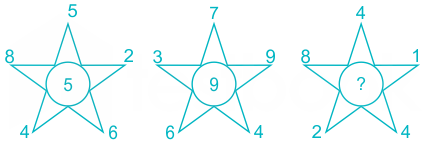
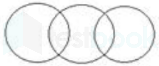
Question 88

The following line graph shows the sales of external hard disks (in thousand numbers) for five shops 1, 2, 3, 4, 5 in the years 2017 and 2018. Answer the given question based on the line graph.

Total sales for shop 1 for both the years is what percentage (approximate) of the total sales for shop 5 for both the years?

  1. AOption (a)

    123%

  2. BOption (b)

    95%

  3. COption (c)

    100%

  4. DOption (d)

    110%

View answer & explanation

Correct answer

Answer: (a)A.

123%

Why this answer is correct

Given:

Sales of external hard disks (in thousand numbers) for five shops 1, 2, 3, 4, 5 in the years 2017 and 2018 are given as:

  • Sales of shop 1 in 2017 = 70,000
  • Sales of shop 1 in 2018 = 90,000
  • Sales of shop 5 in 2017 = 55,000
  • Sales of shop 5 in 2018 = 75,000

Formula Used:

Percentage =

Calculation:

Total sales for shop 1 for both years = 70,000 + 90,000 = 160,000

Total sales for shop 5 for both years = 55,000 + 75,000 = 130,000

Percentage =

Percentage = 123.08%

The total sales for shop 1 for both the years is approximately 123.08% of the total sales for shop 5 for both the years.

Question 89

The following pie chart shows the expenditure of a country on importing various products during a particular year. Answer the given question based on the pie chart.

If the amount spent on importing only machines during the year was ₹8 crore, then what was the total amount (approximate) spent on importing all the various products in that year?

  1. AOption (a)

    ₹40 crore

  2. BOption (b)

    ₹20 crore

  3. COption (c)

    ₹30 crore

  4. DOption (d)

    ₹60 crore

View answer & explanation

Correct answer

Answer: (d)D.

₹60 crore

Why this answer is correct

Given:

The angle for the expenditure on machines is 48° and the amount spent on importing machines is ₹8 crore.

Formula Used:

We know that the angle corresponding to an expenditure is proportional to the total expenditure. The formula is:

Amount spent on machinesTotal expenditure=Angle of machine360 \frac{\text{Amount spent on machines}}{\text{Total expenditure}} = \frac{\text{Angle of machine}}{360}

Calculation:

Let the total expenditure be X.

According to the given information:

8X=48360 \frac{8}{X} = \frac{48}{360}

⇒ X=8×36048 X = \frac{8 \times 360}{48}

⇒ X=288048 X = \frac{2880}{48}

⇒ X=60 X = 60

The total amount spent on importing all the products is ₹60 crore.

Question 90

In a certain code language, AMFMAFAA is written as FMAFAAAM. Which of the given options will be code for DODADODA in that code language? 

  1. AOption (a)

    ADODADOD

  2. BOption (b)

    DADODADO

  3. COption (c)

    AODADODD

  4. DOption (d)

    DODODAAD

View answer & explanation

Correct answer

Answer: (b)B.

DADODADO

Why this answer is correct

The logic followed here is:

AMFMAFAA is written as FMAFAAAM

Similarly,

DODADODA is written as

Hence, "Option 2" is the correct answer.

Question 91

In a certain code language, OPIOIPOPPIOP is written as OIPOPPIOPOPI. How will WFKFKWKWFFWK be written as in that code language?

  1. AOption (a)

    FKWKWFFWKWFK

  2. BOption (b)

    FKWKWFWFKFWK

  3. COption (c)

    FKWWFKFWKFKW

  4. DOption (d)

    FKWFWKWFKKWF

View answer & explanation

Correct answer

Answer: (a)A.

FKWKWFFWKWFK

Why this answer is correct

The logic followed here is:

OPIOIPOPPIOP is written as OIPOPPIOPOPI

Similarly,

WFKFKWKWFFWK is written as

Hence, "Option 1" is the correct answer.

Question 92

If a cube of side 20 cm divide into smaller cubes of side 4 cm, then what is the total number of smaller cubes?

  1. AOption (a)

    27

  2. BOption (b)

    64

  3. COption (c)

    125

  4. DOption (d)

    100

View answer & explanation

Correct answer

Answer: (c)C.

125

Why this answer is correct

Given:

Side of the large cube = 20 cm

Side of the smaller cube = 4 cm

Formula Used:

Number of smaller cubes = (Side of the large cube / Side of the smaller cube)3

Calculation:

Number of smaller cubes = (20 / 4)3

Number of smaller cubes = 53

Number of smaller cubes = 5 × 5 × 5

⇒ Number of smaller cubes = 125

The total number of smaller cubes is 125.

Question 93

If '+' means 'division', '-' means 'addition', '×' means 'subtraction' and '÷' means 'multiplication', then what will be the value of the following expression?

[{(16 × 2) ÷ 2} + (4 - 3)] ÷ 1

  1. AOption (a)

    4

  2. BOption (b)

    3

  3. COption (c)

    2

  4. DOption (d)

    1

View answer & explanation

Correct answer

Answer: (a)A.

4

Why this answer is correct

Given Equation: [{(16 × 2) ÷ 2} + (4 - 3)] ÷ 1

BODMAS Rule:

Decoding the given information:

SymbolGivenActual
+division÷
-addition+
×subtraction-
÷multiplication×


Now replacing the sign from left to right using BODMAS Rule, we get:

⇒ [{(16 - 2) × 2} ÷ (4 + 3)] ÷ 1

⇒ [{14 × 2} ÷ 7] ÷ 1

⇒ [28 ÷ 7] ÷ 1

⇒ 4 ÷ 1

⇒ 4

Hence, the correct option is "Option 1".

Question 94

Of the four given equations, the first three are solved on the basis of a certain system, where the function of the shape "

" remains the same. Find the correct answer for the unsolved fourth equation on the same basis.

7

3 = 8 

4

4 = 5

6

7 = 7

a

b = ?

  1. AOption (a)

    ab(a+b)\frac{{ab}}{{(a + b)}}

  2. BOption (b)

    (a−b)ab\frac{{(a - b )}}{{ab}}

  3. COption (c)

    (ab+b)b\frac{{(ab} + b)}{{b}}

  4. DOption (d)

    (ab+b)a\frac{{(ab} + b)}{{a}}

View answer & explanation

Correct answer

Answer: (c)C.

(ab+b)b\frac{{(ab} + b)}{{b}}

Why this answer is correct

7The logic followed here is:

7

3 = 8

[(7 × 3) + 3] ÷ 3 = 8

[21 + 3] ÷ 3 = 8

24 ÷ 3 = 8

8 = 8 (LHS = RHS)

4

4 = 5

[(4 × 4) + 4] ÷ 4 = 5

[16 + 4] ÷ 4 = 5

20 ÷ 4 = 5

5 = 5 (LHS = RHS)

And,

6

7 = 7

[(6 × 7) + 7] ÷ 7 = 7

[42 + 7] ÷ 7 = 7

49 ÷ 7 = 7

7 = 7 (LHS = RHS)

Similarly,

a

b = ?

[(a × b) + b] ÷ b = ?

Hence, "Option 3" is the correct answer.

Question 95

How will you write 2.47 hours in hours, minutes and seconds?

  1. AOption (a)

    2 hours, 28 minutes, 12 seconds

  2. BOption (b)

    2 hours, 40 minutes, 7 seconds

  3. COption (c)

    2 hours, 47 minutes

  4. DOption (d)

    2 hours, 40 minutes, 47 seconds

View answer & explanation

Correct answer

Answer: (a)A.

2 hours, 28 minutes, 12 seconds

Why this answer is correct

Given : 2.47 hours

So, 2.47 hours can be written as:

2.47 hours ⇒ 2 hours + 0.47 hours

Now, Converting hours to minutes:

1 hour = 60 min

0.47 hrs = 60 × 0.47 ⇒ 28.2 min

Here, 28.2 min can be written as → 28 min + 0.2 min

Now, Converting minutes to seconds:

1 min = 60 sec

0.2 min = 60 × 0.2 ⇒ 12 sec

Thus, 2.47 hours can be written as 2 hours, 28 minutes, 12 seconds.

Hence, "Option 1" is the correct answer.

Question 96

My elder sister showed me a picture of a man in our family photo album and said that he was the only son of our grandmother, but he was not the brother of our mother. If our mother had only two children, one daughter and a son, then how am I related to the man?

  1. AOption (a)

    Son

  2. BOption (b)

    Father

  3. COption (c)

    Paternal uncle

  4. DOption (d)

    Niece

View answer & explanation

Correct answer

Answer: (a)A.

Son

Why this answer is correct

Given:

1) My elder sister showed me a picture of a man in our family photo album and said that he was the only son of our grandmother, but he was not the brother of our mother

2) Our mother had only two children, one daughter and a son.

Thus, I is man's son.

Hence, the correct answer is "Option 1"

Question 97

Without assuming anything beyond the information given, select the correct nature of relationship between the two events A and B.

Events:

A: Tabu, accidently, killed Nikhil during self-defense.

B: Nikhil was approaching Tabu to kill her.

  1. AOption (a)

    Event B is an effect but event A is not its immediate and prinicipal cause.

  2. BOption (b)

    Event A is an effect but event B is not its immediate and principal cause.

  3. COption (c)

    Event A is the immediate and principal cause and event B is its effect.

  4. DOption (d)

    Event A is the effect and event B is its immediate and principal cause.

View answer & explanation

Correct answer

Answer: (d)D.

Event A is the effect and event B is its immediate and principal cause.

Why this answer is correct

Statements:

I. Tabu, accidently, killed Nikhil during self-defense.

II. Nikhil was approaching Tabu to kill her.

Event B (Nikhil approaching Tabu to kill her) is the cause that led to Event A (Tabu accidentally killing Nikhil during self-defense).

In this situation, Tabu's action of killing Nikhil was a defensive response to Nikhil's threat of trying to kill her. Therefore, Event B, Nikhil's aggressive action, is the cause that triggered Event A, Tabu's self-defensive action.

Thus**, Event A is the effect and event B is its immediate and principal cause.**

Hence, the correct answer is "Option 4".

Question 98

Of the four given equations, the first three are solved on the basis of a certain system, where the function of the '

' remains the same. Find the correct answer for the unsolved fourth equation on the same basis.

  1. AOption (a)

    12

  2. BOption (b)

    3

  3. COption (c)

    9

  4. DOption (d)

    6

View answer & explanation

Correct answer

Answer: (d)D.

6

Why this answer is correct

The logic followed here is:

I.

(6 ÷ 2) × (2 + 1) = 9

3 × 3 = 9

9 = 9 (LHS = RHS)

II.

(4 ÷ 2) × (5 + 1) = 12

2 × 6 = 12

12 = 12 (LHS = RHS)

And,

III.

(7 ÷ 2) × (3 + 1) = 14

3.5 × 4 = 14

14 = 14 (LHS = RHS)

Similarly,

IV.

(3 ÷ 2) × (3 + 1) = ?

1.5 × 4 = ?

6 = ?

Hence, "Option 4" is the correct answer.

Question 99

Six teams DD, MI, RCB, KKR, RR and CSK are compared on the basis of the number of matches won by them in 2019. DD won more matches than RR and RCB but less matches than MI and CSK. KKR won more matches than MI but less matches than CSK.

Who won the most numbers of matches?

  1. AOption (a)

    CSK

  2. BOption (b)

    MI

  3. COption (c)

    RCB

  4. DOption (d)

    KKR

View answer & explanation

Correct answer

Answer: (a)A.

CSK

Why this answer is correct

Given: Six teams DD, MI, RCB, KKR, RR and CSK are compared on the basis of the number of matches won by them in 2019.

1) DD won more matches than RR and RCB but less matches than MI and CSK.

MI / CSK > DD > RR / RCB

2) KKR won more matches than MI but less matches than CSK.

CSK > KKR > MI > DD > RR / RCB

Thus, CSK won the most numbers of matches.

Hence, "Option 1" is the correct answer.

Question 100

Select the option that is related to the third term in the same way as the second term is related to the first term.

Napoleon : France :: Christopher Columbus : ?

  1. AOption (a)

    Portugal

  2. BOption (b)

    England

  3. COption (c)

    America

  4. DOption (d)

    Spain

View answer & explanation

Correct answer

Answer: (d)D.

Spain

Why this answer is correct

The logic followed here is:

Logic: Historical Figures and Their Associated Countries.

Here,

Napoleon : France → Napoleon was a historical figure from France.

Similarly,

Christopher Columbus : Spain → Christopher Columbus was a historical figure associated with Spain.

Hence, the correct answer is "Option 4".

100 questions in the full paper