Previous Year Paper

RRB NTPC CBT-I Official Paper (Held On: 4 Mar 2021 Shift 2) (Previous Year Paper)

Held in 2021

100 questions90 minutes
With answers
Free

Paper last updated:

Practise under exam conditions

Take this paper as a timed mock test. Review your answers after you submit.

Attempt timed test

Questions & answers

Read the paper at your pace. Open an explanation when you need it.

Question 1

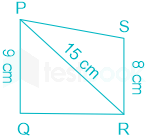
Observe the figure below and find the area of trapezium PQRS.
  1. AOption (a)

    119 cm2

  2. BOption (b)

    114 cm2

  3. COption (c)

    108 cm2

  4. DOption (d)

    102 cm2

View answer & explanation

Correct answer

Answer: (d)D.

102 cm2

Why this answer is correct

Given:

Trapezium PQRST with sides PQ = 9 cm, PR = 15 cm, RS = 8 cm.

Formula used:

Area of trapezium = ½ × (Sum of parallel sides) × Height between parallel sides

Height2 = Hypotenuse2 - Base2

Calculation:

Here, the parallel sides are PQ = 9 cm and RS = 8 cm, and

Height2 = 152 - 92

Height2 = 225 - 81 = 144

Height = √144 = 12 cm

⇒ Area = ½ × (9 + 8) × 12

⇒ Area = ½ × 17 × 12

⇒ Area = 204/2 = 102 cm²

∴ The area of the trapezium PQRS is 102 cm².
Question 2

Select the option that will come next in the following series.

2, 3, 7, 16, 32, 57, ?

  1. AOption (a)

    92

  2. BOption (b)

    107

  3. COption (c)

    93

  4. DOption (d)

    100

View answer & explanation

Correct answer

Answer: (c)C.

93

Why this answer is correct

The logic followed here is:

Hence, the correct answer is "Option 3".

Question 3

Find the arithmetic mean of 36, 53, 50, 43, 57, 50, 40, 35, 39 and 34.

  1. AOption (a)

    50

  2. BOption (b)

    52.4

  3. COption (c)

    43.7

  4. DOption (d)

    43

View answer & explanation

Correct answer

Answer: (c)C.

43.7

Why this answer is correct

Given:

Numbers: 36, 53, 50, 43, 57, 50, 40, 35, 39, 34

Formula Used:

Arithmetic mean = (Sum of all numbers) / (Total number of values)

Calculation:

Sum of numbers = 36 + 53 + 50 + 43 + 57 + 50 + 40 + 35 + 39 + 34

Sum of numbers = 437

Total number of values = 10

Arithmetic mean = 437 / 10

⇒ Arithmetic mean = 43.7

The arithmetic mean is 43.7.

Question 4

Ram eats 7 bananas in the morning, 8 in the afternoon and 3 in the evening. How many dozens of bananas does he eat in a day?

  1. AOption (a)

    215\frac{2}{15}

  2. BOption (b)

    815\frac{8}{15}

  3. COption (c)

    32\frac{3}{2}

  4. DOption (d)

    23\frac{2}{3}

View answer & explanation

Correct answer

Answer: (c)C.

32\frac{3}{2}

Why this answer is correct

Given:

Bananas eaten in the morning = 7

Bananas eaten in the afternoon = 8

Bananas eaten in the evening = 3

Formula Used:

Total bananas eaten in a day = Morning + Afternoon + Evening

Total dozens of bananas = Total bananas / 12

Calculation:

Total bananas eaten in a day = 7 + 8 + 3

⇒ Total bananas = 18

Total dozens of bananas = 18 / 12

⇒ Total dozens = 32\frac{3}{2}

The correct answer is option 3.

Question 5

Read the given statements and possible courses of action carefully and decide which of the courses of action logically follow(s) from the statement.

Statement:

If any of the faculty of sociology or social work sends his/her students to the inter-college debate, the college will definitely get some prizes.

Courses of Action:

(ⅰ) The management must make sure that either of the two faculties of sociology and social work makes his/her students participate in the debate.

(ⅱ) The management must allow only the students of faculty of sociology and social work to take part in the debate.

(ⅲ) Students from sociology or social work must be encouraged to participate in inter-collegiate debates.

  1. AOption (a)

    Only actions (ⅰ) and (ⅱ) follow.

  2. BOption (b)

    All the actions, (ⅰ), (ⅱ) and (ⅲ) follow.

  3. COption (c)

    Only action (ⅱ) follows.

  4. DOption (d)

    Only actions (ⅰ) and (ⅲ) follow.

View answer & explanation

Correct answer

Answer: (d)D.

Only actions (ⅰ) and (ⅲ) follow.

Why this answer is correct

Given:

Statement: If any of the faculty of sociology or social work sends his/her students to the inter-college debate, the college will definitely get some prizes.

Course of Action:

I. The management must make sure that either of the two faculties of sociology and social work makes his/her students participate in the debate - True (Because, this ensures that the college will win some prizes.)

II. The management must allow only the students of faculty of sociology and social work to take part in the debate - False (Because, this unnecessarily restricts participation and does not consider other potential good debaters from different faculties.)

III. Students from sociology or social work must be encouraged to participate in inter-collegiate debates - True (Because, this increases the likelihood of winning prizes.)

So, Only actions (I) and (III) follow.

Hence, the correct answer is "Option 4".

Question 6

Which of the following websites is NOT related to Education?

  1. AOption (a)
  2. BOption (b)
  3. COption (c)
  4. DOption (d)
View answer & explanation

Correct answer

Answer: (c)C.

Why this answer is correct

The correct answer is www.onlinesbi.com.

Key Points

  • www.onlinesbi.com is the official website of the State Bank of India (SBI) for online banking services.
  • The other three websites are directly related to educational resources and institutions in India.
  • State Bank of India (SBI): SBI is a multinational public sector bank in India, offering various financial services, including personal and corporate banking.
  • Online Banking: SBI's online banking platform allows users to access their accounts, make transactions, and manage financial services conveniently through the internet.

Additional Information

  • www.ignou.ac.in: This is the official website of the Indira Gandhi National Open University, offering distance learning programs.
  • www.ncert.nic.in: This site belongs to the National Council of Educational Research and Training, which publishes textbooks and educational resources for schools.
  • www.education.nic.in: This is the Ministry of Education's official website, providing information on educational policies and programs in India.
  • Indira Gandhi National Open University (IGNOU): Established in 1985, IGNOU is one of the largest open universities in the world, providing distance education across various disciplines.
  • National Council of Educational Research and Training (NCERT): Founded in 1961, NCERT focuses on improving the quality of education in schools and develops textbooks and teaching materials.
  • Ministry of Education: The Ministry oversees the implementation of educational policies, frameworks, and various programs aimed at enhancing education in India.

Question 7

Which one of the following books is NOT authored by Amartya Sen?

  1. AOption (a)

    Resources, Values, and Development

  2. BOption (b)

    On Economic Inequality

  3. COption (c)

    Poverty and Famines

  4. DOption (d)

    Poverty of India

View answer & explanation

Correct answer

Answer: (d)D.

Poverty of India

Why this answer is correct

The correct answer is Poverty of India.

Key Points

  • Poverty and Un-British Rule in India
  • Author: The book was written by Dadabhai Naoroji, who was also known as the "Grand Old Man of India".
  • Year of Publication: The book was published in 1901.
  • Focus: It criticized the economic impact of British rule on India, particularly how British policies drained India's wealth and resources.
  • Concept: The book presented the drain theory, explaining how the British exploited India's wealth over their 200-year rule.
  • Role of Dadabhai Naoroji: He was not only a Parsi scholar but also the official ambassador of India and a member of the Liberal Party of the British Parliament.

Additional Information

  • Amartya Sen
  • Profession: He is an Indian philosopher and economist known for his extensive work in welfare economics and social justice.
  • Academic Career: Amartya Sen has been teaching at Harvard University since 1987.
  • Nobel Prize: In 1998, he was awarded the Nobel Prize in Economics for his contributions to welfare economics, particularly in understanding famines and economic disparities.
  • Recommended Author: He is frequently recommended for reading on platforms like Five Books.
  • "Home in the World: A Memoir"
  • "Identity and Violence"
  • "Inequality Reexamined"
  • "Resources, Values and Development"
  • "The Idea of Justice"
  • "The Argumentative Indian"

Question 8

Find the median of 7, 14, 13, 12, 20, 11, 15 and 8.

  1. AOption (a)

    11

  2. BOption (b)

    12.5

  3. COption (c)

    11.5

  4. DOption (d)

    12

View answer & explanation

Correct answer

Answer: (b)B.

12.5

Why this answer is correct

Given:

The numbers are: 7, 14, 13, 12, 20, 11, 15, 8.

Formula Used:

To find the median of a set of numbers, arrange the numbers in ascending order and find the middle number. If there is an even number of observations, the median is the average of the two middle numbers.

Calculation:

Arrange the numbers in ascending order:

7, 8, 11, 12, 13, 14, 15, 20

Number of observations (n) = 8 (even)

Middle numbers: 12 and 13

Median = (12 + 13) / 2

⇒ Median = 25 / 2

⇒ Median = 12.5

The median is 12.5.

Question 9

A shopkeeper sold some articles at ₹77/- each and earned a profit of 40%. What would be the selling price of each article if the profit is 6%?

  1. AOption (a)

    ₹60.40

  2. BOption (b)

    ₹59.75

  3. COption (c)

    ₹62.50

  4. DOption (d)

    ₹58.30

View answer & explanation

Correct answer

Answer: (d)D.

₹58.30

Why this answer is correct

Given:

Selling price (SP) with 40% profit = ₹77

Profit percentage = 40%

New profit percentage = 6%

Formula Used:

Cost Price (CP) = SP / (1 + Profit %)

New Selling Price (New SP) = CP × (1 + New Profit %)

Calculation:

Let the Cost Price (CP) be x.

SP = CP × (1 + Profit %)

77 = x × (1 + 40/100)

77 = x × 1.40

⇒ x = 77 / 1.40

⇒ x = 55

New SP = CP × (1 + New Profit %)

New SP = 55 × (1 + 6/100)

New SP = 55 × 1.06

New SP = 58.3

The selling price of each article if the profit is 6% is ₹58.30.

Question 10

Find the L.C.M. of 45,38\frac{4}{5}, \frac{3}{8}  and 98\frac{9}{8}.

  1. AOption (a)

    36

  2. BOption (b)

    8

  3. COption (c)

    28

  4. DOption (d)

    9

View answer & explanation

Correct answer

Answer: (a)A.

36

Why this answer is correct

Given:

Three fractions: 454545454545454545

Code
          , 383838383838383838

          , 98989898989898

Formula Used:

LCM of fractions = LCM of numerators / HCF of denominators

Calculation:

Numerators: 4, 3, 9

Denominators: 5, 8, 8

Step 1: Find LCM of numerators (4, 3, 9)

Prime factorization:

4 = 22

3 = 31

9 = 32

LCM = 22 × 32

LCM = 4 × 9 = 36

Step 2: Find HCF of denominators (5, 8, 8)

Prime factorization:

5 = 51

8 = 23

HCF = 1

Step 3: Calculate LCM of fractions

LCM of fractions = LCM of numerators / HCF of denominators

⇒ LCM = 36 / 1

⇒ LCM = 36

The correct answer is option 1.

Question 11

Find the difference between the place values of 8 and 4 in the number 683479.

  1. AOption (a)

    79600

  2. BOption (b)

    80000

  3. COption (c)

    76600

  4. DOption (d)

    7

View answer & explanation

Correct answer

Answer: (a)A.

79600

Why this answer is correct

Given:

Number: 683479

Formula Used:

Place value of a digit = Digit × Position value

Calculation:

Place value of 8 in 683479:

8 is in the ten thousands place.

Place value of 8 = 8 × 104 = 80000

Place value of 4 in 683479:

4 is in the hundreds place.

Place value of 4 = 4 × 102 = 400

Difference between the place values of 8 and 4:

⇒ 80000 - 400

⇒ 79600

The correct answer is option 1.

Question 12

Insects breathe through:

  1. AOption (a)

    lungs 

  2. BOption (b)

    gills

  3. COption (c)

    spiracles

  4. DOption (d)

    skin

View answer & explanation

Correct answer

Answer: (c)C.

spiracles

Why this answer is correct

The correct answer is spiracles.

Key Points

  • Insects breathe through spiracles, which are small openings located on the sides of their bodies.
  • These spiracles lead to a network of tracheae that deliver oxygen directly to the tissues.
  • Spiracles help in the exchange of gases, allowing oxygen in and carbon dioxide out.
  • Insects do not have lungs; instead, they rely on this system of spiracles and tracheae for respiration.
  • The tracheal system is highly efficient, enabling insects to thrive in various environments.

Additional Information

  • Spiracles: These are external openings that connect to the tracheal system, facilitating gas exchange in insects.
  • Tracheal System: A network of tubes that transport oxygen directly to the cells and tissues, allowing for efficient respiration without the need for blood circulation of oxygen.
  • Lungs: Found in vertebrates, lungs are not present in insects. They use spiracles instead to breathe.
  • Gills: Aquatic organisms like fish use gills for respiration, but insects primarily rely on spiracles.
  • Skin Respiration: Some organisms can breathe through their skin, but this is not a primary method for insects.

Question 13

Which branch of Physical Geography is devoted to the study of landforms, their evolution and related processes?

  1. AOption (a)

    Climatology

  2. BOption (b)

    Soil Geography

  3. COption (c)

    Hydrology

  4. DOption (d)

    Geomorphology

View answer & explanation

Correct answer

Answer: (d)D.

Geomorphology

Why this answer is correct

The correct answer is Geomorphology.

Key Points

  • Geomorphology is the branch of Physical Geography focused on studying landforms and the processes that shape them.
  • It examines various landforms, such as mountains, valleys, plateaus, and plains, analyzing their origin, development, and classification.
  • Geomorphology investigates both external and internal processes, including erosion, weathering, tectonic activity, and sedimentation.
  • This field helps understand the relationship between landforms and human activities, as well as their impact on ecosystems.
  • Geomorphologists often use tools from geology, hydrology, and climatology to study landform evolution comprehensively.

Additional Information

  • Climatology: The study of climate and its variations over time, focusing on atmospheric conditions and their effects on the environment.
  • Soil Geography: This branch examines soil types, distribution, formation processes, and their relationship with landforms and vegetation.
  • Hydrology: The study of water in the environment, including its distribution, movement, and properties, and its influence on landforms.
  • Processes of Geomorphology: Key processes studied include:
  • Weathering: The breakdown of rocks into smaller particles.
  • Erosion: The removal and transportation of soil and rock by wind, water, or ice.
  • Deposition: The accumulation of sediment in a new location, forming new landforms.
  • Importance of Geomorphology: Understanding landforms aids in natural resource management, hazard assessment, and environmental conservation.

Question 14

What is the ratio of the L.C.M. and H.C.F. of the numbers 56 and 84?

  1. AOption (a)

    6 ∶ 1

  2. BOption (b)

    2 ∶ 3

  3. COption (c)

    7 ∶ 2

  4. DOption (d)

    3 ∶ 2

View answer & explanation

Correct answer

Answer: (a)A.

6 ∶ 1

Why this answer is correct

Given:

Numbers: 56 and 84

Formula Used:

Ratio of L.C.M. and H.C.F. = L.C.M. / H.C.F.

Calculation:

First, find the H.C.F. (Highest Common Factor) of 56 and 84.

Prime factors of 56: 23 × 7

Prime factors of 84: 22 × 3 × 7

H.C.F. = 22 × 7 = 4 × 7 = 28

Now, find the L.C.M. (Least Common Multiple) of 56 and 84.

Using prime factors: L.C.M. = 23 × 3 × 7 = 8 × 3 × 7 = 168

Ratio of L.C.M. to H.C.F.:

Ratio = L.C.M. / H.C.F.

Ratio = 168 / 28

Ratio = 6 / 1

The ratio of the L.C.M. and H.C.F. of the numbers 56 and 84 is 6 ∶ 1.

Question 15

The concept of 'sustainable development' was introduced by which one of the following reports?

  1. AOption (a)

    Rio Declaration

  2. BOption (b)

    Brundtland report

  3. COption (c)

    Johannesburg Declaration

  4. DOption (d)

    Agenda 21

View answer & explanation

Correct answer

Answer: (b)B.

Brundtland report

Why this answer is correct

The correct answer is Brundtland report.

Key Points

  • The concept of sustainable development was popularized by the Brundtland report, officially titled Our Common Future.
  • Published in 1987 by the World Commission on Environment and Development (WCED), the report emphasized the interconnection between economic growth, environmental sustainability, and social equity.
  • The report defined sustainable development as "development that meets the needs of the present without compromising the ability of future generations to meet their own needs."
  • It laid the groundwork for international environmental policies and discussions, influencing major conferences like the Earth Summit in Rio de Janeiro.
  • The Brundtland report highlighted the need for global cooperation and integrated approaches to address environmental issues and promote sustainable practices.

Additional Information

  • Rio Declaration**: Adopted in 1992 at the Earth Summit, it outlines principles for sustainable development but does not introduce the concept itself.**
  • Johannesburg Declaration**: Formulated during the World Summit on Sustainable Development in 2002, it builds upon the ideas presented in the Brundtland report but does not originate the concept.**
  • Agenda 21**: A comprehensive plan of action for sustainable development established at the Earth Summit in 1992, it is a result of the Brundtland report's influence but is not the original source of the term.**
  • World Commission on Environment and Development (WCED): Established by the United Nations in 1983, it aimed to address the growing issues of environment and development and promote sustainable practices globally.
  • Impact of the Brundtland Report**: The report has shaped international policies, development programs, and discussions on sustainability, influencing agendas in various sectors, including climate change and poverty reduction.**

Question 16

The volume of a cylinder is 5500 cm3. If its curved surface area is 4400 sq.cm, then find its height.

  1. AOption (a)

    180 cm

  2. BOption (b)

    480 cm

  3. COption (c)

    280 cm

  4. DOption (d)

    380 cm

View answer & explanation

Correct answer

Answer: (c)C.

280 cm

Why this answer is correct

Given:

Volume of the cylinder (V) = 5500 cm³

Curved Surface Area (CSA) = 4400 cm²

Formula used:

Volume of the cylinder (V) = πr²h

Curved Surface Area (CSA) = 2πrh

Calculation:

From the formula of CSA, 2πrh = 4400

⇒ 2 × 22/7 × r × h = 4400

⇒ r × h = 700 ...... (1)

From the formula of Volume, πr²h = 5500

⇒ (22/7) × r² × h = 5500

⇒ r² × h = 1750 ...... (2)

Now, divide equation (2) by equation (1):

⇒ (r² × h) ÷ (r × h) = 1750 ÷ 700

⇒ r = 2.5 cm

Substitute the value of r in equation (1):

⇒ 2.5 × h = 700

⇒ h = 700 ÷ 2.5

⇒ h = 280 cm

∴ The height of the cylinder is 280 cm.

Question 17

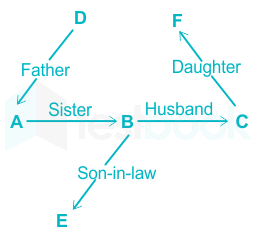
In the following relationship chart, A→B means A is the mother (or any other relationship) of B. Now using the chart, find out how is F related to E.

  1. AOption (a)

    Spouse

  2. BOption (b)

    Father

  3. COption (c)

    Daughter

  4. DOption (d)

    Sibling

View answer & explanation

Correct answer

Answer: (a)A.

Spouse

Why this answer is correct

Family Chart:

From the given diagram: we get - D is the father of A, A is the sister of B, B is the son-in-law of E, C is the daughter of F and B is the husband of C.

Then,

So, E and F are 'Spouse'.

Hence, the correct answer is "Option 1".

Question 18

What was the theme of The Financial Literacy Week 2019?

  1. AOption (a)

    Farmers

  2. BOption (b)

    Students

  3. COption (c)

    Industrialists

  4. DOption (d)

    Housewives

View answer & explanation

Correct answer

Answer: (a)A.

Farmers

Why this answer is correct

The correct answer is Farmers.

Key Points

  • The theme of The Financial Literacy Week 2019 was focused on Farmers, aimed at enhancing financial literacy among the farming community.
  • The initiative emphasized the importance of financial inclusion, enabling farmers to access banking services, credit, and insurance effectively.
  • It aimed to educate farmers about the various financial products available to them, including loans, savings accounts, and investment options.
  • The campaign also highlighted the significance of budgeting, saving, and planning for agricultural seasons and emergencies.
  • The Reserve Bank of India (RBI) organized this week as part of its ongoing efforts to promote financial literacy and empower individuals in rural areas.
  • Dates of Observation: The week was observed from June 3 to June 7. The theme of the Financial Literacy Week 2019 was Farmers.

Additional Information

  • Financial Literacy Week (FLW): An initiative by the Reserve Bank of India, FLW is observed annually to promote financial awareness and education among different segments of society.
  • Objectives of FLW: The primary objectives include increasing awareness about banking products, encouraging savings, and promoting prudent financial management practices.
  • Outreach Programs: During the week, various workshops, seminars, and outreach programs are conducted to engage farmers and other target audiences effectively.
  • Importance for Farmers: Financial literacy is crucial for farmers to manage their finances, make informed decisions regarding loans and investments, and cope with market fluctuations.
  • Previous Themes: Previous editions of Financial Literacy Week have focused on different themes, addressing the financial needs of various segments like women, youth, and small businesses.

Question 19

Provincial autonomy was prescribed under  Government of India Act of:

  1. AOption (a)

    1935

  2. BOption (b)

    1920

  3. COption (c)

    1947

  4. DOption (d)

    1937

View answer & explanation

Correct answer

Answer: (a)A.

1935

Why this answer is correct

The correct answer is 1935.

Key Points

  • The Government of India Act of 1935 is significant as it introduced the concept of provincial autonomy in British India.
  • This act provided provinces with more legislative powers, allowing them to function with greater independence in certain areas.
  • Provincial autonomy enabled provincial governments to legislate on a wider range of subjects, improving self-governance.
  • The act aimed to address the growing demands for self-rule and respond to the Indian independence movement.
  • The 1935 Act was the last major constitutional reform before India gained independence in 1947.
  • Key Features of the 1935 Act:
  • Established a federal structure with a division of powers between the Centre and provinces.
  • Introduced a system of diarchy at the provincial level, allowing elected representatives to govern.
  • Expanded the electorate and provided for separate electorates for different communities.

Additional Information

  • Government of India Act, 1919: This act introduced limited self-government but did not grant provincial autonomy as extensively as the 1935 act.
  • Government of India Act, 1937: This act was enacted under the framework established by the 1935 act, but it was not the one that initially prescribed provincial autonomy.
  • Government of India Act, 1947: This act marked the end of British rule in India and the partition of India and Pakistan, focusing more on independence than on administrative reforms.
  • Significance: The act laid the groundwork for the eventual establishment of a democratic government in India, influencing the Indian Constitution adopted in 1950.

Question 20

A and B entered into a partnership investing ₹20,000/- and ₹16,000/-, respectively. After 3 months, C joined them with an investment of ₹15,000/-. What is B's share (in ₹) if the half yearly profit is ₹4,350/-?

  1. AOption (a)

    ₹1,760

  2. BOption (b)

    ₹1,850

  3. COption (c)

    ₹2,000

  4. DOption (d)

    ₹1,600

View answer & explanation

Correct answer

Answer: (d)D.

₹1,600

Why this answer is correct

Given:

Investment by A = ₹20,000

Investment by B = ₹16,000

Investment by C after 3 months = ₹15,000

Half yearly profit = ₹4,350

Formula Used:

Profit Share = (Investment × Time) / Total Investment × Time

Calculation:

A's investment duration = 6 months

B's investment duration = 6 months

C's investment duration = 3 months

Total Investment by A = ₹20,000 × 6 = ₹120,000

Total Investment by B = ₹16,000 × 6 = ₹96,000

Total Investment by C = ₹15,000 × 3 = ₹45,000

Total Investment = ₹120,000 + ₹96,000 + ₹45,000

⇒ Total Investment = ₹261,000

B's Share = (B's Investment × Time) / Total Investment × Total Profit

⇒ B's Share = (₹96,000 / ₹261,000) × ₹4,350

⇒ B's Share = (96 / 261) × 4,350

⇒ B's Share = 1,600

The correct answer is option 4 (₹1,600).

Question 21

Find the value of 119.52−116.42(119.5−116.4)\frac{{{{119.5}^2} - {\rm{ }}{{116.4}^2}}}{{(119.5 - 116.4)}}.

  1. AOption (a)

    217.9

  2. BOption (b)

    3.1

  3. COption (c)

    235.9

  4. DOption (d)

    235.1

View answer & explanation

Correct answer

Answer: (c)C.

235.9

Why this answer is correct

Given:

Value to be calculated: 119.52−116.42119.5−116.4\frac{{119.5^2} - {116.4^2}}{{119.5 - 116.4}}

Formula Used:

Using the algebraic identity: a2−b2=(a+b)×(a−b)a^2 - b^2 = (a + b) \times (a - b)

Calculation:

Let a = 119.5 and b = 116.4

⇒ a2−b2a−b\frac{{a^2} - {b^2}}{{a - b}}

⇒ (a+b)×(a−b)a−b\frac{{(a + b) \times (a - b)}}{{a - b}}

⇒ a + b

Substituting the values:

⇒ 119.5 + 116.4

⇒ 235.9

The correct answer is option 3.

Question 22

Which of the following is an example of a thermonuclear fusion reaction?

  1. AOption (a)

    Both nuclear and hydrogen bombs

  2. BOption (b)

    Hydrogen bomb

  3. COption (c)

    Nuclear power generation

  4. DOption (d)

    Nuclear bomb

View answer & explanation

Correct answer

Answer: (b)B.

Hydrogen bomb

Why this answer is correct

The correct answer is Hydrogen bomb.

Key Points

  • A hydrogen bomb is an example of a thermonuclear fusion reaction, where hydrogen isotopes combine to form helium, releasing immense energy.
  • This type of bomb uses the energy from a primary nuclear fission explosion to initiate a secondary fusion reaction.
  • The fusion process in a hydrogen bomb occurs at extremely high temperatures, typically millions of degrees Celsius.
  • Hydrogen bombs are significantly more powerful than atomic bombs, which rely solely on nuclear fission.
  • Thermonuclear fusion reactions are harnessed for energy in stars, including the Sun, where hydrogen is converted into helium through fusion.

Additional Information

  • Thermonuclear Fusion: This is a reaction in which two light atomic nuclei combine to form a heavier nucleus, releasing energy in the process.
  • Nuclear Bomb: Also known as an atomic bomb, this device derives its explosive energy from nuclear fission reactions, not fusion.
  • Nuclear Power Generation: Involves the use of controlled nuclear fission reactions in reactors to produce energy for electricity, not fusion.
  • Both Nuclear and Hydrogen Bombs: While both can release massive energy, only the hydrogen bomb specifically utilizes thermonuclear fusion.
  • Significance of Fusion Reactions: Thermonuclear reactions have the potential to provide a nearly limitless source of energy, as seen in research efforts towards nuclear fusion as a power generation method.

Question 23

If (a + b + c) = 6, a2 + b2 + c2 = 2, then ab + bc + ca =?

  1. AOption (a)

    34

  2. BOption (b)

    36

  3. COption (c)

    4

  4. DOption (d)

    17

View answer & explanation

Correct answer

Answer: (d)D.

17

Why this answer is correct

Given:

a + b + c = 6

a2 + b2 + c2 = 2

Formula Used:

(a + b + c)2 = a2 + b2 + c2 + 2(ab + bc + ca)

Calculation:

Given: a + b + c = 6

⇒ (a + b + c)2 = 62

⇒ 36

Also given: a2 + b2 + c2 = 2

Using the formula:

⇒ 36 = 2 + 2(ab + bc + ca)

⇒ 36 - 2 = 2(ab + bc + ca)

⇒ 34 = 2(ab + bc + ca)

⇒ (ab + bc + ca) = 342\frac{34}{2}

⇒ (ab + bc + ca) = 17

The correct answer is option 4.

Question 24

Read the given statements and conclusions carefully and decide which of the conclusions logically follow(s) from the statements.

Statements:

(ⅰ) All the food recipes at ABC Restaurant have some of the spices in them that are Indian.

(ⅱ) Some American and French cuisines are also served at this restaurant.

(ⅲ) Some soft drinks and no milkshakes are served at this restaurant.

Conclusions:

(ⅰ) The American cuisines served at ABC Restaurant have an Indian-cuisine-hint in them.

(ⅱ) Indian spices are also added in the French cuisine served at ABC Restaurant.

(ⅲ) Some milkshakes and no soft drinks are served at ABC Restaurant.

  1. AOption (a)

    Only conclusion (ⅰ) follows.

  2. BOption (b)

    Only conclusion (ⅰ) and (ⅲ) follow.

  3. COption (c)

    Only conclusion (ⅰ) and (ⅱ) follow.

  4. DOption (d)

    Only conclusion (ⅲ) follows.

View answer & explanation

Correct answer

Answer: (c)C.

Only conclusion (ⅰ) and (ⅱ) follow.

Why this answer is correct

Given,

Statement:

(ⅰ) All the food recipes at ABC Restaurant have some of the spices in them that are Indian.

(ⅱ) Some American and French cuisines are also served at this restaurant.

(ⅲ) Some soft drinks and no milkshakes are served at this restaurant.

Conclusions:

(ⅰ) The American cuisines served at ABC Restaurant have an Indian-cuisine-hint in them - True (Because, statement (ⅰ) mentions that all food recipes have some Indian spices in them, which includes American cuisines).

(ⅱ) Indian spices are also added in the French cuisine served at ABC Restaurant - True (Because, statement (ⅰ) mentions that all food recipes have some Indian spices in them, which includes French cuisines).

(ⅲ) Some milkshakes and no soft drinks are served at ABC Restaurant - False (Because, statement (ⅲ) clearly states that no milkshakes are served, and some soft drinks are served).

So, Only conclusion (ⅰ) and (ⅱ) follow.

Hence, the correct answer is "Option 3".

Question 25

Banda Singh Bahadur, military commander of Khalsa army was executed in:

  1. AOption (a)

    1717

  2. BOption (b)

    1716

  3. COption (c)

    1718

  4. DOption (d)

    1715

View answer & explanation

Correct answer

Answer: (b)B.

1716

Why this answer is correct

The correct answer is 1716.

Key Points

  • Banda Singh Bahadur was a prominent military commander of the Khalsa army and played a significant role in the early 18th century Sikh history.
  • He was executed in 1716 by the Mughal authorities after being captured, marking a crucial event in the struggle against Mughal oppression.
  • His leadership and efforts in establishing Sikh rule in Punjab were pivotal in the fight for Sikh sovereignty.
  • Banda Singh Bahadur is remembered for his campaigns against the Mughal Empire and his attempts to promote social justice and equality.
  • He is a revered figure in Sikh history, symbolizing resistance against tyranny and the pursuit of justice.

Additional Information

  • Background: Banda Singh Bahadur was born as Banda Bahadur in 1670 in the region of Rajouri, now in Jammu and Kashmir, and was a follower of Guru Gobind Singh Ji.
  • Khalsa Army: Formed by Guru Gobind Singh Ji, the Khalsa army aimed to defend the rights of the oppressed and promote justice.
  • Legacy: Banda Singh Bahadur established the first Sikh state in Punjab and introduced measures for land reforms, advocating for the rights of peasants and marginalized communities.
  • Execution: His execution was carried out in a brutal manner, intended to serve as a warning to other Sikhs and as a means to suppress the growing Sikh resistance against Mughal rule.
  • Commemoration: Banda Singh Bahadur is commemorated for his sacrifices and contributions to the Sikh community, with various memorials and observances dedicated to his memory.

Question 26

Who was the revenue minister of Emperor Akbar?

  1. AOption (a)

    Abdul Fazl

  2. BOption (b)

    Nur Jahan

  3. COption (c)

    Todar Mal

  4. DOption (d)

    Wazir Khan

View answer & explanation

Correct answer

Answer: (c)C.

Todar Mal

Why this answer is correct

The correct answer is Todar Mal.

Key Points

  • Todar Mal served as the revenue minister under Emperor Akbar and played a crucial role in the administration of the Mughal Empire.
  • He is best known for his reforms in the revenue system, which helped streamline tax collection and improve agricultural productivity.
  • Todar Mal implemented a systematic method of land revenue assessment based on the produce of the land, known as the bandobast.
  • His policies contributed to the stability and prosperity of the Mughal Empire during Akbar's reign.
  • Todar Mal's revenue reforms laid the foundation for a more efficient agricultural economy and are considered a significant aspect of Akbar's administrative legacy.

Additional Information

  • Emperor Akbar: One of the greatest Mughal emperors, Akbar ruled from 1556 to 1605 and is known for his policies of religious tolerance and administrative reforms.
  • Revenue Reforms: Todar Mal introduced a standardized land revenue system, which was essential for fair taxation and reducing corruption in tax collection.
  • Impact of Reforms: The reforms implemented by Todar Mal helped increase the empire's revenue and provided stability to the agrarian economy, benefiting both the state and the farmers.
  • Other Notable Figures:
  • Abdul Fazl: A close advisor and historian, he authored the Akbarnama, documenting Akbar's reign.
  • Nur Jahan: The wife of Jahangir, she played a significant role in the politics of the Mughal court, but she was not a revenue minister during Akbar's time.
  • Wazir Khan: A lesser-known figure, often associated with administrative roles, but not specifically as revenue minister under Akbar.
  • Legacy: Todar Mal's revenue system is studied as an important aspect of Mughal administrative history and served as a model for future revenue systems in India.

Question 27

Silappadikaram, a famous Tamil epic, was composed by:

  1. AOption (a)

    Chathanar

  2. BOption (b)

    Thiruvalluvar

  3. COption (c)

    Kalidas

  4. DOption (d)

    Ilango Adigal

View answer & explanation

Correct answer

Answer: (d)D.

Ilango Adigal

Why this answer is correct

The correct answer is Ilango Adigal.

Key Points

  • Silappadikaram is one of the five great epics of Tamil literature, showcasing the rich cultural heritage of Tamil Nadu.
  • It was composed by Ilango Adigal, a renowned poet and a prince of the Chera dynasty.
  • The epic narrates the story of Kannagi, a woman who seeks justice for her husband, and highlights themes of love, morality, and social justice.
  • Silappadikaram is significant for its intricate portrayal of the lives and customs of ancient Tamils, including their arts, music, and dance.
  • The work has been influential in shaping Tamil literature and has inspired many later literary and artistic expressions.

Additional Information

  • Ilango Adigal: He is not only the author of Silappadikaram but also a key figure in Tamil literary history, believed to have lived in the 2nd century CE.
  • Structure of the Epic: Silappadikaram is divided into three parts: the story of Kannagi, the tale of Kovalan, and the ultimate fate of Kannagi, emphasizing moral lessons and societal values.
  • Other Notable Figures:
  • Chathanar: Known for composing the epic Manimekalai, another important Tamil literary work.
  • Thiruvalluvar: Celebrated for his work Tirukkural, which is a collection of couplets on ethics, politics, and love.
  • Kalidas: A revered Sanskrit poet and playwright, he is known for his works like Shakuntala and Meghaduta, but he is not associated with Tamil literature.
  • Cultural Impact: Silappadikaram has influenced not just literature but also dance and theater, with many performances inspired by its narrative and themes.
  • Historical Context: The epic reflects the socio-political conditions of its time, shedding light on the lives and struggles of women in ancient Tamil society.

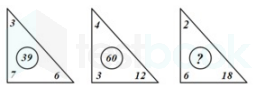
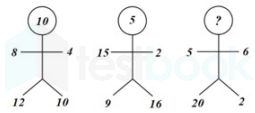
Question 28

Study the given pattern carefully and select the number that can replace the question mark (?) in it.

  1. AOption (a)

    24

  2. BOption (b)

    48

  3. COption (c)

    30

  4. DOption (d)

    26

View answer & explanation

Correct answer

Answer: (b)B.

48

Why this answer is correct

The logic followed here is: Sum of bottom numbers × top number = middle number

Figure 1: (7 + 6) × 3 = 39

Figure 2: (3 + 12) × 4 = 60

Figure 3: (6 + 18) × 2 = 48

Hence, the correct answer is "Option 2".

Question 29

If 625\sqrt {625}  ÷ x=15\sqrt {x} = \frac{1}{5} , then x =?

  1. AOption (a)

    15625

  2. BOption (b)

    125

  3. COption (c)

    3125

  4. DOption (d)

    1225

View answer & explanation

Correct answer

Answer: (a)A.

15625

Why this answer is correct

Given:

√625÷√x=15√{625} ÷ √{x} = \frac{1}{5}

Formula Used:

√625√x=15\frac{√{625}}{√{x}} = \frac{1}{5}

Calculation:

√625 = 25

25√x=15\frac{25}{√{x}} = \frac{1}{5}

Cross-multiplying:

⇒ 25 × 5 = √x

⇒ 125 = √x

Squaring both sides:

⇒ 1252 = x

⇒ 15625 = x

The correct answer is option 1, 15625.

Question 30

Select the option that is different from the rest.

  1. AOption (a)

    Radish

  2. BOption (b)

    Yam

  3. COption (c)

    Eggplant

  4. DOption (d)

    Potato

View answer & explanation

Correct answer

Answer: (c)C.

Eggplant

Why this answer is correct

The logic followed here is:

RadishRoot vegetable
YamRoot vegetable
EggplantFruit vegetable
PotatoRoot vegetable


Radish, Yam, Potato all are Root vegetables,

Whereas,

Eggplant is a Fruit vegetable.

Hence, the correct answer is "Eggplant".

Question 31

Select the option in which the words share the same relationship as that shared by the given pair of words.

Music ∶ Composer

  1. AOption (a)

    Producer ∶ Movie

  2. BOption (b)

    Director ∶ Drama

  3. COption (c)

    Song ∶ Lyricist

  4. DOption (d)

    Movie ∶ Actor

View answer & explanation

Correct answer

Answer: (c)C.

Song ∶ Lyricist

Why this answer is correct

The logic followed here is:

Logic: Creation and Creator Relationship.

Here,

Music : Composer → Composer is a person who creates Music.

Similarly,

Song : Lyricist → Lyricist is a person who creates Song.

Hence, the correct answer is "Option 3".

Question 32

Select the option that is related to the third term in the same way as the second term is related to the first term.

Shoe ∶ Lace ∶∶ Shirt ∶ ?

  1. AOption (a)

    Sleeve

  2. BOption (b)

    Buttons

  3. COption (c)

    Collar

  4. DOption (d)

    Pocket

View answer & explanation

Correct answer

Answer: (b)B.

Buttons

Why this answer is correct

The logic followed here is:

Logic: Parts of clothing and their accessories.

Here,

Shoe : Lace → Shoe is an item of clothing that requires lace as an accessory.

Similarly,

Shirt : Buttons → Shirt is an item of clothing that requires buttons as an accessory.

Hence, the correct answer is "Option 2".

Question 33

In the Constitution of India, principles of Liberty, Equality and Fraternity were borrowed from:

  1. AOption (a)

    the United States Constitution 

  2. BOption (b)

    the French Constitution

  3. COption (c)

    the British Constitution

  4. DOption (d)

    the Irish Constitution

View answer & explanation

Correct answer

Answer: (b)B.

the French Constitution

Why this answer is correct

The correct answer is the French Constitution.

Key Points

  • In the Constitution of India, the principles of Liberty, Equality, and Fraternity were borrowed from the French Constitution. Here are the key points regarding these principles:
  • Liberty: Refers to the freedom of Indian citizens to act as they choose, without oppressive restrictions.
  • Equality: Emphasizes that no group in society should have special privileges and that all individuals should have equal opportunities.
  • Fraternity: Represents a sense of brotherhood and a shared belonging among the citizens of the country.

Additional Information

  • Directive Principles of State Policy from Ireland.
  • Nomination of members to the Rajya Sabha from Ireland.
  • Method of election of a president from Ireland.

Question 34

Which one among the following is NOT a land-based ballistic missile?

  1. AOption (a)

    Prithvi

  2. BOption (b)

    Dhanush

  3. COption (c)

    Surya

  4. DOption (d)

    Agni

View answer & explanation

Correct answer

Answer: (b)B.

Dhanush

Why this answer is correct

The correct answer is Dhanush.

Key Points

  • The Dhanush ballistic missile:
  • Type: It is a short-range, ship-launched ballistic missile (ShLBM) developed by the Defence Research and Development Organisation (DRDO) of India.
  • Specifications:
  • Single-stage, liquid-fueled missile.
  • Range: Approximately 350 kilometers.
  • Payload: Can carry up to 500 kilograms.
  • Warhead: Capable of carrying either a nuclear or conventional warhead.
  • Targeting Capability: The missile can strike land and sea-based targets.
  • Variant: It is the third variant of the Prithvi missile family.
  • Launch Platforms: The Dhanush can be launched from Sukanya-class patrol vessels, specifically from Subhadra and Suvarna.
  • Development and Testing:
  • The first test launch of the Dhanush missile occurred in 2000 from a patrol vessel.
  • Since then, the missile program has conducted about seven test launches, most of which have been successful.
  • The Indian Government declared the development of the Dhanush missile complete in May 2010.
  • Operational Use: The Dhanush missile is capable of conducting ship-to-ship and ship-to-surface strikes.
  • Control: The missile system is under the control of the Strategic Forces Command, which manages all of India’s nuclear weapons and their delivery systems.

Additional Information

  • Surya is not a land-based ballistic missile; it is an intercontinental ballistic missile (ICBM) that is designed for launch from mobile platforms.
  • Prithvi is a series of short-range ballistic missiles developed by India, designed for land-based deployment.
  • Dhanush is a naval variant of the Prithvi missile, launched from ships and is also considered a land-based missile in certain configurations.
  • Ballistic Missiles: These are missiles that follow a ballistic trajectory to deliver one or more warheads to a predetermined target, primarily relying on gravity after the powered flight phase.
  • Land-based Ballistic Missiles: These missiles are launched from fixed or mobile platforms located on land, such as silos or mobile launchers, and include systems like the Prithvi and Agni missiles in India's arsenal.
  • Surya Missile: The Surya missile is still under research and development; it is expected to have the capability to reach targets across continents but is not classified as a land-based system yet.
  • Importance of Missile Systems: The development of ballistic missiles is crucial for national security and defense strategies, as they serve as a deterrent and a means of offensive capability.
  • Global Context: Many countries are investing in missile technology, leading to an arms race in terms of capabilities and strategic deterrence.

Question 35

Which of the following is NOT a source of sea energy?

  1. AOption (a)

    Wave energy 

  2. BOption (b)

    Ocean thermal energy

  3. COption (c)

    Tidal energy

  4. DOption (d)

    Solar energy

View answer & explanation

Correct answer

Answer: (d)D.

Solar energy

Why this answer is correct

The correct answer is Solar Energy.

Key Points​

  • The sun is a renewable resource that provides clean, sustainable energy to Earth.
  • More energy from the sun reaches the planet in one hour than the entire world consumes in one year.
  • Solar energy can be converted into electricity using solar photovoltaic (PV) modules.
  • PV Modules: These modules absorb sunlight and convert it into electrical current.
  • Global Availability: Solar energy is viable worldwide since the sun shines everywhere.
  • Energy Independence: Solar systems can be paired with batteries for energy storage, allowing them to operate independently from the utility grid, which is especially cost-effective for remote locations.
  • Low Maintenance: Solar modules have no moving parts, resulting in low maintenance costs, and they have a long service life, guaranteed for 25+ years.

Additional Information

  • Sea energy, also known as marine energy, is a renewable energy source derived from the ocean's natural movements and temperature differences.
  • Types: It includes various forms of energy harnessed from the ocean, such as:
  • Waves: Energy generated from the surface motion of the ocean.
  • Tides: Energy produced from the gravitational pull of the moon and sun, causing periodic rises and falls in sea levels.
  • Ocean Currents: Energy captured from the continuous flow of ocean water.
  • Temperature Differences: Energy harnessed through ocean thermal energy conversion (OTEC), which utilizes temperature gradients in ocean water.

Question 36

Which of the following sectors contribute the most to GDP in India?

  1. AOption (a)

    Tertiary sector

  2. BOption (b)

    Unorganised sector

  3. COption (c)

    Primary sector

  4. DOption (d)

    Secondary sector

View answer & explanation

Correct answer

Answer: (a)A.

Tertiary sector

Why this answer is correct

The correct answer is Tertiary sector.

Key Points

  • The tertiary sector is indeed the largest contributor to India’s GDP, as highlighted by several key points:
  • The services sector accounts for 54.72% of India's total Gross Value Added (GVA) of 267.62 lakh crore INR, which amounts to approximately 146.44 lakh crore INR in 2023-24.
  • Historical data shows a shift in sector contributions: in 1950-51, agriculture dominated with 51.81%, while services accounted for only 33.25%. By 2013-14, the share of services had increased to 57.03%, demonstrating a long-term trend of growth in this sector.

Additional Information

  • The industry sector contributes 27.62% to the GVA, with a value of 73.93 lakh crore INR, while the agriculture and allied sector has a share of 17.66%.
  • At 2011-12 prices, the composition of the sectors reflects a similar trend: services (54.61%), industry (30.87%), and agriculture & allied (14.52%), indicating a stable dominance of the tertiary sector.
  • The estimated shares for the primary (19.62%), secondary (25.66%), and tertiary sectors (54.72%) illustrate the significant role of services in the Indian economy.

Question 37

The expression (21.98 × 21.98 + 21.98x + 0.04 × 0.04) will be a perfect square if x = ?

  1. AOption (a)

    0.08

  2. BOption (b)

    0.40

  3. COption (c)

    0.02

  4. DOption (d)

    0.20

View answer & explanation

Correct answer

Answer: (a)A.

0.08

Why this answer is correct

Given:

The expression is (21.98 × 21.98 + 21.98x + 0.04 × 0.04)

Formula Used:

Expression for a perfect square: (a + b)2 = a2 + 2ab + b2

Calculation:

Identify a and b:

a = 21.98

b = 0.04

Perfect square expression: (21.98 + 0.04)2

Expand the perfect square:

(21.98 + 0.04)2 = 21.982 + 2 × 21.98 × 0.04 + 0.042

Given expression: 21.98 × 21.98 + 21.98x + 0.04 × 0.04

Match the given expression with the expanded perfect square:

21.98x should be equal to 2 × 21.98 × 0.04

⇒ 21.98x = 2 × 21.98 × 0.04

⇒ x = 2 × 0.04

⇒ x = 0.08

The correct answer is option 1.

Question 38

During the Swadeshi Movement in Bengal, a tricolour flag was designed having colours:

  1. AOption (a)

    orange, white and green

  2. BOption (b)

    red, green and white

  3. COption (c)

    red, green and yellow

  4. DOption (d)

    green, white and yellow

View answer & explanation

Correct answer

Answer: (c)C.

red, green and yellow

Why this answer is correct

The correct answer is red, green and yellow.

Key Points

  • During the Swadeshi Movement in Bengal, the flag designed was primarily composed of red, green, and yellow colors.
  • This flag symbolized the unity and aspirations of the Indian people in their struggle against British colonial rule.
  • The colors represented various aspects of the Indian society: red symbolized courage, green represented prosperity, and yellow stood for peace.
  • The Swadeshi Movement, initiated in the early 1900s, encouraged the use of indigenous goods and the boycott of British products.
  • The movement played a crucial role in awakening national consciousness and fostering unity among Indians during the struggle for independence.

Additional Information

  • Swadeshi Movement: Launched in 1905 as a reaction to the partition of Bengal by the British, it aimed to promote Indian goods and boycott British products to strengthen the Indian economy.
  • Significance of the Flag: The tricolor flag became a symbol of the nationalistic fervor and resistance against colonial rule, inspiring future movements for independence.
  • Evolution of the National Flag: The design and colors of the flag evolved over the years, ultimately leading to the adoption of the current Indian national flag in 1947, which features saffron, white, and green with a navy blue Ashoka Chakra in the center.
  • Key Figures: Prominent leaders of the Swadeshi Movement included leaders like Bal Gangadhar Tilak, Bipin Chandra Pal, and Aurobindo Ghosh, who played significant roles in advocating for self-reliance.
  • Legacy: The Swadeshi Movement laid the groundwork for future movements, fostering a sense of unity and identity among Indians that was crucial for the eventual struggle for independence.

Question 39

Select the option that is different from the rest.

  1. AOption (a)

    UF

  2. BOption (b)

    TG

  3. COption (c)

    VE

  4. DOption (d)

    QK

View answer & explanation

Correct answer

Answer: (d)D.

QK

Why this answer is correct

The logic followed here is: Both letters are opposite to each other.

Option 1) UF ⇒ Opposite letter

Option 2) TG ⇒ Opposite letter

Option 3) VE ⇒ Opposite letter

Option 4) QK ⇒ Not Opposite letters (Q ⇔ J)

So, option 4 is different from the rest.

Hence, the correct answer is "Option 4".

Question 40

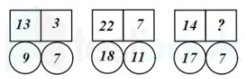
Study the given pattern carefully and select the number that can replace the question mark (?) in it.

  1. AOption (a)

    21

  2. BOption (b)

    3

  3. COption (c)

    10

  4. DOption (d)

    38

View answer & explanation

Correct answer

Answer: (c)C.

10

Why this answer is correct

The logic followed here is:

Sum of top 2 numbers = sum of bottom 2 numbers

From 1st figure;

⇒ 13 + 3 = 9 + 7

⇒ 16 = 16

From 2nd figure:

⇒ 22 + 7 = 18 + 11

⇒ 29 = 29

Similarly, from 3rd figure:

⇒ 14 + ? = 17 + 7

⇒ ? = 24 - 14 = 10

Hence, the correct answer is "Option 3".

Question 41

Right to life is guaranteed under ______ of the Constitution of India.

  1. AOption (a)

    Article 15

  2. BOption (b)

    Article 16

  3. COption (c)

    Article 14

  4. DOption (d)

    Article 21

View answer & explanation

Correct answer

Answer: (d)D.

Article 21

Why this answer is correct

The correct answer is Article 21.

Key Points

  • Article 21 of the Constitution of India guarantees the fundamental right to life and personal liberty.
  • This article states: "No person shall be deprived of his life or personal liberty except according to procedure established by law."
  • The scope of Article 21 has been expanded through various landmark judgments by the Supreme Court to include the right to a dignified life, health, and a clean environment.
  • It plays a crucial role in the protection of individual rights and has become a cornerstone of personal freedoms in India.
  • Article 21 underscores the importance of due process and legal protection in safeguarding an individual's life and liberty.

Additional Information

  • Constitution of India: Adopted on January 26, 1950, it serves as the supreme law of the land, establishing the framework for governance and protecting fundamental rights.
  • Related Articles:
  • Article 14: Guarantees the right to equality before the law and equal protection of the laws within the territory of India.
  • Article 15: Prohibits discrimination on grounds of religion, race, caste, sex, or place of birth.
  • Article 16: Provides for equality of opportunity in matters of public employment.
  • Judicial Interpretation: The Supreme Court of India has interpreted Article 21 to include various rights such as the right to privacy, the right to live with dignity, and the right to a healthy environment.
  • Significant Cases: Landmark cases like Keshavananda Bharati v. State of Kerala and Maneka Gandhi v. Union of India have played a crucial role in expanding the interpretation of Article 21.
  • Impact: Article 21 serves as a vital protection against arbitrary state action and reinforces the commitment to human rights and personal liberty in India.

Question 42

The headquarters of which of the following international organisation is situated at Washington DC?

  1. AOption (a)

    European Central Bank (ECB)

  2. BOption (b)

    Organization for Economic Cooperation and Development (OECD)

  3. COption (c)

    International Monetary Fund (IMF)

  4. DOption (d)

    International Labour Organization (ILO)

View answer & explanation

Correct answer

Answer: (c)C.

International Monetary Fund (IMF)

Why this answer is correct

The correct answer is International Monetary Fund (IMF).

Key Points

  • The International Monetary Fund (IMF) is headquartered in Washington DC.
  • The IMF was established in 1944 to promote international monetary cooperation and exchange rate stability.
  • It aims to facilitate balanced growth of international trade and provide resources to countries facing balance of payments problems.
  • The organization plays a key role in providing financial support and advice to member countries, influencing global economic policies.
  • The IMF also conducts economic surveillance and provides technical assistance to enhance the capacity of its member nations.

Additional Information

  • International Monetary Fund (IMF): A global financial institution comprising 190 member countries aimed at fostering global monetary cooperation and financial stability.
  • Key Functions:
  • Financial Assistance: Provides loans to countries facing economic difficulties, helping stabilize their economies.
  • Surveillance: Monitors the economic and financial developments of member countries, offering policy advice.
  • Capacity Development: Offers technical assistance and training to help countries implement effective economic policies.
  • Comparison with Other Organizations:
  • European Central Bank (ECB): Located in Frankfurt, Germany, responsible for monetary policy in the Eurozone.
  • Organization for Economic Cooperation and Development (OECD): Headquartered in Paris, France, focuses on promoting policies that improve the economic and social well-being of people worldwide.
  • International Labour Organization (ILO): Based in Geneva, Switzerland, it sets international labor standards and promotes social justice.
  • Governance Structure: The IMF operates under a quota system, where member countries contribute financial resources, determining their voting power within the organization.
  • Current Relevance: The IMF continues to play a crucial role in addressing global economic challenges, including crises resulting from financial instability and public health emergencies.

Question 43

What is the principal amount which earns ₹154/- as a compound interest for the second year at 10% per annum?

  1. AOption (a)

    ₹1,400.00

  2. BOption (b)

    ₹2,750.50

  3. COption (c)

    ₹1,540.00

  4. DOption (d)

    ₹1,200.00

View answer & explanation

Correct answer

Answer: (a)A.

₹1,400.00

Why this answer is correct

Given:

Compound interest for the second year (CI) = ₹154

Annual interest rate (r) = 10% per annum

Formula Used:

CI for the second year = Principal amount (P) × (1 + r)2 - Principal amount (P) × (1 + r)

Calculation:

Let the principal amount be P.

We know that:

CI for the second year = P × (1 + r)2 - P × (1 + r)

Given CI for the second year is ₹154, and r = 10% = 0.1

⇒ 154 = P × (1 + 0.1)2 - P × (1 + 0.1)

⇒ 154 = P × 1.21 - P × 1.1

⇒ 154 = P(1.21 - 1.1)

⇒ 154 = P × 0.11

⇒ P = 154 / 0.11

⇒ P = 1400

The principal amount which earns ₹154 as compound interest for the second year at 10% per annum is ₹1,400.00.

Question 44

Ram invested ₹42,000/- in the shares of a company. He sold one-third of the total shares at a profit of 10%. He sold the remaining shares at 10% loss. How much did Ram lose?

  1. AOption (a)

    ₹5,200

  2. BOption (b)

    ₹4,200

  3. COption (c)

    ₹4,000

  4. DOption (d)

    ₹1,400

View answer & explanation

Correct answer

Answer: (d)D.

₹1,400

Why this answer is correct

Given:

Ram's total investment = ₹42,000

Profit on one-third shares = 10%

Loss on remaining shares = 10%

Formula Used:

Profit or Loss = Selling Price - Cost Price

Calculation:

Let the total number of shares be 3x.

Cost Price (C.P) of one share = ₹42,000 / 3x = ₹14,000 / x

C.P of one-third shares = ₹42,000 / 3 = ₹14,000

Selling Price (S.P) of one-third shares at 10% profit:

S.P = C.P + Profit

S.P = ₹14,000 + 10% of ₹14,000

S.P = ₹14,000 + (10/100) × ₹14,000

S.P = ₹14,000 + ₹1,400

S.P = ₹15,400

C.P of remaining shares (two-thirds) = ₹42,000 - ₹14,000 = ₹28,000

S.P of remaining shares at 10% loss:

S.P = C.P - Loss

S.P = ₹28,000 - 10% of ₹28,000

S.P = ₹28,000 - (10/100) × ₹28,000

S.P = ₹28,000 - ₹2,800

S.P = ₹25,200

Total S.P = S.P of one-third shares + S.P of remaining shares

Total S.P = ₹15,400 + ₹25,200

Total S.P = ₹40,600

Ram's loss = Total C.P - Total S.P

Ram's loss = ₹42,000 - ₹40,600

Ram's loss = ₹1,400

The correct answer is option 4 (₹1,400).

Question 45

Find the smallest number that should be added to 166, so that the sum leaves a remainder of 3 on dividing by each of 4, 6, 9 and 15.

  1. AOption (a)

    17

  2. BOption (b)

    16

  3. COption (c)

    163

  4. DOption (d)

    13

View answer & explanation

Correct answer

Answer: (a)A.

17

Why this answer is correct

Given:

We need to find the smallest number that should be added to 166 such that the sum leaves a remainder of 3 when divided by 4, 6, 9, and 15.

Formula used:

We need to find the LCM of 4, 6, 9, and 15 and ensure that the number leaves a remainder of 3 when divided by each of these.

Calculation:

LCM of 4, 6, 9, and 15:

⇒ Prime factors of 4 = 2²

⇒ Prime factors of 6 = 2 × 3

⇒ Prime factors of 9 = 3²

⇒ Prime factors of 15 = 3 × 5

LCM = 2² × 3² × 5 = 180

The number should be 180k + 3 for some integer k.

Let the sum of the number and 166 be 180k + 3.

⇒ Smallest number = 180k + 3 = 180(1) + 3 = 183

⇒ Number to be added = 183 - 166 = 17

∴ The smallest number that should be added to 166 is 17.

Question 46

Deficiency of Vitamin C causes:

  1. AOption (a)

    scurvy 

  2. BOption (b)

    goiter

  3. COption (c)

    loss of vision

  4. DOption (d)

    beriberi

View answer & explanation

Correct answer

Answer: (a)A.

scurvy 

Why this answer is correct

The correct answer is scurvy.

Key Points

  • Vitamin C deficiency leads to the disease known as scurvy.
  • Scurvy is characterized by symptoms such as fatigue, weakness, swollen gums, and joint pain.
  • This deficiency occurs due to insufficient intake of fruits and vegetables, particularly citrus fruits.
  • Vitamin C is essential for the synthesis of collagen, an important protein for skin, cartilage, and bones.
  • Scurvy can be prevented and treated effectively with vitamin C supplementation or increased dietary intake of vitamin C-rich foods.

Additional Information

  • Vitamin C: Also known as ascorbic acid, it is a water-soluble vitamin that plays a vital role in many bodily functions, including antioxidant protection and immune function.
  • Symptoms of Scurvy:
  • Fatigue and Weakness: General feeling of tiredness and lack of energy.
  • Swollen Gums: Gums may become soft, swollen, and bleed easily.
  • Joint Pain: Painful joints due to weakened connective tissue.
  • Skin Issues: Bruising and poor wound healing may occur.
  • Sources of Vitamin C:
  • Citrus fruits (oranges, lemons, grapefruits)
  • Berries (strawberries, blueberries)
  • Vegetables (bell peppers, broccoli, Brussels sprouts)
  • Leafy greens (spinach, kale)
  • Other Deficiencies:
  • Goiter: Caused by iodine deficiency, leading to thyroid gland enlargement.
  • Loss of Vision: Often linked to vitamin A deficiency, leading to conditions like night blindness.
  • Beriberi: Caused by thiamine (vitamin B1) deficiency, affecting the cardiovascular and nervous systems.
  • Historical Context: Scurvy was historically prevalent among sailors during long sea voyages when fresh produce was scarce, leading to significant health issues.

Question 47

Find the value of (22+86)12\left( 22 + 8 \sqrt6 \right)^{\frac 1 2}.

  1. AOption (a)

    4+6{4 + \sqrt 6 }

  2. BOption (b)

    16+2616 + 2\sqrt[]{6}

  3. COption (c)

    4−6{4 - \sqrt 6 }

  4. DOption (d)

    8+268 + 2\sqrt[]{6}

View answer & explanation

Correct answer

Answer: (a)A.

4+6{4 + \sqrt 6 }

Why this answer is correct

Given:

Expression: (22 + 8√6)1/2

Formula Used:

√(a + b) = √(x2 + y2 + 2xy) = x + y where a = x2 + y2 and b = 2xy

Calculation:

Let (22 + 8√6)1/2 = √(22 + 8√6)

We need to find x and y such that x2 + y2 = 22 and 2xy = 8√6

Given 2xy = 8√6

⇒ xy = 4√6

Now, let x = 4 and y = √6

x2 + y2 = 42 + (√6)2

x2 + y2 = 16 + 6

x2 + y2 = 22

So, (22 + 8√6)1/2 = 4 + √6

The value is 4 + √6.

Question 48

For x > 0 find the value of 

(1+1x+1)(1+1x+2)(1+1x+3)(1+1x+4)\left( 1 + \frac {1}{x + 1} \right) \left( 1 + \frac {1}{x + 2} \right) \left( 1 + \frac {1}{x + 3} \right) \left( 1 + \frac {1}{x + 4} \right).

  1. AOption (a)

    x+1x+5\frac {x + 1}{x + 5}

  2. BOption (b)

    1x+5\frac 1 {x + 5}

  3. COption (c)

    (1+1x+5)\left( 1 + \frac {1}{x + 5} \right)

  4. DOption (d)

    x+5x+1\frac {x + 5}{x + 1}

View answer & explanation

Correct answer

Answer: (d)D.

x+5x+1\frac {x + 5}{x + 1}

Why this answer is correct

Given:

x > 0 

Code
   <br>

Find the value of:

(1+1x+1)(1+1x+2)(1+1x+3)(1+1x+4)( 1 + \frac {1}{x + 1} )( 1 + \frac {1}{x + 2} )( 1 + \frac {1}{x + 3} )( 1 + \frac {1}{x + 4} )

Formula Used:

Simplification of fractions and product of terms.

Calculation:

1+1x+1=x+2x+1 1 + \frac{1}{x+1} = \frac{x+2}{x+1}

1+1x+2=x+3x+2 1 + \frac{1}{x+2} = \frac{x+3}{x+2}

1+1x+3=x+4x+3 1 + \frac{1}{x+3} = \frac{x+4}{x+3}

1+1x+4=x+5x+4 1 + \frac{1}{x+4} = \frac{x+5}{x+4}

Combining these fractions:

⇒ (1+1x+1)(1+1x+2)(1+1x+3)(1+1x+4) ( 1 + \frac {1}{x + 1} )( 1 + \frac {1}{x + 2} )( 1 + \frac {1}{x + 3} )( 1 + \frac {1}{x + 4} )

⇒x+2x+1×x+3x+2×x+4x+3×x+5x+4\frac{x+2}{x+1} \times \frac{x+3}{x+2} \times \frac{x+4}{x+3} \times \frac{x+5}{x+4}

All intermediate terms cancel out:

⇒ x+5x+1\frac{x+5}{x+1}

The correct answer is option 4.

Question 49

Which chemical element is required to harden steel?

  1. AOption (a)

    Manganese

  2. BOption (b)

    Chromium

  3. COption (c)

    Vanadium

  4. DOption (d)

    Nickel

View answer & explanation

Correct answer

Answer: (a)A.

Manganese

Why this answer is correct

The correct answer is Manganese.

Key Points

  • The chemical element required to harden steel is manganese (Mn).
  • Symbol and Atomic Number: Manganese has the symbol Mn and an atomic number of 25.
  • Properties: It is a hard, brittle, silvery-white metal and is the second most abundant transition element in the Earth's crust.
  • Role in Steel Making:
  • Manganese is used in large quantities during the steel-making process.
  • It improves the strength, workability, and resistance to wear of steel.
  • Industrial Uses: Beyond steel, manganese is used in various applications, including:
  • As an oxidizing agent.
  • In rubber, glass making, and fertilizers.
  • In ceramics and as a fungicide (manganese sulfate).
  • Dietary Element: Manganese is an essential trace element for humans, important for macronutrient metabolism and bone formation, and can be found in various foods such as nuts, grains, legumes, seeds, coffee, tea, oysters, rice, and greens.
  • Discovery: Manganese was discovered in 1774 by Carl-Wilhelm Scheele and isolated by Johan Gottlieb Gahn in the same year.​

Additional Information

  • ​Chromium: Added to steel to enhance hardness and corrosion resistance.
  • Chromium is a crucial element added to steel to harden and increase its strength.
  • The addition of chromium forms stainless steel, which has excellent resistance to corrosion and rusting.
  • Chromium increases the steel’s hardness by forming chromium carbides, which enhance wear resistance.
  • Nickel: Improves the toughness and ductility of steel, often used in combination with chromium in stainless steel.
  • Vanadium: Enhances hardness and strength by forming stable carbides in the steel.

Question 50

Osama and Rishi are best friends. One day, Rishi found out that his mother's only maternal aunt is married to Osama's paternal uncle Zafar. How is Zafar related to Rishi's maternal grandmother?

  1. AOption (a)

    Sister's husband

  2. BOption (b)

    Son-in-law

  3. COption (c)

    Brother

  4. DOption (d)

    Friend

View answer & explanation

Correct answer

Answer: (a)A.

Sister's husband

Why this answer is correct

Family Chart:

Given: Rishi found out that his mother's only maternal aunt is married to Osama's paternal uncle Zafar. 

So, Zafar is the "Sister's husband" of Rishi's maternal grandmother.

Hence, the correct answer is "Option 1".

Question 51

The Non-Cooperation Movement was pitched in under the leadership of Mahatma Gandhi from:

  1. AOption (a)

    1918 to 1920

  2. BOption (b)

    1920 to 1922

  3. COption (c)

    1930 to 1935

  4. DOption (d)

    1915 to 1919

View answer & explanation

Correct answer

Answer: (b)B.

1920 to 1922

Why this answer is correct

The correct answer is 1920 to 1922.

Key Points

  • The Non-Cooperation Movement was launched by Mahatma Gandhi from 1920 to 1922 as part of India's struggle for independence.
  • The movement was a response to the Jallianwala Bagh massacre of 1919 and British atrocities in India.
  • It called for Indians to boycott British goods, institutions, and honors and to practice non-violent resistance (Satyagraha).
  • Participation in the movement was widespread, involving millions of Indians from various sections of society, including peasants, workers, and students.
  • The movement ended abruptly in February 1922 after the Chauri Chaura incident, where a violent clash led Gandhi to withdraw the movement due to concerns over maintaining non-violence.

Additional Information

  • Causes of the Movement:
  • The Jallianwala Bagh massacre: The brutal killing of hundreds of unarmed civilians by British forces in 1919 outraged Indians.
  • Growing discontent with British colonial rule, especially the repressive laws like the Rowlatt Act.
  • The failure of constitutional reforms and continued British exploitation fueled the desire for complete independence.
  • Gandhi's Leadership: Mahatma Gandhi emerged as the undisputed leader of the national movement, advocating for non-violence and self-reliance through spinning and the boycott of British goods.
  • Chauri Chaura Incident: On February 4, 1922, a violent clash occurred in Chauri Chaura (Uttar Pradesh), where protesters set a police station on fire, killing several policemen. This led Gandhi to call off the movement.
  • Outcomes: Although the movement did not achieve its immediate goal of Swaraj (self-rule), it successfully mobilized millions of Indians and laid the foundation for future movements, including the Civil Disobedience Movement.
  • Other Movements: The Non-Cooperation Movement was followed by other major movements such as the Civil Disobedience Movement (1930-1934) and the Quit India Movement (1942).

Question 52

The word 'monsoon' is derived from the _______ word 'mausim' which means 'season'.

  1. AOption (a)

    Sanskrit

  2. BOption (b)

    French

  3. COption (c)

    Arabic

  4. DOption (d)

    Latin

View answer & explanation

Correct answer

Answer: (c)C.

Arabic

Why this answer is correct

The correct answer is Arabic.

Key Points

  • The word "monsoon" is derived from the Arabic word "mausim", meaning "season".
  • Monsoons are seasonal winds that bring significant changes in weather, especially heavy rains during certain times of the year.
  • The term was used by Arab traders to describe the seasonal wind patterns they encountered in the Indian Ocean region.
  • Monsoons are particularly significant in South Asia, including India, where they play a vital role in agriculture by bringing much-needed rainfall during the summer.
  • The Indian subcontinent experiences two types of monsoons: the Southwest Monsoon (summer) and the Northeast Monsoon (winter).

Additional Information

  • Monsoon Mechanism:
  • Southwest Monsoon: Occurs when moist winds from the Indian Ocean are drawn towards the low-pressure area created over the Indian subcontinent during summer.
  • Northeast Monsoon: Occurs during winter, when cool, dry winds blow from the northeast, causing rainfall in southern parts of India, especially Tamil Nadu.
  • Importance of Monsoons:
  • Agriculture: Monsoons are critical for agriculture in many regions, especially in India, where the majority of crops depend on monsoon rainfall.
  • Water Supply: Monsoons replenish rivers, lakes, and reservoirs, ensuring a steady supply of water for drinking and irrigation.
  • Monsoon Challenges:
  • Floods: Excessive monsoon rains can cause flooding, leading to displacement and damage to infrastructure.
  • Droughts: If monsoon rains are delayed or insufficient, droughts can occur, affecting water supply and agricultural output.
  • Global Monsoon Systems: Other regions, like Southeast Asia, Africa, and parts of North and South America, also experience monsoon systems.

Question 53

Find the area of the curved surface of a cone of radius 7 cm and slant height 25 cm.

  1. AOption (a)

    225 cm2

  2. BOption (b)

    450 cm2

  3. COption (c)

    550 cm2

  4. DOption (d)

    500 cm2

View answer & explanation

Correct answer

Answer: (c)C.

550 cm2

Why this answer is correct

Given:

Radius (r) = 7 cm

Slant height (l) = 25 cm

Formula Used:

Area of the curved surface of a cone = πrl

Calculation:

Using the formula:

Area = π × r × l

⇒ Area = π × 7 × 25

⇒ Area = 175π

Taking π = 22/7

⇒ Area ≈ 175 × 22/7

⇒ Area ≈ 550 cm2

The area of the curved surface of the cone is 550 cm2.

Question 54

The mean of 11 numbers is 44. If the mean of the first 6 numbers is 39 and that of the last 6 numbers is 48, then what is the 6th number?

  1. AOption (a)

    32

  2. BOption (b)

    38

  3. COption (c)

    36

  4. DOption (d)

    34

View answer & explanation

Correct answer

Answer: (b)B.

38

Why this answer is correct

Given:

The mean of 11 numbers = 44

The mean of the first 6 numbers = 39

The mean of the last 6 numbers = 48

Formula Used:

Mean = Sum of numbers / Number of numbers

Calculation:

Sum of 11 numbers = 44 × 11

⇒ Sum of 11 numbers = 484

Sum of the first 6 numbers = 39 × 6

⇒ Sum of the first 6 numbers = 234

Sum of the last 6 numbers = 48 × 6

⇒ Sum of the last 6 numbers = 288

Let the 6th number be xxxxxxx

Code
      .

Sum of the first 5 numbers + 6th number = 234

Sum of the last 5 numbers + 6th number = 288

Sum of the first 5 numbers + Sum of the last 5 numbers + 6th number = 484

234 - x + 288 - x + x = 484

⇒ 522 - x = 484

⇒ x = 522 - 484

⇒ x = 38

The 6th number is 38.

Question 55

If four women or 7 girls can complete a piece of work in 58 days, then how much time will 12 women and 8 girls take to complete the same work?

  1. AOption (a)

    7 days

  2. BOption (b)

    261326\frac{1}{3} days

  3. COption (c)

    29 days

  4. DOption (d)

    14 days

View answer & explanation

Correct answer

Answer: (d)D.

14 days

Why this answer is correct

Given:

4 women or 7 girls can complete the work in 58 days.

We need to find the time taken by 12 women and 8 girls to complete the same work.

Formula used:

Work done = Number of persons x Number of days

Calculation:

Work Done = 58 × 7G = 58 × 4W

4W = 7G

W = 7G/4

Let time taken by 12W + 8G = T days

Work Done by 12W + 8G = T × (12W + 8G)

Since work done is same in both conditions,

58 × 7G = T × (12W + 8G)

58 × 7G = T × (12 × (7G/4) + 8G)

58 × 7G = T × (3 × 7G + 8G)

58 × 7G = T × 29G

T = 14

⇒ Time = 14 days

∴ The time taken by 12 women and 8 girls is 14 days.

Question 56

Study the given pattern carefully and select the alphabet that can replace the question mark (?) in it.

  1. AOption (a)

    R

  2. BOption (b)

    V

  3. COption (c)

    Q

  4. DOption (d)

    S

View answer & explanation

Correct answer

Answer: (a)A.

R

Why this answer is correct

The logic followed here is:

Hence, the correct answer is "Option 1".

Question 57

Who won the Dronacharya Award 2018 in Table Tennis?

  1. AOption (a)

    Clarence Lobo

  2. BOption (b)

    A Srinivasa Rao

  3. COption (c)

    Sandip Gupta

  4. DOption (d)

    Vijay Sharma

View answer & explanation

Correct answer

Answer: (b)B.

A Srinivasa Rao

Why this answer is correct

The correct answer is A Srinivasa Rao.

Key Points

  • ​Shri A. Srinivasa Rao won the Dronacharya Award for 2018 in the field of Table Tennis.
  • Award Name: Dronacharya Award for excellence in sports coaching.
  • Achievements: He has trained several notable Table Tennis players who have won medals in both national and international competitions.
  • Profession: Table Tennis coach.
  • Players Trained: Some prominent players he has coached include:
  • Achanta Sharath Kamal
  • Kumaresan Shamini
  • Chetan P. Baboor
  • S. Raman
  • Neha Agarwal

Additional Information

  • Dronacharya Award:
  • Purpose: The Dronacharya Award is presented for excellence in sports coaching. It aims to honor coaches who have made significant contributions to their respective sports and have played a crucial role in training athletes who achieve success at national and international levels.
  • Inception: The award was established by the Government of India in 1985. It is named after Dronacharya, a revered character in the Indian epic Mahabharata, known for his exceptional teaching abilities.
  • Eligibility: Coaches across various sports disciplines are eligible for this award. The focus is on those who have shown outstanding performance in training athletes and have contributed significantly to sports in India.
  • Award Structure:
  • Recipients receive a medal, a scroll of honor, and a cash prize.
  • The cash prize has been set at ₹5 lakh since 2020, but it may vary in earlier years .
  • Nomination Process: Coaches can be nominated by national sports federations or other recognized bodies. The selection committee evaluates the nominees based on their track record, the performance of the athletes they coached, and their overall contribution to sports .
  • Categories: The award is generally given for two categories:
  • Lifetime Achievement Award: For coaches who have made long-standing contributions to sports coaching.
  • Regular Award: For coaches who have shown exceptional performance in recent years .
  • Significance: The Dronacharya Award serves to encourage and motivate coaches to continue developing sports in India. It highlights the importance of coaching in the development of athletes and the overall sports culture in the country .
  • Notable Recipients: Over the years, many esteemed coaches have received this award, including those from sports such as athletics, boxing, wrestling, and cricket, acknowledging their exceptional guidance and mentorship .
  • Ceremony: The award is presented annually, usually during the National Sports Day celebrations on August 29, honoring the birth anniversary of hockey legend Dhyan Chand .

Question 58

The Ministry of Human Resource Development, Government of India has designed an education portal named:

  1. AOption (a)

    EDUCATION

  2. BOption (b)

    NIOS

  3. COption (c)

    NCERT

  4. DOption (d)

    SAKSHAT

View answer & explanation

Correct answer

Answer: (d)D.

SAKSHAT

Why this answer is correct

The correct answer is SAKSHAT.

Key Points

  • SAKSHAT is an education portal designed by the Ministry of Human Resource Development (MHRD), Government of India.
  • It serves as a one-stop education portal offering resources for students, teachers, and learners across all educational levels.
  • The portal provides various digital learning tools, including e-books, study material, and online courses.
  • SAKSHAT is aimed at promoting online education and e-learning to ensure wider access to quality educational content.
  • It also acts as a platform for disseminating information about government education policies and initiatives.

Additional Information

  • Other Educational Portals:
  • NIOS (National Institute of Open Schooling): An autonomous institution under the Ministry of Education offering open schooling at secondary and senior secondary levels.
  • NCERT (National Council of Educational Research and Training): Provides educational resources, curriculum development, and textbook publications for schools across India.
  • EDUCATION: A general term, not a specific portal, referring to various platforms designed for the promotion of education in India.
  • SAKSHAT Portal Features:
  • Offers a range of multimedia content for learners at all levels, including video tutorials and interactive learning modules.
  • Provides access to virtual labs for science education, helping students perform experiments online.
  • Integrates with other government educational initiatives like SWAYAM (Study Webs of Active Learning for Young Aspiring Minds), which provides MOOCs (Massive Open Online Courses).
  • Objectives of SAKSHAT:
  • To provide quality education and reduce the digital divide in India.
  • To ensure that learners in remote areas have access to the same educational resources as those in urban centers.

Question 59

Which President of India is known as the Missile Man?

  1. AOption (a)

    Zakir Husain

  2. BOption (b)

    Dr. Rajendra Prasad

  3. COption (c)

    Dr. APJ Abdul Kalam

  4. DOption (d)

    Gyani Zail Singh

View answer & explanation

Correct answer

Answer: (c)C.

Dr. APJ Abdul Kalam

Why this answer is correct

The correct answer is Dr. APJ Abdul Kalam.

Key Points

  • Dr. APJ Abdul Kalam, the 11th President of India, is popularly known as the "Missile Man of India" due to his significant contributions to India's missile development.
  • He played a key role in the Indian space program and was instrumental in the development of the Agni and Prithvi missiles.
  • He served as the Chief Scientific Adviser to the Prime Minister and headed several key defense projects, including the Integrated Guided Missile Development Program (IGMDP).
  • Kalam also made pivotal contributions to India's nuclear weapons program, particularly the Pokhran-II nuclear tests in 1998.
  • He was awarded India's highest civilian honor, the Bharat Ratna, in 1997 for his contributions to science and engineering.

Additional Information

  • Early Life and Education:
  • Born on October 15, 1931, in Rameswaram, Tamil Nadu, Kalam studied physics and aerospace engineering.
  • He worked at the Defense Research and Development Organisation (DRDO) and the Indian Space Research Organisation (ISRO), where he contributed to India's space and defense capabilities.
  • Presidency:
  • Dr. APJ Abdul Kalam served as the President of India from 2002 to 2007. He was known as the "People's President" due to his approachable and inspiring leadership style.
  • Legacy:
  • Dr. Kalam's vision for India, as outlined in his book "India 2020", focused on transforming India into a developed nation by the year 2020.
  • He inspired millions of young Indians through his speeches, books, and interactions with students, leaving a lasting legacy as a beloved educator and visionary.
  • Post-Presidency:
  • Even after completing his term as President, Kalam remained active in academia, teaching and mentoring students across the country.
  • He passed away on July 27, 2015, while delivering a lecture at the Indian Institute of Management, Shillong, leaving behind an enduring legacy as one of India's most admired leaders.

Question 60

If θ=60∘\theta = 60^\circ , then the value of 2cot2θ1−cot2θ\frac{{{\rm{2co}}{{\rm{t}}^2}\theta }}{{{\rm{1 - co}}{{\rm{t}}^2}\theta }}=?

  1. AOption (a)

    13\frac{1}{{\sqrt 3 }}

  2. BOption (b)

    1

  3. COption (c)

    3{{\sqrt 3 }}

  4. DOption (d)

    2

View answer & explanation

Correct answer

Answer: (b)B.

1

Why this answer is correct

Given:

θ=60∘\theta = 60^\circ

Formula Used:

Value of 2cot⁡2θ1−cot⁡2θ\frac{{2 \cot^2 \theta}}{{1 - \cot^2 \theta}}

Calculation:

cot⁡θ=1tan⁡θ\cot \theta = \frac{1}{\tan \theta}

tan⁡60∘=3\tan 60^\circ = \sqrt{3}

cot⁡60∘=13\cot 60^\circ = \frac{1}{\sqrt{3}}

cot⁡260∘=(13)2=13\cot^2 60^\circ = (\frac{1}{\sqrt{3}})^2 = \frac{1}{3}

⇒ 2cot⁡2θ1−cot⁡2θ=2×131−13\frac{{2 \cot^2 \theta}}{{1 - \cot^2 \theta}} = \frac{{2 \times \frac{1}{3}}}{{1 - \frac{1}{3}}}

⇒ 2323\frac{{\frac{2}{3}}}{{\frac{2}{3}}}

⇒ 1

The correct answer is option 2.

Question 61

Which of the following is the basic unit of classification of living organisms?

  1. AOption (a)

    Species

  2. BOption (b)

    Genus

  3. COption (c)

    Family

  4. DOption (d)

    Order

View answer & explanation

Correct answer

Answer: (a)A.

Species

Why this answer is correct

The correct answer is Species.

Key Points

  • Species is the most fundamental unit of classification in the biological taxonomy of living organisms.
  • A species is defined as a group of organisms that can interbreed and produce fertile offspring under natural conditions.
  • The concept of species is important for the study of biodiversity and helps in identifying distinct organisms within a population.
  • Classification of organisms starts at the level of species and is organized into higher levels such as genus, family, order, class, and kingdom.
  • Each species is given a unique binomial nomenclature, which includes the genus name and species name, as per the classification system introduced by Carl Linnaeus.

Additional Information

  • Taxonomic Hierarchy:
  • Genus: A group of related species that share similar characteristics. For example, the genus Panthera includes species such as Panthera leo (lion) and Panthera tigris (tiger).
  • Family: A group of related genera. For example, the family Felidae includes cats, lions, and tigers.
  • Order: A higher taxonomic category that groups families. For example, the order Carnivora includes families like Felidae (cats) and Canidae (dogs).
  • Binomial Nomenclature:
  • The system of naming species with two parts: the genus name (capitalized) and the species name (lowercase). For example, Homo sapiens is the scientific name for humans.
  • Importance of Species:
  • Species identification is crucial for the conservation of biodiversity, as it helps in understanding which organisms are at risk of extinction.
  • The concept of species plays a key role in fields like ecology, evolution, and conservation biology.

Question 62

Which of the following is NOT a non-ferrous metallic mineral?

  1. AOption (a)

    Lead

  2. BOption (b)

    Mica

  3. COption (c)

    Bauxite

  4. DOption (d)

    Copper

View answer & explanation

Correct answer

Answer: (b)B.

Mica

Why this answer is correct

The correct answer is Mica.

Key Points

  • Mica is a non-metallic mineral, unlike lead, bauxite, and copper, which are non-ferrous metallic minerals.
  • Mica is commonly used as an insulator in electrical and electronic industries due to its high thermal and electrical resistance properties.
  • Mica occurs in igneous, sedimentary, and metamorphic rocks, and is mined mainly from pegmatite deposits.
  • India is one of the largest producers of mica in the world, especially in the states of Jharkhand, Bihar, and Rajasthan.
  • It is not classified as a metallic mineral because it lacks the typical metallic properties like conductivity and malleability.

Additional Information

  • Non-Ferrous Metallic Minerals:
  • Lead: A heavy metal used primarily in batteries, shielding from radiation, and in the construction industry.
  • Bauxite: The primary ore of aluminum, used to produce aluminum metal for industries like aerospace, packaging, and transportation.
  • Copper: A highly conductive metal used in electrical wiring, plumbing, and in the manufacture of electronics and machinery.
  • Non-Metallic Minerals:
  • Mica: A non-metallic mineral used in the production of electrical insulators, and also in cosmetics, paints, and plastics.
  • Ferrous vs. Non-Ferrous Metals:
  • Ferrous metals contain iron (e.g., steel, iron), while non-ferrous metals do not contain iron (e.g., aluminum, copper, lead).
  • Non-ferrous metals are typically more resistant to corrosion and are lighter, making them ideal for industrial uses.

Question 63

Which of the following sectors in Indian economy is also known as service sector?

  1. AOption (a)

    Primary sector

  2. BOption (b)

    Unorganised sector

  3. COption (c)

    Tertiary sector

  4. DOption (d)

    Secondary sector

View answer & explanation

Correct answer

Answer: (c)C.

Tertiary sector

Why this answer is correct

The correct answer is Tertiary sector.

Key Points

  • The Tertiary sector is also known as the service sector in the Indian economy.
  • This sector includes industries that provide services rather than goods, such as banking, education, healthcare, and IT services.
  • The tertiary sector has become the largest contributor to India’s GDP, contributing more than 50% to the economy.
  • This sector plays a crucial role in providing employment opportunities, especially in urban areas, and supports other sectors like manufacturing and agriculture.
  • In India, the rapid growth of the tertiary sector has been driven by advancements in technology, infrastructure, and globalization.

Additional Information

  • Primary Sector:
  • The primary sector involves the extraction of raw materials from nature, such as agriculture, mining, and fishing.
  • Secondary Sector:
  • The secondary sector is involved in the manufacturing and processing of raw materials into finished goods, including industries like construction, manufacturing, and textiles.
  • Unorganised Sector:
  • This sector includes small-scale businesses that operate without formal registration or government regulation, providing employment without consistent benefits.
  • Growth of Tertiary Sector in India:
  • The development of information technology (IT) and the rise of the BPO industry have been key drivers of growth in the service sector in India.
  • The Indian government has also been promoting foreign investment in the service sector, enhancing infrastructure and financial services.

Question 64

The railway platform at Delhi station is 238 meters long. In how many seconds is it cleared by an express train which is 162 m long and travels at a speed of 120 km an hour?

  1. AOption (a)

    10 seconds

  2. BOption (b)

    16 seconds

  3. COption (c)

    12 seconds

  4. DOption (d)

    14 seconds

View answer & explanation

Correct answer

Answer: (c)C.

12 seconds

Why this answer is correct

Given:

Length of the platform = 238 meters

Length of the express train = 162 meters

Speed of the train = 120 km/h

Formula Used:

Time = Distance / Speed

Calculation:

Total distance to be covered by the train = Length of the platform + Length of the train

Total distance = 238 m + 162 m

Total distance = 400 meters

Speed of the train in meters per second:

Speed = 120 km/h = 120 × (1000/3600) m/s

Speed = 120 × (5/18) m/s

Speed = 33.33 m/s

Time taken to clear the platform:

Time = Distance / Speed

Time = 400 / 33.33

Time = 12 seconds

The correct answer is 12 seconds.

Question 65

In a code language, GODOWN is written as IQFQYP and TRUNK is written as VTWPM. How will BOXES be written as in that code language?

  1. AOption (a)

    DQZUG

  2. BOption (b)

    ZQVCQ

  3. COption (c)

    DQZGU

  4. DOption (d)

    ZQVQC

View answer & explanation

Correct answer

Answer: (c)C.

DQZGU

Why this answer is correct

The logic followed here is:

GODOWN is written as IQFQYP

TRUNK is written as VTWPM

Similarly, for BOXES be written as

Hence, the correct answer is "Option 3".

Question 66

In which year was the Tata Iron and Steel Company (TISCO) incorporated?

  1. AOption (a)

    1948

  2. BOption (b)

    1907

  3. COption (c)

    1915

  4. DOption (d)

    1906

View answer & explanation

Correct answer

Answer: (b)B.

1907

Why this answer is correct

The correct answer is 1907.

Key Points

  • The Tata Iron and Steel Company (TISCO) was incorporated in 1907 by Jamsetji Tata.
  • TISCO was established in Jamshedpur, Jharkhand, and is one of the largest steel-producing companies in India.
  • It was the first privately owned steel company in India and laid the foundation for India’s modern industrial development.
  • In 2005, TISCO was renamed as Tata Steel Limited to reflect its global expansion and modernization.
  • Tata Steel is known for its innovations in the steel industry, focusing on sustainability, advanced technology, and social responsibility.

Additional Information

  • Jamsetji Tata:
  • Jamsetji Tata, often called the "Father of Indian Industry," was the visionary behind the establishment of TISCO, which aimed to make India self-reliant in steel production.
  • Jamshedpur:
  • The city of Jamshedpur was named after Jamsetji Tata and is often referred to as the "Steel City" of India due to its significant industrial base centered around Tata Steel.
  • Indian Steel Industry:
  • India is now the second-largest steel producer in the world, and Tata Steel plays a pivotal role in the country's steel industry, both domestically and globally.
  • Tata Group:
  • Tata Steel is part of the Tata Group, one of India's largest and most respected business conglomerates, with interests in various sectors like automobiles, telecommunications, and hospitality.

Question 67

In which of the following states are India's richest haematite deposits located?

  1. AOption (a)

    Chhattisgarh 

  2. BOption (b)

    Bihar

  3. COption (c)

    West Bengal

  4. DOption (d)

    Odisha

View answer & explanation

Correct answer

Answer: (d)D.

Odisha

Why this answer is correct

The correct answer is Odisha.

Key Points

  • Odisha has the richest haematite deposits in India, which is a type of iron ore with a high iron content of about 60-70%.
  • The Keonjhar and Sundergarh districts in Odisha are known for their vast haematite reserves, making the state a significant contributor to India's iron ore production.
  • Odisha accounts for more than 50% of India’s total iron ore production, with haematite being a major part of the output.
  • The state’s haematite deposits are crucial for India's steel industry, providing raw materials for major steel producers.
  • These reserves have attracted large-scale mining operations, contributing significantly to the state's economy and employment.

Additional Information

  • Haematite:
  • It is one of the most important iron ores and is widely used for steel production due to its high iron content and ease of extraction.
  • Iron Ore Mining in India:
  • India is one of the world’s largest producers of iron ore, and Odisha plays a central role due to its rich deposits of haematite and magnetite ores.
  • Major Mining Regions in Odisha:
  • In addition to Keonjhar and Sundergarh, the Barbil and Joda regions are also important mining areas for iron ore.
  • Environmental Concerns:
  • While iron ore mining contributes to the economy, it also raises environmental concerns, including deforestation, water pollution, and habitat destruction.

Question 68

What is the sex ratio (number of females per 1000 males) of Kerala as per the Census of India 2011?

  1. AOption (a)

    1084

  2. BOption (b)

    1058

  3. COption (c)

    963

  4. DOption (d)

    943

View answer & explanation

Correct answer

Answer: (a)A.

1084

Why this answer is correct

The correct answer is 1084.

Key Points

  • As per the Census of India 2011, Kerala recorded a sex ratio of 1084 females per 1000 males, the highest among all Indian states.
  • The sex ratio in Kerala has consistently been favorable towards females due to various social and educational factors in the state.
  • The state’s high literacy rate, especially among women, is one of the major reasons for this higher sex ratio.
  • Kerala's sex ratio has been higher than the national average of 940 females per 1000 males (as per the 2011 Census).
  • This favorable sex ratio reflects the progressive social policies, focus on healthcare, and female empowerment initiatives in Kerala.

Additional Information

  • Sex Ratio:
  • The sex ratio is a demographic indicator that shows the number of females for every 1000 males in a population.
  • Kerala’s Development Model:
  • Kerala's social and healthcare policies have resulted in high literacy, better healthcare access, and higher life expectancy, all contributing to a favorable sex ratio.
  • Impact of Literacy and Education:
  • Kerala has the highest literacy rate in India, and the high rate of female education is linked to the improved status and rights of women in society.
  • National Comparison:
  • The national sex ratio in India, as per the 2011 Census, was much lower than Kerala’s at 940 females per 1000 males, highlighting the disparity in gender ratios across regions.

Question 69

To raise awareness for tiger conservation, when is global tiger day celebrated?

  1. AOption (a)

    26 July

  2. BOption (b)

    20 July

  3. COption (c)

    29 July

  4. DOption (d)

    25 July

View answer & explanation

Correct answer

Answer: (c)C.

29 July

Why this answer is correct

The correct answer is 29 July.

Key Points

  • Global Tiger Day is celebrated annually on 29 July to raise awareness about the need for tiger conservation.
  • This day was first observed in 2010 after the Saint Petersburg Tiger Summit in Russia, where participating countries declared an ambitious goal to double the tiger population by 2022.
  • It aims to promote a worldwide system to protect the natural habitats of tigers and raise public awareness about tiger conservation issues.
  • India, home to more than 70% of the world’s tigers, plays a crucial role in tiger conservation efforts and celebrates this day with various events.
  • The theme for Global Tiger Day 2023 was "Sustaining Tigers for a Sustainable Planet".

Additional Information

  • Saint Petersburg Declaration:
  • In 2010, at the Tiger Summit in Saint Petersburg, 13 tiger range countries committed to doubling the tiger population by 2022 through the Global Tiger Recovery Program.
  • Project Tiger:
  • India launched Project Tiger in 1973, which is one of the world’s most successful initiatives aimed at saving tigers from extinction.
  • Tiger Population in India:
  • As of the 5th cycle of the All India Tiger Estimation 2022, India is home to a minimum of 3,167 tigers, which accounts for more than 70% of the world's wild tiger population.
  • Threats to Tigers:
  • Despite conservation efforts, tigers face threats from poaching, habitat loss, human-wildlife conflict, and illegal wildlife trade.
  • The newest addition to the list is the Veerangana Durgavati Tiger Reserve in Madhya Pradesh.

Question 70

The small pieces of rocks which move around the sun are called:

  1. AOption (a)

    geoids

  2. BOption (b)

    meteoroids

  3. COption (c)

    asteroids

  4. DOption (d)

    galaxy

View answer & explanation

Correct answer

Answer: (b)B.

meteoroids

Why this answer is correct

The correct answer is meteoroids.

Key Points

  • Meteoroids are small pieces of rocks or metal that travel through space and are smaller than asteroids.
  • These objects orbit the sun, just like planets, and range in size from small grains to larger chunks of rock.
  • When meteoroids enter the Earth’s atmosphere, they can burn up due to friction, creating a streak of light known as a meteor.
  • If a meteoroid survives its journey through the atmosphere and lands on Earth's surface, it is then called a meteorite.
  • Meteoroids can originate from comets or asteroids and are remnants from the early formation of the solar system.

Additional Information

  • Asteroids:
  • Asteroids are larger rocky bodies that orbit the sun, primarily found in the asteroid belt between Mars and Jupiter.
  • Meteor:
  • A meteor is the visible streak of light that occurs when a meteoroid burns up upon entering the Earth’s atmosphere, commonly known as a "shooting star."
  • Meteorite:
  • If the meteoroid survives its passage through the atmosphere and impacts the Earth’s surface, it becomes a meteorite.
  • Geoid:
  • The geoid refers to the shape of the Earth, which is not a perfect sphere but rather an oblate spheroid, slightly flattened at the poles.
  • Galaxy:
  • A galaxy is a large system of stars, planets, gas, and dust bound together by gravity, with our solar system being part of the Milky Way galaxy.

Question 71

In which session of the Congress did Mahatma Gandhi convince other leaders to start a non-cooperation movement in support of Khilafat as well as swaraj?

  1. AOption (a)

    Lucknow session

  2. BOption (b)

    Bombay session

  3. COption (c)

    Nagpur session

  4. DOption (d)

    Calcutta session

View answer & explanation

Correct answer

Answer: (d)D.

Calcutta session

Why this answer is correct

The correct answer is Calcutta session.

Key Points

  • In the Calcutta session of 1920, Mahatma Gandhi convinced Congress leaders to adopt the Non-Cooperation Movement.
  • Lala Lajpat Rai: President of this special session.
  • This movement aimed to protest against British rule, particularly in support of the Khilafat cause and the demand for Swaraj (self-rule).
  • The session marked a turning point in India's struggle for independence as Gandhi’s ideas of non-violent resistance gained significant traction.
  • The movement also sought to unite Hindus and Muslims, as the Khilafat issue appealed to the Muslim population.
  • The Non-Cooperation Movement was officially launched in 1920, following the Calcutta session's resolution.

Additional Information

  • Khilafat Movement:
  • Launched to support the restoration of the Caliph of the Ottoman Empire, the Khilafat Movement was seen as a symbol of Islamic unity and was supported by Gandhi to build Hindu-Muslim unity.
  • Swaraj:
  • Swaraj means self-rule or independence, a core demand of the Indian freedom movement under Gandhi’s leadership.
  • Non-Cooperation Movement:
  • The movement encouraged Indians to boycott British goods, institutions, and services as a form of peaceful protest against colonial rule.
  • Calcutta Session of 1920:
  • This session took place in September 1920 and was presided over by Lala Lajpat Rai.
  • Nagpur Session:
  • In the Nagpur session of 1920, the Non-Cooperation Movement was formally ratified by the Congress.

Question 72

Find the compound interest on ₹20,000/- in 2 years at 8% per annum, if interest is compounded yearly.

  1. AOption (a)

    ₹3,200.00

  2. BOption (b)

    ₹3,109.78

  3. COption (c)

    ₹3,220.00

  4. DOption (d)

    ₹3,328.00

View answer & explanation

Correct answer

Answer: (d)D.

₹3,328.00

Why this answer is correct

Given:

Principal (P) = ₹20,000

Rate of interest (R) = 8% per annum

Time (T) = 2 years

Interest is compounded yearly.

Formula Used:

Compound Interest (CI) = P (1 + R/100)T - P

Calculation:

Substitute the given values into the formula:

CI = ₹20,000 (1 + 8/100)2 - ₹20,000

First, calculate the inside part of the parenthesis:

1 + 8/100 = 1 + 0.08 = 1.08

Now raise this to the power of 2:

1.082=1.16641.08^2 = 1.1664

Next, multiply by the principal:

₹20,000 × 1.1664 = ₹23,328

Now, subtract the principal to find the compound interest:

CI = ₹23,328 - ₹20,000

CI = ₹3,328

The compound interest on ₹20,000 in 2 years at 8% per annum, compounded yearly, is ₹3,328.

Question 73

Select the option that will come next in the following series.

mc, hx, cs, xn, si, ?

  1. AOption (a)

    cx

  2. BOption (b)

    oe

  3. COption (c)

    nd

  4. DOption (d)

    mc

View answer & explanation

Correct answer

Answer: (c)C.

nd

Why this answer is correct

The logic followed here is:

Hence, the correct answer is "Option 3".

Question 74

International Bank for Reconstruction and Development is commonly known as:

  1. AOption (a)

    World Bank

  2. BOption (b)

    State Bank of India

  3. COption (c)

    Reserve Bank of India

  4. DOption (d)

    International Monetary Fund

View answer & explanation

Correct answer

Answer: (a)A.

World Bank

Why this answer is correct

The correct answer is World Bank.

Key Points

  • The International Bank for Reconstruction and Development (IBRD) is one of the five organizations that make up the World Bank Group.
  • It was established in 1944 to help Europe rebuild after World War II and now serves as a global development cooperative.
  • The IBRD provides financial and technical assistance to developing countries for development projects.
  • The IBRD issues loans to middle-income and credit-worthy low-income countries at favorable terms.
  • The World Bank is often colloquially referred to as the IBRD, although it is part of the broader World Bank Group that also includes IDA, IFC, MIGA, and ICSID.

Additional Information

  • World Bank Group:
  • The World Bank Group consists of five institutions: IBRD, IDA, IFC, MIGA, and ICSID. These institutions work together to provide financial assistance and advice to developing countries.
  • International Monetary Fund (IMF):
  • The IMF is an organization separate from the World Bank, focusing on global monetary cooperation and financial stability.
  • State Bank of India (SBI):
  • SBI is India's largest commercial bank and is not associated with the World Bank or the IMF.
  • Reserve Bank of India (RBI):
  • The RBI is the central banking institution of India, responsible for monetary policy and regulation of the banking sector in India.

Question 75

The Air India logo consists of:

  1. AOption (a)

    a flying swan with the wheel of konark inside it 

  2. BOption (b)

    a flying swan only

  3. COption (c)

    a flying crane with the wheel of konark inside it

  4. DOption (d)

    a flying duck with the wheel of konark inside it

View answer & explanation

Correct answer

Answer: (a)A.

a flying swan with the wheel of konark inside it 

Why this answer is correct

The correct answer is a flying swan with the wheel of Konark inside it.

Key Points

  • The Air India logo features a stylized flying swan, which symbolizes grace and beauty.
  • Within the logo, there is a depiction of the Wheel of Konark, a famous Sun temple located in Odisha, India.
  • The design reflects India's rich cultural heritage and its connection to aviation and travel.
  • The logo was designed to create a strong brand identity for Air India, representing both modernity and tradition.
  • It is an iconic symbol recognized globally, representing Air India as the national airline of India.

Additional Information

  • Flying Swan:
  • The swan is often associated with purity and grace, which aligns with the airline's image as a premier carrier.
  • Wheel of Konark:
  • The Wheel of Konark, also known as the Sun Wheel, has intricate carvings and symbolizes the eternal cycle of time, often associated with the Sun God, Surya.
  • Brand Identity:
  • A strong brand identity is crucial for airlines, helping to differentiate them in a competitive market.
  • History:
  • Air India was founded in 1932 by J.R.D. Tata and has a rich history in Indian aviation, having played a pivotal role in promoting air travel in the country.
  • Global Recognition:
  • Air India is a member of the Star Alliance and operates flights to various international destinations, making its logo widely recognized worldwide.

Question 76

Which of the following is NOT a fundamental right as per the Constitution of India?

  1. AOption (a)

    Equal Justice and Free Legal Aid

  2. BOption (b)

    Freedom of Speech and Expression

  3. COption (c)

    Right to Constitutional Remedies

  4. DOption (d)

    Right to Equality

View answer & explanation

Correct answer

Answer: (a)A.

Equal Justice and Free Legal Aid

Why this answer is correct

The correct answer is Equal Justice and Free Legal Aid.

Key Points

  • Article 39A of the Constitution of India, which addresses equal justice and free legal aid:
  • Article 39A is part of Part 4 of the Indian Constitution, which outlines the Directive Principles of State Policy.
  • Purpose: Article 39A guarantees equal justice and free legal aid to citizens unable to access justice due to economic or other disabilities.
  • Inclusion in the Constitution: The article was added to the Constitution in 1976 through the Constitution (Forty-Second Amendment) Act.
  • State Obligations:
  • The state must ensure that the legal system promotes justice based on equal opportunity.
  • It mandates the provision of free legal aid to citizens who cannot afford it due to economic or other disabilities.
  • The state is required to provide free legal aid through suitable legislation or schemes or in any other way.

Additional Information

  • The Fundamental Rights as per the Constitution of India
  • Right to Equality (Articles 14-18):
  • Article 14: Guarantees equality before the law and equal protection of the laws.
  • Article 15: Prohibits discrimination on grounds of religion, race, caste, sex, or place of birth.
  • Article 16: Ensures equality of opportunity in matters of public employment.
  • Article 17: Abolishes "untouchability" and forbids its practice in any form.
  • Article 18: Abolishes titles except for military and academic distinctions.
  • Right to Freedom (Articles 19-22):
  • Article 19: Guarantees the right to freedom of speech and expression, assembly, association, movement, residence, and profession.
  • Article 20: Provides protection against ex-post facto laws, double jeopardy, and self-incrimination.
  • Article 21: Guarantees the right to life and personal liberty.
  • Article 21A: Ensures the right to education for children aged 6 to 14 years.
  • Article 22: Provides protection against arrest and detention in certain cases.
  • Right against Exploitation (Articles 23-24):
  • Article 23: Prohibits human trafficking and forced labor.
  • Article 24: Prohibits child labor in hazardous industries.
  • Right to Freedom of Religion (Articles 25-28):
  • Article 25: Guarantees freedom of conscience and the right to profess, practice, and propagate religion.
  • Article 26: Allows every religious denomination to manage its own affairs.
  • Article 27: Prohibits the state from compelling any citizen to pay taxes for the promotion of any religion.
  • Article 28: Prohibits religious instruction in state-funded educational institutions.
  • Cultural and Educational Rights (Articles 29-30):
  • Article 29: Protects the interests of minorities by allowing them to conserve their culture, language, or script.
  • Article 30: Grants minorities the right to establish and administer educational institutions.
  • Right to Constitutional Remedies (Article 32):
  • Article 32: Allows individuals to approach the Supreme Court for the enforcement of their Fundamental Rights.

Question 77

Deduction of depression from Gross National Product is known as:

  1. AOption (a)

    Gross Domestic Product 

  2. BOption (b)

    National Income

  3. COption (c)

    Corporate Tax

  4. DOption (d)

    Net National Product

View answer & explanation

Correct answer

Answer: (d)D.

Net National Product

Why this answer is correct

The correct answer is Net National Product.

Key Points

  • Net National Product (NNP) is calculated by deducting depreciation (or capital consumption) from the Gross National Product (GNP).
  • Depreciation accounts for the wear and tear or reduction in value of fixed assets over time.
  • NNP provides a more accurate reflection of a nation’s economic performance as it considers the sustainable income available for consumption and investment.
  • NNP is an important indicator for policymakers to assess economic health and resource allocation.
  • It is used in national accounts to understand the total production of goods and services while accounting for capital consumption.

Additional Information

  • Gross National Product (GNP):
  • GNP measures the total economic output produced by a country's residents, regardless of whether the production takes place domestically or abroad.
  • Gross Domestic Product (GDP):
  • GDP measures the total value of all goods and services produced within a country’s borders in a specific time period, without considering who produces them.
  • National Income:
  • National Income is the total income earned by a nation's residents and businesses, including wages, profits, rents, and taxes, minus subsidies.
  • Corporate Tax:
  • Corporate tax is a tax imposed on the income or profit of corporations and does not directly relate to measures of national product.
  • Importance of NNP:
  • NNP is crucial for understanding the long-term economic sustainability of a nation as it indicates how much of the economy is available for consumption without depleting capital assets.

Question 78

A sum of ₹25,000/- amounts to ₹31,500/- in 4 years at a certain rate of simple interest. What is the rate of interest?

  1. AOption (a)

    3.5%

  2. BOption (b)

    6.5%

  3. COption (c)

    4.5%

  4. DOption (d)

    5.5%

View answer & explanation

Correct answer

Answer: (b)B.

6.5%

Why this answer is correct

Given:

Principal (P) = ₹25,000

Amount (A) = ₹31,500

Time (T) = 4 years

Formula Used:

Simple Interest (SI) = A - P

SI = P × R × T / 100

Calculation:

Simple Interest (SI) = ₹31,500 - ₹25,000

SI = ₹6,500

₹6,500 = ₹25,000 × R × 4 / 100

₹6,500 = ₹1,00,000 × R / 100

₹6,500 = ₹1,000 × R

⇒ R = ₹6,500 / ₹1,000

⇒ R = 6.5%

The rate of interest is 6.5%.

Question 79

What do the letters NPK on a fertilizer pack indicate?

  1. AOption (a)

    Nitric acid, Phosphorus, Potassium

  2. BOption (b)

    Nitrogen, Phosphoric acid, Potassium

  3. COption (c)

    Nitrogen, Potassium, Phosphors

  4. DOption (d)

    Nitrogen, Phosphorus, Potassium

View answer & explanation

Correct answer

Answer: (d)D.

Nitrogen, Phosphorus, Potassium

Why this answer is correct

The correct answer is Nitrogen, Phosphorus, Potassium.

Key Points

  • NPK refers to the three essential nutrients required for plant growth: Nitrogen (N), Phosphorus (P), and Potassium (K).
  • Nitrogen is crucial for the growth of leaves and stems, promoting lush, green foliage.
  • Phosphorus is important for root development, flower formation, and overall plant energy transfer.
  • Potassium helps in the overall functioning of plant cells, including water regulation and disease resistance.
  • Fertilizer labels often display NPK ratios, indicating the percentage of each nutrient, which helps in determining the appropriate application for specific crops.
  • Fertilizers are labeled with an NPK ratio, represented by three numbers, which specify the percentage of each nutrient in the fertilizer. For example, a ratio of 16-20-18 means the fertilizer contains 16% nitrogen, 20% phosphorus, and 18% potassium .

Additional Information

  • Nitrogen (N):
  • Nitrogen is a vital component of chlorophyll, the molecule responsible for photosynthesis, and it helps in the synthesis of amino acids and proteins.
  • Phosphorus (P):
  • Phosphorus plays a key role in energy transfer within plants, primarily through ATP (adenosine triphosphate), which is essential for metabolic processes.
  • Potassium (K):
  • Potassium is involved in the regulation of various physiological processes in plants, such as enzyme activation and photosynthesis.
  • Importance of NPK Fertilizers:
  • NPK fertilizers are crucial for balanced nutrition in crops, and their appropriate application can significantly enhance yield and quality.
  • Application and Ratios:
  • Different plants have varying nutrient requirements, so the choice of NPK fertilizer depends on soil nutrient levels, plant type, and growth stage.

Question 80

Which Indian cricket player got the Rajiv Gandhi Khel Ratna Award in 2018?

  1. AOption (a)

    Virat Kohli

  2. BOption (b)

    Mahendra Singh Dhoni

  3. COption (c)

    Dinesh Karthik

  4. DOption (d)

    Rohit Sharma

View answer & explanation

Correct answer

Answer: (a)A.

Virat Kohli

Why this answer is correct

The correct answer is Virat Kohli.

Key Points

  • In 2018, Indian cricketer Virat Kohli received the Rajiv Gandhi Khel Ratna Award.
  • The award is India's highest sporting honor.
  • The award includes a medal, certificate, and a cash prize of ₹25 lakh.
  • Other recipient in 2018: Mirabai Chanu for Weightlifting.

Additional Information

  • The Rajiv Gandhi Khel Ratna Award (RGKR) is India's highest sporting honor.
  • Established: In 1991–92, named after Rajiv Gandhi, India's 6th Prime Minister.
  • Renamed in 2021: Now called the Major Dhyan Chand Khel Ratna Award, after the legendary Indian field hockey player.
  • First recipient: Chess Grandmaster Viswanathan Anand.
  • Youngest recipient: Abhinav Bindra at age 18.
  • The Major Dhyan Chand Khel Ratna Award in 2023 was awarded to Chirag Chandrashekhar Shetty and Satwiksairaj Rankireddy, both in the discipline of Badminton.
  • Athletes are evaluated based on their performances over the preceding four years in major international competitions.
  • The award recognizes athletes for their outstanding performances at the international level, including events like the Olympics, World Championships, and other prestigious international tournaments.
  • Nominations for the award are made by the Ministry of Youth Affairs and Sports, based on recommendations from the selection committee.

Question 81

If 48425÷x=22\sqrt {484\sqrt {25 \div x} } = 22, then x = ______.

  1. AOption (a)

    100

  2. BOption (b)

    75

  3. COption (c)

    50

  4. DOption (d)

    25

View answer & explanation

Correct answer

Answer: (d)D.

25

Why this answer is correct

Given:

48425÷x=22\sqrt{484\sqrt{25 ÷ x}} = 22

Formula Used:

Square both sides to remove the square root.

Calculation:

48425÷x=22\sqrt{484\sqrt{25 ÷ x}} = 22

⇒ 48425÷x=222484\sqrt{25 ÷ x} = 22^2

⇒ 48425÷x484\sqrt{25 ÷ x} = 484

⇒ 25÷x\sqrt{25 ÷ x} = 1

Square both sides again:

⇒ 25 ÷ x = 1

⇒ 25 = x

The correct answer is option 4 (25).

Question 82

If 125\frac{1}{25}∶ 1x\frac{1}{x} = 1x\frac{1}{x}∶1625\frac{1}{625}, then the value of x is ______.

  1. AOption (a)

    25

  2. BOption (b)

    125

  3. COption (c)

    1.25

  4. DOption (d)

    625

View answer & explanation

Correct answer

Answer: (b)B.

125

Why this answer is correct

Given:

125∶1x=1x∶1625\frac{1}{25}∶ \frac{1}{x} = \frac{1}{x}∶\frac{1}{625}

Formula Used:

In a proportion ab=cd\frac{a}{b} = \frac{c}{d} , then a × d = b × c

Calculation:

Given: 125∶1x=1x∶1625\frac{1}{25}∶ \frac{1}{x} = \frac{1}{x}∶\frac{1}{625}

Convert the proportion to an equation:

125×1625=1x×1x\frac{1}{25} × \frac{1}{625} = \frac{1}{x} × \frac{1}{x}

⇒ 125×625=1x2\frac{1}{25 × 625} = \frac{1}{x^2}

⇒ 1252×25=1x2\frac{1}{25^2 × 25} = \frac{1}{x^2}

⇒ 1253=1x2\frac{1}{25^3} = \frac{1}{x^2}

⇒ x2=253x^2 = 25^3

⇒ x = 253\sqrt{25^3}

⇒ x = 251.5

⇒ x = 25 ×  5

⇒ x = 125

The value of x is 125.

Question 83

If in some language, OLYMPUS is written as 18201512241114, then how will MEETING be written as in that language?

  1. AOption (a)

    6218418134

  2. BOption (b)

    6431814812

  3. COption (c)

    6138194412

  4. DOption (d)

    1381962144

View answer & explanation

Correct answer

Answer: (c)C.

6138194412

Why this answer is correct

The logic followed here is:

OLYMPUS is written as 18201512241114

Similarly, for "MEETING" be written as:

Hence, the correct answer is "Option 3".

Question 84

If Ramu, Rohit and Shyam together can finish a piece of work in 8 days, Ramu alone can complete this work in 16 days and Rohit in 24 days, then Shyam alone can finish this work in how many days?

  1. AOption (a)

    48

  2. BOption (b)

    16

  3. COption (c)

    24

  4. DOption (d)

    32

View answer & explanation

Correct answer

Answer: (a)A.

48

Why this answer is correct

Given:

Ramu, Rohit, and Shyam together can finish a piece of work in 8 days.

Ramu alone can complete this work in 16 days.

Rohit alone can complete this work in 24 days.

Formula Used:

Work rate of Ramu + Work rate of Rohit + Work rate of Shyam = Total work rate

Work rate = 1 / Time taken to complete work

Calculation:

Work rate of Ramu = 1 / 16

Work rate of Rohit = 1 / 24

Work rate of Ramu, Rohit, and Shyam together = 1 / 8

Let the work rate of Shyam be 1 / S days.

According to the given data:

1 / 16 + 1 / 24 + 1 / S = 1 / 8

⇒ 1 / S = 1 / 8 - 1 / 16 - 1 / 24

⇒ 1 / S = 3 / 24 - 1.5 / 24 - 1 / 24

⇒ 1 / S = (3 - 1.5 - 1) / 24

⇒ 1 / S = 0.5 / 24

⇒ 1 / S = 1 / 48

⇒ S = 48

Shyam alone can finish the work in 48 days.

Question 85

By how much is 23\frac{2}{3} of 3000 more than 25\frac{2}{5} of 1500?

  1. AOption (a)

    1500

  2. BOption (b)

    2000

  3. COption (c)

    1000

  4. DOption (d)

    1400

View answer & explanation

Correct answer

Answer: (d)D.

1400

Why this answer is correct

Given:

2/3 of 3000

2/5 of 1500

Formula Used:

Difference = 23of3000−25of1500\frac{2}{3} of 3000 - \frac{2}{5} of 1500

Calculation:

23\frac{2}{3} of 3000 = 2 × (3000 / 3)

⇒ 2 × 1000 = 2000

25\frac{2}{5} of 1500 = 2 × (1500 / 5)

⇒ 2 × 300 = 600

Difference = 2000 - 600

⇒ 1400

The correct answer is option 4, 1400.

Question 86

The following pie chart shows the percentage distribution of the expenditure incurred in manufacturing furniture. Study the pie chart and answer the question that follows.

What is the central angle of the sector corresponding to the expenditure incurred on Direct labour cost?

  1. AOption (a)

    100.8°

  2. BOption (b)

    110.9°

  3. COption (c)

    150°

  4. DOption (d)

    90°

View answer & explanation

Correct answer

Answer: (a)A.

100.8°

Why this answer is correct

Given:

Percentage of expenditure on Direct Labour cost = 28%

Formula used:

Central Angle = Percentage of Expenditure100×360∘\dfrac{\text{Percentage of Expenditure}}{100} \times 360^\circ

Calculations:

Central Angle = 28100×360∘\dfrac{28}{100} \times 360^\circ

⇒ Central Angle = 100.8°

∴ The central angle corresponding to the Direct Labour cost is 100.8°.

Question 87

The given bar graph shows the data of the production of chocolates (in thousand tonne) by three branches X, Y and Z of a dairy product company.

What is the ratio of the average production by branch X in the Years 3 to 5 to the average production by branch Y in the same period?

  1. AOption (a)

    3 ∶ 04

  2. BOption (b)

    10 ∶ 20

  3. COption (c)

    28 ∶ 29

  4. DOption (d)

    25 ∶ 30

View answer & explanation

Correct answer

Answer: (c)C.

28 ∶ 29

Why this answer is correct

Given:

Production by branch X in Years 3 to 5 = 35, 55, 50 thousand tonnes

Production by branch Y in Years 3 to 5 = 45, 45, 55 thousand tonnes

Formula used:

Average = Sum of production in the given yearsNumberofyears\dfrac{\text{Sum of production in the given years}}{Number of years}

Ratio = Average production of branch XAverage production of branch Y\dfrac{\text{Average production of branch X}}{\text{Average production of branch Y}}

Calculations:

Average production of branch X = 35+55+503=1403\dfrac{35+55+50}{3} = \dfrac{140}{3}

Average production of branch Y = 45+45+553=1453\dfrac{45+45+55}{3} = \dfrac{145}{3}

⇒ Ratio = 140145=2829\dfrac{140}{145} = \frac{28}{29}

∴ The correct answer is option 3.

Question 88

Study the following table carefully to answer the question that follows.

StatesBiharUPMPPunjabKerala
Years
2012410300250280440
2013500400280320400
2014450450240260350
2015320500400400380
2016500430540350420

Number of candidates appeared in the interview for the post of P.O. in a bank from five different states of India. Identify the only State whose average of students appearing for the interview for all the years, is higher than that of UP?

  1. AOption (a)

    Kerala

  2. BOption (b)

    Punjab

  3. COption (c)

    Bihar

  4. DOption (d)

    MP

View answer & explanation

Correct answer

Answer: (c)C.

Bihar

Why this answer is correct

Given:

Total number of candidates appeared in the interview over the years from different states are:

UP: 300, 400, 450, 500, 430

Bihar: 410, 500, 450, 320, 500

MP: 250, 280, 240, 400, 540

Punjab: 280, 320, 260, 400, 350

Kerala: 440, 400, 350, 380, 420

Formula used:

Average = Total number of candidates / 5 (Number of years)

Calculation:

UP:

⇒ 300 + 400 + 450 + 500 + 430 = 2080

⇒ Average = 2080 ÷ 5 = 416

Bihar:

⇒ 410 + 500 + 450 + 320 + 500 = 2180

⇒ Average = 2180 ÷ 5 = 436

MP:

⇒ 250 + 280 + 240 + 400 + 540 = 1710

⇒ Average = 1710 ÷ 5 = 342

Punjab:

⇒ 280 + 320 + 260 + 400 + 350 = 1610

⇒ Average = 1610 ÷ 5 = 322

Kerala:

⇒ 440 + 400 + 350 + 380 + 420 = 1990

⇒ Average = 1990 ÷ 5 = 398

Average number of students appearing for the interview is higher for Bihar (436) compared to UP (416).

∴ The correct answer is option 3.

Question 89

Study the following pie chart carefully which shows the spending of a country on importing various products from neighbouring country during a particular year.

If total amount spent on imports during the year was 10 crore, then what was the amount (in ₹) spent on biochemicals and jewellery taken together?

  1. AOption (a)

    2.5 crore

  2. BOption (b)

    15,00,000

  3. COption (c)

    2 crore

  4. DOption (d)

    2,60,000

View answer & explanation

Correct answer

Answer: (a)A.

2.5 crore

Why this answer is correct

Given:

Total amount spent on imports during the year = ₹10 crore

Angle for Biochemicals = 42°

Angle for Jewellery = 48°

Total angle of pie chart = 360°

Formula used:

Amount spent on a sector = (Angle of the sector / Total angle) × Total amount

Calculation:

Total angle for Biochemicals and Jewellery = 42° + 48° = 90°

⇒ Amount spent on Biochemicals and Jewellery = (90° / 360°) × 10 crore

⇒ Amount = (1/4) × 10 crore

⇒ Amount = ₹2.5 crore

∴ The amount spent on Biochemicals and Jewellery together is ₹2.5 crore.

Question 90

How many squares are there in the following figure?

  1. AOption (a)

    24

  2. BOption (b)

    20

  3. COption (c)

    34

  4. DOption (d)

    30

View answer & explanation

Correct answer

Answer: (c)C.

34

Why this answer is correct

The squares are:

So, there are '34' squares in the given figure.

Hence, the correct answer is "Option 3".

Question 91

Study the given pattern carefully and select the number that can replace the question mark (?) in it.

  1. AOption (a)

    15

  2. BOption (b)

    43

  3. COption (c)

    0

  4. DOption (d)

    8

View answer & explanation

Correct answer

Answer: (d)D.

8

Why this answer is correct

The logic followed here is:

Product of middle numbers - (Addition of bottom numbers) = Top number

From 1st figure:

⇒ 8 × 4 - (12 + 10) = 32 - 22 = 10

From 2nd figure:

⇒ 15 × 2 - (9 + 16) = 30 - 25 = 5

From 3rd figure:

⇒ 5 × 6 - (20 + 2) = 30 - 22 = 8

Hence, the correct answer is "Option 4".

Question 92

Select the option that CANNOT be concluded from the statements given below.

Statement 1: All spices are cupboards.

Statement 2: All cupboards are fans.

Statement 3: All doors are cupboards.

  1. AOption (a)

    Some fans are doors.

  2. BOption (b)

    Some cupboards are doors.

  3. COption (c)

    All fans are spices.

  4. DOption (d)

    All spices are fans.

View answer & explanation

Correct answer

Answer: (c)C.

All fans are spices.

Why this answer is correct

Given statements:

Statement 1: All spices are cupboards.

Statement 2: All cupboards are fans.

Statement 3: All doors are cupboards.

The least possible diagram is:

Option 1) Some fans are doors - True (Because, All doors are cupboards and All cupboards are fans, so Some fans are doors)

Option 2) Some cupboards are doors - True (Because, All doors are cupboards, so Some cupboards are doors) 

Option 3) All fans are spices - False (Because, All spices are cupboards and All cupboards are fans, so some spices can be fans)

Option 4) All spices are fans - True (Because, All spices are cupboards and All cupboards are fans, so All spices are fans)

So, the option 3 that CANNOT be concluded from the statements.

Hence, the correct answer is "Option 3".

Question 93

Four different positions of a cube are shown. Which shape is on the face opposite to the one having 

?

  1. AOption (a)

  2. BOption (b)

  3. COption (c)

  4. DOption (d)

View answer & explanation

Correct answer

Answer: (c)C.

Why this answer is correct

For find the opposite surface of '

, we need to compare the common surface in the given dices,

Now, symbol '

' is given in Dice 1 and Dice 2, 

So, From Dice 1 and Dice 2,

2 surfaces are common in both dice.

So, the remaining '

' will be the opposite face of '

'.

Hence, the correct answer is "Option 3".

Question 94

Study the given pattern carefully and select the alphabet that can replace the question mark (?) in it.

  1. AOption (a)

    Z

  2. BOption (b)

    T

  3. COption (c)

    D

  4. DOption (d)

    C

View answer & explanation

Correct answer

Answer: (c)C.

D

Why this answer is correct

The logic followed here is: The sum of place value of letters = 20.

Hence, the correct answer is "Option 3".

Question 95

Which of the following options is eighth to the right of the 15th letter from the left in the English alphabet?

  1. AOption (a)

    U

  2. BOption (b)

    V

  3. COption (c)

    O

  4. DOption (d)

    W

View answer & explanation

Correct answer

Answer: (d)D.

W

Why this answer is correct

The logic followed here is:

The 15th letter from the left in the English alphabet is 'O'.

Now, we need to find the letter that is eighth to the right of 'O'.

Counting forward from 'O':

P (1), Q (2), R (3), S (4), T (5), U (6), V (7), W (8)

Hence, the letter eighth to the right of the 15th letter (which is 'O') is 'W'.

Therefore, the correct answer is "Option 4".

Question 96

Muneer ran 340 steps towards north and then ran 90 steps after turning to his left. He then ran 130 steps towards his right. He then, turned towards his right and ran 90 steps. From there, he turned towards his right and ran another 240 steps. How far and in which direction is Muneer with respect to the starting point?

  1. AOption (a)

    230 steps, North

  2. BOption (b)

    330 steps, East

  3. COption (c)

    200 steps, South

  4. DOption (d)

    100 steps, North

View answer & explanation

Correct answer

Answer: (a)A.

230 steps, North

Why this answer is correct

Given:

Muneer ran 340 steps towards north and then ran 90 steps after turning to his left.

He then ran 130 steps towards his right.

He then, turned towards his right and ran 90 steps.

From there, he turned towards his right and ran another 240 steps.

From the diagram: 340 - 110 = 230

So, Muneer is 230 steps, in North with respect to the starting point

Hence, the correct answer is "Option 1".

Question 97

Three of the following four figures are similar in a certain way and one is different. Select the figure that is different.

  1. AOption (a)

    Figure 2

  2. BOption (b)

    Figure 4

  3. COption (c)

    Figure 3

  4. DOption (d)

    Figure 1

View answer & explanation

Correct answer

Answer: (a)A.

Figure 2

Why this answer is correct

The logic followed here is:

Except figure 2, all figures make a matrix.

So, figure 2 is different. 

Hence, the correct answer is "Option 1".

Question 98

Select the number that can replace the question mark (?) in the following series.

12, 17, 27, 57, ?, 777

  1. AOption (a)

    177

  2. BOption (b)

    117

  3. COption (c)

    107

  4. DOption (d)

    87

View answer & explanation

Correct answer

Answer: (a)A.

177

Why this answer is correct

The logic followed here is:

Hence, the correct answer is "Option 1".

Question 99

Select the option that correctly represents the given classes.

Brass, Copper, Zinc

  1. AOption (a)

  2. BOption (b)

  3. COption (c)

  4. DOption (d)

View answer & explanation

Correct answer

Answer: (b)B.

Why this answer is correct

The logic followed here is:

Copper and Zinc are individual elements.

Brass is an alloy of both Copper and Zinc.

Hence, the correct answer is "Option 2".

Question 100

The following figure is a combination of 4 CIRCLES, A, B, C and D. The numbers in the figure corresponds to the number of people in that category. Circle A represents people who like Science while circle B represents the ones who like History. Circle C and D represents people who like English and Sanskrit, respectively. According to the given figure, find total number of people who like ONLY Science AND ONLY English and History together?

  1. AOption (a)

    16

  2. BOption (b)

    18

  3. COption (c)

    55

  4. DOption (d)

    28

View answer & explanation

Correct answer

Answer: (a)A.

16

Why this answer is correct

According to the given Venn diagram:

The shaded area shows the "total number of people who like ONLY Science AND ONLY English and History together".

So, the total number of 'people who like ONLY Science AND ONLY English and History together' = 10 + 6 = 16.

Hence, the correct answer is "Option 1".

100 questions in the full paper