Previous Year Paper

RRB NTPC CBT-I Official Paper (Held On: 4 Feb 2021 Shift 2) (Previous Year Paper)

Held in 2021

100 questions90 minutes
With answers
Free

Paper last updated:

Practise under exam conditions

Take this paper as a timed mock test. Review your answers after you submit.

Attempt timed test

Questions & answers

Read the paper at your pace. Open an explanation when you need it.

Question 1

In October 2018, Indian scientists developed a gel called _____ to protect farmers from toxic pesticides.

  1. AOption (a)

    Zinc Oxide

  2. BOption (b)

    Hydroxyethyl Cellulose

  3. COption (c)

    Poly-Oxime

  4. DOption (d)

    Sodium Polyacrylate

View answer & explanation

Correct answer

Answer: (c)C.

Poly-Oxime

Why this answer is correct

The correct answer is Poly-Oxime

Key Points

  • In October 2018, Indian scientists developed a gel called poly-Oxime to protect farmers from toxic pesticides.
  • Researchers at the Institute for Stem Cell Biology and Regenerative Medicine (InStem) in Bangalore, India.
  • The gel breaks down toxic chemicals into safe substances, preventing them from going deep into the skin and organs
  • It is made  from chemically modified chitosan, which is found in the shells of crustaceans like crabs, lobsters, and shrimps
  • In studies on rats, the gel prevented the loss of motor coordination, loss of endurance, and altered neuromuscular signaling

Additional Information

  • Farmers are exposed to toxic pesticides, through skin contact and inhalation, during the spraying of pesticides.
  • This skin gel inhibits the absorption of the most commonly used pesticides that can cause serious ill effects on health.
  • The Institute for Stem Cell Biology and Regenerative Medicine (inStem), is a state-of-the-art research institute in Bangalore, India, dedicated to the study of stem cell and regenerative biology.
  • An autonomous institute funded by the Dept of Biotechnology, Govt. of India, inStem emphasizes collaborative research in stem cell biology.
Question 2

The area of ​​a square is 289 cm 2. Find the length of its diagonal.

  1. AOption (a)

    17√2 cm

  2. BOption (b)

    13√2 cm

  3. COption (c)

    19√2 cm

  4. DOption (d)

    15√2 cm

View answer & explanation

Correct answer

Answer: (a)A.

17√2 cm

Why this answer is correct

Given:

The area of a square = 289 cm2.

Formula Used:

Diagonal of a square = side × √2

Calculation:

Area of the square = side2

⇒ side2 = 289

⇒ side = √289

⇒ side = 17 cm

Diagonal = side × √2

⇒ Diagonal = 17 × √2

⇒ Diagonal = 17√2 cm

The length of the diagonal is 17√2 cm.

Question 3

Which number will come in place of question mark (?) in the following table?

456
544
645
1416?
  1. AOption (a)

    24

  2. BOption (b)

    19

  3. COption (c)

    14

  4. DOption (d)

    18

View answer & explanation

Correct answer

Answer: (b)B.

19

Why this answer is correct

The logic followed here is: 

Column wise: 1st number × 2nd number - 3rd number = 4th number

Column 1) 4 × 5 - 6 = 20 - 6 = 14

Column 2) 5 × 4 - 4 = 20 - 4 = 16

Column 3) 6 × 4 - 5 = 24 - 5 = 19

Hence, the correct answer is "19".

Question 4

In which of the following plant groups, seeds are present inside the fruit?

  1. AOption (a)

    gymnosperm

  2. BOption (b)

    Pteridophyta

  3. COption (c)

    Angiosperm

  4. DOption (d)

    Bryophyta

View answer & explanation

Correct answer

Answer: (c)C.

Angiosperm

Why this answer is correct

The correct answer is Angiosperm

Key Points

  • Seeds are present inside the fruit in angiosperms, which are also known as flowering plants
  • The term "angiosperm" comes from the Greek words angeion ("container, vessel") and sperma ("seed").
  • After fertilization, the ovules develop into seeds, and the ovary wall forms the fruit around the seed.
  • Angiosperms are different from gymnosperms, which have naked seeds that are not enclosed in fruit.
  • Gymnosperm seeds are exposed or on the scales of cones, like a pine cone.

Additional Information

  • Pteridophytes are the first group of plants to become sporophytic.
  • The reduction division occurs in pteridophytes when spores are formed in them.
  • Diploid is the dominant generation in pteridophytes.
  • They are also known as vascular cryptogams.
  • It produces spores, has vascular tissues, and does not have seeds in them.
  • It includes ferns, Horsetails, and Lycopods or Lycophytes.
  • Angiosperms are also known as Angiospermae or Magnoliophyta.
  • They are flowering and seed-producing plants.
  • It consists of 64 orders, 416 families, approximately 13,000 known genera, and 3,00,000 known species.
  • Their seeds develop in the ovaries of flowers and are surrounded by a protective fruit.
  • Examples of angiosperms are fruits (apple, mango, banana, etc), vegetables (potato, bitter gourd, beetroot, etc.), grains ( Rice, wheat, dal, etc.), and flowers ( Marigold, rose, jasmine, etc.).
  • Angiosperms are classified as Monocotyledons (monocots) and Dicotyledons (dicots) where monocots are flowering plants whose seeds contain only one embryonic leaf or cotyledon and dicots are flowering plants whose seeds contain two embryonic leaves or cotyledons.
  • Bryophytes are the amphibian of the plant kingdom.
  • They have a unique feature as compared to other green plant groups that are their sporophyte is attached to the gametophyte.
  • The first land inhabitant plants are bryophytes.
  • The ciliated sperms and archegonia are present in bryophytes.
  • Examples of Bryophytes are hornworts, liverworts, and mosses.

Question 5

What is the driving force and executive body of the European Union (EU)?

  1. AOption (a)

    court of Auditors

  2. BOption (b)

    Council of the European Union

  3. COption (c)

    European Parliament

  4. DOption (d)

    European Commission

View answer & explanation

Correct answer

Answer: (d)D.

European Commission

Why this answer is correct

The correct answer is European Commission

Key Points

  • The European Commission (EC) is the executive body of the European Union (EU)
  • The EC uses its "right of initiative" to propose new laws and policies.
  • The European Parliament and the Council of the European Union then review and adopt these proposal
  • The EC manages the EU budget and allocates funding.
  • The EC enforces EU law with the Court of Justice
  • The EC represents the EU internationally, for example, by negotiating agreements with other countries

Additional Information

 European Union:

  • The European Union was established on November 1, 1993, in Maastricht, Netherlands.
  • The European Union (EU) is a political and economic union, consisting of 27 member states after the exit of Great Britain.
  • Presently, 24 countries located on the continent of Europe, are not part of the European Union.
  • It is headquartered in Brussels, the capital of Belgium.
  • In order for the EU to adopt policies that concern defense and foreign affairs, all member states must agree unanimously.
  • For the EU to choose policies that interest defense and foreign affairs, all member states must agree collectively.

Question 6

A man completes a journey in 11 h. He travels at a speed of 25 km/h in the first half of the journey and at a speed of 30 km/h in the second half. Find the total distance of the journey.

  1. AOption (a)

    250 km

  2. BOption (b)

    300 km

  3. COption (c)

    285 km

  4. DOption (d)

    265 km

View answer & explanation

Correct answer

Answer: (b)B.

300 km

Why this answer is correct

Given:

Time for the entire journey = 11 hours.

Speed in the first half = 25 km/h.

Speed in the second half = 30 km/h.

Formula Used:

Distance = Speed × Time

Calculation:

Let the total distance be D km.

Distance covered in the first half of the journey = D / 2

Distance covered in the second half of the journey = D / 2

Time taken to cover the first half = (D / 2) / 25

Time taken to cover the second half = (D / 2) / 30

Total time = Time for the first half + Time for the second half

⇒ 11 = (D / 2) / 25 + (D / 2) / 30

⇒ 11 = D / 50 + D / 60

⇒ 11 = (3D + 2.5D) / 150

⇒ 11 = 5.5D / 150

⇒ 11 × 150 = 5.5D

⇒ 1650 = 5.5D

⇒ D = 1650 / 5.5

⇒ D = 300 km

The total distance of the journey is 300 km.

Question 7

In computing terms, what is a 'spider'?

  1. AOption (a)

    Apps for viewing websites

  2. BOption (b)

    Search Engine

  3. COption (c)

    a hacker who breaks into a corporate computer system

  4. DOption (d)

    A program that creates a catalog of websites.

View answer & explanation

Correct answer

Answer: (d)D.

A program that creates a catalog of websites.

Why this answer is correct

The correct answer is A program that creates a catalogue of websites

Key Points

Spider

  • A spider is a software program that that creates a catalog of websites., locating and indexing websites for search engines.
  • All the major search engines, such as Google and Yahoo!, use spiders to build and update their indexes.
  • These programs constantly browse the Web, traveling from one hyperlink to another.

Additional Information

  • A search engine is a software system that provides a list of hyperlinks, images, and textual summaries in response to a user's query.
  • Users can input a query into a search engine through a web browser or mobile app.
  • Google
  • The most popular search engine in the world. As of June 2022, Google had a 91.88% global market share.

Question 8

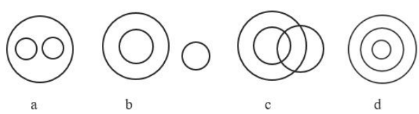
Select the Venn diagram that best represents the relationship between the given classes.

<br>

Mammals, Pigeons, Dogs

  1. AOption (a)

    a

  2. BOption (b)

    b

  3. COption (c)

    c

  4. DOption (d)

    d

View answer & explanation

Correct answer

Answer: (b)B.

b

Why this answer is correct

Given: Mammals, Pigeons, Dogs

Dogs are a subset of Mammals, and Pigeons, being birds and not mammals

The best possible Venn diagram is as follows:

Hence, the correct answer is "b".

Question 9

When and from where was GSAT-6A launched?

  1. AOption (a)

    January 12, 2018, Satish Dhawan Space Centre (Shriharikota)

  2. BOption (b)

    29 March 2018, Satish Dhawan Space Centre (Shriharikota)

  3. COption (c)

    6 October 2016, Guiana Space Centre (Kourou)

  4. DOption (d)

    29 June 2017, Guiana Space Centre (Kourou)

View answer & explanation

Correct answer

Answer: (b)B.

29 March 2018, Satish Dhawan Space Centre (Shriharikota)

Why this answer is correct

The correct answer is 29 March 2018, Satish Dhawan Space Centre (Shriharikota)

Key Points

  • The GSAT-6A satellite was launched from the Satish Dhawan Space Centre (SDSC) SHAR in Sriharikota, India on March 29, 2018 at 11:26 UTC
  • The Geosynchronous Satellite Launch Vehicle (GSLV-F08) launched the GSAT-6A satellite
  • The satellite was launched from the Second Launch Pad at SDSC SHAR
  • The satellite was placed into a geostationary transfer orbit (GTO)

Additional Information

  • Indian Space Research Organisation:
  • Indian Space Research Organisation is headquartered at Bengaluru.
  • ISRO operates under the Department of Space which is directly commanded by the prime minister of India.
  • It was founded by Vikram Sarabhai in the year 1969.

Question 10

If the largest 4 digit number is subtracted from the smallest 6 digit number, what will be the remainder?

  1. AOption (a)

    90001

  2. BOption (b)

    99991

  3. COption (c)

    80001

  4. DOption (d)

    90000

View answer & explanation

Correct answer

Answer: (a)A.

90001

Why this answer is correct

Shortcut Trick

The smallest 6-digit number is 100,000.

The largest 4-digit number is 9,999.

Subtracting them: 100,000 − 9,999 = 90,001.

A quick check: 100,000 − 10,000 = 90,000; since we subtract 1 less, add 1 to the result.

∴ The correct answer is 90001.

Alternate Method

Given:

Smallest 6-digit number = 100,000

Largest 4-digit number = 9,999

Method:

Basic subtraction of the two identified integer values.

Calculations:

⇒ Remainder = Smallest 6-digit number − Largest 4-digit number

⇒ Remainder = 100,000 − 9,999

⇒ Remainder = 90,001

∴ The correct answer is 90001.

Additional Information

Smallest n-digit number

The smallest n-digit number is formed by writing '1' followed by (n − 1) zeros. For example, the smallest 4-digit number is 1,000.

Largest n-digit number

The largest n-digit number is formed by writing the digit 9, n times. For example, the largest 4-digit number is 9,999.

Successor Relationship

The successor of the largest n-digit number (Largest + 1) is always the smallest (n + 1)-digit number (e.g., 999 + 1 = 1,000).

Question 11

Out of the four districts listed, three are alike in some way and one is odd. Choose the odd one.

<br>

Panaji, Surat, Patna, Mumbai

  1. AOption (a)

    Panaji

  2. BOption (b)

    Patna

  3. COption (c)

    Surat 

  4. DOption (d)

    Mumbai

View answer & explanation

Correct answer

Answer: (c)C.

Surat 

Why this answer is correct

The logic followed here is:

Panaji, Patna, and Mumbai are all state capitals. Whereas Surat is not a state capital; it's an important city in Gujarat.

Hence, the correct answer is "Suraj".

Question 12

Where is Devi Ahilya Bai Holkar Airport located?

  1. AOption (a)

    Nagpur

  2. BOption (b)

    Bangalore

  3. COption (c)

    Indore

  4. DOption (d)

    Chennai

View answer & explanation

Correct answer

Answer: (c)C.

Indore

Why this answer is correct

The correct answer is Indore

Key Points

  • Devi Ahilyabai Holkar Airport is an international airport.
  • It primarily serves Madhya Pradesh, cities of Indore and its surrounding areas.
  • The Holkar dynasty of the Maratha Empire was headed by Maharani Ahilya Bai Holkar of Indore, after whom the airport is named.
  • The Airports Authority of India (AAI) released statistics showing that in terms of passenger traffic, it was India's 18th busiest airport in 2018–19.

Additional Information

  • According to the 2017 Airports Council International (ACI) airport service quality (ASQ) rankings, it was named the best airport in the Asia-Pacific area for airports with less than 20 lakh (2 million) annual passenger footfall.
  • This Airport received Worlds Standardization Certification from the UK's World Book of Records for winning the ACI Award 2017 on 9 April 2018.
  • Raja Bhoj International Airport is another international airport in Madhya Pradesh.

Question 13

The floor of a room 12 m long and 8 m wide is to be decorated with square designs having the maximum possible area. Find the number of square designs required.

  1. AOption (a)

    4

  2. BOption (b)

    5

  3. COption (c)

    8

  4. DOption (d)

    6

View answer & explanation

Correct answer

Answer: (d)D.

6

Why this answer is correct

Shortcut Trick

Side of the maximum possible square = HCF of length and width.

Side = HCF(12, 8) = 4 m.

Number of square designs = (Length × Width) ÷ (Side × Side).

Number of designs = (12 × 8) ÷ (4 × 4) = 96 ÷ 16 = 6.

∴ The correct answer is 6.

Alternate Method

Given: Length (L) = 12 m and Width (W) = 8 m.

Formula Used:

  1. Area of rectangle = Length × Width
  2. Side of square (max area) = HCF(L, W)
  3. Number of squares = (Total Area) ÷ (Area of one square)

Calculations:

⇒ Total Area of the floor = 12 m × 8 m = 96 m2

⇒ To find the maximum possible area of square designs, find HCF of 12 and 8.

⇒ 12 = 2 × 2 × 3

⇒ 8 = 2 × 2 × 2

⇒ HCF(12, 8) = 2 × 2 = 4 m

⇒ Area of one square design = 4 m × 4 m = 16 m2

⇒ Number of square designs required = 96 ÷ 16

⇒ Number of square designs required = 6

∴ The correct answer is 6.

Additional Information

Highest Common Factor (HCF)

The HCF of two or more numbers is the largest positive integer that divides each of the numbers without leaving a remainder.

Minimum Number of Tiles

To minimize the number of tiles needed to cover a rectangular area, the side of each square tile must be the HCF of the length and breadth of the rectangle.

Area and Perimeter of a Square

Area = side2 and Perimeter = 4 × side. All four sides of a square are equal and each angle is 90°.

Question 14

Which British Prime Minister sent the Cripps Mission to India?

  1. AOption (a)

    Robert Walpole

  2. BOption (b)

    Benjamin Disraeli

  3. COption (c)

    Margaret Thatcher

  4. DOption (d)

    Winston Churchill

View answer & explanation

Correct answer

Answer: (d)D.

Winston Churchill

Why this answer is correct

The correct answer is Winston Churchill

Key Points

  • Winston Churchill, the British Prime Minister at the time, sent the Cripps Mission to India in 1942.
  • It was happened in March 22, 1942
  • It was Led by Stafford Cripps, a senior minister and member of the Labour Party
  • The Purpose is To secure India's support for World War II

Additional Information

  • Cripps Mission came to India in 1942.
  • Stafford Cripps was a labour minister in Winston Churchill's coalition government in Britain.
  • The Cripps Mission came to India from 22 March to 11 April 1942.
  • Its aim was to obtain Indian cooperation for the British war in the 2nd World war.
  • Proposals of Cripps Mission:
  • Setting up of an Indian dominion.
  • A Constituent Assembly would be formed to frame a new constitution for the country.
  • India’s defence would be controlled by the British until this new constitution came into force.
  • The transfer of power and the rights of minorities would be safeguarded by negotiations between the Constituent Assembly and the British government.

Question 15

Which of the following States shares its border with the maximum number of States/Union Territories?

  1. AOption (a)

    Chhattisgarh

  2. BOption (b)

    Uttar Pradesh

  3. COption (c)

    Rajasthan

  4. DOption (d)

    Madhya Pradesh

View answer & explanation

Correct answer

Answer: (b)B.

Uttar Pradesh

Why this answer is correct

The Correct answer is Uttar Pradesh.

Key Points

  • Uttar Pradesh the only Indian State which has a maximum number of neighbouring states.
  • Uttar Pradesh shares a border with Nine states/ Union Territory.
  • ​Northwest - Uttrakhand and Himachal Pradesh.
  • West - Haryana, Delhi, and Rajasthan.
  • South - Madhya Pradesh.
  • East - Jharkhand,Bihar, and Chhattisgarh.
  • Uttar Pradesh is State in Northern India. Its capital is Lucknow.
  • The Chief Minister of Uttar Pradesh is Yogi Aditya Nath and Governor is Anandiben Patel.

Additional InformationUttar Pradesh 

  • Foundation Day: 24th January 1950.
  • Capital: Lucknow.
  • State Animal: Swamp Deer (Barasingha).
  • State Bird: Sarus Crane.
  • State Tree: Ashoka.
  • State Flower: Palash (Butea monosperma)
  • The High Court of Uttar Pradesh is located in Allahabad.
  • The headquarter of the North-Central Railway is in Allahabad.
  • Chaudhary Charan Singh International Airport is located in Lucknow.
  • Uttar Pradesh has the largest number of monuments in India.
  • Uttar Pradesh is the state through which most numbers of the National Highways pass.
  • Uttar Pradesh is the 'Sugar Bowl of India'.
  • Uttar Pradesh is the first Bicycle Highway in Asia.
  • The First Air Mail system in India was established in Allahabad.
  • Asia's first DNA bank is in Lucknow in Uttar Pradesh.
  • Central Drug Research Institute is located in Lucknow.
  • Indian Institute of Sugar Technology is situated in Kanpur.
  • Indian Institute of Pulses Research is situated in Kanpur.
  • Banaras University is located in Varanasi in Uttar Pradesh.
  • Narora Atomic Power Station is in Uttar Pradesh.
  • Lucknow is known as the 'City of Nawabs'.
  • Kanpur is known as the 'Manchester of North India'.
  • Kanpur is known as the 'Leather City of India'.
  • Kanpur is known as the 'Industrial and Economic Capital of Uttar Pradesh'.
  • Allahabad is known as the 'City of Prime Ministers'.
  • Varanasi is known as the 'Religious Capital of India'.
  • Vrindavan in Uttar Pradesh is known as the 'City of Widows'.
  • Aligarh is famous for 'Lock Production'.​
  • Uttar Pradesh is the most populous state in India.
  • Uttar Pradesh has the maximum membership (80 seats) in the Lok Sabha.
  • Uttar Pradesh has the largest representation in the Rajya Sabha (31 members).

Question 16

'Cricket' is related to 'bat' as 'tennis' is related to ______.

  1. AOption (a)

    Racket

  2. BOption (b)

    gloves

  3. COption (c)

    Stick

  4. DOption (d)

    Wicket

View answer & explanation

Correct answer

Answer: (a)A.

Racket

Why this answer is correct

The relation is:

Cricket : Bat → Bat is required to play Cricket.

Similarly,

Tennis : Racket → Racket is required to play Tennis.

Hence, the correct answer is "Option 1".

Question 17

Who among the following nationalist leaders was the founder and editor of the Marathi newspaper 'Kesari'?

  1. AOption (a)

    bhimrao ambedkar

  2. BOption (b)

    Vinayak Damodar Savarkar

  3. COption (c)

    Vishnu Shastri Chiplunkar

  4. DOption (d)

    Bal Gangadhar Tilak

View answer & explanation

Correct answer

Answer: (d)D.

Bal Gangadhar Tilak

Why this answer is correct

The correct answer is Bal Gangadhar Tilak.

Key Points

  • Bal Gangadhar Tilak was the founder and editor of the Marathi newspaper Kesari
  • Kesari is a Marathi newspaper that was founded on 4 January 1881 by Lokmanya Bal Gangadhar Tilak, a prominent leader of the Indian Independence movement.
  • The newspaper was used as a spokes piece for the Indian national freedom movement and continues to be published by the Kesari Maratha Trust and Tilak's descendants.
  • Bal Gangadhar Tilak used to run his two newspapers, Kesari, in Marathi and Mahratta in English from Kesari Wada, Narayan Peth, Pune.
  • The newspapers were originally started as a co-operative by Chiplunkar, Agarkar, and Tilak.

Additional Information

  • The first English Newspaper was started by Irishman James Augustus Hicky in 1779.
  • It was founded in Calcutta.
  • The name of the First English Newspaper is Hicky's Bengal Gazette.
  • In 1811 started ‘Calcutta Chronicle’ and the editor was James Silk Buckingham.
  • He had introduced a new approach to Journalism in India.
  • He initiated clear journalistic practices and covered the problems of local people and their lives.
  • "The Hindu" was started in the English language in 1878, which was mainly distributed in Tamil Nadu and Kerala.
  • News agency services became available on a regular basis with the Press Trust of India which was started in 1946.
  • Raja Ram Mohan Roy a social reformer recognized the power of newspapers and started a Bengali newspaper ‘Sambad Kaumudi’ in 1822 and a Persian paper ‘Mirat-ul-Akhbar’ in 1822.
  • Fardaonji Murzban in 1822 started ‘Bombay Samachar’, he was a pioneer of the Vernacular Press in Bombay.

Question 18

Which of the following keyboard shortcuts would you use to go to the previously opened program?

  1. AOption (a)

    Alt + Shift + Tab

  2. BOption (b)

    Alt + Tab

  3. COption (c)

    Ctrl + N

  4. DOption (d)

    Ctrl + Home

View answer & explanation

Correct answer

Answer: (a)A.

Alt + Shift + Tab

Why this answer is correct

The correct answer is Alt + Shift + Tab

Key Points1. Alt + Shift + Tab (Option 1):

This shortcut cycles through open programs or windows in the reverse order.

If you press Alt + Shift + Tab once, it will switch to the previously opened program (the one you were using before the current program).

This is the most accurate shortcut for going to the previously opened program.

2. Alt + Tab (Option 2):

This shortcut cycles through open programs or windows in the forward order.

If you press Alt + Tab once, it will switch to the most recently used program.

While this is a common shortcut for switching between programs, it does not specifically target the previously opened program.

3. Ctrl + N (Option 3):

This shortcut is used to open a new window or document in many applications (e.g., a new browser tab or a new file in a text editor).

It has no connection to switching between programs.

4. Ctrl + Home (Option 4):

This shortcut is used to move the cursor to the beginning of a document or page.

It is unrelated to switching between programs.

Additional Information

Shortcut keysDescription
Alt+FFile menu options in the current program.
Alt+EOpen Edit options in the current program.
Alt+TabSwitch between open programs.
F1View help information (F1 is used by almost every Windows program to display help).
F2Rename a selected file.
F5Refresh the current program window.
Ctrl+DBookmark the current page in most Internet browsers.
Ctrl+NCreate a new or blank document in some software, or open a new tab in most Internet browsers.
Ctrl+OOpen a file in the current software.
Ctrl+ASelect all text.
Ctrl+BChange selected text to bold.
Ctrl+IChange selected text to be in italics.
Ctrl+UChange selected text to be underlined.
Ctrl+FOpen find window for current document or window.
Ctrl+SSave the current document file.
Ctrl+XCut selected item.
Shift+DelPermanently delete selected item.
Ctrl+CCopy selected item.
Ctrl+InsCopy selected item.
Ctrl+VPaste
Ctrl+Homemoves the cursor to the beginning of a document or file
Shift+InsPaste

Question 19

The diameter of a wheel is 88 cm. Find the number of rotations made by it to cover a distance of 8712 m. (π=227\pi=\frac{22}{7})

  1. AOption (a)

    3150

  2. BOption (b)

    3350

  3. COption (c)

    3250

  4. DOption (d)

    3450

View answer & explanation

Correct answer

Answer: (a)A.

3150

Why this answer is correct

Given:

Diameter of the wheel = 88 cm

Distance to cover = 8712 m = 871200 cm

Formula used:

  1. Circumference of the wheel = π × Diameter
  2. Number of rotations = Distance ÷ Circumference

Calculations:

Step 1: Calculate the circumference of the wheel:

Circumference = (22/7) × 88

Step 2: Calculate the number of rotations:

Number of rotations = 871200 ÷ [(22/7) × 88]

Number of rotations = 3150

The number of rotations made by the wheel to cover 8712 m is 3150.

Question 20

Flowering in bamboo causes _______.

  1. AOption (a)

    make the land barren

  2. BOption (b)

    Increase in pests and insects

  3. COption (c)

    Increase in rat population

  4. DOption (d)

    Decrease in rainfall

View answer & explanation

Correct answer

Answer: (c)C.

Increase in rat population

Why this answer is correct

The correct answer is an Increase in rat population

Key Points

  • Bamboo flowering causes an increase in the rat population.
  • This is because the seeds from the flowers provide a plentiful food source for rats, which can lead to a rat or rodent plague.
  • Bamboo plants bloom only once in their life cycle,
  • This is known as monocarpic flowering.

Additional Information

  • Bamboo flowering is a part of the species' life cycle, and is a result of a "big bang" reproductive strategy.
  • This strategy involves concentrating reproductive efforts into a single event, which may have evolved to increase pollination efficiency and reduce the population of seed predators.
  • Bamboo flowers only once in their lifetime, usually after 50–100 years.
  • The flowers grow fruit, which is called "bamboo rice" in some parts of India and China

Question 21

When and where was SAARC (South Asian Association for Regional Cooperation) formed?

  1. AOption (a)

    Pakistan, 1981

  2. BOption (b)

    Sri Lanka, 1988

  3. COption (c)

    India, 1987

  4. DOption (d)

    Bangladesh, 1985

View answer & explanation

Correct answer

Answer: (d)D.

Bangladesh, 1985

Why this answer is correct

The correct answer is Bangladesh,1985.

Key Points

  • SAARC was founded on 8 December 1985 in Dhaka, Bangladesh.
  • The full form of SAARC is South Asian Association for Regional Cooperation.
  • Member states Afghanistan, Bangladesh, Bhutan, India, the Maldives, Nepal, Pakistan, and Sri Lanka.
  • Headquarters: Kathmandu, Nepal.
  • Secretary general: Esala Weerakoon.
  • The 2020 SAARC Summit will take place in Islamabad. Pakistan.

Additional Information

  • List of some important organization
OrganizationFoundedHeadquarters
Association of Southeast Asian Nations (ASEAN)8 August 1967Jakarta, Indonesia
Bay of Bengal Initiative for Multi-Sectoral Technical and Economic Cooperation (BIMSTEC)6 June 1997Dhaka, Bangladesh
BRICS (Brazil Russia India China South Africa)July 2006Shanghai, China
North Atlantic Treaty Organization (NATO)4 April 1949Brussels, Belgium
Organization of Islamic Cooperation25 September 1969Jeddah, Saudi Arabia
Asia-Pacific Economic CooperationNovember 1989Singapore
Shanghai Cooperation Organization (SCO)15 June 2001Beijing, China

Question 22

In which year Jawahar Gram Samridhi Yojana was launched?

  1. AOption (a)

    1999

  2. BOption (b)

    1998

  3. COption (c)

    2001

  4. DOption (d)

    2016

View answer & explanation

Correct answer

Answer: (a)A.

1999

Why this answer is correct

The correct answer is 1999.

Key Points

  • Jawahar Gram Samridhi Yojana (JGSY) is the restructured, streamlined, and comprehen­sive version of the erstwhile Jawahar Rozgar Yojana (JRY).
  • Launched on 1st April 1999, it has been designed to improve the quality of life of the rural poor by providing them additional gainful employment
  • The main objective of the scheme is the creation of demand-driven village infrastructure including durable assets for increasing the opportunities for sustained employment and generation of supplementary employment for the unem­ployed poor in rural areas.
  • The program is being implemented entirely at the village panchayat level.

Additional Information

  • Village panchayat is the sole authority for the preparation of the annual action plan and its implementation with the approval of Gram Sabha.
  • 22.5 per cent of JGSY funds have been earmarked for indi­vidual beneficiary schemes for SCs/STs.
  • Three per cent of annual allocation would be utilized for the creation of barrier-free infrastructure for the disabled.
  • The state government will fix wages under JGSY.
  • Village panchayats will have the power to execute works/ schemes up to Rs.50, 000 with the approval of Gram Sabha.
  • However, for works/schemes costing more than Rs50, 000, after taking the approval of the Gram Sabha, the Village panchayat shall seek the technical/administrative approval of appropriate authorities.

Question 23

If the numbers from 1 to 26 which are divisible by 2 are arranged in descending order, then which number will be 9th from the bottom?

  1. AOption (a)

    14

  2. BOption (b)

    20

  3. COption (c)

    18

  4. DOption (d)

    16

View answer & explanation

Correct answer

Answer: (c)C.

18

Why this answer is correct

The numbers divisible by 2 between 1 and 26:

2, 4, 6, 8, 10, 12, 14, 16, 18, 20, 22, 24, 26

Arrange in descending order:                             

26, 24, 22, 20, 18, 16, 14, 12, 10, 8, 6, 4, 2

The 9th number from the bottom:

26, 24, 22, 20, 18, 16, 14, 12, 10, 8, 6, 4, 2

The 9th number from the bottom is 18.

Hence, the correct answer is "Option (3)".

Question 24

According to the Living Planet Report 2020, ______ witnessed the highest decline in wildlife population.

  1. AOption (a)

    latin america

  2. BOption (b)

    Asia

  3. COption (c)

    Europe

  4. DOption (d)

    North America

View answer & explanation

Correct answer

Answer: (a)A.

latin america

Why this answer is correct

The correct answer is Latin America

Key Points

  • According to the 2020 Living Planet Report, Latin America and the Caribbean experienced the highest decline in wildlife populations, with a loss of 94% since 1975
  • The Living Planet Report is a science-based analysis published every two years by the World Wide Fund for Nature (WWF).
  • It assesses the impact of human activity on the health of the planet.
  • The 2020 report found that the loss of biodiversity is a threat to the well-being of current and future generations.

Additional Information

  • The report also highlighted the need for systemic changes to stop the destruction of wildlife populations, including overhauling food production and consumption, making global trade more sustainable, and removing deforestation from global supply chains.
  • Here are the wildlife population declines in other regions:
  • Africa: 76% decline
  • Asia-Pacific: 60% decline
  • Europe: Comparatively smaller decline
  • Central Asia: 35% decline
  • North America: 39% decline

Question 25

The value of angle 54° (in radians) is equal to _______.

  1. AOption (a)

    3π10\frac{3\pi }{10}

  2. BOption (b)

    9π10\frac{9\pi }{10}

  3. COption (c)

    7π10\frac{7\pi }{10}

  4. DOption (d)

    π10\frac{\pi }{10}

View answer & explanation

Correct answer

Answer: (a)A.

3π10\frac{3\pi }{10}

Why this answer is correct

Given:

Angle in degrees = 54º

Formula Used:

Radians = Degrees × π180\frac{\pi}{180}

Calculation:

Angle in radians = 54º × π180\frac{\pi}{180}

⇒ Angle in radians = 54 × π180\frac{\pi}{180}

⇒ Angle in radians = 54π180\frac{54\pi}{180}

⇒ Angle in radians = 3π10\frac{3\pi}{10}

The value of angle 54º in radians is 3π10\frac{3\pi}{10}.

Question 26

Roma introduced a boy saying, “He is the son of the daughter of the father of my son.” How is that boy related to Roma?

  1. AOption (a)

    daughter's son

  2. BOption (b)

    brother's son

  3. COption (c)

    Son

  4. DOption (d)

    Brother

View answer & explanation

Correct answer

Answer: (a)A.

daughter's son

Why this answer is correct

Family Chart:

Given: Roma introduced a boy saying, “He is the son of the daughter of the father of my son.”

So, the boy is the "daughter's son" of Roma.

Hence, the correct answer is "Daughter's son" .

Question 27

When was the Prime Minister Sansad Adarsh ​​Gram Yojana started?

  1. AOption (a)

    19 May 2015

  2. BOption (b)

    11 October 2014

  3. COption (c)

    28 August 2014

  4. DOption (d)

    23 July 2010

View answer & explanation

Correct answer

Answer: (b)B.

11 October 2014

Why this answer is correct

The correct answer is 11 October 2014.

Key Points

  • Saansad Adarsh Gram Yojana (SAGY) was launched in 2014.
  • Prime Minister Shri Narendra Modi launched Saansad Adarsh Gram Yojana (SAGY) on 11th October 2014 on the birth anniversary of Lok Nayak Jai Prakash Narayan at Vigyan Bhawan, New Delhi.
  • Under the Yojana, Members of Parliament (MPs) will be responsible for developing the socio-economic and physical infrastructure of three villages each by 2019, and a total of eight villages each by 2024.
  • The goal was to develop three Adarsh Grams by March 2019, of which one was to be achieved by 2016.
  • Thereafter, five such Adarsh Grams (one per year) will be selected and developed by 2024.
  • Inspired by the principles and values of Mahatma Gandhi, the Scheme places equal stress on nurturing values of national pride, patriotism, community spirit, self-confidence, and on developing infrastructure.
  • SAGY will keep the soul of rural India alive while providing its people with quality access to basic amenities and opportunities to enable them to shape their own destinies.
  • Key objectives of the Yojana include The development of model villages, called Adarsh Grams, through the implementation of existing schemes, and certain new initiatives to be designed for the local context, which may vary from village to village

Additional Information

  • The main objective of SAGY are:
  • To trigger processes that lead to the holistic development of the identified Gram Panchayats.
  • To generate models of local level development and effective local government which can motivate and inspire neighbouring Gram Panchayats to learn and adapt.
  • To substantially improve the standard of living and quality of life of all sections of the population through - Improved basic amenities, Higher productivity, Enhanced human development, Better livelihood opportunities, etc.
  • To nurture the identified Adarsh Grams as schools of local development to train another gram panchayat.
  • ​Criteria for selecting the Village under the Saansad Adarsh Gram Yojana (SAGY):
  • The MP can select any Gram Panchayat that does not belong to him/her or spouse.
  • There is a population criterion for MPs. If the MP is choosing a village in plains, its population should be 3000-5000. If in hills, it can be 1000-3000.
  • Lok Sabha MP has to choose a Gram Panchayat from within his/her constituency and Rajya Sabha MP a Gram Panchayat from the rural area of a district of his/her choice in the State from which he/she is elected.
  • A member from urban areas can identify a village from a nearby constituency. A nominated member can choose from any district across the country.
  • The Gram Panchayats once selected by members of Parliament (whose tenures have ended on account of resignation or otherwise) would be continued as such under SAGY irrespective of whether activities have already been initiated in the GP under SAGY or not. The newly elected MPs will have the option to select the village of their choice and two more subsequently by 2019.

Question 28

Which number will come in place of question mark (?) in the following table?


48248
552011
63?9
  1. AOption (a)

    18

  2. BOption (b)

    20

  3. COption (c)

    28

  4. DOption (d)

    24

View answer & explanation

Correct answer

Answer: (c)C.

28

Why this answer is correct

The logic followed here is: Row wise operation: 1st number / 3rd number × 4 = 2nd number.

Row 1: 48 / 8 × 4 = 6 × 4 = 24

Row 2: 55 / 11 × 4 = 5 × 4 = 20

Similarly, row 3: 63 / 9 × 4 = 7 × 4 = 28

Hence, the correct answer is "28".

Question 29

The Dhauladhar range in the Himalayas is a part of ______.

  1. AOption (a)

    Lower Himalayas

  2. BOption (b)

    Trans Himalaya

  3. COption (c)

    Shivalik

  4. DOption (d)

    Middle Himalayas

View answer & explanation

Correct answer

Answer: (d)D.

Middle Himalayas

Why this answer is correct

The correct answer is 'Middle Himalayas'

Key Points

  • Middle Himalayas:
  • The Dhauladhar range is part of the Middle Himalayas, which lies between the Lower Himalayas and the Greater Himalayas (or the Himadri). The Middle Himalayas are characterized by moderate elevation, steep slopes, and rich biodiversity.
  • These ranges, including the Dhauladhar, are well-known for their scenic beauty and form a natural boundary between the plains of India and the higher Himalayan ranges.
  • The Middle Himalayas are also home to various hill stations, valleys, and important rivers, contributing to the region's ecological significance.

Additional Information

  • Lower Himalayas:
  • The Lower Himalayas, also known as the Sub-Himalayas or Siwaliks, are the outermost range of the Himalayas. They are characterized by lower altitudes and are often found at the foothills of the mountain range.
  • While the Lower Himalayas are important for agricultural activities and human settlements, they do not include the Dhauladhar range.
  • Trans Himalaya:
  • The Trans-Himalaya region lies to the north of the main Himalayan range, mainly covering the Tibetan Plateau. It is known for its unique geography, with ranges like the Zanskar, Ladakh, and Karakoram.
  • The Trans-Himalaya has a significantly different climate and ecosystem compared to the Middle Himalayas, as it is located in a more arid and high-altitude region.
  • Shivalik:
  • The Shivalik range refers to the outermost range of the Himalayas, situated along the foothills. It is also part of the Lower Himalayas and extends from the Indus River to the Brahmaputra River.
  • While the Shivalik range is important for its ecological and geological features, it is not home to the Dhauladhar range.

Question 30

The area of ​​an isosceles right triangle is 81 cm 2. Find the length of its hypotenuse.

  1. AOption (a)

    16 cm

  2. BOption (b)

    18 cm

  3. COption (c)

    22 cm

  4. DOption (d)

    14 cm

View answer & explanation

Correct answer

Answer: (b)B.

18 cm

Why this answer is correct

Given:

The area of ​​an isosceles right triangle is 81 cm2.

Formula Used:

Area of an isosceles right triangle = (1/2) × a2

where 'a' is the length of the equal sides.

Hypotenuse = a√2

Calculation:

Let the length of each equal side be 'a'.

Area = (1/2) × a2

81 = (1/2) × a2

⇒ a2 = 81 × 2

⇒ a2 = 162

⇒ a = √162

⇒ a = √(81 × 2)

⇒ a = 9√2

Hypotenuse = a√2

⇒ Hypotenuse = 9√2 × √2

⇒ Hypotenuse = 9 × 2

⇒ Hypotenuse = 18 cm

The correct answer is option 2.

Question 31

______ is one of the recipients of the Ramon Magsaysay Award.

  1. AOption (a)

    Arvind Kejriwal

  2. BOption (b)

    CNR Rao

  3. COption (c)

    Nirmala Deshpande

  4. DOption (d)

    suprabha seshan

View answer & explanation

Correct answer

Answer: (a)A.

Arvind Kejriwal

Why this answer is correct

The correct answer is Arvind Kejriwal

Key Points

  • In 2006, Arvind Kejriwal was awarded the Ramon Magsaysay Award for Emergent Leadership,
  • It recognizes his involvement in a grassroots movement, Parivartan, using the Right to Information (RTI) to bring transparency and accountability to governance in India.
  • It effectively used the Right to Information (RTI) Act to expose corruption and inefficient practices within government departments.
  • Inspired by the success of Parivartan, Arvind Kejriwal later entered mainstream politics.
  • In 2012, he formed the Aam Aadmi Party (AAP) to further his vision of clean governance and transparency.

Additional Information

  • The Ramon Magsaysay Award is Asia’s highest honor, celebrates the greatness of spirit and transformative leadership in Asia.
  • Ramon Magsaysay Award:
  • The award was started in 1957.
  • Founder: Ramon del Fierro Magsaysay, the third president of the Republic of the Philippines.
  • Ramon Magsaysay Award is known as Asia's Nobel prize.
  • It is the highest award given to Asian individuals and organizations.
  • The awards have been given in six categories:
  • Government service
  • Public service
  • Community leadership
  • Journalism, Literature, Creative communication arts
  • Peace and international understanding
  • Emergent Leadership
  • Awardees are presented with a certificate and a medallion with an embossed image of Ramon Magsaysay facing right in the profile.
  • The Award is presented to awardees in formal ceremonies in Manila, the Philippines on 31st August every year.
  • Vinobha Bhave was the 1st Indian to win the Ramon Magsaysay award.

Question 32

In July 2017, India's first solar-powered train was launched from the railway station of ______.

  1. AOption (a)

    Bangalore

  2. BOption (b)

    Mumbai

  3. COption (c)

    Pune

  4. DOption (d)

    Delhi

View answer & explanation

Correct answer

Answer: (d)D.

Delhi

Why this answer is correct

The correct answer is Delhi

Key Points

  • India's first solar-powered train was launched from Delhi's Safdarjung railway station on July 14, 2017.
  • The train was a diesel-electric multiple unit (DEMU) that ran from Safdarjung Station to Farukh Nagar in Haryana
  • The train has six trailer coaches, with 16 solar panels fitted in each of them.
  • The solar panels will power all the electrical appliances inside.

Additional Information

  • Noida-based firm Jakson Engineers Limited (JEL) had been given the task of providing solar panels for DEMU coaches set to be used by the Railways for its pilot projects in Chennai and Amritsar.
  • Indian Railway's first DEMU service was launched from Jalandhar to Hoshiarpur in 1994.
  • It will reduce CO2 emissions by 9 tonnes per coach per annum.
  • The train also had a battery backup that could run for at least 72 hours.
  • The solar panels were made under the "Make in India" initiative.
  • The train was expected to save the railways money and reduce carbon dioxide emissions.

Question 33

Who among the following is known as the 'Father of Civil Services' in India?

  1. AOption (a)

    Mahatma Gandhi (Mahatma Gandhi)

  2. BOption (b)

    Robert Clive

  3. COption (c)

    Warren Hastings

  4. DOption (d)

    Charles Cornwallis

View answer & explanation

Correct answer

Answer: (d)D.

Charles Cornwallis

Why this answer is correct

The correct answer is Lord Cornwallis.

Key Points

  • During the British  raj, Warren Hastings laid the foundation of the Civil Services.
  • Charles Cornwallis reformed, modernized and rationalized it. Hence, Charles Cornwallis is known as 'the Father of civil service in India'.
  • British General Charles Cornwallis was appointed in February 1786 to serve as both Commander-in-Chief of British India and Governor of the Presidency of Fort William, also known as the Bengal Presidency.
  • He had introduced the Covenanted Civil Services and the Uncovenanted Civil Services.
  • The Covenanted Civil Services was created out of the Law of the Company.

Additional Information Important events and Governor-General at that time: 

Governor-GeneralEvent
Warren Hastings- Regulating Act of 1773. - First Governor-General of Bengal - Wrote Introduction to the first English translation of Gita.
Robert Clive- Robert Clive the first English Governor of Bengal presidency made a settlement with the Nawab of Awadh in 1765, this settlement was also referred to as the First Treaty of Allahabad. - The treaty was signed between Mughal emperor Shah Alam II, Nawab Shuja-ud-Daula, and Robert Clive. - Shuja-ud-Daula was the Nawab of Awadh from 1754 to 1775. He was the successor of Safdar Jang. - According to the treaty the Nawab paid 50 lakhs to the English as war indemnity (protection/insurance). - Nawab also surrendered Allahabad and Kora to the Mughal emperor Shah Alam II. - Robert Clive was the First British Governor of the Bengal Presidency. - The Battle of Plassey (1757) was fought between Siraj Ud Daulah and  Robert Clive. - He is also known as Babar of British India.

Question 34

The ratio of two quantities is 3 : 5. If 9 is subtracted from each quantity, the ratio becomes 5 : 9. Find the smaller quantity.

  1. AOption (a)

    54

  2. BOption (b)

    52

  3. COption (c)

    53

  4. DOption (d)

    51

View answer & explanation

Correct answer

Answer: (a)A.

54

Why this answer is correct

Given:

The ratio of two quantities is 3 : 5.

If 9 is subtracted from each quantity, the ratio becomes 5 : 9.

Formula Used:

Let the quantities be 3x and 5x.

If 9 is subtracted from each quantity, the new quantities are 3x - 9 and 5x - 9.

According to the given condition:

3x−95x−9=59\frac{3x - 9}{5x - 9} = \frac{5}{9}

Calculation:

Cross-multiplying the equation:

⇒ 9(3x - 9) = 5(5x - 9)

⇒ 27x - 81 = 25x - 45

Bringing like terms together:

⇒ 27x - 25x = 81 - 45

⇒ 2x = 36

⇒ x = 36 / 2

⇒ x = 18

The smaller quantity is 3x.

⇒ 3 × 18

⇒ 54

The smaller quantity is 54.

Question 35

A man's daily working hours increase by 35% and his hourly wages decrease by 25%. Find the percentage increase in his daily earnings.

  1. AOption (a)

    1.3

  2. BOption (b)

    1.35

  3. COption (c)

    1.2

  4. DOption (d)

    1.25

View answer & explanation

Correct answer

Answer: (d)D.

1.25

Why this answer is correct

Given:

Increase in daily working hours = 35%

Decrease in hourly wages = 25%

Formula Used:

Percentage increase in daily earnings = ((New Daily Earnings - Original Daily Earnings) / Original Daily Earnings) × 100

Calculation:

Let original daily working hours = 100 hours

New daily working hours = 100 + 35% of 100

New daily working hours = 100 + 35

New daily working hours = 135 hours

Let original hourly wages = $100

New hourly wages = 100 - 25% of 100

New hourly wages = 100 - 25

New hourly wages = $75

Original daily earnings = 100 hours × $100

Original daily earnings = $10000

New daily earnings = 135 hours × $75

New daily earnings = $10125

Percentage increase in daily earnings = ((10125 - 10000) / 10000) × 100

Percentage increase in daily earnings = (125 / 10000) × 100

Percentage increase in daily earnings = 1.25%

The percentage increase in his daily earnings is 1.25%.

Question 36

Four words are given, out of which three are alike in some way, while one is different. Choose the odd word.

Hard disk, RAM, Mouse, Motherboard

  1. AOption (a)

    RAM

  2. BOption (b)

    Mouse

  3. COption (c)

    Motherboard

  4. DOption (d)

    Hard Disk

View answer & explanation

Correct answer

Answer: (b)B.

Mouse

Why this answer is correct

The logic followed here is:

Logic: Storage device.

Except Mouse, all other are storage device, whereas, Mouse is a input device.

Hence, the correct answer is "Option 2".

Question 37

Who among the following can propose a Government Bill?

  1. AOption (a)

    Member of the Treasury Bench in Lok Sabha

  2. BOption (b)

    A Member of Parliament who is not a Minister

  3. COption (c)

    Minister in either House of Parliament

  4. DOption (d)

    Minister in Lok Sabha

View answer & explanation

Correct answer

Answer: (c)C.

Minister in either House of Parliament

Why this answer is correct

The correct answer is Minister in either House of Parliament

Key Points

  • A Minister in either House of Parliament can propose a Government Bill.
  • A bill introduced by a Minister is called a Government Bill, while a bill introduced by a Member of Parliament who is not a Minister is called a Private Member's Bill.
  • A bill is a draft statute that becomes law after it is passed by both Houses of Parliament and approved by the President.
  • A bill that is related to taxation, borrowing, expenditure, audits, and accounting is called a Money Bill.
  • Only a Minister can introduce a Money Bill in Parliament, and it must be recommended by the President first.
  • The Speaker of the Lok Sabha has the final say on whether a bill is a Money Bill.

Additional Information

  • Types of Bill-There are four types of bills in our Constitution. 
  • Ordinary bill-Ordinary bill is a bill that can be introduced in either by houses of any minister or member of the both houses.
  • Money bill-Money Bill refers to a bill that is introduced in the Lower Chamber of Indian Parliament(Lok Sabha) which generally covers the issue of spending and receipt of money, such as law-related with, laws of any governing borrowing, and also government expenditure.
  • Finance bill-Finance Bill is a secret bill introduced each year in Lok Sabha(Lower chamber of the Parliament) immediately after the implementation of the Union Budget, to enact some effect to the financial proposals of the Government of India.
  • Constitutional amendment bills-Bills seeking to amend all other provisions of the Constitution including those enumerated in the provision to article 368(2), are called by the title 'Constitution Amendment Bills'.These Bills can be introduced in the House of Parliament.

Question 38

Five men A, B, C, D and E are married to five women P, Q, R, S and T (not necessarily in the same order). These men like shirts of five different colours, viz. red, green, black, yellow and pink (not necessarily in the same order). One man is married to only one woman and likes only one shirt. No two men are married to the same woman and like the same shirt. C is married to P and does not like black shirt. D likes pink shirt. R is married to E. E does not like green and black shirts. A likes green shirt but is not married to Q or T. B is not married to T.

Which of the following combinations of man, woman and shirt colour is correct?

  1. AOption (a)

    B - Q - Black

  2. BOption (b)

    D - Q - Pink

  3. COption (c)

    E - R - Yellow

  4. DOption (d)

    C - P - Yellow

View answer & explanation

Correct answer

Answer: (a)A.

B - Q - Black

Why this answer is correct

As per the given information:

C is married to P and does not like black shirt.

D likes pink shirt.

MenWomenColor
A
B
CPBlack shirt ╳
DPink shirt
E


R is married to E.

E does not like green and black shirts.

MenWomenColor
A
B
CPBlack shirt ╳
DPink shirt
ERGreen and black shirts ╳


A likes green shirt but is not married to Q or T. 

MenWomenColor
ASGreen shirt
B
CPBlack shirt ╳
DPink shirt
ERGreen and black shirts ╳


B is not married to T. So, D will be married to T.

MenWomenColor
ASGreen shirt
B
CPBlack shirt ╳
DTPink shirt
ERGreen and black shirts ╳


Thus final arrangement:

MenWomenColor
ASGreen shirt
BQBlack shirt
CPYellow / Red
DTPink shirt
ERYellow / Red


So, the combinations of B - Q - Black shirt colour is correct.

Hence, the correct answer is "B - Q - Black".

Question 39

Who among the following was honoured with Bharat Ratna award before becoming the President of India?

  1. AOption (a)

    Rajendra Prasad

  2. BOption (b)

    S Radhakrishnan

  3. COption (c)

    VV Giri

  4. DOption (d)

    pranab mukherjee

View answer & explanation

Correct answer

Answer: (b)B.

S Radhakrishnan

Why this answer is correct

The correct answer is S Radhakrishnan

Key Points

  • Dr. Sarvepalli Radhakrishnan was honored with the Bharat Ratna in 1954, before becoming the President of India in 1962.
  • Dr. Radhakrishnan was an acclaimed philosopher and an expert on Indian philosophy.
  • His works helped bridge Eastern and Western philosophical traditions.
  • His birthday, September 5, is celebrated as Teachers' Day in India to honor his contributions to education and his belief in the value of teaching.
  • Before becoming President, he served as the first Vice President of India (1952–1962).
  • He also represented India as an ambassador to UNESCO and the Soviet Union.

Additional Information

  • Rajendra Prasad​
  • Rajendra Prasad was the longest-serving President of India (1950 to 1962).
  • Rajendra Prasad was elected as the first President of India on 24th January 1950
  • He was one of the prominent leaders of the Indian independence movement and played a prominent role as the President of the Indian National Congress. 
  • During his tenure, H.C. Mookerjee was the Vice-President.
  • ​He was a lawyer by profession, and also an influential leader during the Indian freedom struggle.
  • He served as the president of the Constituent Assembly that drafted the first constitution of the Republic of India, which lasted from 1948 to 1950.
  • He also became the first Minister of Food and Agriculture in 1946 in the Interim National Government.
  • V. V. Giri:
  • Varahagiri Venkata Giri was the 4th president of India from 24 August 1969 to 24 August 1974.
  • He was the only president to be elected as an independent candidate.
  • He was succeeded by Fakhruddin Ali Ahmed as president in 1974.
  • After the end of his full term, Giri was honored by the Government of India with the Bharat Ratna in 1975.
  • V. V. Giri was closely associated with the labor and trade union movement in India throughout his career.
  • V. V. Giri was a founding member of the All India Railwaymen's Federation which was formed in 1923 and served as its general secretary for over a decade.
  • He was elected president of the All India Trade Union Congress for the first time in 1926.
  • V. V. Giri also founded the Bengal Nagpur Railway Association and in 1928 led the workers of the Bengal Nagpur Railway in a non-violent strike for the rights of retrenched workers.
  • Pranab mukherjee​
  • Pranab Mukherjee served as 13th President of India from 25th July 2012 till 25th July 2017.
  • He was honoured with India's highest civilian honour, the Bharat Ratna in 2019 by incumbent President Ram Nath Kovind.
  • Mukherjee had served as the Defence Minister from 2004-2006, External Affairs from 2006-2009, and the Union Minister of Finance from 2009 to 2012 before he was elected President.
  • The Prime Minister PV Narasimha Rao appointed Mukherjee as the head of the Planning Commission in 1991 and Foreign Minister in 1995.

Question 40

The sum of two numbers is 80 and their difference is 8. Find the ratio of the first number and the second number.

  1. AOption (a)

    13 : 11

  2. BOption (b)

    12 : 11

  3. COption (c)

    11 : 9

  4. DOption (d)

    13 : 9

View answer & explanation

Correct answer

Answer: (c)C.

11 : 9

Why this answer is correct

Given:

Sum of two numbers = 80

Difference of two numbers = 8

Formula Used:

Let the first number be x and the second number be y .

x + y = 80

x - y = 8

Calculation:

Add the two equations:

x + y + x - y = 80 + 8

⇒ 2x = 88

⇒ x = 44

Subtract the second equation from the first:

x + y - (x - y) = 80 - 8

⇒ 2y = 72

⇒ y = 36

The ratio of the first number to the second number:

4436=119\frac{44}{36} = \frac{11}{9}

The ratio of the first number to the second number is 11:9.

Question 41

Which of the following endemic species is not found in the Western Ghats?

  1. AOption (a)

    Nilgiri Tahr

  2. BOption (b)

    Nilgiri Langur

  3. COption (c)

    Brown palm civet

  4. DOption (d)

    Hispid Hare

View answer & explanation

Correct answer

Answer: (d)D.

Hispid Hare

Why this answer is correct

The correct answer is Hispid Hare

Key Points

  • The Hispid Hare is not found in the Western Ghats
  • Hispid Hare
  • The Hispid Hare's range includes the tall grasslands of north India and southern Nepal, and the floodplain grasslands of north-eastern India and northern Bangladesh.
  • The Western Ghats are home to a variety of endemic mammals, which are species of plants and animals that are unique to a particular area.
  • The region's ecological significance and evolutionary history are highlighted by the presence of these mammals.

Additional Information

  • Nilgiri Tahr
  • ​The Nilgiri tahr is an ungulate that is endemic to the Nilgiri Hills and the southern portion of the Western and Eastern Ghats in the states of Tamil Nadu and Kerala in southern India.
  • It is the only species in the genus Nilgiritragus and is closely related to the sheep of the genus Ovis.
  • Nilgiri Langur
  • ​The Nilgiri langur is an Asian langur of the Old World monkey.
  • It has glossy, black fur and an orangey-golden brown, hair-like mane on its head.
  • Females have a white patch of fur on the inner thigh.
  • It typically lives in troops of nine to ten individuals, with or without offspring, depending on seasonality.
  • Brown palm civet
  • ​The brown palm civet (Paradoxurus jerdoni), also called the Jerdon's palm civet, is a viverrid endemic to the Western Ghats of India.
  • The scientific name Paradoxurus jerdoni was introduced by William Thomas Blanford in 1885 who described a skull and pelt of a brown palm civet collected in Kodaikanal.

Question 42

It is the oldest trade union organisation in India.

  1. AOption (a)

    INTUC

  2. BOption (b)

    BMS

  3. COption (c)

    AITUC

  4. DOption (d)

    CITU

View answer & explanation

Correct answer

Answer: (c)C.

AITUC

Why this answer is correct

The correct answer is AITUC.

Key Points

  • The All India Trade Union Congress (AITUC) is the oldest trade union federation in India.
  • It is associated with the Communist Party of India. According to provisional statistics from the Ministry of Labour, AITUC had a membership of 14.2 million in 2013.
  • It was founded on 31 October 1920 with Lala Lajpat Rai as its first president.
  • In Bombay by Lala Lajpat Rai, Joseph Baptista, N. M. Joshi, Diwan Chaman Lall and a few others and, until 1945 when unions became organised on party lines, it was the primary trade union organisation in India.

Additional Information

  • The following are the objectives of trade union:
  • To improve the economic lot of workers by securing them better wages.
  • To secure for workers better working conditions.
  • To secure bonus for the workers from the profits of the enterprise/organization.
  • The main purpose of labor unions is to give workers the power to negotiate for more favorable working conditions and other benefits through collective bargaining.

Question 43

Select the Venn diagram that best represents the relationship between the given classes.

<br>

Mother, Doctor, Women

  1. AOption (a)

    b

  2. BOption (b)

    c

  3. COption (c)

    a

  4. DOption (d)

    d

View answer & explanation

Correct answer

Answer: (b)B.

c

Why this answer is correct

Some women are doctors, but not all women are doctors. Similarly, some mothers could also be doctors, but not all mothers are doctors.

The best represents the Venn diagram is as follows:

Hence, the correct answer is "c".

Question 44

A daily wager is hired for a certain number of days at ₹5,850, but because he was absent for a few days he was paid only ₹5,200. What was his maximum possible daily wage?

  1. AOption (a)

    ₹750

  2. BOption (b)

    ₹700

  3. COption (c)

    ₹600

  4. DOption (d)

    ​₹650

View answer & explanation

Correct answer

Answer: (d)D.

​₹650

Why this answer is correct

Given:

Total wage for a certain number of days = ₹5,850

Wage paid for the days worked = ₹5,200

Formula Used:

Daily Wage = Total Wage / Number of Days Worked

Calculation:

Let the total number of days be D and the number of days he was absent be A.

Number of days worked = D - A

Total Wage - Wage Paid = Wage for days absent

₹5,850 - ₹5,200 = ₹650

Daily wage = ₹650

The maximum possible daily wage is ₹650.

Question 45

Who was the first speaker of the Indian Parliament?

  1. AOption (a)

    GV Mavlankar

  2. BOption (b)

    Rajendra Prasad

  3. COption (c)

    BR Ambedkar

  4. DOption (d)

    KM Munshi

View answer & explanation

Correct answer

Answer: (a)A.

GV Mavlankar

Why this answer is correct

The correct answer is GV Mavlankar.

Key Points

  • Ganesh Vasudev Mavalankar (GV Mavalankar) -
  • He was the first Lok Sabha Speaker of the Indian Lok Sabha.
  • Lok Sabha is the lower house of the Indian Parliament.
  • He was affectionately called 'Dadasaheb'.
  • He actively participated in the Non-Cooperation Movement and Salt Satyagraha.

 Additional Information

  • Dr Rajendra Prasad: 
  • Rajendra Prasad, (born December 3, 1884, Zeradei, India—died February 28, 1963, Patna).
  • He was an Indian politician, lawyer, and journalist who was the first president of the Republic of India (1950–62).
  • He also was a comrade of Mahatma Gandhi early in the noncooperation movement for independence and was president of the Indian National Congress (1934, 1939, and 1947).
  • He gave up his law practice in 1920 to join the noncooperation movement.
  • Becoming an active journalist in the nationalist interest, he wrote for Searchlight in English and founded and edited the Hindi weekly Desh.
  • Dr B. R. Ambedkar (14 April 1891 - 6 December 1956):
  • He was a well known political leader, philosopher, writer, economist and scholar.
  • He was also a social reformer who dedicated his life to eradicating untouchability and social inequality in India.
  • Chairman of the Drafting Committee which prepared the Constitution of India.
  • Set up the 'Bahishkrit Hitkarini Sabha (Outcastes Welfare Association)' which was devoted to spreading education and culture amongst the untouchables.
  • Leader of the Dalit rights movement and Dalit Buddhist movement.
  • Books: Annihilation of Caste, The Buddha and His Dhamma, Pakistan or Partition of India, Who Were the Shudras?
  • Award: Bharat Ratna (posthumously in 1990)
  • Resting place: Chaitya Bhoomi, Mumbai
  • KM Munshi
  • KM Munshi was the President of the Order of Business Committee of the Constituent Assembly.
  • The Order of Business Committee was responsible for planning the agenda and order of business for the Constituent Assembly sessions.
  • KM Munshi played a significant role in the drafting of the Indian Constitution and was a member of the Drafting Committee.
  • He was an influential figure in the freedom struggle and later contributed to the shaping of independent India's governance structure.

Question 46

Rakesh donates blood twice every 3 years and donates 330 ml of blood each time. How many liters of blood will he donate in 6 years?

  1. AOption (a)

    1.30 L

  2. BOption (b)

    1.34 L

  3. COption (c)

    1.36 L

  4. DOption (d)

    1.32 L

View answer & explanation

Correct answer

Answer: (d)D.

1.32 L

Why this answer is correct

Given:

Rakesh donates blood twice every 3 years.

He donates 330 ml of blood each time.

Formula Used:

Total blood donated in 6 years = (Number of donations in 6 years) × (Amount of blood donated each time)

Calculation:

Number of donations in 3 years = 2

Number of donations in 6 years = 2 × 2 = 4

Amount of blood donated each time = 330 ml = 0.33 L

Total blood donated in 6 years = 4 × 0.33

⇒ Total blood donated in 6 years = 1.32 L

The correct answer is option 4.

Question 47

13,76,59,427,815\frac{1}{3},\frac{7}{6},\frac{5}{9},\frac{4}{27},\frac{8}{15} The least coefficient (LCM) of is ______.

  1. AOption (a)

    2803\frac{280}{3}

  2. BOption (b)

    3280\frac{3}{280}

  3. COption (c)

    28015\frac{280}{15}

  4. DOption (d)

    15280\frac{15}{280}

View answer & explanation

Correct answer

Answer: (a)A.

2803\frac{280}{3}

Why this answer is correct

Given:

Fractions: 1/3, 7/6, 5/9, 4/27, 8/15

Formula used:

The LCM of fractions is calculated as:

LCM of fractions = LCM of numerators / HCF of denominators

Calculations:

Step 1: Identify the numerators and denominators:

Numerators: 1, 7, 5, 4, 8

Denominators: 3, 6, 9, 27, 15

Step 2: Calculate LCM of numerators:

LCM(1, 7, 5, 4, 8) = 280

Step 3: Calculate HCF of denominators:

HCF(3, 6, 9, 27, 15) = 3

Step 4: Calculate the LCM of fractions:

LCM = LCM of numerators / HCF of denominators

LCM = 280 / 3

The LCM of the given fractions is 280/3.

Question 48

0.532‾0.5\overline{32} is equal to a fraction  _____ .

  1. AOption (a)

    3299\frac{32}{99}

  2. BOption (b)

    527990\frac{527}{990}

  3. COption (c)

    572990\frac{572}{990}

  4. DOption (d)

    537990\frac{537}{990}

View answer & explanation

Correct answer

Answer: (b)B.

527990\frac{527}{990}

Why this answer is correct

Given:

Recurring decimal: 0.532

To find:

Convert 0.532 to a fraction.

Solution:

Let y = 0.532 = 0.532323232...

Multiply by 100 to shift the decimal point for the repeating part:

100y = 53.232323...

(100y - y) = 53.232323... - 0.532323...

99y = 52.7

y = 52.7 / 99

Step 5: Combine with the non-repeating part:

x = 52.7 / 99 = 527 / 990

0.532 = 527/990.

Question 49

Which of the following was discovered by Henri Becquerel?

  1. AOption (a)

    Ultraviolet light

  2. BOption (b)

    Infrared radiation

  3. COption (c)

    X-Rays

  4. DOption (d)

    Radioactivity

View answer & explanation

Correct answer

Answer: (d)D.

Radioactivity

Why this answer is correct

The correct answer is Radioactivity.

Key Points

  • Radioactivity
  • The spontaneous emission of energy and particles from the nucleus of an unstable atom.
  • Types of Radiation: Alpha particles, beta particles, gamma rays, and neutrons.
  • Wavelength: Not applicable, as radioactivity is not a form of electromagnetic radiation.
  • Sources: Naturally occurring radioactive elements like uranium and radium, as well as man-made sources like nuclear reactors and medical equipment.
  • Effects: Can be harmful to living organisms, causing damage to cells and DNA. However, radioactivity also has beneficial applications in medicine, industry, and research.

Additional Information

  • Ultraviolet (UV) Light
  • Definition: A type of electromagnetic radiation with wavelengths shorter than visible light but longer than X-rays.
  • Wavelength: 10-400 nanometers (nm).
  • Sources: The sun, artificial sources like tanning beds and black lights.
  • Effects: Can cause sunburn, premature aging, and skin cancer. However, UV light also plays a crucial role in the production of vitamin D in the human body.
  • Types: UV-A, UV-B, and UV-C, with UV-B being the most harmful type.
  • Infrared (IR) Radiation
  • A type of electromagnetic radiation with wavelengths longer than visible light but shorter than microwaves.
  • Wavelength: 700 nanometers (nm) to 1 millimeter (mm).
  • Heat sources like the sun, fire, and hot objects.
  • Primarily felt as heat. It has various applications, including thermal imaging, remote controls, and medical treatments.
  • Types: Near-infrared, mid-infrared, and far-infrared, each with different wavelengths and applications.
  • X-Rays
  • A type of high-energy electromagnetic radiation with wavelengths shorter than ultraviolet light.
  • Wavelength: 0.01 to 10 nanometers (nm).
  • X-ray tubes, medical imaging equipment, and cosmic rays.
  • Can penetrate many materials, including human tissue, making them useful for medical imaging. However, excessive exposure can be harmful, leading to cell damage and an increased risk of cancer.
  • Medical imaging (X-rays, CT scans), security screening, and industrial applications.

Question 50

Cupcake, Donut, Eclair, Froyo, and Gingerbread are code names for different _______ versions.

  1. AOption (a)

    Computer

  2. BOption (b)

    Ca

  3. COption (c)

    Android

  4. DOption (d)

    Piano

View answer & explanation

Correct answer

Answer: (c)C.

Android

Why this answer is correct

The correct answer is Android.

Key Points Android is a Linux-based operating system that is designed for touch screen mobiles (tablets, smartphones). ​

Additional Information

Android name with their respective versions:

NameVersion Number
No official name1.0
No official name1.1
Cupcake1.5
Donut1.6
Eclair2.0 - 2.1
Froyo2.2 - 2.2.3
Honeycomb3.0 - 3.2.6
Icecream Sandwich4.0 - 4.0.4
JellyBean4.1 - 4.3.1
Kitkat4.4 - 4.4.4
Lollipop5.0 - 5.1.1
Marshmallow6.0 - 6.0.1
Nougat7.0 - 7.1.2
Oreo8.0 - 8.1
Pie9
Android 1010
Android 1111

Question 51

_______ is not a carnivorous plant.

  1. AOption (a)

    Monkeycup

  2. BOption (b)

    Sundew

  3. COption (c)

    Corkscrew

  4. DOption (d)

    Tiger Lily

View answer & explanation

Correct answer

Answer: (d)D.

Tiger Lily

Why this answer is correct

The correct answer is Tiger Lily.

Key Points

  • Tiger Lily:
  • A vibrant, herbaceous perennial with striking orange flowers adorned with dark spots, resembling a tiger's stripes.
  • They are known for their tall stems and are popular garden plants.

Additional Information

  • Monkeycup:
  • This refers to the pitcher plants of the genus Nepenthes.
  • These carnivorous plants have modified leaves that form pitcher-shaped traps to capture and digest insects.
  • Sundew:
  • A genus of carnivorous plants that attract and trap insects with sticky, glandular hairs on their leaves.
  • These hairs secrete a sticky substance that traps insects, and the plant then digests them.
  • Corkscrew:
  • ​While not a plant itself, the term "corkscrew" can describe the growth habit of certain plants, such as some species of willow or hazel, whose branches exhibit a spiral or corkscrew-like twist.

Question 52

The selling price of 40 items is equal to the purchasing price of 35 items. Find the profit or loss percentage.

  1. AOption (a)

    1212%12\frac{1}{2}\% Loss

  2. BOption (b)

    1312%13\frac{1}{2}\% Loss

  3. COption (c)

    1212%12\frac{1}{2}\% Benefit

  4. DOption (d)

    1312%13\frac{1}{2}\% Benefit

View answer & explanation

Correct answer

Answer: (a)A.

1212%12\frac{1}{2}\% Loss

Why this answer is correct

Given:

The selling price of 40 items is equal to the purchasing price of 35 items.

Formula Used:

Profit % = (SellingPrice−CostPrice)×100CostPrice\frac{(Selling Price - Cost Price) × 100}{Cost Price}

Calculation:

Let the purchasing price of each item be P .

Cost Price (CP) for 35 items = 35P

Selling Price (SP) for 40 items = 35P

SP for 1 item = 35P40\frac{35P}{40}

SP for 1 item = 7P8\frac{7P}{8}

Profit = SP - CP

Profit for 1 item = 7P8−P\frac{7P}{8} - P

Profit for 1 item = 7P−8P8\frac{7P - 8P}{8}

Profit for 1 item = −P8-\frac{P}{8}

Profit % = −P8×100P\frac{-\frac{P}{8} × 100}{P}

Profit % = −1008\frac{-100}{8}

Profit % = -12.5%

The correct answer is option 1: 1212%12\frac{1}{2}\% Loss.

Question 53

Which was the last country to join BRICS?

  1. AOption (a)

    India

  2. BOption (b)

    Russia

  3. COption (c)

    China

  4. DOption (d)

    South Africa

View answer & explanation

Correct answer

Answer: (d)D.

South Africa

Why this answer is correct

The correct answer is South Africa.

Key Points

BRICS:

  • The full form of  BRICS is Brazil, Russia, India, China, and South Africa. 
  • Initially, in 2009 there were only four countries. (BRIC)
  • South Africa joined in 2010.
  • It is associated with five emerging economies of the world that have a significant influence on regional affairs.
  • It was formed in 2009 and since then the governments of these 5 countries met annually at formal summits.
  • For the year 2020, Russia hosted the 12th BRICS summit.
  • In 2021, India hosted the 13th BRICS summit.
  • China hosted the most recent 14th BRICS summit on 24 July 2022 virtually.
  • South Africa is going to hold BRICS Chairship in 2023 and also for the fifteenth summit.
  • The headquarters of the BRICS is in Shanghai.

Question 54

A dog sees a cat at a distance of 280 m. The cat immediately runs away at a speed of 10 km/h and the dog also runs after it at a speed of 24 km/h to catch it. How much time will the dog take to catch the cat?

  1. AOption (a)

    1.4 min

  2. BOption (b)

    1.5 min

  3. COption (c)

    1.3 min

  4. DOption (d)

    1.2 min

View answer & explanation

Correct answer

Answer: (d)D.

1.2 min

Why this answer is correct

Given:

Distance between the dog and the cat = 280 m

Speed of the cat = 10 km/h

Speed of the dog = 24 km/h

Formula Used:

Time = Distance / Relative Speed

Calculation:

Relative Speed = Speed of the dog - Speed of the cat

Relative Speed = 24 km/h - 10 km/h

Relative Speed = 14 km/h

Convert 14 km/h to m/s:

14 km/h = 14 × (5/18) = 3.89 m/s

Time = Distance / Relative Speed

Time = 280 m / 3.89 m/s

⇒ Time = 72 s

Convert 72 seconds to minutes:

1 minute = 60 seconds

Time = 72 s × 160\frac{1}{60}

⇒ Time = 1.2 min

The dog will take 1.2 minutes to catch the cat.

Question 55

When light passes through a prism, which colour is deviated the least

  1. AOption (a)

    Green

  2. BOption (b)

    Purple

  3. COption (c)

    Blue

  4. DOption (d)

    Red

View answer & explanation

Correct answer

Answer: (d)D.

Red

Why this answer is correct

The correct answer is Red.

Key Points

  • Dispersion of light: The splitting of white light, when it passes through glass prism into its constituent spectrum is known as the dispersion of light.

  • This is the reason why white light from the sun splits into 7 colours – Violet, Indigo, Blue, Green, Yellow, Orange, and Red (VIBGYOR).

  • And from this, we can see that red deviates least from its mean path and violet is deviated most.

Explanation:

From the above explanation we can see that, when a beam of white light passes through a glass prism, the colour of the light beam that deviates the least is Red.

Question 56

Read the given statements and conclusions carefully. Consider the information given in the statements as true even if it seems to be at variance with commonly known facts and then decide which of the given conclusions logically follow from the given statements.

Statements:

Only hard working students get good grades.

Conclusions:

I. Hard work is necessary for success.

II. Success is not important for those who do not work hard.

  1. AOption (a)

    Neither conclusion I nor conclusion II follows.

  2. BOption (b)

    Both conclusions I and II follow.

  3. COption (c)

    Only conclusion II follows.

  4. DOption (d)

    Only conclusion I follows.

View answer & explanation

Correct answer

Answer: (d)D.

Only conclusion I follows.

Why this answer is correct

Given,

Statement:

Only hard working students get good grades.

Conclusions:

I. Hard work is necessary for success - True (Because, the statement implies that without hard work, students do not achieve good grades, which can be seen as a form of success).

II. Success is not important for those who do not work hard - False (Because, the statement does not provide any information about the importance of success for those who do not work hard. It only states that hard working students get good grades).

So, Only conclusion I follows.

Hence, the correct answer is "Option 4".

Question 57

The people of Sikkim are known for their wonderful mask dance. What is this form of dance called in Sikkim?

  1. AOption (a)

    Chaam

  2. BOption (b)

    Padayani

  3. COption (c)

    Purulia Chhau

  4. DOption (d)

    Mukha Bhaona

View answer & explanation

Correct answer

Answer: (a)A.

Chaam

Why this answer is correct

The correct answer is Chaam.

Key Points

  • Singhi Chaam or the Snow Lion Dance:
  • Singhi Chaam or the Snow Lion or Kanchendzonga is a lion dance form in Sikkim.
  • In Singhi Chaam dance, dancers perform in a lion costume that represents a snow lion.
  • It is a dance of the Bhutia people.​

Additional Information

States about their folk dance:

States of OriginFolk Dance
MaharastraLavani, Nakata, Koli, Lezim, Gafa, Dahikala, Karga
Madhya PradeshJawara Matki, Aada, Khada Nacg, Phulpati, Grida Dance, Selalarki, Selabhadoni, Baredi
MeghalayaKa Shad Suk Mynsiem, Nongkrem, Laho
Tamil NaduKumi, Kolattam, Kavadi
MizoramCheraw Dance, Khuallam, Chailam, Sawlakin, Chawnglaizawn, Zagtalam
SikkimChu Faat, Sikmari, Singhi Chaam or the Snow Lion, Yak Chaam, Denzong Gnenha, Tashi yangku
NagalandRangma, Zeliang, Nsuirolians, Gethinglim
OdishaSavari, Ghumara, Painka, Munari, Chhau
PanjabBhangra, Giddha, Dhaman, Bhand
RajasthanGhumar, Chakri, Ganagor, Jhulan Leela, Jhuma, Suisini, Ghapal

Question 58

Select the option that is related to the third term in the same way as the second term is related to the first term.

<br>

Rabbit : Jump :: Snake ?

  1. AOption (a)

    slithering

  2. BOption (b)

    bounce

  3. COption (c)

    fly

  4. DOption (d)

    run

View answer & explanation

Correct answer

Answer: (a)A.

slithering

Why this answer is correct

The logic followed here is:

Logic: Actions associated with animals.

Here,

Rabbit : Jump  → Jump is an action associated with a Rabbit.

Similarly,

Snake : Slithering→ Slithering is an action associated with a Snake.

Hence, the correct answer is "Option 1".

Question 59

Football legend Johan Cruyff belongs to which of the following countries?

  1. AOption (a)

    Netherlands

  2. BOption (b)

    Brazil

  3. COption (c)

    Argentina

  4. DOption (d)

    England

View answer & explanation

Correct answer

Answer: (a)A.

Netherlands

Why this answer is correct

The correct answer is Netherlands.

Key Points

  • Johan Cruyff was a Dutch professional football player and coach.
  • He was named European Footballer of the Year in 1971, 1973 and 1974.
  • He was a key player in the great Netherlands team that reached the 1974 World Cup final.
  • He was considered an exceptional manager winning four Spanish titles and the European Cup when he was in charge of Barcelona.

Additional Information

  • The Federation Internationale de Football Association (FIFA)  
  • ​President: Gianni Infantino
  • Headquarters: Zürich, Switzerland
  • Founded: 21 May 1904, Rue Saint-Honoré, Paris, France

Question 60

A scooter rider is travelling at a speed of 50 km/h. How much distance will he cover in 212 h2 \frac{1}{2} \mathrm{~h}?

  1. AOption (a)

    130 km

  2. BOption (b)

    125 km

  3. COption (c)

    120 km

  4. DOption (d)

    135 km

View answer & explanation

Correct answer

Answer: (b)B.

125 km

Why this answer is correct

Given:

Speed of the scooter rider = 50 km/h.

Time travelled = 212 h2 \frac{1}{2} \mathrm{~h}

Formula Used:

Distance = Speed × Time

Calculation:

Time travelled = 2.5 hours

Distance = Speed × Time

⇒ Distance = 50 km/h × 2.5 h

⇒ Distance = 125 km

The correct answer is option 2.

Question 61

If the sum of two numbers is 84 and their Highest Common Factor (HCF) and Least Common Multiple (LCM) are 3 and 114 respectively, then what will be the sum of the reciprocals of the two numbers?

  1. AOption (a)

    957\frac{9}{57}

  2. BOption (b)

    1457\frac{14}{57}

  3. COption (c)

    1157\frac{11}{57}

  4. DOption (d)

    857\frac{8}{57}

View answer & explanation

Correct answer

Answer: (b)B.

1457\frac{14}{57}

Why this answer is correct

Given:

Sum of two numbers = 84

HCF = 3

LCM = 114

Formula Used:

Let the two numbers be a and b.

a + b = 84

a × b = HCF × LCM

Sum of the reciprocals of a and b = (1/a) + (1/b)

Sum of the reciprocals = (a + b) / (a × b)

Calculation:

Given, a + b = 84

HCF × LCM = 3 × 114 = 342

⇒ a × b = 342

Sum of the reciprocals = (a + b) / (a × b)

Sum of the reciprocals = 84 / 342

⇒ 84 / 342 = 14/57

The sum of the reciprocals of the two numbers is 14/57.

Question 62

Find the area of ​​an equilateral triangle of side 12 cm.

  1. AOption (a)

    32√3 cm2

  2. BOption (b)

    36√3 cm2

  3. COption (c)

    30√3 cm2

  4. DOption (d)

    34√3 cm2

View answer & explanation

Correct answer

Answer: (b)B.

36√3 cm2

Why this answer is correct

Given:

Side of the equilateral triangle = 12 cm

Formula used:

Area of an equilateral triangle = (√3 / 4) × side²

Calculations:

Area = (√3 / 4) × 12²

Area = (√3 / 4) × 144

Area = 36√3 cm²

The area of the equilateral triangle is approximately 36√3 cm2.

Question 63

Which National Highway connects Delhi and Mumbai?

  1. AOption (a)

    NH 1

  2. BOption (b)

    NH 12

  3. COption (c)

    NH 8

  4. DOption (d)

    NH 10

View answer & explanation

Correct answer

Answer: (c)C.

NH 8

Why this answer is correct

The correct answer is NH 8.

Key Points

NH-1:

  • NH-1 is a national highway in India that connects Delhi to Attari in Punjab, covering a distance of 456 km.
  • It is also known as the Grand Trunk Road and is one of the oldest and most important highways in India, dating back to the Mauryan period. N

NH-2:

  • NH-2 is a national highway in India that connects Delhi to Kolkata, covering a distance of 1,465 km.
  • It is also known as the Delhi-Kolkata Road and is a part of the Golden Quadrilateral project.
  • NH-2 passes through major cities such as Agra, Kanpur, and Varanasi,

NH-8:

  • NH-8 is a national highway in India that connects Delhi to Mumbai, covering a distance of 1,421 km.
  • It is also known as the Delhi-Mumbai Expressway and is a part of the Golden Quadrilateral project

Additional Information 

  • The longest highway in India is NH-44 (formerly known as NH-7), which runs from Srinagar in Jammu and Kashmir to Kanyakumari in Tamil Nadu, covering a distance of 3,745 km.
  • NH-44 is the longest national highway in India, spanning a distance of 3,745 km.
  • It was formerly known as NH-7 and is a part of the Golden Quadrilateral project, which aims to connect major cities in India with four-lane highways.
  • The highway starts from Srinagar in Jammu and Kashmir and ends at Kanyakumari in Tamil Nadu.
  • NH-44 passes through 11 states and connects several major cities such as Jalandhar, Delhi, Jaipur, Ahmedabad, Hyderabad, Bangalore, and Madurai.
  • It also passes through important tourist destinations such as Agra, Khajuraho, and Hampi.
  • The highway has been widened and upgraded to four lanes in several sections to improve connectivity and reduce travel time.
  • NH-44 is a major lifeline for transportation of goods and people across India and plays a crucial role in India's economy.
  • The highway is also known for its scenic beauty, passing through several mountain ranges, rivers, and forests, making it a popular route for road trips and tourism.
  • NH-44 is a crucial link in India's road network, providing connectivity to several important ports, airports, and railway stations, and facilitating trade and commerce between different regions of India

Question 64

If '÷' means 'subtraction', '×' means 'division', '+' means 'multiplication' and '-' means 'addition', then which of the following equations is correct?

  1. AOption (a)

    8 ÷ 4 + 26 × 2 = 5

  2. BOption (b)

    8 ÷ 4 + 2 - 6 × 2 = 4

  3. COption (c)

    12 ÷ 4 - 7 × 2 + 3 = 4

  4. DOption (d)

    12 × 4 - 7 ÷ 2 + 3 = 4

View answer & explanation

Correct answer

Answer: (d)D.

12 × 4 - 7 ÷ 2 + 3 = 4

Why this answer is correct

Decoding signs:

SignsDecoded signs
÷-
×÷
+×
-+


1) 8 ÷ 4 + 26 × 2 = 5

After interchanging the signs then:

⇒ 8 - 4 × 26 ÷ 2 = 5

⇒ 8 - 4 × 13 = 5

⇒ 8 - 52 = 5

⇒ -44 ≠ 5

2) 8 ÷ 4 + 2 - 6 × 2 = 4

After interchanging the signs then:

⇒ 8 - 4 × 2 + 6 ÷ 2 = 4

⇒ 8 - 4 × 2 + 3 = 4

⇒ 8 - 8 + 3 = 4

⇒ 3 ≠ 4

3) 12 ÷ 4 - 7 × 2 + 3 = 4

After interchanging the signs then:

⇒ 12 - 4 + 7 ÷ 2 × 3 = 4

⇒ 12 - 4 + 3.5 × 3 = 4

⇒ 12 - 4 + 10.5 = 4

⇒ 22.5 - 4 = 4

⇒ 18.5 ≠  4

4) 12 × 4 - 7 ÷ 2 + 3 = 4

After interchanging the signs then:

⇒ 12 ÷ 4 + 7 - 2 × 3 = 4

⇒ 3 + 7 - 2 × 3 = 4

⇒ 3 + 7 - 6 = 4

⇒ 10 - 6 = 4

⇒ 4 = 4

Thus, Option 4 equation is correct.

Hence, the correct answer is "12 × 4 - 7 ÷ 2 + 3 = 14".

Question 65

What is the sum of the squares of numbers from 1 to 12?

  1. AOption (a)

    660

  2. BOption (b)

    650

  3. COption (c)

    665

  4. DOption (d)

    655

View answer & explanation

Correct answer

Answer: (b)B.

650

Why this answer is correct

Given:

We need to find the sum of the squares of numbers from 1 to 12.

Formula Used:

Sum of squares of first n natural numbers = n(n+1)(2n+1)6 \frac{n(n+1)(2n+1)}{6}

Calculation:

Here, n = 12

Sum of squares = 12(12+1)(2×12+1)6 \frac{12(12+1)(2×12+1)}{6}

⇒ Sum of squares = 12×13×256 \frac{12×13×25}{6}

⇒ Sum of squares = 39006 \frac{3900}{6}

⇒ Sum of squares = 650

The sum of the squares of numbers from 1 to 12 is 650.

Question 66

In a polygon, the sum of the interior angles is three times the sum of the exterior angles. Find the number of sides.

  1. AOption (a)

    9

  2. BOption (b)

    7

  3. COption (c)

    6

  4. DOption (d)

    8

View answer & explanation

Correct answer

Answer: (d)D.

8

Why this answer is correct

Given:

The sum of the interior angles of a polygon is three times the sum of the exterior angles.

Formula Used:

Sum of the interior angles of a polygon = (n - 2) × 180

Sum of the exterior angles of a polygon = 360

Calculation:

According to the given condition:

 (n - 2) × 180 = 3 × 360 

⇒ (n - 2) × 180 = 1080

⇒ n - 2 = 1080 / 180

⇒ n - 2 = 6

⇒ n = 6 + 2

⇒ n = 8

The number of sides of the polygon is 8.

Question 67

Find the value of the following equation: cos⁡15∘−sin⁡75∘cos⁡15∘+sin⁡75∘\frac{\cos 15^{\circ}-\sin 75^{\circ}}{\cos 15^{\circ}+\sin 75^{\circ}}

  1. AOption (a)

    ∞

  2. BOption (b)

    2 cos 15°

  3. COption (c)

    0

  4. DOption (d)

    1

View answer & explanation

Correct answer

Answer: (c)C.

0

Why this answer is correct

Given:

Expression: (cos 15° - sin 75°) / (cos 15° + sin 75°)

Solution:

Step 1: Simplify sin 75°:

Using the complementary angle property: sin 75° = cos 15°

Step 2: Substitute into the expression:

(cos 15° - sin 75°) / (cos 15° + sin 75°)

= (cos 15° - cos 15°) / (cos 15° + cos 15°)

= 0 / (2 × cos 15°)

Step 3: Simplify:

0 ÷ (2 × cos 15°) = 0

The value of the given expression is 0.

Question 68

The greatest common factor (HCF) of two numbers is 19 and the other two factors of their least common multiple (LCM) are 11 and 13. Which is the larger of the two numbers?

  1. AOption (a)

    249

  2. BOption (b)

    243

  3. COption (c)

    247

  4. DOption (d)

    241

View answer & explanation

Correct answer

Answer: (c)C.

247

Why this answer is correct

Given:

The greatest common factor (HCF) of two numbers is 19.

Other two factors of their least common multiple (LCM) are 11 and 13.

Formula Used:

LCM × HCF = Product of the numbers

Calculation:

Let the numbers be 19a and 19b.

Since 11 and 13 are also factors of LCM, the LCM can be written as:

LCM = 19 × 11 × 13

So,

Product of the numbers = HCF × LCM

Product of the numbers = 19 × (19 × 11 × 13)

Product of the numbers = 192 × 11 × 13

Product of the numbers = 361 × 11 × 13

Product of the numbers = 361 × 143

Product of the numbers = 51523

We need to find the larger of the two numbers. Since 19a and 19b are the factors:

Let 19a be the larger number.

Then, 19a = 19 × 13 = 247

The larger of the two numbers is 247.

Question 69

_______ is a location based F2S (Farm to Shop) trading platform, which helps Indian farmers to sell their produce directly to the consumer without middlemen.

  1. AOption (a)

    Fasal

  2. BOption (b)

    Kiran

  3. COption (c)

    Safal

  4. DOption (d)

    Mandi Trades

View answer & explanation

Correct answer

Answer: (d)D.

Mandi Trades

Why this answer is correct

The correct answer is Mandi Trades

Key Points

  • Mandi Trades is a location-based Farm-to-Shop (F2S) trading platform that enables Indian farmers to sell their produce directly to consumers, eliminating middlemen.
  • This helps farmers achieve better prices and enhances market efficiency.
  • The system aims to empower farmers through alternative markets, wastage reduction, and lower transport costs
  • The platform offers live price updates from government servers, auto-geo tagging of farms, and allows farmers to create their own online stores

Additional Information

  • Safal
  • ​Safal is a well-known brand under Mother Dairy, which is a subsidiary of the National Dairy Development Board (NDDB).
  • It operates in the fruits and vegetables segment and is one of India’s first organized retailing ventures for perishable produce.
  • Safal procures fresh produce directly from farmers, reducing the involvement of middlemen.
  • This ensures better pricing for farmers and fresher produce for consumers.
  • Safal operates over 400 retail outlets in the Delhi-NCR region.
  • It also supplies to major institutional buyers like hotels, caterers, and other retail chains.

Question 70

Which of the following is a form of renewable energy?

  1. AOption (a)

    Potential energy

  2. BOption (b)

    Electrical Energy

  3. COption (c)

    chemical energy

  4. DOption (d)

    Solar Energy

View answer & explanation

Correct answer

Answer: (d)D.

Solar Energy

Why this answer is correct

The correct answer is Solar Energy

Key Points

  • Solar energy is a form of renewable energy
  • Solar energy is a renewable energy source because it comes from the sun and is constantly replenished.
  • It's also the most abundant energy resource and can be used even on cloudy days.
  • A type of radiant energy, or electromagnetic radiation, that can be harnessed to generate electricity.
  • Solar energy is clean and doesn't create greenhouse gases or require mining or drilling

Additional Information

Energy TypeDefinitionExamplesForm of Transfer
Potential EnergyEnergy stored due to position or configuration.Gravity (e.g., a raised object), Elasticity (e.g., a stretched rubber band)Transformation to kinetic energy
Electrical EnergyEnergy from the flow of electric charge.Batteries, Power lines, Electric circuitsConversion to heat, light, mechanical energy
Chemical EnergyEnergy stored in chemical bonds of molecules.Fuels (e.g., gasoline, food), Batteries, BiomassChemical reactions to produce heat or work

Question 71

Rohan and Kundan are good in History and Sanskrit. Shyam and Rohan are good in Maths and History. Gopal and Kundan are good in Science and Sanskrit. Shyam, Gopal and Mohan are good in Maths and Arts. Answer the given question based on the above information.

Who among the following is good in History, Science and Sanskrit?

  1. AOption (a)

    Kundan

  2. BOption (b)

    Rohan

  3. COption (c)

    Gopal

  4. DOption (d)

    Shyam

View answer & explanation

Correct answer

Answer: (a)A.

Kundan

Why this answer is correct

As per the given information:

Rohan and Kundan are good in History and Sanskrit.

Shyam and Rohan are good in Maths and History.

PersonSubjects
RohanHistory, Sanskrit, Maths
KundanHistory, Sanskrit
ShyamMaths, History
Gopal
Mohan


Gopal and Kundan are good in Science and Sanskrit.

Shyam, Gopal and Mohan are good in Maths and Arts. 

PersonSubjects
RohanHistory, Sanskrit, Maths
KundanHistory, Sanskrit, Science
ShyamMaths, History, Arts
GopalScience, Sanskrit, Arts, Maths
MohanArts, Maths


So, Kundan is good in History, Science and Sanskrit.

Hence, the correct answer is "Kundan".

Question 72

35% of a number is equal to 30% of another number. Find the ratio of the first number and the second number.

  1. AOption (a)

    5 : 7

  2. BOption (b)

    7 : 9

  3. COption (c)

    8 : 9

  4. DOption (d)

    6 : 7

View answer & explanation

Correct answer

Answer: (d)D.

6 : 7

Why this answer is correct

Given:

35% of the first number is equal to 30% of the second number.

Let the first number be A and the second number be B.

Formula used:

35% of A = 30% of B

A/B = (30%)/(35%)

Calculations:

Step 1: Write the equation:

(35/100) × A = (30/100) × B

Step 2: Simplify the equation:

A/B = 30/35

A/B = 6/7

The ratio of the first number to the second number is 6:7.

Question 73

if a2 + b2 + c2 + d2 = 1, then, what will be the maximum value of the product of abcd?

  1. AOption (a)

    16

  2. BOption (b)

    64

  3. COption (c)

    116\frac{1}{16}

  4. DOption (d)

    164\frac{1}{64}

View answer & explanation

Correct answer

Answer: (c)C.

116\frac{1}{16}

Why this answer is correct

Given:

a2+b2+c2+d2=1a^2 + b^2 + c^2 + d^2 = 1

To find:

The maximum value of abcd.

Solution:

Step 1: Use the Arithmetic Mean-Geometric Mean (AM-GM) inequality:

The AM-GM inequality states:

x1+x2+⋯+xnn≥x1⋅x2⋅⋯⋅xnn\frac{x_1 + x_2 + \dots + x_n}{n} \geq \sqrt[n]{x_1 \cdot x_2 \cdot \dots \cdot x_n},

with equality when x1=x2=⋯=xnx_1 = x_2 = \dots = x_n.

Step 2: Apply AM-GM to a2+b2+c2+d2=1a^2 + b^2 + c^2 + d^2 = 1:

To maximize abcd, a2=b2=c2=d2a^2 = b^2 = c^2 = d^2.

Let a2=b2=c2=d2=14a^2 = b^2 = c^2 = d^2 = \frac{1}{4}.

Step 3: Determine abcd:

Since a2=14a^2 = \frac{1}{4}, a=±12a = \pm \frac{1}{2} (similarly for b,c,db, c, d).

The product abcd=(12)⋅(12)⋅(−12)⋅(−12)=116abcd = \left(\frac{1}{2}\right) \cdot \left(\frac{1}{2}\right) \cdot \left(-\frac{1}{2}\right) \cdot \left(-\frac{1}{2}\right) = \frac{1}{16}.

The maximum value of abcd is 116\frac{1}{16}.

Question 74

An imaginary line or a line on a map or chart joining all the points having the same depth below the water surface such as sea water is called _____.

  1. AOption (a)

    Isogloss

  2. BOption (b)

    Isobath

  3. COption (c)

    Isohaline

  4. DOption (d)

    Isobar

View answer & explanation

Correct answer

Answer: (b)B.

Isobath

Why this answer is correct

The correct answer is isobaths

Key Points

  • Isobath​
  • Isobath is an imaginary line or a line on a map or chart that connects all points having the same depth below a water surface (as of an ocean, sea, or lake).
  • Isobaths are a type of isopleth line.
  • Isobaths can also be used to indicate the depth of an aquifer or water table below the earth's surface.
  • The word isobath comes from the Greek words is- and bathos, which mean "depth".

Additional Information

IsoplethsDescription
Isotherm- An isotherm is a line drawn on a map or chart joining points with the same temperature. - Isotherms are commonly used in meteorology to show the distribution of temperature at the Earth's surface. - Isotherms are commonly used in meteorology to view temperature distribution on the surface of the Earth or a chart showing steady or constant pressure
Isobar- Isobar, line on a weather map of constant line of barometric pressure drawn on a given reference surface. - The isobaric pattern on a constant-height surface is extremely useful in weather forecasting because of the close association between pressure and weather.
Isohyet- An isohyet is a line on a map that connects points that have the same amounts of precipitation in a given period or for a particular storm. a line on a map that connects places that have the same amount of rain.
Isonomic- A line on a chart connecting points of equal abundance values of a plant species sampled in different sections of an area. - Isonomes of different species from the same area are compared in studies of plant distribution.
Isohypse- A line on a map connecting points of equal height.
Isohel- a line is drawn on a map or chart connecting places of equal duration of sunshine
Isochron- An imaginary line or a line on a chart connecting points at which an event occurs simultaneously or which represents the same time or time difference.

Question 75

Richa bought a car for ₹ 6,50,000 and then sold it for ₹ 7,80,000. What is her profit percentage on selling the car?

  1. AOption (a)

    15%

  2. BOption (b)

    20%

  3. COption (c)

    25%

  4. DOption (d)

    10%

View answer & explanation

Correct answer

Answer: (b)B.

20%

Why this answer is correct

Given:

Cost price (CP) of the car = ₹6,50,000

Selling price (SP) of the car = ₹7,80,000

Formula Used:

Profit Percentage = (SP−CP)CP×100\frac{(SP - CP)}{CP} \times 100

Calculation:

Profit = SP - CP

Profit = ₹7,80,000 - ₹6,50,000

Profit = ₹1,30,000

Profit Percentage = 130000650000×100\frac{130000}{650000} \times 100

Profit Percentage = 15×100\frac{1}{5} \times 100

Profit Percentage = 0.2 × 100

Profit Percentage = 20%

The correct answer is option 2, 20%.

Question 76

Which was the only Indian dance form featured in the music video of Michael Jackson's 1991 hit song 'Black or White'?

  1. AOption (a)

    Odissi

  2. BOption (b)

    Kathak

  3. COption (c)

    Bharatnatyam

  4. DOption (d)

    Kathakali

View answer & explanation

Correct answer

Answer: (a)A.

Odissi

Why this answer is correct

The correct answer is the Odyssey

Key Points

  • The only Indian dance form featured in Michael Jackson's 1991 hit song "Black or White" was Odissi
  • Yamuna Sangarasivam, a trained Odissi dancer, performed with Jackson in the music video.
  • The video shows Sangarasivam and Jackson dancing on an LA expressway
  • The video also features African tribesmen, Thai women, Native Americans, and a troupe of Hopak dancers.

Additional Information

Classical Dance FormRenowned Exponents
BharatanatyamRukmini Devi Arundale, Padma Subrahmanyam
KathakBirju Maharaj, Kumudini Lakhia
OdissiSonal Mansingh, Deba Prasad Das
KuchipudiVyjayanthimala, Pratibha Prahlad
KathakaliKalamandalam Gopi, Mohiniyattam Bhanumathi
ManipuriRatan Thiyam, Sharmila Biswas
SattriyaDr. Parvati Raju, Jamuna Chutia

Question 77

Find the measure of the angle subtended by an arc of length 22 cm at the centre of a circle of radius 28 cm, in degrees.

  1. AOption (a)

    55°

  2. BOption (b)

    45°

  3. COption (c)

    50°

  4. DOption (d)

    40°

View answer & explanation

Correct answer

Answer: (b)B.

45°

Why this answer is correct

Given:

Length of the arc = 22 cm

Radius of the circle = 28 cm

Formula used:

Arc length = 2πr × (θ / 360)

Rearranging for θ:

θ = (Arc length × 360) / (2πr)

Calculations:

Step 1: Substitute the values:

θ = (22 × 360) / (2 × π × 28)

Using π ≈ 22/7:

θ = (22 × 360) / (2 × (22/7) × 28)

Step 2: Simplify:

θ = (22 × 360 × 7) / (2 × 22 × 28)

θ = (360 × 7) / (2 × 28)

θ = 2520 / 56

θ = 45

The measure of the angle subtended by the arc is 45 degrees.

Question 78

Find the ratio of the measure of the angle of a regular pentagon to the measure of the angle of a regular octagon.

  1. AOption (a)

    7 : 8

  2. BOption (b)

    5 : 6

  3. COption (c)

    4 : 5

  4. DOption (d)

    6 : 7

View answer & explanation

Correct answer

Answer: (c)C.

4 : 5

Why this answer is correct

Given:

A regular pentagon has 5 sides, and a regular octagon has 8 sides.

The measure of the interior angle of a regular polygon is given by:

Interior angle = [(n - 2) × 180] / n, where n is the number of sides.

Formula used:

Ratio = Measure of the angle of the pentagon / Measure of the angle of the octagon

Calculations:

Step 1: Calculate the measure of the angle of the pentagon:

Angle = [(5 - 2) × 180] / 5

Angle = (3 × 180) / 5

Angle = 540 / 5

Angle = 108°

Step 2: Calculate the measure of the angle of the octagon:

Angle = [(8 - 2) × 180] / 8

Angle = (6 × 180) / 8

Angle = 1080 / 8

Angle = 135°

Step 3: Find the ratio:

Ratio = 108 / 135

Ratio = 4 / 5

The ratio of the measure of the angle of a regular pentagon to the measure of the angle of a regular octagon is 4:5.

Question 79

Which of the following Indian monuments is included in the list of UNESCO World Heritage Sites?

  1. AOption (a)

    Khajuraho

  2. BOption (b)

    Vaishno Devi

  3. COption (c)

    Akshardham Temple

  4. DOption (d)

    Krimchi Temple

View answer & explanation

Correct answer

Answer: (a)A.

Khajuraho

Why this answer is correct

The correct answer is Khajuraho

Key Points

  • Khajuraho is an Indian monument that is included in the list of UNESCO World Heritage Sites
  • Khajuraho Group of Monuments:
  • It is Located in Madhya Pradesh, this site is known for its Hindu and Jain temples, which were built between 950 and 1050 CE.
  • The temples are famous for their erotic sculptures and carvings, and their Nagara-style architecture.
  • Most Khajuraho temples were built between 885 CE and 1000 CE by the Chandela dynasty.
  • Historical records note that the Khajuraho temple site had 85 temples by the 12th century, spread over 20 square kilometres (7.7 sq mi).

Additional Information

Cultural1. Agra Fort (1983) 2. Ajanta Caves (1983) 3. Archaeological Site of Nalanda Mahavihara at Nalanda, Bihar (2016) 4. Buddhist Monuments at Sanchi (1989) 5. Champaner-Pavagadh Archaeological Park (2004) 6. Chhatrapati Shivaji Terminus (formerly Victoria Terminus) (2004) 7. Churches and Convents of Goa (1986) 8. Elephanta Caves (1987) 9. Ellora Caves (1983) 10. Fatehpur Sikri (1986) 11. Great Living Chola Temples (1987,2004) 12. Group of Monuments at Hampi (1986) 13. Group of Monuments at Mahabalipuram (1984) 14. Group of Monuments at Pattadakal (1987) 15. Hill Forts of Rajasthan (2013) 16. Historic City of Ahmadabad (2017) 17. Humayun's Tomb, Delhi (1993) 18. Jaipur City, Rajasthan (2019) 19. Khajuraho Group of Monuments (1986) 20. Mahabodhi Temple Complex at Bodh Gaya (2002) 21. Mountain Railways of India (1999,2005,2008) 22. Qutb Minar and its Monuments, Delhi (1993) 23. Rani-ki-Vav (the Queen’s Stepwell) at Patan, Gujarat (2014) 24. Red Fort Complex (2007) 25. Rock Shelters of Bhimbetka (2003) 26. Sun Temple, Konârak (1984) 27. Taj Mahal (1983) 28. The Architectural Work of Le Corbusier, an Outstanding Contribution to the Modern Movement (2016) 29. The Jantar Mantar, Jaipur (2010) 30. Victorian Gothic and Art Deco Ensembles of Mumbai (2018)
Natural1. Great Himalayan National Park Conservation Area (2014) 2. Kaziranga National Park (1985) 3. Keoladeo National Park (1985) 4. Manas Wildlife Sanctuary (1985) 5. Nanda Devi and Valley of Flowers National Parks (1988,2005) 6. Sundarbans National Park (1987) 7. Western Ghats (2012)
Mixed1. Khangchendzonga National Park (2016)

Question 80

Which freedom fighter shot General Michael O'Dwyer?

  1. AOption (a)

    Sukhdev

  2. BOption (b)

    Chandra Shekhar Azad

  3. COption (c)

    Bhagat Singh

  4. DOption (d)

    Udham Singh

View answer & explanation

Correct answer

Answer: (d)D.

Udham Singh

Why this answer is correct

The correct answer is Udham Singh

Key Points

  • Udham Singh was an Indian revolutionary who assassinated Michael O'Dwyer in March 1940.
  • The assassination was carried out as payback for O'Dwyer's involvement in the 1919 Jallianwala Bagh massacre in Amritsar, which Singh personally survived.
  • On December 26, 1899, in Lahore, British India, Udham Singh was born "Sher Singh" into a Sikh household.
  • His parents were Tehal Singh and Narain Kaur.
  • Singh was hung in July 1940 after being found guilty of murder at a later trial.
  • He went by the name "Ram Mohammad Singh Azad" while he was detained, signifying his opposition to colonialism and the three main Indian religions.

Additional Information

  • Michael O'Dwyer served as an Irish colonial official in the Indian Civil Service (ICS) before becoming the Lieutenant Governor of Punjab in British India from 1913 to 1919.
  • During O'Dwyer's tenure as Punjab's Lieutenant Governor, the Jallianwala Bagh massacre occurred in Amritsar on April 13, 1919.
  • On April 13, 1919, many locals came to the park to celebrate Baisakhi. There was a carnage known as the Amritsar Carnage or Jallianwala Bagh Massacre.
  • The demonstrators also aimed to peacefully oppose the apprehension and expulsion of two prominent national figures, Satyapal and Saifuddin Kitchlew.
  • The incident resulted in the deaths of hundreds of people and sparked outrage across India.
  • Brigadier R.E.H. Dyer (General Dyer), an Anglo-Indian at the time, gave the order for the Gurkha British Indian army to carry it out.

Question 81

Select the letters from the given options that can replace the question marks (?) in the following series.

<br>

JLKMONPRQS ? ?

  1. AOption (a)

    R S

  2. BOption (b)

    U T

  3. COption (c)

    T U

  4. DOption (d)

    UV

View answer & explanation

Correct answer

Answer: (b)B.

U T

Why this answer is correct

The logic followed here is:

Hence, the correct answer is "U T".

Question 82

'Hangul' (Kashmiri stag) is found in which Wildlife Sanctuary/National Park?

  1. AOption (a)

    Kanha National Park

  2. BOption (b)

    Mudumlai Sanctuary

  3. COption (c)

    Dudhwa National Park

  4. DOption (d)

    Dachigam Sanctuary

View answer & explanation

Correct answer

Answer: (d)D.

Dachigam Sanctuary

Why this answer is correct

The correct answer is Dachigam Sanctuary

Key Points 

  • Dachigam National Park is located at a distance of 22 kilometers from Srinagar.
  • It has Hangul or Kashmir stag which is a critically endangered species.
  • Since 1910 this park has been declared as a protected area.
  • It is spread in the area of 141 kilometre2 and declared as a national park in 1981.
  • This is the only area where Kashmir stag is found.
  • Other species here include Musk deer, Leopard, Leopard cat, a Himalayan black bear, Himalayan brown bear, Jungle cat, and many others.

Additional Information

  • Kanha National Park​
  • The Kanha National Park in Madhya Pradesh is famous for the Tigers.
  • It was created in 1955 and forms the core of the Kanha Tiger Reserve, created in 1974 under Project Tiger
  • The park is also known for its evergreen Sal forests.
  • It is also home to about 300 species of birds, 43 species of mammals, 26 species of reptiles, and more than 500 species of Insects.
  • The Major species found are hard ground Barasingha, Tiger, Leopard, Dhole, Bear, Gaur, and Indian Python, etc.
  • Dudhwa National Park​
  • Dudhwa National Park is situated on the Indo-Nepal border in the Lakhimpur Kheri District of Uttar Pradesh.
  • It is in the sub-Himalayan Region known as Tarai Belt.
  • Year of Establishment- 1 Feb 1977
  • Dudhwa National Park is known as the first National Park of the state after the formation of Uttrakhand.
  • It is home to a large number of rare and endangered species which include Tiger, Leopard cat, Slath beer, Rhinoceros (One horn), Hispid hare, Elephants, Black deer& Swamp deer.
  • River- Mohana and Suhaili river.
  • Mudumlai Sanctuary
  • The Mudumalai National Park is located in the Indian state Tamil Nadu.
  • On the northwestern side of the Nilgiri Hills (Blue Mountains), in Nilgiri District, in Tamil Nadu, India, lies the Mudumalai National Park and Wildlife Sanctuary, also a proclaimed tiger reserve.
  • It shares its borders with Kerala and Karnataka states. Masinagudi, Thepakadu, Mudumalai, Kargudi and Nellakota are split into five areas of the sanctuary.
  • Several endangered and threatened species, including the Indian elephant, Bengal tiger, gaur and Indian leopard, are present in the protected area.

Question 83

Find the compound interest on a sum of ₹1,200 at 12% per annum for 6 months, if the interest is calculated on a quarterly compounding basis.

  1. AOption (a)

    ​₹73.08

  2. BOption (b)

    ₹72.08

  3. COption (c)

    ₹71.08

  4. DOption (d)

    ₹74.08

View answer & explanation

Correct answer

Answer: (a)A.

​₹73.08

Why this answer is correct

Given:

Principal (P) = ₹1,200

Annual Interest Rate (R) = 12%

Time (T) = 6 months = 0.5 years

Quarterly Compounding

Formula Used:

Compound Interest (CI) = P×(1+Rn×100)nT−1P × \left(1 + \frac{R}{n \times 100}\right)^{nT} - 1

Where:

P = Principal amount

R = Annual interest rate

n = Number of times interest is compounded per year

T = Time in years

Calculation:

n = 4 (quarterly)

R = 12%

T = 0.5 years

CI = 1200×(1+124×100)4×0.5−11200 × \left(1 + \frac{12}{4 \times 100}\right)^{4 \times 0.5} - 1

CI = 1200×(1+12400)2−11200 × \left(1 + \frac{12}{400}\right)^{2} - 1

CI = 1200×(1+0.03)2−11200 × \left(1 + 0.03\right)^{2} - 1

CI = 1200×(1.03)2−11200 × \left(1.03\right)^{2} - 1

CI = 1200×(1.0609)−11200 × \left(1.0609\right) - 1

CI = 1200 × 0.0609

CI = ₹73.08

The compound interest is ₹73.08.

Question 84

Select the number from the given options that can come in place of question mark (?) in the following series.

6, 24, 60, 120, 210, ?

  1. AOption (a)

    368

  2. BOption (b)

    336

  3. COption (c)

    274

  4. DOption (d)

    402

View answer & explanation

Correct answer

Answer: (b)B.

336

Why this answer is correct

The logic followed here is:

Hence, the correct answer is "336".

Question 85

In 1784 AD, along with the start of archaeological work in India by the Europeans, the Asiatic Society of Bengal was formed. Who was its founder?

  1. AOption (a)

    James Prinsep

  2. BOption (b)

    George Turnour

  3. COption (c)

    William Jones

  4. DOption (d)

    Alexander Cunningham

View answer & explanation

Correct answer

Answer: (c)C.

William Jones

Why this answer is correct

The correct answer is William Jones. 

Key Points

  • The Asiatic Society of Bengal was founded on Jan 15, 1784, by Sir William Jones, an Orientalist, to encourage Oriental studies.
  • An outstanding scholar from the University of Oxford, arrived in Calcutta (now Kolkata) in 1783, as a supreme court judge. The society was founded after his arrival.
  • The Asiatic Society had the support of Warren Hastings, the Governor-General (1772–85) of Bengal.
  • The society owns an art collection which includes paintings by Peter Paul Rubens and Joshua Reynolds.
  • Indians were first admitted as members of the Asiatic Society in 1829.
  • The society’s library contains some 100,000 general volumes, and more than 27,000 books o Sanskrit, manuscripts, prints, coins, and engravings.
  • The Journal of the Asiatic Society of Bengal is published regularly.

Additional Information

  • West Bengal is a state in eastern India, between the Himalayas and the Bay of Bengal.
  • Its capital, Kolkata (formerly Calcutta), retains architectural and cultural remnants of its past as an East India Company trading post and capital of the British Raj.
  • Trinamool leader Mamata Banerjee is West Bengal's incumbent chief minister, the first woman to hold the office.
  • Shri C V Anand  assumed charge of the office of the Governor of West Bengal on 18th July 2022.

Study the following table and answer the given question. The following table shows the marks obtained by 5 students in 5 subjects in an examination.

Name of Students
SubjectJeevaJustinHetalKuberAlia
English7688547290
Maths8285786460
Science6980828075
History7072768380
Geography8690858073

Question 86

Find the average marks obtained by the students in Science subject.

  1. AOption (a)

    74.5

  2. BOption (b)

    71.8

  3. COption (c)

    77.2

  4. DOption (d)

    80.4

View answer & explanation

Correct answer

Answer: (c)C.

77.2

Why this answer is correct

Given:

Marks obtained by students in Science:

Jeeva: 69

Justin: 80

Hetal: 82

Kuber: 80

Alia: 75

Formula used:

Average marks = (Sum of marks in Science) ÷ (Number of students)

Calculations:

Sum of marks = 69 + 80 + 82 + 80 + 75

Sum of marks = 386

Number of students = 5

Average marks = 386/5

Average marks = 77.2

The average marks obtained by the students in Science is 77.2.

Question 87

Which student scored the highest marks in at least 2 subjects?

  1. AOption (a)

    Hetal

  2. BOption (b)

    Alia

  3. COption (c)

    Justin

  4. DOption (d)

    Jeeva

View answer & explanation

Correct answer

Answer: (c)C.

Justin

Why this answer is correct

Calculations:

Highest marks in each subject:

English: Alia (90)

Maths: Justin (85)

Science: Hetal (82)

History: Kuber (83)

Geography: Justin (90)

Students scoring the highest in at least 2 subjects:

Justin scored the highest in Maths and Geography.

Justin scored the highest marks in at least 2 subjects.

Question 88

Which student stood second in terms of overall highest percentage?

  1. AOption (a)

    Jeeva

  2. BOption (b)

    Justin

  3. COption (c)

    Hetal

  4. DOption (d)

    Kubera

View answer & explanation

Correct answer

Answer: (a)A.

Jeeva

Why this answer is correct

Formula used:

Overall Percentage = (Total Marks Obtained / Maximum Marks) × 100

Calculations:

Step 1: Calculate total marks for each student:

Jeeva: 76 + 82 + 69 + 70 + 86 = 383

Justin: 88 + 85 + 80 + 72 + 90 = 415

Hetal: 54 + 78 + 82 + 76 + 85 = 375

Kuber: 72 + 64 + 80 + 83 + 80 = 379

Alia: 90 + 60 + 75 + 80 + 73 = 378

Step 2: Calculate overall percentages:

Jeeva: (383 / 500) × 100 = 76.6%

Justin: (415 / 500) × 100 = 83%

Hetal: (375 / 500) × 100 = 75%

Kuber: (379 / 500) × 100 = 75.8%

Alia: (378 / 500) × 100 = 75.6%

Step 3: Rank students based on percentages:

1st: Justin (83%)

2nd: Jeeva (76.6%)

Jeeva stood second in terms of overall highest percentage.

Question 89

What is the difference between the total marks of the students who stood first and fifth?

  1. AOption (a)

    40

  2. BOption (b)

    91

  3. COption (c)

    82

  4. DOption (d)

    74

View answer & explanation

Correct answer

Answer: (a)A.

40

Why this answer is correct

Given:

Total marks of students:

1st: Justin = 415

5th: Hetal = 375

Formula used:

Difference = Total marks of 1st student - Total marks of 5th student

Calculations:

Difference = 415 - 375

Difference = 40

The difference between the total marks of the students who stood first and fifth is 40.

Question 90

Select the Venn diagram that best represents the relationship between the given classes.

Rose, Flower, Lotus

  1. AOption (a)

    b

  2. BOption (b)

    a

  3. COption (c)

    c

  4. DOption (d)

    d

View answer & explanation

Correct answer

Answer: (b)B.

a

Why this answer is correct

Given word: Rose, Flower, Lotus

Rose and Lotus both are different types of flowers.

The best represents the Venn diagram is as follows:

Hence, the correct answer is "a".

Question 91

Consider the given statements and state which of the following assumptions is implicit in the given statements?

Statement:

If you want to give good education to your children, enroll them in private schools.

Assumptions:

  1. Only private schools provide good teachers.
  2. Paying heavy fees is worth the education provided in private schools.
  1. AOption (a)

    Only assumption 2 is implicit.

  2. BOption (b)

    Both assumptions 1 and 2 are implicit.

  3. COption (c)

    Only assumption 1 is implicit.

  4. DOption (d)

    Neither assumption 1 nor 2 is implicit.

View answer & explanation

Correct answer

Answer: (d)D.

Neither assumption 1 nor 2 is implicit.

Why this answer is correct

Given Statement: If you want to give good education to your children, enroll them in private schools.

Now, 

Assumptions:

1. Only private schools provide good teachers - Not Implicit (The statement does not exclusively claim that only private schools have good teachers.) 2. Paying heavy fees is worth the education provided in private schools - Not Implicit (The statement does not implies that the quality of education in private schools justifies the fees paid.)

Here, Neither assumption 1 nor 2 is implicit.

Hence, the correct answer is "Option 4".

Question 92

Select the number from the given options that can come in place of question mark (?) in the following series.

6, 11, 8, 9, 11, 7, ?, 5

  1. AOption (a)

    17

  2. BOption (b)

    14

  3. COption (c)

    16

  4. DOption (d)

    15

View answer & explanation

Correct answer

Answer: (d)D.

15

Why this answer is correct

The logic followed here is:

Hence, the correct answer is "15".

Question 93

Seven persons A, B, C, D, E, F and G work as Clerk, PO, IT Officer, Economist, Doctor, Lawyer and Driver (not necessarily in the same order). No two persons have the same profession. C works as a Clerk. A does not work as an Economist or a Doctor. E is not an Economist or a Doctor. B does not work as a Driver or Economist or a Doctor or a PO. F works as an IT Officer. D is not a Doctor or a PO.

Who among the following may be working as a PO?

  1. AOption (a)

    G

  2. BOption (b)

    A

  3. COption (c)

    B

  4. DOption (d)

    D

View answer & explanation

Correct answer

Answer: (b)B.

A

Why this answer is correct

Given: Seven persons A, B, C, D, E, F and G work as Clerk, PO, IT Officer, Economist, Doctor, Lawyer and Driver (not necessarily in the same order).

  1. C works as a Clerk.

  2. F works as an IT Officer.

PersonsProfessions
A
B
CClerk
D
E
FIT Officer
G


  1. A does not work as an Economist or a Doctor.

4) E is not an Economist or a Doctor.

PersonsProfessions
AEconomist or Doctor ❌
B
CClerk
D
EEconomist or Doctor ❌
FIT Officer
G


  1. B does not work as a Driver or Economist or a Doctor or a PO.

  2. D is not a Doctor or a PO.

PersonsProfessions
AEconomist or Doctor ❌
BDriver or Economist or Doctor or PO ❌
CClerk
DDoctor or PO ❌
EEconomist or Doctor ❌
FIT Officer
G


Thus final arrangement:

PersonsProfessions
APO/Driver
BLawyer
CClerk
DEconomist
EPO/Driver
FIT Officer
GDoctor


So, A or E may be working as a PO. But E is not given in options so, A may be working as a PO. 

Hence, the correct answer is "A".

Question 94

In a certain code language, TEACHER is written as TFCFLJX. How will TABLE be written in the same code language?

  1. AOption (a)

    TBCMF

  2. BOption (b)

    UCEPJ

  3. COption (c)

    TBDOI

  4. DOption (d)

    UBCMF

View answer & explanation

Correct answer

Answer: (c)C.

TBDOI

Why this answer is correct

The logic followed here is:

TEACHER is written as TFCFLJX

Similarly, TABLE will be written as:

Hence, the correct answer is "TBDOI".

Question 95

Identify the letter that does not belong to the following series.

E, V, H, S, K, Q, N, M

  1. AOption (a)

    M

  2. BOption (b)

    N

  3. COption (c)

    K

  4. DOption (d)

    Q

View answer & explanation

Correct answer

Answer: (d)D.

Q

Why this answer is correct

The logic followed here is:

The letter Q that does not belong to the following series.


Hence, the correct answer is "Q".

Question 96

Sohan said to Raju, "Yesterday I met Sunita, the only granddaughter of your mother's father." Raju said that his mother was the only child of her parents. How is Raju related to Sunita?

  1. AOption (a)

    Sister

  2. BOption (b)

    Brother

  3. COption (c)

    Father

  4. DOption (d)

    nephew / niece

View answer & explanation

Correct answer

Answer: (b)B.

Brother

Why this answer is correct

Family Chart:

Given: Sohan said to Raju, "Yesterday I met Sunita, the only granddaughter of your mother's father." Raju said that his mother was the only child of her parents. 

So, Raju is the "Brother" of Sunita.

Hence, the correct answer is "Brother".

Question 97

In a certain code language, HOUSE is written as ESUOH. How will CLOCK be written in the same code language?

  1. AOption (a)

    KOCCL

  2. BOption (b)

    KCOLC

  3. COption (c)

    CKLCO

  4. DOption (d)

    KCLOC

View answer & explanation

Correct answer

Answer: (b)B.

KCOLC

Why this answer is correct

The logic followed here is:

HOUSE is written as ESUOH

Similarly, CLOCK will be written as:

Hence, the correct answer is "KCOLC".

Question 98

If '+' means '×', '-' means '÷', '×' means '-' and '÷' means '+', then which of the following equations is correct?

  1. AOption (a)

    12 - 4 × 2 ÷ 5 + 4 = 25

  2. BOption (b)

    7 × 9 ÷ 6 - 3 + 2 = 6

  3. COption (c)

    8 + 6 ÷ 12 × 4 - 2 = 58

  4. DOption (d)

    8 ÷ 2 × 6 + 8 - 4 = 2

View answer & explanation

Correct answer

Answer: (c)C.

8 + 6 ÷ 12 × 4 - 2 = 58

Why this answer is correct

Decoded signs:

SignsDecoded signs
+×
-÷
×-
÷+


Option 1) 12 - 4 × 2 ÷ 5 + 4 = 25

On interchanging the sings then:

⇒ 12 ÷ 4 - 2 + 5 × 4 = 25

⇒ 3 - 2 + 5 × 4 = 25

⇒ 3 - 2 + 20 = 25

⇒ 23 - 2 = 25

⇒ 21 ≠ 25

Option 2) 7 × 9 ÷ 6 - 3 + 2 = 6

On interchanging the sings then:

⇒ 7 - 9 + 6 ÷ 3 × 2 = 6

⇒ 7 - 9 + 2 × 2 = 6

⇒ 7 - 9 + 4 = 6

⇒ 11 - 9 = 6

⇒ 2 ≠ 6

Option 3) 8 + 6 ÷ 12 × 4 - 2 = 58

On interchanging the sings then:

⇒ 8 × 6 + 12 - 4 ÷ 2 = 58

⇒ 8 × 6 + 12 - 2 = 58

⇒ 48 + 12 - 2 = 58

⇒ 60 - 2 = 58

⇒ 58 = 58

Option 4) 8 ÷ 2 × 6 + 8 - 4 = 2

On interchanging the sings then:

⇒ 8 + 2 - 6 × 8 ÷ 4 = 2

⇒ 8 + 2 - 6 × 2 = 2

⇒ 8 + 2 - 12 = 2

⇒ 10 - 12 = 2

⇒ -2 ≠ 2

Hence, the correct answer is "÷ and +".

Question 99

Four words have been given, out of which three are alike in some way, while one is different. Choose the odd word.

Bulletin, Workbook, Magazine, Newspaper

  1. AOption (a)

    Bulletin

  2. BOption (b)

    Workbook

  3. COption (c)

    Newspapers

  4. DOption (d)

    magazine

View answer & explanation

Correct answer

Answer: (b)B.

Workbook

Why this answer is correct

The logic followed here is:

BulletinA type of publication
WorkbookA book for practicing exercises
NewspapersA type of publication
MagazineA type of publication


Bulletin, Newspapers, Magazine all are types of publications,

Whereas,

Workbook is a book for practicing exercises.

Hence, the correct answer is "Workbook".

Question 100

Read the given statements and conclusions carefully. Consider the information given in the statements as true even if it seems to be at variance with commonly known facts and then decide which of the given conclusions logically follow from the statements?

Statements:

All rats are cats.

Some cats are dogs.

Conclusions:

I. Some rats are dogs.

II. No rat is dog.

III. Some cats are rats.

  1. AOption (a)

    Only conclusion II follows.

  2. BOption (b)

    Only conclusion ||| follows.

  3. COption (c)

    Only conclusion I follows.

  4. DOption (d)

    Both conclusions I and III follow.

View answer & explanation

Correct answer

Answer: (b)B.

Only conclusion ||| follows.

Why this answer is correct

Statements:

All rats are cats.

Some cats are dogs.

The least possible Venn diagram is as follows:

Conclusions:

I. Some rats are dogs. - False (because  there is no direct relation given between rats and dogs, so it can be possible but not definite)

II. No rat is dog. - False (because  there is no direct relation given between rats and dogs, so it can be possible but not definite)

III. Some cats are rats. - True (because All rats are cats given. So, Some cats are rats too)

Hence, the correct answer is "Only conclusion III follows".

100 questions in the full paper