Previous Year Paper

RRB NTPC CBT-I Official Paper (Held On: 27 Jan 2021 Shift 1) (Previous Year Paper)

Held in 2021

100 questions90 minutes
With answers
Free

Paper last updated:

Practise under exam conditions

Take this paper as a timed mock test. Review your answers after you submit.

Attempt timed test

Questions & answers

Read the paper at your pace. Open an explanation when you need it.

Question 1

The ratio of the length to the breadth of a rectangular field is 7 : 6. If the breadth is 35 m less than the length, then the perimeter of the field is:

  1. AOption (a)

    910 m

  2. BOption (b)

    940 m

  3. COption (c)

    920 m

  4. DOption (d)

    930 m

View answer & explanation

Correct answer

Answer: (a)A.

910 m

Why this answer is correct

Given:

Ratio of length to breadth = 7 : 6

Breadth is 35 m less than the length

Formula Used:

Perimeter of a rectangle = 2 × (Length + Breadth)

Calculation:

Let the length be 7x and the breadth be 6x.

Breadth is 35 m less than the length:

6x = 7x - 35

⇒ x = 35

Length = 7x = 7 × 35 = 245 m

Breadth = 6x = 6 × 35 = 210 m

Perimeter = 2 × (Length + Breadth)

Perimeter = 2 × (245 + 210)

Perimeter = 2 × 455

Perimeter = 910 m

The perimeter of the field is 910 m.

Question 2

Mission Shakti is related to:

  1. AOption (a)

    Environmental protection

  2. BOption (b)

    India's first test of an anti-satellite weapon

  3. COption (c)

    Vocational training to the socially backward

  4. DOption (d)

    Empowerment of farmers

View answer & explanation

Correct answer

Answer: (b)B.

India's first test of an anti-satellite weapon

Why this answer is correct

Mission Shakti signifies India's advancement in space defense technology.

  • Mission Shakti was India's first test of an anti-satellite (ASAT) weapon.
  • This mission was carried out by the Defence Research and Development Organisation (DRDO) of India.
  • The test successfully demonstrated India's capability to intercept and destroy a satellite in low Earth orbit.
  • Mission Shakti positioned India as the fourth country worldwide with such an advanced space defense capability, joining the United States, Russia, and China.
  • The operation involved launching a missile that struck an Indian satellite, which was a predetermined target in space.
  • The primary objective of Mission Shakti was to ensure India's security in outer space and to safeguard its assets against potential threats.

Key Points

  • The successful test of Mission Shakti does not violate any international law or treaty regarding the use of outer space.
  • India has always advocated for the peaceful use of space and has emphasized that its ASAT capabilities are purely defensive.
  • This capability enhances India's deterrence potential in the region, securing its space assets from potential adversaries.

Question 3

A sum of money at simple interest doubles itself in 4 years 4 months. In how much time will it triple itself ?

  1. AOption (a)

    8238\frac{2}{3} years

  2. BOption (b)

    3183\frac{1}{8} years

  3. COption (c)

    8138\frac{1}{3} years

  4. DOption (d)

    8 years

View answer & explanation

Correct answer

Answer: (a)A.

8238\frac{2}{3} years

Why this answer is correct

Given:

A sum of money at simple interest doubles itself in 4 years 4 months.

Formula used:

Time to triple = 2 × (Time to double)

Calculation:

Time to double = 4 years 4 months

⇒ 4 years 4 months = 4 + 4/12 = 4 + 1/3 = 4 13\frac{1}{3} years

Time to triple = 2 × 4134 \frac{1}{3}

⇒ 2 × (13/3)

⇒ 26/3

⇒ 8238\frac {2}{3} years

∴ The correct answer is 8238\frac{2}{3} years.

Question 4

Select the letter-cluster from among the given options that can replace the question mark (?) in the given series.

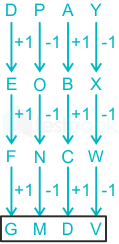
DPAY, EOBX, FNCW, ?

  1. AOption (a)

    VDMG

  2. BOption (b)

    MGVD

  3. COption (c)

    GMDV

  4. DOption (d)

    DVGM

View answer & explanation

Correct answer

Answer: (c)C.

GMDV

Why this answer is correct

The logic followed here is:

Hence, the next term in the series will be 'GMDV'.

Question 5

Select the letter-cluster from among the given options that can replace the question mark (?) in the given series.

ACE, HJL, OQS, ?

  1. AOption (a)

    VXZ

  2. BOption (b)

    UWY

  3. COption (c)

    ZXV

  4. DOption (d)

    VWX

View answer & explanation

Correct answer

Answer: (a)A.

VXZ

Why this answer is correct

The logic followed here is:


Hence, ' VXZ ' is the next term in the given series.

Question 6

Solve the following. 64.916 + 1.456 - 25.326 = ?

  1. AOption (a)

    40.046

  2. BOption (b)

    40.46

  3. COption (c)

    41.46

  4. DOption (d)

    41.046

View answer & explanation

Correct answer

Answer: (d)D.

41.046

Why this answer is correct

Given:

64.916 + 1.456 - 25.326

Formula Used:

Simple arithmetic addition and subtraction.

Calculation:

64.916 + 1.456 = 66.372

66.372 - 25.326

⇒ 66.372 - 25.326 = 41.046

The correct answer is option 4.

Question 7

The 'right to property' is a:

  1. AOption (a)

    Spiritual right

  2. BOption (b)

    Legal right

  3. COption (c)

    Fundamental right

  4. DOption (d)

    No right at all

View answer & explanation

Correct answer

Answer: (b)B.

Legal right

Why this answer is correct

The correct answer is Legal right

Key Points

  • The 'right to property' was originally a Fundamental Right under Article 31 of the Constitution of India.
  • However, it was removed from the list of Fundamental Rights by the 44th Amendment Act of 1978.
  • Currently, the 'right to property' is a Legal right under Article 300A.
  • As a Legal right, it ensures that no person shall be deprived of his property except by authority of law.

Additional Information

  • The 44th Amendment Act was passed in 1978 during the tenure of the Janata Party government.
  • The amendment removed the 'right to property' from the list of Fundamental Rights and made it a constitutional legal right.
  • The purpose of this amendment was to facilitate land reforms and prevent the concentration of land in the hands of a few.
  • As a Legal right, any deprivation of property must be in accordance with the procedure established by law, ensuring protection against arbitrary action by the state.

Question 8

Select the number from among the given options that can replace the question mark (?) in the given series.

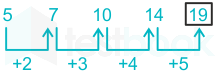
5, 7, 10, 14, ?

  1. AOption (a)

    20

  2. BOption (b)

    17

  3. COption (c)

    18

  4. DOption (d)

    19

View answer & explanation

Correct answer

Answer: (d)D.

19

Why this answer is correct

The logic followed here is:

Hence, the next term in the series will be 19.

Question 9

Three of the given four names share a certain relation whereas one is different. Select the option that is different from the rest.

Agartala, Imphal, Kohima, Silchar

  1. AOption (a)

    Imphal

  2. BOption (b)

    Agartala

  3. COption (c)

    Silchar

  4. DOption (d)

    Kohima

View answer & explanation

Correct answer

Answer: (c)C.

Silchar

Why this answer is correct

The logic followed here is:

Imphal → Capital of Manipur.

Agartala → Capital of Tripura.

Kohima → Capital of Nagaland.

Here, SIlchar is a city in Assam. Capital of Assam is Dispur not Silchar.

Hence, Silchar is the odd one among the given alternatives.

Question 10

The Shanghai Cooperation Organisation was founded in:

  1. AOption (a)

    1989

  2. BOption (b)

    2001

  3. COption (c)

    2014

  4. DOption (d)

    2005

View answer & explanation

Correct answer

Answer: (b)B.

2001

Why this answer is correct

The correct answer is 2001

Key Points

  • The Shanghai Cooperation Organisation (SCO) was founded in 2001.
  • The SCO is a Eurasian political, economic, and security alliance.
  • The founding members of the SCO include China, Kazakhstan, Kyrgyzstan, Russia, Tajikistan, and Uzbekistan.
  • The organization aims to strengthen mutual trust and neighborliness among the member states, promote effective cooperation in politics, trade, economy, research, technology, and culture.
  • The SCO also focuses on enhancing security and stability in the region.

Additional Information

  • The SCO has expanded its membership over the years, with India and Pakistan becoming full members in 2017.
  • The organization holds annual summits and regular meetings to discuss various issues of common interest and to plan collaborative actions.
  • The SCO's charter was signed in 2002 and entered into force in 2003.
  • The headquarters of the SCO is located in Beijing, China.
  • The SCO also has several observer states and dialogue partners, reflecting its growing influence and reach.

Question 11

The name given to the Indian long range, sub-sonic cruise missile that was test-fired on 15 April 2019 is:

  1. AOption (a)

    Abhay

  2. BOption (b)

    Vaayu

  3. COption (c)

    Nirbhay

  4. DOption (d)

    Pawan

View answer & explanation

Correct answer

Answer: (c)C.

Nirbhay

Why this answer is correct

The correct answer is Nirbhay

Key Points

  • Nirbhay is the name of the Indian long-range, sub-sonic cruise missile.
  • It was test-fired on 15 April 2019.
  • The missile has a range of approximately 1,000 kilometers.
  • It is designed to carry both conventional and nuclear warheads.
  • Nirbhay is developed by the Defence Research and Development Organisation (DRDO) of India.

Additional Information

  • The development of Nirbhay began in the early 2000s, and it has undergone several tests since then.
  • The missile is capable of flying at low altitudes to avoid detection by radar.
  • It enhances India's strategic capabilities and adds to the country's defense prowess.
  • The successful test-firing of Nirbhay marks a significant milestone in India's defense technology development.

Question 12

Read the given statements and conclusions carefully and decide which of the conclusions logically follow(s) from the statements.

Statements:

  1. All doctors are players.
  2. Some players are teachers.

Conclusions:

  1. Some players are doctors as well as teachers.
  2. All teachers are players.
  1. AOption (a)

    Conclusion 1 follows

  2. BOption (b)

    Neither conclusions 1 nor 2 follows

  3. COption (c)

    Conclusion 2 follows

  4. DOption (d)

    Both conclusions 1 and 2 follow

View answer & explanation

Correct answer

Answer: (b)B.

Neither conclusions 1 nor 2 follows

Why this answer is correct

The least possible Venn diagram is as follows:

Conclusions:

  1. Some players are doctors as well as teachers. → False (it is possible but not definite)
  2. All teachers are players. → False (it is possible but not definite)

Hence, 'Neither conclusion 1 nor 2 follows'.

Question 13

If a motor car travels the first half of a distance at a speed of 30 km/h and the remaining half distance at a speed of 50 km/h, what will be its average speed?

  1. AOption (a)

    40 km/h

  2. BOption (b)

    37.5 km/h

  3. COption (c)

    37 km/h

  4. DOption (d)

    45 km/h

View answer & explanation

Correct answer

Answer: (b)B.

37.5 km/h

Why this answer is correct

Shortcut Trick

When equal distances are covered at speeds x and y, Average Speed = (2xy) ÷ (x + y)

Here, x = 30 km/h and y = 50 km/h.

Average Speed = (2 × 30 × 50) ÷ (30 + 50)

Average Speed = 3000 ÷ 80 = 37.5 km/h.

∴ The correct answer is 37.5 km/h.

Alternate Method

Given:

Speed for the first half of the distance = 30 km/h

Speed for the remaining half of the distance = 50 km/h

Distance = d Speed = 30 km/h

Distance = d Speed = 50 km/h

Total Distance = 2d

Formula Used:

Average Speed = Total Distance ÷ Total Time

Time = Distance ÷ Speed

Calculations:

⇒ Let the distance of each half be d km.

⇒ Total Distance = d + d = 2d km.

⇒ Time taken for the first half = d ÷ 30 hours.

⇒ Time taken for the second half = d ÷ 50 hours.

⇒ Total Time = (d ÷ 30) + (d ÷ 50)

⇒ Total Time = (5d + 3d) ÷ 150 = 8d ÷ 150 = 4d ÷ 75 hours.

⇒ Average Speed = 2d ÷ (4d ÷ 75)

⇒ Average Speed = (2d × 75) ÷ 4d = 150 ÷ 4 = 37.5 km/h.

∴ The correct answer is 37.5 km/h.

Additional Information

Average Speed for Three Equal Distances

If a person covers three equal distances at speeds x, y, and z, the Average Speed = (3xyz) ÷ (xy + yz + zx).

Average Speed for Different Distances

When distances and speeds are completely different, you must find the total time taken for all individual parts and use the base formula: Average Speed = (Total Distance) ÷ (Total Time) = (d1 + d2 + ...) ÷ (t1 + t2 + ...).

Relative Speed

When two bodies move in the same direction, Relative Speed = Difference in their speeds (x − y). When moving in opposite directions, Relative Speed = Sum of their speeds (x + y).

Question 14

As per Ministry of Statistics and Programme Implementation, which state of India has the highest per capita income for 2018-19?

  1. AOption (a)

    Kerala

  2. BOption (b)

    Goa

  3. COption (c)

    Karnataka

  4. DOption (d)

    Haryana

View answer & explanation

Correct answer

Answer: (b)B.

Goa

Why this answer is correct

The correct answer is Goa

Key Points

  • Goa had the highest per capita income in India for the financial year 2018-19, according to the Ministry of Statistics and Programme Implementation.
  • The per capita income is a measure of the average income earned per person in a given area in a specified year.
  • This metric is crucial for understanding the economic well-being and standard of living of the residents of a state.
  • Goa's high per capita income is attributed to its flourishing tourism industry, mining activities, and a relatively small population.

Additional Information

  • The per capita income is calculated by dividing the total income of the state by its population.
  • It is an important indicator of economic performance and is used for comparing the economic prosperity of different states or regions.
  • Other states with high per capita income include Haryana, Karnataka, and Kerala, but they lag behind Goa.
  • The data provided by the Ministry of Statistics and Programme Implementation helps in policy formulation and economic planning.

Question 15

When water is changed into ice, its volume increases by 10%. If ice is changed into water, the percentage decrease in its volume will be:

  1. AOption (a)

    (100)/(16)%

  2. BOption (b)

    (100)/(120)%

  3. COption (c)

    (100)/(15)%

  4. DOption (d)

    (100)/(11)%

View answer & explanation

Correct answer

Answer: (d)D.

(100)/(11)%

Why this answer is correct

Given:

Volume of water (V1) = 100 units (assumed)

Volume of ice (V2) = 110 units (since volume increases by 10%)

Formula used:

Percentage Decrease = OriginalVolume−NewVolumeOriginalVolume\frac{Original Volume - New Volume}{Original Volume} × 100

Calculation:

Percentage Decrease = 110−100110\frac{110 - 100}{110} × 100

⇒ = 10110\frac{10}{110} × 100

⇒ = 9.09%

∴ The percentage decrease in volume when ice is changed into water is 9.09% i.e. 10011\frac{100}{11} %

Question 16

Tuzuk-i-Baburi/Baburnama was originally written in:

  1. AOption (a)

    Persian

  2. BOption (b)

    Urdu

  3. COption (c)

    Chagatai

  4. DOption (d)

    Hindi

View answer & explanation

Correct answer

Answer: (c)C.

Chagatai

Why this answer is correct

The correct answer is Chagatai

Key Points

  • Tuzuk-i-Baburi, also known as Baburnama, was originally written in Chagatai.
  • Chagatai was the native language of Babur, the founder of the Mughal Empire.
  • It is an autobiography of Babur, providing a detailed account of his life, conquests, and the socio-political environment of his time.
  • The work is regarded as one of the most important historical documents of the Mughal era and offers invaluable insights into the history and culture of Central Asia and India during Babur's reign.

Additional Information

  • Babur was a descendant of Timur on his father's side and Genghis Khan on his mother's side, which influenced his cultural and linguistic heritage.
  • The Baburnama was later translated into Persian during the reign of Babur's grandson, Akbar, making it accessible to a wider audience in the Mughal Empire.
  • The autobiography not only covers military campaigns but also provides descriptions of the flora, fauna, and geography of the regions Babur conquered.
  • Babur's vivid and candid writing style in the Baburnama has been praised by historians and scholars for its authenticity and richness of detail.

Question 17

The compound interest on Rs. 1,400 for 18 months at the rate of 20% per annum is:

  1. AOption (a)

    Rs. 448

  2. BOption (b)

    Rs. 450

  3. COption (c)

    Rs. 454

  4. DOption (d)

    Rs. 470

View answer & explanation

Correct answer

Answer: (a)A.

Rs. 448

Why this answer is correct

Given:

Principal (P) = Rs. 1,400

Time (T) = 18 months = 1.5 years

Rate (R) = 20% per annum

Formula Used:

Compound Interest (CI) = P(1 + R/100)T - P

Calculation:

Since time period is 1.5 years and rate is 20% per annum. So,

For 1st year rate of interest = 20% but for next 6 months rate of interest = 20/2 = 10%.

Total rate of interest for 1.5 years = 20 + 10 + (20 × 10/100) = 32%

CI = [1400(1 + 32/100) - 1]

CI = 1400[(1 + 8/25) - 1]

CI = 1400 × 8/25

CI = 56 × 8

CI = 448

The compound interest on Rs. 1,400 for 18 months at the rate of 20% per annum is Rs. 448.

Question 18

The chemical composition of the ruby gemstone is:

  1. AOption (a)

    Carbon

  2. BOption (b)

    Potassium

  3. COption (c)

    Aluminium oxide

  4. DOption (d)

    Sodium chloride

View answer & explanation

Correct answer

Answer: (c)C.

Aluminium oxide

Why this answer is correct

The correct answer is Aluminium oxide

Key Points

  • The chemical composition of the ruby gemstone is aluminium oxide (Al₂O₃).
  • Rubies are a variety of the mineral corundum, which is primarily composed of aluminium oxide.
  • The red color of rubies is due to the presence of trace amounts of chromium within the aluminium oxide structure.
  • Rubies are one of the four precious gemstones, alongside sapphires, emeralds, and diamonds.
  • They are highly valued for their color, hardness (second only to diamonds), and rarity.

Additional Information

  • Rubies have been used in jewelry for centuries and are also used in various industrial applications due to their hardness.
  • The most valuable rubies are those with a deep red color known as "pigeon's blood" red.
  • Rubies are primarily mined in countries like Myanmar, Thailand, Sri Lanka, and Madagascar.
  • In addition to their aesthetic value, rubies are also believed to have various metaphysical properties, including promoting energy, vitality, and courage.
  • The largest known ruby is the "Liberty Bell Ruby," which weighs over 8,500 carats.

Question 19

The sum of two numbers is 25 and the product is 35. The sum of their reciprocals is:

  1. AOption (a)

    (4)/(7)

  2. BOption (b)

    (5)/(7)

  3. COption (c)

    (6)/(7)

  4. DOption (d)

    (3)/(7)

View answer & explanation

Correct answer

Answer: (b)B.

(5)/(7)

Why this answer is correct

Given:

Sum of numbers (a + b) = 25

Product of numbers (a × b) = 35

Formula used:

Sum of reciprocals = 1a+1b=a+ba×b\frac{1}{a} + \frac{1}{b} = \frac{a + b}{a × b}

Calculation:

Sum of reciprocals = 2535\frac{25}{35}

⇒ Sum of reciprocals = 57\frac{5}{7}

∴ The sum of their reciprocals is 57\frac{5}{7}.

Question 20

Bamboo, birch, sal, spruce and sheesham can be found in the ______ forest.

  1. AOption (a)

    coniferous

  2. BOption (b)

    temperate deciduous

  3. COption (c)

    alpine

  4. DOption (d)

    temperate

View answer & explanation

Correct answer

Answer: (b)B.

temperate deciduous

Why this answer is correct

The correct answer is temperate deciduous

Key Points

  • Bamboo, birch, sal, spruce, and sheesham are typically found in temperate deciduous forests.
  • Temperate deciduous forests are characterized by trees that shed their leaves annually.
  • These forests are found in regions with moderate climate and well-defined seasons, including a distinct winter.
  • The soil in temperate deciduous forests is fertile and rich in nutrients, supporting a wide variety of plant species.

Additional Information

  • Temperate deciduous forests are primarily located in the eastern United States, Canada, Europe, China, and Japan.
  • These forests experience four distinct seasons: spring, summer, autumn, and winter.
  • The biodiversity in temperate deciduous forests includes a variety of trees, shrubs, and herbaceous plants, as well as numerous animal species.
  • Human activities such as logging, agriculture, and urbanization pose threats to these forests, leading to habitat loss and fragmentation.

Question 21

Kosal, Anga, Kashi and Vajji were all:

  1. AOption (a)

    conquered by King Ajatshatru

  2. BOption (b)

    part of 16 Mahajanapadas

  3. COption (c)

    ruled by King Harshvardhan in 6th century AD

  4. DOption (d)

    conquered by King Jaichand

View answer & explanation

Correct answer

Answer: (b)B.

part of 16 Mahajanapadas

Why this answer is correct

The correct answer is Option 2

Key Points

  • Kosal, Anga, Kashi, and Vajji were all part of the 16 Mahajanapadas.
  • The 16 Mahajanapadas were a group of sixteen powerful and vast kingdoms that existed in ancient India.
  • These Mahajanapadas played a significant role in the political and cultural landscape of ancient India.
  • The concept of Mahajanapadas is an important aspect of ancient Indian history and is often studied to understand the political and social structures of that time.

Additional Information

  • The 16 Mahajanapadas included kingdoms like Magadha, Kosala, Vatsa, Avanti, and others.
  • The term Mahajanapada means "great realm" or "great country".
  • The period of the Mahajanapadas is crucial for understanding the development of political organization in ancient India.
  • Most of these Mahajanapadas were located in the fertile Indo-Gangetic plains.
  • This period saw the rise of urban centers and the growth of trade and commerce.
  • The political structure of these Mahajanapadas varied, with some being monarchies and others being republics.

Question 22

If x=y2x = \frac{y}{2} and y=z6 y = \frac{z}{6}, then x : y : z is equal to:

  1. AOption (a)

    1 : 2 : 3

  2. BOption (b)

    1 : 2 : 6

  3. COption (c)

    2 : 12 : 1

  4. DOption (d)

    1 : 2 : 12

View answer & explanation

Correct answer

Answer: (d)D.

1 : 2 : 12

Why this answer is correct

Given:

x = y/2

y = z/6

Formula used:

Find the ratio x : y : z

Calculation:

From y = z/6, we get z = 6y

From x = y/2, we get y = 2x

Substitute y = 2x into z = 6y:

⇒ z = 6 × 2x

⇒ z = 12x

So, x : y : z = x : 2x : 12x

Divide by x:

⇒ x : y : z = 1 : 2 : 12

∴ The ratio x : y : z is 1 : 2 : 12.

Question 23

A rectangular field is to be fenced on three sides leaving a side of 30 ft. uncovered. If the area of the field is 690 sq. ft., how many feet of fencing will be required?

  1. AOption (a)

    76

  2. BOption (b)

    69

  3. COption (c)

    59

  4. DOption (d)

    46

View answer & explanation

Correct answer

Answer: (a)A.

76

Why this answer is correct

Given:

Uncovered side (length) = 30 ft

Area of the field = 690 sq. ft

Formula used:

Area = length × width

Fencing required = 2 × width + length

Calculation:

690 = 30 × width

⇒ width = 69030\frac{690}{30}

⇒ width = 23 ft

Fencing required = 2 × 23 + 30

⇒ Fencing required = 46 + 30

⇒ Fencing required = 76 ft

∴ The required length of fencing is 76 ft.

Question 24

Which of the following air pollutants is known as soot?

  1. AOption (a)

    Lead

  2. BOption (b)

    Ozone

  3. COption (c)

    Carbon monoxide

  4. DOption (d)

    Particulate matter

View answer & explanation

Correct answer

Answer: (d)D.

Particulate matter

Why this answer is correct

The correct answer is Particulate matter

Key Points

  • Particulate matter is commonly known as soot.
  • Particulate matter consists of tiny particles or droplets in the air that can be harmful when inhaled.
  • Sources of particulate matter include vehicle emissions, industrial processes, and natural sources like wildfires and volcanic eruptions.
  • Soot is a type of particulate matter that results from incomplete combustion of fossil fuels and biomass.
  • Exposure to particulate matter can lead to respiratory and cardiovascular diseases.

Additional Information

  • Lead is a toxic metal that can cause various health issues, particularly in children.
  • Ozone at ground level is a harmful air pollutant but is beneficial in the upper atmosphere where it forms the ozone layer.
  • Carbon monoxide is a colorless, odorless gas that can be deadly when inhaled in large amounts.
  • Particulate matter is categorized by size, with PM10 and PM2.5 being common measures representing particles with diameters less than 10 and 2.5 micrometers, respectively.
  • Regulations and measures are in place in many countries to monitor and reduce particulate matter emissions to protect public health.

Question 25

Solve the following:

(27\frac{2}{7} × −35\frac{-3}{5} - 112\frac{1}{12} - 35\frac{3}{5} × 47\frac{4}{7}) × 7 = ?

  1. AOption (a)

    (-251)/(420)

  2. BOption (b)

    (-251)/(60)

  3. COption (c)

    (-251)/(210)

  4. DOption (d)

    (-251)/(209)

View answer & explanation

Correct answer

Answer: (b)B.

(-251)/(60)

Why this answer is correct

Calculation:

(27\frac{2}{7} × −35\frac{-3}{5} - 112\frac{1}{12} - 35\frac{3}{5} × 47\frac{4}{7}) × 7 

⇒ (−635\frac{-6}{35} - 112\frac{1}{12} - 1235\frac{12}{35}) × 7 

⇒ (−72−35−144420\frac{-72-35-144}{420}) × 7

⇒ −251420\frac{-251}{420} × 7

⇒ −25160\frac{-251}{60}

∴ The correct answer is option (2).

Question 26

Rods and cone cells are found in:

  1. AOption (a)

    Brain

  2. BOption (b)

    Liver

  3. COption (c)

    Ears

  4. DOption (d)

    Eyes

View answer & explanation

Correct answer

Answer: (d)D.

Eyes

Why this answer is correct

The correct answer is Eyes

Key Points

  • Rods and cone cells are specialized photoreceptor cells found in the retina of the eyes.
  • Rods are responsible for vision at low light levels (scotopic vision) and do not mediate color vision.
  • Cones are active at higher light levels (photopic vision), are capable of color vision, and are responsible for high spatial acuity.
  • The human retina contains approximately 120 million rod cells and 6 million cone cells.
  • Rods and cones are essential for converting light into electrical signals, which are then processed by the brain to produce visual images.

Additional Information

  • The eye is a complex organ composed of various parts including the cornea, lens, retina, and optic nerve.
  • The retina is the light-sensitive layer at the back of the eye that contains the photoreceptor cells (rods and cones).
  • The optic nerve transmits visual information from the retina to the brain.
  • Common eye conditions involving rods and cones include retinitis pigmentosa and color blindness.
  • Regular eye check-ups are important for maintaining good visual health and early detection of potential issues.

Question 27

What is the lubricating fluid found between the two bones at a movable joint called?

  1. AOption (a)

    Interstitial fluid

  2. BOption (b)

    Synovial fluid

  3. COption (c)

    Cerebrospinal fluid

  4. DOption (d)

    Amniotic fluid

View answer & explanation

Correct answer

Answer: (b)B.

Synovial fluid

Why this answer is correct

The correct answer is Synovial fluid

Key Points

  • Synovial fluid is the lubricating fluid found between the two bones at a movable joint.
  • It reduces friction between the articular cartilage of synovial joints during movement.
  • This fluid is essential for the proper functioning of joints and helps in smooth and painless movements.
  • Synovial fluid also supplies nutrients and removes metabolic wastes from the cartilage cells.

Additional Information

  • The other options provided are not correct for this question:
  • Interstitial fluid: This is the fluid that surrounds the cells in tissues.
  • Cerebrospinal fluid: This fluid surrounds the brain and spinal cord.
  • Amniotic fluid: This is the fluid that surrounds a fetus within the amniotic sac.
  • Synovial fluid is specifically found in joint cavities and is crucial for joint health.

Question 28

If sin A = a/b, then find the value of cos A.

  1. AOption (a)

    (b)/(a2+b2)(b)/(a^2+b^2)

  2. BOption (b)

    b2−a2b\frac{\sqrt {b^2 - a^2}}{b}

  3. COption (c)

    ba\frac{b}{a}

  4. DOption (d)

    √(b2+a2)b\frac{√(b^2 + a^2)}{b}

View answer & explanation

Correct answer

Answer: (b)B.

b2−a2b\frac{\sqrt {b^2 - a^2}}{b}

Why this answer is correct

Given:

sin A = a/b

Formula used:

cos2 A + sin2 A = 1

Calculation:

sin A = a/b

⇒ sin2 A = (a/b)2

⇒ sin2 A = a2/b2

Using the identity cos2 A + sin2 A = 1:

⇒ cos2 A = 1 - sin2 A

⇒ cos2 A = 1 - a2/b2

⇒ cos2 A = (b2 - a2)/b2

⇒ cos A = √((b2 - a2)/b2)

⇒ cos A = √(b2 - a2)/b

∴ The value of cos A is √(b2 - a2)/b.

Question 29

In a certain code language TEACHER is coded as REHCAET. How would the word STUDENT be coded in that language?

  1. AOption (a)

    TNESTUD

  2. BOption (b)

    STUDTNE

  3. COption (c)

    TNEDUTS

  4. DOption (d)

    ENTTUDS

View answer & explanation

Correct answer

Answer: (c)C.

TNEDUTS

Why this answer is correct

The logic followed here is:

Each word is coded in reverse order.

The code for teacher is as follows:

Similarly, the code for STUDENT is as follows:

Hence, the code for STUDENT will be 'TNEDUTS'.

Question 30

As of December 2020, which of the following states has the largest installed wind power capacity?

  1. AOption (a)

    Gujarat

  2. BOption (b)

    Rajasthan

  3. COption (c)

    Tamil Nadu

  4. DOption (d)

    Maharashtra

View answer & explanation

Correct answer

Answer: (c)C.

Tamil Nadu

Why this answer is correct

The correct answer is Tamil Nadu

Key Points

  • As of December 2020, Tamil Nadu has the largest installed wind power capacity among Indian states.
  • Tamil Nadu has been a leader in wind energy with significant investments and favorable policies promoting wind power generation.
  • The state has several large wind farms, and its geographical location provides optimal conditions for harnessing wind energy.
  • Wind power is a crucial component of Tamil Nadu's renewable energy portfolio, contributing significantly to its energy mix.

Additional Information

  • India is one of the largest producers of wind energy in the world, with several states contributing to its wind power capacity.
  • The Ministry of New and Renewable Energy (MNRE) is the nodal agency for the development of wind energy in India.
  • Wind energy plays a vital role in India's renewable energy targets, aiming to achieve sustainable and clean energy solutions.
  • Other states like Gujarat, Maharashtra, and Rajasthan also have significant wind power capacities, contributing to the overall renewable energy landscape in India.
  • Government initiatives and policies, such as tax incentives and subsidies, have been instrumental in promoting wind energy projects across the country.

Question 31

The Air (Prevention and Control of Pollution) Act was introduced in India in:

  1. AOption (a)

    1990

  2. BOption (b)

    1975

  3. COption (c)

    2000

  4. DOption (d)

    1981

View answer & explanation

Correct answer

Answer: (d)D.

1981

Why this answer is correct

The correct answer is 1981

Key Points

  • The Air (Prevention and Control of Pollution) Act was introduced in India in the year 1981.
  • This Act was enacted to provide for the prevention, control, and abatement of air pollution.
  • It establishes the Central and State Pollution Control Boards to monitor and control air pollution.
  • The Act aims to maintain the quality of air and provides powers to the boards to take necessary steps to curb air pollution.
  • It also includes provisions for the establishment of standards for emission of air pollutants from industrial plants and automobiles.

Additional Information

  • The Air (Prevention and Control of Pollution) Act, 1981 was inspired by the United Nations Conference on the Human Environment held in Stockholm in 1972.
  • This Act was one of the first legislative measures taken by India to combat environmental pollution.
  • It provides for the establishment of air quality standards and the regulation of emissions from industrial and vehicular sources.
  • Violations of the Act can lead to penalties including fines and imprisonment, emphasizing the importance of compliance.
  • The Act also encourages public participation and awareness regarding air pollution issues.

Question 32

A spam is a/an:

  1. AOption (a)

    operating system

  2. BOption (b)

    application

  3. COption (c)

    unsolicited e-mail

  4. DOption (d)

    newsgroup

View answer & explanation

Correct answer

Answer: (c)C.

unsolicited e-mail

Why this answer is correct

The correct answer is unsolicited e-mail

Key Points

  • Unsolicited e-mail, commonly known as spam, refers to unwanted or irrelevant messages sent over the internet, typically to a large number of users, for the purposes of advertising, phishing, spreading malware, etc.
  • Spam e-mails can clutter inboxes, consume bandwidth, and sometimes carry malicious attachments or links that can compromise the security of the recipient's device or personal information.
  • Most e-mail services offer spam filters that automatically detect and redirect such unsolicited e-mails to a separate spam or junk folder to minimize their impact on users.
  • Effective management and awareness of spam can help users protect themselves from potential threats and maintain a clean and organized e-mail inbox.

Additional Information

  • Spam is often sent in bulk by botnets, which are networks of infected computers controlled by cybercriminals.
  • Users can report spam messages to their e-mail service providers to help improve spam detection algorithms.
  • Legislation like the CAN-SPAM Act in the United States sets rules for commercial e-mail and gives recipients the right to stop unwanted e-mails, though enforcement can be challenging.
  • Best practices to avoid spam include not sharing your e-mail address publicly, being cautious of where you sign up for services, and using strong, unique passwords for online accounts.

Question 33

A can finish a task in 16 days and B can finish the same task in one fourth the time taken by A. Working together, what part of the same task can they finish in a day?

  1. AOption (a)

    (9)/(16)

  2. BOption (b)

    (5)/(16)

  3. COption (c)

    (1)/(8)

  4. DOption (d)

    (1)/(16)

View answer & explanation

Correct answer

Answer: (b)B.

(5)/(16)

Why this answer is correct

Given:

A can finish a task in 16 days.

B can finish the same task in one fourth the time taken by A.

Formula Used:

Work done by A in 1 day = 1 / Number of days taken by A

Work done by B in 1 day = 1 / Number of days taken by B

Combined work done in 1 day = Work done by A in 1 day + Work done by B in 1 day

Calculation:

Time taken by B to finish the task = 16 / 4 = 4 days

Work done by A in 1 day = 1 / 16

Work done by B in 1 day = 1 / 4

Combined work done in 1 day = (1 / 16) + (1 / 4)

⇒ Combined work done in 1 day = (1 / 16) + (4 / 16)

⇒ Combined work done in 1 day = 5 / 16

∴ The part of the same task can they finish in a day 516\frac{5}{16}.

Question 34

If the letters of the word UNDERSTANDING are arranged in the alphabetical order, then which of the following letter will be in the centre?

  1. AOption (a)

    S

  2. BOption (b)

    G

  3. COption (c)

    R

  4. DOption (d)

    N

View answer & explanation

Correct answer

Answer: (d)D.

N

Why this answer is correct

The letters of the word UNDERSTANDING when arranged in alphabetical order will be as follows:

  • UNDERSTANDING → ADDEGINNNRSTU

The letter in the centre will be:

  • ADDEGINNNRSTU

Hence, N will be in the centre.

Question 35

The East-West Corridor under National Highway Development Project is from:

  1. AOption (a)

    Silchar to Porbandar

  2. BOption (b)

    Guwahati to Dwarka

  3. COption (c)

    Kolkata to Porbandar

  4. DOption (d)

    Kolkata to Mumbai

View answer & explanation

Correct answer

Answer: (a)A.

Silchar to Porbandar

Why this answer is correct

The correct answer is Silchar to Porbandar

Key Points

  • The East-West Corridor under the National Highway Development Project stretches from Silchar to Porbandar.
  • This corridor is part of a larger initiative to improve road connectivity across India, enhancing trade and transportation efficiency.
  • The project aims to facilitate smoother and faster movement of goods and passengers between the eastern and western parts of India.
  • The East-West Corridor is one of the four major highway projects under the National Highways Development Project (NHDP), the other three being the Golden Quadrilateral, the North-South Corridor, and the Port Connectivity project.

Additional Information

  • The National Highways Development Project (NHDP) was initiated by the Government of India to upgrade, rehabilitate and widen major highways in India to international standards.
  • The NHDP is being implemented by the National Highways Authority of India (NHAI).
  • The project aims to ensure a more efficient and safer road network, thereby boosting economic growth and development.
  • The East-West Corridor, along with the other corridors under NHDP, plays a crucial role in reducing travel time and vehicle operating costs, while also improving road safety.
  • The development of such infrastructure projects is essential for the sustained economic growth of the country, facilitating better connectivity and accessibility.

Question 36

One fifth of 40% of a number is equal to two third of 30% of another number. What is the respective ratio of the first number to the second number?

  1. AOption (a)

    2 : 1

  2. BOption (b)

    1 : 5

  3. COption (c)

    2 : 5

  4. DOption (d)

    5 : 2

View answer & explanation

Correct answer

Answer: (d)D.

5 : 2

Why this answer is correct

Given:

One fifth of 40% of a number (x) is equal to two third of 30% of another number (y).

Formula used:

(1/5) × (40/100) × x = (2/3) × (30/100) × y

Calculation:

(1/5) × 0.4 × x = (2/3) × 0.3 × y

⇒ (0.08) × x = (0.2) × y

⇒ x / y = (0.2) / (0.08)

⇒ x / y = 2.5

⇒ x : y = 2.5 : 1

⇒ x : y = 5 : 2

∴ The respective ratio of the first number to the second number is 5 : 2.

Question 37

Who threw a bomb in the Central Legislative Assembly on 8 April 1929?

  1. AOption (a)

    Batukeshwar Dutt and Bhagat Singh

  2. BOption (b)

    Ram Prasad Bismil and Prafull Das

  3. COption (c)

    Asfaqullah Khan and Sukhdev

  4. DOption (d)

    Chandra Shekhar Azad and Raushan Singh

View answer & explanation

Correct answer

Answer: (a)A.

Batukeshwar Dutt and Bhagat Singh

Why this answer is correct

The correct answer is Batukeshwar Dutt and Bhagat Singh

Key Points

  • Batukeshwar Dutt and Bhagat Singh threw a bomb in the Central Legislative Assembly on 8 April 1929.
  • This act was a protest against the repressive policies of the British government.
  • The bomb was thrown into the Assembly as a demonstration of revolutionary opposition and was not intended to cause harm to individuals.
  • Both Dutt and Singh were arrested immediately after the incident and used the trial as a platform to propagate their revolutionary ideas.
  • The incident is a significant event in the history of India's struggle for independence.

Additional Information

  • Bhagat Singh was a prominent revolutionary freedom fighter who is remembered for his bravery and commitment to the cause of India's independence.
  • Batukeshwar Dutt was also a member of the Hindustan Socialist Republican Association (HSRA) and played a crucial role in the revolutionary movement.
  • Their actions on 8 April 1929 were aimed at awakening the masses to the injustices of British rule and inspiring them to join the freedom struggle.
  • The Central Legislative Assembly Bombing is a testament to the sacrifices made by revolutionaries in the fight against colonial rule.
  • The trial following the bombing helped highlight the plight of Indian political prisoners and the oppressive nature of British colonialism.

Question 38

The difference between the greatest and the smallest number of six digits is:

  1. AOption (a)

    895592

  2. BOption (b)

    109999

  3. COption (c)

    100000

  4. DOption (d)

    899999

View answer & explanation

Correct answer

Answer: (d)D.

899999

Why this answer is correct

Given:

The greatest number of six digits = 999999

The smallest number of six digits = 100000

Formula Used:

Difference = Greatest number - Smallest number

Calculation:

Greatest number = 999999

Smallest number = 100000

Difference = 999999 - 100000

⇒ Difference = 899999

The difference between the greatest and the smallest number of six digits is 899999.

Question 39

Which of the following animals has a three-chambered heart?

  1. AOption (a)

    Sting Ray

  2. BOption (b)

    Salamander

  3. COption (c)

    Rohu

  4. DOption (d)

    Sparrow

View answer & explanation

Correct answer

Answer: (b)B.

Salamander

Why this answer is correct

The correct answer is Salamander

Key Points

  • Salamanders are amphibians and possess a three-chambered heart, consisting of two atria and one ventricle.
  • Amphibians, in general, have a three-chambered heart which allows for a partial separation of oxygenated and deoxygenated blood.
  • This type of heart is less efficient than the four-chambered heart found in mammals and birds, but it is sufficient for the metabolic needs of amphibians.

Additional Information

  • Fish like the Rohu have a two-chambered heart, consisting of one atrium and one ventricle.
  • Birds like the Sparrow and mammals have a four-chambered heart, which is the most efficient for oxygenating blood.
  • Sting Rays, being cartilaginous fish, also have a two-chambered heart.

Question 40

If '-' stands for '×', '+' stands for '/', '×' stands for '+' and '/' stands for '-', then find the value of 24 + 6 / 2 - 9 × 4.

  1. AOption (a)

    -18

  2. BOption (b)

    24

  3. COption (c)

    10

  4. DOption (d)

    -10

View answer & explanation

Correct answer

Answer: (d)D.

-10

Why this answer is correct

Given Equation: 24 + 6 / 2 - 9 × 4.

BODMAS Rule:

Decoding the given information:

Alphabet-+×/
Meaning×/+-


Now replacing the sign from left to right using BODMAS Rule, we get:

⇒ 24 / 6 - 2 × 9 + 4

⇒ 4 - 2 × 9 + 4

⇒ 4 - 18 + 4

⇒ 8 - 18 = -10.

Hence, the correct option is "Option 4".

Question 41

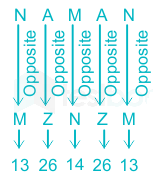
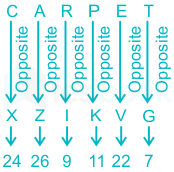
In a certain code language, NAMAN is written as 92. How will CARPET be written as in that language?

  1. AOption (a)

    97

  2. BOption (b)

    98

  3. COption (c)

    96

  4. DOption (d)

    99

View answer & explanation

Correct answer

Answer: (d)D.

99

Why this answer is correct

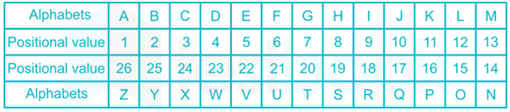
The logic followed here is:

  • The positional value of each letter in reverse alphabetical order is added to get the code for the given word.

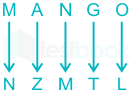
The code for NAMAN will be as follows:

13 + 26 + 14 + 26 + 13 = 92

Similarly, the code for CARPET will be:

24 + 26 + 9 + 11 + 22 + 7 = 99

Hence, the code for CARPET will be '99'.

Question 42

If tan α =(1)/(x), then find the value of sin α + cos α.

  1. AOption (a)

    (1+x)/√(1+x2)(1+x)/√(1+x^2)

  2. BOption (b)

    2x/(1+x2)2x/(1+x^2)

  3. COption (c)

    (1−x2)/(1+x2)(1-x^2)/(1+x^2)

  4. DOption (d)

    (1−x)/(1+x2)(1-x)/(1+x^2)

View answer & explanation

Correct answer

Answer: (a)A.

(1+x)/√(1+x2)(1+x)/√(1+x^2)

Why this answer is correct

Given:

If tan α = 1/x, find the value of sin α + cos α.

Formula used:

tan α = sin α / cos α

sin2 α + cos2 α = 1

Calculation:

tan α = 1/x

⇒ sin α / cos α = 1/x

⇒ sin α = cos α / x

Using sin2 α + cos2 α = 1:

(cos α / x)2 + cos2 α = 1

⇒ cos2 α / x2 + cos2 α = 1

⇒ cos2 α (1/x2 + 1) = 1

⇒ cos2 α (1 + x2) / x2 = 1

⇒ cos2 α = x2 / (1 + x2)

⇒ cos α = x / √(1 + x2)

And sin α = (cos α) / x = 1 / √(1 + x2)

⇒ sin α + cos α = (1 / √(1 + x2)) + (x / √(1 + x2))

⇒ sin α + cos α = (1 + x) / √(1 + x2)

∴ The value of sin α + cos α is (1 + x) / √(1 + x2).

Question 43

Under the Antyodaya Anna Yojana, rice is provided for rupees:

  1. AOption (a)

    5 per kg

  2. BOption (b)

    2 per kg

  3. COption (c)

    9 per kg

  4. DOption (d)

    3 per kg

View answer & explanation

Correct answer

Answer: (d)D.

3 per kg

Why this answer is correct

The correct answer is 3 per kg

Key Points

  • Under the Antyodaya Anna Yojana, rice is provided at a subsidized rate of 3 per kg.
  • The scheme aims to provide highly subsidized food to millions of the poorest families in India.
  • It was launched by the Government of India in December 2000.
  • The scheme is targeted towards the poorest of the poor, ensuring food security for vulnerable sections of society.
  • Beneficiaries under the scheme are provided with 35 kg of rice or wheat per month at the subsidized rate.

Additional Information

  • Antyodaya Anna Yojana (AAY) is a part of the National Food Security Act, 2013.
  • The scheme is implemented by the Food Corporation of India (FCI) along with state governments.
  • The selection of beneficiaries is done by the state governments based on socio-economic criteria.
  • Over the years, the scheme has played a crucial role in reducing hunger and malnutrition among the poorest sections of society.
  • The National Food Security Act aims to provide subsidized food grains to approximately two-thirds of India's population.

Question 44

The value of (0.064 + 0.027)/(0.16 - 0.12 + 0.09) is:

  1. AOption (a)

    0.9

  2. BOption (b)

    0.16

  3. COption (c)

    0.09

  4. DOption (d)

    0.7

View answer & explanation

Correct answer

Answer: (d)D.

0.7

Why this answer is correct

Given:

Expression: (0.064 + 0.027)/(0.16 - 0.12 + 0.09)

Formula used:

Simple arithmetic operations

Calculation:

Numerator: 0.064 + 0.027

⇒ 0.064 + 0.027 = 0.091

Denominator: 0.16 - 0.12 + 0.09

⇒ 0.16 - 0.12 + 0.09 = 0.13

Now, divide the numerator by the denominator:

⇒ 0.091 / 0.13

⇒ 0.7

∴ The value is 0.7.

Question 45

The Lucknow Shatabdi Express leaves Delhi at 1:30 p.m. and reaches Lucknow at 10:30 p.m. The average speed of the train is 90 km/h. What is the distance covered by the train from Delhi to Lucknow?

  1. AOption (a)

    800 km

  2. BOption (b)

    830 km

  3. COption (c)

    810 km

  4. DOption (d)

    750 km

View answer & explanation

Correct answer

Answer: (c)C.

810 km

Why this answer is correct

Given:

Departure time from Delhi = 1:30 p.m.

Arrival time at Lucknow = 10:30 p.m.

Average speed = 90 km/h

Formula used:

Distance = Speed × Time

Calculation:

Time taken: 10:30 p.m. - 1:30 p.m. = 9 hours

Distance = 90 km/h × 9 hours

⇒ Distance = 810 km

∴ The distance covered by the train from Delhi to Lucknow is 810 km.

Question 46

'Patna Kalam' is a:

  1. AOption (a)

    famous pen

  2. BOption (b)

    group of Bihari poets

  3. COption (c)

    museum in Patna

  4. DOption (d)

    style of painting

View answer & explanation

Correct answer

Answer: (d)D.

style of painting

Why this answer is correct

The correct answer is style of painting

Key Points

  • Patna Kalam is a style of painting that originated in Bihar, India.
  • This style is known for its unique blend of Mughal and local Indian art forms, and it flourished during the 18th and 19th centuries.
  • Patna Kalam paintings are characterized by their detailed and realistic depiction of everyday life, nature, and historical events.
  • The artists of Patna Kalam used natural colors and were skilled in creating intricate designs and patterns.

Additional Information

  • Patna Kalam is also known as Patna School of Painting.
  • It is a subset of the broader Mughal painting tradition but with distinct local influences that make it unique.
  • The subjects of Patna Kalam paintings often include scenes from daily life, festivals, and rural activities, reflecting the socio-cultural environment of the time.
  • This art form played a significant role in the cultural heritage of Bihar and continues to be celebrated for its historical and artistic value.
  • Notable artists of this style include Sahib Ram, Hulas Lal, and Shiv Lal, who contributed significantly to its development and popularity.

Question 47

Which country's President made an underwater speech to call for stronger action to protect oceans in 2019?

  1. AOption (a)

    Italy

  2. BOption (b)

    Brunei

  3. COption (c)

    Maldives

  4. DOption (d)

    Seychelles

View answer & explanation

Correct answer

Answer: (d)D.

Seychelles

Why this answer is correct

The correct answer is 4) Seychelles

Key Points

  • Seychelles President made an underwater speech in 2019 to draw attention to the urgent need for stronger ocean protection.
  • This unique act was part of a campaign to highlight the negative impacts of climate change and pollution on the world's oceans.
  • The President's speech took place underwater at a depth of 121 meters, in a submersible off the coast of Seychelles.
  • The initiative aimed to emphasize the importance of marine conservation and the necessity for global cooperation to safeguard oceanic ecosystems.
  • The underwater speech was a call to action for the international community to take more robust measures to protect oceans and marine life.

Additional Information

  • The Seychelles is an archipelago of 115 islands in the Indian Ocean, off East Africa.
  • It is known for its stunning beaches, coral reefs, nature reserves, and rare wildlife such as giant Aldabra tortoises.
  • Climate change and pollution pose significant threats to its marine and coastal ecosystems, which are vital to the country's economy and biodiversity.
  • The country has been actively involved in international efforts to promote sustainable development and environmental conservation.

Question 48

CRY is an organisation that works for the:

  1. AOption (a)

    improvement of agriculture

  2. BOption (b)

    destitute women

  3. COption (c)

    protection of child rights

  4. DOption (d)

    elimination of prostitution

View answer & explanation

Correct answer

Answer: (c)C.

protection of child rights

Why this answer is correct

The correct answer is protection of child rights

Key Points

  • CRY (Child Rights and You) is an Indian non-governmental organization that works towards ensuring the rights of children.
  • CRY focuses on a variety of issues such as child labor, malnutrition, education, and child abuse.
  • The organization works through various grassroots initiatives and advocacy efforts to create a secure and healthy environment for children.
  • CRY collaborates with local communities, government agencies, and other stakeholders to promote child rights and welfare.
  • The mission of CRY is to enable people to take responsibility for the situation of underprivileged children and motivate them to seek resolution through individual and collective action.

Additional Information

  • CRY was founded in 1979 by Rippan Kapur.
  • The organization has impacted the lives of over 3 million children across 19 states in India.
  • CRY works on the principle that child rights are integral to human rights and focuses on ensuring that every child has access to education, healthcare, and protection from exploitation.
  • CRY’s approach involves addressing the root causes of deprivation and inequality that affect children.

Question 49

If the mean of (x)/(2), x, (x)/(3), (x)/(4) and (x)/(6) is 6, then value of x will be:

  1. AOption (a)

    4

  2. BOption (b)

    40/3

  3. COption (c)

    2

  4. DOption (d)

    3/2

View answer & explanation

Correct answer

Answer: (b)B.

40/3

Why this answer is correct

Given:

The mean of x/2, x, x/3, x/4, and x/6 is 6.

Formula used:

Mean = (Sum of terms) / (Number of terms)

Calculation:

Sum of terms = (x/2) + x + (x/3) + (x/4) + (x/6)

Number of terms = 5

Mean = 6

Mean = (Sum of terms) / 5

6 = [(x/2) + x + (x/3) + (x/4) + (x/6)] / 5

⇒ 30 = (x/2) + x + (x/3) + (x/4) + (x/6)

Find the common denominator (12):

⇒ 30 = (6x/12) + (12x/12) + (4x/12) + (3x/12) + (2x/12)

⇒ 30 = (6x + 12x + 4x + 3x + 2x) / 12

⇒ 30 = 27x / 12

⇒ 30 × 12 = 27x

⇒ 360 = 27x

⇒ x = 360 / 27

⇒ x = 40/3

∴ The value of x is 40/3.

Question 50

The mean daily profit by a shopkeeper in a month of 30 days was Rs. 450. If the mean profit for the first 20 days was Rs. 300, then the mean profit for the last 10 days will be:

  1. AOption (a)

    Rs. 500

  2. BOption (b)

    Rs. 250

  3. COption (c)

    Rs. 260

  4. DOption (d)

    Rs. 750

View answer & explanation

Correct answer

Answer: (d)D.

Rs. 750

Why this answer is correct

Given:

Mean daily profit for 30 days = Rs. 450

Mean profit for the first 20 days = Rs. 300

Formula Used:

Mean profit = Total profit / Number of days

Calculation:

Total profit for 30 days = Mean daily profit × Number of days

Total profit for 30 days = 450 × 30

Total profit for 30 days = Rs. 13500

Total profit for the first 20 days = Mean profit for the first 20 days × Number of days

Total profit for the first 20 days = 300 × 20

Total profit for the first 20 days = Rs. 6000

Total profit for the last 10 days = Total profit for 30 days - Total profit for the first 20 days

Total profit for the last 10 days = 13500 - 6000

Total profit for the last 10 days = Rs. 7500

Mean profit for the last 10 days = Total profit for the last 10 days / Number of days

Mean profit for the last 10 days = 7500 / 10

Mean profit for the last 10 days = Rs. 750

The mean profit for the last 10 days is Rs. 750.

Question 51

In Computer terminology, ALU stands for:

  1. AOption (a)

    Application Logical Unit

  2. BOption (b)

    Air Lock Unit

  3. COption (c)

    Arithmetic Logic Unit

  4. DOption (d)

    Active Load Unit

View answer & explanation

Correct answer

Answer: (c)C.

Arithmetic Logic Unit

Why this answer is correct

The correct answer is Arithmetic Logic Unit

Key Points

  • Arithmetic Logic Unit (ALU) is a crucial component of the central processing unit (CPU) in a computer.
  • The ALU is responsible for performing arithmetic and logical operations, such as addition, subtraction, multiplication, division, and logical comparisons.
  • It is a fundamental building block of the CPU and plays a significant role in the execution of instructions.
  • ALUs are designed to handle binary data and execute operations based on the instructions provided by the control unit of the CPU.
  • The efficiency and speed of the ALU directly impact the overall performance of the computer system.

Additional Information

  • The ALU is a key component in both simple and complex processors, from microcontrollers to advanced microprocessors.
  • Modern CPUs may contain multiple ALUs to enhance processing power and enable parallel execution of instructions.
  • In addition to basic arithmetic and logic functions, advanced ALUs may support operations like bitwise shifts, rotations, and complex mathematical functions.
  • The design and architecture of the ALU can vary depending on the specific requirements and applications of the processor.
  • Understanding the functionality of the ALU is essential for computer engineers and anyone involved in computer architecture and design.

Question 52

Read the given query and arguments carefully and decide which of the arguments is/are strong.

Query : Should there be a complete ban on tobacco selling in India?

Argument 1: No, this will render thousands of workers jobless.

Argument 2: Yes, tobacco is consumed by even minors who suffer severe health effects.

  1. AOption (a)

    Neither argument 1 nor 2 is strong

  2. BOption (b)

    Only argument 2 is strong

  3. COption (c)

    Both arguments are strong

  4. DOption (d)

    Only argument 1 is strong

View answer & explanation

Correct answer

Answer: (c)C.

Both arguments are strong

Why this answer is correct

Query : Should there be a complete ban on tobacco selling in India?

Argument 1: No, this will render thousands of workers jobless.

  • Banning tobacco sales will leave thousands unemployed. This would be an extremely disadvantageous situation for India. Therefore, argument 1 is strong.

Argument 2: Yes, tobacco is consumed by even minors who suffer severe health effects.

  • Consumption of tobacco by minors damages their health severely. This is also another disadvantageous situation. So, argument 2 is also strong.

Hence, both the arguments are strong.

Question 53

The ratio of two numbers is 5 : 6 and their HCF is 6. Their LCM is:

  1. AOption (a)

    66

  2. BOption (b)

    120

  3. COption (c)

    180

  4. DOption (d)

    140

View answer & explanation

Correct answer

Answer: (c)C.

180

Why this answer is correct

Given:

The ratio of two numbers = 5:6

HCF of the numbers = 6

Formula Used:

LCM × HCF = Product of the numbers

Calculation:

Let the numbers be 5x and 6x.

HCF = 6

So, x = 6

Numbers are 5x = 5 × 6 = 30 and 6x = 6 × 6 = 36

Product of the numbers = 30 × 36

LCM×HCF=30×36LCM × HCF = 30 × 36

LCM×6=1080LCM × 6 = 1080

⇒ LCM = 1080 / 6

⇒ LCM = 180

The LCM of the numbers is 180.

Question 54

Atulit has 100 apples. He gave 10% of the apples to Arnav, 15% of the apples to Keshav and 2/5th of the apples to Rinku. How many apples are left with Atulit after distribution?

  1. AOption (a)

    25

  2. BOption (b)

    45

  3. COption (c)

    15

  4. DOption (d)

    35

View answer & explanation

Correct answer

Answer: (d)D.

35

Why this answer is correct

Given:

Total apples = 100

Apples given to Arnav = 10% of 100

Apples given to Keshav = 15% of 100

Apples given to Rinku = 25\frac{2}{5} of 100

Formula Used:

Remaining apples = Total apples - (Apples given to Arnav + Apples given to Keshav + Apples given to Rinku)

Calculation:

Apples given to Arnav = 10% of 100

⇒ Apples given to Arnav = 10/100 × 100

⇒ Apples given to Arnav = 10

Apples given to Keshav = 15% of 100

⇒ Apples given to Keshav = 15/100 × 100

⇒ Apples given to Keshav = 15

Apples given to Rinku = 25\frac{2}{5} of 100

⇒ Apples given to Rinku = 2/5 × 100

⇒ Apples given to Rinku = 40

Remaining apples = 100 - (10 + 15 + 40)

⇒ Remaining apples = 100 - 65

⇒ Remaining apples = 35

The number of apples left with Atulit after distribution is 35.

Question 55

Jog falls, the highest waterfalls in India is also known as?

  1. AOption (a)

    Yenna Falls

  2. BOption (b)

    Shivasamudra Falls

  3. COption (c)

    Gersoppa Falls

  4. DOption (d)

    Chachai Falls

View answer & explanation

Correct answer

Answer: (c)C.

Gersoppa Falls

Why this answer is correct

The correct answer is Gersoppa Falls

Key Points

  • Jog Falls is the highest waterfall in India.
  • It is also known as Gersoppa Falls.
  • Jog Falls is located on the Sharavathi river in the state of Karnataka.
  • The waterfall is a major tourist attraction and is known for its breathtaking beauty, especially during the monsoon season.
  • Jog Falls is a segmented waterfall which, depending on the season and rainfall, becomes a plunge waterfall.

Additional Information

  • Jog Falls is located in the Shimoga district of Karnataka.
  • The waterfall drops from a height of 830 feet (253 meters).
  • It is created by the Sharavathi river falling from a cliff, resulting in four distinct cascades: Raja, Rani, Rover, and Rocket.
  • During the monsoon season, the water flow increases significantly, making the falls even more spectacular.
  • Visitors can view the falls from various vantage points, including a viewpoint near the falls and a staircase that leads to the bottom of the falls.

Question 56

Select the Venn diagram that best represents the relationship of the classes:

Stationery, Pen, Pencil

  1. AOption (a)

    A

  2. BOption (b)

    B

  3. COption (c)

    C

  4. DOption (d)

    D

View answer & explanation

Correct answer

Answer: (d)D.

D

Why this answer is correct

The relationship between Stationery, Pen, Pencil.

i) All pen are stationery.

ii) All pencil are stationery.

iv) No pen is pencil.

The least possible Venn diagram is as follows:

Hence, figure D is the correct answer.

Question 57

The current Secretary General of United Nations Antonio Guterres belongs to:

  1. AOption (a)

    France

  2. BOption (b)

    Portugal

  3. COption (c)

    Italy

  4. DOption (d)

    Russia

View answer & explanation

Correct answer

Answer: (b)B.

Portugal

Why this answer is correct

The correct answer is Portugal

Key Points

  • Antonio Guterres is the current Secretary General of the United Nations.
  • He belongs to Portugal.
  • Antonio Guterres took office on January 1, 2017, succeeding Ban Ki-moon.
  • He was re-elected for a second term, which commenced on January 1, 2022.
  • Before his tenure as Secretary General, Guterres served as the United Nations High Commissioner for Refugees from 2005 to 2015.

Additional Information

  • The United Nations was founded in 1945 after the end of World War II to prevent future wars and conflicts.
  • It is an international organization comprising 193 member states.
  • The Secretary General is the head of the United Nations Secretariat, one of the principal organs of the UN.
  • The role of the Secretary General includes administrative functions and acting as a spokesperson and leader of the organization.
  • Antonio Guterres has focused on reforming the UN to make it more efficient and effective, addressing global challenges like climate change, humanitarian crises, and sustainable development.

Question 58

When 1.25 is written in simplest fraction form, the difference between the numerator and the denominator is:

  1. AOption (a)

    0.9

  2. BOption (b)

    0.25

  3. COption (c)

    1

  4. DOption (d)

    2.5

View answer & explanation

Correct answer

Answer: (c)C.

1

Why this answer is correct

Given:

Value to be converted = 1.25

Formula Used:

Fraction form of a decimal: Decimal × (10n) / (10n), where n is the number of decimal places

Calculation:

1.25 has 2 decimal places.

1.25 = 1.25 × (102) / (102)

⇒ 1.25 = 125 / 100

To simplify, find the GCD of 125 and 100, which is 25.

⇒ 125 / 25 = 5

⇒ 100 / 25 = 4

So, 1.25 in simplest fraction form is 5/4.

The difference between the numerator (5) and the denominator (4) is:

⇒ 5 - 4 = 1

The correct answer is option 3.

Question 59

Which one of these is NOT an igneous rock?

  1. AOption (a)

    Granite

  2. BOption (b)

    Diorite

  3. COption (c)

    Dolomite

  4. DOption (d)

    Basalt

View answer & explanation

Correct answer

Answer: (c)C.

Dolomite

Why this answer is correct

The correct answer is Dolomite

Key Points

  • Dolomite is a sedimentary rock, not an igneous rock.
  • Igneous rocks are formed from the solidification of molten magma or lava and include rocks like Granite, Diorite, and Basalt.
  • Granite is a common example of an intrusive igneous rock.
  • Diorite is an intrusive igneous rock composed mainly of plagioclase feldspar, biotite, hornblende, and/or pyroxene.
  • Basalt is an extrusive igneous rock formed from the rapid cooling of basaltic lava exposed at or very near the surface of a planet or moon.

Additional Information

  • Dolomite is primarily composed of the mineral dolomite (CaMg(CO3)2).
  • It is commonly found in sedimentary basins worldwide and forms from the alteration of limestone or lime mud and can also form from the precipitation of calcium and magnesium carbonates in marine and freshwater environments.
  • Dolomite is used in various industries including construction (as a building stone and crushed stone), agriculture (as a soil conditioner and feed additive for livestock), and in the chemical industry (for the production of magnesium and calcium salts).
  • Understanding the differences between rock types is essential in geology, mining, and various engineering fields.

Question 60

The Pulitzer Awards are administered by:

  1. AOption (a)

    Harvard University, USA

  2. BOption (b)

    Stanford University, USA

  3. COption (c)

    The Federal Government, USA

  4. DOption (d)

    The Columbia University, New York

View answer & explanation

Correct answer

Answer: (d)D.

The Columbia University, New York

Why this answer is correct

The correct answer is The Columbia University, New York

Key Points

  • The Pulitzer Awards are administered by The Columbia University, New York.
  • The awards were established by provisions in the will of Joseph Pulitzer, a renowned newspaper publisher, who left money to Columbia University upon his death in 1911.
  • The first Pulitzer Prizes were awarded on June 4, 1917, and they have been awarded annually ever since.
  • The awards cover multiple categories, including journalism, literature, and musical composition.

Additional Information

  • Joseph Pulitzer was a Hungarian-American newspaper publisher who is best known for establishing the Pulitzer Prizes.
  • The Pulitzer Prizes are considered to be the most prestigious awards in the fields they cover, particularly in journalism.
  • Each year, the awards are announced in April, and the winners receive a certificate and a cash award.
  • The Columbia University Graduate School of Journalism administers the awards and oversees the judging process.

Question 61

In triangle ABC, the angles are in the ratio of 2 : 3 : 4. The measure of the biggest angle in degrees is:

  1. AOption (a)

    100º

  2. BOption (b)

    120º

  3. COption (c)

    80º

  4. DOption (d)

    150º

View answer & explanation

Correct answer

Answer: (c)C.

80º

Why this answer is correct

Given:

The angles in triangle ABC are in the ratio 2 : 3 : 4.

Formula Used:

Sum of angles in a triangle = 180º

Calculation:

Let the angles be 2x, 3x, and 4x.

Sum of angles = 2x + 3x + 4x

Since the sum of angles in a triangle is 180º:

⇒ 2x + 3x + 4x = 180º

⇒ 9x = 180º

⇒ x = 180º / 9

⇒ x = 20º

Therefore, the angles are:

2x = 2 × 20º = 40º

3x = 3 × 20º = 60º

4x = 4 × 20º = 80º

The biggest angle is 80º.

Question 62

Select the Venn diagram that best represents the relationship of the classes:

Varanasi, India, Uttar Pradesh

  1. AOption (a)

    C

  2. BOption (b)

    D

  3. COption (c)

    B

  4. DOption (d)

    A

View answer & explanation

Correct answer

Answer: (d)D.

A

Why this answer is correct

The least possible Venn Diagram of the given relationship is:


Hence, figure A is the correct answer.

Question 63

How many seats were won by the Bhartiya Janata Party (BJP) in the 17th Lok Sabha General Elections?

  1. AOption (a)

    282

  2. BOption (b)

    303

  3. COption (c)

    292

  4. DOption (d)

    307

View answer & explanation

Correct answer

Answer: (b)B.

303

Why this answer is correct

The correct answer is option 2

Key Points

  • The Bhartiya Janata Party (BJP) won 303 seats in the 17th Lok Sabha General Elections.
  • The 17th Lok Sabha General Elections were held in 2019.
  • The BJP secured a clear majority in the Lok Sabha, allowing them to form the government.
  • This victory marked the second consecutive term for the BJP under the leadership of Prime Minister Narendra Modi.
  • The election saw a high voter turnout and significant participation from all sections of society.

Additional Information

  • The Lok Sabha, also known as the House of the People, is the lower house of India's bicameral Parliament.
  • Members of the Lok Sabha are elected by direct election using a first-past-the-post system.
  • The term of the Lok Sabha, unless dissolved earlier, is five years from the date appointed for its first meeting.
  • The Lok Sabha can be dissolved by the President on the advice of the Council of Ministers.
  • The 17th Lok Sabha General Elections were conducted in seven phases from April 11, 2019, to May 17, 2019.
  • The results of the elections were declared on May 23, 2019.

Question 64

Which part of a CPU coordinates all the functions of a computer?

  1. AOption (a)

    Mouse

  2. BOption (b)

    Motherboard

  3. COption (c)

    Keyboard

  4. DOption (d)

    Control unit

View answer & explanation

Correct answer

Answer: (d)D.

Control unit

Why this answer is correct

The correct answer is Control unit

Key Points

  • The Control unit is a component of a computer's central processing unit (CPU).
  • It directs the operation of the processor by telling the computer's memory, arithmetic/logic unit, and input and output devices how to respond to the instructions that have been sent to the processor.
  • The control unit is an essential part of the CPU as it manages and coordinates all the activities within the computer.
  • It acts as a central nervous system for the other components of the computer, ensuring that data and instructions are properly routed and executed.

Additional Information

  • The CPU consists of three main parts: the Arithmetic Logic Unit (ALU), the Control Unit (CU), and the Memory or Storage Unit.
  • The Arithmetic Logic Unit (ALU) performs all arithmetic and logical operations.
  • The Memory or Storage Unit holds data and instructions that are currently being processed by the CPU.
  • The Control Unit does not execute program instructions; rather, it directs other parts of the system to do so.
  • Modern CPUs may have multiple control units to handle more complex operations and improve efficiency.

Question 65

The largest physiographic division of India is the:

  1. AOption (a)

    North Indian Plains

  2. BOption (b)

    Islands

  3. COption (c)

    Peninsular Plateau

  4. DOption (d)

    Coastal plains

View answer & explanation

Correct answer

Answer: (c)C.

Peninsular Plateau

Why this answer is correct

The correct answer isPeninsular Plateau.

Key Points

  • The Peninsular Plateau is the largest physiographic division of India.
  • It covers a significant portion of central and southern India.
  • The plateau is bounded by the Eastern Ghats and the Western Ghats, and it includes several smaller plateaus and hill ranges.
  • It is known for its rich mineral resources and diverse topography.

Additional Information

  • India's physiographic divisions are classified into six major regions: the Himalayan Mountains, the Northern Plains, the Peninsular Plateau, the Indian Desert, the Coastal Plains, and the Islands.
  • The Peninsular Plateau is considered one of the oldest landforms in India, dating back to the Precambrian era.
  • Major rivers such as the Narmada, Godavari, Krishna, and Kaveri flow through the plateau, contributing to its agricultural significance.
  • The plateau is also home to several important cities and industrial hubs, including Bangalore, Hyderabad, and Nagpur.

Question 66

GST is a/an:

  1. AOption (a)

    indirect tax

  2. BOption (b)

    direct tax

  3. COption (c)

    travel tax

  4. DOption (d)

    gold tax

View answer & explanation

Correct answer

Answer: (a)A.

indirect tax

Why this answer is correct

The correct answer is indirect tax

Key Points

  • GST stands for Goods and Services Tax and is an indirect tax imposed on the supply of goods and services.
  • It is a comprehensive, multi-stage, destination-based tax that is levied on every value addition.
  • GST is designed to bring uniformity in the taxation system by replacing various indirect taxes like VAT, service tax, excise duty, etc.
  • It is implemented to create a single, unified Indian market to make the economy stronger and more efficient.
  • GST is categorized into Central GST (CGST), State GST (SGST), and Integrated GST (IGST) depending on whether the transaction is intra-state or inter-state.

Additional Information

  • The Goods and Services Tax was implemented in India on 1st July 2017.
  • It aims to streamline the taxation process and reduce the cascading effect of taxes on the end consumers.
  • GST is governed by the GST Council, which consists of the finance ministers of the central and state governments.
  • The introduction of GST is considered a significant step in the reform of India's indirect tax structure.
  • The GST regime has several advantages, including the elimination of the tax-on-tax effect, increased compliance, and a broader tax base.

Question 67

Select the letter-cluster from among the given options that can replace the question mark (?) in the given series.

DPX, EQY, FRZ, GSA, ?

  1. AOption (a)

    HTB

  2. BOption (b)

    BHU

  3. COption (c)

    BTH

  4. DOption (d)

    HUB

View answer & explanation

Correct answer

Answer: (a)A.

HTB

Why this answer is correct

The logic followed here is:

Hence, 'HTB' is the next term in the series.

Question 68

The Lingraja temple of Odisha is built in the:

  1. AOption (a)

    Nagar style of architecture

  2. BOption (b)

    Dravidian style of architecture

  3. COption (c)

    Indo-Gothic style of architecture

  4. DOption (d)

    Rajput style of architecture

View answer & explanation

Correct answer

Answer: (a)A.

Nagar style of architecture

Why this answer is correct

The correct answer is 1) Nagar style of architecture

Key Points

  • The Lingraja temple of Odisha is built in the Nagar style of architecture.
  • The Nagar style, also known as North Indian style, is characterized by its beehive-shaped tower (Shikhara) and intricate carvings.
  • It stands as a significant example of Kalinga architecture, reflecting the grandeur and intricacy of temple construction in ancient India.
  • The temple is dedicated to Lord Shiva and is one of the oldest temples in Bhubaneswar, Odisha.

Additional Information

  • The Lingraja temple was built in the 11th century and is considered a masterpiece of Indian architecture.
  • Odisha's temple architecture is divided into three main types: Rekha Deula, Pidha Deula, and Khakhara Deula, with Lingraja temple being a prime example of Rekha Deula.
  • The temple complex also includes several smaller shrines and is surrounded by a large compound wall.
  • The annual festival of Shivaratri is celebrated with great fervor at the Lingraja temple, attracting thousands of devotees.

Question 69

The largest number of four digits which, when divided by 6, 12 and 18 leaves the same remainder 5 in each case is:

  1. AOption (a)

    9940

  2. BOption (b)

    9976

  3. COption (c)

    9977

  4. DOption (d)

    9978

View answer & explanation

Correct answer

Answer: (c)C.

9977

Why this answer is correct

Shortcut Trick

LCM of given divisors 6, 12, and 18 is 36.

The largest 4-digit number is 9999.

When 9999 is divided by 36, the remainder is 27.

Largest 4-digit multiple of 36 = 9999 − 27 = 9972.

Since it must leave a remainder of 5 in each case, add 5 to the multiple.

Required number = 9972 + 5 = 9977.

∴ The correct answer is 9977.

Alternate Method

Given:

Divisors = 6, 12, and 18

Remainder in each case = 5

Largest 4-digit number = 9999

Formula Used:

Required Number = (Largest N-digit number − Remainder from division by LCM) + Given Remainder

Calculations:

⇒ First, find the LCM of 6, 12, and 18:

⇒ 6 = 2 × 3

⇒ 12 = 22 × 3

⇒ 18 = 2 × 32

⇒ LCM = 22 × 32 = 4 × 9 = 36

⇒ Divide the largest 4-digit number (9999) by the LCM (36):

⇒ 9999 ÷ 36 = 277 with a remainder of 27

⇒ The largest 4-digit number perfectly divisible by 36 = 9999 − 27 = 9972

⇒ To satisfy the condition of leaving a remainder of 5, we add 5 to this number:

⇒ Required Number = 9972 + 5 = 9977

∴ The correct answer is 9977.

Additional Information

LCM (Least Common Multiple)

The smallest positive integer that is perfectly divisible by each of the given numbers.

Constant Remainder Rule

If a number leaves the same remainder 'r' when divided by 'a', 'b', and 'c', then the number is always of the form: k × LCM(a, b, c) + r (where k is a whole number).

Largest N-digit Divisible Number

To find the largest N-digit number divisible by a given divisor D, divide the largest N-digit string (like 999, 9999) by D, and subtract the resulting remainder from it.

Question 70

Who headed the Commission appointed in April 2007 to suggest measures for improvement in centre-state relations in India?

  1. AOption (a)

    M.M.Punchhi

  2. BOption (b)

    K. N. Raj

  3. COption (c)

    G. S. Padhi

  4. DOption (d)

    R. S. Lodha

View answer & explanation

Correct answer

Answer: (a)A.

M.M.Punchhi

Why this answer is correct

The correct answer is M.M. Punchhi

Key Points

  • M.M. Punchhi headed the Commission appointed in April 2007.
  • The Commission was tasked with suggesting measures for the improvement of centre-state relations in India.
  • The Commission is commonly referred to as the Punchhi Commission.
  • The main objective was to address the emerging issues that affect the dynamics between the central and state governments.
  • It covered a wide range of topics including constitutional governance, fiscal federalism, and administrative relations.

Additional Information

  • The Commission was the second such commission, with the first being the Sarkaria Commission established in 1983.
  • The Punchhi Commission submitted its report to the government in 2010.
  • It provided comprehensive recommendations on various aspects of centre-state relations to promote cooperative federalism.
  • Some of the key areas included police reforms, disaster management, and the role of the Governor in state administration.

Question 71

Which of the following is NOT a terrestrial planet?

  1. AOption (a)

    Uranus

  2. BOption (b)

    Earth

  3. COption (c)

    Venus

  4. DOption (d)

    Mars

View answer & explanation

Correct answer

Answer: (a)A.

Uranus

Why this answer is correct

The correct answer is Uranus

Key Points

  • Uranus is NOT a terrestrial planet.
  • Terrestrial planets, also known as rocky planets, include Earth, Venus, Mars, and Mercury.
  • These planets have a solid, rocky surface.
  • Uranus, on the other hand, is classified as an ice giant.
  • Ice giants are composed mainly of elements heavier than hydrogen and helium, such as water, ammonia, and methane, which are in the form of ices.

Additional Information

  • Uranus was discovered by William Herschel on March 13, 1781.
  • It is the seventh planet from the Sun and has a unique sideways rotation.
  • Uranus has a faint ring system and 27 known moons.
  • Its atmosphere is primarily composed of hydrogen, helium, and methane, which gives it a blue-green color.

Question 72

Where did Subhash Chandra Bose form the "Provisional Government of Free India"?

  1. AOption (a)

    Malaya

  2. BOption (b)

    Singapore

  3. COption (c)

    Thailand

  4. DOption (d)

    Burma

View answer & explanation

Correct answer

Answer: (b)B.

Singapore

Why this answer is correct

The correct answer is Singapore

Key Points

  • Subhash Chandra Bose formed the "Provisional Government of Free India" in Singapore on October 21, 1943.
  • The Provisional Government of Free India was also known as Azad Hind Government.
  • This government was established during World War II and was supported by the Axis powers.
  • The formation of this government was a part of Bose's efforts to secure Indian independence from British rule.
  • Under Bose's leadership, the Indian National Army (INA) was also revived to fight against the British forces.

Additional Information

  • Subhash Chandra Bose was a prominent leader in the Indian independence movement and is remembered for his radical approach towards achieving independence.
  • Bose's famous slogan was "Give me blood, and I shall give you freedom!"
  • The INA, under Bose's command, fought alongside Japanese forces in the Burma Campaign against the British Indian Army.
  • Despite initial successes, the INA faced setbacks and was eventually defeated, but Bose’s efforts left a lasting impact on India's struggle for independence.
  • After the war, the trials of INA officers by the British ignited widespread nationalist sentiments in India.

Question 73

A vendor bought mangoes at the rate of 8 for Rs. 12 and sold them at the rate of 6 for Rs. 10. Find his percentage gain.

  1. AOption (a)

    (100)/(3)%

  2. BOption (b)

    (100)/(9)%

  3. COption (c)

    50%

  4. DOption (d)

    10%

View answer & explanation

Correct answer

Answer: (b)B.

(100)/(9)%

Why this answer is correct

Given:

A vendor bought mangoes at the rate of 8 for Rs. 12 and sold them at the rate of 6 for Rs. 10. Find his percentage gain.

Formula used:

Cost Price (CP) of 1 mango = Total cost / Number of mangoes

Selling Price (SP) of 1 mango = Total selling price / Number of mangoes

Percentage Gain = [(SP - CP) / CP] × 100

Calculation:

CP of 1 mango = 12 / 8 = Rs. 1.5

SP of 1 mango = 10 / 6 = Rs. 1.6667

Percentage Gain = [(1.6667 - 1.5) / 1.5] × 100

⇒ Percentage Gain = [0.1667 / 1.5] × 100

⇒ Percentage Gain = 0.1111 × 100

⇒ Percentage Gain = 11.11%

∴ The percentage gain is (100/9)%.

Question 74

Who among the following passed the widow remarriage Act in India?

  1. AOption (a)

    Lord Canning

  2. BOption (b)

    Lord Lytton

  3. COption (c)

    Lord Wellesley

  4. DOption (d)

    Lord Mountbatten

View answer & explanation

Correct answer

Answer: (a)A.

Lord Canning

Why this answer is correct

The correct answer is Lord Canning

Key Points

  • Lord Canning passed the Widow Remarriage Act in India.
  • The Widow Remarriage Act, also known as Act XV of 1856, was enacted on 26th July 1856.
  • This act provided legal sanction to the remarriage of Hindu widows, which was previously prohibited by societal norms and religious practices.
  • The act was a significant social reform aimed at improving the status and rights of women in India during the British colonial period.
  • It played a crucial role in the broader movement for women's rights and social reform in 19th century India.

Additional Information

  • Lord Canning served as the Governor-General of India from 1856 to 1862.
  • He was also the first Viceroy of India after the transfer of power from the East India Company to the British Crown following the Revolt of 1857.
  • Lord Canning is known for his efforts to implement social reforms and his role in the reorganization of the administration after the revolt.
  • The Widow Remarriage Act was part of a broader set of reforms aimed at improving the social and legal status of various marginalized groups in Indian society.
  • Other notable figures who supported the act included Ishwar Chandra Vidyasagar, who was a prominent social reformer advocating for the rights of women and widows.

Question 75

A rectangular field has the sides in the ratio of 3 : 4. The area of the field is 300 m2m^2. The length and the breadth of the field are:

  1. AOption (a)

    20 m, 15 m

  2. BOption (b)

    12 m, 18 m

  3. COption (c)

    15 m, 25 m

  4. DOption (d)

    10 m, 5 m

View answer & explanation

Correct answer

Answer: (a)A.

20 m, 15 m

Why this answer is correct

Given:

Ratio of sides = 3:4

Area of the field = 300 m2

Formula Used:

Area of rectangle = Length × Breadth

Calculation:

Let the length be 3x and the breadth be 4x.

Area = Length × Breadth

⇒ 300 = (3x) × (4x)

⇒ 300 = 12x2

⇒ x2 = 300 / 12

⇒ x2 = 25

⇒ x = √25

⇒ x = 5

Length = 3x = 3 × 5 = 15 m

Breadth = 4x = 4 × 5 = 20 m

The length and the breadth of the field are 15 m and 20 m respectively.

Question 76

As per NITI Ayog data, the total fertility rate in India in 2016 was:

  1. AOption (a)

    2.3

  2. BOption (b)

    1.3

  3. COption (c)

    3.3

  4. DOption (d)

    3.8

View answer & explanation

Correct answer

Answer: (a)A.

2.3

Why this answer is correct

The correct answer is option 1

Key Points

  • As per NITI Ayog data, the total fertility rate in India in 2016 was 2.3.
  • The total fertility rate (TFR) is a measure of the average number of children that would be born to a woman over her lifetime.
  • A TFR of 2.1 is considered the replacement level fertility, meaning the population will remain stable if this rate is maintained.
  • India's TFR has been declining over the years due to various factors such as increased use of contraception, education, and economic development.
  • The decline in TFR is a positive indicator of progress in family planning and women's health initiatives.

Additional Information

  • The NITI Ayog (National Institution for Transforming India) is a policy think tank of the Government of India, established with the aim to achieve sustainable development goals.
  • It was formed on January 1, 2015, replacing the Planning Commission.
  • The NITI Ayog's primary function is to foster cooperative federalism through structured support initiatives and mechanisms with the states on a continuous basis.
  • It provides relevant strategic and technical advice to the central and state governments on various policy matters.
  • Fertility rates are crucial for planning and implementing public health policies and programs.

Question 77

Solve the following.

25 + [20 - {2(20 × 151\over5 ÷ 181\over8 × 1161\over16 - 8)}] = ?

  1. AOption (a)

    37

  2. BOption (b)

    27

  3. COption (c)

    57

  4. DOption (d)

    26

View answer & explanation

Correct answer

Answer: (c)C.

57

Why this answer is correct

Calculation:

25 + [20 - {2(20 × 151\over5 ÷ 181\over8 × 1161\over16 - 8)}]

⇒ 25 + [20 - {2(20 × 151\over5 × 8 × 1161\over16 - 8)}]

⇒ 25 + [20 - {2(2 - 8)}]

⇒ 25 + [20 - {2(-6)}]

⇒ 25 + [20 - {-12}]

⇒ 25 + [20 + 12]

⇒ 25 + 32 = 57

Hence, the correct answer is option (3).

Question 78

Where was the All India Khilafat conference held in 1919?

  1. AOption (a)

    Madras

  2. BOption (b)

    Bombay

  3. COption (c)

    Gandhinagar

  4. DOption (d)

    Delhi

View answer & explanation

Correct answer

Answer: (d)D.

Delhi

Why this answer is correct

The correct answer is Delhi

Key Points

  • The All India Khilafat Conference was held in Delhi in 1919.
  • The Khilafat Movement was launched to protest against the harsh treatment meted out to the Caliph of Turkey by the British after World War I.
  • It was one of the major movements that aimed at uniting the Indian Muslims to protect their religious leader, the Caliph.
  • Several prominent leaders, including Mahatma Gandhi, supported the Khilafat Movement to strengthen the Indian struggle for independence.

Additional Information

  • The movement was led by prominent leaders such as Maulana Mohammad Ali, Maulana Shaukat Ali, and Abul Kalam Azad.
  • Despite its initial success in mobilizing mass support, the movement gradually declined after the abolition of the Caliphate in Turkey in 1924.
  • The Khilafat Movement played a crucial role in shaping the political landscape of India and the eventual path to independence.

Question 79

The HCF of 9/10, 3/25, 6/15 and 12/5 is:

  1. AOption (a)

    (3)/(70)

  2. BOption (b)

    (9)/(50)

  3. COption (c)

    (1)/(150)

  4. DOption (d)

    (1)/(50)

View answer & explanation

Correct answer

Answer: (d)D.

(1)/(50)

Why this answer is correct

Given:

Find the HCF of 9/10, 3/25, 6/15, and 12/5.

Formula used:

HCF of fractions = HCF of numerators / LCM of denominators

Calculation:

Numerators: 9, 3, 6, 12

Denominators: 10, 25, 15, 5

HCF of numerators (9, 3, 6, 12) = 3

LCM of denominators (10, 25, 15, 5):

Prime factorization:

10 = 2 × 5

25 = 52

15 = 3 × 5

5 = 5

LCM = 2 × 3 × 52 = 150

HCF of fractions = HCF of numerators / LCM of denominators

⇒ HCF = 3 / 150

⇒ HCF = 1 / 50

∴ The HCF is 1/50.

Question 80

If REMEMBER is coded as 12323421, then how will MEMBER be coded?

  1. AOption (a)

    323421

  2. BOption (b)

    123421

  3. COption (c)

    323124

  4. DOption (d)

    123124

View answer & explanation

Correct answer

Answer: (a)A.

323421

Why this answer is correct

The code is as follows:

  • REMEMBER
AlphabetREMB
Code1234

Here the code for  MEMBER is as follows:

AlphabetMEMBER
Code323421

Hence, '323421' is the correct answer.

Question 81

The length of a rectangle is 1 cm more than its width. Its perimeter is 14 cm. The area of the rectangle is:

  1. AOption (a)

    28 cm2cm^2

  2. BOption (b)

    16 cm2cm^2

  3. COption (c)

    12 cm2cm^2

  4. DOption (d)

    24 cm2cm^2

View answer & explanation

Correct answer

Answer: (c)C.

12 cm2cm^2

Why this answer is correct

Shortcut Trick

Sum of Length and Width = Perimeter ÷ 2 = 14 ÷ 2 = 7 cm.

Difference between Length and Width is 1 cm.

Length = (7 + 1) ÷ 2 = 4 cm.

Width = (7 − 1) ÷ 2 = 3 cm.

Area = Length × Width = 4 × 3 = 12 cm2.

∴ The correct answer is 12 cm2.

Alternate Method

Length (L) = W + 1 L = 4 cm Width (W) W = 3 cm Area = L × W

Given:

Perimeter of rectangle = 14 cm

Length (L) = Width (W) + 1 cm

Formula Used:

Perimeter = 2 × (L + W)

Area = L × W

Calculations:

⇒ 2 × (W + 1 + W) = 14

⇒ 2W + 1 = 14 ÷ 2

⇒ 2W + 1 = 7

⇒ 2W = 6

⇒ W = 3 cm

⇒ L = 3 + 1 = 4 cm

⇒ Area = 4 × 3 = 12 cm2

∴ The correct answer is 12 cm2.

Additional Information

Area of a Rectangle

The region occupied by the rectangle is called its area. Area = Length × Width.

Perimeter of a Rectangle

The total length of the boundary of a rectangle is its perimeter. Perimeter = 2 × (Length + Width).

Diagonal of a Rectangle

The straight line connecting the opposite corners of the rectangle. Diagonal = √(Length2 + Width2).

Question 82

Simplify the following. (1)/(2+1)+(1)/(3+2)+(1)/(4+3)+...+(1)/(100+99)(1)/(\sqrt 2 + \sqrt 1)+(1)/(\sqrt 3 + \sqrt 2)+(1)/(\sqrt 4 + \sqrt 3)+ ... + (1)/(\sqrt {100} + \sqrt {99})

  1. AOption (a)

    4

  2. BOption (b)

    10

  3. COption (c)

    3

  4. DOption (d)

    9

View answer & explanation

Correct answer

Answer: (d)D.

9

Why this answer is correct

Given:

1/(√2 + √1) + 1/(√3 + √2) + 1/(√4 + √3) + ... + 1/(√100 + √99)

Formula used:

1/(√(n+1) + √n) = (√(n+1) - √n)

Calculation:

1/(√2 + √1) + 1/(√3 + √2) + 1/(√4 + √3) + ... + 1/(√100 + √99)

⇒ (√2 - √1) + (√3 - √2) + (√4 - √3) + ... + (√100 - √99)

⇒ -√1 + √2 - √2 + √3 - √3 + ... - √99 + √100

⇒ -1 + 10

⇒ 9

∴ The correct answer is 9.

Question 83

Which Schedule of the Indian Constitution makes provision for the division of powers between Union and the States?

  1. AOption (a)

    VII

  2. BOption (b)

    IV

  3. COption (c)

    VIII

  4. DOption (d)

    III

View answer & explanation

Correct answer

Answer: (a)A.

VII

Why this answer is correct

The correct answer is VII

Key Points

  • The Seventh Schedule of the Indian Constitution makes provision for the division of powers between the Union and the States.
  • It contains three lists: the Union List, State List, and Concurrent List.
  • The Union List includes subjects on which only the central government can legislate, such as defense, foreign affairs, and banking.
  • The State List includes subjects on which only state governments can legislate, such as police, public health, and agriculture.
  • The Concurrent List includes subjects on which both the central and state governments can legislate, such as education and marriage.

Additional Information

  • The Constitution of India was adopted by the Constituent Assembly on 26th November 1949 and came into effect on 26th January 1950.
  • It lays down the framework defining fundamental political principles, establishes the structure, procedures, powers, and duties of government institutions, and sets out fundamental rights, directive principles, and the duties of citizens.
  • The Constitution of India is the longest written constitution of any country in the world.
  • It declares India a sovereign, socialist, secular, and democratic republic, assuring its citizens justice, equality, and liberty, and endeavors to promote fraternity.
  • Amendments to the Constitution can be made through a process outlined in Article 368.
  • The lists in the Seventh Schedule have been amended several times to meet the evolving needs of the nation.

Question 84

In which year were the number of overs in a cricket world cup tournament reduced to 50 for the first time?

  1. AOption (a)

    1983

  2. BOption (b)

    1987

  3. COption (c)

    1978

  4. DOption (d)

    1984

View answer & explanation

Correct answer

Answer: (b)B.

1987

Why this answer is correct

The correct answer is 1987

Key Points

  • 1987 was the year when the number of overs in a cricket world cup tournament was reduced to 50 for the first time.
  • The reduction in the number of overs per inning was a significant change in the format of the tournament, making it more competitive and exciting.
  • The 1987 Cricket World Cup was the fourth edition of the tournament and was hosted by India and Pakistan.
  • The change from 60 overs to 50 overs per inning was influenced by the shorter daylight hours in the subcontinent during the autumn season.

Additional Information

  • The first three Cricket World Cups (1975, 1979, and 1983) were all played in England with 60 overs per inning.
  • The 1987 World Cup was notable not only for the reduced number of overs but also for being the first time the tournament was held outside England.
  • Australia won the 1987 World Cup by defeating England in the final, which was held at Eden Gardens, Kolkata.
  • The change to 50 overs per inning has since become the standard format for One Day Internationals (ODIs).

Question 85

Select the number from among the given options that can replace the question mark (?) in the given figure series.

  1. AOption (a)

    9

  2. BOption (b)

    27

  3. COption (c)

    720

  4. DOption (d)

    270

View answer & explanation

Correct answer

Answer: (c)C.

720

Why this answer is correct

The logic followed here is:

In figure 1: 2 × 3 × 4 = 24;

In figure 2: 5 × 6 × 7 = 210;

Similarly,

In figure 3: 8 × 9 × 10 = 720

Hence, 720 is the correct answer.

The pie chart represents the various expenses involved in the publishing business. Study the given pie chart and answer the question that follows. 

Question 86

Based on Passage: View directions & passage

If the authors' royalties amount to Rs. 24,000, then, what will be the cost of paper (in Rs.)?

  1. AOption (a)

    Rs. 12,000

  2. BOption (b)

    Rs. 18,000

  3. COption (c)

    Rs. 17,000

  4. DOption (d)

    Rs. 24,000

View answer & explanation

Correct answer

Answer: (b)B.

Rs. 18,000

Why this answer is correct

Given:

The authors' royalties amount to Rs. 24,000 and constitute 24% of the total cost.

We need to find the cost of paper, which is 18% of the total cost.

Formula used:

Cost of paper = (18 / 24) × Authors' royalties

Calculation:

Let the total cost be T.

Authors' royalties = 24% of T = 0.24T

Given 0.24T = 24,000:

⇒ T = 24,000 / 0.24

⇒ T = 100,000

Cost of paper = 18% of T

⇒ Cost of paper = 0.18 × 100,000

⇒ Cost of paper = 18,000

∴ The cost of paper is Rs. 18,000.

Question 87

Based on Passage: View directions & passage

If the printing charges amount to Rs. 30,000, then what will be the total expenditure incurred in bringing out the book.

  1. AOption (a)

    Rs. 9,000

  2. BOption (b)

    Rs. 30,000

  3. COption (c)

    Rs. 10,000

  4. DOption (d)

    Rs. 1,00,000

View answer & explanation

Correct answer

Answer: (d)D.

Rs. 1,00,000

Why this answer is correct

Given:

The printing charges amount to Rs. 30,000 and constitute 30% of the total cost.

We need to find the total expenditure incurred in bringing out the book.

Formula used:

Total cost (T) = Printing charges / (Percentage of total cost)

Calculation:

Let the total cost be T.

Printing charges = 30% of T = 0.30T

Given 0.30T = 30,000:

⇒ T = 30,000 / 0.30

⇒ T = 100,000

∴ The total expenditure incurred in bringing out the book is Rs. 100,000.

Question 88

Based on Passage: View directions & passage

If the total expenditure in bringing out the book is Rs. 2,50,000, then what will be the amount of printing charges plus authors' royalties?

  1. AOption (a)

    Rs. 1,35,000

  2. BOption (b)

    Rs. 1,53,000

  3. COption (c)

    Rs. 1,03,000

  4. DOption (d)

    Rs. 1,30,000

View answer & explanation

Correct answer

Answer: (a)A.

Rs. 1,35,000

Why this answer is correct

Given:

The total expenditure in bringing out the book is Rs. 2,50,000.

We need to find the amount of printing charges plus authors' royalties.

Formula used:

Printing charges = 30% of total expenditure

Authors' royalties = 24% of total expenditure

Calculation:

Printing charges = 0.30 × 2,50,000

⇒ Printing charges = 75,000

Authors' royalties = 0.24 × 2,50,000

⇒ Authors' royalties = 60,000

Printing charges + Authors' royalties = 75,000 + 60,000

⇒ Printing charges + Authors' royalties = 1,35,000

∴ The amount of printing charges plus authors' royalties is Rs. 1,35,000.

Question 89

Based on Passage: View directions & passage

What will be the angle of the sector for miscellaneous expenses?

  1. AOption (a)

    14.4°

  2. BOption (b)

    7.2°

  3. COption (c)

    12.4°

  4. DOption (d)

    6.4°

View answer & explanation

Correct answer

Answer: (a)A.

14.4°

Why this answer is correct

Given:

The total expenditure in bringing out the book is Rs. 2,50,000.

Miscellaneous expenses constitute 4% of the total expenditure.

We need to find the angle of the sector for miscellaneous expenses in a pie chart.

Formula used:

Angle of sector = (Percentage of total expenditure / 100) × 360°

Calculation:

Percentage of total expenditure for miscellaneous expenses = 4%

Angle of sector = (4 / 100) × 360°

⇒ Angle of sector = 0.04 × 360°

⇒ Angle of sector = 14.4°

∴ The angle of the sector for miscellaneous expenses is 14.4°.

Question 90

Select the number from among the given options that can replace the question mark (?) in the table below. 

2916
313?
8126192
  1. AOption (a)

    14

  2. BOption (b)

    13

  3. COption (c)

    12

  4. DOption (d)

    11

View answer & explanation

Correct answer

Answer: (d)D.

11

Why this answer is correct

The logic followed here is;

In Column 1: (3 + 1) × 2 = 8;

In Column 2: (13 + 1) × 9 = 126;

Similarly,

In Column 3: (? + 1) × 16 = 192; 

(? + 1) = 192 ÷ 16;

(? + 1) = 12; ? = 11

Hence, 11 is the correct answer.

Question 91

Ram is brother of Shyam, Mohan is father of Ram, Sohan is the brother of Radhika, Radhika is the daughter of Shyam. Who is the paternal uncle of Sohan? 

  1. AOption (a)

    Mohan

  2. BOption (b)

    Ram

  3. COption (c)

    Shyam

  4. DOption (d)

    Pawan

View answer & explanation

Correct answer

Answer: (b)B.

Ram

Why this answer is correct

Preparing the family tree using the following symbols:

i) Ram is brother of Shyam,

ii) Mohan is father of Ram,

iii) Radhika is the daughter of Shyam.

iv) Sohan is the brother of Radhika,

Here, Ram is the paternal uncle of Sohan. 

Hence, 'Ram' is the correct answer.

Question 92

Read the given statement and conclusions carefully and decide which conclusion(s) is/are implicit in the statement.

Statement:

No nation is completely self-dependent these days.

Conclusions:

I. Citizens of the country have become lazy.

II. It is impossible to grow and produce all that a nation needs.

  1. AOption (a)

    Neither Conclusion I nor II is implicit.

  2. BOption (b)

    Conclusion II is implicit.

  3. COption (c)

    Both Conclusion I and II are implicit.

  4. DOption (d)

    Conclusion I is implicit.

View answer & explanation

Correct answer

Answer: (b)B.

Conclusion II is implicit.

Why this answer is correct

The statement 'No nation is completely self-dependent these days' implies that no nation is completely self-reliant. 

Conclusions:

I. Citizens of the country have become lazy.→ The cause of the dependency cannot be determined from the statement. Therefore, we cannot conclude that citizens have become lazy.

II. It is impossible to grow and produce all that a nation needs. → Since no nation is able to rely on itself for all its needs, it can be safely concluded that it is not possible to be self-reliant or produce all that a country needs by itself.

Hence, only conclusion II is implicit.

Question 93

Out of the four number-pairs listed, three are alike in some manner and one is different. Select the odd one.

  1. AOption (a)

    4, 23

  2. BOption (b)

    18, 85

  3. COption (c)

    15, 30

  4. DOption (d)

    6, 35

View answer & explanation

Correct answer

Answer: (c)C.

15, 30

Why this answer is correct

The logic followed here is:

The difference between the two numbers is a prime number except one.

23 - 4 = 19 (a prime number)

85 - 18 = 67 (a prime number)

30 -15 = 15 (not a prime number)

35 - 6 = 29 (a prime number)

Hence, (15, 30) is is different.

Alternate Method

  • The numbers in pairs (4, 23), (18, 85), (6, 35) are not divisible with each other whereas in (15, 30) the numbers are divisible.

Hence, (15, 30) is different.

Question 94

​Read the given statements and conclusions carefully. Assuming that the information given in the statements is true, even if it appears to be at variance with commonly known facts, decide which of the given conclusions logically follow(s) from the statements. 

Statement 1: Some chairs are tables.

Statement 2: All books are tables.

Conclusion 1: Some books are chairs.

Conclusion 2: Some tables are chairs.

  1. AOption (a)

    Neither conclusion 1 nor 2 follows

  2. BOption (b)

    Only conclusion 1 follows

  3. COption (c)

    Only conclusion 2 follows

  4. DOption (d)

    Both conclusions 1 and 2 follow

View answer & explanation

Correct answer

Answer: (c)C.

Only conclusion 2 follows

Why this answer is correct

The least possible Venn Diagram is as follows:

Conclusions:

Conclusion 1: Some books are chairs. → False ( as it is possible but not definite)

Conclusion 2: Some tables are chairs. → True 

Hence, only conclusion 2 follows.

Question 95

Select the Venn diagram that best represents the relationship of the classes:

papaya, fruit, potato

  1. AOption (a)

    D

  2. BOption (b)

    A

  3. COption (c)

    B

  4. DOption (d)

    C

View answer & explanation

Correct answer

Answer: (d)D.

C

Why this answer is correct

The relationship between papaya, fruit and potato is as follows:

i) All papaya are fruits.

ii) No potato is fruit.

The least possible Venn diagram is as follows:

Hence, answer figure C is the correct answer.

Question 96

Select the number from among the given options that can replace the question mark (?) in the given figure series.

  1. AOption (a)

    145

  2. BOption (b)

    155

  3. COption (c)

    150

  4. DOption (d)

    129

View answer & explanation

Correct answer

Answer: (a)A.

145

Why this answer is correct

The logic followed here is:

Number in circle = [2 × (first number in the quadrilateral) × (second number in the quadrilateral) ] + 1

In figure 1:

41 = [2 × (4) × (5) ] + 1

41 = 40 + 1

In figure 2: 

85 = [2 × (6) × (7) ] + 1

85 = 84 + 1

Similarly in figure 3:

⇒ [2 × (8) × (9) ] + 1

⇒ 144 + 1

⇒145

Hence, 145 is the correct answer.

Question 97

If X is Y's sister, Z is Y's mother, A is Z's father and B is A's mother, then how is X related to A?

  1. AOption (a)

    Father's father

  2. BOption (b)

    Father's mother

  3. COption (c)

    Daughter

  4. DOption (d)

    Daughter's daughter

View answer & explanation

Correct answer

Answer: (d)D.

Daughter's daughter

Why this answer is correct

Preparing the family tree using the following symbols:

i) X is Y's sister,

ii) Z is Y's mother,

iii) A is Z's father and

iv) B is A's mother

Here, X is A's daughter's daughter.

Hence, 'Daughter's daughter' is the correct answer.

Question 98

Select the number from among the options given that is related to the third number in the same way as the second number is related to the first number.

5 : 28 :: 7 : ?

  1. AOption (a)

    52

  2. BOption (b)

    49

  3. COption (c)

    50

  4. DOption (d)

    53

View answer & explanation

Correct answer

Answer: (a)A.

52

Why this answer is correct

The logic followed here is: 

n : n2 + 3 

⇒ 5 : 52 + 3 

⇒ 5 : 25 + 3

⇒ 5 : 28

Similarly,

⇒ 7 : 72 + 3 

⇒ 7 : 49 + 3

​⇒ 7 : 52

Hence, 52 is the correct answer.

Question 99

Select the alphanumeric-cluster from among the given options that can replace the question mark (?) in the given series.

G7H, I9J, K11L, ?

  1. AOption (a)

    O15P

  2. BOption (b)

    N14O

  3. COption (c)

    M13N

  4. DOption (d)

    L12M

View answer & explanation

Correct answer

Answer: (c)C.

M13N

Why this answer is correct

The logic followed here is:

\

Hence, 'M13N' is the next term in the given series.

Question 100

If BREAK is coded as YIVZP, then how will MANGO be coded?

  1. AOption (a)

    NBLSP

  2. BOption (b)

    NBNPL

  3. COption (c)

    NZMTL

  4. DOption (d)

    NZOTP

View answer & explanation

Correct answer

Answer: (c)C.

NZMTL

Why this answer is correct

The logic followed here is:

Each letter is coded as the letter which have same positional value in reverse alphabetical order.

So, the code for BREAK will be

Similarly, the code for MANGO will be

Hence, 'MANGO' will be coded as 'NZMTL'.

100 questions in the full paper