Previous Year Paper

RRB NTPC CBT-I Official Paper (Held On: 26 July 2021 Shift 1) (Previous Year Paper)

Held in 2021

100 questions90 minutes
With answers
Free

Paper last updated:

Practise under exam conditions

Take this paper as a timed mock test. Review your answers after you submit.

Attempt timed test

Questions & answers

Read the paper at your pace. Open an explanation when you need it.

Question 1

Ramani started a business with a capital of Rs. 8,000. Vanita joined the business after 4 months with a capital of Rs. 6,000. At the end of one year of business if they earned a profit of Rs. 3,600, then the share of Vanita is:

  1. AOption (a)

    Rs. 1,800

  2. BOption (b)

    Rs. 1,500

  3. COption (c)

    Rs. 1,200

  4. DOption (d)

    Rs. 2,400

View answer & explanation

Correct answer

Answer: (c)C.

Rs. 1,200

Why this answer is correct

Given:

Ramani's capital = ₹8,000

Vanita's capital = ₹6,000

Vanita joined after 4 months

Total profit = ₹3,600

Formula used:

Profit share = (Capital × Time)

Calculations:

Ramani's time = 12 months

Vanita's time = 12 - 4 = 8 months

Ramani's share = 8000 × 12

Vanita's share = 6000 × 8

Total share = Ramani's share + Vanita's share

Total share = 8000 × 12 + 6000 × 8

⇒ Total share = 96000 + 48000

⇒ Total share = 144000

Vanita's share ratio = Vanita's share / Total share

⇒ Vanita's share ratio = 48000 / 144000

⇒ Vanita's share ratio = 1 / 3

Vanita's profit = Total profit × Vanita's share ratio

⇒ Vanita's profit = 3600 × 1 / 3

⇒ Vanita's profit = 1200

∴ The correct answer is option (3).
Question 2

The difference between two numbers is 45. When 20% of the larger number is added to 35% of the smaller number, we get a sum of 31. What is the sum of the original numbers?

  1. AOption (a)

    135

  2. BOption (b)

    115

  3. COption (c)

    125

  4. DOption (d)

    131

View answer & explanation

Correct answer

Answer: (c)C.

125

Why this answer is correct

Given:

The difference between two numbers is 45.

When 20% of the larger number is added to 35% of the smaller number, the sum is 31.

Let the larger number be x and the smaller number be y.

Set up the equations based on the given conditions.

From the first condition: The difference between the two numbers is 45, so we have:

x - y = 45 (Equation 1)

From the second condition: 20% of the larger number added to 35% of the smaller number equals 31, so we have:

0.2x + 0.35y = 31 (Equation 2)

 Solve the system of equations.

We have the system of equations:

x - y = 45 (Equation 1)

0.2x + 0.35y = 31 (Equation 2)

From Equation 1, solve for x:

x = y + 45

 Substitute x = y + 45 into Equation 2.

Substitute into 0.2x + 0.35y = 31:

0.2(y + 45) + 0.35y = 31

Expand the equation:

0.2y + 9 + 0.35y = 31

Combine like terms:

0.55y + 9 = 31

Subtract 9 from both sides:

0.55y = 22

Divide both sides by 0.55:

y = 22 / 0.55 = 40

 Find the value of x.

Now substitute y = 40 into Equation 1:

x - 40 = 45

x = 45 + 40 = 85

Find the sum of the original numbers.

The sum of the original numbers is:

x + y = 85 + 40 = 125

Final Answer:

The sum of the original numbers is 125.

Question 3

In ΔABC, if ∠A = 3 ∠B and ∠C = 2 ∠B then, what are values of ∠A, ∠B and ∠C?

  1. AOption (a)

    30°, 90° and 60°

  2. BOption (b)

    60°, 30° and 90°

  3. COption (c)

    90°, 60° and 30°

  4. DOption (d)

    90°, 30° and 60°

View answer & explanation

Correct answer

Answer: (d)D.

90°, 30° and 60°

Why this answer is correct

Given:

In ΔABC, ∠A = 3 ∠B and ∠C = 2 ∠B

Formula used:

Sum of angles in a triangle = 180º

Calculation:

Let ∠B = x

∠A = 3x

∠C = 2x

Sum of angles in ΔABC:

∠A + ∠B + ∠C = 180º

3x + x + 2x = 180º

⇒ 6x = 180º

⇒ x = 30º

∠B = x = 30º

∠A = 3x = 3×30º = 90º

∠C = 2x = 2×30º = 60º

∴ The correct answer is option (4).

Question 4

The national calendar based on the Saka Era, with Chaitra as its first month, was adopted from the year:

  1. AOption (a)

    1959

  2. BOption (b)

    1951

  3. COption (c)

    1957

  4. DOption (d)

    1947

View answer & explanation

Correct answer

Answer: (c)C.

1957

Why this answer is correct

The correct answer is 1957

Key Points

  • The national calendar based on the Saka Era, with Chaitra as its first month and a normal year of 365 days was adopted from 22 March 1957 along with the Gregorian calendar for the following official purposes:
  • Gazette of India.
  • News broadcast by All India Radio.
  • Calendars issued by the Government of India.
  • Government communications addressed to the members of the public.
  • Dates of the national calendar have a permanent correspondence with dates of the Gregorian calendar, 
  • Chaitra falling on 22nd March normally and
  • On 21st March in a leap year.

Additional Information 

  • The Gregorian calendar, also called New Style calendar, solar dating system now in general use.
  • It was proclaimed in 1582 by Pope Gregory XIII as a reform of the Julian calendar.
  • Gregorian reform involved two key changes:
  • Leap year adjustment:
  • The leap year rule was modified to reduce the frequency of leap years.
  • Under the Julian calendar, every fourth year was a leap year, but the Gregorian calendar introduced a more accurate system where years divisible by 100 are not leap years unless they are also divisible by 400.
  • This made the year length average to 365.2425 days, much closer to the actual solar year of 365.2422 days.
  • Date Correction: The reform also corrected the accumulated error by dropping 10 days from the calendar.
  • The day following October 4, 1582, was designated as October 15, 1582.

Question 5

Sita, Gita and Rita invested Rs. 20,000, Rs. 50,000 and Rs. 40,000, respectively, in a business. The net profit for the year was Rs. 12,100, which was divided in proportion to their investments. Find the share of profit earned by Rita.

  1. AOption (a)

    Rs. 4,200

  2. BOption (b)

    Rs. 4,100

  3. COption (c)

    Rs. 4,300

  4. DOption (d)

    Rs. 4,400

View answer & explanation

Correct answer

Answer: (d)D.

Rs. 4,400

Why this answer is correct

Given:

Sita's investment = ₹20,000

Gita's investment = ₹50,000

Rita's investment = ₹40,000

Total profit = ₹12,100

Formula used:

Share of profit = (Individual's investment / Total investment) × Total profit

Calculation:

Total investment = ₹20,000 + ₹50,000 + ₹40,000

⇒ Total investment = ₹110,000

Rita's share of profit = (₹40,000 / ₹110,000) × ₹12,100

⇒ Rita's share of profit = (40,000 / 110,000) × 12,100

⇒ Rita's share of profit = (4 / 11) × 12,100

⇒ Rita's share of profit = ₹4,400

∴ The correct answer is option 4.

Question 6

If 'P + Q' means 'P is the brother of Q', 'P - Q' means 'P is the sister of Q', 'P * Q' means 'P is the husband of Q', and 'P / Q' means 'P is the son of Q', then which of the following shows that 'K is the daughter of M'?

  1. AOption (a)

    K - L / N * M

  2. BOption (b)

    K - L / N + M

  3. COption (c)

    L * K - N + M

  4. DOption (d)

    K + L / N - M

View answer & explanation

Correct answer

Answer: (a)A.

K - L / N * M

Why this answer is correct

Family Chart:

Decoding the Symbols:

Symbol*+-/
MeaningHusbandBrotherSisterSon


Option 1) K - L / N * M → K is the sister of L, L is the son of N and N is the husband of M.

Here, K is the daughter of M.

Option 2) K - L / N + M → K is the sister of L, L is the son of N and N is the brother of M.

Here, K is the M's brother's daughter.

Option 3) L * K - N + M → L is the husband of K, K is the sister of N and N is the brother of M.

Here, K is the M's sister.

Option 4) K + L / N - M →  K is the brother of L, L is the son of N and N is the sister of M.

Here, K is the M's sister's son.

S, "K - L / N * M" shows that 'K is the daughter of M'.

Hence, the correct answer is "K - L / N * M".

Question 7

Which of the following fraction falls between 34\frac{3}{4} and 67\frac{6}{7}?

  1. AOption (a)

    911\frac{9}{11}

  2. BOption (b)

    910\frac{9}{10}

  3. COption (c)

    59\frac{5}{9}

  4. DOption (d)

    119\frac{11}{9}

View answer & explanation

Correct answer

Answer: (a)A.

911\frac{9}{11}

Why this answer is correct

Given:

Which of the following fraction falls between 34\dfrac{3}{4} and 67\dfrac{6}{7}?

Formula used:

To check if a fraction ab\dfrac{a}{b} lies between two fractions cd\dfrac{c}{d} and ef\dfrac{e}{f}, we verify: cd<ab<ef\frac{c}{d}<\frac{a}{b}< \frac{e}{f}

Calculation:

Given fractions: 34≈0.75\dfrac{3}{4} \approx 0.75 and 67≈0.857\dfrac{6}{7} \approx 0.857

  1. 911≈0.818\dfrac{9}{11} \approx 0.818

  2. 910≈0.9\dfrac{9}{10} \approx 0.9

  3. 59≈0.556\dfrac{5}{9} \approx 0.556

  4. 119≈1.222\dfrac{11}{9} \approx 1.222

911\dfrac{9}{11} is the only fraction that falls between 34\dfrac{3}{4} and 67\dfrac{6}{7}.

∴ The correct answer is option 1.

Question 8

The 'PM SVANidhi' scheme was introduced by the Ministry of Housing and Urban Affairs for street vendors _______.

  1. AOption (a)

    so that they could resume their livelihood activities that were affected largely due to the Covid-19 lockdown

  2. BOption (b)

    for creating employment for nearly 2.5 lakh persons by the year 2026-27

  3. COption (c)

    for covering ready-to-eat, ready-to-cook, marine products, processed fruits and vegetables, and mozzarella cheese

  4. DOption (d)

    as a fitting tribute to farmers

View answer & explanation

Correct answer

Answer: (a)A.

so that they could resume their livelihood activities that were affected largely due to the Covid-19 lockdown

Why this answer is correct

The correct answer is so that they could resume their livelihood activities that were affected largely due to the Covid-19 lockdown

Key Points

  • The PM SVANidhi (Pradhan Mantri Street Vendor's AtmaNirbhar Nidhi) scheme was launched by the Ministry of Housing and Urban Affairs in June 2020 to provide micro-credit facilities to street vendors.
  • It aimed to support them in resuming their businesses and livelihoods that were impacted by the Covid-19 pandemic.
  • The scheme provides affordable working capital to street vendors to help them restart their work.
  • The scheme provides easy access to working capital for street vendors in the form of loans of up to ₹10,000.
  • This amount can be repaid in monthly instalments over a period of one year.
  • Additionally, digital payments are encouraged, and vendors making such payments are eligible for interest subsidies.
  • The scheme also has provisions for loan extensions based on repayment performance.
  • It was launched on 4th January 2021 in 125 cities in Phase 1, covering approximately 35 lakh street vendors and their families.

Additional Information

  • It aims to cover 28 Lakh Street vendors and their families, with a total target of 20 Lakh scheme sanctions for FY 2022-23.
  • MoHUA has been implementing Prime Minister Street Vendors Atmanirbhar Nidhi (PM Svanidhi), a central sector scheme, since June 1, 2020.
  • The scheme aims at providing an affordable working capital loan to street vendors and has successfully crossed the 30-lakh mark.
  • The scheme aims to not only extend loans to street vendors but also aims for their holistic development and economic upliftment.
  • Under the PMSVANidhi program, schemes include:
  • Pradhan Mantri Jeevan Jyoti Bima Yojana
  • PM Suraksha Bima Yojana
  • Pradhan Mantri Jan Dhan Yojana
  • Registration under Building and Other Constructions Workers (Regulation of Employment and Conditions of Service) Act (BOCW)
  • Pradhan Mantri Shram Yogi Maandhan Yojana
  • National Food Security Act (NFSA) portability benefit – One Nation One Ration Card (ONORC)
  • Janani Suraksha Yojana
  • Pradhan Mantri Matru Vandana Yojana (PMMVY).
  • Quality Council of India (QCI) is the implementing partner for the programme.

Question 9

The value of x in the equation x+527=1227x + \frac{5}{{27}} = \frac{{12}}{{27}} is:

  1. AOption (a)

    13\frac{{1}}{{3}}

  2. BOption (b)

    727\frac{{7}}{{27}}

  3. COption (c)

    927\frac{{9}}{{27}}

  4. DOption (d)

    1027\frac{{10}}{{27}}

View answer & explanation

Correct answer

Answer: (b)B.

727\frac{{7}}{{27}}

Why this answer is correct

Given:

x + 5/27 = 12/27

Formula Used:

To solve for x, isolate x by subtracting 5/27 from both sides of the equation.

Calculations:

x + 5/27 = 12/27

⇒ x = 12/27 - 5/27

⇒ x = (12 - 5) / 27

⇒ x = 7 / 27

Therefore, the value of x is 7/27.

Question 10

Who among the following made history by becoming the first Indian fencer to qualify for the women's individual 2021 Tokyo Olympics?

  1. AOption (a)

    Harpreet Kaur

  2. BOption (b)

    Jagmeet Kaur

  3. COption (c)

    CA Bhavani Devi

  4. DOption (d)

    Kabita Devi

View answer & explanation

Correct answer

Answer: (c)C.

CA Bhavani Devi

Why this answer is correct

The correct answer is CA Bhavani Devi

Key Points

  • CA Bhavani Devi was the first Indian fencer to qualify for the women's individual 2021 Tokyo Olympics
  • Bhavani Devi is a two-time Commonwealth women's sabre champion.
  • She also won back-to-back gold medals in the women's Sabre Individual Fencing competition at the 37th National Games in Goa.
  • Some of her notable achievements include winning medals at the Commonwealth Fencing Championship and the Asian Fencing Championship.
  • She trained with Giovanni Sirovich, an Italian coach, to prepare for the Olympics.

Additional Information

  • Olympic Games 2021:
  • The Olympics took place in Tokyo.
  • The cauldron was held by Naomi Osaka.
  • Its mascots were Miraitowa (official mascot of the 2020 Summer Olympics) and Someity (the official mascot of the 2020 Summer Paralympics).
  • The United States topped the medal tally of Summer Olympics 2021 with 39 golds.
  • The People's Republic of China stood in second place with a total of 38 gold medals.
  • And Japan was third with a total of 27.
  • India's rank in the summer Olympic 2021 was 48th.

Question 11

Which of the following sites was submitted to UNESCO for the nomination of World Heritage Site in the 2021-22 cycle?

  1. AOption (a)

    Sacred ensemble of Hoysalas

  2. BOption (b)

    Rock shelters of Bhimbetka

  3. COption (c)

    Dholavira, a Harappan City

  4. DOption (d)

    Santiniketan India

View answer & explanation

Correct answer

Answer: (a)A.

Sacred ensemble of Hoysalas

Why this answer is correct

The correct answer is Sacred Ensemble of Hoysalas

Key Points

  • The Sacred Ensemble of Hoysalas, located in the Indian state of Karnataka
  • It was submitted for UNESCO World Heritage nomination in the 2021-22 cycle.
  • The site includes three significant Hoysala temples: Chennakesava Temple in Belur, Hoysaleswara Temple in Halebidu, and Kedareswara Temple in the town of Amruthapura.
  • These temples are renowned for their intricate architecture and sculptures, representing the zenith of Hoysala architecture.

Additional Information

  • The Sacred Ensemble of Hoysalas refers to a collection of three Hoysala-era temples located in the state of Karnataka, India.
  • These temples are renowned for their distinctive architecture, intricate carvings, and historical significance.
  • The temples were built during the reign of the Hoysala dynasty (circa 10th to 14th century), which ruled over much of Karnataka and parts of present-day Andhra Pradesh and Tamil Nadu.
  • The Hoysala architecture is characterized by star-shaped temples, intricate carvings, and detailed sculptures that narrate religious and cultural stories.

Question 12

Select the option that is related to the third word in the same way as the second word is related to the first word.

Season : Summer :: Month : ?

  1. AOption (a)

    December

  2. BOption (b)

    Year

  3. COption (c)

    Day

  4. DOption (d)

    Weather

View answer & explanation

Correct answer

Answer: (a)A.

December

Why this answer is correct

The logic followed here is:

Logic: Season and Month

Here,

Season : Summer → Summer is a specific season.

Similarly,

Month : December → December is a specific month.

Hence, the correct answer is "Option 1".

Question 13

A train is moving at a speed of 180 km/h. Its speed expressed in m/s is:

  1. AOption (a)

    30 m/s

  2. BOption (b)

    50 m/s

  3. COption (c)

    5 m/s

  4. DOption (d)

    40 m/s

View answer & explanation

Correct answer

Answer: (b)B.

50 m/s

Why this answer is correct

Given:

A train is moving at a speed of 180 km/h.

Formula used:

1 km/h = (1000 m / 1 km) / (3600 s / 1 h)

Therefore, 1 km/h = 5/18 m/s

Calculation:

Speed in m/s = 180 km/h × (5/18)

⇒ Speed in m/s = 180 × (5/18)

⇒ Speed in m/s = 50 m/s

∴ The correct answer is option 2.

Question 14

Following a certain logic, 5 is related to 28 in the same way as 7 is related to 52 and 9 is related to 84. Using the same logic, to which of the following is 11 related?

  1. AOption (a)

    128

  2. BOption (b)

    126

  3. COption (c)

    121

  4. DOption (d)

    124

View answer & explanation

Correct answer

Answer: (d)D.

124

Why this answer is correct

The logic followed here is:

Logic: (1st number)² + 3 = 2nd number.

Now,

For, 5 : 28

⇒ (5²) + 3 = 25 + 3 = 28.

For, 7 : 52

⇒ (7²) + 3 = 49 + 3 = 52.

For, 9 : 84

⇒ (9²) + 3 = 81 + 3 = 84.

Similarly, for 11 ∶ ?

⇒ (11²) + 3 = 121 + 3 = 124.

Hence, the correct answer is "Option 4".

Question 15

Which of the following group of states falls in the category of 'aspirants' as per the 'Sustainable Development Goals India Index' released by NITI Aayog in 2019?

  1. AOption (a)

    Sikkim, Punjab, Haryana

  2. BOption (b)

    Telangana, Karnataka, Goa

  3. COption (c)

    Kerala, Himachal Pradesh, Tamil Nadu

  4. DOption (d)

    Uttar Pradesh, Bihar, Assam

View answer & explanation

Correct answer

Answer: (d)D.

Uttar Pradesh, Bihar, Assam

Why this answer is correct

The correct answer is Uttar Pradesh, Bihar, Assam.

Key Points

  • According to the 'Sustainable Development Goals India Index' released by NITI Aayog in 2019, states are categorized into various groups based on their performance in achieving the SDGs.
  • The 'aspirants' category comprises states that scored the lowest in the index and therefore need to make significant improvements.
  • Uttar Pradesh, Bihar, and Assam fall in the 'aspirants' category as per the 2019 index, indicating their relatively lower performance in achieving the SDGs.
  • This categorization aims to identify and address the challenges faced by these states and to provide focused interventions to accelerate progress.

Additional Information

  • Sustainable Development Goals (SDGs)
  • SDGs are a collection of 17 global goals set by the United Nations General Assembly in 2015 for the year 2030.
  • The SDGs cover a broad range of social, economic, and environmental development issues.
  • They aim to achieve a better and more sustainable future for all, addressing global challenges such as poverty, inequality, climate change, environmental degradation, peace, and justice.
  • NITI Aayog
  • National Institution for Transforming India (NITI) Aayog is a policy think tank of the Government of India, established with the aim to achieve sustainable development goals and to enhance cooperative federalism.
  • It was established in 2015, replacing the Planning Commission.
  • NITI Aayog plays a crucial role in designing strategic and long-term policies and programs for the Government of India.
  • Sustainable Development Goals India Index
  • The SDG India Index is developed by NITI Aayog to track the progress of all states and union territories in India towards achieving the SDGs.
  • The index helps to identify areas that require improvement and enables the states to prioritize their efforts accordingly.
  • The index is based on a comprehensive set of indicators that align with the SDGs and provides a clear picture of the progress made by each state.
  • Categories in SDG India Index
  • The states are categorized into four groups based on their scores: Achievers, Front Runners, Performers, and Aspirants.
  • 'Achievers' are states that have already achieved the SDGs for the year.
  • 'Front Runners' are states that are within a certain range of achieving the SDGs.
  • 'Performers' are states that are making progress but still have some distance to cover.
  • 'Aspirants' are states that need significant improvement to meet the SDGs.

Question 16

A sum of Rs. 30,000 is invested on compound interest of 7127\frac{{1}}{{2}}% p.a. What is the sum at the end of the second year?

  1. AOption (a)

    Rs. 34,658

  2. BOption (b)

    Rs. 34,668.75

  3. COption (c)

    Rs. 34,668

  4. DOption (d)

    Rs. 34,658.75

View answer & explanation

Correct answer

Answer: (b)B.

Rs. 34,668.75

Why this answer is correct

Given:

Principal (P) = ₹30,000

Rate (r) = 71/2% = 7.5%

Time (t) = 2 years

Formula used:

A = P(1+r100)t(1+\frac{r}{100})^t

Calculations:

A = 30000(1+7.5100)2(1+\frac{7.5}{100})^2

⇒ A = 30000(1+0.075)2(1+0.075)^2

⇒ A = 30000(1.075)2(1.075)^2

⇒ A = 30000(1.155625)(1.155625)

⇒ A = 30000 × 1.155625

⇒ A = 34,668.75

∴ The correct answer is option (2).

Question 17

In a certain code language, 'tomorrow you see' is written as 'la et vi', 'are you late' is written as 'et ju fa', and 'tomorrow come late' is written as 'si vi fa'. How will 'are' be written as in that language?

  1. AOption (a)

    ju

  2. BOption (b)

    et

  3. COption (c)

    si

  4. DOption (d)

    la

View answer & explanation

Correct answer

Answer: (a)A.

ju

Why this answer is correct

According to the given information:

Thus, 'are' will be written as 'ju'.

Hence, the correct answer is "ju".

Question 18

Which of the following is NOT involved in organising the Global Bio India - 2021 event?

  1. AOption (a)

    Biotechnology Industry Research Assistance Council

  2. BOption (b)

    Ministry of Health and Family Welfare

  3. COption (c)

    Department of Biotechnology

  4. DOption (d)

    Ministry of Science and Technology

View answer & explanation

Correct answer

Answer: (b)B.

Ministry of Health and Family Welfare

Why this answer is correct

The correct answer is the Ministry of Health and Family Welfare

Key Points

  • The Global Bio India 2021 event was one of the largest biotechnology events held in India,
  • It aimed at bringing together stakeholders from across the world to discuss and promote the biotechnology sector.
  • The event focused on showcasing India’s strength in biotechnology, including advancements in healthcare, agriculture, and the environment.
  • The Ministry of Health and Family Welfare plays a crucial role in India’s healthcare system, including initiatives related to public health, disease control, and healthcare infrastructure, it was not directly involved in organizing Global Bio India 2021.

Additional Information

  • Biotechnology Industry Research Assistance Council (BIRAC):
  • BIRAC is an initiative of the Department of Biotechnology under the Ministry of Science and Technology.
  • It played a crucial role in organizing the event as it supports the biotechnology industry, especially startups, through funding, mentoring, and networking.
  • Department of Biotechnology (DBT):
  • The Department of Biotechnology, under the Ministry of Science and Technology, is responsible for the development of biotechnology in India.
  • As the main governing body for biotechnology in India, it was a primary organizer of the event, along with other partners.
  • Ministry of Science and Technology:
  • This ministry, through the Department of Biotechnology, supported and facilitated the event.
  • It is involved in promoting the development and use of science and technology across various sectors, including biotechnology.

Question 19

A statement is given followed by two inferences. Decide which of the inferences can be drawn from the given statement.

Statement:

Some students who do not perform well in the written exam still rank high in the merit list for admission to College A.

Inferences:

  1. Candidates who perform well in the written exam never make it to the merit list for admission to College A.
  2. Criteria other than written examinations are also considered for admission to College A.
  1. AOption (a)

    Neither 1 nor 2 can be inferred.

  2. BOption (b)

    Only 1 can be inferred.

  3. COption (c)

    Both 1 and 2 can be inferred.

  4. DOption (d)

    Only 2 can be inferred.

View answer & explanation

Correct answer

Answer: (d)D.

Only 2 can be inferred.

Why this answer is correct

Given,

Statement:

Some students who do not perform well in the written exam still rank high in the merit list for admission to College A.

Inferences:

I. Candidates who perform well in the written exam never make it to the merit list for admission to College A - False (Because, the statement only mentions that some students who do not perform well in the written exam still rank high in the merit list, it does not imply that candidates who perform well in the written exam never make it to the merit list.)

II. Criteria other than written examinations are also considered for admission to College A - True (Because, the statement indicates that some students who do not perform well in the written exam still rank high in the merit list, which suggests that other criteria are considered for admission.)

So, Only inference II follows.

Hence, the correct answer is "Option 4".

Question 20

Which of the following is an important mountain pass in the Western Ghats mountain range, in southwestern India that connects the Nilgiri Hills to the north and Anaimalai Hills to the south?

  1. AOption (a)

    Goran Ghat

  2. BOption (b)

    Thai Ghat

  3. COption (c)

    Palakkad Gap

  4. DOption (d)

    Bhor Ghat

View answer & explanation

Correct answer

Answer: (c)C.

Palakkad Gap

Why this answer is correct

The correct answer is Palakkad Gap

Key Points

  • The Palghat Gap, also known as the Palakkad Gap, is a mountain pass in the Western Ghats that connects the Nilgiri Hills to the north and the Anaimalai Hills to the south
  • Pal Ghat
  • ​Palghat Gap is a major break in the Western Ghats mountain range, in southwestern India..
  • It is about 32 km wide and straddles the Kerala–Tamil Nadu border, serving as a major communication route between those two states.
  • Palghat Gap also influences southern India’s climate; the wet southwest monsoons, as well as storms from the Bay of Bengal, cross the mountains through the opening.

Additional Information

  • Bhor Ghat
  • Bhor Ghat is a mountain passage located between Palasdari and Khandala for railway and between Khopoli and Khandala on the road route in Maharashtra situated on the crest of the Western Ghats.
  • Thai Ghat
  • Thal Ghat is a ghat section in the Western Ghats near the town of Kasara in Maharashtra.
  • The Thal Ghat is located on the busy Mumbai–Nashik route, and is one of the four major routes, rail and road routes, leading into Mumbai.
  • Goran Ghat 
  • Goran Ghat is a mountain pass in the Western Ghats of India that connects the city of Udaipur with Sirohi and Jalore in Rajasthan
  • It is Located in South of Mount Abu, about 1,200 meters above sea level
  • It is Surrounded by desolate rocks with thorny bushes and cact

Question 21

Which of the following is NOT a feature of the Non-cooperation Movement?

  1. AOption (a)

    Salt March

  2. BOption (b)

    Surrender of titles that government awarded

  3. COption (c)

    Boycott of civil services

  4. DOption (d)

    Boycott of foreign goods

View answer & explanation

Correct answer

Answer: (a)A.

Salt March

Why this answer is correct

The correct answer is a Salt March

Key Points

  • Salt March was not a feature of the Non-cooperation Movement.
  • The Non - Cooperation Movement was launched by Mahatma Gandhi on August 1, 1920.
  • It was the first mass movement organized nationwide during India's struggle for freedom.
  • It was first in South Africa in 1913 that Gandhiji first involved women in public demonstrations.
  • In India, it was during the Rowlatt Satyagraha of India that Gandhiji for the **first time invited women to participate in the Indian National Movement.**​

Additional Information

  • Programmes of the Non-Cooperation Movement are​
  • Boycott of government colleges, schools and courts.
  • Boycott of foreign goods and language.
  • Boycott of Council elections to be held as per the suggestions of the Morley-Minto Reforms of 1909.
  • Resignation of Indian members from nominated seats in the local bodies.
  • Surrender of titles and honorary offices.
  • Refusal to attend functions organised by the government.
  • From the above, it is clear that attaining self-government through Constitutional means was not included in the Programme of Non-Cooperation Movement. ​

Important Points

  • The Chauri Chaura incident occurred at Chauri Chaura in the Gorakhpur district on 5 February 1922, when a large group of protesters, participating in the Non - cooperation movement, clashed with police, who opened fire. It was the main reason for the withdrawal of non - cooperation movement.

Question 22

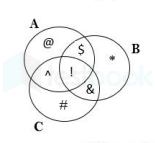
In the given diagram, circle A represents clerks, circle B represents secret agents and circle C represents citizens. Which of the following symbols represent (s) those secret agents who are also clerks?

  1. AOption (a)

    @ and ^

  2. BOption (b)

    ! and &

  3. COption (c)

    $ Only

  4. DOption (d)

    ! and $

View answer & explanation

Correct answer

Answer: (d)D.

! and $

Why this answer is correct

According to the given information:

Thus, ! and $ symbols represent those secret agents who are also clerks.

Hence, the correct answer is "! and $".

Question 23

A group of four bits is called a:

  1. AOption (a)

    megabyte

  2. BOption (b)

    kilobyte

  3. COption (c)

    nibble

  4. DOption (d)

    byte

View answer & explanation

Correct answer

Answer: (c)C.

nibble

Why this answer is correct

The correct answer is Nibble.

Key Points

  • A group of 4 bits is known as a nibble.
  • 4-bit integers, or other data units, are those that are 4 bits wide in computer architecture.
  • 4-bit CPU and ALU architectures are also ones that use registers or data buses that are that size.
  • Memory addresses for 4-bit CPUs are typically significantly bigger than 4-bit (due to the fact that merely 16 memory locations would be extremely limited), such as 12-bit or more, but they might theoretically be 8-bit.
  • A nibble is a collection of four bits that has 24 = 16 potential values. 4-bit computers are now obsolete, but contemporary quantum computers, such as the IBM Q Experience, are 4-bit but also based on qubits.

Important Points

  • A byte is a unit of digital data that typically consists of eight bits.
  • For digital data, the kilobyte is a multiple of the unit byte.
  • For digital data, the megabyte is a multiple of the unit byte. MB is the recommended unit symbol.

Question 24

In which of the following years did the new Indian Flag Code become effective?

  1. AOption (a)

    2002

  2. BOption (b)

    2014

  3. COption (c)

    1950

  4. DOption (d)

    1975

View answer & explanation

Correct answer

Answer: (a)A.

2002

Why this answer is correct

The correct answer is 2002

Key PointsThe Flag Code of India is a compilation of laws, guidelines, and instructions governing the display of the National Flag of India.

  • The Flag Code of India is in effect from 26 January 2002.
  • It gives permission to display the tricolor as long as it maintains the honor of the flag.
  • It modified the existing Flag Code of India and enhanced the existing laws and practices.
  • The Flag Code of India of 2002 has been divided into 3 parts.
  • Part I describes the general instructions of the National Flag.
  • Part II deals with the display of the National Flag by the public, private organizations, educational institutions, etc.
  • And part III contains a display of the flag by central and state governments.

Hence, we can conclude that the Flag Code of India is effective from 26 January 2002.

Additional Information

  • According to the Flag Code of India, the tricolor cannot be used for any commercial purposes.
  • It should not be used for any fest or decoration.
  • The state and central government should use only that flag that meets the given specification laid down.

Question 25

In the context of provident fund, UAN stands for:

  1. AOption (a)

    Universal Allotted Number

  2. BOption (b)

    Universal Account Number

  3. COption (c)

    Unified Allotted Number

  4. DOption (d)

    Unified Account Number

View answer & explanation

Correct answer

Answer: (b)B.

Universal Account Number

Why this answer is correct

The correct answer is Universal Account Number

Key Points

  • UAN stands for Universal Account Number in the context of provident fund
  • The EPFO (Employees' Provident Fund Organisation) allots a UAN to eligible employees.
  • It **acts as an umbrella for multiple Member IDs (**Member Identification Numbers) that an individual may have from different establishments.
  • Benefits
  • A UAN reduces confusion caused by various IDs and makes claim transfers and withdrawals simpler.
  • It also allows for:
  • Online passbooks through SMS services
  • Online updation of KYC
  • Downloading the UAN EPF book
  • Checking EPF balance online

Additional Information

  • Employees Provident Fund Organisation India
  • The Employees’ Provident Fund was established on November 15, 1951, after the passing of the Employees’ Provident Funds Ordinance.
  • The Employees’ Provident Funds Act of 1952 succeeded it.
  • In the year 1952, the Employees’ Provident Funds Bill was submitted in Parliament as a bill to provide for the formation of provident funds for employees in factories and other establishments.
  • The Employees’ Provident Funds & Miscellaneous Provisions Act, 1952, currently applies to the entire country of India.
  • The Employees’ Provident Fund Act and Schemes are administered by a tripartite Board known as the Central Board of Trustees, Employees’ Provident Fund, which is made up of members from the federal and state governments, employers, and employees.
  • For workers in India’s organised sector, the Central Board of Trustees runs a contributory provident fund, a pension programme, and an insurance scheme.
  • The Employees’ PF Organization (EPFO), which has offices in 135 places across the country, assists the Board.
  • Officers and workers of the Organisation, as well as representatives of the Employers and Employees, attend training and seminar sessions in the organisation’s well-equipped training facility.
  • Interest rates on deposits were set at 8.5 percent in 2021, and rates for the current fiscal year will be determined by income estimates.

Question 26

Rs. 21,150 is distributed among A, B and C. The share of A is 45\frac{{4}}{{5}} of the share of B, and the share of B is 34\frac{{3}}{{4}} of the share of C. After receiving their respective sums, C gives some money out of her share to A so that after the transfer, the ratio of the sums A and C have is 7 ∶ 9. What part of her initial share did C transfer to A?

  1. AOption (a)

    112\frac{{1}}{{12}}

  2. BOption (b)

    110\frac{{1}}{{10}}

  3. COption (c)

    15\frac{{1}}{{5}}

  4. DOption (d)

    18\frac{{1}}{{8}}

View answer & explanation

Correct answer

Answer: (b)B.

110\frac{{1}}{{10}}

Why this answer is correct

Given:

The total amount is Rs. 21,150, which is distributed among A, B, and C.

The share of A is 4/5 of the share of B, and the share of B is 3/4 of the share of C.

After receiving their respective sums, C gives some money to A so that the ratio of the sums A and C have is 7:9.

To find:

What part of C's initial share did C transfer to A?

Solution:

Let the initial share of C be x. Then the share of B is 3/4 of x, and the share of A is 4/5 of the share of B.

So, A's share = 4/5 × (3/4 × x) = 3/5 × x.

The total sum of A, B, and C is Rs. 21,150. Therefore, we can write the equation for the total sum:

A's share + B's share + C's share = 21,150

3/5 × x + 3/4 × x + x = 21,150.

Now, solve this equation for x:

To add the terms, we first find a common denominator. The LCM of 5, 4, and 1 is 20, so:

(12/20) × x + (15/20) × x + (20/20) × x = 21,150.

⇒ (12x + 15x + 20x) / 20 = 21,150

⇒ 47x / 20 = 21,150

⇒ 47x = 21,150 × 20

⇒ 47x = 423,000

⇒ x = 423,000 / 47

⇒ x = 9,000.

So, C's initial share is Rs. 9,000. Now, the share of B is:

B's share = 3/4 × 9,000 = Rs. 6,750.

The share of A is:

A's share = 3/5 × 9,000 = Rs. 5,400.

 Find how much money C transfers to A.

Let the amount C transfers to A be y. After the transfer, A's share becomes 5,400 + y, and C's share becomes 9,000 - y.

We are given that the ratio of the amounts A and C have after the transfer is 7:9. Therefore:

(5,400 + y) / (9,000 - y) = 7 / 9.

 Solve the ratio equation.

Cross-multiply to solve for y:

9 × (5,400 + y) = 7 × (9,000 - y)

⇒ 48,600 + 9y = 63,000 - 7y

⇒ 9y + 7y = 63,000 - 48,600

⇒ 16y = 14,400

⇒ y = 14,400 / 16

⇒ y = 900.

Find the part of C's initial share transferred to A.

The part of C's initial share transferred to A is:

y / C's initial share = 900 / 9,000 = 1/10.

Therefore, C transferred 1/10 of her initial share to A.

Question 27

Study the given pattern carefully and select the number from among the given options that can replace the question mark (?) in it.

2916
313?
8126192
  1. AOption (a)

    14

  2. BOption (b)

    11

  3. COption (c)

    13

  4. DOption (d)

    12

View answer & explanation

Correct answer

Answer: (b)B.

11

Why this answer is correct

The logic followed here is:

Columnwise operation: 1st number × 2nd number + 1st number = 3rd number.

Column 1) 2 × 3 + 2 = 6 + 2 = 8

Column 2) 9 × 13 + 9 = 117 + 9 = 126

Column 3) 16 × ? + 16 = 192

16 × ? = 192 - 16 = 176

? = 176 / 16 = 11

Hence, the correct answer is "11".

Question 28

The smallest number that can be divided exactly by 16, 18, 27 and 45 is:

  1. AOption (a)

    1060

  2. BOption (b)

    2160

  3. COption (c)

    1640

  4. DOption (d)

    1540

View answer & explanation

Correct answer

Answer: (b)B.

2160

Why this answer is correct

Given:

The smallest number that can be divided exactly by 16, 18, 27, and 45 is:

Formula used:

Least Common Multiple (LCM) of the given numbers.

Calculations:

Prime factorization of each number:

16 = 24

18 = 2 × 32

27 = 33

45 = 32 × 5

LCM = 24 × 33 × 5

⇒ LCM = 16 × 27 × 5

⇒ LCM = 432 × 5

⇒ LCM = 2160

∴ The correct answer is option (2).

Question 29

If Mohan secured 72% marks in physics and 68% in chemistry, what percentage of marks did Mohan get in both subjects together, assuming that the two subjects have equal weightage?

  1. AOption (a)

    65%

  2. BOption (b)

    55%

  3. COption (c)

    60%

  4. DOption (d)

    70%

View answer & explanation

Correct answer

Answer: (d)D.

70%

Why this answer is correct

Given:

Mohan's marks in Physics = 72%

Mohan's marks in Chemistry = 68%

Both subjects have equal weightage

Formula used:

Average percentage = (Physics marks + Chemistry marks) / 2

Calculation:

Average percentage = (72 + 68) / 2

⇒ Average percentage = 140 / 2

⇒ Average percentage = 70%

∴ The correct answer is option (4).

Question 30

Find the points of intersection of the line 4x - 3y = 10 and the circle x2 + y2 - 2x + 4y - 20 = 0.

  1. AOption (a)

    (2, -3) and (4, 2)

  2. BOption (b)

    (4, 2) and (-2, -6)

  3. COption (c)

    (-2, 3) and (4, 2)

  4. DOption (d)

    (-2, 3) and (4, 3)

View answer & explanation

Correct answer

Answer: (b)B.

(4, 2) and (-2, -6)

Why this answer is correct

Given:

Line equation: 4x - 3y = 10

Circle equation: x2 + y2 - 2x + 4y - 20 = 0

Formula used:

Substitute the line equation into the circle equation to find points of intersection.

Calculations:

From the line equation, express y in terms of x:

⇒ 4x - 3y = 10

⇒ y = (4x - 10)/3

Substitute y = (4x - 10)/3 into the circle equation:

x2 + ((4x - 10)/3)2 - 2x + 4((4x - 10)/3) - 20 = 0

Expand and simplify:

⇒ x2 + (16x2 - 80x + 100)/9 - 2x + (16x - 40)/3 - 20 = 0

⇒ 9x2 + 16x2 - 80x + 100 - 18x + 48x - 120 - 180 = 0

⇒ 25x2 - 50x - 200 = 0

⇒ x2 - 2x - 8 = 0

Solve the quadratic equation x2 - 2x - 8 = 0:

⇒ (x - 4)(x + 2) = 0

⇒ x = 4 or x = -2

For x = 4:

y = (4(4) - 10)/3 = (16 - 10)/3 = 6/3 = 2

Point: (4, 2)

For x = -2:

y = (4(-2) - 10)/3 = (-8 - 10)/3 = -18/3 = -6

Point: (-2, -6)

∴ The correct answer is option (2).

Question 31

Which of the following Articles of the Constitution of India guarantees the protection of certain rights regarding the freedom of speech?

  1. AOption (a)

    Article 14

  2. BOption (b)

    Article 22

  3. COption (c)

    Article 21

  4. DOption (d)

    Article 19

View answer & explanation

Correct answer

Answer: (d)D.

Article 19

Why this answer is correct

The correct answer is Article 19

Key Points

  • Article 19 of the Constitution of India guarantees the freedom of speech and expression

Article 19 is a fundamental right that protects the freedom of speech and expression for all citizens of India.

  • This right includes the freedom to express oneself through speech, writing, printing, visual representations, or any other means.
  • However, this freedom is not absolute and can be subject to reasonable restrictions.
  • The government can impose restrictions in the interest of:
  • Sovereignty and integrity of India
  • Security of the state
  • Friendly relations with foreign states
  • Public order
  • Decency and morality
  • Contempt of court
  • Defamation
  • Incitement to an offense​

Additional Information

ArticleSubjectDescriptionKey Features
Article 14Right to EqualityEnsures equality before the law and equal protection of the laws within the territory of India.- Prohibits discrimination by the State.
- Guarantees equality before the law and equal protection.
Article 21Right to Life and Personal LibertyStates that no person shall be deprived of life or personal liberty except according to procedure established by law.- Includes rights to privacy, education, health, and a clean environment.
- Expands to cover dignity and personal freedoms.
Article 22Protection against Arrest and DetentionProvides specific rights related to protection in cases of arrest or detention under preventive detention laws.- Rights for individuals arrested (e.g., being informed of reasons for arrest, legal counsel).
- Protects against arbitrary detention.

Question 32

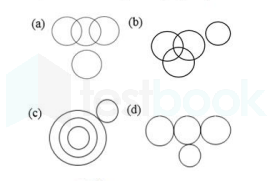
In a class of 46 students, 18 play carom; 17 play chess, including 6 who play carom; 16 play cards, including 4 who play chess, but not carom; and 5 play only tennis. Which of the following figures represents these facts?

  1. AOption (a)

    (b)

  2. BOption (b)

    (d)

  3. COption (c)

    (a)

  4. DOption (d)

    (c)

View answer & explanation

Correct answer

Answer: (c)C.

(a)

Why this answer is correct

According to the given information:

In a class of 46 students, 18 play carom; 17 play chess, including 6 who play carom;

16 play cards, including 4 who play chess, but not carom; and 5 play only tennis.

Carom and Chess: 6 students play both Carom and Chess so, 18 - 6 = 12 play only carom. 

Chess players, excluding Carom and cards: 17 total chess players, 6 play both chess and carom, including 4 card players who play chess, so 17 - 6 - 4 = 7 play only chess.

Card players, excluding Chess: 16 total card players, and 4 play only chess (but not carom), so 16 - 4 = 12 play only cards.

Tennis players: 5 students play only tennis, not involved in Carom, Chess, or Cards.

Then, figure (a) represents these facts.

Hence, the correct answer is "(a)".

Question 33

Which of the following states became India's prime producer of vanadium?

  1. AOption (a)

    Odisha

  2. BOption (b)

    West Bengal

  3. COption (c)

    Madhya Pradesh

  4. DOption (d)

    Arunachal Pradesh

View answer & explanation

Correct answer

Answer: (d)D.

Arunachal Pradesh

Why this answer is correct

The correct answer is Arunachal Pradesh

Key Points

  • Arunachal Pradesh is likely to become India's prime producer of vanadium
  • The Geological Survey of India (GSI) has found vanadium reserves in Arunachal Pradesh.
  • A promising concentration of vanadium was found in the paleo-proterozoic carbonaceous for light rocks in the state's Papum-Pear district. 

Vanadium is a hard, silvery-grey, malleable transition metal with the symbol V and atomic number 23.

  • It is used in strengthening steel and titanium.

Additional Information

  • India is a significant consumer of vanadium, especially in its steel industry, where it is used to produce high-strength steel alloys.
  • The demand for vanadium in India is driven by sectors like construction, aerospace, automotive, and renewable energy.
  • India does not have large-scale primary production of vanadium.
  • The metal is mainly recovered as a by-product from the slag generated during the processing of vanadiferous magnetite ores (a type of iron ore).
  • The recovery process involves extracting vanadium pentoxide (V₂O₅), a key form of vanadium used in various applications.

Question 34

Study the given pattern carefully and select the letter from among the given options that can replace the question mark (?) in it.

  1. AOption (a)

    T

  2. BOption (b)

    O

  3. COption (c)

    S

  4. DOption (d)

    P

View answer & explanation

Correct answer

Answer: (b)B.

O

Why this answer is correct

The logic followed here is: Sum of place value of 1st and 3rd letter = 2nd letter.

Hence, the correct answer is "O".

Question 35

Which of the following cities in Madhya Pradesh was renamed as Narmadapuram?

  1. AOption (a)

    Jabalpur

  2. BOption (b)

    Narsinghpur

  3. COption (c)

    Mandhata

  4. DOption (d)

    Hoshangabad

View answer & explanation

Correct answer

Answer: (d)D.

Hoshangabad

Why this answer is correct

The correct answer is Hoshangabad.

Key Points

  • Hoshangabad
  • In the Indian state of Madhya Pradesh, Hoshangabad, officially known as Narmadapuram, is a city and municipality.
  • Narmadapur, named after the Narmada river, was the previous name of the city.
  • Later, the name was changed to Hoshangabad in honour of Hoshang Shah Gori, the first sultan of the Malwa Sultanate.
  • It acts as the administrative centre for both the Narmadapuram division and the Hoshangabad district.
  • It is situated on the Narmada River's southern bank in the centre of India.

Additional Information

  • The distance between Hoshangabad and the nearest airport, Bhopal (the state capital), is 76.7 kilometres.
  • After India gained its independence in 1947, the Nerbudda (Narmada) Division of the Central Provinces and Berar, which included the Hoshangabad district, became Madhya Bharat (later Madhya Pradesh).
  • The Sethani ghat is one of the city's most well-known and beautiful ghats along the Narmada River's banks.
  • On Narmada Jayanti, the city is filled with vibrant festivities.
  • In March 2021, the name of the city was again changed to Narmadapuram.

Question 36

King Simhavishnu belonged to the ______ dynasty.

  1. AOption (a)

    Pala

  2. BOption (b)

    Chola

  3. COption (c)

    Chalukya

  4. DOption (d)

    Pallava

View answer & explanation

Correct answer

Answer: (d)D.

Pallava

Why this answer is correct

The correct answer is Pallava

Key Points

  • King Simhavishnu belonged to the Pallava dynasty
  • Simhavishnu was the founder of the Pallava dynasty.
  • The Pallava dynasty was a Tamil dynasty that ruled parts of South India from the 3rd century to the 9th century.
  • Simhavishnu's reign marked the rise of the Pallavas to prominence in the region.
  • The Pallavas are known for their patronage of architecture, particularly the rock-cut temples of Mahabalipuram.
  • The dynasty played a crucial role in the cultural and political history of South India.

Additional Information

  • The Pallavas were instrumental in the development of Dravidian architecture.
  • Their rule saw the construction of several notable temples, including the Shore Temple and the Pancha Rathas at Mahabalipuram.
  • Simhavishnu's successors, such as Mahendravarman I and Narasimhavarman I, continued to expand the dynasty's influence and patronage of the arts.
  • The Pallavas had a significant impact on the cultural and religious landscape of South India, with contributions to both Hinduism and Buddhism.

Question 37

When was Mangalyaan, which was launched by Indian Space Research Organization (ISRO), successfully placed into the orbit of Mars?

  1. AOption (a)

    24 September 2014

  2. BOption (b)

    5 November 2013

  3. COption (c)

    24 November 2014

  4. DOption (d)

    5 September 2013

View answer & explanation

Correct answer

Answer: (a)A.

24 September 2014

Why this answer is correct

The correct answer is 24 September 2014

Key Points

  • The Indian Space Research Organization's (ISRO) Mangalyaan, also known as the Mars Orbiter Mission (MOM), was successfully placed into Mars' orbit on September 24, 2014
  • The Mangalyaan was launched on November 5, 2013, from the Satish Dhawan Space Centre in Andhra Pradesh
  • The Mangalyaan spent about a month in Earth's orbit before being injected into a trans-Mars trajectory on November 30, 2013.
  • The Mangalyaan was the first Asian country to orbit Mars, and the second country to do so on its first attempt.
  • It provided valuable data about the Martian surface and atmosphere
  • The Mangalyaan was tracked by the Telemetry, Tracking, and Command Network (ISTRAC), NASA's Deep Space Network, and other organizations.

Additional Information

  • ISRO is the space agency under the Department of Space of Government of India, headquartered in the city of Bengaluru, Karnataka.
  • It was established by Jawaharlal Nehru in 1962 under the Department of Atomic Energy (DAE).
  • Eminent scientist Dr Vikram Sarabhai had a big role in this development.
  • The INCOSPAR became ISRO in 1969.
  • ISRO Chairman: V. Narayan

Question 38

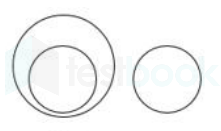
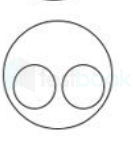
Select the Venn diagram that best represents the relationship between the given set of classes.

Horse, Elephant, Herbivore

  1. AOption (a)

  2. BOption (b)

  3. COption (c)

  4. DOption (d)

View answer & explanation

Correct answer

Answer: (d)D.

Why this answer is correct

Given words: Horse, Elephant, Herbivore

Horse and Elephant are both types of herbivores, meaning they share the characteristic of being herbivores, but they are distinct from each other as specific types of animals.

The best possible Venn diagram:

Hence, the correct answer is "Option 4".

Question 39

NH 44 is the longest national highway route in India and it runs between Srinagar and Kanyakumari. What is its length?

  1. AOption (a)

    3745 km

  2. BOption (b)

    2134 km

  3. COption (c)

    2397 km

  4. DOption (d)

    2369 km

View answer & explanation

Correct answer

Answer: (a)A.

3745 km

Why this answer is correct

The correct answer is 3745 km

Key Points

  • NH-44
  • NH-44 is the longest national highway in India with a length of 3745 Kilometers running from Srinagar in the north to Kanyakumari in the south.
  • This highway connects 11 states and about 30 important cities.
  • It was previously known as NH 44.
  • It came into being by merging seven national highways in full or part NH1, NH 1A, NH 2, NH 3, NH 75, NH 26, NH75.

Additional Information

  • NH 44 passes through 11 states and about 30 important cities, including: 
  • Jammu and Kashmir, Himachal Pradesh, Punjab, Haryana, Uttar Pradesh, Rajasthan, Madhya Pradesh, Maharashtra, Telangana, Andhra Pradesh, Karnataka, and Tamil Nadu.
  • NH 44 was previously known as NH 7.
  • It came into being by merging seven national highways in full or part
  • The shortest national highway of India is NH 548 commonly known as NH 548. The national highway has its northern terminus at Karamboli, Navi Mumbai, and its southern terminus at NH 348.
  • It stretches for 3 miles (5 km) and is half the highway.

Question 40

The 'National Pension Scheme' ('NPS') is regulated by:

  1. AOption (a)

    PFRDA

  2. BOption (b)

    IRDA

  3. COption (c)

    NPDA

  4. DOption (d)

    PCRADA

View answer & explanation

Correct answer

Answer: (a)A.

PFRDA

Why this answer is correct

The correct answer is  PFRDA.

Key Points The National Pension System (NPS) is a voluntary defined contribution pension system in India. 

  • National Pension System, like PPF and EPF, is an EEE (Exempt-Exempt-Exempt) instrument in India where the entire corpus escapes tax at maturity and the entire pension withdrawal amount is tax-free.
  • NPS started with the decision of the Government of India to stop defined benefit pensions for all its employees who joined after 1 January 2004.
  • It is administered and regulated by the Pension Fund Regulatory and Development Authority (PFRDA).
  • On 10 December 2018, the Government of India made NPS an entirely tax-free instrument in India where the entire corpus escapes tax at maturity; the 40% annuity also became tax-free.

Additional Information

  • Benefits of NPS
  • The NPS offers higher returns than traditional instruments like the Public Provident Fund (PPF).
  • It provides a variety of investment options to subscribers, who also have a say in where their funds are invested.
  • The NPS reduces the government's retirement liabilities.
  • If a subscriber has been investing for at least three years, he/she can withdraw up to 25% for certain purposes before retirement (age 60).
  • This withdrawal can be done up to 3 times with a gap of at least 5 years between each withdrawal.
  • These restrictions are only for tier I and not tier II accounts.
  • The entire amount cannot be withdrawn by the account-holder upon retirement.
  • As of April 2021, 60% can be withdrawn, which has now been made tax-free.
  • The remaining 40% must be set aside so that the subscriber can receive a regular pension from an insurance company.

Question 41

In which of the following elections are one-third of the seats reserved for women?

  1. AOption (a)

    Rajya Sabha

  2. BOption (b)

    Legislative Assembly

  3. COption (c)

    Lak Sabha

  4. DOption (d)

    Panchayati Raj

View answer & explanation

Correct answer

Answer: (d)D.

Panchayati Raj

Why this answer is correct

The correct answer is Panchayati Raj 

Key Points

  • In India, seats are reserved for women in Panchayat Raj bodies which are local self-governing bodies**.**
  • According to the 73rd amendment act, 1/3rd of seats are reserved for women apart from the total number of seats.
  • Clause (3) of Article 243D of the Constitution ensures participation of women in Panchayati Raj Institutions by mandating not less than one-third reservation for women out of the total number of seats to be filled by direct election and number of offices of chairpersons of Panchayats.
  • The key provisions for reservation of women in Panchayati Raj Institutions as per the 73rd Constitutional Amendment Act are:
  • There shall be one-third reservation for seats for women in all elected offices of local bodies, including panchayats at the village, intermediate and district levels.
  • One-third of the total number of seats reserved for Scheduled Castes and Scheduled Tribes also has to be reserved for women from those groups.
  • This reservation applies to positions of chairpersons in panchayats at all levels.
  • The reservation for women shall be allotted by rotation to different constituencies in a panchayat.
  • Reservation of one-third seats for women has been made mandatory in all State Panchayati Raj legislation.
  • The reservation for women comes into force immediately from the date of the Amendment Act for panchayats already constituted. For newly elected panchayats, it becomes effective from the first election.
  • 20 States namely Andhra Pradesh, Assam, Bihar, Chhattisgarh, Gujarat, Himachal Pradesh, Jharkhand, Karnataka, Kerala, Madhya Pradesh, Maharashtra, Odisha, Punjab, Rajasthan, Sikkim, Tamil Nadu, Telangana, Tripura, Uttarakhand and West Bengal have made provisions of 50% reservation for women in Panchayati Raj Institutions in their respective State Panchayati Raj Acts.

Additional Information

  • Women’s Reservation Bill (The Constitution (108 Amendment) Bill, 2008):
  • The bill seeks to reserve 33% seats in Lok Sabha and all state legislative assemblies for women.
  • Reserved seats may be allotted by rotation to different constituencies in the state or union territory.
  • Reservation of seats for women shall cease to exist 15 years after the commencement of this Amendment Act.
  • The key features of the Women's Reservation Bill or the 108th Constitutional Amendment Bill are:
  • It proposes to amend Article 334 of the Constitution to reserve one-third of all seats for women in the Lok Sabha and the state legislative assemblies.
  • Of the total 543 Lok Sabha seats, 181 would be reserved for women candidates only. Similarly, one-third seats in state assemblies would be reserved.
  • The seats would be allotted by rotation in different constituencies in a manner to be prescribed by law.
  • The reservation would cease to exist 15 years after commencement of this Amendment Act.
  • Reservation for SC/ST and Anglo-Indian women would be within the one-third quota proposed for women.
  • The Bill was passed by Rajya Sabha in 2010 but is pending approval by Lok Sabha.
  • The Bill aims to enhance the participation of women in public offices and increase their representation in decision making.

Question 42

What was Akbar's idea of Sulh-i-kul?

  1. AOption (a)

    Religious equality

  2. BOption (b)

    Universal peace

  3. COption (c)

    Gender justice

  4. DOption (d)

    Intolerance towards invaders

View answer & explanation

Correct answer

Answer: (b)B.

Universal peace

Why this answer is correct

The correct answer is Universal peace

Key Points

  • Akbar's idea of Sulh-i-kul was to establish universal peace and religious tolerance among the people of India
  • The Arabic term Sulh-i-kul translates to "universal peace" or "peace within all".
  • The policy was based on the idea of tolerance, respect, compromise, and balance.
  • Akbar wanted to unify India's diverse population by establishing peace and equal treatment for all people, regardless of their religion.
  • Akbar was inspired to implement this principle after learning about the beliefs of various religions and participating in religious debates.
  • Akbar formed the religion Din-i Ilahi, which was based on the principle of Sulh-i-kul.

Additional Information

  • Akbar
  • The great ruler of the Mughal Dynasty.
  • He abolished jajiya tax in 1564.
  • He set up Fatepursikri.
  • Transfer the capital from Agra to Fatehpur Sikri in 1571.
  • Founded Ibadat khana, a house of worship for all religions in 1575.
  • Founded Din-I-Ilahi in 1582.
  • Akbar appointed Tansen of Gwalior, in his court for music.
  • The navaratnas in Akbar’s court are- Abul Fazl, Abdul Rahim Khan-I-Khana, Birbal, Mulla Do-Piyaza Faizi, Raja Man Singh, Raja Todar Mal, Fakir Aziao-Din and Tansen.

Question 43

The cube root of 150 will lie between:

  1. AOption (a)

    6 and 7

  2. BOption (b)

    4 and 5

  3. COption (c)

    7 and 8

  4. DOption (d)

    5 and 6

View answer & explanation

Correct answer

Answer: (d)D.

5 and 6

Why this answer is correct

Given:

The cube root of 150

Formula used:

Let x be the cube root of 150

x = 1501/3

Calculations:

53 = 125

63 = 216

⇒ 53 < 150 < 63

⇒ 5 < 1501/3 < 6

∴ The correct answer is option (4).

Question 44

Which of the following are NOT core elements of environmental sustainability?

  1. AOption (a)

    Development of people, communities and cultures

  2. BOption (b)

    Protection and rational use of natural resources

  3. COption (c)

    Environmental conservation

  4. DOption (d)

    Sustainable mobility

View answer & explanation

Correct answer

Answer: (a)A.

Development of people, communities and cultures

Why this answer is correct

The correct answer is Development of people, communities and cultures

Key Points

  • Development of people, communities, and cultures is not a core element of environmental sustainability
  • The environmental dimension of sustainable development focuses on the protection and management of natural resources and ecosystems.
  • The goal is to ensure that natural resources are also available for future generations
  • The four elements of environmental sustainability are air, water, management, and risk reduction

Additional Information

  • The three core elements of sustainable development are economic growth, social inclusion, and environmental protection.
  • These elements are interconnected and are crucial for the well-being of individuals and societies.
  • Economic Sustainability: The main agenda is equal economic growth that generates wealth for all, without harming society and the environment.

Eradicating poverty in all its forms and dimensions.

  • Social Sustainability: It included gender equality, the development of people, communities, and cultures to help achieve a reasonable and fairly distributed quality of life, healthcare, and education across the world.
  • Environmental Sustainability: It is the protection and rational use of natural resources.

Aspects such as environmental conservation, saving water, investment in renewable energy, supporting sustainable mobility, and innovation in sustainable construction and architecture, contribute to achieving environmental sustainability on several fronts.

Question 45

The radius of a wheel is 70 cm. If the wheel makes 10 revolutions in 5 seconds covering a certain distance, then the speed of the wheel is:

  1. AOption (a)

    31.68 km/h

  2. BOption (b)

    36.25 km/h

  3. COption (c)

    29.46 km/h

  4. DOption (d)

    32.72 km/h

View answer & explanation

Correct answer

Answer: (a)A.

31.68 km/h

Why this answer is correct

Given:

Radius of the wheel (r) = 70 cm

Number of revolutions (n) = 10

Time (t) = 5 seconds

Formula used:

Circumference of the wheel = 2πr

Distance covered in one revolution = Circumference of the wheel

Distance covered in n revolutions = n × Circumference of the wheel

Speed = Distance / Time

Calculations:

Circumference of the wheel = 2π × 70 cm

⇒ Circumference = 2 × 3.14 × 70 cm

⇒ Circumference = 439.6 cm

Distance covered in 10 revolutions = 10 × 439.6 cm

⇒ Distance = 4396 cm

Speed = Distance / Time

⇒ Speed = 4396 cm / 5 s

⇒ Speed = 879.2 cm/s

Convert cm/s to km/h:

Speed = 879.2 cm/s × (1 m / 100 cm) × (1 km / 1000 m) × (3600 s / 1 h)

⇒ Speed = 31.6512 km/h

∴ The correct answer is option (1) 31.68 km/h.

Question 46

The third proportional to 16 and 36 is:

  1. AOption (a)

    81

  2. BOption (b)

    64

  3. COption (c)

    49

  4. DOption (d)

    144

View answer & explanation

Correct answer

Answer: (a)A.

81

Why this answer is correct

Given:

The third proportional to 16 and 36 is:

Formula used:

If a, b, c are in continued proportion, then b2 = a × c

Calculation:

Let the third proportional be x.

⇒ (36)2 = 16 × x

⇒ 1296 = 16x

⇒ x = 1296 ÷ 16

⇒ x = 81

∴ The correct answer is option (1).

Question 47

A alone can complete a task in 30 days, while B alone can complete it in 40 days. A and B, working together, can complete the same task in:

  1. AOption (a)

    183718\frac{{3}}{{7}} days

  2. BOption (b)

    152715\frac{{2}}{{7}} days

  3. COption (c)

    112711\frac{{2}}{{7}} days

  4. DOption (d)

    171717\frac{{1}}{{7}} days

View answer & explanation

Correct answer

Answer: (d)D.

171717\frac{{1}}{{7}} days

Why this answer is correct

Given:

A alone can complete a task in 30 days.

B alone can complete the same task in 40 days.

Formula used:

Work done together in 1 day = Work rate of A + Work rate of B

Work rate of A = 1/30

Work rate of B = 1/40

Calculation:

Work done by A and B together in 1 day = 1/30 + 1/40

⇒ 130+140=4120+3120=7120\dfrac{1}{30} + \dfrac{1}{40} = \dfrac{4}{120} + \dfrac{3}{120} = \dfrac{7}{120}

Time taken to complete the task together = 1 / (Work done together in 1 day)

⇒ 1(7/120)=1207=1717\dfrac{1}{(7/120)} = \dfrac{120}{7} = 17 \dfrac{1}{7}

∴ The correct answer is option (4).

Question 48

In a certain code language, HRMGL is written as DMGZD. How will NDCKR be written as in that language?

  1. AOption (a)

    JXZDK

  2. BOption (b)

    JZXCJ

  3. COption (c)

    JYWDJ

  4. DOption (d)

    JZVDK

View answer & explanation

Correct answer

Answer: (c)C.

JYWDJ

Why this answer is correct

The logic followed here is:

HRMGL is written as DMGZD

Similarly, NDCKR will be written as:

Hence, the correct answer is "JYWDJ".

Question 49

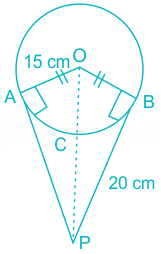
In the given figure, if PB = 20 cm and OA = 15 cm, then find the shortest distance between the circle and P.

  1. AOption (a)

    10 cm

  2. BOption (b)

    20 cm

  3. COption (c)

    25 cm

  4. DOption (d)

    15 cm

View answer & explanation

Correct answer

Answer: (a)A.

10 cm

Why this answer is correct

Given:

PB = 20 cm

OA = 15 cm

Formula used:

Shortest distance between the circle and P = OP - OC

Calculation:

Using Pythagoras theorem in triangle POB:

OP² = PB² + OB²

OP²  = 20² + 15²

OP²  = 400 + 225

OP= 25

PC = OP - OC

Shortest distance = 25 cm - 15 cm

⇒ Shortest distance = 10 cm

∴ The correct answer is option (1).

Question 50

If a, b, c and d are in continued proportion, then (ma3 + nb3 - rc3) : (mb3 + nc3 - rd3) = ?

  1. AOption (a)

    a : d

  2. BOption (b)

    d : a

  3. COption (c)

    c : b

  4. DOption (d)

    b : c

View answer & explanation

Correct answer

Answer: (a)A.

a : d

Why this answer is correct

Shortcut Trick

In a continued proportion a/b = b/c = c/d = k, any homogenous ratio (ma3 + nb3 − rc3) : (mb3 + nc3 − rd3) simplifies to k3.

Let a/b = b/c = c/d = k ⇒ a = bk, b = ck, c = dk.

Expression = [m(bk)3 + n(ck)3 − r(dk)3] / [mb3 + nc3 − rd3] = k3(mb3 + nc3 − rd3) / (mb3 + nc3 − rd3) = k3.

Since a/d = (a/b) × (b/c) × (c/d) = k × k × k = k3, the ratio is a : d.

∴ The correct answer is a : d.

Alternate Method

Given:

a, b, c, d are in continued proportion.

Formula Used:

a/b = b/c = c/d = k

a b c d

ratio k

ratio k

ratio k a/d = k × k × k = k3

⇒ Let a/b = b/c = c/d = k

⇒ c = dk

⇒ b = ck = (dk)k = dk2

⇒ a = bk = (dk2)k = dk3

⇒ Required Ratio = (ma3 + nb3 − rc3) / (mb3 + nc3 − rd3)

⇒ Ratio = [m(dk3)3 + n(dk2)3 − r(dk)3] / [m(dk2)3 + n(dk)3 − r(d)3]

⇒ Ratio = [md3k9 + nd3k6 − rd3k3] / [md3k6 + nd3k3 − rd3]

⇒ Ratio = d3k3(mk6 + nk3 − r) / d3(mk6 + nk3 − r)

⇒ Ratio = k3

⇒ We know a/d = dk3 / d = k3

⇒ Ratio = a / d

∴ The correct answer is a : d.

Additional Information

Continued Proportion

Three or more numbers are said to be in continued proportion if the ratio of the first to the second is equal to the ratio of the second to the third, and so on (a/b = b/c = c/d).

Mean Proportional

If a, b, c are in continued proportion, then b is called the mean proportional between a and c, where b2 = ac or b = √(ac).

Ratio of Sums and Powers

If a/b = b/c = c/d = k, then (an + bn + cn) / (bn + cn + dn) = kn. In this problem, n = 3.

Third and Fourth Proportional

In a/b = b/c, c is the third proportional. In a/b = c/d, d is the fourth proportional to a, b, and c.

Question 51

The remainder, when 1141 + 3 is divided by 10, is:

  1. AOption (a)

    5

  2. BOption (b)

    6

  3. COption (c)

    4

  4. DOption (d)

    3

View answer & explanation

Correct answer

Answer: (c)C.

4

Why this answer is correct

Given:

The remainder, when 1141 + 3  divided by 10

Formula used:

Remainder = Dividend % Divisor

Calculation:

Dividend = 1141 + 3

Divisor = 10

⇒ Remainder = 4/10

⇒ Remainder = 4

∴ The correct answer is option 3.

Question 52

Select the alphanumeric-cluster from among the given options that can replace the question mark (?) in the following series.

E5A, G9C, I17E, K29G, M45I, ?

  1. AOption (a)

    O63K

  2. BOption (b)

    N65K

  3. COption (c)

    O20K

  4. DOption (d)

    O65K

View answer & explanation

Correct answer

Answer: (d)D.

O65K

Why this answer is correct

The logic followed here is:

Hence, the correct answer is "O65K".

Question 53

Which of the following is a graphical web browser based on the WebKit browser engine?

  1. AOption (a)

    Safari

  2. BOption (b)

    Adobe Illustrator

  3. COption (c)

    CorelDRAW

  4. DOption (d)

    Appy Pie Design

View answer & explanation

Correct answer

Answer: (a)A.

Safari

Why this answer is correct

The correct answer is Safari.

Key Points

  • Safari is a web browser.
  • Safari is the default web browser for all Apple devices: Macs, iPads, and iPhones.
  • Safari is the most popular mobile web browser in the US.
  • A web browser is application software for accessing the World Wide Web.
  • In other words, it is an application used to access and view websites.
  • Common web browsers include Microsoft Edge, Internet Explorer, Google Chrome, Mozilla Firefox, and Apple Safari.
  • Google Chrome is the most popular web browser in the world.

Additional Information

  • WebKit is an open-source browser engine that is also used by other web browsers, consoles, and operating systems.
  • Some of these include:
  • PlayStation consoles
  • Tizen mobile operating systems
  • Amazon Kindle e-book reader
  • Nintendo consoles
  • GNOME Web
  • BlackBerry Browser

Question 54

Which of the following is a property of metalloids?

  1. AOption (a)

    Semiconductor

  2. BOption (b)

    Malleable

  3. COption (c)

    Sonorous

  4. DOption (d)

    Ductile

View answer & explanation

Correct answer

Answer: (a)A.

Semiconductor

Why this answer is correct

The correct answer is Semiconductor

Key Points

  • Metalloids have properties that are intermediate between metals and non-metals.
  • They are typically semiconductors, meaning they can conduct electricity under certain conditions, making them useful in electronic devices.
  • The other properties listed (malleable, sonorous, ductile) are more characteristic of metals.

Additional Information

  • Metalloid:-
  • A metalloid is a type of chemical element that has properties in between, or that are a mixture of, those of metals and nonmetals.
  • There are 7 metalloids in the modern periodic table.
  • The seven commonly recognized metalloids are:-
  • Boron, Silicon (Si), germanium (Ge), arsenic (As), antimony (Sb), tellurium (Te), Polonium(Po), and Astatine(At).
  • Metalloids Silicon and Germanium are widely used in the semiconductor industry.
  • Properties of Metalloids:-
  • Most of their other physical properties and chemical properties are intermediate in nature.
  • Typical metalloids have a metallic appearance.
  • They are brittle and only fair conductors of electricity.
  • Chemically, they behave mostly as nonmetals.
  • They can form alloys with metals.
  • They are lustrous in appearance.
  • Their oxides are amphoteric or weakly acidic.

​​

Question 55

If the numerator of a fraction is strictly less than the denominator, then the fraction is a/an:

  1. AOption (a)

    improper fraction

  2. BOption (b)

    proper fraction

  3. COption (c)

    decimal fraction

  4. DOption (d)

    Integer

View answer & explanation

Correct answer

Answer: (b)B.

proper fraction

Why this answer is correct

Explanation:

A fraction where the numerator is strictly less than the denominator is called a proper fraction. This is because the value of such a fraction is always less than 1.

Correct answer: 2) Proper fraction

Question 56

Which of the following Articles of the Constitution of India has Part XX that deals with the powers of the Parliament to amend the Constitution and its procedures?

  1. AOption (a)

    Article 393

  2. BOption (b)

    Article 395

  3. COption (c)

    Article 368

  4. DOption (d)

    Article 367

View answer & explanation

Correct answer

Answer: (c)C.

Article 368

Why this answer is correct

The correct answer is Article 368.

Key Points

  • Article 368 in Part XX of the Constitution deals with the powers of Parliament to amend the Constitution and its procedure.
  • It states that the Parliament may, in the exercise of its constituent power, amend by way of addition, variation or repeal any provision of the Constitution in accordance with the procedure laid down for the purpose.
  • Indian constitution provides for three kinds of amendment processes:
  • Amendment by simple majority.
  • Amendment by special majority.
  • Amendment by special majority and ratification by the States.

Additional Information

  • Article 395​
  • Article 395 repeals the Indian Independence Act of 1947 and the Government of India Act of 1935, as well as all amendments and supplements to the latter Act, except the Abolition of Privy Council Jurisdiction Act of 1949.
  • The Government of India Act, 1935, abolished the dyarchy established by the Government of India Act, 1919, and established a Federation of India consisting of British India provinces and some or all of the Princely states.
  • British India was partitioned into India and Pakistan by the Indian Independence Act of 1947.
  • On July 18, 1947, the Act was signed by King George VI, and on August 15, 1947, modern-day Pakistan and India were born.
  • Article 393​
  • Article 393 essentially establishes the official name of the Constitution.
  • It is a formality that specifies that the Constitution of India is the supreme law of the land and should be referred to as the Constitution of India.
  • This provision does not define any particular rights or duties but serves to formally declare the title under which the document will be recognized.
  • Article 367
  • ​Article 367 of the Indian Constitution deals with the interpretation of the provisions of the Constitution, particularly in relation to terms and expressions used within the Constitution.
  • It provides clarity on how certain terms should be understood in specific contexts.

Question 57

One of the greatest social reforms of abolition of the 'Sati' system in India was done by Governor-General ______.

  1. AOption (a)

    Lord Macauley

  2. BOption (b)

    Lord Cornwallis

  3. COption (c)

    Lord William Bentinck

  4. DOption (d)

    Sir Charles Metcalfe

View answer & explanation

Correct answer

Answer: (c)C.

Lord William Bentinck

Why this answer is correct

The correct answer is Lord William Bentinck.

Key Points 

  • The Sati Pratha was abolished under the Governor Generalship of Lord William Bentinck.
  • The Sati Pratha was abolished in 1829.
  • Ram Mohan Roy was known as the 'Father of the Bengal Renaissance'
  • He had worked for the upliftment of women's position in society.
  • He had worked against polygamy, child marriage, Purdah, and Sati Pratha.
  • It is his work that led to the abolition of Sati Pratha in India.

Additional Information

  • Lord Metcalfe (1835 -1836 )
  • Passed the Press Act of 1835, also known as Metcalfe Act.
  • He is Known as the Liberator of Press in India.
  • Lord Cornwallis (1786 AD-1793 AD )
  • First-person to codify laws (1793 AD).
  • He started the permanent settlement of Bengal.
  • He created the post of District Judge. He is called the Father of Civil Services in India.
  • Third Anglo-Mysore War and the Treaty of Srirangapatnam.
  • He undertook police reforms.

Question 58

Which of the following is NOT a constellation in the sky?

  1. AOption (a)

    Cassiopeia

  2. BOption (b)

    Orion

  3. COption (c)

    Ursa Major

  4. DOption (d)

    Sirius

View answer & explanation

Correct answer

Answer: (d)D.

Sirius

Why this answer is correct

The correct answer is Sirius

Key Points

  • Sirius is not a constellation in the sky
  • Sirius
  • ​It Also known as Alpha Canis Majoris or the Dog Star, Sirius is a binary star in the constellation Canis Major.
  • Constellations
  • Groups of stars that are identified by patterns people see in the stars.
  • Astronomers recognize 88 constellations that cover the entire sky.

Additional Information

  • Some other constellations include:
  • Orion: Also known as the hunter, Orion is made up of seven or eight bright stars.
  • Cassiopeia: A prominent constellation in the northern sky that looks like a distorted letter W or M. It's visible during winter in the early part of the night.
  • Ursa Major: Also known as the Greater Bear, Ursa Major is visible during the summer months in both hemispheres.
  • The Big Dipper is an asterism, or a recognized grouping of stars, that is part of Ursa Major.

Question 59

The product of two numbers is 259200 and their LCM is 4320. The HCF of the same two numbers is:

  1. AOption (a)

    58

  2. BOption (b)

    45

  3. COption (c)

    65

  4. DOption (d)

    60

View answer & explanation

Correct answer

Answer: (d)D.

60

Why this answer is correct

Given:

Product of two numbers = 259200

LCM = 4320

Formula used:

Product of two numbers = LCM × HCF

Calculation:

259200 = 4320 × HCF

⇒ HCF = 2592004320\frac{259200}{4320}

⇒ HCF = 60

∴ The correct answer is option (4).

Question 60

Find the value of

cos1° cos2° cos3° ... cos89° cos90°.

  1. AOption (a)

    1

  2. BOption (b)

    12\frac{1}{2}

  3. COption (c)

    0

  4. DOption (d)

    12\frac{1}{{\sqrt 2 }}

View answer & explanation

Correct answer

Answer: (c)C.

0

Why this answer is correct

Given:

Find the value of cos1º cos2º cos3º ... cos89º cos90º.

Formula used:

cos90º = 0

Calculation:

cos1º × cos2º × cos3º ... × cos89º × cos90º

cos90º = 0

⇒ cos1º × cos2º × cos3º ... × cos89º × 0

⇒ 0

∴ The correct answer is option (3).
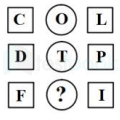
Question 61

If '-' stands for '×', '+' stands for '÷', '×' stands for '+', and '÷' stands for '-', then find the value of

24 + 6 ÷ 2 - 9 × 4.

  1. AOption (a)

    -10

  2. BOption (b)

    -8

  3. COption (c)

    8

  4. DOption (d)

    24

View answer & explanation

Correct answer

Answer: (a)A.

-10

Why this answer is correct

Given: 24 + 6 ÷ 2 - 9 × 4 = ?

Decoding the given information:

Symbol+-×÷
Means÷×+-


Now replacing the sign from left to right using BODMAS Rule, we get:

⇒ 24 ÷ 6 - 2 × 9 + 4

⇒ 4 - 2 × 9 + 4

⇒ 4 - 18 + 4

⇒ 8 - 18 = - 10

Hence, the correct answer is "Option 1".

Question 62

As of June 2019, how many zonal cultural centres were established in India by the Government of India to protect, preserve and promote various forms of art and ancient folk cultures?

  1. AOption (a)

    Six

  2. BOption (b)

    Five

  3. COption (c)

    Four

  4. DOption (d)

    Seven

View answer & explanation

Correct answer

Answer: (d)D.

Seven

Why this answer is correct

The correct answer is Seven

Key Points

  • The Government of India has set up seven Zonal Cultural Centres (ZCCs) in the country with headquarters at Patiala (Punjab), Nagpur (Maharashtra), Udaipur (Rajasthan), Prayagraj (Uttar Pradesh), Kolkata (West Bengal), Dimapur (Nagaland) and Thanjavur (Tamil Nadu) to protect, promote and preserve various forms of folk.
  • The ZCCs were established to: Preserve and promote arts in the concerned zone, Develop and promote cultural diversity, Encourage folk and tribal arts, Preserve vanishing arts, and Involve youth in creative cultural communication.
  • The concept of ZCCs was announced by the Prime Minister of India in 1985 during a visit to Hussainiwala, Punjab.
  • The seven ZCCs were set up during the 7th Five Year Plan.

Additional Information

  • The ZCCs' objectives include: 
  • Promoting and preserving arts in their respective zones
  • Developing and promoting cultural diversity
  • Encouraging folk and tribal arts
  • Preserving vanishing arts
  • Involving youth in creative cultural communication
  • Emphasizing the linkages between different areas and their contribution to Indian culture

Question 63

The headquarters of East Central Railway is in ______.

  1. AOption (a)

    Hajipur

  2. BOption (b)

    Patna

  3. COption (c)

    Kolkata

  4. DOption (d)

    Malda

View answer & explanation

Correct answer

Answer: (a)A.

Hajipur

Why this answer is correct

The correct answer is Hajipur.

Key Points

  • East Central Railway was inaugurated on 8 September 1996 with headquarters at Hajipur, Bihar.
  • It became operational on 1st October 2002 by carving out areas from Eastern and North Eastern Railway Zone.
  • It is consists of the divisions viz. Dhanbad, Danapur, Pt. Deen Dayal Upadhyaya  (Old name Mughalsarai) of Eastern Railway and Sonpur and Samastipur of North Eastern Railway.
  • ECR is also a gateway to Nepal with International traffic catering to the movement of export traffic and passengers to Nepal and vice versa.

Additional Information 

  • Indian Railways was nationalised in 1950 and presently, it is the largest Railway Network in Asia and the second-largest in the world.
  • Indian railways have been divided into 19 zones:
  • Central Railway - Mumbai.
  • Eastern Railway - Kolkata.
  • East Central Railway - Hajipur.
  • East Coast Railway - Bhubaneshwar.
  • Konkan Railway - Navi Mumbai.
  • Northern Railway - New Delhi.
  • North Central Railway - Allahabad.
  • North Eastern Railway - Gorakhpur.
  • North Western Railway - Jaipur.
  • Northeast Frontier Railway - Guwahati.
  • Southern Railway - Chennai.
  • South Coast Railway - Vishakapatnam
  • South Central Railway - Secunderabad.
  • South Eastern Railway - Kolkata.
  • South East Central Railway - Bilaspur.
  • South Western Railway - Hubli.
  • Western Railway - Mumbai CST.
  • West Central Railway - Jabalpur.
  • Metro Railway-Kolkata.

Question 64

Which of the following statements about the TIFAC (Technology Information, Forecasting and Assessment Council) is INCORRECT?

  1. AOption (a)

    Reviving the economy after COVID-19 pandemic

  2. BOption (b)

    Recovery in manufacturing and construction

  3. COption (c)

    Developing a technology-fuelled PDS (public distribution system)

  4. DOption (d)

    Its main function is to formulate a technology vision for the country in a variety of emerging technology areas.

View answer & explanation

Correct answer

Answer: (b)B.

Recovery in manufacturing and construction

Why this answer is correct

The correct answer is Option 2: Recovery in manufacturing and construction.

Key Points

  • The Technology Information, Forecasting and Assessment Council (TIFAC) is an autonomous organization set up in 1988 under the Department of Science & Technology, Government of India.
  • TIFAC's main objective is to assess the state-of-the-art technology and set directions for future technological development in India.
  • In the wake of the COVID-19 pandemic, TIFAC launched a project titled "RESTART" (Rebuilding, Reviving Economy through Science, Technology, and Research Translations) to support the economy's revival.
  • One of TIFAC's initiatives includes the development of a technology-fueled PDS (public distribution system) to ensure food security and efficient distribution of resources.

Additional Information

  • Technology Information, Forecasting and Assessment Council (TIFAC)
  • TIFAC is an autonomous body under the Department of Science & Technology, Government of India, and was established in 1988.
  • Its mission is to assess and forecast the technology trajectories in various sectors and set priority areas for future research and development.
  • TIFAC carries out critical policy analysis and provides recommendations to the government and various stakeholders on technology development.
  • Through its initiatives, TIFAC aims to foster innovation, enhance technological capabilities, and ensure sustainable development in India.
  • Public Distribution System (PDS)
  • The PDS is an Indian food security system established by the Government of India under the Ministry of Consumer Affairs, Food, and Public Distribution.
  • It distributes subsidized food and non-food items to India's poor.
  • Major commodities distributed include staple food grains, such as wheat and rice, and other essential items.
  • The system plays a crucial role in reaching out to the economically weaker sections of society and ensuring food security.
  • RESTART Project
  • RESTART stands for Rebuilding, Reviving Economy through Science, Technology, and Research Translations.
  • It is an initiative by TIFAC to provide strategic foresight and policy recommendations for reviving India's economy post the COVID-19 pandemic.
  • The project focuses on leveraging science and technology to address economic challenges, promote innovation, and support critical sectors.
  • Key areas include healthcare, agriculture, manufacturing, and digital infrastructure to enhance resilience and growth.

Question 65

What is the accuracy level of National Atomic Time Scale dedicated to the nation by Prime Minister Modi in January 2021?

  1. AOption (a)

    2.8 nanoseconds

  2. BOption (b)

    2.7 nanoseconds

  3. COption (c)

    2.6 nanoseconds

  4. DOption (d)

    2.5 nanoseconds

View answer & explanation

Correct answer

Answer: (a)A.

2.8 nanoseconds

Why this answer is correct

The correct answer is 2.8 nanoseconds.

Key Points

  • The National Atomic Time Scale was dedicated to the nation by Prime Minister Modi in January 2021.
  • The accuracy level of this time scale is 2.8 nanoseconds.
  • It is a significant development in the field of timekeeping in India.
  • The National Atomic Time Scale helps in maintaining the Indian Standard Time with high precision.

Additional Information

  • National Atomic Time Scale:
  • The National Atomic Time Scale generates Indian Standard Time with an accuracy of 2.8 nanoseconds.
  • It is a crucial asset for various sectors including satellite navigation, telecommunication, and power grids, which require precise time synchronization.
  • The time scale is maintained by the Council of Scientific and Industrial Research-National Physical Laboratory (CSIR-NPL) in India.
  • CSIR-NPL is responsible for the dissemination of accurate time and frequency signals to the nation.
  • Atomic Clocks:
  • Atomic clocks use the vibrations of atoms to measure time with exceptional precision.
  • These clocks are critical for applications that require extremely accurate timekeeping.
  • Atomic clocks are used in global positioning systems (GPS), internet data transfer, and scientific research.
  • The most accurate atomic clocks can measure time to within a few quadrillionths of a second.
  • Indian Standard Time (IST):
  • IST is the time observed throughout India and Sri Lanka.
  • It is 5 hours and 30 minutes ahead of Coordinated Universal Time (UTC+5:30).
  • IST is determined by the National Physical Laboratory using atomic clocks.
  • Precise timekeeping is essential for various national and international activities, including trade, transportation, and communication.

Question 66

Which of the following organelles helps to keep the cell clean by digesting any foreign material as well as worn out cell organelles?

  1. AOption (a)

    Mitochondria

  2. BOption (b)

    Endoplasmic recticulum

  3. COption (c)

    Golgi apparatus

  4. DOption (d)

    Lysosome

View answer & explanation

Correct answer

Answer: (d)D.

Lysosome

Why this answer is correct

The correct answer is Lysosome

Key Points

  • Lysosomes:​
  • These are membrane-bound vesicular structures formed by the process of packaging in the Golgi apparatus.
  • These are also called ''Suicidal bags'' because of their phagocytic activity.
  • Lysosome keeps the cell clean by digesting any foreign material as well as worn-out cell organelles.
  • If any cell or cell organelle gets damaged, the lysosome digest the damaged cell or cell organelle by the application of hydrolytic enzymes (hydrolases – lipases, proteases, carbohydrases)
  • Lysosomes are discovered by Christian de Duve.

Additional Information

Golgi apparatus- ​It consists of a system of membrane-bound vesicles (flattened sacs) arranged approximately parallel to each other in stacks called cisterns. - Its functions include the storage, modification and packaging of products in vesicles. - They are responsible for packaging proteins into vesicles prior to secretion.
Mitochondria- Mitochondria are membrane-bound cell organelles (mitochondrion, singular) that generate most of the chemical energy needed to power the cell's biochemical reactions.
endoplasmic reticulum (ER)- The endoplasmic reticulum (ER) is a large organelle in the cytoplasm of a cell that is made up of a network of tubes and sacs

Question 67

Find the number of points on the x-axis that are at a distance of 'c' units (c < 3) from the point (2, 3).

  1. AOption (a)

    1

  2. BOption (b)

    3

  3. COption (c)

    0

  4. DOption (d)

    2

View answer & explanation

Correct answer

Answer: (c)C.

0

Why this answer is correct

Given:

Point: (2, 3)

Distance: c units (c < 3)

Formula used:

Distance formula: Distance = (x2−x1)2+(y2−y1)2\sqrt{(x_2 - x_1)^2 + (y_2 - y_1)^2}

For points on the x-axis, y = 0

Calculation:

Let the point on the x-axis be (x, 0).

(x−2)2+(0−3)2=c\sqrt{(x - 2)^2 + (0 - 3)^2} = c

⇒ (x−2)2+9=c\sqrt{(x - 2)^2 + 9} = c

⇒ (x−2)2+9=c2(x - 2)^2 + 9 = c^2

⇒ (x−2)2=c2−9(x - 2)^2 = c^2 - 9

For real solutions, c2−9≥0c^2 - 9 \geq 0

But since c < 3, c2<9c^2 < 9

⇒ c2−9<0c^2 - 9 < 0

⇒ (x−2)2=Negative value(x - 2)^2 = \text{Negative value}

No real solution exists.

∴ The correct answer is option (3).

Question 68

Two trains, 145 m and 155 m in length, run on parallel tracks. One train runs at the speed of 32 km/h and the other at 40 km/h. When both trains run in opposite direction, then the time required for them to cross each other completely from the moment they meet is:

  1. AOption (a)

    10 sec

  2. BOption (b)

    20 sec

  3. COption (c)

    12 sec

  4. DOption (d)

    15 sec

View answer & explanation

Correct answer

Answer: (d)D.

15 sec

Why this answer is correct

Given:

Length of Train 1 = 145 m

Length of Train 2 = 155 m

Speed of Train 1 = 32 km/h

Speed of Train 2 = 40 km/h

Formula used:

Relative Speed (when moving in opposite directions) = Speed of Train 1 + Speed of Train 2

Time = Distance / Speed

Calculations:

Total distance = Length of Train 1 + Length of Train 2

Total distance = 145 m + 155 m

⇒ Total distance = 300 m

Convert speeds from km/h to m/s:

Speed of Train 1 = 32 km/h = 32 × (1000/3600) m/s

⇒ Speed of Train 1 = 8.89 m/s

Speed of Train 2 = 40 km/h = 40 × (1000/3600) m/s

⇒ Speed of Train 2 = 11.11 m/s

Relative speed = Speed of Train 1 + Speed of Train 2

⇒ Relative speed = 8.89 m/s + 11.11 m/s

⇒ Relative speed = 20 m/s

Time = Distance / Speed

⇒ Time = 300 m / 20 m/s

⇒ Time = 15 sec

∴ The correct answer is option 4.

Question 69

What is a river known as when it enters the plains where it twists and turns forming large bends?

  1. AOption (a)

    Levees

  2. BOption (b)

    Flood plains

  3. COption (c)

    Ox-bow lake

  4. DOption (d)

    Meanders

View answer & explanation

Correct answer

Answer: (d)D.

Meanders

Why this answer is correct

The correct answer is Meanders

Key Points

  • When a river enters a plain and twists and turns, forming large bends, it is known as a meandering river
  • Meanders are a characteristic feature of rivers in flatter terrain, where the water flow is slower and less erosive.
  • The formation of meanders is due to both deposition and erosion.
  • The force of the water erodes and undercuts the river bank on the outside of the bend, forming a river cliff.

Additional Information

  • Oxbow lake
  • When the river enters the plains, it twists and turns to form large bends known as meanders.
  • In due course of time, the meander loops start to cut off the river and form cut off lakes, known as the ox-bow lakes.
  • A meandering river across a floodplain forms cut-offs that later develop into ox-bow lakes.
  • Sometimes, because of intensive erosion action, the outer curve of a meander gets accentuated to such an extent that the inner ends of the loop come close enough to get disconnected from the main channel and exist as independent water bodies called oxbow lakes.
  • These water bodies are converted into swamps in due course of time.
  • In the Indo-Gangetic plains, southwards shifting of Ganga has left many oxbow lakes to the north of the present course of the Ganga.
  • A pothole
  • It is a circular or cylindrical hole in the riverbed which is produced by the force of water and abrasion.
  • A pothole is formed when a circular current of water carrying small pebbles and sediment begins to wear away a rock surface.
  • The force of water and the sediment it carries is greater than the resistance of the rock. Once the process has begun, it continues and the rock in that location continues to erode.
  • A levee
  • It is a natural or artificial wall that blocks water from going where we don't want it to go.
  • Rapids
  • It is the areas of shallow, fast-flowing water in a stream. Rapids tend to form in younger streams, with water flow that is straighter and faster than in older streams.

Question 70

Study the given pattern carefully and select the number from among the given options that can replace the question mark (?) in it.

  1. AOption (a)

    154

  2. BOption (b)

    145

  3. COption (c)

    148

  4. DOption (d)

    150

View answer & explanation

Correct answer

Answer: (b)B.

145

Why this answer is correct

The logic followed here is: (Top-left number)2 + (Top-right number)2 = bottom number

Figure 1: 42 + 52 = 16 + 25 = 41

Figure 2: 62 + 72 = 36 + 49 = 85

Similarly, figure 3: 82 + 92 = 64 + 81 = 145

Hence, the correct answer is "145".

Question 71

The ascending order of the fractions 23\frac{2}{3}, 12\frac{1}{2} and 16\frac{1}{6} is:

  1. AOption (a)

    16,23,12\frac{1}{6},\frac{2}{3},\frac{1}{2}

  2. BOption (b)

    23,12,16\frac{2}{3},\frac{1}{2},\frac{1}{6}

  3. COption (c)

    23,16,12\frac{2}{3},\frac{1}{6},\frac{1}{2}

  4. DOption (d)

    16,12,23\frac{1}{6},\frac{1}{2},\frac{2}{3}

View answer & explanation

Correct answer

Answer: (d)D.

16,12,23\frac{1}{6},\frac{1}{2},\frac{2}{3}

Why this answer is correct

Given:

The fractions: 2/3, 1/2, and 1/6.

Formula Used:

To compare fractions, convert them to a common denominator.

Calculation:

Common denominator for 3, 2, and 6 is 6.

2/3 = 4/6, 1/2 = 3/6, and 1/6 is already in the form of 1/6.

Ascending order:

1/6, 1/2, 2/3.

Therefore, the ascending order of the fractions is 1/6, 1/2, 2/3.

Question 72

The number of pairs of twin primes between 1 and 100 are:

  1. AOption (a)

    7

  2. BOption (b)

    8

  3. COption (c)

    9

  4. DOption (d)

    10

View answer & explanation

Correct answer

Answer: (b)B.

8

Why this answer is correct

Given:

The number of pairs of twin primes between 1 and 100

Formula used:

Twin primes are pairs of prime numbers that have a difference of 2.

Calculation:

Identifying twin primes between 1 and 100:

(3, 5), (5, 7), (11, 13), (17, 19), (29, 31), (41, 43), (59, 61), (71, 73)

Count of twin prime pairs = 8

∴ The correct answer is option 2.

Question 73

Which of the following animal species is special to the Western Ghats?

  1. AOption (a)

    Nilgiri tahr

  2. BOption (b)

    Hornbill

  3. COption (c)

    Elephant

  4. DOption (d)

    Tiger

View answer & explanation

Correct answer

Answer: (a)A.

Nilgiri tahr

Why this answer is correct

The correct answer is Nilgiri tahr

Key Points

  • The Nilgiri tahr is a species that is special to the Western Ghats
  • The Nilgiri tahr is a wild mountain goat with a bristly mane and swept-back horns.
  • It is the only mountain ungulate in southern India and is endemic to the Western Ghats.
  • The Nilgiri tahr is the state animal of Tamil Nadu.

Additional Information

  • The Western Ghats is a mountain range that runs from the western coast of Peninsular India.
  • In Hindi ghat means “river landing stairs” or “mountain pass”.
  • It is older than the Himalaya Mountains, they are also known as Sahyadri.
  • It is recognized as a UNESCO World Heritage Site.
  • It is one of the eight hotspots of biological diversity in the world due to its high level of biological diversity and endemism.
  • The endangered and vulnerable species include Nilgiri Tahr, Lion-tailed macaque, parakeets, laughing thrush birds, and more.
  • It begins near the border of Gujarat and stretches down 1600 km through the states of Maharashtra, Karnataka, Kerala, and Tamil Nadu covering around 160,000 km2 of the area.
  • The southern portion of the narrow coast between the Arabian Sea and the Western Ghats is known as Malenadu whereas Kanara is the central portion and Konkan is the northern portion.

Question 74

The number that has factors other than 1 and itself is called a ______ number.

  1. AOption (a)

    even

  2. BOption (b)

    odd

  3. COption (c)

    prime

  4. DOption (d)

    composite

View answer & explanation

Correct answer

Answer: (d)D.

composite

Why this answer is correct

Given:

The number that has factors other than 1 and itself is called a ______ number.

Formula used:

A composite number is a positive integer that has at least one positive divisor other than one or itself.

Calculations:

For example, 4 is a composite number because it has three positive divisors: 1, 2, and 4.

Another example, 6 is a composite number because it has four positive divisors: 1, 2, 3, and 6.

∴ The correct answer is option (4).

Question 75

Which of the following places consists of 12 atolls?

  1. AOption (a)

    Andaman

  2. BOption (b)

    Lakshadweep

  3. COption (c)

    Maldives

  4. DOption (d)

    Seychelles

View answer & explanation

Correct answer

Answer: (b)B.

Lakshadweep

Why this answer is correct

The correct answer is Lakshadweep

Key Points

  • Lakshadweep is the place that consists of 12 atolls
  • This archipelago in the Arabian Sea is made up of 36 islands, including 12 atolls, three reefs, and five submerged banks.
  • The islands are mostly low-lying, with most rising no more than five meters above sea level.
  • The name Lakshadweep comes from Malayalam and Sanskrit, and means "a hundred thousand islands".

Additional Information

About Lakshadweep:

  • India’s smallest Union Territory Lakshadweep is an archipelago consisting of 36 islands with an area of 32 square km.
  • The name Lakshadweep in Malayalam and Sanskrit means ‘a hundred thousand islands’.
  • Amendivi Islands are the northern most while the Minicoy island is the southernmost.
  • It is a uni-district Union Territory and is comprised of 12 atolls, 3 reefs, 5 submerged banks and 10 inhabited islands.
  • The capital is Kavaratti and it is also the principal town of the UT.
  • The Union Territory was formed in 1956 and it was named Lakshadweep in 1973.
  • Kolkali and Parichakali are the two popular folk art forms in the Territory.
  • They are an integral part of the cultural milieu except in Minicoy where “LAVA” is the most popular dance form.
  • For marriages “OPPANA” is a common feature, a song sung by a lead singer and followed by a group of women.

Census of Lakshadweep:

  • ​​As per details from Census 2011, Lakshadweep has population of 64 Thousands, an increase from figure of 60 Thousand in 2001 census.
  • Total population of Lakshadweep as per 2011 census is 64,473 of which male and female are 33,123 and 31,350 respectively.
  • In 2001, total population was 60,650 in which males were 31,131 while females were 29,519.
  • The total population growth in this decade was 6.30 percent while in previous decade it was 17.19 percent.
  • The population of Lakshadweep forms 0.01 percent of India in 2011.
  • In 2001, the figure was 0.01 percent.
  • It has the highest population share of Muslims (96%) and Scheduled Tribes (94.8%) among the UTs.
  • Malayalam is the official as well as the widely spoken native language in the territory.

Question 76

ΔABC is a triangle whose vertices are A(0, 0), B(a, 5) and C(-5, 5). If the triangle is right-angled at A, then find the value of a.

  1. AOption (a)

    6

  2. BOption (b)

    3

  3. COption (c)

    5

  4. DOption (d)

    2

View answer & explanation

Correct answer

Answer: (c)C.

5

Why this answer is correct

Given:

ΔABC is a triangle whose vertices are A(0, 0), B(a, 5) and C(-5, 5). Triangle is right-angled at A.

Formula used:

For a right-angled triangle, Pythagoras theorem: AB2 + AC2 = BC2

Calculation:

AB = a2 + 52

AC = (-5 - 0)2 + (5 - 0)2

BC = (a + 5)2

⇒ AB2 = a2 + 25

⇒ AC2 = 25 + 25 = 50

⇒ BC2 = (a + 5)2

Using Pythagoras theorem:

⇒ a2 + 25 + 50 = (a + 5)2

⇒ a2 + 75 = a2 + 10a + 25

⇒ 75 = 10a + 25

⇒ 50 = 10a

⇒ a = 5

∴ The correct answer is option (3).
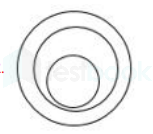
Question 77

'Dollu Kunitha' is a form of folk dance from the state of:

  1. AOption (a)

    West Bengal

  2. BOption (b)

    Karnataka

  3. COption (c)

    Assam

  4. DOption (d)

    Chhattisgarh

View answer & explanation

Correct answer

Answer: (b)B.

Karnataka

Why this answer is correct

The correct answer is Karnataka

Key Points

  • Dollu Kunitha is a traditional folk dance form from the state of Karnataka.
  • This dance is characterized by vigorous drum beats, quick movements, and synchronized group formations.
  • It is typically performed by the men of the Kuruba community in Karnataka during festivals and other significant events.
  • The performers wear traditional attire and carry large drums, which they beat rhythmically while dancing.
  • The dance is a form of storytelling and often depicts scenes from mythology, especially those related to Lord Shiva.

Additional Information

  • The Kuruba community, who primarily perform this dance, are traditionally shepherds and farmers.
  • Dollu Kunitha is not only a form of entertainment but also a means to preserve and promote the cultural heritage of Karnataka.
  • During the performance, dancers often form a semi-circle and move in unison, creating a visually captivating spectacle.
  • The dance is accompanied by singing, which narrates the stories and legends being depicted.
  • It is a significant part of the cultural festivals in Karnataka, such as Mysore Dasara and other regional fairs.

Question 78

Which of the following is a renewable source of energy?

  1. AOption (a)

    Nuclear fission

  2. BOption (b)

    Petroleum

  3. COption (c)

    Wood

  4. DOption (d)

    Coal

View answer & explanation

Correct answer

Answer: (c)C.

Wood

Why this answer is correct

The correct answer is Wood

Key Points

  • Wood is a form of biomass, which is considered a renewable energy source because it can be replenished over a relatively short period through the growth of new trees and plants.
  • Nuclear fission, Petroleum, and Coal are non-renewable sources of energy.
  • Nuclear fuel (uranium) is finite, and fossil fuels like petroleum and coal take millions of years to form, meaning they cannot be replenished on a human timescale.

Additional Information

  • Renewable Energy
  • Renewable energy is energy derived from natural phenomena that are naturally replenished.
  • These include sunlight, water, wind, tides, geothermal heat, and biomass.
  • This energy is utilized in five key areas: air and water heating/cooling, electricity generation, rural applications, and transportation.
  • As per a 2016 report by REN21, the global energy consumption from renewable resources contributed to 19.2% in 2014 and 23.7% in 2015.
  • Many countries are heavily investing in these resources as they aid in sustainable development.
  • The investment in 2015 was about 286 billion dollars, with major sectors being biofuel, solar power, wind, and hydroelectricity.
  • The availability of renewable energy resources is spread across a large geographical area, unlike conventional energy resources which are often concentrated in a limited number of countries.
  • The use of renewable energy resources in energy generation results in less pollution and offers significant economic benefits and energy security.

Question 79

P, Q, R, S, T, U and V are students who have exams on different days of the same week, starting on Monday and ending on Sunday. No two students have exams on the same day.

P's exam is on one of the days after Thursday. Q's exam is on the day immediately after P's exam. Three students have exams between Q and V. R has the exam on one of the days before V, but not on Monday. S has the exam immediately before T.

On which day does U have the exam?

  1. AOption (a)

    Saturday

  2. BOption (b)

    Monday

  3. COption (c)

    Friday

  4. DOption (d)

    Tuesday

View answer & explanation

Correct answer

Answer: (b)B.

Monday

Why this answer is correct

P, Q, R, S, T, U and V are students who have exams on different days of the same week, starting on Monday and ending on Sunday. No two students have exams on the same day.

  1. P's exam is on one of the days after Thursday.

  2. Q's exam is on the day immediately after P's exam.

DaysStudents (case 1)Students (case 2)
Monday
Tuesday
Wednesday
Thursday
FridayP
SaturdayQP
SundayQ


  1. Three students have exams between Q and V.
DaysStudents (case 1)Students (Case 2)
Monday
TuesdayV
WednesdayV
Thursday
FridayP
SaturdayQP
SundayQ


  1. R has the exam on one of the days before V, but not on Monday.

Here case 1 gets eliminated.

DaysStudents
Monday
TuesdayR
WednesdayV
Thursday
Friday
SaturdayP
SundayQ


  1. S has the exam immediately before T.
DaysStudents
Monday
TuesdayR
WednesdayV
ThursdayS
FridayT
SaturdayP
SundayQ


Final arrangement we have:

DaysStudents
MondayU
TuesdayR
WednesdayV
ThursdayS
FridayT
SaturdayP
SundayQ

So, U have the exam on Monday.

Hence, the correct answer is "Monday".

Question 80

Who among the following Assamese writers won the 'Sahitya Akademi Award 2020' in the category of short stories?

  1. AOption (a)

    Jayanta Madhab Bora

  2. BOption (b)

    Sananta Tanti

  3. COption (c)

    Apurba Kumar Saikia

  4. DOption (d)

    Joyshree Goswami Mahanta

View answer & explanation

Correct answer

Answer: (c)C.

Apurba Kumar Saikia

Why this answer is correct

The correct answer is Apurba Kumar Saikia 

Key Points

  • Apurba Kumar Saikia won the 2020 Sahitya Akademi Award for short stories for his work Bengsata.
  • This prestigious award is one of the most notable recognitions for writers in India
  • It is presented by the Sahitya Akademi, the National Academy of Letters.
  • Earlier significant Awards are :
  • Jadav Sarma Literary Award, Literary Excellence Award by Indian Medical Association, Antarlipi Sahitya Bota, Kathasandhi Sanman by Sahitya Akademi, Ambikagiri Roychoudhury Award for the best book on creative writing [Chotor Urohi, Short Story Collection] by Asam Sahitya Sabha.

Additional Information

  • Sahitya Akademi Award is given in the field of Literature and was started in the year 1954.
  • This award is given annually by Sahitya Akademi (India's National Academy of Letters), New Delhi.
  • The award comprises a plaque and a cash prize of ₹ 1,00,000.
  • The award's purpose is to recognize and promote excellence in Indian writing and also acknowledge new trends.
  • Makhanlal Chaturvedi was the first recipient in the Hindi category in the year 1955.
  • RK Narayan was the first recipient in the English category in the year1960.
  • It is given in 24 languages including Hindi and English.

Question 81

Solve the following.

Subtract 92+x2+35x2+74x3\frac{9}{2} + \frac{x}{2} + \frac{3}{5}{x^2} + \frac{7}{4}{x^3}. from 72−x3−15x2\frac{7}{2} - \frac{x}{3} - \frac{1}{5}{x^2}.

  1. AOption (a)

    −1−56x−45x2−74x3 - 1 - \frac{5}{6}x - \frac{4}{5}{x^2} - \frac{7}{4}{x^3}

  2. BOption (b)

    1−56x+45x2+74x3 1 - \frac{5}{6}x + \frac{4}{5}{x^2} + \frac{7}{4}{x^3}

  3. COption (c)

    1−56x−45x2+74x31 - \frac{5}{6}x - \frac{4}{5}{x^2} + \frac{7}{4}{x^3}

  4. DOption (d)

    1−56x+45x2−74x31 - \frac{5}{6}x + \frac{4}{5}{x^2} - \frac{7}{4}{x^3}

View answer & explanation

Correct answer

Answer: (a)A.

−1−56x−45x2−74x3 - 1 - \frac{5}{6}x - \frac{4}{5}{x^2} - \frac{7}{4}{x^3}

Why this answer is correct

Given:

Subtract 92+x2+35x2+74x3\dfrac{9}{2} + \dfrac{x}{2} + \dfrac{3}{5}x^2 + \dfrac{7}{4}x^3 from 72−x3−15x2\dfrac{7}{2} - \dfrac{x}{3} - \dfrac{1}{5}x^2.

Calculations:

72−x3−15x2−(92+x2+35x2+74x3)\dfrac{7}{2} - \dfrac{x}{3} - \dfrac{1}{5}x^2 - \left( \dfrac{9}{2} + \dfrac{x}{2} + \dfrac{3}{5}x^2 + \dfrac{7}{4}x^3 \right)

⇒ 72−x3−15x2−92−x2−35x2−74x3\dfrac{7}{2} - \dfrac{x}{3} - \dfrac{1}{5}x^2 - \dfrac{9}{2} - \dfrac{x}{2} - \dfrac{3}{5}x^2 - \dfrac{7}{4}x^3

⇒ (72−92)−(x3+x2)−(15x2+35x2)−74x3\left(\dfrac{7}{2} - \dfrac{9}{2}\right) - \left(\dfrac{x}{3} + \dfrac{x}{2}\right) - \left(\dfrac{1}{5}x^2 + \dfrac{3}{5}x^2\right) - \dfrac{7}{4}x^3

⇒ −1−56x−45x2−74x3-1 - \dfrac{5}{6}x - \dfrac{4}{5}x^2 - \dfrac{7}{4}x^3

∴ The correct answer is option 1.

Question 82

The angle of a sector is 30°. If its radius is 42 cm, then the length of the arc of the sector is:

  1. AOption (a)

    32 cm

  2. BOption (b)

    22 cm

  3. COption (c)

    22 m

  4. DOption (d)

    20 cm

View answer & explanation

Correct answer

Answer: (b)B.

22 cm

Why this answer is correct

Shortcut Trick

Arc Length = (θ/360) × 2πr

Arc Length = (30/360) × 2 × (22/7) × 42

Arc Length = (1/12) × 2 × 22 × 6

Arc Length = (1/12) × 264 = 22 cm

∴ The correct answer is 22 cm.

Alternate Method

30°

r = 42 cm

Arc length (l) Sector of a Circle

Given:

Angle of sector (θ) = 30°

Radius of sector (r) = 42 cm

Formula used:

Length of the arc (l) = (θ/360°) × 2πr

Calculation:

⇒ l = (30°/360°) × 2 × (22/7) × 42

⇒ l = (1/12) × 2 × 22 × 6

⇒ l = (1/12) × 264

⇒ l = 22 cm

∴ The correct answer is 22 cm.

Additional Information

Area of a Sector

The area of a sector with radius r and angle θ is given by A = (θ/360) × πr2.

Perimeter of a Sector

The total perimeter of a sector is the sum of the arc length and the two radii: P = l + 2r.

Relation between Area and Arc Length

Area of a sector can also be expressed in terms of its arc length as Area = (1/2) × l × r.

Question 83

A shared network within an organisation that enables all its employees to communicate with one another is called:

  1. AOption (a)

    intranet

  2. BOption (b)

    delnet

  3. COption (c)

    extranet

  4. DOption (d)

    internet

View answer & explanation

Correct answer

Answer: (a)A.

intranet

Why this answer is correct

The correct answer is Intranet

Key Points 

  • An intranet is a private network that is part of an organization and is used to securely distribute data and computing resources among staff members.
  • Working in groups and holding teleconferences are two other uses for intranets. Intranets promote internal communication in businesses.
  • An intranet is a private website hosted in the cloud, on-premises, or by external hosting services. It is similar to a company's own internal internet.
  • A company intranet is a private network that connects all employees to a central hub where they may access all resources, including people and tools.

Additional Information

  • Extranet:- Emails can be sent, data can be accessed, different orders can have their statuses checked, and many other things via an extranet.
  • Delnet:- DELNET-Developing Library Network, New Delhi, is a significant resource-sharing library network in India that links more than 7700 institutions, including universities, colleges, R&D organizations, hospitals, and other institutions, in 33 states throughout India and a few other countries.
  • Internet:- There are billions of computers and other electronic devices connected to the Internet on a global scale. You can speak with anyone in the world, access nearly any information, and accomplish a lot more with the help of the Internet.

Question 84

Which of the following glands is an endocrine gland in the human body?

  1. AOption (a)

    Salivary

  2. BOption (b)

    Pituitary

  3. COption (c)

    Prostate

  4. DOption (d)

    Sweat

View answer & explanation

Correct answer

Answer: (b)B.

Pituitary

Why this answer is correct

The correct answer is Pituitary

Key Points 

  • Pituitary Gland is an Endocrine gland in the human body.
  • It is also known as the master gland.
  • A Gland is called the endocrine gland when it secretes hormones directly into the bloodstream.
  • Endocrine: End means no duct required and the hormones go directly into the blood.
  • Examples: Thyroid Gland, Parathyroid Gland, Adrenal Gland, etc.

Additional Information

  • The glands which have ducts through which enzymes pass are known as the Exocrine Glands.
  • Exocrine glands are glands that secrete their products through ducts to an epithelial surface.
  • Unlike endocrine glands, which release hormones directly into the bloodstream, exocrine glands use ducts to transport their secretions externally or into body cavities.
  • They secrete enzymes, mucus, sweat, saliva, and other substances.
  • Examples: Digestive Gland, Salivary Gland, Sweat gland, etc.

Question 85

The Non-cooperation Movement was adopted at the Congress session in December 1920 at:

  1. AOption (a)

    Nashik

  2. BOption (b)

    Aurangabad

  3. COption (c)

    Nagpur

  4. DOption (d)

    Surat

View answer & explanation

Correct answer

Answer: (c)C.

Nagpur

Why this answer is correct

The correct answer is Nagpur

Key Points

  • In December 1920 at the Nagpur Session of Indian National Congress was held and the president of this session was C. Vijayaraghavachariar.
  • The aim of the program was indorsement of the Non-Cooperation Movement.
  • A Congress working Committee(CWC) of 15 members was set up and Provincial Congres on a linguistic basis was organised for attainment of Swaraj.
  • Gandhiji declared through Non-Corporation Movement, Swaraj could be attained.
  • Surendra Nath Banerjee founded Indian National Liberal Federation in 1919.

Additional Information

  • The Non-Cooperation Movement is the first mass political movement under Gandhiji.
  • The Non-Cooperation movement was approved by the Nagpur session of the Indian National Congress in 1920.
  • The main Incidents that leads to Non-Cooperation movements are:
  • Jallianwala Bagh Massacre.
  • Rowlatt Act.
  • Khilafat Agitation.
  • The attainment of 'Swaraj' by peaceful means was the main goal of the Non-Cooperation Movement.
  • The Non-Cooperation Movement was called off Gandhiji due to the Chauri Chaura incident in 1922.

Question 86

Study the given circle graph and answer the question that follows.

The circle graph shows the production of rice by seven different States - U.P, A.P, Bihar, Kashmir, Kerala, Odisha and Haryana - during a particular year.

If the total production of rice by all the given states during the particular year was 20 thousand tonnes, then what was the approximate production of rice (in tonnes) by Kerala?

  1. AOption (a)

    3525

  2. BOption (b)

    2667

  3. COption (c)

    3000

  4. DOption (d)

    9600

View answer & explanation

Correct answer

Answer: (b)B.

2667

Why this answer is correct

Given:

Total production of rice by all states = 20,000 tonnes

Production of rice by Kerala = 13.335% of total production

Formula used:

Production of Kerala = (Total production × Percentage of Kerala) / 100

Calculations:

Production of Kerala = (20,000 × 13.335) / 100

⇒ Production of Kerala = 2,667 tonnes

∴ The correct answer is option 2.

Question 87

Study the given circle graph and answer the question that follows.

The circle graph shows the production of rice by seven different States - U.P, A.P, Bihar, Kashmir, Kerala, Odisha and Haryana - during a particular year.

If the total production of rice by all the given states during the particular year was 18 thousand tonnes, then what was the ratio of the production of rice by Odisha to the production of rice by Kashmir?

  1. AOption (a)

    7 ∶ 8

  2. BOption (b)

    3 ∶ 7

  3. COption (c)

    21 ∶ 29

  4. DOption (d)

    7 ∶ 9

View answer & explanation

Correct answer

Answer: (d)D.

7 ∶ 9

Why this answer is correct

Given:

Total production of rice by all states = 18,000 tonnes

Formula used:

Ratio = Production of rice by Odisha / Production of rice by Kashmir

Calculation:

Let the production of rice by Odisha be O and by Kashmir be K.

We are given the total production is 18,000 tonnes. From the circle graph, assume the production in respective states is distributed in such a way that we can calculate O and K.

⇒ O = (7/72) × 18,000 tonnes

⇒ O = 1,750 tonnes

⇒ K = (9/72) × 18,000 tonnes

⇒ K = 2,250 tonnes

Ratio (Odisha:Kashmir) = 1,750 / 2,250

⇒ Ratio = 7:9

∴ The correct answer is option 4.

Question 88

Study the given table and answer the question that follows.

The table presents the number of foreigners who arrived in India as tourists from five different countries over five years.


Years
Countries
USAUKUAEChinaIran
2012300310250280440
2013480420280320400
2014450450240260350
2015320380300400380
2016490430540350420

Based on the given table, which of the following statements is TRUE?

  1. AOption (a)

    The number of tourists from UK has shown an increase every year during the given years.

  2. BOption (b)

    For all the years together, the total number of tourists from UAE was higher than the total number of tourists from Iran.

  3. COption (c)

    The ratio of the total number of tourists from UK in 2015 and 2016 together to that from China in the same years was 27 ∶ 13.

  4. DOption (d)

    The percentage increase in the number of tourists from USA from 2012 to 2013 was 60%.

View answer & explanation

Correct answer

Answer: (d)D.

The percentage increase in the number of tourists from USA from 2012 to 2013 was 60%.

Why this answer is correct

Given:

The table presents the number of foreigners who arrived in India as tourists from five different countries over five years.

Formula used:

Percentage Increase = (NewValue−OldValue)OldValue×100\dfrac{(New Value - Old Value)}{Old Value} \times 100

Calculations:

To check the percentage increase in the number of tourists from the USA from 2012 to 2013:

Old Value (2012) = 300

New Value (2013) = 480

⇒ Percentage Increase = (480−300)300×100\dfrac{(480 - 300)}{300} \times 100

⇒ Percentage Increase = 180300×100\dfrac{180}{300} \times 100

⇒ Percentage Increase = 0.6 × 100

⇒ Percentage Increase = 60%

∴ The correct answer is option (4).

Question 89

Study the given table and answer the question that follows.

The table presents the number of foreigners who arrived in India as tourists from five different countries over five years.

|
Years | Countries | | | | | | --- | --- | --- | --- | --- | --- | | USA | UK | UAE | China | Iran | | | 2012 | 300 | 310 | 250 | 280 | 440 | | 2013 | 480 | 420 | 280 | 320 | 400 | | 2014 | 450 | 450 | 240 | 260 | 350 | | 2015 | 320 | 380 | 300 | 400 | 380 | | 2016 | 490 | 430 | 540 | 350 | 420 |

Years
CountriesUSAUKUAEChinaIran20123003102502804402013480420280320400201445045024026035020153203803004003802016490430540350420

Years
Countries
USAUKUAEChinaIran
2012300310250280440
2013480420280320400
2014450450240260350
2015320380300400380
2016490430540350420

There was a 40% increase in the total number of tourists from all the countries together in 2017 as compared to 2016. If 1/7th of the total number of tourists in 2017 were from USA, how many tourists from USA visited India in 2017?

  1. AOption (a)

    516

  2. BOption (b)

    446

  3. COption (c)

    562

  4. DOption (d)

    664

View answer & explanation

Correct answer

Answer: (b)B.

446

Why this answer is correct

Given:

The table presents the number of foreigners who arrived in India as tourists from five different countries over five years.

YearsUSAUKUAEChinaIran
2012300310250280440
2013480420280320400
2014450450240260350
2015320380300400380
2016490430540350420

There was a 40% increase in the total number of tourists from all the countries together in 2017 as compared to 2016. If 1/7th of the total number of tourists in 2017 were from USA, how many tourists from USA visited India in 2017?

Formula used:

Total tourists in 2017 = Total tourists in 2016 × (1 + 40/100)

Tourists from USA in 2017 = (1/7) × Total tourists in 2017

Calculation:

Total tourists in 2016 = 490 + 430 + 540 + 350 + 420

= 2230

Total tourists in 2017 = 2230 × 1.40

= 3122

Tourists from USA in 2017 = (1/7) × 3122

⇒ 446

∴ The correct answer is option 2.

Question 90

Select the option in which the two numbers share a different relationship from that shared by the two numbers in the rest of the options.

  1. AOption (a)

    9, 110

  2. BOption (b)

    13, 210

  3. COption (c)

    8, 72

  4. DOption (d)

    5, 42

View answer & explanation

Correct answer

Answer: (c)C.

8, 72

Why this answer is correct

The logic followed here is: (1st number + 1) × (1st number + 2) = 2nd number

1)  9, 110 → (9 + 1) × (9 + 2) = 10 × 11 = 110

2)  13, 210 → (13 + 1) × (13 + 2) = 14 × 15 = 210

3)  8, 72 → (8 + 1) × (8 + 2) = 9 × 10 = 90 ≠ 72

4)  5, 42 → (5 + 1) × (5 + 2) = 6 × 7 = 42

Hence, the correct answer is "8, 72".

Question 91

If 'S' denotes '×', 'B' denotes '-', 'R' denotes '+', and 'V' denotes '÷', then what will be the value of the following expression?

14S63V21R19B22

  1. AOption (a)

    39

  2. BOption (b)

    14

  3. COption (c)

    37

  4. DOption (d)

    0

View answer & explanation

Correct answer

Answer: (a)A.

39

Why this answer is correct

Given Equation: 14S63V21R19B22 = ?

BODMAS Rule:

Decoding the given information:

AlphabetSBRV
Meaning×-+÷


Now replacing the sign from left to right using BODMAS Rule, we get:

⇒ 14 × 63 ÷ 21 + 19 - 22 = ?

⇒ 14 × 3 + 19 - 22 = ?

⇒ 42 + 19 - 22 = ?

⇒ 61 - 22 = 39.

Hence, the correct option is "Option 1".

Question 92

Four terms have been given, out of which three are alike in some manner and one is different. Select the one that is different.

  1. AOption (a)

    Kilogram

  2. BOption (b)

    Metre

  3. COption (c)

    Volume

  4. DOption (d)

    Second

View answer & explanation

Correct answer

Answer: (c)C.

Volume

Why this answer is correct

The logic followed here is:

KilogramUnit of mass
MetreUnit of length
VolumeMeasurement of space
SecondUnit of time


Kilogram, Metre, Second all are units of measurement,

Whereas,

Volume is a measurement of space.

Hence, the correct answer is "Volume".

Question 93

Read the given statements and conclusions carefully. Assuming that the information given in the statements is true, even if it appears to be at variance with commonly known facts, decide which of the given conclusions logically follow(s) from the statements.

Statements:

  1. Some fruits are flowers.
  2. All herbs are flowers.

Conclusions:

  1. All flowers are herbs.
  2. No herb is a fruit.
  1. AOption (a)

    Only conclusion 2 follows.

  2. BOption (b)

    Only conclusion 1 follows.

  3. COption (c)

    Both conclusions 1 and 2 follow.

  4. DOption (d)

    Neither conclusion 1 nor 2 follows.

View answer & explanation

Correct answer

Answer: (d)D.

Neither conclusion 1 nor 2 follows.

Why this answer is correct

Statements:

  1. Some fruits are flowers.
  2. All herbs are flowers.

The least possible Venn diagram is as follows:

Conclusions:

  1. All flowers are herbs. - False (because All herbs are flowers given. So, All flowers are herbs it can be possible but not definite)
  2. No herb is a fruit. - False (because there is no direct relation given between herb and fruit so it can be possible but not definite)

Hence, the correct answer is "Neither conclusion 1 nor 2 follows".

Question 94

Read the given statements and conclusions carefully. Assuming that the information given in the statements is true, even if it appears to be at variance with commonly known facts, decide which of the given conclusions logically follow(s) from the statements.

Statements:

  1. All poems are stories.
  2. All articles are poems.

Conclusions:

  1. All articles are stories.
  2. No story is an article
  1. AOption (a)

    Both conclusions 1 and 2 follow.

  2. BOption (b)

    Only conclusion 2 follows.

  3. COption (c)

    Only conclusion 1 follows.

  4. DOption (d)

    Neither conclusion 1 nor 2 follows.

View answer & explanation

Correct answer

Answer: (c)C.

Only conclusion 1 follows.

Why this answer is correct

Statements:

  1. All poems are stories.
  2. All articles are poems.

The least possible Venn diagram is as follows:

Conclusions:

  1. All articles are stories. - True (because All articles are poems and All poems are stories. So, All articles are stories too)
  2. No story is an article. - False (because All articles are poems and All poems are stories.  i.e. that some stories are articles So, No story is an article it cannot be possible)

Hence, the correct answer is "Only conclusion 1 follows".

Question 95

Select the box that can be formed by folding the given sheet along the lines.

  1. AOption (a)

  2. BOption (b)

  3. COption (c)

  4. DOption (d)

View answer & explanation

Correct answer

Answer: (a)A.

Why this answer is correct

From the dice:

Opposites pairs:

 →

 →

 → 

As we know that opposite surface cannot be together.

Option 1) 

→ Can be formed (As all surface are not opposite to each other)

Option 2) 

→ Cannot be formed (As 

 → 

given together)

Option 3) 

→ Cannot be formed (As 

 → 

given together)

Option 4) 

→ Cannot be formed (As

 → 

 given together)

So, Option 1 box can be formed by folding the given sheet along the lines.

Hence, the correct answer is "Option 1".

Question 96

Ali drives 12 km to the west from point P. He then takes a right turn, drives 6 km and reaches point Q. From there, he takes a right turn, drives 5 km and reaches point S. He then takes a final right turn, drives 10 km and stops at point T. 

Which of the following will take him to point P from point T?

  1. AOption (a)

    Drive 4 km to the north, take a left turn and drive 7 km.

  2. BOption (b)

    Drive 4 km to the west, take a right turn and drive 10 km.

  3. COption (c)

    Drive 7 km to the east, take a left turn and drive 4 km.

  4. DOption (d)

    Drive 5 km to the east, take a right turn and drive 4 km.

View answer & explanation

Correct answer

Answer: (c)C.

Drive 7 km to the east, take a left turn and drive 4 km.

Why this answer is correct

Given: 

Ali drives 12 km to the west from point P.

He then takes a right turn, drives 6 km and reaches point Q.

From there, he takes a right turn, drives 5 km and reaches point S.

He then takes a final right turn, drives 10 km and stops at point T. 

So, Drive 7 km to the east, take a left turn and drive 4 km will take him to point P from point T.

Hence, the correct answer is "Drive 7 km to the east, take a left turn and drive 4 km."

Question 97

RYG is related to YRT by a certain logic. Following the same logic, EPB is related to PEY. Which of the given options follows the same logic?

  1. AOption (a)

    ASI - SAP

  2. BOption (b)

    ASI - SAR

  3. COption (c)

    ASJ - SAP

  4. DOption (d)

    ASJ - SAR

View answer & explanation

Correct answer

Answer: (b)B.

ASI - SAR

Why this answer is correct

The logic followed here is:

RYG is related to YRT

EPB is related to PEY

Similarly, ASI - SAR

Hence, the correct answer is "ASI - SAR".

Question 98

Select the letter-cluster from among the given options that can replace the question mark (?) in the following series.

ACE, HJL, OQS, ?

  1. AOption (a)

    VWX

  2. BOption (b)

    ZXV

  3. COption (c)

    UWY

  4. DOption (d)

    VXZ

View answer & explanation

Correct answer

Answer: (d)D.

VXZ

Why this answer is correct

The logic followed here is:

Hence, the correct answer is "VXZ".

Question 99

P, Q, R, S, T, U, V and W are sitting around a circular table facing the centre. P sits third to the right of U. One person sits between P and T. S sits second to the left of Q. Q is neither an immediate neighbour of P nor U. V is an immediate neighbour of R. V is not an immediate neighbour of U.

Which of the following pairs represents the immediate neighbours of W?

  1. AOption (a)

    S, T

  2. BOption (b)

    Q, U

  3. COption (c)

    S, U

  4. DOption (d)

    V, U

View answer & explanation

Correct answer

Answer: (b)B.

Q, U

Why this answer is correct

Given: P, Q, R, S, T, U, V and W are sitting around a circular table facing the centre.

  1. P sits third to the right of U.

  2. One person sits between P and T.

  3. S sits second to the left of Q.

  4. Q is neither an immediate neighbour of P nor U.

  5. V is not an immediate neighbour of U.

  6. V is an immediate neighbour of R.

Here case 1 gets eliminated.

Thus final arrangement:

So, pairs "Q and U" represent the immediate neighbours of W.

Hence, the correct answer is "Q, U".

Question 100

W and T are married to each other and have only two children. K and M are married to each other and have only three children. R is the only sister of S and Y. N's mother is T. M's brother is N, who is a bachelor. K is the father of R.

How is T related to Y?

  1. AOption (a)

    Mother's brother

  2. BOption (b)

    Father's mother

  3. COption (c)

    Mother's mother

  4. DOption (d)

    Sister's husband

View answer & explanation

Correct answer

Answer: (c)C.

Mother's mother

Why this answer is correct

Family Chart:

Given: 

N's mother is T. M's brother is N, who is a bachelor.

W and T are married to each other and have only two children.

K and M are married to each other and have only three children.

R is the only sister of S and Y. K is the father of R.

So, T is the 'Mother's mother' of Y.

Hence, the correct answer is "Mother's mother".

100 questions in the full paper