Previous Year Paper

RRB NTPC CBT-I Official Paper (Held On: 25 Jan 2021 Shift 1) (Previous Year Paper)

Held in 2021

100 questions90 minutes
With answers
Free

Paper last updated:

Practise under exam conditions

Take this paper as a timed mock test. Review your answers after you submit.

Attempt timed test

Questions & answers

Read the paper at your pace. Open an explanation when you need it.

Question 1

Planet Pluto was discovered by:

  1. AOption (a)

    William Hershel

  2. BOption (b)

    Johann Galle

  3. COption (c)

    John Adams

  4. DOption (d)

    Clyde Tombaugh

View answer & explanation

Correct answer

Answer: (d)D.

Clyde Tombaugh

Why this answer is correct

The correct answer is Clyde Tombaugh.

Key Points

  • Pluto was discovered by Clyde Tombaugh on February 18, 1930, at the Lowell Observatory in Flagstaff, Arizona.
  • Tombaugh was an American astronomer who was born on February 4, 1906, and passed away on January 17, 1997.
  • He discovered Pluto while systematically searching the sky for a ninth planet, which was then referred to as "Planet X."
  • The discovery of Pluto was announced on March 13, 1930, which was the 75th anniversary of the discovery of Neptune and the birthday of Percival Lowell, who had predicted the existence of a ninth planet.

Additional Information

  • William Herschel:
  • He was a British astronomer who discovered Uranus in 1781.
  • He also discovered infrared radiation and conducted extensive studies of nebulae and star clusters.
  • Johann Galle:
  • He was a German astronomer who is credited with the first observation of Neptune in 1846.
  • He used calculations made by Urbain Le Verrier to locate the planet.
  • John Adams:
  • He was a British mathematician and astronomer who independently calculated the position of Neptune, leading to its discovery.
  • His calculations were similar to those of Le Verrier and helped confirm the existence of Neptune.

Question 2

In Computer terminology, what is the full form of IDN?

  1. AOption (a)

    Internal Digital Networks

  2. BOption (b)

    Intertwined Disc Networks

  3. COption (c)

    Internationalized Domain Name

  4. DOption (d)

    Input Distributed Networks

View answer & explanation

Correct answer

Answer: (c)C.

Internationalized Domain Name

Why this answer is correct

The correct answer is Internationalized Domain Name.

  • An Internationalized Domain Name (IDN) is a domain name that includes characters used in the local representation of languages that are not written with the twenty-six letters of the basic Latin alphabet "a-z".
  • This allows domain names to be registered in languages and scripts such as Arabic, Chinese, Cyrillic, Hindi, and others.
  • IDNs are an important step towards making the internet more accessible to people worldwide, allowing them to use domain names in their native languages.
  • The use of IDNs helps in overcoming language barriers and promotes global internet inclusivity.
  • History of IDNs
  • The concept of Internationalized Domain Names was first proposed in 1996.
  • The first implementations of IDNs were available in 1998 and 1999, but they were not standardized and interoperable.
  • In 2003, the Internet Engineering Task Force (IETF) published the first standard for IDNs, called the Internationalizing Domain Names in Applications (IDNA).
  • Since then, several updates and improvements have been made to the IDNA standard.
  • Technical Aspects of IDNs
  • IDNs are stored in the Domain Name System (DNS) as ASCII strings using a system called Punycode.
  • Punycode is a way to represent Unicode characters using only the ASCII subset supported by the DNS.
  • For example, the Chinese domain name "例子.测试" is encoded as "xn--fsq.xn--0zwm56d" in Punycode.
  • This ensures that IDNs are compatible with the existing DNS infrastructure.
  • Challenges and Adoption
  • Despite the benefits, the adoption of IDNs has been slow due to various challenges, including browser and application compatibility, user awareness, and security concerns.
  • Phishing attacks can exploit visually similar characters in different scripts to create deceptive domain names.
  • Efforts are ongoing to improve the security and usability of IDNs.

Question 3

Find the median of the data 40, 50, 30, 20, 80, 70, 90, 50. Next, if 30 is replaced by 120, find the new median.

The mean of the two medians found is ________

  1. AOption (a)

    55

  2. BOption (b)

    60

  3. COption (c)

    110

  4. DOption (d)

    50

View answer & explanation

Correct answer

Answer: (a)A.

55

Why this answer is correct

Given:

Original data set is 40, 50, 30, 20, 80, 70, 90, 50.

Then 30 is replaced by 120.

Formula Used:

Median for an even number of observations = (Value at (n/2) position + Value at ((n/2)+1) position) / 2.

Calculation

Original Set: 40, 50, 30, 20, 80, 70, 90, 50 Ordered Set: 20, 30, 40, 50, 50, 70, 80, 90

⇒ Median = (50 + 50) / 2 = 100 / 2

⇒ Median = 50 After Replacing 30 with 120: New Set: 20, 40, 50, 50, 70, 80, 90, 120

⇒ New Median = (50 + 70) / 2 = 120 / 2

⇒ New Median = 60

Mean of Two Medians: = Mean = (50 + 60) / 2 = 110 / 2

⇒ Mean = 55

Question 4

How will you write 5.26 hours in hours, minutes and seconds?

  1. AOption (a)

    5 hours 20 minutes 6 seconds

  2. BOption (b)

    5 hours 15 minutes 36 seconds

  3. COption (c)

    5 hours 15 minutes 10 seconds

  4. DOption (d)

    5 hours 26 minutes

View answer & explanation

Correct answer

Answer: (b)B.

5 hours 15 minutes 36 seconds

Why this answer is correct

Given:

5.26 hours

Formula Used:

1 hour = 60 minutes

1 minute = 60 seconds

Calculation:

⇒ 5.26 hours × 60 minutes/hour = 315.6 minutes

⇒ 315.6 minutes × 60 seconds/minute = 18936 seconds

⇒ 18936 seconds ÷ 60 seconds/minute = 315.6 minutes

⇒ 315.6 minutes ÷ 60 minutes/hour = 5.26 hours

Therefore, 5.26 hours = 5 hours 15 minutes 36 seconds.

Question 5

Which of the following does NOT support rural development?

  1. AOption (a)

    Promotion of organic farming

  2. BOption (b)

    Development of marketing

  3. COption (c)

    Development of human resources

  4. DOption (d)

    Urban credit

View answer & explanation

Correct answer

Answer: (d)D.

Urban credit

Why this answer is correct

The correct answer is Urban credit.

Key Points

  • Urban credit is primarily directed towards urban areas and does not directly contribute to rural development.
  • Rural development focuses on improving the quality of life and economic well-being of people living in rural areas, often through initiatives such as organic farming, marketing development, and human resource development.
  • Urban credit facilities are designed to cater to the financial needs of urban populations and typically involve different financial instruments and support structures compared to rural credit facilities.
  • While urban credit can indirectly affect rural areas through urban-rural linkages, it is not a direct measure for rural development.

Additional Information

  • Promotion of organic farming
  • Organic farming promotes sustainable agricultural practices that are beneficial for the environment and rural communities.
  • It helps in improving soil health, reducing pollution, and increasing biodiversity.
  • Farmers practicing organic farming often receive premium prices for their produce, which can enhance their income and livelihood.
  • Development of marketing
  • Effective marketing strategies are crucial for rural development as they help farmers and rural producers get better prices for their products.
  • Development of rural marketing infrastructure, such as storage facilities and transportation, can significantly improve market access for rural communities.
  • Development of human resources
  • Investing in education and skill development in rural areas is essential for empowering rural populations.
  • Human resource development initiatives can lead to better job opportunities and improved standards of living in rural areas.

Question 6

Which of the following is NOT a public sector unit?

  1. AOption (a)

    NTPC

  2. BOption (b)

    BCCL

  3. COption (c)

    BHEL

  4. DOption (d)

    ICICI

View answer & explanation

Correct answer

Answer: (d)D.

ICICI

Why this answer is correct

The correct answer is ICICI

Key Points

  • ICICI (Industrial Credit and Investment Corporation of India) is not a public sector unit.
  • It is a private sector financial services company headquartered in India, primarily involved in banking, insurance, and asset management.
  • ICICI is one of India's largest private banks, differentiated from public sector entities by its private ownership and management.
  • ICICI was formed in 1955 at the initiative of the World Bank, the Government of India and representatives of Indian industry.
  • The principal objective was to create a development financial institution for providing medium-term and long-term project financing to Indian businesses.
  • Until the late 1980s, ICICI primarily focused its activities on project finance, providing **long-term funds to a variety of industrial projects.**​

Additional Information

  • NTPC (National Thermal Power Corporation) - NTPC is a public sector company under the Ministry of Power, Government of India. It is the largest power generation company in India, involved in generating and selling electricity to state-owned power distribution companies.
  • BCCL (Bharat Coking Coal Limited) - BCCL is a subsidiary of Coal India Limited (CIL), a public sector undertaking under the Ministry of Coal, Government of India. BCCL specializes in mining coking coal used for steel production and operates primarily in Jharkhand.
  • BHEL (Bharat Heavy Electricals Limited) - BHEL is a public sector undertaking under the Ministry of Heavy Industries, Government of India. It is one of the largest engineering and manufacturing enterprises in India, specializing in the manufacture of electrical equipment.

Question 7

________ was the Buddhist monument built by Emperor Ashoka in Madhya Pradesh to honor Lord Buddha.

  1. AOption (a)

    Bavikonda Stupa

  2. BOption (b)

    Mahabodhi Stupa

  3. COption (c)

    Dhamek Stupa

  4. DOption (d)

    Sanchi Stupa

View answer & explanation

Correct answer

Answer: (d)D.

Sanchi Stupa

Why this answer is correct

The correct answer is Sanchi Stupa

Key Points

  • Sanchi Stupa is the Buddhist monument built by Emperor Ashoka in Madhya Pradesh to honor Lord Buddha.
  • It is one of the oldest stone structures in India and was originally commissioned by Emperor Ashoka in the 3rd century BCE.
  • Sanchi Stupa is famous for its **grand structure and the exquisite carvings that depict various events of the Buddha’s life.**​

Additional Information

  • Bavikonda Stupa - This stupa is located in Andhra Pradesh, India. It is an important Buddhist heritage site
  • Mahabodhi Stupa - Located in Bihar, at the site where Buddha is said to have attained enlightenment under a Bodhi tree. While it is a significant Buddhist site,
  • Dhamek Stupa - Situated in Sarnath, Uttar Pradesh, this stupa marks the place where Buddha delivered his first sermon after attaining enlightenment. Although related to Buddha’s teachings,

Question 8

Maulana Abul Kalam Azad Trophy (MAKA) was instituted in year ________ and awarded to the overall top performing Indian University in the Sports.

  1. AOption (a)

    1958-59

  2. BOption (b)

    1952-53

  3. COption (c)

    1956-57

  4. DOption (d)

    1954-55

View answer & explanation

Correct answer

Answer: (c)C.

1956-57

Why this answer is correct

The correct answer is 1956-57.

Key Points

  • The Maulana Abul Kalam Azad Trophy (MAKA) was instituted in the year 1956-57.
  • It is awarded annually to the university in India that has given the best all-round performance in sports.
  • The trophy is named after Maulana Abul Kalam Azad, the first Minister of Education in independent India, who served from 1947 to 1958.
  • The award aims to promote competitive sports in the universities and encourage sportsmanship.

Additional Information

  • The MAKA Trophy is a rolling trophy awarded by the Ministry of Youth Affairs and Sports, Government of India.
  • It is given to the university that has shown exceptional performance in inter-university tournaments and other sports activities recognized by the Association of Indian Universities (AIU).
  • The universities are judged based on their performance in various sports disciplines including athletics, badminton, basketball, cricket, football, hockey, tennis, and volleyball, among others.

Question 9

Find the remainder when 713 + 1 is divided by 6.

  1. AOption (a)

    1

  2. BOption (b)

    4

  3. COption (c)

    3

  4. DOption (d)

    2

View answer & explanation

Correct answer

Answer: (d)D.

2

Why this answer is correct

Given:

713 + 1

Concept Used:

Remainder Theorem

Calculation:

713 + 1 = (6 × 1 + 1)13 + 1,

⇒ On dividing  (6 × 1 + 1)13, by 6, remainder is 1

∴ [713 + 1]/6 = [1 + 1]/6, remainder = 2.

∴ Option 4 is the correct answer.

Question 10

As of 31st October 2020, The International Monetary Fund (IMF) has ________ members countries.

  1. AOption (a)

    191

  2. BOption (b)

    190

  3. COption (c)

    184

  4. DOption (d)

    185

View answer & explanation

Correct answer

Answer: (b)B.

190

Why this answer is correct

The correct answer is 190.

Key Points

  • As of 31st October 2020, the International Monetary Fund (IMF) has 190 member countries.
  • The IMF was established on December 27, 1945, in Washington, D.C.
  • The primary purpose of the IMF is to ensure the stability of the international monetary system.
  • The IMF provides financial assistance and advice to member countries facing economic difficulties.
  • It also works to promote global economic growth and stability by providing policy advice, financial assistance, and technical assistance to its member countries.

Additional Information

  • History of IMF Membership:
  • The IMF started with 29 member countries when it was founded in 1944.
  • Membership has expanded over the years to include 190 countries as of October 2020.
  • Countries must apply for membership and meet certain requirements to join the IMF.
  • Functions of the IMF:
  • Surveillance: Monitoring economic and financial developments and providing policy advice.
  • Financial Assistance: Providing loans to member countries facing balance of payments problems.
  • Technical Assistance: Offering training and support to help countries improve their economic management.
  • IMF's Role in Global Economy:
  • The IMF plays a crucial role in stabilizing the global economy by providing financial support and policy advice to countries in need.
  • It helps to prevent and resolve economic crises by promoting sound economic policies and practices.
  • The IMF also works to reduce poverty and support sustainable economic growth through its various programs and initiatives.

Question 11

India's first beam weapon KALI-5000 was developed by:

  1. AOption (a)

    ISRO & DRDO

  2. BOption (b)

    CDAC

  3. COption (c)

    DRDO & BARC

  4. DOption (d)

    BEL & ISRO

View answer & explanation

Correct answer

Answer: (c)C.

DRDO & BARC

Why this answer is correct

The correct answer is DRDO & BARC.

Key Points

  • The KALI (Kilo Ampere Linear Injector) is a linear electron accelerator developed in India by the Defence Research and Development Organisation (DRDO) and Bhabha Atomic Research Centre (BARC).
  • It is primarily used as a directed-energy weapon.
  • The KALI-5000 can emit powerful pulses of electrons that can disable enemy electronics and communication systems.
  • Development of KALI began in the 1980s and has since seen several iterations, with the KALI-5000 being one of the most advanced versions.

Additional Information

  • Development and Applications
  • The KALI project was aimed at producing high-energy beams for industrial applications, but its potential as a weapon was also recognized.
  • It has applications in both defense and non-defense sectors, including materials processing and high-speed photography.
  • Other Beam Weapons
  • Countries like the USA, Russia, and China are also developing directed-energy weapons similar to the KALI.
  • Such weapons represent a new class of military technology that can neutralize threats without causing extensive collateral damage.

Question 12

Two poles are standing on the ground. The distances between their feet and their tops are 48 m and 50 m respectively. If the height of the small pole is 10 m, find the height of the big pole.

  1. AOption (a)

    24 m

  2. BOption (b)

    16 m

  3. COption (c)

    12 m

  4. DOption (d)

    14 m

View answer & explanation

Correct answer

Answer: (a)A.

24 m

Why this answer is correct

Shortcut Trick

Use the Pythagorean triplet (7, 24, 25) scaled by a factor of 2: (14, 48, 50).

The distance between feet (Base) is 48 m and the distance between tops (Hypotenuse) is 50 m.

Thus, the difference in height (Perpendicular) must be 14 m.

Height of the big pole = Height of small pole + Difference = 10 + 14 = 24 m.

∴ The correct answer is 24 m.

Alternate Method

Given:

Height of small pole (h1) = 10 m

Distance between feet (d) = 48 m

Distance between tops (s) = 50 m

Formula Used:

According to Pythagorean Theorem: s2 = d2 + (h2 − h1)2

Let the height of the big pole be h2.

⇒ (h2 − 10)2 + 482 = 502

⇒ (h2 − 10)2 = 502 − 482

⇒ (h2 − 10)2 = (50 − 48)(50 + 48)

⇒ (h2 − 10)2 = 2 × 98 = 196

⇒ h2 − 10 = √196

⇒ h2 − 10 = 14

⇒ h2 = 14 + 10 = 24

∴ The correct answer is 24 m.

Additional Information

Pythagorean Triplets

These are sets of three positive integers a, b, and c such that a2 + b2 = c2. Common triplets include (3, 4, 5), (5, 12, 13), (8, 15, 17), and (7, 24, 25). Any multiple of a triplet is also a triplet.

Application in Heights

When two parallel vertical objects stand on horizontal ground, the slant distance between their tops, the horizontal distance between their bases, and the difference in their heights always form a right-angled triangle.

Algebraic Identity

Using the identity a2 − b2 = (a − b)(a + b) simplifies calculations involving squares of large numbers, especially in geometry problems.

Question 13

Kailash Satyarthi was the founder of:

  1. AOption (a)

    Stree Bachao Andolan

  2. BOption (b)

    Beti Padhao Andolan

  3. COption (c)

    Sabko Padhao Andolan

  4. DOption (d)

    Bachpan Bachao Andolan

View answer & explanation

Correct answer

Answer: (d)D.

Bachpan Bachao Andolan

Why this answer is correct

The correct answer is Bachpan Bachao Andolan.

Key Points

  • Bachpan Bachao Andolan (BBA) was founded by Kailash Satyarthi in 1980.
  • BBA is a child rights movement which works to eliminate child labor and trafficking in India.
  • The organization has rescued over 86,000 children from child labor, trafficking, and other forms of exploitation.
  • Kailash Satyarthi was awarded the Nobel Peace Prize in 2014 for his efforts towards children's rights and education.
  • BBA operates through a network of partners and volunteers across India to ensure the safety, education, and well-being of children.

Additional Information

  • Stree Bachao Andolan
  • A movement focused on the protection and empowerment of women in India.
  • It aims to address issues such as gender-based violence, discrimination, and inequality.
  • Beti Padhao Andolan
  • An initiative aimed at promoting the education of girls in India.
  • It addresses issues such as female literacy rates, school enrollment, and retention of girl students.
  • Sabko Padhao Andolan
  • A movement focused on universal education for all children in India.
  • It aims to ensure that every child has access to quality education, regardless of their socio-economic background.

Question 14

Select the number that can replace the question mark (?) in the following series.

-4, -3, -1, 2, 6, ?

  1. AOption (a)

    12

  2. BOption (b)

    10

  3. COption (c)

    15

  4. DOption (d)

    11

View answer & explanation

Correct answer

Answer: (d)D.

11

Why this answer is correct

The logic followed here is :-

Hence, the correct answer is "11".

Question 15

A train starts with full number of passengers. At the first stop, it drops one third of the passengers and takes in 96 more.

At the second stop, it drops one half of the passengers onboard and takes in 12 more. If there are 248 passengers onboard traveling to third station, then with how many passengers did the train start?

  1. AOption (a)

    580

  2. BOption (b)

    560

  3. COption (c)

    564

  4. DOption (d)

    570

View answer & explanation

Correct answer

Answer: (c)C.

564

Why this answer is correct

Given:

Number of passengers onboard traveling to the third station = 248

Formula Used:

Number of passengers at the second stop = Number of passengers onboard traveling to the third station × 2

Calculation:

After 2nd stop:

⇒ Before +12, passengers = 248 - 12 = 236

As 236 is half the passengers after 1st stop,

⇒ Passengers after 1st stop = 236 × 2 = 472

Passengers after 1st stop:

⇒ 2/3 × original + 96 = 472

Solving for original:

⇒ 2/3 × original = 472 - 96 = 376 ⇒ original = 376 × 3/2 = 564

The train started with 564 passengers.

Question 16

A carriage driving in a fog passed a man who was walking at the speed of 3 km/h in the same direction. He could see the carriage for 4 min and it was visible to him up to a distance of 100 m. What was the speed of the carriage?

  1. AOption (a)

    5 km/h

  2. BOption (b)

    4.5 km/h

  3. COption (c)

    6 km/h

  4. DOption (d)

    5.5 km/h

View answer & explanation

Correct answer

Answer: (b)B.

4.5 km/h

Why this answer is correct

Given:

Man's speed = 3 km/h

Carriage visible for 4 min = 4/60 h = 1/15 h

Distance visible = 100 m = 0.1 km

Formula Used:

Relative speed = Distance / Time

Calculation:

Distance = 0.1 km, Time = 1/15 h

⇒ Relative speed = 0.1 / (1/15) = 0.1 × 15 = 1.5 km/h

⇒ Speed of carriage relative to man = 1.5 km/h

Given man's speed is 3 km/h:

⇒ Speed of carriage = Speed of man + Relative speed = 3 + 1.5 = 4.5 km/h.

∴ Option 2 is the correct answer.

Question 17

Which of the following is a volatile memory?

  1. AOption (a)

    EPROM

  2. BOption (b)

    RAM

  3. COption (c)

    ROM

  4. DOption (d)

    PROM

View answer & explanation

Correct answer

Answer: (b)B.

RAM

Why this answer is correct

The correct answer is RAM.

Key Points

  • RAM (Random Access Memory) is a type of volatile memory, which means that it loses its data when the power is turned off.
  • It is used by the computer to store data that is being used currently or frequently accessed applications and processes.
  • RAM allows data to be read and written quickly to and from the memory, making it essential for the smooth operation of active applications and the operating system.
  • Unlike non-volatile memory such as ROM (Read-Only Memory), EPROM (Erasable Programmable Read-Only Memory), or PROM (Programmable Read-Only Memory), which retain data even when the power is off, RAM requires power to maintain the stored information.

Additional Information

  • Types of RAM:
  • DRAM (Dynamic RAM): Needs to be refreshed thousands of times per second.
  • SRAM (Static RAM): Faster and more reliable than DRAM, does not need to be refreshed as often, but is more expensive.
  • Usage of RAM:
  • RAM is used by the system to load the operating system, application programs, and currently used data so that they can be quickly reached by the device's processor.
  • In modern computers, RAM is typically installed in DIMM (Dual Inline Memory Module) slots on the motherboard.
  • Impact of RAM on System Performance:
  • Having more RAM can significantly improve system performance, especially when running multiple applications simultaneously.
  • Insufficient RAM can lead to slower system performance and increased usage of the hard drive for virtual memory, which is much slower than accessing data from RAM.

Question 18

The chemical name of blue vitriol is ________.

  1. AOption (a)

    Potassium nitrate

  2. BOption (b)

    Argon

  3. COption (c)

    Copper Sulphate

  4. DOption (d)

    Aluminium

View answer & explanation

Correct answer

Answer: (c)C.

Copper Sulphate

Why this answer is correct

The correct answer is Copper Sulphate.

Key Points

  • Blue Vitrio l is another name for Copper Sulphate(CuSO4).
  • It is also known as cupric sulfate or bluestone.
  • It is a blue crystalline solid that is commonly used in various industries.
  • It is used as a fungicide, herbicide, and pesticide in agriculture.
  • It is also used in electroplating, as a catalyst in chemical reactions, and the production of various chemical compounds.

Additional Information 

  • Zinc Sulphate (ZnSO4) is a crystalline powder.
  • It is commonly used as a dietary supplement and in the production of various chemical compounds.
  • Sulphuric Acid(H2SO4) is a highly corrosive and dangerous chemical.
  • It is used in the production of various chemical compounds and as a cleaning agent.
  • Sodium Hydroxide(NaOH) is a solid.
  • It is commonly used in the production of various chemical compounds, such as soap and paper.
  • It is commonly known as Caustic Soda.

Important Points Some Common Names of Chemical Compounds:

Common NamesChemical Compounds
Baking SodaSodium Bicarbonate or Sodium Hydrogen Carbonate(NaHCO3)
Bleaching PowderCalcium Oxychloride (CaOCl2)
BoraxSodium Tetraborate Decahydrate or Sodium Borate (Na2[B4O5(OH)4].8H2O)
Dry IceSolid Carbon Dioxide (CO2)
Green VitriolFerrous Sulphate Heptahydrate (FeSO4.7H2O)
GypsumCalcium Sulphate Dihydrate (CaSO4.2H2O)
Laughing GasDinitrogen Monoxide or Nitrous Oxide (N2O)
Quick Lime or Burnt LimeCalcium Oxide (CaO)
Milk of MagnesiaMagnesium Hydroxide (Mg(OH)2)

Question 19

NCSM is an autonomous organization under Ministry of culture. What is the full form of NCSM?

  1. AOption (a)

    National Council of Science Museums

  2. BOption (b)

    National Council of Social Museum

  3. COption (c)

    National Council of Satellite Museum

  4. DOption (d)

    National Council of Space Museum

View answer & explanation

Correct answer

Answer: (a)A.

National Council of Science Museums

Why this answer is correct

The correct answer is National Council of Science Museums.

Key Points

  • National Council of Science Museums (NCSM) is an autonomous organization and It is an autonomous organization under the Indian Ministry of Culture.
  • It is the largest chain of science centers or museums under a single administrative umbrella in the world.
  • the first science museum, Birla Industrial and Technological Museum (BITM), Kolkata under CSIR, was opened on May 2, 1959.
  • the NCSM has been built to coordinate all informal science communication activities in the museum space in the country.
  • In July 1965 the second science museum, Visvesvaraya Industrial & Technological Museum (VITM) was opened in Bangalore.
  • After Kolkata and Bangalore, the work for the third center in Mumbai was taken up in 1974.

Additional Information  Folk Art Museum, Patna

  • Founded in 1963, the museum displays age-old artifacts including folk instruments and jewelry.
  • The museum is also known for its huge collection of terracotta and ceramic objects.

Madhya Pradesh Tribal Museum, Bhopal

  • This is one of the most excellent and different sorts of museums.
  • It presents the lifestyle and culture of tribal people.

Albert Hall Museum, Jaipur

  • Albert Hall Museum, Jaipur is the oldest museum in the state and is considered an incredible piece of Indo-Saracenic architecture.
  • The museum was designed by Samuel Swinton Jacob and the museum was open to the public since 1887.

Question 20

Find the value of a2 + b2 + c2 - 2ab + 2ac - 2bc, if a = x + y, b = x - y and c = 2x - 1

  1. AOption (a)

    0

  2. BOption (b)

    (2x + 2y - 1)2

  3. COption (c)

    (x - y - 1)2

  4. DOption (d)

    (2x - 2y - 1)2

View answer & explanation

Correct answer

Answer: (b)B.

(2x + 2y - 1)2

Why this answer is correct

Given

a = x + y

b = x - y

c = 2x - 1

Formula Used

(a - b)² = a² + b² - 2ab

Calculation

⇒ a² + b² + c² - 2ab + 2ac - 2bc

⇒ (x + y)² + (x - y)² + (2x - 1)² - 2(x + y)(x - y) + 2(x + y)(2x - 1) - 2(x - y)(2x - 1)

⇒ x² + 2xy + y² + x² - 2xy + y² + 4x² - 4x + 1 - 2(x² - y²) + 4x(2x - 1) - 4y(2x - 1)

⇒ 6x² + 2y² - 4x + 1 - 2x² + 2y² + 8x² - 4x - 8xy + 4y

⇒ 2x² + 4y² - 8x + 5

⇒ (2x)² + (2y)² - 2×2x×2y + 5

⇒ (2x - 2y)² + 5

⇒ (2x + 2y - 1)²

∴ Option 2 is the correct answer.

Question 21

Arun ranks 27th in the class. Vijay is 7 ranks ahead of Arun. Vijay's rank from the last is 36th. How many students are there in the class?

  1. AOption (a)

    55

  2. BOption (b)

    51

  3. COption (c)

    56

  4. DOption (d)

    61

View answer & explanation

Correct answer

Answer: (a)A.

55

Why this answer is correct

According to the given information:-

Number of students in the class = 36 + 20 - 1

  • Number of students in the class = 56 - 1
  • Number of students in the class = 55

∴ Here, the number of students in class are '55'.

Hence, the correct answer is "55".

Question 22

Select the Venn diagram that best represents the relationship between the given classes.

Mammals, Tigers, Cows.

  1. AOption (a)

    3

  2. BOption (b)

    2

  3. COption (c)

    4

  4. DOption (d)

    1

View answer & explanation

Correct answer

Answer: (a)A.

3

Why this answer is correct

The least possible Venn diagram for the given relation is as shown below :-

  • All Tigers are Mammals.
  • All Cows are Mammals.
  • Tigers are Carnivores.
  • Cows are Herbivores.
  • Tigers and cows both are different animals.

Hence, the correct answer is "3".

Question 23

784 square tiles, each of side 50 cm are required to tile a floor of a square room. Find the length of the sides of the room.

  1. AOption (a)

    14 m

  2. BOption (b)

    13 m

  3. COption (c)

    12 m

  4. DOption (d)

    15 m

View answer & explanation

Correct answer

Answer: (a)A.

14 m

Why this answer is correct

Given

Number of tiles = 784

Side of each tile = 50 cm = 0.5 m

Formula Used

Area of the room = Number of tiles × Area of each tile

Calculation

⇒ Area of the room = 784 × 0.5 × 0.5

⇒ Area of the room = 196 m²

⇒ Side of the room = √196

⇒ Side of the room = 14 m

Therefore, the length of the sides of the room is 14 m.

Question 24

One year ago, the ratio of Laxman's salary to Gopal's salary was 3 : 5. The ratio of their individual salaries of last year to that of present year is 2 : 3 and 4 : 5 respectively. If their total salaries for the present year are Rs. 4,300, find the present salary of Laxman.

  1. AOption (a)

    Rs. 1,700

  2. BOption (b)

    Rs. 1,600

  3. COption (c)

    Rs. 1,800

  4. DOption (d)

    Rs. 1,900

View answer & explanation

Correct answer

Answer: (c)C.

Rs. 1,800

Why this answer is correct

Given:

Laxman's salary to Gopal's salary 1 year ago = 3 : 5

Laxman's last year to present year = 2 : 3

Gopal's last year to present year = 4 : 5

Total current salaries = Rs. 4,300

Calculation:

Let Laxman's salary last year = 3x and Gopal's = 5x.

Laxman's present salary = 3x × 3/2 = 4.5x.

Gopal's present salary = 5x × 5/4 = 6.25x.

Total present salaries = 4.5x + 6.25x = 10.75x = 4300.

⇒ x = 4300 / 10.75 = 400.

So, Laxman's present salary = 4.5x = 4.5 × 400 = 1800.

Hence, Laxman's present salary is Rs. 1,800.

Question 25

If a positive number N, when divided by 5 leaves a remainder 3, then the unit's place digit of N is:

  1. AOption (a)

    3 or 8

  2. BOption (b)

    1 or 5

  3. COption (c)

    0 or 2

  4. DOption (d)

    0 or 5

View answer & explanation

Correct answer

Answer: (a)A.

3 or 8

Why this answer is correct

Given:

N divided by 5 leaves a remainder of 3.

Formula Used:

If a number N when divided by D leaves a remainder R, then N can be expressed as N = D×Q + R, where Q is the quotient.

Calculation:

N = 5 × Q + 3

⇒ The unit's place digit of N depends on the remainder which is 3.

⇒ When a number N is divided by 5 and leaves a remainder of 3, the unit's place digit of N can be either 3 or 8.

This is because adding 3 to a number ending in 0 or 5 will result in a number ending in 3 or 8, respectively, and both satisfy the condition of leaving a remainder of 3 when divided by 5.

Therefore, the unit's place digit of N is 3 or 8.

Question 26

Instead of multiplying a number by 2, Rahul divided it by 2 and got the answer as 2. What should be the actual answer?

  1. AOption (a)

    8

  2. BOption (b)

    4

  3. COption (c)

    2

  4. DOption (d)

    6

View answer & explanation

Correct answer

Answer: (a)A.

8

Why this answer is correct

Given:

Rahul divided a number by 2 instead of multiplying it by 2 and got the answer as 2.

Calculation:

Original operation performed: Number ÷ 2 = 2 ⇒ Number = 2 × 2 = 4

The correct operation: 4 × 2 ⇒ Actual answer = 8

∴ Option 1 is the correct answer.

Question 27

The Khilafat Movement originated in ________.

  1. AOption (a)

    Germany

  2. BOption (b)

    Israel

  3. COption (c)

    Iran

  4. DOption (d)

    Turkey

View answer & explanation

Correct answer

Answer: (d)D.

Turkey

Why this answer is correct

The correct answer is Turkey.

Key Points 

  • Khilafat Movement is also known as the Caliphate moment.
  • The Khilafat Movement (1919–1924) or the Indian Muslim Movement, was a pan-Islamist political protest campaign started by the Muslims of British India.
  • The movement was led by the Ali brothers (Mohammad Ali and Shaukat Ali)

Cause of originating Caliphat moment

  • Alliance of Turkey and British:- Muslims of the world including India considered the Sultan of Turkey as their spiritual leader (Calipha).
  • During the First World War, Turkey allied with Germany and Austria against the British.
  • Indian Muslims supported the British in the First World War with the hope that the British would give the holy throne of the Ottoman Empire to the Calipha.
  • After the First World War Ottoman Empire was divided, and Turkey was separated from the Caliphate.
  • This angered the Muslims who considered it an insult to the Calipha.

Additional Information  Khilafat Committee

  • The All India Khilafat Committee was formed in 1919 under the leadership of the Ali brothers, Maulana Abul Kalam Azad, Ajmal Khan, and Hasrat Mohani, to force the British government to change its attitude towards Turkey.
  • All India Khilafat Committee was organized in Delhi in November 1919 and foreign goods were boycotted.

Question 28

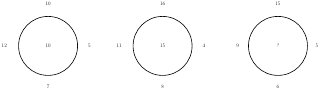
Study the given pattern carefully and select the number that can replace the question mark (?) in it.

  1. AOption (a)

    14

  2. BOption (b)

    12

  3. COption (c)

    13

  4. DOption (d)

    9

View answer & explanation

Correct answer

Answer: (c)C.

13

Why this answer is correct

The logic followed here is :-

(Top number + left number) - (Bottom number + right number) = Middle number

Figure 1:

= (10 + 12) - (5 + 7)

= 22 - 12

= 10

Figure 2:

= (16 + 11) - (4 + 8)

= 27 - 12

= 15

Figure 3:

= (15 + 9) - (5 + 6)

= 24 - 11

= 13

Hence, the correct answer is "13".

Question 29

If 7 + 27 − 2=x + y 14\rm\frac{\sqrt7 \space+\space \sqrt2} {\sqrt7 \space-\space\sqrt2} = x \space+\space y\space \sqrt14, find the value of y.

  1. AOption (a)

    45\frac{4}{5}

  2. BOption (b)

    65\frac{6}{5}

  3. COption (c)

    35\frac{3}{5}

  4. DOption (d)

    25\frac{2}{5}

View answer & explanation

Correct answer

Answer: (d)D.

25\frac{2}{5}

Why this answer is correct

Given:

7 + 27 − 2=x + y 14\rm\frac{\sqrt7 \space+\space \sqrt2} {\sqrt7 \space-\space\sqrt2} = x \space+\space y\space \sqrt14

Concept Used:

(a + b)2 = a2 + b2 + 2ab

(a + b)(a - b) = a2 - b2

Calculation:

Take LHS,

7 + 27 − 2\rm\frac{\sqrt7 \space+\space \sqrt2} {\sqrt7 \space-\space\sqrt2}

⇒ 7 + 27 − 2×7 + 27 + 2\rm\frac{\sqrt7 \space+\space \sqrt2} {\sqrt7 \space-\space\sqrt2} \times \rm\frac{\sqrt7 \space+\space \sqrt2} {\sqrt7 \space+\space\sqrt2}  

⇒ (7 + 2)2(7)2 − (2)2\rm\frac{(\sqrt7 \space+\space \sqrt2)^2} {(\sqrt7 )^2\space-\space(\sqrt2)^2}  

⇒ (7 + 2 + 2×7×2)7 − 2\rm\frac{(7 \space+\space 2\space+\space2\times \sqrt{7}\times \sqrt{2})} {7 \space-\space2}  

⇒ (9 + 2×14)5\rm\frac{(9\space+\space2\times \sqrt{14})} {5}  

⇒ 9 5+ 2145\rm\frac{9\space}{5}+\frac{\space2 \sqrt{14}} {5}  

Compare with RHS

⇒ 9 5+ 2145=x + y 14\rm\frac{9\space}{5}+\frac{\space2 \sqrt{14}} {5} = x \space+\space y\space \sqrt14 

⇒ x = 9/5 and y = 2/5

∴ Option 4 is the correct answer.

Question 30

The area of a square is 36 cm2. Find the area of the square formed by joining the mid-points of its sides.

  1. AOption (a)

    25 cm2

  2. BOption (b)

    28 cm2

  3. COption (c)

    20 cm2

  4. DOption (d)

    18 cm2

View answer & explanation

Correct answer

Answer: (d)D.

18 cm2

Why this answer is correct

Given:

Area of square = 36 cm²

Formula Used:

Area of square formed by joining the midpoints of its sides = (1/2) × (Area of original square)

Calculation:

⇒ Area of square formed by joining the midpoints of its sides = (1/2) × 36 cm²

⇒ Area of square formed by joining the midpoints of its sides = 18 cm²

Therefore, the correct option is 4.

Question 31

A question and three statements labelled (I), (II) and (III) are given. You have to decide which statement(s) is/are sufficient to answer the question.

Question: Who is the tallest among A, B, C, D and E?

Statements:

I. A is taller than E but shorter than D.

II. B is shorter than C but taller than E.

III. D is taller than C and A is taller than B.

  1. AOption (a)

    Statements I and II together are sufficient.

  2. BOption (b)

    Statements I, II and III are insufficient.

  3. COption (c)

    Statements I, II and III are sufficient.

  4. DOption (d)

    Statements I and III together are sufficient.

View answer & explanation

Correct answer

Answer: (d)D.

Statements I and III together are sufficient.

Why this answer is correct

The logic followed here is:

I. A is taller than E but shorter than D.

⇒ D > A > E ------------(i)

Thus statement I alone is not sufficient.

II. B is shorter than C but taller than E.

⇒ C > B > E  ------------(ii)

Thus statement II alone is not sufficient.

III. D is taller than C and A is taller than B.

⇒ D > C and A > B  ------------(iii)

Thus statement III alone is not sufficient.

From Statements I and II: No relation given between D and C so Statements I and II together are not sufficient.

From Statements I and III: D > A > E, B. Also, D > C. So, D is the tallest.

Hence, the correct answer is "Statements I and III together are sufficient.".

Question 32

The mission on Nano Science and Technology (Nano Mission) was launched in ________.

  1. AOption (a)

    2010

  2. BOption (b)

    2009

  3. COption (c)

    2006

  4. DOption (d)

    2007

View answer & explanation

Correct answer

Answer: (d)D.

2007

Why this answer is correct

The correct answer is 2007.

Key Points

  • The mission on Nano Science and Technology (Nano Mission) was launched in 2007.
  • The Nano Mission was an initiative by the Government of India.
  • It was aimed at fostering the growth of research and development in the field of nanotechnology.
  • The mission provided funding for research, infrastructure development, and human resource development in nanotechnology.
  • It was launched by the Department of Science and Technology (DST).

Question 33

Find the area of a rhombus of side 17 cm with one of its diagonal 16 cm long.

  1. AOption (a)

    230 cm2

  2. BOption (b)

    225 cm2

  3. COption (c)

    240 cm2

  4. DOption (d)

    220 cm2

View answer & explanation

Correct answer

Answer: (c)C.

240 cm2

Why this answer is correct

Given:

Length of side = 17 cm

Length of a diagonal = 16 cm

Concept used:

The two diagonals bisect each other at 90° in a rhombus.

Formula used:

Area of rhombus = (1/2) × Product of the two diagonals

Calculations:

Let AC = 16 cm and BD = x cm

If the two diagonals of rhombus ABCD intersect at O then,

⇒ AO2 + BO2 = AB2

⇒ (16/2)2 + (x/2)2 = 172

⇒ 64 + (x2/4) = 289

⇒ (x2/4) = 225

⇒ x2 = 900

⇒ x = 30 cm

Area of rhombus = (1/2) × 16 × 30

⇒ 8 × 30

⇒ 240 cm2

∴ The area of the rhombus is 240 cm2

Question 34

Where is the headquarters of International Labor Organization(ILO) located?

  1. AOption (a)

    Geneva, Switzerland

  2. BOption (b)

    Helsinki, Finland

  3. COption (c)

    Washington DC, USA

  4. DOption (d)

    Lyon, France

View answer & explanation

Correct answer

Answer: (a)A.

Geneva, Switzerland

Why this answer is correct

The correct answer is Geneva, Switzerland

Key Points

  • The headquarters of the International Labour Organization was founded in October 1919 under the league of nations, it is the first and oldest specialized agency of the UN.
  • The Headquarters of the ILO has 187member states: 186 out of 193 UN member states plus the cook-islands.
  • The headquarters of the ILO is headquartered in Geneva, Switzerland, with around 40 field offices around the world and employs some 3381 staff across 107 nations.
  • Formation: 11 April 1919
  • Director-general: Gilbert F. Houngbo
  • Award: Nobel Peace Prize (1969)
  • UNESCO: Paris

Question 35

If 100 copies of a book of 15 sheets require 26 reams of paper, then how many reams of paper is required for 750 copies of a book of 13 sheets?

  1. AOption (a)

    169 reams

  2. BOption (b)

    170 reams

  3. COption (c)

    165 reams

  4. DOption (d)

    182 reams

View answer & explanation

Correct answer

Answer: (a)A.

169 reams

Why this answer is correct

Given

100 copies of a 15-sheet book require 26 reams of paper.

1 ream = 500 sheets of paper.

Formula Used

M1D1 = M2D2

Calculation

According to the question.

⇒ (100 × 15)/26 = (750 × 13)/x

⇒ 1500/26 = 750 × 13)/x

⇒ x = 13 × 13

⇒ x = 169

Therefore, 169 reams of paper are required for 750 copies of a 13-sheet book.

Question 36

Which of the following is NOT a part of the UN?

  1. AOption (a)

    The State Council

  2. BOption (b)

    The Security Council

  3. COption (c)

    The International Court of Justice

  4. DOption (d)

    The General Assembly

View answer & explanation

Correct answer

Answer: (a)A.

The State Council

Why this answer is correct

The correct answer is The State Council.

Key Points

  • The United Nations (UN) is an international organization founded in 1945.
  • It is currently made up of 193 Member States.
  • The main organs of the UN are:
  • The General Assembly: The main deliberative, policymaking, and representative organ.
  • The Security Council: Responsible for maintaining international peace and security.
  • The International Court of Justice: The principal judicial organ of the UN.
  • The Secretariat: Carries out the day-to-day work of the UN.
  • The Economic and Social Council: Promotes international economic and social cooperation and development.
  • The Trusteeship Council: Currently inactive, was established to oversee the administration of trust territories.
  • The State Council is not an organ of the United Nations.

Additional Information

  • The Security Council
  • It has 15 members: 5 permanent members (China, France, Russian Federation, the United Kingdom, and the United States) and 10 non-permanent members elected for two-year terms by the General Assembly.
  • Each member has one vote. Decisions on procedural matters are made by an affirmative vote of at least 9 of the 15 members.
  • Decisions on substantive matters require 9 votes, including the concurring votes of all five permanent members.
  • The International Court of Justice
  • Located in The Hague, Netherlands.
  • The court settles legal disputes between states and gives advisory opinions on international legal issues referred to it by the UN.
  • The General Assembly
  • All 193 Member States of the UN are represented in the General Assembly, making it the only UN body with universal representation.
  • Each year in September, the full UN membership meets in the General Assembly Hall in New York for the annual General Assembly session, and general debate, which many heads of state attend and address.

Question 37

A person sells his table at a profit of 121212\frac{1}{2}% and chair at a loss of 8138\frac{1}{3}% but on the whole he gains Rs. 25. On the other hand, if he sells the table at a loss of 8138\frac{1}{3}% and the chair at a profit of 121212\frac{1}{2}% then he neither gains nor loses. Find the cost price of the table.

  1. AOption (a)

    Rs. 380

  2. BOption (b)

    Rs. 370

  3. COption (c)

    Rs. 360

  4. DOption (d)

    Rs. 350

View answer & explanation

Correct answer

Answer: (c)C.

Rs. 360

Why this answer is correct

Hint813%8\frac{1}{3}\% = 1/12

1212%12\frac{1}{2}\% = 1/8

Calculation:

Let the CP of the table and chair be "T" and "C"

T × (1/12) = C × (1/8)

⇒ T / C = 12 / 8

⇒ T / C = 3 / 2

Again the CP of the table be 3x

And chair = 2x

3x × (1/8) - 2x × (1/12) = 25

⇒ (9x - 4x) / 24 = 25

⇒ 5x = 24 × 25

⇒ x = 24 × 5 = 120 

The CP of table = 3x = 3 × 120 = Rs. 360

Important PointsProfit % = (Profit / CP) × 100%

Loss % = (Loss / CP) × 100%

SP = CP (100 + P)%

SP = CP (100 - L)%

Question 38

The cost of fencing a rectangular field at Rs. 24 per meter is Rs. 1,920. If its length is 23 m, find its breadth.

  1. AOption (a)

    19 m

  2. BOption (b)

    17 m

  3. COption (c)

    18 m

  4. DOption (d)

    20 m

View answer & explanation

Correct answer

Answer: (b)B.

17 m

Why this answer is correct

Given:

Cost of fencing = Rs. 1,920

Cost of fencing per meter = Rs. 24

Length of the field = 23 m

Formula Used:

Perimeter of a rectangle = 2(Length + Breadth)

Calculation:

⇒ Perimeter of the field = Rs. 1,920 ÷ Rs. 24

⇒ Perimeter of the field = 80 m

⇒ 2(23 m + Breadth) = 80 m

⇒ 46 m + 2 × Breadth = 80 m

⇒ 2 × Breadth = 80 m - 46 m

⇒ 2 × Breadth = 34 m

⇒ Breadth = 34 m ÷ 2

⇒ Breadth = 17 m

∴ Option 2 is the correct answer.

Question 39

The procedure for impeachment of the President of India is mentioned in ________ of the Constitution of India.

  1. AOption (a)

    Article 30

  2. BOption (b)

    Article 77

  3. COption (c)

    Article 61

  4. DOption (d)

    Article 66

View answer & explanation

Correct answer

Answer: (c)C.

Article 61

Why this answer is correct

The correct answer is Article 61.

Key Points

  • Article 61 of the Indian Constitution deals with the procedure for the impeachment of the President of India.
  • The President can be impeached for violation of the Constitution.
  • The impeachment process can be initiated in either House of Parliament.
  • The charges can be preferred by either House of Parliament with a two-thirds majority of the total membership of the House.
  • Once the charges are framed, they are sent to the other House for investigation and trial.
  • If the other House, after investigation, sustains the charges by a two-thirds majority of the total membership of the House, the President stands impeached and is deemed to have vacated his office from the date of such resolution.

Additional Information

  • Historical Context:
  • The impeachment procedure is a part of the checks and balances to ensure the President does not violate the Constitution.
  • This provision is meant to hold the President accountable and ensure that the office is not misused.
  • Comparative Perspective:
  • Impeachment procedures exist in various forms in other countries as well, such as the United States, where the President can be impeached for "Treason, Bribery, or other high Crimes and Misdemeanors."
  • In the UK, the concept of impeachment exists but has not been used since the 19th century.

Question 40

Which of the following instruments is used to measure wind speed?

  1. AOption (a)

    Anemometer

  2. BOption (b)

    Ammeter

  3. COption (c)

    Udometer

  4. DOption (d)

    Hygrometer

View answer & explanation

Correct answer

Answer: (a)A.

Anemometer

Why this answer is correct

The correct answer is Anemometer.

Key Points

  • An anemometer is a device used for measuring wind speed and direction.
  • It is a common instrument used in meteorology and aerodynamics.
  • The term is derived from the Greek word 'anemos', meaning wind.
  • Anemometers can be classified into different types such as cup anemometers, vane anemometers, hot-wire anemometers, and laser Doppler anemometers.
  • The most common type is the cup anemometer, which consists of three or four cups attached to horizontal arms.

Additional Information

  • Ammeter
  • An ammeter is an instrument used to measure the current in a circuit.
  • It is connected in series with the circuit whose current is to be measured.
  • Udometer
  • A udometer, also known as a rain gauge, is an instrument used to measure the amount of liquid precipitation over a set period of time.
  • Hygrometer
  • A hygrometer is an instrument used to measure the moisture content in the atmosphere, i.e., humidity.

Question 41

Rahul is older than Shashi but not as old as Kavita. Kavita is older than both Shashi and Ashok. Ashok is younger than Shashi but older than Monika. Who is the youngest among them?

  1. AOption (a)

    Monika

  2. BOption (b)

    Shashi

  3. COption (c)

    Rahul

  4. DOption (d)

    Ashok

View answer & explanation

Correct answer

Answer: (a)A.

Monika

Why this answer is correct

According to the given information:-

1) Rahul is older than Shashi but not as old as Kavita.

2) Ashok is younger than Shashi but older than Monika.

3) Kavita is older than both Shashi and Ashok.

∴ Here, 'Monika' is youngest among all of them.

Hence, the correct answer is "Monika".

Question 42

Which of the following units is used to measure the intensity of sound?

  1. AOption (a)

    Pascal

  2. BOption (b)

    Decibel

  3. COption (c)

    Joule

  4. DOption (d)

    Curie

View answer & explanation

Correct answer

Answer: (b)B.

Decibel

Why this answer is correct

The correct answer is Decibel.

Key Points

  • The intensity of sound is measured in units called decibels (dB).
  • Decibels are a logarithmic unit used to express the ratio of two values of a physical quantity, often power or intensity.
  • A sound level of 0 dB is considered the threshold of hearing, while 120-130 dB is the threshold of pain.
  • Every 10 dB increase represents a tenfold increase in intensity, meaning a sound at 30 dB is ten times more intense than a sound at 20 dB.
  • The decibel scale is used in various fields including acoustics, electronics, and control theory.

Additional Information

  • Pascal (Pa)
  • Pascal is the SI unit of pressure.
  • It is defined as one newton per square meter.
  • Joule (J)
  • Joule is the SI unit of energy.
  • It is defined as the energy transferred when one newton of force moves an object one meter.
  • Curie (Ci)
  • Curie is a unit of radioactivity.
  • It is defined as 3.7 × 10^10 decays per second.

Question 43

Kathiawar Peninsula is a geographical and cultural extension of ________.

  1. AOption (a)

    Raipur

  2. BOption (b)

    Hyderabad

  3. COption (c)

    Ahmedabad

  4. DOption (d)

    Rajasthan

View answer & explanation

Correct answer

Answer: (c)C.

Ahmedabad

Why this answer is correct

The correct answer is Ahmedabad.

Key Points

  • The Kathiawar Peninsula, also known as Saurashtra, is located in western India.
  • Geographically, it is a part of the state of Gujarat.
  • Ahmedabad is one of the major cities in Gujarat and serves as a cultural and economic hub for the region.
  • The peninsula is bounded by the Arabian Sea to the west and southwest, the Gulf of Kutch to the northwest, and the Gulf of Khambhat to the east.
  • The region is known for its rich history, diverse culture, and significant contributions to the Indian independence movement.

Additional Information

  • Historical Significance:
  • The Kathiawar Peninsula has been home to several ancient civilizations, including the Indus Valley Civilization.
  • It has numerous historical sites, including temples, forts, and palaces.
  • Economic Importance:
  • The region is known for its agricultural activities, particularly the cultivation of cotton, groundnuts, and other crops.
  • It also has a significant textile industry, with Ahmedabad being known as the "Manchester of India" due to its thriving textile mills.
  • Cultural Heritage:
  • The Kathiawar Peninsula is known for its rich cultural heritage, including traditional music, dance, and festivals.
  • It is also famous for its handicrafts, such as bandhani (tie-dye) and patola (double ikat) textiles.

Question 44

Of the three given equations, the first two are solved on the basis of a certain system. Find the correct answer for the unsolved third equation on the same basis.

32 × 34 = 96   

25 × 14 = 29    

18 × 51 = ?

  1. AOption (a)

    58

  2. BOption (b)

    18

  3. COption (c)

    15

  4. DOption (d)

    59

View answer & explanation

Correct answer

Answer: (d)D.

59

Why this answer is correct

The logic followed here is :-

Ten's digit of first number × Ten's digit of second number = Ten's digit of third number

And, 

One's digit of first number + One's digit of second number = One's digit of third number.

  • ​32 × 34 → (3 × 3) (2 + 4) = 96

  • 25 × 14 → (2 × 1) (5 + 4) = 29

Similarly, 

  • 18 × 51 → (1 × 5) (8 + 1) = 59

​Hence, the correct answer is **"59".**​​​

Question 45

The top of a tower makes complementary angles of elevation from two points at the distances of 25 m and 16 m from its foot on the ground. Find the height of the tower.

  1. AOption (a)

    25 m

  2. BOption (b)

    18 m

  3. COption (c)

    17 m

  4. DOption (d)

    20 m

View answer & explanation

Correct answer

Answer: (d)D.

20 m

Why this answer is correct

Given:

The top of a tower makes complementary angles of elevation from two points at the distances of 25 m and 16 m from its foot on the ground.

Calculation:

From fig:

⇒ tan(90° - θ) = h/25

⇒ tanθ = h/16

We know that ⇒ tan (90° - θ) = cotθ and cotθ = 1/tanθ

⇒ 1/tanθ = h/25 ……… (eq1)

⇒ tanθ = h/16 ………….(eq2)

From eq 1 and 2

⇒ 16/h = h/25

⇒ h2 = 400

⇒ h = 20 m

Therefore, height of tower is 20 meter.

Question 46

Select the number that can replace the question mark (?) in the following series.

1, 2, 6, 24, 120, ?

  1. AOption (a)

    600

  2. BOption (b)

    720

  3. COption (c)

    144

  4. DOption (d)

    96

View answer & explanation

Correct answer

Answer: (b)B.

720

Why this answer is correct

The logic followed here is :-

Hence, the correct answer is "720".

Question 47

An article is sold at a profit of 20%. If both the cost price and selling price are Rs. 100 less, the profit will be 4% more. Find the cost price.

  1. AOption (a)

    Rs. 600

  2. BOption (b)

    Rs. 800

  3. COption (c)

    Rs. 500

  4. DOption (d)

    Rs. 700

View answer & explanation

Correct answer

Answer: (a)A.

Rs. 600

Why this answer is correct

Given:

Article sold at a profit of 20%.

If both cost price (CP) and selling price (SP) are reduced by Rs 100, profit increases by 4% (to 24%).

Formula Used:

Initial profit formula: Profit% = (SP - CP) / CP × 100

New situation: New profit% = (SP - 100 - (CP - 100)) / (CP - 100) × 100

Calculation:

From given, initial profit = 20%,

⇒ SP = CP + 0.20 × CP

⇒ SP = 1.20 × CP

With Rs. 100 less in CP and SP, profit = 24%,

⇒ (SP - 100) - (CP - 100) = 0.24 × (CP - 100)

⇒ (1.20CP - 100) - CP + 100 = 0.24 × CP - 24

⇒ 0.20CP = 0.24 × CP - 24 ⇒ 24 = 0.24CP - 0.20CP

⇒ 24 = 0.04CP

⇒ CP = 24 / 0.04

⇒ CP = Rs. 600

Thus, the cost price of the article is Rs. 600.

Question 48

Which two freedom fighters threw smoke bombs at the Delhi Central Legislative Assembly in 1929?

  1. AOption (a)

    Bhagat Singh and Mangal Pandey

  2. BOption (b)

    Bhagat Singh and Batukeshwar Dutt

  3. COption (c)

    Bhagat Singh and Subhash Chandra Bose

  4. DOption (d)

    Bhagat Singh and ChandrashekharAzad

View answer & explanation

Correct answer

Answer: (b)B.

Bhagat Singh and Batukeshwar Dutt

Why this answer is correct

The correct answer is Bhagat Singh and Batukeshwar Dutt.

Key Points

  • Bhagat Singh and Batukeshwar Dutt threw the bombs inside the Central Assembly in Delhi on April 8, 1929.
  • The purpose of the bombing was to protest against the repressive laws and to garner attention for the cause of Indian independence.
  • They deliberately chose not to flee the scene and instead courted arrest to use their trial as a platform to propagate their revolutionary ideas.
  • The bombs were not intended to cause harm to anyone, as Bhagat Singh and Batukeshwar Dutt had specifically chosen a time when the assembly was not in session to minimize the risk of casualties.
  • The British government used the incident as an opportunity to crack down on the Indian independence movement, leading to a wave of arrests and harsh measures against activists.
  • Bhagat Singh and Batukeshwar Dutt were both sentenced to life imprisonment for their actions, and their trial became a rallying point for the Indian independence movement.
  • The bombing at the Central Assembly brought attention to the plight of political prisoners in British India and sparked widespread public support for their cause.
  • Bhagat Singh and Batukeshwar Dutt's act of defiance inspired a new wave of revolutionary fervor and resistance against British colonial rule in India.

Additional Information

Batukeshwar Dutt:

  • Batukeshwar Dutt whose party alias was ‘Mohan’, was born on November 18, 1910, in Bengal’s Burdwan district to Goshtha Bihari Dutt and Kamini Devi.
  • His early childhood was spent in Kanpur (Uttar Pradesh), where he studied at the Theosophical High School and Prithvinath Chak High School.
  • It was while studying at the latter, that he made the acquaintance of Surendranath Pandey and Vijay Kumar Sinha, who went on to become his comrades in the future.
  • Dutt died of cancer on July 20, 1965, in Delhi.

Bhagat Singh

  • Born on September 27, 1907, in the village of Banga in Punjab, British India.
  • Considered to be one of the most influential revolutionaries of the Indian independence movement.
  • Became involved in revolutionary activities at a young age by joining the Hindustan Republican Association (HRA).
  • Participated in acts of sabotage against British institutions, including the bombing of the Central Legislative Assembly in Delhi.
  • Convicted and executed for the assassination of John Saunders, a British police officer, on March 23, 1931, at the age of 23.
  • Left a lasting legacy in the struggle for Indian independence and is revered as a martyr and symbol of resistance to British colonialism.
  • His example continues to inspire new generations of activists worldwide.

Question 49

The production in a factory increased from 6600 tons to 7986 tons in 2 years. Find the rate of increase if compounded annually.

  1. AOption (a)

    8%

  2. BOption (b)

    14%

  3. COption (c)

    12%

  4. DOption (d)

    10%

View answer & explanation

Correct answer

Answer: (d)D.

10%

Why this answer is correct

Given:

Initial production = 6600 tons

Final production after 2 years = 7986 tons

Formula Used:

Final production = Initial production × (1 + r)n

Where, r = annual rate of increase, n = number of years

Calculation:

⇒ 7986 = 6600 × (1 + r)2

⇒ (1 + r)2 = 7986 / 6600 = 1.21

⇒ 1 + r = √1.21

⇒ 1 + r = 1.1

⇒ r = 0.1 or 10%

The rate of increase compounded annually is 10%.

Question 50

Each edge of a cube is increased by 50%. Find the percentage increase in its surface area.

  1. AOption (a)

    125%

  2. BOption (b)

    130%

  3. COption (c)

    120%

  4. DOption (d)

    100%

View answer & explanation

Correct answer

Answer: (a)A.

125%

Why this answer is correct

Given:

Each edge of a cube is increased by 50%.

Formula Used:

Original surface area of cube = 6 × (edge)2.

New edge = original edge × 1.50.

New surface area = 6 × (new edge)2.

Percentage increase in surface area = [(New surface area - Original surface area) / Original surface area] × 100.

Calculation:

Let the original edge be x.

Original surface area = 6x2.

New edge = 1.50x.

⇒ New surface area = 6 × (1.50x)2 = 6 × 2.25x2 = 13.5x2.

⇒ Increase in surface area = 13.5x2 - 6x2 = 7.5x2.

⇒ Percentage increase = (7.5x2 / 6x2) × 100 = 125%.

Thus, the percentage increase in the surface area of the cube is 125%.

Question 51

IPAB was constituted in the Ministry of Commerce and Industry in 2003. The full form of IPAB is:

  1. AOption (a)

    Increased Property Appellate Board

  2. BOption (b)

    Internal Property Appellate Board

  3. COption (c)

    Intellectual Property Appellate Board

  4. DOption (d)

    Individual Property Apple Board

View answer & explanation

Correct answer

Answer: (c)C.

Intellectual Property Appellate Board

Why this answer is correct

The correct answer is Intellectual Property Appellate Board.

Key Points

  • The intellectual property Appellate Board (IPAB) was established under section 83 of the Trade Marks Act.
  • It was constituted in 2003 to hear appeals against the decisions of the Registrar under the Trade Marks Act, 1999 and the Geographical Indications of Goods (Registration and Protection) Act, 1999.
  • The IPAB comprises a chairman (a retired judge of high court) and vice-chairman.
  • In addition, there are three technical members: one for patent and one for trademark; the third member hears the case based on the nature of the dispute.
  • The applicants of all Intellectual Property Rights (IPRs) can directly file a Special Leave Petition (SLP) before the Hon’ble Supreme Court against any order of Intellectual Property Appellate Board (IPAB).
  • They can also prefer a writ petition before the High Court against orders of IPAB and IP offices by invoking Article 226 of the Constitution of India and then file SLP before the Supreme Court.

​

Additional Information

  • The Intellectual Property Appellate Board has its headquarters in Chennai.
  • As per the sections of the Finance Act 2017, the Intellectual property Appellate Board shall exercise the jurisdiction, powers and authority conferred on it by or under this Copy Right Act, 1957.
  • In view of the same, all the cases pending before the Copy Right Board were transferred to Intellectual Property Appellate Board.

Question 52

The world's first official airmail was sent from ________ to ________ in February 1911.

  1. AOption (a)

    Andhra, Delhi

  2. BOption (b)

    Allahabad, Naini

  3. COption (c)

    Hyderabad, Tirupati

  4. DOption (d)

    Allahabad, Agra

View answer & explanation

Correct answer

Answer: (b)B.

Allahabad, Naini

Why this answer is correct

The correct answer is Allahabad, Naini.

Key Points

  • The world's first official airmail flight took place in India on 18 February 1911, a journey of 18 kilometres (11 mi) lasting 27 minutes across the from Allahabad to Naini.
  • Only floating post office of India Post is situated in Srinagar, Kashmir which was inaugurated in August 2011 at Dal Lake.

Additional Information

  • The speed post service was introduced in India in 1986 by the department of India Post.
  • It is used for the purpose of the faster delivery of parcels, letters, cards, documents, and other important stuff.
  • India Post started this service under the name of the "EMS Speed Post".
  • The present headquarter of India post is situated at Dak Bhawan, Sansad Marg, New Delhi.

Question 53

Which of the following books won the Man Booker International Prize in the year 2019?

  1. AOption (a)

    Midnight's Children

  2. BOption (b)

    Two Virgins

  3. COption (c)

    Celestial Bodies

  4. DOption (d)

    The Golden Gate

View answer & explanation

Correct answer

Answer: (c)C.

Celestial Bodies

Why this answer is correct

The correct naswer is Celestial Bodies.

Key Points

  • Jokha Alharthi:
  • She is the first woman from Oman who won Man Booker International Prize 2019 for her book "Celestial Body".
  • In this novel, she tells about the story of three sisters and a desert country.

Additional Information

  • In 2019 Margaret Atwood and Bernardine Evaristo won Manbooker Prize in 2019 for the book "The Testament" and "Girl, Woman, and Other" respectively.
Authors NameBooks
Margaret Atwood- The Edible Woman - Hag-Seed - The Heart Goes Last - The Testaments
Bernardine Evaristo- How much heart can hold - Hello mum - Mr. Lover - Girl, Woman, and Other

Question 54

Identify the number-pair that is different from the rest.

  1. AOption (a)

    13 : 17

  2. BOption (b)

    3 : 5

  3. COption (c)

    23 : 29

  4. DOption (d)

    19 : 25

View answer & explanation

Correct answer

Answer: (d)D.

19 : 25

Why this answer is correct

The logic followed here is:

Logic: Both are the Prime Numbers.

Now, checking the options:

Option 1) 13 : 17 → Both are the Prime Numbers.

Option 2) 3 : 5 → Both are the Prime Numbers.

Option 3) 23 : 29 → Both are the Prime Numbers.

Option 4) 19 : 25 → 25 is not a prime numbers.

So, '19 : 25' is odd among the given options.

Hence, the correct answer is "Option 4".

Additional Information

Prime numbers between 1 to 100:

Question 55

What is the greatest number that will divide 2400 and 1810 and leave remainders 6 and 4 respectively?

  1. AOption (a)

    42

  2. BOption (b)

    40

  3. COption (c)

    44

  4. DOption (d)

    46

View answer & explanation

Correct answer

Answer: (a)A.

42

Why this answer is correct

Given:

The greatest number that will divide 2400 and 1810 and leave remainders 6 and 4.

Calculation:

Since on dividing 2400, the remainder 6 is left

So the required number must divide (2400 – 6) = 2394 exactly

Also, on dividing 1810, remainder 4 is left

So the required number must divide (1810 – 4) = 1806 exactly

So, the greatest number required number should be the HCF of 2394 and 1806

⇒ HCF of 2394 and 1806 = 42

∴ Option 1 is the correct answer.

Question 56

Who ascended the Gupta throne after Chandragupta I?

  1. AOption (a)

    Sri Gupta

  2. BOption (b)

    Shudraka

  3. COption (c)

    Brahmagupta

  4. DOption (d)

    Samudragupta

View answer & explanation

Correct answer

Answer: (d)D.

Samudragupta

Why this answer is correct

The correct answer is Samudragupta.

Key Points

  • Samudragupta was the successor of Chandragupta I.
  • He is also called Napoleon of India because of his ambition of the military.
  • He is regarded as the greatest ruler of the Gupta dynasty as he held major military campaigns.
  • He is known for his first Aryavart war and Southern campaign.
  • He ruled around 330-380 BC and contributed greatly to expanding the territory of the Gupta Empire.
  • He is behind capturing of Ganga Yamuna doab.
  • His empire extended to Tamil Nadu as well.
  • At its peak, he captured almost entire North India and his empire stretched from southern and eastern parts of the country as well.
  • He fought many wars and thus he was awarded the title of 'Prithivyah Pratham Veer' which means the first powerful man of the world.
  • Chandragupta, was the first ruler of the Gupta dynasty to adopt the grand

title of maharaj-adhiraja, a title that Samudragupta also used.

  • At a pillar in Allahabad, the details of the wars he fought are described.

Additional Information

Gupta Dynasty:

Gupta Dynasty KingsFacts about Gupta Kings
Sri Gupta- Founder of Gupta Dynasty - Reign from 240 CE to 280 CE - Used the title of ‘Maharaja‘
Ghatotkacha- Son of Sri Gupta - Took the title of ‘Maharaja‘
Chandragupta I- Reigned from 319 CE to 335/336 CE - Started the Gupta Era - He assumed the title of ‘Maharajadhiraja‘ - Married Lichchavi princess Kumaradevi
Samudragupta- Reigned from 335/336 CE to 375 CE - Called ‘Napolean of India’ by V.A. Smith (Irish Indologist and Art Historian) - His campaigns are mentioned in the Eran inscription (Madhya Pradesh)
Chandragupta II- Reigned from 376-413/415 CE - Navratnas (9 Gems in his Court) - Took the title ‘Vikramaditya’
Kumaragupta I- Reigned from 415 CE to 455 CE - Founded Nalanda University - He was also called Shakraditya
Skandagupta- Reigned from 455 AD – 467 AD - Was a ‘Vaishnavite‘ - Son of Kumaragupta - Repulsed an attack by the Hunas but this strained his empire’s coffers
Vishnugupta- Last known ruler of the Gupta Dynasty (540 AD – 550 AD)

Question 57

Find the sum of the mean and median of the given data.

12, 10, 16, 18, 20, 26, 14, 28

  1. AOption (a)

    18

  2. BOption (b)

    35

  3. COption (c)

    44

  4. DOption (d)

    17

View answer & explanation

Correct answer

Answer: (b)B.

35

Why this answer is correct

The logic followed here is :-

Given data is : 12, 10, 16, 18, 20, 26, 14, 28

Number of observations = 8 

Mean=∑xnMean = {\sum x \over n}

Mean = (12 + 10 + 16 + 18 + 20 + 26 + 14 + 28) / 8

Mean = 144 / 8

Mean = 18

Median :

Observations in ascending order are :

10, 12, 14, 16, 18, 20, 26, 28

Here n = 8 is even.

So, 4th and 5th observations are 16, 18.

Median = (16 + 18) / 2

Median = 34 / 2

Median = 17

∴ Sum of mean and median of data = 18 + 17

∴ Here, Sum of mean and median of data = 35

Hence, the correct answer is "35".

Question 58

The Chairman of National Human Rights Commission should be:

  1. AOption (a)

    the Prime Minister

  2. BOption (b)

    a leader of the opposition

  3. COption (c)

    a speaker of the Lok Sabha

  4. DOption (d)

    a retired Chief Justice of India

View answer & explanation

Correct answer

Answer: (d)D.

a retired Chief Justice of India

Why this answer is correct

The correct answer is a retired Chief Justice of India.

Key Points

  • The National Human Rights Commission (NHRC) of India is an autonomous public body constituted on 12 October 1993 under the Protection of Human Rights Ordinance of 28, 1993.
  • The NHRC is responsible for the protection and promotion of human rights, defined by the Act as "rights relating to life, liberty, equality and dignity of the individual guaranteed by the Constitution or embodied in the international covenants and enforceable by courts in India".
  • The NHRC is composed of a Chairperson and other members. The Chairperson should be a retired Chief Justice of India.
  • The first Chairperson of NHRC was Justice Ranganath Mishra.
  • The NHRC also includes one Member who is, or has been, a Judge of the Supreme Court of India, one Member who is, or has been, the Chief Justice of a High Court, and two Members to be appointed from among persons having knowledge of, or practical experience in, matters relating to human rights.

Additional Information

  • Appointment and Tenure:
  • The Chairperson and members of the NHRC are appointed by the President of India on the recommendation of a committee consisting of:
  • The Prime Minister (Chairperson)
  • The Speaker of the Lok Sabha
  • The Minister of Home Affairs
  • The Leader of the Opposition in the Lok Sabha
  • The Leader of the Opposition in the Rajya Sabha
  • The Deputy Chairman of the Rajya Sabha
  • The Chairperson and members hold office for a term of five years or until they attain the age of 70 years, whichever is earlier.
  • Functions and Powers:
  • The NHRC can conduct inquiries, either suo motu or on a petition presented to it by a victim or any person on his behalf, into complaints of violation of human rights or abetment or negligence in the prevention of such violation by a public servant.
  • It has the power to intervene in any proceeding involving any allegation of violation of human rights pending before a court, with the approval of such court.
  • The NHRC can visit any jail or other institution under the control of the State Government, where persons are detained or lodged for purposes of treatment, reformation or protection, for the study of the living conditions of the inmates and make recommendations.
  • It can review the safeguards provided by or under the Constitution or any law for the time being in force for the protection of human rights and recommend measures for their effective implementation.

Question 59

Who was the twenty-fourth Jain Tirthankara?

  1. AOption (a)

    Rishabha

  2. BOption (b)

    Mahavira

  3. COption (c)

    Gomateshwara

  4. DOption (d)

    Parshvanatha

View answer & explanation

Correct answer

Answer: (b)B.

Mahavira

Why this answer is correct

The correct answer is Mahavira.

Key Points

  • Mahavira, also known as Vardhamana, is recognized as the twenty-fourth and last Tirthankara of Jainism.
  • He was born in 599 BCE in Kundagram, Bihar, India.
  • Mahavira attained kevala jnana (omniscience) after 12 years of rigorous penance.
  • He preached the principles of Ahimsa (non-violence), Satya (truth), Asteya (non-stealing), Brahmacharya (celibacy), and Aparigraha (non-possession).
  • Mahavira's teachings form the core of Jain philosophy and are compiled in the Agamas, the canonical scriptures of Jainism.
  • He is considered a reformer who revitalized and reorganized the Jain community during his lifetime.

Additional Information

  • Rishabha
  • He is considered the first Tirthankara in Jainism.
  • Rishabha is believed to have lived millions of years ago, and his teachings laid the foundation for the Jain tradition.
  • Parshvanatha
  • He is the twenty-third Tirthankara in Jainism.
  • Parshvanatha is known for advocating the fourfold restraint (Chaturyama) – non-violence, truthfulness, non-stealing, and non-possession.

Question 60

Who among the following joined the 969 Railway Engineer Regiment of Territorial Army (TA) in 2011? She was the first female jawan in the Indian Army.

  1. AOption (a)

    Amrita Devi

  2. BOption (b)

    Sita Sahu

  3. COption (c)

    Chhavi Rajawat

  4. DOption (d)

    Sapper Shanti Tigga

View answer & explanation

Correct answer

Answer: (d)D.

Sapper Shanti Tigga

Why this answer is correct

The correct answer is Sapper Shanti Tigga.

Key Points

  • Sapper Shanti Tigga joined the 969 Railway Engineer Regiment of Territorial Army (TA) in 2011.
  • She was the first female jawan in the Indian Army.
  • Her induction marked a significant milestone in the Indian Army's history, showcasing the increasing roles of women in the armed forces.
  • She was noted for her physical fitness and determination, which helped her succeed in a traditionally male-dominated field.

Additional Information

  • Women in Indian Army:
  • Women were first inducted into the Indian Army in 1992 as officers in non-combat roles.
  • In recent years, the roles of women in the Indian Army have expanded significantly, including positions in combat support arms and services.
  • The Indian Army has taken several initiatives to increase the participation of women, reflecting a broader trend towards gender equality in the armed forces.
  • Territorial Army (TA):
  • The Territorial Army is a part-time voluntary force that provides support to the regular army during emergencies and national defense operations.
  • It allows civilians to serve in the military while maintaining their civilian careers.
  • The TA has been actively involved in various operations, including disaster relief, internal security, and infrastructure development.

Question 61

Where is the Kolleru Lake situated?

  1. AOption (a)

    Assam

  2. BOption (b)

    Gujarat

  3. COption (c)

    Andhra Pradesh

  4. DOption (d)

    Jammu and Kashmir

View answer & explanation

Correct answer

Answer: (c)C.

Andhra Pradesh

Why this answer is correct

The correct answer is Andhra Pradesh.

Key Points

  • Kolleru Lake is one of the largest freshwater lakes in India.
  • It is located in the state of Andhra Pradesh.
  • The lake is situated between the deltas of the Godavari and Krishna rivers.
  • Kolleru Lake serves as a natural flood-balancing reservoir for these rivers.
  • The lake is an important habitat for a variety of migratory birds and is a designated wetland under the Ramsar Convention.

Additional Information

  • Ecological Significance
  • Kolleru Lake is a vital ecosystem that supports a rich biodiversity of flora and fauna.
  • The lake is home to several species of fish, amphibians, and reptiles.
  • It also serves as a breeding ground for many bird species, making it an important site for birdwatching and ornithological studies.
  • Human Impact and Conservation
  • Over the years, the lake has faced threats from human activities such as agriculture, aquaculture, and urbanization.
  • Efforts are being made to conserve and restore the lake's natural habitat through various government and non-government initiatives.
  • The Andhra Pradesh government has undertaken several measures to regulate fishing and farming activities in and around the lake to preserve its ecological balance.

Question 62

Which part of the muscular system attaches bone to bone?

  1. AOption (a)

    Muscle

  2. BOption (b)

    Cartilage

  3. COption (c)

    Ligament

  4. DOption (d)

    Tendon

View answer & explanation

Correct answer

Answer: (c)C.

Ligament

Why this answer is correct

The correct answer is Ligament.

Key Points

  • Ligaments are fibrous connective tissues that connect bones to other bones.
  • They provide stability and support to joints by limiting excessive movement.
  • Unlike tendons, which connect muscles to bones, ligaments specifically connect bone to bone.
  • Ligaments are crucial for maintaining the structural integrity of the skeletal system.

Additional Information

  • Types of Ligaments:
  • Capsular Ligaments: These are part of the articular capsule that surrounds synovial joints.
  • Extracapsular Ligaments: These lie outside the joint capsule and provide additional support.
  • Intracapsular Ligaments: These are found within the joint capsule and provide stability from within.
  • Common Injuries:
  • Sprains: Overstretching or tearing of ligaments, often occurring in the ankle, knee, or wrist.
  • Torn Ligaments: Severe sprains where the ligament is completely torn, often requiring surgical intervention.

Question 63

The largest nuclear power station in India is in ________.

  1. AOption (a)

    Tarapur

  2. BOption (b)

    Mahabaleshwar

  3. COption (c)

    Aurangabad

  4. DOption (d)

    Panchgani

View answer & explanation

Correct answer

Answer: (a)A.

Tarapur

Why this answer is correct

The correct answer is Tarapur

Key Points 

  • Tarapur Nuclear Power Plant is located in Tarapur, Maharashtra, and is India's first commercial nuclear power station with an installed capacity of 1,000 MW, owned by the Nuclear Power Corporation of India
  • A nuclear power plant generates electricity using nuclear energy produced by reactors, where certain unstable atomic nuclei, like uranium, undergo fission when bombarded by neutrons, releasing a large amount of energy.
  • Tarapur Atomic Power Station (TAPS) was launched by Lal Bahadur Shastri’s government, construction began in 1961, and it was commissioned in 1969, marking its 50th year of operation in 2019.
  • Located in Tarapur, Pune, Maharashtra, it has four pressurised heavy water reactor units with a total capacity of 1,100 MW, owned by the Maharashtra State Electricity Distribution Company and operated by NPCIL.
  • Power generation in Units 1 and 2 is 2×160 MW, and in Units 3 and 4, it is 2×540 MW, with a net nameplate capacity of 1280 MW, making it the second most powerful power plant in India after Kudankulam Nuclear Power Plant.
  • Nuclear fuel for TAPS is delivered by France, China, and Russia under IAEA safeguards, following India’s 1974 nuclear test which ended Western uranium supplies.
  • TAPS was a collaborative effort between New Delhi and Russia, with a contract signed in 1964 and commercial operations starting in 1969, using reactors supplied by the US conglomerate General Electric.

Question 64

________ is the study of earthquakes.

  1. AOption (a)

    Montology

  2. BOption (b)

    Volcanology

  3. COption (c)

    Topography

  4. DOption (d)

    Seismology

View answer & explanation

Correct answer

Answer: (d)D.

Seismology

Why this answer is correct

The correct answer is Seismology.

Key Points

  • An earthquake in simple words is the shaking off the earth.
  • It is a natural event.
  • It is caused due to release of energy, which generates waves that travel in all directions.
  • The study of seismic waves provides a complete picture of the layered interior.
  • Seismology is the study of earthquakes and seismic waves that move through and around the Earth.
  • A seismologist is a scientist who studies earthquakes and seismic waves.
  • All natural earthquakes take place in the lithosphere.
  • The earthquake events are scaled either according to the magnitude or intensity of the shock.
  • The magnitude scale is known as the Richter scale.
  • The magnitude relates to the energy released during the quake.
  • The magnitude is expressed in absolute numbers, 0-10.

Additional InformationCosmology

  • The study of the universe as a whole of the structure and evolution of the content\aa of the universe from the beginning of time to the future.
  • The universe or cosmos is the sum of the total of all the potentially knowable objects.

Pathology:

  • The word ‘Pathology’ is derived from two Greek words:
  • Pathos- means suffering, and logos - means study.
  • It is the branch of science that deals with the scientific study of the structure and function of the body in disease through laboratory examinations of samples of blood, body fluids, tissues (biopsy samples), surgically removed organs, and in some cases the whole body (autopsy), for diagnostic or forensic purposes. Hence, Option 3 is correct.
  • Pathologists are often called 'Doctor's Doctor.

Ecology

  • Ecology is the study of the ways in which organisms interact with each other and with their non-living surroundings.
  • Every animal or plant lives in a certain environment.
  • Ecologists study the interactions of communities with their environment and they explore the complex structure of life on Earth.
  • Ecology is a branch of biology and geography and is also called environmental biology.
  • The subject is the study of individuals, populations, communities, and ecosystems.
  • The term ecology was first used in 1866 by the German biologist Ernst Haeckel in his book 'Generelle Morphologie der Organismen'.

Question 65

A group of men decided to complete a work in 10 days, but five of them remained absent. If the rest of the group completed the work in 12 days, find the original number of men.

  1. AOption (a)

    30 men

  2. BOption (b)

    24 men

  3. COption (c)

    40 men

  4. DOption (d)

    25 men

View answer & explanation

Correct answer

Answer: (a)A.

30 men

Why this answer is correct

Given:

Work to be completed in 10 days

Five men absent

Remaining men complete in 12 days

Formula:

Work = Number of men × Number of days

Calculation:

Let the original number of men be x.

Original plan: ⇒ Work = x × 10

With five men absent, there are now (x - 5) men:

⇒ Work = (x - 5) × 12

Since the total work done remains the same: ⇒ x × 10 = (x - 5) × 12

⇒ 10x = 12x - 60

⇒ 60 = 12x - 10x

⇒ 60 = 2x

⇒ x = 60 ÷ 2

⇒ x = 30

The original number of men is 30.

Question 66

Two trains start at the same time from two stations and proceed towards each other at the speeds of 20 km/h and 25 km/h respectively. When they meet, it is found that one train has travelled 80 km more than the other. Find the distance between the two stations.

  1. AOption (a)

    710 km

  2. BOption (b)

    720 km

  3. COption (c)

    700 km

  4. DOption (d)

    730 km

View answer & explanation

Correct answer

Answer: (b)B.

720 km

Why this answer is correct

Shortcut Trick

Ratio of speeds of two trains = 20 : 25 = 4 : 5.

When time is constant, the ratio of distance covered is equal to the ratio of speeds = 4 : 5.

Difference in distance parts = 5 − 4 = 1 unit → 80 km.

Total distance between stations = Sum of ratio parts = 4 + 5 = 9 units.

Total distance = 9 × 80 = 720 km.

∴ The correct answer is 720 km.

Alternate Method

Given:

Speed of Train 1 = 20 km/h

Speed of Train 2 = 25 km/h

Difference in distance covered = 80 km

Let the time taken by the trains to meet be t hours.

⇒ Distance covered by Train 1 = Speed × Time = 20 × t

⇒ Distance covered by Train 2 = Speed × Time = 25 × t

⇒ According to the question, Train 2 covered 80 km more than Train 1.

⇒ 25t − 20t = 80

⇒ 5t = 80

⇒ t = 16 hours

⇒ Total distance between stations = (Speed1 × t) + (Speed2 × t)

⇒ Total distance = (20 + 25) × 16

⇒ Total distance = 45 × 16 = 720 km

∴ The correct answer is 720 km.

Additional Information

Relative Speed

When two bodies move towards each other, their relative speed is the sum of their individual speeds (S1 + S2). If they move in the same direction, it is the difference (S1 − S2).

Distance-Speed Relationship

For a constant time, the distance is directly proportional to the speed (D1/D2 = S1/S2).

Meeting Time Formula

Time taken to meet = Initial distance between objects ÷ Relative Speed.

Question 67

If 'X' means '-', '#' means '+', '@' means '=', '' means '÷' and '&' means 'X', then which of the following equation is true?

  1. AOption (a)

    (15X4)&3@(602)#3

  2. BOption (b)

    (81X4)&3@4#16X3

  3. COption (c)

    (6#2)2@(2&8)X1

  4. DOption (d)

    (81X4)&3@815&7

View answer & explanation

Correct answer

Answer: (a)A.

(15X4)&3@(602)#3

Why this answer is correct

By using BODMAS RULE:

Symbol×#@$&
Means-+=÷×


Option 1) : (15X4)&3@(60$2)#3

After changing the symbols from given information the equation is as follows: 

⇒ (15 - 4) × 3 = (60 ÷ 2) + 3

⇒ 11 × 3 = 30 + 3

⇒ 33 = 33 → True (

)

LHS = RHS

Option 2) : (81X4)&3@4#16X3

After changing the symbols from given information the equation is as follows: 

⇒ (81 - 4) × 3 = 4 + 16 - 3

⇒ 77 × 3 = 4 + 16 - 3

⇒ 231 = 4 + 16 - 3

⇒ 231 = 20 - 3

⇒ 231 = 17 → False (

)

LHS ≠ RHS 

Option 3) : (6#2)$2@(2&8)X1

After changing the symbols from given information the equation is as follows:

⇒ (6 + 2) ÷ 2 = (2 × 8) - 1

⇒ 8 ÷ 2 = 16 - 1

⇒ 16 = 16 - 1

⇒ 16 = 15 → False (

)

LHS ≠ RHS

Option 4) : (81X4)&3@8$15&7

After changing the symbols from given information the equation is as follows:

⇒ (81 - 4) × 3 = 8 ÷ 15 × 7

⇒ 77 × 3 = 8 ÷ 15 × 7

⇒ 77 × 3 = 0.533 × 7

⇒ 231= 3.733 → False (

)

LHS ≠ RHS 

∴ Here '(15X4)&3@(60$2)#3' is true after changing the symbols.

Hence, the correct answer is "(15X4)&3@(60$2)#3".

Question 68

We hear others speaking to us from adjacent rooms due to ________ of sound waves.

  1. AOption (a)

    echo

  2. BOption (b)

    reflection

  3. COption (c)

    refraction

  4. DOption (d)

    diffraction

View answer & explanation

Correct answer

Answer: (d)D.

diffraction

Why this answer is correct

The correct answer is diffraction.

Key Points 

  • Sound waves spread like light when they move through a narrow aperture. If the aperture is small, sound waves spread out in all directions.
  • Therefore, sound can be heard around the corner of the corridor.
  • The diffraction of lower frequencies in the human voice allows you to hear if someone is talking in another room or around the corner.
  • When sound waves diffract, they bend around obstacles or spread out through narrow openings.
  • If the wavelength of the sound is smaller than the obstacle, almost no diffraction will take place.

Additional Information

  • Reflection: Reflection of sound waves into new directions by a surface is known as 'reflection of sound'. It follows the same laws as for reflection of light: the angle of incidence is equal to the angle of reflection, and the incident wave, normal wave, and reflected wave all lie in the same plane. Sound waves can be reflected by large, hard, smooth, vertical, or faraway surfaces like walls, buildings, etc.
  • Refraction: It is the change of direction of a sound wave on passing from one medium to another. It is accompanied by a change in speed and wavelength of the waves. If medium is changed, speed of the wave will also be changed. For example sound waves refract when they travel over water. It does not change medium rather it travels through a medium with different properties. Thus, waves will encounter refraction and change its direction. Sound waves travel slower in cooler air than they do in warmer air. Because of this the portion of the wave front far above the water speeds ahead. Subsequently, the direction of the wave changes, refracting downwards towards the water.

Question 69

Lima's father is four times as old as Lima. Four years ago, his father was six times as old as he was then. Find the present age of his father.

  1. AOption (a)

    45 years

  2. BOption (b)

    40 years

  3. COption (c)

    35 years

  4. DOption (d)

    30 years

View answer & explanation

Correct answer

Answer: (b)B.

40 years

Why this answer is correct

Consider Lima = L and Lima's father = F.

Lima's father is four times as old as Lima

⇒ F = 4L   ............. (1)

Four years ago, his father was six times as old as he was

⇒ F - 4 = 6(L - 4) 

⇒ F - 4 = 6L - 24

⇒ 6L - F = 20   .............. (2)

Substitute equation (1) in equation (2) so that we get,

⇒ 6L - 4L = 20

⇒ 2L = 20

⇒ L = 10.

∴ Present age of Lima = 10 years.

So, the present age of Lima's father = 4L

∴ Present age of Lima's father = 4 × 10

∴ Present age of Lima's father = 40 years.

Hence, the correct answer is "40 years".

Question 70

Non-volatile memory is a type of computer memory that can retain stored information even when the computer is:

  1. AOption (a)

    not powered

  2. BOption (b)

    intermittently powered

  3. COption (c)

    not processed

  4. DOption (d)

    powered

View answer & explanation

Correct answer

Answer: (a)A.

not powered

Why this answer is correct

The correct answer is not powered

In News

  • Non-volatile memory:
  • NVM or non-volatile storage is a type of computer memory that can retrieve stored information even after having been power cycled (turned off and back on).
  • It is a type of computer memory that has the capability to hold saved data even if the power is turned off.
  • Examples of non-volatile memory include read-only memory, flash memory, ferroelectric RAM, most types of magnetic computer storage devices (e.g. hard disk drives, floppy disks, and magnetic tape, optical discs, and early computer storage methods such as paper tape and punched cards.

Key Points

  • ROM- ROM is an example of non-volatile memory. ROM is called non volatile because it is permanent memory. ROM that is read only memory is non volatile because all the data in it doesn't get erased after shutting down the computer and restarting it.
  • Flash memory- Flash memory is a type of erasable read-only memory (EEPROM) that clears and rewrites data in chunks for fast, energy-efficient access and rewriting. Flash memory, or flash storage, is non-volatile, which means it remains viable even without an active power source.
  • EVMs (Electronic Voting Machines)- Electronic Voting Machines (EVM) introduced in India in 1982 allow the citizens to vote electronically and ease the job of the Election Commission of India in counting the votes. Electronic Voting Machines (EVM) is an example of non-volatile memory.

Question 71

Which of the following is NOT a flagship programme of India?

  1. AOption (a)

    Desert Development Programme

  2. BOption (b)

    Pradhan Mantri Awaas Yojana - Gramin

  3. COption (c)

    National Rural Health Mission

  4. DOption (d)

    Sarva Shiksha Abhiyan

View answer & explanation

Correct answer

Answer: (a)A.

Desert Development Programme

Why this answer is correct

The correct answer is Desert Development Programme

Key Points 

  • The desert development programme started in 1977-1978.
  • The programme was initiated by the central government under the recommendations of the National Commission on Agriculture.
  • The objective of the programme​
  • To minimise the effects of adverse climatic conditions.
  • To restore ecological balance through natural resources.
  • To control >desertification
  • The programme also aims to
  • Achieve ecological balance
  • To promote overall economic development.

Additional Information

  • Pradhan Mantri Awaas Yojana - Gramin
  • To achieve the objective of providing “Housing to All” by the year 2022, the Government of India rolled out the revamped rural housing scheme,
  • Pradhan Mantri Awaas Yojana Gramin (PMAY-G) was launched on 20th November, 2016 with effect from 1 April 2016.
  • Ministry of Rural Development along with States and UTs have undertaken various activities like Bhoomi Pujan, Gruh Pravesh, visit of beneficiaries to demonstration houses, and sensitization of beneficiaries about PMAY-G to celebrate Awaas Diwas.
  • National Rural Health Mission
  • The National Rural Health Mission (NRHM) was launched on April 12, 2005.
  • It is a major program launched by the Government of India to improve health services in rural areas.
  • Sarva Shiksha Abhiyan
  • It is a flagship programme of the government of India, that was started in 2001, to achieve the Universalisation of Elementary Education (UEE).
  • It was started by the Atal Bihari Vajpayee.
  • The legal backing to SSA was provided when free and compulsory education for children in the age group of 6-14 was made a fundamental right in the Indian Constitution under Article 21 A.
  • SSA aims to meet the expectations of this fundamental right in a time-bound manner.
  • Ministry of Human Resource Development (Now Ministry of Education), Government of India (GoI) anchors the SSA Programme and it has been operational since 2000-2001.
  • SSA is termed as an ‘Education for All’ movement

Question 72

Select the option that is related to the third term in the same way as the second term is related to the first term.

Two : Pair :: Three : ?

  1. AOption (a)

    Third

  2. BOption (b)

    Triangle

  3. COption (c)

    Thrice

  4. DOption (d)

    Trio

View answer & explanation

Correct answer

Answer: (d)D.

Trio

Why this answer is correct

The logic followed here is :-

  • The group of two members is called 'Pair'.

Similarly,

  • The group of three members is called 'Trio'.

Hence, the correct answer is "Trio".

Question 73

In a certain code, if HOTEL is written as 30, then how will LATE be written as?

  1. AOption (a)

    22

  2. BOption (b)

    21

  3. COption (c)

    38

  4. DOption (d)

    19

View answer & explanation

Correct answer

Answer: (d)D.

19

Why this answer is correct

The logic followed here is :-

Sum of alphabet positional value ÷ 2 = Number code.

  • HOTEL is written as 30.

= (8 + 15 + 20 + 5 + 12) ÷ 2

= 60 ÷ 2

= 30

Similarly, 

  • LATE will be written as:

= (12 + 1 + 20 + 5) ÷ 2

= 38 ÷ 2

= 19

Hence, the correct answer is "19".

Question 74

The simple interest on a given sum of money for two years would have been Rs. 240 more had the rate of interest per annum been 3% higher. Find the initial sum invested.

  1. AOption (a)

    Rs. 3,000

  2. BOption (b)

    Rs. 3,600

  3. COption (c)

    Rs. 8,000

  4. DOption (d)

    Rs. 4,000

View answer & explanation

Correct answer

Answer: (d)D.

Rs. 4,000

Why this answer is correct

Shortcut Trick

The additional interest percentage for 2 years at 3% higher rate = 3% × 2 = 6%.

This 6% of the Principal is equal to Rs. 240.

Principal (100%) = (240 ÷ 6) × 100 = 40 × 100 = 4,000.

∴ The correct answer is Rs. 4,000.

Alternate Method

Given:

Time (T) = 2 years

Increase in Rate (ΔR) = 3% per annum

Increase in Simple Interest (ΔSI) = Rs. 240

Formula Used:

Simple Interest (SI) = (P × R × T) ÷ 100

Change in Simple Interest (ΔSI) = (P × ΔR × T) ÷ 100

Calculations:

⇒ 240 = (P × 3 × 2) ÷ 100

⇒ 240 = (P × 6) ÷ 100

⇒ 240 × 100 = 6P

⇒ 24000 = 6P

⇒ P = 24000 ÷ 6

⇒ P = 4,000

∴ The correct answer is Rs. 4,000.

Additional Information

Simple Interest Concept

Simple interest is calculated only on the Principal amount, meaning the interest earned remains constant every year if the rate and principal are unchanged.

Total Amount Formula

The final Amount (A) after T years is given by A = P + SI, where P is the Initial Sum.

Direct Proportionality

In Simple Interest, the interest earned is directly proportional to the Principal, the Rate, and the Time duration.

Question 75

Find the least number which when divided by 8, 12 and 16, leaves three as the remainder in each case but when divided by 7 leaves no remainder.

  1. AOption (a)

    149

  2. BOption (b)

    147

  3. COption (c)

    266

  4. DOption (d)

    248

View answer & explanation

Correct answer

Answer: (b)B.

147

Why this answer is correct

Calculation:

L.C.M. of  8, 12, and 16 is 48.

But, get remainder = 3

Checking multiples of 48 (accounting for the remainder of 3):

51 (48 + 3) is not divisible by 7.

99 (48×2 + 3) is not divisible by 7.

147 (48×3 + 3) is divisible by 7.

∴ The correct answer is 147

Question 76

Who among the following was the recipient of Bharat Ratna in 2019?

  1. AOption (a)

    Rajeshwar Acharya

  2. BOption (b)

    Teejan Bai

  3. COption (c)

    Nanaji Deshmukh

  4. DOption (d)

    Virat Kohli

View answer & explanation

Correct answer

Answer: (c)C.

Nanaji Deshmukh

Why this answer is correct

The Correct answer is Nanaji Deshmukh.

Key Points

  • Nanaji Deshmukh was a prominent Indian social activist and politician.
  • He was a member of the Rashtriya Swayamsevak Sangh (RSS) and played a significant role in the Jana Sangh, which later became the Bharatiya Janata Party (BJP).
  • Deshmukh was known for his work in the field of education and rural development.
  • He established the Deendayal Research Institute in Chitrakoot, which focuses on rural development, health, and education.
  • In recognition of his contributions to society, he was awarded the Bharat Ratna, India's highest civilian award, in 2019.
  • Nanaji Deshmukh's work has had a lasting impact on improving the lives of people in rural India.

 Additional Information

  • Rajeshwar Acharya
  • Rajeshwar Acharya is a renowned Indian classical vocalist.
  • He specializes in the Hindustani classical music tradition.
  • Acharya has been awarded the Padma Shri for his contributions to music.
  • Teejan Bai
  • Teejan Bai is a famous Pandavani folk singer from Chhattisgarh, India.
  • She has been honored with the Padma Vibhushan, India's second-highest civilian award.
  • Virat Kohli
  • Virat Kohli is a prominent Indian cricketer and former captain of the Indian national team.
  • He is widely regarded as one of the best batsmen in the world.
  • Kohli has received several awards, including the Rajiv Gandhi Khel Ratna and the Padma Shri.

Question 77

Select the option that is related to the fourth number in the same way as the first number is related to the second number.

26 : 3 :: ? : 4

  1. AOption (a)

    37

  2. BOption (b)

    63

  3. COption (c)

    30

  4. DOption (d)

    65

View answer & explanation

Correct answer

Answer: (b)B.

63

Why this answer is correct

The logic followed here is :-

Second number3 - 1 = First number

  • 26 : 3 → 33 - 1 = 27 - 1 = 26

Similarly,

  • ? : 4 → 43 - 1 = 64 - 1 = 63

Hence, the correct answer is "63".

Question 78

What is 'Heat Budget'?

  1. AOption (a)

    Solar radiation

  2. BOption (b)

    Terrestrial radiation

  3. COption (c)

    The balance between the outgoing heat of the Sun and the incoming heat absorbed by the earth

  4. DOption (d)

    The balance between the incoming heat absorbed by the earth and the outgoing heat in the form of radiation

View answer & explanation

Correct answer

Answer: (d)D.

The balance between the incoming heat absorbed by the earth and the outgoing heat in the form of radiation

Why this answer is correct

The Correct answer is Option 4.

Key Points

  • The heat budget is a concept that describes the balance between the incoming solar radiation absorbed by the Earth and the outgoing heat radiated back into space.
  • This balance is crucial for maintaining the Earth's climate and temperature.
  • The Earth's surface absorbs solar energy, which is then re-radiated as infrared radiation.
  • Factors like greenhouse gases, clouds, and aerosols can affect this balance by trapping heat or reflecting sunlight.
  • Understanding the heat budget is important for studying climate change and predicting future climate patterns.

 Additional Information

  • Solar radiation
  • Solar radiation is the primary source of energy for Earth's climate system.
  • It includes visible light, ultraviolet light, and infrared radiation.
  • Solar radiation is affected by the Earth's orbit, tilt, and atmospheric conditions.
  • Terrestrial radiation
  • Terrestrial radiation refers to the heat energy that the Earth radiates back into space.
  • This radiation is primarily in the form of infrared radiation.
  • It plays a key role in the Earth's energy balance and climate system.

Question 79

Simplify the given expression.

0.25 ÷ 0.0025 × 0.025 × 2.5

  1. AOption (a)

    6.25

  2. BOption (b)

    100

  3. COption (c)

    400

  4. DOption (d)

    625

View answer & explanation

Correct answer

Answer: (a)A.

6.25

Why this answer is correct

Concept used:

Calculation:

⇒ 0.25 ÷ 0.0025 × 0.025 × 2.5

⇒ 2.5 ×  0.025 × 2.5

⇒ 2.5 × 2.5 = 6.25

Therefore, the simplified expression equals 6.25.

Question 80

A baby receives its nutrition in the mother's womb through the ________.

  1. AOption (a)

    hormones

  2. BOption (b)

    placenta

  3. COption (c)

    fallopian tube

  4. DOption (d)

    uterus

View answer & explanation

Correct answer

Answer: (b)B.

placenta

Why this answer is correct

The correct answer is placenta.

Key Points

  • The placenta is an organ that develops in the uterus during pregnancy.
  • It provides oxygen and nutrients to the growing baby and removes waste products from the baby's blood.
  • The placenta attaches to the wall of the uterus, and the baby's umbilical cord arises from it.
  • This structure allows for the exchange of nutrients, oxygen, and waste between the mother and the fetus.
  • The placenta also produces hormones that support the pregnancy, including hCG, estrogen, and progesterone.
  • It acts as a barrier, protecting the fetus from infections and harmful substances.

 Additional Information

  • Hormones
  • Hormones are chemical messengers that are secreted directly into the blood, which carries them to organs and tissues to exert their functions.
  • They play a crucial role in regulating various physiological processes, including growth, metabolism, and reproductive functions.
  • During pregnancy, hormones like hCG, estrogen, and progesterone are essential for maintaining the pregnancy and preparing the body for childbirth.
  • Fallopian Tube
  • The fallopian tubes are two thin tubes that extend from the ovaries to the uterus.
  • They are the site where fertilization typically occurs, as they transport the egg from the ovary to the uterus.
  • They do not play a role in providing nutrition to the fetus.
  • Uterus
  • The uterus is a muscular organ where the fertilized egg implants and grows into a fetus.
  • While the fetus develops in the uterus, it is the placenta that provides the necessary nutrients and oxygen.
  • The uterus also plays a key role during labor and delivery by contracting to help push the baby out.

Question 81

Kamet, Namcha Barwa, Gurla Mandhata are the names of:

  1. AOption (a)

    mountain peaks in Himalayas

  2. BOption (b)

    rivers flowing through Himalayas

  3. COption (c)

    tribes living in Himalayas

  4. DOption (d)

    volcanoes in Himalayas

View answer & explanation

Correct answer

Answer: (a)A.

mountain peaks in Himalayas

Why this answer is correct

The Correct answer is mountain peaks in Himalayas.

Key Points

  • Kamet is the second highest mountain in the Garhwal region of Uttarakhand, India. It stands at an elevation of 7,756 meters.
  • Namcha Barwa is a mountain in Tibet, and it is known as the eastern anchor of the Himalayas. It has an elevation of 7,782 meters.
  • Gurla Mandhata is located in Tibet, near the sacred lake Manasarovar, and has an elevation of 7,694 meters.
  • These peaks are part of the greater Himalayan mountain range, which spans five countries: Bhutan, India, Nepal, China, and Pakistan.
  • The Himalayas are home to some of the world's highest peaks, including Mount Everest and K2.

 Additional Information

  • Rivers flowing through Himalayas
  • The Himalayas are the source of many major rivers, including the Ganges, Indus, Brahmaputra, and Yamuna.
  • These rivers are crucial for the agriculture, hydropower, and drinking water needs of the region.
  • Tribes living in Himalayas
  • The Himalayas are home to various indigenous tribes such as the Sherpas, Ladakhis, and Bhutias.
  • These tribes have unique cultures and traditions that have been preserved over centuries.
  • Volcanoes in Himalayas
  • There are no active volcanoes in the Himalayas.
  • The region is primarily known for its tectonic activity, which has led to the formation of the mountain range.

Question 82

In maths, a student got 16% more marks in the second term than that in the first term. If he got 87 marks in the second term, what were his marks in the first term?

  1. AOption (a)

    75

  2. BOption (b)

    78

  3. COption (c)

    80

  4. DOption (d)

    60

View answer & explanation

Correct answer

Answer: (a)A.

75

Why this answer is correct

Given:

Second term marks = 87 Marks increased by = 16%

Formula Used:

First term marks = Second term marks / (1 + Percentage increase)

Calculation:

⇒ First term marks = 87 / (1 + 0.16)

⇒ First term marks = 87 / 1.16

⇒ First term marks = 75

∴ Option 1 is the correct answer.

Question 83

In which part of India is the festival 'Moatsu' celebrated?

  1. AOption (a)

    Maharashtra

  2. BOption (b)

    Nagaland

  3. COption (c)

    Rajasthan

  4. DOption (d)

    Goa

View answer & explanation

Correct answer

Answer: (b)B.

Nagaland

Why this answer is correct

The correct answer is Nagaland.

Key Points

  • The festival of Moatsu is celebrated by the Ao tribe of Nagaland.
  • It is an important festival that marks the end of the sowing season and the beginning of a period of rest and relaxation.
  • Moatsu is celebrated in the first week of May, usually from May 1st to May 3rd.
  • During the festival, the Ao people engage in various activities including singing, dancing, and feasting.
  • The festival also includes rituals to invoke blessings for a bountiful harvest and protection from natural calamities.
  • Traditional attire and cultural performances are a significant part of the celebration, showcasing the rich heritage of the Ao tribe.

 Additional Information

  • Maharashtra
  • Maharashtra is known for its diverse festivals like Ganesh Chaturthi, Gudi Padwa, and Diwali.
  • Ganesh Chaturthi is one of the most important festivals celebrated with great fervor and enthusiasm across the state.
  • Rajasthan
  • Rajasthan is famous for its vibrant festivals such as Pushkar Camel Fair, Teej, and Gangaur.
  • The Pushkar Camel Fair is a unique event that attracts tourists from all over the world.
  • Goa
  • Goa is renowned for its Carnival, Christmas, and New Year celebrations.
  • The Goa Carnival is a major attraction, featuring parades, music, and dance.

Question 84

What least number must be subtracted from 1391 so that the remainder when divided by 7, 9, 11 will leave in each case the same remainder 3?

  1. AOption (a)

    4

  2. BOption (b)

    1

  3. COption (c)

    3

  4. DOption (d)

    2

View answer & explanation

Correct answer

Answer: (d)D.

2

Why this answer is correct

Given:

Number = 1391 Remainder = 3

Calculation:

LCM(7, 9, 11) = 693

To have a remainder of 3, the target number is of the form 693k + 3.

Max value = 693k + 3 ≤ 1391

⇒ 693k ≤ 1388

⇒ k ≤ 1388 / 693

⇒ k ≤ 2 (Approx)

Max value = 693 × 2 + 3 = 1386 + 3 = 1389

To find the least number to be subtracted from 1391: ⇒ 1391 - 1389 = 2

So, the least number that must be subtracted from 1391 to meet the conditions is 2.

Question 85

How many numbers are there between 200 to 1000 that are completely divisible by 7?

  1. AOption (a)

    115

  2. BOption (b)

    113

  3. COption (c)

    114

  4. DOption (d)

    116

View answer & explanation

Correct answer

Answer: (c)C.

114

Why this answer is correct

Given:

Numbers from 200 to 1000 divisible by 7.

Calculation:

The smallest number >200 divisible by 7: 203 (since (28 × 7 = 196), and (29 × 7 = 203)). The largest number <1000 is divisible by 7: 994 (since (142 × 7 = 994)).

Numbers between 200 and 1000 divisible by 7:

⇒ Count = (Last - First)/Step + 1

⇒ Count = (994 - 203)/7 + 1

⇒ Count = 791/7 + 1

⇒ Count = 113 + 1

⇒ Count = 114

There are 114 numbers between 200 and 1000 that are completely divisible by 7.

Question 86

Read the given information and answer the question that follows.

The given pie chart shows the game-wise distribution of matches in a tournament.

If a total of 300 matches were played, then how many matches were played for football?

  1. AOption (a)

    87

  2. BOption (b)

    51

  3. COption (c)

    24

  4. DOption (d)

    55

View answer & explanation

Correct answer

Answer: (b)B.

51

Why this answer is correct

Calculation:

According to the question:

Match were Played for football = 330 × 17% = 51.

∴ Option 2 is the correct answer.

Question 87

The given table and piechart show the favourite subjects of a group of 100 students.

SubjectsFrequency
Science28
Maths25
English27
History20

What is the angle at the centre for the sector representing Maths in the pie chart?

  1. AOption (a)

    78° 

  2. BOption (b)

    100°

  3. COption (c)

    85°

  4. DOption (d)

    90°

View answer & explanation

Correct answer

Answer: (d)D.

90°

Why this answer is correct

Given:

Total number of students = 100

Number of students who chose Maths as their favorite subject = 25

Formula used:

Angle = (Frequency of Maths / Total Frequency) × 360 degrees

Calculation:

⇒ Angle for Maths = (25 / 100) × 360

⇒ Angle for Maths = 0.25 × 360

⇒ Angle for Maths = 90

Therefore, the angle at the centre for the sector representing Maths is 90 degrees.

Question 88

Three different positions of the same dice (figures 1, 2, and 3) are shown. Which digit is on the face opposite to the one having 5?

  1. AOption (a)

    6

  2. BOption (b)

    1

  3. COption (c)

    3

  4. DOption (d)

    4

View answer & explanation

Correct answer

Answer: (d)D.

4

Why this answer is correct

Opposite surface of the open dice can be found by the below method:- 

  • Alternate surfaces are opposite to each other.
  • No two opposite surface are touched by side or by corners

From the positions 1, 2, 3 of Dice the opposite faces identified as :

Logic : If two dice have the same two face value in the given image then the third number is opposite to each other.

In second and third dice.

Number 1 and 6 are common.

∴ Here, '4' is opposite face of '5'.

Hence, the correct answer is "4".

Question 89

Read the given instructions carefully and answer the question that follows.

8 people - A, B, C, D, E, F, G, H - are sitting at a round table facing each other. A is between E and G, whereas G is sitting second to the right of F. H is between D and B and is second to the left of F. A and B are sitting opposite each other.

How many persons are sitting between A and B?

  1. AOption (a)

    3

  2. BOption (b)

    5

  3. COption (c)

    4

  4. DOption (d)

    2

View answer & explanation

Correct answer

Answer: (a)A.

3

Why this answer is correct

8 people - A, B, C, D, E, F, G, H - are sitting at a round table facing each other.

1) A is between E and G, whereas G is sitting second to the right of F.

2) A and B are sitting opposite each other.

3) H is between D and B and is second to the left of F.

  • Here H is sitting second to the left of F.

∴ Here, '3' persons are sitting between A and B.

Hence, the correct answer is "3".

Question 90

Select the option that is related to the third term in the same way as the second term is related to the first term.

MG : OJ :: RL : ?

  1. AOption (a)

    LR

  2. BOption (b)

    TO

  3. COption (c)

    JO

  4. DOption (d)

    SN

View answer & explanation

Correct answer

Answer: (b)B.

TO

Why this answer is correct

The logic followed here is :-

  • MG : OJ

Similarly,

  • RL : ?

Hence, the correct answer is "TO".

Question 91

From the given options, select the letter that is different from the other three on the basis of the letter clusters given below:

ABCDE FGHIJ KLMNO PQRST UVWXY

  1. AOption (a)

    Y

  2. BOption (b)

    W

  3. COption (c)

    M

  4. DOption (d)

    H

View answer & explanation

Correct answer

Answer: (a)A.

Y

Why this answer is correct

The logic followed here is :-

  1. Y → Letter Y is the fifth letter of given word group UVWXY.

  2. W → Letter W is the third letter of given word group UVWXY.

  3. M → letter M is the third letter of given word group KLMNO.

  4. H → H is the third letter of given word group FGHIJ.

∴ Here, position of 'Y' is different from other three alternatives.

Hence, the correct answer is "Y".

Question 92

Which of the two signs in the given options, if interchanged, would NOT impact the correctness of the following equation?

3 × 5 + 3 - 18 ÷ 3 = 12

  1. AOption (a)

    × and +

  2. BOption (b)

    ÷ and +

  3. COption (c)

    × and ÷

  4. DOption (d)

    × and -

View answer & explanation

Correct answer

Answer: (a)A.

× and +

Why this answer is correct

By using BODMAS RULE :

Option 1) : × and +

Given equation : 3 × 5 + 3 - 18 ÷ 3 = 12

After interchanging the symbols in given equation the equation is as follows:

⇒ 3 + 5 × 3 - 18 ÷ 3 = 12

⇒ 3 + 5 × 3 - 6 = 12

⇒ 3 + 15 - 6 = 12

⇒ 18 - 6 = 12

⇒ 12 = 12 (

)

LHS = RHS

Option 2) : ÷ and + 

Given equation : 3 × 5 + 3 - 18 ÷ 3 = 12

After interchanging the symbols in given equation the equation is as follows:

⇒ 3 × 5 ÷ 3 - 18 + 3 = 12

⇒ 3 × 1.66 - 18 + 3 = 12

⇒ 5 - 18 + 3 = 12

⇒ 8 - 18 = 12

⇒ - 10 ≠ 12 (

)

LHS ≠ RHS

Option 3) : × and ÷ 

Given equation : 3 × 5 + 3 - 18 ÷ 3 = 12

After interchanging the symbols in given equation the equation is as follows:

⇒ 3 ÷ 5 + 3 - 18 × 3 = 12

⇒ 0.6 + 3 - 18 × 3 = 12

⇒ 0.6 + 3 - 54 = 12

⇒ 3.6 - 54 = 12

⇒ - 53.4 ≠ 12 (

)

LHS ≠ RHS

Option 4) : × and -

Given equation : 3 × 5 + 3 - 18 ÷ 3 = 12

After interchanging the symbols in given equation the equation is as follows:

⇒ 3 - 5 + 3 × 18 ÷ 3 = 12

⇒ 3 - 5 + 3 × 6 = 12

⇒ 3 - 5 + 18 = 12

⇒ 21 - 5 = 12

⇒ 16 ≠ 12 (

)

LHS ≠ RHS

Hence, the correct answer is "× and +".

Question 93

In a certain code language, '95' means 'estimated time', '469' means 'space and time' and '65' means 'estimated space'. Which of the following numbers mean 'space' in that language?

  1. AOption (a)

    4

  2. BOption (b)

    9

  3. COption (c)

    5

  4. DOption (d)

    6

View answer & explanation

Correct answer

Answer: (d)D.

6

Why this answer is correct

The logic followed here is :-

∴ Here, 'space' is coded as '6'.

Hence, the correct answer is "6".

Question 94

In a certain code language, 'FAST' is written as 'btug', 'RIPE' is written as 'sqfj', 'LOVE' is written as 'pwfm' and 'TABLE' is written as 'ubcfm'. Which of the following is the code for 'E'?

  1. AOption (a)

    j

  2. BOption (b)

    f

  3. COption (c)

    p

  4. DOption (d)

    m

View answer & explanation

Correct answer

Answer: (b)B.

f

Why this answer is correct

According to the given information:-

∴ Here, 'E' is coded as 'f'.

Hence, the correct answer is "f".

Question 95

Fifteen houses are located in a row such that the distance between two adjacent houses is equal. If the distance between the 1st and 15th house is 560 ft., then what is the distance between the 3rd and 7th house?

  1. AOption (a)

    200 ft.

  2. BOption (b)

    130 ft.

  3. COption (c)

    149.33 ft.

  4. DOption (d)

    160 ft.

View answer & explanation

Correct answer

Answer: (d)D.

160 ft.

Why this answer is correct

Given:

Distance between 1st and 15th house = 560 ft.

Formula Used:

Distance between nth and (n+m)th house = (m-1) × Distance between adjacent houses

Calculation:

⇒ Distance between adjacent houses = 560 ft. / (15-1) = 40 ft.

⇒ Distance between 3rd and 7th house = (7 - 3) × 40 ft. = 160 ft

∴ Option 4 is the correct answer.

Question 96

Read the given statements and conclusions carefully. Assuming that the information given in the statements is true, even if it appears to be at variance with commonly known facts, decide which of the given conclusions logically follow(s) from the statements.

Statements:

  1. All animals are rats.
  2. No rat is brown.

Conclusions:

  1. Some animals are brown.
  2. Those animals that are not rats are brown.
  1. AOption (a)

    Only conclusion 2 follows.

  2. BOption (b)

    Only conclusion 1 follows.

  3. COption (c)

    Neither conclusion 1 nor 2 follows.

  4. DOption (d)

    Both conclusions 1 and 2 follow.

View answer & explanation

Correct answer

Answer: (c)C.

Neither conclusion 1 nor 2 follows.

Why this answer is correct

The least possible Venn diagram for the given statements is as shown below :-

Conclusions:

  1. Some animals are brown → False (As All animals are rats and No rat is brown so, Some animals are brown is false)
  2. Those animals that are not rats are brown → False (As All animals are rats and No rat is brown so, Those animals that are not rats are brown is false)

∴ Here, Conclusions I and II are false.

Hence, the correct answer is "Neither conclusion 1 nor 2 follows".

Question 97

In a certain code language, 'Pen And Pencil' are written as 'g c e', 'Pencil And Paper' are written as 'e c p', 'Pen Or Work' is written as 'g l k'. Which of the given options would be used to write 'Pen Or Pencil and Work' in that language?

  1. AOption (a)

    g l e c k

  2. BOption (b)

    k l e g k

  3. COption (c)

    c k e l g

  4. DOption (d)

    e c k e l

View answer & explanation

Correct answer

Answer: (a)A.

g l e c k

Why this answer is correct

The logic followed here is :-

"Pen" is coded as 'g'.

"And" is coded as 'c'.

"Pencil" is coded as 'e'.

"Paper" is coded as 'p'.

Similarly, code for "Or Work" is "l K".

∴ Here, 'Pen Or Pencil and Work' is coded as 'g l e c k'.

Hence, the correct answer is "g l e c k".

Question 98

Mahesh was facing east when he started from home. He took two right turns and one left turn to reach his school. In which direction, is he facing after reaching his school?

  1. AOption (a)

    North

  2. BOption (b)

    South

  3. COption (c)

    East

  4. DOption (d)

    West

View answer & explanation

Correct answer

Answer: (b)B.

South

Why this answer is correct

According to the given information:-

  • Mahesh was facing east when he started from home.
  • He took two right turns and one left turn to reach his school.

∴ Here, Mahesh is facing 'South' direction after reaching his school.

Hence, the correct answer is "South".

Question 99

In a code language, 'kem bar to' means 'he is clever', 'bar lap tap' means 'clever and rich' and 'jel to lap' means 'she is rich'. Which word stands for 'she' in that language?

  1. AOption (a)

    lap

  2. BOption (b)

    kem

  3. COption (c)

    to

  4. DOption (d)

    jel

View answer & explanation

Correct answer

Answer: (d)D.

jel

Why this answer is correct

The logic followed here is :-

∴ Here, 'she' is coded as 'jel'.

Hence, the correct answer is "jel".

Question 100

From his house, Kamal drives 10 km in the north-west direction and then 10 km in the south-west direction. After that, he drives 10 km in the south-east direction. Finally, he turns towards his house and drives further.

In which of the directions given below is he most likely to be driving?

  1. AOption (a)

    North-east

  2. BOption (b)

    North-west

  3. COption (c)

    South-east

  4. DOption (d)

    South-west

View answer & explanation

Correct answer

Answer: (a)A.

North-east

Why this answer is correct

According to the given information:-

  1. Kamal drives 10 km in the north-west direction and then 10 km in the south-west direction.

  2. After that, he drives 10 km in the south-east direction.

  • Finally, he turns towards his house and drives further.

∴ Here, Kamal is driving finally towards 'North-east'.

Hence, the correct answer is "North-east".

100 questions in the full paper