Previous Year Paper

RRB NTPC CBT-I Official Paper (Held On: 21 Mar 2021 Shift 1) (Previous Year Paper)

Held in 2021

100 questions90 minutes
With answers
Free

Paper last updated:

Practise under exam conditions

Take this paper as a timed mock test. Review your answers after you submit.

Attempt timed test

Questions & answers

Read the paper at your pace. Open an explanation when you need it.

Question 1

661 + 662 + 663 + 664 + 665 is completely divisible by :

  1. AOption (a)

    13

  2. BOption (b)

    17

  3. COption (c)

    15

  4. DOption (d)

    11

View answer & explanation

Correct answer

Answer: (c)C.

15

Why this answer is correct

Given:

661 + 662 + 663 + 664 + 665 is completely divisible by:

Calculations:

⇒ 661 + 662 + 663 + 664 + 665

⇒ 661 (1 + 6 + 62 + 63 + 64)

⇒ 661 (1 + 6 + 36 + 216 + 1296)

⇒ 661 (1555)

∵ The above number is a multiple of 15. 

∴ It is divisible by 15.

∴ The correct answer is option (3) 15.

Question 2

Four numbers have been given, out of which three are alike in some manner and one is different. Select the number that is different from the rest.

  1. AOption (a)

    157

  2. BOption (b)

    131

  3. COption (c)

    149

  4. DOption (d)

    133

View answer & explanation

Correct answer

Answer: (d)D.

133

Why this answer is correct

The logic followed here is:

157, 131, and 149 are Prime Numbers,

Whereas,

133 is the non-prime number, it is divisible by 1, 7, 19, and 133.

So, 133 is odd from the given options.

Hence, the correct answer is "Option 4".

Question 3

The basic unit of classification of living organisms is called :

  1. AOption (a)

    order

  2. BOption (b)

    genus

  3. COption (c)

    family

  4. DOption (d)

    species

View answer & explanation

Correct answer

Answer: (d)D.

species

Why this answer is correct

The correct answer is species.

Key Points

The Five Kingdom classification was proposed by Robert H. Whittaker in 1969. This classification system divides all life forms into five broad categories. Each kingdom is distinct in terms of its cellular composition and organization, mode of nutrition, reproduction, and phylogenetic relationships their evolutionary history.

  • The five kingdoms are as follows:
  • Monera: This kingdom includes unicellular, prokaryotic organisms, which means they lack a true nucleus and other membrane bound organelles. It comprises all bacteria, including both eubacteria and archaebacteria. Some members of this kingdom are autotrophic, usually through photosynthesis, but most are heterotrophic.
  • Protista: This kingdom is a diverse group of eukaryotic microorganisms, including amoebas, algae, protozoa, and slime molds. Many are unicellular, but some, like certain types of algae, are multicellular. Protists exhibit various nutritional modes, including photosynthesis, absorption, and ingestion.
  • Fungi: The kingdom Fungi is composed of eukaryotic, usually multicellular, heterotrophic organisms. They obtain nutrients by absorption, secreting digestive enzymes into their surroundings and then absorbing the broken down organic materials. Examples include molds, yeasts, and mushrooms.
  • Plantae: This kingdom encompasses all plants, which are multicellular, eukaryotic organisms that are typically autotrophic, using photosynthesis to produce their own food from sunlight, water, and carbon dioxide. They have cell walls composed of cellulose.
  • Animalia: The kingdom Animalia includes all animals. These organisms are multicellular, eukaryotic, and heterotrophic, obtaining nutrients by ingestion of other organisms. They do not have cell walls and often have bodies differentiated into tissues, including nervous tissue and muscle tissue for locomotion.

Question 4

In which state of India is the National Waterway No.3 located?

  1. AOption (a)

    West Bengal

  2. BOption (b)

    Kerala

  3. COption (c)

    Uttar Pradesh

  4. DOption (d)

    Assam

View answer & explanation

Correct answer

Answer: (b)B.

Kerala

Why this answer is correct

The correct answer is Kerala.

Key Points

S. NoNational WaterwayLength (km)Location(s)
1NW-1: Ganga-Bhagirathi-Hooghly River System (Haldia - Allahabad)1620Uttar Pradesh, Bihar, Jharkhand, West Bengal
2NW-2: Brahmaputra River (Dhubri - Sadiya)891Assam
3NW-3: West Coast Canal (Kottapuram - Kollam), Champakara and Udyogmandal Canals205Kerala
4NW-4: Phase-1 development of the stretch Muktyala to Vijayawada of river Krishna82Andhra Pradesh

Question 5

Find the least number that, when divided by 72, 80 and 88, leaves the remainders 52, 60, 68 respectively.

  1. AOption (a)

    7920

  2. BOption (b)

    7930

  3. COption (c)

    7940

  4. DOption (d)

    7900

View answer & explanation

Correct answer

Answer: (d)D.

7900

Why this answer is correct

Given:

The least number that, when divided by 72, 80, and 88, leaves remainders 52, 60, and 68, respectively.

Formula used:

Required number = LCM of divisors - common remainder

Where:

Divisors: 72, 80, 88

Common remainder = difference between each divisor and its respective remainder

Calculations:

LCM of 72, 80, and 88:

Prime factors:

72 = 23 × 32

80 = 24 × 5

88 = 23 × 11

LCM = 24 × 32 × 5 × 11 = 7920

Now, common remainder = 7920 - (72 - 52)

⇒ Required number = 7900

Question 6

Which of the following satellites of India was renamed after Dr. Kalpana Chawla in February, 2003?

  1. AOption (a)

    INSAT-3DR

  2. BOption (b)

    METSAT-1

  3. COption (c)

    INSAT-3A

  4. DOption (d)

    CARTOSAT-2

View answer & explanation

Correct answer

Answer: (b)B.

METSAT-1

Why this answer is correct

The correct answer is METSAT-1.

Key Points

  • Kalpana-1 is a meteorological satellite launched by the Indian Space Research Organisation (ISRO).
  • It was originally named METSAT-1 and was later renamed to honor Kalpana Chawla, the first woman of Indian origin in space.
  • The satellite was launched on September 12, 2002.
  • Kalpana-1 is primarily used for weather forecasting, monitoring, and data collection for meteorological purposes.
  • It plays a crucial role in disaster management and in providing accurate weather reports.

Additional Information

  • The satellite operates in the geostationary orbit at a longitude of 74° E.
  • Kalpana-1 carries Very High Resolution Radiometer (VHRR) and Data Relay Transponder (DRT) payloads.
  • ISRO has launched several other meteorological satellites, including the INSAT series, to enhance weather prediction capabilities.
  • These satellites contribute significantly to the study of climate change and environmental monitoring.

Question 7

Which of the following is the smallest dwarf planet in terms of radius?

  1. AOption (a)

    Haumea

  2. BOption (b)

    Eris

  3. COption (c)

    Makemake

  4. DOption (d)

    Ceres

View answer & explanation

Correct answer

Answer: (d)D.

Ceres

Why this answer is correct

The correct answer is Ceres.

Key Points

  • Dwarf Planet Ceres is located between Jupiter and Mars.
  • Dwarf planet Ceres is the largest object in the asteroid belt between Mars and Jupiter.
  • It is the only dwarf planet located in the inner solar system.
  • It was the first member of the asteroid belt to be discovered when Giuseppe Piazzi spotted it in 1801.
  • And when NASA's Dawn arrived in 2015, Ceres became the first dwarf planet to receive a visit from a spacecraft.
  • Even though Ceres comprises 25% of the asteroid belt's total mass, Pluto is still 14 times more massive.
  • Ceres completes one rotation around its axis every 9 hours.
  • Ceres does not have any moons.

Additional Information

Question 8

In which phylum are the animals warm blooded?

  1. AOption (a)

    Pisces

  2. BOption (b)

    Aves

  3. COption (c)

    Amphibians

  4. DOption (d)

    Reptiles

View answer & explanation

Correct answer

Answer: (b)B.

Aves

Why this answer is correct

The correct answer is Aves.

Key Points

Warm-blooded is an informal term referring to animal species that can sustain a higher body temperature than their environment.

In particular, homeothermic organisms maintain stable body temperatures by controlling metabolic processes.

The only known living homeotherms are birds and mammals, while ichthyosaurs, pterosaurs, plesiosaurs, and non-avian dinosaurs are believed to be homeotherms.

  • Warm-blooded animals:
  • They maintain their internal body temperature constant irrespective of the changes in the external environment temperature.
  • Birds and mammals are examples of warm-blooded animals
  • Cold-blooded animals:
  • They do not maintain their internal body temperature constant and keep on changing their temperature with respect to the changes in external environment temperature.
  • Fish, Reptiles, Amphibians, and Insects are examples of Cold-blooded animals

Additional Information

A significant proportion of typical warm-blooded' animals such as birds and mammals, fall into all three of these categories i.e. they are  endothermic, homeothermic, and tachymetabolic.

  • The body's heat is produced by metabolism.
  • This refers to the chemical reactions used by the cells to break down glucose into water and carbon dioxide and thus produce ATP (adenosine triphosphate), a high-energy compound used to power other cellular processes.

Question 9

Which among the following is INCORRECT in the context of Federalism?

  1. AOption (a)

    There is no scope of dual citizenship in the case of federal countries.

  2. BOption (b)

    To prevent the conflict between the centre and state, there is an independent judiciary to settle disputes.

  3. COption (c)

    Each government is autonomous in its own sphere.

  4. DOption (d)

    Federalism is an institutional mechanism to accommodate two sets of polities-one at the regional level and other at the national level.

View answer & explanation

Correct answer

Answer: (a)A.

There is no scope of dual citizenship in the case of federal countries.

Why this answer is correct

The correct answer is There is no scope of dual citizenship in the case of federal countries.

Key Points

  • Federalism is a system of government in which the same territory is controlled by two levels of government.
  • Typically, a broad national government is responsible for the comprehensive governance of large regional areas, while smaller subdivisions, states, and cities govern issues of local concern.
  • Federalism means decentralization of power between the union and the state.

Additional Information

  • Federalism in India refers to the relationship between the central government and the state governments of India.
  • The Constitution of India establishes the structure of the Government of India.
  • Part XI of the Indian Constitution specifies the distribution of legislative, administrative, and executive powers between the central government and the states of India.
  • Legislative powers are classified under a Union List, a State List and a Concurrent List, which respectively represent the powers conferred on the Central Government, the powers conferred on the State Governments and the powers shared between them.

Question 10

If x−1xx -{ {1} \over x} = √21, find the positive value of (x2+1x2)(x+1x)\left (x^2 +{ {1} \over x^2} \right) \left( x + \frac{1}{x} \right)

  1. AOption (a)

    115

  2. BOption (b)

    120

  3. COption (c)

    125

  4. DOption (d)

    122

View answer & explanation

Correct answer

Answer: (a)A.

115

Why this answer is correct

Given:

If x−1x=21x - \frac{1}{x} = \sqrt{21} , find the positive value of (x2+1x2)(x+1x)\left( x^2 + \frac{1}{x^2} \right) \left( x + \frac{1}{x} \right) .

Formula used:

x2+1x2=(x−1x)2+2x^2 + \frac{1}{x^2} = (x - \frac{1}{x})^2 + 2

x+1x=(x−1x)2+4x + \frac{1}{x} = \sqrt{(x - \frac{1}{x})^2 + 4}

Calculations:

Given   :

⇒ x2+1x2x^2 + \frac{1}{x^2} = (21)2+2(\sqrt{21})^2 + 2

⇒ x2+1x2=21+2=23x^2 + \frac{1}{x^2} = 21 + 2 = 23

Now, x+1x=(x−1x)2+4x + \frac{1}{x} = \sqrt{(x - \frac{1}{x})^2 + 4}

⇒ x+1x=21+4=25=5x + \frac{1}{x} = \sqrt{21 + 4} = \sqrt{25} = 5

Therefore, (x2+1x2)(x+1x)(x^2 + \frac{1}{x^2})(x + \frac{1}{x}):

⇒ 23×5=11523 \times 5 = 115

∴ The correct answer is option (1) 115.

Question 11

The style of temple architecture that became popular in Northern India is known as:

  1. AOption (a)

    Nagara

  2. BOption (b)

    Vesara

  3. COption (c)

    Dravida

  4. DOption (d)

    Gupta

View answer & explanation

Correct answer

Answer: (a)A.

Nagara

Why this answer is correct

The correct answer is Nagara.

Key Points

  • Nagara Style of Temple Architecture
  • The Nagara style of temple architecture became popular in northern India. In this style, it is common for an entire temple to be built on a stone platform with steps leading up to it.
  • It does not usually have elaborate boundary walls or gateways.
  • It has several shikhara. Hence, statement 3 is correct.
  • The Garbhagriha is always located directly under the tallest tower. Hence, statement 4 is correct.
  • There are many subdivisions of nagara temples depending on the shape of the shikhara.
  • Pyramidal Shikara is the most striking feature of Dravidian Style of Temple Architecture. Hence, statement 2 is incorrect.
  • The style of temple architecture that became popular in northern India is known as nagara.
  • This style of temples are commonly found in the areas between Himalayas and Vindhyas. Hence, statement 1 is correct.
  • In North India it is common for an entire temple to be built on a stone platform with steps leading up to it.
  • There are many subdivisions of nagara temples depending on the shape of the shikhara.
  • There are different names for the various parts of the temple in different parts of India.
  • The most common name for the simple shikhara which is square at the base and whose walls curve or slope inward to a point on top is called the 'latina' or the rekha-prasada type of shikara.
  • The second major type of architectural form in the nagara order is the phamsana. Phamsana buildings tend to be broader and shorter than latina ones.
  • Valabhi types are rectangular buildings with a roof that rises into a vaulted chamber.

Question 12

Which of the following matches is INCORRECT?

  1. AOption (a)

    1024 ZB = 1 YB

  2. BOption (b)

    1024 TB = 1 PB

  3. COption (c)

    1024 EB = 1 YB

  4. DOption (d)

    8 bits = 1 byte

View answer & explanation

Correct answer

Answer: (c)C.

1024 EB = 1 YB

Why this answer is correct

The correct answer is 1024 EB = 1 YB.

Key Points

  • Unit Conversion Table:
  • 4 bit = 1 Nibble
  • 8 bit = 1 byte
  • 1 KB (kilobyte) = 1024 byte
  • 1 MB (megabyte) = 1024 KB
  • 1 GB (gigabyte) = 1024 MB
  • 1 TB (terabyte) = 1024 GB
  • 1 PB (petabyte) = 1024 TB
  • 1 XB (Exabyte) = 1024 PB
  • 1 ZB (zettabyte) = 1024 XB
  • 1 YB (yottabyte) = 1024 ZB

Question 13

In a triangle, the ratio of the angles is 1 : 2 : 3. Find the difference between the greatest and the smallest angle.

  1. AOption (a)

    0°

  2. BOption (b)

    30°

  3. COption (c)

    60°

  4. DOption (d)

    45°

View answer & explanation

Correct answer

Answer: (c)C.

60°

Why this answer is correct

Given:

In a triangle, the ratio of the angles is 1 : 2 : 3.

Formula used:

The sum of the angles in a triangle is 180º.

Calculation:

Let the angles be x, 2x, and 3x.

x + 2x + 3x = 180º

⇒ 6x = 180º

⇒ x = 30º

The smallest angle is x = 30º.

The greatest angle is 3x = 3×30º = 90º.

The difference between the greatest and the smallest angle is 90º - 30º = 60º.

∴ The correct answer is option (3).

Question 14

Which of the following forests is known as 'Monsoon Forest'?

  1. AOption (a)

    Montane forest

  2. BOption (b)

    Coniferous

  3. COption (c)

    Tropical evergreen

  4. DOption (d)

    Tropical deciduous

View answer & explanation

Correct answer

Answer: (d)D.

Tropical deciduous

Why this answer is correct

The correct answer is Tropical deciduous.

Key Points

  • Tropical Deciduous Forest: 
  • Tropical deciduous forests are found in the peninsula with high rainfall and in the plains of Uttar Pradesh and Bihar.
  • These forests are found in abundance in India.
  • These are also called Monsoon Forests.
  • These forests are found in an area with an annual rainfall of 70cm to 200 cm.

Additional Information

  • Thorny bushes:
  • Thorny bushes are found in a hot and dry desert climate with seasonal rainfall averaging 250 to 500 millimeters or less than 50 cm.
  • The bushes shed their leaves seasonally to avoid loss of water.
  • Leaves are modified into spines (thorns) and are small to minimize transpiration.
  • The stems are succulent to conserve water.
  • Thorny forests are found in the semi-arid areas of Gujarat, Rajasthan, Madhya Pradesh, Chhattisgarh, Uttar Pradesh, and Haryana.
  • Acacias, palms, euphorbias, and cacti are the main plants found in these forests.
  • Mountain vegetation: These are categories into 2 ranges, 
  • Mountain Vegetation of the Himalayan Ranges:
  • These are very thick forests of lofty trees.
  • Oak and chestnut are the predominant trees of the eastern Himalayan region while chir and pine are in the western part.
  • Sal is an important tree in lower altitudes.
  • Deodar, silver fir, and spruce are predominant trees between the height of 2000 and 3000 meters. These forests are less dense as compared to the forests at lesser elevations.
  • The Mountain Vegetation of Peninsular Plateau:
  • Stretches of open rolling grass plains with undeveloped forests or bushes are found.
  • The wet temperate forests below 1500 meters are less dense than those found above this height.
  • The forests have thick undergrowth, epiphytes, mosses, and ferns.
  • Magnolia, laurel, and elm are common trees.
  • Cinchona and eucalyptus have been introduced from outside the country.
  • Tropical rainforest:
  • The tropical rainforest is a hot, moist biome found near Earth's equator.
  • The world's largest tropical rainforests are in South America, Africa, and Southeast Asia.
  • It receives from 60 to 160 inches of precipitation that is fairly evenly distributed throughout the year.
  • Tropical rainforests are an important habitat for migratory animals and sustain as much as 50% of the species on Earth, as well as several diverse and unique indigenous cultures.
  • ​They store vast quantities of carbon while producing a significant amount of the world's o

Question 15

Four words have been given, out of which three are alike in some manner and one is different. Select the odd one.

  1. AOption (a)

    Central

  2. BOption (b)

    Junction

  3. COption (c)

    Terminus

  4. DOption (d)

    Crossing

View answer & explanation

Correct answer

Answer: (d)D.

Crossing

Why this answer is correct

The logic followed here is:

CentralStation
JunctionStation
TerminusStation
CrossingIntersection


Central, Junction, Terminus all are types of Stations,

Whereas,

Crossing is a type of Intersection and not a station..

Hence, the correct answer is "Crossing".

Question 16

A question is given followed by two arguments. Decide which of the arguments is/are strong with respect to the question.

Question:

Should degrees be no longer considered as a criterion for selection in jobs?

Arguments:

(i) Yes, this will help in decreasing crowding in colleges.

(ii) No, every job requires certain minimum qualifications.

  1. AOption (a)

    Both arguments (i) and (ii) are strong.

  2. BOption (b)

    Only argument (ii) is strong.

  3. COption (c)

    Neither argument (i) nor (ii) is strong.

  4. DOption (d)

    Only argument (i) is strong.

View answer & explanation

Correct answer

Answer: (b)B.

Only argument (ii) is strong.

Why this answer is correct

Given:

Statement :

Should degrees be no longer considered as a criterion for selection in jobs?

Now,

Arguments :

I. Yes, this will help in decreasing crowding in colleges - False (While this may be a possible outcome, it does not directly address the quality or suitability of candidates for jobs).

II. No, every job requires certain minimum qualifications - True (This is a strong argument because minimum qualifications ensure that candidates possess the necessary knowledge and skills for the job).

So, Only argument II is strong.

Hence, the correct answer is "Option 2".

Question 17

Which of the following planets is INCORRECTLY paired with its Total number of moons?

  1. AOption (a)

    Jupiter - 79 

  2. BOption (b)

    Earth - 1

  3. COption (c)

    Mars - 4

  4. DOption (d)

    Neptune - 14

View answer & explanation

Correct answer

Answer: (c)C.

Mars - 4

Why this answer is correct

The correct answer is Mars - 4.

Key Points

  • Jupiter has overtaken Saturn as planet with most known moons in the Solar System.
  • Astronomers have counted 12 previously unknown moons in orbit around Jupiter, bringing the known total to 92.
  • Saturn with just 83 moons, is left behind. (As of Feb 2023)
  • The observations were led by astronomer Scott Sheppard of Carnegie Institution for Science.

Additional Information

  • Planets with Moons:
  • Mercury - 0
  • Venus - 0
  • Earth - 1
  • Mars - 2
  • Jupiter - 92
  • Saturn - 83
  • Uranus - 27
  • Neptune - 14
  • Jupiter:
  • It is the largest planet in the Solar System.
  • It takes around 11.8 Earth years to orbit the Sun.
  • Jupiter has a strong magnetic field, 20,000 times stronger than Earth's.
  • It is primarily composed of hydrogen and helium, with small amounts of methane, water, and ammonia.
  • It's largest moon is Ganymede, which is also the largest moon in our Solar System.

Note: As of 15 May 2023, With total count of 145 Saturn has regained it's crown of maximum number of moons.

Question 18

A person marks his article 25% above the cost price but allows 12.5% discount. If he sells the article for ₹875, find his cost price.

  1. AOption (a)

    ₹400

  2. BOption (b)

    ₹600

  3. COption (c)

    ₹700

  4. DOption (d)

    ₹800

View answer & explanation

Correct answer

Answer: (d)D.

₹800

Why this answer is correct

Given:

A person marks his article 25% above the cost price but allows 12.5% discount. If he sells the article for ₹875, find his cost price.

Formula used:

Let the cost price be ₹x.

Marked Price (MP) = Cost Price (CP) + 25% of CP = x + 0.25x = 1.25x

Selling Price (SP) after 12.5% discount = MP - 12.5% of MP = 1.25x - 0.125×1.25x = 1.25x × (1 - 0.125) = 1.25x × 0.875

Calculation:

Given that SP = ₹875

Therefore, 1.25x × 0.875 = 875

⇒ x = 8751.25×0.875\dfrac{875}{1.25 \times 0.875}

⇒ x = 8751.09375\dfrac{875}{1.09375}

⇒ x = 800

∴ The correct answer is option (4).

Question 19

The first nuclear research reactor in India was built with assistance from :

  1. AOption (a)

    France

  2. BOption (b)

    Russia

  3. COption (c)

    Germany

  4. DOption (d)

    United States of America

View answer & explanation

Correct answer

Answer: (d)D.

United States of America

Why this answer is correct

The correct answer is United States of America.

Key Points

  • Tarapur Atomic Power Station:
  • Located in Maharashtra, the Tarapur Atomic Power Station (TAPS) was the first nuclear power plant in India.
  • The plant was established with technical assistance from the United States of America under the 123 Agreement, as a part of India's early nuclear energy program.
  • Commissioned on October 28, 1969, it initially had two boiling water reactor (BWR) units.
  • The station has played a significant role in India's journey towards self-sufficiency in nuclear energy.

Additional Information

  • Bhabha Atomic Research Center's Nuclear Research Reactor APSARA was inaugurated on August 4th, 1956.
  • The first nuclear research reactor in both Asia and India was called APSARA.
  • The APSARA nuclear reactor reached criticality on August 4, 1956, at 3:45 PM.
  • When a nuclear reactor reaches criticality, the nuclear fission reaction has become self-sustaining.
  • In 1957, Pandit Jawaharlal Nehru, India's then-prime minister, gave the reactor its official name, APSARA, and dedicated it to the country.
  • The initial fuel for the reactor was supplied by the United Kingdom, which helped with construction.
  • APSARA is a pool-style reactor that burns fuel that is 80% enriched in uranium.
  • APSARA is located in Mumbai's BARC.
  • In 2009, it was permanently shut down.

Question 20

If 5 horses eat 18 quintals of oats in 9 days, how long at the same rate will 66 quintals last for 15 horses?

  1. AOption (a)

    15 days

  2. BOption (b)

    11 days

  3. COption (c)

    12 days

  4. DOption (d)

    18 days

View answer & explanation

Correct answer

Answer: (b)B.

11 days

Why this answer is correct

Given:

5 horses eat 18 quintals of oats in 9 days

Formula used:

Work formula: Work = Rate × Time

Rate of oats consumption per horse per day = Total oats / (Number of horses × Number of days)

Calculation:

Rate of oats consumption per horse per day = 18 / (5 × 9)

⇒ Rate = 18 / 45

⇒ Rate = 2/5 quintals per horse per day

Now, we need to find how long 66 quintals will last for 15 horses.

Let the number of days be x.

Total oats consumed by 15 horses in x days = Rate × Number of horses × Number of days

⇒ 66 = (2/5) × 15 × x

⇒ 66 = 6x

⇒ x = 66 / 6

⇒ x = 11 days

∴ The correct answer is option (2).

Question 21

P, Q, R, S, T,  U, V and W are sitting around a circular table facing towards the centre (not necessarily in the same order). T is fourth to the right of W and second to the right of Q. V is fourth to the left of P. P is not the neighbour of W. Only two persons sit between P and R.

If Q is not the neighbour of S, then who is to the immediate right of W?

  1. AOption (a)

    S

  2. BOption (b)

    Q

  3. COption (c)

    V

  4. DOption (d)

    U

View answer & explanation

Correct answer

Answer: (d)D.

U

Why this answer is correct

Given: P, Q, R, S, T,  U, V and W are sitting around a circular table facing towards the centre.

1) T is fourth to the right of W and second to the right of Q.

  1. V is fourth to the left of P.

  2. P is not the neighbour of W.

  3. Only two persons sit between P and R.

5) Q is not the neighbour of S.

After positioning R and S only one position is left which will be occupied by the only person left i.e. V.

Thus, according to the final arrangement, U is to the immediate right of W.

Hence, "Option 4" is the correct answer.

Question 22

What is the relative molecular mass of water?

  1. AOption (a)

    16 u

  2. BOption (b)

    18 u

  3. COption (c)

    22 u

  4. DOption (d)

    20 u

View answer & explanation

Correct answer

Answer: (b)B.

18 u

Why this answer is correct

The correct answer is 18 u.

Key Points

  • Relative molecular mass of water (H2O) is 18.
  • The relative molecular mass is unit-less.
  • How to find relative molecular mass?​
  1. Determine the chemical formula of the molecule.
  2. Use the Periodic Table to determine atomic mass of each element.
  3. Multiply the atomic mass with number of atoms of each element in the molecule.
  4. Add the values to get the relative molecular mass.
  • Relative molecular mass of water:-
  • The formula for water is H2O. Each molecule contains 2 hydrogen atoms and 1 oxygen atom.
  • Relative atomic masses: (H (Hydrogen) = 1, O (Oxygen) = 16).
  • Thus, The relative molecular mass of water is -
  • Mr(H2O)=2×Ar(H)+Ar(O)=2×1+16=18M_r(H_2O)=2\times A_r(H)+A_r(O)=2\times1+16=18

Question 23

"Jallikattu", a traditional sport event is held in the Indian State of________.

  1. AOption (a)

    Karnataka

  2. BOption (b)

    Meghalaya

  3. COption (c)

    Tamil Nadu

  4. DOption (d)

    Kerala

View answer & explanation

Correct answer

Answer: (c)C.

Tamil Nadu

Why this answer is correct

The correct answer is Tamil Nadu.

Key Points

  • Jallikattu is a bull-taming sport traditionally organized in the Tamil Nadu state, as an important part of the Pongal festival called the Maatu Pongal.
  • Alanganallur, Palamedu, and Avaniyapuram in Madurai district are the most popular venues for Jallikattu, which is mostly held in central and southern Tamil Nadu districts during the harvest festival of Pongal and a few months after that.

Additional Information

  • Festivals Of Tamil Nadu:
  • Pongal
  • Thiruvaiyaru Festival
  • Thaipusam
  • Natyanjali Dance Festival
  • Mahamaham
  • Karthigai Deepam

Question 24

Solve the following expression:

3 × 0.3 × 0.03 × 0.003 × 300

  1. AOption (a)

    0.0243

  2. BOption (b)

    0.02430

  3. COption (c)

    2.430

  4. DOption (d)

    24.30

View answer & explanation

Correct answer

Answer: (a)A.

0.0243

Why this answer is correct

Given:

3 × 0.3 × 0.03 × 0.003 × 300

Formula used:

None

Calculation:

3 × 0.3 × 0.03 × 0.003 × 300

⇒ 3 × 0.3 = 0.9

⇒ 0.9 × 0.03 = 0.027

⇒ 0.027 × 0.003 = 0.000081

⇒ 0.000081 × 300 = 0.0243

∴ The correct answer is option (1).

Question 25

Select the number that can replace the question mark (?) in the following series.

1, 3, 9, 21, 41, ?

  1. AOption (a)

    81

  2. BOption (b)

    61

  3. COption (c)

    71

  4. DOption (d)

    62

View answer & explanation

Correct answer

Answer: (c)C.

71

Why this answer is correct

The logic followed here is:

Hence, "Option 3" is the correct answer.

Question 26

Find the least square number that is exactly divisible by 4, 5, 6, 15 and 18.

  1. AOption (a)

    32400

  2. BOption (b)

    8100

  3. COption (c)

    3600

  4. DOption (d)

    900

View answer & explanation

Correct answer

Answer: (d)D.

900

Why this answer is correct

Given:

Find the least square number that is exactly divisible by 4, 5, 6, 15, and 18.

Formula used:

LCM (Least Common Multiple) of given numbers

Least square number = (LCM of given numbers)2

Calculation:

First, find the LCM of 4, 5, 6, 15, and 18.

Prime factorization:

4 = 22

5 = 5

6 = 2 × 3

15 = 3 × 5

18 = 2 × 32

LCM = 22 × 32 × 5

LCM = 4 × 9 × 5

LCM = 180

Now, find the smallest square number that is divisible by 180:

Prime factorization of 180 = 22 × 32 × 5

To make it a perfect square, we need to multiply by 5.

180 × 5 = 900

⇒ The smallest square number divisible by 4, 5, 6, 15, and 18 is 900.

∴ The correct answer is option 4.

Question 27

Four words have been given, out of which three are alike in some manner and one is different. Select the odd one.

  1. AOption (a)

    Bats

  2. BOption (b)

    Parrots

  3. COption (c)

    Eagles

  4. DOption (d)

    Pigeons

View answer & explanation

Correct answer

Answer: (a)A.

Bats

Why this answer is correct

The logic followed here is:

BatsMammals
ParrotsBirds
EaglesBirds
PigeonsBirds


Parrots, Eagles, Pigeons all are Birds,

Whereas,

Bats are Mammals.

Hence, the correct answer is "Bats".

Question 28

Which of the following network types is also termed as long haul networks?

  1. AOption (a)

    TAN

  2. BOption (b)

    PAN

  3. COption (c)

    WAN

  4. DOption (d)

    LAN

View answer & explanation

Correct answer

Answer: (c)C.

WAN

Why this answer is correct

The correct answer is WAN.

Key Points

  • LAN- Local Area Network:
  • A local area network (LAN) is a collection of devices connected together in one physical location, such as a building, office, or home.
  • A LAN can be small or large, ranging from a home network with one user to an enterprise network with thousands of users and devices in an office or school.
  • MAN - Metropolitan Area Network:
  • A metropolitan area network (MAN) is a computer network that connects computers within a metropolitan area, which could be a single large city, multiple cities and towns, or any given large area with multiple buildings.
  • WAN - Wide Area Network:
  • A wide-area network (WAN) is a collection of local-area networks (LANs) or other networks that communicate with one another.
  • A WAN is essentially a network of networks, with the Internet the world's largest WAN.

Question 29

Where is the dargah of sufi mystic Sheikh Fariduddin Ganjshaker located?

  1. AOption (a)

    Pakpattan (Pakistan)

  2. BOption (b)

    Delhi

  3. COption (c)

    Lucknow

  4. DOption (d)

    Ajmer (Rajasthan)

View answer & explanation

Correct answer

Answer: (a)A.

Pakpattan (Pakistan)

Why this answer is correct

The correct answer is Pakpattan (Pakistan).

Key Points

  • The dargah of Sufi mystic Sheikh Fariduddin Ganjshakar is located in Pakpattan, Punjab, Pakistan.
  • It is a 13th-century shrine dedicated to the Punjabi Sufi mystic and poet Baba Farid.
  • The shrine is one of the most important in Pakistan and is revered by Muslims, Sikhs, and Hindus.
  • It is considered the "unrivaled center" of Chisti Sufism in Pakistan.
  • The shrine is also known for its annual urs festival, which commemorates the death anniversary of Baba Farid.
  • In 2001, a stampede at the shrine killed 36 devotees. In 2010, a bomb exploded outside the gates of the shrine, killing six people.

Question 30

How many 3-digit numbers are divisible by 7?

  1. AOption (a)

    130

  2. BOption (b)

    128

  3. COption (c)

    126

  4. DOption (d)

    125

View answer & explanation

Correct answer

Answer: (b)B.

128

Why this answer is correct

Given:

3-digit numbers divisible by 7

Formula used:

To find the number of terms (n) in an arithmetic sequence, use the formula:

n = (last term−first term)common difference\dfrac{(last\ term - first\ term)}{common\ difference} + 1

Calculation:

First 3-digit number divisible by 7 = 105

Last 3-digit number divisible by 7 = 994

Common difference (d) = 7

⇒ n = (994−105)7\dfrac{(994 - 105)}{7} + 1

⇒ n = 8897\dfrac{889}{7} + 1

⇒ n = 127 + 1

⇒ n = 128

∴ The correct answer is option (2).

Question 31

Under___________ economy, 'The decisions of what to produce, how much to produce and at what price to sell are taken by the market, by private enterprises, with the state having no economic role'.

  1. AOption (a)

    Capitalist

  2. BOption (b)

    World

  3. COption (c)

    Mixed

  4. DOption (d)

    State

View answer & explanation

Correct answer

Answer: (a)A.

Capitalist

Why this answer is correct

The correct answer is Capitalist.

Key Points

  • A capitalist economy is an economy in which means of production are owned by private individuals.
  • In a capitalist economy, private individuals use these means of production to earn profit.
  • State intervention is minimum in a Capitalist economy.
  • The capitalist economy is also known as the market economy, free enterprise economy and laissez-faire economy.
  • The capitalist economy is the prevalent USA, UK and Japan.​

Additional Information

  • A mixed economy is an economy organized with some free-market elements and some socialistic elements, which lies on a continuum somewhere between pure capitalism and pure socialism.
  • It refers to a type of economy where the public and private sectors coexist.
  • Mixed economies typically maintain private ownership and control of most of the means of production, but often under government regulation.
  • Mixed economies socialize select industries that are deemed essential or that produce public goods.
  • The public sector works alongside the private sector but may compete for the same limited resources.
  • Mixed economic systems do not block the private sector from profit-seeking, but do regulate business and may nationalize industries that provide a public good.

Question 32

In which year was Hampi declared as a World Heritage Site by UNESCO?

  1. AOption (a)

    1984

  2. BOption (b)

    1990

  3. COption (c)

    1988

  4. DOption (d)

    1986

View answer & explanation

Correct answer

Answer: (d)D.

1986

Why this answer is correct

The correct answer is 1986.

Key Points

  • Hampi is a temple town in Karnataka's northern state.
  • The historical Vijayanagara Dynasty's capital was Hampi.
  • Hampi was declared as a World Heritage Site by UNESCO in 1986.

Additional Information

  • In the 14th century, Hampi was the capital of the Vijayanagara Empire.
  • Hampi is “World’s Largest Open-air Museum” and covers an area of nearly 29 sq km.
  • Hampi was the world's second-largest medieval-era city after Beijing.
  • Hampi is located on the banks of the Tungabhadra River.
  • Vijayanagara rulers embellished and constructed this city with numerous beautiful temples, palaces, market streets, and monuments, making it one of India's most famous ancient metropolises.

Question 33

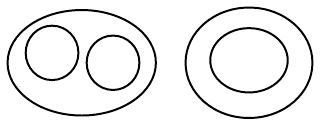
Select the Venn diagram that best represents the relationship between the following classes.

Food, Beverage, Fruit, Cola, Juice

  1. AOption (a)

  2. BOption (b)

  3. COption (c)

  4. DOption (d)

View answer & explanation

Correct answer

Answer: (c)C.

Why this answer is correct

The diagram that best represents the relationship between Food, Beverage, Fruit, Cola, and Juice is shown below :

Cola and Juice comes under the beverage category.

Fruit comes under the food category.

Food and beverage are two different sets.

Hence, "Option 3" is the correct answer.

Question 34

Who became the first Indian athlete to be nominated for the Laureus World Comeback of the Year Award in 2019?

  1. AOption (a)

    Babita Phogat

  2. BOption (b)

    Sunita Phogat

  3. COption (c)

    Geeta Phogat

  4. DOption (d)

    Vinesh Phogat

View answer & explanation

Correct answer

Answer: (d)D.

Vinesh Phogat

Why this answer is correct

The correct answer is Vinesh Phogat.

Key Points

  • Vinesh Phogat is the first Indian athlete to be nominated in one of the seven main categories at the Laureus World Sports Awards 2019 edition.
  • She is a wrestler from Haryana who made a sensational comeback to win the Asian Games gold medal after a long and testing battle with an injury she had sustained during the quarter-final of 50 kg freestyle wrestling event at the 2016 Olympic Games.
  • She was nominated alongside Tiger Woods, who won his first tournament in five years and also won the Laureus World Comeback of the Year Award 2019.
  • Laureus World Team of the year 2019- France's men Football team
  • Laureus World Breakthrough of the year 2019- Naomi Osaka, Japan
  • Laureus World Sportsman of the year 2019- Novac Djokovic
  • Laureus World Sportswoman of the year 2019- Simone Biles

Question 35

A man travels non-stop over a certain distance at an average speed of 60 km/h. With stoppages his speed reduces to 50 km/h. How many minutes per hour does he stop?

  1. AOption (a)

    10 minutes

  2. BOption (b)

    12 minutes

  3. COption (c)

    8 minutes

  4. DOption (d)

    15 minutes

View answer & explanation

Correct answer

Answer: (a)A.

10 minutes

Why this answer is correct

Given:

A man travels non-stop at 60 km/h, but with stoppages his speed reduces to 50 km/h.

Formula used:

Time stopped per hour = (Difference in speeds / Original speed) × 60 minutes

Calculations:

Difference in speeds = 60 - 50 = 10 km/h

Time stopped per hour = (10 / 60) × 60 minutes

⇒ Time stopped per hour = 10 minutes

∴ The correct answer is option (1) 10 minutes.

Question 36

The rivers Arun, Barun and Tamur are part of the________ river system.

  1. AOption (a)

    Sindhu

  2. BOption (b)

    Krishna

  3. COption (c)

    Kosi

  4. DOption (d)

    Godavari

View answer & explanation

Correct answer

Answer: (c)C.

Kosi

Why this answer is correct

The correct answer is Kosi.

Key Points

  • The Kosi is a 720 km long trans-boundary river which flows through Nepal, Tibet and India.
  • It drains the northern slopes in Tibet and southern slopes in Nepal. It is also known as Saptakoshi due to its seven upper tributaries, namely, the Indrawati, the Sun Koshi, the Tama Koshi, the Likhu, the Dudh Koshi, the Arun and the Tamor.
  • The Saptakoshi after flowing through the Himalayas crosses into Bihar where it branches into distributaries before joining the Ganges near Kursela in Katihar district.
  • Kamala, Bagmati and Budhi Gandak are the major tributaries of the river in India.
  • The real name of Koshi is "Kaushiki". It is also known as "Sorrow of Bihar". The river gained this name because of its unstable nature which results in heavy annual flood during the rainy season. Extensive Soil Erosion and Landslides have produced a heap of silt yield which is one of the highest in the world.

Additional Information

  • Sindhu River:
  • Also referred to as the “Sindhu”, the Indus River is a long transboundary river in the Continent of Asia that is shared by the countries of China, India, and Pakistan.
  • Rising in Western Tibet, the river flows for more than 3,180km and is considered as one of the world’s largest rivers and the longest river in Pakistan.
  • Krishna River
  • The Krishna is the second important river in south India.
  • It takes birth at Mahabaleshwar and flows 1,392 km eastwards to join the Bay of Bengal.
  • It flows for only 480 km. through Karnataka.
  • Left bank tributaries- Bhima, Musi, Dindi, Paleru, Munneru.
  • Right bank tributaries-  Venna, Koyna, Panchganga, Dudhaganga, Ghataprabha, Malaprabha, Tungabhadra.
  • The largest tributary of Krishna is the Tungabhadra river.
  • The Koyna is a small tributary but is known for Koyna Dam.
  • The Krishna forms a large delta with a shoreline of about 120 km.
  • Irrigation and hydroelectric power generation from the Krishna river system have benefited Northern Karnataka.
  • Hydroelectric power stations from Krishna are:
  • Almatti Hydroelectric Project- Vijayapura
  • Bhadra Hydroelectric Project- Chickmagaluru
  • Ghataprabha Hydroelectric Project- Belagavi
  • Godavari river
  • The Godavari is the biggest east-flowing river in India.
  • The Godavari basin falls in the Deccan plateau.
  • The Godavari river rises from Trimbakeshwar, Nashik Maharashtra.
  • The Godavari river is outfalls in the Bay of Bengal.
  • The total length of the Godavari is 1465 km.
  • The Godavari is the main river of Telangana state.
  • About 69% of the Godavari catchment area lies in Telangana.
  • Apart from Telangana, Godavari is spread in the states of Maharashtra, Andhra Pradesh, Madhya Pradesh, Karnataka, Chattisgarh, and Orissa.

Question 37

Which amendment of the Constitution of India makes Delhi a National Capital Territory (NCT)?

  1. AOption (a)

    65th Amendment

  2. BOption (b)

    70th Amendment

  3. COption (c)

    68th Amendment

  4. DOption (d)

    69th Amendment

View answer & explanation

Correct answer

Answer: (d)D.

69th Amendment

Why this answer is correct

The correct answer is 69th Amendment.

Key Points

69th Amendment:

  • 69th Amendment Constitutional Amendment Act of 1991 designated the Union Territory of Delhi as the National Capital Territory of Delhi.
  • The 69th Amendment act of the Indian Constitution granted special status to Delhi.
  • In 1991, the amendment was passed and it granted a special state to Delhi and it was declared the National Capital Territory.
  • It created a state assembly and council of ministers for the state.
  • Aditya Nath Jha became the first Lieutenant Governor of Delhi under the act.
  • Article 239AA of the Constitution gave the status of Union Territory to Delhi.
  • Lieutenant Governor of Delhi: Vinai Kumar Saxena
  • Chief Minister of Delhi: Arvind Kejriwal

Thus, by the 69th Amendment, Delhi has become the National Capital Region.

Additional Information

  • 65th Amendment
  • The constitutional rec ognition to National Commission for Scheduled Castes and Scheduled Tribes was given by the 65th Constitutional Amendment Act, 1990, and the commission was formed on 12th March 1992.
  • By the 89th Constitutional Amendment Act 2003, the erstwhile National Commission for SC and ST has been replaced by
  1. National Commission for Scheduled Caste.
  2. National Comm ission for Scheduled Tribe.
  • The 70th Constitutional Amendment:
  • By the 70th Constitutional Amendment, the elected members of the Pondicherry Legislative Assembly were included in the electoral college of the President of India.
  • 68th Constitutional Amendment Act, 1991:
  • The President's rule in Punjab, imposed in May 1987, was extended for a period of five years through the 68th Constitutional Amendment Act of 1991.
  • This amendment allowed the President's rule to be in force beyond the standard period as an exceptional measure due to the prevailing circumstances in Punjab at that time.
  • The extension was considered necessary due to the ongoing insurgency and law and order situation in the state.

Question 38

Who were the two architects who designed New Delhi and its buildings?

  1. AOption (a)

    Edward Baker and Herbert Lutyens

  2. BOption (b)

    Edward Lutyens and Herbert Baker

  3. COption (c)

    Lauren Baker and Raisina Lutyens

  4. DOption (d)

    Edwin Lutyens and Herbert Simon

View answer & explanation

Correct answer

Answer: (b)B.

Edward Lutyens and Herbert Baker

Why this answer is correct

The correct answer is 69th Amendment.

Key Points

  • Edward Lutyens
  • The India Gate was constructed by the Imperial War Graves Commission.
  • It is also known as the All India War Memorial.
  • Edward Lutyens was the architect
  • Edward Lutyens was also the architect of The Parliament Building along with Hebert Baker.
  • It was built in duration of 1921 to 1931 AD.
  • Amar Jawan Jyoti was added to the India Gate in 1972 in the honor of soldiers who sacrificed their lives in the Indo-Pakistan War of 1971.
  • Herbert Baker
  • The Secretariat Building (North and South Block) was designed by the prominent architect Herbert Baker in Indo-Saracenic Revival architecture.​
  • He was an English architect who was a major designer of some of New Delhi's most notable government structures.
  • Edwin Lutyens and Herbert Baker are two architects credited to have designed the city of New Delhi.
  • Edwin Lutyens and Herbert Baker were both English architects and friends.
  • New Delhi, after completion, was inaugurated in the year 1931 by Viceroy Lord Irwin.
  • Rashtrapati Bhawan was also designed by both these architects.

Question 39

What will be the percentage profit after selling an article at a certain price, if there is a loss of 1212{ {1} \over 2}% when the article is sold at half of the that selling price?

  1. AOption (a)

    75%

  2. BOption (b)

    60%

  3. COption (c)

    70%

  4. DOption (d)

    80%

View answer & explanation

Correct answer

Answer: (a)A.

75%

Why this answer is correct

Given:

Loss of 121⁄2% when article is sold at half the selling price. Find the percentage profit at the full selling price.

Formula used:

If selling price (SP) is half, then cost price (CP) is calculated as:

CP=(SP at half)1−Loss%CP = \frac{(SP \text{ at half)}}{1 - Loss\%}

Then, Profit% = ((SP - CP) / CP) × 100

Calculations:

Let full SP = 2x, so half SP = x

Loss% = 12.5%

⇒ CP = x / (1 - 12.5 / 100)

⇒ CP = x / (0.875)

⇒ CP = 8x / 7

Profit% = ((2x - 8x / 7) / (8x / 7)) × 100

⇒ Profit% = ((14x - 8x) / 8x) × 100

⇒ Profit% = (6x / 8x) × 100

⇒ Profit% = 75%

∴ The correct answer is option (1) 75%.

Question 40

How long a person should have served as an advocate in a High Court to be eligible to be appointed as a Judge of the Supreme Court of India?

  1. AOption (a)

    10 years

  2. BOption (b)

    12 years

  3. COption (c)

    13 years

  4. DOption (d)

    11 years

View answer & explanation

Correct answer

Answer: (a)A.

10 years

Why this answer is correct

The correct answer is 10 years.

Key Points

  • The office of appellate or supreme court justice is nonpartisan.
  • To be eligible to serve in either position, a person must have practiced law for at least 10 years.
  • An individual may be appointed as a Judge of the Supreme Court if
  • He/She has been a Judge of a High Court for at least five years ("Appointment from the Bench")
  • He/She has been an advocate of a High Court for at least ten years ("Appointment from the Bar")

Additional Information

  • The Supreme Court of India was inaugurated on January 28, 1950.
  • It succeeded in the Federal Court of India and was established under the Government of India Act, 1935.
  • Articles from 124 to 147 in Part V of the constitution deal with the organization, independence, jurisdiction, powers procedures of the Supreme Court.

Question 41

Who received the Nobel Prize for Physics in 1922 for the investigation of structure of atoms and radiation emanating from them?

  1. AOption (a)

    Robert Hooke

  2. BOption (b)

    E Rutherford

  3. COption (c)

    JJ Thomson

  4. DOption (d)

    Niels Bohr

View answer & explanation

Correct answer

Answer: (d)D.

Niels Bohr

Why this answer is correct

The correct answer is Niels Bohr.

Key Points

  • Niels Bohr
  • The book 'The Theory of spectra and Atomic Constitution' was written by Niels Bohr.
  • The most widely accepted atom model is that of Niels Bohr. Bohr's model was first introduced in 1913.
  • Niels Bohr was the first physicist who discovered that electrons travel in separate orbits around the nucleus
  • Bhor received the Nobel Prize in Physics in 1922.

Additional Information

  • Robert Hooke:-
  • Robert Hooke is credited with introducing the term "cell" in his 1665 book Micrographia.
  • While observing a thin slice of cork under his microscope, Hooke noticed the tiny box-like compartments that resembled the honeycomb cells used by bees to store honey.
  • He described these compartments as "cells" or "cellulae," which later evolved into the modern term "cell."
  • Hooke's observation marked a significant step forward in our understanding of the structure of living organisms.
  • Prior to his discovery, it was believed that plants and animals were composed of solid, continuous matter.
  • However, Hooke's discovery of cells suggested that living organisms were made up of discrete, interconnected units.
  • E Rutherford
  • Ernest Rutherford came to be known as the father of nuclear physics.
  • He was awarded from Nobel Prize in Chemistry in 1908.
  • He was also awarded from 
  • Barnard Medal in 1910
  • Elliott Cresson Medal in 1910
  • Foreign Associate of the National Academy of Sciences in 1911.
  • He was also honored from Hector Memorial Medal in 1916, Dalton Medal in 1919,  Copley Medal in 1922, Franklin Medal in 1924, Albert Medal in 1928, Faraday Medal in 1930, Wilhelm Exner Medal in 1936, Faraday Lectureship Prize in 1936.
  • Alpha particles consist of two protons and two neutrons bound together into a particle identical to a helium-4 nucleus.
  • JJ Thomson
  • J.J. Thomson (1856- 1940), a British physicist, was born in Cheetham Hill, a suburb of Manchester, on 18 December 1856.
  • Thomson's model of an atom
  • Thomson proposed the model of an atom to be similar to that of a Christmas pudding.
  • The electrons, in a sphere of positive charge, were like currants (dry fruits) in a spherical Christmas pudding.
  • One can also think of a watermelon, the positive charge in the atom is spread all over like the red edible part of the watermelon, while the electrons are studded in the positively charged sphere, like the seeds in watermelon.
  • Thomson proposed that:
  • An atom consists of a positively charged sphere evenly distributed all over the atom and the electrons are embedded in it.
  • The negative and positive charges are equal in magnitude. So, the atom as a whole is electrically neutral.
  • Although Thomson’s model explained that atoms are electrically neutral, the results of experiments carried out by other scientists could not be explained by this model.

Hence, according to the Thomson model of the atom, the positive charge is evenly distributed all over the atom.

Question 42

Evaluate :

6 ÷ [5 - { 4 - (3 - 2−1‾{\overline{2 - 1}} )}]

  1. AOption (a)

    3

  2. BOption (b)

    2

  3. COption (c)

    6

  4. DOption (d)

    1

View answer & explanation

Correct answer

Answer: (b)B.

2

Why this answer is correct

Given:

6 ÷ [5 - { 4 - (3 - (2 - 1))}]

Formula used:

Order of operations (BODMAS/BIDMAS): Brackets, Orders (i.e. powers and square roots, etc.), Division and Multiplication, Addition and Subtraction

Calculation:

6 ÷ [5 - { 4 - (3 - (2 - 1))}]

⇒ 6 ÷ [5 - { 4 - (3 - 1)}]

⇒ 6 ÷ [5 - { 4 - 2}]

⇒ 6 ÷ [5 - 2]

⇒ 6 ÷ 3

⇒ 2

∴ The correct answer is option 2.

Question 43

If NORMAL is coded as ONTKDI, then PRAWNS will be coded as________.

  1. AOption (a)

    QQCUYS

  2. BOption (b)

    QTCUQS

  3. COption (c)

    TQCUQP

  4. DOption (d)

    QQCUQP

View answer & explanation

Correct answer

Answer: (d)D.

QQCUQP

Why this answer is correct

The logic followed here is:

NORMAL is coded as ONTKDI

Similarly,

PRAWNS will be coded as________

Hence, "Option 4" is the correct answer.

Question 44

A small boy is standing at some distance from a flag post. When he sees the flag, the angle of elevation formed is 60° If the height of the flag post is 30 feet, what is the distance of the boy from the flag post?

  1. AOption (a)

    15√3 ft

  2. BOption (b)

    10√3 ft

  3. COption (c)

    20√3 ft

  4. DOption (d)

    12√3 ft

View answer & explanation

Correct answer

Answer: (b)B.

10√3 ft

Why this answer is correct

Given:

A small boy is standing at some distance from a flag post. When he sees the flag, the angle of elevation formed is 60º. The height of the flag post is 30 feet.

Formula used:

tan(θ) = Perpendicular / Base

Where, θ = 60º and Perpendicular = height of the flag post = 30 feet

Calculation:

tan(60º) = 30 / Distance

⇒ √3 = 30 / Distance

⇒ Distance = 30 / √3

⇒ Distance = 30 × (√3 / 3)

⇒ Distance = 10√3 feet

∴ The correct answer is option (2).

Question 45

In the context of Chandrayaan-2, who was the project director and a single-point authority for getting the whole system configured, reviewed, implemented, assembled and guided to the landing?

  1. AOption (a)

    Ritu Karidhal

  2. BOption (b)

    P Kunhikrishnan

  3. COption (c)

    K Sivan

  4. DOption (d)

    M Vanitha

View answer & explanation

Correct answer

Answer: (d)D.

M Vanitha

Why this answer is correct

The correct answer is M Vanitha.

Key Points

  • Chandrayaan-2
  • Chandrayaan-2 is India’s 2nd moon mission which was successfully launched by GSLV-MkIII-M1 from Second Launch Pad at Satish Dhawan Space Centre, Sriharikota in Andhra Pradesh.
  • In 2019, Chandrayaan-2 was launched with an orbiter and a lander named Vikram, and a six-wheeled rover named Pragyaan ISRO. The orbiter is still functional and the lander crashed before its induction in any research operation.
  • The spacecraft was launched on its mission to the Moon on 22 July 2019 by a GSLV Mark III-M1.
  • It got a failure when was entering the atmosphere of the moon.
  • According to a failure analysis report submitted to ISRO, the crash was caused by a software glitch. ISRO may re-attempt a landing in 2022 with Chandrayaan-3.
  • India's first mission to the moon, Chandrayaan1 was launched from Sriharikota.
  • It was successfully launched on October 22, 2008.
  • Chandrayaan-1 operated for 312 days.
  • It confirmed the presence of lunar water.
  • The evidence of lunar caves was also confirmed by the Chandrayaan-I.

Question 46

A sum was invested at a simple interest at a certain rate for 2 years. Had it been invested at 3% higher rate, it would have fetched ₹300 more. Find the sum invested.

  1. AOption (a)

    ₹5000

  2. BOption (b)

    ₹5200

  3. COption (c)

    ₹6000

  4. DOption (d)

    ₹4500

View answer & explanation

Correct answer

Answer: (a)A.

₹5000

Why this answer is correct

Given:

Time (t) = 2 years

Difference in interest = ₹300

Increased rate = r + 3%

Formula used:

Simple Interest (SI) = P×r×t100 \dfrac{P \times r \times t}{100}

Calculation:

Let the principal be P and the original rate be r%.

Interest at original rate = P×r×2100 \dfrac{P \times r \times 2}{100}

Interest at increased rate = P×(r+3)×2100 \dfrac{P \times (r+3) \times 2}{100}

Difference in interest = ₹300

⇒ P×(r+3)×2100−P×r×2100=300 \dfrac{P \times (r+3) \times 2}{100} - \dfrac{P \times r \times 2}{100} = 300

⇒ 2P×r+6P−2P×r100=300 \dfrac{2P \times r + 6P - 2P \times r}{100} = 300

⇒ 6P100=300 \dfrac{6P}{100} = 300

⇒ 6P=300×100 6P = 300 \times 100

⇒ 6P=30000 6P = 30000

⇒ P=300006 P = \dfrac{30000}{6}

⇒ P=5000 P = 5000

∴ The correct answer is option (1).

Question 47

Which of the following countries became the first to launch the malaria vaccine RTS,S?

  1. AOption (a)

    Kenya

  2. BOption (b)

    Malawi

  3. COption (c)

    Ghana

  4. DOption (d)

    Nigeria

View answer & explanation

Correct answer

Answer: (b)B.

Malawi

Why this answer is correct

The correct answer is Malawi.

Key Points

  • Malaria vaccine
  • The world's first malaria vaccine was launched in Malawi, a small country located in Southeast Africa
  • It was an initiative of WHO (World Health Organization) which is a coordinated program between three countries Kenya, Ghana and Malawi
  • The vaccine will give the children partial protection against the deadly disease that plagues the region
  • The vaccine will be launched in the remaining two countries in the coming weeks

Question 48

Which one of the following is the smallest fraction:

611,1318,1522,1936,56{{6} \over 11} , {{13} \over 18} , {{15} \over 22} ,{{19} \over 36} ,{{5} \over 6}

  1. AOption (a)

    1936{{19} \over 36}

  2. BOption (b)

    611{{6} \over 11}

  3. COption (c)

    1318{{13} \over 18}

  4. DOption (d)

    56{{5} \over 6}

View answer & explanation

Correct answer

Answer: (a)A.

1936{{19} \over 36}

Why this answer is correct

Given:

Which one of the following is the smallest fraction:

611,1318,1522,1936,56\dfrac{6}{11}, \dfrac{13}{18}, \dfrac{15}{22}, \dfrac{19}{36}, \dfrac{5}{6}

Formula used:

To compare fractions, convert them to decimal form or find a common denominator.

Calculations:

611=0.5454…\dfrac{6}{11} = 0.5454\ldots

1318=0.7222…\dfrac{13}{18} = 0.7222\ldots

1522=0.6818…\dfrac{15}{22} = 0.6818\ldots

1936=0.5277…\dfrac{19}{36} = 0.5277\ldots

56=0.8333…\dfrac{5}{6} = 0.8333\ldots

⇒ Smallest decimal is 0.5277…0.5277\ldots, which corresponds to 1936\dfrac{19}{36}

∴ The correct answer is option (1).

Question 49

Select the term that can replace the question mark (?) in the following series.

KLM, LPV, MTE, ?

  1. AOption (a)

    MXM

  2. BOption (b)

    NYM

  3. COption (c)

    NXM

  4. DOption (d)

    NXN

View answer & explanation

Correct answer

Answer: (d)D.

NXN

Why this answer is correct

The logic followed here is:

​

Hence, "Option 4" is the correct answer.

Question 50

Who defected against Siraj-ud-Daulah in the battle of Plassey?

  1. AOption (a)

    Mir Jafar

  2. BOption (b)

    Murshid Quli Khan

  3. COption (c)

    Alivardi Khan

  4. DOption (d)

    Mir Qasim

View answer & explanation

Correct answer

Answer: (a)A.

Mir Jafar

Why this answer is correct

The correct answer is Mir Jafar.

Key Points

  • The Battle of Plassey was fought between the East India Company headed by Robert Clive and the Nawab of Bengal (Siraj-Ud-Daulah) and his French Troop.
  • It took place on June 23, 1757.
  • Mir Jafar (Commander-in-Chief of Nawab’s army) cheated Siraj-Ud-Daulah during the battle.
  • Mir Jafar was Bribed by the East India Company (EIC).
  • Later Mir Jafar was to be made the Nawab by EIC for conspiring against Siraj-Ud-Daulah.
  • British East India Company made Mir Jafar the first dependent Nawab of Bengal under them.

Additional Information

  • Major causes of the Battle of Plassey:​
  • The rampant misuse of the trade privileges given to the British by the Nawab of Bengal.
  • Non-payment of tax and duty by the workers of the British East India Company.
  • Fortification of Calcutta by the British without Nawab’s permission.
  • Misleading Nawab on various fronts by British.
  • An asylum was provided to Nawab’s enemy Krishna Das

Question 51

10 men can finish a certain task in 10 days, whereas it takes 12 women to finish it in 10 days. If 15 men and 6 women undertake to complete the task, how many days will they need to complete it?

  1. AOption (a)

    5 days

  2. BOption (b)

    6 days

  3. COption (c)

    8 days

  4. DOption (d)

    10 days

View answer & explanation

Correct answer

Answer: (a)A.

5 days

Why this answer is correct

Given:

10 men can finish a certain task in 10 days

12 women can finish the same task in 10 days

Formula used:

Work done by 1 man in 1 day = Total work / (Number of men × Number of days)

Work done by 1 woman in 1 day = Total work / (Number of women × Number of days)

Total work done by 15 men and 6 women in 1 day = (Work done by 1 man in 1 day × 15) + (Work done by 1 woman in 1 day × 6)

Number of days required to complete the task = Total work / Total work done by 15 men and 6 women in 1 day

Calculations:

Work done by 1 man in 1 day = 1 / (10 × 10)

⇒ Work done by 1 man in 1 day = 1 / 100

Work done by 1 woman in 1 day = 1 / (12 × 10)

⇒ Work done by 1 woman in 1 day = 1 / 120

Total work done by 15 men in 1 day = 15 × (1 / 100)

⇒ Total work done by 15 men in 1 day = 15 / 100

Total work done by 6 women in 1 day = 6 × (1 / 120)

⇒ Total work done by 6 women in 1 day = 6 / 120

⇒ Total work done by 6 women in 1 day = 1 / 20

Total work done by 15 men and 6 women in 1 day = (15 / 100) + (1 / 20)

⇒ Total work done by 15 men and 6 women in 1 day = (15 / 100) + (5 / 100)

⇒ Total work done by 15 men and 6 women in 1 day = 20 / 100

⇒ Total work done by 15 men and 6 women in 1 day = 1 / 5

Number of days required to complete the task = 1 / (1 / 5)

⇒ Number of days required to complete the task = 5 days

∴ The correct answer is option 1.

Question 52

371 ÷ 16 = 23.1875. What will be the value of 0.00371 ÷ 0.016?

  1. AOption (a)

    231.875

  2. BOption (b)

    0.231875

  3. COption (c)

    0.0231875

  4. DOption (d)

    2.31875

View answer & explanation

Correct answer

Answer: (b)B.

0.231875

Why this answer is correct

Given:

371 ÷ 16 = 23.1875

Formula used:

If a ÷ b = c, then (a × 0.001) ÷ (b × 0.001) = c

Calculation:

0.00371 ÷ 0.016 = (371 ÷ 100000) ÷ (16 ÷ 1000)

⇒ 0.00371 ÷ 0.016 = (371 ÷ 100000) ÷ (16 ÷ 1000)

⇒ (371 ÷ 100000) × (1000 ÷ 16)

⇒ (371 × 1000) ÷ (100000 × 16)

⇒ 371000 ÷ 1600000

⇒ 0.231875

∴ The correct answer is option 2.

Question 53

Select the Venn diagram that best represents the relationship between the following classes.

Humans, Birds, Mammals

  1. AOption (a)

  2. BOption (b)

  3. COption (c)

  4. DOption (d)

View answer & explanation

Correct answer

Answer: (d)D.

Why this answer is correct

The diagram that best represents the relationship between Humans, Birds, and Mammals is shown below :

Humans comes under the Mammals category.

Birds and mammals are two different sets.

Hence, "Option 4" is the correct answer.

Question 54

Select the Venn diagram that best represents the relationship between the following classes.

Solids, Liquids, Gases

  1. AOption (a)

  2. BOption (b)

  3. COption (c)

  4. DOption (d)

View answer & explanation

Correct answer

Answer: (d)D.

Why this answer is correct

The diagram that best represents the relationship between Solids, Liquids, and Gases is shown below :

Solids, Liquids, Gases are three different states of matter.

Hence, "Option 4" is the correct answer.

Question 55

Find the least number that, when divided by 18, 24, 30 and 42, will leave in each case the same remainder 3.

  1. AOption (a)

    2523

  2. BOption (b)

    2520

  3. COption (c)

    2530

  4. DOption (d)

    2535

View answer & explanation

Correct answer

Answer: (a)A.

2523

Why this answer is correct

Given:

Find the least number that, when divided by 18, 24, 30 and 42, will leave in each case the same remainder 3.

Formula used:

Required number = LCM(18, 24, 30, 42) + Remainder

Calculation:

First, find the LCM of 18, 24, 30, and 42.

Prime factorization:

18 = 2 × 32

24 = 23 × 3

30 = 2 × 3 × 5

42 = 2 × 3 × 7

LCM = 23 × 32 × 5 × 7

⇒ LCM = 8 × 9 × 5 × 7

⇒ LCM = 72 × 5 × 7

⇒ LCM = 360 × 7

⇒ LCM = 2520

Required number = 2520 + 3

⇒ Required number = 2523

∴ The correct answer is option 1.

Question 56

Find the number of lead balls of diameter 1 cm each that can be made from a lead sphere of diameter 16 cm.

  1. AOption (a)

    4096

  2. BOption (b)

    4090

  3. COption (c)

    4080

  4. DOption (d)

    4075

View answer & explanation

Correct answer

Answer: (a)A.

4096

Why this answer is correct

Given:

Diameter of large lead sphere = 16 cm

Diameter of small lead balls = 1 cm

Formula used:

Volume of a sphere = (4/3)πr3

Calculations:

Radius of large lead sphere = 16/2 = 8 cm

Radius of small lead balls = 1/2 = 0.5 cm

Volume of large lead sphere = (4/3)π(8)3

⇒ Volume of large lead sphere = (4/3)π(512)

⇒ Volume of large lead sphere = 2048π cm3

Volume of one small lead ball = (4/3)π(0.5)3

⇒ Volume of one small lead ball = (4/3)π(0.125)

⇒ Volume of one small lead ball = (4/3)π(1/8)

⇒ Volume of one small lead ball = (4π/24)

⇒ Volume of one small lead ball = π/6 cm3

Number of small lead balls = Volume of large lead sphere / Volume of one small lead ball

⇒ Number of small lead balls = 2048π / (π/6)

⇒ Number of small lead balls = 2048 × 6

⇒ Number of small lead balls = 12288

⇒ Number of small lead balls = 4096

∴ The correct answer is option (1).

Question 57

When is National Consumer Day observed every year?

  1. AOption (a)

    5thDecember

  2. BOption (b)

    24thOctober

  3. COption (c)

    5thJune

  4. DOption (d)

    24thDecember

View answer & explanation

Correct answer

Answer: (d)D.

24thDecember

Why this answer is correct

The correct answer is 24thDecember.

Key Points

  • Every Year 24th December is observed as National Consumer Day with a specific theme in India.
  • On this day, the Consumer Protection Act, 1986 had received the assent of the president.
  • The enactment of this Act is considered a historic milestone in the consumer movement in the country.

Additional Information

  • The main objective of the Consumer Protection Act is to provide consumers with effective safeguards against various types of exploitation, including defective goods, unsatisfactory services as well as unfair trade practices.
  • The Department of Consumer Affairs has also launched the Jago Grahak Jago programme to make consumers aware of information and rights.
  • The theme for National Consumer Day 2020 is New features of the Consumer Protection Act, 2019.

Question 58

A square field of 2 sq km area is to be divided into two equal parts by a fence that coincides with a diagonal, Find the length of the fence.

  1. AOption (a)

    3 Km

  2. BOption (b)

    2 Km

  3. COption (c)

    1 Km

  4. DOption (d)

    2 { \sqrt{2} } Km

View answer & explanation

Correct answer

Answer: (b)B.

2 Km

Why this answer is correct

Given:

A square field of 2 sq km area is to be divided into two equal parts by a fence that coincides with a diagonal.

Formula used:

For a square with side length s , the area A is given by:

A = s2s^2

The length of the diagonal d of a square is given by:

d = s2s \sqrt{2}

Calculation:

Given that the area of the square A = 2 sq km, we find the side length s first:

s2s^2 = 2

⇒ s=2s = \sqrt{2} km

Now, we calculate the length of the diagonal (which is the length of the fence):

⇒ d=s2d = s \sqrt{2}

⇒ d=2×2d = \sqrt{2} \times \sqrt{2}

⇒ d = 2 km

∴ The correct answer is option (2).

Question 59

If 5+35−3{ \sqrt{5} + \sqrt{3} \over \sqrt{5} - \sqrt{3}} = a+b15\sqrt{15}, then what is the value of a?

  1. AOption (a)

    8

  2. BOption (b)

    3

  3. COption (c)

    5

  4. DOption (d)

    4

View answer & explanation

Correct answer

Answer: (d)D.

4

Why this answer is correct

Given:

5+35−3\dfrac{ \sqrt{5} + \sqrt{3} }{ \sqrt{5} - \sqrt{3} } = a + b15\sqrt{15}

Formula used:

5+35−3\dfrac{ \sqrt{5} + \sqrt{3} }{ \sqrt{5} - \sqrt{3} } = a + b15\sqrt{15}

Calculation:

5+35−3×5+35+3\dfrac{ \sqrt{5} + \sqrt{3} }{ \sqrt{5} - \sqrt{3} } \times \dfrac{ \sqrt{5} + \sqrt{3} }{ \sqrt{5} + \sqrt{3} }

⇒ (5+3)2(5)2−(3)2\dfrac{ (\sqrt{5} + \sqrt{3})^2 }{ (\sqrt{5})^2 - (\sqrt{3})^2 }

⇒ 5+3+2155−3\dfrac{ 5 + 3 + 2\sqrt{15} }{ 5 - 3 }

⇒ 8+2152\dfrac{ 8 + 2\sqrt{15} }{ 2 }

⇒ 82+2152\dfrac{ 8 }{ 2 } + \frac{ 2\sqrt{15} }{ 2 }

⇒ 4 + 15\sqrt{15}

Therefore, a = 4

∴ The correct answer is option (4).

Question 60

Select the option that will fill in the blank and complete the given series.

3, 4, 6, 10, _____

  1. AOption (a)

    18

  2. BOption (b)

    16

  3. COption (c)

    12

  4. DOption (d)

    14

View answer & explanation

Correct answer

Answer: (a)A.

18

Why this answer is correct

The logic followed here is:

Hence, "Option 1" is the correct answer.

Question 61

Select the option that is related to the third term in the same way as the second term is related to the first term.

Den : Lion :: Stable : ?

  1. AOption (a)

    Bee

  2. BOption (b)

    Sheep

  3. COption (c)

    Cow

  4. DOption (d)

    Horse

View answer & explanation

Correct answer

Answer: (d)D.

Horse

Why this answer is correct

The logic followed here is:

Logic: Animal Shelters.

Here,

Den : Lion → Lion is an animal that lives in a Den.

Similarly,

Stable : Horse → Horse is an animal that lives in a Stable.

Hence, the correct answer is "Option 4".

Question 62

As of Dec 2020, who is the Chairman of the National Commission for Backward Classes ?

  1. AOption (a)

    Pratyush Sharma

  2. BOption (b)

    Anand Mohan

  3. COption (c)

    Bhagwan Lal Sahni

  4. DOption (d)

    Arvind Sharma

View answer & explanation

Correct answer

Answer: (c)C.

Bhagwan Lal Sahni

Why this answer is correct

The correct answer is Bhagwan Lal Sahni.

Key Points

  • The National Commission for Backward Classes was established under the National Commission for Backward Classes Act, 1993 on 14th August 1993.

 Additional Information

  • Historical Background:
  • The first Backward Class Commission was set up on 29th January 1953 by presidential order under the Chairmanship of Kaka Kelkar. This commission had recognized the Schedule castes, Scheduled Tribes along with other backward classes.
  • The Second Backward Class Commission was set up in 1979 under the Chairmanship of BP Mandal. This commission had submitted its report in 1980 by giving the recommendation to provide 27% reservation to OBC in Government Jobs.
  • The Supreme Court of India in its judgment Indira Sawhney Vs Union of India, 1992 directed the Government of India, State Government, and Union Territories to constitute a permanent body for OBC.
  • Objective: To improve the condition of socially and educationally backward classes of the country.
  • About National Commission for Backward Classes:
  • Composition: Chairman + 4 members
  • Chairman must be the judge of the Supreme court or the High Court.
  • Term of office: 3 years
  • Appointed by: President
  • Resignation: President
  • Removal: President
  • Power: Equivalent to Civil Court
  • The first Chairman of the National Backward Commission was RN Prasad.
  • The Current Chairman of the commission is Bhagwanlal Sahni.

Question 63

Find the difference between the mean and the median of the following data set: 2, 3, 4, 5, 5, 8, 8

  1. AOption (a)

    1

  2. BOption (b)

    2

  3. COption (c)

    3

  4. DOption (d)

    0

View answer & explanation

Correct answer

Answer: (d)D.

0

Why this answer is correct

Given:

Data set: 2, 3, 4, 5, 5, 8, 8

Formula used:

Mean = Sum of all values / Number of values

Median = Middle value of the data set (when ordered)

Calculation:

Ordered data set: 2, 3, 4, 5, 5, 8, 8

Mean = (2 + 3 + 4 + 5 + 5 + 8 + 8) / 7

⇒ Mean = 35 / 7

⇒ Mean = 5

Median = Middle value = 5

Difference = Mean - Median

⇒ Difference = 5 - 5

⇒ Difference = 0

∴ The correct answer is option (4).

Question 64

Between the ninth and eleventh centuries, the_________ style was used for the sculptures in Bengal (including Bangladesh) and Bihar.

  1. AOption (a)

    Aryan

  2. BOption (b)

    Mughal

  3. COption (c)

    Gupta

  4. DOption (d)

    Pala

View answer & explanation

Correct answer

Answer: (d)D.

Pala

Why this answer is correct

The correct answer is Pala.

Key Points

  • When Bengali and Odia cultures united during Chaitanya's journey to Orissa in 1510 CE, Pala Gaan might have come to light.
  • This art is performed by a group of five or six people.
  • Gayaka, the main singer, Bayaka, the drummer, and Palia make up the group (Chorus).
  • The Gayaka wields a "Chamara" (fly whisker) with great flair and holds a pair of cymbals in his right hand.
  • He recounts puranic text stories interspersed with justifications.
  • Along with Gayaka, the choir dances in very short, repetitive movements.
  • The Mahabharata by Sarala Das mentions Pala.

 Additional Information

  • The Pala did on the occasion of "Satyanarayana puja" or "Ekousia," which is observed on the 21st day after a child's birth.
  • The worship of Lord Satyanarayana is connected to both two types of Pala.
  • They are Thia (standing) and Baithaki (sitting) (standing).
  • Sometimes, particularly on the occasion of ceremonial celebrations, competitions between two or more groups are sometimes set up, in which each group makes an effort to demonstrate its best qualities.

Question 65

Find the number of squares in the given figure.

  1. AOption (a)

    30

  2. BOption (b)

    35

  3. COption (c)

    34

  4. DOption (d)

    36

View answer & explanation

Correct answer

Answer: (a)A.

30

Why this answer is correct

The number of squares in the given figure is shown below:

Number of squares = 12 + 22 + 32 + 42 ⇒ 30

Thus, there are a total of 30 squares.

Hence, "Option 1" is the correct answer.

Question 66

At what rate percentage will a sum of money become eight times in 3 years if the interest is compounded yearly?

  1. AOption (a)

    80%

  2. BOption (b)

    100%

  3. COption (c)

    50%

  4. DOption (d)

    60%     

View answer & explanation

Correct answer

Answer: (b)B.

100%

Why this answer is correct

Given:

Principal (P) = P

Amount (A) = 8P

Time (t) = 3 years

Formula used:

A = P(1 + r/100)t

Where, r = rate

Calculations:

8P = P(1 + r/100)3

⇒ 8 = (1 + r/100)3

⇒ 23 = (1 + r/100)3

⇒ 2 = 1 + r/100

⇒ 2 - 1 = r/100

⇒ 1 = r/100

⇒ r = 100%

∴ The correct answer is option (2).

Question 67

Which of the following is NOT correctly matched (UN Organization-HQ)?

  1. AOption (a)

    UNEP-Geneva

  2. BOption (b)

    UNITAR - Geneva

  3. COption (c)

    UNICEF - New York

  4. DOption (d)

    UNESCO - Paris

View answer & explanation

Correct answer

Answer: (a)A.

UNEP-Geneva

Why this answer is correct

The correct answer is UNEP-Geneva.

Key Points

  • The United nation organization
  • The United Nations is an International organization founded in 1945. It is currently made up of 193 Member states. Hence, Option 2 is correct.
  • The Mission and work of the United Nations are guided by the purposes and principles contained in its Founding Charter.
  • Due to the powers vested in the Charter and its Unique International character, the United Nations can take action on these issues confronting Humanity in the 21st Century, such as peace and security, climate change, sustainable development, human rights, disarmament, terrorism, humanitarian and health emergencies, gender equality, governance, food production, etc.
  • UNO Headquarter is located in New York, United States.
  • Antonio Guterres serving as the Ninth Secretary-General of the United Nations. A member of the Portuguese Socialist Party, he served as Prime Minister of Portugal from 1995 to 2002.
  • The Main Organs of the UN are the General Assembly, the Security Council, the Economic and Social Council, the Trusteeship Council, the International Court of Justice, and the UN Secretariat.
  • The Five Permanent Members of the UN are- China, France, Russian Federation, The United Kingdom, and the United States, and Ten Non-Permanent Members elected for Every two-year terms by the General Assembly.

Question 68

A number is 50% greater than the other. Then by how much percentage is the second number smaller than the first?

  1. AOption (a)

    331333 {{1} \over 3} %

  2. BOption (b)

    351335 {{1} \over 3} %

  3. COption (c)

    301330 {{1} \over 3} %

  4. DOption (d)

    50%

View answer & explanation

Correct answer

Answer: (a)A.

331333 {{1} \over 3} %

Why this answer is correct

Given:

A number is 50% greater than the other.

Formula used:

If the first number is A, then the second number is B.

A = 1.5B

Calculation:

Let the first number be A and the second number be B.

A = 1.5B

The percentage by which B is smaller than A is given by:

⇒ A−BA×100\dfrac{A - B}{A} \times 100

⇒ 1.5B−B1.5B×100\dfrac{1.5B - B}{1.5B} \times 100

⇒ 0.5B1.5B×100\dfrac{0.5B}{1.5B} \times 100

⇒ 13×100\dfrac{1}{3} \times 100

⇒ 33 1/3%

∴ The correct answer is option (1).

Question 69

A can finish a work in 25 days and B can finish the same work in 20 days. They work together for 5 days and then A goes away. In how many days will B finish the remaining work?

  1. AOption (a)

    10 days

  2. BOption (b)

    9 days

  3. COption (c)

    11 days

  4. DOption (d)

    12 days

View answer & explanation

Correct answer

Answer: (c)C.

11 days

Why this answer is correct

Given:

A can finish a work in 25 days

B can finish the same work in 20 days

They work together for 5 days

A goes away after 5 days

Formula used:

Work done by A in 1 day = 1/25

Work done by B in 1 day = 1/20

Work done by A and B together in 1 day = 1/25 + 1/20

Calculation:

Work done by A and B together in 1 day = 1/25 + 1/20

⇒ Work done by A and B together in 1 day = (4 + 5) / 100

⇒ Work done by A and B together in 1 day = 9/100

Work done by A and B together in 5 days = 5 × 9/100

⇒ Work done by A and B together in 5 days = 45/100

Remaining work after 5 days = 1 - 45/100

⇒ Remaining work after 5 days = 55/100

⇒ Remaining work after 5 days = 11/20

Time taken by B to finish the remaining work = (Remaining work) / (Work done by B in 1 day)

⇒ Time taken by B to finish the remaining work = (11/20) / (1/20)

⇒ Time taken by B to finish the remaining work = 11 days

∴ The correct answer is option (3).

Question 70

Which of the following states has made rooftop rainwater harvesting compulsory for all houses?

  1. AOption (a)

    Karnataka

  2. BOption (b)

    Assam

  3. COption (c)

    Tamil Nadu

  4. DOption (d)

    Kerala

View answer & explanation

Correct answer

Answer: (c)C.

Tamil Nadu

Why this answer is correct

The correct answer is Tamil Nadu.

Key Points

  • Rooftop rainwater harvesting is mandatory in the state of Tamil Nadu, India.
  • Tamil Nadu was the first Indian state to make rainwater harvesting mandatory. The state government introduced this requirement in 2001, responding to a severe water scarcity problem in the state, particularly in the capital city of Chennai.
  • The Tamil Nadu government, under the Tamil Nadu Groundwater (Development and Management) Act, made it compulsory for every building, both residential and commercial, to have rainwater harvesting structures. The rule applies not just to new buildings but also mandates retrofitting older ones.
  • The primary objective of this policy is to capture and store rainwater where it falls. This can reduce the dependence on groundwater and ensure that underground water levels are replenished. Rooftop rainwater harvesting involves channelling rainwater from rooftops through pipes to a storage facility (like a tank or a well) or directly into the ground.
  • The implementation of rainwater harvesting systems has led to significant improvements in groundwater levels in many areas across the state.

Question 71

Which of the following pairs of ISRO centres is INCORRECTLY paired with its location?  

  1. AOption (a)

    U R Rao Satellite Centre - Bengaluru, Karnataka

  2. BOption (b)

    Vikram Sarabhai Space Centre - Thiruvananthapuram, Kerala

  3. COption (c)

    Liquid Propulsion Systems Centre - Thiruvananthapuram, Kerala

  4. DOption (d)

    Satish Dhawan Space Centre - Chandigarh, Punjab

View answer & explanation

Correct answer

Answer: (d)D.

Satish Dhawan Space Centre - Chandigarh, Punjab

Why this answer is correct

The correct answer is Satish Dhawan Space Centre - Chandigarh, Punjab.

Key Points

  • Satish Dhawan Space Centre is located at Sriharikota in Andhra Pradesh.
  • Satish Dhawan Space Centre is an agency responsible for providing launch base infrastructure for the Indian space programme.
  • It was established in 1971.
  • It has two launch pads from where the rocket launching operations of PSLV and GSLV are carried out.
  • It was formerly known as Sriharikota Range.
  • Primer Minister Atal Bihari Vajpayee renamed the centre as Satish Dhawan Space Centre on 5th September 2002.
  • Sriharikota Range was renamed after former ISRO chairman Satish Dhawan.

Question 72

With which of the following countries has India jointly developed the Barak-8 missile?

  1. AOption (a)

    Iran

  2. BOption (b)

    Iraq

  3. COption (c)

    Russia

  4. DOption (d)

    Israel

View answer & explanation

Correct answer

Answer: (d)D.

Israel

Why this answer is correct

The correct answer is Israel.

Key Points

  • Barak 8 is a long-range surface-to-air missile developed by Israel Aerospace Industries and DRDO.
  • Firstly, it was tested successfully in Israel on 10th November 2014.
  • Indian Navy had successfully test-fired the missile from INS Kolkata on 29th and 30th December 2015.
  • Recently, Israel has tested successfully Barak 8 extended-range interceptor on 22 March 2021.
  • It will help in destroying a target 150 km away.​

Additional Information

  • Features of Barak 8:
  • It is also known as LR-SAM naval defence system.
  • It will provide a 360-degree defence against various airborne threats.
  • It will help in defending against UAVs, helicopters, aircraft, ballistic missiles, cruise missiles, etc.
  • It can target multiple targets at the same time in all weather conditions.
  • Initially, it had a target range of 100 km.
  • Variants of Barak 8:
  • Barak 8 AMD/LRSAM - 
  • Designed for Israeli Navy.
  • Now, used by many countries.
  • Barak 8 MRSAM -
  • It is a medium-range land-based missile system.
  • It has a tracking radar, control system, and mobile launcher system.
  • Barak MX -
  • It has a flexible configuration option.
  • It is useful in both naval and land missions.

Question 73

If ALUM is coded as BMVN, then MAIL will be coded as_______.

  1. AOption (a)

    NBHM

  2. BOption (b)

    NBJM

  3. COption (c)

    NAIL

  4. DOption (d)

    NAHM

View answer & explanation

Correct answer

Answer: (b)B.

NBJM

Why this answer is correct

The logic followed here is:

ALUM is coded as BMVN

Similarly,

MAIL will be coded as_______

​

Hence, "Option 2" is the correct answer.

Question 74

Find the remainder when x3 + 4x2 + 6x - 2 is divided by (x + 5) .

  1. AOption (a)

    -50

  2. BOption (b)

    -53

  3. COption (c)

    -55

  4. DOption (d)

    -57

View answer & explanation

Correct answer

Answer: (d)D.

-57

Why this answer is correct

Given:

Find the remainder when x3 + 4x2 + 6x - 2 is divided by (x + 5).

Formula used:

Remainder when a polynomial f(x) is divided by (x - a) is given by f(a).

Calculation:

Here, f(x) = x3 + 4x2 + 6x - 2 and we need to find f(-5).

f(-5) = (-5)3 + 4(-5)2 + 6(-5) - 2

⇒ f(-5) = -125 + 4(25) + 6(-5) - 2

⇒ f(-5) = -125 + 100 - 30 - 2

⇒ f(-5) = -125 + 100 - 30 - 2

⇒ f(-5) = -57

∴ The correct answer is option 4.

Question 75

The position of an element in the periodic table is determined by its _________number.

  1. AOption (a)

    neutron

  2. BOption (b)

    positron

  3. COption (c)

    proton

  4. DOption (d)

    electron

View answer & explanation

Correct answer

Answer: (c)C.

proton

Why this answer is correct

The correct answer is proton.

Key Points

  • Modern Periodic Table has 18 Groups and 7 Periods.
  • It has 118 Elements.
  • Each of the tables has a vertical row is called group. Elements in groups have similar chemical and physical properties because they have the same number of outer electrons.
  • Each of the tables has horizontal rows is called periods. During a period, a gradual change in chemical properties occurs from one element to another.
  • The elements are arranged in the modern periodic table on the basis of Mosely law, which states that the physical and chemical properties of elements are the periodic function of their atomic number.
  • The Structure of it is like a bird Grid.
  • The Modern Periodic table is used to organize all the known elements.
  • Advantages of Modern Periodic Table:- 
  • It is easier to remember the properties of an element if its position in the periodic table is known.
  • It made the study of Chemistry Systematic and Easy.

Modern Periodic Table:-

Question 76

Which of the following are invertebrates?

  1. AOption (a)

    Mammals

  2. BOption (b)

    Arthropods

  3. COption (c)

    Reptiles

  4. DOption (d)

    Fish

View answer & explanation

Correct answer

Answer: (b)B.

Arthropods

Why this answer is correct

The correct answer is Arthropods.

Key Points

  • Invertebrates are a vast and diverse group of animals that do not possess a backbone or vertebral column. They make up the majority of animal species on Earth and are found in various habitats, including terrestrial, freshwater, and marine environments. Here are some key points about invertebrates:
  • Diversity: Invertebrates encompass a wide range of organisms, including arthropods (e.g., insects, spiders, crustaceans), molluscs (e.g., snails, clams, squids), annelids (e.g., earthworms, leeches), cnidarians (e.g., jellyfish, corals), echinoderms (e.g., starfish, sea urchins), and many more.
  • Adaptations: Invertebrates exhibit a remarkable variety of adaptations to survive and thrive in different environments. For example, arthropods have exoskeletons and jointed appendages, molluscs have shells or fleshy mantles, and cnidarians have specialized stinging cells called cnidocytes.
  • Ecological Importance: Invertebrates play crucial roles in ecosystems. They serve as pollinators, decomposers, prey, and predators, contributing to energy transfer and nutrient cycling. Invertebrates also provide essential ecosystem services such as seed dispersal and pest control.
  • Economic Significance: Many invertebrates have economic importance. Insects, for example, are vital for agriculture as pollinators and as biological control agents that combat pests. Invertebrates also serve as a significant food source for humans and are exploited for their shells, silk, pearls, and medical applications.
  • Reproduction and Life Cycles: Invertebrates display diverse reproductive strategies. Some reproduce sexually, while others can reproduce asexually through mechanisms such as budding or fragmentation. Invertebrates also exhibit various life cycles, including metamorphosis (e.g., from larva to adult in insects) and direct development (e.g., without distinct larval stages in many molluscs).
  • Conservation Concerns: Invertebrates face numerous threats, including habitat loss, pollution, climate change, and invasive species. Despite their ecological importance, many invertebrate species remain poorly studied and their populations may be declining. Conservation efforts are crucial to protect their diversity and maintain ecosystem functioning.

Question 77

A tower is 2003 \sqrt{3} m high. Find the angle of elevation of its top from a point 200 m away from its foot

  1. AOption (a)

    90o

  2. BOption (b)

    30o

  3. COption (c)

    45o

  4. DOption (d)

    60o

View answer & explanation

Correct answer

Answer: (d)D.

60o

Why this answer is correct

Given:

A tower is 200 √(3) m high.

Distance from the point to the foot of the tower = 200 m

Formula used:

tan(θ) = Perpendicular / Base

Where, θ = angle of elevation

Calculations:

tan(θ) = 200√3 / 200

⇒ tan(θ) = √3

⇒ θ = 60°

∴ The correct answer is option (4).

Question 78

₹2430 is divided among three persons A, B and C such that if their shares are diminished by ₹5, ₹10 and ₹15 respectively, the remainders shall be in the ratio 3 : 4 : 5. Find the share of C.

  1. AOption (a)

    ₹810

  2. BOption (b)

    ₹605

  3. COption (c)

    ₹1250

  4. DOption (d)

    ₹1015

View answer & explanation

Correct answer

Answer: (d)D.

₹1015

Why this answer is correct

Given:

₹2430 is divided among three persons A, B and C such that if their shares are diminished by ₹5, ₹10 and ₹15 respectively, the remainders shall be in the ratio 3 : 4 : 5.

Formula used:

Let the shares of A, B, and C be ₹a, ₹b, and ₹c respectively.

Given: (a - 5) : (b - 10) : (c - 15) = 3 : 4 : 5

Calculation:

Let a - 5 = 3k, b - 10 = 4k, c - 15 = 5k

⇒ a = 3k + 5

⇒ b = 4k + 10

⇒ c = 5k + 15

Given: a + b + c = 2430

⇒ (3k + 5) + (4k + 10) + (5k + 15) = 2430

⇒ 12k + 30 = 2430

⇒ 12k = 2430 - 30

⇒ 12k = 2400

⇒ k = 200

⇒ c = 5k + 15

⇒ c = 5×200 + 15

⇒ c = 1000 + 15

⇒ c = 1015

∴ The correct answer is option (4).

Question 79

Find the median of the following numbers: 30, 38, 35, 28, 25, 20, 18, 16, 17, 19

  1. AOption (a)

    25

  2. BOption (b)

    28

  3. COption (c)

    22.5

  4. DOption (d)

    26.5

View answer & explanation

Correct answer

Answer: (c)C.

22.5

Why this answer is correct

Given:

Numbers: 30, 38, 35, 28, 25, 20, 18, 16, 17, 19

Formula used:

To find the median, we need to arrange the numbers in ascending order and find the middle value.

Calculation:

Step 1: Arrange the numbers in ascending order: 16, 17, 18, 19, 20, 25, 28, 30, 35, 38

Step 2: Since there are 10 numbers, the median is the average of the 5th and 6th numbers.

⇒ Median = (20 + 25) / 2

⇒ Median = 45 / 2

⇒ Median = 22.5

∴ The correct answer is option (3).

Question 80

Which of the following is INCORRECT about NNP (Net National Product)?

  1. AOption (a)

    NNP = GDP - Income from abroad - Depreciation

  2. BOption (b)

    NNP = GNP - Depreciation

  3. COption (c)

    NNP divided by total population of a nation is equal to per capita income of that nation

  4. DOption (d)

    NNP is the purest form of income of a nation

View answer & explanation

Correct answer

Answer: (a)A.

NNP = GDP - Income from abroad - Depreciation

Why this answer is correct

The correct answer is NNP = GDP - Income from abroad - Depreciation.

Key Points

  • Net National Product
  • Indirect Taxes are deducted from Net National Product(NNP) to arrive at National Income(NI).
  • NI at Factor Cost = NNP at Market Cost – Indirect Taxes + Subsidies
  • Factor cost is the input cost the producer has to incur in the process of producing something, also called factory price.
  • Market Cost is derived after adding the indirect taxes to the factor cost of the product, it means the cost at which the

goods reach the market also called ex-factory price.

  • Subsidy-It is a type of monetary support given to producers to keep the price of essential public good low.
  • Subsidies are added while determining NI.​

Additional Information

  • Gross Domestic Product (GDP) is the value of all final goods and services produced within the boundary of a nation in one year.
  • Net Domestic Product (NDP) is the GDP calculated after adjusting the value of depreciation ( decile in value).
  • ​NDP = GDP – Depreciation
  • Gross National Product (GNP) is the GDP of a country added with its ‘income from abroad’.
  • ​​GNP = GDP + Income from Abroad.
  • ​Net National Product (NNP) of an economy is the GNP after deducting the loss due to ‘depreciation’.
  • ​NNP = GNP – Depreciation

​Important  Information:  National Income in India is calculated by the National Statistical Office under the Ministry of Statistics and Programm Implementation.

Question 81

Who owns the First CNG Tractor of India?

  1. AOption (a)

    Dharmendra Pradhan

  2. BOption (b)

    Nitin Gadkari

  3. COption (c)

    VK Singh

  4. DOption (d)

    Sharad Pawar

View answer & explanation

Correct answer

Answer: (b)B.

Nitin Gadkari

Why this answer is correct

The correct answer is Nitin Gadkari.

Key Points

  • Compressed Natural Gas (CNG):
  • Its primary use is as an alternative for fuel in automobiles.
  • The primary component in CNG is methane.
  • Natural gas is an odourless, gaseous mixture of hydrocarbons—predominantly made up of methane (CH4).
  • CNG is produced by compressing natural gas to less than 1% of its volume at standard atmospheric pressure.
  • The primary source of obtaining CNG is from oil wells, bed methane wells, coal wells and even natural gas wells.
  • CNG is used in light, medium and heavy-duty applications.
  • A CNG-powered vehicle gets about the same fuel economy as a conventional gasoline vehicle

Question 82

Who introduced the policy of Paramountcy?

  1. AOption (a)

    Lord Dalhousie

  2. BOption (b)

    Lord Ripon

  3. COption (c)

    Lord Hastings

  4. DOption (d)

    Lord Cornwallis

View answer & explanation

Correct answer

Answer: (c)C.

Lord Hastings

Why this answer is correct

The correct answer is Lord Hastings.

Key Points

  • Lord Hastings, who was the Governor-General of India from 1813 to 1823, introduced a new policy of 'paramountcy'.
  • By this policy, the Company claimed that its authority was paramount or supreme, hence its power was greater than that of Indian states.
  • The chief instrument through which Lord Dalhousie implemented his policy of annexation was the ‘Doctrine of Lapse’.
  • Under the Doctrine of Lapse, when the ruler of a protected state died without a natural heir, his/her state was not to pass to an adopted heir as sanctioned by the age-old tradition of the country.
  • Lord Dalhousie came to India as the Governor-General in 1848.
  • During Lord Canning's tenure “Doctrine of Lapse” was withdrawn.
  • British Imperial policies between 1763 and 1776 were focused on using the colonies to raise revenue in ways that the colonists saw as unconstitutional.
  • The majority of the colonists were extremely loyal to the crown and only became “reluctant revolutionists” when there was no other choice.

 Additional Information

  • Lord Dalhousie
  • The annexation of Awadh by Lord Dalhousie took place in the year 1856.
  • Lord Dalhousie was the Governor-General of India from 1848 to 1856.
  • The annexation was justified by Dalhousie under the pretext of misgovernment by the Nawab of Awadh.
  • This event was one of the significant causes leading to the Indian Rebellion of 1857.
  • The policy of annexation was part of Dalhousie's Doctrine of Lapse, which aimed at expanding British territories in India.
  • Lord Ripon 
  • The Hunter Commission of 1882 was presided by Sir William Hunter and was appointed by Lord Ripon, the then viceroy of India.
  • The hunter commission was constituted on 3rd April 1882, after a request of the general council of education was made to Ripon.
  • Sir William Hunter was an Indian Civil Service officer and a member of the Executive Council of the Viceroy.
  • The following were the main objectives :
  • Consider different aspects of education in India, paying particular attention to primary education.
  • Enquire into the execution of Wood’s Despatch of 1854 and suggest ways to improve outcomes of the same.
  • Lord Cornwallis​ 
  • The police system was created by Lord Cornwallis.
  • The police commission was appointed by him in Kolkata.
  • He relieved the Zamindars from police functions and established a regular police force in 1791.
  • Cornwallis established a system of circles or ‘thanas’ each headed by a ‘daroga’.
  • The authority of the daroga extended to village watchmen who performed the police duties in the villages.
  • The hereditary village police became ‘chowkidars’.
  • In the big cities, the old office of kotwal was, however, continued, and a daroga was appointed to each of the wards of a city.
  • The daroga system was extended to Madras in 1802.
  • The post of the district superintendent of police was created, and all the thanas were under the general supervision of the district judge.
  • In 1808, a Superintendent of Police was appointed for each division.
  • Later, the district collector was entrusted with the task of controlling the police force in the districts.
  • The main task of the police was to handle crime and prevent conspiracy against British rule.

Question 83

What are White Label' ATMs?

  1. AOption (a)

    ATMs set up, owned and operated by non-banks

  2. BOption (b)

    ATMs set up and owned by banks but operated by non-banks

  3. COption (c)

    ATMs set up and owned by non-banking entities but operated by banks

  4. DOption (d)

    ATMs set up, owned and operated by banks

View answer & explanation

Correct answer

Answer: (a)A.

ATMs set up, owned and operated by non-banks

Why this answer is correct

The correct answer is ATMs set up, owned and operated by non-banks.

Key Points

  • Automated Teller Machine is the full form of the acronym 'ATM'.
  • An ATM is an electronic banking outlet that allows customers to complete basic transactions without the aid of a branch representative or teller.
  • ATMs are known for providing 24/7 access to banking services, such as cash withdrawals, deposits, and fund transfers.
  • They are widely used across the globe, facilitating convenient banking for users.

 Additional Information

  • The first ATM was installed in London in 1967 by Barclays Bank.
  • ATMs are connected to interbank networks, enabling people to withdraw and deposit money from machines not belonging to the bank where they have their accounts.
  • Modern ATMs are equipped with advanced security features, including encryption and biometric verification, to ensure safe transactions.

Question 84

If PRIDE is coded as QTLHJ, then CREED will be coded as___________.

  1. AOption (a)

    DUHII

  2. BOption (b)

    DSFFE

  3. COption (c)

    DTHII

  4. DOption (d)

    DSFFI

View answer & explanation

Correct answer

Answer: (c)C.

DTHII

Why this answer is correct

The logic followed here is:

PRIDE is coded as QTLHJ

Similarly,

CREED will be coded as_____

​

Hence, "Option 3" is the correct answer.

Question 85

Out of the 10 digits in the UPC barcode pattern, the first 5 digits identify the:

  1. AOption (a)

    location

  2. BOption (b)

    colour

  3. COption (c)

    product

  4. DOption (d)

    manufacturer or supplier

View answer & explanation

Correct answer

Answer: (d)D.

manufacturer or supplier

Why this answer is correct

The correct answer is manufacturer or supplier.

Key Points

  • The first Barcode system was developed by Norman Joseph Woodland.
  • The barcode was invented by Norman Joseph Woodland and Bernard Silver and patented in the US in 1951.
  • The invention was based on Morse code that was extended to thin and thick bars.
  • Barcode contains information about a product like-
  • price & weight of the product, date of manufacturing and expiry, name of the manufacturer.
  • Barcode is allocated by an international institution set up for this purpose.
  • Every product has a unique barcode all over the world.

 Additional Information

  • On June 26, 1974, the UPC barcode was used for the first time in Troy, Ohio, at Marsh Supermarket.
  • The first product that was scanned with the new barcode was a pack of Wrigley's Juicy Fruit chewing gum.
  • The choice of a pack of gum as the first product to be scanned wasn't just by chance.
  • A barcode scanner will read this pattern of black and white bars and translate them into a line of test that your retail point of sale system can understand.
  • Barcodes are applied to products as a means of quick identification.
  • They are used in retail stores as part of the purchase process, in warehouses to track inventory, and on invoices to assist in accounting, among many other uses.

Question 86

The given table shows the annual production (actual numbers) of various game sets of a famous toy company. Study the table and answer the following question.

YearLudoScrabblechessMonopolyCarom
2000200150789065
200115018010010570
20021801759211085
200319516012012575
200422018513013580

Production of which game set was maximum from year 2002 to 2004?

  1. AOption (a)

    Carom

  2. BOption (b)

    Chess

  3. COption (c)

    Ludo

  4. DOption (d)

    Monopoly

View answer & explanation

Correct answer

Answer: (c)C.

Ludo

Why this answer is correct

Given:

Annual production data of various game sets from 2002 to 2004.

Formula used:

Maximum production = Highest number among the production values for each game set over the years 2002, 2003, and 2004.

Calculations:

Ludo: 180 (2002), 195 (2003), 220 (2004) ⇒ Maximum = 220

Scrabble: 175 (2002), 160 (2003), 185 (2004) ⇒ Maximum = 185

Chess: 92 (2002), 120 (2003), 130 (2004) ⇒ Maximum = 130

Monopoly: 110 (2002), 125 (2003), 135 (2004) ⇒ Maximum = 135

Carom: 85 (2002), 75 (2003), 80 (2004) ⇒ Maximum = 85

∴ The maximum production from 2002 to 2004 was for Ludo with 220 units in 2004.

Question 87

The given table shows the annual production (actual numbers) of various game sets of a famous toy company. Study the table and answer the following question.

yearLudoScrabblechessMonopolyCarom
2000200150789065
200115018010010570
20021801759211085
200319516012012575
200422018513013580

The percentage increase in the production of Carom from 2003 to 2004 was approximately:

  1. AOption (a)

    0.33%

  2. BOption (b)

    6.66%

  3. COption (c)

    3.33%

  4. DOption (d)

    66.00%

View answer & explanation

Correct answer

Answer: (b)B.

6.66%

Why this answer is correct

Given:

Production of Carom in 2003 = 75

Production of Carom in 2004 = 80

Formula used:

Percentage Increase = ((New Value - Old Value) / Old Value) × 100

Calculations:

Percentage Increase = ((80 - 75) / 75) × 100

⇒ Percentage Increase = (5 / 75) × 100

⇒ Percentage Increase = 6.66%

∴ The percentage increase in the production of Carom from 2003 to 2004 was 6.66%.

Question 88

The given table shows the annual production (actual numbers) of various game sets of a famous toy company. Study the table and answer the following question.

yearLudoScrabblechessMonopolyCarom
2000200150789065
200115018010010570
20021801759211085
200319516012012575
200422018513013580

In 2000, the production of Monopoly was what percentage of the production of Ludo?

  1. AOption (a)

    45%

  2. BOption (b)

    50%

  3. COption (c)

    60%

  4. DOption (d)

    43%

View answer & explanation

Correct answer

Answer: (a)A.

45%

Why this answer is correct

Given:

Production of Monopoly in 2000 = 90

Production of Ludo in 2000 = 200

Formula used:

Percentage = (Part / Whole) × 100

Calculations:

Percentage = (90 / 200) × 100

⇒ Percentage = 0.45 × 100

⇒ Percentage = 45%

∴ The production of Monopoly in 2000 was 45% of the production of Ludo.

Question 89

The given table shows the annual production (actual numbers) of various game sets of a famous toy company. Study the table and answer the following question.

yearLudoScrabblechessMonopolyCarom
2000200150789065
200115018010010570
20021801759211085
200319516012012575
200422018513013580

For which two game sets among the given options was the ratio of production in 2004 to that in 2000 almost equal?

  1. AOption (a)

    Ludo and Carom

  2. BOption (b)

    Ludo and Scrabble

  3. COption (c)

    Chess and Monopoly

  4. DOption (d)

    Scrabble and Carom

View answer & explanation

Correct answer

Answer: (d)D.

Scrabble and Carom

Why this answer is correct

Given:

Production data for 2000 and 2004:

Ludo: 200 (2000), 220 (2004)

Scrabble: 150 (2000), 185 (2004)

Chess: 78 (2000), 130 (2004)Monopoly: 90 (2000), 135 (2004)

Carom: 65 (2000), 80 (2004)

Formula used:

Ratio of production in 2004 to 2000 = Production in 2004 / Production in 2000

Calculations:

Ludo: 220 / 200 = 1.1

Scrabble: 185 / 150 ≈ 1.23

Chess: 130 / 78 ≈ 1.67

Monopoly: 135 / 90 = 1.5

Carom: 80 / 65 ≈ 1.23

The two-game sets with almost equal ratios are Scrabble and Carom, both with a ratio close to 1.23.

Question 90

Six bowlers B1, B2, B3, B4, B5 and B6 are compared on the basis of their bowling speed. Speed of B5 is more than B4 only. Speed of B1 is less than B2 and B3 more than B5 and B6.

Which of the following can be the correct order of their speed?

  1. AOption (a)

    B4>B2>B1>B6>B5>B3

  2. BOption (b)

    B3>B2>B6>B1>B5>B4

  3. COption (c)

    B4>B3>B1>B6>B5>B2

  4. DOption (d)

    B2>B3>B1>B6>B5>B4

View answer & explanation

Correct answer

Answer: (d)D.

B2>B3>B1>B6>B5>B4

Why this answer is correct

Given: Six bowlers B1, B2, B3, B4, B5 and B6 are compared on the basis of their bowling speed. 

1) Speed of B5 is more than B4 only. 

_ > _ > _ > _ > B5 > B4

2) Speed of B1 is less than B2 and B3 more than B5 and B6.

B2 > B3 > B1 > B6 > B5 > B4

Hence, "Option 4" is the correct answer.

Question 91

Select the option that is related to the third term in the same way as the second term is related to the first term.

Crops : Farmer :: Shoes : ?

  1. AOption (a)

    Tailor

  2. BOption (b)

    Editor

  3. COption (c)

    Butcher

  4. DOption (d)

    Cobbler

View answer & explanation

Correct answer

Answer: (d)D.

Cobbler

Why this answer is correct

The logic followed here is:

Logic: Profession and their products.

Here,

Crops : Farmer → Farmer is the person who produces Crops.

Similarly,

Shoes : Cobbler → Cobbler is the person who produces or repairs Shoes.

Hence, the correct answer is "Option 4".

Question 92

A is the sister of F and wife of B. C is the son of D's paternal grandfather. B is the father of E. C is the son of F. How is A related to C?

  1. AOption (a)

    Mother's Sister

  2. BOption (b)

    Father's Sister

  3. COption (c)

    Brother's Son

  4. DOption (d)

    Father's Mother

View answer & explanation

Correct answer

Answer: (b)B.

Father's Sister

Why this answer is correct

Given:  X is the only daughter of Y's maternal grandmother.​

1) A is the sister of F and wife of B.

2) B is the father of E. 

  1. C is the son of F.

4) C is the son of D's paternal grandfather.

Thus, A is C's paternal aunt or father's sister.

Hence, the correct answer is "Option 2".

Question 93

A, B, C, D, E and F are seated in a circle facing the centre and at equal distance from the other. A and D are sitting adjacent to each other and D is to the left of A. B is second to the right of D and is also second to the left of E. F is to C's left.

Who among the following pairs of persons are NOT sitting adjacent to each other?

  1. AOption (a)

    A and B

  2. BOption (b)

    B and C

  3. COption (c)

    E and F

  4. DOption (d)

    A and D

View answer & explanation

Correct answer

Answer: (b)B.

B and C

Why this answer is correct

Given: A, B, C, D, E and F are seated in a circle facing the centre and at equal distance from the other.

1) A and D are sitting adjacent to each other and D is to the left of A. 

2) B is second to the right of D and is also second to the left of E.

  1. F is to C's left.

Thus, according to the final arrangement, B and C are not sitting adjacent to each other.

Hence, "Option 2" is the correct answer.

Question 94

If X is the only daughter of Y's maternal grandmother, then how is Y's brother related to X?

  1. AOption (a)

    Son's Son

  2. BOption (b)

    Husband

  3. COption (c)

    Son

  4. DOption (d)

    Father

View answer & explanation

Correct answer

Answer: (c)C.

Son

Why this answer is correct

Given:  X is the only daughter of Y's maternal grandmother.

Thus, Y's brother is son of X.

Hence, the correct answer is "Option 3".

Question 95

Select the term that can replace the question mark (?) in the following series.

ACE, XZB, ?

  1. AOption (a)

    UWY

  2. BOption (b)

    UWZ

  3. COption (c)

    UVZ

  4. DOption (d)

    UVY

View answer & explanation

Correct answer

Answer: (a)A.

UWY

Why this answer is correct

The logic followed here is:

\

Hence, "Option 1" is the correct answer.

Question 96

In the following question below are given some statements followed by some conclusions based on those statements. Taking the given statements to be true even if they seem to be at variance from commonly known facts. Read all the conclusions and then decide which of the given conclusion logically follows the given statements.

Statements:

I. All cats are dogs.

II. Some cats are rabbits.

Conclusions:

I. Some dogs are rabbits.

II. All rabbits are dogs.

  1. AOption (a)

    Both conclusion I and II follows

  2. BOption (b)

    Only conclusion II follows

  3. COption (c)

    Only conclusion I follows

  4. DOption (d)

    Neither conclusion follows

View answer & explanation

Correct answer

Answer: (c)C.

Only conclusion I follows

Why this answer is correct

The least possible Venn diagram for the given statements is as shown below :

Conclusions:

I. Some dogs are rabbits → Follow (As all cats are dogs and some cats are rabbits. As whole cats comes in dogs and has some part common with rabbits, therefore it is true.)

II. All rabbits are dogs → Does not follow (As all cats are dogs and some cats are rabbits. So it is possible but not definite.)

∴ Here, Only conclusion I follows.

Hence, "Option 3" is the correct answer.

Question 97

Select the term that can replace the question mark (?) in the following series.

2K5, 4M7, ?

  1. AOption (a)

    7O8

  2. BOption (b)

    7N9

  3. COption (c)

    6N8

  4. DOption (d)

    6O9

View answer & explanation

Correct answer

Answer: (d)D.

6O9

Why this answer is correct

The logic followed here is:

Hence, "Option 4" is the correct answer.

Question 98

Select the term that can replace the question mark (?) in the following series.

A1B, C3D, ?

  1. AOption (a)

    E5G

  2. BOption (b)

    E6G

  3. COption (c)

    D5F

  4. DOption (d)

    E5F

View answer & explanation

Correct answer

Answer: (d)D.

E5F

Why this answer is correct

The logic followed here is:

Hence, "Option 4" is the correct answer.

Question 99

Five persons A, B, C, D and E work in different offices P, Q, R, S and T (not necessarily in the same order). No two persons work in same office. B does not work in P or Q. D works in R. E does not work in Q or S or T. A does not work in Q or T.

Where does C work?

  1. AOption (a)

    T

  2. BOption (b)

    P

  3. COption (c)

    Q

  4. DOption (d)

    S

View answer & explanation

Correct answer

Answer: (c)C.

Q

Why this answer is correct

Given: Five persons A, B, C, D and E work in different offices P, Q, R, S and T. No two persons work in same office.

1) D works in R.

  1. B does not work in P or Q.
OfficePerson
Case 1Case 2
P
Q
RDD
SB
TB
  1. E does not work in Q or S or T.
OfficePerson
Case 1Case 2
PEE
Q
RDD
SB
TB
  1. A does not work in Q or T.

As there is no possible position for A in case 1, therefore is eliminated.

After positioning A, only one position is left which will be occupied by the only person left i.e. C.

OfficePerson
Case 2
PE
QC
RD
SA
TB

Thus, C works in office Q.

Hence, "Option 3" is the correct answer.

Question 100

Mohit has an amount of ₹13,000 in the denominations of ten-rupee notes, twenty-rupee notes, fifty-rupee notes and five hundred-rupee notes. The number of five-hundred-rupee notes is 25% of the number of ten-rupee notes. The number of fifty-rupee notes is 50% of the number of ten-rupee notes. The number of twenty-rupee notes is 50% of the number of five-hundred-rupee notes. What is the total number of notes that Mohit has?

  1. AOption (a)

    200

  2. BOption (b)

    150

  3. COption (c)

    100

  4. DOption (d)

    250

View answer & explanation

Correct answer

Answer: (b)B.

150

Why this answer is correct

Given:

Mohit has an amount of ₹13,000 in the denominations of ten-rupee notes, twenty-rupee notes, fifty-rupee notes, and five-hundred-rupee notes.

The number of five-hundred-rupee notes is 25% of the number of ten-rupee notes.

The number of fifty-rupee notes is 50% of the number of ten-rupee notes.

The number of twenty-rupee notes is 50% of the number of five-hundred-rupee notes.

Formula used:

Total value = (Number of ten-rupee notes × 10) + (Number of twenty-rupee notes × 20) + (Number of fifty-rupee notes × 50) + (Number of five-hundred-rupee notes × 500)

Calculations:

Let the number of ten-rupee notes be x .

Number of five-hundred-rupee notes = 25% of x = 25100×x=x4\dfrac{25}{100} \times x = \dfrac{x}{4}

Number of fifty-rupee notes = 50% of x = 50100×x=x2\dfrac{50}{100} \times x = \dfrac{x}{2}

Number of twenty-rupee notes = 50% of the number of five-hundred-rupee notes = 50100×x4=x8\dfrac{50}{100} \times \dfrac{x}{4} = \dfrac{x}{8}

Total value = 10x+20×x8+50×x2+500×x410x + 20 \times \dfrac{x}{8} + 50 \times \dfrac{x}{2} + 500 \times \dfrac{x}{4}

⇒ Total value = 10x + 2.5x + 25x + 125x

⇒ Total value = 10x + 2.5x + 25x + 125x = 162.5x

Given total value is ₹13,000

⇒ 162.5x = 13000

⇒ x = 13000162.5\dfrac{13000}{162.5}

⇒ x = 80

Total number of notes = x + x8+x2+x4\dfrac{x}{8} + \dfrac{x}{2} + \dfrac{x}{4}

⇒ Total number of notes = 80 + 10 + 40 + 20

⇒ Total number of notes = 150

∴ The correct answer is option 2.

100 questions in the full paper