Previous Year Paper

RRB NTPC CBT-I Official Paper (Held On: 19 Mar 2021 Shift 1) (Previous Year Paper)

Held in 2021

100 questions90 minutes
With answers
Free

Paper last updated:

Practise under exam conditions

Take this paper as a timed mock test. Review your answers after you submit.

Attempt timed test

Questions & answers

Read the paper at your pace. Open an explanation when you need it.

Question 1

In 2019, with which international financial institution did India sign an agreement to operationalize two lines for the Mumbai Metro Rail System?

  1. AOption (a)

    Asian Development Bank

  2. BOption (b)

    International Monetary Fund

  3. COption (c)

    Asian Infrastructure Investment Bank

  4. DOption (d)

    World Bank

View answer & explanation

Correct answer

Answer: (a)A.

Asian Development Bank

Why this answer is correct

The correct answer is Asian Development Bank.

Key Points

  • The Asian Development Bank (ADB) is a regional development bank established on 19 December 1966, which is headquartered in Manila, Philippines.
  • The ADB was founded to promote social and economic development in Asia.
  • India signed an agreement with the ADB in 2019 to operationalize two lines for the Mumbai Metro Rail System.
  • The agreement aimed to improve the efficiency of urban transport and ease traffic congestion in Mumbai, facilitating better connectivity.

Additional Information

  • Asian Development Bank (ADB)
  • The ADB was established to foster economic growth and cooperation in the Asia-Pacific region.
  • It provides loans, technical assistance, grants, and equity investments to promote social and economic development.
  • The bank has 68 members, 49 of which are from the Asia-Pacific region.
  • ADB's operations are primarily directed at developing member countries, particularly those with low income, to reduce poverty and improve the quality of life.
  • Mumbai Metro Rail System
  • Mumbai Metro is a rapid transit system serving the city of Mumbai, Maharashtra.
  • The system is designed to reduce traffic congestion in the city and supplement the overcrowded Mumbai Suburban Railway network.
  • It is being implemented in multiple phases, with the first line inaugurated in June 2014.
  • The project aims to improve public transportation, reduce travel time, and provide a modern, efficient, and sustainable means of transport for the residents of Mumbai.

Question 2

Identical square slabs are used to pave the floor of a room, 4.5 m long and 1.5 m board. Find the minimum number of such slabs that will be needed to pave the floor.

  1. AOption (a)

    5

  2. BOption (b)

    2

  3. COption (c)

    10

  4. DOption (d)

    3

View answer & explanation

Correct answer

Answer: (d)D.

3

Why this answer is correct

Given:

Length of the room (L) = 4.5 m

Breadth of the room (B) = 1.5 m

Formula used:

To find the minimum number of square slabs, we need to find the side of the largest square slab that can exactly fit the dimensions of the room.

The side of the square slab = HCF(Length, Breadth)

Calculations:

Length (L) = 4.5 m = 450 cm

Breadth (B) = 1.5 m = 150 cm

Finding HCF of 450 and 150:

⇒ HCF(450, 150) = 150 cm

Side of the square slab = 150 cm = 1.5 m

Number of slabs along the length = Length / Side of slab

⇒ 4.5 / 1.5 = 3

Number of slabs along the breadth = Breadth / Side of slab

⇒ 1.5 / 1.5 = 1

Total number of slabs = Number of slabs along the length × Number of slabs along the breadth

⇒ 3 × 1 = 3

∴ The correct answer is option (4).

Question 3

A is twice as good a workman as B, and together they finish a work in 10 days. In how many days will A finish the work alone?

  1. AOption (a)

    5

  2. BOption (b)

    10

  3. COption (c)

    15

  4. DOption (d)

    7

View answer & explanation

Correct answer

Answer: (c)C.

15

Why this answer is correct

Given:

A is twice as good a workman as B, and together they finish a work in 10 days.

Formula used:

If A is twice as good as B, then A's work rate is 2B's work rate.

Let B's work rate be x work/day. Then, A's work rate is 2x work/day.

Combined work rate of A and B = (2x + x) work/day = 3x work/day.

They finish the work together in 10 days, so:

Work completed in 10 days = 3x × 10 = 30x.

Work completed by A alone in 1 day = 2x work/day.

Calculation:

3x × 10 = 1 work (total work)

⇒ 30x = 1

⇒ x = 1/30

A's work rate = 2x = 2 × (1/30) = 1/15 work/day.

Time taken by A alone to finish the work:

⇒ 1 work / (1/15) work/day

⇒ 15 days

∴ The correct answer is option (3).

Question 4

As per the Government of India (Ministry of Shipping) report, as of 2018, which of the following states houses the highest number of major ports?

  1. AOption (a)

    Karnataka

  2. BOption (b)

    Maharashtra

  3. COption (c)

    Tamil Nadu

  4. DOption (d)

    Kerala

View answer & explanation

Correct answer

Answer: (c)C.

Tamil Nadu

Why this answer is correct

The correct answer is Tamil Nadu.

Key Points

  • Tamil Nadu houses the highest number of major ports in India as of 2018.
  • The state has a total of 3 major ports: Chennai Port, Ennore Port (now Kamarajar Port), and V.O. Chidambaranar Port (Tuticorin Port).
  • These ports play a crucial role in the maritime infrastructure of India, contributing significantly to the country's trade and economy.
  • Tamil Nadu's strategic location along the eastern coast of India makes it an important hub for maritime activities.

Additional Information

  • Major Ports in India
  • India has a total of 13 major ports which are governed by the central government.
  • These ports are strategically located along the coastline of India to facilitate maritime trade.
  • The major ports include Kandla (Deendayal), Mumbai, Jawaharlal Nehru (Nhava Sheva), Mormugao, New Mangalore, Cochin, Chennai, Ennore (Kamarajar), V.O. Chidambaranar (Tuticorin), Visakhapatnam, Paradip, Haldia (Kolkata), and Port Blair.
  • Each port is equipped with modern infrastructure to handle large volumes of cargo efficiently.
  • Importance of Ports
  • Ports are critical for the economic development of a country as they facilitate international trade.
  • They serve as gateways for the import and export of goods, contributing to the country's GDP.
  • Ports also provide employment opportunities and boost the local economy.
  • Modern ports are equipped with advanced technology to ensure smooth and efficient operations.
  • Chennai Port
  • Chennai Port is the second-largest container port in India.
  • It handles a wide range of cargo including automobiles, machinery, and petroleum products.
  • The port has a rich history and has been operational since 1881.
  • Chennai Port is equipped with modern facilities and has excellent connectivity to the hinterland.
  • Kamarajar Port (Ennore Port)
  • Kamarajar Port, formerly known as Ennore Port, is the first corporatized port in India.
  • It primarily handles coal, iron ore, and other bulk cargo.
  • The port is located about 24 km north of Chennai Port.
  • Kamarajar Port has seen significant growth in cargo handling in recent years.
  • V.O. Chidambaranar Port (Tuticorin Port)
  • V.O. Chidambaranar Port, also known as Tuticorin Port, is located in the Gulf of Mannar.
  • It is a major port in South India and handles a variety of cargo including salt, food grains, and coal.
  • The port has been operational since 1974 and has modern facilities for efficient cargo handling.
  • V.O. Chidambaranar Port plays a vital role in the maritime trade of Tamil Nadu and the surrounding regions.

Question 5

If the average of 6 positive integers is 45 and the difference between the largest and the smallest of these 6 numbers is 18, what is the maximum value possible for the largest of these 6 integers?

  1. AOption (a)

    54

  2. BOption (b)

    63

  3. COption (c)

    60

  4. DOption (d)

    57

View answer & explanation

Correct answer

Answer: (c)C.

60

Why this answer is correct

Given:

Average of 6 numbers = 45

Difference between largest and smallest numbers = 18

Formula used:

Sum of n numbers = n × Average

Calculation:

Sum of 6 numbers = 6 × 45

⇒ Sum = 270

Let the numbers be a, b, c, d, e, and f, where f is the largest and a is the smallest.

So, f - a = 18

We assume the smallest five numbers are equal to a to maximize f.

Then, 5a + f = 270

We also know f - a = 18

⇒ f = a + 18

Substitute in 5a + f = 270:

⇒ 5a + (a + 18) = 270

⇒ 6a + 18 = 270

⇒ 6a = 270 - 18

⇒ 6a = 252

⇒ a = 42

Then f = a + 18

⇒ f = 42 + 18

⇒ f = 60

∴ The maximum possible value for the largest integer is 60.

Question 6

What is the difference between the largest and the smallest single-digit prime numbers?

  1. AOption (a)

    6

  2. BOption (b)

    8

  3. COption (c)

    7

  4. DOption (d)

    5

View answer & explanation

Correct answer

Answer: (d)D.

5

Why this answer is correct

Given:

Largest single-digit prime number = 7

Smallest single-digit prime number = 2

Formula used:

Difference = Largest single-digit prime number - Smallest single-digit prime number

Calculation:

Difference = 7 - 2

⇒ Difference = 5

∴ The correct answer is option (4).

Question 7

A shopkeeper has 25 litres of oil in one can and 45 litres in another can. The maximum capacity (in litres) of a container that can measure the oil of either container an exact number of times is:

  1. AOption (a)

    5 

  2. BOption (b)

    3

  3. COption (c)

    1

  4. DOption (d)

    9

View answer & explanation

Correct answer

Answer: (a)A.

5 

Why this answer is correct

Given:

Quantity of oil in the first can = 25 litres

Quantity of oil in the second can = 45 litres

Formula used:

To find the maximum capacity of a container that can measure the oil exactly in both cans, we need to find the Highest Common Factor (HCF) of 25 and 45.

Calculation:

Find the factors of 25 and 45:

Factors of 25 = 1, 5, 25

Factors of 45 = 1, 3, 5, 9, 15, 45

The common factor is 5, and it is the highest.

⇒ HCF of 25 and 45 = 5

∴ The maximum capacity of the container is 5 litres.

Question 8

The device or programme that enables a computer to transmit data over telephones and cable lines is called:

  1. AOption (a)

    modem

  2. BOption (b)

    motherboard

  3. COption (c)

    monitor

  4. DOption (d)

    mouse

View answer & explanation

Correct answer

Answer: (a)A.

modem

Why this answer is correct

The correct answer is modem.

Key Points

  • A modem (short for modulator-demodulator) is a device that converts digital data from a computer into an analog signal that can be transmitted over telephone or cable lines and vice versa.
  • It modulates an analog carrier signal to encode digital information, and also demodulates the carrier signal to decode the transmitted information.
  • Modems are used for various types of data transfer, including Internet access, email, and file transfers.
  • They come in different types, such as dial-up modems, DSL modems, and cable modems, each suited for specific types of connections.

Additional Information

  • Motherboard:
  • The motherboard is the main printed circuit board (PCB) in a computer that holds the CPU, memory, and other essential components.
  • It provides connectors for other peripherals.
  • Motherboards come in different sizes and form factors, such as ATX, MicroATX, and Mini-ITX.
  • It is crucial for ensuring all components of the computer can communicate with each other.
  • Monitor:
  • A monitor is an output device that displays information in pictorial form.
  • It usually consists of a screen, circuitry, a power supply, and buttons to adjust settings.
  • Monitors can be CRT, LCD, or LED, with varying resolutions and sizes.
  • They are essential for users to interact with the computer's graphical interface.
  • Mouse:
  • A mouse is a hand-held pointing device that detects two-dimensional motion relative to a surface.
  • This motion is typically translated into the motion of a pointer on a display.
  • There are different types of mice, such as optical and laser mice, which use light to detect movement.
  • Mice are crucial for navigation and interaction with the computer's user interface.

Question 9

The Braille System is based on:

  1. AOption (a)

    numbers

  2. BOption (b)

    words

  3. COption (c)

    dots

  4. DOption (d)

    letters

View answer & explanation

Correct answer

Answer: (c)C.

dots

Why this answer is correct

The correct answer is dots.

Key Points

  • The Braille system is a tactile writing system used by people who are visually impaired.
  • It is traditionally written with embossed paper and consists of raised dots.
  • Each Braille character or cell is made up of six dots arranged in a rectangle containing two columns of three dots each.
  • The arrangement of these dots represents different letters and symbols used in written language.

Additional Information

  • Braille System:
  • Named after its creator, Louis Braille, who developed the system in 1824.
  • Braille is used worldwide and has been adapted to different languages.
  • It includes not just letters and punctuation, but also numeric symbols, musical notation, and computer notation.
  • Learning Braille allows visually impaired individuals to read and write independently, providing access to education, employment, and information.
  • Louis Braille:
  • Born in 1809 in France, Louis Braille lost his sight at a young age due to an accident.
  • He was a student at the Royal Institute for Blind Youth in Paris where he developed the Braille system.
  • The system was based on a tactile military code called "night writing" developed by Charles Barbier.
  • Louis Braille's system was officially adopted by the Institute in 1854, two years after his death.
  • Usage of Braille:
  • Braille is used in many areas including education, literature, and public spaces.
  • Books, menus, signs, and even currency in some countries have Braille for accessibility.
  • Technology advancements have led to Braille displays and printers, which allow visually impaired individuals to interact with digital information.
  • Braille literacy is crucial for the independence and empowerment of individuals with visual impairments.
  • Modern Adaptations:
  • Electronic Braille devices like Braille e-books, Braille watches, and Braille note-takers are becoming more common.
  • These devices help in accessing digital content and communication for visually impaired individuals.
  • Braille transcription services convert printed text into Braille for educational and informational purposes.
  • Efforts continue globally to promote Braille literacy and ensure accessibility in public and private sectors.

Question 10

32 ÷ 2 ÷ 2 ÷ 2 ÷ 2 is equal to:

  1. AOption (a)

    32

  2. BOption (b)

    2

  3. COption (c)

    8

  4. DOption (d)

    16

View answer & explanation

Correct answer

Answer: (b)B.

2

Why this answer is correct

Given:

32 ÷ 2 ÷ 2 ÷ 2 ÷ 2 is equal to:

Formula used:

Perform the division operations step by step from left to right.

Calculation:

32 ÷ 2 ÷ 2 ÷ 2 ÷ 2

⇒ 32 ÷ 2 = 16

⇒ 16 ÷ 2 = 8

⇒ 8 ÷ 2 = 4

⇒ 4 ÷ 2 = 2

∴ The correct answer is option (2).

Question 11

If sin θ + cos θ = 52\frac{{\sqrt 5 }}{2}, then find the positive value of sin θ - cos θ .

  1. AOption (a)

    72\frac{{\sqrt 7 }}{2}

  2. BOption (b)

    32\frac{{\sqrt 3 }}{2}

  3. COption (c)

    732\frac{{7\sqrt 3 }}{2}

  4. DOption (d)

    334\frac{{3\sqrt 3 }}{4}

View answer & explanation

Correct answer

Answer: (b)B.

32\frac{{\sqrt 3 }}{2}

Why this answer is correct

Given:

sinθ + cosθ = 52\frac{\sqrt{5}}{2}

Formula used:

(sinθ + cosθ)2 + (sinθ - cosθ)2 = 2

Calculations:

(sin⁡θ+cos⁡θ)2+(sin⁡θ−cos⁡θ)2=2\left(\sin\theta + \cos\theta\right)^2 + \left(\sin\theta - \cos\theta\right)^2 = 2

⇒ (52)2+(sin⁡θ−cos⁡θ)2=2\left(\frac{\sqrt{5}}{2}\right)^2 + \left(\sin\theta - \cos\theta\right)^2 = 2

⇒ 54+(sin⁡θ−cos⁡θ)2=2\frac{5}{4} + \left(\sin\theta - \cos\theta\right)^2 = 2

⇒ (sin⁡θ−cos⁡θ)2=2−54\left(\sin\theta - \cos\theta\right)^2 = 2 - \frac{5}{4}

⇒ (sin⁡θ−cos⁡θ)2=84−54=34\left(\sin\theta - \cos\theta\right)^2 = \frac{8}{4} - \frac{5}{4} = \frac{3}{4}

⇒ sin⁡θ−cos⁡θ=34=32\sin\theta - \cos\theta = \sqrt{\frac{3}{4}} = \frac{\sqrt{3}}{2}

∴ The correct answer is option (2).

Question 12

For how many years are the judges of the International Court of Justice elected?

  1. AOption (a)

    8

  2. BOption (b)

    6

  3. COption (c)

    7

  4. DOption (d)

    9

View answer & explanation

Correct answer

Answer: (d)D.

9

Why this answer is correct

The correct answer is 9.

Key Points

  • The judges of the International Court of Justice (ICJ) are elected for a term of 9 years.
  • They can be re-elected if they continue to meet the qualifications required.
  • The ICJ consists of 15 judges, and elections are staggered so that one-third of the judges are elected every three years.
  • The judges are elected by the United Nations General Assembly and the Security Council.

Additional Information

  • International Court of Justice (ICJ)
  • The ICJ is the principal judicial organ of the United Nations (UN).
  • It was established in June 1945 by the Charter of the United Nations and began work in April 1946.
  • The court's role is to settle legal disputes submitted to it by states and to give advisory opinions on legal questions referred to it by authorized UN organs and specialized agencies.
  • The ICJ is located in The Hague, Netherlands.
  • Election Process
  • Judges are elected by the United Nations General Assembly and Security Council, where candidates must receive an absolute majority in both bodies.
  • Elections are held every three years for one-third of the 15-member court, ensuring continuity within the ICJ.
  • Qualifications for Judges
  • Judges must have a high moral character and possess the qualifications required in their respective countries for appointment to the highest judicial offices.
  • Alternatively, they can be jurisconsults of recognized competence in international law.
  • Jurisdiction
  • The ICJ has jurisdiction to hear cases involving disputes between states, and it provides advisory opinions on legal questions referred to it by UN organs and specialized agencies.
  • Only states may be parties in cases before the ICJ.

Question 13

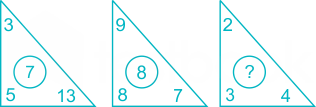
Study the given pattern carefully and select the number that can replace the question mark (?) in it.

  1. AOption (a)

    15

  2. BOption (b)

    17

  3. COption (c)

    8

  4. DOption (d)

    2

View answer & explanation

Correct answer

Answer: (b)B.

17

Why this answer is correct

The logic followed here is:

(14 + 10) = (4 × 6) 

24 = 24

And,

(9 + 6) = (3 × 5) 

15 = 15

Similarly,

(13 + ?) = (5 × 6) 

? = 30 - 13

? = 17

Hence, "Option 2" is the correct answer.

Question 14

What is the smallest natural number that must be added to 2000 for the sum to be a perfect square?

  1. AOption (a)

    100

  2. BOption (b)

    500

  3. COption (c)

    25

  4. DOption (d)

    20

View answer & explanation

Correct answer

Answer: (c)C.

25

Why this answer is correct

Given:

Number = 2000

Formula used:

Let the smallest natural number to be added be x. Then, 2000 + x = n2, where n is a natural number.

Calculation:

We need to find the smallest x such that 2000 + x is a perfect square.

Let's check the nearest perfect squares around 2000:

452 = 2025

⇒ 2025 - 2000 = 25

∴ The smallest natural number that must be added to 2000 for the sum to be a perfect square is 25.

∴ The correct answer is option (3).

Question 15

Which of the following is the Indian railway station having the highest number of platforms?

  1. AOption (a)

    New Delhi

  2. BOption (b)

    Sealdah

  3. COption (c)

    Chhatrapati Shivaji Maharaj Terminus 

  4. DOption (d)

    Howrah Junction

View answer & explanation

Correct answer

Answer: (d)D.

Howrah Junction

Why this answer is correct

The correct answer is Howrah Junction.

Key Points

  • Howrah Junction is one of the oldest and busiest railway stations in India, located in Howrah, West Bengal.
  • It has a total of 23 platforms, making it the station with the highest number of platforms in India.
  • It serves as a crucial hub for both local and long-distance trains, connecting various parts of India.
  • Howrah Junction handles a large volume of passengers daily and is equipped with various facilities to cater to travelers' needs.

Additional Information

  • New Delhi Railway Station
  • New Delhi Railway Station is one of the major railway stations in Delhi and the second busiest in India in terms of train frequency and passenger movement.
  • It has 16 platforms and serves as a major hub for trains connecting the northern parts of India.
  • The station is well-equipped with modern facilities, including Wi-Fi, waiting rooms, and food courts.
  • Sealdah Railway Station
  • Sealdah Railway Station is one of the major railway stations in Kolkata, West Bengal.
  • It has three main sections: Sealdah North, Sealdah Main, and Sealdah South, with a total of 20 platforms.
  • The station handles a significant number of suburban and long-distance trains.
  • Chhatrapati Shivaji Maharaj Terminus (CSMT)
  • Chhatrapati Shivaji Maharaj Terminus, formerly known as Victoria Terminus, is a historic railway station in Mumbai, Maharashtra.
  • It has 18 platforms and is one of the busiest railway stations in India.
  • CSMT is a UNESCO World Heritage Site and serves as the headquarters of the Central Railways.

Question 16

If θ is an acute angle and tanθ = 409\frac{{40}}{9}, what is the value of cosecθ?

  1. AOption (a)

    419\frac{{41}}{9}

  2. BOption (b)

    4041\frac{{40}}{41}

  3. COption (c)

    941\frac{{9}}{41}

  4. DOption (d)

    4140\frac{{41}}{40}

View answer & explanation

Correct answer

Answer: (d)D.

4140\frac{{41}}{40}

Why this answer is correct

Given:

θ is an acute angle

tanθ = 409\frac{40}{9}

Formula used:

cosecθ = 1/sinθ

Using tanθ = perpendicularbase\frac{perpendicular}{base}

hypotenuse = perpendicular2+base2\sqrt{perpendicular^2 + base^2}

sinθ = perpendicularhypotenuse\frac{perpendicular}{hypotenuse}

Calculations:

tanθ = 409\frac{40}{9}

⇒ perpendicular = 40, base = 9

⇒ hypotenuse = 402+92\sqrt{40^2 + 9^2}

⇒ hypotenuse = 1600+81\sqrt{1600 + 81}

⇒ hypotenuse = 1681\sqrt{1681}

⇒ hypotenuse = 41

sinθ = 4041\frac{40}{41}

cosecθ = 1sinθ\frac{1}{sinθ}

⇒ cosecθ = 14041\frac{1}{\frac{40}{41}}

⇒ cosecθ = 4140\frac{41}{40}

∴ The correct answer is option (4).

Question 17

A truck travels for 14 hours and covers the first half of the distance at the speed of 36 km/h and the remaining distance at the speed of 48 km/h. What is the total distance travelled by the truck?

  1. AOption (a)

    576 km

  2. BOption (b)

    528 km

  3. COption (c)

    540 km

  4. DOption (d)

    624 km

View answer & explanation

Correct answer

Answer: (a)A.

576 km

Why this answer is correct

Given:

A truck travels for 14 hours and covers the first half of the distance at the speed of 36 km/h and the remaining distance at the speed of 48 km/h.

Formula used:

Let the total distance be D km. The truck covers the first half distance \dfrac{D}{2} at 36 km/h and the remaining half distance \dfrac{D}{2} at 48 km/h.

Time = Distance / Speed

Total time = Time for first half + Time for second half

Calculation:

Time for first half distance = D/236\dfrac{D/2}{36} hours

Time for second half distance = D/248\dfrac{D/2}{48} hours

Total time = D/236+D/248\dfrac{D/2}{36} + \dfrac{D/2}{48} hours

⇒ 14 = D72+D96\dfrac{D}{72} + \dfrac{D}{96}

⇒ 14 = D(172+196)D \left( \dfrac{1}{72} + \dfrac{1}{96} \right)

⇒ 172+196=4+3288=7288\dfrac{1}{72} + \dfrac{1}{96} = \dfrac{4 + 3}{288} = \dfrac{7}{288}

⇒ 14 = D×7288D \times \dfrac{7}{288}

⇒ D = 14×288714 \times \dfrac{288}{7}

⇒ D = 576 km

∴ The correct answer is option (1).

Question 18

Select the option that can replace the question mark (?) in the following series.

B2D, D3G, G7K, K16P, ?

  1. AOption (a)

    P25U

  2. BOption (b)

    P32V

  3. COption (c)

    P32X

  4. DOption (d)

    Q32V

View answer & explanation

Correct answer

Answer: (b)B.

P32V

Why this answer is correct

The logic followed here is:

Hence, "Option 2" is the correct answer.

Question 19

'Operation Thirst' was launched by the:

  1. AOption (a)

    Railway Protection Force

  2. BOption (b)

    Border Security Force

  3. COption (c)

    Delhi Police

  4. DOption (d)

    Central Industrial Security Force

View answer & explanation

Correct answer

Answer: (a)A.

Railway Protection Force

Why this answer is correct

The correct answer is Railway Protection Force.

Key Points

  • The Railway Protection Force (RPF) is a security force, established by the Railway Protection Force Act, 1957, enacted by the Indian Parliament.
  • RPF is responsible for the protection of railway property, passengers, and passenger areas.
  • Operation Thirst was launched by RPF to check the menace of unauthorized packaged drinking water being sold at railway stations and trains.
  • RPF has the power to search, arrest, investigate, and prosecute offenders for unlawful possession of railway property.

Additional Information

  • Border Security Force (BSF)
  • BSF is one of the five Central Armed Police Forces of India.
  • It is responsible for guarding India's land border during peacetime and preventing transnational crime.
  • BSF was established on December 1, 1965, in response to the 1965 India-Pakistan war.
  • Delhi Police
  • The Delhi Police is the law enforcement agency for the National Capital Territory of Delhi (NCT).
  • It was established in 1861 under the British rule.
  • Delhi Police is responsible for maintaining law and order, prevention and detection of crime, and traffic management in Delhi.
  • Central Industrial Security Force (CISF)
  • CISF is a Central Armed Police Force in India.
  • It was established on March 10, 1969.
  • CISF provides security cover to industrial units, government infrastructure projects, and facilities, and also provides consultancy services to private industries and other organizations.

Question 20

Who among the following was one of the two recipients of Rajiv Gandhi Khel Ratna Award 2019?

  1. AOption (a)

    Bajrang Punia

  2. BOption (b)

    Fouaad Mirza

  3. COption (c)

    Poonam Yadav

  4. DOption (d)

    Chinglensana Singh Kangujam

View answer & explanation

Correct answer

Answer: (a)A.

Bajrang Punia

Why this answer is correct

The correct answer is Bajrang Punia.

Key Points

  • Bajrang Punia is an accomplished Indian freestyle wrestler.
  • He has won multiple medals at various international competitions including the World Wrestling Championships, Asian Games, and Commonwealth Games.
  • Bajrang Punia received the Rajiv Gandhi Khel Ratna Award in 2019, which is India's highest sporting honor.
  • He is known for his dedication and hard work, making significant contributions to Indian wrestling on the global stage.

Additional Information

  • Rajiv Gandhi Khel Ratna Award
  • It is the highest sporting honor of the Republic of India.
  • It is awarded annually by the Ministry of Youth Affairs and Sports.
  • The award is named after Rajiv Gandhi, the former Prime Minister of India.
  • It was instituted in 1991-1992 and the first recipient was Chess Grandmaster Vishwanathan Anand.
  • The award includes a medallion, a certificate, and a cash prize.
  • Fouaad Mirza
  • Fouaad Mirza is an Indian equestrian who also received the Rajiv Gandhi Khel Ratna Award in 2019.
  • He is known for his achievements in the discipline of eventing.
  • He won a silver medal at the 2018 Asian Games.
  • Poonam Yadav
  • Poonam Yadav is an Indian cricketer who plays for the Indian women's cricket team.
  • She is a leg-spin bowler and has been a crucial player in various international tournaments.
  • Chinglensana Singh Kangujam
  • Chinglensana Singh Kangujam is an Indian field hockey player.
  • He has represented India in various international hockey tournaments and has been a key player in the team.

Question 21

In which language can a web page be written?

  1. AOption (a)

    HTML

  2. BOption (b)

    FORTRAN

  3. COption (c)

    C/C++

  4. DOption (d)

    SQL

View answer & explanation

Correct answer

Answer: (a)A.

HTML

Why this answer is correct

The correct answer is HTML.

Key Points

  • HTML (HyperText Markup Language) is the standard language for creating web pages and web applications.
  • HTML is used to structure content on the web, including text, images, links, and other multimedia elements.
  • HTML documents are interpreted by web browsers, enabling users to view and interact with the content.
  • HTML is often used in conjunction with CSS (Cascading Style Sheets) and JavaScript to create visually appealing and interactive web pages.

Additional Information

  • FORTRAN (Formula Translation)
  • FORTRAN is a high-level programming language that is used primarily for scientific and engineering applications.
  • It was developed in the 1950s and is known for its performance in numerical computation and array processing.
  • C/C++
  • C is a general-purpose programming language that provides low-level access to memory and is used for system/software development.
  • C++ is an extension of C that includes object-oriented features, making it useful for both systems and application programming.
  • SQL (Structured Query Language)
  • SQL is a domain-specific language used in programming and managing relational databases.
  • It is used for querying, updating, and managing data in databases.

Question 22

How much does one have to add to 45\frac{4}{5} to obtain 54\frac{5}{4}?

  1. AOption (a)

    920\frac{9}{20}

  2. BOption (b)

    916\frac{9}{16}

  3. COption (c)

    25\frac{2}{5}

  4. DOption (d)

    1625\frac{16}{25}

View answer & explanation

Correct answer

Answer: (a)A.

920\frac{9}{20}

Why this answer is correct

Given:

How much does one have to add to 45\dfrac{4}{5} to obtain 54\dfrac{5}{4}?

Formula used:

Let x be the required number to be added.

45+x=54\dfrac{4}{5} + x = \dfrac{5}{4}

Calculation:

45+x=54\dfrac{4}{5} + x = \dfrac{5}{4}

⇒ x = 54−45\dfrac{5}{4} - \dfrac{4}{5}

⇒ x = (5×5)−(4×4)4×5\dfrac{(5 \times 5) - (4 \times 4)}{4 \times 5}

⇒ x = 25−1620\dfrac{25 - 16}{20}

⇒ x = 920\dfrac{9}{20}

∴ The correct answer is option (1).

Question 23

With which dancing form is the noted classical dancer Shovana Narayan associated?

  1. AOption (a)

    Bharatanatyam

  2. BOption (b)

    Kuchipudi

  3. COption (c)

    Kathak

  4. DOption (d)

    Kathakali

View answer & explanation

Correct answer

Answer: (c)C.

Kathak

Why this answer is correct

The correct answer is Kathak.

Key Points

  • Shovana Narayan is a renowned classical dancer known for her exceptional skills in Kathak.
  • Kathak is one of the eight major forms of Indian classical dance.
  • Shovana Narayan has received numerous accolades and awards for her contributions to Kathak, including the Padma Shri.
  • She is known for her innovative choreography and has performed extensively both in India and internationally.

Additional Information

  • Kathak
  • Kathak is a classical dance form that originated in Northern India.
  • The word 'Kathak' is derived from the Sanskrit word 'Katha', meaning story, and 'Kathakar', meaning the one who tells a story.
  • Traditionally, Kathak dancers narrate stories from Indian epics and mythology through their dance.
  • It is characterized by intricate footwork, spins, and expressive gestures.
  • Bharatanatyam
  • Bharatanatyam is a classical dance form from Tamil Nadu in Southern India.
  • It is known for its fixed upper torso, bent legs, and intricate hand gestures.
  • Bharatanatyam often depicts religious themes and spiritual ideas from Hindu scriptures.
  • Kuchipudi
  • Kuchipudi is a classical dance form from Andhra Pradesh in Southern India.
  • It combines fast rhythms with fluid movements and is known for its dramatic characterizations.
  • Kuchipudi performances often include a combination of dance, acting, and music.
  • Kathakali
  • Kathakali is a classical dance-drama from Kerala in Southern India.
  • It is noted for its elaborate costumes, detailed gestures, and well-defined body movements presented in tune with the anchor playback music and complementary percussion.
  • Kathakali performances typically depict stories from Hindu epics like the Ramayana and the Mahabharata.

Question 24

Which of the following comes under the concurrent list?

  1. AOption (a)

    Police

  2. BOption (b)

    Trade

  3. COption (c)

    Defense

  4. DOption (d)

    Forest

View answer & explanation

Correct answer

Answer: (d)D.

Forest

Why this answer is correct

The correct answer is Forest.

Key Points

  • The Concurrent List in the Indian Constitution includes subjects that are of interest to both the Union and the States.
  • Forests are included in the Concurrent List to ensure both state and central governments can make laws regarding their management and conservation.
  • This inclusion helps in maintaining ecological balance and addresses issues like deforestation and forest conservation more effectively.
  • Both the Parliament and State Legislatures can legislate on concurrent subjects, but in case of any conflict, the central law prevails.

Additional Information

  • Police
  • Police is a subject under the State List. This means that only the state governments have the authority to legislate on matters related to the police.
  • Each state in India has its own police force and administration.
  • Trade
  • Trade and commerce within the state are under the State List, while trade and commerce between different states or with foreign countries fall under the Union List.
  • This division ensures that states can manage their internal trade, while the central government can regulate inter-state and international trade.
  • Defense
  • Defense is a subject under the Union List, meaning only the central government can legislate on matters related to national defense and security.
  • This ensures a unified and consistent defense policy for the entire country.
  • Concurrent List
  • The Concurrent List is one of the three lists in the Seventh Schedule of the Indian Constitution that outlines the subjects on which both the state and central governments can legislate.
  • Subjects in the Concurrent List include criminal law, marriage and divorce, bankruptcy and insolvency, and forests, among others.
  • This list aims to ensure cooperative federalism and addresses issues that are of common interest to both the states and the union.
  • In case of any conflict between central and state laws on a concurrent subject, the central law prevails.

Question 25

What is the value of 993?

  1. AOption (a)

    970299

  2. BOption (b)

    970499

  3. COption (c)

    970389

  4. DOption (d)

    970289

View answer & explanation

Correct answer

Answer: (a)A.

970299

Why this answer is correct

Given:

993 = ?

Formula used:

Exponentiation Formula: an where a is the base and n is the exponent

Calculation:

993 = 99 × 99 × 99

⇒ 99 × 99 = 9801

⇒ 9801 × 99 = 970299

∴ The correct answer is option (1).

Question 26

3 litres of pure petrol is added to 13 litres of a mixture of petrol and ethanol containing 40% petrol. Find the percentage of ethanol in the resulting mixture.

  1. AOption (a)

    48.50%

  2. BOption (b)

    49.25%

  3. COption (c)

    48.75%

  4. DOption (d)

    48.25%

View answer & explanation

Correct answer

Answer: (c)C.

48.75%

Why this answer is correct

Given:

3 litres of pure petrol is added to 13 litres of a mixture of petrol and ethanol containing 40% petrol.

Formula used:

Percentage of ethanol = Volume of EthanolTotal Volume of Mixture×100\dfrac{\text{Volume of Ethanol}}{\text{Total Volume of Mixture}} \times 100

Calculation:

Volume of petrol in the mixture = 40% of 13 litres

⇒ Volume of petrol = 0.4 × 13 = 5.2 litres

Volume of ethanol in the mixture = 13 litres - 5.2 litres

⇒ Volume of ethanol = 7.8 litres

After adding 3 litres of petrol, the total volume of the mixture = 13 litres + 3 litres

⇒ Total volume = 16 litres

Volume of ethanol remains the same = 7.8 litres

Percentage of ethanol = 7.816×100\dfrac{7.8}{16} \times 100

⇒ Percentage of ethanol = 48.75%

∴ The correct answer is option (3).

Question 27

Who is considered as the 'architect of Indian Planning'?

  1. AOption (a)

    Meghanad Saha

  2. BOption (b)

    PC Mahalanobis

  3. COption (c)

    Kshitish Chandra Neogy

  4. DOption (d)

    Mokshagundam Visvesvaraya

View answer & explanation

Correct answer

Answer: (b)B.

PC Mahalanobis

Why this answer is correct

The correct answer is PC Mahalanobis.

Key Points

  • PC Mahalanobis is often regarded as the 'architect of Indian Planning' due to his significant role in the establishment and development of the Indian statistical system and the planning process.
  • He was the founder of the Indian Statistical Institute (ISI), which played a crucial role in shaping India's data collection and analysis infrastructure.
  • Mahalanobis introduced the Mahalanobis distance, a measure in statistics that is widely used in cluster analysis and classification.
  • He was a key figure in the formulation of the Second Five-Year Plan (1956-1961), which emphasized the development of heavy industries and laid the foundation for India's industrialization.

Additional Information

  • Five-Year Plans in India
  • India's Five-Year Plans were centralized and integrated national economic programs, initiated in 1951 by the Planning Commission.
  • The plans aimed to achieve rapid economic growth, self-reliance, social justice, and modernization.
  • The First Five-Year Plan (1951-1956) focused on agricultural development, while the Second Five-Year Plan (1956-1961) emphasized industrialization.
  • The Planning Commission was replaced by the NITI Aayog (National Institution for Transforming India) in 2015.
  • Indian Statistical Institute (ISI)
  • ISI is an academic institute of national importance, founded by PC Mahalanobis in 1931 in Kolkata.
  • It is renowned for its contributions to the fields of statistics, mathematics, and computer science.
  • The institute conducts research and offers various academic programs, including undergraduate, postgraduate, and doctoral degrees.
  • ISI has played a vital role in the development of statistical methods and their application in various sectors such as agriculture, industry, and social sciences.
  • Mahalanobis Distance
  • The Mahalanobis distance is a measure of the distance between a point and a distribution, introduced by PC Mahalanobis in 1936.
  • It is widely used in multivariate statistics, pattern recognition, and cluster analysis to identify and analyze the similarity of datasets.
  • The measure takes into account the correlations of the data set and is scale-invariant, making it a robust tool for various statistical analyses.

Question 28

Select the option in which the terms share the same relationship as that shared by the given pair of terms.

CLN : XOM

  1. AOption (a)

    YAT :FGD

  2. BOption (b)

    EFH : VUS

  3. COption (c)

    QSU : ZXU

  4. DOption (d)

    CQG : MLP

View answer & explanation

Correct answer

Answer: (b)B.

EFH : VUS

Why this answer is correct

The logic followed here is:

​CLN : XOM

Option 1) YAT :FGD

Option 2) EFH : VUS

Option 3) QSU : ZXU

Option 4) CQG : MLP

Thus, out of all the options, 'EFH : VUS' follows the same logic as given.

Hence, "Option 2" is the correct answer.

Question 29

Under which Indian Act has the Central Bureau of Investigation been empowered to apprehend and prosecute wildlife offenders?

  1. AOption (a)

    Prevention of Cruelty to Animals Act, 1960

  2. BOption (b)

    The Wild Life (Protection) Act, 1972

  3. COption (c)

    Indian Forest Act, 1927

  4. DOption (d)

    Environment Protection Act, 1986

View answer & explanation

Correct answer

Answer: (b)B.

The Wild Life (Protection) Act, 1972

Why this answer is correct

The correct answer is The Wild Life (Protection) Act, 1972.

Key Points

  • The Wild Life (Protection) Act, 1972 was enacted by the Government of India to protect the country's wild animals, birds, and plant species in order to ensure environmental and ecological security.
  • This act provides a legal framework for the protection of various species of flora and fauna, and also for the establishment of protected areas such as sanctuaries and national parks.
  • The Central Bureau of Investigation (CBI) has been empowered under this act to apprehend and prosecute wildlife offenders, ensuring stringent enforcement of the law.
  • The act also stipulates the punishment for offenses committed against wildlife, which includes both fines and imprisonment, thereby acting as a deterrent against wildlife crimes.

Additional Information

  • Prevention of Cruelty to Animals Act, 1960
  • This act aims to prevent the infliction of unnecessary pain or suffering on animals and to amend the law relating to the prevention of cruelty to animals.
  • It led to the establishment of the Animal Welfare Board of India, which ensures the implementation of the laws related to animal welfare in the country.
  • Indian Forest Act, 1927
  • This act consolidates the law relating to forests, the transit of forest-produce, and the duty leviable on timber and other forest-produce.
  • It aims to regulate the movement of forest produce and to levy duties on timber and other forest products.
  • Environment Protection Act, 1986
  • This act was enacted in the aftermath of the Bhopal Gas Tragedy and aims to provide for the protection and improvement of the environment.
  • It gives the Central Government the authority to take measures necessary to protect and improve the quality of the environment and to prevent, control, and abate environmental pollution.

Question 30

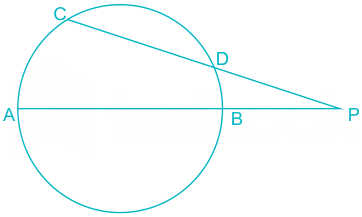
In the given circle, diameter AB is extended to meet chord CD extended at P. If the lengths of the line segments AP, CP and DP are 12 cm, 8 cm and 6 cm, respectively. what is the length of the radius of the circle?

  1. AOption (a)

    4 cm

  2. BOption (b)

    8 cm

  3. COption (c)

    2 cm

  4. DOption (d)

    6 cm

View answer & explanation

Correct answer

Answer: (a)A.

4 cm

Why this answer is correct

Given:

AP = 12 cm

CP = 8 cm

DP = 6 cm

Formula used:

In a circle, if AB is the diameter and P is a point outside the circle, such that PA × PB = PC × PD.

Calculation:

Let PB = x.

Since P is outside the circle and AB is the diameter, PA × PB = PC × PD.

⇒ 12 × x = 8 × 6

⇒ 12x = 48

⇒ x = 4 cm

Now, PB = x = 4 cm.

Therefore, AB = PA - PB = 12 - 4 = 8 cm.

Since AB is the diameter of the circle, the radius of the circle is half of the diameter.

⇒ Radius = AB / 2 = 8 / 2 = 4 cm

∴ The correct answer is option (1).

Question 31

The Great Bath found at Mohenjo-daro was a large:

  1. AOption (a)

    Triangular tank

  2. BOption (b)

    Cylindrical tank

  3. COption (c)

    Rectangular tank

  4. DOption (d)

    Circular tank

View answer & explanation

Correct answer

Answer: (c)C.

Rectangular tank

Why this answer is correct

The correct answer is Rectangular tank.

Key Points

  • The Great Bath is one of the most famous structures among the ruins of the ancient Indus Valley Civilization city of Mohenjo-daro in Sindh, Pakistan.
  • It is a large rectangular tank, measuring approximately 12 meters long, 7 meters wide, and 2.4 meters deep.
  • The Great Bath is made with finely fitted bricks and was likely used for ritualistic or religious purposes.
  • The bath was waterproofed with a thick layer of bitumen (natural tar) to ensure water retention.

Additional Information

  • Mohenjo-daro
  • Mohenjo-daro, meaning "Mound of the Dead Men," is an ancient Indus Valley Civilization city that dates back to 2500 BCE.
  • It is one of the largest settlements of the ancient civilization and one of the world's earliest major urban centers.
  • The city was discovered in the 1920s and is located in the Larkana District of Sindh, Pakistan.
  • Mohenjo-daro features advanced urban planning, including streets laid out in a grid pattern, a sophisticated drainage system, and the use of standardized fired bricks for construction.
  • Indus Valley Civilization
  • The Indus Valley Civilization, also known as the Harappan Civilization, was a Bronze Age civilization that flourished in the northwestern regions of South Asia from 3300 to 1300 BCE.
  • It is noted for its advanced urban planning, architecture, and social organization.
  • Key sites of the civilization include Harappa, Mohenjo-daro, Dholavira, and Lothal.
  • The civilization had a writing system, though its script has not yet been deciphered.
  • Ritualistic Practices
  • The Great Bath at Mohenjo-daro is believed to have been used for religious or ritualistic purposes, possibly for purification rites.
  • Such ritualistic bathing practices are seen in many ancient cultures and are often associated with spiritual cleansing.
  • The presence of a well and a drainage system near the bath suggests that water management was an important aspect of these practices.

Question 32

Which of the following statements is NOT true about the Indian National Satellites System (INSAT)?

  1. AOption (a)

    They were designed for weather prediction purposes.

  2. BOption (b)

    They were initiated in 1979.

  3. COption (c)

    European launch vehicles have been used for the INSAT series.

  4. DOption (d)

    They were designed for communications purposes.

View answer & explanation

Correct answer

Answer: (b)B.

They were initiated in 1979.

Why this answer is correct

The correct answer is Option 2.

Key Points

  • The Indian National Satellites System (INSAT) was designed for both weather prediction and communications purposes.
  • The INSAT series was actually initiated in 1983, not 1979.
  • European launch vehicles, such as those from the European Space Agency (ESA), have indeed been used for launching some of the INSAT series satellites.
  • INSAT satellites play a crucial role in telecommunications, broadcasting, meteorology, and search and rescue operations.

Additional Information

  • Indian National Satellites System (INSAT)
  • INSAT is a series of multipurpose geostationary satellites commissioned by the Indian Space Research Organisation (ISRO) to cater to telecommunications, broadcasting, meteorology, and search and rescue operations.
  • The system was established in 1983 with the launch of INSAT-1B and has since been a key element in India's space program.
  • INSAT satellites are equipped with transponders in various frequency bands such as C-band, Extended C-band, Ku-band, and S-band for different applications including TV broadcasting, telecommunication, and weather forecasting.
  • The INSAT system also includes payloads for meteorological observations, which provide essential data for weather prediction, disaster warning, and climate research.
  • European Launch Vehicles
  • India has used European launch vehicles, such as the Ariane series provided by Arianespace, a European launch service provider, for deploying several of its satellites.
  • The collaboration with European launch vehicles has been crucial for India, especially in the earlier stages of its satellite launch program before the Indian Space Research Organisation (ISRO) developed its own heavy-lift launch capabilities.
  • This collaboration has facilitated the successful deployment of various INSAT satellites, contributing to the robustness of India's satellite communication and meteorological services.

Question 33

The least number that should be substracted from 0.000845 to make it a perfect square is:

  1. AOption (a)

    0.000005

  2. BOption (b)

    0.000001

  3. COption (c)

    0.000004

  4. DOption (d)

    0.000006

View answer & explanation

Correct answer

Answer: (c)C.

0.000004

Why this answer is correct

Given:

The least number that should be subtracted from 0.000845 to make it a perfect square is:

Formula used:

To find the nearest perfect square less than 0.000845

Calculation:

Find the square root of 0.000845:

⇒ 0.000845≈0.029066\sqrt{0.000845} \approx 0.029066

The nearest integer less than 0.029066 is 0.029

Square of 0.029:

⇒ (0.029)2=0.000841(0.029)^2 = 0.000841

Subtract 0.000841 from 0.000845:

⇒ (0.000845−0.000841=0.000004)(0.000845 - 0.000841 = 0.000004)

∴ The correct answer is option (3).

Question 34

Among five friends A, B, C, D and E, A's weight is more than that of B and C does not have the least weight. D's weight is more than that of E and E is heavier than A. Who among them will have the least weight?

  1. AOption (a)

    A

  2. BOption (b)

    D

  3. COption (c)

    B

  4. DOption (d)

    E

View answer & explanation

Correct answer

Answer: (c)C.

B

Why this answer is correct

Given: Five friends A, B, C, D and E.

  1. D's weight is more than that of E and E is heavier than A.

D > E > A

2) A's weight is more than that of B and C does not have the least weight.

D > E > A > C > B

Thus, according to the final arrangement, B has the least weight.

Hence, "Option 3" is the correct answer.

Question 35

Laterite soil develops in the area with:

  1. AOption (a)

    low temperature and medium rainfall

  2. BOption (b)

    high temperature and heavy rainfall

  3. COption (c)

    high temperature and low rainfall

  4. DOption (d)

    low temperature and heavy rainfall

View answer & explanation

Correct answer

Answer: (b)B.

high temperature and heavy rainfall

Why this answer is correct

The correct answer is high temperature and heavy rainfall.

Key Points

  • Laterite soil is rich in iron and aluminum, formed in hot and wet tropical areas.
  • This type of soil is the result of intense leaching due to heavy rainfall and high temperatures which accelerate the chemical weathering of rocks.
  • Laterite soils are generally acidic in nature and have low fertility, often used for construction purposes due to their strength when dry.
  • High temperature and heavy rainfall promote the formation of laterite soils by breaking down silicate minerals and leaving behind more insoluble minerals like iron and aluminum.

Additional Information

  • Laterite Soil:
  • Laterite soils are found in regions with high rainfall and high temperatures, which are common in tropical regions such as parts of India, Southeast Asia, and Africa.
  • These soils are characterized by their reddish color due to the high iron oxide content.
  • Laterite soil is poor in nitrogen, potassium, lime, and humus, which makes it less suitable for agriculture without proper soil management and fertilization.
  • In many regions, laterite soil is used for making bricks because it hardens on exposure to air.
  • Soil Formation:
  • Soil formation is influenced by five main factors: parent material, climate, topography, organisms, and time.
  • Climate, particularly temperature and precipitation, is a dominant factor in the formation of laterite soil.
  • Heavy rainfall leads to leaching, where water percolates through the soil and washes away soluble nutrients, leaving behind iron and aluminum oxides.
  • High temperatures accelerate the chemical weathering of rocks and minerals, further contributing to the development of laterite soil.
  • Leaching:
  • Leaching is the process by which soluble nutrients are washed out of the soil by percolating water.
  • This process is especially intense in regions with high rainfall, leading to the formation of nutrient-poor soils like laterite.
  • Leaching removes essential nutrients such as calcium, magnesium, and potassium, which can affect plant growth and soil fertility.
  • In laterite soils, leaching is responsible for the concentration of iron and aluminum oxides, which give the soil its distinctive color and properties.
  • Soil Management:
  • Effective soil management practices can improve the fertility of laterite soils for agricultural use.
  • Adding organic matter, such as compost or manure, can enhance soil structure and nutrient content.
  • Applying fertilizers that provide essential nutrients like nitrogen, phosphorus, and potassium can help support plant growth.
  • Proper irrigation and drainage management can reduce the effects of leaching and maintain soil moisture levels.

Question 36

28 pipes are connected to a tank. Some of them pour water into the tank, whereas the rest drain water out of it. Each of the pipes that fill water can fill the empty tank in 14 hours, whereas any of the drainpipes can empty the filled tank in 35 hours. If all the pipes are opened simultaneously when the tank is empty and the tank is filled in 2.5 hours, how many of the pipes were drainpipes?

  1. AOption (a)

    15

  2. BOption (b)

    18

  3. COption (c)

    16

  4. DOption (d)

    17

View answer & explanation

Correct answer

Answer: (c)C.

16

Why this answer is correct

Given:

28 pipes are connected to a tank.

Some of them pour water into the tank, whereas the rest drain water out of it.

Each of the pipes that fill water can fill the empty tank in 14 hours.

Any of the drainpipes can empty the filled tank in 35 hours.

If all the pipes are opened simultaneously when the tank is empty and the tank is filled in 2.5 hours.

Formula used:

Let x be the number of filling pipes and y be the number of drainpipes.

We have x + y = 28

Filling rate of one pipe = 114\dfrac{1}{14} tank/hour

Draining rate of one pipe = −135\dfrac{-1}{35} tank/hour

Combined rate when all pipes are open: x×114+y×−135x \times \dfrac{1}{14} + y \times \dfrac{-1}{35}

Time taken to fill the tank = 2.5 hours

Combined rate = 12.5\dfrac{1}{2.5} tank/hour

Calculation:

x×114+y×−135=12.5x \times \dfrac{1}{14} + y \times \dfrac{-1}{35} = \dfrac{1}{2.5}

⇒ x14−y35=12.5\dfrac{x}{14} - \dfrac{y}{35} = \dfrac{1}{2.5}

⇒ x14−y35=25\dfrac{x}{14} - \dfrac{y}{35} = \dfrac{2}{5}

⇒ 5x - 2y = 14×214 \times 2

⇒ 5x - 2y = 28

We also have x + y = 28

⇒ x + y = 28

Solving the two equations:

  1. 5x - 2y = 28
  2. x + y = 28

From equation 2: y = 28 - x

Substitute y in equation 1:

⇒ 5x - 2(28 - x) = 28

⇒ 5x - 56 + 2x = 28

⇒ 7x - 56 = 28

⇒ 7x = 84

⇒ x = 12

Therefore, y = 28 - 12

⇒ y = 16

∴ The correct answer is option (3).

Question 37

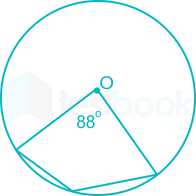
In the given circle with centre O, the acute angle at the centre measures 88°. In the quadrilateral drawn inside the circle, what is the measure of the angle opposite to ∠O? [Figure is not drawn to scale.]

  1. AOption (a)

    136° 

  2. BOption (b)

    272° 

  3. COption (c)

    68° 

  4. DOption (d)

    88° 

View answer & explanation

Correct answer

Answer: (a)A.

136° 

Why this answer is correct

Given:

∠POQ = 88°

Concept used:

The angle subtended by an arc at the centre is double the angle subtended by it at any point on the remaining part of the circle.

The sum of the opposite angles of a cyclic quadrilateral = 180°

Calculation:

Take a point on a circle at the point A and connect PA and QA

So, ∠PAQ = ∠POQ/2 = 88°/2 = 44°

APRS is a cyclic quadrilateral

So, ∠PRQ = 180° - 44° = 136°

∴ The measure (in degree) of ∠PRQ is 88°

Question 38

A sold an item to B at a gain of 25%, and B sold it to C at a loss of 12%. If C paid ₹231, then what was the cost price of the item for A?

  1. AOption (a)

    ₹210

  2. BOption (b)

    ₹250

  3. COption (c)

    ₹200

  4. DOption (d)

    ₹220

View answer & explanation

Correct answer

Answer: (a)A.

₹210

Why this answer is correct

Given:

C paid = ₹231

B sold at a loss of 12%

A sold to B at a gain of 25%

Formula used:

If SP is the selling price, CP is the cost price, then:

SP = CP × (1 + Gain%)

SP = CP × (1 - Loss%)

Calculation:

Let B's cost price be x.

Since B sold at a loss of 12%:

⇒ 231 = x × (1 - 12/100)

⇒ 231 = x × 0.88

⇒ x = 231 / 0.88

⇒ x = 262.5

Let A's cost price be y.

Since A sold at a gain of 25%:

⇒ 262.5 = y × (1 + 25/100)

⇒ 262.5 = y × 1.25

⇒ y = 262.5 / 1.25

⇒ y = 210

∴ The correct answer is option 1.

Question 39

Consider the given statement and decide which of the given assumptions is/are implicit in the statement.

Statement:

Preeti wants to do engineering but her father is insisting het to pursue medical stream in college.

Assumptions:

I. Preeti's father believes that medical stream is better for Preeti's future.

II. Preeti doesn't want to study medical related subjects.

  1. AOption (a)

    Only assumption I is implicit.

  2. BOption (b)

    Either I or II is implicit.

  3. COption (c)

    Both I and II are implicit

  4. DOption (d)

    Only assumption II is implicit.

View answer & explanation

Correct answer

Answer: (c)C.

Both I and II are implicit

Why this answer is correct

Statement: Preeti wants to do engineering but her father is insisting her to pursue medical stream in college.

Now,

Assumptions 1: Preeti's father believes that medical stream is better for Preeti's future - Implicit (Preeti's father is insisting her to pursue medical stream, which indicates he believes it is better for her future.)

Assumption 2: Preeti doesn’t want to study medical related subjects - Implicit (Preeti wants to do engineering, which implies she doesn’t want to study medical related subjects.)

Here, Both assumptions I and II are implicit.

Hence, the correct answer is "Option 3".

Question 40

Which of the following statements is true about the Sutta Pitaka?

  1. AOption (a)

    It is Buddhist text that was written in Sri Lanka.

  2. BOption (b)

    It deals with the conversation between the ruler of Magadha and the Buddha.

  3. COption (c)

    It is about the rules and regulations for those who joined the Buddhist monastic order.

  4. DOption (d)

    It is the biography of the Buddha.

View answer & explanation

Correct answer

Answer: (b)B.

It deals with the conversation between the ruler of Magadha and the Buddha.

Why this answer is correct

The correct answer is It deals with the conversation between the ruler of Magadha and the Buddha.

Key Points

  • The Sutta Pitaka is one of the three main sections of the Pali Canon, the scriptures of Theravada Buddhism.
  • It contains more than 10,000 suttas (teachings) attributed to the Buddha or his close companions.
  • The Sutta Pitaka is divided into five Nikayas: Digha Nikaya, Majjhima Nikaya, Samyutta Nikaya, Anguttara Nikaya, and Khuddaka Nikaya.
  • It includes narratives and dialogues involving the Buddha and various individuals, including kings, disciples, and laypersons, which often illustrate moral and philosophical principles.

Additional Information

  • Pali Canon:
  • The Pali Canon is the standard collection of scriptures in the Theravada Buddhist tradition, preserved in the Pali language.
  • It is divided into three "baskets" (Tipitaka): Vinaya Pitaka (disciplinary code), Sutta Pitaka (discourses), and Abhidhamma Pitaka (philosophical and doctrinal analysis).
  • Digha Nikaya:
  • One of the five Nikayas in the Sutta Pitaka, it contains long discourses (suttas), including important teachings and narratives.
  • It includes notable suttas such as the Maha-parinibbana Sutta, which details the last days of the Buddha.
  • Majjhima Nikaya:
  • Another Nikaya in the Sutta Pitaka, comprising middle-length discourses (suttas), covering a variety of topics in Buddhist doctrine and practice.
  • It is known for its practical and accessible teachings.
  • Vinaya Pitaka:
  • One of the three main divisions of the Pali Canon, it deals with the rules and regulations for the monastic community (Sangha).
  • It is essential for the maintenance of discipline and order within the monastic community.

Question 41

When did Mahatma Gandhi return to India from South Africa?

  1. AOption (a)

    November 1913

  2. BOption (b)

    December 1920

  3. COption (c)

    January 1915

  4. DOption (d)

    March 1919

View answer & explanation

Correct answer

Answer: (c)C.

January 1915

Why this answer is correct

The correct answer is Fri Jan 01 1915 00:00:00 GMT+0530 (India Standard Time).

Key Points

  • Mahatma Gandhi returned to India from South Africa on 9th January 1915, which is commemorated as Pravasi Bharatiya Divas (Non-Resident Indian Day).
  • Gandhi's return marked the beginning of a significant chapter in India's struggle for independence, as he became a prominent leader in the Indian National Movement.
  • He spent 21 years in South Africa, where he developed his political views, ethics, and leadership skills, particularly his advocacy for nonviolent protest (Satyagraha).
  • Upon his return, Gandhi traveled extensively across India to understand the plight of the common people and gradually became involved in various movements against British colonial rule.

Additional Information

  • Gandhi's Early Life and Education
  • Mohandas Karamchand Gandhi, later known as Mahatma Gandhi, was born on 2nd October 1869 in Porbandar, Gujarat.
  • He studied law at the Inner Temple in London and became a barrister in 1891.
  • Gandhi in South Africa
  • Gandhi moved to South Africa in 1893 to practice law and stayed there for 21 years.
  • He faced racial discrimination and injustices, which inspired him to fight for civil rights and justice.
  • Gandhi pioneered the concept of Satyagraha (truth and nonviolent resistance) during his time in South Africa.
  • Gandhi's Role in Indian Independence Movement
  • After returning to India in 1915, Gandhi joined the Indian National Congress and became a leader in the Indian independence movement.
  • He led several nationwide campaigns for various social causes and for Swaraj (self-rule), including the Non-Cooperation Movement, Civil Disobedience Movement, and Quit India Movement.
  • Gandhi's philosophy of nonviolence and peaceful protests influenced many leaders and movements worldwide.
  • Legacy
  • Mahatma Gandhi is remembered as the Father of the Nation in India.
  • His birthday, 2nd October, is celebrated as Gandhi Jayanti and is also observed as the International Day of Non-Violence.
  • Gandhi's teachings continue to inspire movements for civil rights and social justice globally.

Question 42

Pick the odd one out.

  1. AOption (a)

    Nitrogen

  2. BOption (b)

    Air

  3. COption (c)

    Carbon dioxide

  4. DOption (d)

    Oxygen

View answer & explanation

Correct answer

Answer: (b)B.

Air

Why this answer is correct

The logic followed here is:

NitrogenElement
AirMixture of Gases
Carbon dioxideCompound
OxygenElement


Nitrogen, Carbon dioxide, Oxygen all are individual gases,

Whereas, Air is a mixture of gases.

Hence, the correct answer is "Air".

Question 43

Which part of a male human's body is called the 'Adam's Apple'?

  1. AOption (a)

    Tongue

  2. BOption (b)

    Larynx

  3. COption (c)

    Palate

  4. DOption (d)

    Lung

View answer & explanation

Correct answer

Answer: (b)B.

Larynx

Why this answer is correct

The correct answer is Larynx.

Key Points

  • The 'Adam's Apple' is a feature of the human neck and is more prominent in males.
  • It is formed by the thyroid cartilage surrounding the larynx.
  • The Adam's Apple becomes more prominent during puberty when the larynx grows in size.
  • The larynx, also known as the voice box, plays a critical role in breathing, producing sound, and protecting the trachea against food aspiration.

Additional Information

  • Tongue
  • The tongue is a muscular organ in the mouth that is vital for chewing, swallowing, and speech.
  • It is also the primary organ for taste.
  • Palate
  • The palate forms the roof of the mouth and separates the oral cavity from the nasal cavity.
  • It consists of two parts: the hard palate at the front and the soft palate at the back.
  • Lung
  • The lungs are essential respiratory organs located in the chest, responsible for gas exchange.
  • They bring oxygen into the body and expel carbon dioxide.
  • Larynx
  • The larynx, or voice box, is located in the neck and houses the vocal cords.
  • It is involved in breathing, producing sound, and protecting the trachea during swallowing.
  • The larynx is composed of cartilage, muscles, and ligaments, and is more prominent in males, forming the Adam's Apple.
  • During puberty, hormonal changes cause the larynx to grow larger, resulting in a deeper voice and more noticeable Adam's Apple in males.

Question 44

A man buys an article for ₹55.00 and sells it for ₹57.20. Find his gain percentage.

  1. AOption (a)

    8%

  2. BOption (b)

    2%

  3. COption (c)

    4%

  4. DOption (d)

    6%

View answer & explanation

Correct answer

Answer: (c)C.

4%

Why this answer is correct

Given:

Cost Price (CP) = ₹55.00

Selling Price (SP) = ₹57.20

Formula used:

Gain Percentage = (SP−CP)CP×100\dfrac{(SP - CP)}{CP} \times 100

Calculation:

Gain = SP - CP

⇒ Gain = ₹57.20 - ₹55.00

⇒ Gain = ₹2.20

Gain Percentage = ₹2.20₹55.00×100\dfrac{₹2.20}{₹55.00} \times 100

⇒ Gain Percentage = 2.2055.00×100\dfrac{2.20}{55.00} \times 100

⇒ Gain Percentage = 0.04 × 100

⇒ Gain Percentage = 4%

∴ The correct answer is option (3).

Question 45

For how many years are the non-permanent members of the UN Security Council (UNSC) elected?

  1. AOption (a)

    5

  2. BOption (b)

    3

  3. COption (c)

    2

  4. DOption (d)

    4

View answer & explanation

Correct answer

Answer: (c)C.

2

Why this answer is correct

The correct answer is 2 years.

Key Points

  • The United Nations Security Council (UNSC) consists of 15 members.
  • Among these, there are 5 permanent members: China, France, Russia, the United Kingdom, and the United States.
  • The remaining 10 are non-permanent members who are elected by the General Assembly for a term of 2 years.
  • Non-permanent members are elected based on regional groupings to ensure representation from different parts of the world.

Additional Information

  • United Nations Security Council (UNSC)
  • The UNSC is one of the six principal organs of the United Nations, charged with ensuring international peace and security.
  • It has the authority to establish peacekeeping operations, enact international sanctions, and authorize military action.
  • Decisions on substantive matters require nine votes, including the concurring votes of all five permanent members, which means any of these can veto a decision.
  • Election of Non-Permanent Members
  • Non-permanent members are elected by the General Assembly of the United Nations.
  • Each year, five non-permanent members are elected for a two-year term.
  • To be elected, a country must receive at least two-thirds of the votes cast by the General Assembly members.
  • These elections are based on regional distribution to ensure representation from various global regions.
  • Roles and Responsibilities
  • Non-permanent members participate in UNSC meetings and discussions, contributing to decisions and resolutions.
  • They have the responsibility to uphold international peace and security.
  • While they do not have veto power, their votes and participation are crucial in forming the council's decisions.

Question 46

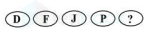
Select the option that can replace the question mark (?) in the following series.

NZ, IU, DP, YK, TF, ?

  1. AOption (a)

    PZ

  2. BOption (b)

    NB

  3. COption (c)

    OA

  4. DOption (d)

    MC

View answer & explanation

Correct answer

Answer: (c)C.

OA

Why this answer is correct

The logic followed here is:

Hence, "Option 3" is the correct answer.

Question 47

Under which ministry in India does NSSO work?

  1. AOption (a)

    Ministry of Labour and Employment

  2. BOption (b)

    Ministry of Commerce and Industry

  3. COption (c)

    Ministry of Statistics and Programme Implementation

  4. DOption (d)

    Ministry of Planning

View answer & explanation

Correct answer

Answer: (c)C.

Ministry of Statistics and Programme Implementation

Why this answer is correct

The correct answer is Ministry of Statistics and Programme Implementation.

Key Points

  • The National Sample Survey Office (NSSO) operates under the Ministry of Statistics and Programme Implementation (MoSPI).
  • The NSSO is responsible for conducting large-scale sample surveys across India to gather socio-economic data.
  • It was established in 1950, and it plays a crucial role in providing data for planning and policy-making.
  • MoSPI ensures the coordination of statistical activities in India and maintains statistical standards.

Additional Information

  • Ministry of Labour and Employment
  • This ministry is responsible for protecting and safeguarding the interests of workers in general and the poor, deprived, and disadvantaged sections of society in particular.
  • It also aims to create a healthy work environment for higher production and productivity.
  • Ministry of Commerce and Industry
  • This ministry formulates and implements policies and programs for achieving growth in the industrial and commercial sectors.
  • It focuses on trade, exports, and investment promotion.
  • Ministry of Planning
  • This ministry is responsible for the overall planning process in India.
  • It was merged with the Ministry of Statistics and Programme Implementation in 2019, now functioning under the same umbrella.

Question 48

Which of the following letters is 10th to the right of the 9th letter from the left in an Alphabetical series?

  1. AOption (a)

    S

  2. BOption (b)

    H

  3. COption (c)

    T

  4. DOption (d)

    G

View answer & explanation

Correct answer

Answer: (a)A.

S

Why this answer is correct

The English Alphabets are:

Left End A B C D E F G H I J K L M N O P Q R S T U V W X Y Z Right End

  1. 9th letter from the right end: I

Left End **A B C D E F G H **I J K L M N O P Q R S T U V W X Y Z Right End

  1. 10th to the left of I : S

Left End A B C D E F G H I J K L M N O P Q R S T U V W X Y Z Right End

Therefore, “S” is the 10th to the right of the 9th letter from the left.

Hence, the correct answer is "S".

Question 49

The radius of a sphere, 'r', is equal to the radius of the base of a right circular cone. The total volume of the two shapes = 73\frac{7}{3}πr3. If 'h' is the height of the cone, find hr\frac{h}{r}.

  1. AOption (a)

    2.5

  2. BOption (b)

    2

  3. COption (c)

    3

  4. DOption (d)

    4

View answer & explanation

Correct answer

Answer: (c)C.

3

Why this answer is correct

Given:

Radius of sphere = r

Radius of cone = r

Total volume of sphere and cone = 73\frac{7}{3}πr3

Formula used:

Volume of a sphere = 43\frac{4}{3}πr3

Volume of a cone = 13\frac{1}{3}πr2h

Calculation:

Let the volume of the sphere be 43\frac{4}{3}πr3 and the volume of the cone be 13\frac{1}{3}πr2h.

Total volume = Volume of sphere + Volume of cone

⇒ 43\frac{4}{3}πr3 + 13\frac{1}{3}πr2h = 73\frac{7}{3}πr3

Divide both sides by 13\frac{1}{3}π

⇒ 4r3 + r2h = 7r3

Subtract 4r3 from both sides:

⇒ r2h = 3r3

Divide both sides by r2:

⇒ h = 3r

⇒ hr\frac{h}{r} = 3

∴ The value of hr\frac{h}{r} is 3.

Question 50

Pick the odd one out.

  1. AOption (a)

    Mentor

  2. BOption (b)

    Coach

  3. COption (c)

    Principal

  4. DOption (d)

    Guide

View answer & explanation

Correct answer

Answer: (c)C.

Principal

Why this answer is correct

The logic followed here is:

MentorA person who guides or advises
CoachA trainer or instructor
PrincipalHead of an educational institution
GuideA person who leads or directs


Mentor, Coach, Guide all are Synonyms of a person who guides or advises,

Whereas, Principal is different as it refers to the head of an educational institution.

Hence, the correct answer is "Principal".

Question 51

For which of the following areas of Physics did James Peebles win the 2019 Nobel Prize?

  1. AOption (a)

    Laser physics

  2. BOption (b)

    Development of lithium-ion batteries

  3. COption (c)

    Exoplanet orbiting a solar-type star

  4. DOption (d)

    Theoretical discoveries in physical cosmology

View answer & explanation

Correct answer

Answer: (d)D.

Theoretical discoveries in physical cosmology

Why this answer is correct

The correct answer is Theoretical discoveries in physical cosmology.

Key Points

  • James Peebles was awarded the Nobel Prize in Physics 2019 for his theoretical discoveries in physical cosmology.
  • His work has significantly contributed to our understanding of the universe's evolution after the Big Bang.
  • Peebles' theoretical framework laid the foundation for the current understanding of the universe's history, including the cosmic microwave background radiation.
  • His contributions have helped shape the modern theory of cosmology, which describes the large-scale structure and dynamics of the universe.

Additional Information

  • Laser Physics
  • Laser physics is the study of the physical principles of lasers, which are devices that emit light through a process of optical amplification based on the stimulated emission of electromagnetic radiation.
  • It involves the study of the properties of lasers, including their coherence, monochromaticity, and ability to focus light into very narrow beams.
  • Development of Lithium-ion Batteries
  • The development of lithium-ion batteries has revolutionized energy storage solutions, providing high energy density and long life cycles for portable electronic devices, electric vehicles, and renewable energy systems.
  • John B. Goodenough, M. Stanley Whittingham, and Akira Yoshino were awarded the Nobel Prize in Chemistry 2019 for their contributions to the development of lithium-ion batteries.
  • Exoplanet Orbiting a Solar-type Star
  • The discovery of an exoplanet orbiting a solar-type star was a significant milestone in the search for extraterrestrial life.
  • Michel Mayor and Didier Queloz were awarded the Nobel Prize in Physics 2019 for their discovery of an exoplanet orbiting the star 51 Pegasi, which marked the beginning of the field of exoplanet research.
  • Theoretical Discoveries in Physical Cosmology
  • Physical cosmology is the study of the large-scale structure and history of the universe.
  • It encompasses the study of the universe's origin, evolution, and eventual fate, including the Big Bang theory, cosmic microwave background radiation, and dark matter and dark energy.
  • James Peebles' theoretical work in cosmology has provided crucial insights into the understanding of the universe's evolution from the Big Bang to its current state.

Question 52

Misa is married to Light. Light's elder brother Yagami has two daughters and no son, Shina being the younger of the two. Mikasa is Shina's paternal grandmother. Mikasa has a grandson Oshio. Yagami's mother-in-law has an only child. Mikasa has only two children and Misa is Mikasa's daughter-in-law. How is Light related to Oshio?

  1. AOption (a)

    Father's Brother

  2. BOption (b)

    Father

  3. COption (c)

    Father's Father

  4. DOption (d)

    Son

View answer & explanation

Correct answer

Answer: (b)B.

Father

Why this answer is correct

Given: 

1) Light's elder brother Yagami has two daughters and no son, Shina being the younger of the two.

2) Mikasa is Shina's paternal grandmother.

  1. Mikasa has only two children and Misa is Mikasa's daughter-in-law. 

4) Misa is married to Light.

5) Mikasa has a grandson Oshio.

6 Yagami's mother-in-law has an only child.

Thus, Light is Oshio's father's.

Hence, the correct answer is "Option 2".

Question 53

In which year did the British government accept separate electorates for the Muslims?

  1. AOption (a)

    1935

  2. BOption (b)

    1892

  3. COption (c)

    1919

  4. DOption (d)

    1909

View answer & explanation

Correct answer

Answer: (d)D.

1909

Why this answer is correct

The correct answer is 1909.

Key Points

  • The British government accepted separate electorates for Muslims in the year 1909.
  • This was implemented under the Indian Councils Act of 1909, also known as the Morley-Minto Reforms.
  • The Act aimed to introduce a limited form of self-government in India and was a significant step in the direction of constitutional reforms.
  • Separate electorates meant that Muslims could elect their representatives separately, which was a crucial demand of the Muslim community at that time.

Additional Information

  • Indian Councils Act of 1909 (Morley-Minto Reforms)
  • The Indian Councils Act of 1909, also known as the Morley-Minto Reforms, was named after the Secretary of State for India, John Morley, and the Viceroy, Gilbert Elliot-Murray-Kynynmound, 4th Earl of Minto.
  • The Act introduced a separate electorate system for Muslims, allowing them to elect their representatives through separate electorates.
  • It aimed to involve more Indians in the governance process by expanding the legislative councils and increasing the number of elected members.
  • This reform was a response to the growing demand for greater participation of Indians in the administration and was seen as an attempt to placate the Indian National Congress and other political groups.
  • Separate Electorates
  • Separate electorates refer to a system where different communities vote separately for their representatives.
  • In the context of the Indian Councils Act of 1909, it meant that Muslims could elect their representatives separately from the rest of the population.
  • This system was introduced to address the concerns of the Muslim community regarding adequate representation in the legislative bodies.
  • The introduction of separate electorates was a significant development in the Indian political landscape and had long-term implications for communal relations in India.
  • Communal Representation
  • Communal representation refers to the allocation of political representation based on religious or ethnic communities.
  • In colonial India, communal representation was introduced to ensure that minority communities, like Muslims, had a voice in the legislative process.
  • This was seen as a way to protect the interests of minority communities and prevent their domination by the majority community.
  • However, communal representation also had the effect of deepening communal divisions and was a contentious issue in Indian politics.

Question 54

what is the HCF of 57, 67, 77 and 87?

  1. AOption (a)

    11

  2. BOption (b)

    3

  3. COption (c)

    7

  4. DOption (d)

    1

View answer & explanation

Correct answer

Answer: (d)D.

1

Why this answer is correct

Given:

Numbers: 57, 67, 77, 87

Formula used:

HCF (Highest Common Factor) is determined by finding the greatest common divisor of the given numbers.

Calculation:

Prime factorization:

57 = 3 × 19

67 = 67

77 = 7 × 11

87 = 3 × 29

Common factors: No common prime factor other than 1

⇒ HCF = 1

∴ The correct answer is option (4).

Question 55

How many days can the Rajya Sabha delay the finance bill passed by the Lok Sabha?

  1. AOption (a)

    14

  2. BOption (b)

    12

  3. COption (c)

    13

  4. DOption (d)

    15

View answer & explanation

Correct answer

Answer: (a)A.

14

Why this answer is correct

The correct answer is 14.

Key Points

  • The Rajya Sabha, also known as the Council of States, is the upper house of India's Parliament.
  • According to Article 109 of the Indian Constitution, the Rajya Sabha can delay the Finance Bill, which is a Money Bill, for a maximum of 14 days.
  • If the Rajya Sabha does not return the Finance Bill within 14 days, it is deemed to have been passed by both Houses of Parliament in the form it was originally passed by the Lok Sabha.
  • The Finance Bill primarily deals with the annual financial statement (budget) including the imposition, abolition, remission, alteration, or regulation of taxes.

Additional Information

  • Lok Sabha:
  • The Lok Sabha, or House of the People, is the lower house of India's bicameral Parliament.
  • Members of the Lok Sabha are directly elected by the people of India.
  • The Lok Sabha has a maximum strength of 552 members.
  • The Lok Sabha is responsible for passing the Finance Bill and has significant control over financial matters.
  • Rajya Sabha:
  • The Rajya Sabha is the upper house of India's Parliament and represents the states and union territories.
  • Members of the Rajya Sabha are elected by the elected members of the State Legislative Assemblies, and by the members of the Electoral college for Union Territories, in accordance with the system of proportional representation by means of a single transferable vote.
  • The Rajya Sabha has a maximum strength of 250 members.
  • Unlike the Lok Sabha, the Rajya Sabha is a permanent body and is not subject to dissolution, but one-third of its members retire every two years.
  • Finance Bill:
  • The Finance Bill is a crucial bill presented in the Parliament along with the Budget.
  • It encompasses all the legislative proposals for the imposition of new taxes, modification of existing tax structures, or abolition of taxes as proposed in the Budget.
  • A Finance Bill must be passed by Parliament and assented to by the President before it becomes law.
  • There are two types of Finance Bills: Money Bills and Financial Bills. Money Bills solely deal with national taxation and government spending, while Financial Bills may include other matters as well.

Question 56

Who invented paper?

  1. AOption (a)

    Baudhayan

  2. BOption (b)

    Cai Lun

  3. COption (c)

    Mahaviracharya

  4. DOption (d)

    Varahamihira

View answer & explanation

Correct answer

Answer: (b)B.

Cai Lun

Why this answer is correct

The correct answer is Cai Lun.

Key Points

  • Cai Lun was a Chinese eunuch and political official who is widely regarded as the inventor of paper.
  • He lived during the Eastern Han Dynasty in China, around 50-121 AD.
  • Cai Lun's invention involved using mulberry bark, hemp, rags, and fishnets, which was a significant improvement over earlier writing materials such as bamboo and silk.
  • His method of papermaking was quickly adopted and spread throughout China and eventually the world, revolutionizing the way information was recorded and disseminated.

Additional Information

  • Baudhayan
  • Baudhayan was an ancient Indian mathematician and priest who is best known for his work in geometry and mathematics.
  • He authored the Baudhāyana Śulbasûtra, which contains some of the earliest known statements of the Pythagorean theorem and the value of π (pi).
  • Baudhayan's work laid the foundation for later developments in Indian mathematics and influenced future mathematicians such as Aryabhata and Brahmagupta.
  • Mahaviracharya
  • Mahaviracharya was an Indian mathematician who lived in the 9th century AD.
  • He is best known for his work "Ganita Sara Samgraha", which is a comprehensive treatise on mathematics covering topics such as arithmetic, algebra, geometry, and combinatorics.
  • Mahaviracharya's contributions to mathematics include the concept of zero, operations on fractions, and the rules for solving quadratic equations.
  • Varahamihira
  • Varahamihira was an Indian astronomer, mathematician, and astrologer who lived during the 6th century AD.
  • He is best known for his work "Brihat Samhita", which is an encyclopedic treatise on various subjects including astronomy, astrology, geography, architecture, and weather prediction.
  • Varahamihira made significant contributions to the field of astronomy, including the discovery of the concept of reflection and refraction of light.

Question 57

Who said "The Indian railways brought people of diverse cultures together to contribute to India's freedom struggle"?

  1. AOption (a)

    Jawaharlal Nehru

  2. BOption (b)

    John Mathai

  3. COption (c)

    Subhash Chandra Bose

  4. DOption (d)

    Mahatma Gandhi

View answer & explanation

Correct answer

Answer: (d)D.

Mahatma Gandhi

Why this answer is correct

The correct answer is Mahatma Gandhi.

Key Points

  • Mahatma Gandhi was a prominent leader of the Indian independence movement against British rule.
  • He is widely regarded as the father of the nation in India and is known for his philosophy of non-violence and civil disobedience.
  • Mahatma Gandhi played a crucial role in mobilizing Indians from diverse cultural backgrounds to unite for the common goal of independence.
  • The Indian railways, as an extensive network, facilitated the movement of people across the country, allowing Gandhi to reach and inspire a wide audience.

Additional Information

  • Indian Railways
  • Indian Railways is one of the largest railway networks in the world, spanning thousands of kilometers and connecting the length and breadth of the country.
  • Established in 1853, it has played a significant role in the socio-economic development of India.
  • During the freedom struggle, Indian Railways enabled leaders to travel extensively, mobilize masses, and spread the message of independence.
  • The railways also facilitated the exchange of ideas and cultures among people from different regions, contributing to a sense of unity and national identity.
  • Jawaharlal Nehru
  • Jawaharlal Nehru was the first Prime Minister of independent India and a central figure in Indian politics before and after independence.
  • He was a senior leader of the Indian National Congress and played a key role in the freedom movement.
  • John Mathai
  • John Mathai was an economist who served as India's first Railway Minister and later as the Finance Minister.
  • He contributed significantly to the development of the Indian railway system post-independence.
  • Subhash Chandra Bose
  • Subhash Chandra Bose was a prominent freedom fighter known for his militant approach to the independence struggle.
  • He founded the Indian National Army (INA) and sought assistance from Axis powers to overthrow British rule in India.

Question 58

The variance of the seven observations 

6, 7, 10, 12, 13, 8, 14 is:

  1. AOption (a)

    8.29

  2. BOption (b)

    9.25

  3. COption (c)

    8.50

  4. DOption (d)

    9

View answer & explanation

Correct answer

Answer: (a)A.

8.29

Why this answer is correct

Given:

The seven observations are 6, 7, 10, 12, 13, 8, 14.

Formula used:

Variance (σ2) = ∑(X−μ)2N\dfrac{\sum (X - \mu)^2}{N}

Where,

X = each observation

μ = mean of the observations

N = number of observations

Calculations:

Mean (μ) = 6+7+10+12+13+8+147\dfrac{6 + 7 + 10 + 12 + 13 + 8 + 14}{7}

⇒ μ = 707\dfrac{70}{7}

⇒ μ = 10

Now, calculate each (X - μ)2:

(6 - 10)2 = 16

(7 - 10)2 = 9

(10 - 10)2 = 0

(12 - 10)2 = 4

(13 - 10)2 = 9

(8 - 10)2 = 4

(14 - 10)2 = 16

Sum of (X - μ)2 = 16 + 9 + 0 + 4 + 9 + 4 + 16 = 58

Variance (σ2) = 587\dfrac{58}{7}

⇒ σ2 ≈ 8.29

∴ The correct answer is option (1).

Question 59

What is the sub-duplicate ratio of the given pair of numbers?

625 ∶ 64

  1. AOption (a)

    4 ∶ 5

  2. BOption (b)

    25 ∶ 16

  3. COption (c)

    16 ∶ 25

  4. DOption (d)

    25 ∶ 8

View answer & explanation

Correct answer

Answer: (d)D.

25 ∶ 8

Why this answer is correct

Given:

Pair (ratio) = 625 : 64

Concept used:

If the ratio x : y is given then its sub-duplicate ratio is given by √x : √y

Calculation:

Sub-duplicate ratio of 625 : 25

⇒ √625 : √64

⇒ 25 : 8

∴ The correct answer is option (4).

Question 60

What is the simple interest (in ₹) on ₹4,000 for 5 years at the rate of 1 paisa rupee per month?

  1. AOption (a)

    ₹1,200

  2. BOption (b)

    ₹600

  3. COption (c)

    ₹1,800

  4. DOption (d)

    ₹2,400

View answer & explanation

Correct answer

Answer: (d)D.

₹2,400

Why this answer is correct

Given:

Principal (P) = ₹4,000

Time (T) = 5 years

Rate (R) = 1 paisa per rupee per month

Formula used:

Simple Interest (SI) = P×R×T100\frac{P \times R \times T}{100}

Calculation:

Convert the monthly interest rate to an annual rate:

1 paisa per rupee per month = 12 paise per rupee per year

Since 1 rupee = 100 paise, the annual interest rate = 12100\frac{12}{100} = 12%

Now, using the simple interest formula:

SI = 4000×12×5100\frac{4000 \times 12 \times 5}{100}

⇒ SI = 240000100\frac{240000}{100}

⇒ SI = ₹2,400

∴ The simple interest on ₹4,000 for 5 years at the rate of 1 paisa per rupee per month is ₹2,400.

Question 61

The constellation which one can see during the early part of a summer night is:

  1. AOption (a)

    Cassiopeia

  2. BOption (b)

    Ursa Major

  3. COption (c)

    Orion

  4. DOption (d)

    Leo Major

View answer & explanation

Correct answer

Answer: (b)B.

Ursa Major

Why this answer is correct

The correct answer is Ursa Major.

Key Points

  • Ursa Major is a prominent constellation visible in the northern hemisphere.
  • It is most easily seen in the spring and early summer evenings.
  • Ursa Major is known for its distinctive pattern often referred to as the "Big Dipper".
  • The constellation is one of the largest and most recognizable in the night sky.

Additional Information

  • Cassiopeia
  • Cassiopeia is a constellation in the northern sky named after the vain queen Cassiopeia in Greek mythology.
  • It is easily recognizable due to its distinctive 'W' shape formed by five bright stars.
  • It is best seen in the autumn and winter months in the northern hemisphere.
  • Orion
  • Orion is a prominent constellation located on the celestial equator and visible throughout the world.
  • It is best seen during the winter months in the northern hemisphere.
  • Orion is known for its bright stars, including Betelgeuse and Rigel, and its distinctive "belt" of three stars.
  • Leo Major
  • Leo Major, often simply referred to as Leo, is one of the constellations of the zodiac.
  • It is visible in the evening sky during the spring and early summer months.
  • Leo is known for its bright star Regulus and its distinctive shape that resembles a lion.

Question 62

Which of the following places has been INCORRECTLY paired with its pass?

  1. AOption (a)

    Jelep La - Zaskar

  2. BOption (b)

    Banihal - Pir Panjal

  3. COption (c)

    Khardung La - Ladakh range

  4. DOption (d)

    Zoji La - the Great Himalayas

View answer & explanation

Correct answer

Answer: (a)A.

Jelep La - Zaskar

Why this answer is correct

The correct answer is Option 1: Jelep La - Zaskar.

Key Points

  • Jelep La is a high mountain pass located between India and Tibet in the Sikkim region.
  • Zaskar is a sub-range of the Himalayas in the Indian state of Jammu and Kashmir, and it is not associated with Jelep La.
  • The correct pair for Jelep La would be Jelep La - Sikkim.
  • The other options are correctly paired as follows:
  • Banihal Pass - Pir Panjal Range
  • Khardung La - Ladakh Range
  • Zoji La - Great Himalayas

Additional Information

  • Jelep La
  • Jelep La is a mountain pass in the Eastern Himalayas, located at a height of about 4,267 meters (14,000 feet).
  • It connects Sikkim in India to the Chumbi Valley in Tibet.
  • The pass is historically significant as it was part of the ancient silk route used for trade between India and Tibet.
  • Banihal Pass
  • Banihal Pass is situated in the Pir Panjal range in Jammu and Kashmir.
  • It lies at an altitude of 2,832 meters (9,291 feet) and connects the Kashmir Valley with the outer Himalayas and the rest of India.
  • Khardung La
  • Khardung La is a high mountain pass located in the Ladakh region of Jammu and Kashmir.
  • It is situated at an altitude of 5,359 meters (17,582 feet) and is one of the highest motorable roads in the world.
  • Zoji La
  • Zoji La is a high mountain pass situated in the Great Himalayas.
  • It connects the Kashmir Valley with the Dras and Suru valleys of the Kargil district.
  • Zoji La is located at an altitude of approximately 3,528 meters (11,575 feet).

Question 63

What is the HCF of 154\frac{{15}}{4}, 103\frac{{10}}{3} and 356\frac{{35}}{6}?

  1. AOption (a)

    5

  2. BOption (b)

    524\frac{{5}}{24}

  3. COption (c)

    525072\frac{{5250}}{72}

  4. DOption (d)

    512\frac{{5}}{12}

View answer & explanation

Correct answer

Answer: (d)D.

512\frac{{5}}{12}

Why this answer is correct

Given:

154\frac{15}{4}, 103\frac{10}{3}, 356\frac{35}{6}

Formula used:

HCF of fractions = HCF of numeratorsLCM of denominators\frac{\text{HCF of numerators}}{\text{LCM of denominators}}

Calculation:

Numerators: 15, 10, 35

Denominators: 4, 3, 6

HCF of 15, 10, 35 = 5

LCM of 4, 3, 6 = 12

⇒ HCF of fractions = 512\frac{5}{12}

∴ The correct answer is option (4).

Question 64

In which year was the Integrated Child Development Services (ICDS) introduced in India?

  1. AOption (a)

    1975

  2. BOption (b)

    1977

  3. COption (c)

    1976

  4. DOption (d)

    1974

View answer & explanation

Correct answer

Answer: (a)A.

1975

Why this answer is correct

The correct answer is 1975.

Key Points

  • The Integrated Child Development Services (ICDS) scheme was launched on October 2, 1975.
  • It is one of the world's largest and most unique outreach programs for early childhood care and development.
  • ICDS aims to provide food, preschool education, and primary healthcare to children under 6 years of age and their mothers.
  • The services provided include supplementary nutrition, immunization, health check-ups, referral services, pre-school non-formal education, and health and nutrition education.

Additional Information

  • Supplementary Nutrition
  • Under ICDS, supplementary nutrition is provided to bridge the caloric gap between the national recommended and average intake of children and pregnant/nursing mothers.
  • It is targeted at children under 6 years and pregnant/nursing mothers from low-income families.
  • Immunization
  • ICDS supports the Universal Immunization Programme (UIP) for protecting children against six vaccine-preventable diseases (tuberculosis, diphtheria, pertussis, tetanus, poliomyelitis, and measles).
  • It also includes immunizing pregnant women against tetanus.
  • Health Check-ups
  • Regular health check-ups are conducted for children and mothers, including antenatal care for pregnant women and postnatal care for nursing mothers.
  • The health check-ups help in early detection and treatment of diseases, and in promoting overall health and well-being.
  • Non-Formal Pre-School Education
  • ICDS provides pre-school education to children aged 3-6 years.
  • This component aims to lay the foundation for proper psychological, physical, and social development of the child.
  • It also helps in preparing the child for primary school education.
  • Health and Nutrition Education
  • Health and nutrition education is a key component of ICDS and aims to educate mothers on best practices related to health, nutrition, and child care.
  • It promotes awareness and behavioral change among mothers, thereby improving health and nutritional status of children and mothers.

Question 65

If 231 × 326 = 75306, then what is the value of 2.31 × 0.326?

  1. AOption (a)

    7.5306

  2. BOption (b)

    75.306

  3. COption (c)

    0.075306

  4. DOption (d)

    0.75306

View answer & explanation

Correct answer

Answer: (d)D.

0.75306

Why this answer is correct

Given:

2.31 × 0.326

Approach:

  1. Count the decimal places:

In 2.31, there is 1 decimal place.

In 0.326, there are 3 decimal places.

Total decimal places = 1 + 3 = 4.

  1. Multiply the numbers without considering the decimal points:

231 × 326 = 75306

  1. Place the decimal point:

Since there are 4 decimal places in total, we place the decimal point 4 places from the right in the product.

⇒ 2.31 × 0.326 = 0.75306

∴ The value of 2.31 × 0.326 is 0.75306.

Question 66

Who said the following words?

"The United Nations was not created to take humanity to heaven, but to save it from hell."

  1. AOption (a)

    U Thant

  2. BOption (b)

    Dag Hammarskjold

  3. COption (c)

    Trygve Lie

  4. DOption (d)

    Kurt Waldheim

View answer & explanation

Correct answer

Answer: (b)B.

Dag Hammarskjold

Why this answer is correct

The correct answer is Dag Hammarskjold.

Key Points

  • Dag Hammarskjold was the second Secretary-General of the United Nations, serving from April 1953 until his death in a plane crash in September 1961.
  • Hammarskjold is widely regarded as one of the most effective UN Secretaries-General due to his active role in diplomacy and peacekeeping missions.
  • He was awarded the Nobel Peace Prize posthumously in 1961 for his efforts to strengthen the United Nations and promote peace.
  • Hammarskjold's tenure was marked by his dedication to international cooperation and his belief in the UN's mission to prevent conflict and protect humanity.

Additional Information

  • United Nations (UN)
  • The United Nations is an international organization founded in 1945 after the Second World War by 51 countries committed to maintaining international peace and security, developing friendly relations among nations, and promoting social progress, better living standards, and human rights.
  • The UN's mission and work are guided by the purposes and principles contained in its founding Charter, which was signed in San Francisco on June 26, 1945.
  • The organization now has 193 member states and works on a vast array of issues, including peace and security, climate change, sustainable development, human rights, disarmament, terrorism, humanitarian and health emergencies, gender equality, governance, and international law.
  • The principal organs of the UN include the General Assembly, the Security Council, the Economic and Social Council, the International Court of Justice, and the UN Secretariat.
  • Secretary-General of the United Nations
  • The Secretary-General is the head of the United Nations Secretariat, one of the principal organs of the UN, and acts as the de facto spokesperson and leader of the organization.
  • The Secretary-General is appointed by the General Assembly on the recommendation of the Security Council, typically for a five-year term, which can be renewed.
  • The role involves providing administrative guidance to the UN, mediating international disputes, and implementing the decisions of the UN's principal organs.
  • Notable Secretaries-General include Trygve Lie (the first Secretary-General), Dag Hammarskjold, U Thant, Kurt Waldheim, Javier Pérez de Cuéllar, Boutros Boutros-Ghali, Kofi Annan, Ban Ki-moon, and the current Secretary-General António Guterres.

Question 67

Which device is used to identify the presence of electric charge on an object?

  1. AOption (a)

    Electroscope

  2. BOption (b)

    Ohmmeter

  3. COption (c)

    Multimeter

  4. DOption (d)

    Ampere meter

View answer & explanation

Correct answer

Answer: (a)A.

Electroscope

Why this answer is correct

The correct answer is Electroscope.

Key Points

  • An electroscope is a scientific instrument used to detect the presence of electric charge on an object.
  • It works on the principle of electrostatic induction or conduction.
  • The most common type of electroscope consists of a metal rod with thin metal leaves (usually gold or aluminum) at the bottom.
  • When a charged object touches the metal rod, the leaves repel each other, indicating the presence of a charge.

Additional Information

  • Ohmmeter
  • An ohmmeter is an instrument used to measure electrical resistance in ohms.
  • It is commonly used to check the continuity of electrical circuits and measure the resistance of electrical components.
  • Multimeter
  • A multimeter is a versatile instrument that can measure voltage, current, and resistance.
  • It combines the functions of an ammeter, voltmeter, and ohmmeter.
  • It is widely used in electrical and electronic testing and troubleshooting.
  • Ampere Meter
  • An ampere meter, or ammeter, is an instrument used to measure electric current in a circuit.
  • It measures current in amperes (A) and is connected in series with the circuit being tested.

Question 68

What is LOGO in computers?

  1. AOption (a)

    Instruction

  2. BOption (b)

    Command

  3. COption (c)

    Programming language

  4. DOption (d)

    Programme

View answer & explanation

Correct answer

Answer: (c)C.

Programming language

Why this answer is correct

The correct answer is Programming language.

Key Points

  • LOGO is a high-level programming language primarily used for educational purposes.
  • It was created in 1967 by Wally Feurzeig, Seymour Papert, and Cynthia Solomon.
  • The language is known for its use of turtle graphics, where commands for movement and drawing produce line graphics either on screen or with a small robot called a turtle.
  • LOGO helps in teaching basic programming concepts and computational thinking to young students.

Additional Information

  • Instruction
  • An instruction is a single operation of a processor defined by the processor instruction set.
  • Instructions are the commands that tell a computer what to do.
  • They are low-level commands used in assembly language programming.
  • Command
  • A command is an instruction given by a user telling a computer to do something, such as run a program.
  • Commands are used in command-line interfaces and scripts to perform specific tasks.
  • Programme
  • A programme is a set of instructions written in a programming language that performs a specific task.
  • It is a broader term that encompasses various types of software applications.

Question 69

Select the option that is related to the third term in the same way as the second term is related to the first term.

Teeth : Toothpaste :: Hair : ?

  1. AOption (a)

    Conditioner

  2. BOption (b)

    Comb

  3. COption (c)

    Oil

  4. DOption (d)

    Shampoo

View answer & explanation

Correct answer

Answer: (d)D.

Shampoo

Why this answer is correct

The logic followed here is:

Logic: Items used for maintenance and hygiene.

Here,

Teeth : Toothpaste → Toothpaste is an item used for maintaining and cleaning Teeth.

Similarly,

Hair : Shampoo → Shampoo is an item used for maintaining and cleaning Hair.

Hence, the correct answer is "Option 4".

Question 70

Rainbow is a natural phenomenon which shows:

  1. AOption (a)

    diffraction

  2. BOption (b)

    refraction

  3. COption (c)

    dispersion

  4. DOption (d)

    reflection

View answer & explanation

Correct answer

Answer: (c)C.

dispersion

Why this answer is correct

The correct answer is dispersion.

Key Points

  • A rainbow is formed due to the dispersion of light when it passes through water droplets in the atmosphere.
  • Dispersion causes the white sunlight to split into its constituent colors (VIBGYOR - Violet, Indigo, Blue, Green, Yellow, Orange, and Red).
  • The process of dispersion involves the bending of light rays at different angles when they enter and exit the water droplets, resulting in a spectrum of colors.
  • The phenomenon of a rainbow can be observed when the sun is low in the sky and behind the observer, and rain is falling in front of them.

Additional Information

  • Diffraction
  • Diffraction is the bending of light waves around the edges of an obstacle or aperture.
  • This phenomenon occurs with all types of waves, including light, sound, and water waves.
  • An example of diffraction is the spreading of light when it passes through a small slit.
  • Refraction
  • Refraction is the change in direction of light when it passes from one medium to another of different density.
  • This bending of light is due to the change in speed of light in different mediums.
  • An example of refraction is the bending of light when it passes from air into water, making objects appear bent or distorted.
  • Reflection
  • Reflection is the bouncing back of light rays when they hit a surface.
  • The angle of incidence (incoming angle) is equal to the angle of reflection (outgoing angle).
  • An example of reflection is the image seen in a mirror.

Question 71

Which of the following is NOT a local name for Western Ghats?'

  1. AOption (a)

    Sahyadri hills in Maharashtra

  2. BOption (b)

    Anaimalai hills in Kerala

  3. COption (c)

    Cardamom hills in Tamil Nadu

  4. DOption (d)

    Nilgiri hills in Karnataka

View answer & explanation

Correct answer

Answer: (c)C.

Cardamom hills in Tamil Nadu

Why this answer is correct

The correct answer is Cardamom hills in Tamil Nadu.

Key Points

  • Sahyadri hills is a local name for the Western Ghats in Maharashtra.
  • Anaimalai hills is a local name for the Western Ghats in Kerala.
  • Nilgiri hills is a local name for the Western Ghats in Tamil Nadu and Karnataka.
  • Cardamom hills is a local name for the Western Ghats, but it is predominantly located in Kerala and not in Tamil Nadu.

Additional Information

  • Western Ghats:
  • The Western Ghats, also known as Sahyadri, is a mountain range that runs parallel to the western coast of the Indian peninsula.
  • It is a UNESCO World Heritage Site and is one of the eight "hottest hotspots" of biological diversity in the world.
  • The range starts near the border of Gujarat and Maharashtra and runs approximately 1,600 km through the states of Maharashtra, Goa, Karnataka, Kerala, and Tamil Nadu ending at Kanyakumari.
  • The Western Ghats influence the Indian monsoon weather pattern and are known for their rich biodiversity, including many endemic species of flora and fauna.
  • Local Names of Western Ghats:
  • Sahyadri: This is the local name for the Western Ghats in Maharashtra. The term Sahyadri means "the Benevolent Mountains."
  • Anaimalai Hills: Also known as the Elephant Hills, these are a part of the Western Ghats located in Kerala and Tamil Nadu.
  • Nilgiri Hills: Known as the Blue Mountains, this part of the Western Ghats lies at the junction of the states of Tamil Nadu, Karnataka, and Kerala.
  • Cardamom Hills: These hills are part of the southern Western Ghats located in Kerala. They are named after the cardamom spice grown in this region.

Question 72

If 2x + 3y = 23 and x = 4, then what is the value of y?

  1. AOption (a)

    5

  2. BOption (b)

    4

  3. COption (c)

    6

  4. DOption (d)

    3

View answer & explanation

Correct answer

Answer: (a)A.

5

Why this answer is correct

Given:

2x + 3y = 23

x = 4

Formula used:

Substitute x in the equation to find y

Calculations:

2(4) + 3y = 23

⇒ 8 + 3y = 23

⇒ 3y = 23 - 8

⇒ 3y = 15

⇒ y = 15 ÷ 3

⇒ y = 5

∴ The correct answer is option (1).

Question 73

Who said the following?

"Freedom is my birth right and I shall have it!"

  1. AOption (a)

    Sardar Vallabhbhai Patel

  2. BOption (b)

    Jawaharlal Nehru

  3. COption (c)

    Mahatma Gandhi

  4. DOption (d)

    Lokmanya Tilak

View answer & explanation

Correct answer

Answer: (d)D.

Lokmanya Tilak

Why this answer is correct

The correct answer is Lokmanya Tilak.

Key Points

  • Bal Gangadhar Tilak, popularly known as Lokmanya Tilak, was a prominent Indian nationalist, teacher, and independence activist.
  • He was one of the first and strongest advocates of "Swaraj" (self-rule) in India and is often referred to as the "Father of Indian Unrest."
  • His declaration "Freedom is my birthright and I shall have it!" became a powerful and motivating slogan for the Indian independence movement.
  • Tilak was a part of the Lal-Bal-Pal triumvirate (Lala Lajpat Rai, Bal Gangadhar Tilak, and Bipin Chandra Pal) which was a trio of assertive nationalists.

Additional Information

  • Indian National Movement:
  • The Indian National Movement was a series of activities with the ultimate aim of ending British rule in India.
  • The movement began in 1857 with the First War of Indian Independence (also known as the Sepoy Mutiny) and continued through various phases including the formation of the Indian National Congress in 1885.
  • The movement saw contributions from various leaders and freedom fighters like Mahatma Gandhi, Jawaharlal Nehru, Sardar Vallabhbhai Patel, and many others.
  • The movement culminated in India gaining independence on August 15, 1947.
  • Swaraj:
  • Swaraj means "self-rule" or "self-governance".
  • The concept was extensively promoted by Bal Gangadhar Tilak and later by Mahatma Gandhi.
  • It was a call for Indians to be independent and to govern themselves without any foreign interference.
  • Swaraj also encompassed the idea of individual and collective independence in political, economic, and social domains.
  • Lal-Bal-Pal:
  • Lal-Bal-Pal refers to the trio of Lala Lajpat Rai, Bal Gangadhar Tilak, and Bipin Chandra Pal.
  • They were prominent leaders of the Indian independence movement during the late 19th and early 20th centuries.
  • They advocated for more radical approaches to achieve independence compared to the moderate methods of the Indian National Congress at the time.
  • Their efforts significantly contributed to mobilizing the masses and igniting a spirit of nationalism among Indians.

Question 74

Study the given pattern carefully and select the letter that can replace the question mark (?) in it.

  1. AOption (a)

    U

  2. BOption (b)

    V

  3. COption (c)

    X

  4. DOption (d)

    W

View answer & explanation

Correct answer

Answer: (c)C.

X

Why this answer is correct

The logic followed here is:

Hence, "Option 3" is the correct answer.

Question 75

India's first satellite ______ was completely designed and fabricated in India. On 19 April 1975, it was launch by a Russian space launched vehicle named 'Kosmos-3M' from the site Kapustin Yar.

  1. AOption (a)

    Aryabhata

  2. BOption (b)

    Rohini

  3. COption (c)

    Bhaskara

  4. DOption (d)

    APPLE

View answer & explanation

Correct answer

Answer: (a)A.

Aryabhata

Why this answer is correct

The correct answer is Aryabhata.

Key Points

  • Aryabhata was India's first satellite, named after the ancient Indian mathematician and astronomer Aryabhata.
  • It was completely designed and fabricated in India by the Indian Space Research Organisation (ISRO).
  • The satellite was launched on 19 April 1975 by a Russian space launch vehicle named 'Kosmos-3M' from the site Kapustin Yar.
  • Aryabhata marked a significant milestone in India's space program, laying the foundation for future satellite development and space exploration.

Additional Information

  • Indian Space Research Organisation (ISRO)
  • ISRO is the space agency of the Government of India, headquartered in Bengaluru, India.
  • It was founded on 15 August 1969 with the vision to harness space technology for national development while pursuing space science research and planetary exploration.
  • ISRO has achieved numerous milestones, including the successful launch of the Mars Orbiter Mission (Mangalyaan) and the Chandrayaan missions to the moon.
  • The organization aims to develop space technology and its applications to various national tasks.
  • Kapustin Yar
  • Kapustin Yar is a Russian rocket launch and development site located in Astrakhan Oblast, Russia.
  • It was established in 1946 and has been used for various purposes, including missile testing, satellite launches, and scientific research.
  • Kapustin Yar played a crucial role in the early development of the Soviet and Russian space programs.
  • Kosmos-3M
  • The Kosmos-3M is a Russian space launch vehicle used to place satellites into orbit.
  • It was developed by the Yuzhnoye Design Bureau in Ukraine and has been in service since 1967.
  • The vehicle is known for its reliability and has been used to launch various types of satellites, including communications, weather, and scientific satellites.
  • Aryabhata
  • Aryabhata was India's first satellite, launched on 19 April 1975.
  • The satellite was named after the ancient Indian mathematician and astronomer Aryabhata.
  • It was designed for conducting experiments in X-ray astronomy, solar physics, and aeronomy.
  • Although it faced some technical issues post-launch, Aryabhata provided valuable data and experience for ISRO.

Question 76

Article 371-A of the Constitution of India provides special status to the state of ______.

  1. AOption (a)

    Arunachal Pradesh

  2. BOption (b)

    Assam

  3. COption (c)

    Sikkim

  4. DOption (d)

    Nagaland

View answer & explanation

Correct answer

Answer: (d)D.

Nagaland

Why this answer is correct

The correct answer is Nagaland.

Key Points

  • Article 371-A of the Indian Constitution provides special provisions for the state of Nagaland to ensure the protection and preservation of the Naga culture and traditions.
  • It was incorporated into the Constitution through the 13th Amendment Act of 1962.
  • This article ensures that no Act of Parliament in respect of religious or social practices of the Nagas, Naga customary law and procedure, administration of civil and criminal justice involving decisions according to Naga customary law, and ownership and transfer of land and its resources shall apply to Nagaland unless the Legislative Assembly of Nagaland by a resolution so decides.
  • The Governor of Nagaland has special responsibility with respect to law and order in the state, and in the discharge of his functions in relation thereto, he shall, after consulting the Council of Ministers, exercise his individual judgment as to the action to be taken.

Additional Information

  • Article 371
  • Article 371 of the Indian Constitution contains special provisions for various states, particularly in the context of the North Eastern states, Maharashtra, and Gujarat, to ensure their distinctive socio-economic development and preservation of cultural heritage.
  • These provisions are aimed at addressing the unique needs and aspirations of the people in these regions.
  • Nagaland
  • Nagaland is a state in Northeast India. It is bordered by the state of Assam to the west, Arunachal Pradesh and Assam to the north, Myanmar to the east, and Manipur to the south.
  • The state capital is Kohima, and the largest city is Dimapur.
  • Nagaland became the 16th state of India on 1 December 1963.
  • The state is known for its rich cultural heritage, vibrant festivals, and diverse ethnic groups, predominantly the Naga tribes.
  • 13th Amendment Act of 1962
  • The 13th Amendment Act of the Indian Constitution was enacted in 1962 to provide special provisions for the state of Nagaland.
  • This amendment introduced Article 371-A, which granted special autonomy to Nagaland to protect its unique social, cultural, and customary practices.
  • The amendment was a significant step towards recognizing the distinct identity and traditions of the Naga people within the Indian Union.

Question 77

Select the Venn diagram that best represents the relationship between the given set of classes.

Paragraph, Letter, Word, Sentence

  1. AOption (a)

  2. BOption (b)

  3. COption (c)

  4. DOption (d)

View answer & explanation

Correct answer

Answer: (d)D.

Why this answer is correct

The diagram that best represents the relationship between Paragraph, Letter, Word, and Sentence is shown below :

Letters are the smallest unit and are used to form Words.

Words are then grouped to form Sentences.

Sentences are grouped to form Paragraphs.

Hence, "Option 4" is the correct answer.

Question 78

An article sold at a gain of 10% yields ₹150 more than when sold at a loss of 10%. Its cost price is:

  1. AOption (a)

    ₹570

  2. BOption (b)

    ₹577

  3. COption (c)

    ₹750

  4. DOption (d)

    ₹735

View answer & explanation

Correct answer

Answer: (c)C.

₹750

Why this answer is correct

Given:

An article sold at a gain of 10% yields ₹150 more than when sold at a loss of 10%

Formula used:

Let the cost price be ₹C.

Selling price at 10% gain = C + 0.1C = 1.1C

Selling price at 10% loss = C - 0.1C = 0.9C

Difference in selling prices = 1.1C - 0.9C = 0.2C

Calculation:

0.2C = ₹150

⇒ C = ₹150 / 0.2

⇒ C = ₹750

∴ The correct answer is option (3).

Question 79

The ratio of three positive numbers is 1 ∶ 3 ∶ 4 and the sum of their squares is 2106. What is the largest of these three numbers?

  1. AOption (a)

    32

  2. BOption (b)

    44

  3. COption (c)

    36

  4. DOption (d)

    40

View answer & explanation

Correct answer

Answer: (c)C.

36

Why this answer is correct

Given:

The ratio of three positive numbers is 1 ∶ 3 ∶ 4 and the sum of their squares is 2106.

Formula used:

Let the numbers be x , 3x , and 4x .

The sum of their squares is given by:

x2+(3x)2+(4x)2=2106x^2 + (3x)^2 + (4x)^2 = 2106

Calculation:

x2+(3x)2+(4x)2=2106x^2 + (3x)^2 + (4x)^2 = 2106

⇒ 26x2=210626x^2 = 2106

⇒ x2=210626x^2 = \dfrac{2106}{26}

⇒ x2=81x^2 = 81

⇒ x=81x = \sqrt{81}

⇒ x = 9

The numbers are 9 , 27 , and 36 .

∴ The largest number is 36, which is option (3).

Question 80

At which of the following places did Gautam Buddha attain enlightenment?

  1. AOption (a)

    Sarnath

  2. BOption (b)

    Bodh Gaya

  3. COption (c)

    Kushinagar

  4. DOption (d)

    Lumbini

View answer & explanation

Correct answer

Answer: (b)B.

Bodh Gaya

Why this answer is correct

The correct answer is Bodh Gaya.

Key Points

  • Bodh Gaya is a religious site and place of pilgrimage associated with the Mahabodhi Temple Complex in Gaya district in the Indian state of Bihar.
  • It is famous as it is the place where Gautam Buddha is said to have attained Enlightenment (Bodhi) under what became known as the Bodhi Tree.
  • The Mahabodhi Temple, a UNESCO World Heritage Site, is located here.
  • It is one of the four main pilgrimage sites related to the life of Gautama Buddha, the others being Kushinagar, Lumbini, and Sarnath.

Additional Information

  • Gautam Buddha
  • Gautama Buddha, also known as Siddhartha Gautama, was a prince who renounced his wealth and status to seek enlightenment.
  • He is the founder of Buddhism, a major world religion that teaches the path to Enlightenment through practices such as meditation, ethical conduct, and wisdom.
  • After attaining enlightenment, he spent the rest of his life teaching others the path to liberation from the cycle of birth and death.
  • Enlightenment (Bodhi)
  • Enlightenment, in Buddhism, refers to the state of perfect wisdom and infinite compassion achieved by a Buddha.
  • It is characterized by the realization of the Four Noble Truths and the cessation of suffering (Nirvana).
  • The path to Enlightenment involves following the Noble Eightfold Path, which includes right understanding, thought, speech, action, livelihood, effort, mindfulness, and concentration.
  • Mahabodhi Temple
  • The Mahabodhi Temple is an ancient, but much rebuilt and restored, temple in Bodh Gaya marking the location where Siddhartha Gautama, the Buddha, is said to have attained enlightenment.
  • The temple is a UNESCO World Heritage Site and a major pilgrimage destination for Buddhists from around the world.
  • The site includes the famous Bodhi Tree under which Buddha meditated and achieved enlightenment.
  • Other Pilgrimage Sites
  • Lumbini: The birthplace of Gautama Buddha, located in modern-day Nepal.
  • Sarnath: The site where Buddha gave his first sermon after attaining enlightenment.
  • Kushinagar: The site where Buddha passed away and attained Parinirvana.

Question 81

Which of the following is NOT a characteristic of the Drought Prone Areas programme (DPAP)? 

  1. AOption (a)

    It emphasized on land development programmes and afforestation.

  2. BOption (b)

    It was initiated during the Fifth Five-Year Plan.

  3. COption (c)

    It emphasized on irrigation projects.

  4. DOption (d)

    It provided employment to the people in drought-prone areas.

View answer & explanation

Correct answer

Answer: (c)C.

It emphasized on irrigation projects.

Why this answer is correct

The correct answer is It emphasized on irrigation projects.

Key Points

  • The Drought Prone Areas Programme (DPAP) was initiated during the Fourth Five-Year Plan (1969-74).
  • It emphasized on activities like land development programmes, afforestation, and soil and water conservation.
  • The programme aimed at providing employment to the people in drought-prone areas.
  • The focus was not primarily on irrigation projects, but rather on measures to conserve soil and water and improve land productivity.

Additional Information

  • Drought Prone Areas Programme (DPAP)
  • The Drought Prone Areas Programme (DPAP) is one of the oldest area development programmes in India, started in 1973.
  • The main objective of DPAP is to minimize the adverse effects of drought on the production of crops, livestock, and productivity of land, water, and human resources, ultimately leading to the drought-proofing of the affected areas.
  • It also aims to promote overall economic development and improve the socio-economic conditions of the resource-poor and disadvantaged sections inhabiting the programme areas.
  • Emphasis is on non-irrigation-based measures like water conservation, afforestation, and soil health improvement.
  • Irrigation Projects
  • Irrigation projects typically involve the construction of dams, canals, and other infrastructure to provide water for agriculture.
  • These projects are crucial in areas with inconsistent rainfall to ensure a stable supply of water for crops.
  • However, the DPAP focused more on land management and conservation practices rather than large-scale irrigation infrastructure.

Question 82

Four different positions of the same dice are shown. Select the symbol that will be on the face opposite to the one having +.

  1. AOption (a)
  2. BOption (b)
  3. COption (c)

    &

  4. DOption (d)

    $

View answer & explanation

Correct answer

Answer: (d)D.

$

Why this answer is correct

The logic followed here is :-

From the given four different cubes the adjacent sides are as shown below :

As + is common on both the dices I and IV, it is clear that —, #, &, and * are adjacent to it, and the remaining i.e. $ will be opposite to it.

Opposite pairs:

— → *

→ &

  • → $

So, the opposite side of "+" will be side "$".

Hence, the correct answer is "Option 4".

Question 83

Pick the odd one out.

  1. AOption (a)

    RQPO

  2. BOption (b)

    JIHG

  3. COption (c)

    VUTS

  4. DOption (d)

    OMLK

View answer & explanation

Correct answer

Answer: (d)D.

OMLK

Why this answer is correct

The logic followed here is:

Option 1) RQPO

Option 2) JIHG

Option 3) VUTS

Option 4) OMLK

Thus, out of all the options, 'OMLK' is the odd one out.

Hence, "Option 4" is the correct answer.

Question 84

The hypotenuse of a right isosceles triangle is 282\sqrt 2  cm. Find the area of the triangle.

  1. AOption (a)

    392 cm2

  2. BOption (b)

    396 cm2

  3. COption (c)

    784 cm2

  4. DOption (d)

    468 cm2

View answer & explanation

Correct answer

Answer: (a)A.

392 cm2

Why this answer is correct

Given:

The hypotenuse of a right isosceles triangle is 282\sqrt{2} cm.

Formula used:

In a right isosceles triangle, the hypotenuse (c) is given by 2×a\sqrt{2} \times a, where a is the length of each equal side.

Area of the triangle = 12×a×a\dfrac{1}{2} \times a \times a

Calculation:

Given hypotenuse c = 282\sqrt{2}

⇒ a2=282a \sqrt{2} = 28\sqrt{2}

⇒ a = 28

Area = 12×a×a\dfrac{1}{2} \times a \times a

⇒ 12×28×28\dfrac{1}{2} \times 28 \times 28

⇒ 12×784\dfrac{1}{2} \times 784

⇒ 392 cm2

∴ The correct answer is option (1).

Question 85

When is 'International Day of Sign Languages' celebrated annually across the world?

  1. AOption (a)

    23rd September

  2. BOption (b)

    23rd October

  3. COption (c)

    13th October

  4. DOption (d)

    13th September

View answer & explanation

Correct answer

Answer: (a)A.

23rd September

Why this answer is correct

The correct answer is 23rd September.

Key Points

  • The International Day of Sign Languages is celebrated annually on 23rd September.
  • This date was chosen to commemorate the establishment of the World Federation of the Deaf (WFD) on 23 September 1951.
  • The day was first celebrated in 2018 as part of the International Week of the Deaf.
  • The aim is to raise awareness of the importance of sign languages in the full realization of the human rights of people who are deaf.

Additional Information

  • World Federation of the Deaf (WFD)
  • WFD is an international non-governmental organization that represents approximately 70 million deaf people worldwide.
  • It was established in Rome, Italy, on 23 September 1951.
  • WFD's mission is to promote the human rights of deaf people and ensure they have equal opportunities.
  • International Week of the Deaf (IWD)
  • It is an initiative of the WFD and is celebrated annually by the global deaf community during the last full week of September.
  • The week culminates with the International Day of Sign Languages on 23rd September.
  • The aim is to draw attention to the achievements and challenges of the deaf community.
  • Sign Languages
  • Sign languages are fully-fledged natural languages with their own grammar and lexicon.
  • They are primarily used by deaf communities around the world.
  • Recognizing and promoting the use of sign languages can help ensure the inclusion and participation of deaf people in society.
  • Human Rights of Deaf People
  • Ensuring the human rights of deaf people includes access to education, employment, public services, and cultural life in sign language.
  • Promoting sign languages helps eliminate barriers and fosters the full and equal participation of deaf people in society.

Question 86

The given pie-chart shows the percentage distribution of the expenditure incurred in manufacturing bicycles.

What is the central angle of the sector corresponding to the expenditure incurred on direct material cost?

  1. AOption (a)

    79.2° 

  2. BOption (b)

    90° 

  3. COption (c)

    105.6° 

  4. DOption (d)

    100.5° 

View answer & explanation

Correct answer

Answer: (a)A.

79.2° 

Why this answer is correct

Given:

Percentage of expenditure on direct material cost = 22%

Formula used:

Central angle for a sector = (Percentage of expenditure × 360°) ÷ 100

Calculation:

Central angle for direct material cost:

⇒ (22 × 360) ÷ 100

⇒ 7920 ÷ 100

⇒ 79.2°

∴ The central angle corresponding to the expenditure incurred on direct material cost is 79.2°.

Question 87

The given bar graph shows the data of the production of cookies (in thousand packs) by three branches B1, B2 and B3 of company A.

What is the ratio of the average production by branch B2 in the year 3 and  year 4 to the average production of branch B1 in the same period?

  1. AOption (a)

    1 ∶ 1

  2. BOption (b)

    2 ∶ 3

  3. COption (c)

    2 ∶ 1

  4. DOption (d)

    3 ∶ 2

View answer & explanation

Correct answer

Answer: (a)A.

1 ∶ 1

Why this answer is correct

Given:

Production by branch B2 in year 3 = 45 thousand

Production by branch B2 in year 4 = 45 thousand

Production by branch B1 in year 3 = 35 thousand

Production by branch B1 in year 4 = 55 thousand

Formula used:

Average = (Sum of quantities) ÷ (Number of years)

Ratio = Average production by B2 ÷ Average production by B1

Calculation:

Average production by B2 in year 3 and 4:

⇒ (45 + 45) ÷ 2

⇒ 90 ÷ 2 = 45

Average production by B1 in year 3 and 4:

⇒ (35 + 55) ÷ 2

⇒ 90 ÷ 2 = 45

Ratio:

⇒ 45 ÷ 45

⇒ 1:1

∴ The ratio is 1:1.

Question 88

Study the following table carefully and answer the question that follows.

YearsStates
SikkimOdishaMPPunjabAP
2012410300250280440
2013500400280320400
2014450450240260350
2015320500400400380
2016500430540350420

Number of candidates appeared in the interview for the post of computer operator in XYZ Bank from five different states of India.

What is the average number of candidates appeared from the state of AP for all the years?

  1. AOption (a)

    398

  2. BOption (b)

    416

  3. COption (c)

    260

  4. DOption (d)

    250

View answer & explanation

Correct answer

Answer: (a)A.

398

Why this answer is correct

Given:

Number of candidates appeared from AP over the years:

2012: 440

2013: 400

2014: 350

2015: 380

2016: 420

Formula used:

Average = (Sum of values) ÷ (Number of years)

Calculation:

Sum of candidates from AP:

⇒ 440 + 400 + 350 + 380 + 420

⇒ 1990

Average:

⇒ 1990 ÷ 5

⇒ 398

∴ The average number of candidates appeared from the state of AP for all the years is 398.

Question 89

The given circle graph shows the spending of a country on importing various products from a neighbouring country during a particular year.

If the total amount spent on the import during the years was ₹5 crore, then what was the approximate amount spent on inorganic chemicals and precious metal together?

  1. AOption (a)

    ₹2.5 crore

  2. BOption (b)

    ₹3 crore

  3. COption (c)

    ₹1.43 crore

  4. DOption (d)

    ₹2.8 crore

View answer & explanation

Correct answer

Answer: (c)C.

₹1.43 crore

Why this answer is correct

Given:

Total amount spent on imports = ₹5 crore

Inorganic chemicals: 64°

Precious metals: 39°

Formula used:

Amount spent = (Central angle × Total amount) ÷ 360

Calculation:

Central angle for both items:

⇒ 64 + 39 = 103°

Amount spent on both items:

⇒ (103 × 5) ÷ 360

⇒ 515 ÷ 360

⇒ ₹1.43 crore

∴ The amount spent on inorganic chemicals and precious metals together is ₹1.43 crore.

Question 90

In a certain code language, PAS is written as 231, TIM is written as 547 and MAIL is written as 4627. How will AIM be written as in that language?

  1. AOption (a)

    274

  2. BOption (b)

    256

  3. COption (c)

    574

  4. DOption (d)

    547

View answer & explanation

Correct answer

Answer: (a)A.

274

Why this answer is correct

According to the given information.

‘A’ is coded as '2' and ‘I/M’ is coded as '4/7'.

So, AIM is coded as '274'

Hence, the correct answer is "Option (1)".

Question 91

If X ≥ Y = P > Q ≤ R > Z, which of the following can be concluded?

  1. AOption (a)

    Q ≥ X ≤ Y

  2. BOption (b)

    Z < Q ≤ R

  3. COption (c)

    R ≥ Q ≥ P

  4. DOption (d)

    P ≤ X > Q

View answer & explanation

Correct answer

Answer: (d)D.

P ≤ X > Q

Why this answer is correct

Given statement: X ≥ Y = P > Q ≤ R > Z

Conclusions:

Option 1) Q ≥ X ≤ Y → Does not follow (As X ≥ Y = P > Q ≤ R > Z. So, it can be concluded as 'Q < X ≥ Y', therefore it is false)

Option 2) Z < Q ≤ R → Does not follow (As X ≥ Y = P > Q ≤ R > Z. Here no relation can be determined between Z and R, therefore it is false)

Option 3) R ≥ Q ≥ P → Does not follow (As X ≥ Y = P > Q ≤ R > Z. Here no relation can be determined between P and R, therefore it is false)

Option 4) P ≤ X > Q → Follow (As X ≥ Y = P > Q ≤ R > Z. Here, both relations, 'X ≥ P' and 'X > Q' can be determined, therefore is true)

Thus, out of all the options, only 'P ≤ X > Q' can be concluded from the given statement.

Hence, the correct answer is "Option 4".

Question 92

Select the Venn diagram that best represents the relationship between the given set of classes. 

Printer, Computer, Machine

  1. AOption (a)

  2. BOption (b)

  3. COption (c)

  4. DOption (d)

View answer & explanation

Correct answer

Answer: (c)C.

Why this answer is correct

The diagram that best represents the relationship between Printer, Computer, and Machine is shown below :

Printer and computer are two different types of machine.

Hence, "Option 3" is the correct answer.

Question 93

Study the given pattern carefully and select the letter that can replace the question mark (?) in it.

  1. AOption (a)

    P

  2. BOption (b)

    N

  3. COption (c)

    O

  4. DOption (d)

    H

View answer & explanation

Correct answer

Answer: (c)C.

O

Why this answer is correct

The logic followed here is:

And,

Similarly,

Hence, "Option 3" is the correct answer.

Question 94

Read the following dialogue and answer the question that follows.

Sam: "Every project of this office submitted by Jonas is brilliant."

Nelly: "That's not true. Several projects by Nanshu and Arnie were also brilliant."

What did Nelly, apparently, assume regarding Sam's statement?

  1. AOption (a)

    Only the projects which are submitted by Jonas are brilliant.

  2. BOption (b)

    Only Jonas submits subjects in their office.

  3. COption (c)

    Jonas submits brilliant projects.

  4. DOption (d)

    Some of the brilliant projects of this office are not submitted by Jonas.

View answer & explanation

Correct answer

Answer: (d)D.

Some of the brilliant projects of this office are not submitted by Jonas.

Why this answer is correct

Given,

Statement:

Sam: "Every project of this office submitted by Jonas is brilliant."

Nelly: "That's not true. Several projects by Nanshu and Arnie were also brilliant."

Now, 

Sam's statement suggests that every project submitted by Jonas is brilliant. However, Nelly disagrees and points out that other individuals, such as Nanshu and Arnie, have also submitted brilliant projects.

From Nelly's response, it can be inferred that she is assuming that there are other brilliant projects in the office that were not submitted by Jonas.

Therefore, the assumption Nelly makes is that "Some of the brilliant projects of this office are not submitted by Jonas".

Hence, the correct answer is "Option 4".

Question 95

Read the given statements and conclusions carefully. Assuming that the information given in the statements is true, even if it appears to be at variance with commonly known facts, decide which of the given conclusions logically follow(s) from the statements.

Statements:

Some cats cry.

All cats dance.

Conclusions:

i. Even those cats who do not cry, dance.

ii. Those cats who do not cry, do not necessarily dance.

  1. AOption (a)

    Only i follows

  2. BOption (b)

    Neither i nor ii follows.

  3. COption (c)

    Only ii follows.

  4. DOption (d)

    Both i and ii follow.

View answer & explanation

Correct answer

Answer: (a)A.

Only i follows

Why this answer is correct

The least possible Venn diagram for the given statements is as shown below :

Conclusions:

i. Even those cats who do not cry, dance → Follow (As some cats cry and all cats dance. So as some part of the cats cry, thus the rest do not cry and whole cats comes in dance, therefore cats who do not cry, dance is true.)

ii. Those cats who do not cry, do not necessarily dance → Does not follow (As some cats cry and all cats dance. So as some part of the cats cry, thus the rest do not cry and whole cats comes in dance, therefore cats who do not cry, don't dance is false.)

∴ Here, Only i follows.

Hence, "Option 1" is the correct answer.

Question 96

Ganesh has 2 sons Ram and Shyaam. Shyaam is the son of Rakhi whose daughter Radha is married to Ramesh. How Ramesh is related to Ganesh?

  1. AOption (a)

    Father

  2. BOption (b)

    Wife's Father

  3. COption (c)

    Daughter's Husband

  4. DOption (d)

    Son

View answer & explanation

Correct answer

Answer: (c)C.

Daughter's Husband

Why this answer is correct

Given: 

1) Ganesh has 2 sons Ram and Shyaam.

  1. Shyaam is the son of Rakhi whose daughter Radha is married to Ramesh.

Thus, Ramesh is Ganesh's son-in-law or daughter's husband.

Hence, the correct answer is "Option 3".

Question 97

In a certain code language, 124 means 'She likes her', 137 means 'He detest her', 175 means 'her detest dress'. Which digit is used for 'dress'?

  1. AOption (a)

    7

  2. BOption (b)

    4

  3. COption (c)

    5

  4. DOption (d)

    1

View answer & explanation

Correct answer

Answer: (c)C.

5

Why this answer is correct

According to the given information,

Thus, according to the given codes the digit '5' is used for the word 'dress'.

Hence, the correct answer is "Option 3".

Question 98

Study the given pattern carefully and select the number that can replace the question mark (?) in it.

  1. AOption (a)

    81

  2. BOption (b)

    49

  3. COption (c)

    36

  4. DOption (d)

    16

View answer & explanation

Correct answer

Answer: (a)A.

81

Why this answer is correct

The logic followed here is:

(3 + 2)2 = 25 

52 = 25

25 = 25

And,

(2 + 6)2 = 64 

82 = 64

64 = 64

Similarly,

(5 + 4)2 = ? 

92 = ?

81 = ?

Hence, "Option 1" is the correct answer.

Question 99

Study the given pattern carefully and select the number that can replace the question mark (?) in it.

  1. AOption (a)

    5

  2. BOption (b)

    9

  3. COption (c)

    6

  4. DOption (d)

    3

View answer & explanation

Correct answer

Answer: (d)D.

3

Why this answer is correct

The logic followed here is:

(3 + 5 + 13) ÷ 3 = 7 

21 ÷ 3 = 7

7 = 7

And,

(9 + 8 + 7) ÷ 3 = 8 

24 ÷ 3 = 8

8 = 8

Similarly,

(2 + 3 + 4) ÷ 3 = ? 

9 ÷ 3 = ?

3 = ?

Hence, "Option 4" is the correct answer.

Question 100

Select the number that can replace the question mark (?) in the following series.

68, 105, 150, 203, ?

  1. AOption (a)

    296

  2. BOption (b)

    264

  3. COption (c)

    248

  4. DOption (d)

    224

View answer & explanation

Correct answer

Answer: (b)B.

264

Why this answer is correct

The logic followed here is:

Hence, "Option 2" is the correct answer.

100 questions in the full paper