Previous Year Paper

RRB NTPC CBT-I Official Paper (Held On: 14 Mar 2021 Shift 1) (Previous Year Paper)

Held in 2021

100 questions90 minutes
With answers
Free

Paper last updated:

Practise under exam conditions

Take this paper as a timed mock test. Review your answers after you submit.

Attempt timed test

Questions & answers

Read the paper at your pace. Open an explanation when you need it.

Question 1

Rama packs 36 boxes in 1 h. Her sister needs 3 h to pack the same number. How much time will they together take to pack these 36 boxes? 

  1. AOption (a)

    42 min

  2. BOption (b)

    38 min

  3. COption (c)

    40 min

  4. DOption (d)

    45 min

View answer & explanation

Correct answer

Answer: (d)D.

45 min

Why this answer is correct

Given:

Rama packs 36 boxes in 1 hour.

Her sister packs 36 boxes in 3 hours.

Formula Used:

Combined work rate = Sum of individual work rates

Time taken = Total work / Combined work rate

Calculation:

Rama's work rate = 36 boxes / 1 hour = 36 boxes/hour

Her sister's work rate = 36 boxes / 3 hours = 12 boxes/hour

Combined work rate = 36 boxes/hour + 12 boxes/hour = 48 boxes/hour

Time taken to pack 36 boxes together

Time = 36 boxes / 48 boxes/hour

Time = 3/4 hour

Time = 3/4 × 60 minutes

Time = 45 minutes

The correct answer is option 4 (45 minutes).

Question 2

Saltoro Kangri Peak are located on which of the following borders? 

  1. AOption (a)

    Indo-Nepal border

  2. BOption (b)

    Indo-Pak border

  3. COption (c)

    Indo-Tibetan border 

  4. DOption (d)

    Indo-China border 

View answer & explanation

Correct answer

Answer: (b)B.

Indo-Pak border

Why this answer is correct

The correct answer is Indo-Pak border.

Key Points

  • Saltoro Kangri is the highest peak in the Saltoro Mountains, a subrange of the Karakoram range.
  • The peak is located near the actual ground position line (AGPL) which is a demarcation between Indian and Pakistani-controlled territories in the Siachen Glacier region.
  • Saltoro Kangri is part of the larger region disputed between India and Pakistan, specifically in the Siachen Glacier area of the Karakoram range.
  • The strategic importance of the region has led to military presence from both nations in the area, making it one of the highest battlegrounds in the world.

Additional Information

  • Saltoro Kangri:
  • Saltoro Kangri is divided into two main peaks: Saltoro Kangri I and Saltoro Kangri II.
  • Saltoro Kangri I stands at an elevation of 7,742 meters (25,400 feet), making it the 31st highest independent peak in the world.
  • The first successful ascent of Saltoro Kangri was made in 1962 by a Japanese-Pakistani expedition.
  • The mountain is part of the Saltoro Ridge, which runs parallel to the Siachen Glacier, the longest glacier in the Karakoram range.
  • Indo-Pak Border:
  • The Indo-Pak border is one of the most heavily militarized international boundaries in the world.
  • The border stretches for approximately 3,323 kilometers (2,065 miles) and runs through various terrains including deserts, mountains, and rivers.
  • The Line of Control (LoC) separates the Indian-administered Jammu and Kashmir from Pakistan-administered Kashmir.
  • Several conflicts have occurred along the border, with the region of Kashmir being a major point of contention between the two countries.
  • Strategic Importance of Siachen Glacier:
  • The Siachen Glacier is located in the eastern Karakoram range in the Himalayas, and it is the second-longest glacier in the world's non-polar areas.
  • Control over the glacier gives strategic advantage due to its high altitude, providing monitoring capabilities over both Indian and Pakistani territories.
  • The region has been a site of intermittent conflict since 1984 when India launched Operation Meghdoot to gain control over the glacier.
  • Due to the extreme conditions and high altitude, the Siachen Glacier is considered one of the most challenging military deployments in the world.

Question 3

When was the first population census conducted in India? 

  1. AOption (a)

    1882

  2. BOption (b)

    1911

  3. COption (c)

    1951

  4. DOption (d)

    1872

View answer & explanation

Correct answer

Answer: (d)D.

1872

Why this answer is correct

The correct answer is 1872.

Key Points

  • The first population census in India was conducted in the year 1872 during the British colonial rule.
  • It was conducted under the supervision of Henry Waterfield, who was then the Census Commissioner of India.
  • The census of 1872 was not synchronous, meaning it was not conducted at the same time across the country. Different regions conducted the census at different times.
  • This census laid the foundation for a more systematic and regular decennial census that began from 1881.

Additional Information

  • Census
  • A census is a systematic and complete enumeration of the population.
  • It typically records details about individuals such as age, sex, occupation, nationality, and other demographic information.
  • Census data is crucial for planning and policy-making, providing a comprehensive picture of the population's characteristics and needs.
  • Decennial Census
  • The decennial census is conducted every ten years and aims to count every resident in the country.
  • In India, the decennial census has been conducted regularly since 1881.
  • It is the largest administrative exercise in the country and involves a vast number of enumerators and supervisors.
  • Henry Waterfield
  • Henry Waterfield was a British civil servant who played a significant role in organizing the first population census in India.
  • He was the Census Commissioner of India during the 1872 census.
  • His efforts were instrumental in laying the groundwork for future censuses in the country.
  • British Colonial Rule
  • The period during which the British Empire ruled over India, approximately from 1858 to 1947.
  • The British introduced various administrative reforms, including the census, to better govern the population.
  • The first census in 1872 was part of these administrative initiatives to gather detailed information about the Indian population.

Question 4

Which of the following river flows through the Dadra and Nagar Haveli? 

  1. AOption (a)

    Dawan

  2. BOption (b)

    Mithi

  3. COption (c)

    Tapti

  4. DOption (d)

    Godavari

View answer & explanation

Correct answer

Answer: (a)A.

Dawan

Why this answer is correct

The correct answer is Dawan.

Key Points

  • The Dawan River flows through the Union Territory of Dadra and Nagar Haveli in India.
  • The river is significant for the region's irrigation and water supply needs.
  • The Dawan River contributes to the local ecosystem and supports various forms of aquatic life.
  • The river's catchment area is crucial for the agricultural activities in Dadra and Nagar Haveli.

Additional Information

  • Dadra and Nagar Haveli:
  • Dadra and Nagar Haveli is a Union Territory in western India.
  • It is known for its lush greenery, rich tribal culture, and scenic landscapes.
  • The territory is bordered by the states of Gujarat and Maharashtra.
  • The economy of Dadra and Nagar Haveli is primarily based on agriculture, forestry, and industrial activities.
  • Tapti River:
  • The Tapti River, also known as Tapi, is one of the major rivers of peninsular India.
  • It flows through the states of Maharashtra, Gujarat, and Madhya Pradesh.
  • The river is 724 km long and drains into the Arabian Sea.
  • It is significant for the regions it flows through, providing water for irrigation and supporting various ecosystems.
  • Godavari River:
  • The Godavari River is the second-longest river in India, after the Ganges.
  • It originates in the state of Maharashtra and flows through several states, including Telangana, Andhra Pradesh, and Odisha.
  • The river is known as the "Dakshina Ganga" or "Ganges of the South."
  • It is crucial for agriculture, providing irrigation to a vast area of the Deccan Plateau.
  • Mithi River:
  • The Mithi River is a river in the city of Mumbai, India.
  • It originates from the overflow of the Vihar and Powai lakes and drains into the Arabian Sea at Mahim Creek.
  • The river is heavily polluted due to industrial waste and sewage.
  • Efforts are being made to clean and rejuvenate the river to restore its ecological balance.

Question 5

The number 0.12464‾0.124\overline {64} in the form pq\frac{p}{q} is equal to :

  1. AOption (a)

    17950\frac{{17}}{{950}}

  2. BOption (b)

    674999\frac{{67}}{{4999}}

  3. COption (c)

    1171950\frac{{117}}{{1950}}

  4. DOption (d)

    6174950\frac{{617}}{{4950}}

View answer & explanation

Correct answer

Answer: (d)D.

6174950\frac{{617}}{{4950}}

Why this answer is correct

Given:

Repeating decimal number: 0.12464 (where 64 is repeated)

Formula used:

To convert a repeating decimal into a fraction, we use the following method:

If x = 0.12464 (repeating), then multiply by powers of 10 to shift the repeating part.

Calculations:

Let x = 0.124646464...

Multiplying by 1000 (to shift two digits after the decimal point):

1000x = 124.646464...

Multiplying by 10 (to shift two digits of the repeating part):

10x = 1.246464...

Now, subtract the two equations:

(1000x - 10x) = (124.646464... - 1.246464...)

990x = 123.4

Now, divide both sides by 990:

x = 123.4 / 990

Converting the decimal to a fraction: 123.4 = 1234/10

x = (1234 / 10) / 990 = 1234 / 9900

Now simplify the fraction:

⇒ x = 617 / 4950

∴ The value of 0.1246464... in fraction form is 617/4950.

Question 6

Looking at a photo of a person a girl said, “His daughter's paternal uncle’s wife is my mother.” What is the relation of that girl to the mother of the person in the photo? 

  1. AOption (a)

    Brother's Daughter 

  2. BOption (b)

    Daughter's Daughter 

  3. COption (c)

    Son's Daughter 

  4. DOption (d)

    Father's Mother

View answer & explanation

Correct answer

Answer: (c)C.

Son's Daughter 

Why this answer is correct

Family Chart:

Given: Looking at a photo of a person a girl said, “His daughter's paternal uncle’s wife is my mother.” 

Thus, person's mother's son will be person's brother and person's mother's son's daughter is the girl.

So, that girl is 'Son's Daughter' of the mother of the person in the photo.

Hence, the correct answer is "Wife's mother".

Question 7

In which city was Gandhiji informed about the problems in Champaran and invited to visit the place? 

  1. AOption (a)

    Lucknow 

  2. BOption (b)

    Delhi

  3. COption (c)

    Patna

  4. DOption (d)

    Ahmedabad

View answer & explanation

Correct answer

Answer: (a)A.

Lucknow 

Why this answer is correct

The correct answer is Lucknow.

Key Points

  • Gandhiji was informed about the problems in Champaran by a farmer named Raj Kumar Shukla at the Lucknow session of the Indian National Congress in 1916.
  • Raj Kumar Shukla was persistent in his request, urging Gandhiji to visit Champaran and see the plight of the farmers suffering under the oppressive system of Indigo plantation.
  • The farmers in Champaran were forced to grow Indigo on a portion of their land and sell it at prices fixed by the British planters, leading to widespread exploitation.
  • This invitation marked the beginning of the Champaran Satyagraha, which was Gandhiji's first active involvement in the Indian freedom struggle and a significant movement in Indian history.

Additional Information

  • Champaran Satyagraha
  • The Champaran Satyagraha of 1917 was the first Satyagraha movement led by Mahatma Gandhi in India.
  • The farmers in the Champaran district of Bihar were being forced by British planters to grow Indigo under the tinkathia system, which was extremely exploitative.
  • Gandhiji's intervention in Champaran was a turning point in the Indian freedom struggle as it highlighted the issues of rural India and mobilized the masses.
  • The success of the Champaran Satyagraha established Gandhiji as a key leader in the Indian independence movement and demonstrated the power of non-violent resistance.
  • Indigo Plantation System
  • The Indigo plantation system was a form of agricultural exploitation practiced by the British in India, particularly in Bihar and Bengal.
  • Farmers were coerced into planting Indigo on a fixed portion of their land and selling it at prices dictated by the British planters.
  • This system led to severe economic hardship for the farmers as Indigo cultivation was less profitable compared to food crops.
  • The oppressive nature of the Indigo plantation system was one of the key issues addressed by the Champaran Satyagraha.
  • Satyagraha
  • Satyagraha is a form of non-violent resistance or civil disobedience developed by Mahatma Gandhi.
  • The term "Satyagraha" is derived from two Sanskrit words: "Satya" meaning truth and "Agraha" meaning insistence or holding firmly to.
  • Gandhiji used Satyagraha as a tool to resist oppression and injustice through non-violent means, emphasizing the power of truth and moral righteousness.
  • Satyagraha played a crucial role in the Indian independence movement and inspired various civil rights movements around the world.

Question 8

Which of the following politicians has never been a leader of the House in the Lok Sabha? 

  1. AOption (a)

    Shri Manmohan Singh

  2. BOption (b)

    Shri Atal Bihari Bajpayee

  3. COption (c)

    Shri Pranab Mukherjee

  4. DOption (d)

    Shri Narendra Modi

View answer & explanation

Correct answer

Answer: (a)A.

Shri Manmohan Singh

Why this answer is correct

The correct answer is Shri Manmohan Singh.

Key Points

  • Shri Manmohan Singh has never been a leader of the House in the Lok Sabha as he has never been a member of the Lok Sabha. He was a member of the Rajya Sabha.
  • Shri Atal Bihari Bajpayee was the leader of the House in the Lok Sabha during his tenure as Prime Minister of India.
  • Shri Pranab Mukherjee served as the leader of the House in the Lok Sabha when he was the Union Minister for Finance.
  • Shri Narendra Modi is the current leader of the House in the Lok Sabha as he is the Prime Minister of India and a member of the Lok Sabha.

Additional Information

  • Leader of the House in the Lok Sabha:
  • The Leader of the House is a parliamentary position held by the Prime Minister or a senior cabinet minister who is a member of the Lok Sabha.
  • The Leader of the House is responsible for organizing government business and ensuring the smooth passage of legislation.
  • The position is crucial in maintaining the government's control over the parliamentary agenda.
  • Lok Sabha:
  • The Lok Sabha is the lower house of India's bicameral Parliament, with members directly elected by the people of India.
  • It is responsible for making laws, and the government is accountable to it.
  • The maximum strength of the Lok Sabha is 552 members.
  • Rajya Sabha:
  • The Rajya Sabha is the upper house of India's Parliament, with members elected by the legislative assemblies of states and union territories.
  • It represents the interests of the states and has a maximum strength of 250 members.
  • The Rajya Sabha is a permanent body and is not subject to dissolution, but one-third of its members retire every two years.

Question 9

Select the number from among the options given that is related to the fifth number in the same way as the second and fourth numbers are related to the first and third numbers respectively. 

15 : 90 :: 203 : 1015 :: 16 : x

  1. AOption (a)

    96

  2. BOption (b)

    128

  3. COption (c)

    112

  4. DOption (d)

    120

View answer & explanation

Correct answer

Answer: (c)C.

112

Why this answer is correct

The logic followed here is: 1st number × (Sum of 1st number digits) = 2nd number.

15 : 90 → 15 × (1 + 5) = 15 × 6 = 90

203 : 1015 → 203 × (2 + 0 + 3) = 203 × 5 = 1015

Similarly, 16 : x → 16 × (1 + 6) = 16 × 7 = 112.

Hence, the correct answer is "112".

Question 10

The sum of the salaries of A and B together is ₹4300. A spends 95% of his salary and B, 80% of his salary. If their savings are the same, what is A's salary? 

  1. AOption (a)

    ₹3442

  2. BOption (b)

    ₹3430

  3. COption (c)

    ₹3440

  4. DOption (d)

    ₹3445

View answer & explanation

Correct answer

Answer: (c)C.

₹3440

Why this answer is correct

Given:

The sum of the salaries of A and B together is ₹4300.

A spends 95% of his salary and B spends 80% of his salary.

Their savings are the same.

Formula Used:

Let A's salary be ₹x and B's salary be ₹(4300 - x).

Savings of A = 5% of x

Savings of B = 20% of (4300 - x)

Given: Savings of A = Savings of B

Calculation:

Savings of A = 5% of x = 0.05x

Savings of B = 20% of (4300 - x) = 0.20 × (4300 - x)

Given: Savings of A = Savings of B

⇒ 0.05x = 0.20 × (4300 - x)

⇒ 0.05x = 860 - 0.20x

⇒ 0.05x + 0.20x = 860

⇒ 0.25x = 860

⇒ x = 860 / 0.25

⇒ x = 3440

The correct answer is option 3, ₹3440.

Question 11

Solve the given equation. 

0.5 × 0.5 - 0.5 ÷ 5 ÷ 0.5 = ?

  1. AOption (a)

    0.25

  2. BOption (b)

    0.025

  3. COption (c)

    0.50

  4. DOption (d)

    0.05

View answer & explanation

Correct answer

Answer: (d)D.

0.05

Why this answer is correct

Given:

Equation: 0.5 × 0.5 - 0.5 ÷ 5 ÷ 0.5 = ?

Formula Used:

Order of Operations (PEMDAS/BODMAS): Parentheses, Exponents (Powers), Multiplication and Division (left to right), Addition and Subtraction (left to right).

Calculation:

Start by solving the equation step by step:

⇒ 0.5 × 0.5 - 0.5 ÷ 5 ÷ 0.5

First, perform the multiplication:

⇒ 0.25 - 0.5 ÷ 5 ÷ 0.5

Next, perform the first division:

⇒ 0.25 - 0.1 ÷ 0.5

Then, perform the second division:

⇒ 0.25 - 0.2

Finally, perform the subtraction:

⇒ 0.05

The correct answer is option 4.

Question 12

As per the census of 2011 which of the following is the highest populated state in India? 

  1. AOption (a)

    Rajasthan

  2. BOption (b)

    Bihar

  3. COption (c)

    Uttar Pradesh 

  4. DOption (d)

    Madhya Pradesh 

View answer & explanation

Correct answer

Answer: (c)C.

Uttar Pradesh 

Why this answer is correct

The correct answer is Uttar Pradesh.

Key Points

  • As per the Census of 2011, Uttar Pradesh is the highest populated state in India with a population of approximately 199.81 million.
  • Uttar Pradesh accounts for about 16.49% of India's total population.
  • It is the fourth-largest Indian state by area but has the highest population density among the states.
  • The state has a diverse demographic profile with a blend of urban and rural populations, and a mix of various cultures and languages.

Additional Information

  • Census
  • The Census of India is the primary source of data on the demographic characteristics of the Indian population.
  • It is conducted every 10 years by the Office of the Registrar General and Census Commissioner, India, under the Ministry of Home Affairs, Government of India.
  • The Census includes various parameters such as population size, growth, density, sex ratio, literacy rate, and more.
  • The most recent Census was conducted in 2011, and the next Census is expected to be conducted in 2021.
  • Population Density
  • Population density is a measurement of population per unit area or unit volume; it is a quantity of type number density.
  • In India, population density is calculated as the number of people per square kilometer.
  • Uttar Pradesh has one of the highest population densities in India, which poses both opportunities and challenges for the state's development.
  • Demographic Profile
  • A demographic profile (often shortened to "a demographic") is a term used in marketing and broadcasting to describe a group of people in a particular target audience.
  • In the context of a state or country, it refers to the statistical characteristics of the population such as age, gender, income, education level, and employment status.
  • Understanding the demographic profile is crucial for planning and implementing policies effectively.

Question 13

In a certain code language, CALCULATOR is written as ACCLLUTARO and HEARTBREAK is written as EHRABTERKA. How will EKSEKTRA be written as in that language? 

  1. AOption (a)

    KEESTKRA

  2. BOption (b)

    KEESTKAR

  3. COption (c)

    KESETKAR

  4. DOption (d)

    KEESKTAR

View answer & explanation

Correct answer

Answer: (b)B.

KEESTKAR

Why this answer is correct

The logic followed here is:

CALCULATOR is written as ACCLLUTARO

HEARTBREAK is written as EHRABTERKA

Similarly, EKSEKTRA will be written:

Hence, the correct answer is "KEESTKAR".

Question 14

The ratio of two numbers is 3 : 5 and their LCM is 105. What is the difference between the numbers? 

  1. AOption (a)

    4

  2. BOption (b)

    7

  3. COption (c)

    10

  4. DOption (d)

    14

View answer & explanation

Correct answer

Answer: (d)D.

14

Why this answer is correct

Given:

The ratio of two numbers is 3:5.

Their LCM is 105.

Formula Used:

Let the two numbers be 3x and 5x.

LCM of 3x and 5x = 15x

Calculation:

Given LCM is 105, so:

15x = 105

⇒ x = 105 / 15

⇒ x = 7

The two numbers are 3x and 5x:

3x = 3 × 7 = 21

5x = 5 × 7 = 35

Difference between the numbers:

Difference = 35 - 21

⇒ Difference = 14

The difference between the numbers is 14.

Question 15

Find the number of straight lines required to make the given figure. 

  1. AOption (a)

    17

  2. BOption (b)

    18

  3. COption (c)

    16

  4. DOption (d)

    15

View answer & explanation

Correct answer

Answer: (a)A.

17

Why this answer is correct

Counting the straight lines:

The number of straight lines required to make the given figure = 17

Hence, the correct answer is "17".

Question 16

If cosecA – cotA = 3 then cosecA + cotA = ?

  1. AOption (a)

    15\frac{1}{5}

  2. BOption (b)

    13\frac{1}{3}

  3. COption (c)

    32\frac{3}{2}

  4. DOption (d)

    12\frac{1}{2}

View answer & explanation

Correct answer

Answer: (b)B.

13\frac{1}{3}

Why this answer is correct

Given:

cosecA – cotA = 3

Formula used:

(cosecA - cotA)(cosecA + cotA) = cosec2A - cot2A

We know that cosec2A - cot2A = 1

Calculations:

cosecA - cotA = 3

Therefore, (cosecA + cotA) is what we need to find:

Using the formula (cosecA - cotA)(cosecA + cotA) = 1, we get:

3 × (cosecA + cotA) = 1

⇒ cosecA + cotA = 1/3

∴ cosecA + cotA = 1/3

Question 17

If ab=bc=cd\frac{a}{b} = \frac{b}{c} = \frac{c}{d}, then b3+c3+d3a3+b3+c3\frac{{{b^3} + {c^3} + {d^3}}}{{{a^3} + {b^3} + {c^3}}} will be equal to:

  1. AOption (a)

    dc\frac{d}{c}

  2. BOption (b)

    bd\frac{b}{d}

  3. COption (c)

    ad\frac{a}{d}

  4. DOption (d)

    da\frac{d}{a}

View answer & explanation

Correct answer

Answer: (d)D.

da\frac{d}{a}

Why this answer is correct

Given:

ab=bc=cd\frac{a}{b} = \frac{b}{c} = \frac{c}{d}

Calculation:

Let  ab=bc=cd\frac{a}{b} = \frac{b}{c} = \frac{c}{d} = k

Then, a = bk , b = ck , c = dk

c = b/k 

d = c/k = b/k2

Putting values of a, b, c, d in terms of b in  b3+c3+d3a3+b3+c3\frac{{{b^3} + {c^3} + {d^3}}}{{{a^3} + {b^3} + {c^3}}}

⇒ b3+(b/k)3+(b/k2)3(bk)3+b3+(b/k)3\frac{{{b^3} + {(b/k)^3} + {(b/k^2)^3}}}{{{(bk)^3} + {b^3} + {(b/k)^3}}}

⇒ [k6b3+(k3b3)+(b3)]/k6[b3k6+b3k3+b3]/k3\frac{[{{k^6b^3} + {(k^3b^3)} + {(b^3)}}]/k^6}{{[{b^3k^6} + {b^3k^3} + {b^3]/k^3}}}

⇒ b3[k6+k3+1]/k3b3[k6+k3+1]\frac{b^3[{{k^6} + {k^3} + {1}}]/k^3}{{b^3[{k^6} + {k^3} + {1]}}}

⇒ 1k3\frac{1}{k^3} ----- (i)

Now, checking all the options,

d/c = 1/k

b/d = b/(b/k2) = k2

a/d = bk/(b/k2) = k3

d/a = 1/k3

Option 4 matches with (i)

∴ The correct answer is option 4.

Question 18

What is the ratio of nitrogen and hydrogen in ammonia on the basis of mass ?

  1. AOption (a)

    14 : 3

  2. BOption (b)

    1 : 8

  3. COption (c)

    3 : 14

  4. DOption (d)

    14 : 8

View answer & explanation

Correct answer

Answer: (a)A.

14 : 3

Why this answer is correct

The correct answer is 14 : 3.

Key Points

  • The chemical formula of ammonia is NH3.
  • In one molecule of ammonia, there is one nitrogen (N) atom and three hydrogen (H) atoms.
  • The atomic mass of nitrogen is 14 units, while the atomic mass of hydrogen is 1 unit.
  • Therefore, the total mass of hydrogen in NH3 is 3 units (3 x 1), making the ratio of nitrogen to hydrogen in ammonia 14:3 by mass.

Additional Information

  • Ammonia (NH3)
  • Ammonia is a compound of nitrogen and hydrogen with the formula NH3.
  • It is a colorless gas with a characteristic pungent smell.
  • Ammonia is a building-block chemical and a key component in the manufacture of many products people use every day.
  • It is primarily used in the production of fertilizers, which is crucial for food production.
  • Atomic Mass
  • Atomic mass is the mass of an atomic particle, sub-atomic particle, or molecule.
  • It is commonly expressed in unified atomic mass units (u), where 1 u is defined as one twelfth of the mass of a carbon-12 atom.
  • The atomic mass of an element is approximately equivalent to the number of protons and neutrons in the atom (the mass number).
  • Chemical Formula
  • A chemical formula is a way of presenting information about the chemical proportions of atoms that constitute a particular chemical compound or molecule.
  • It uses chemical element symbols, numbers, and sometimes also other symbols, such as parentheses, dashes, brackets, commas, and plus (+) and minus (−) signs.
  • For example, the formula of water is H2O, indicating it has two hydrogen atoms and one oxygen atom.
  • Molecular Mass
  • Molecular mass is the mass of a given molecule and is calculated as the sum of the atomic masses of all the atoms in the molecule.
  • It is typically measured in atomic mass units (u).
  • For instance, the molecular mass of NH3 (ammonia) is 17 u (14 u from nitrogen and 3 u from hydrogen).

Question 19

How many basic elements (Tatvas) have been described by early Indian philosophers to classify matter? 

  1. AOption (a)

    Five

  2. BOption (b)

    Six

  3. COption (c)

    Three

  4. DOption (d)

    Nine

View answer & explanation

Correct answer

Answer: (a)A.

Five

Why this answer is correct

The correct answer is Five.

Key Points

  • Early Indian philosophers classified matter into five basic elements known as "Panchamahabhutas".
  • These five elements are Earth (Prithvi), Water (Jal), Fire (Agni), Air (Vayu), and Ether/Space (Akasha).
  • This classification is fundamental to various Indian philosophies including Ayurveda, Yoga, and Sankhya.
  • Each of these elements represents different states of matter and energy in the physical and metaphysical universe.

Additional Information

  • Panchamahabhutas
  • In Sanskrit, "Panchamahabhutas" translates to "five great elements".
  • Earth (Prithvi): Represents solidity and stability. It is associated with the sense of smell.
  • Water (Jal): Represents fluidity and is essential for life. It is associated with the sense of taste.
  • Fire (Agni): Represents transformation and energy. It is associated with the sense of sight.
  • Air (Vayu): Represents movement and is associated with the sense of touch.
  • Ether/Space (Akasha): Represents the space in which everything exists and is associated with the sense of sound.
  • Ayurveda
  • An ancient Indian system of medicine that relies heavily on the concept of Panchamahabhutas for diagnosis and treatment.
  • It aims to balance the five elements within the body to maintain health and wellness.
  • Yoga
  • In Yoga, the five elements are considered to be the building blocks of the universe, including the human body.
  • Practices such as asanas (postures) and pranayama (breathing exercises) are used to balance these elements.
  • Sankhya Philosophy
  • An ancient Indian school of philosophy that explains the creation of the universe through the interaction of Purusha (consciousness) and Prakriti (matter), which includes the Panchamahabhutas.

Question 20

What is the term that can replace the question mark (?)

7Y7, 14X9, 23W11, 34V13, 47U15, ?, 79S19

  1. AOption (a)

    62T17

  2. BOption (b)

    64R15

  3. COption (c)

    64Q17

  4. DOption (d)

    60T19

View answer & explanation

Correct answer

Answer: (a)A.

62T17

Why this answer is correct

The logic followed here is:

Hence, the correct answer is "62T17".

Question 21

A to H are sitting in a row but not necessarily in the same order. E is the fifth from the left and A is the fifth from the right. B and D are adjacent to each other. H is at one end and not a neighbour of D. A is between C and E. There are two persons between E and G. There are three persons between A and D. Who is the third to the left of the person sitting fourth to the right of C? 

  1. AOption (a)

    H

  2. BOption (b)

    F

  3. COption (c)

    A

  4. DOption (d)

    B

View answer & explanation

Correct answer

Answer: (c)C.

A

Why this answer is correct

Given: A to H are sitting in a row but not necessarily in the same order.

  1. E is the fifth from the left and A is the fifth from the right.

2) A is between C and E.

  1. There are three persons between A and D.

  2. H is at one end and not a neighbour of D.

  3. B and D are adjacent to each other.

  4. There are two persons between E and G.

Final arrangement:

From the both cases:

A is the third to the left of the person sitting fourth to the right of C.

Hence, the correct answer is "A".

Question 22

According to Article 170, the number of seats in the Legislative Assembly of each State should not be more than _______.

  1. AOption (a)

    550

  2. BOption (b)

    500

  3. COption (c)

    525

  4. DOption (d)

    475

View answer & explanation

Correct answer

Answer: (b)B.

500

Why this answer is correct

The correct answer is 500.

Key Points

  • Article 170 of the Indian Constitution pertains to the composition of the Legislative Assemblies in Indian states.
  • According to this article, the number of seats in the Legislative Assembly of each State should not exceed 500.
  • The Legislative Assembly is the lower house of the state legislature, also known as the Vidhan Sabha.
  • This limit ensures a manageable size for the effective functioning of the legislative body.

Additional Information

  • Article 170:
  • This article deals with the composition of the Legislative Assemblies in Indian states.
  • It specifies the maximum and minimum number of members in the Legislative Assembly.
  • Each state is divided into territorial constituencies in such manner that the ratio between the population of each constituency and the number of seats allotted to it is, so far as practicable, the same throughout the state.
  • The total number of seats in the assembly of each state shall be determined by the population of the state.
  • Legislative Assembly (Vidhan Sabha):
  • The Legislative Assembly is the lower house of the state legislature in India.
  • Members of the Legislative Assembly (MLAs) are elected directly by the people from single-member constituencies.
  • The term of the Legislative Assembly is five years unless dissolved sooner.
  • The size of the Legislative Assembly varies from state to state, depending on the population.
  • Legislative Council (Vidhan Parishad):
  • Some states also have a Legislative Council, which is the upper house of the state legislature.
  • Members of the Legislative Council (MLCs) are elected by a combination of direct and indirect elections.
  • Not all states have a Legislative Council; it exists only in certain states as per the provisions of the Constitution.
  • The Council acts as a revising chamber, providing a second opinion on bills passed by the Legislative Assembly.
  • Delimitation:
  • Delimitation refers to the act of redrawing the boundaries of electoral constituencies to reflect changes in population.
  • This process ensures that each constituency has roughly the same number of inhabitants, maintaining fair representation.
  • The Delimitation Commission is appointed by the President of India and works in collaboration with the Election Commission.
  • The most recent delimitation exercise was conducted based on the 2001 Census data.

Question 23

You are given two statements :

(1) Some notebooks are laptops.

(2) All laptops are wallets. 

Which of the following conclusions is/are true?

A. Some wallets are notebooks. 

B. Some laptops are wallets.

  1. AOption (a)

    A alone 

  2. BOption (b)

    Both A and B

  3. COption (c)

    Either A or B

  4. DOption (d)

    Neither A nor B

View answer & explanation

Correct answer

Answer: (b)B.

Both A and B

Why this answer is correct

Given statements: 

(1) Some notebooks are laptops.

(2) All laptops are wallets.

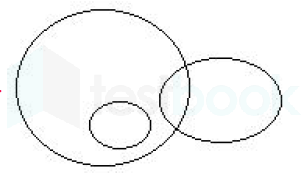
The least possible Venn diagram:

Conclusion:

A. Some wallets are notebooks. - True (Because, Some notebooks are laptops and All laptops are wallets. So, Some wallets are also notebooks)

B. Some laptops are wallets. - True (Because, All laptops are wallets. So, Some laptops are also wallets)

So, Both A and B are true.

Hence, the correct answer is "Both A and B".

Question 24

Which of the following states has the highest road density? 

  1. AOption (a)

    Kerala

  2. BOption (b)

    Karnataka

  3. COption (c)

    Uttar Pradesh 

  4. DOption (d)

    Madhya Pradesh 

View answer & explanation

Correct answer

Answer: (a)A.

Kerala

Why this answer is correct

The correct answer is Kerala.

Key Points

  • Kerala has the highest road density in India, which means it has the highest length of road per unit area of land.
  • The state of Kerala has a well-developed road network that significantly contributes to its high road density.
  • High road density in Kerala facilitates better connectivity and accessibility to remote areas, enhancing trade, travel, and overall development.
  • Kerala's topography and need for efficient transportation systems have driven the development of its extensive road network.

Additional Information

  • Road Density
  • Road density refers to the length of road per unit area of land. It is a key indicator of the accessibility and connectivity of a region's transportation network.
  • High road density indicates a well-developed infrastructure that supports economic activities by facilitating the movement of goods and people.
  • Urban areas typically have higher road densities compared to rural areas due to the concentration of population and economic activities.
  • Types of Roads in India
  • National Highways (NH): These are the main roads that connect major cities and regions across the country, managed by the National Highways Authority of India (NHAI).
  • State Highways (SH): These roads connect the different districts within a state and are managed by the state governments.
  • District Roads: These roads connect the different parts of a district and are maintained by the local district authorities.
  • Rural Roads: These roads connect rural and remote areas, often funded under schemes like the Pradhan Mantri Gram Sadak Yojana (PMGSY).
  • Impact of Road Infrastructure
  • Improved road infrastructure leads to enhanced trade and commerce by reducing transportation costs and time.
  • It provides better access to markets, healthcare, education, and other essential services, thus improving the quality of life.
  • Good road networks also boost tourism by providing better accessibility to tourist destinations.

Question 25

If the cost price of 19 books is equal to the selling price of 25 books, the percentage loss is :

  1. AOption (a)

    24%

  2. BOption (b)

    22%

  3. COption (c)

    27%

  4. DOption (d)

    25%

View answer & explanation

Correct answer

Answer: (a)A.

24%

Why this answer is correct

Given:

Cost price (CP) of 19 books = Selling price (SP) of 25 books

Formula Used:

Percentage Loss = ((CP - SP) / CP) × 100

Calculation:

Let the cost price of 1 book be C.

Then, CP of 19 books = 19C

Let the selling price of 1 book be S .

Then, SP of 25 books = 25S

According to the given condition:

19C = 25S

⇒ C/S = 25/19

⇒ S = 19C/25

Now, Percentage Loss = ((CP - SP) / CP) × 100

Percentage Loss = ((C - 19C/25) / C) × 100

Percentage Loss = ((25C - 19C) / 25C) × 100

Percentage Loss = (6C / 25C) × 100

Percentage Loss = (6 / 25) × 100

Percentage Loss = 24%

The percentage loss is 24%, which corresponds to option 1.

Question 26

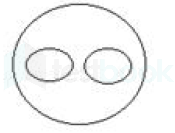
Select the Venn diagram that best represents the relationship between the following classes. 

Birds, Ostriches, Bats

  1. AOption (a)

  2. BOption (b)

  3. COption (c)

  4. DOption (d)

View answer & explanation

Correct answer

Answer: (c)C.

Why this answer is correct

Given: Birds, Ostriches, Bats

Birds is a broad category that includes many types of flying and non-flying birds.

Ostriches are a specific type of bird, so they are a subset of the "Birds" category.

Bats are not birds; they are mammals that can fly.

The best possible diagram: 

Hence, the correct answer is "Option 3".

Question 27

If x – y = 1, then the value of x3 – y3 – 3xy will be:

  1. AOption (a)

    0

  2. BOption (b)

    1

  3. COption (c)

    2

  4. DOption (d)

    –1

View answer & explanation

Correct answer

Answer: (b)B.

1

Why this answer is correct

Given:

x - y = 1

Formula used:

We know the identity:

x3 - y3 = (x - y)(x2 + y2 + xy)

Calculation:

Since x - y = 1,

x3 - y3 = x2 + y2 + xy ------ (i)

we need to find the value of x3 - y3 - 3xy.

From equation (i),

x3 - y3 - 3xy = (x2 + y2 + xy) - 3xy

⇒ x3 - y3 - 3xy = x2 + y2 + xy - 3xy

⇒ x3 - y3 - 3xy = x2 + y2 -2xy

⇒ x3 - y3 - 3xy = (x -  y)2

Substitute x - y = 1,

⇒ x3 - y3 - 3xy = 12 = 1

∴ The expression equals 1.

Question 28

A person invested 14\frac{1}{4} of his capital at 312%3\frac{1}{2}\% , 13\frac{1}{3} at 712%7\frac{1}{2}\% and the remaining at 8% simple interest. If the amount of the yearly simple interest is ₹2,576 then what is the amount of the capital?

  1. AOption (a)

    ₹39500

  2. BOption (b)

    ₹27600

  3. COption (c)

    ₹38400

  4. DOption (d)

    ₹36800

View answer & explanation

Correct answer

Answer: (c)C.

₹38400

Why this answer is correct

Given:

A person invested (1/4) of his capital at 3(1/2)%, (1/3) at 7(1/2)% and the remaining at 8% simple interest.

The amount of the yearly simple interest is ₹2,576.

Formula Used:

Simple Interest (SI) = (Principal × Rate × Time) / 100

Calculation:

Let the total capital be ₹C.

Investment in first part = (1/4)C at 3.5%

Investment in second part = (1/3)C at 7.5%

Remaining investment = C - (1/4)C - (1/3)C at 8%

Simplifying remaining investment:

Remaining investment = C - C/4 - C/3

Remaining investment = (12C - 3C - 4C) / 12

Remaining investment = 5C / 12

Yearly interest from first part = (C/4 × 3.5 × 1) / 100

Yearly interest from first part = 0.035C / 4

Yearly interest from first part = 0.00875C

Yearly interest from second part = (C/3 × 7.5 × 1) / 100

Yearly interest from second part = 0.075C / 3

Yearly interest from second part = 0.025C

Yearly interest from remaining part = (5C/12 × 8 × 1) / 100

Yearly interest from remaining part = 0.4C / 12

Yearly interest from remaining part = 0.0333C

Total yearly interest = 0.00875C + 0.025C + 0.0333C

Total yearly interest = 0.06705C

Given that total yearly interest is ₹2,576:

⇒ 0.06705C = 2576

⇒ C = 2576 / 0.06705

⇒ C ≈ 38400

The amount of the capital is ₹38,400.

Question 29

Select the number that can replace the question mark (?) in the following series. 

1, 3, 6, 11, 18, 29, 42, ?

  1. AOption (a)

    59

  2. BOption (b)

    55

  3. COption (c)

    57

  4. DOption (d)

    63

View answer & explanation

Correct answer

Answer: (a)A.

59

Why this answer is correct

The logic followed here is:

Hence, the correct answer is "59".

Question 30

The LCM of two prime numbers x and y (x > y) is 119.The value of 3y – x is:

  1. AOption (a)

    4

  2. BOption (b)

    6

  3. COption (c)

    8

  4. DOption (d)

    2

View answer & explanation

Correct answer

Answer: (a)A.

4

Why this answer is correct

Given:

The LCM of two prime numbers x and y (x > y) is 119.

Formula Used:

LCM of two prime numbers x and y = x × y

Calculation:

Since 119 is the LCM of two prime numbers, and 119 = 7 × 17, we have:

x = 17 (since x > y)

y = 7

We need to find the value of 3y - x.

3y - x = 3 × 7 - 17

⇒ 3y - x = 21 - 17

⇒ 3y - x = 4

The value of 3y - x is 4. The correct answer is option 1.

Question 31

Calculate the standard deviation for the following data. 

3, 4, 5, 6, 7

  1. AOption (a)

    2

  2. BOption (b)

    3\sqrt{3}

  3. COption (c)

    2\sqrt{2}

  4. DOption (d)

    6\sqrt{6}

View answer & explanation

Correct answer

Answer: (c)C.

2\sqrt{2}

Why this answer is correct

Given:

Data set: 3, 4, 5, 6, 7

Formula used:

Standard Deviation (SD) = √(Σ(x - mean)² / N)

Where,

Σ represents the sum of all values

x is each value in the dataset

mean is the average of the dataset

N is the total number of data points

Calculations:

Step 1: Calculate the mean

Mean = (3 + 4 + 5 + 6 + 7) / 5

Mean = 25 / 5

Mean = 5

Step 2: Calculate the squared differences from the mean

(3 - 5)² = (-2)² = 4

(4 - 5)² = (-1)² = 1

(5 - 5)² = (0)² = 0

(6 - 5)² = (1)² = 1

(7 - 5)² = (2)² = 4

Step 3: Sum of squared differences

Sum = 4 + 1 + 0 + 1 + 4 = 10

Step 4: Divide by the number of data points (N = 5)

Variance = 10 / 5 = 2

Step 5: Take the square root to get the standard deviation

SD = √2

Therefore, the standard deviation is 2.

Question 32

Which article of the Indian Constitution declares Hindi as the language of the Union? 

  1. AOption (a)

    Article 343(1)

  2. BOption (b)

    Article 29(2)

  3. COption (c)

    Article 29(1)

  4. DOption (d)

    Article 343(2)

View answer & explanation

Correct answer

Answer: (a)A.

Article 343(1)

Why this answer is correct

The correct answer is Article 343(1).

Key Points

  • Article 343(1) of the Indian Constitution declares that the official language of the Union shall be Hindi in Devanagari script.
  • The Constitution also allowed the use of English for official purposes for a period of 15 years from the commencement of the Constitution.
  • Article 343(1) was enacted to ensure a smooth transition from English to Hindi as the official language of the Union.
  • The provision was part of the broader objective to promote Hindi as a unifying language while respecting the linguistic diversity of India.

Additional Information

  • Article 29(2)
  • This article guarantees the right of citizens to conserve their distinct language, script, or culture.
  • It also ensures non-discrimination in admission to educational institutions maintained by the State or receiving aid out of State funds.
  • Article 29(1)
  • Article 29(1) provides protection to the interests of minorities by guaranteeing them the right to conserve their distinct language, script, or culture.
  • Article 343(2)
  • This article allows for the continued use of English for official purposes even after the 15-year period mentioned in Article 343(1), if Parliament by law provides for it.

Question 33

Generally in which month does the United Nations call its full General Assembly every year? 

  1. AOption (a)

    March

  2. BOption (b)

    January 

  3. COption (c)

    September 

  4. DOption (d)

    June 

View answer & explanation

Correct answer

Answer: (c)C.

September 

Why this answer is correct

The correct answer is September.

Key Points

  • The United Nations General Assembly (UNGA) holds its annual session starting in September.
  • This annual meeting is referred to as the "regular session" and typically begins on the third Tuesday of September.
  • The session continues for a year but the most intensive part of the session, known as the "general debate," takes place in September and October.
  • During the general debate, world leaders and representatives address the Assembly on a wide range of international issues.

Additional Information

  • United Nations General Assembly (UNGA)
  • The UNGA is one of the six principal organs of the United Nations and the only one in which all member nations have equal representation.
  • It serves as a forum for member states to deliberate and cooperate on international issues covered by the UN Charter.
  • The UNGA addresses issues related to international peace and security, budgetary matters, and international law.
  • Resolutions passed by the UNGA are non-binding but carry significant political weight and moral authority.
  • General Debate
  • The general debate is a high-level event where heads of state and government, along with other senior officials, present their views on pressing global issues.
  • It provides a unique platform for world leaders to address the international community.
  • Speeches delivered during the general debate often outline the foreign policies and international priorities of the participating countries.
  • The general debate usually lasts for about nine days.
  • UNGA Sessions
  • In addition to the regular session, special sessions and emergency special sessions can be convened.
  • Special sessions are called to address specific issues requiring immediate attention, while emergency special sessions are convened in cases of international crisis.
  • The sessions are held at the UN Headquarters in New York City.
  • Each member state has one vote, and decisions on important questions require a two-thirds majority.

Question 34

Where is the office of the Governor of the Reserve Bank of India? 

  1. AOption (a)

    Noida

  2. BOption (b)

    Mumbai 

  3. COption (c)

    Kolkata 

  4. DOption (d)

    Delhi 

View answer & explanation

Correct answer

Answer: (b)B.

Mumbai 

Why this answer is correct

The correct answer is Mumbai.

Key Points

  • The Reserve Bank of India (RBI) is the central bank of India, and its headquarters is located in Mumbai.
  • The RBI was established on April 1, 1935, in accordance with the Reserve Bank of India Act, 1934.
  • Mumbai, being the financial capital of India, houses the offices of many significant financial institutions, including the RBI.
  • The Governor of the Reserve Bank of India operates from the RBI headquarters in Mumbai, managing the central bank's operations and policies.

Additional Information

  • Reserve Bank of India (RBI)
  • The Reserve Bank of India is India's central banking institution, which controls the issuance and supply of the Indian rupee.
  • The RBI plays a crucial role in the development strategy of the Government of India, supervising the monetary policy and maintaining financial stability.
  • The main functions of the RBI include regulating the issue of banknotes, maintaining reserves to secure monetary stability, and operating the credit and currency system in the best interest of the country.
  • The RBI also acts as the regulator and supervisor of the financial system, ensuring the stability and soundness of the financial institutions in India.
  • Governor of the Reserve Bank of India
  • The Governor of the Reserve Bank of India is the chief executive of India's central bank and the ex-officio chairperson of its Central Board of Directors.
  • The Governor is responsible for overseeing the central bank's functions, including monetary policy, financial supervision, and currency issuance.
  • The position of Governor is highly influential and plays a key role in shaping India's economic policy and financial regulatory framework.
  • Appointments to the position of Governor are made by the Government of India, and the term typically lasts for three years, with the possibility of extension.
  • Financial Capital of India - Mumbai
  • Mumbai is recognized as the financial capital of India due to its significant contribution to the country's economy.
  • The city is home to major financial institutions, including the Bombay Stock Exchange (BSE), National Stock Exchange (NSE), and several major banks and insurance companies.
  • Mumbai's status as the financial hub attracts a large number of businesses, investors, and financial professionals, contributing to its economic dynamism.
  • The presence of the Reserve Bank of India and other financial regulatory bodies in Mumbai reinforces its position as the epicenter of India's financial activities.

Question 35

Which railway station is a part of UNESCO's world heritage sites? 

  1. AOption (a)

    Lokmanya Tilak Terminus

  2. BOption (b)

    Anand Vihar Terminus 

  3. COption (c)

    Kolkata Terminus 

  4. DOption (d)

    Chhatrapati Shivaji Maharaj Terminus 

View answer & explanation

Correct answer

Answer: (d)D.

Chhatrapati Shivaji Maharaj Terminus 

Why this answer is correct

The correct answer is Chhatrapati Shivaji Maharaj Terminus.

Key Points

  • Chhatrapati Shivaji Maharaj Terminus (CSMT) is one of the most iconic landmarks in Mumbai, India.
  • It is a historic railway station and a fine example of Victorian Gothic Revival architecture in India.
  • CSMT was designated as a UNESCO World Heritage Site in 2004 due to its outstanding universal value.
  • The station was originally named Victoria Terminus in honor of Queen Victoria but was renamed in 1996 to its present name.

Additional Information

  • UNESCO World Heritage Sites:
  • The United Nations Educational, Scientific and Cultural Organization (UNESCO) designates certain places on Earth as World Heritage Sites.
  • These sites are selected based on their cultural, historical, scientific, or other forms of significance.
  • Being listed as a World Heritage Site signifies the international recognition of the site's value and the commitment to its preservation.
  • Victorian Gothic Revival Architecture:
  • This architectural style was prominent in the mid to late 19th century.
  • It is characterized by features such as pointed arches, ribbed vaults, and flying buttresses.
  • Buildings in this style often have intricate details and ornamentation, which are evident in CSMT's design.
  • Historical Significance of CSMT:
  • CSMT serves as the headquarters of the Central Railways in India.
  • It was designed by British architect Frederick William Stevens and took over 10 years to complete.
  • The station remains one of the busiest in India, serving millions of passengers each day.

Question 36

If each side of a rectangle is increased by 25%, then its area will increase by:

  1. AOption (a)

    5614%56\frac{1}{4}\%

  2. BOption (b)

    5414%54\frac{1}{4}\%

  3. COption (c)

    6014%60\frac{1}{4}\%

  4. DOption (d)

    5514%55\frac{1}{4}\%

View answer & explanation

Correct answer

Answer: (a)A.

5614%56\frac{1}{4}\%

Why this answer is correct

Given:

Each side of the rectangle is increased by 25%.

Formula Used:

New length = Original length × 1.25

New width = Original width × 1.25

New Area = New length × New width

Percentage increase in area = New Area−Original AreaOriginal Area×100%\frac{{\text{{New Area}} - \text{{Original Area}}}}{{\text{{Original Area}}}} \times 100\%

Calculation:

Let the original length = L

Let the original width = W

Original area = L × W

New length = L × 1.25

New width = W × 1.25

New area = (L × 1.25) × (W × 1.25)

New area = L × W × 1.252

New area = L × W × 1.5625

Percentage increase in area = New Area−Original AreaOriginal Area×100%\frac{{\text{{New Area}} - \text{{Original Area}}}}{{\text{{Original Area}}}} \times 100\%

Percentage increase in area = L×W×1.5625−L×WL×W×100%\frac{{L \times W \times 1.5625 - L \times W}}{{L \times W}} \times 100\%

Percentage increase in area = 1.5625−11×100%\frac{{1.5625 - 1}}{{1}} \times 100\%

Percentage increase in area = 0.5625 × 100%

Percentage increase in area = 56.25%

The correct answer is option 1: 561/4%.

Question 37

How was the cell discovered by Robert Hook? 

  1. AOption (a)

    By observing blood 

  2. BOption (b)

    By observing an onion peel

  3. COption (c)

    By observing tree leaves 

  4. DOption (d)

    By observing cork

View answer & explanation

Correct answer

Answer: (d)D.

By observing cork

Why this answer is correct

The correct answer is By observing cork.

Key Points

  • Robert Hooke discovered the cell in 1665 when he was examining a thin slice of cork under his microscope.
  • He observed small, box-like structures which he termed as "cells" because they reminded him of the small rooms in a monastery.
  • The cork cells observed by Hooke were actually dead plant cells.
  • His discovery marked the beginning of cell theory, a fundamental concept in biology that states that all living organisms are composed of cells.

Additional Information

  • Microscope
  • A microscope is an instrument used to see objects that are too small to be seen by the naked eye.
  • Robert Hooke used a compound microscope, which has two sets of lenses for magnification.
  • Microscopes are essential tools in biology for studying cells and microorganisms.
  • Cell Theory
  • Cell theory is a fundamental principle in biology that states that all living organisms are composed of cells.
  • It was developed in the 19th century by scientists like Matthias Schleiden, Theodor Schwann, and Rudolf Virchow.
  • The theory has three main points: all living things are made of cells, the cell is the basic unit of life, and all cells come from pre-existing cells.
  • Cork
  • Cork is a natural material obtained from the bark of cork oak trees.
  • It is composed of dead cells that form a protective layer for the tree.
  • Cork is lightweight, buoyant, and impermeable, making it useful for various applications, including wine bottle stoppers.

Question 38

Select the option in which the numbers share the same relationship as that shared by the given group of numbers .

(15, 7, 110)

  1. AOption (a)

    (21, 4, 90)

  2. BOption (b)

    (44, 2, 95)

  3. COption (c)

    (17, 2, 44)

  4. DOption (d)

    (18, 5, 95)

View answer & explanation

Correct answer

Answer: (d)D.

(18, 5, 95)

Why this answer is correct

The logic followed here is: (1st number × 2nd number) + 5 = 3rd number.

Given: (15, 7, 110) → (15 × 7) + 5 = 105 + 5 = 110

Let's check option one by one:

Option 1) (21, 4, 90) → (21 × 4) + 5 = 84 + 5 = 89 ≠ 90

Option 2) (44, 2, 95) → (44 × 2) + 5 = 88 + 5 = 93 ≠ 95

Option 3) (17, 2, 44) → (17 × 2) + 5 = 34 + 5 = 39 ≠ 44

Option 4) (18, 5, 95) → (18 × 5) + 5 = 90 + 5 = 95.

Hence, the correct answer is "(18, 5, 95).

Question 39

If 2.5x = 0.05y, then y−xy+x\frac{{y - x}}{{y + x}} = ?

  1. AOption (a)

    1951\frac{{19}}{{51}}

  2. BOption (b)

    4951\frac{{49}}{{51}}

  3. COption (c)

    1950\frac{{19}}{{50}}

  4. DOption (d)

    4950\frac{{49}}{{50}}

View answer & explanation

Correct answer

Answer: (b)B.

4951\frac{{49}}{{51}}

Why this answer is correct

Given:

If 2.5x = 0.05y

Calculation:

Given: 2.5x = 0.05y

⇒ 2.5x/0.05 = y

⇒ y = 50x

Now, we need to find y−xy+x\frac{{y - x}}{{y + x}}

⇒ 50x−x50x+x\frac{{50x - x}}{{50x + x}}

⇒ 49x51x\frac{{49x}}{{51x}}

⇒ 4951\frac{{49}}{{51}}

The correct answer is option 2.

Question 40

The greatest number of four digits which is divisible by 18, 25, 45 and 55 is:

  1. AOption (a)

    9500

  2. BOption (b)

    9950

  3. COption (c)

    9900

  4. DOption (d)

    9940

View answer & explanation

Correct answer

Answer: (c)C.

9900

Why this answer is correct

Given:

We need to find the greatest number of four digits which is divisible by 18, 25, 45, and 55.

Formula Used:

To find the greatest number of four digits divisible by given numbers, we first need to find their Least Common Multiple (LCM).

Calculation:

Prime factorization:

18 = 2 × 32

25 = 52

45 = 32 × 5

55 = 5 × 11

LCM = 2 × 32 × 52 × 11

⇒ LCM = 2 × 9 × 25 × 11

⇒ LCM = 2 × 9 × 275

⇒ LCM = 2 × 2475

⇒ LCM = 4950

The largest four-digit number is 9999. To find the greatest number of four digits divisible by 4950, we divide 9999 by 4950 and find the quotient.

Quotient = 9999 / 4950

⇒ Quotient ≈ 2

Therefore, the greatest number of four digits which is divisible by 4950 is 4950 × 2 = 9900.

The correct answer is option 3, 9900.

Question 41

Which two signs need to be interchanged to make the following equation correct? 

24 + 3 × 4 – 30 ÷ 10 = 12

  1. AOption (a)

    ÷ and ×

  2. BOption (b)

    ÷ and –

  3. COption (c)
    • and ÷
  4. DOption (d)
    • and –
View answer & explanation

Correct answer

Answer: (c)C.
  • and ÷

Why this answer is correct

Given:

Equation: 24 + 3 × 4 – 30 ÷ 10 = 12

Formula Used:

Interchange signs to balance the equation.

Calculation:

Original equation: 24 + 3 × 4 – 30 ÷ 10

Interchange + and ÷:

Equation after interchange: 24 ÷ 3 × 4 – 30 + 10

Step-by-step:

⇒ 24 ÷ 3 × 4 – 30 + 10

⇒ 8 × 4 – 30 + 10

⇒ 32 – 30 + 10

⇒ 2 + 10

⇒ 12

The equation is balanced with the interchange of + and ÷.

Question 42

What do we call the process of contraction of the cell away from the cell wall due to water loss? 

  1. AOption (a)

    DE plasmolysis

  2. BOption (b)

    Plasmolysis

  3. COption (c)

    Photosynthesis 

  4. DOption (d)

    Cytolysis

View answer & explanation

Correct answer

Answer: (b)B.

Plasmolysis

Why this answer is correct

The correct answer is Plasmolysis.

Key Points

  • Plasmolysis is the process in plant cells where the cell membrane pulls away from the cell wall due to the loss of water through osmosis.
  • This occurs when the cell is placed in a hypertonic solution, causing water to move out of the cell and resulting in the shrinking of the cell membrane.
  • It is a reversible process if the cell is placed back into a hypotonic solution where water can re-enter the cell.
  • Plasmolysis is often used to demonstrate the principles of osmosis in laboratory settings.

Additional Information

  • DE Plasmolysis:
  • DE plasmolysis is not a correct term in biological context.
  • It might be a typographical error or confusion with the term "deplasmolysis," which is the reverse process of plasmolysis.
  • Photosynthesis:
  • Photosynthesis is the process by which green plants, algae, and some bacteria use sunlight to synthesize nutrients from carbon dioxide and water.
  • It produces oxygen as a byproduct and is vital for the survival of most life forms on earth.
  • Cytolysis:
  • Cytolysis is the bursting or rupturing of a cell membrane when the cell takes in excessive water in a hypotonic environment.
  • This leads to the cell swelling and eventually bursting due to the lack of a rigid cell wall in animal cells.

Question 43

The value of 1−x41+x÷1+x2x×1x(x−1)\frac{{1 - {x^4}}}{{1 + x}} \div \frac{{1 + {x^2}}}{x} \times \frac{1}{{x\left( {x - 1} \right)}} is:

(if x is not equal to 0, –1, 1)

  1. AOption (a)

    1

  2. BOption (b)

    –1

  3. COption (c)

    2

  4. DOption (d)

    0

View answer & explanation

Correct answer

Answer: (b)B.

–1

Why this answer is correct

Given:

1−x41+x÷1+x2x×1x(x−1)\frac{{1 - {x^4}}}{{1 + x}} \div \frac{{1 + {x^2}}}{x} \times \frac{1}{{x\left( {x - 1} \right)}}

where x ≠  0, -1, 1

Formula Used:

To solve the given expression, we will use algebraic simplification and factoring techniques.

Calculation:

First, we simplify 1−x41+x\frac{{1 - x^4}}{{1 + x}}

1−x4=(1−x2)(1+x2)1 - x^4 = (1 - x^2)(1 + x^2)

1−x2=(1−x)(1+x)1 - x^2 = (1 - x)(1 + x)

So, 1−x41+x=(1−x)(1+x)(1+x2)1+x\frac{{1 - x^4}}{{1 + x}} = \frac{{(1 - x)(1 + x)(1 + x^2)}}{{1 + x}}

Since 1 + x ≠ 0 , we can cancel 1 + x in the numerator and denominator:

(1−x)(1+x2)1+x=(1−x)(1+x2)\frac{{(1 - x)(1 + x^2)}}{{1 + x}} = (1 - x)(1 + x^2)

Now we consider the entire expression:

(1−x)(1+x2)1+x÷1+x2x×1x(x−1)\frac{{(1 - x)(1 + x^2)}}{{1 + x}} \div \frac{{1 + x^2}}{x} \times \frac{1}{{x(x - 1)}}

⇒ (1−x)(1+x2)×x1+x2×1x(x−1)(1 - x)(1 + x^2) \times \frac{x}{{1 + x^2}} \times \frac{1}{{x(x - 1)}}

Cancel (1+x2)(1 + x^2) in the numerator and denominator:

⇒ (1−x)×x×1x(x−1)(1 - x) \times x \times \frac{1}{{x(x - 1)}}

Cancel x and 1 - x in the numerator and denominator:

⇒ (1−x)×x×1x(x−1)=−1(1 - x)\times x \times \frac{1}{{x(x - 1)}} = -1

The correct answer is -1.

Question 44

How many children have been awarded the Pradhan Mantri Rashtriya Bal Pursakar 2021?

  1. AOption (a)

    30

  2. BOption (b)

    34

  3. COption (c)

    32

  4. DOption (d)

    36

View answer & explanation

Correct answer

Answer: (c)C.

32

Why this answer is correct

The correct answer is 32.

Key Points

  • In 2021, a total of 32 children were awarded the Pradhan Mantri Rashtriya Bal Puraskar.
  • The awards are given in various categories such as innovation, social service, scholastic, sports, art & culture, and bravery.
  • This award recognizes the exceptional achievements of children in different fields and aims to inspire other children to strive for excellence.
  • The awardees receive a medal, a cash prize of ₹1,00,000, and a certificate.

Additional Information

  • Pradhan Mantri Rashtriya Bal Puraskar
  • The Pradhan Mantri Rashtriya Bal Puraskar is the highest civilian honor in India for individuals under the age of 18.
  • It was instituted by the Ministry of Women and Child Development, Government of India.
  • The awards are categorized into two main categories: Bal Shakti Puraskar and Bal Kalyan Puraskar.
  • The Bal Shakti Puraskar is awarded to children for their exceptional achievements in various fields, while the Bal Kalyan Puraskar is awarded to individuals and institutions who have contributed to the welfare and development of children.

Question 45

In which year did India join the Shanghai Cooperation Organisation? 

  1. AOption (a)

    2017

  2. BOption (b)

    2005

  3. COption (c)

    2001

  4. DOption (d)

    2019

View answer & explanation

Correct answer

Answer: (a)A.

2017

Why this answer is correct

The correct answer is 2017.

Key Points

  • India became a full member of the Shanghai Cooperation Organisation (SCO) on June 9, 2017.
  • The membership was granted during the Astana Summit held in Kazakhstan.
  • India, along with Pakistan, became the first nations to be inducted into the SCO, which was previously a group of six countries.
  • India's membership in the SCO was aimed at enhancing its strategic, economic, and security cooperation with the member countries.

Additional Information

  • Shanghai Cooperation Organisation (SCO)
  • The SCO is a Eurasian political, economic, and security alliance, which was founded in 2001 in Shanghai by the leaders of China, Kazakhstan, Kyrgyzstan, Russia, Tajikistan, and Uzbekistan.
  • The main objectives of the SCO are to strengthen mutual trust and neighborliness among the member states, promote effective cooperation in politics, trade, economy, research, technology, and culture, and work together to maintain and ensure peace, security, and stability in the region.
  • Originally, it was called the "Shanghai Five" when it was formed in 1996, and it was renamed the SCO after Uzbekistan joined the organization in 2001.
  • In addition to India and Pakistan, other observer states include Afghanistan, Belarus, Iran, and Mongolia, with several other countries having dialogue partner status.
  • Astana Summit
  • The Astana Summit refers to the SCO summit held in June 2017 in Astana, Kazakhstan.
  • This summit was significant as it marked the expansion of the SCO with the inclusion of India and Pakistan as full members.
  • The summit focused on discussions about regional security, economic cooperation, and cultural exchange among member states.
  • Strategic Importance of SCO Membership for India
  • Membership in the SCO provides India with a platform to engage with Central Asian countries, enhancing its strategic influence in the region.
  • It allows India to participate in joint military exercises, contributing to regional security and counter-terrorism efforts.
  • Economic cooperation within the SCO framework can lead to increased trade and investment opportunities for India in the Eurasian region.
  • Being part of the SCO aligns with India's "Connect Central Asia" policy, aimed at strengthening ties with Central Asian countries.

Question 46

Which software is more useful for presentation in a classroom? 

  1. AOption (a)

    Microsoft Word 

  2. BOption (b)

    Microsoft Excel 

  3. COption (c)

    Microsoft Access 

  4. DOption (d)

    Microsoft Power Point 

View answer & explanation

Correct answer

Answer: (d)D.

Microsoft Power Point 

Why this answer is correct

The correct answer is Microsoft PowerPoint.

Key Points

  • Microsoft PowerPoint is specifically designed for creating presentations.
  • It offers a variety of templates and design tools to help users create professional-looking slides.
  • PowerPoint allows for the easy integration of multimedia elements such as images, videos, and animations.
  • It supports the creation of dynamic and interactive presentations that can engage the audience effectively.

Additional Information

  • Microsoft Word
  • Primarily used for word processing and creating documents.
  • Features include text formatting, spell check, grammar check, and the ability to insert tables and images.
  • Not ideal for presentations as it lacks the interactive and multimedia features of PowerPoint.
  • Microsoft Excel
  • Used for data analysis and management.
  • Features include complex calculations, graphing tools, pivot tables, and a macro programming language called VBA.
  • Excel is excellent for handling numerical data but not suitable for creating presentations.
  • Microsoft Access
  • A database management tool that helps in storing and managing large amounts of data.
  • Features include creating tables, queries, forms, and reports.
  • Not designed for presentation purposes.

Question 47

Which institute is known as the mother of institutions involved in research on nuclear and accelerator technology? 

  1. AOption (a)

    Variable Energy Cyclotron Centre

  2. BOption (b)

    Indira Gandhi Centre for Atomic Research 

  3. COption (c)

    Raja Ramanna Centre for Advanced Technology 

  4. DOption (d)

    Bhabha Atomic Research Centre

View answer & explanation

Correct answer

Answer: (d)D.

Bhabha Atomic Research Centre

Why this answer is correct

The correct answer is Bhabha Atomic Research Centre.

Key Points

  • The Bhabha Atomic Research Centre (BARC) is the premier nuclear research facility of India, headquartered in Trombay, Mumbai.
  • It was established in 1954 by Dr. Homi Jehangir Bhabha and is named after him.
  • BARC is involved in advanced research in nuclear science, engineering, and related areas, including the development of nuclear reactors and fuel cycle technologies.
  • The institute plays a crucial role in India's nuclear power generation and research programs.

Additional Information

  • Variable Energy Cyclotron Centre (VECC)
  • VECC is a research and development unit of the Department of Atomic Energy located in Kolkata, India.
  • It focuses on the study of nuclear physics, particle physics, and accelerator science.
  • VECC houses the K-130 cyclotron, a major facility for accelerator-based research.
  • Indira Gandhi Centre for Atomic Research (IGCAR)
  • IGCAR is a premier research institute dedicated to the development of fast reactor technologies.
  • It is located at Kalpakkam, Tamil Nadu, and was established in 1971.
  • IGCAR plays a significant role in India's nuclear power program, particularly in the Fast Breeder Reactor (FBR) technology.
  • Raja Ramanna Centre for Advanced Technology (RRCAT)
  • RRCAT, located in Indore, Madhya Pradesh, is a unit of the Department of Atomic Energy.
  • The center specializes in the development of particle accelerators, lasers, and related technologies.
  • RRCAT was established in 1984 and named after Dr. Raja Ramanna, a prominent Indian physicist.

Question 48

Who is the author of the famous Kannada play ‘Tughlaq’ which is also staged in other Indian languages? 

  1. AOption (a)

    Shiv K Kumar

  2. BOption (b)

    Masti Venkatesha Iyengar

  3. COption (c)

    Girish Karnad

  4. DOption (d)

    Chandrashekhara Kambara

View answer & explanation

Correct answer

Answer: (c)C.

Girish Karnad

Why this answer is correct

The correct answer is Girish Karnad.

Key Points

  • Girish Karnad was an Indian actor, film director, Kannada writer, playwright, and a Rhodes Scholar.
  • He wrote the play 'Tughlaq' in 1964, which was a critical and commercial success.
  • The play is based on the life of Muhammad bin Tughlaq, a 14th-century Sultan of Delhi.
  • 'Tughlaq' has been translated into several Indian languages and is considered one of the best works in Indian theatre.

Additional Information

  • Girish Karnad:
  • Born on May 19, 1938, in Matheran, Maharashtra, Girish Karnad was a renowned figure in Indian theatre and cinema.
  • He was awarded the Jnanpith Award, India's highest literary honor, in 1998 for his contributions to literature.
  • Karnad's works often explore contemporary issues through historical and mythological themes.
  • In addition to 'Tughlaq', some of his other notable plays include 'Yayati', 'Hayavadana', and 'Nagamandala'.
  • Muhammad bin Tughlaq:
  • Muhammad bin Tughlaq was the Sultan of Delhi from 1325 to 1351.
  • He is known for his ambitious and often controversial policies, including the transfer of the capital from Delhi to Daulatabad and the introduction of token currency.
  • His reign was marked by both innovative ideas and harsh measures, which have been subjects of extensive historical debate.
  • Girish Karnad's play 'Tughlaq' delves into the complexities of Tughlaq's character and his tumultuous rule.
  • Kannada Literature:
  • Kannada literature has a rich history dating back over a thousand years.
  • It includes works of poetry, fiction, drama, and philosophical writings by various renowned authors and poets.
  • Some of the notable figures in Kannada literature include Kuvempu, Masti Venkatesha Iyengar, and Chandrashekhara Kambara.
  • Kannada literature has made significant contributions to Indian culture and continues to be a vibrant and evolving field.

Question 49

Arrange the following events during India's freedom struggle, chronologically :

I. The Salt March

II. Jallianwala Bagh Massacre

III. Quit India Movement 

IV. Non Cooperation Movement

  1. AOption (a)

    IV, I, II, III

  2. BOption (b)

    II, IV, I, III

  3. COption (c)

    III, IV, II, I

  4. DOption (d)

    I, II, III, IV

View answer & explanation

Correct answer

Answer: (b)B.

II, IV, I, III

Why this answer is correct

The correct answer is Option 2.

Key Points

  • Jallianwala Bagh Massacre occurred on April 13, 1919, where British troops under General Dyer fired upon a peaceful gathering, resulting in a significant number of deaths and injuries.
  • Non Cooperation Movement was launched by Mahatma Gandhi in 1920 as a non-violent protest against British rule, urging Indians to boycott British goods and institutions.
  • The Salt March, also known as the Dandi March, was initiated by Gandhi on March 12, 1930, as a non-violent protest against the British salt tax, covering a distance of 240 miles from Sabarmati Ashram to Dandi.
  • Quit India Movement was launched by Mahatma Gandhi on August 8, 1942, calling for an end to British rule in India with the slogan "Do or Die".

Question 50

Which of the following British policies triggered people to assemble at Jallianwala Bagh, Amritsar? 

  1. AOption (a)

    Government of India Act

  2. BOption (b)

    Rowlatt Act

  3. COption (c)

    Simon Commission 

  4. DOption (d)

    The Pitts India Act

View answer & explanation

Correct answer

Answer: (b)B.

Rowlatt Act

Why this answer is correct

The correct answer is Rowlatt Act.

Key Points

  • The Rowlatt Act, also known as the Anarchical and Revolutionary Crimes Act of 1919, was passed by the British government in India in March 1919.
  • The act gave the British authorities the power to imprison any person suspected of terrorism living in British India without trial for up to two years.
  • The act also allowed the British government to stop the press from reporting and to arrest individuals suspected of sedition without a warrant.
  • The widespread anger against the Rowlatt Act led to a series of protests and gatherings, which culminated in the tragic Jallianwala Bagh massacre.

Additional Information

  • Government of India Act 1919
  • This act introduced a dual mode of administration, called dyarchy, in the provinces of British India.
  • It was part of the Montagu-Chelmsford reforms and aimed to increase the participation of Indians in the government.
  • The act divided the subjects of administration into two categories: transferred and reserved subjects.
  • While transferred subjects were to be administered by ministers accountable to the Legislative Council, reserved subjects were to be administered by the Governor and his executive council.
  • Simon Commission
  • The Simon Commission, formally known as the Indian Statutory Commission, was a group of seven British Members of Parliament under the chairmanship of Sir John Simon.
  • It arrived in India in 1928 to study constitutional reform and make recommendations.
  • However, the commission faced a widespread boycott because it did not include any Indian members.
  • The commission's arrival led to protests and further fueled the demand for self-rule in India.
  • The Pitts India Act 1784
  • This act was passed to address the shortcomings of the Regulating Act of 1773.
  • It established the dual control of the British government and the East India Company over India.
  • The act set up a Board of Control in Britain to oversee the civil, military, and revenue affairs of the company.
  • This act is significant as it marked the beginning of British parliamentary control over the East India Company’s activities in India.

Question 51

At which place has India established CIRUS reactor? 

  1. AOption (a)

    Jadugoda, Jharkhand

  2. BOption (b)

    Indore, Madhya Pradesh 

  3. COption (c)

    Kalpakkam, Tamil Nadu

  4. DOption (d)

    Trombay, Mumbai

View answer & explanation

Correct answer

Answer: (d)D.

Trombay, Mumbai

Why this answer is correct

The correct answer is Trombay, Mumbai.

Key Points

  • The CIRUS reactor was commissioned at the Bhabha Atomic Research Centre (BARC) in Trombay, Mumbai.
  • It was a 40 MW research reactor used for the production of plutonium.
  • The reactor was supplied by Canada and was heavy water moderated but used natural uranium fuel.
  • CIRUS stands for "Canada-India Reactor, U.S." because the heavy water was supplied by the United States.

Additional Information

  • Bhabha Atomic Research Centre (BARC)
  • BARC is India's premier nuclear research facility headquartered in Trombay, Mumbai.
  • It was established in 1954 by Dr. Homi Jehangir Bhabha.
  • BARC is involved in advanced research and development covering the entire spectrum of nuclear science, engineering, and related areas.
  • Plutonium Production
  • Plutonium is a key element used in nuclear reactors and nuclear weapons.
  • It is produced in reactors by irradiating uranium-238 with neutrons.
  • The CIRUS reactor was one of the main sources of plutonium for India's nuclear weapons program.
  • Heavy Water
  • Heavy water (D2O) is used as a neutron moderator in certain types of nuclear reactors.
  • It slows down neutrons, making them more likely to induce fission in uranium-235 or plutonium-239.
  • Heavy water reactors can use natural uranium as fuel, which is an advantage in countries with limited access to enriched uranium.
  • Natural Uranium
  • Natural uranium consists mostly of uranium-238 with about 0.7% uranium-235.
  • It can be used as fuel in reactors with heavy water or graphite moderators.
  • Natural uranium reactors do not require enrichment facilities, which simplifies the fuel supply chain.

Question 52

Find the remainder when 119 + 7 is divided by 10.

  1. AOption (a)

    9

  2. BOption (b)

    7

  3. COption (c)

    1

  4. DOption (d)

    8

View answer & explanation

Correct answer

Answer: (d)D.

8

Why this answer is correct

Given:

Expression: 119 + 7

Formula used:

We need to find the remainder when 119 + 7 is divided by 10.

Calculations:

Step 1: Find the remainder of 119 when divided by 10.

Since the unit digit of 11 is 1, the unit digit of 119 will also be 1.

Remainder of 119/10 = 1

Step 2: Add 7 to this value

1 + 7 = 8

Step 3: Find the remainder when 8 is divided by 10

Remainder of 8/10 = 8

∴ The remainder is 8.

Question 53

Two concentric circles drawn with the radius of inner circle 6 cm and outer circle radius 50% more than inner circle. What is the area of the annulus formed between two circles? 

  1. AOption (a)

    990 cm2

  2. BOption (b)

    9007\frac{{900}}{7}cm2

  3. COption (c)

    9907\frac{{990}}{7} cm2

  4. DOption (d)

    8907\frac{{890}}{7} cm2

View answer & explanation

Correct answer

Answer: (c)C.

9907\frac{{990}}{7} cm2

Why this answer is correct

Given:

Radius of inner circle = 6 cm.

Radius of outer circle = 50% more than the inner circle = 6 + 0.5 × 6 = 9 cm.

Formula Used:

Area of a circle = πr2

Area of annulus = Area of outer circle - Area of inner circle

Calculation:

Area of inner circle = π × 62 = 36π cm2

Area of outer circle = π × 92 = 81π cm2

Area of annulus = 81π - 36π

⇒ Area of annulus = 45π

⇒ Area of annulus = 45 × 227\frac{22}{7}

⇒ Area of annulus = 9907\frac{990}{7} cm2

The area of the annulus formed between two circles is 9907\frac{{990}}{7} cm2.

Question 54

2 men and 3 women can earn ₹49 in 7 days. 3 men and 6 women can earn ₹96 in 8 days. In what time 1 man and 1 woman earn ₹27?

  1. AOption (a)

    10 days

  2. BOption (b)

    9 days

  3. COption (c)

    8 days

  4. DOption (d)

    7 days

View answer & explanation

Correct answer

Answer: (b)B.

9 days

Why this answer is correct

Given:

2 men and 3 women earn ₹49 in 7 days

3 men and 6 women earn ₹96 in 8 days

Calculations:

Let the daily earnings of 1 man be ₹M and that of 1 woman be ₹W.

The equation for the earnings can be written as:

2 men + 3 women in 7 days earn ₹49

⇒ 7 × (2M + 3W) = 49

⇒ 2M + 3W = 7   ...... (i)

Similarly, 3 men + 6 women in 8 days earn ₹96

⇒ 8 × (3M + 6W) = 96

⇒ 3M + 6W = 12   ...... (ii)

Step 1: Solve the two equations to find M and W

Multiply equation (i) by 2:

4M + 6W = 14   ...... (iii)

Subtract equation (ii) from equation (iii):

(4M + 6W) - (3M + 6W) = 14 - 12

M = 2

Substitute M = 2 in equation (i):

2 × 2 + 3W = 7

4 + 3W = 7

3W = 3

W = 1

Step 2: Now find the time taken by 1 man and 1 woman to earn ₹27

Daily earnings of 1 man and 1 woman = M + W = 2 + 1 = ₹3

Time taken = ₹27 ÷ ₹3 = 9 days

Therefore, 1 man and 1 woman will earn ₹27 in 9 days.

Question 55

Who was the author of the Sanskrit epic Mahabharata ?

  1. AOption (a)

    Shree Sukhdevji

  2. BOption (b)

    Shree Krishna 

  3. COption (c)

    Maharishi Veda Vyasa

  4. DOption (d)

    Maharishi Valmiki

View answer & explanation

Correct answer

Answer: (c)C.

Maharishi Veda Vyasa

Why this answer is correct

The correct answer is Maharishi Veda Vyasa.

Key Points

  • Maharishi Veda Vyasa is traditionally credited as the author of the Mahabharata, one of the two major Sanskrit epics of ancient India.
  • He is also known as Krishna Dvaipayana Vyasa because of his dark complexion and his birthplace on an island.
  • Veda Vyasa is considered a central and revered figure in most Hindu traditions, and he is also regarded as a partial incarnation of the god Vishnu.
  • Besides the Mahabharata, he is also credited with compiling the Vedas and writing the Puranas.

Additional Information

  • Mahabharata
  • The Mahabharata is one of the largest epic tales ever written, consisting of approximately 100,000 shlokas or over 200,000 individual verse lines.
  • It narrates the Kurukshetra War between the Kauravas and the Pandavas and encompasses various philosophical and devotional material, including a discussion of the four "goals of life" (purusharthas).
  • One of the most significant parts of the Mahabharata is the Bhagavad Gita, a 700-verse Hindu scripture that is part of the Indian epic Mahabharata.
  • The Mahabharata has had a profound influence on Indian culture and spirituality and continues to be a crucial source of moral and ethical guidance.
  • Vedas
  • The Vedas are a large body of religious texts originating in ancient India. They constitute the oldest layer of Sanskrit literature and the oldest scriptures of Hinduism.
  • There are four Vedas: Rigveda, Samaveda, Yajurveda, and Atharvaveda.
  • Veda Vyasa is traditionally credited with compiling the Vedas, ensuring their preservation and propagation.
  • Puranas
  • The Puranas are ancient Hindu texts eulogizing various deities, primarily the divine Trimurti God in Hinduism through divine stories.
  • Veda Vyasa is also attributed with writing the Puranas, which include the famous Vishnu Purana, Bhagavata Purana, and others.
  • The Puranas cover topics such as cosmogony, cosmology, genealogies of gods, heroes, and sages, folk tales, pilgrimages, temples, medicine, astronomy, grammar, and ritual.

Question 56

The HCF of 156, 455 and 1183 is:

  1. AOption (a)

    7

  2. BOption (b)

    3

  3. COption (c)

    17

  4. DOption (d)

    13

View answer & explanation

Correct answer

Answer: (d)D.

13

Why this answer is correct

Given:

Three numbers: 156, 455, and 1183.

Formula used:

The HCF of two or more numbers is the largest number that divides all of them exactly.

We will use the prime factorization method to find the HCF.

Calculations:

Step 1: Prime factorization of 156:

156 = 2 × 2 × 3 × 13

Step 2: Prime factorization of 455:

455 = 5 × 7 × 13

Step 3: Prime factorization of 1183:

1183 = 13 × 91 (and 91 = 7 × 13)

So, 1183 = 7 × 13 × 13

Step 4: Now, we observe that the common factor in all three numbers is 13.

Therefore, the HCF of 156, 455, and 1183 is 13.

Question 57

Read the following statement:

“I am going to watch her expenditure pattern because I notice a tendency on her part to splurge.”

Which of the following conclusions is /are valid with respect to the statement? 

(A) The speaker is a well-wisher of hers. 

(B) She is spending beyond her means.

(C) The speaker is a concerned parent.

  1. AOption (a)

    A alone 

  2. BOption (b)

    A and B

  3. COption (c)

    A, B and C

  4. DOption (d)

    A and C

View answer & explanation

Correct answer

Answer: (a)A.

A alone 

Why this answer is correct

Statement:

“I am going to watch her expenditure pattern because I notice a tendency on her part to splurge.”

Conclusion:

(A) The speaker is a well-wisher of hers. → Valid (as the speaker seems concerned about her spending habits.)

(B) She is spending beyond her means. → Not Valid (The statement mentions a tendency to "splurge," which generally implies spending excessively or impulsively, but it does not specifically indicate she is spending beyond her means. So, this conclusion is not necessarily valid based on the information given.)

(C) The speaker is a concerned parent. → Not Valid (While the speaker seems concerned, there is no evidence in the statement to indicate they are her parent. Therefore, this is not a valid conclusion.)

Thus, the only valid conclusion is (A).

Hence, the correct answer is "A alone".

Question 58

Calculate the mean for the following data. 

5.2, 13.3, 17.5, 19.5, 21.4

  1. AOption (a)

    15.50

  2. BOption (b)

    15.20

  3. COption (c)

    15.68

  4. DOption (d)

    15.38

View answer & explanation

Correct answer

Answer: (d)D.

15.38

Why this answer is correct

Given:

Data: 5.2, 13.3, 17.5, 19.5, 21.4

Formula Used:

Mean = (Sum of all data values) / (Number of data values)

Calculation:

Sum of data values = 5.2 + 13.3 + 17.5 + 19.5 + 21.4

⇒ Sum = 76.9

Number of data values = 5

Mean = 76.9 / 5

⇒ Mean = 15.38

The correct answer is option 4.

Question 59

Five persons A, B, C, D and E are taking part in a race, each with a car of different colour, i.e. black, white, blue, yellow, red, not necessarily in same order. Blue car is leading in the race and A is the slowest person in the race. The one that has red car is just behind E. B has a white car and it needs to cross just one person to be at the second position. C is just behind D. The one who is at the second last position does not drive black car. Who is driving yellow car and what is its position in the race?

  1. AOption (a)

    A, 5th

  2. BOption (b)

    D, 3rd

  3. COption (c)

    E, 4th

  4. DOption (d)

    B, 3rd

View answer & explanation

Correct answer

Answer: (c)C.

E, 4th

Why this answer is correct

Given: Five persons A, B, C, D and E are taking part in a race, each with a car of different colour, i.e. black, white, blue, yellow, red.

  1. Blue car is leading in the race and A is the slowest person in the race.

Blue car > _ > _ > _ > A

  1. The one that has red car is just behind E.

E > Red car

  1. B has a white car and it needs to cross just one person to be at the second position.

  2. C is just behind D.

D > C

  1. The one who is at the second last position does not drive black car.

Thus, the final arrangement:

D (Blue car) > C (Black car) > B (White car) > E (Yellow car) > A (Red car)

Thus, E is driving yellow car and 4th is its position in the race.

Hence, the correct answer is "E, 4th".

Question 60

How many factors of 27 × 34 × 53 × 7 are even?

  1. AOption (a)

    84

  2. BOption (b)

    40

  3. COption (c)

    320

  4. DOption (d)

    280

View answer & explanation

Correct answer

Answer: (d)D.

280

Why this answer is correct

Given:

The expression is: 27 × 34 × 53 × 7

We are required to find how many factors of this number are even.

Formula used:

Total number of factors of a number is given by the formula:

For a number pa × qb × rc, the total number of factors = (a+1)(b+1)(c+1).

For even factors, we must ensure that at least one factor of 2 is present in the factor.

Calculations:

Step 1: Total number of factors of the number 27 × 34 × 53 × 7:

Total factors = (7+1)(4+1)(3+1)(1+1)

Total factors = 8 × 5 × 4 × 2 = 320

Step 2: To calculate the number of odd factors, we exclude all powers of 2. So, the number of odd factors is calculated from 34 × 53 × 7:

Odd factors = (4+1)(3+1)(1+1)

Odd factors = 5 × 4 × 2 = 40

Step 3: The number of even factors is the total number of factors minus the odd factors:

Even factors = Total factors - Odd factors

Even factors = 320 - 40 = 280

Therefore, the number of even factors is 280.

Question 61

In a certain code language, DUMBLEDORE is written as DOREELDUMB and INDIVIDUAL is written as DUALIVINDI. How will APPENDICES be written as in that language? 

  1. AOption (a)

    PEPADNCISE

  2. BOption (b)

    PEAPDNESIC

  3. COption (c)

    ICESNDAPPE

  4. DOption (d)

    ICESDNAPPE

View answer & explanation

Correct answer

Answer: (d)D.

ICESDNAPPE

Why this answer is correct

The logic followed here is:

DUMBLEDORE is written as DOREELDUMB

INDIVIDUAL is written as DUALIVINDI

Similarly, APPENDICES will be written:

Hence, the correct answer is "ICESDNAPPE".

Question 62

Where is Raja Ramanna Centre for Advanced Technology, a unit of the Department of Atomic Energy situated? 

  1. AOption (a)

    Patna

  2. BOption (b)

    Jammu

  3. COption (c)

    Mumbai 

  4. DOption (d)

    Indore

View answer & explanation

Correct answer

Answer: (d)D.

Indore

Why this answer is correct

The correct answer is Indore.

Key Points

  • The Raja Ramanna Centre for Advanced Technology (RRCAT) is located in Indore, Madhya Pradesh.
  • RRCAT was established in 1984 by the Department of Atomic Energy (DAE) of the Government of India.
  • The center is named after Dr. Raja Ramanna, a renowned Indian physicist and a key figure in India's nuclear program.
  • RRCAT focuses on research and development in the areas of particle accelerators and lasers, contributing significantly to India's scientific and technological advancements.

Additional Information

  • Department of Atomic Energy (DAE)
  • The Department of Atomic Energy (DAE) was established in 1954 and is under the direct charge of the Prime Minister of India.
  • It is responsible for nuclear technology, nuclear power, and nuclear research in India.
  • DAE oversees various institutions like the Bhabha Atomic Research Centre (BARC), Tata Institute of Fundamental Research (TIFR), and Indira Gandhi Centre for Atomic Research (IGCAR).
  • Particle Accelerators
  • Particle accelerators are devices that use electromagnetic fields to propel charged particles to high speeds and to contain them in well-defined beams.
  • They are essential tools in physics research, particularly in the study of subatomic particles.
  • Applications of particle accelerators include medical treatments (such as cancer radiotherapy), industrial processes, and fundamental scientific research.
  • Lasers
  • LASER stands for Light Amplification by Stimulated Emission of Radiation.
  • Lasers are devices that emit light through a process of optical amplification based on the stimulated emission of electromagnetic radiation.
  • They have a wide range of applications, including in medicine (e.g., laser surgery), communications, manufacturing (e.g., cutting and welding), and scientific research.
  • Dr. Raja Ramanna
  • Dr. Raja Ramanna was an Indian physicist who played a crucial role in India's nuclear program.
  • He is renowned for his work in nuclear physics and was instrumental in the development of India's first nuclear bomb, which was tested in 1974.
  • He held several prominent positions, including the Director of Bhabha Atomic Research Centre (BARC) and the Chairman of the Atomic Energy Commission of India.

Question 63

What was the base of first generation computer systems? 

  1. AOption (a)

    Integrated Circuit based 

  2. BOption (b)

    Vacuum tube based

  3. COption (c)

    Transistor based

  4. DOption (d)

    VLSI microprocessor based 

View answer & explanation

Correct answer

Answer: (b)B.

Vacuum tube based

Why this answer is correct

The correct answer is Vacuum tube based.

Key Points

  • First-generation computers, which were developed during the period from the late 1940s to the late 1950s, used vacuum tubes for circuitry and magnetic drums for memory.
  • These computers were enormous in size, often taking up entire rooms, and consumed a large amount of electricity, generating a lot of heat.
  • Examples of first-generation computers include the ENIAC (Electronic Numerical Integrator and Computer) and the UNIVAC I (Universal Automatic Computer).
  • First-generation computers were primarily programmed using machine language, the most basic form of programming language.

Additional Information

  • Vacuum Tubes
  • Vacuum tubes, also known as electron tubes, are devices that control electric current flow in a high vacuum between electrodes to which an electric potential difference has been applied.
  • They were essential components in the earliest electronic devices, including radios, televisions, and early computers.
  • However, vacuum tubes were bulky, fragile, and generated significant heat, which led to their eventual replacement by more efficient and reliable transistor technology in later generations of computers.
  • Integrated Circuits (ICs)
  • Integrated Circuits, or ICs, are set of electronic circuits on a small flat piece (or "chip") of semiconductor material, normally silicon.
  • ICs can contain thousands to millions of transistors, resistors, and capacitors, making them much more efficient than vacuum tubes and transistors alone.
  • They were used in the third generation of computers, significantly reducing the size and cost of computers while increasing their speed and efficiency.
  • Transistors
  • Transistors, which replaced vacuum tubes in the second generation of computers, are semiconductor devices used to amplify or switch electronic signals and electrical power.
  • They are much smaller, faster, and more reliable than vacuum tubes and consume less power.
  • Transistors marked a significant advancement in computer technology, leading to the development of smaller, more efficient, and more powerful computers.
  • VLSI (Very Large Scale Integration)
  • VLSI is the process of creating an integrated circuit by combining millions of transistors into a single chip.
  • This technology was used in the fourth generation of computers, leading to the development of microprocessors.
  • VLSI technology has enabled the creation of extremely powerful and compact computing devices, including modern personal computers and smartphones.

Question 64

What is the standard noise level proposed by the Central Board for Pollution Control for residential areas during the night? 

  1. AOption (a)

    35db

  2. BOption (b)

    45db

  3. COption (c)

    25db

  4. DOption (d)

    65db

View answer & explanation

Correct answer

Answer: (b)B.

45db

Why this answer is correct

The correct answer is 45db.

Key Points

  • The Central Board for Pollution Control (CPCB) has set the standard noise level for residential areas at night to be 45 decibels (dB).
  • This standard is meant to ensure a peaceful and quiet environment during night-time hours, which is critical for the health and well-being of residents.
  • The night-time hours, as defined by CPCB, are from 10 PM to 6 AM.
  • Noise levels above 45 dB in residential areas during the night can be considered as noise pollution and are subject to regulatory actions.

Additional Information

  • Central Board for Pollution Control (CPCB)
  • The CPCB is a statutory organization under the Ministry of Environment, Forest and Climate Change (MoEFCC).
  • It was established in 1974 under the Water (Prevention and Control of Pollution) Act, 1974, and was entrusted with powers and functions under the Air (Prevention and Control of Pollution) Act, 1981.
  • The CPCB provides technical services to the MoEFCC on matters related to pollution control and environmental conservation.
  • It also lays down standards for the prevention and control of noise pollution in India.
  • Noise Pollution
  • Noise pollution refers to unwanted or harmful sounds that disrupt the natural balance of human and animal life.
  • Common sources include traffic, industrial processes, construction activities, and loudspeakers.
  • Prolonged exposure to high noise levels can lead to health issues such as stress, hearing loss, and sleep disturbances.
  • The CPCB's regulations aim to minimize these impacts by setting permissible noise levels for different areas and times of the day.
  • Decibel (dB)
  • Decibel is a unit used to measure the intensity of sound.
  • The scale is logarithmic, meaning a small increase in dB represents a large increase in intensity.
  • A normal conversation is typically around 60 dB, while a quiet library is around 40 dB.
  • The CPCB uses dB as the standard unit for setting permissible noise levels.

Question 65

Which agency has built and is maintaining the Leh-Manali Highway? 

  1. AOption (a)

    Himachal Pradesh State Highway Authority 

  2. BOption (b)

    The Border Road Organisation 

  3. COption (c)

    National Highway Authority of India

  4. DOption (d)

    National Highways and Infrastructure Development Corporation (NHIDCL) 

View answer & explanation

Correct answer

Answer: (b)B.

The Border Road Organisation 

Why this answer is correct

The correct answer is The Border Road Organisation.

Key Points

  • The Border Road Organisation (BRO) is a road construction executive force in India that provides support to and is a part of the Indian Armed Forces.
  • It is responsible for developing and maintaining road networks in India's border areas and friendly neighboring countries.
  • BRO plays a crucial role in the infrastructure development of border areas, which is vital for the strategic and operational needs of the Indian armed forces.
  • The Leh-Manali Highway is one of the most important projects undertaken by the BRO, facilitating connectivity between the northernmost region of India and the rest of the country.

Additional Information

  • Himachal Pradesh State Highway Authority
  • This authority is responsible for the maintenance and development of state highways within Himachal Pradesh.
  • It does not handle national highways or strategic roads like the Leh-Manali Highway.
  • National Highway Authority of India (NHAI)
  • NHAI is an autonomous agency of the Government of India, responsible for the management of a network of over 50,000 km of National Highways in India.
  • It primarily deals with the construction, upgradation, and maintenance of national highways.
  • National Highways and Infrastructure Development Corporation (NHIDCL)
  • NHIDCL is a fully owned company of the Ministry of Road Transport & Highways, Government of India.
  • It is responsible for the development and maintenance of national highways and strategic roads, primarily in the northeastern region of India.
  • Border Road Organisation (BRO)
  • The BRO is a part of the Indian Armed Forces and is responsible for the construction and maintenance of roads in the border areas of India.
  • It was formed on 7 May 1960 to secure India's borders and develop infrastructure in remote areas of the north and northeastern states of the country.
  • The organisation is also involved in the construction of airfields, bridges, and tunnels.
  • The Leh-Manali Highway is one of the most notable projects undertaken by BRO, significantly improving connectivity and strategic mobility in the region.

Question 66

Who among the following organized the “Red Shirts” movement? 

  1. AOption (a)

    Shaukat Ali

  2. BOption (b)

    Maulana Abul Kalam Azad

  3. COption (c)

    J. B. Kriplani

  4. DOption (d)

    Khan Abdul Gaffar Khan

View answer & explanation

Correct answer

Answer: (d)D.

Khan Abdul Gaffar Khan

Why this answer is correct

The correct answer is Khan Abdul Gaffar Khan.

Key Points

  • Khan Abdul Gaffar Khan was a prominent freedom fighter known as the "Frontier Gandhi" for his non-violent opposition to British rule.
  • He founded the "Red Shirts" movement, also known as the Khudai Khidmatgar (Servants of God), which was a non-violent resistance movement against British colonial rule in the North-West Frontier Province (now in Pakistan).
  • The movement aimed to promote social reform and self-reliance among the Pathan people and was inspired by Mahatma Gandhi's principles of non-violence and civil disobedience.
  • Khan Abdul Gaffar Khan was a close associate of Mahatma Gandhi and was awarded the Bharat Ratna, India's highest civilian award, in 1987.

Additional Information

  • Red Shirts Movement (Khudai Khidmatgar)
  • The Red Shirts movement was a Pashtun (Pathan) movement against British rule that advocated non-violent protest and social reform.
  • The members of the movement wore red shirts as a symbol of unity and resistance, which is why they were called "Red Shirts".
  • The movement was primarily active in the North-West Frontier Province (NWFP) and played a significant role in the Indian independence movement.
  • The movement also aimed at promoting education, economic development, and social cohesion among the Pathans.
  • Khan Abdul Gaffar Khan
  • Also known as Bacha Khan or Badshah Khan, he was a senior political and spiritual leader known for his non-violent opposition to British rule.
  • He was a devout follower of Mahatma Gandhi and his ideals of non-violence (Ahimsa).
  • He was a key figure in the Indian National Congress and worked closely with other prominent leaders of the Indian independence movement.
  • After the partition of India, he continued to advocate for the rights of the Pashtun people and opposed the partition.
  • North-West Frontier Province (NWFP)
  • The NWFP was a province of British India, now part of Pakistan, located along the border with Afghanistan.
  • The region has a significant Pashtun population and has historically been a center of resistance against foreign rule.
  • The province played a crucial role in the Indian independence movement and was a stronghold of the Khudai Khidmatgar movement.
  • After the partition of India in 1947, the NWFP became part of Pakistan and is now known as Khyber Pakhtunkhwa.

Question 67

Which of the following cities was the venue for the meeting of the Shanghai Cooperation Organisation's Heads of State Council in 2019?

  1. AOption (a)

    Osh

  2. BOption (b)

    Shanghai

  3. COption (c)

    Dushanbe

  4. DOption (d)

    Bishkek

View answer & explanation

Correct answer

Answer: (d)D.

Bishkek

Why this answer is correct

The correct answer is Bishkek.

Key Points

  • Bishkek is the capital and largest city of Kyrgyzstan.
  • The Shanghai Cooperation Organisation's Heads of State Council meeting in 2019 was held in Bishkek on June 13-14.
  • This was the 19th meeting of the Council of Heads of State of the Shanghai Cooperation Organisation (SCO).
  • Bishkek is known for its Soviet-era architecture and is a key political and economic center in Central Asia.

Additional Information

  • Shanghai Cooperation Organisation (SCO)
  • The SCO is a Eurasian political, economic, and security alliance, originally founded in 2001 in Shanghai.
  • It was founded by six countries: China, Kazakhstan, Kyrgyzstan, Russia, Tajikistan, and Uzbekistan.
  • The main goals of the SCO are to strengthen relations among member states, promote cooperation in political affairs, economics and trade, scientific-technical, cultural, and educational spheres, and ensure peace, security, and stability in the region.
  • India and Pakistan became full members of the SCO in 2017.
  • Heads of State Council
  • The Heads of State Council (HSC) is the highest decision-making body in the SCO.
  • The HSC meets once a year and adopts decisions and guidelines on all important matters of the organization.
  • The HSC meetings are attended by the heads of state of the SCO member countries.
  • These meetings often result in the signing of strategic documents and agreements that shape the future direction of the organization.
  • Bishkek
  • Bishkek is the capital of Kyrgyzstan, located in the Chui Valley at the northern edge of the Kyrgyz Ala-Too range.
  • The city is a major cultural and economic hub in Central Asia.
  • It is known for its wide boulevards, marble-faced public buildings, and Soviet-style apartment blocks.
  • Bishkek hosts various international conferences, summits, and events, making it a significant player in regional diplomacy.

Question 68

Select the letter-cluster that can replace the question mark (?) in the following analogy. 

YLP : KOB :: BUS : HFY :: RAN : ?

  1. AOption (a)

    MZI

  2. BOption (b)

    NSX

  3. COption (c)

    LGR

  4. DOption (d)

    PYD

View answer & explanation

Correct answer

Answer: (a)A.

MZI

Why this answer is correct

The logic followed here is:

YLP : KOB

BUS : HFY

Similarly, RAN : ?

Hence, the correct answer is "MZI".

Question 69

Two regular polygons have the same number of sides. Their lengths are in the ratio 7 : 5 and the area of the larger polygon is 1127 cm2. Find the area of the smaller polygon.

  1. AOption (a)

    550 cm2

  2. BOption (b)

    585 cm2

  3. COption (c)

    575 cm2

  4. DOption (d)

    565 cm2

View answer & explanation

Correct answer

Answer: (c)C.

575 cm2

Why this answer is correct

Given:

Ratio of side lengths of the two polygons = 7 : 5

Area of the larger polygon = 1127 cm2

Formula Used:

The area of similar polygons is proportional to the square of the ratio of their corresponding side lengths.

Calculation:

Let the side lengths of the larger and smaller polygons be 7x and 5x respectively.

Ratio of areas of the polygons = (7x / 5x)2

Ratio of areas = (7 / 5)2

Ratio of areas = 49 / 25

Let the area of the smaller polygon be A cm2.

Then, 1127 / A = 49 / 25

⇒ A = 1127 × 25 / 49

⇒ A = 23 × 25

⇒ A = 575 cm2

The area of the smaller polygon is 575 cm2.

Question 70

As per the census of 2011 what is the population density in India? 

  1. AOption (a)

    382 persons per sq km

  2. BOption (b)

    829 persons per sq km 

  3. COption (c)

    400 persons per sq km 

  4. DOption (d)

    11,320 persons per sq km 

View answer & explanation

Correct answer

Answer: (a)A.

382 persons per sq km

Why this answer is correct

The correct answer is 382 persons per sq km.

Key Points

  • According to the Census of 2011, the population density of India is 382 persons per square kilometer.
  • Population density is defined as the number of persons per unit area, typically per square kilometer.
  • This metric helps in understanding how crowded or sparsely populated a region is.
  • India's population density has significant implications for resource distribution, infrastructure, and urban planning.

Additional Information

  • Census:
  • A census is a systematic process of collecting, analyzing, and recording data about the members of a given population.
  • It is usually conducted by governments to gather demographic information such as age, gender, occupation, and living conditions.
  • In India, the Census is conducted every 10 years by the Office of the Registrar General and Census Commissioner, under the Ministry of Home Affairs.
  • Population Density:
  • Population density is calculated by dividing the total population by the total land area.
  • This metric helps in understanding the distribution of people across different regions.
  • High population density can lead to challenges like overcrowding, pollution, and strain on resources.
  • Conversely, low population density can indicate more rural or less developed areas with potentially fewer resources and services.
  • India's Demographic Trends:
  • India is the second most populous country in the world, after China.
  • The population has been growing rapidly, with significant increases observed in urban areas.
  • This growth has been driven by factors such as high birth rates and declining mortality rates.
  • Urbanization and migration trends also contribute to changes in population density.

Question 71

If with simple interest, an amount doubles in 5 years, how many times of the original amount, will it be after 8 years with same rate of simple interest? 

  1. AOption (a)

    2152\frac{1}{5} times

  2. BOption (b)

    3353\frac{3}{5} times

  3. COption (c)

    2352\frac{3}{5} times

  4. DOption (d)

    3253\frac{2}{5} times

View answer & explanation

Correct answer

Answer: (c)C.

2352\frac{3}{5} times

Why this answer is correct

Given:

The amount doubles in 5 years with simple interest.

We need to find how many times of the original amount it will be after 8 years with the same rate of interest.

Formula Used:

Simple Interest = (P × R × T)/100

Calculations:

In simple interest, the interest is directly proportional to both the principal amount and the time period.

If the amount doubles in 5 years, we can assume:

Principal = P

Amount after 5 years = 2P

Time = 5 years

So, the interest earned in 5 years is:

Interest = Amount - Principal = 2P - P = P

The rate of interest (R) can be calculated as:

R = (Interest) / (Principal × Time)

R = P / (P × 5) = 1/5 × 100 = 20%

Now, we need to calculate the amount after 8 years with the same rate of interest (20%).

Interest for 8 years = P × (20/100) × 8 = 1.6P

Thus, the total amount after 8 years:

Amount = Principal + Interest = P + 1.6P = 2.6P

∴ After 8 years, the amount will be 2.6 times the original amount.

Question 72

If one angle of a parallelogram is 12° less than twice the smallest angle of the same parallelogram, then the largest angle of the parallelogram is :

  1. AOption (a)

    106°

  2. BOption (b)

    86°

  3. COption (c)

    116°

  4. DOption (d)

    136°

View answer & explanation

Correct answer

Answer: (c)C.

116°

Why this answer is correct

Given:

One angle of a parallelogram is 12º less than twice the smallest angle of the same parallelogram.

Formula Used:

Sum of adjacent angles in a parallelogram = 180º

Calculation:

Let the smallest angle be x degrees.

The other angle is 2x - 12º.

Since adjacent angles in a parallelogram sum up to 180º:

⇒ x + (2x - 12) = 180

⇒ 3x - 12 = 180

⇒ 3x = 192

⇒ x = 64

So, the smallest angle is 64º.

The other angle is 2x - 12 = 2(64) - 12 = 128 - 12 = 116º .

The largest angle in a parallelogram is 180º - smallest angle:

⇒ 180º - 64º = 116º.

The largest angle of the parallelogram is 116º.

Question 73

A bus is travelling with 78\frac{7}{8} of its actual speed to cover 42 km in 1 h 16 min. Find the actual speed of the bus. 

Note: For this question, discrepancy is found in question /answer. So, This question is ignored for all candidates.

  1. AOption (a)

    35 km/h

  2. BOption (b)

    30 km/h

  3. COption (c)

    48 km/h

  4. DOption (d)

    31 km/h

View answer & explanation

Correct answer

Answer: (a)A.

35 km/h

Why this answer is correct

Given:

Bus covers 42 km in 1 h 16 min at 7/8 of its actual speed.

Formula Used:

Actual Speed = Distance / Time

Calculation:

Time taken = 1 h 16 min = 1 + 16/60 h

Time taken = 1 + 4/15 h

Time taken = 1515+415\frac{15}{15} + \frac{4}{15} h

Time taken = 19/15 h

Let the actual speed be x km/h.

Given speed = 7x/8 km/h

Distance = 42 km

So, 78x×1915=42\frac{7}{8} x × \frac{19}{15} = 42

⇒ x×78×1915=42x × \frac{7}{8} × \frac{19}{15} = 42

⇒ x × 133/120 = 42

⇒ x = 42 × 120/133

⇒ x ≈ 37.89 km/h

Upon checking options, the closest to 37.89 km/h is 35 km/h.

The actual speed of the bus is 35 km/h.

Question 74

Which of the following is NOT found in human blood?

  1. AOption (a)

    Leucocyte

  2. BOption (b)

    Lymphocyte

  3. COption (c)

    Monocyte

  4. DOption (d)

    Chondrocyte

View answer & explanation

Correct answer

Answer: (d)D.

Chondrocyte

Why this answer is correct

The correct answer is Chondrocyte.

Key Points

  • Chondrocytes are the only cells found in healthy cartilage, a type of connective tissue. They are not found in blood.
  • Chondrocytes produce and maintain the cartilaginous matrix, which consists mainly of collagen and proteoglycans.
  • The primary function of chondrocytes is to maintain the extracellular matrix in cartilage, ensuring its resilience and ability to withstand compressive forces.
  • Unlike other types of cells such as leucocytes, lymphocytes, and monocytes, chondrocytes are specialized for the formation and maintenance of cartilage.

Additional Information

  • Leucocyte (White Blood Cell)
  • Leucocytes are a part of the immune system and help the body fight infection and other diseases.
  • There are several types of leucocytes, including neutrophils, lymphocytes, monocytes, eosinophils, and basophils.
  • Leucocytes circulate in the blood and are also found in the lymphatic system.
  • Lymphocyte
  • Lymphocytes are a subtype of leucocytes.
  • They play a critical role in the immune response and are primarily involved in the body's adaptive immune system.
  • There are two main types of lymphocytes: B cells, which produce antibodies, and T cells, which destroy infected or cancerous cells.
  • Monocyte
  • Monocytes are a type of leucocyte that can differentiate into macrophages and dendritic cells to elicit an immune response.
  • They are the largest type of white blood cell and have a role in both the innate and adaptive immune systems.
  • Monocytes are known for their ability to phagocytose pathogens and present antigens to T cells.
  • Chondrocyte
  • Chondrocytes are specialized cells that produce and maintain the cartilaginous matrix in the body.
  • They are found in cartilage, a type of flexible connective tissue found in various parts of the body like joints, rib cage, ear, nose, bronchial tubes, and intervertebral discs.
  • Chondrocytes are essential for the health and maintenance of cartilage but are not found in blood.

Question 75

Global Positioning System (GPS) is a network of several satellites orbiting the Earth at an approximate altitude of :

  1. AOption (a)

    25,000 km

  2. BOption (b)

    15,000 km

  3. COption (c)

    20,000 km

  4. DOption (d)

    30,000 km

View answer & explanation

Correct answer

Answer: (c)C.

20,000 km

Why this answer is correct

The correct answer is 20,000 km.

Key Points

  • The GPS satellites orbit the Earth at an approximate altitude of 20,000 km.
  • This altitude ensures that the satellites have a clear and unobstructed view of large portions of the Earth's surface, enabling accurate positioning.
  • The altitude of 20,000 km is optimal for maintaining a stable orbit while providing a wide coverage area for GPS receivers on Earth.
  • At this altitude, the satellites complete an orbit approximately every 12 hours, allowing for continuous and reliable global coverage.

Additional Information

  • Global Positioning System (GPS):
  • GPS is a satellite-based navigation system that provides location and time information in all weather conditions, anywhere on or near the Earth.
  • It was developed by the United States Department of Defense and originally intended for military applications but was made available for civilian use in the 1980s.
  • The system consists of a constellation of at least 24 satellites orbiting the Earth, ground control stations, and GPS receivers used by individuals.
  • GPS technology is widely used in various applications, including navigation for vehicles, aircraft, and ships, geolocation services, mapping, and timing synchronization.
  • Orbit Altitude:
  • The altitude at which a satellite orbits the Earth plays a crucial role in determining its coverage area and the frequency of its orbits.
  • Satellites in higher orbits cover larger areas of the Earth but may have longer orbital periods, whereas satellites in lower orbits cover smaller areas but orbit more frequently.
  • For GPS satellites, an altitude of 20,000 km is a compromise that allows for global coverage with a manageable number of satellites.
  • Orbital Period:
  • The orbital period is the time a satellite takes to complete one full orbit around the Earth.
  • GPS satellites have an orbital period of approximately 12 hours, meaning they complete two full orbits in one day.
  • This periodicity ensures that at least four satellites are visible from any point on the Earth's surface at any given time, which is necessary for accurate position determination.

Question 76

On which date is International Yoga day celebrated? 

  1. AOption (a)

    21st May

  2. BOption (b)

    1st May

  3. COption (c)

    21st June

  4. DOption (d)

    5th June

View answer & explanation

Correct answer

Answer: (c)C.

21st June

Why this answer is correct

The correct answer is 21st June.

Key Points

  • International Yoga Day is celebrated on 21st June every year globally.
  • The idea of International Yoga Day was first proposed by India's Prime Minister Narendra Modi during his speech at the United Nations General Assembly (UNGA) on 27th September 2014.
  • The date, 21st June, was chosen because it is the longest day of the year in the Northern Hemisphere and shares special significance in many parts of the world.
  • International Yoga Day aims to raise awareness worldwide of the many benefits of practicing yoga.

Additional Information

  • Yoga
  • Yoga is a physical, mental, and spiritual practice that originated in ancient India.
  • The word "Yoga" is derived from the Sanskrit root "Yuj," meaning "to join" or "to unite."
  • Practicing yoga is believed to lead to the union of an individual's consciousness with the universal consciousness, indicating a perfect harmony between the mind and body, man and nature.
  • There are various styles of yoga, including Hatha Yoga, Ashtanga Yoga, Vinyasa Yoga, and Kundalini Yoga, each focusing on different aspects of physical and mental well-being.
  • United Nations General Assembly (UNGA)
  • The UNGA is one of the six principal organs of the United Nations (UN) and the only one in which all member nations have equal representation.
  • Its powers are to oversee the budget of the United Nations, appoint the non-permanent members to the Security Council, receive reports from other parts of the United Nations, and make recommendations in the form of General Assembly Resolutions.
  • It meets under its president or the UN Secretary-General in regular yearly sessions and special sessions.
  • The first session was convened on 10 January 1946 in the Westminster Central Hall in London and included representatives of 51 nations.
  • Benefits of Yoga
  • Yoga helps in improving flexibility, strength, and balance.
  • It promotes better breathing, reduces stress, and enhances mental clarity and calmness.
  • Regular practice of yoga can improve cardiovascular and circulatory health.
  • Yoga has also been shown to alleviate chronic pain, improve sleep, and boost overall well-being.
  • Global Participation
  • International Yoga Day has seen widespread participation globally, with millions of people taking part in yoga sessions organized in various countries.
  • Events are held in schools, colleges, community centers, parks, and even in large public squares.
  • Governments, non-profit organizations, and yoga institutions collaborate to organize yoga sessions, workshops, and seminars to promote the practice of yoga.
  • The day is also marked by speeches, discussions, and cultural performances that highlight the importance and benefits of yoga.

Question 77

Who among the following has been NOT awarded the Padma Bhushan in 2021?

  1. AOption (a)

    Sumitra Mahajan

  2. BOption (b)

    S P Balasubramaniam

  3. COption (c)

    Nripendra Misra

  4. DOption (d)

    Ram Vilas Paswan

View answer & explanation

Correct answer

Answer: (b)B.

S P Balasubramaniam

Why this answer is correct

The correct answer is S P Balasubramaniam.

Key Points

  • S P Balasubramaniam was awarded the Padma Bhushan in 2011 and not in 2021.
  • He was a renowned Indian playback singer, music director, and actor known for his works in Telugu, Tamil, Kannada, Hindi, and Malayalam cinema.
  • He has won numerous awards, including six National Film Awards for Best Male Playback Singer and 25 Nandi Awards.
  • In 2011, he was honored with the Padma Bhushan by the Government of India for his contributions to the arts.

Additional Information

  • Padma Bhushan
  • The Padma Bhushan is the third-highest civilian award in the Republic of India.
  • It was instituted on 2 January 1954 by the Government of India.
  • The award is given for "distinguished service of a high order," without distinction of race, occupation, position, or sex.
  • The award criteria include contributions in various fields such as arts, education, industry, literature, science, sports, medicine, social service, and public affairs.
  • Sumitra Mahajan
  • Sumitra Mahajan is an Indian politician who served as the Speaker of the Lok Sabha from 2014 to 2019.
  • She was awarded the Padma Bhushan in 2021 for her contributions to public affairs.
  • Nripendra Misra
  • Nripendra Misra is a retired Indian Administrative Service officer who served as Principal Secretary to the Prime Minister of India, Narendra Modi.
  • He was awarded the Padma Bhushan in 2021 for his contributions to civil service.
  • Ram Vilas Paswan
  • Ram Vilas Paswan was an Indian politician from Bihar and the founder of the Lok Janshakti Party.
  • He was awarded the Padma Bhushan posthumously in 2021 for his contributions to public affairs.

Question 78

When was the first synchronous census conducted in India?

  1. AOption (a)

    2001

  2. BOption (b)

    1873

  3. COption (c)

    1972

  4. DOption (d)

    1881

View answer & explanation

Correct answer

Answer: (d)D.

1881

Why this answer is correct

The correct answer is 1881.

Key Points

  • The first synchronous census in India was conducted in the year 1881.
  • This census was conducted under the guidance of W.C. Plowden, the then Census Commissioner of India.
  • The synchronous census involved collecting demographic data at the same time across the entire country, making it a significant step in systematic data collection.
  • It laid the foundation for modern population studies and data analysis in India.

Additional Information

  • Terminology:
  • Census: A census is an official count or survey of a population, typically recording various details of individuals.
  • Synchronous Census: This refers to a census where data is collected simultaneously across different regions at a specific point in time, ensuring consistency and comparability of data.
  • Demographic Data: This includes information about the population such as age, sex, occupation, and other statistics that describe the characteristics of the population.
  • Census Commissioner: An official responsible for overseeing the execution of the census operations in a country.
  • Historical Context:
  • The 1881 census marked the first comprehensive attempt to conduct a simultaneous census across British India.
  • Prior to 1881, various regions conducted local censuses, but they were not coordinated or standardized.
  • The 1881 census provided critical data that helped in the planning and administration of the British Indian Empire.
  • This census set a precedent for future censuses, which have been conducted decennially (every ten years) in India.
  • Significance:
  • Conducting a synchronous census helps in obtaining accurate and reliable demographic data, which is crucial for policy making and governance.
  • It aids in the allocation of resources, planning of social services, and implementation of various development programs.
  • The data collected can be used for historical analysis and research on population trends and changes over time.
  • Modern Censuses:
  • The most recent census in India was conducted in 2011, and the next census is planned for 2021, although it may be delayed due to the COVID-19 pandemic.
  • Modern censuses use advanced technology and methodologies to ensure accuracy and efficiency in data collection and analysis.

Question 79

The value of 83÷35×7553÷57×89÷9\frac{{\frac{8}{3} \div \frac{3}{5} \times \frac{7}{5}}}{{\frac{5}{3} \div \frac{5}{7} \times \frac{8}{9}}} \div 9 is:

  1. AOption (a)

    23\frac{2}{3}

  2. BOption (b)

    15\frac{1}{5}

  3. COption (c)

    35\frac{3}{5}

  4. DOption (d)

    13\frac{1}{3}

View answer & explanation

Correct answer

Answer: (d)D.

13\frac{1}{3}

Why this answer is correct

Given:

The value of 83÷35×7553÷57×89÷9\frac{{\frac{8}{3} \div \frac{3}{5} \times \frac{7}{5}}}{{\frac{5}{3} \div \frac{5}{7} \times \frac{8}{9}}} \div 9

Formula Used:

To solve the expression, use the following formulas:

  1. Division of fractions: ab÷cd=ab×dc\frac{a}{b} ÷ \frac{c}{d} = \frac{a}{b} × \frac{d}{c}
  2. Multiplication of fractions: ab×cd=a×cb×d\frac{a}{b} × \frac{c}{d} = \frac{a×c}{b×d}

Calculation:

First, solve the numerator:

83÷35×75\frac{8}{3} ÷ \frac{3}{5} × \frac{7}{5}

⇒ 83×53×75\frac{8}{3} × \frac{5}{3} × \frac{7}{5}


⇒ 56/9

Next, solve the denominator:

53÷57×89\frac{5}{3} ÷ \frac{5}{7} × \frac{8}{9}

⇒ 53×75×89\frac{5}{3} × \frac{7}{5} × \frac{8}{9}


⇒ 56/27

Now, divide the results and then divide by 9:

5695627÷9\frac{\frac{56}{9}}{\frac{56}{27}} ÷ 9

⇒ 569×2756÷9\frac{56}{9} × \frac{27}{56} \div 9

⇒ 279×19\frac{27}{9} \times \frac{1}{9}

⇒ 3/9

⇒ 3 ÷ 9

⇒ 1/3

The correct answer is option 4.

Question 80

Who built the ‘Shahi’ road connecting Indus Valley to Sonar Valley? 

  1. AOption (a)

    Humayun

  2. BOption (b)

    Akbar

  3. COption (c)

    Shahjahan

  4. DOption (d)

    Sher Shah Suri

View answer & explanation

Correct answer

Answer: (d)D.

Sher Shah Suri

Why this answer is correct

The correct answer is Sher Shah Suri.

Key Points

  • Sher Shah Suri was the founder of the Suri Empire in India.
  • He ruled from 1540 to 1545 after defeating the Mughal Emperor Humayun.
  • Sher Shah Suri is known for his administrative reforms and development of infrastructure, including the construction of roads and inns.
  • The 'Shahi' road, which connected the Indus Valley to the Sonar Valley, was one of his significant contributions to the empire's infrastructure.

Additional Information

  • Indus Valley Civilization:
  • The Indus Valley Civilization, also known as the Harappan Civilization, was a Bronze Age civilization in the northwestern regions of South Asia.
  • It was one of the world's earliest urban cultures, known for its advanced cities, trade, and crafts.
  • Major sites include Harappa, Mohenjo-Daro, and Dholavira.
  • Sher Shah Suri's Administrative Reforms:
  • Sher Shah Suri introduced several administrative reforms that influenced later Mughal administration.
  • He improved the revenue system, introduced a new currency (the Rupiya), and standardized weights and measures.
  • His reforms helped in the efficient management of the empire and the welfare of the people.
  • Suri Empire:
  • The Suri Empire was an Afghan dynasty that ruled northern India in the mid-16th century.
  • It was established by Sher Shah Suri after he defeated the Mughal Emperor Humayun in 1540.
  • The empire is known for its administrative and military strength as well as its contributions to architecture and infrastructure.
  • Grand Trunk Road:
  • The Grand Trunk Road is one of Asia's oldest and longest major roads, originally built by Sher Shah Suri.
  • It runs from Chittagong in Bangladesh to Kabul in Afghanistan, covering a distance of about 2,500 kilometers.
  • This road played a crucial role in facilitating trade and communication across the Indian subcontinent.

Question 81

In a class, the ratio of girls and boys is 13 : 12. Find the percentage of the girls in the class.

  1. AOption (a)

    52%

  2. BOption (b)

    13%

  3. COption (c)

    25%

  4. DOption (d)

    48%

View answer & explanation

Correct answer

Answer: (a)A.

52%

Why this answer is correct

Given:

Ratio of girls to boys = 13 : 12

Formula Used:

Percentage of girls = (Number of girls / Total number of students) × 100

Calculation:

Let the number of girls be 13x and the number of boys be 12x.

Total number of students = 13x + 12x

Total number of students = 25x

Percentage of girls = (13x / 25x) × 100

⇒ Percentage of girls = 13 / 25 × 100

⇒ Percentage of girls = 0.52 × 100

⇒ Percentage of girls = 52%

The percentage of girls in the class is 52%.

Question 82

In which of the following plants is the body NOT differentiated into roots, stems and leaves? 

  1. AOption (a)

    Chara

  2. BOption (b)

    Deodar

  3. COption (c)

    Fern

  4. DOption (d)

    Marsilea

View answer & explanation

Correct answer

Answer: (a)A.

Chara

Why this answer is correct

The correct answer is Chara.

Key Points

  • Chara is a genus of green algae in the family Characeae.
  • Unlike higher plants, Chara does not have a body differentiated into roots, stems, and leaves.
  • Chara has a simple body structure consisting of a thallus without true roots, stems, or leaves.
  • These algae are found in fresh water and are often referred to as stoneworts due to their calcified structure.

Additional Information

  • Deodar
  • Also known as Cedrus deodara, it is a species of cedar native to the western Himalayas.
  • Deodar trees have a well-differentiated body with roots, stems, and leaves.
  • They are large evergreen coniferous trees with needle-like leaves.
  • Fern
  • Ferns are a group of vascular plants that reproduce via spores and have neither seeds nor flowers.
  • They have a well-differentiated body into roots, stems, and leaves.
  • Ferns are known for their large, divided leaves called fronds.
  • Marsilea
  • Marsilea is a genus of aquatic ferns known as water clover.
  • These plants have a differentiated body with roots, stems, and leaves.
  • The leaves are typically four-lobed and resemble a clover.

Question 83

Which movement is called India's first Civil Disobedience Movement? 

  1. AOption (a)

    Champaran Movement 

  2. BOption (b)

    Non–Cooperation Movement 

  3. COption (c)

    Khilafat Movement 

  4. DOption (d)

    Kheda Movement 

View answer & explanation

Correct answer

Answer: (a)A.

Champaran Movement 

Why this answer is correct

The correct answer is Champaran Movement.

Key Points

  • The Champaran Movement of 1917 is considered India's first civil disobedience movement led by Mahatma Gandhi.
  • It was initiated to address the grievances of the farmers who were forced to grow indigo under oppressive conditions by the British planters.
  • Gandhi's involvement in the movement marked his first significant experiment with non-violent resistance or Satyagraha in India.
  • The success of the Champaran Movement laid the foundation for future civil disobedience campaigns against British rule in India.

Additional Information

  • Non-Cooperation Movement
  • Launched by Mahatma Gandhi in 1920, it aimed at non-violent resistance to British rule by boycotting British goods, institutions, and services.
  • The movement saw widespread participation and led to several significant events, including the Jallianwala Bagh massacre.
  • Khilafat Movement
  • A pan-Islamist movement launched in 1919 to protest against the dismemberment of the Ottoman Caliphate by the British after World War I.
  • Gandhi supported the movement to bring Hindu-Muslim unity in the struggle against British colonial rule.
  • Kheda Movement
  • Another significant peasant movement led by Mahatma Gandhi in 1918 in Gujarat.
  • It was launched to support farmers who were unable to pay taxes due to crop failure and sought remission of taxes.

Question 84

If sinA = 417\frac{4}{{\sqrt {17} }} then tan 2 A = ? (0° < A < 90°)

  1. AOption (a)

    -815\frac{8}{{15}}

  2. BOption (b)

    -2115\frac{{21}}{{15}}

  3. COption (c)

    -415\frac{4}{{15}}

  4. DOption (d)

    -715\frac{7}{{15}}

View answer & explanation

Correct answer

Answer: (a)A.

-815\frac{8}{{15}}

Why this answer is correct

Given:

sin(A) = 4 / √17

0° < A < 90°

Formula used:

We know that:

cos²(A) + sin²(A) = 1

tan(2A) = 2tan(A) / (1 - tan²(A))

Calculation:

Step 1: Find cos(A)

We can use the identity sin²(A) + cos²(A) = 1 to find cos(A).

⇒ sin²(A) = (4 / √17)² = 16 / 17

⇒ cos²(A) = 1 - sin²(A) = 1 - 16 / 17 = 1 / 17

⇒ cos(A) = √(1 / 17) = 1 / √17

Step 2: Find tan(A)

tan(A) = sin(A) / cos(A) = (4 / √17) / (1 / √17) = 4

Step 3: Find tan(2A)

Now, use the formula for tan(2A):

⇒ tan(2A) = 2tan(A) / (1 - tan²(A))

⇒ tan(2A) = 2 × 4 / (1 - 4²) = 8 / (1 - 16) = 8 / (-15)

⇒ tan(2A) = -8 / 15

∴ The value of tan(2A) is -8/15.

Question 85

If the annual rate of simple interest increases from 8% to 1212%12\frac{1}{2}\% , a person's yearly income from interest increases by ₹369 then what is the principal amount of his investment?

  1. AOption (a)

    ₹8,500

  2. BOption (b)

    ₹8,100

  3. COption (c)

    ₹8,200

  4. DOption (d)

    ₹8,150

View answer & explanation

Correct answer

Answer: (c)C.

₹8,200

Why this answer is correct

Given:

Initial rate of simple interest = 8%

New rate of simple interest = 121/2% = 12.5%

Increase in yearly income from interest = ₹369

Formula Used:

Simple Interest (SI) = (Principal × Rate × Time) / 100

Calculation:

Let the principal amount be ₹P.

Increase in interest due to rate change:

New Interest - Old Interest = ₹369

Old Interest (at 8%) = (P × 8 × 1) / 100

New Interest (at 12.5%) = (P × 12.5 × 1) / 100

Difference:

(P × 12.5 × 1) / 100 - (P × 8 × 1) / 100 = ₹369

⇒ (12.5P / 100) - (8P / 100) = ₹369

⇒ (12.5P - 8P) / 100 = ₹369

⇒ 4.5P / 100 = ₹369

⇒ 4.5P = ₹36900

⇒ P = ₹36900 / 4.5

⇒ P = ₹8200

The principal amount of his investment is ₹8200.

Study the pie chart and answer the question that follows. 

The pie chart shows the numbers of hours used for different activities of the day. Total hours in a day are 24.

Question 86

What part of the day is spent in school and other activities?

  1. AOption (a)

    58\frac{5}{8}

  2. BOption (b)

    724\frac{7}{{24}}

  3. COption (c)

    29\frac{2}{9}

  4. DOption (d)

    38\frac{3}{8}

View answer & explanation

Correct answer

Answer: (d)D.

38\frac{3}{8}

Why this answer is correct

Given:

Total hours in a day = 24 hours

Hours spent in School = 7 hours

Hours spent on Other activities = 2 hours

Formula used:

Total hours spent in school and other activities = Hours spent in School + Hours spent on Other activities

Calculations:

Total hours spent in school and other activities = 7 + 2 = 9 hours

Part of the day is spent in school and other activities = Total hours spent in school and other activities/Total time

Required part = 9/24 = 3/8

∴ The correct answer is 3/8.

Question 87

​What is the measure of the central angle with respect to sleep?

  1. AOption (a)

    160°

  2. BOption (b)

    135°

  3. COption (c)

    145°

  4. DOption (d)

    120°

View answer & explanation

Correct answer

Answer: (d)D.

120°

Why this answer is correct

Given:

Total hours in a day = 24 hours

Hours spent on Sleep = 8 hours

Formula used:

Central angle for any activity = (Hours spent on activity / Total hours in a day) * 360°

Calculations:

Central angle for sleep = (8 / 24) * 360°

⇒ Central angle for sleep = (1/3) * 360°

⇒ Central angle for sleep = 120°

∴ The measure of the central angle with respect to sleep is 120°.

Question 88

​What is the percentage of hours spent on sports in a day?

  1. AOption (a)

    15%

  2. BOption (b)

    12%

  3. COption (c)

    12.5%

  4. DOption (d)

    13.5%

View answer & explanation

Correct answer

Answer: (c)C.

12.5%

Why this answer is correct

Given:

Total hours in a day = 24 hours

Hours spent on sports = 3 hours

Formula used:

Percentage of hours spent on an activity = (Hours spent on activity / Total hours in a day) * 100

Calculations:

Percentage of hours spent on sports = (3 / 24) * 100

⇒ Percentage of hours spent on sports = 12.5%

∴ The percentage of hours spent on sports in a day is 12.5%.

Question 89

​If a student devotes 4 h to other activities instead of 2 h and reduces 1 h each from school and sports activities, then what will be the approximate percentage decrease in school hours?

  1. AOption (a)

    13%

  2. BOption (b)

    14%

  3. COption (c)

    15%

  4. DOption (d)

    18%

View answer & explanation

Correct answer

Answer: (b)B.

14%

Why this answer is correct

Given:

Initial hours spent on school = 7 hours

New hours spent on school = 7 - 1 = 6 hours

Formula used:

Percentage decrease = ((Initial hours - New hours) / Initial hours) * 100

Calculations:

Percentage decrease in school hours = ((7 - 6) / 7) * 100

⇒ Percentage decrease = (1 / 7) * 100

⇒ Percentage decrease = 14.29% ≈ 14%

∴ The approximate percentage decrease in school hours is 14%.

Question 90

Pick the odd one out .

225, 441, 1225, 961, 343

  1. AOption (a)

    225

  2. BOption (b)

    1225

  3. COption (c)

    343

  4. DOption (d)

    961

View answer & explanation

Correct answer

Answer: (c)C.

343

Why this answer is correct

Given:

Numbers: 225, 441, 1225, 961, 343

Formula Used:

Identify patterns or properties of the numbers.

Calculation:

225 = 152

441 = 212

1225 = 352

961 = 312

343 = 73

The numbers 225, 441, 1225, and 961 are perfect squares, while 343 is a perfect cube.

The correct answer is option 3.

Question 91

Six persons A, B, C, K, L and M are sitting on a table facing each other. Three of them are facing the north and the rest are facing the south. A is not opposite to L who is at any of the extreme end positions. K is at one of the middle positions and at immediate right to M. C is at one of the extreme end positions. A is not opposite to K. C and L are on the same side. Who is adjacent to B on the right side? 

  1. AOption (a)

    L

  2. BOption (b)

    A

  3. COption (c)

    M

  4. DOption (d)

    K

View answer & explanation

Correct answer

Answer: (a)A.

L

Why this answer is correct

Given: Six persons A, B, C, K, L and M are sitting on a table facing each other. Three of them are facing the north and the rest are facing the south.

  1. C is at one of the extreme end positions.

  2. A is not opposite to L who is at any of the extreme end positions.

  3. C and L are on the same side.

Case 1:

Case 2: 

  1. K is at one of the middle positions and at immediate right to M.

Case 1:

Case 2:

  1. A is not opposite to K and A is not opposite to L.

Final arrangement:

Case 1:

Case 2:

From both cases:

L is adjacent to B on the right side.

Hence, the correct answer is "L".

Question 92

Select the option that can replace the question mark (?) in the following series. 

CXM9, EVO7, GTQ5, IRS3, ?

  1. AOption (a)

    KPU7

  2. BOption (b)

    J9M9

  3. COption (c)

    XPU1

  4. DOption (d)

    KPU1

View answer & explanation

Correct answer

Answer: (d)D.

KPU1

Why this answer is correct

The logic followed here is:

Given series: CXM9, EVO7, GTQ5, IRS3, ?

Hence, the correct answer is "KPU1".

Question 93

How will you write 7.17 hours in hours, minutes and seconds? 

  1. AOption (a)

    7 hours, 17 minutes 

  2. BOption (b)

    7 hours, 7 minutes, 10 seconds 

  3. COption (c)

    7 hours, 17 seconds

  4. DOption (d)

    7 hours, 10 minutes, 12 seconds 

View answer & explanation

Correct answer

Answer: (d)D.

7 hours, 10 minutes, 12 seconds 

Why this answer is correct

Given:

Time = 7.17 hours

Formula Used:

1 hour = 60 minutes

1 minute = 60 seconds

Calculation:

Hours = 7

Minutes part:

0.17 hours to minutes

0.17 × 60 = 10.2

Minutes = 10

Seconds part:

0.2 minutes to seconds

0.2 × 60 = 12

Time = 7 hours, 10 minutes, 12 seconds

Question 94

Select the number that can replace the question mark (?) in the following series. 

5, 7, 10, 15, 23, 35, 52, ?

  1. AOption (a)

    98

  2. BOption (b)

    80

  3. COption (c)

    75

  4. DOption (d)

    78

View answer & explanation

Correct answer

Answer: (c)C.

75

Why this answer is correct

The logic followed here is:

Given series: 5, 7, 10, 15, 23, 35, 52, ?

Hence, the correct answer is "75".

Question 95

Read the given statements and conclusions carefully. Assuming that the information given in the statements is true, even if it appears to be at variance with commonly known facts, decide which of the given conclusions logically follow(s) from the statements. 

Statements:

No mirror is sunglasses. All mirrors are lenses. 

Conclusions:

  1. All sunglasses are lenses. 
  2. Some sunglasses are lenses.
  1. AOption (a)

    Only conclusion 2 follows.

  2. BOption (b)

    Neither conclusion 1 nor 2 follows.

  3. COption (c)

    Both conclusions 1 and 2 follow. 

  4. DOption (d)

    Only conclusion 1 follows.

View answer & explanation

Correct answer

Answer: (b)B.

Neither conclusion 1 nor 2 follows.

Why this answer is correct

Statements:

No mirror is sunglasses.

All mirrors are lenses. 

The least possible Venn diagram:

Conclusions:

  1. All sunglasses are lenses. - False (because, No mirror is sunglasses and All mirrors are lenses, so All sunglasses are lenses it can be possible but not definite)
  2. Some sunglasses are lenses. - False (because, No mirror is sunglasses and All mirrors are lenses, so All sunglasses are lenses it can be possible but not definite)

So, Neither conclusion 1 nor 2 follows.

Hence, the correct answer is "Neither conclusion 1 nor 2 follows."

Question 96

Consider the given statement and decide which of the given assumptions is/are implicit in the statement.

Statement:

Strict government policy must be implemented to tackle tax evasion. 

Assumptions:

I: Many people deposit their taxes on time. 

II- Those who have very high income do not deposit tax on time.

  1. AOption (a)

    Only assumption I is implicit. 

  2. BOption (b)

    Only assumption II is implicit. 

  3. COption (c)

    Neither I nor II is implicit. 

  4. DOption (d)

    Both I and II are implicit. 

View answer & explanation

Correct answer

Answer: (c)C.

Neither I nor II is implicit. 

Why this answer is correct

Statement:

Strict government policy must be implemented to tackle tax evasion. 

Assumptions:

I: Many people deposit their taxes on time. - Not implicit (This assumption is not necessarily implicit. The statement does not imply that many people are compliant with tax policies; it only indicates a need for strict measures to address tax evasion. Therefore, we cannot conclude that the statement assumes many people deposit their taxes on time.)

II- Those who have very high income do not deposit tax on time. - Not implicit (This assumption is also not necessarily implicit in the statement. The need for strict government policy suggests an issue with tax evasion in general but does not specifically imply that it is only high-income individuals who are non-compliant. The statement does not specify any particular income group.)

So, Neither assumption I nor II is implicit. 

Hence, the correct answer is "Neither I nor II is implicit."

Question 97

In three of the four letter pairs given below, the first letter is related to the second letter in a similar manner. Identify the odd letter-pair.

  1. AOption (a)

    N : E

  2. BOption (b)

    V : D

  3. COption (c)

    L : B

  4. DOption (d)

    X : H

View answer & explanation

Correct answer

Answer: (a)A.

N : E

Why this answer is correct

The logic followed here is: Sum of place value of both letters = Even number.

1)  N : E → 14 + 5 = 19

2)  V : D → 22 + 4 = 26

3)  L : B → 12 + 2 = 14

4)  X : H → 24 + 8 = 32

Hence, the correct answer is "N : E".

Question 98

Study the given pattern carefully and select the number from the given options that can replace the question mark (?).

  1. AOption (a)

    162

  2. BOption (b)

    241

  3. COption (c)

    543

  4. DOption (d)

    342

View answer & explanation

Correct answer

Answer: (a)A.

162

Why this answer is correct

The logic followed here is: Sum of cube of two small numbers + Square of greater number = middle number

Figure 1: 23 + 33 + 42 = 8 + 27 + 16 = 51

Figure 2: 53 + 73 + 82 = 125 + 343 + 64 = 532

Figure 3: 53 + 13 + 62 = 125 + 1 + 36 = 162

Hence, the correct answer is "162".

Question 99

A, B, C, D, E, and F are sitting at a round table facing the center such that C is not the immediate neighbour of A. B is to the immediate right of C. If E and F exchange their positions. E will be the second to the left of A. D is the immediate neighbour of F. If D and E exchange their positions, who will be the second to the left of B? 

  1. AOption (a)

    A

  2. BOption (b)

    E

  3. COption (c)

    F

  4. DOption (d)

    D

View answer & explanation

Correct answer

Answer: (d)D.

D

Why this answer is correct

Given: A, B, C, D, E, and F are sitting at a round table facing the center.

  1. C is not the immediate neighbour of A.

  2. B is to the immediate right of C.

  3. D is the immediate neighbour of F.

  4. If E and F exchange their positions.

  5. E will be the second to the left of A.

  6. If D and E exchange their positions,

Final arrangement:

So, D will be the second to the left of B.

Hence, the correct answer is "D".

Question 100

Select the option that is different from the rest. 

  1. AOption (a)

    Missile - Trajectory 

  2. BOption (b)

    Scalpel - Surgery 

  3. COption (c)

    Needle - Embroidery 

  4. DOption (d)

    Chisel - Carpentry 

View answer & explanation

Correct answer

Answer: (a)A.

Missile - Trajectory 

Why this answer is correct

The logic followed here is:

Option 1) Missile - Trajectory → A missile follows a trajectory; "trajectory" is the path of a missile, but it is not a tool or specific activity.

Option 2) Scalpel - Surgery → A scalpel is a tool specifically used in surgery.

Option 3) Needle - Embroidery → A needle is a tool specifically used in embroidery.

Option 4) Chisel - Carpentry → A chisel is a tool specifically used in carpentry.

Options 2, 3, and 4 all pair a tool with a specific activity or profession where it is commonly used.

Hence, the correct answer is "Missile - Trajectory".

100 questions in the full paper