Previous Year Paper

RRB NTPC CBT-I Official Paper (Held On: 11 Feb 2021 Shift 2) (Previous Year Paper)

Held in 2021

100 questions90 minutes
With answers
Free

Paper last updated:

Practise under exam conditions

Take this paper as a timed mock test. Review your answers after you submit.

Attempt timed test

Questions & answers

Read the paper at your pace. Open an explanation when you need it.

Question 1

In which state of India can we find the preserved Buddhist caves called 'Karla'?

  1. AOption (a)

    Karnataka

  2. BOption (b)

    Maharashtra

  3. COption (c)

    Bihar

  4. DOption (d)

    Uttar Pradesh

View answer & explanation

Correct answer

Answer: (b)B.

Maharashtra

Why this answer is correct

The correct answer is Maharashtra

Key Points

  • Karla caves are complex ancient Indian Buddhist rock-cut cave shrines located in Karli near Lonavala, Maharashtra.
  • The oldest of the shrines is dated back to 160BC.
  • It is the region that marks the division between North and South India.
  • Now, the cave complex is a protected monument under the Archaeological Survey of India.

Additional Information

Cave NameLocationSignificance
Ajanta CavesAurangabad, MaharashtraUNESCO World Heritage Site; Buddhist rock-cut caves from 2nd century BCE to 6th century CE
Ellora CavesAurangabad, MaharashtraUNESCO World Heritage Site; showcases Hindu, Buddhist, and Jain cultures
Elephanta CavesMumbai, MaharashtraUNESCO World Heritage Site; Hindu caves dedicated to Lord Shiva

Question 2

When did the British Cabinet Mission arrive in India in order to examine the Muslim League's demand, and to suggest a suitable political framework for a free India?

  1. AOption (a)

    March 1946

  2. BOption (b)

    January 1946

  3. COption (c)

    May 1946

  4. DOption (d)

    August 1946

View answer & explanation

Correct answer

Answer: (a)A.

March 1946

Why this answer is correct

The correct answer is March 1946

Key Points Cabinet Mission:

  • The Cabinet Mission came to India with the objective to discuss the transfer of powers from the British government to the Indian leadership.
  • The aim is to safeguard India's unity and grant its independence.
  • Cabinet Mission was a high-powered mission sent by the Atlee Government (British Prime Minister) that arrived in India in 24th March 1946.
  • The mission had three British cabinet members – Pethick Lawrence, Stafford Cripps, & and A.V. Alexander.
  • Clement Atlee (British Prime Minister) decided to send a mission to India for the transfer of powers from the British Indian government to Indian leaders.

Additional Information

Objectives:

  • To obtain an agreement with the Indian leaders as to the framing of a constitution for India.
  • To formulate a constitution-making body (the Constituent Assembly of India).
  • To establish an Executive Council with the support of the major Indian parties.

Reason for failure:

  • The Congress Party wanted a strong centre with minimum powers for the provinces.
  • The Muslim League wanted strong political safeguards for the Muslims like parity in the legislatures.
  • Since both parties had many ideological differences and could not find common ground, the mission came up with its own set of proposals in May 1946.

Question 3

Five Deputy Ministers have been appointed in which of the following States in 2019?

  1. AOption (a)

    Andhra Pradesh

  2. BOption (b)

    Telangana

  3. COption (c)

    Karnataka

  4. DOption (d)

    Tamil Nadu

View answer & explanation

Correct answer

Answer: (a)A.

Andhra Pradesh

Why this answer is correct

The correct answer is Andhra Pradesh

Key Points

  • In 2019, Andhra Pradesh made a significant move by appointing five Deputy Chief Ministers.
  • This was a first-of-its-kind decision in the state's history, made by Chief Minister Y. S. Jagan Mohan Reddy.
  • The five Deputy Chief Ministers were appointed to represent various communities, ensuring inclusivity and social justice in governance.
  • These Deputy Chief Ministers were:
  • Pamula Pushpa Sreevani (Tribal Welfare)
  • Alla Kali Krishna Srinivas (Health and Family Welfare)
  • K Narayana Swamy (Excise and Commercial Taxes)
  • Amzath Basha Shaik Bepari (Minority Welfare)
  • Ch. Venugopala Krishna (Revenue)

Additional Information

  • A deputy minister works under a cabinet minister, who is a senior minister in charge of a policy portfolio.
  • A deputy minister may also be a junior minister who assists a cabinet minister.
  • In some cases, a deputy minister may be a cabinet minister who acts on behalf of a more senior cabinet minister.
  • Sardar Vallabhbhai Patel was the first Deputy Prime Minister of India.
  • He served from 1947 until his death in 1950.
  • Patel was a prominent leader of the Indian National Congress party.
  • He is known as the "Father of Fundamental Rights in India".

Question 4

A and B are brothers, and their maternal uncles are C and D. E is D's wife and the sister-in-law of F. F is the only daughter of G. G is B's maternal grandmother. How is F related to A?

  1. AOption (a)

    Maternal Aunt

  2. BOption (b)

    Maternal Grandmother

  3. COption (c)

    Sister

  4. DOption (d)

    Mother

View answer & explanation

Correct answer

Answer: (d)D.

Mother

Why this answer is correct

Given: 

1) A and B are brothers, and their maternal uncles are C and D.

2) E is D's wife and the sister-in-law of F. 

3) F is the only daughter of G.

4) G is B's maternal grandmother.

So, F is A's mother.

Hence, the correct answer is "Option 4".

Question 5

As of October 2020 which of the following enterprises is NOT classified as a Maharatna company?

  1. AOption (a)

    NHPC

  2. BOption (b)

    ONGC

  3. COption (c)

    BHEL

  4. DOption (d)

    IOCL

View answer & explanation

Correct answer

Answer: (a)A.

NHPC

Why this answer is correct

The correct answer is NHPC

Key Points

  • As of October 2020, NHPC (National Hydroelectric Power Corporation) is NOT classified as a Maharatna company.
  • It is an Indian public sector hydropower company that was incorporated in 1975 to plan
  • It holds the status of a Miniratna Category-I company.
  • The Maharatna status is granted to Central Public Sector Enterprises (CPSEs) that meet certain criteria, including high turnover, profitability, and global presence.
  • This status allows the enterprises greater autonomy in decision-making and investments, enhancing their operational flexibility.

Additional Information List of Maharatna's: 

  • Bharat Heavy Electricals Limited.
  • Bharat Petroleum Corporation Limited.
  • Coal India Limited.
  • Gas Authority of India Limited.
  • Hindusthan Petroleum Corporation Limited.
  • Indian Oil Corporation Limited.
  • National Thermal Corporation Limited.
  • Oil and Natural Gas Corporation.
  • Power Grid Corporation of India.
  • Steel Authority of India Limited.
  • Power Finance Corporation Limited.

Question 6

The regulatory authority of money supply in India is the:

  1. AOption (a)

    SBI

  2. BOption (b)

    RBI

  3. COption (c)

    SEBI

  4. DOption (d)

    IRDA

View answer & explanation

Correct answer

Answer: (b)B.

RBI

Why this answer is correct

The correct answer is RBI

Key Points

  • Reserve Bank of India is the controlling authority of money supply in India.
  • The basic functions of the bank have been described in the Preamble of the Reserve Bank of India as follows:
  • To regulate the issue of banknotes, maintain reserves with a view to achieving monetary stability in India and operate the currency and credit system in the interest of the country in general.
  • Formulate, implement and monitor monetary policy.
  • To regulate and supervise the financial system.
  • Managing foreign exchange.
  • Issuing, exchanging currency and destroying them when they are no longer operational.

Thus, the correct answer is Reserve Bank of India.

Additional Information 

  • Reserve Bank of India
  • The Reserve Bank of India is the central bank of India.
  • It is the operator of all the banks in India.
  • Reserve Bank controls the economy of India.
  • It was established on 1 April 1935 as per the Reserve Bank of India Act 1934​.
  • Initially, its headquarter was in Kolkata, which shifted to Mumbai in 1937.
  • Earlier it was a private bank but since 1949 it has become a Government of India undertaking.​

Question 7

A parliamentary executive is:

  1. AOption (a)

    where the parliament functions as the executive

  2. BOption (b)

    an executive where there is a parliament

  3. COption (c)

    an executive elected by the parliament

  4. DOption (d)

    an executive who is dependent on the support of the majority in the parliament

View answer & explanation

Correct answer

Answer: (d)D.

an executive who is dependent on the support of the majority in the parliament

Why this answer is correct

The correct answer is an executive who is dependent on the support of the majority in the parliament

Key Points

  • A parliamentary executive is an executive that is dependent on the support of the majority in the parliament.
  • It can also mean an executive that is elected by the parliament or where the parliament functions as the executive.
  • In a parliamentary system, the head of government is accountable to the legislature and derives their legitimacy from the support of the majority in the legislature.
  • The legislature has the power to exercise political and financial control over the executive.

Additional Information Some of the features of a parliamentary form of government are:

  • ​The Prime Minister along with the Council of Ministers form the executive and the Parliament is the legislature.
  • The PM and the ministers are elected from the members of parliament, implying that the executive emerges out of the legislature.
  • The executive is responsible to the legislature.
  • There is a collective responsibility, that is, each minister’s responsibility is the responsibility of the whole Council.
  • Most parliamentary democracies follow bicameral legislature.
  • The term of the government depends on its majority support in the lower house. If the government does not win a vote of no confidence, the council of ministers has to resign. Elections will be held and a new government is formed

Question 8

The SONAR technique is used to determine the:

  1. AOption (a)

    air distance

  2. BOption (b)

    depth of the sea

  3. COption (c)

    land surface distance

  4. DOption (d)

    height of a mountain

View answer & explanation

Correct answer

Answer: (b)B.

depth of the sea

Why this answer is correct

The correct answer is depth of the sea

Key Points

  • Sonar (Sound Navigation and Ranging) is a technique that uses sound propagation to navigate, communicate, or detect objects under the surface of the water.
  • It is commonly used to locate underwater hills and ice-bergs, and to determine the depth of the sea.
  • SONAR sends out ultrasonic sound waves
  • The sound waves bounce off underwater objects
  • The time it takes for the sound waves to return is measured
  • The distance to the object is calculated using the speed of sound and the time it took for the sound to return

Additional Information

  • Sonar systems are divided into two types: active sonar and passive sonar.
  • Active sonar emits sound pulses and listens for echoes, while passive sonar listens for sound waves emitted by other sources.
  • The use of sonar technology is critical in various fields such as marine biology, underwater exploration, and naval warfare.
  • Sonar technology has advanced significantly, allowing for more precise and efficient detection and mapping of underwater environments.

Question 9

How many numbers between 500 and 700 are divisible by 11?

  1. AOption (a)

    45

  2. BOption (b)

    63

  3. COption (c)

    18

  4. DOption (d)

    108

View answer & explanation

Correct answer

Answer: (c)C.

18

Why this answer is correct

Given:

Numbers between 500 and 700

Formula used:

Number divisible by k within range [a, b] = ⌊bk⌋−⌊a−1k⌋\left\lfloor \dfrac{b}{k} \right\rfloor - \left\lfloor \dfrac{a-1}{k} \right\rfloor

Calculation:

k = 11, a = 501, b = 699

⇒ ⌊69911⌋−⌊50011⌋\left\lfloor \dfrac{699}{11} \right\rfloor - \left\lfloor \dfrac{500}{11} \right\rfloor

⇒ ⌊63.5454⌋−⌊45.4545⌋\left\lfloor 63.5454 \right\rfloor - \left\lfloor 45.4545 \right\rfloor

⇒ 63 - 45 = 18

∴ The correct answer is option (3).

Question 10

The Universal Declaration of Human Rights (UDHR) is a historic document that was adopted by the United Nations on:

  1. AOption (a)

    1 January 1948

  2. BOption (b)

    31 December 1945

  3. COption (c)

    10 December 1948

  4. DOption (d)

    1 December 1948

View answer & explanation

Correct answer

Answer: (c)C.

10 December 1948

Why this answer is correct

The correct answer is 10th December 1948.

Key Points

  • The Declaration was adopted by the UN General Assembly in Paris on 10 December 1948 during its 183rd plenary meeting. Hence, Option 2 is correct.
  • It is a milestone document in the history of human rights.
  • It is drafted by representatives from different legal and cultural backgrounds from all regions of the world.
  • It declares that human rights are universal – to be enjoyed by all people, no matter who they are or where they live.

Additional Information

  • The Universal Declaration includes civil and political rights, like the right to life, liberty, free speech, and privacy. It also includes economic, social, and cultural rights, like the right to social security, health, and education.
  • Please note that the Universal Declaration is not a treaty, so it does not directly create legal obligations for countries.
  • Human Rights:
  • These are rights inherent to all human beings, regardless of race, sex, nationality, ethnicity, language, religion, or any other status.
  • These include the right to life and liberty, freedom from slavery and torture, freedom of opinion and expression, the right to work and education, and many more.
  • Nelson Mandela had stated ‘To deny people their human rights is to challenge their very humanity.

Question 11

Which among the following is the largest unit of memory?

  1. AOption (a)

    Gigabyte

  2. BOption (b)

    Megabyte

  3. COption (c)

    Terabyte

  4. DOption (d)

    Petabyte

View answer & explanation

Correct answer

Answer: (d)D.

Petabyte

Why this answer is correct

The correct answer is Petabyte

Key Points

  • The largest unit of memory is Petabyte.
  • Petabyte (PB) is the largest unit, representing massive amounts of data storage typically used in fields like data centers, cloud storage, and large-scale computing environments.
  • A petabyte is a measure of memory or data storage capacity that is equal to 2 to the 50th power of bytes.
  • A petabyte is 1,000 times larger than a terabyte

Additional Information

  • Byte: The basic unit of digital information storage.
  • Kilobyte (KB): 1 Kilobyte = 1,024 Bytes.
  • Megabyte (MB): 1 Megabyte = 1,024 Kilobytes.
  • Gigabyte (GB): 1 Gigabyte = 1,024 Megabytes.
  • Terabyte (TB): 1 Terabyte = 1,024 Gigabytes.

Question 12

The area of the triangle formed by the line 2x - 4y - 7 = 0 with the coordinate axis is:

  1. AOption (a)

    494\frac{{49}}{4} unit2

  2. BOption (b)

    498\frac{{49}}{8} unit2

  3. COption (c)

    4916\frac{{49}}{16} unit2

  4. DOption (d)

    492\frac{{49}}{2} units2

View answer & explanation

Correct answer

Answer: (c)C.

4916\frac{{49}}{16} unit2

Why this answer is correct

Given:

The equation of the line is 2x - 4y - 7 = 0

Formula used:

The area of the triangle formed by a line with the coordinate axes is given by:

Area = 12×∣x-intercept∣×∣y-intercept∣\dfrac{1}{2} \times |x\text{-intercept}| \times |y\text{-intercept}|

Calculation:

To find the x-intercept, set y = 0 in the line equation:

2x - 4(0) - 7 = 0

⇒ 2x - 7 = 0

⇒ 2x = 7

⇒ x = 7/2

To find the y-intercept, set x = 0 in the line equation:

2(0) - 4y - 7 = 0

⇒ -4y - 7 = 0

⇒ -4y = 7

⇒ y = -7/4

Since the intercepts are positive distances, use their magnitudes:

Area = 12×∣72∣×∣74∣\dfrac{1}{2} \times \left| \dfrac{7}{2} \right| \times \left| \dfrac{7}{4} \right|

⇒ Area = 12×72×74\dfrac{1}{2} \times \dfrac{7}{2} \times \dfrac{7}{4}

⇒ Area = 12×498\dfrac{1}{2} \times \dfrac{49}{8}

⇒ Area = 4916\dfrac{49}{16} unit2

∴ The correct answer is option (3).

Question 13

Which of the following is NOT an organ of the UN?

  1. AOption (a)

    The Trusteeship Council

  2. BOption (b)

    The General Assembly

  3. COption (c)

    The Economic and Social Council

  4. DOption (d)

    The Human Right Council

View answer & explanation

Correct answer

Answer: (d)D.

The Human Right Council

Why this answer is correct

The correct answer is The Human Right Council

Key Points

  • The Human Right Council is not an organ of the United Nations (UN).
  • It was established in 2006 to replace the Commission on Human Rights.
  • The Human Rights Council has 47 members
  • Members are elected by the United Nations General Assembly for three-year terms
  • Membership is based on equitable geographical distribution
  • The Council meets at the United Nations Office at Geneva (UNOG) in Switzerland​
  • The six principal organs of the UN are: 
  • General Assembly
  • Security Council
  • Economic and Social Council
  • Trusteeship Council
  • International Court of Justice
  • Secretariat

Additional Information

  • The UN also has subsidiary organs that can be established as needed.
  • The UN is an international organization that works to maintain world peace and security.
  • The UN's main organs were established in 1945 when the UN was founded.
  • The Trusteeship Council suspended its operations in 1994 and is no longer active.
  • The UN's headquarters are in New York, with the exception of the International Court of Justice, which is located in The Hague, the Netherlands.

Question 14

The first election for the provincial legislatures in British India was held in the year:

  1. AOption (a)

    1936

  2. BOption (b)

    1937

  3. COption (c)

    1935

  4. DOption (d)

    1938

View answer & explanation

Correct answer

Answer: (b)B.

1937

Why this answer is correct

The correct answer is 1937

Key Points

  • The first election for the provincial legislatures in British India was held in the year 1937.
  • The elections were held in 1937 after the enactment of the Government of India Act, 1935
  • These elections were held to establish responsible governments in provinces, which marked a significant step towards self-governance during the British rule.
  • Various political parties participated, including the Indian National Congress, the Muslim League, the Communist Party of India, and regional parties like the Swatantra Party and Sikhs' Akali Dal.

Additional Information

  • The Indian National Congress emerged in power in eight of the provinces - the three exceptions being Bengal, Punjab, and Sindh.
  • The All-India Muslim League failed to form the government in any province.
Provincial Legislatures Elections In 1937Details
Provinces in which elections held.Madras, Central Provinces, Bihar, Orissa, United Provinces, Bombay Presidency, Assam, NWFP, Bengal, Punjab and Sindh
ResultIndian National Congress707
All-India Muslim League106
Unionist Party101

Question 15

Aphelion occurs in early ________.

  1. AOption (a)

    July

  2. BOption (b)

    December

  3. COption (c)

    January

  4. DOption (d)

    June

View answer & explanation

Correct answer

Answer: (a)A.

July

Why this answer is correct

The correct answer is July

Key Points

  • According to the laws of Johannes Kepler, all planets in the Solar system have elliptical orbits with the Sun at one of the focal points.
  • Now due to this reason at times, Earth will be closer to the sun and at times it will drift far away from the sun.​
  • Aphelion, in astronomy, is the point in the orbit of a planet, comet, or other body most distant from the Sun.
  • When Earth is at its aphelion in early July, it is about 4,800,000 km (3,000,000 miles) farther from the Sun than when at its perihelion in early January.

​

Additional Information

  • The elliptical orbit of the earth around the sun is the cause for aphelion and perihelion.
  • Another cause for this perihelion and aphelion may be the 23.5-degree tilt of the axis of Earth. This tilt results in the changing of the seasons.
  • Earth's Perihelion and Aphelion:
  • The Earth is closest to the Sun, or at the Perihelion, about 2 weeks after the December Solstice, when it is winter in the Northern Hemisphere.
  • Conversely, the Earth is farthest away from the Sun, at the Aphelion point, 2 weeks after the June Solstice, when the Northern Hemisphere is enjoying warm summer months.
  • Mathematicians and astronomers estimate that in the year 6430, over 4000 years from now, the timing of the Perihelion and the March Equinox will coincide.
  • Perigee and Apogee:
  • Like the Earth's orbit around the Sun, the Moon's path around the Earth is elliptical.
  • The point in the Moon's orbit that is closest to the Earth is called the Perigee and the point farthest from the Earth is known as the Apogee.
  • The terms are also sometimes used interchangeably with the Earth's Perihelion and Aphelion.
  • Perihelion: The Earth reaches its perihelion on January 3 every year at a distance of about 147 million km from the Sun.

Question 16

The power of accommodation of the eye usually decreases with ageing. This condition is known as:

  1. AOption (a)

    colour blindness

  2. BOption (b)

    myopia

  3. COption (c)

    hypermetropia

  4. DOption (d)

    presbyopia

View answer & explanation

Correct answer

Answer: (d)D.

presbyopia

Why this answer is correct

The correct answer is Presbyopia.

Key Points

  • The defect of vision in human beings in which the power of accommodation of the eye decreases with aging and the near point gradually recedes away is known as Presbyopia.
  • Presbyopia:
  • ​The power of accommodation of the eye usually decreases with aging.
  • For most people, the near point gradually recedes away.
  • They find it difficult to see nearby objects comfortably and distinctly without corrective eyeglasses.
  • This defect is called Presbyopia. It arises due to the gradual weakening of the ciliary muscles and diminishing flexibility of the eye lens.
  • Sometimes, a person may suffer from both myopia and hypermetropia.
  • Such people often require bifocal lenses.

Additional Information

  • Hypermetropia:
  • Long-sightedness, also known as hypermetropia or hyperopia is a common vision disorder.
  • It results from the overall power of the eye not being strong enough, or the length of the eye being too short.
  • A surgical correction is a treatment option for hypermetropia, including laser eye surgery and clear lens exchange.
  • This defect can be corrected by using a convex lens of appropriate power.
  • Myopia:
  • ​Nearsightedness (myopia) is a common vision condition in which you can see objects near to you clearly, but objects farther away are blurry.
  • It occurs when the shape of your eye causes light rays to bend (refract) incorrectly, focusing images in front of your retina instead of on your retina.

Question 17

A bag has red and blue balls in the ratio 4 ∶ 5. If the total number of balls is 81, then find the number of blue balls. 

  1. AOption (a)

    40

  2. BOption (b)

    90

  3. COption (c)

    45

  4. DOption (d)

    20

View answer & explanation

Correct answer

Answer: (c)C.

45

Why this answer is correct

Given:

The ratio of red and blue balls = 4 ∶ 5

Total number of balls = 81

Formula used:

If the ratio of red balls to blue balls is 4 ∶ 5, then the number of red balls can be represented as 4x and the number of blue balls as 5x.

Therefore, the total number of balls = 4x + 5x = 9x

Calculation:

Given, total number of balls = 81

⇒ 9x = 81

⇒ x = 81 ÷ 9

⇒ x = 9

Number of blue balls = 5x

⇒ 5 × 9

⇒ 45

∴ The correct answer is option 3.

Question 18

A train is travelling at the rate of 45 km/h. How many seconds it will take to cover a distance of 45\frac{{4}}{5} km.

  1. AOption (a)

    64 seconds

  2. BOption (b)

    36 seconds

  3. COption (c)

    124 seconds

  4. DOption (d)

    9 seconds

View answer & explanation

Correct answer

Answer: (a)A.

64 seconds

Why this answer is correct

Given:

A train is travelling at the rate of 45 km/h.

Distance to cover = 45km\dfrac{4}{5} km

Formula used:

Time = DistanceSpeed\dfrac{\text{Distance}}{\text{Speed}}

Calculation:

Speed = 45 km/h

Distance = 45km\dfrac{4}{5} km

Time = 4545hours\dfrac{\frac{4}{5}}{45} \text{hours}

⇒ Time = 45×145hours\dfrac{4}{5} \times \dfrac{1}{45} hours

⇒ Time = 4225hours\dfrac{4}{225} hours

⇒ Time = 4225×3600seconds\dfrac{4}{225} \times 3600 seconds  (since 1 hour = 3600 seconds)

⇒ Time = 4×3600225\dfrac{4 \times 3600}{225} seconds

⇒ Time = 64 seconds

∴ The correct answer is option 1.

Question 19

Select the alphanumeric-cluster that can replace the question mark (?) in the following series.

B9U, E16R, H25O, ?

  1. AOption (a)

    L36M

  2. BOption (b)

    M38N

  3. COption (c)

    J34L

  4. DOption (d)

    K36L

View answer & explanation

Correct answer

Answer: (d)D.

K36L

Why this answer is correct

The logic followed here is:

Hence, "Option 4" is the correct answer.

Question 20

The sum of squares of the first ten natural numbers is:

  1. AOption (a)

    300

  2. BOption (b)

    55

  3. COption (c)

    385

  4. DOption (d)

    380

View answer & explanation

Correct answer

Answer: (c)C.

385

Why this answer is correct

Given:

The sum of squares of the first ten natural numbers is:

Formula used:

Sum of squares of first n natural numbers = n(n + 1)(2n + 1) / 6

Calculation:

Sum of squares of first 10 natural numbers = 10(10 + 1)(2×10 + 1) / 6

⇒ Sum = 10 × 11 × 21 / 6

⇒ Sum = 2310 / 6

⇒ Sum = 385

∴ The correct answer is option (3).

Question 21

A man types at the rate of 35 words per minute. How long will it take for him to type 987 words?

  1. AOption (a)

    28 mins 36 secs

  2. BOption (b)

    28 mins 20 secs

  3. COption (c)

    28 mins 24 secs

  4. DOption (d)

    28 mins 12 secs

View answer & explanation

Correct answer

Answer: (d)D.

28 mins 12 secs

Why this answer is correct

Given:

Words typed per minute = 35 words

Total words to type = 987 words

Formula used:

Time = Total wordsWords per minute\dfrac{\text{Total words}}{\text{Words per minute}}

Calculations:

Time = 98735\dfrac{987}{35}

⇒ Time = 28.2 minutes

⇒ Time = 28 minutes and 0.2 × 60 seconds

⇒ Time = 28 minutes and 12 seconds

∴ The correct answer is option (4).

Question 22

Six family members, A, B, C, D, E and F, are working as a team on a family project of renovating a house. Each person has been given a single task. A is B's son and is the charge of 'flooring'. B is C's sister and is in charge of 'water issues'. C is D's wife and is in charge of 'electrical work'. D is in charge of 'foundation related work' and his son E is in charge of 'interior decoration'. F, who is D's brother, is in charge of 'roof'. What work is assigned to A's cousin?

  1. AOption (a)

    Interior decoration

  2. BOption (b)

    Foundation related work

  3. COption (c)

    Roof

  4. DOption (d)

    Electrical work

View answer & explanation

Correct answer

Answer: (a)A.

Interior decoration

Why this answer is correct

Given: Six family members, A, B, C, D, E and F, are working as a team on a family project of renovating a house. Each person has been given a single task. 

1) A is B's son and is the charge of 'flooring'.

  1. B is C's sister and is in charge of 'water issues'. 
Family memberTask assigned
AFlooring
BWater issues
C
D
E
F

Family tree:

3) C is D's wife and is in charge of 'electrical work'.

4) F, who is D's brother, is in charge of 'roof'.

Family memberTask assigned
AFlooring
BWater issues
CElectrical work
D
E
FRoof

Family tree:

  1. D is in charge of 'foundation related work' and his son E is in charge of 'interior decoration'.
Family memberTask assigned
AFlooring
BWater issues
CElectrical work
DFoundation related work
EInterior decoration
FRoof

Family tree:

Thus, according to the final arrangement, Interior decoration of the house is assigned to A's cousin i.e. E.

Hence, "Option 1" is the correct answer.

Question 23

The 'Pradhan Mantri Kisan Samman Nidhi' initiative was announced during the _______ Union Budget of India.

  1. AOption (a)

    2015-16

  2. BOption (b)

    2019-20

  3. COption (c)

    2017-18

  4. DOption (d)

    2018-19

View answer & explanation

Correct answer

Answer: (b)B.

2019-20

Why this answer is correct

The correct answer is 2019-20

Key Points

  • The 'Pradhan Mantri Kisan Samman Nidhi' (PM-KISAN) scheme was officially announced during the 2019-20 Union Budget by the Government of India.
  • Under this initiative, financial assistance of ₹6,000 per year is provided to eligible small and marginal farmers in three equal installments directly into their bank accounts.
  • Over time, the scheme has been expanded, including an increase in financial assistance and the inclusion of more farmers.
  • Pradhan Mantri Kisan Samman Nidhi (PM-KISAN) is that it aims to provide financial support to farmers to meet their agricultural expenses, including the cost of seeds, fertilizers, and other inputs, helping improve their overall income and livelihoods.

Additional Information

  • Department of Economic Affairs under the Ministry of Finance has been entrusted with the responsibility of preparation and presentation of the Union Budget to Parliament.
  • It formulates and monitors the country's economic policies and programs having a bearing on domestic and international aspects of economic management.
  • Headquarters - New Delhi
  • Ministry - Ministry of Finance
  • Finance Minister - Smt. Nirmala Sitharaman (As of July 2022)
  • The Union Budget is also referred to as the Annual Financial Statement in Article 112 of the Constitution of India.
  • It is the annual budget of the Republic of India.

Question 24

A man purchased an item for Rs. 1,200, spend Rs. 300 on its repairs and sold it for Rs. 2,000. What is the profit percentage?

  1. AOption (a)

    66.66%

  2. BOption (b)

    331333\frac 1 3%

  3. COption (c)

    33%

  4. DOption (d)

    40%

View answer & explanation

Correct answer

Answer: (b)B.

331333\frac 1 3%

Why this answer is correct

Given:

Cost Price (CP) = ₹1,200

Repair Cost = ₹300

Selling Price (SP) = ₹2,000

Formula used:

Profit Percentage = ProfitCostPrice×100\dfrac{Profit}{Cost Price} \times 100

Calculations:

Total Cost Price (CP) = ₹1,200 + ₹300 = ₹1,500

Selling Price (SP) = ₹2,000

Profit = SP - CP

⇒ Profit = ₹2,000 - ₹1,500 = ₹500

Profit Percentage = ₹500₹1,500×100\dfrac{₹500}{₹1,500} \times 100

⇒ Profit Percentage = 5001500×100\dfrac{500}{1500} \times 100

⇒ Profit Percentage = 331/3%

∴ The correct answer is option (2).

Question 25

Among the following words, which one will come last if they are arranged as per their order in an English dictionary?

  1. AOption (a)

    Abide

  2. BOption (b)

    Aback

  3. COption (c)

    Abode

  4. DOption (d)

    Aboriginal

View answer & explanation

Correct answer

Answer: (d)D.

Aboriginal

Why this answer is correct

The correct Dictionary order is:

  1. Aback
  2. Abide
  3. Abode
  4. Aboriginal

So, the last word in the English Dictionary will be: Aboriginal.

Hence, the correct answer is "Option 4".

Question 26

Indian Standard Time is ahead of Greenwich Mean Time by:

  1. AOption (a)

    4 hours and 30 minutes

  2. BOption (b)

    5 hours and 30 minutes

  3. COption (c)

    7 hours and 30 minutes

  4. DOption (d)

    6 hours and 30 minutes

View answer & explanation

Correct answer

Answer: (b)B.

5 hours and 30 minutes

Why this answer is correct

The correct answer is 5 hours 30 minutes.

Key Points

  • Indian Standard Time (IST) is 5 hours 30 minutes ahead of Greenwich Mean Time (GMT).
  • In India, the longitude of 82.5° E is treated as the Standard Meridian. The local time at the meridian is taken as the Standard Time for the whole country. It is known as the Indian Standard Time (IST).
  • The Prime Meridian is a 0° and is known as the Greenwich line as it passes through Greenwich near London, where the British Royal Observatory is located.
  • Longitudes have one very important function i.e. they determine Local Time in relation to Greenwich Mean Time (GMT).
  • Local Time is the time reckoned by the noon-sun at a given place and Standard Time is the Local Time of the Standard Meridian of a country.

Additional Information

Comparison between Latitude and Longitude
LatitudeLongitude
Latitude is the angular distance of a point north or south of the equator as measured in degree.Longitude is the angular distance along the equator measured in degree.
All latitudes are parallel to the equator.All meridians of longitude converge at the poles.
The distance between the two latitudes is approximately 111 km.The distance between two longitudes is maximum at the equator (111.3 km) and minimum at the poles (0 km).
The 0° latitudes are referred to as the equator and the 90° is the poles.There are 360° of longitude, 180° each in the east and west of the Prime Meridian.

Question 27

If you deposit Rs. 6,000 in a bank with 4% per year simple interest for 7 years then the simple interest received will be:

  1. AOption (a)

    Rs. 7600

  2. BOption (b)

    Rs. 1600

  3. COption (c)

    Rs. 1680

  4. DOption (d)

    Rs. 7680

View answer & explanation

Correct answer

Answer: (c)C.

Rs. 1680

Why this answer is correct

Given:

Principal (P) = ₹6,000

Rate (r) = 4% per year

Time (t) = 7 years

Formula used:

Simple Interest (SI) = P×r×t100\dfrac{P \times r \times t}{100}

Calculation:

SI = 6000×4×7100\dfrac{6000 \times 4 \times 7}{100}

⇒ SI = 168000100\dfrac{168000}{100}

⇒ SI = ₹1680

∴ The correct answer is option (3).

Question 28

In a certain code language, 'MUFASA' is written as 'UMAFAS'. How will 'SONNET' be written as in that code language?

  1. AOption (a)

    OSENTE

  2. BOption (b)

    TENNOS

  3. COption (c)

    OSNNTE

  4. DOption (d)

    NNOSTE

View answer & explanation

Correct answer

Answer: (c)C.

OSNNTE

Why this answer is correct

The logic followed here is:

'MUFASA' is written as 'UMAFAS'

Similarly,

'SONNET' is written as

Hence, "Option 3" is the correct answer.

Question 29

Consider the given statement and the following assumptions and decide which of the assumption(s) is/are implicit in the statement.

Statement:

Opening of a few more hospitals is crucial in the village X.

Assumptions:

I. The number of hospitals in the village X is not enough to meet the needs of its inhabitants.

II. Having more hospitals will aid in the increasing needs of healthcare institutes in the village X.

  1. AOption (a)

    Only assumption II is implicit.

  2. BOption (b)

    Neither assumption I nor II is implicit.

  3. COption (c)

    Both assumptions I and II are implicit.

  4. DOption (d)

    Only assumption I is implicit.

View answer & explanation

Correct answer

Answer: (d)D.

Only assumption I is implicit.

Why this answer is correct

Given Statement: Opening of a few more hospitals is crucial in the village X.

Now, 

Assumptions:

1. The number of hospitals in the village X is not enough to meet the needs of its inhabitants. - Implicit (The statement implies that more hospitals are needed, suggesting that the current number is insufficient.) 2. Having more hospitals will aid in the increasing needs of healthcare institutes in the village X. - Not Implicit (The statement does not explicitly mention the increasing needs of healthcare institutes, but rather focuses on the necessity of more hospitals.)

Here, Only assumption I is implicit.

Hence, the correct answer is "Option 4".

Question 30

If y = 26, then what is the value of

yy3−y2?y\sqrt {{y^3} - {y^2}} ? ?

  1. AOption (a)

    3580

  2. BOption (b)

    3480

  3. COption (c)

    3380

  4. DOption (d)

    3280

View answer & explanation

Correct answer

Answer: (c)C.

3380

Why this answer is correct

Given:

If y = 26, then what is the value of y√(y³ - y²)?

Formula used:

y√(y³ - y²)

Calculation:

y√(y³ - y²)

y = 26

⇒ 26√(26³ - 26²)

⇒ 26√(17576 - 676)

⇒ 26√16900

⇒ 26 × 130

⇒ 3380

∴ The correct answer is option 3.

Question 31

If tan θ = ba\frac{b}{a}, then a cos θ + b sin θa cos θ − b sin θ=\frac{a \space cos\space\theta \space+\space b\space sin\space \theta }{a \space cos\space\theta \space-\space b\space sin\space \theta }= ________

  1. AOption (a)

    a2+b2a2−b2\frac{{{a^2} + {b^2}}}{{{a^2} - {b^2}}}

  2. BOption (b)

    a−ba+b\frac{{a - b}}{{a + b}}

  3. COption (c)

    a+ba−b\frac{{a + b}}{{a - b}}

  4. DOption (d)

    a2−b2a2+b2\frac{{{a^2} - {b^2}}}{{{a^2} + {b^2}}}

View answer & explanation

Correct answer

Answer: (a)A.

a2+b2a2−b2\frac{{{a^2} + {b^2}}}{{{a^2} - {b^2}}}

Why this answer is correct

Given:

tan θ = b/a

Formula used:

a cos θ + b sin θ

a cos θ - b sin θ

Calculations:

a cos θ + b sin θa cos θ − b sin θ=\frac{a \space cos\space\theta \space+\space b\space sin\space \theta }{a \space cos\space\theta \space-\space b\space sin\space \theta }=

=a+btan⁡θa−btan⁡θ= \frac{{a + b\tan\theta}}{{a - b\tan\theta}}

[Dividing numerator and denominator by cos θ]

=a+btan⁡θa−btan⁡θ= \frac{{a + b\tan\theta}}{{a - b\tan\theta}}

[We;know;that;tan⁡θ=sin⁡θcos⁡θ]\left[ {We;know;that;\tan \theta = \frac{{\sin \theta }}{{\cos \theta }}} \right]

=a+b×baa−b×ba= \frac{{{a} + b \times \frac{b}{a}}}{{a} - b\times \frac{b}{a}}

[Putting tan θ = b/a]

=a2+b2a2−b2= \frac{{{a^2} + {b^2}}}{{{a^2} - {b^2}}}

The correct answer is Option 1.

Question 32

Simplify the following:

18 - [6 - {4 - (8 - 6 + 3)}]

  1. AOption (a)

    13

  2. BOption (b)

    17

  3. COption (c)

    11

  4. DOption (d)

    15

View answer & explanation

Correct answer

Answer: (c)C.

11

Why this answer is correct

Given:

18 - [6 - {4 - (8 - 6 + 3)}]

Formula used:

Follow the order of operations (BODMAS/BIDMAS): Brackets, Orders (i.e., powers and square roots, etc.), Division, Multiplication, Addition, and Subtraction.

Calculation:

18 - [6 - {4 - (8 - 6 + 3)}]

⇒ 18 - [6 - {4 - (5)}]

⇒ 18 - [6 - {4 - 5}]

⇒ 18 - [6 - (-1)]

⇒ 18 - [6 + 1]

⇒ 18 - 7

⇒ 11

∴ The correct answer is option 3.

Question 33

If the radius of the circle x2 + y2 - 6x + 8y + c = 0 is 6, then the value of c is:

  1. AOption (a)

    -11

  2. BOption (b)

    25

  3. COption (c)

    -10

  4. DOption (d)

    11

View answer & explanation

Correct answer

Answer: (a)A.

-11

Why this answer is correct

Given:

Equation of the circle: x2 + y2 - 6x + 8y + c = 0

Radius (r) = 6

Formula used:

Standard form of the circle: (x - h)2 + (y - k)2 = r2

Where center (h, k) and radius r

Calculations:

Complete the square:

x2 - 6x + y2 + 8y + c = 0

x2 - 6x + 9 + y2 + 8y + 16 + c = 0 + 9 + 16

(x - 3)2 + (y + 4)2 + c = 25

⇒ (x - 3)2 + (y + 4)2 = 36

⇒ c - 25 = -36

⇒ c = -11

∴ The correct answer is option 1.

Question 34

Who was elected as Vice-President of the Constituent assembly in year 1946?

  1. AOption (a)

    HC Mookherjee

  2. BOption (b)

    Rajendra Prasad

  3. COption (c)

    Jaipal Singh

  4. DOption (d)

    TT Krishnamachari

View answer & explanation

Correct answer

Answer: (a)A.

HC Mookherjee

Why this answer is correct

The correct answer is HC Mookherjee

Key Points

  • Harendra Coomar Mookerjee was elected as the Vice-President of the Constituent Assembly on December 11, 1946.
  • The constitutional advisor to the constituent assembly was B. N Rao.
  • The constituent assembly adopted the Indian constitution on 26th November 1949.
  • B.R. Ambedkar was the chairman of the drafting committee.
  • G. V. Mavlankar was the first speaker of the Lok Sabha.

Additional Information

  • The Constituent Assembly was formed for the creation of the Indian Constitution.
  • The Constituent Assembly was formed in July 1946 based on the recommendations of the Cabinet Mission.
  • As a prominent leader of congress, Shri Rajendra Prasad worked with Mahatma Gandhi and other leaders.
  • Rajendra Prasad worked as the longest-serving President of India (1950 to 1962).
  • Rajendra Prasad was elected as the first President of India on 26th January 1950.

Question 35

If a circle has a radius of 4 cm then the area of the largest square that would fit inside the circle would be ________.

  1. AOption (a)

    64 cm2

  2. BOption (b)

    16 cm2

  3. COption (c)

    30 cm2

  4. DOption (d)

    32 cm2

View answer & explanation

Correct answer

Answer: (d)D.

32 cm2

Why this answer is correct

Given:

Radius of circle = 4 cm

Diameter of circle = 2 × 4 = 8 cm

Formula used:

Area of square = 121\over2 × (diagonal)2

Calculation:

The diagonal of a square = Diameter of a circle

⇒ The diagonal of a square = 8 cm

Now,

Area of square = 121\over2 × (diagonal)2

⇒ Area of square = 121\over2 × 82

⇒ Area of square = 121\over2 × 64

Area of square = 32 cm2.

Hence, the correct answer is 32 sq. cm2.

Question 36

A father is 3 times as old as his son today. After 13 years the father will be twice as old as his son. The present age of the son is:

  1. AOption (a)

    13 years

  2. BOption (b)

    12 years

  3. COption (c)

    None

  4. DOption (d)

    8 years

View answer & explanation

Correct answer

Answer: (a)A.

13 years

Why this answer is correct

Given:

A father is 3 times as old as his son today. After 13 years, the father will be twice as old as his son.

Formula used:

Let the present age of the son be x years.

The present age of the father = 3x years.

After 13 years:

The age of the son = x + 13

The age of the father = 3x + 13

According to the problem:

3x + 13 = 2(x + 13)

Calculations:

3x + 13 = 2(x + 13)

⇒ 3x + 13 = 2x + 26

⇒ 3x - 2x = 26 - 13

⇒ x = 13

∴ The correct answer is option (1).

Question 37

Which of the following is known as 'Golden Fibre'?

  1. AOption (a)

    Maize

  2. BOption (b)

    Cotton

  3. COption (c)

    Jute

  4. DOption (d)

    Millet

View answer & explanation

Correct answer

Answer: (c)C.

Jute

Why this answer is correct

The correct answer is Jute.

Key Points

  • Jute:  
  • Jute is a natural fibre produced from plants, also called as the 'Golden fibre' due to its shiny golden colour.
  • Jute is one of the longest and most used natural fibre for various textile applications.
  • Jute is extracted from the bark of the white jute plant (Corchorus capsularis) and to a lesser extent from tossa jute (C. olitorius).
  • It is a natural fibre with a golden and silky shine and hence called the Golden Fibre.
  • Jute is an annual crop taking about 120 days (April/May-July/August) to grow.

Additional Information

  • It thrives in tropical lowland areas with humidity of 60% to 90%.
  • Jute is a rain-fed crop with little need for fertilizer or pesticides.
  • Jute is one of the most affordable natural fibres and is considered second only to cotton in the amount produced and variety of uses of vegetable fibres.
  • The jute crop is grown in nearly 83 districts of seven states - West Bengal, Assam, Orissa, Bihar, Uttar Pradesh, Tripura and Meghalaya.
  • West Bengal alone accounts for over 50% of raw Jute production.
  • Bihar ranks 2nd in terms of Jute production.

Question 38

Who was NOT awarded the Padma Bhushan in 2019?

  1. AOption (a)

    Rajeshwar Acharya

  2. BOption (b)

    John Chambers

  3. COption (c)

    Pravin Gordhan

  4. DOption (d)

    Darshan Lal Jain

View answer & explanation

Correct answer

Answer: (a)A.

Rajeshwar Acharya

Why this answer is correct

The correct answer is Rajeshwar Acharya

Key Points

  • Rajeshwar Acharya was awarded the Padma Shri in 2019, but not the Padma Bhushan.
  • Rajeshwar Acharya is a Hindustani classical vocalist from Varanasi, India.
  • He studied music from Banaras Hindu University and practiced music under Pandit Balwantrai Bhatt.
  • He belongs to the Gwalior gharana of music.
  • He has been associated with the arts and music department of the Banaras Hindu University and Deen Dayal Upadhyay Gorakhpur University.

Additional Information

  • Padma Bhushan awardees in 2019:
  • John Chambers, a former CEO of CISCO Systems
  • Sukhdev Singh Dhindsa, a public affairs awardee from Punjab
  • Pravin Gordhan, a public affairs awardee from South Africa
  • Mahashay Dharam Pal Gulati, a trade and industry awardee from Delhi
  • Darshan Lal Jain, a social work awardee from Haryana
  • Ashok Laxmanrao Kukade, an affordable healthcare awardee from Maharashtra
  • Kariya Munda, a public affairs awardee from Jharkhand
  • Budhaditya Mukherjee, an art-music-sitar awardee from West Bengal
  • Mohanlal Viswanathan Nair, an art-acting-film awardee from Kerala
  • S Nambi Narayan, a science awardee from Kerala

Question 39

Four words have been given, out of which three are alike in some manner and one is different. Select the odd one.

  1. AOption (a)

    Cuboid

  2. BOption (b)

    Cylinder

  3. COption (c)

    Circle

  4. DOption (d)

    Pyramid

View answer & explanation

Correct answer

Answer: (c)C.

Circle

Why this answer is correct

The logic followed here is:

Cuboid3D shape
Cylinder3D shape
Circle2D shape
Pyramid3D shape


Cuboid, Cylinder, Pyramid all are 3D shapes,

Whereas,

Circle is a 2D shape.

Hence, the correct answer is "Circle".

Question 40

Find the value of 11+13−11+12\frac{1}{{1 + \frac{1}{3}}} - \frac{1}{{1 + \frac{1}{2}}}.

  1. AOption (a)

    112\frac{1}{{12}}

  2. BOption (b)

    −16\frac{-1}{{6}}

  3. COption (c)

    13\frac{1}{{3}}

  4. DOption (d)

    16\frac{1}{{6}}

View answer & explanation

Correct answer

Answer: (a)A.

112\frac{1}{{12}}

Why this answer is correct

Given:

Find the value of 11+13−11+12\dfrac{1}{1 + \dfrac{1}{3}} - \dfrac{1}{1 + \dfrac{1}{2}}

Formula used:

To solve the expression, we simplify the fractions in the denominator and then subtract the results.

Calculation:

11+13=143=34\dfrac{1}{1 + \dfrac{1}{3}} = \dfrac{1}{\dfrac{4}{3}} = \dfrac{3}{4}

11+12=132=23\dfrac{1}{1 + \dfrac{1}{2}} = \dfrac{1}{\dfrac{3}{2}} = \dfrac{2}{3}

34−23=3×3−2×44×3=9−812=112\dfrac{3}{4} - \dfrac{2}{3} = \dfrac{3 \times 3 - 2 \times 4}{4 \times 3} = \dfrac{9 - 8}{12} = \dfrac{1}{12}

∴ The correct answer is option (1).

Question 41

Find the mean for the data 1, 1, 1, 2, 4, 5, 5, 7, 8, 12.

  1. AOption (a)

    4

  2. BOption (b)

    4.5

  3. COption (c)

    5

  4. DOption (d)

    4.6

View answer & explanation

Correct answer

Answer: (d)D.

4.6

Why this answer is correct

Given:

Data: 1, 1, 1, 2, 4, 5, 5, 7, 8, 12

Formula used:

Mean = (Sum of all data points) / (Number of data points)

Calculation:

Sum of data points = 1 + 1 + 1 + 2 + 4 + 5 + 5 + 7 + 8 + 12

⇒ Sum = 46

Number of data points = 10

⇒ Mean = 46 / 10

⇒ Mean = 4.6

∴ The correct answer is option (4).

Question 42

The largest employer in India int he organised sector is/are:

  1. AOption (a)

    the SBI

  2. BOption (b)

    TCS

  3. COption (c)

    the Indian Army

  4. DOption (d)

    the Indian Railways

View answer & explanation

Correct answer

Answer: (d)D.

the Indian Railways

Why this answer is correct

The correct answer is The Indian Railways.

Key Points

  • Indian Railways has the largest employer in India
  • According to the latest data released by the World Economic Forum, Indian Railways has approximately 1.5 million active employees in India.
  • Indian Railways manages the fourth-largest railway network in the world by size, with a route length of 67,956 km as of 31 March 2020.
  • Indian Railways was founded on 16 April 1853.
  • The first train in India ran between Bori Bunder (Bombay) and Thane, a distance of 34 km.

Additional Information

  • Minister of Railways - Shri Ashwini Vaishnaw.
  • CEO of Railways - VK Tripathi.
  • The United States has the world's largest railway network.
  • On September 27, 1825 world's first train ran between Stockton and Darlington.

Question 43

Who wrote the book "Stripurush Tulana (A Comparison between Women and Men)', which criticised the social differences between men and women?

  1. AOption (a)

    Pandita Ramabai

  2. BOption (b)

    Ishwar Chandra Vidhasagar

  3. COption (c)

    Raja Ram Mohan Roy

  4. DOption (d)

    Tarabai Shinde

View answer & explanation

Correct answer

Answer: (d)D.

Tarabai Shinde

Why this answer is correct

The correct answer is Tarabai Shinde

Key Points

  • Stri Purush Tulana (A comparison between men and women) is a pamphlet/book written by feminist activist Tarabai Shinde.Tarabai Shinde:
  • Shinde was a writer born in the Berar province of Buldhana (present-day Maharashtra) who protested against upper-caste patriarchy and the caste system in India.
  • She was a member of the Satyashodhak Samaj and was also an associate of Savitribai Phule and Jyotirao Phule.
  • The pamphlet was originally published in Marathi in 1882.
  • The literary work is a critique of upper caste patriarchy and the gender and caste system in 19th century India.
  • The material is also considered the first modern feminist text of India. '.

Additional Information

  • Shinde questions the position of women in society and their rights.
  • Stri Purush Tulana was a reaction to a newspaper article in Pune Vaibhav, an orthodox newspaper that supported the caste and gender system.
  • The article was written attacking a young Brahmin widow Vijayalakshmi who was sentenced for execution for aborting her illegitimate child fearing public disgrace and ostracism.
  • The article also criticized women in general, for their changing morals and behaviour.
  • Shinde reacted firmly against this through her work.
  • Though the book received negative views from society, Jyotirao Phule appreciated Shinde's work and also referenced it in his magazine, 'Satsar'.

Question 44

The COBOL language is suitable for:

  1. AOption (a)

    educational purposes

  2. BOption (b)

    scientific purposes

  3. COption (c)

    business purposes

  4. DOption (d)

    creating graphical interfaces

View answer & explanation

Correct answer

Answer: (c)C.

business purposes

Why this answer is correct

The correct answer is business purposes

Key Points

  • COBOL stands for Common Business-Oriented Language.
  • COBOL is primarily used in business, finance, and administrative systems for companies and governments.
  • The applications like those in the defence domain, insurance domain, etc. which require huge data processing make extensive use of COBOL.
  • It is designed to be easy to read and write, with a syntax that is similar to English, and is commonly used for tasks such as financial and accounting systems, data processing, and business communication.

Additional Information

  • History of Common Business-Oriented Language (COBOL)
  • Common Business-Oriented Language (COBOL) is a programming language that was developed in the late 1950s for business applications. It was designed to be easy to learn and use, and it quickly became the standard language for business applications.
  • COBOL was developed by a team of computer scientists led by Grace Hopper, who was a pioneer in the field of computer programming. The language was based on Hopper's work on the UNIVAC I, which was one of the first commercial computers.
  • COBOL was designed to be used for a wide range of business applications, including financial management, inventory control, and data processing. It was designed to be highly portable, meaning that it could be used on different types of computers without requiring significant modification.
  • COBOL became widely used in the 1960s and 1970s, and it was used by many major corporations and government agencies. It was also used in the development of early computer systems, such as the Integrated Data Store (IDS), which was used by the US Air Force.

Question 45

If a cones has base with radius of 5 cm and height of 10 cm, then its volume (correct to 2 decimal places) is ________ cm3. (Use π = 3.14)

  1. AOption (a)

    261.50

  2. BOption (b)

    261.60

  3. COption (c)

    261.70

  4. DOption (d)

    261.67

View answer & explanation

Correct answer

Answer: (d)D.

261.67

Why this answer is correct

Given:

Radius (r) = 5 cm

Height (h) = 10 cm

Formula used:

Volume (V) of a cone = 13πr2h\dfrac{1}{3}\pi r^2 h

Calculations:

V = 13πr2h\dfrac{1}{3}\pi r^2 h

⇒ V = 13×3.14×52×10\dfrac{1}{3} \times 3.14 \times 5^2 \times 10

⇒ V = 13×3.14×25×10\dfrac{1}{3} \times 3.14 \times 25 \times 10

⇒ V = 13×785\dfrac{1}{3} \times 785

⇒ V = 261.67 cm3

∴ The correct answer is option (4).

Question 46

Indira Gandhi Centre for Atomic research is situated in:

  1. AOption (a)

    Indore

  2. BOption (b)

    Mumbai

  3. COption (c)

    Kalpakkam

  4. DOption (d)

    Kolkata

View answer & explanation

Correct answer

Answer: (c)C.

Kalpakkam

Why this answer is correct

The correct answer is Kalpakkam

Key Points

  • Indira Gandhi Centre for Atomic research is situated in Kalpakkam
  • Kalpakkam power station is located on the coromandel coast 70 km far from Chennai, Tamil Nadu State of India.
  • Kalpakkam power station is known as Madras Atomic Nuclear  Power plants.
  • It was commissioned on 24th January 1984 with a capacity of 470 MW.
  • Kalpakkam nuclear power station is affiliated with the Indira Gandhi Centre for atomic research (IGCAR), and the Barc( Bhabha Atomic Research Centre).
  • It is the only power station in India with a Fast Breeder Test Reactor (FBTR) and Pressurised Heavy Water Reactor (PHWR).

Additional Information

Nuclear PlantLocationOperator
Kakrapar Atomic Power StationGujaratNPCIL
Tarapur Atomic Power StationMaharashtraNPCIL
Kaiga Generating StationKarnatakaNPCIL
Rajasthan Atomic Power StationRajasthanNPCIL
Narora Atomic Power PlantUttar PradeshNPCIL
  • Image of All the Nuclear Plant in India:

Question 47

Who said the following statement?

"We owe a lot to the Indians, who taught us how to count, without which no worthwhile scientific discovery could have been made!"

  1. AOption (a)

    Albert Einstein

  2. BOption (b)

    Frederick Herzberg

  3. COption (c)

    Newton

  4. DOption (d)

    Galileo

View answer & explanation

Correct answer

Answer: (a)A.

Albert Einstein

Why this answer is correct

The correct answer is Albert Einstein.

Key Points

Albert Einstein explained the phenomenon of the Photoelectric Effect.

  • He won the Nobel Prize for the services in Theoretical Physics, with special regard to the discovery of the Photoelectric effect.
  • The photoelectric effect is the phenomenon where when photons hit an electron on the metal surface, an electrical effect due to the release of electrons takes place.
  • The wave-duality effect was discovered due to this very phenomenon.
  • Max Plank discovered Energy Quanta (Nobel Prize in 1918)
  • Neils Bohr - Atomic Structure and Quantum Theory (Nobel Prize in 1922)
  • Ernest Rutherford - First who split the atom (Theory of Atomic Structure, Nobel Prize in 1908)

Additional Information

  • Frederick Herzberg
  • He has researched the issue of human motivation at work.
  • Major works: 
  • Work and the Nature of Man (1966)
  • The Motivation to Work (1959)
  • The Managerial Choice: To be Efficient and to be Human (1976)
  • Herzberg's motivation theory is based on the work experience of over 200 engineers.
  • The study's main goal was to see if different types of characteristics were responsible for job satisfaction.
  • In 1959, After the study, Frederick Herzberg proposed his Two Factor Theory or Hygiene or Motivation.
  • Newton
  • Sir Isaac Newton described three laws of motion in his 1687 book Principia Mathematica Philosophiae Naturalis:
  • First law
  • An object will remain at rest or in motion unless acted upon by another force.
  • This law is also known as the law of inertia or Galileo's principle.
  • Second law
  • The net force on an object is equal to the object's acceleration multiplied by its mass.
  • Third law
  • If two objects exert forces on each other, the forces have the same magnitude but opposite directions.
  • Newton's laws of motion are used to describe the relationship between the motion of an object and the forces acting on it.
  • They are used in many real-world applications, including simulating car collisions, navigating spacecraft, and playing basketball.
  • Galileo
  • A body moving with a certain speed along a straight path will continue to move at the same speed along the same straight path in the absence of the external field.

Question 48

The HCF and LCM of two numbers is 108 and 101273 respectively. If one of the numbers is 1012, then the other number is ________.

  1. AOption (a)

    10873

  2. BOption (b)

    10 × 73

  3. COption (c)

    101273

  4. DOption (d)

    101073

View answer & explanation

Correct answer

Answer: (a)A.

10873

Why this answer is correct

Given:

The HCF and LCM of two numbers are 108 and 101273 respectively. One of the numbers is 1012.

Formula used:

HCF × LCM = Number1 × Number2

Calculation:

108 × 101273 = 1012 × Number2

⇒ Number2 = (108 × 101273) ÷ 1012

⇒ Number2 = 1020 - 12 × 73 

⇒ Number2 = 10873

∴ The correct answer is option (1).

Question 49

Dominic Thiem won the 2020 US Open Men's Single title by defeating _________ in the final.

  1. AOption (a)

    Pablo Busta

  2. BOption (b)

    Alexander Zverev

  3. COption (c)

    Rafael Nadal

  4. DOption (d)

    Roger Federer

View answer & explanation

Correct answer

Answer: (b)B.

Alexander Zverev

Why this answer is correct

The correct answer is Alexander Zverev.

Key Points

  • Dominic Theme won the men's singles title of US Open 2020.
  • Dominic Thiem won the men’s singles title at the 2020 US Open in New York, beating Alexander Zverev in Sunday’s epic final.
  • He became the second Austrian national to win a Grand Slam.

Additional Information

  • US Open
  • U.S. Open, formally the United States Open Tennis Championships, international tennis tournament, the fourth and final of the major events that make up the annual Grand Slam of tennis (the other three tournaments are the Australian Open, the French Open, and the Wimbledon Championships).
  • The U.S. Open is held each year over a two-week period in late August and early September.
  • Since 1978 all the U.S. Open championships have been played on the acrylic hard courts of the U.S. Tennis Associatio in Flushing Meadows, Queens, N.Y.
  • The U.S. Open consists of championships in five main categories: men’s singles and doubles, women’s singles and doubles, and mixed doubles.

Question 50

Find the correct expression for 5.46‾5.\overline {46}  in the fractional form.

  1. AOption (a)

    54199\frac{{541}}{{99}}

  2. BOption (b)

    541100\frac{{541}}{{100}}

  3. COption (c)

    541900\frac{{541}}{{900}}

  4. DOption (d)

    54699\frac{{546}}{{99}}

View answer & explanation

Correct answer

Answer: (a)A.

54199\frac{{541}}{{99}}

Why this answer is correct

Given:

5.46‾\overline{46}

Formula used:

Let x = 5.46‾\overline{46}

Then, 100x = 546.46‾\overline{46}

Calculation:

Let x = 5.464646...

100x = 546.464646...

⇒ 100x - x = 546.464646... - 5.464646...

⇒ 99x = 541

⇒ x = 54199\dfrac{541}{99}

∴ The correct answer is option (1).

Question 51

Four words have been given, out of which three are alike in some manner and one is different. Select the odd one.

  1. AOption (a)

    Pedestal

  2. BOption (b)

    Road

  3. COption (c)

    Street

  4. DOption (d)

    Highway

View answer & explanation

Correct answer

Answer: (a)A.

Pedestal

Why this answer is correct

The logic followed here is:

PedestalSupport or base for a structure
RoadPathway for vehicles
StreetPathway for vehicles
HighwayPathway for vehicles


Road, Street, Highway all are pathways for vehicles,

Whereas,

Pedestal is a support or base for a structure.

Hence, the correct answer is "Pedestal".

Question 52

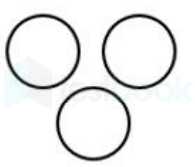
Read the given statements and conclusions carefully. Assuming that the information given in the statements is true, even if it appears to be at variance with commonly known facts, decide which of the given conclusions logically follow from the statements.

Statements:

A. All plastics are fruits.

B. All fruits are books.

C. No books are trousers.

Conclusions:

I. Some books are plastics.

II. No trouser is a plastic.

III. Some fruits are plastics.

IV. Some trousers are fruits.

  1. AOption (a)

    Only conclusions I, II and III follow.

  2. BOption (b)

    Only conclusion II, III and IV follow.

  3. COption (c)

    Only conclusions I and II follow.

  4. DOption (d)

    Only conclusions I and III follow.

View answer & explanation

Correct answer

Answer: (a)A.

Only conclusions I, II and III follow.

Why this answer is correct

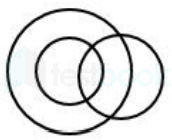
The least possible Venn diagram for the given statements is as shown below :

Conclusions:

I. Some books are plastics → Follow (As all plastics are fruits and all fruits are books. As whole plastics comes in fruits which whole comes in books, therefore it is true.)

II. No trouser is a plastic → Follow (As all plastics are fruits, all fruits are books and no books are trousers. As whole plastics comes in fruits which whole comes in books which cannot be trousers, therefore it is true.)

III. Some fruits are plastics → Follow (As all plastics are fruits. As whole plastics comes in fruits, therefore it is true.)

IV. Some trousers are fruits → Does not follow (As all fruits are books and no books are trousers. As whole fruits comes in books which cannot be trousers, therefore it is false.)

∴ Here, Only conclusions I, II and III follow.​

Hence, the correct answer is "Option 1".

Question 53

Gustatory receptors are responsible for detecting:

  1. AOption (a)

    smell

  2. BOption (b)

    sight

  3. COption (c)

    touch

  4. DOption (d)

    taste

View answer & explanation

Correct answer

Answer: (d)D.

taste

Why this answer is correct

The correct answer is taste.

Key Points

  • With the help of receptors, we smell things with our noses, taste things with our tongues, hear things with our ears, and see things with our eyes.
  • Receptors are usually located in our sense organs, such as the inner ear, the nose, the tongue, and so on.
  • The work of gustatory receptors is to detect the taste.
  • Gustatory receptors are found on the tongue and are evenly distributed across the taste buds. Their primary function is to provide a sense of taste.
  • With each taste of food or sip of drink, the brain integrates the differential input from the taste buds and a complex flavour is perceived.

 Additional Information

  • Touch detection: The somesthetic receptors will detect touch.
  • Sound detection: The auditory receptors are located inside the inner ear which helps in Sound detection.
  • Smell detection: The olfactory receptors will detect smell.

Question 54

The average of four consecutive even integers is 27, what is the largest of these numbers?

  1. AOption (a)

    27

  2. BOption (b)

    30

  3. COption (c)

    96

  4. DOption (d)

    24

View answer & explanation

Correct answer

Answer: (b)B.

30

Why this answer is correct

Given:

The average of four consecutive even integers is 27.

Formula used:

Let the four consecutive even integers be x, x + 2, x + 4, and x + 6.

Average = (Sum of all integers) / (Number of integers)

Calculation:

(x + (x + 2) + (x + 4) + (x + 6)) / 4 = 27

⇒ (4x + 12) / 4 = 27

⇒ 4x + 12 = 108

⇒ 4x = 96

⇒ x = 24

The largest number = x + 6

⇒ 24 + 6 = 30

∴ The correct answer is option 2.

Question 55

Which one of the following is NOT a research reactor of the BARC?

  1. AOption (a)

    DAMINI

  2. BOption (b)

    KAMINI

  3. COption (c)

    Apsara

  4. DOption (d)

    ZERLINA

View answer & explanation

Correct answer

Answer: (a)A.

DAMINI

Why this answer is correct

The correct answer is DAMINI.

Key Points

  • Bhabha Atomic Research Center is the full form of BARC.
  • BARC is India's premier nuclear research facility headquartered in Trombay, Mumbai, Maharashtra.
  • It is a multi-disciplinary research center with extensive infrastructure for advanced research and development in nuclear science, engineering, and related areas.
  • The center is named after Dr. Homi J. Bhabha, who is considered the father of the Indian nuclear program.

 Additional Information

  • Dr. Homi J. Bhabha established the Tata Institute of Fundamental Research (TIFR) in 1945 and later the Atomic Energy Establishment, Trombay (AEET) in 1954, which was renamed BARC in 1966 after his demise.
  • BARC plays a crucial role in India's nuclear power generation, isotope production, and radiation technology applications.
  • The center also conducts research in areas such as high-energy physics, plasma physics, material science, and environmental science.
  • BARC operates under the Department of Atomic Energy (DAE), Government of India.

Question 56

How  many fundamental rights were enshrined in the Constitution of India of 1950?

  1. AOption (a)

    Five

  2. BOption (b)

    Seven

  3. COption (c)

    Eight

  4. DOption (d)

    Six

View answer & explanation

Correct answer

Answer: (b)B.

Seven

Why this answer is correct

The correct answer is Seven.

Key Points

  • Fundamental Rights are enshrined in Part III of the Indian Constitution, from Article 12 to 35.
  • These rights are essential for the overall development of individuals and the preservation of human dignity.
  • Article 21 of the Indian Constitution guarantees the Right to Life and Personal Liberty.
  • Fundamental Rights are justiciable, meaning they can be enforced through the courts of law in India.

 Additional Information

  • Fundamental Rights
  • Fundamental Rights are the basic human rights guaranteed to all individuals by the Constitution of India. These rights are crucial for the protection and development of individuals.
  • They are meant to promote the ideal of political democracy and prevent the arbitrary use of power by the state.
  • Some of the key Fundamental Rights include the Right to Equality (Articles 14-18), Right to Freedom (Articles 19-22), Right against Exploitation (Articles 23-24), Right to Freedom of Religion (Articles 25-28), Cultural and Educational Rights (Articles 29-30), and the Right to Constitutional Remedies (Article 32).
  • These rights are enforceable by the courts, and individuals can approach the judiciary to seek protection and enforcement of their Fundamental Rights.
  • Enforcement of Fundamental Rights
  • Fundamental Rights are justiciable, meaning individuals can approach the courts to enforce these rights if they are violated.
  • The Supreme Court and High Courts have the power to issue writs for the enforcement of Fundamental Rights.
  • Writs such as habeas corpus, mandamus, prohibition, quo warranto, and certiorari are used to enforce these rights.
  • Right to Life (Article 21)
  • Article 21 of the Indian Constitution guarantees the Right to Life and Personal Liberty.
  • This article ensures that no person shall be deprived of their life or personal liberty except according to the procedure established by law.
  • The Right to Life under Article 21 has been interpreted by the Supreme Court to include various rights such as the right to live with human dignity, right to livelihood, right to health, right to education, and more.

Question 57

The Central Government is bound to present the 'Annual Financial Report/Statement' as per ________ of the Constitution of India.

  1. AOption (a)

    Article 110

  2. BOption (b)

    Article 111

  3. COption (c)

    Article 113

  4. DOption (d)

    Article 112

View answer & explanation

Correct answer

Answer: (d)D.

Article 112

Why this answer is correct

The correct answer is Article 112.

Key Points

  • Article 112
  • In terms of Article 112 (1) of the Constitution of India, a statement of estimated receipts and expenditures of the Government of India is presented to the Parliament every year.
  • Article 112(2) provides that the estimate of expenditure embodied in this annual financial Budget shall show separately.
  • The annual Financial Statement shows the receipts and payments of the Government under the three parts in which Government accounts are kept: (i) Consolidated Fund, (ii) Contingency Fund, and (iii) Public Account.
  • Annual reports typically include financial statements, such as balance sheets, income statements, and cash flow statements. In addition, there will often be graphs or charts included, helping break down the financials into easily readable information.

 Additional Information

  • Article 110​
  • A money bill is defined by Article 110 of the Constitution, as a draft law that contains only provisions that deal with all or any of the matters listed therein​
  • The imposition, abolition, remission, alteration, or regulation of any tax.
  • The regulation of the borrowing of money by the Union government.
  • The custody of the Consolidated Fund of India or the contingency fund of India, the payment of money into or the withdrawal of money from any such fund
  • The appropriation of money out of the Consolidated Fund of India.
  • Declaration of any expenditure charged on the Consolidated Fund of India or increasing the amount of any such expenditure.
  • The receipt of money on account of the Consolidated Fund of India or the public account of India or the custody or issue of such money, or the audit of the accounts of the Union or of a state.
  • Article 113
  • Demand for Grants is the form in which estimates of expenditure from the Consolidated Fund, included in the annual financial statement and required to be voted upon in the Lok Sabha, are submitted in pursuance of Article 113 of the Constitution.
  • The demand for grants includes provisions with respect to revenue expenditure, capital expenditure, grants to State and Union Territory governments together with loans and advances.
  • Generally, one demand for a grant is presented in respect of each ministry or department. However, for large ministries and departments, more than one demand is presented.
  • Article 111
  • For assent President has three alternatives (under Article 111 of the Constitution):
  • He may give his assent to the bill.
  • He may withhold his assent to the bill.
  • He may return the bill (If it is not a Money Bill) for the reconsideration of the Parliament.
  • The veto power enjoyed by the executive in modern states can be classified into the following four types:
  • Absolute veto, that is, withholding of assent to the bill passed by the legislature.
  • Qualified veto, which can be overridden by the legislature with a higher majority.
  • Suspensive veto, which can be overridden by the legislature with an ordinary majority.
  • Pocket veto, that is, taking action on the bill passed by the legislature.

Question 58

What will be cost price of a dress sold by a shop keeper if he made a profit of 30% when he sold the dress for Rs. 2,600.

  1. AOption (a)

    Rs. 4,800

  2. BOption (b)

    Rs. 2,000

  3. COption (c)

    Rs. 3,000

  4. DOption (d)

    Rs. 3,650

View answer & explanation

Correct answer

Answer: (b)B.

Rs. 2,000

Why this answer is correct

Given:

Selling Price (SP) = ₹2,600

Profit Percentage = 30%

Formula used:

Cost Price (CP) = SP1+Profit%100\dfrac{SP}{1 + \dfrac{Profit \%}{100}}

Calculation:

CP = 26001+30100\dfrac{2600}{1 + \dfrac{30}{100}}

⇒ CP = 26001+0.30\dfrac{2600}{1 + 0.30}

⇒ CP = 26001.30\dfrac{2600}{1.30}

⇒ CP = ₹2,000

∴ The correct answer is option 2.

Question 59

In a certain code language, 'WET' is coded as 'VXDFSU'. Which of the given options will be coded as 'MOHJAC' in that language?

  1. AOption (a)

    NIB

  2. BOption (b)

    JET

  3. COption (c)

    VEX

  4. DOption (d)

    TIP

View answer & explanation

Correct answer

Answer: (a)A.

NIB

Why this answer is correct

The logic followed here is:

'WET' is coded as 'VXDFSU'

Similarly,

? is coded as 'MOHJAC'

Hence, "Option 1" is the correct answer.

Question 60

When was Galvanizing Organic Bio-Agro Resources Dhan (GOBAR-DHAN) scheme launched?

  1. AOption (a)

    20 April 2019

  2. BOption (b)

    20 April 2017

  3. COption (c)

    30 April 2018

  4. DOption (d)

    20 April 2018

View answer & explanation

Correct answer

Answer: (c)C.

30 April 2018

Why this answer is correct

The correct answer is 30 April 2018.

Key Points

  • The term GOBAR stands for Galvanizing Organic Bio-Agro Resources.
  • The scheme was launched by the then Union Minister for Drinking water and Sanitation, Shri Uma Bharti in April 2018.
  • This scheme aims to positively impact village cleanliness and generate wealth and energy from organic waste.
  • Open defecation-free villages are the objective of the Swachha Bharat Mission. Hence option 1 is incorrect.
  • Objectives of GOBAR-Dhan:
  1. To support villages effectively managing their cattle waste, agricultural waste/residue, and all other organic waste.
  2. To support communities to convert their organic waste (especially cattle waste) to wealth through the generation of manure and energy out of waste.
  3. To promote environmental sanitation and curb vector-borne diseases through effective disposal of waste in rural areas.
  4. To create livelihood opportunities in rural areas and enhance the income of farmers and other rural people by supporting them to convert their waste to wealth.
  5. To promote rural entrepreneurship by involving entrepreneurs, SHGs, and Youth Groups in the setting up and operation, and management of biogas plants.

Question 61

A can lay railway tracks between two given stations in 16 days and B can do the same job in 12 days. With the help of C, they did the job in 4 days only. Considering this, C alone can do the job in:

  1. AOption (a)

    485\frac{{48}}{5} days

  2. BOption (b)

    548\frac{{5}}{48} days

  3. COption (c)

    48 days

  4. DOption (d)

    165\frac{{16}}{5} days

View answer & explanation

Correct answer

Answer: (a)A.

485\frac{{48}}{5} days

Why this answer is correct

Given:

A can lay railway tracks between two given stations in 16 days

B can lay railway tracks between two given stations in 12 days

With the help of C, they did the job in 4 days

Formula used:

Work done by A in 1 day = 1/16

Work done by B in 1 day = 1/12

Work done by A, B, and C together in 1 day = 1/4

Work done by C in 1 day = Work done by A, B, and C together in 1 day - (Work done by A in 1 day + Work done by B in 1 day)

Calculation:

Work done by A in 1 day = 1/16

Work done by B in 1 day = 1/12

Work done by A, B, and C together in 1 day = 1/4

⇒ Work done by C in 1 day = 1/4 - (1/16 + 1/12)

⇒ Work done by C in 1 day = 1/4 - (3/48 + 4/48)

⇒ Work done by C in 1 day = 1/4 - 7/48

⇒ Work done by C in 1 day = 12/48 - 7/48

⇒ Work done by C in 1 day = 5/48

∴ C alone can do the job in 48/5 days

∴ The correct answer is option 1.

Question 62

The distance between two points (a cos α, 0) and (0, a sin α) is ________.

  1. AOption (a)

    a

  2. BOption (b)

    |2a|

  3. COption (c)

    |a|

  4. DOption (d)

    2a

View answer & explanation

Correct answer

Answer: (c)C.

|a|

Why this answer is correct

Given:

Points: (a cos α, 0) and (0, a sin α)

Formula used:

Distance between two points (x1, y1) and (x2, y2) is given by:

Distance = (x2−x1)2+(y2−y1)2\sqrt{(x_2 - x_1)^2 + (y_2 - y_1)^2}

Calculations:

Let (x1, y1) = (a cos α, 0) and (x2, y2) = (0, a sin α)

⇒ Distance = (0−acos⁡α)2+(asin⁡α−0)2\sqrt{(0 - a \cos \alpha)^2 + (a \sin \alpha - 0)^2}

⇒ Distance = (acos⁡α)2+(asin⁡α)2\sqrt{(a \cos \alpha)^2 + (a \sin \alpha)^2}

⇒ Distance = a2cos⁡2α+a2sin⁡2α\sqrt{a^2 \cos^2 \alpha + a^2 \sin^2 \alpha}

⇒ Distance = a2(cos⁡2α+sin⁡2α)\sqrt{a^2 (\cos^2 \alpha + \sin^2 \alpha)}

⇒ Distance = a2×1\sqrt{a^2 \times 1}

⇒ Distance = ∣a∣|a|

∴ The correct answer is option (3).

Question 63

All the involuntary actions, including blood pressure, salivation and vomiting are controlled by the:

  1. AOption (a)

    forebrain

  2. BOption (b)

    medulla

  3. COption (c)

    midbrain

  4. DOption (d)

    limbic System

View answer & explanation

Correct answer

Answer: (b)B.

medulla

Why this answer is correct

The correct answer is medulla.

Key Points

  • Medulla Oblongata
  • Location: The medulla oblongata is the lowermost part of the brainstem, located directly above the spinal cord.
  • Function: It plays a crucial role in controlling vital autonomic functions such as:
  • Respiration: Controls the rate and depth of breathing.
  • Cardiovascular function: Regulates heart rate and blood pressure.
  • Digestion: Influences swallowing, vomiting, and other digestive processes.
  • Other functions: Controls sneezing, coughing, and swallowing reflexes.
  • Structure: The medulla contains nuclei for several cranial nerves, including those involved in swallowing, tongue movement, and head and shoulder movements.
  • Significance: Damage to the medulla can have life-threatening consequences, including respiratory failure, cardiac arrest, and loss of consciousness.

Additional Information

  • Forebrain
  • Location: The largest and most complex part of the brain, located above the midbrain and hindbrain.
  • Function: Responsible for a wide range of complex functions, including:
  • Sensory and motor processing: Receives and processes sensory information, and initiates voluntary movements.
  • Higher cognitive functions: Involved in thought, language, memory, emotion, and personality.
  • Homeostasis: Regulates body temperature, appetite, thirst, and sleep-wake cycles.
  • Structure: Consists of two cerebral hemispheres, the thalamus, hypothalamus, and limbic system.
  • Significance: The forebrain is essential for human consciousness, intelligence, and overall brain function.
  • Midbrain
  • Location: Located between the forebrain and hindbrain, forming the middle portion of the brainstem.
  • Function: Plays a crucial role in:
  • Motor function: Involved in controlling eye movements, posture, and balance.
  • Sensory processing: Processes visual and auditory information.
  • Pain perception: Plays a role in pain modulation.
  • Arousal and consciousness: Contributes to maintaining alertness and wakefulness.
  • Structure: Contains several important nuclei and tracts, including the substantia nigra and the red nucleus.
  • Significance: Damage to the midbrain can result in various neurological problems, including Parkinson's disease, visual and auditory impairments, and movement disorders.
  • Limbic System
  • Location: A collection of interconnected brain structures located deep within the brain, beneath the cerebral cortex.
  • Function: Plays a crucial role in:
  • Emotions: Regulates emotions such as fear, anger, pleasure, and sadness.
  • Memory: Involved in the formation and retrieval of memories, particularly emotional memories.
  • Motivation: Drives basic motivations such as hunger, thirst, and sex.
  • Learning: Plays a role in learning and habit formation.

Question 64

Which of the following is NOT considered as a pillar of human development?

  1. AOption (a)

    Equity

  2. BOption (b)

    Empowerment

  3. COption (c)

    Justice

  4. DOption (d)

    Sustainability

View answer & explanation

Correct answer

Answer: (c)C.

Justice

Why this answer is correct

The correct answer is Justice.

Key Points

  • Human Development Pillars:
  • Equity: Ensuring equal access to opportunities and resources for all individuals, reducing disparities in human development outcomes.
  • Sustainability: Maintaining the availability of opportunities and resources for future generations while meeting today's needs.
  • Productivity: Enhancing human capabilities and improving the quality of life through economic growth and development.
  • Empowerment: Giving individuals the ability and freedom to make choices that affect their lives positively.

Additional Information

  • Definition of Sustainability:
  • Sustainability emphasizes the use of resources in a manner that meets the needs of the present without compromising the ability of future generations to meet their own needs.
  • It focuses on creating and maintaining conditions under which humans and nature can exist in productive harmony.
  • This approach ensures the long-term continuation of resource availability, ecological balance, and overall well-being.

Question 65

Study the given pattern carefully and select the number from the given options that can replace the question mark (?).

  1. AOption (a)

    13

  2. BOption (b)

    12

  3. COption (c)

    7

  4. DOption (d)

    25

View answer & explanation

Correct answer

Answer: (a)A.

13

Why this answer is correct

The logic followed here is:

7 + 6 = 32 + 22

13 = 9 + 4

13 = 13 (LHS = RHS)

25 + 15 = 22 + 62

40 = 4 + 36

40 = 40 (LHS = RHS)

And,

9 + 20 = 22 + 52

29 = 4 + 25

29 = 29 (LHS = RHS)

Similarly,

? + 12 = 32 + 42

? = 9 + 16 - 12

? = 25 - 12

? = 13

Hence, "Option 1" is the correct answer.

Question 66

Study the given pattern carefully and select the option that can replace the question mark (?) in it.

  1. AOption (a)

  2. BOption (b)

  3. COption (c)

  4. DOption (d)

View answer & explanation

Correct answer

Answer: (c)C.

Why this answer is correct

The logic followed here is:

→ 1(

) = 2(

) 

And,

→ 2(

) = 4(

) --------- (1)

→ 1(

) = 2(

)  --------- (2)

Therefore, from (1) and (2):

→ 1(

) + 1(

) = ? 

→ 4(

) + 2(

) = ?

→ 6(

) = ?

Hence, "Option 3" is the correct answer.

Question 67

The theme of the 2019 Human Development Report is:

  1. AOption (a)

    focusing on inequality

  2. BOption (b)

    focusing on malnutrition

  3. COption (c)

    focusing on population

  4. DOption (d)

    focusing on poverty

View answer & explanation

Correct answer

Answer: (a)A.

focusing on inequality

Why this answer is correct

The correct answer is focusing on inequality.

Key Points

  • India stands at 129 positions as per the report titled “Human Development Report 2019" released by the United Nations Development Programme.
  • The complete title of report is-“Human Development Report 2019– Beyond income, beyond averages, beyond today: Inequalities in human development in the 21st century”
  • The total of 189 countries is ranked in this index.
  • The countries were ranked based on indicators such as life expectancy at birth, expected years of schooling, mean years of schooling, gross national income per capita and Human Development Index value.
  • For the year 2017, India ranked 130th and hence it improved by one rank.
  • The first rank is held by Norway. Second rank-Switzerland, third rank-Ireland.

Question 68

Find the compound interest on Rs. 7,500 at 4% per annum for 2 years.

  1. AOption (a)

    Rs. 8,000

  2. BOption (b)

    Rs. 8,112

  3. COption (c)

    Rs. 621

  4. DOption (d)

    Rs. 612

View answer & explanation

Correct answer

Answer: (d)D.

Rs. 612

Why this answer is correct

Given:

Principal (P) = ₹7,500

Rate (r) = 4% per annum

Time (t) = 2 years

Formula used:

Compound Interest (CI) = P(1+r100)t−PP (1+\frac{r}{100})^t - P

Calculations:

CI = 7500(1+4100)2−75007500 (1+\frac{4}{100})^2 - 7500

⇒ CI = 7500(1+4100)2−17500 (1+\frac{4}{100})^2 - 1

⇒ CI = 7500(1.04)2−17500 (1.04)^2 - 1

⇒ CI = 7500 (1.0816 - 1)

⇒ CI = 7500 × 0.0816

⇒ CI = Rs. 612

∴ The correct answer is option (4).

Question 69

A alone can complete a piece of work in 15 days, while B alone can do it in 30 days, if the both of them work on alternate days, when will the work get completed?

  1. AOption (a)

    Cannot be determined

  2. BOption (b)

    20 days

  3. COption (c)

    18 days

  4. DOption (d)

    24 days

View answer & explanation

Correct answer

Answer: (b)B.

20 days

Why this answer is correct

Given:

A alone can complete the work in 15 days.

B alone can complete the work in 30 days.

Formula used:

Work done in a day by A = 1/15

Work done in a day by B = 1/30

Calculations:

Work done in 2 days (A + B) = (1/15 + 1/30)

⇒ Work done in 2 days = (2 + 1)/30

⇒ Work done in 2 days = 3/30

⇒ Work done in 1 days = 1/20

Therefore, work done in 20 days = 20/20 = 1

∴ The correct answer is option (2).

Question 70

Select the Venn diagram that best represents the relationship between the given set of classes.

Cobbler, Man, Shoe, Footwear

  1. AOption (a)

  2. BOption (b)

  3. COption (c)

  4. DOption (d)

View answer & explanation

Correct answer

Answer: (a)A.

Why this answer is correct

The diagram that best represents the relationship between the given set of classes is shown below :

Cobbler is a subset of Man (as a cobbler is a type of person).

Shoe is a subset of Footwear.

Hence, "Option 1" is the correct answer.

Additional InformationCobbler: A person (usually a man or woman) who repairs or makes shoes and other types of footwear. A cobbler is a subset of Man (assuming humans are referred to here).

Man: Refers to humans (or male individuals) in general, which includes cobblers but not shoes or footwear.

Shoe: A specific type of Footwear, so Shoe is a subset of Footwear.

Footwear: A broader category that includes all types of footwear, such as shoes, sandals, boots, etc.

Question 71

The 'Big Bang Theory' is about the:

  1. AOption (a)

    origin of the animal species

  2. BOption (b)

    origin of life

  3. COption (c)

    origin of the human species

  4. DOption (d)

    origin of the universe

View answer & explanation

Correct answer

Answer: (d)D.

origin of the universe

Why this answer is correct

  • The correct answer is origin of the universe.

Key Points

  • The most widely accepted theory about the origin of the universe is the Big Bang Theory.
  • Expanding universe hypothesis. is another name for Big Bang Theory.
  • George Lamaitre coined the term "Big Bang Theory."
  • According to the Big Bang Theory, the universe began as a small hot body that exploded massively and then swiftly expanded.
  • The universe cooled as a result of its fast expansion, bringing it to its current state.
  • The temperature plummeted to 4,500K within 300,000 years after the Big Bang, allowing atomic matter to form.
  • Around 13,75 billion years ago, the big bang happened.
  • Edwin Hubble in 1920 provided evidence that the universe is expanding.

Additional Information

  • Big bang theory: The big bang theory explains the existence of the universe as it was created from a massive explosion that took place bringing and creating matter we have today.
  • This creation of matter is the start of the universe and scientists use the occurrence of this as a reference to the age of the universe.
  • From a number of studies, it is approximated that the Big bang occurred 13.8 billion years ago, as of today.

EXPLANATION:

  • The age of the universe is calculated with reference to the occurrence of the Big Bang i.e. 13.8 billion years ago.
  • 1 billion = 109

Therefore, the age of the universe is 13·8 x109 years

Question 72

Who among the following was the first ruler who inscribed his message on stone surfaces for his subjects and officials?

  1. AOption (a)

    Chandragupta Maurya

  2. BOption (b)

    Ashoka

  3. COption (c)

    Harshavardhan

  4. DOption (d)

    Chandragupta I

View answer & explanation

Correct answer

Answer: (b)B.

Ashoka

Why this answer is correct

The correct answer is Ashoka.

Key Points

  • Emperor Ashoka (304 - 232 BCE) was the third king of the Maurya Dynasty. Remorseful after his bloody campaign and conquest of Kalinga, Ashoka embraced Buddhism.
  • Ashoka:
  • Ashoka was the emperor of India's Maurya Dynasty from 268 to 232 BCE.
  • Ashoka is referred to as Buddhsakya in Maski Inscription and Dharmakosa in his Sarnath Inscription.
  • He was known as Devampiya i.e. beloved of Goda, and as Piyadassi i.e. of pleasing appearance.
  • Ashoka believed in the policy of Dhamma.
  • Ashoka's visit to Lumbini and exemption of Lumbini from tax was mentioned in Rumminidei Pillar Inscription.
  • The Kandhar Inscription speaks about the success of his policy with the hunters and fishermen.
  • Nigalisagar Pillar Inscription: It mentions that Ashoka increased the height of the stupa of Buddha Konakamana to its double size.

 Additional Information

  • Chandragupta Maurya
  • Chanakya was the teacher of Chandragupta Maurya.
  • Chandragupta Maurya was the founder of the Maurya dynasty.
  • He is credited with the setting up of the first pan-Indian empire.
  • Chanakya, also called Kautilya or Vishnugupta played a key role in helping Chandragupta overthrow the powerful Nanda dynasty at Pataliputra, in the Magadha region.
  • Artha-shastra, (“The Science of Material Gain”), written by Kautilya on statecraft, economic policy and military strategy came to be Chandragupta’s guide.
  • The ideas expressed by Kautilya in the Arthashastra are totally practical and unsentimental.
  • Harshavardhan
  • HARSHAVARDHAN (606 CE – 647 CE)
  • During Harshavardhana’s rule, Kannauj was conquered and united with Thaneswar.
  • He attacked Shashank of Gauda Kingdom and established his control over regions of Bengal, Bihar and Odisha and befriended Bhashkarvarman of Kamrup (Assam).
  • Vallabhi King Dhruvbhata in Gujrat too was defeated and a truce was negotiated with him by the marriage of Harsha’s daughter to Dhruvbhata.
  • He assumed titles of Uttarapathanatha or Uttarapathapati (Lord of the North).
  • While marching southwards, Harshavardhan conquered regions of Malawa and after crossing Narmada he was defeated by Pulkeshin II in the Battle of Narmada.
  • He was greatly influenced by the personality of Hieun Tsang and organized a Buddhist assembly at Kannauj under his chairmanship.
  • Hieun Tsang, in his book, has appreciated Harshvardhan’s justice and munificence (generosit
  • ​Chandragupta I
  • Chandragupta I married Kumara Devi who was a Lichchavi princess.
  • The Lichchavi dynasty was a kingdom that existed in Nepal from 400 to 750 CE.
  • Marrying the Lachchavi princess enabled Chandragupta I to expand his territory to Nepal.

Question 73

Study the given pattern carefully and select the number that can replace the question mark (?) in it.

  1. AOption (a)

    3

  2. BOption (b)

    16

  3. COption (c)

    10

  4. DOption (d)

    12

View answer & explanation

Correct answer

Answer: (b)B.

16

Why this answer is correct

The logic followed here is:

4 × 5 = 12 + 8

20 = 20 (LHS = RHS)

And,

5 × 3 = 7 + 8

15 = 15 (LHS = RHS)

Similarly,

6 × 4 = ? + 8

24 - 8 = ?

16 = ?

Hence, "Option 2" is the correct answer.

Question 74

The tenth term of the sequence 2, 5, 8, 11, ......... will be:

  1. AOption (a)

    29

  2. BOption (b)

    27

  3. COption (c)

    32

  4. DOption (d)

    28

View answer & explanation

Correct answer

Answer: (a)A.

29

Why this answer is correct

Given:

The sequence is 2, 5, 8, 11, .........

Formula used:

nth term of an arithmetic sequence: an = a + (n-1)d

Where, a = first term, d = common difference, n = term number

Calculation:

a = 2, d = 3, n = 10

⇒ a10 = 2 + (10-1)×3

⇒ a10 = 2 + 27

⇒ a10 = 29

∴ The correct answer is option (1).

Question 75

A man's health insurance premium for last year was Rs. 1,440. If he paid Rs. 1,512 this year, what is the percentage increase on his health insurance premium?

  1. AOption (a)

    3%

  2. BOption (b)

    4%

  3. COption (c)

    5%

  4. DOption (d)

    6%

View answer & explanation

Correct answer

Answer: (c)C.

5%

Why this answer is correct

Given:

Last year's health insurance premium = ₹1,440

This year's health insurance premium = ₹1,512

Formula used:

Percentage Increase = New Amount−Old AmountOld Amount×100\dfrac{\text{New Amount} - \text{Old Amount}}{\text{Old Amount}} \times 100

Calculations:

Percentage Increase = 1512−14401440×100\dfrac{1512 - 1440}{1440} \times 100

⇒ 721440×100\dfrac{72}{1440} \times 100

⇒ 120×100\dfrac{1}{20} \times 100

⇒ 5%

∴ The correct answer is option (3).

Question 76

Debugging is another term for:

  1. AOption (a)

    removing errors

  2. BOption (b)

    not reading comments

  3. COption (c)

    compiling

  4. DOption (d)

    executing

View answer & explanation

Correct answer

Answer: (a)A.

removing errors

Why this answer is correct

The correct answer is removing errors.

Key Points

  • Debugging is the process of finding and fixing errors or bugs in the source code of any software. When software does not work as expected, computer programmers study the code to determine why any errors occurred.
  • • In software development, the debugging process begins when a developer locates a code error in a computer program and is able to reproduce it. Debugging is part of the software testing process and is an integral part of the entire software development lifecycle.

Question 77

If x=3+13−1x = \frac{{\sqrt 3 + 1}}{{\sqrt 3 - 1}} and y=3−13+1y = \frac{{\sqrt 3 - 1}}{{\sqrt 3 + 1}}, then the value of x2 + y2 is:

  1. AOption (a)

    14

  2. BOption (b)

    13

  3. COption (c)

    10

  4. DOption (d)

    15

View answer & explanation

Correct answer

Answer: (a)A.

14

Why this answer is correct

Given:

If x = 3+13−1\dfrac{\sqrt{3} + 1}{\sqrt{3} - 1} and y = 3−13+1\dfrac{\sqrt{3} - 1}{\sqrt{3} + 1}, then the value of x2 + y2 is:

Formula used:

(a + b)2 + (a - b)2 = 2a2 + 2b2

Calculation:

x = 3+13−1\dfrac{\sqrt{3} + 1}{\sqrt{3} - 1}

Multiply numerator and denominator by (3+1)(\sqrt{3} + 1):

⇒ x = (3+1)(3+1)(3−1)(3+1)\dfrac{(\sqrt{3} + 1)(\sqrt{3} + 1)}{(\sqrt{3} - 1)(\sqrt{3} + 1)}

⇒ x = 3+23+13−1\dfrac{3 + 2\sqrt{3} + 1}{3 - 1}

⇒ x = 4+232\dfrac{4 + 2\sqrt{3}}{2}

⇒ x = 2 + 3\sqrt{3}

Similarly, y = 3−13+1\dfrac{\sqrt{3} - 1}{\sqrt{3} + 1}

Multiply numerator and denominator by (3−1)(\sqrt{3} - 1):

⇒ y = (3−1)(3−1)(3+1)(3−1)\dfrac{(\sqrt{3} - 1)(\sqrt{3} - 1)}{(\sqrt{3} + 1)(\sqrt{3} - 1)}

⇒ y = 3−23+13−1\dfrac{3 - 2\sqrt{3} + 1}{3 - 1}

⇒ y = 4−232\dfrac{4 - 2\sqrt{3}}{2}

⇒ y = 2 - 3\sqrt{3}

x2 + y2 = (2+3)2+(2−3)2(2 + \sqrt{3} )^2 + (2 - \sqrt{3} )^2

⇒ x2 + y2 = (4+43+3)+(4−43+3)(4 + 4\sqrt{3} + 3) + (4 - 4\sqrt{3} + 3)

⇒ x2 + y2 = 7 + 7

⇒ x2 + y2 = 14

∴ The correct answer is option (1).

Question 78

In which year did the British achieve political power in India?

  1. AOption (a)

    1757

  2. BOption (b)

    1657

  3. COption (c)

    1947

  4. DOption (d)

    1857

View answer & explanation

Correct answer

Answer: (a)A.

1757

Why this answer is correct

The correct answer is 1757.

Key Points

  • The British East India Company established its first trading post in India in 1612.
  • However, it wasn't until the mid-18th century that they began to consolidate their political power.
  • The Battle of Plassey in 1757 marked a turning point, where the British East India Company defeated the Nawab of Bengal, significantly expanding their influence.
  • This victory laid the foundation for British dominance in India.
  • Over the following decades, the East India Company gradually expanded its territory through a combination of military conquests, diplomatic maneuvers, and economic exploitation.
  • They employed various strategies, including the Subsidiary Alliance system, which forced Indian rulers to accept British protection in exchange for military support, effectively making them subservient to British control.
  • The Indian Rebellion of 1857, a widespread uprising against British rule, led to a significant shift in power.
  • The British Crown, alarmed by the scale of the rebellion, transferred the administration of India from the East India Company to the British government in 1858.
  • This marked the beginning of the British Raj, a period of direct rule by the Crown.

Question 79

The Konark Temple is situated in which state?

  1. AOption (a)

    Kerala

  2. BOption (b)

    Andhra Pradesh

  3. COption (c)

    Karnataka

  4. DOption (d)

    Odisha

View answer & explanation

Correct answer

Answer: (d)D.

Odisha

Why this answer is correct

The correct answer is Odisha.

Key Points

  • The Sun Temple of Konark is located in the town of Konark in the Puri district of the state of Orissa, India. Even after 750 years of its construction, the Sun Temple fails everyone with its uniqueness, vastness, and artistic grandeur.
  • In fact, what we recognize as the Konark Sun Temple is the Jagmohan or Mahamandapa of the Sun Temple built on the side, which has been demolished long ago. Konark Sun Temple is also known as Black Pagoda in English.
  • The Sun Temple was built by King Narasimha Dev I of the Ganga dynasty in about 1278 AD. It is said that this temple could not be built on the basis of its predetermined design.
  • Its foundation was not built according to the heavy dome of the temple. According to the local people here, this dome was part of the temple, but due to its magnetic power, when the ship started crashing, then this dome was removed. Perhaps for this reason this temple is also called Black Pagod

Question 80

Gastric glands produce the enzyme ________ during digestion, which digests proteins.

  1. AOption (a)

    Lactase

  2. BOption (b)

    Helicase

  3. COption (c)

    Trypsin

  4. DOption (d)

    Pepsin

View answer & explanation

Correct answer

Answer: (d)D.

Pepsin

Why this answer is correct

The correct answer is Pepsin.

Key Points

  • The mucosa of the stomach has gastric glands. Gastric glands have three major types of cells namely -
  1. mucus neck cells which secrete mucus
  2. peptic or chief cells which secrete the proenzyme pepsinogen
  3. parietal or oxyntic cells that secrete HCl and intrinsic factor (factor essential for the absorption of vitamin B12).
  • Chief cells or peptic cells of the stomach secretes proenzyme pepsinogen. The proenzyme pepsinogen on exposure to hydrochloric acid gets converted into the active enzyme pepsin.
  • The enzyme pepsin is responsible for the digestion of proteins. Pepsin converts proteins into proteoses and peptones (peptides).
  • The mucus and bicarbonates present in the gastric juice play an important role in lubrication and protection of the mucosal epithelium from excoriation by the highly concentrated hydrochloric acid.
  • HCl provides the acidic pH (pH 1.8) optimal for pepsins.

Question 81

A, B and C are well-known authors in Hindi, English and Punjabi, not necessarily in the same order. Read the given statements and decide which of the conclusion from the given options logically follows from the statements.

Statements:

  1. C does not write in English.
  2. The book of essays is in Punjabi.
  3. The book of poems in English has won an award.
  4. A is a novelist.
  5. B is not an essayist.
  1. AOption (a)

    B writes poems in English.

  2. BOption (b)

    B writes poems in Hindi.

  3. COption (c)

    A writes essays in Punjabi.

  4. DOption (d)

    C writes poems in English.

View answer & explanation

Correct answer

Answer: (a)A.

B writes poems in English.

Why this answer is correct

Given: A, B and C are well-known authors in Hindi, English and Punjabi.

1) A is a novelist.

2) C does not write in English.

If C does not write in English, that means C writes in either Hindi or Punjabi.

AuthorsLanguageAuthor type
ANovelist
B
CHindi/Punjabi

3) The book of essays is in Punjabi.

4) B is not an essayist.

As B is not an essayist which is in Punjabi and A is already a novelist, therefore the only author left is C.

AuthorsLanguageAuthor type
ANovelist
B
CPunjabiEssayist

5) The book of poems in English has won an award.

As the author who is a poet writes in English, therefore only one author is left i.e. B.

As only one position is left in the language, which will be occupied by the only language left i.e. Hindi.

AuthorsLanguageAuthor type
AHindiNovelist
BEnglishPoet
CPunjabiEssayist

Thus, according to the final arrangement 'B writes poems in English' logically follows from the statements.

Hence, "Option 1" is the correct answer.

Question 82

In humans beings, where does the complete digestion of carbohydrates, proteins and fats take place?

  1. AOption (a)

    Large intestine

  2. BOption (b)

    Small intestine

  3. COption (c)

    Stomach

  4. DOption (d)

    Rectum

View answer & explanation

Correct answer

Answer: (b)B.

Small intestine

Why this answer is correct

The correct answer is Small intestine.

Key Points

Small intestine:

  • The small intestine extends from the pylorus to the ileocecal junction.
  • It is about 6 meter long.
  • It is approximately 2.5 – 3 cm in diameter.
  • The surface area of the human small intestinal mucosa averages 30 square meter.

The small intestine is divided;

  • Duodenum: the first part of the small intestine. It connects to the stomach. The duodenum helps to further digest food coming from the stomach. It absorbs nutrients (vitamins, minerals, carbohydrates, fats, proteins) and water from food so they can be used by the body.
  • Jejunum: The middle part of the small intestine. It is between the duodenum (first part of the small intestine) and the ileum (last part of the small intestine). The jejunum helps to further digest food coming from the stomach.
  • Ileum: The last part of the small intestine. It connects to the cecum (first part of the large intestine). The ileum helps to further digest food coming from the stomach and other parts of the small intestine.

Additional Information

Functions of the small intestine:

  • Onward movement of its contents by peristalsis, which is increased by parasympathetic stimulation.
  • Secretion of intestinal juice, also increased by parasympathetic stimulation.
  • Completion of chemical digestion of carbohydrates, protein and fats in the enterocytes of the villi.

Question 83

'Ratnavali' was written by:

  1. AOption (a)

    Premchand

  2. BOption (b)

    Surdas

  3. COption (c)

    Harsha

  4. DOption (d)

    Kalidas

View answer & explanation

Correct answer

Answer: (c)C.

Harsha

Why this answer is correct

The correct answer is Harsha.

Key Points

  • Ratnavali:
  • Ratnavali is a renowned Sanskrit play written by Harshavardhan, a prominent ruler of northern India during the 7th century.
  • The play is a romantic comedy that showcases the literary prowess of Harshavardhan and his contribution to Indian literature.
  • Harshavardhan, also known as Harsha, was not only a great king but also a notable writer and patron of arts and culture.

Additional Information

  • Premchand
  • The original name of Munshi Premchand was Dhanpat Rai Srivastava.
  • He was an Indian writer famous for his modern Hindustani literature.
  • Munshi Premchand is one of the most celebrated writers of the Indian subcontinent and is regarded as one of the foremost Hindi writers of the early twentieth century.
  • He published his first collection of five short stories in 1907 in a book called Soz-e Watan.
  • He began writing under the pen name "Nawab Rai", but subsequently switched to "Premchand", Munshi being an honorary prefix.
  • His novels include Godaan, Karmabhoomi, Gaban, Mansarovar, Idgah.
  • Premchand was commemorated with the issue of a special 30 Paise postage stamp by India Post on 31 July 1980.
  • ​Surdas
  • The Bhakti poet from Agra is considered to be born between 1478 and 1483.
  • Surdas was blind from birth and lived on the banks of the Yamuna river.
  • He was the disciple of Vallabha Acharya.
  • Surdas was a worshipper of Lord Krishna.
  • He wrote poems in Brajbhasa in praise of Krishna.
  • His composition Sur Sagar contains descriptions of Krishna.
  • Kalidas
BooksWritten by
MeghdootamKalidas
Kumar SambhavamKalidas
RaghuvanshamKalidas
KumarasambhavaKalidas
VikramorvashiKalidas

Question 84

Solve the following

sin(cos−135)+cos(tan−1512)sin (cos^{-1} \frac 3 5) + cos (tan^{-1} \frac 5 {12})

  1. AOption (a)

    10465{\frac{104}{65}}

  2. BOption (b)

    10865{\frac{108}{65}}

  3. COption (c)

    11265{\frac{112}{65}}

  4. DOption (d)

    10065{\frac{100}{65}}

View answer & explanation

Correct answer

Answer: (c)C.

11265{\frac{112}{65}}

Why this answer is correct

Given:

sin⁡(cos⁡−135)+cos⁡(tan⁡−1512)\sin (\cos^{-1} \dfrac{3}{5}) + \cos (\tan^{-1} \dfrac{5}{12})

Formula used:

If θ=cos⁡−135\theta = \cos^{-1} \dfrac{3}{5}, then sin⁡θ=1−(35)2\sin \theta = \sqrt{1 - (\dfrac{3}{5})^2}

If ϕ=tan⁡−1512\phi = \tan^{-1} \dfrac{5}{12}, then cos⁡ϕ=12122+52\cos \phi = \dfrac{12}{\sqrt{12^2 + 5^2}}

Calculation:

sin⁡(cos⁡−135)=1−(35)2\sin (\cos^{-1} \dfrac{3}{5}) = \sqrt{1 - (\dfrac{3}{5})^2}

⇒ sin⁡(cos⁡−135)=1−925\sin (\cos^{-1} \dfrac{3}{5}) = \sqrt{1 - \dfrac{9}{25}}

⇒ sin⁡(cos⁡−135)=1625\sin (\cos^{-1} \dfrac{3}{5}) = \sqrt{\dfrac{16}{25}}

⇒ sin⁡(cos⁡−135)=45\sin (\cos^{-1} \dfrac{3}{5}) = \dfrac{4}{5}

cos⁡(tan⁡−1512)=12122+52\cos (\tan^{-1} \dfrac{5}{12}) = \dfrac{12}{\sqrt{12^2 + 5^2}}

⇒ cos⁡(tan⁡−1512)=12144+25\cos (\tan^{-1} \dfrac{5}{12}) = \dfrac{12}{\sqrt{144 + 25}}

⇒ cos⁡(tan⁡−1512)=12169\cos (\tan^{-1} \dfrac{5}{12}) = \dfrac{12}{\sqrt{169}}

⇒ cos⁡(tan⁡−1512)=1213\cos (\tan^{-1} \dfrac{5}{12}) = \dfrac{12}{13}

sin⁡(cos⁡−135)+cos⁡(tan⁡−1512)\sin (\cos^{-1} \dfrac{3}{5}) + \cos (\tan^{-1} \dfrac{5}{12})

⇒ 45+1213\dfrac{4}{5} + \dfrac{12}{13}

⇒ 4×13+12×55×13\dfrac{4 \times 13 + 12 \times 5}{5 \times 13}

⇒ 52+6065\dfrac{52 + 60}{65}

⇒ 11265\dfrac{112}{65}

∴ The correct answer is option (3).

Question 85

What is the greatest number that will divide 38, 45, 52 and leave as remainders 2, 3 and 4 respectively?

  1. AOption (a)

    5

  2. BOption (b)

    6

  3. COption (c)

    9

  4. DOption (d)

    7

View answer & explanation

Correct answer

Answer: (b)B.

6

Why this answer is correct

Given:

Numbers: 38, 45, 52

Remainders: 2, 3, 4

Formula used:

Greatest number that will divide (N - remainder) for all given numbers.

Calculation:

38 - 2 = 36

45 - 3 = 42

52 - 4 = 48

Find the greatest number that will divide 36, 42, 48 (i.e., HCF of 36, 42, 48)

Prime factorization:

36 = 22 × 32

42 = 2 × 3 × 7

48 = 24 × 3

Common factors: 2 × 3 = 6

⇒ HCF = 6

∴ The correct answer is option (2).

Question 86

The following table shows the production of bananas (in tons) from three different states U.P., M.P., A.P., over the years 2016 to 2019. Based on the table answer the question given below.

Years2016201720182019
States
U.P.34.25.34.8
M.P.55.445.6
A.P.4.14.355.6

What is the difference between the total production of bananas from all the three states combined in 2016, and that of all the three states combined in 2018?

  1. AOption (a)

    3.6 tons

  2. BOption (b)

    2.2 tons

  3. COption (c)

    4.8 tons

  4. DOption (d)

    1.5 tons

View answer & explanation

Correct answer

Answer: (b)B.

2.2 tons

Why this answer is correct

Given:

Production of bananas (in tons) from three states over the years:

Years2016201720182019
States
U.P.34.25.34.8
M.P.55.445.6
A.P.4.14.355.6

Formula used:

Total production in a year = Production from U.P. + Production from M.P. + Production from A.P.

Calculations:

Total production in 2016:

3 (U.P.) + 5 (M.P.) + 4.1 (A.P.)

⇒ 3 + 5 + 4.1

⇒ 12.1 tons

Total production in 2018:

5.3 (U.P.) + 4 (M.P.) + 5 (A.P.)

⇒ 5.3 + 4 + 5

⇒ 14.3 tons

Difference between total production in 2016 and 2018:

14.3 - 12.1

⇒ 2.2 tons

∴ The correct answer is option 2.

Question 87

The following pie chart shows the percentage distribution of the expenditure incurred in manufacturing a product X. Based on the pie chart answer the question given below.

If, for a certain quantity of product X, the manufacturer has to pay Rs. 18,000 towards transportation cost, then how much will be the direct material cost for the same quantity of product X?

  1. AOption (a)

    Rs. 44,000

  2. BOption (b)

    Rs. 50,000

  3. COption (c)

    Rs. 35,000

  4. DOption (d)

    Rs. 42,000

View answer & explanation

Correct answer

Answer: (a)A.

Rs. 44,000

Why this answer is correct

Given:

Transportation Cost = Rs. 18,000

Percentage of Transportation Cost = 15%

Percentage of Direct Material Cost = 37%

Formula used:

Let Total Cost = X

Transportation Cost = 15% of Total Cost

Calculation:

Transportation Cost = 15% of Total Cost

⇒ 18000 = 15% × X

⇒ 18000 = 0.15 × X

⇒ X = 18000 / 0.15

⇒ X = 120000

Direct Material Cost = 37% of Total Cost

⇒ Direct Material Cost = 37% × 120000

⇒ Direct Material Cost = 0.37 × 120000

⇒ Direct Material Cost = 44400

∴ The correct answer is option 1.

Question 88

The following line graph shows the number of vacuum cleaners sold by a company over 6 years. Based on the graph answer the question given below.

Which of the given years recorded the highest percentage difference (increase or decrease) in sales of vacuum cleaners?

  1. AOption (a)

    2013 - 2014

  2. BOption (b)

    2014 - 2015

  3. COption (c)

    2014 - 2016

  4. DOption (d)

    2016 - 2017

View answer & explanation

Correct answer

Answer: (c)C.

2014 - 2016

Why this answer is correct

Given:

Sales in 2013 = 50,000

Sales in 2014 = 35,000

Sales in 2015 = 45,000

Sales in 2016 = 55,000

Sales in 2017 = 30,000

Formula used:

Percentage Difference = (NewValue−OldValue)OldValue×100\dfrac{(New Value - Old Value)}{Old Value} \times 100

Calculation:

Percentage difference for 2013 - 2014:

⇒ (35000−50000)50000×100\dfrac{(35000 - 50000)}{50000} \times 100

⇒ 30%

Percentage difference for 2014 - 2015:

⇒ (45000−35000)35000×100\dfrac{(45000 - 35000)}{35000} \times 100

⇒ 28.57%

Percentage difference for 2014 - 2016:

⇒ (55000−35000)35000×100\dfrac{(55000 - 35000)}{35000} \times 100

⇒ 57.14%

Percentage difference for 2016 - 2017:

⇒ (30000−55000)55000×100\dfrac{(30000 - 55000)}{55000} \times 100

⇒ 45.45%

∴ The correct answer is option (3).

Question 89

The following table shows the number of students from different schools who appeared for an entrance exam to a well ranked university, and the number of students who got selected after appearing for the exam. Based on the table answer the question given below.

SchoolAppearedSelected
K.V.1000800
D.A.V.12001050
H.P.S.15001350
D.P.S.1100900
J.M.I.900750

Which school from the following has the least number of students selected to the university, in comparison to the number of students who appeared for the exam?

  1. AOption (a)

    J.M.I.

  2. BOption (b)

    K.V.

  3. COption (c)

    D.A.V.

  4. DOption (d)

    H.P.S.

View answer & explanation

Correct answer

Answer: (b)B.

K.V.

Why this answer is correct

Given:

Number of students appeared and selected from different schools:

K.V.: Appeared = 1000, Selected = 800

D.A.V.: Appeared = 1200, Selected = 1050

H.P.S.: Appeared = 1500, Selected = 1350

D.P.S.: Appeared = 1100, Selected = 900

J.M.I.: Appeared = 900, Selected = 750

Formula used:

Selection Rate = (Number of students selected / Number of students appeared) × 100

Calculations:

K.V.: Selection Rate = (800 / 1000) × 100 = 80%

D.A.V.: Selection Rate = (1050 / 1200) × 100 = 87.5%

H.P.S.: Selection Rate = (1350 / 1500) × 100 = 90%

D.P.S.: Selection Rate = (900 / 1100) × 100 = 81.82%

J.M.I.: Selection Rate = (750 / 900) × 100 = 83.33%

The school with the least selection rate is K.V.

∴ The correct answer is option 2.

Question 90

If every 4th letter going from left to right of the English alphabet is deleted, then what would be the 5th letter from the right in the new series obtained?

  1. AOption (a)

    U

  2. BOption (b)

    F

  3. COption (c)

    V

  4. DOption (d)

    E

View answer & explanation

Correct answer

Answer: (a)A.

U

Why this answer is correct

As per the given information;

Alphabets in sequence: A B C D E F G H I J K L M N O P Q R S T U V W X Y Z

Step 1: Delete every 4th letter from the sequence.

New sequence after deleting every 4th letter: A B C E F G I J K M N O Q R S U V W Y Z

Step 2: 5th letter from the right in the new sequence is: A B C E F G I J K M N O Q R S U V W Y Z

The 5th letter from the right in the new sequence is 'U'.

Hence, the correct answer is "Option 1".

Question 91

Select the number that can replace the question mark (?) in the following series.

112, 147, 182, 217, ?

  1. AOption (a)

    242

  2. BOption (b)

    248

  3. COption (c)

    252

  4. DOption (d)

    250

View answer & explanation

Correct answer

Answer: (c)C.

252

Why this answer is correct

The logic followed here is:

Hence, "Option 3" is the correct answer.

Question 92

Consider the given statement and the following assumptions and decide which of the assumption(s) is/are implicit in the statement.

Statement:

Children share their feelings more with their friends than with their parents.

Assumptions:

I. Children feel that their friends will be able to understand their feelings better than their parents.

II. Children are not friendly with their parents nowadays.

  1. AOption (a)

    Only assumption I is implicit.

  2. BOption (b)

    Only assumption II is implicit.

  3. COption (c)

    Neither assumption I nor II is implicit.

  4. DOption (d)

    Both assumptions I and II are implicit.

View answer & explanation

Correct answer

Answer: (a)A.

Only assumption I is implicit.

Why this answer is correct

Given Statement: Children share their feelings more with their friends than with their parents.

Now, 

Assumptions:

1. Children feel that their friends will be able to understand their feelings better than their parents - Implicit (Given that children share their feelings more with friends, it is reasonable to assume that they believe their friends understand them better.) 2. Children are not friendly with their parents nowadays - Not Implicit (The statement does not provide information about the friendliness between children and parents; it only compares the level of sharing feelings.)

Here, Only assumption I is implicit.

Hence, the correct answer is "Option 1".

Question 93

In a certain code language, 'TENSION' is written as '183121771312'. How will 'MARUTHI' be written as in that language?

  1. AOption (a)

    111925161786

  2. BOption (b)

    112516191867

  3. COption (c)

    671125161918

  4. DOption (d)

    111625911867

View answer & explanation

Correct answer

Answer: (b)B.

112516191867

Why this answer is correct

The logic followed here is:

'TENSION' is written as '183121771312'

Similarly,

'MARUTHI' is written as

Hence, "Option 2" is the correct answer.

Question 94

Six cousins, A, B, C, D, E and F, are going on a bike trip to Laddakh. Each one is riding a different bike. E is riding slower than F. A is riding faster than C but slower than D. D is riding slower than B but faster than F. C is riding faster than F. Who, among these six, is riding the fastest?

  1. AOption (a)

    A

  2. BOption (b)

    C

  3. COption (c)

    B

  4. DOption (d)

    D

View answer & explanation

Correct answer

Answer: (c)C.

B

Why this answer is correct

Given: Six cousins, A, B, C, D, E and F, are going on a bike trip to Laddakh. Each one is riding a different bike. 

1) A is riding faster than C but slower than D.

D > A > C

2) C is riding faster than F.

3) D is riding slower than B but faster than F.

B > D > A > C > F

4) E is riding slower than F. 

B > D > A > C > F > E

Thus, according to the final arrangement, B is riding the fastest.

Hence, "Option 3" is the correct answer.

Question 95

Select the Venn diagram that best represents the relationship between the given set of classes.

Planet, Earth, Earthlings

  1. AOption (a)

  2. BOption (b)

  3. COption (c)

  4. DOption (d)

View answer & explanation

Correct answer

Answer: (c)C.

Why this answer is correct

The diagram that best represents the relationship between Planet, Earth, and Earthlings is shown below :

Earth is a subset of planets category,

Earthlings is a different set from planets.

Hence, "Option 3" is the correct answer.

Question 96

Select the Venn diagram that best represents the relationship between the given set of classes.

London, Paris, France

  1. AOption (a)

  2. BOption (b)

  3. COption (c)

  4. DOption (d)

View answer & explanation

Correct answer

Answer: (b)B.

Why this answer is correct

The diagram that best represents the relationship between London, Paris, and France is shown below :

Paris is a city located within France.

France is a country, and Paris is a subset of it, but London is entirely separate from France.

London is a city in the United Kingdom and is not part of France.

Hence, "Option 2" is the correct answer.

Question 97

Select the number from among the given options that can replace the question mark(?) in the following series.

7 ∶ 56 ∶∶ 8 ∶ 72 ∶∶ 9 ∶ ?

  1. AOption (a)

    100

  2. BOption (b)

    99

  3. COption (c)

    81

  4. DOption (d)

    90

View answer & explanation

Correct answer

Answer: (d)D.

90

Why this answer is correct

The logic followed here is:

Logic: 1st number × (1st number + 1) = 2nd number.

Now,

For 7 ∶ 56

⇒ 7 × (7 + 1) = 7 × 8 = 56.

For 8 ∶ 72

⇒ 8 × (8 + 1) = 8 × 9 = 72.

Similarly, for 9 ∶ ?

⇒ 9 × (9 + 1) = 9 × 10 = 90.

Hence, the correct answer is "Option 4".

Question 98

Read the given statements and conclusions carefully. Assuming that the information given in the statements is true, even if it appears to be at variance with commonly known facts, decide which of the given conclusions logically follow(s) from the statements.

Statements:

I. Some blankets are scarves.

II. All rooms are a blanket.

Conclusions:

(i) Some scarves are blankets.

(ii) Some rooms are scarves.

  1. AOption (a)

    Neither conclusion (i) nor (ii) follows.

  2. BOption (b)

    Only conclusion (i) follows.

  3. COption (c)

    Only conclusion (ii) follows.

  4. DOption (d)

    Both conclusion (i) and (ii) follow.

View answer & explanation

Correct answer

Answer: (b)B.

Only conclusion (i) follows.

Why this answer is correct

The least possible Venn diagram for the given statements is as shown below :

Conclusions:

i) Some scarves are blankets → Follow (As some blankets are scarves. As some part of blankets is common with scarves, therefore it is true.)

ii) Some rooms are scarves → Does not follow (As some blankets are scarves and all rooms are a blanket. So it is possible but not definite)

∴ Here, Only conclusion (i) follows.​

Hence, the correct answer is "Option 2".

Question 99

Four words have been given, out of which three are alike in some manner and one is different. Select the odd one.

  1. AOption (a)

    Strength

  2. BOption (b)

    Mass

  3. COption (c)

    Weight

  4. DOption (d)

    Volume

View answer & explanation

Correct answer

Answer: (a)A.

Strength

Why this answer is correct

The logic followed here is:

StrengthNot a physical quantity
MassPhysical quantity
WeightPhysical quantity
VolumePhysical quantity


Mass, Weight, Volume all are physical quantities,

Whereas,

Strength is not a physical quantity.

Hence, the correct answer is "Strength".

Question 100

Select the option in which the words share the same relationship as that shared by the given pair of words.

Relaxation ∶ Sleep

  1. AOption (a)

    Minute ∶ Time

  2. BOption (b)

    Cure ∶ Medicine

  3. COption (c)

    Happiness ∶ Feeling

  4. DOption (d)

    Sky ∶ Rocket

View answer & explanation

Correct answer

Answer: (c)C.

Happiness ∶ Feeling

Why this answer is correct

The logic followed here is:

Logic: State and its association.

Here,

Relaxation ∶ Sleep → Relaxation is associated with Sleep.

Similarly,

Happiness ∶ Feeling → Happiness is associated with Feeling.

Hence, the correct answer is "Option 3".

100 questions in the full paper