Previous Year Paper

RRC Group D Previous Year Paper 70 (Held On: 2 Nov 2018 Shift 2)

Held in 2018

100 questions90 minutes
With answers
Free

Paper last updated:

Practise under exam conditions

Take this paper as a timed mock test. Review your answers after you submit.

Attempt timed test

Questions & answers

Read the paper at your pace. Open an explanation when you need it.

CBT (100 questions)

Question 1

_________ gas was not present in its free state at the time when life arose on Earth.

  1. AOption (a)

    Oxygen

  2. BOption (b)

    Methane

  3. COption (c)

    Ammonia

  4. DOption (d)

    Hydrogen

View answer & explanation

Correct answer

Answer: (a)A.

Oxygen

Why this answer is correct

The correct answer is Oxygen.

Key Points

  • Life on Earth started about 4 billion years ago.
  • Initially, there was no oxygen in the earth's atmosphere, gradually oxygen was created and eventually it reached the present level.
  • Oxygen production is done by green plants, which take carbon dioxide from the atmosphere and release oxygen during photosynthesis.
  • The first green plants to grow on Earth were green algae called 'cyanobacteria'.

Additional Information

  • Methane (CH4) -
  • It is a colorless, odorless, and flammable gas.
  • It is found in small amounts in the Earth's atmosphere.
  • It is a potent greenhouse gas and is used as a fuel around the world.
  • Hydrogen -
  • It is the lightest and the first element of the periodic table.
  • It was discovered by Henry Cavendish in 1766 and Lavaschie named it 'hydrogen' in 1883.
  • Ammonia (NH3)  -
  • It is a colorless gas with a pungent odor.
  • It is manufactured industrially by the 'Haber process'.

Question 2

The sound wave travels on the following.

  1. AOption (a)

    different speed in different mediums

  2. BOption (b)

    same speed in different mediums

  3. COption (c)

    10 m/s in wood

  4. DOption (d)

    different speed in the same medium

View answer & explanation

Correct answer

Answer: (a)A.

different speed in different mediums

Why this answer is correct

The correct answer is different speeds in different mediums.

Key Points

  • Sound waves -
  • The nature of sound waves is 'longitudinal mechanical'.
  • This means that a medium (solid, liquid, gas) is required for the propagation of sound.
  • The speed of sound is maximum in solids, less in liquids, and least in gases.

Additional Information

  • On the basis of frequency, sound waves are mainly of three types -
  • Infrasonic Waves -
  • The frequency of these waves is below 20 Hz.
  • Ultrasonic Waves-
  • The frequency of these waves is above 20000 Hz.
  • Human beings cannot ordinarily hear both inaudible and ultrasonic waves.
  • A bat is an organism that has the ability to both generate and hear ultrasonic waves.
  • Audible Waves-
  • These waves can be heard by humans.
  • The frequency of these waves is between 20 Hz to 20000 Hz.

Question 3

_________ gas is evolved when zinc reacts with hydrochloric acid.

  1. AOption (a)

    Hydrogen

  2. BOption (b)

    Hydrogen Chloride

  3. COption (c)

    Chlorine

  4. DOption (d)

    Oxygen

View answer & explanation

Correct answer

Answer: (a)A.

Hydrogen

Why this answer is correct

The correct answer is Hydrogen.

Key Points

  • When hydrochloric acid (HCl) reacts with zinc metal, hydrogen gas and zinc chloride are formed.
  • Zn + 2HCl → ZnCl2 + H2 (Hydrogen)

Additional Information

  • Oxygen -
  • It is the element found in the highest amount (about 46.6%) on the earth's crust.
  • It is colorless, tasteless, and odorless gas.
  • It has been discovered by J. Priestley and Shelley.
  • Its amount in the atmosphere is about 21%.
  • Hydrogen chloride (HCl) -
  • It is a compound with the chemical formula HCl.
  • It is a colorless gas at room temperature,
  • This acid is a valuable reactant in chemistry.
  • Chlorine -
  • It is a halogen and is placed in group 17 in the periodic table.
  • It is found as a gas at normal temperature and pressure.
  • It is placed in group 17 in the periodic table.
  • It is used to make paper and cloth.
  • In the presence of air, it reacts with water to form hydrochloric acid.

Question 4

The movie “The Man Who Knew Infinity”, released in the year 2016, is based on the biography of which famous personality?

  1. AOption (a)

    Srinivasa Ramanujan

  2. BOption (b)

    M.S. Swaminathan

  3. COption (c)

    C.V. Raman

  4. DOption (d)

    A. P. J. Abdul Kalam

View answer & explanation

Correct answer

Answer: (a)A.

Srinivasa Ramanujan

Why this answer is correct

The correct answer is Srinivasa Ramanujan.

Key Points

  • Ramanujan -
  • He was one of the greatest mathematicians.
  • The best book on this is by Robert Kenigel called 'The Man Who Knew Infinity: A Life of the Genius Ramanujan'.
  • In 2015, Matthew Brown made a film on the book of the same name.

Additional Information

  • Abdul Kalam -
  • His full name was Dr. Avul Pakir Jainulabdeen Abdul Kalam.
  • He was born on 15 October 1931 in Rameswaram, Tamil Nadu.
  • He was the 11th President of India, who passed away on 27 July 2015.
  • He was awarded the 'Bharat Ratna' for his achievements.
  • His most notable work was 'India 2020'.
  • M.S Swaminathan Life -
  • He is considered the father of the 'Green Revolution in India'.
  • With his efforts, in 1966, hybrid seeds of high-yielding wheat were developed by mixing the seeds of Mexico with the domestic varieties of Punjab.
  • As a result of which large production of wheat happened for the first time in the country.
  • CV Raman -
  • He was an Indian physicist.
  • He was awarded the Nobel Prize in Physics in 1930 for his outstanding work on the scattering of light.

Question 5

The statement given below is followed by two arguments. You have to decide which argument(s) is/are strong.

Statements:

Food rich in protein is better than junk food.

Arguments:

I. Yes, food rich in protein is good for the mental and physical development of children.

II. No, junk food is tastier than food rich in protein.

  1. AOption (a)

    Only argument I is strong.

  2. BOption (b)

    Neither I Nor is II is strong.

  3. COption (c)

    Only argument II is strong.

  4. DOption (d)

    Both arguments I and II are strong.

View answer & explanation

Correct answer

Answer: (a)A.

Only argument I is strong.

Why this answer is correct

The statement declares that protein-rich food is better than junk food.

  • Argument I agrees with the statement and justifies it by stating the benefits of protein-rich foods. It claims that food rich in proteins is good for overall development in children. Therefore, argument I is strong.
  • Argument II disagrees with the statement by saying that junk food is tastier. But it is not logically or factually correct. Taste is a perceptive quality and is not a valid factor to decide which food is better. So, argument II is not strong.

Hence the correct answer is option 1.

Question 6

Identify the person who does not belong to the group.

  1. AOption (a)

    Pentala Harikrishna

  2. BOption (b)

    Koneru Humpy

  3. COption (c)

    Saina Nehwal

  4. DOption (d)

    Viswanathan Anand

View answer & explanation

Correct answer

Answer: (c)C.

Saina Nehwal

Why this answer is correct

The logic followed here is:-

  • Pentala Harikrishna, Koneru Humpy, and Viswanathan Anand are Chess players
  • Saina Nehwal is a Badminton player.

So, Saina Nehwal is different from others.

Hence, "option 3" is the correct answer.

Question 7

What will be the minimum energy required to launch a satellite of m kg from the surface of the earth into a circular orbit at a height of 2R? The radius of the earth is R.

  1. AOption (a)

    2 mgR

  2. BOption (b)

    3 mgR

  3. COption (c)

    1/2 mgR

  4. DOption (d)

    5/6 mgR

View answer & explanation

Correct answer

Answer: (d)D.

5/6 mgR

Why this answer is correct

The correct answer is 5/6 mgR.

Concept:

  • If we want to launch any satellite in earth’s or any other planet’s orbit certain minimum velocity is required by the satellite to have a stable orbit this velocity is known as critical velocity
  • As critical velocity is the minimum velocity required to put a satellite into orbit. And orbital velocity is the velocity required to keep a satellite moving in an orbit.
  • Hence critical velocity of a satellite is given as vc=GMR{v_c} = \sqrt {\frac{{GM}}{R}}
  • Similarly, in physics, escape velocity is the minimum speed needed for a free, non-propelled object to escape from the gravitational influence of a massive body, that is, to achieve an infinite distance from the planet.

And this escape velocity is given as ve=2GMR{v_e} = \sqrt {\frac{{2GM}}{R}}

  • The above diagram shows how trajectory traced will depend on the velocity of the satellite
  • Here v is the velocity of the satellite at any instance and vc and ve are critical and escape velocity respectively

Hence if v = vc, the satellite will trace the circular path

If v > ve, the satellite will trace the elliptical orbit

If v = ve, the satellite will escape earth’s orbit and will trace the parabolic orbit

G = gravitational constant

M = mass of the planet

R = distance between satellite and centre of the earth

Calculation:

Now, gravitational potential energy is the energy stored in an object as the result of its vertical position or height.

Using the equation of gravitational potential energy,

P.E=−GMr\frac{-GM}{r}

The potential energy at altitude= GmM3R\frac{GmM}{3R}

Orbital velocity: Orbital velocity is the velocity at which a body revolves around the other body. The velocity of an orbit depends on the distance between the object and the centre of the earth.

V orbit = GMR { \sqrt{GM} \over R}

Where the mass of the body at centre = M

Gravitational constant = G

The radius of the orbit = R

Here, V0 =GmMR+h\frac{GmM}{R+h}

Now the total energy is: 

Ef = 12mv02 −GmM3R \frac{-GmM}{3R}

Ef = 12GmM3R−GmM3R\frac{12GmM}{3R} -\frac{GmM}{3R}

Ef = −GmM6R\frac{-GmM}{6R}

Now, Ei = Ef (total energy of the satellite is equal to the total energy of the planet).

Also, the minimum required energy will be

K.E = GmMR−GmM6R\frac{GmM}{R}-\frac{GmM}{6R}

K.E = 56\frac{5}{6}mgR

Question 8

Mendel chose pea plants because ________.

  1. AOption (a)

    All of the above options

  2. BOption (b)

    They were cheap.

  3. COption (c)

    They were readily available.

  4. DOption (d)

    He had odd looking qualities.

View answer & explanation

Correct answer

Answer: (d)D.

He had odd looking qualities.

Why this answer is correct

The correct answer is He had odd-looking qualities.

  • Mendel chose pea plants because they had easily observable characteristics and there were two contrasting observable traits of each character.

Key Points

  • Johann Mendel was born on 20 July 1822 Heinzendorf bei Odrau, Silesia, Austrian Empire.
  • Mendel's pea plant experiments conducted between 1856 and 1863 established many of the rules of heredity, now referred to as the laws of Mendelian inheritance.
  • Mendel worked with seven characteristics of pea plants:
  • ​Plant height, pod shape and colour, seed shape and colour, and flower position and colour.

Additional Information

  • The reason for the selection of pea plants for the genetic experiments are:
  • They have excellent disease resistance and have an optimal rate of survival.
  • The generation time of pea plants is less.
  • Easy to obtain pure breed plant through self-fertilization.
  • The flowers of pea plants are hermaphrodite, i.e flowers have bisexual characteristics.
  • Easy to grow in the garden.

Important Points

Question 9

Find the value of 0.640.16\frac{\sqrt{0.64}}{\sqrt{0.16}}.

  1. AOption (a)

    2

  2. BOption (b)

    8

  3. COption (c)

    6

  4. DOption (d)

    10

View answer & explanation

Correct answer

Answer: (a)A.

2

Why this answer is correct

Given:

0.640.16\frac{\sqrt{0.64}}{\sqrt{0.16}}

Calculation:

Let 0.640.16\frac{\sqrt{0.64}}{\sqrt{0.16}} be a

So, a2 = 0.64/0.16

⇒ a2 = 4

⇒ a = 2

∴ Required answer is 2

Question 10

What is the minimum age limit to be eligible for an appointment as the Prime Minister of India?

  1. AOption (a)

    35 years

  2. BOption (b)

    25 years

  3. COption (c)

    30 years

  4. DOption (d)

    45 years

View answer & explanation

Correct answer

Answer: (b)B.

25 years

Why this answer is correct

The correct answer is 25 years.

Key Points

  • A prime minister must be an Indian resident.
  • The member of Lok Sabha or Rajya Sabha must be the Prime Minister. If at the time of appointment, the person chosen as the Prime Minister is neither a member of the Lok Sabha nor of the Rajya Sabha, he has to become a member of either house within six months.
  • A prime minister must be above 25 years of age if he is a member of the Lok Sabha, or over 30 years of age if he is a member of the Rajya Sabha.
  • A Prime Minister shall not hold any office of profit under the Government of India or the Government of any other State or under any local or other authority subject to the jurisdiction of any of the above States.​
  • The minimum age to become the President of India is 35 years.

Additional Information

  • According to Article 74(1) of the Constitution -
  • There shall be a Council of Ministers to assist and advise the President headed by the Prime Minister.
  • The President shall perform his functions in accordance with the advice of this Council of Ministers.
  • Thus the real executive power is vested in the Council of Ministers, which is headed by the Prime Minister.

Question 11

Which of the following statement is wrong?

  1. AOption (a)

    If the buoyant force is less than the weight of the object, then the object sinks.

  2. BOption (b)

    If the buoyant force is greater than the weight of the object, then the object floats.

  3. COption (c)

    If the buoyant force is less than the weight of the object, then the object floats.

  4. DOption (d)

    If the buoyant force is equal to the weight of the object, then the object floats inside the liquid.

View answer & explanation

Correct answer

Answer: (c)C.

If the buoyant force is less than the weight of the object, then the object floats.

Why this answer is correct

The Correct Answer is Option 3 i.e A.

InstrumentUse
PyrometerMeasures very high temperature
ThermostatRegulates temperature at a particular point or degree
ThermometerMeasures temperature
TonometerTo measure the pitch of a sound
ThermocoupleIt is a kind of sensor used to measure the temperature at a specific point in the form of the EMF or an electric current.

Question 12

What will be the mean of the numbers 4, 1, 1, 6, 2 and 7?

  1. AOption (a)

    3.5

  2. BOption (b)

    2

  3. COption (c)

    2.5

  4. DOption (d)

    3

View answer & explanation

Correct answer

Answer: (a)A.

3.5

Why this answer is correct

Shortcut Trick

To find the mean, sum all the given observations and divide by the total count.

Sum = 4 + 1 + 1 + 6 + 2 + 7 = 21.

Total count of numbers = 6.

Mean = 21 ÷ 6 = 3.5.

∴ The correct answer is 3.5.

Alternate Method

Given: The numbers are 4, 1, 1, 6, 2, and 7.

Formula Used: Mean (μ) = (Σxi) ÷ n

⇒ Sum of observations = 4 + 1 + 1 + 6 + 2 + 7

⇒ Sum (Σx) = 21

⇒ Total count of observations (n) = 6

⇒ Mean = 21 ÷ 6

⇒ Mean = 3.5

∴ The correct answer is 3.5.

Additional Information

Arithmetic Mean

The mean is the most common measure of central tendency, found by dividing the total sum by the number of terms.

Median and Mode

The Median is the middle value in an ordered data set, while the Mode is the value that occurs most often.

Range

The Range is the statistical measure of spread, calculated as Maximum value − Minimum value.

Question 13

Find the geometric mean of the numbers 7, 72, 73, _________ 7n.

  1. AOption (a)

    7n+127^\frac{n +1}{2}

  2. BOption (b)

    7n−127^\frac{n-1}{2}

  3. COption (c)

    7n27^\frac{n}{2}

  4. DOption (d)

    7n77^\frac{n}{7}

View answer & explanation

Correct answer

Answer: (a)A.

7n+127^\frac{n +1}{2}

Why this answer is correct

Shortcut Trick

For an Arithmetic Progression in the exponent, Geometric Mean (GM) = Base(First power + Last power)/2.

Given series: 71, 72, 73, ..., 7n.

First exponent = 1, Last exponent = n.

⇒ GM = 7(1 + n)/2.

∴ The correct answer is 7(n + 1)/2.

Alternate Method

Given: Numbers are 71, 72, 73, ..., 7n.

Formula Used: Geometric Mean (GM) = (x1 × x2 × ... × xn)1/n

Sum of first n natural numbers (Sn) = n(n + 1)/2

⇒ Product (P) = 71 × 72 × 73 × ... × 7n

⇒ P = 7(1 + 2 + 3 + ... + n)

⇒ P = 7[n(n + 1)/2]

⇒ GM = (P)1/n = [7n(n + 1)/2]1/n

⇒ GM = 7[n(n + 1)/2] × (1/n)

⇒ GM = 7(n + 1)/2

∴ The correct answer is 7(n + 1)/2.

Additional Information

Arithmetic Mean vs Geometric Mean

For any set of positive numbers, AM ≥ GM ≥ HM. The GM is particularly useful for sets of numbers that show exponential growth.

Sum of Powers

The sum of an arithmetic series in the exponent transforms into a single power term when multiplied: am × an = am+n.

Question 14

Determine the integer n so that n/60 should be less than or equal to 15\frac{1}{5} but greater than 16\frac{1}{6}.

  1. AOption (a)

    11

  2. BOption (b)

    10

  3. COption (c)

    12

  4. DOption (d)

    Both option 1 and 3

View answer & explanation

Correct answer

Answer: (d)D.

Both option 1 and 3

Why this answer is correct

Shortcut Trick Convert fractions to have a common denominator of 60. 1/6 → 10/60 and 1/5 → 12/60. The condition 1/6 < n/60 ≤ 1/5 becomes 10/60 < n/60 ≤ 12/60. Possible integers for n are 11 and 12. ∴ The correct answer is Both option 1 and 3.

Alternate Method Given: The inequality is 1/6 < n/60 ≤ 1/5 where n is an integer.

Calculations: ⇒ Multiply the entire inequality by 60 to isolate n. ⇒ 60 × (1/6) < n ≤ 60 × (1/5) ⇒ 10 < n ≤ 12 ⇒ Since n must be an integer, n can be 11 or 12. ⇒ Both values satisfy the condition provided in the options. ∴ The correct answer is Both option 1 and 3.

Additional Information Linear Inequalities When multiplying or dividing an inequality by a positive number, the inequality sign remains the same. If the number is negative, the sign reverses. Fraction Comparison To compare fractions easily, convert them to a common denominator (usually the LCM of denominators) or convert them to decimals. Strict vs. Non-strict Inequalities A strict inequality (< or >) does not include the endpoint, whereas a non-strict inequality (≤ or ≥) includes the boundary value.

Question 15

The Act to replace the archaic 'Monopoly and Restricted Trade Practices Act, 1969' is _______.

  1. AOption (a)

    Goods and Services Tax (GST)

  2. BOption (b)

    Business freedom act

  3. COption (c)

    Prohibited Trade Practices Act

  4. DOption (d)

    Competition act

View answer & explanation

Correct answer

Answer: (d)D.

Competition act

Why this answer is correct

The correct answer is Competition act.

Key Points

  • Competition Act, 2002 -
  • This act was passed with the aim of promoting healthy competition in India.
  • This act replaced the Monopoly and Restrictive Practices Act 1969.
  • Under this 'Competition Commission of India' was established.

Additional Information

  • Monopolies and Restrictive Trade Practices Act, 1969 -
  • It was implemented during the Fourth Five Year Plan.
  • This Act (MRTP Act) was implemented in India under the Industrial Reforms.
  • Its purpose was to prevent the centralization of economic power and to control monopolies.
  • Apart from this, the other objective was to prevent restrictive and unfair trade.

Question 16

In a city, each year, the number of people in the population at the beginning of the year increased by 3%. If the present population of that city is 30,00,000, then the population after 3 years will be.

  1. AOption (a)

    3277181

  2. BOption (b)

    3217881

  3. COption (c)

    3278181

  4. DOption (d)

    3281781

View answer & explanation

Correct answer

Answer: (c)C.

3278181

Why this answer is correct

Shortcut Trick

Total population after 3 years with a 3% annual increase is calculated using the compounding factor.

Successive increase of 3% for 3 years ≈ 9.2727% total increase.

Required Population = 30,00,000 × (1.03)3

Required Population = 30,00,000 × 1.092727 = 32,78,181

∴ The correct answer is 3278181.

Alternate Method

Given:

⇒ Present Population (P) = 30,00,000

⇒ Annual Growth Rate (r) = 3%

⇒ Time Period (n) = 3 years

Formula:

Population after n years = P × (1 + r/100)n

Calculations:

⇒ Population = 30,00,000 × (1 + 3/100)3

⇒ Population = 30,00,000 × (103/100) × (103/100) × (103/100)

⇒ Population = 3 × 103 × 103 × 103

⇒ 103 × 103 = 10609

⇒ 10609 × 103 = 1092727

⇒ Population = 3 × 1092727 = 32,78,181

∴ The correct answer is 3278181.

Additional Information

Population Growth and Decay

Population growth follows the principle of Compound Interest. For growth, use (1 + r/100)n and for decline or depreciation, use (1 − r/100)n.

Variable Growth Rates

If the population growth rate varies each year (e.g., r1, r2, r3), the final population is P × (1 + r1/100) × (1 + r2/100) × (1 + r3/100).

Net Percentage Change

For two successive changes of a% and b%, the net effective change is given by [a + b + (a × b)/100]%.

Question 17

Considering the statement, it is to be decided which of these assumption(s) is/are implicit in the statement.

Statements:

If you are a software engineer, we have a challenging project for you.

Assumptions:

I. You are a software engineer.

II. We need a software engineer.

  1. AOption (a)

    Only Assumption II is implicit.

  2. BOption (b)

    Only assumption I is implicit.

  3. COption (c)

    Either Assumption I or II is implicit.

  4. DOption (d)

    Neither assumption I nor assumption II is implicit.

View answer & explanation

Correct answer

Answer: (a)A.

Only Assumption II is implicit.

Why this answer is correct

The statement tells that they are looking for a software engineer.

  • The statement starts with the word 'if'. Thus, assumption I is not implicit since the statement is not declaring that you are an engineer. It is stating a condition based on whether you are an engineer or not.
  • As they are looking for a software engineer, it is implicit that they need one because they have a project for him/her. So, assumption II is implicit.

Hence the correct answer is option 1.

Question 18

What is the temperature at which a liquid begins to boil at atmospheric pressure?

  1. AOption (a)

    Heat of fusion

  2. BOption (b)

    Heat of neutralisation

  3. COption (c)

    Boiling point

  4. DOption (d)

    Melting point

View answer & explanation

Correct answer

Answer: (c)C.

Boiling point

Why this answer is correct

The correct answer is Boiling point.

Key Points

  • Boiling point -
  • The temperature at which a liquid substance begins to change into a vapor state is called the boiling point of that substance.
  • For example, the boiling point of water is 100 degrees centigrade.

Additional Information

  • Melting point - 
  • The temperature at which a solid substance starts melting into a liquid state is called the melting point of that substance.
  • Freezing point -
  • When the state of a substance changes from liquid to solid state.
  • So the temperature at which this occurs is called the freezing point.
  • The heat of neutralization -
  • It is the heat produced when an acid and a base react to form a salt plus water.

Question 19

X attempted 98 questions and got 202 marks. If there is 4 marks for each correct answer and one negative mark for each wrong answer, then the number of correct questions answered by Mr X is _______.

  1. AOption (a)

    58

  2. BOption (b)

    40

  3. COption (c)

    38

  4. DOption (d)

    60

View answer & explanation

Correct answer

Answer: (d)D.

60

Why this answer is correct

Shortcut Trick

Assume all 98 questions were wrong, marks = 98 × (−1) = −98.

Total Marks Difference = 202 − (−98) = 300.

Marks Gap per correct answer = 4 − (−1) = 5.

Number of Correct Answers = 300 ÷ 5 = 60.

∴ The correct answer is 60.

Alternate Method

Given:

Total questions = 98

Marks for correct = +4 | Marks for wrong = −1

Total marks obtained = 202

Calculations:

Let the number of Correct answers be C and Wrong answers be W.

⇒ C + W = 98 → (Eq 1)

⇒ 4C − 1W = 202 → (Eq 2)

Adding (Eq 1) and (Eq 2):

⇒ (C + W) + (4C − W) = 98 + 202

⇒ 5C = 300

⇒ C = 300 ÷ 5

⇒ C = 60

∴ The correct answer is 60.

Additional Information

Alligation Method

This can be solved by comparing the average marks per question (202/98) with the marks for correct (4) and wrong (−1) using the alligation cross.

Negative Marking Impact

Total marks = (Correct × Marks per correct) − (Wrong × Penalty per wrong). The total loss for a wrong answer is (Marks per correct + Penalty per wrong).

Question 20

Justice Jagdish Singh Khehar was appointed as the _______ Chief Justice of India in January 2017.

  1. AOption (a)

    43rd

  2. BOption (b)

    44th

  3. COption (c)

    40th

  4. DOption (d)

    45th

View answer & explanation

Correct answer

Answer: (b)B.

44th

Why this answer is correct

The correct answer is 44th.

Key Points

  • Justice Jagdish Singh Khehar-
  • He was the 44th Chief Justice of India.
  • He took oath as the Chief Justice on 4th January 2017.
  • He is the first Chief Justice of the Supreme Court from the Sikh community.


Additional Information

  • Justice Nathulapati Venkata Ramanna -
  • He is the 48th Chief Justice of the country.
  • The President appoints the Chief Justice of the Supreme Court and other judges.
  • The Chief Justice and other judges of the High Court are appointed by the President.

Question 21

The molar mass of ethene (C2H2) is

  1. AOption (a)

    25u

  2. BOption (b)

    28u

  3. COption (c)

    30u

  4. DOption (d)

    26u

View answer & explanation

Correct answer

Answer: (d)D.

26u

Why this answer is correct

The correct answer is 26u.

  • Molar mass is defined as the mass of a substance for a given amount.
  • The amount of molecules or atoms or compounds present in one mole of a substance is given by this.
  • Mass of Carbon = 12 u
  • Mass of Hydrogen = 1 u
  • The molar mass of ethyne
  • C2H2 = (2 x 12 + 2 x 1) = 26 u
  • The molar mass of ethyne = 26 g
  • Molar mass SI unit is g/mol.

Additional Information

  • Ethene is the formal IUPAC name for H2C=CH2, but it also goes by a common name: Ethylene.
  • The name Ethylene is used because it is like an ethyl group (CH2CH3 ) but there is a double bond between the two carbon atoms in it.
  • Ethene has the formula  C2H4  and is the simplest alkene because it has the fewest carbons (two) necessary for a carbon-carbon double bond.
  • Ethene (ethylene) is the most important organic chemical, by tonnage, that is manufactured. It is the building block for a vast range of chemicals from plastics to antifreeze solutions and solvents.

Question 22

If the angles of a triangle are in the ratio 5 : 6 : 7 then the triangle is said to be

  1. AOption (a)

    equilateral triangle

  2. BOption (b)

    acute triangle

  3. COption (c)

    right angled triangle

  4. DOption (d)

    obtuse triangle

View answer & explanation

Correct answer

Answer: (b)B.

acute triangle

Why this answer is correct

Shortcut Trick Let the angles of the triangle be 5x, 6x, and 7x. Sum of angles in a triangle = 180° ⇒ 5x + 6x + 7x = 180° ⇒ 18x = 180° ⇒ x = 10°. The largest angle is 7x = 7 × 10° = 70°. Since the largest angle is less than 90°, all angles are acute, making it an acute triangle. ∴ The correct answer is acute triangle.

Alternate Method Given: Ratio of angles of a triangle = 5 : 6 : 7 Formula Used: Sum of all interior angles of a triangle = 180° An acute triangle is a triangle where all three angles are less than 90°. An obtuse triangle has one angle greater than 90°. A right-angled triangle has one angle equal to 90°. An equilateral triangle has all three angles equal to 60°.

Calculations: Let the three angles of the triangle be 5x, 6x, and 7x. ⇒ 5x + 6x + 7x = 180° ⇒ 18x = 180° ⇒ x = 10° ⇒ First angle = 5 × 10° = 50° ⇒ Second angle = 6 × 10° = 60° ⇒ Third angle = 7 × 10° = 70° Since all three angles (50°, 60°, 70°) are strictly less than 90°, the triangle is an acute triangle. Why other options are incorrect: • Equilateral triangle: All angles must be exactly 60°, which is not the case here. • Right angled triangle: One angle must be exactly 90°, but the maximum angle here is 70°. • Obtuse triangle: One angle must be greater than 90°, but all angles here are less than 90°. ∴ The correct answer is acute triangle.

Additional Information Classification of Triangles by Angles Triangles are classified as acute (all angles < 90°), right-angled (one angle = 90°), or obtuse (one angle > 90°). Classification of Triangles by Sides Triangles are classified as equilateral (all sides equal, all angles = 60°), isosceles (two sides equal, two angles equal), or scalene (no sides or angles equal). Angle Sum Property The sum of the interior angles of any triangle in Euclidean geometry is always exactly 180°.

Question 23

Select the option which is related to the third word in the same way that the second word is related to the first word.

Prose : Poetry :: Conversation : ________

  1. AOption (a)

    Poem

  2. BOption (b)

    Listening

  3. COption (c)

    Debate

  4. DOption (d)

    Language

View answer & explanation

Correct answer

Answer: (c)C.

Debate

Why this answer is correct

The logic followed here is:-

  • Prose and poetry are forms of literature.
  • Similarly, conversation and Debate are forms of Communication.

Hence, "option 3" is the correct answer.

Question 24

Where is the 'Shri Shiv Chhatrapati Sports Complex' (also known as Balewadi Stadium) located?

  1. AOption (a)

    Nashik

  2. BOption (b)

    Bhubaneswar

  3. COption (c)

    Pune

  4. DOption (d)

    Ahmedabad

View answer & explanation

Correct answer

Answer: (c)C.

Pune

Why this answer is correct

The correct answer is Pune.

Key Points

  • Shree Shiv Chhatrapati Sports Complex -
  • It is an Indian sports complex located in Pune, Maharashtra.
  • The campus is located at a distance of about 14-15 km from Pune city and 4-5 km from Hinjawadi, Pune.
  • The complex was the site of the 2008 'Commonwealth Youth Games'.

Additional Information

  • Nashik - 
  • It is located on the bank of the Godavari river.
  • It is the fourth largest city in Maharastra state.
  • Bhubaneswar -
  • It is the capital of Orissa state.
  • It is situated to the southwest of the Mahanadi.
  • Ahmedabad -
  • It is a district in the state of Gujarat.
  • It is situated on the banks of the Sabarmati River.

Question 25

What are the coordinates of the point which divides the line joining the points (–3, 7) and (9, –1) internally in the ratio 3 : 1?

  1. AOption (a)

    (0, 5)

  2. BOption (b)

    (6, 1)

  3. COption (c)

    (3, 3)

  4. DOption (d)

    (92,2)(\frac{9}{2}, 2)

View answer & explanation

Correct answer

Answer: (b)B.

(6, 1)

Why this answer is correct

Shortcut Trick

The Ratio is 3 : 1, which means the point is 3/4 of the way from (−3, 7) to (9, −1).

x-coordinate = −3 + 3/4 × (9 − (−3)) = −3 + 3/4 × 12 = −3 + 9 = 6.

y-coordinate = 7 + 3/4 × (−1 − 7) = 7 + 3/4 × (−8) = 7 − 6 = 1.

∴ The correct answer is (6, 1).

Alternate Method

Given: Points A(−3, 7) and B(9, −1) with Ratio m : n = 3 : 1.

Formula Used: Section Formula for Internal Division: P(x, y) = [(mx2 + nx1)/(m + n), (my2 + ny1)/(m + n)]

⇒ x = [3 × 9 + 1 × (−3)] / (3 + 1)

⇒ x = (27 − 3) / 4 = 24 / 4 = 6

⇒ y = [3 × (−1) + 1 × 7] / (3 + 1)

⇒ y = (−3 + 7) / 4 = 4 / 4 = 1

∴ The correct answer is (6, 1).

Additional Information

Midpoint Formula

When the ratio is 1 : 1, the coordinates are given by [(x1 + x2)/2, (y1 + y

Question 26

What is the smallest number, which when divided by 4, 6, 10 and 15 leaves a remainder of 3 each time.

  1. AOption (a)

    58

  2. BOption (b)

    126

  3. COption (c)

    37

  4. DOption (d)

    63

View answer & explanation

Correct answer

Answer: (d)D.

63

Why this answer is correct

Shortcut Trick

Smallest number = LCM(4, 6, 10, 15) + Remainder

LCM of 4, 6, 10, and 15 is 60.

Required number = 60 + 3 = 63.

∴ The correct answer is 63.

Alternate Method

Given: Divisors = 4, 6, 10, 15; Remainder = 3.

Formula Used: Required Number = LCM(divisors) + common remainder

⇒ Prime factorization of 4 = 22

⇒ Prime factorization of 6 = 2 × 3

⇒ Prime factorization of 10 = 2 × 5

⇒ Prime factorization of 15 = 3 × 5

⇒ LCM = 22 × 3 × 5 = 4 × 3 × 5 = 60

⇒ Smallest number = 60 + 3 = 63

∴ The correct answer is 63.

Additional Information

LCM (Least Common Multiple)

The smallest positive integer that is divisible by each of the given numbers without leaving a remainder.

Different Remainders Case

If remainders are different (r1, r2) such that (divisor − remainder) = constant k, then number = LCM(divisors) − k.

HCF Relationship

For two numbers a and b, LCM(a, b) × HCF(a, b) = a × b.

Question 27

Select the different figure from the given figures.

  1. AOption (a)

    C

  2. BOption (b)

    A

  3. COption (c)

    D

  4. DOption (d)

    B

View answer & explanation

Correct answer

Answer: (c)C.

D

Why this answer is correct

The logic followed here is:-

  • In figures A, B, and C, the smaller figure is shaded.
  • In figure D, the larger figure is shaded.

So, figure D is different from others.

Hence, "option 3" is the correct answer.

Question 28

In 2017, who has been awarded the 'Indira Gandhi Prize for Peace, Disarmament and Development'?

  1. AOption (a)

    Ela Bhatt

  2. BOption (b)

    Sonia Gandhi

  3. COption (c)

    Rahul Gandhi

  4. DOption (d)

    Manmohan Singh

View answer & explanation

Correct answer

Answer: (d)D.

Manmohan Singh

Why this answer is correct

The correct answer is Manmohan Singh.

  • Manmohan Singh was given this award for 2017 on the birth anniversary of Indira Gandhi.

Key Points

  • **Indira Gandhi Peace Prize -**​
  • This award is given every year since 1986 by the Indira Gandhi Memorial Trust in memory of Indira.
  • This award is given to such a person of the world, who has made a significant contribution in the work of social service, disarmament, or development.

Important Points

Indira Gandhi Prize recipients:

YearRecipientDescription
2017Manmohan SinghFormer Prime Minister, Finance Minister, and Governor of the Reserve Bank of India
2018Centre for Science and EnvironmentNot-for-profit public interest research and advocacy organization based in New Delhi, India.
2019Sir David AttenboroughWorld renowned English broadcaster and natural historian
2021PrathamPratham is an innovative not-for-profit learning organization created to improve the quality of education based in India.

Additional Information

  • Ela Ramesh Bhatt -
  • She is an eminent social worker in India.
  • He founded the Sewa Co-operative Bank in 1974.
  • He was awarded the 2010 Niwano Peace Prize on 13 May 2010.
  • **Sonia Gandhi -**​
  • She is an Indian politician and the President of the Indian National Congress party.
  • She is the wife of former Prime Minister Rajiv Gandhi.
  • Rahul Gandhi -
  • ​He is the son of Rajeev Gandhi.

Question 29

The resistivity of copper is

  1. AOption (a)

    1.69 × 10⁻¹⁰ Ω-m

  2. BOption (b)

    1.69 × 10⁻⁸ Ω-m

  3. COption (c)

    1.69 × 10+8Ω-m

  4. DOption (d)

    1.69 × 10–9Ω-m

View answer & explanation

Correct answer

Answer: (b)B.

1.69 × 10⁻⁸ Ω-m

Why this answer is correct

The correct answer is 1.69 × 10–8 Ω-m.

  • The resistivity of copper is 1.68 x 10⁻⁸ Ω-m.

Key Points

  • The resistance (R) of a conductor is proportional to its length and inversely proportional to its cross-section.
  • The SI unit of electrical resistivity of a material is the ohm-meter (Ω-m).

Additional Information​ 

SubstancesResistivity
Diamond10 11 to 10 18
Gold2.44 x 10 -8
Sea Water2 x 10 -1
Iron1.0 x 10 -7
Tungston5.60 x 10 -8

Question 30

________ is the autobiography of tennis champion Sania Mirza.

  1. AOption (a)

    Ace Against Volleys

  2. BOption (b)

    Ace and volleys

  3. COption (c)

    Ace against odds

  4. DOption (d)

    Ace and odds

View answer & explanation

Correct answer

Answer: (c)C.

Ace against odds

Why this answer is correct

The correct answer is Ace against odds.

  • "Ace Against Odds" -
  • Ace against Odds is Sania Mirza's official autobiography chronicling her journey to becoming one of India.
  • Shah Rukh Khan released the book at a function in Hyderabad in July 2016.

Key Points

  • Sania Mirza -
  • She is famous as an Indian female tennis player.
  • She won during the doubles at Wimbledon in the year 2004.
  • In 2009, she became the first female player to win a Grand Slam for India.
  • She was awarded the Arjuna Award in 2005.

Question 31

World press freedom is celebrated on _________.

  1. AOption (a)

    15 August

  2. BOption (b)

    20 October

  3. COption (c)

    10 June

  4. DOption (d)

    3 May

View answer & explanation

Correct answer

Answer: (d)D.

3 May

Why this answer is correct

The correct answer is 3 May.

Key Points

  • 'World Press Freedom Day' is celebrated every year on 3 May across the world.
  • The theme of the year 2021 of World Press Freedom Day is 'Information as a Public Good'.
  • India is ranked 142 in the 'World Press Freedom Index' 2021.
  • It is published every year by 'Reporters Without Borders'.

Additional Information 

DayCelebrate
20 OctoberWorld Statistics Day
15 AugustIndependence Day
10 JuneWorld groundwater day

Question 32

Choose the correct mirror image of the following figure from the given four alternatives.

Question Figure:


Option Figure:

  1. AOption (a)

    B

  2. BOption (b)

    C

  3. COption (c)

    A

  4. DOption (d)

    D

View answer & explanation

Correct answer

Answer: (c)C.

A

Why this answer is correct

The mirror image of the question figure is as follows:


Hence, "figure A" is the correct answer.

Question 33

1, 4, 9, 16,_______, 36, 49 are the missing numbers in the number series.

  1. AOption (a)

    20

  2. BOption (b)

    24

  3. COption (c)

    28

  4. DOption (d)

    25

View answer & explanation

Correct answer

Answer: (d)D.

25

Why this answer is correct

The logic followed here is:-

Hence, "option 4" is the correct answer.

Question 34

Varsha was facing north, she turns 135° clockwise, then turns 45° anticlockwise, then again 225° clockwise. In which direction is he facing now?

  1. AOption (a)

    East

  2. BOption (b)

    North

  3. COption (c)

    North West

  4. DOption (d)

    West

View answer & explanation

Correct answer

Answer: (c)C.

North West

Why this answer is correct

  • Step 1 - Facing North

  • Step 2 - 135° clockwise

  • Step 3 - 45° anticlockwise

  • Step 4 -  225° clockwise

  • He is facing north-west.

Hence, "option 3" is the correct.

Question 35

Given below is a statement followed by two assumptions I and II. Consider the statement and the following assumptions and decide which of the assumptions are implicit in the statement.

Statements:

A teacher says to a student, "If you don't listen to me, I will punish you."

Assumptions:

I. After the warning the student might heed the teacher's words.

II. Punishment is the best way to discipline the students.

  1. AOption (a)

    Neither the assumption । nor II is implicit.

  2. BOption (b)

    Only assumption I is implicit.

  3. COption (c)

    Both Assumptions I and II are implicit.

  4. DOption (d)

    Only Assumption II is implicit.

View answer & explanation

Correct answer

Answer: (b)B.

Only assumption I is implicit.

Why this answer is correct

The statement talks about the warning that a teacher gave a student about listening to him/her or getting punished.

  • The word "might" is used in the statement. This indicates a possibility. A teacher would not give a warning if he thinks that the student will not heed his words. So, the teacher might have assumed that the warning will be effective. Therefore, assumption I is implicit.
  • Just because the teacher is using the threat of punishment to try and discipline the student, it cannot be termed as the best way to do the job. The statement does not indicate that the imposed punishment would be effective in disciplining the student. So, assumption II is not implicit.

Hence the correct answer is option 2.

Question 36

Choose the odd one from the given figures.

  1. AOption (a)

    b

  2. BOption (b)

    d

  3. COption (c)

    a

  4. DOption (d)

    c

View answer & explanation

Correct answer

Answer: (b)B.

d

Why this answer is correct

The logic followed here is:-

  • Figures a, b, and c have two circles opposite to each other
  • In figure d, the two circles are adjacent to each other.

So, figure d is different from others.

Hence, "option 2" is the correct answer.

Question 37

If the sum of the square roots of two integers is (14+83)\sqrt{(14 + 8\sqrt3)}, then what is the sum of the squares of these two integers?

  1. AOption (a)

    144

  2. BOption (b)

    388

  3. COption (c)

    100

  4. DOption (d)

    162

View answer & explanation

Correct answer

Answer: (c)C.

100

Why this answer is correct

Shortcut Trick

Simplify √(14 + 8√3) as √(14 + 2√48).

Find two numbers whose sum is 14 and product is 48: these are 8 and 6.

So, the expression is √8 + √6. The two integers are 8 and 6.

Sum of squares = 82 + 62 = 64 + 36 = 100.

∴ The correct answer is 100.

Alternate Method

Given: Sum of square roots of two integers x and y is √(14 + 8√3).

Formula: √(a + b + 2√ab) = √a + √b

⇒ √x + √y = √(14 + 8√3)

⇒ √x + √y = √(14 + 2 × 4√3) = √(14 + 2√(16 × 3))

⇒ √x + √y = √(14 + 2√48)

⇒ We need two numbers such that sum = 14 and product = 48.

⇒ The numbers are 8 and 6.

⇒ √x + √y = √8 + √6

⇒ x = 8 and y = 6

⇒ Sum of squares = 82 + 62

⇒ 64 + 36 = 100

∴ The correct answer is 100.

Additional Information

Square Root of Surds

To find √(A + √B), express it in the form √(x + y + 2√xy) which simplifies to √x + √y.

Algebraic Identity

The expression utilizes (a + b)2 = a2 + b2 + 2ab, where a = √x and b = √y.

Sum of Squares

If two integers are a and b, the sum of their squares is a2 + b2.

Question 38

Which one of the following properties increases with an increase in atomic number in both the first and seventh groups of the modern periodic table?

  1. AOption (a)

    Reactivity with water

  2. BOption (b)

    Atomic size

  3. COption (c)

    Oxidation properties

  4. DOption (d)

    Highest valency state

View answer & explanation

Correct answer

Answer: (b)B.

Atomic size

Why this answer is correct

The correct answer is Atomic size.

Key Points

  • Atomic Size -
  • The radius of an atom of an element tells the size of the atom.
  • The size of an atom increases from top to bottom in a group of modern tables.
  • Because the number of orbitals in an atom increases from top to bottom in a group, the size of the atom also increases.
  • The size of an atom decreases as you move from left to right in the periodic table of the modern periodic table.

Additional Information

  • ​Oxidation -
  • It is the process by which the positive charge on an ion increases or decreases with the negative charge.
  • Example: In the formation of ferrous chloride (FeCl2) from ferrous chloride (FeCl3), the ferrous ion (Fe++) changes to ferric ion (Fe+++).
  • That is the positive charge on the iron ion increases.​
  • There are 18 groups and 7 periods in the modern periodic table.

Question 39

In the code language, HUG is written as SFT. What is the code for PET?

  1. AOption (a)

    LVG

  2. BOption (b)

    KVH

  3. COption (c)

    KUG

  4. DOption (d)

    KVG

View answer & explanation

Correct answer

Answer: (d)D.

KVG

Why this answer is correct

The logic followed here is:-

Similarly,

Hence, "option 4" is the correct answer.

Question 40

Which of the following is not a connective tissue?

  1. AOption (a)

    Nerve cells

  2. BOption (b)

    Cartilage

  3. COption (c)

    Bone

  4. DOption (d)

    Blood

View answer & explanation

Correct answer

Answer: (a)A.

Nerve cells

Why this answer is correct

The correct answer is Nerve cells.

Key Points

  • Connective tissue -
  • It serves to connect one part to another in the human body.
  • It is found in every organ. It is a broad group of tissues.
  • The specific function of connective tissues is to assemble, envelop organs and keep them in place.
  • Examples of connective tissues are adipose tissue, cartilage, bone, blood, and lymph.
  • Nerve cells -
  • It is an excitatory cell located in the nervous system.
  • The function of this cell is to exchange and analyze information with the brain.
  • This work is done by an electrochemical signal.

Additional Information

  • Cartilage -
  • It is a flexible connective tissue found in the human body and other animals.
  • These are made up of chondrocytes cells established in our marrow.
  • Ear bone, nose bone, bone joints, etc. are made of cartilage.
  • Bone -
  • It is the hard part of the vertebrate living beings that makes up the endoskeleton.
  • It helps in supporting the body and protecting various parts of the body,
  • It is composed of many types of minerals besides calcium.

Question 41

Choose the correct image for the above blank (?) from the options given below.

  1. AOption (a)

  2. BOption (b)

  3. COption (c)

  4. DOption (d)

View answer & explanation

Correct answer

Answer: (a)A.

Why this answer is correct

The logic followed here is:-

  • The angle is rotating 90° clockwise.
  • A heart is added in alternate figures.
  • Therefore, the answer figure will have an angle only and the angle should have its vertex pointing upwards.

Thus, we get the following series:

Hence, "option 1" is the correct answer.

Question 42

Which of the following funds can be used by the Government of India in case of emergency or calamities?

  1. AOption (a)

    Contingency fund

  2. BOption (b)

    Consolidated funds

  3. COption (c)

    Public Fund

  4. DOption (d)

    General fund

View answer & explanation

Correct answer

Answer: (a)A.

Contingency fund

Why this answer is correct

The correct answer is Contingency fund.

Key Points 

  • Contingency Fund - 
  • It is mentioned in Article 267 of the Constitution.
  • This fund is controlled by the President or the government.
  • Constituted under Article 267(1) of the Indian Constitution, the Contingency Fund of India is used at a time when there is a crisis in the nation - a natural calamity, for instance, and money is required to deal with it.

Additional Information 

  • Consolidated funds -
  • It is mentioned in Article 266 of the Constitution.
  • In this fund all collected taxes/revenue deposits, loans taken are deposited.
  • This is the largest fund of India which is kept under the Parliament.
  • No money can be withdrawn/deposited in it without the prior approval of the Parliament.
  • Public Fund -
  • ​It is mentioned in Article 266(2) of the Constitution.
  • The money that the Government of India collects in addition to the income received from tax collection is called the 'Public Fund' of India.
  • 'Employees Provident Fund' has been deposited in the Public Fund of India.
  • It is a fund under the executive. The money spent from this is checked by the Controller General of Accounts.
  • Article 266(2) also describes the public funds of the states.

Question 43

How many national parks are there in Uttarakhand?

  1. AOption (a)

    4

  2. BOption (b)

    8

  3. COption (c)

    10

  4. DOption (d)

    6

View answer & explanation

Correct answer

Answer: (d)D.

6

Why this answer is correct

The correct answer is 6.

  • The newly formed state of Uttarakhand is renowned for its unique biodiversity.
  • Due to biodiversity present in the state, 12 percent of the total geographical area is protected areas which include 6 National Park, 7 Wildlife Sanctuary, 4 Conservation Reserve & 1 Biosphere Reserve.

Key Points

  • There are 6 National Parks in Uttarakhand, namely :
  • Jim Corbett National Park.
  • Nanda Devi National Park.
  • Rajaji National Park.
  • Valley of Flowers National Park.
  • Gangotri National Park.
  • Govind National Park.​

Additional Information

  • Gangotri National Park
  • Gangotri National Park established in 1989, is situated in Uttarkashi district in the upper catchment of the Bhagirathi river.
  • Jim Corbett National Park
  • It is the oldest national park in India.
  • It was established in 1936 as Hailey National Park to protect the endangered Bengal Tiger.
  • It is located in Ramnagar, Uttarakhand.
  • Rajaji National Park
  • It is both a national park and a tiger reserve.
  • It is located in the Shivalik range of the Himalayas.
  • It was established in 1983 after three sanctuaries (Chilla, Motichur, and Rajaji) were merged into Rajaji National Park.
  • It has been named after C. Rajagopalachari, a freedom fighter and last Governor-General of Independent of India.
  • Nanda Devi National Park
  • The Nanda National Park is one of the most spectacular wilderness areas located in the Chamoli District of Uttarakhand.
  • The park was established as Sanjay Gandhi National Park in 1982 and was later renamed Nanda Devi and Valley of Flowers National Park in 2005.
  • It was made a World Heritage Site by UNESCO in 1988.

Question 44

If tanθ = 35\frac{3}{5}, then find the value of 5sin⁡θ+2cos⁡θ5sin⁡θ+3cos⁡θ\frac{5\sin\theta+ 2\cos\theta}{5\sin\theta+ 3\cos\theta} ?

  1. AOption (a)

    78\frac{7}{8}

  2. BOption (b)

    76\frac{7}{6}

  3. COption (c)

    32\frac{3}{2}

  4. DOption (d)

    56\frac{5}{6}

View answer & explanation

Correct answer

Answer: (d)D.

56\frac{5}{6}

Why this answer is correct

Shortcut Trick

Divide the numerator and denominator by cosθ to convert the expression into tanθ.

Expression = (5tanθ + 2) ÷ (5tanθ + 3)

Substitute tanθ = 3/5: Value = (5 × 3/5 + 2) ÷ (5 × 3/5 + 3)

Value = (3 + 2) ÷ (3 + 3) = 5/6

∴ The correct answer is 5/6.

Alternate Method

Given: tanθ = 3/5 = Perpendicular / Base

Formula Used: sinθ = P/H, cosθ = B/H where H = √(P2 + B2)

⇒ Let P = 3 and B = 5

⇒ Required Expression = (5sinθ + 2cosθ) ÷ (5sinθ + 3cosθ)

⇒ Since H is common in all terms of the fraction, we can directly substitute sinθ → 3 and cosθ → 5.

⇒ Value = (5 × 3 + 2 × 5) ÷ (5 × 3 + 3 × 5)

⇒ Value = (15 + 10) ÷ (15 + 15)

⇒ Value = 25 ÷ 30 = 5/6

∴ The correct answer is 5/6.

Additional Information

Trigonometric Ratios

Fundamental ratios: tanθ = sinθ/cosθ and cotθ = cosθ/sinθ.

Pythagorean Triplets

In a right-angled triangle, H2 = P2 + B2. Common triplets include (3, 4, 5) and (5, 12, 13).

Homogeneous Expression Rule

If a fraction is homogeneous in sinθ and cosθ, we can directly substitute P and B values for sinθ and cosθ.

Question 45

ABCDEFGHIJKLMNOPQRSTUVWXYZ

The letters numbered 20, 1, 7, 5 are chosen to form a meaningful word. What is the second letter of the word?

  1. AOption (a)

    F

  2. BOption (b)

    G

  3. COption (c)

    A

  4. DOption (d)

    T

View answer & explanation

Correct answer

Answer: (c)C.

A

Why this answer is correct

Given series: ABCDEFGHIJKLMNOPQRSTUVWXYZ

  • 20th letter = T,
  • 1st letter = A,
  • 7the letter = G,
  • 5th letter = E.

Meaningful words = GETA and GATE

  • GETA: second letter = E; this is not given in the options, so we can ignore this word.
  • GATE: second letter = A

Hence, "option 3" is the correct answer.

Additional Information

  • GATE - a means of entrance or exit
  • GETA - a Japanese wooden clog for outdoor wear
  • reference - English dictionary website Merriam-Webster

Question 46

If the rational numbers 4−9\frac{4}{-9}, 718\frac{7}{18}, 5−6\frac{5}{-6}, 23\frac{2}{3} are arranged in ascending order, which of the following will be placed first?

  1. AOption (a)

    −49-\frac{4}{9}

  2. BOption (b)

    718\frac{7}{18}

  3. COption (c)

    −56-\frac{5}{6}

  4. DOption (d)

    23\frac{2}{3}

View answer & explanation

Correct answer

Answer: (c)C.

−56-\frac{5}{6}

Why this answer is correct

Shortcut Trick

Convert all fractions to a common denominator to compare easily.

The denominators are 9, 18, 6, and 3. Their LCM is 18.

Convert: −8/18, 7/18, −15/18, 12/18.

The smallest value is −15/18 which corresponds to −5/6.

∴ The correct answer is −5/6.

Alternate Method

Given: Rational numbers are −4/9, 7/18, −5/6, 2/3.

⇒ Standardize fractions with denominator 18:

⇒ 4/−9 = −8/18

⇒ 7/18 = 7/18

⇒ 5/−6 = −15/18

⇒ 2/3 = 12/18

⇒ Comparing numerators: −15 < −8 < 7 < 12

⇒ Order: −15/18 < −8/18 < 7/18 < 12/18

⇒ Ascending Order: −5/6, −4/9, 7/18, 2/3

∴ The correct answer is −5/6.

Additional Information

Comparison of Rational Numbers

To compare rational numbers, always ensure the denominator is positive. If a/−b is given, treat it as −a/b.

Ascending vs Descending Order

Ascending order means arranging from the smallest to the largest value. For negative numbers, the one with the higher absolute value is actually smaller (e.g., −10 < −2).

Decimal Conversion Method

Fractions can also be compared by converting to decimals: −4/9 ≈ −0.44, 7/18 ≈ 0.38, −5/6 ≈ −0.83, 2/3 ≈ 0.66.

Question 47

Some cylindrical containers without a lid are to be made from a rectangular sheet of metal measuring 2.2m × 2.1m. The diameter and height of the containers to be made are the same. The cost of manufacturing a container is Rs. 50. If the diameter of the container is to be made 14 cm, then find the total cost (in Rs.) to make the complete container.

  1. AOption (a)

    3,000

  2. BOption (b)

    5,000

  3. COption (c)

    3,750

  4. DOption (d)

    2500

View answer & explanation

Correct answer

Answer: (a)A.

3,000

Why this answer is correct

Shortcut Trick

Total Area of sheet = 220 × 210 = 46,200 cm2.

Surface Area of one container (base + curved surface) = πr2 + 2πrh.

Given diameter = 14 cm, radius (r) = 7 cm, height (h) = 14 cm.

Area per container = (22/7 × 7 × 7) + (2 × 22/7 × 7 × 14) = 154 + 616 = 770 cm2.

Number of containers = 46,200 ÷ 770 = 60 containers.

Total cost = 60 × ₹50 = ₹3,000.

∴ The correct answer is ₹3,000.

Alternate Method

Given:

Dimensions of rectangular sheet = 2.2 m × 2.1 m = 220 cm × 210 cm.

Diameter (d) of container = 14 cm ⇒ Radius (r) = 7 cm.

Height (h) of container = Diameter = 14 cm.

Cost per container = ₹50.

Calculations:

⇒ Total Area of the metal sheet = 220 × 210 = 46,200 cm2.

⇒ Surface Area of one cylindrical container (without lid) = Area of base + Curved surface area.

⇒ Surface Area = πr2 + 2πrh

⇒ Surface Area = (22/7 × 7 × 7) + (2 × 22/7 × 7 × 14)

⇒ Surface Area = 154 + 616 = 770 cm2.

⇒ Number of containers = Total Area ÷ Surface Area of one container

⇒ Number of containers = 46,200 ÷ 770 = 60.

⇒ Total manufacturing cost = Number of containers × Cost per container

⇒ Total cost = 60 × 50 = ₹3,000.

∴ The correct answer is ₹3,000.

Additional Information

Cylinder Surface Area

Total Surface Area (with lid) = 2πr(r + h). Curved Surface Area (CSA) = 2πrh.

Volume of Cylinder

The amount of space inside the container is given by Volume = πr2h.

Unit Conversion

Always ensure units are consistent: 1 m = 100 cm, and 1 m2 = 10,000 cm2.

Question 48

In which of the following cases, no work is done?

  1. AOption (a)

    A windmill is extracting water from a well.

  2. BOption (b)

    A donkey is carrying a weight on its back.

  3. COption (c)

    Suman is swimming in a pool.

  4. DOption (d)

    An engine is pulling the train.

View answer & explanation

Correct answer

Answer: (b)B.

A donkey is carrying a weight on its back.

Why this answer is correct

The correct answer is A donkey is carrying a weight on its back.

For a donkey carrying a weight, the force of weight would be in a downward direction and the angle between displacement and the force would be 90 degrees, i.e.,

W = F.d cos(90)

= 0

  • No work is done when a donkey is carrying a weight on its back.

Key Points

  • Work is done if there is any change in Energy.
  • Energy is measured in the same unit as work because energy is defined via work (i.e. the capacity of a physical system to do work).
  • The SI unit for energy is the same as the unit of work Joule (J).

Question 49

Which program was launched by Union Minister Uma Bharti in February 2018, for sustainable drinking water supply in rural Rajasthan?

  1. AOption (a)

    Swajal Scheme

  2. BOption (b)

    Pure water scheme

  3. COption (c)

    Available water plan

  4. DOption (d)

    Clean water plan

View answer & explanation

Correct answer

Answer: (a)A.

Swajal Scheme

Why this answer is correct

The correct answer is Swajal Scheme.

Key Points

  • Swajal Yojana was launched by Uma Bharti the then Union Minister of Drinking Water and Sanitation.
  • It is a community-owned drinking water program for sustained drinking water.
  • The Ministry of Drinking water and Sanitation has launched the 2nd Swajal Yojana project at Rajasthan.
  • 90% of the project cost is funded by the Government and the remaining 10% is contributed by the beneficiary community
  • The objective of the Swajal scheme is a single village piped water scheme, hence to have a low-cost scheme and maintenance cost that would reduce the tariff burden on the community.

Additional Information

  • Swajal scheme was launched in February 2018 under the National Rural Drinking Water Programme, in six states of Bihar, Madhya Pradesh, Maharashtra, Rajasthan, Uttar Pradesh, and Uttarakhand.
  • This scheme aims at providing sustainable and adequate drinking water in rural areas.
  • The Scheme benefits have been extended to all the 117 Aspirational Districts spread over 28 States.

Question 50

In ionic compounds, ions attract each other and are held together by a strong _________.

  1. AOption (a)

    electrostatic forces

  2. BOption (b)

    magnetic forces

  3. COption (c)

    gravitational forces

  4. DOption (d)

    electric forces

View answer & explanation

Correct answer

Answer: (a)A.

electrostatic forces

Why this answer is correct

The correct answer is Electrostatic forces.

Key Points 

  • The electrostatic force is the force between two charges it is also a central force because it acts along the line joining the centres of the two charges.
  • It is also known as Columbian or electric force sometimes.

Additional Information 

  • Coulomb's law: When two charged particles of charges q1 and q2 are separated by a distance r from each other then the electrostatic force between them is directly proportional to the multiplication of charges of two particles and inversely proportional to the square of the distance between them.
  • Force (F) ∝ q1 q2.

F=K,q1,×,q2r2F = {{K,} {{q_1,\times ,q_2}\over r^2}}

  • Where K is a constant = 9 x 10⁹ Nm2/C2.

Question 51

The perimeter of an equilateral hexagon is 72 cm. What is its area in cm2?

  1. AOption (a)

    1443\sqrt3

  2. BOption (b)

    2163\sqrt3

  3. COption (c)

    1083\sqrt3

  4. DOption (d)

    363\sqrt3

View answer & explanation

Correct answer

Answer: (b)B.

2163\sqrt3

Why this answer is correct

Shortcut Trick

Side of regular hexagon = 72 ÷ 6 = 12 cm.

A regular hexagon consists of 6 equilateral triangles.

Area = 6 × [(√3 ÷ 4) × 122]

Area = 6 × 36√3 = 216√3 cm2.

∴ The correct answer is 216√3 cm2.

Alternate Method

Given: Perimeter of equilateral hexagon = 72 cm.

Formula Used: Area of a regular hexagon = (3√3 ÷ 2) × a2, where a is the side length.

⇒ Perimeter = 6 × side

⇒ 72 = 6 × side

&rArr

Question 52

In a certain code MEMORY is written as ROMEMY. Then how will SCIENTIST be written according to that code?

  1. AOption (a)

    SITNEICST

  2. BOption (b)

    SITNELGKL

  3. COption (c)

    ICSTISET

  4. DOption (d)

    TENTVEGS

View answer & explanation

Correct answer

Answer: (a)A.

SITNEICST

Why this answer is correct

Shortcut Trick

  • Letters in MEMORY = M, E, O, R, Y = letters in ROMEMY
  • Letters in SCIENTIST = S, C, I, E, N, T = letters in SITNEICST
  • ​Therefore, option 1 is the correct answer.
  • Options 2, 3, and 4 are incorrect because
  • ​option 2 - SITNELGKL contains G
  • option 3 - ICSTISET does not contain N
  • option 4 - TENTVEGS contains V.


The logic followed here is:

Similarly,

Hence, "option 1" is the correct answer.

Question 53

Who is the author of the ancient Sanskrit grammar book 'Ashtadhyayi'?

  1. AOption (a)

    Sushruta

  2. BOption (b)

    Jaydev

  3. COption (c)

    Paṇini

  4. DOption (d)

    Surdas

View answer & explanation

Correct answer

Answer: (c)C.

Paṇini

Why this answer is correct

The correct answer is Panini.

Key Points

  • Ashtadhyayi was composed by the Indian grammarian Panini during the 5th to 6th century BCE.
  • Ashtadhyayi sets working standards for the Sanskrit language.
  • It contains the essence of 4,000 sutras that developed into Vedic religion.
  • Panini divided his work into eight chapters, each of which is further divided into quarters.
  • Beyond defining the morphology and syntax of the Sanskrit language, Ashtadhyayi distinguishes between usage in spoken language and proper usage for the language of sacred texts.

Additional Information

  • Sushruta
  • Sushruta was an ancient Indian surgeon known for his pioneering operations and techniques and for the influential treatise Sushruta-Samhita, the main source of knowledge about surgery in ancient India.
  • Charaka was one of the major contributors to Ayurveda, a system of medicine and lifestyle developed in ancient India.
  • Jaydev
  • Jaidev was the court poet of Bengal and the famous Sanskrit poet of the 12th century.
  • He composed the book Geet Govind, an important text of the Bhakti Movement
  • It was composed in the 12th century.
  • Surdas
  • Surdas was contemporary of Akbar the renowned Mughal ruler.
  • Surdas was a blind bard, who spent most of the time singing about Lord Krishna.

Question 54

Select the correct figure that comes next in the given series of four figures.

  1. AOption (a)

  2. BOption (b)

  3. COption (c)

  4. DOption (d)

View answer & explanation

Correct answer

Answer: (b)B.

Why this answer is correct

The logic followed here is:-

  • The circle moves in a 45° anticlockwise direction in each figure. The series of figures will be as follows:

Hence, "option 2" is the correct answer.

Question 55

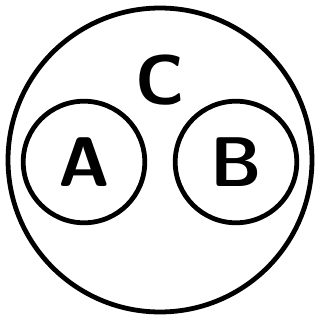
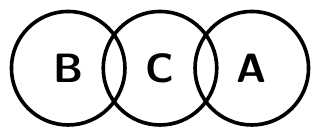
Which of the following correctly represents the relationship between them.

A) Singing

B) Dancing

C) Art

  1. AOption (a)

  2. BOption (b)

  3. COption (c)

  4. DOption (d)

View answer & explanation

Correct answer

Answer: (a)A.

Why this answer is correct

The logic followed here is:-

  • Singing and dancing are forms of art but singing and dancing are different from each other.

The most suitable Venn diagram is given below:

Hence, "option 1" is the correct answer.

Question 56

Instantaneous velocity and Average velocity are equal when the object _________.

  1. AOption (a)

    have uniform acceleration

  2. BOption (b)

    walking in a circle

  3. COption (c)

    have variable acceleration

  4. DOption (d)

    have zero acceleration

View answer & explanation

Correct answer

Answer: (d)D.

have zero acceleration

Why this answer is correct

The correct answer is have zero acceleration.

  • Average velocity is equal to the instantaneous velocity when acceleration is zero.

Important Points

  • Average velocity
  • The average velocity of a body is defined as the change in position or displacement divided by the time interval in which that displacement occurs.
  • Average velocity is a vector quantity.
  • The SI unit is meters per second.
  • Instantaneous velocity
  • The instantaneous velocity is the specific rate of change of position (or displacement) with respect to time at a single point.
  • The SI unit of instantaneous velocity is m/s.
  • It is a vector quantity.

Question 57

Consider the following statements and arguments and decide which of the arguments is stronger.

Statements:

Is it necessary to cut the banyan tree standing in the middle of the road?

Argument:

I. Yes, because it obstructs the traffic. Also, there's going to be a big two-way project.

II. No, the road should be narrowed by dividing it into sections or a signal can be installed. Banyan trees will help in maintaining the supply of oxygen.

  1. AOption (a)

    Neither argument I nor II is strong.

  2. BOption (b)

    Only argument II is strong.

  3. COption (c)

    Only argument I is strong.

  4. DOption (d)

    Both Arguments I and II are strong.

View answer & explanation

Correct answer

Answer: (c)C.

Only argument I is strong.

Why this answer is correct

The question asks whether the banyan tree that is standing in the middle of the road, should be cut or not.

  • Argument I is strong because if there is a tree in the middle of a road, it will cause problems to the traffic, which may also lead to accidents. Additionally, it states that there is also a two-way project planned for the road, thus the tree will make it difficult for traffic flow as well as the project. Another tree can be planted along the sides of the road instead.
  • Argument II states that the tree should not be cut with the suggestion that the road can be narrowed by creating sections, or a signal can be installed. This justification weakens the argument since a narrow road will be more troublesome, especially for large vehicles, and it might become congested leading to traffic issues. Thus, argument II is not strong.

Hence the correct answer is option 3.

Question 58

The sum of the present ages of two cousins is 52 years. 14 years ago the age of the elder brother was three times that of the younger brother. What is the present age of elder brother?

  1. AOption (a)

    30 years

  2. BOption (b)

    28 years

  3. COption (c)

    34 years

  4. DOption (d)

    32 years

View answer & explanation

Correct answer

Answer: (d)D.

32 years

Why this answer is correct

Shortcut Trick

Sum of ages 14 years ago = 52 − (14 × 2) = 52 − 28 = 24 years.

Ratio of ages 14 years ago = 3 : 1 (Total units = 4).

Age of elder brother 14 years ago = (24 ÷ 4) × 3 = 18 years.

Present age of elder brother = 18 + 14 = 32 years.

∴ The correct answer is 32 years.

Alternate Method

Let the age of the younger brother 14 years ago be x and the elder brother be 3x.

Present age of younger brother = x + 14

Present age of elder brother = 3x + 14

⇒ (x + 14) + (3x + 14) = 52

⇒ 4x + 28 = 52

⇒ 4x = 52 − 28

⇒ 4x = 24

⇒ x = 6

⇒ Present age of elder brother = 3(6) + 14 = 18 + 14 = 32 years.

∴ The correct answer is 32 years.

Additional Information

Age Difference Property

The difference between the ages of two people remains constant at any point in time.

Sum of Ages Change

If the sum of ages of 'n' people is S at present, then 't' years ago, the sum was S − (n × t).

Ratio Method

When ratios at two different times are given, equalize the parts representing the constant age difference to solve faster.

Question 59

A solid cylinder whose base radius was 6 cm and height 9 cm is melted to form a solid sphere. The radius of this sphere is ________ cm.

  1. AOption (a)

    393\sqrt[3]{9}

  2. BOption (b)

    433\sqrt[3]{3}

  3. COption (c)

    333\sqrt[3]{3}

  4. DOption (d)

    27

View answer & explanation

Correct answer

Answer: (a)A.

393\sqrt[3]{9}

Why this answer is correct

Shortcut Trick

Volume of Cylinder = Volume of Sphere

πrc2h = (4/3)πrs3

62 × 9 = (4/3)rs3 ⇒ 36 × 9 = (4/3)rs3 ⇒ 9 × 9 × 3 = rs3

rs3 = 243 ⇒ rs = √3 = √[3](27 × 9) = 3√3 cm

∴ The correct answer is 3√3 cm.

Alternate Method

Given: Radius of cylinder (r) = 6 cm, Height (h) = 9 cm.

Formula Used: Volume of cylinder = πr2h; Volume of sphere = (4/3)πR3.

⇒ Volume of Cylinder = Volume of Sphere

⇒ π × 62 × 9 = (4/3) × π × R3

⇒ 36 × 9 = (4/3) × R3

⇒ R3 = (36 × 9 × 3) / 4

⇒ R3 = 9 × 9 × 3 = 243

⇒ R = √3 = √[3](27 × 9) = 3 × √3 cm

∴ The correct answer is 3√3 cm.

Additional Information

Volume Invariance

When one solid object is melted and recast into another shape, its total volume remains constant.

Sphere Properties

The surface area of a sphere is given by 4πR2 and its volume is (4/3)πR3.

Cylinder Properties

The total surface area of a cylinder is 2πr(r + h) and its volume is πr2h.

Question 60

Select the correct water image from the following figures.

  1. AOption (a)

    B

  2. BOption (b)

    D

  3. COption (c)

    A

  4. DOption (d)

    C

View answer & explanation

Correct answer

Answer: (c)C.

A

Why this answer is correct

The correct water image of the question figure is as follows:

Hence, "option 3" is the correct answer.

Question 61

Water flowing at a hydroelectric power station can rotate a turbine because it contains-

  1. AOption (a)

    Electrical energy

  2. BOption (b)

    Chemical energy

  3. COption (c)

    Kinetic energy

  4. DOption (d)

    Potential energy

View answer & explanation

Correct answer

Answer: (c)C.

Kinetic energy

Why this answer is correct

The correct answer is Kinetic energy.

  • Water flowing at a hydroelectric power station can rotate a turbine because it contains Kinetic energy.
  • A turbine uses the flowing energy (kinetic energy) of the water to rotate the motor (mechanical energy) to generate electricity (electrical energy).

Key Points

  • Kinetic energy (KE): The energy possessed by a body by virtue of its motion is called kinetic energy.
  • KE = 1/2mv2
  • where m = mass of the body and v = velocity of the body.
  • Hence, kinetic energy is directly proportional to the square of velocity.

Question 62

What number would come in place of question mark (?) in the series?

2, 7, 19, 31, ?, ?

  1. AOption (a)

    26, 28

  2. BOption (b)

    47, 57

  3. COption (c)

    37, 41

  4. DOption (d)

    31, 33

View answer & explanation

Correct answer

Answer: (c)C.

37, 41

Why this answer is correct

The logic followed here is:-

  • 2, 7, 19, 31 are prime numbers.
  • In option 3, 37 and 41 are prime numbers.

Hence, "option 3" is the correct answer.

Question 63

The company made sales of Rs. 5,00,000 in 1 year. There was an increase in sales of 35% in Year 3 as compared to Year 1. What is the actual profit in year 3?

  1. AOption (a)

    Rs. 2,50,000

  2. BOption (b)

    Rs. 6,75,000

  3. COption (c)

    Rs. 6,00,000

  4. DOption (d)

    Rs. 1,75,000

View answer & explanation

Correct answer

Answer: (d)D.

Rs. 1,75,000

Why this answer is correct

Shortcut Trick

The increase in sales represents the actual profit or growth in sales in Year 3 compared to Year 1.

Given that the increase is 35% of the Year 1 sales:

Increase in Sales = 35% of Rs. 5,00,000

Increase in Sales = (35 ÷ 100) × 5,00,000 = Rs. 1,75,000

∴ The correct answer is Rs. 1,75,000.

Alternate Method

Given:

Sales in Year 1 = Rs. 5,00,000

Percentage increase in sales in Year 3 = 35%

Formulas:

Increase in Sales = (Percentage Increase ÷ 100) × Initial Sales

New Sales = Initial Sales × (100 + Increase%) ÷ 100

⇒ Actual profit/increase in year 3 = Year 3 Sales − Year 1 Sales

⇒ Year 3 Sales = 5,00,000 × (100 + 35) ÷ 100 = 5,00,000 × 1.35 = Rs. 6,75,000

⇒ Actual profit (increase) in Year 3 = Rs. 6,75,000 − Rs. 5,00,000 = Rs. 1,75,000

∴ The correct answer is Rs. 1,75,000.

Additional Information

Percentage Increase Formula

Percentage Increase is calculated as (New Value − Original Value) ÷ Original Value × 100. In business, an increase in sales compared to a base year is often referred to as absolute growth or actual profit generated through expansion.

Question 64

A man can buy 4 more kg of sugar for Rs. 16 after reducing its price by Rs. 2/kg. What was the price of sugar earlier?

  1. AOption (a)

    Rs. 4/kg

  2. BOption (b)

    Rs. 2/kg

  3. COption (c)

    Rs. 8/kg

  4. DOption (d)

    Rs. 16/kg

View answer & explanation

Correct answer

Answer: (a)A.

Rs. 4/kg

Why this answer is correct

Shortcut Trick

Use the Option Verification method.

If original price is ₹ 4/kg, quantity = 16 ÷ 4 = 4 kg.

New price = 4 − 2 = ₹ 2/kg.

New quantity = 16 ÷ 2 = 8 kg.

Difference = 8 − 4 = 4 kg (Matches the condition).

∴ The correct answer is ₹ 4/kg.

Alternate Method

Given: Total expenditure = ₹ 16, Price reduction = ₹ 2/kg, Extra quantity = 4 kg.

Formula: Quantity = Total Expenditure ÷ Price per kg

Let the original price of sugar be x.

⇒ 16/(x − 2) − 16/x = 4

⇒ 4/(x − 2) − 4/x = 1 (Dividing by 4)

⇒ [4x − 4(x − 2)] / [x(x − 2)] = 1

⇒ [4x − 4x + 8] = x2 − 2x

⇒ x2 − 2x − 8 = 0

⇒ (x − 4)(x + 2) = 0

⇒ x = 4 (Price cannot be negative)

∴ The correct answer is ₹ 4/kg.

Additional Information

Price and Consumption Relationship

When expenditure is constant, Price is inversely proportional to Consumption (P ∝ 1/C).

Reduced Price Formula

Reduced Price = (Price reduction % × Total Amount) ÷ Extra Quantity. This is used for percentage-based drops.

Question 65

What is the number of possible faces (without inverting them) in a tetrahedron?

  1. AOption (a)

    4

  2. BOption (b)

    2

  3. COption (c)

    3

  4. DOption (d)

    1

View answer & explanation

Correct answer

Answer: (a)A.

4

Why this answer is correct

Shortcut Trick

A tetrahedron is a triangular pyramid.

It consists of 4 triangular faces.

Since the question asks for the number of possible faces without inverting them (orientation), it refers to the distinct geometric types of faces.

In a regular tetrahedron, all 4 faces are identical equilateral triangles.

∴ The correct answer is 4.

Alternate Method

Given: Shape is a tetrahedron.

Formula Used: Euler's Formula ⇒ V − E + F = 2

⇒ A tetrahedron has 4 vertices (V = 4).

⇒ It has 6 edges (E = 6).

⇒ Applying Euler's Formula: 4 − 6 + F = 2

⇒ −2 + F = 2

⇒ F = 4

∴ The correct answer is 4.

Additional Information

Euler's Polyhedron Formula

For any convex polyhedron, the relationship between vertices (V), edges (E), and faces (F) is given by V − E + F = 2.

Regular Polyhedra (Platonic Solids)

There are only five: Tetrahedron (4 faces), Cube (6 faces), Octahedron (8 faces), Dodecahedron (12 faces), and Icosahedron (20 faces).

Tetrahedron Properties

It is the simplest 3D polynomial. Every vertex is connected to every other vertex by an edge.

Question 66

_________ was started by Lord Cornwallis in Bengal, Bihar and Orissa.

  1. AOption (a)

    Permanent Settlement

  2. BOption (b)

    Ryotwari System

  3. COption (c)

    Izaredari System

  4. DOption (d)

    Mahalwari System

View answer & explanation

Correct answer

Answer: (a)A.

Permanent Settlement

Why this answer is correct

The correct answer is Permanent Settlement.

Key Points

  • The system of Permanent settlement was introduced by Lord Cornwallis in Bengal, Bihar, and Orissa.
  • The Permanent Settlement was introduced by Lord Cornwallis in 1793.
  • They created a class of hereditary landlords who became the permanent owners of their land.
  • They used to collect land revenue from the people and regularly deposit it in the government treasury.
  • The Permanent Settlement was an agreement between the Zamindars (zamindars) and the East India Company.
  • This settlement gave the primary owner of the land to the zamindars and fixed the amount of revenue payable to the company.

Additional Information

  • Ryotwari system
  • The Ryotwari System was introduced by Thomas Munro.
  • He was the first British Collector of Anantapur, Andhra Pradesh.
  • He was known for pro-farmer tax reforms.
  • He introduced the Ryotwari settlement system and was known as the father of the Ryotwari settlement system.
  • ​Izaredari system
  • Izaredari system was introduced by Warren Hastings in 1773 in Bengal.
  • According to this land tenure (first in India), the right to collect revenue was auctioned to the highest bidder.
  • The peasants, merchants, and shopkeepers had to pay their rent to the Izaredar.
  • The system was eventually ended by the Permanent Settlement under the Cornwallis Code in 1793.
  • Mahalwari system
  • In the North-Western Provinces of the Bengal Presidency (most of this area is now in Uttar Pradesh), an Englishman called Holt Mackenzie devised the new system which came into effect in 1822.
  • Under his directions, collectors went from village to village, inspecting the land, measuring the fields, and recording the customs and rights of different groups.
  • The estimated revenue of each plot within a village was added up to calculate the revenue that each village (mahal) had to pay. This demand was to be revised periodically, not permanently fixed.
  • The charge of collecting the revenue and paying it to the Company was given to the village headman, rather than the zamindar.

Question 67

_______ are the regions where pressure, as well as density, is high.

  1. AOption (a)

    Rarefaction

  2. BOption (b)

    Compression 

  3. COption (c)

    Dimension

  4. DOption (d)

    Ascent

View answer & explanation

Correct answer

Answer: (b)B.

Compression 

Why this answer is correct

The correct answer is Compression.

Concept:

Sound: It is a form of energy produced by vibration or disturbance that propagates in a medium.

  • It travels in the form of longitudinal waves (Compression or rarefaction)

Explanation:

  • Compression is the regions where pressure, as well as density, is high.
  • The region of high pressure and high density is called compression and the region of low pressure and low density in the air is called rarefaction.

Additional Information

Rarefaction- Rarefaction is the reduction of an item's density, the opposite of compression. Like compression, which can travel in waves, rarefaction waves also exist in nature. - A common rarefaction wave is the area of low relative pressure following a shock wave.
Dimension- In physics and mathematics, the dimension of a mathematical space is informally defined as the minimum number of coordinates needed to specify any point within it.
Ascent- Ascent means upward movement.

Question 68

The potential difference is 40V. Find the work done to transmit a charge of 0.5C?

  1. AOption (a)

    20 J

  2. BOption (b)

    20 Ω 

  3. COption (c)

    20 A

  4. DOption (d)

    20 Ω-m

View answer & explanation

Correct answer

Answer: (a)A.

20 J

Why this answer is correct

The correct answer is 20 J.

CONCEPT:

  • Electric potential difference: The amount of work done to move a unit charge from a point to another point in a space where an electric field is present is called an electric potential difference.

Potential;difference(V)=;Work;done(W)Charge(Q){\rm{Potential;difference}}\left( {\rm{V}} \right) = {\rm{;}}\frac{{Work;done\left( W \right)}}{{Charge\left( Q \right)}}

Work done (W) = Energy gained = Q V

  • Electric field: The space or region around the electric charge in which electrostatic force can be experienced by other charged particles is called an electric field by that charge.

CALCULATION:

  • Find work done = W

Given:

  • Moving charge (Q) = 0.5 C
  • Two points having a potential difference (V) = 40 V.

We know that

Potentialdifference=Work doneQuantity of charge movedPotential\enspace difference= {Work\ done\over Quantity\ of\ charge\ moved}

  • Work done = Q × V
  • Work done = 0.5 × 40
  • Work done = 20 J.

Question 69

Which of the following is formed when vaporized carbon condenses in an inert gas atmosphere?

  1. AOption (a)

    Fullerene

  2. BOption (b)

    Graphite

  3. COption (c)

    Coke

  4. DOption (d)

    Carbon black

View answer & explanation

Correct answer

Answer: (a)A.

Fullerene

Why this answer is correct

The correct answer is Fullerene.

Key Points

  • Fullerene
  • It is formed when vaporized carbon condenses in an inert gas atmosphere.
  • It was discovered by Richard Smalley in 1985.
  • A form of carbon having a large spheroidal molecule consisting of a hollow cage of sixty or more atoms, of which buckminsterfullerene was the first known example.
  • Fullerenes are produced chiefly by the action of arc discharge between carbon electrodes in an inert atmosphere.
  • Harold Kroto, Robert Curl, and Richard Smalley were given the Nobel prize in chemistry in 1996, for the discovery of this carbon allotrope, fullerene C60.

Additional Information

  • Graphite
  • It is an allotrope of carbon used both as a lubricant and as a lead in pencils.
  • Carbon Black
  • Carbon black is obtained by burning hydrocarbons in a limited supply of air.

CH4+ O2 C + 2H20

  • It is used as a black pigment in black ink.
  • It is also used as a filler in automobile tyres.
  • Heating wood at high temperature in absence of air releases charcoal and volatile tars.
  • Heating coal at a high temperature in absence of air results in the destructive distillation of coal.
  • Heating coal at a high temperature in the presence of air would produce Carbon dioxide.
  • Coke
  • Coke is produced by heating coal for several hours to high temperature out of contact with air until all volatile matters are removed.
  • The process is called "carbonization" or "Destructive distillation of coal".

Question 70

Asian Games was first held in Delhi in the year _________.

  1. AOption (a)

    1951

  2. BOption (b)

    1956

  3. COption (c)

    1953

  4. DOption (d)

    1952

View answer & explanation

Correct answer

Answer: (a)A.

1951

Why this answer is correct

The correct answer is 1951

Key Points

  • The first Asian Games were held in New Delhi, India in 1951.
  • They are also known as Asiad.
  • It is a Pancontinental multi-sport level even held every four years among athletes from all over Asia.
  • The games are regulated by the Asian Games Federation.
  • The motto of the first Asian Games was the game is "Play the game in the spirit of the game".
  • The Games were officially opened by Indian President Rajendra Prasad at the Major Dhyan Chand National Stadium.

Additional Information

EditionYearHost CityHost country
XVII2014IncheonSouth Korea
XVIII2018Jakarta-PalembangIndonesia
XIX2022HangzhouChina
XX2026Aichi-NagoyaJapan
XXI2030DohaQatar
XXII2034RiyadhSaudi Arabia

Question 71

The SI unit of ________ is joule/second?

  1. AOption (a)

    Work

  2. BOption (b)

    Force

  3. COption (c)

    Thrust

  4. DOption (d)

    Power

View answer & explanation

Correct answer

Answer: (d)D.

Power

Why this answer is correct

The correct answer is Power.

Key Points

  • The SI unit of power is joule/second or Watt.
  • Power: It is defined as the rate of doing work.
  • P=Wt=F×vP = {{W} \over t} = F \times v

Where,

  • W = work,
  • t = time,
  • F = force,
  • and V = average velocity.
  • Electric power is the rate, per unit time, at which electrical energy is transferred by an electric circuit (P=W/t).
  • Therefore, it is measured in Joules/ second or Watts which is the SI unit for power.​

Additional Information

  • Thrust
  • When any object is put into the water then the object will replace the water the same as its volume and the cause of which there is a force acting upwards, to balance this weight is called the thrust force.
  • The SI unit of thrust is Newton.
  • Force
  • The interaction which after applying on a body changes or try to change the state of motion or state of rest is called force.
  • Force is denoted by F and the SI unit is Newton (N).
  • Force (F) = Mass (m) x acceleration (a).

Question 72

What products are produced in the chlor-alkali process?

  1. AOption (a)

    Chlorine and Calcium Hydroxide

  2. BOption (b)

    Chlorine and Potassium Hydroxide

  3. COption (c)

    Chlorine and Aluminum Hydroxide

  4. DOption (d)

    Chlorine & Sodium Hydroxide

View answer & explanation

Correct answer

Answer: (d)D.

Chlorine & Sodium Hydroxide

Why this answer is correct

The correct answer is Chorine and Sodium Hydroxide.

  • Chlorine & Sodium Hydroxide are produced in the Chlor-alkali process.

Key Points

  • When the electricity is passed through the aqueous solution of 10% NaCl (brine) then it decomposes to form sodium hydroxide, a basic compound.
  • This process is called the chloralkali process.

2NaCl (aq) + 2H2O → 2NaOH (aq) + Cl2 (g) + H2 (g)

  • The three products in this reaction come are:
  • Sodium hydroxide (NaOH).
  • Chlorine (CI).
  • Hydrogen (H2).

Question 73

The following pie diagram shows the information on sales of different types of food items by restaurant "XYZ". 

The total revenue received by the restaurant in November 2017 was 35 lakhs.

How much revenue was generated by restaurant "XYZ" in 2017 through the sale of donuts?

  1. AOption (a)

    7 lakh

  2. BOption (b)

    10 lakh

  3. COption (c)

    8.75 lakh

  4. DOption (d)

    5.25 lakh

View answer & explanation

Correct answer

Answer: (a)A.

7 lakh

Why this answer is correct

Total revenue is 35 lakhs

Revenue from sale of donuts is 20% = 1/5

Revenue = 35 × 1/5 = 7 lakhs

∴ Required answer is 7 lakhs

Question 74

If the L.C.M. of two numbers 48 and 176 is equal to 4 × m, then find the value of m.

  1. AOption (a)

    112

  2. BOption (b)

    142

  3. COption (c)

    122

  4. DOption (d)

    132

View answer & explanation

Correct answer

Answer: (d)D.

132

Why this answer is correct

Shortcut Trick

LCM of 48 and 176:

48 = 16 × 3 and 176 = 16 × 11

LCM = 16 × 3 × 11 = 528

Given 4 × m = 528 ⇒ m = 528 ÷ 4 = 132

∴ The correct answer is 132.

Alternate Method

Given: Numbers are 48 and 176. Relation is LCM = 4 × m.

Formula: LCM (Least Common Multiple) is the smallest number divisible by both.

Prime Factorisation:

⇒ 48 = 24 × 31

⇒ 176 = 24 × 111

⇒ LCM = 24 × 31 × 111

⇒ LCM = 16 × 33 = 528

⇒ 4 × m = 528

⇒ m = 528 ÷ 4

⇒ m = 132

∴ The correct answer is 132.

Additional Information

Relationship between LCM and HCF

For two numbers a and b, Product of numbers = HCF × LCM. i.e., a × b = HCF(a, b) × LCM(a, b).

HCF (Highest Common Factor)

The greatest number that divides two or more numbers without leaving a remainder. For 48 and 176, HCF is 16.

Co-prime Numbers

Two numbers are co-prime if their HCF is 1. Their LCM is simply the product of the two numbers.

Question 75

Read the given question and decide which of the following statements are sufficient to answer the question.

Question:

In which direction is city X with respect to city Y?

Statements:

I. X is to the north-west of Z.

II. X is to the north of M who is to the west of Z.

III. M is to the north-west of Y.

  1. AOption (a)

    Only I and II are sufficient.

  2. BOption (b)

    Only II and III are sufficient.

  3. COption (c)

    Only I and III are sufficient.

  4. DOption (d)

    Only III is sufficient.

View answer & explanation

Correct answer

Answer: (b)B.

Only II and III are sufficient.

Why this answer is correct

I. X is to the northwest of Z.

  • Here, there is no information given about the direction of Y. Therefore, statement 1 alone is not sufficient.

II. X is to the north of M who is to the west of Z.

  • No information is given about the direction of Y. Therefore, statement 2 alone is not sufficient.

III. M is to the northwest of Y.

  • No information is given about the direction of X. Therefore, statement 3 alone is not sufficient.

  • From statements 2, and 3:-

  • Here, we can see that X is to the north-west of Y. Therefore, statements 2, and 3 together are sufficient.

Hence, "option 2" is the correct answer.

Question 76

Read the following information carefully and answer the question given below.

There are 9 friends P, Q, R, S, T, U, V, W and X living in the apartment respectively. R is 2 km east of Q. P is 1 km north of Q and W is 2 km south of P. V is 1 km west of W. While S is 3 km east of V and U is 2 km north of V. X is in the midpoint of Q and R while T is in the midpoint of W and S. What is the distance between P and U?

  1. AOption (a)

    3 km

  2. BOption (b)

    1.5 km

  3. COption (c)

    1 km

  4. DOption (d)

    2 km

View answer & explanation

Correct answer

Answer: (c)C.

1 km

Why this answer is correct

  • The distance diagram is as follows:

  • The distance between P and U is 1 km

Hence, "option 3" is the correct answer.

Question 77

A man swims 4 km upstream in 5 hours and 16 km downstream in 5 hours. What is the speed of the stream?

  1. AOption (a)

    2.2 km/h

  2. BOption (b)

    3.2 km/h

  3. COption (c)

    1.2 km/h

  4. DOption (d)

    1.5 km/h

View answer & explanation

Correct answer

Answer: (c)C.

1.2 km/h

Why this answer is correct

Shortcut Trick

Upstream Speed (u) = 4 ÷ 5 = 0.8 km/h

Downstream Speed (v) = 16 ÷ 5 = 3.2 km/h

Speed of Stream = (v − u) ÷ 2 = (3.2 − 0.8) ÷ 2 = 1.2 km/h

∴ The correct answer is 1.2 km/h.

Alternate Method

Given:

Upstream distance = 4 km, Upstream time = 5 hours

Downstream distance = 16 km, Downstream time = 5 hours

Formula Used:

Speed = Distance ÷ Time

Speed of Stream = (Downstream Speed − Upstream Speed) ÷ 2

⇒ Upstream Speed (U) = 4 ÷ 5 = 0.8 km/h

⇒ Downstream Speed (D) = 16 ÷ 5 = 3.2 km/h

⇒ Let Speed of Boat be 'x' and Speed of Stream be 'y'.

⇒ x − y = 0.8

⇒ x + y = 3.2

⇒ Subtracting equations: (x + y) − (x − y) = 3.2 − 0.8

⇒ 2y = 2.4

⇒ y = 1.2 km/h

∴ The correct answer is 1.2 km/h.

Additional Information

Speed of Boat in Still Water

Calculated as the average of downstream and upstream speeds: Speed = (D + U) ÷ 2.

Relative Speed in Water

Downstream speed is (Boat + Stream) and Upstream speed is (Boat − Stream).

Question 78

Unregulated means of raising funds for projects using cryptocurrencies such as Bitcoin, D.A.S.H., Ethereum, Monero, Litecoin, and Z-cash have been named ________.

  1. AOption (a)

    Initial, Coin Offering

  2. BOption (b)

    Crypto Currency Offering

  3. COption (c)

    Digi Coin Offering

  4. DOption (d)

    In Digi Currency

View answer & explanation

Correct answer

Answer: (b)B.

Crypto Currency Offering

Why this answer is correct

The correct answer is CryptoCurrency offering.

  • Unregulated means of raising funds for projects using cryptocurrencies such as Bitcoin, D.A.S.H., Ethereum, Monero, Litecoin, and Z-cash have been named Crypto Currency Offering.

Additional Information

  • Bitcoin, first released as open-source software in 2009, is the first decentralized cryptocurrency. Since the release of bitcoin, many other cryptocurrencies have been created.
  • In 1983, the American cryptographer David Chaum conceived an anonymous cryptographic electronic money called ecash.
  • In 1998, Wei Dai published a description of b-money, characterized as an anonymous, distributed electronic cash system.
  • In June 2021, El Salvador became the first country to accept Bitcoin as legal tender.

Important Points

  • Initial, Coin Offering:
  • An initial coin offering or initial currency offering is a type of funding using cryptocurrencies. This is often a form of crowdfunding, although a private ICO that does not seek public investment is also possible.
  • Digi Coin Offering:
  • ​Digital currency (digital money, electronic money, or electronic currency) is any currency, money, or money-like asset that is primarily managed, stored, or exchanged on digital computer systems, especially over the internet.
  • Types of digital currencies include cryptocurrency, virtual currency, and central bank digital currency.

Question 79

________ state has launched Indira Canteen Scheme to provide low-cost food to the urban poor.

  1. AOption (a)

    Tamil Nadu

  2. BOption (b)

    Assam

  3. COption (c)

    Rajasthan

  4. DOption (d)

    Karnataka

View answer & explanation

Correct answer

Answer: (d)D.

Karnataka

Why this answer is correct

The correct answer is Karnataka.

Key Points

  • The Karnataka government and Congress Vice President Rahul Gandhi have started 'Indira Canteen' in Bengaluru with an aim to reach out to the poorer sections of the society.
  • Breakfast in the canteen will be Rs 5 and lunch and dinner at Rs 10 per plate.
  • Out of the total proposed 198 canteens, 101 were started on 16th August 2017 and the rest will start functioning from 2nd October 2017.

Question 80

There are 100 children in a primary school. The number of children who like blue and red is 30. The number of children who like yellow and blue is 20. The number of children who like only one color is 45. No child likes only yellow and red. How many children like all three colours?

  1. AOption (a)

    5

  2. BOption (b)

    15

  3. COption (c)

    10

  4. DOption (d)

    2

View answer & explanation

Correct answer

Answer: (a)A.

5

Why this answer is correct

Given:

Total no. of children = 100

No. of children who like blue and red = 30

No. of children who like yellow and blue = 20.

No. of children who like only one colour = 45.

The Venn diagram representation of the given information is as follows:

  • No. of children who like only red or only yellow or only blue = 45
  • Here, X likes only yellow; Y likes only red
  • So, no. of children who like only blue = 45 - (X + Y) = 45 - X - Y
  • Children who like all three colours = 100 - 45 - 20 - 30 = 100 - 95 = 5
  • Thus, 5 children like all three colours.

Hence, "option 1" is the correct answer.

Question 81

What is the value of 0.92 – 0.126 ÷ 0.6 + 6.7 × 0.03?

  1. AOption (a)

    0.911

  2. BOption (b)

    1.52

  3. COption (c)

    2.72

  4. DOption (d)

    0.83

View answer & explanation

Correct answer

Answer: (a)A.

0.911

Why this answer is correct

Given:

0.92 – 0.126 ÷ 0.6 + 6.7 × 0.03

Concept used:

Calculation:

0.92 – 0.126 ÷ 0.6 + 6.7 × 0.03

⇒ 0.92 – 0.126 × 1/0.6 + 6.7 × 0.03

⇒ 0.92 – 0.21 + 6.7 × 0.03

⇒ 0.92 – 0.21 + 0.201

⇒ 0.911

∴ Requried answer is 0.911

Question 82

Choose the odd option.

ABCD
5EO14T2025Y
  1. AOption (a)

    D

  2. BOption (b)

    C

  3. COption (c)

    A

  4. DOption (d)

    B

View answer & explanation

Correct answer

Answer: (d)D.

B

Why this answer is correct

The logic followed here is:

  • Option A → E and its positional value 5.
  • Option B → O and 14, but its positional value is 15.
  • Option C → T and its positional value 20.
  • Option D → Y and its positional value 25.

So, option B is different from others.

Hence, "option 4" is the correct answer.

Question 83

The three given shapes form a valid figure and identify the figure from the options given below?

  1. AOption (a)

  2. BOption (b)

  3. COption (c)

  4. DOption (d)

View answer & explanation

Correct answer

Answer: (b)B.

Why this answer is correct

  • There are three shapes given to us.

  • When we combine 2) and 3) we get the following figure:

​

  • When we add 1) to the above shape, we get

  • After rotation, we get:

Hence, "option 2" is the correct answer.

Mistake Points Option 3 is incorrect because, the thickness of the shape 3) does not match with the given question figure.

Question 84

The beings of the phylum are exclusively free-living beings in the ocean.

  1. AOption (a)

    Nematoda

  2. BOption (b)

    Mollusca

  3. COption (c)

    Arthropoda

  4. DOption (d)

    Echinodermata

View answer & explanation

Correct answer

Answer: (d)D.

Echinodermata

Why this answer is correct

The correct answer is Echinodermata.

Key Points

  • Echinodermata are exclusively free-living marine animals.
  • Echinodermata is a phylum of sea invertebrates.
  • They have fivefold radial symmetry, a calcareous skeleton, and tube feet operated by fluid pressure.
  • Examples are **sea cucumbers, starfishes, sea urchins, brittle stars, and crinoids.**​

Additional Information

AnimalsDescription
ArthropodaThey are those invertebrates, which
breath through the trachea and book lungs. Examples are butterflies, cockroaches, tarantula, lobster, etc.
MolluscaThey are invertebrates with three main body parts i.e. the foot, the visceral mass, and the mantle. Examples are oysters, limpets,
octopus, chiton, etc.
NematodaThey are microscopic worms that live in the soil. Examples are filariasis, hookworms, pinworms, etc.

Question 85

The sum of first 200 whole numbers is-

  1. AOption (a)

    20100

  2. BOption (b)

    19900

  3. COption (c)

    20000

  4. DOption (d)

    19800

View answer & explanation

Correct answer

Answer: (b)B.

19900

Why this answer is correct

Shortcut Trick

The first 200 whole numbers are 0, 1, 2, ..., 199.

Sum of first n whole numbers = [n × (n − 1)] ÷ 2

Sum = [200 × 199] ÷ 2

Sum = 100 × 199 = 19900

∴ The correct answer is 19900.

Alternate Method

Given: First 200 whole numbers.

Formula Used: Sum of an Arithmetic Progression (AP) = (n/2) × [first term + last term]

⇒ First whole number = 0

⇒ 200th whole number = 199

⇒ Sum = (200 ÷ 2) × (0 + 199)

⇒ Sum = 100 × 199

⇒ Sum = 19900

∴ The correct answer is 19900.

Additional Information

Whole Numbers vs Natural Numbers

Whole numbers start from 0 (0, 1, 2...), while natural numbers start from 1 (1, 2, 3...).

Sum of First n Natural Numbers

The sum of the first n natural numbers is given by the formula: [n × (n + 1)] ÷ 2.

Sum of First n Even/Odd Numbers

Sum of first n odd numbers = n2. Sum of first n even numbers = n × (n + 1).

Question 86

Desert National Park is in ________.

  1. AOption (a)

    Assam

  2. BOption (b)

    Gujarat

  3. COption (c)

    Rajasthan

  4. DOption (d)

    Kerala

View answer & explanation

Correct answer

Answer: (c)C.

Rajasthan

Why this answer is correct

The correct answer is Rajasthan.

Key Points

  • Desert National Park, Rajasthan
  • Desert National Park, Rajasthan, India, is situated in the west Indian state of Rajasthan near the towns of Jaisalmer and Barmer.
  • The Desert National Park is an excellent example of the ecosystem of the Thar Desert.
  • The DNP is the most important site for the long-term survival of the Globally Threatened Great Indian Bustard.

Additional Information

StatesNational park
AssamKaziranga National Park, Dibru-Saikhowa National Park, Manas National Park, Nameri National Park, Orang National Park, Raimona Reserve Forest, Dehing Patkai National Park
GujaratGir Forest National Park, Blackbuck National Park, Marine National Park, Gulf of Kutch
KeralaPambadum Shola National Park, Eravikulam National Park, Mathikettan Shola National Park, Silent Valley National Park, Anamudi Shola National Park, Periyar National Park
RajasthanKeoladeo National Park, Sariska National Park, Ranthambore National Park, Mukundra Hills (Darrah) National Park, Desert National Park

Question 87

Neelu cuts 2 kg of yarn in 12 days working 3 hours a day. How much time will she take to cut 10 kg of yarn working 4 hours a day?

  1. AOption (a)

    48 days

  2. BOption (b)

    45 days

  3. COption (c)

    26 days

  4. DOption (d)

    32 days

View answer & explanation

Correct answer

Answer: (b)B.

45 days

Why this answer is correct

Shortcut Trick

Use the M1D1H1 / W1 = M2D2H2 / W2 formula.

(1 × 12 × 3) / 2 = (1 × Days × 4) / 10

18 = Days × 0.4

Days = 18 / 0.4 = 45 days.

∴ The correct answer is 45 days.

Alternate Method

Given:

Initial work (W1) = 2 kg, Time (D1) = 12 days, Daily hours (H1) = 3 hours.

Final work (W2) = 10 kg, Daily hours (H2) = 4 hours, Let Final days be D2.

Formula Used:

Total Work is proportional to Man-hours (M × D × H / W = constant).

⇒ (1 × 12 × 3) / 2 = (1 × D2 × 4) / 10

⇒ 36 / 2 = 4D2 / 10

⇒ 18 = 0.4 × D2

⇒ D2 = 18 / 0.4

⇒ D2 = 180 / 4

⇒ D2 = 45 days

∴ The correct answer is 45 days.

Additional Information

Chain Rule Formula

For work problems involving multiple variables: (M1D1H1E1)/W1 = (M2D2H2E2)/W2, where E is efficiency.

Direct vs Inverse Proportion

Days are directly proportional to Work (W) and inversely proportional to Hours (H) and Men (M).

Question 88

4 years ago, Mitesh's age was twice that of Pranav. 11 years ago, Mitesh's age was thrice that of Pranav. What is Mitesh's present age?

  1. AOption (a)

    36 years

  2. BOption (b)

    28 years

  3. COption (c)

    34 years

  4. DOption (d)

    32 years

View answer & explanation

Correct answer

Answer: (d)D.

32 years

Why this answer is correct

Shortcut Trick

Age ratio (M:P) 4 years ago = 2 : 1 (Difference = 1 unit)

Age ratio (M:P) 11 years ago = 3 : 1 (Difference = 2 units)

Equating differences: 4 years ago ratio = 4 : 2 | 11 years ago ratio = 3 : 1

Difference in ratio parts (4 − 3) = 1 unit → 7 years (11 − 4)

Mitesh age 4 years ago = 4 × 7 = 28 years ⇒ Present age = 28 + 4 = 32 years.

∴ The correct answer is 32 years.

Alternate Method

Given:

Let the present ages of Mitesh and Pranav be M and P respectively.

Calculations:

⇒ Case 1 (4 years ago): (M − 4) = 2 × (P − 4)

⇒ M − 4 = 2P − 8 ⇒ M − 2P = −4 — (Eq. 1)

⇒ Case 2 (11 years ago): (M − 11) = 3 × (P − 11)

⇒ M − 11 = 3P − 33 ⇒ M − 3P = −22 — (Eq. 2)

⇒ Subtracting Eqn (2) from Eqn (1): (M − 2P) − (M − 3P) = −4 − (−22)

⇒ P = 18 years

⇒ Substitute P in Eqn (1): M − 2(18) = −4

⇒ M − 36 = −4 ⇒ M = 32 years

∴ The correct answer is 32 years.

Additional Information

Ratio Difference Method

When the time interval is the same for both people, the difference in their ages always remains constant. Adjust the ratios so that the difference between ratio parts is equal.

Ages in Linear Equations

For 'n' years ago, subtract n from present age (x − n). For 'n' years hence, add n to present age (x + n).

Product of Means and Extremes

In problems involving ratios after fixed intervals, cross-multiplication of ratios (a/b = c/d ⇒ ad = bc) can quickly isolate variables.

Question 89

Who is Ilavenil Meena Kandasamy?

  1. AOption (a)

    Poet, Author and Activist

  2. BOption (b)

    Composer, Music Producer and Music Director

  3. COption (c)

    Artist, Sculptor and Historian

  4. DOption (d)

    Producer, Director and Screenwriter

View answer & explanation

Correct answer

Answer: (a)A.

Poet, Author and Activist

Why this answer is correct

The correct answer is Poet, Author, and activist.

Key Points

  • Ilavenil Meena Kandasamy is an Indian poet, fiction writer, translator, and activist from Chennai, Tamil Nadu.
  • Meena published two collections of poetry, Touch (2006) and Miss Militancy (2010).
  • From 2001-2002, she edited The Dalit, the bi-monthly alternative English magazine of the Dalit Media Network.
  • She represented India in the International Writing Program of the University of Iowa and was a Charles Wallace India Trust Fellow at the University of Kent, Canterbury, United Kingdom.
  • She writes columns for platforms like Outlook India and The Hindu.

Question 90

________ introduced the Izaredari system, according to which the right to collect revenue was given to the highest bidder for a period of 5 years.

  1. AOption (a)

    Lord Cornwallis

  2. BOption (b)

    Warren Hastings

  3. COption (c)

    Lord Dalhousie

  4. DOption (d)

    Robert Clive

View answer & explanation

Correct answer

Answer: (b)B.

Warren Hastings

Why this answer is correct

The correct answer is Warren Hastings.

Key Points

  • Izaredari system was introduced by Warren Hastings in 1773 in Bengal.
  • There was a frequent change in the assessment period and no fixed revenue generation.

Important Points

  • According to this land tenure (first in India), the right to collect revenue was auctioned to the highest bidder.
  • The peasants, merchants, and shopkeepers had to pay their rent to the Izaredar.
  • The system was eventually ended by the Permanent Settlement under the Cornwallis Code in 1793.

Question 91

The SI unit of displacement is ________.

  1. AOption (a)

    Meter

  2. BOption (b)

    Kilometer

  3. COption (c)

    Centimeter

  4. DOption (d)

    Meter per second

View answer & explanation

Correct answer

Answer: (a)A.

Meter

Why this answer is correct

The correct answer is Meter.

Key Points

  • The Sl unit of displacement is meter (m).
  • Displacement is a vector quantity.
  • It can be positive, negative, or zero.

Important Points

  • Displacement (S"):
  • The minimum path length between starting point to the final point is called displacement.

Question 92

What is the remainder obtained when 4x6 – 5x3 – 3 is divided by x3 – 2?

  1. AOption (a)

    3

  2. BOption (b)

    2

  3. COption (c)

    0

  4. DOption (d)

    1

View answer & explanation

Correct answer

Answer: (a)A.

3

Why this answer is correct

Shortcut Trick

To find the remainder when a polynomial is divided by (x3 − 2), substitute x3 = 2 into the polynomial.

Given Expression: 4(x3)2 − 5(x3) − 3

Substitute x3 = 2 ⇒ 4(2)2 − 5(2) − 3 = 16 − 10 − 3 = 3.

∴ The correct answer is 3.

Alternate Method

Given: Polynomial P(x) = 4x6 − 5x3 − 3 and Divisor g(x) = x3 − 2.

Formula Used: According to the Remainder Theorem, if a polynomial f(x) is divided by (x − a), the remainder is f(a). For a divisor like (xn − a), we substitute xn = a in the dividend.

⇒ Let x3 = y

⇒ The divisor becomes y − 2 = 0, so y = 2.

⇒ Rewrite P(x) in terms of y: 4y2 − 5y − 3

⇒ Substitute y = 2:

⇒ Remainder = 4(2)2 − 5(2) − 3

⇒ Remainder = 4(4) − 10 − 3

⇒ Remainder = 16 − 13

⇒ Remainder = 3

∴ The correct answer is 3.

Additional Information

Remainder Theorem

It states that the remainder of the division of a polynomial f(x) by a linear invariant (x − a) is equal to f(a).

Factor Theorem

If f(a) = 0 for a polynomial f(x), then (x − a) is a factor of the polynomial f(x).

Division Algorithm

Dividend = (Divisor × Quotient) + Remainder, where the degree of the remainder is always less than the degree of the divisor.

Question 93

Select the alternative which has the same relation to the third word as the second word is to the first word.

Petty : Serious :: Yell :

  1. AOption (a)

    Whisper

  2. BOption (b)

    Shout

  3. COption (c)

    Sing

  4. DOption (d)

    Talk

View answer & explanation

Correct answer

Answer: (a)A.

Whisper

Why this answer is correct

The logic followed here is:-

Petty is the antonym of serious.

Similarly, 

Yell is the antonym of whisper.

Hence, "option 1" is the correct answer.

Additional Information

  • Petty - not very important or serious
  • Yell - scream or shout.

Question 94

_______ element has the lowest ionization energy.

  1. AOption (a)

    Sodium

  2. BOption (b)

    Helium

  3. COption (c)

    Francium

  4. DOption (d)

    Caesium

View answer & explanation

Correct answer

Answer: (d)D.

Caesium

Why this answer is correct

The correct answer is Caesium.

Key Points

  • Caesium element has the lowest ionization energy.
  • As we go from Lithium to Cesium down the group, Ionisation potential decreases. It is easiest to withdraw an electron from Cs metal.

Additional Information

Trends in the periodic table:

Along the period (horizontally):

  • Along with the group, electrons keep adding in the same shell. Increased nuclear charge and number of electrons lead to a greater force of attraction between the nucleus and outermost electrons.
  • Hence it requires more energy to remove the electrons from the outermost shell.
  • Therefore ionization energy increases along the period.

Down the group (vertically):

  • Down the group, the electrons start getting placed in the higher energy shells. The distance between the outermost electrons and the nucleus increases and the force of attraction between them decreases.

  • Owing to the easier removal of electrons from the outermost shell, the ionization energy decreases down the group.

  • From the above it is clear that elements having lower period numbers and the higher group number will have higher ionization energy.

  • Lithium, Sodium, Potassium, and Cesium all belong to the alkaline metals group I.

  • As we go down the group 1 - A, the atomic radii increase which leads to a decrease in ionization potential.

Mistake Points 

  • The Francium is below the caesium
  • Fr is a special case of alkali metals as it is the first to have a set of occupied f-orbitals. so it doesn't have the lowest ionisation energy
  • The more electrons shielding the outer electron shell from the nucleus, the less energy is required to expel an electron from a said atom.

Question 95

Read the given question and decide which of the following statements are sufficient to answer the question.

Question: P, Q, W, V, and S are standing in a row in descending order of their weight. Who's standing in the middle?

Statements:

  1. P is heavier than S and V is lighter than S.
  2. Q is heavier than P and W is lighter than V.
  1. AOption (a)

    Only statement 2 is sufficient.

  2. BOption (b)

    Statements 1 and 2 both are insufficient.

  3. COption (c)

    Only statement 1 is sufficient.

  4. DOption (d)

    Statements 1, and 2 together are sufficient. 

View answer & explanation

Correct answer

Answer: (d)D.

Statements 1, and 2 together are sufficient. 

Why this answer is correct

  1. P is heavier than S and V is lighter than S.

P > S > V

  • Here, there is no information given about the weights of Q and W. Therefore, statement 1 alone is not sufficient.
  1. Q is heavier than P and W is lighter than V.

Q > P, W < V

  • No information is given about the weight of S. Therefore, statement 2 alone is not sufficient.
  • From statements 1, and 2:-

Q > P > S > V > W . So, S is in the middle.

  • Here, statements 1, and 2 together are sufficient.

Hence, "option 4" is the correct answer.

Question 96

What is the size of the new Rs. 500 banknote?

  1. AOption (a)

    66 mm × 150 mm

  2. BOption (b)

    66 mm × 105 mm

  3. COption (c)

    66 mm × 151 mm

  4. DOption (d)

    66 mm × 115 mm

View answer & explanation

Correct answer

Answer: (a)A.

66 mm × 150 mm

Why this answer is correct

The correct answer is 66 mm × 150 mm.

Key Points

  • The new Rs. 500 currency note has the dimensions of 150 mm x 66 mm.
  • Width - 150 mm
  • Height - 66 mm
  • It has the portrait of Mahatma Gandhi on the obverse side whereas the motif of Red Fort is present on the reverse side of the note along with a logo and tagline of Swachh Bharat Abhiyan.
  • It is stone-grey in colour.

Question 97

What is the cardiac cycle?

  1. AOption (a)

    A beat and a pulse rate

  2. BOption (b)

    a mechanoreceptor and a pulmonary cycle

  3. COption (c)

    a cycle of contraction and relaxation of the heart

  4. DOption (d)

    double atrioventricular valve opening

View answer & explanation

Correct answer

Answer: (c)C.

a cycle of contraction and relaxation of the heart

Why this answer is correct

The correct answer is a cycle of contraction and relaxation of the heart.

  • The Cardiac cycle is a cycle of contraction and relaxation of the heart.

Key Points

  • Cardiac cycle -
  • The sequential event in the heart which is cyclically repeated is called the cardiac cycle consists of systole and diastole of both the atria and ventricles.
  • To begin with, all the four chambers of the heart are in a relaxed state, i.e., they are in joint diastole.

Additional Information

  • Events in the cardiac cycle-
  • The SAN generates an action potential that stimulates both the atria to undergo a simultaneous contraction - the atrial systole or auricular systole.
  • This increases the flow of blood into the ventricles by about 30 percent.
  • The action potential is conducted to the ventricular side by the AVN and AV bundle from where the bundle of His transmits it through the entire ventricular musculature.
  • This causes the ventricular muscles to contract, (ventricular systole).
  • The atria undergo relaxation (diastole), coinciding with the ventricular systole.
  • The duration of the cardiac cycle in a healthy man is 0.8 seconds.

Question 98

Urmi and Lokesh started partnership with an investment of Rs. 11,250 and Rs. 13,125 respectively but Lokesh had to withdraw his investment after 8 months due to financial crisis. In what ratio should the profit of the first 12 months be divided between both of them?

  1. AOption (a)

    7 : 9

  2. BOption (b)

    9 : 7

  3. COption (c)

    7 : 6

  4. DOption (d)

    6 : 7

View answer & explanation

Correct answer

Answer: (b)B.

9 : 7

Why this answer is correct

Shortcut Trick

Profit is always distributed in the ratio of the product of Investment and Time.

Investment Ratio of Urmi and Lokesh = 11250 : 13125 = 6 : 7

Time Ratio = 12 : 8 = 3 : 2

Profit Ratio = (6 × 3) : (7 × 2) = 18 : 14 = 9 : 7

∴ The correct answer is 9 : 7.

Alternate Method

Given:

Urmi's investment = Rs. 11,250

Lokesh's investment = Rs. 13,125

Time period of Urmi = 12 months

Time period of Lokesh = 8 months

Formula Used:

Profit Ratio = (C1 × T1) : (C2 × T2)

Calculations:

⇒ Urmi's Profit : Lokesh's Profit = (11250 × 12) : (13125 × 8)

⇒ Urmi's Profit : Lokesh's Profit = 135000 : 105000

⇒ Cancelling three zeros from both sides:

⇒ Urmi's Profit : Lokesh's Profit = 135 : 105

⇒ Dividing both terms by 15:

⇒ Urmi's Profit : Lokesh's Profit = 9 : 7

∴ The correct answer is 9 : 7.

Additional Information

Simple vs Compound Partnership

In simple partnership, capitals are invested for the same time period and profit is shared strictly in the ratio of capital. In compound partnership, time periods differ, so profit ratio = (C1 × T1) : (C2 × T2).

Sleeping vs Working Partner

A working partner actively manages the business and usually receives a fixed salary or percentage of profit for his work, while the remaining profit is distributed to all partners according to their active investments.

Time Calculation Rule

Time (T) should always be calculated from the month of active investment up to the end of the business cycle. If a partner withdraws early, T is strictly the number of active months the money was utilized.

Question 99

The number of electrons present in an atom of an element is equal to its _________.

  1. AOption (a)

    Atomic number

  2. BOption (b)

    Electron affinity

  3. COption (c)

    Atomic mass

  4. DOption (d)

    Equivalent weight

View answer & explanation

Correct answer

Answer: (a)A.

Atomic number

Why this answer is correct

The correct answer is Atomic number.

Key Points

  • The number of electrons present in an atom of an element is equal to its Atomic number.
  • Atomic number:
  • The total number of protons in the nucleus of an atom is known as the atomic number
  • It is denoted by Z.
  • Since the number of electrons and protons are the same in an atom, atomic number also corresponds to the number of electrons in an atom but not in the case of ions as in ions, the number of electrons is either more or less than the element.
  • Let's take the example, the atomic number of sodium is 11 so there are 11 protons in its nucleus.
  • A mass number of an atom is the integer closest to the nuclear mass.

Question 100

Which of the following option figures would be suitable for the ? symbol above?

  1. AOption (a)

    A

  2. BOption (b)

    B

  3. COption (c)

    D

  4. DOption (d)

    C

View answer & explanation

Correct answer

Answer: (c)C.

D

Why this answer is correct

The completed figure is given below:-

Hence, "option D" is the correct answer.

100 questions in the full paper