Previous Year Paper

RRC Group D Previous Year Paper 69 (Held On: 1 Nov 2018 Shift 2)

Held in 2018

100 questions90 minutes
With answers
Free

Paper last updated:

Practise under exam conditions

Take this paper as a timed mock test. Review your answers after you submit.

Attempt timed test

Questions & answers

Read the paper at your pace. Open an explanation when you need it.

CBT (100 questions)

Question 1

Where and when was the first football world cup held?

  1. AOption (a)

    Rome, 1934

  2. BOption (b)

    London, 1930

  3. COption (c)

    Monte Video, 1930

  4. DOption (d)

    Rio, 1934

View answer & explanation

Correct answer

Answer: (c)C.

Monte Video, 1930

Why this answer is correct

The correct answer is Monte Video, 1930.

Key Points

  • The first football world cup was held in Monte Video, 1930.
  • In 1929, it was decided that the first-ever World Cup would take place in Uruguay from 13 July to 30 July 1930.
  • Thirteen nations would be participating after accepting invitations – no qualifications took place. In 18 matches, 70 goals would be scored including the first hat-trick in World Cup history by Guillermo Stábile.
  • When the tournament was over, Uruguay had been crowned as first World Cup champions.

Additional Information

  • The FIFA World Cup, often simply called the World Cup, is an international association football competition contested by the senior men's national teams of the members of the Federation Internationale de Football Association (FIFA), the sport's global governing body.
  • The championship has been awarded every four years since the inaugural tournament in 1930, except in 1942 and 1946 when it was not held because of the Second World War.
  • The current champion is France, which won its second title at the 2018 tournament in Russia.
  • The current format involves a qualification phase, which takes place over the preceding three years, to determine which teams qualify for the tournament phase.
  • In the tournament phase, 32 teams, including the automatically qualifying host nation(s), compete for the title at venues within the host nation(s) over about a month.


Question 2

April 2, 2008 was a _______.

  1. AOption (a)

    Wednesday

  2. BOption (b)

    Sunday

  3. COption (c)

    Saturday

  4. DOption (d)

    Friday

View answer & explanation

Correct answer

Answer: (a)A.

Wednesday

Why this answer is correct

  • In an ordinary year, there are 365 days and on dividing 365 by 7, we get remainder = 1, so this extra one day is taken as an odd day.
  • Similarly, in a leap year, there are 366 days and on dividing 366 by 7, we get remainder = 2, so these extra days are taken as the odd days.

Thus, the remainder, which we get after dividing the number of days by 7 is considered as odd days.

  • 2008 = 2000 + 8 years
  • In 2000 years the odd days = 0
  • In 7 years (from 2001 to 2007), = 7/4 = 1 leap year and 6 normal years.
  • In 1 leap year, odd days = 2, and 6 normal years = 6 odd days
  • So total = 2 + 6 = 8 odd days i.e. 8/7 = 1 odd day

In 2008, the number of days up to 2 April = 31(Jan) + 29 (Feb - leap year) + 31(Mar) + 2 days = 93/7 = 2 odd days. 


Total in 2008 years up to 2 April = 0 + 1 + 2 = 3 odd days.

The codes for the week days are as follows:

SundayMondayTuesdayWednesdayThursdayFridaySaturday
0123456


  • The day of the week on 2 April 2008 was Wednesday.

Hence, "option 1" is the correct answer.

Question 3

________ is probably the largest group of animals.

  1. AOption (a)

    Mollusk

  2. BOption (b)

    Annelida

  3. COption (c)

    Echinodermata

  4. DOption (d)

    Arthropod

View answer & explanation

Correct answer

Answer: (d)D.

Arthropod

Why this answer is correct

The correct answer is Arthropod.

Key Points

  • Arthropod is probably the largest group of animals.
  • Arthropod, (phylum Arthropoda), any member of the phylum Arthropoda, the largest phylum in the animal kingdom, which includes such familiar forms as lobsters, crabs, spiders, mites, insects, centipedes, and millipedes.
  • About 84 percent of all known species of animals are members of this phylum.

Additional Information

  • Mollusca is the second-largest phylum of invertebrate animals after the Arthropoda.
  • The members are known as mollusks or mollusks. Around 85,000 extant species of mollusks are recognized.
  • The annelids, also known as the ringed worms or segmented worms, are a large phylum, with over 22,000 extant species including ragworms, earthworms, and leeches.
  • Echinoderm, any of a variety of invertebrate marine animals belonging to the phylum Echinodermata, is characterized by a hard, spiny covering or skin.
  • Echinoderms exhibit a variety of body plans.
  • The starfishes are also called sea stars.
  • Although they commonly have five arms, some can have many more.

Question 4

________ color has the least deviation angle.

  1. AOption (a)

    Purple

  2. BOption (b)

    Yellow

  3. COption (c)

    Blue

  4. DOption (d)

    Red

View answer & explanation

Correct answer

Answer: (d)D.

Red

Why this answer is correct

The correct answer is Red.

Key Points

  • The red color has the least deviation angle.
  • Wavelength is inversely proportional to the deviation in the path of the light.
  • The color red, therefore, deviates the least since it has a maximum wavelength and the color violet deviates the most since it has the least wavelength.

Additional Information

  • When a ray of light passes through a prism, it disperses the ray of light into seven colors.
  • They are - Violet, Indigo, Blue, Green, Yellow, Orange, Red .ie., VIBGYOR.
  • The angle of deviation increases in order.
  • It means that Violet bends the most and Red the least. The extent of bending depends on their wavelength. Red has a larger wavelength than blue

Question 5

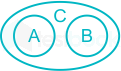
Which of the following Venn diagram correctly represents the relations of the given series?

(A) Metal (B) Sand (C) Water

  1. AOption (a)

  2. BOption (b)

  3. COption (c)

  4. DOption (d)

View answer & explanation

Correct answer

Answer: (a)A.

Why this answer is correct

  • There is no relation between metal, sand and water.

The correct Venn diagram representation is given below:-

Hence, "option 1" is the correct answer.

Question 6

Count the number of triangles in the given figure:

  1. AOption (a)

    19

  2. BOption (b)

    12

  3. COption (c)

    17

  4. DOption (d)

    14

View answer & explanation

Correct answer

Answer: (c)C.

17

Why this answer is correct

The triangles are as follows:

  • The total number of triangles is 17.

Hence, "option 3" is the correct answer.

Question 7

A series of organic compounds having the same functional group but different –CH2 group is called:

  1. AOption (a)

    Fermentation

  2. BOption (b)

    Isomer

  3. COption (c)

    Refined spirit

  4. DOption (d)

    Homologous series

View answer & explanation

Correct answer

Answer: (d)D.

Homologous series

Why this answer is correct

The correct answer is the Homologous series.

Key Points

  • A series of organic compounds having the same functional group but a different –CH2 group is called the Homologous series.
  • A homologous series is a sequence of compounds with the same functional group and similar chemical properties in which the members of the series can be branched or unbranched, or differ by -CH2.
  • The concept of homologous series was proposed in 1843 by the French chemist Charles Gerhardt.

Additional Information

  • Fermentation is a metabolic process that produces chemical changes in organic substrates through the action of enzymes.
  • The science of fermentation is known as zymology.
  • Isomers are molecules or polyatomic ions with identical molecular formulas — that is, the same number of atoms of each element — but distinct arrangements of atoms in space. Isomerism is the existence or possibility of isomers.
  • Isomers do not necessarily share similar chemical or physical properties.
  • Rectified spirit, also known as neutral spirits, rectified alcohol, or ethyl alcohol of agricultural origin is highly concentrated ethanol that has been purified by means of repeated distillation in a process called rectification.
  • In particular, large quantities of neutral alcohol are distilled from wine.

Question 8

At 10:45 a.m. the measure of the smaller of the two angles between the hour hand and minute hand of a clock will be:

  1. AOption (a)

    60°

  2. BOption (b)

    30°

  3. COption (c)

    52.5°

  4. DOption (d)

    54.5°

View answer & explanation

Correct answer

Answer: (c)C.

52.5°

Why this answer is correct

The formula to calculate the angle (N) between the Minute hand (M) and the hour hand (H) is:-

  • N = |11/2 × M - 30 × H|
  • N = |11/2 × 45 - 30 × 10|
  • N = |247.5 - 300|
  • N = 52.50

Hence, "option 3" is the correct answer.

Question 9

Given below are two statements followed by two conclusions I and II have been given. Taking the statements to be true even if they seem to be at variance from commonly known facts. Decide which of the conclusion(s) follow/s from the statements.

Statements:

  1. All neighbours are men.
  2. None of the men is working.

Conclusion :

I. All the neighbours are not working.

II. Some men are neighbours.

  1. AOption (a)

    Both conclusions I and II follow

  2. BOption (b)

    Neither conclusion I nor conclusion II follows

  3. COption (c)

    Only conclusion II follows.

  4. DOption (d)

    Only conclusion I follows.

View answer & explanation

Correct answer

Answer: (a)A.

Both conclusions I and II follow

Why this answer is correct

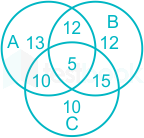
Given statements:

  1. All neighbours are men.
  2. None of the men is working.

The least possible Venn diagram is as follows:

  1. All the neighbours are not working. → Follows (this is true because all neighbours are men and no man is working)
  2. Some men are neighbours. → Follows (as shown in the Venn diagram, a part of men are neighbours)

Hence, "option 1" is the correct answer.

  • Note: Not working means unemployed

Question 10

Find the cost price when the selling price is Rs. 6300 and the profit is 5%.

  1. AOption (a)

    Rs. 5460

  2. BOption (b)

    Rs. 5505

  3. COption (c)

    Rs. 6000

  4. DOption (d)

    Rs. 5670

View answer & explanation

Correct answer

Answer: (c)C.

Rs. 6000

Why this answer is correct

Shortcut Trick

Profit of 5% means the Selling Price (SP) is 105% of the Cost Price (CP).

Using the unitary method: 105% ⇒ Rs. 6300.

1% ⇒ 6300 ÷ 105 = 60.

100% (CP) ⇒ 60 × 100 = Rs. 6000.

∴ The correct answer is Rs. 6000.

Alternate Method

Given: Selling Price (SP) = Rs. 6300, Profit% = 5%.

Formula: CP = [SP × 100] ÷ [100 + Profit%]

⇒ CP = [6300 × 100] ÷ [100 + 5]

⇒ CP = 630000 ÷ 105

⇒ CP = 6000

∴ The correct answer is Rs. 6000.

Additional Information

Profit and Loss Basics

Profit occurs when SP > CP. Loss occurs when CP > SP. All percentage calculations for profit or loss are generally performed on the Cost Price unless stated otherwise.

Fraction Method

5% can be written as 1/20. If CP is 20 units, Profit is 1 unit, making SP 21 units. Since 21 units = 6300, 1 unit = 300, and 20 units (CP) = 6000.

Question 11

A and B together complete a piece of work and earn Rs. 300. If A alone can complete that work in 2 weeks and B alone can do it in 3 weeks, then how should this amount be distributed among them?

  1. AOption (a)

    A = Rs. 140, B = Rs. 160

  2. BOption (b)

    A = Rs. 180, B = Rs. 120

  3. COption (c)

    A = Rs. 120, B = Rs. 180

  4. DOption (d)

    A = Rs. 160, B = Rs. 140

View answer & explanation

Correct answer

Answer: (b)B.

A = Rs. 180, B = Rs. 120

Why this answer is correct

Shortcut Trick

Wages are always distributed in the ratio of efficiency when workers work for the same duration.

Time ratio (A : B) = 2 weeks : 3 weeks = 2 : 3.

Efficiency ratio (A : B) = Inverse of time ratio = 3 : 2.

Total ratio parts = 3 + 2 = 5 units → ₹300.

1 unit = ₹60. Therefore, A = 3 × 60 = ₹180 and B = 2 × 60 = ₹120.

∴ The correct answer is A = ₹180, B = ₹120.

Alternate Method

Given: Time taken by A = 2 weeks, Time taken by B = 3 weeks, Total wages = ₹300.

Formula: Efficiency = Total Work ÷ Time; Wage ∝ Efficiency.

PersonDays (Weeks)Total WorkEfficiency
A263
B32

⇒ Total efficiency of (A + B) = 3 + 2 = 5 units.

⇒ Total wages of ₹300 corresponds to 5 units of efficiency.

⇒ Share of A = (3 ÷ 5) × 300 = ₹180.

⇒ Share of B = (2 ÷ 5) × 300 = ₹120.

∴ The correct answer is A = ₹180, B = ₹120.

Additional Information

Work and Wages Rule

Wages are directly proportional to the total work done by an individual. If the time spent by all workers is the same, wages are shared in the ratio of their individual efficiencies.

Efficiency-Time Relationship

Efficiency is inversely proportional to the time taken to complete a task. If A takes 'x' days and B takes 'y' days, their efficiency ratio is y : x.

Pipes and Cisterns Correlation

Similar to time and work, the rate of flow (efficiency) of a pipe determines how much of the tank it fills in a given time relative to other pipes.

Question 12

Sandhya and Anasuya were sitting and playing carrom in a standard manner. If Sandhya was facing North-West, then her rival Anasuya was facing which of the following direction?

  1. AOption (a)

    Northeast

  2. BOption (b)

    Southwest

  3. COption (c)

    North West

  4. DOption (d)

    Southeast

View answer & explanation

Correct answer

Answer: (d)D.

Southeast

Why this answer is correct

  • In a standard chess game, two players sit facing opposite to each other.


  • Thus, if Sandhya was facing northwest then her rival Anasuya was facing southeast.

Hence, "option 4" is the correct answer.

Question 13

According to Joule's law of heat, the heat generated in a circuit is dependent on certain factors. Which of the following can be attributed to this?

  1. AOption (a)

    Current flowing in the circuit

  2. BOption (b)

    Current, the resistance of conductor and time period for current to flow through it

  3. COption (c)

    Resistance of conductor

  4. DOption (d)

    Stream and time period for the current to flow

View answer & explanation

Correct answer

Answer: (b)B.

Current, the resistance of conductor and time period for current to flow through it

Why this answer is correct

The Correct Answer is Option 3 i.e A.

InstrumentUse
PyrometerMeasures very high temperature
ThermostatRegulates temperature at a particular point or degree
ThermometerMeasures temperature
TonometerTo measure the pitch of a sound
ThermocoupleIt is a kind of sensor used to measure the temperature at a specific point in the form of the EMF or an electric current.

Question 14

Solve (9.5 × 9.5 – 2.5 × 2.5) ÷ (1.52  – 0.25) = ?

  1. AOption (a)

    47

  2. BOption (b)

    42

  3. COption (c)

    49

  4. DOption (d)

    45

View answer & explanation

Correct answer

Answer: (b)B.

42

Why this answer is correct

Given:

(9.5 × 9.5 – 2.5 × 2.5) ÷ (1.52  – 0.25)

Calculation:

(9.5 × 9.5 – 2.5 × 2.5) ÷ (1.52  – 0.25)

⇒ (90.25 – 6.25) ÷ (2.25  – 0.25)

⇒ 84 ÷ 2

⇒ 42

∴ Required answer is 42

Question 15

Complete the following analogy word pair.

Hot : Burning :: Cold : ?

  1. AOption (a)

    Ice

  2. BOption (b)

    Warm

  3. COption (c)

    Freezing

  4. DOption (d)

    Fridge

View answer & explanation

Correct answer

Answer: (c)C.

Freezing

Why this answer is correct

The logic followed here is:-

  • Burning means very hot

Similarly,

  • Freezing means very cold.

Hence, "option 3" is the correct answer.

Question 16

________ provides evidence of evolutionary relationships.

  1. AOption (a)

    River bed

  2. BOption (b)

    Fossil

  3. COption (c)

    Sea floor

  4. DOption (d)

    Rock

View answer & explanation

Correct answer

Answer: (b)B.

Fossil

Why this answer is correct

The correct answer is Fossil.

Key Points

  • Fossil provides evidence of evolutionary relationships.
  • Fossils are important evidence for evolution because they show that life on earth was once different from life found on earth today.
  • Paleontologists can determine the age of fossils using methods like radiometric dating and categorize them to determine the evolutionary relationships between organisms.

Additional Information

  • A stream bed or streambed is the channel bottom of a stream or river, the physical confine of the normal water flow.
  • The lateral confines or channel margins are known as the stream banks or river banks, during all but the flood stage.
  • Under certain conditions, a river can branch from one stream bed to multiple stream beds.
  • The seabed (also known as the seafloor, seafloor, ocean floor, and ocean bottom) is the bottom of the ocean.
  • All floors of the ocean are known as 'seabeds'.
  • The structure of the seabed of the global ocean is governed by plate tectonics.
  • Most of the ocean is very deep, where the seabed is known as the abyssal plain.
  • Rocks forms the Earth's outer solid layer, the crust, and most of its interior, except for the liquid outer core and pockets of magma in the asthenosphere.
  • Rocks are usually grouped into three main groups: igneous rocks, sedimentary rocks, and metamorphic rocks.

Question 17

Read the given question and select which argument(s) is/are strong.

Question :

Should new research centres be set up in India?

Argument :

I. Yes, innovation is encouraged by more research.

II. No, we do not have enough resources to open new research centres.

  1. AOption (a)

    Only argument। is strong.

  2. BOption (b)

    Only argument II is strong.

  3. COption (c)

    Neither I nor II is strong.

  4. DOption (d)

    Both arguments I and II are strong.

View answer & explanation

Correct answer

Answer: (a)A.

Only argument। is strong.

Why this answer is correct

The question asks whether new research centres need to be set up in India.

  • Argument I answers with an affirmation and justifies that new research centres would facilitate more research which will encourage innovation. Innovation is beneficial for the country. Thus, Argument I is strong.
  • Argument II suggests that new research centres should not be set because we do not have enough resources, which is not a valid reason since resources can be established in a lot of ways. This is not an issue that cannot be addressed and hence is not a strong reason to counter the idea of setting up research centres. Thus, Argument II is not strong.

Hence the correct answer is option 1.

Question 18

Which of the following bank was NOT one of the II of the semi-central banks established in India under the British East India Company in 1880.

  1. AOption (a)

    Bank of Bombay

  2. BOption (b)

    Bank of madras

  3. COption (c)

    Bank of Travancore

  4. DOption (d)

    Bank of Kolkata

View answer & explanation

Correct answer

Answer: (c)C.

Bank of Travancore

Why this answer is correct

The correct answer is Bank of Travancore.

Key Points

  • Bank of Travancore was not one of the II of the semi-central banks established in India under the British East India Company in 1880.
  • The Bank of Bombay was the second of the three presidency banks of the British Raj period.
  • It was established, pursuant to a charter of the British East India Company, on 15 April 1840.
  • The bank's headquarters were in Bombay, now called Mumbai.
  • The Bank of Madras was one of the three Presidency Banks of British India, along with the Bank of Bengal and the Bank of Bombay.
  • It was established on 1 July 1843 through the amalgamation of a number of existing regional banks and headquartered in Madras.
  • The Bank of Calcutta was founded on 2 June 1806, mainly to fund General Wellesley's wars against Tipu Sultan and the Marathas.
  • It was the first bank of India and was renamed Bank of Bengal on 2 January 1809.

Question 19

If a wire 28.8 m long is cut in the ratio 13 : 23, then what is the length of the longer piece?

  1. AOption (a)

    7.7 m

  2. BOption (b)

    15.2 m

  3. COption (c)

    17.5 m

  4. DOption (d)

    18.4m

View answer & explanation

Correct answer

Answer: (d)D.

18.4m

Why this answer is correct

Shortcut Trick

Total ratio parts = 13 + 23 = 36 units.

36 units = 28.8 m ⇒ 1 unit = 0.8 m.

Longer piece (23 units) = 23 × 0.8 = 18.4 m.

∴ The correct answer is 18.4 m.

Alternate Method

Given: Total length of wire = 28.8 m, Ratio = 13 : 23.

Formula Used: Length of a part = (Ratio of that part ÷ Sum of ratios) × Total length

⇒ Sum of ratio parts = 13 + 23 = 36

⇒ Length of longer piece = (23 ÷ 36) × 28.8

⇒ Length of longer piece = 23 × 0.8

⇒ Length of longer piece = 18.4 m

∴ The correct answer is 18.4 m.

Additional Information

Ratio and Proportion

A ratio compares two quantities. If a value X is divided in ratio a:b, the parts are [a/(a+b)]×X and [b/(a+b)]×X.

Unitary Method

Find the value of a single unit first by dividing the total value by the total number of parts, then multiply by the required parts.

Question 20

If x = 9, y = 17\sqrt{17}, then, what is the value of  (x2−y2)−13−1(x^2 - y^2{)^{\frac{ - 1}{3}}} - 1?

  1. AOption (a)

    35\frac{3}{5}

  2. BOption (b)

    −34 - \frac{3}{4}

  3. COption (c)

    53\frac{5}{3}

  4. DOption (d)

    −74- \frac{7}{4}

View answer & explanation

Correct answer

Answer: (b)B.

−34 - \frac{3}{4}

Why this answer is correct

Given:

 x = 9, y = 17\sqrt{17}

Concept used:

a-b = 1/ab

Calculation:

(x2−y2)−13−1(x^2 - y^2{)^{\frac{ - 1}{3}}} - 1

⇒ (81 - 17)-1/3 - 1

⇒ 64-1/3 - 1

⇒ 1/{(64)1/3] - 1

⇒ 1/4 - 1

⇒ - 3/4

∴ Required answer is  - 3/4

Question 21

Select the alternative which is related to the third word in the same way as the second word is related to the first.

Mend : Patch :: Bend : ?

  1. AOption (a)

    Mould

  2. BOption (b)

    Direction

  3. COption (c)

    Create

  4. DOption (d)

    Twist

View answer & explanation

Correct answer

Answer: (d)D.

Twist

Why this answer is correct

The logic followed here is:-

  • Patch is the synonym of mend.

Similarly,

  • Twist is the synonym of bend.

Hence, "option 4" is the correct answer.

Question 22

Find the value of(−8)+284+13+144\sqrt{(-8) + \sqrt{284 + \sqrt{13 + \sqrt{144} } } }.

  1. AOption (a)

    5

  2. BOption (b)

    1

  3. COption (c)

    2

  4. DOption (d)

    3

View answer & explanation

Correct answer

Answer: (d)D.

3

Why this answer is correct

Given:

(−8)+284+13+144\sqrt{(-8) + \sqrt{284 + \sqrt{13 + \sqrt{144} } } }

Concept used:

Concept of surds and indices

Calculation:

(−8)+284+13+144\sqrt{(-8) + \sqrt{284 + \sqrt{13 + \sqrt{144} } } }

⇒ (−8)+284+13+12\sqrt{(-8) + \sqrt{284 + \sqrt{13 + 12 } } }

⇒ (−8)+284+25\sqrt{(-8) + \sqrt{284 + \sqrt{25 } } }

⇒ (−8)+284+5\sqrt{(-8) + \sqrt{284 + 5 } }

⇒ (−8)+289\sqrt{(-8) + \sqrt{289 } }

⇒ (−8)+17\sqrt{(-8) + 17}

⇒ 9\sqrt{9}

⇒ 3

∴ Required answer is 3

Question 23

Na2O is a ________ oxide.

  1. AOption (a)

    Alkaline

  2. BOption (b)

    Inactive

  3. COption (c)

    Acidic

  4. DOption (d)

    Amphoteric

View answer & explanation

Correct answer

Answer: (a)A.

Alkaline

Why this answer is correct

The correct answer is Alkaline.

Key Points

  • Na2O is an alkaline oxide.
  • Sodium oxide is an alkali metal oxide with the chemical formula Na2O.
  • It is the anhydride form of sodium hydroxide.

Additional Information

  • It is the anhydride form of sodium hydroxide. When sodium burns in the air it burns with a bright, white light.
  • When it burns in oxygen it burns even more brightly.
  • It forms a white powder called sodium oxide.
  • Within the earth’s crust, sodium ions often combine with the oxygen in soil and rocks to form sodium oxide (Na2O), one of the most common forms of sodium.
  • It is an active flux and is used to create glazes that give exciting color responses.
  • The more notable responses are blue from copper oxide and purple from cobalt and manganese oxides.
  • Used in bodies except where it has been introduced primarily as a deflocculant for casting slips.
  • Sodium oxide is also used in the manufacture of commercial glasses based on the oxides of silicon and certain additives.

Question 24

Find the missing letter in the given series:

X, C, H, M, ?, W

  1. AOption (a)

    A

  2. BOption (b)

    P

  3. COption (c)

    S

  4. DOption (d)

    R

View answer & explanation

Correct answer

Answer: (d)D.

R

Why this answer is correct

The logic followed here is:-

Hence, "option 4" is the correct answer.

Question 25

An object is raised from the ground level first by 5m, then by 10m, and then by 15m. At what height will the object have maximum potential energy?

  1. AOption (a)

    at 10 m

  2. BOption (b)

    at 15 m

  3. COption (c)

    at ground level

  4. DOption (d)

    at 5 m

View answer & explanation

Correct answer

Answer: (b)B.

at 15 m

Why this answer is correct

The correct answer is at 15 m.

CONCEPT:

  • Potential energy is defined as the energy stored due to change in position relative to others, stresses within itself, or many factors.
  • The potential energy (U) = m g h [where m= mass of body, g= acceleration due to gravity, h = distance from the ground].
  • Here, mass is denoted with [M], length with [L], and time with [T].
  • If the height of a body increases from the ground its energy increases and vice versa.
  • The Dimension of energy is - ML2T-2

Explanation:

Object 1:

PE = mgh

Height = 5 m, Mass = m.

P.E1 = m × g × 5 = 5mg

P.E1 =  5 mg

Object 2:

PE = mgh

Height = 10 m, Mass = m.

P.E1 = m × g × 10 = 10mg

P.E1 =  10 mg

Object 2:

PE = mgh

Height = 15 m, Mass = m.

P.E1 = m × g × 15 = 15mg

P.E1 =  15 mg

Therefore, the highest potential energy has an object kept with a height of 15 m.

PE = 15mg > 10mg > 5mg

Question 26

_______ is an example of a single-atom molecule.

  1. AOption (a)

    Argon

  2. BOption (b)

    Sulphur

  3. COption (c)

    Phosphorus

  4. DOption (d)

    Hydrogen

View answer & explanation

Correct answer

Answer: (a)A.

Argon

Why this answer is correct

The correct answer is Argon.

Key Points

  • Argon is an example of a single-atom molecule.
  • Chemists from the first known compound containing this "inert" gas.
  • The element argon has always been a loner.
  • It's one of the inert gases that normally exist as single atoms.
  • Also called inert gases, they have complete outer electron shells and were believed not to react with other elements or compounds.

Additional Information

  • Some elements are monatomic, meaning they are made of a single (mon-) atom (-atomic) in their molecular form.
  • Helium (He) is an example of a monatomic element.
  • Molecular hydrogen (H2) is a form of hydrogen gas, and it comes into existence when two hydrogen atoms combine.
  • Therefore, in its molecular form, hydrogen consists of two protons and two electrons and makes up the smallest molecule.
  • A molecule, however, is composed of more than one atom. Some elements exist naturally as molecules.
  • Other elements exist as molecules—for example, sulfur normally exists as an eight-atom molecule, S8, while phosphorus exists as a four-atom molecule, P4.

Question 27

A question is followed by three arguments. Decide which of the following argument(s) is/are strong.

Question:

Should higher education be compulsory for all children?

Argument :

I. Yes, it is an effective way of educating the entire population.

II. Yes, it will improve the standard of living.

III. No, we do not have the infrastructure to educate the entire population.

  1. AOption (a)

    Only argument II is strong.

  2. BOption (b)

    Only arguments I and III are strong.

  3. COption (c)

    Only argument I is strong.

  4. DOption (d)

    Only arguments II and III are strong.

View answer & explanation

Correct answer

Answer: (c)C.

Only argument I is strong.

Why this answer is correct

The question simply asks whether higher education should be compulsory for all children.

  • Argument I is strong since making education compulsory will effectively ensure that the entire population is educated. This would also mean that there will no school dropouts. Having a highly educated population would mean that the citizens will be qualified for more and better jobs. This is a benefit for the country.
  • Argument II suggests that making higher education compulsory would improve the standard of living. A more educated public can ensure better human resources, but the standard of living is an economic term based on income and expenditure, which needs to be linked to the quality of education and employment opportunities. A high income combined with a high expenditure leaves no room for improvement of the standard of living. So, argument II is not strong.
  • Argument III states that we do not have the required infrastructure but it is not a strong point since infrastructure can be made available. Thus, argument III is not strong.

Thus, the correct answer is option 3.

Question 28

If the radius of the earth is reduced by 1%, what will be the acceleration due to gravity on the surface of the earth (if mass remains constant)?

  1. AOption (a)

    will increase by 1%.

  2. BOption (b)

    will decrease by 1%.

  3. COption (c)

    will increase by 2%.

  4. DOption (d)

    will decrease by 2%.

View answer & explanation

Correct answer

Answer: (c)C.

will increase by 2%.

Why this answer is correct

CONCEPT:

Acceleration Due to Gravity:

  • The force of attraction exerted by the earth on a body is called gravitational pull or gravity.
  • The acceleration produced in the motion of a body under the effect of gravity is called acceleration due to gravity, it is denoted by g.
  • If g is the acceleration due to gravity, then

⇒g=GMR2\Rightarrow g = \frac{{GM}}{{{R^2}}}

Where G = universal gravitational constant, M = mass of the earth, and R = radius of the earth.

  • Error in the division of quantities: Suppose x=abx = \frac{a}{b}
  • The maximum fractional error in x is Δxx=Δaa+Δbb\frac{{{\rm{\Delta }}x}}{x} = \frac{{{\rm{\Delta }}a}}{a} + \frac{{{\rm{\Delta }}b}}{b}

CALCULATION:

Given that,

  • Radius of the earth were to shrink by 1% → R1 = R and R2 = (100-1)% of R2 = 0.99×R
  • its mass remains the same → m = m1 = m2​

​

  • Acceleration due to gravity is before shrinking is

⇒g1=Gm1R12=GmR12\Rightarrow {g_1} = \frac{{G{m_1}}}{{R_1^2}} = \frac{{Gm}}{{R_1^2}}        ---------(1)

  • Acceleration due to gravity is after shrinking is

⇒g2=Gm2R22=GmR22\Rightarrow {g_2} = \frac{{G{m_2}}}{{R_2^2}} = \frac{{Gm}}{{R_2^2}}        ---------(2)

Divide equations 1 and 2, we get

⇒g1g2=GmR12GmR22=R22R12\Rightarrow \frac{{{g_1}}}{{{g_2}}} = \frac{{\frac{{Gm}}{{R_1^2}}}}{{\frac{{Gm}}{{R_2^2}}}} = \frac{{R_2^2}}{{R_1^2}}

⇒g1g2=R22R12=0.992×R2R2=0.992\Rightarrow \frac{{{g_1}}}{{{g_2}}} = \frac{{R_2^2}}{{R_1^2}} = \frac{{{{0.99}^2} \times {R^2}}}{{{R^2}}} = {0.99^2}

⇒g1=;;0.98;g2⇒{g_1} = ;;0.98;{g_2} ⇒ g2 = 1.02 g1

Hence net change is gravitational Δg = g2 - g1 = (1.02 – 1) × g1

⇒ Δg = 0.02 × g1

⇒ Δg = 2% of g1

Question 29

What is the name of the Brazilian player who is known as 'White Pele'?

  1. AOption (a)

    Juninho

  2. BOption (b)

    Oscar

  3. COption (c)

    Zico

  4. DOption (d)

    Socrates

View answer & explanation

Correct answer

Answer: (c)C.

Zico

Why this answer is correct

The correct answer is Zico.

Key Points

  • The name of the Brazilian player who is known as 'White Pele' is Zico.
  • Arthur Antunes Coimbra, better known as Zico is a Brazilian football coach and former player who played as an attacking midfielder.
  • He was a creative playmaker, with excellent technical skills, vision, and an eye for goal, who is considered one of the most clinical finishers and best passers ever, as well as one of the greatest players of all time.
  • He is also widely regarded as the greatest Brazilian to never win the World Cup.
  • One of the world's best players of the late 1970s and early 1980s.
  • He is regarded as one of the best playmakers and free-kick specialists in history, able to bend the ball in all directions.

Additional Information

  • Antonio Augusto Ribeiro Reis Junior, commonly known as Juninho Pernambucano or simply Juninho, is a Brazilian former professional footballer who is the sporting director of French club Olympique Lyonnais.
  • Socrates was a Greek philosopher from Athens who is credited as a founder of Western philosophy and the first moral philosopher of the ethical tradition of thought.

Question 30

Which of the two conclusions can be drawn based on the given statements?

Statement:

All clocks are wall clocks. All wall clocks are frames

Conclusion :

  1. Some clocks are not frames.
  2. Some frames are clocks.
  1. AOption (a)

    Only 2 follows 

  2. BOption (b)

    Either 1 and or 2 follows.

  3. COption (c)

    Both 1 and 2 follow.

  4. DOption (d)

    Only 1 follows.

View answer & explanation

Correct answer

Answer: (a)A.

Only 2 follows 

Why this answer is correct

The Venn diagram is given below:-

Conclusion :

  1. Some clocks are not frames. → False (This is not possible as shown in the above Venn diagram. All clocks are frames.)
  2. Some frames are clocks. → True (As shown in the Venn diagram, a part of frame is definitely clocks, so this conclusion is correct.)

Hence, "option 1" is the correct answer.

Question 31

The value of acceleration due to gravity on the Moon is how many times the value of acceleration is due to gravity on Earth?

  1. AOption (a)

    1/6

  2. BOption (b)

    5

  3. COption (c)

    1/5

  4. DOption (d)

    6

View answer & explanation

Correct answer

Answer: (a)A.

1/6

Why this answer is correct

The correct answer is 1/6. 

Key Points

  • The value of acceleration due to gravity on the Moon is 1/6 times the value of acceleration is due to gravity on Earth.
  • Where m is mass and g is the acceleration due to gravity.
  • The mass of the moon is 1/100 times and the radius of the moon is 1/4 times that of the earth.
  • Since the acceleration due to the gravity of the moon is one-sixth of that of the earth.
  • So Weight of any object on the Moon = 1/6 × Weight of any object on the Earth's surface.
  • The value of the gravitational acceleration on the surface of a planet of radius R and mass M is g=GMR2g = {GM\over{R^2}}.
  • So the gravity on the moon is 1/6th that of Earth because the moon is far less massive than the Earth and has a different radius(R) as well.

Question 32

If in a language, 'CODE' is written as '31545', then how will you write 'FEAR'?

  1. AOption (a)

    65218

  2. BOption (b)

    18156

  3. COption (c)

    65119

  4. DOption (d)

    65118

View answer & explanation

Correct answer

Answer: (d)D.

65118

Why this answer is correct

The logic followed here is:-

Similarly,

Hence, "option 4" is the correct answer.

Question 33

If the numerator of a fraction y/x is increased by 12%, and its denominator is decreased by 2%, the value of that fraction becomes 6/7. Find the original fraction.

  1. AOption (a)

    34\frac{3}{4}

  2. BOption (b)

    43\frac{4}{3}

  3. COption (c)

    25\frac{2 }{ 5}

  4. DOption (d)

    15\frac{1}{5}

View answer & explanation

Correct answer

Answer: (a)A.

34\frac{3}{4}

Why this answer is correct

Shortcut Trick

Let the original fraction be y/x.

New numerator = 112% of y and New denominator = 98% of x.

Given: (y × 112) / (x × 98) = 6/7

y/x = (6/7) × (98/112) = (6/7) × (7/8) = 6/8 = 3/4

∴ The correct answer is 3/4.

Alternate Method

Given:

Original Fraction = y/x

Increased Numerator = y + 12% of y = 1.12y

Decreased Denominator = x − 2% of x = 0.98x

Calculations:

⇒ 1.12y / 0.98x = 6/7

⇒ (112y / 100) / (98x / 100) = 6/7

⇒ 112y / 98x = 6/7

⇒ y/x = (6/7) × (98/112)

⇒ y/x = (6 × 98) / (7 × 112)

⇒ y/x = (6 × 14) / 112

⇒ y/x = 84 / 112

⇒ y/x = 3 / 4 (dividing both by 28)

∴ The correct answer is 3/4.

Additional Information

Percentage Change in Fractions

When the numerator changes by a% and denominator by b%, the new fraction is [(100+a)/100] × Numerator / [(100+b)/100] × Denominator.

Successive Percentage

If a value is increased by x% and then decreased by y%, the net change is [x − y − (xy/100)]%.

Ratio Conversion

To find the original value from the changed value, multiply the result by the reciprocal of the change factor.

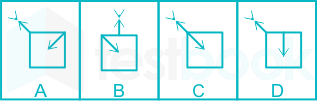
Question 34

Select the alternative figure which is related to the third figure in the same way that the second figure is related to the first.

Question figures :

Answer figures :

  1. AOption (a)

    A

  2. BOption (b)

    D

  3. COption (c)

    C

  4. DOption (d)

    B

View answer & explanation

Correct answer

Answer: (d)D.

B

Why this answer is correct

The logic followed here is:-

  • Figure 1 to Figure 2:
  • 1 arrowhead moves towards the right.
  • The shaded part becomes unshaded and vice versa.
  • Similarly, figure 3 to figure 4:
  • 1 arrowhead moves towards the right.
  • The shaded part becomes unshaded and vice versa.

Hence, "option 4" is the correct answer.

Question 35

Ryotwari system was started in _______ and Madras.

  1. AOption (a)

    Bombay

  2. BOption (b)

    Punjab

  3. COption (c)

    Kolkata

  4. DOption (d)

    Odisha

View answer & explanation

Correct answer

Answer: (a)A.

Bombay

Why this answer is correct

The correct answer is Bombay.

Key Points

  • Ryotwari system was started in Bombay and Madras.
  • Thomas Munro introduced the Ryotwari System in Bombay and Madras in 1820.
  • A direct settlement was made between the government and the cultivators under the Ryotwari System.

Additional Information

  • The ryotwari system was a land revenue system in British India that was introduced by Sir Thomas Munro allowed the government to deal directly with the cultivator ('ryot') for revenue collection and gave the peasant freedom to cede or acquire new land for cultivation.
  • Ryotwari System somewhere in mid and changes in the position.
  • This system was in operation for nearly 5 years and had many features of the revenue system of the Mughals.
  • It was instituted in some parts of British India, one of the three main systems used to collect revenues from the cultivators of agricultural land.
  • These taxes included undifferentiated land revenue and rents, collected simultaneously.
  • Where the land revenue was imposed directly on the ryots (the individual cultivators who actually worked the land) the system of assessment was known as ryotwari.
  • The Ryotwari system is associated with the name of Thomas Munro, who was appointed Governor of Madras in May 1820.

Question 36

When two bodies move towards each other at a constant speed, the distance between them decreases at the rate of 6 m/s. If they move in the same direction, the distance between them increases at the rate of 4 m/s. Find their speed.

  1. AOption (a)

    3 m/s, 3 m/s

  2. BOption (b)

    5 m/s, 1 m/s

  3. COption (c)

    6 m/s, 1 m/s

  4. DOption (d)

    4 m/s, 2 m/s

View answer & explanation

Correct answer

Answer: (b)B.

5 m/s, 1 m/s

Why this answer is correct

Shortcut Trick

When moving towards each other (opposite direction), relative speed = S1 + S2 = 6 m/s.

When moving in the same direction, relative speed = S1 − S2 = 4 m/s.

Speed of faster body = (Sum + Difference) ÷ 2 = (6 + 4) ÷ 2 = 5 m/s.

Speed of slower body = (Sum − Difference) ÷ 2 = (6 − 4) ÷ 2 = 1 m/s.

∴ The correct answer is 5 m/s, 1 m/s.

Alternate Method

Given: Relative speed towards each other = 6 m/s | Relative speed in same direction = 4 m/s.

Formula: Relative speed (Opposite) = S1 + S2 | Relative speed (Same) = S1 − S2.

⇒ S1 + S2 = 6 — (Eqn 1)

⇒ S1 − S2 = 4 — (Eqn 2)

⇒ Adding Eqn 1 and Eqn 2: 2S1 = 10

⇒ S1 = 5 m/s

⇒ Substituting S1 in Eqn 1: 5 + S2 = 6

⇒ S2 = 1 m/s

∴ The correct answer is 5 m/s, 1 m/s.

Additional Information

Relative Speed Concept

When two objects move in opposite directions, their relative speed is the sum of their individual speeds (u + v).

Same Direction Relative Speed

When two objects move in the same direction, their relative speed is the difference between their individual speeds (u − v).

Unit Conversion

To convert km/hr to m/s, multiply by 5/18. To convert m/s to km/hr, multiply by 18/5.

Question 37

Match the following.

I. Atomic theory of matterA. Compounds
II. Potassium SulphateB.Co
III. SodiumC. John Dalton
IV. CobaltD. Na
  1. AOption (a)

    I - C, II - A, III - D, IV - B

  2. BOption (b)

    I - B, II - A, III - D, IV - C

  3. COption (c)

    I - C, II - D, III - A. IV - B

  4. DOption (d)

    I - A, II - C, III - D, IV - B

View answer & explanation

Correct answer

Answer: (a)A.

I - C, II - A, III - D, IV - B

Why this answer is correct

The correct answer is I - C, II-A, III - D, IV - B.

Key Points

I. Atomic theory of matterC. John Dalton
II. Potassium SulphateA.Compounds
III. SodiumD. Na
IV. CobaltB. Co

Additional Information

  • Dalton’s atomic theory was a scientific theory on the nature of matter put forward by the English physicist and chemist John Dalton in the year 1808.
  • It stated that all matter was made up of small, indivisible particles known as ‘atoms’.
  • All substances, according to Dalton’s atomic theory, are made up of atoms, which are indivisible and indestructible building units.
  • While an element’s atoms were all the same size and mass, various elements possessed atoms of varying sizes and masses.
  • Potassium sulfate or potassium sulfate, also called sulfate of potash, arcanite, or archaically potash of sulfur, is the inorganic compound with formula K₂SO₄, a white water-soluble solid.
  • It is commonly used in fertilizers, providing both potassium and sulfur.
  • Sodium is a chemical element with the symbol Na and atomic number 11. It is a soft, silvery-white, highly reactive metal.
  • Sodium is an alkali metal, being in group 1 of the periodic table.
  • Cobalt is a chemical element with the symbol Co and atomic number 27.
  • Like nickel, cobalt is found in the Earth's crust only in a chemically combined form, save for small deposits found in alloys of natural meteoric iron.

Question 38

From the top of a platform 18 m high, the angle of elevation of the top of the tower is 30° If the platform is located 75√3 m away from the tower, then what is the height of the tower?

  1. AOption (a)

    93 m

  2. BOption (b)

    50 3\sqrt{3} m

  3. COption (c)

    75 m

  4. DOption (d)

    37.5 3\sqrt{3} m

View answer & explanation

Correct answer

Answer: (a)A.

93 m

Why this answer is correct

Shortcut Trick

Height of Platform = 18 m. Horizontal Distance (d) = 75√3 m.

In a 30°−60°−90° triangle, the height above the platform level is d ÷ √3.

Extra height = 75√3 ÷ √3 = 75 m.

Total Height of Tower = Platform height + Extra height = 18 + 75 = 93 m.

∴ The correct answer is 93 m.

Alternate Method

Given: Height of Platform (AB) = 18 m, Distance (BC) = 75√3 m, Angle of Elevation (θ) = 30°.

Formula Used: tan θ = Perpendicular / Base

Let the Tower be DE and the Platform be AB. Let the horizontal line from A meet DE at F.

⇒ AB = FE = 18 m

⇒ AF = BC = 75√3 m

⇒ In right ΔDAF, tan 30° = DF / AF

⇒ 1 / √3 = DF / 75√3

⇒ DF = 75 m

⇒ Total Height of Tower (DE) = DF + FE = 75 + 18 = 93 m

∴ The correct answer is 93 m.

Additional Information

Trigonometric Ratios for Standard Angles

For calculations in heights and distances, remember: tan 30° = 1/√3, tan 45° = 1, and tan 60° = √3.

Angle of Elevation vs Depression

The Angle of Elevation is measured upward from the horizontal, while the Angle of Depression is measured downward; both are numerically equal if the lines are parallel.

30-60-90 Triangle Rule

The ratio of sides opposite to 30°, 60°, and 90° is always 1 : √3 : 2 respectively.

Question 39

Who became the first Indian to be awarded the prestigious IhsanDoğramacı Family Health Foundation Award by the World Health Organization (WHO), in January 2018?

  1. AOption (a)

    Dr TV Devarajan

  2. BOption (b)

    Dr Indira Hinduja

  3. COption (c)

    Dr Vinod Paul

  4. DOption (d)

    Dr Devi Shetty

View answer & explanation

Correct answer

Answer: (c)C.

Dr Vinod Paul

Why this answer is correct

The correct answer is Dr. Vinod Paul.

Key Points

  • Dr. Vinod Paul became the first Indian to be awarded the prestigious IhsanDoğramacı Family Health Foundation Award by the World Health Organization (WHO), in January 2018.
  • NITI Aayog Member Dr. Vinod Paul became the first Indian to be awarded the prestigious IhsanDoğramacı Family Health Foundation Prize by World Health Organisation (WHO).
  • It will be formally presented at World Health Assembly to be held in Geneva, Switzerland in May 2018.
  • Dr. Paul is an internationally renowned researcher, clinician, educator, and public health advocate in the area of family health, with a special focus on newborn health.
  • He is recognized the world over as a leading expert in universal health coverage and human resources for health.

Additional Information

  • T. V. Devarajan, is an Indian medical doctor and general physician.
  • The Government of India honored him, in 2013, by awarding him the Padma Shri, the fourth highest civilian award, for his contributions to the field of medicine.
  • Dr. Indira Hinduja is a fertility doctor.
  • She is a well-qualified and trained professional.
  • She has teaching experience of 25 years at KEM Hospital.
  • Devi Prasad Shetty, MS, FRCS, is an Indian entrepreneur and cardiac surgeon who is the chairman and founder of Narayana Health, a chain of 21 medical centers in India.
  • He has performed more than 16,000 heart operations.

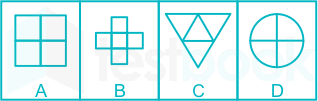
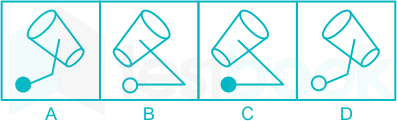
Question 40

Select the figure that is different from the others.

  1. AOption (a)

    C

  2. BOption (b)

    A

  3. COption (c)

    B

  4. DOption (d)

    D

View answer & explanation

Correct answer

Answer: (c)C.

B

Why this answer is correct

The logic followed here is:-

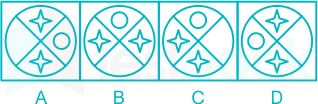
  • Figures A, C, and D are divided into four parts
  • Figure B contains 5 parts.

So, figure B is different from others.

Hence, "option 3" is the correct answer.

Question 41

When did the scientist GJ Mendel die?

  1. AOption (a)

    1884

  2. BOption (b)

    1874

  3. COption (c)

    1879

  4. DOption (d)

    1901

View answer & explanation

Correct answer

Answer: (a)A.

1884

Why this answer is correct

The correct answer is 1884.

Key Points

  • The scientist GJ Mendel died in 1884.
  • Gregor Johann Mendel was a meteorologist, mathematician, biologist, Augustinian friar, and abbot of St. Thomas' Abbey in Brno, Margraviate of Moravia.
  • Mendel was born in a German-speaking family in the Silesian part of the Austrian Empire (today's Czech Republic) and gained posthumous recognition as the founder of the modern science of genetics.
  • Though farmers had known for millennia that crossbreeding of animals and plants could favor certain desirable traits, Mendel's pea plant experiments conducted between 1856 and 1863 established many of the rules of heredity, now referred to as the laws of Mendelian inheritance.
  • After he was elevated as abbot in 1868, his scientific work largely ended, as Mendel became overburdened with administrative responsibilities, especially a dispute with the civil government over its attempt to impose special taxes on religious institutions.
  • Mendel died on 6 January 1884, at the age of 61, in Brno, Moravia, Austria-Hungar

Question 42

Which film has won the Best Detective (Investigation) film award at the National Film Awards, 2017?

  1. AOption (a)

    Placebo

  2. BOption (b)

    Neerja

  3. COption (c)

    Talwar

  4. DOption (d)

    The waterfall

View answer & explanation

Correct answer

Answer: (a)A.

Placebo

Why this answer is correct

The correct answer is Placebo.

Key Points

  • The film Placebo has won the Best Detective (Investigation) film award at the National Film Awards, 2017.
  • Abhay Kumar is probably one of the most promising young filmmakers working in India today and “Placebo” remains his magnum opus.
  • The experimental documentary picked up awards and nominations at various international film festivals but it is still relatively unknown in India, despite winning a National Award for Best Investigative Film in 2017.

Additional Information

  • The National Film Award for Best Investigative Film is one of the National Film Awards presented annually by the Directorate of Film Festivals, the organization set up by the Ministry of Information and Broadcasting, India.
  • It is one of several awards presented for non-feature films and awarded with Rajat Kamal (Silver Lotus).
  • The award was instituted in 1990, at 38th National Film Awards and awarded annually for short films produced in the year across the country, in all Indian languages.

Question 43

The elements of F-block are also called _______.

  1. AOption (a)

    Alkaline earth metals

  2. BOption (b)

    Transitive element

  3. COption (c)

    Intertransitive element

  4. DOption (d)

    Alkaline metals

View answer & explanation

Correct answer

Answer: (c)C.

Intertransitive element

Why this answer is correct

The correct answer is the Intertransitive element.

Key points

  • The elements of the F-block are called the Intertransitive element.
  • The f block elements, numbers 57 to 71 and 89 to 103, are called the inner transition elements because of their placement in the periodic table due to their electron configurations.
  • F block elements are divided into two series, namely lanthanoids and actinoids.
  • This block of elements is often referred to as inner transition metals because they provide a transition in the 6th and 7th row of the periodic table which separates the s block and the d block elements.

Additional Information

  • Alkaline-earth metal, any of the six chemical elements that comprise Group 2 (IIa) of the periodic table.
  • The elements are beryllium (Be), magnesium (Mg), calcium (Ca), strontium (Sr), barium (Ba), and radium (Ra).
  • Many scientists describe a "transition metal" as an element in the d-block of the periodic table, which includes groups 3 to 12 on the periodic table.
  • In actual practice, the f-block lanthanide and actinide series are also considered transition metals and are called "inner transition metals".
  • Alkaline metals are included in Group 1 of the periodic table, the following are the alkali metals: Lithium, Sodium, Potassium, Rubidium, and Caesium.

Question 44

Which of the following is NOT true about alkali?

  1. AOption (a)

    Are bitter in taste.

  2. BOption (b)

    Converts blue litmus to red.

  3. COption (c)

    Forms OH– in aqueous medium/liquid state.

  4. DOption (d)

    good conductors of electricity in the aqueous state.

View answer & explanation

Correct answer

Answer: (b)B.

Converts blue litmus to red.

Why this answer is correct

The correct answer is Converts blue litmus to red.

Key Points

  • Properties of alkali metals:
  • The alkali metals have high thermal and electrical conductivity, luster, ductility, and malleability that are characteristic of metals.
  • Each alkali metal atom has a single electron in its outermost shell.
  • This valence electron is much more weakly bound than those in inner shells.
  • Found in column 1A of the periodic table.
  • Have one electron in their outermost layer of electrons.
  • Easily ionized.
  • Silvery, soft, and not dense.
  • Low melting points and Incredibly reactive.
  • Alkali metals belong to group I of the periodic table. - Some alkalis are corrosive like NaOH and KOH.
  • They are bitter in taste.
  • In an acidic or neutral solution, red litmus paper remains red.
  • In an alkaline solution, red litmus paper turns blue. When an alkaline compound dissolves in water, it produces hydroxide ions, which cause the solution to become alkaline.

Additional Information

  • In general ‘alkali’ refers to the basic or alkaline nature of their metal hydroxides.
  • The compounds are called alkali metals because when they react with water they usually form alkalies which are nothing but strong bases that can easily neutralize acids.
  • Alkali metals have a corresponding [Noble gas] ns1 electronic configuration.
  • They occupy the first column of the periodic table. Alkali elements are Lithium(Li), Sodium(Na), Potassium (K), Rubidium (Ru), Cesium (Cs), and Francium (Fr) occupying successive periods from first to seven.
  • Francium is a radioactive element with a very low half-life.

Question 45

The amount of Rs 66300 divide between Ram and John in such a way that Ram's share after 6 years is equal to John's share after 4 years. The interest for both Ram and John is 10% compounded annually. What will be in his share (Rs.)?

  1. AOption (a)

    30000, 36300

  2. BOption (b)

    20000, 46300

  3. COption (c)

    32000, 34300

  4. DOption (d)

    10000, 56300

View answer & explanation

Correct answer

Answer: (a)A.

30000, 36300

Why this answer is correct

Shortcut Trick

Time difference = 6 years − 4 years = 2 years.

Ratio of Ram's share to John's share = 1 : (1 + 10/100)2 = 1 : 1.21 = 100 : 121.

Total units = 100 + 121 = 221 units → ₹ 66,300.

1 unit = 66300 ÷ 221 = ₹ 300.

Ram's share = 100 × 300 = ₹ 30,000 and John's share = 121 × 300 = ₹ 36,300.

∴ The correct answer is ₹30000, ₹36300.

Alternate Method

Given: Total amount = ₹ 66,300, Rate = 10%, Ram's time = 6 years, John's time = 4 years.

Formula Used: Amount (A) = P(1 + r/100)n

⇒ Let Ram's share be PR and John's share be PJ.

⇒ PR(1 + 10/100)6 = PJ(1 + 10/100)4

⇒ PR(1.1)6 = PJ(1.1)4

⇒ PR(1.1)2 = PJ

⇒ PR × 1.21 = PJ

⇒ PR / PJ = 1 / 1.21 = 100 / 121

⇒ Total ratio = 100 + 121 = 221 units

⇒ 221 units = 66,300

⇒ 1 unit = 66300 ÷ 221 = 300

⇒ Ram's share = 100 × 300 = ₹ 30,000

⇒ John's share = 121 × 300 = ₹ 36,300

∴ The correct answer is ₹30000, ₹36300.

Additional Information

Compound Interest Amount Formula

The amount A after n years is calculated as A = P(1 + r/100)n, where P is the principal and r is the annual rate.

Equal Maturity Condition

When amounts are equal after different time periods t1 and t2, the ratio of principals is P1 : P2 = (1 + r/100)t2 : (1 + r/100)t1.

Effect of Time

The person with the longer investment period will always have a smaller initial share to achieve the same final maturity amount.

Question 46

A horse and a cow were sold at Rs. 12000 each. The horse was sold at 20% profit and the cow at 10% loss. At what profit or loss was the horse and the cow sold (up to 2 decimal places).

  1. AOption (a)

    Profit of Rs. 1000

  2. BOption (b)

    Loss of Rs. 1000

  3. COption (c)

    Profit of  Rs. 666.67

  4. DOption (d)

    No profit no loss

View answer & explanation

Correct answer

Answer: (c)C.

Profit of  Rs. 666.67

Why this answer is correct

Shortcut Trick

Total Selling Price (SP) = 12000 + 12000 = 24000.

CP of Horse = 12000 ÷ 1.2 = 10000.

CP of Cow = 12000 ÷ 0.9 = 13333.33.

Total Cost Price (CP) = 10000 + 13333.33 = 23333.33.

Overall Profit = 24000 − 23333.33 = 666.67.

∴ The correct answer is Profit of Rs. 666.67.

Alternate Method

Given: SP of Horse = Rs. 12000, Profit = 20%; SP of Cow = Rs. 12000, Loss = 10%. Formulas: CP = [SP × 100] ÷ [100 ± Profit/Loss%]; Net Profit/Loss = Total SP − Total CP.

⇒ CP of Horse = [12000 × 100] ÷ 120 = 10000. ⇒ CP of Cow = [12000 × 100] ÷ 90 = 13333.33. ⇒ Total CP = 10000 + 13333.33 = 23333.33. ⇒ Total SP = 12000 + 12000 = 24000. ⇒ Since SP > CP, there is a Profit. ⇒ Profit = 24000 − 23333.33 = 666.67.

∴ The correct answer is Profit of Rs. 666.67.

Additional Information

Cost Price vs Selling Price

When two items are sold at the same SP, the overall result depends on the individual CP values. If percentage gain and loss are same, there is always a net loss.

Profit/Loss Percentage

Profit% = (Profit ÷ CP) × 100. Loss% = (Loss ÷ CP) × 100. Always calculate profit or loss on the Cost Price unless stated otherwise.

Question 47

Who among the following has been the speaker in the Lok Sabha?

  1. AOption (a)

    T. N. Seshan

  2. BOption (b)

    Mallikarjun Kharge

  3. COption (c)

    Sumitra Mahajan

  4. DOption (d)

    Sushma Swaraj

View answer & explanation

Correct answer

Answer: (c)C.

Sumitra Mahajan

Why this answer is correct

The correct answer is Sumitra Mahajan.

Key Points

  • Sumitra Mahajan is an Indian politician who was the Speaker of Lok Sabha from 2014 to 2019.
  • She belongs to Bharatiya Janata Party.
  • She represented the Indore constituency of Madhya Pradesh from 1989 to 2019 as the longest-serving Woman Member of Parliament, and then retired from electoral politics.
  • 2019 onwards Om Birla is a speaker of Lok sabha so far.

Additional Information

  • Tirunellai Narayana Iyer Seshan was an Indian civil servant and bureaucrat who served with the Indian Administrative Service.
  • After serving in various positions in Madras and in various ministries of the Central Government, he served as the 18th Cabinet Secretary of India in 1989.
  • Mapanna Mallikarjun Kharge is an Indian politician who is the current Member of Parliament, Rajya Sabha from Karnataka, and Leader of the Opposition of Rajya Sabha from 16 February 2021.
  • He is the former Minister of Railways and Minister of Labour and Employment in the Government of India.
  • Sushma Swaraj was an Indian politician and a Supreme Court lawyer.
  • A senior leader of Bharatiya Janata Party, Swaraj served as the Minister of External Affairs of India in the first Narendra Modi government.

Question 48

Read the given information carefully and answer the question given below.

A team of five people is to be selected from among five boys Abhinav, Hitesh, Chirag, Deva, Jawahar and four girls Preeti, Shanti, Rekha and Kirtana. The selection criteria are as follows:

(i) Abhinav and Shanti have to be put together.

(ii) Deva and Kirtana cannot be kept together.

(iii) Preeti cannot be placed along with Rekha.

(iv) Chirag and Jawahar are to be kept together.

(v) Rekha cannot be placed with Hitesh.

If Abhinav and Chirag are selected members, other team members can be _______.

  1. AOption (a)

    Hitesh, Jawahar, Shanti

  2. BOption (b)

    Preeti, Rekha, Deva

  3. COption (c)

    Preeti, Kirtana, Jawahar

  4. DOption (d)

    Shanti, Kirtana, Preeti

View answer & explanation

Correct answer

Answer: (a)A.

Hitesh, Jawahar, Shanti

Why this answer is correct

Given information:

  1. Abhinav and Shanti have to be put together.
  2. Deva and Kirtana cannot be kept together.
  3. Preeti cannot be placed along with Rekha.
  4. Chirag and Jawahar are to be kept together.
  5. Rekha cannot be placed with Hitesh.
  6. Abhinav and Chirag are selected

Let us check each option:

  1. Hitesh, Jawahar, Shanti → These people can be selected together.
  2. Preeti, Rekha, Deva → Cannot be together (because Preeti cannot be placed along with Rekha.)
  3. Preeti, Kirtana, Jawahar →  Cannot be together 
  • ​​If they are selected, then the team members will be Abhinav, Chirag, Preeti, Kirtana, Jawahar.
  • But we are given that Abhinav and Shanti must be together. This is not possible.
  1. Shanti, Kirtana, Preeti → Cannot be together
  • If they are selected, then the team members will be Abhinav, Chirag, Shanti, Kirtana, Preeti.
  • But we are given that Chirag and Jawahar must be together. This is not possible.

Hence, "option 1" is the correct answer.

Question 49

The heart is covered by two layers of membrane. What are these membranes called?

  1. AOption (a)

    Pulmonary membrane

  2. BOption (b)

    Pericardial membrane

  3. COption (c)

    Prevalve membrane

  4. DOption (d)

    Systematic membrane

View answer & explanation

Correct answer

Answer: (b)B.

Pericardial membrane

Why this answer is correct

The correct answer is Pericardial membrane.

Key Points

  • The heart is covered by two layers of membrane, these membranes are called a pericardial membrane.
  • The heart is covered by a double-layered membrane called the pericardium.
  • The outer layer is called the parietal pericardium while the inner layer is called the visceral pericardium.
  • The space between the two layers is filled with pericardial fluid which reduces the friction while pumping of the heart.

Additional Information

  • The membrane separates air within the alveoli from the blood within pulmonary capillaries.
  • It consists of the alveolar wall, the capillary wall, and their basement membranes.
  • The heart has four chambers.
  • The two upper chambers are called the atria (singular: atrium) and the two lower chambers are called the ventricles.
  • The partition between the chambers helps to avoid mixing up blood rich in oxygen with blood rich in carbon dioxide.
  • The English physician, William Harvey (A.D.1578–1657), discovered the circulation of blood.

Question 50

When is International Yoga Day celebrated every year?

  1. AOption (a)

    21 June

  2. BOption (b)

    22 April

  3. COption (c)

    21 January

  4. DOption (d)

    21 March

View answer & explanation

Correct answer

Answer: (a)A.

21 June

Why this answer is correct

The correct answer is 21 June.

Key Points

  • International Yoga Day is celebrated every year on 21 June.
  • Recognizing its universal appeal, on 11 December 2014, the United Nations proclaimed 21 June as the International Day of Yoga by resolution 69/131.
  • The International Day of Yoga aims to raise awareness worldwide of the many benefits of practicing yoga.

Additional Information

  • April 22 is Earth Day, an international event celebrated around the world to pledge support for environmental protection.
  • The year 2021 marks the 51st anniversary of the annual celebrations.
  • 21 March is celebrated around the world as the International Day of Forests.
  • The UN Forest and Agriculture Organization has declared this as a day to celebrate the ways in which forests and trees sustain and protect us.

Question 51

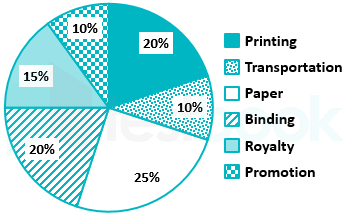
The above pie graph shows the expenditure of a publishing house in Karnataka.

The angle subtended at the center of the portion related to expenditure on royalty is _______.

  1. AOption (a)

    36°

  2. BOption (b)

    90°

  3. COption (c)

    54°

  4. DOption (d)

    72°

View answer & explanation

Correct answer

Answer: (c)C.

54°

Why this answer is correct

Calculation:

Royalty = 15%

Angle = (15/100) × 360°

⇒ 54°

∴ Required answer is 54°

Question 52

A 10N force acts on an object. The object is displaced 5 m in the direction of the force. The work done by the force is ___

  1. AOption (a)

    50 Pa

  2. BOption (b)

    50 J

  3. COption (c)

    50N

  4. DOption (d)

    50 Kg

View answer & explanation

Correct answer

Answer: (b)B.

50 J

Why this answer is correct

The correct answer is 50 J.

Key Points

  • Given that
  • Force on the object (F) = 10 N
  • Displacement (d) = 5 m
  • Work done (w) on the object is denoted by w.
  • w=F×dw=F\times d
  • w=10×5w=10 \times 5
  • w = 50 J
  • So the work done by the force is 50 J

Question 53

Find the value :

5555...\sqrt{5\sqrt{5\sqrt{5\sqrt{5\sqrt{...}}}}} ?

  1. AOption (a)

    5\sqrt5

  2. BOption (b)

    55\sqrt5

  3. COption (c)

    5

  4. DOption (d)

    25

View answer & explanation

Correct answer

Answer: (c)C.

5

Why this answer is correct

Given:

5555...\sqrt{5\sqrt{5\sqrt{5\sqrt{5\sqrt{...}}}}}

Calculation:

Let 5555...\sqrt{5\sqrt{5\sqrt{5\sqrt{5\sqrt{...}}}}} be x

So,

x=5xx =\sqrt{5x}

⇒ x2=(5x)2x^2 =(\sqrt{5x})^2

⇒ x2=5xx^2 =5x

⇒ x = 5

So, 5555...\sqrt{5\sqrt{5\sqrt{5\sqrt{5\sqrt{...}}}}} = 5

∴ Required answer is 5

Question 54

3 R # 2 A $ K 5 % T 7 & N Y + X B / L Q @ 1

Consider the above series.

If the latter half is reversed, the number of symbols that will be preceded by a letter and followed by a digit is:

  1. AOption (a)

    2

  2. BOption (b)

    0

  3. COption (c)

    3

  4. DOption (d)

    1

View answer & explanation

Correct answer

Answer: (d)D.

1

Why this answer is correct

Given series: 3 R # 2 A $ K 5 % T 7 & N Y + X B / L Q @ 1

  • The latter half is reversed: 
  • 3 R # 2 A $ K 5 % T 7 1 @ Q L / B X + Y N &
  • the symbol that will be followed by a digit and preceded by a letter: Letter < Symbol < Digit
  • 3 R # 2 A $ K 5 % T 7 1 @ Q L / B X + Y N &
  • There is only one such symbol: #

Hence, "option 4" is the correct answer.

Question 55

A boat covers a distance of 35 km downstream in 5 hours and returns in 7 hours. Find the speed of the boat in still water.

  1. AOption (a)

    6 km/hr

  2. BOption (b)

    5.5 km/hr

  3. COption (c)

    10.5 km/hr

  4. DOption (d)

    7.5 km/hr

View answer & explanation

Correct answer

Answer: (a)A.

6 km/hr

Why this answer is correct

Shortcut Trick

Downstream speed (D) = 35 ÷ 5 = 7 km/hr

Upstream speed (U) = 35 ÷ 7 = 5 km/hr

Speed in still water = (D + U) ÷ 2 = (7 + 5) ÷ 2 = 12 ÷ 2 = 6 km/hr

∴ The correct answer is 6 km/hr.

Alternate Method

Given:

Distance = 35 km

Time taken downstream (t1) = 5 hours

Time taken upstream (t2) = 7 hours

Formula Used:

Speed = Distance ÷ Time

Speed of boat in still water (u) = (Downstream Speed + Upstream Speed) ÷ 2

Calculations:

⇒ Downstream speed (v + s) = 35 ÷ 5 = 7 km/hr

⇒ Upstream speed (v − s) = 35 ÷ 7 = 5 km/hr

⇒ Speed of boat (v) = (7 + 5) ÷ 2

⇒ v = 12 ÷ 2

⇒ v = 6 km/hr

∴ The correct answer is 6 km/hr.

Additional Information

Speed of Current/Stream

The speed of the stream is calculated as (Downstream Speed − Upstream Speed) ÷ 2. In this case, (7 − 5) ÷ 2 = 1 km/hr.

Relative Speed in Water

Downstream speed is the sum of boat speed and stream speed (v + s), while upstream speed is the difference (v − s).

Average Speed of Trip

For a round trip of equal distance, Average Speed = (2 × Downstream × Upstream) ÷ (Downstream + Upstream).

Question 56

The element with the highest first ionization potential is _________.

  1. AOption (a)

    Boron

  2. BOption (b)

    Carbon

  3. COption (c)

    Nitrogen

  4. DOption (d)

    Oxygen

View answer & explanation

Correct answer

Answer: (c)C.

Nitrogen

Why this answer is correct

The correct answer is Nitrogen.

Key Points

  • The element with the highest first ionization potential is Nitrogen.
  • First ionization energy is the amount of energy required to remove one mole of electrons from a mole of gaseous atoms under standard conditions.
  • All of the nitrogens p-orbitals only contain one electron. However, oxygen has one p-orbital with two electrons, that repel each other.
  • It is easier to remove one of these electrons than the unpaired electrons in nitrogen.
  • This means less energy is required to remove an electron from oxygen and so nitrogen has higher first ionization energy.
  • On the other hand, the increase in nuclear charge from nitrogen to oxygen would increase FIE (first ionization energy) in oxygen compared to nitrogen.
  • However, the effect of electron-electron repulsion in the p-orbital is greater on the FIE so nitrogen has the higher first ionization energy.
  • Amongst B, C, N, and O, N has the highest first ionization energy, because of its half-filled 2p orbital which is more stable.

Question 57

What is the motion of an object in a specified direction called?

  1. AOption (a)

    Speed

  2. BOption (b)

    Displacement

  3. COption (c)

    Velocity

  4. DOption (d)

    Movement

View answer & explanation

Correct answer

Answer: (c)C.

Velocity

Why this answer is correct

The correct answer is Velocity.

Key Points

  • The motion of an object in a specified direction is called velocity.
  • The speed of an object in a particular direction is called velocity.
  • Velocity can also be defined as the rate of change of the object's position with respect to a frame of reference and time.

Additional Information 

  • Speed is the distance traveled per unit of time. It is how fast an object is moving.
  • Speed is the scalar quantity that is the magnitude of the velocity vector.
  • It doesn't have a direction.
  • The displacement is simply the difference in the position of the two marks and is independent of the path taken when traveling between the two marks.
  • The distance traveled, however, is the total length of the path taken between the two marks.
  • Motion is the phenomenon in which an object changes its position over time.
  • Motion is mathematically described in terms of displacement, distance, velocity, acceleration, speed, and time.

Question 58

Who is the Minister of Drinking Water and Sanitation of India?

  1. AOption (a)

    Sushma Swaraj

  2. BOption (b)

    Uma Bharati

  3. COption (c)

    Mamta Banerjee

  4. DOption (d)

    Nirmala Sitharaman

View answer & explanation

Correct answer

Answer: (b)B.

Uma Bharati

Why this answer is correct

The correct answer is Uma Bharti.

Key Points

  • Uma Bharti is the Minister of Drinking Water and Sanitation of India.
  • Uma Bharti (born 3 May 1959) is an Indian politician and former Chief Minister of Madhya Pradesh.
  • After Narendra Modi became the Indian Prime Minister in 2014, she was appointed the Minister for Water Resources, River Development, and Ganga Rejuvenation, and held this office until September 2017.

Additional Information

  • Sushma Swaraj was an Indian politician and a Supreme Court lawyer.
  • A senior leader of Bharatiya Janata Party, Swaraj served as the Minister of External Affairs of India in the first Narendra Modi government.
  • Mamata Banerjee is an Indian politician who is serving as the ninth and current chief minister of the Indian state of West Bengal since 2011, the first woman to hold the office.
  • She founded the All India Trinamool Congress in 1998 after separating from the Indian National Congress and became its first chairperson.
  • Nirmala Sitharaman is an Indian economist and politician serving as the current Minister of Finance and Corporate Affairs of India.
  • She is a member of the Rajya Sabha, the upper house of the Indian Parliament, since 2014.

Question 59

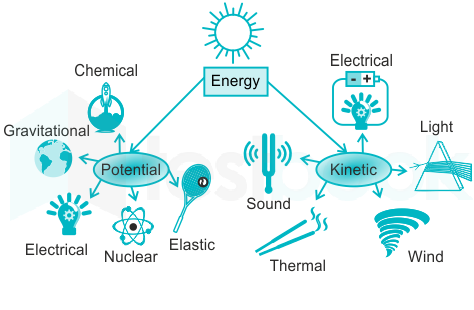
What information does the figure below provide?

  1. AOption (a)

    change of energy

  2. BOption (b)

    types of mechanical energy

  3. COption (c)

    food chain

  4. DOption (d)

    energy conservation

View answer & explanation

Correct answer

Answer: (a)A.

change of energy

Why this answer is correct

The correct answer is the change of energy

Concept:

  • The Law of Conservation of Energy states that the total energy of an isolated system remains conserved (constant), that is, it can neither be created nor be destroyed but it can be transformed from one form to another
  • Energy always transforms from one form to another in this case energy is been transformed in the following order
  • Potential energy is converted to kinetic energy & heat produce because of air resistance as it falls and as it hits the ground it been wasted as sound and heat energy.
  • One of the most common examples of the Law of Conservation of Energy is: water is stored at a height with some potential energy, when the water starts flowing downward then its potential energy is converted into kinetic energy.
  • Kinetic;Energy=12mv2Kinetic;Energy = \frac{1}{2}m{v^2}
  • Potential;Energy=mghPotential;Energy = mgh

Change in Gravitational potential energy = Kinetic Energy.

Explanation:

  • Here energy is converted into various modes.

Sun is the source of energy on earth which is converted into various modes

  • Kinetic
  • Potential
  • Electrical

And they are further converted.

Question 60

________ had successfully led India's first expedition to Antarctica and successfully operated and directed another seven expeditions to the icy continent from 1981 to 1988.

  1. AOption (a)

    MK Kaul

  2. BOption (b)

    AK Hanjura

  3. COption (c)

    VK Raina

  4. DOption (d)

    Dr. SZ Qasim

View answer & explanation

Correct answer

Answer: (d)D.

Dr. SZ Qasim

Why this answer is correct

The correct answer is Dr. SZ Qasim.

Key Points

  • Dr SZ Qasim had successfully led India's first expedition to Antarctica and successfully operated and directed another seven expeditions to the icy continent from 1981 to 1988.
  • The Indian Antarctic Programme, 1981-82 is a program was initiated in 1981 with a selected team of 21 members under the leadership of Dr. S Z Qasim, Secretary of Department of Environment and former Director of National Institute of Oceanography (NIO) with the aim of conducting scientific research in the frozen continent.
  • There have been many negotiations over the topic of Antarctic research since the time it first began.

Additional Information

  • The National Centre for Antarctic and Ocean Research is a research and development body.
  • It functions under the Ministry of Earth Sciences, Government of India.
  • The same controls the Indian Antarctic programme
  • The NCAOR and the Department of Ocean Development select the members for India's Antarctic expeditions.
  • After medical tests and subsequent acclimatization training at the Himalayas, these selected members are also trained in survival, environmental ethics, fire-fighting, and operating in a group.

Question 61

You are given a question and three statements. Identify which of the statement(s) is/are necessary/sufficient to answer the question.

Question :

There are 4 children I, J, K and L whose heights are to be compared. Who among these is tallest?

Statement :

  1. I is taller than L.
  2. L is younger than K.
  3. J is younger than L.
  1. AOption (a)

    Statements 1, 2 and 3 together are sufficient

  2. BOption (b)

    Statements 1, 2 and 3 together are insufficient.

  3. COption (c)

    Statement 2 alone is sufficient.

  4. DOption (d)

    Statement 1 alone is sufficient.

View answer & explanation

Correct answer

Answer: (b)B.

Statements 1, 2 and 3 together are insufficient.

Why this answer is correct

  1. I is taller than L.
  • I > L
  • Here, there is no information given about the heights of J and K. Therefore, statement 1 alone is not sufficient and option 4 is wrong
  1. L is younger than K.
  • L < K
  • No information is given about the heights of I and J. Therefore, statement 2 alone is not sufficient and option 3 is wrong.
  1. J is younger than L.
  • J < L
  • No information is given about the heights of I and K. Therefore, statement 3 alone is not sufficient.
  • From statements 1, 2, and 3, we get the following cases:
  • Case 1: J < L < I < K
  • Case 2: J < L < K < I
  • Thus, either I or K is the tallest. There is no definite answer.
  • So, statements 1, 2, and 3 together are insufficient.

Hence, "option 2" is the correct answer.

Question 62

X attempts 98 questions and scores 202 marks. If there is 4 marks for each correct answer and one negative mark for each wrong answer, then how many questions have been wrongly answered by X:

  1. AOption (a)

    58

  2. BOption (b)

    40

  3. COption (c)

    38

  4. DOption (d)

    60

View answer & explanation

Correct answer

Answer: (c)C.

38

Why this answer is correct

Shortcut Trick

Assume all 98 questions were correct → Total marks = 98 × 4 = 392.

Difference from actual marks = 392 − 202 = 190.

Marks lost per wrong answer (substitution) = 4 (correct) + 1 (negative) = 5 marks.

Number of wrong questions = 190 ÷ 5 = 38.

∴ The correct answer is 38.

Alternate Method

Given: Total questions = 98, Total marks = 202, Marks for correct = +4, Marks for wrong = −1.

Let C be the number of correct answers and W be the number of wrong answers.

⇒ C + W = 98 → (1)

⇒ 4C − 1W = 202 → (2)

Add equation (1) and (2):

⇒ (C + W) + (4C − W) = 98 + 202

⇒ 5C = 300

⇒ C = 60

Substitute C in equation (1):

⇒ 60 + W = 98

⇒ W = 98 − 60 = 38

∴ The correct answer is 38.

Additional Information

Alligation Method

This problem can also be solved using alligation by taking the average marks per question as the central value and the individual marks (+4 and -1) as extremes.

Negative Marking Logic

The effective loss for a wrong answer is always the sum of the potential marks (if it were correct) and the penalty marks (since it is wrong).

Question 63

Read the given question and decide which of the following statement(s) is/are sufficient to answer the question.

Question :

Who is the youngest among M, O, P and Q?

Statement :

  1. M is younger than P and Q.
  2. O is younger than M.
  1. AOption (a)

    Statement 1 alone is sufficient.

  2. BOption (b)

    Statements 1 and 2 both together are sufficient.

  3. COption (c)

    Statements 1 and 2 both together are not sufficient.

  4. DOption (d)

    Statement 2 alone is sufficient.

View answer & explanation

Correct answer

Answer: (b)B.

Statements 1 and 2 both together are sufficient.

Why this answer is correct

  1. M is younger than P and Q.
  • M < P and Q
  • Here, there is no information given about the age of O. Therefore, statement 1 alone is not sufficient and option 1 is wrong.
  1. O is younger than M.
  • O < M
  • No information is given about the ages of P and Q. Therefore, statement 2 alone is not sufficient and option 4 is wrong.
  • From statements 1 and 2, we get the following cases:
  • Case 1: O < M < P < Q.
  • Case 2: O < M < Q < P.
  • In both these cases, O is the youngest.
  • Here, statements 1 and 2 both are sufficient.

Hence, "option 2" is the correct answer.

Question 64

The term 'Night Watchman' is related to which sport?

  1. AOption (a)

    Hockey

  2. BOption (b)

    Table Tennis

  3. COption (c)

    Polo

  4. DOption (d)

    Cricket

View answer & explanation

Correct answer

Answer: (d)D.

Cricket

Why this answer is correct

The correct answer is Cricket.

Key Points

  • The term 'Night Watchman' is related to cricket.
  • In the sport of cricket, a nightwatchman is a lower-order batsman who comes in to bat higher up the order than usual near the end of the day's play.
  • The theory is that losing two top-order batsmen in quick succession would be worse than losing one top-order batsman and a tailender.

Additional Information 

SportTerminologies
HockeyBully, Hat-Trick, Short corner, Stroke, Striking Circle, Penalty corner, Undercutting, Scoop, Centre forward, Carry, Dribble, Goal, Carried.
Lawn TennisPunter, Jockey, Place, Win, Protest.
Horse RacingPunter, Jockey, Place, Win, Protest.

Important Points 

  • Pakistani Nasim-ul-Ghani is the first night-watchman to hit a ton, scoring 101 against England at Lord's in 1962.
  • Australia's Tony Mann was the second when he scored 108 against India at Perth in 1977.

Question 65

What is the relation between Celsius and Kelvin temperature?

  1. AOption (a)

    37° C = 273 K

  2. BOption (b)

    0° C = 273 K

  3. COption (c)

    98.6° C = 273 K

  4. DOption (d)

    0 K = 273°C

View answer & explanation

Correct answer

Answer: (b)B.

0° C = 273 K

Why this answer is correct

The correct answer is 0° C = 273 K.

Key Points

  • The relation between Celsius and Kelvin temperature is  0° C = 273 K.
  • The number of degrees between absolute zero and the freezing temperature of the water is 273 on either temperature scale.
  • Therefore, the freezing temperature of the water is 273 degrees on the Kelvin temperature scale.
  • While the coldest temperature possible on the Celsius temperature scale is -273 degrees.

Additional Information

  • The temperature conversion formula from Celsius to Kelvin is:
  • K = C + 273.15
  • The temperature conversion formula from Kelvin to Celcius is:
  • C = K − 273.15
  • The temperature conversion formula from Fahrenheit to Celsius is:
  • C=(F−32)×59C = {(F − 32) ×{ 5\over{9}}}
  • The Temperature Conversion Formula from Celsius to Fahrenheit is:
  • ​F=C95+32F = {C{9\over{5}}} + 32
  • ​The Temperature Conversion Formula from Fahrenheit to Kelvin is:
  • K=(F−32)×59+273.15K = {(F − 32) × {5\over{9}} + 273.15}

Question 66

_________ were the first land plants to have vascular tissue.

  1. AOption (a)

    bryophyte

  2. BOption (b)

    Thallophyta

  3. COption (c)

    algae

  4. DOption (d)

    pteridophyta

View answer & explanation

Correct answer

Answer: (d)D.

pteridophyta

Why this answer is correct

The correct answer is Pteridophyta.

 Key Points

  • Pteridophyta were the first land plants to have vascular tissue.
  • Pteridophytes are also called first vascular cryptogam or spore-bearing vascular plants.
  • They are the first terrestrial plants to possess vascular tissues.
  • Xylem transport water and minerals to different parts of the plant body and phloem transports organic food to the plant body.

Additional Information

  • Pteridophytes are also called first vascular cryptogam or spore-bearing vascular plants.
  • They are the first terrestrial plants to possess vascular tissues. Xylem transport water and minerals to different parts of the plant body and phloem transports organic food to the plant body.
  • Bryophytes are a proposed taxonomic division containing three groups of non-vascular land plants (embryophytes): the liverworts, hornworts, and mosses.
  • Bryophytes produce enclosed reproductive structures (gametangia and sporangia), but they do not produce flowers or seeds.
  • Thallophyta is a division of the plant kingdom including primitive forms of plant life showing a simple plant body.
  • Including unicellular to large algae, fungi, lichens.
  • They are simple plants without roots stems or leaves.
  • They are non-embryophytes.
  • These plants grow mainly in water.
  • Algae are defined as a group of predominantly aquatic, photosynthetic, and nucleus-bearing organisms that lack the true roots, stems, leaves, and specialized multicellular reproductive structures of plants.

Question 67

If the resistance increases then the electric current I _______.

  1. AOption (a)

    becomes zero

  2. BOption (b)

    will decrease

  3. COption (c)

    will stabilize

  4. DOption (d)

    will double

View answer & explanation

Correct answer

Answer: (b)B.

will decrease

Why this answer is correct

The correct answer is will decrease.

Key Points

  • The relationship between resistance and the area of the cross-section of a wire is inversely proportional.
  • When resistance is increased in a circuit, for example by adding more electrical components, the current decreases as a result.
  • V = IR
  • I=VRI = {V \over{ R}}

Additional Information

  • According to Kirchhoff's law, it states that the sum of product current and resistance is equal to the sum of the potential difference applied across circuits.
  • We can also write this equation as, if the voltage applied is constant.
  • So, when the resistance of a conductor increases, the current will decrease.

Question 68

Select the figures from the following which are similar in the above group.

  1. AOption (a)

    1, 2, 5 ; 8, 6, 4 ; 2, 7, 9

  2. BOption (b)

    1, 2, 8 ; 5, 6, 4 ; 3, 7, 9

  3. COption (c)

    1, 2, 3 ; 5, 6, 8 ; 4, 7, 9

  4. DOption (d)

    1, 2, 8 ; 5, 6, 3 ; 4, 7, 9

View answer & explanation

Correct answer

Answer: (d)D.

1, 2, 8 ; 5, 6, 3 ; 4, 7, 9

Why this answer is correct

The grouping of images will be as follows:

  • Figures 1, 2, and 8 have 2 dots in them and so they form a group.
  • Figures 3, 5, and 6 have 4 parts and so they form a group.
  • Figures 4, 7, and 9 have one axis of symmetry and so they form a group.
  • Thus, the three similar groups are 1, 2, 8; 5, 6, 3; 4, 7, 9

Hence, "option 4" is the correct answer.

Question 69

Food Safety and Standards Authority of India (FSSAI) is an autonomous body under which Union Ministry?

  1. AOption (a)

    Health and family welfare

  2. BOption (b)

    Agriculture & Farmers Welfare

  3. COption (c)

    Food Resource

  4. DOption (d)

    Commerce and Industry

View answer & explanation

Correct answer

Answer: (a)A.

Health and family welfare

Why this answer is correct

The correct answer is Health and family welfare.

Key Points

  • Food Safety and Standards Authority of India (FSSAI) is an autonomous body under the ministry of health and family welfare.
  • FSSAI - Food Safety and Standards Authority of India is an autonomous body established under the Ministry of Health & Family Welfare, Government of India.
  • The FSSAI has been established under the Food Safety and Standards Act, 2006 which is a consolidating statute related to food safety and regulation in India.

Additional Information

  • The Ministry of Agriculture and Farmers' Welfare, formerly the Ministry of Agriculture, is a branch of the Government of India and the apex body for formulation and administration of the rules and regulations and laws related to agriculture in India.
  • The Ministry of Food Processing Industries (MOFPI) is a ministry of the Government of India responsible for the formulation and administration of the rules and regulations and laws relating to food processing in India.
  • The Ministry of Commerce and Industry administers two departments, the Department of Commerce and the Department for Promotion of Industry & Internal Trade.
  • The head of the Ministry is a Minister of Cabinet rank.

Question 70

Pipes A and B can fill an empty tank in 60 hours and 48 hours respectively while pipe C can empty the full tank in 24 hours. How many hours will it take to fill the tank 1/3 when the tank is full and all the three pipes are turned on simultaneously?

  1. AOption (a)

    240

  2. BOption (b)

    160

  3. COption (c)

    80

  4. DOption (d)

    120

View answer & explanation

Correct answer

Answer: (b)B.

160

Why this answer is correct

Shortcut Trick

Assume Total Work = LCM(60, 48, 24) = 240 units.

Efficiencies: A = +4, B = +5, C = −10. Combined Efficiency = 4 + 5 − 10 = −1 unit/hr.

To go from Full tank (240) to 1/3rd tank (80), water to be removed = 240 − 80 = 160 units.

Time taken = 160 units ÷ 1 unit/hr = 160 hours.

∴ The correct answer is 160 hours.

Alternate Method

Given: Filling time A = 60 hrs, B = 48 hrs. Emptying time C = 24 hrs.

Formula Used: Total Work = Time × Efficiency. Net Efficiency = Σ Filling efficiencies − Σ Emptying efficiencies.

PipeHoursTotal Work (LCM)Efficiency
Pipe A (+)602404
Pipe B (+)485
Pipe C (−)24−10

Combined efficiency of A, B, and C = 4 + 5 − 10 = −1 unit/hr (Net emptying).

⇒ Initial quantity in tank = Full = 240 units.

⇒ Required quantity in tank = 1/3 × 240 = 80 units.

⇒ Quantity to be emptied = 240 − 80 = 160 units.

⇒ Time required = Quantity ÷ Net Efficiency = 160 ÷ 1 = 160 hours.

∴ The correct answer is 160 hours.

Additional Information

Net Work in Pipes and Cisterns

Filling pipes have positive efficiency, while outlet/leakage pipes have negative efficiency. Net work per hour is the algebraic sum of efficiencies.

Time and Capacity Relationship

If a pipe fills a tank in 'x' hours, its 1-hour work is 1/x. If the net efficiency is negative, the tank will eventually empty rather than fill.

Question 71

BJP has announced its plan to get around 350 Lok Sabha seats in the upcoming 2019 general elections and called it _________.

  1. AOption (a)

    Mission BJP

  2. BOption (b)

    Sure BJP

  3. COption (c)

    Mission-350

  4. DOption (d)

    Sure 350

View answer & explanation

Correct answer

Answer: (c)C.

Mission-350

Why this answer is correct

The correct answer is Mission-350.

Key Points

  • BJP has announced its plan to get around 350 Lok Sabha seats in the upcoming 2019 general elections and called it Mission-350.
  • “Mission 350”, is to be a plan to secure 350 Lok Sabha seats or near about.
  • The bare bones of the strategy were actually laid out in a meeting of the party’s core committee members, including from State units, held in New Delhi in September 2016.
  • These core committee members that he had identified at least 113 seats across the country where the party had stood second or garnered an impressive vote share despite having no previous history of support.
  • These were to be nurtured and made winnable in the next three years.

Question 72

In which city is the headquarter of Tea Board of India?

  1. AOption (a)

    Guwahati

  2. BOption (b)

    Kolkata

  3. COption (c)

    New Delhi

  4. DOption (d)

    Darjeeling

View answer & explanation

Correct answer

Answer: (b)B.

Kolkata

Why this answer is correct

The correct answer is Kolkata.

Key Points

  • The headquarter of the Tea Board of India is located in Kolkata.
  • The Tea Board of India is a state agency of the Government of India established to promote the cultivation, processing, and domestic trade as well as export of tea from India.
  • It was established by the enactment of the Tea Act in 1953 with its headquarters in Kolkata (formerly Calcutta).
  • It is headed by the Deputy Chairman Mr.P.K.Sahoo, IOFS.

Additional Information

  • The Tea Board India is responsible for the assignment of certification numbers to exports of certain tea merchants.
  • This certification is intended to ensure the teas’ origin, which in turn would reduce the amount of fraudulent labeling on rare teas such as ones harvested in Darjeeling.
  • It coordinates research institutes, the tea trade, and government bodies, ensuring the technical support of the tea trade in the global industry.
  • The offices are located in Kolkata, London, Moscow, and Dubai.
  • The Tea Board had an office in New York City in the 1960s and 70s.
  • Mr. P V Ramaswamy was the first director of the NYC office from 1960 to 1963 and also returned to head it from 1973 to 1975.

Question 73

In the code language, RAT is written as 9267. What will be the code for CAMEL?

  1. AOption (a)

    2426142216

  2. BOption (b)

    2426152215

  3. COption (c)

    2426142215

  4. DOption (d)

    2425142215

View answer & explanation

Correct answer

Answer: (c)C.

2426142215

Why this answer is correct

The logic followed here is:-

Similarly,

Hence, "option 3" is the correct answer.

Question 74

Find the word that does not belong to this group.

  1. AOption (a)

    Deer

  2. BOption (b)

    Snake

  3. COption (c)

    Cow

  4. DOption (d)

    Elephant

View answer & explanation

Correct answer

Answer: (b)B.

Snake

Why this answer is correct

The logic followed here is:-

  • Deer, Cow, and Elephant are mammals but a snake is a reptile.

So, Snake is different from others.

Hence, "option 2" is the correct answer.

Question 75

Dal Bati Churma is one of the most popular food items of ________ cuisines.

  1. AOption (a)

    Rajasthani

  2. BOption (b)

    Punjabi

  3. COption (c)

    Marathi

  4. DOption (d)

    Gujrati

View answer & explanation

Correct answer

Answer: (a)A.

Rajasthani

Why this answer is correct

The correct answer is Rajasthani.

Key Points

  • Dal Bati Churma is one of the most popular food items of Rajasthani cuisines.
  • The famous Rajasthani dish dal bati churma needs no introduction.
  • Dal bati churma is synonymous with Rajasthan; known for its crunchy batis, dipped in ghee along with spicy daal and sweet churma.

Additional Information

  • A list of some Most iconic food of Rajasthan are:
  • Dal Bati Churma
  • Mohan Thaal
  • Laal Maas
  • Mawa Kachori
  • Mirchi Bada
  • Mohan Maas
  • Kalakand
  • Pyaaz Ki Kachori

Question 76

Which of the following Indian film is woven around the real story of the heroes of the Indian independence movement?

  1. AOption (a)

    Uprising

  2. BOption (b)

    Raag Desh

  3. COption (c)

    An Insignificant Man

  4. DOption (d)

    Indu Sarkar

View answer & explanation

Correct answer

Answer: (b)B.

Raag Desh

Why this answer is correct

The correct answer is Raag Desh. 

Key Points

  • Raag Desh is an Indian film is woven around the real story of the heroes of the Indian independence movement.
  • Tigmanshu Dhulia's Raag Desh provides a snappy history of the Indian National Army through the court-martial of three of its soldiers at Delhi's Red Fort in 1945.
  • The trial, one among many, was meant to be a showcase of the colonial imprimatur on its vast colony.
  • Some of the complex histories of the INA and its controversial allegiances (with Nazi Germany, Japan) have been dealt with in Shyam Benegal's biopic Netaji Subhash Chandra Bose: The Forgotten Hero (2004). Raag Desh narrows in on the INA trials, regarded as one of the events that quickened the demise of British rule over India.

Additional Information 

  • An Insignificant Man is a 2016 Hindi/English Indian socio-political documentary co-produced and directed by Khushboo Ranka and Vinay Shukla and also co-produced by filmmaker Anand Gandhi.
  • It is about the rise of anti-corruption protests in India and the formation and rise to power of the Aam Aadmi Party (AAP).
  • Indu Sarkar is a 2017 Indian period political thriller film, co-written, co-produced, and directed by Madhur Bhandarkar.
  • The story screenplay of the movie is written by Anil Pandey and Madhur Bhandarkar and the dialogues are penned by Sanjay Chhel.
  • Indu Sarkar is produced under the banner of Bhandarkar Entertainment and Mega Bollywood Private Limited.
  • The film is set in the period of the emergency in India, i.e. the 19-month-long period from 1975 to 1977 when there was a state of emergency across the country.

Question 77

From the options given below, choose the correct option figure that comes next in the above series of five figures.

  1. AOption (a)

    A

  2. BOption (b)

    D

  3. COption (c)

    B

  4. DOption (d)

    C

View answer & explanation

Correct answer

Answer: (b)B.

D

Why this answer is correct

The logic followed here is:-

  • The internal arrow rotates 900 anticlockwise and then rotates 450 anticlockwise. This pattern is repeated in the next steps.
  • This arrow should be facing vertically upside down in the final answer figure. This is possible in option figure D only.
  • Therefore, D is the correct answer.
  • Additionally, the external arrow rotates 900 clockwise and then 450 clockwise, and so on. 
  • ​This arrow should be at the northwest corner in the final answer figure.

Hence, "option 2" is the correct answer.

Question 78

The given Venn diagram represents the sports preferences of a group of college students. There are three sports : A - Badminton, B - Basketball and C - Tennis. How many students play Badminton or Basketball but do not play Tennis?

  1. AOption (a)

    37

  2. BOption (b)

    15

  3. COption (c)

    30

  4. DOption (d)

    20

View answer & explanation

Correct answer

Answer: (a)A.

37

Why this answer is correct

  • Venn diagram:


  • 13 + 12 + 12 = 37 students play Badminton or Basketball but do not play Tennis.

Hence, "option 1" is the correct answer.

Additional Information

  • When "A or B" is used in Venn diagram problems, it includes A, B, and the intersection of (A, B)
  • For example, "playing Football or Cricket" includes playing only Football, playing only Cricket, and playing both sports.

Question 79

The average test score of 18 boys in a class was 15, while the average of 25 students in the class overall was 16.12. What was the average score of the girls?

  1. AOption (a)

    18.5

  2. BOption (b)

    19.5

  3. COption (c)

    19

  4. DOption (d)

    18.8

View answer & explanation

Correct answer

Answer: (c)C.

19

Why this answer is correct

Shortcut Trick

Total students = 25, Boys = 18 → Girls = 7.

Net deviation from Class Average (16.12):

Boys deviation = 18 × (15 − 16.12) = −20.16.

To balance, Girls total deviation must be +20.16.

Girls average increase = 20.16 ÷ 7 = 2.88 → Avg = 16.12 + 2.88 = 19.

∴ The correct answer is 19.

Alternate Method

Given:

Number of Boys = 18 | Average score of Boys = 15

Total Students = 25 | Average score of Class = 16.12

Formula Used:

Total Score = Average × Number of Students

⇒ Number of Girls = 25 − 18 = 7

⇒ Total Score of Class = 25 × 16.12 = 403

⇒ Total Score of Boys = 18 × 15 = 270

⇒ Total Score of Girls = Total Class Score − Total Boys Score

⇒ Total Score of Girls = 403 − 270 = 133

⇒ Average Score of Girls = 133 ÷ 7 = 19

∴ The correct answer is 19.

Additional Information

Weighted Average Formula

The combined average is calculated as Aavg = (n1A1 + n2A2) ÷ (n1 + n2), where n is the count and A is the average.

Alligation Method

Ratio of quantities n1 : n2 = (A2 − Aavg) : (Aavg − A1). This is useful for finding ratios between two groups.

Sum of Observations

Average is the central value of a data set. Sum = Average × Total number of observations.

Question 80

Consider the following statement(s) and arguments and decide which of the arguments(s) regarding the statement(s) is/are correct.

Statement:

Children should be encouraged to read books from an early age.

Argument:

I. Yes, it will increase their interest in reading for years to come.

II. No, a child who wants to read will naturally take up this activity.

  1. AOption (a)

    Neither I nor II is strong.

  2. BOption (b)

    Arguments I and II both are strong.

  3. COption (c)

    Only argument II is strong.

  4. DOption (d)

    Only argument I is strong.

View answer & explanation

Correct answer

Answer: (d)D.

Only argument I is strong.

Why this answer is correct

The statement makes a suggestion towards encouraging children to read books.

  • If children are encouraged to read books at an early age, they are bound to develop an interest in reading as they grow up. This is a good and useful habit to be developed in childhood. So, argument I is strong.
  • Children are not self-aware of the benefits of reading and should rather be encouraged to do so. Thus, argument II is not strong.

Hence the correct answer is option 4.

Question 81

The mean of the marks of three students in an examination of 25 marks is 16. Two fresh students appeared in the examination. What is the least number of marks required to be obtained by the freshman, who scores less than the second freshman, to make the average marks of the five students to be 19?

  1. AOption (a)

    22

  2. BOption (b)

    21

  3. COption (c)

    20

  4. DOption (d)

    23

View answer & explanation

Correct answer

Answer: (a)A.

22

Why this answer is correct

Shortcut Trick Total marks of 5 students = 5 × 19 = 95 Total marks of 3 students = 3 × 16 = 48 Marks required by two freshmen = 95 − 48 = 47 To minimize one freshman's score, maximize the other (Max = 25). Least marks = 47 − 25 = 22 ∴ The correct answer is 22 marks.

Alternate Method Given: Mean marks of 3 students = 16 Mean marks of 5 students = 19 Maximum marks per student = 25 Formula Used: Sum of observations = Average × Number of observations

Calculations: ⇒ Total marks of initial 3 students = 3 × 16 = 48 ⇒ Total marks of all 5 students = 5 × 19 = 95 ⇒ Marks obtained by 2 fresh students = 95 − 48 = 47 ⇒ Let the marks of the two freshmen be S1 and S2 (where S1 < S2). ⇒ S1 + S2 = 47 ⇒ For S1 to be the least number of marks, S2 must be the maximum possible marks. ⇒ Maximum marks in the examination = 25 ⇒ ∴ Maximum S2 = 25 ⇒ S1 + 25 = 47 ⇒ S1 = 47 − 25 = 22 ∴ The correct answer is 22 marks.

Additional Information Concept of Weighted Average When two groups with averages A1 and A2 and sizes n1 and n2 are combined, the combined average = (n1A1 + n2A2) ÷ (n1 + n2). Minimizing and Maximizing Values In a fixed sum, to find the minimum value of one variable, all other variables must be assigned their maximum possible values within the given constraints. Deviation Method Net deviation from the mean is always zero. Sum of (Value − Mean) = 0. This helps in finding missing values in a dataset quickly.

Question 82

What fraction of a day will be 4-minutes?

  1. AOption (a)

    23400\frac{23}{400}

  2. BOption (b)

    1480\frac{1}{480}

  3. COption (c)

    1360\frac{1}{360}

  4. DOption (d)

    1240\frac{1}{240}

View answer & explanation

Correct answer

Answer: (c)C.

1360\frac{1}{360}

Why this answer is correct

Shortcut Trick

Convert 1 day into minutes: 24 hours × 60 minutes = 1440 minutes.

Required fraction = Given time ÷ Total time.

Required fraction = 4 ÷ 1440 = 1/360.

∴ The correct answer is 1/360.

Alternate Method

Given:

Target time = 4 minutes

Total duration = 1 day

Formula Used:

Fraction = (Value in specific unit) / (Total value in same unit)

⇒ 1 day = 24 hours

⇒ 1 hour = 60 minutes

⇒ Total minutes in a day = 24 × 60 = 1440 minutes

⇒ Required fraction = 4 / 1440

⇒ Required fraction = 1 / 360

∴ The correct answer is 1/360.

Additional Information

Time Conversion Units

Always ensure both values are in the same unit before calculating a fraction. 1 day = 24 hours = 1440 minutes = 86,400 seconds.

Fraction to Percentage

To convert the fraction to a percentage, multiply by 100. For example: (1/360) × 100 ≈ 0.27%.

Question 83

Select the mirror image for the following figure.

  1. AOption (a)

    D

  2. BOption (b)

    C

  3. COption (c)

    B

  4. DOption (d)

    A

View answer & explanation

Correct answer

Answer: (b)B.

C

Why this answer is correct

  • The mirror image of the question figure is as follows:

Hence, "option C" is the correct answer.

Question 84

65% of a number is 91. what is the value of the number?

  1. AOption (a)

    130

  2. BOption (b)

    135

  3. COption (c)

    140

  4. DOption (d)

    134

View answer & explanation

Correct answer

Answer: (c)C.

140

Why this answer is correct

Shortcut Trick

Given that 65% → 91

Divide both sides by 13: 5% → 7

Multiply by 20 to find 100%: 100% → 7 × 20 = 140

∴ The correct answer is 140.

Alternate Method

Given:

65% of a number = 91

Formula Used:

Number = (Given Value ÷ Percentage Value) × 100

Calculations:

Let the number be x.

⇒ 65% of x = 91

⇒ (65/100) × x = 91

⇒ x = (91 × 100) ÷ 65

⇒ x = (7 × 13 × 100) ÷ (5 × 13)

⇒ x = (7 × 100) ÷ 5

⇒ x = 7 × 20

⇒ x = 140

∴ The correct answer is 140.

Additional Information

Percentage to Fraction

To convert a percentage to a fraction, divide by 100. Example: 65% = 65/100 = 13/20.

Base Change Rule

If a% of a number is b, then the number is (b/a) × 100.

Percentage Increase/Decrease

New Value = Original Value × (100 ± Change%)/100.

Question 85

From the top of a tower 100 m high, Rohan observes a boat moving towards the tower with an angle of depression of 30°. After sometime, the angle of depression becomes 60°. The distance (in m) covered by the boat during this time will be

  1. AOption (a)

    301 m

  2. BOption (b)

    160 m

  3. COption (c)

    20037\frac{200\sqrt3}{7} m

  4. DOption (d)

    20033\frac{200\sqrt3}{3} m

View answer & explanation

Correct answer

Answer: (d)D.

20033\frac{200\sqrt3}{3} m

Why this answer is correct

Shortcut Trick For a tower of height h, if the angle of elevation changes from 30° to 60°, the distance moved towards the tower is d = h(cot 30° − cot 60°). Here, h = 100 m, cot 30° = √3, and cot 60° = 1/√3. d = 100 × (√3 − 1/√3) = 100 × (2/√3) = 200/√3 m. Rationalizing the denominator: d = (200√3)/3 m. ∴ The correct answer is (200√3)/3 m. Alternate Method Given: Height of tower (AB) = 100 m, Initial angle of depression = 30°, Final angle of depression = 60°. Formula Used: tan θ = Perpendicular / Base

⇒ In ΔABC: tan 60° = AB / BC ⇒ √3 = 100 / BC ⇒ BC = 100/√3 m ⇒ In ΔABD: tan 30° = AB / BD ⇒ 1/√3 = 100 / BD ⇒ BD = 100√3 m ⇒ Distance CD = BD − BC = 100√3 − 100/√3 ⇒ CD = (300 − 100) / √3 = 200/√3 m ⇒ CD = (200√3)/3 m ∴ The correct answer is (200√3)/3 m. Additional Information Angle of Depression and Elevation The angle of depression from an observer to an object is numerically equal to the angle of elevation from the object to the observer due to alternate interior angles. Standard Values tan 30° = 1/√3, tan 45° = 1, tan 60° = √3. These are essential for solving heights and distances problems. Distance Formula When moving between two points with angles α and β, distance d = h(cot α − cot β) where β > α.

Question 86

Simlipal Wildlife Sanctuary is located in _________.

  1. AOption (a)

    Jharkhand

  2. BOption (b)

    Telangana

  3. COption (c)

    Bihar

  4. DOption (d)

    Odisha

View answer & explanation

Correct answer

Answer: (d)D.

Odisha

Why this answer is correct

The correct answer is Odisha.

Key Points

  • Simlipal Wildlife Sanctuary is located in Odisha.
  • Simlipal National Park is a national park and a tiger reserve in the Mayurbhanj district in the Indian state of Odisha covering 2,750 km2.
  • It is part of the Mayurbhanj Elephant Reserve, which includes three protected areas — Similipal Tiger Reserve, Hadgarh Wildlife Sanctuary with 191.06 km2, and Kuldiha Wildlife Sanctuary with 272.75 km2.
  • Simlipal National Park derives its name from the abundance of red silk cotton trees growing in the area.
  • The park is home to Bengal tiger, Asian elephant, gaur, and chausingha.
  • This protected area is part of the UNESCO World Network of Biosphere Reserves since 2009.

Additional Information

  • Kaziranga National Park is a protected area in the northeast Indian state of Assam.
  • Spread across the floodplains of the Brahmaputra River, its forests, wetlands, and grasslands are home to the world's largest population of tigers, elephants, and the Indian one-horned rhinoceros.
  • The one-horned rhinoceros, Royal Bengal tiger, Asiatic elephant, bison, and swamp deer are collectively known as the 'Big Five' of Kaziranga.
  • In the year 1985, the park was declared a World Heritage Site by UNESCO.
  • It has been declared a national park in 1974.
  • Guindy National Park :
  • Guindy National Park is a beautiful place, located in the Chennai district of the state of Tamil Nadu.
  • The park is home to spotted deer, blackbucks, white bucks, river otter, hyena, bonnet monkey, civet cat, jackals, pangolin, hedgehog and common mongoose, etc.
  • Guindy National Park was established in the year of 1976.
  • Ranthambore National Park :
  • Ranthambore National Park is located about 13.5 kilometers from the city of Sawai Madhopur in Rajasthan.
  • It is a former royal hunting ground and home to tigers, leopards, and marsh crocodiles.

Question 87

As per February 2018, the President of Sangeet Natak Akademi is ________.

  1. AOption (a)

    Dr. PV Rajmannar

  2. BOption (b)

    Mr. Pranay Khullar

  3. COption (c)

    Mrs. Aruna Sairam

  4. DOption (d)

    Mr. Shekhar Sen

View answer & explanation

Correct answer

Answer: (d)D.

Mr. Shekhar Sen

Why this answer is correct

The correct answer is Mr. Shekhar Sen.

Key Points

  • As of February 2018, the President of Sangeet Natak Akademi is Mr. Shekhar Sen.
  • Eminent singer and theatre director Shekhar Sen has been appointed the new chairman of the Sangeet Natak Akademi, the country's premier institution for the performing arts.
  • Mr. Sen was recently awarded the Padma Shri on Republic day for his contribution to the arts.
  • According to an order issued by the Culture Ministry on Wednesday, Sen has been appointed for a term of five years with immediate effect.
  • The Akademi has been without a head after earlier chairperson Leela Samson, who was appointed by the UPA government, quit on September 30 last year.

Additional Information

  • Pakala Venkataramana Rao Rajamannar (1901–1979) was an Indian judge and politician who served as the acting Governor of Madras State from 1957 to 1958.
  • P.V. Rajamannar was the first Indian to become Chief Justice of Madras High Court after independence from 1948 to 1961.
  • He was also the first Chairman of Sangeet Natak Akademi in New Delhi.
  • Aruna Sairam (also spelled Sayeeram) is an Indian classical vocalist and top Carnatic music singer.
  • She is a recipient of the Padma Shri award from the Government of India and has been elected as Vice Chairman of the Sangeet Natak Akademi (India's premier national institution for music and dance) by the Government of India.
  • In 2011, Aruna was the first Karnatic musician to perform at the BBC proms in London.
  • She is also the first Carnatic musician to perform in Oud Festival of Israel.

Question 88

Which of these numbers is the greatest 3-digit perfect square number?

  1. AOption (a)

    900

  2. BOption (b)

    971

  3. COption (c)

    832

  4. DOption (d)

    961

View answer & explanation

Correct answer

Answer: (d)D.

961

Why this answer is correct

Shortcut Trick

Identify the largest 2-digit number whose square is a 3-digit number.

Since 302 = 900 and 402 = 1600 (4-digit), check numbers between 30 and 32.

312 = 961 and 322 = 1024 (4-digit).

∴ The correct answer is 961.

Alternate Method

Given: Find the greatest 3-digit perfect square.

Method: Long division method to find the square root of 999 (largest 3-digit number).

⇒ Square root of 999 ≈ 31.6

⇒ Greatest 3-digit square = (31)2

⇒ 31 × 31 = 961

∴ The correct answer is 961.

Additional Information

Perfect Square Properties

A perfect square never ends with the digits 2, 3, 7, or 8 at the unit place.

Smallest 3-digit Square

The smallest 3-digit perfect square is 100, which is 102.

Smallest 4-digit Square

The smallest 4-digit perfect square is 1024, which is 322.

Question 89

Which part of the Indian Constitution is also called a Unique feature of the Constitution by Dr B.R. Ambedkar?

  1. AOption (a)

    Revision Procedures

  2. BOption (b)

    Fundamental Duties

  3. COption (c)

    Directive Principles of State Policy

  4. DOption (d)

    Fundamental Rights

View answer & explanation

Correct answer

Answer: (c)C.

Directive Principles of State Policy

Why this answer is correct

The correct answer is Directive Principles of State Policy.

Key Points

  • Directive Principles of State Policy the Indian Constitution is also called by Dr B.R Ambedkar as a unique feature of the Constitution.
  • Directive Principles of State Policy (DPSP) are mentioned in Part IV of the Indian constitution from Articles 36 to 51.
  • DPSPs are taken from the Constitution of Ireland.
  • Ambedkar described these principles as 'novel features' of the Constitution.
  • Directive Principles of State Policy aim to create social and economic conditions under which the citizens can lead a good life.
  • They also aim to establish social and economic democracy through a welfare state.

Additional Information

  • Dr. B.R. Ambedkar called the Right to constitutional remedies (Article 32) the "Heart and Soul of the Constitution".
  • In India, the Supreme Court under Article 32 is empowered to issue writs of different types to enforce the Fundamental Rights under Part III of the Indian Constitution.
  • Thus, to make available Right to Constitutional Remedies to every citizen, provisions have been made in the Indian Constitution to issue writs.
  • Thus, the Supreme Court under Article 32 and High Courts under Article 226 is empowered to issue writs for the enforcement of Fundamental Rights.
  • 5 Types of Writs
  • There are five types of writs in the Indian Constitution - Habeas Corpus, Certiorari, Quo-Warranto, Mandamus and Prohibition.
  • Writ of Habeas Corpus -
  • This writ literally means 'you may have the body'.
  • This writ is issued to produce a person physically before the court who has been imprisoned or detained by the law and to set him free if there is no legal justification of his detention.
  • This writ can be issued against authorities of states or organisations or individuals.
  • Writ of Certiorari -
  • This writ literally means 'to be certified'. This writ is issued by the higher court to the lower court for quashing the order already passed by the lower court or removing a suit from the lower court to the higher court for speedy disposal.
  • Writ of Quo-Warranto -
  • This writ literally means 'by what warrants' or what is your authority.
  • It is a writ issued by the Supreme Court or High Court with a view to restraining a person or authority from holding a public office to which he is not entitled. The writ requires the concerned person or authority to explain to the Court by what authority he/she holds the office.
  • Writ of Mandamus -
  • This writ literally means 'we command'. It is a judicial writ issued by the Supreme Court or a High Court as a command to an inferior court or tribunal or a person to perform a public or statutory duty.
  • Writ of Prohibition -
  • This writ is popularly known as 'Stay Order'. This writ is issued by a higher court to a lower court to stop proceeding in a case on the ground of over-stepping of jurisdiction or absence of jurisdiction.
  • It is issued before the judgement or order is made in such cases.

Question 90

__________ is a type of echo location.

  1. AOption (a)

    Vibration

  2. BOption (b)

    Frequency

  3. COption (c)

    Radar

  4. DOption (d)

    Sonar

View answer & explanation

Correct answer

Answer: (d)D.

Sonar

Why this answer is correct

The correct answer is Sonar.

Key Points

  • Sonar is a type of echolocation.
  • Echolocation, also called biosonar, is a biological sonar used by several animal species.
  • Echolocating animals emit calls out to the environment and listen to the echoes of those calls that return from various objects near them.
  • Echolocation is used for navigation, foraging, and hunting in various environments.

Additional Information

  • Vibration is a mechanical phenomenon whereby oscillations occur about an equilibrium point.
  • Frequency is the number of occurrences of a repeating event per unit of time.
  • Frequency is measured in hertz (Hz) which is equal to one (event) per second.
  • The period is the duration of time of one cycle in a repeating event, so the period is the reciprocal of the frequency.
  • Radar (radio detection and ranging) is a detection system that uses radio waves to determine the distance (ranging), angle, or velocity of objects.
  • The term radar has since entered English and other languages as a common noun, losing all capitalization.

Question 91

The East India Company was granted an English Royal Charter by Elizabeth I on 31 December ________.

  1. AOption (a)

    1500

  2. BOption (b)

    1600

  3. COption (c)

    1800

  4. DOption (d)

    1700

View answer & explanation

Correct answer

Answer: (b)B.

1600

Why this answer is correct

The correct answer is 1600.

Key Points

  • The East India Company was granted an English Royal Charter by Elizabeth I on 31 December 1600.
  • The English East India Company, formally known as the Governor and Company of Merchants of London Trading into the East-Indies, was first incorporated by a charter from Queen Elizabeth I (1533–1603) on December 31, 1600.
  • The charter gave the company exclusive rights to all "Traffic and Merchandize to the East-Indices.

Additional Information

  • In 1600, the East India Company acquired a charter from the ruler of England, Queen Elizabeth I, granting it the sole right to trade with the East.
  • This meant that no other trading group in England could compete with the East India Company.
  • Lord Cornwallis (governor-general, 1786-93):
  • He was the first to bring into existence and organize civil services.
  • He abolished the District Fauzdari Courts and established circuit courts at Calcutta, Dacca, Murshidabad, and Patna.
  • William Bentinck (governor-general 1828-1833):
  • He abolished the four Circuit Courts and transferred their functions to the Collectors.
  • Established a Sadar Diwani Adalat and a Sadar Nizamat Adalat at Allahabad for the convenience of the people of Upper Provinces.
  • The English language replaced Persian as the official language of courts.
  • Also, the suitor was now provided the option to use Persian or a vernacular language in courts.

Question 92

Select the option that is related to the third figure in the same way as the second figure is related to the first figure.

Select the correct figure suitable for the blank space. 

  1. AOption (a)

    C

  2. BOption (b)

    D

  3. COption (c)

    B

  4. DOption (d)

    A

View answer & explanation

Correct answer

Answer: (d)D.

A

Why this answer is correct

The logic followed here is:-

  • The second figure is the mirror image of the first figure.
  • ​

Similarly,

  • The fourth figure is the mirror image of the third figure.


​

Hence, "option 4" is the correct answer.

Question 93

Pipe A can fill an empty tank in 30 minutes, Pipe B can empty the same filled tank in 2 hours and Pipe C can empty the same filled tank in 5 hours. If all these are opened together when the tank is empty, then in how many hours will the tank be filled?

  1. AOption (a)

    1013\frac{10}{13}

  2. BOption (b)

    712\frac{7}{12}

  3. COption (c)

    527\frac{5}{27}

  4. DOption (d)

    713\frac{7}{13}

View answer & explanation

Correct answer

Answer: (a)A.

1013\frac{10}{13}

Why this answer is correct

Shortcut Trick

Convert all times to hours: Pipe A = 0.5 hr, Pipe B = 2 hr, Pipe C = 5 hr.

Total capacity (LCM of 0.5, 2, 5) = 10 units.

Combined efficiency = 20 − 5 − 2 = 13 units/hr.

Time taken = Total work ÷ Efficiency = 10/13 hours.

∴ The correct answer is 10/13 hours.

Alternate Method

Given: Filling time Pipe A = 30 min = 1/2 hour. Emptying time Pipe B = 2 hours. Emptying time Pipe C = 5 hours.

PersonTime (hr)Total WorkEfficiency
Pipe A (+)1/210 units20
Pipe B (−)2−5
Pipe C (−)5−2

⇒ Net Efficiency = Efficiency(A) + Efficiency(B) + Efficiency(C)

⇒ Net Efficiency = 20 + (−5) + (−2) = 13 units/hr.

⇒ Time taken = 10 ÷ 13 hours.

∴ The correct answer is 10/13 hours.

Additional Information

Pipes and Cisterns Logic

Filling pipes have positive efficiency (+) while emptying pipes (leakage) have negative efficiency (−).

Alternate Work/Pipes

If pipes are opened in alternate hours, calculate the cycle efficiency first and then determine the total time.

Question 94

A bag contained red, green and pink tokens. The ratio between red and green tokens was 15 : 32 while that between pink and red tokens was 18 : 25. What was the ratio between green and pink tokens?

  1. AOption (a)

    80 : 27

  2. BOption (b)

    192 : 125

  3. COption (c)

    16 : 9

  4. DOption (d)

    25 : 28

View answer & explanation

Correct answer

Answer: (a)A.

80 : 27

Why this answer is correct

Shortcut Trick

To find Green : Pink, multiply the ratios to cancel the Red term.

Ratio 1: Green / Red = 32 / 15

Ratio 2: Red / Pink = 25 / 18

Calculation: (32 / 15) × (25 / 18) = (32 × 5) / (3 × 18) = 160 / 54 = 80 / 27

∴ The correct answer is 80 : 27.

Alternate Method

Given:

Ratio of Red : Green = 15 : 32

Ratio of Pink : Red = 18 : 25

Formula:

To combine ratios A : B and B : C, equalize the common term B.

Calculations:

⇒ Red : Green = (15 × 5) : (32 × 5) = 75 : 160

⇒ Pink : Red = (18 × 3) : (25 × 3) = 54 : 75

⇒ Therefore, Pink : Red : Green = 54 : 75 : 160

⇒ Ratio of Green : Pink = 160 : 54

⇒ Simplified Ratio = 80 : 27

∴ The correct answer is 80 : 27.

Additional Information

Compound Ratio

The compound ratio of (a : b) and (c : d) is (ac : bd). This is used when linking multiple sets of proportions.

Invertendo Property

If the ratio a : b is given, its inverse ratio is b : a. This is helpful for re-aligning common terms in chains.

Equalizing Terms

To find A : C from A : B and B : C, find the LCM of the common term B to create a single continuous ratio.

Question 95

The pH value of salts of strong acid and strong base is:

  1. AOption (a)

    0

  2. BOption (b)

    7

  3. COption (c)

    Greater than 7

  4. DOption (d)

    Less than 7

View answer & explanation

Correct answer

Answer: (b)B.

7

Why this answer is correct

The correct answer is 7.

Key Points

  • The pH value of salts of strong acid and strong base is 7.
  • The salts are from a strong acid and strong base do not hydrolyze and the resulting salt pH will remain 7.
  • The anion in the salt form's strong base does not attract the H+ from the water.

Additional Information

  • Salt of a strong acid and a weak base is acidic with a pH value less than 7 because acid is strong which retains the pH value less than 7.
  • Salt of a weak acid and strong base is base with a pH value of more than 7 because the base is strong hence pH of the whole solution will be more than 7.
  • Salt of a strong acid and strong base is neutral because both are strong and cancels strong effects of each other, the pH will be 7.

Question 96

Solve this equation - 0.15+0.120.15−0.12\sqrt{0.15 + 0.12} \sqrt{0.15 - 0.12}

  1. AOption (a)

    0.09

  2. BOption (b)

    0.03

  3. COption (c)

    0.9

  4. DOption (d)

    0.3

View answer & explanation

Correct answer

Answer: (a)A.

0.09

Why this answer is correct

Given:

0.15+0.120.15−0.12\sqrt{0.15 + 0.12} \sqrt{0.15 - 0.12}

Concept used:

Concept of surds and indices

Calculation:

0.15+0.120.15−0.12\sqrt{0.15 + 0.12} \sqrt{0.15 - 0.12}

⇒0.270.03\sqrt{0.27} \sqrt{0.03}

⇒(27/100)(3/100)(\sqrt{27/100} )(\sqrt{3/100})

⇒3310×310\frac{3\sqrt{3}}{10} \times \frac{\sqrt{3}}{10}

⇒ 9/100

⇒ 0.09

∴ Required answer is 0.09

Question 97

Which of the following number is a prime number?

  1. AOption (a)

    149

  2. BOption (b)

    99

  3. COption (c)

    100

  4. DOption (d)

    249

View answer & explanation

Correct answer

Answer: (a)A.

149

Why this answer is correct

Shortcut Trick

Check divisibility for numbers near perfect squares.

For 149, √149 ≈ 12.2. Check primes 2, 3, 5, 7, 11.

149 is not divisible by 2, 3, 5, 7, or 11.

∴ The correct answer is 149.

Alternate Method

Given: Numbers 149, 99, 100, 249.

Formula Used: A prime number has only two factors: 1 and itself.

⇒ Case 1: 99 → Sum of digits 9+9 = 18 (divisible by 3 and 9). Not prime.

⇒ Case 2: 100 → Even number (divisible by 2, 5, 10). Not prime.

⇒ Case 3: 249 → Sum of digits 2+4+9 = 15 (divisible by 3). Not prime.

⇒ Case 4: 149 → No prime number p ≤ √149 (i.e., 2, 3, 5, 7, 11) divides 149.

∴ The correct answer is 149.

Additional Information

Definition of Prime Numbers

Numbers greater than 1 that have no positive divisors other than 1 and themselves.

Testing Primality

To check if n is prime, test divisibility by all primes up to √n.

Composite Numbers

Numbers with more than two factors. 1 is neither prime nor composite.

Question 98

In the question below a statement is given followed by two assumptions numbered I and II. Decide what assumption is implicit in this statement.

Statement :

Please read the instructions before getting into the swimming pool.

Assumptions:

I. The people who landed in the swimming pool are educated.

II. The people who enter the swimming pool are not blind.

  1. AOption (a)

    Only assumption I is implicit.

  2. BOption (b)

    Neither the assumption I nor II is implicit.

  3. COption (c)

    Both Assumptions I and II are implicit.

  4. DOption (d)

    Only assumption II is implicit.

View answer & explanation

Correct answer

Answer: (c)C.

Both Assumptions I and II are implicit.

Why this answer is correct

  • The statement asks to 'read' the instructions.
  • This requires the people to be capable of reading and having proper eyesight.
  • Thus, the authorities might have assumed that people who enter or land in the swimming pool might be educated or are not blind.

Thus, both assumptions I and II are implicit.

Hence the correct answer is option 3.

Question 99

Which one of the following is different from the rest?

  1. AOption (a)

    A

  2. BOption (b)

    B

  3. COption (c)

    C

  4. DOption (d)

    D

View answer & explanation

Correct answer

Answer: (c)C.

C

Why this answer is correct

The logic followed here is:-

  • Figures A, B, and D have two stars opposite each other with one circle between them.
  • Figure C has 2 stars adjacent to each other.

So, figure C is different from others.

Hence, "option 3" is the correct answer. 

Alternate Method

  • Figure A can be rotated anticlockwise to obtain figure B.
  • Figure B can be rotated anticlockwise to obtain figure D.
  • However, figure C cannot be obtained by rotating any option figure.

Hence,  "option 3" is the correct answer.

Question 100

Identify the odd one out from the given set of words.

glue, Adhesive paste (lei), oil, cement

  1. AOption (a)

    Oil

  2. BOption (b)

    Cement

  3. COption (c)

    Glue

  4. DOption (d)

    Adhesive paste

View answer & explanation

Correct answer

Answer: (a)A.

Oil

Why this answer is correct

The logic followed here is:-

  • Cement, glue, and adhesive paste are used as adhesives but oil is not an adhesive.

Hence, "option 1" is the correct answer.

100 questions in the full paper