Previous Year Paper

RRC Group D Previous Year Paper 67 (Held On: 26 Oct 2018 Shift 3)

Held in 2018

100 questions90 minutes
With answers
Free

Paper last updated:

Practise under exam conditions

Take this paper as a timed mock test. Review your answers after you submit.

Attempt timed test

Questions & answers

Read the paper at your pace. Open an explanation when you need it.

CBT (100 questions)

Question 1

Mr. Z is standing facing towards the east. He takes a left turn and walks 5 km to reach point A. Then he takes a left turn and walks 4 km to reach point B. Then he takes a right turn and walks 3 km to reach point C. Then he takes a right turn and walks 10 km to reach point D.

In which direction is Mr. Z facing now at point D?

  1. AOption (a)

    North

  2. BOption (b)

    South

  3. COption (c)

    West

  4. DOption (d)

    East

View answer & explanation

Correct answer

Answer: (d)D.

East

Why this answer is correct

The figure is given below:-

  • Mr Z is facing the East direction at point D.

Hence, "option 4" is the correct answer.

Question 2

The tendency of an object to resist its stationary state or its state of motion is called:

  1. AOption (a)

    Force

  2. BOption (b)

    Momentum

  3. COption (c)

    Gravitation

  4. DOption (d)

    Inertia

View answer & explanation

Correct answer

Answer: (d)D.

Inertia

Why this answer is correct

The correct answer is Inertia.

Key Points

  • Inertia is the tendency of an object to resist changes in its state of motion.
  • Thus, inertia could be redefined as follows: Inertia: the tendency of an object to resist changes in its velocity.
  • An object at rest has zero velocity - and (in the absence of an unbalanced force) will remain with a zero velocity.

Additional Information

  • A force is a push or pulls upon an object resulting from the object's interaction with another object.
  • Whenever there is an interaction between two objects, there is a force upon each of the objects.
  • Forces only exist as a result of an interaction.
  • Momentum is a physics term; it refers to the quantity of motion that an object has.
  • A sports team that is on the move has the momentum.
  • Momentum can be defined as "mass in motion." All objects have mass; so if an object is moving, then it has momentum - it has its mass in motion.
  • Gravity, also called gravitation, in mechanics, is the universal force of attraction acting between all matter.
  • On Earth, all bodies have a weight, or downward force of gravity, proportional to their mass, which Earth's mass exerts on them.
  • Gravity is measured by the acceleration that it gives to freely falling objects.

Question 3

The following figure gives the percentage distribution of sales of a small home-based business over the past 5 years. The total sales during these five years were Rs. 20,00,000.

What is the difference in sales of year 1 to year 5?

  1. AOption (a)

    Rs. 2,00,000

  2. BOption (b)

    Rs. 3,00,000

  3. COption (c)

    Rs. 50,000

  4. DOption (d)

    Rs. 5,00,000

View answer & explanation

Correct answer

Answer: (b)B.

Rs. 3,00,000

Why this answer is correct

According to the pie given pie chart,

Difference of sales of year 1 to year 5 = 25 - 10 = 15%

So, amount = 2000000 × 15/100

⇒ Rs. 300000

∴ Required answer is Rs. 300000

Question 4

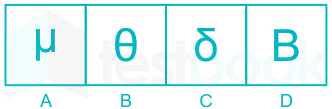
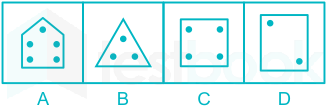
Find the odd one from following-

  1. AOption (a)

    D

  2. BOption (b)

    A

  3. COption (c)

    C

  4. DOption (d)

    B

View answer & explanation

Correct answer

Answer: (c)C.

C

Why this answer is correct

The logic followed here is:-

  • In figures A, B, and D, the inner shape and outer shape are the same
  • In figure C inner shape (circle) and outer shape (hexagon) both are different.

Figure C is different from others.

Hence, "option 3" is the correct answer.

Question 5

Multicellular animals without cell wall can be placed under which of the following group?

  1. AOption (a)

    Animalia

  2. BOption (b)

    Plantia

  3. COption (c)

    Monera

  4. DOption (d)

    Protista

View answer & explanation

Correct answer

Answer: (a)A.

Animalia

Why this answer is correct

The correct answer is Animalia.

Key Points

  • Multicellular animals without cell walls can be placed under the Animalia group.
  • The heterotrophic eukaryotic, multicellular organisms lacking a cell wall are included in the Kingdom Animalia.
  • The mode of nutrition of these organisms is holozoic.
  • Animalia Animals are multicellular and move with the aid of cilia, flagella, or muscular organs based on contractile proteins.
  • They have organelles including a nucleus, but no chloroplasts or cell walls.

Additional Information

  • Monera
  • Individuals are single-celled, may or may not move, have a cell wall, have no chloroplasts or other organelles, and have no nucleus.
  • Monera is usually very tiny, although one type, namely the blue-green bacteria, looks like algae.
  • They are filamentous and quite long, green, but have no visible structure inside the cells.
  • No visible feeding mechanism.
  • They absorb nutrients through the cell wall or produce their own by photosynthesis.
  • Protists are single-celled and usually move by cilia, flagella, or by amoeboid mechanisms.
  • There is usually no cell wall, although some forms may have a cell wall.
  • They have organelles including a nucleus and may have chloroplasts, so some will be green and others won't be.
  • They are small, although many are big enough to be recognized in a dissecting microscope or even with a magnifying glass.
  • Nutrients are acquired by photosynthesis, ingestion of other organisms, or both.
  • Fungi are multicellular, with a cell wall, organelles including a nucleus, but no chloroplasts.
  • They have no mechanisms for locomotion. Fungi range in size from microscopic to very large ( such as mushrooms).
  • Nutrients are acquired by absorption.
  • For the most part, fungi acquire nutrients from decaying material.
  • Plantae is multicellular and most don't move, although gametes of some plants move using cilia or flagella.
  • Organelles including the nucleus, chloroplasts are present, and cell walls are present. Nutrients are acquired by photosynthesis (they all require sunlight).

Question 6

The simple interest on a certain sum of money is 9/4 of the principal amount. If the number of years and the rate of interest are the same, then for what period was the amount deposited?

  1. AOption (a)

    12 years

  2. BOption (b)

    5.5 years

  3. COption (c)

    15 years

  4. DOption (d)

    7.5 years

View answer & explanation

Correct answer

Answer: (c)C.

15 years

Why this answer is correct

Shortcut Trick

When the Time (T) and Rate of interest (R) are numerically equal, use the direct formula:

Time (T) = √((Simple Interest ÷ Principal) × 100)

Substitute given values: T = √((9/4) × 100)

T = √(225) = 15

∴ The correct answer is 15 years.

Alternate Method

Given: Simple Interest (SI) = 9/4 of Principal (P)

Condition: Time (T) = Rate of interest (R)

Formula Used: SI = (P × R × T) ÷ 100

⇒ (9/4)P = (P × T × T) ÷ 100

⇒ 9/4 = T2 ÷ 100

⇒ T2 = (9 ÷ 4) × 100

⇒ T2 = 9 × 25

⇒ T2 = 225

⇒ T = √225 = 15

∴ The correct answer is 15 years.

Additional Information

Amount Calculation

The total amount after interest is calculated as Amount (A) = Principal (P) + Simple Interest (SI) = P(1 + RT/100).

Rate and Time Equality

When Rate (R) and Time (T) are equal, the interest ratio (SI/P) is equal to (T2/100) or (R2/100).

Constant Interest Property

In Simple Interest, the interest earned remains the same every year because it is always calculated on the original Principal.

Question 7

There are 45 fruits in a basket. A man performs puja and offers as many fruits in each temple as there are temples in the city. To do this he needs 5 baskets of fruits. Find the number of temples in the city.

  1. AOption (a)

    15

  2. BOption (b)

    25

  3. COption (c)

    45

  4. DOption (d)

    35

View answer & explanation

Correct answer

Answer: (a)A.

15

Why this answer is correct

Shortcut Trick

Total fruits available → 5 baskets × 45 fruits/basket = 225 fruits.

Condition: Fruits per temple = Number of temples.

Let temples be x, then x2 = 225.

x = √225 = 15.

∴ The correct answer is 15 temples.

Alternate Method

Given:

Number of fruits in 1 basket = 45

Number of baskets used = 5

Condition: Offerings per temple = Total temples

Calculations:

⇒ Total Fruits = 5 × 45 = 225

⇒ Let the number of temples be x

⇒ Fruits offered in each temple = x

⇒ Total fruits offered = x × x = x2

⇒ x2 = 225

⇒ x = √225

⇒ x = 15

∴ The correct answer is 15 temples.

Additional Information

Perfect Square Identification

A number ending in 5 has a square root ending in 5. Example: 152 = 225, 252 = 625, 352 = 1225.

Square Root by Factorization

225 = 3 × 3 × 5 × 5. Taking one from each pair: 3 × 5 = 15.

Question 8

Two trains of length 210 m and 250 m are running on parallel tracks with speeds of 130 km/hr and 110 km/hr respectively. If they are running in opposite directions, how much time will they take to cross each other completely?

  1. AOption (a)

    6.9 second

  2. BOption (b)

    6.3 second

  3. COption (c)

    6.6 second

  4. DOption (d)

    6.1 second

View answer & explanation

Correct answer

Answer: (a)A.

6.9 second

Why this answer is correct

Shortcut Trick

Relative Speed in opposite direction = 130 + 110 = 240 km/hr.

Convert to m/s: 240 × (5/18) = 200/3 m/s.

Total Distance = 210 + 250 = 460 m.

Time = 460 ÷ (200/3) = (460 × 3) ÷ 200 = 1380 ÷ 200 = 6.9 sec.

∴ The correct answer is 6.9 sec.

Alternate Method

Given:

Length of Train 1 (L1) = 210 m, Length of Train 2 (L2) = 250 m.

Speed of Train 1 (S1) = 130 km/hr, Speed of Train 2 (S2) = 110 km/hr.

Formula Used:

Time = Total Distance ÷ Relative Speed

Relative Speed (Opposite Direction) = S1 + S2

Conversion: 1 km/hr = 5/18 m/sec

Calculations:

⇒ Total Distance = L1 + L2 = 210 + 250 = 460 m

⇒ Relative Speed = 130 + 110 = 240 km/hr

⇒ Relative Speed in m/sec = 240 × (5/18) = 40 × (5/3) = 200/3 m/sec

⇒ Time Taken = 460 ÷ (200/3) = 460 × (3/200)

⇒ Time Taken = 1380 ÷ 200 = 6.9 sec

∴ The correct answer is 6.9 sec.

Additional Information

Relative Speed Concepts

For objects moving in opposite directions, Relative Speed = S1 + S2. For same direction, Relative Speed = |S1 − S2|.

Train Crossing Distance

To cross a pole/man, distance = Length of train. To cross a platform/bridge/another train, distance = Sum of both lengths.

Unit Conversion

To convert km/hr to m/s, multiply by 5/18. To convert m/s to km/hr, multiply by 18/5.

Question 9

The book 'Exam Warriors' is authored by which of the following person?

  1. AOption (a)

    Narendra Modi

  2. BOption (b)

    Rajnath Singh

  3. COption (c)

    Smriti Irani

  4. DOption (d)

    Sushma Swaraj

View answer & explanation

Correct answer

Answer: (a)A.

Narendra Modi

Why this answer is correct

The correct answer is Narendra Modi.

Key Points

  • The book 'Exam Warriors' is authored by Narendra Modi.
  • Exam Warriors is a book by Prime Minister of India Narendra Modi, published in 2018.
  • Exam Warriors is written for young students to help them deal with the stress of exams.Narendra Damodardas Modi is an Indian politician serving as the 14th and current prime minister of India since 2014.
  • Modi was the chief minister of Gujarat from 2001 to 2014 and is the Member of Parliament from Varanasi

Additional Information

  • Smriti Zubin Irani is an Indian politician and a former television actress and producer.
  • She is the Minister of Women and Child Development in the Union Cabinet of India since May 2019.
  • A prominent leader within the Bharatiya Janata Party, she is a Member of Parliament in the Lok Sabha, representing Amethi.
  • Bollywood actress-turned-politician, Smriti Zubin Irani has turned author with her debut novel 'Lal Salaa'.
  • Rajnath Singh is an Indian politician serving as the Defence Minister of India.
  • He is currently the Deputy Leader of the House Lok Sabha.
  • He is the former President of the Bharatiya Janata Party.
  • He has previously served as the Chief Minister of Uttar Pradesh and as a Cabinet Minister in the Vajpayee Government.
  • Defence Minister Rajnath Singh has unveiled two books ‘The Republican Ethic Volume III’ and ‘Loktantra Ke Swar’ which are a collection of selected speeches of President Ram Nath Kovind during the third year of his presidency.
  • Sushma Swaraj was an Indian politician and a Supreme Court lawyer.
  • A senior leader of Bharatiya Janata Party, Swaraj served as the Minister of External Affairs of India in the first Narendra Modi government.

Question 10

If X is sister of Y, Z is mother of Y; W is father of Z; V is husband of Z, then brother of W will be _______ of X?

  1. AOption (a)

    Maternal grandfather

  2. BOption (b)

    Brother

  3. COption (c)

    Maternal uncle

  4. DOption (d)

    Maternal grandfather's brother

View answer & explanation

Correct answer

Answer: (d)D.

Maternal grandfather's brother

Why this answer is correct

The family tree is given below:-

Brother of W will be X's maternal grandfather's brother.

Hence, "option 4" is the correct answer.

Question 11

Which of the following is not a part of the female reproductive system?

  1. AOption (a)

    Ovary

  2. BOption (b)

    Uterus

  3. COption (c)

    Vagina

  4. DOption (d)

    Vas deferens

View answer & explanation

Correct answer

Answer: (d)D.

Vas deferens

Why this answer is correct

The correct answer is Vas deferens.

Key Points

  • Vas deferens is not a part of the female reproductive system.
  • Vas deferens, also known as sperm duct, connect the epididymis to the urethra and serve to carry sperms from the testis to the urethra.

Additional Information

  • The female reproductive system consists of ovaries, fallopian tubes, uterus, vagina, and external genitals.
  • Ovaries are the paired structure and serve as primary female sex organs.
  • Fallopian tubes are elongated tube-like structures that connect the superior part of the uterus, fundus, with ovaries.
  • It is known as the oviduct, these tubes propel the egg towards the uterus and serve as the site of fertilization.
  • The uterus is a thick-walled muscular organ that projects into the vagina through its cervix.
  • It serves as the site of embryo development.

Question 12

The ratio of the salaries of Radha and Sudha is 6 : 7. If the salary of each of them increases by Rs. 3,000, then the ratio becomes 8 : 9. What is Radha's new salary?

  1. AOption (a)

    Rs. 12,000

  2. BOption (b)

    Rs. 10,000

  3. COption (c)

    Rs. 10,500

  4. DOption (d)

    Rs. 11,000

View answer & explanation

Correct answer

Answer: (a)A.

Rs. 12,000

Why this answer is correct

Shortcut Trick

Initial Ratio Radha : Sudha = 6 : 7 (Difference = 1)

New Ratio after increase = 8 : 9 (Difference = 1)

Increase in units for both = 8 − 6 = 2 units (or 9 − 7 = 2 units)

Given increase = ₹3,000 ⇒ 2 units = ₹3,000 ⇒ 1 unit = ₹1,500

Radha's new salary = 8 units = 8 × ₹1,500 = ₹12,000.

∴ The correct answer is ₹12,000.

Alternate Method

Given: Initial ratio = 6 : 7, Salary increase = ₹3,000, New ratio = 8 : 9.

Formula Used: Ratio & Proportion fundamental equation.

⇒ Let initial salaries be 6x and 7x.

⇒ According to question: (6x + 3000) ÷ (7x + 3000) = 8 ÷ 9

⇒ 9 × (6x + 3000) = 8 × (7x + 3000)

⇒ 54x + 27000 = 56x + 24000

⇒ 56x − 54x = 27000 − 24000

⇒ 2x = 3000 ⇒ x = 1500

⇒ Radha's new salary = 6x + 3000 = 6(1500) + 3000 = 9000 + 3000 = 12000

∴ The correct answer is ₹12,000.

Additional Information

Ratio Balancing Method

If the difference between the terms of two ratios is the same, the change in terms directly corresponds to the absolute increase/decrease value.

Cross Multiplication Method

For a ratio a:b becoming c:d after an increase k, the value of 1 unit can be found as |(b×c − a×d)| units = k × |(c − d)|.

Question 13

______ is the leading producer of cotton-

  1. AOption (a)

    Gujarat

  2. BOption (b)

    West Bengal

  3. COption (c)

    Assam

  4. DOption (d)

    Odisha

View answer & explanation

Correct answer

Answer: (a)A.

Gujarat

Why this answer is correct

The correct answer is Gujarat.

Key Points

  • Gujarat is the leading producer of cotton.
  • Gujarat is the largest producer of cotton in India because its climatic and geographical conditions are ideal for cotton production are suitable for cotton cultivation.
  • Kanam province of Bharuch in Gujarat is well known for the production of the best quality.

Additional Information

  • In India, cotton is grown in 9 major cotton-growing States viz. Punjab, Haryana, and Rajasthan in the Northern zone, Gujarat, Maharashtra and MP in Central zone and Andhra Pradesh, Karnataka and Tamil Nadu in the Southern zone.
  • Besides, cotton is also grown in Orissa.
  • West Bengal is the largest producer of rice in India.
  • Rice production for the state totalled 14.99 million tonnes in 2017-18. West Bengal is also a major producer of fish.
  • Assam is the single largest tea-producing region globally and contributes over 50% to India's total tea production.
  • It is the largest producer of ginger, second largest producer of pineapple, and third-largest producer of okra and areca nut, amongst Indian states.
  • Odisha is the leading producer of chromite, graphite, bauxite, manganese ore, iron ore, sillimanite, quartzite, pyroxenite and dolomite.
  • The State hosts the country's sole resources of ruby and platinum group of metals.

Question 14

A major part of gypsum and silver ore in India is extracted in _______.

  1. AOption (a)

    Bihar

  2. BOption (b)

    Rajasthan

  3. COption (c)

    Jharkhand

  4. DOption (d)

    Odisha

View answer & explanation

Correct answer

Answer: (b)B.

Rajasthan

Why this answer is correct

The correct answer is Rajasthan.

Key Points

  • A major part of gypsum and silver ore in India is extracted in Rajasthan.
  • The mining sector in Rajasthan is another pre-eminent sector next to Agriculture.
  • There are about 42 major and 28 minor minerals found in the region. This sector provides employment to about two million mine workers throughout the state.
  • The huge sandy expanse of Rajasthan is rich in the white and bright Wollastonite (used primarily in ceramics, plastics, and as a paint filler), lead, zinc, calcite (basically used as a construction material), gypsum, rock phosphate (to make organic manure), silver, marble, sandstone and serpentine (green marble), dolomite, emeralds, and garnets.

Additional Information

  • Rajasthan is the second largest mineral producing state in India and houses about 90% of the total mineral reserves of the country.
  • It shares 24% of the aggregate national production of non-metallic minerals.
  • In India, Rajasthan is the greatest producer of non-ferric metals such as copper and zinc and accounts for 40% of the country's copper production and 100% of zinc production.
  • The state also accounts for 85% of lead production, 94% of gypsum, 76% of silver ore, 68% of feldspar, 84% of asbestos, and 12% of mica.

Question 15

How many numbers are there which are less than 4500, and when divided by 56 and 72, leave a remainder 39 in each case?

  1. AOption (a)

    7

  2. BOption (b)

    5

  3. COption (c)

    8

  4. DOption (d)

    6

View answer & explanation

Correct answer

Answer: (c)C.

8

Why this answer is correct

Shortcut Trick

General form of numbers: N = LCM(56, 72) × k + 39

LCM(56, 72) = 504

N = 504k + 39 < 4500

504k < 4461 ⇒ k < 8.85

Since k can be 0, 1, 2, 3, 4, 5, 6, 7, 8, the total count is 9 if k=0 is included, but for standard positive integers k starts from 0 to 8.

∴ The correct answer is 8.

Alternate Method

Given: Divisors are 56 and 72, Remainder = 39, Upper limit = 4500.

Step 1: Find the LCM of 56 and 72.

⇒ 56 = 23 × 7

⇒ 72 = 23 × 32

⇒ LCM = 23 × 32 × 7 = 8 × 9 × 7 = 504

Step 2: General equation for the number N:

⇒ N = 504k + 39

Step 3: Apply the condition N < 4500:

⇒ 504k + 39 < 4500

⇒ 504k < 4461

⇒ k < 4461 ÷ 504 ≈ 8.85

Step 4: Possible values of k (for positive numbers greater than the remainder):

⇒ k = 1, 2, 3, 4, 5, 6, 7, 8

⇒ Total count = 8

∴ The correct answer is 8.

Additional Information

LCM Method for Remainders

When a number leaves the same remainder r with different divisors a, b, c, the number is of the form LCM(a, b, c) × k + r.

Common Difference Method

If divisors a, b leave remainders r1, r2 such that a−r1 = b−r2 = d, then the number is LCM(a, b) × k − d.

HCF of Numbers

To find the largest number that divides x, y, z leaving the same remainder, find HCF(|x−y|, |y−z|, |z−x|).

Question 16

Which of the following statement(s) is/are true?

A. Out of 114 elements, 22 are non-metals, and others are ores.

B. Every ore is a mineral but a mineral is not an ore.

  1. AOption (a)

    A and B both are true.

  2. BOption (b)

    A and B both are false.

  3. COption (c)

    Only A is true.

  4. DOption (d)

    Only B is true.

View answer & explanation

Correct answer

Answer: (d)D.

Only B is true.

Why this answer is correct

The correct answer is Only B is true.

Key Points

  • Every ore is a mineral but every mineral is not an ore in the modern periodic table, there are 118 elements out of which 92 fall in the category of metals, 20 non-metals, and 6 metalloids.
  • Hence, every ore is a mineral but every mineral is not an ore.
  • So A is false and B is true.

Additional Information

  • Minerals are naturally occurring inorganic solids with a crystalline structure and a definite range of chemical formulas.
  • Ores are concentrations of minerals in rock that are high enough to be economically extracted for use.

Question 17

The kinetic energy of the particles of ______ is maximum.

  1. AOption (a)

    Liquid

  2. BOption (b)

    Plasma

  3. COption (c)

    Solid

  4. DOption (d)

    Gas

View answer & explanation

Correct answer

Answer: (b)B.

Plasma

Why this answer is correct

The correct answer is plasma.

Key points

  • The kinetic energy of the particles of plasma is maximum.
  • The kinetic energy is maximum in the plasma because particles can move freely with almost no force of attraction to tie them down.
  • Plasma possesses the most kinetic energy of the fundamental states of matter.
  • This is because the particles in a plasma move faster than the particles.

Additional Information

  • Solids have the lowest kinetic energy as they are tightly packed and vibrate in place.
  • Liquids have comparatively higher kinetic energy so the particles slide past each other.
  • Gases have the most kinetic energy as a result they float around in the air.

Question 18

Select the alternative that is related to third word in same way as the second word is related to the first word.

Nose : Sneeze : : Eye :

  1. AOption (a)

    See

  2. BOption (b)

    Clarity

  3. COption (c)

    Color

  4. DOption (d)

    Tears

View answer & explanation

Correct answer

Answer: (d)D.

Tears

Why this answer is correct

The logic followed here is:-

  • Sneezing means a sudden involuntary expulsion of air from the nose due to irritation of one's nostrils.
  • Therefore, "sneeze" is related to nose
  • Similarly, "tears" means a secretion of profuse tears that overflow the eyelids and dampen the face.
  • Therefore, "tears" is related to "eyes"

Hence, "option 4" is the correct answer.

Question 19

What will come in place of question mark (?) in the following series?

X - 1, V - 9, T - 25, ?, P - 81

  1. AOption (a)

    N - 15

  2. BOption (b)

    R - 20

  3. COption (c)

    R - 49

  4. DOption (d)

    G - 25

View answer & explanation

Correct answer

Answer: (c)C.

R - 49

Why this answer is correct

The logic followed here is:-

Hence, "option 3" is the correct answer.

Question 20

With respect to the equations of motion, which of the following is incorrect?

  1. AOption (a)

    2as = u2 – v2

  2. BOption (b)

    s = ut + 12\frac{1}{2}at2

  3. COption (c)

    2as = v2 – u2

  4. DOption (d)

    v = u + at

View answer & explanation

Correct answer

Answer: (a)A.

2as = u2 – v2

Why this answer is correct

The correct answer is 2as = u2 – v2.

Key Points 

  • In the case of uniform acceleration, there are three equations of motion which are also known as the laws of constant acceleration.
  • The three equations are,
  • v=u+atv=u+at
  • v2=u2+2as or v2−u2=2asv² = u² + 2as\ or \ v² - u² = 2as​
  • s=ut+12at2s = ut + {1\over{2}}at²
  • where, s = displacement; u = initial velocity; v = final velocity; a = acceleration; t = time of motion.
  • These equations are referred to as SUVAT equations where SUVAT stands for displacement (s), initial velocity (u), final velocity (v), acceleration (a) and time (T).​

Additional Information

  • v=u+atv=u+at is the first equation of motion.
  • It is the equation of motion-time relation.
  • In this v=u+atv=u+at equation,
  • u is the initial velocity
  • v is the final velocity
  • a is acceleration
  • t is the time period
  • The given equation is derived from the acceleration point of view. (It can also be derived from velocity and time graph)

​

s=ut+12at2s = ut + {1\over{2}}at² (s = ut + {1\over{2}}at² \)

Question 21

On which day the Annual Union Budget for the year 2018 was presented?

  1. AOption (a)

    28 February

  2. BOption (b)

    1 March

  3. COption (c)

    1 February

  4. DOption (d)

    1 January

View answer & explanation

Correct answer

Answer: (c)C.

1 February

Why this answer is correct

The correct answer is 1 February.

Key Points

  • The Annual Union Budget for the year 2018 was presented on 1 February.
  • The 2018 Union budget of India was the annual financial statement (AFS), demand for grants, appropriation bill, and finance bill of India for the financial year 2018–19.
  • It was presented to Parliament on 1 February 2018 by Finance Minister Arun Jaitley.

Additional Information

  • The Union Budget of India also referred to as the Annual Financial Statement in Article 112 of the Constitution of India, is the annual budget of the Republic of India.
  • The Government presents it on the first day of February so that it could be materialized before the beginning of the new financial year in April.
  • Until 2016 it was presented on the last working day of February by the Finance Minister in Parliament.
  • The budget, which is presented by means of the Finance Bill and the Appropriation bill has to be passed by Lok Sabha before it can come into effect on 1 April, the start of India's financial year.
  • An interim budget is not the same as a 'Vote on Account'.
  • While a 'Vote on Account' deals only with the expenditure side of the government's budget.
  • An interim budget is a complete set of accounts, including both expenditure and receipts.

Question 22

AB and CD are two parallel chords on opposite sides of the center of the circle. If AB = 10 cm, CD = 24 cm and the radius of the circle is 13 cm, then what is the distance between the two chords?

  1. AOption (a)

    16 cm

  2. BOption (b)

    17 cm

  3. COption (c)

    18 cm

  4. DOption (d)

    15 cm

View answer & explanation

Correct answer

Answer: (b)B.

17 cm

Why this answer is correct

Shortcut Trick

For parallel chords on opposite sides of the center, the distance between them is the sum of their perpendicular distances from the center.

Using the standard Pythagorean triplet (5, 12, 13):

For chord AB = 10 cm (half-length = 5 cm), the perpendicular distance d1 = √(132 − 52) = 12 cm.

For chord CD = 24 cm (half-length = 12 cm), the perpendicular distance d2 = √(132 − 122) = 5 cm.

Total distance between the chords = d1 + d2 = 12 + 5 = 17 cm.

∴ The correct answer is 17 cm.

Alternate Method

Given:

⇒ Radius of the circle (r) = 13 cm

⇒ Length of chord AB = 10 cm

⇒ Length of chord CD = 24 cm

⇒ Chords are parallel and lie on the opposite sides of the center O.

Formula Used:

⇒ The perpendicular drawn from the center of a circle to a chord bisects the chord.

⇒ Pythagoras Theorem: Hypotenuse2 = Base2 + Perpendicular2

Calculations:

Let OM be the perpendicular from center O to chord AB, and ON be the perpendicular from center O to chord CD.

Since AB and CD are parallel and on opposite sides of O, the points M, O, and N are collinear. The distance between the chords is MN = OM + ON.

⇒ AM = AB ÷ 2 = 10 ÷ 2 = 5 cm

⇒ CN = CD ÷ 2 = 24 ÷ 2 = 12 cm

In right-angled triangle OMA:

⇒ OA2 = OM2 + AM2

⇒ 132 = OM2 + 52

⇒ 169 = OM2 + 25

⇒ OM2 = 169 − 25 = 144

⇒ OM = √144 = 12 cm

In right-angled triangle ONC:

⇒ OC2 = ON2 + CN2

⇒ 132 = ON2 + 122

⇒ 169 = ON2 + 144

⇒ ON2 = 169 − 144 = 25

⇒ ON = √25 = 5 cm

Therefore, the total distance between the two chords is:

⇒ MN = OM + ON = 12 + 5 = 17 cm

∴ The correct answer is 17 cm.

Additional Information

Chords on the Same Side of the Center

If the parallel chords are on the same side of the center, the distance between them is the difference of their perpendicular distances from the center: Distance = |OM − ON| = 12 − 5 = 7 cm.

Perpendicular Bisector Theorem

The perpendicular from the center of a circle to a chord bisects the chord. This forms a right-angled triangle with the radius as the hypotenuse.

Equidistant Chords

Equal chords of a circle are equidistant from the center. If AB = CD, then their perpendicular distances from the center are equal (OM = ON).

Question 23

Consider the given statements and decide which of the given assumptions is implicit in the statement.

Statement: Government issues 'Do Not Travel' advisory for travelers traveling to the Maldives.

Assumption:

  1. Traveling to the Maldives will be dangerous.
  2. The government's relations with the Maldives are strained.
  1. AOption (a)

    Only assumption 1 is implicit

  2. BOption (b)

    1 and 2 both are implicit

  3. COption (c)

    either 1 or 2 is implicit

  4. DOption (d)

    Only assumption 2 is implicit

View answer & explanation

Correct answer

Answer: (a)A.

Only assumption 1 is implicit

Why this answer is correct

  • From the part 'Do Not Travel', it can be clearly assumed that the Government thinks that traveling to the Maldives will not be safe and the advisory is a precautionary measure for safety. Thus, assumption 1 is implicit.
  • The statement does not suggest any political issues between the two countries, thus it cannot be assumed that the relations with the Maldives have been strained. Thus, assumption 2 is not implicit.

Hence the correct answer is option 1.

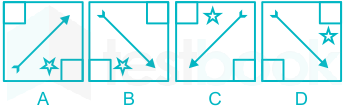
Question 24

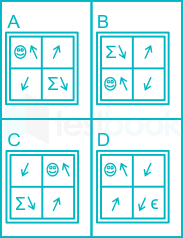
Out of the following 5 figures marked as (A), (B), (C), (D) and (E), 4 are similar in some way while one of them is different. Choose odd one.

  1. AOption (a)

    C

  2. BOption (b)

    D

  3. COption (c)

    A

  4. DOption (d)

    E

View answer & explanation

Correct answer

Answer: (c)C.

A

Why this answer is correct

The logic followed here is:-

In Three-Arm Patterns, If we see in any figure

The direction of the Outer Arm + 90 degrees clockwise rotation = Direction of the Middle arm

The Direction of the Middle Arm + 90 degrees clockwise rotation = Direction of the Inner arm 

In A, Rotation is Anti-clockwise. 

So, figure A is different from others.

Hence, "option 3" is the correct answer.

Question 25

Which of the following is not an example of work done?

  1. AOption (a)

    Boy pushing wall in room

  2. BOption (b)

    Trolley moving forward when girl pushes a trolley

  3. COption (c)

    Applying pressure on a pebble lying on surface

  4. DOption (d)

    Raising a book to a height

View answer & explanation

Correct answer

Answer: (a)A.

Boy pushing wall in room

Why this answer is correct

The correct answer is Boy pushing wall in a room.

Key Points

  • Boy pushing the wall in the room is not an example of work done.
  • When a boy pushes a wall, he is applying force on the wall. We see that the wall shows no displacement.
  • Work is given as the product of the forces and the displacement in the same direction.
  • Hence the work done is zero.

Additional Information

  • Work is done when a force moves. Everyday examples of work include walking up a flight of stairs, lifting heavy objects, pulling a sled and pushing a shopping trolley, Applying pressure on a pebble lying on the surface, raising a book to a height.
  • Work is not done when holding a bag stationary or a book at arm's length because although a force is being applied, the force does not move.

Question 26

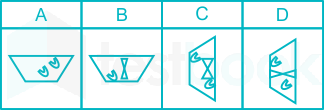
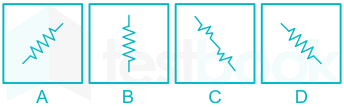
Select the water image of the above figure from the given alternatives.

  1. AOption (a)

    D

  2. BOption (b)

    A

  3. COption (c)

    B

  4. DOption (d)

    C

View answer & explanation

Correct answer

Answer: (d)D.

C

Why this answer is correct

  • The water image of the question figure is figure C:

Hence, "option 4" is the correct answer.

Question 27

Which option figure closely resembles the question figure?

Question-figure:

Option-figures:

  1. AOption (a)

    D

  2. BOption (b)

    B

  3. COption (c)

    C

  4. DOption (d)

    A

View answer & explanation

Correct answer

Answer: (a)A.

D

Why this answer is correct

The logic followed here is:-

  • The figure rotates 900 clockwise direction.

Hence, "option 1" is the correct answer.

Question 28

If × means –, + means ÷, – means × and ÷ means +, then what will be the value of 20 – 6 ÷ 55 + 11 × 30?

  1. AOption (a)

    108

  2. BOption (b)

    95

  3. COption (c)

    100

  4. DOption (d)

    99

View answer & explanation

Correct answer

Answer: (b)B.

95

Why this answer is correct

Given that:-

20 – 6 ÷ 55 + 11 × 30

Symbol+-×÷
Meaning÷×-+
  • After replacing the symbols with their meanings, we get

20 × 6 + 55 ÷ 11 - 30

= 20 × 6 + 5 - 30

= 120 + 5 - 30

= 125 - 30

= 95

Hence, "option 2" is the correct answer.

Question 29

Who is known as the Queen of Track and Field of India?

  1. AOption (a)

    Shiny Abraham

  2. BOption (b)

    P.T. Usha

  3. COption (c)

    M.D. Valsamma

  4. DOption (d)

    Ashwini Nachappa

View answer & explanation

Correct answer

Answer: (b)B.

P.T. Usha

Why this answer is correct

The correct answer is P.T. Usha.

Key Points

  • P.T. Usha is known as the Queen of Track and Field of India.
  • P.T. Usha is one of the greatest athletes the country has ever produced.
  • She made her Olympics debut in 1980  at the Moscow games when she was 16.
  • She was born in Kuttali, Kozhikode, Kerala.
  • She has been associated with Indian athletics since 1979.
  • Usha became the first Indian woman to reach the final of an Olympic event.
  • She is the youngest Indian sprinter, at 16, to compete in the Olympics at the 1980 Moscow Games and won the first medal of the 1982 Asian Games in track and field.

Additional Information

  • Shiny Wilson is a retired Indian athlete. She has been a National Champion in 800 meters for 14 years
  • Shiny Abraham Wilson represented India more than 75 times in international competitions.
  • Marathoner Devasia Valsamma is a retired Indian athlete. She was the second Indian woman to win an individual gold medal at the Asian Games and the first to win it on Indian soil.
  • Ashwini Nachappa is an accomplished former track and field athlete and an Indian film actress from Karnataka.
  • Nachappa gained fame around the start of the 1980s when she outran P.T. Usha on two occasions.
  • She has been referred to as India's FloJo. In 1988 she received the Arjuna award.

Question 30

Complete the following series using the correct terms given in the options-

AA, DB, GC, JD, _______, _______

  1. AOption (a)

    MF, PI

  2. BOption (b)

    EM, FP

  3. COption (c)

    ME, PF

  4. DOption (d)

    PE, KF

View answer & explanation

Correct answer

Answer: (c)C.

ME, PF

Why this answer is correct

The logic followed here is:-

Hence, "option 3" is the correct answer.

Question 31

The provisions of Uniform Civil Code are mentioned in _______ of the Constitution of India-

  1. AOption (a)

    Part VI

  2. BOption (b)

    Part IV

  3. COption (c)

    Part X

  4. DOption (d)

    Part III

View answer & explanation

Correct answer

Answer: (b)B.

Part IV

Why this answer is correct

The correct answer is Part IV.

Key Points

  • The provisions of the Uniform Civil Code are mentioned in part IV of the Constitution of India.
  • 'Uniform Civil Code' is explicitly mentioned in Part 4, Article 44 of the Indian Constitution.
  • Article 44 says, “The State shall endeavor to secure for the citizens a uniform civil code throughout the territory of India.
  • ”Uniform Civil Code is a proposal in India to formulate and implement secular personal laws of citizens which apply on all citizens equally regardless of their religion.
  • Currently, the personal laws of various communities are governed by their religious scriptures.

Additional Information

  • Part X of the Constitution of India consists of Articles on the scheduled and Tribal Areas
  • Article 153 Constitution of India: Governors of States.
  • Part VI Article 154 Constitution of India: Executive power of State. Article 160 Constitution of India: Discharge of the functions of the Governor in certain contingencies.
  • Article 12 to 35 contained in Part III of the Constitution deal with Fundamental Rights.
  • These are the Right to equality, including equality before the law, prohibition of discrimination on grounds of religion, race, caste, sex or place of birth, and equality of opportunity in matters of employment.

Question 32

Which of the following can exist in different forms?

  1. AOption (a)

    Silicon

  2. BOption (b)

    Potassium

  3. COption (c)

    Carbon

  4. DOption (d)

    Magnesium

View answer & explanation

Correct answer

Answer: (c)C.

Carbon

Why this answer is correct

The correct answer is Carbon.

Key Points

  • Carbon can exist in different forms.
  • Carbon has several allotropes or different forms in which it can exist. These allotropes include graphite and diamond, which have very different properties.
  • Despite carbon’s ability to make 4 bonds and its presence in many compounds, it is highly unreactive under normal conditions.
  • Carbon exists in 3 main isotopes: 12C, 13C, 14C. 14C is radioactive and used in dating carbon-containing samples ( radiometric dating ).

Additional Information

  • Two allotropes of silicon exist at room temperature: amorphous and crystalline.
  • Amorphous appears as a brown powder while crystalline silicon has a metallic luster and a grayish color.
  • Single crystals of crystalline silicon can be grown with a process known as the Czochralski process.
  • Potassium is available in different supplemental forms, including potassium chloride, potassium citrate, potassium gluconate, potassium bicarbonate, potassium aspartate, and potassium orotate.

Question 33

Who was appointed by the World Health Organization (WHO) as the Goodwill Ambassador for Hepatitis in the South-East Asia region?

  1. AOption (a)

    Shatrughan Sinha

  2. BOption (b)

    Dharmendra

  3. COption (c)

    Anupam Kher

  4. DOption (d)

    Amitabh Bachchan

View answer & explanation

Correct answer

Answer: (d)D.

Amitabh Bachchan

Why this answer is correct

The correct answer is Amitabh Bachchan.

Key Points

  • Amitabh Bachchan was appointed by the World Health Organization (WHO) as the Goodwill Ambassador for Hepatitis in the South-East Asia region. 
  • World Health Organization today appointed legendary Indian movie star Mr. Amitabh Bachchan as its Goodwill Ambassador for Hepatitis in South-East Asia Region to boost awareness and intensify action to arrest the hepatitis epidemic.

Additional Information

  • The World Health Organization is a specialized agency of the United Nations responsible for international public health. 
  • The WHO was established on 7 April 1948.
  • The WHO has played a leading role in several public health achievements, most notably the eradication of smallpox, the near-eradication of polio, and the development of an Ebola vaccine.
  • It has six regional offices and 150 field offices worldwide.
  • Headquartered - Geneva, Switzerland
  • Dr. Soumya Swaminathan has become the first Indian to hold the deputy director-general post for Programmes at the World Health Organisation (WHO).
  • Currently, she is the Director-General (DG) of the Indian Council of Medical Research (ICMR).
  • She is a paediatrician and is known for her research in tuberculosis and HIV.
  • She is also the secretary of the Department of Health Research in the Ministry of Health.

Question 34

According to the New World Wealth Report 2017, which is the richest city in India?

  1. AOption (a)

    Andhra Pradesh

  2. BOption (b)

    Delhi

  3. COption (c)

    Mumbai

  4. DOption (d)

    Punjab

View answer & explanation

Correct answer

Answer: (c)C.

Mumbai

Why this answer is correct

The correct answer is Mumbai.

Key Points

  • According to the New World Wealth Report 2017, Mumbai is the richest city in India.
  • Maximum City is among the richest cities in India and the world as well.
  • The Financial Capital of India, Mumbai, tops the list with an estimated GDP of $310 billion.

Additional Information

  • Mumbai (formerly called Bombay) is a densely populated city on India’s west coast.
  • A financial center, it's India's largest city.
  • On the Mumbai Harbour waterfront stands the iconic Gateway of India stone arch, built by the British Raj in 1924.
  • Offshore, nearby Elephanta Island holds ancient cave temples dedicated to the Hindu god Shiva.
  • The city's also famous as the heart of the Bollywood film industry.
  • Delhi, India’s capital territory, is a massive metropolitan area in the country’s north.
  • In Old Delhi, a neighborhood dating to the 1600s, stands the imposing Mughal-era Red Fort, a symbol of India, and the sprawling Jama Masjid mosque, whose courtyard accommodates 25,000 people.
  • Punjab, a state bordering Pakistan, is the heart of India’s Sikh community.
  • The city of Amritsar, founded in the 1570s by Sikh Guru Ram Das, is the site of Harmandir Sahib, the holiest gurdwara (Sikh place of worship).
  • Known in English as the Golden Temple, and surrounded by the Pool of Nectar, it's a major pilgrimage site. ​
  • Andhra Pradesh is a state in the south-eastern coastal region of India. It is the seventh-largest state

Question 35

Two angles of a triangle are 70° and 40°. Find the third angle.

  1. AOption (a)

    70°

  2. BOption (b)

    65°

  3. COption (c)

    105°

  4. DOption (d)

    250°

View answer & explanation

Correct answer

Answer: (a)A.

70°

Why this answer is correct

Shortcut Trick

The sum of all interior angles of any triangle is always 180°.

Third angle = 180° − (Sum of the two given angles)

⇒ Third angle = 180° − (70° + 40°)

⇒ Third angle = 180° − 110° = 70°

∴ The correct answer is 70°.

Alternate Method

Given:

First angle (∠A) = 70°

Second angle (∠B) = 40°

Formula Used:

According to the Angle Sum Property of a triangle:

∠A + ∠B + ∠C = 180°

Calculations:

Let the third angle be x.

⇒ 70° + 40° + x = 180°

⇒ 110° + x = 180°

⇒ x = 180° − 110°

⇒ x = 70°

∴ The correct answer is 70°.

Additional Information

Angle Sum Property

The sum of the measures of the interior angles of any triangle is always 180°.

Question 36

Swapna, Janhvi and Rishi shared a cake among themselves. 536\frac{5}{36} of it came in the share of Sapna, 34\frac{3}{4} in the share of Rishi and the rest came in the share of Janhvi. How much of the cake did Janhvi get?

  1. AOption (a)

    45\frac{4}{5}

  2. BOption (b)

    29\frac{2}{9}

  3. COption (c)

    19\frac{1}{9}

  4. DOption (d)

    112\frac{1}{12}

View answer & explanation

Correct answer

Answer: (c)C.

19\frac{1}{9}

Why this answer is correct

Shortcut Trick

Assume total cake = LCM of denominators (36, 4) = 36 units.

Swapna's share = 5/36 × 36 = 5 units.

Rishi's share = 3/4 × 36 = 27 units.

Janhvi's share = 36 − (5 + 27) = 4 units.

Janhvi's fraction = 4/36 = 1/9.

∴ The correct answer is 1/9.

Alternate Method

Given:

Swapna's share = 5/36

Rishi's share = 3/4

Calculations:

⇒ Total share of Swapna and Rishi = 5/36 + 3/4

⇒ Total share = 5/36 + (3 × 9)/(4 × 9) = 5/36 + 27/36

⇒ Total share = 32/36 = 8/9

⇒ Janhvi's share = Total Cake − Combined share of others

⇒ Janhvi's share = 1 − 8/9

⇒ Janhvi's share = 1/9

∴ The correct answer is 1/9.

Additional Information

Fraction Addition

To add fractions, find a Common Denominator (usually the LCM) to make the bottom numbers the same.

Unitary Method in Fractions

In problems involving parts of a whole, the Total Value is always represented as 1 or 100%.

Question 37

Read the given statements and conclusions carefully and choose which of the conclusions logically follows from the statement.

Statement: Mr. Vineet is one of the shortlisted candidates for the post of Dean of the prestigious Deemed University X.

Conclusion:

I. Mr. Vineet will be selected as the Dean of the prestigious Deemed University X.

II. Mr. Vineet will not be selected as the Dean of the reputed Deemed University X.

  1. AOption (a)

    Only I follows.

  2. BOption (b)

    Both Conclusion I and II follows.

  3. COption (c)

    Either conclusion I or II follows.

  4. DOption (d)

    Neither conclusion I nor II follows.

View answer & explanation

Correct answer

Answer: (c)C.

Either conclusion I or II follows.

Why this answer is correct

  • It is stated that Mr. Vineet is short-listed for the post of Dean of the given University.
  • So, either Mr. Vineet will be selected and he will become the Dean, or he will not be selected.
  • Thus, either conclusion I follows, or conclusion II follows.

Hence the correct answer is option 3.

Question 38

Emperor Ashoka got his _____ orders engraved on stone pillars and stone plinths and installed them at prominent places of his kingdom so that the people could behave accordingly.

  1. AOption (a)

    16

  2. BOption (b)

    14

  3. COption (c)

    8

  4. DOption (d)

    10

View answer & explanation

Correct answer

Answer: (b)B.

14

Why this answer is correct

The correct answer is 14.

Key Points

  • Emperor Ashoka got his 14 orders engraved on stone pillars and stone plinths and installed them at prominent places of his kingdom so that the people could behave accordingly.
  • The Major Rock Edicts of Ashoka refer to 14 separate major Edicts, which are significantly detailed and extensive.
  • These Edicts were concerned with practical instructions in running the kingdom such as the design of irrigation systems and descriptions of Ashoka's beliefs in peaceful moral behavior.

Additional Information

  • Ashoka, also known as Ashoka the Great, was an Indian emperor of the Maurya Dynasty, son of Bindusara, who ruled almost all of the Indian subcontinent from c. 268 to 232 BCE.
  • Ashoka promoted the spread of Buddhism across ancient Asia.
  • Ashoka's fame is largely due to his pillar and rock edicts, which allowed him to reach a wide audience and left a lasting historical record.
  • He is remembered as a model ruler, with dharma at the center of his ideology.

Question 39

The volume of a right circular cone, whose base radius is equal to its height, is three times the volume of the hemisphere. The ratio of the radius of the hemisphere and that of the cone is:

  1. AOption (a)

    33\sqrt[3]{3} : 23\sqrt[3]{2}

  2. BOption (b)

    6:1\sqrt6 : 1

  3. COption (c)

    1 : 63\sqrt[3]{6}

  4. DOption (d)

    6 ∶ 1

View answer & explanation

Correct answer

Answer: (c)C.

1 : 63\sqrt[3]{6}

Why this answer is correct

Shortcut Trick

Let radius of cone = height = R and radius of hemisphere = r.

Volume of cone = (1/3) × π × R2 × R = (1/3) × π × R3.

Volume of hemisphere = (2/3) × π × r3.

Given: Volume of cone = 3 × Volume of hemisphere ⇒ (1/3)πR3 = 3 × (2/3)πr3 ⇒ R3 = 6r3.

Ratio r3 : R3 = 1 : 6 ⇒ r : R = 1 : 3√6.

∴ The correct answer is 1 : 3√6.

Alternate Method

Given: Base radius of cone (R) = Height of cone (H). Radius of hemisphere = r.

Formula Used: Volume of cone = (1/3)πR2H; Volume of hemisphere = (2/3)πr3.

⇒ Volume of cone = (1/3) × π × R2 × R = (1/3)πR3

⇒ Volume of hemisphere = (2/3)πr3

⇒ According to question: (1/3)πR3 = 3 × (2/3)πr3

⇒ (1/3)R3 = 2r3

⇒ R3 = 6r3

⇒ r3 / R3 = 1/6

⇒ r / R = 3√(1/6) = 1 / 3√6

∴ The correct answer is 1 : 3√6.

Additional Information

Volume of Sphere

The volume of a complete sphere is given by (4/3)πr3, which is exactly double the volume of a hemisphere.

Slant Height of Cone

The slant height (l) of a cone is calculated as l = √(R2 + H2). If R = H, then l = R√2.

Surface Area of Hemisphere

Curved Surface Area = 2πr2 and Total Surface Area = 3πr2.

Question 40

The marked price of an article is Rs. 352, and its selling price is Rs. 326. What is the rate of discount (up to one decimal place) of the given article?

  1. AOption (a)

    8%

  2. BOption (b)

    7.8% 

  3. COption (c)

    7.4%

  4. DOption (d)

    8.3%

View answer & explanation

Correct answer

Answer: (c)C.

7.4%

Why this answer is correct

Shortcut Trick

Discount = Marked Price − Selling Price = 352 − 326 = 26.

Discount Percentage = (Discount ÷ Marked Price) × 100.

Discount % = (26 ÷ 352) × 100 = 2600 ÷ 352.

On simplifying, 2600 ÷ 352 ≈ 7.386%.

Rounding to one decimal place, we get 7.4%.

∴ The correct answer is 7.4%.

Alternate Method

Given → Marked Price (MP) = Rs. 352, Selling Price (SP) = Rs. 326. Formulas: Discount = MP − SP | Discount% = (Discount ÷ MP) × 100

⇒ Discount = 352 − 326 = Rs. 26 ⇒ Discount% = (26 ÷ 352) × 100 ⇒ Discount% = 1300 ÷ 176 = 325 ÷ 44 ⇒ Discount% = 7.38636...% ⇒ Discount% ≈ 7.4% (up to one decimal place)

∴ The correct answer is 7.4%.

Additional Information

Marked Price & Discount

The Marked Price is the price printed on the label. Discount is always calculated on the Marked Price unless stated otherwise.

Successive Discount

If two discounts of a% and b% are given, the net discount is calculated as (a + b − ab ÷ 100)%.

Question 41

Find odd one among following:

  1. AOption (a)

    C

  2. BOption (b)

    D

  3. COption (c)

    A

  4. DOption (d)

    B

View answer & explanation

Correct answer

Answer: (b)B.

D

Why this answer is correct

The logic followed here is:-

Figures A, B, and C are Greek letters and figure D is an English letter.

So, figure D is different from others.

Hence, " option 2" is the correct answer.

Question 42

A 7312\frac{1}{2}m long wire is cut into 28 equal parts, then what is the length (in meters) of each piece?

  1. AOption (a)

    235\frac{3}{5}

  2. BOption (b)

    258\frac{5}{8}

  3. COption (c)

    214\frac{1}{4}

  4. DOption (d)

    2625\frac{6}{25}

View answer & explanation

Correct answer

Answer: (b)B.

258\frac{5}{8}

Why this answer is correct

Shortcut Trick

Total wire length = 73 (1/2) m = 147/2 m.

Number of equal parts = 28.

Length of each piece = (Total Length) ÷ (Number of parts).

Length = (147/2) × (1/28) = 147 / 56 = 21 / 8 = 2 (5/8) m.

∴ The correct answer is 2 (5/8) m.

Alternate Method

Given:

Total length of wire = 73 (1/2) m

Number of pieces = 28

Calculations:

⇒ Convert mixed fraction to improper: 73 (1/2) = (73 × 2 + 1) / 2 = 147/2 m

⇒ Length of 1 piece = (Total Length) ÷ 28

⇒ Length = (147/2) × (1/28)

⇒ Simplify by 7: (21/2) × (1/4) = 21/8

⇒ Convert to mixed fraction: 21 ÷ 8 = 2 with remainder 5

⇒ Length = 2 (5/8) m

∴ The correct answer is 2 (5/8) m.

Additional Information

Mixed Fraction Conversion

To convert a mixed fraction a (b/c) to an improper fraction, use the formula (a × c + b) / c.

Fraction Division

Dividing by a whole number n is the same as multiplying by its reciprocal 1/n.

Question 43

Read the given argument and assumptions carefully and select the assumption(s) that logically follows from the argument.

Argument:

Promotion in the security forces should be based on merit and not on seniority.

Assumptions:

  1. Seniority does not reflect the abilities of individuals.
  2. It is possible to measure the abilities of a person.
  1. AOption (a)

    Neither of the assumptions 1 and 2 follows.

  2. BOption (b)

    Both assumption 1 and 2 follows.

  3. COption (c)

    Only assumption 2 follows.

  4. DOption (d)

    Only assumption 1 follows.

View answer & explanation

Correct answer

Answer: (b)B.

Both assumption 1 and 2 follows.

Why this answer is correct

The argument states that seniority cannot be the basis of promotion in the security forces and that it should be done on merit.

  • There are many parameters that can be used to judge a person's abilities. Seniority is not a skill. Thus, assumption 1 is clearly implicit.
  • The given statement talks about measuring the ability of security forces through merit. Therefore, it can be safely assumed that abilities can be measured. Thus, assumption 2 is also implicit.

Hence the correct answer is option 2.

Question 44

The structural unit of kidney is-

  1. AOption (a)

    Neuron

  2. BOption (b)

    Cyton

  3. COption (c)

    Ketone

  4. DOption (d)

    Nephron

View answer & explanation

Correct answer

Answer: (d)D.

Nephron

Why this answer is correct

The correct answer is Nephron.

Key Points

  • The nephron is the It minute or microscopic structural and functional unit of the kidney.​

  • It is composed of a renal corpuscle and a renal tubule.

  • The renal corpuscle consists of a tuft of capillaries called a glomerulus and a cup-shaped structure called Bowman's capsule.

Additional Information

  • A neuron or nerve cell is an electrically excitable cell that communicates with other cells via specialized connections called synapses.
  • It is the main component of nervous tissue in all animals except sponges and placozoa.
  • Plants and fungi do not have nerve cells.
  • Cyton is also called a cell body or perikaryon.
  • Several neurofibrils are present in the cytoplasm that help in the transmission of nerve impulses to and from the cell body.
  • Cyton is a large part of the fiber of a nerve, or neuron. It is concerned with the regulation of a neuron's maximum metabolism.
  • In chemistry, a ketone is a functional group with the structure R₂C=O, where R can be a variety of carbon-containing substituents. Ketones contain a carbonyl group.

Question 45

After a 20% reduction in the price of mangoes, a person is able to buy 12 more mangoes for Rs. 15. What was the price of the mangoes before the reduction?

  1. AOption (a)

    21.25 paisa/mango

  2. BOption (b)

    31.05 paisa/mango

  3. COption (c)

    31.25 paisa/mango

  4. DOption (d)

    30.25 paisa/mango

View answer & explanation

Correct answer

Answer: (c)C.

31.25 paisa/mango

Why this answer is correct

Shortcut Trick

Price reduction = 20% = 1/5 ⇒ Price ratio is 5 : 4

Quantity is inversely proportional to price ⇒ Quantity ratio is 4 : 5

Difference in quantity parts = 5 − 4 = 1 unit → 12 mangoes

Original quantity (4 units) = 4 × 12 = 48 mangoes

Original price = Total cost ÷ Original quantity = ₹15 ÷ 48

∴ The correct answer is 31.25 paisa/mango.

Alternate Method

Given: Total expenditure = ₹15, Price reduction = 20%, Extra mangoes bought = 12.

⇒ Reduced amount = 20% of ₹15 = (20/100) × 15 = ₹3

⇒ This ₹3 is the current cost of 12 extra mangoes.

⇒ Current price per mango = ₹3 ÷ 12 = ₹0.25

⇒ Since this is 80% of the original price (after 20% reduction):

⇒ Original price = 0.25 ÷ 0.80 = ₹0.3125

⇒ Price in paisa = 0.3125 × 100 = 31.25 paisa

∴ The correct answer is 31.25 paisa/mango.

Additional Information

Price-Consumption Relation

When expenditure is constant, Price is inversely proportional to Consumption (Quantity). If price decreases by x%, quantity increases by [x/(100−x)] × 100%.

Direct Formula for Original Price

Original Price = (Reduction% × Amount) ÷ [(100 − Reduction%) × Extra Quantity].

Current Price Formula

Current Price = (Reduction% × Amount) ÷ (100 × Extra Quantity).

Question 46

Mallika Sarabhai is related to _____________.

  1. AOption (a)

    Cricket

  2. BOption (b)

    Classical dance

  3. COption (c)

    Tanpura

  4. DOption (d)

    Chemistry

View answer & explanation

Correct answer

Answer: (b)B.

Classical dance

Why this answer is correct

The correct answer is Classical dance.

Key Points

  • Mallika Sarabhai is related to classical dance.
  • Daughter of a classical dancer Mrinalini Sarabhai and space scientist Vikram Sarabhai, Mallika is an accomplished Kuchipudi and Bharatanatyam dancer and performer who has specialized in using the arts for social change and transformation.
  • Sarabhai was a leading exponent of the Bharata Natyam and Kuchipudi dance forms.
  • In 1977 she took over the leadership of the Ahmadabad-based performing arts academy Darpana, which her mother had established decades earlier, and led its dance troupe in festivals around the world. She used her choreography to focus on dance as a tool for social critique and change.

Additional Information

  • Raas or Dandiya Raas is the socio-religious folk dance originating from the Indian state of Gujarat and popularly performed in the festival of Navaratri.
  • The dance is performed in the Marwar region of Rajasthan too.
  • The etymology of Dandiya-Raas is in Sanskrit.
  • Bhangra is an energetic, folk dance and music form that originated from Punjab, India.
  • Today, it's the newest dance, music, and fitness phenomenon spreading all over the world.
  • Bhangra has made its way to America's Got Talent, the London Olympics, and even the White House.
  • Lavani is a genre of music popular in Maharashtra, India.
  • Lavani is a combination of traditional song and dance, which particularly performed to the beats of Dholki, a percussion instrument.
  • Lavani is noted for its powerful rhythm.
  • Lavani has contributed substantially to the development of Marathi folk theatre.

Question 47

A ladder of 10 m is placed along a wall to reach a window at a height of 6 m from the ground. What is the distance between the bottom of the ladder and the wall?

  1. AOption (a)

    7 m

  2. BOption (b)

    8 m

  3. COption (c)

    9 m

  4. DOption (d)

    6 m

View answer & explanation

Correct answer

Answer: (b)B.

8 m

Why this answer is correct

Shortcut Trick

Use the standard Pythagorean triplet: 3, 4, 5.

Scale the triplet by a factor of 2 → (3×2), (4×2), (5×2) = 6, 8, 10.

Given Hypotenuse (ladder) = 10 m and Perpendicular (height) = 6 m.

The remaining side (distance) must be 8 m.

∴ The correct answer is 8 m.

Alternate Method

Given:

Length of the ladder (Hypotenuse, h) = 10 m

Height of the window from ground (Perpendicular, p) = 6 m

Formula Used:

Pythagoras Theorem: h2 = p2 + b2

Calculations:

⇒ 102 = 62 + b2

⇒ 100 = 36 + b2

⇒ b2 = 100 − 36

⇒ b2 = 64

⇒ b = √64

⇒ b = 8 m

∴ The correct answer is 8 m.

Additional Information

Pythagoras Theorem

In a right-angled triangle, the square of the hypotenuse is equal to the sum of the squares of the other two sides: a2 + b2 = c2.

Pythagorean Triplets

Sets of three integers that satisfy the theorem. Common ones include (3, 4, 5), (5, 12, 13), (8, 15, 17), and (7, 24, 25).

Trigonometric Application

If the angle of inclination (θ) is given, the distance can be calculated as Distance = Ladder × cos(θ).

Question 48

Traveling at a speed of 57 km/hr, Manav reached the destination 3 minutes earlier. Had he traveled at the speed of 51 km/hr, he would have reached 1 minute late. What is the distance covered by Manav?

  1. AOption (a)

    31.5 km

  2. BOption (b)

    32.3 km

  3. COption (c)

    31.9 km

  4. DOption (d)

    32.8 km

View answer & explanation

Correct answer

Answer: (b)B.

32.3 km

Why this answer is correct

Shortcut Trick

Use the Distance Formula for two different speeds: Distance = [S1 × S2 / (S1 − S2)] × Total Time Difference

Speed S1 = 57 km/hr, Speed S2 = 51 km/hr

Time Difference = 3 minutes (early) + 1 minute (late) = 4 minutes = 4/60 hours

Distance = [57 × 51 / (57 − 51)] × (4 / 60) = [57 × 51 / 6] × (1 / 15) = 19 × 17 / 10 = 32.3 km

∴ The correct answer is 32.3 km.

Alternate Method

Given: S1 = 57 km/hr, S2 = 51 km/hr, ΔT = 4 minutes

Formula Used: Distance = Product of Speeds ÷ Difference of Speeds × Time Difference

⇒ Time Difference = (3 − (−1)) = 4 minutes = 4/60 hours

⇒ Distance = (57 × 51) ÷ (57 − 51) × (4/60)

⇒ Distance = (2907 ÷ 6) × (1/15)

⇒ Distance = 484.5 ÷ 15

⇒ Distance = 32.3 km

∴ The correct answer is 32.3 km.

Additional Information

Speed-Time Inversity

When distance is constant, the speed is inversely proportional to time (S1/S2 = T2/T1).

Average Speed

For the same distance traveled at two different speeds x and y, Average Speed = 2xy/(x + y).

Time Difference Rule

If both cases are 'Late' or both 'Early', subtract the times. If one is 'Late' and one is 'Early', add the times.

Question 49

Which is the second highest common factor of both 56 and 84?

  1. AOption (a)

    23

  2. BOption (b)

    18

  3. COption (c)

    14

  4. DOption (d)

    24

View answer & explanation

Correct answer

Answer: (c)C.

14

Why this answer is correct

Shortcut Trick

List the factors of the HCF (Highest Common Factor) of 56 and 84.

HCF(56, 84) = 28.

Factors of 28 are 1, 2, 4, 7, 14, 28.

The second highest common factor is the factor just before the HCF.

∴ The correct answer is 14.

Alternate Method

Given: Numbers are 56 and 84.

Step 1: Find all factors of 56.

⇒ Factors of 56 = 1, 2, 4, 7, 8, 14, 28, 56.

Step 2: Find all factors of 84.

⇒ Factors of 84 = 1, 2, 3, 4, 6, 7, 12, 14, 21, 28, 42, 84.

Step 3: Identify Common Factors.

⇒ Common Factors = 1, 2, 4, 7, 14, 28.

Step 4: Determine the second highest value.

⇒ Highest = 28, Second Highest = 14.

∴ The correct answer is 14.

Additional Information

Highest Common Factor (HCF)

The largest number that divides two or more numbers without leaving a remainder. Also known as GCD (Greatest Common Divisor).

Relation between Common Factors

Every common factor of a set of numbers is also a factor of their HCF.

HCF by Division Method

Divide the larger number by the smaller, then the previous divisor by the remainder, until the remainder is zero. The last divisor is the HCF.

Question 50

In a shop, A bell rings every 18 seconds and another bell rings every 60 seconds. At 4.00 p.m. both the bells ring together. At what time will both the bells ring together again?

  1. AOption (a)

    4.05 p.m.

  2. BOption (b)

    4.09 p.m.

  3. COption (c)

    4:03 p.m.

  4. DOption (d)

    4:06 p.m.

View answer & explanation

Correct answer

Answer: (c)C.

4:03 p.m.

Why this answer is correct

Shortcut Trick

Both bells ring together at intervals equal to the LCM of their individual time periods.

LCM (18, 60) → 180 seconds.

Convert seconds to minutes: 180 ÷ 60 = 3 minutes.

Next ring time = 4:00 p.m. + 3 minutes = 4:03 p.m.

∴ The correct answer is 4:03 p.m.

Alternate Method

Given:

Time interval of Bell 1 = 18 seconds

Time interval of Bell 2 = 60 seconds

Initial meeting time = 4:00 p.m.

Formula Used:

Time for bells to ring together = LCM of individual time intervals.

Calculations:

⇒ Prime factors of 18 = 2 × 32

⇒ Prime factors of 60 = 22 × 3 × 5

⇒ LCM = 22 × 32 × 5 = 4 × 9 × 5 = 180 seconds

⇒ Time in minutes = 180 ÷ 60 = 3 minutes

⇒ Time of next ringing = 4:00 p.m. + 0:03 = 4:03 p.m.

∴ The correct answer is 4:03 p.m.

Additional Information

LCM (Least Common Multiple)

Used to find the first common occurrence of periodic events like bells ringing, traffic lights changing, or runners meeting on a track.

Unit Consistency

Always ensure all values are in the same unit (seconds/minutes) before calculating LCM and convert back to the required time format.

Number of rings

To find how many times they ring together in a duration T, use (T ÷ LCM) + 1 (including the start).

Question 51

In a code language JINX is written as 5862, ZEBU as 4371 and FUZE as 9143, so how will ZINE be written in that language?

  1. AOption (a)

    4869

  2. BOption (b)

    4386

  3. COption (c)

    4836

  4. DOption (d)

    4863

View answer & explanation

Correct answer

Answer: (d)D.

4863

Why this answer is correct

The logic followed here is:-

And,

And,

Similarly,

Hence, "option 4" is the correct answer.

Question 52

Which of the following organisms is not a vertebrate?

  1. AOption (a)

    Earthworm

  2. BOption (b)

    Lizard

  3. COption (c)

    Fish

  4. DOption (d)

    Frog

View answer & explanation

Correct answer

Answer: (a)A.

Earthworm

Why this answer is correct

The correct answer is Earthworm.

Key Points

  • The earthworm is not a vertebrate.
  • More than 90 per cent of all living animal species are invertebrates.
  • Worldwide in distribution, they include animals as diverse as sea stars, sea urchins, earthworms, sponges, jellyfish, lobsters, crabs, insects, spiders, snails, clams, and squid.

Additional Information

  • Vertebrates are the most advanced of species in the animal kingdom.
  • Members possess a well-defined internal skeleton system, which includes a backbone. In humans, the spinal cord runs along the body between the caudal and cranial regions connecting to the nerve tissues.
  • Examples of vertebrates include all chordates such as mammals, birds, fish, reptiles, lizards, frogs, amphibians, etc.
  • Invertebrates can be simply identified as animals that do not have a backbone.
  • They are found almost everywhere, from the hottest deserts and the deepest seabeds to the darkest caves and the tallest mountains.
  • Invertebrates constitute more than 97 per cent of all species in the animal kingdom.
  • The number of invertebrates exceeds more than 2 million species, with more being found almost every other day.
  • Prominent examples include annelids, arthropods, bivalves, coelenterates, echinoderms, squid, sponges, snails, and octopuses.

Question 53

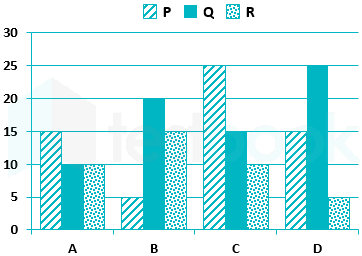
The above bar graph shows the production of three grains P, Q, R in four states A, B, C, D. What is the percentage contribution of state A in the total production of grain P?

  1. AOption (a)

    30

  2. BOption (b)

    20

  3. COption (c)

    25

  4. DOption (d)

    28

View answer & explanation

Correct answer

Answer: (c)C.

25

Why this answer is correct

Grain P in state A = 15

Grain P in state B = 5

Grain P in state C = 25

Grain P in state D = 15

Total production of grain P = 60

% = 15/60 × 100

⇒ 25%

∴ Required percentage is 25%

Question 54

The ratio of clay and gravel in a mixture is 11 : 8, while that of gravel and cement is 6 : 7. What is the ratio of clay and cement in the mixture?

  1. AOption (a)

    77 : 48

  2. BOption (b)

    33 : 28

  3. COption (c)

    8 : 6

  4. DOption (d)

    11 : 7 

View answer & explanation

Correct answer

Answer: (b)B.

33 : 28

Why this answer is correct

Shortcut Trick

To find the ratio of Clay to Cement, multiply the two given ratios directly.

Ratio 1 (Clay : Gravel) = 11/8

Ratio 2 (Gravel : Cement) = 6/7

Clay : Cement = (11/8) × (6/7) = 66/56 = 33/28

∴ The correct answer is 33 : 28.

Alternate Method

Given:

Ratio of Clay : Gravel = 11 : 8

Ratio of Gravel : Cement = 6 : 7

Formula Used:

If A : B = a : b and B : C = c : d, then A : B : C = (a×c) : (b×c) : (b×d)

Calculations:

⇒ To equalize Gravel, find LCM of 8 and 6 = 24.

⇒ Clay : Gravel = (11 × 3) : (8 × 3) = 33 : 24

⇒ Gravel : Cement = (6 × 4) : (7 × 4) = 24 : 28

⇒ Clay : Gravel : Cement = 33 : 24 : 28

⇒ Clay : Cement = 33 : 28

∴ The correct answer is 33 : 28.

Additional Information

Compound Ratio

When two or more ratios are multiplied together (antecedent with antecedent and consequent with consequent), the result is the Compound Ratio.

Equality of Ratios

To combine multiple ratios into one continuous ratio, the common term must have the same value in both ratios using the LCM method.

Question 55

The number of electrons present in the outermost shell is called _______.

  1. AOption (a)

    Valence atom

  2. BOption (b)

    Valence electron

  3. COption (c)

    Valence proton

  4. DOption (d)

    Valence number

View answer & explanation

Correct answer

Answer: (b)B.

Valence electron

Why this answer is correct

The correct answer is Valence electrons.

Key Points

  • The number of electrons present in the outermost shell is called valence electrons.
  • Valence electrons are the s and p electrons in the outermost shell.
  • The electrons present in the inner shell are core electrons.
  • When we study and observe the atom of an element, we come across tiny subatomic particles called valence electrons.
  • Lewis structures help us to track the valence electrons and predict the types of bonds.
  • Valence electrons are all arranged in different orbitals or shells and are mostly negatively charged particles.
  • Further, these electrons are responsible for interaction between atoms and the formation of chemical bonds.
  • Only the electrons present in the outermost shell can participate in the formation of a chemical bond or a molecule.
  • Such type of electrons is called valence electrons.

Additional Information

  • Some key characteristics of a valence electron are:
  • For the main group elements, the valence electron exists only in the outermost electron shell.
  • A valence electron can exist in the inner shell of a transition metal.
  • An atom consisting of a closed shell of valence electrons will usually be chemically inert.
  • A valence electron can either absorb or release energy in the form of a photon.
  • Valence electrons also determine the electrical conductivity of an element.

Question 56

Consider the statement and the following arguments and decide which of the arguments is strong with respect to the statement.

Statement:

The use of screen guards should be made mandatory in the offices to ensure the eye health of the employees who sit in front of the computer for 9 hours.

Argument :

I. Yes, one of the best ways is to wear a screen guard to protect the eyes.

II. No, it is not possible for the company to make such arrangements for the employees.

  1. AOption (a)

    Neither I nor II is strong

  2. BOption (b)

    Arguments I and II both are strong

  3. COption (c)

    Only Argument II is strong

  4. DOption (d)

    Only Argument I is Strong

View answer & explanation

Correct answer

Answer: (d)D.

Only Argument I is Strong

Why this answer is correct

The statement suggests that screen guards are good for protecting the eyes of employees who sit in front of the computer for 9 hours, and so it should be made compulsory.

  • Argument I agrees with the statement and states that using a screen guard can protect the eyes, so it is strong.
  • Argument II does not agree with it. There is no reason mentioned in the argument to explain why would the company be unable to arrange screen guards for its employees. Thus, argument II is not strong.

Hence the correct answer is option 4.

Question 57

Which part of the Indian constitution empowers the state to make special provisions for children, women, scheduled castes and scheduled tribes?

  1. AOption (a)

    Part III

  2. BOption (b)

    Part ।

  3. COption (c)

    Part V

  4. DOption (d)

    Part VI

View answer & explanation

Correct answer

Answer: (a)A.

Part III

Why this answer is correct

The correct answer is Part III.

Key Points

  • Part III of the Indian constitution empowers the state to make special provisions for children, women, scheduled castes, and scheduled tribes.
  • Article 12 to 35 contained in Part III of the Constitution deal with Fundamental Rights.
  • These are the Right to equality, including equality before the law, prohibition of discrimination on grounds of religion, race, caste, sex, or place of birth, and equality of opportunity in matters of employment.

Additional Information

  • This part I of the Indian constitution contains the law in the following examples, establishment, renaming, merging, or altering the borders of the states or union territories.
  • Part V of Article 78 Constitution of India: Duties of Prime Minister as respects the furnishing of information to the President, etc.
  • Article 95 Constitution of India: Power of the Deputy Speaker or other person to perform the duties of the office of, or to act as, Speaker.
  • Part 6 of the Indian constitution contains Article 152 to Article 237.
  • Part 6 mainly focuses on the state government.

Question 58

Which of the following reactions take place during the production of solar energy in the Sun?

  1. AOption (a)

    Nuclear fission

  2. BOption (b)

    Decomposition

  3. COption (c)

    Nuclear fusion

  4. DOption (d)

    Combustion

View answer & explanation

Correct answer

Answer: (c)C.

Nuclear fusion

Why this answer is correct

The correct answer is Nuclear fusion.

Key Points

  • Nuclear fusion takes place during the production of solar energy in the Sun. 
  • Solar energy is created by nuclear fusion that takes place in the sun.
  • Fusion occurs when protons of hydrogen atoms violently collide in the sun's core and fuse to create a helium atom.
  • This process, known as a PP (proton-proton) chain reaction, emits an enormous amount of energy.

Additional Information

  • Nuclear Fission is the splitting of an atomic nucleus into two or lighter nuclei accompanied by energy release.
  • For example, the fission of one kilogram of uranium releases as much energy as burning around four billion kilograms of coal.
  • A decomposition reaction occurs when one reactant breaks down into two or more products.
  • Examples of decomposition reactions include the breakdown of hydrogen peroxide to water and oxygen and the breakdown of water to hydrogen and oxygen.
  • Combustion is another word for burning.
  • In a combustion reaction, fuel is heated and it reacts with oxygen.  When fuels burn in combustion reactions, they release useful thermal energy (heat).
  • Combustion reactions are used to heat our homes, power most cars, and generate a lot of our electricity.

Question 59

When calcium oxide reacts with water, _______ is formed as the product.

  1. AOption (a)

    Copper

  2. BOption (b)

    Calcium

  3. COption (c)

    Slaked lime

  4. DOption (d)

    Calcium oxide

View answer & explanation

Correct answer

Answer: (c)C.

Slaked lime

Why this answer is correct

The correct answer is Slaked lime.

Key Points

  • When calcium oxide reacts with water, slaked lime is formed as the product.
  • In this reaction, calcium oxide and water combine to form a single product, calcium hydroxide or slaked lime.
  • Such a reaction in which a single product is formed from two or more reactants is known as a combination reaction.
  • A solution of slaked lime produced by the above reaction is used for whitewashing walls.

Additional Information

  • Ca(OH)2 reacts vigorously with water to form slaked lime.
  • Calcium hydroxide, also called slaked lime, Ca(OH)2, is obtained by the action of water on calcium oxide.
  • When mixed with water, a small proportion of it dissolves, forming a solution known as limewater, the rest remaining as a suspension called milk of lime(Calcium hydroxide).
  • Calcium hydroxide (traditionally called slaked lime) is an inorganic compound with the chemical formula Ca(OH)2.
  • It is a colourless crystal or white powder and is produced when quicklime (calcium oxide) is mixed or slaked with water.
  • It has many names including hydrated lime, caustic lime, builders' lime, slaked lime, cal, and pickling lime.
  • Calcium hydroxide is used in many applications, including food preparation.
  • Limewater, also called milk of lime, is the common name for a saturated solution of calcium hydroxide.

Question 60

The minimum value of X which makes 65x−14\frac{65}{x -14} an integer is-

  1. AOption (a)

    1

  2. BOption (b)

    –51

  3. COption (c)

    79

  4. DOption (d)

    ​–1

View answer & explanation

Correct answer

Answer: (b)B.

–51

Why this answer is correct

Shortcut Trick

For the expression 65 / (X − 14) to be an integer, the denominator (X − 14) must be a factor of 65.

Factors of 65 are ±1, ±5, ±13, and ±65.

To find the minimum value of X, we set X − 14 equal to the smallest possible negative factor.

⇒ X − 14 = −65

⇒ X = −65 + 14 = −51

∴ The correct answer is −51.

Alternate Method

Given: The expression 65 / (X − 14) results in an integer.

Formula: If a / b is an integer, then b is a divisor of a.

The set of all possible divisors of 65 is {−65, −13, −5, −1, 1, 5, 13, 65}.

⇒ For X to be minimum, X − 14 must be the minimum divisor.

⇒ X − 14 = −65

⇒ X = −65 + 14

⇒ X = −51

Comparing other possibilities:

⇒ If X − 14 = −13, X = 1

⇒ If X − 14 = 65, X = 79

The smallest value among all possibilities is −51.

∴ The correct answer is −51.

Additional Information

Properties of Integers and Divisors

A fraction n/d is an integer if and only if d is a factor of n. Factors include both positive and negative values.

Factors of a Number

If p is a prime factor of a number, then the total number of positive factors of n = pa × qb is (a+1)(b+1). Double this count to include negative factors.

Minimization Strategy

To minimize a variable in an equation like X − c = k, you must choose the minimum possible value for the constant k.

Question 61

An electric current of 0.5 A flows through the filament of an electric bulb for 5 min. What will be the electric charge flowing through that wire?

  1. AOption (a)

    400 C

  2. BOption (b)

    200 C

  3. COption (c)

    240C

  4. DOption (d)

    150C

View answer & explanation

Correct answer

Answer: (d)D.

150C

Why this answer is correct

The correct answer is 150 C.

Key Points

  • Given parameters
  • Current (I) = 0.5 A
  • Time (t) = 5 minutes
  • Time in minutes can be converted into seconds as follows
  • Time(t)=5×60Time (t) = 5 × 60
  • t = 300 sec
  • Hence,
  • Q=I×tQ = I × t
  • Q=0.5×300Q = 0.5 × 300
  • Q = 150 C
  • So the electric charge through the wire will be 150C.

Question 62

Select the image that is not related to the given series-

  1. AOption (a)

    D

  2. BOption (b)

    C

  3. COption (c)

    A

  4. DOption (d)

    B

View answer & explanation

Correct answer

Answer: (a)A.

D

Why this answer is correct

The logic followed here is:-

  • In figure A, the pentagon (Five lines) has five dots inside the pentagon,
  • in figure B, the triangle (three lines) has three dots inside the triangle,
  • in figure C, the square (four lines) has four dots inside the square,
  • but in figure D, the square (four lines) has only two dots.

So, figure D is different from others.

Hence, "option 1" is the correct answer.

Question 63

Ram's father's age is three times his age. 9 years ago, the age of Ram's father was six times his age. What is the present age of Ram?

  1. AOption (a)

    12 Years

  2. BOption (b)

    15 Years

  3. COption (c)

    14 Years

  4. DOption (d)

    13 Years

View answer & explanation

Correct answer

Answer: (b)B.

15 Years

Why this answer is correct

Shortcut Trick

Age ratio (Father : Ram) present = 3 : 1 (diff = 2)

Age ratio (Father : Ram) 9 years ago = 6 : 1 (diff = 5)

Make differences equal: Present = 15 : 5 | 9 years ago = 12 : 2

Ratio unit change = 5 − 2 = 3 units → 9 years

1 unit = 3 years ⇒ Ram's present age = 5 units = 15 years.

∴ The correct answer is 15 Years.

Alternate Method

Given:

Let Ram's present age = x

Father's present age = 3x

9 years ago:

Ram's age = x − 9

Father's age = 3x − 9

Calculations:

⇒ (3x − 9) = 6 × (x − 9)

⇒ 3x − 9 = 6x − 54

⇒ 6x − 3x = 54 − 9

⇒ 3x = 45

⇒ x = 15

∴ The correct answer is 15 Years.

Additional Information

Constant Age Difference

The difference between the ages of two people always remains constant regardless of the number of years passed.

Ratio Balancing Method

To solve age problems quickly, multiply ratio terms so that the numerical difference between the ratios of two time periods becomes equal.

Future/Past Age Calculation

If present age is x, age after n years = x + n, and age n years ago = x − n.

Question 64

Which of the following statement(s) is/are true/false?

A. The following is an example of a reversible reaction.

N2(g) + 3H2(g) ⇄\rightleftarrows 2NH3(g)

B. The following is an example of a balanced reaction.

2Mg(s) + O2(g) ⇄\rightleftarrows 2MgO(s)

  1. AOption (a)

    Only A is true

  2. BOption (b)

    Both A and B are true

  3. COption (c)

    Both A and B are false

  4. DOption (d)

    Only B is true

View answer & explanation

Correct answer

Answer: (b)B.

Both A and B are true

Why this answer is correct

The correct answer is Both A and B are true.

Key Points

  • N2(g) + 3H2(g) ⇄\rightleftarrows 2NH3(g)

As the forward reaction is exothermic and leads to lowering of pressure (produces a lesser number of gaseous moles) hence, according to Le Chatelier's principle, at high pressure and low temperature, the given reversible reaction will shift in forwarding direction to form more product.

So A is true.

  • 2Mg(s) + O2(g) ⇄\rightleftarrows 2MgO(s)

The oxidation reaction is the reaction in which there is the addition of oxygen or the removal of hydrogen.

For example, magnesium reacts with air to form magnesium oxide.  

Therefore, the given reaction 2Mg(s) + O2(g) ⇄\rightleftarrows 2MgO(s) is an example of a combination as well as an oxidation reaction.

So B is true.

Additional Information

  • A combination reaction is a reaction where two or more elements or compounds combine to form a single compound. Such reactions are represented by equations of the following form: X + Y → XY.
  • The combination of two or more elements to form one compound is called a combination reaction.
  • Other types of Chemical Reactions:
  • Decomposition reaction: The opposite of a combination reaction, a complex molecule breaks down to make simpler ones.
  • AB → A + B.
  • Precipitation reaction: Two solutions of soluble salts are mixed resulting in an insoluble solid (precipitate) forming.

A + Soluble salt B  → Precipitate + soluble salt C.

  • Neutralization reaction: An acid and a base react with each other. Generally, the product of this reaction is salt and water.

Acid + Base → Salt + Water.

  • Combustion reaction: Oxygen combines with a compound to form carbon dioxide and water. These reactions are exothermic, meaning they give off heat.

A + O2 → H2O + CO2.

  • Displacement reaction: One element takes place with another element in the compound.

A + BC → AC + B.

Question 65

If 'fun' is written as 62114 and 'ten' is written as 20514, then find the code for 'feet'?

  1. AOption (a)

    6050520

  2. BOption (b)

    6552

  3. COption (c)

    62554

  4. DOption (d)

    65520

View answer & explanation

Correct answer

Answer: (d)D.

65520

Why this answer is correct

The logic followed here is:-

And,

Similarly,

Hence, "option 4" is the correct answer.

Question 66

Which of the following energies is always positive?

  1. AOption (a)

    Static energy

  2. BOption (b)

    Kinetic energy

  3. COption (c)

    Potential energy

  4. DOption (d)

    Gravitational energy

View answer & explanation

Correct answer

Answer: (b)B.

Kinetic energy

Why this answer is correct

The correct answer is Kinetic energy.

Key Points

  • Kinetic Energy is always positive.
  • Kinetic energy can only be zero or positive.
  • It can never be negative.
  • This is because kinetic energy is defined as half an object's mass multiplied by the object's velocity squared.
  • An object's kinetic energy is the energy caused by its motion; if the thing moves in any way, it has positive kinetic energy.

Additional Information

  • Inside an atom are protons, electrons, and neutrons.
  • The protons are positively charged, the electrons are negatively charged, and the neutrons are neutral.
  • Static electricity is the result of an imbalance between negative and positive charges in an object.
  • So static energy is not always positive.
  • Potential energy can be negative. For example, potential energy at any point above the earth's surface is positive.
  • Because a negative amount of work is done to bring an object closer to the Earth, gravitational potential energy is always a negative number when using this reference point.
  • Gravitational potential energy is negative at the surface of Earth because work is done by the gravitational field in bringing a mass from infinity i.e work has to be done on a body, if it is taken away from the gravitational field of the earth.
  • Thus, potential energy is negative.

Question 67

U is the sister of W. U is the wife of T. W is the second son of K. W is ________ of T-

  1. AOption (a)

    Sister-in-law 

  2. BOption (b)

    Sister

  3. COption (c)

    Brother in law

  4. DOption (d)

    Brother

View answer & explanation

Correct answer

Answer: (c)C.

Brother in law

Why this answer is correct

The family tree is given below:-

W is the brother-in-law of T.

Hence, "option 3" is the correct answer.

Question 68

A body of mass 15 kg is moving with an acceleration of 5ms–2. Then the force acting on it will be _______-

  1. AOption (a)

    75 J

  2. BOption (b)

    –75 N

  3. COption (c)

    –75 J

  4. DOption (d)

    75 N

View answer & explanation

Correct answer

Answer: (d)D.

75 N

Why this answer is correct

The correct answer is 75 N.

Key Points

  • Given that
  • Mass of the body (m) = 15 kg
  • Acceleration of the body (a) = 5 m/s2
  • Force = m * a
  • = 15 * 5
  • = 75 N
  • So the force acting on the body will be 75 N.

Question 69

Who is the President of India as of August 2018?

  1. AOption (a)

    Venkaiah Naidu

  2. BOption (b)

    Pratibha Patil

  3. COption (c)

    Ramnath Kovind

  4. DOption (d)

    Pranab Mukherjee

View answer & explanation

Correct answer

Answer: (c)C.

Ramnath Kovind

Why this answer is correct

The correct answer is Ramnath Kovind.

Key Points

  • Ramnath Kovind is the President of India as of August 2018**.**
  • The presidency of Ram Nath Kovind began on July 25, 2017, when he took the oath as the fourteenth president of India administered by Chief Justice Jagdish Singh Khehar.

Additional Information

  • Muppavarapu Venkaiah Naidu is an Indian politician served as the 13th vice president of India from 2017 to 2022.
  • Previously, he served as the minister of Housing and Urban Poverty Alleviation, Urban Development and Information and Broadcasting in the Modi Cabinet.
  • Pratibha Devisingh Patil is an Indian politician and lawyer who served as the 12th president of India from 25 July 2007 to July 2012.
  • A member of the Indian National Congress, Patil is the only woman to have held the office
  • She had previously served as the Governor of Rajasthan from 2004 to 2007.
  • Pranab Kumar Mukherjee was an Indian politician who served as the 13th president of India from 2012 until 2017.

Question 70

Read the given question and decide which of the following statements are sufficient to answer the question.

Question :

A, C, F, G and I are standing in the descending order of their heights. Who's standing in the middle?

Statement :

  1. A is the tallest and C is standing next to A.
  2. I is the shortest and F is standing next to I.
  1. AOption (a)

    Only statement 2 is sufficient

  2. BOption (b)

    Both the statements are not sufficient

  3. COption (c)

    Both the statements together are sufficient

  4. DOption (d)

    Only statement 1 is sufficient

View answer & explanation

Correct answer

Answer: (c)C.

Both the statements together are sufficient

Why this answer is correct

  • A is the tallest and C is standing next to A.
  • A > C > _ > _ > _
  • Here, there is no information given about the heights of F, G, and I. Therefore, statement 1 alone is not sufficient.
  • I is the shortest and F is standing next to I.
  • _ > _ > _ > F > I​
  • No information is given about the heights of A, C, and G. Therefore, statement 2 alone is not sufficient.
  • From statements 1 and 2:-
  • A > C > G > F > I; here G is in the middle.
  • Thus, both the statements together are sufficient.

Hence, "option 3" is the correct answer.

Question 71

Find the length of the longest pole which can be placed in a room of 6 m length, 6 m width and 6 m height?

  1. AOption (a)

    122\sqrt2 m

  2. BOption (b)

    62\sqrt2 m

  3. COption (c)

    63\sqrt3 m

  4. DOption (d)

    9 m

View answer & explanation

Correct answer

Answer: (c)C.

63\sqrt3 m

Why this answer is correct

Shortcut Trick

The longest pole that can fit in a cubic room is its space diagonal.

For a cube with side a, the diagonal is a√3.

Given a = 6 m, the longest pole = 6√3 m.

∴ The correct answer is 6√3 m.

Alternate Method

Given:

Length (l) = 6 m

Width (w) = 6 m

Height (h) = 6 m

Formula Used:

Longest pole (Diagonal of Cuboid) = √(l2 + w2 + h2)

Calculations:

⇒ Longest pole = √(62 + 62 + 62)

⇒ Longest pole = √(36 + 36 + 36)

⇒ Longest pole = √(3 × 36)

⇒ Longest pole = 6√3 m

∴ The correct answer is 6√3 m.

Additional Information

Cube Properties

Total Surface Area of a cube = 6a2 and Volume = a3 where a is the side length.

Face Diagonal vs Space Diagonal

The face diagonal of a cube is a√2, while the space diagonal (longest rod) is a√3.

Pythagoras Theorem in 3D

The distance between opposite corners (x1, y1, z1) and (x2, y2, z2) is √(Δx2 + Δy2 + Δz2).

Question 72

Which day will be on 19th June 2020?

  1. AOption (a)

    Friday

  2. BOption (b)

    Thursday

  3. COption (c)

    Wednesday

  4. DOption (d)

    Saturday

View answer & explanation

Correct answer

Answer: (a)A.

Friday

Why this answer is correct

  • 2020 = 2000 + 20 years
  • In 2000 years, the no. of odd days = 0
  • In 19 years (from 2001 to 2019), = 19/4 = 4 leap years and 15 normal years.
  • In 4 leap years, odd days = 8, and 15 normal years = 15 odd days
  • So total = 8 + 15 = 23 odd days i.e. 23/7 = 2 odd days

In 2020, the number of days up to 19 June = 31 + 29 + 31 + 30 + 31 + 19 days = 171/7 = 3 odd days. 


Total in 2020 years up to 19 June = 0 + 2 + 3 = 5 odd days.

The codes for the weekdays are as follows:

SundayMondayTuesdayWednesdayThursdayFridaySaturday
0123456


  • The day of the week on 19 June 2020 was Friday.


Hence, "option 1" is the correct answer.

Additional Information 

  • In an ordinary year, there are 365 days and on dividing 365 by 7, we get remainder = 1, so this extra one day is taken as an odd day.
  • Similarly, in a leap year, there are 366 days and on dividing 366 by 7, we get remainder = 2, so these extra days are taken as the odd days.

Thus, the remainder, which we get after dividing the number of days by 7 is considered as odd days.

Question 73

In January 2018, the Ministry of Electronics and Information Technology (Meity) has launched _______ to strengthen the cyber security ecosystem in India-

  1. AOption (a)

    Safe Cyber ​​India

  2. BOption (b)

    National cyber security

  3. COption (c)

    Indian cyber caution

  4. DOption (d)

    Cyber Surakshit Bharat

View answer & explanation

Correct answer

Answer: (d)D.

Cyber Surakshit Bharat

Why this answer is correct

The correct answer is Cyber Surakshit Bharat.

Key Points

  • In January 2018, the Ministry of Electronics and Information Technology (Meity) has launched  Cyber Surakshit Bharat to strengthen the cyber security ecosystem in India.
  • Recognizing the need to strengthen the cybersecurity ecosystem in India, and in alignment with the Honourable Prime Minister's vision for a 'Digital India', the Ministry of Electronics and Information Technology (MeitY), announced the Cyber Surakshit Bharat initiative in association with National e-Governance Division (NeGD) and industry partners.

Additional Information

  • Conceptualized with the mission to spread awareness about cybercrime and building capacity for safety measures for Chief Information Security Officers (CISOs) and frontline IT staff across all government departments, Cyber Surakshit Bharat will be operating on the three principles of Awareness, Education, and Enablement.
  • It will include an awareness program on the importance of cybersecurity; a series of workshops on best practices and enablement of the officials with cybersecurity health tool kits to manage and mitigate cyber threats.
  • Cyber Surakshit Bharat is the first public-private partnership of its kind and will leverage the expertise of the IT industry in cybersecurity.

Question 74

Which of the following points are correct regarding the electronic configuration?

A. It is the arrangement of electrons in the shells of an atom.

B. It is the arrangement of electrons in the subshells.

C. It is the arrangement of electrons in the orbitals of an atom.

  1. AOption (a)

    A, B, C all three

  2. BOption (b)

    B and C only

  3. COption (c)

    Only A

  4. DOption (d)

    A and B only

View answer & explanation

Correct answer

Answer: (a)A.

A, B, C all three

Why this answer is correct

The correct answer is A, B, C all three.

Key Points

  • The electronic configuration of an atom is the representation of the arrangement of electrons in the shell, sub-shell, and orbitals in an atom.
  • So A, B, C all three statements are true.

Additional information

  • Element's electron configuration is the arrangement of the electrons in the shells.
  • There are a few guidelines for working out this configuration: Each orbital can hold only two electrons.
  • Electrons that occur together in an orbital are called electron pairs.
  • Electronic configuration, also called electronic structure, is the arrangement of electrons in energy levels around an atomic nucleus.
  • According to the older shell atomic model, electrons occupy several levels from the first shell nearest the nucleus, K, through the seventh shell, Q, farthest from the nucleus.

Question 75

Which film was honoured with the Best Film-Critics Award at Jio Filmfare Awards, 2018?

  1. AOption (a)

    Newton

  2. BOption (b)

    Rustom

  3. COption (c)

    Neerja

  4. DOption (d)

    Airlift

View answer & explanation

Correct answer

Answer: (a)A.

Newton

Why this answer is correct

The correct answer is Newton.

Key Points

  • Newton was honoured with the Best Film-Critics Award at Jio Filmfare Awards, 2018.
  • Nominations for the critic's award were announced on 19 January 2018.
  • The Best Film (Best Director) award was given to the film Newton.

Additional Information

  • ​The 63rd Filmfare Awards ceremony, presented by the Filmfare Magazine, honoured the best Hindi language Indian films of 2017.
  • The ceremony was held on 20 January 2018 and hosted by Shah Rukh Khan, Karan Johar, Ayushmann Khurrana, and Parineeti Chopra.
  • Jagga Jasoos and Secret Superstar led the ceremony with 10 nominations each, followed by Tumhari Sulu with 9 nominations.
  • Jagga Jasoos won 4 awards, thus becoming the most-awarded film at the ceremony.

Question 76

The maximum valency of the halogen group with respect to oxygen is ______.

  1. AOption (a)

    10

  2. BOption (b)

    7

  3. COption (c)

    8

  4. DOption (d)

    2

View answer & explanation

Correct answer

Answer: (b)B.

7

Why this answer is correct

The correct answer is 7.

Key Points

  • The maximum valency of the halogen group with respect to oxygen is 7.
  • The highest valency of halogen with respect to oxygen is +7.
  • A compound having an oxidation state of +7 is HXO4 where X is a halogen atom.

Additional Information

  • Oxidation number in simple terms can be described as the number that is allocated to elements in a chemical combination.
  • The oxidation number is basically the count of electrons that atoms in a molecule can share, lose or gain while forming chemical bonds with other atoms of a different element.
  • The oxidation number is also referred to as the oxidation state.
  • However, sometimes these terms can have a different meaning depending on whether we are considering the electronegativity of the atoms or not.
  • The oxidation number term is used frequently in coordination chemistry.
  • ​Oxidation number or oxidation state of an atom or ion in a molecule/ion is assigned by:
  • Summing up the constant oxidation state of other atoms/molecules/ions that are bonded to it and
  • Equating, the total oxidation state of a molecule or ion to the total charge of the molecule or ion.​

Question 77

Where was the 2018 Winter Olympic Games held?

  1. AOption (a)

    South Korea

  2. BOption (b)

    Japan

  3. COption (c)

    North Korea

  4. DOption (d)

    America

View answer & explanation

Correct answer

Answer: (a)A.

South Korea

Why this answer is correct

The correct answer is South Korea.

Key Points

  • The 2018 Winter Olympic Games was held in South Korea.
  • South Korea competed at the 2018 Winter Olympics in Pyeongchang, from 9 to 25 February 2018, as the host nation.
  • It was represented by 122 competitors[a] in all 15 disciplines (15 sports).
  • In January 2018, following inter-governmental talks, the teams representing South Korea and North Korea entered the Opening Ceremony marching under the Korean Unification Flag, while in women's ice hockey there was a single united Korean team.

Additional Information

  • The country Tuvalu participated with 1 member in the Rio Olympics.
  • Tuvalu competed at the 2016 Summer Olympics in Rio de Janeiro, Brazil, from 5 to 21 August 2016.
  • ​Gaurika Singh was the youngest Athlete at the Rio Olympics. 
  • Nepal's swimming sensation Gaurika Singh was the youngest athlete to compete in the last Olympic Games in Rio.
  • Tokyo Olympics 2020 :
  • Tokyo Olympics 2020 was an international multi-sport event held from 23 July to 8 August 2021 in Tokyo, Japan, with some preliminary events that began on 21 July.​
  • India finished 48th on the medal tally in Tokyo, its highest ranking in over four decades.
  • India marched at the 21st number with the boxer Mary Kom and men’s hockey captain Manpreet Singh as flag-bearers. The teams entered the stadium in alphabetical order according to the language selected by the organizing committee, generally the dominant language in the host city.
  • The 2024 Summer Olympics will be held in Paris. And all the way out in 2028, Los Angeles will play host.

Question 78

______ appointed a council of 8 ministers named Ashta Pradhan as the supreme head of the civilian government.

  1. AOption (a)

    Raja Maan Singh

  2. BOption (b)

    Shivaji

  3. COption (c)

    Raja jay Singh

  4. DOption (d)

    Hyder  Ali

View answer & explanation

Correct answer

Answer: (b)B.

Shivaji

Why this answer is correct

The correct answer is Shivaji.

Key Points

  • Shivaji appointed a council of 8 ministers named Ashta Pradhan as the supreme head of the civilian government.
  • The coronation of Chhatrapati Shivaji Maharaj was held in 1674, at the fort of Raigad in the present-day Indian state of Maharashtra.
  • On that occasion, Shivaji formalized the institution of a council of eight ministers to guide the administration of his nascent state.
  • This council came to be known as the Ashta Pradhan.
  • Each of the ministers was placed in charge of an administrative department; thus, the council heralded the birth of a bureaucracy.
  • The formalization of an administrative mechanism was of a piece with other measures, indicative of the formalization of a sovereign state, which was implemented on the occasion of Shivaji's coronation: coinage bearing his insignia.

Additional Information

  • Raja Man Singh was the Kachwaha Raja of Amer, later known as Jaipur state, in Rajputana.
  • He was a trusted general of the Mughal emperor Akbar, who included him among the Navaratnas, or the nine gems of the royal court of Akbar.
  • Jai Singh, I was a senior general of the Mughal Empire and the Raja of the Kingdom of Amber.
  • His predecessor was his grand-uncle, Raja Bhau Singh.
  • Hyder Ali was the Sultan and de facto ruler of the Kingdom of Mysore in southern India.
  • Born as Hyder Ali Khan, he distinguished himself as a soldier, eventually drawing the attention of Mysore's rulers.

Question 79

Select the option picture that will complete the series of question figure.

Question figure:

Option figure:

  1. AOption (a)

    A

  2. BOption (b)

    B

  3. COption (c)

    D

  4. DOption (d)

    C

View answer & explanation

Correct answer

Answer: (a)A.

A

Why this answer is correct

The logic followed here is:-

  • Triangle (

) rotates one place in the clockwise directions in each step. The direction of the arrow does not change throughout the series.

  • Here, we can see that only option figure A has (

) in its lower-left corner. Therefore, option figures B, C, and D are eliminated.

  • Hence, option 1 is the correct answer.

Question 80

What is the SI unit of potential difference?

  1. AOption (a)

    Ampere

  2. BOption (b)

    Coulomb

  3. COption (c)

    Volt

  4. DOption (d)

    Ohm

View answer & explanation

Correct answer

Answer: (c)C.

Volt

Why this answer is correct

The correct answer is Volt.

Key Points

  • The SI unit of potential difference is volt.
  • One Volt may be defined as the one joule of work done to move a charge of one coulomb.

Additional Information

  • The ampere (A), the SI base unit of electric current, is a familiar and indispensable quantity in everyday life.
  • Coulomb, unit of electric charge in the meter-kilogram-second-ampere system, is the basis of the SI system of physical units.
  • It is abbreviated as C.
  • The coulomb is defined as the quantity of electricity transported in one second by a current of one ampere.
  • The SI unit of electric resistance is the ohm (Ω).
  • 1 Ω = 1 V/A.
  • The SI unit of force is the newton, symbol N.
  • The base units relevant to force are:
  • The meter, unit of length — symbol m.
  • The SI unit of power is the watt (W), in honour of Scottish inventor James Watt (1736 - 1819).

Question 81

In what order were the elements arranged in Mendeleev's periodic table?

  1. AOption (a)

    In increasing order of atomic masses

  2. BOption (b)

    In decreasing order of atomic masses

  3. COption (c)

    In increasing order of atomic numbers

  4. DOption (d)

    In decreasing order of atomic numbers

View answer & explanation

Correct answer

Answer: (a)A.

In increasing order of atomic masses

Why this answer is correct

The correct answer is In increasing order of atomic masses.

Key Points

  • The elements are arranged in Mendeleev's periodic table in increasing order of atomic masses. 
  • Mendeleev's periodic table is an arrangement of elements in an increasing atomic mass order in a tablet form, such that it reflects similarities and trends in the behaviour of elements.
  • Mendeleev initially arranged elements, one below the other, in the order of increasing atomic weight.

Additional Information

  • In Mendeleev’s periodic table, elements were arranged on the basis of the fundamental property, atomic mass, and chemical properties.
  • During Mendeleev’s work, only 63 elements were known.
  • After studying the properties of every element, Mendeleev found that the properties of elements were related to atomic mass in a periodic way.
  • He arranged the elements such that elements with similar properties fell into the same vertical columns of the periodic table.

Question 82

Which of the following products has been recently banned from China on import into India?

  1. AOption (a)

    Heavy electrical equipment

  2. BOption (b)

    Telecom equipment

  3. COption (c)

    Rice

  4. DOption (d)

    Milk and milk products

View answer & explanation

Correct answer

Answer: (d)D.

Milk and milk products

Why this answer is correct

The correct answer is Milk and milk products.

Key Points

  • Milk and milk products have been recently banned from China on import into India.
  • Although India does not import milk, milk products from China, it has imposed the ban as a preventive measure.
  • The government extended the ban on the import of milk and its products, including chocolates, from China till laboratories at ports for testing the presence of toxic chemical melamine are upgraded.

Additional Information

  • FSSAI in a statement said that the ban on import of milk and milk products, including chocolates and chocolate products and confectionery or food preparations with milk and milk solids as ingredients from China may be extended until the capacity of all laboratories at ports of entry have been suitably upgraded for testing melamine.
  • India is the world's largest producer and consumer of milk.
  • It produces around 150 million tonnes of milk annually.
  • Uttar Pradesh is the leading state in milk production followed by Rajasthan and Gujarat.

Question 83

Which of the following statements are true/false about the speed of sound in different mediums at 25°C?

A. In water (sea), the speed of sound is 1531 m/s.

B. In brass, the speed of sound is 4700 m/s.

  1. AOption (a)

    Both A and B are correct

  2. BOption (b)

    Only A is correct

  3. COption (c)

    Neither A nor B is correct

  4. DOption (d)

    only B is correct

View answer & explanation

Correct answer

Answer: (a)A.

Both A and B are correct

Why this answer is correct

The correct answer is Both A and B are correct.

Key Points

  • The speed of sound depends on the properties of the medium through which it travels.
  • The speed of sound in water (sea), the speed of sound is 1531 m/s.
  • So A is correct.
  • The velocity of a sound wave is affected by two properties of Material Type.
  • Speed of Sound (m/s) in brass in 4700 m/s.
  • So B is correct.

Additional Information 

  • The speed of sound depends on the type and properties of the medium through which it is travelling.
  • The speed of sound in a particular medium depends on the temperature and pressure of that medium.
  • The speed of sound decreases when it passes from the solid to the gaseous state of a given medium.
  • In any medium, if the temperature increases, the speed of sound also increases and vice versa.
Speed of sound in different media at 25 ºC
StateMediumSpeed of sound (m/s)
SolidSolids Aluminium6420
Nickel6040
Steel5960
Iron5950
Brass4700
Glass (Flint)3980
liquidLiquids Water (Sea)1531
Water (distilled)1498
Ethanol 12071207
Methanol1103
gasGases Hydrogen1284
Helium965
Air346
Oxygen316
Sulfur dioxide213

https://ncert.nic.in/ncerts/l/iesc112.pdf

Question 84

The egg is carried from the ovary to the uterus by

  1. AOption (a)

    Fallopian tube

  2. BOption (b)

    Ureter

  3. COption (c)

    Spermatic cord

  4. DOption (d)

    Cervix

View answer & explanation

Correct answer

Answer: (a)A.

Fallopian tube

Why this answer is correct

The correct answer is a Fallopian tube.

Key Points

  • The egg is carried from the ovary to the uterus by the fallopian tube. 
  • The ovaries produce the egg cells, called the ova or oocytes.
  • The oocytes are then transported to the fallopian tube where fertilization by a sperm may occur.
  • The fertilized egg then moves to the uterus, where the uterine lining has thickened in response to the normal hormones of the reproductive cycle.

Additional Information

  • The ureter is a tube that carries urine from the kidney to the urinary bladder.
  • There are two ureters, one attached to each kidney.
  • The upper half of the ureter is located in the abdomen and the lower half is located in the pelvic area.
  • The spermatic cord is the cord-like structure in males formed by the vas deferens (ductus deferens) and surrounding tissue that runs from the deep inguinal ring down to each testicle.
  • It is serosal covering, the tunica vaginalis, is an extension of the peritoneum that passes through the transversalis fascia.
  • The cervix is the lower end of the womb (uterus).
  • It is at the top of the vagina.
  • It is about 2.5 to 3.5 centimeters (1 to 1.3 inches) long.
  • The cervical canal passes through the cervix. It allows blood from a menstrual period and a baby (fetus) to pass from the womb into the vagina.

Question 85

A train travels at a normal speed of 70 km/hr. How much distance (in km) will it cover in 24 minutes?

  1. AOption (a)

    40

  2. BOption (b)

    28

  3. COption (c)

    35

  4. DOption (d)

    32

View answer & explanation

Correct answer

Answer: (b)B.

28

Why this answer is correct

Shortcut Trick

Convert Time from minutes to hours: 24 ÷ 60 = 2/5 hours.

Apply Distance = Speed × Time.

Distance = 70 × (2/5) = 14 × 2 = 28 km.

∴ The correct answer is 28 km.

Alternate Method

Given:

Speed of the train = 70 km/hr

Time taken = 24 minutes

Formula Used:

Distance = Speed × Time

1 hour = 60 minutes

Calculations:

⇒ Time in hours = 24 ÷ 60

⇒ Time = 0.4 hours

⇒ Distance = 70 × 0.4

⇒ Distance = 28 km

∴ The correct answer is 28 km.

Additional Information

Unit Conversion

To convert km/hr to m/s, multiply by 5/18. To convert m/s to km/hr, multiply by 18/5.

Average Speed

If a journey is divided into equal distances with speeds x and y, the Average Speed = 2xy ÷ (x + y).

Relative Speed

When two objects move in the same direction, relative speed is (u − v). In opposite directions, it is (u + v).

Question 86

X is the brother of Y, V is the mother of Y, M is the sister of V's husband, N is the brother of V, U is the husband of V, U's father is ______ of X.

  1. AOption (a)

    Brother in law

  2. BOption (b)

    Uncle

  3. COption (c)

    Grandfather

  4. DOption (d)

    Brother

View answer & explanation

Correct answer

Answer: (c)C.

Grandfather

Why this answer is correct

The family tree is given below:-

U's father is the grandfather of X.

Hence, "option 3" is the correct answer.

Question 87

The LCM of 26 and 182 is 182. What will be their HCF?

  1. AOption (a)

    29

  2. BOption (b)

    13

  3. COption (c)

    17

  4. DOption (d)

    26

View answer & explanation

Correct answer

Answer: (d)D.

26

Why this answer is correct

Shortcut Trick

Product of two numbers = HCF × LCM

26 × 182 = HCF × 182

HCF = 26

∴ The correct answer is 26.

Alternate Method

Given:

First number (a) = 26

Second number (b) = 182

LCM = 182

Formula Used:

HCF(a, b) × LCM(a, b) = a × b

Calculations:

⇒ HCF × 182 = 26 × 182

⇒ HCF = (26 × 182) ÷ 182

⇒ HCF = 26

∴ The correct answer is 26.

Additional Information

Definition of HCF

The Highest Common Factor (HCF) is the greatest number which divides two or more numbers without leaving a remainder.

Definition of LCM

The Least Common Multiple (LCM) is the smallest non-zero common multiple of two or more numbers.

Prime Factorization Method

HCF is the product of the lowest powers of all common prime factors. LCM is the product of the highest powers of all prime factors involved.

Question 88

Which of the following is the unit of measurement of the inertia of an object?

  1. AOption (a)

    Mass

  2. BOption (b)

    Density

  3. COption (c)

    Temperature

  4. DOption (d)

    Volume

View answer & explanation

Correct answer

Answer: (a)A.

Mass

Why this answer is correct

The correct answer is mass.

Key Points

  • Mass is the unit of measurement of the inertia of an object.
  • Mass is the quantity of matter in a physical body.
  • It is also a measure of the body's inertia, the resistance to acceleration (change of velocity) when a net force is applied.
  • An object's mass also determines the strength of its gravitational attraction to other bodies.
  • The SI base unit of mass is the kilogram (kg).

Additional Information

  • The SI unit for density is: kilogram per cubic metre (kg/m3).
  • The kelvin is the SI unit of thermodynamic temperature, and one of the seven SI base units.
  • Unusually in the SI, we also define another unit of temperature, called the degree Celsius (°C).
  • The SI unit of volume is the cubic meter (m3), which is a derived unit.

Question 89

The diagram given below shows the number of students playing Football (F), Hockey (H) and Basketball (B) in the class. What is the total number of students playing game F?

  1. AOption (a)

    9

  2. BOption (b)

    49

  3. COption (c)

    53

  4. DOption (d)

    62

View answer & explanation

Correct answer

Answer: (b)B.

49

Why this answer is correct

The Venn diagram is given below:-

The total number of students playing game F is (9 + 12 + 15 + 13) = 49.

Hence, "option 2" is the correct answer.

Question 90

Simplify (23×46)(\frac{2}{3}\times\frac{4}{6}) + (53×72)(\frac{5}{3} \times \frac{7}{2}) – (114×43)(\frac{11}{4}\times\frac{4}{3}):

  1. AOption (a)

    319\frac{31}{9}

  2. BOption (b)

    169\frac{16}{9}

  3. COption (c)

    4718\frac{47}{18}

  4. DOption (d)

    2918\frac{29}{18}

View answer & explanation

Correct answer

Answer: (c)C.

4718\frac{47}{18}

Why this answer is correct

Given:

 (23×46)(\frac{2}{3}\times\frac{4}{6}) + (53×72)(\frac{5}{3} \times \frac{7}{2}) – (114×43)(\frac{11}{4}\times\frac{4}{3})

Calculation:

 (23×46)(\frac{2}{3}\times\frac{4}{6}) + (53×72)(\frac{5}{3} \times \frac{7}{2}) – (114×43)(\frac{11}{4}\times\frac{4}{3})

⇒ 4/9 + 35/6 - 11/3

⇒ (8 + 105 - 66)/18

⇒ 47/18

∴ Required answer is 47/18

Question 91

What is the minimum number of straight lines required to make the above figure?

  1. AOption (a)

    8

  2. BOption (b)

    11

  3. COption (c)

    10

  4. DOption (d)

    9

View answer & explanation

Correct answer

Answer: (d)D.

9

Why this answer is correct

  • The lines are shown below:

  • 9 straight lines are required to make the above figure.

Hence, "option 4" is the correct answer.

Question 92

From the answer figures, select the correct figure that comes in place of '?'- 

Answer figures:

  1. AOption (a)

    A

  2. BOption (b)

    C

  3. COption (c)

    B

  4. DOption (d)

    D

View answer & explanation

Correct answer

Answer: (d)D.

D

Why this answer is correct

The logic followed here is:-

  • Figure 2 is the water image of figure 1 and figure 4 is the water image of figure 3.
  • This is shown below:-

Hence, "option 4" is the correct answer.

Question 93

Who is the author of the book 'Ignited Minds'?

  1. AOption (a)

    Anita desai

  2. BOption (b)

    Amrita Pritam

  3. COption (c)

    A. P. J. Abdul Kalam

  4. DOption (d)

    Anil padmanabhan

View answer & explanation

Correct answer

Answer: (c)C.

A. P. J. Abdul Kalam

Why this answer is correct

The correct answer is A. P. J. Abdul Kalam.

Key Points

  • A. P. J. Abdul Kalamis the author of the book 'Ignited Minds'.
  • Ignited Minds: Unleashing the Power Within India is a book written by A. P. J. Abdul Kalam, who was the President of India from 2002 to 2007.
  • Ignited Minds is a logical step forward from Dr. Kalam's earlier book, India 2020: A Vision for the New Millennium.

Additional Information

  • Anita Desai, born Anita Mazumdar is an Indian novelist and the Emerita John E. Burchard Professor of Humanities at the Massachusetts Institute of Technology.
  • As a writer, she has been shortlisted for the Booker Prize three times.
  • Amrita Pritam was an Indian novelist, essayist, and poet, who wrote in Punjabi and Hindi.
  • She is considered the first prominent female Punjabi poet, novelist, essayist, and the leading 20th-century poet of the Punjabi language, who is equally loved on both sides of the India–Pakistan border.
  • Amrita Pritam was an Indian novelist, essayist, and poet, who wrote in Punjabi and Hindi.
  • She is considered the first prominent female Punjabi poet, novelist, essayist, and the leading 20th-century poet of the Punjabi language, who is equally loved on both sides of the India–Pakistan border.

Question 94

The given Venn diagram represents the sports preferences of a group of 77 college students. There are three games A, B, and C. How many students like to play sports C or A but not sport B?

  1. AOption (a)

    15

  2. BOption (b)

    10

  3. COption (c)

    33

  4. DOption (d)

    23

View answer & explanation

Correct answer

Answer: (d)D.

23

Why this answer is correct

Total number of college students = 77

The student who likes to play sport C or A but not sport B = 13 + 10 = 23.

Hence, "option 4" is the correct answer.

Question 95

Chidambaram Cricket Ground is located in which of the following city?

  1. AOption (a)

    Chennai

  2. BOption (b)

    Kochi

  3. COption (c)

    Bangalore

  4. DOption (d)

    Hyderabad

View answer & explanation

Correct answer

Answer: (a)A.

Chennai

Why this answer is correct

The correct answer is Chennai.

Key Points

  • Chidambaram Cricket Ground is located in Chennai.
  • The stadium is located at Chepauk, Chennai, a few hundred meters from the seashore.
  • M. A. Chidambaram Stadium, commonly known as the Chepauk Stadium, is a cricket stadium in Chennai, Tamil Nadu, India.
  • Established in 1916, it is the second oldest cricket stadium in the country after Eden Gardens in Kolkata.
  • The name Chepauk is popularly used to refer to the M. A. Chidambaram International Cricket Stadium, also known as the Chepauk Stadium.
  • It is believed that the name "Chepauk" itself might have been derived from the Urdu word "Che Bagh" meaning "Six gardens".

Additional Information 

Name Of StadiumLocation
Wankhede StadiumMumbai, Maharashtra
Subrata Roy Sahara StadiumPune, Maharashtra
K.D. Singh Babu StadiumLucknow, Uttar Pradesh
Maulana Azad StadiumJammu & Kashmir
Kalinga StadiumBhuvaneshwar, Odisha

Question 96

A sound wave travels at a speed of 339 ms–1. If its wavelength is 1.5 cm, what will be the frequency of the wave?

  1. AOption (a)

    226 Hz

  2. BOption (b)

    2260 Hz

  3. COption (c)

    226000 Hz

  4. DOption (d)

    22600 Hz

View answer & explanation

Correct answer

Answer: (d)D.

22600 Hz

Why this answer is correct

The correct answer is 22600 Hz.

Key Points

  • Given that :
  • Speed of sound (v) = 339 ms-1
  • Wavelength of sound (λ) = 1.5 cm
  • λ = 0.015 m
  • Speed of sound(v) = Wavelength(λ) x Frequency(f)
  • f=vλf ={v\over{λ}}
  • f=3390.015f ={339\over{0.015}}
  • Frequency = 22600 Hz

Additional Information

  • The frequency range of audible sound for humans lies between 20 Hz to 20,000 Hz.
  • Since the frequency of the given sound is more than 20,000 Hz, it is not audible.

Question 97

ABC is a right-angled triangle in which A = 90°, AB = 6 cm and AC = 8 cm. An in-circle whose centre O lies inside the triangle, what will be the perimeter of the circle?

  1. AOption (a)

    4.5π

  2. BOption (b)

    3π

  3. COption (c)

    3.5π

  4. DOption (d)

    4π

View answer & explanation

Correct answer

Answer: (d)D.

4π

Why this answer is correct

Shortcut Trick

For a right-angled triangle with perpendicular P, base B, and hypotenuse H, the in-radius r is given by the direct formula:

r = (P + B − H) ÷ 2

Here, P = 6 cm, B = 8 cm, and hypotenuse H = √(62 + 82) = 10 cm.

⇒ r = (6 + 8 − 10) ÷ 2 = 2 cm

Perimeter of the in-circle = 2 × π × r = 2 × π × 2 = 4π cm.

∴ The correct answer is 4π cm.

Alternate Method

Given:

Right-angled triangle ABC with ∠A = 90°

Side AB = 6 cm

Side AC = 8 cm

Formula Used:

  1. Pythagoras Theorem: BC2 = AB2 + AC2
  2. In-radius of a triangle: r = Area ÷ Semi-perimeter (s)
  3. Perimeter of a circle: Circumference = 2 × π × r

Calculations:

First, find the hypotenuse BC using Pythagoras theorem:

⇒ BC = √(AB2 + AC2)

⇒ BC = √(62 + 82)

⇒ BC = √(36 + 64) = √100 = 10 cm

Now, calculate the area of the right-angled triangle ABC:

⇒ Area = (1 ÷ 2) × Base × Height

⇒ Area = (1 ÷ 2) × AC × AB

⇒ Area = (1 ÷ 2) × 8 × 6 = 24 cm2

Calculate the semi-perimeter (s) of the triangle:

⇒ s = (AB + BC + AC) ÷ 2

⇒ s = (6 + 10 + 8) ÷ 2 = 24 ÷ 2 = 12 cm

Calculate the in-radius (r) of the circle:

⇒ r = Area ÷ s

⇒ r = 24 ÷ 12 = 2 cm

Calculate the perimeter (circumference) of the in-circle:

⇒ Perimeter = 2 × π × r

⇒ Perimeter = 2 × π × 2 = 4π cm

Evaluation of Options:

⇒ Since the in-radius is exactly 2 cm, the perimeter must be 4π cm.

⇒ Option (1) 4.5π is incorrect because it corresponds to an in-radius of 2.25 cm.

⇒ Option (2) 3π is incorrect because it corresponds to an in-radius of 1.5 cm.

⇒ Option (3) 3.5π is incorrect because it corresponds to an in-radius of 1.75 cm.

⇒ Option (4) 4π is the only correct option as it matches the calculated perimeter of 4π cm.

∴ The correct answer is 4π cm.

Additional Information

In-radius of a Right-Angled Triangle

The in-radius r can be directly calculated using the formula r = (P + B − H) ÷ 2, where P is perpendicular, B is base, and H is hypotenuse.

Circumradius of a Right-Angled Triangle

The circumradius R of a right-angled triangle is exactly half of its hypotenuse, i.e., R = H ÷ 2. The circumcentre lies at the midpoint of the hypotenuse.

Relation between In-radius, Circumradius, and Sides

For any right-angled triangle, the relation between in-radius r, circumradius R, and the legs a and b is given by 2R + r = a + b.
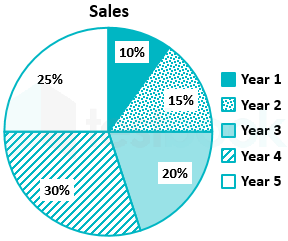
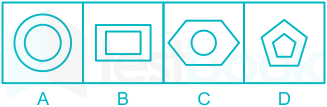
Question 98

You are given a question and two statements. State which statement is necessary/sufficient to answer the question.

Question:

Who gets a job among W, X, Y, Z?

Statement :

  1. X is better than Y and Z.
  2. W is more experienced than X, Y, Z.
  1. AOption (a)

    Statements 1 and 2 both are not sufficient

  2. BOption (b)

    Statement 1 alone is sufficient, but statement 2 alone is not sufficient

  3. COption (c)

    Either 1 or 2 is enough

  4. DOption (d)

    Statement 2 alone is sufficient, but statement 1 alone is not sufficient

View answer & explanation

Correct answer

Answer: (a)A.

Statements 1 and 2 both are not sufficient

Why this answer is correct

  1. X is better than Y and Z.
  • Here, there is no information given about W. Therefore, statement 1 alone is not sufficient.
  1. W is more experienced than X, Y, Z.
  • No information is given about the complete job criteria. Therefore, statement 2 alone is not sufficient.
  1. From statements 1 and 2
  • No information is given about the job criteria.
  • So, even combining the two statements is not enough to answer the question.

Hence, "option 1" is the correct answer.

Question 99

Who is the Chief Minister of Assam as per the information received till August 2018?

  1. AOption (a)

    Sarbananda Sonowal

  2. BOption (b)

    Nitish Kumar

  3. COption (c)

    Biplab Dev

  4. DOption (d)

    Arvind Kejriwal

View answer & explanation

Correct answer

Answer: (a)A.

Sarbananda Sonowal

Why this answer is correct

The correct answer is Sarbananda Sonowal.

Key Points

  • Sarbananda Sonowal is an Indian politician from Assam who is the current Minister of Ports, Shipping and Waterways and Minister of AYUSH in the Government of India.
  • He is a Member of Parliament in the Rajya Sabha (Upper House of India's Parliament) from Assam and also a member of the Cabinet Committee on Political Affairs.
  • He is a former Chief Minister of Assam and a former MLA in the Assam Legislative Assembly.
  • ​He has also served as the Minister for Sports and Youth Affairs, Government of India, from 2014 to 2016.

Additional Information

  • Nitish Kumar is an Indian politician, who is serving as the 22nd Chief Minister of Bihar, a state in India, since 2015 and has served in that role on five previous occasions**.**
  • He has also served as a Union minister in the Union Government of India.
  • Biplab Kumar Deb (born 25 November 1971) is an Indian politician and the former Chief Minister of Tripura.
  • He has been the state president of the Bharatiya Janata Party in Tripura from 7 January 2016 till 2018.
  • Manik Saha is the current Chief Minister of Tripura (As of 2022).

Question 100

Solve:

6 + 6 ÷\div 6 + 6 ×\times 6 – 6 = ?

  1. AOption (a)

    38

  2. BOption (b)

    35

  3. COption (c)

    36

  4. DOption (d)

    37

View answer & explanation

Correct answer

Answer: (d)D.

37

Why this answer is correct

Given:

6 + 6 ÷\div 6 + 6 ×\times 6 – 6 = ?

Concept used:

Calculation:

6 + 6 ÷\div 6 + 6 ×\times 6 – 6 = ?

⇒ 6 + 1 + 6 ×\times 6 – 6

⇒ 6 + 1 + 36 – 6

⇒ 43 – 6

⇒ 37

∴ Required answer is 37

100 questions in the full paper