Previous Year Paper

RRB NTPC Graduate Level CBT-I Official Paper (Held On: 24 Jun, 2025 Shift 3) (Previous Year Paper)

Held in 2025

100 questions90 minutes
With answers
Free

Paper last updated:

Practise under exam conditions

Take this paper as a timed mock test. Review your answers after you submit.

Attempt timed test

Questions & answers

Read the paper at your pace. Open an explanation when you need it.

Question 1

What is the primary purpose of the 'Sections' feature in MS PowerPoint when managing a large presentation?

  1. AOption (a)

    To create hyperlinks between different parts of the presentation

  2. BOption (b)

    To divide the presentation into logical groupings for better organization and navigation during editing and presenting

  3. COption (c)

    To apply different themes to specific groups of slides

  4. DOption (d)

    To enable collaborative editing of specific parts of the presentation by different users

View answer & explanation

Correct answer

Answer: (b)B.

To divide the presentation into logical groupings for better organization and navigation during editing and presenting

Why this answer is correct

The correct answer is option 2,

Key Points

  • The 'Sections' feature in MS PowerPoint enables users to organize large presentations into manageable and logical groupings.
  • It helps in streamlining navigation during both the editing and presentation phases by dividing the slides into distinct sections.
  • Sections allow users to focus on specific parts of the presentation without being overwhelmed by the entire slide deck.
  • This feature is particularly useful when dealing with complex or multi-topic presentations, ensuring better structure and clarity.
  • Users can rename, collapse, or expand sections for easier navigation, enhancing productivity in managing large presentations.

Additional Information

  • Slide Organization in PowerPoint
  • PowerPoint includes features like 'Sections,' 'Slide Sorter View,' and 'Outline View' to help users manage and organize content efficiently.
  • 'Slide Sorter View' provides a thumbnail view of all slides, enabling easier rearrangement.
  • 'Outline View' focuses on text content, offering a structured view of the presentation.
  • Benefits of Using Sections
  • Enhances collaboration when working on different parts of the presentation.
  • Improves workflow by allowing users to concentrate on specific sections.
  • Reduces clutter and simplifies navigation in presentations with numerous slides.
  • Other Navigation Features in PowerPoint
  • Slide Master: Helps maintain consistent design across slides.
  • Hyperlinks: Facilitates linking between slides or external resources.
  • Slide Zoom: Enables focused navigation on specific slides during presentations.
  • PowerPoint for Large Presentations
  • For presentations with hundreds of slides, features like 'Sections' and 'Slide Sorter View' are essential for effective management.
  • Grouping slides into sections ensures logical flow and improved audience engagement.

Question 2

The average height of 15 boys out of a class of 50 is 160 cm. If the average height of the remaining boys is 168 cm, the average height (in cm) of all the boys of the class is:

  1. AOption (a)

    165.6

  2. BOption (b)

    165

  3. COption (c)

    166.6

  4. DOption (d)

    164

View answer & explanation

Correct answer

Answer: (a)A.

165.6

Why this answer is correct

Shortcut Trick

Ratio of boys = 15 : 35 → 3 : 7

Assume average height = 160 cm

Deviation in second group = 168 − 160 = +8 cm

Net deviation for total parts (10) = 7 × 8 = +56

Average height = 160 + (56 ÷ 10) = 160 + 5.6 = 165.6 cm

∴ The correct answer is 165.6 cm.

Alternate Method

Given:

Number of boys in first group (n1) = 15

Average height of first group (A1) = 160 cm

Total number of boys (N) = 50

Average height of remaining boys (A2) = 168 cm

Formula Used:

Weighted Average = (n1A1 + n2A2) ÷ (n1 + n2)

Calculations:

⇒ Total height of first 15 boys = 15 × 160 = 2400 cm

⇒ Number of remaining boys = 50 − 15 = 35 boys

⇒ Total height of 35 boys = 35 × 168 = 5880 cm

⇒ Total height of all 50 boys = 2400 + 5880 = 8280 cm

⇒ Average height of class = 8280 ÷ 50

⇒ Average height = 165.6 cm

∴ The correct answer is 165.6 cm.

Additional Information

Weighted Average Concept

When groups with different averages are combined, the combined average is the total sum divided by the total count: Aavg = Σ (ni × Ai) ÷ Σ ni.

Deviation Method (Change in Average)

If one group is considered as the base average, the overall average increases/decreases by the (net deviation) ÷ (total quantity).

Alligation Rule

The ratio of the quantities is inversely proportional to the differences between their averages and the mean average: n1/n2 = (A2 − Amean) / (Amean − A1).

Question 3

This question is based on the five, three-digit numbers given below. (Left) 103 678 217 111 537 (Right)

(Example: 657 - First digit = 6, Second digit = 5 and third digit = 7) (Note: All operations to be done from left to right)

What will be the resultant if the second digit of the highest number is added to the first digit of the lowest number?

  1. AOption (a)

    12

  2. BOption (b)

    6

  3. COption (c)

    8

  4. DOption (d)

    10

View answer & explanation

Correct answer

Answer: (c)C.

8

Why this answer is correct

Given: (Left) 103 678 217 111 537 (Right)

According to the question:

Given numbers103678217111537
Number are arranged in ascending order103111217537678

So,

Second digit of the highest number → 678 → 7

First digit of the lowest number → 103 → 1

Thus, if the second digit of the highest number is added to the first digit of the lowest number then the resultant will be → 7 + 1 → 8

Hence, the correct answer is "Option 3".

Question 4

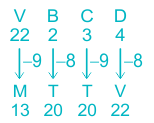
In a certain code language, 'CURE' is coded as '5783' and 'RIGS' is coded as '2179'. What is the code for 'R' in the given code language?

  1. AOption (a)

    2

  2. BOption (b)

    8

  3. COption (c)

    7

  4. DOption (d)

    1

View answer & explanation

Correct answer

Answer: (c)C.

7

Why this answer is correct

According to the given information,

Thus, 'R' is coded as '7'.

Hence, "Option 3" is the correct answer.

Question 5

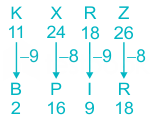
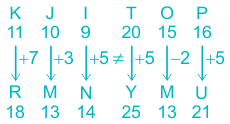
VBCD is related to MTTV in a certain way based on the English alphabetical order. In the same way, LVSX is related to CNJP. To which of the following options is KXRZ related, following the same logic?

  1. AOption (a)

    BPIR

  2. BOption (b)

    BROP

  3. COption (c)

    BPRI

  4. DOption (d)

    BRIP

View answer & explanation

Correct answer

Answer: (a)A.

BPIR

Why this answer is correct

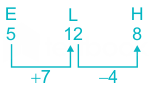
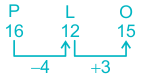
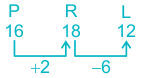
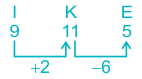
The logic followed here is:

​VBCD is related to MTTV

And,

LVSX is related to CNJP

Similarly,

KXRZ is related to

Hence, "Option 1" is the correct answer.

Question 6

A number when increased by 5712%57 \frac{1}{2}\% gives 378. The number is:

  1. AOption (a)

    100

  2. BOption (b)

    400

  3. COption (c)

    200

  4. DOption (d)

    240

View answer & explanation

Correct answer

Answer: (d)D.

240

Why this answer is correct

Given:

When a number is increased by 57 1/2% (57.5%), it becomes 378.

Formula Used:

Final Value = Original Number × (1 + Percentage Increase / 100)

Calculation:

Let the original number be X.

According to the formula:

378 = X × (1 + 57.5 / 100)

378 = X × 1.575

⇒ X = 378 / 1.575

⇒ X = 240

The original number is 240.

Question 7

Which of the following components is included in the Pradhan Mantri Awas Yojana PMAY-U 2.0 scheme launched in 2024 to provide housing solutions specifically for migrants and workers?​

  1. AOption (a)

    Affordable housing for senior citizens

  2. BOption (b)

    Builders-led construction

  3. COption (c)

    Subsidy scheme

  4. DOption (d)

    Affordable rental housing complexes

View answer & explanation

Correct answer

Answer: (d)D.

Affordable rental housing complexes

Why this answer is correct

The correct answer is option 4,Key Points:

  • Pradhan Mantri Awas Yojana - Urban (PMAY-U) 2.0 focuses on providing Affordable Rental Housing Complexes (ARHCs) for urban migrants and workers.
  • The ARHC component aims to address housing challenges faced by migrant laborers and urban poor by offering affordable rental housing solutions.
  • Under this scheme, ARHCs are developed through Public-Private Partnership (PPP) models or by utilizing existing government-funded housing complexes.
  • PMAY-U 2.0 emphasizes the conversion of vacant government-funded housing units into rental housing complexes to maximize utilization.
  • Special financial incentives and operational mechanisms are provided to private developers for constructing ARHCs to ensure scalability and sustainability.

Additional Information:

  • Pradhan Mantri Awas Yojana - Urban (PMAY-U)
  • Launched in June 2015, PMAY-U aims to provide Housing for All by 2022 through affordable housing initiatives.
  • The scheme targets urban poor, including economically weaker sections (EWS), low-income groups (LIG), and middle-income groups (MIG).
  • It includes various components such as Credit Linked Subsidy Scheme (CLSS), in-situ slum redevelopment, and affordable housing in partnership.
  • Affordable Rental Housing Complexes (ARHCs)
  • ARHCs aim to provide rental housing for urban migrants and workers, addressing the housing shortage in urban areas.
  • These complexes are designed to offer safe and dignified housing at affordable rates near workplaces or industrial hubs.
  • ARHCs are developed by leveraging existing housing stock or constructing new units through public-private partnerships.
  • Public-Private Partnership (PPP) Model
  • PPP is a collaborative framework where private entities and government agencies work together to deliver infrastructure or services.
  • In the context of PMAY-U, PPP models are used to construct and operate ARHCs efficiently.
  • Credit Linked Subsidy Scheme (CLSS)
  • CLSS is a PMAY-U component offering interest subsidies on home loans to eligible beneficiaries.
  • It aims to reduce the financial burden on EWS, LIG, and MIG households while purchasing or constructing their homes.

Question 8

 Who among the following launched the IndiaAI initiatives in 2025?​

  1. AOption (a)

    Minister of Science and Technology

  2. BOption (b)

    Prime Minister of India

  3. COption (c)

    Director of IndiaAI Mission

  4. DOption (d)

    Union IT Minister

View answer & explanation

Correct answer

Answer: (d)D.

Union IT Minister

Why this answer is correct

The correct answer is option 4,

Key Points

  • The IndiaAI initiative was officially launched by the Union IT Minister to strengthen India’s position as a global hub for artificial intelligence.
  • The initiative aims to promote AI research, innovation, and adoption across various sectors such as healthcare, education, agriculture, and governance.
  • IndiaAI serves as a national program fostering collaboration between industry, academia, and government entities to accelerate AI-driven solutions.
  • The platform has a focus on creating skilled manpower through training programs and enhancing AI literacy at grassroots levels.
  • IndiaAI works under the Ministry of Electronics and Information Technology (MeitY) and aligns with the vision of a digitally empowered India.

Additional Information

  • Artificial Intelligence (AI):
  • AI refers to the simulation of human intelligence in machines programmed to think and learn.
  • Key applications include natural language processing, machine learning, and robotics.
  • AI is transforming industries by improving efficiency, decision-making, and innovation.
  • National AI Strategy:
  • The Government of India has laid out a vision for leveraging AI for social and economic growth.
  • Focus areas include responsible AI, ethical frameworks, and democratization of AI technologies.
  • IndiaAI aligns with this strategy to ensure inclusive development.
  • Digital India Program:
  • Launched in 2015, the Digital India initiative aims to transform India into a digitally empowered society.
  • It focuses on areas such as digital infrastructure, governance, and digital literacy.
  • IndiaAI is a major step under this program to enhance technological capabilities.
  • AI in Governance:
  • AI is being used for policy analysis, decision-making, and service delivery in India.
  • Projects like AI-powered chatbots and predictive analytics tools are improving citizen engagement.

Question 9

 Which Indian state does the Thar Desert primarily cover?

  1. AOption (a)

    Gujarat and Maharashtra

  2. BOption (b)

    Rajasthan and Gujarat

  3. COption (c)

    Rajasthan and Uttar Pradesh

  4. DOption (d)

    Rajasthan and Punjab

View answer & explanation

Correct answer

Answer: (b)B.

Rajasthan and Gujarat

Why this answer is correct

The correct answer is option 2,

Key Points

  • The Thar Desert, also known as the Great Indian Desert, is the 17th largest desert in the world and primarily spans the state of Rajasthan, covering approximately 60% of its area.
  • It also extends into parts of Gujarat, Punjab, and Haryana, but Rajasthan is the main state covered.
  • Rajasthan's districts such as Jaisalmer, Barmer, Bikaner, and Jodhpur are most heavily impacted by the Thar Desert's arid conditions.
  • The desert lies in the northwestern part of India and is bordered by the Aravalli mountain range in the southeast.
  • The Thar Desert plays a crucial role in shaping the geography, climate, and cultural heritage of Rajasthan.

Additional Information

  • Climate: The Thar Desert experiences extreme temperatures, ranging from 50°C during summers to near freezing in winters.
  • Vegetation: It is characterized by xerophytic vegetation such as cacti, acacias, and thorny bushes adapted to arid conditions.
  • Economy: Agriculture in the Thar region relies heavily on irrigation systems like the Indira Gandhi Canal, while tourism plays a significant role in districts like Jaisalmer.
  • Wildlife: The desert is home to unique wildlife such as the Great Indian Bustard, Blackbuck, and Desert Fox, protected under various conservation initiatives.
  • Human Settlements: Despite the harsh conditions, the desert supports a dense population, with many villages practicing traditional lifestyles and crafts such as pottery and textiles.

Question 10

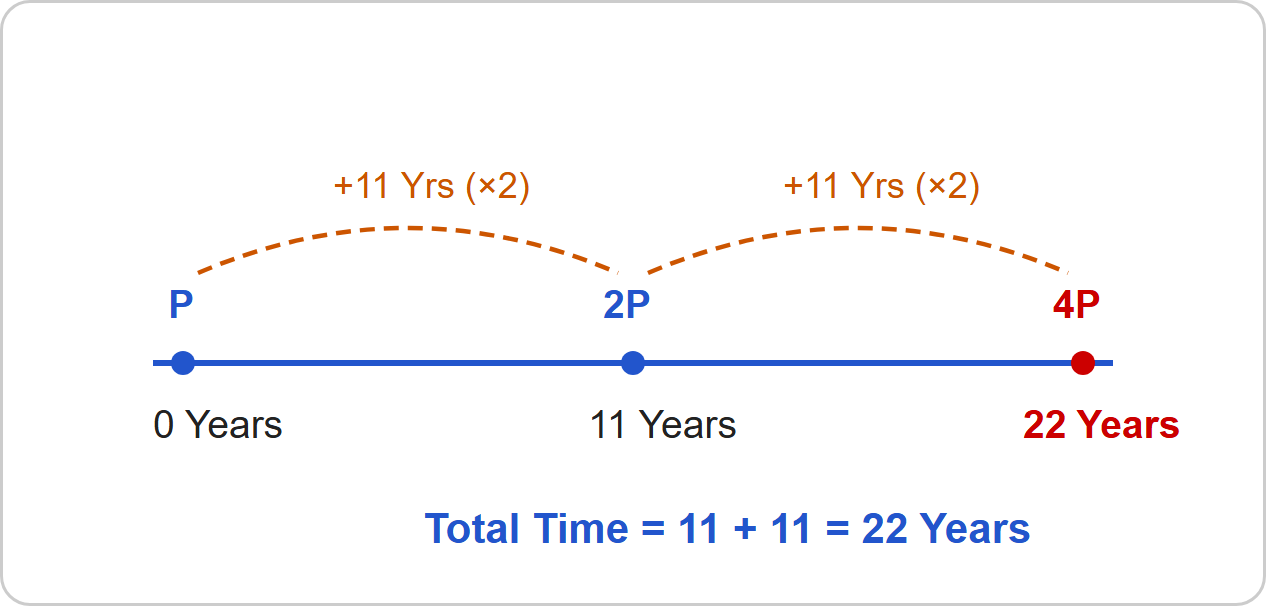
Tejas gets double the amount in 11 years when invested at compound interest, compounded annually. In how many years will the amount become four times itself?

  1. AOption (a)

    44

  2. BOption (b)

    21

  3. COption (c)

    22

  4. DOption (d)

    43

View answer & explanation

Correct answer

Answer: (c)C.

22

Why this answer is correct

Shortcut Trick

In Compound Interest, if a sum becomes n times in T years, it will become nk times in k × T years.

Given: The amount becomes 2 times in 11 years.

Target: The amount needs to become 4 times, which is 22 times.

Here, n = 2, T = 11, and k = 2.

∴ Time taken = 2 × 11 = 22 years.

∴ The correct answer is 22 years.

Alternate Method

Given:

Initial Principal = P

Amount after 11 years = 2P

Rate of interest = r% (compounded annually)

Formula Used:

Amount (A) = P(1 + r/100)n

Calculations:

⇒ 2P = P(1 + r/100)11

⇒ 2 = (1 + r/100)11 --- (Equation 1)

Let the time taken to become 4 times be T years.

⇒ 4P = P(1 + r/100)T

⇒ 4 = (1 + r/100)T

⇒ 22 = (1 + r/100)T

Substitute the value of 2 from Equation 1:

⇒ [(1 + r/100)11]2 = (1 + r/100)T

⇒ (1 + r/100)22 = (1 + r/100)T

Comparing the exponents:

⇒ T = 22

∴ The correct answer is 22 years.

Additional Information

Exponential Growth in CI

In Compound Interest, the amount grows geometrically. If it doubles in 11 years, it will quadruple (2×2) in 11+11=22 years, and become 8 times (2×2×2) in 11+11+11=33 years.

Rule of 72

A quick way to estimate doubling time: Time ≈ 72 ÷ Rate of Interest. This is used for mental calculations in finance.

Effective Annual Rate

When interest is compounded more than once a year, the effective rate is higher. Effective Rate = [1 + r/(100×n)]n − 1, where n is frequency of compounding.

Question 11

A group of numbers and symbols is coded using letter codes as per the codes given below and the conditions that follow. Study the given codes and conditions and answer the question that follows.

Note: If none of the conditions apply, then codes for the respective number/symbol are to be followed directly as given in the table.

Number/Symbol976-8@#+2%+31&
codeCRJZLFIYQPVSUE

Conditions:

If the fourth element is a number, then it is to be coded as γ.

If the first element is a multiple of 3, then it is to be coded as β.

If the second and the fifth elements are symbols, then the codes for these two (the second and the fifth elements) are to be interchanged.

What will be the code for the following group? 9#@27

  1. AOption (a)

    γIJFβR

  2. BOption (b)

    βIFQR

  3. COption (c)

    CIFQR

  4. DOption (d)

    βIFγR

View answer & explanation

Correct answer

Answer: (d)D.

βIFγR

Why this answer is correct

Given Table:

Number/Symbol976-8@#+2%+31&
codeCRJZLFIYQPVSUE

According to the given condition:

Rule no.ConditionResult
(i)Fourth element is a numberIt is to be coded as γ
(ii)First element is a multiple of 3It is to be coded as β
(iii)Second and the fifth elements are symbolsThe codes for these two are to be interchanged

Given: 9#@27

Here, (i) and (ii) rules applies i.e. it is to be coded as γ and β respectively.

9 → coded as β

→ coded as I

@ → coded as F

2 → coded as γ

7 → coded as R

So, 9#@27 → Coded as βIFγR

Hence, "Option 4" is the correct answer.

Question 12

Which city hosted the 55th International Film Festival of India in November 2024?​

  1. AOption (a)

    New Delhi

  2. BOption (b)

    Panaji

  3. COption (c)

    Bengaluru

  4. DOption (d)

    Mumbai

View answer & explanation

Correct answer

Answer: (b)B.

Panaji

Why this answer is correct

The correct answer is Panaji.

Key Points

  • The 55th International Film Festival of India (IFFI) is scheduled to be held in November 2024 in Panaji, Goa.
  • Panaji has been the permanent venue for the International Film Festival of India since 2004.
  • The IFFI is organized jointly by the Ministry of Information and Broadcasting, Government of India, and the Entertainment Society of Goa (ESG).
  • It is one of the most significant film festivals in Asia, showcasing an extensive range of world cinema and honoring film excellence.
  • The festival serves as a platform for fostering global cinematic exchange and offers opportunities for budding filmmakers.

Additional Information

  • International Film Festival of India (IFFI):
  • Started in 1952, it is the oldest film festival in Asia.
  • It aims to promote the art of cinema by bringing together filmmakers and audiences globally.
  • IFFI features categories like International Competition, Indian Panorama, Masterclasses, and Special Screenings.
  • Goa as a Permanent Venue:
  • In 2004, Goa was declared the permanent venue for IFFI due to its infrastructure and scenic appeal.
  • The festival is hosted at venues like Dr. Shyama Prasad Mukherjee Indoor Stadium and Inox Multiplex.
  • Ministry of Information and Broadcasting:
  • The ministry oversees the organization of IFFI in collaboration with state governments and other partners.
  • It promotes Indian cinema globally through initiatives like IFFI.
  • Significance of IFFI:
  • The festival serves as a platform for cultural exchange and dialogue between global filmmakers.
  • It also provides a significant boost to the Indian tourism and entertainment industries.

Question 13

The Cornwallis Code, introduced in 1793, is known for _______.​

  1. AOption (a)

    establishing uniform police and judiciary reforms

  2. BOption (b)

    abolishing the zamindari system

  3. COption (c)

    promoting native Indians in judiciary

  4. DOption (d)

    introducing English as the court language

View answer & explanation

Correct answer

Answer: (a)A.

establishing uniform police and judiciary reforms

Why this answer is correct

The correct answer is establishing uniform police and judiciary reforms.

Key Points

  • The Cornwallis Code, introduced in 1793, marked a significant step in British administrative reforms in India.
  • This code established uniformity in police and judiciary systems, laying the foundation for modern legal and administrative systems in India.
  • It emphasized the separation of revenue collection and judicial functions to avoid conflicts of interest.
  • District judges were made independent of the revenue administration, ensuring impartial judicial processes.
  • The code also introduced strict regulations for the conduct of officials, aiming to curb corruption and inefficiency.

Additional Information

  • Lord Cornwallis
  • He served as the Governor-General of Bengal from 1786 to 1793.
  • Known as the "father of civil services in India," he introduced reforms to make administration more efficient and accountable.
  • Judicial Reforms under Cornwallis
  • The establishment of civil and criminal courts at different levels (district, provincial, and Sadar levels).
  • District judges were appointed, and the concept of rule of law was strengthened.
  • Police Reforms
  • The police system was reorganized, and thanas (police stations) were established to maintain law and order.
  • The officers were made accountable, and their powers were clearly defined.
  • Legacy of the Cornwallis Code
  • It laid the groundwork for the Indian Penal Code and the modern judicial system in India.
  • The reforms also influenced subsequent British administrative practices in the country.

Question 14

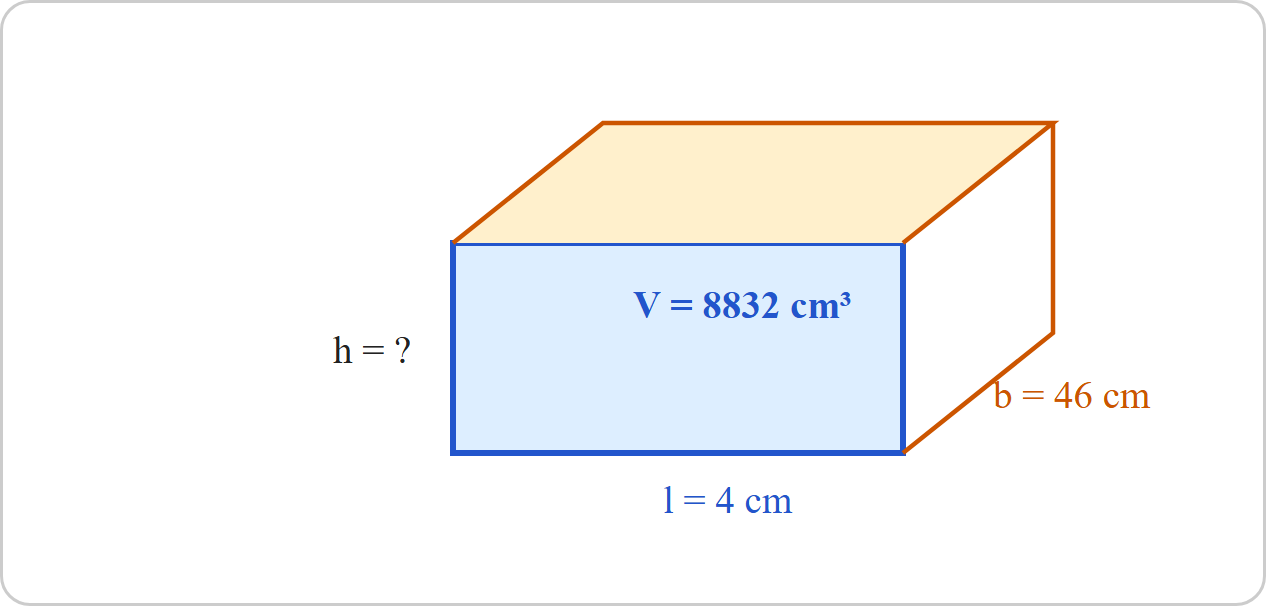
 If the length of a cuboid is 4 cm, breadth is 46 cm and volume is 8832 cm³, then find the height (in cm) of the cuboid.

  1. AOption (a)

    48

  2. BOption (b)

    43

  3. COption (c)

    41

  4. DOption (d)

    57

View answer & explanation

Correct answer

Answer: (a)A.

48

Why this answer is correct

Shortcut Trick

Volume of cuboid = Length × Breadth × Height

8832 = 4 × 46 × Height

8832 = 184 × Height

Height = 8832 ÷ 184 = 48 cm

∴ The correct answer is 48 cm.

Alternate Method

Given:

Length (l) = 4 cm

Breadth (b) = 46 cm

Volume (V) = 8832 cm3

Formula Used:

Volume of a Cuboid = Length × Breadth × Height

Calculations:

⇒ 8832 = 4 × 46 × h

⇒ 8832 = 184 × h

⇒ h = 8832 ÷ 184

⇒ h = 48 cm

∴ The correct answer is 48 cm.

Additional Information

Total Surface Area of Cuboid

The total area of all faces is given by 2 × (lb + bh + hl).

Diagonal of a Cuboid

The length of the longest rod that can be placed inside is √(l2 + b2 + h2).

Lateral Surface Area

The area of the four side walls is given by 2 × Height × (Length + Breadth).

Question 15

The simple interest (in ₹) on ₹2,200 at the rate of 5% per annum in 2 years is:​

  1. AOption (a)

    ₹270

  2. BOption (b)

    ₹320

  3. COption (c)

    ₹220

  4. DOption (d)

    ₹170

View answer & explanation

Correct answer

Answer: (c)C.

₹220

Why this answer is correct

Shortcut Trick

Effective rate of Simple Interest for 2 years = 5% × 2 = 10%

Simple Interest = 10% of Principal

⇒ Interest = 10% of ₹2,200

⇒ Interest = 2200 ÷ 10 = ₹220

∴ The correct answer is ₹220.

Alternate Method

Given:

Principal (P) = ₹2,200

Rate (R) = 5% per annum

Time (T) = 2 years

Formula Used:

Simple Interest (SI) = (P × R × T) ÷ 100

Calculations:

⇒ SI = (2200 × 5 × 2) ÷ 100

⇒ SI = 2200 × 10 ÷ 100

⇒ SI = 22 × 10

⇒ SI = ₹220

∴ The correct answer is ₹220.

Additional Information

Total Amount Formula

The Amount (A) at the end of the period is the sum of the Principal and the Simple Interest: A = P + SI.

Constant Interest Property

In Simple Interest, the interest earned remains the same every year because it is always calculated on the original Principal (P).

Effective Rate Calculation

For quick calculation, the total Percentage Interest over the entire period is the product of the yearly Rate and the Time duration (R × T).

Question 16

Hitesh is three times as old as his son and his daughter is 3 years younger than the son. If the sum of the ages of these three people 3 years ago was 123 years, then Hitesh's present age (in years)

  1. AOption (a)

    81

  2. BOption (b)

    88

  3. COption (c)

    72

  4. DOption (d)

    91

View answer & explanation

Correct answer

Answer: (a)A.

81

Why this answer is correct

Shortcut Trick

Total age 3 years ago = 123 years.

Sum of present ages = 123 + (3 × 3) = 132 years.

Let Son's age be x. Then Hitesh = 3x and Daughter = x − 3.

Total: 3x + x + (x − 3) = 132 ⇒ 5x = 135 ⇒ x = 27.

Hitesh's age = 3 × 27 = 81 years.

∴ The correct answer is 81 years.

Alternate Method

Given:

Relation: Hitesh = 3 × Son

Relation: Daughter = Son − 3

Sum of ages 3 years ago = 123

Let Son's present age = x years

Hitesh's present age = 3x years

Daughter's present age = (x − 3) years

Sum of ages 3 years ago:

⇒ (3x − 3) + (x − 3) + (x − 3 − 3) = 123

⇒ 3x + x + x − 3 − 3 − 6 = 123

⇒ 5x − 12 = 123

⇒ 5x = 135

⇒ x = 27

Hitesh's present age = 3 × 27 = 81 years

∴ The correct answer is 81 years.

Additional Information

Sum of Ages Shift

If there are 'n' people, the sum of their ages 't' years ago was (Present Sum − n × t).

Age Ratio Problems

When ages are given in ratios, always represent them as multiples of a variable 'x' to solve linear equations easily.

Constant Age Difference

The difference between the ages of any two people remains constant throughout their lives.

Question 17

72 ÷ 18 × 32 − 21  x  12 ÷ 3 + 12 = z, then find value of z

  1. AOption (a)

    -44

  2. BOption (b)

    -31

  3. COption (c)

    -36

  4. DOption (d)

    -28

View answer & explanation

Correct answer

Answer: (c)C.

-36

Why this answer is correct

Given:

Equation: 72 ÷ 18 × 32 − 21 x 12 ÷ 3 + 12 = z

Formula Used:

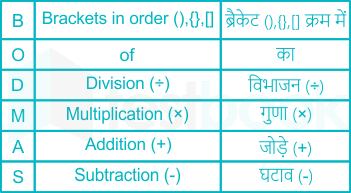
Follow BODMAS (Bracket, Order, Division, Multiplication, Addition, Subtraction) rule to solve the equation.

Calculation:

72 ÷ 18 × 32 − 21 x 12 ÷ 3 + 12 = z

⇒ 4 × 9 − 21 x 4 + 12 = z

⇒ 36 - 84 + 12 = z

⇒ z = 48 - 84

⇒ z = - 36

∴ Option 3 is the correct answer.

Question 18

Each of the digits in the number 5123487 is arranged in ascending order from left to right. The position(s) of how many digits will remain unchanged as compared to that in the original number

  1. AOption (a)

    Two

  2. BOption (b)

    None

  3. COption (c)

    Three

  4. DOption (d)

    One

View answer & explanation

Correct answer

Answer: (b)B.

None

Why this answer is correct

Given number: 5123487

According to the question, 

Given number5123487
Arranged in ascending order1234578

The digits that will remain unchanged as compared to that in the original number → None

Hence, the correct answer is "Option 2".

Question 19

Which of the following is an example of a Tier I city in India

  1. AOption (a)

    Jaipur

  2. BOption (b)

    Amritsar

  3. COption (c)

    Kolkata

  4. DOption (d)

    Bhopal

View answer & explanation

Correct answer

Answer: (c)C.

Kolkata

Why this answer is correct

The correct answer is Kolkata.

Key Points

  • Kolkata is one of the metropolitan cities in India and is classified as a Tier I city.
  • Tier I cities are those that have a high population density, advanced infrastructure, and are major economic hubs.
  • Other Tier I cities in India include Mumbai, Delhi, Bengaluru, Chennai, and Hyderabad.
  • Kolkata is the capital of West Bengal and serves as an important cultural, commercial, and educational hub in eastern India.
  • The city is home to major industries such as jute, textiles, IT, and finance, contributing significantly to India's economy.

Additional Information

  • Tier Classification of Indian Cities:
  • Indian cities are classified into Tier I, Tier II, and Tier III based on population, infrastructure, and economic activity.
  • Tier I cities are highly urbanized and contribute substantially to India's GDP.
  • Tier II cities are mid-sized cities with moderate infrastructure growth.
  • Tier III cities are smaller cities with less urbanization and development.
  • Population Density:
  • Tier I cities generally have a population of over 1 million.
  • High population density in these cities leads to increased demand for housing, infrastructure, and services.
  • Economic Importance of Tier I Cities:
  • Tier I cities are key contributors to India's economy, hosting corporate headquarters, industries, and financial institutions.
  • They serve as gateways for international trade and foreign investments.
  • Urban Development:
  • Tier I cities have advanced transportation networks, healthcare facilities, and educational institutions.
  • They are equipped with modern infrastructure, including airports, metro systems, and IT parks.

Question 20

 Which of the following is NOT one of the factors that the Prime Minister should consider when selecting ministers for the Union Council of Ministers in India?​

  1. AOption (a)

    Representation of foreign communities

  2. BOption (b)

    Individual capacity and capability

  3. COption (c)

    Geographical representation

  4. DOption (d)

    Representation of backward classes

View answer & explanation

Correct answer

Answer: (a)A.

Representation of foreign communities

Why this answer is correct

The correct answer is option 1,

Key Points

  • The selection of ministers for the Union Council of Ministers is governed by various considerations, including individual capacity, geographical representation, and representation of backward classes.
  • Representation of foreign communities is not a factor considered in the selection process as it is not relevant to the Indian political structure.
  • The Prime Minister ensures a balance of representation across regions, social groups, and expertise to reflect the diversity of India.
  • Criteria such as individual capability, integrity, and political experience are emphasized during the appointment of ministers.
  • Other considerations include maintaining party cohesion, rewarding loyalty, and adhering to constitutional provisions under Articles 74 and 75 of the Indian Constitution.

Additional Information

  • Union Council of Ministers:
  • The Union Council of Ministers is the executive body of the Indian government, headed by the Prime Minister.
  • It consists of Cabinet Ministers, Ministers of State, and Ministers of State (Independent Charge).
  • The Council of Ministers is collectively responsible to the Lok Sabha under Article 75 of the Constitution.
  • Articles 74 and 75 of the Indian Constitution:
  • Article 74 mandates that the Prime Minister leads the Council of Ministers to aid and advise the President.
  • Article 75 outlines the appointment of ministers by the President on the advice of the Prime Minister.
  • It includes provisions regarding ministerial qualifications and collective responsibility.
  • Geographical Representation:
  • Geographical representation ensures ministers from different states and regions to reflect India’s federal structure.
  • This helps address regional aspirations and maintain political balance.
  • Representation of Backward Classes:
  • Representation of socially and economically backward classes is crucial to uphold inclusivity and equity in governance.
  • This factor aligns with India's commitment to social justice under Articles 15 and 16 of the Constitution.

Question 21

 Which factor primarily contributed to the development of nucleated settlements in the Bundelkhand region of central India?

  1. AOption (a)

    Security concerns and invasions

  2. BOption (b)

    Proximity to trade routes

  3. COption (c)

    Fertile soil and irrigation facilities

  4. DOption (d)

    Availability of mineral resources

View answer & explanation

Correct answer

Answer: (a)A.

Security concerns and invasions

Why this answer is correct

The correct answer is option 1,

Key Points

  • Nucleated settlements in the Bundelkhand region primarily developed due to security concerns and invasions, especially during historical periods marked by frequent conflicts and raids.
  • The settlements were designed as compact clusters to facilitate defense mechanisms and collective safety against external threats.
  • Bundelkhand's geographical location, surrounded by rugged terrain, made it vulnerable to invasions, necessitating closely-knit communities for protection.
  • Historical records indicate that fortifications and defensive structures were often built in conjunction with these settlements to ensure security.
  • The prevalence of such settlements during medieval times was a strategic response to safeguard inhabitants from both human threats and environmental adversities.

Additional Information

  • Nucleated Settlements:
  • Nucleated settlements are characterized by houses grouped closely together, often around a central feature like a fort, market, or temple.
  • These settlements are common in regions where people need to stay united for social, economic, or security reasons.
  • Historical Invasions in Bundelkhand:
  • Bundelkhand faced invasions from various rulers, including Mughals, Afghans, and Marathas, leading to the need for defensive settlements.
  • Fortifications like the Kalinjar Fort were built to protect inhabitants from external threats.
  • Geographical Influence:
  • The rugged terrain of Bundelkhand provided natural barriers but also isolated communities, making compact settlements a necessity.
  • Limited agricultural potential in the region further emphasized the need for cooperative living in nucleated clusters.
  • Defensive Architecture:
  • Structures like forts, watchtowers, and walls were integral to nucleated settlements, ensuring collective security.
  • These architectural features are still evident in Bundelkhand's historical sites.

Question 22

The 1991 economic reforms in India led to rapid industrialisation and expansion of energy-intensive sectors. Which market-based mechanism has India adopted to balance industrial growth, energy efficiency and emissions?​

  1. AOption (a)

    Make in India

  2. BOption (b)

    Green GDP Accounting

  3. COption (c)

    Perform, Achieve and Trade (PAT) scheme

  4. DOption (d)

    Food Security Act

View answer & explanation

Correct answer

Answer: (c)C.

Perform, Achieve and Trade (PAT) scheme

Why this answer is correct

The correct answer is option 3,

Key Points

  • The Perform, Achieve, and Trade (PAT) scheme is a market-based mechanism introduced by the Bureau of Energy Efficiency (BEE) under the National Mission on Enhanced Energy Efficiency (NMEEE).
  • It aims to improve energy efficiency in energy-intensive industries by setting specific energy consumption reduction targets.
  • Industries that achieve energy efficiency targets earn tradable Energy Saving Certificates (ESCerts), which can be sold to entities that fail to meet their targets.
  • The PAT scheme covers sectors like cement, power, steel, pulp and paper, textiles, and others, making it a key component of India's energy efficiency strategy.
  • The scheme helps India balance industrial growth with energy efficiency and reduction in greenhouse gas emissions, aligning with sustainable development goals.

Additional Information

  • Energy Saving Certificates (ESCerts):
  • These certificates are awarded to industries that exceed their energy savings targets under the PAT scheme.
  • ESCerts can be traded on power exchanges, incentivizing industries to adopt energy-efficient technologies.
  • National Mission on Enhanced Energy Efficiency (NMEEE):
  • NMEEE is one of the eight missions under India's National Action Plan on Climate Change (NAPCC).
  • Its goal is to promote energy efficiency and reduce the energy intensity of India's economy.
  • Market-based Mechanism:
  • The PAT scheme is an example of a market-based approach to address environmental challenges.
  • It incentivizes industries to achieve energy efficiency through tradable certificates rather than penalties.
  • Impact of PAT Scheme:
  • Since its inception in 2012, the PAT scheme has led to significant energy savings and reduction in carbon emissions.
  • It has helped industries adopt advanced technologies and improve competitiveness in global markets.

Question 23

If 1 is added to each even digit and 1 is subtracted from each odd digit in the number 7521432, what will be the sum of digits which are second from left and third from right in the new number thus formed?

  1. AOption (a)

    9

  2. BOption (b)

    8

  3. COption (c)

    10

  4. DOption (d)

    6

View answer & explanation

Correct answer

Answer: (a)A.

9

Why this answer is correct

Given number: 7521432

According to the question, 

Given number7521432
Odd digit → (-1) Even digit → (+1)(-1)(-1)(+1)(-1)(+1)(-1)(+1)
New number6430523

The sum of digits which are second from left and third from right in the new number thus formed → 4 + 5 = 9

Hence, the correct answer is "Option 1".

Question 24

Based on the English alphabetical order, three of the following four letter-clusters are alike in a certain way and thus form a group. Which letter-cluster DOES NOT belong to that group? (Note: The odd one out is not based on the number of consonants/vowels or their position in the letter-cluster)

  1. AOption (a)

    LSO

  2. BOption (b)

    JQM

  3. COption (c)

    GNI

  4. DOption (d)

    ELH

View answer & explanation

Correct answer

Answer: (c)C.

GNI

Why this answer is correct

The logic followed here is:  

Option 1) LSO

Option 2) JQM

​

Option 3) GNI

Option 4) ELH

Thus, out of all 'GNI' is the odd one out.

Hence, "Option 3" is the correct answer.

Question 25

This question is based on the five, three-digit numbers given below. (Left) 307 485 194 237 937 (Right)

(Example: 657 - First digit = 6, Second digit = 5 and third digit = 7) (Note: All operations to be done from left to right.)

What will be the resultant if the third digit of the highest number is subtracted from the first digit of the lowest number?

  1. AOption (a)

    -4

  2. BOption (b)

    -6

  3. COption (c)

    -3

  4. DOption (d)

    -5

View answer & explanation

Correct answer

Answer: (b)B.

-6

Why this answer is correct

Given: (Left) 307 485 194 237 937 (Right)

According to the question:

Given numbers301485194237937
Number are arranged in ascending order194237301485937

So,

Third digit of the highest number → 937 → 7

First digit of the lowest number → 194 → 1

Thus, if the third digit of the highest number is subtracted from the first digit of the lowest number then the resultant will be → 1 - 7 → -6

Hence, the correct answer is "Option 2".

Question 26

Which keyboard shortcut is used in MS PowerPoint 365 to start editing text inside a selected shape or text box

  1. AOption (a)

    Ctrl + E

  2. BOption (b)

    Alt + Enter

  3. COption (c)

    F2

  4. DOption (d)

    F5

View answer & explanation

Correct answer

Answer: (c)C.

F2

Why this answer is correct

The correct answer is option 3,

The correct answer is F2.

Key Points

  • F2 is the default keyboard shortcut in MS PowerPoint 365 to start editing text inside a selected shape or text box.
  • When a shape or text box is selected, pressing F2 directly activates the editing mode, allowing users to modify the text content.
  • This shortcut is specifically designed for convenience and saves time compared to manually double-clicking on the shape or text box.
  • F2 is widely recognized across different versions of PowerPoint, making it a universal shortcut for text editing.
  • Using keyboard shortcuts like F2 significantly enhances productivity and workflow efficiency while working with presentations.

Additional Information

  • Keyboard Shortcuts in MS PowerPoint:
  • Ctrl + M: Adds a new slide to the presentation.
  • Ctrl + D: Duplicates the selected slide.
  • Alt + Shift + Up/Down Arrow: Moves slides up or down in the slide order.
  • Ctrl + P: Activates the pen tool while presenting in slideshow mode.
  • Ctrl + Z: Undoes the last action.
  • Text Editing in PowerPoint:
  • Text boxes and shapes are primary tools for adding content to slides.
  • Double-clicking or using F2 allows users to quickly access the text-editing mode.
  • Formatting options like font size, color, and alignment can be adjusted using the toolbar or ribbon.
  • Keyboard shortcuts like Ctrl + B (bold) and Ctrl + I (italic) enhance text formatting efficiency.
  • Productivity Benefits of Shortcuts:
  • Keyboard shortcuts streamline workflows by reducing dependency on mouse navigation.
  • They help users perform repetitive tasks faster, enhancing overall productivity.
  • Memorizing key shortcuts can significantly improve presentation creation time.
  • PowerPoint Versions:
  • MS PowerPoint 365 is the latest subscription-based version, offering regular updates and cloud-based features.
  • Older versions like PowerPoint 2016 and PowerPoint 2019 support many of the same shortcuts.
  • Shortcuts remain consistent across versions, ensuring ease of use for long-time users.

Question 27

Mohan can do a piece of work in 9 hours. Pramod can do it in 21 hours. With the assistance of Akshay, they completed the work in 6 hours. In how many hours can Akshay alone do twice the same work

  1. AOption (a)

    254

  2. BOption (b)

    252

  3. COption (c)

    251

  4. DOption (d)

    253

View answer & explanation

Correct answer

Answer: (b)B.

252

Why this answer is correct

Shortcut Trick

Total Work (LCM of 9, 21, 6) = 126 units.

Efficiency: Mohan = 14, Pramod = 6, All three (Mohan+Pramod+Akshay) = 21.

Akshay's Efficiency = 21 − (14 + 6) = 1 unit.

Time for Akshay alone to do twice the work = (126 × 2) ÷ 1 = 252 hours.

∴ The correct answer is 252 hours.

Alternate Method

Given: Mohan = 9 hours, Pramod = 21 hours, Mohan + Pramod + Akshay = 6 hours.

Formula Used: Total Work = Time × Efficiency

PersonDaysTotal WorkEfficiency
Mohan912614
Pramod216
Mohan+Pramod+Akshay621

⇒ Total efficiency of M + P + A = 21

⇒ Akshay efficiency = 21 − (14 + 6) = 1

⇒ Total work to be done = 2 × 126 = 252 units

⇒ Time taken by Akshay = 252 ÷ 1 = 252 hours

∴ The correct answer is 252 hours.

Additional Information

Individual Efficiency Rule

The efficiency of an individual is found by subtracting the sum of efficiencies of known members from the combined efficiency of the group.

Work and Time Relation

Time is inversely proportional to Efficiency (Time = Work ÷ Efficiency). If work is doubled, time taken at the same efficiency also doubles.

Question 28

 Which of the following scenarios would most effectively necessitate the use of a three-dimensional reference within an MS Excel formula

  1. AOption (a)

    Applying conditional formatting to a range of data based on values in another worksheet within the same workbook

  2. BOption (b)

    Creating a chart that visualizes data points sourced from several different workbooks

  3. COption (c)

    Calculating the average sales figures across multiple non-contiguous worksheets for the same product category

  4. DOption (d)

    Summing values from a specific cell across a sequence of identically structured worksheets representing monthly data for a year

View answer & explanation

Correct answer

Answer: (d)D.

Summing values from a specific cell across a sequence of identically structured worksheets representing monthly data for a year

Why this answer is correct

The correct answer is Summing values from a specific cell across a sequence of identically structured worksheets representing monthly data for a year.

Key Points

  • A three-dimensional (3D) reference in MS Excel is used to reference the same cell or range of cells across multiple worksheets within the same workbook.
  • It is particularly useful for performing calculations (e.g., summing, averaging) that involve data stored in the same cell position across identically structured worksheets.
  • The correct scenario here—"Summing values from a specific cell across a sequence of identically structured worksheets representing monthly data for a year"—requires referencing the same cell (e.g., B2) across worksheets such as "Jan," "Feb," "Mar," etc.
  • An example of a 3D reference formula for summing cell B2 across worksheets "Jan" to "Dec" would be: =SUM(Jan:Dec!B2).
  • This method simplifies complex calculations and avoids manually navigating to each worksheet, making it efficient for managing large datasets.

Additional Information

  • 3D Reference in MS Excel
  • A 3D reference allows users to refer to the same range or cell across multiple worksheets.
  • It is denoted by the syntax: Sheet1:SheetN!CellReference.
  • Common functions used with 3D references include SUM, AVERAGE, COUNT, MAX, and MIN.
  • Conditional Formatting vs. 3D References
  • Conditional formatting applies visual formatting rules to data within a single worksheet or across specific ranges, but it does not use 3D references.
  • 3D references are designed for computations rather than formatting tasks.
  • Identically Structured Worksheets
  • These are worksheets that share the same layout, such as having the same rows, columns, and headings.
  • Identical structure is a prerequisite for effectively using 3D references.
  • Advantages of 3D References
  • Enables efficient data analysis across multiple worksheets.
  • Reduces redundancy by avoiding repetitive formulas for each worksheet.
  • Improves consistency and minimizes human error in calculations.
  • Limitations of 3D References
  • 3D references cannot be used in array formulas or with certain Excel features like Data Tables.
  • Deleting or rearranging worksheets within the referenced range may lead to formula errors.

Question 29

India's demographic profile on the eve of independence reflected the socio-economic backwardness caused by colonial rule. Which of the following options best describes the health care and literacy statistics on the eve of independence?

  1. AOption (a)

    High life expectancy with high birth rates and low death rates

  2. BOption (b)

    High life expectancy with low birth and death rates

  3. COption (c)

    Moderate life expectancy with declining birth and death rates

  4. DOption (d)

    Low life expectancy with high birth and death rates

View answer & explanation

Correct answer

Answer: (d)D.

Low life expectancy with high birth and death rates

Why this answer is correct

The correct answer is option 4,On the eve of independence, India was characterized by poor healthcare and literacy outcomes due to colonial exploitation. Below are key points and additional information to understand this further:

Key Points

  • Life expectancy at birth during India’s independence (1947) was estimated to be around 32 years, which is considered extremely low compared to global standards.
  • Birth rates and death rates were both high, indicative of poor healthcare infrastructure and lack of access to medical facilities.
  • Infant mortality rates were alarming, with nearly 150-200 infant deaths per 1,000 live births.
  • Literacy rates were abysmally low, with only around 12% of the population being literate, reflecting widespread educational deprivation.
  • The colonial government focused primarily on revenue generation and military needs, leaving public health and education severely neglected.

Additional Information

  • Life Expectancy
  • Life expectancy serves as an indicator of the general health and living conditions in a country.
  • India’s low life expectancy at independence reflected widespread poverty, malnutrition, and limited access to healthcare.
  • High Birth and Death Rates
  • High birth rates were driven by social and economic factors such as lack of contraception and the need for large families in agrarian societies.
  • High death rates were caused by rampant diseases like malaria, cholera, and tuberculosis, compounded by poor sanitation and healthcare.
  • Infant Mortality
  • Infant mortality refers to the death of children under one year of age per 1,000 live births.
  • India’s high infant mortality rate at independence underscored the lack of maternal and child healthcare services.
  • Colonial Impact on Education
  • Colonial policies largely ignored mass education, focusing instead on creating a small class of elites for administrative purposes.
  • The absence of widespread educational initiatives led to the low literacy rates observed at independence.
  • Post-Independence Reforms
  • After independence, India embarked on initiatives to improve healthcare and education, such as the establishment of primary schools and public health programs.
  • These efforts contributed to gradual improvements in life expectancy and literacy rates over the decades.

Question 30

Which policy of the British greatly affected the tribal landholding patterns and led to widespread discontent among the tribes, thereby fueling rebellions

  1. AOption (a)

    The Ryotwari System

  2. BOption (b)

    Forest laws and land settlements

  3. COption (c)

    Permanent Settlement

  4. DOption (d)

    Doctrine of Lapse

View answer & explanation

Correct answer

Answer: (b)B.

Forest laws and land settlements

Why this answer is correct

The correct answer is option 2,

Key Points

  • Forest laws and land settlements introduced by the British led to the alienation of tribal lands and disruption of traditional tribal practices.
  • The British declared vast areas of forests as reserved or protected, prohibiting tribal communities from practicing shifting cultivation, hunting, and gathering.
  • Land settlements imposed by colonial authorities forced tribals into exploitative relationships with moneylenders and landlords, further marginalizing them.
  • These laws deprived tribes of their access to resources, leading to widespread discontent, loss of livelihood, and eventual uprisings such as the Santhal Rebellion (1855-56) and Munda Rebellion (1899-1900).
  • Tribal revolts were fueled by oppressive policies that disregarded their traditional rights and cultural practices, making British forest laws a major factor behind tribal unrest.

Additional Information

  • Santhal Rebellion (1855-56): A significant tribal uprising against exploitative landlords and British policies affecting tribal lands and resources.
  • Munda Rebellion (1899-1900): Led by Birsa Munda, this revolt was against British land policies and the exploitation of tribal populations.
  • Shifting Cultivation: A traditional agricultural practice of many tribal communities, which was banned under British forest laws.
  • Impact of Forest Laws: These laws restricted access to forests for hunting, gathering, and cultivation, leading to economic hardships for tribal communities.
  • Doctrine of Lapse: Although unrelated to tribal unrest, this British policy annexed princely states, further consolidating colonial control in India.

Question 31

Based on the English alphabetical order, three of the following four letter-clusters are alike in a certain way and thus form a group. Which letter-cluster DOES NOT belong to that group? (Note: The odd one out is not based on the number of consonants/vowels or their position in the letter-cluster)

  1. AOption (a)

    HJD

  2. BOption (b)

    PLO

  3. COption (c)

    PRL

  4. DOption (d)

    IKE

View answer & explanation

Correct answer

Answer: (b)B.

PLO

Why this answer is correct

The logic followed here is:  

Option 1) HJD

Option 2) PLO

​

Option 3) PRL

Option 4) IKE

Thus, out of all 'PLO' is the odd one out.

Hence, "Option 2" is the correct answer.

Question 32

In a certain code language, 'LIKE' is coded as '5738' and 'TASK' is coded as '2819'. What is the code for 'K' in the given code language?

  1. AOption (a)

    8

  2. BOption (b)

    9

  3. COption (c)

    2

  4. DOption (d)

    3

View answer & explanation

Correct answer

Answer: (a)A.

8

Why this answer is correct

According to the given information,

Thus, 'K' is coded as '8'.

Hence, "Option 1" is the correct answer.

Question 33

Which of the following statements is/are correct regarding the Dandi March of 1930?

(a)The march started from Sabarmati Ashram and ended at Dandi, covering a distance of 240 miles.

(b) The Dandi March led to the signing of the Poona Pact

  1. AOption (a)

    Only (a)

  2. BOption (b)

    Only (b)

  3. COption (c)

    Neither (a) nor (b)

  4. DOption (d)

    Both (a) and (b)

View answer & explanation

Correct answer

Answer: (a)A.

Only (a)

Why this answer is correct

The correct answer is option 1.

Key Points

  • The Dandi March was a non-violent protest led by Mahatma Gandhi as part of the Civil Disobedience Movement.
  • The march began on 12th March 1930 from Sabarmati Ashram near Ahmedabad and ended at Dandi, a coastal village in Gujarat, covering a distance of 241 miles.
  • The primary objective of the march was to protest against the British salt monopoly and the imposition of tax on salt.
  • The Dandi March is considered a pivotal event in India's struggle for independence as it mobilized mass participation.
  • Statement (b) regarding the Poona Pact is incorrect because the Poona Pact was signed in 1932, unrelated to the Dandi March.

Additional Information

  • Civil Disobedience Movement:
  • Launched by Mahatma Gandhi in 1930 as a non-violent campaign against British rule.
  • Focused on breaking unjust laws, such as the salt tax, and boycotting British goods and institutions.
  • The movement significantly contributed to raising national consciousness and mass participation.
  • Salt Tax:
  • Imposed by the British colonial government, forcing Indians to purchase salt from British-controlled sources.
  • Seen as exploitative and symbolized the broader economic injustices of colonial rule.
  • Poona Pact:
  • An agreement signed in 1932 between Mahatma Gandhi and Dr. B.R. Ambedkar regarding the reservation of seats for depressed classes in the legislature.
  • It is unrelated to the Dandi March and occurred two years later.
  • Impact of Dandi March:
  • Inspired civil disobedience campaigns across India against various colonial laws.
  • Highlighted the power of non-violent protest in challenging oppressive regimes.

Question 34

Each of the digits in the number 7416385 is arranged in ascending order from left to right. The position(s) of how many digits will remain unchanged as compared to that/those in the original number

  1. AOption (a)

    One

  2. BOption (b)

    Two

  3. COption (c)

    Three

  4. DOption (d)

    None

View answer & explanation

Correct answer

Answer: (d)D.

None

Why this answer is correct

Given number: 7415385

According to the question, 

Given number7416385
Arranged in ascending order1345678

The digits that will remain unchanged as compared to that in the original number → None

Hence, the correct answer is "Option 4".

Question 35

The President of India possesses the power to remove or recall officials such as Governors and Ambassadors. This power is exercised based on the advice of:​

  1. AOption (a)

    the Union Council of Ministers

  2. BOption (b)

    the State Governments

  3. COption (c)

    the Supreme Court of India

  4. DOption (d)

    a resolution passed by the Parliament

View answer & explanation

Correct answer

Answer: (a)A.

the Union Council of Ministers

Why this answer is correct

The correct answer is the Union Council of Ministers.

Key Points

  • The President of India, as the head of the state, exercises executive powers, including the removal of officials like Governors and Ambassadors, based on the advice of the Union Council of Ministers.
  • This advisory role of the Union Council of Ministers is mandated by Article 74(1) of the Indian Constitution, which states that the President must act in accordance with their advice.
  • The Union Council of Ministers is headed by the Prime Minister, who communicates decisions and advice to the President on behalf of the council.
  • The removal or recall of Governors and Ambassadors is an executive action that reflects the collective will of the council in alignment with constitutional provisions.
  • The President acts as a constitutional authority, and their actions are bound by the advice provided by the democratically elected government, ensuring parliamentary democracy.

Additional Information

  • Article 74 of the Indian Constitution:
  • It mandates the President to act on the advice of the Council of Ministers with the Prime Minister as its head.
  • The advice tendered by the council is binding on the President.
  • This ensures the functioning of the parliamentary system where the real executive authority lies with the council.
  • Role of Governors in India:
  • Governors serve as the constitutional head of a state, appointed by the President.
  • They hold office during the pleasure of the President and can be removed based on the Union Council of Ministers' advice.
  • Role of Ambassadors in India:
  • Ambassadors represent India in foreign countries and act as the official diplomatic channel.
  • They are appointed and can be recalled by the President based on the advice of the Union government.
  • Parliamentary Democracy in India:
  • India follows a parliamentary system where the President acts as the nominal executive and the Prime Minister-led council functions as the real executive.
  • The system ensures accountability and collective decision-making in governance.

Question 36

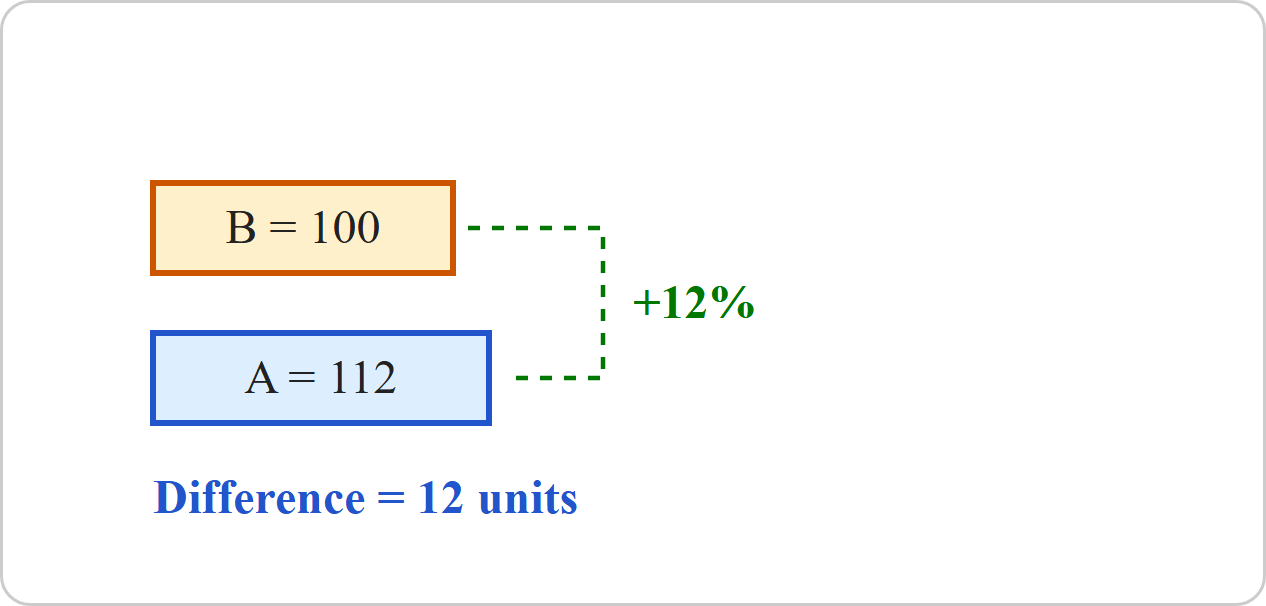
 If A's salary is 12% more than that of B, then by what percentage is B's salary less than that of A (correct to two decimal places)

  1. AOption (a)

    10.71%

  2. BOption (b)

    12.47%

  3. COption (c)

    11.73%

  4. DOption (d)

    13.26%

View answer & explanation

Correct answer

Answer: (a)A.

10.71%

Why this answer is correct

Shortcut Trick

Use the direct percentage reduction formula: [r / (100 + r)] × 100

Here, r = 12%

Reduction = [12 / (100 + 12)] × 100

Reduction = [12 / 112] × 100 ≈ 10.71%

∴ The correct answer is 10.71%.

Alternate Method

Given: A’s salary is 12% more than B’s salary.

Formula Used: Percentage Less = (Difference / Higher Value) × 100

⇒ Let B’s salary = 100

⇒ A’s salary = 100 + 12% of 100 = 112

⇒ Difference = 112 − 100 = 12

⇒ Percentage by which B is less than A = (12 / 112) × 100

⇒ 3/28 × 100 = 300 / 28 = 75 / 7

⇒ 10.7142...

∴ The correct answer is 10.71%.

Additional Information

Percentage Increase/Decrease

If A is R% more than B, then B is [R / (100 + R)] × 100% less than A.

Inverse Case

If A is R% less than B, then B is [R / (100 − R)] × 100% more than A.

Fraction Equivalents

12% = 3/25. If B is 25, A is 25+3=28. B is 3/28 less than A. 1/28 ≈ 3.57%, so 3/28 ≈ 10.71%.

Question 37

On a circular path of 2742 m, Riya and Trisha start walking from the same point but in opposite directions at the speed of 4.6 m/s and X m/s, respectively. They will meet for the first time after 457 seconds. Find the value of X.

  1. AOption (a)

    1.1

  2. BOption (b)

    0.8

  3. COption (c)

    1.4

  4. DOption (d)

    2.2

View answer & explanation

Correct answer

Answer: (c)C.

1.4

Why this answer is correct

Shortcut Trick

Total distance = 2742 m, Time = 457 seconds.

Relative speed = Distance ÷ Time = 2742 ÷ 457 = 6 m/s.

In opposite directions, Relative speed = Speed1 + Speed2.

6 = 4.6 + X ⇒ X = 6 − 4.6 = 1.4 m/s.

∴ The correct answer is 1.4 m/s.

Alternate Method

Given:

Length of circular path (D) = 2742 m

Speed of Riya (S1) = 4.6 m/s

Speed of Trisha (S2) = X m/s

Time taken to meet (T) = 457 s

Formula Used:

Relative Speed (opposite direction) = S1 + S2

Time = Distance ÷ Relative Speed

Calculations:

⇒ 457 = 2742 ÷ (4.6 + X)

⇒ 4.6 + X = 2742 ÷ 457

⇒ 4.6 + X = 6

⇒ X = 6 − 4.6

⇒ X = 1.4 m/s

∴ The correct answer is 1.4 m/s.

Additional Information

Relative Speed in Circular Motion

When two objects move in opposite directions, their relative speed is the sum of their individual speeds (S1 + S2). If they move in the same direction, it is the difference |S1 − S2|.

First Meeting on a Circular Track

The time taken for the first meeting is given by T = L ÷ (S1 ± S2), where L is the length of the track.

Meeting at the Starting Point

The time taken to meet at the starting point for the first time is the LCM of the times taken by each person to complete one full lap: LCM(L/S1, L/S2).

Question 38

Find the median from the following data.

Age in years20-3030-4040-5050-6060-7070-8080-90
No. of patients11161429402117
  1. AOption (a)

    61 years

  2. BOption (b)

    80 years

  3. COption (c)

    59 years

  4. DOption (d)

    79 years

View answer & explanation

Correct answer

Answer: (a)A.

61 years

Why this answer is correct

Shortcut Trick

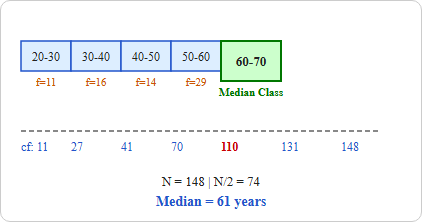
Calculate Total Frequency (N) = 11 + 16 + 14 + 29 + 40 + 21 + 17 = 148.

Find Median Position = N/2 = 148/2 = 74.

Identify Median Class: Cumulative frequencies are 11, 27, 41, 70, 110... Since 74 falls in the 110 group, the class is 60-70.

Apply Interpolation: Median = 60 + [(74 − 70) / 40] × 10 = 60 + [4 / 40] × 10 = 60 + 1 = 61.

∴ The correct answer is 61 years.

Alternate Method

Given: Frequency distribution of patients' ages.

Formula Used: Median = l + [((N/2) − cfp) / f] × h

Where: l = lower limit of median class, N = total frequency, cfp = cumulative frequency of preceding class, f = frequency of median class, h = class width.

Calculations:

⇒ Cumulative Frequencies (cf):

20-30: 11

30-40: 11 + 16 = 27

40-50: 27 + 14 = 41

50-60: 41 + 29 = 70 (cfp)

60-70: 70 + 40 = 110 (Median Class)

70-80: 110 + 21 = 131

80-90: 131 + 17 = 148 (N)

⇒ N/2 = 148 / 2 = 74

⇒ Median Class is 60-70 because its cf (110) is just greater than 74.

⇒ l = 60, cfp = 70, f = 40, h = 10

⇒ Median = 60 + [(74 − 70) / 40] × 10

⇒ Median = 60 + [4 / 40] × 10

⇒ Median = 60 + [1 / 10] × 10

⇒ Median = 60 + 1 = 61

∴ The correct answer is 61 years.

Additional Information

Empirical Relationship

The relationship between Mean, Median, and Mode is given by: Mode = 3 Median − 2 Mean.

Median for Ungrouped Data

If n is odd, Median = ((n+1)/2)th term. If n is even, Median = Average of (n/2)th and (n/2 + 1)th terms.

Class Mark

The Class Mark (xi) is the mid-value of a class interval: (Upper Limit + Lower Limit) ÷ 2.

Question 39

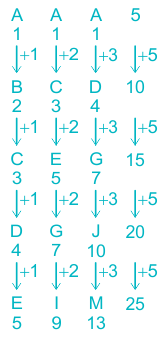
Which of the following letter-number clusters will replace the question mark (?) in the given series to make it logically complete? AAA 5, BCD 10, CEG 15, DGJ 20, ?

  1. AOption (a)

    EKM 25

  2. BOption (b)

    ETN 25

  3. COption (c)

    EGM 25

  4. DOption (d)

    EIM 25

View answer & explanation

Correct answer

Answer: (d)D.

EIM 25

Why this answer is correct

The logic followed here is:

Hence, "Option 4" is the correct answer.

Question 40

S is the father of W. D is the only sister of W. R is the mother's mother of D. L, the mother of P, is married to S.

How is P related to W

  1. AOption (a)

    Sister

  2. BOption (b)

    Father's brother

  3. COption (c)

    Brother

  4. DOption (d)

    Sister's husband

View answer & explanation

Correct answer

Answer: (c)C.

Brother

Why this answer is correct

Given:

  1. S is the father of W.

  2. D is the only sister of W.

3) R is the mother's mother of D. 

4) L, the mother of P, is married to S.

Thus, P is W's brother.

Hence, "Option 3" is the correct answer.

Question 41

A grocer marked his goods at 70% above the cost price and sold them at a discount of X%. If he gained 53% profit, then find the value of X

  1. AOption (a)

    10

  2. BOption (b)

    9

  3. COption (c)

    7

  4. DOption (d)

    11

View answer & explanation

Correct answer

Answer: (a)A.

10

Why this answer is correct

Shortcut Trick

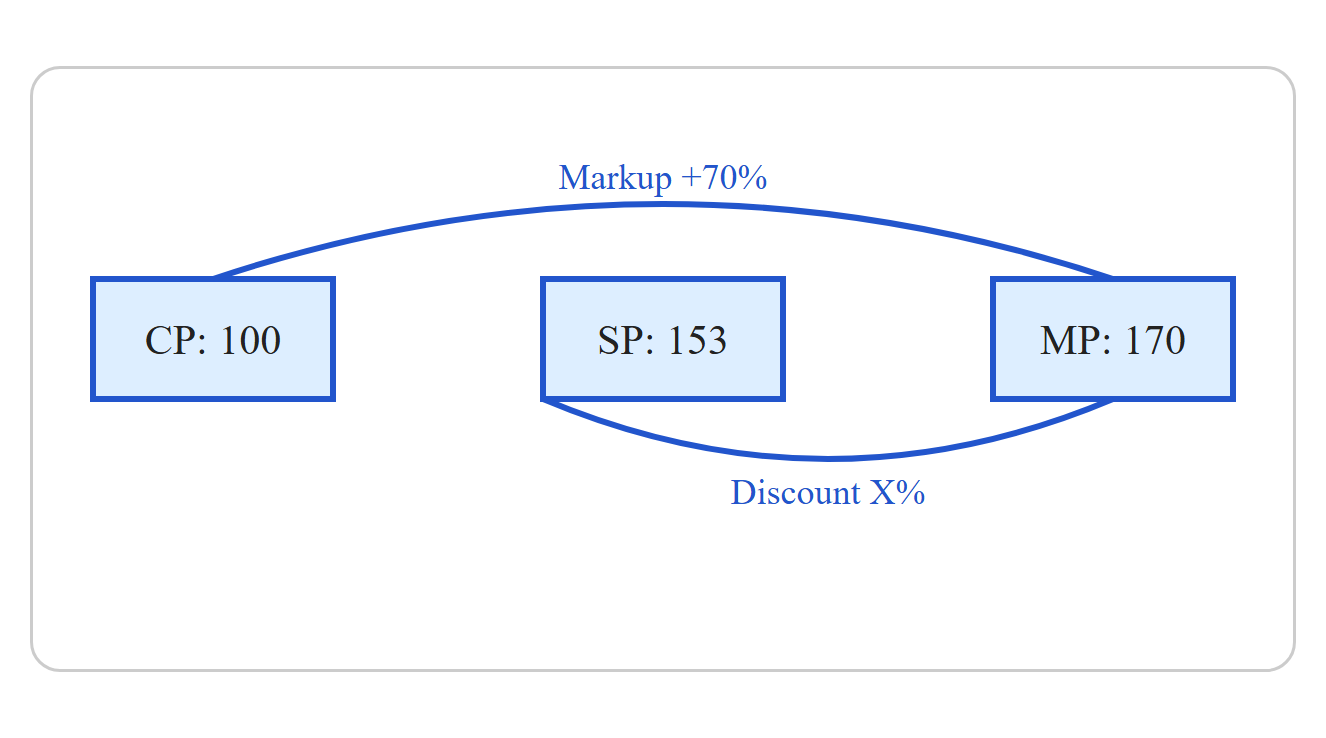
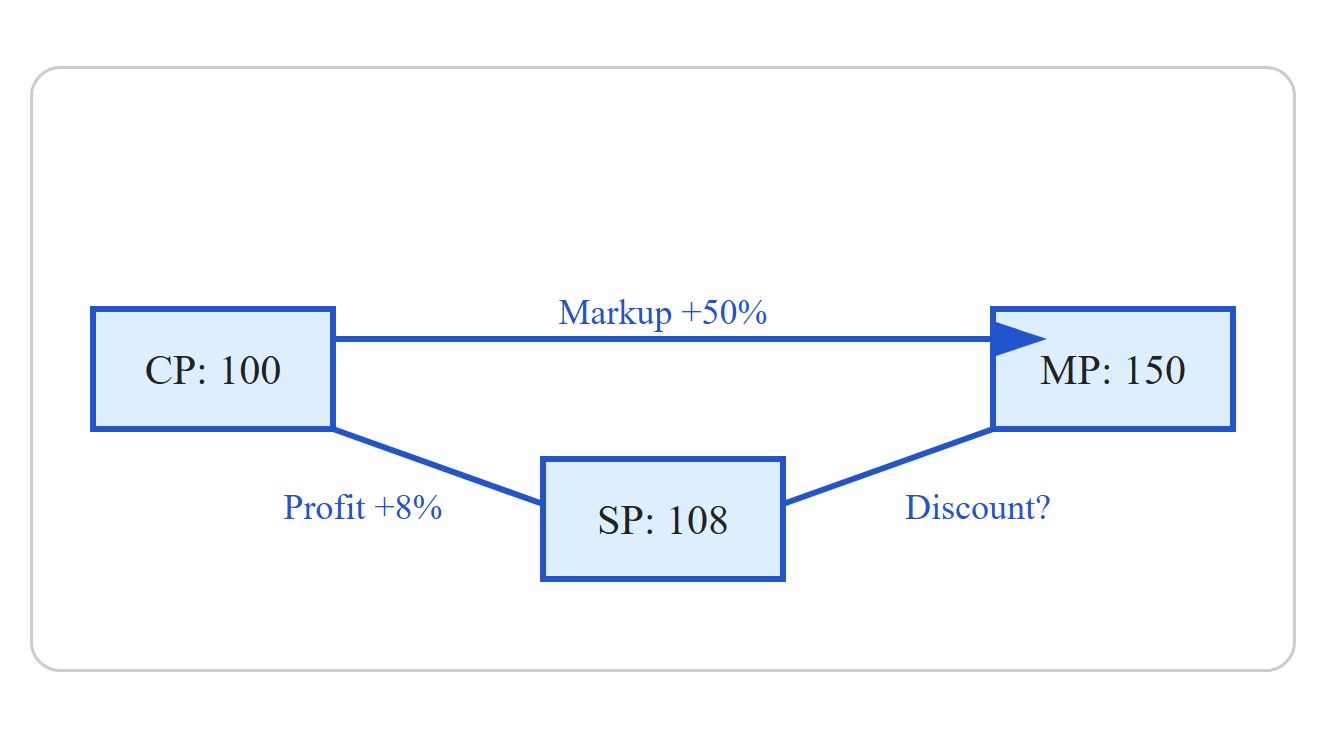
Let Cost Price (CP) be 100.

Marked Price (MP) = 100 + 70% of 100 = 170.

Selling Price (SP) = 100 + 53% of 100 = 153.

Discount = MP − SP = 170 − 153 = 17.

Discount % (X) = (Discount ÷ MP) × 100 = (17 ÷ 170) × 100 = 10%.

∴ The correct answer is 10.

Alternate Method

Given → Markup % = 70%, Profit % = 53%.

Formulas: 100 + Profit% = (100 + Markup%) × (100 − Discount%) ÷ 100

⇒ 100 + 53 = (100 + 70) × (100 − X) ÷ 100

⇒ 153 = 170 × (100 − X) ÷ 100

⇒ 1530 = 17 × (100 − X)

⇒ 90 = 100 − X

⇒ X = 10

∴ The correct answer is 10.

Additional Information

Relationship between MP and CP

The ratio of Marked Price to Cost Price is given by MP ÷ CP = (100 + Profit%) ÷ (100 − Discount%).

Successive Percentage Change

Profit% can be calculated using successive formula: Profit% = Markup% − Discount% − (Markup × Discount) ÷ 100.

Question 42

Who among the following was considered the first notable king of the Pushyabhuti dynasty, ruling from 580-605 CE?

  1. AOption (a)

    Rajyavardhana

  2. BOption (b)

    Harsha Vardhana

  3. COption (c)

    Prabhakaravardhana

  4. DOption (d)

    Naravaradhana

View answer & explanation

Correct answer

Answer: (c)C.

Prabhakaravardhana

Why this answer is correct

The correct answer is option 3,

Key Points

  • Prabhakaravardhana was the first notable king of the Pushyabhuti dynasty and ruled between 580-605 CE.
  • He is remembered for consolidating the dynasty's power and expanding its territorial influence in northern India.
  • Prabhakaravardhana was the father of Harsha Vardhana, who later became one of the most celebrated rulers of ancient India.
  • Under Prabhakaravardhana's reign, the Pushyabhuti dynasty established its capital at Thanesar (modern-day Haryana).
  • Prabhakaravardhana strengthened the military and administration of the dynasty, laying the foundation for its future prominence.

Additional Information

  • Pushyabhuti Dynasty:
  • The Pushyabhuti dynasty was an ancient Indian dynasty that ruled in northern India during the early medieval period.
  • Its capital was located at Thanesar, a prominent city in modern-day Haryana.
  • The dynasty gained prominence under Prabhakaravardhana and reached its zenith under Harsha Vardhana.
  • Harsha Vardhana:
  • Harsha Vardhana, son of Prabhakaravardhana, succeeded him and ruled from 606-647 CE.
  • Harsha expanded the empire significantly and is known for his patronage of arts and Buddhism.
  • He authored notable works like ""Nagananda,"" a Sanskrit drama.
  • Thanesar:
  • Thanesar was a historic city and the capital of the Pushyabhuti dynasty.
  • It was an important center of politics and religion in ancient India.
  • Thanesar is associated with various historical and archaeological sites today.
  • Administration under Prabhakaravardhana:
  • Prabhakaravardhana focused on strengthening the military and administrative systems of the dynasty.
  • He laid the groundwork for the expansion of the dynasty under his successors.

Question 43

The difference between an interior angle and an exterior angle of a regular polygon is 140°. Find the number of sides of the polygon.

  1. AOption (a)

    15

  2. BOption (b)

    16

  3. COption (c)

    18

  4. DOption (d)

    20

View answer & explanation

Correct answer

Answer: (c)C.

18

Why this answer is correct

Shortcut Trick

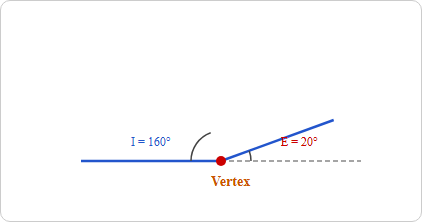
Sum of interior angle (I) and exterior angle (E) is always 180°.

Given: I − E = 140° and we know I + E = 180°.

Subtracting the equations: (I + E) − (I − E) = 180° − 140°.

2E = 40° ⇒ E = 20°.

Number of sides (n) = 360° ÷ Exterior Angle = 360° ÷ 20° = 18.

∴ The correct answer is 18.

Alternate Method

Given: The difference between an interior angle and an exterior angle of a regular polygon is 140°.

Formula Used: Interior angle (I) + Exterior angle (E) = 180°; Number of sides (n) = 360° ÷ E.

Calculations:

⇒ I − E = 140° ... (Equation 1)

⇒ I + E = 180° ... (Equation 2)

⇒ Subtracting Eq. 1 from Eq. 2:

⇒ (I + E) − (I − E) = 180° − 140°

⇒ 2E = 40°

⇒ E = 20°

⇒ n = 360° ÷ 20°

⇒ n = 18

∴ The correct answer is 18.

Question 44

In a row of 22 students facing north, Suman is 14th from the left end. If Dipa is 2nd to the right of Suman, what is Dipa's position from the right end of the line?

  1. AOption (a)

    6th

  2. BOption (b)

    8th

  3. COption (c)

    5th

  4. DOption (d)

    7th

View answer & explanation

Correct answer

Answer: (d)D.

7th

Why this answer is correct

Given: In a row of 22 students facing north, Suman is 14th from the left end. If Dipa is 2nd to the right of Suman.

Suman's position from the left end = 14th

Dipa's position from the left end = 14 + 2 → 16th

Dipa's position from the right end = Total students - Dipa's position from the left end + 1

= 22 - 16 + 1 → 7th

Hence, "Option 4" is the correct answer.

Question 45

A manufacturer fixes his selling price at 30% over the cost of production. If the cost of production goes up by 30%, and the manufacturer raises his selling price by 70%, find the profit percentage.

  1. AOption (a)

    71%

  2. BOption (b)

    69%

  3. COption (c)

    70%

  4. DOption (d)

    73%

View answer & explanation

Correct answer

Answer: (c)C.

70%

Why this answer is correct

Shortcut Trick

Let initial Cost of Production be 100.

Initial Selling Price = 100 × 1.30 = 130.

New Cost of Production = 100 × 1.30 = 130.

New Selling Price = 130 × 1.70 = 221.

Profit = 221 − 130 = 91. Profit% = (91 ÷ 130) × 100 = 70%.

∴ The correct answer is 70%.

Alternate Method

Given → Initial CP = 100, Initial Profit = 30%, Increase in CP = 30%, Increase in SP = 70%. Formulas: Profit = SP − CP | Profit% = (Profit ÷ CP) × 100 | SP = CP × (100 + P%) ÷ 100.

⇒ Assume initial Cost Price (CP1) = 100. ⇒ Selling Price (SP1) = 100 + 30% of 100 = 130. ⇒ New Cost Price (CP2) = 100 + 30% of 100 = 130. ⇒ New Selling Price (SP2) = 130 + 70% of 130 = 130 + 91 = 221. ⇒ New Profit = SP2 − CP2 = 221 − 130 = 91. ⇒ Profit Percentage = (91 ÷ 130) × 100 = 70%.

∴ The correct answer is 70%.

Additional Information

Profit Percentage on Cost Price

The Profit Percentage is always calculated on the Cost Price unless stated otherwise. Formula: P% = (P ÷ CP) × 100.

Effect of Multiplier

When a value increases by x%, it becomes (100 + x)% of its original value, which can be represented by the multiplier (1 + x÷100).

Question 46

What is required for the generation of a sound wave?

  1. AOption (a)

    Air molecules only

  2. BOption (b)

    Electromagnetic carrier wave only

  3. COption (c)

    Vibration and an elastic medium only

  4. DOption (d)

    Vacuum only

View answer & explanation

Correct answer

Answer: (c)C.

Vibration and an elastic medium only

Why this answer is correct

The correct answer is option 3,

Key Points

  • Sound waves are mechanical waves, meaning they require a medium to travel through and cannot propagate in a vacuum.
  • An elastic medium is necessary for the transmission of sound, as it allows the particles within the medium to oscillate and transfer energy between them.
  • Vibration is the primary mechanism for the generation of sound waves, as oscillating objects create disturbances in the surrounding elastic medium.
  • Examples of elastic media include air, water, and solid materials, which facilitate the propagation of sound waves.
  • Without both vibration and an elastic medium, sound waves cannot be generated or transmitted effectively.

Additional Information

  • Mechanical Waves: Sound waves fall under the category of mechanical waves, which require a material medium to propagate.
  • Elastic Medium: An elastic medium is a material that returns to its original shape after being deformed, allowing energy transfer through particle oscillation.
  • Vibration: Vibration refers to the periodic motion of particles about an equilibrium position, which generates disturbances that propagate as sound waves.
  • Speed of Sound: The speed of sound varies depending on the medium; it is fastest in solids, slower in liquids, and slowest in gases.
  • Vacuum: Sound cannot propagate in a vacuum because there are no particles to oscillate and transfer the energy of the wave.

Question 47

The LCM of 40, 78 and another number, X, is 7800. Which of the following can be the value of X.

  1. AOption (a)

    180

  2. BOption (b)

    127

  3. COption (c)

    152

  4. DOption (d)

    200

View answer & explanation

Correct answer

Answer: (d)D.

200

Why this answer is correct

Shortcut Trick

LCM of 40, 78, and X = 7800.

Prime factorization: 7800 = 23 × 31 × 52 × 131.

Check options for prime factors: 200 = 23 × 52. These factors are already within the LCM prime factorization.

Testing other options: 180 has 32, which exceeds 31 in the LCM; 127 and 152 have prime factors (127, 19) not present in 7800.

∴ The correct answer is 200.

Alternate Method

Given: Numbers 40, 78 and X. LCM = 7800.

Formula Used: LCM is the product of the highest power of all prime factors present in the numbers.

Calculations:

⇒ Prime factorization of 40 = 23 × 51

⇒ Prime factorization of 78 = 21 × 31 × 131

⇒ Prime factorization of LCM (7800) = 23 × 31 × 52 × 131

⇒ Comparing LCM factors with 40 and 78, we see that the factor 52 is not fully satisfied (40 only has 51).

⇒ Therefore, X must contain 52 and its other prime factors must not exceed the powers in the LCM.

⇒ Checking Option (4): 200 = 23 × 52. This fits perfectly as 52 is present and 23 is within limits.

∴ The correct answer is 200.

Additional Information

LCM (Least Common Multiple)

The smallest positive integer that is divisible by all the numbers in a set. It is found by taking the highest power of each prime factor.

HCF and LCM Relation

For two numbers a and b, Product of numbers = HCF(a, b) × LCM(a, b).

Prime Factorization Method

Express each number as a product of primes. LCM includes every prime factor at its maximum observed exponent.

Question 48

In the following triads, each group of letters is related to the subsequent one following a certain logic. Select from the given options, the one that follows the same logic.

SAND - DSNA - SDAN

GUNT - TGNU - GTUN

  1. AOption (a)

    FEAR - RFEA - EARF

  2. BOption (b)

    POLE - EPLOI - POEL

  3. COption (c)

    SEAL - ESAL - LEAS

  4. DOption (d)

    JUNK - KJNU - JKUN

View answer & explanation

Correct answer

Answer: (d)D.

JUNK - KJNU - JKUN

Why this answer is correct

The logic followed here is:

SAND - DSNA - SDAN

And,

GUNT - TGNU - GTUN

Similarly,

Option 4) JUNK - KJNU - JKUN

​

​

Hence, "Option 4" is the correct answer.

Question 49

Find the value of(0.06)2+(0.66)2+(0.666)2(0.006)2+(0.066)2+(0.0666)2\frac{(0.06)^2 + (0.66)^2 + (0.666)^2}{(0.006)^2 + (0.066)^2 + (0.0666)^2}

  1. AOption (a)

    10

  2. BOption (b)

    60

  3. COption (c)

    600

  4. DOption (d)

    100

View answer & explanation

Correct answer

Answer: (d)D.

100

Why this answer is correct

Calculation:

(0.06)2+(0.66)2+(0.666)2(0.006)2+(0.066)2+(0.0666)2\frac{(0.06)^2 + (0.66)^2 + (0.666)^2}{(0.006)^2 + (0.066)^2 + (0.0666)^2}

⇒ (0.06)2+(0.66)2+(0.666)2(0.0610)2+(0.6610)2+(0.66610)2\frac{(0.06)^2 + (0.66)^2 + (0.666)^2}{(\frac{0.06}{10})^2 + (\frac{0.66}{10})^{2} + (\frac{0.666}{10})^2}

⇒ (0.06)2+(0.66)2+(0.666)21100[(0.06)2+(0.66)2+(0.666)2]\frac{(0.06)^2 + (0.66)^2 + (0.666)^2}{\frac{1}{100}[(0.06)^2 + (0.66)^2 + (0.666)^2]}

⇒ 100

∴ Option 4 is the correct answer.

Question 50

Sohit and Rohit have a certain sum of money in the ratio of 17 : 14 and they spend their money on purchasing books in the ratio of 12 : 8. After purchasing books each of them has ₹3,392. Find the amount of money that Sohit initially had.

  1. AOption (a)

    ₹7,274

  2. BOption (b)

    ₹7,256

  3. COption (c)

    ₹7,208

  4. DOption (d)

    ₹7,218

View answer & explanation

Correct answer

Answer: (c)C.

₹7,208

Why this answer is correct

Shortcut Trick

Income ratio (Sohit : Rohit) = 17 : 14

Expenditure ratio (Sohit : Rohit) = 12 : 8 → 3 : 2

Since savings are equal (₹3,392), make the parts difference equal: (17−14) = 3 and (3−2) = 1.

Multiply expenditure ratio by 3: 17 : 14 (Income) and 9 : 6 (Expenditure). Difference = 17 − 9 = 8 units.

8 units = ₹3,392 ⇒ 1 unit = ₹424. Sohit's money = 17 × 424 = ₹7,208.

∴ The correct answer is ₹7,208.

Alternate Method

Given: Initial ratio = 17 : 14, Expenditure ratio = 12 : 8 = 3 : 2, Saving = ₹3,392 each.

Formula Used: Income − Expenditure = Savings

⇒ Let Sohit's initial money be 17x and Rohit's be 14x.

⇒ (17x − 3392) / (14x − 3392) = 12 / 8

⇒ (17x − 3392) / (14x − 3392) = 3 / 2

⇒ 2 × (17x − 3392) = 3 × (14x − 3392)

⇒ 34x − 6784 = 42x − 10176

⇒ 42x − 34x = 10176 − 6784

⇒ 8x = 3392

⇒ x = 424

⇒ Sohit's initial money = 17 × 424 = ₹7,208

∴ The correct answer is ₹7,208.

Additional Information

Income and Savings Relationship

Income = Expenditure + Savings. If two people have equal savings, the difference in their incomes is proportional to the difference in their expenditures.

Ratio Balancing Method

When a constant value is added or subtracted from both terms of a ratio, the difference between the ratio parts must be made equal to maintain proportionality.

Question 51

If m=a cos3β and n=b sin3β, then find the value of(ma)23+(nb)23(\frac{m}{a})^{\frac{2}{3}}+(\frac{n}{b})^{\frac{2}{3}}

  1. AOption (a)

    1

  2. BOption (b)

    0

  3. COption (c)

    3

  4. DOption (d)

    2

View answer & explanation

Correct answer

Answer: (a)A.

1

Why this answer is correct

Shortcut Trick

Isolate the trigonometric ratios: m/a = cos3β and n/b = sin3β.

Raise both sides to the power 2/3: (m/a)2/3 = cos2β and (n/b)2/3 = sin2β.

Apply the Pythagorean Identity: sin2β + cos2β = 1.

∴ The correct answer is 1.

Alternate Method

Given:

m = a cos3β

n = b sin3β

Formula Used:

sin2θ + cos2θ = 1

Calculations:

⇒ m/a = cos3β

⇒ (m/a)1/3 = cosβ

⇒ [(m/a)1/3]2 = cos2β

⇒ (m/a)2/3 = cos2β ---- (i)

⇒ n/b = sin3β

⇒ (n/b)1/3 = sinβ

⇒ (n/b)2/3 = sin2β ---- (ii)

⇒ Adding (i) and (ii): (m/a)2/3 + (n/b)2/3 = cos2β + sin2β

⇒ Since sin2β + cos2β = 1, the result is 1.

∴ The correct answer is 1.

Additional Information

Trigonometric Identities

Fundamental identities include sin2θ + cos2θ = 1, 1 + tan2θ = sec2θ, and 1 + cot2θ = cosec2θ.

Laws of Exponents

For any base x, (xa)b = xa×b. This property is used to eliminate cube powers by raising to 1/3 or 2/3.

Substitution Method

In competitive exams, you can substitute β = 0° or 90° to quickly find the value: if β = 0°, m/a = 1 and n/b = 0, result = 1 + 0 = 1.

Question 52

Seven boxes D, E, F, G, I, J and K are kept one over the other but not necessarily in the same order. Only three boxes are kept above G. Only one box is kept between J and G. Only three boxes are kept between J and K. K is kept at some place above G. E is kept immediately below K. F is kept at one of the places above D. I is not kept immediately above or below J. Which box is kept at the lowermost position?

  1. AOption (a)

    D

  2. BOption (b)

    F

  3. COption (c)

    G

  4. DOption (d)

    K

View answer & explanation

Correct answer

Answer: (a)A.

D

Why this answer is correct

Given: Seven boxes D, E, F, G, I, J and K are kept one over the other but not necessarily in the same order. 

1) Only three boxes are kept above G.

Boxes
G

2) Only one box is kept between J and G. 

3) Only three boxes are kept between J and K.

4) K is kept at some place above G.

Boxes
K
G
J

5) E is kept immediately below K.

6) F is kept at one of the places above D.

7) I is not kept immediately above or below J.

Boxes
I
K
E
G
F
J
D

Thus, D box is kept at the lowermost position.

Hence, "Option 1" is the correct answer.

Question 53

Who elects the members of the Estimates Committee in the Indian Parliament? 

  1. AOption (a)

    Members of the Lok Sabha

  2. BOption (b)

    Prime Minister

  3. COption (c)

    Members of the Rajya Sabha

  4. DOption (d)

    President of India

View answer & explanation

Correct answer

Answer: (a)A.

Members of the Lok Sabha

Why this answer is correct

The correct answer is Members of the Lok Sabha.

Key Points

  • The Estimates Committee is constituted every year by the Parliament of India.
  • Members of this committee are elected exclusively by the Members of the Lok Sabha (House of the People).
  • The committee consists of 30 members, all of whom are drawn from the Lok Sabha.
  • Rajya Sabha (Council of States) members are not involved in the election or composition of this committee.
  • The function of the Estimates Committee is to examine the estimates included in the budget and suggest economies in public expenditure.

Additional Information

  • Origin of the Committee
  • The Estimates Committee was first established in 1950 under the Government of India Act, 1935.
  • The provisions for its formation were later incorporated into the Constitution of India.
  • Key Responsibilities
  • The committee examines whether the proposed expenditure is necessary and whether funds are being utilized effectively.
  • It also suggests measures to ensure efficiency in administration.
  • Chairperson
  • The chairperson of the Estimates Committee is appointed by the Speaker of the Lok Sabha from amongst its members.
  • Traditionally, the chairperson is selected from the ruling party or coalition.
  • Limitations
  • The committee does not have the authority to examine policy issues or demand grants.
  • Its focus is restricted to scrutinizing the technical and financial aspects of the estimates.

Question 54

Which of the following statements DOES NOT describe the primary difference between SRAM and DRAM in terms of their internal architecture and performance characteristics? 

  1. AOption (a)

    DRAM is much faster because it has a simple design and doesn’t need refresh.

  2. BOption (b)

    DRAM uses one transistor + one capacitor (1T1C) per cell (high density), while SRAM uses multiple transistors per bit (lower density).

  3. COption (c)

    SRAM is faster and more expensive → used for CPU caches; DRAM is slower and cheaper → used for main memory (RAM).

  4. DOption (d)

    SRAM uses more transistors per bit, yielding faster access than DRAM.

View answer & explanation

Correct answer

Answer: (a)A.

DRAM is much faster because it has a simple design and doesn’t need refresh.

Why this answer is correct

The correct answer is Option 1) “DRAM is much faster and doesn’t need to refresh.”

Key Points

  • Why Option 1 is invalid: DRAM is slower than SRAM and it does require periodic refresh to retain data. The statement reverses both facts.
  • Actual DRAM cell: Typically 1 transistor + 1 capacitor (1T1C) per bit → high density, low cost, but needs refresh → higher latency than SRAM.
  • Actual SRAM cell: Typically multiple transistors (≈6T) forming a bistable latch → no refresh needed, faster access, but lower density and higher cost.
  • Common usage: SRAM → CPU caches (L1/L2/L3). DRAM → system main memory (DIMMs).

Additional Information

  • Option 2 (Correct statement): DRAM uses 1T1C (compact, dense), while SRAM uses multiple transistors per bit (less dense).
  • Option 3 (Correct statement): SRAM is faster and more expensive → used for cache; DRAM is slower and cheaper → used for main memory.
  • Option 4 (Correct statement): SRAM’s multi-transistor latch enables faster access than DRAM’s capacitor-based cell.
  • Performance note: Refresh operations and sense-amp charging in DRAM introduce extra delay; SRAM reads/writes directly from a stable latch.

Question 55

Which Indian Constitution Act provides for the minimization of inequalities in income, property, facilities and opportunities in the Directive Principles of State Policy?

  1. AOption (a)

    42nd Constitutional Amendment 1976

  2. BOption (b)

    97th Constitutional Amendment 2011

  3. COption (c)

    86th Constitutional Amendment 2002

  4. DOption (d)

    44th Constitutional Amendment 1978

View answer & explanation

Correct answer

Answer: (d)D.

44th Constitutional Amendment 1978

Why this answer is correct

The Correct answer is 44th Constitutional Amendment 1978.

Key Points

  • The 44th Amendment Act was enacted to reverse many provisions of the 42nd Amendment introduced during the Emergency.
  • The 42nd Constitutional Amendment Act 1976 is often called the “Mini Constitution” due to the large number of changes it introduced in the Indian Constitution.
  • This amendment made significant changes to the Directive Principles of State Policy (DPSPs), particularly by inserting new directives under Article 39 of the Constitution.
  • It added a directive for the State to secure the minimization of inequalities in income, property, facilities, and opportunities among citizens.
  • The amendment emphasized social, economic, and political justice, aligning with the goals of a welfare state.
  • It also added provisions related to the protection and improvement of the environment, safeguarding of forests and wildlife, and promotion of equal justice.
  • The 42nd Amendment was passed during the period of Emergency (1975–1977) under the leadership of then Prime Minister Indira Gandhi.
  • Through this amendment, the words “Socialist” and “Secular” were also inserted into the Preamble of the Constitution.

Additional Information

  • 97th Constitutional Amendment 2011
  • The 97th Amendment Act dealt with matters related to co-operative societies.
  • It gave constitutional status and protection to co-operatives by inserting Part IXB in the Constitution.
  • The amendment also added the words “co-operative societies” in Article 19(1)(c) and inserted Article 43B as part of DPSPs.
  • 86th Constitutional Amendment 2002
  • The 86th Amendment Act made free and compulsory education a Fundamental Right for children aged 6 to 14 years.
  • It inserted Article 21A into the Constitution and amended Article 45 and Article 51A.
  • This was a crucial step in achieving universal elementary education in India.
  • 44th Constitutional Amendment 1978
  • It restored the power of judicial review and strengthened the position of Fundamental Rights.
  • It also safeguarded Article 352 by making the proclamation of Emergency more difficult.

Question 56

In India, which sector is responsible for transforming natural products into manufactured goods? 

  1. AOption (a)

    Tertiary sector

  2. BOption (b)

    Information sector

  3. COption (c)

    Secondary sector

  4. DOption (d)

    Primary sector

View answer & explanation

Correct answer

Answer: (c)C.

Secondary sector

Why this answer is correct

The correct answer is option 3,Key Points:

  • The Secondary sector is responsible for transforming raw materials or natural products into finished goods through manufacturing and industrial processes.
  • This sector includes industries such as textiles, automobile manufacturing, steel production, cement production, and chemical manufacturing.
  • The secondary sector contributes significantly to India's Gross Domestic Product (GDP), driving economic growth and industrial development.
  • Key activities within this sector include construction, factories, and production units that create value-added goods.
  • It plays a crucial role in employment generation, especially in urban areas, by providing jobs in manufacturing and industrial operations.

Additional Information:

  • Primary Sector:
  • Involves the extraction and harvesting of natural resources like agriculture, fishing, forestry, and mining.
  • Forms the base of the economy and supplies raw materials to the secondary sector.
  • Tertiary Sector:
  • Also known as the service sector, it provides services like banking, education, healthcare, and retail.
  • It supports the primary and secondary sectors by facilitating trade and offering essential services.
  • Role of the Secondary Sector in India:
  • Contributes to industrialization and urbanization, leading to infrastructure development.
  • Promotes export-oriented industries, enhancing foreign exchange reserves.
  • Economic Impact:
  • The secondary sector is vital for creating a balanced economy by reducing dependency on agriculture.
  • It helps in improving living standards through the production of essential and luxury goods.

Question 57

Which of the following letter-clusters should replace # and % so that the pattern and relationship followed between the letter-cluster pair on the left side of :: is the same as that on the right side of :: ?

: RMN :: TOP : %

  1. AOption (a)

    #=MOU, % : YLU

  2. BOption (b)

    NHI, % : YOK

  3. COption (c)

    : KJI, % = YMU

  4. DOption (d)

    #= MHI, % = YTU

View answer & explanation

Correct answer

Answer: (d)D.

#= MHI, % = YTU

Why this answer is correct

The logic followed here is:

Given: # : RMN :: TOP : %  

Option 1) #=MOU, % : YLU → MOU : RMN :: TOP : YLU  

Option 2) # NHI, % : YOK → NHI : RMN :: TOP : YOK

​

Option 3) # : KJI, % = YMU → KJI : RMN :: TOP : YMU

Option 4) #= MHI, % = YTU → MHI : RMN :: TOP : YTU

Hence, "Option 4" is the correct answer.

Question 58

Which smallest number should be added to 22938 so that the sum is completely divisible by 7? 

  1. AOption (a)

    2

  2. BOption (b)

    5

  3. COption (c)

    1

  4. DOption (d)

    6

View answer & explanation

Correct answer

Answer: (c)C.

1

Why this answer is correct

Shortcut Trick

Divide the given number 22938 by 7 to find the remainder.

22938 ÷ 7 leaves a remainder of 6.

The smallest number to be added = 7 − Remainder = 7 − 6 = 1.

∴ The correct answer is 1.

Alternate Method

Given:

The number to be made divisible is 22938.

The divisor is 7.

Formula Used:

Required Number to be added = Divisor − Remainder

Calculations:

⇒ 22938 ÷ 7

⇒ 22938 = 7 × 3276 + 6

⇒ Remainder = 6

⇒ Required smallest number to be added = 7 − 6

⇒ Required smallest number to be added = 1

∴ The correct answer is 1.

Additional Information

Divisibility Rule of 7

Double the last digit of the number and subtract it from the remaining number. If the result is divisible by 7, then the original number is also divisible by 7.

Smallest Number to Subtract

To make a number completely divisible by a divisor, the smallest number that should be subtracted is equal to the Remainder itself.

Smallest Number to Add

To make a number completely divisible by a divisor, the smallest number that should be added is equal to (Divisor − Remainder).

Question 59

Who is the first Indian boxer to win a gold medal at the World Boxing Cup 2025? 

  1. AOption (a)

    Ashishwar Jaiswal

  2. BOption (b)

    Jadumani Singh Mendengbam

  3. COption (c)

    Hitesh Gulia

  4. DOption (d)

    Manish Rathore

View answer & explanation

Correct answer

Answer: (c)C.

Hitesh Gulia

Why this answer is correct

The correct answer is Hitesh Gulia.

Key Points

  • Hitesh Gulia became the first Indian boxer to win a gold medal at the World Boxing Cup 2025.
  • He achieved this historic milestone in the 75 kg middleweight category.
  • The World Boxing Cup 2025 was held in Belgrade, Serbia, showcasing elite boxing talents from around the globe.
  • Hitesh defeated Sergey Ivanov of Russia in the final match with a unanimous decision from the judges.
  • This victory marked a significant achievement for Indian boxing on the international stage, reinforcing India’s growing prominence in the sport.

Additional Information

  • World Boxing Cup
  • It is an international boxing competition organized by the International Boxing Association (IBA).
  • The tournament features top boxers from various countries competing across different weight categories.
  • It serves as a platform for nations to showcase their boxing talent and gain international exposure.
  • Indian Boxing Achievements
  • India has a rich history in boxing, with notable achievements in the Olympics, Asian Games, and Commonwealth Games.
  • Prominent Indian boxers include Mary Kom, Vijender Singh, and Lovelina Borgohain.
  • Hitesh Gulia’s win adds to India’s growing legacy in international boxing events.
  • International Boxing Association (IBA)
  • The IBA is the world governing body for amateur boxing, formerly known as AIBA.
  • It was founded in 1946 and is headquartered in Lausanne, Switzerland.
  • The IBA is responsible for organizing major boxing events and maintaining rules and standards for the sport.
  • Training and Preparation
  • Indian boxers undergo rigorous training at facilities like the National Boxing Academy in Haryana and other Sports Authority of India (SAI) centers.
  • Coaching and support from experienced trainers, alongside exposure to international competitions, play a crucial role in their success.

Question 60

 In which of the following buildings/towns constructed by the Mughals is Salim Chishti's tomb situated? 

  1. AOption (a)

    Fatehpur Sikri

  2. BOption (b)

    Taj Mahal

  3. COption (c)

    Red Fort

  4. DOption (d)

    Agra Fort

View answer & explanation

Correct answer

Answer: (a)A.

Fatehpur Sikri

Why this answer is correct

The correct answer is option 1,

Key Points

  • Salim Chishti’s tomb is located in Fatehpur Sikri, Uttar Pradesh, India.
  • Fatehpur Sikri was built by Mughal Emperor Akbar in the late 16th century and served as his capital for a short period.
  • The tomb honors Sheikh Salim Chishti, a revered Sufi saint whose blessings were believed to have led to the birth of Akbar's son, Jahangir.
  • Salim Chishti’s tomb is an exquisite example of Mughal architecture, featuring intricate marble work and a highly decorative design.
  • The tomb is located within the sacred complex of the Jama Masjid in Fatehpur Sikri and is considered a significant pilgrimage site.

Additional Information

  • Fatehpur Sikri:
  • Built between 1571 and 1585, Fatehpur Sikri is a UNESCO World Heritage Site.
  • The city features several architectural marvels, including the Buland Darwaza, Jama Masjid, and Panch Mahal.
  • It was abandoned due to water scarcity but remains an iconic representation of Mughal grandeur.
  • Sheikh Salim Chishti:
  • He was a 16th-century Sufi saint of the Chishti order.
  • Akbar sought his blessings for a male heir, leading to the birth of Jahangir.
  • His tomb is a revered site attracting pilgrims from across the globe.
  • Mughal Architecture:
  • Mughal architecture is characterized by symmetrical designs, intricate carvings, and use of red sandstone and marble.
  • Key features include domes, arches, minarets, and large courtyards.
  • Prominent examples include the Taj Mahal, Red Fort, and Fatehpur Sikri.
  • Jama Masjid in Fatehpur Sikri:
  • One of the largest mosques in India, built by Akbar in 1571.
  • It serves as a central structure within the Fatehpur Sikri complex.
  • Its design integrates Persian and Indian architectural styles.

Question 61

The mean proportional between 9+37and18−679 + 3\sqrt{7} and 18 - 6\sqrt{7}

  1. AOption (a)

    1

  2. BOption (b)

    6

  3. COption (c)

    13

  4. DOption (d)

    9

View answer & explanation

Correct answer

Answer: (b)B.

6

Why this answer is correct

Shortcut Trick

Mean proportional between a and b is √(a × b).

Product = (9 + 3√7) × (18 − 6√7) = (9 + 3√7) × 2(9 − 3√7).

Using (x + y)(x − y) = x2 − y2 ⇒ 2 × (92 − (3√7)2) = 2 × (81 − 63) = 2 × 18 = 36.

Mean proportional = √36 = 6.

∴ The correct answer is 6.

Alternate Method

Given: First value (a) = 9 + 3√7, Second value (b) = 18 − 6√7.

Formula Used: Mean Proportional (M.P.) = √(a × b)

⇒ M.P. = √[(9 + 3√7) × (18 − 6√7)]

⇒ M.P. = √[(9 + 3√7) × 6(3 − √7)]

⇒ M.P. = √[3(3 + √7) × 6(3 − √7)]

⇒ M.P. = √[18 × (32 − (√7)2)]

⇒ M.P. = √[18 × (9 − 7)]

⇒ M.P. = √[18 × 2]

⇒ M.P. = √36

⇒ M.P. = 6

∴ The correct answer is 6.

Additional Information

Third Proportional

For two numbers a and b, the third proportional is calculated as c = b2 ÷ a.

Fourth Proportional

For three numbers a, b, and c, the fourth proportional d satisfies the ratio a:b = c:d, so d = (b × c) ÷ a.

Mean Proportional Concept

If x is the mean proportional between a and b, then a:x = x:b, which results in x2 = ab.

Question 62

In Windows 11 OS, which of the following is NOT allowed in a file or folder name? 

  1. AOption (a)

    Hyphens (-)

  2. BOption (b)

    Underscores (_)

  3. COption (c)

    Symbols like asterisk (*) or question mark (?)

  4. DOption (d)

    Letters and numbers

View answer & explanation

Correct answer

Answer: (c)C.

Symbols like asterisk (*) or question mark (?)

Why this answer is correct

The correct answer is option 3,"

Key Points

  • Windows operating systems, including Windows 11, prohibit the use of certain special characters in file and folder names.
  • Characters such as asterisks (*), question marks (?), colons (:), slashes (/ \), angle brackets (< >), pipes (|), quotation marks (""), and others are reserved for system use and cannot be included in file or folder names.
  • These restrictions are implemented to avoid conflicts with the file system and ensure proper functioning of the operating system.
  • Hyphens (-), underscores (_), letters, and numbers are allowed in file and folder names, as they do not interfere with system processes.
  • Attempting to use restricted characters will result in an error message from Windows, preventing the creation or renaming of the file or folder.

Additional Information

  • File System in Windows:
  • Windows primarily uses the NTFS (New Technology File System), which governs how data is stored and retrieved on a disk.
  • NTFS supports features like file permissions, encryption, and large file sizes.
  • It enforces character restrictions to maintain system integrity and compatibility.
  • Reserved Characters:
  • Characters like asterisks (*) and question marks (?) are used as wildcards in search and command-line operations.
  • Other reserved characters include angle brackets (< >) for redirection and pipes (|) for command chaining.
  • File Naming Best Practices:
  • Use descriptive names to make files easier to identify.
  • Avoid excessively long file names, as some applications may face issues handling them.
  • Stick to alphanumeric characters, underscores (_), and hyphens (-) for compatibility across different systems.
  • System Reserved Names:
  • Windows prohibits file and folder names like CON, PRN, AUX, NUL, and others, as they are reserved for system devices.
  • These restrictions apply regardless of file extension.

"

Question 63

If x2 + y2 − 10x + 26y + 194 = 0, then the value of x2 + y2 is:

  1. AOption (a)

    190

  2. BOption (b)

    200

  3. COption (c)

    194

  4. DOption (d)

    198

View answer & explanation

Correct answer

Answer: (c)C.

194

Why this answer is correct

Shortcut Trick

Identify half of the coefficients of x and y: a = 10/2 = 5 and b = 26/2 = 13.

Check if a2 + b2 equals the constant: 52 + 132 = 25 + 169 = 194.

Since the sum matches, the equation is (x − 5)2 + (y + 13)2 = 0.

This directly gives x = 5 and y = −13.

Calculating x2 + y2 = 52 + (−13)2 = 194.

∴ The correct answer is 194.

Alternate Method

Given: x2 + y2 − 10x + 26y + 194 = 0

Formula Used: (a − b)2 = a2 − 2ab + b2 and (a + b)2 = a2 + 2ab + b2

⇒ Group the terms: (x2 − 10x) + (y2 + 26y) + 194 = 0

⇒ Complete the square for x: (x2 − 2 × 5 × x + 52) − 25

⇒ Complete the square for y: (y2 + 2 × 13 × y + 132) − 169

⇒ Substitute back: (x − 5)2 − 25 + (y + 13)2 − 169 + 194 = 0

⇒ (x − 5)2 + (y + 13)2 − 194 + 194 = 0

⇒ (x − 5)2 + (y + 13)2 = 0

⇒ Since the sum of squares of real numbers is zero, each term must be zero.

⇒ x − 5 = 0 ⇒ x = 5

⇒ y + 13 = 0 ⇒ y = −13

⇒ Value of x2 + y2 = 52 + (−13)2

⇒ 25 + 169 = 194

∴ The correct answer is 194.

Additional Information

Sum of Squares Property

If the sum of squares of multiple real expressions is zero, i.e., A2 + B2 + C2 = 0, then A = 0, B = 0, and C = 0 individually.

Perfect Square Trinomial

A quadratic expression ax2 + bx + c is a perfect square if its discriminant D = b2 − 4ac = 0.

Completing the Square Technique

To make x2 + bx a perfect square, we add and subtract (b/2)2, resulting in (x + b/2)2 − (b/2)2.

Question 64

The success of the Green Revolution was dependent on institutional support. Which organisation played a key role in agricultural research and the dissemination of HYV seeds in India?

  1. AOption (a)

    NABARD

  2. BOption (b)

    DRDO

  3. COption (c)

    ICAR

  4. DOption (d)

    NITI Aayog

View answer & explanation

Correct answer

Answer: (c)C.

ICAR

Why this answer is correct

The correct answer is ICAR (Indian Council of Agricultural Research).

Key Points

  • ICAR (Indian Council of Agricultural Research) is an autonomous organization under the Department of Agricultural Research and Education (DARE), Ministry of Agriculture and Farmers Welfare, Government of India.
  • It played a pivotal role in the success of the Green Revolution by spearheading agricultural research and promoting the use of High Yielding Variety (HYV) seeds in India.
  • ICAR was instrumental in collaborating with international organizations like the International Rice Research Institute (IRRI) and CIMMYT (International Maize and Wheat Improvement Center) for the transfer and adaptation of HYV seeds.
  • The organization established a strong network of agricultural research institutions and state agricultural universities (SAUs) to disseminate new technologies and practices to farmers.
  • ICAR's coordinated efforts helped achieve self-sufficiency in food grain production during the 1960s and 1970s, a hallmark of the Green Revolution in India.

Additional Information

  • Green Revolution:
  • It refers to a period of agricultural transformation in India during the 1960s-70s, marked by increased food grain production due to the adoption of HYV seeds, chemical fertilizers, and irrigation techniques.
  • Dr. M.S. Swaminathan, often referred to as the "Father of the Green Revolution in India," played a key role in introducing these agricultural reforms.
  • The Green Revolution primarily focused on crops such as wheat and rice, with significant success in states like Punjab, Haryana, and Uttar Pradesh.
  • High Yielding Variety (HYV) Seeds:
  • These seeds are genetically engineered to produce higher yields compared to traditional varieties.
  • They require proper inputs, including adequate irrigation, fertilizers, and pesticides, to achieve their full potential.
  • Role of International Organizations:
  • The International Rice Research Institute (IRRI) in the Philippines developed the semi-dwarf rice variety IR8, which contributed to increased rice production in India.
  • CIMMYT in Mexico developed high-yielding and disease-resistant wheat varieties that were adapted for Indian conditions.
  • Challenges of the Green Revolution:
  • While it boosted food grain production, it led to environmental issues such as soil degradation, water scarcity, and overuse of chemical fertilizers and pesticides.
  • The benefits were unevenly distributed, with some regions and crops receiving more focus than others.
  • Current Role of ICAR:
  • ICAR continues to contribute to agricultural research, focusing on sustainable practices, climate-resilient crops, and biotechnology to meet modern challenges.

Question 65

Read the given statements and conclusions carefully. Assuming that the information given in the statements is true, even if it appears to be at variance with commonly known facts, decide which of the given conclusion(s) logically follow(s) from the statements.

Statements: All tanks are figs.

No eagles are tanks.

Some mugs are eagles.

Conclusions:

(I) Some figs are not eagles.

(II) Some mugs are not tanks.

  1. AOption (a)

    Neither conclusion (I) nor (II) follows.

  2. BOption (b)

    Only conclusion (II) follows.

  3. COption (c)

    Both conclusions (I) and (II) follow.

  4. DOption (d)

    Only conclusion (I) follows.

View answer & explanation

Correct answer

Answer: (c)C.

Both conclusions (I) and (II) follow.

Why this answer is correct

The least possible Venn diagram for the given statements is as shown below :

Conclusions:

(I) Some figs are not eagles. → Follow (As all tanks are figs and no eagles are tanks. As whole tanks comes in figs and cannot be eagles, therefore is true)

(II) Some mugs are not tanks → Follow (As no eagles are tanks and some mugs are eagles. As no tanks can be eagles which has some part common with mugs, therefore it is true.)

∴ Here, Both conclusions (I) and (II) follow.​

Hence, the correct answer is "Option 3".

Question 66

 In April 2025, India and Italy strengthened their strategic partnership by advancing cooperation in which of the following areas?

  1. AOption (a)

    Tourism and cultural exchange

  2. BOption (b)

    Space exploration and agriculture

  3. COption (c)

    Education and healthcare

  4. DOption (d)

    Trade, defense, clean energy, and connectivity

View answer & explanation

Correct answer

Answer: (d)D.

Trade, defense, clean energy, and connectivity

Why this answer is correct

The correct answer is Trade, defense, clean energy, and connectivity.

Key Points

  • In April 2025, India and Italy advanced their strategic partnership, focusing on trade, defense, clean energy, and connectivity.
  • The collaboration emphasizes strengthening bilateral trade, with both nations aiming to boost economic exchanges and enhance market access.
  • Defense cooperation includes joint military exercises, technology sharing, and defense manufacturing under India’s ‘Make in India’ initiative.
  • Clean energy collaboration focuses on renewable energy, particularly in the areas of solar, wind, and hydrogen energy, to combat climate change.
  • Connectivity initiatives highlight projects like transport infrastructure, smart cities, and digital innovation to improve economic integration between the two countries.

Additional Information

  • India-Italy Bilateral Relations:
  • India and Italy enjoy a robust relationship based on shared democratic values, cultural ties, and economic interests.
  • Italy is one of India’s largest trading partners in the European Union, with bilateral trade crossing significant milestones in recent years.
  • Defense Cooperation:
  • The partnership includes joint military exercises, defense R&D, and technology-sharing agreements.
  • Italy has expressed interest in collaborating on India’s defense manufacturing programs, aligning with the ‘Make in India’ initiative.
  • Clean Energy Initiatives:
  • India and Italy are committed to achieving sustainable development through renewable energy projects.
  • Both nations are part of international frameworks like the International Solar Alliance (ISA) to promote clean energy adoption.
  • Connectivity and Digital Innovation:
  • Connectivity efforts include enhancing infrastructure in sectors like transport and smart cities.
  • Digital innovation focuses on AI, IoT, and blockchain technologies to boost economic and technological integration.

Question 67

Anu, Beena, Deepa, Heena, Kareena, Leena and Reena sit in a straight line, facing north. Kareena sits third to the right of Beena, who sits second to the right of Deepa. Reena sits to the immediate left of Leena. Anu sits second to the left of Heena. Three of the following four are alike in a certain way and thus form a group. Which among the following do NOT belong to that group?

  1. AOption (a)

    Leena and Kareena

  2. BOption (b)

    Anu and Deepa

  3. COption (c)

    Beena and Reena

  4. DOption (d)

    Heena and Reena

View answer & explanation

Correct answer

Answer: (d)D.

Heena and Reena

Why this answer is correct

Given: Anu, Beena, Deepa, Heena, Kareena and Reena sit in a straight line, facing north.

1) Kareena sits third to the right of Beena, who sits second to the right of Deepa.

2) Reena sits to the immediate left of Leena.

3) Anu sits second to the left of Heena.

Thus, according to the final arrangement:

Option 1) Leena and Kareena → Immediate neighbours 

Option 2) Anu and Deepa → Immediate neighbours

Option 3) Beena and Reena → Immediate neighbours

Option 4) Heena and Reena → Heena sits second to the left of Renna

Hence, "Option 4" is the correct answer.

Question 68

If A varies directly as B, and A = 210 when B = 51, then find A when B = 136.

  1. AOption (a)

    558

  2. BOption (b)

    559

  3. COption (c)

    560

  4. DOption (d)

    563

View answer & explanation

Correct answer

Answer: (c)C.

560

Why this answer is correct

Shortcut Trick

Since A varies directly as B, the ratio A/B remains constant.

Direct proportion logic: A1 ÷ B1 = A2 ÷ B2

210 ÷ 51 = A2 ÷ 136

A2 = (210 × 136) ÷ 51 = 210 × (8 ÷ 3) × 1 = 70 × 8 = 560

∴ The correct answer is 560.

Alternate Method

Given: A ∝ B, A1 = 210, B1 = 51, B2 = 136.

Formula Used: A = k × B, where k is the constant of proportionality.

⇒ 210 = k × 51

⇒ k = 210 ÷ 51 = 70 ÷ 17

⇒ A = (70 ÷ 17) × 136

⇒ A = 70 × 8

⇒ A = 560

∴ The correct answer is 560.

Additional Information

Direct Variation

When one quantity increases, the other increases in the same ratio. Formula: y = kx or y1/x1 = y2/x2.

Inverse Variation

When one quantity increases, the other decreases in the same ratio. Formula: xy = k or x1y1 = x2y2.

Constant of Proportionality

The fixed ratio 'k' between two proportional quantities that defines their relationship.

Question 69

Mr. RST starts from Point A and drives 16 km towards the south. He then takes a left turn, drives 6 km, turns left and drives 23 km. He then takes a left turn and drives 8 km, turns left and drives 3 km. He then takes a right turn and drives 4 km. He takes a final left turn, drives 4 km and stops at Point A. In what direction (assuming any) and which direction should he drive in order to reach Point A again? (All turns are 90-degree turns only unless specified)

  1. AOption (a)

    3 km to the west

  2. BOption (b)

    6 km to the east

  3. COption (c)

    5 km to the east

  4. DOption (d)

    2 km to the south

View answer & explanation

Correct answer

Answer: (b)B.

6 km to the east

Why this answer is correct

Given:

Mr. RST starts from Point A and drives 16 km towards the south.

He then takes a left turn, drives 6 km, turns left and drives 23 km.

He then takes a left turn and drives 8 km, turns left and drives 3 km.

He then takes a right turn and drives 4 km.

He takes a final left turn, drives 4 km and stops at Point A. 

Thus, Mr. RST should drive 6 km (4 km + 8 km - 6 km) in the east direction in order to reach Point A again.​

Hence, "Option 2" is the correct answer.

Question 70

What should come in place of the question mark (?) in the given series? 4 8 15 27 46 ? 113

  1. AOption (a)

    68

  2. BOption (b)

    76

  3. COption (c)

    72

  4. DOption (d)

    74

View answer & explanation

Correct answer

Answer: (d)D.

74

Why this answer is correct

The logic followed here is:

Hence, "Option 4" is the correct answer.

Question 71

The most important source for Samudragupta's reign is:

  1. AOption (a)

    Prayagraj Prashasti

  2. BOption (b)

    Arthashastra

  3. COption (c)

    Milindapanho

  4. DOption (d)

    Vishnu Purana

View answer & explanation

Correct answer

Answer: (a)A.

Prayagraj Prashasti

Why this answer is correct

The correct answer is option 1,"Key Points: - The Prayagraj Prashasti, also known as the Allahabad Pillar Inscription, is the primary source of information about Samudragupta's reign. - It was composed by Harisena, a court poet of Samudragupta, in classical Sanskrit. - The inscription highlights Samudragupta's military campaigns, administrative achievements, and his conquests over various regions. - The Prashasti refers to Samudragupta as the 'Napoleon of India' due to his extensive military expeditions and victories. - It provides insights into the political and cultural landscape of India during the Gupta Empire. Additional Information: - Samudragupta was a ruler of the Gupta dynasty who reigned from approximately 335-380 CE and is considered one of India's greatest emperors. - The Prayagraj Prashasti is inscribed on the Ashokan pillar located in Prayagraj (Allahabad) and represents an important piece of historical evidence for the Gupta period. - Harisena, the composer of the Prashasti, was not only a poet but also served as a minister and military officer under Samudragupta. - The inscription follows the tradition of eulogizing the king, a common practice during ancient Indian dynasties. - The Gupta Empire under Samudragupta witnessed advancements in arts, science, and literature, often referred to as the 'Golden Age of India'."

Question 72

What is the name of the equestrian competition event that began on March 25, 2025, and ended on March 30, 2025, where Witharika Singhania secured the first position?

  1. AOption (a)

    World Equestrian Cup

  2. BOption (b)

    Azathof CSI Lier

  3. COption (c)

    Indian Equestrian Championship

  4. DOption (d)

    Asian Equestrian Games

View answer & explanation

Correct answer

Answer: (b)B.

Azathof CSI Lier

Why this answer is correct

The correct answer is Azathof CSI Lier.

Key Points

  • The Azathof CSI Lier is an international equestrian competition held in Lier, Belgium, renowned for showcasing top-tier talent in showjumping events.
  • The 2025 edition of the Azathof CSI Lier ran from March 25 to March 30, featuring competitive events across multiple categories.
  • Witharika Singhania, representing India, secured the first position in one of the prestigious showjumping events during this competition.
  • The Azathof CSI Lier is recognized for attracting elite riders and horses from across the globe, making it a significant event on the international equestrian calendar.
  • The competition adheres to the regulations set by the International Federation for Equestrian Sports (FEI), ensuring high standards of integrity and professionalism.

Additional Information

  • Equestrian Sports:
  • Equestrian sports include disciplines like showjumping, dressage, and eventing, governed internationally by the FEI.
  • Showjumping involves riders and their horses navigating a course of fences within a set time, testing speed, agility, and precision.
  • Dressage focuses on the horse's ability to perform predefined movements, emphasizing harmony between rider and horse.
  • International Federation for Equestrian Sports (FEI):
  • The FEI is the global governing body for equestrian sports, founded in 1921 and headquartered in Lausanne, Switzerland.
  • It oversees major competitions like the Olympics, World Equestrian Games, and other international events.
  • Witharika Singhania:
  • Witharika Singhania is an emerging talent in the equestrian world and a prominent Indian rider excelling in international competitions.
  • Her success at the Azathof CSI Lier 2025 highlights India’s growing presence in equestrian sports on the global stage.
  • Belgium’s Role in Equestrian Sports:
  • Belgium is known for its rich equestrian tradition, hosting numerous international events and producing world-class riders and horses.
  • Facilities like the Azathof equestrian center offer state-of-the-art amenities for training and competitions.

Question 73

Seven people, A, B, C, D, S, T, and U are sitting in a row, facing north. No one sits to the right of D. Only three people sit between D and S. Only two people sit between S and T. C sits third to the left of U. A sits to the immediate right of U. How many people sit between B and T?

  1. AOption (a)

    Three

  2. BOption (b)

    One

  3. COption (c)

    Four

  4. DOption (d)

    Two

View answer & explanation

Correct answer

Answer: (a)A.

Three

Why this answer is correct

Given: Seven people, A, B, C, D, S, T, and U are sitting in a row, facing north. 

1) No one sits to the right of D. 

2) Only three people sit between D and S.

3) Only two people sit between S and T.

4) C sits third to the left of U.

5) A sits to the immediate right of U.

After positioning C, U and A only one position is left which will be occupied by the only person left i.e. B.

Thus, three people sit between B and T.

Hence, "Option 1" is the correct answer.

Question 74

Find the value of K, for which the quadratic equation x2 + 4x + K=0 have equal roots?

  1. AOption (a)

    4

  2. BOption (b)

    5

  3. COption (c)

    3

  4. DOption (d)

    6

View answer & explanation

Correct answer

Answer: (a)A.

4

Why this answer is correct

Shortcut Trick

For any quadratic equation of the form x2 + bx + K = 0, the condition for equal roots is K = (b/2)2.

In the given equation x2 + 4x + K = 0, the value of b is 4.

Substituting the value: K = (4 ÷ 2)2 = 22 = 4.

∴ The correct answer is 4.

Alternate Method

Given: The quadratic equation is x2 + 4x + K = 0.

Formula Used: For a standard quadratic equation ax2 + bx + c = 0, the roots are equal if and only if the discriminant (D) is zero.

The formula for the discriminant is D = b2 − 4ac.

⇒ Comparing x2 + 4x + K = 0 with ax2 + bx + c = 0, we get:

⇒ a = 1, b = 4, c = K

⇒ For equal roots, D = 0

⇒ (4)2 − 4 × 1 × K = 0

⇒ 16 − 4K = 0

⇒ 4K = 16

⇒ K = 16 ÷ 4

⇒ K = 4

∴ The correct answer is 4.

Additional Information

Nature of Roots

The value of D = b2 − 4ac determines the nature of roots: D > 0 means real and distinct roots, D = 0 means real and equal roots, and D < 0 means imaginary roots.

Sum and Product of Roots

For the equation ax2 + bx + c = 0, the Sum of roots (α + β) = −b/a and the Product of roots (αβ) = c/a.

Quadratic Formula

The roots of a quadratic equation are calculated using x = (−b ± √D) ÷ 2a.

Question 75

A hollow spherical shell is made of a metal of density 7 g/cm3. It's internal and external radii are 0 cm and 3 cm respectively. What is the approximte weight (in kg) of the shell? 

Take π=227\frac{22}{7} and Densty=massvolume\frac{mass}{volume}

  1. AOption (a)

    2.15

  2. BOption (b)

    0.792

  3. COption (c)

    2.208

  4. DOption (d)

    2.14

View answer & explanation

Correct answer

Answer: (b)B.

0.792

Why this answer is correct

Shortcut Trick

Mass = Density × Volume

Volume of shell = 4/3 × π × (R3 − r3)

Mass = 7 × (4/3 × 22/7 × (33 − 03)) = 4/3 × 22 × 27 = 88 × 9 = 792 g

Weight in kg = 792 ÷ 1000 = 0.792 kg

∴ The correct answer is 0.792 kg.

Alternate Method

Given:

External radius (R) = 3 cm

Internal radius (r) = 0 cm

Density (ρ) = 7 g/cm3

Formula Used:

Volume of Sphere = 4/3 × π × R3

Mass = Density × Volume

Calculations:

⇒ Volume = 4/3 × 22/7 × (3)3

⇒ Volume = 4/3 × 22/7 × 27

⇒ Volume = 4 × 22/7 × 9 = 792/7 cm3

⇒ Mass = Density × Volume

⇒ Mass = 7 × (792/7) = 792 g

⇒ Weight in kg = 792 ÷ 1000

⇒ Weight = 0.792 kg

∴ The correct answer is 0.792 kg.

Additional Information

Volume of Hollow Sphere

The volume of a hollow spherical shell is given by V = 4/3 × π × (R3 − r3), where R is the outer radius and r is the inner radius.

Mass and Density Relation

The relationship is Mass = Density × Volume. Ensure units are consistent (e.g., g/cm3 with cm3 results in grams).

Unit Conversion

To convert grams to kilograms, divide the value by 1000 since 1 kg = 1000 g.

Question 76

Which traditional method of Vedic chanting is regarded as the most complex and extensive among all the recitation styles?

  1. AOption (a)

    Shikshapatha

  2. BOption (b)

    Jatapattha

  3. COption (c)

    Dandapattha

  4. DOption (d)

    Ghanapattha

View answer & explanation

Correct answer

Answer: (d)D.

Ghanapattha

Why this answer is correct

The correct answer is option 4,

Key Points

  • Ghanapattha is the most intricate and elaborate style of Vedic chanting, known for its systematic and rhythmic recitation of Vedic mantras.
  • This method involves repeating words and phrases in various permutations and combinations, enhancing the precision of pronunciation and preserving the original text.
  • Ghanapattha is considered a highly advanced form of recitation and requires rigorous training and mastery over the Vedic texts.
  • It is primarily used to ensure the preservation and transmission of Vedic knowledge in its purest form, following oral traditions.
  • Practiced by highly skilled Vedic scholars, Ghanapattha is seen as a symbol of dedication to the sacred texts and their cultural significance.

Additional Information

  • Shikshapatha: Refers to the basic method of learning Vedic mantras by focusing on pronunciation, phonetics, and intonation.
  • Jatapattha: A more complex style than Shikshapatha, it involves weaving words in a criss-cross pattern to ensure accuracy in transmission.
  • Dandapattha: Another method of recitation, focusing on structured repetition of phrases, though less intricate than Ghanapattha.
  • Vedic Chanting Tradition: These styles are part of the oral tradition used to preserve Vedic knowledge over millennia in the absence of written texts.
  • Importance of Ghanapattha: It exemplifies the meticulous efforts of ancient scholars to prevent distortion of sacred texts, ensuring their purity for future generations.

Question 77

David ranked 19th from the top and 25th from the bottom in his class. How many students are there in his class?

  1. AOption (a)

    44

  2. BOption (b)

    45

  3. COption (c)

    42

  4. DOption (d)

    43

View answer & explanation

Correct answer

Answer: (d)D.

43

Why this answer is correct

Given: David ranked 19th from the top and 25th from the bottom in his class. 

David's rank from the top = 19

David's rank from the bottom = 25

Total students = David's rank from the top + David's rank from the bottom - 1

= 19 + 25 - 1

= 43

Hence, "Option 4" is the correct answer.

Question 78

The length of each of the two equal sides of an isosceles triangle is 41 cm and the length of its base is 18 cm. The area (in cm2) of the triangle is:

  1. AOption (a)

    351

  2. BOption (b)

    355

  3. COption (c)

    365

  4. DOption (d)

    360

View answer & explanation

Correct answer

Answer: (d)D.

360

Why this answer is correct

Shortcut Trick

Height of isosceles triangle (h) = √(a2 − (b/2)2) where a = 41 and b = 18.

h = √(412 − 92) = √(1681 − 81) = √1600 = 40 cm.

Area = 1/2 × base × height = 1/2 × 18 × 40 = 360 cm2.

∴ The correct answer is 360 cm2.

Alternate Method

Given: Equal sides (a) = 41 cm, Base (b) = 18 cm.

Using Pythagoras Theorem in the right-angled half-triangle:

⇒ Height2 + (Base/2)2 = (Equal side)2

⇒ h2 + 92 = 412

⇒ h2 + 81 = 1681

⇒ h2 = 1600

⇒ h = 40 cm

⇒ Area = 1/2 × 18 × 40

⇒ Area = 360 cm2

∴ The correct answer is 360 cm2.

Additional Information

Heron's Formula

Area = √(s(s−a)(s−b)(s−c)), where s is the semi-perimeter (a+b+c)/2.

Isosceles Triangle Area Formula

Area = (b/4) × √(4a2 − b2), where a is the equal side and b is the base.

Perimeter of Isosceles Triangle

Perimeter = 2a + b, representing the sum of all three boundaries.

Question 79

Consider the following statements regarding the visit of Indian Navy's First Training Squadron (ITS) to Thailand in March 2025.

  1. INS Sujata, INS Shardul and ICGS Veera were part of the Indian Navy's First Training Squadron that visited Phuket Deep Sea  Port. 
  2. The Indian ships conducted PASSEX with HTMS Huahin.
  3. The visits included war-like drills, such as stimulated naval combat and live-fie exercises.

which of the following statements is/are correct?

  1. AOption (a)

    Only 2 and 3

  2. BOption (b)

    Only 1 and 2

  3. COption (c)

    1, 2 and 3

  4. DOption (d)

    Only 1

View answer & explanation

Correct answer

Answer: (b)B.

Only 1 and 2

Why this answer is correct

The correct answer is option 2,

Key Points

  • INS Sujata, INS Shardul, and ICGS Veera were indeed part of the Indian Navy's First Training Squadron that visited Phuket Deep Sea Port in Thailand in March 2025.
  • The Indian Navy ships conducted a PASSAGE EXERCISE (PASSEX) with the Royal Thai Navy vessel HTMS Huahin.
  • War-like drills and live-fire exercises were not conducted as part of the visit, focusing instead on fostering maritime cooperation and friendship between the two nations.
  • PASSAGE EXERCISES (PASSEX) are routine naval drills conducted to enhance interoperability and mutual understanding between navies.
  • The visit of the ITS squadron highlights India's commitment to regional maritime security and bilateral defense cooperation.

Additional Information

  • INS Sujata: A Sukanya-class patrol vessel, primarily used for training naval cadets and maritime security operations.
  • INS Shardul: A Landing Ship Tank (Large) designed for amphibious operations and humanitarian assistance and disaster relief missions.
  • ICGS Veera: An Advanced Offshore Patrol Vessel (AOPV) operated by the Indian Coast Guard for surveillance and search-and-rescue operations.
  • PASSEX: Passage Exercises are conducted between navies to enhance operational synergy and demonstrate shared commitment to maritime security.
  • India-Thailand Relations: Both nations share strong historical, cultural, and maritime ties, with regular defense cooperation, joint exercises, and high-level engagements.

Question 80

 How are the proceedings and status of a Lok Adalat treated under Indian law?

  1. AOption (a)

    Proceedings are judicial and Lok Adalat is deemed a civil court under CrPC.

  2. BOption (b)

    Proceedings are advisory and Lok Adalat is not considered a civil court.

  3. COption (c)

    Proceedings are not judicial and have no legal standing in courts.

  4. DOption (d)

    Proceedings are informal and not recognised under any law.

View answer & explanation

Correct answer

Answer: (a)A.

Proceedings are judicial and Lok Adalat is deemed a civil court under CrPC.

Why this answer is correct

The correct answer is Proceedings are judicial and Lok Adalat is deemed a civil court under CrPC..

Key Points

  • Lok Adalat is a statutory body under the Legal Services Authorities Act, 1987, established to provide speedy and amicable resolution of disputes.
  • The proceedings of Lok Adalat are judicial in nature, and it functions as a civil court as defined under the Code of Civil Procedure (CrPC).
  • Decisions made by Lok Adalat are legally binding, and the awards are enforceable as a decree of a civil court.
  • Cases resolved in Lok Adalat are free from appeal unless parties find the outcome unsatisfactory and choose to pursue regular court proceedings.
  • Lok Adalat promotes alternative dispute resolution (ADR) mechanisms to reduce pendency in courts and ensure quick access to justice.

Additional Information

  • Legal Services Authorities Act, 1987:
  • It provides for the establishment of Lok Adalats and other institutions to ensure access to justice for all, particularly underprivileged sections.
  • The Act empowers Lok Adalat to resolve disputes amicably through compromise and conciliation.
  • Jurisdiction of Lok Adalat:
  • Lok Adalat can handle cases related to civil disputes, family matters, motor accident claims, and small offenses not involving serious penalties.
  • It cannot handle non-compoundable criminal cases.
  • Benefits of Lok Adalat:
  • It is cost-effective and eliminates lengthy court procedures.
  • Parties save time and resources while ensuring resolution through mutual understanding.
  • Binding Nature of Lok Adalat Awards:
  • The decision of Lok Adalat is binding on all parties and holds the same status as a civil court decree.
  • Parties retain the option to approach regular courts if dissatisfied, but appeals are rare due to the participatory nature of the process.

Question 81

GG 12 is related to CB 29 in a certain way. In the same way, IK 2 is related to EF 19. To which of the following is RN -6 related, following the same logic?

  1. AOption (a)

    NI 11

  2. BOption (b)

    MI 6

  3. COption (c)

    MH 6

  4. DOption (d)

    NH 11

View answer & explanation

Correct answer

Answer: (a)A.

NI 11

Why this answer is correct

The logic followed here is:

GG 12 is related to CB 29

And,

IK 2 is related to EF 19

Similarly,

RN -6 is related to

​

Hence, "Option 1" is the correct answer.

Question 82

Raj spent ₹1,200, ₹1,300, ₹1,400, ₹1,100, ₹1,300 and ₹1,200 on six consecutive days of a trip. What was his average daily spending over these six days?

  1. AOption (a)

    ₹1,150

  2. BOption (b)

    ₹1,350

  3. COption (c)

    ₹1,250

  4. DOption (d)

    ₹1,300

View answer & explanation

Correct answer

Answer: (c)C.

₹1,250

Why this answer is correct

Shortcut Trick

Assume a base value of 1200 for calculation.

Find the deviations from 1200: 0, +100, +200, −100, +100, 0.

Net deviation = 0 + 100 + 200 − 100 + 100 + 0 = +300.

Average deviation = 300 ÷ 6 = 50.

Average daily spending = 1200 + 50 = ₹1,250.

∴ The correct answer is ₹1,250.

Alternate Method

Given:

Spending on 6 consecutive days: ₹1,200, ₹1,300, ₹1,400, ₹1,100, ₹1,300, ₹1,200.

Formula Used:

Average = (Sum of all observations) ÷ (Total number of observations)

Calculations:

⇒ Sum of Spending = 1200 + 1300 + 1400 + 1100 + 1300 + 1200

⇒ Total Spending = 7500

⇒ Total Days = 6

⇒ Average = 7500 ÷ 6

⇒ Average = 1250

∴ The correct answer is ₹1,250.

Additional Information

Definition of Average

The Arithmetic Mean is the central value of a set of numbers, calculated by dividing the total sum by the count of numbers.

Properties of Average

The sum of deviations of all observations from their mean is always zero. If every value increases by k, the average also increases by k.

Relationship Formula

Total Sum = Average × Number of entities. This is useful for finding missing values in a dataset.

Question 83

 Which cytoskeletal protein is the major component of neurofilaments that helps maintain the caliber and integrity of large axons?

  1. AOption (a)

    Keratin protein

  2. BOption (b)

    Actin protein

  3. COption (c)

    Tubulin protein

  4. DOption (d)

    Neurofilament protein

View answer & explanation

Correct answer

Answer: (d)D.

Neurofilament protein

Why this answer is correct

The correct answer is option 4,

Key Points

  • Neurofilament proteins are intermediate filaments specifically expressed in neurons and are essential for maintaining the structural integrity and diameter of axons.
  • Neurofilaments are composed of three primary subunits: NF-L (light chain), NF-M (medium chain), and NF-H (heavy chain), which together form a stable cytoskeletal network.
  • These proteins are particularly abundant in large axons and play a critical role in axonal transport and neuronal signaling.
  • Neurofilaments contribute to the mechanical strength of axons, ensuring their resilience and ability to transmit signals efficiently across long distances.
  • Mutations or abnormalities in neurofilament proteins are linked to neurodegenerative conditions such as Amyotrophic Lateral Sclerosis (ALS) and Charcot-Marie-Tooth disease.

Additional Information

  • Cytoskeletal Proteins:
  • These are structural proteins responsible for maintaining the shape, structure, and organization of cells.
  • The major cytoskeletal proteins include actin filaments, microtubules, and intermediate filaments.
  • Intermediate filaments like neurofilaments are unique to specific cell types, such as neurons.
  • Axonal Transport:
  • Axonal transport refers to the active movement of organelles, proteins, and other cellular materials along the axon.
  • It is vital for neuronal function and relies on cytoskeletal structures like microtubules and neurofilaments.
  • Neurodegenerative Disorders:
  • Neurodegenerative diseases like ALS and Alzheimer's are associated with cytoskeletal dysfunction and aggregation of proteins.
  • Research on neurofilaments helps in understanding the pathology of these disorders.
  • Intermediate Filaments:
  • Intermediate filaments provide mechanical support to cells and are more stable than actin filaments and microtubules.
  • They are categorized into different types based on the cell type, such as keratin in epithelial cells and neurofilaments in neurons.

Question 84

A shopkeeper fixes the marked price of an item 50% above its cost price. What percentage of discount on the marked price should be allowed to gain 8%?

  1. AOption (a)

    29%

  2. BOption (b)

    30%

  3. COption (c)

    28%

  4. DOption (d)

    27%

View answer & explanation

Correct answer

Answer: (c)C.

28%

Why this answer is correct

Shortcut Trick

Let Cost Price (CP) be 100.

Marked Price (MP) = 100 + 50% of 100 = 150.

To gain 8%, Selling Price (SP) = 100 + 8% of 100 = 108.

Discount = MP − SP = 150 − 108 = 42.

Discount% = (42 ÷ 150) × 100 = 28%.

∴ The correct answer is 28%.

Alternate Method

Given → Markup% = 50%, Profit% = 8%. Formulas: SP = CP × (100 + P%) ÷ 100 | MP = CP × (100 + Markup%) ÷ 100 | Discount% = (MP − SP) ÷ MP × 100

⇒ Assume CP = 100. ⇒ MP = 100 × (150 ÷ 100) = 150. ⇒ SP = 100 × (108 ÷ 100) = 108. ⇒ Discount Amount = 150 − 108 = 42. ⇒ Discount Percentage = (42 ÷ 150) × 100 = 28%.

∴ The correct answer is 28%.

Additional Information

Markup and Discount Relation

The relation between CP and MP is given by: CP ÷ MP = (100 − D%) ÷ (100 + P%).

Effective Percentage Change

Profit% can also be calculated as: Profit% = Markup% − Discount% − (Markup × Discount) ÷ 100.

Question 85

 The median of the observations 54, 65, 77, 34, 68, 66, 60, 70, 33, 71 and 15 is:

  1. AOption (a)

    68

  2. BOption (b)

    65

  3. COption (c)

    66

  4. DOption (d)

    61

View answer & explanation

Correct answer

Answer: (b)B.

65

Why this answer is correct

Shortcut Trick

Arrange the given 11 observations in ascending order:

15, 33, 34, 54, 60, 65, 66, 68, 70, 71, 77

Since the number of terms (N = 11) is odd, the median is the middle term:

Median = ((11 + 1) ÷ 2)th term = 6th term = 65

∴ The correct answer is 65.

Alternate Method

Given:

Observations: 54, 65, 77, 34, 68, 66, 60, 70, 33, 71, 15

Total number of observations (N) = 11

Formula Used:

When N is odd, Median = ((N + 1) ÷ 2)th term of the sorted data.

Calculations:

First, arrange the given observations in ascending order:

⇒ 15, 33, 34, 54, 60, 65, 66, 68, 70, 71, 77

Count the number of observations (N):

⇒ N = 11

Since N is an odd number, the median is calculated as:

⇒ Median = ((N + 1) ÷ 2)th term

⇒ Median = ((11 + 1) ÷ 2)th term

⇒ Median = (12 ÷ 2)th term

⇒ Median = 6th term

Looking at the sorted list, the 6th term is 65.

Let us verify why the other options are incorrect:

⇒ Option (1) 68 is the 8th term, which is not the middle term.

⇒ Option (3) 66 is the 7th term, which is not the middle term.

⇒ Option (4) 61 is not present in the given set of observations.

∴ The correct answer is 65.

Additional Information

Median for Even Number of Terms

If the number of observations (N) is even, the median is the average of the (N ÷ 2)th term and the ((N ÷ 2) + 1)th term after sorting.

Mean vs Median vs Mode

Mean is the average of all values. Median is the middle value. Mode is the most frequently occurring value in the dataset.

Empirical Relationship

For a moderately skewed distribution, the relationship is: Mode = 3 × Median − 2 × Mean.

Question 86

 What was the theme of Financial Literacy Week 2025 observed from 24 to 28 February?

  1. AOption (a)

    Credit Discipline and Credit from Formal Institutions

  2. BOption (b)

    Financial Literacy - Women's Prosperity

  3. COption (c)

    Go Digital, Go Secure

  4. DOption (d)

    Financial Literacy: A Step Towards Empowerment

View answer & explanation

Correct answer

Answer: (b)B.

Financial Literacy - Women's Prosperity

Why this answer is correct

The correct answer is option 2,

Key Points

  • Financial Literacy Week 2025 focused on the theme "Financial Literacy - Women's Prosperity", aiming to empower women through financial knowledge.
  • The initiative was spearheaded by the Reserve Bank of India (RBI) to promote financial education and inclusion among women.
  • Various workshops, campaigns, and educational programs were conducted to highlight the importance of savings, investments, and formal credit access for women.
  • The theme emphasized the need for gender equality in financial literacy to ensure women's active participation in economic activities.
  • It underscored the significance of financial independence for women, contributing to their socio-economic empowerment.

Additional Information

  • Financial Literacy
  • Financial literacy refers to the ability to understand and effectively use financial skills such as budgeting, investing, and personal financial management.
  • It plays a crucial role in improving financial decision-making and promoting economic stability.
  • Enhanced financial literacy can help individuals avoid financial pitfalls and achieve long-term financial goals.
  • Role of RBI in Financial Literacy
  • The RBI organizes Financial Literacy Week annually to promote awareness about various financial topics.
  • It collaborates with banks and educational institutions to implement programs targeting different segments of the population.
  • Gender Equality in Financial Inclusion
  • Empowering women through financial literacy contributes to reducing the gender gap in financial access and decision-making.
  • It enhances women's participation in formal economic sectors and fosters sustainable development.
  • Previous Themes of Financial Literacy Week
  • 2023: "Good Financial Behaviour – Your Saviour"
  • 2024: "Credit Discipline and Credit from Formal Institutions"

Question 87

 The Emperor of Gladness, set in East Gladness, Connecticut, is a 2025 novel by which author?

  1. AOption (a)

    Dan Brown

  2. BOption (b)

    Ocean Vuong

  3. COption (c)

    John Scalzi

  4. DOption (d)

    Philip Pullman

View answer & explanation

Correct answer

Answer: (b)B.

Ocean Vuong

Why this answer is correct

The correct answer is option 2,

Key Points

  • Ocean Vuong is a critically acclaimed Vietnamese-American poet, essayist, and novelist known for his deeply emotional and lyrical writing style.
  • His debut novel, "On Earth We're Briefly Gorgeous" (2019), garnered widespread praise for its exploration of identity, trauma, and queerness.
  • "The Emperor of Gladness" is his latest work, set in East Gladness, Connecticut, continuing his tradition of blending poetic prose with themes of love and resilience.
  • Vuong often incorporates autobiographical elements into his writing, drawing from his personal experiences as a refugee and immigrant in America.
  • His works have earned numerous accolades, including the T.S. Eliot Prize and the MacArthur "Genius Grant." This novel is anticipated to be another milestone in his career.

Additional Information

  • Vietnamese-American Literature:
  • Vietnamese-American literature often explores themes of displacement, identity, and cultural preservation.
  • Authors in this genre, such as Ocean Vuong, have brought greater visibility to the refugee experience and its impact on subsequent generations.
  • Autobiographical Fiction:
  • Autobiographical fiction blends real-life experiences with fictional storytelling, allowing authors to explore personal and universal themes creatively.
  • Ocean Vuong's writing often exemplifies this style, combining poetic prose with introspection.
  • Literary Themes in Vuong's Works:
  • His works often delve into trauma, memory, love, queerness, and intergenerational conflict.
  • Vuong's ability to weave these themes into poetic narratives has earned him critical acclaim.
  • Recognition and Impact:
  • Ocean Vuong's contributions have significantly impacted contemporary literature, inspiring discussions on identity and resilience.
  • He is considered one of the foremost voices in modern American literature.

Question 88

This question is based on the five, three-digit numbers given below. (Left) 514 414 422 875 167 (Right)

(Example: 467- First digit = 4, second digit = 6 and third digit = 7) (Note: All operations to be done from left to right)

What will be the resultant if the second digit of the highest number is subtracted from the second digit of the lowest number?

  1. AOption (a)

    -1

  2. BOption (b)

    2

  3. COption (c)

    1

  4. DOption (d)

    -2

View answer & explanation

Correct answer

Answer: (a)A.

-1

Why this answer is correct

Given: (Left) 514 414 422 875 167 (Right)

According to the question:

Given numbers514414422875167
Number are arranged in ascending order167414422514875

So,

Second digit of the highest number → 875 → 7

Second digit of the lowest number → 167 → 6

Thus, if the second digit of the highest number is subtracted from the second digit of the lowest number then the resultant will be → 6 - 7 → -1

Hence, the correct answer is "Option 1".

Question 89

Which of the following is the primary objective of the Sagarmala Project by the Ministry of Shipping?

  1. AOption (a)

    Inland waterway expansion

  2. BOption (b)

    Coastal city modernization

  3. COption (c)

    Port-led development

  4. DOption (d)

    Industrial corridor development

View answer & explanation

Correct answer

Answer: (c)C.

Port-led development

Why this answer is correct

The correct answer is Port-led development.
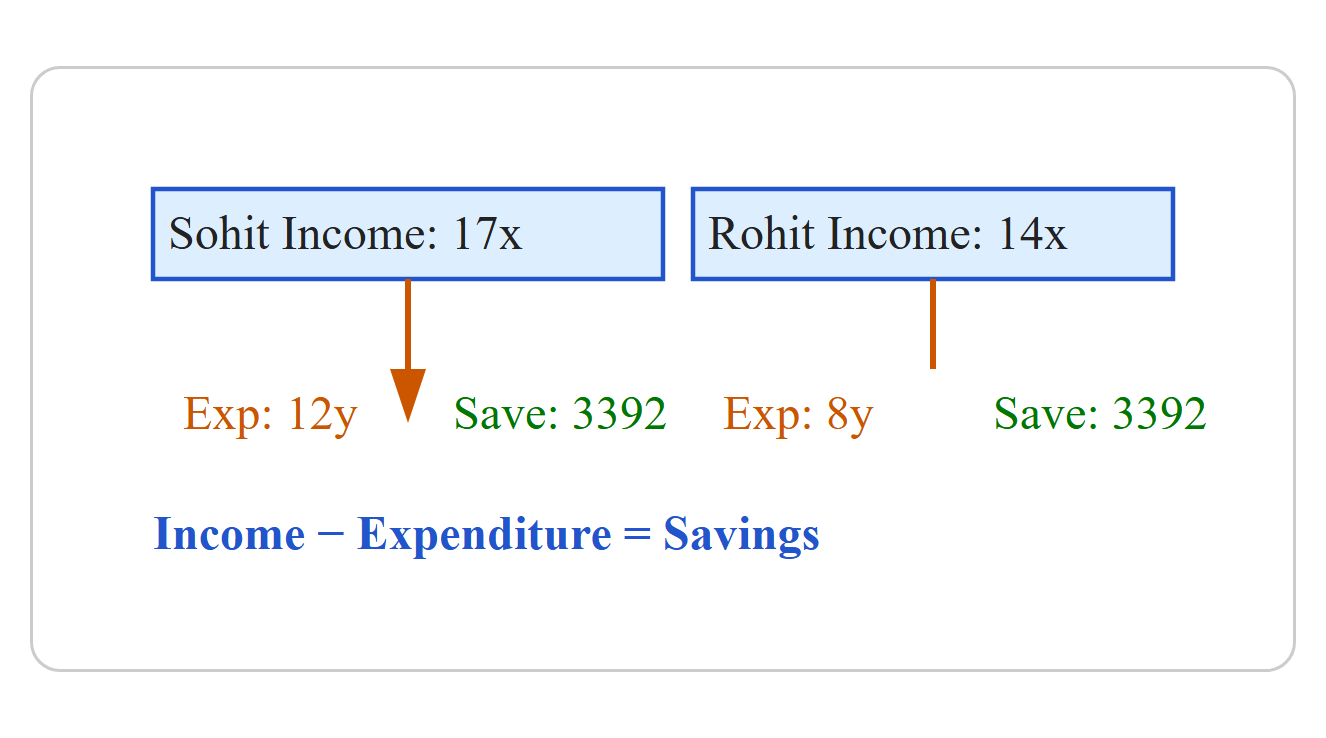
Key Points

  • The Sagarmala Project is an initiative by the Ministry of Shipping aimed at port-led development to enhance India’s logistics efficiency.
  • It was approved by the Union Cabinet in March 2015 and focuses on reducing logistics costs for both domestic and export-import (EXIM) cargo.
  • The project aims to modernize India's ports, improve port connectivity to the hinterland, and develop coastal communities through infrastructure and industrial development.
  • Sagarmala includes the development of new ports, port-linked industrial clusters, and efficient multimodal logistics systems.
  • The initiative is expected to save approximately Rs. 35,000–40,000 crore annually in logistics costs, boosting India’s export competitiveness.

Additional Information

  • Components of Sagarmala:
  • Port Modernization: Upgrading existing ports and developing new ones to handle larger cargo volumes efficiently.
  • Port Connectivity: Building road, rail, and inland waterways to improve connectivity between ports and hinterlands.
  • Port-linked Industrialization: Setting up coastal economic zones and industrial clusters near ports to support manufacturing and trade.
  • Coastal Community Development: Improving the livelihood of coastal communities through skill development, fisheries, and tourism.
  • Economic Significance: The project is expected to contribute significantly to India’s GDP by enhancing trade efficiency and reducing logistics costs.
  • Environmental Considerations: Emphasis is placed on sustainable development practices, including the use of green technologies in port and logistics infrastructure.
  • Global Comparison: The Sagarmala initiative is often compared to successful port-led development models in countries like China (e.g., Belt and Road Initiative) and Singapore.
  • Implementation: The project is being implemented in collaboration with state governments, central ministries, and private players for efficient execution.

Question 90

Sharad can complete a piece of work alone in 13 days and Varad can complete the same piece of work alone in 9 days. They started the work together, but Varad had to leave 11 days before the completion of the work. In how many days will the work complete?

  1. AOption (a)

    910119\frac{10}{11}

  2. BOption (b)

    1221112\frac{2}{11}

  3. COption (c)

    1191111\frac{9}{11}

  4. DOption (d)

    1051110\frac{5}{11}

View answer & explanation

Correct answer

Answer: (c)C.

1191111\frac{9}{11}

Why this answer is correct

Shortcut Trick

Total Work (LCM of 13 and 9) = 117 units.

If a person leaves before completion, add their potential work to the total.

Total units = 117 + (Varad's efficiency × days before completion) = 117 + (13 × 11) = 117 + 143 = 260 units.

Total days = Adjusted Total Work ÷ Combined Efficiency = 260 ÷ (9 + 13) = 260 ÷ 22 = 130 ÷ 11.

∴ The correct answer is 11(9/11) days.

Alternate Method

Given: Sharad takes 13 days, Varad takes 9 days. Varad leaves 11 days before completion.

Formula Used: Total Work = Time × Efficiency

PersonDaysTotal WorkEfficiency
Sharad131179
Varad913

⇒ Let the total work be completed in x days.

⇒ Sharad worked for x days and Varad worked for (x − 11) days.

⇒ 9 × x + 13 × (x − 11) = 117

⇒ 9x + 13x − 143 = 117

⇒ 22x = 117 + 143

⇒ 22x = 260

⇒ x = 260 ÷ 22 = 130 ÷ 11 = 11(9/11)

∴ The correct answer is 11(9/11) days.

Additional Information

Leaving Before Completion

When a person leaves n days before completion, treat it as if they worked those n days by adding their work to the total LCM.

Efficiency and Time Relationship

Efficiency is inversely proportional to the time taken. If time ratio is A:B, the efficiency ratio is B:A.

Pipes and Cisterns

This concept is identical to work; however, outlet pipes have negative efficiency while inlet pipes have positive efficiency.

Question 91

Two sets of numbers are given below. In each set of numbers, certain mathematical operation(s) are performed on the first number results in the second number. Similarly certain mathematical operation(s) on the second and third numbers in the third number and so on. Which of the given options follows the same set of operations as in the given sets? [NOTE: Operations should be performed on the whole numbers, without breaking down the numbers into their constituent digits. E.g. 13 - Operations on 13 such as adding/ subtracting/ multiplying by 13 can be than performing mathematical opera

10 - 20 - 30 - 60; 2 -4 -14 - 28

  1. AOption (a)

    15-30-35-60

  2. BOption (b)

    8-10-20-40

  3. COption (c)

    12-24-34-64

  4. DOption (d)

    5-10-20-40

View answer & explanation

Correct answer

Answer: (d)D.

5-10-20-40

Why this answer is correct

The logic followed here is:

10 - 20 - 30 - 60

10 × 2 = 20

20 + 10 = 30

30 × 2 = 60 

And,

2 -4 -14 - 28

2 × 2 = 4

4 + 10 = 14

14 × 2 = 28 

Similarly,

Option 4) 5-10-20-40

5 × 2 = 10

10 + 10 = 20

20 × 2 = 40 

Hence, "Option 4" is the correct answer.

Question 92

A man has to cover a distance of 387 km in 18 hours. If he covers two-third of this distance in 6/9 of the time, then what should his speed (in km/hr) be to cover the remaining distance in the time left?

  1. AOption (a)

    10.7

  2. BOption (b)

    6.3

  3. COption (c)

    21.5

  4. DOption (d)

    23.7

View answer & explanation

Correct answer

Answer: (c)C.

21.5

Why this answer is correct

Shortcut Trick

Remaining distance = 1 − 2/3 = 1/3 of total = 387 ÷ 3 = 129 km.

Remaining time = 1 − 6/9 = 1 − 2/3 = 1/3 of total = 18 ÷ 3 = 6 hours.

Required Speed = Remaining Distance ÷ Remaining Time = 129 ÷ 6 = 21.5 km/hr.

∴ The correct answer is 21.5 km/hr.

Alternate Method

Given:

Total distance = 387 km

Total time = 18 hours

Calculations:

⇒ Distance covered = 387 × (2/3) = 258 km

⇒ Remaining distance = 387 − 258 = 129 km

⇒ Time spent = 18 × (6/9) = 18 × (2/3) = 12 hours

⇒ Remaining time = 18 − 12 = 6 hours

⇒ Required Speed = Distance ÷ Time = 129 ÷ 6

⇒ Required Speed = 21.5 km/hr

∴ The correct answer is 21.5 km/hr.

Additional Information

Speed Formula

Speed is defined as the distance covered per unit of time. Formula: Speed = Distance ÷ Time.

Unit Conversion

To convert km/hr to m/s, multiply by 5/18. To convert m/s to km/hr, multiply by 18/5.

Average Speed

Average Speed = Total Distance ÷ Total Time. It is not always the arithmetic mean of individual speeds.

Question 93

Which of the following letter-number clusters will replace the question mark (?) in the given series to make it logically complete?

DJ26 EK37 FL48 GM59 ?

  1. AOption (a)

    HM71

  2. BOption (b)

    HN71

  3. COption (c)

    HM70

  4. DOption (d)

    HN70

View answer & explanation

Correct answer

Answer: (d)D.

HN70

Why this answer is correct

The logic followed here is:

​​

Hence, "Option 4" is the correct answer.

Question 94

Which international organisation launched the 'AI for Good' initiative in 2025?

  1. AOption (a)

    United Nations Educational, Scientific and Cultural Organization

  2. BOption (b)

    Organisation for Economic Co-operation and Development

  3. COption (c)

    International Telecommunication Union

  4. DOption (d)

    International Monetary Fund

View answer & explanation

Correct answer

Answer: (c)C.

International Telecommunication Union

Why this answer is correct

The correct answer is International Telecommunication Union.

Key Points

  • The AI for Good initiative was launched by the International Telecommunication Union (ITU) in 2017, not 2025, to promote the use of Artificial Intelligence (AI) for advancing sustainable development goals (SDGs).
  • It is a leading platform where governments, industries, and academia collaborate to discuss the use of AI for solving global challenges such as poverty, healthcare, and climate change.
  • The initiative includes AI for Good Global Summits, which bring together stakeholders to exchange ideas and showcase AI innovations.
  • ITU is a specialized agency of the United Nations responsible for issues related to information and communication technologies (ICT).
  • The "AI for Good" initiative aims to ensure that AI technologies are used ethically, inclusively, and responsibly to serve humanity.

Additional Information

  • International Telecommunication Union (ITU):
  • Founded in 1865, ITU is the oldest international organization in the UN system and focuses on global telecommunications and ICT development.
  • Its headquarters is located in Geneva, Switzerland.
  • ITU works on global standards for communication technologies, spectrum allocation, and bridging the digital divide.
  • Artificial Intelligence (AI):
  • AI refers to the simulation of human intelligence in machines programmed to think and learn.
  • Applications of AI include natural language processing, computer vision, robotics, and predictive analytics.
  • Ethical concerns such as bias, privacy, and accountability are central to discussions about AI deployment.
  • AI for Good Global Summits:
  • These summits are annual events organized by ITU in partnership with other UN agencies.
  • The summits aim to connect innovators in AI with public and private sectors to leverage AI for solving real-world issues.
  • Focus areas include healthcare, education, agriculture, and climate action.
  • Sustainable Development Goals (SDGs):
  • The SDGs are a set of 17 global objectives adopted by the UN in 2015 to end poverty, protect the planet, and ensure prosperity for all by 2030.
  • AI has the potential to accelerate progress on SDGs by offering innovative solutions to complex challenges.

Question 95

What are the units for base quantities called?

  1. AOption (a)

    Standard basic units

  2. BOption (b)

    Fundamental or base units

  3. COption (c)

    Basic constants

  4. DOption (d)

    Derived basic units

View answer & explanation

Correct answer

Answer: (b)B.

Fundamental or base units

Why this answer is correct

The correct answer is Fundamental or base units.

Key Points

  • Base quantities are physical quantities that are defined independently and are used as the foundation for other derived quantities.
  • The units for these base quantities are known as fundamental or base units.
  • Examples of base units include the meter (m) for length, kilogram (kg) for mass, and second (s) for time.
  • The International System of Units (SI) is the globally accepted standard that defines these fundamental units.
  • The SI system includes seven base units, which are used worldwide for scientific and technical purposes.

Additional Information

  • Base Quantities:
  • These are quantities like length, mass, time, electric current, thermodynamic temperature, amount of substance, and luminous intensity.
  • They are considered independent and form the foundation of the measurement system.
  • SI Base Units:
  • The seven SI base units are: meter (m), kilogram (kg), second (s), ampere (A), kelvin (K), mole (mol), and candela (cd).
  • Each unit corresponds to one of the seven base quantities.
  • Derived Units:
  • Derived units are formed by combining base units according to the relationships between physical quantities.
  • Examples include the newton (N) for force and the joule (J) for energy.
  • History of SI Units:
  • The SI system was officially adopted in 1960 at the 11th General Conference on Weights and Measures (CGPM).
  • It has since become the most widely used measurement system globally.
  • Importance of Standard Units:
  • Standardized units ensure consistency and comparability in measurements across different regions and disciplines.
  • They are crucial for scientific research, trade, and technological development.

Question 96

'Swaraj Dweep', a popular tourist destination known for its beaches, is located in:

  1. AOption (a)

    Andaman and Nicobar Islands

  2. BOption (b)

    Gulf of Mannar

  3. COption (c)

    Lakshadweep Islands

  4. DOption (d)

    Daman and Diu

View answer & explanation

Correct answer

Answer: (a)A.

Andaman and Nicobar Islands

Why this answer is correct

The correct answer is option 1,"Key Points: - Swaraj Dweep, formerly known as Havelock Island, is a prominent tourist destination in the Andaman and Nicobar Islands, India. - It is famous for its pristine beaches, including Radhanagar Beach, which is ranked among the best beaches in Asia. - The island offers diverse water sports activities such as scuba diving, snorkeling, and sea walking, attracting global tourists. - Swaraj Dweep is accessible via ferry services from Port Blair, the capital city of the Andaman and Nicobar Islands. - The name 'Swaraj Dweep' was officially adopted in 2018 as a tribute to Netaji Subhas Chandra Bose's vision of India's independence. Additional Information: - The Andaman and Nicobar Islands are a group of 572 islands located at the juncture of the Bay of Bengal and the Andaman Sea. - Radhanagar Beach on Swaraj Dweep received the prestigious title of 'Asia's Best Beach' by Time Magazine in 2004. - The islands are home to unique flora and fauna, with some species found nowhere else in the world. - Indigenous tribes such as the Sentinelese and Jarawas inhabit parts of the Andaman Islands, maintaining a secluded lifestyle. - Swaraj Dweep is a sustainable tourism hub, with eco-friendly resorts and environmental conservation efforts to preserve its natural beauty."

Question 97

Crisil projects India's bank credit growth to accelerate to how much percentage in FY26?

  1. AOption (a)

    14-15%

  2. BOption (b)

    13-14%

  3. COption (c)

    15-16%

  4. DOption (d)

    12-13%

View answer & explanation

Correct answer

Answer: (d)D.

12-13%

Why this answer is correct

The correct answer is 12-13%.

Key Points

  • Crisil, a leading credit rating agency, has projected India's bank credit growth to accelerate to 12-13% in FY26, reflecting a stable recovery in the economy.
  • The forecast is primarily driven by strong retail loan demand and improved corporate credit offtake.
  • Bank credit growth in India has been recovering steadily post-pandemic due to rising private consumption and investments.
  • Key sectors expected to contribute to this growth include infrastructure, MSMEs, and personal loans.
  • The government's focus on capital expenditure is also anticipated to support this credit growth trajectory.

Additional Information

  • Bank Credit Growth
  • It refers to the year-on-year growth in loans and advances extended by banks to various sectors of the economy.
  • It is an important indicator of economic activity and financial stability in the country.
  • Factors Driving Credit Growth
  • Improved macroeconomic stability and recovery in industrial and service sectors.
  • Focus on infrastructure spending and government initiatives for MSMEs.
  • Digitization and ease in loan disbursal processes facilitated by fintech collaborations.
  • Retail Loan Demand
  • Retail loans include personal loans, home loans, vehicle loans, and credit card loans.
  • The segment has been the primary driver of credit growth in India due to rising disposable incomes and urbanization.
  • Corporate Credit Offtake
  • Corporate credit refers to loans taken by businesses for working capital or expansion purposes.
  • Increased activity in sectors such as manufacturing, construction, and services has bolstered corporate credit demand.
  • Role of RBI
  • The Reserve Bank of India (RBI) plays a crucial role in regulating credit growth by adjusting interest rates and liquidity measures.
  • Stable monetary policies and inflation control directly influence credit demand and supply.

Question 98

 What should come in place of the question mark (?) in the given series? 187, 173, 160, 148, 137, ?

  1. AOption (a)

    127

  2. BOption (b)

    117

  3. COption (c)

    129

  4. DOption (d)

    131

View answer & explanation

Correct answer

Answer: (a)A.

127

Why this answer is correct

The logic followed here is:

Hence, "Option 1" is the correct answer.

Question 99

Zakir starts from Point A and drives 7 km towards the South. He then takes a left turn, drives 2 km, turns right and drives 7 km. He then takes a left turn and drives 11 km. He then takes a left turn and drives 8 km. He then takes a left turn and drives 2 km. He takes a final right turn, drives 6 km and stops at Point P. How far (shortest distance) and towards which direction should he drive in order to reach Point A again? (All turns are 90 degrees turns only unless specified.)

  1. AOption (a)

    9 km to the West

  2. BOption (b)

    10 km to the West

  3. COption (c)

    11 km to the West

  4. DOption (d)

    13 km to the West

View answer & explanation

Correct answer

Answer: (c)C.

11 km to the West

Why this answer is correct

Given:

Zakir starts from Point A and drives 7 km towards the South.

He then takes a left turn, drives 2 km, turns right and drives 7 km.

He then takes a left turn and drives 11 km.

He then takes a left turn and drives 8 km.

He then takes a left turn and drives 2 km.

He takes a final right turn, drives 6 km and stops at Point P.

Thus, Zakir should drive 11 km (2 km + 11 km - 2 km) in the west direction in order to reach Point A again.​

Hence, "Option 3" is the correct answer.

Question 100

if 'P' stands for '×', 'Q' stands for '÷', 'R' stands for '-' and 'S' stands for '+', then what will come in place of the question mark (?) in the following equation?

(110 R 32) Q 2 S 9 P 4 R 21 = ?

  1. AOption (a)

    54

  2. BOption (b)

    22

  3. COption (c)

    36

  4. DOption (d)

    48

View answer & explanation

Correct answer

Answer: (a)A.

54

Why this answer is correct

Decoding signs:

SignPQRS
Stands For×÷-+

Given: (110 R 32) Q 2 S 9 P 4 R 21 = ?

(110 R 32) Q 2 S 9 P 4 R 21 = ? ⇒ (110 - 32) ÷ 2 + 9 × 4 - 21 = ?

⇒ (110 - 32) ÷ 2 + 9 × 4 - 21 = ?

⇒ 78 ÷ 2 + 9 × 4 - 21 = ?

⇒ 39 + 9 × 4 - 21 = ?

⇒ 39 + 36 - 21 = ?

⇒ 75 - 21 = ?

⇒ 54 = ?

Hence, "Option 1" is the correct answer.

100 questions in the full paper