If A's salary is 16% more than that of B, then by what percentage is B's salary less than that of A (correct to two decimal places)?
- AOption (a)
12.72%
- BOption (b)
15.05%
- COption (c)
13.79%
- DOption (d)
13.62%
View answer & explanationHide answer & explanation
Correct answer
13.79%
Why this answer is correct

Shortcut Trick
Required percentage = [r ÷ (100 + r)] × 100
Given r = 16%
Required % = [16 ÷ (100 + 16)] × 100
Required % = [16 ÷ 116] × 100 = 400 ÷ 29 ≈ 13.79%
∴ The correct answer is 13.79%.

Alternate Method
Given:
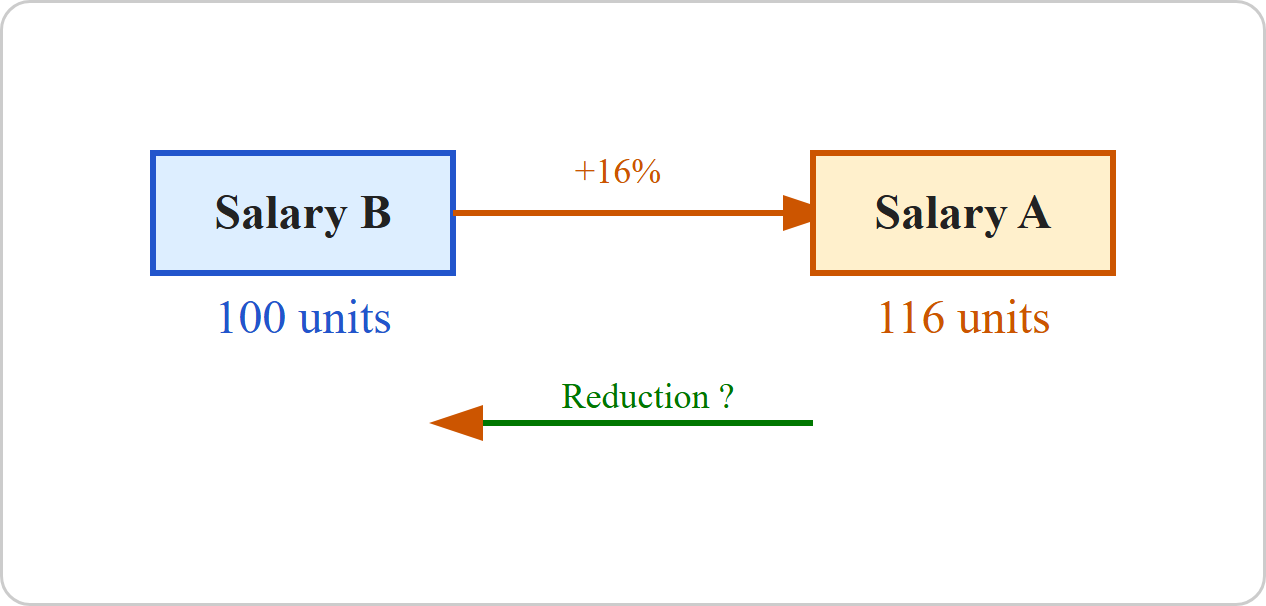
A's salary is 16% more than B's salary.
⇒ Let B's salary = 100
⇒ A's salary = 100 + 16% of 100 = 116
Calculations:
⇒ Difference between A and B = 116 − 100 = 16
⇒ B's salary is less than A's salary by = (Difference ÷ A's salary) × 100
⇒ Percentage less = (16 ÷ 116) × 100
⇒ Percentage less = (4 ÷ 29) × 100
⇒ Percentage less = 400 ÷ 29 = 13.7931...
⇒ Correct to two decimal places = 13.79%
∴ The correct answer is 13.79%.

Additional Information
Percentage Comparison Rule
If A is r% more than B, then B is [r ÷ (100 + r)] × 100% less than A.
Inverse Case
If A is r% less than B, then B is [r ÷ (100 − r)] × 100% more than A.
Base Value Concept
The percentage change depends on the denominator (base value). When comparing B to A, A's value becomes the base.