Shortcut Trick
Arrange the 11 observations in ascending order:
20, 20, 35, 43, 56, 62, 68, 72, 79, 85, 90
Since the number of terms (N = 11) is odd, the median is the middle term:
Median = ((N + 1) ÷ 2)th term = 6th term = 62
∴ The correct answer is 62.

Alternate Method
Given:
Observations: 85, 62, 20, 72, 20, 43, 35, 90, 68, 56, 79
Total number of observations (N) = 11
Formula Used:
When N is odd, Median = ((N + 1) ÷ 2)th observation after arranging in ascending order.

Calculations:
Arrange the given observations in ascending order:
⇒ 20, 20, 35, 43, 56, 62, 68, 72, 79, 85, 90
Count the total number of observations:
⇒ N = 11
Since N is an odd number, the median is calculated as:
⇒ Median = ((11 + 1) ÷ 2)th term
⇒ Median = (12 ÷ 2)th term
⇒ Median = 6th term
Looking at the arranged sequence, the 6th term is 62.
Let us verify why the other options are incorrect:
⇒ Option (1) 68 is the 7th term, which is not the middle term.
⇒ Option (3) 56 is the 5th term, which is not the middle term.
⇒ Option (4) 72 is the 8th term, which is not the middle term.
∴ The correct answer is 62.

Additional Information
Median for Even Number of Terms
If N is even, the median is the average of the (N ÷ 2)th term and the ((N ÷ 2) + 1)th term. Formula: Median = [ (N/2)th term + (N/2 + 1)th term ] ÷ 2.
Mean (Arithmetic Average)
The sum of all observations divided by the total number of observations. Formula: Mean = (Sum of all observations) ÷ N.
Mode
The observation that appears most frequently in the data set. For the given data, 20 appears twice, so the mode is 20.
Empirical Relationship
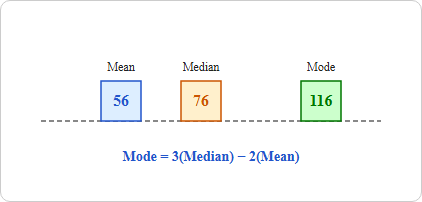
The relationship between Mean, Median, and Mode for moderately skewed distributions is: Mode = 3 × Median − 2 × Mean.