Previous Year Paper

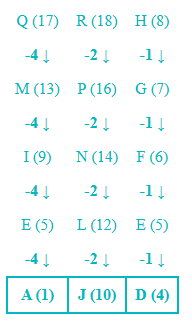
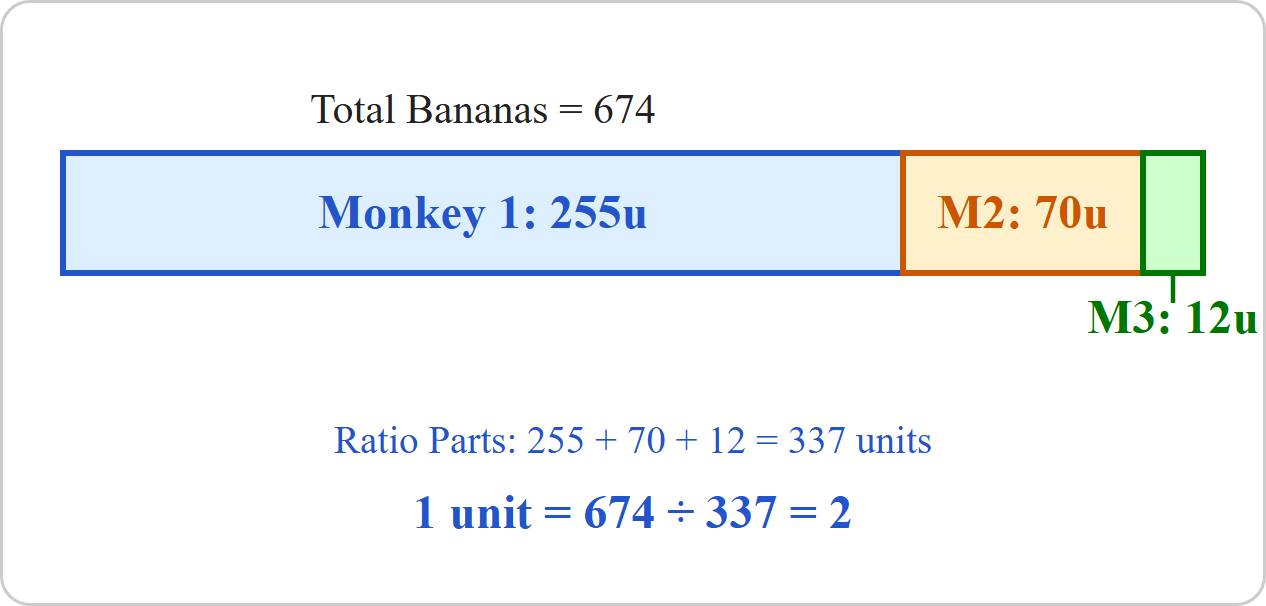
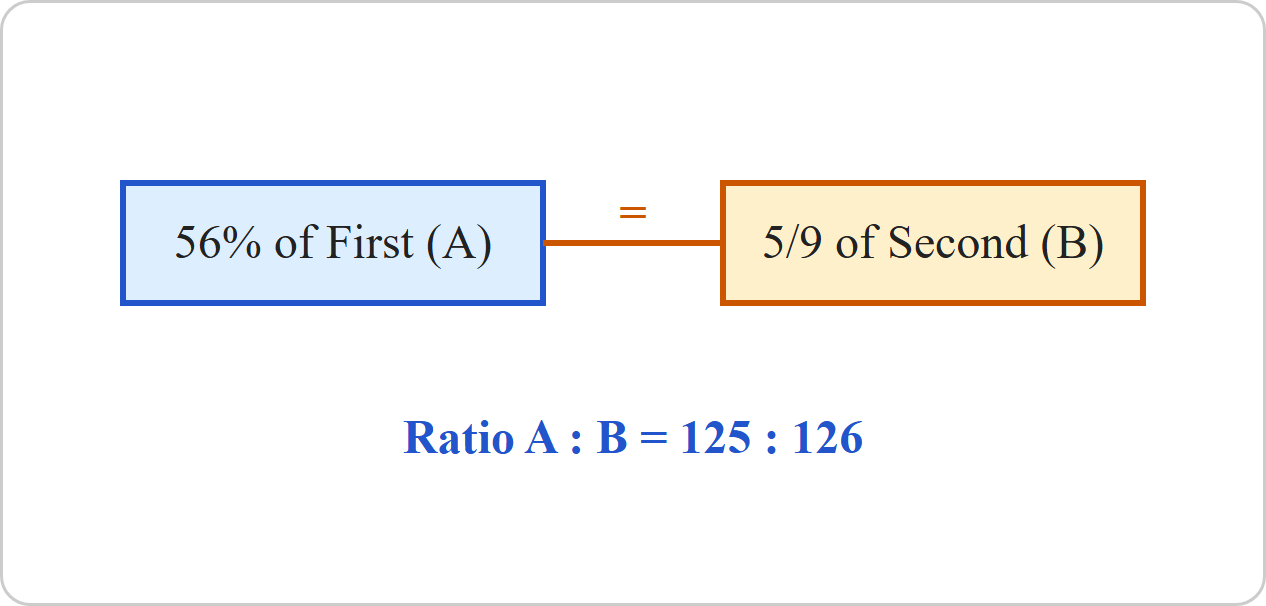
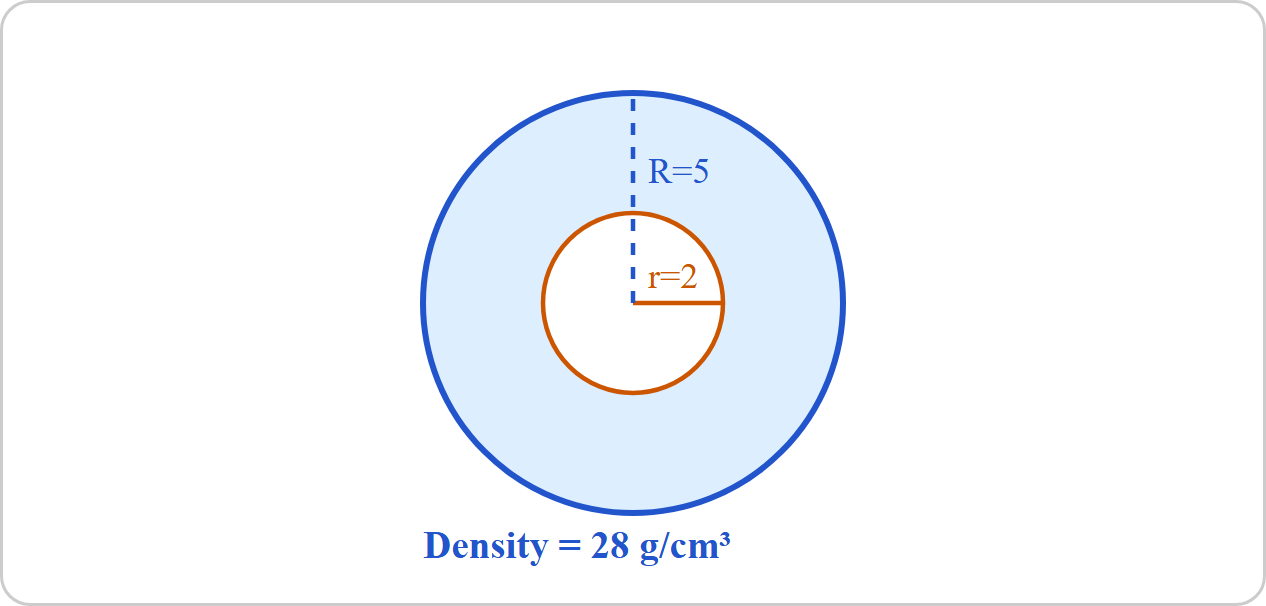
RRB NTPC Graduate Level CBT-I Official Paper (Held On: 21 Jun, 2025 Shift 2) (Previous Year Paper)

Held in 2025

100 questions90 minutes
With answers
Free

Paper last updated:

Practise under exam conditions

Take this paper as a timed mock test. Review your answers after you submit.

Attempt timed test

Questions & answers

Read the paper at your pace. Open an explanation when you need it.

Question 1

Hunger strike as a weapon was used for the first time by Mahatma Gandhi during which struggle?

  1. AOption (a)

     Champaran Satyagraha

  2. BOption (b)

    Non-Cooperation Movement

  3. COption (c)

    Ahmedabad Mill Workers' Struggle

  4. DOption (d)

    Kheda Satyagraha

View answer & explanation

Correct answer

Answer: (c)C.

Ahmedabad Mill Workers' Struggle

Why this answer is correct

The correct answer is Ahmedabad Mill Workers' Struggle.

Key Points

  • Mahatma Gandhi used the hunger strike for the first time during the Ahmedabad Mill Workers' Struggle of 1918.
  • The strike was initiated to demand better wages and working conditions for the mill workers.
  • Gandhi's hunger strike was a non-violent method to support the workers and exert moral pressure on mill owners.
  • The dispute revolved around the mill owners refusing to grant a 50% wage hike as compensation for the increased cost of living during World War I.
  • Gandhi's intervention and hunger strike led to a peaceful resolution, with the workers achieving a 35% wage increase.

Additional Information

  • Hunger Strike:
  • A non-violent method of protest where individuals refuse to eat to draw attention to a cause or demand justice.
  • This method was frequently used by Gandhi as part of his philosophy of Satyagraha (truth-force).
  • Ahmedabad Mill Workers' Struggle:
  • It was one of the first significant labor movements in India led by Gandhi.
  • The strike was a pivotal moment in India's labor rights history and demonstrated the power of peaceful protest.
  • Satyagraha:
  • A philosophy and practice of nonviolent resistance developed by Mahatma Gandhi.
  • It emphasizes the power of truth and nonviolence in achieving justice and social change.
  • Gandhi's Leadership in Labor Movements:
  • Besides the Ahmedabad strike, Gandhi also supported workers during the Champaran Satyagraha (indigo farmers) and Kheda Satyagraha (peasants).
  • His efforts helped establish workers' rights as an essential aspect of India's freedom struggle.

Question 2

Nandan had some marbles. When he distributed the marbles equally among 32 children, he found that 4 marbles were left. Had he distributed the marbles equally among 41 children and 48 children, he still would have had 13 and 20 marbles, respectively, left with him. But when he distributed them equally among 53 children, no marble was left. The number of marbles that Nandan initially had may lie between __________.

  1. AOption (a)

     7834 and 7854

  2. BOption (b)

    7814 and 7824

  3. COption (c)

    7794 and 7804

  4. DOption (d)

    7864 and 7874

View answer & explanation

Correct answer

Answer: (a)A.

 7834 and 7854

Why this answer is correct

Shortcut Trick

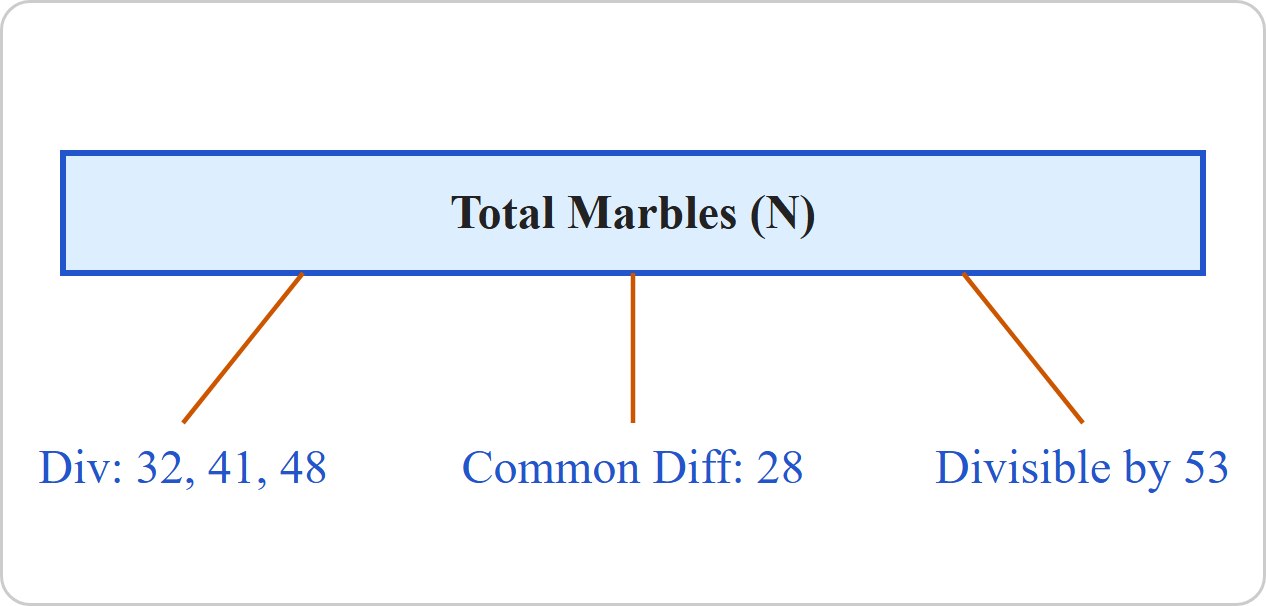
Check the common difference between divisors and remainders.

32 − 4 = 28, 41 − 13 = 28, 48 − 20 = 28.

Number = LCM(32, 41, 48) × k − 28, and it must be divisible by 53.

LCM(32, 41, 48) = 7872. For k = 1, Number = 7872 − 28 = 7844.

7844 ÷ 53 = 148 (Remainder 0). So, 7844 is the number.

∴ The correct answer is 7834 and 7854.

Alternate Method

Given: Divisors (d1, d2, d3) = 32, 41, 48 | Remainders (r1, r2, r3) = 4, 13, 20.

⇒ Common difference (d − r) = 32 − 4 = 28; 41 − 13 = 28; 48 − 20 = 28.

⇒ LCM(32, 41, 48) = 25 × 41 × 3 = 32 × 123 = 7872.

⇒ General form: N = 7872k − 28.

⇒ Condition: N must be exactly divisible by 53.

⇒ Test k = 1: N = 7872(1) − 28 = 7844.

⇒ Verification: 7844 = 53 × 148 + 0. (Condition satisfied).

⇒ 7844 lies between 7834 and 7854.

∴ The correct answer is 7834 and 7854.

Additional Information

LCM with Common Difference

When (Divisor − Remainder) is constant (say x), the number is LCM(Divisors) × k − x.

LCM with Same Remainder

If every divisor leaves the same remainder r, the number is LCM(Divisors) × k + r.

Divisibility Rule of 53

To check if a number is divisible by 53, add 16 times the last digit to the rest of the number.

Question 3

The Badami caves in Karnataka have been built by which of the following rulers?

  1. AOption (a)

    Mauryas

  2. BOption (b)

    Pallavas

  3. COption (c)

    Pandyas

  4. DOption (d)

     Chalukyas

View answer & explanation

Correct answer

Answer: (d)D.

 Chalukyas

Why this answer is correct

The correct answer is Chalukyas.

Key Points

  • The Badami Caves, located in Karnataka, were built during the reign of the Chalukyas, specifically under the rule of Pulakeshin I and his successors.
  • These caves are primarily dedicated to Hindu deities like Shiva and Vishnu, along with some Jain influences, showcasing the religious diversity of the era.
  • The rock-cut architecture of Badami caves highlights the Dravidian style with intricate carvings and sculptures.
  • Badami served as the capital of the early Chalukya dynasty during the 6th to 8th centuries, symbolizing their architectural prowess.
  • There are four main cave temples at Badami, which are a mix of Hindu and Jain traditions, reflecting the cultural synthesis of the Chalukya period.

Additional Information

  • Chalukya Dynasty:
  • The Chalukyas ruled a significant part of southern and central India between the 6th and 12th centuries.
  • They are divided into three branches: Early Chalukyas of Badami, Later Chalukyas of Kalyani, and Eastern Chalukyas of Vengi.
  • The dynasty was known for its patronage of art, architecture, and literature.
  • Rock-Cut Architecture:
  • Rock-cut temples are structures carved directly into natural rocks, showcasing advanced craftsmanship.
  • The Badami caves are prime examples of rock-cut architecture, featuring intricate carvings and sculptures.
  • Dravidian Style of Architecture:
  • Originating in South India, Dravidian architecture is characterized by pyramid-shaped temples, intricate sculptures, and carvings.
  • The Badami caves reflect early Dravidian architectural elements, which influenced later temple constructions.
  • Religious Significance:
  • The cave temples are dedicated to Hindu deities like Shiva and Vishnu, with Jain influences in some caves.
  • They highlight the religious harmony and cultural synthesis during the Chalukya period.

Question 4

 The mean of a data is 76 and its median is 100. The mode (using empirical relation) of the data is:

  1. AOption (a)

    77

  2. BOption (b)

    174

  3. COption (c)

    60

  4. DOption (d)

    148

View answer & explanation

Correct answer

Answer: (d)D.

148

Why this answer is correct

Shortcut Trick

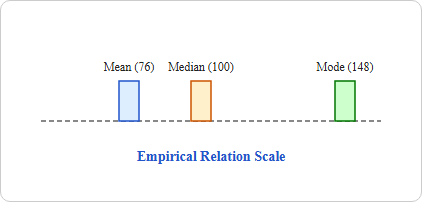
Apply the empirical formula: Mode = 3 × Median − 2 × Mean.

Given: Median = 100 and Mean = 76.

Mode = 3 × 100 − 2 × 76

Mode = 300 − 152 = 148.

∴ The correct answer is 148.

Alternate Method

Given:

Mean = 76

Median = 100

Formula Used:

Mode = 3(Median) − 2(Mean)

Calculations:

⇒ Mode = 3 × 100 − 2 × 76

⇒ Mode = 300 − 152

⇒ Mode = 148

∴ The correct answer is 148.

Additional Information

Empirical Relationship

For a moderately skewed distribution, the relationship between the three measures of central tendency is given by Mode = 3 Median − 2 Mean.

Symmetrical Distribution

In a perfectly symmetrical distribution (like a Normal Distribution), the Mean, Median, and Mode are all equal.

Question 5

Prime Minister Narendra Modi interacted with the beneficiaries of the 'Lakhpati Didi' scheme in Gujarat in March 2025. In this context, which of the following statements is/are correct?

  1. The scheme aims to empower women by enabling SHG members to earn an annual household income of at least ₹1 lakh, sustained over agricultural seasons or business cycles.

  2. It offers direct annual cash transfers of ₹1 lakh to selected SHG members to support their livelihoods.

  3. The scheme is implemented by the Ministry of Rural Development under DAY-NRLM.

  1. AOption (a)

    2 and 3

  2. BOption (b)

    1 and 2

  3. COption (c)

    1 and 3

  4. DOption (d)

     Only 1

View answer & explanation

Correct answer

Answer: (c)C.

1 and 3

Why this answer is correct

The correct answer is Option 3: 1 and 3.

Key Points

  • The 'Lakhpati Didi' scheme aims to empower women by enabling members of Self-Help Groups (SHGs) to achieve an annual household income of at least ₹1 lakh, sustained through agricultural seasons or business cycles.
  • The scheme is implemented under the Deendayal Antyodaya Yojana – National Rural Livelihoods Mission (DAY-NRLM), which is spearheaded by the Ministry of Rural Development.
  • It focuses on enhancing the livelihoods of rural women through entrepreneurial activities, capacity building, and access to financial resources.
  • The scheme does not include direct annual cash transfers of ₹1 lakh to beneficiaries, but instead supports income generation via skill development and enterprise promotion.
  • Prime Minister Narendra Modi interacted with the beneficiaries of the scheme in Gujarat in March 2025 to assess its impact on women empowerment and rural development.

Additional Information

  • Deendayal Antyodaya Yojana – National Rural Livelihoods Mission (DAY-NRLM):
  • Launched in 2011, DAY-NRLM aims to reduce poverty by enhancing sustainable livelihood opportunities for rural poor households.
  • It focuses on creating efficient and effective institutional platforms for the rural poor, especially women, to enable them to increase household income through self-employment and skilled wage employment opportunities.
  • The mission promotes financial inclusion by linking SHGs to banks for credit support.
  • Self-Help Groups (SHGs):
  • SHGs are small, voluntary associations of people, typically women, who come together to save and collectively manage resources for income-generating activities.
  • They play a significant role in empowering women and improving rural livelihoods.
  • Empowerment of Women through SHGs:
  • SHGs facilitate access to credit, skills training, and market linkages, enabling women to start and sustain micro-enterprises.
  • The 'Lakhpati Didi' scheme is a prime example of leveraging SHGs for women’s economic empowerment.
  • Key Features of DAY-NRLM:
  • Universal social mobilization by bringing at least one woman from each identified rural poor household into SHG networks.
  • Skill development and entrepreneurship promotion to enhance employability and income generation.

Question 6

If ‘P’ stands for ‘×’, ‘Q’ stands for ‘÷’, ‘R’ stands for ‘−’ and ‘S’ stands for ‘+’, then what will come in place of the question mark (?) in the following equation?

37 S (28 Q 7) P 5 R 4 P 6 S 21 = ?

  1. AOption (a)

    76

  2. BOption (b)

    43

  3. COption (c)

    54

  4. DOption (d)

    69

View answer & explanation

Correct answer

Answer: (c)C.

54

Why this answer is correct

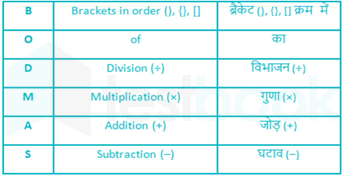
BODMAS Rule:

According to the question, the letters are interchanged as follows:

Original LetterPQRS
New Symbol×÷−+

Now, given the equation: 37 S (28 Q 7) P 5 R 4 P 6 S 21 = ?

After interchanging the specified letters, the new equation is:

37 + (28 ÷ 7) × 5 − 4 × 6 + 21 = ?

Perform operations according to BODMAS:

⇒ 37 + (28 ÷ 7) × 5 − 4 × 6 + 21

⇒ 37 + 4 × 5 − 4 × 6 + 21

⇒ 37 + 20 − 24 + 21

⇒ 57 − 24 + 21

⇒ 33 + 21

⇒ 54

Hence, the correct answer is "Option 3".

Question 7

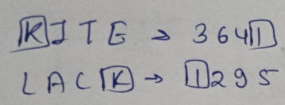
In a certain code language, ‘KITE’ is coded as ‘3641’ and ‘LACK’ is coded as ‘1295’. What is the code for ‘K’ in the given code language?

  1. AOption (a)

    2

  2. BOption (b)

    1

  3. COption (c)

    5

  4. DOption (d)

    4

View answer & explanation

Correct answer

Answer: (b)B.

1

Why this answer is correct

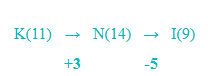
The logic followed here is:

The code for "K" for"1".

Hence, the correct answer is "Option 2".

Question 8

 Which industries commonly used Tetrachloromethane as a degreasing agent?

  1. AOption (a)

    Textile industries

  2. BOption (b)

     Manufacturing and mechanical industries

  3. COption (c)

     Bottling industries

  4. DOption (d)

    Food processing industries

View answer & explanation

Correct answer

Answer: (b)B.

 Manufacturing and mechanical industries

Why this answer is correct

The correct answer is Manufacturing and mechanical industries.

Key Points

  • Tetrachloromethane (carbon tetrachloride) is commonly utilized in manufacturing and mechanical industries due to its excellent degreasing properties.
  • This compound is effective in removing grease, oil, and other contaminants from metal surfaces, tools, and machinery.
  • Mechanical industries employ it for cleaning parts during assembly, maintenance, and repair tasks.
  • Its non-flammable nature made it a preferred choice in industrial applications before its usage was restricted due to environmental concerns.
  • Industries like aerospace and automotive heavily relied on Tetrachloromethane for degreasing metal components.

Additional Information

  • Tetrachloromethane (Carbon Tetrachloride):
  • A chemical compound with the formula CCl4.
  • Historically used as a solvent, cleaning agent, and refrigerant.
  • Its use has significantly declined due to its adverse health effects and contribution to ozone layer depletion.
  • Degreasing Agents:
  • Chemical substances used to remove grease, oil, or dirt from surfaces.
  • Examples include organic solvents, alkaline solutions, and detergents.
  • They are widely applied in industries for cleaning machinery, tools, and metal parts.
  • Environmental Concerns:
  • Carbon Tetrachloride is classified as a potent ozone-depleting substance under the Montreal Protocol.
  • Its production and use have been phased out in many countries due to its harmful environmental effects.
  • It is also considered a hazardous air pollutant with serious health risks to humans.
  • Alternative Degreasing Solutions:
  • Eco-friendly alternatives include water-based cleaners and biodegradable solvents.
  • Industries are increasingly adopting non-toxic and sustainable cleaning agents.
  • These alternatives help reduce health risks and environmental impact.

Question 9

 Labour reforms have remained a key agenda in the post-1991 economic policy landscape. How many labour codes were consolidated by the Indian government under the labour reforms enacted in 2019-2020?

  1. AOption (a)

    Five

  2. BOption (b)

    Three

  3. COption (c)

    Four

  4. DOption (d)

    Two

View answer & explanation

Correct answer

Answer: (c)C.

Four

Why this answer is correct

The correct answer is Four.

Key Points

  • The Indian government consolidated 29 existing labour laws into four labour codes as part of labour reforms enacted in 2019-2020.
  • The four labour codes are: Code on Wages, Code on Industrial Relations, Code on Social Security, and Code on Occupational Safety, Health, and Working Conditions.
  • These reforms aim to simplify, modernize, and streamline labour regulations, ensuring ease of compliance and promoting labour welfare.
  • The consolidation addresses issues such as outdated provisions, multiplicity of definitions, and overlapping jurisdictions, which often created confusion and inefficiencies.
  • The labour codes provide a uniform framework for both workers and employers, promoting transparency and fostering a conducive environment for economic growth.

Additional Information

  • Code on Wages, 2019:
  • This code subsumes four wage-related laws, including the Payment of Wages Act and Minimum Wages Act.
  • It ensures a statutory minimum wage across all sectors and simplifies wage-related compliance.
  • Code on Industrial Relations, 2020:
  • It aims to balance the rights of employers and employees, facilitating better industrial relations.
  • Provisions include streamlined dispute resolution mechanisms and conditions for strikes and lockouts.
  • Code on Social Security, 2020:
  • This code integrates nine laws related to social security, such as the Employees' Provident Fund and Maternity Benefit Act.
  • It expands the social security net to cover gig and platform workers.
  • Code on Occupational Safety, Health, and Working Conditions, 2020:
  • This code combines 13 laws related to health, safety, and working conditions.
  • It focuses on ensuring safe working environments and welfare provisions for workers in various industries.
  • Objective of Labour Reforms:
  • The reforms aim to enhance the ease of doing business and attract investments while safeguarding workers' rights.
  • They are crucial for creating a flexible, simplified, and transparent labour regulatory framework in India.

Question 10

What happens when you press 'Enter' while working with a bullet or numbered list in MS Word 365?

  1. AOption (a)

     It converts the list into plain text.

  2. BOption (b)

     It restarts numbering automatically.

  3. COption (c)

    It deletes the previous bullet or number.

  4. DOption (d)

     It creates a new list item with the same bullet or number.

View answer & explanation

Correct answer

Answer: (d)D.

 It creates a new list item with the same bullet or number.

Why this answer is correct

The correct answer is It creates a new list item with the same bullet or number..

Key Points

  • When you press ‘Enter’ while working with a bullet or numbered list in MS Word 365, it automatically creates a new list item with the same bullet or numbering style.
  • The newly created bullet or number appears directly below the previous item, maintaining the same formatting style.
  • If the user presses ‘Enter’ twice, the current list is terminated, and the cursor moves to a new line without any bullets or numbering.
  • This functionality is part of the auto-formatting features of MS Word, designed to streamline the creation of lists and improve efficiency in document editing.
  • Users can also customize the bullet or numbering style by accessing the ‘Bullets and Numbering’ menu in the toolbar.

Additional Information

  • Bullets and Numbering in MS Word:
  • Bullets are used for unordered lists, while numbering is used for ordered lists.
  • The user can access these options under the ‘Home’ tab in the toolbar.
  • Customizing bullets or numbering allows for the use of symbols, images, or different number formats.
  • Keyboard Shortcuts for Lists:
  • Pressing ‘Ctrl + Shift + L’ applies a default bullet style to the selected text.
  • To increase or decrease the indentation level of a list, use ‘Tab’ or ‘Shift + Tab’, respectively.
  • Auto-Formatting Features:
  • MS Word auto-detects list patterns when typing (e.g., starting a line with "1." or "-").
  • This feature can be toggled on/off in the ‘AutoCorrect Options’ under the ‘File’ menu.
  • Ending a List:
  • Pressing ‘Enter’ twice ends the current list and moves the cursor to a new line without bullets or numbering.
  • Alternatively, users can manually remove bullets or numbering by clicking the respective icons in the toolbar.

Question 11

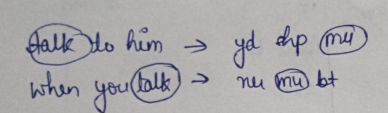
In a certain code language, ‘talk to him’ is coded as ‘yd hp mu’ and ‘when you talk’ is coded as ‘nc mu bt’. How is ‘talk’ coded in the given language?

  1. AOption (a)

    bt

  2. BOption (b)

    mu

  3. COption (c)

    yd

  4. DOption (d)

    nc

View answer & explanation

Correct answer

Answer: (b)B.

mu

Why this answer is correct

The given code language is:                                                                                                                                                                                                                     


Thus, 'talk' is coded as 'mu'.

Hence, the correct answer is "Option 2".

Question 12

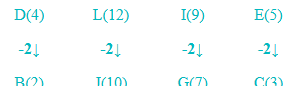
Which of the following letter-number clusters will replace the question mark (?) in the given series to make it logically complete?

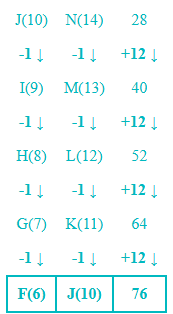
 JN28 IM40 HL52 GK64 ?

  1. AOption (a)

    FJ77

  2. BOption (b)

     FI76

  3. COption (c)

    FI77

  4. DOption (d)

     FJ76

View answer & explanation

Correct answer

Answer: (d)D.

 FJ76

Why this answer is correct

The pattern followed here is.

Thus, the missing term in the series is FJ76.

Hence, the correct answer is Option 4.

Question 13

If α and β are the roots of the equation x2 − x − 6 = 0, find the value of α4 + β4.

  1. AOption (a)

    97

  2. BOption (b)

    95

  3. COption (c)

    902

  4. DOption (d)

    100

View answer & explanation

Correct answer

Answer: (a)A.

97

Why this answer is correct

Shortcut Trick Factorize the quadratic equation x2 − x − 6 = 0 into (x − 3)(x + 2) = 0. The roots are α = 3 and β = −2. Now, substitute these roots directly into the required expression α4 + β4. α4 + β4 = (3)4 + (−2)4 = 81 + 16 = 97. ∴ The correct answer is 97. Alternate Method Given: x2 − x − 6 = 0 For a quadratic equation ax2 + bx + c = 0, the coefficients are a = 1, b = −1, and c = −6. Formula Used: Sum of roots (α + β) = −b/a and Product of roots (αβ) = c/a. ⇒ α + β = −(−1)/1 = 1 ⇒ αβ = −6/1 = −6 To find α4 + β4, first find α2 + β2: ⇒ α2 + β2 = (α + β)2 − 2αβ ⇒ α2 + β2 = (1)2 − 2(−6) = 1 + 12 = 13 Now, square the above result to find α4 + β4: ⇒ α4 + β4 = (α2 + β2)2 − 2(αβ)2 ⇒ α4 + β4 = (13)2 − 2(−6)2 ⇒ α4 + β4 = 169 − 2(36) = 169 − 72 = 97 ∴ The correct answer is 97. Additional Information Relationship between Roots and Coefficients For the equation ax2 + bx + c = 0, the sum of roots is −b/a and the product of roots is c/a. This allows solving symmetric expressions without finding individual roots. Algebraic Identities for Powers Useful identities include α2 + β2 = (α + β)2 − 2αβ and α3 + β3 = (α + β)3 − 3αβ(α + β). Nature of Roots The discriminant (D = b2 − 4ac) determines if roots are real and distinct (D > 0), real and equal (D = 0), or non-real complex (D < 0).

Question 14

 Which of the following statements is INCORRECT about the Fundamental Rights of the Indian Constitution?

  1. AOption (a)

    These are absolute.

  2. BOption (b)

     Cultural and educational rights are fundamental rights.

  3. COption (c)

    These are subject to reasonable restriction.

  4. DOption (d)

    These may be enforced by the courts.

View answer & explanation

Correct answer

Answer: (a)A.

These are absolute.

Why this answer is correct

The correct answer is These are absolute..

Key Points

  • Fundamental Rights in the Indian Constitution are not absolute; they are subject to reasonable restrictions to ensure public order, morality, and national security.
  • Article 19(2) of the Constitution explicitly mentions reasonable restrictions on the freedom of speech and expression.
  • The Fundamental Rights are enforceable by the courts under Article 32, which provides the right to constitutional remedies.
  • The Constitution grants Cultural and Educational Rights as Fundamental Rights under Articles 29 and 30 to protect minority groups.
  • While Fundamental Rights are guaranteed, they can be suspended during a national emergency as stated under Article 359, except for Articles 20 and 21.

Additional Information

  • Fundamental Rights:
  • These are enshrined in Part III of the Indian Constitution, spanning Articles 12 to 35.
  • They ensure the basic rights and freedoms of individuals, including equality, freedom, protection against exploitation, and religious freedom.
  • They are classified into six categories: Right to Equality, Right to Freedom, Right against Exploitation, Right to Freedom of Religion, Cultural and Educational Rights, and Right to Constitutional Remedies.
  • Reasonable Restrictions:
  • Restrictions are imposed to maintain public order, morality, health, security, and friendly relations with foreign states.
  • Such restrictions are defined within the Constitution and upheld by judicial review to prevent misuse by authorities.
  • Article 32 - Right to Constitutional Remedies:
  • Referred to as the "heart and soul of the Constitution" by Dr. B.R. Ambedkar.
  • Allows individuals to approach the Supreme Court directly for enforcement of Fundamental Rights.
  • Empowers courts to issue writs such as habeas corpus, mandamus, prohibition, quo warranto, and certiorari.
  • Suspension of Fundamental Rights:
  • During a national emergency under Article 352, certain Fundamental Rights can be suspended.
  • Rights under Articles 20 and 21 cannot be suspended even in emergencies.
  • Article 358 and Article 359 specify conditions for suspension during emergencies.

Question 15

Which keyboard shortcut is typically used to paste copied content?

  1. AOption (a)

    Ctrl + F

  2. BOption (b)

     Ctrl + C

  3. COption (c)

    Ctrl + V

  4. DOption (d)

    Ctrl + S

View answer & explanation

Correct answer

Answer: (c)C.

Ctrl + V

Why this answer is correct

The correct answer is Ctrl + V.

Key Points

  • Ctrl + V is the standard keyboard shortcut used to paste content in most operating systems and applications.
  • This shortcut works universally across platforms like Windows, macOS, and Linux, making it a widely recognized function.
  • It is part of the trio of common shortcuts: Ctrl + C (copy), Ctrl + X (cut), and Ctrl + V (paste).
  • The use of "V" for pasting can be traced back to early computer systems, where it was chosen because "P" was already assigned to "Print."
  • The shortcut is supported by most text editors, word processors, and graphical user interfaces for efficient and quick workflow.

Additional Information

  • Keyboard Shortcuts
  • Keyboard shortcuts are combinations of keys that provide quick access to specific functions within a software or operating system.
  • They help improve productivity by reducing the need for mouse interactions.
  • Examples include Ctrl + Z (undo), Ctrl + Y (redo), and Ctrl + A (select all).
  • Clipboard
  • The clipboard is a temporary storage area used to transfer data between documents or applications.
  • When you use Ctrl + C or Ctrl + X, the data is saved to the clipboard until you paste it using Ctrl + V.
  • Modern operating systems often support clipboard history, allowing users to access multiple copied items.
  • History of Ctrl + V
  • The shortcut system was popularized by Xerox PARC in the 1970s and later adopted by Apple and Microsoft.
  • Early systems like Apple Lisa and Macintosh standardized these shortcuts, which were later incorporated into Windows.
  • Cross-Platform Usage
  • On macOS, the equivalent shortcut for paste is Cmd + V.
  • Linux-based systems also follow the Ctrl + V convention, though terminal applications may use different shortcuts.

Question 16

The average weight of A, B and C is 45 kg. If the average weight of A and B is 37 kg and that of B and C is 47 kg, then the weight of B (in kg) is:

  1. AOption (a)

    23

  2. BOption (b)

    33

  3. COption (c)

    48

  4. DOption (d)

    43

View answer & explanation

Correct answer

Answer: (b)B.

33

Why this answer is correct

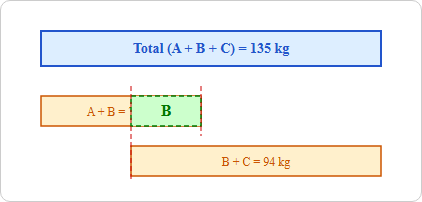
Shortcut Trick

Weight of B = (Sum of A and B) + (Sum of B and C) − (Total Sum of A, B and C)

Weight of B = (37 × 2) + (47 × 2) − (45 × 3)

Weight of B = 74 + 94 − 135 = 33 kg.

∴ The correct answer is 33 kg.

Alternate Method

Given:

Average weight of A, B and C = 45 kg

Average weight of A and B = 37 kg

Average weight of B and C = 47 kg

Formula Used:

Sum of observations = Average × Total number of observations

Calculations:

⇒ Total weight of A, B and C = 45 × 3 = 135 kg

⇒ Total weight of A and B = 37 × 2 = 74 kg

⇒ Total weight of B and C = 47 × 2 = 94 kg

⇒ Sum of (A + B) and (B + C) = A + 2B + C = 74 + 94 = 168 kg

⇒ Weight of B = (A + 2B + C) − (A + B + C)

⇒ Weight of B = 168 − 135 = 33 kg

∴ The correct answer is 33 kg.

Additional Information

Average of Group

The average of a group is the sum of all values divided by the number of values in that group. Formula: Average = Sum ÷ n.

Overlap Method

In problems where one person is part of two subgroups, their value = (Sum of subgroup 1 + Sum of subgroup 2) − (Total sum of all members).

Excluded Value

Weight of an excluded person = (Initial Total Weight) − (New Total Weight after exclusion).

Question 17

 In which year was the Right to Property removed from the Fundamental Rights of the Constitution of India?

  1. AOption (a)

    1986

  2. BOption (b)

    1952

  3. COption (c)

    1976

  4. DOption (d)

    1978

View answer & explanation

Correct answer

Answer: (d)D.

1978

Why this answer is correct

The correct answer is 1978.

Key Points

  • The Right to Property was originally included as a Fundamental Right under Article 19(1)(f) and Article 31 of the Indian Constitution.
  • It was removed from the list of Fundamental Rights by the 44th Amendment Act, 1978, during the tenure of Prime Minister Morarji Desai.
  • After the amendment, the Right to Property was reclassified as a legal right under Article 300A in Part XII of the Constitution.
  • The change was made to resolve conflicts between private property rights and the government's power to acquire land for public purposes.
  • This amendment curtailed the misuse of property-related rights and allowed the government greater flexibility in enacting land reforms.

Additional Information

  • Fundamental Rights:
  • These are enshrined in Part III of the Indian Constitution and are justiciable, meaning they can be enforced by courts.
  • Initially, there were seven Fundamental Rights, but now there are six after the removal of the Right to Property.
  • 44th Amendment Act, 1978:
  • This was enacted to nullify some provisions of the 42nd Amendment, which was passed during the Emergency period (1975-77).
  • It ensured that Fundamental Rights could not be easily abridged or suspended except during a properly declared emergency.
  • Article 300A:
  • It states that no person shall be deprived of their property except by the authority of law.
  • It made the Right to Property a statutory (legal) right instead of a Fundamental Right.
  • Impact of the Change:
  • Reclassification of the Right to Property helped the government implement land acquisition and agrarian reforms more effectively.
  • It reduced the number of property-related litigations in courts.

Question 18

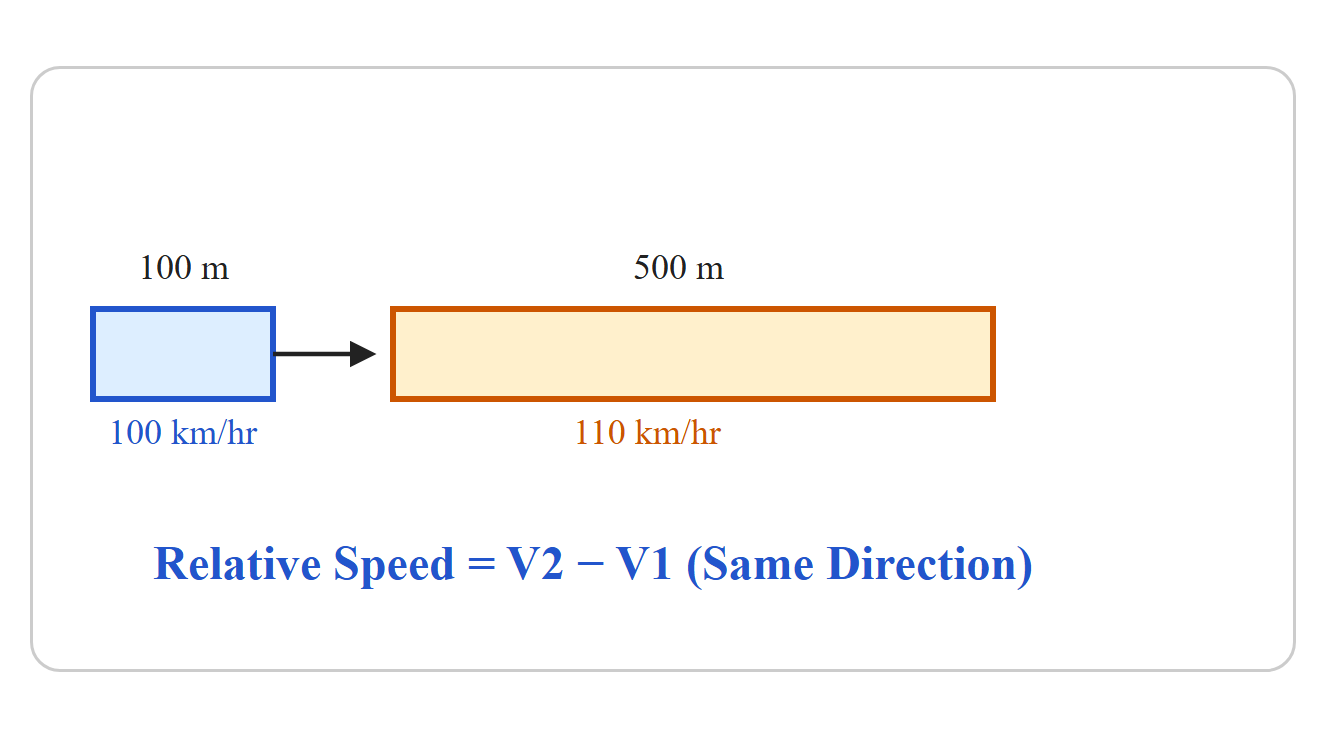
Two trains having lengths of 100 m and 500 m are running at speeds of 100 km/hr and 110 km/hr, respectively, in the same direction. The time taken (in minutes) by the faster train, coming from behind, to completely cross the other train is:

  1. AOption (a)

    6

  2. BOption (b)

    9.3

  3. COption (c)

    1.4

  4. DOption (d)

    3.6

View answer & explanation

Correct answer

Answer: (d)D.

3.6

Why this answer is correct

Shortcut Trick

Relative Speed (Same direction) = 110 − 100 = 10 km/hr.

Total Distance = Sum of lengths = 100 + 500 = 600 m = 0.6 km.

Time (hours) = Distance ÷ Relative Speed = 0.6 ÷ 10 = 0.06 hours.

Time (minutes) = 0.06 × 60 = 3.6 minutes.

∴ The correct answer is 3.6 minutes.

Alternate Method

Given:

Length of train 1 (L1) = 100 m

Length of train 2 (L2) = 500 m

Speed of train 1 (S1) = 100 km/hr

Speed of train 2 (S2) = 110 km/hr

Formula Used:

Time = Total Distance ÷ Relative Speed

Calculations:

⇒ Total Distance = L1 + L2 = 100 + 500 = 600 m

⇒ Relative Speed = S2 − S1 = 110 − 100 = 10 km/hr

⇒ Convert Speed to m/sec: 10 × (5/18) = 50/18 m/sec

⇒ Time (sec) = 600 ÷ (50/18) = (600 × 18) ÷ 50 = 12 × 18 = 216 seconds

⇒ Time (min) = 216 ÷ 60 = 3.6 minutes

∴ The correct answer is 3.6 minutes.

Additional Information

Relative Speed Concept

When two objects move in the same direction, relative speed is the difference (S1 − S2). If they move in opposite directions, it is the sum (S1 + S2).

Unit Conversion

To convert km/hr to m/s, multiply by 5/18. To convert m/s to km/hr, multiply by 18/5.

Crossing Objects

When a train crosses another train or a bridge, the total distance is always the sum of their lengths.

Question 19

What should come in place of the question mark (?) in the given series?

1112 1120 1130 1142 1156 ?

  1. AOption (a)

    1170

  2. BOption (b)

    1172

  3. COption (c)

    1168

  4. DOption (d)

    1174

View answer & explanation

Correct answer

Answer: (b)B.

1172

Why this answer is correct

The logic followed here is:


Thus, the missing term in the series is 1172.

Hence, the correct answer is "Option 2".

Question 20

Refer to the following number and symbol series and answer the question that follows. Counting to be done from left to right only.

 (Left) 7 & 9 ^ # 1 * 5 ≺ 2 6 ≡ 4 ∆ 3 $ @ 8 (Right)

If all the symbols are dropped from the series, which of the following will be fifth from the right$?

  1. AOption (a)

    6

  2. BOption (b)

    2

  3. COption (c)

    5

  4. DOption (d)

    1

View answer & explanation

Correct answer

Answer: (b)B.

2

Why this answer is correct

Given series:

(Left) 7 & 9 ^ # 1 * 5 ≺ 2 6 ≡ 4 Δ 3 $ @ 8 (Right)

Solution:

If all symbols are dropped from the series, the numbers remaining are: 7, 9, 1, 5, 2, 6, 4, 3, 8.

Counting from the right, the fifth number is 2.

Hence, the correct answer is "Option 2"$.

Question 21

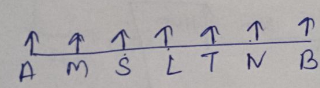
Seven people, A, B, L, M, N, S, and T are sitting in a row, facing north. Only two people sit to the left of S. Only three people sit between S and B. T sits second to the right of S. Only two people sit between T and M. L sits at some place to the right of A but at some place to the left of N.

How many people sit to the right of L?

  1. AOption (a)

    Two

  2. BOption (b)

    Three

  3. COption (c)

    One

  4. DOption (d)

    Four

View answer & explanation

Correct answer

Answer: (b)B.

Three

Why this answer is correct

Given: Seven people, A, B, L, M, N, S, and T are sitting in a row, facing north.

Only two people sit to the left of S. Only three people sit between S and B.

T sits second to the right of S. Only two people sit between T and M.

L sits at some place to the right of A but at some place to the left of N.

Thus, Only  people sit to the right of L.

Hence, the correct answer is "Option 2".

Question 22

What is used along with milk to distill the Pithora colours in Pithora painting?

  1. AOption (a)

    Apple cider

  2. BOption (b)

    Tamarind paste

  3. COption (c)

     Mahuda

  4. DOption (d)

     Lime juice

View answer & explanation

Correct answer

Answer: (c)C.

 Mahuda

Why this answer is correct

The correct answer is Mahuda.

Key Points

  • Mahuda (Madhuca longifolia) is a vital ingredient used in Pithora painting to distill natural pigments for creating the vibrant colors used in this art form.
  • Mahuda flowers are mixed with milk to create a liquid medium that helps extract the natural colors from organic pigments.
  • It is a traditional method employed by the Rathwa and Bhil tribes of Gujarat and Madhya Pradesh, who are renowned for Pithora paintings.
  • The use of Mahuda ensures that the colors maintain their natural vibrancy and adhere well to the surface of the walls.
  • Mahuda is also culturally significant to these tribes, being used in various rituals and traditional practices, including its application in art.

Additional Information

  • Pithora Painting
  • Pithora painting is a ritualistic and traditional art form of the Rathwa and Bhil tribes in Gujarat and Madhya Pradesh.
  • These paintings are typically created on the walls of houses to invoke blessings from the deity Pithora Baba for prosperity and well-being.
  • They are vibrant depictions of tribal culture, incorporating animals, humans, and deities in a symbolic style.
  • Natural Pigments in Pithora Art
  • Natural pigments derived from organic materials such as rice paste, turmeric, and flowers are traditionally used in Pithora paintings.
  • The colors are prepared using a mix of milk and Mahuda to ensure their durability and brightness.
  • Mahuda Tree (Madhuca longifolia)
  • Mahuda is a tropical tree native to India and is widely revered in tribal communities.
  • The flowers of the tree are used in various applications, such as brewing traditional alcoholic beverages, cooking, and as a natural ingredient in art.
  • Significance of Milk in Pithora Painting
  • Milk is used as a binder in traditional Pithora art to create a smooth, adhesive medium for natural pigments.
  • It symbolizes purity and is often associated with the sacred nature of the rituals connected to Pithora painting.

Question 23

Which financial institution was established by the 74th Constitutional Amendment, 1992, to review the finances of Urban Local Government Bodies?

  1. AOption (a)

    Municipal Treasury Board

  2. BOption (b)

     Reserve Bank of Indi

  3. COption (c)

     Urban Taxation Authority

  4. DOption (d)

    State Finance Commission

View answer & explanation

Correct answer

Answer: (d)D.

State Finance Commission

Why this answer is correct

The correct answer is State Finance Commission.

Key Points

  • The 74th Constitutional Amendment Act of 1992 mandated the establishment of the State Finance Commission (SFC) to review the financial position of Urban Local Bodies (ULBs) and Panchayati Raj Institutions (PRIs).
  • The SFC is constituted by the respective State Governments every five years to recommend measures for improving the financial health of local self-governments.
  • Its primary responsibility is to distribute financial resources between the state government and local bodies, ensuring adequate funding for developmental activities.
  • The recommendations of the SFC include devolution of taxes, grants-in-aid, and improving revenue-generating capabilities of ULBs and PRIs.
  • This initiative aligns with the spirit of decentralization, empowering local self-governments to perform their functions more effectively.

Additional Information

  • 74th Constitutional Amendment Act, 1992
  • This Act provided a constitutional status to Urban Local Bodies (ULBs) in India.
  • It introduced the concept of decentralized governance through institutions like Municipalities, Municipal Corporations, and Nagar Panchayats.
  • It also emphasized the importance of financial sustainability and accountability in local governance.
  • State Finance Commission (SFC)
  • The SFC was established under Article 243-I of the Constitution.
  • It is responsible for reviewing the financial position of Panchayati Raj Institutions and Urban Local Bodies within the state.
  • The SFC provides recommendations on tax assignments, revenue-sharing, and grants-in-aid for local bodies.
  • Urban Local Bodies (ULBs)
  • ULBs are the governing institutions responsible for administering towns and cities in India.
  • They include Municipal Corporations, Municipalities, and Nagar Panchayats, which are categorized based on the population size.
  • ULBs are tasked with providing essential services such as water supply, sanitation, waste management, and urban planning.
  • Decentralization
  • Decentralization refers to the transfer of decision-making powers and responsibilities from central authorities to lower levels of government.
  • It aims to improve governance, ensure participation, and enhance service delivery at the grassroots level.
  • The 73rd and 74th Constitutional Amendments are key milestones in India’s journey toward decentralized governance.

Question 24

Refer to the following number and symbol series and answer the question that follows. Counting to be done from left to right only.

(NOTE: All numbers are single digit numbers only.)

(Left) 4 2 1 6 9 & © 2 \% 6 & $ * 5 @ £ 1 8 @ # (Right)

 How many such symbols are there, each of which is immediately preceded by a number and also immediately followed by a symbol$?

  1. AOption (a)

    7

  2. BOption (b)

    4

  3. COption (c)

    6

  4. DOption (d)

    5

View answer & explanation

Correct answer

Answer: (d)D.

5

Why this answer is correct

Given series:

(Left) 4 2 1 6 9 & © 2 \% 6 & $ * 5 @ £ 1 8 @ # (Right)

Condition to be checked:

Number → Symbol → Symbol

4 2 1 6 9 & © 2  \% 6 &  $ * 5 @ £ 1 8 @ #

There are five such symbols in the above arrangement (9 & ©, 2 \%, 6 & , 5 @ £, 8 @ #).

Hence, the correct answer is "Option 4".

Question 25

Which of the following is a feature of contract farming in India?

  1. AOption (a)

    Farmers grow food for self-use

  2. BOption (b)

    No involvement of corporations

  3. COption (c)

    Use of only traditional seeds

  4. DOption (d)

    Fixed buy-back rate by companies

View answer & explanation

Correct answer

Answer: (d)D.

Fixed buy-back rate by companies

Why this answer is correct

The correct answer is Fixed buy-back rate by companies.

Key Points

  • Contract farming involves an agreement between a farmer and a company (buyer) for the production and supply of agricultural products at predetermined prices.
  • The agreement often includes a fixed buy-back rate for the produce, ensuring price stability for the farmers.
  • It is a practice widely adopted to reduce market risks for farmers and ensure a steady supply of raw materials for companies.
  • Contract farming provides access to advanced technology, quality seeds, fertilizers, and technical knowledge supplied by companies.
  • It is a regulated practice under the Indian Model Agricultural Produce and Livestock Contract Farming Act, 2018, which protects the interests of both farmers and companies.

Additional Information

  • Contract Farming Act, 2018:
  • This model act aims to promote contract farming by providing a framework for agreements between farmers and sponsors.
  • It includes provisions to prevent exploitation of farmers, including no transfer of land ownership to sponsors.
  • The act also ensures dispute resolution through a fast-track mechanism.
  • Advantages of Contract Farming:
  • Farmers benefit from guaranteed pricing and reduced market risks.
  • Companies ensure a steady supply of raw materials with desired quality standards.
  • Farmers gain access to modern technology and better farming practices.
  • Disadvantages of Contract Farming:
  • Farmers may become overly dependent on companies for inputs and technology.
  • Disputes may arise regarding quality standards, payment delays, or pricing.
  • Small farmers may face challenges in negotiating favorable contract terms.
  • Examples of Contract Farming in India:
  • PepsiCo's potato farming initiative in Punjab for its snack products.
  • Nestle's milk procurement model through direct contracts with dairy farmers.
  • ITC's e-Choupal initiative for sourcing agricultural produce directly from farmers.

Question 26

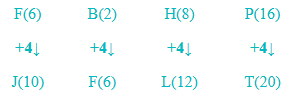
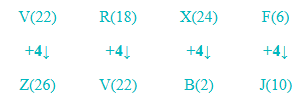
FBHP is related to JFLT in a certain way based on the English alphabetical order. In the same way, VRXF is related to ZVBJ. To which of the following options is HDJR related, following the same logic?

  1. AOption (a)

    LHVN

  2. BOption (b)

     LVHN

  3. COption (c)

    LHNV

  4. DOption (d)

    LVNH

View answer & explanation

Correct answer

Answer: (c)C.

LHNV

Why this answer is correct

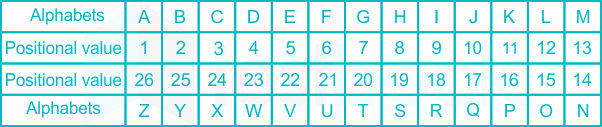
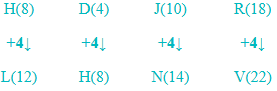
Positional value table of the alphabet

The pattern followed here is that each letter of the first term is shifted forward by 4 positions. The pattern can be summarized as (+4, +4, +4, +4).

For : FBHP : JFLT

For : VRXF : ZVBJ

Applying the same logic to HDJR:

Thus, HDJR is related to LHNV.

Hence, the correct answer is "Option 3".

Question 27

According to the Reserve Bank of India, as of October 2024, India became the fourth country whose foreign exchange (forex) reserves swelled to _______ billion.

  1. AOption (a)

    701

  2. BOption (b)

    1,000

  3. COption (c)

    101

  4. DOption (d)

    901

View answer & explanation

Correct answer

Answer: (a)A.

701

Why this answer is correct

The correct answer is 701.

Key Points

  • As of October 2024, India became the fourth country in the world to have foreign exchange (forex) reserves exceeding $701 billion.
  • The Reserve Bank of India (RBI) is responsible for managing the country’s forex reserves, which include foreign currency assets, gold reserves, Special Drawing Rights (SDRs), and the reserve position in the International Monetary Fund (IMF).
  • India’s forex reserves crossed the $700 billion mark, highlighting its strong economic fundamentals and resilience in the global financial landscape.
  • Other countries with similar high forex reserves include China, Japan, and Switzerland.
  • Maintaining high forex reserves is essential for stabilizing the Indian rupee and supporting India’s imports, external debt, and economic growth.

Additional Information

  • Foreign Exchange Reserves
  • Forex reserves consist of foreign currency assets, gold, SDRs (Special Drawing Rights), and the reserve position in the IMF.
  • These reserves act as a buffer against external economic shocks and ensure financial stability.
  • They are critical for maintaining investor confidence and supporting the balance of payments.
  • Reserve Bank of India (RBI)
  • The RBI is India’s central bank, tasked with managing monetary policy, regulating banks, and overseeing the country’s forex reserves.
  • It actively intervenes in the forex market to stabilize the Indian rupee against global currencies.
  • Special Drawing Rights (SDRs)
  • SDRs are supplementary foreign exchange reserve assets created by the International Monetary Fund (IMF).
  • They are based on a basket of major international currencies, including the US dollar, euro, yuan, yen, and pound sterling.
  • Importance of Forex Reserves
  • They enable a country to meet its external obligations, including import payments and debt repayments.
  • High reserves help mitigate currency volatility and ensure economic stability during global financial crises.
  • India’s Forex History
  • India’s forex reserves have grown significantly since the economic liberalization of 1991, when they were critically low.
  • In 2021, India’s forex reserves exceeded 600billionforthefirsttime,showcasingitseconomicprogress600 billion for the first time, showcasing its economic progress.

Question 28

An electric pump can fill a tank in 4 hours. Due to a leakage in the tank, it takes 9139 \frac{1}{3} hours to fill the tank. How much time will this leak take to empty the full tank if water does not get in or out of the tank through any other point during this period?

  1. AOption (a)

    17 hours

  2. BOption (b)

    15 hours

  3. COption (c)

     7 hours

  4. DOption (d)

     2 hours

View answer & explanation

Correct answer

Answer: (c)C.

 7 hours

Why this answer is correct

Shortcut Trick

Filling rate with pump alone = 1/4 tank/hr.

Filling rate with leakage (9 1/3 hr = 28/3 hr) = 3/28 tank/hr.

Rate of leakage = 1/4 − 3/28 = (7 − 3)/28 = 4/28 = 1/7 tank/hr.

Time taken by leak to empty = 1 ÷ (1/7) = 7 hours.

∴ The correct answer is 7 hr.

Alternate Method

ComponentTime (hr)Total Work (LCM)Efficiency
Pump (P)428 units7
Pump + Leak (P−L)28/33

Given: Filling time = 4 hr, Combined time with leak = 28/3 hr.

Formula Used: Efficiency = Total Work ÷ Time; Leak Efficiency = P − (P−L).

⇒ Efficiency of Pump (P) = 28 ÷ 4 = 7 units/hr.

⇒ Efficiency of Pump − Leak (P−L) = 28 ÷ (28/3) = 3 units/hr.

⇒ Efficiency of Leak (L) = 7 − 3 = 4 units/hr.

⇒ Time taken by Leak to empty = 28 ÷ 4 = 7 hr.

∴ The correct answer is 7 hr.

Additional Information

Inlet and Outlet Pipes

An inlet pipe fills a tank (positive work) while an outlet pipe or leakage empties it (negative work).

Combined Efficiency

If pipe A fills in 'x' hours and leak B empties in 'y' hours, net work per hour = 1/x − 1/y.

Emptying Time Formula

If a tank fills in 'a' hours and with a leak in 'b' hours, the leak empties the full tank in (a × b) ÷ (b − a) hours.

Question 29

The simplified value of 81 - 4 × (5 + 2) + 54 is:

  1. AOption (a)

    110

  2. BOption (b)

    108

  3. COption (c)

    114

  4. DOption (d)

    107

View answer & explanation

Correct answer

Answer: (d)D.

107

Why this answer is correct

Given:

The expression to simplify is: 81 - 4 × (5 + 2) + 54

Formula used:

Follow the BODMAS rule: Brackets, Orders (powers/roots), Division, Multiplication, Addition, Subtraction.

Calculation:

81 - 4 × (5 + 2) + 54

⇒ 81 - 4 × 7 + 54     (solving inside the brackets)

⇒ 81 - 28 + 54     (multiplying 4 × 7)

⇒ (81 + 54) - 28

⇒ 135 - 28 = 107

∴ The correct answer is option (4).

Question 30

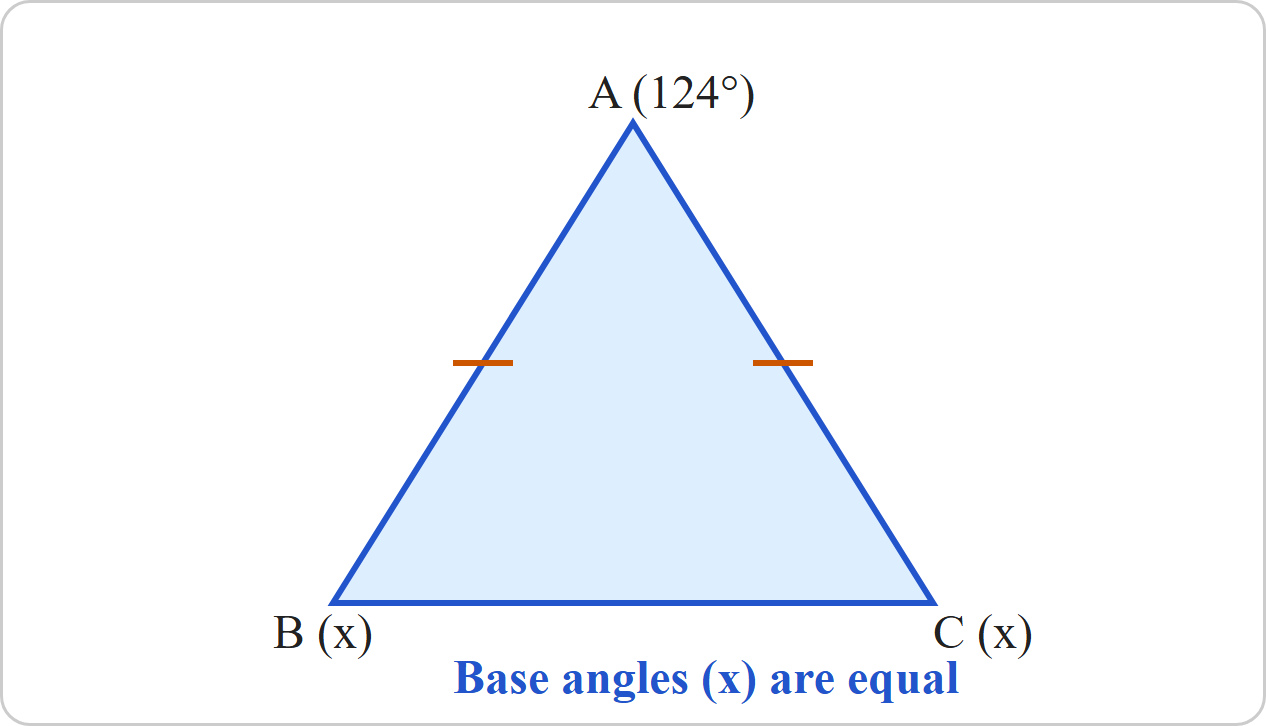
In an isosceles triangle, the vertex angle measures 124°. What is the measure of each of the base angles?

  1. AOption (a)

    28° and 28°

  2. BOption (b)

    31° and 25°

  3. COption (c)

    29° and 41°

  4. DOption (d)

    24° and 40°

View answer & explanation

Correct answer

Answer: (a)A.

28° and 28°

Why this answer is correct

Shortcut Trick

In an isosceles triangle, base angles are equal.

Sum of base angles = 180° − Vertex angle

Sum = 180° − 124° = 56°

Each base angle = 56° ÷ 2 = 28°

∴ The correct answer is 28° and 28°.

Alternate Method

Given:

Vertex angle (top angle) = 124°

Triangle type = Isosceles Triangle

Formula Used:

Sum of all internal angles of a triangle = 180°

In an isosceles triangle, angles opposite to equal sides are equal (Base angles).

Calculations:

Let each base angle be x.

⇒ 124° + x + x = 180°

⇒ 124° + 2x = 180°

⇒ 2x = 180° − 124°

⇒ 2x = 56°

⇒ x = 56° ÷ 2

⇒ x = 28°

∴ The correct answer is 28° and 28°.

Additional Information

Isosceles Triangle Properties

A triangle with at least two equal sides. The angles opposite to these sides are always equal.

Angle Sum Property

The sum of the interior angles of any triangle is always 180°.

Equilateral Triangle

A special case of an isosceles triangle where all three sides and all three angles (each 60°) are equal.

Question 31

JROK is related to HPMI in a certain way based on the English alphabetical order. In the same way, GOLH is related to EMJF. To which of the given options is DLIE related, following the same logic?

  1. AOption (a)

    BJCG

  2. BOption (b)

    JBGC

  3. COption (c)

     BJGC

  4. DOption (d)

    JBCG

View answer & explanation

Correct answer

Answer: (c)C.

 BJGC

Why this answer is correct

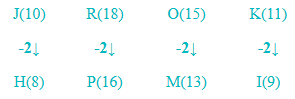
Positional value table of the alphabet

The pattern followed here is that each letter of the first term is shifted backward by 2 positions. The pattern can be summarized as (-2, -2, -2, -2).

For: JROK : HPMI

For**: GOLH : EMJF**

Applying the same logic to DLIE:

Thus, DLIE is related to BJGC.

Hence, the correct answer is "Option 3".

Question 32

Which of the following best explains the functional diversity of RNA molecules in cells?

  1. AOption (a)

    Their linear sequence of deoxyribonucleotides

  2. BOption (b)

     Their capability to act as adapter, structural and catalytic molecules

  3. COption (c)

     Their permanent role as genetic material

  4. DOption (d)

     Their ability to form double-stranded helical structures

View answer & explanation

Correct answer

Answer: (b)B.

 Their capability to act as adapter, structural and catalytic molecules

Why this answer is correct

The correct answer is Their capability to act as adapter, structural and catalytic molecules.

Key Points

  • RNA molecules exhibit functional diversity by acting as adapter molecules in translation, such as transfer RNA (tRNA), which brings amino acids to the ribosome.
  • They serve as structural components in cellular machinery, such as ribosomal RNA (rRNA), which forms the core of ribosomes.
  • RNA molecules can act as catalysts, such as ribozymes, which facilitate biochemical reactions without being proteins.
  • RNA plays regulatory roles, such as microRNAs (miRNAs) and small interfering RNAs (siRNAs), which modulate gene expression post-transcriptionally.
  • The versatility of RNA is due to its ability to adopt complex secondary and tertiary structures, enabling diverse functional roles in cellular processes.

Additional Information

  • Messenger RNA (mRNA):
  • Acts as a template for protein synthesis during translation.
  • mRNA carries genetic information from DNA to ribosomes.
  • Each mRNA sequence specifies the amino acid sequence of a protein.
  • Transfer RNA (tRNA):
  • tRNA functions as an adapter molecule in translation.
  • It has anticodons that pair with mRNA codons and carries specific amino acids to the ribosome.
  • tRNA’s cloverleaf structure is critical for its role in protein synthesis.
  • Ribosomal RNA (rRNA):
  • Forms the structural and functional core of ribosomes.
  • rRNA helps in aligning mRNA and tRNA during translation.
  • Some rRNA molecules exhibit catalytic activity, facilitating peptide bond formation.
  • Ribozymes:
  • RNA molecules with enzymatic properties.
  • Examples include self-splicing introns and the RNA component of RNase P.
  • Ribozymes demonstrate that RNA can act as both genetic material and a catalyst.

Question 33

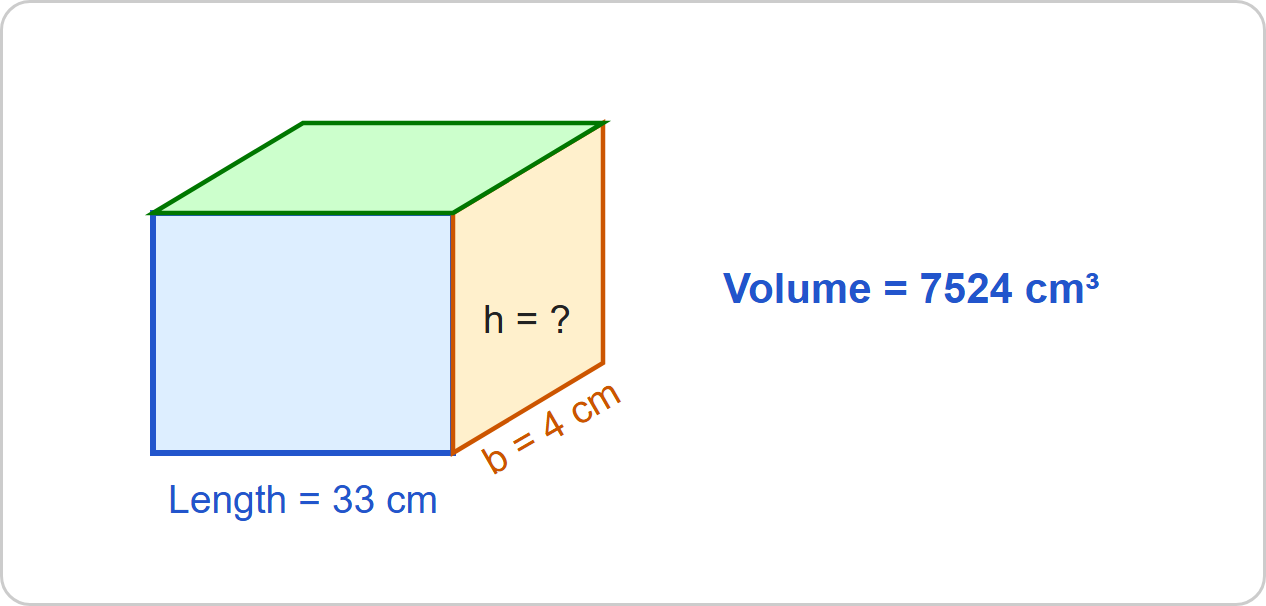
If the length of a cuboid is 33 cm, breadth is 4 cm and volume is 7524 cm3, then find the height (in cm) of the cuboid.

  1. AOption (a)

    67

  2. BOption (b)

    57

  3. COption (c)

    54

  4. DOption (d)

    60

View answer & explanation

Correct answer

Answer: (b)B.

57

Why this answer is correct

Shortcut Trick

Height = Volume ÷ (Length × Breadth)

Height = 7524 ÷ (33 × 4)

Height = 7524 ÷ 132 = 57 cm

∴ The correct answer is 57 cm.

Alternate Method

Given:

Length (l) = 33 cm

Breadth (b) = 4 cm

Volume (V) = 7524 cm3

Formula Used:

Volume of a cuboid = l × b × h

Calculations:

⇒ 7524 = 33 × 4 × h

⇒ 7524 = 132 × h

⇒ h = 7524 ÷ 132

⇒ h = 57 cm

∴ The correct answer is 57 cm.

Additional Information

Total Surface Area of Cuboid

The total surface area is calculated as 2 × (lb + bh + hl).

Diagonal of a Cuboid

The longest rod that can fit in a cuboid is given by √(l2 + b2 + h2).

Lateral Surface Area

Area of four walls = 2 × height × (length + breadth).

Question 34

Let’s denote Z as the number of atoms per unit cell, M as the molar mass of the substance, and NA as Avogadro’s number. Which formula is used to calculate the density (d) of a unit cell?

  1. AOption (a)

    d = (M × a³) / (Z × NA)

  2. BOption (b)

    d = (Z × M) / (a³ × NA)

  3. COption (c)

    d = (Z × NA) / (M × a³)

  4. DOption (d)

    d = (a³ × NA) / (Z × M)

View answer & explanation

Correct answer

Answer: (b)B.

d = (Z × M) / (a³ × NA)

Why this answer is correct

The correct answer is d = (Z × M) / (a³ × NA).

Key Points

  • The formula d = (Z × M) / (a³ × NA) is used to calculate the density of a unit cell in crystallography.
  • In this formula, Z represents the number of atoms per unit cell, M is the molar mass of the substance, a³ is the volume of the unit cell (edge length cubed), and NA is Avogadro’s number.
  • The density (d) is expressed in grams per cubic centimeter (g/cm³) when the molar mass is in grams per mole and the unit cell volume is in cubic centimeters.
  • This formula is derived from the relationship between mass, volume, and density, considering the number of atoms within the unit cell and their molar mass.
  • It is widely used to predict the crystal structure and verify experimental density measurements in solid-state chemistry and materials science.

Additional Information

  • Unit Cell:
  • The unit cell is the smallest repeating structure in a crystal lattice that represents the entire crystal.
  • Its dimensions are defined by the lengths of edges (a, b, c) and angles between them (α, β, γ).
  • Avogadro’s Number (NA):
  • Avogadro’s number is approximately 6.022 × 10²³ mol⁻¹, representing the number of entities in one mole of a substance.
  • It is crucial for converting between macroscopic and molecular scales in chemistry.
  • Molar Mass (M):
  • The molar mass is the mass of one mole of a substance, expressed in grams per mole (g/mol).
  • It is calculated as the sum of the atomic masses of all the elements in a compound.
  • Crystal Lattice:
  • A crystal lattice is a three-dimensional arrangement of atoms, ions, or molecules in a structured and repeating pattern.
  • Common types of unit cells include cubic, tetragonal, hexagonal, and orthorhombic systems.
  • Density in Crystals:
  • Density is a physical property that correlates the mass of a substance to its volume.
  • In crystallography, density helps determine the packing efficiency and arrangement of atoms within a unit cell.

Question 35

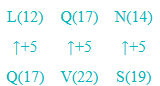
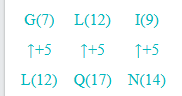
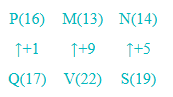
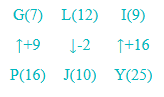
Which of the given letter-clusters should replace # and % so that the pattern and relationship followed between the letter-cluster pair on the left side of :: is the same as that on the right side of ::?

: QVS :: GLI : %

  1. AOption (a)

    = LQN, % = LQN

  2. BOption (b)

     # = KOJ, % = HGT

  3. COption (c)

    = LPQ, % = LKP

  4. DOption (d)

    = PMN, % = PJY

View answer & explanation

Correct answer

Answer: (a)A.

= LQN, % = LQN

Why this answer is correct

Given:

: QVS :: GLI : %

Option 1) # = LQN, % = LQN

For # (LQN) to QVS

The pattern derived from LQN to QVS is: (+5, +5, +5).

For GLI to % (LQN)

The pattern derived from GLI to LQN is: (+5, +5, +5).

Since the patterns for both pairs match, Option 1 is the correct answer.

Option 2) # = KOJ, % = HGT

For # (KOJ) to QVS

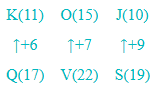
The pattern derived from KOJ to QVS is: (+6, +7, +9).

For GLI to % (HGT)

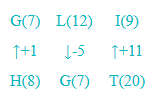
The pattern derived from GLI to HGT is: (+1, -5, +11).

Since the patterns do not match, Option 2 is incorrect.

Option 3) # = LPQ, % = LKP

For # (LPQ) to QVS

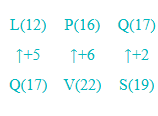
The pattern derived from LPQ to QVS is: (+5, +6, +2).

For GLI to % (LKP)

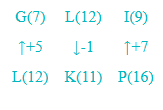
The pattern derived from GLI to LKP is: (+5, -1, +7).

Since the patterns do not match, Option 3 is incorrect.

Option 4) # = PMN, % = PJY

For # (PMN) to QVS

The pattern derived from PMN to QVS is: (+1, +9, +5).

For GLI to % (PJY)

The pattern derived from GLI to PJY is: (+9, -2, +16).

Since the patterns do not match, Option 4 is incorrect.

Hence, the correct answer is "Option 1".

Question 36

How can rivers contribute to the formation of a coastal plain?

  1. AOption (a)

    By evaporating

  2. BOption (b)

    By increasing sea levels

  3. COption (c)

    By creating fault lines

  4. DOption (d)

    By depositing sediments over time

View answer & explanation

Correct answer

Answer: (d)D.

By depositing sediments over time

Why this answer is correct

The correct answer is By depositing sediments over time.

Key Points

  • Rivers contribute to the formation of coastal plains through the process of sediment deposition over long periods of time.
  • As rivers flow, they carry sediments such as sand, silt, and clay, which are deposited at their mouths or along their courses.
  • These sediments accumulate over time and gradually form flat, low-lying land near the coast, which is referred to as a coastal plain.
  • Examples include the Eastern Coastal Plains of India, which were formed by sediment deposition from rivers like the Ganga, Mahanadi, Godavari, Krishna, and Kaveri.
  • The deposition process is influenced by factors such as the river's flow velocity, sediment load, and tidal interactions in coastal areas.

Additional Information

  • Coastal Plain: A flat or gently sloping area of land adjacent to a sea or ocean, often formed by sediment deposition or marine erosion.
  • Delta Formation: In some cases, rivers form deltas at their mouths, where the deposited sediments create triangular landforms, contributing to coastal plain development.
  • Alluvium: Sediments such as sand, silt, and clay transported and deposited by rivers, forming fertile and flat lands.
  • Estuaries and Tidal Influence: In areas where rivers meet the sea, tidal forces can redistribute sediments, further shaping the coastal plain.
  • Human Impact: Human activities such as agriculture, urbanization, and dam construction can alter natural sediment deposition processes, impacting coastal plain formation.

Question 37

 A, B, C, D, E and F live on six different floors of the same building. The lowermost floor in the building is numbered 1, the floor above it, number 2 and so on, till the topmost floor is numbered 6. F lives on an even numbered floor but not 6. The sum of floors on which C and F live is 9. The sum of floors on which F and E live is 5. A lives immediately below B. How many people live below B?

  1. AOption (a)

    3

  2. BOption (b)

    2

  3. COption (c)

    4

  4. DOption (d)

    1

View answer & explanation

Correct answer

Answer: (b)B.

2

Why this answer is correct

Given: A, B, C, D, E and F live on six different floors of the same building, numbered 1 to 6 from bottom to top.

  1. F lives on an even-numbered floor but not 6.

The even-numbered floors are 2, 4, and 6. Since F does not live on floor 6, F must live on either floor 2 or floor 4.

  1. The sum of floors on which C and F live is 9. The sum of floors on which F and E live is 5.

Let's use a case-by-case analysis based on F's floor:

  • Case 1: F lives on Floor 2.
  • Sum of C and F's floors is 9: C's floor + 2 = 9, so C lives on Floor 7. This is not a valid floor. Therefore, this case is not possible.
  • Case 2: F lives on Floor 4.
  • Sum of C and F's floors is 9: C's floor + 4 = 9, so C lives on Floor 5. This is a valid floor.
  • Sum of F and E's floors is 5: 4 + E's floor = 5, so E lives on Floor 1. This is also a valid floor.

The valid placements so far are: F is on Floor 4, C is on Floor 5, and E is on Floor 1.

6
5C
4F
3
2
1E
  1. A lives immediately below B.

The remaining empty floors are 6, 3, and 2. The remaining people are A, B, and D.

Since A lives immediately below B, they must occupy consecutive floors. The only consecutive empty floors are 3 and 2.

So, B is on Floor 3 and A is on Floor 2.

6D
5C
4F
3B
2A
1E

The only remaining person is D and the only remaining floor is 6. So D is on Floor 6.

Therefore, Two people live below B.

Hence, the correct answer is "Option 2".

Question 38

What type of engine is used in the Hansa NG trainer aircraft launched in April 2025?

  1. AOption (a)

     Continental IO-360 engine

  2. BOption (b)

    Lycoming O-320 engine

  3. COption (c)

    Pratt & Whitney PT6 engine

  4. DOption (d)

    Rotax 912 iSc3 Sports engine

View answer & explanation

Correct answer

Answer: (d)D.

Rotax 912 iSc3 Sports engine

Why this answer is correct

The correct answer is Rotax 912 iSc3 Sports engine.

Key Points

  • The Hansa NG trainer aircraft is equipped with the Rotax 912 iSc3 Sports engine, known for its reliability, efficiency, and lightweight design.
  • This engine is a four-stroke, fuel-injected engine that supports unleaded aviation fuel and meets stringent emission standards.
  • The Rotax 912 iSc3 Sports engine delivers 100 horsepower (hp), making it suitable for trainer aircraft used in pilot training programs.
  • It features advanced technology such as electronic fuel injection and digital engine control, enhancing performance and fuel efficiency.
  • The Rotax engine has been widely adopted in the aviation industry, particularly for ultralight and light-sport aircraft, due to its low operational costs and high durability.

Additional Information

  • Trainer Aircraft:
  • Trainer aircraft are specifically designed for pilot training, allowing beginners to learn flight mechanics and navigation.
  • They are equipped with dual controls to enable instructors to assist trainees during flight.
  • Modern trainer aircraft often feature advanced avionics to simulate real-world flying conditions.
  • Rotax Engines:
  • Rotax engines are manufactured by BRP-Rotax GmbH & Co KG, based in Austria.
  • They are widely used in light aircraft, ultralights, and light-sport aircraft due to their lightweight and reliable performance.
  • Rotax engines are known for their low vibration levels, reduced noise, and compliance with international emission standards.
  • Fuel Efficiency:
  • The Rotax 912 iSc3 Sports engine's electronic fuel injection system optimizes fuel consumption and reduces emissions.
  • It is designed to operate efficiently with unleaded aviation gasoline, making it environmentally friendly.
  • Hansa NG Aircraft:
  • The Hansa NG is an upgraded version of the Hansa series, developed by the National Aerospace Laboratories (NAL), India.
  • It is a two-seater trainer aircraft designed for general aviation and pilot training.
  • The aircraft incorporates advanced safety features, improved aerodynamics, and a modern cockpit layout.

Question 39

If x2 + 1x2\frac{1}{x^2}  = 83, x > 0, then find the value of x3 - 1x3\frac{1}{x^3}.

  1. AOption (a)

    756

  2. BOption (b)

    720

  3. COption (c)

    656

  4. DOption (d)

    820

View answer & explanation

Correct answer

Answer: (a)A.

756

Why this answer is correct

Shortcut Trick If x2 + 1/x2 = n, then (x − 1/x) = √(n − 2). Here n = 83 → x − 1/x = √(83 − 2) = 9. Shortcut for x3 − 1/x3 = k3 + 3k, where k = (x − 1/x). Required value = 93 + 3(9) = 729 + 27 = 756. ∴ The correct answer is 756.

Alternate Method Given: x2 + 1/x2 = 83 x > 0 Formula Used:

  1. Algebraic identity: (a − b)2 = a2 + b2 − 2ab
  2. Algebraic identity: a3 − b3 = (a − b)(a2 + b2 + ab) Calculations: ⇒ (x − 1/x)2 = x2 + 1/x2 − 2×x×(1/x) ⇒ (x − 1/x)2 = 83 − 2 ⇒ (x − 1/x)2 = 81 ⇒ x − 1/x = √81 = 9 ⇒ x3 − 1/x3 = (x − 1/x)(x2 + 1/x2 + (x×1/x)) ⇒ x3 − 1/x3 = 9 × (83 + 1) ⇒ x3 − 1/x3 = 9 × 84 = 756 ∴ The correct answer is 756.

Additional Information Positive Power Relation If x + 1/x = k, then x2 + 1/x2 = k2 − 2 and x3 + 1/x3 = k3 − 3k. Negative Power Relation If x − 1/x = k, then x2 + 1/x2 = k2 + 2 and x3 − 1/x3 = k3 + 3k. Relationship between (x+1/x) and (x-1/x) (x + 1/x)2 − (x − 1/x)2 = 4.

Question 40

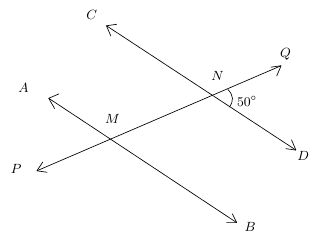
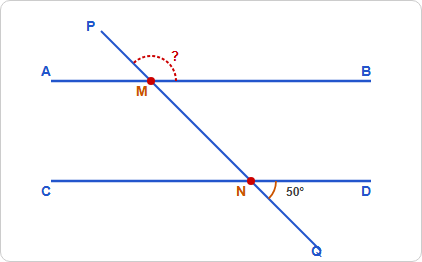
In the given figure, AB and CD are two parallel lines and PQ is a transversal line . Find the measure of ∠PMB.

  1. AOption (a)

    120°

  2. BOption (b)

    130°

  3. COption (c)

    100°

  4. DOption (d)

    50°

View answer & explanation

Correct answer

Answer: (b)B.

130°

Why this answer is correct

Shortcut Trick

Since AB || CD and PQ is a transversal line, the angle ∠MND and the given angle ∠DNQ form a linear pair on the straight line PQ.

⇒ ∠MND = 180° − 50° = 130°

Since corresponding angles are equal for parallel lines, we have:

⇒ ∠PMB = ∠MND = 130°

∴ The correct answer is 130°.

Alternate Method

Given:

⇒ AB || CD (parallel lines)

⇒ PQ is a transversal line intersecting AB at M and CD at N.

⇒ ∠DNQ = 50°

Properties Used:

  1. Linear Pair Axiom: Angles on a straight line sum up to 180°.
  2. Corresponding Angles Postulate: When two parallel lines are cut by a transversal, corresponding angles are equal.

Calculations:

⇒ ∠MND + ∠DNQ = 180° (Linear pair on transversal line PQ)

⇒ ∠MND + 50° = 180°

⇒ ∠MND = 180° − 50° = 130°

Since AB || CD and PQ is the transversal line:

⇒ ∠PMB = ∠MND (Corresponding angles)

⇒ ∠PMB = 130°

Option Analysis:

⇒ Option (1) 120° is incorrect because the supplementary angle to 50° is 130°, not 120°.

⇒ Option (3) 100° is incorrect because the angle is determined by the linear pair relation with 50°, which yields 130°.

⇒ Option (4) 50° is incorrect because ∠PMB is an obtuse angle, whereas 50° is an acute angle (∠BMN = 50°).

∴ The correct answer is 130°.

Additional Information

Corresponding Angles

When two parallel lines are cut by a transversal, the angles in matching corners are called corresponding angles and they are equal.

Alternate Exterior Angles

Alternate exterior angles are equal when lines are parallel. For example, ∠PMA and ∠DNQ are alternate exterior angles.

Consecutive Interior Angles

Consecutive interior angles lie on the same side of the transversal and inside the parallel lines. Their sum is always 180°.

Question 41

Which site is known for its elaborate dockyard structure?

  1. AOption (a)

    Lothal 

  2. BOption (b)

    Dholavira

  3. COption (c)

    Harappa

  4. DOption (d)

    Rakhigarhi

View answer & explanation

Correct answer

Answer: (a)A.

Lothal 

Why this answer is correct

The correct answer is Lothal.

Key Points

  • Lothal is a prominent site of the Indus Valley Civilization, located in present-day Gujarat, India.
  • It is renowned for its advanced and elaborate dockyard structure, which showcases remarkable engineering and urban planning skills.
  • The dockyard was used for maritime activities, including trade and transportation, making Lothal a significant trading hub during ancient times.
  • The dockyard was constructed using bricks and stone, and it featured a sophisticated drainage system to manage water flow and prevent flooding.
  • Excavations at Lothal also revealed evidence of bead-making, shell-working, and metallurgy, highlighting its industrial and commercial significance.

Additional Information

  • Indus Valley Civilization (IVC):
  • The IVC flourished between 2500 BCE and 1900 BCE in the regions of present-day Pakistan and northwest India.
  • It is known for its advanced urban planning, including well-laid streets, drainage systems, and standardized brick sizes.
  • Major sites include Harappa, Mohenjo-Daro, Dholavira, and Lothal.
  • Lothal's Dockyard:
  • The dockyard measures approximately 218 meters in length and 37 meters in width.
  • It is believed to have been connected to the Sabarmati River for facilitating trade and transport.
  • The structure showcases the technical prowess of the civilization in water management and maritime engineering.
  • Trade and Economy:
  • Lothal was a center for trade in beads, semi-precious stones, and ornaments.
  • Artifacts discovered at the site include tools, seals, and pottery, indicating robust commercial activities.
  • Trade links extended to Mesopotamia and other regions, reflecting the global reach of the Indus Valley Civilization.
  • Other Indus Valley Sites:
  • Harappa: Known for its granaries and urban planning.
  • Mohenjo-Daro: Famous for its Great Bath and advanced drainage systems.
  • Dholavira: Known for its water conservation techniques and unique layout.

Question 42

Dhordo, the venue of Rann Utsav (from December, 2024 to February, 2025), is located in which Indian state and near what geographical feature?

  1. AOption (a)

    Punjab – Sutlej Basin

  2. BOption (b)

    Rajasthan – Thar Desert

  3. COption (c)

    Maharashtra – Western Ghats

  4. DOption (d)

    Gujarat – Rann of Kutch

View answer & explanation

Correct answer

Answer: (d)D.

Gujarat – Rann of Kutch

Why this answer is correct

The correct answer is Gujarat – Rann of Kutch.

Key Points

  • Dhordo is a small village located in the state of Gujarat, India, and serves as the gateway to the Rann of Kutch, a vast salt marsh.
  • The Rann Utsav is a cultural festival held annually, showcasing the rich heritage, crafts, music, dance, and cuisine of Gujarat.
  • The Rann of Kutch is one of the largest salt deserts in the world, spanning an area of approximately 7,500 square kilometers.
  • The festival typically takes place during the winter months (December to February), when the region experiences pleasant weather and clear skies.
  • The event attracts tourists globally and provides opportunities for activities such as camel rides, hot air ballooning, and exploring traditional handicrafts.

Additional Information

  • Rann of Kutch
  • The Rann of Kutch is divided into two parts: the Great Rann and the Little Rann.
  • It is known for its unique landscape, consisting of white salt flats that appear like a snow-covered terrain.
  • This geographical feature is formed due to the seasonal flooding and evaporation of seawater from the Arabian Sea.
  • The region is also home to unique wildlife species, such as the Indian Wild Ass and flamingos.
  • Rann Utsav Highlights
  • Rann Utsav includes cultural programs, folk music, and dance performances celebrating Gujarat’s traditions.
  • Visitors can stay in specially designed tent accommodations and enjoy star-gazing in the serene desert nights.
  • The festival promotes local artisans by providing platforms for showcasing handicrafts such as embroidery, pottery, and bandhani textiles.
  • Adventure sports like paramotoring, ATV rides, and trekking are popular activities during the event.
  • Ecological and Cultural Importance
  • The Rann of Kutch serves as a breeding ground for migratory birds, making it an important ecological zone.
  • Local communities such as the Rabari and Kutchi tribes are integral to the region, preserving its rich cultural heritage.
  • The area is famous for its vibrant festivals, including Navratri and other traditional celebrations apart from Rann Utsav.
  • Efforts are being made to promote sustainable tourism in the region to protect its fragile ecosystem.

Question 43

What will come in place of the question mark (?) in the following equation if '÷' and '−' are interchanged and '×' and '+' are interchanged?

 4320 − 96 × 37 + 21 ÷ 372 = ?

  1. AOption (a)

    733

  2. BOption (b)

    1350

  3. COption (c)

    822

  4. DOption (d)

    450

View answer & explanation

Correct answer

Answer: (d)D.

450

Why this answer is correct

Given interchange rules:

  • ‘÷’ and ‘−’ are interchanged.
  • ‘×’ and ‘+’ are interchanged.

The given equation is:

4320 − 96 × 37 + 21 ÷ 372 = ?

After applying the interchange rules, the equation becomes:

4320 ÷ 96 + 37 × 21 − 372 = ?

Now, we solve the equation following the BODMAS rule:

= 4320 ÷ 96 + 37 × 21 − 372

= 45 + 777 − 372

= 822 − 372

= 450

Hence, the correct answer is "Option 4".

Question 44

Seven boxes, A, B, C, D, E, F and G, are kept one over the other, but not necessarily in the same order. E is kept immediately above G. C is kept immediately above D. Only B is kept above F. Only two boxes are kept above E. C is not kept at the third position from the bottom. How many boxes are kept above C?

  1. AOption (a)

    4

  2. BOption (b)

    5

  3. COption (c)

    2

  4. DOption (d)

    3

View answer & explanation

Correct answer

Answer: (b)B.

5

Why this answer is correct

Given: Seven boxes, A, B, C, D, E, F and G, are kept one over the other, but not necessarily in the same order.

  1. E is kept immediately above G.

  2. C is kept immediately above D.

  3. Only B is kept above F.

  4. Only two boxes are kept above E.

  5. C is not kept at the third position from the bottom.

B
F
E
G
A
C
D

After arranging the boxes, the number of boxes above C is 5.

Hence, the correct answer is "Option 2".

Question 45

In a certain code language,

 'A + B' means ‘A is the father of B’

 'A – B' means ‘A is the daughter of B’

 'A x B' means ‘A is the son of B’

 'A ÷ B' means ‘A is the wife of B’

 Based on the above, how is P related to T if ‘P + Q x R – S ÷ T’?

  1. AOption (a)

    Son's wife's brother

  2. BOption (b)

    Daughter's husband

  3. COption (c)

    Wife's brother's son

  4. DOption (d)

    Daughter's son

View answer & explanation

Correct answer

Answer: (b)B.

Daughter's husband

Why this answer is correct

A is
Symbol+–x÷
MeaningFatherDaughterSonWife
of B

Given Expression: P + Q x R - S ÷ T

P + Q: P is the father of Q.

This confirms P is male.

Q x R: Q is the son of R.

This confirms Q is male.

R - S: R is the daughter of S.

This confirms R is female.

S ÷ T: S is the wife of T.

This confirms S is female and T is male.

According to the given information Family Tree Representation:

Therefore, P is the Daughter's husband of T.

Hence, the correct answer is "Option 2"

Question 46

What term is given, in motivation theory, to the things people value and choose to pursue?

  1. AOption (a)

    Goals

  2. BOption (b)

     Innate needs 

  3. COption (c)

    Satisfaction

  4. DOption (d)

    None

View answer & explanation

Correct answer

Answer: (a)A.

Goals

Why this answer is correct

The correct answer is Goals.

Key Points

  • In motivation theory, the term "goals" refers to the objectives or outcomes that individuals value and actively strive to achieve.
  • Goals play a critical role in driving human behavior and guiding decision-making, as they provide a sense of direction and purpose.
  • The concept of setting and pursuing goals is central to several motivation theories, including Goal-Setting Theory by Edwin Locke and Gary Latham.
  • Clear, challenging, and specific goals are known to enhance motivation, focus, and performance, particularly when paired with feedback and self-monitoring.
  • Goals can be categorized into short-term, medium-term, and long-term objectives, depending on the timeline and scope of the desired outcome.

Additional Information

  • Goal-Setting Theory:
  • Proposed by Edwin Locke in the 1960s, this theory emphasizes the importance of setting specific, challenging goals to increase motivation and performance.
  • According to the theory, goals must be clear, measurable, and time-bound to be effective.
  • Providing feedback and recognizing progress are essential elements of successful goal achievement.
  • Intrinsic vs. Extrinsic Motivation:
  • Intrinsic motivation arises from internal factors, such as personal satisfaction or enjoyment derived from the activity itself.
  • Extrinsic motivation is driven by external rewards, such as money, recognition, or avoiding punishment.
  • Both types of motivation can influence goal-setting and achievement.
  • Maslow’s Hierarchy of Needs:
  • Abraham Maslow’s theory suggests that human motivation is driven by a hierarchy of needs, starting with basic physiological needs and progressing to self-actualization.
  • Goals often align with fulfilling these needs, such as financial stability, relationships, or personal growth.
  • SMART Goals:
  • The SMART framework ensures that goals are Specific, Measurable, Achievable, Relevant, and Time-bound.
  • This approach is widely used in personal development, education, and organizational management to enhance goal clarity and attainability.
  • Self-Determination Theory (SDT):
  • SDT emphasizes the role of autonomy, competence, and relatedness in fostering intrinsic motivation and achieving goals.
  • It highlights the importance of aligning goals with personal values and interests for sustained motivation.

Question 47

Mr C starts from Point A and drives 5 km towards the West. He then takes a right turn, drives 11 km, turns right and drives 3 km. He then takes a left turn and drives 4 km. He then takes a right turn, drives 3 km. He then takes a final right turn drives 15 km and stops at Point B. How far (shortest distance) and towards which direction should he drive in order to reach Point A again? (All turns are 90 degrees turns only unless specified)

  1. AOption (a)

    3 km towards the South

  2. BOption (b)

     1 km towards the East

  3. COption (c)

    1 km towards the North

  4. DOption (d)

    1 km towards the West

View answer & explanation

Correct answer

Answer: (d)D.

1 km towards the West

Why this answer is correct

Given: 

Mr C starts from Point A and drives 5 km towards the West.

He then takes a right turn, drives 11 km, turns right and drives 3 km.

He then takes a left turn and drives 4 km. He then takes a right turn, drives 3 km.

He then takes a final right turn drives 15 km and stops at Point B.

Thus, he 1 km towards the West drive in order to reach Point A again.

Hence, the correct answer is "Option 4".

Question 48

The Himalayan High Altitude Atmospheric and Climate Research Centre was inaugurated on 8th April 2025 in which district?

  1. AOption (a)

    Udhampur

  2. BOption (b)

    Anantnag

  3. COption (c)

    Srinagar

  4. DOption (d)

    Pulwama

View answer & explanation

Correct answer

Answer: (a)A.

Udhampur

Why this answer is correct

The correct answer is Udhampur.

Key Points

  • The Himalayan High Altitude Atmospheric and Climate Research Centre was inaugurated on 8th April 2025 in the Udhampur district of Jammu and Kashmir.
  • The centre aims to study atmospheric and climatic changes in the Himalayan region, which is highly sensitive to global climate change.
  • It will serve as a key research hub for monitoring weather patterns, air quality, and greenhouse gas emissions in high-altitude environments.
  • The facility is equipped with advanced instruments to track and analyze microclimatic changes and their impact on biodiversity, water resources, and glacial health.
  • This initiative is part of India’s efforts to enhance scientific research on climate resilience and its impact on socio-economic and ecological systems.

Additional Information

  • Climate Change in the Himalayas
  • The Himalayan region is often referred to as the "Third Pole" due to its vast glacial cover, which is a vital source of freshwater for millions of people.
  • Rising temperatures and erratic weather patterns have accelerated the melting of glaciers, leading to increased risks of glacial lake outburst floods (GLOFs).
  • Studies indicate that the Himalayas are warming at a faster rate than the global average, making it a crucial area for climate research.
  • High-Altitude Atmospheric Research
  • High-altitude research involves studying atmospheric components such as aerosols, clouds, and greenhouse gases, which significantly impact weather and climate systems.
  • Such studies help in understanding the role of aerosols in cloud formation and precipitation patterns.
  • Impact on Biodiversity
  • The Himalayas host a rich array of flora and fauna, many of which are endemic to the region.
  • Climate change poses a threat to this biodiversity, leading to shifts in species distribution and habitat loss.
  • India’s Climate Research Initiatives
  • India has established several high-altitude research stations, including the Himadri station in the Arctic, to study global climate interactions.
  • These initiatives align with India’s commitment to the Paris Agreement on climate change and sustainable development goals.

Question 49

In which state of India is the Bhil tribal community found in large numbers?

  1. AOption (a)

    Odisha

  2. BOption (b)

    Tamil Nadu

  3. COption (c)

    Madhya Pradesh

  4. DOption (d)

    Kerala

View answer & explanation

Correct answer

Answer: (c)C.

Madhya Pradesh

Why this answer is correct

The correct answer is Madhya Pradesh.

Key Points

  • The Bhil tribal community is one of the largest indigenous communities in India and is primarily concentrated in Madhya Pradesh, followed by Rajasthan, Gujarat, and Maharashtra.
  • Bhil tribes in Madhya Pradesh are known for their traditional art forms, including the famous Pithora paintings, which reflect their cultural heritage.
  • Madhya Pradesh has a significant population of Bhils, especially in regions like the Malwa, Nimar, and Jhabua districts.
  • The Bhil community primarily depends on agriculture, hunting, and forest produce for their livelihood and has a deep connection with nature.
  • They are recognized as a Scheduled Tribe under the Indian Constitution, which entitles them to special benefits and protections.

Additional Information

  • Bhil Tribe
  • The term "Bhil" originates from the word "Billu," which means bow, as Bhils were traditionally skilled archers.
  • They are classified as one of the largest tribal groups in India, with a population spread across several states.
  • The Bhil community has its own distinct language, customs, and traditions, contributing to India's cultural diversity.
  • They practice animism and have a rich tradition of folklore and oral storytelling.
  • Scheduled Tribes in India
  • Scheduled Tribes (STs) are officially designated groups under the Indian Constitution, recognized for their socio-economic disadvantages.
  • The government provides various schemes, reservations, and welfare programs to uplift ST communities.
  • India has a diverse tribal population, with each group having its own culture, language, and traditions.
  • Pithora Paintings
  • Pithora paintings are traditional murals created by Bhil and other tribal communities, depicting their beliefs and customs.
  • These artworks are often created on the walls of houses and are considered sacred.
  • The paintings use vibrant colors and feature themes like nature, animals, and gods.
  • Forest Rights Act, 2006
  • The Forest Rights Act recognizes the rights of forest-dwelling communities, including tribes like Bhils, over forest land and resources.
  • It aims to empower tribal populations by granting them legal rights to land and forest produce.

Question 50

At what rate (in percentage) per annum will ₹1,250 give ₹500 as simple interest in 10 years?

  1. AOption (a)

    7%

  2. BOption (b)

    6%

  3. COption (c)

    4%

  4. DOption (d)

     3%

View answer & explanation

Correct answer

Answer: (c)C.

4%

Why this answer is correct

Shortcut Trick

Annual Interest = Total Interest ÷ Time = 500 ÷ 10 = ₹50

Rate % = (Annual Interest ÷ Principal) × 100

Rate % = (50 ÷ 1250) × 100 = 4%

∴ The correct answer is 4%.

Alternate Method

Given:

Principal (P) = ₹1,250

Simple Interest (SI) = ₹500

Time (T) = 10 years

Formula Used:

Simple Interest (SI) = (P × R × T) ÷ 100

Calculations:

⇒ 500 = (1250 × R × 10) ÷ 100

⇒ 500 = (12500 × R) ÷ 100

⇒ 500 = 125 × R

⇒ R = 500 ÷ 125

⇒ R = 4%

∴ The correct answer is 4%.

Additional Information

Simple Interest (SI) Formula

The basic formula for Simple Interest is SI = (P × R × T) ÷ 100, where P is Principal, R is Rate per annum, and T is Time in years.

Total Amount Formula

The Amount (A) at the end of the period is the sum of the Principal and the Interest: A = P + SI = P(1 + RT ÷ 100).

Time Calculation

To find the Time period when other values are known: T = (SI × 100) ÷ (P × R).

Principal Calculation

To find the Principal when interest, rate, and time are known: P = (SI × 100) ÷ (R × T).

Question 51

Based on the English alphabetical order, three of the following four letter-clusters are alike in a certain way and thus form a group. Which letter-cluster DOES NOT belong to that group?

(Note: The odd one out is not based on the number of consonants/vowels or their position in the letter-cluster.)

  1. AOption (a)

    NQL

  2. BOption (b)

    EHB

  3. COption (c)

    HKF

  4. DOption (d)

    KNI

View answer & explanation

Correct answer

Answer: (b)B.

EHB

Why this answer is correct

The logic followed here is:

Option (1): NQL


Option (2): EHB


Option (3): HKF

Option (4): KNI


Hence, the correct answer is "Option 2".

Question 52

Kalpana and Sudha got 624 and 720 marks, respectively, in the same examination. If Kalpana scored 26% marks, then what is the percentage of marks scored by Sudha?

  1. AOption (a)

     27%

  2. BOption (b)

    33%

  3. COption (c)

    30%

  4. DOption (d)

    29%

View answer & explanation

Correct answer

Answer: (c)C.

30%

Why this answer is correct

Shortcut Trick

Percentage of Sudha = (Sudha's marks ÷ Kalpana's marks) × Kalpana's %

⇒ Percentage = (720 ÷ 624) × 26%

⇒ Percentage = (15 ÷ 13) × 26% = 15 × 2% = 30%

∴ The correct answer is 30%.

Alternate Method

Given:

Marks obtained by Kalpana = 624

Percentage obtained by Kalpana = 26%

Marks obtained by Sudha = 720

Calculation:

⇒ Let the Total Marks of the examination be x.

⇒ According to the question, 26% of x = 624

⇒ (26 ÷ 100) × x = 624

⇒ x = (624 × 100) ÷ 26

⇒ x = 24 × 100 = 2400

⇒ Percentage of Sudha = (Marks obtained ÷ Total marks) × 100

⇒ Percentage = (720 ÷ 2400) × 100

⇒ Percentage = 720 ÷ 24 = 30%

∴ The correct answer is 30%.

Additional Information

Percentage Change

To find the percentage increase or decrease: Change % = (Difference ÷ Original Value) × 100.

Base Change Property

If person A scores x% marks and person B scores y% marks, the ratio of their marks is equal to the ratio of their percentages.

Pass Marks Calculation

If a student fails by 'a' marks or passes by 'b' marks, Total Marks = (Difference in marks ÷ Difference in %) × 100.

Question 53

Who among the following was appointed as Ombudsman and Ethics Officer of the Board of Control for Cricket in India in January 2025?

  1. AOption (a)

    Justice Harish Tandon

  2. BOption (b)

    Justice Ashish Naithani

  3. COption (c)

    Justice Arun Mishra

  4. DOption (d)

     Justice Joymalya Bagchi

View answer & explanation

Correct answer

Answer: (c)C.

Justice Arun Mishra

Why this answer is correct

The correct answer is Justice Arun Mishra.

Key Points

  • Justice Arun Mishra was appointed as the Ombudsman and Ethics Officer of the Board of Control for Cricket in India (BCCI) in January 2025.
  • The Ombudsman and Ethics Officer position in BCCI is crucial for addressing disputes and ethical issues within the organization.
  • Justice Arun Mishra is a former Supreme Court judge known for his significant judgments during his tenure.
  • His appointment reflects the BCCI’s commitment to ensuring transparency and ethical governance in Indian cricket administration.

Additional Information

  • Ombudsman Role:
  • An Ombudsman is an independent official appointed to investigate complaints and disputes within organizations.
  • In the context of BCCI, the Ombudsman handles issues related to players, officials, and stakeholders in cricket.
  • Ethics Officer Role:
  • The Ethics Officer ensures adherence to ethical practices and addresses conflicts of interest within the BCCI.
  • This role is vital for maintaining the integrity of cricket administration and governance.
  • BCCI Governance:
  • The Board of Control for Cricket in India is the governing body for cricket in India, responsible for organizing domestic and international matches.
  • It operates under guidelines set by the International Cricket Council (ICC).
  • Judiciary and Cricket Administration:
  • Retired judges are often appointed to key roles in sports governance to bring impartiality and legal expertise.
  • Such appointments aim to ensure fair decision-making and conflict resolution within sports organizations.

Question 54

Disinvestment was adopted as a tool for privatisation in India. Which of the following options best defines disinvestment?

  1. AOption (a)

     Increase in public borrowing

  2. BOption (b)

    Selling government stakes in public sector enterprises

  3. COption (c)

    Purchase of private companies by the government

  4. DOption (d)

     Sale of public assets to foreign governments

View answer & explanation

Correct answer

Answer: (b)B.

Selling government stakes in public sector enterprises

Why this answer is correct

The correct answer is Selling government stakes in public sector enterprises.

Key Points

  • Disinvestment refers to the process of selling or liquidating government-owned stakes in public sector enterprises (PSEs).
  • The primary objective of disinvestment in India is to reduce the financial burden on the government and encourage private sector participation in the economy.
  • It is an essential tool for privatization, wherein ownership or control of public sector enterprises is transferred, fully or partially, to private entities.
  • The disinvestment policy is implemented by the Department of Investment and Public Asset Management (DIPAM) under the Ministry of Finance.
  • Disinvestment helps in unlocking the value of investments in public enterprises, ensuring efficient utilization of resources and boosting economic growth.

Additional Information

  • Types of Disinvestment:
  • Minority Disinvestment: The government retains more than 50% ownership, ensuring control over the enterprise.
  • Majority Disinvestment: The government sells a majority stake, transferring control to private entities.
  • Complete Disinvestment: The government sells its entire stake, resulting in full privatization of the enterprise.
  • DIPAM (Department of Investment and Public Asset Management):
  • DIPAM is responsible for managing the disinvestment process.
  • It ensures transparency, efficiency, and compliance during the sale of government stakes in public sector enterprises.
  • Notable Disinvestment Examples:
  • Privatization of Air India in 2021, wherein Tata Group acquired 100% of the government’s stake.
  • Partial disinvestment of Bharat Petroleum Corporation Limited (BPCL).
  • Benefits of Disinvestment:
  • Reduces the fiscal deficit and generates revenue for the government.
  • Encourages private sector efficiency and competitiveness.
  • Frees up government resources for developmental projects.
  • Challenges of Disinvestment:
  • Opposition from labor unions and political stakeholders.
  • Concerns over undervaluation and loss of strategic assets.
  • Need to balance privatization with social welfare objectives.

Question 55

Which country's interim president met with the Iraqi Prime Minister in Qatar in April 2025?

  1. AOption (a)

    Jordan

  2. BOption (b)

    Iran

  3. COption (c)

     Syria

  4. DOption (d)

    Lebanon

View answer & explanation

Correct answer

Answer: (c)C.

 Syria

Why this answer is correct

The correct answer is Syria.

Key Points

  • The interim president of Syria met with the Iraqi Prime Minister in Qatar in April 2025 to discuss matters of regional cooperation and stability.
  • This meeting highlighted Syria's transitional leadership and its efforts to rebuild diplomatic ties in the region after years of civil conflict.
  • Iraq and Syria share historical, cultural, and political linkages, making their bilateral relations significant for regional peace and security.
  • Qatar acted as the host nation for this diplomatic dialogue, showcasing its role as a mediator in Middle Eastern geopolitics.
  • This meeting emphasized the importance of rebuilding regional alliances and addressing shared concerns like counter-terrorism and economic collaboration.

Additional Information

  • Interim President:
  • An interim president is a temporary leader appointed during a transitional period, often following political upheaval or constitutional changes.
  • In Syria's case, the interim presidency reflects efforts to stabilize governance amidst post-conflict reconstruction.
  • Syria-Iraq Relations:
  • Syria and Iraq share a long border and have faced common challenges, including terrorism and political instability.
  • Both nations are part of the Arab League and have cooperated in various regional initiatives.
  • Qatar's Role in Diplomacy:
  • Qatar has positioned itself as a neutral mediator in Middle Eastern conflicts and diplomatic negotiations.
  • It frequently hosts high-profile meetings and peace talks to foster regional stability.
  • Regional Cooperation:
  • Cooperation among Middle Eastern countries is critical for addressing shared issues such as security, economic development, and migration.
  • Meetings like this aim to strengthen alliances and foster collaborative solutions to pressing challenges.

Question 56

What should come in place of the question mark (?) in the given series?

 6 13 25 42 64 ?

  1. AOption (a)

    96

  2. BOption (b)

    86

  3. COption (c)

    81

  4. DOption (d)

    91

View answer & explanation

Correct answer

Answer: (d)D.

91

Why this answer is correct

The logic followed here is:                                                                                                                                                                                                                   


Thus, the missing term in the series is 91.

Hence, the correct answer is "Option 4".

Question 57

What was the theme of the 2024 G20 Summit in Brazil?

  1. AOption (a)

     Building a Just World and a Sustainable Planet

  2. BOption (b)

    Global Recovery and Resilience

  3. COption (c)

    Solidarity, Equality, Sustainability

  4. DOption (d)

     Inclusive Growth for All

View answer & explanation

Correct answer

Answer: (a)A.

 Building a Just World and a Sustainable Planet

Why this answer is correct

The correct answer is Building a Just World and a Sustainable Planet.

Key Points

  • The theme of the 2024 G20 Summit in Brazil is "Building a Just World and a Sustainable Planet."
  • It emphasizes global collaboration to tackle issues like climate change, inequality, and sustainable development.
  • The focus is on fostering inclusive growth, social justice, and environmental sustainability.
  • Brazil, as the host nation, aims to integrate regional and global priorities to ensure equitable development.
  • This theme aligns with the overarching goals of the G20, including strengthening economic resilience and promoting sustainable practices.

Additional Information

  • G20 Overview:
  • The G20 is an international forum comprising 19 countries and the European Union, representing major economies worldwide.
  • It addresses global economic challenges and promotes international financial stability.
  • G20 members collectively account for over 80% of global GDP and 75% of international trade.
  • Sustainable Development Goals (SDGs):
  • The SDGs are a set of 17 global objectives adopted by the United Nations to achieve a better and sustainable future for all.
  • They include goals like poverty eradication, climate action, and reduced inequalities.
  • The 2024 G20 theme reflects commitments to SDG implementation.
  • Climate Change and Global Cooperation:
  • Climate change is one of the most pressing issues globally, requiring coordinated international efforts.
  • The G20 plays a critical role in driving policies for carbon neutrality and renewable energy adoption.
  • Brazil's Role in Global Leadership:
  • Brazil has been an advocate for sustainable development and addressing social disparities.
  • Hosting the 2024 G20 Summit allows Brazil to showcase its leadership in balancing economic growth with environmental protection.

Question 58

In which year did the government of India launch the Aatma Nirbhar Bharat Campaign?

  1. AOption (a)

    2021

  2. BOption (b)

    2019

  3. COption (c)

    2020

  4. DOption (d)

    2022

View answer & explanation

Correct answer

Answer: (c)C.

2020

Why this answer is correct

The correct answer is 2020.

Key Points

  • The Aatma Nirbhar Bharat Abhiyan (Self-Reliant India Campaign) was launched by the Indian government in May 2020.
  • It aimed to make India self-reliant by promoting local manufacturing, supply chains, and innovation.
  • The campaign was introduced as a response to the economic impact of the COVID-19 pandemic.
  • The government announced a ₹20 lakh crore economic package (equivalent to 10% of India's GDP) under this initiative.
  • The campaign focuses on five pillars: Economy, Infrastructure, System, Vibrant Demography, and Demand.

Additional Information

  • Aatma Nirbhar Bharat Package:
  • The package was announced in five tranches, focusing on sectors such as MSMEs, agriculture, health, and education.
  • Measures included credit guarantees, tax reliefs, and direct benefit transfers to support businesses and individuals.
  • Special focus was given to promoting local industries under the "Vocal for Local" initiative.
  • Reforms under the Campaign:
  • Structural reforms in agriculture, labor laws, and public sector enterprises were introduced.
  • FDI limits in defense manufacturing were increased to promote domestic production.
  • Focus was laid on enhancing the ease of doing business in India.
  • Key Sectors Targeted:
  • Healthcare: Strengthening healthcare infrastructure and promoting indigenous production of medical equipment.
  • Agriculture: Enhancing supply chain efficiency and improving market access for farmers.
  • Technology: Boosting digital infrastructure and promoting startups in tech-driven sectors.
  • Impact and Vision:
  • The initiative aims to reduce import dependency and position India as a global manufacturing hub.
  • It aligns with the vision of a $5 trillion economy by 2024-25.
  • The campaign promotes sustainability, innovation, and economic resilience in the long run$.

Question 59

Which of the following statements is/are correct regarding the recent Supreme Court developments on bail under the PMLA (Prevention of Money Laundering Act, 2002) in 2024-25?

  1. The Supreme Court has clarified that prolonged incarceration without trial can be a valid ground for granting bail under PMLA-2002, despite the twin conditions under Section 45.

  2. In Arvind Kejriwal’s case, the Court ruled that the legality of arrest must also consider the “need and necessity” of arrest, in addition to the standard “reasons to believe” clause.

  3. The Court has held that “bail is the exception, jail the rule”, which remains applicable in money laundering cases.

  1. AOption (a)

    Statements 1, 2 and 3

  2. BOption (b)

     Statements 1 and 2 only

  3. COption (c)

    . Statements 2 and 3 only

  4. DOption (d)

    Statement 1 only

View answer & explanation

Correct answer

Answer: (b)B.

 Statements 1 and 2 only

Why this answer is correct

The correct answer is Option 2: Statements 1 and 2 only.

Key Points

  • Statement 1: The Supreme Court has clarified that prolonged incarceration without trial can be a valid ground for granting bail under PMLA-2002, despite the twin conditions under Section 45.
  • Statement 2: In a recent judgment related to Arvind Kejriwal’s case, the Court emphasized that the legality of arrest must consider both the "need and necessity" of the arrest and the "reasons to believe" clause.
  • Statement 3: Not correct. The Court did not declare "bail is the exception, jail the rule" as applicable to money laundering cases under PMLA.
  • The correct interpretation of the Supreme Court’s developments on PMLA bail focuses on ensuring fair trial rights while balancing the stringent provisions of Section 45.

Additional Information

  • PMLA, 2002: The Prevention of Money Laundering Act was enacted to prevent money laundering and confiscate property derived from such activities.
  • Section 45: It imposes twin conditions for granting bail, requiring the court to be satisfied that (1) the accused is not guilty and (2) they are unlikely to commit any offense while on bail.
  • Prolonged Incarceration: The Supreme Court has increasingly recognized that prolonged pre-trial detention violates the right to a fair and speedy trial under Article 21 of the Indian Constitution.
  • Need and Necessity Test: Introduced by the Supreme Court, this test evaluates whether an arrest is essential and proportionate, rather than routine, particularly in economic offenses.
  • Stringent Bail Laws: The PMLA’s stringent provisions reflect the seriousness of money laundering offenses, which have cross-border implications and impact national security.

Question 60

The sum of nine times the present age of A and eight times the present age of B is 148 years. Two times the present age of B exceeds two times the present age of A by 20 years. What will be the sum of the ages (in years) of A and B, 6 years from now?

  1. AOption (a)

    30

  2. BOption (b)

    14

  3. COption (c)

    10

  4. DOption (d)

    12

View answer & explanation

Correct answer

Answer: (a)A.

30

Why this answer is correct

Shortcut Trick

Given 2B − 2A = 20 ⇒ B − A = 10.

Substitute B = A + 10 in 9A + 8B = 148: 9A + 8(A + 10) = 148 ⇒ 17A = 68 ⇒ A = 4.

Then B = 14. Sum of present ages = 18 years.

Sum after 6 years = 18 + 2 × 6 = 30 years.

∴ The correct answer is 30 years.

Alternate Method

Given:

Let the present age of A be x and B be y.

⇒ 9x + 8y = 148 --- (Equation 1)

⇒ 2y − 2x = 20 ⇒ y − x = 10 ⇒ y = x + 10 --- (Equation 2)

Calculations:

⇒ Substitute Equation 2 in Equation 1:

⇒ 9x + 8(x + 10) = 148

⇒ 9x + 8x + 80 = 148

⇒ 17x = 68

⇒ x = 4 years

⇒ y = 4 + 10 = 14 years

⇒ Sum of ages 6 years from now = (x + 6) + (y + 6)

⇒ Sum = (4 + 6) + (14 + 6) = 10 + 20 = 30 years

∴ The correct answer is 30 years.

Additional Information

Linear Equations in Two Variables

Solve using substitution or elimination methods to find individual age values from given conditions.

Ages after 'n' years

If present age is X, age after n years is X + n. For sum of two people, add 2n to the present total sum.

Age Difference Property

The difference between ages of two people remains constant throughout their lives.

Question 61

 A sum of money is to be distributed among A, B, C, and D in the ratio of 14 : 7 : 11 : 10. If C gets ₹196 more than B, how much did A receive?

  1. AOption (a)

     ₹685

  2. BOption (b)

     ₹684

  3. COption (c)

     ₹688

  4. DOption (d)

    ₹686

View answer & explanation

Correct answer

Answer: (d)D.

₹686

Why this answer is correct

Shortcut Trick

Ratio of A : B : C : D is 14 : 7 : 11 : 10.

Difference between C and B in ratio units = 11 − 7 = 4 units.

Given, 4 units = ₹196 → 1 unit = ₹49.

Share of A = 14 units = 14 × 49 = ₹686.

∴ The correct answer is ₹686.

Alternate Method

Given:

Ratio of A : B : C : D = 14 : 7 : 11 : 10

Let the shares be 14x, 7x, 11x, and 10x.

Calculations:

⇒ Share of C − Share of B = 196

⇒ 11x − 7x = 196

⇒ 4x = 196

⇒ x = 196 ÷ 4 = 49

⇒ Share of A = 14x = 14 × 49

⇒ Share of A = 686

∴ The correct answer is ₹686.

Additional Information

Ratio and Proportion

If a sum S is divided in the ratio a:b:c, then the share of the first part is [a / (a + b + c)] × S.

Difference Rule

The difference between any two shares in a ratio is proportional to the difference in their respective ratio terms.

Question 62

A sells a smartphone to B at a loss of 60% and B sells the smartphone to C at a profit of 25%. If C purchased the smartphone for ₹42,206, then what was the cost (in ₹) of the smartphone for A?

  1. AOption (a)

    84,407

  2. BOption (b)

    84,406

  3. COption (c)

    84,412

  4. DOption (d)

    84,415

View answer & explanation

Correct answer

Answer: (c)C.

84,412

Why this answer is correct

Shortcut Trick

Let the cost price for A be 100 units.

A sells to B at 60% loss ⇒ B CP = 100 − 60 = 40 units.

B sells to C at 25% profit ⇒ C CP = 40 × (125 ÷ 100) = 50 units.

Given 50 units = ₹42,206.

100 units = 42,206 × 2 = ₹84,412.

∴ The correct answer is ₹84,412.

Alternate Method

Given: CP of C = ₹42,206, Loss of A = 60%, Profit of B = 25%.

Formulas: SP = CP × (100 ± P/L%) ÷ 100

⇒ Let CP of A be x.

⇒ x × (100 − 60)/100 × (100 + 25)/100 = 42,206

⇒ x × (40/100) × (125/100) = 42,206

⇒ x × (2/5) × (5/4) = 42,206

⇒ x × (1/2) = 42,206

⇒ x = 42,206 × 2 = 84,412

∴ The correct answer is ₹84,412.

Additional Information

Successive Transactions

When an item is sold through multiple hands, the Final Price = Initial Price × (100 ± r1)/100 × (100 ± r2)/100.

Effective Gain or Loss

Net percentage change = a + b + (ab/100), where loss is negative and profit is positive.

Question 63

Prior to 1992, what was the status of Local Governments in India?

  1. AOption (a)

    Autonomous self-governance

  2. BOption (b)

    Constitutional status

  3. COption (c)

    Statutory status under State Law

  4. DOption (d)

    Directly controlled by the Central Government

View answer & explanation

Correct answer

Answer: (c)C.

Statutory status under State Law

Why this answer is correct

The correct answer is Statutory status under State Law.

Key Points

  • Prior to the 73rd and 74th Constitutional Amendments in 1992, Local Governments in India functioned based on statutory provisions enacted by the respective State Legislatures.
  • The Local Government bodies, such as Panchayats and Municipalities, did not have constitutional recognition and were established or dissolved at the discretion of state governments.
  • Local Governments were governed by state-specific laws, resulting in varying frameworks and powers across different states.
  • The absence of constitutional status meant that Local Governments lacked autonomy and were primarily dependent on state governments for finances and functional authority.
  • The 1992 constitutional amendments (73rd and 74th) granted these bodies a constitutional mandate, ensuring uniformity, autonomy, and empowerment for self-governance.

Additional Information

  • 73rd Constitutional Amendment Act (1992):
  • It granted constitutional status to Panchayati Raj Institutions (PRIs).
  • Introduced a three-tier system of Panchayats at the village, intermediate, and district levels.
  • Mandated regular elections, reservation for women and marginalized groups, and the establishment of the State Election Commission.
  • 74th Constitutional Amendment Act (1992):
  • It provided constitutional recognition to Urban Local Bodies (ULBs) such as Municipalities.
  • Defined the structure, composition, and powers of ULBs to ensure urban self-governance.
  • Introduced provisions for Metropolitan Planning Committees and District Planning Committees.
  • Statutory Status:
  • Refers to the status granted to institutions or entities through ordinary legislation passed by a legislative body, such as a State Legislature.
  • Unlike constitutional status, statutory status can be modified or revoked by amending the enabling legislation.
  • Autonomy of Local Governments Post-1992:
  • Post-1992, Local Governments gained autonomy in decision-making and financial matters.
  • They were mandated to prepare plans for economic development and social justice as per the Constitution.

Question 64

Which city hosted the 18th Pravasi Bharatiya Divas Convention in January 2025?

  1. AOption (a)

    Hyderabad

  2. BOption (b)

    Lucknow

  3. COption (c)

    Bhubaneswar

  4. DOption (d)

     New Delhi

View answer & explanation

Correct answer

Answer: (c)C.

Bhubaneswar

Why this answer is correct

The correct answer is Bhubaneswar.

Key Points

  • The 18th Pravasi Bharatiya Divas (PBD) Convention is scheduled to be hosted in Bhubaneswar, Odisha, in January 2025.
  • The Pravasi Bharatiya Divas Convention is celebrated biennially to strengthen the engagement of the Indian diaspora with their homeland.
  • Bhubaneswar, the capital city of Odisha, has been chosen for its historical and cultural significance and its ability to host large-scale international events.
  • Pravasi Bharatiya Divas marks the return of Mahatma Gandhi from South Africa to India on 9 January 1915, symbolizing the contribution of the Indian diaspora to the nation's development.
  • The event typically features discussions, cultural programs, and awards recognizing the contributions of Non-Resident Indians (NRIs) and Persons of Indian Origin (PIOs).

Additional Information

  • Historical Background of Pravasi Bharatiya Divas (PBD):
  • The first Pravasi Bharatiya Divas was celebrated on 9 January 2003 in New Delhi.
  • The event was conceptualized to acknowledge the contributions of the Indian diaspora in their respective fields worldwide.
  • The Ministry of External Affairs organizes the event in collaboration with state governments and other stakeholders.
  • Bhubaneswar's Importance:
  • Bhubaneswar is known as the "City of Temples" and is a key cultural hub in India.
  • It is also a fast-growing city with modern infrastructure, making it an ideal location for international conventions.
  • Key Objectives of Pravasi Bharatiya Divas:
  • To connect the Indian diaspora with the government and people of India.
  • To discuss key issues related to NRIs and PIOs, including their role in India's socio-economic development.
  • To honor exemplary contributions of overseas Indians through the Pravasi Bharatiya Samman Awards.
  • Pravasi Bharatiya Samman Awards (PBSA):
  • PBSA is the highest honor conferred on NRIs, PIOs, or organizations/institutions run by them.
  • The awards recognize their outstanding achievements in enhancing India's image globally or their contributions to Indian society.

Question 65

A, B, C, D, E, F, and G are sitting around a circular table facing the centre. Only one person sits between G and E when counted from the right of G. Only one person sits between E and B. Only one person sits between G and F. Only two people sit between C and B. Only one person sits between D and F.

How many people sit between A and D when counted from the right of D?

  1. AOption (a)

    One

  2. BOption (b)

    Four 

  3. COption (c)

    Three

  4. DOption (d)

    Two

View answer & explanation

Correct answer

Answer: (d)D.

Two

Why this answer is correct

Given: A, B, C, D, E, F, and G are sitting around a circular table facing the centre.

Only one person sits between G and E when counted from the right of G.

Only one person sits between E and B. Only one person sits between G and F.

Only two people sit between C and B. Only one person sits between D and F.

Thus, Only two people sit between A and D when counted from the right of D.

Hence, the correct answer is "option 4".

Question 66

The Coromandel Coast is located along which part of India?

  1. AOption (a)

    Southern West coast

  2. BOption (b)

    Southern East coast

  3. COption (c)

    Northern East coast

  4. DOption (d)

    Northern West coast

View answer & explanation

Correct answer

Answer: (b)B.

Southern East coast

Why this answer is correct

The correct answer is Southern East Coast.

Key Points

  • The Coromandel Coast is located along the southeastern part of India, spanning the states of Tamil Nadu and Andhra Pradesh.
  • It lies between the Eastern Ghats and the Bay of Bengal.
  • The coast is known for its fertile soil and is a major agricultural region, producing crops such as rice, millet, and pulses.
  • Prominent cities along the Coromandel Coast include Chennai, Puducherry, and Cuddalore.
  • The region experiences a tropical climate and receives most of its rainfall during the northeast monsoon season (October to December).

Additional Information

  • Terminology:
  • The term "Coromandel" is derived from the ancient Tamil word "Chola Mandal", referring to the region ruled by the Chola dynasty.
  • Geographical Features:
  • The coast features extensive sandy beaches and lagoons, such as the famous Pulicat Lake.
  • It is prone to cyclones originating in the Bay of Bengal.
  • Historical Significance:
  • The Coromandel Coast played a vital role in maritime trade during the colonial period, especially under the Portuguese, Dutch, and British.
  • It was a center for the export of textiles and spices.
  • Tourism:
  • Key tourist attractions along the coast include Mahabalipuram, known for its UNESCO World Heritage temples, and Puducherry, renowned for its French colonial architecture.
  • It is a popular destination for beach tourism in India.

Question 67

In MS PowerPoint, which of the following keyboard combinations is used to create a new blank presentation?

  1. AOption (a)

    Ctrl + O

  2. BOption (b)

     Ctrl + B

  3. COption (c)

    Ctrl + N

  4. DOption (d)

    Ctrl + E

View answer & explanation

Correct answer

Answer: (c)C.

Ctrl + N

Why this answer is correct

The correct answer is Ctrl + N.

Key Points

  • The keyboard shortcut Ctrl + N is used in MS PowerPoint to create a new blank presentation instantly.
  • Upon pressing Ctrl + N, a new presentation opens with the default template applied.
  • This shortcut is universally recognized across different versions of MS PowerPoint, ensuring ease of use for users.
  • Using shortcuts like Ctrl + N helps in improving workflow efficiency and reduces the dependency on mouse navigation.
  • Similar shortcuts exist in other Microsoft Office applications like Word and Excel, where Ctrl + N is used to create new blank documents or spreadsheets.

Additional Information

  • Keyboard Shortcuts in MS PowerPoint:
  • Ctrl + O: Opens an existing presentation.
  • Ctrl + S: Saves the current presentation.
  • Ctrl + P: Opens the print dialog box for the presentation.
  • Ctrl + M: Inserts a new slide in the current presentation.
  • Importance of Shortcuts:
  • Keyboard shortcuts save time and help users to work more efficiently.
  • They reduce the dependency on mouse usage, allowing for smoother navigation.
  • MS PowerPoint Overview:
  • MS PowerPoint is a widely used presentation software developed by Microsoft.
  • It allows users to create slideshows composed of text, images, videos, and animations.
  • First launched in 1987, it is a part of the Microsoft Office suite.
  • Other Related Applications:
  • MS Word: Used for creating text-based documents.
  • MS Excel: Used for data organization, analysis, and creating spreadsheets.
  • MS Outlook: Used for managing emails, calendars, and tasks.

Question 68

Find the value of 7secA(1 + sin A) (sec A − tanA) − 4.

  1. AOption (a)

    10

  2. BOption (b)

    7

  3. COption (c)

    4

  4. DOption (d)

    3

View answer & explanation

Correct answer

Answer: (d)D.

3

Why this answer is correct

Shortcut Trick

Put A = 0° as the expression is valid for all values of A.

sin 0° = 0, cos 0° = 1, sec 0° = 1, tan 0° = 0.

⇒ 7 × sec 0° (1 + sin 0°) (sec 0° − tan 0°) − 4

⇒ 7 × 1 (1 + 0) (1 − 0) − 4 = 7 × 1 × 1 × 1 − 4 = 7 − 4 = 3.

∴ The correct answer is 3.

Alternate Method

Given: 7sec A (1 + sin A) (sec A − tan A) − 4

Formula Used: sec A = 1/cos A, tan A = sin A/cos A, (a + b)(a − b) = a2 − b2, 1 − sin2A = cos2A

⇒ 7sec A (1 + sin A) (1/cos A − sin A/cos A) − 4

⇒ 7sec A (1 + sin A) [(1 − sin A) / cos A] − 4

⇒ 7sec A [(1 + sin A)(1 − sin A) / cos A] − 4

⇒ 7sec A [(1 − sin2A) / cos A] − 4

⇒ 7(1/cos A) [cos2A / cos A] − 4

⇒ 7(1/cos A) × cos A − 4

⇒ 7 − 4 = 3

∴ The correct answer is 3.

Additional Information

Trigonometric Identities

sin2A + cos2A = 1, sec2A − tan2A = 1, and cosec2A − cot2A = 1.

Value Substitution Method

In trigonometric expressions with no conditions, substituting standard angles like 0°, 30°, 45° often yields the result quickly.

Question 69

Simplify the following:

229×223×567+834 2 \dfrac{2}{9} \times 2 \dfrac{2}{3} \times 567 + 8 \dfrac{3}{4}

  1. AOption (a)

    3372.15

  2. BOption (b)

    3364.35

  3. COption (c)

     3368.75

  4. DOption (d)

     3347.25

View answer & explanation

Correct answer

Answer: (c)C.

 3368.75

Why this answer is correct

Given:

Simplify: 2 29\dfrac{2}{9} × 2 23\dfrac{2}{3} × 567 + 8 34\dfrac{3}{4}

Formula used:

Mixed Fraction: a bc\dfrac{b}{c} = ac+bc\dfrac{ac + b}{c}

Calculation:

Step 1: Convert mixed fractions into improper fractions.

2 29\dfrac{2}{9} = (2×9)+29\dfrac{(2×9)+2}{9} = 209\dfrac{20}{9}

2 23\dfrac{2}{3} = (2×3)+23\dfrac{(2×3)+2}{3} = 83\dfrac{8}{3}

8 34\dfrac{3}{4} = (8×4)+34\dfrac{(8×4)+3}{4} = 354\dfrac{35}{4}

Step 2: Simplify the expression.

Expression: 209×83×567+354\dfrac{20}{9} × \dfrac{8}{3} × 567 + \dfrac{35}{4}

⇒ 209×83×567=20×8×5679×3\dfrac{20}{9} × \dfrac{8}{3} × 567 = \dfrac{20×8×567}{9×3}

⇒ 20×8×56727=9072027\dfrac{20×8×567}{27} = \dfrac{90720}{27}

⇒ 9072027=3360\dfrac{90720}{27} = 3360

Adding 354\dfrac{35}{4}:

⇒ 3360+354=(3360×4)+3543360 + \dfrac{35}{4} = \dfrac{(3360×4)+35}{4}

⇒ 13440+354=134754\dfrac{13440+35}{4} = \dfrac{13475}{4}

⇒ 134754=3368.75\dfrac{13475}{4} = 3368.75

∴ The correct answer is option (3).

Question 70

A group of numbers and symbols is coded using letter codes as per the codes given below and the conditions that follow. Study the given codes and conditions and answer the question that follows.

 Note: If none of the conditions apply, then codes for the respective number/symbol are to be followed directly as given in the table.

Number/symbol7%25*$3^#4+698
CodeUGLFBMCHNDJPEK

Conditions: 

I) If the first element is a symbol and the last a number, then the codes for these two (the first and the last elements) are to be interchanged.

II) If the first element is an odd number and the last element is an even number, then the first and last elements are to be coded as @.

III) If both the second and third elements are perfect square roots, the third element is to be coded as the code for the second element.

What will be the code for 536+8$?

  1. AOption (a)

    @CPJ@

  2. BOption (b)

    @PCJ@

  3. COption (c)

     FCPJK

  4. DOption (d)

    KCPJF

View answer & explanation

Correct answer

Answer: (a)A.

@CPJ@

Why this answer is correct

The solution for the given number/symbol coding problem is as follows.

Number/Symbol7%25*$3^#4+698
CodeUGLFBMCHNPQVOA


Given: 536+8?

Conditions: 

I) If the first element is a symbol and the last a number, then the codes for these two (the first and the last elements) are to be interchanged.

II) If the first element is an odd number and the last element is an even number, then the first and last elements are to be coded as @.

III) If both the second and third elements are perfect square roots, the third element is to be coded as the code for the second element.


Here, condition ii followed,

536+8

The code for 5 is @.

The code for 3 is C.

The code for 6 is V.

The code for + is P.

The code for 8 is @.

Thus, the code for 536+8 is @CPJ@.

Hence, the correct answer is "Option 1".$

Question 71

TLOS is related to NFIM in a certain way based on the English alphabetical order. In the same way, VNQU is related to PHKO. To which of the given options is XPSW related, following the same logic?

  1. AOption (a)

     RJMQ

  2. BOption (b)

    JRMQ

  3. COption (c)

    JRQM

  4. DOption (d)

    RJQM

View answer & explanation

Correct answer

Answer: (a)A.

 RJMQ

Why this answer is correct

Positional value table of the alphabet

The pattern followed here is that each letter of the first term is shifted backward by 6 positions. The pattern can be summarized as (-6, -6, -6, -6).

For: TLOS : NFIM

For**: VNQU : PHKO**

Applying the same logic to XPSW:

Thus, XPSW is related to RJMQ.

Hence, the correct answer is "Option 1".

Question 72

Which of the following is a mineral-based industry that uses ore or other minerals as raw materials?

  1. AOption (a)

    Rubber

  2. BOption (b)

    Iron and steel

  3. COption (c)

    Textile

  4. DOption (d)

     Sugar

View answer & explanation

Correct answer

Answer: (b)B.

Iron and steel

Why this answer is correct

The correct answer is Iron and steel.

Key Points

  • Iron and steel industry is classified as a mineral-based industry since it uses iron ore, a mineral, as its primary raw material.
  • Iron and steel are essential materials for industrial development and are used in infrastructure, manufacturing, and construction activities.
  • The iron and steel industry is often considered the backbone of industrialization due to its role in producing machinery, transportation vehicles, and buildings.
  • India is one of the largest producers of steel globally, with major steel plants located in cities like Jamshedpur, Bhilai, and Rourkela.
  • The industry also contributes significantly to employment generation and GDP growth in mineral-rich regions.

Additional Information

  • Mineral-Based Industries:
  • These industries depend on minerals as their primary raw materials for production.
  • Examples include iron and steel, cement, aluminum, and petrochemical industries.
  • Iron Ore:
  • It is a naturally occurring mineral used to extract iron for industrial applications.
  • India's major iron ore reserves are found in Odisha, Jharkhand, Chhattisgarh, Karnataka, and Goa.
  • Steel Production Process:
  • Involves several stages, including mining, smelting, refining, and rolling.
  • Modern techniques include Blast Furnace and Electric Arc Furnace methods.
  • Importance of Steel:
  • Steel is vital for infrastructure development, such as bridges, railways, and airports.
  • It is also used in the automotive, defense, and energy sectors.

Question 73

If x + 1/x = 11, then x2 + 1/x2 is:

  1. AOption (a)

    112

  2. BOption (b)

    119

  3. COption (c)

    129

  4. DOption (d)

    114

View answer & explanation

Correct answer

Answer: (b)B.

119

Why this answer is correct

Shortcut Trick

For an algebraic expression of the form x + 1/x = k, the value of x2 + 1/x2 is given by the formula k2 − 2.

Given: x + 1/x = 11, so k = 11.

⇒ x2 + 1/x2 = 112 − 2

⇒ 121 − 2 = 119

∴ The correct answer is 119.

Alternate Method

Given: x + 1/x = 11

To find the value of x2 + 1/x2, we use the square identity:

Formula: (a + b)2 = a2 + b2 + 2ab

⇒ (x + 1/x)2 = (11)2

⇒ x2 + (1/x)2 + 2 × x × (1/x) = 121

⇒ x2 + 1/x2 + 2 = 121

⇒ x2 + 1/x2 = 121 − 2

⇒ x2 + 1/x2 = 119

∴ The correct answer is 119.

Additional Information

Negative Sign Identity

If x − 1/x = k, then x2 + 1/x2 = k2 + 2.

Cubic Identity

If x + 1/x = k, then x3 + 1/x3 = k3 − 3k.

Higher Power (Fourth)

To find x4 + 1/x4, square the value of (x2 + 1/x2) and subtract 2.

Question 74

Each of the digits in the number 63458791 is arranged in the descending order from left to right. The position(s) of how many digits will remain unchanged in the new number thus formed as compared to that in the original number?

  1. AOption (a)

    One

  2. BOption (b)

     Two

  3. COption (c)

    None

  4. DOption (d)

    Three

View answer & explanation

Correct answer

Answer: (a)A.

One

Why this answer is correct

Given:

The number is 63458791.

Original Number63458791

Arranging the digits of the number 63458791 in descending order from left to right:

Original Position1st2nd3rd4th5th6th7th8th
Original Digit63458791
Sorted Digit98765431

Comparing the positions:

Only one digit (1) remains in the same position.

Hence, the correct answer is "Option 1".

Question 75

Refer to the number and symbol series given below and answer the question that follows. Counting to be done from left to right only.

(NOTE: All numbers are single digit numbers only.)

 (Left) 9 # 2 6 7 © 6 8 & © & 3 9 1 7 5 # @ * 4 (Right)

How many such numbers are there, each of which is immediately preceded by a symbol and also immediately followed by a symbol?

  1. AOption (a)

    3

  2. BOption (b)

    2

  3. COption (c)

    1

  4. DOption (d)

    0

View answer & explanation

Correct answer

Answer: (c)C.

1

Why this answer is correct

Given series:

 (Left) 9 # 2 6 7 © 6 8 & © & 3 9 1 7 5 # @ * 4 (Right)

Condition to be checked:

Symbol → Number → Symbol

 (Left) 9 # 2 6 7 © 6 8 & © $ & 3 9 1 7 $ 5 # @ * 4 (Right)

There is one numbers in the above arrangement that are immediately preceded by a symbol and immediately followed by a symbol.

Hence, the correct answer is "Option 3".

Question 76

 If 1 is added to each even digit and each odd digit in the number 57831426, what will be the sum of the first two and the last two digits from the left in the new number thus formed?

  1. AOption (a)

    26

  2. BOption (b)

    20

  3. COption (c)

    24

  4. DOption (d)

    22

View answer & explanation

Correct answer

Answer: (c)C.

24

Why this answer is correct

Given:

1 is added to each even digit and each odd digit in the number 57831426.

Given57831426
Operation+1+1+1+1+1+1+1+1
New number68942537

The new number formed is 68942537.

The first two digits are 6 and 8.

The last two digits are 3 and 7.

The sum of these four digits is 6 + 8 + 3 + 7 = 24.

Hence, the correct answer is "Option 3".

Question 77

Each of P, Q, R, S, T, U and V has an exam on a different day of a week starting from Monday and ending on Sunday of the same week. Only five people have exams between Q and T. U has the exam on Thursday. S has the exam immediately before V. R has the exam immediately before Q.

How many people have exams between V and P?

  1. AOption (a)

    Four

  2. BOption (b)

    One

  3. COption (c)

    Three

  4. DOption (d)

    Two

View answer & explanation

Correct answer

Answer: (b)B.

One

Why this answer is correct

Given: Each of P, Q, R, S, T, U and V has an exam on a different day of a week,

Starting from Monday and ending on Sunday of the same week.

  1. Only five people have exams between Q and T.

  2. U has the exam on Thursday.

  3. S has the exam immediately before V.

  4. R has the exam immediately before Q.

DayPerson
MondayT
TuesdayS
WednesdayV
ThursdayU
Friday
SaturdayR
SundayQ


Now, we need to place P, which must be on Wednesday (the only remaining day).

So the complete arrangement is:

DayPerson
MondayT
TuesdayS
WednesdayV
ThursdayU
FridayP
SaturdayR
SundayQ


Hence, there is only one  people have exams between V and P

Hence, the correct answer is "Option 2".

Question 78

The mode of the observations 24, 33, 32, 24, 28, 24, 29, 25, 25, 34, 27, 26, 22, 34, 27, 24 and 30 is:

  1. AOption (a)

    33

  2. BOption (b)

    24

  3. COption (c)

    32

  4. DOption (d)

    28

View answer & explanation

Correct answer

Answer: (b)B.

24

Why this answer is correct

Shortcut Trick

Mode is defined as the observation that appears most frequently in a data set.

By scanning the data: 24 appears 4 times, while 25, 27, and 34 appear only 2 times each.

All other numbers (22, 26, 28, 29, 30, 32, 33) appear only once.

Since 24 has the maximum frequency, it is the mode of the given observations.

∴ The correct answer is 24.

Alternate Method

Given: Observations = 24, 33, 32, 24, 28, 24, 29, 25, 25, 34, 27, 26, 22, 34, 27, 24, 30

Formula: Mode = Value with the highest frequency.

To find the mode, we construct a frequency table for the given data:

⇒ Frequency of 22 = 1

⇒ Frequency of 24 = 4

⇒ Frequency of 25 = 2

⇒ Frequency of 26 = 1

⇒ Frequency of 27 = 2

⇒ Frequency of 28 = 1

⇒ Frequency of 29 = 1

⇒ Frequency of 30 = 1

⇒ Frequency of 32 = 1

⇒ Frequency of 33 = 1

⇒ Frequency of 34 = 2

⇒ Comparing all frequencies, the maximum frequency is 4.

⇒ The observation corresponding to the maximum frequency is 24.

∴ The correct answer is 24.

Additional Information

Empirical Formula

For a moderately skewed distribution, the relationship between mean, median, and mode is: Mode = 3 × Median − 2 × Mean.

Types of Data Sets

A data set with one mode is unimodal. If it has two modes, it is bimodal, and if it has more than two, it is multimodal.

Median Calculation

To find the Median, arrange data in ascending order. If n is odd, Median = ((n+1)/2)th term. If n is even, Median = Average of (n/2)th and (n/2 + 1)th terms.

Question 79

A car travels 60 km in the first hour, 80 km in the second hour, and 100 km in the third hour. What is the average speed of the car over the 3 hours?

  1. AOption (a)

    75 km/hr

  2. BOption (b)

    85 km/hr

  3. COption (c)

    90 km/hr

  4. DOption (d)

    80 km/hr

View answer & explanation

Correct answer

Answer: (d)D.

80 km/hr

Why this answer is correct

Shortcut Trick

Average Speed for equal time intervals = Arithmetic Mean of individual speeds.

Speeds are 60 km/hr, 80 km/hr, and 100 km/hr.

Average = (60 + 80 + 100) ÷ 3 = 240 ÷ 3 = 80 km/hr.

∴ The correct answer is 80 km/hr.

Alternate Method

Given:

Distance in 1st hour (d1) = 60 km, Time (t1) = 1 hr

Distance in 2nd hour (d2) = 80 km, Time (t2) = 1 hr

Distance in 3rd hour (d3) = 100 km, Time (t3) = 1 hr

Formula Used:

Average Speed = Total Distance ÷ Total Time

Calculations:

⇒ Total Distance = 60 + 80 + 100 = 240 km

⇒ Total Time = 1 + 1 + 1 = 3 hours

⇒ Average Speed = 240 ÷ 3

⇒ Average Speed = 80 km/hr

∴ The correct answer is 80 km/hr.

Additional Information

Harmonic Mean for Equal Distances

If a car covers two equal distances at speeds v1 and v2, the average speed is (2 × v1 × v2) ÷ (v1 + v2).

Relative Speed

When two objects move in the same direction, relative speed is |v1 − v2|. In opposite directions, it is (v1 + v2).

Unit Conversion

To convert km/hr to m/s, multiply by 5/18. To convert m/s to km/hr, multiply by 18/5.

Question 80

What is the main function of MS PowerPoint?

  1. AOption (a)

    Editing photos

  2. BOption (b)

    Creating and presenting slideshows

  3. COption (c)

    Browsing the internet

  4. DOption (d)

    Managing emails

View answer & explanation

Correct answer

Answer: (b)B.

Creating and presenting slideshows

Why this answer is correct

The correct answer is Creating and presenting slideshows.

Key Points

  • MS PowerPoint is primarily designed for creating and presenting slideshows that consist of text, images, videos, charts, and animations.
  • It is widely used for business presentations, educational purposes, and personal projects.
  • PowerPoint allows users to create slides with customizable layouts, transitions, and animations to enhance visual appeal and audience engagement.
  • The software supports various file formats, including .pptx and .pdf, ensuring compatibility across platforms.
  • Users can utilize features such as templates, themes, and collaborative tools to streamline presentation creation.

Additional Information

  • Slide Layouts: PowerPoint offers predefined slide layouts such as title slides, content slides, and comparison slides to organize information effectively.
  • Transitions and Animations: These features allow users to create smooth slide changes and emphasize specific content with motion effects.
  • Presenter View: This feature provides tools like slide previews, notes, and timers to assist speakers during presentations.
  • Collaboration Tools: PowerPoint integrates with cloud platforms like OneDrive, enabling multiple users to work on presentations simultaneously.
  • Integration: MS PowerPoint is part of the Microsoft Office suite, offering seamless compatibility with other applications like MS Word and MS Excel.

Question 81

In January 2025, who was honoured with the Padma Shri for developing the HRMN-99 variety of apples?

  1. AOption (a)

    Rajesh Rajan

  2. BOption (b)

    Hariman Sharma

  3. COption (c)

    Ramesh Pokhriyal

  4. DOption (d)

    GS Randhawa

View answer & explanation

Correct answer

Answer: (b)B.

Hariman Sharma

Why this answer is correct

The correct answer is Hariman Sharma.

Key Points

  • Hariman Sharma, an innovative farmer from Himachal Pradesh, developed the HRMN-99 variety of apples, which is known for its ability to grow in regions with warmer climates.
  • He was honored with the Padma Shri award in January 2025 for his significant contribution to horticulture and agricultural innovation.
  • The HRMN-99 variety of apples has enabled apple cultivation in areas with temperatures unsuitable for traditional apple varieties, thus expanding the scope of apple farming in India.
  • Hariman Sharma's efforts have benefitted farmers across the country by introducing a resilient crop variety that adapts to diverse climatic conditions.
  • The Padma Shri award recognizes his groundbreaking work in agriculture, which has had a transformative impact on India's horticulture sector.

Additional Information

  • HRMN-99 Apple Variety:
  • Developed by Hariman Sharma, this variety can grow in temperatures up to 40°C, making it suitable for regions where traditional apple varieties fail.
  • It is a low-chill variety, meaning it requires less cold weather for flowering and fruiting.
  • The HRMN-99 apple is known for its sweetness, crisp texture, and adaptability.
  • It has been widely adopted by farmers in non-traditional apple-growing areas, thus diversifying agricultural possibilities.
  • Padma Awards:
  • The Padma Awards are among the highest civilian honors in India, presented annually by the Government of India.
  • They are categorized into Padma Vibhushan, Padma Bhushan, and Padma Shri, based on the degree of contribution to various fields.
  • Padma Shri is awarded for distinguished contributions in fields such as arts, science, sports, social work, and agriculture.
  • Horticulture in India:
  • Horticulture involves the cultivation of fruits, vegetables, and other crops, and plays a significant role in India's agricultural economy.
  • India is one of the largest producers of horticultural crops, including apples, mangoes, bananas, and tomatoes.
  • Innovations like HRMN-99 help address challenges posed by climate change and resource constraints in agriculture.
  • Climate-Resilient Crops:
  • Crops such as HRMN-99 are designed to withstand adverse climatic conditions, ensuring food security and stable agricultural productivity.
  • These crops are critical in regions affected by global warming and erratic weather patterns.

Question 82

Two sets of numbers are given below. In each set of numbers, certain mathematical operation(s) on the first number results in the second number. Similarly, certain mathematical operation(s) on the second number results in the third number and so on. Which of the given options follows the same set of operations as in the given sets? (NOTE: Operations should be performed on the whole numbers, without breaking down the numbers into their constituent digits. E.g. 13 – Operations on 13 such as adding / subtracting / multiplying to 13 can be performed. Breaking down 13 into 1 and 3 and then performing mathematical operations on 1 and 3 is not allowed.)

 12 - 13 - 15 - 30; 14 - 15 - 17 - 34

  1. AOption (a)

    1 - 2 - 4 - 16

  2. BOption (b)

    9 - 10 - 12 - 24

  3. COption (c)

    4 - 5 - 7 - 10

  4. DOption (d)

    3 - 4 - 5 - 10

View answer & explanation

Correct answer

Answer: (b)B.

9 - 10 - 12 - 24

Why this answer is correct

The relationship between the numbers in the given sets is a three-step sequence of operations:

  1. First to Second Number: Add 1.
  2. Second to Third Number: Add 2.
  3. Third to Fourth Number: Multiply by 2.

For 12 - 13 - 15 - 30:

  • 12 + 1 = 13
  • 13 + 2 = 15
  • 15 × 2 = 30

For 14 - 15 - 17 - 34:

  • 14 + 1 = 15
  • 15 + 2 = 17
  • 17 × 2 = 34


Option 1: (1, 2, 4, 16)

  • 1 + 1 = 2 (Correct)
  • 2 + 2 = 4 (Correct)
  • 4 × 2 = 8 (Incorrect, expected 16)

Option 2: (9, 10, 12, 24)

  • 9 + 1 = 10 (Correct)
  • 10 + 2 = 12 (Correct)
  • 12 × 2 = 24 (Correct)

Option 3: (4, 5, 7, 10)

  • 4 + 1 = 5 (Correct)
  • 5 + 2 = 7 (Correct)
  • 7 × 2 = 14 (Incorrect, expected 10)

Option 4: (3, 4, 5, 10)

  • 3 + 1 = 4 (Correct)
  • 4 + 2 = 6 (Incorrect, expected 5)

Hence, the correct answer is "Option 2".

Question 83

Read the given statements and conclusions carefully. Assuming that the information given in the statements is true, even if it appears to be at variance with commonly known facts, decide which of the given conclusion(s) logically follow(s) from the statements.

Statements:

 All induction are stove.

 Some stove are oven.

 Some oven are tandoor.

 Conclusions:

 (I) Some tandoor are induction.

 (II) Some oven are induction.

  1. AOption (a)

    Only conclusion (II) follows

  2. BOption (b)

    Only conclusion (I) follows

  3. COption (c)

    Both conclusions (I) and (II) follow

  4. DOption (d)

    Neither conclusion (I) nor (II) follows

View answer & explanation

Correct answer

Answer: (d)D.

Neither conclusion (I) nor (II) follows

Why this answer is correct

The least possible venn diagram is given:

 Conclusions:

 (I) Some tandoor are induction - False(because, there is no direct relation is given between them, so it can be possible only).

 (II) Some oven are induction  - False(because, there is no direct relation is given between them, so it can be possible only).

Thus, Neither conclusion (I) nor (II) follows

Hence, the correct answer is "Option 4".

Question 84

In covering a distance of 90 km, Anirudh takes 3 hours more than Burhan. If Anirudh doubles his speed, then he would take 2 hours less than Burhan. Anirudh's initial speed is:

  1. AOption (a)

    18 km/hr

  2. BOption (b)

    6 km/hr

  3. COption (c)

    9 km/hr

  4. DOption (d)

     2 km/hr

View answer & explanation

Correct answer

Answer: (c)C.

9 km/hr

Why this answer is correct

Shortcut Trick

Speed ratio of Anirudh = 1 : 2

Time ratio of Anirudh (inverse of speed) = 2 : 1

Difference in time units = 2 − 1 = 1 unit

Actual time difference = 3 hours (more) + 2 hours (less) = 5 hours

∴ 1 unit = 5 hours → Initial time (2 units) = 10 hours

Initial Speed = Distance ÷ Initial Time = 90 ÷ 10 = 9 km/hr

∴ The correct answer is 9 km/hr.

Alternate Method

Given: Total distance = 90 km. Let Anirudh's speed be x km/hr and Burhan's time be TB.

Formula: Time = Distance ÷ Speed

⇒ Case 1: 90/x = TB + 3

⇒ Case 2: 90/(2x) = TB − 2

⇒ Subtracting Case 2 from Case 1:

⇒ (90/x) − (90/2x) = (TB + 3) − (TB − 2)

⇒ 90/2x = 5

⇒ 45/x = 5

⇒ x = 45/5 = 9 km/hr

∴ The correct answer is 9 km/hr.

Additional Information

Speed-Time Inversity

When distance is constant, speed is inversely proportional to time. If speed ratio is a:b, then time ratio is b:a.

Average Speed

For a constant distance traveled at two different speeds x and y, Average Speed = 2xy ÷ (x + y).

Relative Speed

If two objects move in opposite directions, relative speed is the sum (s1 + s2); if in the same direction, it is the difference (s1 − s2).

Question 85

 The percentage profit earned by selling a table lamp for ₹863 is equal to the percentage loss incurred by selling the same table lamp for ₹433. At what price (in ₹) should the table lamp be sold to make 25% profit?

  1. AOption (a)

    810

  2. BOption (b)

    812

  3. COption (c)

    811

  4. DOption (d)

    813

View answer & explanation

Correct answer

Answer: (a)A.

810

Why this answer is correct

Shortcut Trick

When Profit% = Loss% for two selling prices, CP = (SP1 + SP2) ÷ 2.

CP = (863 + 433) ÷ 2 = 1296 ÷ 2 = ₹648.

To gain 25% profit, required SP = CP × (100 + P%) ÷ 100.

Required SP = 648 × 125 ÷ 100 = 648 × 5 ÷ 4.

Required SP = 162 × 5 = ₹810.

∴ The correct answer is ₹810.

Alternate Method

Given: SP1 = ₹863 (Profit), SP2 = ₹433 (Loss), Profit% = Loss%.

Formulas: Profit = SP − CP | Loss = CP − SP | SP = CP × (100 + P%) ÷ 100

⇒ Since Profit% = Loss% and both are on the same CP, the absolute Profit = absolute Loss.

⇒ (863 − CP) = (CP − 433)

⇒ 2 × CP = 863 + 433 = 1296

⇒ Cost Price (CP) = 1296 ÷ 2 = ₹648

⇒ Desired Profit = 25% of 648 = 648 ÷ 4 = ₹162

⇒ New Selling Price = CP + Profit = 648 + 162 = ₹810

∴ The correct answer is ₹810.

Additional Information

Equating Profit and Loss

If numerical profit equals numerical loss, the Cost Price is always the arithmetic mean of the two Selling Prices.

Percentage Calculations

To find 25% of a value, it is often faster to divide the value by 4. Adding this result to the original CP gives the SP for a 25% profit.

Question 86

Mr. Helux starts from Point A and drives 18 km towards the West. He then takes a left turn, drives 6 km, turns right and drives 21 km. He then takes a right turn and drives 18 km. He takes a final right turn, drives 39 km and stops at Point P. How far (shortest distance) and towards which direction should he drive in order to reach Point A again? (All turns are 90 degrees turns only unless specified.)

  1. AOption (a)

    16 km to the East

  2. BOption (b)

    10 km to the West

  3. COption (c)

    19 km to the North

  4. DOption (d)

     12 km to the South

View answer & explanation

Correct answer

Answer: (d)D.

 12 km to the South

Why this answer is correct

Given:

 Mr. Helux starts from Point A and drives 18 km towards the West.

He then takes a left turn, drives 6 km, turns right and drives 21 km.

He then takes a right turn and drives 18 km.

He takes a final right turn, drives 39 km and stops at Point P.

Thus, he drive  12 km to the South in order to reach Point A again.

Hence, the correct answer is "Option 4".

Question 87

Which law permitted widow remarriage in India?

  1. AOption (a)

    Female Protection Act, 1862

  2. BOption (b)

     Equality Law Act, 1870

  3. COption (c)

    Hindu Widow Remarriage Act, 1856

  4. DOption (d)

    Women's Rights Act, 1859

View answer & explanation

Correct answer

Answer: (c)C.

Hindu Widow Remarriage Act, 1856

Why this answer is correct

The correct answer is Hindu Widow Remarriage Act, 1856.

Key Points

  • The Hindu Widow Remarriage Act was passed on 26 July 1856 during British rule in India.
  • This act was enacted to legalize the remarriage of Hindu widows, which was previously considered a social taboo.
  • It was championed by social reformer Ishwar Chandra Vidyasagar, who worked tirelessly to advocate for the rights of widows.
  • The law provided widows with the legal right to remarry, addressing a major social injustice faced by women in traditional Hindu society.
  • It played a key role in initiating social reforms and improving the status of women in 19th-century India.

Additional Information

  • Ishwar Chandra Vidyasagar
  • A renowned social reformer and educationist, he was instrumental in advocating for widow remarriage.
  • He persuaded the British authorities to pass the Hindu Widow Remarriage Act of 1856.
  • Vidyasagar also worked to improve women's education and fought against child marriage.
  • Background of the Act
  • In traditional Hindu society, widows were often ostracized and denied basic rights, including remarriage.
  • The act was introduced to address these injustices, providing widows with the legal right to rebuild their lives.
  • Key Provisions of the Act
  • The act legalized the remarriage of Hindu widows.
  • It declared that children born from such remarriages would be considered legitimate.
  • Widows forfeited their right to their deceased husband's property after remarriage.
  • Impact of the Act
  • The act marked a significant step toward gender equality in India.
  • It faced resistance from orthodox sections of society but paved the way for future social reforms.
  • It is considered a landmark in the history of women's rights in India.

Question 88

Select the letter-cluster from among the given options that can replace the question mark (?) in the following series.

QRH MPG INF ELE ?

  1. AOption (a)

    AHE

  2. BOption (b)

    BHD

  3. COption (c)

     AJE

  4. DOption (d)

     AJD

View answer & explanation

Correct answer

Answer: (d)D.

 AJD

Why this answer is correct

The logic followed here is:

Thus, the missing term in the series is AJD.

Hence, the correct answer is "Option 4";

Question 89

 A pipe can fill a tank in 27 hours. Another pipe can empty the filled tank in 28 hours. If both the pipes are opened simultaneously, then the time (in hours) in which the tank will be one-fourth filled, is:

  1. AOption (a)

    756

  2. BOption (b)

    378

  3. COption (c)

    567

  4. DOption (d)

    189

View answer & explanation

Correct answer

Answer: (d)D.

189

Why this answer is correct

Shortcut Trick

Let filling pipe be A and emptying pipe be B.

Net efficiency for filling full tank = (1/27 − 1/28) = 1/(27 × 28) per hour.

Time to fill full tank = 27 × 28 = 756 hours.

Time to fill 1/4th tank = 756 ÷ 4 = 189 hours.

∴ The correct answer is 189 hours.

Alternate Method

PipeTime (hrs)Total Work (LCM)Efficiency
Pipe A (Inlet)27756+28
Pipe B (Outlet)28−27

⇒ Total Capacity of tank = LCM of 27 and 28 = 756 units.

⇒ Efficiency of Pipe A = 756 ÷ 27 = +28 units/hr.

⇒ Efficiency of Pipe B = 756 ÷ 28 = −27 units/hr.

⇒ Combined efficiency (A + B) = 28 − 27 = 1 unit/hr.

⇒ Work to be done = 1/4 of total capacity = 756 ÷ 4 = 189 units.

⇒ Required Time = 189 ÷ 1 = 189 hours.

∴ The correct answer is 189 hours.

Additional Information

Inlet and Outlet Pipes

Inlet pipe efficiency is taken as positive (+) and outlet (emptying) pipe efficiency is taken as negative (−).

Net Time Formula

If an inlet fills in 'x' hours and outlet empties in 'y' hours, net time to fill is (xy) ÷ (y − x), provided y > x.

Question 90

If 674 bananas were distributed among three monkeys in the ratio 172:146:25\frac{17}{2} : \frac{14}{6} : \frac{2}{5} respectively, how many bananas did the third monkey get?

  1. AOption (a)

    24

  2. BOption (b)

    22

  3. COption (c)

    23

  4. DOption (d)

    25

View answer & explanation

Correct answer

Answer: (a)A.

24

Why this answer is correct

Shortcut Trick

Simplify ratio: 17/2 : 14/6 : 2/5 → 17/2 : 7/3 : 2/5.

LCM of denominators (2, 3, 5) = 30.

New Ratio: (17/2 × 30) : (7/3 × 30) : (2/5 × 30) = 255 : 70 : 12.

Total parts = 255 + 70 + 12 = 337 units.

337 units = 674 ⇒ 1 unit = 2 bananas.

Third monkey (12 units) = 12 × 2 = 24 bananas.

∴ The correct answer is 24.

Alternate Method

Given:

Total bananas = 674

Ratio = 17/2 : 14/6 : 2/5

Calculations:

⇒ First, simplify the fraction ratio by multiplying with the LCM of denominators 2, 6, and 5.

⇒ LCM(2, 6, 5) = 30.

⇒ Monkey 1 = (17/2) × 30 = 255

⇒ Monkey 2 = (14/6) × 30 = 70

⇒ Monkey 3 = (2/5) × 30 = 12

⇒ Total Ratio Sum = 255 + 70 + 12 = 337

⇒ Share of third monkey = (12 ÷ 337) × 674

⇒ Share = 12 × 2 = 24

∴ The correct answer is 24.

Additional Information

Ratio Simplification

To convert a fractional ratio a/b : c/d into a whole number ratio, multiply each term by the LCM of the denominators b and d.

Proportional Division

If a total quantity X is divided in the ratio a : b : c, then the share of the third part is calculated as [c ÷ (a + b + c)] × X.

Compound Ratio

The compound ratio of (a : b) and (c : d) is found by multiplying corresponding terms, resulting in (ac : bd).

Question 91

If 56% of a number is equal to 59\frac{5}{9}​ of another number, then what is the ratio of the first number to the second number?

  1. AOption (a)

    125 : 126

  2. BOption (b)

    128 : 125

  3. COption (c)

    130 : 131

  4. DOption (d)

    123 : 128

View answer & explanation

Correct answer

Answer: (a)A.

125 : 126

Why this answer is correct

Shortcut Trick

Let the first number be A and the second number be B.

Given: 56% of A = 5/9 of B

⇒ 56/100 × A = 5/9 × B

⇒ 14/25 × A = 5/9 × B

⇒ A/B = (5 × 25) / (9 × 14) = 125/126

∴ The correct answer is 125 : 126.

Alternate Method

Given:

Percentage of First Number (x) = 56%

Fraction of Second Number (y) = 5/9

Calculations:

⇒ 56% × x = (5/9) × y

⇒ (56/100) × x = (5/9) × y

⇒ (14/25) × x = (5/9) × y

⇒ x/y = (5/9) ÷ (14/25)

⇒ x/y = (5/9) × (25/14)

⇒ x/y = 125/126

∴ The correct answer is 125 : 126.

Additional Information

Percentage to Fraction Conversion

To convert a percentage to a fraction, divide the number by 100 and simplify. Example: 56% = 56/100 = 14/25.

Ratio of Equality

If m × A = n × B, then the ratio A : B is equal to n : m. This is the inverse relationship between coefficients and ratios.

Simplifying Complex Ratios

When dealing with fractions in ratios, multiply both parts by the LCM of denominators to convert to whole numbers.

Question 92

 Birjis Qadr, the son of the deposed Nawab Wajid Ali Shah, was proclaimed the new Nawab of a princely state in which place?

  1. AOption (a)

    Lucknow

  2. BOption (b)

    Delhi

  3. COption (c)

     Mysore

  4. DOption (d)

    Madras

View answer & explanation

Correct answer

Answer: (a)A.

Lucknow

Why this answer is correct

The correct answer is Lucknow.

Key Points

  • Birjis Qadr was the son of Nawab Wajid Ali Shah, the last ruler of the princely state of Awadh (Oudh).
  • In 1857, during the Indian Rebellion (First War of Independence), Birjis Qadr was proclaimed the Nawab of Lucknow by the rebels.
  • His ascension was supported by his mother, Begum Hazrat Mahal, a prominent leader of the rebellion in Awadh.
  • Lucknow became a significant center of resistance against British rule during the revolt, with the rebels fighting to restore the sovereignty of the Nawabs of Awadh.
  • Despite initial successes, the British forces recaptured Lucknow in March 1858, forcing Birjis Qadr and Begum Hazrat Mahal into exile.

Additional Information

  • Wajid Ali Shah:
  • The last Nawab of Awadh, he was deposed by the British in 1856 on charges of misgovernance.
  • He was exiled to Calcutta (now Kolkata) after the annexation of Awadh.
  • Wajid Ali Shah was also a patron of arts, known for his contributions to music, dance, and poetry.
  • Begum Hazrat Mahal:
  • The wife of Wajid Ali Shah and mother of Birjis Qadr, she played a crucial role in the 1857 rebellion.
  • She led the resistance against the British in Awadh, rallying support from various sections of society.
  • After the fall of Lucknow, she fled to Nepal, where she lived in exile until her death.
  • The Annexation of Awadh:
  • In 1856, the British East India Company annexed Awadh under the pretext of "misgovernance" using the Doctrine of Lapse.
  • The annexation caused widespread discontent among the local population, contributing to the 1857 rebellion.
  • The Indian Rebellion of 1857:
  • Also known as the First War of Independence, it was a major uprising against British rule in India.
  • It began with the sepoys (Indian soldiers in the British army) and later gained support from various princely states and civilians.
  • The rebellion was eventually suppressed by the British, but it marked the beginning of organized resistance against colonial rule.

Question 93

A hollow spherical shell is made of a metal of density 28 g/cm3. Its internal and external radii are 2 cm and 5 cm, respectively. What is the approximate weight (in kg) of the shell?

(Take π\pi = 227\frac{22}{7}, Density = MassVolume\frac{Mass}{Volume}

  1. AOption (a)

    15.12

  2. BOption (b)

    10.728

  3. COption (c)

    13.728

  4. DOption (d)

    15.49

View answer & explanation

Correct answer

Answer: (c)C.

13.728

Why this answer is correct

Shortcut Trick

Mass = Density × Volume

Volume of shell = (4/3) × (22/7) × (53 − 23) = (4/3) × (22/7) × 117 cm3

Mass = 28 × (4/3) × (22/7) × 117 = 4 × 4 × 22 × 39 = 13728 g

Mass in kg = 13728 ÷ 1000 = 13.728 kg

∴ The correct answer is 13.728 kg.

Alternate Method

Given:

Internal radius (r) = 2 cm

External radius (R) = 5 cm

Density = 28 g/cm3

Formula Used:

Volume of hollow shell = (4/3)π(R3 − r3)

Mass = Volume × Density

Calculations:

⇒ Volume = (4/3) × (22/7) × (53 − 23)

⇒ Volume = (4/3) × (22/7) × (125 − 8)

⇒ Volume = (4/3) × (22/7) × 117 = 490.28 cm3

⇒ Mass (in grams) = 490.28 × 28

⇒ Mass = 13728 g

⇒ Mass (in kg) = 13728 ÷ 1000 = 13.728 kg

∴ The correct answer is 13.728 kg.

Additional Information

Volume of Solid Sphere

The volume of a solid sphere is given by V = (4/3)πr3.

Surface Area of Sphere

The total surface area of a sphere is 4πr2.

Density Conversion

To convert g/cm3 to kg/m3, multiply by 1000. Here, weight is asked in kg, so we divide total grams by 1000.

Question 94

The population of a village was 1,20,000. It increased by 10% in the first year and increased by 30% in the second year. Its population after two years is _______.

  1. AOption (a)

    1,71,600

  2. BOption (b)

    1,32,000

  3. COption (c)

     1,56,000

  4. DOption (d)

     1,68,000

View answer & explanation

Correct answer

Answer: (a)A.

1,71,600

Why this answer is correct

Shortcut Trick

Apply the successive percentage increase formula for two years.

Net Percentage Increase = a + b + (a × b)/100 = 10 + 30 + (10 × 30)/100 = 43%.

Final Population = 120000 × 1.43 = 1,71,600.

∴ The correct answer is 1,71,600.

Alternate Method

Given: Initial population = 1,20,000; Increase in 1st year = 10%; Increase in 2nd year = 30%.

Formula: Final Value = Initial Value × (1 + r1/100) × (1 + r2/100)

⇒ Population after 1st year = 1,20,000 + 10% of 1,20,000

⇒ Population after 1st year = 1,20,000 + 12,000 = 1,32,000

⇒ Population after 2nd year = 1,32,000 + 30% of 1,32,000

⇒ Population after 2nd year = 1,32,000 + 39,600

⇒ Population after 2nd year = 1,71,600

∴ The correct answer is 1,71,600.

Additional Information

Successive Percentage Formula

When a value changes by a% then b%, the net change is (a + b + ab/100)%.

Multiplying Factor Method

An increase of x% is equivalent to multiplying by (1 + x/100). For 10%, multiply by 1.1; for 30%, multiply by 1.3.

Population Decrease

If the population decreases, use a negative sign in the formula: Final = Initial × (1 − r/100)n.

Question 95

 If a sum of ₹8,20,000 is invested for a year at 6% per annum compounded half yearly, then find the compound interest.

  1. AOption (a)

    ₹50,028

  2. BOption (b)

     ₹49,685

  3. COption (c)

     ₹48,444

  4. DOption (d)

     ₹49,938

View answer & explanation

Correct answer

Answer: (d)D.

 ₹49,938

Why this answer is correct

Shortcut Trick

For half-yearly compounding, the rate becomes 3% (6 ÷ 2) and the time periods become 2 (1 year × 2).

Effective rate for 2 periods of 3% each = 3 + 3 + (3 × 3)/100 = 6.09%.

Compound Interest = 6.09% of ₹8,20,000

⇒ CI = 8,20,000 × (6.09 ÷ 100) = 8,200 × 6.09 = ₹49,938.

∴ The correct answer is ₹49,938.

Alternate Method

Given: Principal (P) = ₹8,20,000, Rate (R) = 6% p.a., Time (T) = 1 year.

Since the interest is compounded half-yearly:

⇒ New Rate (r) = 6% ÷ 2 = 3% per half-year.

⇒ Number of periods (n) = 1 × 2 = 2 half-years.

Formula: Amount (A) = P(1 + r/100)n

⇒ A = 8,20,000 × (1 + 3/100)2

⇒ A = 8,20,000 × (103/100) × (103/100)

⇒ A = 8,20,000 × 1.03 × 1.03

⇒ A = 8,20,000 × 1.0609 = ₹8,69,938

⇒ Compound Interest (CI) = Amount − Principal

⇒ CI = 8,69,938 − 8,20,000

⇒ CI = ₹49,938

∴ The correct answer is ₹49,938.

Additional Information

Compounding Half-Yearly Rule

When interest is compounded half-yearly, the annual rate is divided by 2 (R/2) and the time period is multiplied by 2 (2T).

Successive Percentage Formula

For two successive interest rates x% and y%, the effective interest rate is (x + y + xy/100)%.

Compounding Quarterly Rule

When interest is compounded quarterly, the annual rate is divided by 4 (R/4) and the time period is multiplied by 4 (4T).

Question 96

Which of the following MS PowerPoint features allows you to record the timing for each slide and any narration or laser pointer movements to be replayed automatically during a slideshow?

  1. AOption (a)

    Set Up Slide Show

  2. BOption (b)

     Presenter View

  3. COption (c)

    Record Slide Show

  4. DOption (d)

    Rehearse Timings

View answer & explanation

Correct answer

Answer: (c)C.

Record Slide Show

Why this answer is correct

The correct answer is Record Slide Show.

Key Points

  • Record Slide Show is a feature in MS PowerPoint that enables users to record the timing for each slide, along with narration, animations, and laser pointer movements.
  • This feature allows you to create a self-running slideshow for presentations without requiring manual intervention during playback.
  • Users can access this feature via the Slide Show tab in the PowerPoint ribbon and select "Record Slide Show."
  • The recordings include audio narration and slide timings, making it ideal for creating professional or educational presentations.
  • Recorded slide timings and narration can be previewed and adjusted, ensuring the presentation runs smoothly.

Additional Information

  • Set Up Slide Show:
  • Allows users to define how the presentation will be displayed during a slideshow.
  • Options include setting up a kiosk mode, looping, or customizing transitions.
  • Presenter View:
  • Displays speaker notes, slide previews, and a timer for presenters while the audience sees only the slides.
  • Helps presenters keep track of their flow and timing during the presentation.
  • Rehearse Timings:
  • Allows users to practice their presentation and record the timings for each slide.
  • Primarily used for adjusting the duration of slide display during a slideshow.
  • Laser Pointer Tool:
  • Available in PowerPoint to highlight specific parts of a slide during a presentation.
  • Can be recorded along with narration using the "Record Slide Show" feature.

Question 97

During the Gupta Empire, the terms 'Chata' and 'Bhata' were used for ________.

  1. AOption (a)

    priestly warriors

  2. BOption (b)

    elephant riders

  3. COption (c)

    military spies

  4. DOption (d)

    regular and irregular troops

View answer & explanation

Correct answer

Answer: (d)D.

regular and irregular troops

Why this answer is correct

The correct answer is regular and irregular troops.

Key Points

  • During the Gupta Empire, the terms "Chata" and "Bhata" referred to military personnel, specifically regular and irregular troops.
  • Chata represented the standing army or regular troops, maintained by the state for defense and administrative purposes.
  • Bhata referred to mercenaries or irregular troops, who were recruited temporarily for specific campaigns or emergencies.
  • The military structure under the Gupta Empire was well-organized, with clear distinctions between permanent and temporary forces to ensure efficient governance.
  • These troops played a significant role in maintaining the territorial integrity and expansion of the Gupta Empire.

Additional Information

  • Gupta Military Organization:
  • The Gupta Empire maintained a strong military force, including cavalry, infantry, and war elephants, for defense and territorial expansion.
  • Military commanders, known as Mahadandanayaka, held significant power in maintaining law and order.
  • Economic Support for the Army:
  • The empire's economy, with revenues from land taxes and trade, supported the maintenance of a robust military structure.
  • Irregular troops such as mercenaries (Bhata) were paid based on the campaigns they participated in.
  • Role of Chata and Bhata:
  • Chata (regular troops) ensured internal stability and guarded key administrative centers.
  • Bhata (irregular troops) were deployed for external campaigns or when additional forces were required.
  • Gupta Empire's Territorial Expansion:
  • With the help of its well-structured military, the Gupta Empire expanded its territory across northern and central India.
  • The efficient use of regular and irregular troops helped consolidate its power and repel invasions.

Question 98

A dealer purchased an oven for ₹54,000. He allows a discount of 10% on its marked price and still gains 75%. Find the marked price of the oven.

  1. AOption (a)

    ₹1,04,968

  2. BOption (b)

     ₹1,04,961

  3. COption (c)

    ₹1,05,000

  4. DOption (d)

    ₹1,04,868

View answer & explanation

Correct answer

Answer: (c)C.

₹1,05,000

Why this answer is correct

Shortcut Trick

Ratio of Marked Price (MP) to Cost Price (CP) is given by: MP/CP = (100 + Gain%) / (100 − Discount%).

Substituting the values: MP / 54,000 = (100 + 75) / (100 − 10).

MP / 54,000 = 175 / 90.

MP = 54,000 × (175 ÷ 90) = 600 × 175.

MP = 1,05,000.

∴ The correct answer is ₹1,05,000.

Alternate Method

Given: Cost Price (CP) = ₹54,000, Gain% = 75%, Discount% = 10%.

Formulas: Selling Price (SP) = CP × (100 + Gain%) ÷ 100 | Marked Price (MP) = (SP × 100) ÷ (100 − Discount%).

⇒ Selling Price (SP) = 54,000 × (175 ÷ 100) = 54,000 × 1.75 = ₹94,500.

⇒ Let Marked Price be MP. SP = MP × (100 − 10) ÷ 100 = 0.9 × MP.

⇒ 94,500 = 0.9 × MP.

⇒ MP = 94,500 ÷ 0.9 = ₹1,05,000.

∴ The correct answer is ₹1,05,000.

Additional Information

Marked Price & Discount

Discount is always calculated on the Marked Price (MP). SP = MP − Discount.

Relation between CP and MP

The direct formula CP/MP = (100 − D%) / (100 + G%) is very useful for competitive exams to save time.

Question 99

According to the UNEP Emissions Gap Report 2024, what is the projected global temperature rise by the end of the century if current policies continue?

  1. AOption (a)

     4.8%

  2. BOption (b)

    3.8%

  3. COption (c)

    4.6%

  4. DOption (d)

     3.1%

View answer & explanation

Correct answer

Answer: (d)D.

 3.1%

Why this answer is correct

The correct answer is 3.1%.

Key Points

  • According to the UNEP Emissions Gap Report 2024, current global policies are projected to result in a temperature rise of 3.1% by the end of the century.
  • This projection is based on the assumption that there will be no significant strengthening of climate mitigation policies globally.
  • Limiting global warming to below 2°C or ideally 1.5°C as per the Paris Agreement requires enhanced efforts to close the emissions gap.
  • The emissions gap refers to the difference between the global emissions required to meet climate targets and the emissions expected under current policies.
  • UNEP reports highlight the urgent need for countries to implement stronger climate action to avoid catastrophic impacts on ecosystems and human societies.

Additional Information

  • Paris Agreement:
  • The Paris Agreement, adopted in 2015, is an international treaty on climate change aimed at limiting global warming to well below 2°C and pursuing efforts to limit it to 1.5°C.
  • It emphasizes nationally determined contributions (NDCs), where each country sets its climate goals.
  • Emissions Gap:
  • The emissions gap represents the shortfall between the greenhouse gas emissions reductions pledged by nations and the reductions needed to meet global climate targets.
  • Closing the gap requires stronger national commitments, rapid decarbonization, and global cooperation.
  • UNEP:
  • The United Nations Environment Programme (UNEP) is responsible for assessing global environmental challenges, including climate change.
  • Its annual Emissions Gap Report evaluates the effectiveness of climate policies and highlights areas needing urgent action.
  • Global Impacts of Warming:
  • A temperature rise of 3.1% could lead to severe disruptions, including intensified heatwaves, flooding, droughts, and loss of biodiversity.
  • Such warming would disproportionately affect vulnerable communities and exacerbate social inequalities.

Question 100

Based on the English alphabetical order, three of the following four letter-clusters are alike in a certain way and thus form a group. Which letter-cluster DOES NOT belong to that group?

(Note: The odd one out is not based on the number of consonants/vowels or their position in the letter-cluster.)

  1. AOption (a)

    NUZC

  2. BOption (b)

     IPVX

  3. COption (c)

    SZEH

  4. DOption (d)

     GNSV

View answer & explanation

Correct answer

Answer: (b)B.

 IPVX

Why this answer is correct

The logic followed here is:

Option (1): NUZC


Option (2): IPVX   


Option (3): SZE


Option (4): GNSV

Hence, the correct answer is "Option 2".

100 questions in the full paper